05. Forest Society and Colonialism – Short and Long Question answer

Q1: What did the colonial government do to properly control and manage the forest resources in India?
Ans:
 To control and manage forest resources in India, the British appointed Dietrich Brandis, a German expert, as the first Inspector General of Forests. He introduced a new system and trained people in conservation. The Indian Forest Service was established in 1864, and the Indian Forest Act was introduced in 1865. Grazing, felling of trees, and use of forest produce were made illegal. The British also replaced natural vegetation with single types of trees under the name of scientific forestry.

Q2: What was ‘scientific forestry’? Mention its essential features.
Ans: 
Scientific forestry involved cutting down natural forests with various types of trees and replacing them with a single type of tree planted in straight rows. Forest officials surveyed the forests, estimated the areas under different types of trees, and made working plans for forest management. The plantation area was cut in portions every year, with replanting to ensure a cycle of continuous harvest.

Q3: Mention different things that come from forests.
Ans:
 

  • The paper in the book, desks and tables, doors and windows, dyes, spices, tendu leaf in bidis, gum, honey, coffee, tea, and rubber. 
  • The oil in chocolates, which comes from sal seeds, the tannin used to convert skins and hides into leather, or the herbs and roots used for medicinal purposes. Forests also provide bamboo, wood for fuel, grass, charcoal, packaging, fruits, flowers, animals, birds, and many other things.


Q4: Why were forests cut during the colonial period?
Ans: 

  • Oak forests were essential for building ships for the British Royal Navy. As these forests in England began to disappear, search parties were sent to explore the forest resources of India in the 1820s. Trees were felled on a massive scale and vast quantities of timber were exported to England.
  • The spread of railways from the 1850s created a new demand for timber. Railway tracks led to extensive felling of trees for sleepers, causing forests around railway tracks to disappear.
  • Large areas of natural forests were cleared to make way for tea, coffee and rubber plantations to meet Europe’s growing need for these commodities.


Q5: Why was a vast quantity of timber needed in Europe in the early nineteenth century?
Ans:
 Oak forests in England were disappearing by the early nineteenth century, causing a shortage of timber for the Royal Navy’s shipbuilding needs. As a result, search parties were sent to explore India’s forest resources in the 1820s. This led to large-scale tree cutting, with vast quantities of timber being exported to England.

Q6: How did forest rules affect the villagers across the country?
Ans: 
Forest rules made the villagers’ lives miserable by restricting their activities. Everyday practices like cutting wood for houses, grazing cattle, collecting fruits and roots, hunting, and fishing became illegal. People resorted to stealing wood from forests, and if caught, they were at the mercy of forest guards who often demanded bribes. Women collecting fuelwood were particularly affected, as police constables and forest guards would demand free food from them.

Q7: Who were the Kalangs of Java? Write a short note on them.
Ans: 
The Kalangs of Java were skilled forest cutters and shifting cultivators. They were vital for harvesting teak and building palaces. When the Dutch gained control over the forest in the 18th century, they tried to make the Kalangs work for them, leading to resistance and conflicts. The Kalangs were known for their expertise in forest-related activities.

Q8: What were forest villages?
Ans:
 Forest villages were villages that were allowed to remain within reserved forests in exchange for free labor to the forest department. These villagers worked on cutting and transporting trees and protecting the forest from fires. People from other villages were displaced without compensation due to the colonial government’s forest policies.

Q9: Which factors led to the expansion of cultivation in the colonial period?
Ans: 
In the colonial period, cultivation expanded rapidly for a variety of reasons:

  • The British directly encouraged the production of commercial crops like jute, sugar, wheat and cotton. The demand for these crops increased in the nineteenth century in Europe where foodgrains were needed to feed the growing urban population and raw materials were required for industrial production.
  • In the early nineteenth century, the colonial state thought that forests were unproductive. They were considered to be wilderness that had to be brought under cultivation so that the land could yield agricultural products and revenue, and enhance the income of the state.


Q10: How did the British suppress the rebellion in Bastar? What was a major victory for the rebels?
Ans:
 The British sent troops to suppress the rebellion in Bastar. Adivasi leaders attempted negotiations, but the British surrounded their camps and used force. The British flogged and punished those involved in the rebellion, causing many villages to be deserted. The rebellion took three months to quell. The major victory for the rebels was the temporary suspension of the reservation plan and a reduction in the area to be reserved.

Q11: ‘New opportunities of work did not always mean improved well-being for the people’. Explain with examples.
Ans:
 In Assam, forest communities like Santhals, Oraons, and Gonds were recruited to work on tea plantations, but they faced low wages and poor working conditions. Many pastoralist and nomadic communities lost their livelihoods and were forced to work in factories, mines, and plantations under government supervision. While new opportunities emerged, the quality of life for many did not improve.

Q12: Enlist five facts about the people of Bastar.
Ans:

  • Bastar is located in the southernmost part of Chhattisgarh and is home to various communities such as Maria and Muria Gonds, Dhurwas, Bhatras, and Halbas.
  • Despite speaking different languages, these communities share common customs and beliefs. They have a strong connection with the land and nature, believing that each village was given its land by the Earth.
  • They follow a tradition of respecting the spirits of the Earth, river, forest, and mountain. Each village takes care of the natural resources within its boundaries.
  • Inter-village resource use involves small fees or offerings, such as dev sari, dand, or man, when one village seeks to gather resources from another village’s forests.
  • Villages protect their forests through measures like employing watchmen and contributing grain to pay them. The communities hold annual meetings to discuss issues, including forest management.


Q13: How did forest rules affect shifting cultivation?
Ans:

  • European colonialism had a significant impact on shifting cultivation, also known as Swidden agriculture. European foresters considered this practice harmful for forests, believing that land used for cultivation every few years couldn’t grow suitable trees for timber.
  • Shifting cultivation involves cutting and burning parts of the forest, which was seen as a danger to valuable timber due to the risk of spreading flames.
  • The practice complicated tax calculation for the government, leading to its decision to ban shifting cultivation.
  • The ban led to the displacement of communities engaged in shifting cultivation from their forest homes.


Q14: Describe why the people of Bastar rebelled against the colonial government?
Ans:

The people of Bastar rebelled against the colonial government due to several reasons:

  • The colonial government proposed reserving two-thirds of forests in 1905, which meant stopping shifting cultivation, hunting, and forest product collection. This deeply affected their traditional way of life.
  • Some villages were allowed to stay in the reserved forests under the condition of free labor for the forest department, while others were displaced without notice or compensation.
  • Severe famines in 1899-1900 and 1907-1908 added to the discontent, aggravating the situation.
  • The Dhurwas of the Kanger forest initiated the movement against reservation, led by Gunda Dhur from village Nethanar.
  • In 1910, messages inviting rebellion circulated between villages. The rebellion involved looting bazaars, burning official buildings, redistributing resources, and a unified effort to challenge British authority.
04. Pastoralists in the Modern World – Short and Long Question answer

Q1. Give a brief assessment of the Gaddi shepherds of Himachal Pradesh.

Ans: The Gaddi shepherds of Himachal Pradesh follow a seasonal migration pattern:

  • During winter, they reside in the low hills of the Siwalik range, grazing their flocks in scrub forests.
  • By April, they migrate north to spend the summer in Lahul and Spiti.
  • As the snow melts and high passes clear, many move to higher mountain meadows.
  • By September, they begin their return journey, stopping in villages to reap their summer harvest and sow winter crops.
  • They then descend with their flocks back to their winter grazing grounds in the Siwalik hills.
  • In the following April, they start the cycle again, heading back to the summer meadows.

Q2. What did the Dhangar shepherds do after they reached the Konkan?

Ans: The Konkan region was a thriving agricultural area, characterised by high rainfall and fertile soil. Upon arrival, the Dhangar shepherds were greeted by the local Konkani peasants. Key activities included:

  • After the Kharif harvest, fields required fertilisation for the upcoming Rabi harvest.
  • The Dhangar flocks contributed by manuring the fields and grazing on the stubble left after harvesting.
  • In return, the peasants provided rice, which the shepherds took back to their plateau where food was limited.

As the monsoon approached, the Dhangars moved back to their dry plateau settlements, as their sheep could not withstand the wet conditions.

Q3. What are Gujjar mandaps? Mention some of their features.

Ans: Gujjar mandaps are traditional huts used by the Gujjar cattle herders in the high mountains of central Garhwal. Key features include:

  • Constructed from bamboo and grass.
  • Located at altitudes of 10,000 to 11,000 feet, as buffaloes cannot go higher.
  • Serve as both homes and workplaces for the herders.
  • Herders produce ghee for sale in these mandaps.

Q4. What do you know about the movement of the pastoralists living in the plateaus?

Ans: Unlike mountain pastoralists, the seasonal movements of plateau pastoralists are influenced by the monsoon and dry seasons:

  • During the dry season, they migrate to the coastal tracts.
  • They return to the plateaus when the rains begin.
  • Only buffaloes thrive in the swampy coastal areas during the monsoon; other herds must move to the dry plateaus.

The Banjaras, another notable group of graziers, are found in:

  • Uttar Pradesh
  • Punjab
  • Rajasthan
  • Madhya Pradesh
  • Maharashtra

They travel long distances in search of good pasture, trading plough cattle and goods for grain and fodder.

Q5. Write about banjaras in short.

Ans: Banjaras are a well-known group of graziers found in various regions of India, including:

  • Uttar Pradesh
  • Punjab
  • Rajasthan
  • Madhya Pradesh
  • Maharashtra

They are known for:

  • Moving long distances in search of good pastureland for their cattle.
  • Selling plough cattle and other goods to villagers.
  • Exchanging these goods for grain and fodder.

Q6. Give a brief description of the Raikas and their activities.

Ans: The Raikas inhabit the deserts of Rajasthan, where rainfall is scarce and unpredictable. This leads to fluctuating harvests each year. To adapt, they combine cultivation with pastoralism. Their activities include:

  • During the monsoon season, Raikas from Barmer, Jaisalmer, Jodhpur, and Bikaner remain in their villages where pasture is available.
  • By October, as grazing grounds become dry, they migrate in search of new pasture and water.
  • They return to their villages with the onset of the next monsoon.

There are two main groups of Raikas:

  • The Maru Raikas, who herd camels.
  • Another group that raises sheep and goats.

These pastoralists carefully manage their herds, timing their movements and establishing relationships with farmers to graze in harvested fields, ensuring their survival in a challenging environment.

Q7. How do pastoralist communities in India continue to survive in spite of all odds?

Ans: Pastoralist communities in India have shown remarkable resilience despite numerous challenges. Their survival strategies include:

  • Adapting to changes by altering their movement patterns when pasturelands are restricted.
  • Reducing herd sizes to match available resources.
  • Diversifying income by combining pastoralism with other economic activities.
  • Utilising new grazing areas, such as agricultural fields after harvests.

Many ecologists argue that pastoralism remains the most ecologically viable lifestyle in dry and mountainous regions. This adaptability has allowed pastoralist numbers to grow in several areas over recent decades.

Q8. Name the pastoral communities that live in Africa. Mention different activities they are involved in for their livelihood.

Ans: Over half of the world’s pastoral population resides in Africa, including communities such as:

  • Bedouins
  • Berbers
  • Maasai
  • Somali
  • Boran
  • Turkana

These communities primarily inhabit semi-arid grasslands and arid deserts, where traditional agriculture is challenging. Their livelihoods involve:

  • Raising livestock such as cattle, camels, goats, sheep, and donkeys.
  • Producing and selling milk, meat, animal skins, and wool.
  • Engaging in trade and transport.
  • Combining pastoral activities with agriculture.
  • Taking on various odd jobs to supplement their income.

Q9. What were the social changes that occurred in the Maasai pastoral community?

Ans: The social changes in the Maasai community occurred at two levels:

  • The traditional age-based hierarchy between elders and warriors was disrupted, though not entirely eliminated.
  • A new divide emerged between the wealthy and poor pastoralists.

These changes illustrate how pastoral communities worldwide are influenced by modern developments. New laws and borders have affected their movement, making it harder for them to seek pastures. As grazing lands decreased, the impact of droughts intensified, leading to a decline in livestock.

Q10. Describe how drought affects the life of pastoralists?

Ans: Drought significantly impacts the lives of pastoralists, particularly the Maasai. When rainfall is insufficient, pastures dry up, leading to serious challenges for livestock survival. Key effects include:

  • Starvation Risk: Without access to fresh forage, cattle are at risk of starving.
  • Movement Restrictions: Traditionally, pastoralists are nomadic, moving to find better pastures. However, colonial restrictions confined the Maasai to a fixed area, preventing them from seeking new grazing lands.
  • Livestock Loss: In the severe droughts of 1933 and 1934, over half of the cattle in the Maasai Reserve died due to starvation and disease.
  • Declining Herds: As grazing lands shrank, the negative effects of drought intensified, leading to a steady decline in livestock numbers.
  • Economic Impact: The restrictions not only affected pastoral activities but also limited trading opportunities, disrupting their traditional livelihoods.

The combination of these factors has made it increasingly difficult for pastoralists to sustain their way of life in the face of recurring droughts.

Q11. How did the poor pastoralists in Africa adapt themselves to tide over the bad times?

Ans: The life of poor pastoralists in Africa is challenging, as they primarily rely on their livestock for survival. During difficult times, such as wars and famines, they often lose everything.

To cope, many pastoralists:

  • Seek work in towns.
  • Engage in jobs like charcoal burning or other odd tasks.
  • Some find more stable employment in road or building construction.

These adaptations help them navigate the hardships they face.

Q12. Name all the pastoral communities in India. Also mention where they lived.

Ans: There are seven main pastoral communities in India, each residing in distinct regions:

  • Gujjar Bakarwals – Found in Jammu and Kashmir.
  • Gaddi shepherds – Located in Himachal Pradesh.
  • Gujjar cattle herders – Inhabiting Garhwal and Kumaon.
  • Dhangar community – Residing in the central plateau of Maharashtra.
  • Gollas, Kurumas, and Kurubas – Found in the dry central plateau of Karnataka and Andhra Pradesh.
  • Banjaras – Living in villages across Uttar Pradesh, Punjab, Rajasthan, Madhya Pradesh, and Maharashtra.
  • Raikas – Inhabiting the deserts of Rajasthan.

Q13. Describe the cycle of seasonal movement of the Gujjar Bakarwals of Jammu and Kashmir.

Ans: The Gujjar Bakarwals of Jammu and Kashmir are traditional mountain pastoralists, known for their seasonal movement between grazing grounds. Their movement is influenced by the changing weather conditions, particularly the cold and snow in the mountains.

  • In winter, when the high mountains are covered with snow, they reside in the low hills of the Siwalik range, where dry scrub forests provide pasture for their herds.
  • By the end of April, they begin their journey northwards to their summer grazing grounds.
  • They cross the Pir Panjal passes and enter the lush green valley of Kashmir as the snow melts.
  • During summer, the mountainsides are rich with nutritious forage, ideal for their animals.
  • By the end of September, the Bakarwals start their return journey to their winter base.

Q14. Who were Dhangars? Give a brief assessment of their movement.

Ans: Dhangars were a significant pastoral community in Maharashtra, with a population of approximately 467,000 in the early twentieth century. Their roles included:

  • Most were shepherds, while others were blanket weavers or buffalo herders.
  • During the monsoon, they resided in the central plateau, a semi-arid area with low rainfall and poor soil.
  • This region was covered with thorny scrub, suitable only for dry crops like bajra.
  • In the monsoon, it transformed into a vast grazing ground for their flocks.

By October, the Dhangars:

  • Harvested their bajra and began their journey west to the Konkan.
  • The Konkan was rich in agriculture, with high rainfall and fertile soil.
  • Here, they collaborated with Konkani peasants to prepare fields for the rabi harvest.
  • The Dhangars manured the fields and fed on the stubble, receiving rice supplies in return.

As the monsoon approached, the Dhangars:

  • Returned to their dry plateau settlements, as their sheep could not withstand the wet conditions.

Q15. How did the laws enforced by the colonial government affect the lives of the pastoralists?

Ans: The laws enforced by the colonial government caused significant hardships for pastoral communities in India. Key impacts included:

  • The colonial government took over grazing lands, converting them into cultivated fields, which reduced the available area for pasture.
  • Restrictions on forest access meant pastoralists could no longer freely graze their cattle in these areas.
  • As pasturelands diminished, existing animal stock had to rely on the remaining grazing land, leading to overgrazing and a decline in pasture quality.
  • This deterioration resulted in a shortage of forage, causing many animals to suffer from malnutrition, especially during famine or scarcity.
  • Underfed cattle died in large numbers, making survival increasingly difficult for pastoralists.
  • Consequently, many pastoralists sought alternative livelihoods, with some becoming settled peasants or engaging in trade, while the poorest became labourers.

03. Nazism and the Rise of Hitler – Short and Long Question answer

Q1: ‘The First World War left a deep imprint on the European society and polity’. Give examples to support the statement.
Ans:
The following examples can be given in support of the above statement.

  • Soldiers came to be placed above civilians. Politicians and publicists laid great stress on the need for men to be aggressive, strong, and masculine.
  • The media glorified trench life. The truth, however, was that soldiers lived miserable lives in these trenches, trapped with rats feeding on corpses. They faced poisonous gas and enemy shelling and witnessed their ranks being reduced rapidly.
  • Aggressive war propaganda and national honour occupied center stage in the public sphere, while popular support grew for a conservative dictatorship that had recently come into being. Democracy could not survive in such circumstances.


Q2: What were the promises made by Hitler to the people of Germany? (Imp)
Ans:
Hitler made several promises to the people of Germany:

  • He promised to build a strong nation, undo the injustice of the Versailles Treaty, and restore the dignity of the German people.
  • He promised employment for those looking for work and a secure future for the youth.
  • He promised to end all foreign influences and resist all foreign ‘conspiracies’ against their nation.

Q3: How did Hitler mobilize the German people?
Ans:

  • Hitler mobilized the German people through his powerful oratory. His passion and his words moved the Germans. He made many promises to them, which included restoration of their dignity, employment for those looking for work, etc.
  • He understood the significance of rituals and spectacle in mass mobilization. Nazis held massive rallies, public meetings to demonstrate support for Hitler and instill a sense of unity among the people.
  • Nazi propaganda skillfully projected Hitler as a messiah, a savior, as someone who had arrived to deliver people from their miseries. It is an image that captured the imagination of a people whose sense of dignity and pride had been shattered, and who were living in a time of acute economic and political crisis.


Q4: What do you know about the genocidal war waged by Germany in the shadow of the Second World War?
Ans:

  • Germany waged a genocidal war under the shadow of the Second World War. It resulted in the mass murder of selected groups of innocent civilians in Europe.
  • The number of people killed included 6 million Jews, 200,000 Gypsies, 1 million Polish civilians, 70,000 Germans who were considered mentally and physically disabled, besides innumerable political opponents.
  • Nazis devised an unprecedented means of killing people, that is, by gassing them in various killing centers like Auschwitz.


Q5: Whom did Hitler assign the responsibility for economic recovery in Germany? Why was he removed?
Ans:

  • Hitler appointed the economist Hjalmar Schacht. Schacht aimed at full production and full employment through a state-funded work-creation program. This project produced the famous German superhighways and the people’s car, the Volkswagen.
  • Hitler also pulled out of the League of Nations in 1933, reoccupied the Rhineland in 1936, and integrated Austria and Germany in 1938. Then he took the country of Czechoslovakia.
  • Hitler’s hunger for more success and fame corrupted his mind and soul so much so that he could never distinguish between right and wrong. Schacht advised him against investing hugely in rearmament as the state still ran on deficit financing. Hitler did not like such cautious people and immediately removed him.


Q6: Describe what you know about the Nazis’ art of propaganda.
Ans:

  • Nazi ideas were spread through visual images, films, radio, posters, catchy slogans, and leaflets.
  • Propaganda films were made to create hatred for Jews. The most infamous film was the Eternal Jew, in which Orthodox Jews were stereotyped and marked.
  • They were shown with flowing beards wearing kaftans. They were referred to as vermin, rats, and pests. Their movements were compared to those of rodents.
  • Orthodox Jews were also stereotyped as killers of Christ and moneylenders. Stereotypes about Jews were even popularized through math classes. Children were taught to hate Jews.
  • Nazi propaganda was so effective that a large section of people began to see the world through Nazi eyes and speak their minds in Nazi language. They felt hatred and anger surge inside them when they saw someone who looked like a Jew.


Q7: How was the German economy hit by the Great Depression?
Ans:

  • The German economy was badly hit by the Great Depression. By 1932, industrial production was reduced to 40 percent of the 1929 level.
  • Workers lost their jobs or were paid reduced wages. The number of unemployed grew. Unemployed youths played cards or simply sat at street corners or desperately queued up at the local employment exchange.
  • The economic crisis created deep anxieties and fears in people. Small businessmen, the self-employed, and retailers suffered as their businesses were ruined. These sections of society were reduced to the ranks of the working classes. The large mass of peasantry was equally distressed.


Q8: What was the effect of the economic crisis on the small businessmen of Germany? How did the peasantry class suffer?
Ans:

  • The effect of the economic crisis on the small businessmen of Germany was deep. They suffered as their businesses got ruined. These people were filled with the fear of proletarianization, an anxiety of being reduced to the ranks of the working class, or worse still, the unemployed.
  • The large mass of peasantry was affected by a sharp fall in agricultural prices. Women became victims of deep despair as they were unable to feed their children.


Q9: Which communities were classified as undesirable in Nazi Germany?
Ans:

The Nazis classified several communities as ‘undesirable’:

  • JewsGypsies (Sinti and Roma)Blacks, and others were seen as racially inferior.
  • PolesRussians, and political opponents were also dehumanized.
  • Even Germans with physical or mental disabilities were considered unfit to live under Nazi racial policies.


Q10: How were Jews treated in Nazi Germany?
Ans:

Jews faced systematic discrimination, violence, and eventually extermination:

  • From 1933 to 1938, they were boycotted, segregated, and forced to emigrate.
  • After 1941, they were confined to ghettos in inhuman conditions.
  • From 1941 to 1945, millions were sent to concentration camps and gas chambers, especially in Poland.


Q11: What do you know about the traditional Christian hostility towards Jews? How were they treated until medieval times? What was Hitler’s hatred of Jews based on?
Ans:

  • The traditional Christian hostility towards Jews is well-known. The Jews had been stereotyped as killers of Christ and usurers.
  • Until medieval times, Jews were barred from owning land. They survived mainly through trade and moneylending. They were made to live in separately marked areas called ghettos. They were often persecuted through periodic organized violence and expulsion from the land.
  • Hitler’s hatred of Jews was based on pseudoscientific theories of race, which held that conversion was no solution to the Jewish problem. It could be solved only through their total elimination. Therefore, Jews remained the worst sufferers in Nazi Germany.

Q12: How was the Weimar Republic politically fragile?
Ans:

The Weimar Constitution had some inherent defects, which made it unstable and vulnerable to dictatorship.

  • One was proportional representation. This made achieving a majority by any one party a near impossible task, leading to a rule by coalitions.
  • Another defect was Article 48, which gave the president the powers to impose an emergency, suspend civil rights, and rule by decree.
  • Within its short life, the Weimar Republic saw twenty different cabinets lasting on average 239 days, and a liberal use of Article 48. Yet the crisis could not be managed.


Q13: What were the two inherent defects in the Weimar Constitution?
Ans:

The Weimar Constitution had some inherent defects, which made it unstable and vulnerable to dictatorship.

  • One was proportional representation. This made achieving a majority by any one party a near impossible task, leading to a rule by coalitions.
  • Another defect was Article 48, which gave the president the powers to impose an emergency, suspend civil rights, and rule by decree.
  • Within its short life, the Weimar Republic saw twenty different cabinets lasting on average 239 days, and a liberal use of Article 48. Yet the crisis could not be managed.


Q14: ‘The Peace treaty at Versailles with the Allies was a harsh and humiliating peace’. Explain.
Ans:

The terms that Germany was forced to accept after its defeat at the end of the First World War were too harsh and humiliating:

  • Germany had to lose its overseas colonies, a tenth of its population, 13 percent of its territories, 7 percent of its iron, and 26 percent of its coal to France, Poland, Denmark, and Lithuania.
  • The Allied Powers demilitarized Germany to weaken its powers. The War Guilt Clause held Germany responsible for the war and damages the Allied countries suffered.
  • Germany was made to pay compensation amounting to £6 billion. The Allied armies also occupied the resource-rich Rhineland for much of the 1920s. Thus, Germany had to face disgrace at Versailles.


Q15: What measures did Hitler take to create an exclusive racial community of pure Germans? 
Ans:

  • Hitler aimed to create an exclusive racial community of pure Germans by eliminating all those considered ‘undesirable’.
  • He envisioned a society of “pure and healthy Nordic Aryans”, who alone were seen as worthy of prosperity and reproduction.
  • The following groups were classified as undesirable:
    – Jews, Gypsies (Sinti and Roma), and Blacks – labeled as racial inferiors.
    – Russians and Poles – considered subhuman; captured civilians were forced into slave labour in occupied territories.
  • Jews were the worst affected:
    – From 1933 to 1938, they were terrorized, segregated, and pauperised, forcing many to leave the country.
    – From 1939 to 1945, Jews were concentrated in ghettos and later exterminated in gas chambers, especially in Poland.


Q16: How were Poles treated in Nazi Germany?
Ans:

  • Occupied Poland was divided. Much of north-western Poland was annexed to Germany.
  • Poles were forced to leave their homes and properties behind to be occupied by ethnic Germans brought in from occupied Europe. Poles were then herded like cattle in the other part, called the General Government, the destination of all ‘undesirables’ of the empire.
  • Members of the Polish intelligentsia were murdered in large numbers in order to keep the entire people intellectually and spiritually servile.
  • Polish children who looked like Aryans were forcibly snatched from their mothers and examined by ‘race experts’. If they passed the race tests, they were raised in German families, and if not, they were deposited in orphanages where most perished. In this way, Poles were treated very ruthlessly in Nazi Germany. They were considered subhuman and were exploited through forced labor, cultural repression, and mass executions.

Q17: What was the famous Enabling Act? Mention some of its important provisions. (Imp)
Ans:

On 3 March 1933, the famous Enabling Act was passed. This Act established Hitler’s dictatorship in Germany. It gave Hitler all powers to sideline Parliament and rule by decree. Some of its provisions were:

  • The structures of democratic rule were dismantled, and dictatorship was established in its place.
  • All political parties and trade unions were banned except for the Nazi Party and its affiliates. The state established complete control over the economy, media, army, and judiciary.
  • Special surveillance and security forces were created to control and order society in ways that the Nazis wanted.
  • Apart from the already existing regular police in green uniform and the SA or the Storm Troopers, these included the Gestapo (secret state police), and the SS (the protection squads), criminal police, and the security service or (SD).
  • People could now be detained in Gestapo torture chambers, rounded up and sent to concentration camps, deported at will, or arrested without any legal procedures. The police forces acquired powers to exercise unchecked power.


Q18: How were the ideas of Darwin and Herbert Spencer adopted by the Nazis?
Ans:

  • Hitler’s racism borrowed from thinkers like Charles Darwin and Herbert Spencer. Darwin was a natural scientist who tried to explain the creation of plants and animals through the concept of evolution and natural selection.
  • Herbert Spencer later added the idea of survival of the fittest. According to this idea, only those species survived on  earth that could adapt themselves to changing climatic conditions.
  • Although Darwin never advocated human intervention in what he thought was purely a natural process of selection, his ideas were used by racist thinkers and politicians to justify imperial rule over conquered peoples.
  • The Nazis argued that the strongest race would survive and the weak ones would perish.
  • They considered that the Aryan race was the finest. It had to retain its purity, become stronger, and dominate the world.


Q19: Describe Hitler’s policy towards women.
Ans:

  • Hitler believed that women were radically different from men. He was not in favor of equal rights for men and women. He considered it wrong because it would destroy society.
  • While boys were taught to be aggressive, masculine, and steel-hearted, girls were told that they had to become good mothers and rear pure-blooded Aryan children.
  • Girls had to maintain the purity of the race, distance themselves from Jews, look after the home, and teach their children Nazi values. They had to be the bearers of Aryan culture and race.
  • In Nazi Germany, all mothers were not treated equally. Women who bore racially undesirable children were punished, and those who produced racially desirable children were rewarded. They were given favored treatment in hospitals. To encourage women to produce many desirable children, Honour Crosses were awarded.
  • All ‘Aryan’ women who deviated from the prescribed code of conduct were publicly condemned and severely punished. Those who maintained contact with Jews, Poles, and Russians were humiliated and harassed in many ways.


Q20: What was Hitler’s policy towards the youth of the country?
Ans:

  • Hitler showed deep interest in the youth of the country. He was of the opinion that a strong Nazi society could be established only by teaching children Nazi ideology. Hence, all schools were purified by dismissing teachers and students who were Jewish.
  • ‘Good German’ children were subjected to a process of Nazi schooling, a prolonged period of ideological training. Children were taught to be loyal and submissive, hate Jews, and worship Hitler. Boxing was encouraged among boys because it made them iron-hearted, strong, and masculine.
  • Youth organizations were made responsible for educating German youth in ‘The spirit of National Socialism’. Ten-year-olds had to enter the Jungvolk. At 14, all boys had to join the Nazi youth organization, that is, Hitler Youth, where they learned to worship war, glorify aggression and violence, condemn democracy, and hate Jews, Communists, and Gypsies.
  • After a period of rigorous ideological and physical training, they joined the Labor Service, usually at the age of 18. Then they had to serve in the armed forces and enter one of the Nazi organizations.
  • The Youth League of the Nazis was founded in 1922. Four years later, it was renamed Hitler Youth. To unify the youth movement under Nazi control, all other youth organizations were systematically dissolved and finally banned.

02. Socialism in Europe and the Russian Revolution – Short and Long Question answer

Q1: What different visions of the future had socialists?

Or

How did socialists’ visions of the future differ from one another?
Ans:

Socialists had different visions of the future:

  • Some believed in the idea of cooperatives. Robert Owen, a leading English manufacturer, sought to build a cooperative community called New Harmony in Indiana (USA).
  • Other socialist felt that cooperatives could not be built on a wide scale only through individual initiative. They demanded that governments encourage cooperatives. In France, Louis Blanc wanted the government to encourage cooperatives and replace capitalist enterprises.
  • Karl Marx and Friedrich Engels believed that to free themself from capitalist exploitation, workers had to construct a radically socialist society where all property was socially controlled.


Q2: How was the year 1904 bad one for the Russian workers?
Ans:

  • The year 1904 was a particularly bad one for Russian workers. Prices of essential commodities rose so quickly that real wages declined by 20 per cent. The membership of workers’ associations rose dramatically.
  • When four members of the Assembly of Russian workers, which had been formed in 1904, were dismissed at the Putilov Iron works, there was a call for industrial action.
  • Over the next few days thousands of workers in St. Petersburg went on strike demanding a reduction in the working day to eight hours, an increase in wages and improvement in working conditions. But their condition remained the same.


Q3: How were conservatives opposed to radicals and liberals?

Or

What were the ideas of conservatives about the societal change?
Ans: 
Conservatives opposed both radicals and liberalsprimarily due to differing views on societal change:

  • In the eighteenth century, conservatives resisted change, valuing tradition and stability.
  • By the nineteenth century, they acknowledged that some change was unavoidable, but insisted it should respect the past and occur gradually.
  • Conservatives were wary of radical ideas, which sought to reshape society based on the majority’s will, including support for the women’s suffragette movement.
  • Unlike liberals, conservatives did not advocate for universal voting rights, believing that only property owners should have the vote.
  • Radicals, on the other hand, aimed to dismantle the privileges of the wealthy and promote equality, opposing the concentration of property.
  • These contrasting ideologies clashed during the social and political upheavals following the French Revolution, highlighting the tensions between the desire for change and the need to preserve established norms.


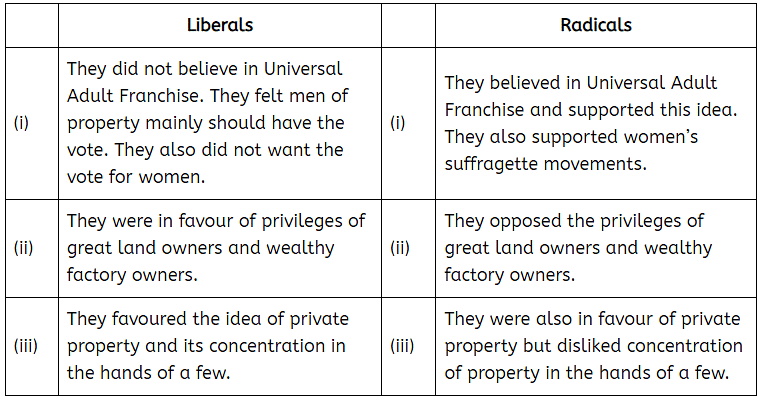
Q4: Distinguish between the ideas of liberals and radicals.
Ans:


Q5: How were Russian industries badly affected by the First World War?

Or

The First World War had severe impact on Russian industries. Explain.

Or

How did the First World War affect the industry in Russia?
Ans: 
The First World War significantly harmed Russian industries due to several factors:

  • Limited Industrial Base: Russia had few industries, and many were outdated. The war cut off access to foreign supplies, particularly after Germany controlled the Baltic Sea.
  • Equipment Deterioration: Industrial machinery deteriorated faster in Russia than in other European countries, leading to decreased production capacity.
  • Labour Shortages: With many able-bodied men conscripted into the army, there was a severe shortage of workers. This resulted in the closure of small workshops that produced essential goods.
  • Railway Disruptions: By 1916, railway lines were breaking down, making it difficult to transport goods and resources.
  • Food Scarcity: Large quantities of grain were redirected to feed the army, causing severe shortages of bread and flour in cities. This led to widespread riots over food.
  • The cumulative effect of these issues discredited the government and Tsar Nicholas II, as public dissatisfaction grew due to the lack of basic necessities and industrial support.


Q6: Why were socialists active in the countryside in Russia through the late nineteenth century?
Ans:

  • Socialists were active in the countryside through the late nineteenth century. They formed the Socialist Revolutionary Party in 1900. This party struggled for peasant’s rights and demanded that land belonging to nobles be transferred to peasants.
  • Social democrats disagreed with socialist revolutionaries about peasants. So, they (socialist revolutionaries) kept themselves active to protect the peasants’ interests.


Q7: Who were liberals? What were their political and social ideologies?
Ans:

  • One of the groups that looked to change society in the nineteenth century were the liberals. They wanted a nation which tolerated all religions. They also opposed the uncontrolled power of dynastic rulers.
  • They wanted to safeguard the rights of individuals against government. They argued for a representative, elected parliamentary government, a subject to laws interpreted by a well-trained judiciary that was independent of rulers and officials.
  • But liberals were not democrats. They did not believe in universal adult franchise. They felt that men of property mainly should have the right to vote. They were also against women’s right to vote.


Q8: How were the critics of planned economy and collectivisation treated by Stalin’s and his sympathizers?
Ans:

  • Many people criticised the confusion in industrial production under the Planned Economy and the consequences of collectivisation Stalin and his sympathisers charged these critics with conspiracy against socialisation.
  • Accusations were made throughout the country, and by 1939, over 2 millions were sent to prison or labour camps. Most were innocent of the crimes, but no one spoke for them.
  • A large number of people were forced to make false confessions under torture and were executed. Several among them were talented professionals.


Q9: Describe the economic condition of Russia before 1905. (Imp)
Ans:

The social, economic and political conditions in Russia before 1905 was quite backward.

  • Social conditions: There was no equality among the working class. Workers were a divided group. Some had strong links with the villages from which they came. Others had settled in cities permanently. Workers were divided by skill. Workers whose jobs needed skill and training considered themselves aristocrats among other workers.
    Women were discriminated against. They were paid less than men. Divisions among workers showed themselves in dress and manners too. But there was unity among them. They could go on a strike when they disagreed with employers about dismissals or work conditions.
  • Economic conditions: Before 1905, the vast majority of Russia’s people were agriculturists. About 85% of the Russian population earned their living from agriculture. In the empire, cultivators produced for the market as well as for their own needs and Russia was a major exporter of grain. There were few industries. Craftsmen undertook much of the production, but large factories existed alongside craft workshops.
    Many factories were set up in the 1890s, when Russia’s railway network was extended, and foreign investment in industry increased. Coal production doubled and iron and steel output quadrupled. In spite of these improvements, Russia’s economic condition remained backward. There was acute employment problem among the workers.
  • Political conditions: Politically too Russia was a backward country. All political parties were illegal in Russia before 1914. The Russian peasants formed the Socialist Revolutionary Party in 1900, This party struggled for peasants’ rights and demanded that land belonging to nobles be transferred to peasants. But as they were not a united group, they were not considered to be part of a socialist movement started by Lenin .


Q10: How did industrialisation change the lives of people in Europe?
Ans: 
Industrialisation changed the lives of people in Europe in several significant ways:

  • Urbanisation: Many people moved to cities for factory jobs, leading to rapid urban growth.
  • Working Conditions: Factory work often involved long hours and low wages, with poor working conditions.
  • Unemployment: Job loss was common, especially during economic downturns.
  • Housing Issues: Rapid urbanisation resulted in inadequate housing and sanitation problems.
  • Social Change: The rise of new social classes, including a growing working class, changed societal structures.


Q11: Why did socialists believe that private property was the root of all social ills of the time? (Imp)
Ans: 
Socialists believed that private property was the root of many social problems because:

  • Individuals owned property that provided employment.
  • Property owners often prioritised their own gain over the welfare of workers.
  • If society as a whole controlled property, it could focus on collective interests.
  • Socialists campaigned for this change to improve social conditions.


Q12: How you say that liberals were not democrats?Or

What were the ideas that liberals cherished?
Ans:

  • One of the groups that looked to change society in the nineteenth century were the liberals. They wanted a nation which tolerated all religions. They also opposed the uncontrolled power of dynastic rulers.
  • They wanted to safeguard the rights of individuals against government. They argued for a representative, elected parliamentary government, a subject to laws interpreted by a well-trained judiciary that was independent of rulers and officials.
  • But liberals were not democrats. They did not believe in universal adult franchise. They felt that men of property mainly should have the right to vote. They were also against women’s right to vote.


Q13: How did the First World War on the ‘Eastern front’ differ from that on the ‘Western front’?
Ans: 
The First World War on the Eastern Front differed significantly from that on the Western Front in several ways:

  • Trench Warfare: On the Western Front, battles were fought from entrenched positions in eastern France, leading to a static front. In contrast, the Eastern Front was much longer, resulting in lower troop concentrations and less effective trenches. This allowed for more movement and larger battles, which often resulted in high casualties.
  • Casualties: The Eastern Front saw devastating defeats for the Russian army against Germany and Austria between 1914 and 1916, contributing to over 7 million casualties by 1917. These losses were shocking and demoralising for the troops.
  • Geographical Conditions: The Eastern Front, primarily involving Russia, experienced harsher winter conditions compared to the Western Front. While both fronts faced difficult weather, the Eastern Front’s winters were notably colder and longer.

Overall, the differences in warfare strategies, geographical challenges, and the impact on soldiers’ morale defined the contrasting experiences on the Eastern and Western Fronts during the First World War.


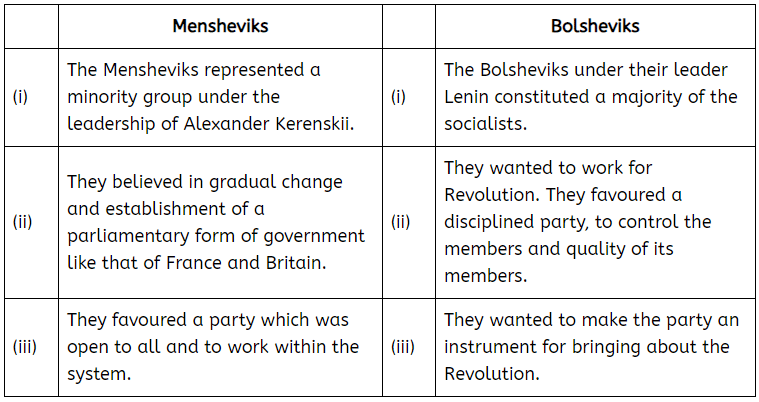
Q14: How were the Bolsheviks different from the Mensheviks?
Ans:


Q15: What was the Duma? How far was it successful?
Ans:

  • The Duma: Duma, an elected consultative Parliament, was created by the Tsar of Russia during the 1905 Revolution. In the beginning it promised that it would be a representative assembly and that its approval would be necessary for the enactment of legislation. But the fundamental laws, issued in April 1906, before the first Duma met in May 1906, deprived it of control over state ministers and limited its ability to initiate legislation effectively.
  • However, the Tsar dismissed the First Duma within 75 days and the re-elected second Duma within three months. He did not want any questioning of his authority or any reduction in his power. He changed the voting laws and packed the third Duma with conservative politicians, liberals and revolutionaries were kept out. The fourth Duma was also of limited political influence. Thus the Duma was reentered right from the start, and people knew it.


Q16: What was Stalin’s collectivisation programme? How were peasants treated who resisted his programme?
Ans:
Stalin’s collectivisation programme:

  • Collectivisation was a policy of forced consolidation of individual peasant, households into collective farms called ‘Kolkhozes’. It was carried out by the Soviet Government in the late 1920s – early 1930s. Stalin introduced this system to overcome the food crisis which was rampant in the country at that time and to increase peasant labour productivity. The bulk of land and implements were transferred to the ownership of collective farm.
  • Many peasants protested such attempts and destroyed livestock to show their anger. But Stalin’s collectiviasation programme did not bring the desired results. The food supply situation turned even worse in subsequent years because production did not increase immediately.
  • Peasants were not happy with Stalin’s collectivisation programme because their land had been taken away to establish state-controlled large farms. They resisted the authorities and destroyed their livestock. These peasants were severely punished. Many were deported and exiled. Although Stalin’s government allowed some independent cultivation, it treated such cultivation unsympathetically.


Q17: Mention three major changes that Stalin introduced in industry.
Ans: 
Three major changes introduced by Stalin in industry:

  • Centralised Planning: Stalin implemented a system of centralised planning, which allowed the government to set specific production targets and allocate resources effectively. This approach aimed to boost industrial output significantly.
  • Five-Year Plans: The introduction of the Five-Year Plans focused on rapid industrialisation. The first plan (1928-1932) aimed to double production in key sectors like coal, steel, and oil, leading to the establishment of new factories and cities.
  • Collectivisation: Stalin enforced collectivisation, merging individual farms into large, state-controlled collective farms. This aimed to increase agricultural efficiency and provide a steady supply of food for industrial workers, although it led to widespread resistance and hardship among peasants.


Q19: How did the outlook of conservatives change after the French Revolution?
Ans: 
After the French Revolution, the outlook of conservativesshifted significantly:

  • Previously, conservatives were largely against change, preferring to maintain the status quo.
  • Post-revolution, they recognised that some change was necessary, though they advocated for a gradual approach.
  • They believed in respecting the past while accepting that society must evolve.
  • This change in perspective led to clashes with radicals and liberals, who sought more immediate reforms.
  • The political turmoil of the 19th century highlighted the limits and potential of these differing views.
  • Overall, the French Revolution prompted conservatives to reconsider their stance on societal change, leading to a more open-minded approach while still valuing tradition.


Q19: Who was Lenin? What do you know about his ‘April Theses’? Why were some people in the Bolshevik Party initially surprised by it?
Ans:

  • Lenin was the leader of the radical socialist Bolshevik movement that toppled the Tsarist regime in 1917 and head of the first government of the Union of Soviet Socialist Republics (USSR). He was exiled for taking part in the 1905 Revolution. In April 1917, he returned to Russia from his exile.
  • Lenin and the Bolsheviks had opposed the war since 1914. Now he felt it was time for Soviets to take over power. He declared that the war be brought to a close, land be transferred to the peasants, and banks be nationalised. These three demands were Lenin’s ‘April Theses’. He also argued that the Bolshevik Party rename itself the Communist Party to indicate its new radical aims.
  • Many people in the Bolshevik Party were initially surprised by the April theses. They thought that the time was not yet ripe for a socialist revolution and the provisional government needed to be supported.


Q20: How was Kerenskii’s Provisional Government overthrown by the Bolsheviks in October 1917?Or

Why did the Kerenskii Government in Russia fall?
Ans:

  • Lenin was very apprehensive of Kerenskii’s Provisional Government. He feared that the Provisional Government would set up a dictatorship in Russia. In September, he began discussions for an uprising against the government, Bolshevik supporters in the army, Soviets and factories were brought together. On 16 October 1917, Lenin persuaded the Petrograd Soviet and the Bolshevik Party to agree to a socialist seizure of power. The Military Revolutionary Committee was appointed by the Soviet under Leon Trotskii to organise the seizure. The date of event was kept a secret.
  • The uprising began on 24 October. However, Prime Minister Kerenskii had already left the city to arrange for the troops. At dawn, pro-government military men seized the buildings of two Bolshevik newspapers. Pro-government troops were sent to take over telephone and telegraph offices and protect the Winter Palace. The Military Revolutionary Committee acted swiftly. It ordered its supporters to seize the government offices and arrest ministers.
  • Late in the day, the ship Aurora shelled the Winter Palace. Other vessels sailed down the river Neva and took over various military points. By night, the city was under the committee’s control and the ministers had surrendered. At a meeting of the all Russian Congress of Soviets in Petrograd, the majority approved the Bolshevik action. Uprisings took place in other cities. There was heavy fighting especially in Moscow. Ultimately the Bolsheviks succeeded in controlling the Moscow Petrograd area by December.


Q21: Enlist the factors that led to the 1905 Revolution in Russia. What were its consequences?
Ans: Several factors contributed to the Russian Revolution of 1905:

  • The Tsar’s autocratic rule became intolerable. He was seen as an inefficient and corrupt leader who neglected the needs of the common people.
  • Liberal movements gained momentum, with activists campaigning to improve the dire conditions in Russia. They collaborated with social democrats and socialist revolutionaries to advocate for a constitution.
  • The harsh conditions faced by Russian workers worsened the situation. Rising prices for essential goods and falling real wages led to widespread strikes as workers demanded better pay and working conditions.
  • The Bloody Sunday incident escalated tensions. Over 100 workers were killed and around 300 were injured when police attacked a peaceful protest, igniting anger and strikes across the nation.

Consequences of the 1905 Revolution:

  • The Tsar allowed the establishment of an elected Duma, a consultative parliament, although it was short-lived.
  • Numerous trade unions and factory committees emerged, but most were later declared illegal.
  • The Tsar dismissed the first Duma within 75 days and the second Duma within three months, indicating his refusal to share power.
  • Political activity faced severe restrictions, and the Tsar altered voting laws to favour conservative politicians, keeping liberals and revolutionaries out.


Q22: Mention the positive and negative aspects of the Bolshevik government on Soviet Union and its people.
Ans:

Positive aspects:

  • The Bolshevik government came in power in 1917 under the leadership of Lenin. Lenin and his supporters had opposed the war since 1914. So, when he came to power, he declared that the war be brought to a close. In March 1918, despite opposition by their political allies, the Bolsheviks made peace with Germany at Brest Litovsk.
  • The Bolsheviks were totally opposed to private property. So, banks and industries were nationalised, so that they might not remain individual’s property.
  • Land and other means of production were declared the property of the entire nation. Labour was made compulsory for all. This ended the exploitation of the poor by the hands of the capitalists and landlords.

Negative aspects:

  • Since land was declared social property, So peasants began to seize the land of the nobility. In cities, Bolsheviks enforced the partition of large houses according to family requirements.
  • Russia became a one-party state. Trade unions were kept under party control. The secret police punished those who criticised the Bolsheviks. Thus, on one hand, the party stood for socialism and for change and so many welcomed it but on the other hand, the party encouraged censorship which disillusioned many.


Q23: Why did Stalin introduce collectivisation and what were the consequences of his policies?Or

What was the collectivisation policy of Stalin? How did peasants react to this policy?Or

What were the major changes that Stalin introduced in the field of agriculture through his collectivisation programme?
Ans: Stalin introduced collectivisation to address grain shortages and modernise agriculture.

  • By 1927-1928, Soviet towns faced severe grain shortages.
  • The government set low prices for grain, but peasants refused to sell.
  • Stalin believed wealthy peasants, known as kulaks, were hoarding grain.
  • To combat this, he enforced grain collections and targeted kulaks.
  • Collectivisation aimed to consolidate small farms into large, state-controlled ones.

Consequences of collectivisation included:

  • From 1929, all peasants were forced into collective farms (kolkhoz).
  • Many peasants resisted, leading to livestock destruction and severe punishment.
  • Between 1929 and 1931, cattle numbers dropped by one-third.
  • Resistance was met with deportations and exiles.
  • Despite collectivisation, agricultural production initially did not increase.
  • Bad harvests from 1930 to 1933 caused a devastating famine, resulting in over 4 million deaths.
  • Overall, Stalin’s policies aimed to modernise agriculture but led to widespread suffering and loss.


Q24: Describe how Petrograd led the February Revolution of 1917 that brought down the monarchy in Russia.
Ans:
Main events and effects of the February Revolution:

  • On 22 February, a lockout took place at a factory on the right bank of the river Neya.On 23 February, workers in fifty factories called a strike in sympathy. In many factories, women led the way to strikes. Demonstrating workers crossed from the factory quarters to the centre of the capital—the Nevskii Prospekt. However the government suppressed their agitation by imposing curfew.
  • On 25 February, the government suspended the Duma. Politicians spoke out against the measure.Demonstrators returned in force to the streets of the left bank on the 26th. On the 27th, the Police Headquarters were ransacked. The streets crowded with people raising slogans about bread, wages, better hours and democracy. The government tried to control the situation but nothing happened. The regiments supported the workers. Eventually ‘Soviet’ or ‘Council’ was formed.
  • On 2nd March, the Tsar abdicated and Soviet leaders and Duma leaders formed a provisional government to run the country. The February revolution was not led by any political party but people themselves led it. Petrograd had brought down the monarchy and gained an important place in the history of Soviet Union. Trade unions became active and their number grew.

01. The French Revolution – Short and Long Question answer

Q1: Under what circumstances did the representatives of the third estate form the National Assembly?
Ans: The representatives of the third estate formed the National Assembly under circumstances where their demands for equal voting rights were denied by King Louis XVI during the assembly of the Estates General. Despite being the majority of the population, the third estate’s voices were suppressed. Frustrated by this, they convened in an indoor tennis court in Versailles on 20 June 1789 and declared themselves the National Assembly. They aimed to draft a constitution that would limit the powers of the monarch and represent the interests of the entire French nation.

Q2: What was the immediate cause that angered the French people so much that they stormed and destroyed the Bastille and started the Revolution?
Ans: The National Assembly was busy at Versailles drafting a constitution that would limit the powers of the monarch. Meanwhile, the common people were facing hardships, including a severe winter that reduced the harvest and caused the price of bread to rise. The king’s order to move troops into Paris further agitated the people. On 14 July 1789, an angry crowd stormed and destroyed the Bastille, a symbol of the despotic power of the king. This event marked the start of the French Revolution.

Q3: What were the consequences of the uprising led by the Jacobins in 1792?
Ans: The uprising led by the Jacobins in 1792 had significant consequences:

  • The Assembly voted to imprison Louis XVI and his family members. Elections were held, granting all men of 21 years and above the right to vote.
  • Monarchy was abolished, and France was declared a republic.
  • Louis XVI was sentenced to death and executed publicly on 21 January 1793. Marie Antoinette also met the same fate shortly after.


Q4: Write three points about the Jacobin club in France. Who was its leader?
Ans:

  • The Jacobin club, named after the former convent of St. Jacob in Paris, was the most successful political club during revolutionary France.
  • Its members mainly belonged to less prosperous sections of society, including small shopkeepers, artisans, and daily-wage workers.
  • Some Jacobin members wore distinctive long striped trousers to distinguish themselves from the aristocracy, who often wore knee breeches. The leader of the Jacobin club was Maximilian Robespierre.


Q5: What were reasons behind an empty treasury upon the accession of Louis XVI in 1774?
Ans:
 Upon his accession in 1774, the new king Louis XVI found an empty treasury. There were several reasons behind it:

  • Long years of war had drained the financial resources of France. Added to this was the cost of maintaining an extravagant court at the immense palace of Versailles.
  • Under Louis XVI, France helped the thirteen American colonies to gain their independence from Britain. The war added more than a billion livres to debt that had already risen to more than 2 billion livres. Lenders who gave the state credit now began to charge 10 per cent interest on loans.
  • French society in the eighteenth century was divided into three estates, and only members of the third estate paid taxes.


Q6: How was the system of estates in French society organised?
Ans:
 French society in the eighteenth century was divided into three estates:

  • The first estate was constituted by the clergy, who enjoyed certain privileges by birth.
  • The second estate was constituted by the nobility, who enjoyed feudal privileges.
  • The third estate consisted of big businessmen, merchants, court officials, lawyers, peasants, artisans, small peasants, landless laborers, and servants. Thus, within the third estate, some were rich and others poor. Members of the first two estates were exempted from paying taxes to the state, while only the members of the third estate had to pay taxes.


Q7: Why did members of the third estate walk out of the assembly of the Estates General, called by Louis XVI on 5 May 1789?
Ans: 
On 5 May 1789, Louis XVI called together an assembly of the Estates General to pass proposals for new taxes. The first and second estates sent 300 representatives each, while the third estate sent 600 representatives. Voting in the Estates General in the past had been conducted according to the principle that each estate had one vote. This time, members of the third estate demanded that voting be conducted by the assembly as a whole, with each member having one vote. When the king rejected this proposal, members of the third estate walked out of the assembly in protest.

Q8: Which factors were responsible for the subsistence crisis in France in 1789?
Ans:
 The following factors led to the subsistence crisis in France in 1789:

  • The population of France rose dramatically in 1789, leading to a rapid increase in the demand for food grains. Production of grains could not keep pace with the growing demand, causing the price of bread, the staple diet of the majority, to rise rapidly.
  • Most workers were employed as laborers in workshops where owners fixed their wages. However, wages did not keep pace with the rise in prices.
  • A severe winter reduced the harvest, worsening the food shortage.


Q9: Under what circumstances did Louis XVI finally accord recognition to the National Assembly? Mention the changes brought by the Assembly on the night of 4 August 1789.
Ans: 
Louis XVI finally accorded recognition to the National Assembly due to the intensifying agitation across France, where peasants were attacking chateaux and protesting against their problems. Faced with the power of the revolting subjects, Louis XVI recognized the National Assembly and accepted the principle that his powers would be limited by a constitution.
On the night of 4 August 1789, the Assembly brought the following changes:

  • The feudal system of obligations and taxes was abolished.
  • Members of the clergy were forced to give up their privileges.
  • Tithes were abolished, and lands owned by the church were confiscated.


Q10: What was a Directory? Why was it dismissed?
Ans: 
After the fall of the Jacobin government, the wealthier middle classes took power and introduced a new constitution. This constitution denied voting rights to non-propertied sections of society and established two elected legislative councils. These councils appointed a Directory, an executive consisting of five members, to prevent concentration of power. However, the Directors frequently clashed with the legislative councils, leading to the dismissal of the Directory and the rise of Napoleon.

Q11: Describe the triangular slave trade that was carried on during the eighteenth and nineteenth centuries.
Ans:

  • The triangular slave trade was a system involving Europe, Africa, and the Americas during the eighteenth and nineteenth centuries.
  • French merchants sailed from European ports like Bordeaux or Nantes to Africa, where they purchased slaves from local chieftains.
  • These slaves were then transported across the Atlantic to the Americas, primarily the Caribbean, where they were sold to plantation owners.
  • The trade involved the movement of goods, slaves, and resources between these three regions, forming a triangle that exploited African labor for the benefit of European economies.


Q12: “Women had been active participants in the events which brought about many important changes in French society. Still, their condition did not improve.” Explain.
Ans:
 Despite their active participation in events that led to significant changes in French society, women’s conditions did not improve. They were disappointed as their involvement did not lead to significant improvements in their lives. Women faced hardships, working for a living in jobs such as seamstresses, laundresses, and domestic servants. Lack of access to education and job training, combined with low wages, left them struggling to support their families and carry out household responsibilities.

Q13: Why is Robespierre’s government known as the Reign of Terror? Give reasons.
Ans: 
Robespierre’s government earned the name “Reign of Terror” due to several reasons:

  • Price and wage controls were enforced, with rationing of essentials like meat and bread. Peasants were compelled to sell their grain at government-fixed prices.
  • Citizens were mandated to consume “equality bread,” made from whole wheat. Churches were repurposed for different uses.
  • Robespierre’s government adopted radical measures, strict control, and harsh punishment, which created an environment of fear and oppression.
  • Even supporters of Robespierre fell under his severe policies, causing anxiety among the people.
  • The overall atmosphere of intense control, punishment, and fear during his government led to the label “Reign of Terror.” Eventually, Robespierre himself was arrested and executed.


Q14: Describe how slavery was abolished in France?
Ans:
 The abolition of slavery in French colonies followed these stages:

  • The French colonies, particularly in the Caribbean, relied on a triangular slave trade for commodities like sugar, tobacco, and coffee.
  • The National Assembly debated extending rights to all French subjects, including those in colonies, but passed no laws due to expected resistance from businesses dependent on the slave trade.
  • In 1794, the Convention legislated to free slaves in French overseas territories. However, Napoleon reintroduced slavery in 1804.
  • The definitive end to slavery in French colonies came in 1848.

Q15: How did the revolution affect the everyday life of the people in France?
Ans: 
The French Revolution brought profound changes to people’s lives:

  • Laws promoting liberty and equality abolished censorship, allowing freedom of speech and expression.
  • Revolutionary ideals spread through newspapers, pamphlets, and books, fostering discussions and debates.
  • Plays, songs, and processions conveyed revolutionary messages, and the institution of slavery faced criticism and eventual abolition.
  • The revolution influenced clothing, language, and reading materials, reflecting evolving political circumstances.
  • The government’s reforms impacted how people lived, communicated, and interacted.

Q16: Describe how France became a republic?
Ans:
 France’s transition to a republic followed these steps:

  • Louis XVI’s reluctance to sign the 1791 Constitution led to secret negotiations with the king of Prussia.
  • Neighboring countries planned to send troops to suppress the ongoing events in France since 1789.
  • The National Assembly declared war against Prussia and Austria in 1792. Volunteers joined the army, singing the Marseillaise.
  • Political clubs, especially the Jacobins, played a pivotal role in discussions and actions related to government policies.
  • In summer 1792, Parisians stormed the Palace of the Tuileries, leading to the imprisonment of the royal family. Subsequent elections abolished the monarchy, and France was declared a republic. Louis XVI and his queen were publicly executed.

Q17: How did the French Revolution impact the world?
Ans:
 The French Revolution had global ramifications:

  • The ideals of liberty and democratic rights spread beyond France, inspiring movements and revolutions throughout Europe.
  • Political revolutions erupted across Europe as people challenged monarchical authority, often drawing inspiration from the French Revolution.
  • Colonized regions found inspiration in French ideals, translating them into movements for national sovereignty and independence.
  • Notable figures like Tipu Sultan and Rammohan Roy were influenced by the revolutionary ideas from France, showcasing the global reach of the revolution’s ideals.