5. Outcomes of Democracy – Chapter Notes

Introduction

The chapter “Outcomes of Democracy” explores the impact and effectiveness of democratic governance on various aspects of society. 

Democracy is a system where ultimate power rests with the people, who participate in decision-making through voting and electing representatives. 

This political structure emphasizes:

  • Individual Freedoms: Allowing citizens to express themselves and make choices freely.
  • Equal Representation: Ensuring every citizen has a fair voice in politics.
  • Protection of Human Rights: Guarding the basic rights and freedoms of every individual.

How Do We Assess Democracy’s Outcomes?

Common features of democracies:-

To evaluate the outcomes of democracy, we consider its common characteristics:

  • Regular elections: General elections are held to choose a new government.
  • Right to vote: All citizens above a certain age can vote.
  • Political parties: These are essential for democracy, presenting candidates in elections.
  • Rule of law: Law is supreme, ensuring all citizens are equal before it.

Democracy is a better form of government when compared with dictatorship or any other alternative form of government.

  • Promotes equality among citizens.
  • Enhances the dignity of the individual.
  • Improves the quality of decision-making.
  • Provides a method to resolve conflicts.
  • Allows room to correct mistakes.

Practical Dilemma: [Principle vs. Practice] Democracy is valued in principle but often criticized in practice. Many support democratic ideals but may be dissatisfied with its execution.

Democratic Variations:

  • Global Practice: Over a hundred countries practice various forms of democracy, with differences in social, economic, and cultural contexts.
  • Expectation vs. Reality: Achievements in democracy vary widely; expectations may not always align with outcomes.

Understanding Democracy:

  • Not a Panacea: Democracy offers a framework but does not instantly resolve all problems. Citizens need to actively participate in and use democratic processes to see the results they want.
  • Recognising Outcomes: Realising that democracy is simply a form of government helps understand that it can only set the stage for achieving goals. Citizens must take advantage of these conditions to reach their aims.

Try yourself:

What is a key feature of a democratic government?

  • A.Regular elections
  • B.Censorship of media
  • C.Absolute power of the ruler
  • D.Limited individual freedoms

View Solution

Accountable, Responsive and Legitimate Government

The Political Outcomes can be defined using five basic points which can be understood as:

I. Fundamental Outcomes of Democracy

  • Right to Choose and Control: Citizens should have the right to select their leaders and influence their decisions.
  • Participation: Citizens should be able to take part in decision-making that affects them.
  • Accountability: Governments must be responsible to the citizens.
  • Responsiveness: Governments should meet the needs and expectations of the citizens.
  • Mechanisms for Accountability: Democratic governments create ways for citizens to hold them accountable and involve themselves in decision-making as needed.

II. Decision-Making Process in Democracy

  • Deliberation and Negotiation: Democracy is built on the principles of deliberation and negotiation.
  • Procedural Approach: Democratic governments follow procedures, making their decisions both acceptable and effective.

III. Mechanisms for Citizen Participation

  • Decision-Making Involvement: Democracy allows citizens to participate in the decision-making process.
  • Essential Practices: Free and fair elections, open debates on policies, and the right to information are vital for accountable democracies.

IV. Transparency in Democracy

  • Procedural Norms: Democracy ensures that decisions follow established procedures, and citizens have the right to understand and scrutinize these processes.
  • Lack of Transparency in Non-Democracies: Non-democratic regimes often lack transparency.

V. Legitimacy of Democratic Government

  • People’s Government: Despite imperfections, democratic governments are considered legitimate as they are elected by the people.
  • Global Support: Democracy is widely supported worldwide, reflecting its perceived legitimacy and acceptance among citizens.

In essence, democracy is not just a form of government; it is a system designed to ensure accountability, responsiveness, transparency, and the active participation of citizens in decision-making, making it a legitimate and widely supported governance model.

Try yourself:Which of the following is not the fundamental outcomes of democracy?

  • A.Enhancing the dignity of the individual.
  • B.Promoting social hierarchy among citizens.
  • C.Allowing room to correct mistakes.
  • D.Improving the quality of decision-making.

View Solution

Economic Growth and Development

I. Connection Between Democracy and Economic Growth

  • Over the past five decades, dictatorships have exhibited a slightly higher economic growth rate compared to democracies.
  • Various factors influence a country’s economic growth, including population size, global circumstances, cooperation from other nations, and the economic priorities adopted by the country.
  • Despite a marginal disparity in economic growth rates between dictatorships and democracies, favoring democracy is advisable due to its additional positive outcomes, such as upholding the dignity and freedom of citizens.

II. Correlation between Democracy and Development

  • Democracies are anticipated to foster development, influenced by factors like population size, global conditions, and cooperation from other countries.
  • In democracies, decision-making involves discussion and deliberation, making it a slower but just and appropriate process.
  • The deliberate nature of democracy ensures fairness in the pursuit of development goals.

Economic Outcomes of Democracy

The following points show the relationship of democracy with economic growth and economic inequalities:

  • If we look at democracies and dictatorships from 1950 to 2000, dictatorships have shown slightly higher economic growth rates.
  • Factors that affect a country’s economic growth include:
    • Population size
    • Global circumstances
    • Cooperation with other nations
    • Economic priorities of the country
  • The difference in economic development rates between less developed countries with dictatorships and democracies is minimal.
  • While democracy doesn’t guarantee economic development, it should not fall behind dictatorships.
  • Supporting democracy is important due to its added benefits, such as protecting citizens’ dignity and freedom.

Reduction of Inequality and Poverty

Expectations from Democracy:

  • Economic Equity: Democracies should ideally reduce economic disparities and ensure fair distribution of wealth and opportunities.
  • Economic Growth vs. Inequality: Economic growth in democracies does not always translate into reduced inequalities; it can sometimes lead to greater disparities.

Current Reality:

  • Wealth Distribution: A small number of very wealthy individuals have a disproportionately large share of wealth and income, with their portion in the total income of the country rising. At the same time, a small segment of the population holds a significant amount of wealth, while those at the lower end struggle more.
  • Basic Needs: People at the bottom of the economic ladder find it hard to meet essential needs such as food, housing, education, and healthcare, with their incomes declining.

Democratic Effectiveness:

  • Political Equality vs. Economic Inequality: While democracies support political equality through voting rights, they may not effectively tackle economic inequality. In practice, democracies seem to struggle with reducing these inequalities.
  • Government Response: The poor make up a large group of voters, and no political party wants to lose their support. However, democratically elected governments do not seem very eager to address poverty issues as one might expect.

Global Context:

  • Poverty in Poor Countries: In some nations, the situation is even worse, with many people living in poverty. Numerous poorer countries rely on aid from wealthier nations for basic supplies.

Try yourself:

What is the correlation between democracy and economic growth?

  • A.Democracies have consistently exhibited higher economic growth rates compared to dictatorships.
  • B.Dictatorships have consistently exhibited higher economic growth rates compared to democracies.
  • C.There is no significant correlation between democracy and economic growth.
  • D.Economic growth rates are influenced by factors unrelated to the type of government.

View Solution

Accommodation of Social Diversity

Democratic Approach: Democracies manage social diversity by providing mechanisms to handle conflicts and encourage respect for differences. They aim to balance majority rule with minority rights.

Key Conditions for Effective Democracy:

  • Majority-Minority Cooperation: Majority rule should involve working together with minorities, making sure that all opinions are heard. It is crucial that majority rule does not turn into domination by a specific religious, racial, or linguistic group.
  • Inclusivity: Democracy must not allow any single group to dominate; all citizens should have chances to affect decisions.

Examples:

  • Belgium: Successfully manages ethnic diversity through federalism, which gives different linguistic regions their own autonomy, helping to reduce conflict.
  • Sri Lanka: Even though it is a democracy, it has experienced ethnic conflict because it did not adequately address minority concerns. This illustrates that a democracy must meet two conditions to effectively manage social diversity: the majority must cooperate with the minority, and majority rule must not lead to the dominance of one specific community.

Dignity and Freedom of the Citizens

Democracy’s Promotion of Dignity and Freedom:

1. Individual Dignity and Freedom:

  • Democracy is considered superior for promoting the dignity and freedom of individuals.
  • Conflicts often arise due to perceived lack of respect, and democracy addresses these concerns.

2. Passion for Respect and Freedom: The foundation of democracy lies in the shared passion for respect and freedom among individuals.

3. Global Recognition of Principles: Democracies worldwide, at least in principle, recognize the importance of individual dignity and freedom.

4. Degrees of Recognition: Various democracies have achieved different degrees of recognizing the principles of dignity and freedom.

5. Challenges in Recognizing Equality: Societies historically built on subordination and domination find it challenging to accept the equality of all individuals.

Challenges and Achievements in Democracy:

1. Dignity of Women:

Globally, most societies have been historically male-dominated. The long efforts of women have led to greater awareness that respect and equal treatment of women are essential for a democratic society.

2. Legal and Moral Foundations:

In democracies, the legal and moral support for individual freedom and dignity is stronger, creating a basis to challenge unacceptable practices.

3. Caste Inequalities in India:

Democracy in India has empowered disadvantaged and discriminated castes to claim equal status and equal opportunity. Cases of caste-based inequalities lack robust moral and legal foundations in a democratic context.

Try yourself:

What is one of the economic outcomes of democracy?

  • A.Increased economic growth compared to dictatorships.
  • B.Higher economic inequalities within the country.
  • C.Reduction of poverty and inequality.
  • D.Decreased economic opportunities for the poorer sections of society.

View Solution

Expectations and Continuous Evaluation of Democracy:

1. Unending Examination of Democracy:

  • Democracy is unique because its assessment never ends; as it meets one challenge, new ones arise.
  • People’s growing awareness and rising expectations lead to a constant appraisal of democracy.
  • These expectations serve as benchmarks for evaluating any democratic nation.

2. Complaints as Evidence of Success:

  • The existence of public complaints indicates the success of democracy; it reflects that people are now aware and can scrutinise those in power.

3. Change from Subjects to Citizens:

  • Public dissatisfaction signifies the success of democracy, transforming people from subjects to engaged citizens.

4. Belief in the Impact of Voting:

  • Most individuals believe that their vote makes a difference in how the government operates and influences their self-interest.

5. Awareness of Rights:

  • It may be the recognition of their rights that leads ordinary citizens to appreciate their democratic entitlements.

6. Democracy vs Other Governments:

  • Discussions reveal that democracy is a superior form of governance compared to dictatorship or other alternatives.

7. Advantages of Democracy:

  • Democracy fosters equality among individuals, uplifts personal dignity, enhances decision-making quality, provides conflict resolutio

In summary, democracy’s emphasis on dignity, freedom, and continuous evaluation by an engaged citizenry marks its success in transforming societies and addressing diverse challenges.
4. Political Parties – Chapter Notes

Introduction

Political parties are organized groups of individuals who come together with a shared set of beliefs, values, and goals, aiming to influence or control government policy and decision-making.

Political parties are fundamental to the operation of modern democracies. They are instrumental in shaping political structures, influencing government policies, and representing various social interests.

In this chapter, we will:

  • Explore the Role of Political Parties: Understand why political parties are crucial in a democratic system.
  • Examine the Ideal Number of Parties: Discuss how many parties are beneficial for a democracy.
  • Analyze Political Parties in India: Look at the national and regional parties, their functions, and their impact on the political landscape.
  • Address Challenges: Identify issues faced by political parties and consider potential reforms for improvement.

Why do We Need Political Parties? 

  • Political parties are highly visible in democracies and are often synonymous with democracy for many citizens.
  • In remote and less educated areas, people may not be familiar with the Constitution or government structure but are likely to recognize political parties.
  • Despite their visibility, political parties often face criticism and are blamed for issues within democracy and political life.
  • They are frequently associated with social and political divisions.

The Role of Political Parties

  • Representation: Political parties represent diverse social groups and interests within a democracy.
  • Policy Formation: They develop and propose policies that address public issues and reflect their ideologies.
  • Leadership and Elections: Parties select and support candidates for public office, influencing the formation of governments.
  • Governance: Once in power, they implement policies and manage government functions.
  • Choice for Voters: They provide voters with options, allowing them to support the party that aligns with their views.

Historical Context: About a hundred years ago, political parties were less common globally. Today, the majority of democracies around the world feature political parties, indicating their growing importance and omnipresence.

Symbols of Different Political Parties in India

Meaning

A Political Party is a group of people who come together to contest elections and hold power in the government. 

  • They come together with a shared vision to promote the collective good through agreed-upon policies and programs.
  • Policy Promotion: Parties advocate for policies they believe will benefit society as a whole.
  • Electoral Success: They aim to win elections to implement their policies and gain popular support.
  • Diverse Views: Different parties represent varying perspectives on what is beneficial for society, reflecting fundamental political divisions.
  • Partisanship: Parties are associated with particular parts of society, based on their policies and the interests they represent.

Components of a Political Party:

1. Leaders: Individuals who guide the party’s direction and make strategic decisions.

2. Active Members: Party members who are actively involved in the party’s activities and operations.

Try yourself:

What are the three components of a political party?

  • A.The leaders, the active members, and the supporters
  • B.The government officials, the followers, and the voters
  • C.The politicians, the party workers, and the general public
  • D.The ruling party, the opposition party, and the independent candidates

View Solution

Functions

1. Parties contest elections:

  • Political parties select and put forward candidates for elections. 
  • This allows voters to have a choice between different parties and their candidates. 
  • Parties select and field candidates for elections. Candidate selection methods differ: in some places, members choose candidates (e.g., USA), while in others, party leaders make the selection (e.g., India).

2. Parties present policies and programmes: 

  • Parties present policies and programs, consolidating diverse views into coherent platforms.
  • This helps to provide a direction for the formulation of government policies. 
  • Parties consolidate a wide range of opinions into a few basic positions that they support. 
  • Voters can then choose which party’s policies align with their own views.

3. Parties play a role in lawmaking: 

  • While laws are formally debated and passed in the legislature, most members of the legislature belong to political parties. 
  • Therefore, party direction and leadership often influence the voting decisions of individual lawmakers, regardless of their personal opinions.

4. Parties form and run governments: 

  • Political parties are responsible for forming and running governments. 
  • The political executive, which makes big policy decisions, is typically composed of members from political parties. 
  • Parties recruit and train leaders, who are then appointed as ministers to run the government according to the party’s agenda and policies.

5. Parties act as the opposition: 

  • Parties that do not win elections often take on the role of the opposition. 
  • They voice different views and criticize the government for its failures or wrong policies. 
  • Opposition parties serve as a check on the ruling party, mobilize opposition to the government, and offer alternative perspectives to policies and governance.

6. Parties shape public opinion: 

  • Political parties raise and highlight important issues in society. 
  • They have a large membership and network of activists, which allows them to mobilize support and launch movements for resolving societal problems. 
  • Opinions in society often align with the positions taken by political parties, as parties influence public discourse and shape public opinion.

7. Parties provide access to government machinery and welfare schemes: 

  • Parties serve as a link between the general public and the government machinery. 
  • Ordinary citizens find it easier to approach a local party leader for assistance or information about government programs and welfare schemes, rather than directly approaching government officials.

Try yourself:

Which of the following is a function of political parties in a democracy?

  • A.Contesting elections and providing choices to voters.
  • B.Implementing policies without seeking popular support.
  • C.Exercising power without forming governments.
  • D.Ignoring public opinion and shaping government policies.

View Solution

Necessity

Political parties are essential for the functioning of modern democracies for several reasons:

1. Coordination and Promise:

  • Without parties, elections would be contested by independent candidates with no unified policy platform.
  • Parties offer a structured way to make and commit to promises about major policy changes, ensuring that the government has a clear direction and accountability.

2. Government Formation and Accountability:

  • In the absence of parties, forming a stable government would be challenging, and its effectiveness could be uncertain.
  • Elected representatives would be accountable only for local issues, with no organized approach to national governance.

3. Representation and Organization:

  • Even in non-party-based elections (e.g., panchayats), factions or panels often form, mimicking party dynamics.
  • This shows that even in informal settings, people organize themselves into groups with common agendas, reflecting the role of parties.

4. Handling Complex Societies:

  • As societies grow larger and more complex, they need mechanisms to aggregate and present diverse views.
  • Parties help in gathering various perspectives, forming a representative government, and ensuring effective policy-making.

5. Support and Restraint:

  • Parties support or restrain the government, influencing policy decisions and providing checks and balances.
  • They are crucial for ensuring that different viewpoints are considered in governance.

Ruling Party: Political party that runs government.

How many parties should we have?  

  • In a democracy, any group of citizens is free to form a political party, leading to a plethora of political parties in each country.
  • India, for instance, boasts over 750 registered parties, though only a handful are significant contenders during elections.
  • The effectiveness of parties in winning elections and forming a government raises the question of the ideal number of major parties for a democracy.

One-Party Systems:

  • Some countries operate under one-party systems where only one party controls and governs, as seen in China with the Communist Party.

One Party System resembles Dictatorship

  • Despite the theoretical freedom to establish parties, the lack of free competition renders such systems undemocratic.

Two-Party Systems:

  • In certain nations like the United States and the United Kingdom, power typically alternates between two main parties, with other parties contesting for seats.
  • This structure allows the two main parties a substantial chance of securing a majority to form a government.

Multi-Party Systems:

  • In countries where power distribution involves various parties, either independently or through alliances, a multi-party system prevails, as seen in India.
  • Coalitions and alliances among multiple parties, like the National Democratic Alliance and the United Progressive Alliance in India, occur to contest elections and gain power.
  • While multi-party systems may seem chaotic and potentially unstable, they facilitate diverse interests and opinions in governance.

Choosing the Ideal System:

  • There is no one-size-fits-all answer to which system is superior as each country’s political landscape is influenced by unique societal, regional, and historical factors.
  • Various systems evolve over time based on a nation’s circumstances, with no single system being universally applicable.

Try yourself:

Why are political parties necessary in modern democracies?

  • A.To ensure candidates in elections are independent and able to make promises about major policy changes.
  • B.To create uncertainty in government formation and avoid responsibility for running the country.
  • C.To prevent the split of the village into factions during non-party based elections.
  • D.To gather different opinions on various issues and present them to the government in representative democracies.

View Solution

National Parties   

  • In democracies with a federal system, political parties typically fall into two categories: those that operate solely within a single federal unit and those that are active across multiple or all units of the federation.
  • In India, there are country-wide parties known as “national parties” which have units in various states. These parties generally follow the same policies, programs, and strategies decided at the national level.
  • All political parties in India must register with the Election Commission, which treats all parties equally but provides special facilities to large and established parties.
  • The Election Commission has specific criteria for a party to be recognized, such as securing at least six percent of the total votes and winning a certain number of seats in elections.
  • A party that meets the criteria in an election for a state legislative assembly is recognized as a state party, while a party that meets the criteria in Lok Sabha or assembly elections in four states is recognized as a national party.

Major National Parties in India

According to this classification, there are six recognized national parties in the country as per notification of the Election Commission of India issued in 2023.  

National Parties in India

1. Aam Aadmi Party (AAP)

  • Established on 26 November 2012 after the 2011 movement against corruption. The party was created with a focus on responsibility, honest governance, openness, and effective management.
  • Early Progress: Soon after its inception, AAP became the second largest party in the Delhi Legislative Assembly elections. It later formed a government with the backing of the Indian National Congress (INC).
  • Expansion: Following the 2022 Gujarat Legislative Assembly elections, AAP also became a significant player in Gujarat politics, marking its presence as the third front.
  • Present Status: Currently, AAP is in power in Punjab and Delhi, governing these states.
  • National Presence: In the 2019 Lok Sabha elections, AAP secured a seat in the Lok Sabha, reflecting its national ambitions and reach.

2) Bahujan Samaj Party (BSP)

  •  Formed in 1984 under the leadership of Kanshi Ram. Aims to represent and gain power for the bahujan samaj, which includes dalits, adivasis, OBCs, and religious minorities.
  • Derives inspiration from the thoughts and teachings of Sahu Maharaj, Mahatma Phule, Periyar Ramaswami Naicker, and Babasaheb Ambedkar.
  • Advocates for the rights and well-being of dalits and oppressed individuals.
  • Primarily operates in Uttar Pradesh and holds a significant presence in neighboring regions like Madhya Pradesh, Chhattisgarh, Uttarakhand, Delhi, and Punjab.
  • Has formed governments in Uttar Pradesh multiple times, aligning with different political parties as needed.
  • In the 2019 Lok Sabha elections, the BSP garnered approximately 3.63% of the votes and secured 10 seats in the Lok Sabha.

3) Bharatiya Janata Party (BJP)

  •  Founded in 1980 by reviving the former Bharatiya Jana Sangh, established by Syama Prasad Mukherjee in 1951.
  • Goal: To construct a robust and contemporary India by taking inspiration from India’s ancient culture and values, along with Deendayal Upadhyaya’s concepts of integral humanism and Antyodaya.
  • Idea: Cultural nationalism (or ‘Hindutva’) is a significant aspect in its view of Indian nationhood and politics.
  • Objectives: Advocates for complete territorial and political integration of Jammu and Kashmir with India, a uniform civil code for all citizens regardless of religion, and a prohibition on religious conversions.
  • Expansion: Witnessed a substantial rise in its support during the 1990s. Initially concentrated in the north and west, as well as urban regions, the party broadened its base to include the south, east, the north-east, and rural areas.
  • Achievements: Assumed power in 1998 as the head of the National Democratic Alliance (NDA), comprising various regional parties. Emerged as the largest party with 303 members in the 2019 Lok Sabha elections. Currently leads the ruling NDA government at the Centre.

4) Communist Party of India – Marxist (CPI-M)

  • Founded in 1964. Believes in Marxism-Leninism. 
    Supports socialism, secularism, and democracy and opposes imperialism and communalism.
  • Accepts democratic elections as a useful and helpful means for securing the objective of socio-economic justice in India.
  • Enjoys strong support in West Bengal, Kerala, and Tripura.
  • The party was in power in West Bengal without a break for 34 years.
  • In the 2019 Lok Sabha elections, it won about 1.75 per cent of votes and 3 seats.

Try yourself:

Which political party in India advocates for the rights and well-being of dalits and oppressed individuals?

  • A.Aam Aadmi Party (AAP)
  • B.Bahujan Samaj Party (BSP)
  • C.Communist Party of India – Marxist (CPI-M)
  • D.Bharatiya Janata Party (BJP)

View Solution

5) Indian National Congress (INC)

  • Popularly known as the Congress Party.
  • One of the oldest parties globally, established in 1885 with numerous divisions.
  • Significantly influential in Indian politics post-independence, both nationally and at state levels.
  • Guided by Jawaharlal Nehru, aimed to shape a modern, inclusive democratic nation.
  • Ruled the country from 1977 to 1980 and then from 1980 to 1989.
  • Post 1989, faced a decline in support but remains a substantial presence nationwide.
  • Identified as a centrist party, upholding secularism and advocating for the welfare of marginalized communities.
  • Endorses new economic policies with a focus on human-centric approaches.
  • Led the United Progressive Alliance (UPA) government from 2004 to 2019.
  • In the 2019 Lok Sabha election, secured 19.5% of the votes and 52 seats.

6) Nationalist People’s Party (NPP)

  • Formed in July 2013 under the leadership of P.A Sangma.
  • NPP is the first political party from North East India to achieve national party status.
  • It believes in the diversity of India and understands that different regions face unique development challenges.
  • The main idea of the party is to provide education and jobs to everyone and empower all parts of society.
  • NPP has formed the government in Meghalaya and has a presence in various North Eastern States.
  • In the 2019 Lok Sabha elections, NPP won one seat in the Lok Sabha.

State Parties

  • Apart from the national parties, most major parties in the country are classified as ‘State parties’ by the Election Commission.
  • These State parties are often referred to as regional parties, but they may not necessarily have a regional ideology or outlook.
  • Some of these parties, like the Samajwadi Party and Rashtriya Janata Dal, have a national level political organization with units in multiple states.
  • Certain State parties, such as Biju Janata DalSikkim Democratic FrontMizo National Front, and Telangana Rashtra Samithi, are conscious of their state identity.
  • Over the past three decades, the number and strength of these State parties have increased, making the Indian Parliament more politically diverse.
  • No single national party has been able to secure a majority in the Lok Sabha without forming alliances with State parties, until 2014.
  • This has contributed to the strengthening of federalism and democracy in the country.

Try yourself:

How are candidates selected to contest elections?

  • A.Candidates are chosen by top leaders of political parties.
  • B.Candidates are chosen by members of political parties.
  • C.Candidates are selected by the Election Commission.
  • D.Candidates are selected through a lottery system.

View Solution

Challenges to Political Parties

1. Lack of Internal Democracy

  • One of the main challenges faced by political parties is the lack of internal democracy.
  • Many parties concentrate power in a few leaders at the top, resulting in a lack of transparency and decision-making power for ordinary members.
  • Leaders assume greater power and make decisions on behalf of the party, making it difficult for those who disagree with the leadership to continue in the party.

2. Limited Opportunities for Ordinary Workers to Rise to the Top in a Party

  • Leaders often favor people close to them or their family members, leading to unfair advantages and a lack of adequate experience or popular support in positions of power.

3. Growing Role of Money and Muscle Power in Parties

  • Parties tend to nominate candidates who can raise large amounts of money, leading to the influence of rich individuals and companies on party policies and decisions.
  • There is concern about the increasing influence of rich individuals and big companies in democratic politics.

4. Parties often do not Provide a Meaningful Choice to Voters

  • Ideological differences among parties have declined in recent years, making it difficult for voters to choose between significantly different policies or leaders.
  • The same set of leaders often shift from one party to another, limiting the possibility of electing different leaders.

Try yourself:

What is one of the main challenges faced by political parties?

  • A.Lack of transparency and decision-making power for ordinary members
  • B.Growing role of money and muscle power in parties
  • C.Limited opportunities for ordinary workers to rise to the top in a party
  • D.Parties often do not provide a meaningful choice to voters

View Solution

How can Parties be Reformed?

Political parties face significant challenges, and reforms are necessary to address these issues. 

  • The key question is whether parties are willing to reform and, if not, whether they can be compelled to do so.
  • In democracies, political leaders, who often resist change, hold the power to make decisions.

However, recent efforts and suggestions in India have been made to reform political parties:

1. Anti-Defection Law: 

  • A constitutional amendment prevents elected MLAs and MPs from switching parties, curbing defection. 
  • While this has reduced defections, it also limits dissent, as MPs and MLAs must adhere to party leadership.

2. Affidavit Requirement: 

  • The Supreme Court mandates that election candidates disclose their assets and any pending criminal cases through affidavits. 
  • This has increased transparency, though there is no mechanism to verify the accuracy of the information.

Affidavit: A signed document submitted to an officer, where a person makes a sworn statement regarding her personal information.

3. Election Commission Orders: 

  • Political parties are required to hold internal elections and file income tax returns. 
  • Although this is sometimes just a formality, it has encouraged some level of internal democracy.

4. Regulation of Internal Party Affairs: Proposals include laws requiring parties to maintain membership registers, adhere to their constitutions, establish independent authorities for disputes, and hold open elections for top positions.

5. Gender Quotas:  A proposed mandate for political parties to allocate at least one-third of their election tickets to women and ensure representation in decision-making bodies.

6. State Funding of Elections: The government could provide financial support for election expenses, either in kind or based on a party’s previous electoral performance.

While these suggestions have not been universally accepted, they could lead to improvements if implemented. However, there is caution against over-regulating political parties, as it may lead to legal evasion.

Defection: Changing party allegiance from the party on which a person got elected (to a legislative body) to a different party.

Alternative Approaches:

1. Public Pressure: Citizens, pressure groups, movements, and the media can exert pressure on political parties to reform by using petitions, publicity, and agitation.

2. Public Participation: For meaningful political reform, more citizens need to actively participate in politics rather than merely criticize it. Improving democracy requires greater involvement in the political process.

Reforms in political parties are crucial for strengthening democracy, but achieving them requires both internal willingness and external pressure.

Try yourself:

What is one of the challenges faced by political parties according to the information provided?

  • A.Lack of transparency and decision-making power for ordinary members.
  • B.Excessive regulations imposed by the government.
  • C.Overwhelming support from the general population.
  • D.Easy access to funding and resources.

View Solution

3. Gender, Religion and Caste – Chapter Notes

Introduction

In a vibrant democracy like India, social diversity is not merely a characteristic—it’s a fundamental principle of the nation’s identity. 

Far from threatening democratic values, the expression of social differences can enrich political discourse and strengthen democratic institutions. We look at three kinds of social differences – gender, religion, and caste that significantly shape the Indian socio-political landscape.
We also ask whether different expressions based on these differences are healthy or otherwise in a democracy.

Gender and Politics

Gender division is a  social division prevalent in society, often overlooked in political studies. It is commonly perceived as natural and unchangeable, although it is rooted in social expectations and stereotypes rather than biology.

Public/Private Division

  • Gender Roles and Division of Labor: Boys and girls are socialized to believe that women’s primary responsibilities are household chores and child-rearing. While men can perform these tasks, they often view them as women’s duties. 
  • However, when these chores are paid, men are willing to undertake them (e.g., tailors and cooks in hotels).
  • Women’s Work Outside the Home: Women, in both rural and urban areas, engage in various forms of work outside the home, including fetching water, farming, and working as domestic helpers or office employees. 
  • Despite their contributions, women’s work is often undervalued, limiting their participation in public life and politics.
  • Gender Inequality and Feminist Movements: Historically, men dominated public affairs and held political offices. Feminist movements have campaigned for gender equality, advocating for women’s rights in education, employment, and family life. 
  • However, challenges persist, including lower literacy rates among women, fewer girls pursuing higher education, and unequal pay for equal work, as well as the ongoing practice of sex-selective abortions in some regions.

Sexual division of labour

Try yourself:

What is the primary factor that contributes to the limited participation of women in public life and politics?

  • A.Biological differences between men and women
  • B.Women’s preference for household chores and child-rearing
  • C.Social expectations and stereotypes
  • D.Lack of educational opportunities for women

View Solution

Women’s Political Representation

  • Women’s political representation is crucial for addressing women’s issues effectively.
  • In India, the percentage of women in the legislature is significantly low, with only 14.36% in Lok Sabha and less than 5% in state assemblies.
  • India ranks poorly in terms of female representation compared to other developing countries in Africa and Latin America.
  • Despite women holding top positions like Chief Minister or Prime Minister, cabinets in the government are predominantly male.
  • The Panchayati Raj system in India reserves one-third of seats for women in local government bodies, resulting in over 1 million elected women representatives.
  • Women’s organizations advocate for a similar reservation of one-third of seats in the Lok Sabha and State Assemblies, but consensus among political parties is lacking.
  • Gender division in politics highlights the importance of addressing social inequalities in the political sphere to benefit disadvantaged groups.
  • Despite some progress, women’s representation in politics remains low. The Nari Shakti Vandan Adhiniyam (Women’s Reservation Act, 2023) has introduced a 33% reservation for women in the Lok Sabha, State Legislative Assemblies, and the Delhi Assembly.

Religion, Communalism, and Politics

  • Religious divisions, unlike gender divides, are prevalent globally and can influence politics.
  • Even within a single religious community, variations in religious practices can lead to significant differences, as observed in Northern Ireland.
  • Gandhi emphasized the interconnection between religion and politics, suggesting that ethical principles derived from religion should guide political decisions.

 Religion and politics should never be mixed

  • Human rights organizations in India highlight that religious minorities often bear the brunt of communal violence, advocating for enhanced governmental protection.
  • The women’s movement argues that family laws across religions exhibit gender bias, calling for legislative reforms to ensure equality.
  • These instances underscore the intricate relationship between religion and politics, emphasizing the significance of incorporating diverse religious values and principles in political discourse.
  • Political authorities have a role in overseeing religious practices to prevent discrimination and ensure equal treatment of all religions.

Communalism

  • The issue arises when religion is regarded as the foundation of a nation.
  • The Problem becomes more acute when religion is politicized in an exclusive, biased manner, leading to conflicts between religious groups and the use of state power for one group’s dominance.
  • Communal politics involves using religion as the primary basis of social community, assuming that followers of the same religion form one community with identical interests, while those of different religions cannot belong to the same social group.
  • In extreme cases, communalism leads to the belief that people of different religions cannot be equal citizens in one nation and must either dominate or form separate nations.
  • This belief is flawed, as people of the same religion do not always share the same interests and identities, and attempts to unify them solely based on religion can suppress diverse voices within that community.

Try yourself:What is the significance of women’s political representation?

  • A.It ensures equal treatment of all religions.
  • B.It addresses social inequalities and benefits disadvantaged groups.
  • C.It leads to conflicts between religious groups.
  • D.It emphasizes the interconnection between religion and politics.

View Solution

Forms of Communalism in Politics:

  • Common expressions of communalism include everyday religious biases, stereotypes, and the belief in one’s religion’s superiority.
  • Communal mindset often seeks political dominance for one’s religious community, either through majoritarian supremacy or minority aspirations for a separate political entity.
  • Political mobilization on religious grounds involves leveraging sacred symbols, emotional appeals, and fear to unite followers of one religion in the political sphere, sometimes by appealing to the emotions or interests of voters from one religion over others.
  • Communalism is the belief that religion should be the principal basis for social community. This often leads to divisions and conflicts, such as communal violence and riots, and can result in the misuse of state power to favor one religious group over others.
  • Communalism can manifest in communal violence, riots, and massacres, as seen in the history of India and Pakistan during Partition and in post-independence communal conflicts.

Secular State

  • Communalism poses a significant challenge to democracy in India.
  • India’s Constitution does not recognize any official religion, ensuring equality and freedom of religion. Secularism is essential in combating communalism and maintaining national unity.
  • The framers of the Indian Constitution were well aware of this challenge and thus opted for a secular state model.

This decision is evident in various constitutional provisions:

  • No official religion is designated for the Indian state, unlike the situations in Sri Lanka, Pakistan, and England.
  • All individuals and communities have the freedom to follow any religion, including the choice not to follow any.
  • The Constitution prohibits discrimination based on religion.
  • While allowing state intervention in religious matters to ensure equality within religious communities, such as the prohibition of untouchability.
  • Secularism, in this context, is not merely a concept of certain groups or individuals but stands as a foundational principle of the country.
  • Communalism should not be viewed as a threat to specific individuals but rather as a threat to the very essence of India.
  • Therefore, combating communalism is crucial to preserve the core values of the country.
  • While a secular Constitution like India’s is essential, it alone is insufficient to address communalism.
  • It is imperative to actively counter communal prejudices and propaganda in everyday life and political spheres.

Try yourself:

What are some common expressions of communalism in politics?

  • A.Everyday religious biases and stereotypes.
  • B.Belief in one’s religion’s superiority.
  • C.Political mobilization on religious grounds.
  • D.All of the above.

View SolutionCaste and Politics

Two instances of social divisions in politics: one positive and one negative.

Caste and politics: both positive and negative aspects.

Caste Inequalities

  • Caste division specific to India; all societies have social inequality and division of labor.
  • Caste system: extreme form of hereditary occupational division sanctioned by rituals.
  • Members of the same caste: practiced same occupation, married within caste, and did not interact with other caste groups.
  • Caste continues to influence economic status. ‘Upper’ castes generally fare better economically, while Dalits, Adivasis, and other backward classes face greater economic challenges.
  • Caste system based on exclusion and discrimination against ‘outcaste’ groups.
  • Efforts by leaders and socio-economic changes have significantly impacted the caste system:
    1. Economic and Social Changes: Urbanization, economic development, and literacy have weakened traditional caste hierarchies, though caste still plays a role in social and economic life.
    2. Legal Protection: The Indian Constitution prohibits caste-based discrimination and seeks to address historical injustices.
    3. Persistence of Caste: Despite legal measures, caste-based practices like marriage within caste and untouchability persist. Certain caste groups have advanced in education, while others continue to face disadvantages, with caste still influencing economic status.

Social and Religious Diversity of India

  • The Census of India documents the religious affiliation of every Indian every decade.
  • During the census process, the religion stated by each individual in a household is accurately recorded, including those who identify as having ‘no religion’ or as ‘atheist’.
  • This method provides dependable data on the distribution of various religious groups in the country and how it has evolved over time.

Population Proportion of Major Religious Communities

  • A pie chart illustrates the population distribution of six major religious groups in India.
  • While the total population of each community has grown significantly since Independence, their relative proportions have remained relatively stable.
  • Since 1961, the percentage of Hindus, Jains, and Christians has seen a slight decrease, while the proportions of Muslims, Sikhs, and Buddhists have slightly increased.
  • Contrary to common belief, expert projections suggest that the Muslim population is expected to rise by only 3 to 4 percent over the next 50 years, indicating that the overall demographic balance among religious communities is unlikely to undergo significant changes.

Significance of Scheduled Castes and Scheduled Tribes

  • Social Group Classification: The Census of India divides people into two primary social categories: Scheduled Castes (SCs) and Scheduled Tribes (STs). These groups are listed in an official Schedule, with “Scheduled” referring to their specific classification.
  • Scheduled Castes (Dalits): Historically, Dalits, or Scheduled Castes, were marginalized within the Hindu caste hierarchy, often facing exclusion, discrimination, and untouchability.
  • Scheduled Tribes (Adivasis)Scheduled Tribes, or Adivasis, consist of isolated communities, primarily living in hills and forests, with limited contact with mainstream society.
  • Population Statistics: In 2011, Scheduled Castes constituted 16.6% of India’s population, while Scheduled Tribes made up 8.6%. Together with Other Backward Classes (OBCs), these groups represented about two-thirds of the total population and three-fourths of the Hindu population, according to the 2004-2005 National Sample Survey.

Try yourself:

What factors have led to changes in the caste system in modern India?

  • A.Economic development, urbanization, growth of literacy and education, occupational mobility, and decline of landlord power.
  • B.Efforts of social reformers like Jotiba Phule, Gandhiji, B.R. Ambedkar, and Periyar Ramaswami Naicker.
  • C.The Constitution of India prohibiting caste-based discrimination and aiming to reverse the injustices of the caste system.
  • D.All of the above.

View Solution

Caste in Politics

  • Casteism, like communalism, is based on the belief that caste is the primary determinant of social community.
  • Contrary to this belief, a shared caste does not imply that shared interests are exclusive to that caste.
  • Caste identities influence political decisions, such as candidate selection and voter mobilization. Politics also influences caste identities, with new groups like ‘backward’ and ‘forward’ castes emerging in the political landscape.

Forms of Caste in Politics

  • Political parties consider caste demographics when selecting candidates for elections to garner necessary support.
  • Governments aim for caste and tribal representation when forming cabinets.
  • Appeals to caste sentiments are common during elections to secure support.
  • Universal adult franchise necessitated political mobilization and raised awareness among previously marginalized castes.

Caste Influence in Elections

  • Elections are not solely about caste; other factors influence voting patterns.
  • No constituency has a single caste majority, requiring candidates to appeal to diverse groups.
  • Parties do not win votes solely based on caste affiliations.
  • The electorate’s political allegiance often overrides caste considerations.
  • Rich and poor or men and women within the same caste may vote differently based on various factors.

Caste Inequality Today

  • Caste and Economic Disparities: Caste continues to impact access to resources, contributing to economic inequality.
  • Historical Inequality‘Untouchable’ castes were denied land and education, while ‘twice-born’ castes had privileges.
  • Changing Dynamics: Over time, the correlation between caste and economic status has evolved, with individuals from all castes now found across the economic spectrum, including affluent members from traditionally lower castes.

Try yourself:

What role does caste play in politics?

  • A.Caste is the primary determinant of social community.
  • B.Caste determines the shared interests of a community.
  • C.Caste has no influence in politics.
  • D.Caste plays a role in politics but is not the most important aspect.

View Solution

Research from the National Sample Survey underscores the enduring link between caste and economic status through various indicators:

  • The economic well-being of different caste groups still mirrors the historical hierarchy, with the ‘upper’ castes enjoying the highest economic status, while Dalits and Adivasis are at the bottom, and backward classes fall in between.
  • Although poverty affects individuals across all castes, extreme poverty rates (below the official poverty line) disproportionately impact the lower castes compared to the upper castes, with the backward classes positioned as intermediaries.

Politics in caste

  • Mutual Influence: Caste influences politics, but politics also influences the caste system and caste identities by bringing them into the political arena, resulting in the politicization of caste rather than the caste-ridden nature of politics.
  • Forms of Caste Politicization:
    – Caste groups attempt to expand by including neighboring castes or sub-castes.
    – Caste groups must form coalitions with other castes or communities, leading to dialogue and negotiation.
    – New caste groups, such as ‘backward’ and ‘forward’ castes, have emerged in the political landscape.

2. Federalism – Chapter Notes

The concept of federalism has been around for centuries, and it has been implemented in a variety of ways in different countries. In the United States, for example, the federal system was established in the late 18th century as a way to balance the power of the central government with the rights of the individual states.

In this chapter, we will explore the concept of federalism, a system of governance that divides powers between a central authority and regional entities.

  • To understand federalism, we can compare the cases of Belgium and Sri Lanka.
  • Belgium’s shift to a federal system in 1993 is a significant example.
  • Previously, regional governments in Belgium had powers that could be revoked by the central government.
  • The 1993 constitutional change granted these regional governments permanent, constitutionally protected powers, marking a transition from a unitary to a federal system.
  • In contrast, Sri Lanka remains a unitary state, where the central government holds all major powers.
  • There is ongoing debate, particularly among Tamil leaders, about the need for Sri Lanka to adopt a federal system to accommodate regional demands and differences better.
  • This chapter will delve into the principles of federalism and how different countries implement it to address diverse regional needs and conflicts.

What is Federalism?
(i) Federalism is a political system that involves the division of power between a central government and regional or state governments.

(ii) This division of power is enshrined in a country’s constitution, and it typically involves the central government retaining certain powers, while other powers are reserved for the regional governments.
(iii) Federations are contrasted with unitary governments.
(iv) Under the unitary system, either there is only one level of government or the sub-units are subordinate to the central.
(v) In a federal system, the central government cannot order the state government to do something.

Try yourself:Which of the following statements is true about federalism?

  • A.Federalism involves a centralized government with no regional powers.
  • B.The division of power in federalism is not enshrined in the constitution.
  • C.Unitary governments have sub-units that are independent of the central government.
  • D.The central government in federalism cannot order state governments to do something.

View Solution

Federalism has two levels of government:
(a) One is the government for the entire country that is (Central Government) usually responsible for a new subject of common national interest.

(b) The others are governments at the level of provinces or states that look after much of the day-to-day administering of their state.

Seven Key Features of Federalism

  1. Multiple Levels of Government: Federalism features two or more levels (or tiers) of government.
  2. Distinct Jurisdictions: Different levels of government govern the same citizens, with each having authority over specific areas such as legislation, taxation, and administration.
  3. Constitutional Authority: The constitution defines and guarantees the powers of each level of government, ensuring their existence and authority are protected.
  4. Amendment Process: Fundamental constitutional provisions cannot be altered by just one level of government; such changes need approval from both levels.
  5. Judicial Oversight: Courts interpret the constitution and resolve disputes between different government levels, with the highest court serving as an impartial adjudicator.
  6. Revenue Allocation: The constitution specifies the revenue sources for each level of government to maintain financial independence and autonomy.
  7. Unity and Diversity: Federalism aims to balance national unity with regional diversity, requiring mutual trust and agreed-upon power-sharing rules between levels of government.

There are two kinds of routes through which federations have been formed.
(a) The first route involves independent States coming together on their own to form a bigger unit so that by pooling sovereignty and retaining identity they can increase their security. This is ‘coming together’ federations.

(b) The second route is where a large country decides to divide its power between the constituent States and the national government. This is ‘holding together’ federations.

Try yourself:What is federalism?

  • A.A political system that involves the division of power between a central government and regional or state governments.
  • B.A system where the central government orders the state government to do something.
  • C.A system where there is only one level of government.
  • D.A system where sub-units are subordinate to the central government.

View Solution

What makes India a Federal Country?
(i) India is a federal country because its political system is based on the division of power between the central government and state governments. 

(ii) This division of power is enshrined in the Indian Constitution, which outlines the responsibilities and powers of both levels of government.

(iii) The constitution declared India as the Union of States.

(iv) The Constitution originally provided for a two-tier system of government, the Union Government or what we call the Central Government, representing the Union of India and the State Government.

(v) Later the third tier of federalism was added in the form of Panchayats and municipalities.

The Constitution has a three-fold distribution of legislative powers between the Union Government and the State Governments.

The Constitution contains three Lists:
(i) Union Lists: 
In India, the Union List is a list of subjects that are exclusively within the jurisdiction of the central government. This means that only the Union Government, which is another term for the central government, has the authority to make laws relating to these subjects.

It includes subjects of national importance such as the defense of the country, foreign affairs, banking, communications and currency.

(ii) State Lists: 
In India, the State List is a list of subjects that are exclusively within the jurisdiction of the state governments. This means that only the state governments have the authority to make laws relating to these subjects.
It contains subjects of States and local importance such as police, trade, commerce, agriculture and irrigation.
(iii) Concurrent List: 
Both the Union as well as the State Governments can make laws on the subjects mentioned in this list. If their laws conflict with each other, the law made by the Union Government will prevail.
It includes subjects of common interest to both the Union Governments, such as education, forest, trade unions, marriage, adoption and succession.

– Unequal Power Distribution in Indian States:

  • In federations formed by “holding together,” constituent units often have unequal powers.
  • In India, not all states have the same level of authority.

– Special Status for Certain States:

  • Some states, such as Assam, Nagaland, Arunachal Pradesh, and Mizoram, have special powers under Article 371 of the Constitution due to unique social and historical factors.
  • These powers protect indigenous land rights, culture, and offer preferential treatment in government jobs. 
  • Non-residents are restricted from purchasing land or property in these states.

– Union Territories and Limited Powers:

  • Certain regions in India, including Chandigarh, Lakshadweep, and Delhi, are classified as Union Territories. 
  • These areas are too small to be independent states and therefore have limited powers, with the Central Government holding special authority over them.

– Power Sharing Between Union and State Governments:

  • The sharing of power between the Union and State Governments is fundamental to the Constitution’s structure. 
  • Altering this power-sharing arrangement is difficult and requires approval from both Houses of Parliament with a two-thirds majority, followed by ratification by at least half of the state legislatures.

– Judicial Oversight and Dispute Resolution:

  • The judiciary, especially the High Courts and the Supreme Court, plays a critical role in overseeing the implementation of constitutional provisions and resolving disputes regarding the division of powers.

– Taxation and Resource Allocation:

  • Both the Union and State Governments have the authority to levy taxes to fund their operations and fulfill their responsibilities.

How is Federalism Practiced?

Federalism is practiced in India through a system of shared governance, in which power is divided between the central government, state governments, and local governments.
Each level of government has its own set of responsibilities and powers, which are outlined in the Indian Constitution.

  • At the national level, the central government is responsible for issues of national importance, such as defence, foreign affairs, and currency.
  • At the state level, state governments are responsible for issues that are more local, such as education, healthcare, and law and order.    
  • At the local level, India has established a third tier of government through the creation of Panchayati Raj institutions. These local governing bodies have been granted significant powers and responsibilities by the Constitution, such as the authority to manage local public works projects, collect local taxes, and regulate local industries. 

Note: In addition, both the central government and state governments have the authority to make laws related to subjects listed in the Concurrent List, which includes areas such as health, education, and social welfare.

Try yourself:What is the Union List in India?

  • A.A list of subjects exclusively within the jurisdiction of state governments
  • B.A list of subjects exclusively within the jurisdiction of the central government
  • C.A list of subjects on which both the central and state governments can make laws
  • D.None of the above

View Solution

Linguistic States

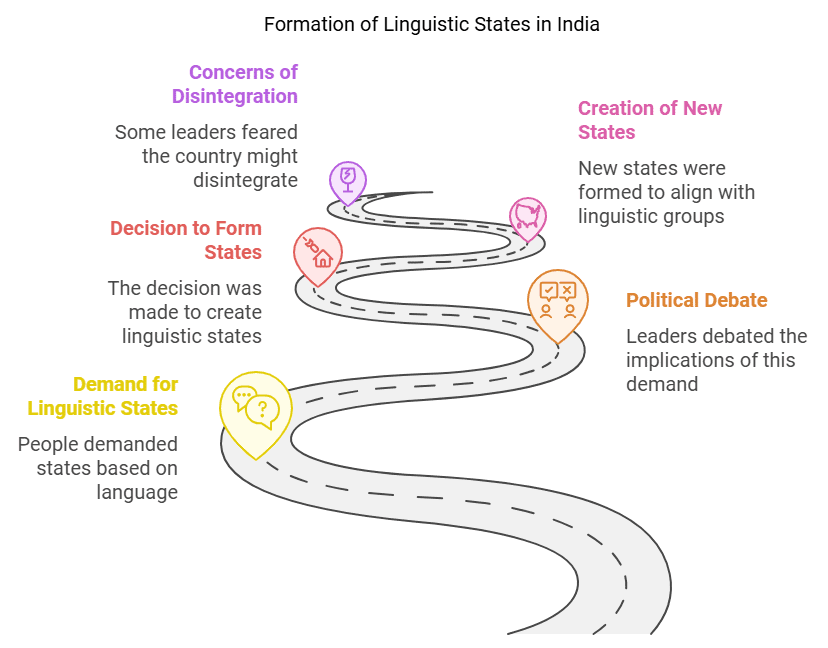
The creation of linguistic states was the first and a major test for democratic politics in our country. Many old States have vanished and many new States have been created.

  • In 1947, the boundaries of several old states of India were changed to create new States.
  • This was done to ensure that people who spoke the same language lived in the same States.
  • When the demand for the formation of States based on language was raised, some national leaders feared that it would lead to the disintegration of the country.

Language Policy

1. Language Policy and No National Language:

  • The Indian Constitution does not designate a national language. 
  • Hindi is recognized as the official language, but as it is the mother tongue of only about 40% of Indians, various safeguards are in place to protect other languages.

2. Scheduled Languages and Examination Flexibility:

  • In addition to Hindi, the Constitution recognizes 22 Scheduled Languages. 
  • Candidates appearing for Central Government exams can choose to take them in any of these languages. 
  • States also have their own official languages, which are used for most governmental work.

3. Cautious Spread of Hindi:

  • Unlike in Sri Lanka, Indian leaders took a careful approach in promoting Hindi. 
  • Initially, the Constitution planned to cease the use of English for official purposes by 1965. 
  • However, after protests, particularly in Tamil Nadu, the Central Government agreed to continue using English alongside Hindi.

4. Criticism and Continued Promotion of Hindi:

  • Critics argue that continuing the use of English benefits the English-speaking elite. 
  • Despite this, the Government of India continues to promote Hindi, though it does not impose it on non-Hindi-speaking states. 
  • The flexibility of Indian leaders in handling the language issue has helped avoid conflicts like those seen in Sri Lanka.

Centre-state Relations

1. Strengthening Federalism Through Centre-State Relations:

  • Restructuring Centre-State relations has played a significant role in strengthening federalism in India. 
  • The effectiveness of constitutional power-sharing largely depends on how ruling parties and leaders adhere to these arrangements.

2. Dominance of a Single Party:

  • For a long time, the same party governed both the Centre and most States, leading to State Governments not fully exercising their autonomy as federal units. 
  • When different parties governed the Centre and the States, the Central Government often attempted to undermine State powers, weakening the federal spirit.

3. Misuse of Constitutional Powers:

  • In the past, the Central Government frequently misused its constitutional authority to dismiss State Governments led by rival parties, which eroded the essence of federalism.

4. Rise of Regional Parties and Coalition Governments:

  • This dynamic changed significantly after 1990, with the rise of regional political parties in many States. 
  • This era also marked the beginning of coalition governments at the Centre, where major national parties had to ally with regional parties to form a government due to the lack of a clear majority in the Lok Sabha.

Decentralization in India

Need for a Third Tier: India’s vast size and diversity require more than just two levels of government. A third tier, local government, was created for more effective power sharing.

Concept of Decentralization: Decentralization involves transferring power from Central and State governments to local governments, enabling local problem-solving and encouraging democratic participation.

Initial Challenges: Early attempts at decentralization were limited. Local governments lacked power, resources, and regular elections.

1992 Constitutional Amendment:
A significant step towards effective decentralization was taken with the 1992 amendment, which empowered local governments.

  • Key Features of the Amendment:
  • Mandatory regular elections for local bodies.
  • Reservation of seats for Scheduled Castes, Scheduled Tribes, Other Backward Classes, and women.
  • Creation of State Election Commissions for local elections.
  • Requirement for State governments to share powers and revenue with local bodies.
  • Structure of Rural Local Government Known as Panchayati Raj, it includes: Gram Panchayat: Decision-making body for villages, supervised by the Gram Sabha. Panchayat Samiti: Grouping of several Gram Panchayats at the block level. Zilla Parishad: District-level body with elected members and the Zilla Parishad chairperson as the political head.

Urban Local Government:
Municipalities for towns and municipal corporations for big cities, both controlled by elected representatives.
The political head is the municipal chairperson or mayor.

1. Power Sharing – Chapter Notes

Introduction

Power sharing is a fundamental principle of democratic governance that ensures the distribution of power among various organs of government, social groups, and political entities to prevent the concentration of power in a single authority. 
This approach is crucial for maintaining stability, fostering inclusiveness, and promoting fairness in diverse societies.

In a democracy all power does not rest with any one organ of the government. An intelligent sharing of power among the legislature, executive and judiciary is very important for the design of democracy.

Belgium and Sri Lanka

Belgium

  • Belgium is a small European country, smaller in area than Haryana state.
  • Borders: France, the Netherlands, Germany, and Luxembourg.
  • Population: Just over one crore, with a complex ethnic composition.
  • Language breakdown: 59% Dutch speakers in Flemish region, 40% French speakers in Wallonia, and 1% German speakers.
  • In Brussels, 80% speak French and 20% speak Dutch.
  • Tensions: Dutch-speaking community felt disadvantaged compared to the French-speaking minority, leading to conflicts in the 1950s and 1960s.

Sri Lanka

  • Sri Lanka is an island nation close to Tamil Nadu with a population similar to Haryana.
  • Population: Around two crore with significant diversity.
  • Social groups: 74% Sinhala speakers, 18% Tamil speakers, including Sri Lankan Tamils and Indian Tamils.
  • Religion: Majority of Sinhala speakers are Buddhists, while Tamils are mostly Hindus or Muslims.
  • Concentration: Sri Lankan Tamils are mainly in the north and east of the country.
  • Possibilities: Potential conflicts due to demographic majorities could lead to partition and power struggles.

Try yourself:What is the significance of power sharing in a democracy?

  • A.It ensures that one organ of the government has complete control.
  • B.It prevents concentration of power in a single authority
  • C.It allows the executive branch to make all the important decisions.
  • D.It increases the efficiency and effectiveness of the judiciary.

View Solution

Majoritarianism in Sri Lanka

Post-Independence Era (1948 Onwards): Following independence in 1948, Sri Lanka witnessed the rise of majoritarianism, where leaders of the Sinhala community sought to secure political dominance by leveraging their majority status.

Majoritarian Measures: A series of measures were adopted to establish Sinhala supremacy:

  • Official Language Act (1956): Sinhala was recognized as the sole official language, disregarding Tamil.
  • Preferential Policies: Government policies favored Sinhala applicants for university admissions and government jobs.
  • Religious Favoritism: The constitution mandated state protection and promotion of Buddhism, further alienating the Tamil community.

Impact on Sri Lankan Tamils:

  • Growing Alienation: Sri Lankan Tamils increasingly felt marginalized, perceiving that government policies denied them equal political rights, discriminated against them in employment opportunities, and ignored their cultural and linguistic needs.
  • Political Discontent: Tamil leaders and parties sought recognition of Tamil as an official language, regional autonomy, and equality in education and job opportunities, but these demands were persistently denied.

Escalation and Civil War (1980s-2009):

  • Rise of Separatist Movements: By the 1980s, political organizations advocating for an independent Tamil state, Tamil Eelam, emerged in the northern and eastern parts of Sri Lanka.
  • Civil Conflict: Distrust between the Sinhala and Tamil communities escalated into widespread conflict, culminating in a civil war that lasted until 2009.

Consequences of the Civil War:

  • Human and Social Impact: The war resulted in the loss of thousands of lives, the displacement of families, and widespread economic and social disruption.
  • Cultural and Economic Setbacks: The conflict severely affected Sri Lanka’s social fabric and economic development, undermining previous achievements in education, health, and overall well-being.
  • End of the Civil War (2009): The war concluded in 2009, leaving lasting scars on the nation’s societal and economic landscape

Try yourself:

Which country witnessed the rise of majoritarianism post-independence, leading to conflicts between different ethnic groups?

  • A.Belgium
  • B.Sri Lanka
  • C.Netherlands
  • D.Germany

View Solution

Accommodation in Belgium

Recognition of Diversity: Belgian leaders took a proactive approach by acknowledging the existence of regional differences and cultural diversities. To facilitate peaceful coexistence, they amended the constitution four times between 1970 and 1993, resulting in a unique and innovative arrangement.  

Key Elements of the Belgian Model:

1. Equal Representation in Central Government:

  • The constitution prescribes that the number of Dutch and French-speaking ministers in the central government shall be equal. This prevents any single community from making unilateral decisions.
  • Some special laws require the support of a majority from each linguistic group, ensuring balanced decision-making and preventing domination by one community.

2. Decentralization and Autonomy of State Governments:

  • Many powers of the Central Government were devolved to the State Governments of the two main regions (Flanders and Wallonia), which are not subordinate to the Central Government. 
  • This decentralization underscores the autonomy of the regions.

3. Equal Representation in Brussels:

  • Brussels, the capital city, has a separate government where both Dutch and French-speaking communities have equal representation. 
  • This balance was accepted by the French-speaking population as the Dutch-speaking community agreed to equal representation in the Central Government.

4. Community Government:

  • In addition to the Central and State Governments, a ‘community government’ exists. It is elected by people belonging to one of the three language communities—Dutch, French, and German—regardless of their residence. 
  • This government has authority over cultural, educational, and language-related issues, allowing each community to preserve its identity.

5. Complexity and Effectiveness:

  • The Belgian model is indeed complex, even for the people living in Belgium. 
  • However, it has effectively avoided civic strife between the two major communities and prevented a potential division of the country on linguistic lines. 
  • The success of this model is further demonstrated by Brussels being chosen as the headquarters of the European Union.

Comparative Insights:

Belgium’s Power-Sharing Success:

  • Belgium illustrates how respecting the interests and feelings of different communities through power-sharing arrangements can preserve the unity of a diverse country. 
  • The model promotes mutual acceptance and cohesion.

Sri Lanka’s Cautionary Tale:

  • In contrast, Sri Lanka’s experience shows that when a majority community attempts to enforce its dominance and refuses to share power, it can undermine national unity and lead to conflict.

Why Power Sharing is Desirable?

  • Social Stability: Power sharing reduces the likelihood of conflicts between social groups, which in turn minimizes violence and political instability. Imposing the majority’s will may seem appealing initially, but it can harm national unity in the long term.
  • Democracy’s Essence: Power sharing embodies the essence of democracy. Democratic governance involves sharing power with those impacted by decisions, allowing them a say in governance and a stake in the system.

Two Sets of Reasons:

  • Prudential Reasons: Focus on the positive outcomes that power sharing can bring, emphasizing its practical benefits.
  • Moral Reasons: Highlight the intrinsic value of power sharing itself, beyond its outcomes, by stressing the importance of citizen participation and stakeholder involvement in governance. 

Forms of Power-Sharing

  • Power-sharing can be considered as the spirit of democracy as power is not concentrated in the hands of few people.
  • Moreover, the people in power are not only responsible for their decisions but are also held accountable for them.
  • Power-sharing also gives respect to each and every social group which is rarely seen in any other type of government except democracy.

There are different ways in which power-sharing takes place in various democracies:

Try yourself:

What is one of the key reasons why power sharing is desirable in a democracy?

  • A.It reduces conflicts between social groups
  • B.It concentrates power in the hands of few people
  • C.It promotes majority dominance
  • D.It undermines national unity

View Solution

1. Power-Sharing between Different Organs of the Government

  • The power division is horizontal where different organs of the government at the same level exercise different powers in their jurisdiction. 
  • This is easily seen in Indian democracy the legislature, judiciary and executive function on the same level and yet have different jurisdictions.

2. Power-Sharing between Different Levels of Government

  • This refers to the system where the power is distributed among various levels of government such as the central and provincial governments. 
  • This system is also known as federalism. India is a prime example of the federal system of government. 
  • In certain matters, the power-sharing is so exclusive that certain subjects are only exclusive to the union government or the state government.

3. Power-Sharing between Different Social Groups

  • Representation of Social Groups: Power may also be shared among different social groups, such as religious and linguistic communities. The ‘community government’ in Belgium is an example of this type of arrangement, where various groups have a voice in governance.
  • Constitutional and Legal Arrangements: In many countries, there are constitutional and legal mechanisms to ensure that socially weaker sections and women are represented in legislatures and administration. For example, India uses a system of ‘reserved constituencies’ to ensure representation for marginalized communities.
  • Purpose of Social Power-Sharing: These arrangements are designed to give minority communities and socially weaker groups a fair share of power, preventing them from feeling alienated from the government. This approach helps in accommodating social diversities within the governance framework.

4. Power-Sharing between Different Political Groups

  • Role of Political Parties and Groups: Power-sharing in democracies often involves various political groups, including political parties, pressure groups, and other public interest groups. These groups influence decision-making and ensure that power is not concentrated in one hand.
  • Competition and Coalition: In a democratic system, competition among political parties allows citizens to choose their leaders. This competition can lead to power-sharing when two or more parties form an alliance to contest elections. If their alliance wins, they form a coalition government, sharing power directly.
  • Influence of Interest Groups: In addition to political parties, interest groups such as traders, businessmen, industrialists, farmers, and workers also play a role in power-sharing. They may participate in governmental committees or exert influence on the decision-making process, ensuring that various societal interests are represented in governance.

Try yourself:Which of the following is an example of horizontal sharing of power?

  • A.Power-Sharing between different states.
  • B.Power-Sharing between different organs of the government.
  • C.Power-Sharing between different levels of the government.
  • D.Power-Sharing between different political parties.

View Solution

Important Terms to Remember

  1. Power-sharing: Power-sharing is the distribution of power among the organs of the government like–legislature, executive, and judiciary. It is an intelligent step to ensure the stability of political order. Besides, power-sharing also includes sharing at the different levels like union, state, and local.
  2. Majoritarian: A concept which signifies a belief that the majority community should be able to rule a country in whatever way it wants is known as Majoritarian. In this type of rule, they disregard the wishes and needs of the minority.
  3. Ethnicity: A social division based on shared culture. Most people belonging to the same ethnic group believe in their common descent because they have similarities of physical type or culture or both. They may not have the same religion or nationality, e.g, French-speaking, Dutch-speaking, Sinhala speaking, etc. 
  4. Community Government: A type of Government that is elected by people belonging to one language community is called community government. For example, Dutch, French, and German-speaking people form their respective community governments, no matter where they live. This is a very specific type of government in Belgium.
  5. Civil War: violent conflict between opposing groups within a country is known as a civil war. Sometimes it becomes so intense that it appears like a war.
  6. Prudential: It is a set of reasons which favours power-sharing. It is based on prudence, or on careful calculation of gains and losses. Prudential reasons stress beneficial consequences.
  7. Checks and Balances: A system in which each organ of the government checks the others which results in a balance of power among various institutions. It ensures that none of the organs can exercise unlimited power.
  8. Vertical Division of Power: It is a type of distribution of power that involves the higher and lower levels of government such as central, provincial, and regional levels.
  9. Reserved Constituencies: It is a system in which constituencies are reserved in the Assemblies and the Parliament for minorities in order to give them a fair share in power. 
  10. Coalition Government: When the alliance of two or more parties gets elected and forms a government it is known as the Coalition Government. This is another form of power-sharing.