05. Previous Year Questions: Outcomes of Democracy

Previous Year Questions 2025

Q1: “That democratic system of government is considered good in which maximum number of citizens are made stakeholders in political power.” Explain the statement with suitable arguments.  (3 Marks)

Hide Answer  

Ans: A democratic system of government is considered good when the maximum number of citizens are made stakeholders in political power because:

  • Ensures People’s Participation:
    In democracy, citizens have the right to elect their representatives and participate in decision-making. This allows power to be shared among a large number of people instead of being concentrated in a few hands.
  • Makes Government Accountable and Responsive:
    Democratic governments are answerable to the people. Citizens can question policies, demand transparency, and expect the government to respond to their needs and aspirations.
  • Legitimises the Government:
    When rulers are chosen by the people, the government is seen as legitimate and “people’s own government,” which enjoys public trust and support.
  • Promotes Transparency:
    Democracy follows norms and procedures such as free and fair elections, open debates, and the right to information, ensuring that decisions are made transparently.
  • Upholds Equality and Dignity:
    It recognises equal rights for all citizens, strengthens individual dignity, and gives every citizen a voice in governance.
  • Allows Correction of Mistakes:
    Democracy provides mechanisms like elections and debates through which wrong decisions or policies can be corrected peacefully.

Hence, the greater the participation of citizens in political power, the stronger, more legitimate, and more effective the democracy becomes.


Q2: Explain any five bases for assessing the outcomes of democracy.  (5 Marks)

Hide Answer  

Ans: The outcomes of democracy can be assessed on the following five bases:

  • Accountable and Responsive Government:
    Democracy produces a government that is accountable to citizens and responsive to their needs through regular, free and fair elections and open debates.
  • Economic Growth and Development:
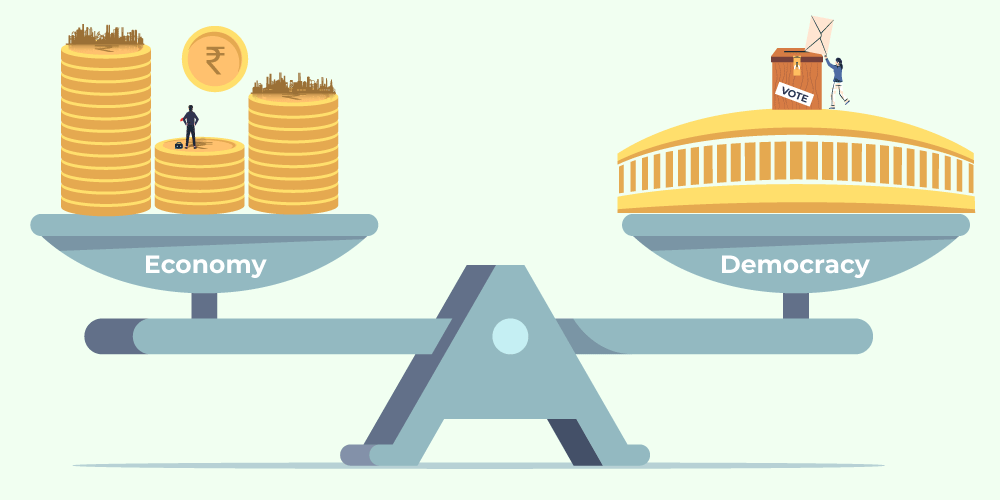
    Democracies aim at economic growth and development, though their performance may not always be better than dictatorships. Still, they provide conditions for people’s participation in development.
  • Reduction of Inequality and Poverty:
    Democracy is expected to reduce inequality and poverty by ensuring political equality. However, in practice, economic disparities often persist.
  • Accommodation of Social Diversity:
    Democracies accommodate differences among social, religious, or linguistic groups through negotiation and respect for diversity, preventing violent conflicts.
  • Dignity and Freedom of Citizens:
    Democracy upholds the dignity and freedom of individuals, ensuring equal respect and opportunities, especially for women and disadvantaged groups.


Q3: “One distinct feature of democracy is that its scrutiny never ends.” Explain the statement with appropriate arguments.  (5 Marks)

Hide Answer  

Ans: One distinct feature of democracy is that its scrutiny never ends because people continuously evaluate and question its functioning.

  • Continuous Public Examination:
    In a democracy, citizens constantly assess how well their government is performing. As democracy passes one test, people raise new expectations and demand further improvement.
  • Rising Expectations of Citizens:
    When citizens experience some benefits of democracy, they seek more participation, transparency, and equality. This continuous demand keeps democracy under constant review.
  • Public Awareness and Critical Thinking:
    Democracy transforms people from subjects into active citizens who are aware of their rights and are willing to question those in power.
  • Complaints Indicate Success:
    The fact that people complain about the functioning of democracy is itself proof of its success, as it shows they have developed the ability to expect and evaluate.
  • Ongoing Process of Improvement:
    Democracy is not a static system. It evolves with time, correcting mistakes and striving to become better by responding to the voices and needs of its citizens.

Hence, the scrutiny of democracy never ends because it is an ongoing process of evaluation, improvement, and accountability driven by active and aware citizens.


Q4: “Democratic system is better than other systems.” Explain the statement with appropriate arguments.  (5 Marks)
Or
​How is democracy better than other types of government? Analyse.  (5 Marks)

Hide Answer  

Ans: Democracy is considered better than other forms of government because it upholds equality, accountability, and freedom for all citizens.

  • Accountable and Responsive Government:
    In democracy, rulers are accountable to the people and must respond to their needs and expectations. Citizens can question the government through elections, debates, and the right to information.
  • Legitimate Government:
    A democratic government is people’s own government. It gains legitimacy because rulers are elected by the citizens and act according to their will.
  • Transparency in Decision-Making:
    Democratic governments follow norms and procedures before making decisions. This ensures transparency and allows citizens to examine whether proper processes were followed.
  • Promotes Equality and Dignity:
    Democracy is based on political equality — every citizen has one vote of equal value. It also upholds the dignity and freedom of individuals, allowing them to live with respect.
  • Peaceful Resolution and Correction of Mistakes:
    Democracy provides peaceful methods to resolve conflicts and correct mistakes through dialogue, discussion, and elections — unlike dictatorships or monarchies, which suppress dissent.

Thus, democracy is superior to other systems because it ensures people’s participation, accountability, equality, and respect for freedom and human dignity.


Q5: Analyse the role of democracy in reducing inequality and poverty.  (5 Marks)
or
​Explain the role of democracy in reducing economic inequalities in India.  (5 Marks)

Hide Answer  

Ans: Democracy is expected to reduce inequality and poverty because it is based on the principle of political equality — where every citizen has one vote and equal political rights. However, its actual performance in reducing economic inequalities has been limited.

  • Expectation of Equal Distribution:
    Democracies aim to ensure that wealth and opportunities are distributed fairly so that all citizens can lead a better life.
  • Persistence of Inequalities:
    In practice, economic inequalities continue to exist. A small number of rich people enjoy a large share of national income, while those at the bottom struggle to meet basic needs like food, housing, health, and education.
  • Political Equality vs. Economic Inequality:
    Though democracy provides equal political rights, it has not been equally successful in providing equal economic opportunities. The gap between the rich and poor often widens even in democratic societies.
  • Government’s Role and Voter Pressure:
    Since the poor form a large part of the electorate, democratic governments are expected to address poverty. However, many governments fail to give it the attention it deserves.
  • Scope for Change:
    Despite its shortcomings, democracy allows people to raise their voices, organise movements, and demand policies for social and economic justice — which is not possible in non-democratic regimes.

Thus, while democracy has not completely eliminated inequality and poverty, it provides the space and means to struggle against them and move towards a more just society.


Q6: How does democracy establish an accountable, responsible, and legitimate governance? Explain.  (3 Marks)

Hide Answer  

Ans: Democracy establishes an accountable, responsive, and legitimate government in the following ways:

  • Accountability:
    In a democracy, rulers are elected by the people and can be voted out if they fail to perform. Regular, free, and fair elections make the government accountable to citizens.
  • Responsiveness:
    Democratic governments are expected to respond to the needs and expectations of the people through public debate, participation, and the right to information.
  • Legitimacy:
    A democratic government is considered legitimate because it is chosen by the people and functions according to their consent. Even if it is slow or inefficient, it is still people’s own government.

Thus, democracy ensures that power remains in the hands of the people and that the government acts according to their will and welfare.


Q7: “Democratic governance is responsive to the expectations of citizens.” Justify the statement with suitable arguments.  (5 Marks)

Hide Answer  

Ans: Democratic governance is responsive to the expectations of citizens because it is based on participation, accountability, and public welfare.

  • People’s Participation in Decision-Making:
    In democracy, citizens have the right to elect their representatives and take part in decisions that affect their lives. This ensures that government policies reflect people’s needs and aspirations.
  • Public Opinion and Debate:
    Decisions in a democracy are made through discussion, negotiation, and consultation. Open public debates and media scrutiny compel the government to act according to citizens’ expectations.
  • Accountability to the People:
    Elected representatives are answerable to the people. If they fail to deliver, citizens can replace them through free and fair elections. This keeps the government responsive.
  • Transparency in Governance:
    Democratic systems allow people access to information through laws like the Right to Information Act. This enables citizens to question government actions and demand explanations.
  • Focus on Public Welfare:
    Since governments depend on the support of the people, they must implement welfare measures in areas like education, health, and poverty reduction to retain trust and legitimacy.

Thus, democracy ensures that the government remains sensitive to citizens’ needs, works for their welfare, and constantly adapts to public expectations.

OR

“Democracy accommodates social diversity better than dictatorship.” Justify the statement with suitable arguments.  (5 Marks)

Hide Answer  

Ans: 

Democracy accommodates social diversity better than dictatorship because it recognises and respects the differences that exist among various communities in a society.

  • In a democracy, people belonging to different religions, languages, and castes can freely express their views and take part in decision-making. Differences are managed through discussion and negotiation rather than force or suppression.
  • Democracy ensures that all groups have equal political rights. Every citizen, regardless of background, has one vote of equal value, preventing any group from being permanently excluded from power.
  • True democracy is not simply rule of the majority; it also protects the interests of the minority. The majority must work with the minority so that governments represent the views of all sections of society.
  • Democratic governments create power-sharing arrangements among different social groups and regions, allowing everyone to have a say in governance. This makes democracy flexible and inclusive.
  • Dictatorships, on the other hand, often suppress social and cultural differences to maintain control, leading to conflict and injustice.

Therefore, democracy is better suited to accommodate social diversity because it promotes equality, understanding, and peaceful coexistence among people with varied backgrounds.


Q8: In a democratic country the government adopts environment friendly policies with the help of citizens and experts. Which one of the following is a positive outcome of this process?  (1 Mark)
(a) The government is capable of determining policies on its own. 
(b) Citizens feel empowered to determine policies. 
(c) Corporates protect their own interest in determining policies. 
(d) Market forces also influence the government for their interests.

Hide Answer  

Ans: (b) Citizens feel empowered to determine policies.

In a democracy, when the government adopts environment-friendly policies through discussion with citizens and experts, it shows people’s participation and accountability. This makes citizens feel empowered as they actively take part in shaping decisions that affect their lives — a key positive outcome of democracy.


Q9: Explain the role of opposition in democracy.  (3 Marks)

Hide Answer  

Ans: The opposition plays a vital role in a democracy by ensuring that the government remains accountable and works within constitutional limits.

  • The opposition questions and criticises the policies and decisions of the ruling party, helping to keep a check on misuse of power.
  • It represents alternative viewpoints and voices the concerns of citizens who may not agree with the ruling party, ensuring that different opinions are heard in governance.
  • The opposition also contributes to better decision-making by engaging in debates and discussions in the legislature, suggesting improvements and highlighting flaws in government policies.

Thus, the opposition strengthens democracy by promoting transparency, accountability, and balance of power in the political system.


Q10: “Democracy elevates humans from the status of subject to citizen.” Justify the statement with suitable arguments.  (5 Marks)

Hide Answer  

Ans: Democracy elevates humans from the status of subjects to citizens because it gives people power, dignity, and the right to participate in governance.

  • In a democracy, individuals are not merely ruled; they rule themselves through their representatives. This makes them active participants in decision-making rather than passive followers.
  • Democracy grants fundamental rights and freedoms, allowing citizens to express their opinions freely, criticise the government, and demand accountability. This empowers people and gives them control over those in power.
  • It promotes dignity and equality — every person, regardless of caste, gender, or status, has one vote of equal value and an equal right to be treated with respect.
  • Citizens have the right to information and participation, enabling them to question government actions and influence public policy. This develops awareness and responsibility among people.
  • The fact that people can complain, protest, and demand change shows the success of democracy, as it transforms them from silent subjects to aware and empowered citizens who shape their nation’s future.

Thus, democracy truly uplifts individuals by recognising them as equal, dignified, and active citizens rather than subjects under authority.


Q11: “Democracy stands much superior to any other form of government in promoting dignity and freedom of the individual.” Justify the statement with suitable arguments.   (5 Marks)

Hide Answer  

Ans: Democracy stands much superior to any other form of government in promoting the dignity and freedom of the individual because it is founded on equality, respect, and individual rights.

  • Recognition of Individual Freedom:
    Democracy guarantees fundamental rights such as freedom of speech, expression, and participation in decision-making, allowing individuals to live with dignity and independence.
  • Equality and Respect for All:
    In a democratic system, all citizens are considered equal before the law. Every person, irrespective of caste, religion, gender, or class, enjoys equal political rights and opportunities.
  • Dignity of Women:
    Through long struggles, democracy has helped recognise that respect and equal treatment of women are essential to a just society. Although inequality still exists, democratic principles give women a legal and moral basis to fight for their rights.
  • End of Social Discrimination:
    In societies like India, democracy has strengthened the position of disadvantaged and discriminated castes, helping them claim equal status and opportunity.
  • Citizens’ Awareness and Empowerment:
    Democracy transforms people from subjects to active citizens who are aware of their rights and can question authority. This awareness itself reflects the dignity and strength of individuals in a democratic system.

Thus, democracy is superior because it not only provides freedom and equality but also ensures that every individual is treated with respect, dignity, and a sense of self-worth.


Q12: “Democracy and Development go together.” Justify the statement with suitable arguments.  (5 Marks)

Hide Answer  

Ans: Democracy and development go together” because democracy creates the right conditions for sustainable and inclusive growth by involving people in decision-making and ensuring accountability in governance.

  • People’s Participation in Policy-Making:
    In a democracy, decisions related to development are made after discussion and consultation with citizens. This helps in identifying real needs and using resources effectively for public welfare.
  • Transparency and Accountability:
    Democratic governments follow proper procedures and allow citizens to question decisions. This transparency reduces corruption and ensures that development benefits reach the people.
  • Equal Opportunities for All:
    Democracy is based on equality, giving every individual the right to education, employment, and participation in public life — all of which contribute to national development.
  • Balance Between Growth and Justice:
    While dictatorships may achieve faster growth, democracies ensure that growth is accompanied by social justice and protection of citizens’ rights, preventing exploitation.
  • Public Pressure for Welfare Measures:
    In a democracy, citizens can influence the government through elections and movements to adopt pro-people policies such as poverty reduction, education, and healthcare.

Hence, democracy and development go hand in hand because democracy not only promotes economic progress but also ensures that development is inclusive, accountable, and just.


Q13: “Democratic governments are usually attentive to the needs and demands of the people.” Justify the statement with suitable arguments.  (5 Marks)

Hide Answer  

Ans: Democratic governments are usually attentive to the needs and demands of the people because they derive their authority from citizens and depend on their support to remain in power.

  • Government by the People’s Choice:
    In a democracy, rulers are elected by the citizens. To win elections and maintain public trust, they must listen to the people’s problems and act according to their needs.
  • Accountability to Citizens:
    Since the government can be changed through regular, free, and fair elections, it remains accountable to the people. This accountability ensures that the government pays attention to citizens’ welfare.
  • Public Discussion and Debate:
    Democracy is based on deliberation and negotiation. Through debates in legislatures, media discussions, and public opinion, citizens influence government decisions and policies.
  • Transparency and Right to Information:
    Citizens have the right to know how decisions are made and funds are used. This transparency forces governments to respond to people’s expectations.
  • Focus on Welfare Measures:
    Democratic governments try to fulfil social and economic needs such as education, health, and employment, as ignoring these can lead to public dissatisfaction and loss of support.

Thus, democratic governments are attentive to the people because their power depends on public approval, making them responsive and responsible towards the citizens’ needs.


Q14: Evaluate the outcomes of democracy in the economic sector of the country.  (5 Marks)

Hide Answer  

Ans: The outcomes of democracy in the economic sector show a mixed picture. While democracies provide opportunities for growth and fairness, they have not always been fully successful in ensuring equal economic progress for all.

  • Moderate Economic Growth:
    Studies show that democracies and dictatorships have had almost similar rates of economic growth. Dictatorships may grow slightly faster, but the difference is small, and democracies provide fairer conditions for development.
  • Balanced Development:
    Economic development in democracy depends on factors like population, resources, and global situation. Though democracies may not achieve very high growth, they ensure stable and people-centred development.
  • Inequality of Wealth:
    Democracies have not been very successful in reducing the gap between the rich and the poor. A small section of society enjoys a large share of wealth, while many struggle to meet basic needs.
  • Reduction of Poverty:
    Despite having political equality, democracies often fail to effectively address poverty and unemployment. Governments are sometimes unable to meet the expectations of the poor majority.
  • Freedom and Participation in Economy:
    The positive side of democracy is that it allows citizens to participate freely in economic decisions and influence policies through public pressure and debate. This ensures that development remains accountable to the people.

Hence, while democracy may not always deliver rapid economic growth, it provides a fair, transparent, and participatory system that aims for inclusive and sustainable development.


Q15: Evaluate the outcomes of democracy in the social sector of the country.  (5 Marks)

Hide Answer  

Ans: The outcomes of democracy in the social sector are seen in its efforts to promote equality, harmony, dignity, and freedom among citizens. Though challenges remain, democracy provides the best framework for achieving these goals.

  • Political and Social Equality:
    Democracy is based on the principle of political equality, where every individual has one vote of equal value. This promotes social equality by recognising that all citizens are equal, regardless of caste, gender, or religion.
  • Accommodation of Social Diversity:
    Democracies respect and accommodate social, religious, and linguistic differences through discussion and power-sharing. This helps in reducing conflicts and promoting harmony among various communities.
  • Protection of Minority Rights:
    True democracy ensures that majority rule does not become majority domination. It protects the rights and interests of minority groups, promoting inclusiveness in governance.
  • Dignity and Freedom of Individuals:
    Democracy upholds the dignity and freedom of every citizen. It provides the legal and moral foundation for women, disadvantaged castes, and other marginalised groups to fight against discrimination and inequality.
  • Public Awareness and Citizen Empowerment:
    Democracy transforms people from passive subjects into active, aware citizens who can question authority and demand justice. This growing awareness strengthens social justice and equality.

Thus, democracy has made significant progress in promoting social justice, equality, and harmony, even though complete elimination of social inequalities remains an ongoing challenge.


Q16: Explain the role of democracy in establishing the dignity of citizens.  (5 Marks)

Hide Answer  

Ans: Democracy plays a crucial role in establishing the dignity of citizens because it is built on the principles of equality, freedom, and respect for every individual.

  • Recognition of Equality:
    Democracy treats all citizens as equal before the law, irrespective of caste, religion, gender, or social background. This equality forms the foundation of human dignity in a democratic society.
  • Freedom and Rights:
    Citizens enjoy fundamental rights such as freedom of speech, expression, and association. These rights enable individuals to live with self-respect and make independent choices without fear or oppression.
  • Dignity of Women:
    Democracy has helped in recognising that equal treatment and respect for women are essential features of a just society. Women now have legal and moral grounds to fight against discrimination and inequality.
  • Empowerment of Marginalised Groups:
    Democracy provides a platform for disadvantaged castes and minority groups to demand equal status and opportunities. It has strengthened their social position and given them a voice in governance.
  • Transformation from Subjects to Citizens:
    Democracy transforms people from being passive subjects to active citizens who can question authority and influence governance. This sense of participation enhances their self-worth and dignity.

Thus, democracy ensures that every individual is treated with respect, equality, and freedom, making dignity not just an ideal but a living reality for all citizens.


Q17: Explain the role of democracy in establishing harmony among social diversities.  (5 Marks)

Hide Answer  

Ans: Democracy plays a vital role in establishing harmony among social diversities because it recognises, respects, and accommodates the differences that exist within society.

  • Peaceful Management of Differences:
    In a democracy, social divisions based on religion, language, caste, or ethnicity are handled through dialogue, discussion, and negotiation rather than force. This prevents conflicts from turning violent.
  • Equal Political Rights for All:
    Every citizen has equal voting rights and the opportunity to participate in governance. This equality ensures that no group feels excluded or inferior, promoting unity and mutual respect.
  • Representation of Minority Groups:
    True democracy protects minority interests and ensures that the majority does not misuse its power. The majority must work with minority groups to form policies that reflect the interests of all.
  • Power-Sharing and Inclusion:
    Democratic governments often adopt power-sharing mechanisms to include different social, cultural, and regional groups in decision-making, ensuring fair participation and trust.
  • Prevention of Suppression:
    Unlike dictatorships that often suppress diversity, democracy allows free expression of identity and culture, helping people coexist peacefully and strengthening social harmony.

Thus, democracy establishes harmony by promoting tolerance, respect, and cooperation among diverse groups, ensuring that unity is maintained in a society full of differences.


Q18: “Democratic governments are usually attentive to the needs and demands of the people.” Justify the statement with suitable arguments.  (5 Marks)

Hide Answer  

Ans: Democratic governments are usually attentive to the needs and demands of the people because they derive their power from citizens and are accountable to them.

  • Government Chosen by the People:
    In a democracy, the rulers are elected by citizens through free and fair elections. To retain power, they must listen to the people’s needs and fulfil their expectations.
  • Accountability and Responsibility:
    Democratic governments are answerable to the public. If they fail to perform or ignore people’s demands, they can be voted out in the next election. This compels them to remain responsive.
  • Public Debate and Consultation:
    Democracy is based on deliberation and negotiation. Policies and decisions are discussed openly in legislatures and the media, ensuring that public opinion shapes governance.
  • Transparency and Right to Information:
    Citizens have the right to know how decisions are made and public funds are used. This transparency keeps the government sensitive to public concerns and prevents misuse of power.
  • Focus on Welfare Measures:
    Since the government depends on people’s support, it is encouraged to introduce programmes related to education, health, poverty reduction, and employment to improve citizens’ lives.

Thus, democratic governments remain attentive because their authority and survival depend on the trust, participation, and satisfaction of the people they represent.


Q19: How is democracy a responsible and legitimate government? Explain.  (5 Marks)

Hide Answer  

Ans: Democracy is considered a responsible and legitimate government because it is based on the consent of the people and functions according to their will.

  • Government by Consent:
    In a democracy, rulers are elected by the people through free and fair elections. This gives the government legitimacy, as it represents the will of the citizens rather than the authority of a few individuals.
  • Accountability to the People:
    Democratic governments are responsible and answerable to the citizens. If they fail to fulfil their duties or misuse power, people have the right to question them and replace them in the next election.
  • Transparency in Decision-Making:
    Democracy follows established norms and procedures before making decisions. Citizens can know how and why a particular decision was made through the Right to Information, ensuring transparency and fairness.
  • Public Participation:
    Citizens can influence and participate in decision-making through debates, protests, and discussions. This ensures that policies reflect public opinion and collective interest.
  • Moral and Legal Legitimacy:
    Even if a democratic government is slow or imperfect, it remains people’s own government, functioning with moral and legal authority — something non-democratic regimes lack.

Thus, democracy is both responsible — because it answers to the people — and legitimate — because it is formed and sustained by the consent of the governed.

Previous Year Questions 2024

Q1: Read the following statements regarding democracy and choose the correct option.
(I) Promotes equality among citizens
(II) Government by few individuals
(III) Protection of human rights
(IV) Ensures checks and balance system     (CBSE 2024)
Options:
(a) 
(I), (II) and (III)
(b) (II), (III) and (IV)
(c) (I), (III) and (IV)
(d) (I), (II) and (IV)

Hide Answer  

Ans: (c)
The correct answer is (c) because in a democracy, it promotes equality among citizens, protects human rights, and ensures a system of checks and balances to prevent any one group from having too much power. Statement (II), which says “Government by few individuals,” does not apply to democracy, as it implies a system like an oligarchy, not a democratic government.


Q2: “Democracy is an accountable, responsive and legitimate government.” Explain the statement.     (CBSE 2024)

Hide Answer  

Ans: (1) Democracy produces an accountable government because in a democracy, people have the right in choosing their representatives through the electoral process.
(2) Elected representatives participate in the decision-making  process on behalf of  the people. They are accountable to the people who elect them.
(3) If these elected representatives do not work properly, people have a chance to correct them in the next elections. Thus, it is an legitimate government because it is chosen by people through free and fair elections.
(4) Democratic governments are elected by the people and are responsible towards the Constitution and the Parliament.
(5) A democratic government is people’s own government. It is popular and responsible for making favourable laws for the collective good of the society.


Q3: “Accommodation of social diversity is the key feature of democracy.” Explain the statement in the Indian context.     (CBSE 2024)

Hide Answer  

Ans: Accommodation of social diversity is the key feature of democracy because:
(1) Constitutional Framework:
 All Indian citizens, regardless of caste, religion, gender, or ethnicity, are guaranteed fundamental rights by the Indian Constitution. In order to remedy the past injustices that minority people have endured, it also contains provisions for affirmative     action measures like reservations.
(2) Federal Structure: India’s federal structure provides for decentralised governance, allowing states to have autonomy in matters pertaining to language, culture, and regional identity.
(3) Representation in Government: India’s parliamentary democracy ensures representation of diverse social groups in government institutions.
(4) Reservation Policies: India has implemented reservation policies to ensure the representation of marginalised communities in elected bodies, educational institutions, and government jobs.
(5) Cultural Pluralism: The diversity of languages, faiths, traditions, and customs that makeup India’s cultural landscape is remarkable. India’s democratic culture promotes cultural plurality, enabling people to freely practice their various cultural identities as individuals and communities.

Previous Year Questions 2023

Q4: Which one of the following is the most popular form of government in the contemporary world?   (2023, At 2014)
(a)
 Dictatorial Government
(b) 
Constitutional Monarchy
(c) 
Military Government
(d) 
Democratic Government 

Hide Answer  

Ans: (d)
The correct answer is (d) Democratic Government because, today, most countries around the world practice democracy, where the people have the power to elect their leaders and make decisions. In contrast, the other options like dictatorial, military, or constitutional monarchy governments are less common and do not give the same level of power to the citizens.


Q5: “Democracy produces an accountable, responsive and legitimate government.” Support the statement with arguments.      (CBSE 2023)

Hide Answer  

Ans: Democracy produces an accountable, responsive and legitimate Government. This statement can be explained on the following grounds:

  • The government can be responsible when people start taking actions when the government becomes insensitive about their aspirations. People can hold protests, carry out campaigns and organise rallies and force the government to respond to them.
  • A democratic government is a legitimate government, as it is elected by citizens and enjoys the confidence and trust of the citizens.
  • People have the right to choose their rulers and they have control over their rulers. Citizens can participate in decision making.
  • Democracy makes the point that decision making is based on norms and procedures. So, a citizen who wants to know if a decision was taken through the correct procedures, can find out this information.
  • A democratic government is the people’s own government and it is run by the people. People are ruled by representatives elected by them.


Q6: “There is an overwhelming support for the idea of democracy all over the world” Support the statement with examples.       (2023)

Hide Answer  

Ans: Despite any shortcomings that we might witness in a democratic model of governance, it is still the most preferred form of government all over the world including in South Asia. Some reasons for this are given below:
(i) People have the right to choose who governs them through regular elections.
(ii) The elected government is answerable to the people and to ensure its stability, and has to deliver its promises.
(iii) Democracy ensures transparency.
(iv) It accommodates diversity and promotes inclusion and equality.
(v) It gives an equal chance of participation to all the citizens.
(vi) An important pillar of democracy is ensuring the dignity and freedom of people.
(vii) The true power lies with people.
(viii) Lastly, democracy has proven to be a better mode than dictatorship, aristocracy, or any other form ol governance.


Q7: “Democracy stands much superior to any other forms of governments in promoting dignity and freedom of the individual. Support the statement with arguments.      (CBSE 2023, 18, 14)

Hide Answer  

Ans: “Democracy stands much superior in promoting dignity and freedom of the citizens”:

  • Every individual wants to receive respect from fellow beings. Democracy provides fundamental rights to every citizen.
  • Freedom from coercion is the basis of any democracy, where everyone can have faith in choice.
  • In a democracy, people have equal opportunities so they can come up in life. They are not discriminated against on the basis of caste or gender.
  • Long struggles by women have got them respect and equal treatment. In many democracies, women were deprived of their right to vote for a long time which they have achieved now. In India, 1/3rd of seats have been reserved for women in local bodies.
  • Democracy has strengthened the claims of the disadvantaged and discriminated castes for equal status and equal opportunity.


Q8: Which type of government is likely to be more acceptable to the people in the world? 
(a) Democracy 
(b) Military 
(c) Dictatorship 
(d) Theocratic (CBSE 2023)

Hide Answer  

Ans: (a)
Democracy is generally more acceptable to people around the world because it is based on the principles of freedom, equality, and representation. In a democratic government, citizens have the right to participate in decision-making, elect their leaders, and hold them accountable. This form of government promotes human rights, respects diversity, and allows for peaceful transitions of power, making it preferable and more widely accepted than other forms such as military rule, dictatorship, or theocracy.
Therefore, the correct answer is (a) Democracy.

Get additional INR 200 off today with EDUREV200 coupon.

Previous Year Questions 2022

Q9: Analyse the reason for the overwhelming support for the idea of democracy all over the world.      (2022)

Hide Answer  

Ans: 
1. Promotes freedom: Democracy is based on the principle of individual freedom and liberty. People in democratic societies have the freedom to express their opinions, choose their leaders, and participate in decision-making processes.

2. Ensures equality: Democracy provides equal opportunities for all citizens, regardless of their social or economic status. It ensures that everyone has an equal voice in decision-making processes.

3. Allows peaceful transitions of power: In a democratic system, power is transferred through elections, which provides a peaceful way for people to change their leaders and express their opinions.

4. Protects human rights: Democracy promotes the protection of human rights and ensures that citizens have access to justice and equality before the law.

5. Fosters stability and development: Democracy provides a stable and predictable environment for businesses, investors, and individuals to operate in. It also encourages economic growth and development.

6. Reflects popular will: In a democratic system, the government is accountable to the people and reflects the will of the majority. This ensures that policies and decisions made by the government reflect the needs and desires of the people.
Overall, the overwhelming support for democracy all over the world can be attributed to its ability to promote individual freedom, equality, peaceful transitions of power, human rights protection, stability, development, and reflect the popular will.

Previous Year Questions 2021

Q10: “Democracy’s ability to generate its own support is itself an outcome that cannot be ignored.” Analyse the statement with three examples.    (Term-II, 2021-22)

Hide Answer  

Ans: Democracy’s ability to generate its own support is indeed an important outcome that cannot be ignored. Here are three examples to illustrate this:

  • Example 1: The United States of America
    In the United States, democracy has been able to generate its own support through the electoral process. The citizens have the right to vote and choose their representatives, which gives them a sense of ownership and participation in the government. The high voter turnout during elections is evidence of the support democracy receives from the people.
  • Example 2: India
    India is the world’s largest democracy and has successfully generated its own support through a vibrant electoral system. Despite its diverse population and numerous challenges, democracy has been able to sustain itself in India. The regular elections, where millions of people participate, reflect the support and belief in the democratic system.
  • Example 3: South Africa
    South Africa’s transition from apartheid to democracy is a remarkable example of how democracy can generate its own support. The majority of South Africans fought for the end of racial segregation and the establishment of a democratic government. The democratic system in South Africa has been able to address historical injustices and promote equality, garnering support from the people.

Therefore, these examples demonstrate that democracy’s ability to generate its own support is a significant outcome that cannot be overlooked.


Q11: Democratic government is a legitimate government. Support the statement with suitable arguments.    (Term-II, 2021-22 C)

Hide Answer  

Ans: A democratic government is called legitimate  government because it is people’s own government.
(i) It may be slow, less efficient and may have other flaws but it is people’s government.  
(ii) There is an overwhelming support for the idea of democracy all over the world. People of South Asia, Bangladesh, Sri Lanka, India, Pakistan and Nepal have no j doubt about the suitability of democracy for their country,
(iii) People wish to be ruled by representatives elected by them. Democracy’s ability to generate its own support makes it more legitimate


Q12: How is a democratic government known as a responsive government? Explain with examples.   (Term-II, 2021-22 C, AI 2014)

Hide Answer  

Ans: A democratic government has to be responsive to the needs of its citizens.
(i) Through discussions and public opinions the democratic government can check the popularity of its decisions and mechanism of administering justice.
(ii) A government which is able to respond to grievances faster is able to avoid confrontation and provide good governance. Such governments are said to be responsive


Q13: Mention the two conditions that democracy must fulfill in order to achieve a harmonious social life.  (Term-II,2021-22)

Hide Answer  

Ans: Democracy must fulfill two conditions to achieve a harmonious social life. Firstly, there should be a respect for the principles of equality, justice, and human rights. This means that all individuals should have equal opportunities, equal protection under the law, and their basic rights and freedoms should be safeguarded. Secondly, there should be a culture of dialogue, inclusiveness, and compromise. This involves fostering an environment where different opinions and perspectives are respected, conflicts are resolved through peaceful means, and consensus is built through open and constructive discussions.


Q14: “Democracy enhances the dignity and freedom of individuals.” Support the statement.   (Term-II, 2021-22 C)

Hide Answer  

Ans: Democracy enhances the dignity and freedom of individual. This statement is supported on the basis of
(i) The societies which have been built on the basis of subordination and domination, democracy recognise that all individuals are equal.
(ii) For women, most societies are male dominated. But democracy recognise the equality of women as well.
(iii) Same in the case of caste inequalities. Democracy give equal status and opportunities to all sections of society.


Q15: “Democracy stands much superior in promoting dignity and freedom of the citizens”. Justify the statement.
(Term-ll, 2021-22 C, 2015,2014)

Hide Answer  

Ans: “Democracy stands much superior in promoting dignity and freedom of the citizens”:
(i) Every individual wants to receive respect from fellow beings. Democracy provides fundamental rights to every citizen.
(ii) Freedom from coercion is basis of any democracy, where everyone can have faith of choice.
(iii) In a democracy people have equal opportunities so they can come up in life. They are not discriminated on the basis of caste or gender.
(iv) Long struggles by women have got them respect and equal treatment. In many democracies, women were deprived of their right to vote for a long time which they have achieved now. In India l/3rd of seats have been reserved for women in local bodies.
(v) Democracy has strengthened the claims of the disadvantaged and discriminated castes for equal status and equal opportunity.

Also read: Mind Map: Outcomes of Democracy

Previous Year Questions 2020

Q16: “Democracies accommodate social diversities and provide dignity and freedom to the citizens”. Justify the statement.
(Term-ll, 2021 – 22 ,2020)

Hide Answer  

Ans: Democracy promotes dignity and freedom of the people:
(i) Democracy stands much superior to any other form of government in promoting dignity and freedom of the people.
(ii) It promotes equality among citizen and hence increases respect for each other among citizen.
(iii) Respect and freedom have been recognised as the basis of democracy. (iv) Freedom and equality to women
(v) Strengthened the claims of the disadvantaged and discriminated castes for equal status and equal opportunity.
(vi) Majority-minority coordination.


Q17: Give any one example of economic development in dictatorial regimes. (CBSE 2020)

Hide Answer  

Ans: Dictatorships have higher rates of economic growth as compared to democracies. For example, China’s growth rate is higher than most of the other democracies in the world.


Q18: “Democracy is best suited to produce better results.” Examine the statement.  (CBSE 2020, 16)

Hide Answer  

Ans: Democracy produces better results because: 
(1) Democracy is a popular form of government. People participate in making decisions that affects them, including chosing of their representatives. This makes results acceptable. 
(2) Regular elections offer a chance to the people to change the current rulers. People can vote for other leaders in the following elections.
(3) Democracy provides an efficient method to deal with differences and conflicts, which are bound to arise in a diverse society, in a peaceful manner through negotiations. 
(4) Only a democratic setup is able to accommodate various social divisions without violence. 
(5) Democratic governments have a formal constitution

Previous Year Questions 2019

Q19: How do democratic governments ensure transparency? Explain.    (2019 C)

Hide Answer  

Ans: Following are the ways by which democratic government ensures transparency:
(i) Democratic government ensures that the decision i making process is based on proper norms and procedures,
(ii) Citizens have the right to examine the process of decision making.
(iii) A democratic government develops mechanism for the citizens to hold the government accountable and mechanism for citizens to take part in decision making  whenever they think fit.


Q20: Describe the importance of democratic government as an accountable and legitimate government.   (CBSE Delhi 2019,32/1/1)

Hide Answer  

Ans: Democratic government can be said to be accountable and legitimate government. The following reasons can be scribed to it:
Accountable government:
(i)
 When people choose their representatives, they are expected to be accountable, this is the basic outcome of democracy.
(ii) The citizens have the right and also the means to examine the process of decision making, that is high level of accountability is expected.
(iii) The government is expected to practice regular, free and fair elections and open discussions on important issues.
(iv) Democratic government can apparently be less efficient than a non-democratic government. This happens because a non-democratic government does not need to arrive at consensus among a diverse set of people. Democracy functions on the basis of deliberation and negotiation and hence decisions are often delayed. But this does not mean that a democratic government is less efficient. 

Legitimate government:
(i) 
A democratic government is people’s own government. That is why there is an overwhelming support for the idea of democracy all over the world and I there is the element of legitimacy attached to it.
(ii) People wish to be ruled by representatives elected by them. They also believe that democracy is suitable for their country. Democracy’s ability to generate support for itself is an outcome that cannot be ignored.
(iii) Though there are many reports of democracies ignoring the demands of people and there are routine tales of corruption but yet chances of governments improving only exists in democratic set-up.


Q21: “Democracies do not appear to be very successful in reducing economic inequalities.” Justify the statement.  (CBSE 2019)

Hide Answer  

Ans: Democracies fail to fulfill the expectations of economic development:
(i) Slow economic development and economic growth can be due to large population.
(ii) Basic needs of life, such as food, clothing, shelter are difficult to achieve in certain democracies.
(iii) Prevalence of economic inequalities are often seen.
(iv) Poverty is still a big issue.
(v) Allocation of resources in few hands.
(vi) Unjust distribution of goods and opportunities


Q22: Study the given picture and answer the question that follows:

Which one of the following options best signifies this cartoon? 
(a) Demand for separate state from Democratic Government. 
(b) Democratic Government is facing territorial issues with the bordering states. 
(c) Democratic Government is coping with multiple pressures through accommodation. 
(d) Democratic Government accepts demands based on separate state. (CBSE 2019)

Hide Answer  

Ans: (c)
This cartoon likely illustrates the challenges faced by democratic governments in managing the diverse demands and pressures from various groups within the country. Instead of rejecting these pressures outright, a democratic government seeks ways to accommodate different interests and groups, balancing diverse needs to maintain stability and unity. This approach reflects the flexibility and inclusiveness characteristic of democratic systems.
Therefore, the correct answer is (c) Democratic Government is coping with multiple pressures through accommodation.


Q23: ‘‘Democracies have had greater success in setting regular free and fair elections.’’ Analyse the statement. (CBSE 2019)

Hide Answer  

Ans: Democracies have had greater success in setting regular free and fair elections: 
(1) In a democracy, all people above a certain age have the right to vote as well as contest elections. 
(2) Elections are free and fair in a democracy as there is an independent body (Election Commission in India) which monitors all election related activities impartially. 
(3) If there are any malpractices during elections, then a re-election is conducted in that constituency. Hence democracy has had greater success in setting up free elections.

Attention!Sale expiring soon, act now & get EduRev Infinity at 40% off!

Previous Year Questions 2018

Q24: How is democracy a better form of government when compared with dictatorship or any other alternative government? (CBSE 2018, 17, 15)

Hide Answer  

Ans: Democracy is a better form of government when compared with dictatorship or any other alternative form of government because it:
(1) Promotes equality among citizens. 
(2) Enhances the dignity of the individual. 
(3) Improves the quality of decision making.


Q25: ‘‘Democracies lead to peaceful and harmonious life among citizens.’’ Support the statement with examples.  (CBSE 2018)

Hide Answer  

Ans: The given statement can be supported using the following points. 
(1) Democracy accommodates various social divisions. 
(2) Democracy reduces the possibility of social tensions from becoming explosive and violent. 
(3) An ability to handle social differences and conflicts among different groups is an advantage of democracy. 
(4) Democracy develops procedure to conduct healthy competitions among different groups in a society. 
(5) Democracy respects differences and provides mechanism to resolve them.

Previous Year Questions 2017

Q26 Explain the meaning of ‘sectional interest group’.    (Foreign 2017)

Hide Answer  

Ans: A ‘sectional interest group’ refers to an organized association or organization that represents the common interests of a specific section or segment of society. These interest groups advocate for the concerns and issues that are specific to their particular section, such as labor unions representing workers’ rights or farmer associations advocating for agricultural policies. Sectional interest groups aim to protect and promote the welfare of their members and influence decision-making processes that affect their respective sections.


Q27: Explain the meaning of democracy.    (Al 2017)

Hide Answer  

Ans: Democracy is a system of government in which the entire population or all eligible members of a state have the power to participate in decision-making processes. This can be done directly, through direct voting on policies and laws, or indirectly, by electing representatives who make decisions on behalf of the people. In a democratic system, the government is accountable to the people, and citizens have the right to express their opinions, criticize the government, and participate in the political process.


Q28: Why is there overwhelming support for democracy all over the world? Explain one reason.    (CBSE (AI) 2017)

Hide Answer  

Ans: 

  • It is because democracy is an accountable, responsive and legitimate government. The most basic outcome of democracy should be that it produces a government that is accountable to the citizens, and responsive to the needs and expectations of the citizens.
  • Democracy ensures that decision making will be based on norms and procedures and a citizen who wants to know if a decision was taken through the correct procedures can find this out.
  • The actual performance of democracies shows that democracies have had greater success in setting up regular and free elections and in setting up conditions for open public debate.


Q29: On the basis of which values will it be a fair expectation that democracy should produce a harmonious social life? Explain.   (CBSE (AI) 2017)

Hide Answer  

Ans: The values that are associated with democracy producing a harmonious social life are; 

  • Equality among all human beings.
  • Respect for individual freedom.
  • Democracies accommodate various social divisions.
  • Democracies reduce the possibility of tensions becoming explosive or violent.
  • Ability to handle social differences, divisions and conflicts.

Q30: How can you say that democracy is better than dictatorship?
OR
Which values make democracy better than any other form of government? Explain.   (CBSE (F) 2017)
OR
Analyse any three values that make democracy better. (CBSE 2017, 15, 14)

Hide Answer  

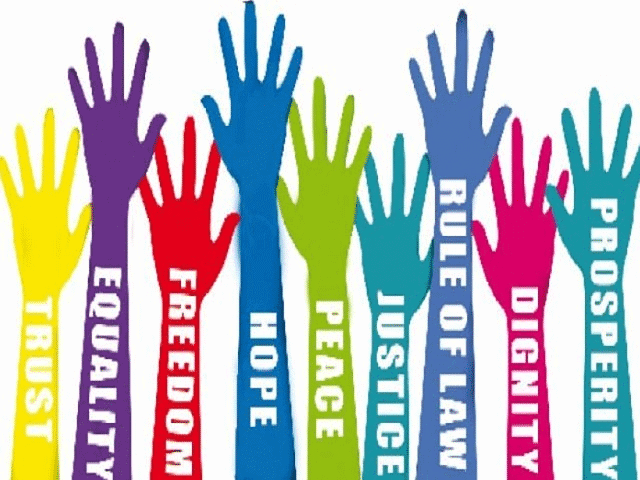
Ans: Democracy promotes equality among citizens as it is the people’s own government.

  • It enhances the dignity of the individual.
  • It also improves the quality of decision-making.
  • It provides methods to resolve conflicts if any.
  • Only democracy allows room to correct mistakes.
  • It is a legitimate government.
  • Gives equal status and respect to women and weaker sections.
  • It promotes transparency.
  • Values of social justice, equality, fraternity.
  • It gives importance to public opinion.
  • It provides rights to people.
  • It gives the feeling of collective belonging.
  • It encompasses the feeling of integrity secularism and tolerance.
  • It inculcates the feeling of integrity and dutifulness.
  • It may be slow, less efficient, not always very responsive or clean. A democratic government is the people’s own government.
  • There is overwhelming support for the idea of democracy all over the world—in countries with democratic regimes as well as non-democratic regimes.


Q31: “Democracy is accountable and responsive to the needs and expectations of the citizens.” Evaluate the statement. (CBSE (Comptt) 2017)
OR

“Democratic government is known as responsive government.” Assess the statement.   (CBSE (Comptt) 2017)

Hide Answer  

Ans: Democracy is accountable and responsive to the needs and expectations of the citizens

  • The most basic outcome of democracy is that it produces a government that is accountable to the citizens, and responsive to the needs and expectations of the citizens. 
  • Economic growth and development -level of economic development is slow because of delays in decision making. 
  • Accommodation of social diversity – the majority should work with the minority. 
  • Dignity and freedom of citizens-every individual want to receive respect from fellow beings. Equality for women.


Q32: How does democracy stand better than any other form of government in promoting the dignity and freedom of the citizens? Explain with examples.   (CBSE (Comptt) 2017)

Hide Answer  

Ans: Democracy stands better than any other form of government in promoting the dignity and freedom of citizens:

  • Respect and Freedom: The passion for respect and freedom is the basis of democracy which is recognized throughout the world in principle.
  • Dignity of women: Democracy provides dignity to women by giving them the freedom to fight for their rights.
  • Right to equality: equal status and equal opportunity have a legal sanction in democracy.
  • Individual freedom: In a democracy, every individual has the freedom to pursue his goal.

Q33: “Democratic government is legitimate government”? Support the statement with arguments. (CBSE Delhi 2016)
OR
How is a “democratic government” a “legitimate government”? Explain with examples. (CBSE Delhi 2017)

Hide Answer  

Ans: Democratic government is a legitimate government: It may be slow, less efficient, not always very responsive or clean. But a democratic government is peoples’ own government. That is why there is overwhelming support for the idea of democracy all over the world. People wished to be ruled by representatives elected by them. They also believe that democracy is suitable for their country. Democracy’s ability to generate its own support is itself an outcome that cannot be ignored.
Democratic Government is known as legitimate government:

  • Democracy produces a government that follows and is accountable to the people.
  • It provides a mechanism for citizens to hold the government accountable and allows citizens to take part in decision making whenever they think fit.
  • If you wanted to measure democracies on the basis of this expected outcome you would look for the following practices and institutions regular free and fair election, open public debate on major policies.


Q34: Democracy accommodates social diversities. Support the statement with examples. (CBSE (AI) 2016)
OR
How is social diversity accommodated in democracy? Explain with examples.  (CBSE (Al) 2017)

Hide Answer  

Ans: “Democracy accommodates social diversities”.
Democracy develops a mechanism which successfully negotiates difference among the ethnic population.

  • Democracies develop a procedure to conduct their competition. This reduces the possibility of these tensions becoming explosive or violent.
  • No society can fully and permanently resolve conflicts among different groups. But we can certainly learn to respect these differences and can evolve a mechanism to negotiate these differences. 
  • The ability to handle social differences, divisions and conflicts is thus a definite plus point of democratic regimes. Democracy accommodates social diversity as it allows for equality, fair representation to all irrespective of their caste, creed, colour, race, religion, language or place of residence. 
  • Democracy also ensures that the government should not be made by the majority but it should have the representation of minorities as well.  
  • For example: Belgium has successfully negotiated differences among the ethnic population. This reduces the possibility of tensions.


Q35: Explain any one difference between a pressure group and a political party.  (CASE (AI) 2017)

Hide Answer  

Ans: One difference between a pressure group and a political party is that political parties contest elections and hold power in the government while pressure groups attempt to influence government policies.


Q36: Explain the meaning of transparency in democracy.    (CBSE (AI) 2017)

Hide Answer  

Ans: In a democracy, decision making is based on norms and procedures. A citizen has the right and the means to examine the process of decision making. This is known as transparency.


Q37: If you want to extract information about the functions of any government department, which right would you exercise? (CBSE 2017)

Hide Answer  

Ans: I would exercise my Right to Information (RTI) to extract information about the functions of any government department.


Q38: How is democracy based on political equality in India?  (CBSE 2017, 15)

Hide Answer  

Ans: In India, every citizen above 18 years of age has the right to vote. Every citizen has the right to contest elections irrespective of his/ her caste, religion, creed, economic status, etc. if he/she is 21 years of age. Hence, democracy is based on political equality in India.

Also read: Mind Map: Outcomes of Democracy

Previous Year Questions 2016

Q39: In which area does democracy fail to achieve the same results as in dictatorship?   (2016)

Hide Answer  

Ans: Democracy may fail to achieve the same results as dictatorship in terms of efficiency and speed of decision-making. In a democracy, decision-making often involves extensive discussions, debates, and consultations, which can be time-consuming. On the other hand, in a dictatorship, decisions are made by a single ruler or a small group of individuals, allowing for quick and decisive actions. However, it is important to note that democracy provides greater transparency, inclusivity, and protection of individual rights, which are crucial for a just and equitable society.


Q40: What is meant by economic inequality?  (2016)

Hide Answer  

Ans: Economic inequality refers to the disparities and uneven distribution of economic assets and income within a society. It is characterized by a significant gap between the wealthy and the poor, where a small portion of the population possesses a large share of wealth and resources, while the majority struggles with poverty and limited economic opportunities. Economic inequality can result from various factors such as unequal access to education, employment opportunities, social privileges, and discriminatory practices.


Q41: Name any two sectional interest groups.  (Al 2016)

Hide Answer  

Ans: Two examples of sectional interest groups are Labor Unions and Farmer Associations. Labor Unions represent the collective interests and rights of workers, advocating for better working conditions, fair wages, and improved labor laws. Farmer Associations, on the other hand, represent the interests of farmers and agricultural workers, focusing on issues related to farming practices, agricultural policies, and rural development.


Q42: Which system can reduce the possibility of tension and conflict among different groups of society?  (2016)

Hide Answer  

Ans: Democracy is a system that can reduce the possibility of tension and conflict among different groups of society. Through democratic processes such as open dialogue, inclusive decision-making, and respect for individual rights and freedoms, democracy provides a platform for different groups to express their opinions, negotiate their differences, and work towards common goals. By ensuring equal participation and representation, democracy encourages cooperation, compromise, and the peaceful resolution of conflicts, thereby fostering social harmony and stability.


Q43: Suggest some broad guidelines that can be kept in mind while devising ways and means for political reforms in India.   (C-BST Sample Paper 2016)

Hide Answer  

Ans: Some important political reforms should be done for improving democracy in India. These are:

  • A law should be made to regulate the internal affairs of political parties. Political parties should maintain a register of its members, to hold open elections, to follow its own Constitution, etc.
  • Political parties can be monitored by ordinary citizens, pressure groups, media, etc. Pressure on political parties can be done through petitions, publicity and agitation.
  • The quality of democracy depends on the degree of public participation. It is difficult to reform politics if ordinary citizens do not directly participate in politics and simply criticize it from outside. 

Thus, the participation of common people in politics is necessary for democracy.


Q44: “Democratic governments in practice are known as accountable.” Support the statement with arguments.   (CBSE (F) 2016)

Hide Answer  

Ans: Democratic governments in practice are accountable:

  • It is right to expect democracy to produce a government that follows procedures and is accountable to the people.
  • It is also expected that the democratic government develops mechanisms for citizens to take part in decision making whenever they think it is fit.
  • The democratic government is accountable to the people. If it ignores the will of the people, they will not elect their ruler in the next general election.
  • The procedures and decision-making process should be transparent for democratic government to be accountable to the people.


Q45: “No party system is ideal for all countries and in all situations.” Analyse the statement.  (CBSE (All) 2017, CBSE (F) 2016)

Hide Answer  

Ans: Party system is not something any country can choose:

  • It evolves over a long time, depending on the nature of society.
  • It depends on social and regional divisions.
  • It depends on the history of politics and its system, of elections.
  • These cannot be changed very quickly.
  • Each country develops a party system that is conditioned by its special circumstances.


Q46: Complaints are treated as a testimony to the success of democracy.” Justify the statement.   (CBSE 2017-18C)

Hide Answer  

Ans: 

  • Complaints are treated as a testimony to the success of democracy as they highlight the awareness of people and their expectations from the system that has been put in place.
  • In a democracy, the scrutiny is ongoing. As democracy passes over one test, it produces another test. As people get some benefits of democracy, they ask for more and want to make democracy even better.
  • People always come up with more expectations and complaints.
  • A public expression of dissatisfaction with democracy shows the success of the democratic project. It transforms people from the status of a subject into that of a citizen. 
  • Most individuals today believe that their vote makes a difference to the way the government is run and to their own self-interest.


Q47: Describe any five characteristics of democracy.   (CBSE (Al) 2017)

Hide Answer  

Ans: Democracy is a better form of government than any other form of government:

  • Democracy promotes equality among citizens: In democracies, every citizen vote has the same value irrespective of gender, caste, religion, or race. This ensures political equality among its citizens.
  • Democracy enhances the dignity of the individual:  Democracy is based on the the principle of political equality, on recognizing that the poorest and the least educated has the same status as the rich and the educated.
  • Democracy improves the quality of decision making: Democracy is based on consultation and discussion. A democratic decision always involves many persons, discussions and meeting. When a number of people put their heads together, they are able to point out possible mistakes in any decision. Even though this takes time but taking time over important decisions is a must 
  • Provides a method to resolve conflicts: Democracy provides a method to deal with differences and conflicts as different people have different opinions and interests. However, there are free and fair elections. In a democracy, no one is a permanent loser or a permanent winner. Different groups can live with one another in harmony and peace. 
  • Accountable, responsive and legitimate government: In a democracy, the Government is always held accountable. If any of the policies, and laws are not implemented properly, then the citizens have the right to vote them out in the next elections. Moreover, in a democracy, citizens can approach the Judiciary, if the Government has taken any actions which are counter productive to the well-being of citizens. 
  • Reduction of inequality and poverty: Governments can intervene to promote equity, and reduce inequality and poverty, through the tax and benefits system. This means employing a progressive tax and benefits system which takes proportionately more tax from those on higher levels of income, and redistributes welfare benefits to those on lower incomes. 
  • Democracy promotes transparency:  Democratic government ensures that the decision-making process is based on proper norms and procedures. Citizens have the right to examine the process of decision making. A democratic government develops mechanisms for the citizens to hold the government accountable and mechanism for citizens to take part in decision making whenever they think fit.


Q48: “A democracy must look after the interests of all, not just one section.” Support the statement with arguments.   (CBSE (F) 2017)

Hide Answer  

Ans: Democracy must look after the interest of all because:

  • Democracy believes in and work for equality.
  • It has the ability to handle social differences irrespective of religion or race or linguistic group, etc.  
  • It gives equal treatment to women.
  • It cares equally for the majority and minority.
  • Democracy in India has strengthened the claims of the disadvantaged.
  • It tries to provide equal opportunities to minority and depressed classes.
  • Ordinary citizens value their democratic rights.
  • Democracy shows that people have developed awareness.
  • It has the ability to expect and look critically at power holders.


Q49: “Democracy stands much! superior in promoting dignity and freedom of the citizens.” Justify the statement.   (CBSE Delhi 2017, CBSE (Al) 2016)

Hide Answer  

Ans: “Democracy stands much Superior in promoting dignity and freedom of the citizens”:

  • Every individual wants to receive respect from fellow beings.
  • The passion for respect and freedom are the basis of democracy.
  • Democracies throughout the world have recognized this. It has been achieved in various degrees in various democracies.
  • Long struggles by women have got them respect and equal treatment and now accepted as necessary ingredients of a democratic society.
  • In many democracies, women were deprived of their right to vote for a long time which they have achieved new.
  • In India, 1/3rd of seats have been reserved for women in local bodies.
  • Democracy has strengthened the claims of the disadvantaged and discriminated castes for equal status and equal opportunity.
  • Legal basis which works on the principle of individual freedom and dignity.


Q50: Evidence shows that in practice, many democracies did not fulfil the expectation of producing economic development in the country. Validate the statement with the help of a relevant example.   (CBSE Sample Paper 2016)

Hide Answer  

Ans: If we consider all democracies and all dictatorships for the fifty years between 1950 and 2000, dictatorships have a slightly higher rate of economic growth.
Economic development depends on several factors: country’s population size, global situation, cooperation from other countries, economic priorities adopted by the country, etc.
However, the difference in the rates of economic development between less developed countries with dictatorships and democracies is negligible. Overall, it cannot be said that democracy is a guarantee of economic development But we can expect democracy not to lag behind dictatorships in this respect.
When such a significant difference in the rates of ectopic growth between countries under dictatorship and democracy, it is better to prefer democracy as it has several other positive outcomes.


Q51: “A public expression of dissatisfaction with democracy shows the success of the democratic project.” Justify the statement.   (CBSE (F) 2016)

Hide Answer  

Ans: “A public expression of dissatisfaction with democracy shows the success of the democratic project”:

  • As democracy passes one test, it produces another test. As people get some benefits of democracy they ask for more and want to make democracy even better.
  • That is why when we ask people about the way democracy functions, they will always come up with more expectations, and many complaints.
  • The fact that people are complaining is itself a testimony to the success of democracy; it shows that people have developed awareness and the ability to expect and to look critically at power holders and the high and the mighty.
  • A public expression of dissatisfaction with democracy shows the success of the democratic project; it transforms people from the states into citizens.
  • Most individuals today believe that their vote makes a difference to the way the government is run and to their own self-interest.


Q52: Mention any two common features of democratic politics.  (CBSE 2016, 12)

Hide Answer  

Ans: Features of a democratic government are: 
(1) Free and fair elections are organised. 
(2) The principle of ‘one person, one vote, one value’ is followed.

Previous Year Questions 2015

Q53: What is meant by transparency? (CBSE 2015)

Hide Answer  

Ans: Transparency means that every citizen belonging to any democratic country has the right to information, the right to examine or investigate whether the laws, plans, action, policies or decisions taken by the government are correct or are beneficial to them or not.


Q54: How does democracy produce an accountable government? (CBSE 2015)

Hide Answer  

Ans: Democracy produces an accountable government by giving the citizen the right to examine the process by which decisions are made


Q55: Democracy accommodates the social diversities. Support the statement with examples. (CBSE 2015)

Hide Answer  

Ans: Democracy accommodates social diversities and this can be asserted as follows: (1) Democracies develop a procedure to conduct their competition. This reduces the possibility of these social conflicts or tensions becoming explosive or violent. (2) A democratic society learns to respect these differences and can evolve a mechanism to negotiate these differences. (3)     Ability to handle social differences, divisions and conflicts is a benefit of democratic regimes.
04. Previous Year Questions: Political Parties

Previous Year Questions 2025

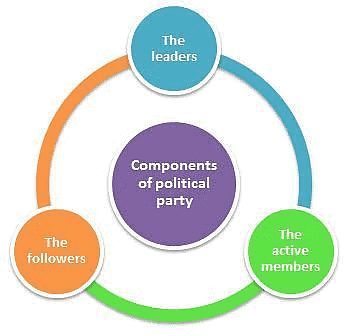
Q1: Which of the following are the main components of a political party? Choose the correct option:  (1 Mark)

I. Leaders
II. Active members
III. Followers
IV. Pressure groups
(a) 
Only I, II, and III are correct.
(b) Only II, III, and IV are correct.
(c) Only I, III, and IV are correct.
(d) Only I, II, and IV are correct.

Hide Answer  

Ans: (a) Only I, II, and III are correct.
According to the chapter, a political party has three main components — the leaders, the active members, and the followers. Pressure groups are not a component of a political party; they are separate organisations that may be extensions of parties.


Q2: Explain the importance of political parties in democracy.  (3 Marks)

Hide Answer  

Ans: Political parties are essential for the working of democracy because they perform vital functions such as:

  • Contesting Elections: Parties put up candidates and fight elections to fill political offices and exercise power.
  • Policy Making: They put forward different policies and programmes, allowing voters to choose between alternatives.
  • Forming and Running Governments: The party that wins forms the government, while others play the role of opposition by criticising the government and mobilising opposition.
  • Shaping Public Opinion: Parties raise and highlight issues, helping people form opinions on various matters.
  • Providing Access to Government: Parties act as a link between the people and the government by addressing people’s needs and demands.

In summary: Political parties are necessary because they make representative democracy work effectively and ensure that governments are accountable to the people.


Q3: Why did India adopt the multiparty system? Explain with suitable arguments.  (3 Marks)

Hide Answer  

Ans: India adopted a multiparty system because of its social and geographical diversity and large population. The reasons are:

  1. Diverse Society: India has a vast variety of religions, languages, regions, and cultures. This diversity cannot be represented by just two or three parties.
  2. Representation of Different Interests: A multiparty system allows different opinions and regional interests to have political representation.
  3. Historical and Political Evolution: India’s party system evolved naturally from its political and social conditions, not by choice.


Q4: Describe three main functions of political parties.  (3 Marks)

Hide Answer  

Ans: The three main functions of political parties are:

  1. Contesting Elections: Political parties nominate candidates to contest elections and seek to win popular support to form the government.
  2. Policy Formulation: Parties put forward different policies and programmes, and the voters choose from them. The ruling party then frames laws and policies based on its ideology.
  3. Forming and Running Governments: The winning party forms the government, while the opposition parties criticise the government and offer alternative policies.


Q5: Describe three major challenges faced by political parties in India.  (3 Marks)

Hide Answer  

Ans: The three major challenges faced by political parties in India are:

  1. Lack of Internal Democracy: Power is concentrated in the hands of a few leaders. Ordinary members are not consulted in decision-making, and internal elections are rarely held.
  2. Dynastic Succession: Top positions are often controlled by members of one family, which is unfair to other members and weakens democracy.
  3. Use of Money and Muscle Power: Parties nominate candidates who can raise or spend large amounts of money, and sometimes support criminals to win elections.


Q6: To reform the party system, which of the following tasks have been made compulsory for political parties? Choose the most appropriate option:  (1 Mark)
I. It is now compulsory for all political parties to file income tax returns.
II. It is now compulsory for all parties to have one-third women candidates.
III. It is now compulsory for all political parties to hold their organizational election.
IV. It is now compulsory for all candidates to disclose information about pending criminal cases against them through affidavit.
(a)
 Only I, II, and III are correct.
(b) Only I, II, and IV are correct.
(c) Only I, III, and IV are correct.
(d) Only II, III, and IV are correct.

Hide Answer  

Ans: (c) Only I, III, and IV are correct.

According to the chapter, the Election Commission has made it compulsory for political parties to hold organisational elections and file income tax returns, while the Supreme Court has made it mandatory for every candidate to file an affidavit giving details of property and criminal cases. There is no law making one-third women candidates compulsory.


Q7: Describe any three features of the multiparty system.  (3 Marks)

Hide Answer  

Ans: The three features of the multiparty system are:

  • Competition Among Several Parties: More than two parties compete for power, and several of them have a reasonable chance of forming the government.
  • Coalition Governments: When no single party gets a majority, different parties join together to form an alliance or front to run the government.
  • Representation of Diversity: This system allows various interests, opinions, and social groups to be represented in the political process, reflecting the country’s diversity.


Q8: Which of the following statements are correct related to the role of political parties in India?  (1 Mark)
I. Play a decisive role in making laws for the country.
II. Making different interest groups in the country.
III. Play a role in shaping public opinion in the country.
IV. Pulling forward different policies and programs before voters.
(a) 
Only I, II, and III are correct.
(b) Only I, III, and IV are correct.
(c) Only II, III, and IV are correct.
(d) Only I, II, and IV are correct.

Hide Answer  

Ans: (b) Only I, III, and IV are correct.

Political parties play a decisive role in making lawsshape public opinion, and put forward different policies and programmes before voters. They do not create different interest groups — those are usually formed separately or as extensions of parties.


Q9: Read the following source and answer the questions that follow:  (4 Marks)
The Need for Political Parties
As we have seen, large societies need representative democracy. As societies became large and complex, they also needed some agency to gather different views on various issues and to present these to the government. They needed some ways to bring various representatives together so that a responsible government could be formed. They needed a mechanism to support or restrain the government, make policies, justify or oppose them. Political parties fulfill these needs that every representative government has. We can say that parties are a necessary condition for a democracy.

(i) Explain the meaning of ‘representative democracy’.  (1 Mark)

Hide Answer  

Ans: Representative democracy is a system where people elect their representatives to make laws, form policies, and run the government on their behalf.

(ii) How do political parties shape public opinion?  (1 Mark)

Hide Answer  

Ans: Political parties shape public opinion by raising and highlighting issues, conducting movements, and spreading their views among the people through their large network of members and activists.

(iii) Why are political parties considered a necessary condition for a democracy? Explain.  (2 Marks)

Hide Answer  

Ans: Political parties are necessary because they bring together different views from society, present them to the government, and help form a responsible government. They act as a mechanism to support or restrain the government, make policies, justify or oppose them — fulfilling essential needs of a representative democracy.


Q10: Two statements are given below. They are Assertion (A) and Reason (R). Read both the statements and choose the correct option:  (1 Mark)
Assertion (A): Every party in India has to register with the Election Commission.
Reason (R): The Government provides election symbols to all political parties in India.
(a) Both (A) and (R) are true and (R) is the correct explanation of (A).
(b) Both (A) and (R) are true, but (R) is not the correct explanation of (A).
(c) (A) is true, but (R) is false.
(d) (A) is false, but (R) is true.

Hide Answer  

Ans: (c) (A) is true, but (R) is false.

Every political party in India must register with the Election Commission — this is correct. However, it is the Election Commission, not the government, that provides election symbols to political parties. Therefore, the reason is false.

Previous Year Questions 2024

Q1: How do Political Parties ensure accountability to the public? Choose the most suitable option from the following.    (1 Mark) (CBSE 2024)
(a)
 Through Press Conferences
(b) Through Social Media Campaigns
(c) Through encouraging Partisanship
(d) Through Elections and Voter Support

Hide Answer  

Ans: (d)
Elections are the primary means by which political parties are held accountable to the public. Voters are able to assess the candidates’ performance and decide whether or not to endorse them based on their deeds and statements.


Q2: Describe any three functions of the Political Parties.    (3 Marks) (CBSE 2024)

Hide Answer  

Ans: Functions of Political Parties are: 
(1) They contest election.
(2) They put forward different policies and programmes.
(3) Parties form and run the government.
(4) Parties that lose in the election play the role of opposition.
(5) They shape public opinion.
(6) They provide people access to government machinery and welfare schemes.

Previous Year Questions 2023

Q3: Which one of the following countries has two party system?    (1 Mark) (2023)
(a) 
China
(b) 
Russia
(c) 
America
(d) 
India

Hide Answer  

Ans: (c)
The United States operates under a two-party system, primarily dominated by the Democratic Party and the Republican Party. This means that most elections are primarily contested between these two parties, making it easier for voters to choose between two distinct options. In contrast, other countries like China and Russia have different political systems, and India has multiple parties, which is known as a multi-party system.


Q4: Explain the merits of Multi Party System.     (3 Marks) (2023)

Hide Answer  

Ans: The merits of a multi-party system include:

  • Diverse representation: It allows various interests and opinions to participate in politics.
  • Inclusivity: In a diverse country, this system addresses the needs of different sections of society.


Q5: Analyze the need of Political Parties in the Democracy.  (3 Marks) (CBSE 2023)
OR
Describe the roles of Political Parties in India. (CBSE 2014)

Hide Answer  

Ans: The need of political parties in a democracy are as follows: 
(1) Parties contest elections. In most democracies, elections are fought mainly among the candidates put up by political parties. 
(2) Parties play a decisive role in making laws for a country. They mould public opinion. 
(3) Parties provide people access to government machinery and welfare schemes implemented by governments.

Get additional INR 200 off today with EDUREV200 coupon.

Previous Year Questions 2022

Q6: Differentiate between ruling and opposition parties.     (Term-ll, 2021-22)

Hide Answer  

Ans: The ruling party is the political party that wins elections and forms the government. It is responsible for making and implementing policies.

In contrast, the opposition party consists of those parties that do not achieve a majority in the elections. Their role includes:

  • Critiquing the government’s decisions and policies.
  • Voicing alternative views and concerns.
  • Mobilising public opinion against the ruling party.


Q7: Why has India adopted a multi-party system? Explain.     (Term-ll, 2021-22, Foreign 2017, Al 2016)

Hide Answer  

Ans: India has adopted a multi-party system due to its vast social and geographical diversity. This system allows for a range of interests and opinions to be represented in politics. 
Key reasons include:

  • The large population and varied cultures make it difficult for just one or two parties to represent everyone.
  • A multi-party system encourages political representation for different groups.
  • It allows for the formation of alliances among parties, which can lead to more stable governance.

Overall, this system reflects the complex nature of Indian society and ensures that multiple voices are heard in the political arena.


Q8: How do political parties shape public opinion?    (Term-ll, 2021-22)

Hide Answer  

Ans: Political parties shape public opinion in the following ways:

  • Highlighting issues: They raise awareness about various social and political issues.
  • Membership influence: With a large number of members across the country, parties often form pressure groups that represent different societal sections, helping to shape public views.
  • Launching movements: Parties sometimes initiate movements to address problems faced by the public.
  • Access to government: They provide citizens easier access to government services and welfare schemes, making it simpler to approach local party leaders than government officials.


Q9: Explain how the rise of political parties is directly linked to the emergence of representative democracies.     (Term-ll, 2021-22)

Hide Answer  

Ans: The rise of political parties is closely linked to the development of representative democracies. As societies grow and become more complex, they require effective governance. 
Here are key points illustrating this connection:

  • Political parties serve as a foundation for representative government.
  • They collect and express public opinions on important issues.
  • Parties unite various representatives, enabling them to support or challenge the government.
  • They help formulate policies and communicate these to the public, based on their political ideologies.
  • These functions are essential for the healthy functioning of representative democracies.

Thus, political parties are vital for the establishment and maintenance of a representative democratic system.


Q10: Explain any three features of a ‘one-party system’.    (Term-ll, 2021-22)

Hide Answer  

Ans: Three features of one party system are as follows: 
(i) Only one party is allowed to control and rule the government. There is no change of government and power is concentrated in the hands of the party leader.
(ii) In this system electoral politics does not permit free competition for power.
(iii) There is absence of the checks and balances provided by democratic government.


Q11: “Political parties have become omnipresent in democracies all over the world.” Explain the statement with examples.     (Term-ll, 2021-22)

Hide Answer  

Ans: We need political parties because of the functions that the political parties perform:
(i) They contest in elections.
(ii) They put forward different policies and programme for the betterment of society.
(iii) They play a decisive role in the making of laws that affect each of us.
(iv) They form and run the government.
(v) They play the role of opposition to the ruling party.
(vi) They shape public opinion, as they raise and highlight issues.
(vii) They provide people access to government machinery and welfare schemes implemented by the government.


Q12: Describe the role of political parties in Indian democracy.    (Term-ll, 2021-22 C, 2020 C)

Hide Answer  

Ans: Indian democracy has a multi-party system, political parties perform a series of functions to strengthen our democracy in the following manners:
(i) Contesting elections : Political parties contest elections; A political party nominates its candidate for the electoral contest in various constituencies. This provides a variety of choice of personalities for the people to vote for.
(ii) Policies : Political parties put forward different policies and programmes so that the voters can choose from amongst them. A political party brings a large number of similar opinions under one umbrella. These opinions are channelised to form policies and programmes. The policies and programmes of the ruling party generally become the government policies.
(iii) Making law : Political parties play a decisive role in making laws for the country that benefits the v/hole population.
(iv) Playing opposition : A party which does not get majority or does not come under the majority coalition, needs to play the role of opposition. This forms the basis of checks and balances in a democracy.
(v) Shaping public opinion: Political parties shape public opinion. They do so by raising and highlighting issues in the legislature and in the media.
(vi) Providing access to government machinery: Political parties provide people access to government machinery and welfare schemes implemented by governments. Parties need to be responsive to people’s needs and demands thus bring good governance. 

Political parties are as easily one of the most visible institutions in a democracy. For most ordinary citizens, democracy is equal to political parties.


Q13: “There are various reforms taken to strengthen parties in India so that they perform their function well.” Explain the statement with examples.    (Term-II,2021-22)

Hide Answer  

Ans:  To strengthen political parties in India and enhance their functioning, several reforms have been implemented.
Here are some examples:
(i) Transparency and Accountability: Requiring political parties to disclose their funding sources and expenditures to ensure transparency and accountability. For example, the Election Commission of India has introduced guidelines for parties to submit annual audited reports.
(ii) Internal Democracy: Encouraging parties to adopt internal democratic processes such as holding regular elections for party leadership positions. This promotes inclusivity and fairness within the party structure.
(iii) Anti-defection Law: Implementing the Anti-defection law to prevent elected representatives from switching parties indiscriminately, thus promoting stability and party discipline.
(iv) State Funding of Elections: Providing state funding for elections to reduce the influence of money power and promote a level playing field for all parties, especially smaller ones with limited resources.
(v) Electoral Reforms: Introducing reforms like electronic voting machines (EVMs) to ensure free and fair elections, reducing malpractices and enhancing the credibility of the electoral process.
(vi) Strengthening Election Commission: Empowering the Election Commission to regulate and oversee the conduct of elections impartially, ensuring that parties adhere to the set guidelines and rules.
These reforms aim to strengthen political parties in India, enabling them to fulfill their functions effectively and serve the interests of the public better.

Previous Year Questions 2021

Q14: Read the source given below and answer the questions that follow:    (2021 C)
Democracies that follow a federal system all over the world tend to have two kinds of political parties : parties that are present in only one of the federal units and parties that are present in several or all units of the federation. This is the case in India as well. There are some countrywide parties, which are called ‘national parties’. These parties have their units in various states. But by and large, all these units follow the same policies, programmes and strategy that is decided at the national level.
Every party in the country has to register with the Election Commission. While the Commission treats all parties equally, it offers some special facilities to large and established parties. These parties are given a unique symbol – only the official candidates of that party can use that election symbol. Parties that get this privilege and some other special facilities are ‘recognised’ by the Election Commission for this purpose. That is why these parties are called, ‘recognised political parties’. The Election Commission has laid down detailed criteria of the proportion of votes and seats that a party must get in order to be a recognised party. A party that secures at least 6 percent of the total votes in an election to the Legislative Assembly of a State and wins at least two seats is recognised as a State party. A party that secures at least six percent of total votes in Lok Sabha elections or Assembly elections in four States and wins at least four seats in the Lok Sabha is recognised as a National party.
Answer the following MCQs by choosing the most appropriate option:

(i) Which one of the following is a National party?
(a)
 Bharatiya Janata Party
(b) Samajwadi Party
(c) Shiv Sena
(d) Shiromani Akali Dal

Hide Answer  

Ans: (a) 
The Bharatiya Janata Party (BJP) is recognized as a national party in India because it has a presence in multiple states and follows a unified policy and strategy set at the national level. It meets the criteria laid out by the Election Commission, which includes securing a specific percentage of votes and winning a certain number of seats in elections. In contrast, the other options, like the Samajwadi Party, Shiv Sena, and Shiromani Akali Dal, are primarily focused on specific states and do not have the same national reach.

(ii) Which of the following is not a regional party?   [Old NCERT]
(a) 
Jharkhand Mukti Morcha
(b) Asom Gana Parishad
(c) Indian National Congress
(d) Dravida Munnetra Kazhagam

Hide Answer  

Ans: (c)
The Indian National Congress (INC) is not a regional party because it operates across the entire country and has units in multiple states. In contrast, the other options like Jharkhand Mukti Morcha, Asom Gana Parishad, and Dravida Munnetra Kazhagam are regional parties that primarily focus on specific areas or states in India.

(iii) Where does every political party have to register in India?
(a) 
Government of India
(b) NITI Aayog
(c) Election Commission
(d) Law Commisssion

Hide Answer  

Ans: (c)
In India, every political party must register with the Election Commission. This ensures that the party is recognized officially and can participate in elections. The Election Commission regulates the conduct of elections and maintains a fair electoral process in the country.

(iv) When a party that secures at least six per cent of total votes in Lok Sabha elections or Assembly elections in four states and wins at least four seats of Lok Sabha, it is recognised as a :
(a) 
Regional Party
(b) National Party
(c) Pressure Group
(d) Business Organisation

Hide Answer  

Ans: (b)
A party is recognized as a National Party in India if it secures at least 6% of the total votes in Lok Sabha elections or Assembly elections in four states and wins at least four seats in the Lok Sabha. This recognition allows the party to have certain privileges, like using a unique election symbol across the country.

Previous Year Questions 2020

Q15: Give one technical term for the following statement: “A person who is strongly committed to a party or group.”  (2020 C)

Hide Answer  

Ans: Partisan 

partisan is someone who is strongly committed to a specific party or group. This commitment often leads to:

  • A tendency to take a side on issues.
  • An inability to view matters from a balanced perspective.

Partisanship can influence political dynamics, as it reflects loyalty to particular policies and interests.


Q16: Describe the role of political parties in Indian democracy.    (Term-ll, 2021-22 C, 2020 C)

Hide Answer  

Ans: Indian democracy operates within a multi-party system, where political parties play essential roles to enhance democratic governance. 
Their functions include:

  • Contesting elections: Political parties nominate candidates for elections, providing voters with diverse choices.
  • Formulating policies: They present various policies and programmes, allowing voters to select options that reflect their views. This helps consolidate similar opinions into coherent policies.
  • Making laws: Political parties are crucial in the legislative process, contributing to laws that benefit the entire population.
  • Opposition role: Parties not in the majority serve as the opposition, ensuring checks and balances within the government.
  • Shaping public opinion: They influence public discourse by raising important issues in both the legislature and media.
  • Access to government: Political parties facilitate citizens’ access to government services and welfare schemes, promoting good governance.

Political parties are among the most visible institutions in a democracy. For many citizens, the concept of democracy is closely linked to the presence and actions of political parties.


Q17: Define the term ‘Political Party’. Explain with examples the need for political parties in India.   (2020)

Hide Answer  

Ans: Political parties: A political party is a group of people who come together to contest elections and hold power in the government. 
Need of Political Parties in India:
(i) The rise of political parties is directly linked to the emergence of representative democracies.
(ii) As societies became large and complex, they also needed some agency to gather different views on various issues and to present these to the government.
(iii) They needed some ways, to bring various representatives together so that a responsible government could be formed.
(iv) They needed a mechanism to support or restrain the government, make policies, justify or oppose them.
(v) Political parties fulfill these needs that every representative government has.


Q18: Correct the following statement and rewrite it: Bahujan Samaj Party (BSP) was formed under the leadership of Mayawati.    (2020)

Hide Answer  

Ans: 

  • The Bahujan Samaj Party (BSP) was established in 1984 under the leadership of Kanshi Ram.
  • It aims to represent the interests of the Bahujan Samaj, which includes DalitsAdivasisOBCs, and religious minorities.
  • The party draws inspiration from leaders such as Sahu MaharajMahatma PhulePeriyar Ramaswami Naicker, and Babasaheb Ambedkar.
  • Its focus is on securing the rights and welfare of the oppressed communities.
  • The BSP has a strong presence in Uttar Pradesh and neighbouring states like Madhya Pradesh and Chhattisgarh.


Q19: Suggest any one way to make political parties more responsive to people’s needs and demands. (CBSE 2020, 15)

Hide Answer  

Ans: Political parties can be made more responsive through organised petitions, agitations and publicity by various groups. 
Explanation: This shall make political parties pay more attention to people’s needs to secure their support.


Q20: Suggest any one way to promote public participation in political parties for enhancing the quality of democracy. (CBSE 2020)

Hide Answer  

Ans: Following are the ways in which public participation in political parties can be promoted: 
(1) Parties should make their election process more transparent and elect more candidates from among the common people. 
(2) Various platforms like social media can be used to allocate them small responsibilities to maintain their interest in party activities.

Also read: PPT: Political Parties

Previous Year Questions 2019

Q21: Explain the three components of a political party.      (CBSE Delhi 2019 (32/1/2) 

Hide Answer  

Ans: 


The three components of a political party are as follows:

  • The Leaders: The leaders are the ones who hold positions of power at various levels in the sphere of politics. They belong to different political parties. The leaders of the ruling party are responsible for the impact of various policies and processes and address issues of the people time and again.
  • The Active members: Political parties comprise lakhs of members and political activists across the entire nation. They play an important role in promoting the agenda of the party including a focus on issues and various policies and party leadership.
  • The Followers: The followers of a political party are the supporters of the ideas and agenda of that particular political party. They are the citizens of the general public who strongly believe in the ideas and approaches of the party and extend their support to the party, especially during elections.

Note: A political party is a group of people with similar ideologies who come together to form an organization in order to contest elections and hold power in the government.


Q22: How are Political parties recognised as regional and National parties in India?    (CBSE Delhi 2019)

Hide Answer  

Ans: India has a multi-party system, where political parties are classified as national, state or regional level parties. All parties are registered with the Election Commission.
The criterion for Recognition by The Election Commission as national or state-level parties.

National Party:
(i) A party that secures at least six per cent of total votes in Lok Sabha elections or Assembly elections in four States and wins at least four seats in the Lok Sabha is recognised as a national part.
(ii) Now, India has seven recognised national parties.
(iii) Indian National Congress, Bhartiya Janta Party.

State Party:
(i) A party that secures at least 6 per cent of the total votes in an election to the Legislative Assembly of a State and wins at least two seats is recognised as a State party.
(ii) There are 54, state recognised parties in India.
(iii) Biju Janta Dal, Mizo National Front


Q23: Define the two-party system. Explain its advantages and disadvantages. (CBSE 2019)

Hide Answer  

Ans: Two party system: In a democratic system power usually changes between two main parties, several other parties may exists but only the two main parties have a serious chance of winning majority of seats to form government is known as Two Party System.
Advantages: 
(1) Several other parties contest election. 
(2) Clarity of manifestoes and programs. 
Disadvantages: 
(1) Limited choice to the voters. 
(2) Limited representation.

Previous Year Questions 2018

Q24: Political parties fill political offices and exercise political power. But they do this by performing a series of important functions. Describe any five of them.  [CBSE 2018]
Or 
Describe the role of political parties in a democratic state. [CBSE 2017-18]

Hide Answer  

Ans: Political parties play a crucial role in democracies by performing several important functions:

  • Contest elections: Political parties field candidates to compete in elections, allowing voters to choose from various options.
  • Formulate policies: They present different policies and programmes, helping to group similar opinions and guide government direction.
  • Opposition role: Parties that do not win elections serve as the opposition, critiquing the government and highlighting its failures.
  • Shape public opinion: Political parties raise and focus on issues that matter to the public, influencing societal views and discussions.
  • Access to government: They provide citizens with easier access to government services and welfare schemes, making it simpler for people to voice their concerns.


Q25: Illustrate the situations which display lack of internal democracy within a political party. (CBSE 2018)

Hide Answer  

Ans: Situations which display lack of internal democracy within a political party: 
(1) Parties do not keep membership registers, do not hold organisational meetings, and do not conduct internal elections regularly. 
(2) Ordinary members of the party do not get sufficient information on what happens inside the party. 
(3) They do not have the means or the connections needed to influence the decisions. As a result, the leaders assume greater power to make decisions in the name of the party. 
(4) Since one or few leaders exercise paramount power in the party, those who disagree with the leadership find it difficult to continue in the party. 
(5) More than loyalty to party principles and policies, personal loyalty to the leader becomes more important.

Attention!Sale expiring soon, act now & get EduRev Infinity at 40% off!

Previous Year Questions 2017

Q26: Which organization does recognize ‘Political Parties in India?    (CBSE 2017, 11)

Hide Answer  

Ans: The Election Commission of India is responsible for the task of recognizing political parties in India. Every party in India has to register with the Election Commission and it also lays down detailed criteria for state as well as national level parties to qualify as a particular ‘party.’


Q27: Name any two regional political parties of U.P. (Uttar Pradesh).     (CBSE 2017)

Hide Answer  

Ans: Two Regional Political Parties of UP:

  • Samajwadi Party (S.P.)
  • Rashtriya Lok Dal (R.L.D.)


Q28: Assess the importance of political parties in a democracy.     (CBSE (F) 2017)

Hide Answer  

Ans: Importance of Political Parties:

  • Parties contest elections to form a government.
  • Parties put forward different policies and programmes and the voters choose from them.
  • A party reduces a vast multitude of opinions into a few basic positions which it supports.
  • Parties play a decisive role in making laws for a country.
  • Parties recruit leaders, trains them and then make them ministers to run the Government.
  • Parties provide people access to government machinery and welfare schemes implemented by governments.


Q29: “Political Parties are a necessary condition for a democracy.” Analyse the statement with examples.     (CBSE (Comptt) 2017)

Hide Answer  

Ans: Political parties are a necessary condition for a democracy: If political parties don’t exist then:

  • Every candidate in the elections will be independent.
  • No one will be able to make any promise to the people about any major policy changes. 
  • The government may be formed, but its utility will remain ever uncertain.
  • Elected representatives will be accountable to their constituency for what they do in the locality.
  • No one will be responsible for how the country will be run.
  • Political parties are important for representative democracies as they bring representatives together to form the government.
  • It consists of people seeking to achieve their objectives through constitutional means and aims at promoting national interest.


Q30: Why did India choose to have a multi-party system?
OR
Examine the reason to accept a multi-party system in India.     (CBSE (F) 2017)

Hide Answer  

Ans: India adopted multi-party system because

  • It strengthens democracy.
  • India is geographically a very large country.
  • India is socially a very diverse country.
  • India is culturally and religiously a diverse country.
  • All these diversities can be accommodated if there is a multi-party system and just 1 party or 2 party system will not help in more representation and participation of people in democratic processes.


Q31: Elucidate some of the recent efforts taken in our country to reform political parties and their leaders.     (CBSE Delhi 2017)
OR
Examine any two institutional amendments made by different institutions to reform political parties and their leaders.     (CBSE (F) 2016)

Hide Answer  

Ans:

  • The Constitution was amended to prevent elected MLAs and MPs from changing parties. This was done because many elected representatives were indulging in DEFECTION in order to become ministers or for cash rewards. Now, if any MLA or MP changes parties, he or she will lose the seat in the legislature. 
  • The Supreme Court passed an order to reduce the influence of money and criminals. Now, it is mandatory for every candidate who contests elections to file an AFFIDAVIT giving details of his property and criminal cases pending against him. The new system has made a lot of information available to the public. But there is no system of check if the information given by the candidates is true. 
  • The Election Commission passed an order making it necessary for political parties to hold their organisational elections and file their income tax; returns. The parties have started doing so but sometimes it is a mere formality. It is not clear if this step has led to greater internal democracy in political parties.


Q32: Describe in brief the recent efforts that have been made in India to reform political parties and their leaders.     (CBSE 2016-17C)

Hide Answer  

Ans: Recent efforts to reform political parties and their leaders are as given below:

  • Anti-defection law: In India, many elected representatives started indulging in changing party allegiance from the party to which a person had got elected to a different party in order to become ministers or for cash rewards. So in order to curb this tendency, anti-defection law was passed. According to it, if any MLA or MP changes parties, he or she will lose the seat in the legislature. Now MPs and MLAs have to obey the decisions of the party.
  • Filing of an affidavit: The Supreme Court has made it mandatory for every candidate who contests an election to file an affidavit giving details of his property and criminal cases pending against him. This has been done to reduce the influence of money and criminals.
  • Hold organisational elections: The Election Commission has made it necessary for political parties to hold their organisational elections and file their income tax returns.


Q33: How can the growing role of money and muscle power in political parties be controlled? Suggest any three measures. (CBSE 2017)

Hide Answer  

Ans: The growing role of money and muscle power in political parties can be controlled in the following ways: 
(1) There should be state funding of elections. 
(2) Rath yatras, rallies and processions should be banned. 
(3) All types of elections should be held at the same time. 
(4) It should be mandatory for every candidate contesting elections to file an affidavit giving details of his/her property and criminal cases pending against him/her, if any. 
(5) Political parties should hold their organisational elections and file their income tax returns


Q34: Explain any three recent efforts made to reform political parties in India. (CBSE 2017, 11)
OR
Suggest any three reforms to make political parties more democratic. (CBSE 2017)

Hide Answer  

Ans: Recent efforts made to reform political parties in India are: 
(1) Anti-defection law has been introduced, under which a member can be disqualified if he/she goes against the instructions issued by the party for monetary benefits. 
(2) To reduce the influence of money and muscle power in the parties, funding of political parties has been made transparent and democratic. Funds can only be accepted if complete documentation has been attached and miscreants are likely to be punished. 
(3) It is mandatory for any candidate to file an affidavit giving details of his property and cases pending against him/her before nomination.

Previous Year Questions 2016

Q35: Why is a one-party system not considered a good democratic system?    (CBSE 2016)

Hide Answer  

Ans: A one-party system is not seen as a good democratic system for several reasons:

  • It limits political competition, preventing alternative viewpoints.
  • There is a lack of accountability and transparency in governance.
  • Healthy democracies require multiple parties to foster debate and represent diverse interests.

In contrast, systems with multiple parties encourage a broader range of opinions and choices.


Q36: Name any one political party that has a national-level political organization but is not recognized as the national political party.    (Al 2016)

Hide Answer  

Ans: Samajwadi Party, Samata Party, Rashtriya Janata Dal


Q37: Name the alliance formed by the Congress Party.    (CBSE 2016)

Hide Answer  

Ans: The alliance formed by the Congress Party is known as the United Progressive Alliance (UPA).


Q38: Which party was the principal opposition party in Lok Sabha in 2004?    (2016)  [Old NCERT]

Hide Answer  

Ans: The principal opposition party in the Lok Sabha in 2004 was the Bharatiya Janata Party (BJP).


Q39: What are the components of a political party?       (CBSE (AI) 2016)

Hide Answer  

Ans: The components of a political party include:

  • Leaders: They create the party’s policies and select candidates for elections.
  • Active members: These individuals engage in various party committees and participate in activities.
  • Followers: Supporters who believe in the party’s ideology and vote for it during elections.


Q40: Name any one political party that has a national-level political organisation but not recognised as the national political party. (CBSE Delhi 2016)

Hide Answer  

Ans: State parties like the Samajwadi Party, Samata party and Rashtriya Janata Dal have National level political organisations with units in several States but are not recognised as national parties.


Q41: Why is a one-party political system not considered a good democratic system?     (CBSE (F) 2016)

Hide Answer  

Ans: The one-party political system is not considered a good democratic system for several reasons:

  • It lacks democratic choice, as there is no competition for power.
  • Democracy requires at least two parties to compete in elections.
  • In a healthy democracy, multiple parties should have a fair chance to gain power.
  • Countries like the United States and the United Kingdom exemplify a two-party system.
  • multiparty system, like in India, allows several parties to compete for power.
  • In a one-party system, such as in China, only one party controls the government, limiting political freedom.


Q42: What is meant by a ‘national political party? State the conditions required to be a national political party.    (CBSE Delhi 2016)

Hide Answer  

Ans: National Political Party has units in the various states, they follow the same policies, programmes and strategy that is decided at the national level.
Conditions required:
(i) A party that secures at least 6% of the total votes in general elections of Lok Sabha or assembly elections in four states.
(ii) Wins at least 4 seats in Lok Sabha.


Q43: “Nearly every one of the state parties wants to get an opportunity to be a part of one or the other national-level coalition.” Support the statement with arguments.     (CBSE 2016)

Hide Answer  

Ans: State parties seeking National level coalition: Before the general election of 2014, in three general elections, no one national party was able to secure on its own a majority in Lok Sabha. As a result, the national parties were compelled to form alliances with state or regional parties. Since 1996, nearly every one of the state parties has got an opportunity to be a part of one or the other national-level coalition government. This has contributed to the strengthening of federalism and democracy.


Q44: What is meant by a regional political party? State the conditions required to be recognised as a ‘regional political party.    (CBSE (Al) 2016) 

Hide Answer  

Ans: A regional Party is a party that is present only in some states. Conditions required for a party to be recognised as a regional political party are:

  • Regional political party (or state party) is a party that has its presence only in one or some states.
  • The regional parties may not always be regional in their ideology or outlook. Examples of some regional parties with units in several states include Samajwadi Party, Samata Party, Rashtriya Janata Dal etc. Parties such as Biju Janata Dal or Mizo National Front are conscious about their state identity.
  • According to the criteria laid down by the Election Commission, a party that secures at least six per cent of the total votes in an election to the legislative assembly of a state and wins at least two seats is recognized as a state party.


Q45: What is a political party? State any two points of the ideology of the Bhartiya Janata Party.      (CBSE (F) 2016)

Hide Answer  

Ans: political party is a group of individuals who unite to contest elections and gain power in the government. They share common policies and programmes aimed at promoting the collective good of society.

The ideology of the Bharatiya Janata Party (BJP) includes:

  • Full territorial and political integration of Jammu and Kashmir with India.
  • A uniform civil code for all citizens, regardless of religion.
  • Emphasis on cultural nationalism.


Q46: Why did India adopt a multi-party system?     (CBSE (AI) 2016)

Hide Answer  

Ans: India has adopted a multi-party systemdue to its vast size and diverse society. 
Here are key reasons:

  • Social Diversity: India is home to various cultures, languages, and religions, making it challenging for just two or three parties to represent all interests.
  • Geographical Diversity: The country’s varied geography contributes to different regional issues, necessitating multiple parties to address these effectively.
  • Political Representation: A multi-party system allows for a broader range of opinions and interests to be represented in government.

This system can lead to coalitions where parties join forces to form a government, reflecting the complex political landscape of India.


Q47: “All over the world, people express their dissatisfaction with the failure of political parties to perform their functions well.” Analyse the statement with arguments.     (CBSE Delhi 2016)

Hide Answer  

Ans: Popular dissatisfaction and criticism: It has focused on four areas in the working of political parties, need to face and overcome these challenges in order to remain effective instruments of democracy. Lack of internal democracy within parties.

  • Dynastic succession: Since most political parties do not practice open transparent procedures for their functioning, there are very few ways for an ordinary worker to rise to the top in a party. Those who happen to be leaders are in a position of unfair advantage to favour people close to them or even their family member.
  • The growing role of money and muscle power in parties: Since parties are focused only on mining elections, they land to use shortcuts to win elections. They feed to nominate those considers who have or can raise a lot of mercy. Rich people and companies who give funds to the parties tend to have an influence on the policies and decisions of the party. In some cases, parties support climates that can win an election.
  • There is not a meaningful choice to the voters: In recent years there has been a decline in the ideological parties of the world. Sometimes different leaders either because shifting from one party to another.


Q48: What suggestions are often made to reform political parties?
OR
Suggest any five effective measures to reform political parties.     (CBSE (AI) 2016)

Hide Answer  

Ans:

  • A law should be made to regulate the internal affairs of political parties. It should be made compulsory for political parties to maintain a register of its members, to follow its own constitution, to act as a judge in case of party disputes and to hold open elections to the highest post.”
  • It should be made mandatory for political parties to give a minimum number of tickets, about one-third to the women candidates. 
  • There should be state funding for elections. The government should give parties money to support their election expenses. This support can be given in a way like; petrol, paper, telephone, etc. Or, it could be given in cash on the basis of votes, secured by the party in the last elections. It should be mandatory to hold their organisational elections. 
  • People can put pressure on political parties through petitions, publicity and agitation. 
  • Parties should reduce the influence of money and criminals. 
  • The parties should select candidates for contesting elections who have a good record.


Q49: “Political parties are a necessary condition for a democracy”. Analyse the statement with examples.    (CBSE (AI) 2016)
OR

“About hundred years ago there were a few countries that had hardly any political party. Now, there are a few countries that do not have political parties .” Examine this statement.

Hide Answer  

Ans: Political parties are a necessary condition for democracy.

  • Without political parties, democracies cannot exist.
  • If we do not have political parties – in such a situation every candidate in elections will be independent.
  • No one will be able to make any promises to the people about any major policy changes.
  • The rise of political parties is directly linked to the emergence of representative democracies. As we have seen, large societies need representative democracy.
  • The government may be formed but its utility will remain uncertain. They needed some ways to bring various representatives together so that a responsible government could be formed.
  • They needed some mechanisms to support or restrain the government, make policies, justify or oppose them.
  • Elected representatives will be accountable to their constituency for what they do in their locality.
  • Political parties play a decisive role in making laws for a country. Formally laws are debated and passed in the legislature in which the ruling party plays a major role.
  • Parties form and run governments. Parties recruit leaders, train them and then make them ministers to run the government in the way they want.
  • Those parties that lose in the elections play the role of opposition to the parties in power, by voicing different views and criticising for its failure or wrong policies.
  • Parties shape public opinions. They raise and highlight issues. Parties have lakhs of members and activists spread all over the country. Parties sometimes also launch movements for the resolution of problems faced by people.
  • But no one will be responsible for how the country will run.
  • The role of the opposition party in a democracy necessitates the existence of political parties,
  • As societies become large and complex, they also needed some agencies to gather different views on various issues and to present these to the government, that is why political parties are needed.

Previous Year Questions 2015

Q50: “Lack of internal democracy within parties is the major challenge to political parties all over the world.” Analyse the statement. (CBSE 2015)
Or 

In what way lack of internal democracy is seen in the political parties?

Hide Answer  

Ans:

  • All over the world, there is a tendency of political parties towards the concentration of power in one or few leaders at the top. 
  • Parties do not keep membership register. 
  • They do not regularly hold organisational meetings. 
  • They do not conduct internal elections regularly. 
  • Ordinary members of the party do not have sufficient information as to what happens inside the party. 
  • As a result, the leaders assume greater power to make decisions in the name of the party.


Q51: What is the multi-party system? Why did India adopt a multi-party system?      (CBSE 2015)

Hide Answer  

Ans: Multi-party system: A multi-party system exists when several political parties compete for power, and more than two parties have a realistic chance of winning either independently or through alliances.

Reasons for India’s multi-party system:

  • Each country develops a party system based on its unique circumstances.
  • India’s vast social and geographical diversity cannot be effectively represented by just two or three parties.


Q52: Why do political parties involve partisanship? (CBSE 2015)

Hide Answer  

Ans: Parties follow different ideologies and people who support these ideologies passionately are its supporters. These supporters work hard to prove that their political party and its ideology is the only correct and ideal approach towards development of the country. In this process, they become staunch supporters of their parties which is called being a partisan.

Also read: PPT: Political Parties

Previous Year Questions 2014

Q53: Describe any three functions of the Political Parties. (CBSE 2014)

Hide Answer  

Ans: Functions of Political Parties are: 
(1) They contest election. 
(2) They put forward different policies and programmes. 
(3) Parties form and run the government


Q54: Name the “Regional political parties” that are predominant in Jharkhand, Maharashtra and in Odisha respectively with their symbols. (CBSE 2014)

Hide Answer  

Ans: The “Regional political parties” that are predominant in Jharkhand, Maharashtra and in Odisha respectively with their symbols are:

Previous Year Questions 2013

Q55: Name the national political party which espouses secularism and welfare of weaker sections and minorities. Mention any four features of that party. (CBSE 2013)

Hide Answer  

Ans: Indian National Congress (INC) espouses secularism and welfare of weaker sections and minorities. Four features of the party are as follows:

  • Commitment to Secularism: The party promotes harmony among different religions and ensures equality irrespective of religious or cultural differences.
  • Focus on Welfare of Weaker Sections: The INC advocates for policies aimed at uplifting marginalized groups, such as Scheduled Castes, Scheduled Tribes, and minorities, through reservations, scholarships, and welfare schemes.
  • Support for Economic Reforms with Social Justice: The party supports liberalization and privatization while balancing the interests of weaker sections through programs aimed at poverty alleviation and rural development.
  • Advocacy of Democratic Values: The INC emphasizes democratic principles, striving for a fair and inclusive political environment within its party framework and in governance

03. Previous Year Questions: Federalism

Previous Year Questions 2025

Q1: Read the given source and answer the questions that follow:  (4 Marks)
Decentralisation in India
The need for decentralisation was recognised in our Constitution. Since then, there have been several attempts to decentralise power to the level of villages and towns. Panchayats in villages and municipalities in urban areas were set up in all the States. But these were directly under the control of state governments. Elections to these local governments were not held regularly. Local governments did not have any powers or resources of their own. Thus, there was very little decentralisation in effective terms. A major step towards decentralisation was taken in 1992. The Constitution was amended to make the third-tier of democracy more powerful and effective.

(i) At how many levels has decentralisation of power been done in the Indian Constitution? (1 Mark)

Hide Answer  

Ans: Decentralisation of power has been done at three levels — the Union Government, the State Governments, and the local governments (Panchayats and Municipalities). 

(ii) Explain the role of local self-government in solving problems.  (1 Mark)

Hide Answer  

Ans: Local self-government plays an important role in solving problems because people have better knowledge of local issues and can decide how to spend money and manage things efficiently. It allows direct participation of people in decision-making.

(iii) “Local government is the best way to realise one important principle of democracy, namely local self-government.” Explain the statement.  (2 Marks)

Hide Answer  

Ans: Local government enables people to participate directly in decision-making about issues that affect their daily lives. It helps inculcate a habit of democratic participation and ensures that governance becomes more accountable and effective at the grassroots level. By empowering people at the village and town level, it fulfils the democratic ideal of self-rule by the people

Q2: Choose the correctly matched pair from the following:  (1 Mark)
(a) Concurrent List – Education
(b) Concurrent List – Defence
(c) Concurrent List – Police
(d) Concurrent List – Trade

Hide Answer  

Ans: (a)

Education is a subject of common interest to both the Union and State Governments and is therefore included in the Concurrent List. Both can make laws on it, but if there is a conflict, the Union law prevails.


Q3: Choose the correct option related to concurrent list of the Indian Constitution: (1 Mark)
(a) Marriage, Currency, Commerce
(b) Defence, Banking, Education
(c) Agriculture, Trade, Irrigation
(d) Education, Forest, Marriage

Hide Answer  

Ans: (d)

The Concurrent List includes subjects of common interest to both the Union and State Governments such as education, forest, trade unions, marriage, adoption, and succession.


Q4: Choose the correct option related to Union list:  (1 Mark)
(a) Police, Foreign affairs, Agriculture
(b) Trade, Irrigation, Marriage
(c) Education, Commerce, Banking
(d) Currency, Communication, Defence

Hide Answer  

Ans: (d)

The Union List includes subjects of national importance such as defence of the country, foreign affairs, banking, communications, and currency, on which only the Union Government can make laws.


Q5: Explain the main features of the Indian federal system. (3 Marks)

Hide Answer  

Ans: The main features of the Indian federal system are:

  • Two or more levels of government:
    India has a three-tier system — the Union Government, the State Governments, and the Local Governments.
  • Division of powers:
    The Constitution clearly divides powers between the Union and the State Governments through three lists — Union List, State List, and Concurrent List.
  • Constitutional authority of each level:
    The existence and authority of each level of government are constitutionally guaranteed, and one level cannot change the powers of the other unilaterally.
  • Independent judiciary:
    Courts, especially the Supreme Court, act as an umpire in case of disputes between different levels of government.
  • Financial autonomy:
    The sources of revenue for each level are clearly specified to ensure financial independence.


Q6: How does the Indian federal structure promote balanced governance across the nation?  (1 Mark)
(a) 
By allowing states to exercise complete autonomy on all issues.
(b) By ensuring a division of power between centre and states.
(c) By allowing all decision-making processes under the Union Government.
(d) By giving more powers to local governments in comparison to states.

Hide Answer  

Ans: (b) By ensuring a division of power between centre and states.
India’s federal structure ensures balanced governance by dividing powers between the Union and State Governments through the Union, State, and Concurrent Lists. This allows both levels to function independently within their own areas of jurisdiction.


Q7: Read the following source and answer the questions that follow:  (4 Marks)
Local Self Government
The local government structure goes right up to the district level. A few gram panchayats are grouped together to form what is usually called a panchayat samiti or block or mandal. The members of this representative body are elected by all the panchayat members in that area. All the panchayat samitis or mandals in a district together constitute the zilla (district) parishad. Most members of the zilla parishad are elected. Members of the Lok Sabha and MLAs of that district and some other officials of other district-level bodies are also its members. Zilla parishad chairperson is the political head of the zilla parishad. Similarly, local government bodies exist for urban areas as well. Municipalities are set up in towns. Big cities are constituted into municipal corporations. Both municipalities and municipal corporations are controlled by elected bodies consisting of people’s representatives. Municipal chairperson is the political head of the municipality. In a municipal corporation, such an officer is called the mayor. This new system of local government is the largest experiment in democracy conducted anywhere in the world.

(i) Explain the relationship between gram panchayats and panchayat samitis.  (1 Mark)

Hide Answer  

Ans: A few gram panchayats are grouped together to form a panchayat samiti (also called block or mandal). The members of the panchayat samiti are elected by all the members of the gram panchayats in that area.

(ii) How is the structure of municipal corporation different from municipality?  (1 Mark)

Hide Answer  

Ans: municipality is set up in towns, while a municipal corporation is established in big cities. Both are controlled by elected bodies, but the political head of a municipality is the municipal chairperson, whereas in a municipal corporation it is the mayor.

(iii) How does the local government structure promote democracy? Examine.  (2 Marks)

Hide Answer  

Ans: Local government promotes democracy by ensuring direct participation of people in decision-making at the village and city levels. It enables citizens to take part in discussions on local issues, helps in better governance, and strengthens the principle of self-government. This deepens democracy and makes it more representative and accountable.

Q8: Read the given source and answer the questions that follow:  (4 Marks)
State Reorganisation Commission
“The report of the States Reorganisation Commission (SRC), was implemented on November 1, 1956. This, in its own time and own way, has also transformed the political and institutional life of the nation. … Gandhi and other leaders promised their followers that when freedom came, the new nation would be based on a new set of provinces, these based on the principle of language. However, when India was finally free in 1947, it was also divided… Far from undermining Indian unity, linguistic states have helped strengthen it. It has proved to be perfectly consistent to be Kannadiga and Indian, Bengali and Indian, Tamil and Indian, Gujarati and Indian. To be sure, these states based on language sometimes quarrel with one another.

Hide Answer  

(i) What promise did Gandhiji make to his followers?  (1 Mark)

Ans: Gandhiji and other leaders promised their followers that when freedom came, the new nation would be organised into provinces based on the principle of language.

(ii) How did language strengthen the unity of India?  (1 Mark)

Hide Answer  

Ans: The creation of linguistic states helped people of the same language live together, making administration easier and more efficient. Instead of dividing the country, it strengthened Indian unity by allowing people to maintain both their regional identity and national identity — for example, being Kannadiga and Indian.

(iii) Mention the names of major language of Kerala and Andhra Pradesh states.  (2 Marks)

Hide Answer  

Ans: The major language of Kerala is Malayalam, and the major language of Andhra Pradesh is Telugu.


Q9: Read the following statements regarding the creation of States on the basis of language in India and choose the correct options:  (1 Mark)
I. Formation of states on the basis of language made the country more united and stronger.
II. Formation of states on the basis of language made administration easier.
III. Formation of states on the basis of language has weakened the federal structure.
IV. Formation of states on the basis of language led to the development of Indian languages.
(a) 
Only I, II and III are correct.
(b) Only II, III and IV are correct.
(c) Only I, II and IV are correct.
(d) Only I, III and IV are correct.

Hide Answer  

Ans: (c) Only I, II and IV are correct.

The formation of linguistic states made the country more united and stronger (I)made administration easier (II), and helped in the development and recognition of Indian languages (IV).
It did not weaken the federal structure; instead, it strengthened unity and democracy.


Q10: Differentiate between federal and unitary form of government with examples.  (3 Marks)

Hide Answer  

Ans: A federal government divides power between central and regional units, while a unitary government concentrates power at the center.


Q11: Read the given source and answer the questions that follow:  (4 Marks)
Source: A city called Porto Alegre in Brazil has carried out an extraordinary experiment in combining decentralisation with participative democracy. The city has set up a parallel organisation operating alongside the municipal council, enabling local inhabitants to take real decisions for their city. The nearly 13 lakh people in this city get to participate in making the budget for their own city. The city is divided into many sectors or what we call wards. Each sector has a meeting, like that of the gram sabha, in which anyone living in that area can participate. There are some meetings to discuss issues that affect the entire city. Any citizen of the city can participate in those meetings. The budget of the city is discussed in these meetings. The proposals are put to the municipality that takes a final decision about it.

(i) Explain the meaning of ‘participatory democracy’. (1 Mark)

Hide Answer  

Ans: Participatory democracy means direct involvement of people in the decision-making process of governance. Citizens actively participate in discussions, planning, and budgeting for their local areas. 

(ii) In the context of separation of powers, the given example defines which type of government?  (1 Mark)

Hide Answer  

Ans: The given example defines a decentralised form of government, where power is shared with local bodies and people participate directly in governance. 

(iii) Describe the structure of the system in India which is almost similar to the example of Brazil.  (2 Marks)

Hide Answer  

Ans: In India, a similar system exists through the three-tier structure of local self-government:

  • Gram Panchayat at the village level,
  • Panchayat Samiti or Block/Mandal at the intermediate level, and
  • Zilla Parishad at the district level in rural areas.
    In urban areas, Municipalities and Municipal Corporations function similarly, allowing citizens to participate in decision-making about local issues.

Previous Year Questions 2024

Q1: Choose the correct answers to the questions from the given options. Match Column-I with Column-II and choose the correct option from the following:    (1 Mark) (CBSE 2024)

Options:
(a)
 (A)-(IV ), (B)-(I), (C)-(III), (D)- (IV)
(b) (A)-(II), (B)-(III), (C)-(I), (D)- (IV)
(c) (A)-(I), (B)-(II), (C)-(IV ), (D)- (III)
(d) (A)-(III), (B)-(IV ), (C)-(II), (D)- (I) 

Hide Answer  

Ans: (b)

(A) Union List – (II) Banking: Banking is primarily managed by the central government, which falls under the Union List.

(B) State List – (III) Police: The police force is a subject that is managed by individual states, so it belongs to the State List.

(C) Concurrent List – (I) Trade Union: Trade unions can be regulated by both the central and state governments, making them a subject in the Concurrent List.

(D) Residuary List – (IV) Internet: The internet is a newer subject not explicitly mentioned in the Constitution, thus it falls under the Residuary List where powers are given to the government to legislate on subjects not specified.

Previous Year Questions 2023

Q2: Read the given source and answer the questions that follow:   (4 & 5 Marks) (2023)
Language Diversity of India
How many languages do we have in India? The answer depends on how one counts it. The latest information that we have is from the Census of India held in 2011. This census recorded more than 1300 distinct languages which people mentioned as their mother tongues. These languages were grouped together under some major languages. For example languages like Bhojpuri, Magadhi, Bundelkhandi, Chhattisgarhi, Rajasthani and many others were grouped together under ‘Hindi’. Even after this grouping, the Census found 121 major languages. Of these 22 languages are now included in the Eighth Schedule of the Indian Constitution and are therefore called ‘Scheduled Languages’. Others are called ‘Non-Scheduled Languages’. In terms of languages, India is perhaps the most diverse country in the world.
(I) Explain the importance of language diversity in India.
(II) Differentiate between Scheduled and Non-Scheduled Languages.
(III) The fusion of languages has united the country into one cultural entity.’ Explain the statement with an example.

Hide Answer  

Ans: (i) Importance of Language Diversity in India:

  • India’s vast number of languages contributes to its cultural diversity.
  • This diversity helps to preserve the unique identities of various communities.

(ii) Difference Between Scheduled and Non-Scheduled Languages:

  • Scheduled Languages: There are 22 languages recognised in the Indian Constitution, known as scheduled languages.
  • Non-Scheduled Languages: All other languages not included in this list are referred to as non-scheduled languages.

(iii) Fusion of Languages and Cultural Unity: The statement highlights how the blending of diverse languages and cultures has fostered a shared national identity. For instance, unlike Sri Lanka, Indian leaders have been careful in promoting Hindi, allowing for a more inclusive approach to language use.


Q3: Match Column-A with Column-B and choose the correct option.     (1 Mark) (2023)

(a) I – 4 , II – 3, III – 1, IV – 2
(b)
 I – 3 , II – 4, III – 1, IV – 2
(c)
 I – 4 , II – 1, III – 3, IV – 2
(d)
 I – 2 , II – 3, III – 1, IV – 4

Hide Answer  

Ans: (d)

I. Defence – 2. Union List: Defence is managed by the central government, which is why it falls under the Union List.

II. Police – 3. State List: The police force is a state subject, meaning individual states have the power to legislate on this issue, so it belongs to the State List.

III. Marriage – 1. Concurrent List: Laws regarding marriage can be made by both the central and state governments, which is why it is included in the Concurrent List.

IV. Computer Software – 4. Residual Subjects: Since computer software is a newer subject not specifically mentioned in the Constitution, it falls under the Residual Subjects, allowing the government to make laws on it.


Q4: Match the column – A with column – B and choose the correct option.           (1 Mark) (2023)

(a) I – 4 , II – 3, III – 1, IV – 2
(b)
 I – 3 , II – 4, III – 1, IV – 2
(c) 
I – 2 , II – 3, III – 1, IV -4
(d)
 I – 4 , II – 2, III – 1, IV – 3

Hide Answer  

Ans:  (c)

(I) Banks – 2. Union List: Banking is primarily managed by the central government, so it falls under the Union List.

(II) Agriculture – 3. State List: Agriculture is mainly regulated by individual states, making it a subject in the State List.

(III) Education – 1. Concurrent List: Education is a subject where both the central and state governments can make laws, which is why it is included in the Concurrent List.

(IV) Computer – 4. Residuary Subjects: The topic of computers is newer and not specifically mentioned in the Constitution, placing it in the Residual Subjects category, allowing the government to legislate on it.


Q5: Identify the administrative level of Indian Government with the help of the information given in the box and choose the correct option:   (1 Mark)  (CBSE 2023)
1. Power shared between Central to Local Government.
2. The State Governments are required to share some powers and revenue with them.
3. It is called a three tier government._________
(a)
 Dictatorial System
(b)
 Unitary Federal System
(c)
 Decentralised System
(d)
 Imperialistic System

Hide Answer  

Ans: (c)
A Decentralised System means that power and responsibilities are distributed from the central government to local governments, allowing them to make decisions about local matters. In India, this involves a three-tier government structure with the central, state, and local levels, where state governments share powers and revenue with local authorities, enhancing local governance and participation.


Q6: Read the given extract and answer all questions.    (4 Marks) (2023)
DECENTRALISATION IN INDIA

When power is taken away from Central and State governments and given to local government, it is called decentralization. The basic idea behind decentralization is that there are a large number of problems and issues which are best settled at the local level. People have better knowledge of problems in their localities. They also have better ideas on where to spend money and how to manage things more efficiently. Besides at the local level it is possible for the people to directly participate in decision making. This helps to inculcate a habit of democratic participation. Local government is the best way to realise one important principle of democracy, namely local self-government. The need for decentralisation was recognized in our Constitution. Since then, there have been several attempts to decentralize power to the level of villages and towns. Panchayats in villages and muncipalities in urban areas were set up in all the States. But these were directly under the control of State Governments. Elections to these local governments were not held regularly.
(i) Explain Decentralization in democracy.
(ii) Explain the importance of Local self Government in democracy.
(iii) Describe any two steps taken by Indian government for decentralization.

Hide Answer  

Ans: (i) Decentralisation in democracy refers to the transfer of power from central and state governments to local governments. This process allows local authorities to address issues more effectively, as they have a better understanding of local problems.
(ii) The importance of local self-government includes:

  • Local issues are often best resolved at the community level.
  • Residents possess better insights into spending priorities and resource management.
  • It encourages direct participation in decision-making, fostering a culture of democratic involvement.

(iii) Two significant steps taken by the Indian government for decentralisation are:

  • Establishment of Panchayats in villages and municipalities in urban areas across all states.
  • Mandatory regular elections for local government bodies, ensuring local representation.
Get additional INR 200 off today with EDUREV200 coupon.

Previous Year Questions 2022

Q7: Which one of the following countries is the example of Holding together federation?     (2022)
(a) Australia
(b) India
(c) U.SA
(d) Switzerland

Hide Answer  

Ans: (b)

India is an example of a holding together federation
Here are some key points:

  • In a holding together federation, the central government is typically more powerful than the states.
  • Different states may have unequal powers, with some granted special rights.
  • Other examples include Spain and Belgium.

In contrast, Australia, the USA, and Switzerland are examples of coming together federations.


Q8: Identify the correct feature of Unitary form of government from the following options.     (2022)  [Old NCERT]
(a) There are two or more levels of government.
(b) Different tiers of government govern the same citizens.
(c) Each tier of government has its own jurisdiction.
(d) The sub-units are subordinate to the central government.

Hide Answer  

Ans: (d)

In a unitary form of government:

  • The sub-units are subordinate to the central government.
  • There is either one level of government or the lower levels follow the orders of the central government.

This means that the central government has the authority to direct provincial or local governments.


Q9: Choose the correct pair among the following:     (2022)  [Old NCERT]
(a) A – 1
(b) B – 2
(c) C – 3
(d) D – 4

Hide Answer  

Ans: (d)
Russia, Canada and Argentina are federal countries. China is a unitary country.


Q10: Which of the following countries is an example of ‘coming together federation?   (2022)
(a) United States of America
(b) India
(c) Spain
(d) Belgium

Hide Answer  

Ans: (a)

  • The United States is an example of a ‘coming together’ federation.
  • In this type of federation, constituent states typically have equal power.
  • In contrast, India, Spain, and Belgium represent ‘holding together’ federations.
  • In holding together federations, the central government usually has more power than the states.


Q11: Which one of the following subjects is included in the Union list?     (Term-1,2021-22)
(a) Communication
(b) Trade
(c) Commerce
(d) Irrigation

Hide Answer  

Ans: (a)
Communication is included in the Union list


Q12: Which one of the following subjects is included in the State list?    (Term-1, 2021-22)
(a) Banking
(b) Business
(c) Currency
(d) Communication

Hide Answer  

Ans: (b)
Business is included in the State list. Banking, currency and communication are included in the Union list.


Q13: Which one of the following subjects is included in the Concurrent List?     (Term-1,2021-22)
(a) Trade
(b) Commerce
(c) Agriculture
(d) Marriage

Hide Answer  

Ans: (d)
Concurrent list includes subjects of common interest to both the Union Government as well as the State Government. These are education, forest, marriage, adoption and succession.


Q14: Match Column I with Column II and choose the correct option:   (2022)

(a) l – C, II – D, III – B, IV – A
(b)
 I – A, II – B, III -C, IV – D
(c) 
l – D, II – C, III – B, IV – A
(d)
 l – B, II – A, III – C, IV – D

Hide Answer  

Ans: (c)

(I) Union List – D. Defence: Defence is primarily a central government responsibility, so it falls under the Union List.

(II) State List – C. Police: The police force is managed by state governments, which makes it a subject in the State List.

(III) Concurrent List – B. Forest: Forest management can be legislated by both the central and state governments, placing it in the Concurrent List.

(IV) Subsidiary Matters – A. Computer-related matter: Since computer-related issues are more recent and not specifically detailed in the Constitution, they fall under Subsidiary Matters.

Previous Year Questions 2021

Q15: Identify the correct feature of Unitary form of government from the following options: 
(a) There are two or more levels of government. 
(b) Different tiers of government govern the same citizens. 
(c) Each tier of government has its own jurisdiction. 
(d) The sub-units are subordinate to the central government. (CBSE Term-1 2021)

Hide Answer  

Ans: (d)
In a Unitary form of government, all powers are centralized at the national level. The central government holds the primary authority, and any administrative divisions (sub-units) function under its control. The sub-units do not have independent jurisdiction but instead operate as extensions of the central government, with limited powers that are often delegated by the central authority.
The other options are characteristics of a federal form of government, where:
(a) There are two or more levels of government.
(b) Different tiers of government govern the same citizens.
(c) Each tier has its own jurisdiction and powers defined by the constitution.
Therefore, the correct answer is (d) The sub-units are subordinate to the central government.


Q16: Which one of the following countries is the example of ‘Holding together federation’? 
(a) Australia 
(b) India 
(c) U.S.A. 
(d) Switzerland (CBSE Term-1 2021)

Hide Answer  

Ans: (b)
In a Holding Together Federation, the central government shares power with constituent states or regions, but the division of power is typically unequal, with the central authority retaining more control. This model is used to unify a country with diverse regions and cultural groups, aiming to hold them together under a single federal structure.
India is an example of a Holding Together Federation, as the union government holds significant power, and states have varying degrees of autonomy.


Q17: Which one of the following subjects is included in the Concurrent List? 
(a) Trade 
(b) Commerce 
(c) Agriculture 
(d) Marriage (CBSE Term-1 2021)

Hide Answer  

Ans: (d)
In the Indian Constitution, subjects are divided into three lists: the Union List, the State List, and the Concurrent List.
(i) The Concurrent List includes subjects on which both the central and state governments can legislate. However, in case of a conflict, the central law prevails.
(ii) Marriage is included in the Concurrent List, allowing both the central and state governments to make laws regarding marriage.
The other options are part of different lists:
(i) Trade and Commerce are typically included in the Union and State Lists, depending on whether they are inter-state or intra-state.
(ii) Agriculture is in the State List, giving states the power to legislate on it.
Therefore, the correct answer is (d) Marriage.


Q18: Choose the correct pair among the following:  (CBSE Term-1 2021)

Hide Answer  

Ans: 
(a) Russia – Unitary:
 Incorrect. Russia is a federal country, with powers divided between the central government and various federal subjects.
(b) China – Federal: Incorrect. China has a unitary system, where the central government holds primary authority, and administrative divisions operate under its control.
(c) Canada – Unitary: Incorrect. Canada is a federal country, with powers shared between the national government and provinces.
(d) Argentina – Federal: Correct. Argentina operates as a federal country, with powers divided between the national government and its provinces.
Therefore, the correct answer is (d) Argentina – Federal.

Also read: Mind Map: Federalism

Previous Year Questions 2020

Q19: Rewrite the correct statement:     (2020 C)
India, Spain and Belgium are examples of ‘Coming Together Federation’.

Hide Answer  

Ans: India, Spain, and Belgium are examples of a ‘holding together federation’.

  • In this type of federation, the central government holds more power than the states.
  • States may have unequal powers, with some granted special authorities.
  • This structure allows for a balance between the national and state governments.


Q20: Rewrite the correct statement:    (2020 C) [Old NCERT]
The Union Government as well as the State Governments can make laws on State subjects like forest, trade unions, marriage, etc. 

Hide Answer  

Ans: The Union Government and State Governments can make laws on subjects that are of shared interest, known as concurrent subjects. Examples include:

  • Forests
  • Trade unions
  • Education
  • Marriage

If there is a conflict between laws made by both governments, the law passed by the Union Government takes precedence.


Q21: Describe any three features of ‘federal government’.     (2020)

Hide Answer  

Ans: The three features of a federal government are:

  • Power distribution: The central government shares some powers with state governments.
  • Separation of powers: Authority is divided among the legislature, executive, and judiciary.
  • Elected officials: Those in office hold supreme power within the government.


Q22: Describe any three features of ‘unitary government’.     (2020) [Old NCERT]

Hide Answer  

Ans: Three features of unitary government are:

  • Centralisation: A unitary government has a centralised structure, meaning most powers are held by the central authority.
  • Supremacy: The central government holds supreme power over all administrative divisions.
  • Limited Autonomy: Local divisions, such as states or districts, have less authority compared to the central government.


Q23: Describe any three characteristics of distribution of power between the center and states in India.    (2020)

Hide Answer  

Ans: The Constitution clearly provided a three-fold distribution of legislative powers between the Union Government and the State Governments. Thus, it contains three lists.
List of Jurisdiction:
(i) Union List:
 Union List includes subjects of national importance; such as defence of the country, foreign affairs, banking, communications and currency. They are included in this list because we need a uniform policy on these matters throughout the country. The Union Government alone can make laws relating to the subjects mentioned in the Union List.
(ii) Concurrent List: Concurrent List includes subjects of common interest such as education, forest, trade unions, marriage, adoption and succession. Both the Union as well as the State Governments can make laws on the subjects mentioned in this list. If their laws conflict with each other, the law made by the Union Government will prevail.
(iii) State List: State List contains subjects of State and local importance such as police, trade, commerce, agriculture and irrigation. The State Governments alone can make laws relating to the subjects mentioned in the State List.
(iv) Residuary List: Anything out of purview of above mentioned list is taken as residuary subject. Union Government has the power to legislate on these subjects.


Q24: Enumerate the features of federalism.    (2020)

Hide Answer  

Ans: The features of federalism include:

  • There are two or more levels of government.
  • Each level has its own jurisdiction over specific areas like legislation, taxation, and administration.
  • The constitution defines the powers of each government level.
  • Changes to fundamental constitutional provisions require agreement from both levels of government.
  • Courts interpret the constitution and resolve disputes between government levels.
  • Revenue sources for each government level are clearly defined to ensure financial independence.
  • The federal system aims to maintain national unity while respecting regional diversity.


Q25: Federalism is a system of government in which the power is divided between a central authority and various constituent units of the country. Support the statement in reference of India.    (2020)

Hide Answer  

Ans: Federalism is a system of government where power is shared between a central authority and various units within the country. In India, this is evident through the following points:

  • India has multiple levels of government, each governing the same citizens.
  • Each level has its own jurisdiction over specific areas like legislation, taxation, and administration.
  • The Constitution clearly defines the powers and responsibilities of each tier, ensuring their existence is constitutionally protected.
  • Changes to fundamental provisions of the Constitution cannot be made unilaterally; they require agreement from both the central and state governments.
  • The courts have the authority to interpret the Constitution and the powers of different government levels.


Q26: Which institution has been created in each State of India to conduct Panchayat and Municipal elections?    (2020)

Hide Answer  

Ans: The State Election Commission has been established in each state of India to oversee the conduct of panchayat and municipal elections. This independent body ensures that elections are held regularly and fairly.

  • It is responsible for managing the electoral process at the local level.
  • The commission guarantees that elections are conducted in accordance with the law.
  • It plays a crucial role in strengthening local governance.


Q27: Describe the rationale behind the implementation of Decentralisation in India.    (2020) 
OR
Explain the basic idea behind decentralisation of political power in India.    (2019)

Hide Answer  

Ans: The basic idea behind decentralisation is that there are a large number of problem and issues which are best settled at the local level, people have better knowledge about problems in their localities. They also have better idea about where to spend money and how to manage things more efficiently. Besides at the local level, it is possible for the people to directly participate in decision making. This helps to inculcate a habit of democratic participation. Local government is the best way to realise one important principle of democracy, namely local self-government.


Q28: Describe the nature of the Panchayati Raj System in India.    (2020)

Hide Answer  

Ans: Nature of the Panchayati Raj System in India:

  • The Gram Panchayat is a council made up of ward members, known as panchs, and a president called the sarpanch.
  • Members are directly elected by the adult population of the village or ward.
  • It serves as the main decision-making body for the village.
  • In 1992, the Constitution was amended to establish a more effective three-tier system: Gram PanchayatBlock Samiti, and Zila Parishad.


Q29: Consider the following statements regarding language policy of Indian federation. 
(I) Hindi was identified as the official language. 
(II) Besides Hindi, there are 21 other languages recognised as scheduled languages. 
(III) English can be used along with Hindi for official purpose.
Choose the combination that provides the correct statement(s) from the following : 
(a) (I) and III 
(b) (I) and (II) 
(c) Only (I) 
(d) (I), (II) and (III)  (CBSE 2020)

Hide Answer  

Ans: (d)
All three statements regarding the language policy of the Indian federation are correct:
(I) Hindi was identified as the official language: Correct. Hindi, in the Devanagari script, was designated as the official language of India under Article 343 of the Indian Constitution.
(II) Besides Hindi, there are 21 other languages recognized as scheduled languages: Correct. Initially, there were 14 scheduled languages, but this number has expanded to 22, including Hindi, under the Eighth Schedule of the Constitution.
(III) English can be used along with Hindi for official purposes: Correct. English continues to be used for official purposes along with Hindi, especially in non-Hindi-speaking states and for communication between the central and state governments.
Since all statements are correct, the answer is (d) (I), (II) and (III).


Q30: State any one step taken in Belgium  to rule out the problem of regional differences and cultural diversities. (CBSE 2020)

Hide Answer  

Ans: The Constitution of Belgium took a significant step to address regional differences and cultural diversities by ensuring equality in representation. This was achieved by:

  • Maintaining an equal number of French and Dutch speakers in the central government.
  • Preventing any single community from dominating decision-making.


Q31: Describe the features of federalism in India.   (CBSE 2020)

Hide Answer  

Ans: The main features of federalism in India are as follows:

  • Two or more levels of government: India has a central government and state governments, with a third tier of local governance through Panchayats and Municipalities.
  • Same citizens with separate jurisdiction: Different levels of government govern the same citizens, but each has its own authority over specific areas like legislation, taxation, and administration.
  • Jurisdiction specified by the constitution: The powers of each government level are clearly defined in the constitution, ensuring their existence and authority are constitutionally protected.
  • No unilateral constitutional changes: Fundamental provisions of the constitution cannot be changed by one level of government alone; consent from both levels is required.
  • Sources of revenue: Each government level has clearly defined sources of revenue, ensuring financial independence.

Previous Year Questions 2019

Q32: Name any two subjects that are included in the Concurrent List. How are laws made on these subjects? Explain.     (2019)

Hide Answer  

Ans: Concurrent List: Concurrent List includes subjects of common interest such as education, forest, trade unions, marriage, adoption and succession. Both the Union as well as the State Governments can make laws on the subjects mentioned in this list. If their laws conflict with each other, the law made by the Union Government will prevail.


Q33: How is sharing of power between the union and the state government basic of the structure of the constitution of India? Explain.     (2019)

Hide Answer  

Ans: The sharing of power between the Union Government and the State governments, there is power-sharing which is basic to the structure of the Constitution. It is not easy to make changes to this power-sharing arrangement. The Parliament cannot on its own change this arrangement. Any change to it has to be first passed by both the Houses of Parliament with at least two-thirds majority. Then it has to be ratified by the legislatures of at least half of the total states.


Q34: Describe any three steps taken to strengthen the local self-governments by the Constitutional Amendment, 1992.    (CBSE 2019, 18) 
OR 
Explain the steps taken by the Indian Government in 1992 to make the third-tier of democracy more powerful.     (2019)

Hide Answer  

Ans: A significant step towards decentralisation and strengthening local self-governments was taken in 1992 with the amendment of the Constitution. This amendment aimed to empower the third tier of democracy by granting constitutional status to local governing bodies.

  • Regular Elections: It is now a constitutional requirement to hold regular elections for local government bodies. Each State has established an independent State Election Commission to oversee these elections.
  • Reservation of Seats: Seats are reserved in local governing bodies for Scheduled CastesScheduled Tribes, and Other Backward Classes. Additionally, at least one-third of all positions are reserved for women.
  • Power and Revenue Sharing: State governments must share certain powers and revenue with local government bodies, although the specifics can vary by State.


Q35: Describe the importance of a third-tier of government in a vast country like India.     (2019)

Hide Answer  

Ans: Importance of third-tier government:

  • Local Problem Solving: Many issues are best addressed at the local level, as residents understand their communities better.
  • Resource Management: Locals have better insights on how to allocate resources effectively.
  • Direct Participation: The local level allows people to engage directly in decision-making processes.
  • Democratic Engagement: This fosters a culture of democratic participation among citizens.


Q36: Which government has the power to legislate on ‘Residuary’ subjects in India? (CBSE 2019)

Hide Answer  

Ans: The Union Government has the authority to legislate on residuary subjects in India. These subjects are those not specified in the Constitution’s three lists:

  • Union List: Covers national issues like defence and foreign affairs.
  • State List: Includes local matters such as police and agriculture.
  • Concurrent List: Contains subjects of mutual interest, like education and marriage.

Previous Year Questions 2018

Q37: Describe any three provisions of amendment made in Indian constitution in 1992 for making. ‘Three-Tier’ government more effective and powerful.     (CBSE 2018)

Hide Answer  

Ans: Three provisions of the 1992 amendment to the Indian Constitution that enhance the effectiveness of the ‘Three-Tier’ government are:

  • Regular Elections: It is now mandatory to hold regular elections for local government bodies.
  • Reservation of Seats: Seats are reserved for the Scheduled CastesScheduled Tribes, and Other Backward Classes in elected bodies.
  • Women’s Representation: At least one-third of all positions in local governance are reserved for women.
  • State Election Commission: Each state has established an independent State Election Commission to oversee panchayat and municipal elections.
  • Power Sharing: State governments must share certain powers and revenues with local government bodies.


Q38: Describe any three steps taken to strengthen local self-governments, by the Constitutional Amendment, 1992. (CBSE 2018)

Hide Answer  

Ans: Steps taken to strengthen local self-governments by the Constitutional Amendment in 1992 include:

  • Regular elections to local government bodies are now mandatory.
  • Seats are reserved for Scheduled CastesScheduled Tribes, and Other Backward Classes in elected bodies.
  • At least 33% of the seats are reserved for women in all elected bodies.
Attention!Sale expiring soon, act now & get EduRev Infinity at 40% off!

Previous Year Questions 2017

Q39: List under which both the Union and State Governments can make laws under the federal system in India. (2017)

Hide Answer  

Ans: Concurrent List

The Concurrent List in India is a category of subjects where both the Union and State Governments can make laws. This includes:

  • Education
  • Forests
  • Trade
  • Marriages

Both levels of government share the responsibility for these subjects, allowing for a collaborative approach to legislation.


Q40: What is the system of Panchayati Raj? (CBSE 2017)

Hide Answer  

Ans: In India, the Panchayati Raj functions as a system of governance in which gram panchayats are the basic units of local administration. The system has three levels: Gram Panchayat (village level), Block Samiti or Panchayat Samiti (block level), and Zila Parishad (district level).


Q41: Why was the States re organisation commission formed? (CBSE 2017, 16)

Hide Answer  

Ans: It was formed to recommend creation of states in India on the basis of different languages.


Q42: “India has a large cultural, regional and religious diversity but there is unity among people”. What factors are responsible for this? Elaborate.  (CBSE 2017, 16)

Hide Answer  

Ans: India is known for its vast cultural, regional, and religious diversity, yet it maintains a strong sense of unity among its people. 
Several factors contribute to this unity:

  • Democratic principles: India is a democratic country that strives for political, social, and economic equality through its Constitution, fostering harmony among its citizens.
  • Constitutional recognition: The Indian Constitution acknowledges and empowers various ethnic groups and tribes, which helps reduce feelings of isolation.
  • Federal structure: India’s federal government encourages public participation in political processes, ensuring that government decisions are legitimate and accepted by all.

Previous Year Questions 2016

Q43: Mention the dual objectives of federal system of government. (2016)

Hide Answer  

Ans: The federal system has dual objectives:

  • To promote unity within the country.
  • To accommodate regional diversity.


Q44: Explain any five features of the Panchayati Raj system in India. (2016)

Hide Answer  

Ans: Five features of the Panchayati Raj system in India are:

  • Rural-based: The Panchayati Raj system primarily focuses on rural areas.
  • Gram Panchayat: Each village has a Gram Panchayat, which serves as the basic unit of the system.
  • Elected Representatives: Members known as Panchs and a Sarpanch are elected by the village’s adult population to govern the Gram Panchayat.
  • Gram Sabha: The Panchayat operates under the supervision of the Gram Sabha, which includes all voters in the village and meets at least twice or thrice a year.
  • Panchayat Samiti: Several Gram Panchayats combine to form a Panchayat Samiti, also called a Block or Mandal, responsible for coordinating and supervising the Gram Panchayats.


Q45: Explain the factors that make federal government in India so attractive. (2016)

Hide Answer  

Ans: The factors that make the federal government in India attractive include:

  • Defined Jurisdiction: Each branch of government has a clear jurisdiction, allowing issues to be addressed appropriately.
  • Administrative Autonomy: Each level of government operates independently, with financial autonomy and no administrative interference.
  • Unity and Diversity: The federal structure promotes unity among citizens while respecting regional diversity.


Q46: How has the Panchayati Raj strengthened democracy in India? Express your views. (2016)

Hide Answer  

Ans: The Panchayati Raj system has strengthened democracy in India in the following ways:
1. Decentralization of power: The Panchayati Raj system is a prime example of decentralization of power. It provides a platform for the direct participation of people in decision-making at the local level. This ensures that people can get most of their problems solved locally and have a say in the governance of their own communities.
2. Empowerment of local communities: The Panchayati Raj system has empowered local communities by giving them the authority to make decisions on matters that directly affect their lives. People at the grassroots level have a better understanding of their problems and can find appropriate solutions, leading to effective governance.
3. Promoting social justice: The Panchayati Raj system has played a crucial role in promoting social justice. It has given marginalized sections of society, such as women, Scheduled Castes, and Scheduled Tribes, an opportunity to participate in decision-making and have their voices heard. This has led to greater representation and inclusivity in the democratic process.
Overall, the Panchayati Raj system has strengthened democracy in India by promoting grassroots democracy, empowering local communities, and ensuring social justice.


Q47: What is decentralisation? Why do we need it? (CBSE 2016, 15, 14)

Hide Answer  

Ans: Decentralisation grants more autonomy or freedom to lower levels of government and increases political awareness participation among the people

Also read: Mind Map: Federalism

Previous Year Questions 2015

Q48: In which list of the Indian Constitution Does Education come? Why? (2015)

Hide Answer  

Ans: Education is included in the Concurrent List of the Indian Constitution. This means:

  • Both the Central and State governments can make laws regarding education.
  • This arrangement allows for a unified approach to education across the country.
  • If there is a conflict between laws made by the two levels of government, the law made by the Central Government will take precedence.


Q49: Highlight any three steps taken by India towards making it a federation. (2015)

Hide Answer  

Ans: Three steps taken by India towards making it a federation are:

  • Reorganization of States: The boundaries of several old states were adjusted to create new states based on linguistic, cultural, ethnic, or geographical differences.
  • Center-State Relations: These relations have been clearly defined, ensuring a distinct distribution of power and responsibilities between the central and state governments.
  • Decentralization: India has implemented decentralization at the local level through the establishment of Panchayati Raj and municipal governments, promoting greater participation and self-governance.


Q50: Differentiate between Gram Sabha and Gram Panchayat. (2015)

Hide Answer  

Ans: The differences between Gram Sabha and Gram Panchayat are as follows:

  • Composition: Gram Sabha includes all the voters in a village, whereas Gram Panchayat is a council made up of elected ward members and a president (sarpanch).
  • Decision-making: Gram Sabha serves as the main decision-making body at the village level, allowing all adult members to participate. In contrast, Gram Panchayat acts as the executive body that carries out the decisions made by the Gram Sabha.
  • Functions: Gram Sabha discusses and decides on various matters, such as approving development plans, resolving disputes, and monitoring the Gram Panchayat’s performance. Gram Panchayat is responsible for daily administration and governance, including implementing development projects and welfare schemes.


Q51: Why did the makers of our Constitution declare India to be a union of States? Why were some sub-political units of India given a special status? (CBSE 2015, 12)

Hide Answer  

Ans: This can be explained as follows: 
(1) India became a ‘Union of states’ because it was a union of both British ruled territories as well as many princely states. 
(2) The term indicated the values of unity and harmony among its people. 
(3) Some sub-political units of India have a special status because they were integrated in the Indian union on different grounds. 
(4) Some units were very backward in their development on measures of literacy and economy- hence had to be especially looked after. 
(5) Some states were too big to be called cities, too small to be called states and hence were called Union Territories.


Q52: Highlight three major distinctions between the Federation of coming together type and the holding together type. (CBSE 2015)

Hide Answer  

Ans: Three distinctions are:

Previous Year Questions 2012

Hide Answer  

Q53: How are the powers divided between the state and the centre in India? Explain with an example. (CBSE 20212)

Ans: The division of power between the central and state governments is done through a three fold distribution of legislative powers between the Union Government and the State Government. This is done through three lists: Union List, State List and Concurrent List. 
(1) Union List: It includes subjects of national importance, e.g. defence of the country, foreign affairs, banking, communication and currency. The Central Government makes laws to maintain uniformity on these subjects. 
(2) State List: It contains subjects of state and local importance such as police, trade, commerce, agriculture and irrigation. 
(3) Concurrent List: It includes those subjects which are of common interest to both the Central as well as State Governments, like education, forests, marriage and trade unions. Both the State and Central Government can make decisions on these matters.


Q54: What is a Gram Sabha? Describe any four functions of a Gram Sabha.  (CBSE 2012)

Hide Answer  

Ans: A Gram Sabha comprises all the adult citizen voters of the village. It is empowered to support and review the Gram Panchayat body. 
The functions of Gram Sabha are: 
(1) It elects the members of the Gram Panchayat. 
(2) It supervises the work of the Gram Panchayat. 
(3) It approves the annual budget of the Panchayat. 
(4) It reviews the performance of the Gram Panchayat.

02. Previous Year Questions: Federalism

Previous Year Questions 2025

Q1: Read the given source and answer the questions that follow:  (4 Marks)
Decentralisation in India
The need for decentralisation was recognised in our Constitution. Since then, there have been several attempts to decentralise power to the level of villages and towns. Panchayats in villages and municipalities in urban areas were set up in all the States. But these were directly under the control of state governments. Elections to these local governments were not held regularly. Local governments did not have any powers or resources of their own. Thus, there was very little decentralisation in effective terms. A major step towards decentralisation was taken in 1992. The Constitution was amended to make the third-tier of democracy more powerful and effective.

(i) At how many levels has decentralisation of power been done in the Indian Constitution? (1 Mark)

Hide Answer  

Ans: Decentralisation of power has been done at three levels — the Union Government, the State Governments, and the local governments (Panchayats and Municipalities). 

(ii) Explain the role of local self-government in solving problems.  (1 Mark)

Hide Answer  

Ans: Local self-government plays an important role in solving problems because people have better knowledge of local issues and can decide how to spend money and manage things efficiently. It allows direct participation of people in decision-making.

(iii) “Local government is the best way to realise one important principle of democracy, namely local self-government.” Explain the statement.  (2 Marks)

Hide Answer  

Ans: Local government enables people to participate directly in decision-making about issues that affect their daily lives. It helps inculcate a habit of democratic participation and ensures that governance becomes more accountable and effective at the grassroots level. By empowering people at the village and town level, it fulfils the democratic ideal of self-rule by the people

Q2: Choose the correctly matched pair from the following:  (1 Mark)
(a) Concurrent List – Education
(b) Concurrent List – Defence
(c) Concurrent List – Police
(d) Concurrent List – Trade

Hide Answer  

Ans: (a)

Education is a subject of common interest to both the Union and State Governments and is therefore included in the Concurrent List. Both can make laws on it, but if there is a conflict, the Union law prevails.


Q3: Choose the correct option related to concurrent list of the Indian Constitution: (1 Mark)
(a) Marriage, Currency, Commerce
(b) Defence, Banking, Education
(c) Agriculture, Trade, Irrigation
(d) Education, Forest, Marriage

Hide Answer  

Ans: (d)

The Concurrent List includes subjects of common interest to both the Union and State Governments such as education, forest, trade unions, marriage, adoption, and succession.


Q4: Choose the correct option related to Union list:  (1 Mark)
(a) Police, Foreign affairs, Agriculture
(b) Trade, Irrigation, Marriage
(c) Education, Commerce, Banking
(d) Currency, Communication, Defence

Hide Answer  

Ans: (d)

The Union List includes subjects of national importance such as defence of the country, foreign affairs, banking, communications, and currency, on which only the Union Government can make laws.


Q5: Explain the main features of the Indian federal system. (3 Marks)

Hide Answer  

Ans: The main features of the Indian federal system are:

  • Two or more levels of government:
    India has a three-tier system — the Union Government, the State Governments, and the Local Governments.
  • Division of powers:
    The Constitution clearly divides powers between the Union and the State Governments through three lists — Union List, State List, and Concurrent List.
  • Constitutional authority of each level:
    The existence and authority of each level of government are constitutionally guaranteed, and one level cannot change the powers of the other unilaterally.
  • Independent judiciary:
    Courts, especially the Supreme Court, act as an umpire in case of disputes between different levels of government.
  • Financial autonomy:
    The sources of revenue for each level are clearly specified to ensure financial independence.


Q6: How does the Indian federal structure promote balanced governance across the nation?  (1 Mark)
(a) 
By allowing states to exercise complete autonomy on all issues.
(b) By ensuring a division of power between centre and states.
(c) By allowing all decision-making processes under the Union Government.
(d) By giving more powers to local governments in comparison to states.

Hide Answer  

Ans: (b) By ensuring a division of power between centre and states.
India’s federal structure ensures balanced governance by dividing powers between the Union and State Governments through the Union, State, and Concurrent Lists. This allows both levels to function independently within their own areas of jurisdiction.


Q7: Read the following source and answer the questions that follow:  (4 Marks)
Local Self Government
The local government structure goes right up to the district level. A few gram panchayats are grouped together to form what is usually called a panchayat samiti or block or mandal. The members of this representative body are elected by all the panchayat members in that area. All the panchayat samitis or mandals in a district together constitute the zilla (district) parishad. Most members of the zilla parishad are elected. Members of the Lok Sabha and MLAs of that district and some other officials of other district-level bodies are also its members. Zilla parishad chairperson is the political head of the zilla parishad. Similarly, local government bodies exist for urban areas as well. Municipalities are set up in towns. Big cities are constituted into municipal corporations. Both municipalities and municipal corporations are controlled by elected bodies consisting of people’s representatives. Municipal chairperson is the political head of the municipality. In a municipal corporation, such an officer is called the mayor. This new system of local government is the largest experiment in democracy conducted anywhere in the world.

(i) Explain the relationship between gram panchayats and panchayat samitis.  (1 Mark)

Hide Answer  

Ans: A few gram panchayats are grouped together to form a panchayat samiti (also called block or mandal). The members of the panchayat samiti are elected by all the members of the gram panchayats in that area.

(ii) How is the structure of municipal corporation different from municipality?  (1 Mark)

Hide Answer  

Ans: municipality is set up in towns, while a municipal corporation is established in big cities. Both are controlled by elected bodies, but the political head of a municipality is the municipal chairperson, whereas in a municipal corporation it is the mayor.

(iii) How does the local government structure promote democracy? Examine.  (2 Marks)

Hide Answer  

Ans: Local government promotes democracy by ensuring direct participation of people in decision-making at the village and city levels. It enables citizens to take part in discussions on local issues, helps in better governance, and strengthens the principle of self-government. This deepens democracy and makes it more representative and accountable.

Q8: Read the given source and answer the questions that follow:  (4 Marks)
State Reorganisation Commission
“The report of the States Reorganisation Commission (SRC), was implemented on November 1, 1956. This, in its own time and own way, has also transformed the political and institutional life of the nation. … Gandhi and other leaders promised their followers that when freedom came, the new nation would be based on a new set of provinces, these based on the principle of language. However, when India was finally free in 1947, it was also divided… Far from undermining Indian unity, linguistic states have helped strengthen it. It has proved to be perfectly consistent to be Kannadiga and Indian, Bengali and Indian, Tamil and Indian, Gujarati and Indian. To be sure, these states based on language sometimes quarrel with one another.

Hide Answer  

(i) What promise did Gandhiji make to his followers?  (1 Mark)

Ans: Gandhiji and other leaders promised their followers that when freedom came, the new nation would be organised into provinces based on the principle of language.

(ii) How did language strengthen the unity of India?  (1 Mark)

Hide Answer  

Ans: The creation of linguistic states helped people of the same language live together, making administration easier and more efficient. Instead of dividing the country, it strengthened Indian unity by allowing people to maintain both their regional identity and national identity — for example, being Kannadiga and Indian.

(iii) Mention the names of major language of Kerala and Andhra Pradesh states.  (2 Marks)

Hide Answer  

Ans: The major language of Kerala is Malayalam, and the major language of Andhra Pradesh is Telugu.


Q9: Read the following statements regarding the creation of States on the basis of language in India and choose the correct options:  (1 Mark)
I. Formation of states on the basis of language made the country more united and stronger.
II. Formation of states on the basis of language made administration easier.
III. Formation of states on the basis of language has weakened the federal structure.
IV. Formation of states on the basis of language led to the development of Indian languages.
(a) 
Only I, II and III are correct.
(b) Only II, III and IV are correct.
(c) Only I, II and IV are correct.
(d) Only I, III and IV are correct.

Hide Answer  

Ans: (c) Only I, II and IV are correct.

The formation of linguistic states made the country more united and stronger (I)made administration easier (II), and helped in the development and recognition of Indian languages (IV).
It did not weaken the federal structure; instead, it strengthened unity and democracy.


Q10: Differentiate between federal and unitary form of government with examples.  (3 Marks)

Hide Answer  

Ans: A federal government divides power between central and regional units, while a unitary government concentrates power at the center.


Q11: Read the given source and answer the questions that follow:  (4 Marks)
Source: A city called Porto Alegre in Brazil has carried out an extraordinary experiment in combining decentralisation with participative democracy. The city has set up a parallel organisation operating alongside the municipal council, enabling local inhabitants to take real decisions for their city. The nearly 13 lakh people in this city get to participate in making the budget for their own city. The city is divided into many sectors or what we call wards. Each sector has a meeting, like that of the gram sabha, in which anyone living in that area can participate. There are some meetings to discuss issues that affect the entire city. Any citizen of the city can participate in those meetings. The budget of the city is discussed in these meetings. The proposals are put to the municipality that takes a final decision about it.

(i) Explain the meaning of ‘participatory democracy’. (1 Mark)

Hide Answer  

Ans: Participatory democracy means direct involvement of people in the decision-making process of governance. Citizens actively participate in discussions, planning, and budgeting for their local areas. 

(ii) In the context of separation of powers, the given example defines which type of government?  (1 Mark)

Hide Answer  

Ans: The given example defines a decentralised form of government, where power is shared with local bodies and people participate directly in governance. 

(iii) Describe the structure of the system in India which is almost similar to the example of Brazil.  (2 Marks)

Hide Answer  

Ans: In India, a similar system exists through the three-tier structure of local self-government:

  • Gram Panchayat at the village level,
  • Panchayat Samiti or Block/Mandal at the intermediate level, and
  • Zilla Parishad at the district level in rural areas.
    In urban areas, Municipalities and Municipal Corporations function similarly, allowing citizens to participate in decision-making about local issues.

Previous Year Questions 2024

Q1: Choose the correct answers to the questions from the given options. Match Column-I with Column-II and choose the correct option from the following:    (1 Mark) (CBSE 2024)

Options:
(a)
 (A)-(IV ), (B)-(I), (C)-(III), (D)- (IV)
(b) (A)-(II), (B)-(III), (C)-(I), (D)- (IV)
(c) (A)-(I), (B)-(II), (C)-(IV ), (D)- (III)
(d) (A)-(III), (B)-(IV ), (C)-(II), (D)- (I) 

Hide Answer  

Ans: (b)

(A) Union List – (II) Banking: Banking is primarily managed by the central government, which falls under the Union List.

(B) State List – (III) Police: The police force is a subject that is managed by individual states, so it belongs to the State List.

(C) Concurrent List – (I) Trade Union: Trade unions can be regulated by both the central and state governments, making them a subject in the Concurrent List.

(D) Residuary List – (IV) Internet: The internet is a newer subject not explicitly mentioned in the Constitution, thus it falls under the Residuary List where powers are given to the government to legislate on subjects not specified.

Previous Year Questions 2023

Q2: Read the given source and answer the questions that follow:   (4 & 5 Marks) (2023)
Language Diversity of India
How many languages do we have in India? The answer depends on how one counts it. The latest information that we have is from the Census of India held in 2011. This census recorded more than 1300 distinct languages which people mentioned as their mother tongues. These languages were grouped together under some major languages. For example languages like Bhojpuri, Magadhi, Bundelkhandi, Chhattisgarhi, Rajasthani and many others were grouped together under ‘Hindi’. Even after this grouping, the Census found 121 major languages. Of these 22 languages are now included in the Eighth Schedule of the Indian Constitution and are therefore called ‘Scheduled Languages’. Others are called ‘Non-Scheduled Languages’. In terms of languages, India is perhaps the most diverse country in the world.
(I) Explain the importance of language diversity in India.
(II) Differentiate between Scheduled and Non-Scheduled Languages.
(III) The fusion of languages has united the country into one cultural entity.’ Explain the statement with an example.

Hide Answer  

Ans: (i) Importance of Language Diversity in India:

  • India’s vast number of languages contributes to its cultural diversity.
  • This diversity helps to preserve the unique identities of various communities.

(ii) Difference Between Scheduled and Non-Scheduled Languages:

  • Scheduled Languages: There are 22 languages recognised in the Indian Constitution, known as scheduled languages.
  • Non-Scheduled Languages: All other languages not included in this list are referred to as non-scheduled languages.

(iii) Fusion of Languages and Cultural Unity: The statement highlights how the blending of diverse languages and cultures has fostered a shared national identity. For instance, unlike Sri Lanka, Indian leaders have been careful in promoting Hindi, allowing for a more inclusive approach to language use.


Q3: Match Column-A with Column-B and choose the correct option.     (1 Mark) (2023)

(a) I – 4 , II – 3, III – 1, IV – 2
(b)
 I – 3 , II – 4, III – 1, IV – 2
(c)
 I – 4 , II – 1, III – 3, IV – 2
(d)
 I – 2 , II – 3, III – 1, IV – 4

Hide Answer  

Ans: (d)

I. Defence – 2. Union List: Defence is managed by the central government, which is why it falls under the Union List.

II. Police – 3. State List: The police force is a state subject, meaning individual states have the power to legislate on this issue, so it belongs to the State List.

III. Marriage – 1. Concurrent List: Laws regarding marriage can be made by both the central and state governments, which is why it is included in the Concurrent List.

IV. Computer Software – 4. Residual Subjects: Since computer software is a newer subject not specifically mentioned in the Constitution, it falls under the Residual Subjects, allowing the government to make laws on it.


Q4: Match the column – A with column – B and choose the correct option.           (1 Mark) (2023)

(a) I – 4 , II – 3, III – 1, IV – 2
(b)
 I – 3 , II – 4, III – 1, IV – 2
(c) 
I – 2 , II – 3, III – 1, IV -4
(d)
 I – 4 , II – 2, III – 1, IV – 3

Hide Answer  

Ans:  (c)

(I) Banks – 2. Union List: Banking is primarily managed by the central government, so it falls under the Union List.

(II) Agriculture – 3. State List: Agriculture is mainly regulated by individual states, making it a subject in the State List.

(III) Education – 1. Concurrent List: Education is a subject where both the central and state governments can make laws, which is why it is included in the Concurrent List.

(IV) Computer – 4. Residuary Subjects: The topic of computers is newer and not specifically mentioned in the Constitution, placing it in the Residual Subjects category, allowing the government to legislate on it.


Q5: Identify the administrative level of Indian Government with the help of the information given in the box and choose the correct option:   (1 Mark)  (CBSE 2023)
1. Power shared between Central to Local Government.
2. The State Governments are required to share some powers and revenue with them.
3. It is called a three tier government._________
(a)
 Dictatorial System
(b)
 Unitary Federal System
(c)
 Decentralised System
(d)
 Imperialistic System

Hide Answer  

Ans: (c)
A Decentralised System means that power and responsibilities are distributed from the central government to local governments, allowing them to make decisions about local matters. In India, this involves a three-tier government structure with the central, state, and local levels, where state governments share powers and revenue with local authorities, enhancing local governance and participation.


Q6: Read the given extract and answer all questions.    (4 Marks) (2023)
DECENTRALISATION IN INDIA

When power is taken away from Central and State governments and given to local government, it is called decentralization. The basic idea behind decentralization is that there are a large number of problems and issues which are best settled at the local level. People have better knowledge of problems in their localities. They also have better ideas on where to spend money and how to manage things more efficiently. Besides at the local level it is possible for the people to directly participate in decision making. This helps to inculcate a habit of democratic participation. Local government is the best way to realise one important principle of democracy, namely local self-government. The need for decentralisation was recognized in our Constitution. Since then, there have been several attempts to decentralize power to the level of villages and towns. Panchayats in villages and muncipalities in urban areas were set up in all the States. But these were directly under the control of State Governments. Elections to these local governments were not held regularly.
(i) Explain Decentralization in democracy.
(ii) Explain the importance of Local self Government in democracy.
(iii) Describe any two steps taken by Indian government for decentralization.

Hide Answer  

Ans: (i) Decentralisation in democracy refers to the transfer of power from central and state governments to local governments. This process allows local authorities to address issues more effectively, as they have a better understanding of local problems.
(ii) The importance of local self-government includes:

  • Local issues are often best resolved at the community level.
  • Residents possess better insights into spending priorities and resource management.
  • It encourages direct participation in decision-making, fostering a culture of democratic involvement.

(iii) Two significant steps taken by the Indian government for decentralisation are:

  • Establishment of Panchayats in villages and municipalities in urban areas across all states.
  • Mandatory regular elections for local government bodies, ensuring local representation.
Get additional INR 200 off today with EDUREV200 coupon.

Previous Year Questions 2022

Q7: Which one of the following countries is the example of Holding together federation?     (2022)
(a) Australia
(b) India
(c) U.SA
(d) Switzerland

Hide Answer  

Ans: (b)

India is an example of a holding together federation
Here are some key points:

  • In a holding together federation, the central government is typically more powerful than the states.
  • Different states may have unequal powers, with some granted special rights.
  • Other examples include Spain and Belgium.

In contrast, Australia, the USA, and Switzerland are examples of coming together federations.


Q8: Identify the correct feature of Unitary form of government from the following options.     (2022)  [Old NCERT]
(a) There are two or more levels of government.
(b) Different tiers of government govern the same citizens.
(c) Each tier of government has its own jurisdiction.
(d) The sub-units are subordinate to the central government.

Hide Answer  

Ans: (d)

In a unitary form of government:

  • The sub-units are subordinate to the central government.
  • There is either one level of government or the lower levels follow the orders of the central government.

This means that the central government has the authority to direct provincial or local governments.


Q9: Choose the correct pair among the following:     (2022)  [Old NCERT]
(a) A – 1
(b) B – 2
(c) C – 3
(d) D – 4

Hide Answer  

Ans: (d)
Russia, Canada and Argentina are federal countries. China is a unitary country.


Q10: Which of the following countries is an example of ‘coming together federation?   (2022)
(a) United States of America
(b) India
(c) Spain
(d) Belgium

Hide Answer  

Ans: (a)

  • The United States is an example of a ‘coming together’ federation.
  • In this type of federation, constituent states typically have equal power.
  • In contrast, India, Spain, and Belgium represent ‘holding together’ federations.
  • In holding together federations, the central government usually has more power than the states.


Q11: Which one of the following subjects is included in the Union list?     (Term-1,2021-22)
(a) Communication
(b) Trade
(c) Commerce
(d) Irrigation

Hide Answer  

Ans: (a)
Communication is included in the Union list


Q12: Which one of the following subjects is included in the State list?    (Term-1, 2021-22)
(a) Banking
(b) Business
(c) Currency
(d) Communication

Hide Answer  

Ans: (b)
Business is included in the State list. Banking, currency and communication are included in the Union list.


Q13: Which one of the following subjects is included in the Concurrent List?     (Term-1,2021-22)
(a) Trade
(b) Commerce
(c) Agriculture
(d) Marriage

Hide Answer  

Ans: (d)
Concurrent list includes subjects of common interest to both the Union Government as well as the State Government. These are education, forest, marriage, adoption and succession.


Q14: Match Column I with Column II and choose the correct option:   (2022)

(a) l – C, II – D, III – B, IV – A
(b)
 I – A, II – B, III -C, IV – D
(c) 
l – D, II – C, III – B, IV – A
(d)
 l – B, II – A, III – C, IV – D

Hide Answer  

Ans: (c)

(I) Union List – D. Defence: Defence is primarily a central government responsibility, so it falls under the Union List.

(II) State List – C. Police: The police force is managed by state governments, which makes it a subject in the State List.

(III) Concurrent List – B. Forest: Forest management can be legislated by both the central and state governments, placing it in the Concurrent List.

(IV) Subsidiary Matters – A. Computer-related matter: Since computer-related issues are more recent and not specifically detailed in the Constitution, they fall under Subsidiary Matters.

Previous Year Questions 2021

Q15: Identify the correct feature of Unitary form of government from the following options: 
(a) There are two or more levels of government. 
(b) Different tiers of government govern the same citizens. 
(c) Each tier of government has its own jurisdiction. 
(d) The sub-units are subordinate to the central government. (CBSE Term-1 2021)

Hide Answer  

Ans: (d)
In a Unitary form of government, all powers are centralized at the national level. The central government holds the primary authority, and any administrative divisions (sub-units) function under its control. The sub-units do not have independent jurisdiction but instead operate as extensions of the central government, with limited powers that are often delegated by the central authority.
The other options are characteristics of a federal form of government, where:
(a) There are two or more levels of government.
(b) Different tiers of government govern the same citizens.
(c) Each tier has its own jurisdiction and powers defined by the constitution.
Therefore, the correct answer is (d) The sub-units are subordinate to the central government.


Q16: Which one of the following countries is the example of ‘Holding together federation’? 
(a) Australia 
(b) India 
(c) U.S.A. 
(d) Switzerland (CBSE Term-1 2021)

Hide Answer  

Ans: (b)
In a Holding Together Federation, the central government shares power with constituent states or regions, but the division of power is typically unequal, with the central authority retaining more control. This model is used to unify a country with diverse regions and cultural groups, aiming to hold them together under a single federal structure.
India is an example of a Holding Together Federation, as the union government holds significant power, and states have varying degrees of autonomy.


Q17: Which one of the following subjects is included in the Concurrent List? 
(a) Trade 
(b) Commerce 
(c) Agriculture 
(d) Marriage (CBSE Term-1 2021)

Hide Answer  

Ans: (d)
In the Indian Constitution, subjects are divided into three lists: the Union List, the State List, and the Concurrent List.
(i) The Concurrent List includes subjects on which both the central and state governments can legislate. However, in case of a conflict, the central law prevails.
(ii) Marriage is included in the Concurrent List, allowing both the central and state governments to make laws regarding marriage.
The other options are part of different lists:
(i) Trade and Commerce are typically included in the Union and State Lists, depending on whether they are inter-state or intra-state.
(ii) Agriculture is in the State List, giving states the power to legislate on it.
Therefore, the correct answer is (d) Marriage.


Q18: Choose the correct pair among the following:  (CBSE Term-1 2021)

Hide Answer  

Ans: 
(a) Russia – Unitary:
 Incorrect. Russia is a federal country, with powers divided between the central government and various federal subjects.
(b) China – Federal: Incorrect. China has a unitary system, where the central government holds primary authority, and administrative divisions operate under its control.
(c) Canada – Unitary: Incorrect. Canada is a federal country, with powers shared between the national government and provinces.
(d) Argentina – Federal: Correct. Argentina operates as a federal country, with powers divided between the national government and its provinces.
Therefore, the correct answer is (d) Argentina – Federal.

Also read: Mind Map: Federalism

Previous Year Questions 2020

Q19: Rewrite the correct statement:     (2020 C)
India, Spain and Belgium are examples of ‘Coming Together Federation’.

Hide Answer  

Ans: India, Spain, and Belgium are examples of a ‘holding together federation’.

  • In this type of federation, the central government holds more power than the states.
  • States may have unequal powers, with some granted special authorities.
  • This structure allows for a balance between the national and state governments.


Q20: Rewrite the correct statement:    (2020 C) [Old NCERT]
The Union Government as well as the State Governments can make laws on State subjects like forest, trade unions, marriage, etc. 

Hide Answer  

Ans: The Union Government and State Governments can make laws on subjects that are of shared interest, known as concurrent subjects. Examples include:

  • Forests
  • Trade unions
  • Education
  • Marriage

If there is a conflict between laws made by both governments, the law passed by the Union Government takes precedence.


Q21: Describe any three features of ‘federal government’.     (2020)

Hide Answer  

Ans: The three features of a federal government are:

  • Power distribution: The central government shares some powers with state governments.
  • Separation of powers: Authority is divided among the legislature, executive, and judiciary.
  • Elected officials: Those in office hold supreme power within the government.


Q22: Describe any three features of ‘unitary government’.     (2020) [Old NCERT]

Hide Answer  

Ans: Three features of unitary government are:

  • Centralisation: A unitary government has a centralised structure, meaning most powers are held by the central authority.
  • Supremacy: The central government holds supreme power over all administrative divisions.
  • Limited Autonomy: Local divisions, such as states or districts, have less authority compared to the central government.


Q23: Describe any three characteristics of distribution of power between the center and states in India.    (2020)

Hide Answer  

Ans: The Constitution clearly provided a three-fold distribution of legislative powers between the Union Government and the State Governments. Thus, it contains three lists.
List of Jurisdiction:
(i) Union List:
 Union List includes subjects of national importance; such as defence of the country, foreign affairs, banking, communications and currency. They are included in this list because we need a uniform policy on these matters throughout the country. The Union Government alone can make laws relating to the subjects mentioned in the Union List.
(ii) Concurrent List: Concurrent List includes subjects of common interest such as education, forest, trade unions, marriage, adoption and succession. Both the Union as well as the State Governments can make laws on the subjects mentioned in this list. If their laws conflict with each other, the law made by the Union Government will prevail.
(iii) State List: State List contains subjects of State and local importance such as police, trade, commerce, agriculture and irrigation. The State Governments alone can make laws relating to the subjects mentioned in the State List.
(iv) Residuary List: Anything out of purview of above mentioned list is taken as residuary subject. Union Government has the power to legislate on these subjects.


Q24: Enumerate the features of federalism.    (2020)

Hide Answer  

Ans: The features of federalism include:

  • There are two or more levels of government.
  • Each level has its own jurisdiction over specific areas like legislation, taxation, and administration.
  • The constitution defines the powers of each government level.
  • Changes to fundamental constitutional provisions require agreement from both levels of government.
  • Courts interpret the constitution and resolve disputes between government levels.
  • Revenue sources for each government level are clearly defined to ensure financial independence.
  • The federal system aims to maintain national unity while respecting regional diversity.


Q25: Federalism is a system of government in which the power is divided between a central authority and various constituent units of the country. Support the statement in reference of India.    (2020)

Hide Answer  

Ans: Federalism is a system of government where power is shared between a central authority and various units within the country. In India, this is evident through the following points:

  • India has multiple levels of government, each governing the same citizens.
  • Each level has its own jurisdiction over specific areas like legislation, taxation, and administration.
  • The Constitution clearly defines the powers and responsibilities of each tier, ensuring their existence is constitutionally protected.
  • Changes to fundamental provisions of the Constitution cannot be made unilaterally; they require agreement from both the central and state governments.
  • The courts have the authority to interpret the Constitution and the powers of different government levels.


Q26: Which institution has been created in each State of India to conduct Panchayat and Municipal elections?    (2020)

Hide Answer  

Ans: The State Election Commission has been established in each state of India to oversee the conduct of panchayat and municipal elections. This independent body ensures that elections are held regularly and fairly.

  • It is responsible for managing the electoral process at the local level.
  • The commission guarantees that elections are conducted in accordance with the law.
  • It plays a crucial role in strengthening local governance.


Q27: Describe the rationale behind the implementation of Decentralisation in India.    (2020) 
OR
Explain the basic idea behind decentralisation of political power in India.    (2019)

Hide Answer  

Ans: The basic idea behind decentralisation is that there are a large number of problem and issues which are best settled at the local level, people have better knowledge about problems in their localities. They also have better idea about where to spend money and how to manage things more efficiently. Besides at the local level, it is possible for the people to directly participate in decision making. This helps to inculcate a habit of democratic participation. Local government is the best way to realise one important principle of democracy, namely local self-government.


Q28: Describe the nature of the Panchayati Raj System in India.    (2020)

Hide Answer  

Ans: Nature of the Panchayati Raj System in India:

  • The Gram Panchayat is a council made up of ward members, known as panchs, and a president called the sarpanch.
  • Members are directly elected by the adult population of the village or ward.
  • It serves as the main decision-making body for the village.
  • In 1992, the Constitution was amended to establish a more effective three-tier system: Gram PanchayatBlock Samiti, and Zila Parishad.


Q29: Consider the following statements regarding language policy of Indian federation. 
(I) Hindi was identified as the official language. 
(II) Besides Hindi, there are 21 other languages recognised as scheduled languages. 
(III) English can be used along with Hindi for official purpose.
Choose the combination that provides the correct statement(s) from the following : 
(a) (I) and III 
(b) (I) and (II) 
(c) Only (I) 
(d) (I), (II) and (III)  (CBSE 2020)

Hide Answer  

Ans: (d)
All three statements regarding the language policy of the Indian federation are correct:
(I) Hindi was identified as the official language: Correct. Hindi, in the Devanagari script, was designated as the official language of India under Article 343 of the Indian Constitution.
(II) Besides Hindi, there are 21 other languages recognized as scheduled languages: Correct. Initially, there were 14 scheduled languages, but this number has expanded to 22, including Hindi, under the Eighth Schedule of the Constitution.
(III) English can be used along with Hindi for official purposes: Correct. English continues to be used for official purposes along with Hindi, especially in non-Hindi-speaking states and for communication between the central and state governments.
Since all statements are correct, the answer is (d) (I), (II) and (III).


Q30: State any one step taken in Belgium  to rule out the problem of regional differences and cultural diversities. (CBSE 2020)

Hide Answer  

Ans: The Constitution of Belgium took a significant step to address regional differences and cultural diversities by ensuring equality in representation. This was achieved by:

  • Maintaining an equal number of French and Dutch speakers in the central government.
  • Preventing any single community from dominating decision-making.


Q31: Describe the features of federalism in India.   (CBSE 2020)

Hide Answer  

Ans: The main features of federalism in India are as follows:

  • Two or more levels of government: India has a central government and state governments, with a third tier of local governance through Panchayats and Municipalities.
  • Same citizens with separate jurisdiction: Different levels of government govern the same citizens, but each has its own authority over specific areas like legislation, taxation, and administration.
  • Jurisdiction specified by the constitution: The powers of each government level are clearly defined in the constitution, ensuring their existence and authority are constitutionally protected.
  • No unilateral constitutional changes: Fundamental provisions of the constitution cannot be changed by one level of government alone; consent from both levels is required.
  • Sources of revenue: Each government level has clearly defined sources of revenue, ensuring financial independence.

Previous Year Questions 2019

Q32: Name any two subjects that are included in the Concurrent List. How are laws made on these subjects? Explain.     (2019)

Hide Answer  

Ans: Concurrent List: Concurrent List includes subjects of common interest such as education, forest, trade unions, marriage, adoption and succession. Both the Union as well as the State Governments can make laws on the subjects mentioned in this list. If their laws conflict with each other, the law made by the Union Government will prevail.


Q33: How is sharing of power between the union and the state government basic of the structure of the constitution of India? Explain.     (2019)

Hide Answer  

Ans: The sharing of power between the Union Government and the State governments, there is power-sharing which is basic to the structure of the Constitution. It is not easy to make changes to this power-sharing arrangement. The Parliament cannot on its own change this arrangement. Any change to it has to be first passed by both the Houses of Parliament with at least two-thirds majority. Then it has to be ratified by the legislatures of at least half of the total states.


Q34: Describe any three steps taken to strengthen the local self-governments by the Constitutional Amendment, 1992.    (CBSE 2019, 18) 
OR 
Explain the steps taken by the Indian Government in 1992 to make the third-tier of democracy more powerful.     (2019)

Hide Answer  

Ans: A significant step towards decentralisation and strengthening local self-governments was taken in 1992 with the amendment of the Constitution. This amendment aimed to empower the third tier of democracy by granting constitutional status to local governing bodies.

  • Regular Elections: It is now a constitutional requirement to hold regular elections for local government bodies. Each State has established an independent State Election Commission to oversee these elections.
  • Reservation of Seats: Seats are reserved in local governing bodies for Scheduled CastesScheduled Tribes, and Other Backward Classes. Additionally, at least one-third of all positions are reserved for women.
  • Power and Revenue Sharing: State governments must share certain powers and revenue with local government bodies, although the specifics can vary by State.


Q35: Describe the importance of a third-tier of government in a vast country like India.     (2019)

Hide Answer  

Ans: Importance of third-tier government:

  • Local Problem Solving: Many issues are best addressed at the local level, as residents understand their communities better.
  • Resource Management: Locals have better insights on how to allocate resources effectively.
  • Direct Participation: The local level allows people to engage directly in decision-making processes.
  • Democratic Engagement: This fosters a culture of democratic participation among citizens.


Q36: Which government has the power to legislate on ‘Residuary’ subjects in India? (CBSE 2019)

Hide Answer  

Ans: The Union Government has the authority to legislate on residuary subjects in India. These subjects are those not specified in the Constitution’s three lists:

  • Union List: Covers national issues like defence and foreign affairs.
  • State List: Includes local matters such as police and agriculture.
  • Concurrent List: Contains subjects of mutual interest, like education and marriage.

Previous Year Questions 2018

Q37: Describe any three provisions of amendment made in Indian constitution in 1992 for making. ‘Three-Tier’ government more effective and powerful.     (CBSE 2018)

Hide Answer  

Ans: Three provisions of the 1992 amendment to the Indian Constitution that enhance the effectiveness of the ‘Three-Tier’ government are:

  • Regular Elections: It is now mandatory to hold regular elections for local government bodies.
  • Reservation of Seats: Seats are reserved for the Scheduled CastesScheduled Tribes, and Other Backward Classes in elected bodies.
  • Women’s Representation: At least one-third of all positions in local governance are reserved for women.
  • State Election Commission: Each state has established an independent State Election Commission to oversee panchayat and municipal elections.
  • Power Sharing: State governments must share certain powers and revenues with local government bodies.


Q38: Describe any three steps taken to strengthen local self-governments, by the Constitutional Amendment, 1992. (CBSE 2018)

Hide Answer  

Ans: Steps taken to strengthen local self-governments by the Constitutional Amendment in 1992 include:

  • Regular elections to local government bodies are now mandatory.
  • Seats are reserved for Scheduled CastesScheduled Tribes, and Other Backward Classes in elected bodies.
  • At least 33% of the seats are reserved for women in all elected bodies.
Attention!Sale expiring soon, act now & get EduRev Infinity at 40% off!

Previous Year Questions 2017

Q39: List under which both the Union and State Governments can make laws under the federal system in India. (2017)

Hide Answer  

Ans: Concurrent List

The Concurrent List in India is a category of subjects where both the Union and State Governments can make laws. This includes:

  • Education
  • Forests
  • Trade
  • Marriages

Both levels of government share the responsibility for these subjects, allowing for a collaborative approach to legislation.


Q40: What is the system of Panchayati Raj? (CBSE 2017)

Hide Answer  

Ans: In India, the Panchayati Raj functions as a system of governance in which gram panchayats are the basic units of local administration. The system has three levels: Gram Panchayat (village level), Block Samiti or Panchayat Samiti (block level), and Zila Parishad (district level).


Q41: Why was the States re organisation commission formed? (CBSE 2017, 16)

Hide Answer  

Ans: It was formed to recommend creation of states in India on the basis of different languages.


Q42: “India has a large cultural, regional and religious diversity but there is unity among people”. What factors are responsible for this? Elaborate.  (CBSE 2017, 16)

Hide Answer  

Ans: India is known for its vast cultural, regional, and religious diversity, yet it maintains a strong sense of unity among its people. 
Several factors contribute to this unity:

  • Democratic principles: India is a democratic country that strives for political, social, and economic equality through its Constitution, fostering harmony among its citizens.
  • Constitutional recognition: The Indian Constitution acknowledges and empowers various ethnic groups and tribes, which helps reduce feelings of isolation.
  • Federal structure: India’s federal government encourages public participation in political processes, ensuring that government decisions are legitimate and accepted by all.

Previous Year Questions 2016

Q43: Mention the dual objectives of federal system of government. (2016)

Hide Answer  

Ans: The federal system has dual objectives:

  • To promote unity within the country.
  • To accommodate regional diversity.


Q44: Explain any five features of the Panchayati Raj system in India. (2016)

Hide Answer  

Ans: Five features of the Panchayati Raj system in India are:

  • Rural-based: The Panchayati Raj system primarily focuses on rural areas.
  • Gram Panchayat: Each village has a Gram Panchayat, which serves as the basic unit of the system.
  • Elected Representatives: Members known as Panchs and a Sarpanch are elected by the village’s adult population to govern the Gram Panchayat.
  • Gram Sabha: The Panchayat operates under the supervision of the Gram Sabha, which includes all voters in the village and meets at least twice or thrice a year.
  • Panchayat Samiti: Several Gram Panchayats combine to form a Panchayat Samiti, also called a Block or Mandal, responsible for coordinating and supervising the Gram Panchayats.


Q45: Explain the factors that make federal government in India so attractive. (2016)

Hide Answer  

Ans: The factors that make the federal government in India attractive include:

  • Defined Jurisdiction: Each branch of government has a clear jurisdiction, allowing issues to be addressed appropriately.
  • Administrative Autonomy: Each level of government operates independently, with financial autonomy and no administrative interference.
  • Unity and Diversity: The federal structure promotes unity among citizens while respecting regional diversity.


Q46: How has the Panchayati Raj strengthened democracy in India? Express your views. (2016)

Hide Answer  

Ans: The Panchayati Raj system has strengthened democracy in India in the following ways:
1. Decentralization of power: The Panchayati Raj system is a prime example of decentralization of power. It provides a platform for the direct participation of people in decision-making at the local level. This ensures that people can get most of their problems solved locally and have a say in the governance of their own communities.
2. Empowerment of local communities: The Panchayati Raj system has empowered local communities by giving them the authority to make decisions on matters that directly affect their lives. People at the grassroots level have a better understanding of their problems and can find appropriate solutions, leading to effective governance.
3. Promoting social justice: The Panchayati Raj system has played a crucial role in promoting social justice. It has given marginalized sections of society, such as women, Scheduled Castes, and Scheduled Tribes, an opportunity to participate in decision-making and have their voices heard. This has led to greater representation and inclusivity in the democratic process.
Overall, the Panchayati Raj system has strengthened democracy in India by promoting grassroots democracy, empowering local communities, and ensuring social justice.


Q47: What is decentralisation? Why do we need it? (CBSE 2016, 15, 14)

Hide Answer  

Ans: Decentralisation grants more autonomy or freedom to lower levels of government and increases political awareness participation among the people

Also read: Mind Map: Federalism

Previous Year Questions 2015

Q48: In which list of the Indian Constitution Does Education come? Why? (2015)

Hide Answer  

Ans: Education is included in the Concurrent List of the Indian Constitution. This means:

  • Both the Central and State governments can make laws regarding education.
  • This arrangement allows for a unified approach to education across the country.
  • If there is a conflict between laws made by the two levels of government, the law made by the Central Government will take precedence.


Q49: Highlight any three steps taken by India towards making it a federation. (2015)

Hide Answer  

Ans: Three steps taken by India towards making it a federation are:

  • Reorganization of States: The boundaries of several old states were adjusted to create new states based on linguistic, cultural, ethnic, or geographical differences.
  • Center-State Relations: These relations have been clearly defined, ensuring a distinct distribution of power and responsibilities between the central and state governments.
  • Decentralization: India has implemented decentralization at the local level through the establishment of Panchayati Raj and municipal governments, promoting greater participation and self-governance.


Q50: Differentiate between Gram Sabha and Gram Panchayat. (2015)

Hide Answer  

Ans: The differences between Gram Sabha and Gram Panchayat are as follows:

  • Composition: Gram Sabha includes all the voters in a village, whereas Gram Panchayat is a council made up of elected ward members and a president (sarpanch).
  • Decision-making: Gram Sabha serves as the main decision-making body at the village level, allowing all adult members to participate. In contrast, Gram Panchayat acts as the executive body that carries out the decisions made by the Gram Sabha.
  • Functions: Gram Sabha discusses and decides on various matters, such as approving development plans, resolving disputes, and monitoring the Gram Panchayat’s performance. Gram Panchayat is responsible for daily administration and governance, including implementing development projects and welfare schemes.


Q51: Why did the makers of our Constitution declare India to be a union of States? Why were some sub-political units of India given a special status? (CBSE 2015, 12)

Hide Answer  

Ans: This can be explained as follows: 
(1) India became a ‘Union of states’ because it was a union of both British ruled territories as well as many princely states. 
(2) The term indicated the values of unity and harmony among its people. 
(3) Some sub-political units of India have a special status because they were integrated in the Indian union on different grounds. 
(4) Some units were very backward in their development on measures of literacy and economy- hence had to be especially looked after. 
(5) Some states were too big to be called cities, too small to be called states and hence were called Union Territories.


Q52: Highlight three major distinctions between the Federation of coming together type and the holding together type. (CBSE 2015)

Hide Answer  

Ans: Three distinctions are:

Previous Year Questions 2012

Hide Answer  

Q53: How are the powers divided between the state and the centre in India? Explain with an example. (CBSE 20212)

Ans: The division of power between the central and state governments is done through a three fold distribution of legislative powers between the Union Government and the State Government. This is done through three lists: Union List, State List and Concurrent List. 
(1) Union List: It includes subjects of national importance, e.g. defence of the country, foreign affairs, banking, communication and currency. The Central Government makes laws to maintain uniformity on these subjects. 
(2) State List: It contains subjects of state and local importance such as police, trade, commerce, agriculture and irrigation. 
(3) Concurrent List: It includes those subjects which are of common interest to both the Central as well as State Governments, like education, forests, marriage and trade unions. Both the State and Central Government can make decisions on these matters.


Q54: What is a Gram Sabha? Describe any four functions of a Gram Sabha.  (CBSE 2012)

Hide Answer  

Ans: A Gram Sabha comprises all the adult citizen voters of the village. It is empowered to support and review the Gram Panchayat body. 
The functions of Gram Sabha are: 
(1) It elects the members of the Gram Panchayat. 
(2) It supervises the work of the Gram Panchayat. 
(3) It approves the annual budget of the Panchayat. 
(4) It reviews the performance of the Gram Panchayat.

01. Previous Year Questions: Power-Sharing

Previous Year Questions 2025

Q1: Belgium solved its problem of majoritarianism by strengthening which of the following types of government?  (1 Mark)
(a) Unitary
(b) Presidential
(c) Federal
(d) Parliamentary

Hide Answer  

Ans: (c) Federal
Belgium solved its problem of majoritarianism by dividing powers between the central and state governments, creating a federal form of government. This arrangement prevented the domination of one linguistic group over another and maintained unity in the country.


Q2: “Power sharing is the very spirit of democracy.” Support the statement by giving suitable arguments.  (3 Marks)

Hide Answer  

Ans: Power sharing is the very spirit of democracy because:

  • Involvement of People: In a democracy, people are the source of all political power. They have a right to be consulted on how they are to be governed.
  • Legitimacy of Government: A legitimate government is one where citizens participate and acquire a stake in the system through power sharing.
  • Respect for Diverse Views: It ensures that due respect is given to different groups and opinions in society, making governance more democratic.

Thus, power sharing upholds the essence of democracy by ensuring participation, consultation, and inclusiveness in decision-making.

Or 

Why is power sharing essential for the success of democracy? Explain.  (3 Marks)

Hide Answer  

Ans: Power sharing is essential for the success of democracy because it ensures fairness, equality, and stability in society.

  • Prevents Concentration of Power: By dividing powers among different organs and levels of government, it avoids misuse of authority.
  • Protects Interests of All Groups: Power sharing gives minorities and weaker sections a voice in governance, making them feel included.
  • Maintains Unity and Harmony: When all groups share power, trust grows, conflicts reduce, and democracy becomes stronger.

Thus, power sharing makes democracy more inclusive, stable, and effective.


Q3: “Political power cannot be divided.” Analyse suitable arguments against the statement.  (3 Marks)

Hide Answer  

Ans: The statement “Political power cannot be divided” is incorrect because in a democracy, power sharing is essential. Arguments against the statement are:

  • Prevents Concentration of Power: Division of power among organs of government ensures that no single organ can exercise unlimited power.
  • Promotes Checks and Balances: Power shared horizontally among legislature, executive, and judiciary maintains balance and accountability.
  • Ensures Participation and Stability: Sharing power among different levels of government, social groups, and political parties promotes inclusion and prevents conflict.

Hence, division of power strengthens democracy and ensures the stability of the political system.

Q4: Which one of the following organisations has its headquarter in Brussels?  (1 Marks)

(a) United Nations Organisation
(b) European Union
(c) Non-Alignment Movement
(d) South Asian Association for Regional Co-operation

Hide Answer  

Ans: (b) European Union

  • Brussels, the capital of Belgium, was chosen as the headquarters of the European Union because Belgium’s model of power sharing successfully maintained unity and harmony among diverse communities.


Q5: Which of the following countries is an example of sharing of power between the national and state governments to account for internal diversity?  (1 Mark)

(a) United States of America
(b) Australia
(c) Belgium
(d) Switzerland

Hide Answer  

Ans: (c) Belgium

Belgium shares power between the central government and state governments of the two major regions to accommodate linguistic and cultural diversity. This federal division of power helped prevent conflicts between Dutch-speaking and French-speaking communities.


Q6: “The government measures gradually increased the feeling of alienation among the Sri Lankan Tamils.” Explain the statement.  (3 Marks)

Hide Answer  

Ans: The Sri Lankan government took several steps that made the Tamil people feel left out and unfairly treated.

  • In 1956, Sinhala was made the only official language, and Tamil was ignored.
  • The government gave more jobs and educational opportunities to Sinhala-speaking people.
  • The Constitution protected Buddhism, while Tamil culture and religion were not given equal importance.

Because of these actions, the Tamil people felt neglected and discriminated against, which increased their anger and separation from the government.


Q7: Which of the following group is in majority in Sri Lanka?  (1 Mark)

(a) Tamil-speakers
(b) Sinhala-speakers
(c) Telugu-speakers
(d) English-speakers

Hide Answer  

Ans: (b) Sinhala-speakers

In Sri Lanka, 74% of the population speaks Sinhala, making them the majority group, while 18% are Tamil-speakers.


Q8: Explain the effectiveness of vertical distribution of ‘power sharing’ in the context of India.  (2 Marks)

Hide Answer  

Ans: In India, vertical distribution of power means sharing power among different levels of government — the Central GovernmentState Governments, and local bodies like panchayats and municipalities.

This system is effective because:

  1. It allows governments at each level to make decisions for their own area, ensuring efficient administration.
  2. It gives people more participation in decision-making and helps address local needs better.

Thus, vertical power sharing in India makes democracy strong, balanced, and more responsive to the people.


Q9: “Sharing of power between the Union Government and the State Governments is basic to the structure of the Indian Constitution.” Analyse the statement with suitable arguments.  (3 Marks)

Hide Answer  

Ans: In India, power is shared between the Union Government and the State Governments, and this is a very important part of our Constitution.

  • The Constitution clearly divides powers between both levels of government. Some subjects like defence and foreign affairs are handled by the Union Government, while others like police and health are handled by State Governments.
  • This system helps both governments to work independently and smoothly in their own areas without interfering with each other.
  • It also allows people to take part in decision-making at different levels — national, state, and local — which makes democracy stronger.

Therefore, sharing of power between the Union and the States is basic to the Indian Constitution, as it ensures balance, cooperation, and better governance.


Q10: Explain the effectiveness of horizontal distribution of power in the context of India.  (2 Marks)

Hide Answer  

Ans: In India, horizontal distribution of power means sharing power among the three organs of government — the LegislatureExecutive, and Judiciary.

This system is effective because:

  • Each organ checks the other: It prevents any one organ from becoming too powerful. For example, the judiciary can review laws made by the legislature.
  • Maintains balance and accountability: It ensures that power is used responsibly and within limits.

Thus, horizontal power sharing in India helps maintain a balance of power, protects democracy, and ensures fair governance.


Q11: How does the Indian Constitution ensure the division of powers between the Union and State Governments? Explain.  (3 Marks)

Hide Answer  

Ans: The Indian Constitution clearly divides powers between the Union Government and the State Governments to ensure smooth functioning and avoid conflicts.

  1. Three Lists: The Constitution provides a Union ListState List, and Concurrent List.
    • The Union List includes subjects like defence and foreign affairs.
    • The State List includes subjects like police and public health.
    • The Concurrent List includes subjects like education and forests, where both can make laws.
  2. Clarity of Powers: This clear division helps both levels of government work independently and efficiently in their respective areas.
  3. Federal Structure: It maintains a federal balance and ensures that power is not concentrated at one level.

Thus, through these constitutional arrangements, India ensures a fair and effective division of power between the Union and the States.

Q12: How is the distribution of power among different social groups beneficial for democracy? Explain.  (2 Marks)

Hide Answer  

Ans: Distribution of power among different social groups helps democracy by making it more inclusive and fair.

  • It ensures that minorities and weaker sections get a share in decision-making, so they don’t feel neglected.
  • It helps in reducing social conflict and promotes harmony among different religious and linguistic groups.

Thus, sharing power among social groups makes democracy stronger, more equal, and more peaceful.

Q13: Two statements are given below. They are Assertion (A) and Reason (R). Read both the statements and choose the correct option:

Assertion (a): The French-speaking community was rich in comparison to the Dutch-speaking community in Belgium.

Reason (R): Dutch-speaking community got the benefit of economic development and education much later.  (1Mark)
(a)
 Both (a) and (R) are correct and (R) is the correct explanation of (a).
(b) Both (a) and (R) are correct but (R) is not the correct explanation of (a).
(c) (a) is correct but (R) is incorrect.
(d) (a) is incorrect but (R) is correct.

Hide Answer  

Ans: (a) Both (a) and (R) are correct and (R) is the correct explanation of (a).

In Belgium, the French-speaking community was richer and more powerful, while the Dutch-speaking community received the benefits of economic development and education much later, which caused tensions between the two groups.


Q14: Which of the following is an example of horizontal power sharing in Indian democracy?  (1 Mark)

(a) Division of power between Central and State Governments.
(b) Division of power between Rural and Urban Governments.
(c) Division of power among Administration, Judiciary, and Army.
(d) Division of power among Legislative, Executive, and Judiciary.

Hide Answer  

Ans: (d) Division of power among Legislative, Executive, and Judiciary.

Horizontal power sharing in India refers to the separation of powers among the three organs of government — the LegislatureExecutive, and Judiciary — ensuring that each organ checks the others and prevents misuse of power.


Q15: Choose the correct option to fill the blank.  (1 Mark)
The Belgian leaders took a different path than Sri Lanka. They recognised the existence of regional differences and ____________
(a) 
Religious diversities
(b) Historical diversities
(c) Cultural diversities
(d) Administrative diversities

Hide Answer  

Ans: (c) Cultural diversities

  • The Belgian leaders recognised regional and cultural diversities and amended their Constitution to ensure fair power sharing among Dutch, French, and German-speaking communities.

​​​​

Q16: Two statements are given below. They are Assertion (A) and Reason (R). Read both the statements and choose the correct option:
Assertion (a): There was civil war in Sri Lanka.
Reason (R): An Act was passed in 1956 to secure dominance of Sinhala community on the government.  (1 Mark)
(a)
 Both (a) and (R) are correct and (R) is the correct explanation of (a).
(b) Both (a) and (R) are correct, but (R) is not the correct explanation of (a).
(c) (a) is correct, but (R) is incorrect.
(d) (a) is incorrect, but (R) is correct.

Hide Answer  

Ans: (a) Both (a) and (R) are correct and (R) is the correct explanation of (a).

In Sri Lanka, the Sinhala community passed an Act in 1956 making Sinhala the only official language, which led to discrimination against Tamils. This caused anger, distrust, and ultimately resulted in a civil war in the country.


Q17: Belgium took some measures to solve its problem. Read the following measures and choose the correct option:
I. Formation of community government.
II. Following majoritarian policy.
III. By providing equal representation of language groups.
IV. By providing additional powers to local governments.  (1 Mark)
(a) 
Only I, II, and III are correct.
(b) Only I, III, and IV are correct.
(c) Only I, II, and IV are correct.
(d) Only II, III, and IV are correct.

Hide Answer  

Ans: (b) Only I, III, and IV are correct.

Belgium solved its problems by:

  • forming a community government,
  • giving equal representation to Dutch and French-speaking groups, and
  • providing more powers to state and local governments.
    It did not follow a majoritarian policy like Sri Lanka.


Q18: “The law enacted in 1956 and other Constitutional Provisions led to major conflict between the two communities in Sri Lanka.” Support the statement.  (5 Marks)

Hide Answer  

Ans: 

After gaining independence in 1948, Sri Lanka adopted several majoritarian measures that favoured the Sinhala-speaking majority and ignored the Tamil-speaking minority. These steps created deep conflict between the two communities.

  1. Sinhala as the Only Official Language (1956):
    The government passed an Act making Sinhala the only official language, completely ignoring Tamil. This made it difficult for Tamil people to get government jobs and access public services.
  2. Preferential Policies for Sinhalas:
    The government gave preference to Sinhala applicants in universities and government employment, reducing opportunities for Tamils.
  3. Protection of Buddhism:
    The Constitution gave Buddhism a special status, ignoring the equal rights of Tamils, who were mostly Hindus and Muslims.
  4. Denial of Political and Cultural Rights:
    Tamil leaders demanded equal political rightsregional autonomy, and recognition of Tamil language, but these demands were repeatedly rejected.
  5. Rise of Conflict and Civil War:
    As a result, Tamil groups started demanding an independent Tamil state (Tamil Eelam). The distrust and anger grew, leading to a civil war that caused great loss of life, property, and peace in Sri Lanka.

Thus, the 1956 law and other discriminatory policies created a sense of alienation and injustice among Tamils, resulting in a long-lasting ethnic conflict in Sri Lanka.


Q19: “Power sharing increases trust between different groups.” Support the statement.  (5 Marks)

Hide Answer  

Ans: Power sharing is an important feature of democracy because it helps to build trust and cooperation among different social and cultural groups. It ensures that no group feels ignored or dominated by another.

  1. Representation of All Groups:
    Power sharing gives all social, linguistic, and religious groups a role in governance. When everyone participates in decision-making, it reduces feelings of neglect or inequality.
  2. Reduces Social Conflicts:
    When power is shared fairly, it prevents anger and violence between communities. For example, Belgium avoided conflict between Dutch and French-speaking people by sharing power equally.
  3. Promotes Unity and Stability:
    Power sharing helps maintain the unity of the country. People are more likely to support the government when they see their interests being respected.
  4. Encourages Cooperation:
    It allows different groups to work together, promoting mutual respect and understanding among them.
  5. Strengthens Democracy:
    When power is distributed and everyone has a voice, democracy becomes stronger and more stable. It prevents domination and builds trust and confidence among citizens.

Thus, power sharing increases trust between different groups by ensuring fairness, equality, and participation in governance, which helps maintain peace and unity in a democratic country.

Previous Year Questions 2024

Q1: Identify the primary objective of power-sharing arrangements in Belgium from the following options. 
(a) Establishing a unitary form of government. 
(b) Centralized political control of government. 
(c) Establishing cultural and educational matters of Dutch. 
(d) Accommodating linguistic and regional interest.  (CBSE 2024)

Hide Answer  

Ans: (d)
The primary objective of power-sharing arrangements in Belgium was to accommodate the diverse linguistic and regional interests of the country’s population, which includes Dutch-speaking, French-speaking, and a small German-speaking community. Belgium implemented a complex system of power sharing that allowed each linguistic group representation in the government to ensure peace and equality among communities, thus promoting social harmony and political stability.
Therefore, the correct answer is (d) Accommodating linguistic and regional interest.


Q2: Why is power sharing desirable? Explain.  (CBSE 2024)

Hide Answer  

Ans: Power sharing is desirable because it helps in maintaining peace, stability, and fairness within a society. Here’s why:

  • Prevents Conflict: Power sharing ensures that no single group dominates over others. This helps in reducing conflicts and tensions between different communities or groups, which might otherwise arise if one group holds too much power.
  • Promotes Democracy: Power sharing is a key feature of a democratic system. It ensures that people from different backgrounds (such as ethnic, religious, or social groups) have a say in decision-making, making the system more inclusive.
  • Encourages Cooperation: When power is shared, different groups are encouraged to cooperate and work together for the common good. This leads to more balanced and fair policies.
  • Protects Minority Rights: Power sharing helps protect the rights of minority groups by ensuring that they have representation in government and decision-making processes, preventing their interests from being ignored.
  • Ensures Political Stability: When different groups feel included in the governance process, it leads to greater political stability and reduces the chances of unrest or rebellion.

In summary, power sharing is desirable because it promotes fairness, reduces conflicts, supports democracy, and ensures that all groups have a voice in the political system.


Q3:  Which of the following was the primary objective of Belgium to form the separate government in Brussels?  (CBSE 2024)
(a) 
Promoting cultural events. 
(b) Managing international relations. 
(c) Enforcing local laws. 
(d) Ensuring linguistic accommodation. 

Hide Answer  

Ans: (d) Ensuring Linguistic accommodation. 
Belgium created a separate government in Brussels primarily to ensure linguistic accommodation between its two main communities: the Dutch-speaking Flemish and the French-speaking Walloons. Brussels, being a bilingual city, required a system that could manage the linguistic diversity in the region and ensure that both linguistic groups were fairly represented and their cultural needs met. This system of accommodation helped in reducing tensions between the Flemish and Walloon communities.

Previous Year Questions 2023

Q4: Two statements are given below as Assertion (A) and Reason (R). Read the statements and choose the correct option:
Assertion (A): Sri Lanka adopted ‘Tamil’ as the official language of the State.
Reason (R): The Government of Sri Lanka adopted a series of majoritarian measures.    (2023)
(a) Both (A) and (R) are true and (R) is the correct explanation of (A).
(b) Both (A) and (R) are true but (R) is not the correct explanation of (A).
(c) (A) is true but (R) is false.
(d) (A) is false but (R) is true.

Hide Answer  

Ans: (d)

Assertion (A): This is false. Sri Lanka adopted Sinhala, not Tamil, as the sole official language of the state in 1956, through the Sinhala Only Act. This led to discontent among the Tamil-speaking minority.

Reason (R): This is true. The Government of Sri Lanka did adopt a series of majoritarian measures, such as making Sinhala the official language and prioritizing Sinhala speakers in state employment and education, which marginalized the Tamil community.


Q5: Consider the following statements on Power Sharing and choose the correct option.
I. It deepens democracy.
II. It helps to reduce conflicts among social groups.
III. It is a way to ensure political stability.
IV. It brings socio-economic struggles.    (2023)
(a) I, II and III
(b) III, Ill and IV
(c) I, III and IV
(d) I, II and IV

Hide Answer  

Ans: (a)
I. It deepens democracy: Power sharing allows various groups to participate in governance, making the political system more inclusive and democratic.

II. It helps to reduce conflicts among social groups: By giving different social groups a stake in political power, it reduces the chances of conflict, as everyone feels represented.

III. It is a way to ensure political stability: When power is shared among various groups, it promotes stability because it prevents any one group from dominating and causing unrest.

IV. This statement is incorrect: Power sharing aims to address socio-economic struggles rather than create them.


Q6: Consider the following statements on Power Sharing and choose the correct option :
(I) Majoritarianism is the real spirit of democracy.
(II) It creates balance and harmony in different groups.
(III) It reduces the possibility of conflict among social groups.
(IV) Power sharing is the essence of democracy.        (2023)
(a) I, II and III
(b) II, III and IV
(c) I, III and IV
(d) I, II and IV

Hide Answer  

Ans: (b)

II. It creates balance and harmony in different groups: Power sharing helps ensure that different social groups can coexist peacefully by allowing them to have a voice in governance.

III. It reduces the possibility of conflict among social groups: By sharing power, it addresses the concerns of various groups, which helps prevent tensions and conflicts from escalating.

IV. Power sharing is the essence of democracy: In a democracy, it is crucial for different groups to have representation and influence in decision-making processes.

is incorrect because majoritarianism, which favors the majority, can undermine the rights and voices of minority groups, thus not reflecting the true spirit of democracy.

Get additional INR 200 off today with EDUREV200 coupon.

Previous Year Questions 2022

Q7: Which one of the following elements is NOT included in the Belgium model? (Term-1,2021-22)
(a) Dutch and French speaking ministers shall be equal in the government.
(b) Many powers of the central government have been given to state governments.
(c) Brussels has a separate government in which both the communities have equal representation.
(d) There is a community government which has special powers of administration.

Hide Answer  

Ans: (d)
There is a community government in Belgium, but it does not have “special powers of administration” in the way implied. Instead, it is responsible for cultural, educational, and language-related matters, ensuring that the needs of each linguistic community are respected. Hence, this option is not accurate in describing the Belgium model.


Q8: Two statements are given below as Assertion (A) and Reason (R). Read the statements and choose the most appropriate option.
Assertion (A): Majority community is dominant in a few democratic states.
Reason (R): Dominance can undermine the unity of the country. (Term-1, 2021-22)
(a) Both A and R are correct, and R is the correct explanation of the A.
(b) Both A and R are correct, but R is not the correct explanation of the A.
(c) A is correct, but R is incorrect.
(d) A is incorrect, but R is correct.

Hide Answer  

Ans: (a)

Assertion (A): This is true. In some democratic states, the majority community can dominate decision-making, which may marginalise minority groups.

Reason (R): This is true. When the majority excludes or sidelines minorities, it can lead to dissatisfaction and conflict, threatening the country’s unity and stability.


Q9: Two statements are given below as Assertion (A)  and Reason (R). Read the statements and choose the most appropriate option.
Assertion (A): The distrust between Sinhalese and  Tamil communities turned into widespread conflict in Sri Lanka
Reason (R): 1956 Act recognised Sinhala as the only official language. (Term-1, 2021-22)
(a) Both A and R are correct, and R is the correct explanation of the A.
(b) Both A and R are correct, but R is not the correct explanation of the A.
(c) A is correct, but R is incorrect.
(d) A is incorrect, but R is correct.

Hide Answer  

Ans: (a)

Assertion (A): This is true. The distrust between the Sinhalese and Tamil communities in Sri Lanka escalated into widespread conflict, culminating in a brutal civil war.

Reason (R): This is true. The 1956 Act, which made Sinhala the sole official language, was one of the key majoritarian measures taken by the Sinhalese-dominated government. This decision marginalized the Tamil community and fueled their resentment, leading to tensions and eventually violent conflict.


Q10: Two statements are given below as Assertion (A) and Reason (R). Read the statements and choose the most appropriate option.
Assertion (A): Power-sharing is good.
Reason (R): It helps to reduce the possibility of conflicts between social groups. (Term-1, 2021-22)
(a) Both A and R are correct, and R is the correct explanation of the A.
(b) Both A and R are correct, but R is not the correct explanation of the A.
(c) A is correct, but R is incorrect.
(d) A is incorrect, but R is correct.

Hide Answer  

Ans: (a)

Assertion (A): This is true. Power-sharing is considered beneficial as it promotes inclusivity and ensures that all groups in society have a voice in governance.

Reason (R): This is true. Power-sharing reduces the likelihood of conflict by addressing the grievances of different social groups, thereby fostering harmony and stability.


Q11: What is NOT an integral part of the government? (Term-1, 2021-22)
(a) Office of the Prime Minister
(b) Legislature
(c) Executive
(d) Judiciary 

Hide Answer  

Ans: (a)
While the Office of the Prime Minister is an important position in the government, it is not a separate branch or integral part of the government structure itself. The three main integral parts of the government are the Legislature (which makes laws), the Executive (which enforces laws), and the Judiciary (which interprets laws). The Prime Minister operates within the executive branch but does not represent a distinct part of the government like the others.

Previous Year Questions 2021

Q12: 59 percent of the total population of Belgium live in the ______ region. (2021 C)

Hide Answer  

Ans: 59 percent of the total population of Belgium live in the Flemish region.


Q13: How did the Belgium government accommodate the social differences? (2021 C)

Hide Answer  

Ans: The Belgian government has implemented a unique model to accommodate its social differences:

  • Equal representation: Both Dutch and French-speaking populations have equal representation in the central government.
  • Federal structure: Belgium is a Federal state, granting significant powers to state governments.
  • Independent state governments: State governments operate independently and are not subordinate to the central government.
  • Community government: There is a separate government for each language community, handling cultural and educational matters.
Also read: Extra Questions: Power-sharing

Previous Year Questions 2020

Q14: Which one of the following is a major religious group of Sri Lanka? (2020)  
(a) Christian and Tamil
(b) Buddhist and Hindu
(c) Sinhali and Tamil
(d) Sinhali and Christian

Hide Answer  

Ans: (b)
In Sri Lanka, the major religious groups are primarily linked to the two main religions: Buddhism and Hinduism. The question asks for a major religious group in Sri Lanka. While “Sinhali and Tamil” represent the two primary ethnic groups in Sri Lanka, they are not religious groups. “Christian and Tamil” is also incorrect as Tamil is an ethnic group, not a religion. Buddhism and Hinduism are the major religions practiced in Sri Lanka. The Sinhala people, who mostly practice Buddhism, form a significant part of the population, while the Tamil community, which includes many Hindus, is also a major group. Thus, Buddhism and Hinduism represent the prominent cultural and religious identities among the different caste groups in the country.

Q15: Under which of the following is power shared in the ‘Community Government’ of Belgium? (2020)
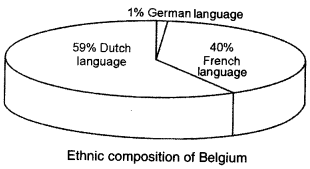
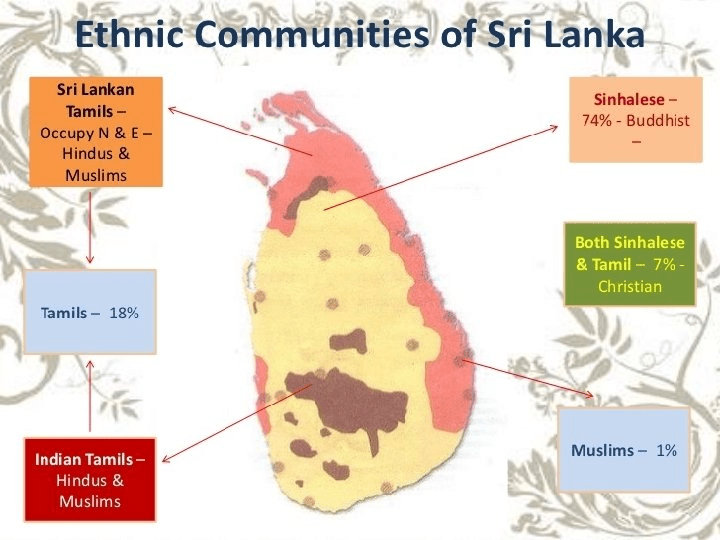
(a) Different social groups
(b) Different organs of government
(c) Central and State government
(d) State government and Community government 

Hide Answer  

Ans: (a)
In Belgium, the Community Government is designed to represent and share power among different social groups, such as linguistic communities (like the Flemish and French speakers). This system ensures that the diverse interests and identities within the country are recognized and that each group has a say in governance, promoting unity and reducing conflict among them.


Q16: State any one step taken in Belgium to rule out the problem of regional differences and cultural diversities. (2020)

Hide Answer  

Ans: Equal representation in the central government is a key step taken in Belgium to address regional differences and cultural diversities. 
The following measures have been implemented:

  • The constitution mandates that the number of Dutch and French-speaking ministers in the central government is equal.
  • Special laws require support from a majority of members from each linguistic group for certain decisions.
  • State governments have been granted significant powers, operating independently of the central government.
  • Brussels has a separate government that ensures equal representation for both communities.


Q17: The Belgium model of ‘Community government’ worked well because_______ (2020 C)

Hide Answer  

Ans: The Belgium model of ‘Community government’ worked well because it recognized the belonging of individuals to one language community.

This approach has several advantages:

  • It promotes cultural identity by acknowledging the distinct languages spoken.
  • It allows for tailored governance that addresses the unique needs of each community.
  • It helps to maintain social harmony and prevent conflicts between different linguistic groups.

Overall, this model has contributed to a stable and inclusive political environment in Belgium.


Q18: Describe the horizontal power-sharing arrangements. (2020)

Hide Answer  

Ans: Horizontal power-sharing involves the distribution of power among various branches of government. 
The key features are:

  • Power is shared among different organs of government, including the legislatureexecutive, and judiciary.
  • Each organ exercises distinct powers, ensuring that no single organ can dominate.


Q19: Why is there a need to give space to diverse social groups in the administration of a democratic country? Give any one reason. (CBSE 2020)

Hide Answer  

Ans: It is necessary to give space to diverse social groups in the administration of a country to avoid majoritarianism, accumulation of power in the hands of a particular social group which would lead to social conflicts.

Previous Year Questions 2019

Q20: Why was there an acute problem in Brussels during 1950s and 1960s between the two communities? (2019 C)

Hide Answer  

Ans: During the 1950s and 1960s, tensions arose in Brussels between the two main communities in Belgium due to several factors:

  • The French-speaking community was a minority but was relatively wealthy and influential.
  • The Dutch-speaking community felt resentment as they had access to economic development and education much later.
  • Brussels posed a unique challenge: While the Dutch-speaking people were the majority in the country, they were a minority in the capital.


Q21: Explain the major repercussions of passing Sinhala as the only official language in Sri Lanka in 1956. (2019 C)

Hide Answer  

Ans: The major repercussion of passing Sinhala as the only official language in Sri Lanka in 1956 was the increase in the feeling of alienation among the Sri Lankan Tamils. This led to the launch of parties and struggles for the recognition of Tamil as an official language.


Q22: Explain any one benefit of ‘Power-Sharing’. (AI2019)

Hide Answer  

Ans: Power-sharing helps to reduce the possibility of conflicts between different social groups. A social conflict often leads to violence and political instability. Power sharing helps to ensure the stability of political order.


Q23: How did the idea of power-sharing emerge? Explain different forms that have common arrangements of power-sharing.  (Delhi 2019)

Hide Answer  

Ans: The idea of power-sharing has emerged contrary to the notions of undivided political power. Earlier, it was believed that all powers of a government must reside in one person or group located in one place. It was felt that if the power to decide was dispersed, it would not be possible to make quick decisions and enforce them. However, these notions have changed with the emergence of democracy.
Different forms that have common arrangements of Power Sharing:

  • Horizontal power-sharing: This involves distributing power among different branches of government, such as the legislature, executive, and judiciary. Each branch checks the others, preventing any one branch from having unlimited power and ensuring a balance among institutions.
  • Vertical power-sharing: This refers to the division of power between different levels of government, such as the central government and state governments. In India, the constitution defines the powers of each level, ensuring clarity in governance.
  • Empowering social groups: Power can also be shared among various social groups, including religious and linguistic minorities. An example of this is the system of reserved constituencies in assemblies and Parliament, which aims to give minority communities a fair representation.
  • Political parties and pressure groups: Power-sharing is evident in how political parties, pressure groups, and social movements influence those in power. This competition helps prevent power from being concentrated in a single entity, allowing for diverse representation of ideologies and social interests.


Q24: Explain with examples the accommodative experience of Belgium for peace and harmony.  (CBSE 2019)

Hide Answer  

Ans: The accommodative experience of Belgium for peace and harmony:
(1) Dutch and French speaking ministers got equal say and powers in the central government. 
(2) Many Powers of the central government have been transferred to state government. 
(3) The State government is no longer subordinate to the Central government. This helped in delegation of duties. 
(4) Brussels has a separate government in which both the communities have equal representation. 
(5) There is a third kind of government called community government elected by the people belonging to Dutch, French and German communities no matter where they live.

Attention!Sale expiring soon, act now & get EduRev Infinity at 40% off!

Previous Year Questions 2017

Q25: Explain the three measures taken by Sri Lanka, as per the Act passed in 1956. (2017)

Hide Answer  

Ans: The three measures taken by Sri Lanka under the Act passed in 1956 are:

  • The government declared  Sinhala as the only official language, ignoring Tamil.
  • Preferential policies were implemented, favouring Sinhala applicants for university positions and government jobs.
  • A new Constitution mandated that the state would protect and promote Buddhism.

Previous Year Questions 2016

Q26: How and when was Sinhala recognized as the official language of Sri Lanka?   (2016)

Hide Answer  

Ans: 

  • Sinhala was officially recognised as the only language of Sri Lanka through an Act passed in 1956.
  • This decision established Sinhala as the sole official language.
  • It disregarded the Tamil language, leading to significant political and social implications.
  • Subsequent government policies favoured Sinhala speakers in education and employment.


Q27: What is the prudential reason behind power-sharing? (2016)

Hide Answer  

Ans: The prudential reason for power-sharing is to avoid the concentration of power in one individual or group. 
This is important because:

  • It helps prevent authoritarianism, where one party has unchecked control.
  • It reduces the risk of oppression of minority groups.
  • Power-sharing promotes political stability and peace.


Q28: What does ‘the system of checks and balances’ ensure in power-sharing? (2016)

Hide Answer  

Ans: The system of checks and balances ensures that:

  • No single individual or institution can hold unlimited power.
  • It prevents the abuse of power by distributing authority.
  • It protects the rights and interests of various groups within society.


Q29: Mention any one characteristic of power-sharing. (2016)

Hide Answer  

Ans: One characteristic of power-sharing is the sharing of power between different levels of government or between different communities or groups within a society.


Q30: How is the ethnic composition of Belgium very complex? Explain. (2016)

Hide Answer  

Ans: The ethnic composition of Belgium is complex for several reasons:

  • Approximately 59% of the population resides in the Flemish region and speaks Dutch.
  • About 40% live in the Wallonia region and communicate in French.
  • Only 1% of Belgians speak German.
  • In Brussels, 80% of the population speaks French, while 20% speak Dutch.


Q31: How did Sri Lanka and the Belgium government try to solve the ethnic problem? (2016)

Hide Answer  

Ans: Sri Lanka and the Belgium government tried to solve the ethnic problem in different ways:
(i) The Belgium government respected the feelings and interests of different communities and regions, establishing a federal structure and power-sharing between the Union Government and its constituent units.
(ii) Sri Lanka adopted majoritarianism, passing an Act in 1956 to recognize Sinhala as the only official language, favoring Sinhala applicants for positions, and protecting and fostering Buddhism through the Constitution. 


Q32: “Attempts at forced integration often sow the seeds of disintegration”. Support the statement with suitable arguments. (2016)

Hide Answer  

Ans: Forced integration can lead to disintegration due to the following reasons:

  • Integration through force can create feelings of resentment and conflict among different regions or communities.
  • Sharing power and resources often raises fears of domination by one group over another.
  • People prefer to maintain their autonomy rather than being overshadowed by others.
  • Historical examples, such as the breakup of the USSR, illustrate the negative effects of forced integration.

Therefore, integration should be based on harmonious and cooperative terms rather than coercion.


Q33: “Sharing of powers makes a country more powerful and united.” Do you agree with this statement and why? (2016)  

Hide Answer  

Ans: Yes, I agree with the statement that the sharing of powers makes a country more powerful and united. This is because:
(i) Power-sharing ensures that no single community or group dominates the decision-making process, promoting inclusivity and fairness.
(ii) It allows for the representation of diverse interests and perspectives, leading to better policies and governance.
(iii) Power-sharing can prevent the marginalization of certain communities or regions, reducing conflicts and promoting social cohesion.
(iv) By distributing power, it strengthens the democratic principles of participation, accountability, and checks and balances.


Q34: Why is power-sharing necessary in democracy? Explain. (2016)

Hide Answer  

Ans: Power-sharing is necessary in democracy for several reasons:

  • Conflict Reduction: It helps to minimise conflicts between different social groups.
  • Political Stability: Power-sharing promotes a stable political environment, reducing the risk of violence and instability.
  • Unity Preservation: Imposing the will of the majority can seem appealing but ultimately harms national unity.
  • Majority Tyranny: The oppression of minorities can lead to negative consequences for the majority as well.
  • Democratic Spirit: True democracy involves sharing power with those affected by its exercise, ensuring that citizens have a say in governance.
  • Legitimacy: A legitimate government is one where citizens participate and have a stake in the system.
Also read: Extra Questions: Power-sharing

Previous Year Questions 2015

Q35: Which factor is responsible for increasing the feeling of alienation among the Sri Lankan Tamil? (2015)

Hide Answer  

Ans: The majoritarianism policy in Sri Lanka has significantly increased the feeling of alienation among the Sri Lankan Tamils
Key points include:

  • The policy favoured the Sinhalese community, leading to feelings of exclusion.
  • It resulted in discrimination in political rights and job opportunities for Tamils.
  • Government actions ignored the interests of the Tamil population.

These factors contributed to a growing sense of alienation among the Sri Lankan Tamils.


Q36: Which type of powers does the community government of Belgium enjoy? (CBSE 2015)

Hide Answer  

Ans: The community government of Belgium enjoys cultural and educational powers, as well as issues related to language.


Q37: State any two measures adopted by Sri Lanka in 1956 as part of their majoritarian policy. (2015)

Hide Answer  

Ans: Two measures adopted by Sri Lanka in 1956 as part of their majoritarian policy were:
(i) They declared Sinhala as an official language.
(ii) They tried to promote their religion, Buddhism.


Q38: What system of power-sharing is called “Checks and Balances”? (2015)

Hide Answer  

Ans: The system of power-sharing called “Checks and Balances” refers to the distribution of powers among different institutions of government, where each institution has the ability to check the actions of the others to ensure a balance of power.


Q39: Give reasons why power-sharing is desirable. (2015)

Hide Answer  

Ans: Power-sharing is desirable for several reasons:

  • Prevents domination: It stops one community from overpowering others, promoting equality.
  • Encourages inclusivity: It accommodates diverse interests and identities, fostering social harmony.
  • Reduces conflict: It lowers the chances of tensions and disputes between communities.
  • Strengthens democracy: It ensures participation, accountability, and checks in decision-making.
  • Improves governance: It allows better representation and responsiveness to citizens’ needs.


Q40: What is a Homogenous Society? (CBSE 2015)  

Hide Answer  

Ans: It is a society which shares a common language, ethnicity and culture. For example, Japan and South Korea.

Previous Year Questions 2014

Q41: Who formed the majority in terms of population in Sri Lanka? (2014)

Hide Answer  

Ans: The majority of the population in Sri Lanka is formed by the Sinhala community.


Q42: What is the state religion of Sri Lanka? (2014)

Hide Answer  

Ans: The state religion of Sri Lanka is Buddhism.


Q43: In which city is the headquarters of the European Union located? (2014)

Hide Answer  

Ans: The headquarters of the European Union is located in Brussels.

5. Outcomes of Democracy – Long Answer Questions

Q1. Discuss some merits and demerits of democracy in the light of your study of the chapter.
Ans: Merits:

  • Promotes equality among citizens.
  • Enhances the dignity of the individual.
  • Improves the quality of decision-making.
  • Provides a method to resolve conflicts.
  • Allows room to correct mistakes.

Demerits:

  • Democracy takes more time to follow procedures compared to non-democratic governments.
  • Many democracies struggle to ensure fair elections and public debate.
  • Democratic governments often do not share information effectively with citizens.
  • Democracies can frustrate the needs of the people and ignore the majority’s demands.

Q2. How does democracy produce an accountable, responsive and legitimate government?
Ans: Democracy produces an accountable government through:

  • Regular, free, and fair elections.
  • Open discussions on major issues and legislation.
  • Citizens’ right to access information about government actions.

responsive government is formed by elected representatives who:

  • Address societal problems.
  • Develop policies and programmes based on public needs.
  • Ensure effective implementation of these programmes.

Democracy is considered legitimate because:

  • It operates under a constitution that applies to everyone, including government officials.
  • Free and fair elections empower citizens to remove unsatisfactory parties in future elections.

Q3. What are the conditions under which democracies accommodate social diversities?
Ans: Democracies have a duty to create a safe and harmonious society for all citizens. It is essential to address differences among ethnic groups in a peaceful manner. Here are key conditions for democracies to accommodate social diversities:

  • Different individuals or groups should be elected to form the government.
  • The majority community, whether based on religion, race, or language, should not dominate.
  • All citizens should have the opportunity to be part of the majority.
  • No one should be excluded from majority status based on their birth, as this undermines the essence of democracy.

Democracy is not merely about majority rule; it requires collaboration between the majority and minority to ensure that all voices are represented in government. This balance is crucial for a functioning democracy.

Q4. Examine with the help of four examples how the dignity and freedom of citizens are best guaranteed in a democracy.  

Ans: The dignity and freedom of citizens are best guaranteed in a democracy are as follows:

  • Equality Before the Law: Democracy ensures that all citizens are treated equally, regardless of caste, religion, gender, or economic status. Example: The Indian Constitution guarantees equality under Article 14.
  • Freedom of Speech and Expression: Citizens are free to express their opinions and ideas without fear of punishment or oppression. Example: People can protest peacefully, share opinions on social media, and criticize government policies.
  • Empowerment of Women and Minorities: Democracy provides equal opportunities for women and minority groups, ensuring inclusivity and representation. Example: Laws like reservations for women in local governance and the Right to Education Act in India.
  • Right to Choose Leaders: Citizens have the right to vote and elect their representatives through free and fair elections. Example: In India, every adult citizen has the right to vote regardless of their background.

Q5. Identify the challenges to democracy in the following descriptions. Also, suggest policy/institutional mechanism to deepen democracy in the given situations: 
(i) Following a High Court directive, a temple in Orissa that had separate entry doors for Dalits and non-Dalits allowed entry for all from the same door. 
(ii) A large number of farmers are committing suicide in different states of India. 
(iii) Following allegation of killing of three civilians in Gandwara in a fake encounter by Jammu and Kashmir police, an enquiry has been ordered.
Ans: (i) The main challenge here is to eliminate caste-based inequalities. Legal measures should be enforced against those who engage in discriminatory practices. Such actions are considered a crime under our constitution and should be met with severe penalties. 
(ii) The high rate of farmer suicides across various states in India highlights the issue of economic inequality. Many farmers struggle to repay loans due to unpredictable crop failures caused by adverse weather. To address this, the government should offer subsidies to farmers, helping them achieve a sustainable income and reduce financial stress. 
(iii) A significant challenge to democracy in this context is the need to regulate the power of the police and other authorities. Additionally, it is crucial to maintain the public’s trust in government institutions like the police, especially following serious allegations of misconduct.

4. Political Parties – Long Answer Questions

Q.1. Discuss the merits and demerits of the two-party system and a multi-party system.
Ans. In some countries, there are only two main parties, and power changes hands between them only. They are the only ones who can win seats in elections. There may be other parties and they may win a small number of seats, but never enough to form a government.
Example: United States of America and United Kingdom

In a multi-party system, three or more parties have a chance to win elections and gain control of the government. In this system, there are more than two distinct, officially recognized groups called, political parties.In a multi-party system, groups come to power on their own strength or in alliance with others. In India various parties have come together in a coalition. In India, there have been three major alliances in the 2004 parliamentary elections as no single party got an absolute majority. This system is followed in India, France and Denmark.
This system gives a chance to various interests and concerns, to gain representation. This system can sometimes lead to instability, as many parties cannot pull together.

Q.2. How has an increase in the number of state or regional parties strengthened democracy in India?

Ans. Democracy means more and more representation of people in the running of the government and the opportunity to influence the government as India is a federal state, more regional parties mean, more influence of state parties in national politics. The regional parties have a say in national policies as they win elections in their states. No single national party (from among the six in India) has been able to form a government on its strength since 1996. They had to form alliances with the regional parties to form a coalition government at the Centre. This has strengthened federalism and democracy in our country.


Q.3. Mention some of the suggestions made to reform political parties.

Ans. Laws made to regulate internal politics:

  • It should be compulsory to maintain a register of its members.
  • hold independent inquiry in case of a party dispute.
  • hold open elections to top party posts.

It should be mandatory to give 1/3 party tickets to women candidates. There should be a quota for women in decision-making bodies.
The government or the state should help parties during elections by funding them.

  • Expenses for petrol, paper, telephone, etc. were given.
  • Cash can be given based on votes secured by the party in the last elections.

Q.4. Which two other ways can help in reforming political parties?
 OR
 How can an ordinary citizen help in reforming political parties?

Ans. Pressure should be put on the political parties. This can be done through petitions and agitations. Ordinary citizens, pressure groups, and movements can bring about reforms if they join hands. If political parties feel that they would lose popular support, they will have to reform.

Political parties can improve if they allow more and more people to join their organization. The quality of democracy improves if there is maximum participation by the public. If the public only criticizes from outside, it has no effect. To improve bad politics, goods politics has to take charge.


Q.5. Write short notes on:
(i) Ideology of the Indian National Congress (INC)
(ii) States in which Bahujan Samaj Party has its main base.

Ans.

(i) The Indian National Congress is one of the oldest political parties in the world and is India’s oldest political party. It is a party which is neither leftist nor rightist in its ideology. Its main aim is secularism, the welfare of the weaker sections and minorities. It projects a vision of a politically united, economically prosperous, socially just, and culturally harmonious India. Its six basic policies are social harmony, employment for the youth, rural development, economic resurgence, women’s employment, and equal opportunity.(ii) The Bahujan Samaj Party has its base in the state of Uttar Pradesh and substantial presence in Madhya Pradesh, Chhattisgarh, Uttarakhand, Delhi and Punjab. It has formed a government in Uttar Pradesh several times.


Q.6. Describe various challenges faced by political parties.

Ans. The NCP was formed in 1999, when a split took place in the Congress Party. Its aims are almost the same as those of the parent body. They also support the cause of democracy, Gandhian secularism, equality, social justice and federalism. But they want that high offices in government should be held only by natural born citizens of India. Sharad Pawar, P.A. Sangma and Tariq Anwar, members of the Congress Party, objected to a person of foreign origin becoming the Prime Minister of India and formed this new party. It has the biggest support in Maharashtra and important presence in Meghalaya, Manipur and Assam. It is a coalition partner in Maharashtra, in alliance with the Congress. Since 2004, it remained a\ member of the United Progressive Alliance. (UPA).


Q.7. Political parties play a major role in democracy. Give four points to justify this statement.
OR
Describe any four functions of political parties in India. [2011 (T-2)]
OR
What is a political party? Highlight any three functions of parties in a democracy. [2011(T-2)]
OR
“Political parties are necessary in a democracy.” In the light of this statement explain any four functions of political parties in India. [2011 (T-2)]

Ans. Parties contest elections. In most democracies, elections are fought mainly among the candidates put up by political parties. In some countries, such as the USA, members and supporters of a party choose its candidates. Parties put forward different policies and programmes and the voters choose from them. In a democracy, a large number of similar views have to be grouped together to provide a direction in which policies can be formulated by the governments.

Parties play a decisive role in making laws for a country. Parties form and run governments. The big policy decisions are taken by political executive that comes from the political parties. Parties recruit leaders, trains them and then make them ministers to run the government in the way they want.


Q.8. Describe various challenges faced by political parties.
Ans. There is lack of internal democracy within parties. There is generally concentration of powers in one or few leaders at the top. Parties do not keep membership registers, do not keep hold organisational meeting, and do not conduct internal elections regularly. Dynastic succession does not allow ordinary workers to rise to the top in the party. Where top positions are controlled by the members of one family, it is bad for democracy since people who do not have adequate experience or popular support come to occupy positions of power.

The growing role of money and muscle power in parties pose another challenge, specially during the time of elections. Rich people and companies who give funds to the parties tend to have influence on the policies and decisions of the party. Parties, very often, do not offer a meaningful choice to the voters. In recent years, there has been a decline in the ideological differences among parties. Those who want really different policies have no option available to them.

3. Gender, Religion and Caste – Long Answer Questions

Q1. Explain the sexual division of labour.

Ans: The sexual division of labour in India assigns specific roles to men and women, often leading to unequal treatment. Key aspects include:

  • Women’s Responsibilities: Women are primarily responsible for housework and raising children. This includes cooking, cleaning, and laundry.
  • Rural Work: In rural areas, women also work in the fields and collect water and fuel, often without pay.
  • Urban Employment: In urban settings, middle-class women may work in offices, while poorer women often serve as domestic helpers.
  • Wage Disparity: Women generally earn less than men, even when performing the same jobs.
  • Men’s Roles: Men typically do not engage in housework unless it is paid work, such as in hotels.

Q2. What forms can caste take in politics?

Ans: Caste can take various forms in politics:

  • Political parties often select candidates based on their caste to reflect the caste composition of their voters.
  • Many voters tend to vote according to caste, which can lead to unsuitable candidates being elected.
  • When forming a government, parties ensure representation from different castes and tribes.
  • During elections, parties frequently appeal to caste sentiments to gain support.
  • Parties have made lower castes aware of their rights, promoting political consciousness.

Q3. Explain the major factors responsible for the rigid caste system disappearing from India. Give two suggestions of your own.

Ans: Major factors responsible for the rigid caste system disappearing from India:

  • Social reformers like GandhiJyotiba PhuleB.R. Ambedkar, and Ramaswami Naickar have advocated for a society free from caste inequalities.
  • Increased literacy and education have promoted awareness and opportunities.
  • Economic development has weakened the power of traditional landlords.
  • The Constitution of India prohibits caste-based discrimination.
  • Fundamental rights ensure equality for all citizens.

To further reduce the caste system:

  • Promote education across all caste groups.
  • Encourage inter-caste marriages to break down barriers.

Q4. Describe the influence of politics on caste system.

Ans: Politics influences the caste system in several ways:

  • Caste groups aim to expand by including neighbouring castes or sub-castes that were previously excluded.
  • Different caste groups often form coalitions with others, leading to dialogue and negotiation.
  • New political categories have emerged, such as ‘backward’ and ‘forward’ caste groups.

This interplay allows caste to play various roles in politics:

  • It provides disadvantaged communities, like Dalits and OBCs, a platform to demand their share of power.
  • Political and non-political organisations advocate for an end to discrimination and for better access to resources.

However, focusing solely on caste can have negative consequences:

  • It may distract from critical issues such as povertydevelopment, and corruption.
  • Caste divisions can lead to tensions, conflict, and violence.

Q5. Is the ideological basis of communalism flawed? Substantiate your views. [HOTS]

Ans: Communal politics is based on the flawed idea that religion is the main basis for social community. Here are some key points highlighting its flaws:

  • It assumes that all followers of a particular religion belong to a single community.
  • It suggests that their fundamental interests are identical.
  • It claims that people of different religions cannot coexist in the same social community.
  • It leads to the belief that differing religions must result in conflict.
  • In extreme cases, it implies that individuals of different religions cannot be equal citizens in one nation, often resulting in the formation of separate nations, as seen with Pakistan.

Communalism can manifest in various ways, including:

  • Everyday beliefs that promote religious prejudices and stereotypes.
  • Political mobilisation that uses religious symbols and emotional appeals.
  • Violence and riots, as witnessed during the Partition of India and Pakistan.

To combat communalism, a secular state is essential, as outlined in the Indian Constitution, which does not endorse any official religion. This secular framework is vital for maintaining democracy and ensuring equality among all citizens.

Q6. Discuss the socio-economic conditions of women in our society. Has the political expression of gender division really helped? [HOTS]

Ans: Socio-economic conditions of women:

  • The literacy rate among women is only 54%, compared to 76% for men.
  • Women hold a small proportion of highly paid jobs.
  • In most sectors, women earn less than men for the same work.
  • In many regions, there is a preference for sons, leading to gender-selective abortions.

Political expression of gender division has made some progress, but more is needed:

  • Women now occupy over 10 lakh elected positions in local government due to reservations.
  • However, societal change is essential to fully address gender divisions.

Despite improvements, issues affecting women’s well-being often lack attention. Many believe that without women in power, their problems will remain overlooked. Increasing women’s representation in politics is crucial for addressing these issues.

2. Federalism – Long Answer Questions

Q1. Mention three policies that have strengthened federalism in India.

Ans: The success of federalism in India is largely due to its democratic politics, which promotes respect for diversity and a shared desire for unity. Here are three key policies that have strengthened federalism:

  • Linguistic States: – The creation of states based on language was a significant step after independence. – This approach has helped unify the country and simplify administration, despite initial concerns about potential disintegration.
  • Language Policy: – While Hindi is the official language, the Constitution protects 21 other scheduled languages. – This policy ensures that no single language dominates, supporting the cultural diversity of the nation.
  • Centre-State Relations: – The restructuring of these relations has enhanced federalism. – Post-1990, the rise of regional parties and coalition governments has fostered a culture of power-sharing and respect for state autonomy.

Q2. In which way does the language policy in India help our country avoid the situation that Sri Lanka is in today? (HOTS)

Ans: India’s language policy plays a crucial role in maintaining harmony among its diverse linguistic communities. Key aspects include:

  • No single national language: The Constitution does not designate any language as the national language, which helps prevent dominance by any one group.
  • Official languages: Hindi is the official language, but there are 22 other Scheduled Languages recognised, ensuring representation for various linguistic groups.
  • Flexibility in language use: The Central Government allows the use of English alongside Hindi for official purposes, accommodating non-Hindi speaking states.
  • State languages: Each state can have its own official language, allowing local governance to operate in the language of the majority.
  • Contrast with Sri Lanka: In Sri Lanka, the 1956 Act made Sinhala the only official language, marginalising Tamil speakers and leading to social tensions.

The cautious approach of Indian leaders in promoting Hindi, without imposing it on other states, has helped avoid the ethnic conflicts seen in Sri Lanka.

Q3. How can you say that power-sharing is more effective today than it was in the early years after the Constitution came into force? (HOTS)

Ans: In the early years after the Constitution was enacted, the same party often ruled at both the Centre and in most States. This led to:

  • The State Governments not fully exercising their rights as autonomous federal units.
  • Central Government misusing its power to dismiss State Governments controlled by rival parties, undermining the spirit of federalism.

However, significant changes occurred after 1990:

  • The rise of regional parties in many States.
  • The beginning of the era of coalition governments at the Centre, as no single party secured a clear majority in the Lok Sabha.
  • Major national parties had to form alliances with regional parties to govern effectively.

This shift fostered:

  • A new culture of power-sharing.
  • Greater respect for the autonomy of State Governments.

Q4. Why is decentralisation favoured in democracy? Identify any two reasons. (2014)

Ans: Decentralisation is favoured in democracy for several reasons:

  • Local Knowledge: People have a better understanding of the issues in their own areas. This local insight allows for more effective solutions.
  • Participation: Decentralisation enables direct involvement of citizens in decision-making processes, fostering a culture of democratic engagement.

Decentralisation involves transferring power from central and state governments to local authorities. This approach is essential for addressing numerous local problems effectively. The Constitution of India acknowledges the need for decentralisation, leading to significant reforms in 1992 that strengthened local governance.

Key features of these reforms include:

  • Mandatory regular elections for local bodies.
  • Reservation of seats for Scheduled CastesScheduled Tribes, and women.
  • Establishment of the State Election Commission to oversee local elections.
  • Sharing of powers and resources between state and local governments.

These measures enhance the effectiveness of local governance and ensure that democracy is more participatory.

Q5. Explain the structure of the new Panchayati Raj institutions, both in rural and urban areas.

Ans: Rural Local Government is known as Panchayati Raj or democratic decentralisation. The structure includes:

  • Each village or group of villages has a Gram Panchayat.
  • The Panch, President, or Sarpanch is directly elected by the adult population of the village.
  • The Panchayat operates under the supervision of the Gram Sabha, which includes all voters.
  • A group of Gram Panchayats forms a Panchayat Samiti (also known as Block or Mandal).
  • All Panchayat Samitis together create the Zilla Parishad, which consists of elected members, including Lok Sabha members and local MLAs.
  • The Chairperson of the Zilla Parishad is its political head.

Urban Local Government consists of:

  • Municipalities for towns and Municipal Corporations for larger cities.
  • Both are governed by elected representatives.
  • The political head of a Municipality is the Municipal Chairperson.
  • The head of a Municipal Corporation is called the Mayor.

State governments must share certain powers and revenues with local bodies, though the extent of this varies by state.

1. Power Sharing – Long Answer Questions

Q.1. Describe the different forms of power-sharing in modern democracies. Give an example of each of these. (CBSE Sample Paper)
Ans. In modern democracies, power-sharing arrangements can take many forms
(i) Among different organs of government: Power is shared among the legislature, executive and judiciary. This is called horizontal distribution of power because it allows the three organs of government placed at the same level to exercise different powers. Each organ checks the others, no organ can exercise unlimited power.
(ii) Among governments at different levels: Here power is shared among governments at the provincial or regional level and a general government for the entire country, called Federal Government. In India, we call it Central or Union Government.
In India, the government at the provincial level is called State government. The Constitution clearly lays down powers of different levels of government. The third level of government is called municipality and panchayat. This arrangement is called vertical division of power.
(iii) Among different social groups: Power may also be shared among different social groups, such as the religious and linguistic groups. For example, Community Government in Belgium. In India, weaker sections of society have ‘reserved constituencies’ in Assemblies and the Parliament. They also have ‘reserved seats’ in government jobs.
(iv) Among political parties, pressure groups and movements: Power is shared among various political parties that represent different ideologies and social groups. Interest groups such as those of traders, businessmen, industrialists, farmers and individual workers also have shared in governmental power, either through participation in governmental committees or bringing influence on the decision making process.

Q.2. Bring out the main features of the Belgian model of governance.
Ans. Between 1970 and 1993, Belgian leaders made four amendments to their Constitution to establish a consensus. The main features of the Belgian model of governance include:

  • Equal Representation: The Constitution mandates that the number of Dutch and French-speaking ministers in the central government must be equal. Important laws require majority support from both linguistic groups, preventing any single community from making unilateral decisions.
  • Decentralised Power: Many powers of the central government have been transferred to state governments in the two regions. These state governments operate independently and are not subordinate to the central authority.
  • Brussels Government: Brussels has its own government, ensuring equal representation for both communities.
  • Community Government: A separate ‘Community government’ is elected by people from one language community—Dutch, French, or German—regardless of their location. This government handles cultural, educational, and language-related matters.

Composition of Belgium people

Q.3. What do we learn from the story of Sri Lanka? Should India follow the Belgian model? (HOTS)

Ans. The distrust between the two communities in Sri Lanka turned into widespread conflict. It soon turned into a civil war in which thousands of people of both the communities were killed, thousands became homeless and were forced to leave the country as refugees.

The story of Sri Lanka teaches us the lesson of sharing power among various communities. Various prudential and moral reasons for power sharing are desirable to ensure stability of the political order, unity and integrity of the country. The rule of majority community leads to conflict in society and eventually to a bloody civil war.

India should not follow the Belgian model as it is not suitable for a large multilingual and multi-religious country like ours. Our Constitution is best suited and most appropriate for Indian society and culture. Belgian model of power sharing is quite complicated and not suitable for India.


Q.4. What could ethnic problem lead to in Belgium and Sri Lanka?
Ans. In both countries, there could be tension and conflict between different ethnic groups. In Belgium, the majority community of Dutch-speaking people could try to dominate the French and German-speaking people.

This could lead to conflict— especially in Brussels. Brussels could have been partitioned as the ratio of the Dutch and the French were different from the rest of the country. In Sri Lanka, the Sinhalese people, already in the majority, could try further to dominate the Tamil speaking people. It could even lead to war.

Thus, size and population do not matter. Ethnic divisions, if not handled with patience and common sense, can lead to a civil war, division of the country and conflict between communities.


Q.5. Give instances to show how Sri Lanka has imposed ‘majoritarianism’.
Ans. Sri Lanka has imposed majoritarianism through several key measures:

  • Population Majority: With 74% of the population being Sinhala-speaking, the government established majority rule from independence.
  • Language and Religion: The Constitution was amended to declare Sinhala as the only official language and Buddhism as the state religion.
  • Employment Discrimination: Job opportunities were preferentially given to Sinhala speakers, sidelining Tamil culture and language.
  • Neglect of Minorities: Other religions, such as Hinduism, Islam, and Christianity, received little recognition or support.

Pp
Q.6. In what way was the Belgian method better?
Ans. The Belgians gave equal importance to all the ethnic groups. At the Centre, there were both French and Dutch ministers, and their number was equal.
(i) The Centre and the states had equal and independent powers.
(ii) If new laws were made, they had to be passed with the majority in both ethnic groups-voting for them.
(iii) A separate government was elected for the city of Brussels.
(iv) A third community government was elected, comprising Dutch, French and German speaking people. It looked after the language, culture and educational issues.
(v) In short, the Belgians wisely tried to avoid all tensions and conflicts by accommodating the needs and wishes of all ethnic groups.

Q.7. Here are some examples of power-sharing. Which of the four types of power-sharing do these represent? Who is sharing power with whom?
(i) The Bombay High Court ordered the Maharashtra state government to immediately take action and improve the living conditions for the 2,000-odd children at seven children’s homes in Maharashtra.
(ii) The government of Ontario state in Canada has agreed to a land claim settlement with the aboriginal community. The Minister responsible for Native Affairs announced that the government will work with aboriginal people in a spirit of mutual respect and cooperation.
(iii) Russia’s two influential political parties, The Union of Right Forces and the Liberal Yabloko Movement, agreed to unite their organizations into a strong right-wing coalition. They propose to have a common list of candidates in the next parliamentary elections.
(iv) The finance ministers of various states in Nigeria got together and demanded that the federal government declare its sources of income. They also wanted to know the formula by which the revenue is distributed among various state governments.
Ans:
(i) The state judiciary is exercising its power to control the state executive by asking the state government to look into the conditions of its 2,000 children’s home. This is power-sharing between judiciary and executive (horizontal sharing).
(ii) The aboriginal people have exercised pressure on the government to agree to their land claims. So power is shared by a social group with the government.
(iii) In this case, two political parties have formed a coalition and are sharing power with mutual consent.
(iv) In the last example, power is being shared at different government levels, the state or regional governments are demanding the government at the Centre to declare its sources of income, so that they can have a larger share of finances for their respective states.

Q.8. How has the idea of power-sharing changed with time?
Ans. For a long time, it was believed that all the power of a government must reside in one person or group of persons located at one place. It was felt that dispensing powers would delay in decision-making and their enforcement.
But these notions have changed with the emergence of democracy. One basic principle of democracy is that people are the source of all political power. In a good democratic government, due respect is given to diverse groups and views that exist in a society. Everyone has a voice in the shaping of public policies.

Q.9. One of the ways in which power-sharing is done in Indian democracy is by providing reservations for the Scheduled Castes, Scheduled Tribes, and OBCs. Now the Muslims and Christian Dalits are asking for reservations. Is this demand of power sharing justified? (HOTS)
Ans. Initially, when the reservation of seats was done for the socially weaker sections, the intention of the Constitution was to bring an end to the alienation being faced by the so-called weaker communities, and now it has become more of a political gimmick, a means to collect votes, than to genuinely work for their development. It may encourage more and more communities to demand reservations, thus leading to widening of social division. This is a sort of negative power-sharing in my opinion. Some more positive steps need to be taken to encourage power-sharing as early as possible.

l