5. Outcomes of Democracy – Short Answer Questions

Q1. Which factors help economic growth in the country?
Ans: Factors that contribute to economic growth in a country include:

  • Population size: A larger population can lead to greater economic activity. However, rapid population growth can strain resources, as seen in countries with over a billion people.
  • Global cooperation: Economic growth often relies on support from wealthier nations. Developing countries benefit from partnerships with developed countries.
  • Government policies: The strategies and policies implemented by the government play a crucial role in shaping economic growth.


Q2. How have democracies fallen short of people’s expectations?
Ans: Democracies have often fallen short of people’s expectations due to several key issues:

  • Unfair Elections: Many democracies do not provide a fair chance for all citizens during elections.
  • Lack of Transparency: There is insufficient sharing of information with the public.
  • Limited Public Debate: Democratic processes often fail to encourage open discussions among citizens.
  • Corruption: Corruption remains a significant problem within democratic governments.


Q3. What is a must for a successful democratic government?
Ans: In a democracy, it is essential for the government to be:

  • Accountable to the citizens.
  • Responsive to the needs and expectations of the people.

These elements ensure that citizens have the right to choose their leaders. People can participate in decisions that affect their lives. While some argue that democratic governments may be less efficient due to deliberation and negotiation, they provide transparency in decision-making. Mechanisms for citizens to hold the government accountable.


Q4. What do you understand by the term ‘majority’ in a democracy?
Ans: Majority in a democracy refers to the principle that decisions are made based on the support of a larger group, but it is not merely about the majority opinion.

  • Democracy requires collaboration between the majority and the minority to ensure that all voices are heard.
  • The concept of majority can change; different groups can form a majority in various contexts.
  • Majority rule should not be based on religionrace, or language, but rather on collective decision-making.
  • In every election or decision, diverse groups may come together to form a majority.


Q5. What are the conditions under which democracies accommodate social diversities?
Ans: Democracies accommodate social diversities under the following conditions:

  • The majority must collaborate with the minority to ensure that the government reflects the views of all.
  • It is essential that rule by majority does not translate into rule by a specific community based on religionrace, or language.
  • Different individuals or groups should have the opportunity to form a government through elections.


Q6. Some people think that democracy produces less efficient and effective government. Do you agree with their views? 
Ans: Some believe that democracy leads to less efficient government. While it is true that democratic processes involve deliberation and negotiation, which can cause delays, this does not inherently mean that democracy is ineffective.

  • Non-democratic rulers can make quick decisions, but these may not reflect the people’s will.
  • Democratic governments, although slower, often produce decisions that are more acceptable to the public.
  • The time spent on procedures in democracy can lead to more effective governance.

Moreover, democracy promotes transparency, allowing citizens to understand decision-making processes. This is often lacking in non-democratic systems.


Q7. Examine with the help of three examples how the dignity and freedom of citizens are best guaranteed in a democracy. 
Ans: Three examples on the dignity and freedom of citizens are best guaranteed in a democracy are as follows:

  • Dignity of women: The long struggles of women have raised awareness that respect and equal treatment are essential in a democratic society.
  • Caste inequalities: Democracy in India has empowered disadvantaged and discriminated castes, promoting their claims for equal status and opportunities. Although caste-based inequalities still exist, they lack moral and legal support in a democratic framework.
  • Public expression of dissatisfaction: The ability to publicly express dissatisfaction is a sign of a successful democracy. It transforms individuals from being mere subjects to active citizens, demonstrating their awareness and ability to critically evaluate those in power.
4. Political Parties – Short Answer Questions

Q.1. What is the role of Opposition?
 OR
 What is the function of the Opposition party?

Ans.  

  • Opposition party is a party which does not win elections in sufficient numbers to form a government.
  • It keeps an eye on the working of the ruling party.
  • Acts as a check on their activities.
  • Prevents the ruling party from misusing its powers.
  • Keeps a check on their expenditures.
  • Brings their failure before the public.
  • Protects the rights and liberties of the people.
  • Ensures no law is passed that threatens their fundamental rights.

Q.2. Write a short note on one-party system.

Ans. One-party system is followed in China, North Korea and Cuba. This system was also prevalent in USSR till its breakup into 15 independent states. They are mostly communist countries. There is no competition in this system. The lone party nominates candidates and the voters have to say “yes” or “no” only against the name of the candidates. They have another choice of not voting at all.

One-party system is popular in communist or authoritarian countries. Supporters of one-party system claim that this system helps the government in mobilising the talents of all citizens towards a common goal.

But this system limits the choices and freedom of the citizens, hence it is not a good system for a democracy. In democracy people must have at least two parties to choose from. The one party system is like a dictatorship, where people have to follow government policies.

Q.3. Are political parties no longer popular? Discuss with examples.

Ans.  

  • Political parties are losing popularity in most countries.
  • People have lost their trust in political parties.
  • A recent survey in South Asia indicates a majority do not trust the parties.
  • Many people fall into the “not much” trust category.
  • In India, there is a growing indifference towards political parties.
  • Political parties have failed to reduce poverty and control prices.
  • This failure has led to indifference and unpopularity.
  • Globally, in many democracies, political parties are among the least trusted institutions.
  • Strangely, participation and membership in political parties have increased.
  • In India, party membership is higher than in advanced countries like CanadaJapanSpain, and South Korea.
  • Party membership in South Asia is higher than in the rest of the world.
  • Despite becoming unpopular, participation in India is growing yearly.

Q.4. What is the first thing the Election Commission does after recognising a party? Does it treat every party as equal?

Ans. It allots a ‘symbol’ to the parties. It has to treat every party as equal, but it offers some special facilities to large and established parties. These parties are given a unique symbol and only the official candidates of that party can use that symbol. For example, the Hand is the symbol of only the Congress Party and the Lotus of the BJP. Parties which have these benefits are called recognised national political parties.

Q.5. What is the criteria laid down by the Election Commission for the proportion of votes in order to be a recognised party?
 OR
 What are the criteria laid down by the Election Commission in order to be recognised as a national party and a state party. 

Ans. A party that secures 6% all of the total votes cast in an election to the Legislative Assembly of a state and wins at least two seats in the state is called a state party. A party that wins 6% of total votes caste in the elections for Lok Sabha or Assembly Elections in four states and wins at least four seats in the Lok Sabha is called a national party.

Q.6. Why is there a need to quickly solve the challenges faced by the political parties?

Ans. Political parties cannot remain in power if they lose the trust of the people. They have to face the criticism levelled at them by the others and try to quickly overcome the challenge. The voters or the people can lose trust in the party which does not try to meet the challenge and lose election.

Q.7. Name the four problem areas in the working of political parties. Why is dynastic succession bad for a democratic country?
 OR
 Mention any two challenges faced by political parties in India. 

Ans. The four challenges are :
(i) Lack of internal democracy within parties
(ii) Challenge of dynastic succession
(iii) Money and muscle power
(iv) A meaningful choice

Dynastic succession means that the power remains in the hands of a few. They pass on this power to their family members, who may not have popular support or enough experience in politics and governance. In many parties, the top positions are always controlled by members of one family and this tendency is present to some extent all over the world even in older democracies. Examples : USA, India.

Q.8. Explain the terms Defection and Affidavit.

Ans.

(i) When an elected MP or MLA changes his party, it is called Defection.
(ii) An affidavit is a signed document submitted to an officer, where a person makes a sworn statement regarding her/his personal information. In the case of politics, a candidate has to file an affidavit giving details of his property and criminal cases pending against him.

Q.9. What role has the Election Commission played in reforming political parties?

Ans.

(i) Made it compulsory for parties to hold organisational elections.
(ii) Political parties are to file their income-tax returns.

Q.10. Do you think reforms can be forced on political parties by legal actions?

Ans. No, people would stop participating in the work of political parties if there are too many legal hassles. Parties will find various illegal ways to break the law. Reforms cannot be imposed from outside. They have to come from within. Political parties will never allow a law to be passed which they do not like.

Q.11. ‘No system is ideal for all countries and all situations’. Explain. 

Ans. No system is ideal for all countries and in all situations because party system is not something any country can choose. It evolves over a long time, depending on the nature of society, its social and regional divisions, its history of politics and its system of elections. Each country develops a party system that is conditioned by its special circumstances.

Q.12. ‘The rise of regional parties has led to strengthening of federation and democracy in our country.’ Do you agree with the option? Why/why not? 

Ans. Over the last few decades, the number and strength of regional parties has expanded. This made the Parliament of India politically more and more diverse, since no one national party is able to secure majority on its own in the Lok Sabha, the national parties are compelled to form alliances with state parties. This has contributed to the strengthening of federalism and democracy in our country.

3. Gender, Religion and Caste – Short Answer Questions

Q.1. How can religion influence politics?

Ans.

  1. Gandhiji believed that politics must be guided by ethics drawn from all religions.
  2. Ideas, ideals and values drawn from different religions can play a role in politics.
  3. People should have the freedom to express in politics their needs, interest and demands as a member of a religious community.
  4. People who hold political power should see that discrimination and oppression does not take place due to religion.

Q.2. What is communal politics?
                                                                     OR
 How does communalism create problems in politics?

Ans.

(i) When one uses religion in politics, it is communal politics. It creates problems when one sees religion as the basis of the nation.
(ii) When one religion considers itself superior to other religions.
(iii) When there is discrimination against the followers of the other religion.
(iv) When state power is used to help one religion to dominate other religious groups and
(v) When the demands of one religious group are in opposition to others.

Q.3. What are the effects of communalism on politics?

Ans.

(i) Political parties are formed on communal basis — Muslim League, Akali Dal, the Hindu Mahasabha, the DMK are some examples.
(ii) Religion rather than ability becomes the criteria to choose candidates for elections.
(iii) People prefer to cast votes in favour of candidates of their own religion.
(iv) Communalism can turn ugly and lead to violence, massacre and riots.

Q.4. What is secularism? Mention any four provisions of the Indian Constitution which makes it a secular state.

Ans. Secularism means all religions are given the same respect and there is no state religion.
(i) No religion has a special status.
(ii) Freedom to practice, profess and propagate one’s religion is allowed by the Constitution.
(iii) No discrimination of any kind is allowed on religious grounds.
(iv) ‘Untouchability’ is banned.

Q.5. Has caste disappeared from India?

Ans. No. The following points prove the fact
(i) Even now people marry in their own caste.
(ii) Untouchability is still practised in many parts of India.
(iii) The caste groups which had better education are still ahead of other caste groups.

Q.6. Why is it necessary to have secularism in India?

Ans. India is a land of many religions and it has led to communalism in India. In fact, one of the results of communalism was partition of India into two nations. It was a challenge for Indian democracy and they chose a secular state as a model. Several constitutional provisions were made to secure secularism in India. It was not just an ideology of some party or people. Secularism is the basis, one of the foundations, of our country. To avoid the threat of communalism, secularism was chosen.

Q.7. When does the problem of communalism begin?

Ans. The problem of communalism begins when religion is seen as the basis of a nation. The problem becomes more acute when religion is expressed in politics in exclusive and partisan terms, when one religion and its followers are pitted against another. This happens when the beliefs of one religion are presented as superior to those of other religions, and when the state power is used to establish domination of one religious group over the rest.

Q.8. Which factors have led to weakening of caste hierarchy in India?

Ans. Caste hierarchy in India is weakening due to number of reasons :
(i) Efforts of social reformers like Gandhiji, Periyar, Jyotiba Phule etc. did the starting part of establishing a society in which caste inequalities are absent.
(ii) It has also weakened due to economic development, large-scale urbanisation, growth of literacy and education, occupational mobility, and the weakening of the position of landlords in the villages.

Q.9. Do you agree with the view that casteism has not disappeared from Indian society? Discuss. 

Ans. Although the old barriers of caste system are breaking down, but still casteism continues to be there in the Indian society.
(i) Even now most people marry within their own caste or tribe
(ii) Untouchability has not ended completely.
(iii) Effects of centuries of advantages and disadvantages continue to be felt today.

Q.10. Do the ‘caste’ and ‘vote bank’ factors completely control the elections in India?

Ans. There is an impression that elections in India are all about caste and nothing else. But it is also true that ‘caste’ and ‘vote bank’ factors alone cannot determine elections in India due to the following reasons :
(i) No single caste is ever elected with a clear majority in any parliamentary constituency. So votes of more than one caste is required to win the election for any candidate or party.
(ii) Many political parties may put up candidates from the same caste. Some voters have more than one candidate from their caste, while many voters have no candidate from their caste.
(iii) No party wins the votes of all the voters of a caste or community.

2. Federalism – Short Answer Questions

Q1. Give three reasons for decentralisation of power.
Ans: Reasons for decentralisation of power are as follows:

  • States in India are often larger than many European countries, necessitating decentralisation for effective administration.
  • Local issues are best understood by the local population, who can address their unique challenges more effectively.
  • Decentralisation enhances democracy at the grassroots level, allowing local people to directly engage in governance.

Q2. List the main features of the 73rd Amendment Act.
Ans: The main features of the 73rd Amendment Act are as follows:

  • Direct Elections: All three levels of the Panchayati Raj are elected directly by the people.
  • Term Duration: Each term lasts for five years.
  • Women’s Reservation: One-third of the seats are reserved for women.
  • Social Reservations: Seats are also reserved for Scheduled CastesScheduled Tribes, and Other Backward Classes at all levels.


Q3. Seats are reserved for women in the local self-government. Seeing the position of women in India as well as the corruption in politics, how far do you think this reservation will help? (HOTS)
Ans: The reservation of seats for women is a significant step towards improving democracy in India. However, challenges remain due to the existing power politics and corruption. Here are some key points to consider:

  • Increased Participation: Reserved seats encourage more women to participate in elections.
  • Democratic Enhancement: This reservation aims to strengthen women’s representation in local governance.
  • Ongoing Challenges: Despite reservations, many women still face difficulties in entering politics.
  • Need for Support: Effective implementation and support systems are crucial for realising the benefits of this reservation.

Q4. What is the dual objective of the federal system? What is required to fulfill them?
Ans: The federal system has dual objectives:

  • To safeguard and promote the unity of the country.
  • To accommodate regional diversity.
  • Two aspects are crucial for the institutions and practice of Federalism. Governments at different levels must agree to some power-sharing rules. They should also trust that each would abide by the agreement.


Q5. What is the role of judiciary in implementing federalism?
Ans: The judiciary plays a crucial role in implementing federalism by:

  • Resolving disputes: The Supreme Court and High Courts settle disagreements regarding the division of powers between the Union and State Governments.
  • Taxation authority: Both levels of government can levy taxes. If disputes arise over these powers, the courts intervene to resolve them.
  • Interpreting the Constitution: Courts interpret constitutional provisions, ensuring that both levels of government adhere to their designated powers.


Q6. What are the steps taken by our Constitution to safeguard the different languages?
Ans: Our Constitution has taken several steps to safeguard different languages:

  • The Constitution recognises Hindi as the official language, while also protecting other languages.
  • In addition to Hindi, there are 22 other languages acknowledged as Scheduled Languages.
  • Candidates can take central government examinations in any of these languages.
  • Each state has its own official languages, and government work is conducted in the respective state language.


Q7. Why was third-tier of the government created?
Ans: A vast country like India cannot be effectively governed with only two tiers of government. Here are some key reasons for the creation of a third tier:

  • Some Indian states are as large as independent countries in Europe. For example, Uttar Pradesh has a population larger than that of Russia, while Maharashtra is comparable to Germany.
  • These states exhibit significant internal diversity, necessitating power sharing.
  • A third tier of government, known as local government, was established to facilitate this decentralisation.
  • Decentralisation allows local issues to be addressed more effectively, as local residents have better knowledge of their own problems.


Q8. Write a note on the local government bodies in urban areas.
Ans: Local government bodies in urban areas include Municipalities and Municipal Corporations.

  • Municipalities are established in towns. Municipal Corporations are formed in larger cities.
  • Both are governed by elected representatives.
  • The head of a Municipality is called the Chairperson. The head of a Municipal Corporation is known as the Mayor.


Q9. How can you say that the new system of local government is the largest experiment in democracy conducted anywhere in the world?
Ans: The new system of local government in India is considered the largest experiment in democracy globally due to several key factors:

  • There are about 36 lakh elected representatives in the panchayats and municipalities all over the country
  • This number is bigger than the population of many countries of the world. Constitutional status for local government has helped to deepen democracy in our country. 
  • By providing reservation for women, it has also increased women’s representation in our country.
  • While elections are held regularly, gram sabhas often do not convene as frequently. Many state governments have yet to delegate significant powers or resources to local bodies.

Q10. Some Nepalese students were discussing the proposals on adoption of federalism in their new Constitution. This is what some of them said.
Khag Raj: I don’t like federalism. It would lead to reservation of seats for different caste groups as in India.
Sarita: Ours is not a very big country. We don’t need federalism.
Babulal: I am hopeful that the Terai areas will get more autonomy if they get their own state government.
Ram Ganesh: I like federalism because it will mean that powers that were earlier enjoyed by the king will now be exercised by our elected representatives. 

(a) What would be your response to each of these? 

(b) Which of these reflect a wrong understanding of what federalism is? 

(c) What makes India a federal country?
Ans: (a) I would agree with Ram Ganesh. He understands that federalism means power-sharing and not dictatorship. Sarita has a wrong perspective of Federalism. Federalism does not depend on size. 

(b) Belgium is an example of a small country following federalism. Federalism accommodates all divisions and differences. Khag Raj does not realise that if there are social divisions, they have to be accommodated and minority divisions are to be protected as in India

(c) India is a land of diversity with so many languages, religions and regions. So the powers had to be shared to avoid conflict. No group can be allowed to dominate.

1. Power Sharing – Short Answer Questions

Q1: Give three reasons for the civil war in Sri Lanka.

Ans: The following were the reasons for the civil war in Sri Lanka:

  • Language discrimination: Sinhala was declared the only official language, which ignored the Tamil language.
  • Employment bias: Preference was given to Sinhala speakers for government jobs and military positions.
  • Religious favouritism: Buddhism was established as the official religion, marginalising other faiths.


Q2: Why is power-sharing desirable in a democracy or any other system of government? 
Ans: Power-sharing is desirable in a democracy and other systems of government for several reasons:

  • Reduces conflict: Distributing power among various social groups lowers the risk of conflict.
  • Ensures stability: It contributes to a stable political order, promoting national unity.
  • Encourages participation: Involving citizens in governance makes them feel invested in the system, enhancing the government’s legitimacy.


Q3: Describe the power-sharing in Lebanon. 
Ans: Power-sharing in Lebanon is characterised by a complex system designed to maintain balance among various religious communities:

  • The President must be a Maronite Christian.
  • The Prime Minister is always a Sunni Muslim.
  • The Deputy Prime Minister is allocated to the Orthodox Christian sect.
  • The Speaker of Parliament is reserved for Shia Muslims.

Furthermore:

  • Christians agreed to forfeit French protection.
  • Muslims agreed to refrain from pursuing unification with Syria.


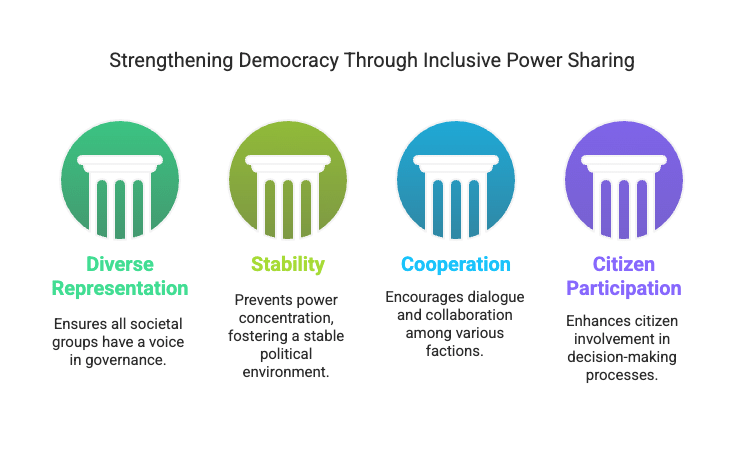
Q4: Why is power sharing essential for a democracy?
Ans: Power sharing is vital for democracy because it:

  • Ensures representation of diverse groups in society.
  • Promotes stability by preventing the concentration of power.
  • Encourages cooperation and dialogue among different factions.
  • Enhances citizen participation in governance.

By distributing power, democracy becomes more inclusive and responsive to the needs of all citizens.

Q5: In the Flemish region which language did the majority of the people speak?
Ans: The majority of people in the Flemish region speak the Dutch language.

Q6: What is the power of the community government in Belgium?
Ans: The community government in Belgium has significant powers in several key areas:

  • Cultural matters: Manages cultural institutions and promotes activities.
  • Education: Oversees the education system, including schools and curricula.
  • Language: Regulates language use and policies within its jurisdiction.

This decentralisation enables communities to effectively address local needs.

Q7: In a democracy power sharing is ensured in the presence of political parties and pressure groups. Explain. 
Ans: In a democracy, political parties are essential for distributing power. Here’s how they contribute:

  • Competition: Political parties compete for power, allowing each a fair chance to govern.
  • Coalitions: When no party achieves a clear majority, parties may form coalition governments to share power.
  • Interest Groups: Various groups, including workers and business owners, influence government decisions, enhancing power sharing.

This system ensures that diverse voices and interests are represented in governance.

Q8: Can dividing power lead to the weakening of a country? 
Ans: No, dividing power cannot lead to the weakening of a country.

In fact, the division of power:

  • Protects the rights of minorities.
  • Prevents the tyranny of the majority.
  • Promotes national integration.
  • Increases citizens’ sense of safety and security.

Overall, a system of divided power supports a more democratic society.

Q9: Describe any three forms of power sharing in modern democracies. 
Ans: Three forms of power sharing in modern democracies:

  • Separation of Powers: Power is divided among the different branches of government, including the legislatureexecutive, and judiciary.
  • Federalism: Authority is shared between a central government and regional or provincial governments, promoting local governance.
  • Social Group Representation: Different social groups, such as religious and linguistic communities, share power. For instance, Belgium has a community government to represent these groups.


Q10: Write one prudential and one moral reason for power sharing.
Ans: Prudential reason for power sharing: Power sharing helps to:

  • Reduce social conflicts between groups with different interests.
  • Avoid violence and political instability.
  • Maintain a stable political order.

Moral reason for power sharing: Power sharing reflects the essence of:

  • Democracy by involving those affected by decisions.
  • Allowing people to have a say in governance.