05. Democratic Rights – Chapter Notes

Democratic Rights

For a government to be democratic, its citizens must enjoy certain rights to lead a good life. Studying democratic rights is essential as it enables us to understand our freedoms and responsibilities as citizens. It promotes informed decision-making during elections and fosters civic engagement. Additionally, it encourages respect for diversity and upholds the principles of justice and equality, which are the foundations of a healthy democratic society.

Democratic Rights

Life Without Rights 

Have you ever wondered what would life be like if the citizens in a country would not have their basic rights? Let’s take a look at how life without rights looks like with the help of some examples around the world.

a) Prison in Guantanamo Bay:

  1. Guantanamo Bay is a naval base near Cuba, where the U.S. Forces secretly abducted about 600 people suspected of involvement in the 9/11 terrorist attacks and imprisoned them at Guantanamo Bay.
  2. In many cases, the governments of the prisoners’ home countries were not asked or informed about their imprisonment. Prisoners’ families were not informed about the imprisonments. Families of the prisoners, media, and UN representatives have not been allowed to meet with the prisoners.
  3. Amnesty International, an international human rights organisation, reported that prisoners were being tortured in violation of U.S. laws and international treaties.
  4. Some prisoners were not released even after being declared not guilty.
  5. The UN Secretary General called for the closure of the Guantanamo Bay prison. The U.S. government refused to accept these pleas and the prison remains operational.

Try yourself:

Which country operates Guantanamo Bay prison where prisoners are held without trial and allegedly tortured?

  • A.Saudi Arabia
  • B.United States
  • C.Kosovo
  • D.Cuba

View Solution

b) Citizens’ Rights in Saudi Arabia:

  1. The country is an absolute monarchy with a hereditary king. The king has full control over the government, selecting the legislature and executive. The king also appoints judges and can overturn their decisions.
  2. Citizens are not allowed to form political parties or organizations. The media is heavily censored, only reporting approved content. 
  3. Religious freedom is restricted, with Islam as the mandatory state religion. Non-Muslims can only practice their religion privately.
  4. Women face significant public restrictions and discrimination. The legal system values the testimony of men over women (one man’s testimony is equal to that of two women).

There are several other countries in the the world where citizens face several such restrictions. 

c) Ethnic Massacre in Kosovo:

Even in countries where a leader is elected democratically, there have been cases where the rights of religious or ethnic minorities have been violated. Look at the case of Kosovo:

  1.  Kosovo was a province in Yugoslavia. Albanians were an ethnic majority population in Kosovo, while Serbs were the majority in other parts of Yugoslavia.
  2. Milosevic, who became the Prime Minister, wanted Serbs to dominate the country and aimed to eliminate the ethnic minority of Albanians.
  3. Thousands of Albanians were massacred under Milosevic’s regime.
  4. Finally, with the intervention of many other countries, the massacre stopped. Milosevic lost power and a case was filed against him in the International Court of Justice for crimes against humanity.

Rights in a Democracy

In all the examples above, you can see that the citizens were treated in an unfair and unjust manner. What could have protected them from these cruelties? To ensure a system of security and dignity, democracies offer rights to its citizens. Let’s understand them. 

a) What are Rights?

“Rights are reasonable claims of a person over other fellow beings, over the society and over the government. They are recognized by the society and sanctioned by law.”

Some characteristics of rights: 

  1. Rights are things that people can demand from others, society, and the government. They must be fair and not hurt anyone else. When we have a right, we also have a responsibility to respect the rights of others.
  2. For something to be a right, society needs to agree that it is important. Rights only matter when they are part of a community. Each society has rules that guide our actions and help us know what is right and wrong. When society agrees that something is a right, it becomes more meaningful.
  3. When rights are written into laws, they become much stronger. Without being part of the law, rights are just ideas or moral beliefs. Once a right is in the law, people can demand it and make sure it is respected. If someone breaks the law or ignores a right, people can go to court to protect their rights.

Rights of Citizens in a Democracy

Why do we need Rights in a Democracy?

  1. Fundamental Rights provide the conditions which are essential for the development of the inherent qualities in man and to secure his all-round growth.
  2. These are necessary to preserve human dignity and promote social progress in an atmosphere of freedom.
  3. These provide civil liberties, without which democracy cannot be even conceived.
  4. These are a significant check on the arbitrary use of the government.
  5. Rights protect minorities from the oppression of the majority.

Rights in the Indian Constitution

The Constitution of India mentions several fundamental rights that it guarantees to all its citizens, and so do most other democracies around the world. Certain rights that are essential to our lives are granted a special status, known as Fundamental Rights. The preamble of our Constitution emphasizes the goal of ensuring equality and justice for all citizens. Fundamental Rights help fulfill this commitment and are a crucial foundational element of India’s Constitution. 

Fundamental Rights in India

a) ‘Right to Equality’

The various aspects of ‘Right of Equality’ are as follows:

  1. Rule of law: The constitution guarantees that all the citizens are equal before law, or in other words, the laws apply in the same way to all its citizens. This is called the rule of law.  The same law applies to political leaders and ordinary citizens alike. 
  2. There is no discrimination on the basis of race, caste, sex or place of birth.
  3. All citizens have access to all public places (like malls, hotels, etc.) and there is no restriction on the use of public utilities like wells, public playgrounds, etc. 
  4. The State cannot discriminate against anyone in the matter of employment. All citizens can apply and become employees of the State.
  5. Abolition of all titles like Khan Bahadur, etc.
  6. People to be given equal opportunity to show their skill.
  7. Protection of Weaker Sections: the right of equality gives special provisions for women and children.
  8. Reservation: In legislature, educational institutions, government offices, etc, some seats are reserved for the weaker sections.
  9. Ban on Untouchability: Untouchability is a form of social discrimination, which is an offence under the Constitution of India. Untouchability isn’t just about avoiding physical contact with certain castes. It includes any belief or practice that discriminates against people because of their caste. This denies them the chance to mix with others or use public places like everyone else. Anyone who practices untouchability is liable to punishment.

Two exceptions to the Right to Equality
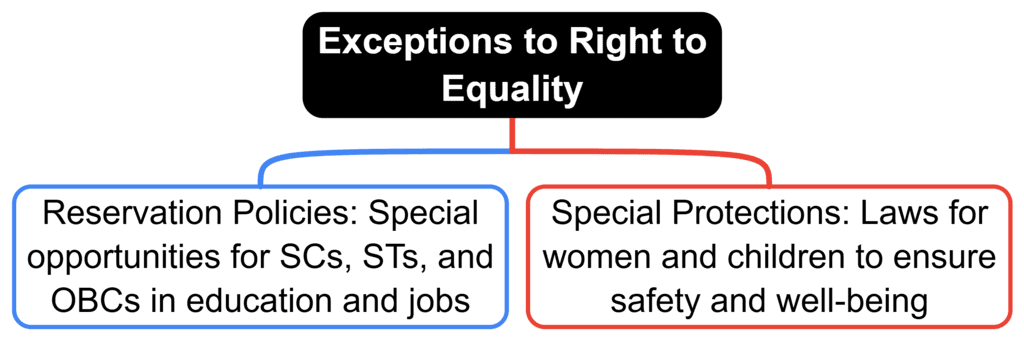
The Right to Equality contains two exceptions as follows:

  1. Reservation Policies: The Constitution allows for affirmative action, such as reservations in education and employment for Scheduled Castes, Scheduled Tribes, and Other Backward Classes. This is done to promote social and educational equality by giving these historically disadvantaged groups special opportunities.
  2. Laws for Special Protections: Certain laws provide special protections or privileges for specific groups, like women and children, based on their unique needs. These laws are meant to address social inequalities and ensure their safety and well-being, even if they create exceptions to the general principle of equality.
  • These marginalized groups require additional support and protection due to historical and ongoing instances of discrimination and unequal treatment in various aspects of society. 
  • These measures serve to promote social justice and work towards the eradication of inequalities faced by these disadvantaged groups in society.
  • Equality isn’t about treating everyone the same, regardless of their needs. It’s about providing equal opportunities for everyone to achieve their potential. Sometimes, this requires giving special treatment to ensure fairness. 
  • Job reservations serve this purpose by helping to create equal opportunities

Try yourself:Which of the following is NOT a part of the Right to Equality in a democracy?

  • A.Abolition of titles except for military and academic distinctions.
  • B.Reservation in educational institutions for marginalized groups.
  • C.Ban on untouchability.
  • D.Right to vote for all citizens.

View Solution

b) Right to Freedom

The Right to Freedom is a Fundamental Right given to us by the Constitution and safeguarded by the government . It consists of the following rights:

  1. Freedom of speech and expression.
  2. Freedom to assemble peacefully.
  3. Freedom to form unions and associations.
  4. Freedom to move within the country.
  5. Freedom to live in any part of India.
  6. Freedom to practice any profession.

In addition, the Parliament has enacted a law giving the right to information to the citizens.

Right to Freedom

Freedom of speech and expression 

  • You have the right to disagree with government policies or the actions of an organization and to voice your opinions in conversations with family and friends.
  • You can share your views through various forms of media, like pamphlets, magazines, newspapers, art, poetry, or songs. 
  • However, this freedom doesn’t allow you to incite violence, encourage rebellion against the government, or defame others by spreading false and harmful information.

Freedom to assemble peacefully

  • Citizens are free to hold meetings, processions, rallies, and demonstrations on various issues.
  • However, these gatherings must be peaceful and should not cause public disorder or disturb the peace.
  • Participants in these activities are not allowed to carry weapons.

Freedom to form unions and associations

Citizens also have the right to form associations, such as workers in a factory creating a union to advocate for their interests or a group of people forming an association to fight against corruption or pollution in their town.

Freedom to move within and live in any part of the country

  • We have the freedom to live and settle in any part of India.
  • For example, if someone from Assam wants to start a business in Hyderabad, even if they’ve never been to the city or have any connections there, they have the right to do so as an Indian citizen.
  • This right enables millions of people to migrate from villages to towns and from less developed areas to more prosperous regions and big cities.

Freedom to practice any profession

  • No one can compel you to take up or avoid a specific job.
  • Women cannot be restricted from certain types of work.
  • Individuals from disadvantaged castes cannot be forced to stick to their traditional occupations.

“No citizen can be denied his life and liberty.”

The Right to Freedom guarantees that no citizen can be denied his life and liberty.

  1. These can be denied only by law, i.e., only if a citizen has violated a law or committed a crime.
  2. No one can be arrested without being told why he/she is being arrested.
  3. And, if arrested, every citizen has the right to defend himself/herself through a lawyer of his/her own choice.
  4. Also, if a citizen is arrested, he/she must be brought before a magistrate within 24 hours.

Recently, the Supreme Court has expanded the meaning of the right to life to include the right to food. All these rights are given to the citizens to ensure that the government cannot oppress them unjustly or take away their liberty.

Preventive Detention:

If a person is seen to be a threat to law or unity and integrity of the country, the government can detain such person to prevent any damage. this is called Preventive Detention. But preventive detention can extend only for three months. The period can be extended by an advisory board. At the end of this period, the person should either be brought for trial before a Court or released.

c) Right Against Exploitation

When the rights to liberty and equality are recognized, it naturally leads to the right of every citizen to be free from exploitation. The makers of the Constitution believed it was important to include specific provisions to protect vulnerable groups from exploitation. The Constitution identifies three particular forms of exploitation and explicitly declares them illegal.

  1. Traffic in Human Beings
    • The Constitution prohibits traffic in human beings, which means the selling and buying of human beings, usually women, for immoral purposes.
  2. Forced Labour (Begar)
    • The Constitution also prohibits forced labour or begar in any form. Begar is a practice where a worker is compelled to provide services to their employer without payment or for a minimal wage. 
    • When this practice continues over a lifetime, it is known as bonded labour
  3. Child Labour
    • The Constitution bans child labour, forbidding the employment of anyone under the age of fourteen in factories, mines, or other dangerous jobs, including work in railways and ports. 
    • This constitutional mandate has led to the creation of various laws to prevent children from working in industries like beedi production, firecrackers, matches, printing, and dyeing.

These provisions are essential to protect the fundamental rights of citizens, particularly those from vulnerable sections of society. The enforcement of these laws ensures that individuals are not subjected to exploitation and can live with dignity and freedom.

Try yourself:

Which of the following is NOT a restriction to the Right to Freedom in India?

  • A.National Integration
  • B.Protection of Public Property
  • C.Right to Food
  • D.Public Order and Morality

View Solution

d) Right to Freedom of Religion

Under our constitution, everyone has the right to follow, practice, and promote their chosen religion. Additionally, each religious group or sect is free to manage its own religious activities. . Accordingly,

  1. There is no discrimination against any religion;
  2. Laws are not passed based on religion;
  3. A citizen can be proactive in any religion which he/she wishes to;
  4. Religion Constitutional sects can set up charitable institutions.

What You Cannot Do Under the Right to Freedom of Religion

  • You cannot force, deceive, or use inducements to convert someone to your religion. While you are free to share and promote your beliefs, conversion must be voluntary.
  • You cannot engage in practices that harm others or are illegal under the guise of religion. For instance, animal or human sacrifices are not permitted.
  • You cannot enforce religious practices that discriminate against or restrict the freedoms of individuals, particularly women. For example, it is not allowed to compel a widow to shave her head or wear specific clothes.

e) Cultural and Educational Rights

India is a country many religions, languages and cultures. The Constitution helps them in preserving and developing their own identity.

  1.  All sections of people having their distinct cultures, languages and scripts have full freedom to protect the same.
  2. No citizen can be denied admission to any educational institution funded or supported by the government due to their religion or language.
  3. All minorities have the right to establish and administer educational institutions of their choice

Educational Rights

f) Right to Constitutional Remedies

Rights act as promises that must be upheld. The true value of fundamental rights in the Constitution lies in their enforceability. This is where the Right to Constitutional Remedies plays a pivotal role, serving as a fundamental right that empowers individuals to enforce their rights. The following section will help you understand this further.

How can we secure these Rights?

  • Right to Constitutional Remedies: This right is crucial for making other rights actionable. It allows individuals to seek legal recourse in courts against any violation of their rights by fellow citizens, private entities, or the government. Dr. Ambedkar hailed this right as the Constitution’s “heart and soul.”
  • Protection Against Violations: Fundamental Rights are safeguarded against infringement by the Legislature, the Executive, and any governmental bodies. Any law or action contravening these rights is deemed invalid, enabling individuals to challenge such violations in court.
  • Enforcement by Courts: Both the Supreme Court and High Courts are vested with the authority to issue directives, orders, or writs to enforce Fundamental Rights.  A writ is a formal written order issued by a court or other legal authority. It commands a person, organization, or lower court to perform or refrain from performing a specific act. Writs  are a way to protect fundamental rights and address legal grievances. They can also compensate victims and penalize offenders, underscoring the judiciary’s independence and power in safeguarding citizen rights.
  • Access to Courts: Anyone aggrieved by a violation of a Fundamental Right can approach the courts for redress. Moreover, the advent of Public Interest Litigation (PIL) has broadened this scope, allowing any individual or group to seek judicial intervention in matters of public interest against government actions or laws, with the possibility of initiating such litigation through simple means, such as a postcard.

Try yourself:

Which fundamental right allows individuals to seek legal recourse in courts against any violation of their rights by fellow citizens, private entities, or the government?

  • A.Right to Equality
  • B.Right to Freedom of Religion
  • C.Right to Constitutional Remedies
  • D.Right to Education

View Solution

Expanding Scope of RightsWhile we mostly focused on the Fundamental Rights in the Constitution, it’s important to know that people have many more rights than just these. The Constitution and different laws have helped increase these rights over time.

  • This enhancement often paves the way for the introduction of new legal rights for citizens.
  • Judicial pronouncements have occasionally widened the interpretation of pre-existing rights, such as the right to freedom of the pressright to information, and right to education.
  • As of now, every Indian citizen is assured the right to free and compulsory education until the age of 14, a mandate enforced by the government under the law.
  • The Right to Information Act was instituted drawing from the Fundamental Right to freedom of thought and expression, enabling citizens to procure information from government entities.
  • The Supreme Court has recently expanded the definition of the right to life to encompass the right to food.
  • It’s noteworthy that not all rights are limited to the Fundamental Rights enumerated in the Constitution. For instance, the right to property and the right to vote in elections are recognized as constitutional rights, albeit not as Fundamental Rights.

The extension of rights also ventures into the domain of human rights, which stand as universal moral entitlements that might not necessarily be upheld by law. With the proliferation of democracy globally, there’s a growing impetus on governments to honor these claims, further buoyed by international agreements. International agreements or covenants have helped in expansion of fundamental rights. 

Covenants are formal, binding agreements or promises made between parties.  These agreements are enforceable by law and often relate to property, business, or personal matters.

The evolution of rights continues unabated, with new rights emerging in response to societal advancements and the establishment of new constitutions. For example, the South African Constitution endows its citizens with several novel rights:

  • Right to privacy, safeguarding against unwarranted searches of homes, phone tapping, and interception of personal communications.
  • Right to an environment that is not detrimental to health or well-being.
  • Right to access adequate housing.
  • Right to healthcare services, adequate food and water, and emergency medical treatment without discrimination.

International Covenant on Economic, Social and Cultural Rights

This international covenant recognizes several rights that are not explicitly included in the Fundamental Rights of the Indian Constitution. Although it has not yet become an international treaty, human rights activists globally view it as a benchmark for human rights standards. The rights covered by this covenant include:

  • Right to Work: The opportunity for everyone to earn a livelihood through employment.
  • Right to Safe and Healthy Working Conditions: Ensuring fair wages and working conditions that provide a decent standard of living for workers and their families.
  • Right to an Adequate Standard of Living: Access to sufficient food, clothing, and housing.
  • Right to Social Security and Insurance: Protection against economic hardship through social security and insurance.
  • Right to Health: Access to medical care during illness, special care for women during childbirth, and measures to prevent epidemics.
  • Right to Education: Provision of free and compulsory primary education and equal access to higher education.

There’s a prevailing belief that India should elevate rights such as the right to workright to healthright to a minimum livelihood, and right to privacy to the status of Fundamental Rights.

Keywords

  • Amnesty International: This global entity, powered by volunteers, champions human rights and compiles independent assessments of human rights abuses across the globe.
  • Claim: Encompasses the pursuit of legal or moral entitlements by an individual towards fellow citizens, society, or the state.
  • Covenant: Represents a solemn promise by individuals, groups, or nations to adhere to a specific rule or principle.
  • Dalit: A designation for individuals from castes historically deemed untouchable, also known as Scheduled Castes or Depressed Classes.
  • The International Covenant on Economic, Social, and Cultural Rightsacknowledges numerous rights not explicitly covered under the Fundamental Rights of the Indian Constitution. Though not an international treaty, it is regarded as a human rights standard globally, enumerating rights such as:
    • The right to work, enabling everyone to earn a living through employment.
    • Safe and healthy working conditions and fair wages for a decent living standard for workers and their families.
    • The right to an adequate standard of living, including sufficient food, clothing, and housing.
    • Right to social security and insurance.
    • Right to health, encompassing medical care during illness, childbirth care for women, and preventive measures against epidemics.
    • Right to education, ensuring free and compulsory primary education and equitable access to higher education.
  • Ethnic Group: Identified as a community of people who share common cultural practices, religious beliefs, and historical backgrounds.
  • Traffic: Entails the illicit trade of individuals, including men, women, or children, for exploitative purposes.
  • Summon: A judicial notice compelling an individual’s appearance in court.
  • Writ: A formal directive issued by the High Court or the Supreme Court mandating governmental action
04. Working of Institutions – 2 Chapter Notes

The Judiciary and Its Structure

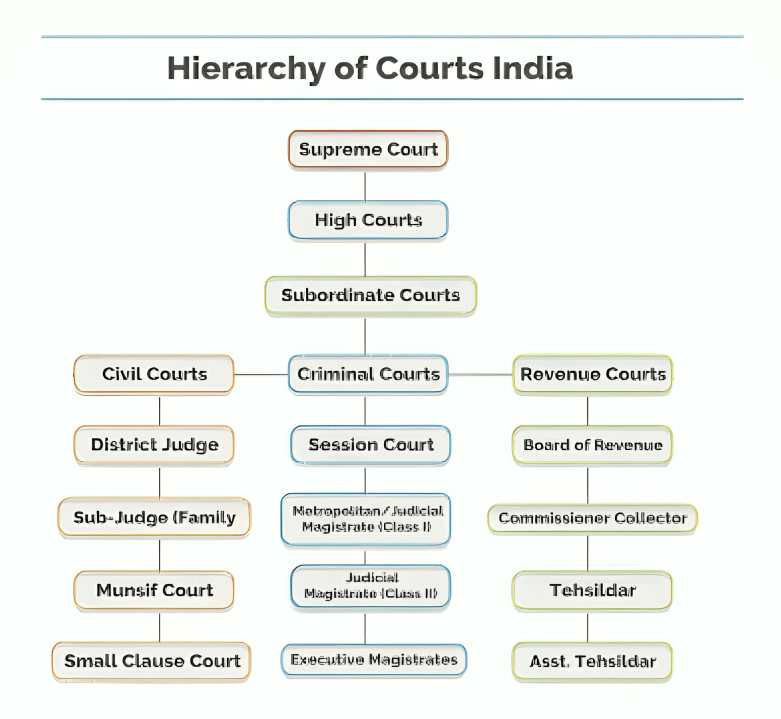
The judiciary is an institution responsible for delivering justice and resolving legal disputes. In India, the judiciary consists of various courts at different levels, collectively known as the judiciary.

The structure of the Indian judiciary includes:

  • Supreme Court: The highest court in the country.
  • High Courts and Subordinate Courts: Functioning at the state level.
  • District Courts and Local Courts: Operating at the district and local levels.
  • Lok Adalats: Special courts for quicker and informal dispute resolutions.

India’s judiciary is unified, meaning the Supreme Court supervises judicial administration across the nation. Its decisions must be followed by all other courts.

The judiciary has the power of judicial review, allowing the Supreme Court and High Courts to check if any law or executive action is constitutional when challenged. This ensures that laws align with the Constitution.

Judges of the Supreme Court and High Courts are appointed by the President, based on the Prime Minister’s advice and after consulting the Chief Justice of the Supreme Court. Once appointed, judges retain a high level of independence, with minimal interference from the political executive. The most senior judge is usually appointed as the Chief Justice.

Removing judges is a serious matter; a judge can only be removed through an impeachment motion that must be passed by two-thirds of both Houses of Parliament. This process highlights the independence of the judiciary.

Additionally, the judiciary plays an important role in protecting citizens’ rights through public interest litigation. This process allows anyone to approach the courts if government actions harm public interest.

Try yourself:

Which court is responsible for supervising judicial administration across India?

  • A.High Courts
  • B.District Courts
  • C.Supreme Court
  • D.Lok Adalats

View Solution

Independence of the Judiciary

Judicial independence is essential for a fair justice system. It guarantees that the judiciary operates without influence from the legislature or executive branches. Judges make decisions based on the law, not on government or political party instructions. This separation is vital in modern democracies like India, where courts function independently from other government branches.

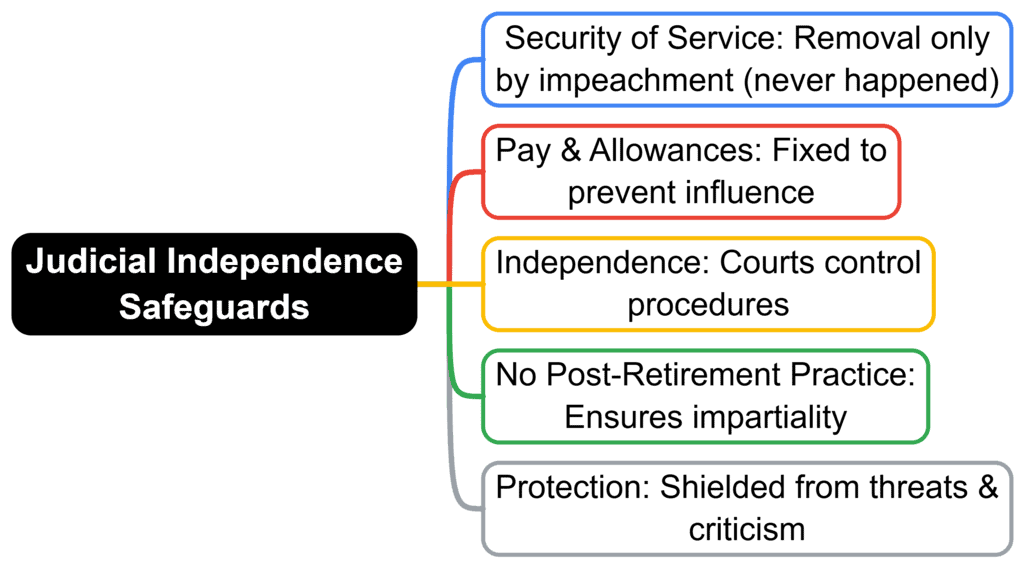
The Constitution safeguards this independence through various provisions:

  • Security of Service: A judge can only be removed through an impeachment motion that passes with a two-thirds majority in both Houses of Parliament. This has never occurred in Indian history.
  • Security of Pay and Allowances: Judges receive stable salaries and allowances to prevent financial manipulation.
  • Free from Outside Influence: Courts can decide their procedures and work without outside interference.
  • No Practice after Retirement: Judges cannot practice law after retiring, ensuring impartiality.
  • Safety and Protection: Judges are protected from threats against their person, property, or reputation, and their decisions cannot be publicly criticised by the media or the public.

Moreover, the judiciary in India possesses substantial powers that enhance its independence:

  • Judicial Review: The judiciary has the authority to assess the constitutional validity of any legislation or executive action when challenged in court.
  • Power of the Judiciary: The Supreme Court and High Courts can interpret the Constitution and declare any law or action of the legislature or executive invalid if it violates the Constitution.
  • Integrated Judiciary: India has an integrated judiciary where the Supreme Court oversees judicial administration, and its decisions are binding on all other courts.
  • Public Interest Litigation: Individuals can approach the courts if government actions harm the public interest, known as public interest litigation.

The powers and independence of the Indian judiciary enable it to safeguard Fundamental Rights. Citizens can seek remedies in court for violations of their rights. In recent years, courts have issued numerous rulings to protect public interests and human rights.

Therefore, the independence of the judiciary is vital for democracy in India, ensuring justice is served without bias or outside influence.

Appointment and Removal of Judges

Judges for the Supreme Court and High Courts are appointed by the President of India, based on the Prime Minister’s advice and in consultation with the Chief Justice of the Supreme Court. The Indian judiciary is among the strongest globally, with the power to interpret the Constitution and invalidate any laws or executive actions that contradict it.

  • Senior judges from the Supreme Court are also involved in choosing new judges. This limits political interference, helping maintain judicial independence.
  • Removal of judges is very uncommon. Once appointed, it is quite challenging to dismiss a judge. A judge can only be removed through an impeachment motion that must be approved by two-thirds of the members in both Houses of Parliament. This process is as complex as removing the President of India and has never occurred in Indian democratic history.

The Supreme Court and High Courts hold the power of judicial review, enabling them to evaluate the constitutional validity of laws or executive actions challenged in court. This authority highlights the judiciary’s role in protecting the Constitution and safeguarding the Fundamental Rights of citizens.

Powers and Role of the Supreme Court and High Courts

The Supreme Court of India has various types of authority:

  • Original Jurisdiction: This includes disputes involving the Union Government and states, conflicts between states, and cases between citizens and the state. The judiciary’s powers and independence ensure it protects Fundamental Rights.
  • Appellate Jurisdiction: The Supreme Court reviews appeals from both criminal and civil cases decided by High Courts.
  • Advisory Jurisdiction: The Supreme Court can advise the President of India on legal issues.

Additionally, the Supreme Court is empowered to:

  • Interpret the Constitution: It can declare laws from Parliament and State Legislatures unconstitutional if they breach the Constitution.
  • Judicial Review: The Court assesses the constitutionality of actions from the legislature and executive, determining if any laws or actions are constitutional.

The High Courts operate similarly at the state level, with powers to interpret the Constitution and protect fundamental rights. They handle public interest cases through Public Interest Litigation (PIL) and scrutinise government actions.

Judges of both the Supreme Court and High Courts are appointed by the President based on the Prime Minister’s advice and consultation with the Chief Justice. The judiciary is independent, meaning it does not answer to the legislature or executive. A judge can only be removed through an impeachment motion that requires two-thirds approval from both Houses of Parliament. India’s judiciary is among the most powerful globally.

Judiciary as the Guardian of Fundamental Rights

Both the Supreme Court and High Courts serve as defenders of citizens’ Fundamental Rights. Anyone whose rights have been infringed or whose public interest is negatively affected by government actions can turn to the judiciary via Public Interest Litigations (PILs).

  • The courts play a vital role in stopping the misuse of government authority. They step in to prevent improper use of power and to address wrongdoings. This judicial oversight is crucial for maintaining checks and balances in Indian democracy.
  • In federal systems like India and the United States, the judiciary settles disputes between the central and state governments or among different states. For instance, issues like water distribution between Haryana and Punjab are often resolved by the courts. This capacity to settle inter-state disputes is essential for the effective operation of federal states.

The judiciary has the authority to assess the constitutional validity of any law or action taken by the executive when challenged. This process is known as judicial review. The Supreme Court and the High Courts are responsible for interpreting the Constitution of the country.

Judges of the Supreme Court and High Courts are appointed by the President based on the Prime Minister’s advice and in consultation with the Chief Justice. After their appointment, judges can only be removed through an impeachment motion, which requires a two-thirds majority from both Houses of Parliament. This procedure safeguards the independence of the judiciary, making it challenging to remove judges.

The independence and powers of the judiciary enable it to act as the guardian of Fundamental Rights. Citizens can approach the courts for remedies if their rights are violated. In recent years, the courts have issued numerous rulings and directives to uphold public interest and human rights.

The independent and robust judiciary is crucial for democracies. All courts at various levels in a country together form the judiciary. The Indian judiciary comprises a Supreme Court for the nation, High Courts in the states, District Courts, and local courts. India has an integrated judiciary, meaning the Supreme Court oversees the whole judicial system.

Try yourself:Two features of Indian judicial system are:

  • A.Independent Judiciary
  • B.Integrated Judiciary
  • C.Dependent Judiciary
  • D.Both (a) and (b)

View Solution

Judicial Setup and Functioning

At the top of India’s judicial system is the Supreme Court, followed by High Courts at the state level. Below the High Courts, there are District Courts and Subordinate Courts that deal with criminal and civil cases.

  • Supreme Court: As the highest court, it addresses cases that impact the entire country, including constitutional issues, civil and criminal appeals, and providing advice to the President. It has the authority to assess the constitutional validity of any law or executive action when contested, a process known as judicial review.
  • High Courts: These courts handle state-level legal matters and possess similar powers to the Supreme Court in interpreting the Constitution and upholding justice. They also hear appeals from lower courts.
  • District and Subordinate Courts: These courts manage local disputes and are the primary legal interface within their areas.

The Supreme Court oversees all other courts in the nation, ensuring consistency within the judicial system. It can hear appeals against High Court decisions.

Judges of the Supreme Court and High Courts are appointed by the President based on the Prime Minister’s advice, in consultation with the Chief Justice of the Supreme Court. Once appointed, a judge can only be removed through an impeachment motion passed by two-thirds of the members from both Houses of Parliament.

The judiciary in India is also one of the most powerful globally. The Supreme Court and High Courts can interpret the Constitution and nullify any law or executive action that contradicts it, whether at the national or state level.

Moreover, any individual can approach the courts if they believe the government’s actions harm public interest. This is known as public interest litigation, allowing the judiciary to step in and prevent the abuse of government power, protecting public interest and human rights.

Conclusion

This chapter explains the Indian judicial system and its vital role in supporting democratic values. The independence and powers of the Indian judiciary enable it to protect Fundamental Rights. This system can assess the constitutionality of laws or executive actions through a process called judicial review. This means they can evaluate any law or executive action when it is challenged in court.

The Supreme Court of India has stated that the main principles of the Constitution cannot be altered by Parliament. In recent times, the courts have made many decisions to safeguard public interests and human rights. This allows anyone to bring cases to court if government actions harm public interest, a process known as public interest litigation. The judiciary steps in to prevent the abuse of governmental power and to address malpractices.

Difficult Words

  1. Elucidates – Makes something clear; explains.
  2. Responsibilities – Duties or tasks that one is required or expected to carry out.
  3. Democratic Institutions – Organisations that uphold the principles of democracy.
  4. Parliament – The supreme legislative body of a country.
  5. Executive – The branch of government that carries out laws.
  6. Judiciary – The system of courts that interprets and applies the law.
  7. Operation – The functioning or work of an organisation.
  8. Checks and Balances – Mechanisms that ensure no single branch of government is too powerful.
  9. Governance – The manner of governing a state or organisation.
  10. Informed Citizen Participation – Active engagement of citizens in politics based on knowledge.
  11. Equips – Provides the necessary items or knowledge for a purpose.
  12. Significance – The importance or meaning of something.

04. Working of Institutions – 1 Chapter Notes

Introduction

This chapter discusses how institutions operate within a democracy. We explore how significant decisions are made and executed in our country. In this context, we identify three vital institutions responsible for major decisions: the legislatureexecutive, and judiciary

We also examine how disputes arising from these decisions are resolved, often resulting in delays and complications. While dealing with institutions can be frustrating, some delays allow for a broader range of people to be included in the decision-making process.

How is a Major Policy Decision Taken?

A Government Order

  • On August 13, 1990, the Government of India released an order known as an Office Memorandum, identified by the number O. M. No. 36012/31/90-Est (SCT), dated 13.8.1990.
  • The Prime Minister and the Cabinet are responsible for making all significant policy decisions.
  • Civil servants work collaboratively to implement the decisions made by the ministers.
  • The Supreme Court resolves disputes between citizens and the government.

Working with institutions can be challenging due to the rules and regulations that can limit leaders’ actions. There are many meetings, committees, and protocols which often cause delays. While it may seem easier for one person to make all decisions without rules, this contradicts the principles of democracy. Although institutions can slow down decision-making, they also prevent hasty decisions.

The Decision Makers

Who decided to issue this Memorandum? 
Such a major decision would have involved other major functionaries in India, which involves the following points:

  • The President, who is the head of state and the highest formal authority in India.
  • The Prime Minister, who leads the government and makes most decisions in Cabinet meetings.
  • Parliament, comprising the President and two Houses, Lok Sabha and Rajya Sabha. The Prime Minister relies on the majority support from Lok Sabha members to pass a memorandum.

Background of Office Memorandum

  • In 1979, the Indian government set up the Second Backward Classes Commission, led by B.P. Mandal, to identify socially and educationally backward classes.
  • The Commission’s report, submitted on December 31, 1980, recommended a 27% reservation in government jobs for backward classes. Parliament debated these recommendations for several years.

Try yourself:How is a Major Policy Decision Taken?

  • A. By the President of India
  • B.By the Prime Minister of India
  • C.By the Parliament of India
  • D.By the Backward Classes Commission

View Solution

Events leading to the implementation of the Mandal Commission report

  • In 1989, the Janata Dal party pledged to implement the Mandal Commission report if they won the Lok Sabha election. After their victory, V.P. Singh became the Prime Minister.
  • The President of India indicated support for the recommendations in a speech to Parliament. Then, on August 6, 1990, the Union Cabinet officially decided to implement the recommendations.
  • On August 7, 1990, Prime Minister V.P. Singh informed Parliament about this decision. Finally, on August 13, 1990, officials from the Department of Personnel and Training drafted an order based on the Cabinet’s choice, which was approved by the minister. An officer signed the order for the Union Government, creating O.M. No. 36012/31/90.

Impact and Resolution of the Office Memorandum on Reservation in India

  • The passing of the Office Memorandum triggered extensive debate, protests, and anxiety about job opportunities and fairness.
  • The Supreme Court addressed the issue in the case of ‘Indira Sawhney and others Vs Union of India’, upholding the original order but stating that affluent members of backward classes should not receive reservation benefits.
  • On September 8, 1993, the Department of Personnel and Training issued a revised Office Memorandum that clarified the policy and resolved the controversy.

Need for Political Institutions

In modern democracies, various arrangements are set up to carry out different functions of the government, which we refer to as institutions. Rulers in a democracy must adhere to specific rules and procedures, working alongside these institutions. 

This section discusses how these institutions operate within a democratic framework. The main goal is to grasp how these institutions collectively manage the responsibilities of government. A democracy functions effectively when these institutions fulfil their designated roles.

  • Institutions entail meetings, committees, and established routines, which can often cause delays and complications. As a result, engaging with institutions may become frustrating.
  • While some of the delays and complications introduced by institutions can be cumbersome, they also provide a chance for a broader range of individuals to offer input.
  • Institutions can slow down decision-making processes; however, they also prevent hasty and poor decisions from being made.

For instance:

  • The Prime Minister and the Cabinet are responsible for making all significant policy decisions.
  • Civil Servants work collaboratively to implement the decisions made by ministers.
  • The Supreme Court resolves disputes between citizens and the government.

Engaging with institutions can be challenging. They involve rules and regulations that may restrict leaders’ actions. One might think it would be simpler for a single person to make all decisions without any rules, procedures, or meetings, but that contradicts the essence of democracy.

Understanding the operation of political institutions is vital for the smooth functioning of democracy, ensuring that decisions are made with proper procedures and consideration for all affected parties.

Parliament

The Indian Parliament is an important organ of the Central Government. Let us study its composition and powers.

Why do we need a Parliament?

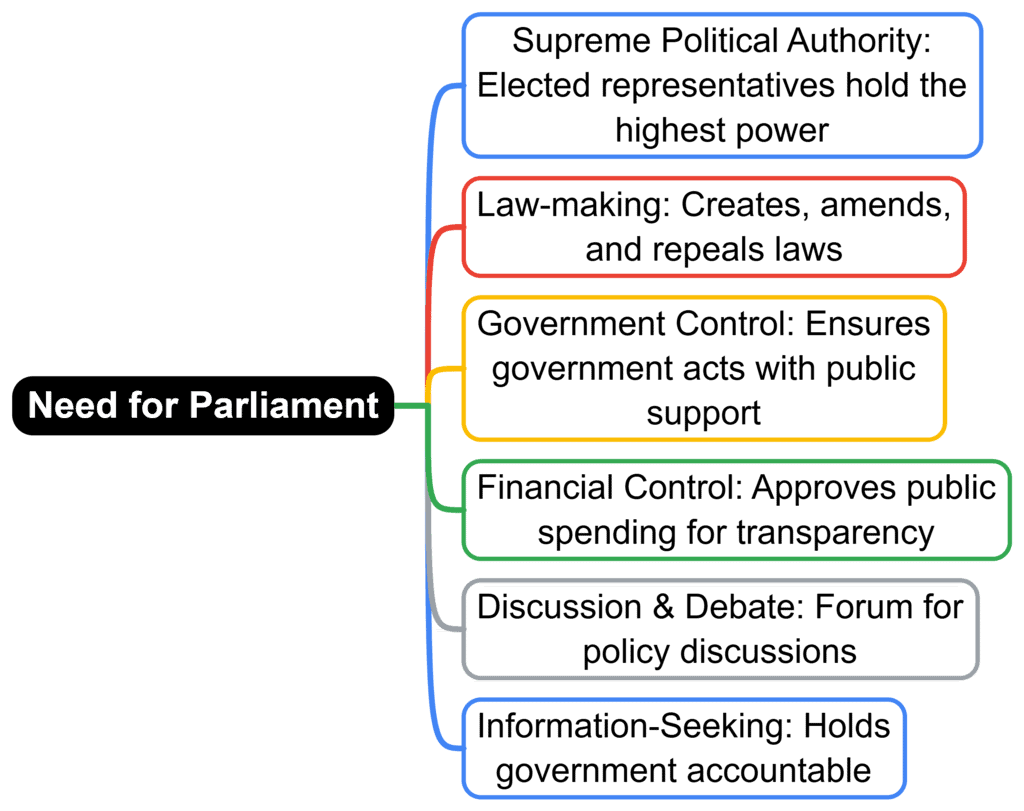
  • Supreme Political Authority: In democracies, a group of elected representatives holds the highest political authority for the people. In India, this group is known as Parliament, while at the state level, it is referred to as the Legislature or Legislative Assembly.
  • Law-making authority: Parliament is the ultimate body responsible for creating laws. This role is so significant that these bodies are called legislatures. Parliaments worldwide can introduce new laws, amend existing ones, or repeal laws entirely.
  • Government control: The government can only make decisions as long as it has the support of Parliament, ensuring that its actions align with the people’s wishes.
  • Financial control: Parliaments oversee all governmental finances. In most nations, public funds can only be spent with Parliament’s approval, promoting transparency and accountability.
  • Discussion and debate: Parliament serves as the highest forum for discussing important public matters and influencing national policies. It provides a space for debate on issues of public concern.
  • Information-seeking: Parliament has the power to request information on any issue, holding the government accountable for its actions.

Two Houses of Parliament

In modern democracies, Parliament plays a crucial role and is often divided into two parts, called Chambers or Houses, in most large countries.

  • One House, generally elected directly by the people, holds the main authority on their behalf.
  • The second House, often elected indirectly, has specific roles such as representing the interests of various states, regions, or federal units.
  • The Indian Parliament consists of two Houses. The Lower House is called the Lok Sabha or the House of the People, while the Upper House is known as the Rajya Sabha or the Council of States.
  • The total membership of the Lok Sabha is 545. The President of India can nominate two members from the Anglo-Indian community if they are not adequately represented. (Note: This provision has been abolished as of the 104th Constitutional Amendment Act, 2019.)
  • The total membership of the Rajya Sabha is 245. Out of this, 233 are elected by the 28 States and seven Union Territories, while 12 are nominated by the President to represent distinguished individuals in literature, science, art, or social service.
  • It may seem that the Rajya Sabha is more powerful since it is often referred to as the ‘Upper Chamber’, and the Lok Sabha as the ‘Lower Chamber.’
  • However, this does not mean that the Rajya Sabha has more power than the Lok Sabha; this terminology is simply outdated and not used in our Constitution.

Powers of Lok Sabha over Rajya Sabha

The Lok Sabha holds more power over the Rajya Sabha in several ways:

  • In the event of a disagreement between the two Houses on an ordinary law, a joint session is held where members from both Houses meet. Because there are more members in the Lok Sabha, their opinion is likely to carry more weight in such a meeting.
  • The Lok Sabha has more authority in financial matters, such as approving the budget or other money-related laws. The Rajya Sabha can only delay this by 14 days or suggest amendments, but cannot reject it. The Lok Sabha may choose to accept or not accept these amendments.
  • Crucially, the Lok Sabha controls the Council of Ministers, as only someone with the support of the majority of Lok Sabha members can be appointed as the Prime Minister. If the majority expresses ‘no confidence’ in the Council of Ministers, all ministers, including the Prime Minister, must resign. The Rajya Sabha does not possess this power.

Furthermore, the President of India is part of Parliament but is not a member of either House. All laws passed in the Houses come into effect only after receiving the President’s approval.

Try yourself:Which House of the Indian Parliament exercises more power over the other?

  • A.Lok Sabha
  • B.Rajya Sabha
  • C.Both Houses have equal power
  • D.It depends on the specific matter or legislation

View Solution

Political Executive

  • In various levels of government, there are officials who make daily decisions but do not hold ultimate power representing the people.
  • These officials are collectively known as the executive, as they are responsible for the ‘execution’ of government policies.
  • Therefore, when referring to ‘the government’, we generally mean the executive.

Political and Permanent Executive

  • In a democratic nation, the executive is made up of two groups: one is elected by the people for a specific term, known as the political executive.
  • The political executive includes leaders who make significant decisions.
  • The other group is appointed for the long term, referred to as the permanent executive or civil services.
  • Individuals in civil services are called civil servants. They remain in position even when the ruling party changes.
  • Civil servants assist the political executive in managing daily administration.

Powers of Permanent and Political Executive

  • The political executive holds more power than the non-political executive because, in a democracy, the people’s will is paramount. 
  • Ministers are elected representatives and have the authority to enact the wishes of the legislature members.
  • You may wonder why the political executive is more powerful than the non-political executive. Although civil servants often have more education and expertise, such as economic advisors in the Finance Ministry, it is the ministers who make the final decisions, even if they lack technical knowledge in their areas.
  • At various levels of government, there are officials who carry out daily decisions but do not wield ultimate authority on behalf of the people. These officials are collectively known as the executive, responsible for executing government policies.
  • Regarding the decision on the Office Memorandum, it is likely that such a significant choice involved many key officials. 
  • The person who signed it was likely just following the orders from the Minister of Personnel, Public Grievances and Pensions, under whose department it fell.
  • The President is the head of state and holds the highest formal authority in the country.

Prime Minister and Council of Ministers

Prime Minister’s Role: The Prime Minister leads the government and holds all its powers. While the Prime Minister is a crucial part of the political system, they are not an institution on their own. There is no direct election for this position; instead, the President appoints the Prime Minister. However, the President can only choose the leader of the party or coalition that has a majority in the Lok Sabha.

The Union Council of Ministers is led by the Prime Minister and includes three categories of Ministers:

  • Cabinet Ministers: These are the key members of the Council of Ministers with significant portfolios. The Cabinet forms the inner group of the Council.
  • Ministers of State with independent charge: They manage smaller Ministries and attend Cabinet meetings only when invited.
  • Deputy Ministers: They support the Cabinet Ministers and the Council of Ministers.

Powers of the Prime MinisterThe Prime Minister has wide-ranging powers.

  • The Prime Minister oversees various ministries, guiding all ministers. They have the authority to dismiss ministers, and if the Prime Minister resigns, the entire ministry follows suit. Thus, while the Cabinet is a powerful institution in India, the Prime Minister is the most influential within it. 
  • Over recent decades, the Prime Minister’s powers in parliamentary democracies have expanded, leading some to view these systems as Prime Ministerial governments. 
  • Political parties now significantly influence politics, allowing the Prime Minister to control both the Cabinet and Parliament through their party. The term “Council of Ministers” refers to the group that includes all Ministers.
  • On the advice of the Prime Minister, the President appoints other ministers.
  • The Prime Minister is free to choose ministers, as long as they are members of Parliament.
  • He chairs and makes most of the decisions in the Cabinet meetings.
  • He coordinates the work of different departments and his decisions are final in case disagreements arise between departments.
  • He exercises general supervision of different ministries and all ministers work under his leadership.
  • He distributes and redistributes work to the ministers.
  • He also has the power to dismiss ministers. When Prime Minister quits, the entire ministry quits.

While the Prime Minister is the head of the government, the President serves as the head of the State. In our political system, the head of the State has only nominal powers. The President oversees the functioning of all political institutions in the country to ensure they work together to meet the State’s objectives.

The President

The President is the Head of the State. The President supervises the overall functioning of all the political institutions in India, so that they operate in harmony to achieve the objectives of the state.

Smt. Droupadi Murmu

Election of President

The President is not elected directly by the public. A candidate for the President’s position must gain a majority of votes from Members of Parliament (MPs) and the Members of the Legislative Assemblies (MLAs) to win.

Powers of President

  • All government activities occur in the name of the President.
  • All laws and key policies of the government are issued in the President’s name.
  • Major appointments, including the Chief Justice of India, Supreme Court Judges, High Court Judges, Governors of states, Election Commissioners, and Ambassadors, are made in the President’s name.
  • All international treaties and agreements are made in the President’s name.
  • The President is the supreme commander of India’s defence forces.

The President exercises these powers only based on the advice of the Council of Ministers. If no party or coalition has a majority in the Lok Sabha, the President uses her discretion. The President appoints a leader who she believes can gain majority support in the Lok Sabha. In these cases, the President may ask the new Prime Minister to demonstrate majority support in the Lok Sabha within a set timeframe. The President can also request the Council of Ministers to reconsider its advice. However, if the same advice is given again, she must follow it.

03. Electoral Politics – Chapter Notes

Introduction

Electoral Politics refers to the process through which representatives are elected by the people to govern on their behalf in a democracy. It encompasses all activities related to elections, including campaigning, voting, and the declaration of results.

In a democratic system, citizens govern indirectly by choosing representatives through elections. This chapter explores the essential role of elections in democracy, explaining why they are necessary and how they work.

Why Elections?

Elections are essential in a democracy, allowing people to select their leaders and ensure they are held responsible. The 1987 Haryana Assembly election is a key example of how this process works within the larger context of Indian democracy.

Assembly Election in Haryana

  • The Congress party had been in power since 1982.
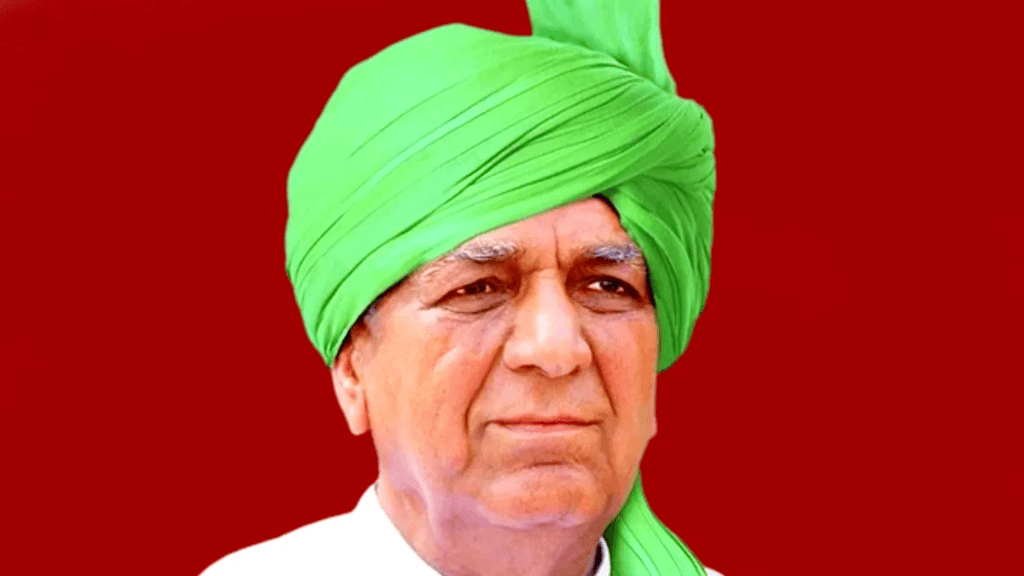
  • Chaudhary Devi Lal, the opposition leader, initiated the ‘Nyaya Yudh’ movement (Struggle for Justice), established a new party called Lok Dal, and collaborated with other opposition groups to challenge Congress.

Chaudhary Devi Lal

Election Results

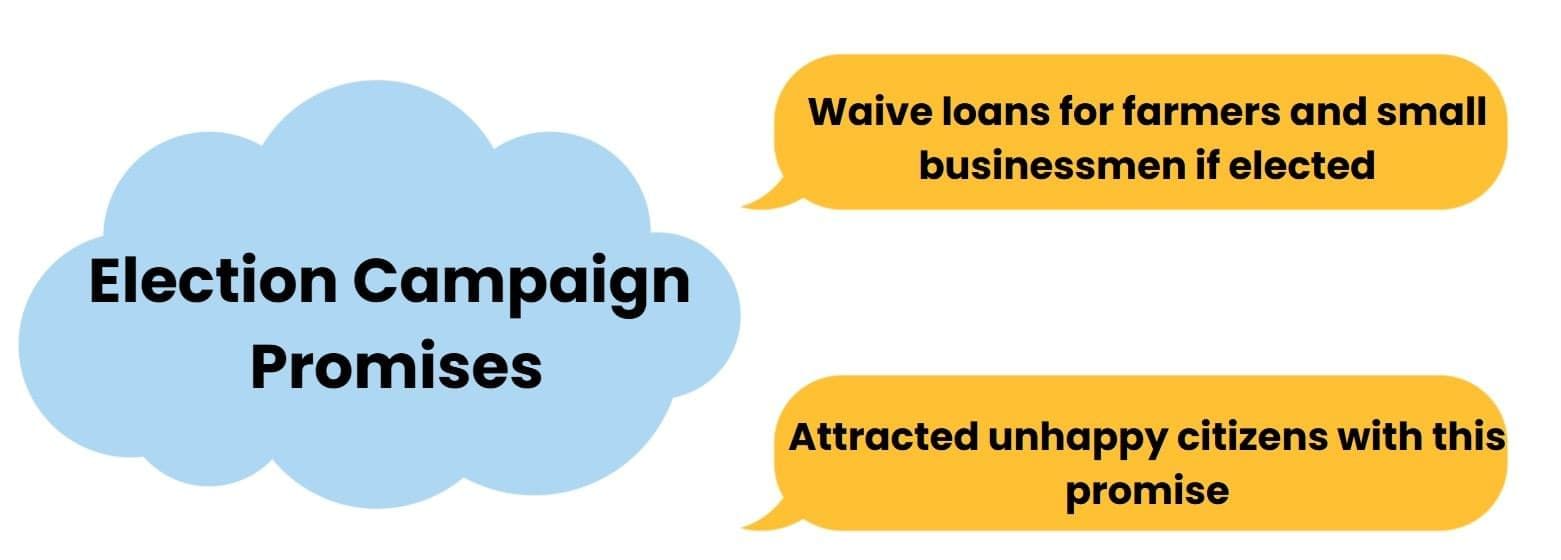
  • The public was unhappy with the current government and found Devi Lal’s promise attractive.
  • Lok Dal and its allies secured 76 out of 90 seats in the State Assembly.
  • Lok Dal won 60 seats on its own, while Congress managed only 5.
  • Devi Lal was elected as leader by the newly chosen MLAs.
  • The Governor invited Devi Lal to take on the role of Chief Minister.

Devi Lal Government Actions

  • Waived outstanding loans for small farmers, agricultural labourers, and small businessmen.
  • Ruled the state for four years.

1991 Haryana State Assembly Election

  • Lok Dal did not win popular support.
  • Congress won the election and formed the government.

Try yourself:

What was the main reason for the formation of the Lok Dal party in Haryana?

  • A.To challenge the ruling Congress party in the state elections.
  • B.To support the ‘Nyaya Yudh’ movement led by Chaudhary Devi.
  • C.To waive loans for farmers and small businessmen if elected.
  • D.To unite with other opposition parties against the Congress.

View Solution

Why do we need elections?

Elections are a crucial part of any democratic system. They serve several key purposes:

  1. Representation: In a large society, it is not practical for everyone to gather and make decisions directly. Elections allow people to choose representatives who will make decisions on their behalf.
  2. Accountability: Elections provide a way for people to hold their representatives accountable. If the representatives do not perform well or fulfill their promises, voters can replace them in the next election.
  3. Legitimacy: Elections give legitimacy to the government. When leaders are chosen by the people, it reinforces the idea that the government represents the will of the majority.
  4. Freedom of Choice: Elections allow citizens to choose who will create laws, form the government, and guide policies. This gives people a direct role in shaping their society.
  5. Regular Intervals: Elections occur at regular intervals, ensuring that representatives are continuously accountable and that citizens have the opportunity to make new choices.

Without elections, a system cannot truly be democratic because there would be no way to measure public opinion, change leadership, or ensure that government power reflects the people’s will.

What Choices Do Voters Make?

  • Voters choose who will make laws.
  • Voters choose who will form the government.
  • Voters choose the party whose ideas will guide the government.

What makes an election democratic?

Democratic Elections vs. Other Elections

  • Democratic elections exist in all democratic countries, while some non-democratic countries also hold elections.
  • It’s essential to distinguish democratic elections from other elections for a better understanding.

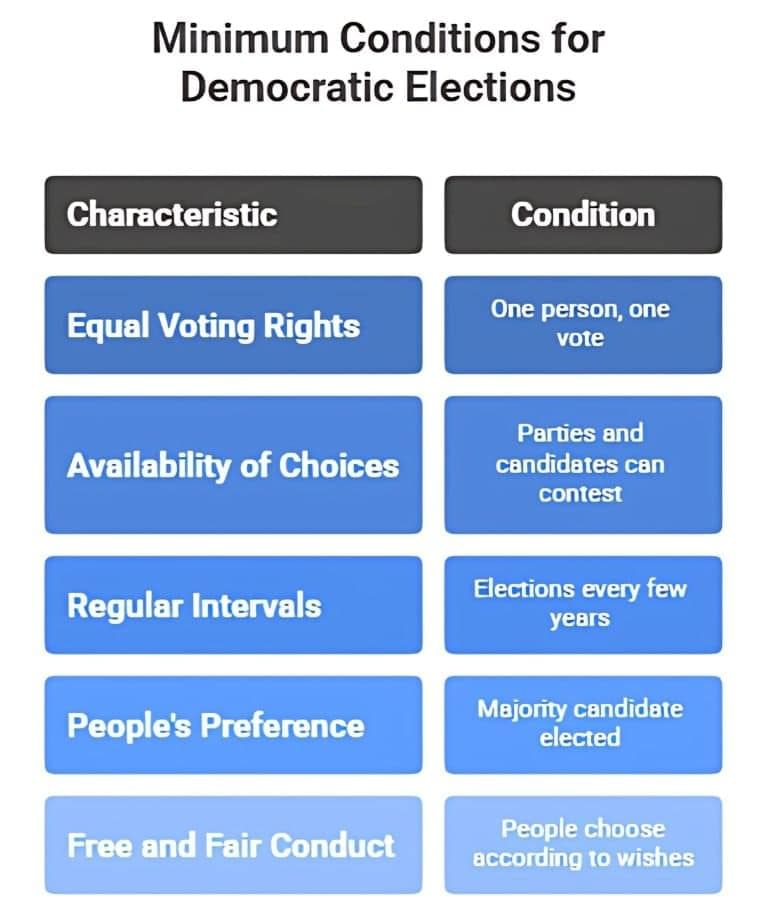
Minimum Conditions for Democratic Elections:

  • Equal voting rights: Everyone should have one vote, and each vote should have equal value.
  • Availability of choices: Parties and candidates should be free to contest elections, providing real choices to voters.
  • Regular intervals: Elections should be held every few years to maintain a democratic system.
  • People’s preference: The candidate preferred by the majority should be elected.
  • Free and fair conduct: Elections should be conducted in a manner where people can choose according to their wishes.

Applying Conditions to Our Country

  • It’s necessary to assess if these conditions are met in our country to determine if our elections are democratic.
  • Many countries do not fulfill these simple yet essential conditions for democratic elections.

Try yourself:

Why do we need elections in a democracy?

  • A.To allow people to choose their representatives and change them if desired.
  • B.To determine the most experienced and knowledgeable leaders.
  • C.To waive outstanding loans for small farmers and businessmen.
  • D.To form a government and make major decisions.

View Solution

Is it good to have political competition?

  • Elections are essentially about political rivalry. 
  • This rivalry occurs in different ways. 
  • The most apparent form is the competition amongst political parties. 
  • At the constituency level, it involves a contest between multiple candidates. 
  • Without competition, elections would lose their purpose.

Problems with Political Competition

  • Political competition can lead to fights, blame games, and dirty tricks between parties.
  • It sometimes causes disunity in local areas.
  • Some people feel this competition stops leaders from making long-term, good policies.
  • Good people who want to serve the country may stay away from politics due to this unhealthy environment.

Why Do We Still Have Political Competition?

  • Our Constitution makers knew these problems, but still chose free competition in elections.
  • This is because, in real life, leaders are not always motivated just to serve the people. Many also want power and positions.
  • Even if leaders want to serve the people, they may not always know what the people truly need.

How do Elections Help?

  • Elections allow people to reward or remove leaders based on their performance.
  • If leaders do good work, they have a better chance of winning again.
  • If they fail, people can vote them out in the next election.
  • This system is like a market—just as a shopkeeper gives good service to keep customers, leaders must work for the people to stay in power.

What is Our System of Elections?

To determine if Indian elections are democratic, let’s look at how they are carried out.

  • Lok Sabha and Vidhan Sabha (Assembly) elections happen every five years, marking the end of the elected representatives’ terms, leading to the dissolution of the Lok Sabha or Vidhan Sabha.
  • Elections occur simultaneously across all constituencies, either on the same day or within a few days, known as a general election.
  • Sometimes, a single constituency holds an election to fill a vacancy due to a member’s death or resignation, called a by-election.

Electoral Constituencies

  • India follows an area-based system of representation. For this purpose, the country is divided into different areas for purposes of elections. These are called electoral constituencies.
  • Voters who live in a constituency elect a representative for their area. 
  • For the Lok Sabha elections, the country is divided into 543 constituencies. 
  • Each constituency elects a representative, known as a Member of Parliament or MP. 
  • Therefore, 543 MPs get elected to the Lok Sabha as people’s representatives. 
  • In a democratic election, every vote should hold equal value, so the Constitution mandates that each constituency should have a roughly equal population.
  • Each state is also divided into a specific number of Assembly constituencies, where the elected representative is called the Member of Legislative Assembly or MLA. 
  • The same principle applies to Panchayat and Municipal elections. Every village or town is divided into various ‘wards’ that function like constituencies. Each ward elects one member of the village or urban local body.
  • Sometimes, these constituencies are referred to as ‘seats’, as each constituency represents one seat in the assembly. 
  • For example, when we say ‘Lok Dal won 60 seats’ in Haryana, it means that Lok Dal candidates emerged victorious in 60 assembly constituencies in the state, resulting in 60 MLAs for Lok Dal in the state assembly.

Reserved Constituencies

A true democracy provides equal opportunity to all individuals and sections of society to take part in elections, get elected, and share in the governance of the economy.

Concerns of the Constitution Makers

  • Weaker sections may not have a fair chance in open electoral competition
  • Lack of resources, education, and contacts could hinder their chances of winning elections.
  • Democracy would be less representative without the voice of these significant sections

Reserved Constituencies

  • Special system for weaker sections (Scheduled Castes and Scheduled Tribes).
  • SC reserved constituencies: only Scheduled Castes candidates can stand for election.
  • ST reserved constituencies: only Scheduled Tribes candidates can stand for election.
  • 84 Lok Sabha seats are reserved for the Scheduled Castes, 47 for the Scheduled Tribes (as on 26 January).

Reservation Extensions

  • The reservation system was extended to the district and local level.
  • Seats in rural (panchayat) and urban (municipalities and corporations) local bodies are reserved for Other Backward Classes (OBC) in many states.
  • The proportion of seats reserved varies from state to state.
  • One-third of seats are reserved in rural and urban local bodies for women candidates.

Voters’ list

  • After deciding the voting areas (constituencies), the next step is to make a list of who can vote.
  • This list is called the Electoral Roll, also known as the Voters’ List.
  • It is made before the election and shared with everyone.

Why is the Voters’ List Important?

  • It ensures that everyone gets an equal chance to vote.
  • According to the rule of universal adult franchise, every adult has one vote, and each vote has equal value.
  • People may be rich or poor, educated or not, kind or unkind — but everyone should have the right to vote because everyone has their own opinions and needs.

Who Can Vote?

  • In India, all citizens who are 18 years or older can vote.
  • Your caste, religion, or gender does not matter.
  • Only in rare cases, such as serious criminals or people with mental illness, can voting rights be denied.

Keeping the List Updated

  • The government must make sure all eligible people are included in the voters’ list.
  • Names are added when someone turns 18.
  • Names are removed if a person dies or moves to a different area.
  • The list is updated every five years to keep it correct.

Voter ID Card

  • A new system called the Election Photo Identity Card (EPIC) has been introduced.
  • The government is giving this card to people on the voters’ list.
  • Voters are asked to carry this card when voting to stop others from voting in their place.
  • However, this card is not mandatory. Other IDs, like a ration card or driving licence, can also be shown.

Try yourself:

What do voters in a constituency elect?

  • A.A Mayor
  • B.A President
  • C.A Member of Parliament
  • D.A Governor

View Solution

Nomination of candidates

  • In a democracy, people should have a real choice of candidates to vote for.
  • This is possible only when anyone can contest elections with very few restrictions.

Who Can Be a Candidate?

  • Any person who is a voter can also become a candidate.
  • The minimum age to vote is 18 years, but to contest elections, the person must be at least 25 years old.
  • People with serious criminal backgrounds can be stopped from contesting, but only in rare cases.

Party Nomination

  • Political parties select candidates to contest elections on their behalf.
  • These candidates are given the party’s symbol and are said to have received a party ticket.

What is the Nomination Process?

Anyone who wants to contest must:
– Fill out a nomination form
– Pay a security deposit (a fixed amount of money)

New Declaration Rules

  • The Supreme Court has made it compulsory for all candidates to give full details about:
    – Criminal cases (if any) against them
    – Their assets and debts
    – Their educational qualifications
  • This information must be shared with the public so that voters can make an informed choice.

Educational qualifications for candidates

Q: Why is there no educational qualification for holding such an important position when some kind of educational qualification is needed for any other job in the country?

Ans: 

  • Some people ask why there is no educational qualification needed to become an MLA or MP, even though most jobs in the country require one.
  • But not all jobs need an education degree.
    – For example, to be in the Indian cricket team, you don’t need a degree — you need to play well.
    – In the same way, to be a good MLA or MP, a person needs to understand people’s problems and speak for them, not just hold a degree.
  • Voters are like examiners. They judge the candidates during elections and decide who is suitable to represent them.
  • Even if education matters, it should be the voters’ choice to decide how important it is while voting.
  • Also, making education compulsory would go against democracy in India.
    – If a rule said only graduates (B.A., B.Com, B.Sc) can contest elections, then most people (over 90%) would not be allowed to stand for elections.
    – This would be unfair to the majority of citizens.

Election Campaign

  • The main aim of an election is to give people the chance to choose their leadersthe government, and the policies they want.
  • So, there must be free and open discussions about who is a better candidate, which party will run the government better, what are the best policies?
  • An election campaign is the time when political parties and candidates talk to voters and promote their ideas.
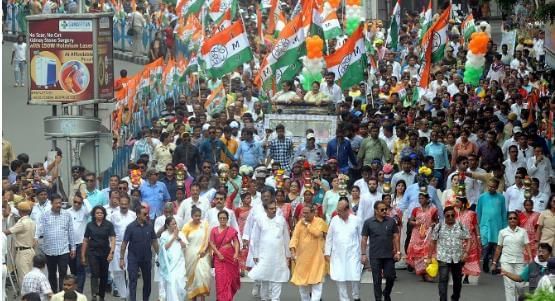
  • In India, official campaigns happen for two weeks — from the day the final list of candidates is announced to the day of voting (polling). During this time:
    – Candidates meet voters
    – Political leaders give speeches
    – Parties gather support
    – TV and newspapers show news, stories, and debates about elections.
  • However, parties often start preparing for elections months in advance, not just during these two weeks.

What Do Parties Do in Campaigns?

  • Parties focus on major issues and try to convince people to vote for them based on those issues.
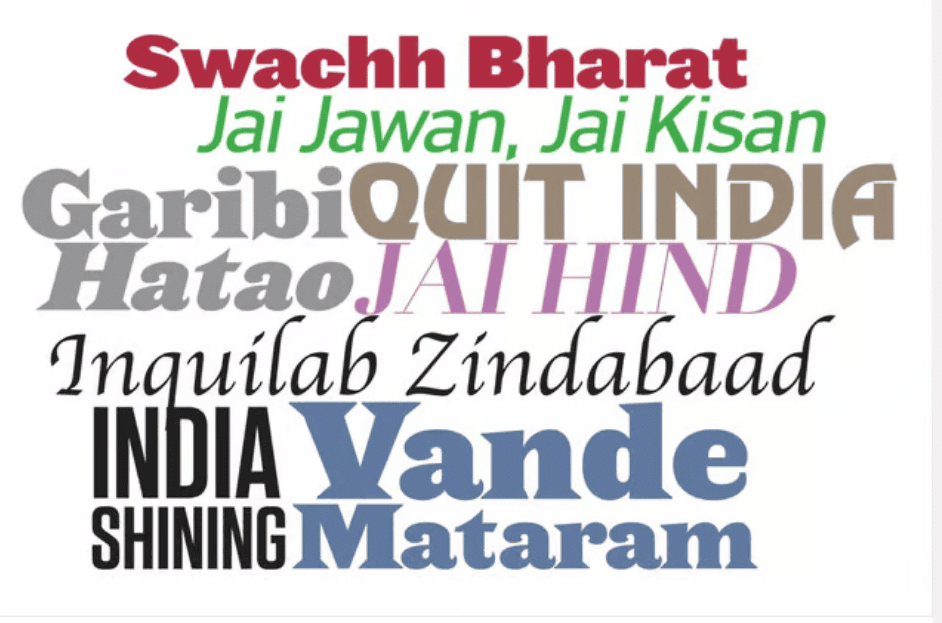
  • They use slogans and messages to catch the public’s attention and promote their promises.

Election Campaign in India

Successful Slogans in Various Elections –

  • In the 1971 Lok Sabha elections, Indira Gandhi and the Congress Party gave the slogan “Garibi Hatao” (Remove Poverty). They promised to change government policies to reduce poverty in the country.
  • In the 1977 Lok Sabha elections, the Janata Party, led by Jayaprakash Narayan, used the slogan “Save Democracy”. They aimed to reverse the wrongdoings during the Emergency and bring back people’s freedoms.
  • During the 1977 West Bengal Assembly elections, the Left Front used the slogan “Land to the Tiller”, showing support for giving land rights to farmers who work on the land.
  • In the 1983 Andhra Pradesh Assembly elections, N. T. Rama Rao, leader of the Telugu Desam Party, gave the slogan “Protect the Self-Respect of the Telugus”, to promote pride and dignity among Telugu-speaking people.

Rules for Election Campaigns

  • In a democracy, political parties and candidates should be free to campaign in their own way.
  • But to make sure everyone gets a fair chance, some rules and limits are needed.

What the Law Says –

According to Indian election law, no party or candidate is allowed to bribe or threaten voters, ask for votes using caste or religion and use government property or staff for campaigning.

Spend more than:

  • 25 lakh for a Lok Sabha (Parliament) election (per constituency)
  • 10 lakh for an Assembly election (per constituency)

If any candidate breaks these rules, the court can cancel their election, even if they have already won.

Model Code of Conduct

All political parties in India also follow a set of rules called the Model Code of Conduct during elections. According to this:

  • They cannot use religious places (like temples, mosques, churches) for campaigning
  • They cannot use government vehicles, planes, or officials for election work
  • Once elections are announced, Ministers are not allowed to:
    – Start any new projects
    – Make big policy decisions
    – Promise new public services or benefits

Polling and counting of votes

  • On Election Day, every person whose name is on the voters’ list can go to a nearby polling booth, usually situated in a local school or a government office.
  • Voter enters the booth, identified and marked by officials.
  • Candidate agents ensure fair voting inside the booth.
  • EVMs replace ballot papers for casting votes.
  • EVMs display candidates’ names and symbols for voting.
  • EVMs are sealed and securely stored after polling.
  • Vote counting happens on a fixed date with candidate agents present.
  • The candidate with the highest votes wins the constituency.
  • Results are announced soon after counting, revealing the next government.

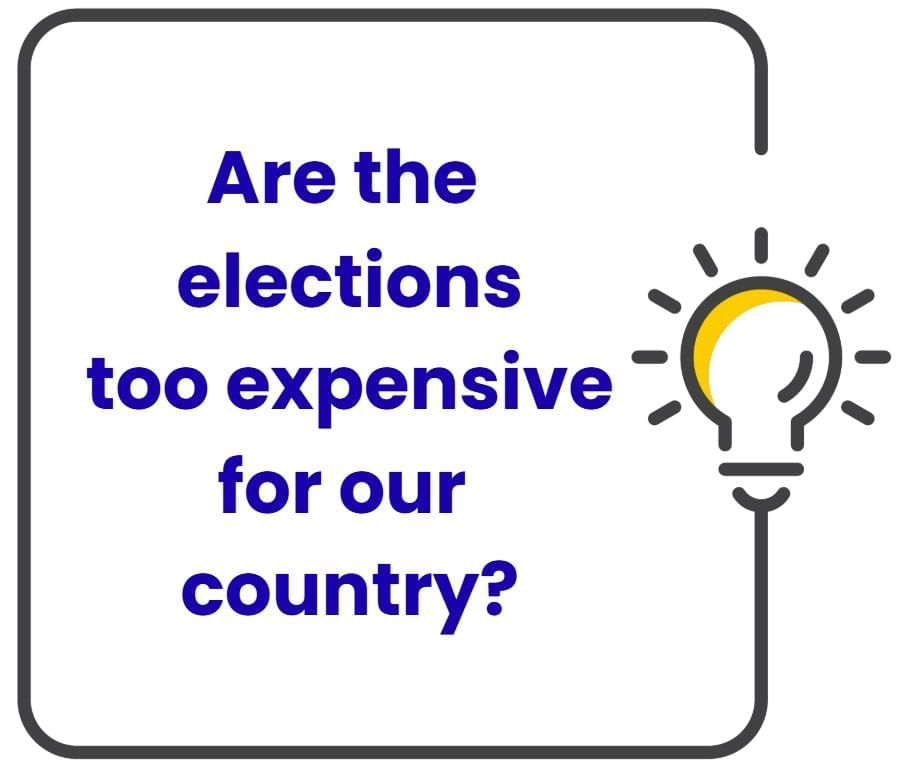
Elections do cost money, but how much is “too much” is debatable: the 2014 Lok Sabha elections cost the government about ₹3,500 crore (≈₹40 per voter), while total spending including parties and candidates was roughly ₹30,000 crore (≈₹500 per voter). Critics call this a burden for a poor country, yet comparable national expenses include a single nuclear submarine at about ₹3,000 crore (2005) and the 2010 Commonwealth Games at around ₹20,000 crore. Seen against such figures, election costs may not be excessive—you decide.

What Makes Elections in India Democratic?

Unfair practices in elections are often reported, including:

  • Voter List Issues: The inclusion of false names or the exclusion of genuine voters from the electoral rolls.
  • Misuse of Government Resources: Ruling parties may misuse government facilities and officials to gain an advantage in elections.
  • Excessive Use of Money: Wealthy candidates and large parties often use excessive amounts of money to influence voters.
  • Intimidation and Rigging: Voters may be threatened, and there can be attempts to rig the voting process on election day.

While these practices are troubling, they usually do not occur at a scale large enough to undermine the overall purpose of elections

Independent Election Commission

  • In India, elections are conducted by the Election Commission (EC).
  • The EC is independent and has a lot of power, just like the judiciary (courts).
  • The Chief Election Commissioner (CEC) is appointed by the President of India, but once appointed, no one can easily remove them—not even the government or ruling party.
  • The EC controls everything about the elections—from announcing dates to declaring results.
  • It enforces rules (like the Model Code of Conduct) and can punish candidates or parties who break them.
  • The EC can ask the government to follow certain rules during elections to make sure there is no misuse of power.
  • It can even transfer government officers if needed to keep elections fair.
  • During elections, government officers work under the EC, not under the government.
  • If the EC finds that voting was unfair in some areas, it can order a re-poll (voting again).
  • Even if the ruling party is unhappy, they have to follow the EC’s decisions.
  • This shows how powerful and independent the EC is.

Popular Participation

One way to judge if elections are free and fair is to see how excited and active people are in taking part. If elections are not fair, people will lose interest and stop voting.

Let’s understand people’s participation in Indian elections:

1. What is Voter Turnout?

  • Voter turnout means the percentage of eligible voters who actually go and vote.
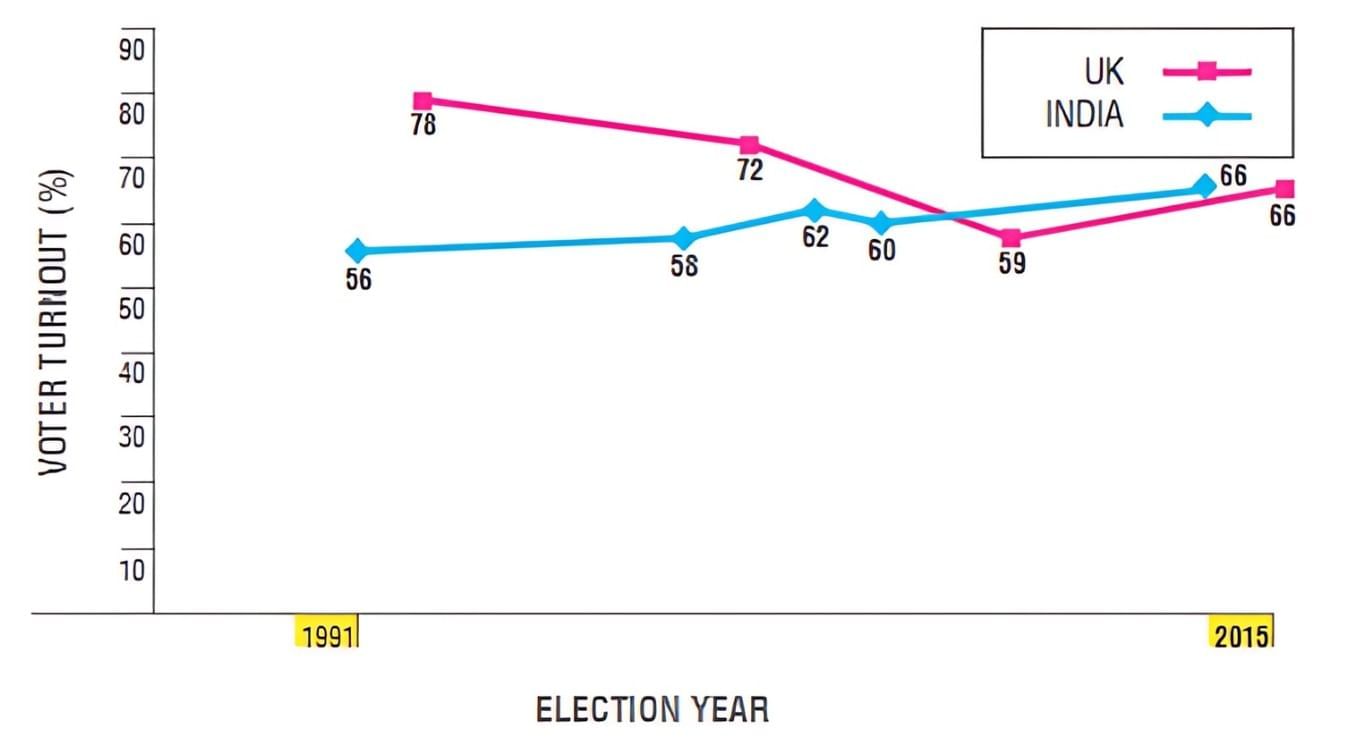
  • In the last 50 years, voter turnout in Europe and North America has gone down.
  • But in India, voter turnout has stayed the same or increased.

Voter Turnout in India and the UK

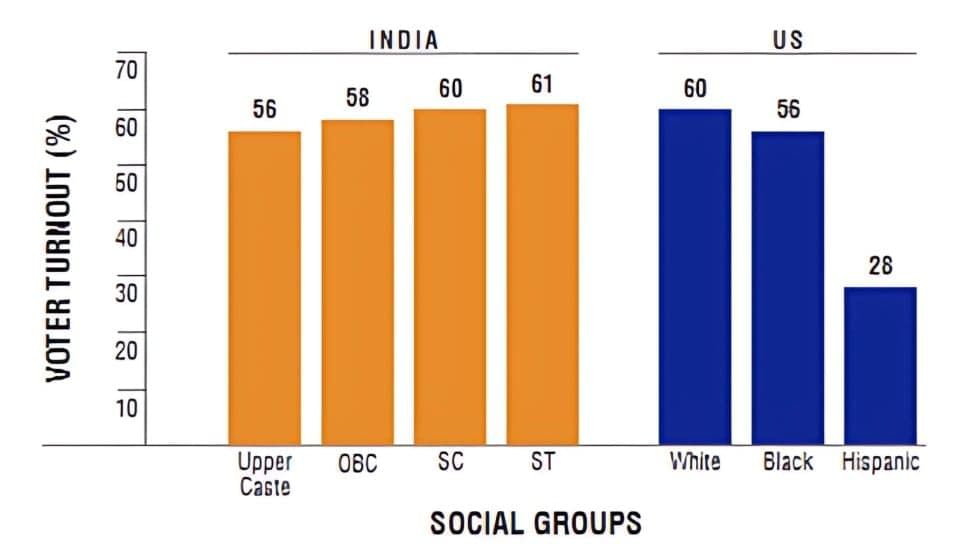
2. Who Votes More in India?

  • In India, the poor, less educated, and underprivileged people vote more than the rich and educated.
  • This is opposite to countries like the USA, where rich and white people vote more, and poor, African-Americans and Hispanics vote less.

Voter Turnout in India and US by social groups, 2004

3. Why Do Common People Vote in India?

  • People believe elections help them put pressure on political parties.
  • They feel their vote can bring change and improve the way the country is run.
  • Voting gives them a voice in the government.

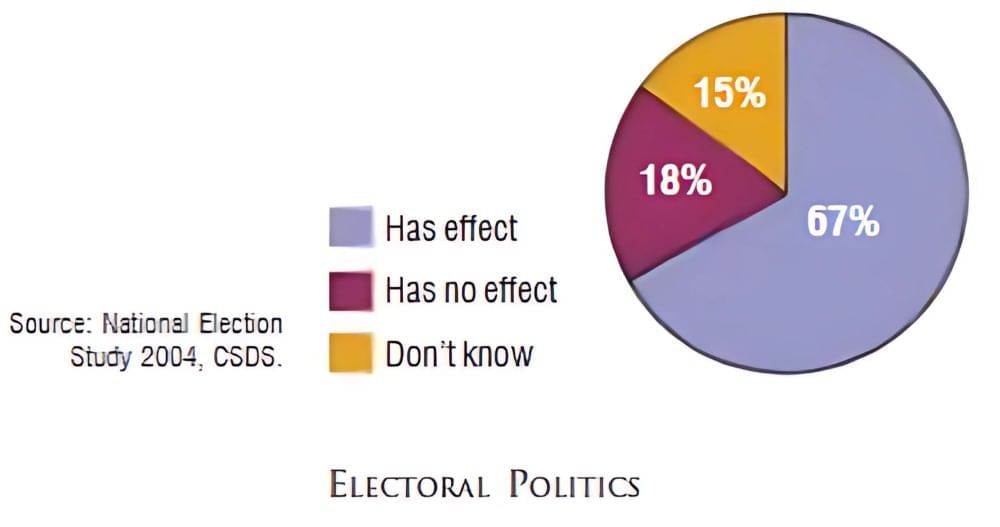
Do you think your vote makes a difference?

4. Growing Interest in Elections

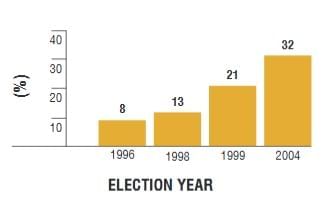
  • In the 2004 elections, over one-third of voters took part in campaign activities (like rallies, meetings, or discussions).
  • More than half of the voters feel close to some political party.
  • 1 out of every 7 voters is a member of a political party.

Those who participated in any election related activity in India

Acceptance of election outcome

If elections are not free and fair, the outcome always favours the powerful. In such a situation, the ruling parties do not lose elections. The outcome of India’s elections speaks for itself:

  • The ruling parties routinely lose elections in India, both at the national and state levels. In fact, in two out of the three elections held in the last fifteen years, the ruling party lost.
  • In the US, an incumbent or ‘sitting’ elected representative rarely loses an election. In India, about half of the sitting MPs or MLAs lose elections.
  • Candidates who are known to have spent a lot of money on ‘buying votes’ and those with known criminal connections often lose elections.
  • Barring a few disputed elections, the electoral outcomes are usually accepted as ‘people’s verdict’ by the defeated party.

Try yourself:

What is a key feature of elections in India?

  • A.They do not allow public participation.
  • B.They are only for local leaders.
  • C.They involve a voting process.
  • D.They are held every year.

View Solution

Challenges to free and fair elections

In general, elections in India are mostly free and fair. The party that wins usually does so because the people have chosen it over other parties.
Yes, there may be a few places where candidates win using money or unfair means, but overall, the results of elections show what most people want. This is why Indian elections are considered democratic.

Even though elections seem fair, there are serious challenges:

1. Lack of Informed Choices

  • Many voters do not have full knowledge about candidates or party policies.

2. Unfair Advantage of Money and Power

  • Rich parties and candidates spend large amounts on campaigns.
  • They get more attention, making it hard for smaller parties to compete.

3. Criminal Backgrounds

  • In some areas, criminals manage to get party tickets and scare others away.

4. Family Dominance

  • Some political parties are controlled by one family.
  • Tickets are often given to relatives, not based on merit.

5. Limited Choice for Voters

  • Sometimes, both major parties have similar ideas and actions.
  • Voters feel they have no real alternative.

These problems are not unique to India; even developed democracies face them.

This is why citizens, NGOs, and activists are calling for electoral reforms.

What Can Be Done?

  • Reforms are needed to make elections more fair and inclusive.
  • Ordinary citizens can stay informed, vote responsibly, and raise their voices for better laws and systems.

Key Terms

  1. Electoral Constituencies: Specific geographic areas defined for the purpose of elections, from which representatives are elected to legislative bodies. Each constituency elects one representative.
  2. Reserved Constituencies: Constituencies where seats are reserved for candidates belonging to Scheduled Castes (SC) and Scheduled Tribes (ST) to ensure political representation for these historically marginalized communities.
  3. Electoral Roll (Voters’ List): The official list of eligible voters who can participate in an election. This list is crucial for the organization and fairness of electoral processes.
  4. Election Campaign: The period leading up to the election when candidates and parties promote their policies and criticize their opponents to win voter support.
  5. Model Code of Conduct: A set of guidelines issued by the Election Commission to regulate the behavior of parties and candidates during an election. It ensures that the election campaign is conducted in a fair and respectful manner.
  6. Electronic Voting Machines (EVMs): Devices used in elections to record votes. Voters press buttons corresponding to their chosen candidates. EVMs are designed to increase the efficiency and reliability of the electoral process.
  7. By-Election: An election held in a single constituency to fill a vacancy that arises due to death or resignation of a member, outside the regular election cycle.
  8. General Election: Regularly scheduled elections where representatives are chosen in all electoral constituencies, typically held at fixed intervals, as stipulated by law or the constitution.
  9. Independent Election Commission: A neutral body established by the constitution or legislative act to oversee the conduct of elections and ensure they are free and fair.
  10. Universal Adult Franchise: The right of all adult citizens to vote without discrimination on the basis of race, sex, belief, wealth, or social status.

02. Constitutional Design – Chapter Notes

Introduction

Constitutional design refers to the process of creating a constitution that outlines the framework for governance in a country.

  • These rules are not just for the people but for the government as well. 
  • They form the constitution, which is the foundation of every democracy.
  • In this chapter, Constitutional Design, we explore why constitutions are essential and how they come into existence. 
  • We will dive into questions like who creates these constitutions, what values they represent, and how they can adapt to changing times. 
  • Through the example of South Africa’s journey to democracy, we will see how constitutions can transform nations. 
  • Finally, we’ll turn our attention to the making of the Indian Constitution and its guiding principles that shape the lives of citizens and the functioning of the government.

Democratic Constitution in South Africa 

  • Nelson Mandela once declared:
    “I have fought against white domination and I have fought against black domination. I have cherished the ideal of a democratic and free society in which all persons live together in harmony and with equal opportunities. It is an ideal which I hope to live for and to achieve. But if needs be, it is an ideal for which I am prepared to die.”
  • These words were spoken during his trial for treason by the white South African government.
  • In 1964, Nelson Mandela and seven other leaders were sentenced to life imprisonment for resisting the apartheid regime in South Africa.
  • Mandela was imprisoned for the next 27 years in Robben Island, one of the most feared prisons in South Africa.

Try yourself:

What was the policy of discrimination and oppression based on race in South Africa called?

  • A.Segregation
  • B.Apartheid
  • C.Integration
  • D.Unity

View Solution

Struggle Against Apartheid

Signs of Apartheid 

  • Apartheid was a system of racial discrimination that existed only in South Africa, enforced by white Europeans.
  • In the 17th and 18th centuries, European trading companies captured South Africa using force, similar to how they took control of India.
  • Unlike India, a large number of white Europeans settled permanently in South Africa and became its rulers.
  • The apartheid system divided people based on their skin colour:
    – Black South Africans were the native population and formed about three-fourths of the total population.
    – People of mixed race were referred to as ‘coloured’.
    – There were also Indians who had migrated to South Africa.
    – White rulers considered all non-white groups inferior and denied them voting rights.Population of South Africa
  • Apartheid was especially harsh on black South Africans:
    – They were banned from living in areas meant for whites.
    – They could only work in white areas with special permits.
    – Facilities like trains, buses, hospitals, schools, libraries, cinemas, beaches, and toilets were segregated—whites and blacks had to use separate ones.
  • They were not allowed to enter white churches, form associations, or protest against discrimination.
  • From 1950 onwards, the blacks, coloured people, and Indians began resisting apartheid through protests and strikes.
  • The African National Congress (ANC) led this resistance. It was a large organisation that included:
    – Workers’ unions
    – The Communist Party
    – Even some white South Africans who opposed racism
  • Globally, many countries condemned apartheid as a form of injustice and racism.
  • However, the white-dominated government responded with violence, often arresting, torturing, and killing thousands of black and coloured people.

Towards a New Constitution  

  • As the number of protests and struggles against apartheid increased, the South African government realized it could no longer control the black population using force. So, the white government started changing its approach:
    a) Unfair and discriminatory laws were removed.
    b) Bans on political parties and restrictions on the media were lifted.
    c) Nelson Mandela was finally released from prison after 28 years.
  • On the night of 26 April 1994, South Africa got a new national flag and became a free and democratic country. The apartheid rule officially ended, and a new government was formed with people of all races.

How did this happen peacefully?

  • Nelson Mandela, the first President of democratic South Africa, explained that even though people had been enemies, they were ready to forgive each other and believed in the goodness of others. This helped them move from hatred to unity.
  • After becoming free, black leaders encouraged everyone, especially fellow black citizens, to forgive the white rulers for their past crimes.
  • They wanted to build a new South Africa that treated everyone equally—men and women, black and white—with values of democracy, justice, and human rights.
  • Both sides—the ruling party that had oppressed people and the freedom fighters—worked together to write a new constitution. After two years of discussion, they created one of the best constitutions in the world.
  •  It gave South Africans the most complete set of rights seen in any country. They also agreed:
    a) No one should be left out, no matter what they did in the past.
    b) Everyone should help solve the country’s problems together.
  • This spirit is reflected in the Preamble of the South African Constitution. Today, South Africa is an example of a successful democracy. 
  • Once rejected by the world for being unfair and racist, it is now praised for its democratic values. This change happened because the people of South Africa were determined to work together and turn their painful history into a hopeful future.

Nelson Mandela said:

“The Constitution talks about both the past and future. It is a promise that we will never repeat the racism and cruelty of the past. But it also shows our hope to turn South Africa into a country truly shared by all people — black and white, women and men.”

Nelson Mandela 

Try yourself:

What was the main objective of the African National Congress?

  • A.To establish a non-racial democratic South Africa.
  • B.To enforce the policy of apartheid.
  • C.To impose economic sanctions on South Africa.
  • D.To ban the African National Congress.

View Solution

Why do we need a Constitution?

  • The example of South Africa helps us understand the importance of a constitution.
  • In South Africa, the white minority (oppressors) and the black majority (oppressed) decided to live together as equals in a new democracy.
  • But it was hard for both groups to trust each other because of past injustice and fear.
  • Each group wanted to protect its own interests:
    – The black majority wanted to ensure majority rule and social and economic rights.
    – The white minority wanted to protect its property and privileges.
  • After long discussions, both sides agreed to a compromise:
    – Whites accepted one person, one vote and majority rule.
    – They also accepted basic rights for poor people and workers.
    – Blacks agreed that majority rule would not be absolute, and that the property of the white minority would not be taken away.
  • This compromise was not easy, and people still worried:
    – What if one side broke the agreement later?
    – How could they make sure everyone followed the rules?
  • The answer was to write down the rules clearly so that everyone follows them – this is called a constitution.

What Does a Constitution Do?

  • A constitution is a set of written rules that everyone in a country agrees to follow.
  • These rules explain:
    a) How the leaders (rulers) will be chosen.
    b) What powers the government will have and what it cannot do.
    c) What rights the citizens will have.
  • These rules must be protected so that the winning group in an election can’t easily change them.
  • This is what South Africans did – they agreed on basic rules that no government can ignore, and these rules became their constitution.

Do Only Countries Need Constitutions?

  • Not just South Africa – every country needs a constitution because different people have different views and interests.
  • Even if their differences are not as serious as in South Africa, they still need clear rules to live and work together.
  • This doesn’t apply only to countries. Clubs, societies, and political parties also need constitutions to function smoothly.

What is a Constitution?

A set of written rules agreed upon by all people in a country. The highest law that:

  • Defines the relationship between citizens and government.
  • Defines the relationship among citizens themselves.

Main Functions of a Constitution:

1. Builds Trust and Unity: Helps different groups of people live together peacefully.

2. Explains Government Structure: Tells us how the government will be formed and who will take what decisions.

3. Limits Government Power: Ensures the government does not misuse power and clearly defines the rights of the people.

4. Expresses People’s Dreams: Shows what kind of society people want to create – fair, equal, and just.

Do All Countries Have Constitutions?

  • Not all countries with constitutions are democratic. But all democratic countries must have a constitution.
  • Example:
    – After winning independence from Britain, America created a constitution.
    – After their revolution, the French people also adopted a democratic constitution.
  • Since then, it has become common practice for democracies to have a written constitution.

Making of the Indian Constitution

Preamble of the Indian Constitution

  • The making of the constitution for a huge and diverse country like India was not an easy affair. 
  • The people of India were emerging from the status of subjects to that of citizens.
  • The country was born through a partition on the basis of religious differences. At least ten lakh people were killed on both sides of the border in partition-related violence.
  • The British had left it to the rulers of the princely states to decide whether they wanted to merge with India or with Pakistan or remain independent. The merger of these princely states was a difficult and uncertain task.
  • When the Constitution was being written, the makers of the Constitution had anxieties about the present and the future of the country.

The Path to Constitution

  • Existing Consensus: Unlike South Africa, India already had a broad agreement on democratic principles before drafting the Constitution.
  • Foundational Documents: Key documents, like the 1928 Motilal Nehru draft and the 1931 Karachi resolution, laid the groundwork for universal adult franchise and minority rights.
  • Colonial Experience: The experience with British legislative institutions, especially the 1937 Provincial Legislature elections, helped shape India’s own governance structures.
  • Global Inspiration: Indian leaders were influenced by global ideals like the French Revolution and U.S. Bill of Rights but adapted them to suit India’s unique needs.
  • Thoughtful Adaptation: Years of deliberation ensured that the Constitution was not a mere imitation but a well-considered document tailored for India.

The Constituent Assembly

First Constituent Assembly

  • The Constitution of India was framed by a Constituent Assembly set up under the Cabinet Mission Plan, of 1946
  • The assembly consisted of 389 members representing provinces (292), states (93), the chief commissioner provinces (3) and Baluchistan (1). 
  • Formation: The Constituent Assembly was formed to draft the Indian Constitution. Elections were held in July 1946.
  • The assembly held its first meeting on December 6, 1946. It elected Dr. Rajendra Prasad as its Chairman. Soon after the country was divided into India and Pakistan. 
  • The Constituent Assembly was also divided into the Constituent Assembly of India and that of Pakistan. The Constituent Assembly that wrote the Indian Constitution had 299 members. 
  • The Assembly adopted the Constitution on 26 November 1949 but it came into effect on January 26, 1950. To mark this day we celebrate January 26 as Republic Day every year.

Try yourself:What is the purpose of a constitution?

  • A.To establish a democratic government.
  • B.To determine citizen rights and government powers.
  • C.To create a good society.
  • D.To specify the relationship between citizens and the government.

View Solution

Why should we accept the Constitution made by the Constituent Assembly more than  50 years ago?

  • The Indian Constitution represents the collective agreement of many people at the time, not just a few individuals.
  • It has been respected and upheld, unlike some countries that had to completely rewrite their constitutions.
  • No significant group or political party has ever questioned the legitimacy of the Constitution itself, which is quite remarkable.
  • The Constituent Assembly was not directly elected by all citizens due to the absence of universal suffrage but was elected by members of the Provincial Legislatures.
  • This ensured a diverse representation from various regions, languages, castes, classes, religions, and occupations.
  • The assembly worked in an orderly and transparent manner, agreeing on fundamental principles.
  • A committee headed by Dr. B.R. Ambedkar was responsible for drafting the Constitution.
  • They meticulously discussed the draft, considering over two thousand amendments.
  • The discussions were meticulously documented in the ‘Constituent Assembly Debates,’ which span 12 volumes.
  • These debates provide detailed explanations for each part of the Constitution and assist in its interpretation.

Guiding Values of the Indian Constitution

 We will be exploring the specific rules and provisions of the Constitution related to various topics. But before that, it’s important to understand the basic philosophy behind our Constitution. There are two ways to do this: 
a)  By looking at the opinions of key leaders about the Constitution
b) By reading what the Constitution itself says. 

The Preamble helps us understand this philosophy.  Let’s look at both approaches, one at a time.

The Dream and the Promise

You might have noticed that one important name is missing from the list of Constitution makers—Mahatma Gandhi. He was not a part of the Constituent Assembly. However, many members were inspired by his ideas. In 1931, through his magazine Young India, Gandhi had expressed what he hoped the Constitution would achieve which is as follows:

Dr. Ambedkar also dreamed of an India free from all forms of inequality and played a major role in framing the Constitution. However, his approach to tackling inequality differed from that of Mahatma Gandhi. He strongly disagreed with Gandhi’s ideas and often expressed sharp criticism. In his final speech to the Constituent Assembly, he clearly voiced his concerns which is:

Finally, let us turn to Jawaharlal Nehru, giving his famous speech to the Constituent Assembly at the stroke

Philosophy of the Constitution

Values that inspired and guided the freedom struggle and were in turn nurtured by it, formed the foundation for India’s democracy. Given below are the values embedded in the Preamble of the Indian Constitution.

  • We, the People of India: The Constitution has been drawn up and enacted by the people through their representatives, and not handed down to them by a king or any outside powers.
  • Sovereign: People have the supreme right to make decisions on internal as well as external matters. No external power can dictate the Government of India.
  • Socialist: Wealth is generated socially and should be shared equally by society. The government should regulate the ownership of land and industry to reduce socio-economic inequalities.
  • Secular: Citizens have complete freedom to follow any religion. But there is no official religion. The government treats all religious beliefs and practices with equal respect.
  • Democratic: A form of government where people enjoy equal political rights, elect their rulers and hold them accountable. The government is run according to some basic rules.
  • Republic: The head of the state is an elected person and not a hereditary position.
  • Justice: Citizens cannot be discriminated against on the grounds of caste, religion and gender. Social inequalities have to be reduced. The government should work for the welfare of all, especially of the disadvantaged groups.
  • Liberty: There are no unreasonable restrictions on the citizens in what they think, how they wish to express their thoughts, and the way they wish to follow up their thoughts in action.
  • Equality: All are equal before the law. The traditional social inequalities have to be ended. The government should ensure equal opportunity for all.
  • Fraternity: All of us should behave as if we are members of the same family. No one should treat a fellow citizen as inferior.

Try yourself:Which of the following terms is not included in the Preamble to the Indian Constitution?

  • A.Liberty
  • B.Equality
  • C.Secular
  • D.Religion

View Solution
Institutional Design

  • A constitution is not just a document that lists values and ideals.
  • It mainly turns these values into actual systems and rules for running the country.
  • The Indian Constitution contains detailed instructions about how the government should work.
  • It is a very long and detailed document.
  • Because society and people’s needs keep changing, the Constitution needs to be updated regularly.
  • The people who wrote the Indian Constitution believed that it should match the hopes and changes of society.
  • They did not treat it as a holy or unchangeable law.
  • So, they included ways to make changes in the Constitution when needed.
  • These changes are known as constitutional amendments.
  • The Constitution uses formal legal language to describe how institutions should work.
  • If someone reads it for the first time, it might be hard to understand.
  • However, the basic structure of how it works is not too hard to grasp.
  • Like other constitutions, the Indian Constitution explains how leaders are chosen to govern the country.
  • It also explains how much power each leader or group will have and what decisions they can make.
  • It sets boundaries on the government’s powers by giving citizens certain rights that cannot be taken away.

Some of the members of the Constituent Assembly were:

Difficult Words

  1. Apartheid: A policy or system of segregation or discrimination on grounds of race, which was formerly practiced in South Africa against non-white citizens.
  2. Constituent Assembly: A body composed of members elected to draft or adopt a new constitution or reform an existing one.
  3. Universal Adult Suffrage: The right of citizens in a given society who are entitled to vote in an election to do so; typically, this term refers to all adults, without regard to race, sex, belief, or social status.
  4. Preamble: An introductory statement in a document that explains the document’s purpose and underlying philosophy.
  5. Sovereign: Possessing supreme or ultimate power. In the context of a country, it means independent and having the right to govern itself.
  6. Secular: The principle of separation of the government from religious institutions.
  7. Socialist: In the context of the Indian Constitution, it refers to an economic system where the government or the public as a whole has ownership and control of the means of production and distribution of goods.
  8. Republic: A state in which supreme power is held by the people and their elected representatives, and which has an elected or nominated president rather than a monarch.
  9. Fraternity: A sense of brotherhood and unity among all citizens.
  10. Amendments: Changes or additions that are made to a constitution or a law.
  11. Bill of Rights: A formal declaration of the legal and civil rights of the citizens of any state, country, federation, etc. 
  12. Judiciary: The judicial authorities of a country; the system of courts that interprets and applies the law in legal cases.
  13. Multi-party System: A system of government in which multiple political parties have the capacity to gain control of government offices, independently or in coalition.
  14. Parliamentary Democracy: A form of government in which the executive derives its legitimacy from its ability to command the support of the legislature, typically a parliament, to which it is accountable.
  15. Constitutional Monarchy: A system of government in which a monarch (king or queen) acts as the Head of State within the parameters of a constitution.

01. What is Democracy? Why Democracy? – Chapter Notes

What is Democracy?

The word ‘Democracy’ has been derived from the Greek word ‘Democratic’. ‘Demos’ means people and ‘Kratia’ means the rule. So, democracy is the rule by the people. Democracy is a form of government where rulers are elected by the people. A key characteristic of all democracies is that the government is chosen through popular elections.

Why define Democracy? 

Understanding Differences: Defining democracy helps distinguish it from non-democratic systems. This distinction is crucial for understanding how different governments operate.

  • Examples of Non-Democratic Systems:
    Myanmar: Rulers were not elected by the people; the military took control, leaving citizens without a say.
    Dictatorships: Leaders like Pinochet in Chile were not elected by the public.
    Monarchies: Power is typically inherited or seized, rather than elected. The Kings of Saudi Arabia rule not because the people have chosen them to do so but 

Here’s a table comparing Democratic and Non-Democratic Governments:

A Simple Definition 

A simple definition of democracy is : Democracy is a form of government in which the rulers are elected by the people”

  • This basic definition of democracy—”rule by the people”—is insufficient on its own. 
  • While it highlights the concept of people’s rule, applying this definition without careful consideration could mistakenly classify nearly every government with elections as a democracy. Such an interpretation would be misleading and inaccurate.

Features of Democracy

The simple definition of democracy gives rise to various questions, which are given below:

Key Questions:

  1. Who are the Rulers?
    In a democracy, rulers are those elected by the people.
  2. What Constitutes a Democratic Election?
    A democratic election is free, fair, and allows all eligible citizens to vote and stand for office.
  3. Who Can Elect or Be Elected?
    All eligible citizens have the right to vote in elections and can run for office.
  4. What Form of Government is Democracy?
    Democracy is a form of government where power rests with the people and is exercised through elected representatives.

To address these questions fully, we need to examine the features of democracy.Major Decisions by Elected Leaders

A democratic government is one in which the people’s representatives participate in the decision-making process. They own collective responsibility for all the decisions taken by the government. 

  • Dictatorships and Monarchies: Representatives may be elected but lack real decision-making power.
  • Case Study: Pakistan: Under General Pervez Musharraf, who came to power through a military coup in October 1999, the real power was held by non-elected leaders, despite the presence of an elected parliament and government.
  • This gives us the first feature of democracy. In a democracy, the final decision-making power must rest with those elected by the people.


Free and Fair Electoral Competition

A Democracy must be based on a Free and Fair Election

Elections in China:

  • Election Process: China holds elections every five years for its parliament, the National People’s Congress.
  • Power and Membership: The National People’s Congress appoints the President and includes nearly 3000 members, some elected by the army.
  • Candidate Approval: Candidates must have the approval of the Chinese Communist Party. In the 2002-03 elections, only members of the Communist Party or allied parties were allowed to run.
  • Single Party Rule: The Communist Party always forms the government.
  • Historical Impact: The lack of multi-party elections and an independent press in China may have contributed to issues like the 1958-1961 famine.

Elections in Mexico:

  • Election History: Since 1930, Mexico has held presidential elections every six years without military or dictatorial rule.
  • Democratic Shortcomings: Despite regular elections, Mexico was not truly democratic until 2000.
  • Dominance of PRI:Until 2000, the Institutional Revolutionary Party (PRI) won every election. PRI employed various tactics to ensure victory:
    • Government Pressure: Government employees were required to attend PRI meetings.
    • Election Manipulation: Teachers pressured parents to vote for PRI, and media largely ignored or criticized opposition parties.
    • Polling Booth Issues: Polling booths were sometimes moved last minute, complicating voting for many citizens.
    • Campaign Spending: PRI spent significant amounts on campaign efforts.

Elections in China vs Elections in Mexico

Here, we have the second feature of Democracy. Democracy must be based on a free and fair election where those currently in power have a fair chance of losing.

Try yourself:What is the Chinese Parliament called?

  • A. National People’s Congress
  • B. Chinese Communist Party
  • C.The Communit party of China
  • D.Peoples Congress

View Solution

One Person, One Vote, One Value

  • A true democracy grants its citizens what is called the ‘universal adult franchise’. it means all adults have a right to vote without any discrimination based on sex, colour, race, caste or class. 
  • Each person can cast one vote, all votes are counted, and the person who gets the maximum number of votes gets elected in many countries, this is not how the system works. 
  • There are many instances of denial of equal right to vote
    (i) In Saudi Arabia, women do not have the right to vote.
    (ii) Estonia has made its citizenship rules in such a way that people belonging to the Russian minority find it difficult to get the right to vote.
    (iii) In Fiji, the electoral system is such that the vote of an indigenous Fiji has more value than that of an Indian Fijian.
  • That gives us the third feature of democracy. In a democracy, each adult citizen must have one vote, and each vote must have one value.

Rule of Law and Respect for Rights

  • In Zimbabwe, elections are held regularly but are won by only one party, i.e. Zanu-PF. the party uses unfair practices in elections that are against the principles of democracy.
  • Robert Mugabe has been ruling Zimbabwe since independence.
  • Over the years, President Mugabe has changed the constitution several times to increase the power of the president and make him less accountable.
  • In a democracy, people and opposition can criticize the government, but this is not allowed in Zimbabwe.
  • The government has ignored some court judgments, which are also against the principles of democracy.
  • Television, radio, and press are controlled by the government.
  • The example of Zimbabwe shows that popular approval of the rulers is necessary in a democracy, but it is not sufficient. Popular government can be undemocratic. Popular leaders can be autocratic. In a democracy, the state should respect some basic rights of the citizen. They should be free to think, have opinions, express these in public, form associations, protest, and take other political actions.
  • Everyone should be equal in the eyes of the law. These rights must be protected by an independent judiciary whose orders are obeyed by everyone. A democratic government cannot do whatever it likes simply because it has won an election. It has to respect some basic rules. In particular, it has to respect some guarantees to minorities. Every major decision has to go through a series of consultations.
  • The fourth and final feature of democracy.  A democratic government rules within limits set by constitutional law and citizen’s rights.

Summary Definition

Democracy is a form of government in which:

  • Rulers elected by the people make all the major decisions.
  • Elections offer a choice and fair opportunity to the people to change the current rulers.
  • This choice and opportunity are available to all people on an equal basis.
  • The exercise of this choice leads to a government limited by basic rules of the constitution and citizens’ rights.

Try yourself:

What is a key feature of a democratic government?

  • A.Rule by force and a single person.
  • B.Decision-making by representatives elected by the people.
  • C.No opposition or criticism allowed.
  • D.Arbitrary decision-making without any rules.

View SolutionWhy Democracy?Debating Merits of Democracy

  • A democratic government is a better government because it is a more accountable form of government.
  • Democracy improves the quality of decision-making.
  • Democracy provides a method to deal with differences and conflicts.
  • Democracy enhances the dignity of citizens.
  • Democracy allows us to correct our own mistakes.

Arguments Against Democracy

  • Leaders keep changing in a democracy. This leads to instability.
  • Democracy is all about political competition and power play. There is no scope for morality.
  • So many people have to be consulted in a democracy, and this leads to delays.
  • Elected leaders do not know the best interests of the people. It leads to bad decisions.
  • Democracy leads to corruption, for it is based on electoral competition.
  • Ordinary people do not know what is good for them; they should not decide anything.

Arguments for Democracy

  • A democratic government is a better government because it is a more accountable form of government.
  • Democracy provides a method for the quality of decision-making.
  • Democracy provides a method to deal with differences and conflicts.
  • Democracy enhances the dignity of citizens.
  • Democracy is better than other forms of government because it allows us to correct our own mistakes.
  • Democracy is considered the best form of government.

Broader Meaning of Democracy

Representative Democracy, its Importance

  • Representative democracy is one in which people elect their representatives to legislatures. These representatives, in turn, form the government and govern. In this type of democracy, a majority is allowed to make decisions on behalf of all the people.
  • Representative democracy becomes necessary because of the following reasons:
    (i) Modern Democracies involve such a large number of people that it is physically impossible for them to sit together and make a collective decision.
    (ii) Even if they could, the citizens do not have the time, the desire or the skills to take part in all the decisions.

Nominal Democracy and Ideal Democracy

  • A nominal democracy, as we normally use the term, refers to a system of governance that is run by the people’s elected representatives.
  • An ideal democracy is a broader concept. An ideal democracy is a system in which every citizen must be able to play an equal role in decision-making. For this, one does not need just an equal right to vote.
  • Every citizen needs to have equal information, basic education, equal resources and a lot of commitment. There may not be any country in the world that passes this test of democracy. Yet, an understanding of democracy as an ideal reminds us of why we value democracy.

Role of Citizens Played in a Democracy

Citizens Exercising the Right to Vote

  • Citizens must learn to tolerate the differences and views of all others who disagree with them. That is, the citizens must accept the principle of mutual tolerance and dissent. 
  • Citizens must act with a sense of discipline and responsibility. They have a right to express their dissent. They must express their grievance through channels provided by the democratic system. 
  • Citizens must participate and seek to influence public opinion. This can happen only when they are well-informed on civic matters. 
  • Citizens must exercise their right to vote. This provides a direction to the whole democratic process.

Try yourself:

What must citizens do to influence public opinion?

  • A.Avoid expressing dissent
  • B.Agree with everyone
  • C.Stay informed on civic matters
  • D.Vote regularly

View Solution

Conclusion

Democracy a Government by Discussion and PersuasionIt is a government by discussion because of the following reasons:

(i) Policy matters are decided after thorough discussion; in the absence of consensus, the majority view prevails.
(ii) The majority view is respected and given due consideration during discussion.
(iii) The majority view is heard and not shut down by force.
It is a government by persuasion because:
(i) The opposition is encouraged to participate in debates about government policies and programs.
(ii) During the discussion, opponents are persuaded to accept the government’s viewpoint.
(iii)At times, the government itself may see merit in what the opposition has to say and accept it.Key Terms

  1. Universal Adult Franchise: The right of all adult citizens to vote, regardless of wealth, income, gender, social status, race, ethnicity, or any other restriction, subject to very few exceptions.
  2. Free and Fair Elections: Elections that are conducted impartially, openly, and in accordance with established laws, where all voters are able to vote freely without coercion, and all votes are counted accurately.
  3. Constitutional Law: A body of law that defines the role, powers, and structure of different entities within a state, namely, the executive, the parliament or legislature, and the judiciary, as well as the basic rights of citizens.
  4. Rule of Law: The principle that all people and institutions are subject to and accountable to law that is fairly applied and enforced.
  5. Electoral Competition: The contest between political parties or candidates for electoral power.
  6. Multi-party System: A system of government in which multiple political parties across the political spectrum run for national election, and all have the capacity to gain control of government offices, separately or in coalition.
  7. Nominal Democracy: A form of democracy where although elections take place and representatives are chosen, many characteristics essential to a functional democracy might be missing, like free media, civil liberties, or meaningful choice between candidates.
  8. Ideal Democracy: A theoretical concept of democracy in which all citizens have equal access to power and education, allowing them to participate fully and effectively in the political process.
  9. Representative Democracy: A type of democracy founded on the principle of elected individuals representing the people, as opposed to direct democracy, where individuals vote on policy initiatives directly.
  10. Popular Government: A government that is elected by and derives its power from the people, as opposed to being inherited or imposed through force.
  11. Constitutional Limits: Legal limits on the powers of government officials or bodies established in a constitution to prevent abuse of power and to protect citizens’ rights.
  12. Opposition Party: A political party that does not form part of the government and is responsible for challenging and providing an alternative to the policies of the government.
  13. Democratic Institutions: Structures, organizations, or mechanisms in a society that work according to democratic processes, like parliaments, local councils, or judicial systems.
  14. Electoral Manipulation: Actions taken by a government or party in power to alter election results or influence the election process in their favour, which can undermine the fairness and free nature of elections.