5. Democratic Rights – Extra Question and answer – 2

46)   Why did Dr. Ambedkar call the Right to Constitutional Remedies ‘the heart and soul’ of our constitution?

Answer:  (i) Right to Constitutional Remedies is a fundamental right. This right makes other rights effective.
(ii) It is possible that sometimes our rights may be violated by fellow citizens, private bodies or by the government. When any of our rights is violated, we can seek remedy through courts.
(iii) If it is a Fundamental Right, we can directly approach the Supreme Court or the High Court of a state. That is why, Dr. Ambedkar called the Right to Constitutional Remedies ‘the heart and soul’ of our constitution. 

47) What is PIL? How does it work?

Answer: (i) In case of any violation of a Fundamental Right, the aggrieved person can go to a court for remedy.
(ii) But now, any person can go to court against the violation of a Fundamental Right, if it is of social or public interest. This is called Public Interest Litigation (PIL).
(iii) Under the PIL, any citizen or group of citizens can approach the Supreme Court or the High Court for the protection of public interest against a particular law or action of the government. 

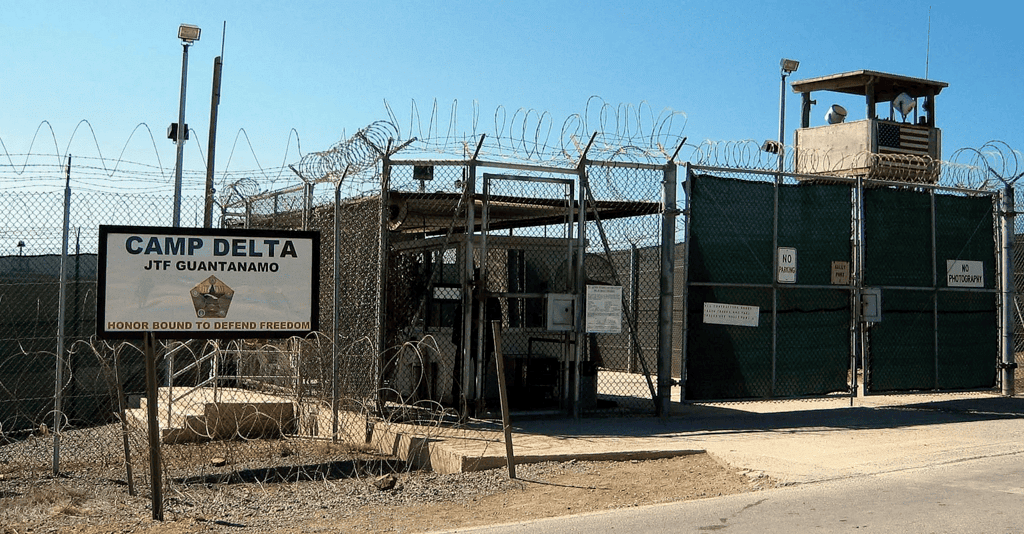
48) How were prisoners treated in Guantanamo Bay?

Answer:Treatment of prisoners in Guantanamo Bay was very humiliating.
(i) There was no trial before any magistrate and US law was completely violated.
(ii) This place is not located in US but an area near Cuba controlled by American Navy, so nobody knows the location of the prison.
(iii) Families of prisoners, media or even UN representatives were not allowed to meet the prisoners. 

49) What did Amnesty International do to get Guantanamo Bay prison closed?

Answer: (i) Amnesty International, an international human rights organisation, collected information on the condition of the prisoners in Guantanamo Bay and reported that prisoners were being tortured in ways that violated the US laws.
(ii) They were being denied the treatment that even prisoners of war must get as per international treaties. Prisoners were not released even after they were officially declared not guilty.
(iii) The UN Secretary General said that the prison in Guantanamo Bay should be closed down. The US government refused to accept these pleas. 

50) What happened in Kosovo (Albania) in 1999?

Answer: (i) A massacre was being carried out by the army of their own country, working under the directions of a leader, Milosevic, who came to power through democratic election.
(ii) This was one of the worst instances of killings based on ethnic lines in recent time.
(iii) Finally, several other countries intervened to stop the massacre. Milosevic lost power and was tried by an International Court of Justice for crimes against humanity. 

51) Why do some rights need to be placed higher than the government?

Answer: (i) Things may go wrong when some citizens may wish to take away the rights of others. This usually happens when those in majority want to dominate in the minority.
(ii) The government should protect the citizens’ rights in such a situation. But sometimes elected governments may not  protect or may even attack the rights of their own citizens. (iii) That is why, some rights need to be placed higher than the government, so that the government cannot violate them. 

52)   Why has constitution made un touch ability a punishable offence?

Answer: (i) The constitution mentions an extreme form of social discrimination, the practice of un touch ability and clearly directs the government to put an end to it.
(ii) The practice of un touch ability has been forbidden in any form.
(iii) Un touch ability, here does not only mean refusal to touch people belonging to certain castes. It refers to any belief or social practice which looks down upon people on account of their birth with certain caste labels.
(iv) Such practice denies them interaction with others or access to public places as equal citizens. So, the constitution made un touch  ability a punishable offence.

 53) “Right to Freedom” is the most important Fundamental right. Analyse this statement.

Answer: Right to Freedom is the most important right:
(i) Freedom means absence of interference in our affairs by it others-be individual or Government.
(ii) Freedom of speech and expression.
(iii) Assembly in a peaceful manner.
(iv) Form unions and associations
(v) Move freely throughout country.
(vi) Reside in any part of the country and practice any profession.

54)   What are ‘rights’? How can we claim a right?

Answer:Rights are claims of a person over other fellow beings, the society and the government.
(i) A right is possible when we make a claim that is equally possible for others. You cannot have a right that harms or hurts others.
(ii) The Serbs in Yugoslavia could not have claimed the whole country for themselves.
(iii) The claims we make should be reasonable. They should be such that it can be made available to others in equal measure.
(iv) A right comes with an obligation to respect others’ rights. 

55) Why do we need rights in a democracy?

Answer:  (i) Rights are necessary for the very sustenance of a democracy.
(ii) In a democracy, every citizen has to have the right to vote and the right to be elected to the government.
(iii) For democratic elections, it is necessary that citizens should have the right to express their opinion, form political parties and take part in political activities.
(iv) Rights protect the minorities from the oppression of the majority.
(v) Rights are a guarantee which can be used when things go wrong. Things may go wrong when some citizens may wish to take away the rights of others. So, rights perform a very special role in democracy. 

56) What are the main features of Right to Equality?

Answer:  (i) Every citizen, from the Prime Minister to a small farmer in a remote village, is subject to the same laws.
(ii) Under Right to Equality, the government shall not discriminate against any citizen on the grounds of religion, ethnicity, sex or place of birth.
(iii) Every citizen shall have access to public places like shops, restaurants, hotels and cinema halls.
(iv) All citizens have equality of opportunity in matters relating to employment or appointment to any position in the government. No citizen shall be discriminated against or made ineligible for employment on any grounds.
(v) Equality means giving everyone an equal opportunity to achieve whatever one is capable of. Sometimes, it is necessary to give special treatment to someone in order to ensure equal opportunity. 

57) What is Secularism? How did the Indian Constitution make India a secular state?

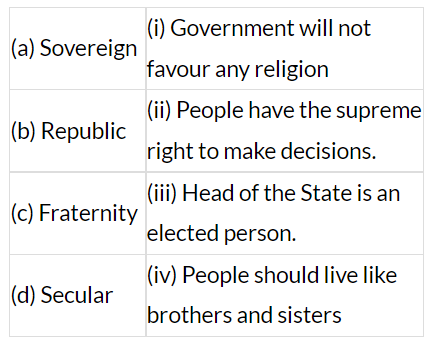
Answer:Secularism does not confer any privilege or favour on any particular religion. All religions are treated equally by the law.
(i) Secularism is based on the idea that the state is concerned only with relations among human beings and not with the relation between human beings and God.
(ii) A secular state is one that does not establish any one religion as the official religion. (iii) Indian secularism keeps equal distance from all religions.
(iv) The state has to be neutral and impartial in dealing with all religions. 

58)   How does the constitution protect our rights?

Answer: (i) Fundamental Rights are guaranteed against the actions of the Legislature, the Executive and any other authority instituted by the government.
(ii) There can be no law or action that violates the Fundamental Rights.
(iii) Courts also enforce the Fundamental Rights against private individuals and bodies. (iv) The Supreme Court and High Courts have the power to issue orders or ‘writs’ for the enforcement of the Fundamental Rights.
(v) They can also award compensation to the victims and punishment to the violators. In case of any violation of a Fundamental Right, the aggrieved person can go to a court for remedy.

59)   Write a short note on the National Human Rights Commission.

Answer:  (i) NHRC is an independent commission set up by the law in 1993.
(ii) Like the Judiciary, the commission is independent of the government.
(iii) The commission is appointed by the President and includes retired judges, officers and eminent citizens.
(iv) It does not bear the burden of deciding cases. So it can focus on helping the victims secure their human rights.
(v) These include all the rights granted to the citizens by the constitution.
(vi) The NHRC cannot punish the guilty. That is the responsibility of the courts.
(vii) Like any court, it can summon witnesses, question any government official, demand any official paper, visit any prison for inspection or send its own team for on-the-spot inquiry

60)   ‘The Right to Freedom is a cluster of several Rights’. Explain.

Answer:(i) Freedom of speech and expression.
(ii) Assemble in a peaceful manner.
(iii) Form associations and unions.
(iv) Move freely throughout the country.
(v) Reside in any part of the country.
(vi) Practice any profession, occupation, trade and business. 

61)   How are the scope of rights expanded?

Answer: (i) Certain rights like right to freedom of press, right to information, and right to education are derived from the Fundamental Rights.
(ii) Now school education has become a right for Indian citizens. The governments are responsible for providing free and compulsory education to all children up to the age of 14 years.
(iii) Parliament has enacted a law giving the right to information to the citizens. This Act was made under the Fundamental Right to freedom of thought and expression.
(iv) Constitution provides many more rights, which may not be Fundamental Rights. For example, the right to property is not a Fundamental Right, but it is a constitutional right. (v) Sometimes, the expansion takes place in what is called human rights. There are universal moral claims that may or may not have been recognised by law.

62) What are Fundamental Rights? Mention the six Fundamental Rights provided in the Indian Constitutions. Which Fundamental Right protects the rest of the Fundamental Rights? 

Answer: (i) Some rights which are fundamental to our life are given a special status in the Constitution. They are called Fundamental Rights.
(ii) The Constitution provides six
Fundamental Rights: (1) Right to Equality  
(2) Right to Freedom
(3) Right to Freedom of Religion
(4) Cultural and Educational Rights
(5) Right against Exploitation
(6) Right to Constitutional  Remedies. 

(iii) Right to constitutional remedies protects the rest of the Fundamental Rights.

63) Women are subjected to many public restrictions. What values are neglected in this conduct?

Answer:(i) Right to Freedom       (ii) Right to Equality
(iii) Right to Express        (iv) Right to Career
(v) Right to Education     (vi) Right to Exploitation. 

64) On what grounds are rights morally justified to citizens?

Answer:  (i) To promote democracy (ii) To promote right to live (iii) To promote rights of minorities (iv) To give people right to freedom of conscience (v) To give people right to express 

65) What rights would you enjoy and not enjoy if you are granted freedom of speech and expression?

Answer: Enjoyments (i) To elect the government (ii) To develop personality
(iii) To communicate freely
Limitations (i) Cannot instigate violence (ii) Cannot rebel against government
(iii) Cannot damage a person’s reputation. 

66) The Indian Constitution under right against exploitation highlights certain values. What are these? 

Answer:  (i) To prohibit selling and buying of human beings
(ii) To prohibit forced labour
(iii) To ban bonded labour
(iv) To ban child labour in hazardous industries. 

67) Amnesty International is an international organisation for (a) human rights (b) world peace (c) restoring democracy (d) justice

Answer:  B

68) Kosova was a province of which of the following countries? (a) Czechoslovakia (b) Yugoslavia (c) Serbia (d) Russia

Answer: 

69) Which one of the following is not a Fundamental Right? (a) Right to Equality (b) Right to Constitutional Remedies (c) Right to sacrifice animals under the Right to Freedom of Religion (d) Right against Exploitation

Answer: 

70) A secular state is one (a) that does not establish any one religion as the official religion (b) that does not confer any privilege or favour on any particular religion (c) that which has to be neutral and impartial in dealing with all religions (d) all of the above

Answer: B 

71) In which year was the National Human Rights Commission set up in India? (a) 1991 (b) 1992 (c) 1993 (d) 1994 

Answer: B   

72) What was the reason given by America for imprisoning people at Guantanamo Bay?

Answer: America considered the people as their enemies and linked them to the attack on New York on 11th September, 2001. 

73) Which body exposed to the world that prisoners at Guantanamo Bay were being tortured in ways that violated the US laws?

Answer: Amnesty International, an international human rights organisation reported that prisoners at Guantanamo Bay were being tortured in ways that violated the US laws.

74) What was Slobodan Milosevic’s attitude towards the Albanians?

Answer: Slobodan Milosevic was a narrow-minded Serb nationalist, who wanted Serbs to dominate the Albanians as his government was hostile to the Kosovo Albani 

75) How was the Massacre of Albanians finally stopped?

Answer: Several countries intervened to stop the Massacre of Albani 

76) What was the result of the intervention of other countries to stop the killings of Albanians?

Answer: Several countries intervened to stop the killing of Albanians, as a result Milosevic lost power and was tried by the International Court of Justice for crimes against humanity.

77) What are rights?

Answer: Rights are reasonable claims of person recognised by society and sanctioned by law. 

78) Which Fundamental Right ensures the ban on bonded labour?

Answer: The Fundamental Right, which ensures the ban on bonded labour is ‘Right against exploitation’.

79) What makes any political system democratic?

Answer: The availability of different Civil Rights, Political Rights and Economic Rights makes any political system democratic. 

80) If our Fundamental Rights are violated, where can we seek the remedy?

Answer:  If our Fundamental Rights are violated, we seek remedy to the Supreme Court or High Court.

5. Democratic Rights – Extra Question and answer – 1

Q1. What is Amnesty International?

Answer:   It is an international human rights organisation which helps the people who suffer due to violation of human rights. 

Q2. How are rulers of Saudi Arabia elected?

Answer: The country is ruled by a hereditary king and the people have no role in electing or changing their rulers. 

Q3. How do citizens exercise their rights in Saudi Arabia?

Answer: Citizens cannot form political parties or any political organisation. There is no freedom of religion. Every citizen is required to be Muslim. Non-Muslim residents can follow their religion in private, but not in public.

Q4. What are rights?

Answer: Rights are claims of a person over other follow being over the society and over the government. 

Q5. How can we claim our right?

Answer: A right is possible when we make a claim that is equally possible for others. We cannot have a right that harms or hurts others. 

Q6. What are the three qualities of rights?

Answer:

  • They are reasonable claims of persons. 
  • They are recognised by society. 
  • They are sanctioned by law. 

Q7. Why are rights necessary for the very sustenance of a democracy?

Answer: In a democracy every citizen has to have the right to vote and the right to be elected to government. For democratic elections to take place it is necessary that citizens should have the right to express their opinion, form political parties and take part in political activities. 

Q8. In what situation should a government project the citizen’s rights?

Answer: Things may go wrong when some citizens may wish to take away the rights of others. This usually happens when those in majority want to dominate those in minority. The government should protect the citizen’s rights in such a situation. 

Q9. What are Fundamental Rights?

Answer: Some rights which are fundamental to our life are given a special status. They are called Fundamental Rights.

Q10. Name the six Fundamental Rights provided by the Indian Constitution to Indian citizens.

Answer: 

  • Right to Equality 
  • Right to freedom of religion
  • Right to freedom 
  • Cultural & Educational rights
  • Right against exploitation
  • Right to constitutional remedies. 

Q11.  What does ‘Rule of law’ mean?

Answer: The constitution says that the government shall not deny to any person in India equality before the law or the equal protection of the laws. It means that the laws apply in the same manner to all, regardless of a person’s status. This is called the ‘Rule of Law’. 

Q12. How is Rule of Law considered the foundation of any democracy?

Answer: It means that no person is above the law. These cannot be any distinction between a political leaders, government official and an ordinary citizen. 

Q13. Is it true that every citizen from the Prime Minister to a small farmer, is subjected to the same laws?

Answer: A few years ago a Prime Minister of the country faced a court case on charges of cheating. The court finally declared that he was not guilty. But as long as the case continued, he had to go to the court give evidences and file papers, just like any other citizen. 

Q14. How is right to equality exercised?

Answer: The government shall not discriminate against any citizen on the grounds of religion, caste, ethnicity, sex or place of birth. Every citizen shall have access to public places like shops, restaurants, hotels and cinema halls. All citizens have equality in the matters relating to employment also.

Q15. What does ‘untouchability’ mean?

Answer: Untouchability does not only mean refusal to touch people belonging to certain castes. It refers to any belief of social practice which looks down upon people on account of their birth with certain caste labels. 

Q16. What does ‘Freedom’ mean?

Answer:  Freedom means absence of constraints. In practical life it means absence of interference in our affairs by others be it other individuals or the government. 

Q17. What is meant by ‘freedom of speech and expression’?

Answer: Our ideas and personality develop only when we are able to freely communicate with others. Even if a hundred people think in one way, we should have the freedom to think differently and express our views accordingly. Government in a democracy should give this freedom to its citizens.

Q18. How do citizens of India exercise freedom to travel to any part of the country?

Answer: Citizens of India enjoy single citizenship and are free to reside and settle in any part of the territory of India. This right allows lakhs of citizens to migrate from villages to towns and from poorer regions of the country to prosperous regions and big cities. 

Q19.  What is meant by ‘traffic in human beings’?

Answer:  Traffic here means selling and buying of human being, usually women for immoral purposes. 

Q2O. What is ‘Begar’?

Answer: ‘Begar’ is a practice where the worker is forced to render service to the ‘master’ free of charge or at a nominal remuneration. When this practice takes place on a lifelong basis, it is called the practice of bonded labour. 

Q21.  In what way is child labour prohibited by the Indian constitution?

Answer: The constitution prohibits child labour. No one can employ a child below the age of fourteen to work in any factory or mine or in any other hazardous work, such as railways and posts.

Q22. What is ‘Secularism’?

Answer: Secularism is based on the idea that the state is concerned only with relations among human beings, and not with the relation between human beings and the God. Indian Secularism practices an attitude of a principled and equal distance from all religions. 

Q23. What is a ‘Secular State’?

Answer: A Secular state is one that does not establish any one religion as official religion. The state has to be neutral and impartial in dealing with all religions. 

Q24. Why do we need Cultural and Educational rights?

Answer: It is language, culture and religion of minorities that needs special protection. Otherwise they may get neglected or undermined under the impact of the language, religion and culture of the majority. That is why, the constitution specifies the cultural and educational rights of the minorities. 

Q25. What does Right to Constitutional Remedies imply?

Answer: It is possible that sometimes our rights may be violated by fellow citizens, private bodies or by the government. When any of our rights are violated we can seek remedy through courts. If it is Fundamental Right we can directly approach the supreme court or the High court of a state.

Q26. What are writs?

Answer: A formal document containing an order of the court to the government issued only by High Court or the Supreme Court. 

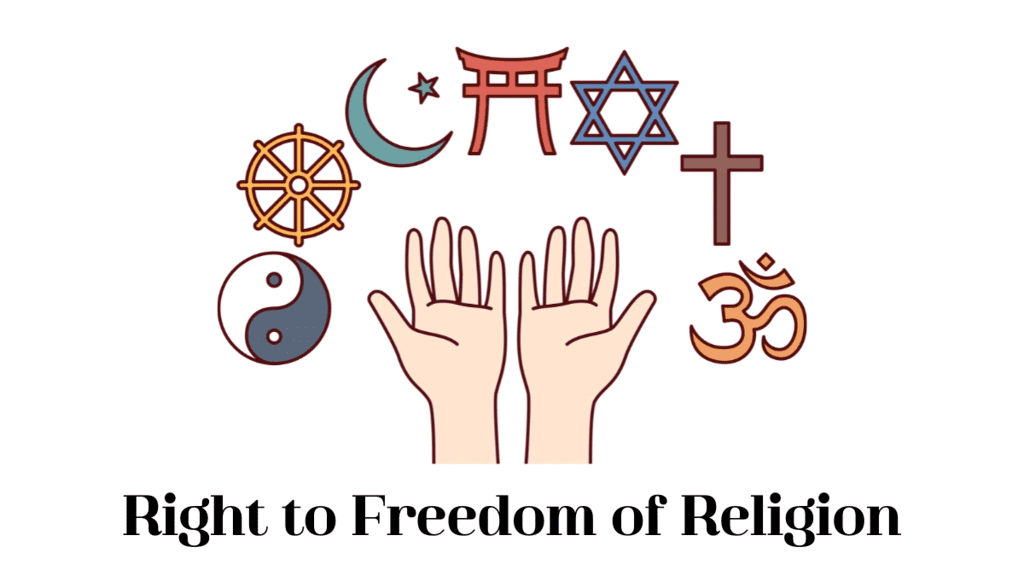
Q27. What does ‘Right to freedom of Religion’ mean?

Answer: Every person has a right to choose, practise and propagate any religion he or she believes in. Every religious group or sect is free to manage its religious affairs. 

Q28. What is PIL?

Answer: PIL is called as Public Interest litigation. Under PIL any citizen or group of citizens can approach the Supreme Court or a High Court for the protection of public interest against a particular law or action of the government. 

Q29. What does ‘Right to Education’ mean?

Answer: Now school education has become a right for Indian citizens. The governments are responsible for providing free and compulsory education to all children up to the age of 14 years under this right.

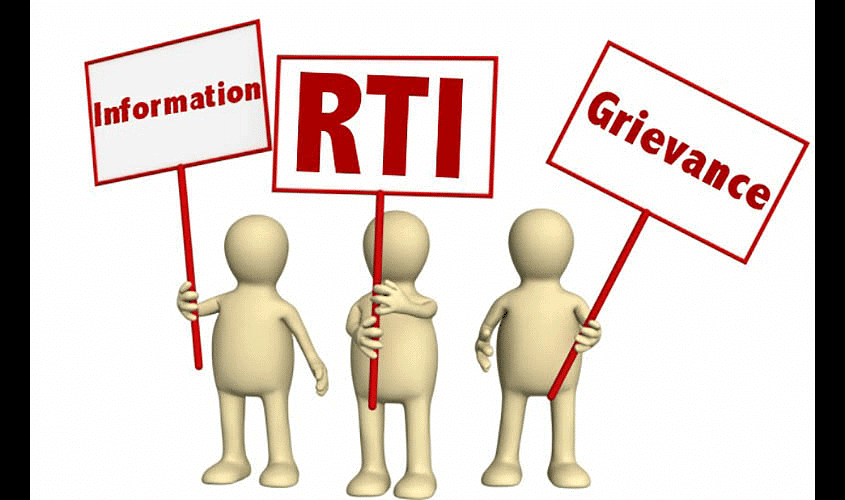
Q30. What is RTI?

Answer: RTI is Right to Information. Parliament has enacted a law giving the right to information to the citizens. This Act was made under the Fundamental Right to freedom of thought and expression. We have a right to seek information from government offices. 

Q31. What are Human Rights?

Answer: Human Rights are universal moral claims that may or may not have been recognised by law. But then rights give you a right to be treated as equal by law. Every human being who is born anywhere has the right to live and enjoy his life and should not be tortured by any means.

Q32. How were prisoners tortured by the US army in Guantanamo Bay prison?

Answer: 

  • The prisoners were being tortured in ways that violated the US laws.
  • They were being denied the treatment that even prisoners of war must get as per the international treaties.
  • Prisoners were not released even after they were officially declared ‘not guilty’. 

Q33. What was the background in which the ethnic massacre took place in Kosovo?

Answer:

  • Kosovo was a province of Yugoslavia before it split. In this province, the Serbs were in minority and Albanians were in majority, while it was the other way round in the rest of the country.
  • A narrow-minded Serb nationalist Milosevic had won the elections. His government was hostile to the Kosovo Albanians.
  • He wanted the Serbs to dominate the country. Many Serb leaders thought that ethnic minorities like the Albanians should either leave the country or accept the dominance of the Serbs. 

Q34. How does society affect the implementation of rights?

Answer: Every society makes certain rules to regulate one’s conduct. They tell us what is right and what is wrong. What is recognised by the society as rightful becomes the basis of rights.

  • The notion of ‘right’ changes from time to time and society to society.
  • When the socially recognised claims are written into law, they acquire real force. Otherwise, they remain merely as natural or moral rights.
  • When law recognises some claims, they become enforceable. We can then demand their application. When fellow citizens or the government do not respect these rights, we call it violation of our rights. 

Q35. Which three qualities are required for calling any claim, a right?

Answer:

  • Rights are reasonable claims of persons.
  • Rights are recognised by the society.
  • Rights are sanctioned by law. 

Q36. How or why is the ‘Right to Freedom’ called a cluster of several rights?

Answer:  Under the Indian Constitution, all citizens exercise a number of freedoms which are all covered in the right to freedom. So every citizen has the right to all of the following freedoms: 

  • Freedom of speech and expression
  • Freedom of assembly in a peaceful manner
  • Freedom to form associations and unions
  • Freedom to move freely throughout the country
  • Freedom to reside in any part of the country
  • Freedom to practise any profession, or to carry on any occupation, trade or business. 

Q37. How can you say that ‘Freedom of Speech and Expression’ is one of the essential features of any democracy?

Answer:

  • Our ideas and personality develop only when we are able to freely communicate with others. Even if hundred people think in one way, you should have the freedom to think differently and express your views accordingly.
  • You may disagree with a policy of the government or activities of an association. You are free to criticise the government in your conversation with parents, friends and relatives.
  • You may publicise your views through a pamphlet, magazine or newspaper. You can do the same through paintings, poetry or songs.

Q38. How can citizens exercise their freedom to hold rallies and demonstrations?

Answer: 

  • Citizens have the freedom to hold rallies and demonstrations in our country guaranteed by the constitution.
  • But such meetings have to be peaceful.
  • They should not lead to public disorder or breach of peace in society.
  • Those who participate in these activities and meetings should not carry weapons with them.
  • Citizens can also form associations like workers in a factory can form a workers’ union to promote their interests. 

Q39. Can an Indian citizen enjoy the freedom to travel in any part of the country?

Answer: 

  • Citizens are free to reside and settle in any part of India.
  • This right allows lakhs of people to migrate from villages to towns and from poorer regions of the country to prosperous regions and big cities.
  • For example, a person who belongs to Assam wants to start a business in Hyderabad. He may not have any connections with that place or people there, he may have not seen it ever. Yet as a citizen of India, he has the right to set up base there. 

Q40. What procedure should a citizen follow to get proper legal justification, if he or she is arrested?

Answer: 

  • A person who is arrested and detained in custody will have to be informed of the reasons for such arrest and detention.
  • A person who is arrested and detained shall be produced before the nearest magistrate within a period of 24 hours of arrest.
  • Such a person has the right to consult a lawyer or engage a lawyer for his defence. 

Q41. Which three evils are tackled by right against exploitation?

Answer: 

The Constitution mentions three specific evils and declares them illegal.

  • Traffic in human beings: Traffic here means selling and buying of human beings, usually women, for immoral purposes.
  • Begar: Our constitution also prohibits forced labour or begar in any form. It is a practice where the worker is forced to render service to the ‘master’, free of charge or at a nominal salary. When this practice takes place on a lifelong basis, it is called ‘bonded labour’.
  • Child labour: The Constitution also prohibits child labour. No one can employ a child below the age of 14 years to work in any factory or mine or in any other hazardous work such as in the railways and at ports. Many laws have been made to prohibit children from working in industries such as beedi making, firecrackers and matchbox, printing and dyeing

Q42. How does a person exercise his right to freedom of religion?

Answer:

  • Every person has a right to profess, practise and propagate the religion he or she believes in.
  • Every religious group or sect is free to manage its religious affairs.
  • A right to propagate one’s religion, however, does not mean that a person has the right to compel another person to convert into his religion by means of force, fraud, inducement or allurement. 

Q43. What are the provisions of cultural and educational rights?

Answer:   

  • The Constitution specifies the cultural and educational rights of the minorities. (i) Any section of citizens with a distinct language or culture have a right to conserve it.
  • Admission to any educational institution  maintained by the government or receiving government aid cannot be denied to any citizen on the grounds of religion or language. 
  • All minorities have the right to establish and administer educational institutions of their choice. Here, minority does not mean only religious minority at the national level.

Q44. Mention any one exception to the Right to Equality as a Fundamental Right. Give reasons also. 

Answer.

  • The state has the authority to implement special provisions aimed at benefiting women and children.
  • Special treatments are necessary to ensure equal opportunities for all members of society, particularly those from disadvantaged or vulnerable sections.
  • These measures aim to address historical and societal inequalities faced by women and children.
  • Special provisions may include targeted policies, programs, and initiatives to uplift and empower women and ensure the well-being of children.
  • Such provisions are crucial for achieving true equality and social justice within a diverse society.

Q45. Mention any two limitations of freedom of speech and expression.

Answer.

  • Defamation and Libel: Freedom of speech does not protect statements that harm the reputation of others. Defamatory statements that are false and maliciously intended can lead to legal consequences.
  • Incitement to Violence: Speech that directly encourages or incites violence or illegal activities is not protected under freedom of speech. This includes speech that poses a clear and present danger to public safety or order.

Q46. “Right to Constitutional Remedies is a very special right”. What is so special about this right? 

  • Safeguarding Fundamental Rights: This right acts as a guardian for all other fundamental rights guaranteed by the Constitution. 
  • Access to Courts: Citizens have the right to approach the Supreme Court, High Courts, or other authorized courts if their fundamental rights are infringed upon by the State, individuals, or groups. 
  • Ensuring Justice: Provides a legal avenue for individuals to seek justice and redressal when their rights are unlawfully encroached upon.
  • Upholding Constitutional Values: Reinforces the principle of rule of law and ensures adherence to constitutional provisions and values.
  • Role in Democracy: Strengthens democratic principles by maintaining a balance between individual rights and state authority.

4. Working of Institutions – Extra Question and answer – 2

1) What is SEBC?

Answer:SEBC is initially and Economically Backward classes. SEBC is another name. for all those people who belong to castes that are considered backward by the government.  

2)   What is the role of the President in India?

Answer:  President is the Executive head of the state and is the highest formal authority in the country. 

3)   What are the Prime Minister’s powers in India?

Answer: Prime Minister is the head of the government and actually exercises all governmental powers. He takes most of the decisions in the cabinet meetings. 

4)   What do you know about Mandal Commission?

Answer:Mandal Commission was asked to determine the criteria to identify the socially and educationally backward classes in India and recommend steps to be taken for their advancement. 

5) Who agreed to the recommendations of Mandal Commission?

Answer:  Some felt that existence of inequalities among people of different castes in India necessitated job reservations. They felt this would give a fair opportunity to those communities who so far had not adequately been represented in government employment. 

6) Who all were against Mandal Commissions Recommendations?

Answer: There were people who felt that this was unfair as it would deny equality of opportunity to those who did not belong to backward communities. They would be denied jobs even though they could be more qualified. 

7) What is the role of government in a citizen’s life?

Answer:The government is responsible for ensuring security to the citizens and providing facilities for education and health to all. It collects taxes and spends the money on administration, defence and development programmes.  

8) Why do democratic governments insist on Institutions?

Answer: Institutions make it difficult to have a good decisions taken very quickly. But they also make it equally difficult to rush through a bad decisions. That is why democratic governments insist on institutions.  

9) What is an assembly of elected representatives called in India?

Answer:  In India such a national assembly of elected representatives is called Parliament. At the state level this is called Legislature or Legislative Assembly.  

10) What is the role of Parliament in law making?

Answer:Parliament is the final authority for making laws in any country. Parliaments all over the world can make new laws, change existing laws or abolish existing laws and make new ones in their place. 

11) Which two houses form the parliament of one country?

Answer:The two houses are known as Council of States or Rajya Sabha and the House of People or Lok Sabha. The President of India is a part of the parliament, although he or she is not a member of either houses. 

12) What is the length of the term of a government in India?

Answer:It is of 5 years.  

13) Can the houses be dissolved or is it permanent?

Answer:  The Lok Sabha can be dissolved if no-confidence motion is passed against it but, Rajya Sabha cannot be dissolved as it is a permanent house.  

14) How does Lok Sabha exercise money powers?

Answer: Lok Sabha exercises more powers in money matters. Once the Lok Sabha passes the budget of the government or any other money related law, the Rajya Sabha cannot reject it. The Rajya Sabha can delay it by 14 days or suggest changes in it. The Lok Sabha may or may not accept these changes. 

15) How does Lok Sabha exercise control over the Council of Ministers?

Answer:Lok Sabha controls the council of ministers. If the majority of the Lok Sabha members say they have ‘no confidence’ in the council of ministers including the prime minister, have to quit. The Rajya Sabha does not have this power.  

16) What is an executive?

Answer:At different levels of any government we find functionaries who take day-to- day decisions but do not excessive supreme power on behalf of the people. All those functionaries are collectively known as the executive.  

17) Why are they called as the Executive?

Answer:They are called the executive because they are in-charge of the execution of the policies of the government 

18) What do you understand by the term ‘Political Executive’?

Answer:The executive which is elected by the people for a specific period is called political executive. Political leaders who take the big decisions fall in this category. 

19) Who is called ‘Permanent Executive’?

Answer:Permanent Executive members are appointed on a long term basis. They are called permanent executive or civil services. They remain in office even when the ruling party changes. These officers work under political executive and assist them in carrying out day-to-day administration. 

20) Why does the political executive have more power than the non-political executive?

Answer:  The civil servant is usually more educated and has more expert knowledge of the subject. The advisors working in the Finance Ministry know more about economies than the Finance Minister. Sometimes, the ministers may know very little about the technical matters that come under their ministry.  

21) Why should the minister have final say on important matters?

Answer:  In a democracy the will of the people is supreme. The minister is elected by the people and thus empowered to exercise the will of the people on their behalf. He or she is finally answerable to the people for all the consequences of his/her decisions.  

22) How is the Prime Minister appointed?

Answer: The President appoints the Prime Minister. The President appoints the leader of the majority party or the coalitions of parties that commands a majority in the Lok Sabha as Prime Minister. 

23) How are Ministers chosen by the Prime Minister?

Answer: The ministers are usually from the party or the coalition that has the majority in the Lok Sabha. The Prime Minister is free to choose ministers, as long as they are members of parliament.  

24) What is a Council of Ministers?

Answer: Council of Ministers is the official name for the body that includes all the ministers. It wholly has 60 to 80 ministers of different ranks. 

25) Who are the Cabinet Ministers?

Answer:  Cabinet Ministers are usually top level leaders of the ruling party or parties who are in-charge of the major ministries. Cabinet actually represents the Council of Ministers. 

26) Who are Ministers of State with independent charge?

Answer: Ministers of State with independent charge are usually in-charge of smaller ministers. They participate in the cabinet meetings only when specially insisted. 

27)  Why is parliamentary democracy in most countries often known as the cabinet form of government?

Answer: The cabinet works as a team. The ministers may have different views and opinions but everyone has to own upto every decision of the cabinet.  

28) How does the President act as Executive Head?

Answer: The president is the head of the state. In our political system the head of the state exercises only nominal powers. The president of India is like the queen of Britain whose functions are to a large extent ceremonial. The president supervises the overall functioning of all the political institutions in the country so that they operate in harmony to achieve the objectives of the state.  

29)  How does President give his assent to a bill?

Answer:  A bill passed by the parliament becomes a law only after the President gives assent to it. If the president wants he/she can delay this for some time and send the bill back to the parliament for reconsideration. But if the parliament passes the bill again, she/he has to sign it.  

30) What is called as ‘The Judiciary’.

Answer:All the courts at different levels in a country put together are called the Judiciary.  

31)  Which courts are covered under Indian Judiciary?

Answer: The Indian Judiciary consists of a supreme court for the entire nation, high courts in the states and District courts and the courts at the local level. 

32) How is the chief justice of India appointed?

Answer: The senior most Judge of the supreme court is usually appointed the chief justice. Once a person is appointed as the Judge of the Supreme Court or the High Courts it is nearly impossible to remove him or her from that position.  

33) How can a Judge be removed?

Answer:A Judge can be removed only by an impeachment motion passed by two- thirds members of the two houses of the parliament. It has never happened so far in the history of Indian democracy 

34) What is Judicial review?

Answer: Supreme court can declare invalid any law of the legislative. They can determine the constitutional validity of any legislation or action of the executive in the country, when it is challenged before them. This is known as Judicial review. 

35) How does Judiciary act as guardian of the Fundamental Rights? 

Answer: The citizens have the right to approach the courts to seek remedy in case of any isolation of their rights.

36) Who are the major functionaries in India?

Answer:The major functionaries of our country are: (i) The President who is the head of the state and is the highest formal authority in the country. (ii) The Prime Minister who is the head of the government and one who actually exercises all the government powers. He takes most of the decisions in the cabinet meetings. (iii) The Parliament which consists of two Houses?Lok Sabha and Rajya Sabha. The Prime Minister must have the support of a majority of the Lok Sabha members.  

37)  Why had the Mandal Commission become a debatable issue in India?

Answer:  (i) The newspapers and magazines were full of different views and opinions on this issue.
(ii) It led to widespread protests and counter-protests, some of which were violent.
(iii) People reacted strongly because this decision affected thousands of job opportunities.
(iv) Some felt that the existence of inequalities among people of different castes in India necessitated job reservations.
(v) Others were of the view that this was unfair as it would deny equality of opportunity to those who did not belong to a backward community.
(vi) Some felt that this would hamper national unity.

38) What is the need for political institutions?

Answer: (i) The government is responsible for ensuring security to the citizens and providing facilities for education and health to all.
(ii) It collects taxes and spends the money thus raised on administration, defence and development programmes.
(iii) It formulates and implements several welfare schemes. To attend to all these tasks, several arrangements are made in all modern democracies. Such arrangements are called Political Institutions.  

39) What are the basic powers and functions of each institution in India?

Answer: (i) The Prime Minister and the Cabinet are institutions that take all important policy decisions.
(ii) The Civil Servants, who work together with the ministers, are responsible for taking steps to implement the ministers’ decisions.
(iii) The Supreme Court is an institution where disputes:
(a) between citizens of the country,
(b) between citizens and the government,
(c) between two or more state governments and
(d) between union and state governments are finally settled.  

40)   State how working with institutions is not an easy task.

Answer: (i) Institutions involve rules and regulations. This can bind the hands of the leaders.
(ii) Institutions involve meetings, committees and routines. This often leads to delays and complications. Therefore, dealing with institutions can be frustrating.
(iii) Some of the delays and complications introduced by the institutions are very useful. They provide an opportunity for a wider set of people to be consulted in any decision-making.
(iv) Institutions make it difficult to take good decisions very quickly, but they also make it equally difficult to rush through a bad decision. 

4. Working of Institutions – Extra Question and answer – 1

Q1. State how the delays and complications introduced by the institutions are very useful in a democracy. [Important]
Ans: Working with institutions involves rules, regulations, and routines, which can lead to delays and complications. However, these delays can be beneficial for a democracy because:

  • They allow for a wider range of people to be consulted on decisions.
  • They prevent hasty decisions that may not be in the best interest of the public.
  • They encourage thorough discussion and consideration of various viewpoints.

Ultimately, while dealing with institutions may be frustrating, it is essential for ensuring democratic processes.

Q2. Even though civil servants are far more educated and have expert knowledge on various subjects, why does the ultimate power to decide matters lie with the ministers? [Important]

Ans: The ultimate decision-making power lies with ministers because they are elected representatives of the people. Here are the key reasons:

  • A minister is accountable to the public for their decisions.
  • Ministers set the overall framework and objectives for policies.
  • While civil servants possess expert knowledge, they operate under the direction of ministers.
  • Ministers consult experts but ultimately decide based on the broader goals.

This structure ensures that the will of the people is reflected in government decisions.

Q3. Who appoints the Prime Minister and the Council of Ministers, and on what basis?
Ans: The Prime Minister is appointed by the President of India, but this appointment is not arbitrary. The President selects:

  • The leader of the majority party or coalition in the Lok Sabha.
  • If no party has a majority, the President chooses someone likely to gain majority support.

Once appointed, the Prime Minister can continue in office as long as they lead the majority party or coalition. Following this, the President appoints other ministers based on the Prime Minister’s advice. These ministers typically belong to the majority party or coalition in the Lok Sabha. The Prime Minister has the freedom to select ministers from among:

  • Members of Parliament.
  • Individuals who are not MPs, provided they are elected to Parliament within six months of their appointment.

Q4. In which way do the cabinet ministers exercise more powers than the other ministers?
Ans: Cabinet ministers hold more power than other ministers in several ways:

  • Leadership Role: They are the top leaders of the ruling party and manage major ministries.
  • Decision-Making: Key decisions are made in cabinet meetings, which other ministers must follow.
  • Exclusive Meetings: Other ministers attend cabinet meetings only if invited.
  • Coordination: Cabinet ministers coordinate the work of various departments and have the final say in disputes.

Q5. How has the rise of coalition politics imposed constraints on the power of the Prime Minister?
Ans: The Prime Minister in a coalition government faces several constraints on their power:

  • They cannot make decisions unilaterally.
  • They must consider the interests of various groups and factions within their own party.
  • Collaboration with alliance partners is essential for governance.
  • The survival of the government relies on the support of other parties.

These factors limit the Prime Minister’s ability to act independently.

Q6. Why is an independent and powerful judiciary considered essential for democracies?Logo of Supreme Court of India 
Ans: An independent and powerful judiciary is vital for democracies for several reasons:

  • Separation of Powers: The judiciary operates independently from the legislature and executive, ensuring it is not influenced by political agendas.
  • Protection of Rights: It acts as a guardian of Fundamental Rights, allowing citizens to seek justice if their rights are violated.
  • Judicial Review: The judiciary can declare laws or executive actions invalid if they contradict the Constitution.
  • Impeachment Process: Judges can only be removed through a rigorous process, making them less susceptible to political pressure.

These features ensure that the judiciary remains a check on government power, safeguarding democracy.

Q7. What is the procedure for the removal of the judges?

Ans: The procedure for removing a judge is known as impeachment. This process involves the following steps:

  • A motion for impeachment must be passed by a two-thirds majority in both Houses of Parliament.
  • Judges are appointed by the President but cannot be removed solely by the President.
  • Both the Lok Sabha and Rajya Sabha must agree on the resolution for removal.

This process is significant as it ensures the independence of the judiciary, making it very difficult to remove a judge once appointed.

Q8. Discuss the powers and functions of the Parliament. [CBSE 2010]
Ans: Parliament is the ultimate authority for making laws in the country. Its key powers and functions include:

  • Law-Making: Parliament can create new laws, amend existing ones, or abolish them.
  • Government Oversight: It exercises control over the government, ensuring that those in power have its support to make decisions.
  • Financial Control: Parliament manages public finances; government spending requires its approval.
  • Debate Forum: It serves as the highest platform for discussing public issues and national policies.

Parliament is divided into two Houses: the Lok Sabha (House of the People) and the Rajya Sabha (Council of States). The Lok Sabha is directly elected and holds more power, especially in financial matters, while the Rajya Sabha represents various states and regions.

Q9. Explain the composition of the council of ministers. [2011 (T-2)]
Ans: After the Prime Minister is appointed, the President selects other ministers based on the Prime Minister’s advice. These ministers typically belong to the party or coalition that holds the majority in the Lok Sabha.

  • The Prime Minister can choose ministers from among the members of Parliament.
  • Occasionally, a non-member can be appointed as a minister, but they must be elected to Parliament within six months.

The Council of Ministers is the official term for the group of all ministers, usually comprising 60 to 80 members of varying ranks.

  • Cabinet Ministers are senior leaders responsible for major ministries. They convene to make decisions on behalf of the Council.
  • Ministers of State with independent charge oversee smaller ministries and attend Cabinet meetings when invited.
  • Ministers of State assist Cabinet Ministers and are attached to their ministries.

Since it is impractical for all ministers to meet regularly, decisions are made in Cabinet meetings. This structure is why many parliamentary democracies are referred to as a Cabinet form of government. Every ministry is supported by secretaries, who are civil servants providing essential information to help ministers make informed decisions. The Cabinet is also aided by the Cabinet Secretariat, which coordinates the work of various ministries.

Q10. Write about the process of appointment and removal of a judge of Supreme Court. [2011 (T-2)]Supreme Court of India
Ans: The process for appointing and removing judges of the Supreme Court in India involves several key steps:

  • The President appoints judges based on the advice of the Prime Minister and in consultation with the Chief Justice of the Supreme Court.
  • In practice, senior judges often select new judges for the Supreme Court.
  • Removal of a judge can only occur through an impeachment motion, which requires a two-thirds majority in both Houses of Parliament.

This removal process is quite rare, reflecting the judiciary’s independence and stability.

Q11. Under what condition can a state of emergency be declared in India? Explain. [2011 (T-2)]
Ans: A state of emergency can be declared in India under specific conditions:

  • External aggression or armed rebellion increases.
  • The government machinery of a state breaks down.
  • There is a threat to the country’s financial stability.

In these situations, the President can impose a state of emergency, which is referred to as President’s rule.

Q12. Rajya Sabha is called the Upper House but that does not mean that it is more powerful than Lok Sabha. Our constitution does not give Rajya Sabha the same special powers over the states. But on most matters, the Lok Sabha exercises supreme power.Parliament of India
Ans: Rajya Sabha is referred to as the Upper House, but this does not imply it holds more power than the Lok Sabha. The Constitution grants the Rajya Sabha some special powers over states, yet the Lok Sabha generally holds greater authority on most issues. Here are some key points:

  • Both Houses must pass any ordinary law. If there is a disagreement, a joint session is held, where the Lok Sabha’s larger membership usually determines the outcome.
  • The Lok Sabha has more control over financial matters. Once it passes the budget, the Rajya Sabha can only delay it for 14 days or suggest changes, which the Lok Sabha may accept or reject.
  • The Lok Sabha oversees the Council of Ministers. The Prime Minister is appointed from among its majority members. If the Lok Sabha expresses ‘no confidence’ in the Council, all ministers, including the Prime Minister, must resign.

Q13. Why are political institutions important? Give any three points. [2011 (T-2)]
Ans: Political institutions are essential for the effective governance of a country. Here are three key reasons for their importance:

  • Structure and Organisation: Institutions provide a framework for governance, ensuring that various activities are organised and managed efficiently.
  • Decision-Making: Institutions like the Prime Minister and Cabinet are responsible for making crucial policy decisions that affect the nation.
  • Conflict Resolution: The Supreme Court serves as an institution to resolve disputes between citizens and the government, ensuring justice is upheld.

Q14. Give three differences between the Lok Sabha and the Rajya Sabha. [2011 (T-2)]

Ans:Differences between Lok Sabha and Rajya Sabha:

  • Tenure: The Lok Sabha has a term of 5 years, while the Rajya Sabha is a permanent house with no fixed tenure.
  • Election Process: Members of the Lok Sabha are elected through direct elections by the public. In contrast, Rajya Sabha members are elected by the representatives of state legislative assemblies, making it an indirect election.
  • Strength: The Lok Sabha can have between 500 to 552 members, currently having 543 seats. The Rajya Sabha’s strength ranges from 200 to 250, with 245 seats currently.

Q15. What is the tenure of the President in India? Mention the qualifications for President of India. [2011 (T-2)]
Ans: The President of India serves as the head of state with a tenure of five years. The qualifications required for a candidate to be elected as President are:

  • Must be a citizen of India.
  • Must be at least thirty-five years old.
  • Must be qualified to become a member of the Lok Sabha.
  • Must not hold any office of profit under the Union or any State government.

Q16. Under what circumstances does the President exercise his discretion in the appointment of the Prime Minister? Who appoints the other ministers? [2011 (T-2)]
Ans: When a party or coalition wins a clear majority in the elections, the President must appoint the leader of that majority party or coalition as the Prime Minister. However, if no party or coalition secures a majority in the Lok Sabha, the President can exercise discretion. In this case:

  • The President appoints a leader who is likely to gain majority support in the Lok Sabha.
  • The newly appointed Prime Minister may be asked to prove majority support within a specified time.

After the Prime Minister is appointed, the President appoints other ministers based on the Prime Minister’s advice. These ministers typically come from the majority party or coalition in the Lok Sabha. The Prime Minister has the freedom to choose ministers, provided they are members of Parliament. In some cases, a non-member can also be appointed, but they must be elected to Parliament within six months.

Q17. What is a coalition government? Why the Prime Minister of a coalition government cannot take decisions as he likes? [2011 (T-2)] [Old NCERT]
Ans: The Prime Minister of a coalition government cannot make decisions unilaterally due to several key reasons:

  • He must consider the interests of various groups and factions within his party.
  • He has to collaborate with alliance partners and accommodate their views.
  • The survival of the government relies on the support of these coalition partners and other parties.

While the Prime Minister leads the government, he operates within a framework that requires consensus and cooperation, limiting his ability to act independently.

Q18. What are the powers of the Prime Minister? Describe any three. [2011 (T-2)]
Ans: The Prime Minister holds significant powers as the head of the government, including:

  • Chairing cabinet meetings, where key decisions are made.
  • Coordinating the work of various departments to ensure smooth governance.
  • Exercising general supervision over ministries, guiding their functions and operations.

Additionally, the Prime Minister has the authority to dismiss ministers, and when they resign, the entire ministry also steps down.

Q19. ‘Parliament is the supreme legislature of India.’ Justify the statement. [2011 (T-2)]
Ans: In all democracies, an assembly of elected representatives holds supreme political authority on behalf of the people. In India, this assembly is known as Parliament, while at the state level, it is referred to as the Legislature or Legislative Assembly. Parliament serves several crucial functions:

  • Law-making authority: It is the final authority for creating laws. Parliaments can make new laws, amend existing ones, or abolish them.
  • Control over government: Parliament exercises control over the government. Decisions can only be made if they have the support of Parliament.
  • Financial oversight: Parliament controls public funds, ensuring that money can only be spent with its approval.
  • Forum for discussion: It is the highest platform for discussing public issues and national policies.

In India, Parliament consists of two Houses:

  • Lok Sabha: The House of the People, which holds more power, especially in financial matters.
  • Rajya Sabha: The Council of States, which has some special powers but generally plays a supportive role.

All laws passed by Parliament require the assent of the President of India to come into effect. This structure ensures that Parliament remains the supreme legislative body in India.

Q20. Distinguish between political executives and permanent executives.

3. Electoral Politics – Extra Question and answer – 2

56) What do you know about voter’s ID card?

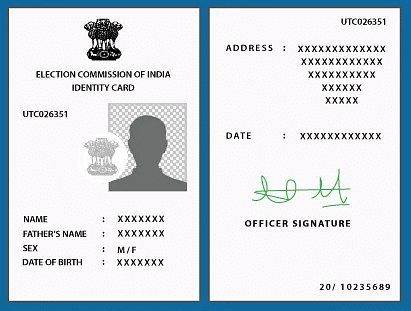
Answer: (i) In the last few years, a new system of Election Photo Identity Card (EPIC) has been introduced.
(ii) The government has made efforts to give this card to every person on the voters’ list. (iii) The voters are required to carry this card when they go out to cast their vote, so that no one can vote for someone else.
(iv) But the card is not yet compulsory for voting. The voters can show many other proofs of identity like the ration card, driving license or the passport, etc. 

57) Do people have real choice in a democratic election?

Answer: (i) In a democratic election, people should have real choice. This happens only when there are almost no restrictions on anyone to contest elections. This is what our system provides.
(ii) Anyone who can be a voter, can also become a candidate in elections and therefore can contest elections.
(iii) The only difference is that in order to be a candidate, the minimum age is 25 years, while it is only 18 years for being a voter. 

58) In what manner does the Election Commission monitor the election campaign?

Answer:  (i) In a democracy, it is best to leave political parties and candidates free to conduct their election campaigns the way they want to.
(ii) But it is sometimes necessary to regulate campaigns to ensure that every political party and candidate gets a fair and equal chance to compete.
(iii) Election Commission can fix the amount of rupees to be spent in campaigning and any kind of malpractices can be checked by them. 

59)  What is a Model Code of Conduct for election campaigns?

Answer: (i) No party or candidate can use any place of worship for election propaganda. (ii) No party or candidate can use government vehicles, aircraft and officials for elections. (iii) Once elections are announced, ministers shall not lay foundation stones of any projects, take any big policy decision or make any promises of providing public facilities.

60) How can we check the quality of the election process?

Answer:Ways to check the quality of the election process: (i) To see whether people participate in it with enthusiasm. (ii) Turn out of the voters indicate it. (iii) Large proportions of the poor, illiterate, and under privileged vote in the process. It shows the success of the system. (iv) Election-related activities are increasing over the years. 

61) How are results declared after an election in our country?

Answer: (i) A few days later, on a fixed date, all the EVMs from a constituency are opened and the votes secured by each candidate are counted. (ii) In general elections, usually the counting of votes in all the constituencies takes place at the same time, on the same day. (iii) Television channels, radio and newspapers report this event. Within a few hours of counting, all the results are declared and it becomes clear. as to who will form the next government. 

62) What does turnout figure indicate?

Answer: (i) People’s participation in election is usually measured by voters’ turnout figure. (ii) Turnout indicates the percentage of eligible voters who actually cast their vote. (iii) Over the last fifty years, the turnout in Europe and North America has declined. In India, the turnout has either remained stable or actually gone up. 

63) Is it true that the interest of voters is increasing day by day in election- related activities?

Answer: (i) The interest of voters in election-related activities has been, increasing over the years. (ii) During the 2004 elections, more than one-third voters took part in campaign-related activities. (iii) More than half of the people identified themselves as being close to one or the other political party. One out of every seven voters is a member of a political party. 

64) In what way does the outcome of elections matter to the people?

Answer: (i) One final test of the free and fairness of the elections is in its outcome itself. (ii) If elections are not free or fair, the outcome always favours the powerful. In such a situation, the ruling parties do not lose elections. (iii) Usually, the losing party does not accept the outcome of a rigged elections. 

65) How can you say that elections in India are free, fair and democratic?

Answer:  (i) Elections in India are basically free and fair. The party that wins an election and forms government does so because people have chosen it over its rivals.
(ii) This may not be true for every constituency. A few candidates may win purely on the basis of money power and unfair means. But the overall verdict of a general election still reflects popular preference.
(iii) There is very few exceptions to this rule in the last fifty years in our country. This is what makes Indian elections democratic.

66)  What does booth capturing and rigging mean in the elections? 

Answer:(i) Booth capturing: Supporters or hired musclemen of party or a candidate gain physical control of a polling booth and cast false votes by threatening everyone or by preventing genuine voters from reaching the polling booth. (ii) Rigging: Fraud and malpractices indulged by a party or candidate to increase his votes. It includes stuffing ballot boxes by a few persons using the votes of others; recording multiple votes by the same person; and bribing polling officers to favour a candidate. 

67) What are the minimum conditions for a democratic election?

Answer: Minimum conditions for democratic elections are as follows:
(i) Everyone should be able to choose. This means that everyone should have one vote and every vote should have equal value.
(ii) Parties and candidates should be free to contest elections and should offer some real choice to the voters.
(iii) The choice should be offered at regular intervals. Elections must be held every few years.
(iv) The candidates preferred by the people should get elected.
(v) Elections should be conducted in a free and fair manner, where people can choose as they wish.

68)   What are the merits and demerits of an electoral competition?

Answer:Merits: 
(i) In an ideal world, all political leaders know what is good for the people and are motivated only by a desire to serve them.
(ii) Our constitution makers opted for free competition in elections as the way to select our future leaders, because this system works better in the long run. (iii) Political leaders are motivated by a desire to advance in their political careers. They want to remain in power or get power and position for themselves for which, they can compete with other political parties.
Demerits: (i) An electoral competition creates a sense of disunity and factionalism in every locality.
(ii) Different political parties and leaders often level allegations against one another.
(iii) Parties and candidates often use dirty tricks to win elections. 

69)   How are elections held in India?

Answer:  (i) Lok Sabha and Vidhan Sabha elections are held regularly, after every five years.
(ii) After five years, the term of all the elected representatives comes to an end.
(iii) The Lok Sabha or Vidhan Sabha stands dissolved.
(iv) Elections are held in all constituencies at the same time either on the same day or within a few days. This is called a ‘general election’.
(v) Sometimes, elections are held only for one constituency to fill the vacancy caused by the death or resignation of a member. This is called a ‘by-election’. 

70)   Why were ‘reserved constituencies’ devised for the weaker sections by the makers of the Indian constitution?

Answer: (i) The constitution makers were worried that in an open electoral competition, certain weaker sections may not stand a good chance to get elected to the Lok Sabha and to the State Legislative Assemblies.
(ii) They may not have the required resources, education and contacts to contest and win elections against others.
(iii) Those who are influential and resourceful may prevent them from winning the elections.
(iv) If that happens, our Parliament and Assemblies will be deprived of the voice of a significant section of the population. This would make our democracy less representative and less democratic. 

71)   How was the system of ‘reserved constituencies’ introduced for the SCs and STs?

Answer: (i) Some constituencies are reserved for the people who belong to the Scheduled Castes and Scheduled Tribes.
(ii) In an SC-reserved constituency, only someone who belongs to the scheduled caste can stand for elections.
(iii) Similarly, only those belonging to a scheduled tribe can contest elections from a constituency reserved for STs.
(iv) Currently, 79 seats are reserved for the Scheduled Castes and 41 for the Scheduled Tribes in the Lok Sabha.
(v) This number is in proportion to their share in the total population; thus the reserved seats for SCs and STs do not take away the legitimate share of any other social group. 

72) How does a party file a nomination for its candidate?

Answer: (i) In order to be a candidate, the minimum age is 25 years.
(ii) Political parties nominate their candidates who get the party symbol and support.
(iii) Party’s nomination is often called a party ‘ticket’.
(iv) Every person who wishes to contest an election has to fill a ‘nomination form’ and give some money as ‘security deposit’. If the information provided is not correct, the nomination can be cancelled and the security deposit is returned. 

73) How is campaigning done for elections held in India?

Answer: (i) In India, such campaigns take place for a two-week period between the announcement of the final list of candidates and the date of polling.
(ii) During this period, the candidates contact their voters.
(iii) Political leaders address election meetings and political parties mobilize their supporters.
(iv) This is also the period when newspapers and the television news broadcasting channels are full of election-related stories and debates.
(v) During election campaigns, political parties try to focus the public attention on some big issues.
(vi) They want the public to vote for their party on that basis. 

74) Write some of the successful slogans given by different political parties in various elections.

Answer: (i) ‘Garibi Hatao’ was the slogan of the Congress party, led by Indira Gandhi in the Lok Sabha elections of 1971. The party promised to prepare all policies to remove poverty from the country.
(ii) ‘Save Democracy’ was the slogan of the Janata Party in the Lok Sabha elections of 1977. The party promised to undo the excesses committed during the Emergency and restore civil liberties.
(iii) ‘Land to the Tiller’ was the slogan used by the Left Front in the West Bengal Assembly elections held in 1977.
(iv) ‘Protect the Self-respect of the Telugus’ was the slogan used by N.T. Rama Rao, the leader of the Telugu Desam Party in the Andhra Pradesh Assembly elections in 1983. 

75) What election laws are made for campaigning?

Answer:Every political party and candidate gets a fair and equal chance to compete. According to our election law, no party or candidate can:
(i) bribe or threaten the voters to vote for them only;
(ii) appeal to the voters in the name of caste or religion;
(iii) use the government resources for election campaigns;
(iv) spend more than ` 25 lakhs in a constituency for the Lok Sabha elections or ` 10 lakhs in a constituency during an assembly election. If they do so, their election can be rejected by the court even after they have been declared elected. 

76) How are ‘polls’ conducted in India?

Answer:  (i) The final stage of an election is the day when the voters cast their votes in a polling booth. That day is usually called the Election Day.
(ii) Every person whose name is on the voters’ list can go to a nearby ‘polling booth’, situated usually in a local school or a government office.
(iii) Once the voter goes inside the booth, the election officials identify him or her by putting a mark on his or her finger and allow him or her to cast the vote.
(iv) An agent of each candidate is allowed to sit inside the polling booth and ensure that the voting takes place in a fair way.
(v) A ballot paper is placed in which the names of the contesting candidates along with their party name and symbols are listed.
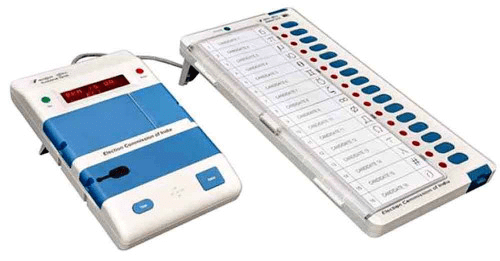
(vi) Nowadays, Electronic Voting Machines (EVMs) are used to record votes.
(vii) The machine shows the names of the candidates and party symbols. Independent candidates too have their own symbols, allotted by the election officials.
(viii) Each voter has to press the button against the name of the candidate she or he wants to vote for. 

77)   How are votes counted after the polls?

Answer:  (i) Once the polling is over, all the EVMs are sealed and taken to a secure place. (ii) A few days later, on a fixed date, all the EVMs from a constituency are opened and the votes secured by each candidate are counted.
(iii) The agents of all candidates are present there to ensure that the counting is done properly.
(iv) The candidate who secures the highest number of votes from a constituency is declared elected.
(v) In a general election, the counting of votes in all the constituencies usually takes place at the same time, and on the same day.
(vi) Within a few hours of counting, all the results are declared and it becomes clear as to who will form the next government. 

78) Who organises the election procedure in India?

Answer:   (i) In India, elections are conducted by an independent and very powerful Election Commission (EC).
(ii) It enjoys independence like the judiciary of our country.
(iii) The Chief Election Commissioner (CEC) is appointed by the President of India. But once appointed, the CEC is not answerable to the President or the government.
(iv) Even if the ruling party or the government does not like what the Commission does, it is virtually impossible for them to remove the CEC. 

79) What powers are exercised by the Election Commission of India?

Answer:  (i) The Election Commission (EC) controls the elections right from the announcement of the elections to the declaration of the result.
(ii) It implements the Code of Conduct and punishes any candidate or party that violates it.
(iii) During the election period, the EC can order the government to follow some guidelines, to prevent the use and misuse of government power to enhance its chances to win the elections or to transfer some government officials.
(iv) If the EC comes to know that the polling was not fair in some booths or even an entire constituency, they order a repoll.

80)   How is the ‘voter turnout’ in India measured?

Answer:  (i) People’s participation in elections is usually measured by the voter  turn out figures. Turnout indicates the per cent of eligible voters who actually cast their votes.
(ii) In India, the poor, illiterate and the underprivileged people vote in larger proportion as compared to the rich and privileged sections.
(iii) Common people in India attach a lot of importance to elections. They feel that through elections, they can bring pressure on the political parties to adopt policies and programmes favourable for them.
(iv) The interest of voters, in election-related activities, has been increasing over the years. 

81)   What are the challenges to free and fair elections in India?

Answer: Challenges to free and fair elections in India are as follows:
(i) Candidates and parties with a lot of money may not be sure of their victory but they do enjoy a big and unfair advantage over smaller parties and independents.
(ii) In some parts of the country, candidates with criminal connection have been able to secure a ‘ticket’ from major parties.
(iii) Some families tend to dominate the political parties; tickets are distributed to relatives from these families.
(iv) Very often, elections offer little choice to ordinary citizens as both the major parties are similar to each other in their policies and practices.
(v) Smaller parties and independent candidates suffer a huge disadvantage as compared to the bigger parties. 

82)   Which section of our country’s population is eligible to vote? 

Answer: (i) In our country, all the citizens aged 18 years and above can vote in an election.
(ii) Every citizen has the right to vote, regardless of his or her caste, religion or gender. (iii) Some criminals and persons with unsound mind can be denied the right to vote, but only in rare situations.
(iv) It is the responsibility of the government to get the names of all the eligible voters put on voters’ list.
(v) Names of those who move out of a place or those who are dead are deleted.
(vi) A complete revision of the list takes place every five years. This is done to ensure that it remains up to date.

83) Do you think that elections promote democracy?

Answer:Yes, elections do promote democracy. They help people to choose candidates on the basis of one-vote-one-value. Parties are free to contest elections. Elections must be held at regular intervals. Further, candidates preferred by people only are elected. Besides, elections are free and fair. 

84) How far is it good to have political competition? Give reasons.

Answer:It is good to have political competition. In a democracy political leaders know what is good for the people. It motivates them to serve the people. Regular electoral competition provides an initiative to political parties arid leaders. Leaders realise that if they raise and work for people’s issues they would become popular and their chance to win would increase. 

85) You visited an electoral booth and viewed malpractices being used to win the election. Can these malpractices be stopped? Give reasons.

Answer:  Yes, the malpractices related to election can be curbed. The Election Commission should ban people with criminal background from contesting election. Further, it should be mandatory for candidates to declare their assets and electoral malpractices or rigging should be checked. 

86) Identify the reasons which make India a successful democracy in the world. 

Answer: (i) Free and fair elections are held.
(ii) Periodic elections are held.
(iii) Independent Election Commission exists to make elections free and fair. 

87) Who amongst the following constitute an important segment of the food insecure population? (a) SCs and STs with poor land base (b) The people affected by natural disaster (c) OBCs with low land productivity (d) All the above

Answer: 

88) For the purpose of elections, the country is divided into different areas called (a) states (b) districts (c) constituencies (d) none of these

Answer: 

89) Like constituencies, each village or town is divided into (a) panchayats (b) blocks (c) wards (d) grams

Answer: 

90) How many seats are reserved for women candidates in the rural and urban local bodies? (a) Two-third of the seats (b) One-third of the seats (c) One-fourth of the seats (d) Three-fourth of the seats

Answer: 

91)  Political parties nominate their candidates and the party’s nomination is called (a) partisanship (b) party ticket (c) party nomination (d) party’s nominee

Answer: 

92) ‘Land to the Tiller’ was the famous slogan used by (a) Left Front (b) Congress party (c) Telugu Desam Party (d) none of these 

Answer: 

93) What is general election ?

Answer:Election held after every five year is termed as general election. 

94) Is the Election Commission of India an independent or an advisory body?

Answer:The Election Commission of India is an independent body. 

95) Who is responsible for the appointment of Chief Election Commissioner (CEC) of India?

Answer: President of India appoints the Chief Election Commissioner of India. 

3. Electoral Politics – Extra Question and answer – 1

1) Why do we have representative government in most democracies?

Answer: In most democracies, people rule through their representatives. Since it is not possible for everyone to have time and knowledge to take decisions on all matters, representation is needed. 

Therefore in most democracies people rule through their representatives.

Universal Adult Franchise

2) What is the mechanism of Elections behind choosing the representatives of a democratic country?

Answer: The mechanism of elections behind choosing the representatives of a democratic country is the universal adult franchise. It ensures equality and uniformity amongst the masses by giving all people who have attained the age of 18 years the right to cast their vote in favor of their preferred representative. This process aims to ensure free and fair elections, where voters cannot be easily influenced, and confidentiality is maintained through the use of a secret ballot machine.

3) How are voters’ choices fulfilled by Elections?

Answer: Elections enable voters to select their preferred lawmakers and representatives who can make significant governmental decisions. Additionally, they can vote for the specific political party whose policies align with their beliefs and preferences.

4) What choices do elections offer for choosing a political party?

Answer: Elections offer various choices for selecting a political party, as there should be multiple parties and candidates available to contest the elections. This provides voters with a genuine opportunity to choose a suitable political party to represent them in the parliament.

5) What kind of competition is offered to the people for elections?

Answer:  The most obvious form is the competition among political parties. At the constituency level, it takes the form of competition among several candidates. If there is no competition elections will be pointless. 

6) Give any two demerits of Electoral Competition.

Answer: Two demand of electoral competition:

(i) It creates a sense of disunity and factionalism in every locality. 

(ii) Different political parties and leaders often level allegations against one another. 

7) Give any two merits of Electoral Competition.

Answer: Two merits of Electoraal Competition are:

(i) Political leaders all over the world, like all other professionals, are motivated by a desire to advance their political careers. 

(ii) They want to come into power and retain positions for themselves. So they do their best to win the hearts of people. 

Symbols of Political Parties in India

8) How can political leaders be made accountable to the people?

Answer: It can be done by setting up a system where political leaders are rewarded for serving the people and punished for not doing good for the sake of the people. Regular electoral competition should be held through elections.

9) How do political leaders try to win the hearts of the voters?

Answer: Political leaders know that if they raise issues that people want to be raised, their popularity and chances of victory will increase in the next elections. But if they fail to satisfy the voters with their work they will not be able to win again.

10) How does political competition help the leaders to serve the people?

Answer:

  • Political competition encourages leaders to focus on serving the public.
  • Similar to a shopkeeper prioritizing customer service, politicians must prioritize the needs of the people.
  • Although political competition can create divisions and negativity, it ultimately benefits the public.
  • Parties and leaders are compelled to address the concerns of the people in order to maintain their support.

11) How are general elections held in India?

Answer: 

  1.  General elections in India occur for Lok Sabha and Vidhan Sabha.
  2. They take place every five years.
  3. The elected representatives’ terms conclude after this period.
  4. These elections are known as general elections.
  5. All constituencies hold elections simultaneously.  

12) What are By-Elections?

Answer: When elections are held only for one constituency to fill the vacancy caused by the death or resignation of a member. This is called By-Elections. 

13) What are Electoral Constituencies?

Answer:  The country is divided into different areas for the purposes of elections. These areas are called electoral constituencies. 

14) How many constituencies do we have for Lok Sabha?

Answer: For Lok Sabha elections the country is divided into 543 constituencies. 

15) What is an elected representative from the constituency is called?

Answer: The representative elected from each constituency is called a member of parliament or an MP. 

16) What is an elected representative at the state level called as?

Answer:  Each state is also divided into a specific number of Assembly constituencies. Here the elected representative is called the Member of Legislative Assembly or an MLA.

17) How are constituencies divided at the local level?

Answer: At Panchayati and municipal elections each village or town is divided into several ‘wards’ that are like constituencies. Each ward elects one member of the village or the urban local body. 

18) Why were ‘Reserved Constituencies’ created by the makers of the constitution?

Answer:   

  • The creators of the constitution were concerned about the electoral chances of weaker sections in society.
  • They believed that without special provisions, these groups might not be adequately represented in the Lok Sabha and State Legislative Assemblies.
  • This lack of representation would make the democracy less inclusive and less democratic.
  • To address this issue, the makers of the constitution developed the concept of ‘Reserved Constituencies.’
  • This special system ensures better representation for weaker sections, making the democracy more representative and democratic. 

19) How many seats are reserved for SC & ST in Lok Sabha?

Answer: Currently in the Lok Sabha 79 seats are reserved for the scheduled caste and 41 for the scheduled tribe. 

20) How many seats are reserved for women at local bodies?

Answer: One-third of the total seats are reserved in rural and urban local bodies for women candidates

21) What is a Voters’ List?

Answer: In a democratic election the list of those who are eligible to vote is prepared much before the elections and given to everyone. This list is officially called the ‘Electoral Roll’ and is commonly known as ‘Voters’ List’. 

22) What is the principle of universal adult Franchise?

Answer: In practice, it means that everyone should have one vote and each vote should have equal value. All the citizens aged 18 years and above have got the right to vote.

23)  What is the Election Photo Identity Card System?

Answer: Every voter is issued this photo identity card by the Election Commission. The voters are required to carry this card when they go out to vote so that no one can vote for someone else. 

Voter ID/ Election Card

24) What is a party ticket?

Answer:   Political parties nominate their candidates who get the party symbol and support. This party’s nomination is often called the party ‘ticket’. 

25) How does a person file nomination papers?

Answer: Every person who wishes to contest elections has to fill a ‘nomination form’ and give some money as a ‘security deposit’. This is how nomination papers are filed. 

26) What are the legal declarations of a party candidate?

Answer:   Details of assets and liabilities of the candidate and his or her family and Educational qualifications of the candidate.

27) Why has the personal information of a candidate to be made public?

Answer:  This information needs to be made public as it provides an opportunity for the voters to make their decisions on the basis of the information provided by the candidates.

28) Why are election campaigns needed?

Answer:

  • Election campaigns provide opportunity for people to choose representatives, government, and preferred policies.
  • Enables free and open discussion about better representatives, parties, and policies.
  • Facilitates informed decision-making during elections. 

29)  What is the time period of campaigning for elections?

Answer:  In one country such campaigns take place for a two-week period between the announcement of the final list of candidates and the date of polling.

30) How are voters contacted during campaigning?

Answer: Voters contacted during campaigning through:

  1. Election meetings by political leaders.
  2. Mobilization of supporters by parties.
  3. Newspaper and television campaigns.
  4. Use of recorded mobile messages.

31)  What is a ballot paper?

Answer: A ballot paper is a sheet of paper on which the names of the contesting candidates along with party name and symbols are issued. 

32) What is a ‘polling booth’?

Answer: On the election day every person whose name is on the voter’s list can go to a nearby ‘Polling Booth’, situated usually in a local school or a government office. In this booth, voters go inside and election officials identify them and put a mark on his or her finger and allow them to cast the vote.

33) What is EVM?

Answer: EVMs are electronic voting machines, which are used to record votes. 

EVM

34) How is a vote cast on EVM?

Answer: The machine shows the names of the candidates and the party symbols. All the voter has to do is to press the button against the name of the candidate he or she wants to give a vote. 

35) What do you know about the ‘Election Commission’?

Answer: In our country elections are conducted by an independent and very powerful election commission. It enjoys the same kind of independence that the judiciary enjoys

36) How is the Chief Election Commissioner appointed?

Answer:  The Chief Election Commissioner is appointed by the President of India. But once appointed, he is not answerable to the President or the government. It is virtually impossible to even by the ruling party to remove the Chief Election Commissioner.

37) What do you mean by ‘Turn out’.

Answer:  Turnout indicates the per cent of eligible voters who actually cast their vote.

38) Why do common people in India attach a lot of importance to elections?

Answer:  They feel that through elections they can bring pressure on political parties to adopt policies and programmes favourable to them.

39) Are elections in India ‘free and fair’?

Answer: Elections in India are basically free and fair. The party that wins an election and forms government does so because people have chosen it once. A few candidates may win on the basis of money power and unfair means. But the overall verdict of a general election still reflects popular preference.

40) Give anyone challenge of Indian Elections.

Answer: Some families tend to dominate political parties; tickets are distributed to relatives from the families.

41) What is ‘booth capturing’? 

Answer: Supporters or hired muscle men of a party or a candidate gain physical control of a polling booth and cast false votes by threatening everyone or by preventing genuine voters from reaching the polling booth.

42) What choices are given to a voter during elections?

Answer:

Choices given to a voter during elections are: 

(i) They can choose who will make laws for them. 

(ii) They can choose who will form the government and take major decisions. 

(iii) They can choose the party whose policies will guide the government and law-making. 

43) What forms does the political competition take during elections?

Answer: Political competition takes various forms such as: 

(i) The most obvious form is the competition among political parties. 

(ii) At the constituency level, it takes the form of competition among several candidates. (iii) If there is no competition, elections will become pointless.

44) How does electoral competition help the political parties and leaders to win the elections?

Answer:  Electoral competition help the political parties and leaders to win the elections in folloewing ways:

(i) Regular electoral competitions provide incentives to political parties and leaders. 

(ii) They know that if they raise issues that people want to be raised, their popularity and chances of victory will increase in the next elections. 

(iii) But if they fail to satisfy the voters with their work, they will not be able to win again.

45) What is the ‘Voters’ List’?

Answer:  

  • In a democratic election, the list of those who are eligible to vote is prepared much before the election and is available to everyone. 
  • This list is officially called the Electoral Roll and is commonly known as the Voters’ List. (iii) This is an important step as it is linked to the first condition of a democratic election. 

46) How does the principle of ‘Universal Adult Franchise’ work in the Indian democracy?

Answer: 

  • In practice, a universal adult franchise means that everyone should have one vote and each vote should have equal value.
  • No one should be denied the right to vote without good reason.
  • Citizens differ from one another in many ways; some are rich, some are poor; some are highly educated, some are not; some are kind, others are not so kind. But all of them are human beings with their own needs and views. That is why all of them deserve to have an equal say in decisions that affect them. 

47)  What legal declaration is required to be submitted by each candidate who wishes to contest an election?

Answer: Every candidate has to make a legal declaration, giving full details of the following: 

(i) Serious criminal cases pending against the candidate. 

(ii) Details of the assets and liabilities of the candidate and his or her family. 

(iii) Educational qualifications of the candidate. This information helps voters to make their decisions. 

48) What is an Election Commission? Who appoints the Chief Election Commissioner and how can he/she be removed?

Answer: 

  • In our country, elections are conducted by an independent and very powerful Election Commission. It enjoys the same kind of independence as the Judiciary enjoys. 
  • The Chief Election Commissioner is appointed by the President of India. But once appointed, he is not answerable to the president of the government. 
  • Even if the ruling party or the government does not like the Chief Election Commissioner it is virtually impossible for it to remove the CEC.

Symbol of Election Commission of India

49) What is an Election Commission? What is its role in the elections?

Answer: 

 In our country, elections are conducted by an independent and very powerful Election Commission. It enjoys the same kind of independence that the judiciary enjoys. The Chief Election Commissioner (CEC) is appointed by the President of India. But once appointed, he is not answerable to the President or the government.

The functions of Election Commission are:

  • The Election Commission prepares the list and issues the identity card to voters.
  • The Election Commission is to prepare the timetable for the election.
  • It’s the responsibility of the Election Commission to conduct an election in a state.
  • The Election Commission allows the eligible candidate to contest the election.
  • The Election Commision has the responsibility to resolve the disputes that may arise during the election.

50)  What is the outcome of free and fair elections held in India?

Answer:

  • The ruling parties routinely lose elections in India, both at the national and state levels.
  • In India, about half of the sitting MPs or MLAs lose elections.
  • Candidates who are known to have spent a lot of money in ‘buying votes’ and those with criminal connections often lose elections. Barring very few disputed elections, the electoral outcomes are usually accepted as the people’s verdict by the defeated party.

51) Mention any three powers and functions of the Election Commission of India.

Answer: Powers and Functions of Election Commission of India:
(i) To conduct and control the elections.
(ii) To implement the code of conduct.
(iii) To order the government to follow guidelines.
(iv) To prevent the use and misuse of government machinery at the time of election. 

52)  How do general elections differ from by-elections?

Answer: When elections are held in all the constituencies at the same time, either on the same day or within few days, this is called general elections. Sometimes, the election is held only for one constituency to fill the vacancy caused by the death or resignation of a member. This is called a by-election. 

53) How are constituencies for Lok Sabha decided by the Election Commission?

Answer: 

(i) For the Lok Sabha elections, the country is divided into 543 constituencies.
(ii)  The representative elected from each constituency is called a Member of Parliament or an MP.
(iii) One of the features of a democratic election is that every vote should have equal value. That is why our constitution requires that each constituency should have a roughly equal population living within it. 

54) How is the division of constituencies done at the state level?

Answer:   

  • Each state is divided into a specific number of Assembly constituencies on the basis of their population size.
  • In this case, the elected representative is called a Member of Legislative Assembly or an MLA.
  • Each parliamentary constituency has several assembly constituencies within it. 

55)   How has the reservation system been extended to other weaker sections?

Answer: 

  • The system of reservation was extended later to other weaker sections at the district and local level.
  • In many states, seats in rural and urban local bodies are now reserved for Other Backward Classes (OBCs) as well.
  • However, the proportion of seats reserved varies from state to state. Similarly, one-third of the seats are reserved in rural and urban local bodies for women candidates

2. Constitutional Design – Extra Question and answer – 2

Q51. What do you understand by preamble? What is the significance of ‘We the people of India’ and ‘Secular’ in the Preamble?

The Preamble states the objectives which the Constitution seeks to establish and promote. It is a short statement of basic values with which a Constitution begins. It deals with the ideals, principles and aims of the Constitution. Preamble is the soul of our Constitution. It contains the philosophy on which the entire Constitution has been built. The words ‘We, the people of India’ lay stress on the point that political sovereignty in India rests with the people. The word ‘secular’ means that every citizen has complete right to follow any religion. There is no official religion. Government treats all religious beliefs and practices with equal respect.  

Q52. Why did the Constitution framers make provisions for amendments in the Indian Constitution?

The Constitution of India has enough scope for amendment if required for the welfare of its citizens. The makers of the Indian Constitution felt that it needs to be amended regularly to keep it updated. Amendments must be done in accordance with people’s aspirations and needs. To maintain law and order, the dignity and rights of the citizens, the Constitution made some provisions for amendment from time to time. At the same time, the process of amendment is not very easy. All amendments can be initiated only in the Union Parliament, not in any state Igislature. A special majority by two-thirds vote in favour is required to amend the Constitution.  

Q53. “Like the Constitution of South Africa, Indian Constitution was also drawn up under very difficult circumstances.” Elaborate this statement with the help of any four circumstances.

The four circumstances that elaborate the statement

  • At that time, the people of India were emerging from the status of a subject to that of citizens. The country was born through a partition on the basis of religious differences. It was an    extremely traumatic experience for the people.
  • The British rulers had left it to the rulers of the princely states to decide whether to merge with India or with Pakistan or remain independent.
  • The future of the nation did not look very secure at that time. The makers of the Constitution had anxieties about the present and the future of the country.
  • There were sharp differences of opinion about the path, the country should take after attaining freedom.  

Q54. Why is the Preamble very important?

The Constitution of the Republic of India is introduced to us through a wisely formulated and well written Preamble. It makes the intentions of our constitution makers quite clear through the following points

  • It declares India to be a Sovereign, Socialist, Secular and Democratic Republic.
  • It envisages Justice-Social, economic and political for all the citizens of India.
  • It promises Liberty of all types necessary for the individual, i.e., freedom of thought and expression, freedom of faith, freedom of belief and of worship.
  • It promotes Fraternity which assures the dignity of the individual and the unity and integrity of the nation.  

Q55. Throw some light on the composition of the Constituent Assembly.

The Constitution of our country was framed by the Constituent Assembly which was constituted in 1946 under the provisions of the Cabinet Mission Plan. This Assembly originally had 389 members. Of them, most were elected by the Provincial Assemblies and some were nominated by the rulers of the native states. As a result of the partition of the country, its membership was reduced to 308 in 1947. This Assembly   included   eminent   persons   like  Dr Rajendra Prasad, Pt Jawaharlal Nehru, Sardar Vallabhbhai Patel, Maulana Abul Kalam Azad, Dr BR Ambedkar,  KM   Munshi,   Rajagopalachari,   HC Mookherjee, Baldev Singh etc. Women members like Sarojini Naidu, G Durgabai Deshmukh etc also played an important role in the Constituent Assembly. When the Constitution was completed it had only 299 members in the Assembly. 

Q56. How was the new Constitution of South Africa formed?

After the emergence of the new democratic South Africa, black leaders said, “let us build a new South Africa based an equality of all races and men and women, democratic values, social justice and human rights.” The party that ruled through oppression and brutal killings and the party that led the freedom struggle sat together to draw up a common constitution. After two years of debate and discussion they came out with a Constitution, which gave to its citizens the most extensive rights available in any country. The Constitution makers decided that everybody should become a part of the new South Africa, despite whatever they hade done in the past.  

Q57. How did South Africa get independence?

The white European leaders imposed apartheid, i.e. racial discrimination on the blacks of South Africa. Since 1950, the blacks, coloureds and Indians fought against the apartheid system. As protest and struggle against apartheid had increased, the government realised that they could no longer keep the blacks and coloured people suppressed. The government changed its policies and discriminatory laws were repealed. Bans on political parties and restrictions on the media were lifted. On 26th April, 1994, South Africa got independence. The apartheid government came to an end in the newly born democracy, paving the way for the formation of a multi-racial government.  

Q58. Why do you think there is more importance of a Constitution to a democratic country?

The Constitution of a country is a set of written rules that are  accepted by all people of a country. The Constitution has more importance in a democratic form of government   because

  • In a democracy, the government is formed according to the Constitution and also works according to it.
  • The Constitution delimits the scope of activity of the various organs of the government. The Constitution specifies who will have the power to take which   decisions.
  • In a democracy, the Constitution safeguards the rights of the citizens.
  • The Constitution expresses the aspirations of the   people about creating a good society. It constantly goes on growing and evolving according to the needs and aspirations of the people.   

Q59. “Indian Constitution is both rigid and flexible”, explain.

Indian Constitution is both rigid and flexible, because the procedure of amendment is neither easy nor difficult. The Constitution has provided a federal structure for India. The jurisdictions of the centre and state have been defined and demarcated. Both the centre and the states have been authorised to exercise powers independency. There are provisions which can change the Federal structure into a Unitary one. Amendments can be made only with the consent of both the Centre and the States. A special majority of the Union Parliament, i.e., a majority of not less then two-thirds vote is required to amend the Constitution. Thus Indian Constitution enjoys the advantages of a combination of flexibility and rigidity. 

Q60. “Formation of Indian Constitution was no less struggle than that of Africa” – Do you agree Explain with five arguments.

Like South Africa, India’s Constitution was written under very difficult situation. The making of a Constitution for such a huge and diverse country like India is not an easy task.

  • After partition the people of India were emerging from the status of subjects to that of citizens.
  • India was born through a partition of the undivided India an the basis of religious differences. It was a traumatic experience for both the people of India and Pakistan.
  • The British had left it to the rulers of the princely states to decide whether they wanted to merge with India or with Pakistan or remain independent. The merger of these princely states was a difficult and uncertain task.
  • When the constitution was being written, the future of the country did not look as secure as it does today.

Q61. Why should we accept the Constitution made by the Constituent Assembly more than fifty years ago? Explain any three reason. Or Why should we accept the Constitution made by the Constituent Assembly more than 62 years ago? Give three reasons. 

The Constituent Assembly that wrote the Indian constitution had 299 members. The Assembly adopted the constitution on 26th November 1949 but it came into effect on 26th January 1950.

  • The Constitution does not reflect the views of its members alone, it expresses a board consensus of its time. The makers of our constitution comprised illustrious personalities, belonging to different communities, regions and political parties of India.
  • The Constituent Assembly represented all different social groups irrespective of class, creed, status, gender and occupations. There was no adult franchise, at that time. Even if the Constituent Assembly was elected by universal adult franchise, its composition would not have been very different. 
  • In some countries, the Constitution exists as a mere piece of paper, no one follows it. But in our country, no large social group or political party has ever questioned the legitimacy of the Constitution itself. This is an unusual achievement for any Constitution.
  • The manner in which the Constituent Assembly worked gives sanctity to the Constitution. They worked in a systemtic, open and consensual manner.

Q62. Assess the contribution made by the Constituent Assembly to form the Indian Constitution. State the steps involved in the framing of Indian Constitution. 

The drafting of the constitution was done by an assembly of elected representatives, called the Constituent Assembly

  • Elections to the Constituent Assembly held in July 1946 and its first meeting was held in December 1946.
  • After the partition the Constituent Assembly was also divided into the Constituent Assembly of India and that of Pakistan.
  • The Constituent Assembly that wrote the Indian constitution had 299 members. The constitution does not only reflect the views of its members but it expresses a broad consensus of its time.
  • The Constituent Assembely represented the people of India, i.e., members from different language groups, castes, classes, religious and occupations. Thus the constitution written by the Constituent Assembly covered the interests of the diverse population of our country.
  • Finally, the manner in which the Constituent Assembly worked gives sanctity to the constitution. They worked in a systematic, open and consensual manner. A Drafting Committee chaired by Dr BR Ambedkar prepared a draft constitution. Several rounds of thorough discussion took place. Every documents were recorded and preserved. These are ‘Constituent Assembly debates’ and are printed in 12 volumes. These are used to interpret true meaning of the constitution.

Q63. When did the Constituent Assembly adopt the Constitution of India? When did it come into force?

The Constitution of India was adopted by the Constituent Assembly on 26th November, 1949. It came into force on the 26th January, 1950. 

Q64. Who framed the Constitution of India?

The Constitution of India was flamed by the Constituent Assembly which was established in 1946 

Q65. Name some important members of the Constituent Assembly.

Some important members of the Constituent Assembly were Dr Rajendra Prasad, Dr BR Ambedkar, Pandit Jawaharlal Nehru, Dr S Radhakrishnan, KM Munshi etc. 

Q66. Who was the Chairman of the Constituent Assembly?

The first session of the Constituent Assembly started on 9th December, 1946 where Dr Sachidanand Sinha was chosen as the temporary Chairman of the Assembly. On 11th December, 1946, Dr Rajendra Prasad was unanimously elected its permanent Chairman.  

Q67. Here are some false statements. Identify the mistake in each case and rewrite these correctly based on what you have read in this chapter. 

(a) Leaders of the freedom movement had an open mind about whether the country should be democratic or not after independence. (b) Members of the Constituent Assembly of India held the same views on all provisions of the Constitution. 
(c) A country that has a Constitution must be a democracy. 
(d) Constitution cannot be amended because it is the supreme law of the country.

(a) Leaders of the freedom movement were clear in their mind that the country should be democratic after independence. 

(b) The members of the Constituent Assembly of India held differing views on various provisions of the Constitution. 

(c) A country that is a democracy must have a Constitution.

(d) The Constitution needs to be amended because it has to be in accordance with people’s aspirations and changes in society.  

Q68. Which of these was the most salient underlying conflict in the making of a democratic Constitution in South Africa? 

(a) Between South Africa and its neighbours 
(b) Between men and women 
(c) Between the white majority and the black minority 
(d) Between the coloured minority and the black majority

 (d) Between the coloured minority and the black majority  

Q69. Which of these is a provision that a democratic Constitution does not have? 
(a) Powers of the Head of State 
(b) Name of the Head of State 
(c) Powers of the Legislature 
(d) Name of the country

(b) Name of the Head of the State  

Q70. What are the ideals before the Indian nation?

The Constitution of India lays down certain ideals before the Indian nation. These are : Democracy, socialism, secularism and national integration.

Q71.  How much time did the Constituent Assembly take in framing the Constitution of India?

The Constituent Assembly took 2 years 11 months and 18 days in framing the Constitution of India which was adopted by it on 26th November, 1949.  

Q72. Which Constitution has inspired democrats all over the world? 
(a) Indian 
(b) South African 
(c) Russian 
(d) French

 (b) South African  

Q73. Who was Abul Kalam Azad?

Abul Kalam Azad was an educationist, author and theologian who became the first Education Minister in the first Union Cabinet.  

Q74. What is the meaning of the term ‘fraternity’ in the Indian Constitution?

Fraternity in the Indian Constitution means that all of us should behave as if we are members of the same family. No one should treat a fellow citizen as inferior  

Q75. Which one of the following words is not in the preamble of Indian constitution? 
(a) Justice 
(b) Liberty 
(c) Knowledge 
(d) Equality

(c) Knowledge 

Q76. This is not fair! What was the point in having a Constituent Assembly in India if all the basics were already decided?

We can not say that there was no point in having a Constituent Assembly to discuss and frame a Constitution if the basics had already been decided. The basics were relating right to freedom, universal adult franchise, rights on minorities which are the basis of any democratic sociery. These basics were the guiding principles which were further developed and expanded to establish a welfare state. In a democracy it is the Constituent Assembly which makes the Constitutions with the help of the basics. So, the Constituent Assembly in India was established, even if all the basics were already decided.

Q77. Compare the Preambles to the Constitutions of the United States of America, India and South Africa. 
(i) Make a list of ideas that are common to all these three. 
(ii) Note down at least one of the major differences among them. 
(iii) Which of the three makes a reference to the past? 
(iv) Which of these does not invoke God?

In the first quotation, Gandhiji strived for an India in which there should be no higher or lower class of people and all communities should live in perfect harmony. In the second quotation, BR Ambedkar said. We are going to enter a life of contradictions. In politics, we will have equality but in social and economic life, we will have inequality.” In the third quotation, Jawaharlal Nehru said about the ending of inequality, “the service of India means the ending of poverty, ignorance, disease and inequality of opportunity.”  

Q78. Who was Nelson Mandela?

Nelson Mandela was the leader of African National Congress (ANC). He remained in for jail for 28 years in South Africa’s most dreaded prison, Robben Island opposing the apartheid regime.  

Q79. What does ‘Apartheid’ mean?

The official policy of racial discrimination and ill treatment of blacks followed by the government of South Africa between 1948 and 1989.  

Q80. What does ‘Segregation’ mean in South Africa?

Trains, buses, taxis, hotels, hospitals, schools and colleges, libraries, cinema halls, theaters, beaches, swimming pools, public toilets, were all separate for the whites and blacks in South Africa. This was called ‘Segregation’.  

2. Constitutional Design – Extra Question and answer – 1

Ques1. Which of the guiding values of the Constitution of India means that people have the supreme right to make decisions?

Answer:  The guiding value called ‘Sovereign’ means that people have the supreme right to make decisions on internal as well as external matters. No external power can dictate to the Government of India. 

Ques2. How many members did the Constituent Assembly have that wrote the Indian Constitution?

Answer: The Constituent Assembly that wrote the Indian Constitution had 299 members. 

Ques3. Name the President of the Constituent Assembly?

Answer: Dr Rajendra Prasad was the President of the Constituent Assembly. 

Ques4. Is it true that non-democratic countries do not have a Constitution?

Answer: No, it is not true. Whether democratic or not, most countries in the world need to have some basic rules which are called the Constitution.  

Ques5. Name the Chairman of the Constitution Drafting Committee of India?

Answer:  Dr Bhim Rao Ambedkar, an eminent lawyer and politician, was the Chairman of the Constitution Drafting Committee of India.  

Ques6. Earlier to 1992, South Africa practiced a form of racial discrimination. What is it termed as?

Answer:  The racial discrimination practiced in South Africa prior to 1992 was called apartheid. 

Ques7. In a republic, how is the Head of State decided or chosen?

Answer: In a republic, the Head of State is a person elected by people. 

Ques8. Nelson Mandela remained in prison for treason for how many years?

Answer:  Nelson Mandela spent approximately 27 years in prison, primarily on Robben Island, during the apartheid era in South Africa.

Ques9. On which day did South Africa gain independence from the rule of the White minority?

Answer: South Africa gained independence from the rule of the White minority on 26th April, 1994.  

Ques10. What is the title of the autobiography of Nelson Mandela?

Answer: The title of the autobiography of Nelson Mandela is, “Long Walk to Freedom”.  

Ques11. Which national leader tried to draft a Constitution for India as far back as in 1928?

Answer: Pandit Moti Lal Nehru tried to draft a Constitution for India in 1928. 

Ques12. When were the elections to the Constituent Assembly held in India?

Answer:  The elections to the Constituent Assembly were held in July, 1946 

Ques13. The Constituent Assembly originally had how many members and was left with how many after the partition of the country?

Answer:  Originally the Constituent Assembly had 389 members, but was reduced to 299 members after the partition of the country.  

Ques14. In which country did a large number of ‘Whites’ settle and become the local rulers?

Answer: The country is South Africa.  

Ques15. Who said, “…. I shall work for an India in which the poorest shall feel that it is their country in whose making they have an effective voice. ……”?

Answer: Mahatma Gandhi said this statement.  

Ques16. Did the ideals of the Quit India Movement contribute to the making of the Indian Constitution?

Answer:  No, they did not. However, the Socialist Revolution in Russia, the Bill of the Rights of the US and the ideals of the French Revolution were the contributing factors.  

Ques17. Which organisation led the freedom movement in South Africa?

Answer:  The African National Congress (ANC) was the umbrella organisation that led the struggle against the policies of segregation.  

Ques18. Which Indian politician bitterly criticized Mahatma Gandhi’s vision?

Answer: Dr BR Ambedkar, who played a key role in the making of the Constitution, had a different understanding from Mahatma Gandhi of how inequalities could be removed. He often bitterly criticised Mahatma Gandhi and his vision. 

Ques19. From which country’s Constitution have most countries of the world chosen to begin their Constitution with a Preamble?

Answer:  Most countries of the world have chosen to begin their Constitution with a Preamble from the Constitution of the USA. 

Ques20.  Did all members of the Constituent Assembly of India hold the same views on all provisions of the Constitution?

Answer: No, they did not. But the Constituent Assembly worked in a systematic, open and consensual manner to decide all matters. 

Ques21. Why is India considered as a sovereign country?

Answer: India is a sovereign country because people have supreme right to make decisions.  

Ques22. How do you define a country where citizens have complete freedom to follow any religion?

Answer: A country where citizens have complete freedom to follow any religion in known as secular state.  

Ques23. Define the Preamble.

Answer: An introductory statement containing guiding values in a Constitution is known as the Preamble.  

Ques24. Name the leader who used to write in the magazine ‘Young India’ in 1931.

Answer:  Mahatma Gandhi used to write in the magazine ‘Young India’ in 1931.  

Ques25. Who is known as the Father of Indian Constitution?

Answer:  Dr BR Ambedkar is known as the Father of Indian Constitution. 

Ques26. What is ‘Constituent Assembly Debates’?

Answer:  Each and every document presented and every word spoken in the Constituent Assembly have been recorded and preserved as ‘Constituent Assembly Debates’.  

Ques27. In which session of the Congress did Indian National Congress Plan on how independent India’s Constitution should look like?

Answer:In Karachi Session(1931), Indian National Congress planned on how independent India’s Constitution should look like 

Ques28.When did the Indian Constitution come into force?

Answer: On 26th January, 1950, the Indian Constitution came into force.  

Ques29. In the Constituent Assembly, the first captain of the Indian hockey team also has a role. Who was he?

Answer: He was Jaipal Singh.  

Ques30. Which country has the largest written Constitution of the world?

Answer: India has the largest written Constitution of the world. 

Ques31. Who often bitterly criticised Mahatma Gandhi and his vision regarding how to remove inequalities from our society?

Answer:  Dr BR Ambedkar had a different understanding of how inequalities could be removed from our society, thus he often bitterly criticised Mahatma Gandhi and his vision.

Ques32. On the basis of what did the system of apartheid divide people?

Answer: On the basis of skin colour the system of apartheid divided    people.   

Ques33. “I have fought against the white domination and I have fought against the Black domination”. Who said this sentence?

Answer: Nelson Mandela said this statement. 

Ques34. If the head of the state is an elected person and not a hereditary position. What is it called?

Answer: It is called as Republic. 

Ques35. Name the founder of Andhra Mahila Sabha. 

Answer: G Durgabai Deshmukh was the founder of Andhra Mahila Sabha.   

Ques36. What would have happened in South Africa if the black majority had decided to take revenge on the whites for all their oppression and exploitation?

Answer:  If the blacks had not forgiven the whites for all their oppression and exploitation and decided to take revenge upon them, there would have been bloodshed everywhere. It could have led to a division of the country and we would not have seen a united and peaceful South Africa that exists now. Fortunately, the black community followed the policy of non-violence in their freedom struggle.  

Ques37.Match the following leaders with their roles in the making of the Constitution.

Answer: (a)-(iv),    (b)-(iii), (c)-(i),    (d)-(ii). 

Ques38. Read again the extracts from Nehru’s speech “Tryst with Destiny” and answer the following Why did Nehru use the expression “not wholly or in full measure” in the first sentence? What pledge did he want the makers of the Indian Constitution to take? “The ambition of the greatest man of our generation has been to wipe every tear from every eye”. Who was he referring to?

Answer:  (i) Pt Jawaharlal Nehru used the expression ‘not wholly or in full measure’ because the pledge that they had taken was yet to be fulfilled, it was yet to be completed, although not all at once but substantially and gradually.
(ii) Pt Jawaharlal Nehru wanted the makers of the Constitution to take a pledge of dedication to the service of the nation and her people and to the still larger cause of humanity.
(iii) Pt Jawaharlal Nehru was referring to Mahatma Gandhi.  

Ques39. Here are some of the guiding values of the Constitution and their meanings. Rewrite them by matching them correctly.

Answer: (a)-(ii),  (b)-(iii), (c)-(iv),   (d)-(i),  

Ques40. Here are different opinions about what made India a democracy. How much importance would you give to each of these factors? Democracy in India is a gift of the British rulers. We received training to work with representative legislative institutions under the British rule. Freedom struggle challenged the colonial exploitation and denial of different freedoms to Indians. Free India could not be anything but democratic. We were lucky to have leaders who had democratic convictions. The denial of democracy in several other newly independent countries shows the important role of these leaders.

Answer:(i) Although, the British rule was not democratic our leaders learnt about how to work with representative Legislative institutions during the last few years of the rule, as the British allowed elections in a limited way and creation of some Legislative Assemblies. 

(ii) Freedom struggle  against  colonial  exploitation contributed a lot to making India a democracy. 

(iii) This is the most important factor in making India a democracy. The absence of these type of leaders made many newly independent countries undemocratic.  

Ques41. What do you understand by the term ‘apartheid’?

Answer:  Apartheid was the name of a system of racial discrimination unique to South Africa, which was imposed on black by the white Europe In this system, the blacks were forbidden from living in white areas. They could work in white areas only if they had a permit. Trains, buses, taxis, hotels hospitals, schools, colleges, libraries, cinema halls, theatres, beaches, swimming pools, public toilets, etc were all separate for the whites and the blacks. 

Ques42. What was the ‘Drafting Committee’?

Answer: The ‘Drafting Committee’ chaired by Dr BR Ambedkar prepared a draft of the Constitution for discussion. Several rounds of thorough discussion took place on the Draft Constitution, clause by clause. The members worked for 114   days spread over three years. More than two thousand amendments were considered. Every document presented and every word spoken in the Constituent Assembly has been recorded and preserved. 

Ques43.  How did the Blacks of South Africa fight against the practice of apartheid? What is meant by apartheid? How did the people of South Africa struggle against it? Or Describe any three efforts made by the people of South Africa to struggle against the apartheid system.

Answer:Apartheid was the name of a system of racial discrimination unique to South Africa, which was imposed by the white Europeans on the blacks. 

(i) Since 1950, the blacks, coloureds and Indians fought against the apartheid system. They launched protest marches and strikes. 

(ii) The African National Congress led the struggle against this policy of segregation. 

(iii) Many workers’ unions and the Communist Party joined this movement. 

(iv) Even many sensitive Whites joined the ANC and played a leading role in this movement. 

Ques44. What is meant by ‘sovereign, socialist and secular’ as the key words of our Constitution?

Answer:  The Constitution of India declares India as a sovereign, socialist, secular and democratic republic.
(i) Sovereign The sovereign nature of India signifies that people of India have supreme right to make decisions on internal as well as external matters.
(ii) Socialist The socialist nature of India suggests that wealth is generated socially and should be shared equally by society.
(iii) Secular The word ‘secular’ signifies that the state has no official religion of its own. Every citizen has complete freedom to follow any religion.  

Ques45. The South African Constitution inspires democrats all over the world’. Justify the statement.

Answer:  After two years of discussion and debate the Constitution of South Africa was produced. It gave its citizens the most extensive rights available in any country. The Constitution writers included everybody, no one has treated differently whatever they have done in the past. So all communites sat down together to transform the bitter experience into a binding glue of a rainbow nation. They wanted to solve the problems of the country collectively. The Constitution was based on social equality and justice. Thus the Constitution inspires democrats all over the world.  

Ques46. Who led the struggle against apartheid? State any four practices following in the system of apartheid in South Africa.

Answer:African National Congress (ANC) led the struggle against apartheid. Many sensitive whites also joined the ANC to oppose apartheid and played a leading role in the struggle movement. Apartheid was the name of a system or policy of racial discrimination unique to South Africa. 

(i) The white Europeans imposed this system on non-white people of South Africa. 

(ii) The blacks were forbidden from living in white areas. They could work in these areas only if they had a permit. 

(iii) There were separate schools, colleges, hotels, hospitals, trains, buses, cinema halls, theatres, shopping areas and public toilets, swimming pools and beaches, etc for the whites and blacks. 

(iv) The blacks could not even visit the churches where the whites worshipped.

(v) The non-whites were denied the voting rights and even the basic human right.  

Ques47. What is a Constitution? Why do we need a Constitution? Give any five reasons. Or Why do we need a Constitution in a democracy? Explain any three reasons. Or What is a Constitution? Why do we need a Constitution? Give any four reasons.

 Answer:  The Constitution of a country is a set of written rules that are accepted by all people living together in a country. Constitution is the supreme law that determines the relationship among people living in a territory (called citizens) and also the relationship between the people and government. We need a Constitution because
(i) It generates a degree of trust and coordination that is necessary for different   kind of people to live together.
(ii) It specifies how the government will be constituted, who will have power to take which decisions.  
(iii) It lays down limits on the powers of the   government and tells us what the rights of the  citizens are.
(iv) It expresses the aspirations of the people about creating a good society.
(v) Indian Constitution safe guards the interests of minority, OBC, poor and weaker section of our society. It gives universal adult franchise to all and establishes equality for all.  

Ques48. “The manner in which the Constituent Assembly worked gives sanctity to the constitution of India. “Justify the statement with three arguments.

Answer:  The manner in which the Constituent Assembly worked gives sanctity to the Constitution. This statement can be justified by following points
(i) It worked in a systematic, open and consensual manner.
(ii) First some basic principles were decided and agreed upon and a draft of Constitution was prepared.
(iii) Serveral rounds of thorough discussion took place, clause by clause.
(iv) More than two thousands amendments were considered.
(v) Every document presented and every word spoken in the Constituent Assembly was recorded and preserved. These ‘Constituent Assembly Debates, were printed in 12 volumes.  

Ques49. How has the Indian Constitution embodied the basic values into institutional arrangements? Explain.

Answer:  Indian Constitution is embodying the basic values into institutional arrangements by following ways
(i) The Constitution of India is a detailed document. It needs to be amended quite regularly to keep it updated. It has to be changed in accordance with people’s aspirations and changes in society. These changes are called Constitutional Amendments.
(ii) The Constitution lays down a procedure for choosing persons to govern the country. (iii) It defines who will have how much power to take which decisions.
(iv) It limits the powers of the government by providing some rights to the citizen that cannot be violated.  

Ques50. Explain the major factors that contributed to the making of Indian Constitution. Or List the factors that contributed to the making of Indian Constitution. 

Answer:  The making of a Constitution for a huge and diverse country like India was not an easy task. The various factors that contributed in the making of our Constitution were (i) Many of our leaders were inspired by the ideals of French Revolution
(ii) They were also influenced by the practice of parliamentary democracy in Britain and the Bill of Rights in the US.
(iii) Socialist Revolution in Russia inspired them to think of a system based on social and economic equality. (iv) At each step they questioned whether the things suited our country or not.

1. What is Democracy? Why Democracy? – Extra Question and answer – 3

1) Which of the following is in favour of democracy?
(a) Leaders keep changing 
(b) Delays are often made in taking decisions
(c) The dignity of the citizen is enhanced 
(d) Political competition is very prominent
Ans:  (c) 

2) Which reason is responsible for the death of nearly three crore people in China’s famine of 1958-1961?
(a) Presence of democracy
(b) Absence of democracy
(c) Government’s negligence 
(d) Weak economic policy
Ans: (b) 

3) I have heard a different version. Democracy is off the people far (from) the people and (where they) buy the people. Why don’t we accept that?
Ans: In some cases, the democracy is off the people far (from) the people and (where they) buy the people i.e., where the democracy does not belong to the people it is not for them but far away from them, where the democracy is not by the people but the candidates the votes with money which means that true democracy does not exist. But we should not see these examples and be hopeless. These cases are exceptions and not the rule, which will be removed with the passage of time.

4) Let us take Lyngdoh Madam seriously and try to write down the exact definition of some of the simple words that we use all the time: pen, rain and love. e.g., is there a way of defining a pen that distinguishes it clearly from a pencil, a brush, chalk or crayon? 
(i) What have you learnt from this attempt? 
(ii) What does it teach no about understanding the meaning of democracy?
Ans: 

(i) From this conversation, I have learnt that there is no shortest to our thinking about the matter ourselves. We have to think about its meaning and evolve a definition. Each and everything has some specific features on the basis of which we can define that thing.
(ii) We need a definition only when we come across a difficulty in the use of a word. We need a clear definition of democracy because there are different kinds of governments which are known as Democracy. Abraham Lincoln said that Democracy is a rule of the people, for the people and by the people. We must not accept the definition, jug. because everyone accepts it. We do not know if this is the best way of defining democracy unless we think about it ourselves. After thinking about it we can say that democracy is a form of government in which the rulers are elected by the people. This is a common basic feature of democracy.

5) Ribiang went back home and collected some more famous quotations on democracy. This time she did not mention the names of the people who said or wrote these. She wants you to read these and comment on how good or useful these thoughts are 
(i) Democracy gives every man the right to be his own oppressor. 
(ii) Democracy consists of choosing your dictators after they, have told you what you think it is you want to hear. 
(iii) Man’s capacity for justice makes democracy possible, but man’s inclination to injustice makes democracy necessary. 
(iv) Democracy is a device that ensures we shall be governed no better than we deserve. 
(v) All the ills of democracy can be cured by more democracy.
Ans: The first and second thoughts are about those forms of government in which the people have the right to elect their ruler without having options. It means they have to elect the candidate only from the ruling party. In the third thought, it suggests that if man accepts justice, then democracy is possible. But when the man follows injustice, democracy is necessary there to give justice to others. The fourth thought, suggests that there must be a balance between the form of government and our need. The strongest argument for democracy is about what it does to the citizens. Democracy recognises our needs and enhances our dignity. In the last thought, there is scope for changing the features and activities of democracy as per our need. There is no guarantee that mistakes cannot be made in a democracy. The advantage is that there is room for correction. Either the rulers have to change their decisions or the rulers can be changed. In this way, the ills of democracy can be cured. 

6) This cartoon was drawn when elections were held in Iraq with the presence of US and other foreign powers. 
(i) What do you think this cartoon is saying? 
(ii) Why is ‘democracy’ written the way it is?
Ans: (i) The cartoon is saying that democracy is being established in Iraq with the help of the US military power.
(ii) Democracy is written in this particular way because it shows that it is not true democracy and it is a mockery of democracy set up by the US for its own interest. Democracy is being ridiculed in this cartoon. 

7) Syria is a small West Asian country. The ruling Ba’ath Party and some of its small allies are the only parties allowed in that country.
(i) Do you think this cartoon could apply to China or Mexico? 
(ii) What does the crown of leaves on democracy signify?
Ans: (i) Yes, this cartoon could be applied to China, because there is a one-party rule in China. Before contesting elections, a candidate needs the approval of the Chinese communist party. So China cannot be said to be a true democracy. Mexico has a multiparty system. Nationally there are three large political parties, viz, Institutional Revolutionary   Party (IRP), National Action Party (NAP), and Party of the Democratic Revolution (PDR). But until 2000 every election was won by the PRI. The PRI was known to use many dirty tricks to win elections. So the cartoon can be applied to Mexico until the 2000 election. But in 2006, election PRI fell to third place behind both the PAN and the PRD. Now Mexico has a coalition government.
(ii) Crown of leaves means a circle of leaves that is worn on somebody’s head as a sign of victory. The cartoon signifies that democracy has won in some of the countries of the world, but it is not accepted by all. 

8) This cartoon was drawn in the context of Latin America.

(i) Do you think it applies to the Pakistani situation as well?
(ii)Think of other countries where this could apply? 
(iii) Does this happen sometimes in our country as well?
Ans: 
(i) The cartoon suggests the scene of booth capturing with the gun. This can be applicable to Pakistan. In Pakistan, General Musharraf with the help of army officials controlled the elected representatives.
(ii) This could be applied in Iraq, China, etc.
(iii) Booth capturing by the political hooligans happens sometimes in our country also. 

9) All this is so remote for me. 
(i) Is democracy all about rulers and governments?
(ii) Can we talk about a democratic classroom?
(iii) Or a democratic family?
Ans: 

(i) Democracy is not only about rulers and governments. Democracy is a principle that can be applied to any sphere of life. A democratic decision involves consultation with and consent of all those who are affected by that decision. In this sense, it can be applied to any organisation other than the government.
(ii) We can have democratic classrooms where the students can ask questions without hesitation. Where the teachers have a democratic temperament. Where the interaction is not one-way traffic but a healthy two-way interaction.
(iii) Democracy can be seen in families also. We could have democratic families where the decisions are not taken by any one individual and imposed on the rest of the family members. All the family members should sit down and arrive at a general consensus. My opinion should matter as much as my father’s. In this way, we can have, democracy in our family also.

10) This cartoon was titled ‘Building Democracy’ and was first published in a Latin American Publication. 

(i) What do money bags signify here? 
(ii) Could this cartoon be applied to India?
Ans: 

(i) At the time of the election, the political parties in the fray spend a lot of money to win the election. Not only political parties, the government also spends a lot of money to conduct a free and fair election. The cartoon suggests that we establish democracy with the help of money power.
(ii) Yes, this cartoon could be applied to India. 

11) This cartoon is about the Iraqi election held after Saddam Hussein’s regime was overthrown. He is shown behind the bars. 

(i) What is the cartoonist saying here? 
(ii) Compare the message of this cartoon with the first cartoon in this chapter.
Ans: 

(i) In one of the quotations of the cartoon, the cartoonist tells us about the equality of the right to vote and equal value of each man’s vote. In another quotation, he says that the dicta top mostly prefers the situation when he is the only man to decide any matter by his only vote.
(ii) The first cartoon shown in two chapters suggests that the US army personnel are elevating the process to form a democracy in Iraq. But in this cartoon, the message is that democracy is already established.    

12) (i) Why talk about Zimbabwe? 
(ii) I read similar reports from many parts of our own country. Why don’t we discuss that?
Ans: (i) The President of Zimbabwe is the head of the state of Zimbabwe. In 1987, Robert Mugabe becomes the president and he revises the Constitution to make himself Executive President. President Mugabe is popular but also uses unfair practices in elections. Opposition party workers are harassed, public protest and demonstration against the government are declared illegal, both print and electronic media are controlled by the government. The government has pressurised judges to give verdict in favour of the government. The example of Zimbabwe shows that popular approval of the rulers is necessary for a democracy, but it is not sufficient. A democratic government cannot do whatever it likes, simply because it has won the election. This is the reason for which Zimbabwe is discussed here.
(ii) Our country is democratic and elections are by and large free and fair. However, sometimes we hear reports about the use of unfair means, violence and money power in elections. These tactics (methods) are adopted by some candidates with criminal connections or criminal background. However, such cases are decreasing day by day. 

13) Chinese Government blocked the free flow of information on the internet by placing restrictions on popular websites like ‘Google’ and ‘Yahoo’. The image of tanks and an unarmed student reminds the reader of another major event in recent Chinese history. Find out about that event. 

Ans: The cartoon reminds us of the Massacre in Tiananmen square in 1989. In April 1989, triggered by the death of Hu Yaobang, a liberal reformer, mass gathering and protests took place in and around Tiananmen Square in Beijing. It was largely a student-run demonstration that called for economic reform, freedom of the press and political liberalisation. The Chinese government brutally suppressed the movement for which it was internationally 

14) Read these five examples of working or denial of democracy. Match each of these with the relevant feature of democracy discussed above.

Ans: 

15) I want to be in Lyngdoh Madam’s class! That sounds like a democratic classroom, doesn’t it?
Ans: Yes, Lyngdoh Madam’s classroom sounds like a democratic classroom. Here everybody can speak his own mind. The students are giving their own arguments passionately. They feel very bad if someone that the environment in the classroom is democratic.

16) This cartoon is from Brazil, a country that has long experience of dictatorship. It is entitled The Hidden Side of Dictatorship’ 

(i) Which hidden sides does this cartoon depict? 
(ii) Is it necessary for every dictatorship to have a hidden side? 
(iii) Find out the dictators discussed in the first chapter and, if possible, about Abacha in Nigeria and Macros in the Philippines. 
Ans: 

(i) The hidden side depicted by the cartoon is the brutal side to the dictator. Dictator like Hitler ordered mass killings to eliminate ‘undesirable’ persons like Hitler many dictator killed the innocent people who were against their regime. This evil side of the dictator is shown in this cartoon.
(ii) No, it is not necessary for every dictatorship to have a hidden side. Because, if the dictator really wants to work for the betterment of people, he does not need to have a hidden side.
(iii) (a) The revolt by the army took place in Chile on 11th, September 1973 under General Augusto Pinochet in which President Salvador Allende was killed. Pinochet became the president of the country and ruled it for the next 17 years.
(b) Wojciech Witold Jaruzelski was the last communist leader of Poland who was the head of the state from 1985 to 1990. He resigned from power after the Polish Round table Agreement in 1989 that led to democratic elections in Poland.
(c) General Sani Abacha was a Nigerian military dictator and politician. He was the defacto president of Nigeria from 1993 to 1998. His regime was tied to human rights violations and allegations of corruption. He hanged the famous social activist Ken Saro-Wiwa. He did not allow democratic process like elections in Nigeria He was listed as the world’s fourth most corrupt leader in recent history.
(d) Ferdinand Emmanuel Edralin Marcos was the president of the Philippines from 1965 to 1986. He implemented wide-ranging programmes of infrastructure development and economic reform. However, his administration was marred by massive authoritarian, political repression and human rights violations. In 2004, Global Transparency Report, Marcos appeared on the list of the world’s corrupt leader. He was said to have amassed between $ 5 billion to $ 10 billion in his 21 years as President of the Philippines. 

17) What would have happened if India was not a democracy? Could we have stayed together as a single nation?
Ans: No, we would have not stayed together as a single nation if India was not a democracy. India has multi-religious, multi-cultural and multi-linguistic population. If there was no democracy then all the people could not have followed their religion and customs with freedom and there would have been conflicts between different religious and linguistic groups where the minorities would have lived in fear and insecurity. But democracy provides the peaceful solutions to every problem. It provides the best method of dealing with differences and conflicts. 

18) Why is democracy considered the best form of government?
Ans: Democracy is often viewed as the best form of government for several reasons:

  • Better Decision-Making: It tends to produce better decisions by involving many people in discussions.
  • Respect for Wishes: Democracies are more likely to respect the wishes of the people.
  • Inclusivity: They allow diverse groups to coexist peacefully.
  • Accountability: Leaders must respond to the needs of the people, making them more accountable.
  • Correcting Mistakes: Democracies provide a way to correct errors through public discussion and feedback.
  • Dignity: They enhance the dignity of all citizens, recognising everyone’s equal status.

While democracy may not solve every problem, it offers a framework for improvement and greater citizen involvement, making it preferable to other forms of government.


19) How does democracy allow us to correct its own mistakes?
Ans: The democratic system does not guarantee that mistakes won’t occur, but it provides mechanisms for addressing them. Key features include:

  • Transparency: Mistakes in a democracy are often exposed quickly, allowing for public discussion.
  • Accountability: Leaders can be held responsible for their decisions and may need to change them.
  • Change of leadership: If rulers fail to correct their mistakes, citizens have the power to replace them.

In contrast, non-democratic governments lack these corrective measures, making it difficult to rectify errors. While democracy is not perfect and does not solve all issues, it remains superior to other forms of government by promoting citizen dignity and providing a framework for improvement.

20) How does democracy improve the quality of decision making?  
Ans: A democratic decision involves the consultation and consent of all affected individuals. In a democracy:

  • Everyone, regardless of power or status, has an equal say in decision-making.
  • This principle applies to governments, families, and organisations.
  • Democracy reduces the likelihood of rash or irresponsible decisions.

Moreover, democracy:

  • Provides a method for resolving conflicts and differences peacefully.
  • Enhances the dignity of all citizens, recognising their equal status.
  • Allows for the correction of mistakes through public discussion.

In summary, democracy improves decision-making by ensuring inclusivity, accountability, and the opportunity for correction.

1. What is Democracy? Why Democracy? – Extra Question and answer – 2

41) How does democracy improve the quality of decision-making?
Ans: Democracy is based on consultation and discussion. A democratic decision always involves many persons, discussions and meetings. Those who are not powerful have the same say in taking the decisions as those who are powerful. When many people put their heads together, they are able to point out possible mistakes or drawbacks in any decision. It takes time. But important decisions should be taken after proper discussion. This process may be time-consuming, but it reduces the chances of rash or irresponsible decisions. Thus the lengthy process of taking decisions on any important issue in democracy improves the quality of the decision. 

42) Explain the difficulties faced by the people in a non-democratic country? 
Ans: The common difficulties faced by the people in a non-democratic country are
(i) People cannot choose or change their ruler.
(ii) People cannot question the authority of the ruler or dictator.
(iii) People do not enjoy any rights. Supporters of democracy are tortured or killed. For example, in Chile more than 3000 people were killed by military.
(iv) In a non-democratic country, public protests and demonstration against the government are declared illegal. Sometimes political activists are imprisoned for   indefinite time. For example, Aung San Suu Kyi in Myanmar spent a long time in under house arrest.
(v) In a non-democratic country, people do not have political equality. Universal adult Franchise is denied sometimes.
(vi) In a non-democratic country people may have elected their representatives, but in reality they are not really the rulers. The power of taking final decision rests with army officials. For example, in Pakistan, the real power is enjoyed by the army. 

43) “Democracy is the most popular form of government emerging in modern times. Still its shortcomings cannot be ruled out.” Justify the statement by assessing any five shortcomings of democracy.
Ans: Shortcomings of democracy are
(i) In the democratic form of government, leaders keep on  changing, which leads to instability.
(ii) There is political competition and power play everywhere. This situation hardly follows any rules of morality.
(iii) Elected leaders are unable to contact a large number of people and can hardly guess about the real problems of the people, which results in wrong decisions, delay of work, etc.
(iv) A large number of people are illiterate. They do not know what is good for them. So they cannot decide anything properly.
(v) Democracy leads to corruption for it is based on electoral competition. To win the election, the political parties adopt their own policies and try to win election by hook or by crook. 

44) How did. Musharraf establish his rule in Pakistan?
Ans: General Pervez Musharraf led a military coup in Pakistan in October 1999. He overthrew a democratically elected government and declared himself the Chief Executive of the country. Later the changed his designation to President. In 2002, he held a referendum in the country that granted him a five year extension. In August, 2002, he issued a ‘Legal Framework Order’ that amended the Constitution of Pakistan. According to this order, the President can dismiss the national or provincial assemblies. A National Security Council dominated by military officers supervised the work of the civilian cabinet. After passing the ‘Legal Framework Order’ Law, elections were held to the national and state assemblies.  

45) How did Robert Mugabe establish his dictatioral rule in Zimbabwe after independence?
Ans:  Zimbabwe attained independence from white minority rule in 1980. After independence, the country has been ruled by ZANU-PF, the party that led the freedom struggle. Its leader Mugabe has been ruling since independence. Mugabe is popular, but also uses unfair practices in elections. Over the years, his government has changed the constitution several times to increase the power of the President and make him less accountable. Opposition party workers are harassed, public protests against the government are delcared illegal and both electronic and print media are controlled by the government. Even the government ignores the court judgements that go against it. He has reelected in 2013 at the age of 89 for another five years. His supporters characterise him as a true Pan-Africanist who stands strong against forces of imperialism in Africa.  

46) Write a response to the following arguments against democracy. 
(a) Army is the most disciplined and corruption-free organisation in the country. Therefore Army should rule the country. 
(b) Rule of the majority means the rule of ignorant people. What we need is the rule of the wise, even if they are in small numbers. 
(c) If we want religious leaders to guide us in spiritual matters, why not invite them to guide us in politics as well. The country should be ruled by religious leaders.
Ans: (a) The Army is for the defence of the country. Even if it is the most disciplined and corruption-free organisation it should not be allowed to rule the country as its primary duty is defence and not governance.
(b) Rule of majority is democratic as it represents the views of all sections of people. Illiterate and poor people cannot be called ignorant. At least they can realize which representative is good for them. Democracy means equal opportunity to all without any discrimination
(c) This statement is wrong. We should not mix religion and politics, especially in a multi-racial, multi-religious and multi-lingual country like India, Besides, many religious leaders do not have any experience of administration.

47) Are the following statements in keeping with democracy as a value? Why? 
(a) Father to Daughter I don’t want to hear your opinion about your marriage. In our family, children marry what the parents tell them to. 
(b) Teacher to Student Don’t disturb my concentration by asking me questions in the classroom. 
(c) Employee to the Officer Our working hours must be reduced according to the law.
Ans: (a) The first statement is undemocratic because a girl is not allowed to give her opinion relating to her own marriage. Just as the people have the right to choose their representatives, the girl should also be allowed to have a say in the selection or choice other husband.
(b) The second statement is undemocratic because the student is not being allowed to speak and ask questions. It is the duty of the teacher to teach and satisfy the queries of the students.
(c) The third statement is democratic because it calls for the reduction of working hours according to the law. Employees should enjoy the right to work for fixed hours as fixed by international law. 

48) Why is democracy considered the best form of government?
Ans: Democracy has been accepted as the best form of government in the modern world. Under this, government works for the welfare of the people. Democracy performs better regarding the removal of poverty and backwardness in a country. It offers better conditions of living. It implements policies to ensure equal opportunities for all the citizens in education and employment. Democracy is likely to respect people’s own wishes and allows different kinds of people to live together. Even if it fails to deliver on some of its promises, always there is a scope to correct its mistakes. Above all, it offers more dignity to all citizens. That is why democracy is considered the best form of government.

49) Is Mexico a democratic country or not? Give arguments in favour of your answer.
Ans: Mexico became independent in 1930. It holds elections after every six years. But until 2000, every election was won by a party called PRI (Institutional Revolutionary Party). PRI used many dirty tricks to win the elections. It spent a large sum of money for its candidates. Opposition parties did contest elections, but never managed to win. Media largely ignored the activities of the opposition political parties. But from 2000 the scenario has changed. In the 2000 election, Vicente Fox of National Action Party (PAN) in alliance with Ecologist Green Party of Mexico (PVEM) became the first opposition candidate to win the election. Vicente Fox became the President of Mexico. After him Felipe Calderone of National Action Party (PAN) again became the President. It suggests that Mexico has marched towards democracy. 

50) Explain the representative democracy. Why is the representative democracy the most common form of government in modern times? Explain any four reasons. Or What is the representative democracy? Discuss its significance in the contemporary world.
Ans: The most common form of democracy in present time is that of a representative democracy. It is a type of democracy founded on the principle of elected representatives representing a group of people as opposed to direct democracy.
(i) India and most of the countries follow the representative democracy. In a democracy, all the people do not rule. Direct rule by people is not possible.
(ii) In a democracy, a majority is allowed to take decisions on behalf of all the people. Even the majority does not rule directly. It rules through its elected representatives.
(iii) Representative democracy becomes necessary in the contemporary world. Because modern democracies involve such a large number of people that it is physically impossible for them to sit together and take a collective decision.
(iv) Even if they could, the citizens do not have the time, desire or skill to take part in all the decisions. 

51) Elections in China do not represent people’s verdict. Explain. Or Why are elections in China not free and fair? Explain any three reasons. Or Why can’t the democratic set up in China be called a true democracy? Explain.
Ans: Democracy is a major concept introduced to China in the late 19th century.
In China, elections are regularly hold after every five years for electing the country’s Parliament, called National People’s Congress.
It has nearly 3000 members elected from all over China. Some members are elected by the army.
This National People’s Congress has the power to appoint the president of the country.
Before contesting elections, a candidate needs the approval of the Chinese Communist party.
Only those who are members of the Chinese Communist Party or eight smaller parties allied to if -are allowed to contest elections in China.
The government is always formed by the communist party.  
Thus, we cannot say that the elections in China are  free and fair. It is always restricted by the communist   party.

52) What steps were taken by PRI to win election in Mexico? Or The Institutional Revolutionary Party (PRI) used many dirty tricks to win elections in Mexico”. Justify the statement with five example. Or Describe any five dirty tricks used by PRI to win elections in Mexico. Or “Till 2000 Mexican people seem to have a choice to elect their leader but practically they had no choice.” Support this statement with three suitable reasons.  
Ans:The Institutional Revolutionary Party (PRI) of Mexico won all the elections from 1930 to 2000. The opposition parties did contest elections, but never managed win. The PRI used many dirty tricks to attend the elections.
(i) All the government employees had to attend the party meetings of PRI.\
(ii) Teachers of government schools advised and sometimes forced the parents for casting their votes in favour of PRI.
(iii) Media always criticised the opposition parties but ignored their good effort.
(iv) Sometimes the Polling booths are shifted from one place to another without prior notice. It tried to hamper the election procedure.
(v) Being in power, the PRI spent a large sum of money to manipulate the election and the campaign for the candidate. In Mexico people seemed to really have a choice, but in reality they had no choice, but to cast their vote in favour of the PRI. 

53) Who said this : ‘Democracy is the rule of the people, for the people and by the people’?
Ans: Abraham Lincoln, the former President of USA said this. 

54) From which word or words, has the word ‘Democracy’ been derived?
Ans: The word ‘Democracy’ is derived from the Greek words – ‘Demos’ and ‘cratia’. ‘Demos’ means ‘people’ and ‘cratia’ means ‘power’. Thus, Democracy means a form of government in which the power to rule lies in the hands of the people.

55) What is direct democracy?
Ans:  It is a form of government in which people directly participate in the affairs of the state. This system is possible only in those states where the population is small and all the citizens can directly participate in the affairs of the state. All the adult citizens have the right to participate in the meetings of the Assembly where all the laws are passed and decisions are taken. Today this system exists only in a few cantons of Switzerland. 

56) The King of which country has declared that in future he will be guided by the advice given to him by elected representatives?
Ans: King of Bhutan has declared that in future he will be guided by the advice given to him by elected representatives.

57) What do you understand by ‘indirect democracy’?
Ans: Indirect democracy has been established in almost all the modern states, because modern states are much larger in size and population than before. Here people do not directly taken part in the affairs of the state, but they elect their representatives for a fixed period. If the representatives do not work according to the wishes of the people and for their welfare, they are changed at the time of the next election. 

58)  Parliamentary democracy envisages representation of the people, responsible government and ……. (Select the correct option) 
(a) accountability of the Council of Ministers 
(b) universal adult franchise 
(c) major political parties 
(d) None of the above
Ans: (a) 

59) Here is some information about four countries. Based on this information, how would you classify each of these countries? Write ‘democratic’, ‘undemocratic’ or ‘not sure’ against each of these. 
(a) Country A People who do not accept the country’s official religion do not have a right to vote. 
(b) Country B The same party has been winning elections for the last twenty years. 
(c) Country C Ruling party has lost in the last three elections. 
(d) Country D There is no independent Election Commission.
Ans: (a) Undemocratic
(b) Not sure
(c) Democratic
(d) Undemocratic 

60) Here is some information about four countries. Based on this information, how would you classify each of these countries? Write ‘democratic’, ‘undemocratic’ or ‘not sure’ against each of these. 
(a) Country P The Parliament cannot pass a law about the Army without the consent of the Chief of Army. 
(b) Country Q The Parliament cannot pass a law reducing the powers of the Judiciary. 
(c) Country K The country’s leaders cannot sign any treaty with another country without taking permission from its neighbouring country. 
(d) Country S All the major economic decisions about the country are taken by officials of the Central Bank which the ministers cannot change.
Ans: (a) Undemocratic
(b) Democratic
(c) Undemocratic  
(d) Undemocratic 

61) Which of these is not a good argument in favour of democracy? Why? 
(a) People feel free and equal in a democracy. 
(b) Democracies resolve conflict in a better way than others. 
(c) Democratic government is more accountable to the people. 
(d) Democracies are more prosperous than others.
Ans: (d) Democracies are more prosperous than others is not a good argument in favour of democracy because countries of the Middle East like UAE and Saudi Arabia are economically strong but they have non-democratic governments, whereas India is a developing country but is a democracy. The poor countries can be democratic while the rich ones may not be. A good monarch can make his country more prosperous than some of the democracies.
62) Each of these statements contains a democratic and an undemocratic element. Write out the two separately for each statement. 
(a) A minister said that some laws have to be passed by the Parliament in order to conform to the regulations decided by the World Trade Organisation.
(b) The Election Commission ordered re-polling in a constituency where large scale rigging was reported. 
(c) Women’s representation in the Parliament has never reached 10 per cent. This led women’s organisations to demand one-third seats for women.
Answer : (a) Passing of laws by the Parliament is democratic, whereas  passing in conformity to the regulations decided by World Trade Organisation (WTO) is undemocratic.
(b) To order repoll in a constituency by the Election Commission is democratic, whereas   large scale rigging is undemocratic.
(c) Women’s representation in the Parliament has never reached 10 per cent is undemocratic, whereas demand by women’s organisations to reserve one-third seatsfor women is democratic.

63) Which of these is not a valid reason for arguing that there is a lesser possibility of famine in a democratic country? 
(a) Opposition parties can draw attention to hunger and starvation. 
(b) A free press can report suffering from famine in different parts of the country. 
(c) Government fears its defeat in the next elections. 
(d) People are free to believe in and practice any religion.
Ans: (d) is not a valid reason for arguing that there is a lesser possibility of famine in a democratic country, because practicing a religion is in no way related to prevent famines.

64) How does democracy enhance the dignity of the citizens?
Ans: Democracy is based on the principle of political equality. It means that the poorest and the least educated have the same status as the rich and the educated. People are not subjects of a ruler, they are the rulers themselves. Even when they make mistakes, they are responsible for their own mistakes.
65) This cartoon was published in Canada just before its Parlimentary elections of 2005. Everyone, including the cartoonist, expected the Liberal Party to win once again. When the result came, the Liberal Party lost the elections. In this cartoon an argument against democracy or for democracy?
Ans: This cartoon is an argument for democracy. Because in democracy, the voters decide in favour of or against the ruling party. Although the cartoonist expended the Liberal Party to win, he criticised the Liberal Party which he could do only in a democracy.