5. Democratic Rights – Glossary and information

Glossary and Important Information

1.  Begar:  Begar is a practice where the worker is forced to render service to the ‘master’ free of charge or at a nominal remuneration. When this practice takes place on a life-long basis, it is called the practice of bonded labour. 
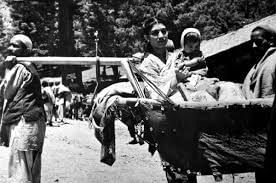
2. Democracy: Democracy is a system of government where power is held by the people, typically exercised through elected representatives. 

3. Writs : A formal document containing an order of the court to the government issued only by High Court or the Supreme Court. 
4.  Rights : Rights are the reasonable claims of persons recognised by society and sanctioned by law.

5. Amnesty International : It is an independent international organisation of volunteers who campaign for human rights. It highlights violation of human rights on over the world.

6.  Claim : A demand for legal or moral entitlement which a person makes of fellow citizens, society or the government.

7. Covenant : A promise made by individuals, groups or countries to uphold a rule or principle.

8.  Dalit : A person belonging to a low caste also known as scheduled castes and depressed classes.

9. Ethnic Group : A group of people who share a common ancestry. They are bound together by common cultural practices, religious beliefs and historical memories.

10. Summons : An order issued by a court asking a person to appear before it.

11. Democratic Rights: Democratic rights are the rights that are essential for the functioning of a democratic society. They include the right to vote, the right to freedom of speech and expression, the right to equality, and the right to participate in political activities. These rights ensure that citizens can express their opinions, participate in governance, and be treated equally by the state. Fundamental Rights  

These are the basic human rights which are given to every citizens in a democracy for the development of their personality. There are 6 Fundamental Rights guaranteed by the constitution to the citizen of India. These are discussed as follows: 
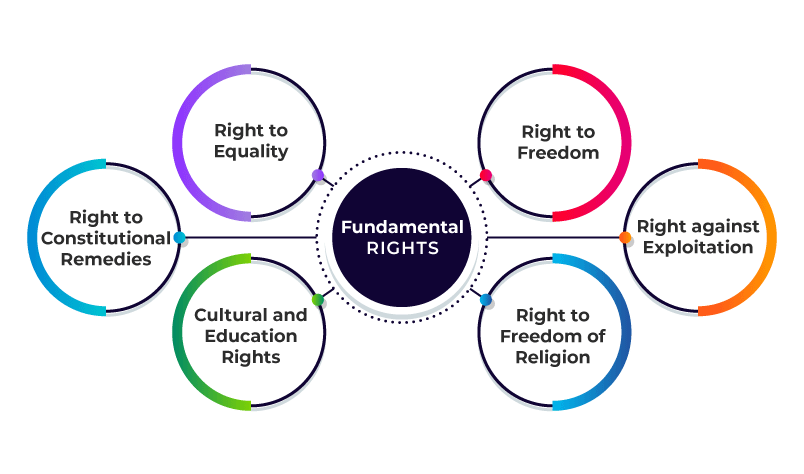
  • Right to Equality:
    Ensures equal treatment before the law and prohibits discrimination on grounds of religion, race, caste, sex, or place of birth.
  • Right to Freedom:
    Guarantees freedoms such as speech, expression, assembly, association, movement, residence, and profession.
  • Right against Exploitation:
    Prohibits human trafficking, forced labor, and employment of children in hazardous occupations.
  • Right to Freedom of Religion:
    Protects the freedom of individuals to profess, practice, and propagate religion, subject to public order, morality, and health.
  • Cultural and Educational Rights:
    Provides minority communities with the right to conserve their culture, language, and establish educational institutions of their choice.
  • Right to Constitutional Remedies:
    Ensures the right to move the court for enforcement of fundamental rights through writs such as habeas corpus, mandamus, prohibition, quo warranto, and certiorari.
4. Working of Institutions – Glossary and information

Glossary and Important Information

  • Council of Ministers: A group of ministers who are collectively responsible to the Lok Sabha.
  • Cabinet: A group of senior ministers who manage key ministries. It is the main part of the Council of Ministers and often meets to make important decisions for the entire Council.
  • Impeachment: A special procedure in Parliament to prosecute or remove the President and Judges for breaking the Constitution.
  • Money Bills: Bills that deal with financial matters such as taxes, income, spending, and grants.
  • Lok Sabha: The lower house of the Indian Parliament, made up of elected representatives of the people.
  • Rajya Sabha: The upper house of Parliament that represents the interests of states and Union Territories.
  • Speaker: The presiding officer of the Lok Sabha, responsible for ensuring smooth conduct of its business.
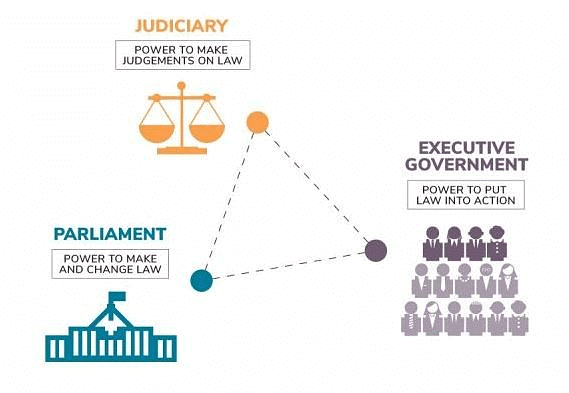
  • Executive: The part of government that puts laws into action. It consists of people with the authority to create major policies, make decisions, and implement them according to the Constitution and laws.
  • Legislative: The part of government that creates laws and monitors the executive branch.
  • Judiciary: The system that administers justice and resolves legal disputes. All courts in the country are part of the judiciary.
  • Criminal Cases: Cases involving breaking criminal laws, such as murder, theft, and assault.
  • Independence of the Judiciary: The Constitution ensures that the judiciary operates independently from the executive to avoid bias in favour of the government.
  • Coalition Government: A government formed when multiple political parties come together to rule, usually when no single party has a majority.
  • Government: The organisation responsible for managing a country, state, or community, exercising authority over various aspects of public life.
  • Office Memorandum: A communication from an authority stating the government’s policy or decision.
  • Political Institutions: Formal structures like government bodies and political parties that regulate political processes and hold authority in society.
  • Reservation: A policy aimed at offering special opportunities to disadvantaged groups, often through quotas in education and employment.
  • State: A political entity with a defined territory, organised government, and the ability to make domestic and foreign policies. The state remains constant, even if government leaders change. The terms country, nation, and state are often used interchangeably.
  • Legislative Assembly: A governing body that is responsible for making laws in a specific region.
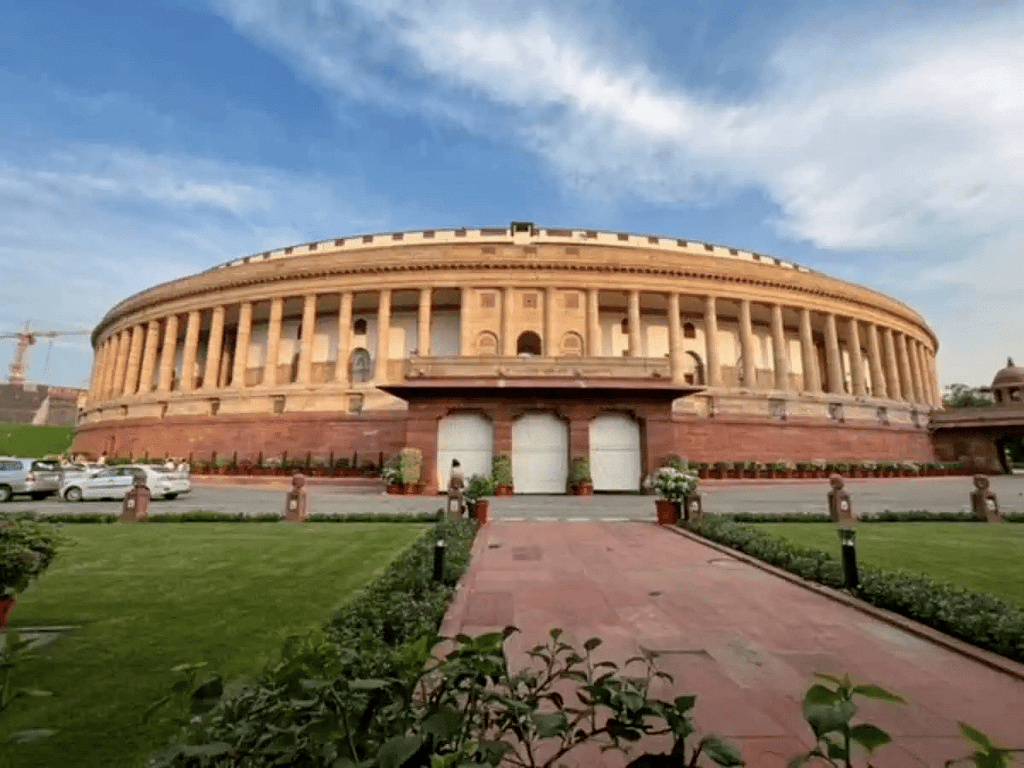
  • Parliament: The highest legislative body in a country, made up of elected representatives who create laws and oversee the government.
  • Political Executive: The branch of government that implements laws and policies, led by elected officials like the president or prime minister.
  • Public Interest Litigation: Legal action taken in the interest of the public, aimed at addressing social justice, human rights, or welfare issues.

3. Electoral Politics – Glossary and information

Glossary and Important Information

1.   By-election : Means an election held to fill a vacancy caused by either death, resignation or any other reason.

2.   Campaigning : Refers to a process by which a candidate tries to persuade the vote to vote for him rather than for others.

3.   Constituency : It refers to an area delimited for the purpose of election.

4.   Elcectorate : It refers to the entire body of people who are qualified to vote in the elections for the legislature.

5.   Election Commission : A parliamentary body constituted to conduct free and fair election in the country.

6.   Election Manifesto : A document published by each political party before election containing the policies and programme of that party.

7.   Franchise : Refers to the right of people to vote and elect their representatives to make laws.

8.   Opposition parties : The parties which are defeated in the election do not form the government but form the opposition and keep the government in check.

9.   Public opinion : Opinion of the electorate on all major-social political, economic and other important issues.

10. General Election : When an election is held in all constituencies and people from all parts of the country participate to choose their representatives for Parliament or state legislative Assembly, it is called a general election.

11. Secret Ballot : System of casting one’s vote is secrecy so that the choice of the voter remains a secret and is not known to others.

12. Print Media : Means of public information which consists of News papers, Periodicals and Magazines.

13. Electronic Media : Means of public information system which runs on electronics like Radio, T.V., Computer etc.

14. Universal Adult Franchise : Every Indian citizen of 18 years and above has the right to vote irrespective of caste, creed or sex.

15. One Person one vote : Every body has  the right to cast one vote and everyone’s vote is of equal importance.

16. Seats : The term refers to number of position in any legislature.

17. Election : A contest of power between different candidate and parties.

18. Electoral Participation : It entails participating in the election procedure through voting, contesting election, compainging .

19. Electoral Roll : It is the voter’s list prepared by a door to door survey to include only bonafide voter and minimise role of bogus voters.

20. Rigging : Any unfair practice indulged in during election is called rigging.

21. Turnout : The percentage of eligible voters who cast their votes in an election.

22. Incumbent : The current holder of a political office.

23.Code of conduct : A set of norms and guide lines to be followed by political parties and contesting candidates during election time.

2. Constitutional Design – Glossary and information

Glossary

  • Constitution:The foundational legal document governing a country’s government, encompassing basic laws, defining organ functions, jurisdiction, and citizens’ fundamental rights.
  • Cabinet Mission: In February 1946, the British government sent the cabinet mission to India. It proposed the formation of a federation, with a union government and three types of states and also proposed the formation of a Constituent Assembly and an interim government.
  • Objective Resolution: On December 13, 1946, Jawaharlal Nehru moved a resolution in the Constituents Assembly proposing the main objectives or aims of the new constitution to be made for free India. It is known as the Objective Resolution.
  • Drafting Committee: A committee set up to draft a constitution.
  • Amendment:The term means to change or modify. It is used in connection with changes made in the constitution of a country. The procedure of amendment of the Indian constitution is given in Article 368 of the constitution itself.
  • Democracy: A form of government that is chosen by the people to work for their welfare and can be changed by them.
  • Preamble: It is an introduction to the constitution that explains the aims and objectives of the constitution.
  • Republic: A country in which the head of the state is elected and not hereditary.
  • Secularism: It implies religious freedom. The state does not have any official religion of its own. Everyone has the right to preach, practice & profess any religion.
  • Universal Adult suffrage: It refers to the right to vote for all the adult citizens of a country without any discrimination on the basis of caste, creed, color, sex, or education. It is based on the principle of one person one vote.
  • Apartheid: A system of reaggregation of whites from blacks on the basis of race. Each group had to live in separate areas, and go to separate schools and non-whites had no voting rights.
  • Constituent Assembly: An assembly of people’s representatives that writes a constitution for a country.
  • Philosophy: The most fundamental principles underlying one’s thoughts and actions.
  • Treason: The offense of attempting to overthrow the government of the state to which the offender owes allegiance.
  • Tryst: A meeting or meeting place that has been agreed upon.

Important Information

Introduction

In a democracy, rulers and citizens are bound by fundamental rules, collectively known as the constitution. The Constitution dictates citizen rights, government powers, and operational protocols. It serves as the supreme law determining relationships among citizens, governments, and operational guidelines. 

Democratic Constitution in South Africa 

Apartheid Definition: Policy of discrimination based on race in South Africa.

Features of Apartheid

  • Racial classification and separation.
  • Separate living areas, schools, universities, and facilities.
  • Criminal offense for interracial marriage.
  • Restrictions on movement.
  • Non-whites were denied voting rights and governance participation.

End of Apartheid

  • African National Congress (ANC) was formed in 1910 for a non-racial democratic South Africa.
  • Intensified movement in the 1950s, ANC was banned in the 1960s.
  • UN condemnation and international sanctions in the 1980s.
  • Negotiations for a new constitution in the 1990s.
  • In elections in April 1994, the ANC won, forming a non-racial democratic government.

Towards a New Constitution

  • Formation of a common constitution by oppressive and freedom-struggling parties.
  • South African constitution provides extensive rights and inclusivity.
  • Upholds the principle that nobody should be excluded from problem-solving.

Nelson Mandela – Gandhi of South Africa

  • Nelson Mandela, an efficient leader of ANC, played a crucial role against apartheid.
  • Imprisoned in 1964, released in 1990.
  • First democratic elections in 1999, Mandela elected President.
  • Symbolizes the transformation from an isolated regime to a model of democracy.

Why do we need a Constitution?A constitution is a set of written rules accepted by citizens, determining relationships and governance.

Functions of a constitution

  • Generates trust and coordination among diverse people.
  • Specifies government composition and decision-making powers.
  • Sets limits on government powers and outlines citizen rights.
  • Expresses people’s aspirations for a good society.

Making of the Indian Constitution

  • Challenges during the making of the Indian Constitution.
  • Born through partition in 1947, with challenges of merging princely states.
  • Constitution drafted under the Cabinet Mission Plan of 1946.
  • Institutional design influenced by colonial rule, French Revolution ideals, and global democratic practices.
  • Inspired by Motilal Nehru’s constitution (1928) and Karachi session resolution (1931).

Guiding Values of the Indian Constitution

Values embedded in the Preamble:

We, the People of India.

  • Sovereign.
  • Socialist.
  • Secular.
  • Democratic.
  • Republic.
  • Justice.
  • Liberty.
  • Equality.
  • Fraternity.

Reflects the dreams of leaders like Mahatma Gandhi and Dr. Ambedkar.

Institutional Design

  • The constitution is not static but designed to accommodate changes.
  • Provisions for constitutional amendments (104 to date) reflect changing aspirations and societal dynamics.
  • Three categories of amendments based on majority requirements.

1. What is Democracy? Why Democracy? – Glossary and information

Glossary 

  • Dictatorship: In it all the powers are in the hands of a single individual or a small group of individual and the dictator is not answerable to anybody.
  • Democracy: It is a form of government in which the ruling power is vested in the hands of the people and the government is answerable to the people who can change it through constitutional means.
  • Communist State: A state-run by the communist Party without allowing other parties to fight elections.
  • Coalition: A combination of parties to share power in the government.
  • Political Prisoners: Prisoners held in prison or detained for opposing the government.
  • Dictator: Head of the state who arbitrarily rules the country.
  • Constitution: Rules of laws according to which the government of the state runs.

Important Information

What is Democracy?

  •  Democracy is a form of government in which the rulers are elected by the people.
  •  One chief factor common to all democracies is that the government is chosen by the people.

Why define Democracy?

  • Defining Democracy is important because: It helps students to demarcate between democratic and non-democratic governments. 
  • From the non-democratic government, take the example of Myanmar, where rulers were not elected by the people. 
  • Those who were in charge of the army of the country took over as rulers and people had no say in this decision. 
  • Dictators like Pinochet (Chile) are not elected by the people. This also applies to monarchies.

Try yourself:

What is the main characteristic of a dictatorship?

  • A.The ruling power is vested in the hands of the people.
  • B.The government is answerable to the people.
  • C.All powers are in the hands of a single individual or a small group.
  • D.Other parties are allowed to fight elections.

View Solution

A Simple Definition

Democracy is a form of government in which the supreme power is vested in the people and exercised directly by them or by their elected agents under a free electoral system.

Features of Democracy 

  •  The rulers are elected by the people.
  • Free and competitive elections are held.
  • Each adult irrespective of religion, education, caste, colour, wealth have one vote, one value.
  • The elected rulers take decisions within limits set by constitutional law and citizens’ rights.
  • Rule of Law
  • The rights of the citizens must be protected through Constitution.
  • There must be an independent judiciary

Major Decisions by Elected leaders

  • In Pakistan, General Pervez Musharraf led a military coup in October 1999 and overthrew a democratically elected government and became President of the country.
  • In 2002, he held a referendum in the country which was based on malpractices and fraud granted him a five-year extension.
  • After passing the law, the ‘Legal Framework Order’ which gave the president power to dismiss the national and provincial assemblies, elections were held to the national and provincial assemblies.
  • In this case, Pakistan has had elections, elected representatives have some powers.
  • But the final power rests with military officers and General Musharraf himself. So, this should not be called a democracy.
  • In a democracy, the final decision-making power must rest with those elected by the people.

 Free and fair electoral competition

  •  In China, elections are regularly held after every five years for electing the country’s parliament called the National People’s Congress.
  • Before contesting elections, a candidate needs the approval of the Chinese Communist Party.
  • The government is always formed by the Communist Party.
  • Mexico holds elections after every six years to elect its President.→ But until 2000 every election was won by a party called PRI (Institutional Revolutionary Party). → Opposition parties did contest elections but never managed to win as PRI was known to use many dirty tricks to win elections.
  • Both the cases should not be called a democracy.
  • Democracy must be based on a free and fair election where those currently in power have a fair chance of losing.

Try yourself:

Which of the following is a feature of democracy?

  • A.Rulers are appointed by the military.
  • B.Citizens’ rights are protected through the Constitution.
  • C.Elections are held based on malpractices and fraud.
  • D.The government is always formed by a single political party.

View Solution

One person, One vote, One value

  • There are many instances of denial of equal right to vote.
  • In Saudi Arabia, women do not have the right to vote.
  • Estonia has made its citizenship rules in such a way that people belonging to the Russian minority find it difficult to get the right to vote. 
  • In Fiji, the electoral system is such that the vote of an indigenous Fiji has more value than that of an Indian-Fijian.
  • In a democracy, each adult citizen must have one vote and each vote must have one value.

Summary Definition

Democracy is a form of government in which:

(i) Rulers elected by the people take all the major decisions.

(ii) Elections offer a choice and fair opportunity to the people to change the current rulers.

(iii) This choice and opportunity are available to all people on an equal basis.

(iv) The exercise of this choice leads to a government limited by basic rules of the constitution and citizens rights.

Rule of Law and Respect for Rights 

  • Since independence, Zimbabwe ruled by ZANU-PF.
  • Its leader, Robert Mugabe has been ruling the country. He is popular but also uses unfair practices in elections.
  • Elections have been held regularly and always won by ZANU-PF.
  • Opposition party workers are harassed and their meeting disrupted.
  • Public protests and demonstrations against the government are declared illegal.
  • Television and radio are controlled by the government and give only the ruling party’s version.
  • Independent newspapers are there but the government harasses those journalists who go against it.
  • The government has ignored some court judgments that went against it and has pressurised judges.
  • In this case, the government is not democratic as there is no citizen basic rights, no political opposition, no judiciary.
  • A democratic government rule within limits set by constitutional law and citizens’ rights.

Why Democracy?

Debating Merits of Democracy

  • Democracy, as a principle, can go beyond the government and can be applied to any sphere of life. 
  • People use the word democracy not to describe any existing government but to set up an ideal standard that all democracies must aim to become. 
  • However, if the ideals of democracy are considered then no country in the world is correctly democratic.

Arguments against democracy

  • Leaders keep changing in a democracy. This leads to instability.
  • Democracy is all about political competition and power play. There is no scope for morality.
  • So many people have to be consulted in a democracy that it leads to delays.
  • Elected leaders do not know the best interest of the people. It leads to bad decisions.
  • Democracy leads to corruption for it is based on electoral competition.
  • Ordinary people don’t know what is good for them; they should not decide anything.

Arguments for democracy

  • A democratic government is a better government because it is a more accountable form of government.
  • Democracy improves the quality of decision-making.
  • Democracy provides a method to deal with differences and conflicts.
  • Democracy enhances the dignity of citizens.
  • Democracy allows us to correct our own mistakes.

Try yourself:What is the main characteristic of a democratic government?

  • A.Rulers elected by the people take all the major decisions.
  • B.Citizens do not have basic rights and there is no political opposition.
  • C.The government controls all forms of media.
  • D.None of these

View Solution

Broader Meanings of Democracy 

  • The most common form that democracy takes in our times is that of a representative democracy where the majority is allowed to take decisions on behalf of all the people.
  • The majority of people rule through their elected representatives.
  • A democratic decision involves consultation with and consent of all those who are affected by that decision.
  • Democracy is a principle that can be applied to any sphere of life.
  • Democracy can apply to a government or a family or any other organisation.

Advantages of Democracy

  • Equality: Democracy promotes equality among citizens, ensuring that everyone has a voice in decision-making regardless of their background, wealth, or status.
  • Freedom: Citizens in a democracy enjoy various freedoms such as freedom of speech, assembly, religion, and press. This fosters individual liberties and protects human rights.
  • Accountability: Elected representatives in a democratic system are accountable to the people who elect them. If they fail to fulfill their promises or act against the interests of the public, they can be voted out of office.
  • Political Stability: Democracies tend to be more politically stable compared to autocratic regimes because power is distributed among multiple institutions and there are mechanisms in place for peaceful transitions of power.
  • Innovation and Creativity: Democracy encourages innovation and creativity as diverse perspectives and ideas are considered in decision-making processes, leading to better problem-solving and policy outcomes.

Disadvantages of Democracy

  • Slow Decision-Making: Democratic processes such as debates, negotiations, and consensus-building can sometimes result in slow decision-making, especially in times of crisis when swift action may be needed.
  • Majority Tyranny: In a democracy, the majority rule, which can sometimes lead to the oppression or marginalization of minority groups if their rights are not adequately protected.
  • Populism: Democracy is susceptible to populism, where leaders may appeal to public emotions and preferences rather than rational policies, leading to short-term solutions and neglect of long-term interests.
  • Political Polarization: Democracies may experience political polarization, where society becomes divided along ideological or partisan lines, making it difficult to reach consensus and govern effectively.
  • Manipulation and Corruption: Democratic processes, such as elections and lobbying, can be vulnerable to manipulation and corruption by special interest groups, undermining the integrity of the political system.