04. Working of Institutions – Worksheet

Q.1. Which is the upper house of Indian Parliament?

Q.2. How many members can the President nominate in Lok Sabha?

Q.3. What is SEBC?

Q.4. Name two houses of Parliament of India.

Q.5. What is the maximum number of members of Rajya Sabha?

Q.6. Who is the presiding officer of Rajya Sabha?

Q.7. Who is the supreme commander of the Armed Forces?

Q.8. Who is the first Prime Minister of India?

Q.9. Write down the structure of Rajya Sabha?

Q.10. How can you say that the Lok Sabha is more powerful than the Rajya Sabha?

Q.11. What are the qualifications to become a member of Lok Sabha?

Q.12. How the president of United States of America gets elected and what is his position in his country?

Q.13. What is government order?

Q.14. Why do we need a Parliament?

Q.15. What is Zero Hour?

Q.16. Compare both the houses of Indian Parliament in five points.

Q.17. Can you explain three political institution of the Indian Parliamentary system?

Q.18. What was Mandal Commission? Why was it appointed? What did it recommend to the government?

Q.19. Why do the political executives have more powers than the permanent executives?

Q.20. Why do we need institutions for governing a country?

You can access the solutions to this worksheet here.
03. Electoral Politics – Worksheet

Multiple Choice Questions (MCQ)

Q1: Who appoints the Chief Election Commissioner of India?
(a) The Chief Justice of India
(b) The Prime Minister of India
(c) The President of India
(d) The Law Minister of India

Q2: Constituencies called ‘wards’ are made for the election to
(a) Parliament
(b) State Legislative Assembly
(c) State Legislative Council
(d) Local bodies such as Panchayats and Municipalities

Q3: Which of these is not a part of the district and local level bodies?
(a) Panchayats
(b) Municipalities
(c) Corporations
(d) Lok Sabha

Q4: When on election duty, under whose control do the government officers work?
(a) Central Government
(b) Election Commission
(c) District Magistrate
(d) District Court

Q5: Which document must a candidate submit before elections?
(a) 
Identity Card
(b) Nomination Form
(c) Proof of citizenship only
(d) School certificate

Fill in the Blanks

Q1: In India, Lok Sabha and Vidhan Sabha elections are held regularly after every _______ .

Q2: The party that does not form the government is called the _______.

Q3:  The list of those people who are eligible to vote is officially called the Electoral Roll and is commonly known as the _______ .

Q4: _______ is the term used for fake voting or misuse of polling process.

Q5: A person must be at least _______ years old to vote in India.

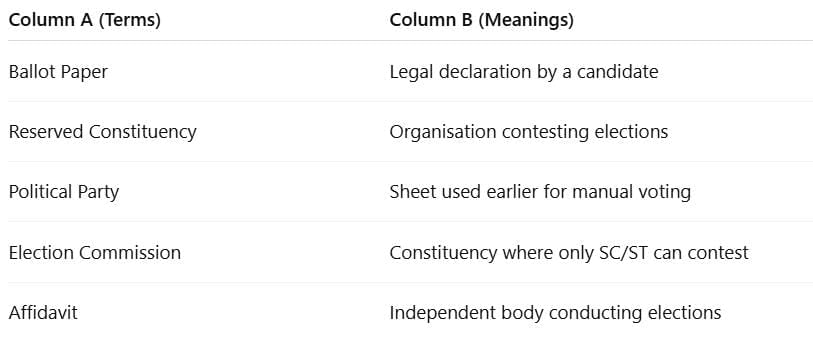
Match the Following

Very Short Answer Questions

Q1. Who formed the new party named Lok Dal?

Q2. How many Lok Sabha Constituencies are there in the Indian Parliament?

Q3. What is an Electoral Roll?

Q4. What is a party ticket?

Q5. What do you mean by Turn Out?

02. Constitutional Design – Worksheet

Q.1. When was the Constitution of India adopted?

Q.2. Which country’s constitution is considered a model for equality and reconciliation post-apartheid?

Q.3. What is Clouse?

Q.4. Who are called black in South Africa?

Q.5. What is Apartheid?

Q.6. Define Tryst.

Q.7. What resolution was made in 1931, Karachi Session?

Q.8. What do understand by constitutional amendment?

Q.9. What is the importance of Preamble of the Constitution?

Q.10. Who was Vallabhbhai Jhaverbhai Patel?

Q.11. What do you know about T.T. Krishnamachari?

Q.12. What do you know about Jaipal Singh?

Q.13. What do you know about G. Durgabai Deshmukh?

Q.14. What do you know about Kanhaiyalal Maniklal Munshi?

Q.15. What do you know about Shyama Prasad Mukherjee?

Q.16. “The South African Constitution inspires democrats all over the world”. Comment.

Q.17. What is constitution? Explain the role of constitution in a country?

Q.18. “Democracy is the only peaceful solution to the problems on a socially diverse country like India”. Comment.

Q.19. Explain the terms Justice, liberty, equality and fraternity, written the preamble of India.

Q.20. Why is the Preamble very important?

You can access the solutions to this worksheet here.

01.  What is Democracy? Why Democracy? – Worksheet

Q.1. Which two countries of the world have allowed the ruling parties to contest elections?

Q.2. Name the ruler who had established dictatorship in Germany?

Q.3. Write a drawback of the electoral system of Fiji?

Q.4. Why are quality decisions always possible in a democracy?

Q.5. Name a country which has multi-party system.

Q.6. Democracy comes from which Greek word?

Q.7. Name the country where women are not allowed to take part in the election.

Q.8. What dirty practices were used by IRP to win the elections in Mexico?

Q.9. Why is democracy considered the best form of government?

Q.10. Who was Robert Mugabe?

Q.11. Assess any three conditions that applied to the way a democratic government is run after the elections.

Q.12. How far is it correct to say that respect for citizen’s rights were not followed in Pakistan. Explain.

Q.13. What are the features of a good democracy?

Q.14. What is responsible government?

Q.15. What do you understand by room for correction?

Q.16. Write any five features of Non Democratic government.

Q.17. How far it is correct to say that the government of PRI in Mexico was a non democratic government? Give arguments.

Q.18. “Elections in china do not offer people a real choice.” Explain.

Q.19. “Democracy improves the quality of decision making” .Explain.

Q.20. Is it good to elect a President for life or is it better to hold regular elections after every five years? Give reasons.

You can access the solutions to this worksheet here.