04. Working of Institutions – Worksheet Solutions

Q.1. Which is the upper house of Indian Parliament?

Rajya Sabha.


Q.2. How many members can the President nominate in Lok Sabha?

Two members.


Q.3. What is SEBC?

SEBC is Socially and Economically Backward Classes. SEBC is another name for all those people who belong to castes that are considered backward by the government.


Q.4. Name two houses of Parliament of India.

Lok Sabha and Rajya Sabha.


Q.5. What is the maximum number of members of Rajya Sabha?

250 members.


Q.6. Who is the presiding officer of Rajya Sabha?

Vice-President.


Q.7. Who is the supreme commander of the Armed Forces?

The President.


Q.8. Who is the first Prime Minister of India?

Pt. Jawahar Lal Nehru


Q.9. Write down the structure of Rajya Sabha?

Rajya Sabha is called the Council of the States. It is the Upper house of Parliament. There can be 250 members. Rajya Sabha is indirectly elected body. It is less powerful than Lok Sabha It is the permanent house of Indian Parliament.


Q.10. How can you say that the Lok Sabha is more powerful than the Rajya Sabha?

Lok Sabha is more powerful than the Rajya Sabha in money matter. Money bill can only be introduced in Lok Sabha. Ones the money bill is passed by the Lok Sabha the Rajya Sabha cannot reject it. The party or group which attains the majority in Lok Sabha forms the Government. Lok Sabha controls the council of Ministers.


Q.11. What are the qualifications to become a member of Lok Sabha?

Person must be a citizen of India. He must be over the age of 25 years. He must not hold any office of profit under the Union or State government. He should not be of unsound mind or bankrupt. He should not have been disqualified under any law of Parliament.


Q.12. How the president of United States of America gets elected and what is his position in his country?

In many countries of the world, the President is both the head of the states and the head of the government. The President of US is the most well known example of this kind of President. The US President is directly elected by the people. He personally chooses and appoints the Ministers. The law making is still done by the legislature but the President can veto any law. Most importantly the President does not need the support of the majority of members in the congress and neither he is answerable to them. He has affixed tenure of four years.


Q.13. What is government order?

The order issued by the government is termed as a government order. It is also known as office memorandum. By office memorandum decision of the Government is communicated by the competent authority. The government issues many orders everyday on various subjects.


Q.14. Why do we need a Parliament?

Parliament makes laws and is the final authority for making laws. Parliament exercise control over the executive. Parliament passes the income and expenditure of the government.


Q.15. What is Zero Hour?

It is very important part of Parliament’s schedule. In Lok Sabha after the question hour and before the beginning of regular proceeding of the house, the time is called Zero Hour. During this time, the members can raise any important matter without giving any prior information.


Q.16. Compare both the houses of Indian Parliament in five points.

The Rajya Sabha has strength of 250 members; where as the Lok Sabha has 543 members.

The Rajya Sabha can introduce only ordinary bill, where as Lok Sabha can introduce both ordinary and money bill.

Regarding to any bill Rajya Sabha has only recommending power. Its suggestion is not binding on the Lok Sabha

The Rajya Sabha has no control over Council of Ministers; where as the Lok Sabha controls the Council of Ministers by exercising No Confidence Motion.

In case of any joint meeting of both the houses it is the Chairperson of the Lok Sabha who presides over the meeting.


Q.17. Can you explain three political institution of the Indian Parliamentary system?

Legislature: The prime minister and the cabinet are the institutions that take all important policy decisions. The law making body of the government is Legislature.

Executive: The political executives and the Civil servants, working together are responsible for taking steps to implement the ministers’ decisions. Law implementing body is Executive.

Judiciary: Supreme Court is an institution where disputes between citizens and the government are finally settled. All the courts of India together known as Judiciary of India.


Q.18. What was Mandal Commission? Why was it appointed? What did it recommend to the government?

The government of India had appointed the Second Backward commissions in 1979. It was headed by B.P. Mandal. Hence it was popularly called the Mandal Commission.

It was asked to determine the criteria to identify the socially and educationally backward classes in India and recommend steps to be taken for their advancement.

The Commission gave its Report in 1980 and made many recommendations.

One of these was that 27% of government jobs be reserved for the socially and educationally backward classes.

The Report and recommendations were discussed in the Parliament. For several years, many parliamentarians and parties kept demanding the implementations of the Commission’s recommendations.


Q.19. Why do the political executives have more powers than the permanent executives?

Political executives are elected by the people. Therefore, they are more empowered.

Political executives are answerable to the people.

Permanent executives work under the political executives and assist them in carrying out the day to day administration.

All policy decisions are taken by the political executives.

Permanent executives implement the decisions taken by political executives.

Permanent executives are expert in their field, they are qualified and educated.


Q.20. Why do we need institutions for governing a country?

The institutions are responsible for ensuring security to the citizens and providing facilities for education and health to all.

It collects taxes and spends money and rose on administration, defense and development programmes.

The institutions take decision and makes rules and regulations for proper administration.

If any dispute arises on these decisions or in their implementation, there are institutions who determine what is wrong and what is right.

Institutions also impart the duties and decide the jurisdiction of different bodies of government.
03. Electoral Politics – Worksheet Solutions

Multiple Choice Questions (MCQ)

Q1: Who appoints the Chief Election Commissioner of India?
(a) The Chief Justice of India
(b) The Prime Minister of India
(c) The President of India
(d) The Law Minister of India
Ans: (c) The President of India

According to the Indian Constitution, the President appoints the Chief Election Commissioner. However, after appointment, the CEC functions independently and is not answerable to the President or the government.

Q2: Constituencies called ‘wards’ are made for the election to
(a) Parliament
(b) State Legislative Assembly
(c) State Legislative Council
(d) Local bodies such as Panchayats and Municipalities
Ans: (d) Local bodies such as Panchayats and Municipalities

Wards are smaller divisions used for elections in local government bodies like municipal corporations and Panchayati Raj institutions.

Q3: Which of these is not a part of the district and local level bodies?
(a) Panchayats
(b) Municipalities
(c) Corporations
(d) Lok Sabha
Ans: (d) Lok Sabha

Lok Sabha is a part of the Union Parliament and not related to local or district-level governance, which includes Panchayats, Municipalities, and Corporations.

Q4: When on election duty, under whose control do the government officers work?
(a) Central Government
(b) Election Commission
(c) District Magistrate
(d) District Court
Ans: (b) Election Commission

During elections, all officers and staff involved in election duties are under the direct control of the Election Commission, not the government.

Q5: Which document must a candidate submit before elections?
(a) 
Identity Card
(b) Nomination Form
(c) Proof of citizenship only
(d) School certificate

Ans: (b) Nomination Form

To contest elections, candidates must file a nomination form along with a security deposit and affidavit disclosing criminal records (if any), assets, liabilities, and educational qualifications.

Fill in the Blanks

Q1: In India, Lok Sabha and Vidhan Sabha elections are held regularly after every _______ .
Ans: In India, Lok Sabha and Vidhan Sabha elections are held regularly after every five years.

Q2: The party that does not form the government is called the _______.
Ans: The party that does not form the government is called the opposition.

Q3:  The list of those people who are eligible to vote is officially called the Electoral Roll and is commonly known as the _______ .
Ans: The list of those people who are eligible to vote is officially called the Electoral Roll and is commonly known as the Voters List.

Q4: _______ is the term used for fake voting or misuse of polling process.

Ans: Rigging is the term used for fake voting or misuse of the polling process.

Q5: A person must be at least _______ years old to vote in India.

Ans: A person must be at least 18 years old to vote in India.

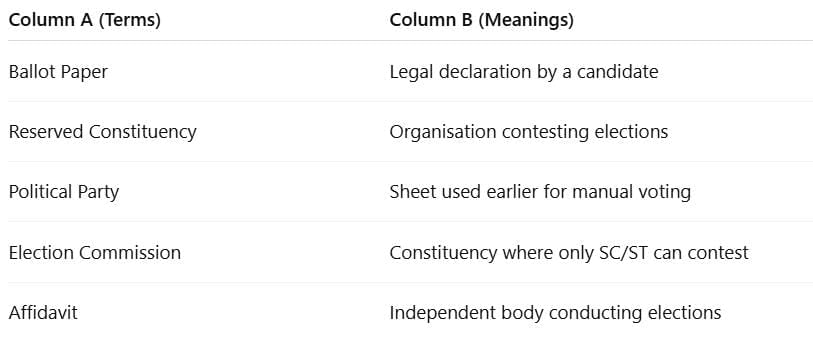
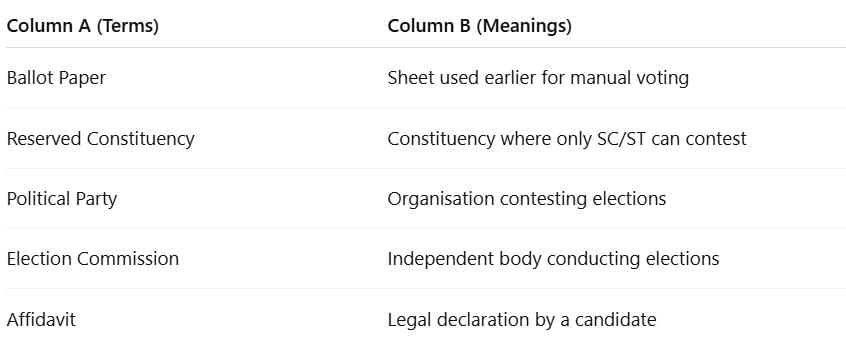
Match the Following

Ans:

Very Short Answer Questions

Q1. Who formed the new party named Lok Dal?
Ans: Choudhary Devi Lal.

Q2. How many Lok Sabha Constituencies are there in the Indian Parliament?
Ans: 543 seats.

Q3. What is an Electoral Roll?
Ans: It is the list that contains the particulars of eligible voters.

Q4. What is a party ticket?
Ans: A party ticket is the official nomination by a political party, allowing a candidate to contest elections with the party’s symbol and support.

Q5. What do you mean by Turn Out?
Ans: Turnout refers to the percentage of eligible voters who actually cast their vote.

02. Constitutional Design – Worksheet Solutions

Q.1. When was the Constitution of India adopted?

26th November, 1949.


Q.2. Which country’s constitution is considered a model for equality and reconciliation post-apartheid?

South Africa.


Q.3. What is Clouse?

A distinct section of a document.


Q.4. Who are called black in South Africa?

The native people of South Africa are black.


Q.5. What is Apartheid?

The official policy of racial discrimination and till treatment of blacks followed by the government of South Africa between the years of 1948 to 1989.


Q.6. Define Tryst.

Meeting or meeting place that has been agreed upon.


Q.7. What resolution was made in 1931, Karachi Session?

The 1931 Karachi Session passed a resolution on how the constitution of independent India should look like, including commitments to universal adult franchise, equality, and rights of minorities.


Q.8. What do you understand by constitutional amendment?

A constitutional amendment is a formal change made to the Constitution by the supreme legislative body to keep it updated with the changing needs of society.


Q.9. What is the importance of the Preamble to the Constitution?

The Preamble of the constitution is important because it contains the philosophy on which the entire Constitution has been built. It provides a standard to examine and evaluate any law and action of government to find whether it is good or bad. It is the soul of the Indian constitution.


Q.10. Who was Vallabhbhai Jhaverbhai Patel?

He was born (1875-1950) in Gujarat. Home Minister, Information and broadcasting minister. Lawyer and leader of Bardoli peasant Satyagraha. Played a decisive role in the integration of the Indian princely states. Later he became Deputy Home minister.


Q.11. What do you know about T.T. Krishnamachari?

T.T. Krishnamachari (1899-1974)Born- Tamil Nadu. Member of Drafting Committee. Entrepreneur and congress leader. Later finance Minister in the Union Cabinet.


Q.12. What do you know about Jaipal Singh?

Jaipal Singh (1903-1970)Born- Jharkhand. A sportsman and educationist. Captain of the first national Hockey TeamFounder president of Adivasi Maha Sabha. Later founder Jharkhand Party.


Q.13. What do you know about G. Durgabai Deshmukh?

G. Durgabai Deshmukh (1909-1981)Born- Andhra Pradesh. Advocate and Public Activist for women’s emancipation. Founder Andhra Mahila Sabha. Congress Leader. Later Founder Chairperson of Central Social Welfare Board.


Q.14. What do you know about Kanhaiyalal Maniklal Munshi?

Kanhaiyalal Maniklal Munshi(1887-1971). Born-Gujarat. Advocate historian and linguist. Congress leader and Gandhian. Later: Minister in the Union Cabinet. Founder of the Swatantra Party.


Q.15. What do you know about Shyama Prasad Mukherjee?

Shyama Prasad Mukherjee (1901-1953). Born-West Bengal. Minister for Industry and Supply in the Interim Government. Educationist and lawyer. Active in Hindu Mahasabha. Later: Founder President of Bharatiya Jansangh.


Q.16. “The South African Constitution inspires democrats all over the world”. Comment.

The South African constitution inspires democrats all over the world. A state denounced by the entire world till recently as the most undemocratic one is now seen as a model of democracy. What made this change possible was the determination of the South African people to work together, to transform bitter experience into the binding glue of a rainbow nation. They agreed that everybody should become part of the solution, whatever they might have done or represented in the past. The preamble to the South African constitution sums up the spirit.


Q.17. What is a constitution? Explain the role of the constitution in a country?

The Constitution is a set of written rules accepted by all citizens of a country. It determines the relationships among citizens and between citizens and the government. It builds trust, outlines powers of government, safeguards citizen rights, and expresses aspirations of a good society.


Q.18. “Democracy is the only peaceful solution to the problems of a socially diverse country like India”. Comment.

In a diverse country like India, democracy keeps our country together. In our country, people belong to different regions, languages, religious and castes. Equal dignity and respect is given to every citizen without any discrimination. They have different performances. The preferences of one group can clash with those of other groups which can be resolved here in a better way. In a democracy no one is a permanent winner and no one is a permanent loser. Different groups can live with one another peacefully. In any society, people have differences of opinion and interests. These differences are particular sharp in a country like ours where there is a wide social diversity.


Q.19. Explain the terms Justice, liberty, equality and fraternity, as written the preamble of India.

Justice: Citizens cannot be discriminated on the ground of caste, religion and gender. Social inequalities have to be reduced. Government should work for the welfare of all, especially of the disadvantaged group.

Liberty: There are no unreasonable restrictions on the citizens in what they wish to express their thoughts and the way they wish to follow up their thought in action.

Equality: All are equal before the law. The traditional social inequalities have to be ended. The government should ensure equal opportunity for all.

Fraternity: All should behave as if we are members of the same family. No one should treat a fellow citizen as inferior.


Q.20. Why is the Preamble very important?

It declares India to be a sovereign, Socialist, Secular Democratic Republic. It envisages Justice-Social, Economic and political for all the citizens of the Republic. It ensures all types of freedom necessary for the individuals that are freedom of thought and expression. It strives for equality of status and opportunity to all individuals and safeguards their dignity irrespective of their religious belief or section. It promotes a sense of brotherhood among the citizens.

01. What is Democracy? Why Democracy? – Worksheet Solutions

Q.1. Which two countries of the world have allowed the ruling parties to contest elections?

China and Mexico are the two countries where ruling parties can contest elections.

  • In China, the elections are tightly controlled by the Communist Party.
  • In Mexico, while elections are held regularly, the ruling party historically dominated until 2000.


Q.2. Write a drawback of the electoral system of Fiji?

In Fiji, the electoral system has a significant drawback:

  • The vote of an indigenous Fijian carries more weight than that of an Indian Fijian.
  • This disparity undermines the principle of political equality, which is essential in a democracy.


Q.3. Why are quality decisions always possible in a democracy?

Quality decisions in a democracy are always possible due to several key factors:

  • Time for Reflection: Democracies allow time for careful consideration of decisions, reducing the likelihood of rash choices.
  • Public Discussion: There is space for open dialogue about decisions, enabling corrections and adjustments when mistakes occur.
  • Conflict Resolution: Democracies provide methods to address differences and conflicts among diverse groups, fostering cooperation.
  • Accountability: Leaders in a democracy are accountable to the public, ensuring that their decisions reflect the people’s wishes.
  • Inclusivity: Different perspectives are considered, leading to more comprehensive and balanced decision-making.

While democracy may not solve every problem, it is generally more effective than other forms of government in producing quality decisions and respecting citizens’ dignity.


Q.4. Name a country which has multi-party system.

India is a country that has a multi-party system. This means that multiple political parties can compete for power and influence in the government.

Q.5. Democracy comes from which Greek word?

The term democracy originates from the Greek word demokratia.

  • demos means “people”.
  • kratia means “rule”.

Therefore, democracy can be understood as the rule by the people.


Q.6. Name the country where women are not allowed to take part in the election.

Saudi Arabia is the country where women were not allowed to participate in elections until 2015.


Q.7. What dirty practices were used by IRP to win the elections in Mexico?

The PRI (Institutional Revolutionary Party) employed various unethical tactics to secure election victories in Mexico:

  • Government employees were required to attend party meetings.
  • Teachers in government schools pressured parents to vote for the PRI.
  • The media largely ignored opposition parties, focusing instead on criticising them.
  • Polling booths were sometimes moved at the last minute, complicating the voting process.
  • The PRI invested heavily in campaign financing for its candidates.


Q.8. Why is democracy considered the best form of government?

Democracy is often regarded as the best form of government for several reasons:

  • Conflict Resolution: It provides a peaceful way to handle differences among people.
  • Self-Correction: Democracy allows for the correction of mistakes made by leaders.
  • Better Decision-Making: Involvement of many voices leads to improved decisions.
  • Dignity of Citizens: It respects the worth of every individual, ensuring equality.


Q.9. Who was Robert Mugabe?

Robert Mugabe was the leader of ZANU-PF and ruled Zimbabwe from its independence in 1980. Key points about his leadership include:

  • Regular elections were held, but they were consistently won by ZANU-PF.
  • Mugabe was popular yet employed unfair practices in elections.
  • His government frequently changed the constitution to enhance presidential powers and reduce accountability.
  • Opposition party members faced harassment, and their meetings were often disrupted.

Public protests were declared illegal, and media was heavily controlled, limiting criticism of the President. Mugabe was eventually forced out of office in 2017.


Q.10. Assess any three conditions that applied to the way a democratic government is run after the elections.

Conditions for a Democratic Government:

  • Citizens must have the freedom to express their views.
  • They should be able to form associations and protest.
  • The country must be governed by constitutional law.
  • Everyone should be treated equally under the law.
  • People’s rights must be respected and protected by law.


Q.11. How far is it correct to say that respect for citizen’s rights were not followed in Pakistan. Explain.

Yes, it is correct to say that respect for citizen’s rights were not followed in Pakistan. In August 2002, a Legal Framework Order was issued, amending the Constitution of Pakistan. Key points include:

  • The President has the power to dismiss both national and provincial assemblies.
  • The civilian cabinet’s work is overseen by the National Security Council, which is largely controlled by military officers.
  • While elections were held, the ultimate authority rested with military leaders and General Musharraf, not the elected representatives.

This situation indicates a significant lack of adherence to democratic principles and citizens’ rights.


Q.12. What are the features of a good democracy?

Features of a Good Democracy:

  • Every citizen should have an equal role in decision-making.
  • Equal voting rights are essential, but access to information, basic education, and resources are also necessary.
  • A good democracy ensures that no one goes to bed hungry.
  • It provides employment and access to basic needs for all individuals.


Q.13. What is responsible government?

Responsible government refers to a democratic system where:

  • The representatives are elected by the people.
  • These representatives are accountable to the public.
  • If they fail to act responsibly, they can be replaced in the next election.

This ensures that the government remains answerable to the citizens.


Q.14. What do you understand by room for correction?

Room for correction refers to the ability within a democracy to acknowledge and rectify mistakes. Key points include:

  • In a democracy, mistakes are openly admitted.
  • There is a commitment to correcting these errors.
  • This process ensures accountability among rulers.
  • Unlike non-democratic systems, democracies allow for changes in leadership or decisions.

Thus, democracy provides a space for correction and public discussion on issues.


Q.15. Write any five features of Non Democratic government.

(i) People do not enjoy political rights or they have every limited right.

(ii) Elections are not held in a free and fair manner. People face many restrictions.

(iii) People are not allowed to participate in the functioning of decision making.

(iv) Government is not accountable and responsive to the needs of people.

(v) People are never considered rulers or dignified citizens. They are treated as subjects.


Q.16. How far it is correct to say that the government of PRI in Mexico was a non democratic government? Give arguments.

The government of the Institutional Revolutionary Party (PRI) in Mexico was not a democratic government. It operated against the principles of democracy. Key points include:

  • The PRI employed manipulative tactics to secure election victories.
  • All government employees were required to attend party meetings.
  • Teachers in government schools pressured parents to vote for the PRI.
  • Opposition parties participated in elections but rarely won.
  • The media largely ignored opposition activities, focusing instead on criticism.
  • Polling booths were often relocated at the last minute, complicating voting for citizens.
  • The PRI spent significant funds on campaigning for its candidates.

These practices indicate that the elections held during this period did not provide a genuine choice for the electorate, undermining the essence of a democratic system.


Q.17. “Elections in china do not offer people a real choice.” Explain.

In China, elections occur every five years to elect the country’s parliament, known as Quanguo Renmin Daibiao Dahui (National People’s Congress). This body has the authority to appoint the country’s President. Key points about the electoral process include:

  • The National People’s Congress comprises nearly 3,000 members elected from across China, including some from the army.
  • Candidates must receive approval from the Chinese Communist Party (CCP) before they can contest elections.
  • Only members of the CCP or eight smaller parties allied with it were permitted to run in elections held between 2002 and 2003.
  • The government is consistently formed by the Communist Party, limiting genuine electoral choice.

As a result, the elections do not provide the people with a real choice, as they can only select candidates approved by the ruling party. This situation raises questions about the fairness and legitimacy of the electoral process.


Q.18. “Democracy improves the quality of decision making” .Explain.

Democracy enhances the quality of decision-making through several key mechanisms:

  • Consultation and Discussion: Decisions are made collectively, involving many people.
  • Identification of Mistakes: Diverse perspectives help to identify potential errors in decisions.
  • Time for Reflection: Taking time to deliberate reduces the risk of hasty or irresponsible choices.
  • Accountability: Democratic systems allow for corrections and adjustments, ensuring decisions can be improved over time.

Overall, these factors contribute to a more thoughtful and responsible approach to governance.


Q.19. Is it good to elect a President for life or is it better to hold regular elections after every five years? Give reasons.

No, it is not good to elect a President for life. It is better to hold regular elections every five years for the following reasons:

  • People’s Choice: Elected rulers can make important decisions on major issues.
  • Opportunity for Change: Regular elections give citizens the chance to change their leaders.
  • Equal Participation: Everyone has an equal opportunity to vote and influence the government.
  • Constitutional Limits: Elections ensure that the government operates within the basic rules of the constitution and respects citizens’ rights.