Chapter Notes: Keeping Time with the Skie
Introduction
The Moon can sometimes be seen during the daytime. This made Meera curious when she noticed the Moon in the sky on Makar Sankranti. This chapter explains why the Moon changes its appearance and how people have used observations of the sky to measure time.
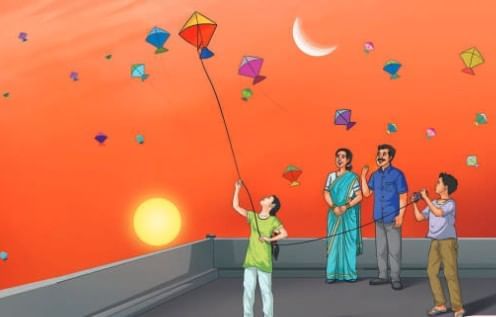 Kites in the Sky
How Does the Moon’s Appearance Change and Why?
Phases of the Moon
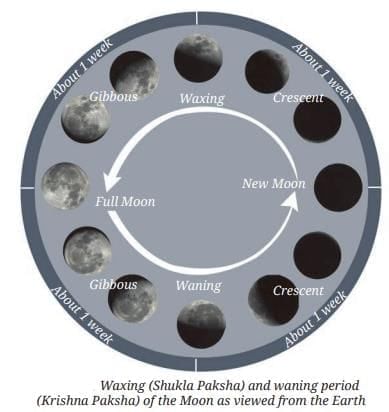
The changing shapes of the Moon’s illuminated (bright) portion, as seen from Earth, are known as the phases of the Moon.
Waning Period (Krishna Paksha)
- After a full Moon, the bright portion decreases from a full circle to a half circle in about a week.
- The bright portion continues to shrink, disappearing completely in another week.
- This two‑week shrinking period is called the waning period or Krishna Paksha in India.
New Moon (Amavasya)
- The day when the Moon is not visible at all is called the new Moon or Amavasya.
Waxing Period (Shukla Paksha)
- After the new Moon, the bright side grows to a half circle in about a week and becomes a full circle (full Moon) in another week.
- This two‑week growing period is called the waxing period or Shukla Paksha in India.
- The Moon’s waxing and waning occurs in a cyclical (repeating) pattern each month.
- The full cycle from one full Moon to the next takes about one month (about 29.5 days).
Important Terms
- Full Moon (Purnima): The day when the Moon appears as a full bright circle.
- New Moon (Amavasya): The day when the Moon is not visible at all.
- Waxing: The period when the bright part of the Moon increases (from new Moon to full Moon).
- Waning: The period when the bright part of the Moon decreases (from full Moon to new Moon).
- Gibbous: More than half but not fully illuminated Moon.
- Crescent: Less than half illuminated Moon.
Locating the Moon
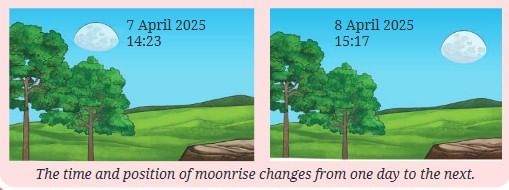
The Moon’s position in the sky changes each day, even at the same clock time.
On full Moon day:
- The Moon is nearly opposite the Sun.
- When the Sun rises in the east, the Moon is almost setting in the west.
After full Moon:
- Each morning at sunrise, the bright part of the Moon gets smaller and the Moon appears closer to the Sun’s position in the sky.
- When the Moon looks like a half circle, it is overhead at sunrise.
- A few days after, the crescent Moon appears even closer to the Sun.
The phase (shape) of the Moon and whether it is waxing or waning help you know where and when to look for it in the sky.
- Waxing Moon: Best seen at sunset.
- Waning Moon: Best seen at sunrise.
- The moonrise time becomes about 50 minutes later each day, which explains why the Moon can sometimes be seen during daylight (for example, in the afternoon between 2:00–4:00 p.m.).
- After moonrise, wait about 30 minutes for the Moon to climb higher into the sky for an easier view.
Making Sense of Our Observations – The Moon’s Changing Appearance
The Moon’s Shape:
- The actual shape of the Moon does not change; what changes is how much of the illuminated part we can see from Earth.
The Moon’s Light:
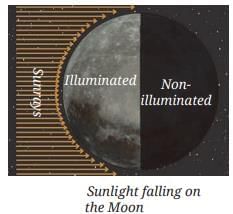
- The Moon does not produce its own light. It appears bright because it reflects sunlight that falls on it.
Sunlit and Dark Halves:
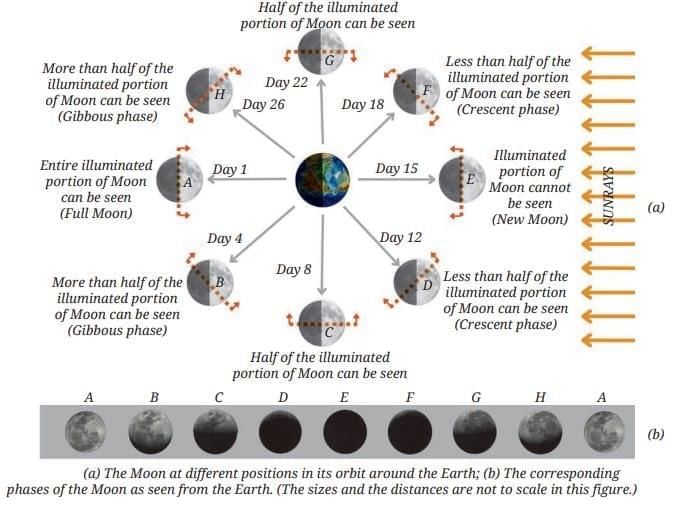
- At any moment, half of the Moon faces the Sun and is illuminated by sunlight.
- The other half, facing away from the Sun, remains in darkness (non‑illuminated).
Appearance from Earth:
- As the Moon revolves around the Earth, the position and viewing angle change.
- Although always one half of the Moon is sunlit, that half is not always fully visible from Earth.
- The portion of the Moon we see from Earth may be fully illuminated, partly illuminated, or not illuminated at all — producing the phases.
Full Moon and New Moon:
- Full Moon: When the entire sunlit half faces Earth, we see the Moon as a whole bright circle.
- New Moon: When the non‑illuminated half faces Earth, we cannot see the Moon at all.
Reason for Changing Appearance:
- The Moon seems to change shape because its position relative to Earth and Sun is constantly changing as it orbits Earth.
- We only see the illuminated part that faces toward us; the visible fraction changes with the Moon’s orbit.
The Moon’s Phases with a Simple Model
Model Demonstration:
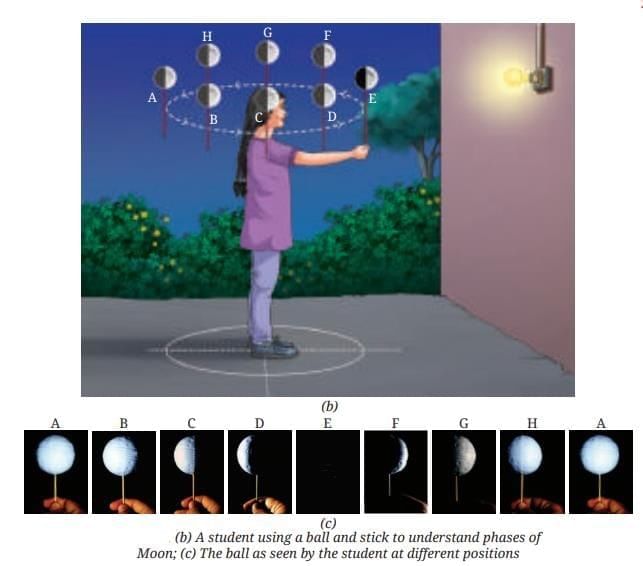
- Use a small ball on a stick to represent the Moon, a torch or lamp as the Sun, and your head as the Earth.
- Hold the ball slightly above your head and shine the torch toward the ball to represent sunlight.
- As you turn in a circle, the ball (“Moon”) shows a changing illuminated portion to your eyes, similar to lunar phases.
What the Model Shows:
- Full Moon: When the ball is held opposite the lamp (behind you compared to the Sun), the side facing you is fully lit — like a full Moon.
- New Moon: When the ball is held between your head and the lamp (towards the Sun), you see only the dark side — like a new Moon.
- Crescent and Gibbous Phases: Turning the ball slowly changes the visible portion: sometimes crescent (less than half lit), sometimes gibbous (more than half lit).
- The line between the bright and dark parts is always curved — this matches what is seen on the real Moon.
The Science Behind the Phases:
- At every moment, half the Moon is lit by sunlight and half is dark.
- As the Moon revolves around the Earth, the angle between Earth, Moon and Sun changes, so the part of the Moon we see bright changes accordingly.
Phase Names:
- Crescent: Less than half illuminated.
- Gibbous: More than half illuminated.
- Full Moon: Whole face illuminated.
- New Moon: No illuminated part visible.
Why Do Moon Phases Occur?
- Incorrect Idea: Moon phases are not caused by Earth’s shadow falling on the Moon.
- Correct Reason: The phases of the Moon occur because of the changing relative positions (orientation) of the Sun, Moon and Earth as the Moon revolves around Earth.
Earth’s Shadow and Lunar Eclipse:
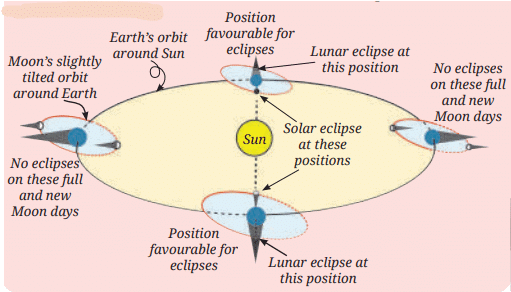
- The only time Earth’s shadow actually falls on the Moon is during a lunar eclipse.
- Lunar eclipses can only happen on a full Moon day.
- Solar eclipses can only happen on a new Moon day.
Why Don’t Eclipses Happen Every Month?
- Eclipses do not occur every month even though there is a full Moon and new Moon monthly.
- This is because the Moon’s orbit is slightly tilted relative to Earth’s orbit around the Sun.
- Most months, the Sun, Earth and Moon do not line up perfectly for the Earth’s shadow to cover the Moon (lunar eclipse) or for the Moon’s shadow to fall on Earth (solar eclipse).
How Did Calendars Come into Existence?
Natural Cycles and Time Measurement
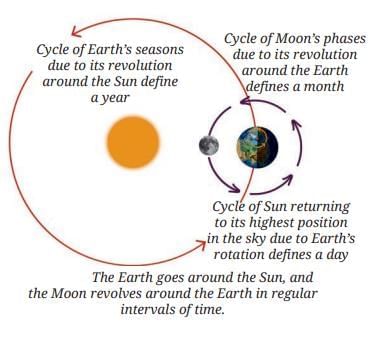
- The apparent daily motion of the Sun (rising in the east, setting in the west) is due to Earth’s rotation on its axis.
- This natural cycle forms the basis of the day — the primary unit of timekeeping.
- Mean Solar Day: The time between one “highest Sun position” (shortest shadow at noon) to the next is about 24 hours, known as the mean solar day.
Shadow Tracking and the Day
- The shortest shadow during the day marks the Sun’s highest point in the sky (noon).
- Measuring from one day’s noon to the next gives the length of a day.
- The average solar day is about 24 hours.
The Month and the Moon
- The phases of the Moon create another natural cycle — one complete phase cycle (from full Moon to next full Moon) takes about 29.5 days (approximately one month).
- This lunar cycle is the basis for measuring a month.
The Year and the Seasons
- One year is the time Earth takes to make a full revolution around the Sun, which is about 365¼ days.
- The repetition of seasons (spring, summer, autumn, winter) marks the annual cycle.
Try yourself:
What is the primary unit of timekeeping based on Earth’s rotation?
- A.Month
- B.Year
- C.Day
- D.Hour
Types of Calendars
1. Lunar Calendars
- Based on the phases of the Moon.
- Each lunar month is about 29.5 days and 12 lunar months make a year of about 354 days.
- This lunar year is shorter than a solar year, so the months shift with respect to the seasons over time.
2. Solar Calendars
- Based on Earth’s revolution around the Sun and the arrival of seasons.
- The Gregorian calendar is a solar calendar (widely used) with months adjusted so a regular year has 365 days.
- To correct the extra quarter day, a leap day is added every 4 years (February 29).
- Leap year rule: Years divisible by 4 are leap years, with additional adjustments: skip leap years every 100 years, but add them back every 400 years.
3. Luni‑Solar Calendars
- Combine lunar months with corrections to keep in sync with the solar year and seasons.
- In India and elsewhere, an extra month (Adhika Maasa) is added every 2–3 years to adjust the calendar with the solar year.
- The names of months in Indian luni‑solar calendars include: Chaitra, Vaisakha, Jyeshtha, Ashadha, Shravana, Bhadrapada, Ashwin, Kartika, Margashirsha (Agrahayan), Pausha, Magha, and Phalguna.
- Amant calendars: A month begins after a new Moon and ends on the next new Moon.
- Purnimant calendars: A month begins after a full Moon and ends at the next full Moon.
Observations and Heritage
- Ancient observers noticed 12 cycles of Moon phases fit in one yearly cycle of seasons.
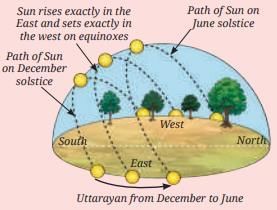
- The Sun’s position at sunrise changes through the year (northward in summer, southward in winter) due to Earth’s tilt.
- This movement is described in Indian tradition as Uttarayana (northward, roughly December–June) and Dakshinayana (southward, June–December).
- Solstices and equinoxes are important points for tracking the Sun’s yearly journey and for adjusting calendars.
The Indian National Calendar
The Indian National Calendar, also known as the Saka Calendar, is a solar calendar officially used by the Government of India along with the Gregorian calendar.
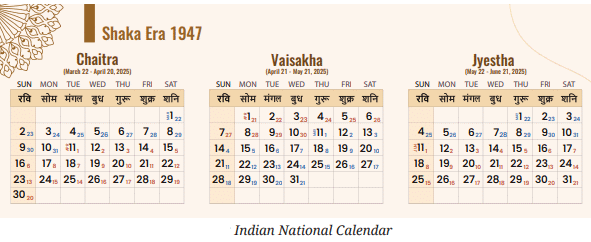
- It consists of 365 days in a year in a normal year.
- The year begins on 22 March (the day after the spring equinox). In leap years it begins on 21 March.
- Each month is named after traditional Indian months: Chaitra, Vaisakha, Jyestha, Ashadha, Shravana, Bhadrapada, Ashwin, Kartika, Agrahayana, Pausha, Magha, and Phalguna.
- Months have 30 or 31 days: In a regular year, months 2–6 have 31 days; the rest have 30 days.
- In a leap year, a day is added to Chaitra (the first month), making it start on 21 March.
- The Indian National Calendar was introduced in 1956, based on recommendations by the Calendar Reform Committee (CRC) headed by the astrophysicist Meghnad Saha.
- The calendar follows principles that relate to ancient Indian astronomical works such as the Surya Siddhanta.
- This calendar helps unify civil timekeeping across India.
Are Festivals Related to Astronomical Phenomena?
Many Indian festivals are linked to the phases of the Moon and thus are based on lunar or luni‑solar calendars.
Examples
- Diwali: Celebrated on the new Moon of Kartika.
- Holi: Celebrated on the full Moon of Phalguna.
- Buddha Purnima: Occurs on the full Moon of Vaisakha.
- Eid‑ul‑Fitr: Celebrated after sighting the crescent Moon at the end of Ramadan.
- Dussehra: Occurs on the tenth day of Ashwina.
- These festivals appear on different dates in the Gregorian calendar each year because the lunar year and solar year are not the same length.
- Luni‑solar calendars add an extra (intercalary) month every few years to align lunar months with the solar year, causing date shifts of less than a month relative to the Gregorian calendar.
- Pure lunar calendars do not make this adjustment; so festivals like Eid‑ul‑Fitr move through the Gregorian calendar months over the years.
Solar Festivals
- Some Indian festivals follow a solar sidereal calendar, occurring nearly on the same Gregorian date each year.
- Examples: Makar Sankranti, Pongal, Bihu, Vaisakhi, Poila Baisakh, and Puthandu.
- These were originally linked to solstices or equinoxes, but a slight difference between sidereal and tropical years causes slow drift of dates over centuries (for example, Makar Sankranti shifts by one day about every 71 years).

Variations in Festival Dates
- The exact lunar phase at sunrise can vary for eastern and western parts of India, causing festival dates to differ by a day in different regions even in the same year.
- To standardise dates, the Rashtriya Panchang (national almanac) is published by the Positional Astronomy Centre, Government of India, giving advanced calculations for official festival dates.
Cultural Connection
- The Moon and Sun inspire Indian classical art forms:
- Music: Ragas such as Chandrakauns and Chandranandan are inspired by the Moon.
- Dance: Gestures (mudras) such as Chandrakala and Ardhachandran in Bharatanatyam and other dances invoke lunar imagery.
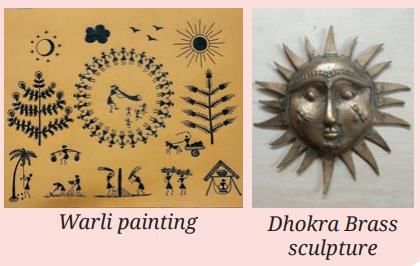
- Visual Arts: Traditional painting styles (e.g., Madhubani, Warli), sculpture and pottery frequently depict the Moon and Sun, reflecting their cultural significance.
Why Do We Launch Artificial Satellites in Space?
Natural vs Artificial Satellites
- The Moon is Earth’s natural satellite, revolving around our planet.
- Artificial satellites are man‑made objects placed in orbit around Earth by various countries and organisations.
Artificial Satellites: Purpose and Functions
- Appearance: Artificial satellites can appear as small, bright, continuously moving dots across the sky.
- Typical Low Earth Orbit: Many satellites orbit at heights of a few hundred kilometres (for example around 800 km) and complete an orbit in roughly 100 minutes.
- Key Uses:
- Communication (TV, telephone, internet)
- Navigation (GPS, map services)
- Weather monitoring
- Disaster management (detecting floods, cyclones, etc.)
- Scientific research (studying space, atmosphere, and Earth)
Try yourself:
What is one reason we launch artificial satellites into space?
- A.To communicate with animals
- B.To study weather
- C.To explore oceans
- D.To grow plants
Satellites and Missions by ISRO (Indian Space Research Organisation)
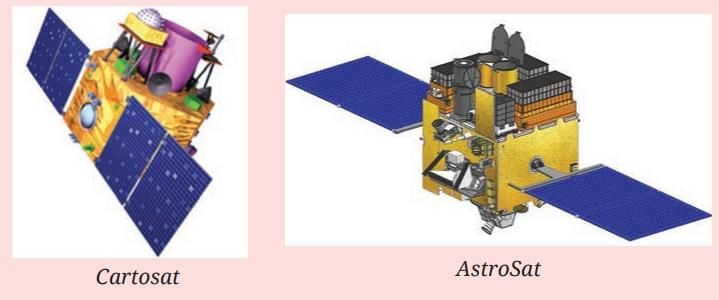
- Cartosat Series: High‑resolution imaging satellites for mapping, city planning, and disaster response. Platforms such as Bhuvan use Cartosat images to analyse soil, land use, vegetation, and terrain.
- AstroSat: Observatory satellite for studying stars and other celestial objects.
- Chandrayaan 1, 2, 3: Moon missions for exploration and scientific study.
- Aditya‑L1: Satellite for studying the Sun.
- Mangalyaan: Mars Orbiter Mission.
- Student Satellites: ISRO encourages students to build and launch small satellites, such as AzaadiSat, InspireSat‑1, and Jugnu.
Observing Artificial Satellites
- How to Spot: Look for a small, bright, continuously moving dot in the sky, typically visible just after sunset or before sunrise.
- Satellites can often be seen without a telescope.
- Mobile apps and websites for satellite tracking show which satellites are visible at your location and time.
Space Debris (Space Junk)
- When artificial satellites and rocket parts become old and stop working, they turn into space debris.
- Risks: Collisions with functional satellites and cluttering of useful orbits.
Disposal and Mitigation
- Small debris usually burns up while entering the atmosphere.
- Larger fragments can survive re‑entry and fall to Earth.
- Countries and agencies collaborate on solutions to minimise and remove space debris (for example, controlled re‑entry, moving satellites to graveyard orbits, and debris‑removal research).
Key Figures in the Indian Space Programme
Vikram Sarabhai: Pioneer of India’s space programme, often called the “Father of the Indian Space Programme”.
- The Vikram Sarabhai Space Centre (VSSC) in Thiruvananthapuram is named in his honour.
- VSSC focuses on rocket and launch vehicle technology.
Key Points to Remember
- Phases of the Moon: The changing shapes of the illuminated part of the Moon observed from day to day (new Moon, crescent, half, gibbous, full Moon).
- Cause of Moon Phases: Phases occur because we see varying portions of the Moon’s sunlit side as it orbits Earth.
- Cycle of Moon Phases: A complete sequence of the Moon’s phases takes about a month (≈29.5 days).
- Calendars: Systems created using natural cycles — day (Earth’s rotation), month (Moon’s phases), and year (Earth’s revolution around the Sun).
- Lunar Calendar: Follows the cycle of the Moon’s phases and has about 354 days in 12 months.
- Solar Calendar: Follows the cycle of seasons determined by Earth’s orbit; the Gregorian calendar is an example.
- Luni‑solar Calendar: Adapts lunar months to the solar year by adding an extra month occasionally (as in many Indian traditional calendars).
- Artificial Satellites: Human‑made objects launched into orbit to provide communication, navigation, weather and scientific data.