Reflect and Respond
I. Complete the given word web.
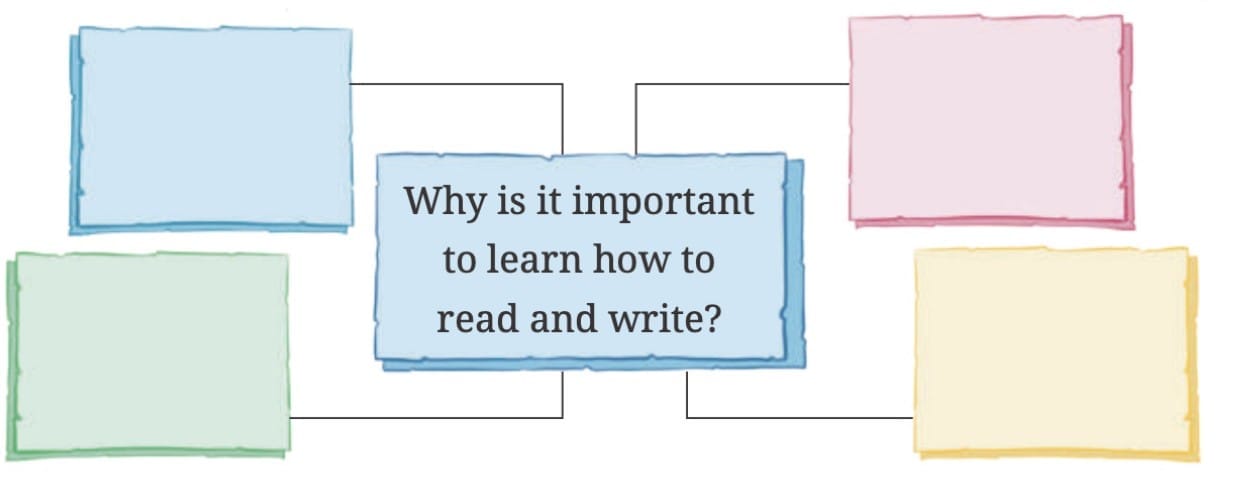
Ans
- To gain knowledge
- To communicate effectively
- To become independent
- To improve career opportunities
II. Read the questions given below and share your answers.
- Which language(s) do your grandparents or elderly relatives speak?
My grandparents speak Hindi and Punjabi. - How do they spend their time? How do you spend time with them?
They spend their time reading, praying, and watching TV. I spend time with them by talking, helping them, and listening to their stories. - What is your favourite experience with them?
My favourite experience is listening to their childhood stories and learning from them. - What is something that the elderly in your family cannot do easily but enjoy watching you do?
They cannot use modern technology easily but enjoy watching me use a phone or computer.
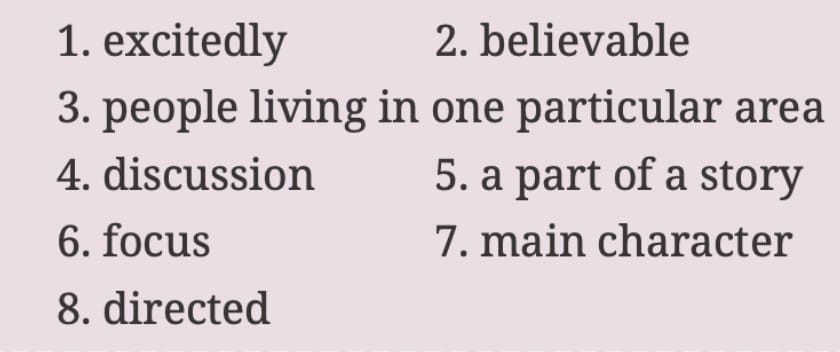
III Read the following passage. Match the highlighted words with their meanings given in the box below.
The casting for the (i) protagonist of our school’s annual play was done after a lot of (ii) debate as many good actors had auditioned for the role. We had decided to present an (iii) episode from an inspirational story. It was a life story of a group of children who worked with the (iv) community to spread literacy. Every day, we reached school early to practise with (v) concentration.We waited (vi) eagerly for the final presentation. All of us played our roles in a very (vii) convincing manner as our theatre teacher had (viii) guided us well.
Ans
- protagonist → main character
- debate → discussion
- episode → a part of a story
- community → people living in one particular area
- concentration → focus
- eagerly → excitedly
- convincing → believable
- guided → directed
Check Your Understanding (Part I)
I. Complete the cause and effect table based on Part I of the story.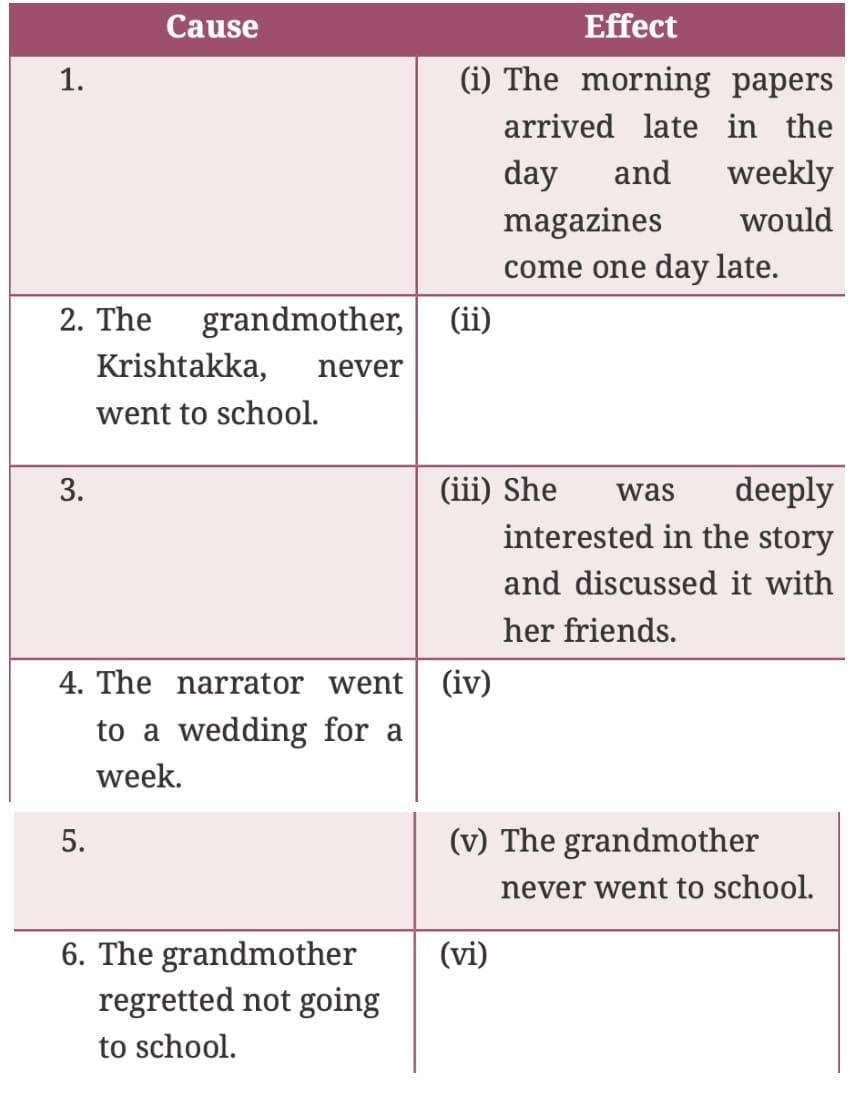
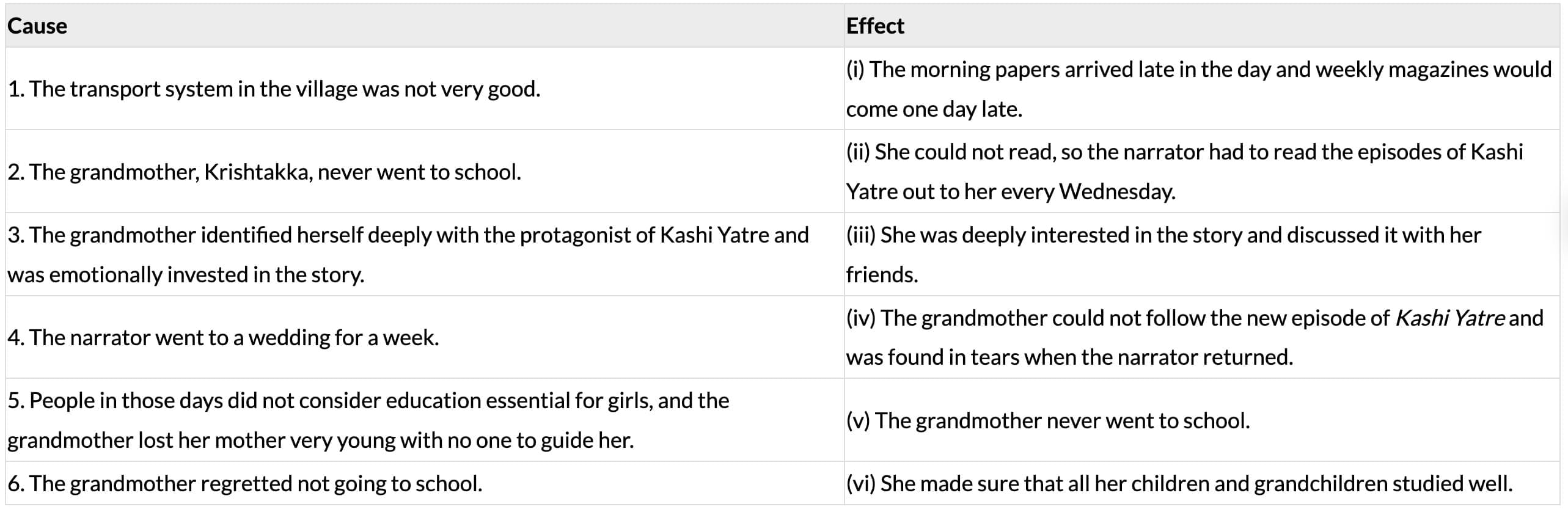
II. Do you think the narrator expected to see her grandmother in tears when she returned to the village? If yes, why? If no, why not?
Ans: No, the narrator did not expect it. She was surprised because her grandmother had always been strong and composed, never crying even in difficult times. The narrator did not realize her absence would upset Avva so much, especially as she felt helpless after missing Kashi Yatre.
III. How might the narrator help her grandmother to fulfil her desire to learn to read and write?
Ans: The narrator could teach her grandmother the Kannada alphabet step by step, giving daily lessons and practice from simple words to sentences. She becomes her teacher and sets Saraswati Puja during Dassara as the goal for Avva to read a novel independently.
Check Your Understanding (Part II)
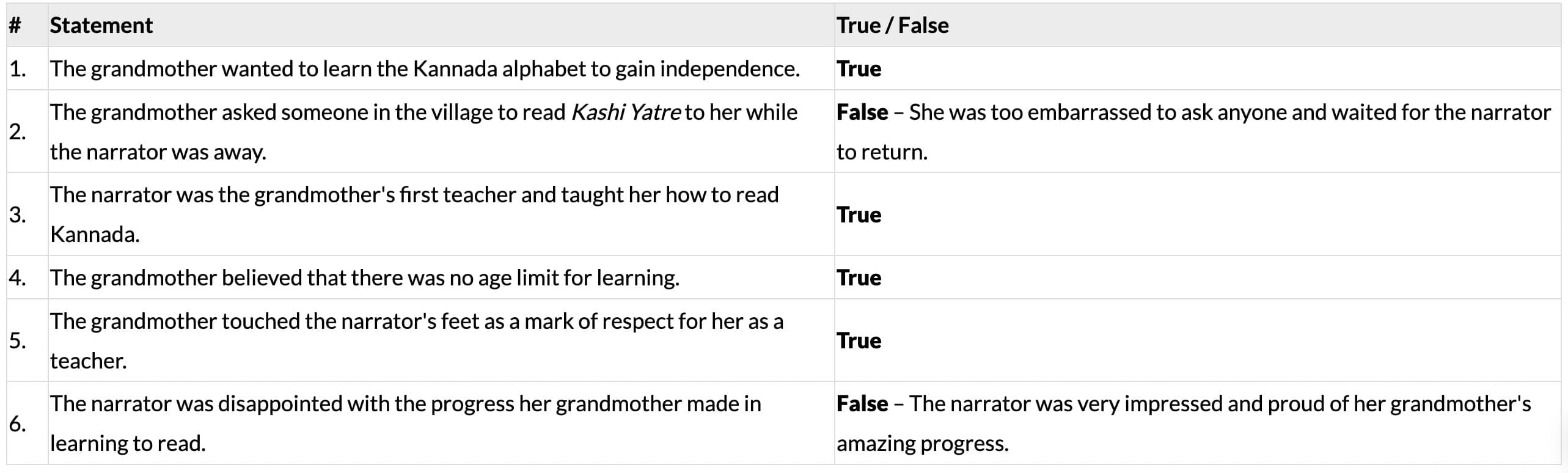
I. State whether the following sentences are True or False.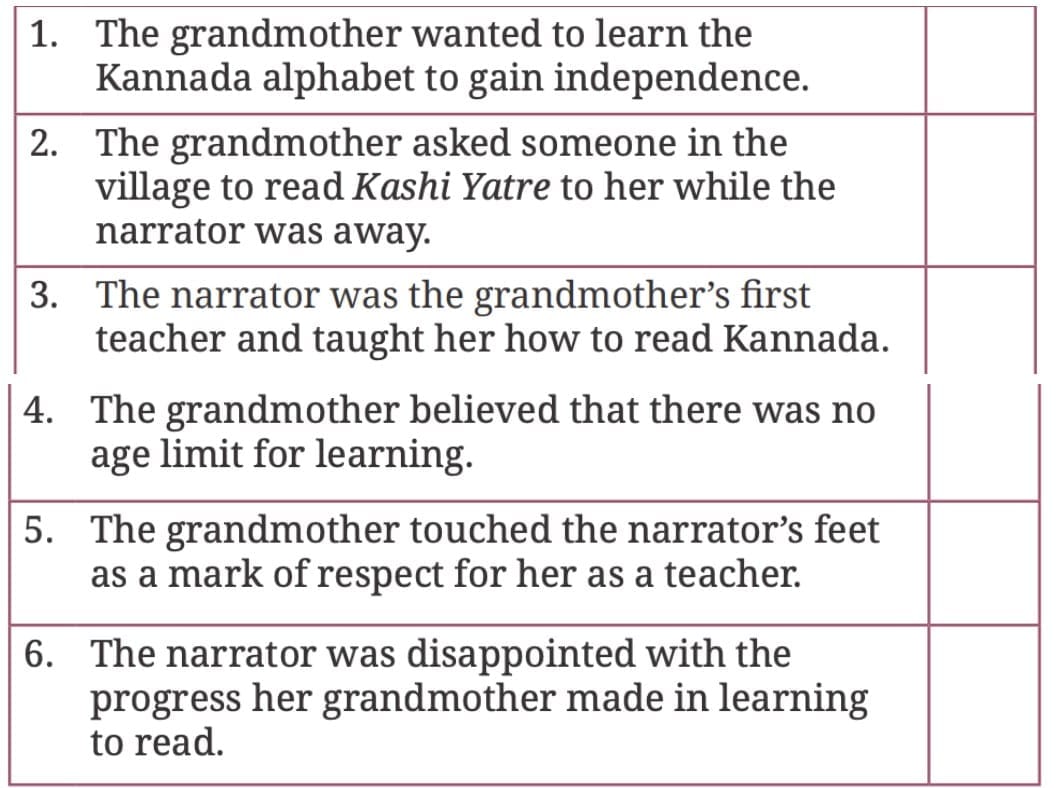
Critical Reflection
I. Read the extracts and answer the questions.
Extract 1:
When I came back to my village, I saw my grandmother in tears. I was surprised, for I had never seen her cry even in the most difficult situations. What had happened? I was worried.
“Avva, is everything all right? Are you okay?”
I used to call her Avva, which means mother in the Kannada spoken in North Karnataka.
She nodded but did not reply. I did not understand and forgot about it. At night, after dinner, we were sleeping on the open terrace of our house. It was a summer night, and there was a full moon. Avva came and sat next to me. Her affectionate hands touched my forehead.
(i) Complete the following sentence with the appropriate option.
The phrase ‘never seen her cry in the most difficult situations’ tells us that the grandmother was ____________.
A. strong-willed
B. understanding
C. considerate
D. bold
Ans: A. strong-willed.
The grandmother had always faced difficulties without breaking down, which shows she was a strong-willed person. That is why finding her in tears was so surprising to the narrator.
(ii) Grandmother did not reply when the narrator asked if she was alright because she might have been too ________(emotional/tired) to respond.
Ans: emotional.
The grandmother was overwhelmed by her feelings of helplessness and longing — she had been unable to read the story she loved so much, and the emotion of that experience made it difficult for her to reply immediately.
(iii) Identify the clue from the extract that indicates a rural setting with traditional customs.
Ans: The clue is that they were sleeping on the open terrace on a summer night under the full moon, typical of rural Indian life. The word “Avva” (Kannada for grandmother) also indicates a rural, traditional setting.
(iv) Which lines of the extract establish a tender atmosphere?
Ans: The lines — “It was a summer night and there was a full moon. Avva came and sat next to me. Her affectionate hands touched my forehead.”
The lines create a tender, warm mood through the full moon night and the grandmother’s gentle, affectionate gesture of touching the narrator’s forehead.
(v) Which of the following aspect is NOT emphasised in the given extract?
A. the emotional turmoil of the grandmother
B. the affectionate bond between the narrator and her grandmother
C. the grandmother’s regret over her lack of education
D. the narrator’s concern for her grandmother
Ans: C. the grandmother’s regret over her lack of education.
The extract focuses on the grandmother’s emotional state, the affectionate bond between narrator and grandmother, and the narrator’s concern — but the theme of regret over lack of education is addressed later in the story, not in this particular extract.
Extract 2:
“I have decided I want to learn the Kannada alphabet from tomorrow onwards. I will work very hard. I will keep Saraswati Puja day during Dassara as the deadline. By that day, I should be able to read a novel on my own. I want to be independent.”
I saw the determination on her face, yet I laughed at her.
“Avva, at this age of sixty-two, you want to learn the alphabet? All your hair is grey, your hands are wrinkled, you wear spectacles, and you work so much in the kitchen…”
Childishly, I made fun of the old lady, but she just smiled.
“For a good cause, if you are determined, you can overcome any obstacle. I will work harder than anybody, and I will do it. For learning, there is no age bar.”
(i) What does the grandmother’s statement “I want to be independent” reveal about her character?
A. She wanted to be literate.
B. She desires self-sufficiency.
C. She wants to prove her intelligence to others.
D. She feels pressured by society to learn.
Ans: B. She desires self-sufficiency.
The grandmother is a woman of dignity and self-respect. Even though her family is well-off, she feels helpless and dependent because she cannot read. Her desire to be independent reveals that she values the ability to do things on her own without relying on others.
(ii) The grandmother’s determination shows that learning has no ________.(age limit/gender bias/cultural barriers)
Ans: age limit.
At the age of sixty-two, with grey hair, wrinkled hands, and spectacles, the grandmother decides to learn the alphabet. Her resolve demonstrates that the desire and determination to learn can overcome any barrier, including age.
(iii) The narrator laughs at her grandmother’s decision to learn the alphabet at the age of sixty-two because ________.
Ans: The narrator laughs because she thinks her grandmother is too old to learn, noticing her grey hair, wrinkles, and spectacles. It reflects a childish and immature assumption, which she later realizes is wrong.
(iv) List any two qualities displayed by the grandmother.
Ans:
- Determination and willpower – She sets a firm deadline (Saraswati Puja day during Dassara) and works extremely hard to achieve her goal.
- Self-respect and dignity – Rather than asking a stranger to read for her and feeling embarrassed, she chooses to learn on her own so she can be independent.
(v) How can we say that the narrator is making assumptions about her grandmother?
Ans: The narrator assumes her sixty-two-year-old grandmother cannot learn, judging her by grey hair, wrinkles, and spectacles. This proves wrong when the grandmother successfully learns to read through determination.
II. Answer the following questions.
Q1: Why do you think the grandmother felt embarrassed to ask someone else to read to her while the narrator was away?
Ans: The grandmother felt embarrassed because she valued self-respect and independence. Asking others to read would make her seem helpless. Despite being well-off, she felt her inability to read was a personal weakness and did not want to show it, reflecting her pride and dignity.
Q2: Why does the narrator initially laugh at her grandmother’s determination to learn at the age of sixty-two?
Ans:The narrator laughs because, at twelve, she thinks in a childish and shallow way. She judges her grandmother by her age and physical appearance—grey hair, wrinkles, spectacles, and heavy kitchen work—and assumes she cannot learn. Later, she realizes this assumption was wrong.
Q3: What significance does the story of Kashi Yatre have in both the grandmother’s life and the story?
Ans: Kashi Yatre is central to the story in several ways:
- The grandmother connects deeply with its old lady protagonist, making her eager to follow every episode.
- Its theme of compassion over personal desire reflects Avva’s own selfless nature.
- Missing an episode when the narrator is away becomes the turning point, motivating her to learn to read.
- In the end, she reads the novel’s title and publisher’s name on her own, proving her success and giving the story emotional closure.
Q4: What does the grandmother’s desire to learn the Kannada alphabet reflect about her?
Ans: The grandmother’s desire to learn at the age of sixty-two reflects several admirable qualities:
- A thirst for learning – She has always regretted not being educated and now seizes the opportunity when she can.
- Determination and courage – She is not deterred by age, physical limitations, or social expectations.
- A deep desire for independence – She wants to be self-reliant so she does not have to depend on anyone else for something as basic as reading.
- Self-awareness – She understands what she has missed and is willing to work hard to make up for it.
Her resolve embodies the message that it is never too late to learn.
Q5: What lessons can we infer from the grandmother’s action of touching the narrator’s feet?
Ans: The grandmother’s action of touching her granddaughter’s feet teaches us several important lessons:
- Respect for the teacher is paramount — The grandmother makes it clear she is touching the feet of a teacher, not her granddaughter. This reflects the Indian tradition of honouring the guru regardless of age or relationship.
- Humility in a great person — A sixty-two-year-old woman bowing to a twelve-year-old shows true humility and greatness of character.
- Learning erases social barriers — The act suggests that in the realm of learning, conventional social hierarchies of age and family role become secondary.
- Gratitude must be expressed — The grandmother feels deeply grateful and expresses it in the most sincere way she knows.
Q6: What does the following line tell us about the broader theme of the story?
“For a good cause if you are determined, you can overcome any obstacle.”
Ans: This line highlights the theme that determination can overcome any challenge, regardless of age or limitations. The grandmother’s decision to learn reading at sixty-two and succeed before Dassara proves this. It shows that education is for everyone and that obstacles like age or lack of time can be overcome with strong motivation.
Q7: How effectively does the story highlight the value of education in supporting personal independence?
Ans: The story highlights this through the grandmother, who is well-off and respected but feels helpless because she cannot read. She realises money cannot replace the independence that literacy gives. Unable to read or ask for help, she feels dependent, but once she learns, reading the book’s title herself symbolises her newfound independence and shows that education is true freedom.
Vocabulary and Structures in Context
I. Match the binomials with their meanings.
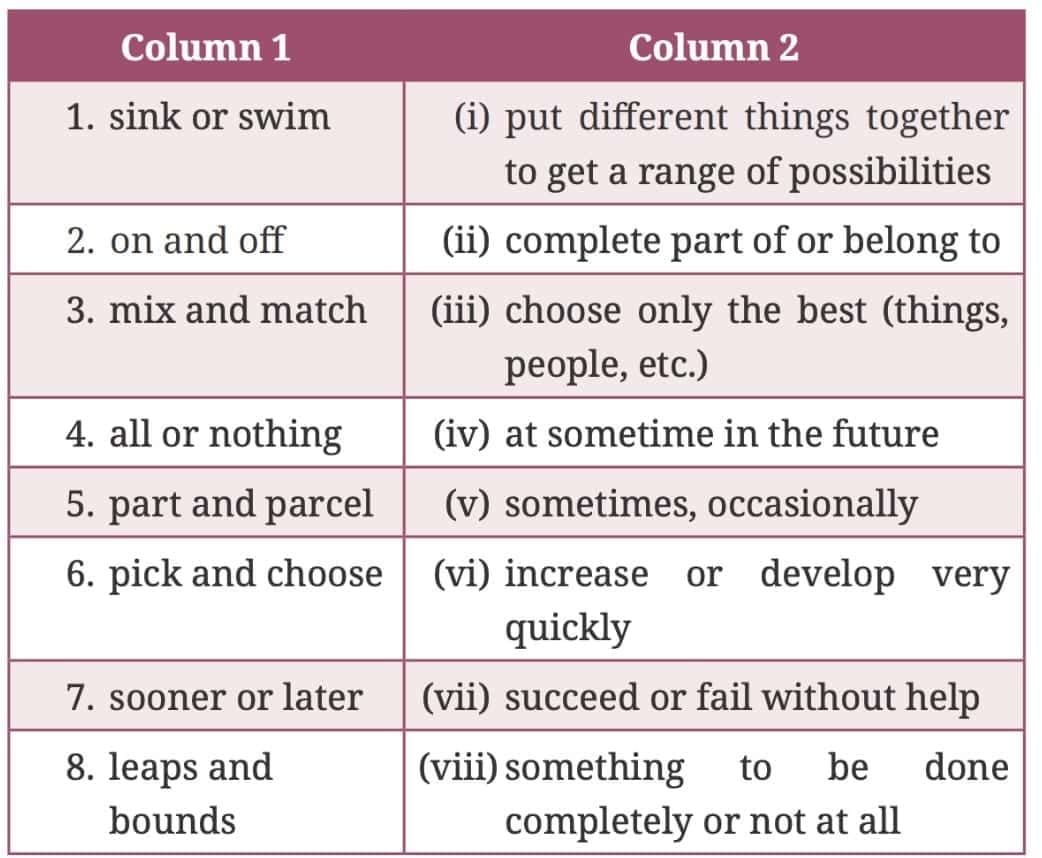
Now, use any five of the above binomials in sentences of your own.
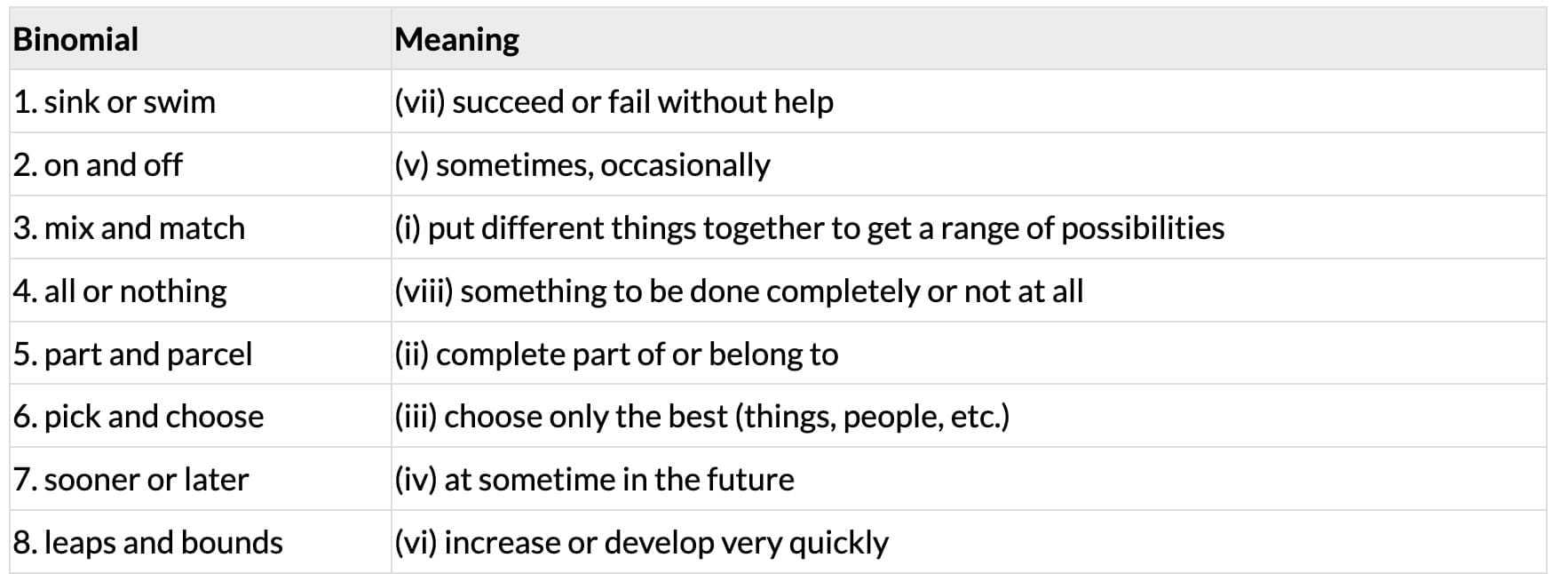
Ans
Use any five binomials in sentences of your own:
- Sink or swim: When I joined the new school mid-year, I had to sink or swim and figure things out on my own.
- On and off: She had been practising the piano on and off for several years but never committed to it fully.
- All or nothing: For him, friendship was all or nothing — he was either fully committed or not involved at all.
- Sooner or later: Sooner or later, hard work always pays off.
- Leaps and bounds: After joining the coaching class, Riya’s progress in mathematics improved by leaps and bounds.
II. Read the following words from the text given in the box below.

These words are made by adding suitable prefixes (‘un’,‘ir’, and ‘in’) to give an opposite or negative meaning tothe words. Now, make words by adding the suitable prefixes given in the box to the words from the text in Column 1. Write the prefixed words in Column 2. One example has been done for you.
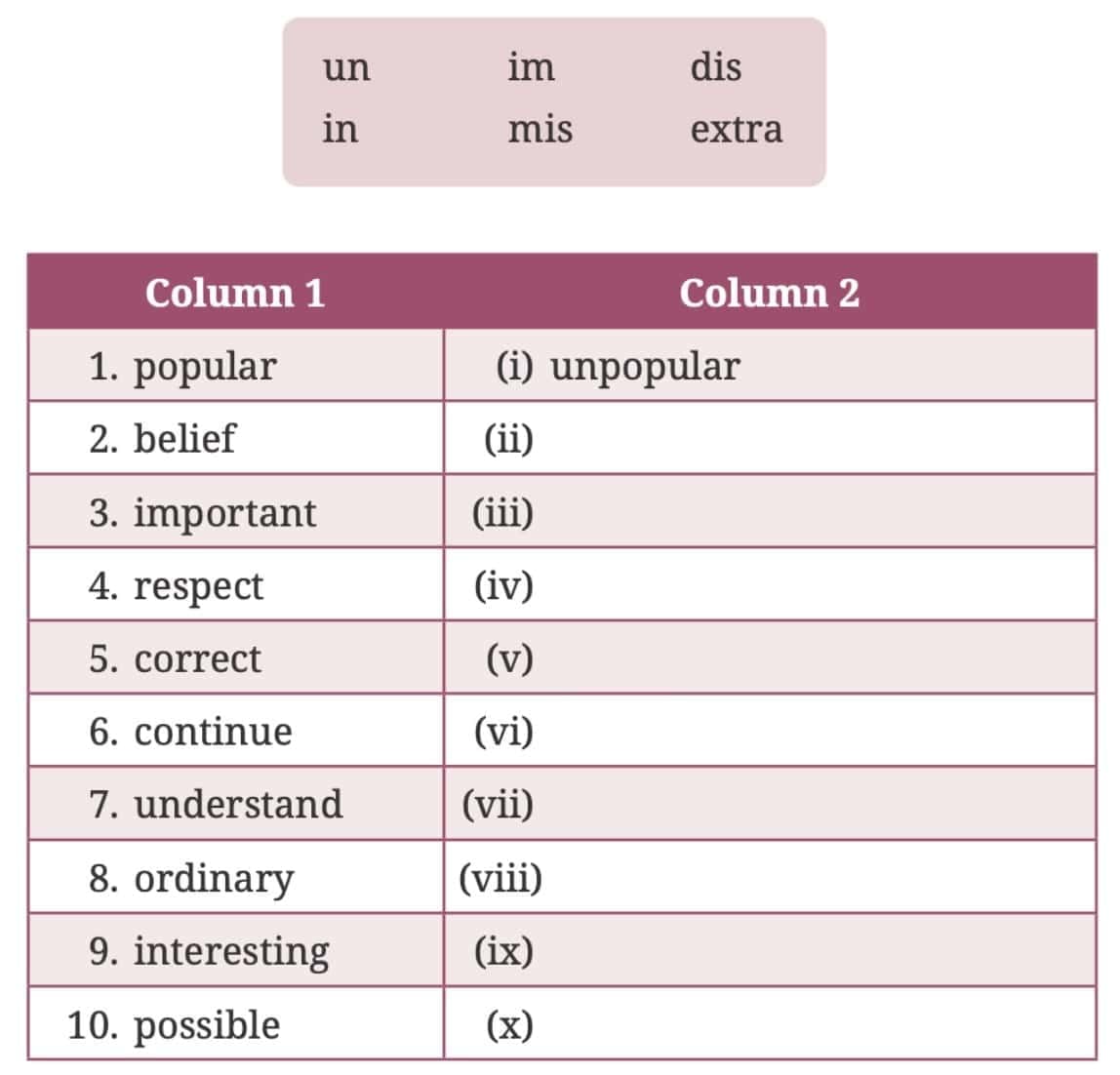
Add suitable prefixes to the following words.
Ans
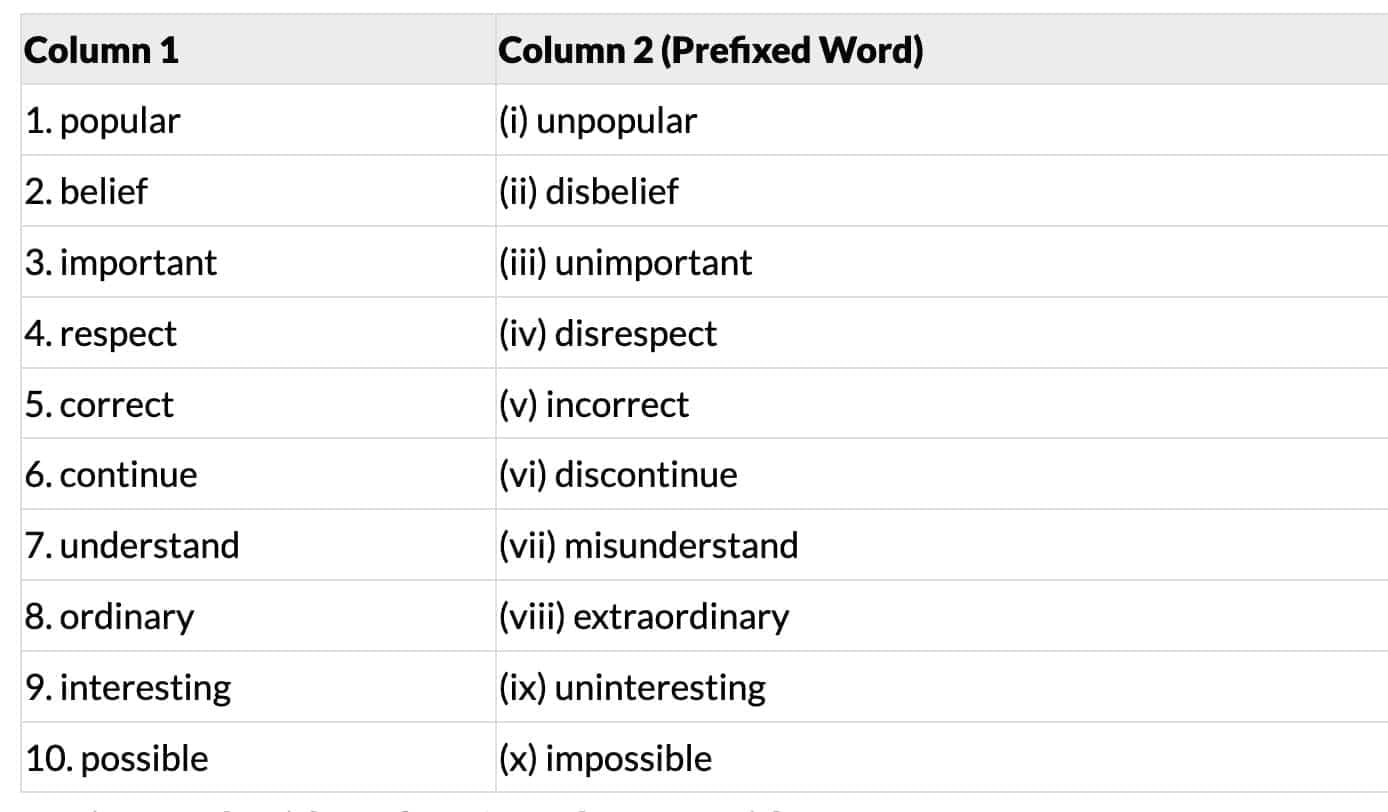
III. Five words with prefixes from the story with sentences:
- Unhappy – Her face was unhappy when she could not read the magazine on her own.
- Unusual – It was unusual for an elder to touch the feet of a younger person.
- Unfortunately – Unfortunately, Triveni died very young, cutting short a brilliant literary career.
- Irrespective – A teacher must be respected irrespective of their age or gender.
- Independent – After learning to read, the grandmother felt truly independent for the first time.
IV. Match the idioms related to ‘learning’ with their meanings.
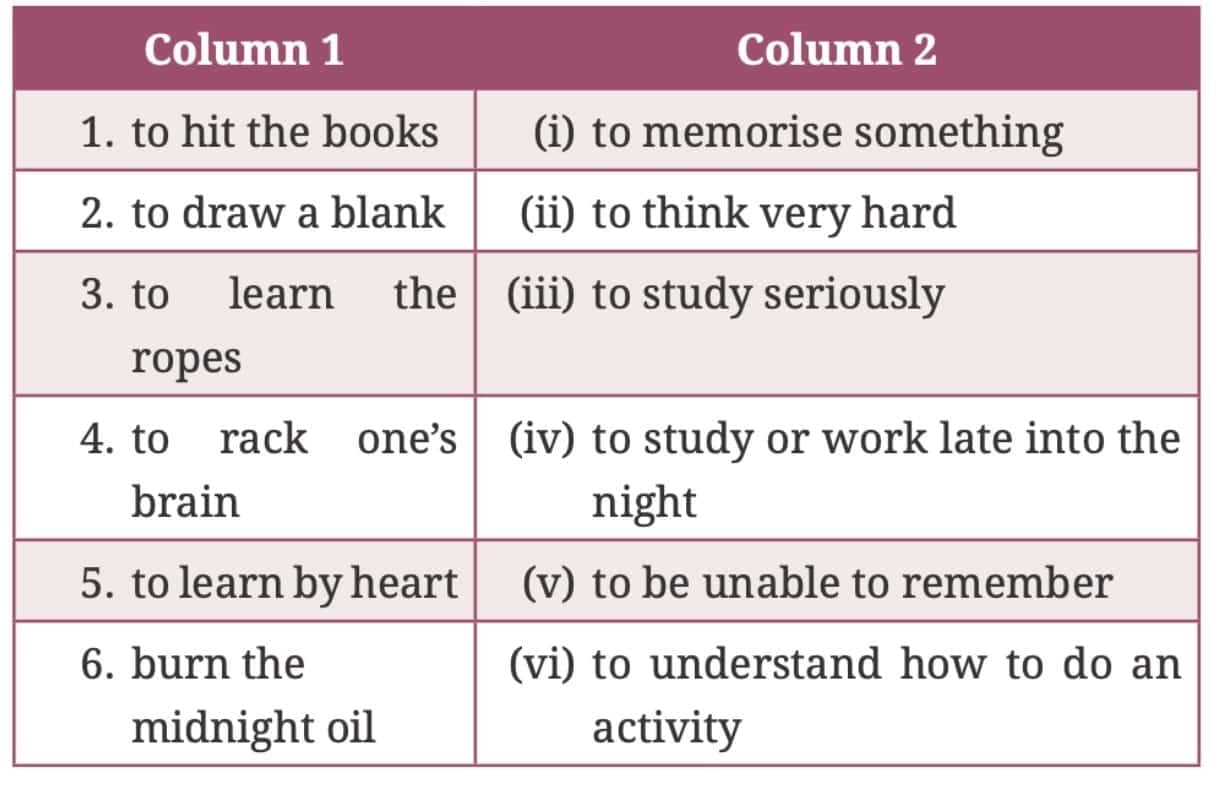
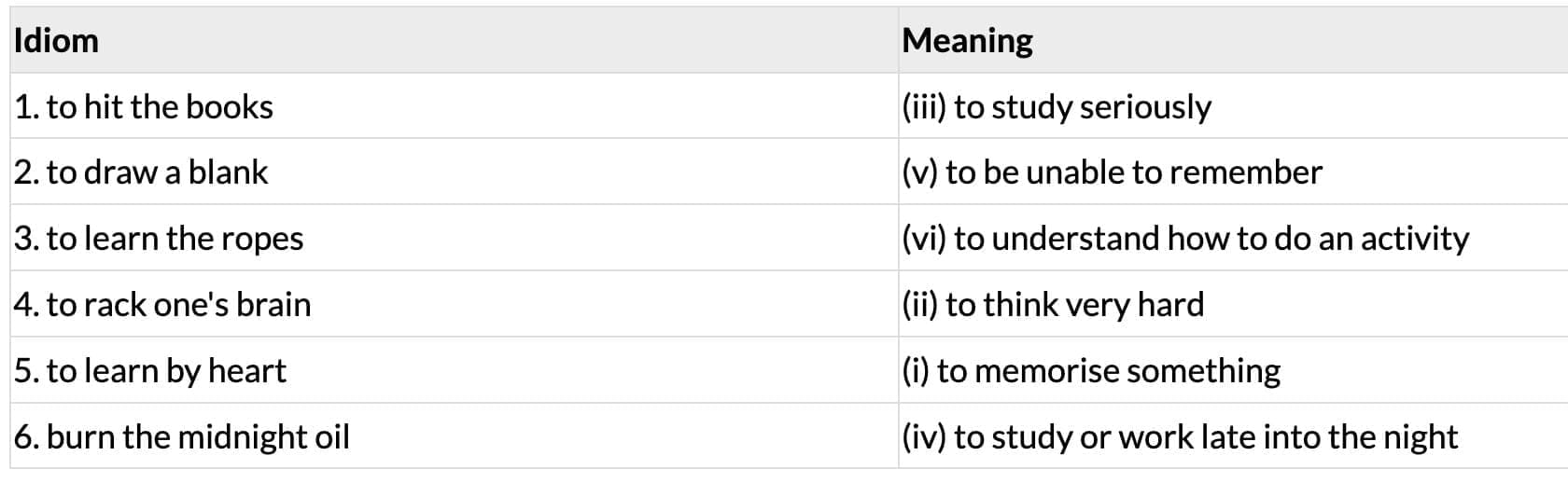
Ans
Use these idioms in sentences of your own:
- Hit the books: With the board exams approaching, Arjun decided to hit the books every evening.
- Draw a blank: When the teacher asked me the capital of Kazakhstan, I drew a complete blank.
- Learn the ropes: It took her a few weeks to learn the ropes of the new job.
- Rack one’s brain: I racked my brain trying to remember where I had kept my notebook.
- Learn by heart: The grandmother could learn by heart the entire text of every episode read to her.
- Burn the midnight oil: She burned the midnight oil to finish her project before the deadline.
V. (i) Fill in the blanks with simple past and past perfect tense form of the verbs given in brackets.
A. When the delegates ________ (arrive) at the conference, the keynote speaker ________ (already begin) the session.
B. After the students ________ (learn) how to identify fake news online, they ________ (start) verifying information before sharing it.
C. Before Kiran ________ (start) using digital payment platforms, she ________ (ensure) her understanding of online fraud prevention.
D. By the time Varun ________ (recognise) the importance of budgeting, he ________ (exhaust) most of his savings.
E. When Raghu ________ (log in) to the cybersecurity webinar, the instructor ________ (already discuss) the importance of strong passwords.
Ans
A. When the delegates arrived at the conference, the keynote speaker had already begun the session.
B. After the students learned how to identify fake news online, they started verifying information before sharing it.
C. Before Kiran started using digital payment platforms, she had ensured her understanding of online fraud prevention.
D. By the time Varun recognised the importance of budgeting, he had exhausted most of his savings.
E. When Raghu logged in to the cybersecurity webinar, the instructor had already discussed the importance of strong passwords.
(ii) Fill in the blanks with the correct form of verbs.
Last year, my parents and I A. ________ (take) a financial planning course. When we B. ________ (review) our expenses, we realised we C. ________ (spend) too much on unnecessary purchases. After my parents D. ________ (discuss) ways to save, I E. ________ (open) a savings account.
By the time we F. ________ (set) our budget, the course G. ________ (already introduce) investment strategies. We H. ________ (hurry) to take notes, but many participants I. ________ (complete) their financial plans. Despite that, we J. ________ (enjoy) learning how to manage money wisely.
Ans
Last year, my parents and I A. took a financial planning course. When we B. reviewed our expenses, we realised we C. had spent too much on unnecessary purchases. After my parents D. discussed ways to save, I E. opened a savings account.
By the time we F. set our budget, the course G. had already introduced investment strategies. We H. hurried to take notes, but many participants I. had completed their financial plans. Despite that, we J. enjoyed learning how to manage money wisely.
Speaking Activity
Turncoat is a type of solo debate where the speaker argues for and against a topic, switching sides after a certain period of time.
Choose your topic and speak ‘for’ and ‘against’ for not more than one minute each.
Topic 1: It is important to learn a new language apart from your mother tongue.
Topic 2: Learning can happen only when you are young.
Use the guidelines given below:
- Begin with speaking ‘for’ the topic for one minute.
- Your teacher will signal that it is time to switch sides.
- Then speak ‘against’ the topic for one minute.
You may use the following sentence prompts.
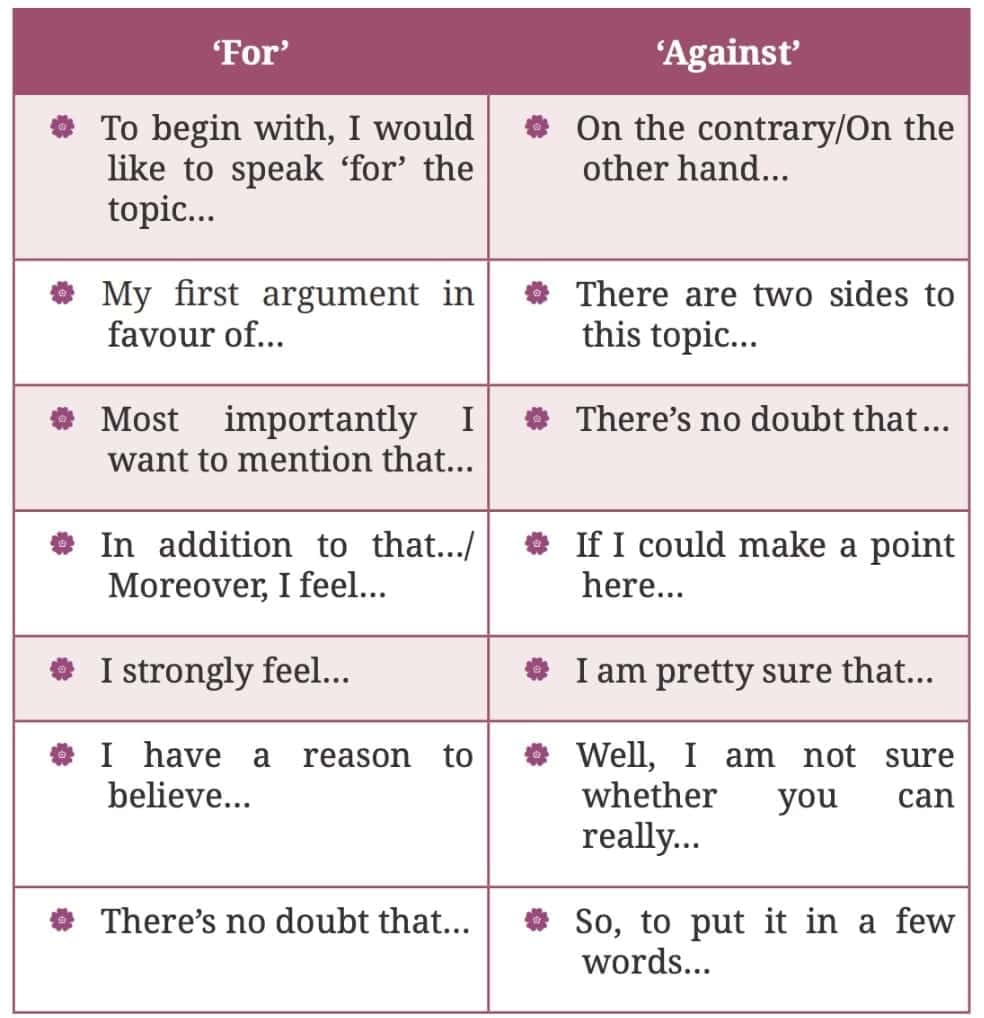
Ans
Topic 1: It is important to learn a new language apart from your mother tongue
FOR:
Learning a new language apart from our mother tongue is very important. It helps us communicate with more people and understand different cultures. In today’s global world, knowing multiple languages increases job opportunities and boosts confidence. It also improves brain skills like memory and problem-solving. Moreover, it allows us to travel easily and connect with people from different regions. Therefore, learning a new language is a valuable skill that benefits us in many ways.
AGAINST:
While learning a new language is useful, it is not always necessary. Our mother tongue is enough for communication in our daily lives. Learning another language takes time and effort, which can be used to develop other important skills. Also, not everyone has access to proper resources to learn new languages. In many cases, technology like translation apps can help us communicate without learning a new language. So, it is not essential for everyone to learn another language.
Topic 2: Learning can happen only when you are young
FOR:
Learning happens best when we are young because our minds are more active and flexible. Children can easily grasp new concepts, languages, and skills faster than adults. At a young age, we have fewer responsibilities and more time to focus on learning. Schools and teachers also guide us during this stage, making learning easier and structured. Therefore, youth is the most effective time for learning.
AGAINST:
Learning is a lifelong process and does not depend on age. People can learn new skills at any stage of life if they are determined. In fact, adults often learn better because they have experience, focus, and clear goals. Many successful people have achieved great things later in life by learning new skills. Age should not be a barrier to learning. Hence, learning can happen at any age.
Writing Task
I. Sample Letter to the Editor on Student Participation in Adult Literacy Camps
Rahul Sharma
Student, Class IX
Green Valley Public School
45, Sector 12, Chandigarh – 160012
18 March 2026
The Editor
The Tribune
Sector 29, Chandigarh
Subject: Student Participation in Adult Literacy Camps
Sir/Madam,
This is with reference to the article on adult illiteracy dated 15 March 2026 in your newspaper. As a concerned citizen, I would like to draw your attention towards the importance of student participation in adult literacy camps conducted by various organisations. A large number of adults in our country still lack basic education, which restricts their growth and limits opportunities.
The issue at hand affects a large section of society and hampers overall development. Illiteracy leads to unemployment, lack of awareness, and poor decision-making. It is imperative that students come forward and contribute to literacy drives. Such initiatives nurture a sense of responsibility and compassion among students. By engaging in these programmes, students develop communication skills, leadership qualities, and a deeper understanding of social realities, while helping others become self-reliant.
A possible solution to this issue could be making student participation in literacy programmes more structured and encouraged by educational institutions. Authorities could consider implementing awareness campaigns, workshops, and incentives like certificates to motivate students. I trust this matter will be considered seriously for the benefit of all. I hope this letter gets published in the columns of your esteemed daily.
Yours faithfully,
Rahul Sharma