01. Short and Long Answer Questions: Matter in Our Surroundings

Very Short Answer Type Questions

Q.1. Define matter.
Ans. Anything that occupies space and has mass is called matter.

Q.2. State different states of matter with an example.
Ans. Matter exists in three common states: solid (e.g., a pen), liquid (e.g., water) and gas (e.g., oxygen).

Q.3. What is diffusion?

Ans. Diffusion is the process by which particles of one substance spread and mix with particles of another due to their random motion. For example, a drop of ink spreading in water is a result of diffusion.
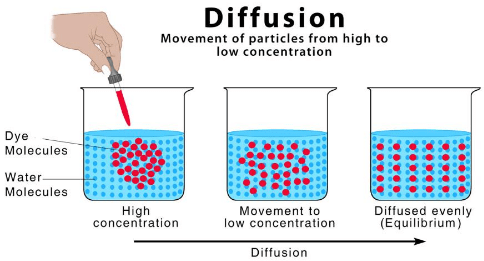
Diffusion

Q.4. What happens to the rate of diffusion if the temperature is increased?

Ans. With an increase in temperature, the rate of diffusion increases because particles gain more kinetic energy, move faster and mix more quickly.

Q.5. Name the state of matter that has the tendency to maintain its shape when subjected to outside force.

Ans. A solid tends to maintain its shape when subjected to an external force. Examples include a pen, a book or a wooden stick.

Q.6. Define melting point.

Ans. The melting point is the temperature at which a solid turns into a liquid at the normal atmospheric pressure.

Q.7. Define boiling point.

Ans. The boiling point is the temperature at which a liquid changes into vapour (gas) at the normal atmospheric pressure.

Q.8. Define latent heat of vaporization.

Ans. Latent heat of vaporisation is the heat energy required to convert 1 kg of a liquid into its vapour at its boiling point, at atmospheric pressure.

Q.9. Define latent heat of fusion.

Ans. Latent heat of fusion is the amount of heat energy required to change 1 kg of a solid into a liquid at its melting point, without any change in temperature.

Q.10. Define sublimation.

Ans. Sublimation is the process in which a solid changes directly into a gas without passing through the liquid state.
The reverse process, in which a gas changes directly into a solid, is called deposition.
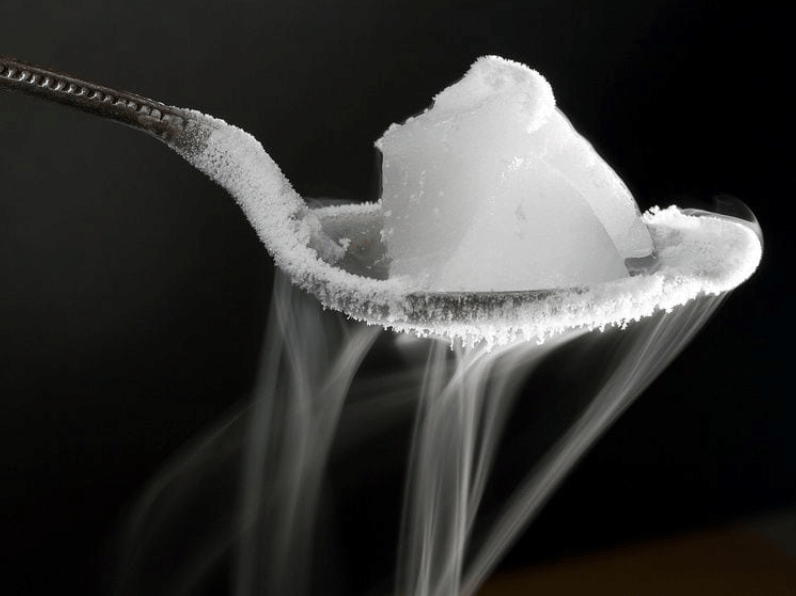
Sublimation

Q.11. What is dry ice?

Ans. Dry ice is the solid form of carbon dioxide (CO2). It does not melt at atmospheric pressure but sublimates directly to carbon dioxide gas. Its temperature is about -78.5°C.

Q.12. What is humidity?

Ans. Humidity is the amount of water vapour present in the air. When the air contains a large quantity of water vapour, it feels humid.

Q.13. Give two properties of a solid.

Ans.

(i) Solids have a fixed shape and are rigid.

(ii) Solids cannot be easily compressed because their particles are closely packed.

Q.14. What will happen if the pressure is reduced on solid carbon dioxide (dry ice)?

Ans. If the pressure on solid carbon dioxide is reduced, it will sublimate – that is, it will change directly from solid to gas without melting into a liquid.

Q.15. Name any three substances that show sublimation.

Ans. Ammonium chloridecamphor and naphthalene are examples of substances that undergo sublimation.

Q.16. Sponge is solid, but we can still compress it. Why?

Ans. A sponge is a solid with many tiny pores that trap air. When compressed, the air in these pores is pushed out and the sponge’s volume decreases, which makes it appear compressible even though the material is solid.

Q.17. What is normal atmospheric pressure?

Ans. Normal atmospheric pressure at sea level is defined as:

  • 1 atmosphere (1 atm)
  • which is equal to 1.013 × 10⁵ Pa.

Thus, standard atmospheric pressure is 1 atm at sea level.

Q.18. What is Kelvin?

Ans. Kelvin is the SI unit of temperature.

  • 0°C is equivalent to 273.15 K.
  • To convert from Kelvin to Celsius, subtract 273.15.
    °C = K − 273
  • To convert from Celsius to Kelvin, add 273.15.
    K = °C + 273
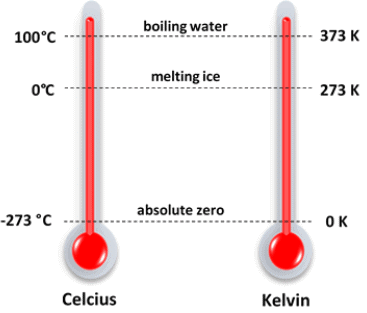
Temperature Scale in Degree and Kelvin

Q.19. Give two examples of diffusion.
Ans. Examples of diffusion:

  • Milk drops spreading in water.
  • Perfume sprayed in a room spreading its smell.

Q.20. Give the temperature at which water exists in two different phases/states.

Ans.

(i) At 0°C (273.15 K), water can exist as ice (solid) or as liquid water.

(ii) At 100°C (373.15 K) at 1 atm pressure, water can exist as liquid or as vapour (gas).

Short Answer Type Questions

Q.1. Why do we see water droplets collected on the outer surface of a glass container containing ice?

Ans. Water vapour in the air comes into contact with the cold outer surface of the glass, loses heat and changes into tiny liquid droplets. This process is called condensation.

Q.2. Explain why solids have a fixed shape but liquids and gases do not have a fixed shape.

Ans.Solids have particles held tightly in fixed positions by strong intermolecular forces, so they keep a definite shape. Liquids have weaker forces, allowing particles to move past each other; therefore liquids take the shape of their container. Gases have very weak forces and particles are far apart and move freely, so gases expand to fill any available space.

Q.3. Liquids and gases can be compressed but it is difficult to compress solids. Why?

Ans. Liquids and gases have noticeable space between their molecules, so applying pressure can push these molecules closer together – this makes them compressible. Solids have particles closely packed with very little space between them, so they cannot be easily compressed.

Q.4. A balloon, when kept in the sun, bursts after some time. Why?

Ans. The air inside the balloon heats up in sunlight. As temperature rises, air molecules gain kinetic energy and the gas expands, increasing the internal pressure on the balloon’s walls. If the pressure exceeds the elastic strength of the balloon, it bursts.

Q.5. Why do people perspire a lot on a hot, humid day?

Ans. The body sweats to cool down by evaporation of sweat. On a humid day the air already contains a lot of water vapour, so sweat evaporates more slowly and cooling is less effective; consequently, more sweat accumulates and we appear to perspire more.

Q.6. Distinguish between evaporation and boiling.

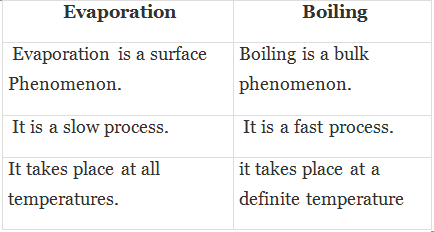
Ans. Evaporation is the slow vapourisation of a liquid from its surface at any temperature below its boiling point. Boiling is rapid vapourisation that occurs throughout the liquid at a specific temperature called the boiling point. Evaporation occurs at the surface and causes cooling; boiling occurs throughout the liquid and produces bubbles of vapour.
Q.7. Why is it advisable to use a pressure cooker at higher altitudes?

Ans. At higher altitudes, atmospheric pressure is low, so the boiling point of water decreases. As a result, food cooks slowly. A pressure cooker increases pressure and raises the boiling point, allowing faster cooking.

Q.8. What are fluids?

Ans. Fluids are substances that can flow and take the shape of their container. They include:

  • Liquids – definite volume but no fixed shape.
  • Gases – neither definite volume nor definite shape.

Q.9. One kg cotton and one kg sand, which is more denser? Why?

Ans. One kilogram of sand is denser than one kilogram of cotton because density = mass/volume. Both masses are equal, but cotton occupies a much larger volume (because of trapped air), so its density is lower than that of sand.
Q.10. Why is water liquid at room temperature?

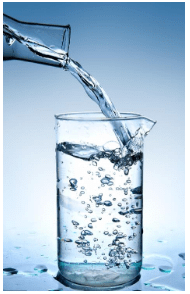
Ans. At room temperature the intermolecular forces in water are not fully overcome by thermal energy, so water molecules remain close enough to form a liquid phase. The available thermal energy at room temperature is insufficient for water to become gas.

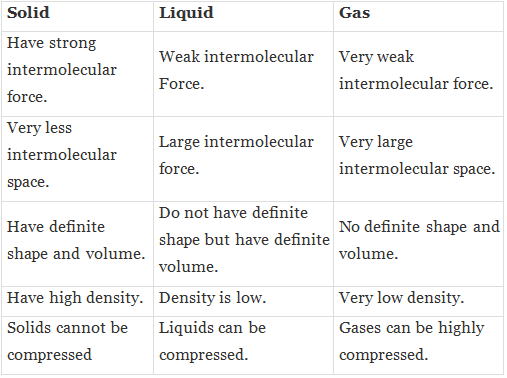
Q.11. State the differences between solid, liquid and gas.

Ans.
Q.12. Cotton is solid but it floats on water. Why?

Ans. Cotton contains many pores filled with air, which greatly increases its volume and reduces its average density. Because its density is lower than that of water, cotton floats. If the pores fill with water, the cotton becomes heavier and may sink.

Q.13. Why are solids generally denser than liquids and gases?

Ans. Density = mass/volume. In solids particles are packed closely, so a given mass occupies a small volume, producing higher density. Liquids and gases have larger intermolecular spaces, so for the same mass their volume is larger and density is lower.

Q.14. On a hot sunny day, why do people sprinkle water on the roof or open ground?

Ans. When water evaporates, it absorbs latent heat of vapourisation from the surrounding surface, causing cooling. Sprinkling water increases evaporation and thereby cools the roof or ground.

Q.15. On a hot sunny day, why do we feel pleasant sitting under a tree?

Ans. Leaves lose water by transpiration. The evaporating water cools the air nearby, making the shaded area under the tree feel cooler and more pleasant.

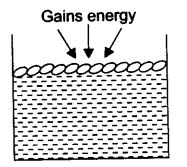
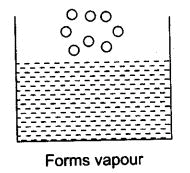
Q.16. The temperature at which liquids change into vapours is very high, for example, if water evaporates at 100°C, then how is water to evaporate at room temperature or at other temperatures?

Ans. Although the boiling point of water is 100°C, surface molecules of a liquid can gain enough energy from surroundings to escape into the vapour state at lower temperatures. This surface vapourisation at temperatures below the boiling point is evaporation. Examples: uncovered water drying and wet clothes drying at room temperature.
Q.17. Name the factors that affect evaporation.

Ans. The rate of evaporation depends on:

  • Surface area: Larger area → faster evaporation.
  • Temperature: Higher temperature → faster evaporation.
  • Humidity: Lower humidity → faster evaporation.
  • Wind speed: Higher wind speed removes vapour from the surface → faster evaporation.
Q.18. The melting point of ice is 273.16 K. What does this mean? Explain in detail.

Ans. The given value 273.16 K is essentially equivalent to 273.15 K (commonly used). This means:

  • 273.15 K = 0°C, the temperature at which pure ice and water coexist in equilibrium at 1 atm pressure.
  • When ice at 0°C is heated, it absorbs heat but its temperature stays constant until all ice melts; the absorbed heat is used to overcome attractive forces between molecules (latent heat of fusion).
  • After all ice melts, further heating raises the temperature of the water.

Q.19. How is the high compressibility property of gas useful to us?

Ans. High compressibility allows large volumes of gas to be stored in small cylinders for transport and use. Examples include LPG and CNG for cooking and vehicles, and medical oxygen cylinders. Compressibility saves space and makes handling easier.

Q.20. With the help of an example, explain how diffusion of gases in water is essential.

Ans. Diffusion of gases into water is essential for aquatic life. For example:

  • Oxygen from air dissolves into pond water and diffuses to fish and other organisms for respiration.
  • Carbon dioxide dissolves and is used by aquatic plants for photosynthesis.

Long Answer Type Questions

Q.1. Pressure and temperature determine the state of a substance. Explain this in detail.
Ans.
(a) Increasing temperature gives particles more energy. For example, heating ice causes its temperature to rise until it reaches its melting point. At that temperature the solid melts to a liquid; further heating converts the liquid to vapour.

(b) Decreasing temperature removes energy from particles. For example, cooling steam causes it to condense into water, and further cooling of water leads to freezing into ice.

(c) Changing pressure can also change the state. Increasing pressure can liquefy gases (as in LPG cylinders where gas is stored as liquid under pressure). Reducing pressure can cause solids like dry ice (solid CO2) to sublimate directly into gas. Thus the combination of temperature and pressure determines whether a substance is solid, liquid or gas.

Q.2. Explain, giving examples, the various factors on which the rate of evaporation depends.

Ans. The rate of evaporation depends on:

  1. Surface area: A larger surface area exposes more molecules to escape into the vapour and so increases evaporation. For example, spreading wet clothes or placing tea in a saucer helps them cool and dry faster.
  2. Temperature: Higher temperature supplies more energy to surface molecules so more of them escape as vapour. Water evaporates quicker in sunlight than in the shade.
  3. Humidity: If the air already contains a lot of water vapour (high humidity) its capacity to take more vapour is reduced and evaporation slows down. This is why wet clothes dry slowly on humid days.
  4. Wind speed: Air movement carries away the vapour near the surface, lowering local humidity and increasing evaporation. A breeze speeds up drying.

Value-Based Answer Type Questions

Q.1. Adil parked his bicycle on a sunny day in a parking stand on his school campus. When the school got over, Adil saw his burst cycle type. Thereafter, he kept less air in his cycle types and did not inflate them fully.
(a) Why did the tyre burst?
(b) Why is air compressible?
(c) What value of Adil is reflected in the above act?
Ans.
(a) The tyre burst because the air inside it heated up in the sun, expanded and exerted extra pressure on the tyre walls. If this pressure exceeded the tyre’s strength, it caused the tyre to burst.
(b) Air is compressible because its molecules are far apart with significant space between them, so they can be pushed closer together under pressure.
(c) Adil showed the values of prudence and responsibility by deciding to keep less air to avoid future bursts. He demonstrated awareness of safety.

Q.2. Akshay’s friend visited his house in Mumbai and he was surprised to see air conditioners installed in all of his rooms. His friend advised Akshay to use water coolers and save electricity. On this, Akshay told him that the water-cooler is not at all effective in coastal areas.
(a) Why are water-coolers not effective in coastal areas?
(b) What are the other two factors on which evaporation of water depends?
(c) What value of Akshay’s friend is seen in this act?
Ans.
(a) Water coolers work by evaporative cooling. In coastal areas the humidity is already high, so the air cannot accept much more moisture and evaporation (and hence cooling) is reduced.
(b) Two other factors affecting evaporation are temperature and surface area.
(c) Akshay’s friend showed the values of environmental concern and thoughtfulness by suggesting an energy-saving alternative.

Q.3. Sita lived in a village and could not afford a refrigerator in her house. She knew how to keep water cold and preserve all perishable items in her house. She kept an ivet cloth surrounding the earthen pot to keep water cool. She also kept vegetables fresh by keeping them in wet gunny bags and sprinkled water over them in a timely manner.
(a) Why did Sita keep wet cloth surrounding the earthen pot?
(b) Suggest one more method of keeping the house cool in summer.
(c) What value of Sita is reflected in the above case?
Ans.
(a) The wet cloth surrounding the earthen pot keeps water cool because the water in the cloth evaporates, and evaporation absorbs heat from the pot, producing a cooling effect.
(b) Sprinkling water on the courtyard or veranda or keeping windows shaded with curtains are simple methods to keep the house cooler in summer.
(c) Sita showed practical wisdom, resourcefulness and a responsible attitude towards using simple, low-cost methods for cooling and preservation.

Q.4. Shreya commutes in a CNG-fitted van to school every day along with many other students. She told the van driver to get the CNG connection certified and timely check it for any leakage or loose connection of pipes. She told the driver to be more careful during summer.
(a) What is CNG?
(b) Why should one be more careful with CNG cylinders during summer?
(c) What value of Shreya is seen in the above act?
Ans.
(a) CNG stands for Compressed Natural Gas, a fuel stored at high pressure in cylinders.
(b) In summer the temperature rises and gas inside cylinders expands, increasing pressure. Any leakage or faulty connection can lead to fire or explosion, so regular checks and certification are necessary for safety.
(c) Shreya demonstrated responsibility, care for others’ safety and civic-minded behaviour by ensuring regular checks and safe use of fuel systems.
12. Long Question Answer: Improvement in Food Resources

Q1: What are manures? Give its classification.
Ans:
 Substance rich in organic matter and also supplies small quantities of nutrients to soil is called manure. Manure is classified based on the kind of biological material used to make it as :
(i) Compost,
(ii) Vermi-compost,
(iii) Green manure. 

  • Compost : The manure prepared by decomposing farm waste, livestock excreta, plant waste, etc. in a pit is known as compost.
  • Vermi-compost : When the above given matter is allowed to decompose in the pit along with some earthworms to fasten the process of decomposition is called vermi-composting. 
  • Green manure : Some plants like sun-hemp are used to prepare manure by mulching them into soil by plough is known as green manure.


Q2: What are the various methods of irrigation in India?
Ans:
 Most of agriculture in India is rain-fed, several different kinds of irrigation system are adopted to supply water to agricultural lands. The resources are-wells, canals, rivers and tanks. 

  • Wells : Dug wells and tube wells. In dug wells water is collected from water— bearing strata. 
  • Tubewells : Water from deeper strata. 
  • Canals : Most extensive irrigation system. Canals receive water from reservoirs or rivers. The main canal is divided into branch canals having further distributaries to irrigate fields.
  • River lift system : Water is directly drawn from the river for supplementing irrigation in areas close to rivers. 
  • Tanks : These are small storage reservoirs, which intercept and store the run-off of smaller catchment areas.


Q3: What are the different patterns of cropping? 

or 

What are the different cropping systems?
Ans: Different systems of growing crop : 

  • Mixed cropping : Two or more crops grow simultaneously on the same piece of land, is called mixed cropping.  
    Example : Wheat + grain, wheat + mustard.
  • Inter-cropping : It is a method of growing two or more crops simultaneously on the same field in a definite pattern. A few row of one crop alternate with a few rows of second crop.  
    Example : Soyabean + Maize or Bajra + Lobia.(
  • Crop rotation : The growing of different crops on a piece of land in a succession is known as crop rotation.


Q4: What are weeds? How can we control them? Give different methods of weed control.
Ans: 
Unwanted plants which grow along with crops are called weeds. Weeds compete with crops for natural resources; like sunlight, water and nutrients. Thus, weeds hamper the growth of crops. Weeds are usually removed manually by hands and by sickles. This process is called weeding. Sometimes, weedicides are also sprayed to kills weeds.
Weeds can be controlled by different methods :

  • Weedicides : These are the chemicals sprayed on the weeds to kill them. Excessive use is poisonous and causes environmental pollution. 
  • Mechanical removal : In this method weeds are uprooted by removing manually or by machines.
  • Preventive methods : Proper seed bed preparation, timely sowing of crops, intercropping and crop rotation helps in weed control.


Q5: What are the factors for which variety improvement of crop is done?
Ans:

  • Higher yield : It increases production of crop. 
  • Biotic and abiotic resistance : Crop should be resistant to biotic factors like diseases, insects, pests and abiotic factors like drought, salinity, heat, etc. 
  • Change in maturity duration : Short-duration maturity allows farmer to grow more crops in a year with short duration maturity and reduces the crop production cost. 
  • Wider adaptability : Crop should be able to adapt to changing environmental conditions. 
  • Desirable agronomic characteristics : Crop should have tallness and dwarfness as per need. Dwarfness is required for cereals, so that few nutrients are consumed.


Q6: Large amount of food grains get spoiled every year in India due to improper storage of food grains. How can this be avoided?
Ans:
 Food grains get spoiled by insects, fungi, rodents, bacteria, moisture at the place of storage.
Storage losses can be reduced by taking some preventive and control measures. 

  • The seeds that are to be stored should be dry
  • The grains should be cleaned.
  • The grains should be fumigated using chemicals that kills pest.
  • The storage houses should be waterproof.
  • The grains should be stored in sealed gunny bags.
  • The bags should be kept few centimetres away from the wall.
  • The walls and the floor should be water-proof with no holes in it, to avoid rodents, pests.


Q7: Explain different types of fisheries.
Ans: 
The different types of fisheries are marine fisheries; inland fisheries, capture fishing, mariculture and aquaculture.

  • Marine fisheries : Marine fishes are caught using fishing nets. 
  • Mariculture : Marine .fishes are cultured in seawater. 
  • Inland fisheries : The fisheries done in freshwater resources like canals, ponds, reservoirs and rivers. 
  • Capture fishing : It is done in sea-water, estuaries and lagoons. 
  • Aquaculture : Culture of fish done in different water bodies is called aquaculture.


Q8: What are the practices used for dairy industry?
Ans: The practices used for dairy industry to get the optimum yield are : 

  • Shelter : The shelter should be clean, spacious and airy. (
  • Feeding : Proper food at proper time is essential for dairy animals. 
  • Rearing of animals : Providing them proper health care and protection from pathogens, diseases and proper vaccination. 
  • Breeding : The crossing of different variety of milch animals to obtain a breed that can produce more yield of milk.


Q9: Write a paragraph in your own words on each of the following.
(a) Preparation of soil,
(b) Sowing,
(c) Weeding,
(d) Threshing
Ans:

(a) Preparation of soil : Preparation of soil is the first step of farming. Soil is loosened and turned over. This helps in making the soil more airy so that roots can breathe in air. Moreover, loosening of soil also facilitates better penetration of roots into the soil. Seeds can be easily sown in loosened soil.
(b) Sowing : The method of putting the seeds into soil is called sowing. Traditionally, seed is sown manually by spreading the seeds by hands. This process is called broadcasting. Seed drills are used when sowing needs to be done on a large scale.
(c) Weeding : Removal of weeds is called weeding. Unwanted plants which grow along with the crop are called weeds. They compete for resources; like sunlight, water and air; with the main crop. So, it is necessary to remove weeds for proper growth of crops. Weeding is usually done manually by using hands and sickles. Sometimes weedicides are also sprayed.
(d) Threshing : Separation of grains from harvested stems is called threshing. For smaller quantity, threshing is done by hands. For somewhat bigger quantity, threshing is done using animal; especially bullocks. Animals are made to trample over the harvested stock which helps in separation of grains. Threshing machines are used for bigger quantities.

Q10: If wheat is sown in the kharif season, what would happen? Discuss.
Ans: 
The crop of wheat needs mild to moderate temperature and frost free days; along with irrigation but no water logging. Winters are suitable for growing wheat. In the kharif season; which coincides with the peak summer months in India, temperature is at its peak which is not suitable for wheat. Moreover, during rainy season lot of water accumulates in fields which would be harmful for wheat crop. Hence, if wheat is sown in the kharif season; the productivity would be minuscule and would not be profitable for the farmers.

Q11: Give brief sketch on advantages and disadvantages on manure and fertilizers.
Ans:

Advantages of manure 

  • It increases the number of friendly microbes. 
  • It improves the texture of soil by adding organic matter (humus). 
  • It increases soil fertility, water holding capacity and aeration. 
  • It reduces soil erosion. 
  • It is cheap.

Disadvantages of manure

  • They have fewer amounts of nutrients as compared to fertilizers.
  • Manures are bulky and not easy to store and transport.

Fertilizers : These are commercially manufactured inorganic salts containing one or more essential plant nutrients like NPK, which are used to increase soil fertility.
Advantages of fertilizers

  •  They are nutrient specific and required in small amounts. 
  • They are water soluble and absorbed by the plant easily. 
  • They are easy to store and transport. 

Disadvantages of fertilizers

  • Fertilizers can change the soil structure by killing the soil microbes. 
  • Fertilizers can change the chemical composition of soil. 
  • Accumulation of fertilizers in water bodies causes eutrophication.

11. Long Question Answer: Sound

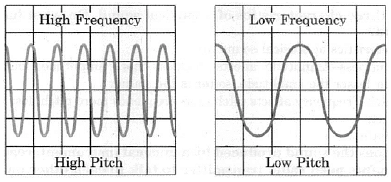
Q1: (i) Draw the sound waves for a low pitched and the high pitched sound.
(ii) Write one use of ultrasonography.
(iii) Which wave property determines pitch?
Ans:
(i) The diagram is as shown:

Frequency of sound wave(ii) Ultrasonography is used for examination of the fetus during pregnancy to detect congenital defects and growth abnormalities.
(iii) The pitch depends on frequency.

Q2: The stem of a tuning fork is pressed against a table top. Answer the following questions :
(i) Would the above action produce any audible sound?
(ii) Does the above action cause the table to set into vibrations?
(iii) If the answer above is yes, what type of vibrations are they? 
(iv) Under what conditions does the above action lead to resonance?
Ans:

(i) Yes, there is an audible sound produced.
(ii) Yes, the table top is set into ‘forced vibrations’ by this.
(iii) The vibrations are forced vibrations.
(iv) P ressing the stem of a vibrating tuning fork against a table top, would lead to resonance if the frequency of the tuning fork equals the natural frequency of oscillations of the table top.

Q3: How does the sound produced by a vibrating object in a medium reach your ear?
Ans : 
When a vibrating object moves forward, it pushes and compresses the air in front of it creating a region of high pressure called compression. This compression starts to move away from the vibrating object. When vibrating object moves backwards, it creates a region of low pressure called refraction. As the object moves forth and back rapidly, a series of compressions and refractions are created in the air. These produce the sound wave that propagates through the medium. This continues until the sound wave reaches to the ear of the listener.
Q4: Write conditions for the production of an echo. 
Ans:
 Conditions for the production of an echo are :

  • Time gap: The echo is heard if the original sound reflected by an obstacle reaches our ears after at least 0.1 seconds.
  • Distance: The minimum distance between the sound source and the obstacle must be 17.2 metres in air at 25°C for a clear echo.
  • Nature of the obstacle: The reflecting surface must be rigid, such as a building, hill, or cliff.
  • Size of the obstacle: The obstacle should be large enough to effectively reflect the sound.


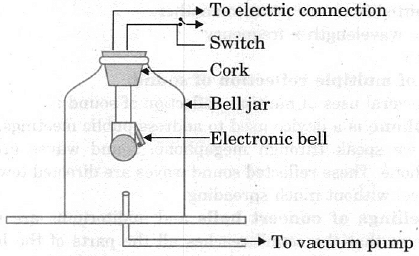
Q5: With the help of a labelled diagram show that sound needs a material medium for its propagation.
Ans: A well labelled diagram is as shown :

Bell jar experiment

(i) Take an electric circuit which consists of a cell, a switch and an electric bell arranged inside a bell jar, which stands on the platform of an evacuating pump.
(ii) The switch of the bell is pressed to close the electric circuit. When there is air within the bell jar, sound is heard. Air is now pumped out of the bell jar. When the air is completely removed from the bell jar, no sound is heard as it is obvious from fig. because the medium of air which has to carry energy from the bell to the bell jar is removed. It shows that sound needs material medium for its propagation.

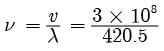
Q6: A particular transmitter of Aakashvani broadcasts at 420.5 m wavelength. (Given the speed of radio waves 3 × 10⁸ ms–1) Calculate the frequency at which the radio station broadcasts its program. What is the direction of oscillations of the medium particles through which a :
(i) Transverse w ave is propagating?
(ii) Longitudinal wave is propagating?
Ans:

Given
λ = 420.5 m, v = 3 × 10⁸ ms–1, n = ?
Using the expression v = nλ

= 7 × 10⁵ Hz
(i) The particles oscillate perpendicular to the direction of propagation of the wave.
(ii) The particles oscillate parallel to the direction of propagation of the wave.

Q7: (i) State two characteristics of wave motion.
(ii) W hat is the relation between frequency, wavelength and speed of a wave?
Ans:

(i) A wave motion is periodic in nature. The particles of the medium do not move from their mean position but execute vibration but only the energy is transmitted from one point to another.
(ii) Speed = wavelen gth  × frequency
v = λ x v

Q8:Give uses of multiple reflection of sound.
Ans:
 There are several uses of multiple reflection of sound :

  • Megaphone: This horn-shaped device is used to address public gatherings. When you speak into a megaphone, sound waves are reflected and directed towards the audience, minimising spreading.
  • Concert Halls: The ceilings in concert halls and auditoriums are often curved. This design helps sound reflect evenly throughout the space, ensuring all areas receive sound. Additionally, these ceilings use sound-absorbing materials to reduce reverberation.
  • Stethoscope: Doctors use this instrument to listen to sounds from the heart and lungs. The sounds produced by these organs reach the doctor’s ears through multiple reflections.
  • Sound Boards: These are curved surfaces (concave) placed in large halls to direct sound waves towards the audience. The speaker is positioned at the focus of the sound board, enhancing sound delivery.
  • Hearing Aids: For individuals with hearing difficulties, hearing aids concentrate incoming sound waves into a narrow beam through reflection. This beam vibrates the ear’s diaphragm with greater amplitude, improving hearing ability.


Q9: Give application of ultrasound (ultrasonic waves).
Ans:
 Ultrasonic waves have number of uses :

  • Ultrasonic vibrations are used to homogenise milk, breaking down larger fat particles into smaller ones.
  • In dishwashing machines, ultrasonic vibrations help clean utensils by agitating detergent particles.
  • These vibrations can create a depression effect in pests like rats and cockroaches.
  • Ultrasonic waves are essential for monitoring fetal growth during pregnancy.
  • They are also effective in relieving pain in joints and muscles.
  • In industry, ultrasonic vibrations detect flaws in metal products and measure their thickness.


Q10: A tuning fork produces 1024 waves in 4 seconds. Calculate the frequency to the tuning fork.
Ans:
 The tuning fork produces 1024 waves in 4 seconds. To find the frequency:

  • Frequency (v) is the number of vibrations per second.
  • Calculate by dividing the total number of waves by the time:
  • Frequency = 1024 waves / 4 seconds
  • Thus, Frequency = 256 Hz.

10. Long Question Answer: Work & Energy

Q1: A force of 10N causes a displacement of 2 m in a body in its own direction. Calculate the work done by force.

Ans:

The work done by a constant force acting in the direction of displacement is given by

Work = F × s

= 10 N × 2 m

= 20 J

The work is positive because the force and displacement are in the same direction.

Q2: How much force is applied on the body when 150 joule of work is done in displacing the body through a distance of 10 m in the direction of force?

Ans: 

Given W = 150 J and s = 10 m.

Using W = F × s, we get

F = W / s

= 150 J / 10 m

= 15 N

The force applied in the direction of displacement is 15 N.

Q3: A body of 5 kg raised to 2 m find the work done.

Ans:

The work done to raise a body against gravity equals the gain in gravitational potential energy (PE).

PE = mgh

= 5 kg × 9.8 m/s2 × 2 m

= 98 J

Therefore, the work done in raising the body is 98 J.

Q4: A work of 4900 J is done on load of mass 50 kg to lift it to a certain height. Calculate the height through which the load is lifted.

Ans: 

Work done in lifting = increase in potential energy = mgh.

4900 J = 50 kg × 9.8 m/s2 × h

h = 4900 / (50 × 9.8) = 4900 / 490 = 10 m

The load is lifted through a height of 10 m.

Q5: An engine work 54,000 J work by exerting a force of 6000 N on it. What is the displacement of the force?

Ans:

Displacement s = W / F

= 54000 J / 6000 N= 9 m

Thus, the displacement is 9 m.

Q6: A body of mass 2 kg is moving with a speed of 20 m/s. Find the kinetic energy.

Ans:

Kinetic energy (KE) = ½ mv2

= 0.5 × 2 kg × (20 m/s)2

= 0.5 × 2 × 400

= 400 J

The kinetic energy of the body is 400 J.

Q7: A hammer of mass 1 kg falls freely from a height of 2 m. Calculate (I) The velocity and (II) The kinetic energy of the hammer just before it touches the ground. Does the velocity of hammer depend on the mass of hammer?

Ans: 

Use energy conservation (neglecting air resistance): loss of potential energy = gain in kinetic energy.
PE at top = mgh = 1 kg × 9.8 m/s2 × 2 m = 19.6 J
Thus KE just before impact = 19.6 J.
Let v be the speed just before impact. Then ½ m v2 = 19.6 J.
19.6 = 0.5 × 1 × v2 → v2 = 39.2 → v ≈ 6.26 m/s.
(I) Velocity just before touching ground ≈ 6.26 m/s.
(II) Kinetic energy just before impact = 19.6 J.
The velocity does not depend on the mass of the hammer (neglecting air resistance) because v for a freely falling object from rest after falling height h is v = √(2gh), which contains no mass term.

Q8: A weight of 50 kg runs up a hill rising himself vertically 10 m in 20 sec. Calculate power. (Given g = 9.8 ms-1)

Ans: Work done = increase in potential energy = mgh 
= 50 kg × 9.8 m/s2 × 10 m 
= 4900 J.

Power = Work / time = 4900 J / 20 s = 245 W.

The required power is 245 W.

Q9: A rickshaw puller pulls the rickshaw by applying a force of 100 N. If the rickshaw moves with constant velocity of 36 kmh-1. Find the power of rickshaw puller.

Ans:

Force = 100 N.

Velocity = 36 km/h = 36 × 5 / 18 = 10 m/s.

Power = Force × Velocity = 100 N × 10 m/s = 1000 W.

Therefore, the rickshaw puller supplies 1000 W of power. At constant velocity this power balances resistive forces such as friction and air resistance.

Q10: An athlete weighing 60 kg runs up a staircase having 10 steps each of 1 m in 30 sec. Calculate power (g = 9.8ms-1).

Ans:

Total vertical height climbed h = 10 × 1 m = 10 m.

Work done = increase in potential energy = mgh = 60 kg × 9.8 m/s2 × 10 m = 5880 J.

Power = Work / time = 5880 J / 30 s = 196 W.

The athlete’s power while climbing is 196 W.

Q11: A horse exert a force of 200N to pull the cart. If the horse cart system moves with velocity 36 kmh-1 on the level road, then find the power of horse in term of horse power (1 HP = 746 W).

Ans:

Velocity = 36 km/h = 10 m/s.

Power = F × v = 200 N × 10 m/s = 2000 W.

In horsepower: 2000 W ÷ 746 W per HP ≈ 2.68 HP.

So the horse develops about 2.68 horsepower.

Q12: An electric kettle of 500W is used to heat water everyday for 2 hours. Calculate the number of unit of electrical energy consumed by it in 10 days

Ans:

Power = 500 W = 0.5 kW. Daily usage = 2 h, for 10 days total time = 2 × 10 = 20 h.

Energy = P × t = 0.5 kW × 20 h = 10 kWh = 10 units.

The kettle consumes 10 units of electrical energy in 10 days.

Q13: Calculate the cost of using a 2 kWh immersion rod for heating water in a house for one hour each day for 60 days if the rate is 1.50 per unit kWh.

Ans:

Power = 2 kW, daily time = 1 h, period = 60 days → total energy = 2 kW × 60 h = 120 kWh = 120 units.

Cost = 120 units × Rs 1.50 per unit = Rs 180.

The total cost is Rs 180.

Q14: In an experiment to measure his power, a student records the time taken by him in running up a flight of steps on a staircase.

Ans:

Use the following data to calculate the power of the student :

Number of steps = 28,

Height of each step = 20 cm,

Time taken = 5.4 s,

Mass of student = 55 kg,

Acceleration due to gravity = 9.8 ms-2

The total vertical height climbed = 28 × 0.20 m = 5.6 m.

Work done = mgh = 55 kg × 9.8 m/s2 × 5.6 m = 3018.4 J.

Power = Work / time = 3018.4 J / 5.4 s ≈ 559 W.

The student’s power while climbing the steps is approximately 559 W.

Q15: The power of a heart which beats 72 times in a minute is 1.2 kW. Calculate the work done by heart for each beat. (1 kJ)

Ans: 

Power P = 1.2 kW = 1200 W. Time interval considered = 1 minute = 60 s.

Total work done in 60 s = P × t = 1200 W × 60 s = 72000 J.

Number of beats in 60 s = 72. Work done per beat = 72000 J / 72 = 1000 J = 1 kJ.

Work done by the heart in each beat is 1 kJ.

Q16: Calculate the electricity bill amount for a month of 31 days, if the following devices are used as specified. 
(a) 3 bulbs of 40 W for 6 hours. 
(b) 4 tubelights of 50 W for 8 hours, 
(c) A TV of 120 W for 6 hours.
The rate of electricity is Rs 2.50 per unit.

Ans: 

Convert powers to kW and find daily energy consumption:

E1 (3 bulbs) = 3 × 40 W × 6 h = 720 Wh = 0.72 kWh per day.

E2 (4 tubelights) = 4 × 50 W × 8 h = 1600 Wh = 1.60 kWh per day.

E3 (TV) = 120 W × 6 h = 720 Wh = 0.72 kWh per day.

Total per day = 0.72 + 1.60 + 0.72 = 3.04 kWh per day.

For 31 days: Energy = 3.04 kWh × 31 = 94.24 kWh (units).

Cost = 94.24 × Rs 2.50 = Rs 235.60.

The electricity bill for the month is Rs 235.60.

Q17: (a) What is meant by mechanical energy? State its two forms. State the law of conservation of energy. Give an example in which we observe a continuous change of one form of energy into another and vice-versa.
(b) Calculate the amount of work required to stop a car of 1000 kg moving with a speed of 72 km/h.

Ans:

(a) Mechanical energy of a body is the sum of its kinetic energy and gravitational potential energy. Its two forms are:

– Kinetic energy (energy of motion).

– Potential energy (energy due to position in a force field, e.g., gravity).

Law of conservation of energy: Energy can neither be created nor destroyed; it can only be transformed from one form to another.

Example: In a simple pendulum, energy continuously converts between kinetic and potential energy. At the mean position the energy is mainly kinetic, and at the extreme positions it is mainly potential. During oscillation the total mechanical energy (neglecting friction) remains constant.

(b) Given: m = 1000 kg, initial speed u = 72 km/h = 20 m/s, final speed v = 0.

Work required to stop = change in kinetic energy = ½ m (v2 – u2) = -½ m u2.

Magnitude of work done by the brakes = ½ × 1000 kg × (20 m/s)2 = 0.5 × 1000 × 400 = 200000 J = 2 × 10⁵ J.

The brakes must do 2 × 10⁵ J of work (energy removed) to bring the car to rest.

09. Long Question Answer: Gravitation

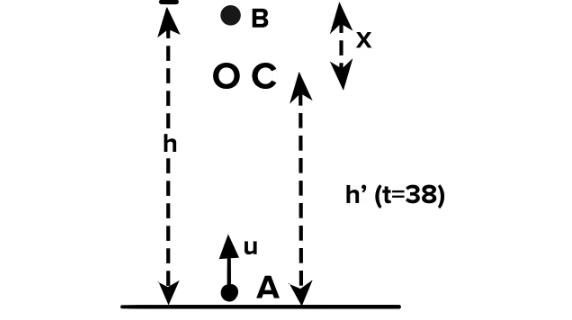
Q1: A ball thrown up is caught by the thrower after 4 s. With what velocity was it thrown up? How high did it go? Where was it after 3 s ? (g = 9.8 ms–2
Ans: 
Long Question Answer: GravitationIn case of upward motion of the ball from A to B
  • Initial velocity, u = ?
  • Final velocity, v = 0 (at maximum height)
  • Time taken by the ball to reach the highest point = 2s (time of ascent = time of descent)
  • Acceleration due to gravity g = -9.8 m/s2 (upward motion)

Finding the initial velocity of the ball

Using the first equation of motion, v = u + gt:

v = u – gt

0 = u – 9.8 × 2

u = 19.6 m/s

The initial velocity of the ball is 19.6 m/s.

Finding the maximum height (h) attained by the ball

Using the second equation of motion, h = ut + 1/2 gt2:

h = 19.6 × 2 – 1/2 × 9.8 × (2)2

h = 39.2 – 19.6

h = 19.6 m

Let the ball be at C after t = 3 sec

Consider motion from A to C

  • u = 19.6 m/s
  • t = 3 s
  • g = -9.8 m/s2
  • s = h’

s = ut + 1/2 gt2

h’ = 19.6 × 3 – 1/2 × 9.8 × (3)2

h’ = 58.8 – 44.1 = 14.7 m

Distance from top

x = h – h’

x = 19.6 – 14.7 = 4.9 m

Hence, the ball goes to the maximum height of 19.6 m, the velocity at which it was thrown is 19.6 m/s, and the distance below its highest point after 3 sec is 4.9 m.

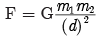
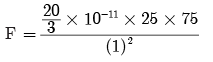
Q2: Calculate the force of gravitation due to a child of mass 25 kg on his mother of mass 75 kg if the distance between their centres is 1 m from each other. Given G = (20/3) × 10–11 Nm2 kg–2
Ans:
 Here m1 = 25 kg; m2 = 75 kg; d = 1 m;
Using,
Consider motion from A to C

Consider motion from A to C

F = 12,500 × 10–11
or F = 1.25 × 10⁻⁷ N

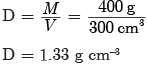
Q3: A sealed tin of Coca-Cola of 400 g has a volume of 300 cm3. Calculate the density of the tin.
Ans:
 Here,
mass of tin, M = 400 g
Volume of tin, V = 300 cm3
Density of tin,
Consider motion from A to C

Q4: A sealed can of mass 600 g has a volume of 500 cm3. Will this can sink in water? Density of water is 1 g cm–3.
Ans:
 Here,
mass of can, M = 600 g
Volume of can, V = 500 cm3
Density of can, Consider motion from A to C
Since, density of the can is greater than the density of water, so the can will sink in water.

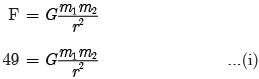
Q5: The gravitational force between two objects is 49 N. How much distance between these objects be decreased so that the force between them becomes double?
Ans: 
Let ‘r’ be the distance between the object of mass m1 and m2
Consider motion from A to C

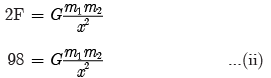
Now, the distance is reduced to ‘x’ so that the force become twice, then

Consider motion from A to C

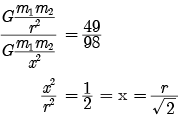
Dividing eq. (i) by (ii)

Consider motion from A to C

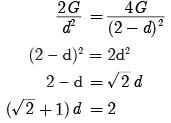
So, the distance must decrease by Consider motion from A to C times the original distance.


Q6: A force of 200 N is applied perpendicular to its surface having area 4 square metres. Calculate the pressure.
Ans:

Thrust = 200 N
Area = 4 m2  
Pressure = ?  
Pressure = Thrust / Area = Consider motion from A to C
= 50 Nm–2 = 50 Pa

Q7: The density of water is 1000 kg m3. If relative density of iron is 7.874, then calculate the density of iron.
Ans: 
 
Density of water = 1000 kg/m3
Relative density (R.D.) of iron = 7.874
Using, R.D. of iron we get  
Density of iron = R.D. of iron   × density of water  
= 7.874 × 1000 kg/m3
= 7874 kg/m3.

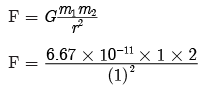
Q8: What is the force of gravitation between two point masses of 1 kg and 2 kg kept 1 m apart?
Ans:

m = 1 kg, m2 = 2 kg, r = 1 m
Consider motion from A to C

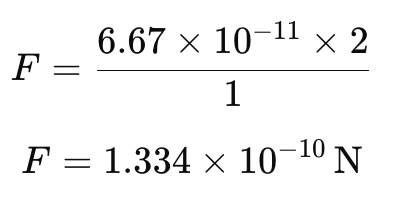
Consider motion from A to C

= 13.34 x 10⁻¹¹N
This is an extremely small force.

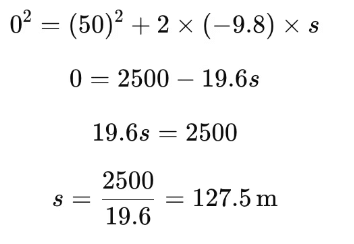
Q9: A particle is thrown up vertically with a velocity of 50 m/s. (a) What will be its velocity at the highest point of its journey? (b) How high would the particle rise? (c) What time would it take to reach the highest point?
Ans:
 
At the highest point the velocity will be zero. Considering activity A to B
Using
 = u + at
0 = 50 – 9.8 × t
t = 5.1 sec
Also v– u2 = 2as Consider motion from A to Cs = 127.5 m

Q10: Weight of a girl is 294 N. Find her mass.
Ans: 
W = mg  
294 = m × 9.8  m
Q11: How much force should be applied on an area of 1 cmto get a pressure of 15 Pa?
Ans: 
Here,
Area, A = 1 cm2 = 10–4 m2
Pressure (P) = 15 Pa = 15 N/m2
As F = P × A  
= (15 N/m2) × (10–4 m2)  
= 1.5 × 10⁻³ N

Q12: A force of 20N acts upon a body whose weight is 9.8N. What is the mass of the body and how much is its acceleration? Given, Force = 20 N, Weight W = 9.8 N. We know, W = mg; 9.8 = m × 9.8 m = 1 kg 
Ans:
 
We know
F = ma
20 = 1 × a  
a = 20 m/s2

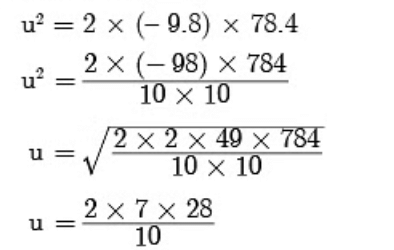
Q13: An object is thrown vertically upwards and reaches a height of 78.4 m. Calculate the velocity at which the object was thrown? (g = 9.8 m/s2)
Ans: Given,
h = 78.4 m  
v = 0  
g = –9.8 m/s2
Now, v2 = u2 – 2ghConsider motion from A to CConsider motion from A to Cu = 39.2 m/s2

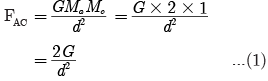
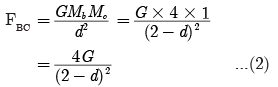
Q14: Two bodies A and B having masses 2 kg and 4 kg respectively are separated by 2 m. Where should a body of mass 1 kg be placed so that the gravitational force on this body due to bodies A and B is zero?
Ans: 
 
Mass of body a is Ma = 2 kg
Mass of body b is Mb = 4 kg
Mass of body c is Mc = 1 kg
Separation between a and b = 2 m
Let the body C be placed at a distance d from body A Gravitational force between A and C
Consider motion from A to C

Gravitational force between B and C isConsider motion from A to C

For body C the gravitational force is 0.

Hence, FAC = FBC
Consider motion from A to C
 d = 0.83

Q15: Let us find force of attraction between two blocks lying 1 m apart. Let the mass of each block is 40 kg.
Ans:

F = ?
m1 = 40 kg
m2 = 40 kg
d = 1 m
G = 6.67 × 10⁻¹¹ Nm2kg–2
Consider motion from A to C
= 1.0672 x 10⁻⁷N

08. Long Question Answer: Force and Law of Motion

Q1: State all 3 Newton’s law of motion.
Ans: 

  • Newton’s I law of motion : An object remains in a state of rest or of uniform motion in a straight line unless acted upon by an external unbalanced force.
  • Newton’s II law of motion : The rate of change of momentum of an object is proportional to the applied unbalanced force in the direction of the force.
  • Newton’s III law of motion : To every action, there is an equal and opposite reaction and they act on two different bodies.


Q2: Explain inertia and momentum.
Ans :

  • Inertia : The natural tendency of an object to resist a change in their state of rest or of uniform motion is called inertia. For example : A book lying on a table will remain there until an external force is applied on it to remove or displace it from that position.
  • Momentum : Momentum of body is the quantity of motion possessed by the body. It is equal to the product of the mass and velocity of the body and is denoted by p. p = mv Momentum is a vector quantity and its direction is same as the direction of velocity of the object. Its SI unit is kilogram metre per second (kg ms–1).


Q3: Define force. What are different types forces?
Ans: 

  • Force : It is a push or pull on an object that produces acceleration in the body on which it acts. The S.I. unit of force is Newton.
  • Types of forces : Balanced force : When the forces acting on a body from the opposite direction do not change the state of rest or of motion of an object, such forces are called balanced forces.
  • Unbalanced force : When two opposite forces acting on a body move a body in the direction of the greater force or change the state of rest, such forces are called as unbalanced forces.
  • Frictional force : Force of friction is the force that always opposes the motion of object.


Q4: What is inertia? Explain different types of inertia.
Ans: 

  • Inertia : The natural tendency of an object to resist change in their state of rest or of motion is called inertia. The mass of an object is a measure of its inertia. Its S.I. unit is kg.

Types of inertia :

  • Inertia of rest : The object remain in rest unless acted upon by an external unbalanced force.
  • Inertia of motion : The object in the state of uniform motion will continue to remain in motion with same speed and direction unless external force is not applied on it.

Q5: Give example to show the effects of force.
Ans: 
(i) Place a ball in the ground. Kick it with your foot. The ball starts moving. The ball moves because of the force applied to it.
(ii) If ball is coming towards you, you can kick it in any direction. The direction of motion of the ball changes because of the force applied to it.
(iii) Place a rubber on the ground. Press it with your foot. It is found that the ball is no longer round but takes the shape of an egg, i.e. it is oblong. The shape of the ball has changed because of the force applied on the ball.

Q6: (a) What is friction?
(b) What are the advantages of friction? or Why is friction necessary?

Ans: 
(a) The force which opposes the motion of one body over the surface of another is called friction or the force of friction.
(b) Friction is very desirable and an important force in our daily life.
Some advantages of friction are :

  • The nails and screws hold the wooden boards together due to friction. 
  • It is due to the friction between the ground/road and the soles of our shoes that we are able to walk. 
  • The friction between the road and the surface of the tyres permits safe driving. 
  • W e are able to write on paper because of the friction between the pen/pencil and the paper. That is why, it is very difficult to write on a glazed/waxed paper. 
  • The application of brakes to stop a cycle, scooter or car, etc., is possible due to friction between the brake-lining and the rim of the wheel.


Q7: (i)  What are the causes of friction?
(ii) How can friction between any two surfaces can be reduced?  or  Describe some method for reducing friction.

Ans: The friction rises due to the following factors : 

  • Due to the force of attraction between the molecules of the two surfaces in contact. This is called the force of adhesion. 
  • Due to the interlocking of the surface irregularities. 
  • Thus, friction is due to the roughness of the two surfaces in contact. 
  • The friction between two surfaces can be reduced by following methods :
    • By polishing surfaces : Rough surfaces can be made smooth by polishing. Therefore, polishing reduces friction. 
    • By applying oil or grease on the surfaces : Oil/ grease forms a thin layer between the two surfaces and reduces friction.

Long Question Answer: Force and Law of Motion

Q1: State all 3 Newton’s law of motion.
Ans: 

  • Newton’s I law of motion : An object remains in a state of rest or of uniform motion in a straight line unless acted upon by an external unbalanced force.
  • Newton’s II law of motion : The rate of change of momentum of an object is proportional to the applied unbalanced force in the direction of the force.
  • Newton’s III law of motion : To every action, there is an equal and opposite reaction and they act on two different bodies.


Q2: Explain inertia and momentum.
Ans :

  • Inertia : The natural tendency of an object to resist a change in their state of rest or of uniform motion is called inertia. For example : A book lying on a table will remain there until an external force is applied on it to remove or displace it from that position.
  • Momentum : Momentum of body is the quantity of motion possessed by the body. It is equal to the product of the mass and velocity of the body and is denoted by p. p = mv Momentum is a vector quantity and its direction is same as the direction of velocity of the object. Its SI unit is kilogram metre per second (kg ms–1).


Q3: Define force. What are different types forces?
Ans: 

  • Force : It is a push or pull on an object that produces acceleration in the body on which it acts. The S.I. unit of force is Newton.
  • Types of forces : Balanced force : When the forces acting on a body from the opposite direction do not change the state of rest or of motion of an object, such forces are called balanced forces.
  • Unbalanced force : When two opposite forces acting on a body move a body in the direction of the greater force or change the state of rest, such forces are called as unbalanced forces.
  • Frictional force : Force of friction is the force that always opposes the motion of object.


Q4: What is inertia? Explain different types of inertia.
Ans: 

  • Inertia : The natural tendency of an object to resist change in their state of rest or of motion is called inertia. The mass of an object is a measure of its inertia. Its S.I. unit is kg.

Types of inertia :

  • Inertia of rest : The object remain in rest unless acted upon by an external unbalanced force.
  • Inertia of motion : The object in the state of uniform motion will continue to remain in motion with same speed and direction unless external force is not applied on it.

Q5: Give example to show the effects of force.
Ans: 
(i) Place a ball in the ground. Kick it with your foot. The ball starts moving. The ball moves because of the force applied to it.
(ii) If ball is coming towards you, you can kick it in any direction. The direction of motion of the ball changes because of the force applied to it.
(iii) Place a rubber on the ground. Press it with your foot. It is found that the ball is no longer round but takes the shape of an egg, i.e. it is oblong. The shape of the ball has changed because of the force applied on the ball.

Q6: (a) What is friction?
(b) What are the advantages of friction? or Why is friction necessary?

Ans: 
(a) The force which opposes the motion of one body over the surface of another is called friction or the force of friction.
(b) Friction is very desirable and an important force in our daily life.
Some advantages of friction are :

  • The nails and screws hold the wooden boards together due to friction. 
  • It is due to the friction between the ground/road and the soles of our shoes that we are able to walk. 
  • The friction between the road and the surface of the tyres permits safe driving. 
  • W e are able to write on paper because of the friction between the pen/pencil and the paper. That is why, it is very difficult to write on a glazed/waxed paper. 
  • The application of brakes to stop a cycle, scooter or car, etc., is possible due to friction between the brake-lining and the rim of the wheel.


Q7: (i)  What are the causes of friction?
(ii) How can friction between any two surfaces can be reduced?  or  Describe some method for reducing friction.

Ans: The friction rises due to the following factors : 

  • Due to the force of attraction between the molecules of the two surfaces in contact. This is called the force of adhesion. 
  • Due to the interlocking of the surface irregularities. 
  • Thus, friction is due to the roughness of the two surfaces in contact. 
  • The friction between two surfaces can be reduced by following methods :
    • By polishing surfaces : Rough surfaces can be made smooth by polishing. Therefore, polishing reduces friction. 
    • By applying oil or grease on the surfaces : Oil/ grease forms a thin layer between the two surfaces and reduces friction.


Q8: When a force of 40 N is applied on a body it moves with an acceleration of 5 ms2. Calculate the mass of the body.
Ans: 
Let m be the mass of the body.
Given : F = 40 N, a = 5 ms2 
From the relation F = m a, we have  
40 = m × 5
m = 40/5 = 8 kg

Q9: An object undergoes an acceleration of 8 ms–2 starting from rest. Find the distance travelled in 1 second.
Ans:
 Given,
Acceleration, a = 8 ms–2 
Initial velocity, u = 0
Time interval, t = 1 s
Distance travelled, s = ?
Using the equation of motion,
s = ut + 1/2 at2, one gets  
s = 0 × 1 + 1/2 × 8 × 12 = 4 m
The object travels a distance of 4 m.

Q10: Calculate the force required to impact to a car, a velocity of 30 ms–1 in 10 seconds. The mass of the car is 1,500 kg.
Ans:

Here
u = 0 ms–1;
v = 30 ms–1;
t = 10 s;
a = ?
Using v = u + at, we have  
30 = 0 + a (10) a
= 3 ms–2
Now
F = ma
= 1,500 × 3 or F = 4,500 NLong Question Answer: Force and Law of Motion

Q1: State all 3 Newton’s law of motion.
Ans: 

  • Newton’s I law of motion : An object remains in a state of rest or of uniform motion in a straight line unless acted upon by an external unbalanced force.
  • Newton’s II law of motion : The rate of change of momentum of an object is proportional to the applied unbalanced force in the direction of the force.
  • Newton’s III law of motion : To every action, there is an equal and opposite reaction and they act on two different bodies.


Q2: Explain inertia and momentum.
Ans :

  • Inertia : The natural tendency of an object to resist a change in their state of rest or of uniform motion is called inertia. For example : A book lying on a table will remain there until an external force is applied on it to remove or displace it from that position.
  • Momentum : Momentum of body is the quantity of motion possessed by the body. It is equal to the product of the mass and velocity of the body and is denoted by p. p = mv Momentum is a vector quantity and its direction is same as the direction of velocity of the object. Its SI unit is kilogram metre per second (kg ms–1).


Q3: Define force. What are different types forces?
Ans: 

  • Force : It is a push or pull on an object that produces acceleration in the body on which it acts. The S.I. unit of force is Newton.
  • Types of forces : Balanced force : When the forces acting on a body from the opposite direction do not change the state of rest or of motion of an object, such forces are called balanced forces.
  • Unbalanced force : When two opposite forces acting on a body move a body in the direction of the greater force or change the state of rest, such forces are called as unbalanced forces.
  • Frictional force : Force of friction is the force that always opposes the motion of object.


Q4: What is inertia? Explain different types of inertia.
Ans: 

  • Inertia : The natural tendency of an object to resist change in their state of rest or of motion is called inertia. The mass of an object is a measure of its inertia. Its S.I. unit is kg.

Types of inertia :

  • Inertia of rest : The object remain in rest unless acted upon by an external unbalanced force.
  • Inertia of motion : The object in the state of uniform motion will continue to remain in motion with same speed and direction unless external force is not applied on it.

Q5: Give example to show the effects of force.
Ans: 
(i) Place a ball in the ground. Kick it with your foot. The ball starts moving. The ball moves because of the force applied to it.
(ii) If ball is coming towards you, you can kick it in any direction. The direction of motion of the ball changes because of the force applied to it.
(iii) Place a rubber on the ground. Press it with your foot. It is found that the ball is no longer round but takes the shape of an egg, i.e. it is oblong. The shape of the ball has changed because of the force applied on the ball.

Q6: (a) What is friction?
(b) What are the advantages of friction? or Why is friction necessary?

Ans: 
(a) The force which opposes the motion of one body over the surface of another is called friction or the force of friction.
(b) Friction is very desirable and an important force in our daily life.
Some advantages of friction are :

  • The nails and screws hold the wooden boards together due to friction. 
  • It is due to the friction between the ground/road and the soles of our shoes that we are able to walk. 
  • The friction between the road and the surface of the tyres permits safe driving. 
  • W e are able to write on paper because of the friction between the pen/pencil and the paper. That is why, it is very difficult to write on a glazed/waxed paper. 
  • The application of brakes to stop a cycle, scooter or car, etc., is possible due to friction between the brake-lining and the rim of the wheel.


Q7: (i)  What are the causes of friction?
(ii) How can friction between any two surfaces can be reduced?  or  Describe some method for reducing friction.

Ans: The friction rises due to the following factors : 

  • Due to the force of attraction between the molecules of the two surfaces in contact. This is called the force of adhesion. 
  • Due to the interlocking of the surface irregularities. 
  • Thus, friction is due to the roughness of the two surfaces in contact. 
  • The friction between two surfaces can be reduced by following methods :
    • By polishing surfaces : Rough surfaces can be made smooth by polishing. Therefore, polishing reduces friction. 
    • By applying oil or grease on the surfaces : Oil/ grease forms a thin layer between the two surfaces and reduces friction.


Q8: When a force of 40 N is applied on a body it moves with an acceleration of 5 ms2. Calculate the mass of the body.
Ans: 
Let m be the mass of the body.
Given : F = 40 N, a = 5 ms2 
From the relation F = m a, we have  
40 = m × 5
m = 40/5 = 8 kg

Q9: An object undergoes an acceleration of 8 ms–2 starting from rest. Find the distance travelled in 1 second.
Ans:
 Given,
Acceleration, a = 8 ms–2 
Initial velocity, u = 0
Time interval, t = 1 s
Distance travelled, s = ?
Using the equation of motion,
s = ut + 1/2 at2, one gets  
s = 0 × 1 + 1/2 × 8 × 12 = 4 m
The object travels a distance of 4 m.

Q10: Calculate the force required to impact to a car, a velocity of 30 ms–1 in 10 seconds. The mass of the car is 1,500 kg.
Ans:

Here
u = 0 ms–1;
v = 30 ms–1;
t = 10 s;
a = ?
Using v = u + at, we have  
30 = 0 + a (10) a
= 3 ms–2
Now
F = ma
= 1,500 × 3 or F = 4,500 NLong Question Answer: Force and Law of Motion

Q1: State all 3 Newton’s law of motion.
Ans: 

  • Newton’s I law of motion : An object remains in a state of rest or of uniform motion in a straight line unless acted upon by an external unbalanced force.
  • Newton’s II law of motion : The rate of change of momentum of an object is proportional to the applied unbalanced force in the direction of the force.
  • Newton’s III law of motion : To every action, there is an equal and opposite reaction and they act on two different bodies.


Q2: Explain inertia and momentum.
Ans :

  • Inertia : The natural tendency of an object to resist a change in their state of rest or of uniform motion is called inertia. For example : A book lying on a table will remain there until an external force is applied on it to remove or displace it from that position.
  • Momentum : Momentum of body is the quantity of motion possessed by the body. It is equal to the product of the mass and velocity of the body and is denoted by p. p = mv Momentum is a vector quantity and its direction is same as the direction of velocity of the object. Its SI unit is kilogram metre per second (kg ms–1).


Q3: Define force. What are different types forces?
Ans: 

  • Force : It is a push or pull on an object that produces acceleration in the body on which it acts. The S.I. unit of force is Newton.
  • Types of forces : Balanced force : When the forces acting on a body from the opposite direction do not change the state of rest or of motion of an object, such forces are called balanced forces.
  • Unbalanced force : When two opposite forces acting on a body move a body in the direction of the greater force or change the state of rest, such forces are called as unbalanced forces.
  • Frictional force : Force of friction is the force that always opposes the motion of object.


Q4: What is inertia? Explain different types of inertia.
Ans: 

  • Inertia : The natural tendency of an object to resist change in their state of rest or of motion is called inertia. The mass of an object is a measure of its inertia. Its S.I. unit is kg.

Types of inertia :

  • Inertia of rest : The object remain in rest unless acted upon by an external unbalanced force.
  • Inertia of motion : The object in the state of uniform motion will continue to remain in motion with same speed and direction unless external force is not applied on it.

Q5: Give example to show the effects of force.
Ans: 
(i) Place a ball in the ground. Kick it with your foot. The ball starts moving. The ball moves because of the force applied to it.
(ii) If ball is coming towards you, you can kick it in any direction. The direction of motion of the ball changes because of the force applied to it.
(iii) Place a rubber on the ground. Press it with your foot. It is found that the ball is no longer round but takes the shape of an egg, i.e. it is oblong. The shape of the ball has changed because of the force applied on the ball.

Q6: (a) What is friction?
(b) What are the advantages of friction? or Why is friction necessary?

Ans: 
(a) The force which opposes the motion of one body over the surface of another is called friction or the force of friction.
(b) Friction is very desirable and an important force in our daily life.
Some advantages of friction are :

  • The nails and screws hold the wooden boards together due to friction. 
  • It is due to the friction between the ground/road and the soles of our shoes that we are able to walk. 
  • The friction between the road and the surface of the tyres permits safe driving. 
  • W e are able to write on paper because of the friction between the pen/pencil and the paper. That is why, it is very difficult to write on a glazed/waxed paper. 
  • The application of brakes to stop a cycle, scooter or car, etc., is possible due to friction between the brake-lining and the rim of the wheel.


Q7: (i)  What are the causes of friction?
(ii) How can friction between any two surfaces can be reduced?  or  Describe some method for reducing friction.

Ans: The friction rises due to the following factors : 

  • Due to the force of attraction between the molecules of the two surfaces in contact. This is called the force of adhesion. 
  • Due to the interlocking of the surface irregularities. 
  • Thus, friction is due to the roughness of the two surfaces in contact. 
  • The friction between two surfaces can be reduced by following methods :
    • By polishing surfaces : Rough surfaces can be made smooth by polishing. Therefore, polishing reduces friction. 
    • By applying oil or grease on the surfaces : Oil/ grease forms a thin layer between the two surfaces and reduces friction.


Q8: When a force of 40 N is applied on a body it moves with an acceleration of 5 ms2. Calculate the mass of the body.
Ans: 
Let m be the mass of the body.
Given : F = 40 N, a = 5 ms2 
From the relation F = m a, we have  
40 = m × 5
m = 40/5 = 8 kg

Q9: An object undergoes an acceleration of 8 ms–2 starting from rest. Find the distance travelled in 1 second.
Ans:
 Given,
Acceleration, a = 8 ms–2 
Initial velocity, u = 0
Time interval, t = 1 s
Distance travelled, s = ?
Using the equation of motion,
s = ut + 1/2 at2, one gets  
s = 0 × 1 + 1/2 × 8 × 12 = 4 m
The object travels a distance of 4 m.

Q10: Calculate the force required to impact to a car, a velocity of 30 ms–1 in 10 seconds. The mass of the car is 1,500 kg.
Ans:

Here
u = 0 ms–1;
v = 30 ms–1;
t = 10 s;
a = ?
Using v = u + at, we have  
30 = 0 + a (10) a
= 3 ms–2
Now
F = ma
= 1,500 × 3 or F = 4,500 NLong Question Answer: Force and Law of Motion

Q1: State all 3 Newton’s law of motion.
Ans: 

  • Newton’s I law of motion : An object remains in a state of rest or of uniform motion in a straight line unless acted upon by an external unbalanced force.
  • Newton’s II law of motion : The rate of change of momentum of an object is proportional to the applied unbalanced force in the direction of the force.
  • Newton’s III law of motion : To every action, there is an equal and opposite reaction and they act on two different bodies.


Q2: Explain inertia and momentum.
Ans :

  • Inertia : The natural tendency of an object to resist a change in their state of rest or of uniform motion is called inertia. For example : A book lying on a table will remain there until an external force is applied on it to remove or displace it from that position.
  • Momentum : Momentum of body is the quantity of motion possessed by the body. It is equal to the product of the mass and velocity of the body and is denoted by p. p = mv Momentum is a vector quantity and its direction is same as the direction of velocity of the object. Its SI unit is kilogram metre per second (kg ms–1).


Q3: Define force. What are different types forces?
Ans: 

  • Force : It is a push or pull on an object that produces acceleration in the body on which it acts. The S.I. unit of force is Newton.
  • Types of forces : Balanced force : When the forces acting on a body from the opposite direction do not change the state of rest or of motion of an object, such forces are called balanced forces.
  • Unbalanced force : When two opposite forces acting on a body move a body in the direction of the greater force or change the state of rest, such forces are called as unbalanced forces.
  • Frictional force : Force of friction is the force that always opposes the motion of object.


Q4: What is inertia? Explain different types of inertia.
Ans: 

  • Inertia : The natural tendency of an object to resist change in their state of rest or of motion is called inertia. The mass of an object is a measure of its inertia. Its S.I. unit is kg.

Types of inertia :

  • Inertia of rest : The object remain in rest unless acted upon by an external unbalanced force.
  • Inertia of motion : The object in the state of uniform motion will continue to remain in motion with same speed and direction unless external force is not applied on it.

Q5: Give example to show the effects of force.
Ans: 
(i) Place a ball in the ground. Kick it with your foot. The ball starts moving. The ball moves because of the force applied to it.
(ii) If ball is coming towards you, you can kick it in any direction. The direction of motion of the ball changes because of the force applied to it.
(iii) Place a rubber on the ground. Press it with your foot. It is found that the ball is no longer round but takes the shape of an egg, i.e. it is oblong. The shape of the ball has changed because of the force applied on the ball.

Q6: (a) What is friction?
(b) What are the advantages of friction? or Why is friction necessary?

Ans: 
(a) The force which opposes the motion of one body over the surface of another is called friction or the force of friction.
(b) Friction is very desirable and an important force in our daily life.
Some advantages of friction are :

  • The nails and screws hold the wooden boards together due to friction. 
  • It is due to the friction between the ground/road and the soles of our shoes that we are able to walk. 
  • The friction between the road and the surface of the tyres permits safe driving. 
  • W e are able to write on paper because of the friction between the pen/pencil and the paper. That is why, it is very difficult to write on a glazed/waxed paper. 
  • The application of brakes to stop a cycle, scooter or car, etc., is possible due to friction between the brake-lining and the rim of the wheel.


Q7: (i)  What are the causes of friction?
(ii) How can friction between any two surfaces can be reduced?  or  Describe some method for reducing friction.

Ans: The friction rises due to the following factors : 

  • Due to the force of attraction between the molecules of the two surfaces in contact. This is called the force of adhesion. 
  • Due to the interlocking of the surface irregularities. 
  • Thus, friction is due to the roughness of the two surfaces in contact. 
  • The friction between two surfaces can be reduced by following methods :
    • By polishing surfaces : Rough surfaces can be made smooth by polishing. Therefore, polishing reduces friction. 
    • By applying oil or grease on the surfaces : Oil/ grease forms a thin layer between the two surfaces and reduces friction.


Q8: When a force of 40 N is applied on a body it moves with an acceleration of 5 ms2. Calculate the mass of the body.
Ans: 
Let m be the mass of the body.
Given : F = 40 N, a = 5 ms2 
From the relation F = m a, we have  
40 = m × 5
m = 40/5 = 8 kg

Q9: An object undergoes an acceleration of 8 ms–2 starting from rest. Find the distance travelled in 1 second.
Ans:
 Given,
Acceleration, a = 8 ms–2 
Initial velocity, u = 0
Time interval, t = 1 s
Distance travelled, s = ?
Using the equation of motion,
s = ut + 1/2 at2, one gets  
s = 0 × 1 + 1/2 × 8 × 12 = 4 m
The object travels a distance of 4 m.

Q10: Calculate the force required to impact to a car, a velocity of 30 ms–1 in 10 seconds. The mass of the car is 1,500 kg.
Ans:

Here
u = 0 ms–1;
v = 30 ms–1;
t = 10 s;
a = ?
Using v = u + at, we have  
30 = 0 + a (10) a
= 3 ms–2
Now
F = ma
= 1,500 × 3 or F = 4,500 N
Q8: When a force of 40 N is applied on a body it moves with an acceleration of 5 ms2. Calculate the mass of the body.
Ans: 
Let m be the mass of the body.
Given : F = 40 N, a = 5 ms2 
From the relation F = m a, we have  
40 = m × 5
m = 40/5 = 8 kg

Q9: An object undergoes an acceleration of 8 ms–2 starting from rest. Find the distance travelled in 1 second.
Ans:
 Given,
Acceleration, a = 8 ms–2 
Initial velocity, u = 0
Time interval, t = 1 s
Distance travelled, s = ?
Using the equation of motion,
s = ut + 1/2 at2, one gets  
s = 0 × 1 + 1/2 × 8 × 12 = 4 m
The object travels a distance of 4 m.

Q10: Calculate the force required to impact to a car, a velocity of 30 ms–1 in 10 seconds. The mass of the car is 1,500 kg.
Ans:

Here
u = 0 ms–1;
v = 30 ms–1;
t = 10 s;
a = ?
Using v = u + at, we have  
30 = 0 + a (10) a
= 3 ms–2
Now
F = ma
= 1,500 × 3 or F = 4,500 N

07. Long Question Answer: Motion

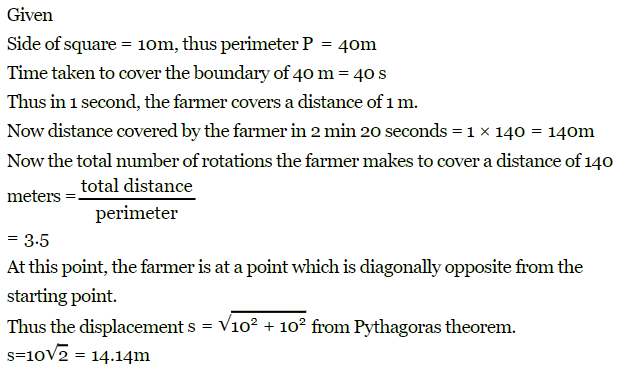
Q1: A person moves along the boundary of a square field of side 10 m in 20 s. What will be the magnitude of displacement of that person at the end of 2 minutes 20 seconds?
Ans:

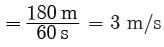
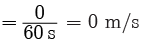
Q2:  Neha swims in a 90 m long pool. She covers 180 m in one minute by swimming from one end to the other and back along the same straight path. Find the average speed and average velocity of Neha.
Ans:

Total distance = 180 m
Total displacement = 0
Time taken t = 1 min = 60 s


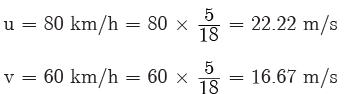
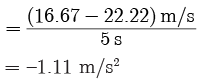
Q3: A car decreases its speed from 80 km/h to 60 km/h is 5 seconds. Find the acceleration of the car.
Ans:

Time (t) = 5 s
Acceleration (a) = 


Q4: A train starting from a railway station and moving with uniform acceleration, attains a speed 40 km/h in 10 minutes. Find its acceleration.
Ans: 
 
u = 0 (starting from rest)
v = 40 km/h= 11.11 m/s  
Time t = 10 minutes = 600 s
Acceleration (a) = 


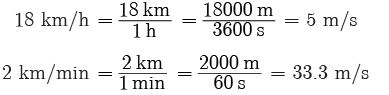
Q5: The average speed of a bicycle, an athlete and car are 18 km/h, 7 m/s and 2 km/min respectively. Which of the three is the fastest and which is the slowest
Ans:

Thus, the average speeds of the bicycle, the athlete and the car are 5 m/s, 7 m/s and 33.3 m/s respectively. So, the car is the fastest and the bicycle is the slowest.

Q6: Figure shows distance-time graph of two objects A and B, which object is moving with greater speed when both are moving?

Ans: The line for object B makes a longer angle with the time-axis. Its slope is longer than the slope of the line for object A. Thus, the speed of B is greater than that of A.

Q7: Figure represents the speed time graph for a particle. Find the distance covered by the particle between t = 10 min and t = 30 min.

Ans:
We draw perpendicular lines from the 10-minute point and the 30-minute point to the time-axis (fig.). The distance covered is equal to the area of the rectangle ABCD, its value is  
ABCD = (30 min – 10 min) x (10 km/h)
= 20 min × 10 km/h


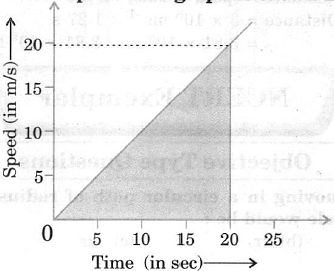
Q8: Find the distance covered by a particle during the time interval t = 0 to t = 20 s for which the speed time graph is shown in figure.
Ans:
The distance covered in the time interval 0 to 20 s is equal to the area of the shaded triangle. So,
Distance = 1/2 x Base x Height
= 1/2 x (20 s) x (20 m/s)
= 200 m.

Q9: A bus moves 30 km in 30 min and the next 30 km. in 40 min. Calculate the average speed for the entire journey.
Ans:
 Given, the total time taken is 30 min + 40 min = 70 min and the total distance travelled is 30 km + 30 km = 60 km
The average speed is

= 51.4 km/h

Q10: It is estimated that the radio signal takes 1.27 seconds to reach the Earth from the surface of the Moon. Calculate the distance of the Moon from the Earth. Speed of radio signal = 3 × 10⁸ ms–1 (speed of light in air).
Ans:

Here,
time = 1.27 s
Speed = 3 × 10⁸ ms–1  
Distance = ?  
Using distance = speed × time, we get
Distance = 3 × 10⁸ ms–1 × 1.27 s  
= 3.81 × 10⁸ m
= 3.81 × 10⁵ km

Q11: Divya walked 2 km on a straight road and then walked back 1 km. Which of the two quantities involved in her walking is greater- the scalar or vector?
Ans:

Distance travelled by Divya = 2 km + 1 km = 3 km
Displacement  = 2 km – 1 km = 1 km
Hence, distance which is a scalar quantity is greater than the displacement which is a vector quantity.

Q12: Two satellites A and B revolve around a planet C. The time taken by satellite B to go around the planet is twice the time taken by A. Which of the two satellites will have a greater magnitude of velocity?
Ans:
 
Satellite A will have greater magnitude of velocity since velocity is inversely proportional to time. 


Q13: A child moving on a circular track of radius 40 m completes one revolution in 5 minutes. What is his (i) average speed (ii) average velocity in one full revolution?
Ans:
 Distance travelled in one revolution,  
2p r =2p  × 40m
Displacement in one revolution = 0
Time taken = 5 minutes = 5 × 60s
(i) Average speed = Distance / Time = 

(ii) Average velocity =  Displacement / Time = Zero

06. Long Question Answer: Tissues

Q1: Explain the structure of a nervous tissue with details about its location and function.
Ans: 

Structure: Nervous tissue is composed of specialized cells called neurons, which consist of a cell body containing the nucleus and cytoplasm. Neurons have long, slender extensions known as axons, which transmit electrical signals, and shorter, branching extensions called dendrites, which receive signals from other neurons. These neurons are interconnected in complex networks.

Long Question Answer: Tissues

Location: Nervous tissue is primarily found in the brain, spinal cord, and nerves throughout the body.

Function: Nervous tissue plays a crucial role in transmitting and processing information within the body. It facilitates communication between different parts of the body, coordinates responses to stimuli, and regulates various bodily functions, including movement, sensation, and cognition.

Q2: Explain the structure of parenchyma. What are its major modifications?
Ans: 
Parenchyma: It is the basic or fundamental tissue found in plants. Cells of this tissue are thin walled, circular or polygonal. They are living with a nucleus and a vacuole. Intercellular spaces are present between the cells of this tissue. Two modifications of parenchyma are chlorenchyma and aerenchyma.

  • Chlorenchyma : Sometimes cells of the parenchyma contain chlorophyll and perform photosynthesis. This kind of parenchyma is known as chlorenchyma.
  • Aerenchyma : In aquatic plants, parenchyma contains big air spaces in between them. Such a parenchyma tissue is known as aerenchyma.


Q3: Explain plant tissue in detail.
Ans: 
Plant tissue is mainly divided into two categories :

  • Meristematic tissue
  • Permanent tissue 

Meristematic tissue: The cells divide very fast. It helps in the growth of the plants. The shape of the cell is oval, round and polygonal. There is no intercellular space. There are three types of meristematic tissues :
(i) Apical meristem : Growth in length
(ii) Lateral meristem : Growth in breadth or thickness
(iii) Intercalary meristem : Growth in inter-nodes
Permanent tissue: When meristematic tissue stops dividing and gets mature, then it forms permanent tissue. There are two types of permanent tissues :
(i) Simple t issue
(ii) Complex tissue
 
(i) Simple Tissue : Simple tissues are same in structure and perform the same functions. There are three types of simple tissues :
(a) Parenchyma : It is present in soft parts.
(b) Collenchyma : It provides mechanical strength to plants and is found in stalks. (c) Sclerenchyma : It provides support as well as flexibility to plants.
(ii) Complex Tissue : They are different in structure but perform the same function in group. There are two types of complex tissues :
(a) X ylem : It transports water from roots to shoot in plants.
(b) P hloem : Transports foods to all parts of the plant.

Q4: Explain connective tissue along with its types.
Ans: 
Connective tissue consists various types of cells which perform the same function. These are of three types :
(i) Proper connective tissue
(ii) Fluid tissue
(iii) Skeletal tissue 

  • Proper connective tissue : These are of four types– Areolar and ligament connective tissue : It is present between muscles and skin and in the bone marrow. It is also present around nerves and blood vessels. They fill the space inside the organ. They also provide strength to internal organs and helps in repair of tissues.
  • Adipose tissue: It is found below the skin and also between internal organs. It stores fat and due to this fat storage, it behaves as an insulator.
  • Tendon: It is fibrous, strong and flexible and joins muscles with bone.
  • Ligament: It is elastic and strong and joins bone with bone.
  • Fluid tissue consists of: Blood: It is a liquid tissue called plasma which has RBCs, WBCs, plasma and blood platelets. It helps to transport substances like gases, hormones, digested food and waste material.
  • Lymph: It transports digested fat and white blood cells in plasma.
  • Skeletal tissue is made up of : Bone : It is a hard tissue which helps in the movement and support of our body.
  • Cartilage: It softens the bone surface at joints. It is found in our ear, nose, trachea and larynx.


Q5: Explain epidermis in plants.
Ans:
 It forms the outermost layer of the plant. It is comprised of a single cell layer. This tissue forms a protective layer for plants and that helps to protect the internal parts of plants. It helps in protection against loss of water, attack by parasitic fungi and mechanical injury.
Epidermis has small pores known as stomata. They are small holes or pores on the surface of leaves which help in exchange of gases and also in transpiration. Epidermis has long parts like hair that provide greater surface area for water absorption in roots. In plants found in deserts, epidermis consists of a thick waxy coating called cutin which makes the outer layer water resistant.

Q6: Give the difference between the types of muscle fibres diagrammatically
Ans:
Long Question Answer: Tissues

Q7: Explain complex tissue in plants.
Ans: 
Generally, complex tissues consist of more than one type of cell. They are different in structure but together perform the same function.
There are two types of complex tissues : 

  • X ylem : It transports water from roots to shoot in plants. The movement is only in one direction that is, from roots to shoot. It provides mechanical support to the plant. It has mostly dead elements. Its elements are tracheids, xylem sclerenchyma, xylem parenchyma, vessel elements. 
  • P hloem : Conduct foods to all parts of the plant. The movement of phloem is bidirectional that is, movement in both the directions is possible. Its elements are mostly living. Its elements are sieve  tubes, phloem parenchyma, companion cells and intermediary cells.

Above given both complex tissues are conductive tissues and form the vascular bundle.

Q8: Explain the structure of three types of muscle fibres. Also write the locations where they are found in the body.
Ans: 
The followings are the three types of muscle cells : 

  • Unstriated muscles (also known as smooth, involuntary muscles) : This type of muscular tissue consists of spindle-shaped, long uninucleated cells. This type of muscles are present in alimentary canal, blood vessels, iris of eye, in ureters and bronchi of lungs, etc. 
  • Striated muscles (also known as voluntary muscles because oftheir function being in our control or will) : This type ofmuscular cells are long multinucleated and enclosed in a membrane called sarcolemma. Each fibre has several longitudinal filaments embedded in cytoplasm. These filaments give these muscles striated appearance. These muscles are attached to the skeleton; so they are called skeletal muscles. 
  • Cardiac muscles : These muscles are found in heart. They are not under the control of the will. They contract rhythmically and involuntarily throughout life without the sign of fatigue. Structurally they show the characters of both unstriated and striated muscles. They are made up of branched fibres. These fibres are uninucleated and show alternate light and dark bands (striation).


Q9: Draw a labelled diagram of section of a phloem.
Ans:
Long Question Answer: Tissues

Q10: What is the difference between meristematic cells and permanent cells?
Ans:

Difference between meristematic cells and permanent cells :
Meristematic cells:

  • They have dense cytoplasm and a large centrally placed nucleus.
  • These cells are capable of dividing to _produce new cells.

Permanent cells:

  • They have a large central vacuole and normal nucleus.
  • They attain permanent shape and are not capable of producing new cells.


Q11: How many types of meristems are present in plants, on the basis of position?
Ans:
 On the basis of location of meristem, it is classified into three types : 

  • A pical meristem is present at the tip of stem, roots and their branches. 
  • In tercalary meristem is found at the leaf base, above the nodes (i.e. at the base of internodes as in grasses) or below the nodes (i.e. at the uppermost region of internode as in mint). 
  • La teral meristem 
  • V ascular cambium and cork cambium are the examples of lateral meristem. 
  •  V ascular cambium is found in vascular bundles while cork cambium is found underneath the bark of trees. Both of these cause increase in girth of plants.


Q12: Differentiate between parenchyma and collenchyma.
Ans: 
Difference between parenchyma and collenchyma :
Long Question Answer: Tissues
Q13: Differentiate between collenchyma and sclerenchyma.
Ans: 
Difference between collenchyma and sclerenchyma :
Long Question Answer: Tissues

Q14: Describe the structure of phloem.
Ans: 
Phloem is a complex tissue responsible for transporting organic nutrients, primarily sugars, throughout the plant. It consists of several cell types, including:

  • Sieve tube elements: Elongated cells with perforated end walls called sieve plates, through which nutrients flow. These cells lack nuclei and are supported by companion cells.
  • Companion cells: Adjacent to sieve tube elements, companion cells are metabolically active and provide support and assistance in nutrient transport.
  • Phloem fibers: Long, slender cells that provide structural support to the phloem tissue.
  • Phloem parenchyma: Thin-walled cells that store reserves of organic compounds and provide structural support.

The interconnectedness of these cell types facilitates the efficient transport of nutrients, such as sugars produced during photosynthesis, from sources (such as leaves) to sinks (such as roots, fruits, and developing tissues) throughout the plant.


Q15: Differentiate between chlorenchyma and arenchyma.
Ans:
 Difference between chlorenchyma and arenchyma:
Long Question Answer: Tissues

Q16: What is xylem? Explain its structure. Which one of its component is very important and why?
Ans: 
Xylem is a complex plant tissue which transports water and dissolved minerals from roots to all other plant parts.

  • Structure: Xylem consists of four kinds of cells (also known as elements).
  • Tracheids: A tracheid is an elongated, hollow cell with its both ends tapering. The walls of these cells are thick by the deposition of lignin. At certain spots lignin is not present. These spots are termed as pits. The tracheids are dead cells.
  • Vessels: These are tube-like structures formed by a number of cells placed end to end with their transverse walls dissolved. The side walls of these tubes also have deposition of lignin. The thickening of the walls show various kinds of patterns. They are also dead cells.
  • Xylem Parenchyma: They are prenchymatous, thin walled, living cells. They help in lateral conduction of water and sap. They also store food.
  • Xylem Fibres: They are lignified dead fibres which provide mechanical support to plant.
  • The most important element of xylem is vessel because most of the water and minerals are carried upward through this component of xylem.


Q17: Differentiate between :
(i)
 Xylem and phloem
(ii) Vessel and sieve tube
(iii) Tracheid and vessel 

Ans: 
(i) Xylem and phloem

(ii) Vessel and sieve tube

(iii) Tracheids and vessel
Long Question Answer: Tissues


Q18: What are three main categories of connective tissue?
Ans:
 
Categories of connective tissue are :
Connective tissue proper: There is a matrix in which generally two types of (white and yellow) fibres are present. In between these fibres some connective tissue cells are present.
Example of this kind of connective tissues are aerolar tissue and adipose tissue.

Skeletal tissue: This type of tissues form the skeleton of an organism. It is of two types : Cartilage and bone. 

  • C artilage has solid matrix called chondrin, in which fibres and cells known as chondrocytes are present. Usually cells are present in clusters of 2-3 cells in small spaces called lacunae. Cartilage is found in the regions of pinna, nose, trachea and larynx.
  • In  bones, matrix is formed of a protein called ossein impregnated with phosphate and carbonates of calcium and magnesium.

Fluid tissue: Blood and lymph are examples of fluid connective tissues. These are specialized connective tissues. It consists of liquid matrix with no fibres. In liquid matrix called plasma corpuscles remain suspended. Blood transports food material, gases and other substances to the various parts of the body.

Q19: Explain the structure of a fluid connective tissue.
Ans:
 Blood is a fluid connective tissue. Blood consists of:
(i) Blood plasma,
(ii) Blood cells.

Blood plasma: It is the fluid matrix which contains 85 to 95% water, 7% different types of proteins, 0.9% of salts, about 0.1% glucose and a very small amount of hormones, wastes, etc. In the plasma, blood corpuscles (cells) are suspended. 

Blood cells: Three kinds of blood cells are found suspended in the blood plasma.  These are :
(i) Red blood corpuscles (Erythrocytes) or RBCs
(ii) White blood corpuscles (leucocytes) or WBCs and
(iii) Blood platelets.
Red blood corpuscles (Erythrocytes) or RBCs : The red blood corpuscles are biconcave, disc-like cells which are devoid of nucleus. They contain a substance called haemoglobin because of this they appear red in colour. The most important function of the RBCs is the transport of oxygen and carbon dioxide.
White blood corpuscles (Leucocytes) or WBCs : These cells are comparatively large in size, colourless and irregular in appearance. They are devoid of haemoglobin. They protect our body from diseases by destroying germs.
 Blood platelets : These are small, 2-4 m  in diameter. They are without nucleus. Their main function is to liberate some substances which helps in blood clotting.

Q20:Differentiate between bone and cartilage.
Ans:

Long Question Answer: TissuesQ21: Give one function of each of the following : (a) Stomata, (b) Root nodules, (c) Cardiac muscle fibres.
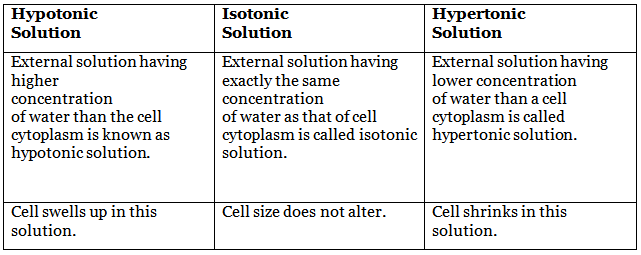
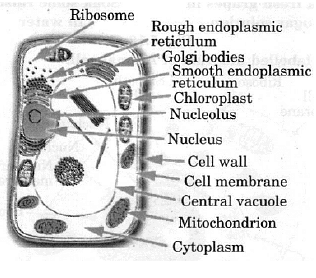
Ans: 
(a) Exchange of gases in plants.
(b) Root nodules are found in leguminous plants. They harbour bacteria which can fix free atmospheric nitrogen into nitrates and nitrites which plants like pulses can use for protein synthesis.
(c) Cardiac muscles show rhythmic contraction and relaxation throughout life. Because of this heart can pump the blood.

Q22: Describe the structure of cartilage and bone.
Ans: 
Cartilage: Cartilage is a flexible and resilient connective tissue found in various parts of the body, including the nose, ears, trachea, and joints. It consists of chondrocytes (cartilage cells) embedded in a matrix of collagen and elastic fibers. Chondrocytes reside within small spaces called lacunae and maintain the integrity of the cartilage matrix. Cartilage provides support and cushioning to joints and other structures, allowing for smooth movement and shock absorption.

Bone: Bone is a rigid connective tissue that forms the skeletal framework of the body. It consists of osteocytes (bone cells) embedded in a matrix of collagen fibers and mineral salts, primarily calcium phosphate. Osteocytes are housed within small cavities called lacunae and are interconnected by tiny channels called canaliculi. Bone tissue is highly vascularized, allowing for the exchange of nutrients and waste products. It provides structural support, protection of internal organs, and serves as a reservoir for minerals such as calcium and phosphorus.


Q23: What are the two main components of blood? Why is blood considered a type of connective tissue?
Ans:

  • Blood has two main components :
    (a) Fluid (liquid) matrix called plasma.
    (b) Suspended red blood cells (RBCs), white blood cells (WBCs) and platelets. 
  • Blood is considered as connective tissue because :
    (a) It has the same origin as the other connective tissues.
    (b) It flows to different parts of the body and thus connects different parts of the body with one another to exchange materials and gases.

05. Long Question Answer: Cell – The Fundamental Unit of Life

Q1: Give difference between hypotonic solution, isotonic solution and hypertonic solution.
Ans:


Q2: (a) Name the organelle which provides turgidity and rigidity to the plant cell. Name any two substances which are present in it. 
(b) How are they useful in unicellular organisms?

Ans: 
(a) Plant cells have big vacuoles that provide them turgidity and rigidity. Plant vacuoles store amino acids, sugars, various organic acids and some proteins.
(b) I n unicellular organism they can serve the following works : 

  • Forming food vacuoles : In single celled organisms like amoeba, the food vacuole contains the food items that the amoeba has engulfed. After that the food items are digested by the enzymes. 
  • Removal of excess water and wastes : In some unicellular organisms, vacuoles play important roles in egesting excess water and some wastes from the cell.


Q3: Write a note on the structure of cell.
Ans :
(a) 
Cell is the basic unit of all living organisms. It is surrounded by an outer selectively permeable Plasma Membrane. Plant cells have an additional covering called “cell wall” outer to the Plasma Membrane.
(b) Inside the plasma membrane there is a translucent viscous substance the cytoplasm in which the organelles are embedded. The control centre of the cell is the nucleus; it contains all the information necessary for the cell to function and to reproduce. Surrounding the nucleus is the endoplasmic reticulum (ER) on which ribosomes may be embedded. Ribosomes are granular structures which are the site of protein synthesis.
(c) The powerhouse of cell is the mitochondria. It helps in releasing energy by the oxidation of food in cell. There are flat membranous secretory structures in the cell called the Golgi bodies. In plant cells, an additional structure located near the nucleus called the chloroplast, is also present. They are the site of photosynthesis.
(d) Cells also contain lysosomes which are also called suicide bags. They digest and remove the unwanted debris of the cell. Centriole (present in animal cells) located near the nucleus helps in cell division. Cytoplasm also contains vacuoles filled with the cell sap. In plant cells, vacuole is large and centrally placed.

Q4: Give the difference between plant cell and animal cell.
Ans:

No.Plant CellAnimal Cell
1.Usually larger in size.Comparatively smaller in size.
2.Enclosed by a rigid cellulose cell wall in addition to plasma membrane.Enclosed by a plasma membrane only.
3.Has a fixed shape.Shape is usually variable.
4.Plastids present (chloroplasts in photosynthetic cells).Plastids absent.
5.A mature plant cell has a large central vacuole.Vacuoles are small, temporary or absent.
6.Nucleus usually lies at the periphery due to large vacuole.Nucleus usually lies in the centre.
7.Centrioles usually absent.Centrioles present.
8.Lysosomes rare.Lysosomes common.
9.Plasmodesmata present.Plasmodesmata absent.
10.Reserve food is starch.Reserve food is glycogen.
11.Can synthesize all amino acids, vitamins and coenzymes required.Cannot synthesize all amino acids, vitamins and coenzymes.
12.Does not burst in hypotonic solution due to rigid cell wall (becomes turgid).May burst in hypotonic solution due to absence of cell wall.


Q5: Draw a neat labelled diagram of plant cell.
Ans:

Plant cell

Q6: (i) Name the organelle which provides turgidity and rigidity to the plant cell. Name any two substances which are present in it. 
(ii) How are they useful in unicellular organisms?
Ans :
 
(i) Plant cells have big vacuoles full of cell sap that provide them turgidity and rigidity. Plant vacuoles store amino acids, sugars, various organic acids and some proteins.
(ii) I n unicellular organism they may serve the following purposes : 

  • Forming food vacuoles: In single celled organisms like amoeba, the food vacuole contains the food items that the amoeba has ingested. The food items are digested by the enzymes later on. 
  • Removal of excess water and wastes: In some unicellular organisms, specialized vacuoles play important roles in expelling excess water and some wastes from the cell.


Q7: Describe the role played by the lysosomes. Why are these termed as suicidal bags? How do they perform their functions?
Ans : 
Functions of lysosomes : 

  • Extracellular digestion. Sometimes lysosome enzymes are released outside the cell to break down extracellular material. 
  • Digestion of foreign material. Lysosome also destroys any foreign material which enters inside the cell such as bacteria. 
  • Cellular digestion. In damaged cells, ageing cells or dead cells lysosomes get ruptured and enzymes are released. These enzymes digest their own cell.

Lysosomes contain about 40 hydrolytic enzymes. When the cell gets damaged, lysosomes burst and their enzymes digest their own cell. So, lysosomes are called ‘suicide bags’.

Q8: Describe an activity to demonstrate endosmosis and exosmosis. Draw a diagram also.
Ans: 
1. Endosmosis : 
The movement of water in the cell or a body through a semipermeable membrane is called endosmosis. It can be demonstrated as follows :
(i) Take some raisins with stalks and put them in plain water in a beaker.
(ii) Observation : Raisins absorb water and swell. Raisins have high concentration of sugar than surrounding plain water. Because of this, water from the outside passing through semipermeable membrane enters into the cell. This is endosmosis.
2. Exosmosis : The movement of water out from a cell or a body through a semipermeable membrane is called exosmosis. This can be demonstrated as follows :
(i) We place the swollen raisins (from above activity) into a beaker containing a concentrated solution of sugar or salt.
(ii) Observation : When swollen raisins are placed in concentrated sugar or salt solution, they shrink because the solution surrounding the raisins is having low water concentration. Thus, raisins loose water by osmosis, this process is called exosmosis.

Q9: Draw a neat labelled diagram of Animal cell.
Ans:

Animal Cell

Q10: Explain the structure and function of Golgi bodies.
Ans:
 Golgi bodies consist of a system of membrane-bound vesicles arranged in stacks parallel to each other called cisterns. These membranes are connected with the membrane of endoplasmic reticulum (ER).
Golgi apparatus

Functions of Golgi apparatus : 
(i) 
Golgi apparatus packages and dispatches the material synthesized in the cell.
(ii) Golgi complex is also involved in the formation of lysosomes.
(iii) Golgi apparatus is also involved in the synthesis of many substances such as polysaccharides, glycoprotein, etc.

Q11: Give difference between plasma membrane and cell wall.
Ans:

FeaturePlasma MembraneCell Wall
CompositionMade up of lipids and proteinsMade up of cellulose (in plants)
NatureLivingDead / non-living
PresencePresent in both plant and animal cellsPresent in plant cells only (absent in animal cells)
PermeabilitySemi-permeableFreely permeable
Physical natureSoft and flexibleHard and rigid
FunctionRegulates entry and exit of substancesProvides shape, support, and protection


Q12: Explain the structure of nucleus. Give a neat labelled diagram of a nucleus of cell. Give brief information about nucleus.
Ans:
 Nucleus is the control centre of the cell. It is covered by a double layered envelope called nuclear membrane. The nuclear membrane has some pores which allow the transfer of material from inside the nucleus to cytoplasm. Inside the nuclear membrane some thread like structures are present. This is known as chromatin material.
Structure of a nucleus

The chromatin material mainly formed through DNA (deoxyribonucleic acid) and proteins. When a cell starts to divide, chromatin material condenses into rod-shaped structures called chromosomes. The chromosomes contain DNA which are called genes.
The nucleus is a large, centrally located spherical cellular component. It is bounded by two nuclear membranes, both forming a nuclear envelope. The nuclear envelope separates the nucleus from the cytoplasm. Within nucleoplasm two types of nuclear structures are embedded : the nucleolus and chromatin material. The nucleolus may be one or more in number and is not bounded by any membrane. It is rich in protein and RNA molecules and acts as the site for ribosome formation.
Nucleus

Q13: Explain the following terms : (a) Plasma membrane, (b) Cytoplasm, (c) Nucleus.
Ans:
 
(a) Plasma membrane: It is a thin membrane which controls the passage of materials in and out of the cell. It is also called selectively permeable membrane. It makes the outer boundary of the cell and is made up of lipids and proteins (phospholipid bilayer).
(b) Cytoplasm: It is transparent jelly-like thick substance present in the cell. It makes the ground of the cell in which all the cell organelles are suspended.
(c) Nucleus: It is a double-layered membrane structure which contains chromosomes required for the inheritance of characteristics from one generation to the other.

Q14: Give difference between diffusion and osmosis. Write any two examples where a living organism uses osmosis to absorb water.
Ans:


Example of Osmosis : 
(i) 
Plant roots absorb water.
(ii) Unicellular organisms such as amoeba absorb water from freshwater.

Q15: What would happen if when we put an animal cell into a solution of sugar or salt in water?
Ans: 
The following three things could happen : 

  • If the solution surrounding the cell is very dilute than cytoplasm, the water will move into the cell, i.e., the cell will gain water. 
  • I f the solution has exactly similar water concentration as that of cytoplasm of cell, there will be no net movement of water across the cell membrane, i.e., no gain or loss of water from the cell. 
  • If the medium (solution) has a lower concentration of water than the cell, i.e., the solution is concentrated, the cell will lose water by osmosis. How do all cells look alike in terms of shape and size?
    • Cells vary in shapes and sizes according to the fusion. Generally, cells are spherical but they may be long and branched as in nerve cell, Kidney shaped as guard cell in plant’s leaves, discoid as RBC, spindle shaped as muscle cell, etc. Size of cell varies from 0.2 mm to 18 cm in diameter. Some are microscopic while some are visible with naked eyes.
      For example : 
      (i) Size of a typical cell in a multicellular organism ranges from 20-30 mn.
      (ii) The largest cell is ostrich egg (15 cm in diameter with shell and 8 cm in diameter without shell).
      (iii) The longest cell is nerve cell (up to 1 m. or more) and red blood cells are the smallest cell in our body.
      (iv) Smallest cells so far known are PPLOs, e.g. mycoplasma (0.1 µm in diameter).
      (v) Human egg is 0.1 mm in diameter.


Q16: How do lysosomes perform their function?
Ans:

Functions of lysosomes: 
(i) Extracellular digestion: 
Sometimes lysosome enzymes are released outside the cell to break down extracellular material.
(ii) Destruction of foreign material: Lysosome also destroys any foreign material which enters inside the cell such as bacteria.
(iii) Cellular digestion : Enzymes are released in damaged cells, ageing cells or dead cells. These enzymes digest their own cell.

Lysosomes contain about 40 hydrolytic enzymes. Lysosomes burst and their enzymes digest their own cell when the cell gets damaged. So, lysosomes are called ‘suicide bags’.
Foreign materials entering the cell, such as bacteria or food, as well as dead old organelles in the lysosomes break up into small pieces.

Q17: What types of enzymes are present in the lysosomes? What is their function? Which organelle membranes manufacture these enzymes?
Ans: Lysosomes contain powerful digestive enzymes capable of breaking down all organic material.
Lysosomes help to keep the cell clean by digesting worn out cell organelles and foreign material such as bacteria or food.
RER (Rough Endoplasmic Reticulum) makes the digestive enzymes present in the lysosomes.

Q18: Give brief information about the mitochondria. Describe the structure of mitochondria.
Ans: 
The mitochondria are tiny bodies of varying shapes and size. Each mitochondria is bounded by a double membrane envelope. Outer membrane is porous. The inner membrane is thrown into folds. These folds are called cristae and are studded with small rounded bodies known as oxysomes. The interior cavity of the mitochondria is filled with a protein matrix which contains a few small-sized ribosomes, a circular DNA molecule and phosphate granules. Mitochondria are sites of cellular respiration.
Mitochondria are membrane bound cell organelle found in the cytoplasm. Each mitochondria is a double membrane bounded structure. The outer membrane of mitochondrion is smooth. But, the inner membrane of the mitochondrion is folded inwardly, into the matrix of mitochondrion forming finger like projections. The inward finger like projections of inner membrane is called cristae. Cristae greatly increase the surface area of inner membrane. Mitochondria contain extra nuclear DNA.
Mitochondria

04. Long Question Answer: Structure of the Atom

Q1: Number of electrons, protons and neutrons in chemical species A, B, C and D is given below:

Long Question Answer: Structure of the Atom

Now, answer the following questions :
(a) What is the mass number of A and B?
(b) What is the atomic number of B?
(c) Which two elements represent a pair of isotopes and why?
(d) What is the valency of element C?
Also, justify your answers.
Ans:

(a)  Mass number = Number of protons + Number of neutrons
Mass number of A = 3 + 4 = 7
Mass number of B = 9 + 8 = 17
(b)  Atomic Number = Number of protons; therefore, atomic number of B = 9.
(c) Elements C and D represent a pair of isotopes.
Explanation: Isotopes are atoms of the same element that have the same atomic number (same number of protons) but different mass numbers (different numbers of neutrons). Since C and D have the same number of protons but different numbers of neutrons, they are isotopes of each other.
(d) To find the valency of element C, look at its electronic configuration.
Given that C has 8 electrons, its configuration is 2, 6.
It needs 2 more electrons to complete its octet and attain a stable noble gas configuration. Therefore, its valency = 2.

Q2: Describe in brief Rutherford’s alpha-particle scattering experiment with the help of a labelled diagram. Write any three important conclusions drawn from the experiment. 
Ans: 
Rutherford’s alpha-particle scattering experiment:

Ernest Rutherford directed a beam of fast-moving alpha particles (positively charged) at a very thin gold foil and observed their scattering using a fluorescent screen. The alpha particles were produced by a radioactive source and the scattered particles produced tiny flashes of light on the screen, which were counted to record their paths.

Observations:

  • Most alpha particles passed straight through the foil without deflection.
  • Some alpha particles were deflected by small angles.
  • A very few alpha particles (about 1 in 12,000) were deflected back, i.e., scattered through large angles.

Conclusions drawn:

  • Most of the atom is empty space, because the majority of alpha particles passed through the foil without any deflection.
  • There is a small, dense, positively charged nucleus at the centre of the atom; this concentrated positive charge repelled and deflected the positively charged alpha particles, causing the observed deflections.
  • The size of the nucleus is very small compared to the overall size of the atom, since only a tiny fraction of alpha particles experienced large deflections.Scattering of alpha particles by a gold foilScattering of alpha particles by a gold foil
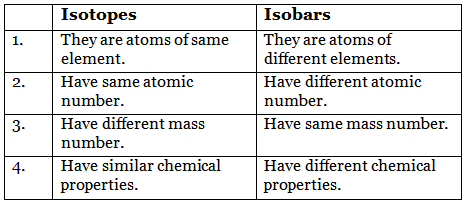

Q3: Give the number of electrons, protons and neutrons in 59CO27 and 108Ag47.
Ans :
 For 59Co27:
Atomic number = 27 → 27 protons

Number of electrons = 27 (since the atom is neutral)

Number of neutrons = Mass number − Atomic number = 59 − 27 = 32

For 108Ag47:

Atomic number = 47 → 47 protons

Number of electrons = 47 (neutral atom)

Number of neutrons = 108 − 47 = 61

Q4: Give the difference between isotopes and isobars.
Ans:

Long Question Answer: Structure of the Atom

Difference between isotopes and isobars:

  • Isotopes: Atoms of the same element that have the same atomic number (same number of protons) but different mass numbers (different numbers of neutrons). Example: 35Cl and 37Cl.
  • Isobars: Atoms of different elements that have the same mass number but different atomic numbers (different numbers of protons). Example: 40Ca (Z = 20) and 40Ar (Z = 18) are isobars because both have mass number 40.

Q5: Chlorine occurs in nature in two isotopic forms with masses 35u and 37u in the ratio of 3 : 1. What should be the mass of a chlorine atom?
Ans: 
The average atomic mass of chlorine is calculated using the masses of its isotopes and their relative abundances.

Average atomic mass = (fractional abundance × mass of isotope) summed over isotopes.

Long Question Answer: Structure of the Atom

Using the given ratio 3 : 1, the fractional abundances are 3/4 and 1/4, respectively.

Average mass = (3 × 35u + 1 × 37u) / 4 = 142 / 4 = 35.5 u.
Hence, the average atomic mass of chlorine is 35.5 u.

Q6: An element 12X24 loses two electrons to form a cation, which combines with the anion of element 17Y35 formed by gaining an electron. 
(i) Write the electronic configuration of element X. 
(ii) Write the electronic configuration of the anion of element Y. 
(iii) Write the formula for the compound formed by the combination of X and Y.

Ans: 
(i) Atomic number of X = 12 → electronic configuration = 2, 8, 2.
On losing 2 electrons, it forms X²⁺ whose configuration becomes 2, 8 (like a noble gas).

(ii) Atomic number of Y = 17 → electronic configuration = 2, 8, 7.
On gaining 1 electron, Y forms the anion Y⁻ with configuration 2, 8, 8 (stable octet).

(iii) To balance charges: one X²⁺ ion will combine with two Y⁻ ions.
X²⁺ + 2 Y⁻ → XY₂.
So, the formula of the compound is XY₂.

Q7: Give reasons : 
(i) The mass number of an atom excludes the mass of an electron. 
(ii) The nucleus of an atom is charged. 
(iii) Alpha-particle scattering experiment was possible by using a gold foil only and not by a foil of any other metal.
Ans:
 

(i) The mass of an electron is negligible compared to that of a proton or neutron (about 1/1836 of a proton). Therefore, the mass number, which counts the major contributors to atomic mass, includes only protons and neutrons and excludes electrons.

(ii) The nucleus contains protons, which are positively charged, while neutrons are neutral. As a result, the overall charge of the nucleus is positive.

(iii) Gold is highly malleable and can be hammered into extremely thin foils (a few atoms thick) without breaking. Such a thin foil was essential to allow alpha particles to pass through and to observe their scattering. This property made gold especially suitable for Rutherford’s experiment.

Q8: Give the postulates of Dalton’s atomic theory.
Ans: 
Dalton proposed an atomic theory in 1808 to explain the nature of matter. The main postulates of Dalton’s atomic theory are:

  1. All matter is composed of tiny indivisible particles called atoms.
  2. Atoms of a given element are identical in mass and properties.
  3. Atoms of different elements have different masses and properties.
  4. Atoms combine in simple whole-number ratios to form compounds.
  5. Atoms are indivisible and indestructible in chemical reactions (they are not created or destroyed in ordinary chemical changes).
  6. The relative number and kinds of atoms in a compound remain constant (fixed composition).

Note: Some parts of Dalton’s theory were later revised after the discovery of subatomic particles and isotopes, but his ideas laid the foundation of modern atomic theory.

Q9: Explain Bohr’s Model of the atom? 
Ans: Bohr’s model was proposed to address limitations of Rutherford’s model. Its key postulates are:

  1. Quantised orbits: Electrons move in certain fixed circular orbits or energy levels around the nucleus without radiating energy. These orbits are labelled K, L, M, N or by principal quantum number n = 1, 2, 3, 4,…
  2. No radiation in stationary orbits: While an electron remains in a permitted orbit, it does not emit energy.
  3. Energy emission or absorption: An electron can move from one allowed orbit to another by absorbing energy (moving to a higher orbit) or emitting energy (moving to a lower orbit). The energy absorbed or emitted equals the difference between the two energy levels and is given by E = hν, where ν is the frequency of radiation.
  4. Quantised energy levels explain spectral lines: Since only specific energy differences are possible, atoms emit or absorb radiation of specific frequencies, producing discrete spectral lines.

Bohr’s model thus introduced the idea of quantised energy levels, explaining atomic spectra and the stability of atoms in a simple, conceptual way appropriate at the class 9 level.

Long Question Answer: Structure of the Atom

Q10: How are electrons disturbed in different shells or orbits?

Ans: Electron distribution in different shells:

The distribution of electrons in orbits (or energy levels) is explained by the following rules:

  1. Maximum electrons in a shell: The maximum number of electrons that can be accommodated in the nth shell is given by 2n².
    • K-shell (n = 1): 2 × 1² = 2 electrons
    • L-shell (n = 2): 2 × 2² = 8 electrons
    • M-shell (n = 3): 2 × 3² = 18 electrons
    • N-shell (n = 4): 2 × 4² = 32 electrons
  2. Maximum electrons in outermost shell: The outermost shell of an atom can have a maximum of 8 electrons (for the common main-group elements) to attain a stable configuration.
  3. Filling order of shells: Electrons occupy the inner shells first; an outer shell is not filled unless all inner shells are complete. Thus electrons are filled in a step-wise manner starting from the innermost shell.

Example: For sodium (atomic number 11), the electron distribution is 2, 8, 1, showing inner shells filled first and one electron in the outermost shell.