03. Long Question Answer: Atoms and Molecules

Q1: Glucose has the molecular formula C6H12O6. Calculate :
(a) Its molecular mass. 
(b) The number of atoms in one molecule of glucose. 
(c) The number of gram molecules in 18 g of glucose.
Ans:
 The molecular mass of a compound is the sum of the atomic masses of all the atoms present in its molecular formula.
(a) Molecular mass of C6H12O6  
= (6 × 12u) + (12 × 1u) + (6 × 16u)  
= 72u + 12u + 96u = 180u
(b) The number of atoms in one molecule of C6H12O6  
= 6 atoms of C + 12 atoms of H   + 6 atoms of O  
= 6 + 12 + 6 = 24 atoms
(c) Number of gram molecules
= Mass of glucose (g) / Molecular mass of glucose (g)
= 18 g / 180 g/mol
= 0.1 mol

Q2: What is the use of the mole concept in chemistry?

Ans: The mole concept is extremely useful in chemistry for quantitative analysis:

  1. It allows chemists to count atoms, molecules, or ions using mass.
  2. One mole of any substance contains 6.022 × 10²³ particles (Avogadro’s number).
  3. One mole of any gas occupies 22.4 litres at standard temperature and pressure (STP).
  4. It helps in calculating reactants and products in chemical reactions through balanced equations.
  5. It is used to determine molar mass and establish relationships between mass, volume, and number of particles.

Q3: Give symbol and valency of: Potassium, Barium, Aluminium, Calcium, Cobalt, Fluorine, Lead, Zinc, Iodine, Sulphide.
Ans:
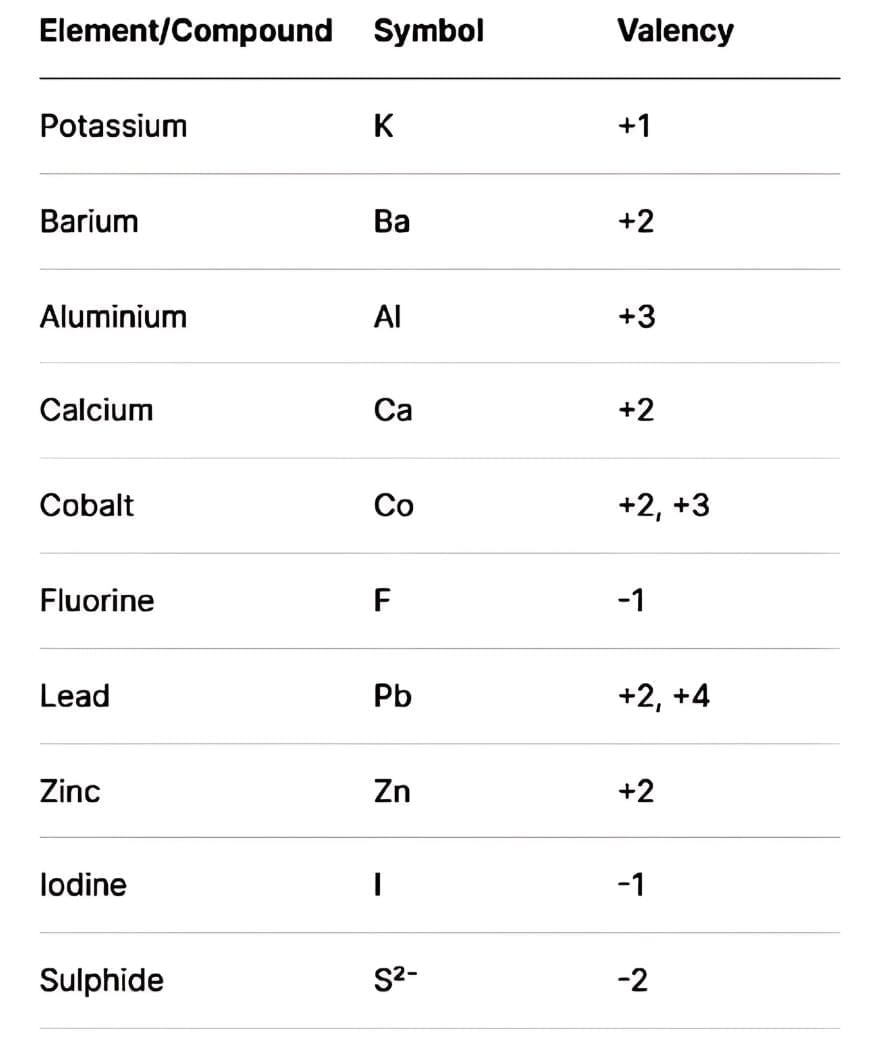
Long Question Answer: Atoms and Molecules

Q4: In a reaction, 6.83 g of lead chloride precipitated. The initial solution had 5 g each of lead nitrate and sodium chloride. What is the amount of sodium nitrate formed?

Ans: Initially, we have:

  • 50 g of 10% lead nitrate solution = 5 g Pb(NO3)2 + 45 g water
  • 50 g of 10% sodium chloride solution = 5 g NaCl + 45 g water Total mass before reaction = 5 g + 5 g + 90 g water = 100 g

After reaction, 6.83 g of lead chloride (PbCl2) precipitates out. Assuming no mass is lost, Total mass after = 100 g Remaining components (water and NaNO3) = 100 – 6.83 = 93.17 g

Water is 90 g, so: Mass of sodium nitrate formed = 93.17 – 90 = 3.17 g

Q5: Write a formula for the following : 
(a) Zinc sulphate, 
(b) Methane, 
(c) Ammonium carbonate.
Ans:

(a) Zinc sulphate Long Question Answer: Atoms and Molecules
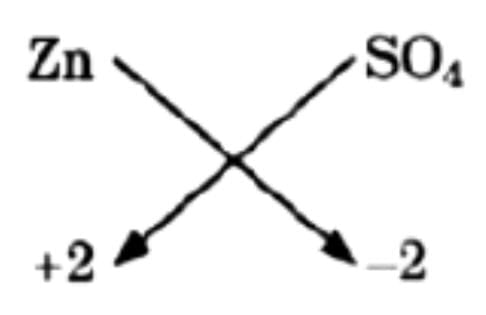
Thus, Zn2(SO4)2 and finally = ZnSO4

(b) Methane
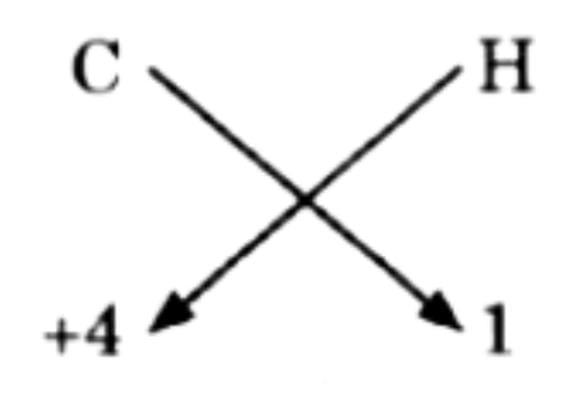
Long Question Answer: Atoms and Molecules

Thus, finally = CH4

(c) Ammonium carbonate
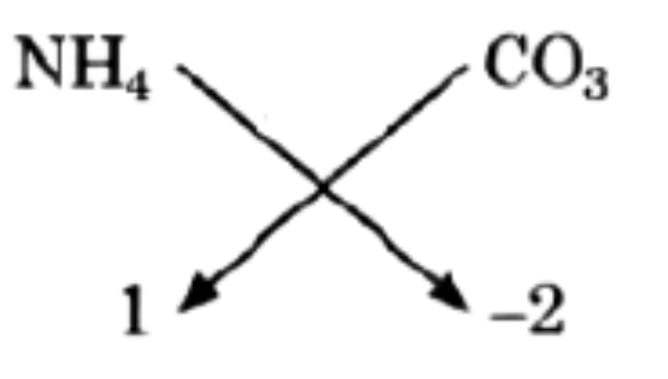
Long Question Answer: Atoms and MoleculesThus, finally = (NH4)2CO3

Q6: Explain the law of multiple proportions.
Ans:
 According to the law of multiple proportions, when two elements combine to make one or more compounds, then the ratio of weights of these elements remains in a fixed ratio to one another.

For example: Hydrogen and oxygen combine to form water (H2O) and hydrogen peroxide (H2O2) under different conditions. 2 grams of hydrogen combine with 16 grams of oxygen in the case of water, while 2 grams of hydrogen combine with 32 grams of oxygen to form hydrogen peroxide. Now, the weights of oxygen combine with a fixed weight of hydrogen in water and hydrogen peroxide, respectively ,are 16 and 32, which are in a simple ratio of 16: 32 or 1 : 2.

Q7: What are molecules? Give a brief explanation of the arrangement of the constituent atoms in the molecules.
Ans:
 A molecule is the smallest particle of an element or compound which is stable under normal conditions. And it can freely show all the properties of that element or compound. It may be made up of one, two or more atoms. A molecule with one atom is called a monoatomic molecule.
E.g. helium, neon, etc.

A molecule with two atoms is called a diatomic molecule. E.g. Cl2, O2.
Similarly, there are molecules containing three atoms (CO2), four atoms (P4) and so on.

Q8: The mass of one molecule of a substance is 4.65 × 10²³ grams. What is its molecular mass?
Ans:
 Mass of 1 molecule of a substance = 4.65 × 10²³ grams

Mass of 6.023 × 10²³ molecules of a substance  

= 4.65 × 1023 × 6.023 × 1023

= 28 g/mol

Molecular mass of the substance = 28 g/mol

Q9: An element 12X24 loses two electrons to form a cation, which combines with the anion of element 17Y35 formed by gaining an electron. 
(a) Write the electronic configuration of element X. 
(b) Write the electronic configuration of the anion of element Y. 
(c) Write the formula for the compound formed by the combination of X and Y.
Ans: 

(a) X = 2, 8, 2

(b) Y = 2, 8, 8

(c) XY2

Q10: Calculate the formula unit masses of ZnO, Na2O, K2CO3 given atomic masses of Zn = 65u, Na = 23u, K = 39u, C = 12u, and 0 = 16u.
Ans: 
Formula unit mass of ZnO = 1 × 65u + 1 × 16u = 81u  

Formula unit mass of Na2O = 2 × 23u + 1 × 16u = 62u  

Formula unit mass of K2CO3 = 2 × 39u + 1 × 12u + 3 × 16u = 138u

Q11: What is the mass of : 
(a) 1 mole of nitrogen atoms? 
(b) 4 moles of aluminium atoms (atomic mass of aluminium = 27)? 
(c) 10 moles of sodium sulphite (Na2SO3)?
Ans: 

(a) 1 mole of nitrogen atoms  

= 1 × gram atomic mass of nitrogen atom  

= 1 × 14 g = 14 g

(b) 4 moles of aluminium atoms   

= 4 × gram atomic mass of aluminium atoms  

= 4 × 27 g = 108 g

(c) 10 moles of sodium sulphite (Na2SO3)   

= 10 (2 × gram atomic mass of Na   + 1 × gram atomic mass of sulphur   + 3 × gram atomic mass of oxygen)  

= 10 (2 × 23 g + 1 × 32 g + 3 × 16g)  

= 10 (46 g + 32 g + 48 g)  

= 10 × 126 g = 1260 g

Q12: Give the postulates of Dalton’s atomic theory.
Ans:
 John Dalton proposed his atomic theory in 1808. It explains the nature of matter in terms of atoms. The main postulates of Dalton’s atomic theory are:

  1. All matter is made up of indivisible particles called atoms.
  2. Atoms of a given element are identical in mass and properties.
  3. Atoms of different elements have different masses and chemical properties.
  4. Atoms combine in simple whole-number ratios to form compounds.
  5. Atoms can neither be created nor destroyed in a chemical reaction.
  6. The relative number and types of atoms in a given compound remain constant.

These postulates laid the foundation for modern chemistry, although some parts were later modified with the discovery of subatomic particles.

Q13: (a) Give one point of difference between an atom and an ion. 
(b) Give one example each of a polyatomic cation and an anion. 
(c) Identify the correct chemical name of FeSO3: Ferrous sulphate, Ferrous sulphide, Ferrous sulphite.
(d) Write the chemical formula for the chloride of magnesium.

Ans: 

(a) An atom is a neutral particle containing equal numbers of protons and electrons. An ion is a charged particle formed when an atom loses or gains electrons. Positive ions are called cations, and negative ions are called anions.

(b) (i) Polyatomic cation: Ammonium ion, (NH4)+

 (ii) Polyatomic anion: Sulphate ion, (SO4)2–

(c) FeSO3 contains Fe²⁺ and SO3²⁻ (sulphite ion), so the correct name is Ferrous sulphite.

(d) Magnesium has a valency of 2, and chlorine has a valency of 1. Therefore, the formula is MgCl2 (Magnesium chloride).

Q14: When 3.0 g of magnesium is burnt in 2.00 g of oxygen, 5.00 g of magnesium oxide is produced. What mass of magnesium oxide will be formed when 3.00 g of magnesium is burnt in 5.00 g of oxygen? Which law of chemical combination will govern your answer? State the law.
Ans: 
According to the given reaction: 3.00 g magnesium + 2.00 g oxygen → 5.00 g magnesium oxide. This shows that 3 g of magnesium reacts completely with 2 g of oxygen.

Now, when 3.00 g magnesium is burnt in 5.00 g oxygen, only 2 g of oxygen will be used (as per the fixed ratio), and 3 g of oxygen will remain unused.

So, mass of magnesium oxide formed = 3 + 2 = 5.00 g

Law involved: This illustrates the Law of Definite Proportions, which states that a chemical compound always contains the same elements in the same fixed ratio by mass.

Long Question Answer: Atoms and Molecules

Q1: Glucose has the molecular formula C6H12O6. Calculate :
(a) Its molecular mass. 
(b) The number of atoms in one molecule of glucose. 
(c) The number of gram molecules in 18 g of glucose.
Ans:
 The molecular mass of a compound is the sum of the atomic masses of all the atoms present in its molecular formula.
(a) Molecular mass of C6H12O6  
= (6 × 12u) + (12 × 1u) + (6 × 16u)  
= 72u + 12u + 96u = 180u
(b) The number of atoms in one molecule of C6H12O6  
= 6 atoms of C + 12 atoms of H   + 6 atoms of O  
= 6 + 12 + 6 = 24 atoms
(c) Number of gram molecules
= Mass of glucose (g) / Molecular mass of glucose (g)
= 18 g / 180 g/mol
= 0.1 mol

Q2: What is the use of the mole concept in chemistry?

Ans: The mole concept is extremely useful in chemistry for quantitative analysis:

  1. It allows chemists to count atoms, molecules, or ions using mass.
  2. One mole of any substance contains 6.022 × 10²³ particles (Avogadro’s number).
  3. One mole of any gas occupies 22.4 litres at standard temperature and pressure (STP).
  4. It helps in calculating reactants and products in chemical reactions through balanced equations.
  5. It is used to determine molar mass and establish relationships between mass, volume, and number of particles.

Q3: Give symbol and valency of: Potassium, Barium, Aluminium, Calcium, Cobalt, Fluorine, Lead, Zinc, Iodine, Sulphide.
Ans:
Long Question Answer: Atoms and Molecules

Q4: In a reaction, 6.83 g of lead chloride precipitated. The initial solution had 5 g each of lead nitrate and sodium chloride. What is the amount of sodium nitrate formed?

Ans: Initially, we have:

  • 50 g of 10% lead nitrate solution = 5 g Pb(NO3)2 + 45 g water
  • 50 g of 10% sodium chloride solution = 5 g NaCl + 45 g water Total mass before reaction = 5 g + 5 g + 90 g water = 100 g

After reaction, 6.83 g of lead chloride (PbCl2) precipitates out. Assuming no mass is lost, Total mass after = 100 g Remaining components (water and NaNO3) = 100 – 6.83 = 93.17 g

Water is 90 g, so: Mass of sodium nitrate formed = 93.17 – 90 = 3.17 g

Q5: Write a formula for the following : 
(a) Zinc sulphate, 
(b) Methane, 
(c) Ammonium carbonate.
Ans:

(a) Zinc sulphate Long Question Answer: Atoms and Molecules

Thus, Zn2(SO4)2 and finally = ZnSO4

(b) Methane

Long Question Answer: Atoms and Molecules

Thus, finally = CH4

(c) Ammonium carbonate

Long Question Answer: Atoms and MoleculesThus, finally = (NH4)2CO3

Q6: Explain the law of multiple proportions.
Ans:
 According to the law of multiple proportions, when two elements combine to make one or more compounds, then the ratio of weights of these elements remains in a fixed ratio to one another.

For example: Hydrogen and oxygen combine to form water (H2O) and hydrogen peroxide (H2O2) under different conditions. 2 grams of hydrogen combine with 16 grams of oxygen in the case of water, while 2 grams of hydrogen combine with 32 grams of oxygen to form hydrogen peroxide. Now, the weights of oxygen combine with a fixed weight of hydrogen in water and hydrogen peroxide, respectively ,are 16 and 32, which are in a simple ratio of 16: 32 or 1 : 2.

Q7: What are molecules? Give a brief explanation of the arrangement of the constituent atoms in the molecules.
Ans:
 A molecule is the smallest particle of an element or compound which is stable under normal conditions. And it can freely show all the properties of that element or compound. It may be made up of one, two or more atoms. A molecule with one atom is called a monoatomic molecule.
E.g. helium, neon, etc.

A molecule with two atoms is called a diatomic molecule. E.g. Cl2, O2.
Similarly, there are molecules containing three atoms (CO2), four atoms (P4) and so on.

Q8: The mass of one molecule of a substance is 4.65 × 10²³ grams. What is its molecular mass?
Ans:
 Mass of 1 molecule of a substance = 4.65 × 10²³ grams

Mass of 6.023 × 10²³ molecules of a substance  

= 4.65 × 1023 × 6.023 × 1023

= 28 g/mol

Molecular mass of the substance = 28 g/mol

Q9: An element 12X24 loses two electrons to form a cation, which combines with the anion of element 17Y35 formed by gaining an electron. 
(a) Write the electronic configuration of element X. 
(b) Write the electronic configuration of the anion of element Y. 
(c) Write the formula for the compound formed by the combination of X and Y.
Ans: 

(a) X = 2, 8, 2

(b) Y = 2, 8, 8

(c) XY2

Q10: Calculate the formula unit masses of ZnO, Na2O, K2CO3 given atomic masses of Zn = 65u, Na = 23u, K = 39u, C = 12u, and 0 = 16u.
Ans: 
Formula unit mass of ZnO = 1 × 65u + 1 × 16u = 81u  

Formula unit mass of Na2O = 2 × 23u + 1 × 16u = 62u  

Formula unit mass of K2CO3 = 2 × 39u + 1 × 12u + 3 × 16u = 138u

Q11: What is the mass of : 
(a) 1 mole of nitrogen atoms? 
(b) 4 moles of aluminium atoms (atomic mass of aluminium = 27)? 
(c) 10 moles of sodium sulphite (Na2SO3)?
Ans: 

(a) 1 mole of nitrogen atoms  

= 1 × gram atomic mass of nitrogen atom  

= 1 × 14 g = 14 g

(b) 4 moles of aluminium atoms   

= 4 × gram atomic mass of aluminium atoms  

= 4 × 27 g = 108 g

(c) 10 moles of sodium sulphite (Na2SO3)   

= 10 (2 × gram atomic mass of Na   + 1 × gram atomic mass of sulphur   + 3 × gram atomic mass of oxygen)  

= 10 (2 × 23 g + 1 × 32 g + 3 × 16g)  

= 10 (46 g + 32 g + 48 g)  

= 10 × 126 g = 1260 g

Q12: Give the postulates of Dalton’s atomic theory.
Ans:
 John Dalton proposed his atomic theory in 1808. It explains the nature of matter in terms of atoms. The main postulates of Dalton’s atomic theory are:

  1. All matter is made up of indivisible particles called atoms.
  2. Atoms of a given element are identical in mass and properties.
  3. Atoms of different elements have different masses and chemical properties.
  4. Atoms combine in simple whole-number ratios to form compounds.
  5. Atoms can neither be created nor destroyed in a chemical reaction.
  6. The relative number and types of atoms in a given compound remain constant.

These postulates laid the foundation for modern chemistry, although some parts were later modified with the discovery of subatomic particles.

Q13: (a) Give one point of difference between an atom and an ion. 
(b) Give one example each of a polyatomic cation and an anion. 
(c) Identify the correct chemical name of FeSO3: Ferrous sulphate, Ferrous sulphide, Ferrous sulphite.
(d) Write the chemical formula for the chloride of magnesium.

Ans: 

(a) An atom is a neutral particle containing equal numbers of protons and electrons. An ion is a charged particle formed when an atom loses or gains electrons. Positive ions are called cations, and negative ions are called anions.

(b) (i) Polyatomic cation: Ammonium ion, (NH4)+

 (ii) Polyatomic anion: Sulphate ion, (SO4)2–

(c) FeSO3 contains Fe²⁺ and SO3²⁻ (sulphite ion), so the correct name is Ferrous sulphite.

(d) Magnesium has a valency of 2, and chlorine has a valency of 1. Therefore, the formula is MgCl2 (Magnesium chloride).

Q14: When 3.0 g of magnesium is burnt in 2.00 g of oxygen, 5.00 g of magnesium oxide is produced. What mass of magnesium oxide will be formed when 3.00 g of magnesium is burnt in 5.00 g of oxygen? Which law of chemical combination will govern your answer? State the law.
Ans: 
According to the given reaction: 3.00 g magnesium + 2.00 g oxygen → 5.00 g magnesium oxide. This shows that 3 g of magnesium reacts completely with 2 g of oxygen.

Now, when 3.00 g magnesium is burnt in 5.00 g oxygen, only 2 g of oxygen will be used (as per the fixed ratio), and 3 g of oxygen will remain unused.

So, mass of magnesium oxide formed = 3 + 2 = 5.00 g

Law involved: This illustrates the Law of Definite Proportions, which states that a chemical compound always contains the same elements in the same fixed ratio by mass.


Q15: (a) Calculate the number of molecules of SO2 present in 44 g of it.
(b) If one mole of oxygen atoms weighs 16 grams, find the mass of one atom of oxygen in grams.
Ans:
(a)
 Molecular mass of SO2 = Atomic mass of S    + 2 × Atomic mass of O
= 32 + 2 × 16
= 64u
Molar mass = 64 g
Number of molecules, N = Long Question Answer: Atoms and Molecules

= 44/64 x 6.022 x 1023
= 4.14 × 10²³ molecules
(b) One mole of oxygen contains 6.022 × 10²³ atoms of oxygen
Mass of one atom of oxygen = Long Question Answer: Atoms and Molecules
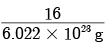
= 2.66 × 10⁻²³ g

Q16: Sodium is represented as 23Na11.
(a) What is its atomic mass?
(b) Write its gram atomic mass.
(c) How many atoms of Na will be there in 11.5 g of the sample?
Ans:

(a) Atomic mass = 23u
(b) Gram atomic mass = 23 g
(c) Given mass = 11.5 g  
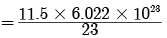
Molar mass = 23 g Number of atoms (N) = Long Question Answer: Atoms and Molecules

Long Question Answer: Atoms and Molecules
= 3.011 × 10²³ atomsLong Question Answer: Atoms and Molecules

Q1: Glucose has the molecular formula C6H12O6. Calculate :
(a) Its molecular mass. 
(b) The number of atoms in one molecule of glucose. 
(c) The number of gram molecules in 18 g of glucose.
Ans:
 The molecular mass of a compound is the sum of the atomic masses of all the atoms present in its molecular formula.
(a) Molecular mass of C6H12O6  
= (6 × 12u) + (12 × 1u) + (6 × 16u)  
= 72u + 12u + 96u = 180u
(b) The number of atoms in one molecule of C6H12O6  
= 6 atoms of C + 12 atoms of H   + 6 atoms of O  
= 6 + 12 + 6 = 24 atoms
(c) Number of gram molecules
= Mass of glucose (g) / Molecular mass of glucose (g)
= 18 g / 180 g/mol
= 0.1 mol

Q2: What is the use of the mole concept in chemistry?

Ans: The mole concept is extremely useful in chemistry for quantitative analysis:

  1. It allows chemists to count atoms, molecules, or ions using mass.
  2. One mole of any substance contains 6.022 × 10²³ particles (Avogadro’s number).
  3. One mole of any gas occupies 22.4 litres at standard temperature and pressure (STP).
  4. It helps in calculating reactants and products in chemical reactions through balanced equations.
  5. It is used to determine molar mass and establish relationships between mass, volume, and number of particles.

Q3: Give symbol and valency of: Potassium, Barium, Aluminium, Calcium, Cobalt, Fluorine, Lead, Zinc, Iodine, Sulphide.
Ans:
Long Question Answer: Atoms and Molecules

Q4: In a reaction, 6.83 g of lead chloride precipitated. The initial solution had 5 g each of lead nitrate and sodium chloride. What is the amount of sodium nitrate formed?

Ans: Initially, we have:

  • 50 g of 10% lead nitrate solution = 5 g Pb(NO3)2 + 45 g water
  • 50 g of 10% sodium chloride solution = 5 g NaCl + 45 g water Total mass before reaction = 5 g + 5 g + 90 g water = 100 g

After reaction, 6.83 g of lead chloride (PbCl2) precipitates out. Assuming no mass is lost, Total mass after = 100 g Remaining components (water and NaNO3) = 100 – 6.83 = 93.17 g

Water is 90 g, so: Mass of sodium nitrate formed = 93.17 – 90 = 3.17 g

Q5: Write a formula for the following : 
(a) Zinc sulphate, 
(b) Methane, 
(c) Ammonium carbonate.
Ans:

(a) Zinc sulphate Long Question Answer: Atoms and Molecules

Thus, Zn2(SO4)2 and finally = ZnSO4

(b) Methane

Long Question Answer: Atoms and Molecules

Thus, finally = CH4

(c) Ammonium carbonate

Long Question Answer: Atoms and MoleculesThus, finally = (NH4)2CO3

Q6: Explain the law of multiple proportions.
Ans:
 According to the law of multiple proportions, when two elements combine to make one or more compounds, then the ratio of weights of these elements remains in a fixed ratio to one another.

For example: Hydrogen and oxygen combine to form water (H2O) and hydrogen peroxide (H2O2) under different conditions. 2 grams of hydrogen combine with 16 grams of oxygen in the case of water, while 2 grams of hydrogen combine with 32 grams of oxygen to form hydrogen peroxide. Now, the weights of oxygen combine with a fixed weight of hydrogen in water and hydrogen peroxide, respectively ,are 16 and 32, which are in a simple ratio of 16: 32 or 1 : 2.

Q7: What are molecules? Give a brief explanation of the arrangement of the constituent atoms in the molecules.
Ans:
 A molecule is the smallest particle of an element or compound which is stable under normal conditions. And it can freely show all the properties of that element or compound. It may be made up of one, two or more atoms. A molecule with one atom is called a monoatomic molecule.
E.g. helium, neon, etc.

A molecule with two atoms is called a diatomic molecule. E.g. Cl2, O2.
Similarly, there are molecules containing three atoms (CO2), four atoms (P4) and so on.

Q8: The mass of one molecule of a substance is 4.65 × 10²³ grams. What is its molecular mass?
Ans:
 Mass of 1 molecule of a substance = 4.65 × 10²³ grams

Mass of 6.023 × 10²³ molecules of a substance  

= 4.65 × 1023 × 6.023 × 1023

= 28 g/mol

Molecular mass of the substance = 28 g/mol

Q9: An element 12X24 loses two electrons to form a cation, which combines with the anion of element 17Y35 formed by gaining an electron. 
(a) Write the electronic configuration of element X. 
(b) Write the electronic configuration of the anion of element Y. 
(c) Write the formula for the compound formed by the combination of X and Y.
Ans: 

(a) X = 2, 8, 2

(b) Y = 2, 8, 8

(c) XY2

Q10: Calculate the formula unit masses of ZnO, Na2O, K2CO3 given atomic masses of Zn = 65u, Na = 23u, K = 39u, C = 12u, and 0 = 16u.
Ans: 
Formula unit mass of ZnO = 1 × 65u + 1 × 16u = 81u  

Formula unit mass of Na2O = 2 × 23u + 1 × 16u = 62u  

Formula unit mass of K2CO3 = 2 × 39u + 1 × 12u + 3 × 16u = 138u

Q11: What is the mass of : 
(a) 1 mole of nitrogen atoms? 
(b) 4 moles of aluminium atoms (atomic mass of aluminium = 27)? 
(c) 10 moles of sodium sulphite (Na2SO3)?
Ans: 

(a) 1 mole of nitrogen atoms  

= 1 × gram atomic mass of nitrogen atom  

= 1 × 14 g = 14 g

(b) 4 moles of aluminium atoms   

= 4 × gram atomic mass of aluminium atoms  

= 4 × 27 g = 108 g

(c) 10 moles of sodium sulphite (Na2SO3)   

= 10 (2 × gram atomic mass of Na   + 1 × gram atomic mass of sulphur   + 3 × gram atomic mass of oxygen)  

= 10 (2 × 23 g + 1 × 32 g + 3 × 16g)  

= 10 (46 g + 32 g + 48 g)  

= 10 × 126 g = 1260 g

Q12: Give the postulates of Dalton’s atomic theory.
Ans:
 John Dalton proposed his atomic theory in 1808. It explains the nature of matter in terms of atoms. The main postulates of Dalton’s atomic theory are:

  1. All matter is made up of indivisible particles called atoms.
  2. Atoms of a given element are identical in mass and properties.
  3. Atoms of different elements have different masses and chemical properties.
  4. Atoms combine in simple whole-number ratios to form compounds.
  5. Atoms can neither be created nor destroyed in a chemical reaction.
  6. The relative number and types of atoms in a given compound remain constant.

These postulates laid the foundation for modern chemistry, although some parts were later modified with the discovery of subatomic particles.

Q13: (a) Give one point of difference between an atom and an ion. 
(b) Give one example each of a polyatomic cation and an anion. 
(c) Identify the correct chemical name of FeSO3: Ferrous sulphate, Ferrous sulphide, Ferrous sulphite.
(d) Write the chemical formula for the chloride of magnesium.

Ans: 

(a) An atom is a neutral particle containing equal numbers of protons and electrons. An ion is a charged particle formed when an atom loses or gains electrons. Positive ions are called cations, and negative ions are called anions.

(b) (i) Polyatomic cation: Ammonium ion, (NH4)+

 (ii) Polyatomic anion: Sulphate ion, (SO4)2–

(c) FeSO3 contains Fe²⁺ and SO3²⁻ (sulphite ion), so the correct name is Ferrous sulphite.

(d) Magnesium has a valency of 2, and chlorine has a valency of 1. Therefore, the formula is MgCl2 (Magnesium chloride).

Q14: When 3.0 g of magnesium is burnt in 2.00 g of oxygen, 5.00 g of magnesium oxide is produced. What mass of magnesium oxide will be formed when 3.00 g of magnesium is burnt in 5.00 g of oxygen? Which law of chemical combination will govern your answer? State the law.
Ans: 
According to the given reaction: 3.00 g magnesium + 2.00 g oxygen → 5.00 g magnesium oxide. This shows that 3 g of magnesium reacts completely with 2 g of oxygen.

Now, when 3.00 g magnesium is burnt in 5.00 g oxygen, only 2 g of oxygen will be used (as per the fixed ratio), and 3 g of oxygen will remain unused.

So, mass of magnesium oxide formed = 3 + 2 = 5.00 g

Law involved: This illustrates the Law of Definite Proportions, which states that a chemical compound always contains the same elements in the same fixed ratio by mass.


Q15: (a) Calculate the number of molecules of SO2 present in 44 g of it.
(b) If one mole of oxygen atoms weighs 16 grams, find the mass of one atom of oxygen in grams.
Ans:
(a)
 Molecular mass of SO2 = Atomic mass of S    + 2 × Atomic mass of O
= 32 + 2 × 16
= 64u
Molar mass = 64 g
Number of molecules, N = Long Question Answer: Atoms and Molecules
= 44/64 x 6.022 x 1023
= 4.14 × 10²³ molecules
(b) One mole of oxygen contains 6.022 × 10²³ atoms of oxygen
Mass of one atom of oxygen = Long Question Answer: Atoms and Molecules
= 2.66 × 10⁻²³ g

Q16: Sodium is represented as 23Na11.
(a) What is its atomic mass?
(b) Write its gram atomic mass.
(c) How many atoms of Na will be there in 11.5 g of the sample?
Ans:

(a) Atomic mass = 23u
(b) Gram atomic mass = 23 g
(c) Given mass = 11.5 g  
Molar mass = 23 g Number of atoms (N) = Long Question Answer: Atoms and Molecules
Long Question Answer: Atoms and Molecules
= 3.011 × 10²³ atoms
Q15: (a) Calculate the number of molecules of SO2 present in 44 g of it.
(b) If one mole of oxygen atoms weighs 16 grams, find the mass of one atom of oxygen in grams.
Ans:
(a)
 Molecular mass of SO2 = Atomic mass of S    + 2 × Atomic mass of O
= 32 + 2 × 16
= 64u
Molar mass = 64 g
Number of molecules, N = Long Question Answer: Atoms and Molecules
= 44/64 x 6.022 x 1023
= 4.14 × 10²³ molecules
(b) One mole of oxygen contains 6.022 × 10²³ atoms of oxygen
Mass of one atom of oxygen = Long Question Answer: Atoms and Molecules
= 2.66 × 10⁻²³ g

Q16: Sodium is represented as 23Na11.
(a) What is its atomic mass?
(b) Write its gram atomic mass.
(c) How many atoms of Na will be there in 11.5 g of the sample?
Ans:

(a) Atomic mass = 23u
(b) Gram atomic mass = 23 g
(c) Given mass = 11.5 g  
Molar mass = 23 g Number of atoms (N) = Long Question Answer: Atoms and Molecules
Long Question Answer: Atoms and Molecules
= 3.011 × 10²³ atoms

02. Long Answer Type Questions: Is Matter Around Us Pure

Long Answer Type Questions

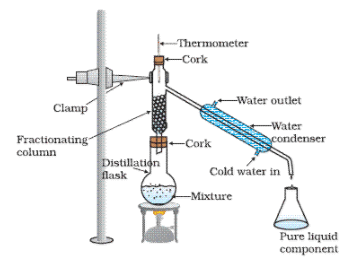
Q1. Fractional distillation is suitable for separation of miscible liquids with a boiling point difference of about 25 K or less. What part of fractional distillation apparatus makes it efficient and possess an advantage over a simple distillation process. Explain using a diagram.
Answer:

Long Answer Type Questions

The apparatus used for fractional distillation includes a fractionating column. This column is designed to enhance the separation of liquids with similar boiling points. Here’s how it works:

  • The fractionating column contains glass beads that increase the surface area.
  • As vapours rise, they encounter these beads, allowing them to cool and condense more effectively.
  • This process occurs in multiple cycles, improving the separation of components.

In contrast, a simple distillation lacks this feature, making it less efficient for separating miscible liquids with small boiling point differences.

Q2. (a) Under which category of mixtures will you classify alloys and why? 
Answer: When constituent particles of a combination of two or more element or compound retains their properties, then it is called mixture. In an alloy the constituent particles, hence alloys are classified as mixture. For example; steel is an alloy of carbon and iron.

(b) A solution is always a liquid. Comment.
Answer: Since, a solution is the homogeneous mixture of two or more substances, thus it is not necessary that a solution would always a liquid.A solution can be in all the three states of matter. A solution is a homogeneous mixture and can be in all the three states of matter.

Example:

Solution of alcohol in water is a liquid.
Air is a solution of different gas.
Alloy is a solution which is in the form of solid.

(c) Can a solution be heterogeneous?
Answer: Solution is defined as the homogeneous mixture, hence a solution cannot be heterogeneous. But when a mixture becomes heterogeneous, it cannot be fall under the definition of solution.


Q3. Iron filings and sulphur were mixed together and divided into two parts, ‘A’ and ‘B’. Part ‘A’ was heated strongly while Part ‘B’ was not heated. Dilute hydrochloric acid was added to both the Parts and evolution of gas was seen in both the cases. How will you identify the gases evolved?
Answer: When iron filings and sulphur are mixed, Part B (unheated) reacts with dilute hydrochloric acid to produce hydrogen gas (Fe + 2HCl → FeCl+ H2), while Part A (heated to form iron sulphide, FeS) reacts to produce hydrogen sulphide gas (FeS + 2HCl → FeCl2 + H2S). The gases can be identified by simple tests: hydrogen from Part B gives a pop sound with a burning splinter, whereas hydrogen sulphide from Part A turns moist lead acetate paper black. This confirms that heating transforms the mixture into a compound, changing the nature of the gas evolved.


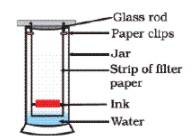
Q4. A child wanted to separate the mixture of dyes constituting a sample of in 36. A child wanted to separate the mixture of dyes constituting a sample of ink. He marked a line by the ink on the filter paper and placed the filter paper in a glass containing water as shown in Fig. The filter paper was removed when the water moved near the top of the filter paper. 

Long Answer Type Questions

(i) What would you expect to see, if the ink contains three different coloured components?  

Answer: Streaks of different colours can be seen on the filter paper.

(ii) Name the technique used by the child.  
Answer: Chromatography

(iii) Suggest one more application of this technique.
Answer: Chromatography is used for separating pigments from colours, for the separation drugs from blood sample, etc.


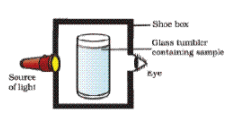
Q5. A group of students took an old shoe box and covered it with a black paper from all sides. They fixed a source of light (a torch) at one end of the box by making a hole in it and made another hole on the other side to view the lig37. A group of students took an old shoe box and covered it with a black paper from all sides. They fixed a source of light (a torch) at one end of the box by making a hole in it and made another hole on the other side to view the light. They placed a milk sample contained in a beaker/tumbler in the box as shown in the Fig. They were amazed to see that milk taken in the tumbler was Fig.illuminated. They tried the same activity by taking a salt solution but found that light simply passed through it?

Long Answer Type Questions

(a) Explain why the milk sample was illuminated. Name the phenomenon involved.  
Answer: Since, milk is a colloid and when light scattered from the particles of colloids, it is illuminated, thus light was illuminated when passed through the milk. This is known as Tyndall Effect.

(b) Same results were not observed with a salt solution. Explain.  
Answer: For scattering of light the size of particles should be large enough. Since the particles of solution are not enough to scattered the beam of light, hence same result were not observed.

(c) Can you suggest two more solutions which would show the same effect as shown by the milk solution?  
Answer: Soap bubbles and fog are the colloids, hence same effect, i.e. scattering of light is shown by these. This is known as Tyndall effect.


Q6. Classify each of the following, as a physical or a chemical change. Give reasons. 
(a) Drying of a shirt in the sun.
 
Answer: Drying of shirt in the sun is a Physical change. Since in this change no new substance is formed.

(b) Rising of hot air over a radiator.
Answer: Since, in rising of hot air over a radiator no new substance is formed, hence it is a Physical change.

(c) Burning of kerosene in a lantern. 
Answer: While burning of kerosene in a lantern carbon dioxide, and water vapour is formed, hence it is a Chemical change.

(d) Change in the colour of black tea on adding lemon juice to it. 
Answer: In this change a new substance is formed, hence it is a Chemical change.

(e) Churning of milk cream to get butter. 
Answer: While churning of milk cream to get butter, no new substance is formed, hence it is a Physical change.


Q7. During an experiment the students were asked to prepare a 10% (Mass/Mass) solution of sugar in water. Ramesh dissolved 10g of sugar in 100g of water while Sarika prepared it by dissolving 10g of sugar in water to make 100g of the solution.

(a) Are the two solutions of the same concentration 
Answer: No, the two solutions have different concentrations.

(b) Compare the mass % of the two solutions.  
Answer: We know;

Long Answer Type Questions

For first solution:

Mass of solute = 10 gram

Mass of solution = 100 gram + 10 gram = 110 gram

Hence;

Mass % of solution = 10/110 x 100 = 9.09 %

For second solution:

Mass of solute = 10 gram

Mass of solution = 100 gram

Hence;
Long Answer Type Questions

Mass percent of first solution: Mass percent of second solution = 9.09 : 10


Q8. You are provided with a mixture containing sand, iron filings, ammonium chloride and sodium chloride. Describe the procedures you would use to separate these constituents from the mixture? 
Answer: 

The given mixture can be separated using the following methods:

  • Magnetic Separation: Use a magnet to attract the iron filings from the mixture. The iron filings will stick to the magnet, allowing for easy separation.
  • Sublimation: After removing the iron filings, heat the remaining mixture. Ammonium chloride will sublimate, turning into vapour without becoming liquid. This vapour will condense on the inner wall of a funnel, leaving sodium chloride and sand behind.
  • Filtration: Mix the remaining sand and sodium chloride with water. Stir the mixture; the sodium chloride will dissolve. Use filter paper to separate the undissolved sand from the solution.
  • Vapourisation: Heat the solution obtained from filtration to evaporate the water. This will leave behind sodium chloride crystals.

In summary, the components of the mixture—sandiron filingsammonium chloride, and sodium chloride—can be effectively separated using magnetic separation, sublimation, filtration, and vapourisation.


Q9. Arun has prepared 0.01% (by mass) solution of sodium chloride in water. Which of the following correctly represents the composition of the solutions?

(a) 1.00 g of NaCl + 100g of water
(b) 0.11g of NaCl + 100g of water
(c) 0.01 g of NaCl + 99.99g of water
(d) 0.10 g of NaCl + 99.90g of water

Answer: (c) 0.01 g of NaCl + 99.99 g of water
The correct composition for a 0.01% (by mass) NaCl solution is 0.01 g of NaCl in 99.99 g of water. The other options either miscalculate the mass of NaCl or the water, making them incorrect.


Q10. Calculate the mass of sodium sulphate required to prepare its 20% (mass percent) solution in 100g of water?
Answer: In a 20% solution containing 100 g water; the mass percentage of water = 100 – 20 = 80%

∴ 80% of solution is 100 gm

∴ 100% of solution is 100/80 gm
Long Answer Type Questions

Hence; to prepare 20% (w/w) solution in 100 gram of water 25 gram of sodium sulphate is needed.

01. Long Question Answer: Matter in Our Surroundings

Q1: Discuss the factors which affect evaporation. 
Ans: Evaporation is the process by which liquid changes into vapour at temperatures below its boiling point. Several factors influence the rate of evaporation. These include:

1. Surface Area:
The rate of evaporation increases with the increase in surface area. This is because more molecules are exposed to the surface and can escape into the atmosphere. For example, wet clothes dry faster when spread out.

2. Temperature:
When the temperature rises, the kinetic energy of the particles increases. This allows more molecules to overcome the force of attraction and escape from the liquid surface as vapour.

3. Wind Speed:
A higher wind speed removes the evaporated particles from the surface quickly, allowing more particles to escape. This increases the rate of evaporation.

4. Humidity:
Humidity refers to the amount of water vapour present in the air. If the air is already humid, it cannot take in more vapour, so the rate of evaporation decreases.

Thus, evaporation is faster when the surface area and temperature are high, the wind is strong, and the humidity is low.Long Question Answer: Matter in Our Surroundings


Q2: Explain the interconversion of three states in terms of force of attraction and kinetic energy of the molecules.
Ans: 
Matter exists in three main states—solid, liquid, and gas. These states can change into one another by varying temperature and pressure. These changes are based on two key properties of particles:

  • Intermolecular Force of Attraction
  • Kinetic Energy

1. Solids:
In solids, the particles are tightly packed due to strong forces of attraction. The kinetic energy is very low, so particles only vibrate at fixed positions.

2. Liquids:
When a solid is heated, its particles gain energy and vibrate more vigorously. At a certain temperature (melting point), the force of attraction is weakened, and the solid becomes a liquid. Particles in liquids have more kinetic energy and can slide past each other.

3. Gases:
Further heating of the liquid increases kinetic energy so much that the particles overcome almost all the attraction and move freely. The liquid changes into gas (boiling point). Gases have the weakest forces of attraction and the highest kinetic energy.

Hence, increasing temperature or decreasing pressure leads to a change of state by altering the kinetic energy and intermolecular attraction among particles.Interconversion of three statesInterconversion of three states

Changes in temperature or pressure can cause these states to convert into one another:

  • Sublimation: Solid to gas without becoming liquid.
  • Deposition: Gas to solid without becoming liquid.
  • Boiling: Liquid to gas throughout the liquid.
  • Evaporation: Liquid to gas from the surface.

Q3: How is the high compressibility property of gas useful to us? 
Ans: 
Gases have a unique property called compressibility, which means they can be compressed easily because the particles are far apart. This property is extremely useful in our daily life and in industrial applications.

Uses of Compressibility:

  • LPG (Liquefied Petroleum Gas):
    LPG is a fuel made by compressing petroleum gas into a liquid and storing it in cylinders. When the pressure is released during use, it returns to gaseous form and is used for cooking.
  • Oxygen Cylinders:
    Oxygen used in hospitals is stored in compressed form in metal cylinders. This allows a large quantity of oxygen to be carried in a small container.
  • CNG (Compressed Natural Gas):
    CNG is methane gas compressed into high-pressure containers. It is used as a fuel for vehicles because it is cleaner and occupies less space in compressed form.

Thus, the compressibility of gases makes it possible to store and transport them efficiently for domestic, medical, and industrial use.


Q4: Pressure and temperature determine the state of a substance. Explain this in detail.
Ans: 
The state of any matter (solid, liquid, or gas) depends on its temperature and the pressure applied to it. Both of these factors affect the particle movement and the intermolecular forces of attraction.

Effect of Temperature:

  • When the temperature increases, particles gain kinetic energy and start moving faster.
  • For example, if ice (solid) is heated, it melts into water (liquid). On further heating, the water boils and becomes steam (gas).Long Question Answer: Matter in Our Surroundings
  • Similarly, cooling removes energy. Steam condenses into water, and upon further cooling, it forms ice.

Effect of Pressure:

  • An increase in pressure brings particles closer, which strengthens intermolecular forces and may change a gas into a liquid or a liquid into a solid
Long Question Answer: Matter in Our Surroundings
  • For instance, carbon dioxide gas changes into dry ice (solid) when high pressure is applied and the temperature is lowered.
  • In LPG cylinders, the gas is compressed under pressure to store it in liquid form. When the gas is used, the pressure is released and it becomes gaseous.

Both temperature and pressure play important roles in changing the state of a substance by affecting molecular motion and spacing between particles.

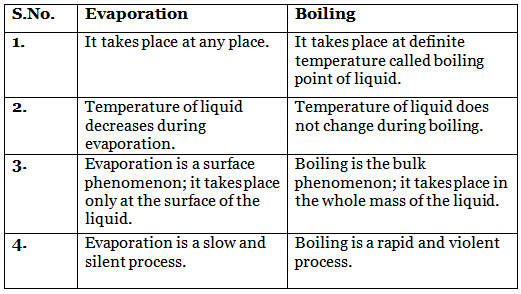
Q5: Give the difference between Evaporation and Boiling.
Ans:
Long Question Answer: Matter in Our Surroundings
Q6: The melting point of ice is 273.15 K. What does this mean? Explain in detail.
Ans:
 The melting point of a solid is the temperature at which it changes into a liquid at normal atmospheric pressure. For ice, this melting point is 273.15 K (0°C).

Explanation:

  • At 273.15 K, ice starts to melt into water.
  • The temperature remains constant during this process, even though heat is continuously supplied.
  • The heat energy is used to overcome the strong intermolecular forces holding the solid particles together.
  • This energy is called the latent heat of fusion.
  • Once all the ice melts, the temperature of the resulting liquid water starts to rise if more heat is supplied.

The melting point of ice signifies the temperature at which it turns into liquid water without any change in temperature, by absorbing latent heat.


Q7: With the help of an example, explain how the diffusion of gases in water is essential.
Ans: Diffusion is the process by which particles move from an area of higher concentration to an area of lower concentration. Gases from the atmosphere, such as oxygen and carbon dioxide, diffuse into water, and this diffusion is vital for aquatic life.

Importance of Diffusion in Water:

  • Oxygen from the air dissolves in water through diffusion. Aquatic animals like fish absorb this oxygen through their gills for respiration.
  • Carbon Dioxide also diffuses into water and is used by aquatic plants during photosynthesis to make food.

Example:
Fish survive in water because they take in the dissolved oxygen, which has diffused from the air into the water. Similarly, underwater plants use dissolved carbon dioxide. Thus, the diffusion of gases like oxygen and carbon dioxide in water is crucial for the survival of aquatic organisms.

12. Short Question Answer: Improvement in Food Resources

Q1: How do biotic and abiotic factors affect crop production?
Ans: 
Living organisms such as honey bees and earthworms aid improve crop output, whereas pests (insects and rodents) and bacteria have a negative impact on crop production.
Climate conditions and nonliving natural resources such as soil, water, and air are examples of abiotic factors.They also have an impact on crop productivity, as favourable temperature, humidity, and mineral nutrition boost crop yield.

Q2: What are the desirable agronomic characteristics for crop improvements?
Ans: 
The following are desired agronomic traits for crop improvement:
(i)For cereal crops, dwarfness is a beneficial trait since it allows the plants to use fewer nutrients.
(ii)Tallness and profuse branching are ideal traits for fodder crops so that we can get more leaves to feed our animals.

Q3: What are macronutrients and why are they called macronutrients?
Ans:
 There are sixteen nutrients that are required for plant growth. Six of these thirteen nutrients are considered macronutrients since they are required in high amounts.
Nitrogen, phosphorus, potassium, calcium, magnesium, and sulphur are all macronutrients.

Q4: How do plants get nutrients?
Ans: 
Plants get their nutrients from the air, water, and soil. Nutrients supplied as a source of Carbon in the air, oxygen in the air Hydrogen and oxygen are found in water.
Soil nitrogen, phosphorus, potassium, calcium, magnesium, sulphur, iron, manganese, boron, zinc, copper, molybdenum, chlorine, zinc, manganese,

Q5: Why should preventive measures and biological control methods be preferred for protecting crops?
Ans:
 It is likewise true for plants that prevention is preferable to treatment. Herbicides, weedicides, insecticides, pesticides, fungicides, and other chemicals are sprayed on the crop.
Because their excessive usage can injure crop plants and pollute the environment, careful seed bed preparation, timely crop sowing, intercropping, and crop rotation are also recommended.

Q6: Which method is commonly used for improving cattle breeds and why?
Ans: 
Cross-breeding is a typical technique for developing cow breeds.
For instance, in dairy animals Exotic or foreign breeds (such as Jersey and Brown Swiss) are bred for lengthy lactation durations, whilst native breeds (such as RedSindhi and Sahiwal) are bred for disease resistance. The two can be crossed to produce animals with both desirable traits.

Q7: Discuss the implications of the following statement:
“It is interesting to note that poultry is India’s most efficient converter of low fibre food stuff (which is unfit for human consumption) into highly nutritious animal protein food.”
Ans:
 Under poultry the birds kept are fed on agricultural waste material and broken grains etc which are not useful for humans but those birds consuming such waste provide us with eggs and meat. It is a highly nutritious animal protein food hence the statement made is quite appropriate.

Q8: What management practices are common in dairy and poultry farming?
Ans:
 Food requirements Proper cleaning and shelter facilities Protection from unfavourable climatic conditions and diseases are frequent management strategies in dairy and poultry farms. Protection against pests

Q9: How are fish obtained?
Ans: 
Fishes can be obtained in two ways.
(a) Capture fishing: 
This is a method of collecting fish from natural sources (rivers, lakes, oceans).
(b) Cultural fishery: This is also known as fish farming and involves the rearing and breeding of selected fish.

Q10: What are the advantages of composite fish culture?
Ans: 
The following are some of the benefits of composite fish culture:

  • In such systems, both indigenous and imported fish species can be utilised.
  • Food accessible in all regions of the water reservoir is exploited due to the non-competitive nature of selected species.
  • Increases the amount of fish in the water reservoir (intensive fish farming).

Q11: What are the desirable characters of bee varieties suitable for honey production?
Ans:
 Characteristics of bee types appropriate for honey production include:

  • Honey harvesting capacity is high. They have to be less stingy.
  • They should stay in a beehive for a long time and breed prolifically.


Q12: What is pasturage and how is it related to honey production?
Ans:
 Pasturage refers to the blooms that bees can collect nectar and pollen from. The pasturage determines the value or quality of honey. In addition, the type of flowers present will influence the honey’s flavour.

Q13: For increasing production, what is common in poultry, fisheries and bee-keeping?
Ans: 
The following are steps that are commonly used in poultry, fisheries, and beekeeping to increase production:

  • The best types and breeds are used. Food is supplied that is both nutritional and tasty.
  • Cleanliness and hygienic conditions are maintained.

Q14:  What are the benefits of cattle farming?
Ans: 
Cattle farming provides two advantages:
(i)Draught animals for farm labour (males), i.e. tilling, irrigation, and carting.
(ii)Milch animals (dairy animals) are females who produce milk.

Q15: How do storage grain losses occur?
Ans:
 Storage grain losses are caused by a variety of biotic and abiotic factors: biotic factors include insects, rodents, bacteria, fungi, and other organisms that feed on grains. Unfavorable humidity and temperature conditions are abiotic variables.

Q16: Why are manure and fertilizers used in fields?
Ans:
 Manure contributes to soil fertility by supplementing it with nutrients and organic materials. The majority of organic matter in manure aids in soil structure improvement.
Fertilizers are used to promote healthy vegetative growth (leaves, branches, and flowers) by supplying specific nutrients such as nitrogen, phosphorus, and potassium.

Q17: Define 
(a) Pisciculture
 
Ans: Pisciculture is the large-scale rearing and management of fish.
(b) hatcheries 
Ans:
 Hatcheries are nurseries where fish eggs or fish seed are placed in freshwater fisheries.
(c) swarming
Ans:
 Swarming is the process by which the new queen leaves the old hives and seeks out a new home for reproduction.

Q18:  What is green manuring? Give examples of green manures.
Ans:
 Green manure is made from herbaceous plants that are cultivated, ploughed beneath, and mixed with the soil while they are still green. Green manuring is the process of ploughing green plants and combining them with the soil.
Sun hemp, cluster bean (guar), lentil (Masur), and cowpea are some of the plants utilised as green manure (Lobia).

Q19: Discuss the preventive measures for the storage of grains.
Ans:
 The preventive measures for the storage of grains are:
(a) Drying – For grain storage, the moisture content of the grains should be decreased to less than 14 percent. This can be accomplished by drying in the sun and then drying in the shade.
(b) Hygiene should be maintained –Godowns and stores should be cleaned regularly.
Remove any dirt, trash, webs, or debris from the previously kept grains. Waterproofing and sealing cracks and gaps in the walls, floor, and ceiling are essential. For storing food grains, new gunny bags should be used. The mouth of the gunny bag should be tightly sewn once it has been filled.

Q20: Name three basic scientific approaches for increasing yield of a crop.
Ans: 
Three scientific approaches for increasing yields of a crop are –
(i) Crop production management, which involves correct irrigation and fertiliser management, is one of three scientific methodologies for enhancing crop yields. Manure and fertilisers can be used to accomplish this. Crop rotation, intercropping, and mixed-cropping can all help with nutrient management. Plants require protection from weeds, insects, pests, and pathogens.
(ii) Crop protection management It can be accomplished through biological, chemical, or cultural methods.
(iii) Crop variety management: Crop variety can be enhanced by hybridization or transgenic techniques. It is possible to do so in order to get desired plant traits

Q21: What are the advantages of bee-keeping?
Ans: 
The following are some of the benefits of beekeeping:
(a)It takes minimal investment and offers the farmer additional income.
(b)In addition to honey, beekeeping produces wax, royal jelly, and bee venom, among other things.
(c) Cross pollination is aided by bees.

Q22: Differentiate between capture fishing, aquaculture and mariculture.
Ans: 
(a) Capture fishing –Capture fishing is the process of obtaining fish from bodies of water such as rivers, seas, and oceans:
(b) Aquaculture – Aquaculture is the cultivation of aquatic creatures in fresh or saltwater.
(c) Mariculture – Mariculture is the cultivation of marine fish.


Q23: List the steps to be taken to prevent and control diseases in animals.
Ans:
 The following steps should be followed to control diseases:

  • Providing adequate shelter.
  • Maintaining animal hygiene and disposing of dead animals and animal wastes properly.
  • Disease screening of animals on a regular basis, with unhealthy animals being isolated immediately.
  • Following the advice of a veterinary practitioner, providing a proper diet and appropriate medications.
  • Handling of all animal products and by-products in a sanitary manner.


Q24: What are the components of cattle feed?
Ans:
 Roughage and concentrates are present in cattle feed in the form of hay and grain, as well as a large amount of water.

  • Roughage — Roughage is made up of coarse and fibrous components with poor nutrient content; animals acquire roughage from hay (cereal straw) and grain, respectively, as well as a lot of water.
  • Cotton seeds, oilseeds, oilcakes, and cereal grains like gramme and bajra are high in one or more nutrients (such as carbohydrates, lipids, proteins, minerals, and vitamins) and low in fibres. Cattle are fed green fodder in the winter, primarily Berseem and Lucerne, and maize, bajra, jowar, and dry fodder in the other seasons.


Q25: Define the following 
(i) White revolution 
Ans:
 The term “white revolution” refers to the increased production of milk. It required the utilisation of upgraded high-milk-yielding mulch animal crossbreeds.
(ii) silver revolution 
Ans:
 The term “silver revolution” refers to a massive increase in egg output.
(iii) blue revolution.
Ans: 
The term “blue revolution” refers to an increase in fish production.

Q26: What is green manuring? Give an example of green manures.
Ans: 
Green manure is made from herbaceous plants that have been cultivated, ploughed under, and mixed with the soil while they are still green. Green manuring is the term for this process.
Sun hemp, cluster bean (guar), lentil (maser), and cowpea are some of the plants utilised as green manure (Berseem)

Q27: What are the main practices involved in keeping animals or animal husbandry?
Ans: Animal husbandry day involves the following main practises.

  • Breeding – This is done to get animals with specific traits. Animals with high milk yields and meat yields can be developed through breeding.
  • Feeding – This is the study of the right food (called feed), as well as the mode and timing of feeding of various animals.
  • Weeding –This is the process of eliminating animals that are not economically viable.


Q28: Name the abiotic and biotic factors which affect stored grains and how?
Ans:
 Insects, birds, rodents, mites, fungi, and bacteria are examples of biotic forces.
(a) Moisture, temperature and the storage container’s material are all abiotic variables. As a result of the aforementioned conditions, cereal grains become infested with insects and microorganisms.
(b) Quality deterioration
(c) Weight reduction.
(b) Poor grain germination potential
(e) Produce discoloration

Q29: What is the need for crop improvement? What are the desirable agronomic characteristics for crop improvement?
Ans: 
Crop enhancement entails creating superior plants with the following characteristics:

  • High-yielding
  • Varieties with higher-quality produce.
  • Disease-resistant cultivars
  • Plants have beneficial agronomic traits, such as
    • Dwarfness is required in cereals, which consumes less nutrients.
    • Plants for fodder crops that are tall and have a lot of branching.

Q30: Define 
(i) Draught breeds
Ans:
 Draught cattle, sometimes known as bullocks, are cattle that are employed for labour.
(ii) Dual purpose breeds
Ans: 
Dual-purpose breeds are those that have females for milk and men for work.
(iii) Dairy breeds
Ans:
 Dairy animals are breeds that are solely used for milk production.


Q31: What are the symptoms of diseased animals?
Ans:

  • The animal stops eating and becomes lethargic, looks exhausted, and remains isolated as a result of the condition.
  • The animal shivers as its body temperature rises.
  • The animal produces an excessive amount of saliva, which hangs from its mouth at times.
  • The animal excretes a mixture of loose dung and colourful urine.
  • The animal’s mouth and ears droop.


Q32: What do we get from cereals, pulses, fruits and vegetables?
Ans:
 Cereals provide carbohydrates, pulses provide proteins, while fruits and vegetables provide vitamins and minerals.

Q33: What factors may be responsible for losses of grains during storage?
Ans:
 Both biotic and abiotic factors may be responsible for losses of grains during storage are :

  • Humidity and temperature of the environment and moisture content of grains are the abiotic factors.
  • Biotic factors include organisms such as rodents, bacteria, fungi, and some insects that feed on grains.


Q34: What are weeds? Give two examples.
Ans:
 Weeds are undesired plants that grow in fields. Common weeds include Amaranthus and Chenopodium.

Q35: What is crop rotation?
Ans: 
Crop rotation is the technique of alternately cultivating various crops in the same land in a pre-planned succession.

Q36: What are drones?
Ans:
 Drones are airborne devices that are used in agriculture to improve crop output and to track crop growth.
They assist farmers in developing agricultural field systems for using water, fertilisers, herbicides, and seeds. These tools have revolutionised agriculture by allowing farmers to save significant amounts of money while also increasing efficiency and profitability.

Q37: What is pasturage and how is it important?
Ans:
 Crop rotation is the practice of farming a variety of crops in a pre-determined order on the same piece of land.

Q38: What is a layer and a broiler? What are the differences between the two?
Ans: 
The egg-laying poultry bird is known as an egg layer, whereas the meat-producing poultry bird is known as a chicken or broiler.
Housing (shelter), food, and environmental requirements differ from layer requirements. Broiler feed is protein- and vitamin-rich, with an acceptable fat content.

Q39: What are the characteristic features of ideal shelters for cattle?
Ans: 
The following are characteristics of a shelter:

  • The animals are protected from rain, heat, and cold by a suitably roofed shed.
  • The shed’s floor is slanted to make cleaning easier and to keep their sitting area dry.
  • A plan for safe drinking water is put in place.
  • Excreta disposal is properly arranged in the sheds.


Q40: What are the hazards of using fertilizers?
Ans:
 Effects of fertiliser application –
(a) Impact on soil quality – fertiliser application leads to a loss of organic matter and a deterioration of soil structure.
(b) Eutrophication – Excessive fertiliser application causes nitrate buildup in the soil.
Rain washes nitrates and phosphates into lakes, ponds, and rivers, where they encourage algae to develop excessively.

11. Short Question Answer: Sound

Q1: Explain how sound is produced by your school bell.
Ans: 
The sound of the bell depends upon the vibration of the bell when it is rung. When the bell starts ringing, it drives the molecules around the air to vibrate. This produces the wave. So the compression is produced, however, the rarefaction makes the sound echo through the air.
Since, the vibrating molecules put pressure on one another, in turn, air particles are disturbed and start moving forward and backward.  

Q2: Why are sound waves called mechanical waves?
Ans: 
Mechanical Waves are waves that generate through a medium (solid, liquid, or gas) at a wave speed. A sound wave is an example of a mechanical wave. Sound waves cannot travel through a vacuum, It requires some medium to propagate, which could be air, water, or metal similar to mechanical waves. That’s why; a sound wave is called a mechanical wave.

Q3: Suppose you and your friend are on the moon. Will you be able to hear any sound produced by your friend?
Ans:
 A sound wave needs a medium to propagate. Be it a solid, gas, or liquid medium. The moon resides in a vacuum; since it has no air that defines it has no medium to generate the sound waves. So, it is not feasible to hear any sound on the moon.

Q4: Which wave property determines
(a) Loudness,
Ans:
 The loudness of the sound is a decibel unit (dB). Loudness is defined as the intensity of the wave or the molecule. The determination of the loudness depends on the magnitude of the wave. Precisely, the amplitude of the wave determines the loudness of sound.
(b) Pitch
Ans: Pitch is defined as the response of the sound by ear which goes hand in hand. Higher the pitch, the higher the frequency. So, the pitch of the sound is dependent on the frequency of the sound.

Q5: How are the wavelength and frequency of a sound wave related to its speed?
Ans:
 Longer the wavelength, the longer will be the frequency waves. In the context of speed, it is dependent upon the medium through which the sound wave is traveling. The more inflexible, inelastic the medium, the faster will the movement of sound.
The equation forms as VW = fλ, where VW is the speed of sound, f is its frequency, and λ is its wavelength.

Q6: Calculate the wavelength of a sound wave whose frequency is 220 Hz and speed is 440 m/s in a given medium.
Ans: 
The wave with the greatest frequency has the shortest wavelength.
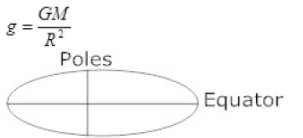
We have to calculate the wavelength of the sound with the frequency of 220 Hz and the speed will be 440m/s.
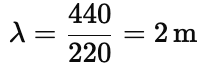
Short Question Answer: SoundGiven:  v=440 m/s , f = 220Hz
Short Question Answer: Sound

The wavelength is 2m.

Q7: A person is listening to a tone of 500 Hz sitting at a distance of 450 m from the source of the sound. What is the time interval between successive compressions from the source?
Ans:
 The time interval between successive compressions from the source

T = 1/v = 1/500 = 0.002 second.

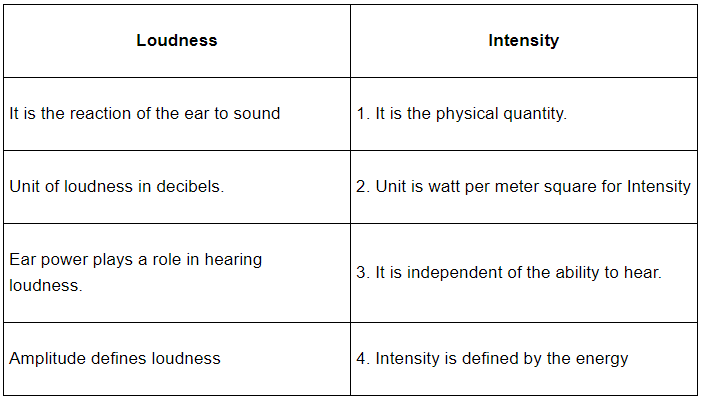
Q8: Distinguish between loudness and intensity of sound.
Ans:
 Differences between loudness and intensity of sound are:

Short Question Answer: Sound

Q9: An echo returned in 3 s. What is the distance of the reflecting surface from the source, given that the speed of sound is 342 m/s?
Ans:

Speed of sound = distance/time

Therefore, distance travelled by sound during echo = speed × time = 342 × 3 = 1026 m

 so the distance of reflecting surface = 1026/2 = 513 m

Q10: Why are the ceilings of concert halls curved?
Ans: 
The curved architecture of any structure helps the sound to reach every end. Concert halls are very big, so the sound might not reach every corner of the hall. This is achieved when the sound generates the reflection technique to reach every corner.

Q11: What is the range of frequencies associated with
(a) Infrasound?
Ans:
 Infrasound is used for the sound below 20 Hz. Sound at 20-200 Hz is called low-frequency sound. The range of frequency is less than 20 Hz.

(b) Ultrasound?
Ans: 
Ultrasound adds biologically significant sounds ranging from 15 kHz or so up to 200 kHz, which is too high in frequency. So the range for Ultrasound = greater than 20 KHz

Q12: A submarine emits a sonar pulse, which returns from an underwater cliff in 1.02 s. If the speed of sound in saltwater is1531 m/s, how far away is the cliff?
Ans: 
Distance travelled by a sonar pulse = speed of sound in saltwater × time = 1531×1.02 = 1561.62 m

Therefore, the distance of cliff from submarine =1561.62/2 = 780.81 m

Q13: What is sound and how is it produced?
Ans:
 Sound is the type of energy that is defined by vibrations between any state of medium (Gas, Solid, Liquid). Vibration is the movement of air particles. The oscillation of a molecule propagates the sound.

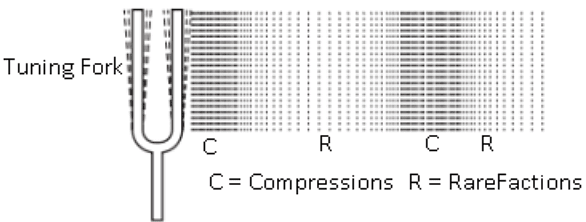
Q14: Describe with the help of a diagram, how compressions and rarefactions are produced in the air near a source of the sound.
Ans: 
Compression and rarefaction are produced because of the movement in the medium caused by sound waves.Short Question Answer: Sound

Q15: Why is a sound wave called a longitudinal wave?

Ans: The movement of the particle is called vibration. A medium can be anything – a liquid (such as water), a solid (such as the seafloor), or a gas (such as air). A sound wave is called a compressional or longitudinal wave when it vibrates parallel to the direction in which the sound wave moves.

Q16: Flash and thunder are produced simultaneously. But thunder is heard a few seconds after the flash is seen. Why?
Ans:
 There are many times we have observed that the thunder is heard a few seconds later after the flash

This happens because the speed of light in the atmosphere for air is

3 × 10⁸ m/s2 which are very high, to that of sound which is only 330 m/s.

This is the reason; the sound of thunder reaches us later than the flash.

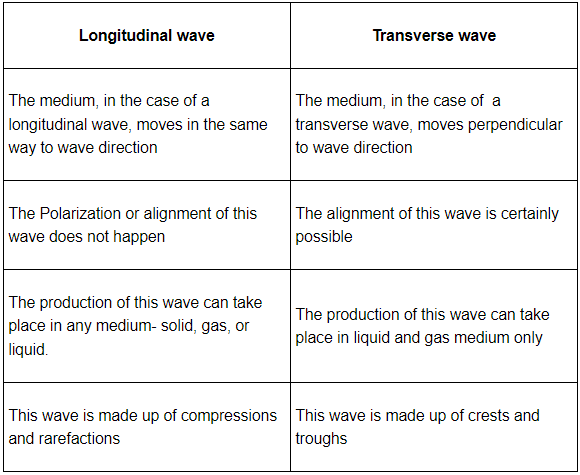
Q17: Differentiate between longitudinal and transverse waves?
Ans:
 The difference between longitudinal and transverse waves are as follows

Short Question Answer: Sound

Q18: Define the terms:
Ans:
 

(a) Wavelength: It is the distance between two successive crests or troughs of a wave. The direction will be the same as the wave

(b) Frequency: It is defined as the number of waves that pass a fixed place in a given amount of time. The Hertz measurement, abbreviated Hz, is the number of waves that pass by per second.

Q19: What is an echo? Name two areas of its application

Ans: Echo is a sound repetition by sound wave reflection, having a lasting or far-reaching impact.

Application of echo: In the medical field, echo uses sound waves to create pictures of the heart’s chambers, valves, walls, and the blood vessels (aorta, arteries, and veins) attached to the heart for testing purposes. Also, it is used in SONAR and detecting flaws in metal objects.

Q20: Why are sound waves called mechanical waves?
Ans:
 Sound needs a medium to propagate, as it does not generate in a vacuum. So, all sound waves are examples of mechanical waves. Sound waves are called mechanical waves as it is a wave that is an oscillation of matter.

Q21: Define (a) Time Period (b) Amplitude of a wave
Ans:
 

(a) Time period is defined as the time taken by a complete cycle of the wave to pass a particular area.

The formula for time is: T (period) = 1 / f (frequency).

λ = c / f = wave speed i.e.  c (m/s) / frequency f (Hz).

(b) Amplitude of a wave is the maximum amount of displacement of a particle on the medium from its static position. Amplitude measures how far a wave rises and dips.

Q22: What do you understand by the loud and soft sound?

Ans:  Sound is a type of vibrating pressure that is transmitted in waves.

  • Loud sound: Higher the sound, the higher will be the amplitude referred to as loud sound.
  • Soft sound: lower the sound, less will be the amplitude that defines the soft sound.


Q23: What do you understand by low-pitched and high-pitched sound?
Ans:
 Low pitched sound: It refers to the low sound that defines slower oscillation. A sound that is low-pitched is deep.
High pitched sound: The vibration is that of a pure tone with a frequency equal to 3000 Hz, which is considered a high-pitched sound as it completes a large number of vibrations in a given time.

Q24: Why do we see light first and hear the sound later during a thunderstorm?
Ans: There are many times we have observed that the thunder is heard a few seconds later after the flash. This happens because the speed of light in the atmosphere for air is  3× 10⁸ ms⁻² which is very high, to that of sound which is only 330 ms⁻¹.  This is the reason; the sound of thunder reaches us later than the flash.

Q25:  Why are the ceilings of concert halls curved?
Ans: The curved architecture of any structure helps the sound to reach every end. Concert halls are very big, so the sound might not reach every corner of the hall.  This is achieved when the sound generates the reflection technique to reach every corner.

Q26: How does the sound produced by a vibrating object in a medium reach your ear?
Ans: Sound waves enter the outer ear and travel through a narrow passageway called the ear canal, which leads to the eardrum. When the sound waves fall on the eardrum, the eardrum starts vibrating back and forth rapidly.
The sound produced by a vibrating object reaches our ear through sound waves which travel in the medium as a series of compressions and rarefactions. The process is repeated further and as result sound waves propagate in the form of compressions and rarefactions to the listener’s ear.

Q27: What are the wavelength, frequency, time period, and amplitude of a sound wave?
Ans:
 The wavelength of a sound wave is defined as the distance between the identical parts of the wave also called crests and troughs.
The wavelength of the sound wave is calculated as:
Wavelength = velocity of sound / frequency

  • Frequency is defined as the number of vibrations or oscillations per second i.e. it is the number of complete waves or cycles produced in one second. It refers to how rapidly or slowly the oscillations occur.
  • The time period is the time taken to complete one vibration/oscillation/complete wave is called the time period. It is measured in seconds.
  • Amplitude is the utmost rearrangement of the particles of the medium from their actual static position.


Q28: Cite an experiment to show that sound needs a material medium for its propagation.
Ans: The Bell-jar experiment shows that sound needs a medium for its propagation. An electric bell and an airtight glass bell jar are required. 

  • The electric bell is suspended inside the airtight bell jar. The bell jar is connected to a vacuum pump if you press the switch you will be able to hear the bell. 
  • Now start the vacuum pump. When the air in the jar is pumped out slowly, the sound becomes dimmer, although the same current is passing through the bell.
  • After some time when less air is left inside the bell jar, you will hear a very feeble sound. Now if we evacuate the bell jar no sound is heard.


Q29: What happens when sound travels in the air?
Ans:
 The air is made up of many tiny particles. The movement propagates through a medium, and then alternate regions of pressure variations are created.
The region where particles come closer to each other (high density) and the pressure of air is high is called compression. The region where particles are far apart from each other (low density) and pressure of air are less are called rarefaction compression and rarefactions always occur together.

Q30: Sound requires a medium to travel? Justify experimentally.
Ans:
 Sound requires a medium for propagation and it can beproved by the following experiment:
(i) Take a bell jar and suspend an electric bell in it.
(ii) Thebell jar is connected to a vacuum pump. Till the air is in the bell jar, the sound of the electric bell is louder.
(iii) Now, withthe help of a vacuum pump, pump out the air gradually
(iv) Now as air is pumped out, the sound of the bell gets fainter and fainter.
(v) Now, when the bell jar is completely vacuumed no sound is heard.
(vi) This shows that air is required for the propagation of sound.

Q31: Discuss briefly the structure and working of the human ear?
Ans:
 Ear collects sound waves and channels them into the ear canal (external auditory meatus), where the sound is amplified. Sound waves cause the eardrum to vibrate.

  • Structure of the Human Ear: The outer ear is called pinna followed by an auditory canal in which ends in a tympanic membrane. The tympanic membrane is then connected to three bones, hammer, anvil, and stirrup. After that, there is a cochlea connected to an auditory nerve.
  • Working of the Human Ear: The auricle or the pinna collects the sound and the collected sound passes through and reaches the auditory nerve. After which it forces the eardrum (tympanic membrane) to vibrate. The vibrations are then amplified by 3 bones and the pressure variations reach the inner ear after which the cochlea converts them to electrical signals. The auditory nerve carries the electrical signals to the brain and the brain interprets them as sound.


Q32: What is SONAR? Write the working?
Ans: SONAR is an abbreviation of Sound Navigation and Ranging. It is the method used for echoing. Dinars are used to find the depth of the sea or to locate underwater things like shoals of fish, enemy submarines, etc.
It is used to navigate or detect and communicate with the objects present on underwater surfaces such as oceans by using sound propagation. Sonar works by sending short bursts of ultrasonic sound from a ship into the sea and then picking up the echo produced by the reflection of ultrasound from underwater objects like the bottom of the sea.

10. Short Question Answer: Work and Energy

Q1: When the work is said to be done?
Ans: 
When a force acts on an object and moves it in the same direction that of force then work is said to be done.

Q2: What will be the expression for the work done when a force acts on an object in the direction of its motion.
Ans: 
Work done = Force × Displacement
If W is the work done, F is the force applied on object and d is the displacement, then the expression of work done will be
W = F × d

Q3: Explain 1 joule of work done.
Ans: 
When a force of 1 N (Newton) is applied on an object and that object displaces upto a distance of 1 m (meter) in the same direction of its displacement, then 1 joule (J) of work is done on the object.

Q4: How much work is done in ploughing a 15 m long field when a pair of bullocks applies a force of 140 N on the plough?
Ans: 
Since Work done (W) = Force (F) × Displacement (d)
Hence, Work done in ploughing (W) = 140 N × 15 m =  2100 J

Q5: The force acting on the object is 7 N, and the displacement of the object occurs in the direction of the force is 8 m. Suppose that force acts on the object through displacement, then how much work was done in this case?
Ans: 
 As we know, Work done (W) = Force (F) × Displacement (d)
Thus, Work done in the given case (W) = 7 N × 8 m =  56 J

Q6: Define kinetic energy of an object.
Ans: 
The kinetic energy of an object is a kind of mechanical energy that exists in the object due to its state of motion (movement).

Q7: Write down the kinetic energy expression of an object.
Ans:
 If m is the mass of an moving object and v is its velocity, then the expression of its kinetic energy (KE) will be
K.E = 1/2mv2

Q8: Define power.
Ans: The rate by which work is done refers to power. It is expressed by P.
Power = Work done/Time
P = W/t

Q9: What is 1 watt of power?
Ans:
 When an object is doing work at the rate of 1 J/s, then the power of that body or object is 1 watt (where watt is the unit of power).

Q10: An object is thrown at an angle to the ground, moves along a curve and falls back to the ground. The start and end points of the object path are on the same horizontal line. How much work is done by the gravity on that object?  
Ans: 
There must be a displacement to calculate the work, but since the vertical displacement in this case is zero (because the start and end points are on the same horizontal line), the work done by gravity is zero.

Q11: How does the state of energy get changed when a battery lights up a bulb?
Ans:
 The chemical energy of the battery is converted into heat and light energy of the bulb in the given case.

Q12: Calculate the work done by the force that changes the velocity of a moving body from 5 ms-1 to 2 ms-1. The body has a mass of 20 kg.
Ans: 
Since work done by force = Change in the kinetic energy of the moving body
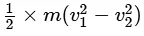
Therefore, Work done by force = 

= 1/2 x 20 ( 5 2– 22) = 10 x (25-4) = 10 x 21 = 210 J

Q13: An object having 10 kg weight is moved from point A to point B on the table. If the distance between A and B is horizontal, what work does gravity do to the object?  Give the reason for the answer.
Ans:
 Since the work done by gravity on the object depends on the change in the vertical height of the object, the vertical height of the object will not change. Because the connection level of A and B is at the same height, the work done is zero.

Q14: The potential energy of an object decreases gradually in a free fall. How does this violate the law of conservation of energy?
Ans: 
This does not violate the law of conservation of energy, because the potential energy of an object in free fall gradually decreases with gradual changes until the kinetic energy of the object maintains the state of free fall, that is, the total energy of the object remains conserved.

Q15: What energy conversion occurs when riding a bicycle?  
Ans:
 Our muscle energy is converted into mechanical energy while riding a bicycle.

Q16:  Does energy transfer occur when you push a huge rock with all your strength without moving it? Where did the energy you applied go?  
Ans:
 As long as you push a big rock with all your strength and do not move it, energy transfer will not occur, because cell energy is only used for muscle contraction and relaxation, and also for releasing heat (sweating).

Q17:A household uses 250 units of energy in a month. How much energy is used  by that house in joules?
Ans:
 Energy consumption by a house = 250 kWh
Since, 1 kWh = 3.6 × 10⁶ J
hence, 250kWh= 250 × 3.6 × 106 = 9 × 10⁸ J

Q18: The output power of the electric heater is 1500 watts. How much energy does it consume in 10 hours?  
Ans: 
Power of electric heater (p) = 1500W = 1.5kW
Energy = Power × Time = 1.5kW × 10 hours = 15 kWh

Q19: An object of mass m moves at a constant speed v. How much work does the subject need to do to make it stable?  
Ans:
 For an object to be stationary, the work done must be equal to the kinetic energy of the moving object.
The kinetic energy of any object is equal to
K.E=1/2mv2, where m is the mass of the body and v is its velocity.

Q20: Sony said that even if different forces act on the object, the acceleration of the object can be zero. Do you agree with her, if yes, why?  
Ans:
 Yes, we agree with Soni, because the displacement of an object becomes zero when many balancing forces act on that object.

Q21: Calculate the energy (in kilowatt hours) consumed by four 500 W devices in 10 hours.
Ans:
 Since, Energy = Power × Time
Hence, Energy consumed by four 500 W devices in 10 hours
= 4 × 500 × 10
= 20000 Wh
= 20 kWh

Q22: Free-falling objects will eventually stop when they hit the ground. What will happen to their kinetic energy?
Ans:
 The object will eventually stop after it hits the ground in free fall, because its kinetic energy will be transferred to the ground when it hits the ground.

Q23: A large force acting on an object, and the displacement of that object is zero, what will be the work done?  
Ans:
 The work done on the body is defined as the force exerted on the body that causes a net displacement of the body.  
Work done = Force x Displacement  
If the force does not cause any displacement, the work done to the object is zero.

Q24: Write some differences between kinetic and potential energy.
Ans: 
Differences between kinetic and potential energy:


Q25: Describe the law of conservation of energy. 
Ans: 
The law of conservation of energy says that:

  • Energy cannot be produced or destroyed. It can only be transformed from one form to another.  
  • The energy of the universe is constant.


Q26: A person weighing 50 kg climbs the stairs with a height difference of 5 meters, within 4 seconds.  
(a) What kind of work is done by that person?  
(b) What is the average power of that person?
Ans:
 Mass of the man = 50 Kg
Distance moved by that man = 5 meter
Time taken to cover the given distance = 4s
(a) Work Done = Force  Acceleration
In this case, the increase in Potential energy = Work done =Mgh
=50×10×5
=2500 J
(b) Power = Work Done /Time Taken  =2500/ 4=625 Watts

Q27: Write differences between power and energy.
Ans:
 Differences between power and energy are given below:


Q28: Write down the expressions for
(a) Potential energy of an object
(b) Kinetic energy of an object
Ans:
 
(a) The expression for Potential energy of an object = P.E = mgh
Where, m = Mass of Body
g = Acceleration due to gravity
h = Height
(b) The expression for Kinetic energy of an object = 1/2mv2
Where, m = Mass of body
v = Velocity of body

Q29: If a force of 12.5 N is applied to complete a work of 100 J, what is the distance covered by the force?
Ans:
  W = Work = 100 J
F = Force = 12.5 N
And S is the distance moved or displacement
Since, Work done = Force  Displacement
W = FS
100 =12.5 × S
100/12.5  = S
8 m=S (Displacement)

Q30: A car weighing 1800 kg is moving at a speed of 30 m/s when braking. If the average braking force is 6000 N, it is determined that the vehicle has traveled to a standstill distance. What is the distance at which it becomes stable?
Ans: 
M = Mass of the car = 1800 Kg
V = Velocity of the car = 30 m/s
F = Force applied while braking = 6000 N
KE=1/2mv2
KE =121800×900
KE=810000 J
KE of car = Work done by the car = Force  Displacement
810000=6000× Displacement
810000/6000= Displacement
135 m= Displacement

Q31: What do you understand about average power?
Ans: 
The agent may not always be able to complete the same amount of work in a given time period. In other words, the power of this work will change over time. Therefore, in this case, we can take the average power of the work done by the body per unit time (that is, the total energy consumed divided by the total time).

Q32: Take a look at the steps below. Based on your understanding of the word “work”, prove whether the work will proceed.  

  • Suma swims in the pond.  
  • The donkey carries a heavy load.  
  • The windmill draws water from the well.  
  • Green plants perform photosynthesis.  
  • The trains are pulled by engines. 
  • Drying food grains in the sun.  
  • Sailing boats are powered by wind.

Ans: The work is said to be done when a force acts on an object and moves in the direction of the force. According to this explanation, the following activities were taken in which work will be proceeded:

  • Suma swims in the pond.  
  • The donkey carries a heavy load.  
  • The windmill draws water from the well.  
  • The trains are pulled by engines. 
  • Sailing boats are powered by wind.


Q33: The law of conservation of energy is explained by discussing the energy changes that occur when we move the pendulum laterally and swing it. Why does the pendulum eventually stop? What happens to the energy and does it violate energy conservation law?
Ans: 
Bob will eventually stop due to the friction created by the air and the rigid support that holds the thread in place. This does not violate the law of conservation of energy, because mechanical energy can be converted into another unusable form of energy for some useful work. This energy loss is called energy dissipation.

Q34: Get the expression of the potential energy of an object. Calculate PE for a body of 10 kg which is resting at a height of 10 m.
Ans:
 The potential energy of an object with mass = m kg, at height above the ground =h m
Gravitational force of attraction on that body = mgN
To lift that body to B height at h  m above the ground.
Force applied to lift this body with a constant velocity =mgN
Distance moved by the body after applying force = hm
Work done in lifting the body from a to B distance = Force × Distance
Energy cannot be destroyed, hence, this energy is stored as potential energy in the stone.
m = 10Kg
g = 10 m/s2
h = 10 m
PE = mgh
PE = mgh
= 10 × 10 × 10
= 1000Joules

09. Short Question Answer: Gravitation

Q1: What do you mean by free fall?
Ans:
 It is the object falling towards earth under the influence of attraction force of earth or gravity.

Q2: What do you mean by acceleration due to gravity?
Ans:
 During free fall any object that has mass experiences force towards centre of earth and hence an acceleration works as well. “acceleration experienced by an object in its freefall is called acceleration due to gravity.” It is denoted by g.

Q3: Why is it difficult to hold a schoolbag having a strap made of a thin and strong string?
Ans:
 It is difficult to hold a schoolbag having a strap made of a thin and strong string because a bag of that kind will make its weight fall over a small area of the shoulder and produce a greater pressure that makes holding the bag difficult and painful.

Q4: What do you mean by buoyancy?
Ans:
 It is the upward force experienced by an object when it is immersed into a fluid.

Q5: You find your mass to be 42 kg on a weighing machine. Is your mass more or less than 42 kg?
Ans: 
Mass will be slightly more than 42 kg.

Q6: You have a bag of cotton and anir on bar, each indicating a mass of 100 kg when measured on a weighing machine. In reality, one is heavier than other. Can you say which one is heavier and why?
Ans: 
The bag of cotton is heavier since volume of cotton bag is greater than iron bar, so the up thrust is larger in case of cotton hence real mass of cotton bag is more and it is heavier.

Q7: How does the force of gravitation between two objects change when the distance between them is reduced to half?
Ans: 
The force of gravitation between two objects is inversely proportional to the square of the distance between them therefore the gravity will become four times if distance between them is reduced to half.

Q8: Gravitational force acts on all objects in proportion to their masses. Why then, a heavy object does not fall faster than alight object?
Ans: 
In free fall of objects the acceleration in velocity due to gravity is independent of mass of those objects hence a heavy object does not fall faster than alight object.

Q9: What is the magnitude of the gravitational force between the earth and a 1 kg object on its surface? (Mass of the earth is 6 x 1024 kg and radius of the earth is 6.4 x 10⁶ m.)
Ans: 
Short Question Answer: Gravitation

Short Question Answer: Gravitation

Q10: The earth and the moon are attracted to each other by gravitational force. Does the  earth attract the moon with a force that is greater or smaller or the same as the force with which the moon attracts the earth? Why?
Ans: 
The earth and the moon are attracted to each other by same gravitational force because for both of them formula to calculate force of attraction is the same 

Short Question Answer: Gravitation
d is also same for both.

Q11: If the moon attracts the earth, why does the earth not move towards the moon?
Ans:
 Earth does not move towards moon because mass of moon is very small as compared to that of earth.

Q12: Amit buys few grams of gold at the poles as per the instruction of one of his friends. He hands over the same when he meets him at the equator. Will the friend agree with the weight of gold bought? If not, why? [Hint: The value of g is greater at the poles than at the equator.]
Ans: 
Since  W = m x g and given in the question that value of g is greater at the poles than at the equator, hence weight of same amount of gold will be lesser at equator than it was on the poles. Therefore, the friend will not agree with the weight of gold bought.

Q13: Why will a sheet of paper fall slower than one that is crumpled into a ball?
Ans: 
A greater surface area offers greater resistance and buoyancy same is true in the case of a sheet of paper that has larger surface area as compared to paper crumpled into a ball. So sheet of paper falls slower.

Q14: Gravitational force on the surface of the moon is only 1/6 as strong as gravitational force on the earth. What is the weight in newton’s of a 10 kg object on the moon and on the earth?
Ans:
 value of gravity on earth = 9.8 m/s2
value of gravity on moon = l/6th of earth = 9.8/6 = 1.63 ms2
weight of object on moon = m x 1 .63 = 10 x 1.63 = 16.3 N
weight of object on earth = m x. 9.S = 10 x 9.8 = 98 N

Q15: A ball is thrown vertically upwards with a velocity of 49 m/s. Calculate
(i) the maximum height to which it rises,
(ii) the total time it takes to return to the surface of the earth.
Ans: 
(i) v = u + gt
0 = 49 + (-9.8) x t
9.8t = 49
t = 49/9.8 = 5 s
Short Question Answer: Gravitation
= 49 x 5 + 1/2 x 9.8 x 25
= 245 – 122.5
= 122.5
(ii) total time taken to return = 5 + 5 = 10 s

Q16: Why does a block of plastic released under water come up to the surface of water?
Ans: 
Since of plastic has density very less as compared to water i.e. weight of plastic is less than the buoyant force experienced by it therefore a block of plastic released under water come up to the surface of water/floats.

Q17:  The volume of 50 g of a substance is 20 cm3 . If the density of water is 1g /cm3 , will the substance float or sink?
Ans:
 Density of that substance (d) = mass/volume = 50/20 = 2.5 g /cm3
since the density of substance (2.5) is greater than the density of water (1) therefore it will sink.

Q18: State the Universal law of Gravitation?
Ans. 
According to Universal law of Gravitation every particle in the universe attracts every other particle with a force which is directly proportional to the product of their masses and inversely proportional to the square of the distance between them.
Let M1, M2 = Masses of two bodies
r = Distance of separation
f = force acting b/w them
Short Question Answer: Gravitation

Q19: If heavier bodies are attracted more strongly by the earth, why do they not fall faster to the ground?
Ans:
 Heavier bodies do not fall fast on the ground even though they are attracted by the earth strongly because of their larger mass, the acceleration produced in them by the force of earth will be less as
F = m
F/m = a
m-mass, F = force, a = Acceleration
so if Mass is more, Acceleration will be less


Q20: How does acceleration due to gravity change with the shape of earth?
Ans: 
Since earth is not a perfect sphere, it is flattened from the top and bulges at the centre and acceleration due to gravity (g) is inversely proportional to the radius of earth so, g is more at poles because of lesser radius and less at equator because of greater radius.

Short Question Answer: Gravitation


Q21: What do you understand by the gravitational force of earth and weight?
Ans:
 Gravitational force of earth is the force by which earth exerts on any object towards itself.
Weight is the force which the object exerts on the earth.

Q22: A man of mass 60 Kg is standing on the floor holding a stone weighing 40 N. What is the force with which the floor is pushing him up?
Ans:
 The gravitational pull on the man = Mg
= 60 x 10 = 600.V
The weight he is carrying = 40 N
The total downward force on the floor = 40 N + 600 N
= 640 N
The Gravitational force and upward force of the floor is an action – reaction pair.
The force with which the floor pushes the man = 640 N.

Q23: What is acceleration due to gravity and how is it different from acceleration?
Ans: 
Acceleration due to gravity is the acceleration produced in the object when it falls freely under the effect of gravitational force of earth only. Acceleration is produced when any external force applied on the body makes it to move.

Q24: What is the importance of the universal law of Gravitation?
Ans: 
The importance of universal law of gravitation:

  • The force that binds us to the earth.
  • The motion of the moon around the earth.
  • The motion of the planet around the sun
  • The tides due to the moon and the sun


Q25: Define Pressure? How is thrust different from Pressure?
Ans:
 The pressure due to a force is defined as the force acting or unit area.
Short Question Answer: Gravitation
A unit of Pressure is N / m2
Thrust is also the pressure but it is the force acting on a surface normal to its area.

Q26: What are fluids? What are the factors on which the upward pressure at a point on a  fluid depends?
Ans: Fluids are that which flow and it includes both liquids and gases.
Factors on which the upward pressure at a point of the fluid depends are:

  • the depth of the point from the surface of the liquid.
  • the density of the liquid
  • the acceleration due to gravity.


Q27: State the universal law of gravitation.
Ans: 
According to Newton’s universal law of gravitation:
Every mass in this universe attracts every other mass with a force which is directly proportional to the product of two masses and inversely proportional to the square of the distance between them.

Q28: Write the formula to find the magnitude of the gravitational force between the earth and an object on the surface of the earth.
Ans: The formula to find the magnitude of the gravitational force between the earth and an object on the surface of the earth is given below:

Short Question Answer: Gravitation

F = magnitude of gravitational force
G = Universal gravitation constant
M = mass of earth
m = mass of object
d = distance of object from the centre of earth

Q29: What are the differences between the mass of an object and its weight?
Ans:

Short Question Answer: Gravitation

Q30: Why is the weight of an object on the moon 1/6th its weight on the earth?
Ans.
 since we know FF = mx g Mass of object remains the same whether on earth or moon but the value of acceleration on moon is 1/6th of the value of acceleration on earth. Because of this weight of an object on moon is 1/6th its weight on the earth.

08. Short Question Answer: Force and Laws of Motion

Q1: An object experiences a net zero external unbalanced force. Is it possible for the object to be traveling with a non-zero velocity? If yes, state the conditions that must be placed on the magnitude and direction of the velocity. If no, provide a reason.
Ans: 

  • Yes, it is possible for an object to be traveling with a non-zero velocity if it experiences a net zero external unbalanced force. This is based on Newton’s First law of motion, which states that an object will change its state of motion if and only if the net force acting on it is non-zero.  
  • Thus, in order to change its motion or to bring about motion, some external unbalanced force is required. 
  • In this case, the object experiences a net zero unbalanced force, which will cause it to move with some non-zero velocity provided that the object was previously moving with a constant velocity.


Q2: When a carpet is beaten with a stick, dust comes out of it. Explain.
Ans:
 When a carpet is beaten with a stick, dust is released due to the principle of inertia, which is part of Newton’s First Law of Motion. Here’s how it works:

  • The carpet and dust particles are initially at rest.
  • Beating the carpet causes it to move.
  • Dust particles resist this change in motion because of their inertia.
  • As the carpet moves forward, it exerts a backward force on the dust.
  • This force causes the dust to be expelled from the carpet.

Thus, the dust comes out when the carpet is struck.


Q3: Why is it advised to tie any luggage kept on the roof of a bus with a rope?
Ans: 
It is important to tie any luggage kept on the roof of a bus with a rope due to the principles of Newton’s First Law of Motion, also known as the law of inertia. Here’s why:

  • When the bus is in motion, the luggage also moves along with it.
  • If the bus suddenly stops, the luggage will continue moving forward due to its inertia, which can cause it to fall off.
  • Similarly, if the bus slows down or turns, the luggage will resist these changes in motion, increasing the risk of it falling off.

By securing the luggage with a rope, you can prevent accidents and ensure that it stays in place during the journey.


Q4: A stone of 1kg is thrown with a velocity of 20ms−1 across the frozen surface of a lake and comes to rest after traveling a distance of 50m. What is the force of friction between the stone and the ice?
Ans:
 Given:
Mass of stone: m = 1kg
Initial velocity of stone: u = 20ms−1
Final velocity of stone: v = 0ms−1 (as it comes to rest)
Distance traveled on ice: s = 50m
To find: Force of friction between stone and ice.
First, we need to find the deceleration:
It is known that – v2 = u2 + 2as
Thus, 02 = (20)2 + 2a(50)
⇒ 0  = 400 + 100a
⇒ −400 = 100a
⇒ a = −4ms−2
The negative sign implies deceleration.
Next, finding the frictional force:
F = ma
⇒ F = (1)(−4)
⇒ F = −4N
Thus, the force of friction between stone and ice is −4N.

Q5: An automobile vehicle has a mass of 1500kg. What must be the force between the vehicle and road if the vehicle is to be stopped with a negative acceleration of 1.7ms−2?
Ans: 
Given:
Mass of vehicle: m = 1500kg
Negative acceleration: a = −1.7ms−2
To find: Force of friction between road and vehicle.
It is known that – F = ma
⇒ F = (1500)(−1.7)
⇒ F = −2550N
Thus the force between the vehicle and road if the vehicle is to be stopped with a negative acceleration of 1.7ms−2 is −2550N.

Q6: An object of mass 100kg is accelerated uniformly from a velocity of 5ms−1 to 8ms−1 in 6s. Calculate the initial and final momentum of the object. Also, find the magnitude of the force exerted on the object.
Ans: Given:
Mass of object: m = 100kg
Initial velocity of object: u = 5ms−1
Final velocity of object: v = 8ms−1
Time duration of acceleration: t = 6s
To find: 

  • Initial momentum
  • Final momentum
  • Force exerted on the object

It is known that – momentum = mass × velocity
Initial_momentum = mass × initial_velocity
⇒ Initial_momentum = 100 × 5
⇒ Initial_momentum = 500kgms−1
Final_momentum = mass × final_velocity
⇒ Final_momentum = 100 × 8
⇒ Final_momentum = 800kgms−1
Now, the force – F = ma
Short Question Answer: Force and Laws of Motion

Thus,

  • Initial momentum:500kgms−1
  • Final momentum: 800kgms−1
  • Force exerted on object: 50N


Q7: Akhtar, Kiran, and Rahul were riding in a motorcar that was moving with a high velocity on an expressway when an insect hit the windshield and got stuck on the windscreen. Akhtar and Kiran started pondering over the situation. Kiran suggested that the insect suffered a greater change in momentum as compared to the change in momentum of the motorcar (because the change in the velocity of the insect was much more than that of the motorcar). Akhtar said that since the motorcar was moving with a larger velocity, it exerted a larger force on the insect. And as a result, the insect died. Rahul while putting an entirely new explanation said that both the motorcar and the insect experienced the same force and a change in their momentum. Comment on these suggestions.
Ans: 
Akhtar, Kiran, and Rahulwere riding in a fast-moving motorcar when an insect hit the windshield and got stuck. They discussed the incident, leading to different viewpoints:

  • Kiran argued that the insect experienced a greater change in momentum than the motorcar because its velocity changed significantly upon impact.
  • Akhtar believed that the motorcar, moving at a higher velocity, exerted a larger force on the insect, which caused its death.
  • Rahul suggested that both the motorcar and the insect experienced the same force and change in momentum.

Here are some comments on their suggestions:

  • Kiran’s point is valid; the insect’s momentum change is indeed greater due to its sudden stop.
  • Akhtar’s assertion about force is partially correct; while the motorcar does exert a larger force, it is not solely responsible for the insect’s death.
  • Rahul’s claim that both experienced the same force is misleading; the forces they experience differ due to their masses and the nature of the collision.

In summary, while all three perspectives have merit, the nuances of momentum and force in collisions highlight the complexity of the situation.

Q8: State Newton’s second law of motion?
Ans:
 Newton’s Second Law of Motion states that when an unbalanced external force acts on an object, its velocity changes, resulting in acceleration. This law can also be expressed as the time rate of change of momentum of a body being equal, in both magnitude and direction, to the force applied on it.
Mathematical Representation:
F = ma, where ‘F’ denotes the force, ‘m’ the mass of the object, and ‘a’ the acceleration produced. This relationship indicates that the acceleration of an object is directly proportional to the net force acting on it and inversely proportional to its mass.


Q9:  What is the momentum of a body of mass 200g moving with a velocity of 15ms−1?
Ans:
 Given:
Mass of body: m = 200g = 0.2kg
Velocity of body: v = 15ms−1
To find: Momentum of the body.
It is known that – momentum=mass×velocity
⇒ momentum = 0.2 × 15
⇒ momentum = 3kgms−1
Thus, the momentum of the body is 3kgms−1.

Q10: Define force and what are the various types of forces?
Ans: 
Force is defined as the push or pull exerted on an object that produces a change in its state or shape. It can also cause modifications in speed and/or direction of motion.
The various types of force are:

  • Mechanical force
  • Gravitational force
  • Frictional force
  • Electrostatic force
  • Electromagnetic force
  • Nuclear force


Q11: A force of 25N acts on a mass of 500g resting on a frictionless surface. What is the acceleration produced?
Ans: 
Given:
Mass: m = 500g = 0.5kg
Force exerted: F = 25N
To find: Acceleration.
It is known that – F = ma
⇒ a = Fm
⇒ a = 25 / 0.5
⇒ a = 50ms−2
Thus, the acceleration produced is 50ms−2.

Q12: State Newton’s first law of Motion?
Ans:
 Newton’s first law of motion is also called the law of Inertia. It states that an object remains in a state of rest or of uniform motion in a straight line unless compelled to change that state by an applied force. Or, an object rest will continue to be at rest and an object in motion will continue to be in motion until and unless it is acted upon by an external force.

Q13: A body of mass 5kg starts and rolls down 32m of an inclined plane in 4s. Find the force acting on the body?
Ans:
 Given:
Mass of body: m = 5kg
Initial velocity of body: u = 0ms−1 (as it is starting to roll)
Distance travelled on inclined plane: s = 32m
Time duration of rolling: t = 4s
To find: Force acting on the body.
First we need to find the acceleration:
It is known that Short Question Answer: Force and Laws of Motion

Short Question Answer: Force and Laws of Motion

Next, finding the force:
F = ma
⇒ F = (5 × 4)
⇒ F = 20N
Thus, the force acting on the body is 20N.

Q14: On a certain planet, a small stone tossed up at 15ms−1 vertically upwards takes 7.5s to return to the ground. What is the acceleration due to gravity on the planet?
Ans: 
Given:
Initial velocity of stone:u = 15ms−1
Final velocity of stone: v = 0ms−1 (as it becomes zero at the highest point)
Total time duration of flight (tossed up and falling down to the ground): t = 7.5s
To find: Acceleration due to gravity of the planet.
It is known that – v = u + at
Thus, 0 = 15 + (at)

Short Question Answer: Force and Laws of Motion this denotes the time for one-half of the entire flight.
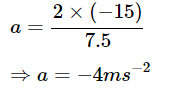
Thus the total duration of the flight is twice this duration.

Short Question Answer: Force and Laws of Motion

Now, the acceleration due to gravity is –

Short Question Answer: Force and Laws of Motion

Thus, the acceleration due to gravity of the planet is −4ms−2

Q15: Why does the passenger sitting in a moving bus are pushed in the forward direction when the bus stops suddenly?
Ans:
 The passengers sitting in a moving bus are pushed forward when the bus stops suddenly due to inertia. This occurs because:

  • The upper body of the passenger continues moving forward.
  • The lower body, which is in contact with the seat, remains at rest.
  • This difference causes the upper body to lurch forward in the direction the bus was travelling.


Q16: Why does the boat move backward when the sailor jumps in the forward direction?
Ans:
 The boat moves backward when the sailor jumps forward due to Newton’s third law of motion. This law states:

  • For every action, there is an equal and opposite reaction.
  • When the sailor jumps forward, he exerts a force on the boat.
  • As a result, the boat pushes back with an equal force, causing it to move backward.

This interaction illustrates how forces work between two objects, leading to the boat’s backward movement.


Q17: An astronaut has 80kg mass on earth.
(i) What is his weight on earth?
Ans:
 Given:
Mass of astronaut: m = 80kg
To find his weight on earth.
It is known that,
Acceleration due to gravity on earth: g= 10ms−2
Acceleration due to gravity on mars: gm = 3.7ms−2
Weight: w = m × g
Weight on earth: we = m × ge
⇒ we = 80 × 10
we = 800N
(ii) What will be his mass and weight on mars with gm=3.7ms−2?
Ans: Given:
Mass of astronaut: m = 80kg
To find his mass and weight on mars.
It is known that,
Acceleration due to gravity on earth: ge = 10ms−2
Acceleration due to gravity on mars: gm = 3.7ms−2
Weight: w = m × g
Weight on mars: wm=m×gm
⇒ wm = 80 × 3.7
wm = 296N
The mass of astronauts remains the same on mars because it is a constant value.
Thus, mass on mars is m = 80kg.

Q18: Which of the following has more inertia:
(a) A rubber ball and a stone of the same size?
Ans:
 Inertia depends on the mass of the object. The larger the mass, the greater will be its inertia and vice-versa. In the case of a rubber ball and a stone of the same size, it is clear that the stone will have greater inertia than the ball. It is because, despite being the same size, the stone weighs more than the rubber ball.
(b) A bicycle and a train?
Ans: 
Inertia depends on the mass of the object. The larger the mass, the greater will be its inertia and vice-versa. In the case of a bicycle and a train, it is clear that the train will have greater inertia than the bicycle because the train weighs more than the bicycle.
(c) A five rupees coin and a one-rupee coin?
Ans:
 Inertia depends on the mass of the object. The larger the mass, the greater will be its inertia and vice-versa. In the case of a five rupees coin and a one-rupee coin, the five rupees coin will have greater inertia than the one-rupee coin because five rupees coin weighs more than a one-rupee coin.

Q19: In the following example, try to identify the number of times the velocity of the ball changes:
“A football player kicks a football to another player of his team who kicks the football towards the goal. The goalkeeper of the opposite team collects the football and kicks it towards a player of his own team”.
Also, identify the agent supplying the force in each case.

Ans: In the example, the number of times the velocity of football changes is four.

(i) The velocity of the football changes first when a player kicks the ball towards another player on his team. Here, the agent supplying the force is the foot of the football player who is kicking the ball.
(ii) The velocity of the football changes second when that another player kicks the ball towards the goal. Here, the agent supplying the force is the foot of the other player who is now kicking the ball towards the goal.
(iii) The velocity of the football changes for the third time when the goalkeeper of the opposite team stops the football by collecting it. Here, the agent supplying the force are the hands of the goalkeeper who collects the ball.
(iv) The velocity of the football changes for the fourth time when the goalkeeper kicks it towards a player of his team. Here, the agent supplying the force is the foot of the goalkeeper who is now kicking the ball towards his teammate.

Q20: Explain why some of the leaves may get detached from a tree if we vigorously shake its branch.
Ans:
 Some leaves may detach from a tree when its branch is vigorously shaken due to the following reasons:

  • The branches move while the leaves tend to remain still because of their inertia.
  • When the branch shakes, the force causes a rapid change in direction.
  • This sudden force can exceed the attachment strength of the leaves, leading to their detachment.

In summary, the combination of inertia and the force of shaking results in some leaves falling off the tree.


Q21: Why do you fall in the forward direction when a moving bus breaks to a stop and fall back when it accelerates from rest?
Ans: 
The behaviour of passengers in a moving bus can be explained by the principle of inertia. When the bus suddenly stops, the following occurs:

  • The passengers’ upper bodies continue moving forward because they are in a state of motion.
  • The lower part of their bodies, which is in contact with the seat, remains at rest.
  • This difference causes the upper body to be pushed forward, in the direction the bus was moving.

Conversely, when the bus accelerates from a stop:

  • The lower part of the passengers’ bodies begins to move forward with the bus.
  • The upper bodies, however, tend to stay at rest due to inertia.
  • This results in the upper bodies being pushed backward, opposite to the direction of the bus’s acceleration.


Q22: If action is always equal to the reaction, explain how a horse can pull a cart.
Ans: 
The ability of a horse to pull a cart can be explained through the principles of action and reactionas outlined in Newton’s third law of motion. Here’s how it works:

  • When the horse pulls the cart, it exerts a force on the cart.
  • According to Newton’s third law, the cart exerts an equal and opposite force back on the horse.
  • The horse’s muscles generate enough force to overcome the cart’s resistance and any friction with the ground.
  • The ground also plays a crucial role; as the horse pushes against it, the ground pushes back, allowing the horse to move forward.
  • This interaction enables the horse to pull the cart despite the equal and opposite forces at play.

In summary, the horse can pull the cart because:

  • The horse applies a force to the cart.
  • The reaction force from the cart does not prevent the horse from moving forward.
  • The ground provides necessary traction for the horse to exert force effectively.


Q23: Explain why is it difficult for a fireman to hold a hose, which ejects large amounts of water at a high velocity.
Ans: 
It is difficult for a fireman to hold a hose, which ejects large amounts of water at a high velocity because of Newton’s third law of motion. In this case, the water being ejected out in the forward direction with great force (action) will create a backward force that results in the backward movement (reaction) of the hose pipe. As a result of this backward force and movement, it will be difficult for the fireman to hold the hose properly with stability.

Q24: From a rifle of mass 4kg, a bullet of mass 50g is fired with an initial velocity of 35ms−1. Calculate the initial recoil velocity of the rifle.
Ans: 
Given:
Mass of rifle: m1= 4kg
Mass of bullet: m2 = 50g = 0.05kg
Initial velocity of rifle: u1= 0ms−1 (it is stationary during firing)
Initial velocity of bullet: u= 0ms−1(it starts from rest, inside the barrel of the rifle)
Fired velocity of bullet: v= 35ms−1
To find: Recoil velocity of rifle:v1
By using the law of conservation of momentum, for an isolated system, is that the total initial momentum for an event is equal to total initial momentum, we get –
m1v1 + m2v2 = m1u1 + m2u2
Here, m1u+ m2uis the total sum of momentum of rifle and bullet before firing and m1v1 + m2v2 is the total sum of momentum of rifle and bullet after firing.
Substituting the values in – m1v+ m2v= m1u+ m2u2
Short Question Answer: Force and Laws of Motion

⇒ v1 = −4.375ms−1 (The negative sign indicates the backward direction in which the rifle moves when it recoils)
Thus, the recoil velocity of the rifle is 4.375ms−1.

Q25: An 8000kg engine pulls a train of 5 wagons, each of 2000kg, along a horizontal track. If the engine exerts a force of 40000N and the track offers a friction force of 5000N, then calculate:
(a) The net accelerating force
Ans:
 Given:
Force exerted by engine on wagons: F = 40000N
Frictional exerted on wagons: f = 5000N
Mass of engine: me = 8000kg
Mass of each wagon: mw=2000kg
Mass of all five wagons: mW = 5 × mw = 5 × 2000 = 10000kg
Mass of entire train: mT=me + mW = 8000 + 10000 = 18000kg
To find accelerating force.
Net accelerating force can be found by subtracting the frictional force from the force exerted by the engine on the wagons.
Thus, Net Accelerating Force=Force Of Engine − Frictional Force
⇒ Net Accelerating Force = F − f
⇒ Net Accelerating Force = 40000 − 5000
⇒ Net Accelerating Force = 35000N
(b) The acceleration of the train
Ans:
  Given:
Force exerted by engine on wagons: F = 40000N
Frictional exerted on wagons: f = 5000N
Mass of engine: m= 8000kg
Mass of each wagon: mw = 2000kg
Mass of all five wagons: mW = 5 × mw = 5 × 2000 = 10000kg
Mass of entire train: mT = me + mW=8000 + 10000=18000kg
To find the acceleration of the train.
It is known that – F = ma
Short Question Answer: Force and Laws of Motion

Q26: wo objects, each of mass 1.5kg, are moving in the same straight line but in opposite directions. The velocity of each object is 2.5ms−1 before the collision during which they stick together. What will be the velocity of the combined object after collision?
Ans: 
Given:
Mass of object 1: m1= 1.5kg
Mass of object 2: m2 = 1.5kg
Initial velocity of object 1: u1= 2.5ms−1
Initial velocity of object 2: u2 = −2.5ms−1 (negative sign because it is moving in the opposite direction)
Mass of combined object after collision: m = m1 + m2 = 1.5 + 1.5 = 3kg
To find: Final velocity of the combined object after collision:v
By using the law of conservation of momentum, for an isolated system, is that the total initial momentum for an event is equal to total initial momentum, we get –
mv = m1u+ m2u2
Here, m1u1 + m2uis the total sum of the momentum of objects before the collision and mv is the total momentum of the combined objects after the collision.
Substituting the values in – mv = m1u+ m2u2
⇒ (3 × v) = (1.5 × 2.5) + (1.5 × −2.5)
⇒ (3 × v) = (3.75) + (−3.75s)
⇒ (3 × v) = 0
⇒ v = 0ms−1
Thus, the velocity of the combined object after collision is 0ms−1.

Q27: According to the third law of motion when we push on an object, the object pushes back on us with an equal and opposite force. If the object is a massive truck parked along the roadside, it will probably not move. A student justifies this by answering that the two opposite and equal forces cancel each other. Comment on this logic and explain why the truck does not move.
Ans: The student’s reasoning that the two opposite and equal forces cancel each other is not entirely correct. Here’s a clearer explanation of why the truck does not move:

  • Third Law of Motion: According to this law, when we push an object, it pushes back with an equal and opposite force.
  • Massive Truck: A truck is very heavy, which means it has a large mass. The force required to move it must overcome its inertia.
  • Balanced Forces: When you push the truck, the force you apply is equal to the force the truck exerts back on you. However, this does not mean the truck will move. If the frictional force between the truck’s wheels and the ground is greater than the force you apply, the truck will remain stationary.
  • Friction: The friction between the truck’s tyres and the road is a significant factor. It resists movement and must be overcome for the truck to start moving.
  • Net Force: For an object to move, there must be a net unbalanced force acting on it. In this case, if your push does not exceed the frictional force, the net force is zero, and the truck does not move.


Q28: A hockey ball of mass 200g traveling at 10ms−1 is struck by a hockey stick so as to return it along its original path with a velocity at 5ms−1. Calculate the change of momentum that occurred in the motion of the hockey ball by the force applied by the hockey stick.
Ans:
 Given:
Mass of hockey ball: m = 200g = 0.2kg
Initial velocity of hockey ball: u = 10ms−1
Final velocity of hockey ball: v = −5ms−1 (because it moves back in its original direction)
To find: Change in momentum of hockey ball due to the force of hockey stick
ChangeOfMomentum = mv − mu
Here, mu is the initial momentum of the hockey ball and mv is the final momentum of the hockey ball.
Substituting the values in – Change Of Momentum = mv − mu
⇒ ChangeOfMomentum = (0.2 × −5) − (0.2 × 10)
⇒ ChangeOfMomentum = (−1) − (2)
⇒ ChangeOfMomentum = −3kgms−1
Thus, the change in momentum of hockey ball due to the force of hockey stick is −3kgms−1.

Q29: A bullet of mass 10g traveling horizontally with a velocity of 150ms−1 strikes a stationary wooden block and comes to rest in 0.03s. Calculate the distance of penetration of the bullet into the block. Also, calculate the magnitude of the force exerted by the wooden block on the bullet.
Ans:
 Given:
Mass of bullet: m = 10g = 0.01kg
Initial velocity of bullet: u = 150ms−1
Final velocity of bullet: v = 0ms−1 (as it comes to rest after penetration)
Time duration of bullet travel: t = 0.03s
To find:

  • Distance of penetration of bullet into the block
  • Force exerted by the block on the bullet

(a) Distance of penetration:
It is known that – v = u + at
Thus, 0 = 150 + (a × 0.03)
⇒ (a × 0.03) = −150
⇒ a = −5000ms−2
Now,

Short Question Answer: Force and Laws of Motion

(b) Next, finding the force:
F = ma
⇒ F = (0.01 × −5000)
⇒ F = −50N
Thus,

  • Distance of penetration of bullet into the block is 2.25m
  • Force exerted by the block on the bullet is −50N


Q30: Differentiate between mass and weight?
Ans:
 The difference between mass and weight is given below,
Short Question Answer: Force and Laws of Motion

Q31: A scooter is moving with a velocity of 20ms−1when brakes are applied. The mass of the scooter and the rider is 180kg. The constant force applied by the brakes is 500N.
(a) How long should the brakes be applied to make the scooter comes to a halt?
Ans:
  Given:
Mass of scooter and rider: m = 180kg
Initial velocity of scooter: u = 20ms−1
Final velocity of scooter: v = 0ms−1(as it halts after applying the brake)
Force of the brake: F = −500N(as it opposes the motion)
To find the time duration over which brake should be applied to stop the scooter.
Now, the force – F = ma

Short Question Answer: Force and Laws of Motion

Rearranging,

Short Question Answer: Force and Laws of Motion

(b) How far does the scooter travel before it comes to rest?
Ans: 
Given:
Mass of scooter and rider: m = 180kg
Initial velocity of scooter: u = 20ms−1
Final velocity of scooter: v = 0ms−1(as it halts after applying the brake)
Force of the brake: F = −500N(as it opposes the motion)
To find distance travelled by scooter before coming to halt.

Short Question Answer: Force and Laws of Motion

Acceleration is negative because it is retarding the motion of the scooter.

Short Question Answer: Force and Laws of Motion

Q32: State Newton’s third law of motion and how does it explain the walking of man on the ground?
Ans:
 Newton’s third law of motion states that for every action, there is an equal and opposite reaction acting on different bodies. This implies the existence of the action-reaction force pair. That is, for every action force created an equal and opposite reaction force will be created.
The walking of a man on the ground can be explained with Newton’s third law of motion. During walking on the ground, the man creates an active force on the ground in the backward direction during each step, while the ground creates a reaction force pushing the man forward enabling him to walk.

Q33: State Newton’s second law of motion and derive it mathematically?
Ans:
 Newton’s second law of motion states that the rate of change of momentum of an object is proportional to the applied unbalanced force in the direction of the force.
Mathematical derivation:
Say we have an object of mass m that is moving along a straight line with an initial velocity, u.
It is then uniformly accelerated to velocity, v in time, t  by the application of a constant force, F throughout the time, t.
Initial Momentum of object: p1= m × u
Final Momentum of object: p2= m × v
Now, the change of momentum is the Final momentum subtracted by the Initial momentum
Thus, Δp = p2 − p1= mv − mu = m(v − u)
⇒ Δp = m(v − u)
The rate of change of momentum is Δp / t

Short Question Answer: Force and Laws of Motion

We know that the applied force is proportional to the rate of change of momentum of the object.

Short Question Answer: Force and Laws of Motion

Using these, we get
⇒ F = ma
The SI unit of force is Newton (Kgms−2)
The second law of motion gives a method to measure the force acting on an object as a product of its mass and acceleration.

Q34: Why does a person while firing a bullet holds the gun tightly to his shoulders?
Ans: A person while firing a bullet holds the gun tightly to his shoulder because of the recoil of the gun when the bullet is fired. This is in accordance with Newton’s third law of motion, which states that for every action, there is an equal and opposite reaction, that acts on different bodies. 

  • When a bullet is fired, the forward motion of the bullet (action) creates a recoil or backward motion of the gun (reaction). The action force being much greater will create an equivalent recoil force in the backward direction. 
  • If the person who holds the gun does not hold it properly to his shoulders that can result in injury. This is because the shoulder absorbs most of the force during recoil that enables the shooter to take a steady shot.
  • Thus, if not held tightly to his shoulders, the shot will not be precise and this can also cause the gun to fly away from his hands.

Q35: A car is moving with a velocity of 16ms−1 when brakes are applied. The force applied by the brakes is 1000N. The mass of the car its passengers is 1200kg.
(a) How long should the brakes be applied to make the car come to a halt?
Ans:
 Given:
Mass of car and passengers: m = 1200kg
Initial velocity of car: u = 16ms−1
Final velocity of car: v = 0ms−1(as it halts after applying the brake)
Force of the brake: F = −1000N(as it opposes the motion)
To find time duration over which brake should be applied to stop the car.
Now, the force – F = ma

Short Question Answer: Force and Laws of Motion

Rearranging,

Short Question Answer: Force and Laws of Motion

(b) How far does the car travel before it comes to rest?
Ans:
 Given:
Mass of car and passengers: m = 1200kg
Initial velocity of car: u = 16ms−1
Final velocity of car: v = 0ms−1(as it halts after applying the brake)
Force of the brake: F = −1000N(as it opposes the motion)
To find distance travelled by car before coming to halt.
Acceleration – Short Question Answer: Force and Laws of Motion

Short Question Answer: Force and Laws of Motion

Acceleration is negative because it is retarding the motion of the scooter.

Short Question Answer: Force and Laws of Motion

07. Short Question Answer: Motion

Q1: Distinguish between speed and velocity.
Ans:
 Speed of a body is the distance travelled by a body  per unit time while velocity is the displacement travelled by a body  per unit time.

Q2: Under what condition(s) is the magnitude of the average velocity of an object equal to its average speed?
Ans:
 If the distance travelled by a body is equal to the displacement, then the magnitude of the average velocity of an object will be equal to its average speed.

Q3: What does the odometer of an automobile measure?
Ans:
 The odometer of an automobile is used to measure the distance covered by an automobile.

Q4: What does the Graph of an object look like when it is in uniform motion?
Ans:
 Graphically it will be linear; it looks like a straight line when it is in uniform motion.

Q5: During an experiment, a signal from a spaceship reached the ground station in five minutes. What was the distance of the spaceship from the ground station? The signal travels at the speed of light, that is, 3 × 10⁸ms−1
Ans:
 The given data is that time is five minutes and speed is(3 × 10⁸ms−1)
Distance = Speed × Time
⇒ 5min × (3 × 108ms−1)
⇒( 5 × 60)sec × (3 × 108ms−1)
⇒ 300sec × (3 × 108ms−1)
⇒ 900 × 108ms−1 = 9 × 10¹⁰m
∴ Distance = 9 × 10⁷km

Q6: When will you say a body is in
(i) Uniform acceleration?
Ans: When an object travels in a straight line and its velocity changes by equal amount in an equal interval of time, it is said to have uniform acceleration.
(ii) Non-uniform acceleration?
Ans:  Non-uniform acceleration is also called variable acceleration. When the velocity of an object changes by unequal amounts in equal intervals of time, it is said to have non-uniform acceleration.

Q7: A bus decreases its speed from 80kmh−1 to 60kmh−1 in 5s. Find the acceleration of the bus.
Ans: 
Initial speed of bus (u)  = 80kmh−1
Short Question Answer: Motion

Acceleration (a) =  Short Question Answer: Motion

∴ Acceleration (a) = −1.11m/s2


Q8: What is the nature of the distance time graphs for uniform and non-uniform motion of an object?
Ans:
 If an object has a uniform motion then the nature of distance time graph will be linear, that is it would in a straight line and if it has non-uniform motion then the nature of the distance-time graph will be a curved line.

Q9: What is the quantity which is measured by the area occupied below the velocity-time graph?
Ans: 
The area occupied below the velocity-time graph measures the displacement moved by any object.

Q10: A bus starting from rest moves with a uniform acceleration of 0.1ms−2 for 2 minutes . Find
(a) The speed acquired,    
Ans:
 u = 0, a = 0.1ms−2, t = 2min = 120sec
v = u + at = 0 + 0.1 × 120=12ms−1
Speed acquired = v = 12ms−1
(b) The distance travelled.
Ans: s = ut + 1/2at2 = 0 × 120 + 1/2 x 0.1 × 120= 720m

Q11: A trolley, while going down an inclined plane, has an acceleration of 2cm s−2 . What will be its velocity 3s after the start?
Ans:
 Given : u = 0, a = 2cm/s2, t = 3s
v = u + at = 0 + 2 × 3
= 6cm/s

Q12: A racing car has a uniform acceleration of4ms−2 . What distance will it cover in 10s  after start?
Ans:
 Given: u =0, a = 4m/s2, t = 10s
s = ut + 1/2at2
s = 0 × 10 + 1/2 × 4 × 102
∴ s = 200m

Q13: Differentiate between distance and displacement?
Ans:
 The difference between distance and displacement is as below, Short Question Answer: Motion

Q14: Derive mathematically the first equation of motion V = u + at?
Ans: 
Acceleration is defined as the rate of change of velocity.
Let V = final velocity; Vo = initial velocity, T =  time, a = acceleration.
So by definition of acceleration
Short Question Answer: Motion
If V= u =  initial velocity, then  [V = u + at]

Q15: Calculate the acceleration of a body which starts from rest and travels 87.5m in 5sec?
Ans:
 Given Data: u = 0 (starts from rest) u =  initial velocity
a =  acceleration = ?
t = 5sec, t = time
S = 87.5m (S = distance)
From second equation of motion
Short Question Answer: Motion
∴ a = 7m/s2 

Q16: Define uniform velocity and uniform acceleration?
Ans: 

  • Uniform velocity:- A body is said to move with uniform velocity if equal displacement takes place in equal intervals of time, however small these intervals may be. 
  • Uniform acceleration:- A body is said to move with uniform acceleration if equal changes in velocity take place in equal intervals of time, however, small intervals may be.


Q17: The velocity-time graph of two bodies A and B traveling along the +x direction are given in the (a) Are the bodies moving with uniform acceleration?
Ans:
 Yes the bodies are moving with uniform acceleration.
(b) Which body is moving with greater acceleration A or B?
Ans: 
Body A is moving with greater acceleration.

Q18: Calculate the acceleration and distance of the body moving with 5m/s which comes to rest after traveling for 6sec?
Ans: 
Acceleration = a = ?
Final velocity = V = o (body comes to rest)
Distance = s     =?
Time  = t =  6 sec
From,    V = u + at
Short Question Answer: Motion

∴ s = 15m

Q19: A body is moving with a velocity of 12m/s and it comes to rest in 18m, what was the acceleration?
Ans: 
Initial velocity = u = 12m/s
Find velocity  = V = 0
S = distance=18m
A= acceleration =?
From 3rd equation of motion;

Short Question Answer: Motion

Q20: A body starts from rest and moves with a uniform acceleration of 4m/s2 until it travels a distance of 800m, find the find velocity?
Ans:
 Initial velocity =u=0
Final velocity = v = ?
Acceleration=a=4m/s2
Distance = s = 800m
v2 − u2 = 2as
v2 − (0) = 2 × 4 × 800
v = 80m/s

Q21: Differentiate between scalars and vectors?
Ans: 
The difference between scalars and vectors is as below,
Short Question Answer: Motion


Q22: An object has moved through a distance. Can it have zero displacements? If yes, support your answer with an example.
Ans: 
Yes, if an object is moved through a distance it can have zero displacement because displacement of an object is the actual change in its position when it moves from one position to the other position. So if an object travels from point A to B and then returns back to point A again, the total displacement will be zero.

Q23: A train starting from a railway station and moving with uniform acceleration attains a speed 40kmh−1 in 10min. Find its acceleration.
Ans:
 Since the train starts from rest (railway station) = u = zero
Final velocity of train = v = 40kmh−1
Short Question Answer: Motion

time(t) = 10min = 10 × 60 = 600 seconds
Since
Short Question Answer: MotionShort Question Answer: Motion
Q24:What can you say about the motion of an object whose distance time graph is a straight line parallel to the time axis?
Ans:
    If the object’s distance time graph is a straight line parallel to the time axis indicates that with increasing time the distance of that object is not increasing hence the object is at rest that is not moving.
Short Question Answer: Motion
Q25: What can you say about the motion of an object if its speed time graph is a straight line parallel to the time axis?
Ans:  Such a graph indicates that the object is travelling with uniform velocity.

Short Question Answer: Motion


Q26: A train is travelling at a speed of 90kmh−1 . Brakes are applied so as to produce a uniform acceleration of−0.5ms−2 . Find how far the train will go before it is brought to rest.
Ans: 

Short Question Answer: Motion

Given: a = −0.5ms−2, v = 0 (train is brought to rest)
Short Question Answer: Motion

Q27: A stone is thrown in a vertically upward direction with a velocity of5ms−1 . If the acceleration of the stone during its motion is10ms−1 in the downward direction, what will be the height attained by the stone and how much time will it take to reach there?
Ans: 
    Given: u = 5ms−1, a = −10ms−2
v = 0   (since at maximum height its velocity will be zero)
v = u + at = 5 + (−10) × t
Short Question Answer: Motion

Q28: Two cars A and B are moving along in a straight line.    Car A is moving at a speed of 80kmph  while car B is moving at a speed of 50kmph in the opposite direction, find 
(a) The relative velocity of car B with respect to A.
(b)  Relative velocity of car B with respect to A

Ans:
(a) The relative velocity of car B with respect to A.
Velocity of car A = 80kmph
 Velocity of Car B = − 50  kmph  (-ve sign indicates that Car B is moving in the opposite direction to Car A )
The relative velocity of car A with respect to B
velocity of  car A + (- velocity    of car B)
⇒ 80 + (−(−50))
⇒ 80  + 50
⇒ +130kmph
shows that for a person in car B, car A will appear to move in the opposite direction with a speed of the sum of their individual speed.
(b)  Relative velocity of car B with respect to A
Ans: 
 ⇒ Velocity of car B+ (- velocity of car A)
⇒ −50  + (−80)
⇒ −130kmph
It shows that car B will appear to move with 130   kmph in opposite direction to car A

Q29: A ball starts from rest and rolls down 16m down an inclined plane in 4s.
(a) What is the acceleration of the ball?
Ans: 
 Given: u= initial velocity = 0 (body starts from rest) S= distance = 16 m
T= time = 4s
Short Question Answer: Motion
(b) What is the velocity of the ball at the bottom of the incline?
Ans: 
From, v = u + at
v = 0 + 2 × 4
[v = 8m/s]

Q30: 

Fig 2.26 shows the displacement-time graph for the motion of two boys A and B along a straight road in the same direction. Answer the following:
(i) When did B start after A ?
(ii) How far away was A from B when B started?
(iii) Which of the two has greater velocity ?
(iv) When and where did B overtake A ?

.
Short Question Answer: MotionAns:(i) B started his motion 2 h later from the start of A.
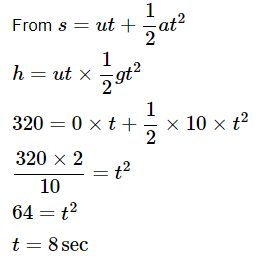
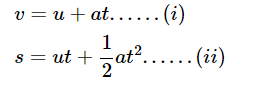
(ii) When B started, A was at distance 10 km away from B.
(iii) B has greater velocity than A since the straight line on graph for B has greater slope than that for A.
(iv) B overtook A at the instant when both were at the same place. This position is at the point where the two straight lines meet each other. For this point, distance from the starting point is 20 km and time is 4 h. Thus B overtook A when A has travelled for 4 h (or B has travelled for 4 – 2 = 2 h) at distance 20 km from the starting point


Q31: A body is dropped from a height of320m. The acceleration due to the gravity is 10m/s2?
(a) How long does it take to reach the ground?
Ans: 
 Given Data: Height = h
Distance = s = 320m
Acceleration due to gravity = g = 10m/s2
Initial velocity  = u = 0
Short Question Answer: Motion
(b) What is the velocity with which it will strike the ground?
Ans:
 From v = u + at
v = 0 + 10 × 8
v = 80m/s

Q32: Derive third equation of motion v2 − u2 = 2as numerically?
Ans: 
We know,
Short Question Answer: Motion
When, v= final velocity
u= initial velocity
a = acceleration
t = time
s = distance
From equation (i) Short Question Answer: Motion
Put the value of t in equation (ii)
Short Question Answer: Motion

Q33: The velocity-time graph of the runner is given in the graph.
(a) What is the total distance covered by the runner in16s?
Ans:
  We know that area under v-t graph gives displacement:
So, Area = distance = s = area of triangle + area of rectangle Area of triangle = 1/2 × base × height
Short Question Answer: Motion
∴Area of triangle = 30m
Area of rectangle= length × breadth
⇒ (16 − 6)×10
⇒ 10 × 10
⇒ 100m
Total area = 130m
Total distance = 130m
(b) What is the acceleration of the runner at t = 11s?
Ans:
 Since at t = 11sec , particles travel with uniform velocity so, there is no change in velocity hence acceleration = zero.

Q34: A boy throws a stone upward with a velocity of 60m/s .
(a) How long will it take to reach the maximum height(g=−10m/s2)?
Ans: 
u = 60 m/s; g = -10m/s2; v=0
 The time to reach maximum height is
v = u + at = u + gt
0 = 60 − 10t
t = 60 / 10
=6s
(b) What is the maximum height reached by the ball?
Ans:
 The maximum height is:
Short Question Answer: Motion
(c) How long will it take to reach the ground?
Ans:
 The time to reach the top is equal to the time taken to reach back to the ground. Thus, the time to reach the ground after reaching the top is 6s or the time to reach the ground after throwing is 6 + 6 = 12s.

Q35: Derive the third equation of motion  v2 − u2 = 2as  as graphically?
Ans: 
Let at time t = 0, the body moves with initial velocity u and time at ‘t’ has final velocity ‘v’ and in time ‘t’ covers a distance ‘s’
Short Question Answer: Motion

Short Question Answer: Motion
Put the value of ‘t’ in equation (i)
Short Question Answer: Motion

Third equation of motion.

06. Short Question Answer: Tissues

Q1: What is a tissue?
Ans:
 A group of cells that are similar in structure and/or work together to achieve a particular function forms a tissue.  Examples of tissues are blood, phloem and muscle .

Q2: What are the constituents of phloem?

Ans: There are four types of elements are present in the phloem they are:

  • Sieve tube: Helps in conduction of food material
  • Companion cells: It helps sieve tube in conduction of food material
  • Phloem parenchyma: storage
  • Phloem fibres: It provides mechanical support.

Q3: Name types of simple tissues.
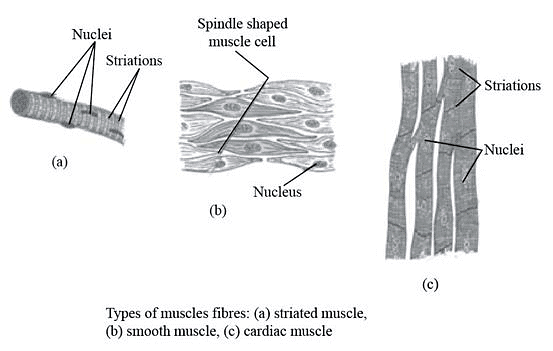
Ans: 
Three types simple tissues are:
I. Parenchyma
II. Collenchyma
III. Sclerenchyma

Q4: What does a neuron look like?
Ans:
 A neuron comprises a cell body from which long thin hair-like parts(arise). Then the neuron has a single long part(axon) and many short, branched parts(dendrites).


Q5: How many types of elements together make up the xylem tissue? Name them.
Ans: 
Xylem tissue consist of four types of elements:
I. Tracheids
II. vessels
III. Xylem fibres
IV. Xylem parenchyma

Q6: How are simple tissues different from complex tissues in plants?
Ans:
 Difference between simple tissues and complex tissues in plants is given below:


Q7: Differentiate between parenchyma, collenchyma and sclerenchyma on the basis of their cell wall.
Ans: 
Difference between parenchyma, collenchyma and sclerenchyma on the basis of their cell wall is given below:


Q8: What are the functions of the stomata?
Ans: 
The functions of stomata are:
I. Gaseous exchange with the atmosphere.
II. Transpiration (formation of water vapours for the removal of excess water)
Q9: What is the specific function of the cardiac muscle?
Ans: 
Cardiac muscles are the muscles of heart that pumps blood to all parts of body and it shows rhythmic contraction and relaxation throughout life without any fatigue. The cells of heart muscles are branched, cylindrical and uninucleate.
Q10: Name the following:
(a) Tissue that forms the inner lining of our mouth.
Ans:
 Epithelial tissue
(b) Tissue that connects muscle to bone in humans.
Ans:
 Tendon
(c) Tissue that transports food in plants.
Ans: 
Phloem
(d) Tissue that stores fat in our body.
Ans:
 Adipose tissue
(e) Connective tissue with a fluid matrix.
Ans:
 Blood
(f) Tissue presents in the brain.
Ans:
 Nerve tissue
Q11: Identify the type of tissue in the following: skin, bark of tree, bone, lining of  kidney tubule, vascular bundle.
Ans:
 The type of tissues of the given is listed below:

Q12: Name the regions in which parenchyma tissue is present.
Ans:
 Leaves, fruits and flowers are the regions where the parenchyma tissue is present.
Q13: What is the role of epidermis in plants?
Ans: 
Epidermis is a protective layer to all the plant parts. It will provide protection against water loss, Control the process of gas exchange, Epidermis secretes a waxy, water-resistant layer.
Q14: How does the cork act as a protective tissue?
Ans:
 In the plant a strip of secondary meristem located in the cortex forms layers of cells that are dead and arranged in a compact manner without intercellular spaces which is cork. They have deposition of suberin in their walls which is very hard and impermeable hence protects plants from unfavorable conditions and microbial attack etc.
Q15: What are the two types of tissues? Explain them.
Ans:
 

Plant tissues are mainly divided into two types they are:

  • Meristematic Tissue: dividing tissue is the reason for growth of plants occurs only in specific regions this is also known as meristematic tissue. Apical, lateral and intercalary are the classification of the meristematic tissues.
    Permanent Tissue: The cells formed by meristematic tissue later lose the ability to divide as a result permanent tissue is formed. The process of taking up a permanent shape, size, and a function is called differentiation; this also leads to the development of permanent tissues.

Q16: What is the function of Tendon and ligament?
Ans: 

  • Ligaments: They connect one bone to another bone and another type of connective tissue. They are strong, elastic, consisting of yellow fibers.
  • Tendon: They connect muscle to bone and another type of connective tissue. They are tough, non – elastic, consisting of white fibres.

Q17: Differentiate the following activities on the basis of voluntary or involuntary:
Ans:
(a) Jumping of frog
Ans: 
Voluntary
(b) Pumping of the heart
Ans:
 Involuntary
(c) writing with hand
Ans:
 Voluntary
(d) Moving of chocolate in stomach
Ans:
 Involuntary
Q18: Write the difference between cartilage and bone.
Ans: 
Difference between cartilage and bone is listed below:

Q19: Which components of xylem are living and which ones are dead?
Ans: 
Xylem is composed of four elements:

  • Tracheid: Dead
  • Vessels: Dead
  • Xylem parenchyma: Living
  • Xylem fibres: Dead

Q20: Define due process of differentiation.
Ans: 
Dividing tissue is the reason for growth of plants occurs only in specific regions this is also known as meristematic tissue. The cells formed by meristematic tissue later lose the ability to divide as a result permanent tissue is formed. The process of taking up a permanent shape, size, and a function is called differentiation.
Q21: Mention characteristics of permanent tissues.
Ans:
 Characteristics of permanent tissues are:

  • Cells are large, comparatively thick walls and well developed .
  • Cytoplasm is present as a layer along the cell wall.
  • Bigger nucleus , vacuole is present in the cell.
  • There is lack of the power for the cell division in permanent tissue.

Q22: Mention the functions of nervous tissue.
Ans: 
Function of nervous tissues are:

  • They conduct nerve impulses from one part of the body to another part.
  • The nervous tissues in the body are specialised for being stimulated and then pass on the    stimulus very quickly from one place to another.

Q23: How aquatic plant like Water hyacinth floats on the water surface. Explain.
Ans:
 Water hyacinth floats on the surface of water due to presence of aerenchyma. It is a special form of parenchyma, which contains air cavities. It provides buoyancy because of the air trapped inside which helps water hyacinth in floating because of the air trapped inside.

Q24: Name the two types of vascular tissues.
Ans:
 Types of vascular tissues are 

  • Xylem: It conduct water and minerals from roots to the parts of the plant
  • Phloem: It conduct food from leaves to all parts of plant

Q25: What is the utility of tissues in multi-cellular organisms?
Ans: 
Millions of cells will be there in multicellular organisms. Specific functions are carried out by different groups of cells. There is a clear-cut division of labour in multicellular organisms i.e., different parts of the body of a multicellular organism perform specific functions. For example, the brain controls all other parts of the body, the heart pumps blood to all parts of the body, kidneys remove waste materials from the body, sense organs collect information from external sources and transfer to the brain etc. All these functions would never be possible without formation of tissues in multicellular organisms.
Q26: What are the functions of areolar tissue?
Ans: 
Areolar tissue is a connecting tissue found between skin and muscles, around our blood vessels and nerve cells and also in the bone marrow. Its functions are,
I. To fill the space inside organs.
II. To support internal organs.
III. To help in repair tissues
Q27: Differentiate between striated, untreated and cardiac muscles on the basis of their structure and site/location in the body.
Ans: 
Difference between striated, untreated and cardiac muscles on the basis of their structure and site/location in the body is given below:


Q28: Complete the table:


Ans:


Q29: How many types of tissues are found in animals? Name the different types.
Ans:
 In animal four types of tissues are found: 

  • Epithelium or Epithelial tissue (covering tissue): It forms outer protective covering all over the body.
  • Connective tissue  (supporting tissue): It binds cells of other tissues in the body and give them rigidity and support.
  • Muscular tissue (contractile tissue): It helps the movement of the body by contraction and relaxation.
  • Nervous tissue: Its receiver stimulates and transmit the messages.

Q30: Differentiate between voluntary and involuntary muscles. Give one example of each
Ans:
 Difference between voluntary and involuntary muscles are given below:

Q31: What are the major functions of blood?
Ans:
 Blood is a type of connective tissue, and its functions are:

  • Blood flow can transport oxygen, food, hormones and waste material from one part of the body to the other part of the body
  • Blood carries oxygen and food to all cells. It also collects wastes from all parts of the body and carries them to the liver and kidney for disposal purposes.
  • Regulates temperature by distributing heat within the body
  • WBC’S protect due body from disease and helps in wound healing
  • Platelets help in blood clotting

Q32: Write about the functions of,
(a) Epidermis
Ans:
 Epidermis, its main function is protection. It forms a waterproof coating, which reduces loss of water.
(b) Cork
Ans:
 Cork: It is protective in function. It prevents desiccation, by preventing loss of water from the plant body. It prevents infection and mechanical injury
(c) Stomata.
Ans: 
Stomata:These are the small opening which helps in exchange of gases
Q33: Differentiate between parenchyma and  collenchyma
Ans:
 Difference between parenchyma and collenchyma is given below:


Q34: Mention the characteristics features of connective tissue.
Ans: Characteristics of connective tissue:

  • The cells are loosely spaced and are embedded in a non – living intercellular matrix
  • The intercellular matrix may be like jelly, fluid, dense or rigid.
  • Depending on the connective tissues functions the nature of the matrix varies.

Q35: How does cardiac muscle differ from both voluntary and involuntary muscles in both structure and function?
Ans: Cardiac muscles are the muscles of the heart that pumps blood to all parts of the body and it shows rhythmic contraction and relaxation throughout life without any fatigue. The cells of heart muscles are branched, cylindrical and uninucleate.

  • Cardiac Muscles are involuntary
  • More akin in structure and only found in heart.
  • They function throughout the  life

Q36: Differentiate between meristematic and permanent tissue.
Ans:
 Difference between meristematic and permanent tissue is given below:
CBSE Class 9  >  Class 9 Notes  >  Science   >  Short Question Answer: Tissues

Short Question Answer: Tissues

Q1: What is a tissue?
Ans:
 A group of cells that are similar in structure and/or work together to achieve a particular function forms a tissue.  Examples of tissues are blood, phloem and muscle .

Q2: What are the constituents of phloem?

Ans: There are four types of elements are present in the phloem they are:

  • Sieve tube: Helps in conduction of food material
  • Companion cells: It helps sieve tube in conduction of food material
  • Phloem parenchyma: storage
  • Phloem fibres: It provides mechanical support.

Q3: Name types of simple tissues.
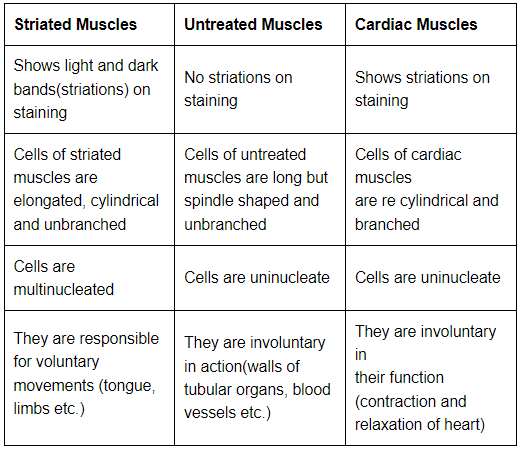
Ans: 
Three types simple tissues are:
I. Parenchyma
II. Collenchyma
III. Sclerenchyma

Q4: What does a neuron look like?
Ans:
 A neuron comprises a cell body from which long thin hair-like parts(arise). Then the neuron has a single long part(axon) and many short, branched parts(dendrites).


Q5: How many types of elements together make up the xylem tissue? Name them.
Ans: 
Xylem tissue consist of four types of elements:
I. Tracheids
II. vessels
III. Xylem fibres
IV. Xylem parenchyma

Q6: How are simple tissues different from complex tissues in plants?
Ans:
 Difference between simple tissues and complex tissues in plants is given below:


Q7: Differentiate between parenchyma, collenchyma and sclerenchyma on the basis of their cell wall.
Ans: 
Difference between parenchyma, collenchyma and sclerenchyma on the basis of their cell wall is given below:


Q8: What are the functions of the stomata?
Ans: 
The functions of stomata are:
I. Gaseous exchange with the atmosphere.
II. Transpiration (formation of water vapours for the removal of excess water)
Q9: What is the specific function of the cardiac muscle?
Ans: 
Cardiac muscles are the muscles of heart that pumps blood to all parts of body and it shows rhythmic contraction and relaxation throughout life without any fatigue. The cells of heart muscles are branched, cylindrical and uninucleate.
Q10: Name the following:
(a) Tissue that forms the inner lining of our mouth.
Ans:
 Epithelial tissue
(b) Tissue that connects muscle to bone in humans.
Ans:
 Tendon
(c) Tissue that transports food in plants.
Ans: 
Phloem
(d) Tissue that stores fat in our body.
Ans:
 Adipose tissue
(e) Connective tissue with a fluid matrix.
Ans:
 Blood
(f) Tissue presents in the brain.
Ans:
 Nerve tissue
Q11: Identify the type of tissue in the following: skin, bark of tree, bone, lining of  kidney tubule, vascular bundle.
Ans:
 The type of tissues of the given is listed below:

Q12: Name the regions in which parenchyma tissue is present.
Ans:
 Leaves, fruits and flowers are the regions where the parenchyma tissue is present.
Q13: What is the role of epidermis in plants?
Ans: 
Epidermis is a protective layer to all the plant parts. It will provide protection against water loss, Control the process of gas exchange, Epidermis secretes a waxy, water-resistant layer.
Q14: How does the cork act as a protective tissue?
Ans:
 In the plant a strip of secondary meristem located in the cortex forms layers of cells that are dead and arranged in a compact manner without intercellular spaces which is cork. They have deposition of suberin in their walls which is very hard and impermeable hence protects plants from unfavorable conditions and microbial attack etc.
Q15: What are the two types of tissues? Explain them.
Ans:
 

Plant tissues are mainly divided into two types they are:

  • Meristematic Tissue: dividing tissue is the reason for growth of plants occurs only in specific regions this is also known as meristematic tissue. Apical, lateral and intercalary are the classification of the meristematic tissues.
    Permanent Tissue: The cells formed by meristematic tissue later lose the ability to divide as a result permanent tissue is formed. The process of taking up a permanent shape, size, and a function is called differentiation; this also leads to the development of permanent tissues.

Q16: What is the function of Tendon and ligament?
Ans: 

  • Ligaments: They connect one bone to another bone and another type of connective tissue. They are strong, elastic, consisting of yellow fibers.
  • Tendon: They connect muscle to bone and another type of connective tissue. They are tough, non – elastic, consisting of white fibres.

Q17: Differentiate the following activities on the basis of voluntary or involuntary:
Ans:
(a) Jumping of frog
Ans: 
Voluntary
(b) Pumping of the heart
Ans:
 Involuntary
(c) writing with hand
Ans:
 Voluntary
(d) Moving of chocolate in stomach
Ans:
 Involuntary
Q18: Write the difference between cartilage and bone.
Ans: 
Difference between cartilage and bone is listed below:

Q19: Which components of xylem are living and which ones are dead?
Ans: 
Xylem is composed of four elements:

  • Tracheid: Dead
  • Vessels: Dead
  • Xylem parenchyma: Living
  • Xylem fibres: Dead

Q20: Define due process of differentiation.
Ans: 
Dividing tissue is the reason for growth of plants occurs only in specific regions this is also known as meristematic tissue. The cells formed by meristematic tissue later lose the ability to divide as a result permanent tissue is formed. The process of taking up a permanent shape, size, and a function is called differentiation.
Q21: Mention characteristics of permanent tissues.
Ans:
 Characteristics of permanent tissues are:

  • Cells are large, comparatively thick walls and well developed .
  • Cytoplasm is present as a layer along the cell wall.
  • Bigger nucleus , vacuole is present in the cell.
  • There is lack of the power for the cell division in permanent tissue.

Q22: Mention the functions of nervous tissue.
Ans: 
Function of nervous tissues are:

  • They conduct nerve impulses from one part of the body to another part.
  • The nervous tissues in the body are specialised for being stimulated and then pass on the    stimulus very quickly from one place to another.

Q23: How aquatic plant like Water hyacinth floats on the water surface. Explain.
Ans:
 Water hyacinth floats on the surface of water due to presence of aerenchyma. It is a special form of parenchyma, which contains air cavities. It provides buoyancy because of the air trapped inside which helps water hyacinth in floating because of the air trapped inside.

Q24: Name the two types of vascular tissues.
Ans:
 Types of vascular tissues are 

  • Xylem: It conduct water and minerals from roots to the parts of the plant
  • Phloem: It conduct food from leaves to all parts of plant

Q25: What is the utility of tissues in multi-cellular organisms?
Ans: 
Millions of cells will be there in multicellular organisms. Specific functions are carried out by different groups of cells. There is a clear-cut division of labour in multicellular organisms i.e., different parts of the body of a multicellular organism perform specific functions. For example, the brain controls all other parts of the body, the heart pumps blood to all parts of the body, kidneys remove waste materials from the body, sense organs collect information from external sources and transfer to the brain etc. All these functions would never be possible without formation of tissues in multicellular organisms.
Q26: What are the functions of areolar tissue?
Ans: 
Areolar tissue is a connecting tissue found between skin and muscles, around our blood vessels and nerve cells and also in the bone marrow. Its functions are,
I. To fill the space inside organs.
II. To support internal organs.
III. To help in repair tissues
Q27: Differentiate between striated, untreated and cardiac muscles on the basis of their structure and site/location in the body.
Ans: 
Difference between striated, untreated and cardiac muscles on the basis of their structure and site/location in the body is given below:


Q28: Complete the table:


Ans:


Q29: How many types of tissues are found in animals? Name the different types.
Ans:
 In animal four types of tissues are found: 

  • Epithelium or Epithelial tissue (covering tissue): It forms outer protective covering all over the body.
  • Connective tissue  (supporting tissue): It binds cells of other tissues in the body and give them rigidity and support.
  • Muscular tissue (contractile tissue): It helps the movement of the body by contraction and relaxation.
  • Nervous tissue: Its receiver stimulates and transmit the messages.

Q30: Differentiate between voluntary and involuntary muscles. Give one example of each
Ans:
 Difference between voluntary and involuntary muscles are given below:

Q31: What are the major functions of blood?
Ans:
 Blood is a type of connective tissue, and its functions are:

  • Blood flow can transport oxygen, food, hormones and waste material from one part of the body to the other part of the body
  • Blood carries oxygen and food to all cells. It also collects wastes from all parts of the body and carries them to the liver and kidney for disposal purposes.
  • Regulates temperature by distributing heat within the body
  • WBC’S protect due body from disease and helps in wound healing
  • Platelets help in blood clotting

Q32: Write about the functions of,
(a) Epidermis
Ans:
 Epidermis, its main function is protection. It forms a waterproof coating, which reduces loss of water.
(b) Cork
Ans:
 Cork: It is protective in function. It prevents desiccation, by preventing loss of water from the plant body. It prevents infection and mechanical injury
(c) Stomata.
Ans: 
Stomata:These are the small opening which helps in exchange of gases
Q33: Differentiate between parenchyma and  collenchyma
Ans:
 Difference between parenchyma and collenchyma is given below:


Q34: Mention the characteristics features of connective tissue.
Ans: Characteristics of connective tissue:

  • The cells are loosely spaced and are embedded in a non – living intercellular matrix
  • The intercellular matrix may be like jelly, fluid, dense or rigid.
  • Depending on the connective tissues functions the nature of the matrix varies.

Q35: How does cardiac muscle differ from both voluntary and involuntary muscles in both structure and function?
Ans: Cardiac muscles are the muscles of the heart that pumps blood to all parts of the body and it shows rhythmic contraction and relaxation throughout life without any fatigue. The cells of heart muscles are branched, cylindrical and uninucleate.

  • Cardiac Muscles are involuntary
  • More akin in structure and only found in heart.
  • They function throughout the  life

Q36: Differentiate between meristematic and permanent tissue.
Ans:
 Difference between meristematic and permanent tissue is given below: