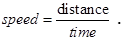
07. Very Short Question Answer: Motion

Q1: Define the term velocity. What is its unit? Is it a scalar or vector quantity?
Ans:
 Velocity is a physical quantity that gives the speed and direction of motion of the body  
Velocity = Displacement  / Time
The S.I. unit of velocity is ms–1. Velocity is a vector quantity because its description requires both magnitude and direction.

Q2: Define acceleration. Is it a scalar or a vector quantity?
Ans:
 In non-uniform motion, the velocity of a body changes with time. It has different velocities at different instants of time and at different points of its path. In such a situation, we define a physical quantity called acceleration which is a measure of the change in the velocity of a body per unit time. It is a vector quantity.

Q3: What is the acceleration of a body moving uniform velocity?
Ans: 
The acceleration of a body moving with uniform velocity is zero.

Q4: “The direction in which an object moves is given by the direction of velocity of the object and not the direction of acceleration.” Give an example to justify this statement.
Ans: 
When an object is thrown upward, its velocity is directed upward while its acceleration is directed downwards. Thus, the velocity determines the direction of motion.

Q5: Name the different types of graph.
Ans:
 Bar graphs, straight line graphs, histograms, etc.

Q6: Name the two types of physical quantities.
Ans: 
The two types of physical quantities are scalar quantity and vector quantity.

Q7: Define a scalar quantity.
Ans
: A physical quantity which has only magnitude and no direction is called a scalar quantity.

Q8: Define vector quantity.

Ans: A physical quantity which has both magnitude and direction is called a vector quantity.

Q9: Give two examples of a vector quantity?
Ans:
 Two examples of a vector quantity are displacement and velocity.

Q10: Give the simplest type of motion.
Ans: 
The simplest type of motion is the motion along a straight line.

Q11: Give two examples of a scalar quantity.
Ans: 
Two examples of a scalar quantity are distance and speed.

Q12: What is magnitude?
Ans: 
The numerical value of a physical quantity is called its magnitude.

Q13: Which type of graph is used to describe motion?
Ans: 
Line graph are used to describe the motion of an object.

Q14: When is the acceleration of a body positive?
Ans:
 The acceleration of a body is taken to be positive if it is in the direction of velocity.

Q15: Differentiate acceleration from velocity.
Ans: 
Velocity is the change in position of a body per unit time in a given direction and acceleration is the change in velocity of a body per unit time.

Q16: What is the Si unit of acceleration?
Ans:
 The SI unit of acceleration is m/s2.

Q17: What is the relationship between distance travelled and the time elapsed for the motion with uniform velocity?
Ans: 
Distance is directly proportional to time used.
In fact, distance travelled  
= Uniform velocity × Time used.

06. Very Short Question Answer: Tissues

Q1: What is the function of epidermis in plants?
Ans: 
Epidermal tissue forms a protective layer for plants and helps to protect the internal parts of plants which prevent the plant from loss of water, attack by parasitic fungi and outer injury.

Q2: What is the structure of a neuron?
Ans:
 Building block of a nervous tissue is a neuron. It has a thread-like structure with axon and cell body.

Q3: Where can we find apical meristem?
Ans:
 It is found in the growing tips of roots and stem. The length of roots and stem is increased due to the presence of apical meristem.

Q4: What do you mean by aerenchyma?
Ans:
 Aerenchyma is the cell with large air-filled cavities of parenchyma. It helps aquatic plants to float.

Q5: Name two types of plant tissues.
Ans:

(i) Permanent tissue
(ii) Meristematic tissue

Q6: Give the types of meristematic tissues.
Ans:

(i) Intercalary tissue — nodes
(ii) Apical tissue — tips of shoot and roots
(iii) Lateral tissue — stem sides

Q7: Name the tissues which are present in the plants at the nodes.
Ans: 
Intercalary tissues.

Q8: Define tracheids.
Ans:
 Tracheids have tapering ends and are basically elongated cells.

Q9: What is the use of tissues in multicellular organisms?
Ans:
 Tissue provides structural and mechanical strength as well as to allow division of labour in multicellular organisms.

Q10: Where is parenchyma tissue present?
Ans: 
Parenchyma tissue is present below the epidermis.

Q11: Name the tissue which is responsible for the movement of our body?
Ans: 
A combination of following two tissues is responsible for the movement of our body :
(i) Muscular t issue
(ii) Nervous tissue

Q12: Write the various functions of all types of epithelial tissues?
Ans:
 Epithelial tissues help in protection, absorption, excretion, exchange of respiratory gases and secretion.

Q13: How is ligament different from tendons?
Ans:
 Ligaments are elastic connective tissue which attach bone to bone to keep them in their place. Tendons are less elastic connective tissues which attach muscles to a bone.

Q14: What is the function of connective tissue?
Ans:
 Connective tissue connects different tissues and organs. It provides support to different parts of the body by forming packing around different organs of the body.

Q15: What will happen if ligaments are over stretched?
Ans: 
Sprain will occur.

Q16: What are blood platelets?
Ans: 
Blood platelets are minute (about 2 to 4 μm in diameter), anucleated, disc like bodies. The main function of platelets is to help in clotting of blood.

Q17: What is basement membrane?
Ans: 
It is very thin non-cellular membrane on which cells of epithelial tissue rest. It also separates the epithelial tissue from the underlying tissues.

Q18: Write the main functions of collenchyma?
Ans:
 The main functions of collenchyma are to provide mechanical support, tensile strength, elasticity and flexibility to stem, leaf stalks and leaves.

Q19: Where is chlorenchyma tissue present?
Ans:
 It is present in the centre of stems and roots. If it has chlorophyll then it is called chlorenchyma. It is present in green leaves.

Q20: Mention the functions of cuboidal epithelium.
Ans:

(i) Absorption
(ii) Excretion
(iii) Secretion
(iv) Mechanical support

Q21: Mention the different types of blood cells.
Ans:
(i)
 WBCs
(ii) RBCs
(iii) Platelets

Q22: Why does the growth of plants occur only in certain specific regions?
Ans: 
Growth of plants occurs only in certain specific region because the meristematic tissue is located only at these points.

Q23: Define differentiation.
Ans: 
The process of taking up permanent size, shape and function of cell is called differentiation.

Q24: Name the two types of tissues.
Ans:

(i) Animal tissues
(ii) Plant tissues

Q25: What is the location of stratified squamous epithelium? Also, mention its functions.
Ans:
 Stratified squamous epitheliums are found in the skin. They are present in layers to prevent wear and tear.

05. Very Short Question Answer: Cell – The Fundamental Unit of Life

Q1: Name the smallest cell and the longest cell in human body.
Ans:
 The smallest cell in the human body is the red blood cell or the sperm cell in males. The longest cell is the nerve cell.

Q2: What is osmosis?
Ans:
 The movement of water molecules through a selectively permeable membrane is known as osmosis. This process occurs when water moves from an area of higher concentration to an area of lower concentration.

Q3: Why does mitochondria have largely folded inner membrane?
Ans:
 Mitochondria have largely folded inner membrane which provides the increased surface area for ATPgenerating chemical reactions. Mitochondria is the site for cellular respiration and provides energy to the cell.

Q4: Which organelle makes the digestive enzyme of lysosome?
Ans:
 The rough endoplasmic reticulum (RER) is responsible for producing the digestive enzymes found in lysosomes.

Q5: Name the cell organelles that have their own DNA and ribosomes. Name the autonomous organelles in the cell.
Ans: 
The cell organelles with their own DNA and ribosomes are mitochondria and plastids. Chloroplast and mitochondria are the autonomous organelles in the cells.

Q6: What is the energy currency of the cell?
Ans:
 ATP—Adenosine Triphosphate.

Q7: Where are genes located in the cell?
Ans:
 Genes are located in the chromosomes in the nucleus of the cell.

Q8: What is the cell wall composed of ?
Ans: 
The cell wall is primarily made of cellulose, which is a complex substance. This composition provides structural strength to plants.

Q9: Where are proteins synthesized inside the cell?
Ans:
 Proteins are synthesised in the ribosomes, which are often referred to as the cell’s protein factories.

Q10: What would happen if the plasma membrane breaks down?
Ans: 
If plasma membrane breaks down then molecules of some substances will freely move in and out.

Q11: State two conditions required for osmosis.
Ans: 
Conditions required for osmosis:

  • Concentration difference: There must be a difference in the concentration of water, with one side having a higher concentration than the other.
  • Semi-permeable membrane: A semi-permeable membrane is necessary to allow the flow of water.


Q12: What is the function of vacuoles?
Ans: 
Vacuoles are the storage sacs for solid or liquid content. In plant cells, it provides turgidity and rigidity to the cell. In single-celled organisms, vacuoles store food, e.g. amoeba.

Q13: Why are plasma membrane called selectively permeable membrane?
Ans:
 Plasma membrane allows to go in and out some materials to and from the cell. It also prevents movement of some other materials. So, it is called selectively permeable membrane.

Q14: Why are plasma membrane called selectively permeable membrane?
Ans:
 Plasma membrane allows to go in and out some materials to and from the cell. It also prevents movement of some other materials. So, it is called selectively permeable membrane.

Q15: What are genes?
Ans: 
Gene is a part of DNA. They are located on chromosomes in linear fashions. One gene may perform one or more function. Genes are carrier of genetic character.

Q16: Do vacuoles store material? If so, name them.
Ans: 
Yes, vacuoles store some important substances required in life of the plant cell. These are amino acids, sugars, various organic acids and also some proteins.
Example : Amoeba, vacuoles also store food.

Q17: Which cell organelle is known as the ‘suicidal bags’ of a cell? Why?
Ans: 
Lysosomes are known as suicidal bag of cell. During the disturbance in cellular metabolism, lysosome may burst and the enzymes digest their own cell. Hence, lysosome are called ‘suicide bags’ of a cell.

Q18: What are chromosomes? What are they made of?
Ans: 
The compact rod-like bodies inside the nucleus are called chromosomes. These are seen at the time of cell division. They are made up of deoxyribonucleic acid or DNA and proteins.

Q19: How are new cells reproduced?
Ans: 
Cells multiply by dividing themselves again and again. Cells divide to produce cells of their own kind.

Q20: What is a prokaryotic cell?
Ans: 
A cell in which there is absence of a defined nuclear region and a nuclear membrane is called a prokaryotic cell. Prokaryotic cells are generally small in size. They lack membrane bound cell organelles. They have a single chromosome.

Q21: How does a living cell perform basic functions?
Ans:
 A living cell perform basic functions by division of labour among specific components within it is known as cell organelles.

Q22: Write a function of cell membrane.
Ans: 
Its major function is to hold cellular contents and control passage of materials in and out of the cell.

Q23: Give example of working of chromoplasts.
Ans:
 Spinach looks green due to the presence of chloroplasts, papaya is yellow and edible part of watermelon is red due to the presence of chromoplasts.

Q24: Which cell organelle transmits the heredity information from parents to offspring?
Ans: 
Genes are the functional units of chromosomes which transmit the heredity information from parents to offspring. These are located on chromosomes.

Q25: Where do lipids and proteins get synthesized?
Ans:
 Lipids get synthesized in the smooth endoplasmic reticulum and proteins get synthesised in the ribosome and rough endoplasmic reticulum.

04. Very Short Question Answer: Structure of the Atom

Q1: Why did Rutherford select a gold foil in his alpha-ray scattering experiment?
Ans:
 Rutherford selected a gold foil in his alpha-ray scattering experiment because gold has high malleability and can be hammered into a thin sheet.

Q2: What is an orbit?
Ans: 
An orbit is the fixed path followed by an electron around the nucleus according to the Bohr model of the atom. It represents a definite energy level in which an electron can remain without radiating energy.

Q3: What are nucleons?
Ans: 
Protons and neutrons that are present in the nucleus of an atom are collectively called nucleons.

Q4: Why do noble gases show the least reactivity?
Ans:
 Noble gases have completely filled outer electron shells (a full duplet in helium and an octet in other noble gases). This stable electronic configuration makes them unlikely to gain, lose or share electrons, so they show very little chemical reactivity.

Q5: Electrons have a negative charge, protons have a positive charge. An atom has both, but why is there no charge?
Ans: 
An atom is electrically neutral because it contains equal numbers of protons (positive) and electrons (negative). The positive and negative charges cancel each other, giving no net charge.

Q6: What is the charge and mass of an alpha particle?
Ans: 
Charge = +2 units; Mass = 4 u. An alpha particle is the nucleus of a helium atom, containing two protons and two neutrons.

Q7: A Helium atom has two electrons in its valence shell, but its valency is not two. Why?
Ans:
 Helium’s outermost shell is completely filled with two electrons, which is a stable duplet. Because its valence shell is full, helium does not need to gain or lose electrons to become stable, so its valency is zero, not two.

Q8: If an atom contains one electron and one proton, will it carry any charge or not?
Ans: 
It will not carry any net charge because the single positive charge of the proton is exactly balanced by the single negative charge of the electron; the atom is electrically neutral.

Q9: Give two uses of isotopes in the field of medicine.
Ans:

(i) An isotope of cobalt (Co-60) is used in radiotherapy to treat certain types of cancer.
(ii) An isotope of iodine (I-131) is used in the diagnosis and treatment of thyroid disorders such as goitre.

Q10: What is meant by the electronic configuration of elements?
Ans: 
The electronic configuration of an element is the systematic arrangement of its electrons in different shells or orbits around the nucleus, showing how many electrons occupy each energy level.

Q11: Why do some elements possess fractional atomic mass?
Ans: 
Some elements possess fractional atomic mass because they occur in nature in different isotopic forms. So, accordingly, their average mass is calculated. For example, Chlorine has two isotopes Cl 35 and Cl 37, and its average atomic mass is 35.5.

Q12: Are noble gases inert?
Ans:
 Yes. Noble gases are largely inert because their outermost electron shells are full, so they have little tendency to participate in chemical reactions.

Q13: How can an atom become stable by losing or gaining electrons?
Ans:
 For the stability of an atom, it must have either 2 or 8 electrons in the outermost orbit. So, by losing or gaining electrons, it reaches the electronic configuration of the nearest noble gas.

Q14: If Z = 3, what would be the valency of the element? Also, name the element.
Ans:  

Atomic number Z = 3
Electronic configuration = 2 (K), 1 (L)
The valence shell has 1 electron, so the valency of the element is 1. The element is lithium.

Q15: How are the canal rays different from electrons in terms of charge and mass?
Ans:  
Canal rays consist of positively charged particles, whereas electrons are negatively charged. The mass of a typical canal-ray particle (for example a proton) is much larger than that of an electron – roughly 2000 times greater.


Q16: What is the limitation of J.J. Thomson’s model of an atom?
Ans:
 J.J. Thomson’s atomic model, often called the “plum pudding” model, had several limitations. It couldn’t explain the stability of the atom, particularly how the positive charge held the negative electrons. It also failed to account for the nucleus of an atom and couldn’t explain the results of Rutherford’s alpha-particle scattering experiment, where most particles passed through a gold foil but some were deflected at different angles. 

Q17: Do isotopes of an element have similar chemical properties?
Ans:
 Yes, Isotopes of an element have the same atomic number and the same arrangement of valence electrons, so they exhibit very similar chemical behaviour.

Q18: Why is the valency of Na is 1 and not 7?
Ans:
 A sodium atom can attain a stable electronic configuration more easily by losing one electron than by gaining seven. Losing one electron gives it the noble-gas configuration, so its valency is 1 and not 7.

03. Very Short Question Answer: Atoms and Molecules

Q1: What is the building block of all matter?
Ans:
 Atom is the building block of all matter.

Q2: Give the derivation source of the symbol of sodium (Na).
Ans: 
The symbol of ‘Na’ for sodium is derived from its Latin name ‘Natrium’.

Q3: What is the measuring unit of atomic radius?
Ans:
 Nanometer (nm) is the measuring unit of atomic radius.

Q4: Who stated the Law of Constant Proportion?
Ans: 
Joseph Louis Proust stated the Law of Constant Proportion.

Q5: What is the full form of IUPAC?
Ans: 
International Union of Pure and Applied Chemistry.

Q6: Name the instrument which produces an image of the surface of an element that shows atoms.
Ans: 
Scanning tunnelling microscope.

Q7: Who was the first scientist to give the concept of the formation of compounds?
Ans: 
Antoine L. Lavoisier gave the concept of the formation of compounds.

Q8: Give the full form of amu?
Ans: 
The full form of amu is atomic mass unit.

Q9: State the law of conservation of mass.
Ans: 
This law states that mass can neither be created nor destroyed in a chemical reaction. That is, the mass of reactants is always equal to the mass of products.

Q10: Who introduced the word ‘Mole’?
Ans: 
‘Wilhelm Ostwald’ introduced the word ‘Mole’.

Q11: What is Avogadro’s Constant?
Ans:
 The number of particles present in one mole of any substance is fixed with a value of 6.022 × 10²³.

Q12: Give two examples of triatomic molecules.
Ans: 
Carbon dioxide (CO2) and water (H2O).

Q13: Define valency.
Ans:
 The combining power of an element to attain the noble gas configuration is called valency. Or, it is defined as the number of electrons lost or gained by an atom to acquire noble gas configuration.

Q14: Name any two monatomic atoms.
Ans: 
Sodium, Aluminium.

Q15: What is the latest short form of the atomic mass unit?
Ans: 
The latest short form of the atomic mass unit is u, according to IUPAC.

Q16: What do we get if 3 atoms of oxygen unite into a molecule, instead of the usual 2?
Ans: 
We get (O3) ozone.

Q17: How does an atom exist?
Ans: 
Atom exists in the form of atom, molecule, or ions.

Q18: Give difference between 2H and H2.
Ans: 
2H indicates 2 atoms of hydrogen, and H2 indicates one molecule of hydrogen.

Q19: How did the scientist lay the foundation of chemical sciences? Name the scientist.
Ans:
 Antoine Laurent Lavoisier laid the foundation of chemical science by establishing two important laws of chemical combination.

Q20: Define law of conservation of mass.
Ans: 
Law of conservation of mass states that, ‘Mass is neither created nor destroyed in a chemical reaction.’

Q21: Define law of constant proportion.
Ans:
 Law of constant proportion states that, ‘In a pure chemical substance, the elements are always present in definite proportions by mass.’

Q22: Which organization approves the names of elements all over the world?
Ans: 
International Union of Pure and Applied Chemistry (IUPAC).

Q23: Write the symbols of tungsten and iron.
Ans: 
(i) Tungsten (W) and (ii) Iron (Fe)

Q24: Name two atoms which exist as independent atoms.
Ans:
 Noble gases such as argon (Ar) and helium (He) exist as independent atoms.

Q25: Define atomicity.
Ans:
 The number of atoms present in one molecule of an element or a compound is known as its atomicity.

02. Very Short Question Answer: Is Matter Around Us Pure

Q1: Name the process by which pure copper sulphate can be obtained from its impure sample.
Ans:
 Crystallisation is the process used to obtain pure copper sulphate from an impure sample.

Q2: What is a homogeneous mixture of two or more substances called?
Ans:
 A solution is a homogeneous mixture in which the solute is uniformly distributed in the solvent, so the composition is the same throughout.

Q3: What is the component of a solution that is present in a smaller proportion called?
Ans: 
The solute is the component of a solution that is present in a smaller proportion and is dissolved by the solvent.

Q4: Naphthalene and sand can be separated by the process of
Ans: 
The separation of naphthalene from sand can be achieved through the process of sublimation, because naphthalene changes directly from solid to vapour on heating while sand does not.

Q5: What is an element made up of?
Ans:
 An element is made up of only one type of atom; for example, carbon (C) and iron (Fe) each consist of only one kind of atom.

Q6: What type of mixture is Milk of Magnesia?
Ans:
 Milk of Magnesia is a suspension, not a true solution; it contains fine solid particles dispersed in a liquid which may settle on standing.

Q7: Give two examples of colloids from your daily life.
Ans:
 Examples of colloids are milk (liquid dispersed in liquid) and fog (tiny liquid droplets dispersed in air).

Q8: Name the constituents of German silver.
Ans: 
German silver is an alloy made of copper, zinc, and nickel.

Q9: What is the meaning of the ‘concentration of a solution’?
Ans:  
Concentration of a solution is the amount of solute dissolved in a specified amount of solvent or solution; a greater amount of dissolved solute means a higher concentration.

Q10: Name the process used to separate liquids which have a difference in boiling points of less than 25°C.
Ans:
 Fractional distillation is used to separate such liquids; it employs a fractionating column to separate components with close boiling points.

Q11: Name two categories of pure substances.
Ans: 
The two categories of pure substances are an element and a compound.

Q12: Define the term Solvent.
Ans:
 A solvent is the component of a solution present in larger amount that dissolves the solute to form the solution.

Q13: What are two types of matter on the basis of composition?
Ans: 
Pure substances and mixtures are the two main types of matter based on composition.

Q14: Name the types of mixtures.
Ans: 
The two types of mixtures are homogeneous mixtures (uniform composition) and heterogeneous mixtures (non-uniform composition).

Q15: Give natural examples of a mixture.
Ans: 
Examples of natural mixtures include seawatermineral ores and soil, all of which contain a variety of substances combined together.

Q16: Name a metal that is liquid at room temperature.
Ans: 
Mercury is the only metal that is liquid at ordinary room temperature.

Q17: What is the principle of separation?
Ans:
 The principle of separation is based on differences in physical or chemical properties of components, such as boiling pointsolubilityparticle size or magnetic properties, and using these differences to separate them.

Q18: Give an example of a liquid and a liquid-type solution.
Ans: 
Vinegar is a liquid solution made of acetic acid dissolved in water.

Q19: Define dispersion medium.
Ans:
 The dispersion medium is the component present in excess in a colloid that acts as the medium in which the colloidal particles are dispersed.

Q20: Define the term heterogeneous mixture.
Ans:
 A heterogeneous mixture is one in which the components are not uniformly distributed and different parts of the mixture show different properties.

01. Very Short Question Answer: Matter in Our Surroundings

Q1: A rubber band is a solid, but it can change its shape. Why?
Ans:
 A rubber band changes shape under force and regains the shape when the force is removed, this is due to less intermolecular force of attraction between the particles.

Q2: When salt or sugar is poured into different kinds of vessels, why do they take the shape of vessel as they are solid?
Ans: 
Salt or sugar takes the shape of containing vessel, but does not change its individual shape. For example : Sugar crystal is cubical and they remain cubical in any vessel.

Q3: We can easily move our hand in the air but to do the same through a solid block of wood. We need a karate expert. Why?
Ans: 
In air, the inter-particle attractive forces are negligible and hence, it is easy to separate the particles in air and we can easily move our hand in air. The interparticle forces are very strong in solids. So, it is not easy to separate the particles and it is not easy to move our hand through a solid block of wood.

Q4: Express the boiling point of water in Celsius as well as Kelvin scale.
Ans: 
100°C and 373 K.

Q5: What is dry ice?
Ans:
 Solid carbon dioxide obtained by cooling and applying pressure on carbon dioxide gas. It does not melt so it is called dry ice.

Q6: What is normal atmospheric pressure?
Ans: 
The atmospheric pressure at sea level is 1 atmosphere and taken as the normal atmospheric pressure.

Q7: Give the temperature at which water exists in two different phases/states.
Ans: 
(i) At 0°C water can be in solid or in liquid state. (ii) At 100°C water can be in liquid or in gaseous state.

Q8: Define matter.
Ans:
 Anything that occupies space and has mass and is felt by senses is called matter.

Q9: Give state of a matter if this substance has neither a fixed shape nor a fixed volume.
Ans:
 Gas.

Q10: What do you mean by vapour?
Ans:
 A substance that is found in gaseous state only at room temperature is called vapour.

Q11: Name any two substances which sublime.
Ans: 
Camphor and naphthalene.

Q12: Which is the slow process, evaporation or boiling?
Ans: 
Evaporation.

Q12: Write the SI unit of temperature?
Ans:
 Kelvin.

Q13: Convert 10°C into Kelvin scale.
Ans:
 273 + 10 = 283 K

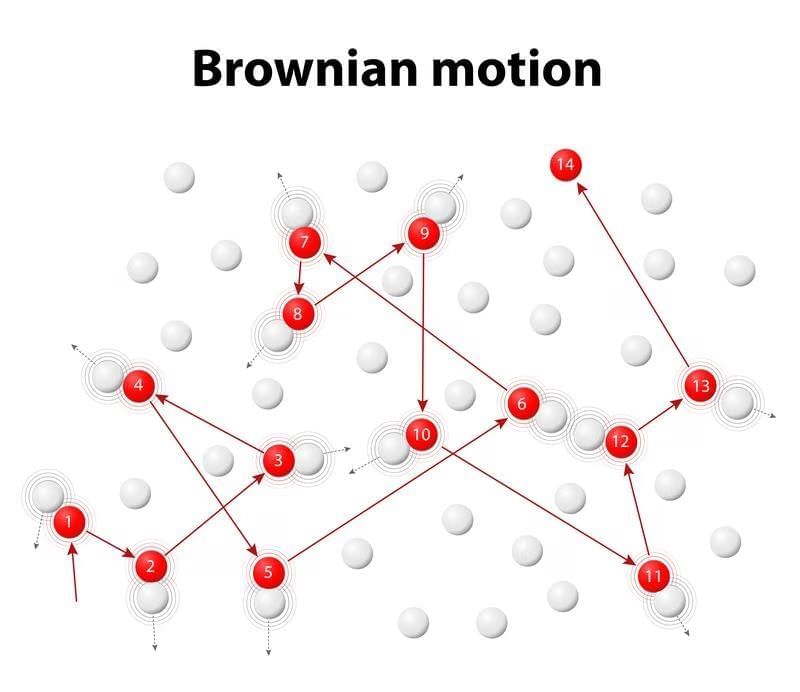
Q14: Name two processes from which it may be concluded that the particles of a gas move continuously.
Ans: 
Compressibility and Brownian movement.

Zig-Zag movement of Particles

Q15: What is common among the three states of matter?
Ans:
 They all contain molecules.

Q16: A substance x is highly compressible and could easily be liquefied. It can also take the shape of the container. Guess the nature of the substance.
Ans:
 Gas.

Q17: Is it possible to turn a liquid into vapour without heating?
Ans:
 Yes, by the process of evaporation as evaporization of water occur below the boiling point under atmospheric pressure.

Q18: When we put CuSO4 in water, after some time we find the solution turns blue. Why? Also, on heating it, what change will occur?
Ans:
 The solution turns blue because of diffusion. On heating the solution, nothing will happen.

Q19: The boiling point of alcohol is 78°C. What is this temperature on Kelvin scale?
Ans: 
K = °C + 273 = 78 + 273 = 351 K

Q20: Why are light and sound not considered as matter?
Ans:
 Light and sound are not considered as matter because they have no mass and do not occupy space.

Q21: We can get the smell of perfume sitting several metres away, why?
Ans: 
This is because perfumes diffuse very fast and can reach to people sitting several metres away.

Q22: Sponge is a solid, yet we are able to compress it. Why?
Ans: 
Sponge has very small holes throughout its structure. These holes are filled with air. When it is compressed, the air in the holes is squeezed out. Thus, we are able to compress it.

Q23: What is plasma?
Ans:
 Plasma is a state of matter consisting of super excited particles of very high energy level.

Q24: Define melting point.
Ans:
 The temperature at which a solid melts to become liquid at the atmospheric pressure is called its melting point.

Q25: What is humidity?
Ans:
 The air holds water vapour, this air with water is called humid air and the amount of water vapour present in the air is called humidity.

12. Worksheet Solutions: Improvement in Food Resources

Multiple Choice Questions

Q1. Which of the following is a Kharif crop?
(a) Wheat
(b) Mustard
(c) Soyabean
(d) Gram

Correct Answer is   Option (c)
Soyabean is a Kharif crop grown during the monsoon season.

Q2. What is the main objective of crop variety improvement?
(a) To increase water availability
(b) To make crops resistant to diseases
(c) To reduce the maturity duration
(d) All of the above

Correct Answer is   Option (d)
Crop variety improvement focuses on increasing yields, resistance to diseases, and reducing maturity duration.

Q3. Which farming practice involves growing two or more crops in definite row patterns?
(a) Mixed farming
(b) Intercropping
(c) Crop rotation
(d) Agroforestry

Correct Answer is   Option (b)
Intercropping is the practice of growing two or more crops in definite row patterns.

Q4. What is a major challenge in composite fish culture?
(a) Increased fish yield
(b) Availability of good-quality fish seed
(c) High water consumption
(d) Overfishing

Correct Answer is   Option (b)
The lack of availability of good-quality fish seed is a challenge in composite fish culture.

Q5. Which nutrient is supplied by air to plants?
(a) Nitrogen
(b) Phosphorus
(c) Carbon
(d) Potassium

Correct Answer is   Option (c)
Air supplies carbon and oxygen to plants.

Q6. What is the primary purpose of cross-breeding in cattle farming?
(a) To increase milk production
(b) To improve resistance to diseases
(c) To improve meat quality
(d) To improve lactation period

Correct Answer is   Option (a)
Cross-breeding improves milk production in cattle.

Q7. What is the process of composting?
(a) Growing plants to enrich the soil
(b) Decomposition of waste materials in pits
(c) Using fertilizers to improve soil quality
(d) The use of pesticides to protect crops

Correct Answer is   Option (b)
Composting is the process of decomposing waste materials in pits to produce organic matter for enriching soil.

Q8. Which type of manure is prepared by using earthworms?
(a) Green manure
(b) Compost
(c) Vermi-compost
(d) Bio-manure

Correct Answer is   Option (c)
Vermi-compost is made by using earthworms to hasten the decomposition process.

Q9. Which of the following is a method used to increase food production in India?
(a) Green Revolution
(b) White Revolution
(c) Both a and b
(d) None of the above

Correct Answer is   Option (c)
Both the Green and White Revolutions have helped increase food production in India.

Q10. What is the main aim of organic farming?
(a) To increase the use of chemical fertilizers
(b) To use minimal or no chemicals and maximum organic manures
(c) To focus on large-scale production
(d) To use genetically modified crops

Correct Answer is   Option (b)
Organic farming focuses on minimal chemical use and maximum organic manures.

Q11. Which of the following crops is an example of a Rabi crop?
(a) Pigeon pea
(b) Cotton
(c) Wheat
(d) Maize

Correct Answer is   Option (c)
Wheat is a Rabi crop grown during the winter season.

Q12. What is a key feature of composite fish culture?
(a) It involves only one species of fish
(b) It uses multiple species with different food habits
(c) It requires a high salt concentration
(d) It is only done in marine waters

Correct Answer is   Option (b)
Composite fish culture uses multiple species with different food habits to increase the yield.

Q13. What type of irrigation is most commonly used in India?
(a) Canal irrigation
(b) Rain-fed irrigation
(c) River irrigation
(d) Wells

Correct Answer is   Option (b)
Most agriculture in India is rain-fed, meaning dependent on rainfall.

Q14. What is the primary goal of nutrient management in crops?
(a) To increase the water supply
(b) To improve plant growth
(c) To enhance soil fertility
(d) Both b and c

Correct Answer is   Option (d)
Nutrient management focuses on improving both plant growth and soil fertility.

Q15. What is the role of bees in agriculture?
(a) Pollination
(b) Honey production
(c) Pest control
(d) All of the above

Correct Answer is   Option (d)
Bees play an important role in pollination, honey production, and pest control.

Fill in the blanks

1. Matter is made up of small ______.

Correct Answer is   Particles

2. The forces of attraction between the particles are ______ in solids, ______ in liquids, and ______ in gases.

Correct Answer is   Maximum, intermediate, minimum

3. ______ is the change of gaseous state directly to solid state without going through liquid state.

Correct Answer is   Deposition or Desublimation

4. In intercropping, crops are grown in ______ patterns.

Correct Answer is   Definite row

5. The process of composting involves the decomposition of organic waste in ______.

Correct Answer is   Pits

6. ______ is the method of enriching soil by growing certain plants and then ploughing them into the soil.

Correct Answer is   Green manure

7. ______ is a popular marine fish caught off the Indian coastline.

Correct Answer is   Mackerel

8. Organic farming focuses on using minimal or no ______ and maximum organic manures.

Correct Answer is   Chemicals

9. The process of hybridization involves the crossing of ______ plants.

Correct Answer is   Genetically dissimilar

10. Fish farming in freshwater is known as ______.

Correct Answer is   Inland fisheries

11. ______ are essential nutrients required by plants in large quantities.

Correct Answer is   Macronutrients

12. Crop rotation involves the growing of different crops in a pre-planned ______.

Correct Answer is   Succession

13. ______ is the main source of protein from fish.

Correct Answer is   Fish meat

14. In cattle farming, animals used for milk production are called ______.

Correct Answer is   Milch animals

15. ______ is the management of livestock for the purpose of breeding, feeding, and disease control.

Correct Answer is   Animal husbandry

Very Short Answer Question

Q.1. What has green revolution led to?

Ans: Increased food grain production. 

Q.2. What has white revolution led to?

Ans: Increased production and more efficient management of milk.

Q.3. Name the two factors on which food security depends.

Ans: Availability of food and access to it

Q.4. What should we do for a sustained livelihood?

Ans: We should adopt practices like mixed farming, intercropping and integrated farming practices.

Q.5. Which food items primarily supply proteins?

Ans: Pulses like gram, peas, lentils, etc.

Q.6. Name any two fodder crops.

Ans: Berseem and Sudan grass

Q.7. What is the duration of kharif season?

Ans: From the month of June to October

Q.8. What is the duration of Rabi season?

Ans: From the month of November to April

Q.9. What is the name given to crops obtained by introducing a gene that provides the desired characteristic?

Ans: Genetically modified crops

Q.10. What is the main benefit of mixed cropping?

Ans: It reduces production risk and gives insurance against failure of all the crops.

Short Answer Types Questions

Q.1. What are the hazards of using fertilizers?

Effects of using fertilizers:

  • Effect on soil quality: continued use of fertilizers leads to a loss of organic matter, a deterioration of soil structure.
  • Eutrophication: Excessive use of fertilizers build up nitrates on the soil.

Nitrates and phosphates are washed by rain and carried to lakes, ponds and rivers and causes excessive growth of plants of algae. Algae deplete the oxygen content of the water body.


Q.2. What are the main practices involved in keeping of animals or animal husbandry?

Main practices involved in animal husband day:

  • Breeding – It is done to obtain animals with desired characters. Breeding can develop high milk yielding and high meat-yielding animals.
  • Feeding – It deals with the study of proper food (called feed), mode and time of feeding of different animals.
  • Weeding – It is elimination of uneconomical animals.
  • Heeding – It means the proper care and management of animals.


Q.3. How do good animal husbandry practices benefit farmers?

Animal husbandry is the scientificmanagement of animal livestock. It includesvarious aspects such as feeding, breeding anddisease control.
As the population increases and asliving standards increase, the demand formilk, eggs and meat is also going up. Also,the growing awareness of the need for proper treatment of livestock has broughtin new limitations in livestock farming. Thus,livestock production also needs to beimproved. This improvement can be brought about by good animal husbandry practices like providing good food and preventing diseases in the cattles that will benefit farmers to obtain better quality and quantity products.


Q.4. What is hybridization?

Hybridization refers to the crossing between genetically dissimilar plants. In this method, the two crop verities are selected, each with at least one of desired characteristics such as high-yield or resistance to disease.


Q.5. For increasing production, what is common in poultry, fisheries and bee-keeping?

For increasing production, steps that are common in poultry, fisheriesand bee-keeping are as follows :

  • Good varieties/breeds are used.
  • Good nutritious food is provided.
  • Hygienic conditions/cleanliness is taken care of


Q.6. How do biotic and abiotic factors affect crop production?

The biotic factors include living organisms like honey bees and earthworms who help in better crop production while pests(insects and rodents) and microbes that produce bad effect on crop production.

The abiotic factors are the climatic conditions and non living natural resources like soil, water and air. They also affect crop production since favourable conditions of temperature, humidity and mineral nutrition improve crop production.


Q.7. What factors may be responsiblefor losses of grains duringstorage?

Factors that may be responsiblefor losses of grains duringstorage are :

  • Abiotic factors: Unfavourable conditions of humidity and temperature.
  • Biotic factors: Insects, rodents, bacteria, fungi etc that feed on grains.


Q.8. Why should preventive measures and biological control methods bepreferred for protecting crops?

Prevention is better than cure so is true for plants also. Such preventions involve spraying of herbicides, weedicides, insecticides, pesticides, fungicides etc in the crop field.
Since their excessive use can harm the crop plants and cause pollution so proper seed bed preparation, timelysowing of crops, intercropping and croprotation are additionally applicable. Other than these biological control methods like use of resistant varieties is highly useful.


Q.9. What is pasturage and how is it related to honey production?

Pasturage refers to the flowers availableto the bees for nectar and pollen collection.The value or quality of honey depends upon the pasturage. Along with this the kind of flowers available will determine the taste of the honey.

Q.10. Differentiate between compost and vermicompost.

Compost: It is prepared by the process in which farm waste materials like livestock excreta, vegetable wastes, animal refuse, domestic waste, straw, eradicated weeds are decomposed and used as manure. 
Vermicompost: It is the compost prepared from organic matter using earthworms which hasten the process of decomposition. 
12. Worksheet: Improvement in Food Resources

Multiple Choice Questions

Q1. Which of the following is a Kharif crop?
(a) Wheat
(b) Mustard
(c) Soyabean
(d) Gram

Q2. What is the main objective of crop variety improvement?
(a) To increase water availability
(b) To make crops resistant to diseases
(c) To reduce the maturity duration
(d) All of the above

Q3. Which farming practice involves growing two or more crops in definite row patterns?
(a) Mixed farming
(b) Intercropping
(c) Crop rotation
(d) Agroforestry

Q4. What is a major challenge in composite fish culture?
(a) Increased fish yield
(b) Availability of good-quality fish seed
(c) High water consumption
(d) Overfishing

Q5. Which nutrient is supplied by air to plants?
(a) Nitrogen
(b) Phosphorus
(c) Carbon
(d) Potassium

Q6. What is the primary purpose of cross-breeding in cattle farming?
(a) To increase milk production
(b) To improve resistance to diseases
(c) To improve meat quality
(d) To improve lactation period

Q7. What is the process of composting?
(a) Growing plants to enrich the soil
(b) Decomposition of waste materials in pits
(c) Using fertilizers to improve soil quality
(d) The use of pesticides to protect crops

Q8. Which type of manure is prepared by using earthworms?
(a) Green manure
(b) Compost
(c) Vermi-compost
(d) Bio-manure

Q9. Which of the following is a method used to increase food production in India?
(a) Green Revolution
(b) White Revolution
(c) Both a and b
(d) None of the above

Q10. What is the main aim of organic farming?
(a) To increase the use of chemical fertilizers
(b) To use minimal or no chemicals and maximum organic manures
(c) To focus on large-scale production
(d) To use genetically modified crops

Q11. Which of the following crops is an example of a Rabi crop?
(a) Pigeon pea
(b) Cotton
(c) Wheat
(d) Maize

Q12. What is a key feature of composite fish culture?
(a) It involves only one species of fish
(b) It uses multiple species with different food habits
(c) It requires a high salt concentration
(d) It is only done in marine waters

Q13. What type of irrigation is most commonly used in India?
(a) Canal irrigation
(b) Rain-fed irrigation
(c) River irrigation
(d) Wells

Q14. What is the primary goal of nutrient management in crops?
(a) To increase the water supply
(b) To improve plant growth
(c) To enhance soil fertility
(d) Both b and c

Q15. What is the role of bees in agriculture?
(a) Pollination
(b) Honey production
(c) Pest control
(d) All of the above

Fill in the blanks

1. Matter is made up of small ______.

2. The forces of attraction between the particles are ______ in solids, ______ in liquids, and ______ in gases.

3. ______ is the change of gaseous state directly to solid state without going through liquid state.

4. In intercropping, crops are grown in ______ patterns.

5. The process of composting involves the decomposition of organic waste in ______.

6. ______ is the method of enriching soil by growing certain plants and then ploughing them into the soil.

7. ______ is a popular marine fish caught off the Indian coastline.

8. Organic farming focuses on using minimal or no ______ and maximum organic manures.

9. The process of hybridization involves the crossing of ______ plants.

10. Fish farming in freshwater is known as ______.

11. ______ are essential nutrients required by plants in large quantities.

12. Crop rotation involves the growing of different crops in a pre-planned ______.

13. ______ is the main source of protein from fish.

14. In cattle farming, animals used for milk production are called ______.

15. ______ is the management of livestock for the purpose of breeding, feeding, and disease control.

Very Short Answer Question 

Q.1. What has green revolution led to? 

Q.2. What has white revolution led to?

Q.3. Name the two factors on which food security depends.

Q.4. What should we do for a sustained livelihood?

Q.5. Which food items primarily supply proteins?

Q.6. Name any two fodder crops.

Q.7. What is the duration of Kharif season?

Q.8. What is the duration of Rabi season?

Q.9. What is the name given to crops obtained by introducing a gene that provides the desired characteristic?

Q.10. What is the main benefit of mixed cropping?

Short Answer Types Questions

Q.1. What are the hazards of using fertilizers?

Q.2. What are the main practices involved in keeping of animals or animal husbandry?

Q.3. How do good animal husbandry practices benefit farmers?

Q.4. What is hybridization?

Q.5. For increasing production, what is common in poultry, fisheries and bee-keeping?

Q.6. How do biotic and abiotic factors affect crop production?

Q.7. What factors may be responsiblefor losses of grains duringstorage?

Q.8. Why should preventive measures and biological control methods bepreferred for protecting crops?

Q.9. What is pasturage and how is it related to honey production?

Q.10. Differentiate between compost and vermicompost.

11. Worksheet Solutions: Sound

Q.1. Fill in the blanks

(i) Quality of sound depends on Waveform .
(ii) The speed of sound in a solid is greater than the speed of sound in air.
(iii) Sound is caused by Vibrations .
(iv) Pitch of sound depends on frequency .
(v) Sound cannot travel through Vacuum .


Q.2. If 25 sound waves are produced per second, what is the frequency in hertz?
(a) 25 hertz
(b) 50 hertz
(c) 75 hertz
(d) 1/25 hertz

Ans: (a)

Explanation: Frequency is the number of waves produced per second. If 25 waves are produced each second, the frequency is 25 hertz, written as 25 Hz.


Q.3. Which of the following vibrates when a musical note is produced by the cymbals in an orchestra?
(a) Stretched strings
(b) Stretched membranes
(c) Metal plates
(d) Air columns

Ans: (c)

Explanation: Cymbals are thin metal plates that vibrate when struck. These vibrations of the metal plates set the surrounding air into motion and produce sound. Stretched strings and membranes vibrate in instruments like guitars and drums, and air columns vibrate in wind instruments, so those options are not correct for cymbals.


Q.4. Inner Ear is called as
(a) Cochlea
(b) Pinna
(c) Hammer
(d) Anvil

Ans: (a)

Explanation: The inner ear is called the cochlea; it is the spiral-shaped part that helps convert sound vibrations into nerve signals. The pinna is the outer ear, while the hammer and anvil are small bones in the middle ear.


Q.5. Frequency of ultrasonic sound wave is
(a) Greater than 20 HZ
(b) Greater than 20,000 HZ
(c) Greater than 2 HZ
(d) Greater than 2 MHZ

Ans: (b)

Explanation: Ultrasonic sound waves have frequencies greater than 20,000 Hz (20 kHz). Options (a) and (c) describe much lower frequencies; option (d) (greater than 2 MHz) is far above the ultrasonic threshold but does not define the general ultrasonic range.


Q.6. Why are the ceilings of concert halls curved?

Ans: The ceilings of concert halls are curved so that sound reflections are spread evenly throughout the hall. Curved surfaces help direct and disperse sound waves to reach all corners, improving clarity and loudness for the entire audience.


Q.7. What happens when sound travels in air?

Ans: When sound travels through air it creates alternating regions of compression and rarefaction. In a compression the air particles are closer together and the pressure is higher; in a rarefaction the particles are farther apart and the pressure is lower. These successive compressions and rarefactions move through the air and carry the sound to the listener.


Q.8. What is an echo? Name two areas of its application?

Ans: An echo is the reflected sound heard when sound waves strike a surface and return to the listener. Two applications of echoes are SONAR (used to detect objects under water) and using reflected ultrasound to detect flaws in metal objects (ultrasonic testing).


Q.9. What is SONAR? Write its working?

Ans: SONAR stands for Sound Navigation and Ranging. It uses ultrasonic waves to locate objects under water. A transmitter sends out ultrasonic pulses; these pulses travel through water, strike an object and get reflected back. A detector receives the reflected waves and converts them into electrical signals. By measuring the time between sending the pulse and receiving the echo, the distance to the object is calculated using the relation distance = (speed of sound in water × time taken)/2.


Q.10. How can ultrasound be used to detect the defect in metal block?

Ans: Ultrasound (waves with frequency greater than 20 kHz) is sent into the metal from one end while detectors are placed at the other end or at positions to receive returned echoes. If the metal has no defect, the ultrasound passes through and is detected as expected. If there is a defect, part of the ultrasound is reflected back or attenuated at the defect, so the detector receives a changed signal (weaker, delayed or missing). Such changes indicate the presence and often the location of the defect; this is the basis of ultrasonic non-destructive testing.


Q.11. Suppose you and your friend are on the moon. Will you be able to hear any sound produced by your friend?

Ans: No. There is no air on the Moon, so there is no medium to carry sound waves. Therefore you and your friend would not be able to hear sounds produced by one another; communication on the Moon requires radio or other electronic means.


Q.12. Sound requires a medium to travel? Justify experimentally.

Ans: The following experiment demonstrates that sound requires a medium for propagation:

  • Take a bell jar and suspend an electric bell in it,
  • The bell jar is connected to a vacuum pump. Till the air is in the bell jar, the sound of the electric bell is louder.
  • Now, with the help of vacuum pump, pump out the air gradually
  • Now as air is pumped out, the sound of the bell gets fainter and fainter.
  • Now, when the bell jar is completely vacuumed no sound is heard.
  • This shows that air is required for propagation of sound.

Explanation: As air is removed from the jar the bell becomes fainter and finally silent in a vacuum, showing that air (a medium) is needed to transmit sound.


Q.13. How does the sound produced by a vibrating object in a medium reach your ear?

Ans: A vibrating object pushes and pulls the particles of the surrounding medium. These particles transfer the disturbance to neighbouring particles as alternating compressions and rarefactions. The chain of particle vibrations travels through the medium until the waves reach the ear, where they make the eardrum vibrate and are perceived as sound.


Q.14. Why are sound waves called as mechanical waves?

Ans: Sound waves are called mechanical waves because they require a material medium (solid, liquid or gas) to travel. Without a medium, sound cannot propagate, which is a defining property of mechanical waves.


Q.15. Explain how sound is produced by your school bell.

Ans: When the peon strikes the school bell with a hammer, the bell metal vibrates. These vibrations disturb the air around the bell, creating compressions and rarefactions that travel as sound waves. The sound waves reach our ears and are heard as the ringing of the bell.