6. The Making of a Scientist – Short Answer Questions

Q1. Which project did Ebright submit in his eighth grade? Why did he win?
Ans: In his eighth grade, Ebright conducted a project to investigate the cause of a viral disease that periodically wiped out nearly all monarch caterpillars. He hypothesised that the disease might be transmitted by a beetle. Although his attempts to raise caterpillars alongside beetles did not yield significant results, he presented his experiments and trials. This effort earned him first place at the county fair and entry into the International Science and Engineering Fair, where he secured third place in zoology.


Q2. ‘Richard was the focus of his mother’s attention.’ Compose a thesis on this.
Ans: The thesis statement is that Richard’s father’s death when he was just three years old made him the sole focus of his mother. This created a strong bond and a nurturing environment that fostered his interest in learning. As a result, Richard achieved success in various fields, particularly in science.


Q3. Which project of Ebright won first prize in the county science fair?
Ans: Initially, Ebright did not win any awards at his first science fair, which made him realise that successful projects require real experiments. However, he later achieved significant success. Ebright, alongside a fellow scientist, created a device that demonstrated that the tiny gold spots on a monarch pupa produced a hormone essential for the butterfly’s complete development. This project earned him first prize at the county science fair and third prize in zoology at the international science fair.


Q4. ‘Science shows a connection between structure and function.’ Show this to be so, for the spots Ebright saw on Monarch pupas.
Ans: Richard Ebright conducted experiments on a monarch’s wing cells, demonstrating that they could only grow into normal butterfly wing scales when supplied with hormones from the gold spots on the pupa. This significant finding won him first place in zoology at the International Fair. Later, he identified the chemical structure of the hormone, which helped him understand how cells interpret the blueprints of their DNA.


Q5. What was Richard A Weiher’s opinion of his student Richard, Ebright?
Ans: Mr. Richard A. Weiherer, Ebright’s Social Studies teacher and adviser, regarded him as a student with varied interests. Ebright dedicated three to four hours each night to debate research, alongside his butterfly studies and other pursuits. Weiherer noted that Ebright was competitive, but in a positive way, focusing on doing his best rather than merely winning.


Q6. How did Richard Ebright grow cells from a monarch butterfly’s wing? What did that project win for Ebright?
Ans: Richard Ebright successfully grew cells from a monarch butterfly’s wing in a culture. He demonstrated that these cells could divide and develop into normal butterfly wing scales, provided they were nourished with a hormone from the gold spots. This project earned him first place in zoology at the International Fair.


Q7. Why and where did Richard Ebright send the tagged butterflies?
Ans: At the end of The Travels of Monarch X, readers were invited to assist in studying the migration of monarch butterflies. They were encouraged to tag butterflies for research conducted by Dr. Frederick A. Urquhart from the University of Toronto. Richard Ebright began attaching light adhesive tags to the wings of these butterflies and sent them to Dr. Urquhart for his research.


Q8. How did Ebright’s basement become home to thousands of monarch butterflies?
Ans: Richard Ebright became interested in monarch butterflies while assisting Dr. Urquhart with his research. Catching butterflies one by one proved challenging, so Ebright decided to raise them in his basement. He would capture a female monarch, collect her eggs, and nurture them through their life cycle—from egg to caterpillar, then to pupa, and finally to adult butterfly. After tagging their wings, he would release them. Over the years, his basement became home to thousands of monarchs at various stages of development.


Q9. What did Ebright realize when he started tagging butterflies?
Ans: Ebright began tagging monarch butterflies and quickly realised that chasing them individually would limit his observations. To see more butterflies, he decided to raise a flock instead. He captured a female monarch, collected her eggs, and nurtured them through their life cycle in his basement. This process allowed him to observe thousands of monarchs at various stages, from egg to adult butterfly. After they matured, he tagged their wings and released them.


Q10. Why did Ebright begin to lose interest in tagging butterflies?
Ans: Ebright began to lose interest in tagging butterflies because there was little feedback from his efforts. He felt disappointed as only two of the butterflies he tagged were recaptured, and they were found within seventy-five miles of his home.


Q11. What happened when Ebright wrote to Dr. Urquhart for ideas?
Ans: Ebright wrote to Dr. Urquhart seeking ideas, and in response, the renowned scientist provided him with numerous suggestions for experiments. These experiments kept Ebright engaged throughout high school and led to him winning several prizes at both county and international science fairs.


Q12. Why do the viceroy butterflies imitate the monarch butterflies?
Ans: The viceroy butterflies imitate monarch butterflies to avoid being eaten by birds. Research indicates that birds find monarchs unappetising due to their toxicity. In contrast, viceroys are tasty to birds. By resembling monarchs, viceroys reduce their chances of predation, as birds are less likely to eat something that looks like a monarch.


Q13. Which simple question led to the discovery of an unknown insect hormone?
Ans: In his second year of high school, Richard Ebright’s research led to the discovery of an unknown insect hormone, which also contributed to his new theory on cell life. He sought to answer a simple question: What is the purpose of the twelve tiny gold spots on a monarch pupa? While many believed the spots were merely decorative, Ebright and a fellow student built a device that demonstrated these spots produced a hormone essential for the butterfly’s complete development.


Q14. What idea did Ebright get when he was looking at the X-ray photos of cells?
Ans: While examining X-ray photos of the chemical structure of cells, Ebright conceived a new theory about cell life. These images helped him solve a significant biological question: how cells can ‘read’ the blueprint of their DNA. DNA, located in the nucleus, controls heredity and determines the cell’s form and function, serving as the blueprint for life.


Q15. Richard Ebright was a famous scientist but he had time for other interests too. What were the other interests and hobbies of Ebright?
Ans: Richard Ebright’s journey as a scientist began with his passion for collecting butterflies. Alongside this, he pursued several other interests and hobbies. He became a champion debater and public speaker, showcasing his skills in various competitions. Ebright was also an accomplished canoeist and enjoyed outdoor activities. Additionally, he developed expertise in photography, particularly focusing on nature and scientific exhibits.


Q16. “… There was one thing I could do —collect things.” What did Richard Ebright do in his childhood?
Ans: Richard Ebright, an only child, grew up in Reading, Pennsylvania. He mentioned, “There wasn’t much I could do there,” but he found joy in collecting things. Starting in kindergarten, he began collecting butterflies with great enthusiasm. By second grade, he had gathered all 25 species of butterflies native to his area. In addition to butterflies, Ebright also collected rocksfossils, and coins. He developed a keen interest in astronomy, often spending nights stargazing.


Q17. How and where did Richard Ebright identify the hormone’s chemical structure?
Ans: After his freshman year at Harvard University, Richard Ebright returned to the Department of Agriculture laboratory. There, he conducted further research on the hormones from the gold spots. Using the laboratory’s sophisticated instruments, he successfully identified the hormone’s chemical structure.


Q18. What book opened the world of science to the eager young collector, Richard Ebright?
Ans: Richard Ebright developed a passion for collecting at a young age, amassing all twenty-five species of butterflies in his hometown by the second grade. The book that truly opened the world of science for him was The Travels of Monarch X, a children’s book given to him by his mother. This book detailed the migration of monarch butterflies to Central America, sparking Ebright’s interest in scientific exploration.


Q19. When and how did Richard Ebright get a hint of what real science is?
Ans: Richard Ebright first discovered what real science is in seventh grade when he participated in a county science fair and did not win. He felt disheartened as he did not receive any recognition while others were awarded. His project involved slides of frog tissues viewed under a microscope. This experience made him realise that the successful participants had conducted genuine experiments, whereas he had merely created a neat display.
Determined to improve, Ebright resolved to undertake a real experiment for the following year’s fair. He decided to focus on the insect work he had been doing for several years. He reached out to Dr Urquhart for ideas, which resulted in a plethora of suggestions that kept him engaged throughout high school and led to award-winning projects at both county and international science fairs.


Q20. Who was Dr. Frederick A Urquhart? Why did Richard Ebright look to him for fresh ideas?
Ans: Dr. Frederick A Urquhart was a renowned scientist and educator at the University of Toronto, Canada, known for his research on butterfly migrations. Richard Ebright, a budding scientist, sent him numerous tagged butterflies for his studies. Ebright sought Dr. Urquhart’s insights and fresh ideas, which proved invaluable. The suggestions he received led Ebright to conduct various experiments, ultimately helping him achieve success in both county and international science fairs.
5. Footprints without Feet – Short Answer Questions

Q1. What discovery did Griffin make? What was the result of his discovery?
or
How did Griffin succeed in becoming invisible? What was the result of his experiments?

Ans: Griffin, a brilliant scientist, discovered rare drugs that made the human body invisible while staying solid. Despite his success, he lacked morals. After a fight with his landlord, he set his house on fire and ran away. Now homeless and invisible, he wandered around, but his muddy footprints exposed his presence and shocked people.

Q2. How was Griffin a lawless man?
or
How and why did a brilliant scientist like Griffin degenerate into a lawless and homeless wanderer?
or
How did Griffin become a homeless wanderer without clothes and money?

Ans: Griffin, a brilliant scientist, discovered how to make the human body invisible but used it for selfish purposes. He committed thefts, assaults, and broke into shops for food and clothes. When his landlord tried to evict him, Griffin set the house on fire and escaped by turning invisible. This made him a homeless and lawless wanderer.

Q3. What was the explanation of the mystery of the footmarks? Who was responsible for them?

Ans: The mystery of the footmarks was quite simple. They belonged to Griffin, a scientist who had discovered how to make the human body invisible. After conducting numerous experiments, he succeeded in proving that a person could become transparent. To escape being seen, Griffin had to remove his clothes, which led to him becoming a homeless wanderer. However, when he stepped in mud, he left behind visible footprints.

Q4. Why was the time bad for Griffin, the scientist, to become invisible?

Ans: Griffin became invisible after removing his clothes in January, a particularly cold month. As he stripped away his garments, the chilly air caused him to shiver uncontrollably. Therefore, the timing was unfortunate for Griffin to undergo such a transformation.

Q5. How did Griffin save himself from the cold of January?

Ans: Griffin was shivering from the cold in January when he entered a large store for warmth. After the store closed, he took advantage of the situation by putting on warm clothes he found. He then enjoyed a meal of cold meat and coffee, followed by sweets and wine. Finally, he settled down to sleep on a pile of quilts, effectively saving himself from the bitter cold.

Q6. Why did Griffin hurry to Drury Lane, the center of the theatre world?
or
What did Griffin do when he returned to the theatrical company’s shop for the second time?

Ans: The second time, Griffin raided a theatrical company’s stock to find clothes and items like side whiskers, glasses, a false nose, bandages, and a hat to cover his invisible head. He emerged wearing bandages, dark glasses, a false nose, thick whiskers, and a large hat.

Q7. Why did Griffin decide to leave London and come to the village of Iping?

Ans: Griffin left crowded London to seek solitude in the village of Iping. He desired to live in isolation, away from the prying eyes of others. To achieve this, he took a train to Iping and booked two rooms at the local inn. His aim was to enjoy a peaceful and undisturbed life in the village.

Q8. Why did the landlady, Mrs. Hall, try to be friendly and prepared to excuse Griffin’s irritable habits?

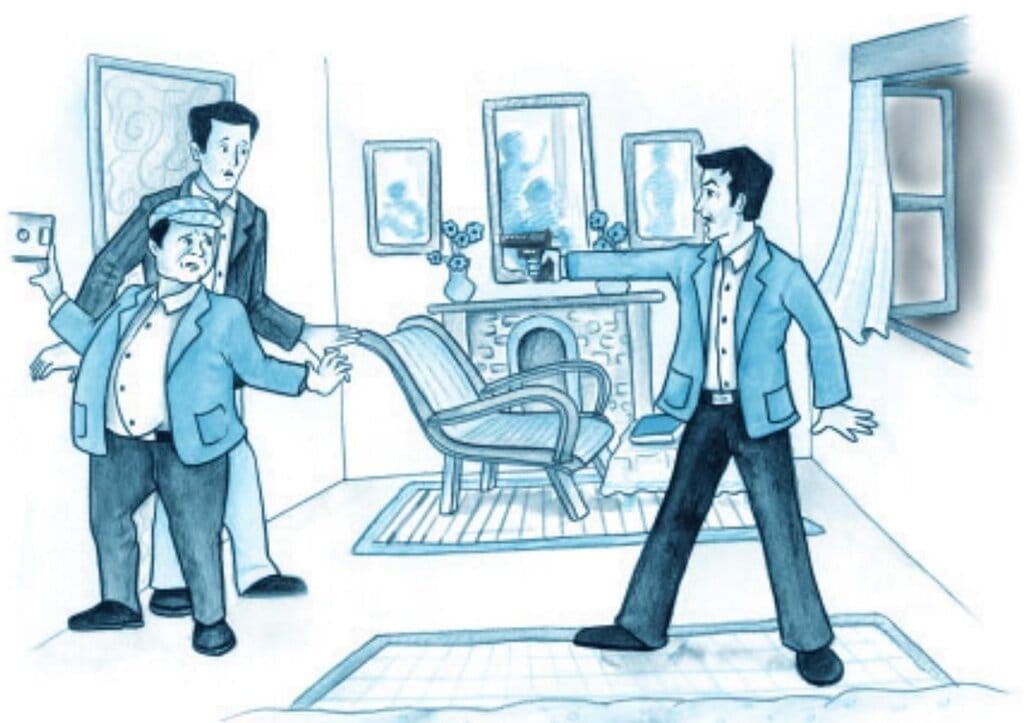
Ans: During winter, it is quite unusual for a stranger to visit Iping, so Mrs Hall, the landlady, felt it was important to be friendly to her guest. Although Griffin was irritable and told her not to disturb him, Mrs Hall tolerated his behaviour because he had paid in advance. She believed he was an eccentric scientist, which made her more understanding of his strange habits and temper.

Q9. Describe the strange behavior of Mrs. Hall’s furniture. How did the chair start moving and push Mr. and Mrs. Hall out of the room?

or

​Why did Mrs. Hall think that the room was haunted by ghosts? What did the neighbors think about the strange incident, the movement of furniture in the stranger’s room?

Ans: Suddenly, Mrs Hall heard a sniff near her ear, and Griffin’s hat hit her face. Then, a chair sprang up, charged at them, and pushed both her and her husband out of the room, slamming the door behind them. Terrified, Mrs Hall nearly fell down the stairs, believing the room was haunted and the stranger had filled it with spirits. The neighbours, on the other hand, speculated that the strange occurrences were due to witchcraft.

Q10. Why were the landlord and his wife surprised to see the scientist’s door wide open?

Ans: The landlord and his wife were surprised to find the scientist’s door widely open. He usually kept it locked and was very angry if anyone entered. This unusual sight prompted them to investigate. They noticed the bedclothes were cold, indicating he had been up for a while, and his clothes and bandages were scattered around the room.

Q11. What did the Halls see in the scientist’s room?
or
What did Mrs. Hall and her husband find when they investigated Griffin’s room?

Ans: The Halls were shocked to find Griffin’s room open and the bedclothes cold, showing he had been up for a while. His clothes and bandages were lying around, but he was nowhere to be seen.

Q13. Describe the burglary committed very early in the morning at a clergyman’s house in Iping.

Ans: Early one morning, a clergyman and his wife heard strange sounds from the study and the clink of money being taken. Armed with a poker, the clergyman burst in and shouted, “Surrender!” But to their shock, the room was empty. Despite searching everywhere, they found no one—only an open desk and missing housekeeping money.

Q14. What and why did Griffin show himself to Mrs. Hall and why were the people in the bar horrified?

Ans: Mrs. Hall was curious how the stranger came from an empty room and what he did to her chair. Angered by her questions, Griffin shouted, “Very well—I’ll show you,” and removed his bandages, whiskers, spectacles, and even his nose. Mrs. Hall was shocked, and the bar patrons were horrified to see a headless man.

Q15. What happened to Jaffers when he tried to catch the invisible scientist?
or
What happens to the constable when he encounters Griffin?

Ans: When Constable Jaffers came to arrest Griffin, he was stunned to see him headless. As Griffin undressed and turned invisible, a struggle began. Jaffers tried to fight back but was overpowered by unseen blows and knocked unconscious. Griffin escaped, leaving behind confusion and chaos.

Q16. How did the invisible man first become visible?
or
How did Griffin accidentally reveal himself to the public?

Ans: Griffin first became visible when he stepped in mud, leaving footprints that could be seen by others, revealing his presence. His invisibility was again compromised when he entered a London store, fell asleep, and then had to run from the store employees, leaving behind his clothing and becoming visible as a result.

4. A Question of Trust – Short Answer Questions

Class 10 English Chapter “A Question of Trust”  is about a thief who gets a taste of his own deeds. The story reminds us to be careful when we trust someone and to take time to get to know them before depending on them completely. Let us see some Short Answer Questions of this chapter in this EduRev document: 

Q1: Why was it not hard to open the safe for Horace Danby?:
Ans: It was not going to be hard to open the safe for Horace Danby. After all, he had `lived with locks and safes all his life’. He made locks himself with two helpers. The burglar alarm was poorly built and he cut the wires of the burglar alarm. He knew about the safe and the key, and it was not a difficult job for him to open it when no one was present in the house.


Q2: Whose voice was it that advised Horace about the special treatment of his hay fever?
Ans: When Horace was about to open the safe, he heard a female voice. She asked if he suffered from a cold or hay fever. He was sneezing again and again. She told that he could cure the hay fever with special treatment. He must find out what plant gave him that disease. She also advised Horace to see a doctor.


Q3: Describe the unexpected meeting of the young lady in red and Horace.
Ans: When a voice advised Horace to find a suitable treatment of his hay fever, he was surprised. It was a quiet, kindly voice but one with firmness in it. A young woman, quite pretty and dressed in red was standing there. She walked to the fireplace and straightened the ornaments. She said that she “didn’t expect to meet a burglar”.


Q4: Why did the woman in red threaten to call the police?
Ans: Horace was caught red-handed. The woman in red said that she didn’t expect to meet a burglar there. She added that she knew that it had been a great inconvenience for him to meet her. She also asked what he was going to do. Horace replied that he was thinking of running away. The lady threatened that if he did so, she would call the police and tell them all about him. They would get him at once.


Q5: When and why did the woman in red say, “Society must be protected from men like you”? Doesn’t it sound ironical?
Ans: Horace assured the woman in red that he would not hurt her. She must forget she ever met him. It made her angry. She couldn’t let him go, otherwise, he would rob someone else. Society must be protected from people like him. It sounds ironic because she herself was a thief and had come for the same purpose for which Horace was there in the house.


Q6: “I have always liked the wrong kind of people,” said the woman in red. Comment.
Ans: It was ironic that the woman who was being considered as the lady of the house and talking big things was herself a thief. Horace requested her to let him go. He was desperate and afraid of going to prison. He promised never to do such a thing again. The lady pretended to be generous and stated that she “always liked the wrong kind of people”.

Q7: Who is the real culprit in the story, the young lady in red or Horace Danby? Comment.
Ans: Law of any land works on evidence. Horace Danby opened the safe without wearing his gloves. He didn’t think it necessary to wear them as he thought he was working for ‘the lady of the house’. So the police matched his fingerprints and he was arrested. The lady in the red was actually the real culprit. She made Horace open the safe for her. She was also a thief and decamped with the jewels. But in the eyes of the law, Horace was the real culprit because the evidence was against him.

Q8: Why didn’t the dog bark when Horace Danby and the young lady in red entered to commit theft in the house?
Ans: Both, Horace Danby and the young lady in red knew all the tricks of their trade. They knew the real nature of dogs and how to be friendly with them. A small dog when made a noise, Horace called out “All right, Sherry,” as he passed. Perhaps, the lady in red also knew like Horace that to keep dogs quiet, one must call them by their right names. Their trick worked and Sherry remained quiet.

Q9: Why did Horace Danby prefer books to collecting paintings?
Ans: Horace Danby had a passion for books. Collecting and buying rare and expensive books was his passionate hobby. He resorted to robbing a safe every year to buy them. When the preference between collecting books and paintings came, he chose the former. The paintings took up too much space. In a small house like his, books were a better choice.

Q10: Why didn’t Horace Danby ever get any chance to look for another safe?
Ans: Horace got nothing from the house at Shotover Grange. The lady in red decamped with the jewels. For two days, he kept his promise given to the kind, young lady in red. On the third day, he realized that he would have to look for another safe to buy books. But he never got that chance because the police arrested him for the jewel robbery at Shotover Grange.


Q11: Which of the two lacked honor?
Ans: Among the two the young lady lacked honor. She came face to face with a thief, still, she tricked ‘him. But Horace did not know that she was a thief. She got all the jewels. She went free but poor Horace was arrested. It was against the profession of thieves.

Q12: How did Horace Danby manage to get rare and expensive books?
Ans: Horace Danby loved rare and expensive books. He bought them secretly through an agent. But for this, he had to rob a safe every year because he did not have enough money to buy these books. In this way, he managed to get these rare and expensive books.

Q13: What did the young lady asked Horace to do for her?
Ans: The young lady told Horace that she had come there to take the jewel from the safe. She said that she had to wear them that night at a party. She made an excuse of forgetting the number to open the safe. So she compelled Horace to break open the safe for her if not she would tell the police everything about him.


Q14: What story did Horace tell the police when he was arrested?
Ans: He told the police that he had not stolen any jewels. He said that he broke open the safe for the young wife of the owner of the house. But the wife was herself an old lady of about sixty with grey hair. So, none believed his story.


Q15: Why did he rob every year? Was he a typical thief? If so, why?
Ans: Horace loved reading rare and expensive books. So he robbed a safe every year to buy these books. He was a typical thief because he robbed only one safe every year.


Q16: He was a very successful thief. What went wrong when he attempted to rob Shotover Grange?
Ans: Danby was a very successful thief. He always used gloves while breaking a safe. He never left any fingerprints behind. This time when he started his work, he felt a little tickle in his nose. It was because of a big flower pot lying on the table. He was repeatedly sneezing. This happened wrong with him.


Q17: Did the young lady expect Horace to be caught after the theft?
Ans: Yes, the young lady expected Horace to be caught after the theft. She thought that it would be very easy to detect Horace with the help of fingerprints.


Q18: In what way could his arrest have helped her?
Ans: If Horace Danby was arrested for the jewels robbery at Shotover Grange then she could be safe. She got the jewels but Horace broke the safe for her. Thus, his arrest could have helped her by making her tension free.


Q19: Did Horace get the jewels from the Grange safe? If not, why did the police arrest him?
Ans: No, Horace did not get the jewels from the Grange safe. But he broke open the safe for the wife of the owner of the house without gloves. But in reality, that lady was a burglar. Thus, there were Horace’s fingerprints all over the room. So, the police arrested him for stealing the jewels from the Grange safe.


Q20: Who was Horace Danby?
Ans: Horace Danby was about fifty years old and unmarried. Everyone thought that he was a good and honest citizen. He lived with a housekeeper who worried about his health. He suffered from attacks of hay fever in the summer. He made locks and was successful at his business. But he was not completely honest. He robbed a safe once a year to buy rare and costly books.


Q21: Why was Horace Dan by not completely honest?
Ans: Generally, people thought that Horace Danby was a good, honest and respectable citizen. However, he was not completely honest. He robbed a safe every year. This was done to get the necessary money for the purchase of ‘rare and expensive’ books. The money he stole was enough to last a year. He secretly bought the books he loved through an agent.


Q22: What preparations did Horace make for ‘this year’s robbery’ at Shotover Grange?
Ans: All the previous yearly robberies of Horace Danby were successful. He felt sure that this year’s robbery at Shot over Grange would also be successful. He had been studying the location of the house for two weeks. He studied its rooms, electric wiring, paths, and garden. He found out that the two servants had gone to the movies. He had seen the housekeeper hang the key to the kitchen door on a hook outside.


Q23: How did Horace Danby enter the house?
Ans: Horace Danby had been preparing for the theft. He studied the house carefully for two weeks before committing the theft in the house at Shotover Grange. He studied its rooms, electric wiring, paths and its garden. He had seen the housekeeper hang the key to the kitchen door on a hook outside. He put on a pair of gloves, took the key and opened the door. Thus, he entered the house at Shotover Grange.

Q24: What precautions did Horace make before reaching the safe? Name three of them.
Ans: Horace Danby took the following precautions before committing the theft:
(i)He put on a pair of gloves as he was always careful not to leave any fingerprints.
(ii) To tackle the house-dog, Sherry, he kept him quiet and friendly by calling him by his right name.
(iii) He cut the wire of the burglar bell.

Also Check at EduRev:

Q25: Why did Horace mistake the young lady in red as the lady of the house?
Ans: The young woman in red was even smarter than Horace Danby. She was a thief and came with the same purpose as Horace to that house. However, she encountered Horace with an air of confidence and authority. She didn’t allow him to doubt or think about her. She showed that the dog, Sherry, belonged to her. He told him that she returned ‘home’ just in time. Her manner of speaking, gestures, and confidence made Horace mistake her to be the lady of the house.

If you want to make the most of your studies and get the grades you deserve, then EduRev is a perfect choice!  

3. The Midnight Visitor – Short Answer Questions

Q1: What made the story of the balcony so convincing?
Ans:
 Ausable showed his annoyance for the nuisance created by the balcony. He said that this was the second time that someone had got into his room through it. He also said that the balcony was not his but belongs to the next apartment and earlier his room used to be a part of a large unit.

Q2: Comment on the writer’s likely choice to create an unconventional spy character like Ausable in ‘The Midnight Visitor’.
Ans: 
The writer likely chose to create an unconventional spy character like Ausable in “The Midnight Visitor” to offer a fresh and memorable story that challenges typical spy stereotypes. This choice highlights that people involved in espionage can be different from what we usually expect. Ausable’s unique traits make him more relatable, add humor to the story, and present a new perspective on what a spy can be. The difference between Ausable’s ordinary appearance and his skillful handling of the situation makes his character more interesting and adds depth to the story.

Q3: Henry unintentionally saved Ausable’s life. Briefly comment. 
Ans:
 Henry, the waiter at the hotel where Ausable was staying, unintentionally saved Ausable’s life. At a crucial moment, Henry knocked on Ausable’s door just as Ausable was convincing Max about a non-existent balcony. Thinking the knock was the police, Max panicked and jumped out of the window, leading to Ausable being saved.

Q4: How did Ausable befool Max about the balcony?
Ans: Ausable was a very intelligent spy agent. When he found Max waiting for him in his room, he immediately thought of the plan. He told Max that there is a balcony from where people enter his room that Max must have also entered from there. Max got convinced about the story and hence when someone knocked at the door, he ran towards the balcony to hide and died.

Q5: Why did so many people risk their lives?
Ans: Ausable had received a paper which had certain important information about new missiles. The paper was so important that several men and women had risked their lives to get it.

Q6: How did Ausable kill Max without using a weapon?
Ans: Ausable was an intelligent spy. When he found Max waiting for him in his room, he made a story of a balcony under his window. He convinced Max about the balcony. And thus, when someone knocked at the door, Max fearing it to be the police, jumped out of the window and died.

Q7: Who was in Ausable’s room? What was in his hand?
Ans: A man named Max was there in Ausable’s room. He was another secret agent. He had an automatic pistol in his hand.

Q8: What did the secret agent tell Max when he heard the knock?
Ans: He told Max that it would be the police. He said that he had called the police for the protection of such an important paper that he was going to receive that night. He wanted to have extra protection for the report.

Q9: Did Ausable know that it was the waiter who had knocked at the door?
Ans: Yes, Ausable knew that the man knocking at the door was the waiter. He had ordered him to bring a bottle of wine. And he knew that the waiter must have come with the drinks.

Q10: Was there a balcony outside the window? Give instances from the text in support of your answer.
Ans: No, actually there was not a balcony outside the window. Ausable had falsely told Max about the balcony. When Max dropped himself to the balcony, he screamed. He fell down to the ground from the sixth floor. In the end, Ausable told Fowler, “No, he won’t return.”

Q.11. How and why did Max come inside Ausable’s room?
Ans. Max had come into the room using a passkey. He had come to get the secret report about some new missiles which, he was sure, was with Ausable.

Q.12. How was Ausable different from the other secret agents?
Ans. Ausable, unlike other secret agents, was very fat with an accent of German. Fowler was expecting a smart and active agent having messages slipped into his hand by a dark beauty. Whereas, Ausable received a telephone call making an appointment in his room.

Q.13. Why was Ausable confident that Max would never return?
Ans. Believing Ausable’s story about the balcony to be true, Max stepped out, however, had concocted a very convincing story, and knew that what awaited hit° was a drop from the sixth floor. Hence, he was confident that Max would never return.

Q.14. Did Max really deserve to get a chance to accomplish a risky task?
Ans. I do not believe that Max deserved a chance to accomplish a risky task, as his err very smart, gun. A spy without these nor very intelligent. He did not even look threatening to Fowler except seeing apparent qualities will most likely be a failure.

Q.15. Why did Fowler want to meet Ausable? Why was he disappointed?
Ans. Fowler was a young and romantic writer. He wanted to meet Ausable because he was a secret agent. He was disappointed to meet Ausable because he was a fat sloppy fellow. He was not romantic. He lived in a small room in a gloomy hotel.

Q16: How did Ausable behave to see Max in his room?
Ans: To see Max in his room Ausable remained cool and silent. He was not afraid of Max. He seemed to be angry with the management of the hotel regarding the balcony below the window of his room.

Q17: Fowler said that Max would soon come back from the balcony. What did Ausable tell him?
Ans: Ausable told Fowler that Max would never return. He said so because he knew that there was not any balcony outside. He said that Max had fallen down to the ground to meet his end.

Q18:  Ausable did not fit any description of a secret agent. Comment.
Ans: Ausable did not fit any description of a secret agent. He did not seem to be so smart, active, movable, aggressive and romantic as we read in books or see in films. He was very fat and sloppy. The crack of pistols, wine and dark-eyed beauties are normally associated with secret agents like James Bond. These qualities had nothing to do with Ausable.

Q19: What is the important paper that Ausable talks of?
Ans: Ausable is a secret agent. He has been assigned an important job. He has an important paper regarding some new missiles under his custody. The paper may well affect the course of history. It is of so much importance that several men and women have risked their lives to get them. Even Max, a secret agent himself, comes to grab them from Ausable’s room.

Q20: How did Fowler have his first authentic thrill of the day?
Ans. Fowler was rather bored and disillusioned after meeting the secret agent, Ausable. But soon, he had his first authentic thrill of the day. The moment Ausable switched on the light, he found a man standing halfway across the room. He had a small automatic pistol in his hand. Fowler was stunned. The man demanded the report concerning some new missiles from Ausable. Fowler had his first authentic thrill of the day.

Q21: What was the real story of the balcony below the window of Ausable’s room?
Ans: Ausable had an instant and fertile mind. He could cook up all kinds of stories that fit in different situations. Actually, there was no balcony below the window of his room. Ausable cooked up a story that the balcony below his room had become a big nuisance. It was the second time that someone had got into his room through it. Actually, he wanted to confuse Max and make him jump out of the window to get rid of him.

Q22: What position did Max take before he jumped out of the window?
Ans: Max kept his body twisted. In this way, he could keep his gun pointed at Ausable and Fowler. He grasped the frame with his free hand to support himself. He swung his other leg up and over the windowsill. The moment he heard the knocking getting louder at the door, he positioned himself to jump out of the window.

Q23: What story did Ausable cook up regarding the arrival of the police? How did it affect Max?
Ans: Ausable was very quick of mind. His sharp brain could cook up any story that could fit in a particular situation. When Max heard a loud knocking at the door, he got nervous. Ausable told Max that the knocking at the door announced the arrival of the police. After all, he was holding an important paper concerning missiles. He had sought police protection. He told the police to check on him to make sure that everything was all right. This unnerved and confused Max.

Q24: How did Max react when Ausable told him that the loud knockings at the door of the police?
Ans: Ausable cooked up the police’s story. He told that he himself had sought the protection of the police. The knockings at the door signaled their arrival. Max’s face was black with anger. Max swung a leg over the windowsill and shouted to send the police away. He threatened him to obey. If not, he would take his chances and shoot.

Q25: Who was actually knocking at the door? Was it pre-planned?
Ans. Ausable could cook up any false story to suit his mission. He cooked up the story of the police. He told Max that he himself sought the protection of the police. He had a very important report with him. Actually, the knocking at the door was of Henry, the waiter. When the door opened, he was standing there with a bottle and two glasses. It was all cleverly planned in advance to outwit the crafty rival, Max.

Q.26. Why and how did Max enter Ausable’s room?
Ans. Max’s entry was not merely accidental. He had entered Ausable’s room through a passkey. When Ausable switched on the light, he found him standing with a small automatic pistol in his hand. He had come to grab a very important paper that was related to some new missiles. Several men and women had already risked their lives to get that report.

Q.27. Describe Max as a secret agent.
Ans. Max was a secret agent and a rival and enemy of Ausable. He was slender, a little less than tall. He appeared crafty and had pointed countenance of a fox. There was nothing especially menacing about him except his pistol. He came to Ausable’s room to steal a very important paper concerning some new missiles. He is outwitted by Ausable and made to jump out of his window.

Q.28. How did clever Ausable outwit and get rid of his rival or enemy secret agent Max?
Ans. Ausable very cleverly convinced Max that there existed a balcony below the windowsill of his room. Actually, it was a trap to make Max jump out of the window. He unnerved Max by cooking up a false story of the arrival of the police. Confused and panicky, Max jumped out on the balcony which did not exist. In this way, Ausable got rid of his enemy or rival.

Q.29. What happened to Max after he jumped out of the window?
Ans. At last, the crafty Max was trapped in. He was outwitted by the cleverer secret agent Ausable. Ausable, the quick-witted secret agent, made Max believe that there was a balcony below his windowsill. He also made him believe that the knockings at the door were made by the police. The confused, panicked and unnerved Max jumped out of the window. He cried only for once. That was the end of the crafty rival secret agent and Ausable got rid of him forever.

Q.30. How do you judge Ausable as a secret agent?
Ans. Ausable was fat in the body but exceptionally quick in mind and manipulations. He might look fat and sloppy but was much more than that. His sharp mind could cook up any story that could fit in a particular situation. The story of the balcony and the police were cooked up only to confuse and unnerve Max. Although he didn’t look like secret agents as described in books or shown in films, he was a highly competent and sharp-witted secret agent.

2. The Thief’s Story – Short Answer Questions

Q1. Why did Hari Singh not make many friends?
Ans: Hari Singh did not make many friends because he believed that the problems they could bring were greater than any benefits. He preferred to avoid drawing curiosity from others, which led him to keep his distance.


Q2. Why did Hari Singh decide to come back to Anil?
Ans: Hari Singh returned to Anil because he felt guilty for breaking his trust. He also realised that Anil’s education could help him lead an honest and respectable life.


Q3. Why did Hari Singh choose Anil to be his next victim?
Ans: Hari Singh, a skilled thief, chose Anil as his next target because he perceived him as easy-going and kind. Anil’s simple nature made him seem like an uncomplicated victim, and Hari believed he could quickly gain his trust to carry out his plan.


Q4. Why did Hari Singh not go to his friend’s house or a hotel just after he missed the train?
Ans: Hari Singh did not visit his friend’s house or a hotel after missing the train because he had no friends and wanted to avoid drawing attention to himself. He believed that staying at one of the small hotels near the station would make him curious to others. Additionally, the only person he truly knew was the man he had robbed, which added to his reluctance to seek help.


Q5. Why was it difficult for Hari Singh to rob Anil?
Ans: The task of robbing Anil was difficult for Hari Singh because of Anil’s trusting nature. Hari Singh believed that stealing from a greedy person was easier, as they could afford the loss. However, robbing a careless person was also unappealing, as they might not even realise they had been robbed, which diminished the thrill of the act. Anil’s trust made the robbery less rewarding.


Q6. Why did Hari Singh tell lies about cooking?
Ans: Hari Singh claimed he could cook, but the meal he prepared that night was so awful that Anil gave it to a stray dog and told him to leave. Despite this, Anil found it amusing and later patted Hari on the head, assuring him he would teach him to cook.


Q7. Why was the thief able to steal from Anil easily?
Ans: Anil’s trusting nature made him an easy target for Hari Singh. He was somewhat careless and gullible, which allowed Hari to rob him without much effort. Anil’s lack of suspicion and his belief in others contributed to the ease of the theft.


Q8. Why did Hari Singh feel bad after stealing the money?
Ans: Hari Singh felt guilty after stealing the money because he had betrayed Anil’s trust. Anil had shown him kindness by teaching him how to cook and helping him learn to read and write. When Hari stole the money, his conscience troubled him, as he realised he had broken the bond of trust that Anil had placed in him.


Q9. What are the different reactions of the people when they are robbed?
Ans: According to Hari Singh, people react differently when they are robbed. A greedy man often feels fear, while a rich man may express anger. In contrast, a poor man tends to accept the situation. However, a trusting person like Anil would feel sadness, not for the loss of money, but for the loss of trust.


Q10. Why did Anil decide to pay Hari Singh regularly?
Ans: Anil decided to pay Hari Singh regularly because he wanted to support him after making some money. He handed Hari a fifty-rupee note as payment for his services and expressed his intention to pay him consistently from then on. Anil was aware of Hari’s past and aimed to prevent him from being tempted to steal again due to financial need.


Q11. Describe Hari Singh, the young and successful thief.
Ans: Hari Singh was a fifteen-year-old boy who had already become quite skilled in the art of thievery. He was adept at identifying potential victims and used his intelligence to get close to them. Even while learning to read and write, his primary thought was how to use this knowledge to enhance his thieving abilities.


Q12. Why did Anil hire Hari Singh?
Ans: Anil hired Hari Singh because Hari expressed a desire to work for him. When Anil mentioned he could not pay, Hari asked if he could be fed. Anil then inquired if Hari could cook, to which Hari falsely claimed he could. Anil agreed to take him on, suggesting that if Hari could cook, he might be able to feed him.

Q13. How did Hari Singh realize that Anil knew about his theft?
Ans: Anil handed Hari Singh a fifty-rupee note in the morning, which was still damp from the rain. He mentioned that they would start learning to write full sentences together, accompanied by a smile. This interaction made Hari Singh realise that Anil was aware of his theft.


Q14. What was Anil’s job? What did he usually do with the money he earned?
Ans: Anil was a writer who contributed articles to magazines. He did not have a steady income; instead, he earned money irregularly. Whenever he received some money, he would often go out to celebrate.


Q15. How did Hari think Anil would react when he discovered the theft? Why did he think so?
Ans: Hari Singh believed that when Anil discovered the theft, his face would reveal a hint of sadness. This reaction would not stem from the loss of money, but rather from the loss of trust in Hari Singh.

1. A Triumph of Surgery – Short Answer Questions

Q1: What makes you know that Mrs. Pumphrey was a rich lady?
Ans: Mrs. Pumphrey was a wealthy lady as she had many servants and maids and also had a pet. She used to feed her pet with a lot of dishes, sweets and snacks. Moreover, she had a separate room and wardrobe for her pet. All these things show that she was a rich lady.

Q2: Why did Mrs. Pumphrey call the doctor?
Or
Why did Mrs. Pumphrey take Tricki to the doctor?
Ans: Tricki was not eating anything for the past few days. He had refused even dishes and had bouts of vomiting. Moreover, he was spending his time lying on a rug; panting. He was not going for walks. All these symptoms forced Mrs. Pumphrey to visit the doctor.

Q3: How does Dr. Herriot treat Tricki?
Ans. Tricki was treated by Dr Herriot without medicine or surgery. He controlled the amount of food he ate and gave him plenty of water. He made Tricki play and exrecise with the other dogs in the surgery. Tricki gained his energy and spark back once he was fed the correct amount of food and given enough exrcise.

Q4: Why were the household dogs not interested in Tricki initially?
Ans: Tricki was a newcomer in the house. Moreover, Tricki was very lethargic to play with them. He was not comfortable there. But after a few days, Tricki started enjoying them. He discovered the joys of being bowled over, tramped on and squashed every few minutes. He became an accepted member of the gang.

Q5: Why was Dr. Herriot confident that Tricki will be in hospital soon?
Ans: Tricki was fat as a bloated sausage and his eyes grew red when he had met Dr. Herriot in road. As he was a vetenary surgeon, he predicted that with such health condition the poor dog will surely fall ill soon. Thus Dr. Herriot was confident that tricky will be in hospital soon.


Q6: Why was the entire staff of Mrs. Pumphrey at work while Tricki was going to the hospital?
Ans: Tricki was Mrs. Pumphrey’s beloved dog, and when he was going to the hospital, the entire staff got to work. His day and night beds, favourite cushions, toys and rubber rings, and food bowls were loaded into the narrator’s car by them.

Q7: What was the cause of Tricki’s ailment?
Or
What was the main cause of `Tricki’s ill-health’?
Ans: Tricki was overfed by Mrs. Pumphrey. He became hugely fat and inactive. He was pampered with a lot of cream cakes, chocolates and hot links. This was the main cause of his illness.

Q8: Why did Mr. Herriot ask Mrs. Pumphrey to admit Tricki in a hospital?
Ans: Dr. Herriot asked Mrs. Pumphrey to admit Tricki in a hospital because instead of cutting down on his food and making him exercise, she was pampering him.

Q9: Why did Mrs. Pumphrey treat Tricki in a special way?
Ans: Mrs. Pumphrey was an extremely rich lady but was foolishly indulgent in pampering her dog, Tricki. She served him with cream cakes, chocolates and cod liver oil. She did so because she treated Tricki like her son.

Q10: Why was Dr. Herriot worried about Tricki?
Ans: Dr. Herriot was worried about Tricki because he had become hugely fat and inactive. He suggested to Mrs. Pumphrey to cut down his food and give him some exercise but she was reluctant to do so.

Q11: Why was Tricki sent to the hospital?
Ans: Tricki had become sluggish as he had grown so fast that it became difficult for him to walk. He started panting all the time, kept on vomiting and stopped eating. He seemed very ill so he was hospitalized.

Q12: What was Mrs. Pumphrey’s reaction when Tricki showed little enthusiasm for exertion?
Ans: She was shocked and worried. She thought that Tricki was seriously ill. She thought that he had been suffering from malnutrition.

Q13: What did she do to bring him back to normal health? Was she successful?
Ans: She thought that Tricki was suffering from malnutrition and therefore she started to give Tricki more food because of which Tricki had become very slow and lazy . so, she was not successful .

Q14: What was Mr. Herriot’s strict advice? Did Mrs. Pumphrey heed his advice? What excuses did she make?
Ans: Mr. Herriot’s strict advice was to cut down on sweet things and to give him plenty of exercise. But Mrs. Pumphrey did not heed (pay attention) to this advice. She thought Tricki was weak, so she was giving him cream cakes and chocolates. Tricki had very little exercise because the gardener was unwell.

Q15: Why did Mrs. Pumphrey make a frantic (anxiety with fear) call to Mr. Herriot?
Ans: Mrs. Pumphrey made a frantic call to Mr. Herriot because Tricki was seriously ill. He ate no food. He refused even his favourite dishes. He had bouts of vomiting. He liked to do nothing.

Q16: Describe the `parting scene’ between Tricki and Mrs. Pumphrey’s household.
Ans. Mrs. Pumphrey was wailing. The entire staff was roused (awakened). The maids rushed in and out bringing his beds and bowls to the doctor’s car. When the doctor drove the car away everybody in the house was in tears.

Q17: “I think I know a cure for you.” What was the `cure’?
Ans: It was the cure to control Tricki’s diet. He did not give any food to Tricki for two days. He gave him a lot of water to drink. He gave him no medicine. He gave him a lot of exercises and this all made Tricki very active.

Q18: The household dogs at the surgery rejected Tricki as “uninteresting objects.” Why?
Ans: At the surgery the household dogs surrounded Tricki. He looked at them with dull eyes. The other dogs sniffed him but he did not give any response. So they found him as an uninteresting object and rejected him.

Q19: How did he become an accepted member of the gang and start enjoying the company of other dogs?
Ans: After two or three days Tricki’s health began to improve rapidly. He started mixing-up with other dogs. He enjoyed playing different games with the other dogs. In this way, he became an accepted member of the gang. He enjoyed their company.


Q20: What was Mrs. Pumphrey’s reaction when the doctor said that Tricki must be taken to the hospital for a fortnight?
Ans. Hearing this from the doctor’s mouth she almost swooned. She was sure that Tricki would pine and die if he did not see her every day.

Q21: How did the gang of the household dogs accept Tricki as their member?
Ans:  After two or three days Tricki mixed-up with the household dogs. He had a lot of fun and exercise there. He ran about with the dogs. He enjoyed being bowled over, tramped on and squashed. Thus they accepted him as their member.

Q22: How did Tricky treat his mistress when she went to collect him?
Ans: When Tricki saw his mistress, he took off from Mr. Herriot’s arms. He took a tremendous leap. He sailed into Mrs. Pumphrey’s lap. He swarmed over her. He licked her face and barked.


Q23: What special diet did Mrs. Pumphrey give to build Tricki up?
Ans. Mrs. Pumphrey found that Tricki had become listless. He seemed to have no energy. She thought he must be suffering from malnutrition. She decided to give some little special diet between meals to build him up. She gave him some malt, cod-liver oil and a bowl of Horlicks at night. She couldn’t refuse cakes and chocolates to Tricki even after being advised to cut down on the sweet things.

Q24: What was the only fault of Tricki as diagnosed by Dr. Herriot?
Ans: Dr. Herriot knew that overindulgence and pampering of Tricki’s mistress, Mrs. Pumphrey created problems for him. The only fault of Tricki was his greed for food. He had never known to refuse food. Overfeeding and not giving him proper exercise made him hugely fat and dull.

Q25: What plans did Dr. Herriot make to get Tricki out of the house?
Ans: Dr. James Herriot realised that as long as Tricki was with Mrs. Pumphrey, he would be miserable. He suggested to her that Tricki must be hospitalised for a fortnight. He would be under his observation. The lady almost fainted on hearing this, but Dr. Herriot took a firm line. He insisted that the dog was ill and it was the only way of saving him.
Q26: How did Mrs. Pumphrey react when she heard from the doctor that Tricki needed to be hospitalised for a fortnight?
Ans: When Dr. Herriot informed Mrs. Pumphrey that Tricki was to be kept under his Supervision, Mrs. Pumphrey almost fainted on hearing this. It was extremely difficult for her to be away from her pampered pet for a fortnight. She agreed only after Dr. Herriot told her that that was the only way of saving Tricki.

Q27: How was Tricki treated at the surgery?
Ans: Dr. Herriot gave no medical treatment to Tricki. He realised that the only problem of Tricki was his greed for food. For two days, he kept an eye on him. He gave him no food but plenty of water. He made up a bed for him in a warm loose box next to where other dogs slept.

Q28: Describe the gradual progress of Tricki at the surgery.
Ans: Tricki’s main problem was his greed for food. For two days, Dr. Herriot gave no food but plenty of water to the dog. On the first day, Tricki lay motionless on the carpet. On the second day, he started showing some interest in his surroundings. On the third day, he began to whimper when he heard the dogs in the yard. From then on, his progress was rapid. He started for his share of food and hunting rats at night.

Q29: How did the word ‘convalescing’ (recovering) affect Tricki’s mistress, Mrs. Pumphrey?
Ans: The moment Mrs. Pumphrey heard that Tricki was out of danger and convalescing, she was excited. She started bringing fresh eggs, two dozen at a time, to build up his strength. Wine and brandy were given to enrich Tricki’s blood. For a few nights, brandy was rolled around, inhaled and reverently drunk.

Q30: Why was Dr. Herriot tempted to keep Tricki on as a permanent guest?
Ans: Tricki was a pampered dog and his mistress, Mrs. Pumphrey was an overindulgent lady. For a happy period, Dr. Herriot and his partner had two eggs each for breakfast. Then there was a liberal inflow of wine and brandy. They were the days of deep content for him. He was naturally tempted to keep Tricki on as a permanent guest.

9. The Book that Saved the Earth – Worksheet Solutions

Q.1. Who tried to invade the earth in the twenty-first century?
(a) Martians
(b) Mercurius
(d) Plutians
(c) Jupiters

Correct Answer is Option (a)


Q.2. Who is the writer of the chapter ‘The Book That Saved the Earth’?
(a) Victor Canning
(b) H.O. Wells
(c) K.A. Abbas
(d) Claire Boiko

Correct Answer is Option (d)


Q.3. Why did Think-Tank wish to contact the space probe?

Think-Tank wanted to contact the probe to find out what the crew of the probe had observed about Earth.


Q.4. How does Think-Tank explain the books to his probe crew?

Think-Tank told his crew that the books were sandwiches. He even ordered his crew to eat them. Then, he called them communication devices, and later he said that they were meant for watching.


Q.5. Think-Tank thinks that Earthlings are after him. What is the reason?

Think-Tank crew read about Humpty-Dumpty’s fall in the rhyme and showed the picture to Think-Tank. Think-Tank’s head resembled that of Humpty-Dumpty. This makes Think-Tank feel that earthlings were planning to invade Mars and capture him.


Q.6. Compare and contrast the characters of Noodle and Think-Tank

Noodle and Think-Tank have contrasting characters. Think-Tank likes to be called the ‘Great and the Mighty. He orders and commands. He is the ruler of Mars but has no intelligence. He thinks books are sandwiches. He is wrong about everything. He demands that the crew obey him. He likes to pass on others’ ideas as his own. He is a coward who simply boasts about his power. Noodle, his apprentice, is very clever and wise. He corrects the mistakes of the ruler (Think-Tank) very gently. He never takes credit for his ideas. But he offers them to the ruler very gently. Think-Tank makes them his own.


Q.7. Noodle hails Think-Tank as the most powerful and intelligent creature in the whole universe. Do you agree? Write your opinion of Think-Tank citing instances from the given text.

Noodle is an trainee under Think-Tank. He bows before him and hails his ruler as the most powerful and intelligent creature in the universe. However, Think-Tank is not really intelligent. He misinterprets the nursery rhymes completely. ‘Silver’, ‘shells’ and ‘garden’ for him mean that the earthlings are growing metals in farms. He thinks books to be sandwiches and wants the crew to eat them. When he is read out the nursery rhyme which says, ‘Humpty-Dumpty had a great fall’ he is terrified and plans his escape from Mars Thus, Think-Tank in nothing more than a show off and a pompous fool.


Q.8. Compare and contrast the characters of Noodle and Think-Tank.

Noodle and Think-Tank have contrasting characters. Think-Tank likes to be called the ‘Great and the Mighty. He orders and commands. He is the ruler of Mars but has no intelligence. He thinks books are sandwiches. He is wrong about everything. He demands that the crew obey him. He likes to pass on others’ ideas as his own. He is a coward who simply boasts about his power. Noodle, his apprentice, is very clever and wise. He corrects the mistakes of the ruler (Think-Tank) very gently. He never takes credit for his ideas. But he offers them to the ruler very gently. Think-Tank makes them his own.


Q.9. Mars and Earth become friends. How?

Think-Tank evacuates Mars and the Martians move to Alpha Centauri. They fear an invasion by Earth. In the twenty-fifty century, the two planets become friends. The wise and wonderful Noodle replaces Think-Tank. Earthlings tell Martians the difference between sandwiches and books. They even taught them how to read. At the same time, they have created a model library for Martians at Metropolis. Still, there is one thing that Martians have never learned to do. They have never tried to read the nursery rhymes of ‘Mother Goose’.


Q.10. Why does the space probe crew take vitamins?

Think-Tank wanted the probe crew to find out what was in the books. So, the probe crew take vitamins to increase their intelligence. They are able to read books after taking those vitamins.

8. Bholi – Worksheet Solutions

Q.1. What is the opposite of ‘laughing’?
(a) Smiling
(b) Crying
(c) Complaining
(d) Teasing

Correct Answer is Option (b)

  • Crying is often seen as the emotional opposite of laughing.
  • While laughing represents joy, crying signifies sadness.


Q.2. What does the word ‘daring’ mean?
(a) Wanting
(b) Showing
(c) Teasing
(d) Seeking

Correct Answer is Option (a)

The word ‘daring’ refers to a willingness to take risks or act boldly. It can be understood as:

  • Desire to challenge oneself
  • Willingness to face danger or difficulty
  • Boldness in actions or decisions

Thus, it aligns closely with the meaning of ‘wanting’in a bold context.


Q.3. Why is Sulekha called ‘Bholi’?

Sulekha is called ‘Bholi’ because she is a simpleton due to her suffering some brain damage after falling off a cot when she was ten months old. As a result, she is not as smart as children of her age.


Q.4. How did Bholi react when the teacher asked her name?

Bholi stammered when she spoke and could not tell her name completely when the teacher asked her to do so. So, she broke into tears.


Q.5. What filled Bholi’, a dumb cow, with new hope in her?

Bholi’s first day of school brought hope for a new life. She had found a loving and kind teacher. The teacher had inspired her and given her a book and had made Bholi feel confident about herself.


Q.6. What objections does Ramlal have to Bishamber’s proposal?

Ramlal was not very happy with the proposal. He did not like the fact that Bishamber was of his age. He had a limp and the children were quite grown up. It was not a very satisfactory proposition.


Q.7. Why were Bholi’s sisters envious of her luck?

Bishamber Nath was quite prosperous. The procession for Bholi’s marriage had a brass band and the groom rode a decorated horse. Such pomp and show impressed everyone. All this made her sisters envious of her.


Q.8. Bholi is a child different from others. This difference makes her an object of neglect and laughter. Elaborate.

Society does not tolerate differences very easily. Bholi is not like others. She is slow for her age. She stammers when she speaks. Smallpox leaves her all covered with pock-marks. As a result, she has to suffer a lot. Her parents do not even bathe her. She is ignored and neglected. They take her only as a burden. People laugh at her. Children imitate her when she speaks. So, she remains silent most of the time. She has no confidence or self-esteem. Society must realize that it must accept those who are ” different. They must be treated with the same love and respect as others.


Q.9. ‘Dowry is the negation of the girl’s dignity. Discuss with reference to the story ‘Bholi’.

A girl is an individual in her own right. Equal opportunities in life can help her become independent and strong. She is not a burdensome object to be given away with money as compensation. Thus dowry negates the girl’s dignity and self-respect. The story ‘Bholi’ shows this in a dramatic manner. Bholi is thought to be ugly and dumb by her parents. So, they are willing to pay dowry to an old man with a limp. So that he marries her. Bholi, on the other hand, refuses to marry that man. She is educated; assertive and capable of taking care of herself. She dedicates her life to the service of her parents and teaching at school.


Q.10. The chapter ‘Bholi’ highlights the discrimination against the girl child. Analyze this statement.

‘Nature does not discriminate, but society does. From time immemorial the world has discriminated against the girl child. The chapter, ‘Bholi’ throws, up many instances. Ramlal’s sons go to school and college. His daughters are not educated because it would be difficult to marry them off. Her mother does not think it necessary to take Bholi’s consent for her marriage. The groom is an old and lame widower. Still, he demands dowry. Her father is ready to pay him. It is the girl herself who realizes that she is being demeaned and hence opposes the marriage. She raises her voice against the man’s undue demand and refuses to marry him. She is criticized and humiliated for standing up for her dignity. But she is firm and decides the course of her life. From the dumb cow and stammering fool, she transforms herself into a bold girl who is ready to speak her mind.

7. The Necklace – Worksheet Solutions

Q.1. One day Mr. Loisel received an invitation from: 
(a) The Minister of Health            
(b) The Minister of Home Affairs
(c) The Minister of Sea Affairs    
(d) The Minister of Public Instruction

Correct Answer is Option (d)


Q.2. How much time did they take to repay the loan? 
(a) Two years                    
(b) Five years
(c) Ten years                      
(d) Twenty years

Correct Answer is Option (c)


Q.3. What was the excuse given for the delay in returning the necklace?

Matilda wrote to Mme Forestier that she had broken the clasp of the necklace and would repair it before returning. They thought this would give them time to find the necklace.


Q.4. What would Matilda often dream of?

Matilda would often dream of all the delicacies, luxuries, elegant dinners, marvelous dishes, rich silver, beautiful dresses, jewels, adoration, and a life of glory. She would escape into her dreams from the dullness of her very humble existence.


Q.5. Why did Matilda throw the invitation spitefully?

Matilda was simply displeased when her husband showed the invitation. She felt humiliated and threw the invitation spitefully as she had nothing beautiful enough to wear to such a grand gathering.


Q.6. How was Mrs. Loisel ‘a mistake of destiny’?

Mrs. Matilda Loisel was very charming and pretty. She appeared to be a lady of a high family. But she was born into a family of clerks. As her parents did not have much money, she was married to a clerk. But her thoughts were high. She wanted to enjoy the luxuries of life. So, the writer says that she was ‘a mistake of destiny.’


Q.7. What excuse did Loisels put up to explain the delay in returning the necklace?

Loisel had lost the necklace and needed time to find an identical one. Thus, Loisels wrote a letter to Mme Forestier with an excuse that the clasp of the necklace was broken and they needed time to get it repaired.


Q.8. Loisel wished to keep his wife in good humour. Which values of Matilda impress him?

Loisel wished to keep his wife in good humour. Mrs Loisel was a beautiful and delicate woman. She was fond of all riches and luxuries. She thought she deserves all these and thought that it is an error of destiny that she is born in a poor family and married to a mere clerk in the office of the Board of Education. Matilda’s beauty and style impressed Lisle. He tried his best to keep her happy. She was fond of parties and balls. That’s an 8 W y when Lisle got an invitation of Ball of minister’s residence. He was happy for his wife. He bought her a new dress for the ball, with the money he had saved to buy a hunting gun. He loved her so much that he bought the new diamond necklace to replace the lost one for thirty-six thousand francs which lost all his savings and compelled him to do extra jobs after office time. He did all this because he loved his beautiful wife very much and wanted to keep her happy.


Q.9. Do you think the story is aptly titled? Justify your answer.

The whole narrative of the story ‘The Necklace’ revolves around a young woman Matilda, who in her foolish pride borrows a necklace inviting misery and sorrow for herself as well as for her husband. The ‘necklace’ has lost and the Loisels fall into tremendous debt. They spend the next ten years of their life in paying debt for the replacement of the lost necklace. Their entire life moves around impoverished everyday saga of misery and hunger and the necklace, in fact, changes the very course of their life. Also, it is against the back drop of the necklace that Matilda’s pride and dishonesty are highlighted. At the same time, the necklace serves a twist at the end as it turns out to be a fake one. The story is, hence, most aptly titled as the necklace is, in fact, the leading character of this ironic tale of desire, the doom and the tragedy.


Q.10. What is your opinion about M. Loisel?

M. Loisel was a petty clerk at the office of the Board of education. He was a satisfied and content man. He found happiness in the little delicacies of life. M. Loisel was also a very caring husband. Despite having saved his money for himself, he gladly gave it away to his wife to buy a pretty dress. M. Loisel was also a man of honor. He did not deceive his wife’s friend. Instead, he took out a loan to buy a necklace and then spent ten difficult years repaying the loan.

6. The Making of a Scientist – Worksheet Solutions

Q.1. Ebright wanted to become – 
(a) A scientist
(b) A Journalist
(c) An astronomer
(d) A writer

Correct Answer is Option (c)


Q.2. Ebright was always encouraged for studies by his – 
(a) Father
(b) Grandmother
(c) Sister
(d) Mother

Correct Answer is Option (d)


Q.3. What rare achievement did Richard manage at the age of twenty-two?

Richard had a rare honor at the age of twenty-two. He wrote an article with his friend about a theory of how cells work. The article was published in the scientific journal ‘Proceedings of the National Academy of Science.’ No one had this achievement at such a young age before him.


Q.4. How did ‘The Travels of Monarch X’ prove a turning point in his life?

Richard was bored with collecting butterflies. At this time, his mother got the book ‘The Travels of Monarch X’ for him. After reading the book, he studied the migration of butterflies and it opened the world of science to him.


Q.5. Which project did Richard undertake in the eighth grade?

Richard undertook the project to find the cause of a viral fever that had killed thousands of butterflies. He thought that a beetle might carry the virus although he was not able to prove it.


Q.6. Mention any two of Ebright’s contributions to the world of science.

Ebright discovered a hormone that was necessary for the growth of a butterfly. His other important contribution proved to be his study of how cells read their DNA.


Q.7. Mr. Weiherer pays a glowing tribute to Richard. What did he say?

Mr. Weiherer was Ebright’s social studies teacher. He praised him for his brilliant mind, his curiosity, and a will to win for the right reason. He also admired Richard for his spirit to do his very best all the time.


Q.8. What are the values required to become a successful scientist like Richard Ebright? Elaborate with reference to the lesson ‘The Making of a Scientist.

Curiosity to know more and a motivation to find reasons for the existence of anything or any phenomena are necessary for becoming a successful scientist. The urge to know more develops the scientific aptitude in a person. At a very young age, Ebright became competitive by participating in various county fairs. He never lost hope and kept on trying to do better. In addition to curiosity and motivation, Ebright displayed the qualities of hard work, sincerity, determination, and patience. He also accepted failure and success in the right spirit. Thus, he became a successful scientist.


Q.9. Richard Ebright displayed a well-rounded personality. Do you agree? Elucidate in the context of the given text.

Richard’s genius was obvious by the time he was in his second grade. He managed to collect all twenty-five. species of butterflies around his hometown and classify them. He also loved to collect coins, fossils, and rocks. Science was not his only passion. He was an active member of his school’s oratory club and Model United Nations club and was an effective debater and a public speaker. He loved photography as well. He was an enthusiastic canoeist and an all-around outdoors person. Learning was easy for him. So he found it simple to devote time and energy to many other interests. He became a champion in whatever he did. He believed in the spirit of competition to win. But, he did not wish to defeat others just to win. He wanted to win to do his best. Thus, he displayed a well-rounded personality.


Q.10. Which project did Albright submit in his eighth grade? Why did he win?

For his eighth-grade project, he tried to find the cause of a viral disease that killed all monarch caterpillars every few years. He thought it all happened because of a hectic and tried raising caterpillars in the presence of beetles but he did not get any results, but he went ahead and showed his experiments and trials arid won a prize.