3. The Midnight Visitor – Textbook Summary

Key Points of the Story

  • Fowler, a writer, meets Ausable, a secret agent, expecting excitement and adventure.
  • Ausable is overweight, speaks with an American accent, and seems unimpressive.
  • Ausable tells Fowler about an important document that several people have risked their lives for.
  • They enter Ausable’s room and find a man, Max, holding a gun, demanding the document.
  • Ausable mentions a balcony used to access his room, frustrating Max.
  • Ausable suggests the police are knocking on the door, making Max nervous.
  • Max decides to hide on the balcony, but there is no balcony, and he falls to his death.
  • The knocking is revealed to be a waiter bringing drinks Ausable had ordered.
  • Ausable calmly explains to Fowler that there was no balcony.

Summary

Ausable was a secret agent. He was staying in a French hotel. A young and romantic writer named Fowler came to meet him. Fowler was disappointed to see Ausable. He was a sloppy fat fellow. His room was at the top and sixth floor of that musty and gloomy hotel. When they both entered the room and Ausable switched on they found that a man was standing in the center of the room. He hand a pistol in his hand. It was the first thrill of the day for Fowler.The name of the man with a gun was Max.
He said that he had come there to snatch the report from Ausable which he was expecting to receive. Ausable remained silent and cool. He seemed to be angry with the management of the hotel. He cocked-up a story about the balcony. He told him that there was a balcony just below the window of his room and last month an unknown person had entered the room through that balcony.
Max told Ausable that he had used a master key to enter the door. He wished that he should have entered through the balcony way. It would have been much easier. There was still half an hour for the report to arrive.
There was a sudden knocking at the door. Ausable smiled. He said it must be the police because he himself had called them for the protection of such an important report.
Max was nervous. He jumped through the window to the balcony. But there was no balcony as Ausable had told. He fell down to the ground from the sixth floor and was killed.
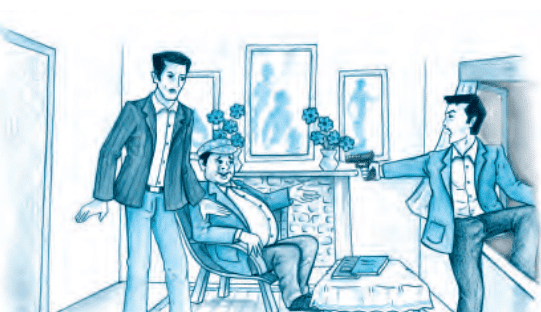

Then the door opened. The waiter entered the room with a tray a bottle of wine and two glasses. Ausable had ordered for them. The waiter left. Fowler did not know anything about the balcony. He feared that Max would return soon. But Ausable told him the fact that he would never return. Thus, Fowler was much impressed by his cleverness and presence of mind.

Try yourself:

What did Max come to Ausable’s room for?

  • A.To meet Fowler
  • B.To steal Ausable’s report
  • C.To have a drink with Ausable
  • D.To discuss secret agent missions

View Solution

Theme/ Message

Theme

  • Appearance vs. Reality:
    • Ausable defies the typical image of a secret agent, showing that appearances can be deceptive.
    • The absence of the balcony is a twist, highlighting the gap between appearance and reality.
  • Wit and Intelligence Over Physical Strength:
    • Ausable uses his intelligence and quick thinking to outsmart Max, demonstrating that wit can triumph over physical threats.

Difficult Words

  1. Musty: Having a stale, moldy smell.
  2. Gloomy: Dark or poorly lit, especially so as to appear depressing or frightening.
  3. Passably: In an adequate or satisfactory manner.
  4. Espionage: The practice of spying or using spies.
  5. Prosaic: Having the style or diction of prose; lacking poetic beauty.
  6. Disillusioned: Disappointed in someone or something that one discovers to be less good than one had believed.
  7. Authentic: Of undisputed origin; genuine.
  8. Wheezed: Breathed with a whistling or rattling sound in the chest.
  9. Crafty: Clever at achieving one’s aims by indirect or deceitful methods.
  10. Explanatorily: Serving to explain something.
  11. Commanding: Having a position of authority.
  12. Inflection: A change in the pitch or tone of a person’s voice.
  13. Moodily: Given to unpredictable changes of mood, especially sudden bouts of gloominess or sullenness.
  14. Menacing: Suggesting the presence of danger; threatening.
  15. Prosaic: Lacking imaginativeness or originality.

2. The Thief’s Story – Textbook Summary

Key Points of the Story

  • Ruskin Bond’s ‘The Thief’s Story’ is more than just a tale about a thief. 
  • The story highlights essential human values and relationships
  • Even a thief finds it hard to steal from an honest and careless individual.
  • A young boy becomes friends with Anil. Anil trusts him totally and employs him. 
  • To evade the police and previous employers, he frequently changed his name, and this time he went by Hari Singh.
  • The narrative reveals how the thief tricks Anil by stealing from him but later feels guilty. 
  • Anil’s expression when he realised the theft showed only a hint of sadness, not for the money lost, but for the trust that was broken.

Try yourself:

What does Anil feel when he realizes the theft?

  • A.Fear
  • B.Happiness
  • C.Sadness
  • D.Anger

View Solution

Detailed Summary

The Thief’s Story by Ruskin Bond revolves around Hari Singh, a young but experienced thief who earned his living by befriending people and stealing from them. To keep himself safe from police and former victims, he kept changing his name — this time calling himself Hari Singh.

He met Anil, a simple and easy-going writer, while Anil was watching a wrestling match. Anil, who lived a modest life, earned money irregularly by writing articles for magazines and selling books to publishers. He often borrowed and lent money, earning “by fits and starts”.

When Hari Singh offered to work for Anil, Anil said he could not pay him but could at least feed him if he could cook. Hari lied about knowing how to cook and was hired. His first meal was terrible, but Anil did not get angry. Instead, he offered to teach Hari cooking, reading, writing, and simple mathematics.

Hari Singh worked for Anil and sometimes made small profits while buying groceries, earning about a rupee daily by cheating Anil. However, Anil knew about it and never confronted him.

One day, Anil brought home a bundle of notes after selling a book. At night, while Anil was asleep, Hari Singh stole the money from under Anil’s mattress. He told himself that Anil would only waste the money on friends anyway. As he slipped out quietly, he reached the railway station and was ready to catch the Lucknow Express. But at the last moment, he hesitated and missed the train.

Wandering the streets at night, Hari Singh felt guilty and restless. It started raining heavily, soaking him completely. He sat under the clock tower and thought deeply about his actions. He remembered that stealing from greedy people was easy as they could afford to be robbed, but robbing a careless, trusting person like Anil gave him no satisfaction. Anil would likely feel only sadness, not because of the money lost, but because of the broken trust.

He also realised that Anil’s education was giving him an opportunity for a better life. Without it, he would remain a thief; with it, he could become a respectable man. Overcome by guilt, Hari Singh returned to Anil’s room and quietly placed the money back under the mattress.

The next morning, Anil behaved as usual. He handed Hari Singh a fifty-rupee note — which was damp from the rain — and told him that he would now start paying him regularly. He also said they would begin writing full sentences from that day. Although Anil didn’t say anything directly, Hari Singh understood that Anil knew about the theft but chose to forgive him and give him a second chance.

Try yourself:

What does the story highlight about the difficulty of stealing from an honest person?

  • A.It is easier for a thief to steal from a greedy person.
  • B.It is difficult for a thief to steal from an honest person.
  • C.An honest person is more likely to catch a thief.
  • D.An honest person is less likely to have valuable belongings.

View Solution

Theme

  • The story The Thief’s story by Ruskin Bond is focused on the topics of friendship, treachery, aspirations, connection, trust, guilt, change, kindness, loyalty, retribution, and honesty. 
  • The plot of the narrative is built on the idea that kindness and love have the power to change even the worst crooks and thieves in this harsh planet.
  • The moral of “The Thief’s Story” teaches us not to betray someone’s trust. Although Hari tried to keep the money, he realised that breaking Anil’s trust would leave him with deep regret. Just like Hari, everyone has a chance for redemption.

Message 

  • The message or the moral in ‘The Thief story’ is not to betray the trust reposed on you by a person. 
  • Once the trust of a person is lost, everything is lost. Kindness touches hearts and brings about a change in even in the worst person.
  • This is shown by Hari Singh, the thief, who, despite stealing from Anil, chooses to return because he cannot bear the thought of Anil feeling hurt by his betrayal. Kindness has the power to change even the most troubled individuals.

Glossary

1. A Triumph of Surgery –  Textbook Summary

Key Points of the Story

  • This story is about Tricki, a dog who is the pet of a rich lady named Mrs. Pumphrey. She loves her dog very much and is unable to refuse him anything he wants. 
  • One day, Mr. Herriot meets her on the street and is shocked to see Tricki’s bloated, unhealthy condition, “like a bloated sausage with a leg at each corner.” Mrs. Pumphrey explains that Tricki seems tired and lacking energy, so she has been giving him extra snacks like malt, cod-liver oil, Horlicks, and also cream cakes and chocolates.
  • Mr. Herriot advises her to cut down Tricki’s food and give him more exercise, but she finds it difficult to refuse him treats.
  • A few days later, Mrs. Pumphrey calls, distressed that Tricki is refusing food, vomiting, and unwilling to move. Mr. Herriot insists on taking Tricki to his surgery for treatment, despite Mrs. Pumphrey’s reluctance.
  • At the surgery, Tricki shows no interest in other dogs and is given only water for two days. On the second day, he begins showing interest in his surroundings; on the third day, he joins the other dogs outside and starts eating.
  • Tricki’s health improves rapidly—he plays, competes for food, and becomes active and energetic.
  • Believing Tricki needs “energy foods,” Mrs. Pumphrey sends eggs, wine, and later brandy, which Mr. Herriot and his colleagues consume themselves.
  • After two weeks, Tricki is lean, strong, and fit. Mr. Herriot decides to return him to Mrs. Pumphrey. Tricki joyfully leaps into her lap, and Mrs. Pumphrey, overjoyed, calls his recovery “a triumph of surgery.”

Try yourself:

What does Mrs. Pumphrey think Tricki needs to be healthy?

  • A.More exercise
  • B.Extra snacks
  • C.Less food
  • D.A new toy

View Solution

Detailed Summary

The story begins when Mrs. Pumphrey, a wealthy lady, is out walking her pet dog, TrickiMr. Herriot, a veterinary surgeon who knows her, sees Tricki and is shocked to find him hugely overweight, “like a bloated sausage with a leg at each corner.” Mrs. Pumphrey explains that Tricki seems listless and lacking energy, so she has been giving him extra snacks like malt, cod-liver oil, and Horlicks, along with cream cakes and chocolates. Mr. Herriot advises her to cut down on his food and give him more exercise, but she finds it difficult to refuse him treats.

A few days later, Mrs. Pumphrey calls in distress—Tricki is refusing foodvomiting, and unwilling to do anything. Mr. Herriot decides that the only solution is to take him to his surgery for a fortnight. Though reluctant and worried, Mrs. Pumphrey agrees, sending along numerous items for Tricki’s comfort.

At the surgery, Tricki shows no interest in the other dogs and lies still in his bed. For two days, he is given only water. By the second day, he starts showing interest in his surroundings; on the third day, he joins the other dogs in the yard and begins eating.

From then on, his recovery was rapid. He plays, joins in scrimmages, competes for food at mealtimes, and becomes active and lively. Hearing that Tricki is convalescing, Mrs. Pumphrey starts sending fresh eggs, then bottles of wine, and finally brandy, thinking these will aid his recovery. Mr. Herriot and his colleagues enjoy these luxuries themselves, with eggs for breakfast, wine at lunch, and brandy in the evenings.

After two weeks, Tricki is transformed into a fit, hard-muscled dog. Mr. Herriot decides it is time to return him. When Mrs. Pumphrey’s car arrives, Tricki joyfully leaps into her lap. Overjoyed, she thanks Mr. Herriot and calls the recovery “a triumph of surgery.”

Try yourself:

What was Tricki’s favorite food that Mrs. Pumphrey would often give him?

  • A.Cream cakes and chocolates
  • B.Eggs and bacon
  • C.Milk and cookies
  • D.Carrots and celery

View Solution

Theme

  • The major theme of the chapter is Care vs Over-indulgence.
  • Mrs Pumphrey loved Tricki. Under the influence of her blind love for her pet, she overfed him.
  • Mrs Pumphrey gave him malt, cod-liver oil and a bowl of Horlicks, which she believed would help Tricki regain his strength.
  • This made Tricki overweight and lethargic. Mrs Pumphrey’s over-indulgence in Tricki’s care had, in fact, harmed him.
  • After Tricki’s treatment, Mrs Pumphrey was elated to see her dog active and playful again.

Message

  • The lesson emphasises the importance of responsible pet ownership, cautioning against excessive love that can prove harmful. Mrs. Pumphrey, a wealthy woman, showered her dog Tricky with lavish care and overfeeding. 
  • Her indulgence led to Tricky’s health deterioration, making him lazy and obese. Hospitalised due to his condition, Mrs. Pumphrey continued pampering him with gifts. 
  • The story highlights the message that excessive love and overindulgence can have adverse effects on the well-being of those we care about.

Glossary

  • Gleaming – shining brightly, usually because it is clean or polished.
  • Reverently – with deep respect.
  • Roused – awakened from sleep.
  • Supper – the main evening meal.
  • Tweed –. coarse wool fabric.
  • Bouts – short periods of intense activity.
  • Ceremonial – related to formal public or religious events.
  • Clasped – held tightly in one’s hand.
  • Convalescing – recovering health after an illness.
  • Engulfed – completely surrounded or overwhelmed.
  • Entire – whole, or complete.
  • Fetch – to go and bring back.
  • Flapping – moving in waves.
  • Fortnight –. period of two weeks.
  • Gang –. group of individuals.
  • Gasping – breathing with difficulty.
  • Harness –. set of straps used for control.
  • Hastened – moved or acted quickly.
  • Hovered – stayed in one place in uncertainty.
  • Hugely – very much.
  • Hurtling – moving quickly and uncontrollably.
  • Lolled – relaxed in a lazy manner.
  • Lumbago – pain in the lower back.
  • Panting – breathing quickly and short.
  • Sausage – minced meat in a long casing.
  • Rheumy – watery discharge from the nose or eyes.
  • Listless – lacking energy.
  • Regime –. set plan for diet and exercise.
  • Distraught – extremely upset.
  • Scrimmage –. confused struggle.
  • Lithe – flexible and graceful.

19. The Proposal – Very Short Questions answer

Q1: Why did Lomov visit Chubukov?
Ans: 
Lomov visited Chubukov’s house to propose to Natalaya.

Q2: What does Chubukov suspect?
Ans:
 Chubukov suspects that Lomov has come to borrow money from him.

Q3: What does Lomov think about Natalaya?
Ans: 
He thinks that Natalaya is an excellent housekeeper, not bad looking, and well-educated.

Q4: How old was Lomov?
Ans:
 Lomov was already thirty-five years old.

Q5: Where was the Oxen Meadows situated?
Ans:
 Oxen Meadows were wedged in between Chubukov’s Birchwoods and the Burnt Marsh.

Q6: What does Natalaya guess on seeing Lomov?
Ans:
 She thinks that he is perhaps going to a ball for dancing.

Q7: Why is Lomov not able to answer properly?
Ans: 
Lomov is nervous and confused as he is going to propose to Natalya, so he is not able to answer properly.

Q8: What does Natalaya say about Oxen Meadows?
Ans: 
Natalaya says that Oxen Meadows belong to her.

Q9: What does Lomov say on his part?
Ans: 
Lomov says that Natalaya can see from the documents.

Q10: Who is a land grabber?
Ans:
 A land grabber is a person who grabs the land of others.

Q11: What threatening was given by Lomov?
Ans: 
Lomov told him to go to the court for a decision.

Q12: What is the last threatening to Lomov?
Ans: 
Chubukov warned Lomov never to set foot in his house again.

Q13: What was felt by Lomov?
Ans:
 Lomov felt heart-palpitation.

Q14: How does Chubukov behave in the end?
Ans: 
Chubukov gives Lomov’s hand into Natalaya’s hands and advises them for a kiss.

Q15: Write down the final advice of Chubukov?
Ans:
 Chubukov advised Natalaya and Lomov to start their family bliss.

18. Poem – For Anne Gregory – Very Short Questions answer

Q1: How will the young man react to seeing the honey coloured ramparts?
Ans:
 He will be thrown into despair on seeing the honey coloured ramparts.

Q2: What is the colour of the ramparts of the young lady?
Ans: The colour of the ramparts of the young lady is of honey.

Q3: For what will the man love her?
Ans: 
The man will love her for herself.

Q4: What feature of the woman has put the young man into despair?
Ans: The outer part of the woman’s ear has put the young man into despair.

Q5: How can the young woman dye her hair?
Ans:
 She can dye her hair with brown, black or carrot colour.

Q6: Why does she want to dye her hair?
Ans:
 She wants to dye her hair so that young men may love her for her own sake and not for her yellow hair.

Q7: What matters for God more to love human beings?
Ans:
 For God, the inner qualities of human beings matter more than their physical appearance.

Q8: Who was it that the poet had heard?
Ans: 
The poet had heard an old religious man.

Q9: What did the text say?
Ans: 
The text said that it is God alone who loves you for yourself alone.

Q10: What did the young lady expect?
Ans: The young lady expected that her lover should love her for herself only.

17. The Sermon at Benares – Very Short Questions answer

Q1: What was the original name of the Buddha?
Ans:
 The original name of the Buddha was Siddhartha Gautama.

Q2: What did Siddhartha study in school?
Ans:
 Siddhartha was sent away to school to study the sacred Hindu scriptures.

Q3: What did Siddhartha see at the age of twenty-five?
Ans:
 At the age of twenty-five, he saw a sickman, an aged man, a funeral procession and a monk begging.

Q4: Where did Siddhartha get enlightened?
Ans: 
Siddhartha got enlightened under a peepal tree after seven days.

Q5: Why was the tree renamed as‘Bodhi Tree’?
Ans: 
The Buddha got wisdom under the tree. So it was renamed ‘Bodhi tree’.

Q6: What was the problem of Gotami?
Ans:
 Gotami’s son had died. She wanted him to live again.

Q7: What did she see in the city?
Ans:
 She watched the light of the city.

Q8: What did she learn from the flickering of lights?
Ans: 
She learnt that the fate of men is just like the city lights that flickered and extinguished again and again.

Q9: Who is being addressed by the Buddha?
Ans: 
The people of Benares were being addressed by the Buddha.

Q10: What did he say about life of mortals?
Ans:
 Buddha said that all mortals have to die.

Q11: What is inevitable?
Ans: 
Death is inevitable.

Q12: What have the life and death of the man been compared to?
Ans:
 The life and death are being seen and compared with the ripe fruits which have to fall.

16. Poem – The Tale of Custard the Dragon – Very Short Questions answer

Q1: Where did Belinda live?
Ans:
 Belinda lived in a little white house.

Q2: What was the name of Belinda’s little black kitten?
Ans:
 His name was Ink.

Q3: Who was Blink?
Ans:
 Blink was Belinda’s little grey mouse.

Q4: Who was Mustard?
Ans:
 Mustard was Belinda’s little yellow dog.

Q5: What name was given to the dragon?
Ans:
 He was given a name custard.

Q6: Who was called cowardly?
Ans:
 The custard was called cowardly.

Q7: Who attacked over them?
Ans:
 A pirate attacked over them.

Q8: Who faced the pirate bravely?
Ans: 
Custard faced the pirate bravely.

Q9: What happened to the pirate?
Ans:
 He was killed by the dragon.

Q10: Who mourned over the death of the pirate?
Ans:
 None mourned over the death of the pirate.

Q11: What did the dragon cry for?
Ans:
 The dragon cried for a nice safe cage.

15. Madam Rides the Bus – Very Short Questions answer

Q1: Who was Valli?
Ans: Valli was an eight year old girl.

Q2: What was her full name?
Ans:
 Her full name was Valliammai.

Q3: What was her favourite pastime?
Ans: 
Her favourite pastime was to watch the happening in the street outside standing in the front doorway of her house.

Q4: What did she use to watch from her door?
Ans:
 She used to watch the happenings in the street outside.

Q5: Why did she spend her time all alone?
Ans:
 She spent her time all alone because she had no playmates of her own age.

Q6: What was her overwhelming desire?
Ans:
 Here overwhelming desire was to ride the bus.

Q7: Where was the bus going?
Ans:
 The bus was going to the city.

Q8: What did the conductor say to Valli?
Ans: 
The conductor asked Valli to hurry up and come quickly.

Q9: What did Valli reply to the conductor?
Ans:
 Valli replied that she was the only passenger who had to go on.

Q10: Where was Valli going?
Ans:
 Valli was going to the city.

Q11: Why did Valli stand up on her seat?
Ans: 
She stood up on her seat because she found her view cut off by a canvas blind.

Q12: What did Valli see outside the window?
Ans:
 She saw a canal, palm tree, grassland and mountains outside the window.

Q13: How was Valli feeling?
Ans: 
Valli was feeling happy and enjoying her ride.

Q14: What did the elderly woman try to do?
Ans:
 The elderly women tried to befriend Valli.

Q15: What did the woman ask her?
Ans:
 The woman asked Valli if she was all alone.

Q16: Why did Valli become sad?
Ans:
 Valli became sad because the cow was dead.

Q17: What did Valli find when she came back home?
Ans: 
When Valli came back and entered her home, she found her mother awake and talking to one of her aunts

14. Poem – Fog – Very Short Questions answer

Q1: According to the poet, what is the fog like?
Ans: According to the poet, the fog is like a cat.

Q2: How does the fog come?
Ans: 
The fog comes slowly and silently.

Q3: What is the fog compared to?
Ans: 
The fog is compared to a cat.

Q4: What does the fog look over ?
Ans: 
The fog looks over the harbour and the city.

Q5: How does the poet make the fog like a living creature?
Ans: 
The poet makes the fog like a living creature by comparing it to a cat.

Q6: How does the fog move on?
Ans:
 The fog moves on slowly.

13. Mijbil the Otter – Very Short Questions answer

Q1: Where did Gavin Maxwell live?
Ans: 
Gavin Maxwell lived in Camusfeama.

Q2: What did the author decide to experiment?
Ans: 
The author decided to have an otter as a pet instead of a dog.

Q3: Why was his place a suitable place for that experiment?
Ans: 
The author’s place was a suitable place for that experiment because otters love to see flowing water and feed on fish.

Q4: What did the author’s friend advise him?
Ans: 
The author’s friend advised him to get an otter from the Tigris marshes.

Q5: Why did the author go to Basra?
Ans:
 The author went to Basra to the Consulate—General to collect and answer his mail from Europe.

Q6: Why did the author cable to England?
Ans:
 The author cabled to England to get information about the status of his mail.

Q7: Why did the author wait for three days?
Ans:
 The author waited to telephone for three days as there were problems with it.

Q8: When did the author receive his mail?
Ans:
 Five days later, the author received his mail.

Q9: What did the author find in his bedroom?
Ans:
 The author found two Arabs in his bedroom.

Q10: What did the author see in the bathroom?
Ans: 
The author found Mijbil upon the bath tub.

Q11: Where did Mijbil go?
Ans:
 Mijbil went inside the bathroom to have fun with water.

Q12: What did the otter want to do?
Ans: 
Mijbil, the otter was trying to turn the tap so that water could come out of it.

Q13: How did Mijbil spend his time?
Ans:
 Mijbil spent his time in playing with rubber ball.

Q14: Who was in the box.
Ans:
 Mij, the otter was in the box.

Q15: What did the author find in the box?
Ans: 
The author found complete silence in the box.

Q16: What was the condition of Mijbil in the box?
Ans: 
Mijbil’s condition was miserable.

Q17: How did Mijbil spend his time in London?
Ans:
 Mijbil spent his time playing with a selection of toys—ping-pong balls, rubber fruit and terrapin shell.

Q18: What did Mijbil invent?
Ans:
 Mijbil invented a new game with the ping-pong ball.

Q19: How did he play with his new game?
Ans:
 Mijbil placed the ball on the light end and tried to grab it from the other end.

Q20: What did the labourer want to know?
Ans: 
The labourer wanted to know the species of Mijbil.