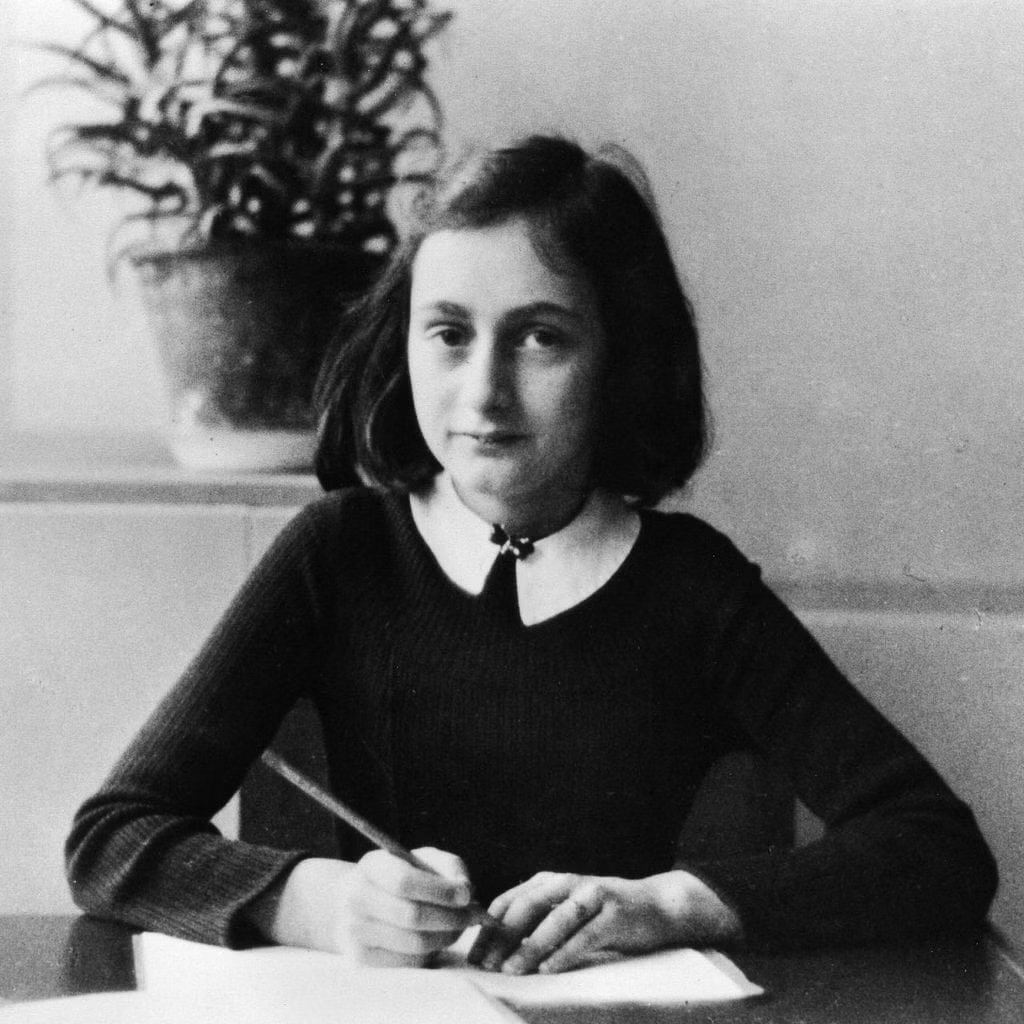
Anne finds writing a diary strange but necessary to express her feelings.
She feels lonely and lacks a true friend, so she treats her diary as one and names it “Kitty.”
Although she has a loving family and many acquaintances, she cannot confide in anyone.
Anne shares a brief sketch of her life, her family, and her school days.
She deeply loved her grandmother, whose death affected her greatly.
Her class is anxious about their promotion results; Anne is only unsure about math.
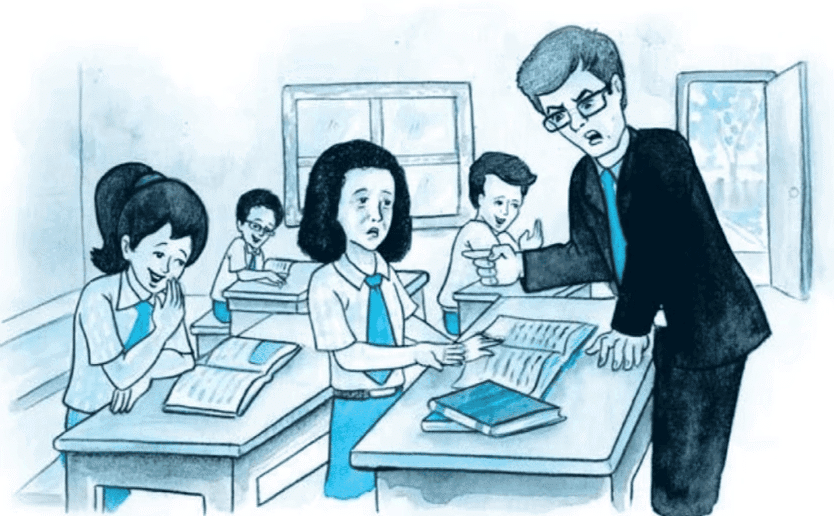
Mr. Keesing, her math teacher, punishes her for talking in class by assigning essays.
Anne uses humor and clever arguments in her essays, calling talking an inherited trait.
For the final punishment, she writes a poem, turning the joke back on Mr. Keesing.
Mr. Keesing appreciates her creativity and stops punishing her, even starts making jokes.
Anne Frank
Detailed Summary
From the Diary of Anne Frank is an autobiography of a young Jewish girl who wrote her thoughts in a diary. At first, she felt it was an unusual experience for her to pen down all her thoughts. She believed that no one in the near future would be interested to read about a young girl’s past experiences from her diary. However, she still decided to write her thoughts in her diary and named it “Kitty”. She considered her diary to be her true and loyal friend as she was lonely and had no friends to talk to. Anne felt that her diary had more capacity to absorb thoughts than people with low patience levels. Further, she mentioned how much she loved her family, especially her adorable father, who gifted her the diary on her thirteenth birthday.
On 20th June 1942, Anne stated how her entire class was nervous about their exam results. Although she was confident about other subjects, she wasn’t quite sure about mathematics. She and her friend, G, pleaded with the students to calm down and not make noise, but all in vain. She felt that about a quarter of the class were dummies who should be kept back in the same class as they did not participate in other activities.
Besides, Anne also mentioned how the maths teacher, Mr Keesing, was annoyed by her talkative nature. He would often punish her with extra homework whenever she talked more during his class. In the first punishment, he asked her to write an essay on ‘A Chatterbox’, which in itself was a weird topic for Anne. She gave good thought to the topic and decided to present convincing arguments in her essay, justifying her points in support of talking. She mentioned that she would try to improve herself, but she could not do anything about the trait that she inherited from her mother. When her teacher read the essay, he found it amusing and assigned her a second essay, ‘An Incorrigible Chatterbox’, for her unreformable talkative nature.
However, during the third lesson, Mr Keesing had read enough of her justifications and assigned her another topic entitled, ‘Quack, Quack, Quack, Said Mistress Chatterbox’ as a punishment for her incorrigible habit. Anne almost ran out of thoughts after writing essays on similar topics previously. This time she took the help of her friend, Sanne, who was good at poetry and wrote the essay from beginning to end in satirical verse. When her teacher read the essay he took it lightly and thoroughly enjoyed it. Since then, Anne was allowed to talk in class and was never assigned any extra homework by Mr Keesing.
Try yourself:
What was the topic of the third essay assigned by the math professor to the author?
A.”Chatterbox”
B.”An Incorrigible Chatterbox”
C.”Quack, Quack, Quack, Said Mistress Chatterbox”
D.Poetry
View Solution
Theme/ Message
Theme
Loneliness and Companionship: Anne Frank feels lonely and creates an imaginary friend, “Kitty,” in her diary to cope with her isolation.
Power of Writing: Writing in her diary helps Anne express thoughts and feelings she can’t share with others, providing emotional relief.
Self-Improvement and Resilience: Anne shows resilience and creativity when punished for her talkativeness, using her punishments as opportunities for self-expression.
Message
Importance of Expression: Expressing thoughts and emotions, even through writing, is essential for mental well-being.
Creativity in Adversity: Challenges can be met with creativity and resilience, turning punishments into opportunities for growth.
Value of Companionship: Creating a sense of companionship, even imaginatively, helps combat loneliness and fosters a sense of connection.
Difficult Words
Brooding – deeply thinking about something makes someone unhappy
Adorable – cute
Prompt – reminded
Confide – blindly trust someone and tell everything
John Berryman was an American poet and scholar who became known for his work in the confessional school of poetry. He attended South Kent School, Columbia University, and the University of Cambridge. His most famous book is “The Dream Songs.”Berryman endured a tragic event at the age of 12 when his father committed suicide outside his window, which deeply affected him. He later adopted his stepfather’s surname when his mother remarried. Despite the challenges he faced, Berryman achieved significant recognition for his poetry, winning both the Pulitzer Prize for Poetry and the National Book Award for Poetry.
John Berryman
Key Points of the Poem
The poem discusses the common theme of loss through the story of a boy who loses his ball.
The boy’s grief represents the deep feelings that come with losing something valued, connecting his sadness to a greater awareness of loss and responsibility.
A dime, or another ball, is shown to be worthless, highlighting that nothing can truly ease the pain of loss.
He is learning, despite his desperate expression, about the nature of loss and how to accept what everyone must eventually face.
This serves as a reminder that experiencing losses is a part of the human condition.
People will take balls, and balls will always be lost, illustrating that loss is unavoidable and brings valuable lessons.
Money is external, pointing out that financial compensation cannot replace what is emotionally lost.
Detailed Summary
What is the boy now, who has lost his ball, What, what is he to do? I saw it go Merrily bouncing, down the street, and then Merrily over — there it is in the water! No use to say ‘O there are other balls’:
The poem describes a young boy who feels a deep sense of loss after his favourite ball rolls away and ends up in the water. This loss is not just about the ball; it carries important memories of happy moments spent playing. While others might think it’s just a toy, for the boy, it represents something much more meaningful. This event highlights how we can form strong emotional connections to our belongings.
An ultimate shaking grief fixes the boy As he stands rigid, trembling, staring down All his young days into the harbour where His ball went. I would not intrude on him; A dime, another ball, is worthless.
The boy is deeply affected by the loss of his ball and is visibly shaken. He stands still, trembling, gazing into the dark water, clearly upset. The poet chooses not to interfere, suggesting that offering money for a new ball would not make a difference. The loss signifies more than just the ball; it is about the memories and experiences tied to it.
Now He senses first responsibility In a world of possessions. People will take Balls, balls will be lost always, little boy. And no one buys a ball back. Money is external
Looking into the water, the boy realises he cannot retrieve his ball. This moment marks his first understanding of responsibility. The poet points out that through losing the ball, the boy learns about the nature of ownership in a world filled with possessions. Although he might buy a new ball, he cannot replace the one he lost. The poet stresses that money cannot restore the emotional ties and memories associated with the lost ball.
He is learning, well behind his desperate eyes, The epistemology of loss, how to stand up Knowing what every man must one day know And most know many days, how to stand up.
The poet implies that the boy’s experience of losing his ball is a lesson in navigating a world filled with material possessions. Through this loss, the boy is gradually coming to understand the concept of loss itself. By witnessing how others must cope with similar losses, the boy begins to grasp the inevitable nature of loss and the resilience required to move forward. As he learns to stand up and face the challenges presented by loss, he gains a deeper understanding of its true significance and the transient nature of possessions. Ultimately, the poet suggests that this experience will equip the boy with the strength and wisdom needed to navigate future losses and leave them behind, having learned their profound lessons.
Theme/Message
Theme
This poem can be termed as a ‘coming of age’ poem that deals with the theme of loss and suffering.
The poem explores the themes of loss, growing up and transformation of an individual.
The poem also touches on the importance of coping with the loss of things that money can’t buy and moving ahead in life.
Message
The poet gives us the message that loss is inevitable and one must learn to bear with such loss with patience and courage.
This poem teaches us the philosophy of life through the loss of the ball. It tells us to accept loss and move ahead in life.
Literary Devices
Symbolism –. figure of speech where an object, person or situation has another meaning other than its literal meaning. Ball – the ball symbolises the boy’s happy innocent days.
Repetition – Repetition of words or phrases in the same line. What , what Balls, Balls
Anaphora – When two consecutive lines begin with the same word What is the boy to do now, What , what is he to do? Merrily bouncing down the street Merrily over – there it is in the water!
Alliteration– Repetition of the initial consonant sounds in the same line What , what Balls, balls, Buys a ball back
Asyndeton – omission or absence of conjunction between parts of a sentence A dime, another ball, is worthless
Rhetorical question –. question asked just for the sake of asking What is he to do?
Imagery – Using descriptive language to create vivid pictures in the reader’s mind, like ‘Merrily bouncing down the street’
Personification – human attributes given to immaterial things ‘Merrily bouncing down the street
Metaphor – The ball is the metaphor for things lost
Transferred epithet- (When an adjective is used to describe a noun but it actually refers to another noun) desperate eyes – the boy is desperate not the eyes
Difficult Words
Merrily: cheerful
Bouncing: jumping up and down
Grief: sorrow
Rigid: fixed
Trembling: shaking
Harbour: dock, port
Intrude: invader
Dime: 10 cents (U.S)
Worthless: valueless, useless
Possessions: Ownership
External: Here, things with which feelings are not attached
Desperate: hopeless
Epistemology: The Greek word episteme means ‘knowledge’
Carolyn Wells, born in New Jersey, USA in 1862 and passing away in 1942, was deeply involved in writing from 1900 onward. She wrote over 170 books, including children’s stories and detective novels. Her famous works include “Patty Fairfield,” “A Nonsense Anthology,” and “The Rubaiyat of Motor Car.” She was praised for her witty and humorous writing style, evident in works like “How to Tell Wild Animals,” where she creatively presents ideas to captivate readers.
Key Points of the Poem
The poem humorously describes methods to identify wild animals based on their behavior.
The Asian Lion is identified by its roar, which may be heard as you’re “dyin’.”
The Bengal Tiger is recognized by its black stripes on yellow fur and its tendency to eat you.
A Leopard has spotted skin and is relentless, leaping repeatedly.
A Bear can be identified by its strong “hug,” resembling a bearhug.
The Crocodile is distinguished from the Hyena by their expressions—Hyenas “laugh” while Crocodiles “weep.”
The Chameleon is small, wingless, earless, and blends perfectly with its surroundings.
The poem uses playful language and rhythm to create humor, with intentional wordplay like “lept” and “lep.”
It combines absurd situations with exaggerated traits of animals for comic effect.
Try yourself:
What characteristic distinguishes a crocodile from a hyena?
A.Crocodiles have tears in their eyes.
B.Crocodiles have a yellow coat with black stripes.
C.Crocodiles give tight hugs.
D.Crocodiles pounce and have spots.
View SolutionDetailed Summary
Stanza 1
If ever you should go by chance To jungles in the east; And if there should to you advance A large and tawny beast, If he roars at you as you’re dyin’ You’ll know it is the Asian Lion…
The poet is telling the readers that how they can recognize various animals in the jungles of the east. So, in first stanza she says that if the reader comes across an animal whose skin is yellowish brown in colour and if it roars at him so strongly that he can die out of fear, it means that he has encountered an Asian Lion. She has humorously explained the Asian Lion which could kill a person with its roar.
Or if sometime when roaming round, A noble wild beast greets you, With black stripes on a yellow ground, Just notice if he eats you. This simple rule may help you learn The Bengal Tiger to discern.
In this passage, the author describes a majestic animal that inhabits the jungle and is considered part of a noble lineage. This creature has a coat of yellowish hue adorned with striking black stripes. The author employs a darkly humorous tone as she explains that if one finds oneself in the unfortunate circumstance of being attacked and consumed by such an animal, it becomes rather moot to determine its precise species. In other words, the gruesome fate of being devoured renders the distinction between different wild animals irrelevant. The author’s use of dark humor adds a layer of irony to the description, highlighting the grim reality of encountering such formidable predators in the wild.
Let’s Revise
Q: What feature helps distinguish the Bengal Tiger?
If strolling forth, a beast you view, Whose hide with spots is peppered, As soon as he has lept on you, You’ll know it is the Leopard. ’Twill do no good to roar with pain, He’ll only lep and lep again.
In this stanza, the poet describes a scenario where one encounters an animal while leisurely strolling through the jungle. This animal possesses a coat adorned with distinctive spots. The poet emphasizes the speed and agility of this creature, noting that it can swiftly leap upon its prey. This immediate pouncing action serves as a clear indicator of the animal’s identity: it is unmistakably a leopard. Furthermore, the poet paints a vivid picture of the relentless nature of the leopard’s attack, suggesting that even if one were to cry out in pain, it would be futile as the leopard would continue its assault without pause. Through this description, the poet effectively communicates the defining characteristics and behavior of the leopard in a manner that is both descriptive and engaging.
If when you’re walking round your yard You meet a creature there, Who hugs you very, very hard, Be sure it is a Bear. If you have any doubts, I guess He’ll give you just one more caress.
In this passage, the poet describes a situation where one encounters a creature while walking in the lawn area of their house. This creature exhibits a behavior of embracing tightly, resembling a warm hug. The poet asserts that this behavior is characteristic of a bear. Moreover, to dispel any lingering doubts about the animal’s identity, the poet suggests that the creature will continue to embrace and touch the person gently. This gentle and affectionate behavior serves as a clear confirmation of the animal’s identity as a bear. Through this description, the poet effectively conveys the distinct behavior of bears in a manner that is both clear and illustrative.
Let’s Revise: What does the poet suggest is a sure sign that you’ve encountered a bear?
Though to distinguish beasts of prey A novice might nonplus, The Crocodile you always may Tell from the Hyena thus: Hyenas come with merry smiles;
In this verse, the poet acknowledges the challenge faced by newcomers in identifying predatory animals. To aid readers in this task, the poet provides a distinction between two such animals. Firstly, the poet notes that hyenas, known for their predatory nature, typically appear to be smiling. Conversely, the poet describes crocodiles as always being in tears, emphasizing their menacing presence. Despite their differing physical characteristics, both animals are depicted as dangerous predators. By offering this comparison, the poet seeks to assist readers in distinguishing between these formidable creatures, thereby enhancing their understanding of the natural world and its potential hazards.
Let’s Revise: How does the poet suggest one can distinguish a Hyena from a Crocodile?
The true Chameleon is small, A lizard sort of thing; He hasn’t any ears at all, And not a single wing. If there is nothing on the tree, ’Tis the chameleon you see.
In this stanza, the poet introduces the chameleon, a small reptile often mistaken for a lizard. However, the poet highlights key differences between the two creatures: chameleons lack ears and wings. Furthermore, the poet describes the chameleon’s remarkable ability to change its color to blend in with its surroundings. This adaptive skill allows the chameleon to camouflage itself effectively, making it virtually invisible to predators and unsuspecting passersby. As a result, if one were to encounter a tree devoid of other visible inhabitants, the poet suggests that it is likely a chameleon perched upon it. By seamlessly blending into its environment, the chameleon exemplifies nature’s ingenuity and the marvels of adaptation. Through this description, the poet not only educates readers about the distinguishing features of the chameleon but also underscores the fascinating diversity of the natural world.
The theme of the poem is how dangerous wild beasts can be. The poet suggests some dangerous and imaginative ways to identify the wild animals.
The poem is full of humorous examples when the poet tries to distinguish one animal from the others. It is not safe to be close to the tigers and lions but the poet ironically suggests very risky ways to identify these animals.
Message
Awareness and Caution: Through humor and vivid descriptions, the poem encourages readers to be aware of their surroundings and exercise caution when encountering wildlife, highlighting the potential dangers and unique traits of each animal.
Adaptation and Survival: By showcasing the diverse adaptations of animals like the chameleon, the poem underscores the theme of adaptation and survival in the natural world, teaching readers about the remarkable abilities of different species to thrive in their environments.
Literary Devices
Rhyme Scheme – The rhyme scheme of the poem is ‘ababcc’. “If strolling forth, a beast you view. a Whose hide with spots is peppered. b As soon as he has lept on you. a You’ll know it is the Leopard. b ‘Twill do no good to roar with pain. c He’ll only lep and lep again.” c
Tone – The poet narrates the poem in a humorous tone. Her descriptions of how animals like tiger, lion and leopard kill are intended to make us laugh. Her statement about a bear hug is also an example of a humorous tone employed in the poem.
Imagery – The use of descriptive language by a poet or an author that helps the reader to visualise the pictures in one’s mind. Example: The image of the Bengal tiger is created when we read the lines ‘A noble beast greets you, with black stripes with a yellow background.
Oxymoron – An oxymoron is a figure of speech that combines contradictory or opposite terms to create a new phrase that expresses a paradoxical idea. The oxymoron is used in “noble wild beast”. The word “noble” implies a sense of honour, dignity, and grace, while “wild beast” suggests an untamed, savage animal. These two terms are contradictory and create a paradoxical expression, making it an oxymoron. The same can be found in the phrase ‘true Chameleon‘.
Metaphor – This poetic device is used when a covert comparison is made between two different things or ideas. In the poem, the metaphors have been used in an ironical way. roar with pain – the painful voice compared ironically with the roar of a leopard A noble wild beast – Ironically leopard is shown here as a noble one the term ‘caress’ is used ironically for a bear’s claw attack.
Alliteration – Alliteration is the repetition of the same sound that is used in the beginning of the closely placed words. The phrases ‘lep and lep again’, ‘roaming round’, ‘very, very hard’ and ‘novice might nonplus’ are examples of alliteration in the poem.
Repetition – Repetition is a poetic device that is used to repeat single words, phrases or even stanzas at intervals. He’ll only lep and lep again. Who hugs you very, very har
Personification – This poetic device is used to bestow human qualities on something that is not human. The poet refers to the tiger not as ‘it’ but as ‘he’. In the poem, the ‘hyena’ and ‘crocodile’ have been personified. The human qualities of ‘smiling’ and ‘weeping’ have been given to the hyena and crocodile respectively.
Irony – Irony is a poetic device that is used by the poets to bring humour or satire on somebody or something. It is done by giving two meanings to a word or a phrase, i.e., surface meaning and underlying meaning. A noble wild beast greets you. He’ll give you just one more caress.
Poetic Licence – With the use of poetic licence, the poet not only maintains the rhyme scheme but also creates a humorous effect in the poem. The poet has employed poetic licence in her use of language in the poem. In some stanzas, she has shortened words like ‘lept’, ‘lep’, and ‘dyin’. Also, certain sentences are framed differently in the poem like ‘novice might nonplus’ and ‘if strolling forth, a beast you view’.
Try yourself:Which poetic device is used in the line “‘Twill do no good to roar with pain, He’ll only lep and lep again”?
A.Personification
B.Metaphor
C.Irony
D.Alliteration
View SolutionDifficult Words
Tawny: yellowish brown color
Noble: high-born, aristocratic
Discern: recognize
Strolling: walking casually
Peppered: Here it means the spots
Lept (Leapt): jump towards someone
Beast of Prey: Any animal that hunts other animals for food
Key Points of Story I: His First Flight (by Liam O’Flaherty)
A young seagull is afraid to fly despite his siblings already having flown.
His parents scold and threaten to let him starve unless he flies.
He watches his family fly and feed on fish, growing increasingly hungry and desperate.
His mother uses food to trick him — she flies close with fish but doesn’t feed him.
Driven by hunger, he dives toward the food — and inadvertently begins flying.
At first terrified, he soon feels the thrill of flying and begins to enjoy it.
He successfully lands on the sea and is praised by his family.
Theme: Conquering fear through necessity and instinct.
Detailed Summary of His First Flight
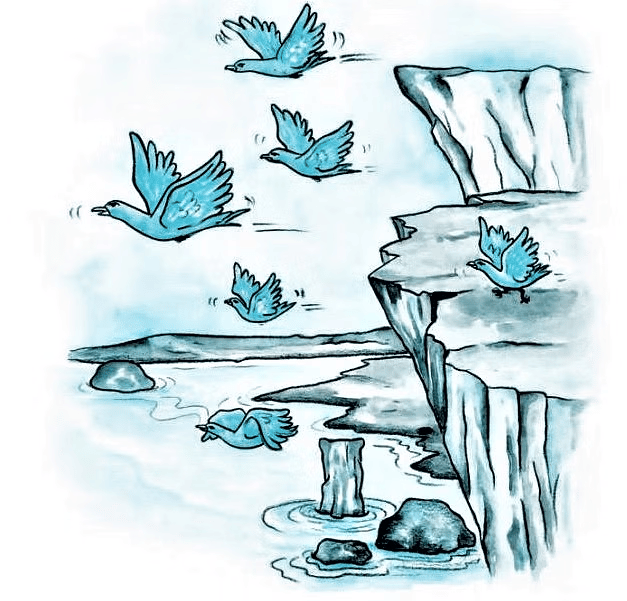
The story “His First Flight” is written by Liam O’Flaherty and is based on a young seagull who was afraid to take his first flight because he feared that his wings wouldn’t support him while flying. All his siblings took the plunge to fly fearlessly in the open air despite having shorter wings than him. On the contrary, the young bird could not muster up courage to take the plunge due to distrust on his wings. Whenever he tried to come forward towards the brink of the ledge while attempting to fly, he became afraid and went back. His parents constantly upbraided and threatened him that unless he flew away he would have to starve alone on the ledge, but all their efforts went in vain. He would just watch his parents teaching his siblings how to skim the waves and dive for fish.
One fine day, the whole family flew to a big plateau and taunted the young seagull for his cowardice. As the sun rays blazed on his ledge, he could feel the heat and was starving since the previous nightfall. The young bird begged his mother to bring him some food. He uttered a joyful scream when his mother quickly picked a piece of fish and flew across to him. He leaned out eagerly and jumped at the fish exasperated by hunger. Suddenly he fell outward in the open space and a monstrous terror seized him as he could feel that he was falling downward. The next moment he felt his wings spread outwards and he was able to fly fearlessly. Finally, the young seagull took his first flight and soared higher and skimmed through the waves and dived along with his siblings.
Try yourself:
What was the young seagull afraid of?
A.His siblings flying
B.His wings not supporting him
C.Hunger
D.Flying too high
View Solution
Key Points of Story II: The Black Aeroplane (by Frederick Forsyth)
A pilot is flying his Dakota airplane from France to England at night.
Everything seems fine until he encounters massive storm clouds.
He decides to fly into the storm despite low fuel and loss of navigation tools.
Inside the storm, all instruments fail, and he gets completely lost.
Suddenly, a mysterious black airplane appears and guides him out of the storm.
The pilot safely lands but cannot find the black plane or its pilot.
At the control tower, he is told no other plane was in the sky that night.
Theme: Mysterious help in moments of crisis; possible supernatural intervention or hallucination.
Detailed Summary of Black Aeroplane
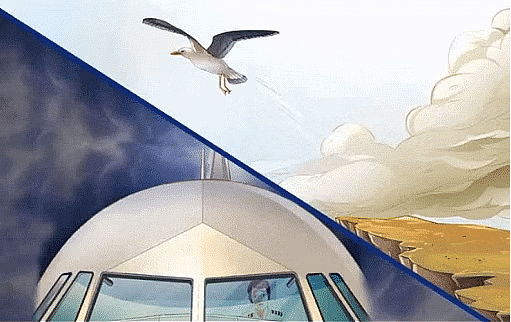
“Black Aeroplane” is a mysterious story written by Fredrik Forsyth that revolves around a pilot. The narrator of the story is a pilot who wanted to be with his family and enjoy a wholesome breakfast with them in England. He had to fly from France to England to spend time with his family. The plane was Dakota DS-088 and was flying at night. After the journey of 150 Km, suddenly the pilot came across the storm clouds that looked like black mountains. It was just in front of him and he was in a confusion whether he should return back or should face the storm. However, he flew through the clouds and soon realized that everything around him had turned completely black. Nothing was visible to him outside the aeroplane. He noticed that the cloud was looking so dangerous, but finally he entered the clouds and found that the compass and the radio had stopped working. He was completely helpless. Suddenly he noticed that a black aeroplane was flying just beside his aeroplane. It had no lights on its wings. The pilot of that aeroplane waved his hands and signalled him to follow.
He began to follow him just like an obedient child. After sometime he noticed that the fuel in the second tank was left only for the Journey for 5 to 10 minutes. He began to feel frightened but was following the other aeroplane continuously. Suddenly he noticed that he was out of the storm and the runway of an airport was being seen. After watching that he got relaxed and landed his aeroplane. He was trying to find out the other pilot and the black aeroplane, but couldn’t see them. After landing his aeroplane, he went to the woman who was sitting in the control center and asked her about the black aeroplane. He wanted to thank him for saving his life. But the woman in the control center told him that there was no other airplane in the night sky other than his aeroplane. Then surprisingly, he began to think continuously about the incident and finally couldn’t reach to any conclusion whether the black aeroplane was his imagination or did any other miracle occur?
Try yourself:
What did the pilot want to do in England?
A.Go sightseeing
B.Enjoy breakfast
C.Have dinner
D.Visit friends
View SolutionMessage from the Story
The stories “His First Flight” and “The Black Aeroplane” both convey a powerful message about courage, self-belief, and the importance of taking the first step despite fear or uncertainty.
In the first story, the young seagull overcomes his fear of flying only when driven by hunger, showing that growth often begins with discomfort and is achieved through action.
In the second story, the pilot, lost in a dangerous storm, is mysteriously guided to safety by an unknown plane, suggesting that help can come when least expected and that faith and instinct play a vital role in survival. Together, the stories highlight that facing fear and trusting oneself or unseen forces can lead to discovery, growth, and success.
George Leslie Norris (21 May 1921 – 6 April 2006), was a prize-winning Welsh poet and short story writer. He taught at academic institutions in Britain and the United States, including Brigham Young University. Norris is considered one of the most important Welsh writers of the post-war period, and his literary publications have won many prizes.
Key Points of the Poem
The poem consists of 5 stanzas. All stanzas are made up of 4 lines. Thus, the entire poem consists of 20 lines in total.
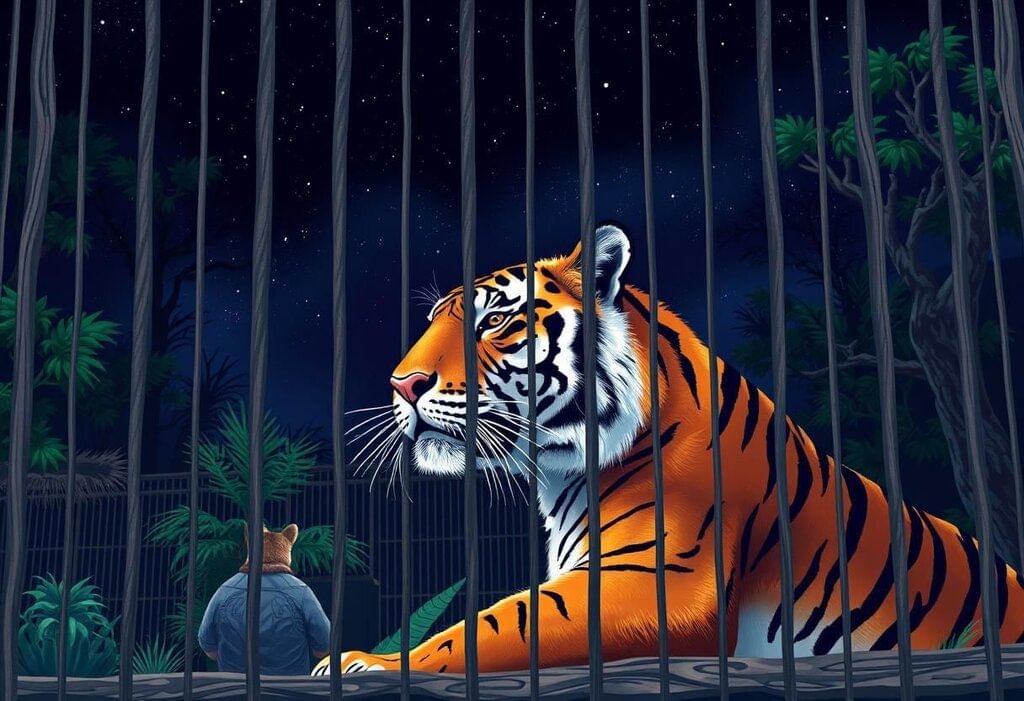
This poem contrasts a tiger when it is in its natural habitat and when it is imprisoned in a zoo.
On a starry night, the poet sees a tiger in a zoo.
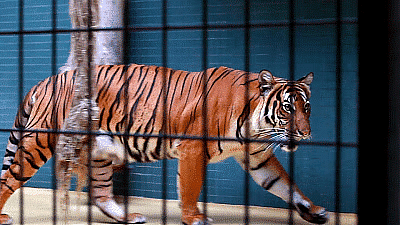
The tiger moves slowly up and down in his cage.
The tiger is full of rage but is quiet in his helplessness.
The poet is moved to pity for the tiger.
Detailed Summary
Stanza 1
He stalks in his vivid stripes The few steps of his cage, On pads of velvet quiet, In his quiet rage.
Here the poet says that the tiger that is confined in the zoo moves around in the cage under his bright coloured skin. He further says that the tiger can take only a few steps because the cage is small and it is not easy to move in it. One cannot hear his footsteps because he has very soft feet, like velvet because of which there is no sound of the tiger’s footsteps. The tiger tries to control his anger by quietly walking in the limited area of his cage. He is angry because he is not free.
Try yourself:
What does the poet mean by “On pads of velvet quiet”?
A.The tiger’s cage is covered with soft velvet material.
B.The tiger’s feet make a soft and quiet sound.
C.The tiger is angry because he is confined in a small space.
D.The tiger is pacing back and forth in his cage.
View Solution
Stanza 2
He should be lurking in shadow, Sliding through long grass Near the water hole Where plump deer pass.
The poet says that if this tiger was free, he would have hid himself behind the long grass near the water bodies so that he could easily catch a deer in order to have it as its food. Basically, the poet wants to say that the actual life of a tiger is to live in jungle where he could catch his prey and eat it but the tiger in the cage can not do so .
Stanza 3
He should be snarling around houses At the jungle’s edge, Baring his white fangs, his claws, Terrorising the village!
The poet says that if the tiger would have been free, he would have snarled around the houses located at the outskirts of the forest. He would terrorise people with his sharp tooth and claws. This would create fear among the people living in the villages.
Stanza 4
But he’s locked in a concrete cell, His strength behind bars, Stalking the length of his cage, Ignoring visitors.
Now the poet comes to the reality of the tiger that is inside the cage. He says that the tiger is confined in a strong cell which is made of strong building material. He further says that as the tiger is behind bars, so his ferociousness is also behind the bars. He just stalks in the cage. He never tries to terrorise the visitors because his power is restricted by the cage. Therefore, he never tries to terrorise the visitors as he cannot attack them.
Stanza 5
He hears the last voice at night, The patrolling cars, And stares with his brilliant eyes At the brilliant stars.
The poet says that in the night, the tiger hears the sounds of the patrolling cars. Patrolling cars are the vehicles of police which are used to guard at night. So, in the night the tiger hears the sounds of these cars. He then stares at the shining stars with his shining eyes. The poet wants to say that the tiger is sad and as he is confined in the cage, so, he cannot do anything. Therefore, he stares at the stars in the night and tries to divert his thoughts towards them.
Theme/ Message
Theme
The theme is ‘freedom vs. captivity’. Freedom is desired by humans and animals alike. The poem shifts between the condition of the tiger in confinement and the life he would have lived in the wild if he were free.
The poem brings forth the extreme agony and hopelessness of the caged tiger and his desire for freedom
Message
The poem gives us the message of ‘liberty for animals’. It tells us that it is wrong to confine animals in zoos for the sake of entertainment. Every animal, like humans, desires to live a life of freedom.
Animals too have a right to live freely on this earth and it is a cruel practice to cage them and force them to live a life full of agony inside their small cells.
Literary Devices
Imagery – The imagery is conveyed through ‘vivid stripes’, ‘lurking in the shadow’, sliding through long grass’, ‘snarling around houses’, terrorising the village’, ‘stalking the length of his cage’, ignoring visitors’, ‘stars with his brilliant eyes’, ‘at the brilliant stars’
Symbolism – Norris symbolises the words ‘cage’ and ‘sky’. ‘Cage’ symbolises the captivity of the tiger by humans. ‘Sky’, on the other hand, symbolises the freedom that the caged tiger longs for. By symbolising ‘cage’ and ‘sky’, Norris shows the helplessness of the tiger.
Oxymoron – The use of two consecutive words that have contradictory meanings. The poet uses the phrase ‘quiet rage’, in which the words ‘quiet’ and ‘rage’ have contrasting meaning making it mean ‘silent anger’ or ‘suppressed anger’. This contrasting phrase is used to convey that though the tiger is quiet in the cage, it is full of rage.
Personification – The tiger is referred to with the use of the pronoun ‘he’, implying that he can feel like humans do, that is, feeling helpless at being imprisoned and wanting to be free. Therefore, the tiger has been personified, that is, has been given human-like qualities in this poem.
Alliteration – Repetition of initial consonant sounds in the same line Alliteration has been used in phrases ‘should be lurking in shadow’ ‘plump deer pass’, ‘in a concrete cell’ By highlighting soft sounds like ‘s’, ‘p’ and ‘c’, Norris draws the readers’ attention towards the tiger’s condition – what it is and what it should be.
Metaphor – Metaphor is a literary device used to make a comparison without using the words ‘like’ or ‘as’. ‘On pads of velvet quiet’ – this phrase compares the paws of the tiger to velvet because of the quality of softness of velvet
Repetition – Repetition of words/phrases in the same line. The words ‘stalk’, ‘quiet’ and ‘brilliant’ are repeated throughout the poem. The word ‘stalk’ and ‘quiet’ refer to the strength of the tiger and how it has been trapped inside the cage. The word ‘brilliant’, on the other hand, refers to both the sky and the tiger’s eyes. It represents the tiger’s yearning to be free.
Enjambment – Sentence is continuing to next line without any punctuation mark Stanza 2 – the second and the third line
Metonymy – This poetic device consists of the substitution of the name of an attribute or adjunct for that of the thing meant. In this poem, the poet uses the device of metonymy in the 2nd line of the 4th stanza. He uses the word ‘strength’ to mean the body of the tiger, where the entire strength of this majestic creature resides and which is locked up within a cage in the zoo.
Consonance – Use of ‘s’ sound (stalks, his, stripes)
Assonance – Use of vowel sound ‘I’ (in his vivid stripes).
Difficult Words
Stalks: follows
Vivid: bright coloured
Pads: paws of tiger
Rage: anger
Lurking: To be hidden as to wait for your prey
Snarling: warning sounds made by animals
Baring: uncovered
Fangs: Sharp teeth of animals
Concrete: a building made of bricks, cement, sand and water
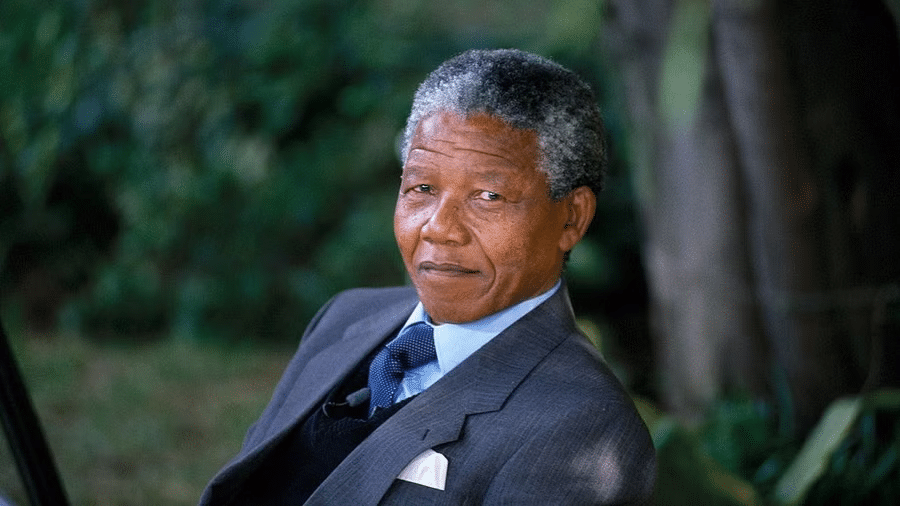
The story is from Nelson Mandela’s autobiography, highlighting the struggle against apartheid.
On 10 May 1994, Mandela became South Africa’s first Black President.
The event marked the end of white rule and the beginning of democracy.
The inauguration in Pretoria was attended by many international leaders.
Mandela promised equality, justice, and no discrimination for all.
Two national anthems were sung to symbolize unity.
He recalled the suffering of black people under apartheid.
Stated that hatred is learned, and love is natural.
True courage is facing and overcoming fear.
Everyone has duties to their family and nation.
Freedom was once an illusion for black South Africans.
Freedom is for all—both oppressed and oppressor need to be freed.
Try yourself:
What was the main objective of Nelson Mandela’s struggle?
A.To become the President of South Africa
B.To fight against apartheid and discrimination
C.To establish a new political party
D.To achieve economic independence for South Africa
View Solution
Detailed Summary
Nelson Mandela: Long Walk to Freedom is an extract from the autobiography of Nelson Rolihlahla Mandela that describes the struggle for freedom of black people in South Africa. On 10th May 1994, Nelson Mandela took the oath as South Africa’s first Black President after more than three centuries of White rule. His party had won 252 out of the 400 seats in the first democratic elections in the history of South Africa.Nelson Mandela
Many dignitaries and political figures from several countries attended the inauguration ceremony that took place in the Union Buildings amphitheatre in Pretoria. In his speech, Mandela addressed all dignitaries respectfully and assured his fellow countrymen that his country would never experience similar suppression by one group over another. While taking his vow as the first black President, he established democracy in the country and said there would be no discrimination against people, irrespective of caste, colour, creed or race. He assured that the government would always treat all the people of the country with due respect and equality.
The lovely day of inauguration was symbolic for Mandela as the South African people sang two national anthems – the vision of whites sang ‘Nkosi Sikelel –iAfrika’ and the blacks sang ‘Die Stem’, the old anthem of the Republic. All these events reminded Mandela of how black-skinned people were exploited by white people earlier. He deeply felt the pain of his race and said that this type of suppression and racial domination of the white-skinned people against the dark-skinned people on their own land gave rise to one of the harshest and most inhumane societies the world had ever seen or known. He strongly believed that no person is born to hate the other person on the basis of skin colour, background or religion. However, people must learn to hate because if they learn to hate, they can be taught to love as well, as love comes more naturally to humans than hate. He also mentioned how a person becomes brave, not because he does not feel afraid, but because he knows how to conquer his fears.
Try yourself:What historic event did Nelson Mandela reflect on during his inauguration as the first black President of South Africa?
A.End of colonial rule
B.End of apartheid
C.End of civil war
D.End of dictatorship
View Solution
Furthermore, Mandela stated that every man in life has two major obligations. The first one is his obligation towards his family, which includes his parents, wife and children, and the second is towards his motherland, countrymen and his community. Everyone is able to fulfil those obligations according to his own interests and inclinations. However, it was difficult to fulfil both these obligations as a black man in a country like South Africa before the democratic wave took over the nation by storm. When Mandela became an adult, he realised that freedom was merely an illusion and temporary in nature for the black-skinned people of his country. He felt that they were treated as slaves of exploitation, and all the people of his race were treated unfairly by the white-skinned people.Racial Domination
According to Mandela, freedom was indivisible for all. But the people of his colour and race were bound in chains of oppression and tyranny. He knew that the oppressor must be liberated just like the oppressed because a person who snatches another’s freedom is also a prisoner of similar oppression. Thus, the oppressor is not free too and feels shackled in the chains of oppression himself.
Theme:
The central theme of the chapter revolves around courage, resilience, and the struggle for justice. Nelson Mandela’s life exemplifies unwavering willpower and determination in the face of adversity. Despite enduring years of imprisonment and oppression, Mandela’s story reflects the power of forgiveness, unity, and love in the fight against injustice. His journey serves as an inspiring example of how one can transform personal suffering into a broader movement for freedom and equality. The theme also stresses that courage and resilience are vital traits for achieving one’s goals and challenging societal wrongs.
Try yourself:
Which quality is highlighted in Mandela’s life story as essential for overcoming challenges?
A.Perseverance
B.Humility
C.Laziness
D.Indecisiveness
View Solution
Message:
The story delivers a powerful message that both the oppressor and the oppressed are dehumanized by the system of injustice—one through hatred and the other through suffering. True liberation, therefore, means freeing both parties from the chains of inhumanity. It also conveys that real and lasting change is possible only through collective action, where individuals unite despite their differences. The narrative underscores the importance of forgiveness, collaboration, and moral courage in building a just and equal society.
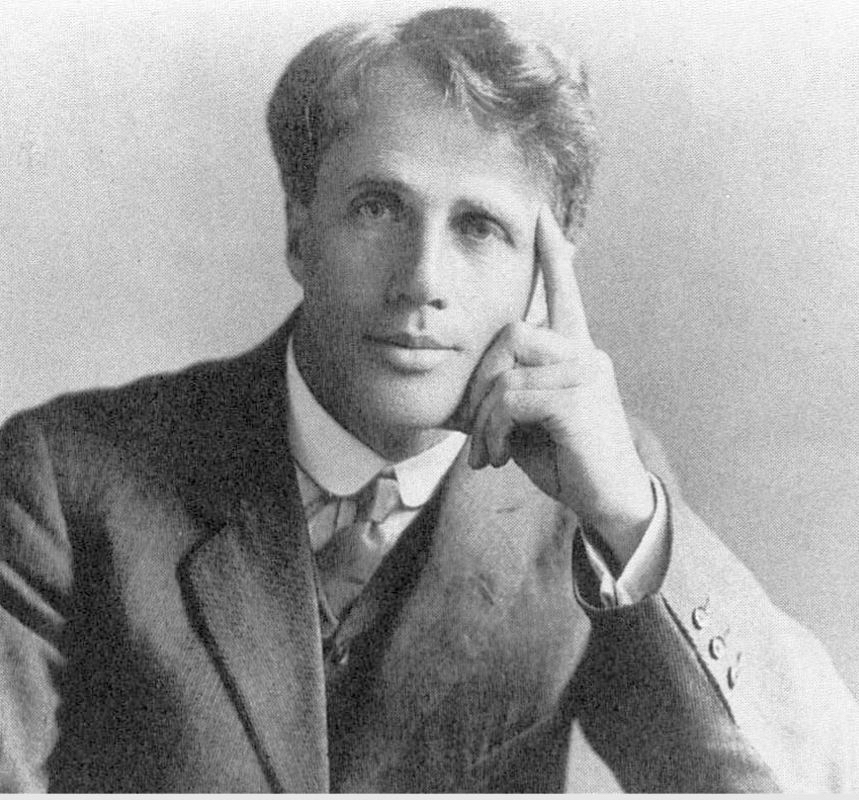
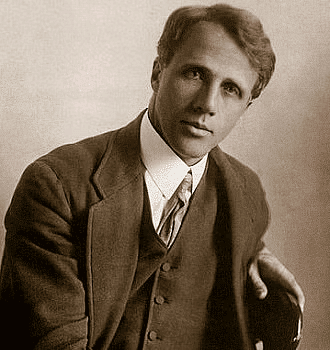
Robert Lee Frost (March 26, 1874 – January 29, 1963) was an American poet. His work was initially published in England before it was published in the United States. Known for his realistic depictions of rural life and his command of American colloquial speech, Frost frequently wrote about settings from rural life in New England in the early 20th century, using them to examine complex social and philosophical themes.
Key Points of the Poem
The poem consists of 2 stanzas. First stanza is made up of 4 lines and the second stanza of 5 lines. Thus, the entire poem consists of 9 lines in total.
The poem has been written symbolically.
The poet says that there are mainly two opinions about the end of this world, one by fire and another by ice.
The symbols — ‘Fire’ and ‘Ice’ have been used for human emotions like desire and hatred respectively.
As fire can spread very fast and cause a great destruction in no time likewise our desires may also prove very destructive if they go out of control.
Hatred causes slow destruction like ice but it is also very harmful.
Try yourself:
What is the main theme of the poem?
A.The destruction caused by fire
B.The destructive power of human desires
C.The slow destruction caused by ice
D.The importance of rural life in New England
View Solution
Detailed Summary
Stanza 1
Some say the world will end in fire Some say in ice. From what I’ve tasted of desire I hold with those who favour fire.
In these lines, the poet analyses the views of the people and states that there can be two possible causes for the end of the world. On one side there are people who believe that the world will end because of fire. Here, fire represents the extreme desire, anger, greed etc. present within of human beings. On the other side, there are people who favour ice. Here, ice represents the human emotions of the hatred, intolerance, etc. the poet from his experience believes that the world will end with fire. Thus, the poet remains with those people who favour fire.
Stanza 2
But if it had to perish twice, I think I know enough of hate To say that for destruction ice Is also great And would suffice.
In these lines, the poet thinks that if the world had to end twice, ice would also be able to destroy it completely.For the poet, ice (hatred) is as powerful as fire (desire). In human beings, hatred is long lasting and it enters into their hearts. It remains through the life. Thus, poet thinks that ice or hatred will be sufficient to bring an end to this world.
Theme/ Message Theme
Destruction by Extremes: The poem explores the idea that both fire and ice can lead to the end of the world, symbolizing destructive human tendencies.
Symbolism: Fire represents desire, passion, and the intensity of human emotions, while ice symbolizes hatred, coldness, and emotional detachment.
Human Nature: Frost reflects on the destructive nature of human emotions and how they can lead to catastrophic consequences.
Preference and Bias: The poem suggests that people may have different opinions on which force—fire or ice—will cause the world’s end.
Message
The poem is revolving around the theme that human emotions are destructive, and has two possible forms.
The fire symbolises burning desires, while the ice, on the other hand, describes ice-cold hatred.
Literary Devices
Rhyme scheme — stanza 1 is abaa while for stanza 2 it is ababa. Symbolism – Symbolism is the use of symbols to signify some ideas by giving them symbolic meaning different from their literal meaning. •Fire – symbolizes desire, including human emotions like lust, fury, cruelty, greed etc.. •Ice – symbolizes the hatred with cold feelings of humans such as rigidity, jealousy, indifference, intolerance, etc..
Imagery —Imagery is the visualisation of the poetic description through our sensory organs. Here, the reader would visualise the destruction through fire or ice. The imagery formed would depend on how we perceive and imagine in the context being portrayed in the poem. It makes a poem picturesque as images are formed in the minds of the reader. For example, “Some say the world will end in fire” and “To say that for destruction ice, is also great”.
Personification —Personification is to assign human qualities to non-living things. In this poem, ‘fire’ and ‘ice’ are capable of destroying the earth. Therefore, the poet personifies fire and ice by giving them a mind which is capable of destroying almost anything.
Anaphora — Anaphora is the repetition of a word or expression at the start of two or more consecutive lines. For example: “Some say the world will end in fire, Some say in ice.” ‘Some say’’ is repeated at the start of the lines 1 and 2.
Alliteration —Alliteration is the repetition of the same sound used at the beginning of the nearly placed words. Example: The sound of ‘s’ in “some say,” ‘f’ in “favour fire,” and ‘w’ in “world will.”
Assonance – Assonance is the repetition of the same vowel sounds in different words in the same line e.g., ‘‘I hold with those who favour fire.’’ In this line, the long sound of ‘O’ is used.
Enjambment—It is a line or clause that does not come to an end at a line break, rather it moves over to the next line. This device has been used prominently in the poem. For Example: ‘‘From what I’ve tasted of desire I hold with those who favour fire’’
Metaphor – It is a literary device that is used to make a covert comparison without using the words ’like ‘or ’as ‘. Here, the poet has used the terms ‘fire’ and ‘ice’ as metaphors for the human emotions related to desire and hatred.
Antithesis – Fire is the antithesis of ice. Two contrasting and directly opposite destructive forces are the hallmark of this poem: ‘Fire’ and ‘Ice’.
Try yourself:
Which of the following best represents the symbolism of fire in the poem?
Robert Lee Frost (March 26, 1874 – January 29, 1963) was an American poet. His work was initially published in England before it was published in the United States. Known for his realistic depictions of rural life and his command of American colloquial speech, Frost frequently wrote about settings from rural life in New England in the early 20th century, using them to examine complex social and philosophical themes.
Key Points of the Poem
The poem consists of 2 stanzas. Each of these stanzas is made up of 4 lines. Thus, the entire poem consists of 8 lines in total.
The poem describes a very simple happening in very simple words.
It tells us that sometimes even a small incident may prove to be of a larger significance.
The poet is upset at the beginning of the poem but a small incident of falling of snow changes his mood totally.
In the end of the poem the poet feels relaxed and thankful to nature for saving his day from being wasted.
Detailed Summary
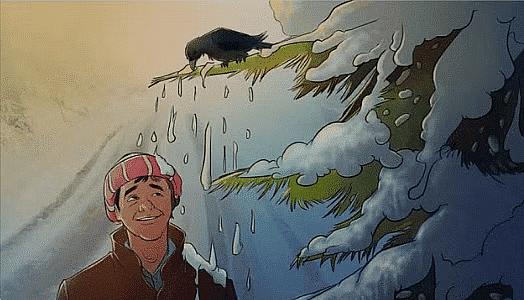
Stanza 1 The way a crow Shook down on me The dust of snow From a hemlock tree
In this poem, the poet is talking about a winter’s day when all the treetops were covered with snowflakes. The poet was walking under one such snow-covered tree. This was a Hemlock tree. The hemlock tree is usually associated with poison and toxicity as a poison named hemlock is also derived from it. Thus, this tree cannot be associated with anything positive. However, a crow came and sat down on this tree suddenly, and because of this sudden motion, the mass of snowflakes from the top fell on the poet like rain. The snowflakes were so light and small that the poet thought they looked like white and immaculate dust particles, though usually not white. This shower of snowflakes from the hemlock tree is the subject matter of this poem since it touched the poet in some way.
Stanza 2
Has given my heart A change of mood And saved some part Of a day I had rued.
Now in the second stanza, the poet explains exactly in what way the shower of snowflakes had an effect on him. He says that it changed his mood. Earlier, he had been in a despairing mood but the shower of the snowflakes falling on him all of a sudden gladdened his heart. In addition to this, there was another effect that the shower of snowflakes had on the poet. He says that particular day was one he hadn’t been looking forward to, and it hadn’t been going well either. He had decided, in his mind, that that particular day would go to waste. However, the shower of dust like snow on his shoulder changed his mind. It made him feel that the day had not been a complete waste. At least some part of that day had been pleasant since it had given him a new experience that he could treasure as well as the material for another one of his wonderful poetic compositions.
Try yourself:
What effect did the shower of snowflakes have on the poet?
A.It reminded him of summer.
B.It changed his mood.
C.It made him cold.
D.It made him angry.
View Solution
Theme/ Message
Theme
Nature’s Influence: The poem explores the transformative power of nature.
Unexpected Redemption: A seemingly mundane incident, like a crow shaking snow on the poet, leads to a positive change.
Symbolism: The dust of snow symbolizes a moment of clarity or inspiration that changes the speaker’s perspective.
Simplicity and Beauty: The poem highlights the beauty in simple, everyday moments and the potential for these moments to bring joy.
Escape from Melancholy: The poem suggests that even a small event in nature can lift one’s spirits and provide a respite from life’s difficulties.
Message
This poem conveys the message that nothing in life is small. Even trivial things can bring positive changes in our life.
If we take things positively in life, situations do change for better. Even the small help or good gestures we do for others make large differences.
Literary Devices
Rhyme Scheme– ababcdcd
Imagery: Visual images like the crow shaking snow from a hemlock tree and the ‘dust of snow’ falling on the poet highlight nature’s impact on mood.
Alliteration: Repetition of initial consonant sounds in closely placed words, e.g., Has given my heart And saved some part
Symbolism: The crow and hemlock tree, usually seen as negative, symbolize sorrow and death but are used to show how even grim elements of nature can uplift the mood.
Inversion: When the structure of a sentence is changed by the poet to create a rhyme, the poetic license is called inversion. In stanza 1, the poetic device ‘inversion’ is used.
Enjambment: In enjambment, the same sentence continues to the next line without the use of any punctuation marks. This poem is very good example of this poetic device. It is used throughout the poem. The lines of stanzas flow to the next line without any punctuation.
Metaphor: “Dust of snow” metaphorically compares snowflakes to dust, symbolizing a small but meaningful event.
Synecdoche: The word “heart” is used to represent the poet’s entire emotional state.
Assonance: Repetition of vowel sounds, e.g., the ‘o’ sound in “Shook down on me.”
Difficult Words
Way—manner
Dust—very small particles
Dust of snow— small white flakes falling on earth
Shook – to move with short quick movements from side to side or up and down
Shook down—shook the snow dust down
Hemlock—a poisonous plant with fernlike leaves and white flowers
Give heart – make happy and confident
Has given my heart – has created impact on my heart and made me feel happy and confident
Mood—state of mind
A change of mood—a change in the present condition of mind
The story “A Letter to God” was penned by G.L. Fuentes, a prominent Mexican writer known for his contributions in poetry, novels, and journalism during that era.
The narrative unfolds in a Latin American setting, focusing on Lencho, a farmer who faces a crisis when his entire crop is destroyed by a hailstorm.
Seeking divine intervention, Lencho writes a letter to God.
Although his prayers are partially answered, he remains unappreciative and questions the integrity of the postmasters who anonymously provide financial aid in the name of God.
Try yourself:
What is the main conflict faced by Lencho in the story “A Letter to God”?
A.His house is destroyed by a hailstorm.
B.His entire crop is destroyed by a hailstorm.
C.He loses his job and becomes homeless.
D.He falls ill and cannot work on his farm.
View Solution Detailed Summary
Lencho was a dedicated farmer. He was expecting a decent harvest. However, to his grief, a hailstorm came and destroyed his harvest completely. Lencho was very sad.
However, he had a strong belief in God. He was certain that God would help him. Also, he was an extremely straightforward man. Although working for a long time on the farm, he knew writing. Thus, he composed a letter to God. In the letter, he asked God to send him one hundred pesos. At that point, he went to the post office and put his letter into the post box.
The postman removed the letter from the letterbox. He read the address on it and laughed very much. Also, he rushed to the postmaster and demonstrated to him that strange letter. Moreover, the postmaster also laughed in the same way when he saw the address of God. However, on reading the letter, he got very serious. He lauded this man who had unquestioned faith in God and decided to help him in terms of money. He asked the employees of the post office to give charity. Moreover, he gave a part of his salary too. However, they were able to collect only a little more than half the money as requested by Lencho. The postmaster put the money in an envelope. It was addressed to Lencho.
On Sunday, Lencho once again came to the post office. He asked if there was a letter for him. The postman took out the letter and handed it to Lencho. Lencho was not surprised after seeing the money. But when he counted the money, he became angry with God. He was sure that God could not have made a mistake. He took paper and ink and wrote one more letter to God. Then he put it into the letterbox.
After Lencho had left the place, the postmaster and the employees read the letter. In it, Lencho had complained to God that he had received only seventy pesos. Also, he requested God to send him the rest of the money this time. However, he asked God not to send the money through the mail. He wrote that the post-office employees were a bunch of crooks and thus might have stolen the money.
Try yourself:What was Lencho’s reaction when he received the money from the postmaster?
A.He was grateful and thanked God for the help.
B.He was disappointed and felt that God Could not have made a mistake.
C.He was surprised by the money he got and thanked the postmaster.
D.He was indifferent and did not pay much attention to the money.
View Solution
Theme/ Message
Theme
The main themes in this story are faith, hope, and the power of nature.
The story is about a farmer named Lencho who experiences a hailstorm that destroys his crops, leaving him with no hope of feeding his family. Despite this, Lencho remains hopeful that God will help him, and he writes a letter to God asking for 100 pesos to help him plant his fields again.
The story highlights the power of faith and how it can provide hope in times of adversity. Additionally, the story explores the power of nature, as the hailstorm wreaks havoc on Lencho’s crops, highlighting the unpredictability and destructive potential of the natural world.
Finally, the story touches on themes of charity and the kindness of strangers, as the postmaster and his colleagues come together to help Lencho in his time of need, even though they cannot give him everything he asks for.
Message
The message of the story is that faith and belief can move mountains. Lencho’s faith in God is unshakable, and he believes that God will help him no matter what.
The postmaster’s act of kindness shows that even in difficult times, people can come together to help each other.
Try yourself:
What is the main message conveyed in the story?
A.The power of nature can be destructive.
B.Faith and belief can provide hope in difficult times.
C.Strangers are always willing to help those in need.
Q1: Who are Producers? Ans: People who make goods and provide services are called producers. As producers of goods and services, we could be working in any of the sectors such as agriculture, industry or services.
Q2: Who are Consumers? Ans: Consumers participate in the market when they purchase goods and services that they need. These are final goods that people as consumers use.
Q3: What is the need of rules and regulations in the market? Ans: Rules and regulations are needed to protect workers in unorganised sector or protect people from high interest rates charged by moneylenders in the informal sector or for protecting a consumer in the market.
Q4: Why do individual consumers often find themselves in a weak position? Ans: Whenever there is a complaint regarding a good or service that they had bought, the seller tries to shift all the responsibility on to the buyer.
Q5: How can large companies with huge wealth and power manipulate the market? Ans: At times, false information is given through media, and other sources to attract consumers. Such big companies with huge wealth and power can manipulate the market.
Q6: Give an example to prove how big companies can manipulate market with wealth and power. Ans: A long battle had to be fought with court to make cigarette–manufacturing companies accept that their product could cause cancer.
Q7: Why did consumer movement arise in India? Ans: Consumer movement arose out of the dissatisfaction of the consumers as many unfair practices were being indulged in by the sellers.
Q8: Who does the standardisation of products at National level? Ans: Standardisation of products is done at the national level by the Bureau of Indian Standards Act, 1986. ISI, AGMARK, Hallmark are well known, certification marks for national standardisation. Q9: Name two certification marks for international standardisation. Ans: Standardisation of product is done at the international level. ISO 9000 and ISO 14000 are the well-known certification marks for international standardisation.
Q10: Which logo will you like to see on the electric heater to be sure of its quality? OR Which quality logo would you like to see on the electric goods to be sure about their quality? [CBSE (F) 2016], [CBSE (F) 2017] Ans: ISI.
Q11: Initially what was done by consumers to protect themselves from the exploitation? Ans: Initially when a consumer was not happy with a particular brand, product or shop, he or she generally avoided buying that brand product, or would stop purchasing from that shop.
Q12: Why did the consumer movement begin as a social force in India? Ans: In India, the consumer movement as a ‘social force’ originated with the necessity of protecting and promoting the interests of consumers against unethical and unfair trade practices. Q13: What was the status of consumer movement in 1960s? Ans: Rampant food shortages, hoarding, black marketing, adulteration of food and edible oil gave birth to consumer movement in an organised form in 1960s.
Q14: What efforts were done in 1970s by consumer groups? Ans: Till 1970s, consumer organisations were largely engaged in writing articles and holding exhibitions. They formed consumer groups to look into the malpractices in ration shops and overcrowding in the road passenger transport.
Q15: What is COPRA? Ans: A major step taken in 1986 by the Indian government was the enactment of the Consumer Protection Act, 1986, popularly known as COPRA to protect consumer’s interests.
Q16: When and why was ‘Consumer International’ adopted? Ans: In 1985, United Nations adopted the UN Guidelines for Consumer Protection. This was a tool for nations to adopt measures to protect consumers’ advocacy groups to press their governments to do so.
Q17: What is the status of Consumer International today? Ans: Today, Consumer International has become an umbrella body of over 250 member organisations from in 120 countries.
Q18: Give any one example of consumer’s ‘right to choose.’ [CBSE Delhi 2017] Ans: If a person wants to buy toothpaste and the shop owner says that she can sell the toothpaste only if the customer buys toothbrush. If you are not interested in buying the brush, you have right to deny.
Q19: Why should Right to Safety be practised by the consumers? Ans: While using many goods and services, we as consumers, have the right to be protected against the marketing of goods and delivery of services that are hazardous to life and property.
Q20: Why do producers need to strictly follow the required safety rules and regulations? Ans: There are many goods and services that we purchase that require special attention to safety. For example, pressure cookers have a safety valve which, if defective, can cause a serious accident. The manufacturers of the safety valve have to ensure high quality.