3. Money and Credit – Textbook Worksheet

Multiple Choice Questions
Q1: A person can withdraw money from a bank by issuing a cheque. What is a cheque?
(a) Loan taken by the bank.
(b) Loan taken by the depositor from the bank.
(c) Paper instructing the bank to pay a specific amount.
(d) Paper valid to withdraw money

Q2: Which one of the following is not a formal source of credit?
(a) Commercial Banks
(b) State Bank of India
(c) Employers
(d) Co-operatives

Q3: All the banks actas mediator between _________ and _________.
(a) rural people, urban people
(b) literates, illiterates
(c) people, government
(d) depositors, borrowers

Q4: Organised credit is also called
(a) informal credit
(b) formal credit
(c) cooperative credit
(d) none of these

Q5: A porter making pots, wants to exchange pots for wheat. Lukily, he meets a farmer who has wheat and is willing to exchange it for the pots. What is this situation known as?
(a) Incidence of wants
(b) Double coincidence of wants
(c) Barter system of wants
(d) None of the above

Q6: Organised credit is also called
(a) informal credit
(b) formal credit
(c) cooperative credit
(d) none of these

Q7: Modern form of money is linked with which system?
(a) Accounts system
(b) Finance system
(c) Banking system
(d) None of the above.

Q8: Which one of the following does not come under terms of credit?
(a) Interest rate
(b) Employment
(c) Collateral
(d) Mode of repayment.

Q9: What are electronic banking services?
(a) ATM
(b) Debit Card
(c) Credit Card
(d) All of the above.

Q10: A person can withdraw money by issuing a cheque. What is a cheque?
(a) Loan taken by the bank.
(b) Loan taken by the depositor from the bank.
(c) Paper instructing the bank to pay a specific amount.
(d) Paper valid to withdraw money

Fill in The Blanks
Direction: Complete the following statements with appropriate word(s).
Q1: Modern forms of money include _______ (gold coins/ paper notes)

Q2: Deposits in bank accounts withdrawn on demand are called _____ .

Q3: _____ issues currency notes on behalf of the Central Government.

Q4: Majority of the credit needs of the _____ households are met from informal sources.

Q5: _____ is an asset that the borrower owns and uses as a guarantee until the loan is repaid to the lender.

True & False

Direction: Read each of the following statements and write if it is true or false.
Q1: In a SHG, most of the decisions regarding savings and loan activities are taken by government.

Q2: The collateral demand that lenders make loans against are vehicle and building of the borrower.

Assertion And Reason Type Questions
Direction Mark the option which is most suitable :‘
Q1: Assertion: In India, no individual can refuse to accept a payment made in rupees.
Reason: Rupee is the legal tender in India.
(a) If Both assertion and reason are true, and reason is the correct explanation of assertion.
(b) If Both assertion and reason are true, but reason is not the correct explanation of assertion.
(c) If Assertion is true, but reason is false.
(d) If Both assertion and reason are false.

Q2: Assertion: Banks keep only a small proportion of their deposits as cash with themselves.
Reason: Banks in India these days hold about 15 per cent of their deposits as cash.

(a) If Both assertion and reason are true, and reason is the correct explanation of assertion.
(b) If Both assertion and reason are true, but reason is not the correct explanation of assertion.
(c) If Assertion is true, but reason is false.
(d) If Both assertion and reason are false.

Q3: Assertion: Rohan took credit in the form of advance payment from a buyer and he delivered the goods to the buyer on time and also earned profit. The credit made Rohan better off in this situation.
Reason: Credit can never push a person into a debt trap.

(a) If Both assertion and reason are true, and reason is the correct explanation of assertion.
(b) If Both assertion and reason are true, but reason is not the correct explanation of assertion.
(c) If Assertion is true, but reason is false.
(d) If Both assertion and reason are false.

Q4: Assertion: Collateral is an asset that the borrower owns (such as land, building, vehicle, livestock, deposits with banks) and uses this as a guarantee to a
Reason: Collateral is given as the lender can sell the collateral to recover the loan amount if the borrower fails to repay the loan.

(a) If Both assertion and reason are true, and reason is the correct explanation of assertion.
(b) If Both assertion and reason are true, but reason is not the correct explanation of assertion.
(c) If Assertion is true, but reason is false.
(d) If Both assertion and reason are false.

Q5: Assertion: The Reserve Bank of India supervises the functioning of formal sources of loans.
Reason: The RBI sees that the banks give loans not just to profit-making businesses and traders but also to small cultivators, small scale industries, to small borrowers etc.

(a) If Both assertion and reason are true, and reason is the correct explanation of assertion.
(b) If Both assertion and reason are true, but reason is not the correct explanation of assertion.
(c) If Assertion is true, but reason is false.
(d) If Both assertion and reason are false.

Very Short Answer Type Questions
Q1: Give any two examples of informal sector of credit. 

Q2: How does the use of money make it easier to exchange things? Give an example. 

Q3: How do the deposits with the banks become their source of income? 

Q4: Compare formal sector loans with informal sector loans regarding interest only. 

Q5: What do people do with extra money?

Q6: Why do we consider demand deposits as money?

Q7: What does higher cost of borrowing means?

Q8: When is crucial for the country’s development?

Q9: How do the SHGs help borrowers?

Q10: Prove with an argument that there is a great need to expand formal sources of credit in rural India.

Short Answer Type Questions 
Q1: Why is cheap and affordable credit important for the country’s development? Explain any three reasons.
or
“Cheap and affordable credit is crucial for the country’s development.” Assess the statement.

Q2: Explain any three loan activities of banks in India.

Q3: Why do banks ask for collateral while giving credit to a borrower?

Q4: What comprises ‘terms of credit’?

Q5: “Supervision of the functioning of formal sources of loans is necessary”.

Q6: “There is a great need to expand formal sources of credit in rural India.” Examine the statement.

Q7: Describe the utility of Cheque.

Q8: “The credit activities of the informal sector should be discouraged.” Support the statement with arguments.

Q9: ‘Credit has its own unique role for development.’ Justify the statement with arguments.

Q10: “Poor households still depend on informal source of credit.” Support the statement with examples.
or
“Most of the poor household still depend on the informal sector for loans, both in rural and urban areas of India.” Support the statement with three examples.

Long Answer Type Questions
Q1: What are self-help groups? How are they emerging as an import ant source of credit? Explain.
or
‘Self-Help Groups’ help borrowers to overcome the problems of lack of collateral.” Examine the statement.

Q2: How do SHG’s act to provide a platform for women to address their various social issues?

Q3: “Banks are playing an important role in the development of the Indian economy.” Support the statement with examples.

Q4: How can the formal sector loans be made beneficial for the poor farmers and workers? Suggest any five measures.

Q5: What are Self-Help Groups? How do they work? Explain.

Q6: What is credit? How does credit play a vital and positive role? Explain with an example.

Q7: Why are banks necessary for a country?

Q8: In what ways does the Reserve Bank of India supervise the functioning of banks? Why is this necessary? 
OR
How does Reserve Bank of India play a crucial role in controlling the formal sector loans. Explain.

Q9: When does credit push the borrower into a debt-trap? Explain with the help of an example.

Q10: What are the merits and demerits of credit ?
OR
‘‘Credit is useful as well as harmful, it depends on the risk involved.’’ Support the statement with examples.

The solutions of the worksheet “Worksheet Solutions: Money & Credit

2. Sectors of the Indian Economy – Textbook Worksheet

Multiple Choice Questions

Q1: Which of the following sectors is the largest producing sector in India?
(a)  Primary sector
(b)  Modern sector
(c)  Tertiary sector
(d)  Secondary sector

Q2: Which of the following is another name for primary sector?
(a)  Service sector
(b)  Agriculture and related sector
(c)  IT Sector
(d)  Industrial sector

Q3: Which of the following is a benefit of a tertiary sector?
(a) The activities of tertiary sector help in the development of primary and secondary sector.
(b) The tertiary sector helps in the production of goods by directly using natural resources.
(c) The individuals involved in tertiary sector use better quality seeds and manure to produce agricultural goods.
(d) The individuals involved in tertiary sector buys raw materials directly from farmers to convert them into final goods.

Q4: Public Sector stands for:
(a) Most of the assets owned by big companies.
(b) Assets owned by Government.
(c) Most of the assets owned by a group of people.
(d) Most of the assets owned by an individual.

Q5: Which of the following best defines the gross domestic product (GDP) of a country?
(a) It is the decrease in the value of assets over a given period of time.
(b) It is the value of final goods and services produced with in the domestic territory of a country.
(c) It is the difference between value of goods imported and the value of goods exported.
(d) It is the value of all final goods and services produced by the citizens of a country within and outside the country.

Q6: Choose a method to tackle the problem of underemployment in a country.
(a) Identify, promote and locate industries and services where a large number of people can be employed.
(b) Provide debt-waiver schemes for farmers so that they can easily take loans to increase agricultural activities.
(c) The government should provide unemployment benefits to citizens.
(d) The government should focus on developing jobs in the unorganized sector as most of the people are employed in unorganized sectors.

Q7: Which of the following sectors is the largest producing sector in India?
(a) Primary sector
(b) Modern sector
(c) Tertiary sector
(d) Secondary sector

Q8: Identify the difference between the organised and unorganised sectors.
(a) Employees in organised sector are mainly involved in agriculture and allied activities, while the employees in unorganized sector are mainly involved in manufacturing activities that take place with the help of equipment in factories.
(b) Firms in organised sector are registered by the government and have to follow certain norms of employment as set by the government, while the unorganised sector is characterised by small and scattered units which are largely outside the control of the government.
(c) Employees in organized sector are mainly self-employed, while the employees in unorganized sector are mainly employed in government or public sector jobs.
(d) In a country, the contribution of organized sector is minimal to the GDP, while the unorganized sector mainly supports the economic growth of a country.

Q9: Which of the following is true about Mahatma Gandhi National Rural Employment Guarantee Act
(a)  The government has to ensure to increase the number of jobs in unorganized sector.
(b)  The government is required to provide 100 days of employment in rural areas to people who are able to and in need of work.
(c)  The government has to ensure that all the unemployed individuals in rural areas must get  100 per day as unemployment benefits.
(d)  The government is required to provide free health check ups and medical facilities to unemployed people in rural areas for at least 100 days in a year.

Q10: Which of the following refers to the intermediary good?
(a)  Goods that are included in the estimation of GDP.
(b)  Goods that are not used as raw material for production of other goods during a year.
(c)  Goods that are used as raw material for the production of other goods during a year.
(d)  Goods that are not resold by the firms to make profit during a year.

Fill in the Blanks

Q1: The ____________ sector involves the creation of products by extracting and gathering natural resources.

Q2: The ____________ sector includes activities that support the growth of the primary and secondary sectors.

Q3: Gross Domestic Product (GDP) is the sum of production of ____________ sectors in a year.

Q4 The ____________ sector gradually became the most important in the economy and employment.

Q5: The ____________ sector overtook the primary sector as India’s largest producing sector in 2013-14.

True and False
Q1: The tertiary sector is not playing any significant role in the development of Indian economy.

Q2: The purpose of the Public Sector is not just to earn profits while activities in the sector are guided by the motive to earn profits only.

Q3: There has been a big change in the three sectors of economic activities in India but a similar shift has not taken place in the share of employment.

Q4: The public sector plays an important role in the economy of India by creating and expanding infrastructure such as the construction of roads, bridges, railways, schools, hospitals, etc.

Q5: The unorganised sector in urban areas constitutes casual workers especially in construction, trade and transport as well as the people who are employed on their own doing small jobs such as selling on the street or doing repair work.

Assertion and Reasoning Based Type Questions

Q1: Assertion: An individual who manufacture flour from wheat is engaged in primary sector.
Reason: When some process of manufacturing is used the product is a part of secondary sector.
(a)  If both assertion and reason are true and reason is the correct explanation of assertion.
(b)  If both assertion and reason are true but reason is not the correct explanation of assertion.
(c)  If assertion is true but reason is false.
(d)  If both assertion and reason are false. 

Q2: Assertion: Leela works five days a week, receives her income on the last day of each month and gets medical facilities from her firm.
Reason: Leela is working in organized sector.

(a)  If both assertion and reason are true and reason is the correct explanation of assertion.
(b)  If both assertion and reason are true but reason is not the correct explanation of assertion.
(c)  If assertion is true but reason is false.
(d)  If both assertion and reason are false. 

Q3: Assertion: There are several goods and services that the society needs; however, the private sector does not produce all of them.
Reason: Private sector is profit driven.

(a)  If both assertion and reason are true and reason is the correct explanation of assertion.
(b)  If both assertion and reason are true but reason is not the correct explanation of assertion.
(c)  If assertion is true but reason is false.
(d)  If both assertion and reason are false.

Q4: Assertion: Rakesh is an educated and skilled worker who earns a high monthly salary as he is employed in a private bank in a city.
Reason: All service sectors in India are growing extremely well and each individual engaged in any kind of tertiary activity earns a high income.

(a)  If both assertion and reason are true and reason is the correct explanation of assertion.
(b)  If both assertion and reason are true but reason is not the correct explanation of assertion.
(c)  If assertion is true but reason is false.
(d)  If both assertion and reason are false.

Q5: Assertion: Mohan is a shopkeeper who pays his taxes on time. He has employed two workers Rakesh and Raghu in his shop. He pays them well, however, none of the workers get any paid leaves in the year.
Reason: Rakesh and Raghu are employed in unorganized sector.

(a)  If both assertion and reason are true and reason is the correct explanation of assertion.
(b)  If both assertion and reason are true but reason is not the correct explanation of assertion.
(c)  If assertion is true but reason is false.
(d)  If both assertion and reason are false.

Q6: Assertion: In India, over the forty years between 1973- 74 and 2013-14, while production in all three sectors has increased, it has increased the most in the tertiary sector.
Reason: Tertiary sector is the only organized sector in the economy so the government spends a lot of money for creating jobs in tertiary sector.

(a)  If both assertion and reason are true and reason is the correct explanation of assertion.
(b)  If both assertion and reason are true but reason is not the correct explanation of assertion.
(c)  If assertion is true but reason is false.
(d)  If both assertion and reason are false.

Q7: Assertion: Reliance industries is a privately-owned firm.
Reason: Government is a major stakeholder in reliance industries.

(a)  If both assertion and reason are true and reason is the correct explanation of assertion.
(b)  If both assertion and reason are true but reason is not the correct explanation of assertion.
(c)  If assertion is true but reason is false.
(d)  If both assertion and reason are false.

Q8: Assertion: The development of agriculture and industry leads to the development of service sector.
Reason: As the primary and secondary sectors develops, the demand for transport, storage structures, banks, insurance, etc., increases.

(a)  If both assertion and reason are true and reason is the correct explanation of assertion.
(b)  If both assertion and reason are true but reason is not the correct explanation of assertion.
(c)  If assertion is true but reason is false.
(d)  If both assertion and reason are false.

Q9: Assertion: In India, the primary sector is the largest employer.
Reason: The demand for services has increased enormously.

(a)  If both assertion and reason are true and reason is the correct explanation of assertion.
(b)  If both assertion and reason are true but reason is not the correct explanation of assertion.
(c)  If assertion is true but reason is false.
(d)  If both assertion and reason are false.

Q10: Assertion: When calculating the total value of goods and services produced in a country, the value of all goods and services at each stage of production should be calculated.
Reason: At each stage of production some value is added to a good or service, therefore, the value added at each stage of production is added to derive the total value of goods and services in an economy.

(a)  If both assertion and reason are true and reason is the correct explanation of assertion.
(b)  If both assertion and reason are true but reason is not the correct explanation of assertion.
(c)  If assertion is true but reason is false.
(d)  If both assertion and reason are false. 

Very Short Answer Type Questions

Q1: TISCO : Private, ________ : Public.

Q2: The main objective of a private sector enterprise is ________.

Q3: Complete the following :
The activities of the primary sector are called primary because _______.

Q4: Correct the following statement and rewrite.
When more people work in a job than required it is known as seasonal employment.

Q5: Identify the sector with the help of the following features :
(a)  Registered by the government
(b) Workes enjoy security of employment.
(c)  It is also called organised sector.

Q6: What type of goods and services are included for calculation of GDP in India?

Q7: What if the underemployed people are removed from primary sector and provide them with proper work somewhere else ?

Q8: What happens in the situation of underemployment ?

Q9: Where do we find majority of workers from scheduled castes, tribes and backward communities?

Q10: Which aspects of human development does the government need to pay attention ?

Short Answer Type Questions
Q1: What is an economic activity ?

Q2: How do we calculate the value of various goods and services and know the total production in each sector ?

Q3: What are the non-economic activities ?

Q4: Why is the tertiary sector becoming more important in India ? Explain. 

Q5: What does this mean that the primary sector provided employment to more than half of the working population while its share in GDP was less than 25 percent ?

Q6: Why does disguised unemployment not help to enhance the productivity of the country?

Q7: “The declining share of agriculture in the Gross Domestic Product (G.D.P.) is a matter of serious concern in India.” Support this statement with any five reasons.
OR
“The declining share of agriculture in the Gross Domestic Product (GDP) is a matter of serious concern in India.” Support the statements.

Q8: Explain the objective of implementing the MGNREGA 2005.

Q9: What is underemployment ?

Q10: Why is the value of only final goods and services counted while calculating GDP ?

Long Answer Type Questions

Q1: What do you mean by the term Gross Domestic product? What precautions should we take in calculating GDP?

Q2: How do you think the sectoral composition of Indian economy has changed ?

Q3: Pavan is a poor agriculture labourer in a village. He wants to migrate to city in search of better employment opportunities. Can you suggest some ways through which his migration for better employment opportunities be stopped ?

Q4: What are the ways to increase more employment for the people in rural India ?

Q5: Reema works as a Head Technician in Mehta Textiles Private Ltd. whereas Shirin works as a Sales Executive in Kashvi Fashion Showroom. Identify the sectors of economy in which Reema and Shirin are working. Evaluate the role of each of these sectors in the Indian economy.

Q6: Write any five features of an organized sector.

Q7: Rohan works in a bank as a clerk while Sumit works on a construction site as a labourer. Find out the difference in their conditions of work and judge the benefits and drawbacks of working in the respective sectors.

Q8: Mr. Swaminathan works in a government textile mill. Now the government is planning to sell that mill to a company in private sector. What can be the demerits of private sector?

Q9: Explain how public sector contributes to the economic development of a nation.

Q10: What historical changes have been brought about in the primary, secondary and tertiary sectors ?

The solutions of the worksheet “Worksheet Solutions: Sectors of the Indian Economy

1. Development – Textbook Worksheet

Objective Type Questions
Q1: Which of the following is not true about development?
a. Different people usually have same goals.
b. Different people can have different goals.
c. Different people can have different as well as conflicting goals.
d. Different people can have different as well as conflicting goals regarding national development.

Q2: Which statement does not justify the need for provision of public facilities
a. Income itself indicate the ability to utilize goods and services
b. Public facilities are provided because people need them
c. Providing public facilities collectively reduces costs
d. Income itself cannot indicate the ability to utilize goods and services

Q3: Which one of the following is not a base for preparation of Human Development Index (HDI)
a. Literacy rate
b. Life expectancy
c. Industrialization
d. Per capita income

Q4: Which of the following is the most important component for comparing different countries
a. Resources
b. Youth in population
c. Per capita income
d. Life expectancy

Q5: Which criteria is used by World Bank for classifying countries?
a. Literacy Rate
b. Life Expectancy
c. Enrolment percentage
d. Per Capita income

Q6: Kerala has low infant mortality rate because it has
a. Low provision of basic health and educational facilities
b. Adequate provision of basic health and educational facilities
c. High mortality rate among elderly people
d. None of the above

Q7: Body mass index is used to calculate
a. Nourishment level
b. Body growth
c. Only a
d. Both a and b

Q8: Assume there are five families in a country. The average per capita income of these families is Rs 10000. If the income of three families is Rs 9500, Rs 10500, Rs 10200 and Rs 9800 respectively, what is the income of the fifth family?
a. Rs 10000
b. Rs 10500
c. Rs 20220
d. Rs 5800

Q9: Which of the following is not a reason for a person which will not prevent him from joining a job which pay high salary?
a. Job security
b. Work environment
c. Facilities for family
d. Power

Q10: Which of the following is true when industrialists want more dam to get more electricity but tribals oppose it?
a. Different persons can have different developmental goals
b. What may be development for one may not be development for the other.
c. For development, people look at a mix of goals.
d. Different persons could have different as well as conflicting notions of a country’s development.

Very Short Answer Type Questions
Q1: The total income of the country divided by its total population is Called

Q2: Which organization publishes the Human Development Report?

Q3: Which state in has the highest literacy rate?

Q4: As per Human Development Report 2006 which neighboring country has the highest income?

Q5: What is sustainable development?

Q6: Development of a country can generally be determined by ____________

Q7: Which of the state has low infant mortality rate?

Q8: What is the full form of HDI?

Q9: Which areas of the world has the largest crude oil reserves?

Q10: Besides money what are the other developmental goals?

Short Answer Type Questions
Q1: What does development mean for a landless rural labourer?

Q2: Do all people of a country have the same notion of development?

Q3: What are the development goals of people other than income?

Q4: Which is the most important criterion for comparing development of countries/states?

Q5: What is meant by total income of a country?

Q6: What is ‘Average Income’ Or ‘Per capita Income’?

Q7: What is the main criterion used by World Bank in classifying different countries?
Ans:

Q8: Why children in many parts of India are not able to achieve Secondary education?

Q9: Why does Kerala have low infant mortality rate?

Q10 : What are the criterions used by the Human Development Report published by UNDP to compare countries?

Long Answer Type Questions
Q1: How did World Bank classify countries? What criterion did they use? What are its limitations?

Q2: Give three examples where an average income is used for comparing situations.
Or Why do we use average income? What are the limitations to their use?

Q3: Why do you think average income is an important criterion for development? Explain.
Ans:

Q4: Money in your pocket cannot buy all the goods and services that you may need to live well.
OR Prove by giving examples that income itself is not a completely adequate indicator of material goods and services that citizens were able to use.

The solutions of the worksheet “Worksheet Solutions: Development

5. Consumer Rights – Chapter Notes

Consumer rights are basic rules made to protect people when they buy things, ensuring they are treated fairly and businesses act honestly. These rights are meant to stop people from being taken advantage of or getting poor-quality products or services, giving them more power in their purchases. 

The Consumer in the Marketplace

  • Market Participation: We engage in the market as both producers and consumers. Whether working in agriculture, industry, or services, our roles extend to creating goods and services as producers and acquiring them as consumers.
  • Development and Regulation: In previous discussions, we emphasized the necessity for rules and regulations to promote development. These measures are crucial for protecting workers in the unorganized sector, preventing exploitation from moneylenders charging high interest rates in the informal sector, and safeguarding the environment.
  • Exploitation in the Unorganized Sector: Moneylenders in the informal sector employ various tactics to exploit borrowers, compelling producers to sell their produce at low rates in return for timely loans. Small farmers, like Swapna, may be forced to sell their land to repay loans. Workers in the unorganized sector often endure low wages, unfair conditions, and adverse health impacts. To address such issues, rules and regulations have been discussed, with organizations striving to ensure their implementation.
  • Consumer Protection in the Marketplace: Rules and regulations are equally essential for protecting consumers in the marketplace. Individual consumers often find themselves in vulnerable positions when lodging complaints about purchased goods or services. Sellers tend to shift responsibility onto buyers, suggesting they go elsewhere if dissatisfied. The consumer movement, discussed later, aims to rectify this situation and enhance consumer rights.

Consumer Movement

• In India, the consumer movement as a ‘social force’ originated with the necessity of protecting and promoting the interests of consumers against unethical and unfair trade practices.

• Rampant food shortages, hoarding, black marketing, adulteration of food and edible oil gave birth to the consumer movement in an organized form in the 1960s.

• Till the 1970s, consumer organisations were largely engaged in writing articles and holding exhibitions. They formed consumer groups to look into the malpractices in ration shops and overcrowding in the road passenger transport.

• More recently, India witnessed an upsurge in the number of consumer groups.

Exploitative Practices in the Marketplace: Exploitation in the marketplace manifests in various ways, such as unfair trade practices. Traders may engage in deceptive practices like underweighing, undisclosed charges, or selling adulterated/defective goods. 

Try yourself:

Why is there a need for rules and regulations to protect consumers in the marketplace?

  • A.To ensure fair treatment and ethical business practices for buyers.
  • B.To prevent exploitation and the sale of substandard products or services.
  • C.To empower individuals in their transactions.
  • D.All of the above.

View Solution

Consumers Rights

Rights which are provided by law : –

1. Right to safety

  • Consumers have the right to be protected against the marketing of goods and delivery of services that are hazardous to life and property.
  • Producers need to strictly follow the required safety rules and regulations.
  • There are many goods and services that we purchase that require special attention to safety.

2.Right to be informed

  • Product packaging shows details like ingredients, price, batch number, manufacturing date, expiry date, and manufacturer’s address.
  • Medicines include directions, side effects, and risks, while garments have washing instructions.
  • These rules ensure consumers’ right to be informed about the goods and services they buy.
  • Consumers can complain or ask for replacement/compensation if a product is defective.
  • Example: A defective product within the expiry date can be replaced, but without the expiry date, responsibility could be avoided.
  • Selling expired medicines leads to severe actions.
  • MRP (Maximum Retail Price) protects against overpricing, and consumers can negotiate to pay less.
  • The Right to Information (RTI) Act, passed in 2005, ensures citizens can access information on government functions.

3. Right to choose

  • All consumers have the right to choose whether to continue a service, regardless of age, gender, or type of service.
  • Example: Gas supply dealers may insist you buy a stove with a new connection, forcing unwanted purchases.
  • This limits consumer choice and leaves them with no option.

4. Right to seek redressal

  • Consumers have the right to seek redressal for unfair trade practices and exploitation.
  • They can claim compensation based on the extent of damage.
  • An easy and effective public system is needed for this process.
  • Consumers can file complaints in the consumer forum with or without a lawyer’s help.

5. Right to represent in Consumer Disputes Redressal Commissions 

  • The consumer movement in India has led to the creation of consumer forums and protection councils.
  • These organizations guide consumers on filing cases with the Consumer Disputes Redressal Commissions and often represent them.
  • They receive government financial support to raise awareness.
  • Residents’ Welfare Associations in colonies also take up cases of unfair trade practices on behalf of their members.
  • COPRA established a three-tier quasi-judicial systemfor consumer dispute redressal:
    1. District Commission: cases up to Rs 1 crore.
    2. State Commission: cases between Rs 1 crore and Rs 10 crore.
    3. National Commission: cases above Rs 10 crore.
  • Consumers can appeal from the district to the state, and then to the national level if needed.
  • This Act ensures the right to representation in consumer commissions.

Try yourself:

Which right ensures that consumers have the right to be protected against hazardous goods and services?

  • A.Right to safety
  • B.Right to be informed
  • C.Right to choose
  • D.Right to seek redressal

View Solution

Learning to become Well Informed Consumers
• To protect and promote the interest of consumers.
• Under COPRA, a three-tier quasi-judicial machinery at the district, state and national levels is set up for redressal of consumer disputes.

• If a case is dismissed in district level court, the consumer can also appeal in state and then in national level courts. Thus, the Act has enabled us as consumers to have the right to represent in the Consumer Disputes Redressal Commissions.

Taking the consumer movement forward

  • National Consumers’ Day is observed on 24 December, the day the Consumer Protection Act was enacted in 1986.
  • India has a unique system for consumer redressal, with over 2000 consumer groups, though only 50-60 are well-recognized.
  • The consumer redressal process can be cumbersome, expensive, and time-consuming, often requiring lawyers and proof of purchase (cash memos).
  • The Consumer Protection Act (COPRA) was amended in 2019 to address online purchases and strengthen consumer rights, holding service providers accountable for defective products or services.
  • Mediation is encouraged at all three levels of consumer commissions for dispute settlement.
  • Despite over 30 years of COPRA, consumer awareness is growing slowly, and enforcement of laws, especially for workers in unorganized sectors, remains weak.
  • Consumer movements require active involvement from consumers and a voluntary effort for effectiveness.

Try yourself:

What is the purpose of consumer rights?

  • A.To protect individuals in their roles as buyers and ensure fair treatment.
  • B.To promote the interests of producers in the marketplace.
  • C.To manipulate the market and increase profits for large companies.
  • D.To restrict consumer choices and limit competition.

View Solution

4. Globalisation and the Indian Economy – Chapter Notes

As consumers today, many of us have a diverse range of goods and services available. The latest models of digital cameras, mobile phones, and televisions from leading global manufacturers are easily accessible. Indian roads now feature a variety of car models each season, a departure from the past when Ambassador and Fiat were the dominant choices. This choice of brands extends to various products, from shirts to televisions to processed fruit juices. 

Consumer Choices

This abundance of choices is a relatively recent development in our markets, transforming rapidly within a matter of years. 

The chapter explores the factors behind these changes and their impact on people’s lives.

Production Across Countries

  • Trade has historically been the primary means of communication between distant nations, and Multinational Corporations (MNCs) now play a crucial role in this process. 
  • An MNC, which oversees production in multiple countries, strategically establishes production headquarters and factories in regions with affordable labor and resources. This strategy aims to minimize production costs, enabling MNCs to maximize profits.
  • MNCs choose locations close to markets where skilled and unskilled labor is available at economical rates, ensuring the availability of essential production elements. 
  • Additionally, MNCs may advocate for government measures that safeguard their interests in the regions where they operate.Factors on which location Selection Depends

Interlinking Production Across Countries

Investment involves spending money on assets like land, buildings, machinery, and equipment. In the context of Multinational Corporations (MNCs), this investment is termed foreign investment, with the expectation of earning profits from these assets.

MNCs engage in global production through various methods of interaction with local producers:

  1. Joint Production: MNCs often work together with local companies for joint production. This helps local businesses in two main ways:
    • They receive financial investments to boost production.
    • They gain access to advanced technology from the MNCs, which helps them produce more efficiently.
  2. MNC Expansion and Influence through Acquisitions: Multinational companies (MNCs) often expand by buying local companies, using their vast wealth to do so. 
    For example, the American MNC Cargill Foods acquired the Indian company Parakh Foods, which had a strong reputation and marketing network in India. Cargill took over Parakh’s four oil refineries and became the largest producer of edible oil in India, producing 5 million pouches daily. Many MNCs have more wealth than the budgets of developing countries, giving them significant power and influence.
  3. Controlled Production: Large MNCs in developed nations place orders with small producers. Examples include garments, footwear, and sports items from various countries. These small producers supply goods, which MNCs sell under their own brand names. The MNCs control pricing, quality, delivery, and labour conditions for these producers, exerting significant influence over the production process.

Interlinking Production Across Countries

The partnership between MNCs and local businesses in production helps local firms in several ways:

  1. MNCs can provide funds for additional investments, such as acquiring new machinery to improve production efficiency.
  2. Multinational corporations introduce advanced manufacturing technology, assisting local businesses in modernisation.

Generally, MNCs establish production where they can easily access markets; where skilled and unskilled labour is available at low costs; and where other production factors are assured. Additionally, MNCs seek government policies that protect their interests.

Try yourself:

What is the main reason behind multinational corporations (MNCs) strategically establishing production headquarters and factories in regions with affordable labor and resources?

  • A.To maximize profits by minimizing production costs.
  • B.To gain access to advanced manufacturing technology.
  • C.To collaborate with local businesses for joint production.
  • D.To expand their production capabilities through acquisition of local companies.

View Solution

Foreign Trade and Integration of Markets 

  • Foreign trade has historically linked nations through trade routes, allowing for significant exchanges. Trading interests led companies like the East India Company to operate in India.
  • This trade enables producers to widen their market reach beyond local borders, allowing them to sell not only in their home market but also in international ones.
  • Generally, as trade increases, goods move between markets. This leads to a greater selection of products available. Prices for similar goods across different markets start to align, resulting in strong competition among producers from various countries, regardless of distance.
  • Thus, foreign trade connects markets or integrates them across nations, enhancing global competition and increasing choices for consumers.
  • The example of Chinese toys in Indian markets illustrates the effects of foreign trade. Chinese manufacturers recognised an opportunity to export toys to India, where prices were high. With lower prices and fresh designs, Chinese toys gained popularity, leading to 70-80% of Indian toy shops opting to sell them within a year. Indian consumers benefitted from a wider selection of toys at reduced prices. However, Indian toy makers faced challenges, as their sales dropped significantly due to this competition.

What is Globalisation?

Globalisation means countries are becoming more connected through trade and investment from multinational companies (MNCs). It describes how quickly countries are integrating with one another.

The process of rapid Integration or interconnection between countries is called Globalisation

Globalisation

Let us see Examples

  1. Microsoft :
    •  Microsoft has its main office in the USA.
    • This company creates part of its software in India and other nations.
    • Microsoft’s software is used globally.
  2. Ford Motors:
    • Ford Motors is located in the USA.
    • The car factory in India not only makes cars for the Indian market but also sends cars to other developing countries.
    • Additionally, the company may source gearboxes from one country, seat belts from another, and lights and mirrors from yet another country.
    • Most parts are supplied by different vendors to Ford Motors, which puts them together to build the car.

All these activities help in generating employment opportunities across the world. This in turn affects the world economy

You can think of various activities in the step of final production of a product or a service that take place around the world at different locations. This results in the interdependence of national economies around the world.

Try yourself:

What is the purpose of foreign trade?

  • A.To limit market presence to domestic boundaries.
  • B.To provide buyers with a limited range of choices.
  • C.To foster the connection and integration of markets across different countries.
  • D.To restrict the availability of products in global marketplaces.

View Solution

Factors that have Enabled Globalisation

Globalisation, the process of increasing interconnectedness and integration of economies, societies, and cultures on a global scale, has been facilitated by several key factors. These factors have played a significant role in enabling globalisation and shaping its trajectory. Here are some of the most important factors:

Factors Affecting Globalisation

1. Technology:

  • Transportation Technology: In the last fifty years, advances in transportation have made it quicker and less expensive to send goods over long distances, boosting international trade. The use of shipping containers has been crucial, as they can be easily transferred onto ships, trains, planes, and trucks. This has greatly lowered handling costs at ports and sped up the delivery of exports.
  • Information and Communication Technology: Major developments in telecommunications, computers, and the Internet have changed how we communicate globally. Tools like telegraphs, telephones (including mobile phones), and fax machines allow people around the world to connect and access information instantly. These technological advancements have also propelled globalisation forward.
  • Satellite Communication: Satellite technology has improved global connections, allowing for effective communication even from remote locations.
  • Computers and the Internet: Computers are now essential in nearly every industry, and the Internet provides immediate access to information and communication. This includes sending emails, making voice calls, and sharing data at low costs. Additionally, the cost of air transport has decreased, allowing for much larger volumes of goods to be shipped by air.

2. Trade Liberalisation:

  • Impact of Import Tax: If the Indian government imposes a tax on imported Chinese toys, their prices will rise, making them less appealing compared to local toys. This would lower imports and help Indian toy manufacturers.
  • Trade Barriers: Taxes on imports represent trade barriers, which governments use to control foreign trade and manage the types and amounts of goods entering the country. For example, a tax on Chinese toys would make them more expensive, leading to fewer imports and supporting Indian toy-makers.
  • Historical Context: After gaining independence, India used trade barriers to shield its developing industries from foreign competition, permitting imports only for necessary goods like machinery and fertilisers.
  • Policy Changes in 1991: Beginning in 1991, India started to dismantle trade barriers and restrictions to foster competition, improve the performance of local producers, and attract foreign investment.
  • Liberalisation: The process of removing trade barriers is called liberalisation. It allows businesses to make import and export decisions with fewer government restrictions, leading to a more open and competitive market.

3. Foreign Investment Policy:

Significant investments made by a company in a foreign enterprise are termed foreign direct investments (FDI). 

  • Purpose: This policy seeks to attract foreign investment to enhance economic growth, generate jobs, and introduce new technology and expertise.
  • Regulation: Governments create guidelines to control how much and in which sectors foreign investors can invest. These rules protect local businesses and ensure that investments serve national interests.
  • Liberalisation: Many countries have gradually relaxed restrictions to facilitate foreign investment. This liberalisation process aims to increase foreign investment by reducing bureaucratic barriers and offering incentives.
  • Impact: Foreign investment can drive economic growth by creating jobs, advancing technology, and boosting competition. However, it is vital to balance foreign investment with the protection of domestic industries and national interests.

Role of MNC  in Globalisation 

In the globalisation process, Multinational Corporations (MNCs) play a vital role by:

  1. Expanding Markets: MNCs significantly contribute to globalisation. They facilitate the flow of goods, services, investments, and technology across borders, helping to broaden markets through extensive trade.
  2. Transfer of Technology: Globalisation is a fast-paced integration of countries. MNCs bring cutting-edge technology and effective management practices to new regions, enhancing the interconnectedness of production and markets worldwide.
  3. Investment and Growth: Increased foreign investment and trade result in tighter production and market integration. MNCs invest in local firms and infrastructure, which stimulates economic growth and job creation in host nations.
  4. Global Competition: MNCs foster global competition, which can improve product quality and lower prices for consumers.
  5. Cultural Exchange: MNCs promote cultural exchange by bringing new products and practices to different countries.

World Trade Organisation (WTO) 

This organisation aims to liberalise international trade. This organisation says that all countries in the world should liberalise their policies.

  • This organisation established the rules regarding international trade and sees that these rules are obeyed. 
  • Currently, 161 countries are members of the WTO. India joined WTO on 1 January 1995.

WTO Symbol

  • Support for Liberalization: International organizations, including the World Trade Organisation (WTO), support the removal of barriers to foreign trade and investment, advocating for free trade between countries.
  • WTO’s Role: The WTO, initiated by developed countries, aims to establish and enforce international trade rules. It currently has about 161member countries.
  • Imbalance in Trade Barriers: Developing countries question why they must lower trade barriers while developed nations continue to subsidise their farmers. They argue this situation raises the question of whether trade is genuinely free and fair.
  • Example of Discrepancy: An example of this imbalance is the ongoing debate over trade in agricultural products, highlighting the unequal impact of WTO rules on different countries.

Try yourself:

Which factor has played a significant role in facilitating the process of globalisation?

  • A.Political stability
  • B.Technological progress
  • C.Cultural diversity
  • D.Natural resources

View Solution

Impact of Globalisation in India

Globalisation has had a significant impact on India across various sectors, transforming its economy, society, and culture. Here are some of the key impacts of globalization in India:

Impact of Globalisation

1. For Consumers

  • Globalisation and increased competition among both local and foreign producers have benefited consumers, especially the wealthy in urban areas.
  • These consumers now have a wider selection of products and enjoy better quality and lower prices.
  • As a result, their standards of living are much higher than in the past.
  • However, the effects of globalisation vary. Urban consumers have access to many products, while rural areas often lack the same opportunities. This difference in lifestyle is shaped by broader economic factors, not just product availability.
  • Additionally, MNCs have significantly increased their investments in India over the past 20 years, further shaping the economic landscape influenced by globalisation.

2. For MNCs

Large MNCs order their products from Indian exporters.

  • With the rise of global trade, MNCs have greatly increased their reach and presence in different markets.
  • Large MNCs procure their goods from Indian suppliers.
  • Investments made by MNCs are referred to as foreign investment, which aims to generate profits from these assets.
  • Seeing the potential in urban regions, MNCs are keen to establish factories and offices in sectors like mobile phones, cars, and electronics.
  • MNCs have the ability to relocate their operations to other countries to reduce production expenses and maximise profits.
  • This relocation can lead to negative impacts on workers, such as job uncertainty and lower pay.
  • MNCs contribute funds for further investments and introduce advanced technology for manufacturing, boosting the abilities of local businesses.

3. For Workers

  • No Job Security- Due to increasing competition in the market, many employers now prefer to hire workers on flexible terms. This means jobs are less secure, and workers can be let go at any moment.
  • The issues regarding work conditions and the struggles faced by workers have become widespread across various industries and services in India. Workers often endure long hours and are required to take on night shifts regularly during busy periods to satisfy employer demands.
  • Low Wages- There are limited job opportunities, and exporters are keen on reducing their costs. The number of workers exceeds the available positions, making it easy for employers to find cheap labour. Many workers feel compelled to work overtime just to make ends meet and are often willing to accept lower wages because of financial pressures.
  • Large multinational corporations in the garment sector from Europe and America place orders with Indian exporters, which increases competition and puts more pressure on local workers.
  • Additionally, workers in the organised sector, like Sushila, no longer receive the protections and benefits they once had.

4. For Small Producers

  • Small producers are facing intense competition from well-established firms.
  • Many small producers and workers have encountered serious challenges due to globalisation. While some can manage minor losses, numerous units have closed down, leaving many workers unemployed. This competitive strain has forced some small producers to sell their businesses to MNCsExample: Industries like batteries, capacitors, plastics, toys, tyres, dairy products, and vegetable oil have seen small manufacturers significantly affected by competition.
  • Certain large Indian companies, including Tata Motors, Infosys, Ranbaxy, Asian Paints, and Sundram Fasteners, have become multinationals themselves, taking advantage of globalisation by expanding their operations internationally.
  • The effects of globalisation vary; skilled workers have found more opportunities, whereas unskilled workers continue to struggle.
  • Small and medium industries in India provide the largest employment (11 crores) in the country, following agriculture.

Steps to Attract Foreign Investment

Government Initiatives

  • In recent years, both central and state governments in India have implemented measures to draw foreign companies to invest.
  • Special Economic Zones (SEZs) are being established, featuring world-class facilities such as:
    • Electricity
    • Water
    • Roads
    • Transport
    • Storage
    • Recreational and educational facilities
  • Companies that establish production units in SEZs enjoy a tax exemption for the first five years.
  • The government has made labour laws more flexible, allowing companies to hire temporary workers as needed to manage costs.

Impact on Local Businesses

  • The creation of SEZs has benefitted local companies by providing them opportunities to supply raw materials.
  • This has fostered a mutually beneficial relationship between local businesses and foreign investments.

Opposition and Concerns

  • Some groups within India oppose the establishment of SEZs, citing concerns about:
    • Displacement of local communities
    • Prioritising corporate interests over public welfare

Broader Economic Policy

  • The government’s liberalisation strategy, backed by international organisations, plays a key role in making India more attractive for foreign investment.

The Struggle for a Fair Globalisation 

  • Unequal Benefits of Globalisation: Not everyone enjoys the same benefits from globalisation; those with education, skills, and wealth often gain the most, while others miss out.
  • Need for Fair Globalisation: To make globalisation more just, it should create chances for everyone and ensure that its advantages are shared more widely.
  • Role of Government and Other Entities: Governments can significantly influence fair globalisation, but it’s also important to acknowledge the roles of multinational corporations (MNCs) and employers. Governments can help by:
    • Protecting the interests of all citizens, not just the wealthy and powerful.
    • Implementing and enforcing labour laws to guarantee workers’ rights.
    • Supporting small producers until they can compete effectively.
    • Using trade and investment barriers if needed.
    • Negotiating for fairer rules at the WTO.
    • Working with other developing countries to challenge the dominance of developed nations in the WTO.
  • People’s Role: Public campaigns and representation from people’s organisations have affected important trade and investment decisions at the WTO, showing that people can also help make globalisation fairer. The International Labour Organisation has been a key advocate for fair globalisation.

3. Money and Credit – Chapter Notes

Introduction

Money is a central pillar in our lives, essential for both meeting daily needs and fulfilling our desires. 

It often serves as a solution to many challenges we face. In the broader economic context, money performs three crucial functions:

  1. Medium of Exchange: Facilitates transactions.
  2. Unit of Account: Provides a common measure for valuing goods and services.
  3. Store of Value: Maintains purchasing power over time.

Credit, on the other hand, is equally vital. By enabling borrowing and lending, credit drives economic activity and fosters growth. 

This chapter delves into the significant roles that money and credit play in shaping modern economies.Money as a Medium of Exchange

Money

  • Everyone prefers to receive payments in money because it can be easily exchanged for any commodity or service they need.
  • This flexibility allows individuals to use money to purchase exactly what they want.

Barter System: 

  • In the early periods when the use of money was not prominent, people had adopted a simple and convenient system where they exchanged goods for other types of goods. This was known as the Barter system.
  • Suppose someone has surplus vegetables and needs wheat in exchange; they could find a person who has surplus wheat and needs vegetables.

Barter SystemDouble Coincidence of Wants

The major feature, or rather drawback, of the barter system was the double coincidence of wants. It used to be difficult to find a person who could fulfil the coincidence of wants. Moreover, it was impractical and difficult to carry heavy goods for barter. This restricted economic activity.

Lack of Double Coincidence of Wants

Try yourself:

What was the major drawback of the barter system?

  • A.Difficult to find a person who can fulfil the coincidence of wants.
  • B.Heavy goods were impractical and difficult to carry.
  • C.Limited economic activity.
  • D.Surplus vegetables were difficult to find.

View SolutionModern Forms of Money

Currency

  •  Paper notes and coins are the modern form of currency.
  • In India, the Reserve Bank of India issues currency notes on behalf of the central government. 
  • No other individual or organisation is allowed to issue currency. 
  • The rupee is widely accepted as a medium of exchange in India.
  • So even though the materials used for making notes have no separate value, however, if the note is issued by the government, it becomes a medium of exchange.

Deposits with Banks

People often hold money in the form of bank deposits. 
For example, workers who receive their salaries at the end of the month may have extra cash at the beginning of the month. To manage this surplus, they deposit it into their bank accounts.

  • Interest on Deposits: 
    Banks accept these deposits and pay interest on them, ensuring that the money is both safe and earns a return.
    Depositors can withdraw their money as needed, making these deposits known as demand deposits.
  • Cheque Payments:  Demand deposits can also be used for payments via cheque. 
    A cheque is a written instruction from the account holder to the bank to pay a specific amount from their account to the recipient named on the cheque. 

This system allows for convenient and secure transactions, making demand deposits a practical medium of exchange.

Modern Forms of Money

We must understand that Both Currency and deposits are closely linked to each other for proper working, and the banking system manages the relationship between the two.

Try yourself:Who is responsible for issuing currency notes in India?A.Reserve Bank of IndiaB.Ministry of FinanceC.State Bank of IndiaD.Ministry of CommerceView SolutionLoan Activities of Banks

1. Cash Reserves: 

  • Banks keep only a small fraction of their deposits as cash, about 5% in India. 
  • This cash is reserved to meet the withdrawal needs of depositors. 
  • Since only a portion of depositors withdraw money on any given day, banks can manage with this reserve.

2. Loan Extension: 

  • The majority of deposits are used by banks to extend loans. 
  • There is a high demand for loans for various economic activities, which banks address using these deposits.

3. Mediating Role: 

  • Banks act as intermediaries between depositors with surplus funds and borrowers in need of funds. 
  • They charge a higher interest rate on loans compared to the interest paid on deposits.

4. Income from Interest Rate Spread: 

  • The difference between the interest rates charged on loans and the rates paid on deposits constitutes the banks’ main source of income.

Relationship Between Currency, Deposit and Bank

Try yourself:What is the main source of income for banks?A.Cash reservesB.Interest on loansC.DepositsD.Provision for withdrawalsView Solution

Two Different Credit Situations

A large number of transactions in our day-to-day activities involve credit in some form or the other.

Credit (Loan): A financial agreement where the lender provides the borrower with money, goods, or services with the understanding that the borrower will repay the amount in the future.

Here are 2 examples that help you to understand how credit works:1) Festive Season

1. Scenario:

  • Context: With the festival season approaching in two months, Salim, a shoe manufacturer, receives an order for 3,000 pairs of shoes to be delivered in a month.
  • Production Needs: To fulfil the order on time, Salim needs to hire additional workers and purchase raw materials.

2. Sources of Credit:

  • Supplier Credit: Salim arranges for leather from a supplier with the promise of future payment.
  • Cash Loan: He also secures an advance payment for 1,000 pairs of shoes from the large trader, agreeing to deliver the entire order by the end of the month.

3. Outcome: With the credit, Salim completes production on time, delivers the order, earns a good profit, and repays the borrowed money.

4. Role of Credit: In this case, credit plays a crucial and positive role in meeting Salim’s working capital needs, enabling him to manage production costs, meet deadlines, and ultimately increase his earnings.2) Swapna’s Problem

1. Loan for Cultivation: Swapna, a small farmer, takes a loan from a moneylender to cover the expenses of cultivating groundnuts on her three acres of land, hoping to repay the loan with the harvest.

2. Crop Failure: Midway through the season, pests destroy her crop. Despite using expensive pesticides, the crop fails, leaving her unable to repay the loan. Her debt grows over the year.

3. Struggle with Debt: The following year, Swapna takes another loan for cultivation. Although the crop is normal, her earnings are not enough to repay the previous debt.

4. Consequences: Trapped in debt, Swapna is forced to sell part of her land to repay the loan. Instead of improving her situation, credit leaves her worse off, leading to what is commonly known as a debt trap.Terms of Credit

  • Interest Rate: Every loan agreement specifies an interest rate that the borrower must pay in addition to repaying the principal amount.
  • Collateral: Lenders often require collateral, which is a valuable asset owned by the borrower, such as land, buildings, vehicles, livestock, or bank deposits. This collateral serves as security for the loan.
  • Guarantee: The borrower uses the collateral as a guarantee to the lender until the loan is fully repaid.
  • Lender’s Right: If the borrower cannot repay the loan, the lender has the right to sell the collateral to recover the money.
  • Examples of Collateral: Common examples include land titles, bank deposits, and livestock.

Terms of Credit

Try yourself:

In which credit situation does the borrower benefit from the credit?

  • A.Festive Season
  • B.Swapna’s Problem
  • C.Both situations
  • D.Neither situation

View Solution

Formal Sector Credit in India

Cheap and affordable credit is crucial for the country’s development. The various types of loans can be grouped as:(a) Formal sector loans:

  • These are the loans from banks and cooperatives.
  • The Reserve Bank of India oversees the operations of formal sources of loans.
  • Banks are required to provide details to the RBI about their lending activities, including the amount lent, recipients, and interest rates.

(b) Informal sector loans:

  • Loans come from various sources like moneylenders, traders, employers, relatives, and friends.
  • No overseeing body monitors these informal lenders.
  • There are no restrictions preventing them from resorting to unfair tactics to retrieve their money.

Role of the Reserve Bank of India (RBI) and Credit Supervision:

  1. Supervision of Formal Sources: The RBI oversees the functioning of formal loan sources like banks. It ensures banks maintain a minimum cash balance and provides loans not only to profitable businesses but also to small cultivators, small-scale industries, and other small borrowers.
  2. Reporting Requirements: Banks are required to periodically report to the RBI on their lending practices, including the amount lent, the recipients, and the interest rates charged.
  3. Lack of Supervision in the Informal Sector: Unlike formal lenders, informal sector lenders are not regulated. They can charge any interest rate and use unfair practices to recover loans, leading to higher borrowing costs.
  4. Impact of High Interest Rates: Informal lenders often charge significantly higher interest rates, resulting in a greater financial burden on borrowers. This reduces their income and, in some cases, leads to a debt trap where repayments exceed their income.
  5. Need for More Formal Lending: To mitigate these issues, it is essential for banks and cooperative societies to increase their lending. Access to affordable credit would enable individuals to invest in agriculture, businesses, and small-scale industries, fostering economic growth and development.

Formal and Informal Credit: Who Gets What?

  • In both rural and urban areas, richer households rely mainly on formal credit sources, while poorer households depend more on informal lenders, who often charge high interest rates. 
  • Formal credit meets only about half of rural credit needs, with the rest coming from costly informal sources that do little to improve incomes. 
  • To address this, banks and cooperatives should expand lending in rural areas and ensure fairer distribution so that poorer households can also access affordable loans.

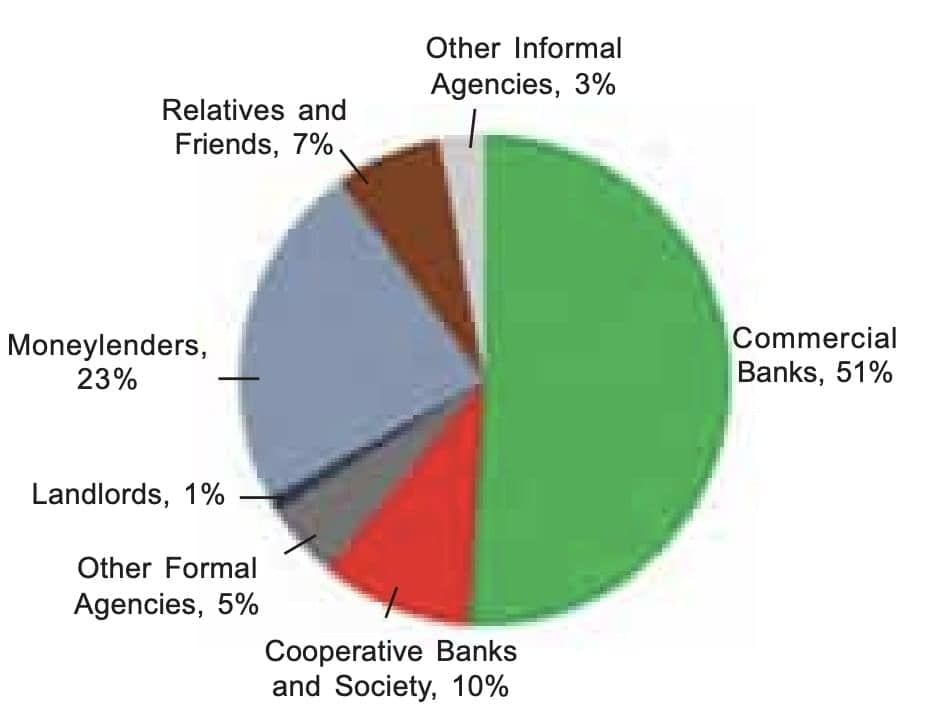
The following diagram shows the share of different sources of credit in rural households in India in 2019.

Self-Help Groups for the Poor

In recent years, people have tried out some newer ways of providing loans to the poor. The idea is to organize rural poor, in particular women, into small Self Help Groups (SHGs) and pool (collect) their savings.

  • A typical SHG has 15-20 members, usually belonging to one neighbourhood, who meet and save regularly. Saving per member varies from Rs 25 to Rs 100 or more, depending on the ability of the people to save.
  • Members can take small loans from the group itself to meet their needs.
  • The group charges interest on these loans, but this is still less than what the moneylender charges. After a year or two, if the group is regular in savings, it becomes eligible to avail a loan from the bank.
  • The loan is sanctioned in the name of the group and is meant to create self-employment opportunities for the members.
  • Most of the important decisions regarding the savings and loan activities are taken by the group members. The group decides as regards the loans to be granted — the purpose, amount, interest to be charged, repayment schedule, etc.
  • Also, it is the group that is responsible for the repayment of the loan. Any case of non-repayment of the loan by any one member is followed up seriously by other members in the group.
  • Because of this feature, banks are willing to lend to the poor women when organised in SHGs, even though they have no collateral as such.

Overcoming Collateral Issues: SHGs assist borrowers by alleviating the need for collateral. Members can access timely loans for various purposes at reasonable interest rates.

Empowering Rural Poor: SHGs serve as foundational structures for organising the rural poor, particularly empowering women to achieve financial self-reliance.

Social Impact: Regular group meetings offer a platform for discussing and addressing social issues, such as health, nutrition, and domestic violence, fostering community development beyond financial support.

Try yourself:What is the main advantage of formal credit over informal credit?A.Formal credit charges lower interest rates.B.Formal credit does not require collateral.C.Formal credit is easily accessible in rural areas.D.Formal credit is provided by self-help groups.View Solution

DO YOU KNOW ? 

Grameen Bank of Bangladesh: Empowering the Poor Through Microcredit

The Grameen Bank in Bangladesh is a remarkable example of successfully providing credit to the poor at reasonable rates. It began in the 1970s as a small initiative but has since grown significantly. By 2018, the bank had over 9 million members across approximately 81,600 villages in Bangladesh.

Most of the borrowers are women from the poorest segments of society. These women have demonstrated that they are not only reliable borrowers but also capable of starting and managing various small income-generating activities successfully. The Grameen Bank model highlights the potential of microcredit in empowering the poor and fostering economic development.

Summing Up

In this chapter, we explored modern forms of money and their connection to the banking system.

  • Role of Banks: Depositors keep their money in banks, while borrowers take loans from these institutions. Economic activities often require credit, which can have both positive and negative impacts.
  • Sources of Credit: Credit is available from both formal and informal sources, with significant variations in terms between them. Currently, richer households have better access to formal credit, while the poor rely on informal sources, which are often more expensive.
  • Need for Reform: To reduce dependence on costly informal credit, it is crucial to increase the availability of formal sector credit. Ensuring that the poor receive a larger share of formal loans from banks and cooperative societies is essential for economic development.

2. Sectors of the Indian Economy – Chapter Notes

Sectors of Economic Activities

  • Sectors are communities of individuals engaged in various activities, including creating goods or services. These economic activities generate income and profit.
  • For instance, a farmer cultivates crops to sell for profit, while an industry produces goods or services for consumers to make money.

This pie chart shows the distribution of contributions from different sectors to the economy.
It is divided into three main sections: Services, Industry, and Agriculture.

  • Services: This is the largest section, taking up 56% of the chart. This means that more than half of the economy’s output comes from the services sector, which includes things like banking, education, healthcare, and IT services.
  • Industry: The next largest section is Industry, which contributes 26% to the economy. Industries involve manufacturing, construction, and other activities that produce goods.
  • Agriculture: The smallest section, at 18%, is Agriculture. This sector involves farming, fishing, and forestry.

Overview of Sectors

1. Primary Sector Activities involving the direct use of natural resources.

Examples:

  • Agriculture: Cultivation of cotton (depends on rainfall, sunshine, climate).
  • Dairy: Milk production (depends on biological processes and fodder).
  • Mining: Extraction of minerals and ores.

Characteristics: Forms the base for other products; also known as agriculture and related sector.

2. Secondary Sector Activities where natural products are transformed into other forms through manufacturing.

Examples:

  • Textiles: Spinning yarn and weaving cloth from cotton.
  • Food Production: Making sugar or gur from sugarcane.
  • Construction: Converting earth into bricks and using bricks for building houses.

Characteristics: Involves manufacturing processes; also known as industrial sector.

3. Tertiary SectorActivities that support the development of primary and secondary sectors by providing services.

Examples:

  • Transport: Moving goods by trucks or trains.
  • Storage: Warehousing goods.
  • Communication: Telephone and postal services.
  • Banking: Financial services for production and trade.
  • Trade: Wholesale and retail selling.

Characteristics: Generates services rather than goods; also known as the service sector.

Comparing the Three Sectors

Each sector contributes to the economy’s total output of goods and services. The proportion of goods and services produced and the number of people employed can vary across sectors. Some sectors may dominate in production and employment, while others remain smaller.

Gross Domestic Product (GDP) 

  • It is important to include only the final goods and services.
  • The total value of final goods and services produced in each sector during a specific year represents that sector’s production for that year.
  • Adding up the production from various sectors results in what is known as the Gross Domestic Product (GDP) of a country.
  • This indicates the value of all final goods and services produced within a country in a given year.
  • In India, a central government ministry is responsible for measuring GDP. This ministry, along with various government departments from all Indian states and union territories, collects data on the total volume of goods and services and their prices to estimate GDP.
  • Recently, the Indian Government started reporting the contributions of three sectors towards Gross Value Added (GVA) instead of GDP to align with global standards. The GVA reflects the contribution of these sectors after adjusting for taxes and subsidies.

Try yourself:The task of measuring GDP is undertaken by the

  • A.central government
  • B.state government
  • C.provincial government
  • D.all of the above

View Solution

Historical Changes in Sectors

Early Development:

  • Primary Sector Dominance: At first, the primary sector was vital for the economy. Agriculture played a key role, providing jobs and producing natural goods.
  • Technological Advancements: With better farming techniques, agriculture generated more food, enabling people to pursue other jobs like crafting and trading.
  • Emergence of Other Roles: This increase in trade led to more roles such as transporters, administrators, and military personnel.

Shift to Secondary Sector:

  • Industrialization: Over time, improvements in manufacturing resulted in the rise of factories, with many former farm workers moving to factory jobs.
  • Secondary Sector Growth: The secondary sector (industrial) grew in significance for production and jobs due to affordable, mass-produced goods. Industries like food processing, textiles, and equipment manufacturing flourished.
  • Support Services: This period also saw the growth of banking, healthcare, and educational services.

Recent Changes:

  • Tertiary Sector Emergence: In the last century, the tertiary sector (services) has become the largest sector in India, overtaking the primary sector.
  • Service Sector Dominance: The service sector now employs the majority of people and includes vital services such as transportation, communication, and IT.
  • Production Growth: From 1977-78 to 2017-18, while production increased in all three sectors, the growth was highest in the tertiary sector.
  • Primary Sector Employment: Despite changes, the primary sector still remains the largest employer today.

Primary, Secondary and Tertiary Sectors in India

  • Graph 1 illustrates the production of goods and services across three sectors.
  • This data is presented for two specific years: 1973-74 and 2013-14.
  • The choice of these two years is based on the comparable and authentic nature of the data.
  • The graph highlights the growth in total production over a period of forty years.

Rising Importance of the Tertiary Sector in Production

The tertiary sector overtook the primary sector as India’s largest producing sector in 2013-14. The tertiary sector in India has been increasingly important for the following reasons:

  1. Hospitals, educational institutions, post and telegraph services, police stations, courts, village administrative offices, municipal corporations, defense, transportation, banks, insurance businesses, and other services are considered vital for everyone.
  2. Agriculture and industry expansion lead to the expansion of services such as transportation, commerce, and storage.
  3. As people’s incomes rise, they expect more luxuries like dining out, tourism, shopping, private hospitals, private schools, professional training, and so on.
  4. During the recent decade, several new information and communication technology-based services have become increasingly important and indispensable.

However, The service sector in India is not growing uniformly for everyone.

  • This sector employs a variety of people with different skills and education levels.
  • On one side, there are a few services that require highly skilled and educated workers.
  • On the other side, many workers are involved in services like:
    1. Small shopkeepers
    2. Repair workers
    3. Transport workers
  • These individuals often struggle to earn a living.
  • They continue to work in these jobs because there are few alternative job options available.
  • As a result, only a portion of the service sector is becoming more important.
  • More details about this will be provided in the next section.

Disguised Unemployment: This term refers to a situation where unemployment does not affect overall output. It occurs when productivity is low and there are too many people for the available jobs. This can happen in any group of people who aren’t using their full potential.

Try yourself:

Which sector of the economy involves activities like banking, education, healthcare, and IT services?

  • A.Primary Sector
  • B.Secondary Sector
  • C.Tertiary Sector
  • D.Quarternary Sector

View Solution

Where are most of the people employed?

  • Graph 2 shows the percentage of GDP that comes from three different sectors. 
  •  It highlights how the importance of these sectors has changed over a period of forty years
  •  Even though the share of GDP from each sector has varied, the patterns of employment have stayed mostly the same.

Lack of Shift in Employment:

  • Graph 2 shows the percentage contribution of sectors to GDP, indicating shifts in sector importance over forty years.
  • Despite increased industrial output (nine times), employment in the industry grew only three times.
  • Service sector production rose 14 times, but employment grew five times.
  • Graph 3 shows how jobs are spread out among three sectors during two different years: 1977-78 and 2017-18.
  • The primary sector still employs the most people compared to the other sectors.
  • This data helps to understand how employment in various sectors has changed over the years.
  •  The comparison highlights the trends in job distribution from the past to the present. 

Current Employment Distribution:

  • Graph 3 shows the employment share in the three sectors for 1977-78 and 2017-18, confirming the primary sector as the largest employer.
  • More than half of workers are in the primary sector (mainly agriculture), contributing about one-sixth of GDP.
  • The secondary and tertiary sectors produce the rest of the GDP but only employ about half the workforce.

Underemployment in Agriculture:

  • There is a high number of workers in agriculture compared to actual production needs.
  • Additionally, some individuals are entirely unemployed.
  • This underemployment can also occur in other sectors.

Impact of Removing Underemployed Workers:

  • Removing a few workers from agriculture does not affect production but can increase family income through other jobs.
  • For instance, if Laxmi’s family members find work elsewhere, they earn extra income without reducing farm productivity.
  • Many small farmers in India experience similar underemployment problems.
  • Reducing the agricultural workforce and providing better opportunities elsewhere can enhance overall income without compromising agricultural output.

Underemployment in Other Sectors:

  • Casual workers in urban services often endure irregular employment.
  • Examples include individuals in occasional jobs or low-income street vendors with limited options.

How to Create More Employment?

  • Every state or region has the potential to boost income and employment opportunities for its residents.
  • Areas such as tourism, regional crafts, and new services like IT can contribute significantly.
  • According to NITI Aayog, research from the Planning Commission suggests that around 20 lakh jobs could be created in the education sector alone.
  • In 2005, the Mahatma Gandhi National Rural Employment Guarantee Act (MGNREGA) was introduced by the Indian central government to implement the Right to Work across approximately 625 districts.
  • This Act prioritises work types that will help enhance production from land in the future.

MGNREGA (2005)

  • It primarily serves individuals in rural areas who are willing to work.
  • It is known as the Mahatma Gandhi National Rural Employment Guarantee Act 2005 (MGNREGA 2005).
  • Each year, the MGNREGA provides at least 100 work days to rural households that voluntarily engage in unskilled work.
  • The MGNREGA scheme is available to any Indian citizen over the age of 18 residing in rural areas.
  • Another aim of the MGNREGA act is to provide rural communities with long-term assets such as roads, wells, and ponds.
  • If the government fails to generate jobs, people may have to rely on unemployment benefits.
  • It is implemented without contractors or agents in gram panchayats.
  • This law supports environmental preservation, rural women’s empowerment, social equality, reduces urban migration, and provides essential services, among other benefits.

Try yourself:What is the primary goal of the Mahatma Gandhi National Rural Employment Guarantee Act (MGNREGA)?

  • A.To provide unemployment benefits to rural households.
  • B.To implement the Right to Work in rural areas.
  • C.To create long-term assets in rural areas.
  • D.To promote migration to urban areas.

View Solution

Division of Sectors as Organised and Unorganised

Example: Consider working condition of Kanta and Kamal

Kanta works in an office with set hours from 9:30 a.m. to 5:30 p.m. She receives a regular monthly salary, along with benefits such as a provident fund, medical allowances, and paid holidays (including Sundays). Upon starting, she was given an appointment letter detailing her job terms. Kanta works in an organised sector.

Kamal, Kanta’s neighbour, is a daily wage labourer at a grocery shop. He works long hours from 7:30 a.m. to 8:00 p.m. Kamal does not receive additional benefits or paid holidays and is only paid for the days he works. He lacks a formal appointment letter and can be dismissed at any time. Kamal works in an unorganised sector. The unorganised sector is characterised by small, scattered units largely outside government control.

1. Organized Sector: 

  • Organised sectors provide fixed and secure employment.
  • These industries are registered with the government and must follow its rules and regulations, as outlined in various laws such as the Factories Act, Minimum Wages Act, Payment of Gratuity Act, and Shops and Establishments Act.
  • Employees in the organised sector enjoy job security and receive pensions upon retirement.

2. Unorganized Sector: 

  • The government appears to have little control over the unorganised sector. Although there are rules and regulations, they are often not followed.
  • Workers in the unorganised sector do not have the same level of job security as those in the organised sector.
  • Overtime work is not compensated in any way.

How to Protect Workers in Unorganised Sector?

The organised sector is known for providing desirable jobs, but its growth has been slow. Many businesses in the unorganised sector use tactics to avoid taxes and ignore laws that protect workers. Consequently, numerous individuals are compelled to take unorganised sector jobs, which offer very low salaries. Their earnings are often inconsistent and insecure, lacking benefits. Since the 1990s, many workers have shifted from the organised sector to the unorganised sector, resulting in lower wages. This situation underscores the need not only for more job opportunities but also for protection and support for workers in the unorganised sector.

Vulnerable Groups in the Unorganized Sector

Rural Areas:

  • In rural areas, the unorganised sector mainly includes landless agricultural labourers, small and marginal farmers, sharecroppers, and artisans such as weavers, blacksmiths, carpenters, and goldsmiths.
  • Approximately 80 percent of rural households in India are small and marginal farmers. These farmers require support through timely delivery of seeds, agricultural inputs, credit, storage facilities, and marketing outlets.

Urban Areas:

  • The unorganised sector in urban areas comprises workers in small-scale industries, casual workers in construction, trade, and transport, as well as street vendors, head load workers, garment makers, and rag pickers.
  • Small-scale industries also need government assistance for obtaining raw materials and marketing their products. Casual workers in both rural and urban settings require protection.

Social Discrimination:

  • Workers from scheduled castes, tribes, and backward communities are often found in the unorganised sector.
  • In addition to facing irregular and low-paid work, these workers also deal with social discrimination.

Sectors in Terms of Ownership: Public and Private Sectors

1. Public Sector:

  • Ownership and Control: Government owns most assets and provides services.
  • Purpose: Focuses on public welfare, not just profit. Funded through taxes.
  • Examples: Railways, post offices.

Government’s Role:

  • Infrastructure Development: Invests in roads, bridges, railways, harbours, and electricity generation. These require large sums of money and are often beyond private sector capacity.
  • Support for Industries: Provides affordable electricity to prevent small-scale industries from shutting down and buys and stores agricultural products to sell at lower prices.
  • Human Development: Provides essential services like health and education. Ensures the availability of safe drinking water, housing, and nutrition for the poor.
  • Challenges: The Private sector may not provide certain essential services at reasonable costs, necessitating government intervention.

2. Private Sector:

  • Ownership and Control: Owned by private individuals or companies that provide services.
  • Purpose: Focused on making a profit, with consumers paying for products and services.
  • Examples: Includes companies like Tata Iron and Steel Company Limited (TISCO) and Reliance Industries Limited (RIL).

Characteristics: Activities are guided by profitability. Government sometimes supports private sector activities to ensure they are viable or to reduce costs for consumers.

Summary

In this chapter, we explored how to classify economic activities into meaningful groups. One method is to categorize these activities into primary, secondary, or tertiary sectors. Over the past thirty years in India, data shows that while the tertiary sector contributes the most to the Gross Domestic Product (GDP), the majority of employment still resides in the primary sector. We also discussed various ways to enhance employment opportunities in the country.

Another classification involves distinguishing between organized and unorganized sectors. A significant portion of the workforce is employed in unorganized sectors, making it crucial to provide them with necessary protections. Additionally, we examined the differences between private and public activities, emphasizing the importance of public activities focusing on specific areas for the greater good.

1. Development – Chapter Notes

What Development Promises- Different People, Different Goals

  • Development has many aspects. People have different perspectives on development and there are ways by which we can arrive at common indicators for development.
  • Different persons have different notions of development. They seek different things. They seek things that are most important to them.
  • For example, a girl may seek equal opportunities and responsibilities compared to her brother, who might not share the same viewpoint.
  • Similarly, industrialists aiming for increased electricity supply may clash with the interests of tribals who prioritize land preservation and sustainable irrigation methods.Different People Have Different Goals
  • Development is subjective and varies among individuals based on their priorities and circumstances.
  • What one person perceives as progress may not align with another’s definition and could potentially harm their interests.
  • Understanding diverse perspectives is crucial in crafting inclusive and sustainable development policies.

Try yourself:

What is the significance of understanding diverse perspectives in the development process?

  • A.It helps in forming common indicators for development.
  • B.It ensures equal opportunities and responsibilities for all individuals.
  • C.It prioritizes land preservation and sustainable irrigation methods.
  • D.It aligns different viewpoints and avoids potential harm to interests.

View Solution

Income and Other Goals

  • People’s desires often revolve around aspects like regular work, improved wages, and fair prices for their produce, aiming for increased income.
  • Alongside the pursuit of higher income, individuals also strive for equal treatment, freedom, security, and respect from others, while strongly opposing discrimination.
  • Non-material factors such as friendship, dignity, security, and freedom significantly contribute to one’s quality of life, surpassing the sole importance of material possessions or wealth.

Individuals strive for equal treatment

  • When considering job opportunities, factors beyond monetary rewards play a crucial role, including family amenities, work environment, learning prospects, and job security.
  • Developmental aspirations encompass a blend of objectives, where women’s involvement in unpaid work not only enhances their status but also promotes a culture of shared responsibilities and support for women in the workforce.

National Development

  • It’s crucial to recognize that individuals can hold conflicting views on what constitutes a nation’s progress.
  • Not all ideas are of equal significance. 
  • When there are conflicting opinions, it’s essential to determine a fair and just path forward. Consider whether an idea benefits a large population or just a small segment.
  • National development involves contemplating the impact of ideas on a broad spectrum of people and assessing whether there are better approaches to achieve progress.

Try yourself:What are some non-material factors that significantly contribute to one’s quality of life?

  • A.Regular work and improved wages
  • B.Friendship, dignity, security, and freedom
  • C.Equal treatment, freedom, security, and big house
  • D.Family amenities, work environment, learning prospects, and job security

View Solution

How to Compare Different Countries or States

  • Development can have various interpretations, leading to the classification of some countries as developed and others as underdeveloped
  • When comparing entities, it’s essential to consider both similarities and differences.
  • For instance, income is a crucial criterion for comparing countries.
  • Higher income levels are often associated with more developed nations, as increased income enables access to essential resources and amenities.
  • Total income alone is not a sufficient measure for comparing countries, as populations vary.
  • To address this, the average income, also known as per capita income, is calculated by dividing the total income by the population.
  • The World Bank classifies countries in its World Development Reports based on per capita income. In 2019, high-income countries had per capita incomes of $49,300 or more, while low-income countries had $2,500 or less. India, with a per capita income of $6,700, is considered a low-middle-income country. Rich countries are typically termed developed countries.
  • Countries with higher incomes are more developed than others with less income.
  • As different countries have different populations, comparing total income will not tell us what an average person earns. So, we compare the average income of countries.

Income and Other Criteria

When we think of a nation or a region, besides average income, public facilities and other criteria are equally significant attributes.

  • Individual Aspirations and Goals: People aspire for better income along with goals like security, respect, equal treatment, and freedom.
  • National or Regional Attributes: Besides average income, other important attributes define the development of a region or nation. When comparing per capita income, Haryana emerges as the most developed state, while Bihar appears least developed.
  • Infant Mortality Rate: Kerala has lower infant mortality compared to Haryana, highlighting significant differences in child welfare.
  • Educational Disparities: In Bihar, around half of children aged 14-15 do not attend school beyond Class 8, indicating educational challenges.
  • The data reflects disparities in healthcare and education across different states, impacting the well-being and future opportunities of their populations.

Public Facilities

These are the services provided by the government to its citizens. Some of the important public facilities include: 

  • Public Education
  • Hospitals
  • Public Distribution System
  • UNDP on the basis of educational level, health status and per capita income
  • Comparison with neighbouring countries – Sri Lanka much better in per capita income, life expectancy, HDI rank etc.

Income Limitations: Higher income doesn’t guarantee access to essential services like clean environment, unadulterated medicines, or protection from diseases.

Collective Provision: Essential services such as security and education are best provided collectively. This is more cost-effective and ensures broader access.

Kerala vs. Haryana

  • Kerala: Lower infant mortality rate, higher literacy rate, and better school attendance despite lower per capita income.
  • Haryana: Higher income but poorer health and education indicators.
  • Public Distribution System (PDS): States with efficient PDS have better health and nutrition outcomes.

International Comparisons

  • Sri Lanka: Higher human development indicators than India.
  • Nepal and Bangladesh: Better life expectancy despite lower per capita income.

Human Development Index (HDI): Measures health, education, and standard of living, emphasizing overall well-being rather than just income.

Try yourself:Which of the following is not a criterion used to compare countries or regions for development?

  • A.Average income
  • B.Public facilities
  • C.Altitude
  • D.Health status 

View Solution

The Human Development Report (HDR) is an annual publication by the United Nations Development Programme (UNDP). It provides insights into global development issues and trends, focusing on improving human wellbeing.

Key Features:

  1. Human Development Index (HDI): A ranking of countries based on health, education, and income.
  2. Thematic Focus: Each report explores a specific theme like inequality, sustainability, gender equity, or climate change.
  3. Data & Analysis: Offers global and regional trends in human development, comparing progress across countries.
  4. Goal: To promote policies for sustainable development, equity, and human rights.

Significance: The HDR helps shape global and national policies to improve human development outcomes.

Sustainability of Development

Sustainable development is defined as development that meets the needs of the present, without compromising the ability of future generations. Scientists have been warning that the present type and levels of development are not sustainable. 

Types of Resources

  • Renewable Resources: Renewable resources like groundwater are naturally replenished, similar to crops and plants. However, if these resources are consumed at a faster rate than they are replenished, overuse occurs.
  • Non-Renewable Resources: Non-renewable resources, such as fossil fuels, are finite and will eventually be depleted after continuous use. While new resources may be discovered, the stock is limited and will diminish over time.
  • Example 1: Groundwater in India is overused, especially in agricultural regions, urban areas, and hard rock zones, leading to rapid depletion. If unchecked, 60% of the country will face this issue in 25 years. Sustainable practices like water conservation and efficient irrigation can prevent overuse.
  • Example 2: Global crude oil reserves may last 50 years, with the Middle East having 70 years of reserves. Oil-importing nations like India face price risks, while countries with fewer reserves, like the U.S., seek control through military or economic means. Sustainable energy is essential to reduce dependency.

3. Gender, Religion and Caste – Short and Long Question answer

Q1. “There is urgent need to combat communalism”. Explain. [CBSE 2014]

Ans: Communal politics is based on the belief that religion is the main basis for social communities. Here are key points explaining the urgent need to combat communalism:

  • Community Identity: Followers of a specific religion are seen as part of one community, sharing the same fundamental interests. Differences among them are often viewed as trivial.
  • Political Dominance: A communal mindset can lead to a desire for political power. Majority communities may seek to dominate, while minority groups might wish to establish separate political identities.
  • Violence and Conflict: Communalism can escalate into severe violence, such as riots and massacres, as seen in regions like UP, Bihar, and Gujarat.
  • Threat to Unity: Communalism poses a threat not just to certain individuals but to the very essence of India as a nation. It undermines the idea of a diverse and inclusive society.

Q2. “In India women’s political representation is very low”. Justify.
Or
Explain the need for more representation for women as elected representatives. How can it be achieved?
Or
What is the status of women representation in India’s legislative bodies? [CBSE 2013]

Ans: The representation of women in India’s political landscape is alarmingly low:

  • The percentage of elected women members in the Lok Sabha has never exceeded 14.36% of its total strength.
  • In State Assemblies, the share of women is less than 5%.
  • India ranks among the bottom nations globally in terms of women’s political representation, falling behind many developing countries in Africa and Latin America.
  • Government cabinets are predominantly male, even when a woman holds the position of Chief Minister or Prime Minister.

To address this issue, it is crucial to:

  • Implement legal measures to ensure a fair representation of women in elected bodies.
  • Follow the example of the Panchayati Raj, which reserves one-third of seats for women in local government.
  • Support the Nari Shakti Vandan Adhiniyam (Women’s Reservation Act, 2023), which reserves 33% of seats for women in the Lok Sabha and State Assemblies.

Q3. How has the principle of Universal Adult Franchise helped in combating casteism?

Ans: Universal Adult Franchise has played a significant role in reducing casteism in India through the following ways:

  • Equal Voting Rights: All citizens aged 18 and above can vote, regardless of their caste, creed, colour, sex, religion, or belief.
  • Political Mobilisation: The principle of one-person-one-vote has encouraged political leaders to actively seek support from various communities.
  • Empowerment of Lower Castes: It has raised awareness among castes that were previously viewed as inferior, promoting their political engagement.

Q4. What were Gandhiji’s views regarding religion and politics? Explain.

Ans: Gandhiji believed that religion and politics are intertwined. He did not refer to specific religions like Hinduism or Islam, but to the moral values that underpin all faiths. His views can be summarised as follows:

  • Religion should guide political ethics.
  • Political actions must reflect moral principles from various religions.
  • People should express their needs and interests as members of their religious communities.
  • Political power can regulate religious practices to prevent discrimination.

Q5. ‘Political mobilisation on religious lines is a frequent form of communalism.’ Explain.

Ans: Political mobilisation on religious lines refers to the practice of rallying support based on religious identity. This often includes:

  • Utilising sacred symbols and religious leaders to unite followers.
  • Employing emotional appeals and fear tactics to strengthen political bonds.
  • Focusing on the interests and emotions of one religious group over others during elections.

This approach can lead to a desire for political dominance, where:

  • The majority community seeks to maintain control.
  • The minority community may strive for a separate political identity.

Q6. Besides caste, which other factors do in matter in electoral politics ?

Ans: Besides caste, other factors that matter in electoral politics include:

  • Voting by Community: Political leaders often encourage voters to cast their votes based on their community affiliations.
  • Religious Mobilisation: This involves using religious symbols, leaders, and emotional appeals to unite followers of a particular religion in the political sphere. It often prioritises the interests of one religion over others.
  • Government Performance: Voters assess the effectiveness of the political party and its agenda, alongside caste and community considerations.

Q7. Write the appropriate term:

Ans: 

  • A person who believes that religion is the main basis of community is a Communalist.
  • A person who advocates for equal rights and opportunities for both women and men is a Feminist.
  • A person who does not discriminate against others based on their religious beliefs is a Secularist.

Long Answer Type Questions (5 Marks)

Q1. Name the movements that agitate for women’s rights. How have these movements helped in improving women’s conditions?

Ans: Feminist Movements have played a crucial role in advocating for women’s rights and improving their conditions. Key contributions include:

  • Political Mobilisation: These movements have raised awareness about gender divisions, leading to greater participation of women in public life.
  • Career Opportunities: Women now work in various fields such as sciencemedicineengineering, and law, which were previously deemed unsuitable.
  • Political Representation: In countries like Sweden, Norway, and Finland, initiatives such as reserved seats in the Lok Sabha have significantly increased women’s involvement in politics.

Overall, feminist movements have been instrumental in enhancing women’s roles and rights across different sectors.

Q2. Mention any four steps that can be undertaken to improve women’s representation in politics.
Or
Suggest any three steps to improve women’s participation in politics.

Ans: 

  • Make it legally binding to ensure a fair proportion of women in elected bodies.
  • Reserve a certain number of seats in the Lok Sabha and State Assemblies for women.
  • Political parties should provide adequate representation for women members.
  • Improve the literacy rate among women to encourage their participation in politics.

Q3. What is casteism? How is casteism in India different as compared to other societies?
Or
Describe any five features of the caste system prevailing in India.

Ans: Casteism refers to the social system in which people are divided into groups based on their birth, affecting their marriage, work, and dietary practices. In India, this system is particularly pronounced and differs from other societies in several ways:

  • Social Organisation: People are organised into social groups, which influences their marriage and occupation.
  • Rigidity: The Indian caste system is very rigid, with individuals expected to marry within their caste and avoid socialising with those from other castes.
  • Hereditary Occupations: Unlike many societies where jobs can change, in India, occupations are often passed down through generations, sanctioned by rituals.
  • Exclusion: The system promotes exclusion and discrimination against ‘outcaste’ groups, leading to practices like untouchability.
  • Economic Links: Caste is closely tied to economic status, with upper castes generally enjoying better economic conditions compared to lower castes.

Q4. Mention any positive role of caste in politics.
Or
Describe the positive and negative aspects of the relationship between caste and politics.

Ans: Positive Role of Caste in Politics

  • In some cases, the expression of caste differences in politics allows disadvantaged communities to demand their share of power.
  • Caste politics has enabled Dalits and OBCs to gain better access to decision-making.
  • Various organisations advocate for an end to discrimination, promoting dignity and access to resources.

However, it is important to note that focusing solely on caste can lead to negative outcomes:

  • Politics based on caste identity can divert attention from critical issues like povertydevelopment, and corruption.
  • Caste divisions may result in tensions and conflicts.

Q5. What is casteism? How is casteism in India different as compared to other societies?
Or
Describe any five features of the caste system prevailing in India.

Ans: Casteism refers to the social system in which people are divided into groups based on their birth, affecting their marriage, occupation, and diet. In India, casteism is distinct from other societies due to several key features:

  • Extreme Division of Labour: The Indian caste system represents a severe form of occupational division based on birth.
  • Hereditary Occupations: Unlike many societies where jobs can change, in India, occupations are traditionally passed down through generations, often enforced by rituals.
  • Rigid Social Structure: Members of the same caste typically form a close-knit community, sharing similar jobs, marrying within their caste, and avoiding meals with those from other castes.
  • Exclusion and Discrimination: The caste system often excludes and discriminates against ‘outcaste’ groups, leading to practices like untouchability.
  • Economic Links: Caste is closely tied to economic status, with higher castes generally enjoying better economic conditions than lower castes.

Q6. Mention any positive role of caste in politics.
Or
Describe the positive and negative aspects of the relationship between caste and politics.

Ans: Positive Aspects of Caste in Politics:

  • The expression of caste differences can empower disadvantaged communities to demand their share of power.
  • Caste politics has enabled Dalits and OBCs to gain better access to decision-making roles.
  • Many political and non-political organisations advocate for the end of discrimination against specific castes, promoting dignity and access to resources.

Negative Aspects of Caste in Politics:

  • It can disrupt social harmony and lead to tensions and conflicts.
  • Focusing solely on caste may divert attention from crucial issues like poverty and corruption.

Q7. Why is the idea of communal politics fundamentally flawed?

Ans: The idea of communal politics is fundamentally flawed for several reasons:

  • Individual differences: People within the same religion often have varied interests and aspirations.
  • Multiple identities: Each person has their own choices, roles, and identities that go beyond their religion.
  • Diverse voices: Every community contains many voices, all of which deserve to be heard.
  • Suppression of voices: Attempts to unify followers of a religion in non-religious contexts can silence many within that community.

Therefore, the notion that all members of a religion share the same interests is misleading and oversimplifies the complexity of human identities.

Q8. What are Feminist Movements? What were their major demands ? 
Or
What was the Feminist Movement ? Explain the political demands of the Feminist Movement in India.

Ans: Feminist Movements are organised efforts by various women’s groups aimed at achieving equality for women in both personal and family life.

  • They demand equal rights for women across all areas of life.
  • There have been protests worldwide for the extension of voting rights to women.
  • These movements seek to enhance the political and legal status of women.
  • They also advocate for improved educational and career opportunities for women.

Q9. Explain the relationship between religion and politics.
Or
How are religious differences expressed in politics ?

Ans: Views of Gandhiji: Gandhiji believed that religion and politics are inseparable. He referred to religion not as specific faiths like Hinduism or Islam, but as the moral values common to all religions. He argued that politics should be guided by ethical principles derived from these values.

Views of Human Rights Groups: Human rights organisations in India have highlighted that most victims of communal riots belong to religious minorities. They advocate for the government to implement special measures to safeguard these communities.

Women’s Movements: Women’s rights activists contend that family laws across various religions often discriminate against women. They call for the government to reform these laws to ensure greater equity.

These examples illustrate the complex relationship between religion and politics. While there can be positive influences, challenges arise when religious differences lead to discrimination or conflict.

Q10. How can religion influence politics? Explain.

Ans: Religion can influence politics in several ways:

  • Ethics and Morality: Gandhiji believed that politics should be guided by ethical principles derived from various religions.
  • Representation: Individuals should express their needs and interests in politics as members of their religious communities.
  • Regulation: Political leaders may need to regulate religious practices to prevent discrimination and oppression.
  • Equality: Such political actions are acceptable as long as they treat all religions equally.

However, problems arise when religion becomes the basis for nationalism, leading to communalism, where one religion is seen as superior to others. This can create divisions and conflicts within society.

2. Federalism – Short and Long Questions Answer

Short Answer Type Questions (3 Marks)

Q1: “Belgium shifted from a unitary to a federal form of government”. What key changes were brought in the political system under the above mentioned shift ?
Ans: (i) Many powers of the central government were given to state governments of the two regions of the country.
(ii) The regional governments were given constitutional powers that were no longer dependent on the central government.
(iii) Apart from the central government and the state government there is a third kind of government known as community government. This government has the power regarding cultural, educational and language related issues.

Q2: “Federations are contrasted with unitary governments”. Explain by giving examples from Sri Lanka and Belgium.
Ans: 
Under the unitary system, either there is only one level of government or the sub-units are subordinate to the Central government. The Central government can pass on orders to the provincial or the Local government. For example in Sri Lanka is a unitary country and the Union government passed a new law stipulating that the state shall protect and foster Buddhism. Whereas under federal system, the Central government cannot order the State government to do something. State government has powers of its own for which ‘ it i’s not answerable to the Central government. Both these governments are separately answerable to the people.


Q3: Mention any three features of an ideal federal system.
Ans: 
(i) The federal system which safeguards and promotes unity of the country, while at the same time accommodates regional diversity.
(ii) Governments at different levels should agree to some rules of power-sharing. They should also trust that each would abide by its part of the agreement.
(iii) An ideal federal system has both aspects : mutual trust and agreement to live together.

Q4: Mention any two subjects which are included in the union list. Explain by giving reasons why these are included in the union list.
Ans: 
Defence and foreign affairs are two subjects included in the Union List.
Reasons for their inclusion:

  • National importance: Both subjects are crucial for the security and diplomatic relations of the country.
  • Uniform policy: A consistent approach is necessary across the nation to effectively manage these areas.


Q5: ‘All states in the Indian Union do not have identical powers. Justify. –
Ans:
 (i) Some states like Jammu and Kashmir has its own Constitution.
(ii) Many provisions of the Indian Constitution are not applicable to this State without the approval of the State Assembly.
(iii) Indians who are not permanent residents of this State cannot buy land or house here. Similar special provisions exist for some other States of India as well.

Q6: “Federal power sharing is more effective today than it was in the early years after the Constitution came into force”. Explain.
Or
How is federal power sharing more effective today than in the early years? Explain.
Ans: 
Federal power sharing is more effective today than it was in the early years after the Constitution came into force.

  • Centre-State relations: Initially, when the ruling party at the State level differed from that at the Centre, the Central Government often undermined State powers. They misused the Constitution to dismiss rival State governments, which weakened the spirit of federalism. This changed significantly after 1990 with the rise of regional political parties.
  • Coalition Governments: The era of coalition governments began as no single party secured a clear majority in the Lok Sabha. Major national parties formed alliances with regional parties, fostering a new culture of power sharing and respect for State autonomy.
  • Supreme Court Judgement: The Supreme Court of India established strict guidelines for imposing President’s rule. These guidelines made it challenging for the Central Government to dismiss State governments arbitrarily, further enhancing federal power sharing.


Q7: ‘The sharing of power between the Union government and the state governments is basic to the structure of the Indian Constitution’. Explain.
Ans:
 (i) Under a federal government, the fundamental provisions cannot be unilaterally changed by one level of the government and the same is true for India,
(ii) The Parliament cannot on its own change the fundamental structure of the Constitution. Any change in it has to be first passed by both the Houses of the Parliament with at least two-third majority. Then it has to be ratified by the legislatures of at least half of the total states.

Q8: Mention any four features of federalism.  
Or
Explain four features of the federal form of government.
Ans:
 (i) The power is divided between a central authority and its various constituent units.
(ii) Different tiers of the government govern the same citizens.
(iii) The fundamental provisions of the government cannot be unilaterally changed by one level of government.
(iv) It has a dual objective, i.e., to safeguard and promote the unity of the country, and also to accommodate the regional diversity.

Q9: “There is a need for power sharing within the states”. Explain.
Ans:
 (i) A vast country like India cannot be run only through these two-tiers. States in India are as large as independent countries of Europe. In terms of population, Uttar Pradesh is bigger than Russia, Maharashtra is about as big as Germany.
(ii) Many of Indian states are internally very diverse. There is thus a need for power sharing within these states.
(iii) The third tier is also required to principle of decentralisation of power.

Q10: Mention any four difficulties of the local government in India. 
Ans:
 (i) Most states have not transferred significant powers to the local governments.
(ii) There is a shortage of resources.
(iii) Elections are not held regularly.
(iv) The Gram Sabhas are not held regularly.

Long Answer Type Questions (5 Marks)

Q11: Explain the major key features of federalism.
Or
Describe any four features of the federalism.
Ans: 
Key Features of Federalism:

  • Multiple Levels of Government: Federalism involves two or more levels of government, typically a central government and state or provincial governments.
  • Same Citizens, Separate Jurisdictions: Different tiers govern the same citizens, but each has its own jurisdiction over specific areas like legislation, taxation, and administration.
  • Constitutional Authority: The Constitution defines the powers of each government level, ensuring their existence and authority are constitutionally protected.
  • Rigid Constitution: Changes to fundamental constitutional provisions cannot be made unilaterally; they require consent from both levels of government.
  • Judicial Oversight: Courts interpret the Constitution and resolve disputes between government levels, acting as an impartial arbiter.
  • Financial Autonomy: Each government level has clearly defined sources of revenue to maintain its financial independence.
  • Dual Objectives: Federalism aims to promote national unity while accommodating regional diversity, necessitating mutual trust and agreement between government levels.


Q12: ‘India is a federal country.’ Explain by giving examples.
Or
Explain the three fold distribution of legislative powers between the Union Government and the State Governments.
Or
Mention any five main features which make India a federal country.
Ans: 
(i) Division of powers: The Constitution demarcates the powers of the central and the state governments into different lists of subjects. There are three lists :
(a) Union List.
(b) State List.
(c) Concurrent List.
(ii) Three-tier system : As discussed earlier, under a federal government different tiers of the government govern the same citizens. This is true for India. In India, we have a three-tier system of government, i.e.,

  • Union Government
  •  State Government
  • Local Self-Government.

(iii) Not equal powers to all administrative units : Most of the federations that are formed by ‘holding together’ do not give equal powers to its constituent units. Thus, all states in the Indian Union do not have identical powers. Some states enjoy a special status. Jammu and Kashmir has its own Constitution. Many provisions of the Indian Constitution are not applicable to this state without the permission of the state assembly.
(iv) Consent of both the levels of the government : Under a federal government, the fundamental provisions cannot be unilaterally changed by one level of the government, and the same is true for India. The Parliament cannot on its own change the fundamental structure of the Constitution. implementation of constitutional provisions and procedures. The same is true for India. In case of any dispute about the division of powers, the High Courts and the Supreme Court take a decision.
(v) Separate sources of income : A clear mention regarding the financial powers of the centre and the states has been made in the Indian Constitution. Income tax, excise duty, corporation tax, etc., are levied and collected by the central government, whereas land revenue, stamp duty, building tax, etc., come under the state government.


Q13: How is federalism practised in India ? Explain.
Or
‘The real success of federalism in India can be attributed to the nature of democratic politics in India.’ Explain.
Ans:
 Federalism in India is practised through several key mechanisms:

  • Linguistic States: After independence in 1950, the boundaries of various states were altered to create new ones. This aimed to group people who spoke the same language and shared common culture, ethnicity, or geography.
  • Language Policy: The Indian Constitution does not designate any language as the national language. While Hindi is recognised as an optional language, the central government does not impose it on states where other languages are predominant. Additionally, there are 22 other languages acknowledged as Scheduled Languages.
  • Centre-State Relations: Strengthening relations between the Centre and states is crucial for federalism. Although the Constitution outlines the powers of the Union and state governments, the Union can still influence states in various ways. Historically, the central government has misused its powers to dismiss state governments led by rival parties, which undermines the essence of federalism and democracy. The judiciary has played a significant role in restoring the autonomy of state governments that were dismissed arbitrarily.


Q14: “The creation of linguistic states was the first and major test for democratic politics in our country.” Justify this statement.
Ans:
 In 1947, the boundaries of several old States of India were changed in order to create new States. This was done to ensure that people who spoke the same language lived in the same State. Some States were created not on the basis of language but to recognize differences based on culture, ethnicity or geography. These include States like Nagaland, Uttarakhand and Jharkhand. When the demand for the formation of States on the basis of language was raised, some national leaders feared that it would lead to the disintegration of the country. The Central Government resisted linguistic States for some time. But the experience has shown that the formation of linguistic States has actually made the country more united. It has also made administration easier.


Q15: Explain how law making powers are  shared between centre and states in India ? Mention three subjects each of Union List and State List.
Or
Describe the division of power between the central and the state governments in India.
Or
How are the powers divided between the states and centre? Explain with examples.
Ans: 
Union List includes subjects of national importance such as defence of the country, foreign affairs, banking, communications and currency. They are included in this list because we need a uniform policy on these matters throughout the country. The Union Government alone can make laws relating to the subjects mentioned in the Union List.
State List contains subjects of State and local importance such as police, trade, commerce, agriculture and irrigation. The State Governments alone can make laws relating to the subjects mentioned in the State List. Concurrent List includes subjects of common interest to both the Union Government as well as the State Governments, such as education, forest, trade unions, marriage, adoption and succession.
Both the Union as well as the State Governments can make laws on the subjects mentioned in this list. If their laws conflict with each other, the law made by the Union Government will prevail.
(i) Under a federal government, the fundamental provisions cannot be unilaterally changed by one level of the government and the same is true for India,
(ii) The Parliament cannot on its own change the fundamental structure of the Constitution. Any change in it has to be first passed by both Houses of the Parliament with at least two-third majority. Then it has to be ratified by the legislatures of at least half of the total states.


Q16: ‘Most federations that are formed by ‘holding together’ do not give equal power to its constituent units.’ Is it true for India? Explain.
Or
“Holding together federations” do not give equal power to its constituent units. Explain the statement with the help of examples in context to India.
Ans:
 Yes, the above statement is true for India.
(i) All states in the Indian Union do not have identical powers. Some states enjoy a special status. Jammu and Kashmir has its own Constitution. Many provisions of the Indian Constitution are not applicable to this state without the permission of the state assembly. Indians who are not permanent residents of this state cannot buy land or house here.
(ii) Similar special provisions exist for Assam and the hill states of North-East India.
(iii) There are some units of Indian Union which enjoy very little power. These are areas which are too small to become an independent state but which could not be merged with any of the existing states. These areas, like Chandigarh, or Lakshadweep or the capital city of Delhi, are called the Union Territories. These territories do not have the powers of a state. The central government has special powers in running these areas.

Q17: Why were the linguistic states created? What are their advantages?
Ans:
 (i) Common Language: Many states were created on the basis of language to ensure that people who speak the same language lived in the same state.
(ii) Common culture, ethnicity or geography: Some States were created not on the basis of language but to recognise differences based on culture, ethnicity or geography. These include States like Nagaland, Uttarakhand and Jharkhand.
Advantages:
The experience has shown that the formation of linguistic States has actually made the country, more united. It has also made administration easier.

Q18: Explain the language policy of Indian Federal. How is it different from Sri Lanka?
Or
Write any four characteristics of language policy of India. 
Or 
Describe in brief the language policy of India.
Ans:
 Creation of Linguistic States

  • Common Language: Many states were formed to group people who speak the same language together.
  • Cultural and Ethnic Recognition: Some states, like Nagaland, Uttarakhand, and Jharkhand, were created based on cultural, ethnic, or geographical differences.

Advantages:

  • The formation of linguistic states has contributed to a more united country.
  • It has simplified administration and governance.


Q19: ‘Restructuring the Centre-State relations is an important way in which the Indian Federalism has been strengthened in practice.’ Explain.
Ans
: (i) After 90s, many regional political parties have emerged in many states of the country.
(ii) The regional parties are playing a very vital role in forming the Union government.
(iii) The judiciary has played a major role in improving the autonomy of the state governments because many a time, it has rescued the state governments which were dismissed in an arbitrary manner.

Q20: Point out one feature in the practice of federalism in India that is similar to any one feature that is different from that of Belgium.
Ans: 
One similar feature of Federalism between India and Belgium : India and Belgium are both holding together federations where the Central Governments tend to be more powerful vis-a-vis the states.
One different feature of Federalism between India and Belgium : In Belgium, there are three kinds of government – government at the centre, government at the state level and third kind of government is the community government. The community government has the power regarding cultural, educational and language related issues.
But in India, there is no third kind of government, there is no community government.