1. The Rise of Nationalism in Europe – Long Answer Questions

Q1: How did the French territory change due to the Treaty of Vienna in 1815?
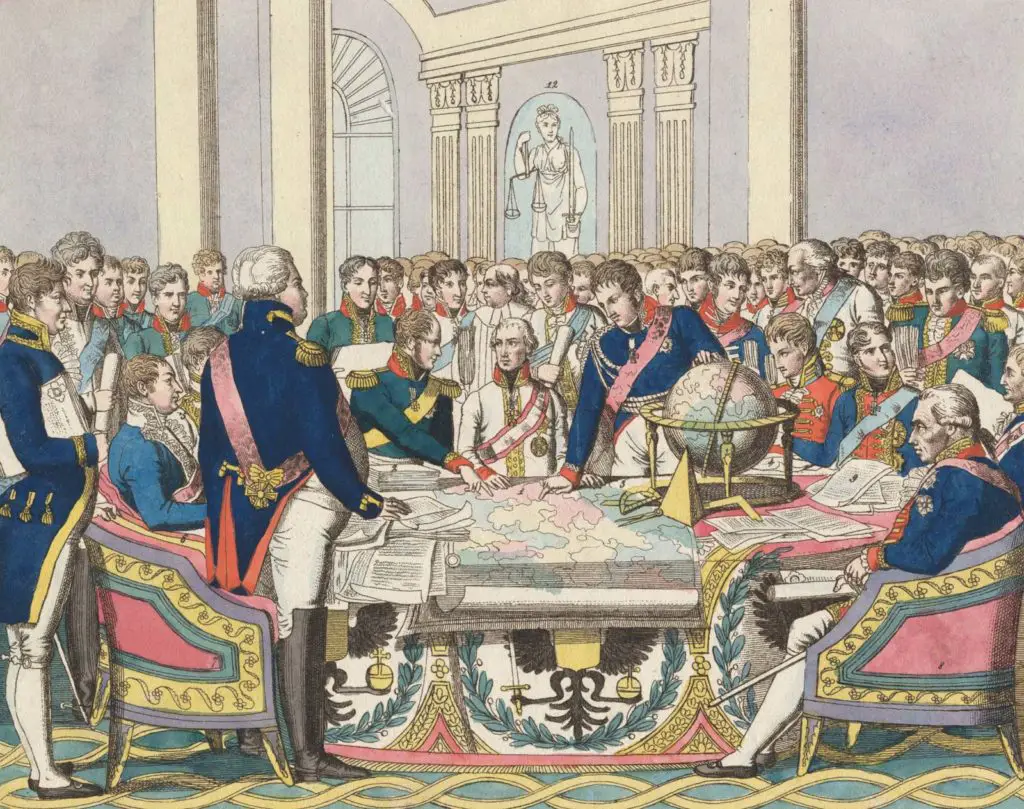
Ans: Representatives of European powers, i.e. Austria, Britain, Russia and Prussia, met at Vienna in 1815 after having defeated Napoleon. The Austrian Chancellor Duke Metternich was the head of the Congress. Here the Treaty of Vienna of 1815 was drawn to undo the changes after the Napoleonic wars.

  • Thus the Bourbon dynasty, deposed during the French Revolution, was put back in power even as France lost the territories it had annexed under Napoleon. 
  • To prevent every future expansion of France, many states were set up on France’s boundaries. So the kingdom of Netherlands including Belgium came up in the north, while Genoa came together with Piedmont in the south.
  • Prussia received some important new territories on its western frontiers
  • Austria gained control of northern Italy. 
  • The 39 states in the German Confederation as set up by Napoleon did not change. In the east, Russia received a part of Poland and Prussia received a part of Saxony.
  • The objective was to restore the monarchies overthrown by Napoleon and create a new conservative order in Europe.
Q2: Discuss the lives of the aristocrats and the new middle class in the 19th century Europe.
Ans: In the 19th-century Europe, the landed aristocracy dominated all social and political spheres. They were united by a common lifestyle. They owned huge estates in the countryside and some had large townhouses too. Their spoken language was French, both in high society and in diplomatic circles. Most of the aristocratic families were connected by marriage. The aristocrats formed a small group but held a lot of power.
Peasantry comprised the larger group of the population. To the west, most of the land was farmed by small owners and tenants. In eastern and central Europe, the pattern of landholding was characterized by vast estates cultivated by the serfs. In the western and some parts of central Europe industrial production and trade was on the rise and with them towns grew and the commercial classes emerged.
Their existence was based on the production for the market. Industrialization took birth in England in the 1850s but France and Germany experienced it only during the 19th century. This caused the emergence of new social groups — working class and middle class.
The latter comprised industrialists, businessmen and professionals. These groups were not many in central and eastern Europe. So it was the liberal, educated middle class which encouraged national unity after aristocratic privileges were abolished.

Q3: What views did the conservatives hold?
Ans: Napoleon was defeated in 1815 and soon European governments adopted the idea of conservatism. The conservatives held the belief that established traditional institutions of state and society like monarchy, church, social hierarchies, property and family must be protected and preserved.
They never proposed a pre-revolutionary period to return to but they knew that as Napoleon had carried out changes, modernization would in fact contribute to a strong monarchy. They believed that it would strengthen the power of the state and make it much more effective.
For them it was a firm belief that aristocratic monarchies of Europe would gain much from a modern army, an efficient bureaucracy, a dynamic economy, the abolition of feudalism and serfdom.

Q4: Friedrich List, Professor of Economics at the University of Tubingen in Germany, wrote in 1834.
“The aim of the Zollverein is to bind the Germans economically into a nation. It will strengthen the nation materially as much by protecting its interests externally as by stimulating its internal productivity. It ought to awaken and raise national sentiment through a fusion of individual and provincial interests. The German people have realized that a free economic system is the only means to engender national feelings.”
Read the statement by Professor List and discuss what political ends he hoped, would be achieved by economic measures.
Ans: Professor List was sure that economic measures could result in certain political ends:
(a) A national economy binds the nation together. For example, Zollverein abolished tariff barriers. It also reduced the currencies from thirty to two. This economic union was joined by most of the German states and brought them together and created a national feeling.
(b) It also promoted internal productivity, for example, to help trade growth, a network of railways was needed for increased mobility. This also brought people together.
(c) Economic measures like the Zollverein also protected nation’s external interests (the use of common currency and abolishing of tariffs). This fusion of individual and provincial interests aroused national sentiments in people.

Q5: The French philosopher Ernst Renan (1823-92) outlined his understanding of a nation in the following way:
“A nation is the result of a long past of endeavors, sacrifice and devotion. A heroic past, great men, glory, that is the social capital upon which one bases a national idea. To have common glories in the past, to have a common will in the present, to have performed great deeds together, to wish to perform still more, these are the essential conditions of being a people. A nation is, therefore, large-scale solidarity … Its existence is a daily plebiscite … A province is its inhabitants; if anyone has the right to be consulted, it is the inhabitants. A nation never has any real interest in annexing or holding on to a country against its will. The existence of nations is a good thing, a necessity even. Their existence is a guarantee of liberty, which would be lost if the world had only one law and only one master.”
(a) What, according to Renan, are the attributes of a nation?
(b) Why does he think nations are important?
(c) How is his idea different from others? Do you agree with him?
Ans:
(a) According to Renan, a nation must have people who have shared “a glorious past,” and have a desire, a will to perform deeds together for the glory of the country in the present and in the future also. There is solidarity. They belong to the nation and have to be consulted on any issue, they exercise their rights daily. A nation does not want to grab territories, it does not want to conquer any country or dominate it against the will of the people.
(b) A nation is necessary because it guarantees freedom to every citizen. This liberty (individual) would be lost, if there was a uniform law for everyone and only one ruler.
(c) He differs from others as he does not believe that a nation speaks the same language, follow the same religion, belongs to the same race and occupies the same territory. I agree with him. India is a nation made of different races, different religions, we speak different languages, follow different cultures. Yet, we have unity in diversity as we have a common past and a desire to live together.

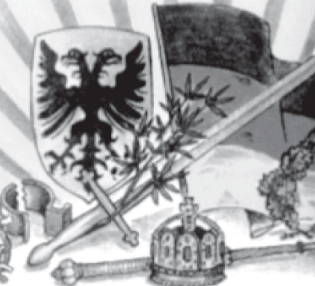
Q6: What is the significance of the symbols given in this picture?
Ans: Each symbol has meaning and significance.
(a) The broken chains represent freedom, freedom from slavery.
(b) The breastplate with an eagle on it represents the German Empire and its strength (the eagle is a strong bird).
(c) The tricolour — black, red and gold — was the flag of liberal nationalists in 1848. It was banned by Dukes of the German states. A flag always unites people and arouses national feelings.
(d) The sword symbolises a readiness to fight. The German nation was ever ready to fight for its honour.
(e) The crown of oak leaves stands for courage, bravery and heroism.
(f) The olive branches around the sword show that Germans are as eager for peace as they are eager to fight.
(g) The rays of the rising sun symbolizes the beginning of a new era as a united German nation.

Q7: Read the two opinions about the role of women in society:
1. Carl Welcker: A liberal politician member of the Frankfurt Parliament:
‘Nature has created men and women to cany out different functions … Man, the stronger, the bolder and peer of the two, has been designated as protector of the family, its provider, meant for public tasks in the domain of law, production, defence. Woman, the weaker, dependent and timid, requires the protection of man. Her sphere is the home, the care of the children, the nurturing of the family … Do we require any father proof that given such differences, equality’ between the sexes would only endanger harmony and destroy the dignity of the family?’
2. Louise Otto Peters, a political activist, wrote in a journal (21 April, JS4Q): ‘Let us ask how many men, possessed by thoughts of Iriing and dying for the sake of Liberty, would be prepared to fight for the freedom of the entire people, of all human beings? When asked this question, they would all too easily respond with a “Yes”, though their untiring efforts are intended for the benefit of only one half of humanity— men. But Liberty is mdnisible’ Free men therefore must not tolerate to be surrounded by the unfree.

(a) What according to Carl Welcker is a woman’s function? Does he think women should be given equality and liberty?
(b) Louise Otto Peters asks a question in his article. What is the significance of his question? How does he define liberty?
Ans:
(a) A woman, according to Carl Welcker, is weak, timid and needs the protection of the strong, bold, free man. He confines the woman to the kitchen, home and children. He does not support equality and liberty for women. A woman must remain subservient to a man.
(b) Louise Otto Peters is certainly a feminist. Does he want to know whether men are prepared to fight for “freedom of the entire people, all human beings”? His question is significant because though the men will unanimously answer “yes” but they are not ready to grant this freedom to women, who constitute half the population of the world.
For him Liberty is indivisible, it cannot be given to some and not to others. He certainly holds a totally different view from Carl Welcker, who is a male chauvinist!

Q8: How was the history of nationalism in Britain, unlike the rest of Europe?

OR
How was the formation of the nation-state the result of a long drawn-out process in Britain?
Explain.
Ans: In Britain, the formation of the nation-state was not the result of a sudden upheaval or revolution. It was the result of a long-drawn-out process. There was no British nation prior to the eighteenth century. All the ethnic groups had their own cultural and political traditions.
But as the English nation steadily grew in wealth, importance and power, it extended influence over other nations of the island. The English parliament, which had seized power from the monarchy in 1688 at the end of a protracted conflict, was the instrument through which a nation-state, with England at its centre, came to be forged.
The Act of Union (1707) between England and Scotland that resulted in the formation of the ‘United Kingdom of Great Britain’ meant, in effect, that England was able to impose its influence on Scotland. The British parliament was henceforth dominated by its English members.
The growth of a British identity meant that Scotland’s distinctive culture and political institutions were systematically suppressed. Ireland suffered a similar fate. It was a country deeply divided between Catholics and Protestants. The English helped the Protestants of Ireland to establish their dominance over a largely Catholic country. Catholic revolts against the British dominance were suppressed.

Q9: Analyse the measures and practices introduced by the French revolutionaries to create a sense of collective identity amongst the French people.
Ans: The measures and practices introduced by the French revolutionaries to create a sense of collective identity among the French people were as follows.

  • The idea of la patrie (the fatherland) and le citoyen (the citizen) emphasised the idea of united people enjoying equal rights under a constitution.
  • A new French flag, the tricolour, was chosen to replace the former royal standard.
  • The Estates General was elected by the active citizens and renamed the National Assembly.
  • New hymns were composed, oaths taken and martyrs commemorated in the name of nation.
  • Regional dialects were discouraged and French, as it was spoken and written in Paris, became the common language of the nation.
  • A centralised administrative system was put in practice and it formulated uniform laws for all citizens within its territory.
  • Internal customs duties and dues were abolished and a uniform system of weights and measures was adopted.

Q10: ‘Nationalism no longer retained its idealistic liberal democratic sentiments by the last quarter of the 19th century in Europe’. Analyse the statement with examples.
Ans: 

  • Towards the end of the 19th century, nationalism became a narrow belief with inadequate ends.
  • This period saw nationalist groups becoming increasingly prejudiced against each other and ready to wage a war at the slightest pretext.
  • Nationalism was now identified with increasing one’s sphere of influence, by establishing control over more territories. Balkan states became jealous of each other and entered into a conflict to establish more control and power in the region at the cost of others.
  • The chief European authorities saw this as an opportunity and manipulated the nationalist desires of the subject peoples. 
  • European powers were keen on countering the hold of other powers over the Balkans. They did nothing serious to solve the Balkan issue but rather watched the situation to turn fruitful for them.The most severe tensions emerge after 1871, leading to a series of wars and ultimately led to the First World War in 1914.
5. Print Culture and the Modern World – Short Answer Questions

Q1. Why was China a major producer of printed material for a long time?

Ans: China was a major producer of printed material due to several key factors:

  • To support candidates, a large number of textbooks were printed, sponsored by the imperial state.
  • From the 16th century onwards, the number of examination candidates increased, leading to a surge in printed materials.
  • By the 17th century, as urban culture flourished, print became more diverse, reaching beyond scholar-officials to include merchants and leisure readers.
  • New genres emerged, such as fiction, poetry, and autobiographies, attracting a wider audience, including women.

Q2. Who were the people who employed scribes to write in the 14th century?

Ans: In the 14th century, the following groups employed scribes to write:

  • Wealthy individuals – The rich could afford the high costs of handwritten books.
  • Aristocrats – Nobility often commissioned scribes for their literary needs.
  • The Church – Religious institutions required scribes for manuscripts.

However, the production of manuscripts was slow and costly, leading to a shift towards woodblock printing, which made books more accessible.

Medieval Scribe

Q2. State the limitations of handwritten books. OR Why were Manuscripts not used widely in everyday life before the age of print in India?

Ans: Limitations of Handwritten Books

  • Costly and time-consuming to produce.
  • Copying manuscripts was expensive and required a lot of effort.
  • Manuscripts were fragile and could easily be damaged.
  • Their size and weight made them cumbersome to transport.
  • Limited circulation meant they were often unaffordable for the middle class.

Q3. Write a short note on the developments or innovations in printing technology in the 19th century. 
OR 
Give three methods by which printed books became more accessible to people. OR Describe the development of the printing press after Gutenberg.

Ans: In the 19th century, several significant innovations in printing technology emerged:

  • Richard M. Hoe from New York developed the power-driven cylindrical press, which could print 8,000 sheets per hour. This was particularly beneficial for newspaper printing.
  • The late 19th century saw the introduction of the offset press, capable of printing up to six colours simultaneously.
  • By the early 20th century, electrically-operated presses further increased printing speeds.
  • Improvements included better paper feeding methods, enhanced plate quality, and the introduction of automatic paper reels and photoelectric controls for colour registration.

Q4. Write a short note on how the printing press came to India.

Ans: The printing press was introduced to India by Jesuit missionaries in the mid-sixteenth century. Key developments include:

  • Jesuit priests arrived in Goa, where they learned Konkani and printed various tracts.
  • By 1674, around 50 books were printed in Konkani and Kanarese languages.
  • The first book in Tamil was published in 1579 at Cochin by Catholic priests.
  • In 1713, the first book in Malayalam was printed.
  • By 1710, Dutch Protestant missionaries had printed 72 Tamil books, mostly translations.
  • By the end of the 18th century, newspapers began to emerge in various Indian languages.

Q5. What were the difficulties faced by manuscripts in India?

Ans: Manuscripts in India faced several difficulties, including:

  • High Cost: Handwritten books were expensive to produce.
  • Fragility: Manuscripts were delicate and required careful handling.
  • Limited Accessibility: Their size and weight made them hard to carry and read.
  • Complex Scripts: Varied writing styles complicated reading.
  • Teaching Methods: Students often learned by writing down texts dictated from memory, rather than reading them.

Q6. Explain the terms Ulema and Fatwas.

Ans: Ulema: These are the scholars of Islam who specialise in Sharia, the body of Islamic law. They are learned individuals and are recognised as experts in religious matters.

Fatwa: This is a religious edict issued by a qualified authority, known as a Mufti. A fatwa clarifies specific points about Islam or provides guidance on how Muslims should act in particular situations.

Q7. Who were the dissenters? Why did they object to women being educated?

Ans: There were dissenters among both Hindus and Muslims regarding women’s education:

  • Many Hindus held the superstitious belief that educating women would lead to their widowhood.
  • Muslims feared that women would be corrupted by reading Urdu romances.

Q8. What was the role of cartoons and caricatures in new forms of publications?

Ans: By the 1870s, cartoons and caricatures were common in journals and newspapers, addressing social and political issues. Their roles included:

  • Critiquing the educated Indians’ fascination with Western styles and customs.
  • Expressing fears regarding social change.
  • Mocking the behaviour of imperial rulers and their attitudes.
  • Nationalists also used caricatures to criticise imperial rule.

This form of art sparked public debate and encouraged people to reflect on societal norms and the role of imperialism.

4. The Age of Industrialisation – Short Answer Questions

Q1. What factors were responsible for increasing demand for goods? Give an example.

Ans: The demand for goods increased due to several key factors:

  • Expansion of trade: The growth of international trade networks allowed for a greater exchange of goods.
  • Acquisition of colonies: European powers established colonies, providing new resources and markets.
  • Increased production: As colonies were developed, they contributed to a rise in the volume of trade.

For example, during the eighteenth century, the establishment of colonies enabled Europeans to access more resources, which significantly boosted trade.

Q2. What were the first symbols of industrialisation?

Ans: Cotton and metal production, particularly iron and steel, were the first symbols of industrialisation. Key points include:

  • Factories in England began emerging in the 1730s.
  • The number of factories steadily increased over time.
  • Production processes evolved to include cardingtwistingspinning, and rolling.

Q3. Write a short note on trade guilds.

Ans: Trade guilds were associations of producers that played a significant role in regulating various trades. They had several key functions:

  • Trained craftspeople and artists in their respective trades.
  • Controlled production by managing competition and setting prices.
  • Restricted the entry of new individuals into the trade.
  • Were often granted the exclusive right to produce certain goods by their rulers.

As a result, these guilds made it challenging for new merchants to establish businesses in towns.

Q4. What other sectors of production benefited from ordinary inventions?

Ans: Cotton and metal industries were powered by steam, but many ordinary inventions also aided various non-mechanised sectors. These sectors include:

  • Food processing
  • Building
  • Pottery
  • Glasswork
  • Tanning
  • Furniture-making
  • Production of implements

These innovations significantly improved efficiency and productivity across these industries.

Q5. What is the most recent views regarding industrial revolution of the eighteenth and mid-nineteenth centuries?

Ans: Modern historians now acknowledge the significant role of traditional craftspersons and labourers during the mid-nineteenth century. Key points include:

  • Technological changes were slow and costly, limiting their effectiveness.
  • Merchants and manufacturers were cautious about adopting new technologies due to concerns over cost and maintenance.
  • By the mid-nineteenth century, most workers were not machine operators but rather skilled craftspersons.

This recognition highlights the complexity of the industrial revolution and the importance of human labour in this transformative period.

Q6. Write a short note on the condition of a labour’s life in Victorian Britain.

Ans: In Victorian Britain, the life of labourers was challenging due to several factors:

  • Many poor peasants and vagrants migrated to cities seeking work.
  • This influx led to low wages as the supply of labour exceeded demand.
  • Workers were often exploited by industrialists, who preferred to hire seasonal labour.
  • Industries like gas works and breweries required more workers during peak seasons, leading to temporary employment.
  • Despite some wage increases, the real value of earnings often declined due to rising prices.
  • During economic slumps, unemployment rates could reach as high as 75% in certain areas.

The overall condition of labourers reflected a struggle for survival amidst economic challenges.

Q7. Explain why machines did not necessarily affect the employment of labours.

Ans: Machines required large capital investments. Their introduction did not immediately change traditional production methods. Key reasons include:

  • The need for machines depended on the availability of labour.
  • In areas with abundant labour, wages remained low.
  • Many industries preferred hand labour due to its flexibility and lower costs.

Q8. What were the limits of machine-made products?

Ans: Machines had several limitations when it came to production:

  • They could only create uniform, standardised products.
  • Machines were designed for mass markets, not for unique items.
  • Many consumers preferred goods with intricate designs and specific shapes.
  • In mid-nineteenth-century Britain, for example, a large variety of tools required human skill rather than mechanical technology.

Q9. Who invented the Spinning Jenny? How did it work?

Ans: The Spinning Jenny was invented by James Hargreaves in 1764. This innovative machine:

  • Increased the speed of the spinning process.
  • Reduced the amount of labour needed.
  • Allowed one worker to operate multiple spindles simultaneously.
  • Enabled the spinning of several threads of yarn with a single turn of the wheel.

Q10. What is the monopoly of trade?

Ans: Monopoly of trade refers to a situation where a country establishes control over trade, effectively eliminating competition.

  • This allows the country to manage costs efficiently.
  • It ensures a steady supply of goods in the market.
  • For instance, British colonisers monopolised products like silk and cotton in India.

Q11. How did the Indian weavers react to the monopoly of cotton production?

Ans: Indian weavers reacted strongly to the monopoly of cotton production. Their responses included:

  • Increased reliance on income from raw cotton sales, which reduced their independence and bargaining power.
  • Many weavers in Carnatic and Bengal deserted their villages and migrated.
  • Some joined local traders in revolting against Company officials.
  • Over time, many weavers refused loans, closed their workshops, and turned to agricultural labour.

Q12. Discuss the impact of the Indian national movement on Indian entrepreneurs.

Ans: During the Indian national movement in the early twentieth century:

  • Swadeshi activists boycotted and burned foreign goods.
  • Indigenous industrialists organised to demand tariff protection and government grants.
  • During wartime, Indian industries diversified into products like war goods, steel, and iron.
  • As British mills focused on war production, imports into India declined, creating a vast home market.
  • Indian factories supplied various war needs, leading to the establishment of new factories.

3. The Making of a Global World – Short Answer Questions

Q1. What role did the silk route play between the Chinese and the Romans?
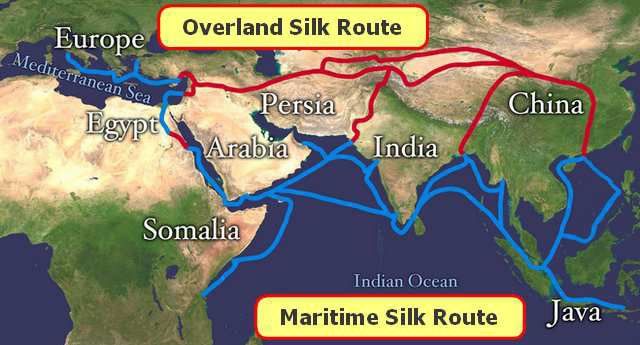
Ans. The Romans learned about the silk route from the Parthians around 53 B.C.E. They used the word “Seres” or the silk people to refer to the Chinese.  Although there is no direct evidence of Roman merchants or Chinese traders in each other’s civilizations, silk was highly prized in Rome, and Roman items were also popular in China.

Silk Route

Q2. Explain how food habits are good indicators of globalization.
Ans. The exchange of food crops and habits between different regions and their adoption by different societies was a good indicator of globalization.
Example: The Europeans benefited from the introduction of potatoes with good nutrients and health. Thousands perished in the 1840s during the Irish Potato Famine.


Q3. Describe in a few words how Europe changed at the end of the eighteenth century. 
Ans. By the end of the 1700s, new scientific and revolutionary ideas changed how Europeans thought and acted. The Industrial Revolution started in England and spread to other European countries. The Reformation, led by Martin Luther, boosted capitalism and scientific thinking

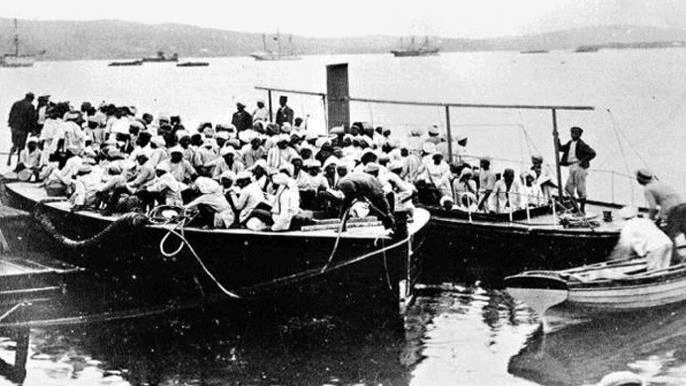
Q4. Who were the indentured labourers? Which states of India produced the largest number of indentured labour? 
Ans. Indentured labourers were bonded labourers who were transferable to any country on contract for a specific amount of wage and time. Most of the labourers were from Uttar Pradesh, Bihar, Central India and certain districts of Tamil Nadu.

Indian Indentured Labourers

Q5. Describe some technological developments of the nineteenth century that affected industrial growth.
Ans. Railways were needed to link agricultural regions to the ports. Shipbuilding became an important industry and countries competed to control the trade routes on seas. The invention of the steam engine made it possible for steamships and railways to carry large volumes of trading materials between long and inaccessible distances.

Q6. What was the new system of slavery in the nineteenth century? 
OR
Nineteenth-Century indenture has been described as a new system of slavery. Explain any three points.
Ans. Nineteenth-Century indenture has been described as a new system of slavery in following ways:

  • The poor labours recruited as indentured labours were often cheated by the agents and employers alike.
  • Some were forcibly taken, while some were not even told of their final destinations.
  • They were treated miserably. Such practices led some historians to refer to it as ‘a new system of slavery.’


Q7. How was the USA able to recover from the post–World War economic crisis? 
Ans. USA able to recover from the post–World War economic crisis in following way:

  • The USA was able to recover from the post-war crisis at a great speed. Its economy resumed its strong growth in the early 1920s. 
  • An important factor was the introduction of mass production. Henry Ford, the owner of the Ford Company, was the first man to start using a new system of production, known as assembly line production
  • Others included large foreign investment and war-time loans as well as agricultural exports.

Q8. Describe how the Great Depression spread from the USA to other countries of the world. 
Ans.  The Great Depression spread from the USA to other countries of the world as follows:

  • American crisis affected other countries in Europe and elsewhere by virtue of their being dependent on her overseas capital investment and loans. Then, their own internal weaknesses made the conditions worse. 
  • Many factors were responsible including lack of confidence and panic among the investors. 
  • Britain also decided to return to the gold standard ratio of US dollar 4.86 to 1 pound sterling which was the pre-World War I level.

Q9. Write a short note on the effects of the Second World War. 
Ans. The effects of the Second World War are as follows:

  • The Second World War was more devastating than the first. About 3% of the world’s population perished, more civilians died than the fighting soldiers. 
  • Two crucial developments shaped the post-war scenario of which the first one was the emergence of the USA and the USSR as superpowers. 
  • The second was the establishment of international organizations like the UNO and others to maintain peace and stability.


Q10. Briefly summarise the two lessons learned by the economists and politicians from the post-war economic experience.
Ans.  In the post-war system two lessons learned by economists and politicians were:

  • One was to ensure mass consumption in industrial society by high and stable income.
  • Another one was to ensure full employment and government control of flows of goods, capital and labour.

Therefore, they aimed to establish a stable economy and provide full employment in the industrial nations through the Bretton Woods institutions, namely, the IMF and the World Bank.


Q11. How did silk routes link the world? Explain with three suitable examples. 
OR
Explain any three characteristics of the Silk Route. 
Ans. Pre-modern trade and cultural links between distant places were established by the Silk Routes.  

  • The silk route linked the West and China as silk cargoes were carried along this route. Historians have mentioned and identified several silk routes over land and by sea which brought together vast areas of Asia and linked Asia with Europe and Northern Africa.
  • Chinese pottery travelled to India through these routes, even before the Christian era, and textiles and spices from India and South-East Asia; precious metals, like gold and silver, flowed from Europe to Asia.
  • Trade and cultural exchange took place at the same time. Buddhism emerged from eastern India and spread in several directions through the silk route. Christian missionaries travelled through these routes to Asia, as did the early Muslim preachers a few centuries later.


Q12. “The First World War was fought between two power blocs.” Explain.
Ans: The First World War was fought from 1914 – 1918. On the one side were the Allies – Britain. France and Russia (later joined by the US): and on the opposite side were the Central Powers – Germany. Austria – Hungary and Ottoman Turkey.

2. Nationalism in India – Short Answer Questions

Q.1. What is meant by the idea of Satyagraha?
 OR
Gandhiji said ‘Satyagraha’ was active resistance. How?
 OR
Explain the idea of Satyagraha.
Ans. Gandhiji said ‘Satyagraha’ was not passive resistance but it called for intensive activity. Physical force was not used against the oppressor, nor vengeance was sought. Only through the power of truth and non-violence, an appeal was made to the conscience of the oppressor. Persuasion, not force, would make the oppressor realise the truth. This ‘dharma’ of non-violence and truth united people against the oppressor and made them realise the truth.  

Satyagrah Movement

Q.2. Why were Indians outraged by the Rowlatt Act?
Ans. The Rowlatt Act was passed hurriedly by the Imperial Legislative Council in 1919. It was opposed by all its Indian members. The government assumed enormous powers through this Act as they could detain political prisoners without trial for two years. Gandhiji decided to launch a ‘Hartal’ on 6 April against the Rowlatt Act.


Q.3. Give one example to prove that Non-Cooperation Movement was more successful on the economic front.
Ans. One example is boycott of foreign goods. The import of foreign textile cloth became half of what it was, between 1921–1922. It fell from 102 crores to 57 crores.


Q.4. Which party did not support the boycott of council elections during the movement and why.
Ans. The Justice Party of Madras decided not to boycott Council elections. The Justice Party members were non-Brahmins and so far had not been able to win elections, as the Brahman candidates always won. They thought it was a golden opportunity for them to enter the Councils.


Q.5. Why did Gandhiji call off the Non-Cooperation Movement?
Ans. The Chauri Chaura incident near Gorakhpur made him to do so. A peaceful procession turned violent and burnt a police chowki at Chauri Chaura and 22 policemen were burnt alive. Gandhiji, an apostle of non-violence, was shocked and immediately called off the movement.


Q.6. What was the cause of disagreement between the Congress-led Non-Cooperation Movement and the peasants’ and workers’ movements?
Ans. The Congress under Gandhiji believed in achieving ‘Swaraj’ by peaceful means and total non-violence. The peasants and workers, though believers in Gandhi’s Swaraj, khadi and boycott, did not believe in non-violence. They turned violent to gain their aims, which went against the Congress creed.


Q.7. What was the Inland Emigration Act of 1859?
Ans. The British government had passed this Act to prevent the plantation workers to leave the plantations and go back to their villages in Assam. They were forced to remain at the plantations and not leave them without permission. The permission to leave was seldom granted.


Q.8. Explain the two important factors that shaped Indian politics towards 1920’s. [2011(T-2)]
 OR
 Mention two factors which influenced Indian politics in the late 1920s. [2011(T-2)]

Ans. (i) The first was the worldwide economic depression which brought the agricultural prices crashing down in India. Farmers could not sell their produces and the whole country-side was in turmoil.

(ii) The British constituted a statutes commission in 1927 under Sir John Simon. The aim was to diffuse nationalism aroused by the Non-Cooperation Movement. The Commission was to look into the functioning of the constitutional system in India. It was an all-white commission, with not a single Indian member in it. It set the political world in India on fire and led to Gandhiji starting the Civil Disobedience Movement.


Q.9. Explain the difference in the objectives of the Non-Cooperation Movement and the Civil Disobedience Movement.
 OR
 How was the civil disobedience movement different from the Non-Cooperation Movement.

Ans. Non-Coorporation Movement (1920-22) wanted to bring the Government to a standstill by refusing to cooperate with it; Civil Disobedience Movement (1930-34) wanted to paralyse the government by performing illegal acts like violating the laws.


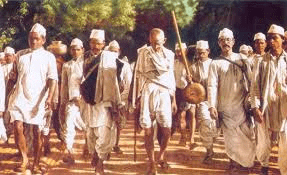
Q.10. Why did Gandhiji choose ‘Salt’ as the symbol of his Civil Disobedience Movement?
Ans. Salt is consumed by both the poor and the rich, and is one of the most essential items of food everywhere in the world. The British government had the monopoly on the production of salt in India. By imposing a ‘salt tax’ the government hit both the rich and the poor, specially the poor. Gandhiji thought it was the most repressive Act of the British government and chose to defy it by breaking the “Salt Law”.


Q.11. How did the British Government react to the “Salt March” of Gandhiji?
Ans. A frightened and shaken British government responded with a policy of brutal repression. About 100,000 people were arrested. Gandhiji was arrested on 4th May, 1930. The government also tried to diffuse the situation by releasing Gandhiji and making him sign the Gandhi-Irwin Pact (the then Viceroy of India) on 5th March, 1931. But the failure of the Second Round Table Conference in 1931 led the Government to begin its repressive measures in 1932 again. Congress was declared illegal and Nehru and Abdul Ghaffar Khan were arrested. All boycotts, meetings and demonstrations were banned by the British.


Q.12. Why did the industrialists and industrial workers lose interest in the Civil Disobedience Movement?
 OR
 Why did the initial enthusiasm of the merchants and industrialists fade away during the later stage of the civil disobedience movement?

Ans. The industrialists were perturbed by the increasing influence of socialism among the younger members of the Congress. They were also worried by the long-drawn militant activities and were worried about the harm done by it to their business interests.


Q.13. How and when nationalism captures the hearts and minds of the people ?
Ans. When people begin to believe strongly that they are part of the same nation. Also, when they discover common bonds that unite them, when they share the same struggles and have a common folklore, history and culture, then nationalism grips their hearts and minds.


Q14. What is the significance of 13th April, 1919?
Ans. April 13, 1919, is significant for the Jallianwala Bagh massacre, where British troops killed hundreds of people in a crowd in Amritsar. The massacre sparked widespread unrest and led Mahatma Gandhi to end the Satyagraha movement in response to the severe repression by the British government. 

1. The Rise of Nationalism in Europe –  Short Answer Questions

Q 1. What views did Giuseppe Mazzini have about Italy?

Giuseppe Mazzini

Ans: Mazzini believed that God had intended nations to be the natural units of mankind. So Italy could not continue to be a patchwork of small states and kingdoms. Italy had to be forged into a single unified republic within a wider alliance of nations. This unification from above could be the basis of Italian unity.

Q 2. What was the reaction to the Napoleonic Code? 

Ans: Initially many people welcomed French armies as harbingers of liberty. But the initial enthusiasm soon turned to hostility, as it became clear that the new administrative arrangements did not go hand in hand with political freedom. Increased taxation and censorship, and forced conscription into the French armies as required to conquer the rest of Europe all seemed to outweigh the advantages of the administrative changes.

Q 3. What kind of life did the aristocrats lead?

Ans: Socially and politically, a landed aristocracy was the dominant class on the European continent. The members of this class were united by a common way of life that cut across regional divisions. They owned estates in the countryside and also townhouses. They spoke French for purposes of diplomacy and in high society. Their families were often connected by the ties of marriage. This powerful aristocracy was, however, a numerically small group.

Q 4. What was understood by the term ‘liberalism’?

Ans: The term ‘liberalism’ derives from the Latin root liberal meaning free. For the new middle classes, liberalism stood for freedom for the individual and equality of all before the law. Politically, it emphasized the concept of government by consent. Since the French Revolution, liberalism has stood for the end of autocracy and clerical privileges, a constitution, and representative government through Parliament. Nineteenth-century liberals also stressed the inviolability of private property.

Q 5. When and why was the Zollverein formed?

Ans: In 1834, a customs union, or Zollverein was formed at the initiative of Prussia and joined by most of the German States. The union abolished tariff barriers and reduced the number of currencies from over thirty to two. The creation of a network of railways further stimulated mobility, harnessing economic interests to national unification. A wave of economic nationalism strengthened the wider nationalist sentiments growing at the time.

Q 6. How did the Treaty of Vienna (1815) come into being?

Ans: In 1815, representatives of the European powers – Britain, Russia, Prussia, and Austria – who had collectively defeated Napoleon, met at Vienna to draw up a settlement for Europe. The Congress was hosted by the Austrian Chancellor Duke Metternich.Signing of Treaty of Vienna

The delegates drew up the Treaty of Vienna of 1815 with the object of undoing most of the changes that had come about in Europe during the Napoleonic wars.

Q 7. What was the nature of conservative regimes set up in 1815?
OR
Enumerate any three features of conservative regimes set up in Europe following the defeat of Napoleon in 1815.

Ans: The conservative regimes set up in 1815 were autocratic. They did not tolerate criticism and dissent and sought to curb activities that questioned the legitimacy of autocratic governments. Most of them imposed censorship laws to control what was said in newspapers, books, plays, and songs and reflected ideas of liberty and freedom associated with the French Revolution.

Q 8. What led to the rise of the revolutionaries?

Ans: During the years following 1815, the fear of repression drove many liberal nationalists underground. Secret societies sprang up in many European states to train revolutionaries and spread their ideas. To be revolutionary at this time meant a commitment to oppose monarchical forms that had been established after the Vienna Congress and to fight for liberty and freedom. Most of these revolutionaries also saw the creation of nation-states as a necessary part of this struggle for freedom.

Q 9. Write briefly about conditions in Europe in the 1870s.

Ans: By the last quarter of the 19th Century, nationalism did not have its idealistic liberal-democratic sentiment of the first half of the century. Nationalism had become a narrow creed with limited ends. Nationalist groups were no longer trusting nor tolerant of each other. They were always at each other’s throats. The major European powers manipulated the nationalist aspirations of the
subject people in Europe to further their imperialist aims. The most serious source of nationalist tension in 1871 was in the Balkans.

Q 10. What has made the Balkan a source of nationalist tension?

Ans: The most serious source of nationalist tension in Europe after 1871 was the area called the Balkans. The region had geographical and ethnic varieties. The Balkans included Romania, Bulgaria, Albania, Greece, Macedonia, Croatia, Bosnia-Herzegovina, Slovenia, Serbia and Montenegro. The inhabitants of the Balkan regions were called Slavs. Most of the Balkan region was under Ottoman rule. The spread of the ideas of romantic nationalism in the Balkans, together with the disintegration of the Ottoman Empire, made this region very explosive.

Q 11. How had the female figures become an allegory of the nation during the 19th century in Europe? Analyse.

Ans: In the 19th century in Europe, the female figures became an allegory of the nation in the following ways:

  • The artists, in the 18th and 19th centuries in Europe, wanted to represent a country, as if it was a person. In other words, they wanted to personify the nation. Nations were represented as female figures. The female form did not belong to any particular woman in real life. It was an abstract idea, which gave the nation a concrete form. The female figure became an allegory of a nation.
  • In France, the female form was given the name of Marianne, which represented the nation. Her characteristics were a red cap, the tricolor, and the cockade, drawn from those of Liberty and the Republic.
  • Similarly, Germany became the allegory of the German nation. Germania wears a crown of oak leaves because oak stands for heroism.

Q 12. ‘The decade of 1830 had brought great economic hardships in Europe’. Support the statement with arguments.

Ans: The first half of the nineteenth century saw an increase in population, all over Europe. There was a scarcity of jobs and few employment opportunities. Population from rural areas migrated to the cities in search of jobs. They lived in overcrowded slums. Small producers in towns faced stiff competition from imports of cheap machine goods from England. In those parts of Europe where aristocracy was strong and enjoyed enormous powers, the peasants groaned under the burden of feudal dues and taxation. The rise of food prices or a year of bad harvest added to the miseries of the common man.

5. Print Culture and the Modern World – Textbook Worksheet

Objective type Questions
Q1: Vellum is :
(a) metal frame in which the types are laid and the text compressed
(b) a parchment made from the skin of animals
(c) the art of beautiful and stylised writing
(d) a historical account or folk tale in verse, usually sung or recited

Q2: The earliest print technology was developed in :
(a) China, Japan and Korea
(b) France, China and India
(c) Germany, Korea, Vietnam
(d) China, Japan and Germany

Q3: Who were deeply anxious about the collapse of Muslim dynasties ?

(a) Jesuit priests
(b) Hindus
(c) The Ulama
(d) Portuguese missionaries

Q4: This city became the hub of the new print culture, catering to the Western-style schools :
(a) Mumbai
(b) Tokyo
(c) Shanghai
(d) New York

Q5: He developed the first-known Printing Press in the 1430s :
(a) Martin Luther
(b) Marco Polo
(c) Warren Hastings
(d) Johann Gutenberg

Q6: Which one of the following was NOT the reason for the popularity of scientific ideas among the common people in eighteenth century Europe ?
(a) Printing of idea of Isaac Newton
(b) Development of printing press
(c) Interest of people in science and reason
(d) Traditional aristocratic groups supported it.

Q7: Who wrote Ramcharitmanas ?
(a) Tulsidas
(b) Gangadhar Bhattacharya
(c) Kashibaba
(d) Ram Chaddha

Q8: Calligraphy is :
(a) the art of making ceramics
(b) the art of making pottery
(c) a style of music
(d) the art of beautiful and stylised writing

Q9: When was the Vernacular Press Act passed ?
(a) 1820
(b) 1878
(c) 1857
(d) 1907

Q10: It is a historical account or folk tale in verse, usually sung or recited :
(a) Taverns
(b) Vellum
(c) Ballad
(d) Galley


True or False

Q1: Dr.Ambedkar was also known as ‘Periyar’. (True/False)

Q2: Those people who believed in the teachings of the Church were known as heretics. (True/False)

Q3: Print popularised the ideas of the enlightenment thinkers. (True/False)

Q4: Manuscripts in India were cheap and durable. (True/False)

Q5: The Vernacular Press Act was passed in 1878. (True/False)

Assertion and Reasoning Based Questions

Q1: Assertion : As literacy and schools spread in African countries, there was a virtual reading mania. 
Reason : Churches of different denominations set up schools in villages, carrying literacy to tribals.
(a) If both assertion and reason are true and reason is the correct explanation of assertion.
(b) If both assertion and reason are true and reason is not the correct explanation of assertion.
(c) If assertion is true but reason is false.
(d) If both assertion and reason are false.

Q2: Assertion : The new reading culture was accompanied by a new technology.
Reason :
 From hand printing there was a gradual shift to mechanical printing.
(a) If both assertion and reason are true and reason is the correct explanation of assertion.
(b) If both assertion and reason are true and reason is not the correct explanation of assertion.
(c) If assertion is true but reason is false.
(d) If both assertion and reason are false.

Q3: Assertion : The first book that Gutenberg printed was the Bible. 
Reason :
 About 500 copies were printed and it took two years to produce them.
(a) If both assertion and reason are true and reason is the correct explanation of assertion.
(b) If both assertion and reason are true and reason is not the correct explanation of assertion.
(c) If assertion is true but reason is false.
(d) If both assertion and reason are false.

Q4: Assertion : Children became an important category of readers.
Reason : 
Primary education became compulsory from the late nineteenth century.
(a) If both assertion and reason are true and reason is the correct explanation of assertion.
(b) If both assertion and reason are true and reason is not the correct explanation of assertion.
(c) If assertion is true but reason is false.
(d) If both assertion and reason are false.

Q5: Assertion : In 1517, the religious reformer Martin Luther wrote Ninety Five Theses criticising many of the practices and rituals of the Roman Catholic Church.
Reason : 
This led to a division within the Church and to the beginning of the Protestant Reformation.
(a) If both assertion and reason are true and reason is the correct explanation of assertion.
(b) If both assertion and reason are true and reason is not the correct explanation of assertion.
(c) If assertion is true but reason is false.
(d) If both assertion and reason are false.

Q6: Assertion : Print and popular religious literature stimulated many distinctive individual interpretations of faith even among little-educated working people.
Reason : 
Through the seventeenth and eighteenth centuries, literacy rates went up in most parts of Europe.
(a) If both assertion and reason are true and reason is the correct explanation of assertion.
(b) If both assertion and reason are true and reason is not the correct explanation of assertion.
(c) If assertion is true but reason is false.
(d) If both assertion and reason are false.

Q7: Assertion : There was intense controversy between social and religious reformers and the Hindu orthodoxy over matters like widow immolation, monotheism, Brahmanical priesthood and idolatory.
Reason : 
The Deoband Seminary founded in 1867, published thousands of fatwas telling Muslim readers how to conduct themselves in everyday lives, and explaining the meaning of Islamic doctrines.
(a) If both assertion and reason are true and reason is the correct explanation of assertion.
(b) If both assertion and reason are true and reason is not the correct explanation of assertion.
(c) If assertion is true but reason is false.
(d) If both assertion and reason are false.

Q8: Assertion : The production of handwritten manuscripts could not satisfy the ever-increasing demand for books. 
Reason : 
Chinese paper reached Europe via the silk route.
(a) If both assertion and reason are true and reason is the correct explanation of assertion.
(b) If both assertion and reason are true and reason is not the correct explanation of assertion.
(c) If assertion is true but reason is false.
(d) If both assertion and reason are false.


Very Short Answer Type Questions 

Q1: What were almanacs ?

Q2: How had hand printing technology introduced in Japan?

Q3: How many copies of the Bible were printed by Johannes Gutenberg in Europe ?

Q4: How was Biliotheque Bleue different from Penny Chapbooks ?

Q5: Who invented printing press and when ?

Q6: Who wrote ‘My Childhood and My University’ ?

Q7: Who was Johannes Gutenberg ?

Q8: Why was printing of textbooks sponsored by the Imperial State in China ?

Q9: What was woodblock printing ?

Q10: What led to the schism within the Catholic Church and the birth of the Protestant Reformation movement in Germany ?

Short Answer Type Questions

Q1: Who brought the printing technology to British India and how ?

Q2: How had the Imperial State in China been the major producer of printed material for a long time? Explain with examples.

Q3: Give reasons for the statement : ‘Woodblock print only came to Europe after 1295’.

Q4: Write the name of any two women writers of India in nineteenth century and highlights their contribution.

Q5: Write briefly on the Vernacular Press Act. (NCERT)

Q6: How did print culture affect women in the nineteenth century ?

Q7: Print created the possibility of wide circulation of ideas and introduced a new world of debate discussion.’’ Analyse the statement in the context of religion in Europe.

Q8: Write short notes to show what you know about the Gutenberg Press.

Q9: Why did British government curb the freedom of the Indian press after the revolt of 1857 ?

Q10: Write a note on Erasmus’s idea of a printed book.

Long Answer Type Questions

Q1: Why did the Roman Catholic Church begin keeping an Index of Prohibited Books from the mid-sixteenth century ? Explain by giving five reasons.

Q2: Describe three shortcomings of manuscripts that were overcome by the printing press.

Q3: Explain how print culture assisted the growth of nationalism in India.

Q4: How were ideas and information written before the age of print in India ? How did the printing technique begin in India ?

Q5: Why did some people in eighteenth century Europe think that print culture would bring enlightenment and end despotism ?

Q6: What was the attitude of people in India in the nineteenth century towards women reading ? How did women respond to this ?

The solutions of the worksheet “Worksheet Solutions: Print Culture and the Modern World

4. The Age of Industrialisation – Textbook Worksheet

Timeline of Events

  • 1600: The East India company was established
  • 1730: The earliest factories in England were setup
  • 1760: Britian imported New cotton to feed its cotton industry
  • 1764: James Hargreaves, devised spinning Jenny
  • 1767: Richard Arkwright established the cotton mill
  • 1781: James watt improvised steam engine & patented it
  • 1785: Cart wright invented the powerloom which used steam power for spinning & weaving
  • 1830-1840: Dwarkanath Tagore setup 6 joint stock companies in Bengal
  • 1840: Cotton was the leading sector in the first phase of Industrialisation in Britain.
  • 1850 : Railway station developed all over London
  • 1854: The first cotton mill was established in Bombay
  • 1855: The first Jute Mill was set up in Bengal
  • 1860: The supply of cotton reduced because of American Civil War
  • 1860: Elgin Mill was started in Kanpur
  • 1861: The first cotton mill was setup in Ahmedabad
  • 1873: Britain exported Iron & Steel
  • 1874: The first spinning & weaving mill & Madras began its production
  • 1900: E.T paul music company published “Dawn of Century”
  • 1912: J.N. Tata set up first Iron & Steel works in Jameshedpur
  • 1917: Seth Hukumchand set up first Jute Mill in Calcutta
  • 1941: use of Fly shuttle in more than 35 looms

Points to be Remember

  • Orient-The countries of the East especially East Asia
  • Capital-That part of money when invested is used for trade purpose.
  • Socialism- Where factors of production are held by the government.
  • Spenning Jenny-Invented by James Hargreaves in 1764. It accelerated production.
  • Staples: A person who ‘Staples’ or sorts wool according to fibre.
  • Fuller: A person who ‘Fulls’ that it gathers cloth by pleating.
  • Carding: The process in when fibres such as cotton or wool are prepared prior to spinning.
  • Fly shuttle was a mechanical device used for weaving moved by means of ropes and pullies.
  • First Jute Mill was established in Calcutica, in India
  • James Watt invented Steam Engine.
  • In India first cotton mill eastablished in 1854.
  • Portuguese were the first Europeans to come India.


Multiple Choice Questions

Q1: Who invented steam engine
(a) James Watt
(b) New Comen
(c) Richard Arpwright
(d) E.T. Paull

Q2: Which of the following were the most dynamic industries of the Great Britain?
(a) Cotton and Metal Industry
(b) Metal & Agrobased industries
(c) Cotton and Sugar Industry
(d) Ship & Cotton

Q3: Dwarkanath Tagore was a ___________
(a) Indusrialist
(b) Painter
(c) Philosopher
(d) Social Reformer

Q4: Which is associated with Gomasthas?
(a) Traders
(b) Servant
(c) Businessman
(d) Supervisor appointed by company

Q5: When did the exports of British cotton increase dramatically?
(a) In the early 17th century
(b) In the early 18 century
(c) In early 19 century
(d) In early 20 century

Q6: Koshtis were
(a) A community of Weavers
(b) Weavers
(c) Cotton Weavers
(d) Landless Labourer

Q7: Which of the following were the Pre-colonial ports of India
(a) Surat & Masulispatnam
(b) Madras & Hoogly
(c) Madras & Bombay
(d) Bombay & Hoogly

Q8: Who were Jobbers?
(a) A person employed by industrialist to new recruits
(b) A paid servant of East India company
(c) A person employed by farmer to sell their products
(d) A person doing most important job in a factory

Q9: In 1911, 67 of the large industries were located in one of the following places in India
(a) Surat & Ahemdabad
(b) Bengal & Bombay
(c) Patna & Lucknow
(d) Delhi & Bombay

Q10: The Nationalist message of swadeshi was spread
(a) Tariffs
(b) Advertisements
(c) Force
(d) Low prices

Fill in the Blank

Q1: Proto-industrialisation was a phase when there was large-scale industrial production for an international market which was not based on ___________.

Q2: Richard Arkwright created the __________ mill.

Q3: The pace of industrialisation was hindered by technological changes occurring slowly because the new technology was expensive, machines often broke down, and repair was ____________.
Q4: After the East India Company established political power, they appointed a paid servant called the __________ to supervise weavers, collect supplies, and examine the quality of cloth.

Q5: By the end of the nineteenth century, factories in India began production, flooding the market with machine-made goods, creating a problem for ____________.

One Mark Questions

Q1: In the 19th industrialist in which country started using machines.

Q2: In which decade factories opened in England ?

Q3: Who were Gomashtas ?

Q4: Which methods were adopted to create new consumers ?

Q5: In the initial phase of Industrialisation.

Q6: How did spinning Jenny accelerated production ?

Q7: What kind of products introduced European Managing Agencies ?

Q8: How do Urban producers control production ?

Q9: Why industrialist were reluctant to use machines ?

Q10: Name two most important industries of Europe ?

3/5 Marks Questions

Q1: How did the advent of Manchester create problems for Indian Weavers?

Q2: What were the reasons for increase in production during WWI ?

Q3: What were the reasons for great economic depression of 1930 ?

Q4: Why it was difficult for new merchants to establish trade in towns ?

Q5: Why new industrialist could not displace traditional industries ?

Q6: The network of Indian Merchants started break down why ?

Q7: Why did East India Company employ Gomashtas ?

Q8: Who were Jobbers ? What was their role ?

Q9: How did British manufactures captured Indian market through advertisement ?

Q10: How did increase Labour affect lines of workers ?

Very Short Answer Type Questions

Q1: Who patened the steam engine in 1781 produced by Newcowman? Who manufactured its new model?

Q2: Name two new ports which grew in importance after the decline of Surat and Hooghly.

Q3: What is meant by ‘Proto-Industrialisation’?

Q4: What do you understand about Orient?

 Q5: What were ‘guilds’?
Short Answer Type Questions

Q1: What was the impact of new trade network on weavers introduced by East India Company in India?

Q2: How did jobbers misuse his position and power? Explain. 

 Q3: How the Proto-Industrial system did develop a close relation between towns and countries?

Q4: ‘Proto-industrial system was thus part of a network of commercial exchanges’. Give reasons.

Q5: Why did the poor peasants and artisans of Europe agree to work for the merchants?

Q6: Discuss about the employment conditions in Victorian Britain after 1840.

Q7: Give a brief account of Indian textile industry before the age of machine industries developed in Europe.

Long Answer Type Questions

Q1: Describe any five major problems faced by new European merchants in setting up their industries in towns before the industrial revolution.

 Q2: Describe the main features of the picture on the cover page of the Music book ‘Dawn of the Century’ published by E.T. Paul Music Co in 1900.

Q3: Point out the significance of the picture ‘Two Magicians’ published in Inland printers in 1901.
OR
‘The glorification of machines and technology is even more marked in a picture which appeared on the pages of a trade magazine over a hundred years ago”? Support your answer with suitable examples.
OR
“The history of industrialisation thus becomes simply a story of development, and the modern age appears as a wonderful time of technological progress”. Justify.

Q4: Why did the merchants of Europe move to the country side for goods in 19th Century?

Q5: How had a series of inventions in the eighteenth century increased the efficacy of each step of the production process in the cotton textile industry? Explain.

Q6: “Historians now have come to increasingly recognise that the typical worker in the midnineteenth century was not a machine operator but the traditional craftsperson and labourer”. Justify.

Q7: Why did some industrialists in the 19th century Europe prefer hand labour over machines?
OR
Why did the upper class people prefer to use hand products in the Victorian period?

Q8: Discuss the life of the workers of 19th century European cities with suitable examples.

Q9: ‘‘Industrialization has changed the form of Urbanization in the modern period.’’ Analyse the statement with special reference of London.

Q10: Describe the life of Workers during the nineteenth century in England.

The solutions of the worksheet “Worksheet Solutions: The Age of Industrialisation

3. The Making of a Global World – Textbook Worksheet  – 2

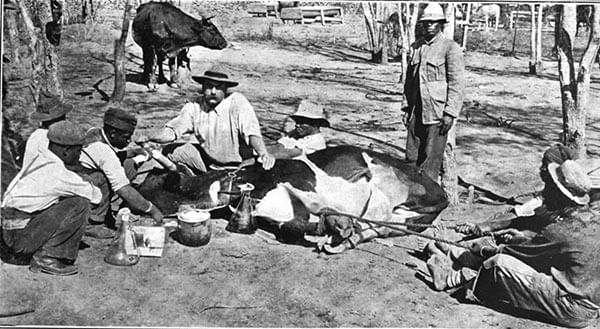
Q.1. Describe the impact of ‘Rinderpest’ on people’s livelihoods and local economy in Africa in the 1890s?  
OR
How did Rinderpest become instrumental in subjugating the Africans?

OR
Write a note to explain the effects of the coming of Rinderpest to Africa. 

Ans. Impact of Rinderpest:
(i) Rinderpest killed 90% of cattle in Africa.
(ii) The loss of cattle destroyed African livelihoods.
(iii) Planters, mine owners, and colonial governments took control of the limited cattle resources to boost their power and force Africans into the labor market.
(iv) Controlling cattle resources helped European colonists conquer and dominate Africa.  (Any three)

Q.2. Read the sources given below and answer the questions that follow:
SOURCE A:
 Silk Routes Link the World [NCERT History Ch. 3 Page 54] The silk routes are a good example of vibrant pre-modern trade and cultural links between distant parts of the world. The name ‘silk routes’ points to the importance of West-bound Chinese silk cargoes along this route. Historians have identified several silk routes, overland and by sea, knitting together vast regions of Asia, and linking Asia with Europe and northern Africa. They are known to have existed since before the Christian Era and thrived almost till the fifteenth century. But Chinese pottery also travelled the same route, as did textiles and spices from India and Southeast Asia. In return, precious metals – gold and silver – flowed from Europe to Asia.
SOURCE B: Late Nineteenth-Century Colonialism [NCERT History Ch. 3 Page 60] trade flourished and markets expanded in the late nineteenth century. But this was not only a period of expanding trade and increased prosperity. It is important to realize that there was a darker side to this process. In many parts of the world, the expansion of trade and a closer relationship with the world economy also meant a loss of freedoms and livelihoods. Late nineteenth-century European conquests produced many painful economic, social and ecological changes through which the colonized societies were brought into the world economy.
SOURCE C: Rinderpest, or the Cattle Plague [NCERT History Ch. 3 Page 62] In Africa, in the 1890s, a fast-spreading disease of cattle plague or Rinderpest had a terrifying impact on people’s livelihoods and the local economy. This is a good example of the widespread European imperial impact on colonized societies. It shows how in this era of conquest, even a disease affecting cattle reshaped the lives and fortunes of thousands of people and their relations with the rest of the world.
Historically, Africa had abundant land and a relatively small population. For centuries, land and livestock sustained African livelihoods, and people rarely worked for a wage. In late nineteenth-century Africa, there were few consumer goods that wages could buy. If you had been an African possessing land and livestock – and there was plenty of both – you too would have seen little reason to work for a wage.

The Cattle Plague

Questions: SOURCE A: Silk Routes Link the World
(i) Enlist the major items which travelled through the silk routes.
SOURCE B: Late Nineteenth-Century Colonialism
(ii) What was the negative impact of the expansion of trade and a closer relationship with the world economy in many parts of the world?
SOURCE C: Rinderpest, or the Cattle Plague
(iii) In your opinion, why were the Africans not interested in working for wages?
Ans.
 (i) Chinese pottery, textiles and spices from India and Southeast Asia and precious metals–gold and silver–from Europe to Asia were a few major items which travelled through the silk routes.
(ii) In many parts of the world, the expansion of trade and a closer relationship with the world economy also meant a loss of freedoms and livelihoods. Late nineteenth-century European conquests produced many painful economic, social and ecological changes through which the colonized societies were brought into the world economy.
(iii) Land and livestock were abundant, and the population was less, this was sufficient for the Africans to sustain their livelihood. This, in my opinion, could be a major reason for which they were not interested in working for wages.

Q.3. Critically examine the expansion of trade facilities in the 19th century. 
Ans. Expansion of trade facilities in the 19th century:
(i) In many parts of the world, these developments meant loss of freedom and livelihoods.(ii) In the late 19th century, European conquest brought about many destructive economic, social and ecological changes in the colonies.
(iii) In Africa, in the 1890s, a fast spreading disease of cattle plague or Rinderpest had a terrifying impact on people’s livelihoods and the local economy.
(iv) The example of indentured labour migration.
(v) Great misery and poverty for others.
(vi) New forms of coercion in Asia and Africa. (Any five)

Q.4. After the 19th century, how did the indentured labourers discover their own ways of survival? Explain.
Ans. 

(i) Initially, indentured laborers struggled with the harsh conditions on the plantations, but they soon found new ways to adapt.
(ii) They created new forms of self-expression, blending old and new art and cultural traditions.
(iii) In Trinidad, the Muharram procession evolved into a lively carnival called ‘Hosay,’ where people of all races and religions participated.
(iv) The protest religion Rastafarianism is believed to have links to Indian migrations to the Caribbean.
(v) Chutney music, popular in Trinidad and Guyana, is another form of creative expression from the post-indentured period.

Q.5. Explain the three types of flows within the international economy in exchanges. 
OR
Mention the three types of flows within international economic exchanges during the 19th century.
Ans. (i) Flow of Trade: Trade flow of goods, e.g. cloth or wheat, in which goods are exchanged at long and short distances. For example, Indian weavers produced fine quality cotton cloth and exported it to European countries. But post industrial revolution due to tariff barriers this changed drastically.
(ii) Flow of Labour: The migration of people in search of employment is called ‘Flow of Labour’. Nearly 50 million people emigrated from Europe to America and Australia in the 19th century. All over the world, some 150 million people are estimated to have left their homes, crossed oceans and vast distances over land in search of a better future.
(iii) Flow of Capital Investment for short-term or long-term investment: In this, movement of resources from one country to another takes place through loans or business investments. The British transferred a lot of capital from India to England before independence. All three are closely associated and affected the lives of people in the nineteenth century.

Q.6. What were the ‘Corn Laws’? How was it abolished?
OR
What were the Corn Laws? Why were the Corn Laws abolished? What was the result of the abolishing of Laws?

Ans. (i) The laws allowing the British Government to restrict the import of corn is known as the “Corn Laws”.
(ii) These laws were abolished because the industrialists and urban dwellers were unhappy with high food prices; as a result of which they forced the abolition of the Corn Laws.
Result: Food could be imported into Britain at a much cheaper rate. The immediate effect of the British Government’s decision to abolish the Corn Laws was the inflow of cheaper agricultural crops from America and Australia. Many English farmers left their profession and migrated to towns and cities.

Q.7. Describe three major consequences of the Second World War. 
Ans. Major consequences of the Second World War are as follows:
(i) The death toll from the war was enormous, with around 60 million people, or about 3 percent of the world’s 1939 population, believed to have died due to the conflict.
(ii) Millions more were injured, with most deaths occurring outside the battlefield, affecting civilians more than soldiers.
(iii) Large areas of Europe and Asia were devastated, and many cities were destroyed by bombing and artillery attacks.
(iv) The war led to significant economic and social damage, and rebuilding was expected to be long and challenging. (Any three)

Q.8. Explain how the global transfer of disease in the pre-modern world helped in the colonisation of the Americas?
Ans.
 Global transfer of disease in the pre-modern world helped in the colorization of the Americans:
(i) America was not conquered and colonised by Europeans with the help of superior fire power alone.
(ii) Germs, such as those of smallpox were helpful to a great extent.
(iii) Americans had no immunity against them as a result of long isolation. Once introduced, the germs spread deep into the continent decimating whole communities and paving way for conquest.

Q.9. Mention the two key lessons learnt from the inter-war economic experiences by the economists and politicians after the Second World War.
Ans. 
The two lessons learnt by the economists and politicians during the Second World War were:
First: An industrial society based on mass production needs mass consumption. For mass consumption, steady income was necessary and for stable income, full employment was necessary. For this, the government has to take steps to minimise the fluctuation of price, production and employment. Hence, economic stability could be ensured by the government intervention.
Second: They understood that international cooperation and economic integration were essential to avoid trade wars and economic conflicts that could lead to global instability.

Q.10. The First World War was a war like no other before. Explain any three features about the war that supports the statement. 
Ans. The three features of the war that supports the statements are:
(i) It involved the world’s leading industrial nations.
(ii) This war was the first modern industrial war. Machine guns, tanks, aircraft, chemical weapons, were used on a massive scale.
(iii) Most of those who were killed and aimed were men of working age. The scale of death and destruction was great. These deaths and injuries reduced the workforce.
(iv) Industries during the war were restructured to produce war-related products.
(v) The war led to the snapping of economic links between the world’s largest economic powers which were now fighting with each other to pay for them. The war transformed the US from being an international debtor to an international creditor. (Any three)

Q.11. How did the use of technology transform food availability in Europe?

OR
What was the impact of technology on food availability? Explain with the help of examples.
Ans. (i) Faster railways, lighter wagons and larger ships helped food to reach more cheaply and quickly from faraway farms to markets.
(ii) Earlier the animals were shipped live from America to Europe, many died on the way or became unfit to eat. Thus meat became expensive.
(iii) Refrigerated ships: The animals could be slaughtered at the starting point of America, Australia or New Zealand and transported to Europe as frozen meat.
(iv) This reduced the shipping cost and lowered prices in Europe.
(v) The poor could add variety to their food and it improved their living conditions.

Objective Type Question 
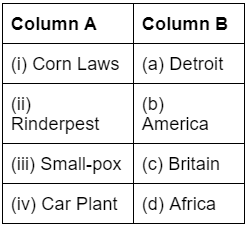
Q.12. Match the following:


Ans. (i)-(c), (ii)-(d), (iii)-(b), (iv)-(a)

Q.13. Arrange the following in the correct sequence:
(i) The Second World War
(ii) The Great Depression
(iii) The Chinese Revolution
(iv) The IMF and the World Bank Commenced financial operations
Options:
(a)
 (i) – (iii) – (iv) – (ii)
(b) (iii) – (iv) – (ii) – (i)
(c) (iv) – (ii) – (i) – (iii)
(d) (ii) – (i) – (iv) – (iii)
Ans. (d)

Q.14. Complete the following table related to resources on the basis of exhaustibility:


Ans.
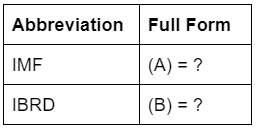
 (A)  –  International Monetary Fund
(B) – International Bank for Reconstruction and Development

Q.15. In Trinidad what was referred to as Hosay?
(a) 
Annual Muharram procession marking a Carnival.
(b) Christmas celebration
(c) Easter festival
(d) New Year celebration
Ans. (c)

Q.16. Until the 18th century, which two countries were considered the richest in the world?
(a)
 China and Japan
(b) England and France
(c) India and China
(d) England and Italy
Ans. (b)

Q.17. What is the meaning of ‘cultural fusion’? Give two examples how the indentured labour system led to cultural fusion. 
OR
“The indentured labour gave rise to a new culture in the Caribbean islands.” Justify this statement with suitable examples.
Ans. (i) Cultural fusion happens when two or more cultures mix and create a new culture.
(ii) Indentured labourers used to live and work in very harsh conditions. This pushed them to find new ways to relax and find comfort, which led to a mix of different cultural forms.
(iii) Examples:
(a) Hosay: In Trinidad, the annual Muharram procession was transformed into a riotous carnival called ‘Hosay’ in which workers of all races and religions joined.
(b) Chutney Music: ‘Chutney music’ is another creative contemporary expression of the post indentured experience.
(c) Rastafarianism: The protest religion of ‘Rastafarianism’ is also said to reflect social and cultural links with Indian migrants to the Caribbean. (Any two)

Q.18. Describe the social and economic effects of the World War on England and the USA. 
Ans. Social Effects:
(i) Most of those killed or injured were working-age people, which impacted the workforce in England.
(ii) Household income declined and women stepped in to take up jobs.
(iii) Role and position of women changed forever in England.
Economic Effects:
(i) Economic links between some of the major economic powers of the world were snapped.
(ii) England borrowed large sums of money from the US Banks.
(iii) USA emerged as an international creditor.
(iv) USA owned more assets in foreign countries than foreign countries owned in the USA. (Any two)

Q.19. ‘China became an attraction destination for investment by foreign MNCs in the 19th and 20th centuries.’ Justify the statement.
Ans.
 China became an attraction destination for investment by foreign MNCs in the 19th and 20th centuries because:
(i) Wages were relatively low in countries like China.
(ii) This was because of the low cost structure of the Chinese economy, most importantly its low wages.
(iii) TVs, mobile phones and toys were seen in the shops that seem to be made in China.

Q.20. Explain any five factors that led to the Great Depression of 1929.
OR
What do you know about the Great Depression? Write any two causes of it.
Ans. The Great Depression began around 1929 and lasted till the mid 1930s. During this period, most parts of the world experienced decline in production, employment, incomes and trade. Agricultural regions and communities were amongst the most affected.
Causes of Great Depression:
(i) Post-world war economy of the world was fragile. Agricultural overproduction was a problem. As prices slumped, farm produce rotted.
(ii) Many countries financed loans from the US.
(iii) US overseas lenders panicked at the sign of financial crisis.
(iv) Thus, banks were bankrupt and were forced to close down in Europe and in the US because they were unable to recover investments, collect loans and repay depositors.
(v) American capitalists stopped all loans.

3. The Making of a Global World – Textbook Worksheet  -1

Q1. Why did Europeans flee to America in the nineteenth century? Explain. Marks 3
OR

State three reasons why Europeans fled to America in the 19th century.

Ans. Europeans fled to America in the 19th century because:

  • Until the 19th century, poverty and hunger were common in Europe.
  • Cities were crowded, and deadly diseases were widespread.
  • Religious conflicts were common and religious dissenters were persecuted.
  • Scrapping of Corn Laws, led to the inability of British agriculture to compete with imports.
  • Thousands of people were left unemployed due to agricultural land lying uncultivated. So, people migrated in thousands, crossed oceans to find employment and a better future.
  • In America, plantations were growing cotton and sugar for the European market. These plantations were worked on by slaves. (Any three)


Q2. “Indian trade had played a crucial role in the late nineteenth-century world economy”. Analyze the statement.  Marks 5

Ans. Indian trade played a crucial role in the late nineteenth-century world economy. This statement can be analyzed through the following facts:

  • Trade Surplus: Britain had a trade surplus with India, i.e., a situation under which the value of exports is more than the imports. Britain used this surplus to balance its trade deficit with other countries.
  • Home charges: Britain’s trade surplus in India also helped to pay the so-called ‘home charges’ that included private remittances home by British officials and traders, interest payments on India’s external debts and pensions of the British officials in India.
  • Major supplier of cotton: India remained a major supplier of raw cotton to Britain, which was required to feed the cotton textile industry of Britain.
  • Supplier of indentured workers: Many indentured workers from Bihar, Uttar Pradesh, Central India migrated to other countries to work in mines and plantations.


Q3. Describe the economic conditions of Britain after the ‘First World War’. Marks 3
OR

Explain the impact of the First World War on the British economy. 

OR
Explain the three impacts of the First World War on the British economy.

Ans. Economic conditions of Britain after the First World War: After the First World War, Britain found it difficult to recapture its earlier position. Britain was burdened with huge external debts. The war had led to an economic boom, a large increase in demand, production and employment. When the war boom ended, production contracted and unemployment increased. At the same time, the government reduced bloated war expenditures to bring them into line with peace time revenues. These debts led to huge job losses. Many agricultural economists were also in crisis. Note: If a candidate writes in points, it is also to be considered.


Q4. Read the sources given below and answer the questions that follows:

SOURCE A: Wartime Transformations [NCERT History Ch. 3 Page 68] The First World War, as you know, was fought between two power blocs. On the one side were the Allies – Britain, France and Russia (later joined by the US); and on the opposite side were the Central Powers – Germany, Austria-Hungary and Ottoman Turkey. When the war began in August 1914, many governments thought it would be over by Christmas. It lasted more than four years. The First World War was a war like no other before. The fighting involved the world’s leading industrial nations which now harnessed the vast powers of modern industry to inflict the greatest possible destruction on their enemies.
SOURCE B: Post-War Recovery [NCERT History Ch. 3 Page 69] Post-War economic recovery proved difficult. Britain, which was the world’s leading economy in the pre-war period, in particular faced a prolonged crisis. While Britain was preoccupied with war, industries had developed in India and Japan. After the war, Britain found it difficult to recapture its earlier position of dominance in the Indian market, and to compete with Japan internationally. Moreover, to finance war expenditures Britain had borrowed liberally from the US. This meant that at the end of the war Britain was burdened with huge external debts. The war had led to an economic boom, that is, to a large increase in demand, production and employment. When the war boom ended, production contracted and unemployment increased. At the same time the government reduced bloated war expenditures to bring them into line with peacetime revenues. These developments led to huge job losses – in 1921 one in every five British workers was out of work. Indeed, anxiety and uncertainty about work became an enduring part of the post-war scenario.
SOURCE C: Rise of Mass-Production and Consumption [NCERT History Ch. 3 Page 69-70] In the US, recovery was quicker. We have already seen how the war helped boost the US economy. After a short period of economic trouble in the years after the war, the US economy resumed its strong growth in the early 1920s. One important feature of the US economy of the 1920s was mass production. The move towards mass production had begun in the late nineteenth century, but in the 1920s it became a characteristic feature of industrial production in the US. A well-known pioneer of mass production was the car manufacturer Henry Ford. He adapted the assembly line of a Chicago slaughterhouse (in which slaughtered animals were picked apart by butchers as they came down a conveyor belt) to his new car plant in Detroit. He realised that the ‘assembly line’ method would allow a faster and cheaper way of producing vehicles. The assembly line forced workers to repeat a single task mechanically and continuously – such as fitting a particular part to the car – at a pace dictated by the conveyor belt. This was a way of increasing the output per worker by speeding up the pace of work. Standing in front of a conveyor belt no worker could afford to delay the motions, take a break, or even have a friendly word with a workmate. As a result, Henry Ford’s cars came off the assembly line at three-minute intervals, a speed much faster than that achieved by previous methods. The T-Model Ford was the world’s first mass-produced car.

SOURCE A: Wartime Transformations
(i) Which were the two power blocs in the First World War?
SOURCE B: Post-War Recovery
(ii) Britain, which was the world’s leading economy in the pre-war period, in particular faced a prolonged crisis. Comment on this statement.
SOURCE C: Rise of Mass-Production and Consumption
(iii) The ‘assembly line’ method would allow a faster and cheaper way of producing vehicles. How?

Ans. (i) Two power blocs in the First World War were: On the one side were the Allies – Britain, France and Russia (later joined by the US); and on the opposite side were the Central Powers – Germany, Austria-Hungary and Ottoman Turkey.

(ii) While Britain was preoccupied with war, industries had developed in India and Japan. After the war Britain found it difficult to recapture its earlier position of dominance in the Indian market, and to compete with Japan internationally. Moreover, to finance war expenditures Britain had borrowed liberally from the US. This meant that at the end of the war Britain was burdened with huge external debts.

(iii) The assembly line forced workers to repeat a single task mechanically and continuously – such as fitting a particular part to the car – at a pace dictated by the conveyor belt. This was a way of increasing the output per worker by speeding up the pace of work. Standing in front of a conveyor belt no worker could afford to delay the motions, take a break, or even have a friendly word with a workmate.


Q5. Mention three reasons for the creation of the International Monetary Fund and the World Bank. 
Ans. 

  • The International Monetary Fund and the World Bank were created to meet the financial needs of the industrial countries.
  • When Japan and Europe rapidly rebuilt economies, they became less dependent on the IMF and the World Bank.
  • Thus, from the late 1950s the Bretton Woods institutions, World Bank and IMF, began to turn their attention towards newly developing countries.
  • The newly independent countries facing problems of poverty came under the guidance of international agencies dominated by the former colonial powers. (Any three)


Q6. What do G-77 countries want to gain from the New International Economic Order? Describe. 
OR
What is G-77? What were its demands?
OR
Explain what is referred to as the G-77 countries. In what ways can G-77 be seen as a reaction to the activities of the Bretton Woods twins?
Ans. G-77 or Group of 77 refers to the seventy seven developing countries that did not benefit from the fast growth western economies experienced in 1950s and 1960s. So, they organized themselves into G-77. They demanded: 

  1. A new international economic order that would give them real control over their natural resources.
  2. More development assistance.
  3. Fairer prices for raw material.
  4. Better access for their manufactured goods in developed countries’ markets.


Analyze the information given below, considering one of the following correct options:

Q7. Consider the jute producers of Bengal. They grew raw jute that was processed in factories for export in the form of gunny bags. But as gunny exports collapsed, the price of raw jute crashed more than 60 per cent. Peasants who borrowed in the hope of better times or to increase output in the hope of higher incomes faced ever lower prices, and fell deeper and deeper into debt. Thus the Bengal jute growers’ lament: Grow more jute, brothers, with the hope of greater cash. Costs and debts of jute will make your hopes get dashed. When you have spent all your money and got the crop off the ground,… traders, sitting at home, will pay only Rs 5 a maund.
(a) The Great Depression
(b) India and the Great Depression
(c) Post-War Recovery
(d) Rise of mass Production and Consumption

Ans. (b) India and the Great Depression

Answer in one word/one sentence:

Q8. What do ‘Silk Routes refer to?
Ans. Network of routes connecting Asia with Europe and Northern Africa.


Q9. Who discovered the continent of America?
Ans. Christopher Columbus.


Q10. Who was a well-known Pioneer of mass production?
Ans. Henry Ford

Fill in the blanks:

Q11. ______ was a Nobel Prize winning writer who was a descendant of indentured labour from India.
Ans. V.S. Naipaul


Q12. ______ discovered the American Continent.
Ans. Christopher Columbus


Q13. Britain and Russia were known as ______ powers in the First World War.
Ans. Allied


Q14. Explain the destruction caused during the Second World War. Mention two crucial influences which shaped post-war reconstruction.
Ans. 

  • Unlike earlier wars, most of the deaths took place outside the battlefields.
  • More civilians than soldiers died from war.
  • Vast parts of Asia and Europe were devastated.
  • Cities were destroyed.
  • There was an immense amount of economic devastation.

Two crucial influences:
First: U.S’s emergence as military power in the western world.
Second: Dominance of the Soviet Union.


Q15. Elucidate any three factors that led to the Great Depression.
Ans. 

  • Agricultural overproduction remained a problem and it was made worse by falling agricultural prices.
  • As prices slumped and agricultural incomes declined, farmers tried to expand production and bring a large volume of produce to the market but it pushed down prices.
  • In the mid-1920s, many countries financed their investments through loans from the US, it was extremely easy to raise loans in the US.
  • But in the first half of the 1920s, countries that depend crucially on US loans faced an acute crisis.
  • The withdrawal of the US loans affected the rest of the world in different ways. In Europe, it led to the failure of small major banks and the collapse of currencies such as the British Pound Sterling. (Any three)