2. Nationalism in India – Textbook Worksheet – 2

Q.1. Evaluate the role of business classes in the ‘Civil Disobedience Movement’. Marks 3
Ans.
 Role of Business class in ‘Civil Disobedience Movement’:
(i) The business class reached against policies that restricted business activities.
(ii) They wanted protection against imports of foreign goods and a rupee-sterling foreign exchange ratio that would discourage imports.
(iii) In order to organise business interest, they formed the Indian Industrial and Commercial Congress in 1920 and the Federation of the Indian Chamber of Commerce and Industries (FICCI) in 1927.
(iv) They gave financial assistance for the movement.
(v) They refused to buy and sell imported goods. (Any other relevant point)

Q.2. Who had organized the dalits into the ‘Depressed classes Association in 1930’? Describe his achievements. Marks 5
Ans. 
Depressed Classes Association was organized by Dr. B. R. Ambedkar in 1930. Achievements:
(i) Dr. B. R. Ambedkar raised the demand of a separate electorate for Dalits.
(ii) British government conceded Ambedkar’s demand of separate electorates for Dalits
(iii) The depressed classes got reservation of seats in provincial and Central Legislative Councils.
(iv) Ambedkar accepted Gandhi’s position and as the result Poona Pact was signed. (Any other relevant point)

Q.3. Why did Mahatma Gandhi relaunch the Civil Disobedience Movement with great apprehension? Explain. Marks 5
Ans. Mahatma Gandhi relaunched the Civil Disobedience Movement with great apprehension:
(i) In December, 1931 Gandhiji went to London for the Round Table Conference, but the negotiations broke down and he returned disappointed.
(ii) In India, he discovered that the government had begun a new cycle of repression.
(iii) Abdul Ghaffar Khan and Jawaharlal Nehru were both in jail.
(iv) The Congress had been declared illegal.
(v) A series of measures had been imposed to prevent meetings, demonstrations and boycotts.

Q.4. Why did Mahatma Gandhi find in ‘Salt’ a powerful symbol that could unite the nation? Explain. Marks 5
Ans. Mahatma Gandhi found ‘Salt’ a powerful symbol : Gandhiji sent a letter to Viceroy Irwin starting eleven demands on 31st January, 1930. The most stirring of all was to abolish the salt tax. Salt was one of the most essential items of foods. It was consumed both by rich and poor alike. He urged them to peacefully defy the tax imposed on salt. On 6th April he reached Dandi and violated the law.

Q.5. Critically examine the main aspects of Indian National Movement during the period between 1920 and 1935. Marks 5
Ans. 
Following are the main aspects of the Indian National Movement between 1920-1935:
(i) Beginning of Mass Movement after Jallianwala Bagh Massacre.
(ii) Application of satyagraha to mass movement, new methods to protest, boycott, picketing, renunciation of titles, and non-payment of taxes.
(iii) People of different sections and parts shared a common bond of resistance—united in their hatred against the British rule.
(iv) Industrialists led by Purshottamdas Thakurdas and G. D. Birla criticised colonialism.

Q.6. Compare the images of Bharat Mata in this chapter with the image of Germania in Chapter 1. Marks 3
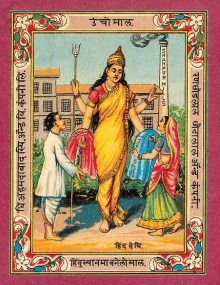
Ans. (i) The image of Bharat Mata created by Abanindranath Tagore is portrayed as an ascetic figure. She is calm, composed, divine and spiritual. Another image of Bharat Mata is shown with a trishul, standing beside a lion and an elephant both are the symbols of power and authority.
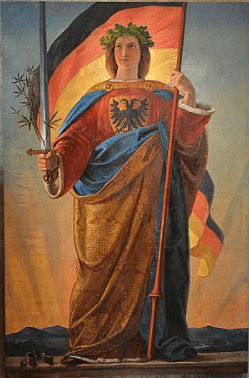
(ii) Germania was the symbol of the German nation. She is depicted as a female figure standing against a background where beams of sunlight shine through the tricolour fabric of the national flag. Germania is wearing a crown of oak leaves, as the German oak stands for heroism.

Analyze the information given below, considering one of the following correct options:
Q.7. Mahatma Gandhi’s letter was, in a way, an ultimatum. If the demands were not fulfilled by 11 March, the letter stated, the Congress would launch a Civil Disobedience Campaign. Irwin was unwilling to negotiate. So Mahatma Gandhi started his famous salt march accompanied by 78 of his trusted volunteers. The march was over 240 miles, from Gandhiji’s ashram in Sabarmati to the Gujarati coastal town of Dandi. The volunteers walked for 24 days, about 10 miles a day. Thousands came to hear Mahatma Gandhi wherever he stopped, and he told them what he meant by swaraj and urged them to peacefully defy the British. On 6 April, he reached Dandi, and ceremonially violated the law, manufacturing salt by boiling sea water.
(a) Non-Cooperation Movement
(b) Salt March
(c) Khilafat Movement
(d) Rowlatt Act
Ans. b

Answer in one word/one sentence:
Q.8.Trace the reason because of which Gandhiji started Satyagraha in 1919.
Ans. To protest against the Rowlatt Act

Fill in the blanks:
Q.9. In Lahore, the resolution of ______ was adopted in 1929.
Ans.
 Purna Swaraj

Q.10. Assertion and Reason Type Questions :the question given below, there are two statements. One is marked as Assertion (A) and other as Reason (R). Read the statements and choose the correct option:
Assertion:
 It was declared that 26th January, 1930 would be celebrated as Independence Day when people were to take a pledge to struggle for Complete Independence.
Reason: Mahatma Gandhi had to find a way to relate this abstract idea of freedom to more concrete issues of everyday life.
(a) Both (A) and (R) are true and (R) is the correct explanation of (A).
(b) Both (A) and (R) are true but (R) is not the correct explanation of (A).
(c) (A) is correct but (R) is wrong.
(d) (A) is wrong but (R) is correct.
Ans. a

Q.11. Explain the issue behind the Khilafat Movement. Marks 3
OR
What was the Khilafat Agitation? Why did Gandhiji give support to this agitation?
Ans.
Khilafat Agitation:
(i) The Khilafat movement (1919–1924) initiated by Muhammad Ali and Shaukat Ali was a mass movement against the reduction of temporal powers of Caliph after defeat of Ottoman-Turkey in the First World War.
(ii) To defend Khalifa’s temporal powers, the Khilafat Committee was formed in 1919 as he was considered as the spiritual head of Muslims.
(iii) Gandhiji supported it because he saw it as an opportunity to bring Muslims under the umbrella of a unified National Movement

Q.12. Describe the spread of Non-Cooperation Movement in the countryside. Marks 3
Ans.
 Non-Cooperation Movement spread in the countryside
(i) In Awadh, peasants were led by Baba Ramchandra. Here the movement was against talukdars and landlords who demanded from peasants exorbitantly high rents and a variety of other cesses.
(ii) Peasants had to beg and work at landlords’ farms without any payments. As tenants, they had no security of tenure and were regularly evicted so that they have no right over the leased land.
(iii) The peasant movement demanded reduction of revenue, abolition of begar and social boycott of oppressive landlords. In the meantime, Jawaharlal Nehru began going around the villages in Awadh.
(iv) The Awadh Kisan Sabha was set up in the villages. The peasant movement, however, developed in forms that the Congress leadership was unhappy with.
(v) As the movement spread, the houses of talukdars and merchants were attacked: bazaars were looted and grain hoards were taken over. (Any three)

Q.13. How had the First World War created a new economic situation in India? Explain with three examples. Marks 3
Ans. Three points on the First World War’s impact on the economic situation in India are given below:
(i) It led to a huge rise in the defence expenditure of the Government of India.
(ii) Custom duties were increased and income tax was introduced.
(iii) The prices of the goods doubled between 1913-1918 and created hardships for the people.
(iv) Forced recruitment was carried out and men from the villages were forced to become soldiers.

Q.14. How did Mahatma Gandhi successfully organise Satyagraha Movement in various places just after arriving in India? Explain by giving three examples. Marks 3
Ans. After arriving in India, Mahatma Gandhi successfully organised Satyagraha Movement in various places:
(i) In 1916, he travelled to Champaran in Bihar to inspire the peasants to struggle against the oppressive plantation of Indigo.
(ii) In 1917, he organised a Satyagraha to support the peasants of the Kheda district of Gujarat who were affected by crop failure and plague epidemic and could not pay the revenue.
(iii) In 1918, Mahatma Gandhi went to Ahmedabad to organize the Satyagraha Movement amongst cotton mill workers.

Q.15. How did Gandhiji convert the National Movement into a mass movement? Marks 5
Ans. 
Gandhiji converted the National Movement into a mass movement by:
(i) His simple and saintly lifestyle and style of convincing the masses made him popular.
(ii) His undisputed leadership and magnetic personality.
(iii) His policy of non-violent satyagraha.
(iv) His programmes of social reforms like fighting against untouchability.
(v) His commitment to Hindu-Muslim unity.

Q.16. Describe the main features of ‘Poona Pact‘. Marks 3
Ans. The main features of ‘Poona Pact’ were:
(i) The Poona Pact (September 1932) gave Depressed Classes (later to be known as Scheduled Caste) reserved seats in provincial and central legislative councils.
(ii) They were to be voted in by the general electorate.
(iii) The Act came into force due to Gandhi’s fast unto death.
(iv) Dr. B. R. Ambedkar ultimately accepted Gandhiji’s stand. (Any three)
Q.17. Explain the grievances of the peasants against the government. What steps were taken to organise the Peasant Movement to fulfil their demands during colonial rule? Marks 5
Ans. Reasons of grievances of the peasants against the government were:
(i) Due to forest laws of the colonial government.
(ii) Depriving them of the traditional rights of entering the forest to graze their cattle or to collect fuelwood and fruits.
(iii) High land revenues.
(iv) Forced to perform begar. (Any three)
Steps taken to organise Peasant Movement:
(i) Many kisan sabhas were organised.
(ii) Organised guerrilla militant movement.
(iii) Attacked police stations and attempted to kill British police officials.
(iv) Gandhiji declared that no tax to be paid. (Any two)

Q.18. Read the sources given below and answer the questions that follows:
SOURCE A : The Salt March and the Civil Disobedience Movement [NCERT History Ch. 2 Page 40] Worried by the developments, the colonial government began arresting the Congress leaders one by one. This led to violent clashes in many places. When Abdul Ghaffar Khan, a devout disciple of Mahatma Gandhi, was arrested in April 1930, angry crowds demonstrated in the streets of Peshawar, facing armoured cars and police firing. Many were killed. A month later, when Mahatma Gandhi himself was arrested, industrial workers in Solapur attacked police posts, municipal buildings, law courts and railway stations – all structures that symbolised British rule. A frightened government responded with a policy of brutal repression. Peaceful satyagrahis were attacked, women and children were beaten, and about 100,000 people were arrested.
SOURCE B : How Participants saw the Movement [NCERT History Ch. 2 Page 41] The industrial working classes did not participate in the Civil Disobedience Movement in large numbers, except in the Nagpur region. As the industrialists came closer to the Congress, workers stayed aloof. But in spite of that, some workers did participate in the Civil Disobedience Movement, selectively adopting some of the ideas of the Gandhian programme, like boycott of foreign goods, as part of their own movements against low wages and poor working conditions. There were strikes by railway workers in 1930 and dockworkers in 1932. In 1930 thousands of workers in Chhotanagpur tin mines wore Gandhi caps and participated in protest rallies and boycott campaigns. But the Congress was reluctant to include workers’ demands as part of its programme of struggle. It felt that this would alienate industrialists and divide the anti-imperial forces.
SOURCE C : The Sense of Collective Belonging The identity of the nation, as you know is most often symbolised in a figure or image. This helps create an image with which people can identify the nation. It was in the twentieth century, with the growth of nationalism, that the identity of India came to be visually associated with the image of Bharat Mata. The image was first created by Bankim Chandra Chattopadhyay. In the 1870s he wrote ‘Vande Mataram’ as a hymn to the motherland. Later it was included in his novel Anandamath and widely sung during the Swadeshi Movement in Bengal. Moved by the Swadeshi movement, Abanindranath Tagore painted his famous image of Bharat Mata. In this painting Bharat Mata is portrayed as an ascetic figure; she is calm, composed, divine and spiritual. In subsequent years, the image of Bharat Mata acquired many different forms, as it circulated in popular prints, and was painted by different artists. Devotion to this mother figure came to be seen as evidence of one’s nationalism.
Questions : SOURCE A:
(i) What happened when Abdul Ghaffar Khan was arrested ?
SOURCE B:
(ii) What did the workers in Chhotanagpur tin mines do ?
SOURCE C:
(iii) What were Bankim Chandra Chattopadhyay’s contributions in nationalism of India?

Ans. (i) When Abdul Ghaffar was arrested in April 1930, angry crowds demonstrated in the streets of Peshawar, facing armoured cars and police firing. Many were killed.
(ii) In 1930 thousands of workers in Chhotanagpur tin mines wore Gandhi caps and participated in protest rallies and boycott campaigns.
(iii) The image of Bharat Mata was created by Bankim Chandra Chattopadhyay. In 1870, he wrote ‘Vande Mataram’ as a hymn to the Motherland. Later it was sung during the Swadeshi Movement in Bengal.

Q.19. How was the sense of collective belonging developed during the freedom movement ? Explain. Marks 5
OR
How did a variety of cultural processes play an important role in the making of nationalism in India? Explain with examples.
OR
How did people belonging to different communities, regions or language groups develop a sense of collective belonging?

Ans. (i) This sense of collective belonging came partly through the experience of united struggles and growing anger among people against the colonial government.
(ii) But there were also a variety of cultural processes through which nationalism captured people‘s imagination:
(a) The identity of the nation symbolised in a figure or image of Bharat Mata created through literature, songs, paintings, etc.
(b) Movement to revive Indian folklore to enhance nationalist sentiments.
(c) Role of icons and symbols in unifying people and inspiring in them a feeling of nationalism.
(d) Creating a feeling of nationalism was through reinterpretation of history.

Q.20. Explain any three features of the Peasant Movement organised in Awadh in the second decade of 20th century. Marks 3
Ans. (i) In the second decade of the 20th century, a Peasant Movement started against exploitation of talukdars and landlords.
(ii) The movement was led by Baba Ramchandra who was earlier a Sanyasi.
(iii) The peasants through this movement demanded reduction of revenue, abolition of ‘begar’ and social boycott of oppressive landlords.
2. Nationalism in India – Textbook Worksheet – 1

Q.1. Describe the role of Alluri Sitaram Raju in Andhra Pradesh during 1920s. Marks 3
Ans. Role of Alluri Sitaram Raju in the Gudem hills of Andhra Pradesh:
(i) Alluri Sitaram Raju claimed that he had a variety of special powers like making astrological predictions, healing people and surviving bullet shots.
(ii) The rebels proclaimed him as an incarnation of God.
(iii) Raju was inspired by Gandhi’s Non-Cooperation Movement.
(iv) Persuaded people to wear khadi and give up drinking.
(v) But at the same time he asserted that India could be liberated only by the use of force, not non-violence.
(vi) Used guerrilla warfare for achieving swaraj. (To be assessed as whole)

Q.2. Why did Gandhiji decide to launch a nationwide ‘Satyagraha’ against the proposed Rowlatt Act (1919)? How was it opposed? Explain. Marks 5
Ans.
 Gandhi ji decided to launch a nation-wide Satyagraha:

(i) This Act had been hurriedly passed through the Imperial Legislative Council.
(ii) Indian members opposed the Act.
(iii) It gave the government enormous powers to repress political activities.
(iv) It allowed detention of political prisoners without trial for two years. (Any two points to be explained)
It opposed in the following ways: (i) Rallies were organised in various cities.
(ii) Workers went on strike.
(iii) Shops were closed.
(iv) Communication, railway, telegraphs lines were disrupted. (Any other relevant point) (Any three)
Q.3. “British rule in India would have collapsed if Indians had not cooperated.” How did this statement help in starting a mass movement in India against the British rule? 
Ans. (i) Mahatma Gandhi declared that British rule was established in India with the cooperation of Indian and if Indians had refused to cooperate, British rule in India would have collapsed within a year.
(ii) He proposed that the movement should unfold in stages.
(iii) It should begin with the surrendering of titles that the government had awarded to the Indians.
(iv) A boycott of civil services, army, police, courts and legislative assemblies, schools and foreign goods would show their non-cooperation to the British empire.
(v) Mahatma Gandhi felt that in case the government used repression, a full civil disobedience campaign would be launched. (Any three)

Q.4. Explain the effects of the First World War on India. Marks 5

OR
How did the ‘First World War’ create new economic and political situations in India? Explain with examples. 
OR
Explain any five major problems posed by the First World War in India. 
OR
Examine the effects of the First World War on the National Movement of India.
OR
Explain How the First World War helped in the growth of the National Movement in India. [NCERT]
Ans. (i) The war created a new economic and political situation.

(ii) It led to a huge increase in defence expenditure which was financed by war loans.

(iii) To fulfil the loan demands taxes were increased, custom duties were raised. Not only this, a new tax in the form of income tax was also introduced.

(iv) Prices increased, doubling between 1913 and 1918. This hit the common people.

(v) Villagers were asked to supply soldiers and through force recruitment in rural areas.

(vi) During 1918-19, crops failed in many parts of India which created a shortage of food.

(vii) Spread of influenza epidemic and death of 12 to 13 million people. (Any five)

Q.5. Define the term ‘Civil Disobedience Movement’. Describe the participation of rich and poor peasant communities in the ‘Civil Disobedience Movement’. Marks 5
Ans. 
Civil Disobedience Movement: To disobey the rules of the British Government.

Participation of rich and poor peasants:
(i) In the countryside, rich peasant communities like patidars of Gujarat and Jats of U.P. were active inmovement.
(ii) Rich peasants participated in the movement as a struggle against high revenue demand.
(iii) Rich peasants organized their community to support the Civil Disobedience Movement.
(iv) The poor peasants participated as they wanted their unpaid rent to be remitted. (Any other relevant point)

Detailed Answer: Definition of Civil Disobedience Movement: Civil Disobedience Movement refers to the act by a group of people by refusing to obey laws or pay taxes, as a peaceful way of expressing their disapproval of those laws or taxes and in order to persuade the government to change them. Gandhiji and Martin Luther King both conducted Civil Disobedience Movements in their respective countries to get rid of the exploitation and oppression offered by their colonial rulers.
(i) Rich Peasants: Depression and fall in prices affected them badly. They demanded reduction in land revenue. Swaraj meant reduction of taxes for them. They were disappointed when the movement was called off.
(ii) Poor Peasants: Depression affected them badly. They demanded reduction in rent. Swaraj meant reduction of rent for them. They joined Communist and revolutionary movements.

Q.6. Explain in brief the ‘Dandi March’. Marks 3
OR
Describe the main features of the ‘Salt March’. 

Ans. (i) Mahatma Gandhi started his famous ‘Salt March’ or ‘Dandi March’ on 11th March, 1930 accompanied by 78 of his trusted volunteers.
(ii) The march was to cover 240 miles from Gandhi’s ashram in Sabarmati to the Gujarati Coastal town of Dandi.
(iii) On 6th April, 1930, he reached Dandi and ceremonially violated the law by manufacturing salt by boiling sea water.
(iv) This marked the beginning of the Civil Disobedience Movement. (Any three)

Correct the following statement and rewrite:
Q.7. The import of foreign cloth doubled between 1921 and 1922, its value increasing from ₹ 102 Crore to ₹ 200 Crore.

Ans. The import of foreign cloth halved between 1921 and 1922, its value dropping from ₹102 Crore to ₹57 Crore.

Q.8. In 1928, the Hindustan Socialist Republician Army (HSRA) was founded at a meeting in Ferozeshah Kotla ground in Kolkata.
Ans.
 In 1928, the Hindustan Socialist Republician Army (HSRA) was founded at a meeting in Ferozeshah Kotla ground in Delhi.

Find the incorrect option:
Q.9. (a) In 1928, Vallabhbhai Patel led the peasant movement in Bardoli, a taluka in Gujarat.
(b) It was against enhancement of land revenue, known as the Civil Disobedience Movement.
(c) This movement was a success under the able leadership of Vallabhbhai Patel.
(d) The struggle was widely publicized and generated immense sympathy in many parts of India.
Ans.
 The Incorrect option is (b): It was against enhancement of land revenue, known as the Civil Disobedience Movement.

Correct answer is: It was against enhancement of land revenue, known as Bardoli Satyagraha.

Q.10. What type of flag was designed during the ‘Swadeshi Movement’ in Bengal? Explain its main features. Marks 3
Ans. During the “Swadeshi Movement” in Bengal the flag was designed as a Tricolour Flag.
The two features of the flag were:
(i) The colour of the flag was Red, Green and Yellow.
(ii) It had eight lotuses representing eight provinces in British India.
(iii) It had a crescent moon representing Hindus and Muslims. (Any two)

Q.11. Explain any five factors which gave rise to the Civil Disobedience Movement of 1930. Marks 5
Ans. Factors that gave rise to the Civil Disobedience Movement were:

(i) The problem with the Simon Commission.
(ii) Irwin’s vague offer of dominion status for India in an unspecified future.
(iii) Salt Law (iv) Negligence of eleven demands of Gandhiji by the British.
(v) Lahore Session of INC (1929)

Q.12. Explain the attitude of the Indian merchants and the industrialists towards the ‘Civil Disobedience Movement’. Marks 5
Ans. The attitude of the Indian merchants and the industrialists towards the Civil Disobedience Movement: 
(i) During the First World War, Indian merchants and industrialists had made huge profits and became powerful.
(ii) They wanted protection against imports of foreign goods and a Rupee-Sterling Foreign Exchange ratio that would discourage import.
(iii) To organise business interest they formed the Indian Industrial and Commercial Congress (in 1920) and the Federation of Indian Chamber of Commerce and Industries—FICCI ( in 1927).
(iv) They gave financial assistance and refused to buy or sell imported goods.
(v) Most businessmen came to see ‘Swaraj’ as a time when colonial restrictions on business would no longer exist and trade and industry would flourish without constraints.(vi) After the failure of the Round Table Conference business groups were no longer uniformly enthusiastic.

(vii) They were apprehensive of the spread of militant activities and worried about prolonged disruption of business. (Any five)

Q.13. How did the Civil Disobedience Movement come into force in various parts of the country? Explain with examples.  Marks 5
Ans.
 The Civil Disobedience Movement came into force in various parts of the country :
(i) Gandhi led the Salt March from Sabarmati Ashram to Dandi with his followers starting the Civil Disobedience Movement.
(ii) Thousands in different parts of the country broke the Salt Law, manufactured salt and demonstrated in front of government salt factories.
(iii) In the countryside like the rich Patidars of Gujarat and Jats of Uttar Pradesh were active in the movement.
(iv) As rich peasant communities were very hard hit by the trade depression and falling prices, they became enthusiastic supporters of the Civil Disobedience Movement.
(v) As the depression continued and the cash invoice dwindled, the small tenants found it difficult to pay the rent. They wanted the unpaid rent to the landlords to be remitted and thus they joined the movement.
(vi) Merchants and industrialists supported the movement by giving financial assistance and refused to buy and sell the imported goods.
(vii) The industrial working class of Nagpur region participated in the Civil Disobedience Movement (CDM).
(viii) Railway workers, dock workers, coal mine workers of Chhota Nagpur, etc. participated in protest rallies and boycott campaigns.
(ix) Women also participated in large numbers. (Any five)

Q.14. Read the sources given below and answer the questions that follows:
SOURCE A : Towards Civil Disobedience [NCERT History Ch. 2 Page 38] In February 1922, Mahatma Gandhi decided to withdraw the Non-Cooperation Movement. He felt the movement was turning violent in many places and satyagrahis needed to be properly trained before they would be ready for mass struggles. Within the Congress, some leaders were by now tired of mass struggles and wanted to participate in elections to the provincial councils that had been set up by the Government of India Act of 1919. They felt that it was important to oppose British policies within the councils, argue for reform and also demonstrate that these councils were not truly democratic. C. R. Das and Motilal Nehru formed the Swaraj Party within the Congress to argue for a return to council politics. But younger leaders like Jawaharlal Nehru and Subhas Chandra Bose pressed for more radical mass agitation and for full independence.
SOURCE B : The Independence Day Pledge, 26 January, 1930 [NCERT History Ch. 2 Page 39] ‘We believe that it is the inalienable right of the Indian people, as of any other people, to have freedom and to enjoy the fruits of their toil and have the necessities of life, so that they may have full opportunities of growth. We believe also that if any government deprives a people of these rights and oppresses them, the people have a further right to alter it or to abolish it. The British Government in India has not only deprived the Indian people of their freedom but has based itself on the exploitation of the masses, and has ruined India economically, politically, culturally, and spiritually. We believe, therefore, that India must sever the British connection and attain Purna Swaraj or Complete Independence.’
SOURCE C : The Salt March and the Civil Disobedience Movement [NCERT History Ch. 2 Page 39] Mahatma Gandhi found in salt a powerful symbol that could unite the nation. On 31 January 1930, he sent a letter to Viceroy Irwin starting eleven demands. Some of these were of general interest; others were specific demands of different classes, from industrialists to peasants. The idea was to make the demands wide-ranging, so that all classes within Indian society could identify with them and everyone could be brought together in a united campaign. The most stirring of all was the demand to abolish the salt tax. Salt was something consumed by the rich and the poor alike, and it was one of the most essential items of food. The tax on salt and the government monopoly over its production, Mahatma Gandhi declared, revealed the most oppressive face of British rule. Marks 3
Question : SOURCE A : Towards Civil Disobedience
(i) What was the major reason behind the formation of the Swaraj Party?
SOURCE B : The Independence Day Pledge, 26 January, 1930
(ii) What was the negative impact of the British rule in India?
SOURCE C : The Salt March and the Civil Disobedience Movement
(iii) In Mahatma Gandhi’s opinion, what revealed the true oppressive face of the British government?
Ans. 
(i) C. R. Das and Motilal Nehru formed the Swaraj Party within the Congress to argue for a return to council politics.
(ii) Negative impact of the British rule in India: The British Government in India had not only deprived the Indian people of their freedom but had also based itself on the exploitation of the masses, and had ruined India economically, politically, culturally, and spiritually.
(iii) Salt was something consumed by the rich and the poor alike, and it was one of the most essential items of food. The tax on salt and the government monopoly over its production, Mahatma Gandhi declared, revealed the most oppressive face of British rule.

Q.15. Why was the ‘Salt March’ considered an effective symbol of resistance against colonialism? Explain. Marks 5
Ans. Salt March:
(i) Salt was consumed by all the sections of the society.
(ii) It was the most essential item of food.
(iii) The tax on salt and the government monopoly over production.
(iv) Gandhiji found salt as a powerful symbol that could unite the nation.
(v) On 31st January 1930, he sent a letter to Viceroy Irwin starting eleven demands.
(vi) The idea was to make the demands wide ranging, so that all classes within Indian society could identify with them and everyone could be brought together in a united campaign.
(vii) The most stirring of all was the demand to abolish the salt tax. (Any five)

1. The Rise of Nationalism in Europe – Textbook Worksheet – 3

Q.1. Why in the years after 1848, the autocrats of Central and Eastern Europe began to introduce the changes that had already taken place in Western Europe before 1815? Explain. Marks 3
OR
What forced the monarchs to introduce reforms in the society?
Ans. Though conservative forces were able to suppress liberal movements in 1848, they could not restore the old order. Monarchs were beginning to realise that the cycles of revolution and repression could only be ended by granting concessions to the liberal-nationalist revolutionaries. Hence, in the years after 1848, the autocratic monarchies of Central and Eastern Europe began to introduce the changes that had already taken place in Western Europe before 1815. Thus, serfdom and bonded labour were abolished both in the Habsburg dominations and in Russia. The Habsburg rulers granted more autonomy to the Hungarians in 1867.

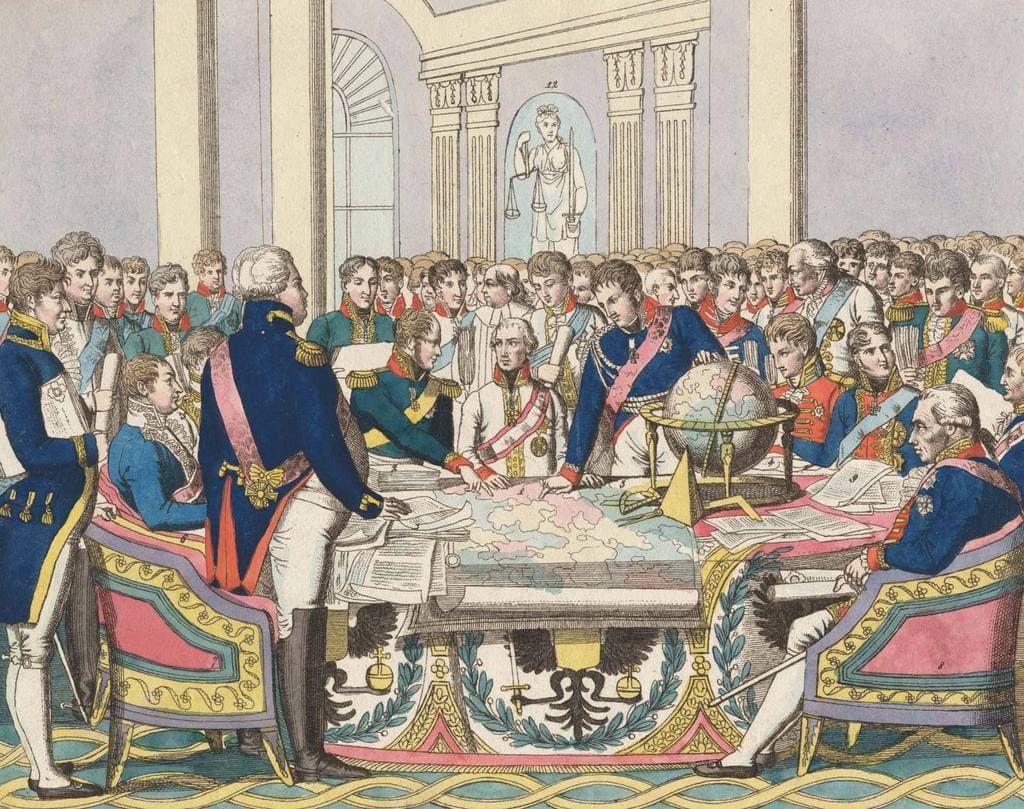
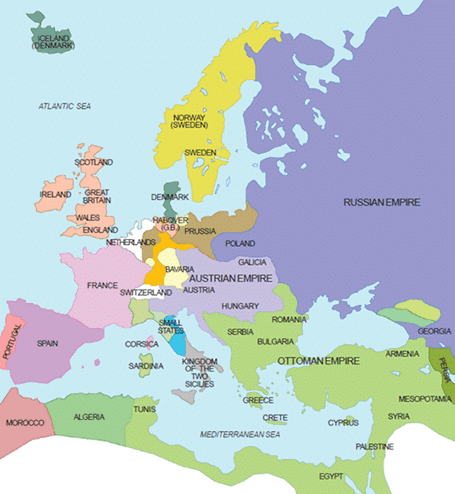
Q.2. Who hosted ‘Vienna Congress’ in 1815? Analyse the main changes brought by the ‘Vienna Treaty.’ Marks 5
Ans. 
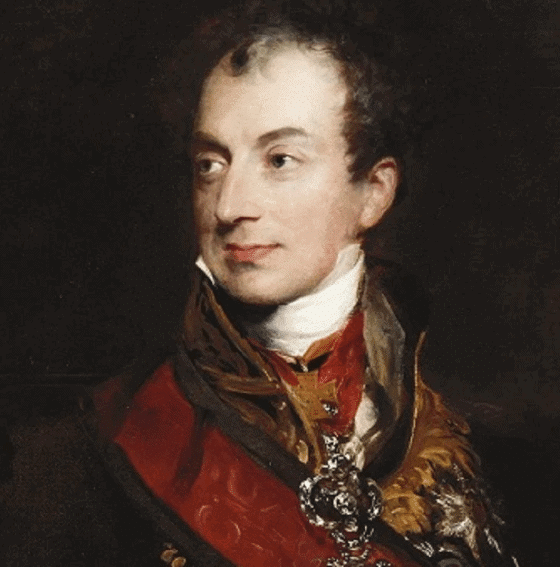
Congress of Vienna was hosted by Austrian Chancellor Duke Metternich in 1815. The following changes were made:
(i) The Bourbon Dynasty, which had been deposed during the French Revolution, was restored to power and France lost the territories it had annexed.
(ii) A series of states were set up on the boundaries of France to prevent the French expansion in future. Thus, the kingdom of the Netherlands, which included Belgium, was set up in the north and Genoa was added to Piedmont in the south.
(iii) Prussia was given important new territories on its  western frontiers, while Austria was given control of northern Italy.
(iv) The German confederation of 39 states that had been set up by Napoleon was left untouched.

Congress of Vienna

Q.3. How had revolutionaries spread their ideas in many European states after 1815? Explain with examples. Marks 3
Ans: (i) After 1815, many liberal nationalists went underground for the fear of repression. Secret societies emerged in many European states to train revolutionaries and spread their ideas. Giuseppe Mazzini, an Italian revolutionary, founded two underground societies—first, Young Italy in Marseilles and then, Young Europe in Berne. Following the footsteps of Mazzini, many secret societies were set up in Germany, France, Switzerland and Poland.
(ii) Romanticism was a cultural movement which sought to develop a particular form of nationalist sentiment. The romantics used folk songs, folk poetry and folk dances to popularize the true spirit of the nation. For example, Karol Kurpinski celebrated the national struggle through his operas and music in Poland. He turned folk dances like polonaise and mazurka into nationalist symbols.
(iii) Language also played an important role in developing nationalist sentiments. For example, it was mainly used as a weapon of national resistance when the Polish language was forced out of schools and the Russian language was imposed everywhere in Poland.

Q.4. Assertion and Reason Type Questions: the question given below, there are two statements. One is marked as Assertion (A) and other as Reason (R). Read the statements and choose the correct option:
Assertion: Giuseppe Garibaldi was an Italian General, politician and nationalist who played a large role in the history of Italy.
Reason: He was the architect in the process of nation – building.
(a) Both (A) and (R) are true and (R) is the correct explanation of (A).
(b) Both (A) and (R) are true but (R) is not the correct explanation of (A).
(c) (A) is correct but (R) is wrong.
(d) (A) is wrong but (R) is correct.
Ans. c

Correct the following statement and rewrite:
Q.5. The concept of nationalism emerged in Europe during the eighteenth century.
Ans. The concept of nationalism emerged in Europe during the nineteenth century.

Find the incorrect option:
Q.6. (a) 
During the years following 1815, the fear of repression drove many liberal-nationalists underground.
(b) Secret Societies Sprang up in many Indian states to train revolutionaries and spread their ideas.
(c) To be a revolutionary at this time meant a commitment to oppose monarchical forms that had been established after the Vienna Congress, and to fight for liberty and freedom.
(d) Most of these revolutionaries also saw the creation of nation states as a necessary part of this struggle for freedom.
Ans. b
Solution: Secret Societies sprang up in many Indian states to train revolutionaries and spread their ideas.
Correct answer is: Secret Societies sprang up in many European states to train revolutionaries and spread their ideas.

Q.7. Arrange the following in the correct sequence:
(i) Treaty of Constantinople
(ii) First upheaval took place in France
(iii) Lord Byron died
(iv) Greek Struggle for independence begins
Option:

(a) (i) – (ii) – (iii) – (iv)
(b) (ii) – (iv) – (i) – (iii)
(c) (iv) – (iii) – (ii) – (i)
(d) (iii) – (iv) – (ii) – (i)
Ans. c

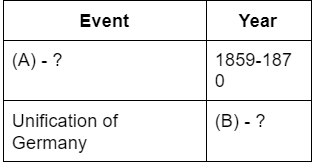
Q.8. Complete the following table with the happening of two events and the respective years in which they took place.

Ans. (A) – Unification of Italy (B) – 1866-71

Multiple Choice Questions
Q.9. Study the picture and answer the question that follows:

Which of the following aspects best signifies this image of Germania”?


(a) Heroism and Justice
(b) Folk and Cultural Tradition
(c) Austerity and Asceticism
(d) Revenge and Vengeance
Ans. a

Q.10. Analyse the information given below, considering one of the following correct options:
He was perhaps the most celebrated of Italian freedom fighters. He came from a family engaged in coastal trade and was a sailor in the merchant navy. In 1833, he met Mazzini, joined the Young Italy movement and participated in a republican uprising in Piedmont in 1834.
(a) Otto von Bismarck
(b) Giuseppe Mazzini
(c) Count Camillio de Cavour
(d) Giuseppe Garibaldi
Ans. d

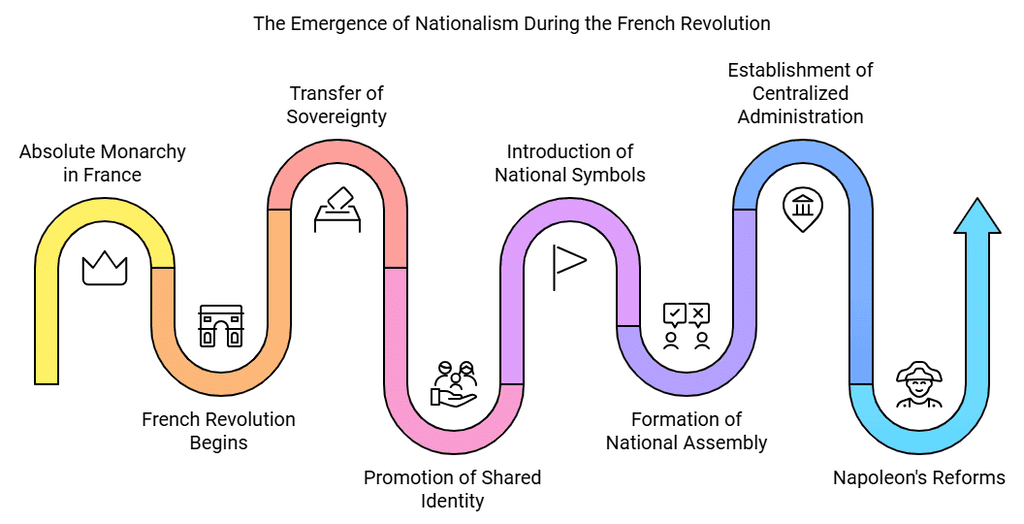
Q.11. Describe any five measures introduced by the French revolutionaries to create a sense of collective identity amongst the French people. Marks 5
Ans. The following measures were introduced by the French revolutionaries to create a sense of collective identity:
(i) The ideas of la patrie (the fatherland) and le citoyen (the citizen) were emphasised as the notion of a united community enjoying equal rights under a constitution.
(ii) A new French flag, the tricolour, was chosen to replace the former royal standard.
(iii) The Estates General was elected by the body of active citizens and renamed the National Assembly.
(iv) New hymns were composed, oaths taken and martyrs commemorated, all in the name of the nation.
(v) A centralised administrative system was put in place and it formulated uniform laws for all citizens within its territory.
(vi) Internal custom duties and dues were abolished and a uniform system of weights and measures were adopted.
(vii) Regional dialects were discouraged and French, as it was spoken and written in Paris, became the common language of the nation. (Any five points to be described)

Q.12. Describe the process of unification of Italy. Marks 5
Ans. Unification of Italy: (i) During the middle of the 19th century, Italy was divided into seven states of which only one, Sardinia-Piedmont, was ruled by an Italian princely house.(ii) The unification process was led by three revolutionaries—Giuseppe Mazzini, Count Camillo de Cavour, and Giuseppe Garibaldi During 1830, Mazzini decided to unite Italy. He had formed a secret society ‘Young Italy’ to achieve his goal.
(iii) After earlier failures in 1831 and 1848, King Victor Emmanuel II took to unify the Italian states through wars.
(iv) Through a tactful diplomatic alliance with France by Cavour, Sardinia-Piedmont succeeded in defeating the Austrian forces in 1859.
(v) After earlier failures in 1831 and 1848, King Victor Emmanuel II took to unify the Italian states through wars.
(vi) Through a tactful diplomatic alliance with France by Cavour, Sardinia-Piedmont succeeded in defeating the Austrian forces in 1859.
(vii) Under the leadership of Garibaldi armed volunteers marched into South Italy in 1860 and the Kingdom of the Two Sicilies and succeeded in winning the support of the local peasants in order to drive out the Spanish rulers.
(viii) In 1861, Victor Emmanuel II was proclaimed king of united Italy. (Any five)

Q.13. Name the female allegory who represents France. Describe her main characteristics. Marks 3
Ans. Marianne was the female allegory who represented France.
Her characteristics were drawn from:
(i) Those of liberty and republic.
(ii) These were the red cap, the tricolour, the cockade.
(iii) Statues of Marianne were erected in public squares to remind the public of the national symbol of unity and to persuade them to identify with it.
(iv) Her images were marked on coins and stamps of 1850. (Any three)

Q.14. Read the sources given below and answer the questions that follows:
SOURCE A : Visualising the Nation [NCERT History Ch. 1 Page 23] ou will Recall that during the French Revolution artists used the female allegory to portray ideas such as Liberty, Justice and the Republic. These ideals were represented through specific objects or symbols. As you would remember, the attributes of Liberty are the red cap, or the broken chain, while Justice is generally a blindfolded woman carrying a pair of weighing scales.
SOURCE B : Nationalism and Imperialism [NCERT History Ch. 1 Page 26] The most serious source of nationalist tension in Europe after 1871 was the area called the Balkans. The Balkans was a region of geographical and ethnic variation comprising modern-day Romania, Bulgaria, Albania, Greece, Macedonia, Croatia, Bosnia-Herzegovina, Slovenia, Serbia and Montenegro whose inhabitants were broadly known as the Slavs. A large part of the Balkans was under the control of the Ottoman Empire. The spread of the ideas of romantic nationalism in the Balkans together with the disintegration of the Ottoman Empire made this region very explosive. All through the nineteenth century the Ottoman Empire had sought to strengthen itself through modernisation and internal reforms but with very little success. One by one, its European subject nationalities broke away from its control and declared independence. The Balkan peoples based their claims for independence or political rights on nationality and used history to prove that they had once been independent but had subsequently been subjugated by foreign powers. Hence the rebellious nationalities in the Balkans thought of their struggles as attempts to win back their long-lost independence.
SOURCE C : Visualising the Nation [NCERT History Ch. 1 Page 23] While it is easy enough to represent a ruler through a portrait or a statue, how does one go about giving a face to a nation? Artists in the eighteenth and nineteenth centuries found a way out by personifying a nation. In other words, they represented a country as if it were a person. Nations were then portrayed as female figures. The female form that was chosen to personify the nation did not stand for any particular woman in real life; rather it sought to give the abstract idea of the nation a concrete form. That is, the female figure became an allegory of the nation. Marks 3
Questions: SOURCE A : Visualising the Nation
(i) What are the attributes of Liberty and Justice according to French Revolution artists?SOURCE B : Nationalism and Imperialism
(ii) Who were Slavs ?
SOURCE C : Visualising the Nation
(iii) Why was the female form chosen to portray a nation by the French Revolution artists?

Ans. (i) The attributes of Liberty are the red cap or the broken chain, while Justice is generally a blindfolded woman carrying a pair of weighing scales.
(ii) The inhabitants of Balkans were broadly known as the Slavs. It was a region of geographical and ethnic variation comprising modern–day Romania, Bulgaria, Albania, Greece, Macedonia, Slovenia, Serbia and Montenegro.
(iii) Artists in the eighteenth and nineteenth Centuries found a way out by personifying a nation. They represented a Country as if it were a person. Nations were then portrayed by female figures because the female form that was chosen to personify the nation did not stand for any particular woman in real life; rather it was brought to give the abstract idea of the nation’s concrete form. That is, the female figure became an allegory of the nation.

Analyse the information given below, considering one of the following correct options:
Q.15. While it is easy enough to represent a ruler through a portrait or a statue, how does one go about giving a face to a nation? Artists in the eighteenth and nineteenth centuries found a way out by personifying a nation. In other words they represented a country as if it were a person.
(a) Portrait of a nation
(b) idol of a nation
(c) Personification of a nation
(d) Visualising a nation
Ans. d
Solution: Concept of liberalization in the field of Economic Sphere:
In the economic sphere, liberalization stood for freedom of market and the abolition of state-imposed restrictions on the movement of goods and capital.

Q.16. “Nationalism no longer retained its idealistic liberal democratic sentiment by the last quarter of the nineteenth century in Europe.” Analyse the statement with examples. Marks 5

OR
“The idealistic liberal-democratic sentiment of nationalism in the first half of the nineteenth century became a narrow creed with limited ends.“ Examine the statement.
Ans.
 Sentiment of Nationalism in the first half of the 19th century:
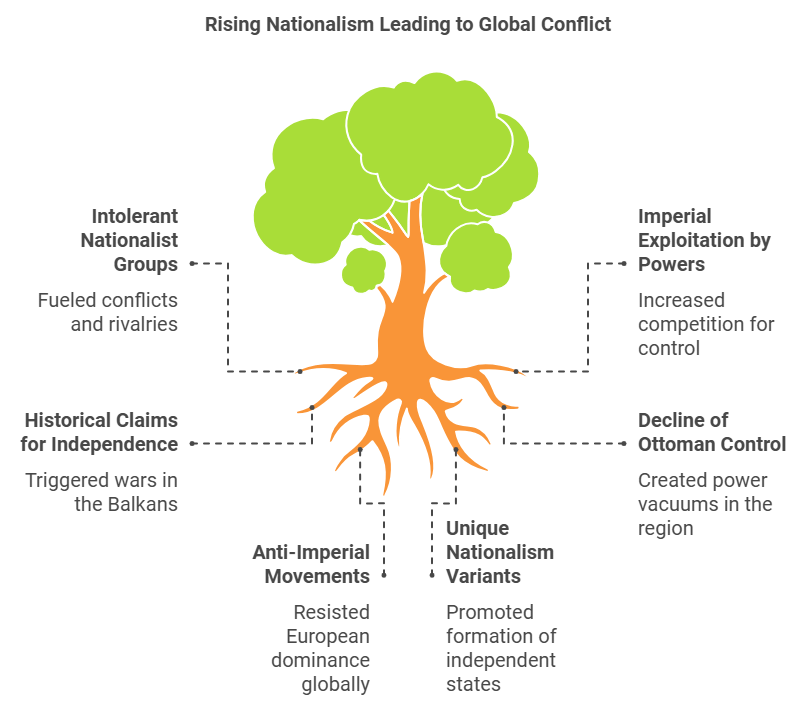
(i) Towards the last quarter of the 19th century, nationalism could not retain its idealistic liberal-democratic sentiments of the first half of the century but became a narrow belief with inadequate ends.
(ii) Nationalist groups became increasingly intolerant, which led to war.
(iii) Major European powers manipulated the nationalist aspirations to further their own imperialist aims.
(iv) Source of nationalist tension in Europe was the area called the Balkans.
(v) Idea of romantic nationalism in the Balkan together with the disintegration of the Ottoman Empire made this region very explosive.
(vi) One by one, European nationalities broke away from its control and declared independence.
(vii) The Balkan people based their claims for independence or political rights on nationality to prove that they were once independent but were subjugated by a foreign power.
(viii) Slavic nationalities struggled to define their identity and independence. Hence, the Balkan area became an area of intense conflict. (Any five)

Q.17. How did the Balkan issue become one of the major factors responsible for the First World War? Marks 3
Ans. (i) The spread of the ideas of romantic nationalism in the Balkans together with the disintegration of the Ottoman Empire made this region very explosive.
(ii) The Balkan area became an area of intense conflict as different Slavic nationalities struggled for their independence.
(iii) It became the source of big power rivalry among the European powers over trade, colonies and military might.

Q.18. How did the Balkan region become a source of nationalist tension in Europe after 1871? Marks 3
Ans. (i) The Balkans was a region of geographical and ethnic variations comprising modern-day Romania, Bulgaria, Albania, Greece, Macedonia, Croatia, Bosnia-Herzegovina, Slovenia, Serbia and Montenegro.
(ii) The inhabitants of these regions were known as Slavs.
(iii) A large part of the Balkans was under the control of the Ottoman Empire.
(iv) As the different Slavic nationalities struggled to define their identity and independence, the Balkan area became an area of intense conflict.
(v) The Balkan states were fiercely jealous of each other and each hoped to gain more territory at the expense of others (Any three)

Q.19. Examine the conditions of Italy before unification. Marks 3
Ans.
 Conditions of Italy before unification:
(i) The greatest problem in the unification of Italy was its fragmentation into several political units, each under a different authority.
(ii) Italians were scattered over several dynastic states as well as the multinational Habsburg Empire.
(iii) During the middle of the 19th century, Italy was divided into seven states.
(iv) Out of seven, only one Sardinia-Piedmont was ruled by an Italian princely house.
(v) The north was under Austrian Habsburgs.
(vi) The centre was ruled by the Pope.
(vii) Southern regions were under the Bourbon kings of Spain.
(viii) The Italian language had not acquired one common form. It still had many regional and local variations. (Any six)

Q.20. “In Britain, the formation of the nation-state was not the result of a sudden upheaval or revolution.” Validate the statement with relevant arguments? Marks 5
Ans. In Britain, the formation of the nation–state was not the result of a sudden upheaval or revolution. It was the result of a long-drawn-out process.
(i) The primary identities of the people who inhabited the British Isles were ethnic ones–such as English, Welsh, Scot or Irish. There was no British nation prior to the 18th century
(ii) All of these ethnic groups had their own cultural and political traditions.
(iii) Because of steady growth of the English nation in case of wealth, importance and power, it was able to extend its influence over the other nations of the islands.
(iv) The Act of Union 1707 between England and Scotland resulted in the formation of the ‘United Kingdom of Great Britain’. It meant that England was able to impose its influence on Scotland.
(v) The English parliament, which had seized power from the monarchy in 1688 at the end of a protracted conflict, was the instrument through which a nation-state with England at its centre, came to be forged.
(vi) The growth of the British identity meant that Scotland‘s distinctive culture and political institutions were systematically suppressed.
(vii) The Scottish Highlanders were forbidden to speak their Gaelic language or wear their national dress, and large numbers were forcibly driven out of their homeland. (Any five)

1. The Rise of Nationalism in Europe – Textbook Worksheet – 2

Table of contents

Multiple Choice Questions
Q1: Romanticism refers to
(a) cultural movement
(b) religious movement
(c) political movement
(d) literary movement

Ans: (a)

Romanticism was a cultural movement that originated in the late 18th century in Europe. It emphasized emotion, individualism, nature, and glorified the past, especially the medieval era, opposing the rationalism of the Enlightenment.


Q2: In Prussia, who was referred to as ‘Junkers’?
(a) Military officials
(b) Large landowners
(c) Factory owners
(d) Aristocratic nobles

Ans:  (b)

The term ‘Junkers’ was used for the wealthy, conservative landowning class in Prussia. They held significant political power and supported the monarchy and military traditions.


Q3: Who among the following was proclaimed the first King of United Italy?
(a) Nicholas II
(b) King George II
(c) Wilhelm IV
(d) Victor Emmanuel II

Ans: (d)

Victor Emmanuel II was the King of Sardinia-Piedmont and became the first King of a unified Italy in 1861. He played a key role in the Italian unification movement.


Q4: A large number of people were hostile to the Napoleonic code because
(a) it was not suitable for all.
(b) it destroyed the special privileges of the rulers.
(c) administrative changes did not go hand-in-hand with political freedom.
(d) none of the above.
Ans: (c)

Although the Napoleonic Code introduced modern laws and administrative reforms, it often ignored democratic principles. People resented the lack of political freedom and imposition of French control.


Q5: Who, among the following, hosted the Congress at Vienna in 1815?
(a) King of the Netherlands
(b) Giuseppe Mazzini
(c) Duke Metternich
(d) Otto von Bismarck
Ans: (c)

The Congress of Vienna was hosted by Duke Metternich. It aimed to restore monarchies and balance power in Europe after Napoleon’s defeat.

Very Short Answer Questions

Q1: Who remarked, “When France sneezes, the rest of Europe catches a cold”. 
Ans: Duke Metternich.

Q2: Name the Treaty of 1832 that recognised Greece as an independent nation. 
Ans: 
Treaty of Constantinople (1832).

Q3: What was the main aim of the revolutionaries of Europe during the years following 1815? 
Ans: To oppose monarchical forms of government. 

Q4: Who was proclaimed German Emperor in a ceremony held at Versailles in January 1871? 
Ans: Kaiser William I of Prussia was proclaimed German Emperor in a ceremony held at Versailles in January 1871. 

Q5: Name the event that mobilised nationalist feelings among the educated elite across Europe in 1830-1848
Ans: The Greek War of Independence in 1821. 

Short Answer Type Questions
Q1: Explain the contribution of Otto von Bismarck to German unification.
Ans: Otto von Bismarck played a significant role in the German unification process as nationalist sentiments gained traction among middle-class Germans in 1848. During this period, there was a concerted effort to unite various regions of the German Confederation into a single nation-state, aiming for a government with elected representatives. Unfortunately, this liberal movement faced suppression from a coalition of monarchy and military forces, backed by Prussian landowners. 


Q2: Describe any three reforms introduced by Napoleon in the territories he conquered.
Ans: 
Napoleon implemented three key reforms in the territories he conquered:

  1. The Napoleonic Code: This legal framework eliminated birth-based privileges, ensuring equality before the law and safeguarding property rights.
  2. Administrative Simplification: Napoleon streamlined administrative divisions, abolished the feudal system, and emancipated peasants from serfdom and manorial dues.
  3. Standardization Measures: He established uniform laws, standardized weights and measures, and introduced a common national currency to facilitate the seamless movement and exchange of goods and capital across different regions.

Q3: How did nationalism develop through culture in Europe? Explain. 
                                                                              Or
Describe the role of culture in shaping the feelings of nationalism in Europe from 1830 to the end of the 19th century.

Ans:(i) Culture played a pivotal role in fostering nationalist sentiments, with art, poetry, and music serving as mediums for expressing such feelings. The cultural movement of Romanticism, which prioritized emotions over reason, played a significant role in shaping nationalist ideals.
(ii) Language also played a crucial role in nurturing nationalism. In the face of Russian occupation, the Polish resistance adopted language as a tool of national defiance after an armed rebellion against Russian rule in 1831.
(iii) Additionally, music and dance played a role in popularizing the spirit of the nation. Romantics like the German philosopher Herder emphasized the importance of discovering true national culture among the common people, or “das volk,” through folk songs, poetry, and dances.


Q4: Explain the conditions that were viewed as obstacles to the economic exchange and growth by the new commercial classes during the nineteenth century in Europe. 
Ans: 

  • Liberalism in the economic sphere championed free markets and the removal of state-imposed restrictions on the movement of goods and capital.
  • In the 19th century, Napoleon’s administrative measures consolidated numerous small principalities into a confederation of 39 states.
  • Each state had its currency, weights, and measures, creating a fragmented economic landscape.
  • Merchants travelling from Hamburg to Nuremberg, for example, encountered 11 custom barriers, with a 5% duty at each checkpoint.
  • Diverse regional systems of weights and measures added complexity, requiring time-consuming calculations.
  • The new commercial classes saw these conditions as impediments to economic growth and exchange.
  • Advocates argued for the establishment of a unified economic territory to enable the free movement of goods, people, and capital.


Q5: Describe three economic hardships faced by Europe in the 1830s.
Ans:  In the 1830s, Europe faced significant economic hardships, which can be summarised as follows:

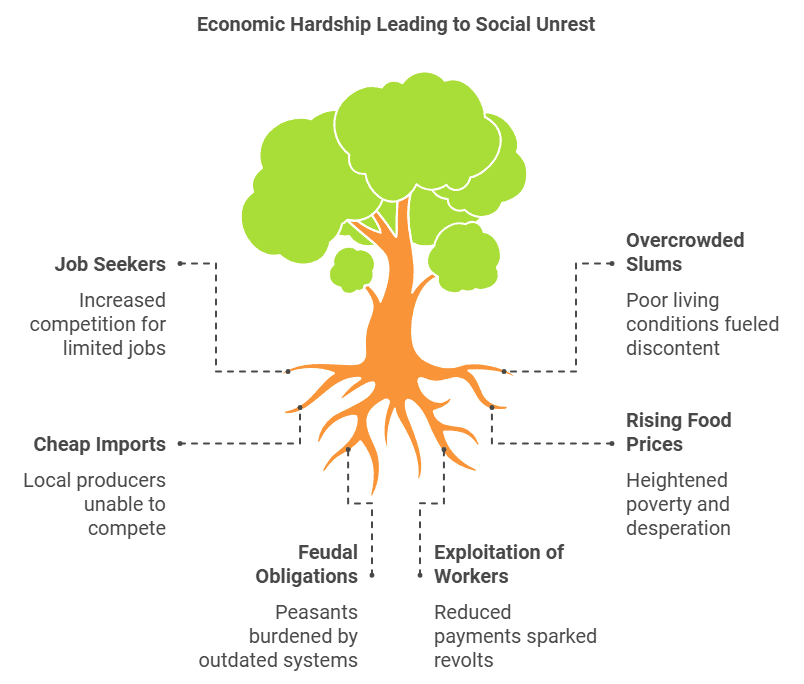
  • Widespread Unemployment: Many countries experienced a surplus of job seekers, leading to high levels of unemployment. Urban areas became overcrowded as people migrated from rural regions in search of work.
  • Intense Competition: Small producers struggled against cheap, machine-made goods imported from England. The rapid industrialisation in England, particularly in textile production, outpaced the capabilities of local producers on the continent.
  • Feudal Burdens: In areas where the aristocracy held power, peasants were burdened by feudal dues and obligations. Rising food prices and poor harvests worsened their situation, contributing to widespread poverty.

 Long Answer Type Questions
Q1: Describe the ideology of liberalism during the early 19th century.
Ans: Liberalism in the early 19th century represented a significant shift in political thought, particularly for the new middle classes. It was characterised by several key principles:

  • Individual Freedom: Liberalism advocated for the freedom of the individual and equality before the law.
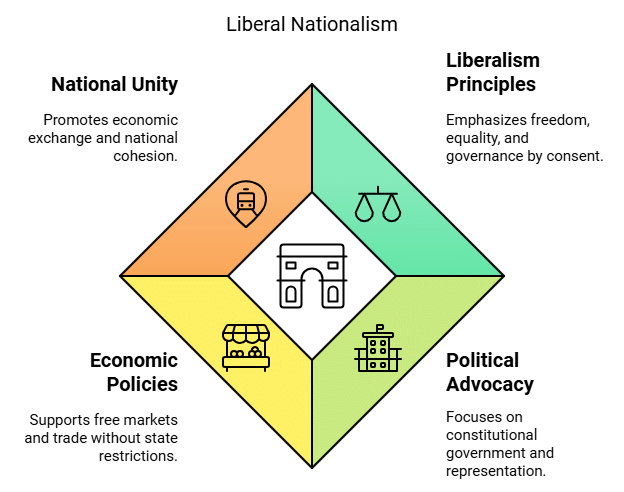
  • Government by Consent: It emphasised that governments should operate with the consent of the governed.
  • End of Autocracy: The ideology called for the abolition of autocratic rule and clerical privileges.
  • Property Rights: It upheld the inviolability of private property and supported free markets without state restrictions.

The term ‘liberalism’ comes from the Latin word liber, meaning ‘free’. For the middle classes, it symbolised:

  • A demand for political rights, although initially limited to property-owning men, excluding the lower classes and women.
  • Inspiration from the French Revolution, which highlighted the need for constitutional and representative government.

Despite its focus on equality, liberalism did not advocate for universal suffrage. The right to vote was primarily reserved for men with property, reflecting the social hierarchies of the time. Overall, early 19th-century liberalism laid the groundwork for modern democratic principles, influencing future movements for broader political rights.


Q2: What was the status of France as a state before 1789? Which two political and constitutional changes came in the wake of the French Revolution?
Ans.  Before 1789, France was a territorial state governed by an absolute monarch.

  • The French Revolution shifted power from the monarchy to the citizens of France.
  • It established that the people would now form the nation and determine its future.

The revolutionaries introduced several key changes:

  • They fostered a sense of collective identity among the French.
  • They promoted the ideas of la patrie (the fatherland) and le citoyen (the citizen), highlighting equal rights.
  • A new national flag, the tricolour, replaced the royal standard.
  • The Estates General was reformed into the National Assembly, elected by active citizens.
  • New hymns and oaths were created, commemorating martyrs in the name of the nation.
  • A centralised administration was established, implementing uniform laws across the territory.
  • Internal customs duties were abolished, and a standard system of weights and measures was adopted.
  • Regional dialects were discouraged, promoting the use of French as the common language.


Q3: What happened during the year following 1815 when the fear of repression drove many liberal nationalists underground? Explain. 
Ans:
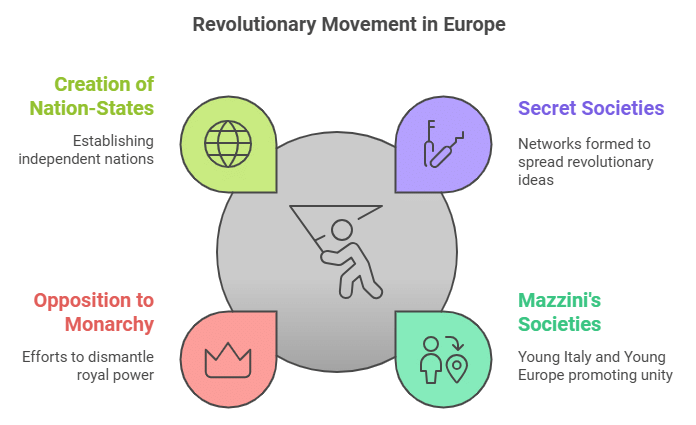
 (i) Secret societies sprang up in many European states to train revolutionaries and spread their ideas.
(ii) To be revolutionary at this time meant a commitment to oppose monarchical forms that had been established after the Vienna Congress, and to fight for liberty and freedom.
(iii) Most of these revolutionaries also saw the creation of nation-states as a necessary part of this struggle for freedom. One such individual was the Italian revolutionary Giuseppe Mazzini.
(iv) He subsequently founded two more underground societies, first, Young Italy in Marseilles, and then, Young Europe in Berne, whose members were like-minded young men from Poland, France, Italy, and the German states.
(v) Mazzini believed that God had intended nations to be the natural units of mankind. So, Italy could not continue to be a patchwork of small states and kingdoms. It had to be forged into a single unified republic within a wider alliance of nations.
(vi) This unification alone could be the basis of Italian liberty. Following his model, secret societies were set up in Germany, France, Switzerland, and Poland.
(vii) Mazzini‘s relentless opposition to monarchy and his vision of democratic republics frightened the conservatives. Metternich described him as ‘the most dangerous enemy of our social order’.

Q4:Explain the process of unification of Italy. 
Ans: 

  • Italy had a history of political fragmentation, with Italians scattered across dynastic states and the Habsburg Empire.
  • The country was divided into seven states, and the Italian language lacked a common form.
  • Giuseppe Mazzini played a key role in unification, forming the secret society ‘Young Italy’ to promote his goal of a unified republic.
  • Mazzini believed that Italy should not remain a patchwork of small states and needed to be forged into a single, unified republic.
  • After unsuccessful uprisings in 1831 and 1848, the responsibility for unification shifted to Sardinia-Piedmont under Emmanuel II.
  • Chief Minister Cavour, under Emmanuel II’s rule, successfully defeated Austrian forces in 1859.
  • Cavour, through diplomatic alliances with France, overcame Austrian forces, and Giuseppe Garibaldi also joined the cause.
  • In 1860, they marched towards South Italy and the Kingdom of the Two Sicilies, with local peasant support, driving out the Spanish rulers.
  • In 1861, Victor Emmanuel II was proclaimed the King of a United Italy.

Q5: Describe the process of the Unification of Britain.
                                      Or
How has Britain come into existence? Explain. 
Ans: Nationalism in Britain differed from that in the rest of Europe in several key aspects:

  1. Gradual Evolution: Unlike many European nations, British nationalism did not emerge suddenly through uprisings or revolutions but developed over an extended period.
  2. Ethnic Diversity: Before the 18th century, there was no unified British nation; instead, the British Isles housed distinct ethnic groups such as the English, Welsh, Scots, and Irish. The English, gaining wealth and influence, gradually extended their dominance over other nations, including Scotland.
  3. English Dominance: The British Parliament, largely composed of English members, sought to suppress Scotland’s unique culture and political institutions. This led to restrictions on language, dress, and the expulsion of many Scots.
  4. Bloodless Revolution: In 1688, a bloodless revolution saw the English Parliament wrest power from the monarchy, establishing itself as the focal point of a nation-state.
  5. Incorporation of Scotland and Ireland: The Act of Union in 1707 brought Scotland into the United Kingdom, while Ireland, despite opposition, was forcibly incorporated in 1801.
  6. Parliamentary Action: The formation of the British nation was achieved primarily through parliamentary actions rather than through revolutions or wars.
  7. Cultural Propagation: The creation of a new ‘British Nation’ involved the promotion of English culture. Symbols like the Union Jack, the national anthem “God Save Our Noble King,” and the English language were emphasized, with the older nations becoming subordinate partners in the Union.

Passage

Q6: Read the extract and answer the questions that follow.
By the last quarter of the nineteenth century, nationalism no longer retained its idealistic liberal democratic sentiment of the first half of the century but became a narrow creed with limited ends. During this period nationalist groups became increasingly intolerant of each other and ever ready to go to war. The major European powers, in turn, manipulated the nationalist aspirations of the subject peoples in Europe to further their imperialist aims. The most serious source of nationalist tension in Europe after 1871 was the area called the Balkans. The Balkans was a region of geographical and ethnic variation comprising modern-day Romania, Bulgaria, Albania, Greece, Macedonia, Croatia, Bosnia-Herzegovina, Slovenia, Serbia and Montenegro, whose inhabitants were broadly known as the Slavs. A large part of the Balkans was under the control of the Ottoman Empire. The spread of the ideas of romantic nationalism in the Balkans, together with the disintegration of the Ottoman Empire, made this region very explosive. All through the nineteenth century the Ottoman Empire had sought to strengthen itself through modernization and internal reforms but with very little success. One by one, its European subject nationalities broke away from its control and declared independence. The Balkan peoples based their claims for independence or political rights on nationality and used history to prove that they had once been independent but had subsequently been subjugated by foreign powers. Hence the rebellious nationalities in the Balkans thought of their struggles as attempts to win back their long-lost independence. As the different Slavic nationalities struggled to define their identity and independence, the Balkan area became an area of intense conflict. The Balkan states were fiercely jealous of each other and each hoped to gain more territory at the expense of the others. Matters were further complicated because the Balkans also became the scene of big power rivalry. During this period, there was intense rivalry among the European powers over trade and colonies as well as naval and military might. These rivalries were very evident in the way the Balkan problem unfolded. Each power – Russia, Germany, England, and Austro-Hungary – was keen on countering the hold of other powers over the Balkans and extending its control over the area. This led to a series of wars in the region and finally the First World War.
Questions: (i) Why did the major European powers manipulate the nationalist aspirations of the subject peoples in Europe by the last quarter of the nineteenth century?
(ii) What was the basis of the Balkan people regarding their claim for independence?
(iii) State any two reasons that led to a series of wars in the Balkan region and finally the First World War.
Ans.
 (i) The major European powers manipulated the nationalist aspirations of the subject people in Europe by the last quarter of the nineteenth century to fulfill their imperialistic aims.
(ii) The Balkan peoples based their claims for independence or political rights on nationality and used history to prove that they had once been independent but had subsequently been subjugated by foreign powers. Hence, the rebellious nationalities in the Balkans thought of their struggles to win back their long-lost independence.
(iii) Two major reasons that led to a series of wars in the Balkan region and finally the
First World War: 
(a) The Balkan area had become an area of intense conflict. The Balkan states were fiercely jealous of each other and each hoped to gain more territory at the expense of the others. Matters were further complicated because the Balkans also became the scene of big power rivalry.
(b) During this period, there was intense rivalry among the European powers over trade and colonies as well as naval and military might. These rivalries were very evident in the way the Balkan problem unfolded. Each power was keen on countering the hold of other powers over the Balkans and extending its control over the area.

1. The Rise of Nationalism in Europe – Textbook Worksheet – 1

Q.1. How had the Napoleonic Code been exported to the other regions under French control? Explain with examples. (3 Marks)

Ans. The Napoleonic Code was exported to the regions under French Control:
(i) In the Dutch Republic, in Switzerland, in Italy, and in Germany, Napoleon simplified administrative divisions, abolished the feudal system, and freed peasants from seldom and manorial dues.
(ii) In the towns too, guild restrictions were removed. Transport and communication systems were improved. Peasants, artisans, workers, and new businessmen enjoyed newfound freedom.
(iii) Businessmen and small-scale producers of goods, in particular, began to realise that uniform laws, standardised weights, and measures, and a common national currency would facilitate the movement and exchange of goods and capital from one region to another.

Q.2. What was the impact of the Treaty of Vienna (1815) on European people? Write any three points. (3 Marks)
Ans. Provisions of Treaty of Vienna (1815):

  • Bourbon Dynasty was restored to power in France. France lost the territories it had annexed under Napoleon.
  • The kingdom of the Netherlands was set up in the north and Genoa was added to Piedmont in the south.
  • Prussia was given new territories on its western frontiers. Austria was given control of Northern Italy.
  • Russia was given a part of Poland and Prussia was given a part of Saxony.

Q.3. Describe the events of the French Revolution which had influenced the people belonging to other parts of Europe.     (3 Marks)
Ans. 
The events of the French Revolution which had influenced the people belonging to other parts of Europe:
(i) Students and other members of the educated middle class began to set up Jacobin clubs.
(ii) Their activities and campaigns paved the way for the French armies which moved into Holland, Belgium, Switzerland and large parts of Italy.
(iii) Due to the outbreak of various revolutionary wars the French armies began to carry the idea of nationalism abroad. Thus, a sense of collective identity was brought in.


Q.4. Describe the role of Giuseppe Mazzini as an Italian revolutionary. (3 Marks)
Ans.
 The role of Giuseppe Mazzini as an Italian revolutionary:

  • He founded two secret societies—Young Italy in Marseilles and Young Europe in Berne.
  • Members of these societies were like-minded young men from Poland, France, Italy, and the German states.
  • Mazzini believed that God had intended nations to be the natural units of mankind. 
  • Mazzini’s relentless opposition to monarchy and his vision of a democratic republic frightened the conservatives. (Any three)


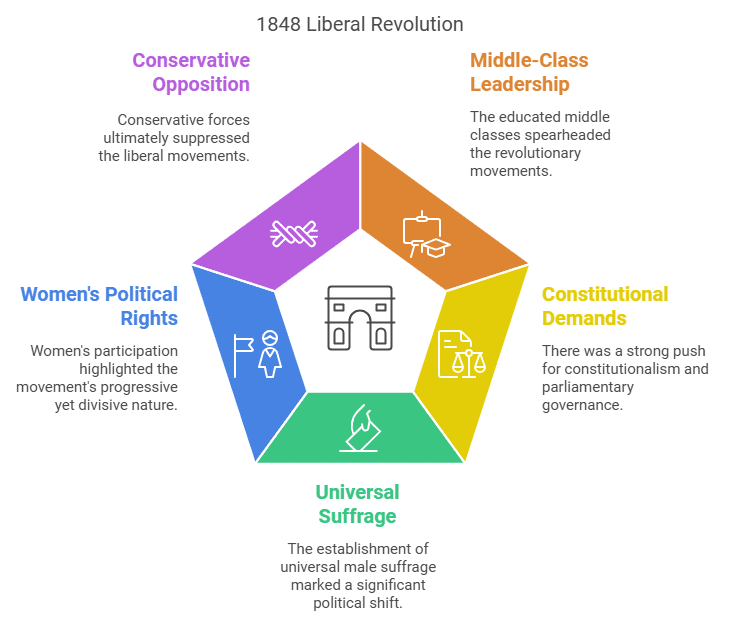
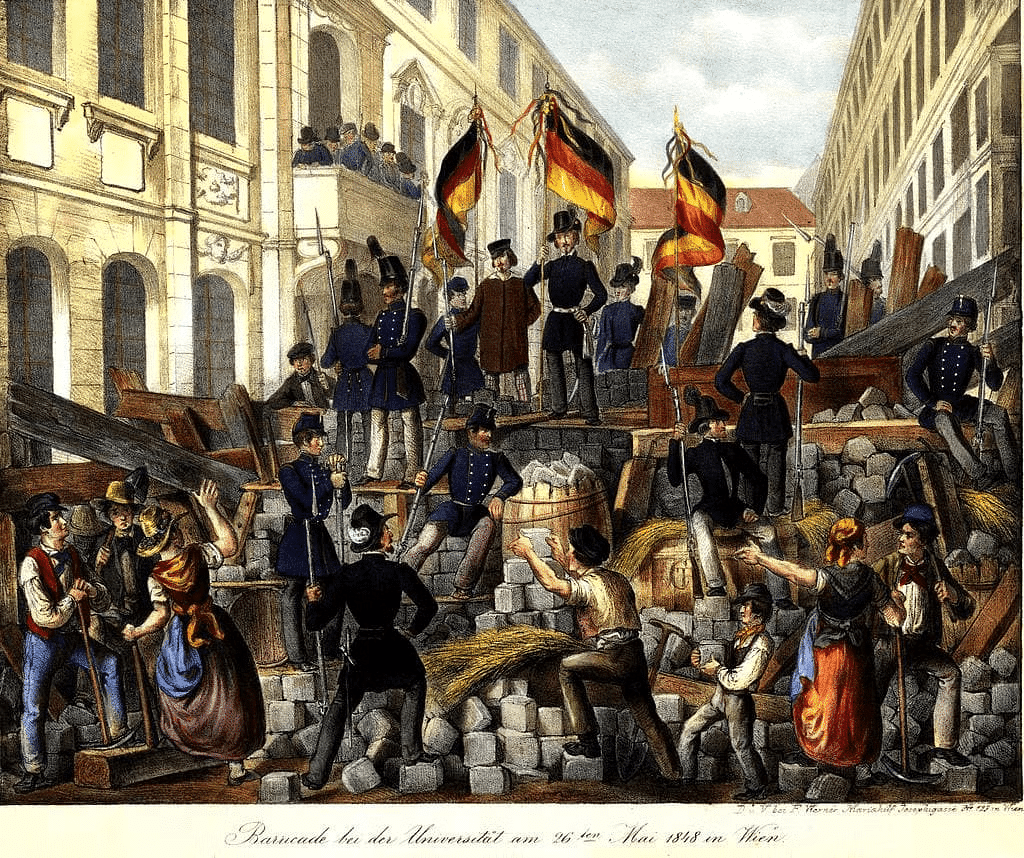
Q.5. Why was the period of 1848 considered the phase of the revolution of the Liberals in Europe? Explain.     (5 Marks)
Ans. The period of 1848 was considered as phase of the revolution of the Liberals in Europe because of the following reasons:

  • Germany, Italy, Poland, the Austro-Hungarian Empire – men and women of the liberal middle classes combined their demands for constitutionalism with national unification.
  • They took advantage of the growing popular unrest to push their demands for the creation of a nation-state on parliamentary principles – a constitution, freedom of the press and freedom of association.
  • In the German regions, a large number of political associations whose members were middle-class professionals, businessmen and prosperous artisans came together in the city of Frankfurt and decided to vote for an all-German National Assembly.
  • Women had formed their own political associations, founded newspapers and taken part in political meetings and demonstrations. 

Q.6. Write a note on the role of women in nationalist struggles. (3 Marks)
Ans.
 The role of women in nationalist struggles are as follows:

  • Women had formed their own political associations. 
  • They took part in political meetings and demonstrations. 
  • They attended the Frankfurt Parliament also, though as observers, since the right to vote was not given to them.
  • They also participated in large numbers in the liberal movement.

Q.7. ‘While it is easy enough to represent a ruler through a portrait or a statue, how does one go about giving a face to a nation.” Examine this statement in the context of European nationalism in five points. (5 Marks)
Ans. European nationalism are as follows:
(i) In olden times, the best way to present an idea was through symbolic personifications. This was the most common and appealing way to invite people’s attention.
(ii) From 1789, females appeared in paintings as a symbol of liberty and revolution.
(iii) During the French Revolution, many symbolic personifications of ‘Liberty’ and ‘Reason’ appeared. Marianne was the female figure invented by artists in the nineteenth century to represent the French nation. Her characteristics were drawn from those of Liberty and the Republic—the red cap, the tricolour, the cockade.
(iv) Statues of Marianne were erected in public places to remind the public of the national symbol of unity and to persuade them to identify with it.
(v) Marianne images were marked on coins and stamps.


Q.8. Arrange the following in the correct sequence:
(i) Slav nationalism went there in the Habsburg and Ottoman Empires.
(ii) Unification of Germany.
(iii) Victor Emmanuel II was declared as the king of united Italy and Rome was declared the capital of Italy. 
(iv) The Prussian King, William I was proclaimed the German Emperor.
Option:

(a) (iv) – (ii) – (iii) – (i)
(b) (iii) – (iv) – (ii) – (i)
(c) (iii) – (ii) – (iv) – (i)
(d) (i) – (ii) – (iii) – (iv)
Ans. c

Q.9. Answer in one word/one sentence: Who was called as the architect of Germany’s Unification? 
Ans
. Otto von Bismarck

Q.10. ______ means ‘Rebirth’.
Ans.
 Renaissance

Q.11. The Civil Code of 1804 is also known as the ______. 
Ans.
 Napoleonic Code

Q.12. In the question given below, there are two statements. One is marked as Assertion (A) and the other as Reason (R). Read the statements and choose the correct option.
Assertion: The French Revolution was an influential event that marked the age of revolutions in Europe.
Reason: The French Revolution transferred the sovereignty from the people to the monarch.
(a) Both (A) and (R) are true and (R) is the correct explanation of (A).
(b) Both (A) and (R) are true but (R) is not the correct explanation of (A).
(c) (A) is correct but (R) is wrong.
(d) (A) is wrong but (R) is correct.
Ans. (c)


Q.13. Otto von Bismarck was the architect of ‘German Unification’. Explain. 

OR

Examine the main features of the process of German unification under the leadership of Otto von Bismarck.        (5 Marks)
Ans. Otto von Bismarck was the true architect of Germany who played an important role in the unification of the country. He is known for his policy of ‘Blood and Iron’.
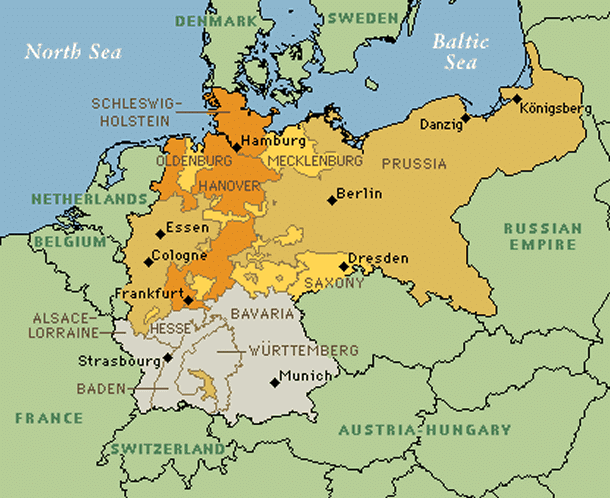
(i) The middle-class Germans in 1848 tried to unite the different regions of the German confederation into a nation-state.
(ii) Prussian Chief Minister, Otto von Bismarck, with the help of the army and bureaucracy, carried out the task of unification.
(iii) Three wars over seven years with Austria, Denmark and France ended in Prussian victory and completed the process of unification.
(iv) On 18th January 1871, the Prussian King, Kaiser William I was proclaimed German Emperor in a ceremony held at Versailles in the presence of important officials, army representatives and Otto von Bismarck.


Q.14. Briefly describe the process of German unification. 

OR

Briefly trace the process of German unification. [NCERT]     (3 Marks)
Ans. 
The process of German unification as follows:
(i) In the 1800s, nationalist feelings were strong in the hearts of middle-class Germans.
(ii) During the Vienna Congress in 1815, Germany was identified as a loose confederation of 39 states.
(iii) They united in 1848 to create a nation-state out of the numerous German states.
(iv) Prussia soon became the leader of the German unification movement.
(v) Chief Minister of Prussia Otto von Bismarck was the architect of the process with support from the Prussian army and bureaucracy.


Q.15. Read the extract and answer the questions that follow.
In the German regions a large number of political associations whose members were middle-class professionals, businessmen and prosperous artisans came together in the city of Frankfurt and decided to vote for an all-German National Assembly. On 18 May 1848, 831 elected representatives marched in a festive procession to take their places in the Frankfurt parliament convened in the Church of St Paul. They drafted a constitution for a German nation to be headed by a monarchy subject to a parliament. When the deputies offered the crown on these terms to Friedrich Wilhelm IV, King of Prussia, he rejected it and joined other monarchs to oppose the elected assembly. While the opposition of the aristocracy and military became stronger, the social basis of parliament eroded. The parliament was dominated by the middle classes who resisted the demands of workers and artisans and consequently lost their support. In the end troops were called in and the assembly was forced to disband. The issue of extending political rights to women was a controversial one within the liberal movement, in which large numbers of women had participated actively over the years. Women had formed their own political associations, founded newspapers and taken part in political meetings and demonstrations. Despite this they were denied suffrage rights during the election of the Assembly. When the Frankfurt parliament convened in the Church of St Paul, women were admitted only as observers to stand in the visitors’ gallery.
(i) People from which classes mainly constituted the members of many political associations in the German region?
(ii) What was Wilhelm IV’s reaction when he was offered the crown on certain terms by the deputies?
(iii) In what ways were the women active in the political sphere? (3 Marks)
Ans.
(i)
 Middle-class professionals, businessmen, and prosperous artisans were the classes that mainly constituted the members of many political associations in the German region.
(ii) When the deputies offered the crown on these terms to Friedrich Wilhelm IV, King of Prussia, he rejected it and joined other monarchs to oppose the elected assembly.
(iii) Women actively participated in large numbers in the liberal movement over the years. Women had formed their own political associations, founded newspapers, and taken part in political meetings and demonstrations.

Q.16. Describe the great economic hardship that prevailed in Europe during the 1930s. 

OR

Describe any three economic hardships faced by Europe in the 1830s.

OR

“The decade of 1830 had brought great economic hardship in Europe.” Support the statement with arguments.      (3 Marks)
Ans. The decade of 1830 had brought great economic hardship or crisis in Europe due to the following reasons:
(i) There was an enormous increase in population all over Europe.
(ii) There were more job seekers than employment opportunities. The migration of rural people to the cities further made the situation worse.
(iii) Small scale producers in towns sometimes faced with stiff competition from imports of cheap machine-made goods from England.
(iv) Due to the increased population, the demand for food increased. It led to the rise in food prices. This led to an increase in the prices and there was widespread pauperism in the entire country. (Any three points)


Q.17. Write a note on the Greek War of Independence.     (3 Marks)
Ans. The Greek War of Independence are as follows

  • Greece had been a part of the Ottoman Empire since the 15th century.
  • Struggle for independence began in 1821.
  • Greece got support from Greeks living in exile and West-Europeans who had sympathies for ancient Greek culture.
  • Poets and artists lauded Greece as the cradle of European civilisation and mobilised public opinion to support its fight against Muslim empire.
  • The English poet Lord Byron, organised funds, fought in war and died of fever in 1824
  • The Treaty of Constantinople of 1832 recognized Greece as an independent nation. (Any five)


Q.18. “Napoleon had destroyed democracy in France but in the administrative field, he had incorporated revolutionary principles in order to make the whole system more rational and efficient.” Analyse the statement with arguments.      (5 Marks)
Ans.  
Napoleon had destroyed democracy in France but in the administrative field, he had incorporated revolutionary principles in order to make the whole system more rational and efficient:

  • All privileges based on birth were removed. He established equality before law.
  • Right to property was given. He simplified administrative divisions.
  • Feudal system was abolished and peasants were freed from serfdom and manorial dues.
  • Guild restrictions were removed.
  • Transport and communication systems were improved.

5. Print Culture and the Modern World – Chapter Notes

Introduction

It is challenging for us to picture a world without printed materials. We see prints everywhere we look – in booksjournalsnewspapers, prints of famous paintings, and in everyday items like theatre programs, official circulars, calendars, diaries, advertisements, and cinema posters on street corners. We often take this world of print for granted and forget that there was a time before it existed. We might not realise that print itself has a history that has shaped our modern world. In this chapter, we will explore the development of print, from its origins in East Asia to its spread in Europe and India.

The invention of the printing press changed people’s lives, altering how they interacted with information and knowledge, as well as their connections with institutions and authorities. With the printing press, a new reading public emerged, enabling a larger group of society to access literature and information that was once available only to a few.

Importance of Historical Context

Understanding the historical context of print technology is essential. The development of print in East Asia set the stage for its later growth in Europe and India. The spread of print culture had significant effects on social lives and cultures, influencing areas such as:

  • Education
  • Political discourse

The First Printed Books

  • The first printed books originated in China, Japan, and Korea through a method of hand printing.First Printed Book
  • In China, books were printed from AD 594 onwards by pressing paper against inked woodblocks, leading to the creation of the traditional Chinese ‘accordion book’ due to the limitations of printing on both sides of the paper.
  • Skilled craftsmen in China could replicate calligraphy beautifully with hand printing.
  • China’s imperial state was a significant producer of printed material, especially for textbooks used in civil service examinations.
  • Print usage in China grew in the 16th and 17th centuries, covering city life, trade details for merchants, and leisure reading for more people.
  • With the rise of urban culture in China, print was no longer just for scholar-officials. It was embraced by many, including women who began publishing their own works.
  • By the late nineteenth century, Western printing techniques and mechanical presses were introduced in China, marking a transition from hand printing to mechanical printing.
  • Shanghai emerged as a center of the new print culture, facilitating the dissemination of Western-style education.

Let’s Revise: Which method was used in China for producing the first printed books, and when did it begin?

View Answer  

Print in Japan

  • Buddhist missionaries from China introduced hand-printing technology into Japan around AD 768-770.
  • The oldest Japanese book, printed in AD 868, is the Buddhist Diamond Sutra, containing six sheets of text and woodcut illustrations.

A Page from The Diamond Sutra

  • Pictures were printed on textiles, playing cards, and paper money.
  • In medieval Japan, poets and prose writers were regularly published, and books were cheap and abundant.
  • Printing of visual material led to interesting publishing practices.
  • In the late eighteenth century, in the flourishing urban circles at Edo (later to be known as Tokyo), illustrated collections of paintings depicted an elegant urban culture.
  • Libraries and bookstores were packed with hand-printed material of various types, including books on womenmusical instrumentscalculationstea ceremonyflower arrangementsproper etiquettecooking, and famous places.

Try yourself:

Which region introduced hand-printing technology into Japan around AD 768-770?

  • A.China
  • B.Korea
  • C.India
  • D.Europe

View Solution

Print Comes to Europe

  • Arrival of Paper in Europe: In the past, valuable goods like silk and spices came to Europe from China. Around the eleventh century, Chinese paper also made its way to Europe, facilitating the creation of manuscripts by scribes.
  • Introduction of Woodblock Printing: In 1295, after his travels in China, Marco Polo returned to Italy and introduced the concept of woodblock printing. This innovation led to the production of books in Italy, which eventually spread throughout Europe.
  • Shift in Book Production: Initially, luxurious editions were handwritten on costly vellum for the elite, while printed books were considered inferior. However, as demand rose, printed copies became popular among merchants and students.
  • Expansion of Book Trade: Bookstores across Europe started exporting books to various regions, and book fairs emerged. Handwritten manuscripts were produced in new ways to meet the increasing demand, with scribes now employed by booksellers as well.
  • Rise of Woodblock Printing: Due to the limitations of handwritten manuscripts, woodblock printing gained popularity by the fifteenth century. This method was used for textiles, playing cards, and religious images with brief texts.
  • Invention of the Printing Press: The need for faster and cheaper text reproduction led to the development of the printing press by Johann Gutenberg in Strasbourg, Germany, during the 1430s. This marked a significant advancement in print technology.

Let’s Revise: Who introduced the idea of woodblock printing to Europe, and when?

View Answer  

Gutenberg and the Printing Press

  • Gutenberg, the son of a merchant, drew inspiration from his childhood experiences with presses and stone polishing. He later became a skilled goldsmith and learned to create lead moulds.

Johannes Gutenberg

  • Adapting existing technology, Gutenberg innovated the printing press, basing it on the olive press and using moulds for metal types.
  • In 1448, Gutenberg perfected his system and printed the Bible, producing about 180 copies in three years, a remarkable feat for the time.
  • Printed books initially resembled handwritten manuscripts, with metal letters mimicking ornate handwriting styles and hand-painted illustrations.
  • Printing presses spread across Europe between 1450 and 1550, significantly increasing book production.
  • The shift from hand printing to mechanical printing marked the print revolution, with millions of copies flooding European markets.

The Print Revolution and Its Impact

It was more than just a new way of making books. The print revolution changed how people interacted with information and knowledge, as well as with authorities. It also affected how people perceived things and opened up new perspectives.

Printing Revolution

A New Reading Public

Emergence of a New Reading Public:

  • The printing press lowered book costs and reduced production time and labor.
  • Enabled mass production of books, flooding the market and reaching a growing readership.

Creation of a New Reading Culture:

  • Before printing, reading was confined to the elite, while common people relied on oral culture for knowledge transfer.
  • Sacred texts, ballads, and folk tales were shared orally, and collective listening was the norm.
  • The printing press made books more accessible, creating a reading public alongside the existing hearing public.

Transition Challenges:

  • Literacy rates were low in most European countries until the twentieth century.
  • Publishers needed to make printed books appealing to the general public.

Publishers’ Strategies:

  • To reach non-readers, publishers printed popular ballads and folk tales with rich illustrations.
  • These printed materials were sung and recited at social gatherings, integrating oral culture into print.

Blurring Cultural Lines:

  • The distinction between oral and reading cultures became blurred.
  • The hearing public and reading public began to intermingle, creating a unified culture.

Religious Debates and the Fear of Print

  • Print enabled widespread circulation of ideas, fostering debates and discussions.
  • It allowed people to print and share their ideas, potentially influencing others and sparking change in different areas of life.
  • Despite the benefits, not everyone embraced printed books.
  • Many harbored concerns about the impact of easier access to printed materials and the broader dissemination of books on people’s minds.
  • There was a fear that uncontrolled printing and reading could lead to the spread of rebellious and irreligious notions, endangering the authority of respected literature.
  • This apprehension was shared by religious figures, monarchs, writers, and artists, sparking criticism of the emerging printed literature.
  • In 1517, Martin Luther penned the Ninety-Five Theses, criticizing Roman Catholic Church practices. A printed copy was posted in Wittenberg, inviting debate.
  • Luther’s writings were widely reproduced, sparking division in the Church and the Protestant Reformation.
  • Luther’s translation of the New Testament was a big success, selling 5,000 copies in just a few weeks. A second edition was out in three months.
  • Feeling very thankful for the printing press, Luther declared, “Printing is a wonderful gift from God and the best one.
  • Some experts believe that the printing press created a fresh intellectual environment, aiding the spread of new ideas that eventually led to the Reformation.

Try yourself:

What was the impact of the introduction of the printing press on book production in Europe?

  • A.Book production remained limited to handwritten manuscripts.
  • B.Books became more affordable and book production increased.
  • C.Only the elite class had access to printed books.
  • D.Book production decreased due to the introduction of the printing press.

View Solution

Print and Dissent

  • Print and popular religious literature sparked diverse individual interpretations of faith, even among less-educated working individuals.
  • In the 16th century, Menocchio, a miller in Italy, delved into books accessible in his area.
  • He reinterpreted the Bible’s message, shaping a controversial perspective on God and Creation that provoked the Roman Catholic Church.
  • In response to the spread of these heretical ideas, the Roman Church initiated inquisitions to suppress such dissent.
  • Menocchio faced interrogation twice and was eventually executed.
  • Troubled by the impact of widespread reading and questioning of faith, the Roman Church tightened its grip over publishers and booksellers.
  • It also established an Index of Prohibited Books starting from 1558.

The Reading Mania

  • During the 17th and 18th centuries, literacy rates increased across most of Europe.
  • Churches of various denominations established schools in villages, spreading literacy among peasants and artisans.
  • By the late 18th century, some parts of Europe achieved high literacy rates ranging from 60 to 80 percent.

Spread of Literacy and Schools

  • With the expansion of literacy and schools in European countries, there was a surge in the desire for reading materials.
  • Printers responded by producing a growing number of books to meet this demand.

New Forms of Popular Literature

  • Emerging forms of popular literature targeted new audiences.
  • Booksellers utilized pedlars who traveled through villages selling small books.
  • Various materials such as almanacs, ballads, folktales, penny chapbooks, and romances reached ordinary readers for entertainment.

Development of Periodical Press

  • The periodical press evolved from the early 18th century, blending current affairs with entertainment.
  • Newspapers and journals disseminated information on wars, trade, and events from across different regions.
  • The works of scientists, philosophers, and thinkers like Isaac Newton, Thomas Paine, Voltaire, and Rousseau became more accessible to a broader audience through printed materials.

‘Tremble, therefore, tyrants of the world!’

  • In the mid-18th century, many people believed that books played a crucial role in spreading progress and enlightenment. 
  • They believed books could transform society, liberate it from oppressive rulers, and bring about an era where reason and intellect would lead.
  • Louise-Sebastien Mercier, a novelist from 18th-century France, strongly advocated for the impact of books. 
  • He saw the printing press as a tool for progress and believed that public opinion could overthrow despotism. 
  • In Mercier’s novels, characters who read books undergo significant changes. They immerse themselves in the worlds created by books and gain enlightenment through reading.
  • Mercier emphasized the power of print in enlightening people and destabilizing tyrannical regimes. 
  • He famously proclaimed, “Tremble, therefore, tyrants of the world! Tremble before the virtual writer!”

Try yourself:

Which 18th-century novelist emphasized the power of print in enlightening people and destabilizing tyrannical regimes?

  • A.Isaac Newton
  • B.Thomas Paine
  • C.Voltaire
  • D.Louise-Sebastien Mercier

View Solution

Print Culture and the French Revolution

Historians argue that print culture set the stage for the French Revolution.

Three main arguments support this view:

  • Print popularized Enlightenment ideas that criticized tradition, superstition, and despotism.
  • Print fostered a culture of dialogue and debate, encouraging the questioning of existing norms.
  • Literature in the 1780s ridiculed the royalty, fueling anti-monarchy sentiments.
  • Mercier’s writing exemplifies the transformative power of reading and the impact of new ideas.
  • Print facilitated the spread of diverse ideas, including criticisms of the monarchy.
  • People were exposed to various viewpoints through print, shaping their interpretations and beliefs.
  • Print didn’t dictate minds but opened avenues for independent thinking.

The Nineteenth Century

The 1800s witnessed significant advancements in mass literacy across Europe, leading to a surge in new readers among children, women, and workers.

Children, Women, and Workers

  • With the enforcement of compulsory primary education in the late 19th century, children emerged as a crucial readership group.
  • The production of school textbooks became pivotal for the publishing industry.
  • A dedicated children’s press, focused solely on literature for children, was established in France in 1857.
  • The Grimm Brothers in Germany spent years compiling traditional folk tales collected from peasants, which were then edited and published in 1812 after removing unsuitable content.
  • Women also became significant readers and writers during this period.
  • Penny magazines and manuals on proper behavior and housekeeping catered specifically to women.
  • Notable female novelists like Jane Austen, the Bronte sisters, and George Eliot played a crucial role in defining a new type of woman characterized by willpower, strength, determination, and intellect.
  • Lending libraries, which had been present since the 17th century, evolved in the 19th century to educate white-collar workers, artisans, and the lower-middle class.
  • As the working day gradually shortened from the mid-1800s, workers found time for self-improvement and self-expression by writing political tracts and autobiographies in large numbers.

Further Innovations

  • By the end of the 18th century, metal became the primary material for making printing presses.
  • Throughout the 19th century, there were significant advancements in the field of printing technology.
  • In the mid-19th century, Richard M. Hoe from New York perfected the power-driven cylindrical press, capable of printing 8,000 sheets per hour, especially beneficial for newspapers.
  • Later in the 19th century, the offset press was introduced, capable of printing up to six colors simultaneously.
  • Electrically operated presses from the early 20th century greatly sped up printing processes.
  • Various other developments occurred, such as improvements in paper feeding methods, better plate quality, automatic paper reels, and the introduction of photoelectric color register controls.
  • These cumulative mechanical enhancements significantly altered the appearance of printed texts.
  • Printers and publishers continuously devised new marketing strategies. In the 19th century, important novels were serialized in periodicals, influencing a distinct style of novel writing.
  • In the 1920s in England, popular works were sold in affordable series like the Shilling Series. The innovation of the dust cover or book jacket also emerged during the 20th century.
  • During the Great Depression in the 1930s, publishers were concerned about declining book sales. To encourage purchases, they began releasing inexpensive paperback editions.

Try yourself:

What was a significant development in printing technology in the mid-19th century?

  • A.Introduction of the offset press
  • B.Invention of metal printing presses
  • C.Development of photoelectric color register controls
  • D.Perfection of power-driven cylindrical presses

View Solution

India and the World of Print

Manuscripts Before the Age of Print

  • India had a long tradition of handwritten manuscripts in languages like Sanskrit, Arabic, Persian, and vernacular languages.
  • Manuscripts were copied on palm leaves or handmade paper, sometimes with beautiful illustrations.
  • To preserve them, pages were pressed between wooden covers or sewn together.

Pages from the Diwan of Hafiz, 1824

  • Despite the introduction of print, manuscripts continued to be produced till the late nineteenth century.
  • Manuscripts were expensive, fragile, and written in various styles, making them hard to read.
  • They were not widely used in everyday life due to these challenges.
  • In pre-colonial Bengal, village primary schools existed, but students often learned to write without reading texts.
  • Teachers recited texts from memory, and students wrote them down, becoming literate without reading.

Print Comes to India

  • Handwritten manuscripts were still made in India long after the arrival of print technology. An example is an eighteenth-century manuscript in the Malayalam script.
  • The printing press was introduced to Goa by Portuguese missionaries in the mid-sixteenth century.
  • Jesuit priests printed various texts in Konkani and Kanara languages. By 1674, around 50 books had been printed.
  • Catholic priests printed the first Tamil book in 1579 in Cochin, and the first Malayalam book in 1713.
  • Dutch Protestant missionaries had printed 32 Tamil texts by 1710, many of which were translations.
  • English language printing did not flourish in India until later, despite the English East India Company importing presses from the late seventeenth century.
  • In 1780, James Augustus Hickey initiated the Bengal Gazette, a weekly magazine promoting itself as independent of colonial influence.
  • Hickey published various advertisements, including those concerning the sale of slaves, and gossiped about Company officials.
  • Governor-General Warren Hastings persecuted Hickey for this, promoting officially sanctioned newspapers to counter negative information about the colonial government.
  • By the end of the eighteenth century, numerous newspapers and journals were being printed.
  • Indian individuals also began publishing newspapers, with the first being the Bengal Gazette by Gangadhar Bhattacharya, associated with Rammohun Roy.

Let’s Revise: Who started the first Indian-run newspaper, and what was it called?

View Answer  

Religious Reform and Public Debates

  • In the early 19th century, there were intense debates about religious issues in colonial society.
  • Different groups responded to societal changes with various interpretations of religious beliefs.
  • Some criticized existing practices and advocated for reform, while others opposed reformers.
  • These debates took place publicly and through printed materials, such as tracts and newspapers.
  • Printed materials not only spread new ideas but also shaped the nature of the debate, allowing a wider public to participate.
  • Controversies arose between social and religious reformers and Hindu orthodoxy on topics like widow immolationmonotheismpriesthood, and idolatry.
  • In Bengal, debates led to the proliferation of tracts and newspapers in everyday language to reach a broader audience.
  • Rammohun Roy published the Sambad Kaumudi, while the Hindu orthodoxy countered with the Samachar Chandrika.
  • Newspapers like Jam-i-Jahan NamaShamsul Akhbar, and Bombay Samachar were established to express differing viewpoints.
  • In north India, the ulama used lithographic presses to publish religious texts and newspapers to preserve Muslim traditions.
  • The Deoband Seminary issued fatwas to guide Muslims in their daily lives and explain Islamic doctrines.
  • Various Muslim sects and seminaries emerged with distinct faith interpretations, engaging in public debates through Urdu print.
  • Among Hindus, print culture encouraged the reading of religious texts, with vernacular editions becoming popular.

Let’s Revise: How did print contribute to religious debates in 19th-century India?

View Answer  

New Forms of Publication

  • New Forms of Publication Printing created an interest in new types of writing. 
  • As literacy increased, people desired to see their own lives, experiences, emotions, and relationships mirrored in what they read.
  • The novel, a genre that originated in Europe, perfectly addressed this need and soon adopted unique Indian forms and styles.
  • It introduced readers to fresh realms of experience and offered a vibrant portrayal of the variety of human experiences.
  •  Various new literary formats emerged, including lyrics, short stories, and essays on social and political issues. 
  • Each of these forms, in their own way, emphasized human lives, personal emotions, societal rules, and political influences.
  • By the late 19th century, a novel visual culture was emerging. The proliferation of printing presses enabled the easy replication of visual images.
  • Artists like Raja Ravi Varma produced images for mass distribution.
  • Impoverished wood engravers, who crafted woodblocks, established workshops near printing presses and were hired by print shops.
  • Inexpensive prints and calendars, readily available in markets, were accessible even to the less affluent to adorn their homes or workplaces.
  •  These prints began molding popular perceptions of modernity, tradition, religion, politics, society, and culture. 
  • By the 1870s, satirical drawings and cartoons appeared in periodicals and newspapers, offering commentary on social and political matters.
  •  Some caricatures mocked educated Indians’ fascination with Western customs and attire, while others expressed apprehension about societal transformations. 
  • There were also imperial caricatures deriding nationalists and nationalist cartoons critiquing imperial governance. 

Try yourself:

What was a significant advancement in print technology that occurred in the 15th century?

  • A.Introduction of woodblock printing
  • B.Arrival of paper in Europe
  • C.Invention of the printing press
  • D.Shift in book production

View Solution

Women and Print

  • Women’s lives and emotions started being depicted more vividly in writings, leading to increased reading among women in middle-class households.
  • Liberal husbands and fathers began educating women at home and later in schools established for women in cities and towns post the mid-nineteenth century.
  • Several journals started publishing women’s writings, advocating for women’s education. They also provided study materials for home-based education.
  • Not all families supported women’s education. Conservative Hindus and Muslims held reservations, fearing negative consequences like widowhood or corruption.
  • Despite prohibitions, some women rebelled and pursued education. For instance, a girl in a conservative Muslim family secretly learned Urdu, and Rashsundari Debi from East Bengal learned to read and wrote her autobiography in the 19th century.
  • Social reforms and novels generated curiosity about women’s lives, leading to women like Kailashbashini Debi and others writing about women’s struggles and injustices faced at home.
  • Writers like Tarabai Shinde and Pandita Ramabai highlighted the challenges faced by upper-caste Hindu women, particularly widows, in Maharashtra during the 1880s.
  • Women expressed the value of reading in their confined lives, with a Tamil novel character emphasizing the happiness books brought into her restricted world.
  • While Urdu, Tamil, Bengali, and Marathi printing cultures developed early, Hindi printing focused on women’s education from the 1870s onwards.

Print and the Poor People

  • Very affordable small books were introduced to markets in nineteenth-century Madras towns, where they were sold at intersections, making it convenient for impoverished individuals commuting to markets to purchase them.
  • Public libraries began to emerge from the early twentieth century, significantly broadening access to books. These libraries were primarily situated in cities, towns, and occasionally in prosperous villages.
  • Establishing a library was a means for affluent local sponsors to gain prestige.
  • From the late nineteenth century onward, issues related to caste discrimination started being addressed in numerous printed pamphlets and essays.
  • Jyotiba Phule, a Maratha advocate of ‘low caste’ protest movements, criticized the injustices of the caste system in his work Gulamgiri (1871).Jyotibha Phule
  • In the twentieth century, B.R. Ambedkar in Maharashtra and E.V. Ramaswamy Naicker in Madras (Periyar) composed influential pieces on caste, which garnered readership throughout India.
  • Various local protest movements and groups produced popular publications that critiqued ancient texts and envisioned a fairer future.
  • Despite being overworked and lacking education, Kashibaba, a millworker from Kanpur, authored and published Chhote Aur Bade Ka Sawal in 1938 to highlight the connection between caste and class exploitation.
  • Sudarshan Chakr, a fellow Kanpur millworker, penned poems between 1935 and 1955 under the pseudonym Sudarshan Chakr, which were compiled and released in a collection named Sacchi Kavitayan.
  • In the 1930s, cotton millworkers in Bangalore established libraries to self-educate, inspired by the actions of workers in Bombay. These initiatives were backed by social reformers aiming to curb excessive alcohol consumption, promote literacy, and sometimes advocate nationalism.

Try yourself:

What was one of the ways in which women in the nineteenth century rebelled against societal norms regarding education?

  • A.Pursuing education in secret
  • B.Advocating for men’s education
  • C.Rejecting education entirely
  • D.Embracing traditional roles

View Solution

Print and Censorship

  • Before 1798: The East India Company in colonial India did not initially focus on censorship. Early censorship efforts targeted critical Englishmen to prevent attacks on the Company’s trade monopoly.
  • 1820s: Calcutta Supreme Court introduced regulations on press freedom. The Company promoted newspapers supporting British rule. In 1835, press laws were revised based on petitions from newspaper editors.
  • Post-1857 Revolt: Attitudes towards press freedom changed. Englishmen called for restrictions on the ‘native’ press. The Vernacular Press Act of 1878 allowed extensive government censorship of vernacular newspapers.
  • Nationalist Newspapers: Despite repression, nationalist newspapers multiplied across India, criticizing colonial rule and promoting nationalist activities. Suppression efforts triggered protests and cycles of persecution.
  • Impact: Balgangadhar Tilak’s support for Punjab revolutionaries in 1907 led to his imprisonment in 1908, sparking widespread protests in India.

4. The Age of Industrialisation – Chapter Notes

Introduction 

The chapter explores how industrialisation transformed societies, economies, and cultures. It begins with proto-industrialisation—production before factories—and traces the shift to factory-based industries, focusing on Britain and India. The chapter highlights the role of technology, global trade, and changing production methods, while also examining the varied effects on workers and the uneven impact across regions.

  • E.T. Paull’s 1900 Music Book: Featured a cover image celebrating the “Dawn of the Century,” symbolizing progress and the future.
  • Angel of Progress: Central figure holding a flag, representing time and the future, surrounded by symbols of technological progress like railways, cameras, machines, and factories.
  • Glorification of Technology: The image represents the early 20th-century belief that technological advancements equated to progress and development.
  • Contrast Between East and West: Another image from a trade magazine compares Aladdin from the East (representing the past) with a modern mechanic from the West (representing modernity and technological innovation).
  • Historical Focus: The chapter will explore the history of industrialization, starting with Britain and then examining India, particularly how colonial rule influenced industrial change.
  • Impact on Society: The text encourages reflection on the true impact of industrialization on people’s lives and whether continuous mechanization should still be celebrated today.

Before the Industrial Revolution

  • Industrialisation is often associated with the rise of factory production and factory workers. Histories of industrialisation typically start with the establishment of factories. However, this view overlooks an earlier phase known as proto-industrialisation. 
  • For example: Before factories were widespread in England and Europe, there was already a lot of industrial production for global markets. This early stage of industrialisation, called proto-industrialisation, didn’t use factories but involved large-scale production in various ways. Proto-Industrialisation
  • In the 17th and 18th centuries, European merchants moved to the countryside to supply money to peasants and artisans, encouraging them to produce goods for international markets. With expanding world trade and growing demand, merchants faced challenges in towns due to powerful urban associations that controlled production, competition, and prices. These associations had monopolies granted by rulers, making it hard for new merchants to start businesses in towns. As a result, merchants turned to the countryside to meet the increasing demand.  
  • In the countryside, poor peasants and artisans started working for merchants during a time when open fields were disappearing and common lands were being enclosed. With limited land and resources, they eagerly took advances from merchants to produce goods, which provided extra income and allowed them to stay on their small farms and earn additional income from proto-industrial production.
  •  In the proto-industrial system, a close relationship developed between towns and the countryside. Merchants, based in towns, managed production done primarily in the countryside. 
  • For example, a merchant clothier in England sourced wool, which was processed through spinning, weaving, fulling, and dyeing, with final finishing in London. This system, a network of commercial exchanges, was controlled by merchants who oversaw production by numerous producers working from their homes. Each merchant employed 20 to 25 workers at different stages, effectively managing hundreds of workers in total. 

The Coming Up of the Factory

  • Early Factories: The earliest factories in England appeared around the 1730s, but their numbers only began to grow significantly in the late 18th century.
  • Boom in Cotton Production: By the late 18th century, cotton production surged. In 1760, Britain imported 2.5 million pounds of raw cotton, which increased to 22 million pounds by 1787.
  • Technological Advancements: The 18th century saw a series of inventions that improved the production process for cotton. These innovations increased worker output and enabled the production of stronger threads and yarn.
  • Creation of the Cotton Mill: Richard Arkwright’s invention of the cotton mill revolutionized production by consolidating all production processes—carding, twisting, spinning, and rolling—under one roof. This allowed for better supervision, quality control, and labor regulation.
  • Factories and English Landscape: By the early 19th century, factories became a prominent feature of the English landscape. The new mills and technologies were highly visible and impressive, overshadowing the traditional production methods still used in village workshops.

Coming Up of the Factory

The Pace of Industrial Change

Adoption of New Technology

  • James Watt improved Newcomen’s steam engine and patented it in 1781.
  • Despite improvements, industrialist Mathew Boulton struggled to find buyers for years.

Dynamic Sectors

  • Early Phase (Pre-1840s): Cotton was the dominant industry.
  • Post-1840s Shift: Iron and steel took over, driven by railway expansion.
  • Export Boom: By 1873, Britain’s iron and steel exports (£77 million) doubled that of cotton.

Persistence of Traditional Industries

  • New industries struggled to replace older ones.
  • By the late 19th century, fewer than 20% of workers were in modern industries.
  • Many textiles were still produced in small domestic units.

Growth in Traditional Sectors

  • Unlike steam-powered industries, traditional sectors grew gradually.
  • Small innovations improved food processing, pottery, glass, tanning, and tool-making.

Slow Technological Spread

  • Adoption was slow due to high costs and frequent machine failures.
  • Industrialists were cautious, as new technology often failed to meet expectations.

A spinning factory in 1830

  • By the early 19th century, only 321 steam engines were in use in England.
  • Most steam engines were used in cotton, wool, mining, canal works, and iron industries.
  • Steam engines were not widely adopted in other industries until much later in the century.
  • Industrialists were cautious about adopting the new technology due to its high cost and maintenance issues.
  • Typical Worker: Historians now recognize that in the mid-19th century, most workers were still traditional craftspeople and laborers, not machine operators.

Try yourself:

What was the key industry that led early industrialization in Britain?

  • A.Textiles
  • B.Steel
  • C.Agriculture
  • D.Mining

View Solution

Hand Labour and Steam Power

  • Abundant Labour in Victorian Britain: There was no shortage of workers, as poor peasants and vagrants flocked to cities for jobs. This kept wages low, discouraging industrialists from investing in machines that could replace human labor.
  • Skilled Hand Labour in 19th Century Britain: In the mid-19th century, hand labour was vital for producing specialized goods with intricate designs. Machines focused on mass production, but demand for custom products, example 500 types of hammers and 45 kinds of axes in Britain, relied on human skill, highlighting the continued importance of manual craftsmanship.
  • Seasonal Demand for Labor: Some industries, like gas works and breweries, needed more workers during certain seasons, so they preferred to hire hand labor temporarily rather than investing in machines.
  • Preference for Handmade Goods: The upper classes in Britain valued handmade products for their quality and craftsmanship, while machine-made goods were primarily exported to colonies. Handmade products came to symbolise refinement and class because of better finish and careful and unique design . 
  • Different Contexts Abroad: In contrast, countries with labor shortages, like 19th-century America, favored mechanization to reduce the need for human labor.

Life of the Workers

  • 1. Labour Migration:
    • Urban Shift: Workers flocked to cities seeking jobs, often relying on social networks for quicker employment.
    • Struggles: Those without connections faced long waits and stayed in temporary shelters.
  • 2. Seasonal and Job Insecurity:
    • Work Cycles: Seasonal work led to periods of unemployment, with some returning to rural areas during off-seasons.
    • Odd Jobs: Finding alternative work was tough until the mid-nineteenth century.
  • 3. Wages and Economic Variability:
    • Wage Impact: Wages increased but did not always reflect real income due to inflation and economic fluctuations.
    • Unemployment: High unemployment rates during economic slumps, with significant poverty in urban areas.
  • 4. Resistance to Technology:
    • Job Loss Fear: Workers resisted new technologies like the Spinning Jenny due to fears of losing their jobs.A Spinning Jenny
  • 5. Increased Employment Opportunities Post-1840s:
    • Building Boom: Urban construction and infrastructure projects created new job opportunities.
    • Transport Industry Growth: Employment in the transport sector doubled in the 1840s and again in the following decades.

Try yourself:

What was a major concern of workers during the Industrial Revolution?

  • A.Fear of losing their jobs to machines.
  • B.Unavailability of seasonal work.
  • C.Preference for handmade goods.
  • D.Lack of skilled workers in factories.

View Solution

Industrialisation in the Colonies

The Age of Indian Textiles

Decline of Traditional Trade Networks:

  • Disruption: The collapse of the traditional trade network, controlled by Indian merchants, led to the breakdown of established supply chains.
  • Financial Impact: Weavers and artisans lost their access to advances and financial support previously provided by local merchants and bankers.

Shift to European-Controlled Ports:

  • Port Decline: Major old ports like Surat and Hoogly experienced a dramatic fall in trade volume.
  • New Ports Rise: The rise of new ports such as Bombay and Calcutta, controlled by European companies, meant that traditional trade routes were marginalized.

Economic Challenges:

  • Credit Crisis: The drying up of credit from local bankers who had financed the textile trade led to economic hardships for weavers and artisans.
  • Bankruptcies: The financial strain contributed to the bankruptcy of local bankers and further exacerbated the difficulties faced by producers.

Control by European Companies:

  • European Monopoly: European trading companies gained monopoly rights, controlling trade and using European ships, which disrupted the traditional trade practices.
  • New Dynamics: Weavers and artisans had to adapt to a new trading environment dominated by European interests, often leading to reduced autonomy and lower bargaining power.

Economic and Social Impact:

  • Reduced Income: The decline in traditional markets and the shift to European-dominated trade affected the income and livelihood of weavers and artisans.
  • Unemployment and Poverty: The collapse of old trading systems contributed to unemployment and poverty among artisans who struggled to find new markets or adapt to the changing economic landscape.

What Happened to Weavers?

  • Initial DemandIncreased Textile Exports: Post-1760s, despite consolidation, the demand for Indian textiles remained high in Europe, with the Company keen to expand exports.
  • Monopoly EstablishmentControl Over Trade: The Company replaced local traders with Gomasthas, eliminating competition and imposing direct control over the weavers.
  • Control MeasuresGomasthas were appointed to supervise weavers, collect supplies, and enforce exclusive sales to the Company. Advance System: Weavers received loans but were tied to selling only to the Company, reducing their market options.
  • Economic ImpactDependency: Weavers had to focus solely on weaving, often abandoning farming, leading to increased reliance on the Company.
  • Social ImpactConflicts: Harsh treatment by gomasthas led to clashes and revolts; many weavers migrated or shifted to agricultural labor.
  • Long-Term EffectsDecline: Many weavers closed their workshops and faced economic hardship as traditional practices were undermined by Company policies.

A Weaver at work, Gujrat

Manchester Comes to India

  • Henry Patullo’s Prediction: In 1772, Patullo predicted that the demand for Indian textiles would remain high due to their unmatched quality.
  • Decline in Textile Exports: By the early 19th century, Indian textile exports plummeted. Piece-goods exports dropped from 33% of India’s total exports in 1811-12 to just 3% by 1850-51.
  • Factors Contributing to Decline: As England’s cotton industries advanced, there was increasing pressure to restrict imports and promote British goods. The British government imposed duties on imported cotton textiles to protect domestic industries. The East India Company facilitated the entry of British textiles into Indian markets, further damaging local industries.
  • Impact on Indian Weavers: Indian weavers faced a dual challenge: a collapse in their export market and a local market overwhelmed by cheap British imports. Increased Competition: Manchester-made goods, produced more cheaply due to mechanization, made it difficult for Indian weavers to compete.
  • Raw Material Issues: The American Civil War disrupted cotton supplies, leading to a rise in raw cotton prices. Indian weavers struggled to afford the high costs of raw materials.
  • Further Challenges: By the late 19th century, Indian factories began producing machine-made textiles, flooding the local market and exacerbating the difficulties for traditional weavers.
  • Consequences: The decline led to widespread economic hardship among weavers. Many faced unemployment or had to migrate for survival. Craft Decline – Traditional weaving industries struggled to survive amidst these changing conditions, leading to a significant decline in the handloom sector.

Try yourself:

What was one of the main challenges faced by cotton weavers in India as a result of the industrialization in Britain?

  • A.Collapse of the export market due to Manchester imports.
  • B.Lack of availability of raw materials.
  • C.Increase in demand for handmade goods.
  • D.Decrease in wages for weavers.

View Solution

Factories Come Up

• In 1854, the first cotton mill in Bombay came up.
• In 1855, first jute mill in Bengal came up.
• By 1862, four cotton mills came up.
• In 1862, another jute mill came up.
• In  1860s, the Elgin mill was started in Kanpur
• In 1861, the first cotton mill of Ahmadabad was set up.
• In 1874, the first spinning and weaving mill of Madras began production.

The Early Entrepreneurs

  • Business Origins: Many Indian business groups trace their roots back to trade with China, especially in opium and tea.
  • Dwarkanath Tagore: Made a fortune in the China trade, later invested in industries.
  • Parsis in Bombay: Dinshaw Petit and Jamsetjee Tata built industrial empires using wealth from China trade and cotton exports.
  • Hukumchand: Founded India’s first jute mill in Calcutta in 1917, also involved in China trade.
  • Trade Networks: Merchants from Madras traded with Burma and had links to the Middle East and East Africa.
  • Local Merchants: Some operated within India, transporting goods and providing banking services. They later set up factories when investment opportunities arose.
  • Colonial Challenges: British colonial control limited Indian merchants, forcing them to export raw materials and pushing them out of shipping.
  • European Dominance: Before WWI, European agencies controlled much of Indian industry, making investment and business decisions while Indian financiers provided capital.

Where Did the Workers Come From?

  • In most industrial regions workers came from the districts around.
  • Industrialists usually employed a jobber to get new recruits.

→ He got people from his village, ensured them jobs, helped them settle in the city.Young workers of a Bombay mill, early twentieth century

Try yourself:

Where did most of the workers in the early Indian factories come from?

  • A.They were brought in from European countries.
  • B.They were recruited from far-off regions within India.
  • C.They were all local residents of the industrial regions.
  • D.They were primarily from China and Burma.

View Solution

The Peculiarities of Industrial Growth

  • European Managing Agencies: Dominated Indian industrial production, focusing on products for export, like tea, coffee, mining, indigo, and jute.
  • Indian Industry Beginnings: In the late nineteenth century, Indian entrepreneurs avoided competing directly with British imports, producing coarse cotton yarn instead of fabric.
  • Shifts in Production: By the early 1900s, the swadeshi movement encouraged boycotting foreign cloth, leading to increased domestic production of cotton piece-goods, which doubled between 1900 and 1912.

Impact of World War I:

  • Before World War I, industrial growth was relatively slow. However, the war brought a dramatic shift. 
  • With British mills focused on war production, imports from Manchester to India declined, leaving a large gap in the market. Indian mills quickly seized this opportunity to supply the domestic market with essential war-related items such as jute bags, cloth for uniforms, tents, leather boots, and saddles. 
  • This surge in demand led to the establishment of new factories, extended hours for existing ones, and increased employment.

 As a result, industrial production in India experienced significant growth during the war years.Post-War Changes:

  • After World War I, Manchester was unable to regain its former status in the Indian market due to its failure to modernize and compete with emerging industrial powers like the US, Germany, and Japan.
  •  This led to a significant decline in Britain’s economy, causing a collapse in cotton production and a dramatic drop in cotton cloth exports. 
  • Meanwhile, local industrialists in the colonies, such as India, consolidated their positions by replacing foreign imports with locally produced goods, gradually capturing the domestic market. 

Small-scale Industries Predominate

  • Post-War Industry: Factory industries grew but were a small part of the economy (67% in Bengal and Bombay).
  • Labor Force: Only 5% worked in registered factories in 1911; most in small workshops.
  • Handicraft Expansion: Handloom production tripled (1900-1940) due to technological adoption (e.g., fly shuttle).
  • Weaver Survival: Finer cloth weavers thrived; coarse cloth weavers faced fluctuating demand.
  • Weaver Challenges: Weavers lived hard lives, often working as families, and were integral to industrialization.

Market for Goods

  • British Manufacturers and Indian Market: British manufacturers tried to dominate the Indian market, while Indian weavers, craftsmen, traders, and industrialists resisted colonial control and demanded tariff protection to safeguard their products.
  • Creation of New Consumers: To sell new products, manufacturers needed to create demand. Advertisements were used to make products appear desirable and necessary, shaping consumer preferences and creating new needs.
  • Role of Advertisements in Industrial Age: From the start of the industrial age, advertisements played a significant role in expanding markets and fostering a new consumer culture. Advertisements appeared in various media, such as newspapers, magazines, hoardings, and calendars.
  • Manchester Labels and Branding: Manchester industrialists labeled their cloth with “Made in Manchester” to establish brand recognition and signify quality. Labels were often beautifully illustrated and carried images, making the products more appealing to Indian buyers.
  • Use of Religious Imagery: Images of Indian gods and goddesses like Krishna and Saraswati were commonly featured on product labels. This created a sense of familiarity and divine approval, making foreign goods more acceptable to Indian consumers.
  • Calendars for Promotion: By the late 19th century, manufacturers began printing calendars to advertise their products. Calendars reached a wide audience, including illiterate people, as they were displayed in homes, shops, and offices. These calendars often featured gods and religious figures.
  • Royal Imagery in Advertisements: Advertisements frequently included images of emperors, nawabs, and royal figures, implying that products associated with royalty were of superior quality and worthy of respect.
  • Nationalist Advertisements and Swadeshi: Indian manufacturers promoted the nationalist message of Swadeshi through advertisements, urging people to support Indian-made goods. The advertisements emphasized the connection between supporting national industry and demonstrating patriotism.An Indian mill cloth label Try yourself:What was a key strategy used by Indian manufacturers to promote their products in the market?
    • A.Utilizing royal endorsements
    • B.Implementing product labeling
    • C.Emphasizing resistance to British control
    • D.Focusing on advertisements
    View Solution

New Words

  • Proto – Indicating the first or early form of something 
  • Stapler – A person who ‘staples or sorts of wool according to its fiber.
  • Fuller – A person who ‘Fulls’ – that is, gathers – cloth by pleating 
  • Carding – The process in which fibers, such as cotton or wool, are prepared prior to spinning
  • Spinning Jenny – Devised by James Hargreaves in 1764, this machine speeded up the spinning process and reduced labour demand. By turning one single wheel a worker could set in motion a number of spindles and spin several threads at the same time.
  • Fly shuttle – It is a mechanical device used for weaving, moved by means of ropes and pullies. It places the horizontal threads (called the weft) into the verticle threads (called the warp).

3. The Making of a Global World – Chapter Notes

Introduction

global world refers to a system in which economies, cultures, and societies across the globe are interconnected and interdependent. 

  • This interconnectedness is facilitated through trade, communication, technology, and migration, leading to increased interaction and exchange among people from different regions. 
  • The chapter examines how historical events and processes, such as colonialism, industrialization, and technological advancements, contributed to the development of this global network, shaping the contemporary world economy and cultural landscape.

The Pre Modern World

  • Globalization, often associated with the past 50 years, has a much longer history involving trade, migration, and the movement of people and capital.
  • Trade, migration, the movement of capital, and the spread of ideas and diseases have all contributed to globalization.
  • Evidence of globalization can be found as far back as 3000 BCE.
  • Cowries from the Maldives were used as currency in China and East Africa for over a millennium.
  • The long-distance spread of disease-carrying germs can be traced back to the seventh century.
  • By the thirteenth century, globalization was an unmistakable link between different parts of the world.

Cowries Currency

Globalization is the process by which ideas, knowledge, information, goods and services spread around the world. In business, the term is used in an economic context to describe integrated economies marked by free trade, the free flow of capital among countries and easy access to foreign resources, including labor markets, to maximize returns and benefit for the common good.

Silk Routes Link the World

  • Silk routes are significant examples of pre-modern trade and cultural connections across the globe. The term ‘silk routes’ highlights the importance of Chinese exports heading west.
  • Historians have identified multiple silk routes, both overland and sea, connecting vast Asian regions, and linking Asia with Europe and North Africa.
  • These routes were operational before the Christian Era and flourished until the 15th century.
  • Alongside silk, Chinese pottery, Indian and Southeast Asian textiles and spices also traveled these routes. In return, gold and silver flowed from Europe to Asia.
  • Trade routes were often accompanied by cultural exchanges, with Christian and Muslim missionaries travelling these routes to Asia.
  • Buddhism, which originated in eastern India, also spread in multiple directions through the silk routes.

Silk Route

Try yourself:What is the significance of the Silk Routes in pre-modern trade?

  • A.They do not facilitated the free movement of goods, technology, ideas, and people across the globe.
  • B.They connected vast Asian regions and linked Asia with Europe and North Africa.
  • C.They do not allowed for the exchange of silk, Chinese pottery, Indian and Southeast Asian textiles, and spices.
  • D.They were not  primarily used for the flow of gold and silver from Europe to Asia.

View Solution

Food Travels: Spaghetti and Potato

  • Traders and travellers introduced new crops to the lands they travelled.
  • Even ‘ready’ foodstuff in distant parts of the world might share common origins like spaghetti and noodles or, perhaps, Arab traders took pasta to 5th century Sicily, an island now in Italy.
  • Similar foods were also known in India and Japan, so the truth about their origins may never be known. Yet such guesswork suggests the possibilities of long-distance cultural contact even in the pre-modern world.
  • Many of our common foods such as potatoes, soya, groundnuts, maize, tomatoes, chilies, sweet potatoes, and so on were not known to our ancestors until about five centuries ago.
  • These foods were only introduced in Europe and Asia after Christopher Columbus accidentally discovered the vast continent that would later become known as the Americas.

Potato Famine in Ireland 1845

Conquest, Disease, and Trade

Before the sixteenth century, the Indian Ocean was a hub of bustling trade, with goods, people, knowledge, and customs crisscrossing its waters. The Indian subcontinent was central to these trade flows, playing a crucial role in the networks. However, the entry of Europeans in the sixteenth century helped expand or redirect some of these flows towards Europe. 

The Impact of European Exploration

  •  In the sixteenth century, European sailors discovered a sea route to Asia and successfully crossed the western ocean to America, shrinking the pre-modern world significantly. 
  •  America, previously cut off from regular contact for millions of years, began to transform trade and lives with its vast lands and abundant crops and minerals. 

Precious Metals and European Wealth

  •  Precious metals, particularly silver from mines in present-day Peru and Mexico, enhanced European wealth and financed trade with Asia. Legends
  •  Spread in the seventeenth century about South America’s fabled wealth, such as the El Dorado, sparked many expeditions in search of these riches. 

Conquest and Colonization

  •  By the mid-sixteenth century, the Portuguese and Spanish conquest and colonization of America were decisively underway. 
  •  European conquest was not solely due to superior firepower; the most powerful weapon of the Spanish conquerors was the germs, such as smallpox, they carried with them. 

The Role of Germs in Conquest

  •  America’s original inhabitants, due to their long isolation, had no immunity against these diseases that came from Europe. 
  •  Smallpox, in particular, proved deadly, spreading deep into the continent ahead of any European arrivals. It killed and decimated whole communities, paving the way for conquest. 

Smallpox in America

Economic and Social Conditions in Europe

  •  By the eighteenth century, Europe was experiencing poverty and hunger, with crowded cities and widespread deadly diseases. 
  •  Religious conflicts were common, and religious dissenters faced persecution, prompting thousands to flee Europe for America. 

The Shift in Trade Centers

  •  By the eighteenth century, plantations in America, worked by slaves captured in Africa, were producing cotton and sugar for European markets. 
  • China and India were among the world’s richest countries and preeminent in Asian trade. However, from the fifteenth century, China is said to have restricted overseas contacts and retreated into isolation. 

The Rise of Europe as the Centre of Trade

  •  The reduced role of China and India and the rising importance of the Americas gradually moved the centre of trade westwards, with Europe emerging as the centre of world trade. 

The Nineteenth Century (1815-1914)

  • The nineteenth century saw significant transformations driven by economic, political, social, cultural, and technological factors.
  • Economic flows are categorized into three types:
    1. Trade flow: Primarily involved the exchange of goods like cloth and wheat.
    2. Labour flow: The migration of people seeking employment.
    3. Capital flow: Investments made over long distances, both short-term and long-term.
  • These three flows were interconnected and had a profound impact on people’s lives, though labour migration was sometimes more restricted compared to goods and capital. 
  • Understanding these flows together provides a clearer picture of the nineteenth-century world economy.

The Nineteenth Century 

Try yourself:

What factors contributed to the transformation of societies and reshaping of external relations in the 19th century?

  • A.Flow of trade, flow of labor, and movement of capital
  • B.Discovery of new trade routes, colonization, and conquest
  • C.Introduction of new crops, cultural exchange, and disease
  • D.Poverty, hunger, and disease

View Solution

A World Economy Takes Shape

  • Traditional self-sufficiency in food became a challenge in 19th-century Britain.
  • Population growth increased demand for food, and industrial expansion raised agricultural product demand.
  • The government, under pressure from landed groups, restricted corn imports through the ‘Corn Laws.’
  • The abolition of these laws led to cheaper imported food, causing British agriculture to lose competitiveness.
  • Uncultivated land increased, and many workers lost jobs, moving to cities or overseas. Abolition led to a rise in food consumption and increased imports.
  • Worldwide, lands were cleared and food production expanded to meet British demand. Capital from financial centres like London was essential for railways, harbours, and settlements.
  • Nearly 50 million people emigrated from Europe to America and Australia. Globally, an estimated 150 million people left their homes in search of a better future.
  • global agricultural economy emerged, with changes in labour, capital flows, ecologies, and technology. Food sourcing shifted from local to distant locations, transforming agriculture and transportation.
  • British Indian government’s irrigation canals in west Punjab turned semi-desert areas into fertile lands. Peasants from various parts of Punjab settled in Canal Colonies, cultivating wheat and cotton for export.
  • World trade multiplied 25 to 40 times between 1820 and 1914. Nearly 60% of this trade comprised primary products like wheat, cotton, and minerals.
  • Rapid regional specialization in commodities, such as cotton and rubber, fueled the expansion of global trade.

Role of Technology

  • Role of technology in the 19th century transformed. Important inventions: railways, steamships, telegraph.
  • Technological advances are influenced by social, political, and economic factors.
  • Colonization stimulated new investments and improvements in transport. Faster railways, lighter wagons, and larger ships helped transport food more cheaply.
  • Trade in meat is an example of this connected process. Previously, live animals were shipped from America to Europe and then slaughtered. This was expensive and limited meat availability to the European poor.
  • The development of refrigerated ships allowed for the transport of perishable foods over long distances. Animals were now slaughtered at the starting point and transported as frozen meat. This reduced shipping costs and lowered meat prices in Europe.
  • Improved living conditions and access to a varied diet promoted peace and support for imperialism.

Late Nineteenth-Century Colonialism

  • The late nineteenth century saw flourishing trade and expanding markets.
  • The expansion of trade and closer relationship with the world economy had a darker side.
  • Many parts of the world experienced loss of freedoms and livelihoods.
  • European conquests in the late nineteenth century led to painful economic, social, and ecological changes.
  • European powers met in Berlin in 1885 to divide up Africa- Britain, France, Belgium, and Germany became new colonial powers.
  • US also became a colonial power by taking over colonies previously held by Spain.
  • One example of the destructive impact of colonialism on the economy and livelihoods of colonized people.

Map of Colonial Africa at the End of the Nineteenth Century 

Rinderpest, or the Cattle Plague

1. Impact of Rinderpest in Africa (1890s):

  • Rinderpest, a cattle plague, spread rapidly in 1890s Africa, highlighting European imperial influence.
  • The disease reshaped lives and economies, showcasing the broader impact of conquest on societies.

Rinderpest in Africa

2. African Livelihoods in Historical Context:

  • Historically, Africa had abundant land and a small population sustaining livelihoods through land and livestock.
  • Wages were uncommon, as people with land and livestock found little incentive to work for wages.

3. European Attraction to Africa in Late 19th Century:

  • Europeans were drawn to Africa for its vast land and mineral resources, aiming to establish plantations and mines.
  • The unexpected challenge was a labor shortage, hindering European economic goals.

4. Recruitment and Retention of Labor:

  • To address labor shortages, heavy taxes were imposed, compelling people to work on plantations and mines.
  • Inheritance laws were changed, displacing peasants from land and pushing them into the labor market.

5. Impact of Rinderpest:

  • Rinderpest, entering from British Asia, devastated African cattle, killing 90% along its westward path.
  • Loss of cattle shattered African livelihoods, allowing planters, mine owners, and colonial governments to monopolize resources.

6. Manipulation of Scarce Resources:

  • Rinderpest enabled European colonizers to control scarce cattle resources, consolidating power and forcing Africans into the labor market.
  • The conquest and subjugation of Africa were facilitated by manipulating essential resources.

7. Broader Impact of Western Conquest:

  • Similar stories of conquest’s impact unfolded in other parts of the 19th-century world.
  • Western imperial forces leveraged disruptions like rinderpest to reshape societies and consolidate control.

Indentured Labour Migration from India

  • Indentured labour migration from India occurred in the 19th century.
  • Indian and Chinese labourers went to work on plantations, mines, and construction projects.
  • Indian indentured labourers were hired under contracts and promised return travel to India after five years.

Labour Migration from India

  • Indian indentured workers mainly came from eastern Uttar Pradesh, Bihar, central India, and Tamil Nadu.
  • The main destinations for Indian indentured migrants were the Caribbean islands, Mauritius, and Ceylon.
  • Agents recruited workers and provided false information about destinations and working conditions.
  • Conditions on the plantations were harsh and workers faced legal rights issues.
  • Some workers developed new forms of self-expression and cultural fusion.
  • Many workers stayed on after their contracts ended or returned to India briefly before settling in the new country.
  • India’s nationalist leaders opposed indentured labor migration and it was abolished in 1921.
  • Descendants of Indian indentured workers faced a sense of loss and alienation in the Caribbean islands.

Try yourself:

What technological advances played a role in the transformation of the world economy in the 19th century?

  • A.Invention of railways and telegraph
  • B.Development of refrigerated ships
  • C.Introduction of steamships
  • D.All of the above

View Solution

Indian Entrepreneurs Abroad

  • Indian entrepreneurs and some bankers like Nattukottai and Chettiars financed the export of agriculture to Central and Southeast Asia.
  • They even followed the Europeans to Africa.
  • The Industrial Revolution in England changed the balance of trade between England and India.
  • Indian handicrafts and agriculture were destroyed, and Britain enjoyed a trade surplus with India.
  • Their exports increased and imports decreased.

Indian Trade, Colonialism and Global System

  • Historically, India exported fine cotton to Europe, but British industrialization led to demands for protectionist measures. Tariffs imposed by the British government on cloth imports caused a decline in the inflow of Indian cotton to Britain.
  • British textiles faced stiff competition in international markets, as Indian textiles were excluded by tariff barriers. India’s cotton textile export share declined from 30% in 1800 to less than 3% by the 1870s.
  • While exports of manufactures decreased, raw material exports, particularly raw cotton, surged from 5% to 35% between 1812 and 1871. Indigo and opium, used for dyeing and trade with China, also became significant exports.
  • Britain grew opium in India, exported it to China, and used the earnings to finance tea and other imports from China. 
  • Opium shipments to China became India’s major export in the 19th century.
  • British manufacturers flooded the Indian market, and India’s food grain and raw material exports to Britain increased. 
  • Britain maintained a trade surplus with India, using it to balance trade deficits with other countries globally.
  • India played a crucial role in the late-19th-century world economy by helping Britain balance its trade deficits. Britain’s trade surplus with India also financed home charges, covering private remittances, interest payments, and pensions of British officials in India.

The Inter-war Economy

The First World War (1914-18) was fought in Europe, but its impact was felt around the world. During this period, the world experienced widespread economic and political instability and another catastrophic war.

First World War 

War Time Transformations

  • The First World War was fought between the Allies (Britain, France, Russia) and the Central Powers (Germany, Austria-Hungary, Ottoman Empire).
  • The first modern industrial war involved machine guns, tanks, aircraft, and chemical weapons.
  • Millions of soldiers were recruited and transported to the frontlines.
  • Unprecedented scale of death and destruction, with 9 million dead and 20 million injured.
  • Reduction in able-bodied workforce and decline in household incomes.
  • Industries were restructured to produce war-related goods, and societies were reorganized for war efforts.
  • The war led to an economic disconnection between significant powers, with Britain borrowing large sums from US.
  • The US transformed from an international debtor to an international creditor at the war’s end.

Post-War Recovery

  • After the war was over, production reduced and unemployment increased.
  • In the US, war recovery was quicker.
  • The ‘Assembly line’ method introduced by Henry Ford soon spread to the US and were also widely copied in Europe in the 1920s.
  • Mass production lowered the costs and prices of engineered goods.
  • There was a housing and consumer boom in the 1920s, which ultimately led to the Great Depression of 1929.
  • Markets crashed in 1929 and led to the failure of banks and the crisis affected other countries.
  • By 1933, over 4000 banks closed and between 1929-32 about 110,000 companies collapsed.

Rise of Mass Production and Consumption

  • The US economy recovered quickly and resumed its strong growth in the early 1920s. 
  • Mass production is one of the important features of the US economy which began in the late nineteenth century. 

T-Model automobiles lined up outside the factory

  • Henry Ford is a well-known pioneer of mass production, a car manufacturer who established his car plant in Detroit. 
  • The T-Model Ford was the world’s first mass-produced car. 
  • Fordist industrial practices soon spread in the US and were also copied in Europe in the 1920s. 
  • The demand for refrigerators, washing machines, etc. also boomed, financed once again by loans. 
  • In 1923, the US resumed exporting capital to the rest of the world and became the largest overseas lender.

The Great Depression

1. Overview (1929 – mid-1930s):

  • The Great Depression began around 1929 and lasted until the mid-1930s.
  • Most parts of the world experienced significant declines in production, employment, incomes, and trade.
  • Agricultural regions and communities were particularly hard-hit due to a more prolonged fall in agricultural prices compared to industrial goods.

2. Causes:

  • Fragile Post-War Economy: The global economy was already unstable after World War I.
  • Agricultural Overproduction: Farmers expanded production to maintain income as prices fell, leading to market gluts and further price drops. Much farm produce rotted unsold.
  • Dependence on US Loans: Many countries financed investments through US loans in the 1920s. As the US economy faltered, overseas lenders withdrew funds, causing a financial crisis in loan-dependent countries.

3. Global Impact:

  • Europe: Withdrawal of US loans led to the failure of major banks and currency collapses, notably the British pound sterling.
  • Latin America & Elsewhere: The slump in agricultural and raw material prices deepened, exacerbating economic difficulties.
  • US Protectionism: The US doubled import duties to protect its economy, further damaging global trade.

4. US Impact:

  • Severe Industrial Decline: The US was the most industrially affected country. Falling prices led to reduced domestic lending and loan recalls.
  • Economic Collapse: Many farms could not sell harvests; businesses failed, and households were ruined, losing homes, cars, and consumer goods.
  • Banking Crisis: The US banking system collapsed, with over 4,000 banks closing by 1933. Between 1929 and 1932, approximately 110,000 companies failed.

5. Aftermath:

  • Modest Recovery: By 1935, a modest economic recovery began in most industrial countries.
  • Enduring Effects: The Great Depression had long-lasting impacts on society, politics, international relations, and people’s psyche.

The Great Depression

India and the Great Depression

  • The global economy was highly integrated by the early twentieth century.
  • The depression had a significant impact on India’s trade.
  • India’s exports and imports nearly halved between 1928 and 1934.
  • Agricultural prices in India fell sharply, causing suffering for peasants and farmers.
  • Peasants producing for the world market were hit the hardest.

Great Depression in India, 1929

  • Jute producers in Bengal faced a crash in prices, leading to increased indebtedness.
  • Indian peasants sold precious metals and became exporters of gold.
  • Indian gold exports helped promote global economic recovery, but did little for Indian peasants.
  • The civil disobedience movement was launched by Mahatma Gandhi during the depression.
  • Urban India fared better during the depression, with falling prices benefiting those with fixed incomes and industrial investment growing.

Rebuilding a World Economy: The Post-war Era
The Second World War broke out a mere two decades after the end of the First World War and once again, it led to destruction.

1. Overview (1939 – 1945):

  • The Second World War began just two decades after World War I.
  • Fought between the Axis Powers (Nazi Germany, Japan, Italy) and the Allies (Britain, France, Soviet Union, US).
  • It was a global conflict fought over six years on multiple fronts—land, sea, and air.

2. Scale of Death and Destruction:

  • Approximately 60 million people (about 3% of the 1939 world population) died, with millions more injured.
  • Most deaths occurred outside traditional battlefields, with more civilians than soldiers killed.
  • Europe and Asia suffered extensive devastation; numerous cities were destroyed by aerial bombardment and artillery attacks.
  • The war caused significant economic devastation and social disruption, making reconstruction a long and challenging process.

3. Post-War Reconstruction:

  • US Dominance: The United States emerged as the leading economic, political, and military power in the Western world.
  • Soviet Union’s Rise: The Soviet Union, after significant sacrifices to defeat Nazi Germany, transformed from a backward agricultural nation into a world power, especially during the years when the capitalist world struggled through the Great Depression.

Post-war Settlement and the Bretton Woods Institutions

Bretton Woods Institution 

  • To ensure a stable economy a framework was agreed upon at the United Nations Monetary and Financial Conference held at Bretton Woods in New Hampshire, USA.
  • It established the International Monetary Fund (IMF) and the World Bank.
  • The International Monetary Fund (IMF) deals with external surpluses and deficits of its member nations.
  • The International Bank for Reconstruction and Development (popularly known as the World Bank) was set up to finance post-war reconstruction.
  • The IMF and the World Bank commenced financial operations in 1947.
  • Bretton Woods  System was based on a fixed exchange rate.
  • National currencies were pegged to the American dollar at a fixed rate.
  • Decision-making in these institutions is controlled by the Western industrial powers largely by the US.

The Early Post-War Years

The Bretton Woods system, initiated after World War II, ushered in an era of remarkable growth in trade and incomes for Western industrial nations and Japan. Between 1950 and 1970, world trade saw annual growth rates exceeding 8%, ensuring stable economic expansion. The period also boasted low unemployment rates, averaging less than 5% in most industrial countries. The Mount Washington Hotel in Bretton Woods, US, hosted the pivotal conference that shaped this economic landscape. Additionally, there was a global spread of technology and enterprise during these decades, as developing countries invested significantly to catch up with advanced industrial nations.

Decolonisation and Independence

  • After World War II, many parts of Asia and Africa were still under European colonial rule.
  • In the following two decades, most colonies gained independence but faced challenges like poverty and resource shortages due to prolonged colonial rule.
  • The IMF and World Bank, initially designed for industrial countries, struggled to address the developmental needs of newly independent nations.
  • With Europe and Japan rebuilding, attention shifted to developing countries in the late 1950s.
  • Despite gaining independence, former colonies faced challenges as former colonial powers continued to control vital resources.
  • Developing nations, not benefiting from Western economic growth, formed the Group of 77 (G-77) to demand a New International Economic Order (NIEO).
  • The NIEO aimed for real control over natural resources, more development assistance, fairer prices for raw materials, and improved market access for their goods in developed countries.

Try yourself:

What were the major impacts of the First World War on the global economy?

  • A.Increased production and employment rates worldwide.
  • B.Expansion of trade and economic stability.
  • C.Agricultural overproduction and decline in household incomes.
  • D.Rapid growth of industrialization and technological advancements.

View Solution

End of Bretton Woods and the Beginning of ‘Globalisation’

1. US Economic Strain:

  • Rising costs of overseas involvements weakened the US financially.
  • The US dollar lost confidence as the world’s principal currency.
  • Inability to maintain its value in relation to gold led to the collapse of fixed exchange rates.

2. Shift in International Financial System (Mid-1970s):

  • Developing countries faced challenges borrowing from Western commercial banks.
  • Shift from international institutions to private lending institutions.
  • Resulted in periodic debt crises, especially impacting Africa and Latin America.

3. Unemployment and Industrial Changes (Mid-1970s – Early 1990s):

  • Rising unemployment in the industrial world during the mid-1970s to the early 1990s.
  • Multinational Corporations (MNCs) started shifting production to low-wage Asian countries.

4. China’s Economic Reintegration (Post-Revolution Era):

  • China, isolated since its 1949 revolution, re-entered the world economy with new economic policies.
  • Collapse of Soviet-style communism in Eastern Europe contributed to global economic integration.

5. Low-Wage Countries Attract Investment:

  • Countries with low wages, like China, became attractive for foreign MNCs.
  • Relocation of industries to low-wage countries stimulated global trade and capital flows.

6. Transformation of Economic Geography (Last Two Decades):

  • Rapid economic transformation in countries like India, China, and Brazil.
  • Significant changes in the world’s economic geography.

7. Impact on World Trade and Capital Flows:

  • Relocation to low-wage countries contributed to the global production shift.
  • China, India, and Brazil played key roles in the transformed world economic landscape.

2. Nationalism in India – Chapter Notes

Introduction

Nationalism in India is a powerful idea that developed during British rule. It was when people started to unite and fight for their own country’s freedom, wanting to govern themselves instead of being ruled by the British.

I. Modern Nationalism in Europe:

  • Formation of Nation-States: Associated with creating new nation-states.
    Identity and Belonging: Changed people’s understanding of their identity and sense of belonging.
  • New Symbols and Icons: Introduction of new symbols, icons, songs, and ideas that forged new links and redefined community boundaries.
  • Long Process: The creation of national identity was a gradual process in most countries.

II. Growth of Nationalism in India:

  • Anti-Colonial Movement: The rise of modern nationalism in India was closely linked to the anti-colonial struggle.
  • Unity Through Struggle: People began to discover a shared unity through their fight against colonial rule.
  • Shared Oppression: The experience of oppression under colonialism created a common bond among various groups.
  • Varied Experiences: Different classes and groups experienced colonialism in diverse ways and had differing ideas about freedom.

III. Congress and Mahatma Gandhi:

  • Forging Unity: The Indian National Congress, under Mahatma Gandhi, attempted to unite these diverse groups into one movement.
  • Challenges: The process of creating unity was not without conflicts.

IV. Historical Focus:

  • 1920s and Beyond: The chapter continues the narrative from the 1920s, focusing on the Non-Cooperation and Civil Disobedience Movements.
  • Congress’s Role: Examination of how the Congress sought to develop the national movement.
  • Social Group Participation: Analysis of how various social groups participated in the movement.
  • Capturing Imagination: Exploration of how nationalism captured the imagination of the Indian people.

Non-Cooperation Movement

V. Nationalism Capturing the Imagination of People

  • New symbols, icons, songs, and ideas created links and redefined community boundaries.
  • People’s understanding of their identity and sense of belonging changed as nationalism grew.
  • The making of a new national identity was a long and complex process.
  • Nationalism in India was shaped by the anti-colonial movement and the experiences of different social groups.

The First World War, Khilafat and Non-Cooperation 

In the years after 1919, the national movement in India witnessed significant developments, with the movement spreading to new areas, incorporating new social groups, and adopting new modes of struggle. These developments can be understood by examining the following factors and their implications:

I. Economic and Political Situation Post-War

  • The war led to a massive increase in defense expenditure, financed by war loans and increased taxes, including raised customs duties and the introduction of income tax.
  • Prices doubled between 1913 and 1918, causing extreme hardship for the common people.
  • Forced recruitment in rural areas led to widespread anger.

II. Crop Failures and Famine

  • In 1918-19 and 1920-21, crops failed in many parts of India, resulting in severe food shortages.
  • An influenza epidemic accompanied these famines.
  • According to the 1921 census, 12 to 13 million people died due to famines and the epidemic.
  • People hoped that their hardships would end after the war, but this did not happen.
  • At this stage, a new leader appeared and suggested a new mode of struggle for the national movement.

Pandemic and Hunger

These developments had significant implications for the national movement, as they led to the expansion of the movement to new areas and the involvement of new social groups. Additionally, the new modes of struggle adopted during this period contributed to the evolution of the movement and its eventual success in achieving independence for India.

Try yourself:What was the impact of the war on the Indian economy?

  • A.Increase in defense expenditure and reduced taxes
  • B.Decrease in defense expenditure and raised customs duties
  • C.Increase in defense expenditure and raised taxes
  • D.Decrease in defense expenditure and reduced taxes

View Solution

The Idea of Satyagraha

I. Concept of Satyagraha:

  • Satyagraha, a method pioneered by Mahatma Gandhi, is based on the power of truth and the principle of non-violence. 
  • It advocates that if the cause is just, then one can confront injustice without physical force. 
  • Instead of using violence or seeking revenge, a satyagrahi (one who practices satyagraha) aims to appeal to the oppressor’s conscience, convincing them of the truth of the cause.
  • Gandhi believed that this approach could unite all Indians and lead to the triumph of truth.

Satyagraha Movement

II. Satyagraha Movements in India

  • Gandhi organized various satyagraha movements across India after his return to India in January 1915.
  • He aimed to inspire people to struggle against oppression without using violence.

1. Champaran Movement (1917)

  • Gandhi’s first significant satyagraha in India was in ChamparanBihar.
  • He addressed the plight of the peasants under the oppressive plantation system imposed by British planters.
  • The movement was successful in compelling the planters to agree to some reforms and better conditions for the peasants.

2. Kheda Satyagraha (1917)

  • In 1917, Gandhi organized a satyagraha for the peasants of the Kheda district in Gujarat.
  • The peasants were affected by crop failure and a plague epidemic.
  • They were unable to pay the revenue due to these hardships.
  • The peasants were demanding a relaxation in revenue collection.

3. Ahmedabad Cotton Mill Workers Satyagraha (1918)

  • In Ahmedabad, Gandhi led a satyagraha among cotton mill workers who were protesting against poor working conditions and low wages. 
  • The movement aimed to secure fair wages and better working conditions for the workers. 
  • Gandhi’s approach helped to resolve the dispute with a compromise that benefited the workers.

The Rowlatt Act

I. Launching the Nationwide Satyagraha Against the Rowlatt Act (1919)

  • Gandhiji initiated the nationwide satyagraha against the Rowlatt Act, which granted the government extensive powers to suppress political activities.
  • The Act allowed detention of political prisoners without trial for up to two years.
  • Non-violent civil disobedience was planned against the unjust laws, starting with a hartal on 6 April.

Resistance against Rowlatt Act

II. Protests, Strikes, and the British Administration’s Response

  • Rallies and strikes were organized in various cities, with workers going on strike and shops closing down, instilling fear in the British administration.
  • Local leaders were arrested, and Mahatma Gandhi was barred from entering Delhi.
  • On 10 April, the police fired upon a peaceful procession in Amritsar, resulting in widespread attacks on government buildings and the imposition of martial law.

III. Jallianwalla Bagh Incident (13 April 1919)

  • On April 13th, the Jallianwala Bagh incident took place.
  • A large crowd gathered at the enclosed Jallianwalla Bagh ground, some to protest against the government’s repressive measures, while others were attending the Baisakhi fair.
  • General Dyer entered the area, blocked the exits, and opened fire on the crowd, killing hundreds to create a feeling of terror and awe among satyagrahis.
  • After the Jallianwala Bagh massacre, people became furious and went on strikesclashes with police and attacks on government buildings.

IV. Aftermath and the Need for a Broader Movement

  • Protests erupted in various north Indian towns, with strikes and clashes with the police.
  • The government responded with brutal repressionhumiliating and terrorizing people with actions such as forcing satyagrahis to crawl on the streets and flogging them.
  • Mahatma Gandhi called off the movement and realized the need for a more broad-based movement, which required bringing Hindus and Muslims together.

V. Uniting Hindus and Muslims Through the Khilafat Issue

  • Gandhiji saw an opportunity to unite Muslims and Hindus through the Khilafat issue.
  • The First World War ended with the defeat of Ottoman Turkey, raising concerns about a harsh peace treaty being imposed on the Ottoman emperor, the Khalifa, who was also the spiritual head of the Islamic world.
  • The Khilafat Committee was formed in Bombay in March 1919, and Muslim leaders like Muhammad Ali and Shaukat Ali began discussing the possibility of united mass action with Mahatma Gandhi.
  • At the Calcutta session of the Congress in September 1920, Gandhiji convinced other leaders of the need to start a non-cooperation movement in support of Khilafat and swaraj.

Why Non-Cooperation?

Mahatma Gandhi leading the Non-Cooperation movement

I. Establishment of British Rule in India

  • Mahatma Gandhi stated in Hind Swaraj (1909) that British rule in India was established and survived due to the cooperation of Indians.
  • He believed that if Indians refused to cooperate, British rule would collapse within a year, leading to swaraj (self-rule).

II. Gandhi’s Proposal for a Non-Cooperation Movement

Gandhi suggested a staged approach to the Non-Cooperation Movement.

  • Stage 1: Surrender government-awarded titles, boycott civil services, army, police, courts, legislative councils, schools, and foreign goods.
  • Stage 2: Launch a full civil disobedience campaign if the government used repression.

Throughout the summer of 1920, Gandhi and Shaukat Ali traveled extensively to mobilize support for the movement.

III. Concerns and Opposition within the Congress

  • Many Congress members were concerned about the proposals, fearing potential violence and being reluctant to boycott the council elections scheduled for November 1920.
  • From September to December 1920, there was an intense debate within the Congress regarding the movement.

IV. Resolution and Adoption

At the Congress session in Nagpur in December 1920, a compromise was reached, and the Non-Cooperation Programme was officially adopted.

V. Participation and Perceptions

  • The movement saw widespread participation across various social groups, though the way different groups conceived of non-cooperation varied. 
  • Gandhi’s approach aimed to unite diverse segments of Indian society in the struggle for independence.

Differing Strands within the Movement 

In January 1921, the Non-Cooperation-Khilafat Movement began.
In this movement, various social groups participated, but the term meant different things to different people.

The Movement in the Towns

I. Initial Phase of the Movement

  • The Non-Cooperation Movement began with the involvement of the middle class in urban areas.
  • Thousands of students left government-controlled schools and colleges, while headmasters and teachers resigned.
  • Lawyers also gave up their legal practices in support of the movement.
  • Council elections were boycotted in most provinces, except Madras, where the Justice Party saw this as an opportunity to gain power.

II. Economic Effects

  • Foreign goods were boycotted, and foreign cloth was burned in large bonfires.
  • The import of foreign cloth halved from Rs 102 crore in 1921 to Rs 57 crore in 1922.
  • Many merchants and traders refused to deal in foreign goods or finance foreign trade.
  • The production of Indian textile mills and handlooms increased as people started wearing only Indian clothes.

III. Challenges and Slowdown

  • The Non-Cooperation Movement faced several challenges, which eventually caused it to slow down.
  • Khadi cloth was more expensive than mass-produced mill cloth, making it difficult for the poor to continue boycotting mill cloth.
  • The boycott of British institutions required alternative Indian institutions, which were slow to come up.
  • As a result, students and teachers started returning to government schools, and lawyers resumed their work in government courts.

Rebellion in the Countryside

I. Non-Cooperation Movement in the Countryside

  • The Non-Cooperation Movement extended from urban areas to rural regions, incorporating the struggles of peasants and tribals.
  • Awadh’s peasant movement led by Baba Ramchandra, a former indentured laborer in Fiji.
  • Protests against high rents, various cesses, and forced labor (begar) by landlords.
  • Demand for reduced revenue, abolition of begar, and social boycott of oppressive landlords.
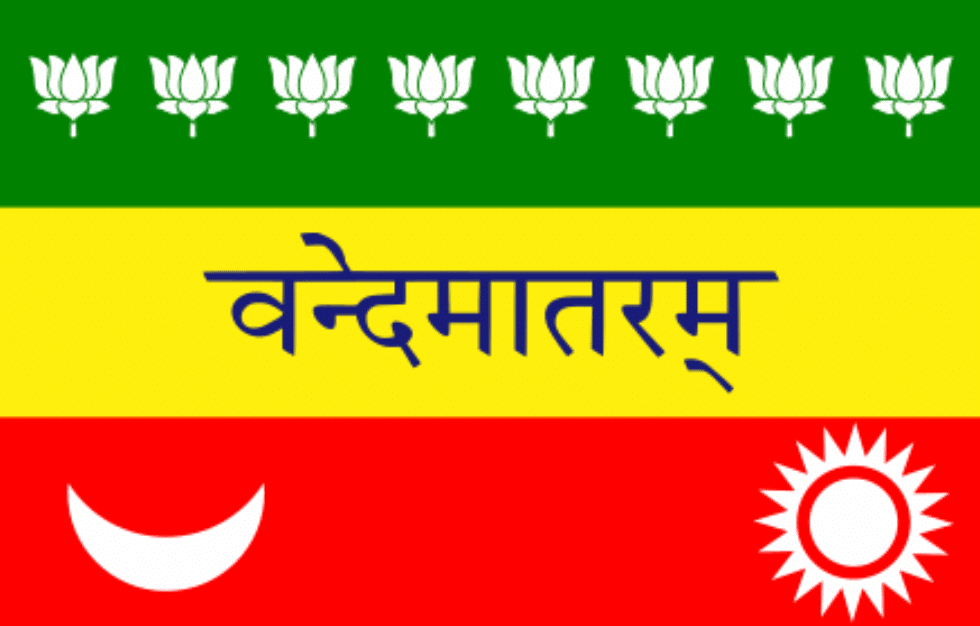
  • The Oudh Kisan Sabha was established in October 1920, led by Jawaharlal Nehru, Baba Ramchandra, and others. Within a month, over 300 branches were set up in the region.
  • The Congress aimed to integrate the Awadh peasant struggle into the Non-Cooperation Movement.

II. Peasant Movement and Congress Leadership

  • The peasant movement took forms that were not approved by the Congress leadership, including attacks on landlords’ houses, looting bazaars, and seizure of grain hoards.
  • Rumors spread that Gandhi had sanctioned tax avoidance and land redistribution. 
  • The Congress leadership struggled with these radical actions and the invocation of Gandhi’s name to justify them.

III. Tribal Peasants and Swaraj Interpretation

  • In the Gudem Hills of Andhra Pradesh, a guerrilla movement emerged in the early 1920s, which was not aligned with the Congress’s non-violent approach.
  • Colonial government restricted access to forest resources, affecting livelihoods and traditional rights.
  • Hill people revolted against forced labor (begar) for road building.
  • Alluri Sitaram Raju emerged as a leader, claiming special powers and invoking Gandhi’s influence to encourage khadi wear and abstinence from alcohol.
  • Raju advocated for the use of force rather than non-violence to achieve independence. His movement included attacks on police stations and British officials.
  • Encouraged wearing khadi and giving up drinking, but advocated for use of force to achieve swaraj.
  • Guerrilla warfare against British officials and police stations to achieve independence.
  • Raju captured and executed in 1924, becoming a folk hero.

Try yourself:What did the peasants demand from the talukdars and landlords?

  • A.Reduction of revenue
  • B.Abolition of begar
  • C.Social boycott of oppressive landlords
  • D.All of the above

View Solution

Swaraj in the Plantations

Workers’ Understanding of Mahatma Gandhi and Swaraj

  • Plantation workers in Assam saw freedom as the right to move freely and maintain a connection with their villages.
  • The Inland Emigration Act of 1859 restricted their movement, keeping them confined to tea gardens.

Non-Cooperation Movement and Plantation Workers

  • Thousands of workers defied authorities, left plantations, and attempted to return to their villages, believing Gandhi Rai would give them land.
  • They believed in the promise of ‘Gandhi Raj,’ expecting land distribution in their villages.
  • These workers never reached their destinations due to a railway and steamer strike, and were caught and beaten by the police.

Workers, Peasant and Tribal Movements in Assam

Visions of Swaraj

  • Movements were not defined by Congress programmes, but workers interpreted swaraj in their own ways.
  • Their actions and aspirations reflected a broader vision of freedom, despite not being fully informed by Congress directives.

Emotional Connection to All-India Agitation

  • Tribals chanting Gandhi’s name and demanding ‘Swatantra Bharat’ showed their emotional connection to a larger movement.
  • They identified with a movement beyond their immediate locality when acting in Gandhi’s name or linking their actions to the Congress.

Towards Civil Disobedience

Withdrawal of Non-Cooperation Movement

  • In February 1922, Mahatma Gandhi withdrew the Non-Cooperation Movement due to increasing violence.
  • Gandhi believed that satyagrahis needed proper training before participating in mass struggles.

Swaraj Party Formation and Internal Debates

  • Some Congress leaders, like C.R. Das and Motilal Nehru, wanted to participate in provincial council elections and formed the Swaraj Party.
  • Younger leaders, such as Jawaharlal Nehru and Subhas Chandra Bose, pushed for more radical mass agitation and full independence.

Impact of Worldwide Economic Depression

  • Agricultural prices fell from 1926, leading to a decline in exports and difficulty for peasants to pay their revenue.
  • By 1930, the Indian countryside was in turmoil due to the economic depression.

Simon Commission and Opposition

  • The Tory government in Britain set up a Statutory Commission under Sir John Simon to review the constitutional system in India.
  • The commission faced opposition in India as it had no Indian members, leading to protests with the slogan ‘Go back Simon’.
  • All parties, including the Congress and the Muslim League, took part in the demonstrations against the commission.

Viceroy’s Offer and Demand for Purna Swaraj

  • Viceroy Lord Irwin announced a vague offer of ‘dominion status’ for India and a Round Table Conference to discuss a future constitution in October 1929.
  • This offer did not satisfy Congress leaders, and the radicals, led by Jawaharlal Nehru and Subhas Chandra Bose, became more assertive.
  • In December 1929, the Lahore Congress, under Nehru’s presidency, formalized the demand for ‘Purna Swaraj’ or full independence for India.
  • 26 January 1930 was declared as ‘Purna Swaraj’ Day, marking the demand for complete independence from British rule.
  • To make the concept of freedom more relatable, Mahatma Gandhi sought to connect it to concrete issues of everyday life.

Try yourself:What was the main problem with the Simon Commission?

  • A.It was an all British commission
  • B.It was formed in India
  • C.It was set up in response to the nationalist movement
  • D.All of the above

View Solution

The Salt March & the Civil Disobedience Movement

Demands Letter and Ultimatum to Viceroy Irwin

  • Gandhi sent a letter on 31 January 1930, stating eleven demands to unite the Indian society.
  • The most significant demand was the abolition of the salt tax, which affected both rich and poor.
  • If demands were not met by 11 March, the Congress would launch a civil disobedience campaign.
  • Irwin refused to negotiate, leading to the start of the Salt March.

The Salt March

  • Gandhi and 78 volunteers marched 240 miles from Sabarmati to Dandi.
  • The march lasted 24 days, with the participants walking about 10 miles a day.
  • Thousands gathered to listen to Gandhi’s speeches on swaraj and peaceful defiance.
  • On 6 April, Gandhi reached Dandi and broke the law by making salt from sea water.

Depiction of Salt March led by Mahatma Gandhi and his followers

The Civil Disobedience Movement

  • Different from Non-Cooperation Movement as people were asked to break colonial laws.
  • Thousands broke the salt law, boycotted foreign cloth, and picketed liquor shops.
  • Peasants refused to pay taxes, village officials resigned, and forest people violated forest laws.
  • Colonial government arrested Congress leaders, leading to violent clashes and repressive measures.

Demands of Civil Disobedience Movement

The Gandhi-Irwin Pact and the Round Table Conference

  • Gandhi called off the movement and agreed to participate in the Round Table Conference in London.
  • The government released political prisoners in return. Negotiations in London broke down, and Gandhi returned disappointed.
  • Back in India, the government started a new cycle of repression, and Gandhi relaunched the movement.

The Movement’s Decline

  • The Civil Disobedience Movement continued for over a year but lost momentum by 1934.
  • Gandhi’s efforts, however, remained a significant part of India’s struggle for independence.

How Participants saw the Movement

Participation of Different Social Groups in the Civil Disobedience Movement

1. Rich peasant communities (Patidars of Gujarat, Jats of Uttar Pradesh)

  • Hit hard by the trade depression and falling prices.
  • Supported the movement to fight high revenues.
  • Disappointed when movement called off without revenue rates revision.

2. Poorer peasantry

  • Struggled with rent payments to landlord.
  • Joined radical movements led by Socialists and Communists.
  • Uncertain relationship with Congress due to Congress’ reluctance to support ‘no rent’ campaigns.

Role of the Business Classes- Indian merchants and industrialists

  • Made huge profits during World War I
  • Opposed colonial policies restricting business activities
  • Formed Indian Industrial and Commercial Congress (1920) and Federation of Indian Chamber of Commerce and Industries (FICCI) (1927)
  • Supported the Civil Disobedience Movement initially, but became apprehensive later.

Involvement of Industrial Working Class

  • Limited participation in the movement
  • Distanced themselves as industrialists came closer to Congress
  • Some workers participated in boycott of foreign goods, strikes, and protests
  • Congress reluctant to include workers’ demands in its program

Participation of Women in the Movement

  • Large-scale participation in various activities
  • Listening to Gandhiji, protest marches, manufacturing salt, picketing liquor shops
  • Women from high-caste urban families and rich peasant rural households
  • Saw service to the nation as a sacred duty
  • Limited change in the position of women
  • Gandhiji believed women’s primary duty was in the home
  • Congress reluctant to allow women in positions of authority within the organization

The Limits of Civil Disobedience

Untouchables and the Concept of Swaraj

  • Untouchables, or dalits, felt ignored by the Congress due to fear of offending conservative high-caste Hindus.
  • Gandhi aimed to eliminate untouchability, calling them harijan (children of God) and advocating for their rights to public spaces and amenities.
  • However, many dalit leaders sought political solutions, such as reserved seats in educational institutions and separate electorates.
  • Despite Gandhi’s efforts, dalit participation in the Civil Disobedience Movement remained limited.

Dr B.R. Ambedkar and the Depressed Classes Association

  • Ambedkar organized the dalits into the Depressed Classes Association in 1930.
  • He clashed with Gandhi at the second Round Table Conference, demanding separate electorates for dalits.
  • Following Gandhi’s fast unto death, Ambedkar agreed to the Poona Pact, which provided reserved seats for Depressed Classes but with a general electorate.
  • Dalit movement remained cautious of the Congress-led national movement.

Muslim Response to Civil Disobedience Movement

  • Many Muslim organizations felt alienated from the Congress after the decline of the Non-Cooperation-Khilafat movement.
  • Congress’s association with Hindu nationalist groups and communal clashes further deepened the divide between Hindus and Muslims.
  • Efforts to forge unity between the Congress and the Muslim League failed due to disagreements over representation in future assemblies.
  • Jinnah was willing to give up separate electorates in exchange for reserved seats and proportional representation in Muslim-dominated provinces, but negotiations fell apart.

Atmosphere of Suspicion and Distrust

  • When the Civil Disobedience Movement started, there was already suspicion and distrust between Hindus and Muslims.
  • Many Muslims felt alienated from the Congress and were concerned about their status as a minority within India.
  • As a result, large sections of Muslims did not respond to the call for a united struggle during the Civil Disobedience Movement.

The Sense of Collective Belonging

Nationalism and Collective Belonging

  • Nationalism spreads when people believe they are part of the same nation
  • Unity develops through shared experiences and cultural processes
  • History, fiction, folklore, songs, popular prints, and symbols contribute to nationalism

Visual Symbols of National Identity

  • In the twentieth century, India’s identity was associated with the image of Bharat Mata
  • Created by Bankim Chandra Chattopadhyay in the 1870s through the hymn ‘Vande Mataram’
  • The image evolved over time and devotion to it signified nationalism

Bharat Mata

Revival of Indian Folklore

  • Nationalists recorded folk tales, songs, and legends to preserve traditional culture
  • Rabindranath Tagore and Natesa Sastri were prominent figures in the folk revival movement
  • Folklore was considered national literature and a representation of people’s true thoughts and characteristics

Icons and Symbols in Unifying People

  • Nationalist leaders used icons and symbols to inspire unity and nationalism
  • Tricolour flag was adopted as the national flag of India in 1931 and was influenced by the Congress flag
  • Carrying and displaying the flag became a symbol of defiance

Reinterpretation of History

  • Indians sought to instill pride in the nation by reinterpreting history
  • They focused on the glorious achievements in ancient times, followed by a period of decline under colonization
  • Nationalist histories aimed to inspire pride and a desire for change

Issues in Unifying People

  • The glorified past, which was predominantly Hindu, made people of other communities feel excluded
  • The challenge was to create a sense of unity while maintaining the diverse cultural identity of India

Conclusion

  • During the first half of the twentieth century, various groups and classes of Indians united in the struggle for independence.
  • The Congress under the leadership of Mahatma Gandhi attempted to resolve differences and ensure that the demands of one group did not alienate another. 
  • In other words, a nation was emerging with many voices wanting freedom from colonial rule.

Frequently Asked Questions

Q.1: Why was the Rowlatt Act imposed? 

Ans: The imposing of the Rowlatt Act authorized the government to imprison any person without trial and conviction in a court of law.

Q.2: Name two main ‘Satyagraha’ movements organized by Mahatma Gandhi successfully in favour of peasants in 1916 and 1917.

Ans: The two main ’Satyagraha’ movements organized by Mahatma Gandhi successfully in the favour of peasants are: 

  1. Indigo Planters Movement in Champaran, Bihar in 1916.
  2. Peasants Satyagraha Movement was organized in Kheda district in Gujarat in 1917 to support peasants in the demand for relaxation of revenue collection.

Q.3: In which novel was the hymn ‘Vande Mataram’ included and who was the novel written by? 
Ans: 
In the novel Aandamath the hymn ‘Vande Mataram‘ included. It was written by Bankim Chandra Chattopadhyay.

For additional question answers from this chapter and to excel in your school exams, click the links provided below:

Long Answer Questions: Nationalism in India

Short Answer Questions: Nationalism in India

Previous Year Questions: Nationalism in India

1. The Rise of Nationalism in Europe – Chapter Notes

Frédéric Sorrieu Vision of World

In 1848, Frédéric Sorrieu, a French artist, created a series of prints depicting his vision of a world composed of democratic and social Republics.

The Dream of Worldwide Democratic and Social Republics – The Pact Between Nations, a print prepared by Frédéric Sorrieu, 1848.

  • The first print shows people from Europe and America of all ages and social classes marching in a procession, paying tribute to the Statue of Liberty, symbolizing freedom and enlightenment.
  • Liberty is portrayed as a female figure holding the torch of Enlightenment and the Charter of the Rights of Man.
  • The scene includes shattered symbols of absolutist institutions, representing the overthrow of oppressive regimes.
  • Different nations are depicted through flags and national costumes, with the United States and Switzerland leading the procession.
  • FranceGermanyAustria, and other nations follow, reflecting the aspirations for nationhood and democracy prevalent in 1848.
  • Christ, saints, and angels observing from above symbolize fraternity among nations.
  • Nationalism emerged in the 19th century, leading to the rise of nation-states and the decline of multi-national empires in Europe.
  • Nation-states involved centralized power over defined territories, with citizens sharing a common identity and history.
  • This common identity is forged through struggles and shared experiences, which shape the concept of nation-states and nationalism in Europe.

The Storming of Bastille

The French Revolution & the Idea of a Nation

  • The concept of nationalism emerged prominently during the French Revolution in 1789.
  • France was a complete territorial state ruled by an absolute monarch before the revolution.
  • The French Revolution brought significant political and constitutional changes transferring sovereignty from the monarchy to French citizens.
  • The revolution emphasized that the people, not the monarchy, would form the nation and determine its fate.
  • French revolutionaries implemented various measures to foster a shared identity among the French populace.
  • Notions like la patrie (the fatherland) and le citoyen (the citizen) promoted a united community with equal rights under a constitution.
  • Symbols of national unity were introduced, such as the tricolor flag replacing the royal standard.
  • The Estates General transformed into the National Assembly, elected by active citizens.
  • New customs like hymns, oaths, and commemorations emphasized national pride.
  • centralized administration was established with uniform laws, currency, and language across the nation.
  • Napoleon, extending French influence, introduced reforms like the Napoleonic Code, promoting equality and property rights.
  • Under Napoleon, administrative reforms were implemented across regions under French control, simplifying divisions and abolishing feudal systems.
  • French rule received mixed reactions in conquered territories, initially welcomed but later met with resistance due to increased taxation and lack of political freedom.


The Making of Nationalism in Europe

  • In the mid-eighteenth century, Europe was not composed of nation-states as we recognize them today.
  • Regions like GermanyItaly, and Switzerland were fragmented into kingdoms, duchies, and cantons with their own rulers and territories.
  • Eastern and Central Europe were under autocratic monarchies where diverse peoples lived without a shared identity or culture.
  • The Habsburg Empire, ruling over Austria-Hungary, was a mosaic of varied regions and peoples.
  • It encompassed regions like the TyrolAustria, the SudetenlandBohemiaLombardyVenetiaHungaryGalicia, and Transylvania.
  • People within the empire spoke different languages and belonged to distinct ethnic groups.
  • The diversity within the empire hindered the development of a sense of political unity.
  • Various groups were loyal to the emperor but did not share a common identity or culture.
  • The idea of nationalism and nation-states began to evolve due to the lack of shared identity among diverse groups.
  • People began to identify with the concept of a nation and sought political unity through commonalities.
  • These movements laid the foundation for the eventual formation of nation-states.

The Aristocracy and the New Middle Class

  • Socially and politically, a landed aristocracy was the dominant class on the continent.
  • The members of this class shared a common way of life cutting across regional divisions.
  • They owned estates both in the countryside and in towns.
  • French was often spoken in diplomacy and high society.
  • Family connections were often maintained through marriages.
  • Although powerful, the aristocracy was a numerically small group.
  • The majority of the population consisted of the peasantry.
  • In Western Europe, land was mainly farmed by tenants and small owners, while in Eastern and Central Europe, vast estates were worked by serfs.
  • Industrial production and trade led to the growth of towns and the emergence of commercial classes in Western Europe and parts of Central Europe.
  • Industrialization began in England in the late 18th century but occurred later in France and parts of Germany.
  • New social groups emerged, including a working-class population and middle classes comprising industrialists, businessmen, and professionals.
  • In Central and Eastern Europe, these groups were smaller in number until the late 19th century.
  • Ideas of national unity gained popularity among the educated, liberal middle classes after aristocratic privileges were abolished.

French Aristocrats

What did Liberal Nationalism Stand for?

  • Liberal Nationalism in early 19th-century Europe was closely linked with liberalism, which emphasizes freedom and equality.
  • Liberalism, rooted in the Latin word “liber” for free, symbolized liberty for individuals and equality under the law for the burgeoning middle classes.
  • Politically, liberalism advocated for governance based on consent, marking a shift from autocracy and clerical privileges towards constitutional government and parliamentary representation.
  • Nineteenth-century liberals prioritized private property rights and the concept of government by the people through elected representatives.
  • However, equal treatment before the law did not always translate to universal suffrage, as seen in early democratic experiments like revolutionary France where only property-owning men could vote.
  • Throughout the 19th and early 20th centuries, movements emerged advocating for equal political rights for women and non-propertied men.
  • Economically, liberalism supported free markets by opposing state-imposed restrictions on the movement of goods and capital.
  • In the German-speaking regions during the early 19th century, the emergence of a customs union, the Zollverein, aimed to streamline trade by abolishing tariffs and reducing the number of currencies.
  • The Zollverein, initiated by Prussia and joined by other German states, facilitated economic growth by allowing the free flow of goods, people, and capital, reinforced by the development of a railway network.
  • This economic nationalism further bolstered broader nationalist sentiments, promoting economic exchange and national unity.

Try yourself:

What was the aim of the French revolutionaries during the French Revolution?

  • A.To establish a monarchy in France
  • B.To create a sense of collective identity among the French people
  • C.To abolish the Estates General and establish a new political system
  • D.To conquer other European countries and expand the French empire

View Solution

A New Conservatism after 1815

  • After Napoleon’s 1815 defeat, European governments leaned towards conservatism, aiming to uphold traditional institutions like the monarchy, the Church, social hierarchies, property, and family.
  • Conservatives recognized that modernization could benefit traditional institutions, making state power more robust through advancements like a modern army, efficient bureaucracy, a dynamic economy, and the end of feudalism.
  • The Congress of Vienna in 1815, involving powers like Britain, Russia, Prussia, and Austria, sought to reverse many changes brought by Napoleon, restoring the Bourbon dynasty in France and establishing new states to contain French expansion.
  • Prussia and Austria gained territories, while Russia and Prussia acquired parts of Poland and Saxony, respectively, with the primary goal of reinstating overthrown monarchies and establishing a conservative European order.
  • Post-1815 conservative regimes were autocratic, suppressing dissent and instituting censorship to quell challenges to autocratic rule, despite liberal ideals from the French Revolution persisting and inspiring movements like advocating for press freedom.

Try yourself:Which of the following countries did not attend the Congress of Vienna 1815?

  • A.Britain
  • B.Russia
  • C. Switzerland
  • D.Prussia

View Solution

The Revolutionaries

  • In 1815, secret societies were formed in many European states to train revolutionaries and spread their ideas. Revolutionary opposed monarchical forms, and fight for liberty and freedom.
  • Most of these revolutionaries also saw the creation of nation-states as a necessary part of this struggle for freedom.
  • The Italian revolutionary Giuseppe Mazzini, born in Genoa in 1807, founded two more underground societies, first, Young Italy in Marseilles.
  • Secondly, he founded Young Europe in Berne, whose members were like-minded young men from Poland, France, Italy, and the German states.
  • Following his model, secret societies were set up in Germany, France, Switzerland, and Poland.
  • Mazzini’s relentless opposition to monarchy and his vision of democratic republics frightened the conservatives.
  • Metternich described him as ‘the most dangerous enemy of our social order’.

The Age of Revolutions: 1830-1848

  • The period from 1830 to 1848 was known as “The Age of Revolutions.”
  • In Europe, as conservative governments sought to strengthen their power, ideas of liberalism and nationalism became linked with revolutionary movements.
  • These revolutions occurred in various European regions like the Italian and German states, parts of the Ottoman EmpireIreland, and Poland.
  • The revolutions were primarily led by liberal nationalists from the educated middle-class elite, including professors, schoolteachers, clerks, and members of the commercial middle classes.
  • The first major uprising happened in France in July 1830, where the Bourbon monarchy was overthrown by liberal revolutionaries who established a constitutional monarchy headed by Louis Philippe.
  • The July Revolution in France inspired a similar movement in Brussels, leading to the separation of Belgium from the United Kingdom of the Netherlands.
  • The Greek War of Independence ignited nationalist sentiments across Europe, as Greece had been under Ottoman rule since the 15th century.
  • Revolutionary nationalism in Europe fueled the Greek struggle for independence that began in 1821, supported by exiled Greeks and sympathizers from Western Europe.
  • Prominent figures like Lord Byron supported the Greek cause, emphasizing Greece’s importance as the cradle of European civilization.
  • Lord Byron organized financial aid and joined the conflict, ultimately passing away in 1824 due to illness.
  • The Treaty ofConstantinople in 1832 officially recognized Greece as an independent nation.

Revolutionaries in Berlin in March 1848, waving the revolutionaries flags

The Romantic Imagination and National Feeling

  • Nationalism didn’t just arise from wars and territorial expansion; culture also played a crucial role in shaping the idea of the nation.
  • Art, poetry, stories, and music played an instrumental role in expressing and shaping nationalist sentiments.
  • Romanticism was a cultural movement that aimed to cultivate a unique form of nationalist emotion.
  • Romantic artists and poets critiqued the exaltation of reason and science, focusing instead on emotions, intuition, and mystical feelings.
  • They sought to establish a sense of shared collective heritage and a common cultural past as the foundation of a nation.
  • German philosopher Johann Gottfried Herder emphasized discovering true German culture among the common people.
  • The essence of the nation (volksgeist) was promoted through folk songs, poetry, and dances.
  • Collecting and preserving folk culture was vital for the project of nation-building.
  • Emphasis on vernacular language and local folklore aimed at connecting with large illiterate audiences.
  • Polish language and culture were suppressed after the Russian occupation, but efforts to revive national feelings persisted.
  • Karol Kurpinski used music and operas to celebrate the national struggle, elevating folk dances as nationalist symbols.
  • Language became a weapon of national resistance in Poland, with clergy using Polish for religious purposes against Russian dominance.

Try yourself:Choose the correct nationality of the artist Frederic Sorrieu who visualised in his painting a society made up of Democratic and Social Republic.

  • A.German
  • B.French
  • C.Swiss
  • D.American

View Solution

Hunger, Hardship and Popular Revolt

  • The 1830s in Europe were marked by severe economic difficulties.
  • Population growth led to a surplus of job seekers and a shortage of jobs.
  • Rural residents moved to cities, living in overcrowded slums.
  • Local producers faced tough competition from cheap English goods due to industrialization.
  • Textile production, mainly in homes or small workshops, faced competition from mechanized English production.
  • Peasants in regions with powerful aristocracies suffered from feudal obligations.
  • Rising food prices and poor harvests worsened poverty in both urban and rural areas.
  • In 1848, food shortages and unemployment triggered unrest in Paris, leading to Louis Philippe’s ousting.
  • A Republic was declared, suffrage was extended to adult males, and the right to work was guaranteed.
  • National workshops were established to provide employment.
  • In 1845, weavers in Silesia revolted against contractors who exploited them by reducing payments.
  • Weavers demanded higher wages, leading to clashes with the contractor and eventual military intervention.
  • The conflict resulted in the death of eleven weavers.

1848: The Revolution of the Liberals

  • Occurred alongside uprisings of impoverished, unemployed, and hungry peasants and workers across Europe.
  • In 1848, a revolution led by the educated middle classes was unfolding.
  • In France, events in February led to the abdication of the monarch and the establishment of a republic with universal male suffrage.
  • In countries like Germany, Italy, Poland, and the Austro-Hungarian Empire, liberal middle-class individuals demanded constitutionalism and national unification.
  • They sought to establish a nation-state based on parliamentary principles, including a constitution, freedom of the press, and freedom of association.
  • In Germany, various political groups composed of professionals, businessmen, and successful artisans convened in Frankfurt to form an all-German National Assembly.
  • On May 18, 1848, 831 elected representatives gathered in Frankfurt to draft a constitution for a German nation with a monarch subject to parliamentary oversight.
  • King Friedrich Wilhelm IV of Prussia rejected the terms offered by the assembly, aligning with other monarchs to oppose the elected body.
  • The parliament faced increasing opposition from the aristocracy and military, losing support from workers and artisans.
  • The parliament, dominated by the middle class, eventually disbanded after troops intervened.
  • Political rights for women were a divisive issue within the liberal movement despite active female participation in political activities.
  • Women were not granted suffrage during the Assembly elections and were only allowed as observers in the visitors’ gallery at the Church of St Paul.
  • Conservative forces suppressed liberal movements in 1848, leading to a realization among monarchs that concessions to liberal-nationalist revolutionaries were necessary to prevent cycles of revolution and repression.
  • Following 1848, autocratic monarchies in Central and Eastern Europe began implementing changes witnessed in Western Europe before 1815, such as the abolition of serfdom and bonded labor.
  • The Habsburg rulers granted more autonomy to Hungarians in 1867 as part of the reforms.

Try yourself:What were the reasons for economic hardships in Europe in the 1830s?

  • A.Decrease in population and lack of labor supply.
  • B.Overcrowding in cities and migration from rural areas.
  • C.Lack of industrialization and competition from England.
  • D.None of these.

View Solution

The Making of Germany and Italy

Germany – Can the Army be the Architect of a Nation?

  • After 1848, nationalism in Europe shifted away from democracy and revolution.
  • Nationalist feelings were often manipulated by conservatives to strengthen state power and gain political control.
  • Germany and Italy underwent a process of unification as nation-states.
  • German middle-class individuals in 1848 attempted to unite the German confederation into a nation-state through an elected parliament.
  • However, this liberal effort was suppressed by the monarchy, military, and Prussian landowners (Junkers).
  • Prussia then took the lead in the movement for national unification, led by Otto von Bismarck.
  • Through three wars in seven years (against Austria, Denmark, and France), Prussia emerged victorious, finalizing the unification process.
  • In January 1871, King William I of Prussia was declared German Emperor in Versailles.
  • The nation-building process in Germany highlighted the dominance of Prussian state power.
  • The new German state focused on modernizing currency, banking, legal, and judicial systems, setting an example for the rest of Germany.

Italy Unified

  • Italy, like Germany, had a history of political fragmentation.
  • Italians were spread across different states and empires.
  • Italy was divided into seven states, with only Sardinia-Piedmont ruled by an Italian princely house.
  • The north was under Austrian Habsburg rule, the center under the Pope, and the south under Bourbon kings of Spain.
  • The Italian language had various regional variations.
  • Giuseppe Mazzini aimed for a unified Italian Republic and created Young Italy for this cause.
  • Failed uprisings led to Sardinia-Piedmont taking the lead in unification under King Victor Emmanuel II.
  • Cavour, a key figure, orchestrated a diplomatic alliance with France to defeat Austria and unify Italy.
  • In 1860, armed volunteers led by Garibaldi helped unify Italy, with Victor Emmanuel II becoming king in 1861.
  • Despite unification, many Italians were unaware of liberal-nationalist ideas, with high illiteracy rates among the masses.

The Strange Case of Britain

  • The nation-state model in Britain evolved gradually rather than through sudden change.
  • Prior to the 18th century, there wasn’t a unified British identity; people identified more with their ethnic backgrounds like EnglishWelshScot, or Irish.
  • As England grew in wealth and power, it exerted influence over the other nations in the British Isles.
  • The English Parliament, after gaining power from the monarchy in 1688, played a crucial role in forming a nation-state with England as its core.
  • TheAct of Union in 1707 between England and Scotland led to the creation of the ‘United Kingdom of Great Britain’, consolidating English influence over Scotland.
  • Scotland‘s unique culture and political institutions faced suppression as a British identity emerged, leading to the marginalization of Scottish traditions.
  • In Ireland, deep divisions between Catholics and Protestants existed, with English support aiding Protestant dominance over a predominantly Catholic nation.
  • Rebellions against British control, like the one led by Wolfe Tone and the United Irishmen in 1798, were quashed, eventually leading to Ireland‘s inclusion in the United Kingdom in 1801.
  • A new British identity was constructed, emphasizing English culture and symbols like the Union Jack and the English language, relegating older nations to subordinate roles in the union.

Map: Unification of Germany

Try yourself:Who played the leading role in the unification of Germany?

  • A.German Emperor (formerly King of Prussia) — Kaiser William I
  • B.Otto Von Bismarck (Prussian Chief Minister)
  • C.Johann Gottfried Herder — German philosopher
  • D.Austrian Chancellor — Duke Metternich.

View Solution

Visualising the Nation

  • Artists in the 18th and 19th centuries personified nations by representing them as female figures.
  • The chosen female form symbolized the nation as a personification, not a specific real-life woman.
  • Female allegories, such as Marianne in France and Germania in Germany, were created to embody the nation.
  • During the French Revolution, LibertyJustice, and the Republic were depicted using symbols like the red cap, broken chain, blindfolded woman with weighing scales.
  • Marianne, symbolizing France, was associated with the red cap, tricolour, and cockade, with statues erected in public places as a symbol of unity.
  • Germania, symbolizing Germany, wore a crown of oak leaves to represent heroism in visual representations.
  • These allegorical figures were used on coins, stamps, and public monuments to instill a sense of national identity.

Nationalism and Imperialism

  • Nationalism evolved from an idealistic sentiment to a narrow creed by the late 1800s.
  • Nationalist groups grew intolerant and war-ready, while major European powers exploited these sentiments for imperialism.
  • The Balkans, encompassing various modern countries, experienced heightened nationalist tensions post-1871.
  • Under Ottoman control, the Balkans saw the rise of romantic nationalism and the empire’s decline.
  • Balkan nations sought independence based on historical claims, leading to conflicts and power rivalries.
  • European powers like Russia, Germany, England, and Austro-Hungary vied for control over the Balkans, sparking wars.
  • Intense competition over trade, colonies, and military strength culminated in the outbreak of World War I in 1914.
  • Colonized nations globally began resisting European dominance, fostering anti-imperial movements.
  • These movements aimed to establish independent nation-states, driven by collective national unity and opposition to imperialism.
  • Unique varieties of nationalism emerged worldwide, emphasizing the natural organization of societies into nation-states.