Multiple Choice QuestionsQ1: Cube root of the expression 1252 (a) 5 (b) 25 (c) 10 (d) 125
Q2: Which of the following is not a perfect square number?
(a) 1156 (b) 4657 (c) 4624 (d) 7056
Q3: Which of these is not a perfect cube but a perfect square of a number (a) 729 (b) 2197 (c) -1331 (d) 169
Q4: Which of these is a perfect cube (a) 216 (b) 392 (c) 8640 (d) 243
Q5: √0.09 is (a) 0.3 (b) 0.03 (c) 0.9 (d) 0.33
Q6: The sum of first n odd natural numbers is (a) n2 (b) 2n (c) n2+1 (d) n2−1
Q7: The one’s digit of the cube of 53 is:
(a) 9 (b) 3 (c) 7 (d) 1
Q8: The volume of the cube is 5832m3 , the side is (a) 18m (b) 16 m (c) 28 m (d) 19m
Q9:A perfect square can never have the following digit in its ones place (a) 8 (b) 4 (c) 0 (d) 1
Q10: Which of the following expressions is not a perfect cube (a) 27 x 125 x 64 (b) 1331 x 125 x 8 (c) 15 x 8 x 25 x 9 (d) None of these
True and FalseQ1: 648 is not a perfect cube.
Q2: 999 is a perfect cube.
Q3: The square of a number is positive, so the cube of that number will also be positive.
Q4: 125×8×27 is a perfect cube.
Q5: For an integer p, p3 is always greater than p2.
Q6: 83 = 5.12
Fill in the blanks
Q1: The square of an even number is _____
Q2: The least number by which 72 be multiplied to make it a perfect cube is __________.
Q3: √4096 is ____
Q4: If 8x3=216, then x ix ____
Q5: The cube of .5 is _____
Q6: There are _________ perfect cubes between 1 and 1000.
Q7: The digit at the ones place of 233 is ____
Q8: The cube of the even natural number is ____
Find the cube roots by prime factorization method
Q1: 15625
Q2: 2744
Q3: 125/2197
Q4: 5832
Q5: 64000
Find the square roots by prime factorization method
Q1: 144
Q2: 3600
Q3: 2025
Q4: 81/256
Q5: 1024
Q6: 3844
Answer the following questions
Q1: Is 256 a perfect cube? If not, find the smallest number by which it should be divided to get a perfect cube. Q2: What could be the possible ‘one’s’ digits of the square root of each of the following numbers? (i) 1801 (ii) 856 (iii) 1008001 (iv) 6577525 Q3: Three numbers are in the ratio 1:2:3 and the sum of their cubes is 4500. Find the numbers.
Q4: Find the smallest number by which following number must be divided to get a perfect square. Also, find the square root of the perfect square so obtained. (i)600 (ii)2904
Q5: Find the smallest number by which following number must be multiplied to get a perfect square. Also, find the square root of the perfect square so obtained. (i) 1008 (ii) 1280 (iii) 1875
You can access the solutions to this Unit Test here.
Q1. Which of the following is not a factor of production? (a) Land (b) Labour (c) Money (d) Entrepreneurship
Ans: (c) Money Money alone is not considered a factor; instead, it is part of capital when used for production.
Q2. In economics, “land” refers to— (a) Only soil and ground (b) All natural resources used for production (c) Only forests (d) Only minerals
Ans: (b) All natural resources used for production Land includes soil, forests, minerals, water, sunlight, air, etc.
Q3. Human effort, both physical and mental, used in the production process is called— (a) Capital (b) Labour (c) Entrepreneurship (d) Technology
Ans: (b) Labour Labour means human physical and mental effort in production.
Q4. The knowledge, skills, and expertise of workers are called— (a) Land (b) Human capital (c) Physical labour (d) Entrepreneurship
Ans: (b) Human capital Human capital makes labour more productive.
Q5. Which two main facilitators help build strong human capital? (a) Wealth and inheritance (b) Education and healthcare (c) Minerals and forests (d) Elections and democracy
Ans: (b) Education and healthcare Education increases skills, and healthcare ensures productivity.
Q6. Capital in production refers to— (a) Only money (b) Durable assets like machinery, tools, and buildings plus money (c) Only human resources (d) Only natural resources
Ans: (b) Durable assets like machinery, tools, and buildings plus money Capital includes machines, tools, offices, and money used in production.
Q7. The person who takes risk, combines resources, and creates businesses is called— (a) Worker (b) Capitalist (c) Entrepreneur (d) Educator
Ans: (c) Entrepreneur Entrepreneurs create businesses, innovate, and take risks.
Q8. Which Indian business leader founded India’s first airline in 1932? (a) Dhirubhai Ambani (b) J.R.D. Tata (c) Ratan Tata (d) Verghese Kurien
Ans: (b) J.R.D. Tata He founded Tata Airlines, later known as Air India.
Q9. Which of the following shows how technology helps production? (a) Pulleys and wheelbarrows in ancient times (b) UPI for faster payments today (c) Drones spraying fertilizers (d) All of these
Ans: (d) All of these Technology improves production in both traditional and modern ways.
Q10. India became the first country in 2014 to pass a law requiring companies to spend part of their profits on— (a) Exports (b) Corporate Social Responsibility (c) Workers’ salaries (d) Import duties
Ans: (b) Corporate Social Responsibility Companies must spend 2% of profits on CSR activities.
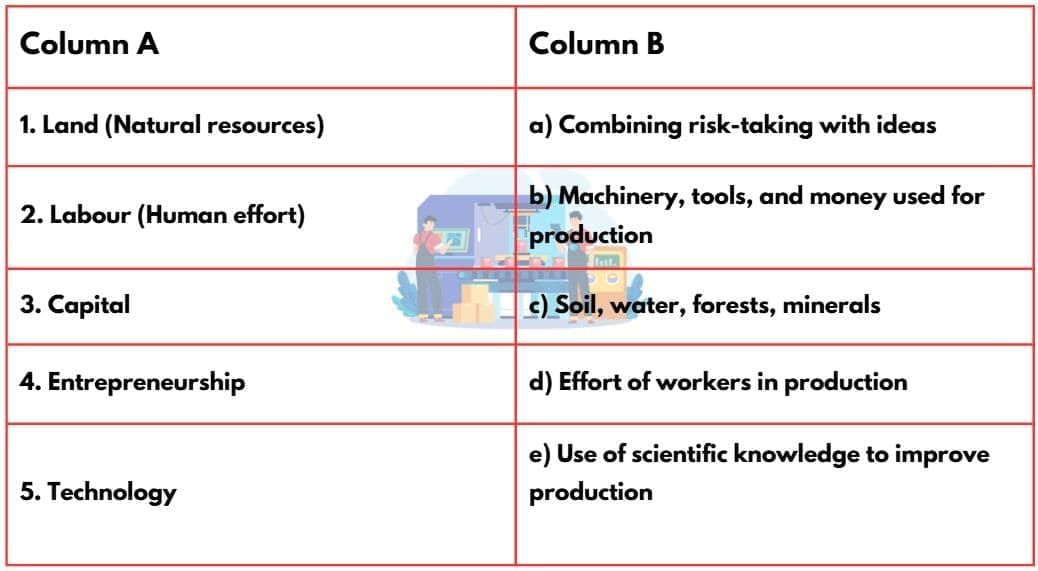
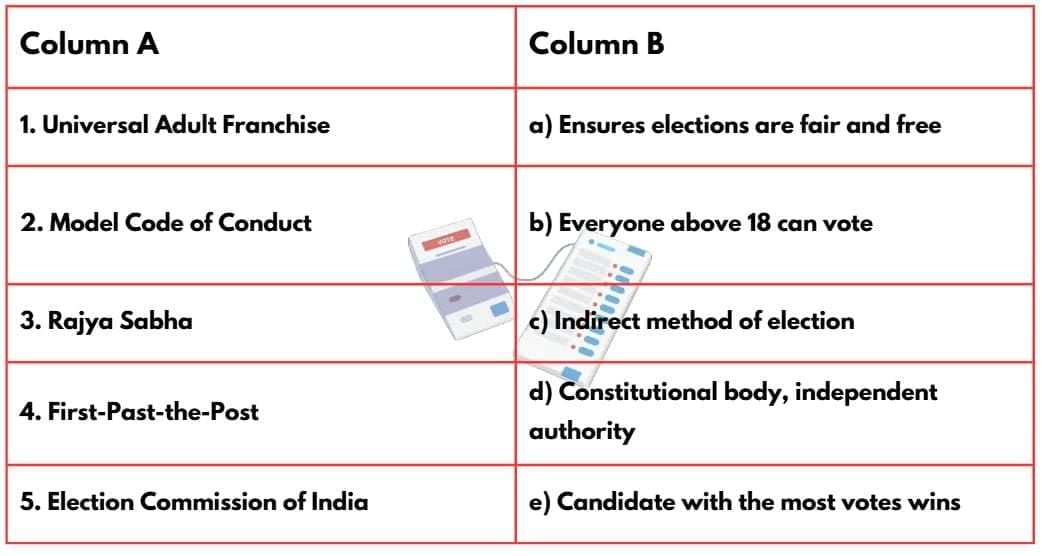
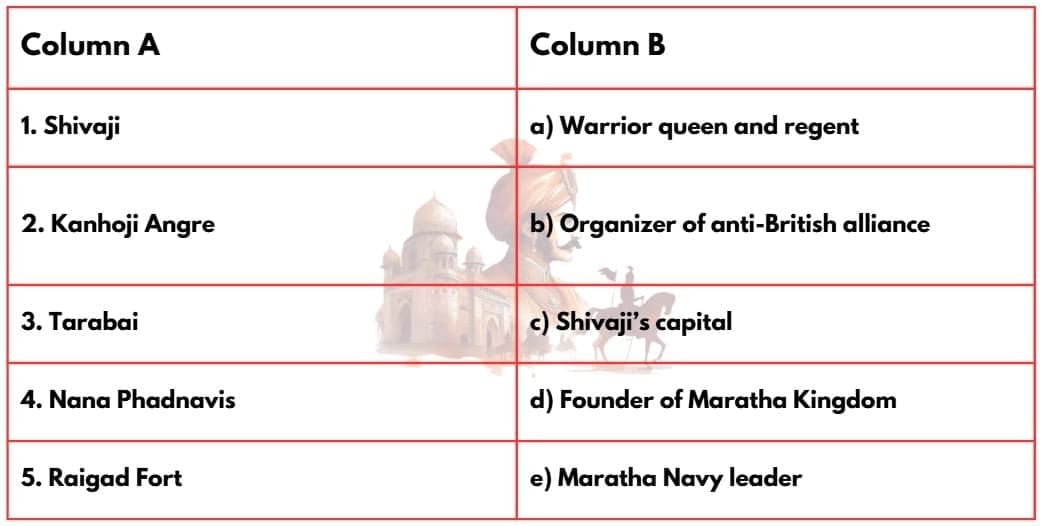
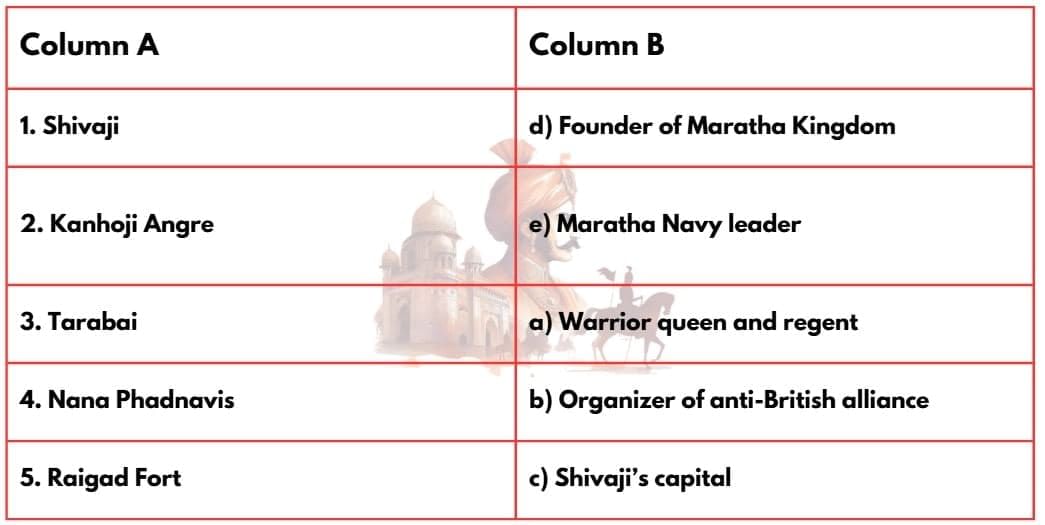
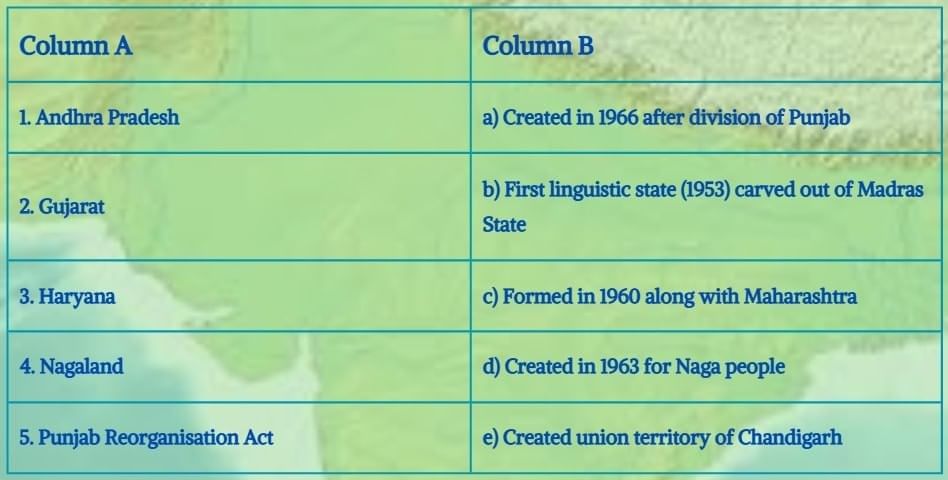
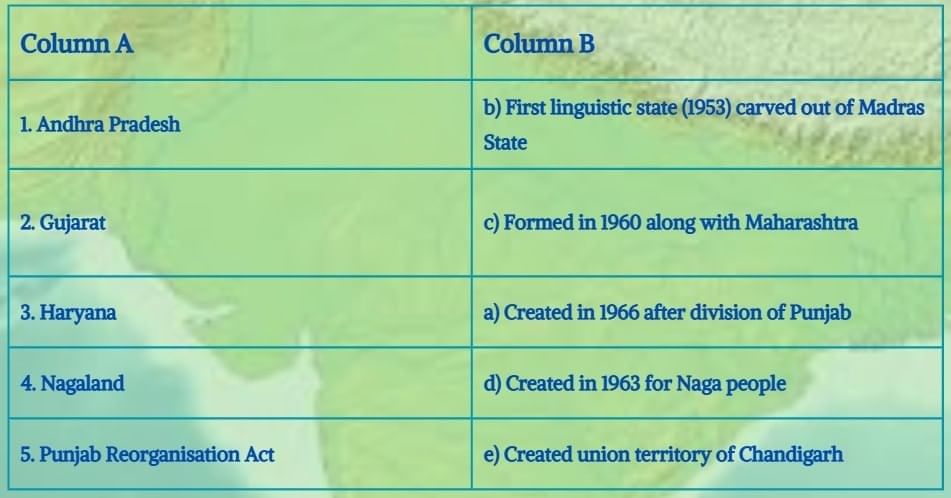
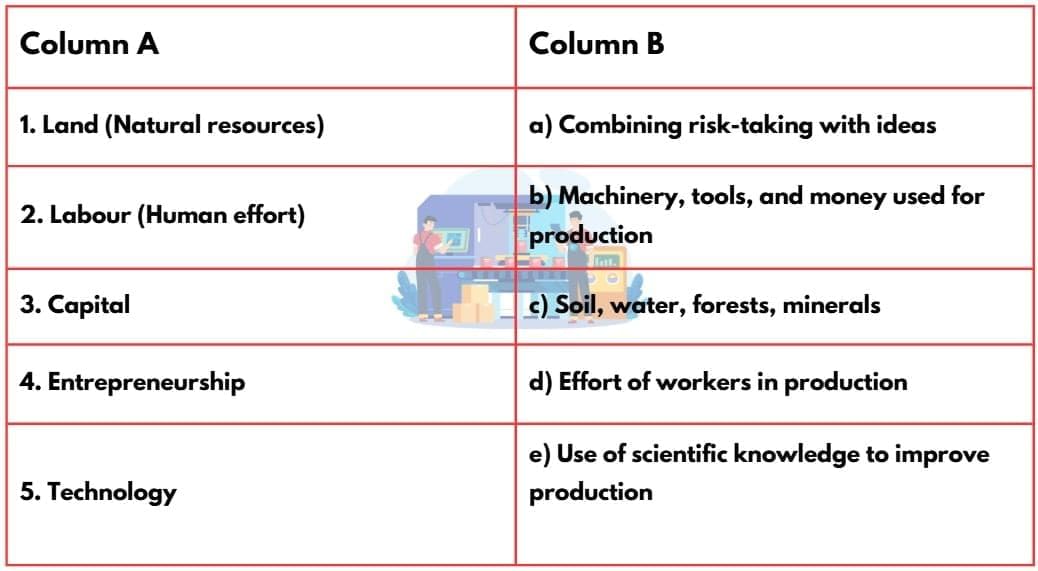
Match the Following
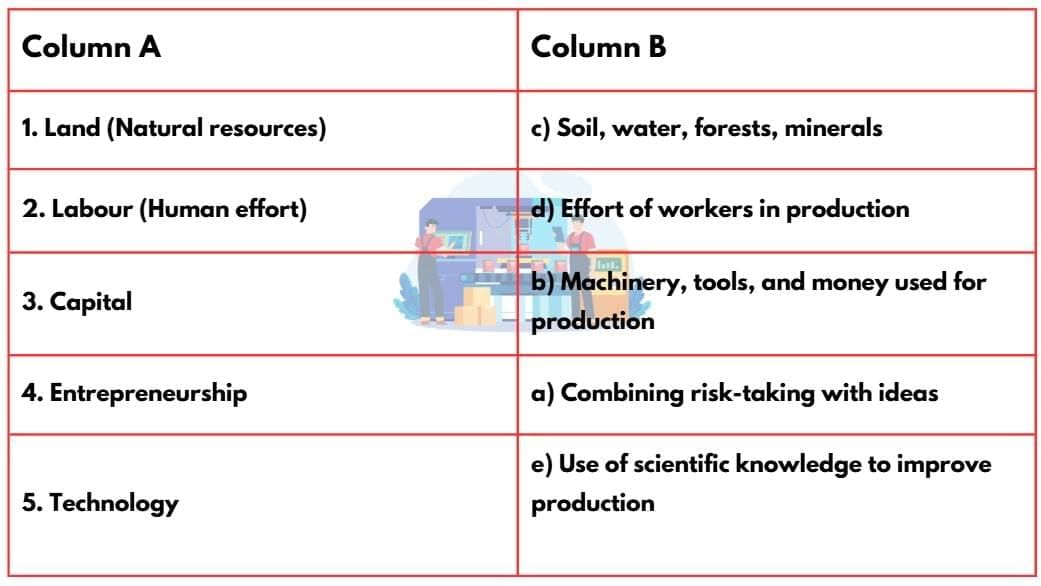
Ans:
True or False
Q1. Human capital is the same as human labour. Ans: False
Human capital adds skills and knowledge, making labour more effective.
Q2. Education and training improve the productivity of workers. Ans: True
They equip workers with skills and expertise.
Q3. J.R.D. Tata started the first steel plant in India. Ans: False
He founded India’s first airline, not the first steel plant.
Q4. Technology reduces barriers to learning and jobs. Ans: True
Technology enables online courses and wider job access.
Q5. In economics, capital also includes buildings, tools, and machinery. Ans: True
Capital covers both money and durable production assets.
Q6. CSR (Corporate Social Responsibility) means ignoring society’s welfare and focusing only on profits. Ans: False
CSR is about companies spending on social welfare and sustainability.
Fill in the Blanks
Q1. The four main factors of production are land, labour, capital, and ______. Ans: Entrepreneurship
Q2. Knowledge and skills that make labour more effective are called ______ capital. Ans: Human
Q3. Good ______ helps workers be healthy and productive. Ans: Healthcare
Q4. The concept of kaizen, meaning continuous improvement, comes from ______. Ans: Japan
Q5. J.R.D. Tata founded ______ Airlines in 1932. Ans: Tata (later Air India)
Q6. Money borrowed from a bank must be repaid with ______. Ans: Interest
Q7. In 2014, India made CSR spending by companies ______ under law. Ans: Mandatory
Very Short Answer Questions
Q1. Define factors of production. Ans: Factors of production are resources like land, labour, capital, and entrepreneurship used to produce goods and services.
Q2. Give two examples of natural resources used in production. Ans: Water and minerals.
Q3. What is the difference between labour and human capital? Ans: Labour is physical and mental effort, while human capital refers to skills and knowledge that increase productivity.
Q4. Name two ways societies can build human capital. Ans: Education and healthcare.
Q5. What is capital? Give one example. Ans: Capital includes man-made resources like machines or money; example: a sewing machine.
Q6. Who is called an entrepreneur? Ans: A person who takes risks, organizes factors of production, and creates businesses.
Q7. Mention one contribution of J.R.D. Tata to India. Ans: He founded India’s first airline (Tata Airlines/Air India).
Q8. Give two examples of technology used in modern production. Ans: Drones in farming and UPI for payments.
Q9. What does CSR stand for? Ans: Corporate Social Responsibility.
Q10. Why should factors of production be used responsibly? Ans: To protect the environment, ensure fair treatment of workers, and secure resources for future generations.
Q1. The Parliament of India consists of— (a) Lok Sabha and Rajya Sabha only (b) The President and Lok Sabha (c) The President, Lok Sabha, and Rajya Sabha (d) The Prime Minister and Lok Sabha
Ans: (c) The President, Lok Sabha, and Rajya Sabha The Indian Parliament includes the President and the two Houses.
Q2. How many Lok Sabhas have been formed as of June 2024? (a) 15 (b) 16 (c) 17 (d) 18
Ans: (d) 18 The 18th Lok Sabha began in June 2024.
Q3. Who presides over the sessions of the Lok Sabha? (a) President (b) Vice President (c) Speaker (d) Prime Minister
Ans: (c) Speaker The Speaker maintains order and discipline in Lok Sabha.
Q4. Who is the chairperson of the Rajya Sabha? (a) Prime Minister (b) Speaker (c) Vice President of India (d) President of India
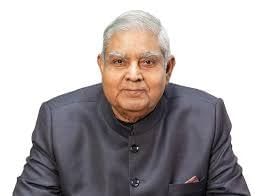
Ans: (c) Vice President of India The Vice President acts as the Chairperson of Rajya Sabha.
Vice President of India
Q5. Which of the following is not a legislative function of Parliament? (a) Making laws (b) Checking the government (c) Signing bills into law (d) Approving budgets
Ans: (c) Signing bills into law That is done by the President, not Parliament.
Q6. In the lawmaking process, a proposal for a law is called— (a) Act (b) Bill (c) Gazette (d) Clause
Ans: (b) Bill A bill is a draft proposal, which becomes an Act once passed.
Q7. Article 21A of the Constitution makes education for children of which age group a Fundamental Right? (a) 0 to 6 years (b) 6 to 14 years (c) 14 to 18 years (d) 18 to 21 years
Ans: (b) 6 to 14 years Article 21A guarantees free and compulsory education for this age group.
Q8. The President appoints the Prime Minister based on— (a) Seniority in Parliament (b) Support of the majority in Lok Sabha (c) Rajya Sabha majority (d) Governor’s recommendation
Ans: (b) Support of the majority in Lok Sabha The Prime Minister must have majority support in the Lok Sabha.
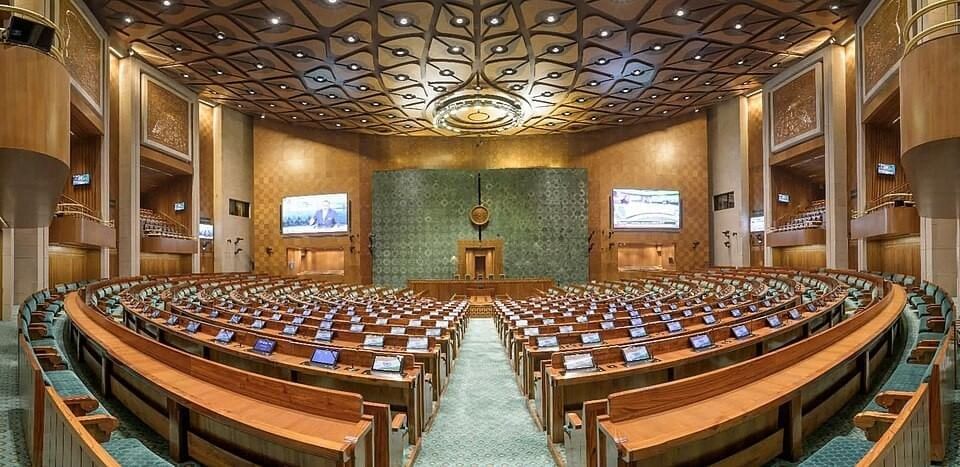
Lok Sabha
Q9. Which list allows both Union and State governments to make laws? (a) Union List (b) State List (c) Concurrent List (d) Federal List
Ans: (c) Concurrent List In case of conflict, Union law prevails.
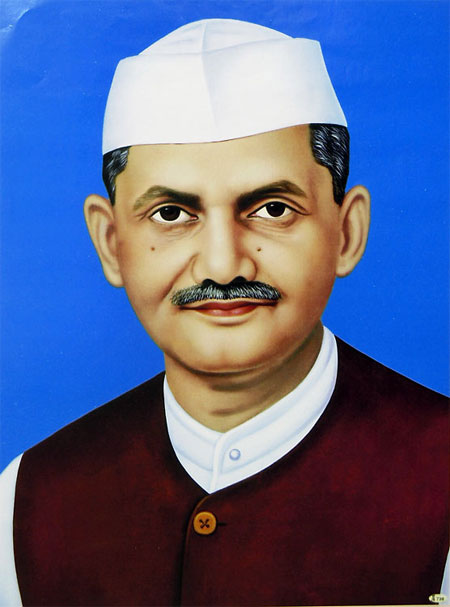
Q10. Which former Prime Minister resigned as Railway Minister in 1956 after a train accident? (a) Jawaharlal Nehru (b) Lal Bahadur Shastri (c) Atal Bihari Vajpayee (d) Morarji Desai
Ans: (b) Lal Bahadur Shastri He took moral responsibility and resigned.
Lal Bahadur Shastri
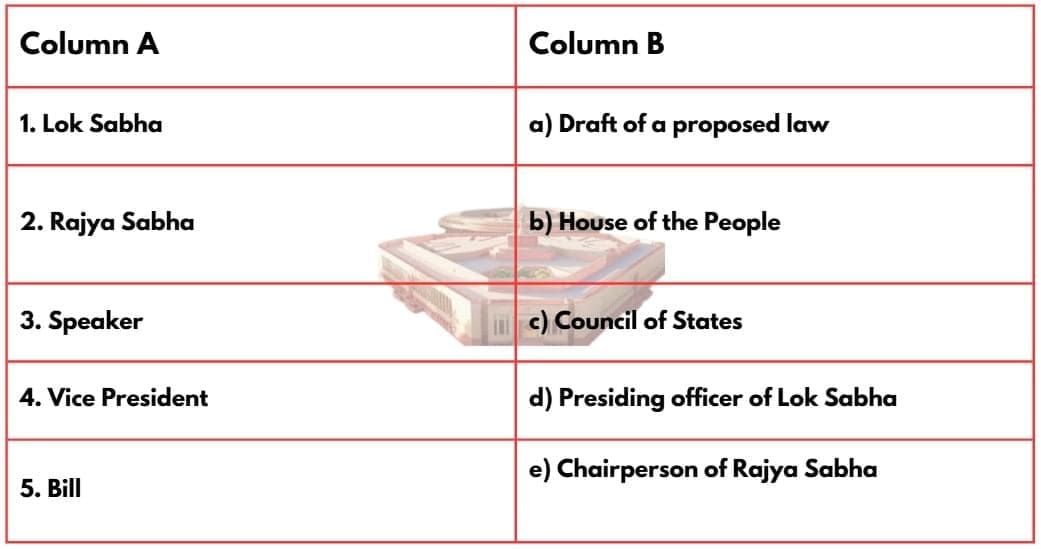
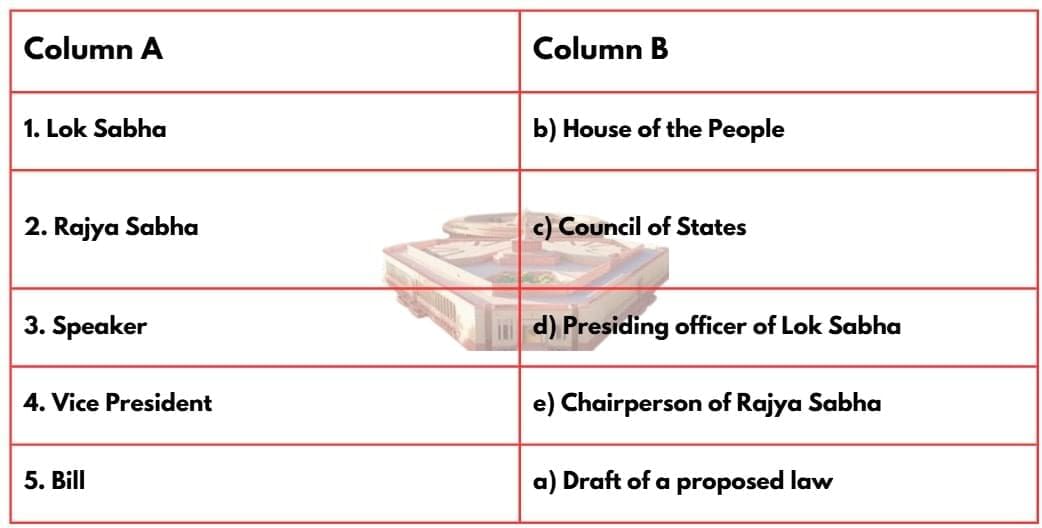
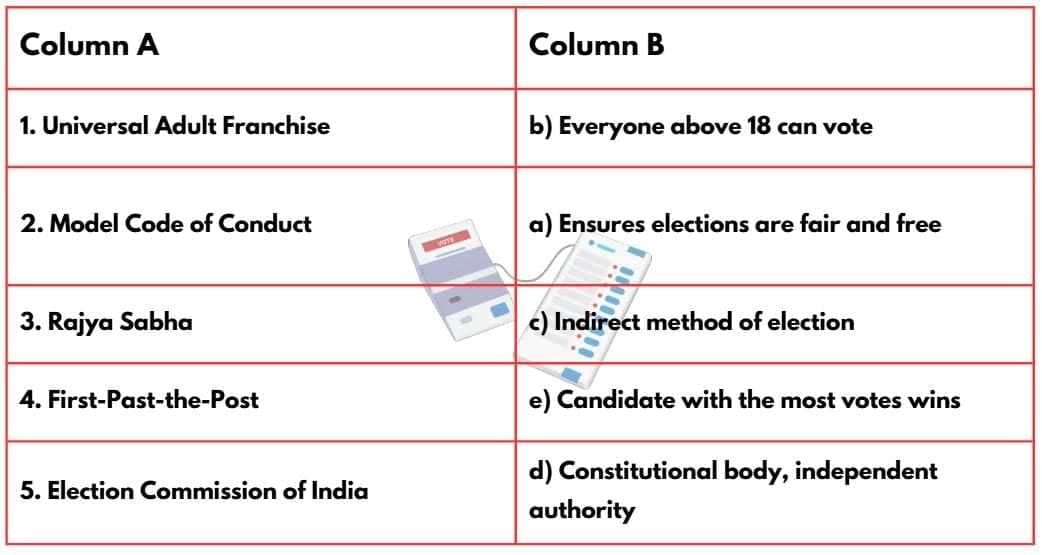
Match the Following
Ans: True or False
Q1. The Rajya Sabha is a permanent house and never dissolves completely. Ans: True
It is called the Permanent House; one-third of members retire every two years.
Q2. Only State governments can legislate on Defence and Foreign Affairs. Ans: False
These are Union List subjects.
Q3. The Parliament meets three times a year—Budget, Monsoon, and Winter Sessions. Ans: True
These are the three annual sessions of Parliament.
Q4. Money Bills can only be introduced in the Rajya Sabha. Ans: False
They can only be introduced in the Lok Sabha with the President’s recommendation.
Q5. Judiciary acts as the guardian of the Constitution. Ans: True
It interprets and safeguards the Constitution.
Q6. All states in India have a bicameral legislature with two houses. Ans: False
Only six states have bicameral legislatures; others have unicameral.
Fill in the Blanks
Q1. The Indian Parliament follows a ______ system consisting of two houses. Ans: Bicameral
Q2. The presiding officer of the Lok Sabha is called the ______. Ans: Speaker
Q3. The RTE Act makes education for children aged ______ to ______ a Fundamental Right. Ans: 6, 14
Q4. The Prime Minister and Council of Ministers are collectively responsible to the ______. Ans: Lok Sabha
Q5. The ______ appoints the Prime Minister of India. Ans: President
Q6. In case of conflict in the Concurrent List, the ______ law prevails. Ans: Union
Q7. ______ Hour in the Lok Sabha is used by MPs to hold ministers accountable. Ans: Question
Very Short Answer Questions
Q1. What is meant by the term “bicameral legislature”? Ans: A legislature with two houses/chambers, like the Lok Sabha and Rajya Sabha in India.
Q2. Who are the members of the Union Executive? Ans: The President, Vice President, Prime Minister, and Council of Ministers.
Q3. What is meant by federalism? Ans: A system where power is shared between the central government, state governments, and local bodies.
Q4. Define a ‘bill’ in the context of Parliament. Ans: A bill is a draft proposal for a law that has to be passed by Parliament before becoming an Act.
Q5. What is the role of the Judiciary in checks and balances? Ans: It ensures laws and actions follow the Constitution and protects Fundamental Rights.
Q6. Mention two states that have bicameral legislatures. Ans: Uttar Pradesh and Maharashtra (also Andhra Pradesh, Bihar, Karnataka, Telangana).
Q7. What are the three lists in the Constitution that divide subjects for lawmaking? Ans: Union List, State List, and Concurrent List.
Q8. Why are legislatures important in a democracy? Ans: They make laws, hold the government accountable, approve budgets, and represent the people’s will.
Q9. State one major challenge faced by India’s legislatures. Ans: Poor-quality debates, disruptions, and bills being delayed.
Q10. Who said in the Lok Sabha, “Governments will come and go, parties will rise and fall, but the nation and its democracy must endure”? Ans: Atal Bihari Vajpayee.
Q1. What is the minimum age to vote in India? (a) 16 years (b) 18 years (c) 21 years (d) 25 years
Ans: (b) 18 years Indian citizens aged 18 and above have the right to vote under the universal adult franchise.
Q2. Which Article of the Indian Constitution ensures the universal adult franchise? (a) Article 324 (b) Article 21 (c) Article 326 (d) Article 14
Ans: (c) Article 326 Article 326 provides for elections to the Lok Sabha and Legislative Assemblies based on universal adult suffrage.
Q3. Which body is responsible for conducting free and fair elections in India? (a) Parliament of India (b) Supreme Court of India (c) Election Commission of India (d) Planning Commission
Ans: (c) Election Commission of India The ECI is a constitutional body responsible for managing elections independently.
Election Commission of India
Q4. How many constituencies are there for Lok Sabha elections? (a) 545 (b) 500 (c) 543 (d) 520
Ans: (c) 543 There are 543 elected Lok Sabha constituencies across India.
Q5. Members of the Rajya Sabha are elected by: (a) The citizens of India directly (b) Members of State Legislative Assemblies (c) The President of India (d) Governors of States
Ans: (b) Members of State Legislative Assemblies Rajya Sabha elections are held indirectly through elected MLAs.
Q6. Which voting system is used in Lok Sabha elections? (a) Proportional Representation (b) Single Transferable Vote (c) First-Past-the-Post (d) Indirect Voting
Ans: (c) First-Past-the-Post The candidate with the highest votes in a constituency wins.
Q7. The “Festival of Democracy” refers to: (a) Cultural festivals in India (b) General Elections (c) Independence Day celebrations (d) Republic Day
Ans: (b) General Elections General elections are celebrated as the “Festival of Democracy” in India.
Q8. The President of India is elected by: (a) All Indian citizens (b) Judges of the Supreme Court (c) An Electoral College of MPs and MLAs (d) Only MPs of Lok Sabha
Ans: (c) An Electoral College of MPs and MLAs The President is chosen indirectly by MPs and MLAs using proportional representation.
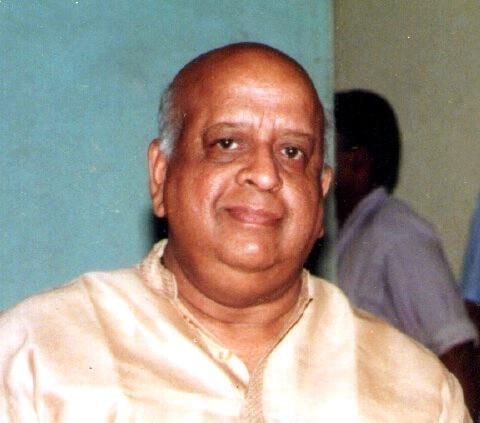
Q9. Who was the Chief Election Commissioner famous for strict electoral reforms in the 1990s? (a) Sukumar Sen (b) Rajiv Gandhi (c) T.N. Seshan (d) K.R. Narayanan
Ans: (c) T.N. Seshan He introduced voter IDs, stricter campaign rules, and spending regulation. T.N. Seshan
Q10. One major challenge of India’s elections is: (a) Small population (b) Lack of diversity (c) Money power and criminalization in politics (d) Limited number of eligible voters
Ans: (c) Money power and criminalization in politics These issues undermine fairness in Indian elections.
Match the Following
Ans: True or False
Q1. Every Indian citizen above 21 years can vote. Ans: False
The voting age is 18 years, not 21.
Q2. The Lok Sabha has 543 constituencies for elections. Ans: True
There are 543 directly elected Lok Sabha seats.
Q3. The Rajya Sabha never dissolves completely. Ans: True
It is called the Permanent House, with one-third retiring every two years.
Q4. Women in India got the right to vote in 1950, much later than in Switzerland. Ans: False
India granted women suffrage from the start, while Switzerland did so in 1971.
Q5. The Election Commission of India was established in 1950. Ans: True
It has been functioning since 1950 as per the Constitution.
Q6. The Model Code of Conduct prevents political leaders from misusing government resources during elections. Ans: True
It ensures fairness by limiting undue influence during elections.
Fill in the Blanks
Q1. The right to vote in India is based on ______ adult franchise. Ans: Universal
Q2. The Chief Election Commissioner in the 1990s who brought strict reforms was ______. Ans: T.N. Seshan
Q3. Lok Sabha members are also called ______. Ans: Members of Parliament (MPs)
Q4. The minimum voting age in India is ______ years. Ans: 18
Q5. Elections in India are often called the “Festival of ______.” Ans: Democracy
Q6. The Rajya Sabha is also known as the ______ House. Ans: Permanent
Q7. Article ______ of the Indian Constitution provides for universal adult franchise. Ans: 326Very Short Answer Questions
Q1. Define Universal Adult Franchise in one sentence. Ans: It means every Indian citizen aged 18 and above has an equal right to vote, irrespective of caste, religion, gender, or income.
Q2. Who can vote in India? Ans: Any Indian citizen aged 18 or above who is registered as a voter and not disqualified by law.
Q3. What is the value of each vote in India? Ans: Each vote has equal value, regardless of the voter’s social or economic background.
Q4. Who conducts the elections in India? Ans: The Election Commission of India (ECI).
Q5. What is the role of the State Election Commission? Ans: It conducts elections to local bodies like municipalities and panchayats within a state.
Q6. What do MPs and MLAs stand for? Ans: MPs are Members of Parliament, and MLAs are Members of Legislative Assembly.
Q7. Write one key feature of the Model Code of Conduct. Ans: Political parties and leaders cannot announce new schemes during elections to influence voters.
Q8. Why is the Rajya Sabha called the “Permanent House”? Ans: It never dissolves; one-third of its members retire every two years.
Q9. Which method of voting is used to elect the President of India? Ans: Proportional representation through the single transferable vote system.
Q10. Mention one challenge faced in conducting elections in India. Ans: Influence of money power and candidates with criminal backgrounds.
Q1. What is colonialism? (a) One country taking control of another, imposing political, economic, and cultural systems (b) Trading goods between countries (c) Forming alliances for protection (d) Promoting local cultures
Ans: (a) One country taking control of another, imposing political, economic, and cultural systems Colonialism involves domination and control by one country over another region’s political, economic, and cultural systems.
Q2. Which European explorer arrived in India in 1498, marking the start of European colonisation? (a) Christopher Columbus (b) Vasco da Gama (c) Ferdinand Magellan (d) Robert Clive
Ans: (b) Vasco da Gama Vasco da Gama’s arrival at Kappad marked the beginning of European colonisation in India.
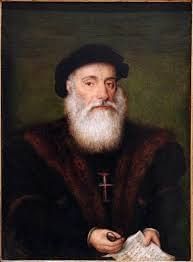
Vasco da Gama
Q3. The Portuguese used which system to control trade in the Arabian Sea? (a) Subsidiary Alliance (b) Cartaz pass system (c) Doctrine of Lapse (d) Divide and Rule
Ans: (b) Cartaz pass system The Portuguese required ships to buy passes to trade in the Arabian Sea, controlling maritime commerce.
Q4. Which Indian queen resisted Portuguese control in Ullal using alliances and fireballs made from coconut shells? (a) Rani Lakshmibai (b) Rani Abbakka (c) Begum Hazrat Mahal (d) Rani Durgavati
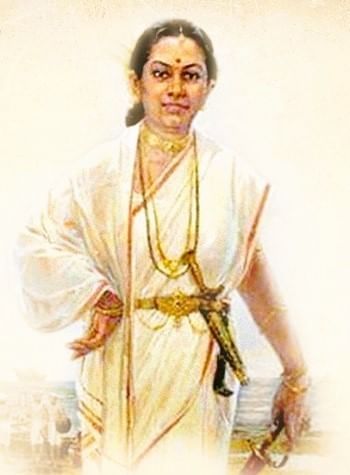
Ans: (b) Rani Abbakka She successfully resisted Portuguese attempts to seize Ullal and was known for bold tactics against them. Rani Abbakka
Q5. The Dutch lost control in India after which battle? (a) Battle of Plassey (b) Battle of Colachel (c) Battle of Buxar (d) Battle of Panipat
Ans: (b) Battle of Colachel King Marthanda Varma’s forces defeated the Dutch in this rare Asian victory over Europeans.
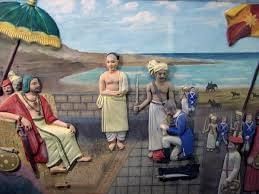
Battle of Colachel
Q6. Which European power established a trading post in Pondicherry in 1674? (a) Portuguese (b) Dutch (c) French (d) British
Ans: (c) French Pondicherry became the French East India Company’s key colony in India.
Q7. What strategy did the British use to become rulers while pretending to be traders? (a) Subsidiary Alliance (b) Divide and Rule (c) Cartaz system (d) Assimilation policy
Ans: (b) Divide and Rule British exploited rivalries among Indian rulers, gaining power step-by-step.
Q8. The Doctrine of Lapse allowed the British to annex princely states on what condition? (a) Ruler died without a natural male heir (b) Ruler converted to Christianity (c) Territory was conquered by British army (d) Ruler was voted out
Ans: (a) Ruler died without a natural male heir This policy ignored traditional adoption practices to seize territory.
Q9. What was one major cause of the Bengal Famine of 1770–72? (a) Crop failure only (b) British taxation demands during famine (c) War destruction (d) Natural drought alone
Ans: (b) British taxation demands during famine High taxes during famine worsened the crisis, causing millions of deaths.
Q10. Which Indian leader wrote about the drain of India’s wealth caused by British rule? (a) Dadabhai Naoroji (b) Jawaharlal Nehru (c) Mahatma Gandhi (d) Romesh Chunder Dutt
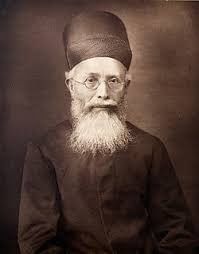
Ans: (a) Dadabhai Naoroji He highlighted economic exploitation and wealth drain in his writings. Dadabhai Naoroji
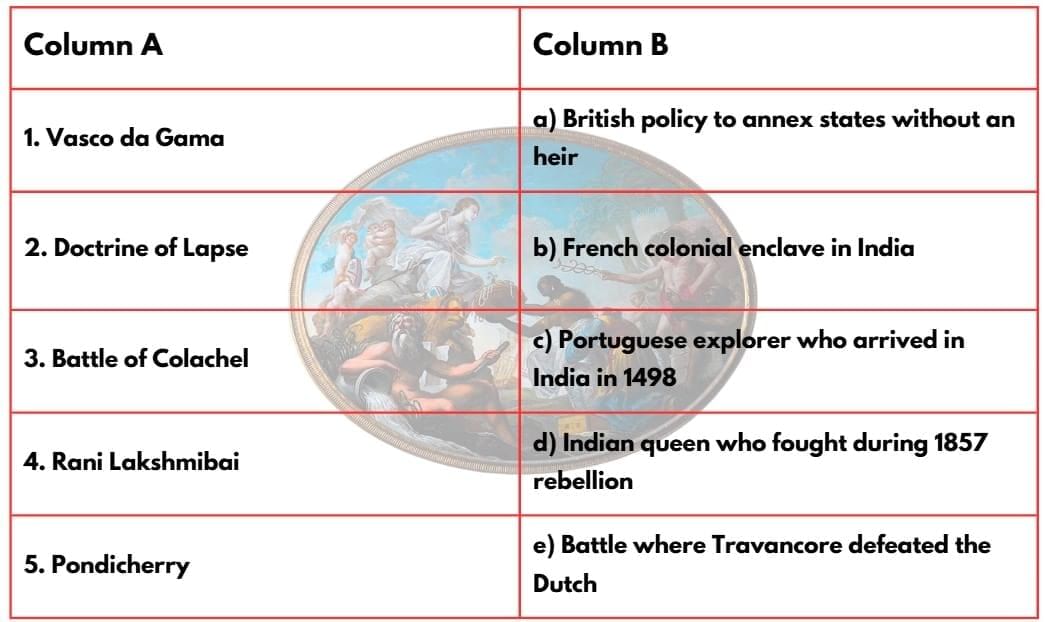
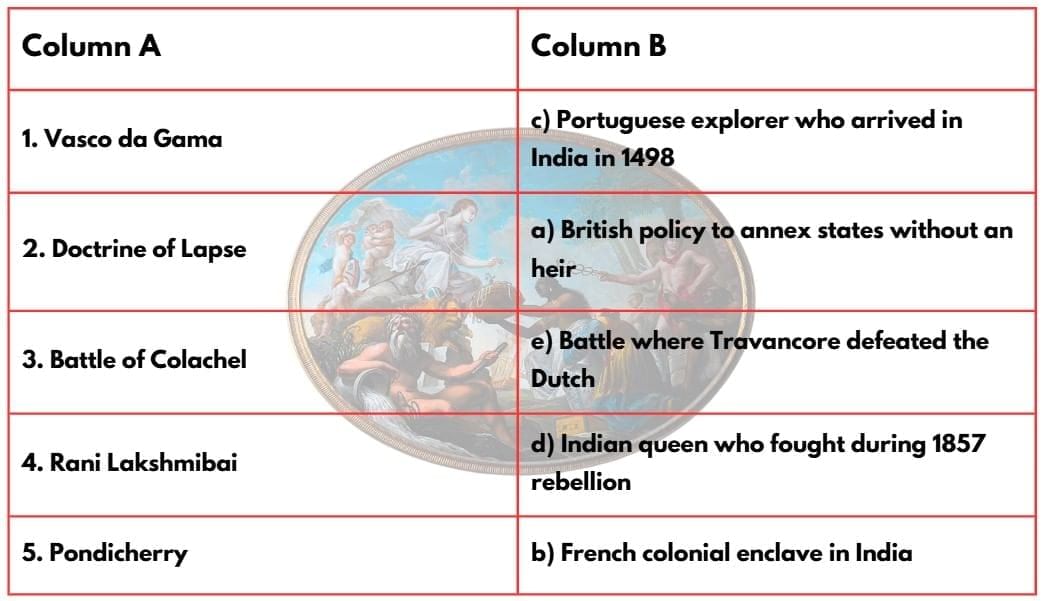
Match the Following
Ans: True or False
Q1. The British used a ‘divide and rule’ policy to control India. Ans: True
This policy helped widen divisions to strengthen British hold.
Q2. The Portuguese Inquisition in Goa lasted until the early 19th century. Ans: True
It continued until 1812, persecuting various religious groups.
Q3. The French extensively interfered in Indian social and religious customs. Ans: False
The French mostly avoided interfering in social and religious life except occasional incidents.
Q4. The Bengal Famine killed around 10 million people due to both crop failure and British policies. Ans: True
Harsh taxation increased suffering during crop failures.
Q5. The Battle of Plassey was won with the help of Mir Jafar’s betrayal of Nawab Siraj-ud-daulah. Ans: True
Mir Jafar’s mutiny enabled the British victory.
Q6. The British Crown took over direct control of India from the East India Company after 1857. Ans: True
The British Raj started post-1857 rebellion.
Fill in the Blanks
Q1. Colonialism began in the __________ century with European expansion. Ans: Colonialism began in the 15th century with European expansion.
Q2. Vasco da Gama landed at __________ in India. Ans: Vasco da Gama landed at Kappad (near Kozhikode) in India.
Q3. __________ was the colonial capital of Portuguese India. Ans: Goa was the colonial capital of Portuguese India.
Q4. The British used the __________ strategy to exploit rivalries among Indian rulers. Ans: The British used the Divide and Rule strategy to exploit rivalries among Indian rulers.
Q5. The __________ rebellion of 1857 is considered a major turning point in Indian resistance. Ans: The Great Rebellion of 1857 is considered a major turning point in Indian resistance.
Q6. The __________ rebellion was led by ascetics opposing British tax policies. Ans: The Sanyasi-Fakir rebellion was led by ascetics opposing British tax policies.
Q7. The British education policy was shaped by Thomas __________. Ans: The British education policy was shaped by Thomas Macaulay.
Very Short Answer Questions
Q1. What was the main goal of European colonialism? Ans: To gain wealth, power, and influence by controlling other countries politically, economically, and culturally.
Q2. Name the European powers that competed for control over India. Ans: Portuguese, Dutch, French, and British.
Q3. Who were Rani Abbakka I and II? Ans: Queens of Ullal who resisted Portuguese colonial advances in southern Karnataka.
Q4. What was the significance of the Battle of Plassey? Ans: It enabled the British East India Company to gain control over Bengal and marked the beginning of British political dominance in India.
Q5. Explain the Doctrine of Lapse briefly. Ans: A British policy allowing annexation of princely states if a ruler died without a natural male heir, ignoring local customs.
Q6. What caused the Bengal Famine of 1770 to become so deadly? Ans: A combination of crop failure and oppressive British taxation policies during the famine.
Q7. Name one way the British changed traditional Indian industries. Ans: They imposed heavy taxes on Indian textiles and flooded India with British goods, causing the decline of indigenous industries.
Q8. Who was Begum Hazrat Mahal and what role did she play? Ans: She led the defence of Lucknow during the 1857 rebellion against British forces and symbolized resistance.
Q9. How did the British education policy divide Indian society? Ans: By creating an English-educated elite (“Brown Englishmen”) that was culturally separated from the majority who spoke native languages.
Q10. What was one unintended positive consequence of colonial rule in India? Ans: The opening of India to global cultural exchanges and the translation of Indian texts into European languages, influencing western thought.
Q1. The Marathas primarily hail from which region? (a) Punjab (b) Maharashtra (c) Gujarat (d) Rajasthan
Ans: (b) Maharashtra The Marathas are originally from Maharashtra and speak Marathi.
Q2. The Maratha leader who founded the kingdom and envisioned Swarajya was— (a) Sambhaji (b) Tarabai (c) Shivaji (d) Bajirao I
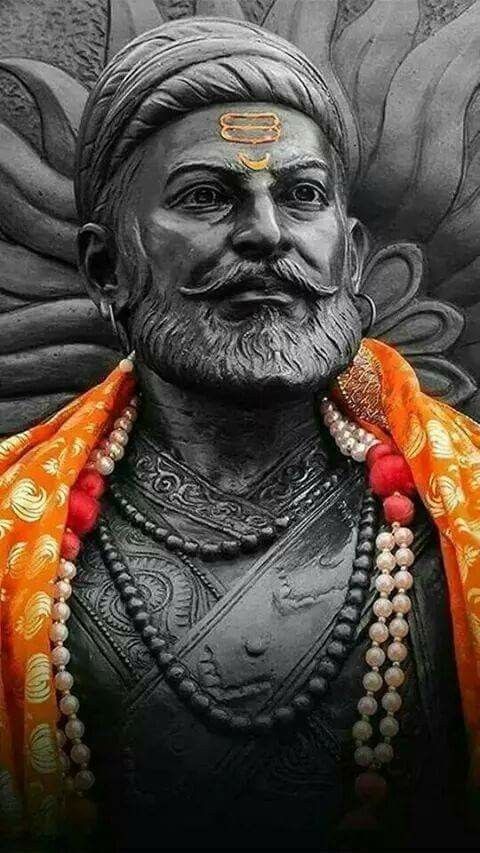
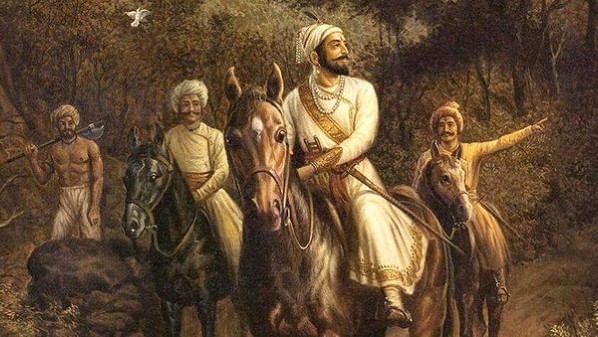
Ans: (c) Shivaji Shivaji established the Maratha kingdom and championed the concept of Swarajya (self-rule). Shivaji
Q3. Which military tactic was Shivaji famous for? (a) Large-scale infantry battles (b) Naval warfare only (c) Guerrilla warfare (d) Siege warfare only
Ans: (c) Guerrilla warfare He used surprise attacks and swift raids to defeat larger and better-equipped armies. Guerrilla warfare
Q4. The council of ministers established by Shivaji was known as— (a) Peshwa (b) Ashta Pradhana Mandala (c) Diwan (d) Mansabdari
Ans: (b) Ashta Pradhana Mandala This was a council of eight ministers helping Shivaji in governance.
Q5. The Maratha tax called ‘chauth’ was approximately— (a) 10% (b) 15% (c) 25% (d) 50%
Ans: (c) 25% Chauth was a tax amounting to one-fourth of the revenue collected from territorial chieftains.
Q6. Who led the Maratha Navy in the 18th century, earning a reputation as a formidable admiral? (a) Kanhoji Angre (b) Sambhaji (c) Mahadji Shinde (d) Nana Phadnavis
Ans: (a) Kanhoji Angre He was the celebrated admiral known for his naval supremacy along the western coast.
Kanhoji Angre
Q7. Which queen led Maratha resistance after Rajaram’s death? (a) Ahilyabai Holkar (b) Tarabai (c) Jijabai (d) Rani Durgavati
Ans: (b) Tarabai Tarabai led the Maratha resistance against the Mughals during a challenging period.
Q8. The capital fort of Shivaji’s kingdom was— (a) Daulatabad (b) Raigad (c) Purandar (d) Pratapgad
Ans: (b) Raigad Raigad Fort served as the capital and coronation site of Shivaji.
Q9. Which Maratha ruler is credited for organizing the first pan-Indian anti-British alliance? (a) Nana Phadnavis (b) Bajirao I (c) Mahadji Shinde (d) Peshwa Balaji Bajirao
Ans: (a) Nana Phadnavis He united various Indian rulers against the British threat. Nana Phadnavis
Q10. The script primarily used by Marathas for correspondence was— (a) Devanagari (b) Modi (c) Persian (d) Kannada
Ans: (b) Modi Modi script, a cursive form of Devanagari, was used for administration and correspondence.
He introduced salaries to reduce hereditary power and increase loyalty.
Q2. The Maratha army included only infantry and cavalry, no navy. Ans: False
Shivaji built a strong navy to defend the coastal region.
Q3. Chauth was a tax levied only on territories directly ruled by Marathas. Ans: False
Chauth was collected from territories they protected but did not directly govern.
Q4. Ahilyabai Holkar was known for charitable works and temple restoration. Ans: True
She rebuilt key temples and supported public welfare.
Q5. The Marathas had modern ships that matched European technology. Ans: False
Their ships were less advanced, but clever tactics gave them an advantage.
Q6. Trade and infrastructure development were supported under Maratha rule. Ans: True
The Marathas promoted trade and built roads, bridges, and ferry networks.
Fill in the Blanks
Q1. The Maratha movement for self-rule is called ________. Ans: Swarajya
Q2. Shivaji’s council of eight ministers was called ________. Ans: Ashta Pradhana Mandala
Q3. The tax called ‘chauth’ amounted to ________ percent of revenue. Ans: 25
Q4. The famous Maratha naval commander was ________. Ans: Kanhoji Angre
Q5. The fort at which Shivaji was crowned is called ________. Ans: Raigad
Q6. The script used for Maratha official correspondence was called ________. Ans: Modi
Q7. The leader credited with uniting Indian powers against the British was ________. Ans: Nana Phadnavis
Very Short Question Answers
Q1. Who was Shivaji and why is he important? Ans: Shivaji was the founder of the Maratha kingdom, celebrated for establishing Swarajya and pioneering guerrilla warfare.
Q2. What was guerrilla warfare used by the Marathas? Ans: A tactic using swift surprise attacks and mobility to defeat stronger enemies.
Q3. What was the ‘chauth’ tax? Ans: A 25% tax imposed on territories protected by the Marathas.
Q4. How did the Marathas challenge European naval power? Ans: Through their navy led by Kanhoji Angre, who used tactical advantages on the coastline.
Q5. Name two cultural contributions of the Marathas. Ans: Revival of Marathi and Sanskrit literature and rebuilding of Hindu temples.
Q6. Who was Tarabai and what was her role? Ans: A warrior queen who led the Maratha resistance after the death of Rajaram.
Q7. Describe the Maratha administrative system under Shivaji. Ans: A centralized system with salaried officials and regular transfers to prevent accumulation of power.
Q8. What was Nana Phadnavis known for? Ans: Organizing a pan-Indian alliance to resist British expansion.
Q9. How did Marathas support trade and infrastructure? Ans: By maintaining roads, bridges, ferry networks, and facilitating maritime trade.
Q10. How did forts help the Marathas? Ans: Forts controlled strategic routes, acted as defense points, and ensured state resilience during conflicts.
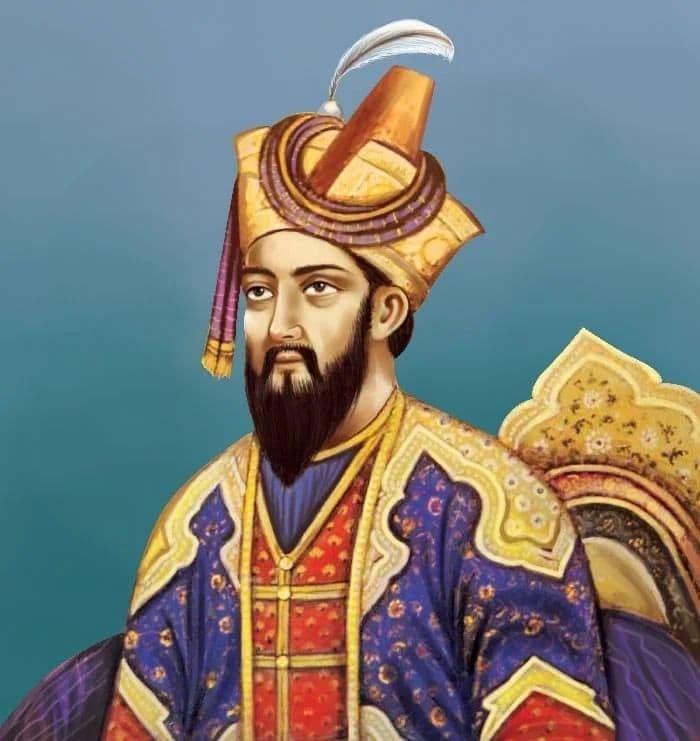
Ans: (b) Baburnama Baburnama is Babur’s autobiography revealing his thoughts and life.
Match the Following
Ans:
True or False
Q1. The iqta system made administrative positions hereditary in the Delhi Sultanate. Ans: False
Iqta positions were not hereditary but were granted by the Sultan.
Q2. Timur’s invasion left Delhi devastated in the late 14th century. Ans: True
Timur’s invasion caused massive destruction and political chaos.
Q3. Krishnadevaraya was a great builder and patron of literature. Ans: True
He supported arts and authored the Telugu epic Āmuktamālyada.
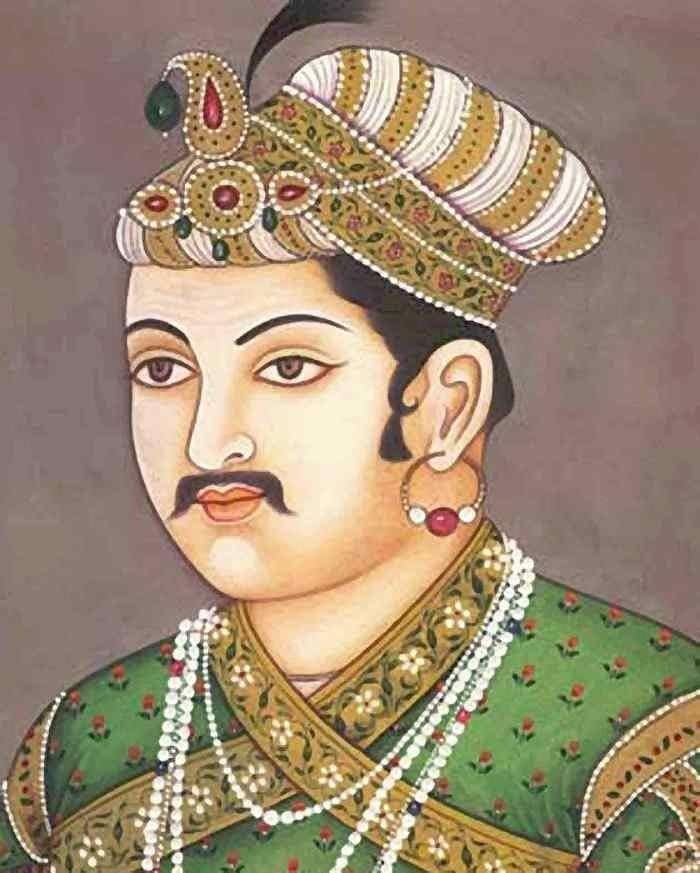
Q4. Akbar started the jizya tax on non-Muslims. Ans: False
Akbar abolished the jizya tax during his reign.
Q5. Ahom warriors used their knowledge of terrain to defeat the Mughals at Saraighat. Ans: True
They used guerrilla tactics and terrain familiarity.
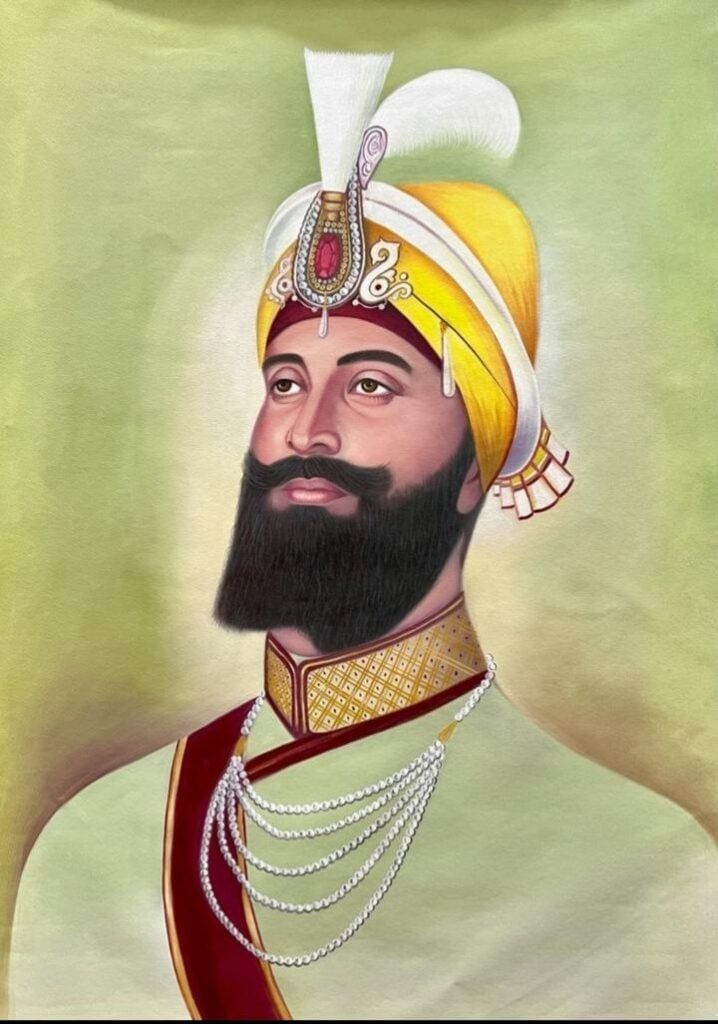
Q6. Guru Gobind Singh introduced the Khalsa for strengthening Sikh identity. Ans: True
The Khalsa was created in 1699 to unify Sikhs militarily and spiritually.
Fill in the Blanks
Q1. Prithviraj Chauhan was defeated in ________, establishing the Delhi Sultanate. Ans: 1192 CE
Q2. The Vijayanagara Empire was founded by two brothers, ________ and ________. Ans: Harihara and Bukka
Q3. The Rajput leader who resisted Akbar at the Battle of Haldighati was ________. Ans: Maharana Pratap
Q4. Babur’s army used ________ and ________ in the First Battle of Panipat. Ans: gunpowder and field artillery
Q5. Trade and ________ were economic strengths of medieval India. Ans: agriculture
Q6. Temples served as centers of ________, learning, and culture. Ans: economy
Q7. The Ahoms defeated the Mughals in the Battle of ________. Ans: Saraighat
Very Short Question Answers
Q1. What is meant by “medieval period” in Indian history? Ans: The period from 11th to 17th centuries marked by foreign invasions, new dynasties, and cultural blending.
Q2. Name any two dynasties of the Delhi Sultanate. Ans: Mamluks (Slave dynasty) and Khiljis.
Q3. Who was Timur and what was the impact of his invasion? Ans: A Turkic-Mongol conqueror whose 14th-century invasion devastated Delhi and caused political chaos.
Q4. Why did Muhammad bin Tughlaq shift his capital, and what happened as a result? Ans: To control the empire better, but the forced relocation caused hardship and was later reversed.
Q5. Mention one reason for the decline of the Vijayanagara Empire. Ans: Defeat at the Battle of Talikota in 1565 by a coalition of Deccan Sultanates.
Q6. What was the jizya tax? Ans: A tax levied on non-Muslim subjects under some sultans and Mughal rulers.
Q7. Name the founder of the Bahmani Sultanate. Ans: It was established by rebelling governors from the Delhi Sultanate, but leadership is associated with Ala-ud-Din Bahman Shah.
Q8. Who was Rani Durgavati and why is she remembered? Ans: Queen of the Gond kingdom who bravely resisted Mughal invasions and became a symbol of resistance.
Q9. What was a hundi? Ans: An ancient financial instrument for transferring money, similar to a written order of payment.
Q10. Mention one contribution of Akbar to literature and culture. Ans: He promoted translations of Sanskrit texts into Persian and supported arts and scholars.
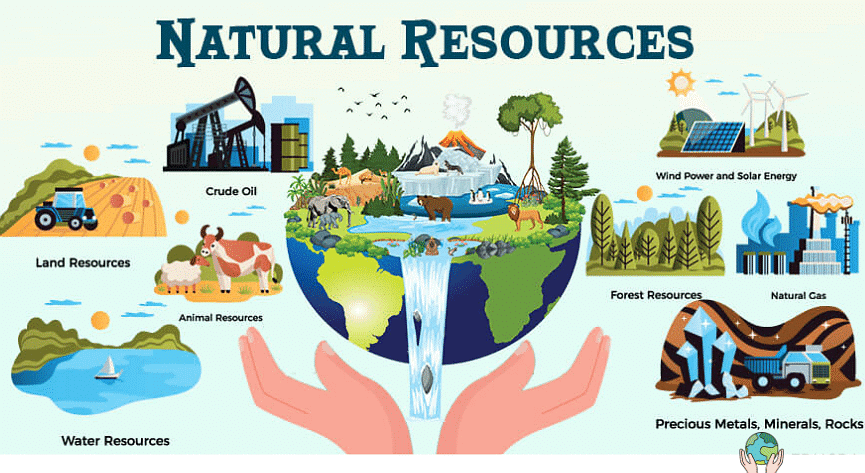
Q1. Resources that we find in nature and are used without much modification are called ___________ (a) Human Resource (b) Natural Resource (c) Renewable Resource (d) Human Made Resource
Ans: (b) Natural Resource Natural resources are those that we find in nature and can be used without much modification, such as air, water, minerals, and forests.
Q2. How are natural resources primarily categorized? (a) By color (b) By use and renewability (c) By size (d) By location
Ans: (c) By use and renewability Natural resources are grouped based on how humans use them and whether they can be replenished. They are divided by use into those essential for life (like air and water), materials (like wood and marble), and energy (like coal and sunlight). They are also classified by renewability: renewable resources (like solar energy) can replenish naturally, while non-renewable ones (like coal) cannot be replaced quickly.
Q3. Which of the following is an example of a renewable resource? (a) Coal (b) Petroleum (c) Solar energy (d) Natural gas
Ans: (c) Solar energy Solar energy is an example of a renewable resource because it is continuously replenished by the sun and will not be depleted with use.
Q4. What factor can change substances into resources? (a) Air (b) Time and technology (c) Water (d) Soil
Ans: (b) Time and technology Time and technology are factors that can change substances into resources. Over time, advancements in technology can make previously unusable substances valuable resources.
Q5. What is the main focus of sustainable development? (a) Exploiting resources for short-term gain (b) Using resources carelessly (c) Balancing present needs with future conservation (d) Wasting resources
Ans: (c) Balancing present needs with future conservation The main focus of sustainable development is to balance present human needs with the conservation of resources for future generations, ensuring that resources are used responsibly and not depleted.
Q6. Which of the following is a non-renewable resource? (a) Solar energy (b) Timber (c) Coal (d) Wind
Ans: (c) Coal Non-renewable resources are those that exist in limited amounts and take millions of years to form, so they cannot be replenished quickly. Coal is a non-renewable resource used for energy, as its formation takes a very long time, and once used, it is gone.
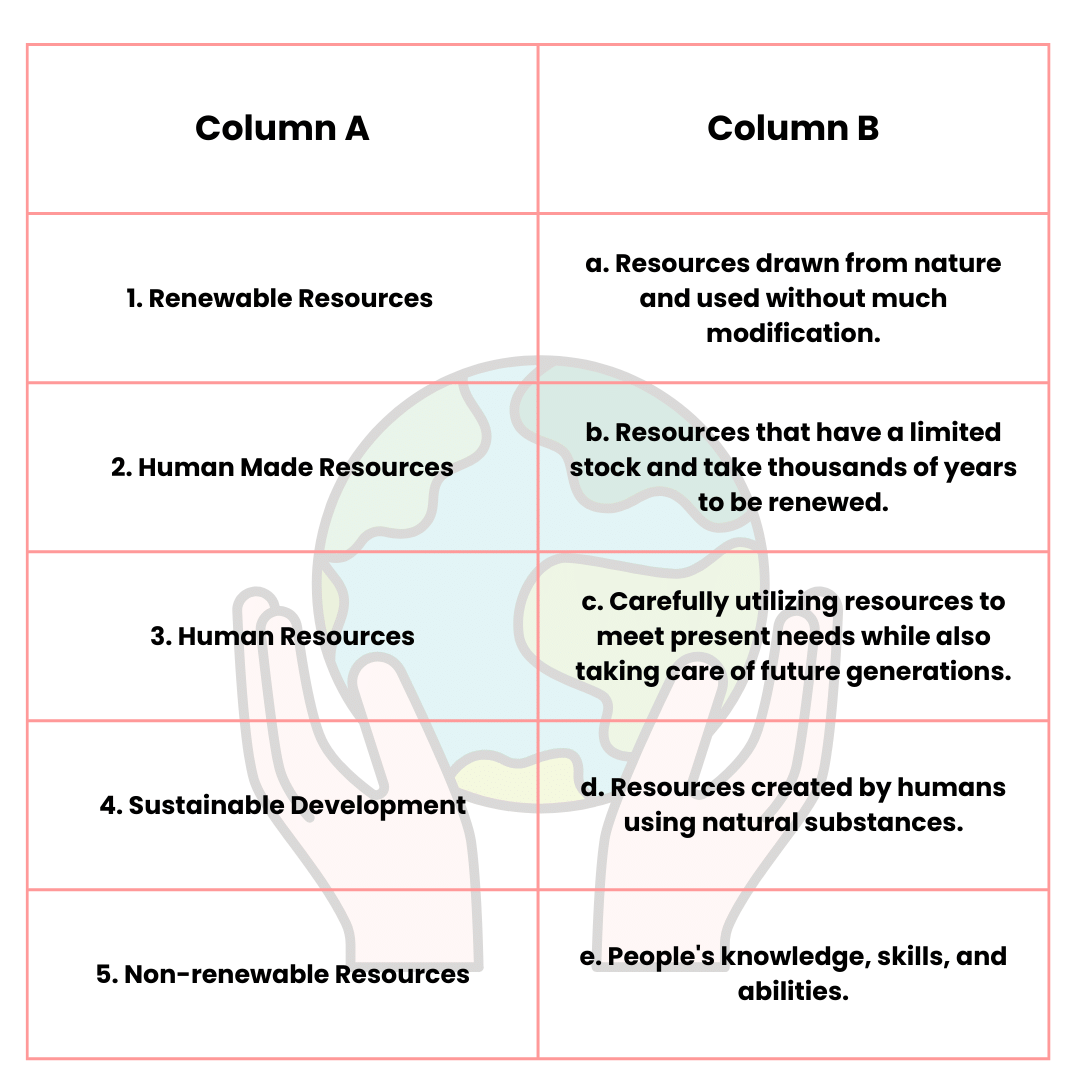
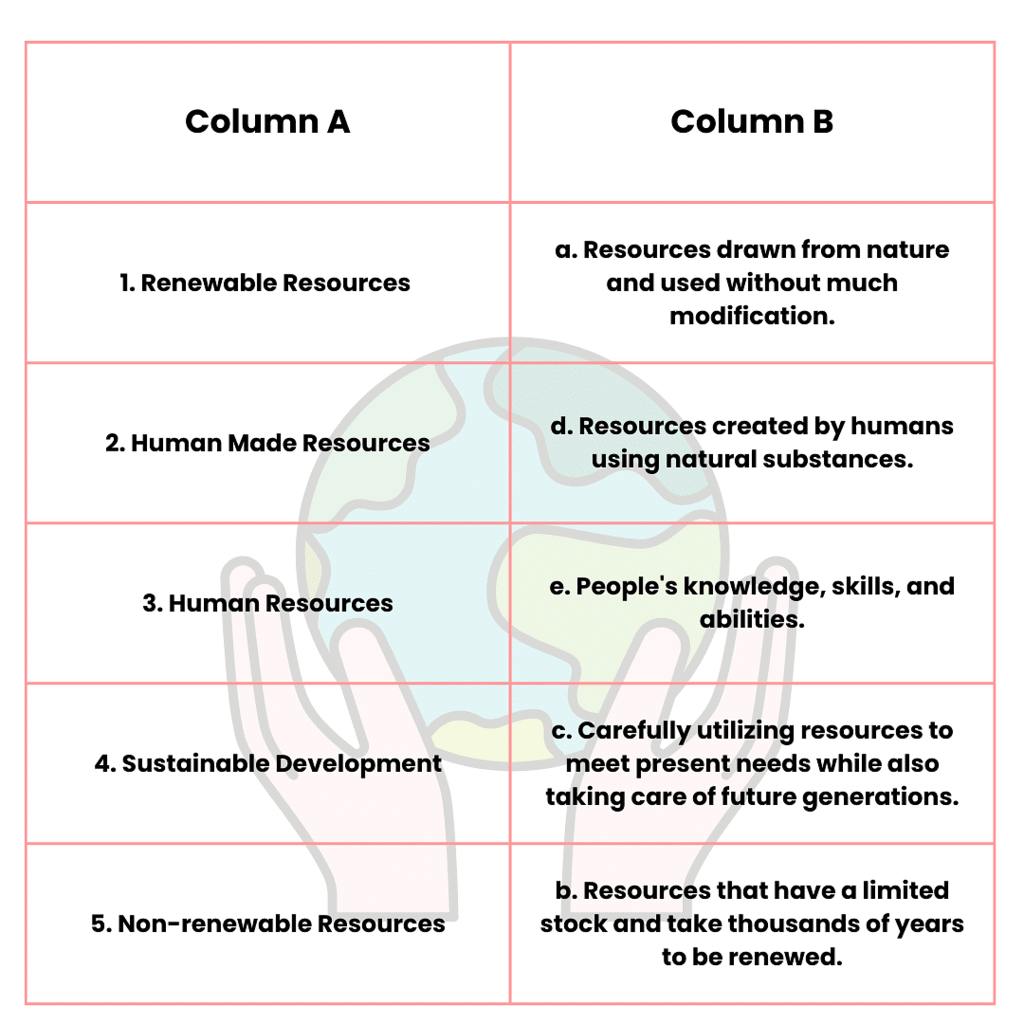
Match the Following
Ans:
True or False
Q1. Natural resources include only those substances that have economic value. Ans: False
Natural resources include substances found in nature, whether or not they have economic value. For example, air and water are natural resources that are essential for life but may not have direct economic value.
Q2. Renewable resources can never be depleted or exhausted. Ans: False
While renewable resources can be replenished over time, they can still be depleted or exhausted if used unsustainably. For example, forests can be depleted if trees are cut down faster than they can regrow.
Q3. Overexploitation of renewable resources can disrupt nature’s restoration and regeneration cycles. Ans: True
Renewable resources, like water and forests, can naturally replenish through nature’s cycles of restoration (healing) and regeneration (creating new life). However, if we use them faster than they can recover—like over-pumping groundwater or cutting trees without replanting—these cycles get disturbed. This can lead to shortages, such as when groundwater levels drop too low for use, harming both people and the environment.
Q4. Resource conservation involves using resources carelessly without thinking about the future. Ans: False
Resource conservation involves using resources carefully and responsibly, considering the needs of both the present and future generations. It aims to avoid wasteful consumption and ensure the long-term sustainability of resources.
Q5. Sustainable development aims to balance the use of resources for current needs and conserve them for the future. Ans: True
Sustainable development seeks to meet the needs of the present without compromising the ability of future generations to meet their own needs. It involves balancing economic, social, and environmental factors to ensure that resources are used efficiently and equitably.
Fill in the Blanks
Q1. All ___________ have some utility and value. Ans: All resources have some utility and value.
Q2. _______ is an example of a resource essential for life. Ans: Water is an example of a resource essential for life.
Q3. Human beings use ________ and _________ to develop resources. Ans: Human beings use technology and knowledge to develop resources.
Q4. _________ is an example of a renewable resource that can be depleted if overused. Ans: Forest is an example of a renewable resource that can be depleted if overused.
Q5. _______or _______makes an object or substance a resource. Ans: Utility or value makes an object or substance a resource.
Q6. _____________ is an example of a non-renewable resource used for energy Ans: Petroleum is an example of a non-renewable resource used for energy
Very Short Question Answers
Q1. What are non-renewable resources? Ans: Non-renewable resources are those which have a limited stock.
Q2. What do you mean by stock of resource? Ans: Stock of resource is the amount of resources available for use.
Q3. How are natural resources classified by their use? Ans: Natural resources are classified by their use into those essential for life (e.g., air, water), for materials (e.g., wood, marble), and for energy (e.g., coal, solar energy).
Q4. Why must renewable resources be used sustainably? Ans: Renewable resources must be used sustainably to allow nature’s restoration and regeneration cycles to replenish them, preventing depletion.
Q5. How does the uneven distribution of natural resources affect human life? Ans: Uneven distribution shapes settlements, trade, and conflicts, as people settle near resources for jobs, trade them, or compete for control.
Q6. What is resource conservation? Ans: Using resources carefully and giving them time to get renewed is called resource conservation.
Q7. Name some natural resources. Ans: The air we breathe, the water in our rivers and lakes, the soils, minerals are all natural resources.
Q8. What is sustainable development? Ans: Balancing the need to use resources and also conserve them for the future is called sustainable development.
Q9. What is the natural resource curse? Ans: The natural resource curse is when regions rich in natural resources experience slower economic growth due to poor management or over-reliance on resources.
Q10. What is utility? Ans: If a substance can be used in any way, it is said to have a utility.
Q11. What makes a substance a resource? Ans: Utility or usability is what makes an object or substance a resource.
Q12. What are renewable resources? Ans: Renewable resources are those which get renewed or replenished quickly.
Q13. What is Vrikshayurveda, and how does it promote sustainable resource use? Ans: Vrikshayurveda is an ancient Indian science of plant care that promotes sustainable agriculture through practices like crop rotation, natural pest control, and soil management.
Q14. What is technology? Ans: Technology is the application of latest knowledge and skill in doing or making things.
Q15. What are natural resources? Ans: Resources that are drawn from nature and used without much modification are called natural resources.
Q1. Which of the following is not a factor of production? (a) Land (b) Labour (c) Money (d) Entrepreneurship
Q2. In economics, “land” refers to— (a) Only soil and ground (b) All natural resources used for production (c) Only forests (d) Only minerals
Q3. Human effort, both physical and mental, used in the production process is called— (a) Capital (b) Labour (c) Entrepreneurship (d) Technology
Q4. The knowledge, skills, and expertise of workers are called— (a) Land (b) Human capital (c) Physical labour (d) Entrepreneurship
Q5. Which two main facilitators help build strong human capital? (a) Wealth and inheritance (b) Education and healthcare (c) Minerals and forests (d) Elections and democracy
Q6. Capital in production refers to— (a) Only money (b) Durable assets like machinery, tools, and buildings plus money (c) Only human resources (d) Only natural resources
Q7. The person who takes risk, combines resources, and creates businesses is called— (a) Worker (b) Capitalist (c) Entrepreneur (d) Educator
Q8. Which Indian business leader founded India’s first airline in 1932? (a) Dhirubhai Ambani (b) J.R.D. Tata (c) Ratan Tata (d) Verghese Kurien
Q9. Which of the following shows how technology helps production? (a) Pulleys and wheelbarrows in ancient times (b) UPI for faster payments today (c) Drones spraying fertilizers (d) All of these
Q10. India became the first country in 2014 to pass a law requiring companies to spend part of their profits on— (a) Exports (b) Corporate Social Responsibility (c) Workers’ salaries (d) Import duties
Match the Following
True or False
Q1. Human capital is the same as human labour. Q2. Education and training improve the productivity of workers. Q3. J.R.D. Tata started the first steel plant in India. Q4. Technology reduces barriers to learning and jobs. Q5. In economics, capital also includes buildings, tools, and machinery. Q6. CSR (Corporate Social Responsibility) means ignoring society’s welfare and focusing only on profits.
Fill in the Blanks
Q1. The four main factors of production are land, labour, capital, and ______. Q2. Knowledge and skills that make labour more effective are called ______ capital. Q3. Good ______ helps workers be healthy and productive. Q4. The concept of kaizen, meaning continuous improvement, comes from ______. Q5. J.R.D. Tata founded ______ Airlines in 1932. Q6. Money borrowed from a bank must be repaid with ______. Q7. In 2014, India made CSR spending by companies ______ under law.
Very Short Answer Questions
Q1. Define factors of production. Q2. Give two examples of natural resources used in production. Q3. What is the difference between labour and human capital? Q4. Name two ways societies can build human capital. Q5. What is capital? Give one example. Q6. Who is called an entrepreneur? Q7. Mention one contribution of J.R.D. Tata to India. Q8. Give two examples of technology used in modern production. Q9. What does CSR stand for? Q10. Why should factors of production be used responsibly?