11. Harvest Hymn – Textbook Worksheet

Multiple Choice Questions (MCQs)

Instruction: Select the correct option for each question.

Q1. Who is praised as the “Lord of the morn” in the poem?
(a) Varuna
(b) Surya
(c) Bramha
(d) Prithvi

Q2. What does Varuna provide according to the poem?
(a) Fruits and flowers
(b) Rain and dew
(c) Corn and gold
(d) Songs and garlands

Q3. Who is referred to as the “Queen of the harvest”?
(a) Prithvi
(b) Surya
(c) Bramha
(d) Saraswati

Q4. What does the line “Thou art the Seed and the Scythe” suggest about Bramha?
(a) He gives rain only
(b) He begins and ends the cycle of life
(c) He plays musical instruments
(d) He grows lotus flowers

Q5. What musical instruments are mentioned as part of the tribute?
(a) Guitar and drum
(b) Cymbal, flute, pipe, drum
(c) Violin and trumpet
(d) Harp and piano

Fill in the Blanks

Instruction: Fill in the blanks with the correct word based on the chapter.

Q1. Surya is described as the lord of the ______ and the harvest.

Q2. Varuna is called the sender of ______ and dewfall.

Q3. Prithvi is compared to a ______ who feeds and nurtures her children.

Q4. Bramha is hailed as the Lord of the ______ and our being.

Q5. The people offer their songs, garlands, and the ______ of their fields as tribute.

Very Short Answer Questions

Instruction: Answer the following questions in one line.

Q1. Who wrote the poem “Harvest Hymn”?

Q2. What do the men bring as tribute to Surya and Varuna?

Q3. How is Prithvi addressed by the women?

Q4. What does Bramha symbolize in the poem?

Q5. Which natural elements are celebrated in the poem?

Short Answer Questions

Instruction: Answer the following questions in 2–3 lines.

Q1. Why do the villagers praise Surya in the poem?

Q2. What role does Varuna play in the lives of farmers?

Q3. How is Mother Earth described in the hymn?

Q4. What does the tribute offered to the deities signify?

Q5. How does the poem emphasize the unity of life and nature?

Match the Following

Instruction: Match Column A with the correct option in Column B.Column AColumn B1. Suryaa) Rain and dew provider2. Varunab) Eternal father, Lord of the Universe3. Prithvic) Sun God, lord of the morning4. Bramhad) Omnipotent mother, source of riches5. Tributee) Songs, garlands, and fruits of the fields
10. The Cherry Tree – Textbook Worksheet

Multiple Choice Questions (MCQs)

Instruction: Select the correct option for each question.

Q1. Why did Rakesh’s parents send him to live with his grandfather in Mussoorie?
(a) To enjoy the mountain life
(b) Because there were no schools in their village
(c) To help his grandfather in farming
(d) Because they wanted him to grow cherries

Q2. Where did the cherries that Rakesh bought come from?
(a) Himachal Pradesh
(b) Nepal
(c) Kashmir Valley
(d) Local Mussoorie farms

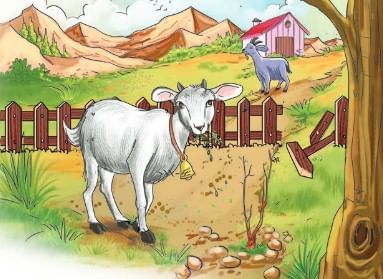
Q3. What happened to the young cherry tree when a goat entered the garden?
(a) It was uprooted completely
(b) Its leaves were eaten
(c) It was trampled down
(d) Nothing happened

Q4. How old was Rakesh when he first saw the cherry tree blossom?
(a) Six years old
(b) Seven years old
(c) Eight years old
(d) Nine years old

5. Why did Rakesh and Grandfather feel the cherry tree was special?
(a) Because it gave sweet cherries
(b) Because it survived all odds
(c) Because they had planted it themselves
(d) Because it was the tallest tree

Fill in the BlanksInstruction: Fill in the blanks with the correct word based on the chapter.

Q1. Rakesh paid ______ paise for the bunch of cherries.

Q2. Grandfather told Rakesh that nothing is lucky if you put it away; you must put it to some ______.

Q3. During the monsoons, a ______ cut the cherry tree in two with her scythe.

Q4. The first blossom on the cherry tree was of a pale ______ colour.

Q5. Grandfather enjoyed sitting under the cherry tree because of its cool ______.

Very Short Answer Questions

Instruction: Answer the following questions in one line.

Q1. Where did Rakesh live with his grandfather?

Q2. What did Rakesh use pebbles for around the cherry plant?

Q3. What was Rakesh’s nickname given by his grandfather?

Q4. Who were some of the first visitors to the cherry tree?

Q5. What did Rakesh whisper while touching the tree at the end?

Short Answer Questions

Instruction: Answer the following questions in 2–3 lines.

Q1. Why did Grandfather stop Rakesh from planting the cherry seed in the flowerbed?

Q2. How did the cherry tree show resilience?

Q3. How did the cherry tree bring nature closer to Rakesh?

Q4. What did Grandfather and Rakesh enjoy about the tree in the end?

Q5. What is the significance of the cherry tree in the story?

9. Spectacular Wonders – Textbook Worksheet

Multiple Choice Questions (MCQs)

Instruction: Select the correct option for each question.

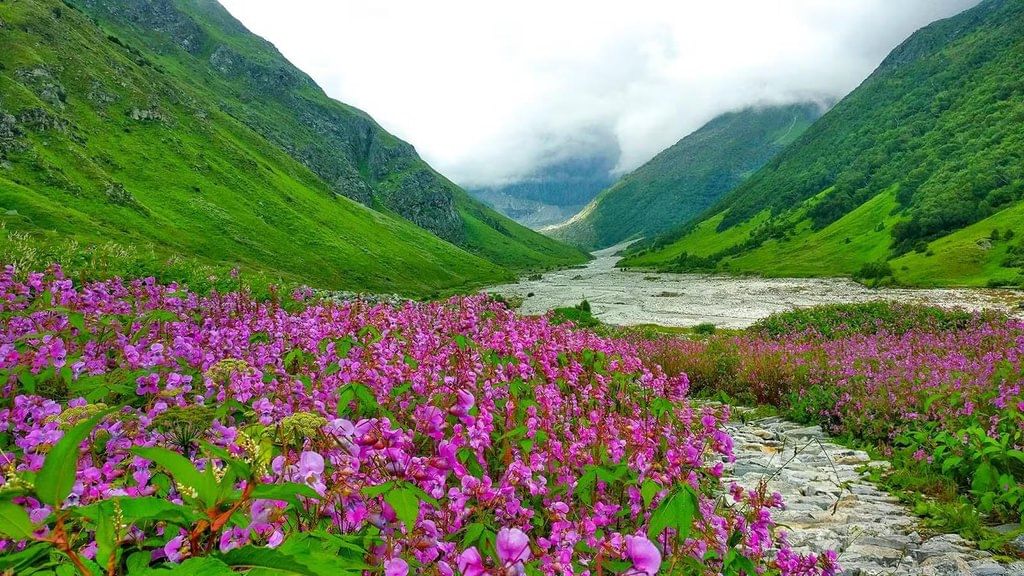
Q1. What makes the Valley of Flowers in Uttarakhand a UNESCO World Heritage Site?

Valley of Flowers

(a) Its large population of snow leopards
(b) Its 600 species of exotic flowers and rare wildlife
(c) Its man-made bridges
(d) Its disappearing sea

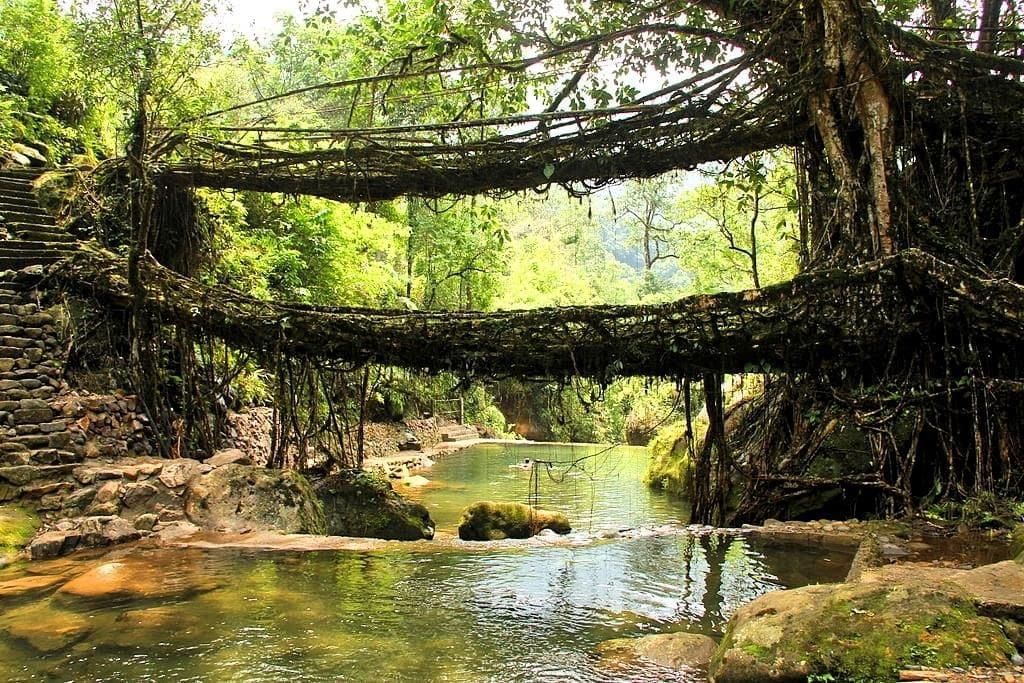
Q2. How are the living root bridges in Meghalaya primarily constructed?
(a) Using cement and stones
b) With intertwined roots of local flora
(c) From bamboo and wood
(d) By carving into the hillside

Q3. What caused the formation of the Lonar Crater Lake in Maharashtra?
(a) A volcanic eruption
(b) A colossal meteorite impact
(c) Heavy monsoon rains
(d) Human excavation

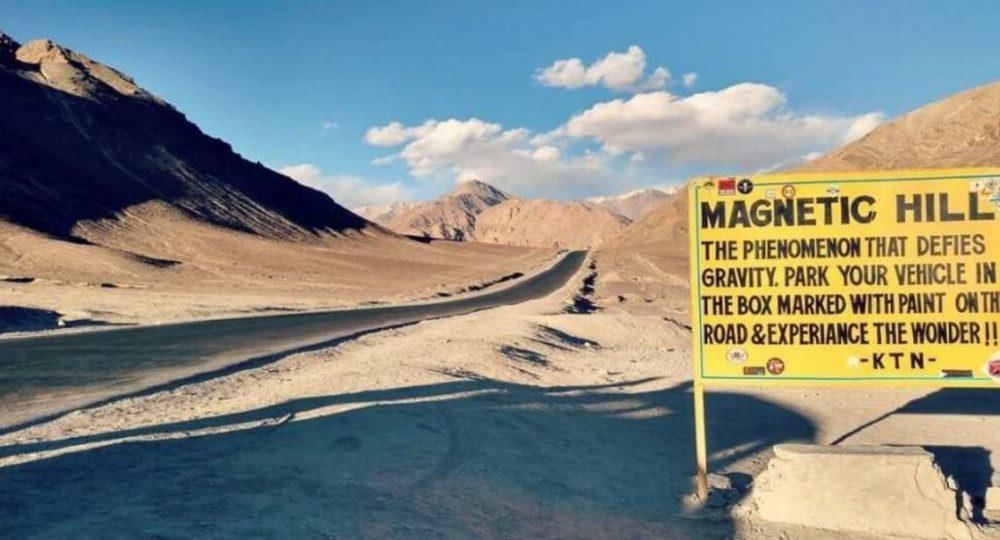
Q4. What creates the optical illusion at the Magnetic Hill in Ladakh?

Magnetic Hill, Ladakh(a) A magnetic force pulling vehicles
(b) The alignment of surrounding slopes and horizon
(c) Bioluminescent organisms
(d) Tidal movements of water

Q5. What is the primary reason for the glowing waters in Kumbalangi, Kerala?
(a) Artificial lights from the village
(b) Bioluminescence from micro-planktons
(c) Reflection of the moon
(d) Chemical pollution in the water

Fill in the Blanks

Instruction: Fill in the blanks with the correct word based on the chapter.

Q1. The Valley of Flowers is located in the ________ district of Uttarakhand.

Q2. The living root bridges in Meghalaya are a ________ UNESCO World Heritage Site.

Q3. The Lonar Crater Lake is unique because it is formed in ________ rock.

Q4. The Sundarbans is a ________ forest in West Bengal.

Q5. The sea at Chandipur Beach retreats by ________ km during ebb tide.

Living Root Bridge, Meghalya

Very Short Answer Questions

Instruction: Answer the following questions in one line.

Q1. Which months are ideal for visiting the Valley of Flowers?

Q2. What is the longest living root bridge in Meghalaya said to be?

Q3. Where is the Lonar Crater Lake located?

Q4. What is the name of the signboard at the Magnetic Hill in Ladakh?

Q5. What type of tourism is Kumbalangi village known for?

Short Answer Questions

Instruction: Answer the following questions in 2–3 lines.

Q1. What types of wildlife can be found in the Valley of Flowers?

Q2. Why were bamboo bridges ineffective in Meghalaya’s waterways?

Q3. What makes the Lonar Crater Lake visually striking?

Q4. How does the Magnetic Hill create a unique experience for visitors?

Q5. What role do the mangrove forests of the Sundarbans play in the environment?

8. The Magic Brush of Dreams – Textbook Worksheet

Multiple Choice Questions (MCQs)

Instruction: Select the correct option for each question.

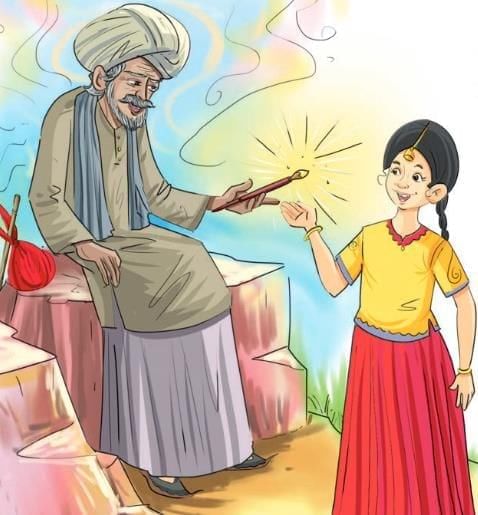
Q1. What was Gopi asked to collect at the beginning of the poem?
(a) Beans, rice, and mangoes
(b) Fruits, flowers, and water
(c) Sticks, leaves, and grass
(d) Wheat, pulses, and oil

Q2. Where was Gopi sitting when she was first seen drawing?
(a) In the fields
(b) Inside her hut
(c) Beneath a banyan tree
(d) Beside a river

Q3. What special gift did Gopi receive from the man with the brush?
(a) A golden bowl
(b) A magic brush
(c) A book of dreams
(d) A bag of treasures

Q4. What rule did the man give Gopi about using the brush?
(a) To paint only for her family
(b) To paint only for the poor
(c) To paint for everyone equally
(d) To paint only during the night

Q5. How did Gopi finally escape from prison?
(a) She painted wings for herself
(b) She painted a horse and a road
(c) The villagers rescued her
(d) The Zamindar set her free

Fill in the Blanks

Instruction: Fill in the blanks with the correct word based on the chapter.

Q1. The mysterious man gave Gopi a __________ to paint.

Q2. Gopi first painted a bowl of _________ for her family.

Q3. The villagers came to see the _________ after hearing the news.

Q4. The greedy _________ ordered Gopi to paint treasures and riches.

Q5. To stop the Zamindar’s men, Gopi painted a mighty _________.

Very Short Answer Questions 

Instruction: Answer the following questions in one line.

Q1. Who was Gopi?

Q2. What happened when Gopi painted food?

Q3. Who spread fear by demanding treasures from Gopi?

Q4. Where was Gopi imprisoned?

Q5. What did Gopi paint to scare the Zamindar at the end?

Short Answer Questions 

Instruction: Answer the following questions in 2–3 lines.

Q1. What was special about the brush given to Gopi?

Q2. How did Gopi use the brush to help the villagers?

Q3. Why did the Zamindar imprison Gopi?

Q4. How did Gopi escape from the prison?

Q5. What lesson does the poem teach us?

7. The Case of the Fifth Word – Textbook Worksheet

Multiple Choice Questions (MCQs)

Instruction: Select the correct option for each question.

Q1. What was Encyclopedia Brown’s real name?
(a) Daniel
(b) Tim
(c) Leroy
(d) Nolan

Q2. Why was Encyclopedia given the nickname “Encyclopedia”?
(a) He loved collecting books.
(b) He remembered all facts he read.
(c) He worked at a library.
(d) He wrote an encyclopedia himself.

Q3. What business did Tim Nolan start in Idaville?
(a) Jewellery shop
(b) Palm-tree nursery
(c) Grocery store
(d) Bookshop

Q4. What did Nolan leave for Davenport in his will?
(a) Jewellery
(b) Palm-tree nursery
(c) House and gold
(d) Only money

Q5. What was the hidden meaning of the four words “Nom Utes Sweden Hurts”?
(a) They were random words.
(b) They were names of countries.
(c) They stood for days of the week.
(d) They were part of a poem.

Fill in the Blanks

Instruction: Fill in the blanks with the correct word based on the chapter.

Q1. Encyclopedia was in the ______ grade.

Q2. Chief Brown was the ______ of Police in Idaville.

Q3. Nolan and Davenport first met while they were in ______.

Q4. The clerk could not testify against Nolan because she was not ______.

Q5. The stolen jewellery was finally found under a young ______ tree.

Very Short Answer Questions 

Instruction: Answer the following questions in one line.

Q1. Who was the Chief of Police in Idaville?

Q2. Who was Nolan’s partner in crime?

Q3. What illness did Nolan suffer from?

Q4. What was clipped to Nolan’s will?

Q5. What did Nolan manage to do just before dying?

Short Answer Questions 

Instruction: Answer the following questions in 2–3 lines.

Q1. Why did Encyclopedia’s father keep his son’s detective skills a secret?

Q2. How did Encyclopedia get clues from his parents’ conversation?

Q3. Why did Chief Brown suspect Nolan and Davenport in the robbery?

Q4. How did Encyclopedia crack the calendar code?

Q5. Where was the jewellery hidden and how did Encyclopedia know?

Match the Following

Instruction: Match Column A with the correct option in Column B.Column AColumn B1. Leroya) Partner in crime with Nolan2. Chief Brownb) Nicknamed Encyclopedia3. Tim Nolanc) Chief of Police in Idaville4. Daniel Davenportd) Started palm-tree nursery5. Fir treee) Jewellery hidden under it

6. Verghese Kurien — I Too Had A Dream – Textbook Worksheet

Multiple Choice Questions (MCQs)

Instruction: Select the correct option for each question.

Q1. What was Verghese Kurien’s main reason for choosing to work in Anand, Gujarat?

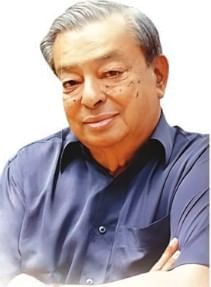
Verghese Kurien

(a) To become a chief executive of a large company
(b) 
To serve the nation’s farmers and contribute to India’s progress
(c) 
To pursue a career in the Indian Army
(d) 
To move to the US as a successful NRI  

Q2. What value did Kurien emphasize as the most important in his life?
(a) Wealth
(b) 
Fame
(c) 
Integrity
(d) 
Ambition  

Q3. What award did Kurien receive in 1999, as mentioned in the chapter?
(a) Bharat Ratna
(b) 
Padma Shri
(c) 
Padma Bhushan
(d) 
Padma Vibhushan  

Q4. How did Kurien’s grandmother contribute to his work in Anand?
(a) She moved to the US to support him financially
(b) 
She supported his choice to live and work in Anand
(c) 
She encouraged him to join the Indian Army
(d) 
She advised him to pursue metallurgy  

Q5. What does Kurien say about failure in the chapter?

(a) Failure is about not succeeding in any task
(b) 
Failure is not trying or contributing to the common good
(c) Failure is about not earning awards
(d) 
Failure is about not being happy  Fill in the Blanks

Instruction: Fill in the blanks with the correct word based on the chapter.

Q1. Kurien started his work soon after India became ________.

Q2. Kurien worked with a small ________ of dairy farmers in Anand.

Q3. Kurien’s mentor in Anand was ________ Patel.

Q4. Kurien dedicated his musings to his grandson ________ and other children.

Q5. Kurien believed that life is a ________ and should not be wasted.Very Short Answer Questions

Instruction: Answer the following questions in one line.

Q1. Where did Kurien choose to work instead of pursuing other careers?

Q2. What was the time period when Kurien began his work, as mentioned in the chapter?

Q3. What did Kurien’s grandmother sacrifice to support his work in Anand?

Q4. What did Kurien say about the rewards of a life well-spent?

Q5. What did Kurien urge Siddharth to earn in his lifetime?
Short Answer Questions

Instruction: Answer the following questions in 2–3 lines.

Q1. Why did Kurien prefer writing a letter to his grandson instead of using a telephone?

Q2. What was Kurien’s dream for India as described in the chapter?

Q3. How did Kurien’s choice to work in Anand change his life?

Q4. What did Kurien learn about happiness from his experiences?

Q5. How did Kurien view the role of personal integrity in his work?

5. Somebody’s Mother – Textbook Worksheet

Multiple Choice Questions (MCQs)

Instruction: Select the correct option for each question.

Q1. Why was the old woman afraid to cross the street?
(a) Because it was too dark
(b) Because the street was slippery with snow
(c) Because there were no traffic lights
(d) Because she had lost her way

Q2. How did the other schoolboys behave towards the old woman?
(a) They teased her.
(b) They quickly helped her.
(c) They ignored her and passed by.
(d) They laughed at her.

Q3. What was the young boy’s attitude after helping the woman?
(a) Angry and upset
(b) Proud and happy
(c) Careless and indifferent
(d) Sad and disappointed

Q4. What prayer did the old woman make for the boy?
(a) That he would become rich
(b) That he would pass his exams
(c) That God be kind to him
(d) That he would become famous

Q5. What does the phrase “Somebody’s mother” mainly highlight?
(a) That the woman was poor
(b) That she was unknown to others but precious to her child
(c) That she had many children
(d) That she was waiting for her son

Fill in the Blanks

Instruction: Fill in the blanks with the correct word based on the chapter.

Q1. The poem Somebody’s Mother was written by __________.

Q2. The boys came out of school like a flock of __________.

Q3. The woman’s feet were described as __________ and slow.

Q4. The boy guided the woman across the __________ street.

Q5. At the end, the woman prayed for the __________ boy.

Very Short Answer Questions

Instruction: Answer the following questions in one line.

Q1. Who is the central character of the poem?

Q2. How did the children react to the old woman at first?

Q3. Who helped the old woman cross the street?

Q4. What was the boy proud of after helping her?

Q5. What quality of the boy does the poem highlight?

Short Answer Questions

Instruction: Answer the following questions in 2–3 lines.

Q1. Describe the condition of the old woman in the poem.

Q2. How does the poet show the difference between the old woman and the schoolboys?

Q3. Why did the boy stop to help the woman?

Q4. What impact did the boy’s act of kindness have on the old woman?

Q5. What message does the poem convey to society?

Match the Following

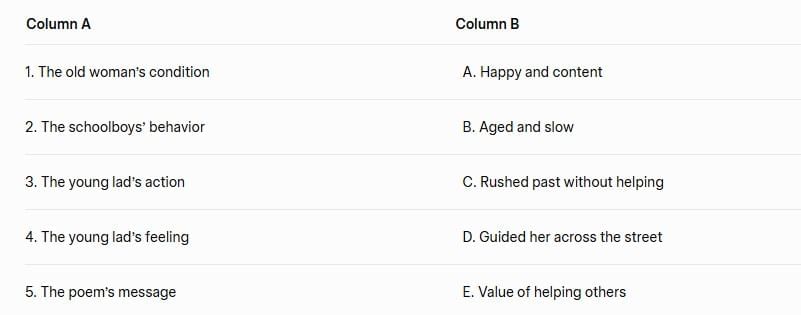
Instruction: Match Column A with the correct option in Column B.

4. A Tale of Valour: Major Somnath Sharma and the Battle of Badgam – Textbook Worksheet

Multiple Choice Questions (MCQs)

Instruction: Select the correct option for each question.

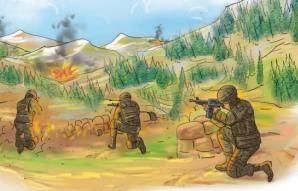
Q1. Major Somnath Sharma was the first recipient of which prestigious award?

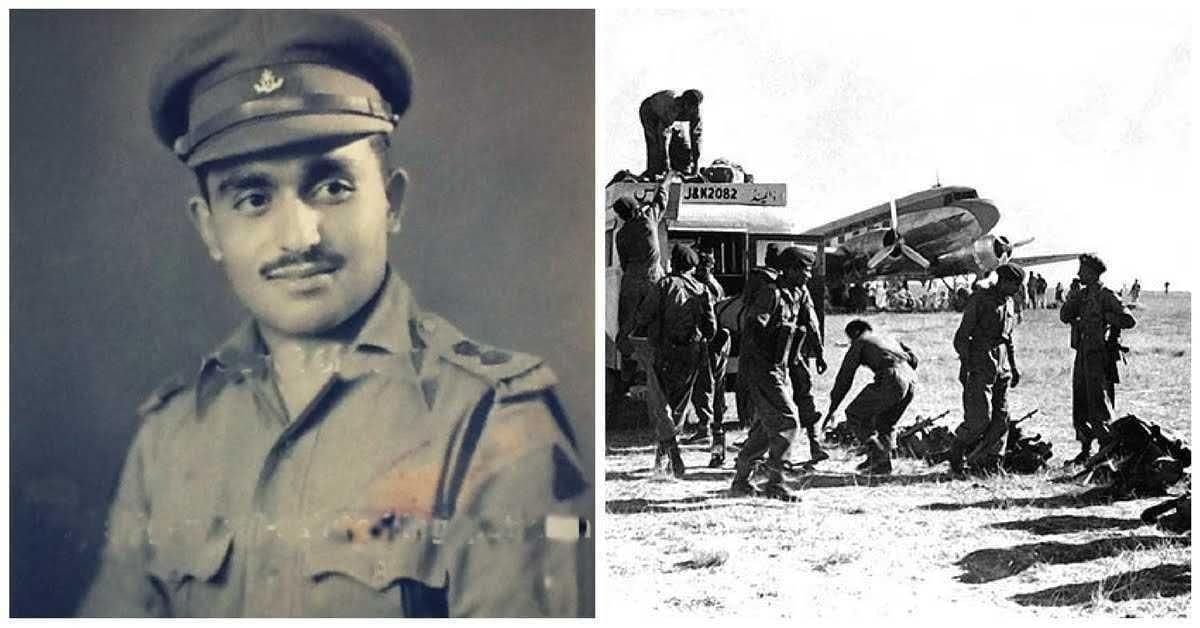
Major Somnath Sharma

(a) Ashoka Chakra
(b) 
Vir Chakra
(c) 
Param Vir Chakra
(d) 
Maha Vir Chakra

Q2. The Battle of Badgam took place in which year?
(a) 1942
(b) 
1945
(c) 
1947
(d) 
1950

Q3. Who was the ruler of Jammu and Kashmir at the time of Pakistan’s invasion in 1947?
(a) 
Raja Gulab Singh
(b) 
Maharaja Hari Singh
(c) 
Zorawar Singh
(d) 
General Cariappa

Q4. Which regiment did Major Somnath Sharma command during the Battle of Badgam?
(a) 
8th Battalion, Hyderabad Regiment
(b) 
4th Battalion, Kumaon Regiment
(c) 
Punjab Regiment
(d) 
Dogra Regiment

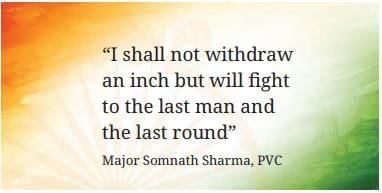
Q5. What was Major Somnath Sharma’s famous last message to Brigade headquarters?
(a) “I will not retreat; I will fight till the last breath.”
(b) 
“We shall fight with courage and strength.”
(c) 
“The enemy is 50 yards from us… I shall not withdraw an inch but fight to the last man and the last round.”
(d) 
“Victory belongs to those who fight bravely.”

Fill in the Blanks

Instruction: Fill in the blanks with the correct word based on the chapter.

Q1. Pakistan launched Operation ________ to annex Kashmir in 1947.

Q2. Major Somnath Sharma was born on 31 January ____ in Kangra, Himachal Pradesh.

Q3. The Princely State of Jammu and Kashmir officially became a part of India on __ October 1947.

Q4. The Indian troops were airlifted to Srinagar on __ October 1947.

Q5. Major Somnath Sharma studied at Sherwood College, ______ during his early education.

Very Short Answer Questions

Instruction: Answer the following questions in one line.

Q1. At what age did Major Somnath Sharma sacrifice his life?

Q2. What was the main objective of the Pakistani invaders in 1947?

Q3. Which family member inspired Somnath Sharma with tales from the Mahabharata?

Q4. Where did Major Somnath Sharma receive his military training?

Q5. Which battalion was awarded the Battle Honour, Srinagar?

Short Answer Questions

Instruction: Answer the following questions in 1–2 lines.

Q1. Why was the village of Badgam strategically important in 1947?

Q2. How did Major Somnath Sharma show commitment despite his injury?

Q3. What role did air strikes play in the Battle of Badgam?

Q4. What was the immediate outcome of D Company’s resistance in the battle?

Q5. Why is Major Somnath Sharma remembered as an inspiration?

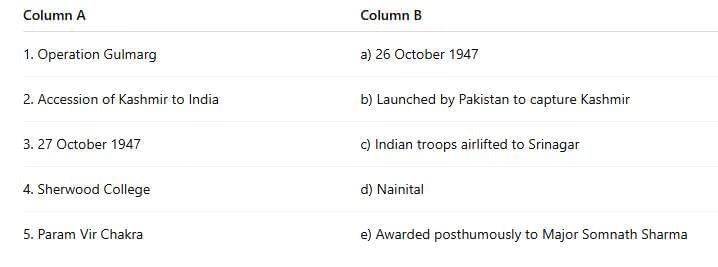
Match the Following

Instruction: Match Column A with the correct option in Column B.

3. Wisdom Paves the Way – Textbook Worksheet

Multiple Choice Questions (MCQs)

Instruction: Select the correct option for each question.

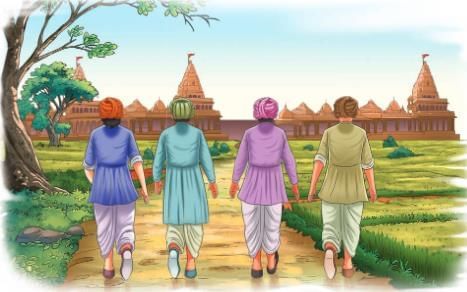
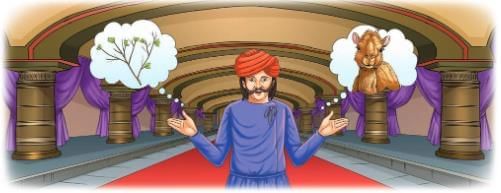
Q1. Where are the four young men traveling to find work?
(a) Delhi
(b) Ujjain
(c) Jaipur
(d) Agra

Q2. What does the merchant accuse the young men of doing?
(a) Stealing his camel
(b) Lying to the King 
(c) Hiding in the forest
(d) Refusing to help him

Q3. How does Ram Datt know the camel is lame?
(a) He saw the camel limping
(b) He heard the merchant’s description
(c) He noticed uneven footprints 
(d) He found blood on the road

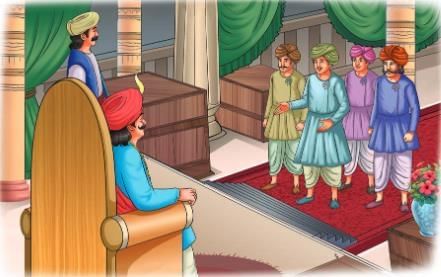
Q4. What job does the King offer the young men?
(a) Soldiers
(b) Advisers
(c) Merchants
(d) Farmers

Q5. What is the main theme of the story?
(a) Importance of wealth
(b) Power of friendship alone 
(c) Need for fast travel
(d) Value of wisdom and observation

Fill in the Blanks

Instruction: Fill in the blanks with the correct word based on the chapter.

Q1. The four young men have been traveling for _____ days to reach Ujjain.

Q2. The merchant is upset because his _____ is missing.

Q3. Shiv Datt deduces the camel is blind in its _____ eye.

Q4. The King’s court is decorated with rich _____ and tall pillars.

Q5. The King praises the young men for their _____ after hearing their explanations.

Very Short Answer Questions

Instruction: Answer the following questions in one line.

Q1. What is the name of the city the four young men are traveling to?

Q2. Who runs toward the young men asking for help with a lost animal?

Q3. Where do the young men stop to discuss the camel tracks?

Q4. What does Har Datt notice that suggests the camel has a short tail?

Q5. What does the King do after dismissing the merchant’s accusations?

Short Answer Questions

Instruction: Answer the following questions in 2–3 lines.

Q1. Why do the young men want to meet the King of Ujjain?

Q2. How does Dev Datt know the camel has a stomachache?

Q3. Why does the merchant think the young men are thieves?

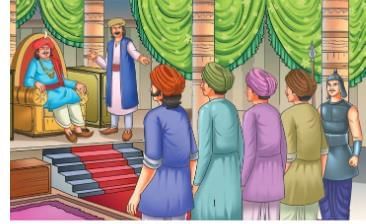
Q4. How does the King react to the young men’s explanations?

Q5. What lesson does the story teach about observation?

2. A Concrete Example – Textbook Worksheet

Multiple Choice Questions

Instruction: Select the correct option for each question.

Q1. What is the primary material in Mrs. Jones’s garden?
(a) Flowers
(b) Grass
(c) Stones
(d) Trees

Q2. What does the poem suggest about Mrs. Jones’s attitude toward her garden?
(a) She is embarrassed by it
(b) She wants to change it 
(c) She ignores it
(d) She takes pride in it

Q3. What is the setting of the interaction between the speaker and Mrs. Jones in the third stanza?
(a) A market
(b) Mrs. Jones’s garden
(c) The speaker’s house
(d) A park

Q4. What does the “strange device” on the sundial suggest about Mrs. Jones’s taste?
(a) She prefers modern technology
(b) She likes simple designs
(c) She values unusual features
(d) She dislikes decorative items

Q5. What creates the ironic moment in the poem’s final stanza?
(a) The speaker steps on the flower he admires
(b) Mrs. Jones forgets about her garden
(c) The speaker buys a plant from Mrs. Jones
(d) Mrs. Jones changes her garden’s designFill in the Blanks

Instruction: Fill in the blanks with the correct word based on the chapter.

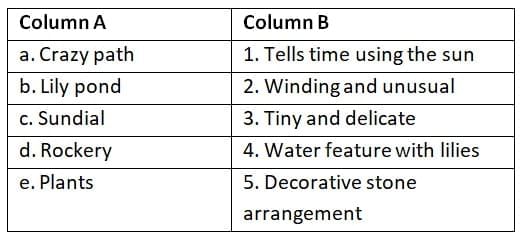
Q1. Mrs. Jones’s garden has a ______ path that twists and turns.

Q2. The ______ in Mrs. Jones’s garden is a tool that tells time using the sun.

Q3. The speaker finds the tiny plants so small that they seem to have no ______ at all.

Q4. Mrs. Jones is described as an ______ gardener who loves her stone garden.Very Short Answer Questions

Instruction: Answer the following questions in one line.

Q1. What is the name of the poet who wrote “A Concrete Example”?

Q2. What contains water lilies in Mrs. Jones’s garden?

Q3. How long do the speaker and Mrs. Jones talk about the flower?

Q4. What does Mrs. Jones say when the speaker asks where the flower is?

Q5. What type of garden feature is the rockery in the poem?Short Answer Questions

Instruction: Answer the following questions in 2–3 lines.

Q1. How does the poem’s structure contribute to its readability?

Q2. Why does the speaker think the tiny plants are insignificant?

Q3. How does the dialogue in the third stanza make the poem more humorous?

Q4. How does the poem show Mrs. Jones’s unique taste in gardening?

Q5. What lesson about perception does the poem teach?Match the Following

Instruction: Match Column A with the correct option in Column B.

Check out the solutions of this worksheet here.