08. Short & Long Question Answer: Quadrilaterals

Q1: What is a quadrilateral? Mention 6 types of quadrilaterals.
Sol: 
A quadrilateral is a two-dimensional closed polygon having four sides and four vertices. The sum of its interior angles is 360°. Common types of quadrilaterals include:

  • Rectangle
  • Square
  • Parallelogram
  • Rhombus
  • Trapezium
  • Kite

Q2: Identify the type of quadrilaterals:
(i) The quadrilateral formed by joining the midpoints of consecutive sides of a quadrilateral whose diagonals are perpendicular.
(ii) The quadrilateral formed by joining the midpoints of consecutive sides of a quadrilateral whose diagonals are congruent.
Sol: 
(i) By Varignon’s theorem, the quadrilateral formed by joining the midpoints of the sides of any quadrilateral is a parallelogram whose adjacent sides are parallel to the diagonals of the original quadrilateral and have lengths equal to half those diagonals. If the original diagonals are perpendicular, the two adjacent sides of the midpoint parallelogram are perpendicular. A parallelogram with adjacent sides perpendicular is a rectangle. Hence the figure is a rectangle.

(ii) If the diagonals of the original quadrilateral are congruent (equal in length), then the corresponding adjacent sides of the midpoint parallelogram are equal in length (each equals half a diagonal). A parallelogram whose adjacent sides are equal is a rhombus. Hence the figure is a rhombus.

Q3: In a rectangle, one diagonal is inclined to one of its sides at 25°. Measure the acute angle between the two diagonals.
Sol: 
Let θ = 25° be the acute angle made by a diagonal with a side of the rectangle. The two diagonals of a rectangle are symmetric about the centre and make equal angles θ and -θ with the same side. Therefore the acute angle between the two diagonals is 2θ = 2 × 25° = 50°. Hence the acute angle between the diagonals is 50°.

Q4: Prove that the angle bisectors of a parallelogram form a rectangle.
Sol: 
Let LMNO be a parallelogram. Let the bisectors of ∠L, ∠M, ∠N and ∠O meet pairwise to form quadrilateral PQRS (so each vertex of PQRS is the intersection of bisectors of two consecutive angles of LMNO).

In a parallelogram, consecutive interior angles are supplementary, so ∠L + ∠M = 180°.

When ∠L and ∠M are bisected, their half-angles satisfy (∠L)/2 + (∠M)/2 = 90°.

At the intersection point Q of the bisectors of ∠L and ∠M, the angle ∠PQR equals (∠L)/2 + (∠M)/2 = 90°.

Similarly, each interior angle of PQRS is formed by the sum of half of two consecutive angles of the parallelogram, and each such sum equals 90°.

Hence all four angles of PQRS are right angles, so PQRS is a rectangle. 

Q5: Calculate all the angles of a parallelogram if one of its angles is twice its adjacent angle.

Sol: Let one angle be x and its adjacent angle be 2x. Opposite angles of a parallelogram are equal, so the four angles are x, 2x, x and 2x. Their sum is 360°:

x + 2x + x + 2x = 360°

6x = 360° ⇒ x = 60°.

Thus the angles are 60°, 120°, 60° and 120°.

Q6: The diagonals of which quadrilateral are equal and bisect each other at 90°?
Sol: 
A square. In a square the diagonals are equal in length, they bisect each other, and they intersect at right angles. A rhombus has diagonals that bisect at 90° but they are not equal unless it is a square; a rectangle has equal diagonals but they are not perpendicular unless it is a square. Therefore the required quadrilateral is a square.

Q7: Find all the angles of a parallelogram if one angle is 80°.

Sol: In a parallelogram opposite angles are equal. If one angle is 80°, the opposite angle is also 80°. Consecutive angles are supplementary, so each adjacent angle is 180° – 80° = 100°. Hence the four angles are 80°, 100°, 80° and 100°.

Q8: Is it possible to draw a quadrilateral whose all angles are obtuse angles?

Sol: No. An obtuse angle is greater than 90°. If all four angles of a quadrilateral were obtuse, their sum would be greater than 4 × 90° = 360°, but the sum of interior angles of any quadrilateral is exactly 360°. Therefore it is not possible to have all four angles obtuse.

Q9: In a trapezium ABCD, AB∥CD. Calculate ∠C and ∠D if ∠A = 55° and ∠B = 70°

Sol: In a trapezium with AB ∥ CD, each pair of interior angles on the same leg are supplementary. Thus ∠A + ∠D = 180° and ∠B + ∠C = 180°.
Given ∠A = 55°, so ∠D = 180° – 55° = 125°.
Given ∠B = 70°, so ∠C = 180° – 70° = 110°.
Therefore ∠C = 110° and ∠D = 125°.

Q10: Calculate all the angles of a quadrilateral if they are in the ratio 2:5:4:1.

Sol: Let the common factor be x. Then the angles are 2x, 5x, 4x and x. Their sum is 360°:
2x + 5x + 4x + x = 360° ⇒ 12x = 360° ⇒ x = 30°.
Therefore the angles are: 2x = 60°, 5x = 150°, 4x = 120°, and x = 30°.
07. Short & Long Question Answer: Triangles

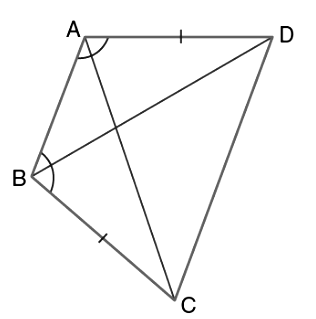
Q1: ABCD is a quadrilateral in which AD = BC and ∠DAB = ∠CBA. Prove that
(i) ΔABD ≅ ΔBAC
(ii) BD = AC
(iii) ∠ABD = ∠BAC.

Short & Long Question Answer: TrianglesSol:
As per given in the question,
∠DAB = ∠CBA and AD = BC.
(i) ΔABD and ΔBAC are similar by SAS congruency as
AB = BA (common arm)
∠DAB = ∠CBA and AD = BC (given)
So, triangles ABD and BAC are similar
i.e. ΔABD ≅ ΔBAC. (Hence proved).
(ii) As it is already proved,
ΔABD ≅ ΔBAC
So,
BD = AC (by CPCT)
(iii) Since ΔABD ≅ ΔBAC
So, the angles,
∠ABD = ∠BAC (by CPCT).

Q2: Line l is the bisector of an angle ∠A and B is any point on l. BP and BQ are perpendiculars from B to the arms of ∠A. Show that:
(i) ΔAPB ≅ ΔAQB
(ii) BP = BQ or B is equidistant from the arms of ∠A.Sol:

It is given that the line “l” is the bisector of angle ∠A and the line segments BP and BQ are perpendiculars drawn from l.
(i) ΔAPB and ΔAQB are similar by AAS congruency because;
∠P = ∠Q (both are right angles)
AB = AB (common arm)
∠BAP = ∠BAQ (As line l is the bisector of angle A)
So, ΔAPB ≅ ΔAQB.
(ii) By the rule of CPCT, BP = BQ. So, we can say point B is equidistant from the arms of ∠A.

Q3: In right triangle ABC, right-angled at C, M is the mid-point of hypotenuse AB. C is joined to M and produced to a point D such that DM = CM. Point D is joined to point B (see the figure). Show that:
(i) ΔAMC ≅ ΔBMD
(ii) ∠DBC is a right angle.
(iii) ΔDBC ≅ ΔACB
(iv) CM = 1/2 AB
Sol:

It is given that M is the mid-point of the line segment AB, ∠C = 90°, and DM = CM
(i) Consider the triangles ΔAMC and ΔBMD:
AM = BM (Since M is the mid-point)
CM = DM (Given)
∠CMA = ∠DMB (Vertically opposite angles)
So, by SAS congruency criterion, ΔAMC ≅ ΔBMD.

(ii) ∠ACM = ∠BDM (by CPCT)
∴ AC ∥ BD as alternate interior angles are equal.
Now, ∠ACB + ∠DBC = 180° (Since they are co-interiors angles)
⇒ 90° + ∠B = 180°
∴ ∠DBC = 90°

(iii) In ΔDBC and ΔACB,
BC = CB (Common side)
∠ACB = ∠DBC (Both are right angles)
DB = AC (by CPCT)
So, ΔDBC ≅ ΔACB by SAS congruency.

(iv) DC = AB (Since ΔDBC ≅ ΔACB)
⇒ DM = CM = AM = BM (Since M the is mid-point)
So, DM + CM = BM + AM
Hence, CM + CM = AB
⇒ CM = (½) AB

Q4: ΔABC is an isosceles triangle in which AB = AC. Side BA is produced to D such that AD = AB. Show that ∠BCD is a right angle.Sol:
Given, AB = AC and AD = AB
To prove: ∠BCD is a right angle.
Proof:
Consider ΔABC,
AB = AC (Given)
Also, ∠ACB = ∠ABC (Angles opposite to equal sides)
Now, consider ΔACD,
AD = AC
Also, ∠ADC = ∠ACD (Angles opposite to equal sides)
Now,
In ΔABC,
∠CAB + ∠ACB + ∠ABC = 180°
So, ∠CAB + 2∠ACB = 180°
⇒ ∠CAB = 180° – 2∠ACB — (i)
Similarly in ΔADC,
∠CAD = 180° – 2∠ACD — (ii)
Also,
∠CAB + ∠CAD = 180° (BD is a straight line.)
Adding (i) and (ii) we get,
∠CAB + ∠CAD = 180° – 2∠ACB + 180° – 2∠ACD
⇒ 180° = 360° – 2∠ACB – 2∠ACD
⇒ 2(∠ACB + ∠ACD) = 180°
⇒ ∠BCD = 90°

Q5: Two sides AB and BC and median AM of one triangle ABC are respectively equal to sides PQ and QR and median PN of ΔPQR (see the figure). Show that:
(i) ΔABM ≅ ΔPQN
(ii) ΔABC ≅ ΔPQR
Sol:

Given;
AB = PQ,
BC = QR and
AM = PN
(i) 1/2 BC = BM and 1/2QR = QN (Since AM and PN are medians)
Also, BC = QR
So, 1/2 BC = 1/2QR
⇒ BM = QN
In ΔABM and ΔPQN,
AM = PN and AB = PQ (Given)
BM = QN (Already proved)
∴ ΔABM ≅ ΔPQN by SSS congruency.

(ii) In ΔABC and ΔPQR,
AB = PQ and BC = QR (Given)
∠ABC = ∠PQR (by CPCT)
So, ΔABC ≅ ΔPQR by SAS congruency.

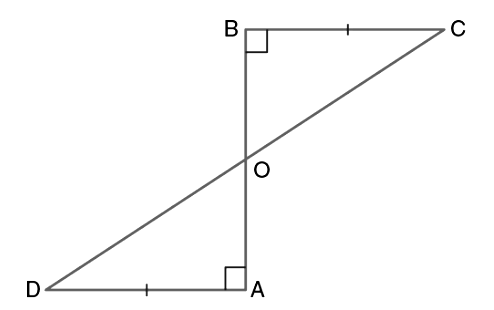
Q6: AD and BC are equal perpendiculars to a line segment AB. Show that CD bisects AB.
Short & Long Question Answer: TrianglesSol:
Given, AD and BC are two equal perpendiculars to AB.
To prove: CD is the bisector of AB
Proof:
Triangles ΔAOD and ΔBOC are similar by AAS congruency
Since:
(i) ∠A = ∠B (perpendicular angles)
(ii) AD = BC (given)
(iii) ∠AOD = ∠BOC (vertically opposite angles)
∴ ΔAOD ≅ ΔBOC.
So, AO = OB ( by CPCT).
Thus, CD bisects AB (Hence proved).

Q7: AB is a line segment and P is its mid-point. D and E are points on the same side of AB such that ∠BAD = ∠ABE and ∠EPA = ∠DPB. Show that
(i) ΔDAP ≅ ΔEBP
(ii) AD = BE

Sol:
Given, P is the mid-point of line segment AB.
Also, ∠BAD = ∠ABE and ∠EPA = ∠DPB
(i) Given, ∠EPA = ∠DPB
Now, add ∠DPE on both sides,
∠EPA + ∠DPE = ∠DPB + ∠DPE
This implies that angles DPA and EPB are equal
i.e. ∠DPA = ∠EPB
Now, consider the triangles DAP and EBP.
∠DPA = ∠EPB
AP = BP (Since P is the mid-point of the line segment AB)
∠BAD = ∠ABE (given)
So, by ASA congruency criterion,
ΔDAP ≅ ΔEBP.
(ii) By the rule of CPCT,
AD = BE

Q8: ABC is an isosceles triangle in which altitudes BE and CF are drawn to equal sides AC and AB respectively. Show that these altitudes are equal.Sol:
Given:
(i) BE and CF are altitudes.
(ii) AC = AB
To prove:
BE = CF
Proof:
Triangles ΔAEB and ΔAFC are similar by AAS congruency, since;
∠A = ∠A (common arm)
∠AEB = ∠AFC (both are right angles)
AB = AC (Given)
∴ ΔAEB ≅ ΔAFC
and BE = CF (by CPCT).

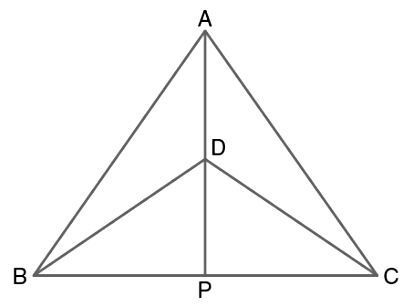
Q9: ΔABC and ΔDBC are two isosceles triangles on the same base BC and vertices A and D are on the same side of BC (see the figure). If AD is extended to intersect BC at P, show that
(i) ΔABD ≅ ΔACD
(ii) ΔABP ≅ ΔACP
(iii) AP bisects ∠A as well as ∠D.
(iv) AP is the perpendicular bisector of BC.

Short & Long Question Answer: TrianglesSol:
In the above question, it is given that ΔABC and ΔDBC are two isosceles triangles.
(i) ΔABD and ΔACD are similar by SSS congruency because:
AD = AD (It is the common arm)
AB = AC (Since ΔABC is isosceles)
BD = CD (Since ΔDBC is isosceles)
∴ ΔABD ≅ ΔACD.

(ii) ΔABP and ΔACP are similar as:
AP = AP (common side)
∠PAB = ∠PAC ( by CPCT since ΔABD ≅ ΔACD)
AB = AC (Since ΔABC is isosceles)
So, ΔABP ≅ ΔACP by SAS congruency.

(iii) ∠PAB = ∠PAC by CPCT as ΔABD ≅ ΔACD.
AP bisects ∠A. ………… (1)
Also, ΔBPD and ΔCPD are similar by SSS congruency as
PD = PD (It is the common side)
BD = CD (Since ΔDBC is isosceles.)
BP = CP (by CPCT as ΔABP ≅ ΔACP)
So, ΔBPD ≅ ΔCPD.
Thus, ∠BDP = ∠CDP by CPCT. ……………. (2)
Now by comparing equation (1) and (2) it can be said that AP bisects ∠A as well as ∠D.

(iv) ∠BPD = ∠CPD (by CPCT as ΔBPD ≅ ΔCPD)
and BP = CP — (1)
also,
∠BPD + ∠CPD = 180° (Since BC is a straight line.)
⇒ 2∠BPD = 180°
⇒ ∠BPD = 90° —(2)
Now, from equations (1) and (2), it can be said that
AP is the perpendicular bisector of BC.

Q10: In the Figure, PR > PQ and PS bisect ∠QPR. Prove that ∠PSR > ∠PSQ.
Sol:

Given, PR > PQ and PS bisects ∠QPR
To prove: ∠PSR > ∠PSQ
Proof:
∠QPS = ∠RPS — (1) (PS bisects ∠QPR)
∠PQR > ∠PRQ — (2) (Since PR > PQ as angle opposite to the larger side is always larger)
∠PSR = ∠PQR + ∠QPS — (3) (Since the exterior angle of a triangle equals the sum of opposite interior angles)
∠PSQ = ∠PRQ + ∠RPS — (4) (As the exterior angle of a triangle equals to the sum of opposite interior angles)
By adding (1) and (2)
∠PQR + ∠QPS > ∠PRQ + ∠RPS
Now, from (1), (2), (3) and (4), we get
∠PSR > ∠PSQ.

06. Short & Long Question Answer: Lines and Angle

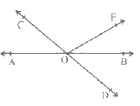
Q1: In the figure, lines AB and CD intersect at O. If ∠AOC + ∠BOE = 70° and ∠BOD = 40°, find ∠BOE and reflex ∠COE.

Ans:
At point O three adjacent angles on a straight line add to 180°.
So, ∠AOC + ∠BOE + ∠COE = 180°.
Given ∠AOC + ∠BOE = 70°, substitute to get:
70° + ∠COE = 180°
∴ ∠COE = 110°.
Now consider the other straight line through O: ∠COE + ∠BOD + ∠BOE = 180°.
Substitute ∠COE = 110° and ∠BOD = 40°:
110° + 40° + ∠BOE = 180°
∴ ∠BOE = 180° – 150° = 30°.
The reflex angle ∠COE is the larger angle at O corresponding to ∠COE, so reflex ∠COE = 360° – 110° = 250°.
Hence, ∠BOE = 30° and reflex ∠COE = 250°.
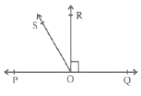
Q2: In the Figure, POQ is a line. Ray OR is perpendicular to line PQ. OS is another ray lying between rays OP and OR. Prove that ∠ROS = 1/2(∠QOS – ∠POS).

Ans:
POQ is a straight line, so the three adjacent angles on that line sum to 180°:
∠POS + ∠ROS + ∠ROQ = 180°.
Given OR ⟂ PQ, so OR is perpendicular to the straight line POQ. Hence ∠POR = ∠ROQ = 90°. In particular ∠ROQ = 90°.
Substitute ∠ROQ = 90° into the previous equation:
∠POS + ∠ROS + 90° = 180°
∴ ∠POS + ∠ROS = 90°. (1)
Now ∠QOS is formed by ∠QOR + ∠ROS. But ∠QOR = ∠ROQ = 90°, so
∠QOS = 90° + ∠ROS.
Rearrange this to get:
∠QOS – ∠ROS = 90°. (2)
From (1) and (2) we have:
∠POS + ∠ROS = ∠QOS – ∠ROS
Bring like terms together:
2∠ROS + ∠POS = ∠QOS
Therefore ∠ROS = 1/2(∠QOS – ∠POS), as required.
Q3: In the Figure, if AB || CD, EF ⊥ CD and ∠GED = 126°, find ∠AGE, ∠GEF and ∠FGE.
Ans:

Since AB ∥ CD and GE is a transversal, alternate interior angles are equal. Therefore
∠AGE = ∠GED = 126°.
At point E on line EF, ∠GED is split as ∠GEF + ∠FED. Given EF ⟂ CD, we have ∠FED = 90°.
So, ∠GEF = ∠GED – ∠FED = 126° – 90° = 36°.
Also, ∠FGE and ∠GED are a linear pair (they lie on a straight line through G), so
∠FGE + ∠GED = 180°.
Hence ∠FGE = 180° – 126° = 54°.
Therefore,
∠AGE = 126°, ∠GEF = 36° and ∠FGE = 54°.
Q4: In Fig. 6.33, PQ and RS are two mirrors placed parallel to each other. An incident ray AB strikes the mirror PQ at B, the reflected ray moves along the path BC and strikes the mirror RS at C and again reflects back along CD. Prove that AB || CD.
Ans:
Draw normals BE and CF at the points of incidence B and C respectively, so BE ⟂ PQ and CF ⟂ RS. Since PQ ∥ RS, their normals BE and CF are also parallel: BE ∥ CF.
By the law of reflection, angle of incidence = angle of reflection at each mirror. So at B:
∠(AB, BE) = ∠(EB, BC). Label these ∠1 = ∠2. At C:
∠(BC, CF) = ∠(CF, CD). Label these ∠3 = ∠4.
Because BE ∥ CF and BC is a transversal cutting them at B and C, alternate interior angles are equal. Thus ∠2 = ∠3.
Combine equalities: ∠1 = ∠2 and ∠2 = ∠3 and ∠3 = ∠4, so ∠1 = ∠4.
Angles ∠1 and ∠4 are the angles that AB and CD make with the common direction of the mirrors. Since these corresponding angles are equal, AB ∥ CD (alternate interior/corresponding angle test).
Thus AB is parallel to CD.
Q5: In the figure, if AB || CD || EF, PQ || RS, ∠RQD = 25° and ∠CQP = 60°, then find ∠QRS.
Ans:

Given PQ ∥ RS and the transversal through Q and C, angles ∠PQC and ∠BRS are alternate interior angles, so they are equal. Thus ∠BRS = ∠PQC = 60°. (i)
Given AB ∥ CD and the transversal QR, angles ∠DQR and ∠QRA are alternate interior angles, so ∠QRA = ∠DQR = 25°. (ii)
Angles ∠ARS and ∠BRS form a linear pair on line RS, so ∠ARS + ∠BRS = 180°. Using (i):
∴ ∠ARS = 180° – 60° = 120°. (iii)
Now ∠QRS = ∠QRA + ∠ARS. Using (ii) and (iii):
∠QRS = 25° + 120° = 145°.
Hence ∠QRS = 145°.
Q6: In the Figure, lines XY and MN intersect at O. If ∠POY = 90° and a : b = 2 : 3, find c.
Ans:

Angles on a straight line add to 180°, so along the line through P-O-Y we have:
∠POY + a + b = 180°. Given ∠POY = 90°, so a + b = 90°.
Given a : b = 2 : 3, let a = 2x and b = 3x. Then 2x + 3x = 90° ⇒ 5x = 90° ⇒ x = 18°.
Thus a = 2×18° = 36° and b = 3×18° = 54°.
From the diagram b and c form a straight angle on the other line, so b + c = 180°. Substitute b = 54°:
c + 54° = 180° ⇒ c = 126°.
Therefore c = 126°.
Q7: It is given that ∠XYZ = 64° and XY is produced to point P. Draw a figure from the given information. If ray YQ bisects ∠ZYP, find ∠XYQ and reflex ∠QYP.
Ans:
Since XY is produced to P, XP is a straight line. Therefore ∠XYZ + ∠ZYP = 180°.
Given ∠XYZ = 64°, so ∠ZYP = 180° – 64° = 116°.
Ray YQ bisects ∠ZYP, so each part is half of 116°: ∠ZYQ = ∠QYP = 58°.
Now ∠XYQ = ∠XYZ + ∠ZYQ = 64° + 58° = 122°.
The reflex angle ∠QYP is the larger angle at Y from Q to P around Y: reflex ∠QYP = 360° – (minor ∠QYP). The minor ∠QYP = 58°, so
reflex ∠QYP = 360° – 58° = 302°. (Equivalently, reflex ∠QYP = 180° + ∠XYQ = 180° + 122° = 302°.)
Hence ∠XYQ = 122° and reflex ∠QYP = 302°.
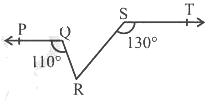
Q8: In the Figure, if PQ || ST, ∠PQR = 110° and ∠RST = 130°, find ∠QRS.
[Hint: Draw a line parallel to ST through point R.]

Ans:
Through R draw a line XY parallel to PQ (and hence parallel to ST).
Angles on the same side of a transversal add to 180°. For transversal QR with PQ ∥ XY:
∠PQR + ∠QRX = 180° ⇒ ∠QRX = 180° – 110° = 70°.
For transversal RS with ST ∥ XY:
∠RST + ∠SRY = 180° ⇒ ∠SRY = 180° – 130° = 50°.
On the straight line XY at R the three adjacent angles satisfy:
∠QRX + ∠QRS + ∠SRY = 180°.
Substitute the known angles: 70° + ∠QRS + 50° = 180° ⇒ ∠QRS = 180° – 120° = 60°.
Thus ∠QRS = 60°.
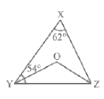
Q9: In Fig. 6.40, ∠X = 62°, ∠XYZ = 54°. If YO and ZO are the bisectors of ∠XYZ and ∠XZY respectively of Δ XYZ, find ∠OZY and ∠YOZ.

Ans:
Sum of interior angles of ΔXYZ: ∠X + ∠XYZ + ∠XZY = 180°.
Substitute ∠X = 62° and ∠XYZ = 54° to get:
62° + 54° + ∠XZY = 180° ⇒ ∠XZY = 180° – 116° = 64°.
ZO bisects ∠XZY, so ∠OZY = 1/2 × 64° = 32°.
YO bisects ∠XYZ, so ∠OYZ = 1/2 × 54° = 27°.
Now the angles in triangle OYZ sum to 180°:
∠OZY + ∠OYZ + ∠YOZ = 180° ⇒ 32° + 27° + ∠YOZ = 180°.
Therefore ∠YOZ = 180° – 59° = 121°.
Hence ∠OZY = 32° and ∠YOZ = 121°.

05. Short & Long Question Answer: Introduction To Euclid’s Geometry

Q1: What are the five postulates of Euclid’s Geometry?
Sol: Euclid’s postulates are the basic assumptions on which Euclidean geometry is built. They are:

  • A straight line may be drawn from any one point to any other point.
  • A terminated straight line can be produced indefinitely in a straight line.
  • A circle can be described with any centre and any radius.
  • All right angles are equal to one another.
  • If a straight line falling on two straight lines makes the interior angles on the same side of it taken together less than two right angles, then the two straight lines, if produced indefinitely, meet on that side on which the sum of the angles is less than two right angles.

These five statements serve as the starting rules for classical plane geometry. The fifth postulate is often called the parallel postulate because of its relation to the existence and behaviour of parallel lines.
Q2: If in Q.2, point C is called a mid-point of line segment AB. Prove that every line segment has one and only one mid-point.
Sol:

Let AB be a line segment.
Assume, for contradiction, that P and Q are two distinct mid-points of AB.
Then by definition of midpoint,
AP = PB ………(1)
and AQ = QB ……(2)
Since AP + PB = AB and AQ + QB = AB, both AP and AQ are halves of AB.
From (1), adding AP to both sides gives:
AP + AP = PB + AP (If equals are added to equals, the wholes are equal.)
⇒ 2 AP = AB …(3)
From (2), similarly:
2 AQ = AB …(4)
From (3) and (4):
2 AP = 2 AQ
⇒ AP = AQ
Hence the distances from A to P and from A to Q are equal, so P and Q coincide.
This contradicts the assumption that P and Q are different points.
Therefore every line segment has one and only one mid-point.
Hence proved.
Q3: Does Euclid’s fifth postulate imply the existence of parallel lines? Explain.
Sol:

Yes. Euclid’s fifth postulate implies the existence of parallel lines because it gives a condition under which two straight lines will never meet.

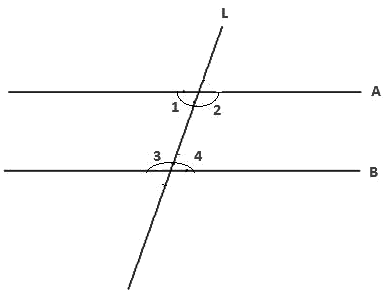
If a straight line falling on two straight lines makes the interior angles on the same side add up to two right angles (180°), then the two lines, when extended indefinitely on that side, do not meet. Such lines are defined as parallel.
Thus, when ∠1 + ∠2 = 180° (or ∠3 + ∠4 = 180° in the figure), the two lines are parallel.
Equivalently, this postulate is closely related to Playfair’s axiom, which states: through a point not on a given line there is exactly one line parallel to the given line. Both statements describe the same geometric idea in different forms.
Q4: If a point C lies between two points A and B such that AC = BC, then prove that AC =1/2 AB. Explain by drawing the figure.
Sol:

Given AC = BC and C lies between A and B, so AB = AC + CB.
Add AC to both sides of AC = BC:
AC + AC = BC + AC
2 AC = BC + AC
But BC + AC = AB (since AC and CB together make AB), therefore:
2 AC = AB
⇒ AC = 1/2 AB.
Thus AC is half of AB, so C is the midpoint of AB.
Q5: In the given figure, if AC = BD, then prove that AB = CD.
Sol:

It is given that AC = BD.
From the figure, AC = AB + BC and BD = BC + CD.
Therefore,
AB + BC = BC + CD (since AC = BD)
Subtract BC from both sides (if equals are subtracted from equals, the remainders are equal):
AB = CD.
Hence proved that AB equals CD.
Q.6: It is known that x + y = 10 and that x = z. Show that z + y = 10.
Sol:
Given:
x + y = 10 …(i)
x = z …(ii)
Substitute z for x in equation (i) (if equals are substituted for equals, the results are equal):
z + y = 10.
Hence z + y = 10, as required.

04. Short & Long Question Answer: Linear Equations In Two Variables

Q1: Express the following linear equations in the form ax + by + c = 0 and indicate the values of a, b and c in each case:
(i) x – y/5 – 10 = 0
(ii) -2x+3y = 6
(iii) y – 2 = 0

Sol:
(i) x – y/5 – 10 = 0
The equation x-y/5-10 = 0 can be written as:
(1)x + (-1/5) y + (-10) = 0
Now compare the above equation with ax + by + c = 0
Thus, we get;
a = 1
b = -⅕
c = -10

(ii) -2x + 3y = 6
Re-arranging the given equation, we get,
–2x + 3y – 6 = 0
The equation –2x + 3y – 6 = 0 can be written as,
(–2)x + 3y +(– 6) = 0
Now comparing (–2)x + 3y +(– 6) = 0 with ax + by + c = 0
We get, a = –2
b = 3
c = -6

(iii) y – 2 = 0
The equation y – 2 = 0 can be written as,
0x + 1y + (–2) = 0
Now comparing 0x + 1y + (–2) = 0with ax + by + c = 0
We get, a = 0
b = 1
c = –2

Q2: Find the value of k, if x = 2, y = 1 is a solution of the equation 2x + 3y = k.
Sol:
The given equation is
2x + 3y = k
According to the question, x = 2 and y = 1.
Now, Substituting the values of x and y in the equation 2x + 3y = k,
We get,
⇒ (2 x 2)+ (3 × 1) = k
⇒ 4+3 = k
⇒ 7 = k
⇒ k = 7
The value of k, if x = 2, y = 1 is a solution of the equation 2x + 3y = k, is 7.

Q3: If the point (3, 4) lies on the graph of the equation 3y = ax + 7, find the value of a.
Sol:

The given equation is
3y = ax + 7
According to the question, x = 3 and y = 4
Now, Substituting the values of x and y in the equation 3y = ax + 7,
We get,
(3×4) = (ax3) + 7
⇒ 12 = 3a+7
⇒ 3a = 12–7
⇒ 3a = 5
⇒ a = 5/3
The value of a, if the point (3, 4) lies on the graph of the equation 3y = ax + 7 is 5/3.

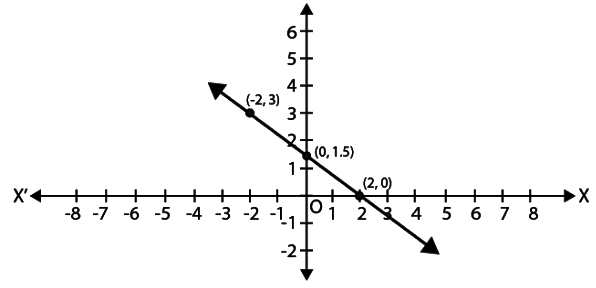
Q4: Draw the graph of the linear equation 3x + 4y = 6. At what points, the graph cuts X and Y-axis?
Sol: 
Given equation,
3x + 4y = 6.
We need at least 2 points on the graph to draw the graph of this equation,
Thus, the points the graph cuts
(i) x-axis
Since the point is on the x-axis, we have y = 0.
Substituting y = 0 in the equation, 3x + 4y = 6,
We get,
3x + 4×0 = 6
⇒ 3x = 6
⇒ x = 2
Hence, the point at which the graph cuts x-axis = (2, 0).

(ii) y-axis
Since the point is on the y-axis, we have, x = 0.
Substituting x = 0 in the equation, 3x + 4y = 6,
We get,
3×0 + 4y = 6
⇒ 4y = 6
⇒ y = 6/4
⇒ y = 3/2
⇒ y = 1.5
Hence, the point at which the graph cuts y-axis = (0, 1.5).
Plotting the points (0, 1.5) and (2, 0) on the graph.
Short & Long Question Answer: Linear Equations In Two Variables
Q5: Write four solutions for each of the following equations:
(i) 2x + y = 7

(ii) πx + y = 9
Sol: (i) 2x + y = 7
To find the four solutions of 2x + y = 7 we substitute different values for x and y
Let x = 0
Then,
2x + y = 7
(2×0)+y = 7
y = 7
(0,7)
Let x = 1
Then,
2x + y = 7
(2×1)+y = 7
2+y = 7
y = 7 – 2
y = 5
(1,5)
Let y = 1
Then,
2x + y = 7
2x+ 1 = 7
2x = 7 – 1
2x = 6
x = 3
(3,1)
Let x = 2
Then,
2x + y = 7
2(2)+y = 7
4+y = 7
y = 7 – 4
y = 3
(2,3)
The solutions are (0, 7), (1,5), (3,1), (2,3)

(ii) πx + y = 9
To find the four solutions of πx + y = 9 we substitute different values for x and y
Let x = 0
Then,
πx + y = 9
(π × 0)+y = 9
y = 9
(0,9)
Let x = 1
Then,
πx + y = 9
(π×1)+y = 9
π+y = 9
y = 9-π
(1,9-π)
Let y = 0
Then,
πx + y = 9
πx +0 = 9
πx = 9
x =9/π
(9/π,0)
Let x = -1
Then,
πx + y = 9
(π(-1))+y = 9
-π + y = 9
y = 9+π
(-1,9+π)
The solutions are (0,9), (1,9-π),(9/π,0),(-1,9+π)

Q6: Draw the graph of each of the following linear equations in two variables:
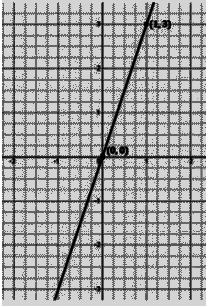
(i)y = 3x

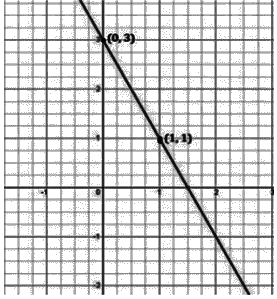
(ii) 3 = 2x + y
Sol: (i) y = 3x
To draw a graph of linear equations in two variables, let us find out the points to plot.
To find out the points, we have to find the values for which x and y satisfies the given equation.
Here,
y=3x
Substituting the values for x,
When x = 0,
y = 3x
y = 3(0)
⇒ y = 0
When x = 1,
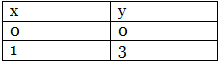
y = 3x
y = 3(1)
⇒ y = 3
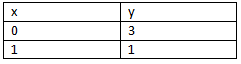
Short & Long Question Answer: Linear Equations In Two VariablesThe points to be plotted are (0, 0) and (1, 3)
Short & Long Question Answer: Linear Equations In Two Variables

(ii) 3 = 2x + y
To draw a graph of linear equations in two variables, let us find out the points to plot.
To find out the points, we have to find the values for which x and y satisfies the given equation.
Here,
3 = 2x + y
Substituting the values for x,
When x = 0,
3 = 2x + y
⇒ 3 = 2(0) + y
⇒ 3 = 0 + y
⇒ y = 3
When x = 1,
3 = 2x + y
⇒ 3 = 2(1) + y
⇒ 3 = 2 + y
⇒ y = 3 – 2
⇒ y = 1
Short & Long Question Answer: Linear Equations In Two VariablesThe points to be plotted are (0, 3) and (1, 1)
Short & Long Question Answer: Linear Equations In Two Variables
Q7: Show that the points A (1, 2), B ( – 1, – 16) and C (0, – 7) lie on the graph of the linear equation y = 9x – 7.
Sol:

We have the equation,
y = 9x – 7
For A (1, 2),
Substituting (x,y) = (1, 2),
We get,
2 = 9(1) – 7
2 = 9 – 7
2 = 2
For B (–1, –16),
Substituting (x,y) = (–1, –16),
We get,
–16 = 9(–1) – 7
-16 = – 9 – 7
-16 = – 16
For C (0, –7),
Substituting (x,y) = (0, –7),
We get,
– 7 = 9(0) – 7
-7 = 0 – 7
-7 = – 7
Hence, the points A (1, 2), B (–1, –16) and C (0, –7) satisfy the line y = 9x – 7.
Thus, A (1, 2), B (–1, –16) and C (0, –7) are solutions of the linear equation y = 9x – 7
Therefore, the points A (1, 2), B (–1, –16), C (0, –7) lie on the graph of linear equation y = 9x – 7.

03. Short & Long Question Answer: Coordinate Geometry

Q1: Write the coordinates of each of the points P, Q, R, S, T and O from the figure given.
Sol:
The coordinates of the points P, Q, R, S, T and O are as follows:
P = (1, 1)
Q = (-3, 0)
R = (-2, -3)
S = (2, 1)
T = (4, -2)
O = (0, 0)

Q2: Without plotting the points indicate the quadrant in which they will lie, if
(i) the ordinate is 5 and abscissa is – 3
(ii) the abscissa is – 5 and ordinate is – 3
(iii) the abscissa is – 5 and ordinate is 3
(iv) the ordinate is 5 and abscissa is 3
Sol:

(i) The point is (-3,5).
Hence, the point lies in the II quadrant.
(ii) The point is (-5,-3).
Hence, the point lies in the III quadrant.
(iii) The point is (-5,3).
Hence, the point lies in the II quadrant.
(iv) The point is (3,5).
Hence, the point lies in the I quadrant.

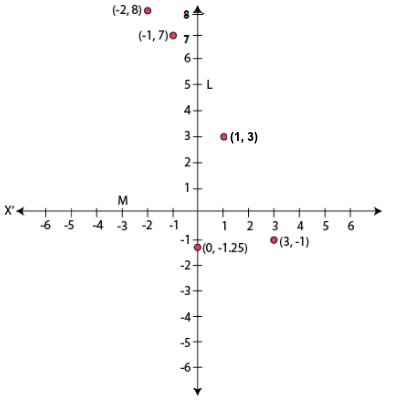
Q3: Plot the points (x, y) given in the following table on the plane, choosing suitable units of distance on the axes.
Sol: 

The points to plotted on the(x,y) are:

  1. (-2,8)
  2. (-1,7)
  3. (0,-1.25)
  4. (1,3)
  5. (3,-1)

On the graph mark X-axis and Y-axis. Mark the meeting point as O.
Now, Let 1 unit = 1 cm


Q4: Plot the following points and check whether they are collinear or not:
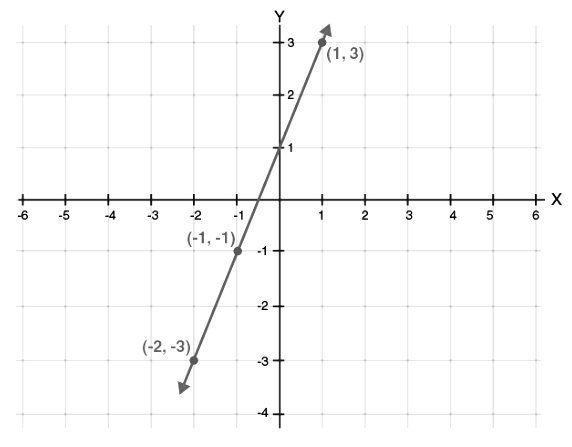
(i) (1, 3), (– 1, – 1), (– 2, – 3)
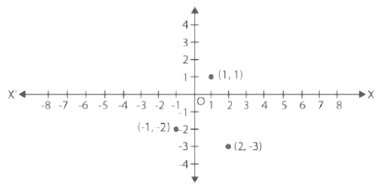
(ii) (1, 1), (2, – 3), (– 1, – 2)
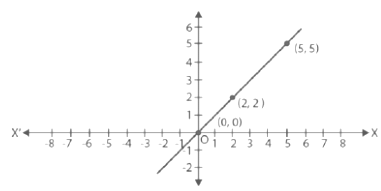
(iii) (0, 0), (2, 2), (5, 5)
Sol:

(i)

The points (1, 3), (– 1, – 1), (– 2, – 3) lie in a straight line,
Hence, the points are collinear.
(ii)

The points (1, 1), (2, – 3), (– 1, – 2) do not lie in a straight line,
Hence, the points are not collinear.
(iii)

The points (0, 0), (2, 2), (5, 5) lie in a straight line,
Hence, the points are collinear.

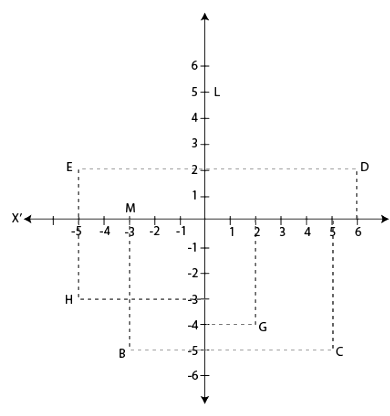
Q5: See figure and write the following:

  1. The coordinates of B.
  2. The coordinates of C.
  3. The point identified by the coordinates (–3, –5).
  4. The point identified by the coordinates (2, – 4).
  5. The abscissa of the point D.
  6. The ordinate of the point H.
  7. The coordinates of the point L.
  8. The coordinates of the point M.

Sol:

  1. The co-ordinates of B is (-3, -5).
  2. The co-ordinates of C is (5, −5).
  3. The point identified by the coordinates (−3, −5) is B.
  4. The point identified by the coordinates (2, −4) is G.
  5. Abscissa means x co-ordinate of point D. So, the abscissa of the point D is 6.
  6. Ordinate means y coordinate of point H. So, the ordinate of point H is -3.
  7. The coordinates of the point L is (0, 5).
  8. The coordinates of the point M is (−3, 0).

Q.6: Write the answer to each of the following questions:
(i) What is the name of the horizontal and the vertical lines drawn to determine the position of any point in the Cartesian plane?
(ii) What is the name of each part of the plane formed by these two lines?
(iii) Write the name of the point where these two lines intersect

Sol:
(i) The name of horizontal and vertical lines drawn to determine the position of any point in the Cartesian plane is x-axis and y-axis respectively.
(ii) The name of each part of the plane formed by these two lines x-axis and the y-axis is called quadrants.
(iii) The point where these two lines intersect is called the origin

02. Short & Long Question Answer: Polynomials

Q1: Give an example of a monomial and a binomial having degrees of 82 and 99, respectively.
Sol:
An example of a monomial having a degree of 82 = x82
An example of a binomial having a degree of 99 = x99 + x

Q2: Find the value of the polynomial 5x – 4x2 + 3 at x = 2 and x = –1.
Sol:
Let the polynomial be f(x) = 5x – 4x2 + 3
Now, for x = 2,
f(2) = 5(2) – 4(2)2 + 3
⇒ f(2) = 10 – 16 + 3 = –3
Or, the value of the polynomial 5x – 4x2 + 3 at x = 2 is -3.
Similarly, for x = –1,
f(–1) = 5(–1) – 4(–1)2 + 3
⇒ f(–1) = –5 –4 + 3 = -6
The value of the polynomial 5x – 4x2 + 3 at x = -1 is -6.

Q3:Factorise the quadratic polynomial by splitting the middle term: x2 + 14x + 45
Sol: x2 + 14x + 45

here a = 1, b = 14, c = 45

ac = 45 = 9 x 5 , b = 14 = 9 + 5

x2 + 14x + 45

= x2 + 9x + 5x + 45

= x( x + 9 ) + 5(x + 9)

= (x + 9) (x + 5) 


Q4: Check whether 3 and -1 are zeros of the polynomial x+4.

Sol: Let p(x)=x+4.

Now, check for each value:

p(3) =3+4 =7

p(−1)=−1+4 =3

Therefore, 3 and -1 are not zeros of the polynomial x+4x+4. 

Q5: Check whether (7 + 3x) is a factor of (3x3 + 7x).
Sol:
Let p(x) = 3x3 + 7x and g(x) = 7 + 3x. Now g(x) = 0 ⇒ x = –7/3.
By the remainder theorem, we know that when p(x) is divided by g(x) then the remainder is p(–7/3).
Now, p(–7/3) = 3(–7/3)3 + 7(–7/3) = –490/9 ≠ 0.
∴ g(x) is not a factor of p(x).

Q6: Verify whether 1 and -2 are zeros of the polynomial x2+3x.
Sol: 
Let p(x)=x2+3x.

Now, check for each value:

  • p(1) =12+3(1)=1+3 =4
  • p(−2) =(−2)2+3(−2)=4−6 =−2

Therefore, 1 and -2 are not zeros of the polynomial x2+3x.


Q7: Calculate the perimeter of a rectangle whose area is 25x2 – 35x + 12. 
Sol:
Given,
Area of rectangle = 25x2 – 35x + 12
We know, area of rectangle = length × breadth
So, by factoring 25x2 – 35x + 12, the length and breadth can be obtained.
25x2 – 35x + 12 = 25x2 – 15x – 20x + 12
⇒ 25x2 – 35x + 12 = 5x(5x – 3) – 4(5x – 3)
⇒ 25x2 – 35x + 12 = (5x – 3)(5x – 4)
So, the length and breadth are (5x – 3)(5x – 4).
Now, perimeter = 2(length + breadth)
So, perimeter of the rectangle = 2[(5x – 3)+(5x – 4)]
= 2(5x – 3 + 5x – 4) = 2(10x – 7) = 20x – 14
So, the perimeter = 20x – 14

Q8: Find the value of k, if x+2 is a factor of 3x3+5x2−2x+k.
Sol: 
As x+2 is a factor of p(x)=3x3+5x2−2x+k, we know that p(−2)=0.

Now, calculate p(−2) :

p(−2) =3(−2)3+5(−2)2−2(−2)+k

p(−2) =3(−8)+5(4)+4+k = −24+20+4+k

0 =−24+20+4+k

0 = 0+k

k =0. 


Q9: Find the values of a and b so that (2x3 + ax2 + x + b) has (x + 2) and (2x – 1) as factors.
Sol:
Let p(x) = 2x3 + ax2 + x + b. Then, p( –2) = and p(½) = 0.
p(2) = 2(2)3 + a(2)2 + 2 + b = 0
⇒ –16 + 4a – 2 + b = 0 ⇒ 4a + b = 18 ….(i)
p(½) = 2(½)3 + a(½)2 + (½) + b = 0
⇒ a + 4b = –3 ….(ii)
On solving (i) and (ii), we get a = 5 and b = –2.
Hence, a = 5 and b = –2.

Q10: Factorise x2 + 1/x2 + 2 – 2x – 2/x.
Sol:
 x2 + 1/x2 + 2 – 2x – 2/x = (x2 + 1/x2 + 2) – 2(x + 1/x)
= (x + 1/x)2 – 2(x + 1/x)
= (x + 1/x)(x + 1/x – 2).

01. Short & Long Question Answer: Number Systems

Q1: Find five rational numbers between 1 and 2.
Sol:
We have to find five rational numbers between 1 and 2.
So, let us write the numbers with denominator 5 + 1 = 6
Thus, 6/6 = 1, 12/6 = 2
From this, we can write the five rational numbers between 6/6 and 12/6 as:
7/6, 8/6, 9/6, 10/6, 11/6

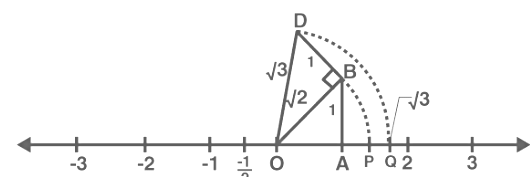
Q2: Locate √3 on the number line.
Sol:

Construct BD of unit length perpendicular to OB (here, OA = AB = 1 unit) as shown in the figure.
By Pythagoras theorem,
OD = √(2 + 1) = √3
Taking O as the centre and OD as radius, draw an arc which intersects the number line at the point Q using a compass.
Therefore, Q corresponds to the value of √3 on the number line.

Q3: Find the decimal expansions of 10/3, 7/8 and 1/7.
Sol:
Therefore, 10/3 = 3.3333…
7/8 = 0.875
1/7 = 0.1428571…

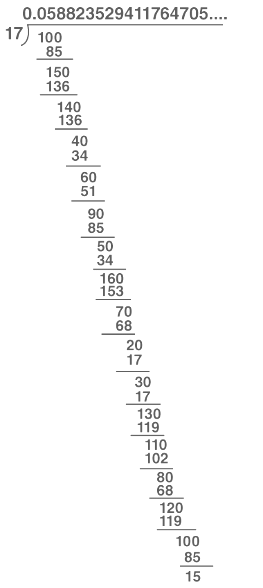
Q4: What can the maximum number of digits be in the repeating block of digits in the decimal expansion of 1/17? Perform the division to check your answer.
Sol:
Thus, 1/17 = 0.0588235294117647….
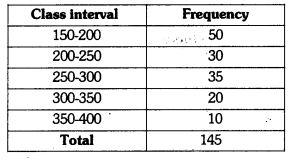
Therefore, 1/17 has 16 digits in the repeating block of digits in the decimal expansion.

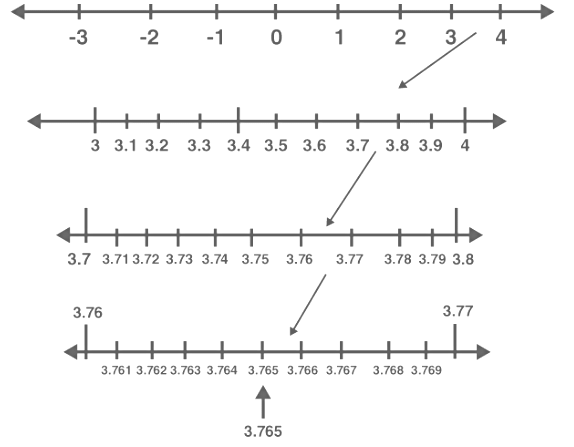
Q5: Visualise 3.765 on the number line, using successive magnification.
Sol:
Visualisation of 3.765 on the number line, using successive magnification is given below:

Q6: Simplify: (√3+√7) (√3-√7).
Sol:
(√3 + √7)(√3 – √7)
Using the identity (a + b)(a – b) = a2 – b2,
(√3 + √7)(√3 – √7) = (√3)2 – (√7)2
= 3 – 7
= -4

Q7: Find five rational numbers between 3/5 and 4/5.
Sol:
We have to find five rational numbers between 3/5 and 4/5.
So, let us write the given numbers by multiplying with 6/6, (here 6 = 5 + 1)
Now,
3/5 = (3/5) × (6/6) = 18/30
4/5 = (4/5) × (6/6) = 24/30
Thus, the required five rational numbers will be: 19/30, 20/30, 21/30, 22/30, 23/30

Q8: Are the square roots of all positive integers irrational? If not, give an example of the square root of a number that is a rational number.
Sol:
No, since the square root of a positive integer 16 is equal to 4. Here, 4 is a rational number.

Q9: Find three different irrational numbers between the rational numbers 5/7 and 9/11.
Sol:
The given two rational numbers are 5/7 and 9/11.
5/7 = 0.714285714…..
9/11 = 0.81818181……
Hence, the three irrational numbers between 5/7 and 9/11 can be:
0.720720072000…
0.730730073000…
0.808008000…

Q10: Add 2√2+ 5√3 and √2 – 3√3.
Sol:
(2√2 + 5√3) + (√2 – 3√3)
= 2√2 + 5√3 + √2 – 3√3
= (2 + 1)√2 + (5 – 3)√3
= 3√2 + 2√3

12. Long Question Answer: Statistics

Q1: For a particular year, following is the distribution of ages (in years) of primary school teachers in a district :

(i) Write the lower limit of first class interval.
(ii) Determine the class limits of the fourth class interval.
(iii) Find the class mark of the class 45 – 50.
(iv) Determine the class size.
Ans:

(i) First class interval is 15 – 20 and its lower limit is 15.
(ii) Fourth class interval is 30 – 35.
Lower limit is 30 and upper limit is 35.
(iii) Class mark of the class 45 – 50 = (45 + 50) / 2 = 95 / 2 = 47.5.
(iv) Class size = Upper limit of each class interval – Lower limit of each class interval.
∴ Here, class size = 20 – 15 = 5.
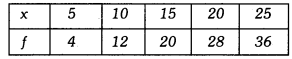
Q2: Find the mean of the following distribution :

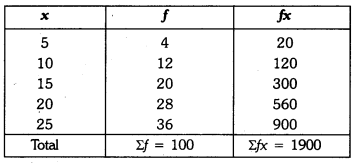
Ans:

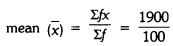
Now,

Explanation: Use the formula mean = Σ(f × x) / Σf, where f is frequency and x is class mark. The required values of Σ(f × x) and Σf are shown in the calculation above. Substituting these values gives the mean = 19.

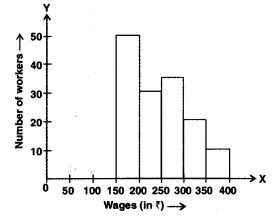
Q3: In figure, there is a histogram depicting daily wages of workers in a factory. Construct the frequency distribution table.

Ans:

Explanation: The frequency distribution table is obtained by reading the class intervals and the heights of the bars from the histogram. The table constructed from the given histogram is shown above.

Q4: Ten observations 6, 14, 15, 17, x + 1, 2x – 13, 30, 32, 34, 43 are written in ascending order. The median of the data is 24. Find the value of x.
Ans:

Here, the arranged data is 6, 14, 15, 17, x + 1, 2x – 13, 30, 32, 34, 43.

Total number of observations = 10.

For an even number (10) of observations, the median is the average of the 5th and 6th observations.

5th observation = x + 1
6th observation = 2x – 13

Therefore, (x + 1 + 2x – 13) / 2 = 24

⇒ (3x – 12) / 2 = 24

⇒ 3x – 12 = 48

⇒ 3x = 60

⇒ x = 20.

∴ The value of x = 20.

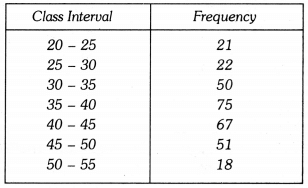
Q5: Draw a histogram for the given data :

Ans:

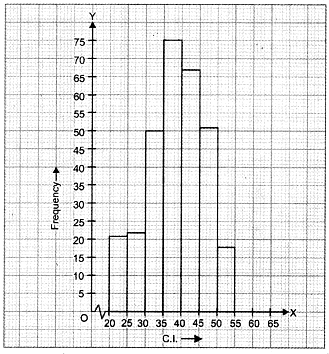
Let us represent class-intervals along x-axis and corresponding frequencies along y-axis on

a suitable scale. For each class interval draw a rectangle whose base is the class width and whose height is the frequency (or frequency density if class widths differ). The required histogram is as under : 

Q6: Given are the scores (out of 25) of 9 students in a Monday test :
14, 25, 17, 22, 20, 19, 10, 8 and 23
Find the mean score and median score of the data.
Ans: 
Ascending order of scores is :
8, 10, 14, 17, 19, 20, 22, 23, 25.

Mean score:
Sum of scores = 8 + 10 + 14 + 17 + 19 + 20 + 22 + 23 + 25 = 158.
Number of students = 9.
Mean = Sum / Number = 158 / 9 = 17.555… ≈ 17.56 marks.

Median score:
Since there are 9 (odd) observations, the median is the 5th value in the ordered list.
5th value = 19.
∴ Median = 19 marks.

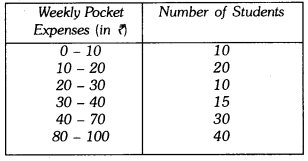
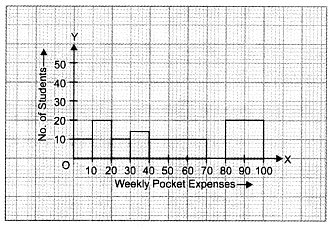
Q7: Draw a histogram of the weekly pocket expenses of 125 students of a school given below :

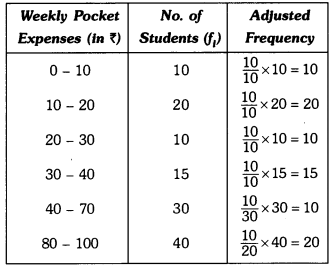
Ans: Here, the class sizes are different, so calculate the frequency density (adjusted frequency) for each class by using the formula:

frequency density = frequency/class width.

Alternatively, if you wish to scale densities to the smallest class width (here minimum class width = 10), you may use:

adjusted frequency = frequency × (Minimum class size/class width).

Here, the minimum class size = 10 – 0 = 10.

Let us represent weekly pocket money along x-axis and corresponding frequency densities (or adjusted frequencies) along y-axis on a suitable scale. The required histogram using these densities is given below :

Q8: The weight in grams of 35 mangoes picked at random from a consignment are as follows:
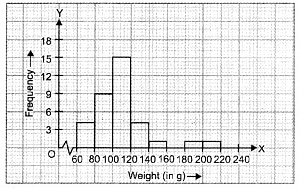
131, 113, 82, 75, 204, 81, 84, 118, 104, 110, 80, 107, 111, 141, 136, 123, 90, 78, 90, 115, 110, 98, 106, 99, 107, 84, 76, 186, 82, 100, 109, 128, 115, 107, 115 From the grouped frequency table by dividing the variable range into interval of equal width of 20 grams, such that the mid-value of the first class interval is 70 g. Also, draw a histogram.
Ans:

It is given that the size of each class interval = 20 and the mid-value of the first class interval is 70.

Let the lower limit of the first class interval be a, then its upper limit = a + 20.

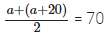
Mid-value of first interval = (a + a + 20) / 2 = a + 10 = 70     …………..

⇒ a = 70 – 10 = 60.

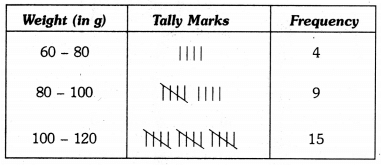
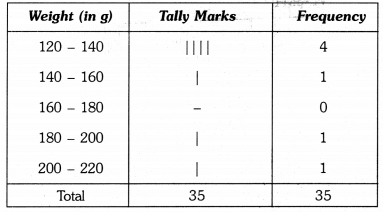
Thus, the first class interval is 60 – 80 and the other class intervals are 80 – 100, 100 – 120, 120 – 140, 140 – 160, 160 – 180, 180 – 200 and 200 – 220.

So, the grouped frequency table formed by counting the number of mango weights falling in each interval is as under :

Let us represent weight (in g) along x-axis and corresponding frequencies along y-axis on a suitable scale. The required histogram is as under :

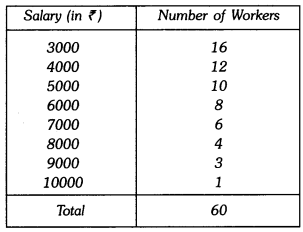
Q9: Find the mean salary of 60 workers of a factory from the following table :

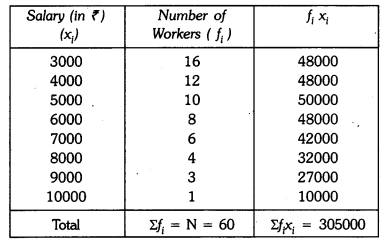
Ans:

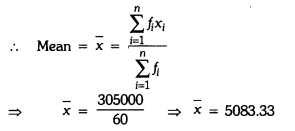
Explanation: Use the formula mean = Σ(f × x) / Σf, where x is the class mark and f the frequency. The table above shows the class marks, f, and f × x values. Summing these gives Σf = 60 and Σ(f × x) = 304,999.8 (as computed in the table). Therefore mean salary = Σ(f × x) / Σf = 304,999.8 / 60 = ₹5,083.33.

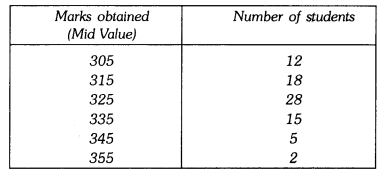
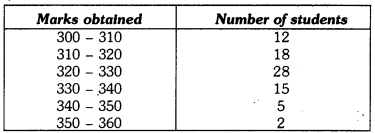
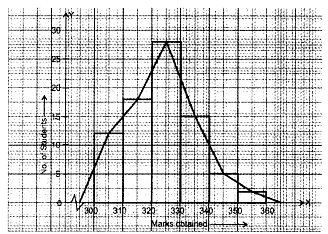
Q10: In a school marks obtained by 80 students are given in the table. Draw a histogram. Also, make frequency polygon.

Ans:

∴ Lower limit of first class interval is 305 – 10/2 = 300.

Upper limit of first class interval is 305 + 10/2 = 310.

Thus, first class interval is 300 – 310.

Required histogram and frequency polygon are drawn on graph paper as shown below:

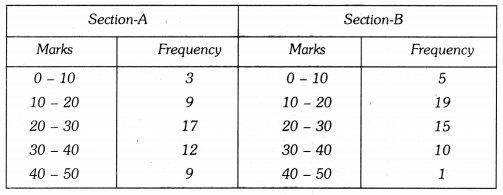
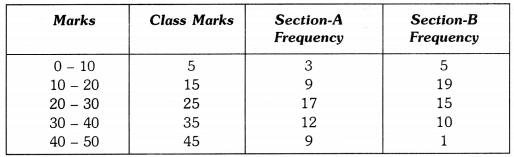
Q11: The following two tables gives the distribution of students of two sections according to the marks obtained by them :

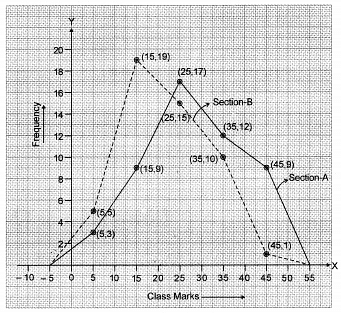
Represent the marks of the students of both the sections on the same graph by two frequency polygons. From the two polygons compare the performance of the two sections.
Ans:

The class marks are as under :

Let us take class marks on X-axis and frequencies on Y-axis. To plot frequency polygon of Section-A, plot the points (5, 3), (15, 9), (25, 17), (35, 12), (45, 9) and join these points by straight line segments. To plot frequency polygon of Section-B, plot the points (5, 5), (15, 19), (25, 15), (35, 10), (45, 1) on the same scale and join these points by dotted line segments.

From the two polygons, Section A’s polygon lies above Section B’s polygon for most of the middle and higher class marks. This indicates that Section A has more students scoring in the middle and higher ranges compared with Section B; hence, overall performance of Section A is better.

11. Long Question Answer: Surface Areas And Volume

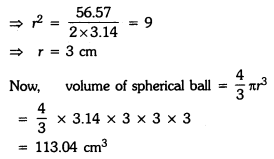
Q1: A spherical ball is divided into two equal halves. If the curved surface area of each half is 56.57 cm, find the volume of the spherical ball. [use π = 3.14]
Ans:

Since curved surface of half of the spherical ball = 56.57 cm2
2πr2 = 56.57

= 113.04 cm3

Q2: Find the capacity in litres of a conical vessel having height 8 cm and slant height 10 cm.
Ans:

Height of conical vessel (h) = 8 cm
Slant height of conical vessel (l) = 10 cm
∴ r2 + h2 = l2
⇒ r2 + 82 = 102
⇒ r2 = 100 – 64 = 36
⇒ r = 6 cm
Now, volume of conical vessel = 1/3πr2h
= 1/3 × 227 × 6 × 8
= 301.71 cm3
= 0.30171 litre

Q3: Calculate the surface area of a hemispherical dome of a temple with radius 14 m to be whitewashed from outside.
Ans:

Here, radius of hemispherical dome (r) = 14 m
Surface area of dome = 2πr2
= 2 × 22/7 × 14 × 14 = 1232 m2
Hence, total surface area to be whitewashed from outside is 1232 m2.

Q4: A rectangular piece of paper is 22 cm long and 10 cm wide. A cylinder is formed by rolling the paper along its length. Find the volume of the cylinder.
Ans:

Since rectangular piece of paper is rolled along its length.
∴ 2πr = 22
r = 22 / (2π) = 22 / (2 × 22/7) 
= 22 × 7 / 44 = 3.5 cm
Height of cylinder (h) = 10 cm
∴ Volume of cylinder = πr2h
= 22/7 × 3.5 × 3.5 × 10 = 385 cm3

Q5: A heap of wheat is in the form of a cone whose diameter is 10.5 m and height is 3 m. Find it volume. If 1m3 wheat cost is ₹10, then find total cost.
Ans:

Diameter of cone = 10.5 m
Radius of cone (r) = 5.25 m
Height of cone (h) = 3 m
Volume of cone = 13πr2h
= 13 × 22/7 × 5.25 × 5.25 × 3
= 86.625 m3
Cost of 1mof wheat = ₹10
Cost of 86.625 m3 of wheat = ₹10 × 86.625
= ₹866.25

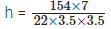
Q6: A cylindrical vessel can hold 154 g of water. If the radius of its base is 3.5 cm, and1cm3 of water weighs 1 g, find the depth of water.
Ans:

Since 1 cm3 of water weighs 1 g.
∴ Volume of cylindrical vessel = 154 cm3
πr2h = 154
22/7 × 3.5 × 3.5 × h = 154

h = 4cm
Hence, the depth of water is 4 cm.

Q7: A wall of length 10 m is to be built across an open ground. The height of the wall is 5 m and thickness of the wall is 42 cm. If this wall is to be built with brick of dimensions 42 cm × 12 cm × 10 cm, then how many bricks would be required?
Ans:

Here, length of the wall (L) = 10 m = 1000 cm
Breadth of the wall (B) = 42 cm
Height of the wall (H) = 5 m = 500 cm
∴ Volume of the wall = L × B × H
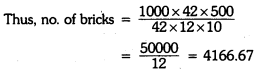
= 1000 × 42 × 500 cm3
Volume of each brick = 42 × 12 × 10 cm3

= 4167
Hence, the required number of bricks is 4167.

Q8: The volume of cylindrical pipe is 748 cm. Its length is 0.14 m and its internal radius is 0.09 m. Find thickness of pipe.
Ans:

Internal radius (r) of cylindrical pipe = 0.09 m = 9 cm
Length (height) of cylindrical pipe (h) = 0.14 m = 14 cm
Let external radius of the cylindrical pipe be R cm.
Volume of cylindrical pipe = 748 cm3
⇒ π(R2 – r2)h = 748
⇒ 22/7 (R2 – 92)14 = 748

⇒ R= 81 + 17 = 98
⇒ R = √98 = 7√2 cm = 9.9 cm
Thus, thickness of the pipe = 9.9 -9 = 0.9 cm

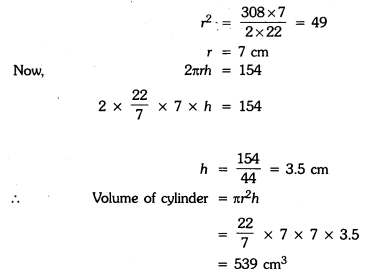
Q9: The curved surface area of a cylinder is 154 cm. The total surface area of the cylinder is three times its curved surface area. Find the volume of the cylinder.
Ans:

Since curved surface area of cylinder = 154 cm2 (given]
Total surface area of cylinder = 3 × curved surface area
3 × CSA = 3 × 154 = 462 cm2
So 2πr2 = 462 – 154 = 308


Q10: A right-angled ∆ABC with sides 3 cm, 4 cm and 5 cm is revolved about the fixed side of 4 cm. Find the volume of the solid generated. Also, find the total surface area of the solid.
Ans: 
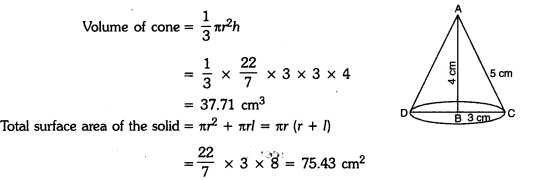
When right angled ∆ABC is revolved about AB = 4 cm, it forms a right circular cone of radius 3 cm and height 4 cm. Slant height of the cone is 5 cm.


Q11: A semicircular sheet of metal of radius 14 cm is bent to form an open conical cup. Find the capacity of the cup.
Ans: 
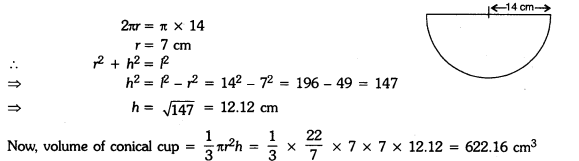
Radius of semicircular sheet (r) = 14 cm
∴ Slant height (1) = 14 cm
Circumference of base = Circumference of semicircular sheet


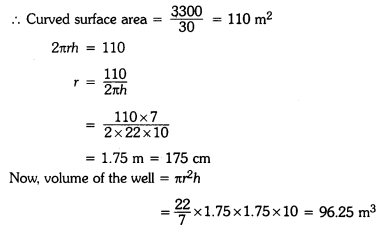
Q12: It costs ₹3300 to paint the inner curved surface of a 10 m deep well. If the rate cost of painting is of ₹30 per m2, find :
(a) inner curved surface area
(b) diameter of the well
(c) capacity of the well.
Ans:

Depth of well (h) = 10 m
Cost of painting inner curved surface is ₹30 per m2 and total cost is ₹3300.

Hence, inner curved surface area is 110 m2, diameter of the well is 2 × 1.75 i.e., 3.5 m and capacity of the well is 96.25 m3.

Q13: Using clay, Anant made a right circular cone of height 48 cm and base radius 12 cm. Versha reshapes it in the form of a sphere. Find the radius and curved surface area of the sphere so formed.
Ans:

Height of cone (h) = 48 cm
Radius of the base of cone = 12 cm
Let R be the radius of sphere so formed
∴ Volume of sphere = Volume of cone
4/3πR3 = 1/3πr2h
4R3 = 12 × 12 × 48
R3 = 12 × 12 × 12
R = 12 cm
Now, curved surface area of sphere = 4πR2
= 4 × 22/7 × 12 × 12
= 1810.29 cm

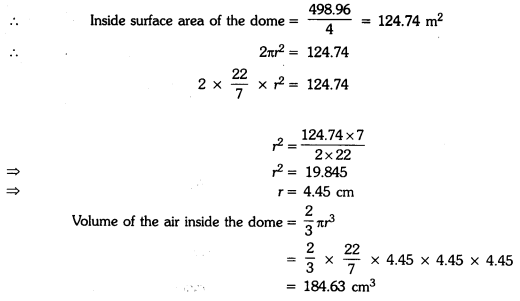
Q14: A dome of a building is in the form of a hemisphere. From inside, it was whitewashed at the cost of ₹498.96. If the rate of whitewashing is ₹4 per square metre, find the :
(i) Inside surface area of the dome
(ii) Volume of the air inside the dome.
Ans:

Here, dome of building is a hemisphere.
Total cost of whitewashing inside the dome = ₹498.96
Rate of whitewashing = ₹4 per m2


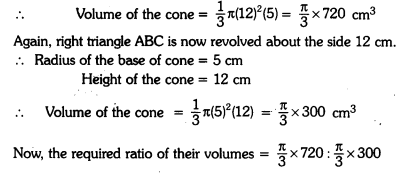
Q15: A right triangle ABC with sides 5 cm, 12 cm and 13 cm is revolved about the side 5 cm. Find the volume of the solid so obtained. If it is now revolved about the side 12 cm, then what would be the ratio of the volumes of the two solids obtained in two cases ?
Ans:

Here, right triangle ABC with sides 5 cm, 12 cm and 13 cm is revolved about the side 5 cm.
∴ Radius of the base of cone = 12 cm
Height of the cone = 5 cm

= 12 : 5

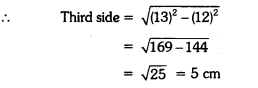
Q16: A right triangle of hypotenuse 13 cm and one of its sides 12 cm is made to revolve taking side 12 cm as its axis. Find the volume and curved surface area of the solid so formed.
Ans:

Here, hypotenuse and one side of a right triangle are 13 cm and 12 cm respectively.

Now, given triangle is revolved, taking 12 cm as its axis
∴ Radius of the cone (r) = 5 cm
Height of the cone (h) = 12 cm
Slant height of the cone (1) = 13 cm
∴ Curved surface area = πrl = π(5)(13) = 65π cm2
Volume of the cone = 1/2πr2h = 1/2π × 5 × 5 × 12 = 100π cm3
Hence, the volume and curved surface area of the solid so formed are 100 π cm3 and 65 π cm2 respectively.