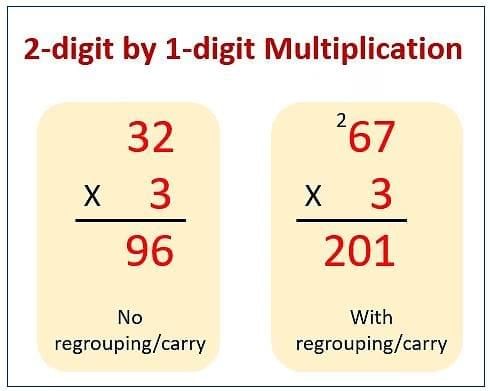
(iii) 53 x 8 ______. Take the help of this example to solve the questions above:
Q2: Multiply
(i) 4,032 by 198
(ii) 3,647 by 245
(iii) 501 by 123
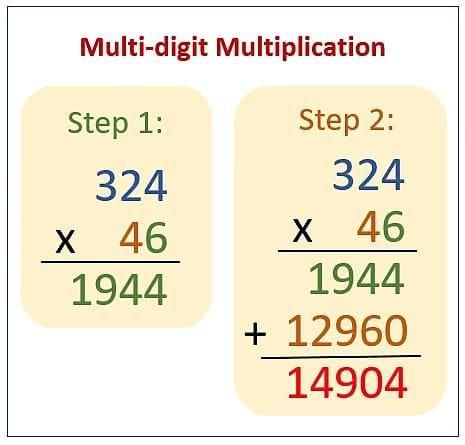
Take the help of this example to solve the questions above:
Q3: Fill in the blanks
(i) 2,586 x ______ = 2,586
(ii) 624 x ______ = 38 x 624
(iii) 600 x ______ = 0.
Q4: Round off the following numbers to the nearest tens
(i) 13,528
(ii) 3,542
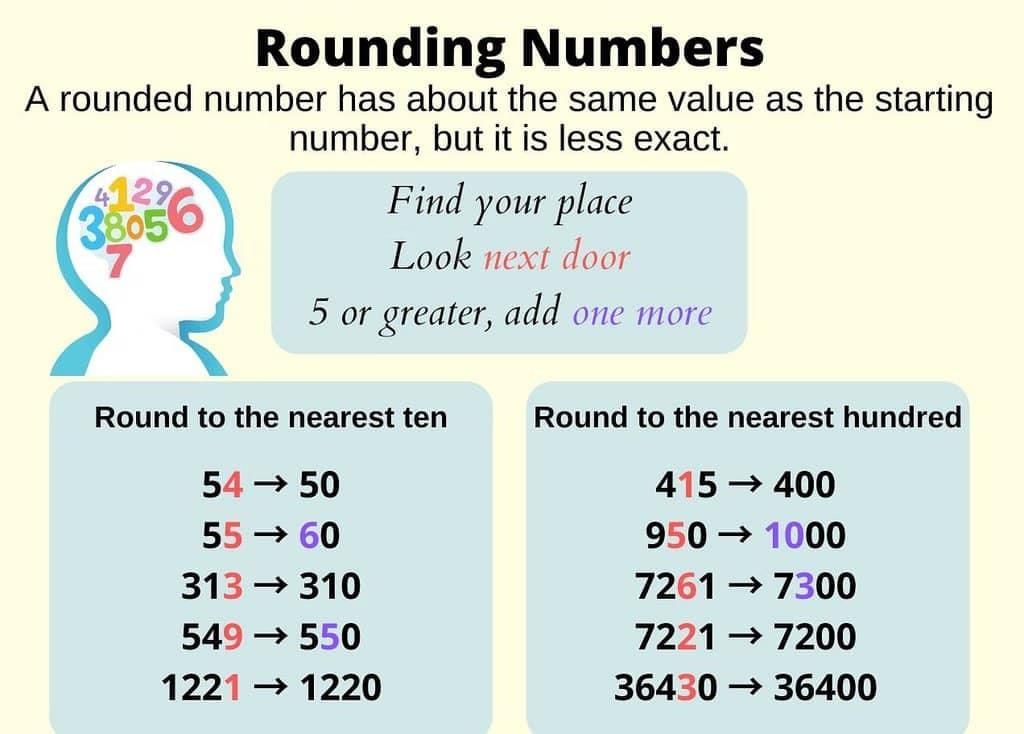
(iii) 174 You can solve the questions of rounding off with the help of these examples:
Q5: Estimate Products by rounding each number to the nearest TensInstruction: Find an approximate answer for each multiplication problem by rounding both numbers to the nearest tens place first, then multiplying the rounded numbers. (i) 52 x 43 (ii) 63 x 52
Q6: Answer the following Questions(I) Calculate the product of the place values of the two 6s in the number 6,965.
(ii) Find the product of the greatest 2-digit number and the smallest 4-digit number ______.
(iii) A transistor costs Rs. 1,642. Find the cost of 95 such transistors.
(iv) A candle factory produced 814 candles in a day. How many candles will this factory produce in one year?
(v) A farmer produced 735 quintals of rice. He sold it at the rate of Rs. 1525 per quintal. How much money did he get?
(vi) The cost of a pack of Ghee is Rs. 308 Find the cost of 97 such packs.
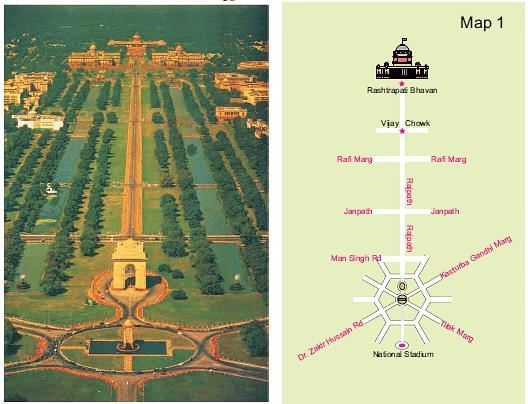
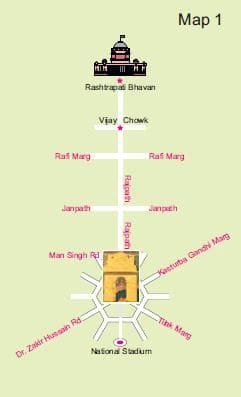
Match the map and Photo:Q1: Have you seen a map? Look at the Map. Match it with the photo and find out where India Gate is. Draw it on the map. Sol: Yes, I have seen a map.
Q2: Name roads that you will cross on your way from Rashtrapati Bhawan to India Gate. Sol: The roads that I will come across on my way from Rashtrapati Bhawan to India Gate are Rafi Marg, Janpath and Tilak Marg.
Q3: Look for the National Stadium in Map 1. Can you see it in the photo? Sol: The National Stadium is seen in Map 1, but cannot be seen in the photo.
Page No. 114
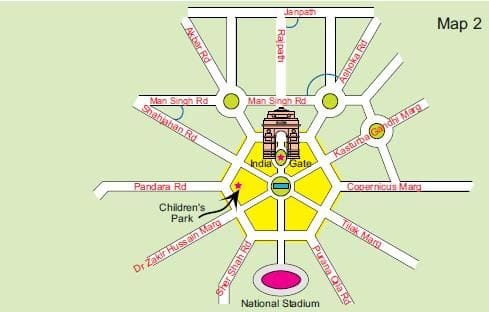
The Central hexagon If we zoom in to look more closely at one part of the map, it looks like this.
Find out from the map: Q1: If you are walking on Rajpath then after India Gate on which side would Children’s Park be? Sol: The Children’s Park would be on the right side, while walking on Rajpath.
Q2: Which of these roads make the biggest angle between them? (a) Man Singh Road and Shahjahan Road (b) Ashoka Road and Man Singh Road (the angle away from India Gate) (c) Janpath and Rajpath Sol: Ashoka Road and Man Singh Road
Q3: Which of the above pairs of roads cut at right angles? Sol: Janpath and Rajpath cut at right angles.
Page No. 115
Waiting for the parade
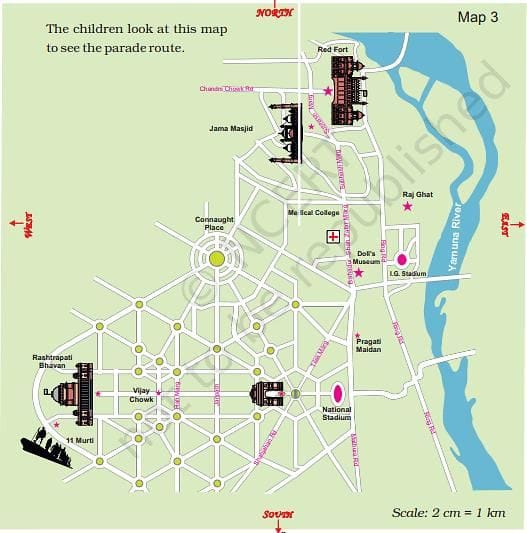
While waiting for the parade, Kancha and some of his friends wonder where this parade ends. Vijay Chowk — Rajpath — India Gate — Tilak Marg — B.S. Zafar Marg — Subhash Marg — Red Fort. Kancha is carrying a newspaper in which the route of the parade is written —
Page No. 116
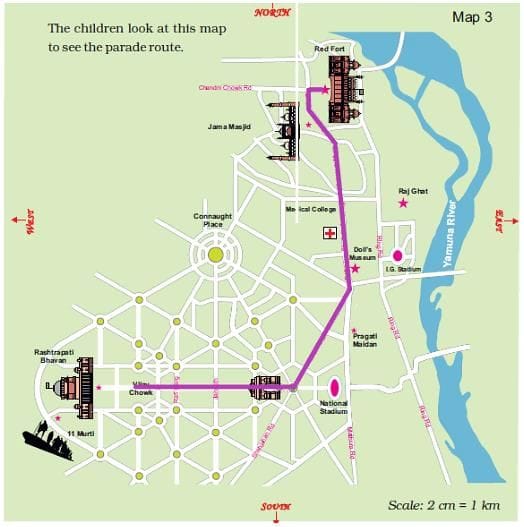
Mark the route: Q1: Trace the route of the parade in Map 3 and mark India Gate and Rajpath Sol: The route of the parade is traced below.
Q2: Look at the map carefully and find out: (a) Which of these is the longest road? (i) B S Zafar Marg (ii) Subhash Marg (iii) Tilak Marg Sol: Subhash Marg is the longest road among them.
(b) If Rubia is coming from Jama Masjid to join the parade, guess how far she has to walk. Sol: We know that the route of the parade through Subhash Marg and the Jama Masjid is 1 cm away from the Subhash Marg on the map. In given map the scale is 2 cm = 1 km so, 1 cm = 0.5 km We know that, 1 km = 1000 m so, 0.5 km = 500 m Thus, Rubia will have to walk about 500 m to join the parade
(c) The total route of the parade is about how long? (i) 3km (ii) 16km (iii) 25 km (iv) 8km Sol: The total distance of the parade on the map is 16 cm. And we know that, 2 cm on map = 1 km Thus, 16 cm = 8 km So, the total route of the parade will be about 8 km.
Page No. 117
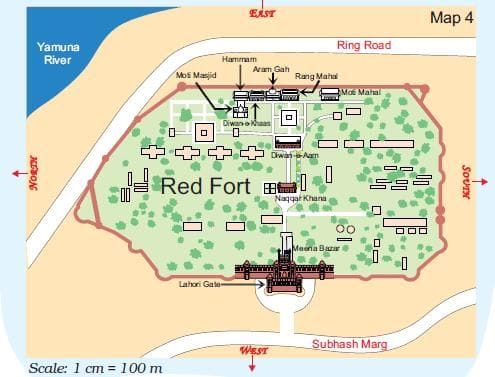
Trip to Red Fort
Page No. 118
Find out from Map 4 Q1: Which of these is nearer to river Yamuna? — The Diwan-e-Aam or the Diwan-e-Khaas? Sol: Diwan-e-Khaas is nearer to river Yamuna than Diwan-e-Aam.
Q2: Between which two buildings is Aaram Gah? Sol: Aaram Gah is between Diwan-e-Khaas and Rang Mahal.
Q3: Which buildings do you pass while going from Rang Mahal to the Hammam? Sol: We will pass through Aram Gah and Diwan-e-Khaas while going from Rang Mahal to the Hammam.
Q4: Which building on this map is farthest from Meena Bazar? Sol: Hammam is farthest from Meena Bazar.
Q5: About how far is Lahori Gate from Diwan-e-Khaas? Sol: The map distance of Lahori Gate from Diwan-e-Khaas is about 6 cm. We know 1 cm = 100 m So, the ground distance of Lahori Gate from Diwan-e-Khaas = 6 ×100 = 600 m
Page No. 119
Make it bigger, make it smaller
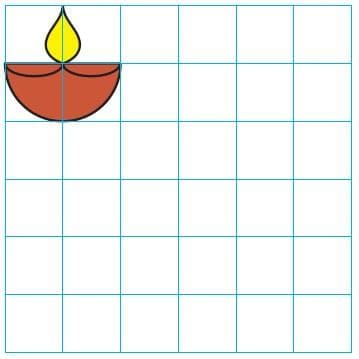
Here are some pictures drawn on a 1cm square grid. Try making the same pictures on a 2 cm grid and also on a ½ cm grid.
The side of the square was made two times bigger. Does its area also become two times bigger? Sol: Suppose the original length of the side of the square is 1 cm. Now, area of square = side × side = 1 × 1 square cm = 1 square cm When the side of the square is made two times bigger, then the new length of the side of the square will be 2 cm Area of square = side × side = 2 × 2 square cm = 4 square cm So, when the side of the square is made 2 times bigger, then its area becomes 4 times bigger than the original area.
Page No. 120
Dancers from Different States
Page No. 121
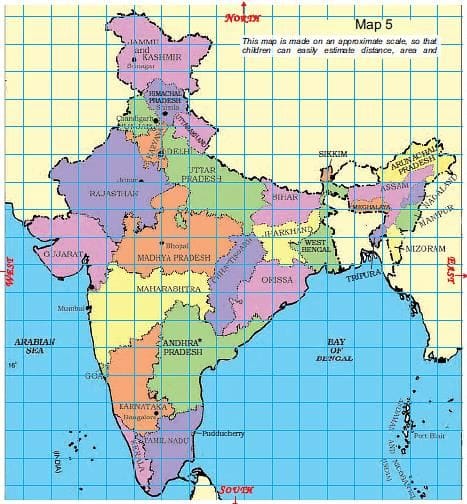
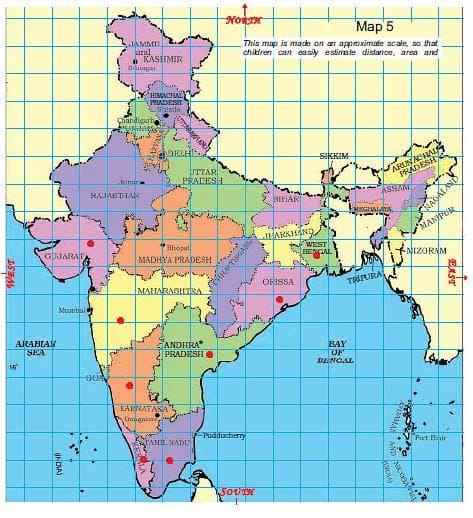
Look at the map of India below and find the states these children are talking about. Answer the questions.Q1: The Karnataka team starts from Bangalore and moves in the north direction. Which states does it cross to reach Delhi? Sol: Maharashtra, Madhya Pradesh and Rajasthan.
Page No. 122
Q2: Jammu and Kashmir is to the north of Delhi so the team from there travels towards south to reach Delhi. Which states does it cross? Sol: Himachal Pradesh, Punjab and Haryana.
Q3: Nonu lives in Gujarat. Nonu’s friend Javed lives in West Bengal. Nonu wants to visit his friend. In which direction will he travel? (a) Towards west (b) Towards east (c) Towards south (d) Towards north Sol: Towards the east
Q4: Is there any state which is to the north of Jammu and Kashmir? Sol: No, there is no state which is to the north of Jammu and Kashmir.
Q5: Is there any state which is to the west of Gujarat? Sol: No, there is no state which is to the west of Gujarat.
Q6: If 1 cm on the map shows 200km on the ground, use this scale to find out: (A) About how far is Delhi from Jaipur? (i) 50 km (ii) 500 km (iii) 250 km Sol: 250 km
(B) Estimate how far Jaipur is from Bhopal. On the map = _______ cm. On the ground = _______ km Sol: On the map = 2cm. On the ground = 400km
Q7: Look at the map and tell: (a) Which state is surrounded by four other states? Sol: Madhya Pradesh (b) Which state has the largest area? If its name is not in the map, find it from your teacher or parents. Explain how you got your answer. Sol: Rajasthan. This can be observed from the given map. (c) Which state is about 8 times bigger in area than Sikkim? (i) Uttar Pradesh (ii) Tripura (iii) Maharashtra (iv) Himachal Pradesh Sol: Himachal Pradesh (d) About how many times of Punjab is the area of Rajasthan? Sol: Rajasthan is about 7 times the area of Punjab.
Page No. 123
The sea
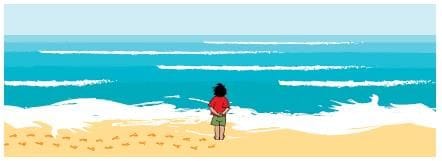
Bala is standing on the sea-coast and looking at the vast sea. The sea looks endless.
Q1: Have you seen the sea? In the picture where is the sea? Now look for the sea in the map of India. What colour is used to show the sea? Sol: Yes, I have seen the sea. The blue colour represents the sea in the given picture. The blue colour is used to show the sea on the map of India.
Q2: Mark those states which have the sea on one side. Sol: The red colour dot shows states which have the sea on one side in below-given map.
Q3: Name one state which does not have the sea on any side. Sol: Madhya Pradesh
Page No.124
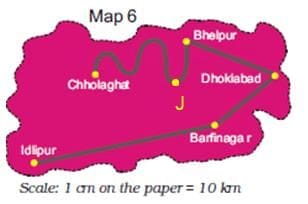
Distance between towns
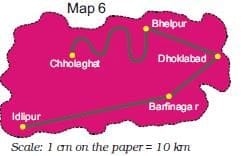
These are five towns. Find out: Q1: How many cm away is Idlipur from Barfinagar on the map? Sol: The distance between Idlipur and Barfinagar is 5 cm on the map.
Q2: How many kilometers will you have to travel if you travel from Idlipur to Barfinagar? Sol: Given, the scale is 1 cm = 10 km Distance between Idlipur and Barfinagar on the map = 5 cm Now, actual distance between Idlipur and Barfinagar = 5 × 10 = 50 km Thus, we have to travel 50 km to go from Idlipur to Barfinagar.
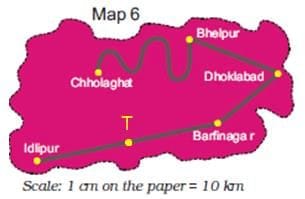
Q3: There is a place called Thukpagram midway between Idlipur and Barfinagar. Mark it with a ‘T’. Sol:
Q4: A town called Jalebipur is 35 km away from both Chholaghat and Dhoklabad. Where do you think it can be? Mark ‘J’ for it. Sol:
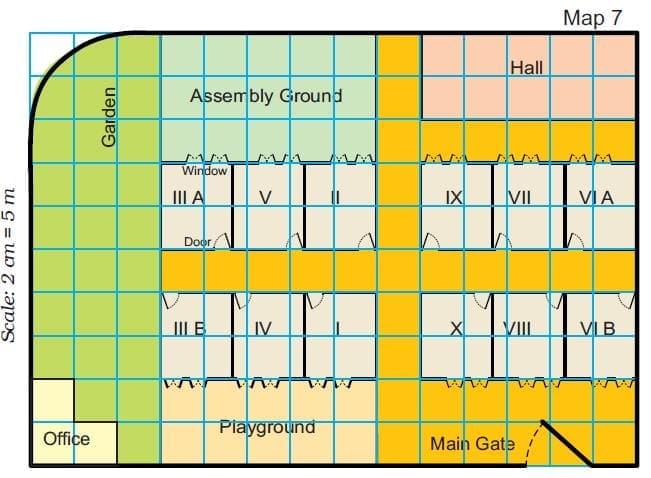
Ashi’s School
Ashi’s school looks like this from the top. Use the squares to find out:
Q1: How many times bigger is the area of the Assembly ground than that of the office? Sol: The area of the assembly ground is five times bigger than that of the office.
Q2: How much is the length and width of each classroom? (a) Length 5 m, width 4 m (b) Length 2 m, width 1 m (c) Length 12 m, width 10 m (d) Length 5 m, width 5 m Sol: Length 5 m, width 4 m
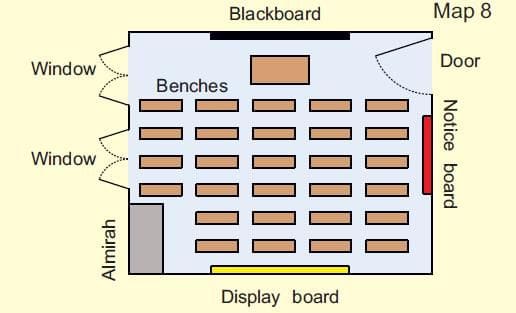
Q3: All the classrooms in Ashi’s school look like this.
Look carefully and answer. (a) Which of these is exactly opposite to the blackboard? Almirah, windows, notice board, display board Sol: The display board is exactly opposite to the blackboard.
(b) Can a child sitting in III A see the playground? Sol: No, a child sitting in III A cannot see the playground
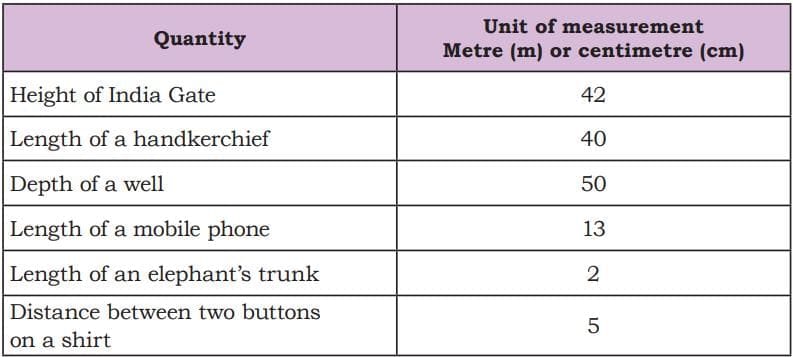
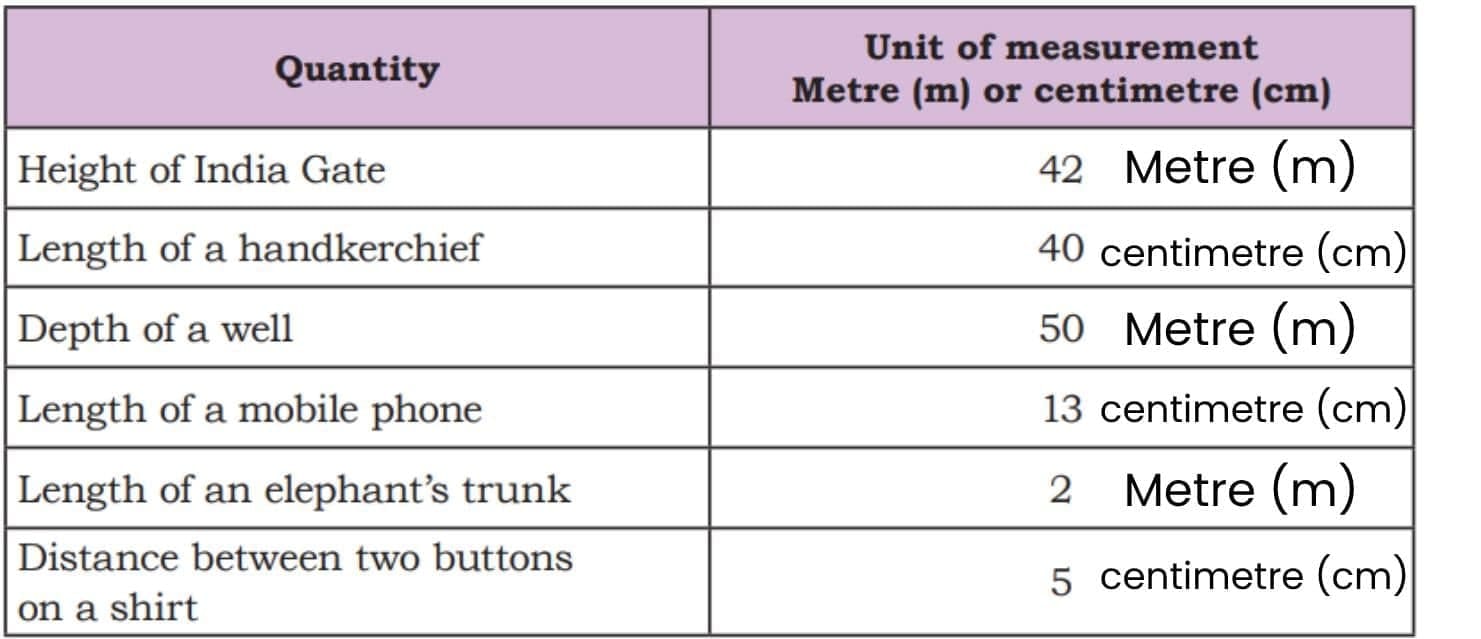
Identify the appropriate units for measuring each of the following.
Answer:
Different Units but Same Measure
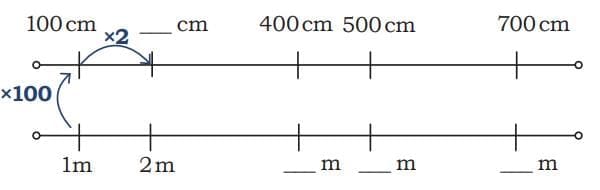
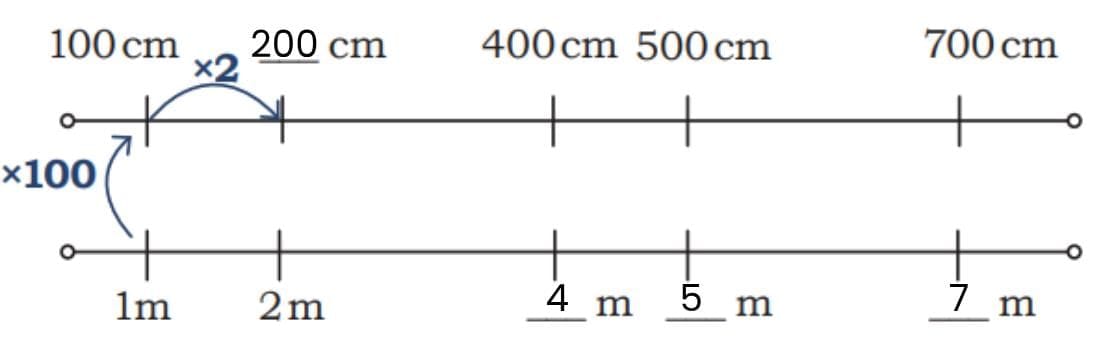
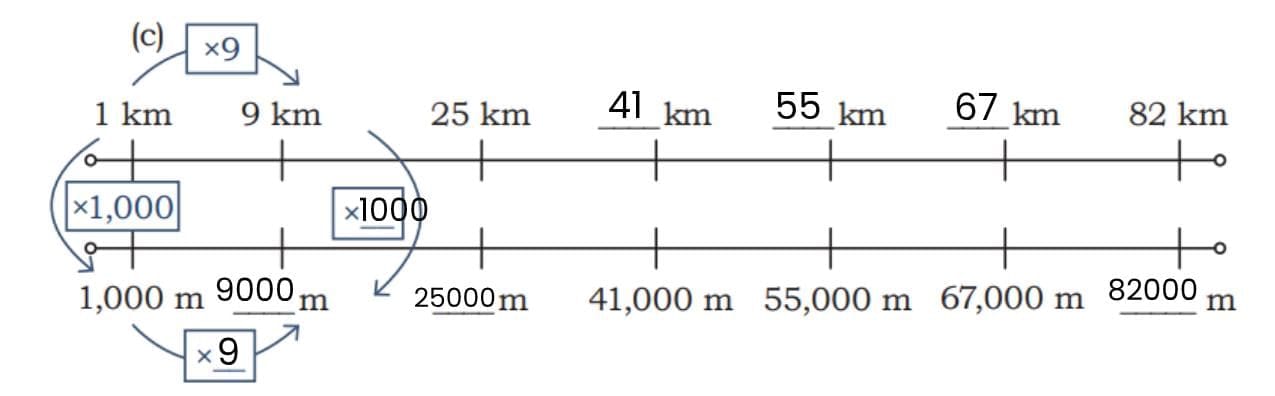
Shikha and Sonu are measuring the lengths of saris and stoles in the village weaving centre. Find which measures represent the same sari or stole. You can take help of the double number line below.
Answer: Based on the conversion
100 cm & 1 m
200 cm & 2 m 400 cm & 4 m 500 cm & 5 m 700 cm & 7 m
Therefore, the measures that represent the same sari or stole are:
• 204 cm and 2 metre 4 cm
• 540 cm and 5 metre 40 cm
• 750 cm and 6 metre 150 cm
• 240 cm and 2 metre 40 cm
• 404 cm and 2 metre 204 cmPage 58
Let Us Compare
1.Ritika is comparing the lengths of different rods. Compare them using <, =, > signs.
(a) 456 cm ____ 5 m Answer: 456 cm < 5 m (since 5 m = 500 cm)
(b) 55 cm + 200 cm ____ 200 cm + 54 cm Answer: 55 cm + 200 cm > 200 cm + 54 cm (since 255 cm > 254 cm)
(c) 6 m 5 cm ___ 6 m 50 cm Answer: 6 m 5 cm < 6 m 50 cm (since 605 cm < 650 cm)
(d) 2 m 150 cm ___ 3 m 50 cm Answer:2 m 150 cm < 3 m 50 cm (since 350 cm < 350 cm is false, 2m 150cm = 350cm, 3m 50cm = 350cm, so 2 m 150 cm = 3 m 50 cm)
(e) 238 cm ____ 138 cm + 1 m Answer: 238 cm = 138 cm + 1 m (since 138 cm + 100 cm = 238 cm)
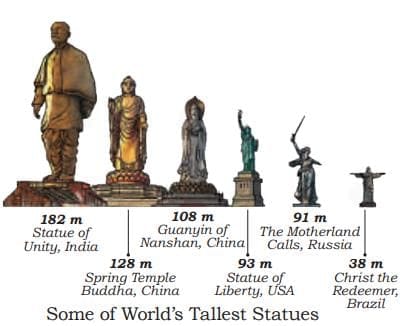
2. World’s tallest statue
(a) What is the difference between the height of the tallest statue in the world and the Statue of Liberty? Answer: Tallest statue in the world (from the given list) is Unity, India (182 m). Height of Statue of Liberty is 93 m. Difference = 182 m – 93 m = 89 m.
(b) Identify the statues whose heights have the least difference. Answer: Let’s list the heights: Unity, India: 182 m Spring Temple Buddha, China: 128 m Guanyin of Nanshan, China: 108 m Christ the Redeemer, Brazil: 38 m The Motherland Calls, Russia: 91 m Statue of Liberty, USA: 93 m
Differences: Statue of Liberty (93m) and The Motherland Calls (91m): 93 – 91 = 2 m (Least difference)
(c) Identify the statues whose heights have the largest difference. Answer: Largest difference would be between the tallest and the shortest. Tallest: Unity, India (182 m) Shortest: Christ the Redeemer, Brazil (38 m) Difference = 182 m – 38 m = 144 m (Largest difference)
(d) The height of which Statue will be equal to the height of the Statue of Unity, if it is doubled? Answer: Height of Statue of Unity = 182 m. We need to find a statue whose height, when doubled, equals 182 m. 182 m / 2 = 91 m. The Statue of The Motherland Calls, Russia has a height of 91 m. So, if its height is doubled, it will be equal to the height of the Statue of Unity.Page 59
Let Us Do
Measure 100 m and 200 m on your school playground, or any other place in and around your school, using a Long Tape. Mark these points and draw a straight line. Walk on the lines and count the number of steps. Use this relationship between the number of steps taken and distance walked to find distances around you for at least 3 locations. Wherever possible, walk and find the number of steps. Otherwise, find the distance and estimate the number of steps.
(a) Identify and write the locations that are the nearest and the farthest from your home. Nearest location _______________________________________________________ Farthest location _______________________________________________________
Answer: Nearest location: Local grocery store 500 m Farthest location: Grandparent’s house 5 km
(b) Write the distances obtained above in increasing order. _______________, _________________, _________________, __________________.
Answer: 500 m, 1 km, 2 km, 5 km
(c) Name a location that is equal to or more than 1,000 m from your home.
Answer: Local park 1500 m
Let Us Explore
When we walk 1,000 m, we say we have walked 1 km. 1,000 m = 1 km Kilo stands for thousand. This unit is used to measure long distances.
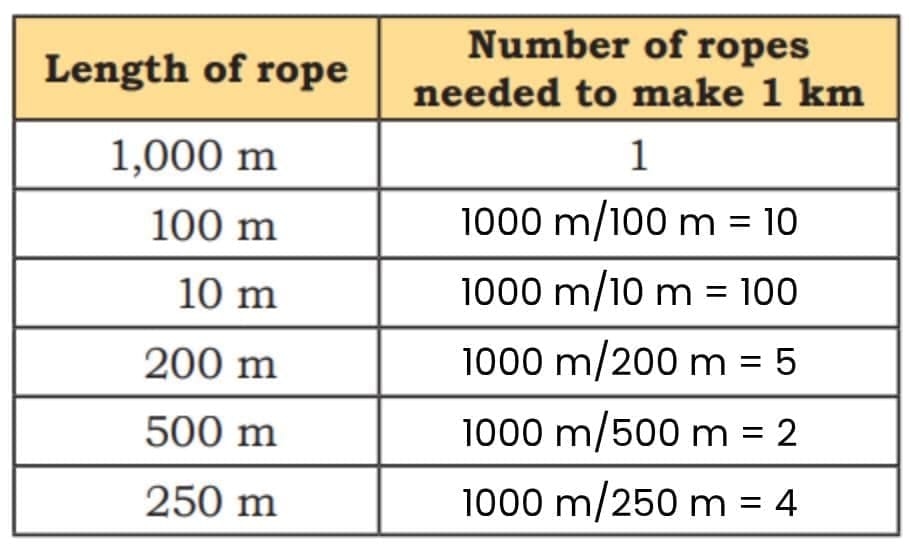
Question: Number of ropes needed to make 1 km
Page 60
Kilometre Race
Sheena and Jennifer are helping to organise a 3-km race. Help them with the arrangements for the race.
1.Water stations are to be arranged after every 500 m. How many water stations must be set up? At what positions from the starting point will these water stations be placed?
Answer: Total race distance = 3 km = 3000 m. Water stations every 500 m. Number of water stations = Total distance / Interval = 3000 m / 500 m = 6. Positions: 500 m, 1000 m (1 km), 1500 m (1.5 km), 2000 m (2 km), 2500 m (2.5 km), 3000 m (3 km – finish line). So, 6 water stations will be set up at 500 m, 1 km, 1.5 km, 2 km, 2.5 km, and 3 km from the starting point.
2. Children need to stand at an interval of 300 m to direct the runners. How many children are needed? At what positions from the starting point will the children be standing?
Answer: Total race distance = 3 km = 3000 m. Children every 300 m. Number of children = Total distance / Interval = 3000 m / 300 m = 10. Positions: 300 m, 600 m, 900 m, 1200 m (1.2 km), 1500 m (1.5 km), 1800 m (1.8 km), 2100 m (2.1 km), 2400 m (2.4 km), 2700 m (2.7 km), 3000 m (3 km – finish line). So, 10 children are needed at 300 m, 600 m, 900 m, 1.2 km, 1.5 km, 1.8 km, 2.1 km, 2.4 km, 2.7 km, and 3 km from the starting point.
3. Red and blue flags are to be placed alternately at every 50 m. How many red and blue flags are needed till the finish line?
Answer: Total race distance = 3 km = 3000 m. Flags every 50 m. Number of flag positions = Total distance / Interval = 3000 m / 50 m = 60. Since flags are placed alternately, there will be 30 red flags and 30 blue flags.
Let Us Do: Longest Train Journey
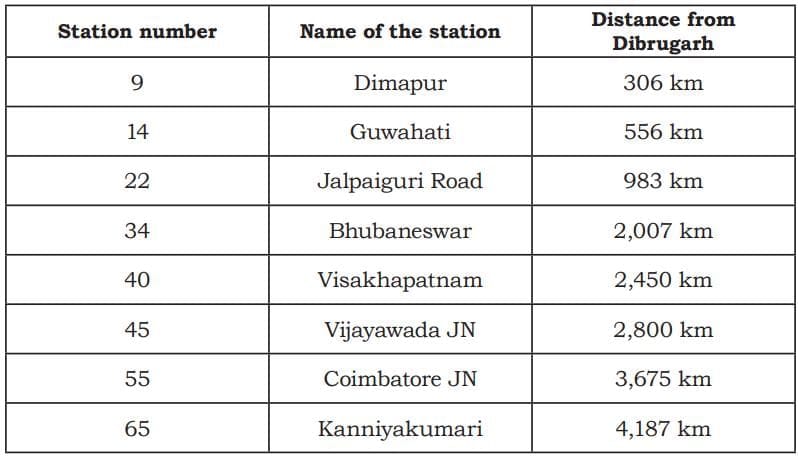
The longest train journey in India is by The Vivek Express which runs from Dibrugarh in Assam to Kanniyakumari in Tamil Nadu. Look at the stations on the route shown in the table below and answer the questions.
1. The total length of the route from Dibrugarh to Kanniyakumari is _______________ km.
Answer:The total length of the route from Dibrugarh to Kanniyakumari is 4,187 km (distance of Kanniyakumari from Dibrugarh).
2. The distance between Vijayawada and Jalpaiguri road is _______________.
Answer: Distance of Vijayawada JN from Dibrugarh = 2,800 km Distance of Jalpaiguri Road from Dibrugarh = 983 km Distance between Vijayawada and Jalpaiguri Road = 2,800 km – 983 km = 1,817 km.
3. Distance between Vijayawada and Visakhapatnam is _______________.
Answer: Distance of Vijayawada JN from Dibrugarh = 2,800 km Distance of Visakhapatnam from Dibrugarh = 2,450 km Distance between Vijayawada and Visakhapatnam = 2,800 km – 2,450 km = 350 km.
4. Which two stations are farther apart — Guwahati and Dimapur or Bhubaneswar and Jalpaiguri Road?
Answer: Distance between Guwahati and Dimapur: Guwahati = 556 km, Dimapur = 306 km Difference = 556 km – 306 km = 250 km.
Distance between Bhubaneswar and Jalpaiguri Road: Bhubaneswar = 2,007 km, Jalpaiguri Road = 983 km Difference = 2,007 km – 983 km = 1,024 km.
Comparing 250 km and 1,024 km, Bhubaneswar and Jalpaiguri Road are farther apart.
5. What is the distance between Guwahati and Coimbatore JN?
Answer: Distance of Coimbatore JN from Dibrugarh = 3,675 km Distance of Guwahati from Dibrugarh = 556 km Distance between Guwahati and Coimbatore JN = 3,675 km – 556 km = 3,119 km.Page 62
Let Us Do
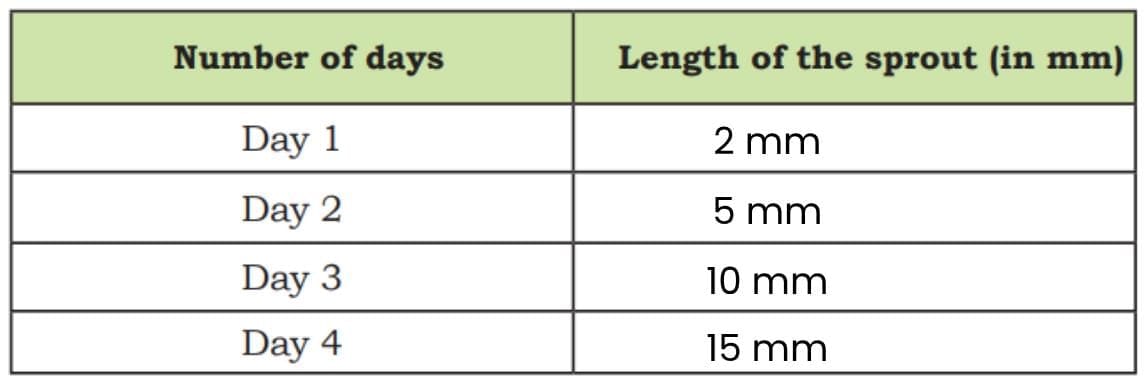
Soak some seeds of whole moong or black or white chana overnight. Next morning, take them out and wrap them in a moist cloth to sprout them. Over the next 4 days, take out one seed each day and measure the length of sprout. For ease of measurement, you can either place the seed on a paper and mark the length of the sprout, or use a thread to find its length.
Answer:
Let Us Draw
Draw lines of the following lengths in your notebook using a scale.
1.5 cm 5 mm
2.3 cm 6 mm
3.8 cm 3 mm
4.36 mm
5.67 mm
How did you draw lines of lengths 36 mm and 67 mm? Share your thoughts in class.
Answer:
To draw lines of lengths 36 mm and 67 mm:
• For 36 mm: Since 10 mm = 1 cm, 36 mm is equal to 3 cm and 6 mm. So, place the scale on the notebook, mark a starting point, and then draw a line up to the 3 cm mark and then 6 small divisions (mm) further.
• For 67 mm: Similarly, 67 mm is equal to 6 cm and 7 mm. Place the scale, mark a starting point, and draw a line up to the 6 cm mark and then 7 small divisions (mm) further.Page 63
Let Us Do
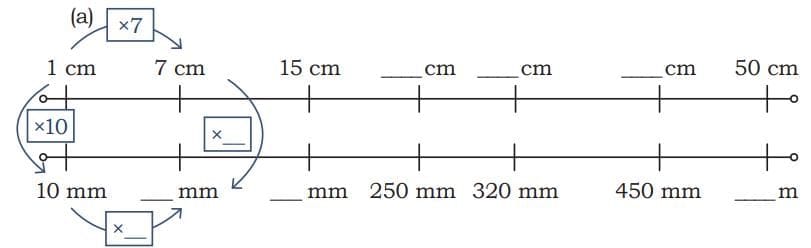
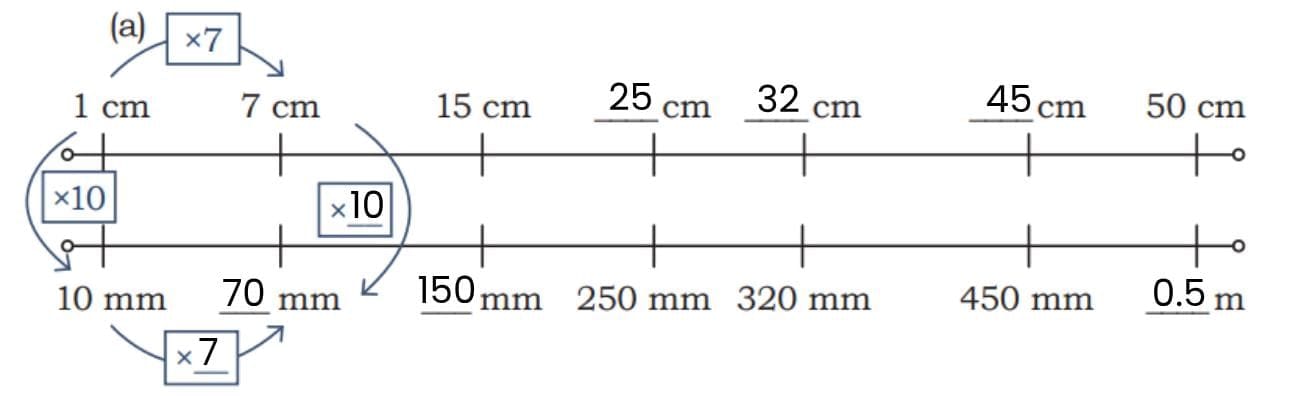
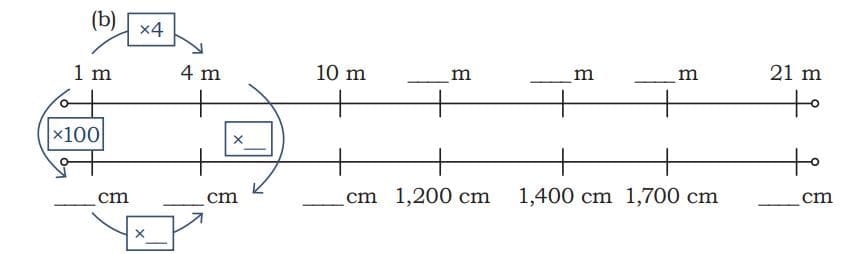
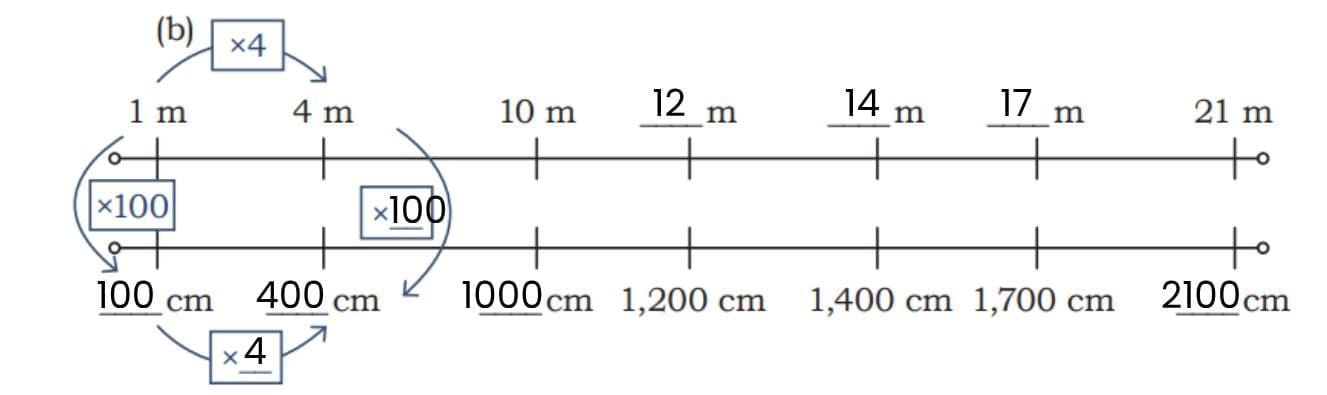
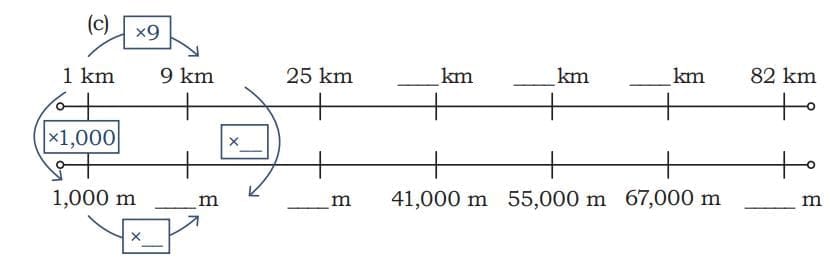
1.Fill in the blanks appropriately in the double number lines given below.
Answer:
Answer:
Answer:
2. Use your understanding from above to fill in the blanks appropriately.
(a) 4 cm 5 mm = ______ mm Answer: 4 cm 5 mm = 40 mm + 5 mm = 45 mm
(b) 89 mm = ____ cm ____ mm Answer: 89 mm = 80 mm + 9 mm = 8 cm 9 mm
(c) 234 cm = ____ mm Answer: 234 cm = 234 × 10 mm = 2340 mm
(d) 514 mm = ____ cm ____ mm Answer: 514 mm = 510 mm + 4 mm = 51 cm 4 mm
(e) 6 m 34 cm = ____ cm Answer: 6 m 34 cm = 600 cm + 34 cm = 634 cm
(f) 20 m 12 cm = ____ cm Answer: 20 m 12 cm = 2000 cm + 12 cm = 2012 cm
(g) 397 m = ______ cm Answer: 397 m = 397 × 100 cm = 39700 cm
(h) 5,792 cm = ______m ______ cm Answer: 5,792 cm = 5700 cm + 92 cm = 57 m 92 cm
(i) 9,108 cm = ______ m ______ cm Answer: 9,108 cm = 9100 cm + 8 cm = 91 m 8 cm
(j) 34 km = _______ m Answer: 34 km = 34 × 1000 m = 34000 m
(k) 6,870 m = ____ km ____ m Answer: 6,870 m = 6000 m + 870 m = 6 km 870 m
(l) 10,552 m = ____ km ___ m Answer: 10,552 m = 10000 m + 552 m = 10 km 552 m
(m) 29 km 30 m = ____ m Answer: 29 km 30 m = 29 × 1000 m + 30 m = 29000 m + 30 m = 29030 m
(n) 32 km 359 m = ____ m Answer: 32 km 359 m = 32 × 1000 m + 359 m = 32000 m + 359 m = 32359 mPage 66
Let Us Do
1.Rani has two red-coloured ribbon rolls, one of length 3 m 75 cm and another 2 m 25 cm long. How much ribbon does she have?
Answer: Length of first ribbon = 3 m 75 cm Length of second ribbon = 2 m 25 cm
Total ribbon = (3 m + 2 m) + (75 cm + 25 cm) Total ribbon = 5 m + 100 cm Since 100 cm = 1 m, Total ribbon = 5 m + 1 m = 6 m.
2. The distance from Bhopal to Sanchi is 48 km 700 m. Bhadbhada Ghat waterfall is on the way, and 17 km 900 m away from Bhopal. How far is Sanchi from the waterfall?
Answer: Total distance from Bhopal to Sanchi = 48 km 700 m Distance from Bhopal to Bhadbhada Ghat waterfall = 17 km 900 m
Distance from Sanchi to the waterfall = Total distance – Distance to waterfall
km m 48 700
-17 900
We cannot subtract 900 m from 700 m. So, we borrow 1 km (1000 m) from 48 km.
km m 47 1700 (borrowed 1km = 1000m from 48km)
– 17 900
————-
30 800
So, Sanchi is 30 km 800 m from the waterfall.
3. Gulmarg Gondola in Gulmarg, Kashmir is the second longest and second highest cable car in the world. It is divided into two sections. The first section covers 2 km 300 m and the second section covers 2 km 650 m. What is the total distance covered by the cable car?
Answer: Length of first section = 2 km 300 m Length of second section = 2 km 650 m
Total distance = (2 km + 2 km) + (300 m + 650 m) Total distance = 4 km + 950 m Total distance = 4 km 950 m.
4. Circle the bigger length and find the difference.
(a) 11 mm and 1 cm Difference — ________________ Answer: 1 cm = 10 mm. So, 11 mm is bigger. Difference = 11 mm – 10 mm = 1 mm.
(b) 26 mm and 2 cm Difference — ________________ Answer: 2 cm = 20 mm. So, 26 mm is bigger. Difference = 26 mm – 20 mm = 6 mm.
(c) 20 cm and 201 mm Difference — ________________ Answer: 20 cm = 200 mm. So, 201 mm is bigger. Difference = 201 mm – 200 mm = 1 mm.
(d) 1,020 mm and 1m Difference — ________________ Answer: 1 m = 1000 mm. So, 1,020 mm is bigger. Difference = 1020 mm – 1000 mm = 20 mm.
(e) 2 m and 245 cm Difference — ________________ Answer: 2 m = 200 cm. So, 245 cm is bigger. Difference = 245 cm – 200 cm = 45 cm.
(f) 5,678 m and 6 km Difference — ________________ Answer: 6 km = 6000 m. So, 6 km is bigger. Difference = 6000 m – 5678 m = 322 m.
(g) 6 km 1,480m and 7 km 479m Difference — ________________ Answer:6 km 1,480 m = 6 km + 1 km 480 m = 7 km 480 m. Comparing 7 km 480 m and 7 km 479 m, 6 km 1,480 m is bigger. Difference = 7 km 480 m – 7 km 479 m = 1 m.Page 67
Multiplying and Dividing Lengths
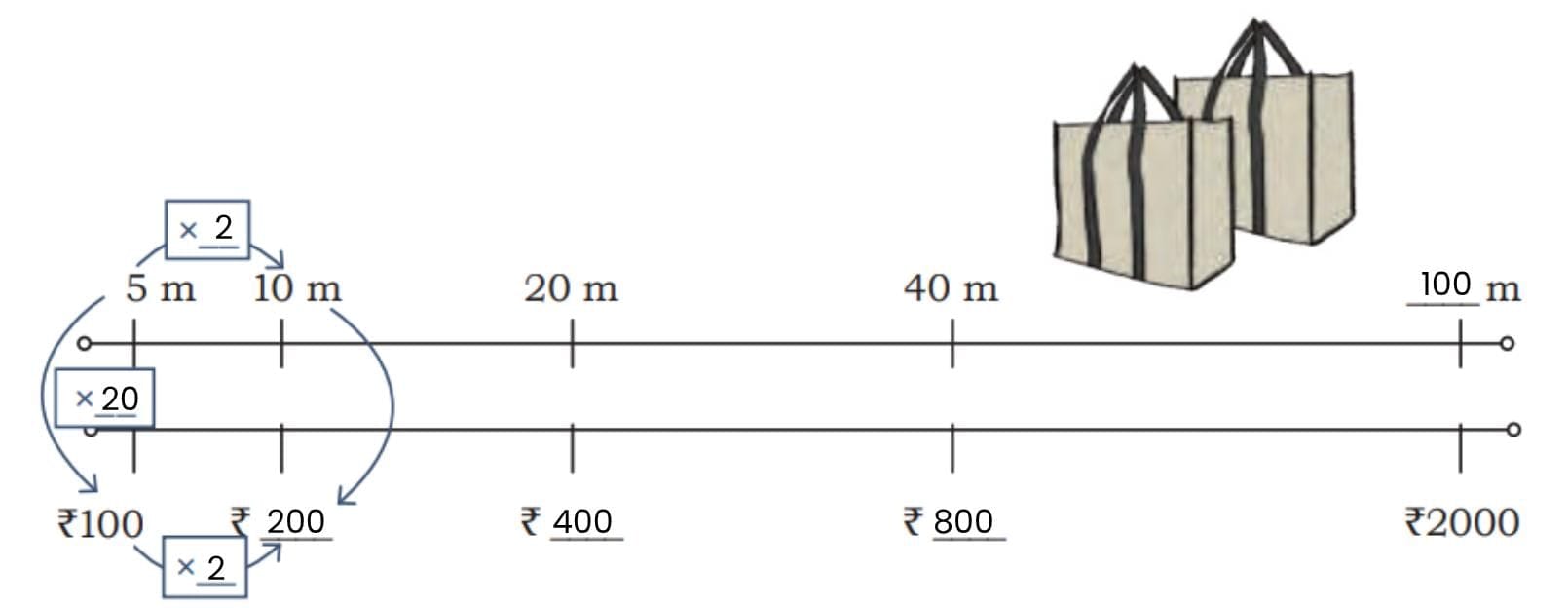
1.A shop sells cloth for making bags at ₹100 for 5 m. How much money is needed to buy a 1 m cloth?
Answer: Cost of 5 m cloth = ₹100 Cost of 1 m cloth = ₹100 ÷ 5 = ₹20.
Now, use the double number line to find the cost of the cloth or the length of cloth that we can buy at a particular cost.
3. Anita is making an embroidery on the border of a sari. She needs a 1 m long thread to embroider a 50 cm sari. How much thread would she need for a 5 m sari border?
A 1 m long thread costs ₹50. How much money will be needed to buy the thread?
Answer: Thread needed for 50 cm sari = 1 m
First, convert 5 m sari border to cm: 5 m = 500 cm.
If 50 cm sari needs 1 m thread, then 500 cm sari (which is 10 times 50 cm) will need 10 times the thread. Thread needed for 5 m (500 cm) sari = 10 × 1 m = 10 m.
Cost of 1 m thread = ₹50 Cost of 10 m thread = 10 × ₹50 = ₹500.
4. A road 12 km 600 m long is being laid in a town. The workers lay an equal length of road each day, and complete the work in 6 days. How much road-laying work is done on each day?
Answer: Total length of road = 12 km 600 m Number of days to complete work = 6 days
Convert total length to meters: 12 km 600 m = 12 × 1000 m + 600 m = 12000 m + 600 m = 12600 m.
Length of road laid each day = Total length / Number of days = 12600 m / 6 = 2100 m
Convert back to km and m: 2100 m = 2000 m + 100 m = 2 km 100 m.
So, 2 km 100 m of road-laying work is done each day.
A giant wheel makes a full turn when it comes back to the starting position E. Reema takes two half turns in the same direction. It is like a full turn.
What happens if she takes 2 quarter turns in the same direction? It is like a half turn.
What happens if she takes 4 quarter turns in the same direction? It is like a full turn.
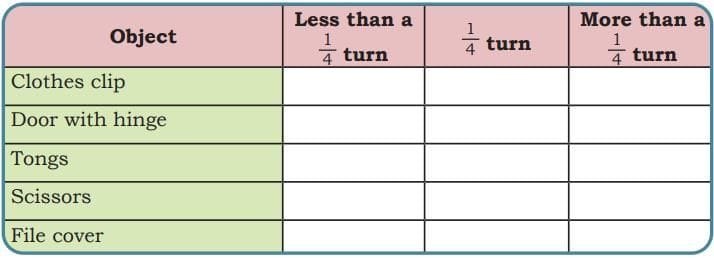
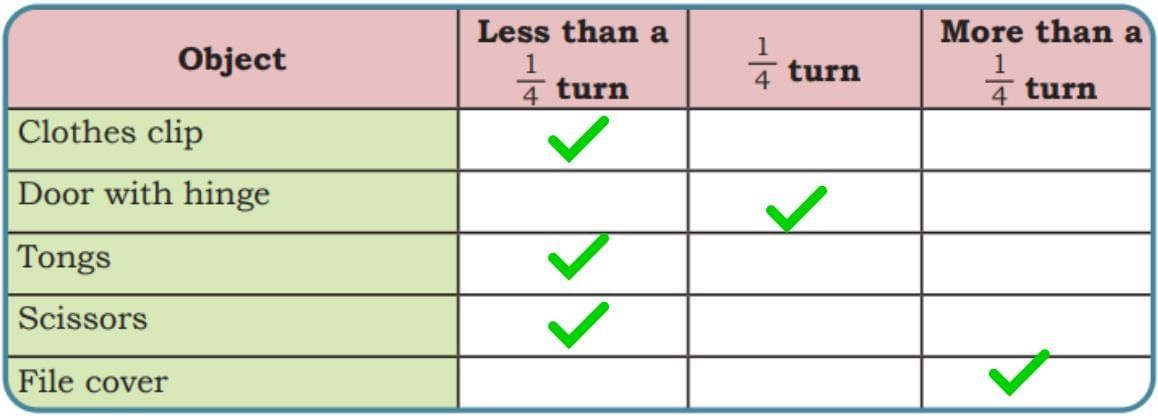
Write some of the everyday objects that involve turns. For example, taps, door knobs, screwdrivers, wheels, keys, and jar lids.
What is the maximum possible turn in each of these cases? Check and tick.
Let Us Do (Page 35)
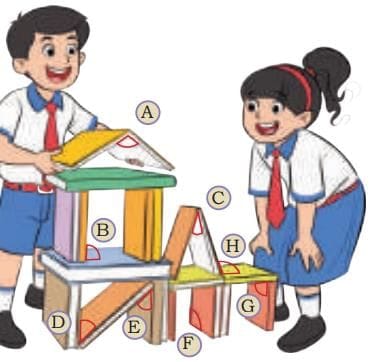
Question (b): You might have built houses using the hard covers of notebooks or cardboard pieces. Look at the angles marked in the house. What angles are you able to see in this house? Write your answers as right, acute or obtuse angle.
Answer: A: Obtuse angle B: Right angle C: Acute angle D: Acute angle E: Acute angle F: Right angle G: Right angle H: Obtuse angle
Question (c): Make a 5-sided shape with 2 right angles, 2 obtuse angles, and 1 acute angle in your notebook.
Answer:
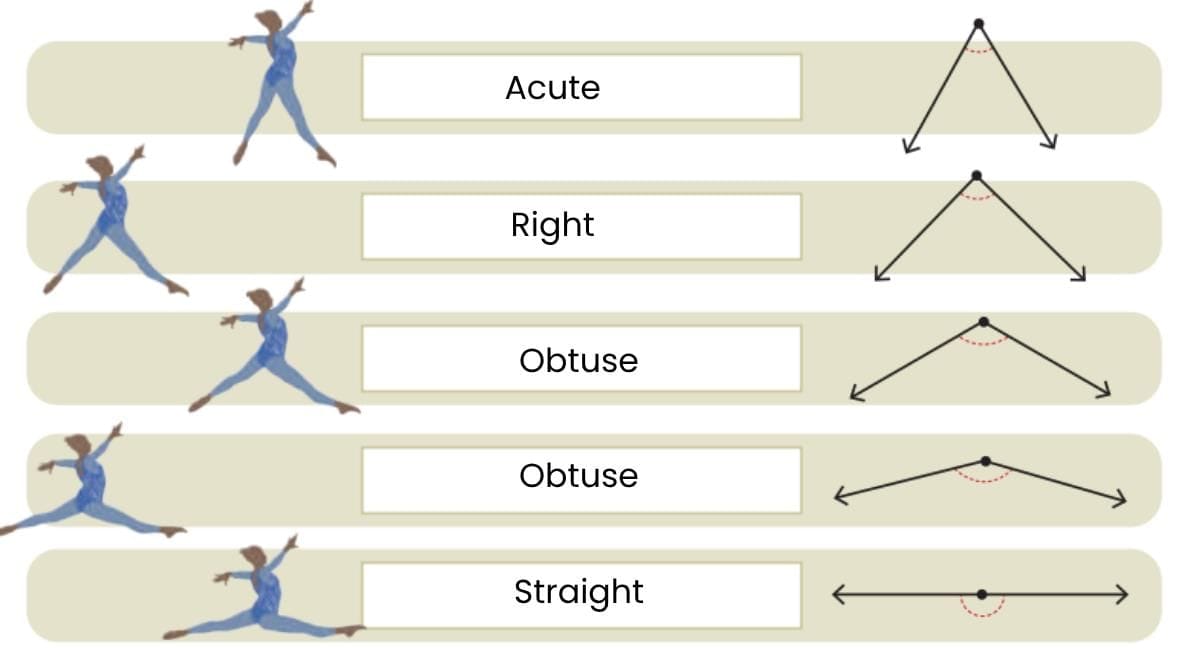
Look at the angle formation between the legs of these gymnasts. Identify whether the angles are acute, obtuse, right or straight.
Answer:
Let Us Think
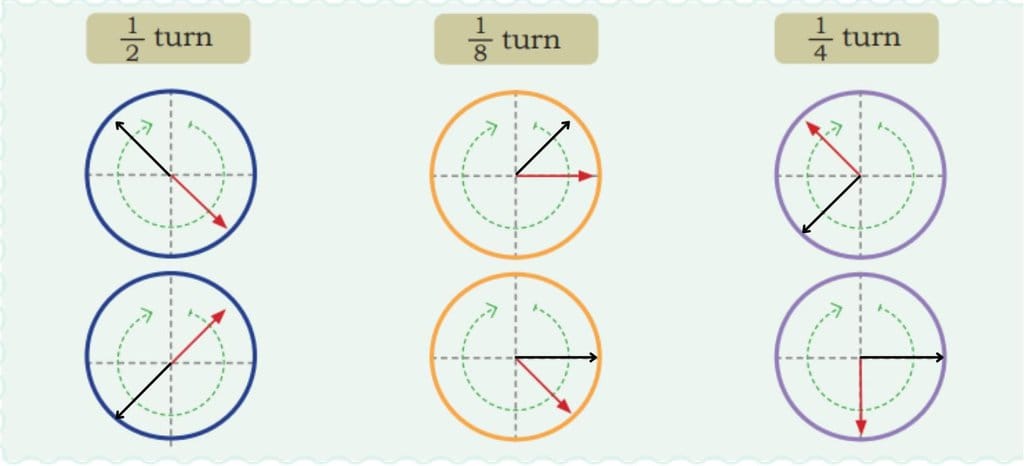
In the following circles, the end points of turns are shown. Draw arrows to show the starting points.
Answer:
Let Us Do (Page 38)
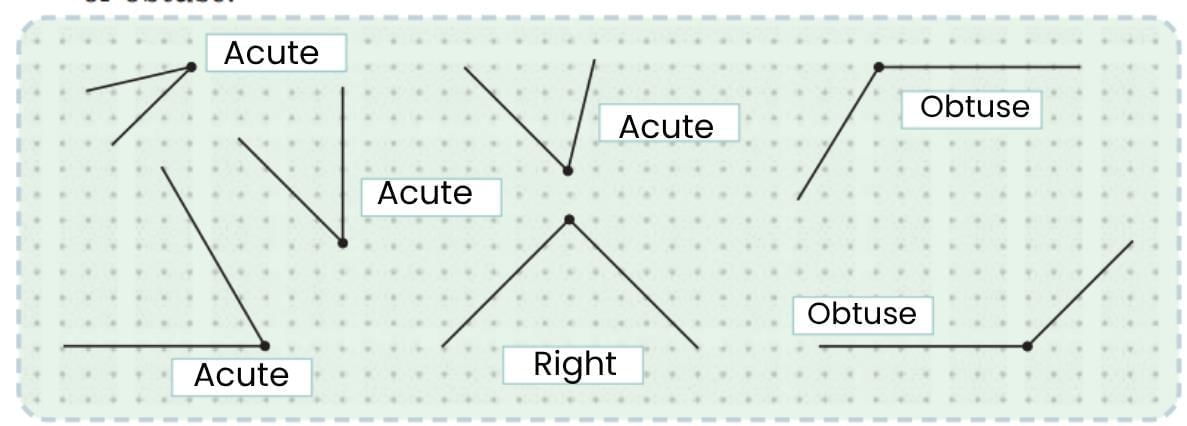
Question 1: Guess the measures of each of the angles shown below. Then, check using your angle measuring tools. You may need to use a combination of measures. Also, state whether each of the angles is acute, right, or obtuse.
Answer:
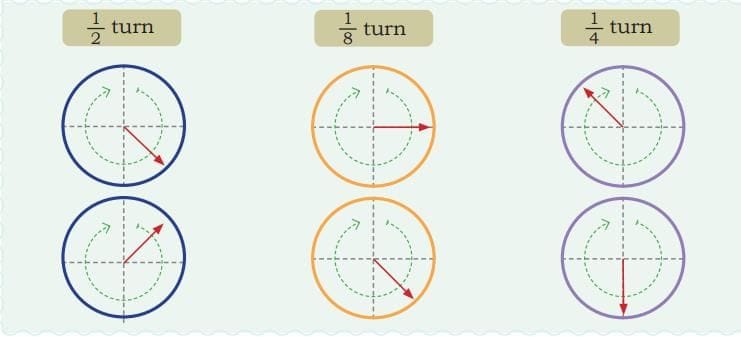
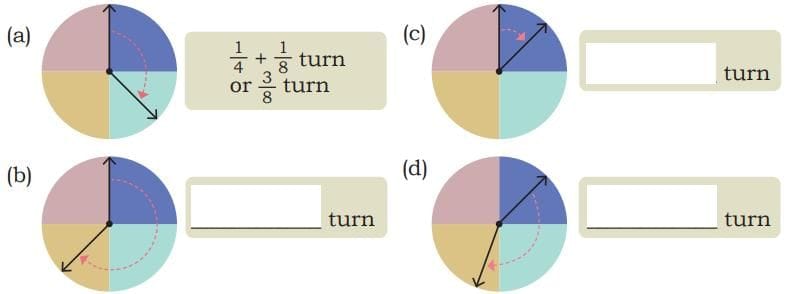
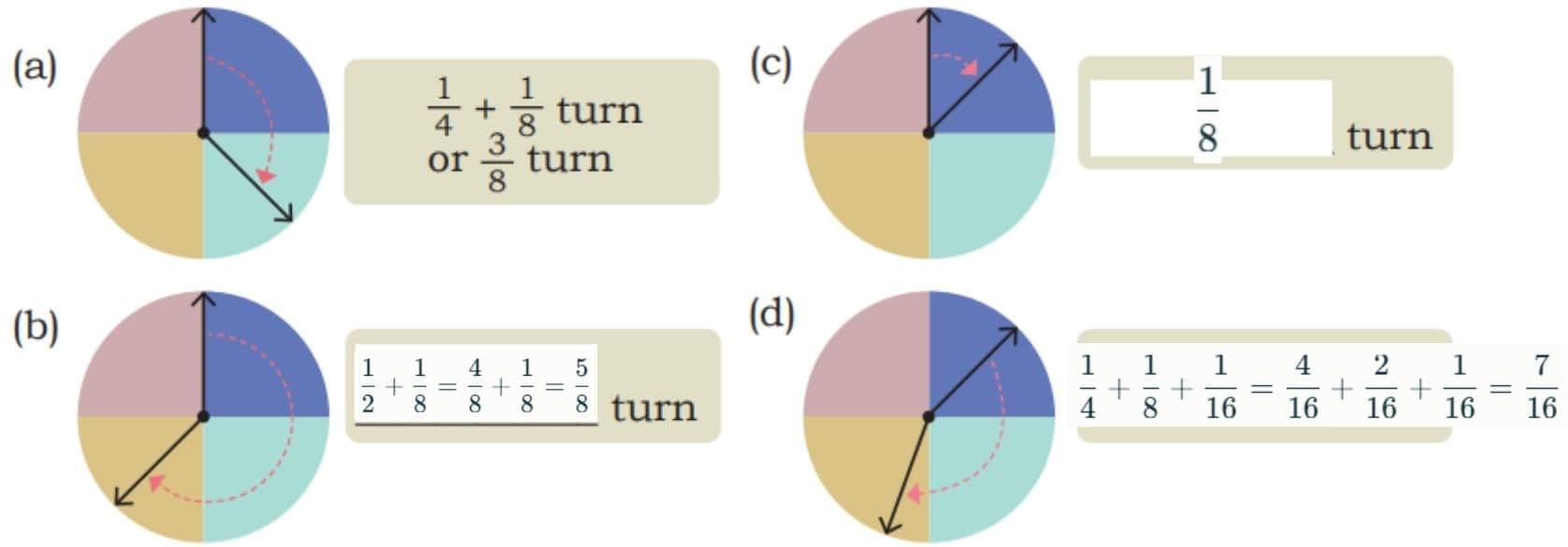
2. Guess the measure of the turns made by the arrow in each of the following cases. Verify with a combination of angle measuring tools.
Answer:
Let Us Do (Page 39)
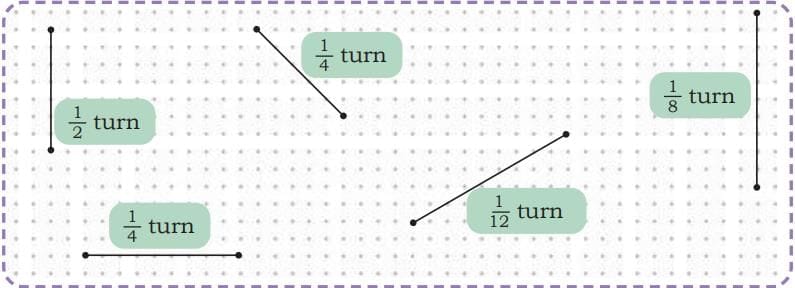
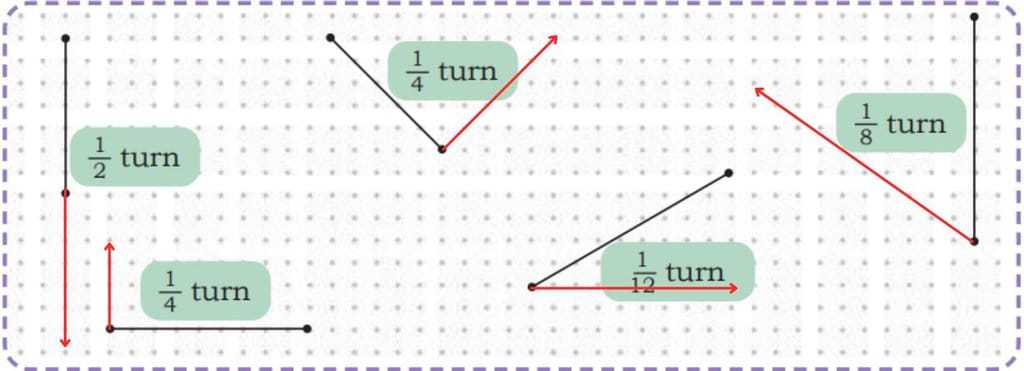
4: Draw angles for the given measures of turns using the given lines.
Answer:
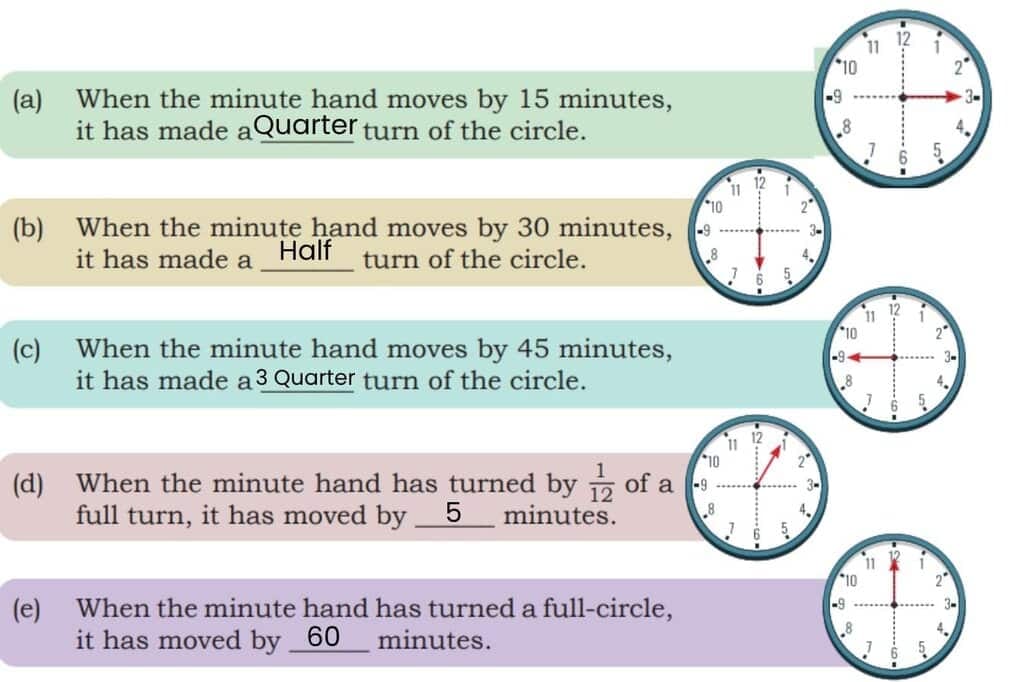
6: Guess the measure of turns the minute hand of a clock makes in each of the following cases. The initial position of the minute hand is given. Draw the final position of the minute hand on the clock face. Discuss your reasoning in class.
(a) When the minute hand moves by 15 minutes, it has made a _______ turn of the circle. (b) When the minute hand moves by 30 minutes, it has made a _______ turn of the circle. (c) When the minute hand moves by 45 minutes, it has made a _______ turn of the circle. (d) When the minute hand has turned by 1/12 of a full turn, it has moved by ______ minutes. (e) When the minute hand has turned a full-circle, it has moved by ______ minutes.
Answer:
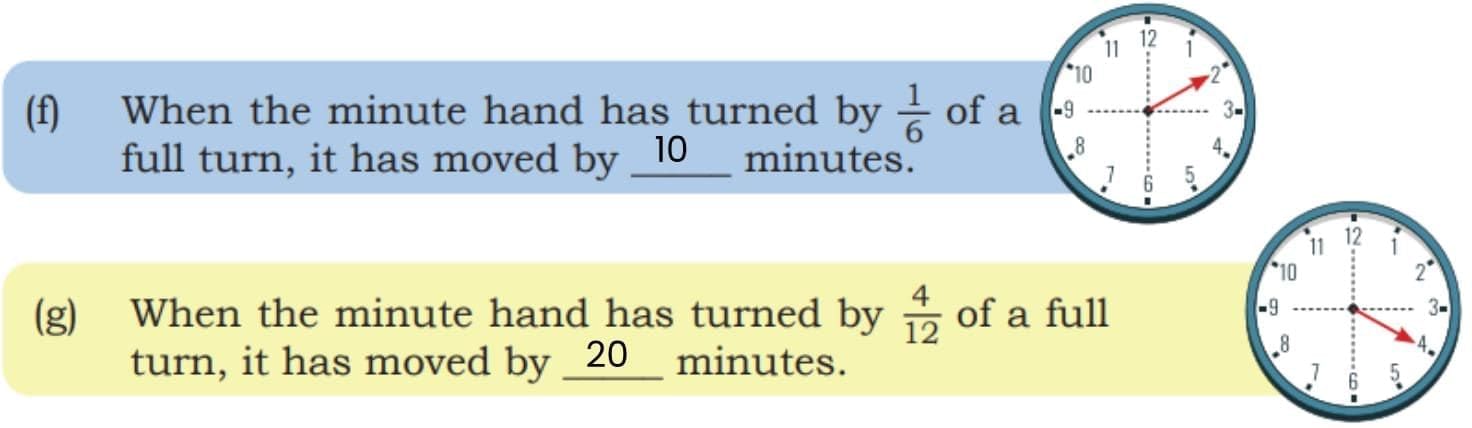
Let Us Do (Page 40)
(f) When the minute hand has turned by 1/6 of a full turn, it has moved by _____ minutes. (g) When the minute hand has turned by 4/12 of a full turn, it has moved by _____ minutes.
Answer:
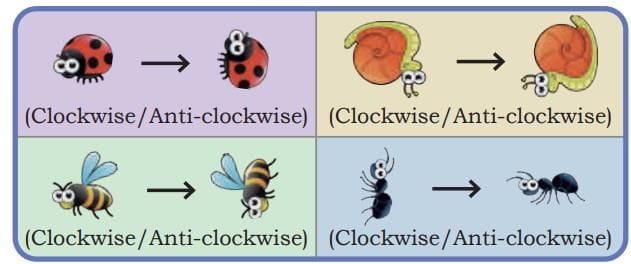
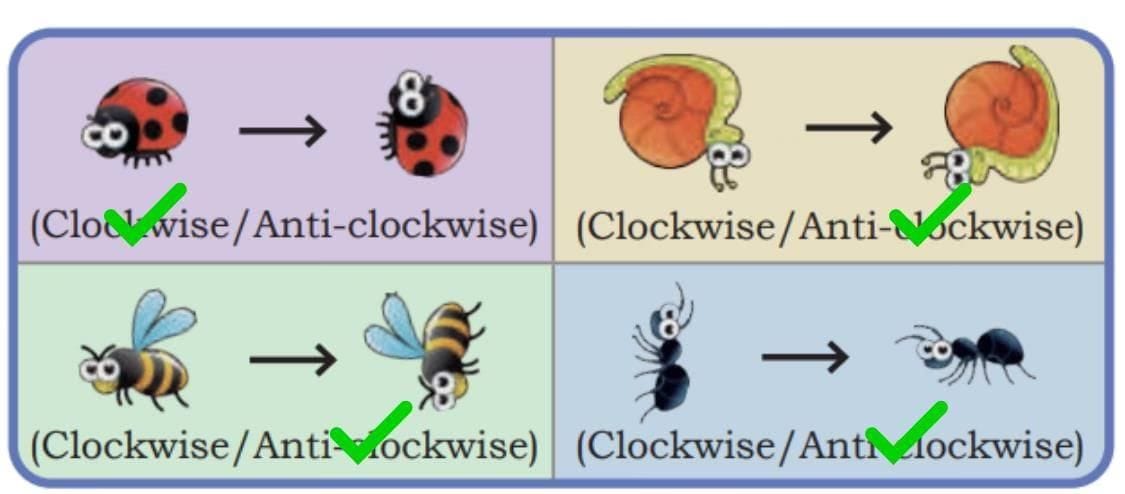
Which direction? (Page 40)
The creatures below have made a quarter turn once. Tick the direction in which they have moved.
Answer:
Try these (Page 40)
Question: Observe the direction of movement while opening a tap, unscrewing a lid or loosening a nut. Do they move clockwise or anti-clockwise?
Answer:
• Opening a tap: Usually anti-clockwise (lefty loosey, righty tighty).
• Unscrewing a lid: Anti-clockwise.
• Loosening a nut: Anti-clockwise.
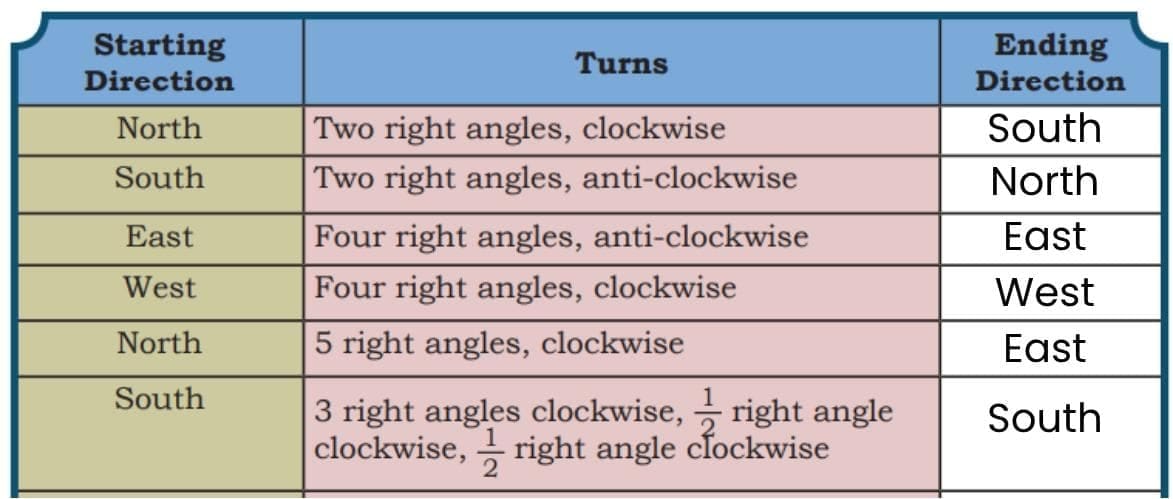
Fun with Turns (Page 9)
1. The children in a class are playing a game in which the teacher tells them the direction in which they should rotate. Complete the table by filling the direction the children will face on completing the given turns. The starting direction is given in the table.
Answer:
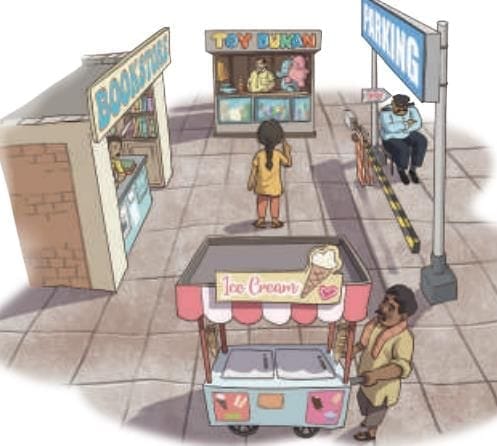
2. Padma is facing the toy shop. What place will she face if she takes a half turn clockwise?
Answer: She will face the ice cream side
What other way can she turn to face the same place?
Answer: She can turn a half turn anti clockwise to face the same side.
usually not a full turn without special hinges or breaking.)
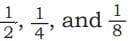
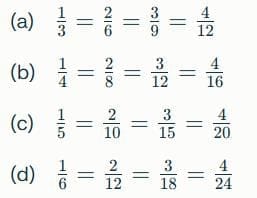
Question 1:In groups of 3 or 4, find different ways of making a whole with different fraction pieces from your kit. Write the equivalent fractions for the following that you may find in the process.
Answer: Examples of equivalent fractions are:
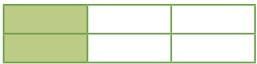
Question 2: Find the following using your kit. You can also shade and check by shading the following. The first one is partially done for you.
A. How many 16 s make 1 3?
Answer: The shaded part is 1 3. Identify16 in the same whole and find how many 16s fit into1 3? (Answer: Two 16s make 13 ).
B. How many 1/8s make (a) 1/4? (b) 1/2?
a)
b)
Answer: (a) Two 1/8s make 1/4. (b) Four 1/8s make 1/2.
C. How many 1/12s make (a) 1/2 (b) 1/3 (c) 1/4 (d) 1/6?
Answer: (a) Six 1/12s make 1/2. (b) Four 1/12s make 1/3. (c) Three 1/12s make 1/4. (d) Two 1/12s make 1/6.
Page 21Let Us Do
Question 1: Fill in the blanks with equivalent fractions. There may be more than one answer.
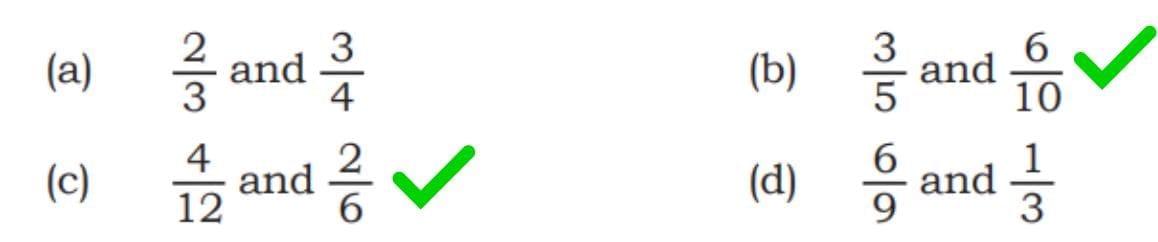
Question 2: Put a tick against the fractions that are equivalent.
(a) 2/3 and 3/4 (b) 3/5 and 6/10 (c) 4/12 and 2/6 (d) 6/9 and 1/3
Answer: (a) 2/3 and 3/4 (Not equivalent) (b) 3/5 and 6/10 Equivalent, because 3 x 2=6 and 5 x 2=10) (c) 4/12 and 2/6 Equivalent, because 2 x 2=4 and 6 x 2=12 (d) 6/9 and 1/3 (Not equivalent)
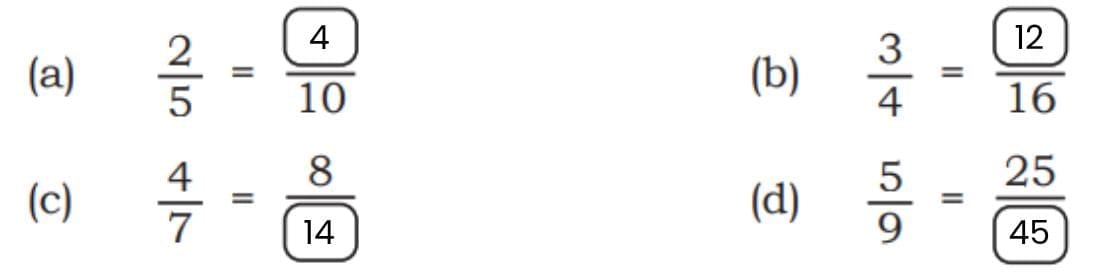
Question 3: Fill in the boxes such that the fractions become equivalent.
Answer: (a) 2/5 = 4/10 (because 5 x 2=10, so 2×2=4) (b) 3/4 = 12/16 (because 4×4=16, so 3×4=12) (c) 4/7 = 8/14 (because 4×2=8, so 7×2=14) (d) 5/9 = 25/45 (because 5×5=25, so 9×5=45)
Page 22Let Us Do
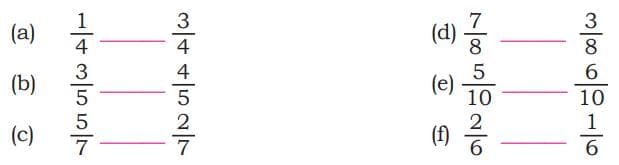
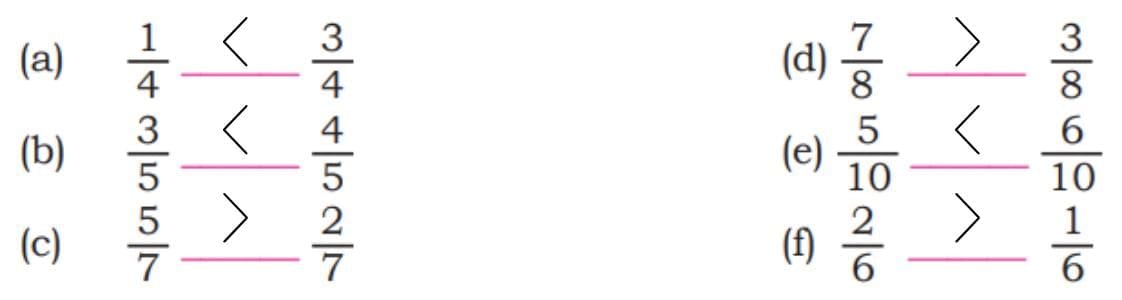
Question 1: Compare the fractions given below using < and > signs.
Answer:
Page 23Let Us Do
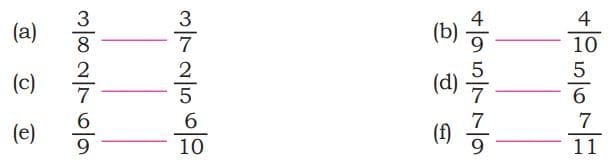
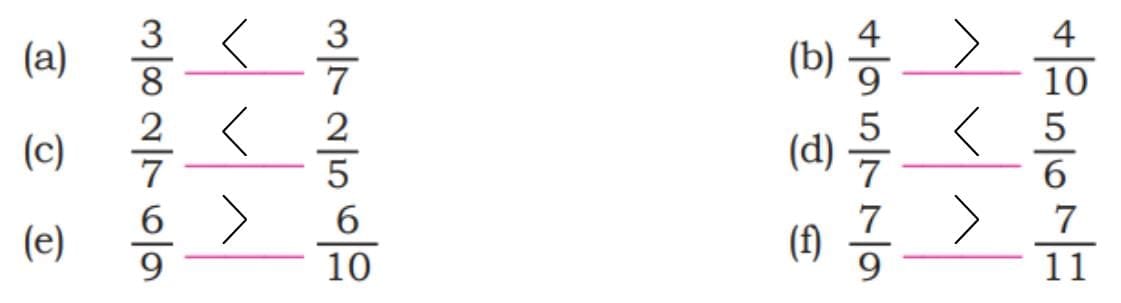
Question 1: Compare the following fractions using < and > signs.
Answer:
Let Us DoPage 28
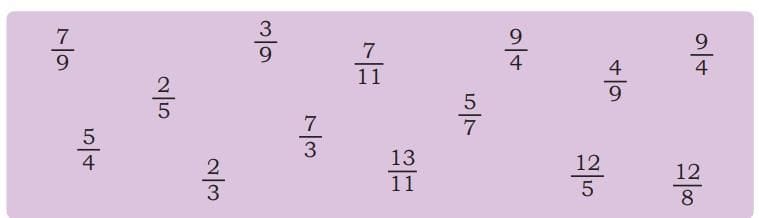
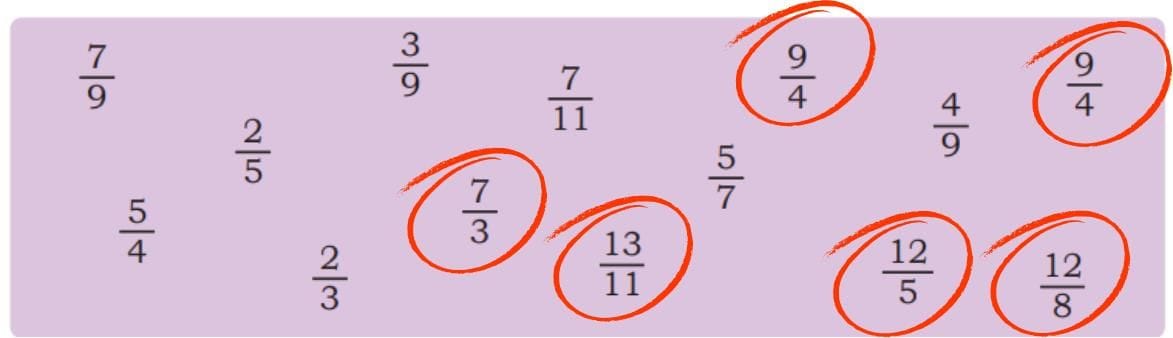
Question 2: Circle the fractions that are greater than one (whole). How do you know? Discuss your reasoning in the class.
Answer: Fractions greater than one are those where the numerator is greater than the denominator.
Page 29Let Us Do
1. Compare the following fractions using 1 as a reference. Share your reasoning in the class.
Answer:
Let Us Do Page 30
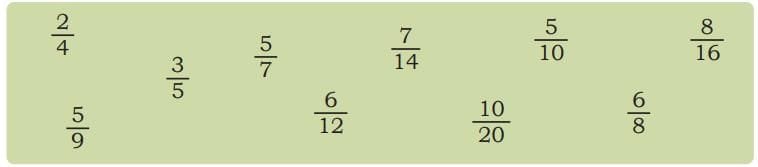
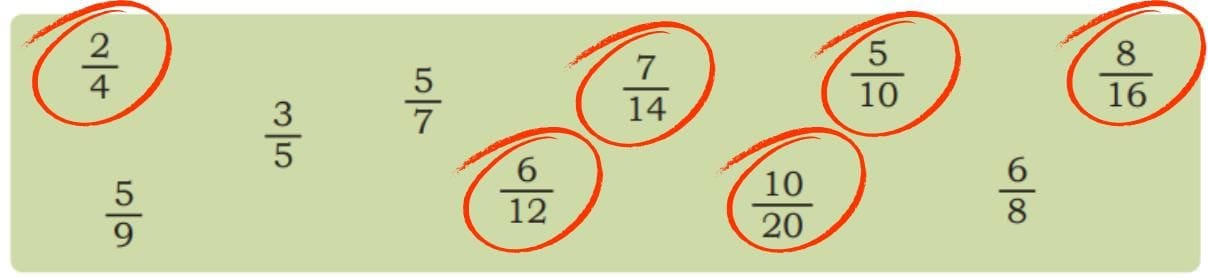
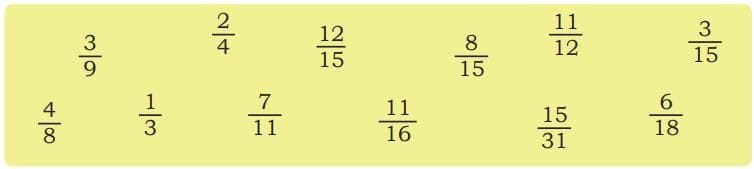
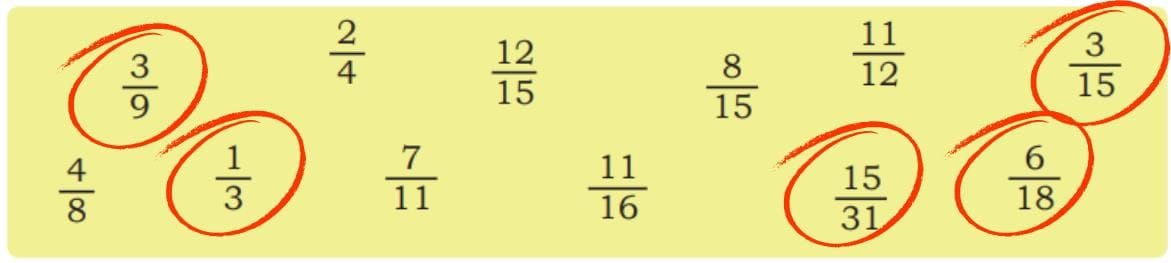
Question 1: Circle the fractions below that are equal to 1/2.
Answer: Fractions equal to 1/2 are those where the numerator is exactly half of the denominator.
Question 2: Some fractions are written in the box below. Circle the fractions that are less than half. How do you know? Discuss your reasoning in the class.
Answer: Fractions less than half are those where the numerator is less than half of the denominator.
Page 14Let Us Do
Question 1: Compare the following fractions. Where possible, compare the fractions with 1/2.
Answer:
• 2/9 and 4/7:
2/9: Half of 9 is 4.5. Since 2 < 4.5, 2/9 < 1/2.
4/7: Half of 7 is 3.5. Since 4 > 3.5, 4/7 > 1/2.
Therefore, 2/9 < 4/7.
•11/14 and 7/20:
11/14: Half of 14 is 7. Since 11 > 7, 11/14 > 1/2.
7/20: Half of 20 is 10. Since 7 < 10, 7/20 < 1/2.
Therefore, 11/14 > 7/20.
•5/7 and 3/9:
5/7: Half of 7 is 3.5. Since 5 > 3.5, 5/7 > 1/2.
3/9: Half of 9 is 4.5. Since 3 < 4.5, 3/9 < 1/2.
Therefore, 5/7 > 3/9.
•6/7 and 4/10:
6/7: Half of 7 is 3.5. Since 6 > 3.5, 6/7 > 1/2.
4/10: Half of 10 is 5. Since 4 < 5, 4/10 < 1/2.
Therefore, 6/7 > 4/10.
•9/17 and 3/15:
9/17: Half of 17 is 8.5. Since 9 > 8.5, 9/17 > 1/2.
3/15: Half of 15 is 7.5. Since 3 < 7.5, 3/15 < 1/2.
Therefore, 9/17 > 3/15.
•7/12 and 3/11:
7/12: Half of 12 is 6. Since 7 > 6, 7/12 > 1/2.
3/11: Half of 11 is 5.5. Since 3 < 5.5, 3/11 < 1/2.
Therefore, 7/12 > 3/11.
•1/3 and 5/9:
1/3: Half of 3 is 1.5. Since 1 < 1.5, 1/3 < 1/2.
5/9: Half of 9 is 4.5. Since 5 > 4.5, 5/9 > 1/2.
Therefore, 1/3 < 5/9.
•3/9 and 4/7: (This is a repeat of the first comparison, so the answer is the same)
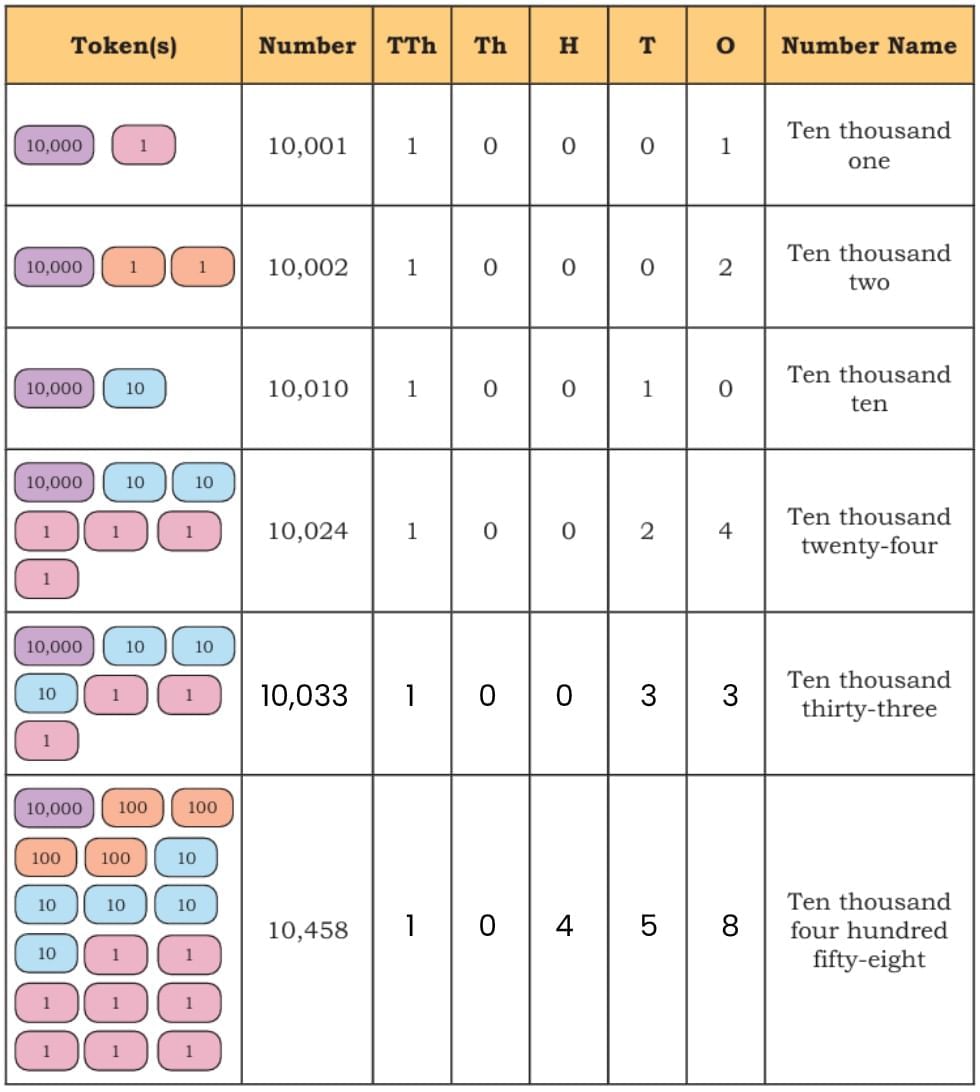
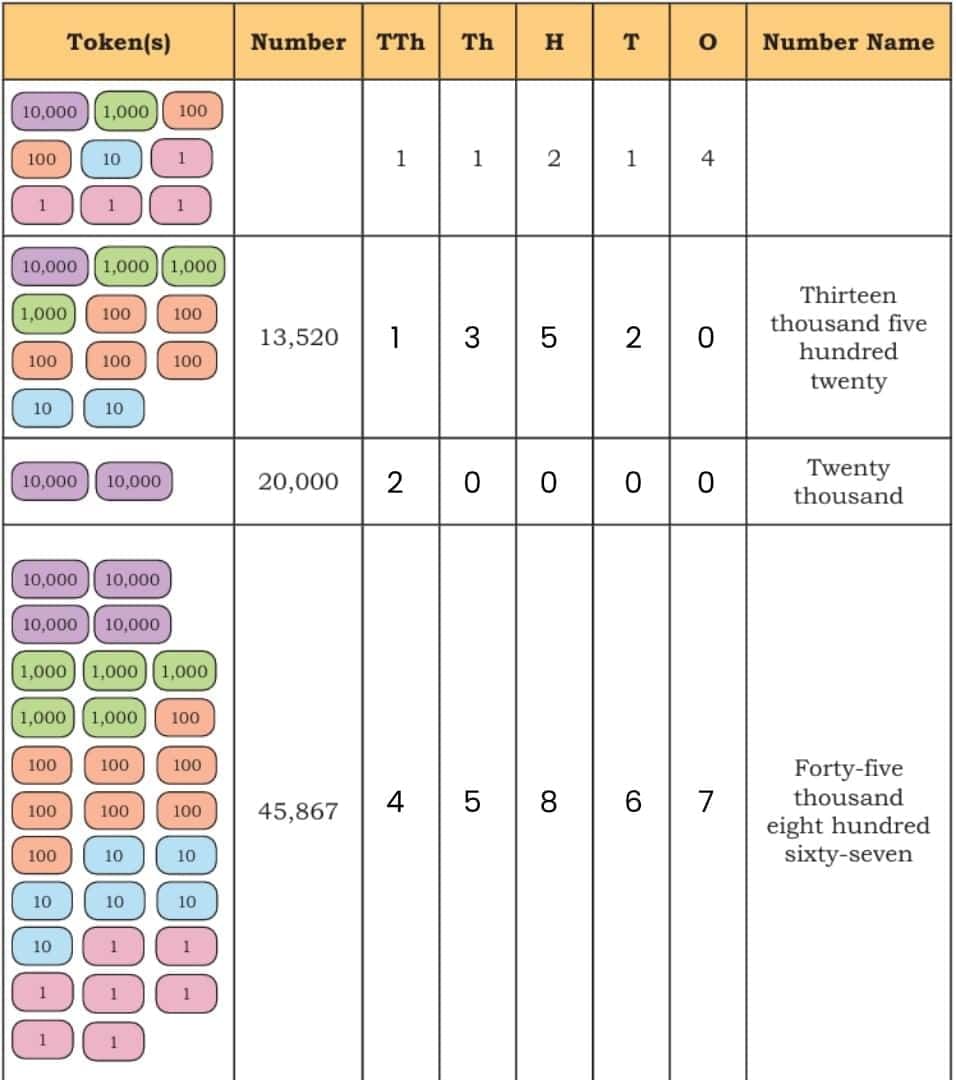
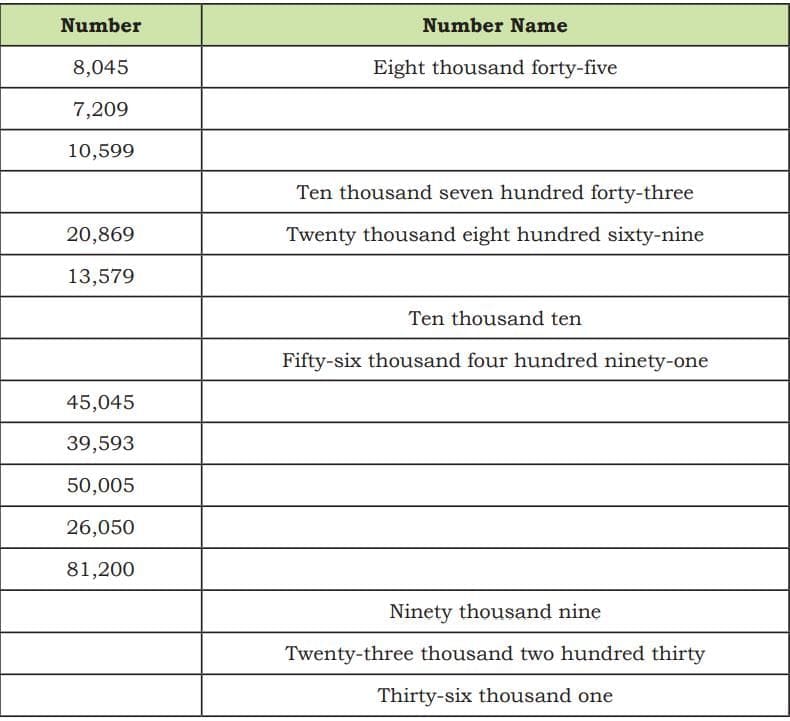
Imagine you have a lot of things, like thousands of candies! How do we write such big numbers? Let’s start with 1,000. What numbers do we get when we keep adding a thousand? If we keep adding 1,000, we get these numbers
Let us see how we write numbers beyond 10,000 and how we name them. We write them in the same way as numbers below 9,999.
Let Us Do
Page 5, 6
Fill in the blanks by continuing the pattern in each of the following sequences. Discuss the patterns in class.
(a) 456 567 678
(b) 1,050 3,150 4,200
(c) 5,501 6,401 7,301
(d) 10,100 10,200 10,300
(e) 10,105 10,125
(f) 10,992 10,993
(g) 10,794 10,796 10,798
(h) 73,005 72,004
(i) 82,350 83,350
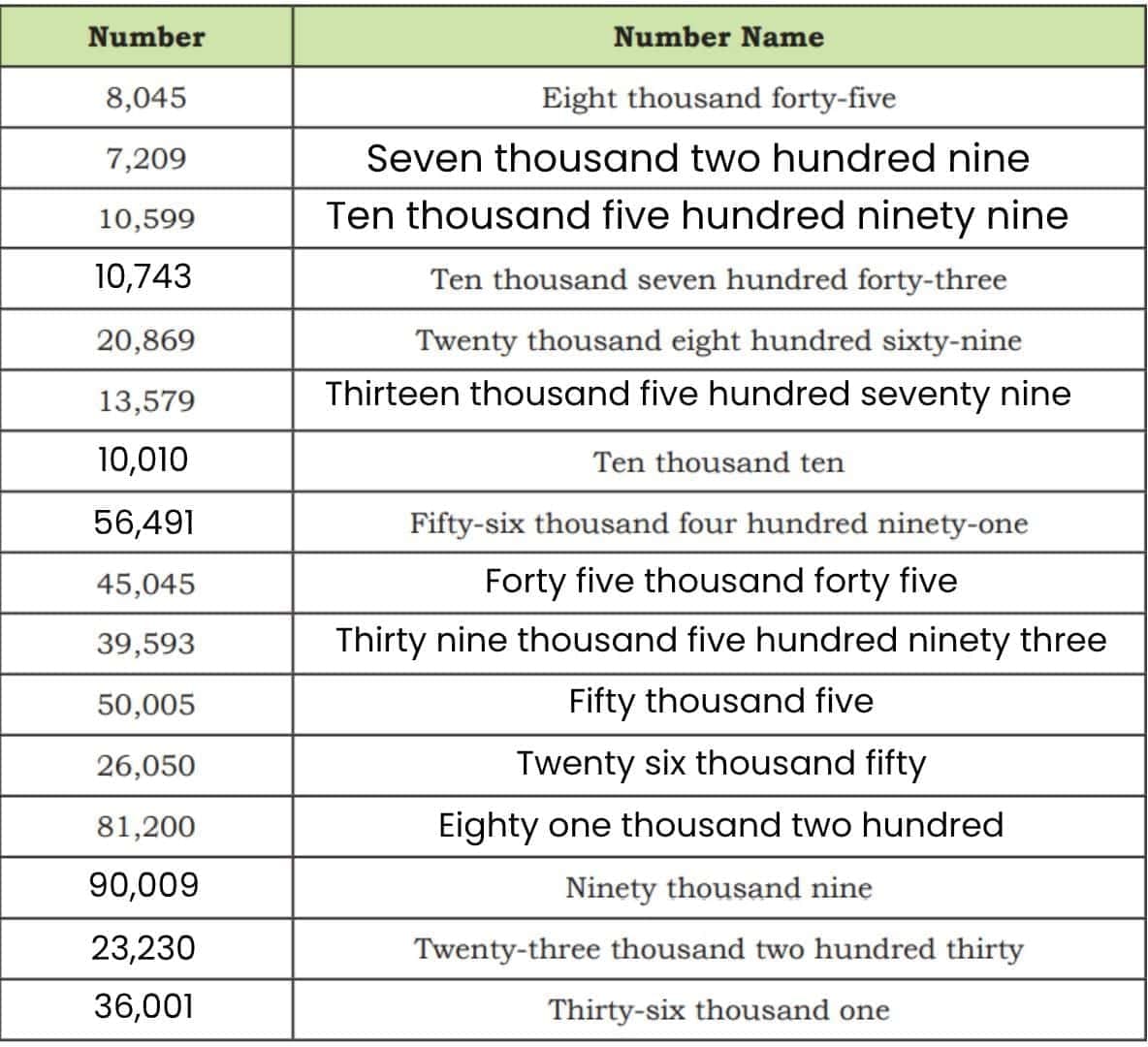
Fill in the blanks appropriately. Use commas as required.
Answer:
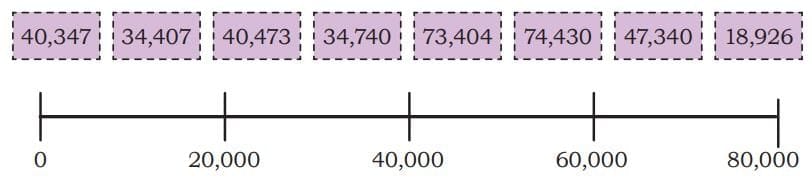
2. Arrange the numbers below in increasing order. You can use the number line below if required.
Answer:
4. A student said 9,990 is greater than 49,014 because 9 is greater than 4. Is the student correct? Why or why not?
Answer:
The student is not correct.
Here’s why:
When comparing two numbers, you must compare their place values starting from the left (the highest place value). Let’s break it down:
9,990 has 4 digits.
49,014 has 5 digits.
Any 5-digit number is always greater than any 4-digit number, regardless of what digits they start with.
Use the number line below to find the position of the numbers. Fill in the blanks.
Answer:
5. Digit swap
(a) In the number 1,478, interchanging the digits 7 and 4 gives 1,748. Now, interchange any two digits in the number 1,478 to make a number that is larger than 5,500
Answer:
The original number is 1,478.
To make the largest possible number, swap the digits so the biggest digit is in the thousands place. The digits are 1, 4, 7, 8. The largest arrangement is 8,741 (swap 1 and 8).
8,741 is much greater than 5,500.
So, you can swap the digits 1 and 8.
Any swap putting 7 or 8 in the leftmost place will create a number larger than 5,500 (such as 7,418, 8,471, etc.).
(b) Interchange two digits of 10,593 to make a number i) Between 11,000 and 15,000. ii) More than 35,000.
Answer:
i) Between 11,000 and 15,000
You need a five-digit number that starts with 11, 12, 13, or 14.
Try swapping 0 and 1: 01,593 (still 1,593 — not enough digits). Try swapping 1 and 5: 50,193 (too large). Swap 0 and 5: 15,093 (matches the condition).
Swapping 0 and 5 gives: 15,093 (which is between 11,000 and 15,000).
ii) More than 35,000
You’d need 3 or higher in the ten-thousand place.
Try swapping 1 and 3: 30,591 (less than 35,000). Swap 1 and 5: 50,193 (greater than 35,000).
Swapping 1 and 5 gives: 50,193.
(c) Interchange two digits of 48,247 to make a number i) As small as possible. ii) As big as possible
Answer:
i) As small as possible
You want the smallest possible digit (other than 0, which is not present) in the highest place.
Swapping 4 and 2: 28,447 (2 in the ten-thousands place).
28,447 is the smallest possible by swapping 4 and 2.
ii) As big as possible
Largest digit in leftmost place. The digits are 4, 8, 2, 4, 7; largest is 8.
Swap 4 and 8: 84,247.
84,247 is the biggest possible by swapping 4 and 8.
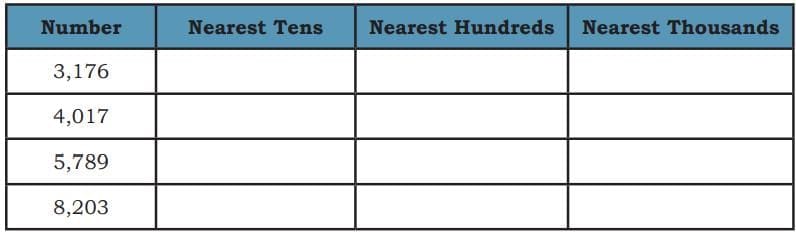
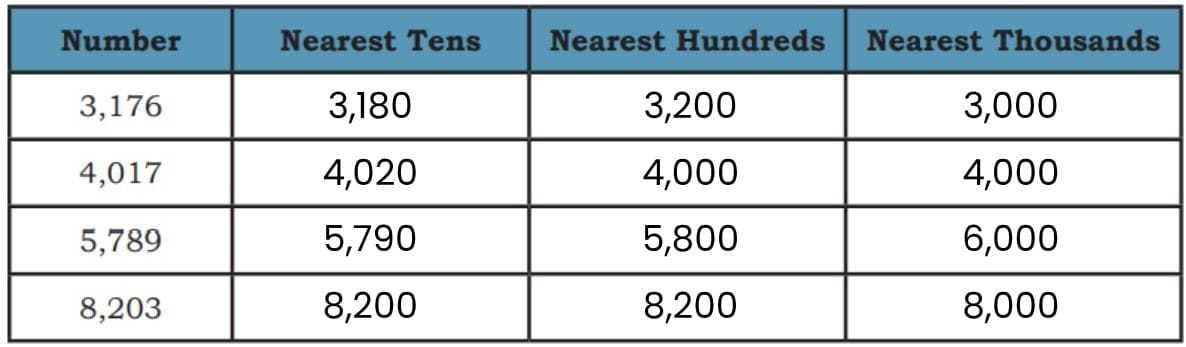
Nearest Tens (10s), Hundreds (100s), and Thousands (1,000s)
Page 8
Fill in the boxes appropriately.
Let Us Think
Page 8
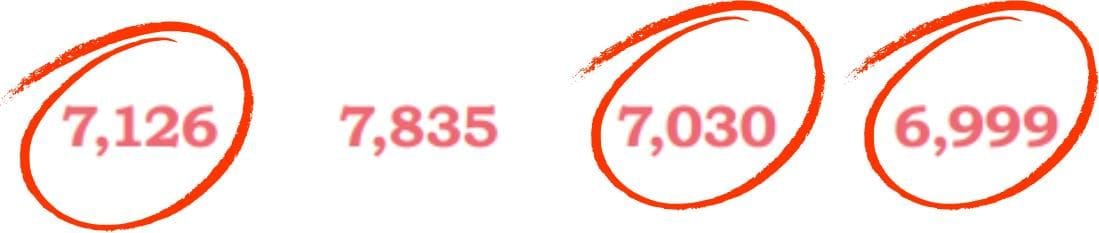
1. Vijay rounded off a number to the nearest hundred. Suma rounded off the same number to the nearest thousand. Both got the same result. Circle the numbers they might have used.
Answer:
This is because all these three numbers are closest to 7,000.
2. Think and write two numbers that have the same
(a) Nearest ten.
(b) Nearest hundred.
(c) Nearest thousand.
Answer:
(a) Nearest ten: Any two numbers between the same pair of tens will round to the same ten. Example: 42 and 47
Both rounded to nearest ten = 40 (since digits in ones place <5 for 42 and ≥5 for 47, so 47 rounds to 50. For SAME value: use 42 and 44, both round to 40).
So, 42 and 44 → Nearest ten = 40.
(b) Nearest hundred: Any two numbers within the interval of 100 that round to the same hundred. Example: 163 and 187
Both round to nearest hundred = 200 (163 rounds to 200 because tens digit is 6 (≥5); 187 rounds to 200). To get SAME, you want both under 150, say 121 and 149 → Both round to 100.
So, 121 and 149 → Nearest hundred = 100.
(c) Nearest thousand: Any two numbers from 3,000 up to 3,499 will round to 3,000. Example: 3,254 and 3,492
3,254 → 3,000
3,492 → 3,000
3. Think and write the numbers that have the same
(a) Nearest ten and nearest hundred.
(b) Nearest hundred and nearest thousand.
(c) Nearest ten, hundred and thousand.
Answer:
(a) Nearest ten and nearest hundred: Pick numbers whose tens and hundreds digits are the same after rounding. Example: 145 and 149
145 rounds to 150 (ten) and 100 (hundred);
146 rounds to 150 (ten) and 100 (hundred); But not matching. Instead, try numbers like 200 and 202 →
200 (ten: 200, hundred: 200)
202 (ten: 200, hundred: 200) So, 200 and 202.
(b) Nearest hundred and nearest thousand: Pick numbers that, after rounding to hundred, also round to the same thousand. Example: 3,040 and 3,080
3,040 to nearest hundred = 3,000; nearest thousand = 3,000
3,080 to nearest hundred = 3,100; nearest thousand = 3,000 But for SAME: 3,010 and 3,020, both round to 3,000 (hundred: 3,000; thousand: 3,000). So, 3,010 and 3,020.
(c) Nearest ten, hundred, and thousand: Pick numbers at the lower end so all three round the same. Example: 1,001 and 1,004
Rounds to 1,000 (ten, hundred, thousand).
So, 1,001 and 1,004.
Let Us Do
Page 10
1. A cyclist can cover 15 km in one hour. How much distance will she cover in 4 hours, if she maintains the same speed?
Answer:
If a cyclist can cover 15 km in one hour and maintains the same speed, in 4 hours she will cover:
Distance = Speed × Time = 15 km/hour × 4 hours = 60 km
So, she will cover 60 km in 4 hours.
2. A school has 461 girls and 439 boys. How many vehicles are needed for all of them to go on a trip using the following modes of travel? The numbers in the bracket indicate the number of people that can travel in one vehicle.
(a) Bicycle (2)
(b) Autorickshaw (3)
(c) Car (4)
(d) Big car (6)
(e) Tempo traveller (10)
(f) Boat (20)
(g) Minibus (25)
(h) Aeroplane (180)
Answer:
The total number of students = 461 (girls) + 439 (boys) = 900 students.
To find the number of vehicles needed for each mode, use the formula: Number of vehicles = Total persons / Capacity per vehicle (and round up to the next whole number when necessary).
(a) Bicycle (2 per bicycle): Number of vehicles = 900 / 2 = 450
(b) Autorickshaw (3 per rickshaw): Number of vehicles = 900 / 3 = 300
(c) Car (4 per car): Number of vehicles = 900 / 4 = 225
(d) Big car (6 per big car): Number of vehicles = 900 / 6 = 150
(e) Tempo traveller (10 per traveller): Number of vehicles = 900 / 10 = 90
(f) Boat (20 per boat): Number of vehicles = 900 / 20 = 45
(g) Minibus (25 per minibus): Number of vehicles = 900 / 25 = 36
(h) Aeroplane (180 per plane): Number of vehicles = 900 / 180 = 5
Finding Large Numbers Around Us
Page 10
1. Find something in the classroom whose count is a— (i) 4-digit number. (ii) 5-digit number.
Answer:
(i) 4-digit number:
Number of pages in all the textbooks combined in a classroom can easily be a 4-digit number (for example, if there are 5 books of about 250 pages each, that’s 1,250 pages).
Number of chalk pieces used in a year can also be in the thousands.
(ii) 5-digit number:
Number of pencil shavings collected over a year by all students in a classroom.
Number of words written by students in their notebooks during a year can be over 10,000.
2. List some quantities whose count is a 4-digit or a 5-digit number in the context of— (i) A tree. (ii) Your village/town/city, or any other place of your choice.
Answer:
In the context of:
(i) A tree:
4-digit count: Number of leaves on a large tree (many trees have well over 1,000 leaves).
5-digit count: Number of flowers or fruits produced by a mature, flowering tree in a season (some large fruit trees or flowering trees can have 10,000+ flowers in full bloom).
(ii) Your village/town/city, or another place:
4-digit count:
Number of houses or families in a small town or village.
Number of streetlights in a medium city.
5-digit count:
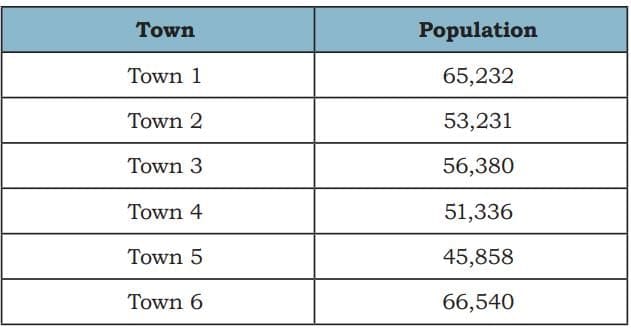
Population of many towns or small cities (e.g., a town with 15,000 people).
Number of vehicles registered in a city.
Number of books in a large public library.
Number of school children in all schools combined in a mid-sized city.
Let Us Do
Page 13
Write 5 numbers between the numbers 23,568 and 24,234. ___________, ___________, ___________, ___________, and ___________
Answers: 23,600; 23,789; 23,920; 24,000; and 24,123.
Write 5 numbers that are more than 38,125 but less than 38,600. ___________, ___________, ___________, ___________, and ___________
Answers: 38,200; 38,300; 38,500; 38,450; and 38,555.
Ravi’s car has been driven for 56,987 km till now. Sheetal’s car has been driven 67,543 km. Whose car has been driven more? ________________.
Answer: Sheetal’s car.
The following are the prices of different electric bikes. Arrange the prices in ascending (increasing) order. ₹90,000 ₹89,999 ₹94,983 ₹49,900 ₹93,743 ₹39,999
Have you ever wondered how birds like the Siberian Crane travel so far and still return to the same place? Or how do we find our way in a new place like a zoo or bird sanctuary? Just like road signs guide us, maps and directions help us reach our destination. In this chapter, you will learn how to find directions using the sun or a compass, read and draw maps, follow routes, guide an ant through a maze, and use coordinates to locate animals in a zoo. With fun puzzles and activities, you’ll become a map master and explore anywhere with ease!
Finding Directions: Face the Rising Sun!
Do you know one simple way to find directions without using a compass? Let’s try this fun activity together!
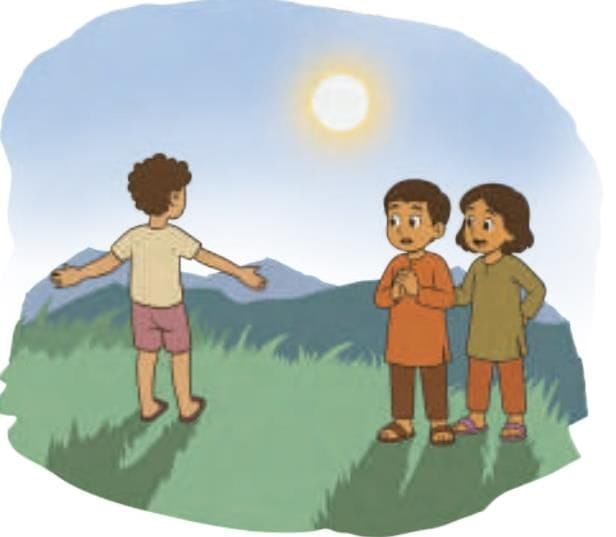
Steps to be followed: 1. Go outside early in the morning or imagine you are standing in a field. 2. Now, face the rising sun. The direction you are facing is called East. The sun always rises in the East! 3. Stretch out your arms to your sides.
Your left hand is now pointing towards the North.
Your right hand is pointing towards the South.
And the direction behind you is West – that’s where the sun sets.
You’ve just found all four cardinal directions — East, West, North, and South — just by facing the sun! Isn’t that cool?
Remember:
Let us perform some activities to understand directions better:
1. Observe the picture above and answer the following:
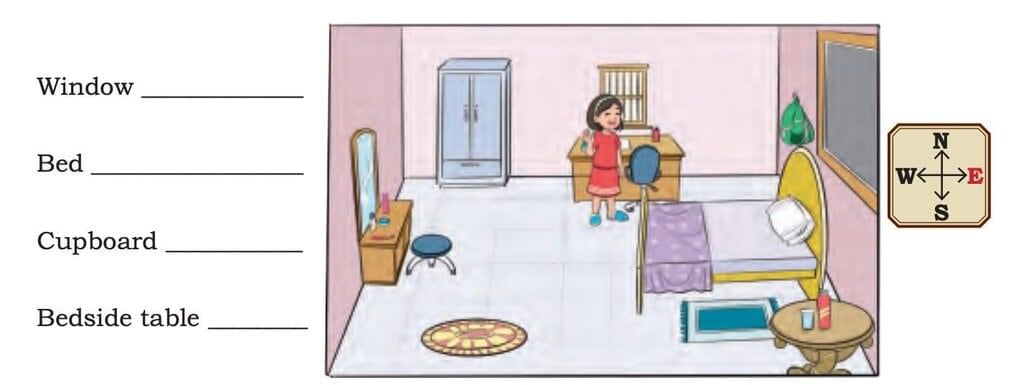
Manu is facing the rising Sun. That direction is East. His left hand is pointing in the North direction. His right hand is pointing in the South direction. West is behind him. 2. Write the directions of the following with the girl.
Ans:
Window — North Bed — East Cupboard — West Bedside table — South
Let’s Learn About Maps!
Have you ever used a map while going on a trip or playing a treasure hunt game?
A map is a special drawing that shows the layout of places – like streets, parks, schools, or even a zoo! Maps help us find places, plan routes, and know which direction to go.
What Does a Map Show?
Places – Like houses, roads, parks, shops, or famous monuments
Symbols – Small pictures or signs that stand for things
Directions – Maps usually have a direction arrow showing North (N), so we can figure out East, West, and South too
Routes – Lines or paths that show how to go from one place to another
Key or Legend – A box that explains what the symbols on the map mean
Now, Let’s Use a Map!
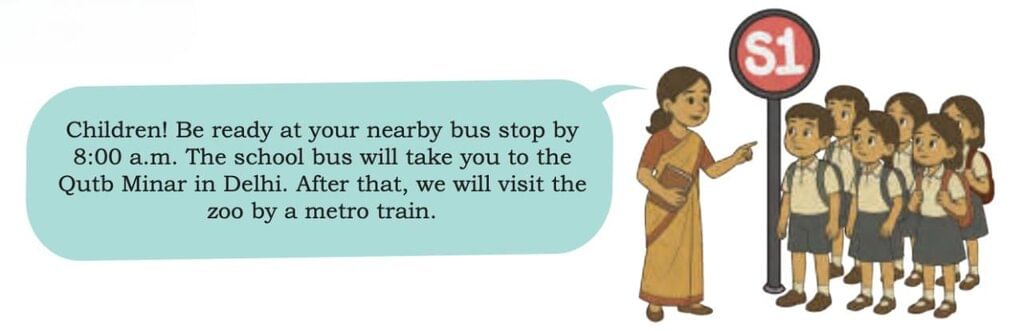
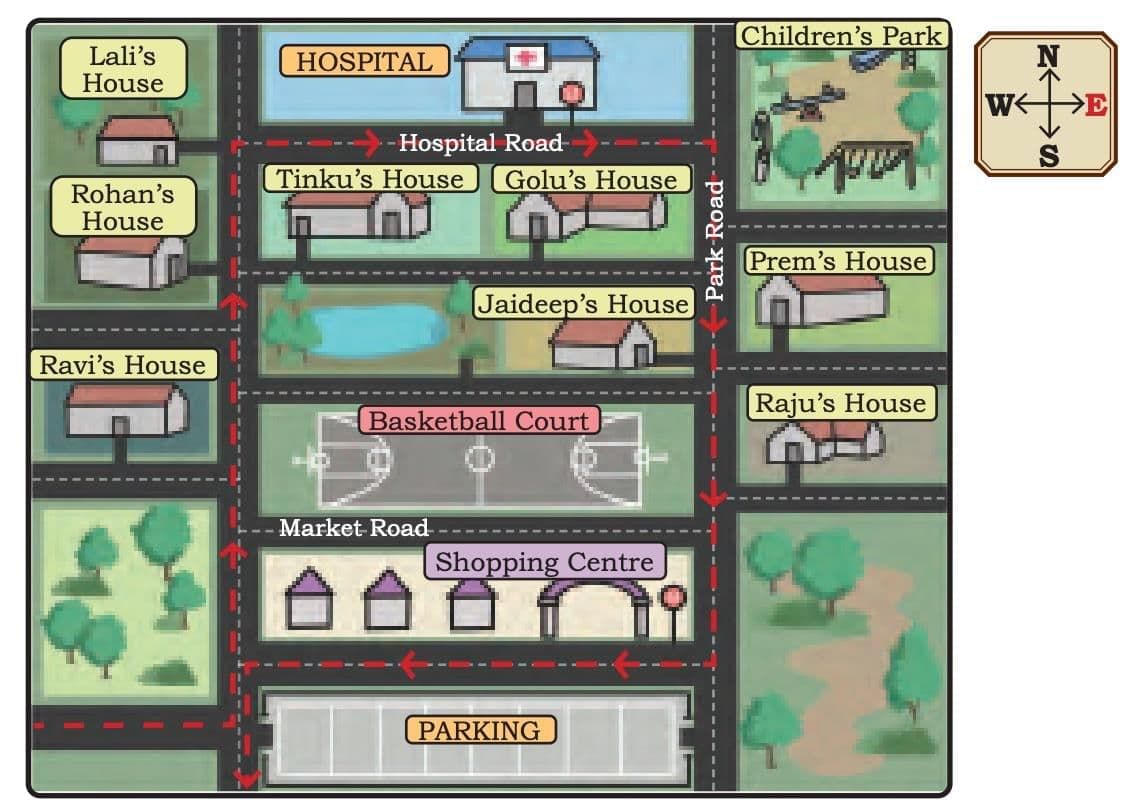
1. The street map shows the bus route with dotted lines. The bus will pick up children from Stop 1 and Stop 2 marked on the map.
Observe the map and help the children board the bus.
The bus will start from the parking area. It will go north and then it will take a right turn onto ___________ Road driving in the ___________ direction to reach Stop 1(S1). To reach Stop 2(S2), it will turn _______ (right/left) onto ___________ Road driving in the ___________ direction.
Ans: The bus will start from the parking area. It will go north and then it will take a right turn onto Market Road driving in the east direction to reach Stop 1 (S1). To reach Stop 2 (S2), it will turn left onto Temple Road driving in the north direction.
Bus Route
(a) Whose houses are situated to the east of Jaideep’s house?____________ (b) Mark the route from Ravi’s house to the children’s park. (c) Which stop is closer to Lali’s house? __________________ (d) Golu is running late. Trace the route to help him reach the nearest bus stop. (e) In which direction would Prem have to move to reach Stop 2?
Ans:
(a) Raju’s house and Prem’s house (b) From Ravi’s house → go north on Hospital Road → turn east to reach Children’s Park (c) Stop 1 (S1) (d) From Golu’s house → go north on Market Road → turn east to reach Stop 1 (S1) (e) North
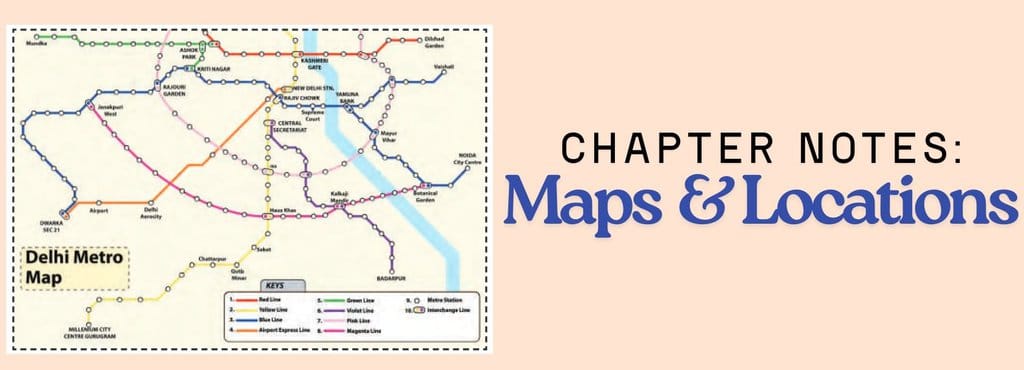
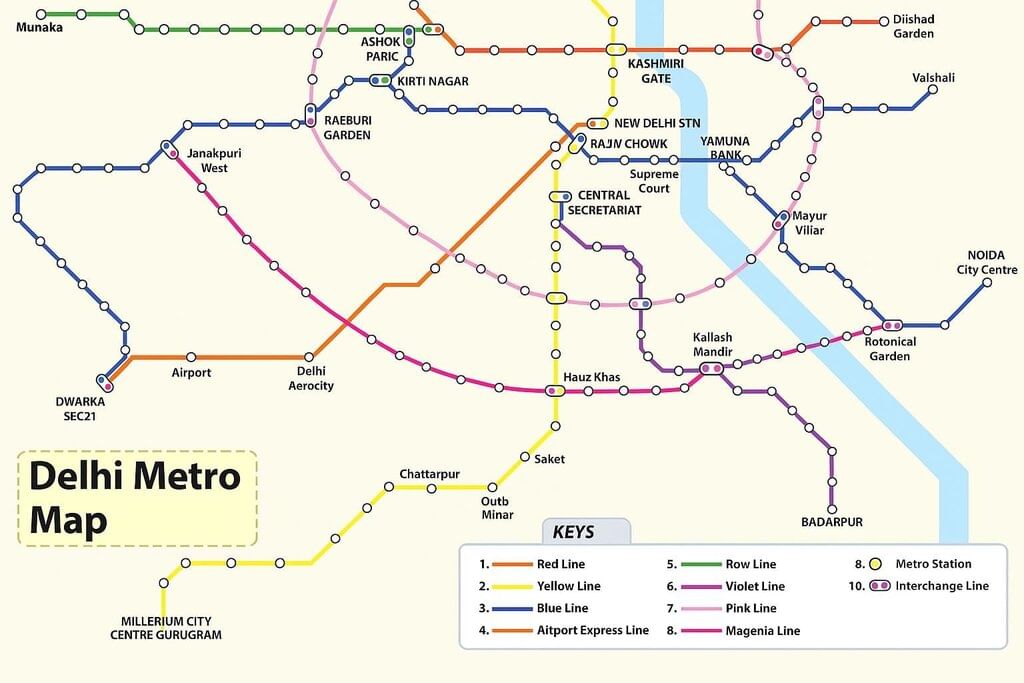
2. Children will get off the bus at the Qutub Minar metro station. To reach the zoo, they need to get off the metro at the Supreme Court metro station. Here is the metro map for your reference. Read the key to the symbols and identify them on the map. What do the different coloured lines represent? Mark the Qutub Minar station on the Yellow Line and the Supreme Court station on the Blue Line.
Study the map carefully and answer the questions that follow.
(a) Look at the metro map and trace different routes from the Qutub Minar metro station to the Supreme Court metro station. (b) Lali says, “We can take the Yellow Line and change the metro at Hauz Khas to take the Magenta Line.” If the children follow Lali’s suggestion, at which station(s) do they need to change the metro line again to reach the Supreme Court metro station? (c) Which route has the least number of stations between Qutub Minar and the Supreme Court? (d) Which metro route(s) do you think, is/are the best way to reach the zoo from Qutub Minar? __________________________
Ans:
(a) Possible routes from Qutub Minar (Yellow Line) to Supreme Court (Blue Line):
Qutub Minar (Yellow) → Central Secretariat (Change to Blue) → Supreme Court
Reason: This is the shortest, simplest route with only one interchange and minimal travel time.
Now that we have understood the concept of maps and directions, let us solve some questions:
1. To collect food, the ant can only crawl along the dotted lines on the grid. The arrows show the direction in which the ant can move.
Fill in the blanks below with the distances and the directions in which the ant must move from its starting position.
(a) To get to the laddoos, the ant has to crawl 2 cm towards the east. (b) To get to the sugar, the ant has to crawl ____cm in the _______direction. (c) To get to the bread, the ant has to crawl ____cm in the _______ direction; then ____cm in the _______direction. (d) To get to the apple, the ant needs to crawl ______ cm towards _________, and then ____cm towards _________, and finally ___cm towards______. Identify other routes to reach the point where Apple is located. Which one is the shortest?
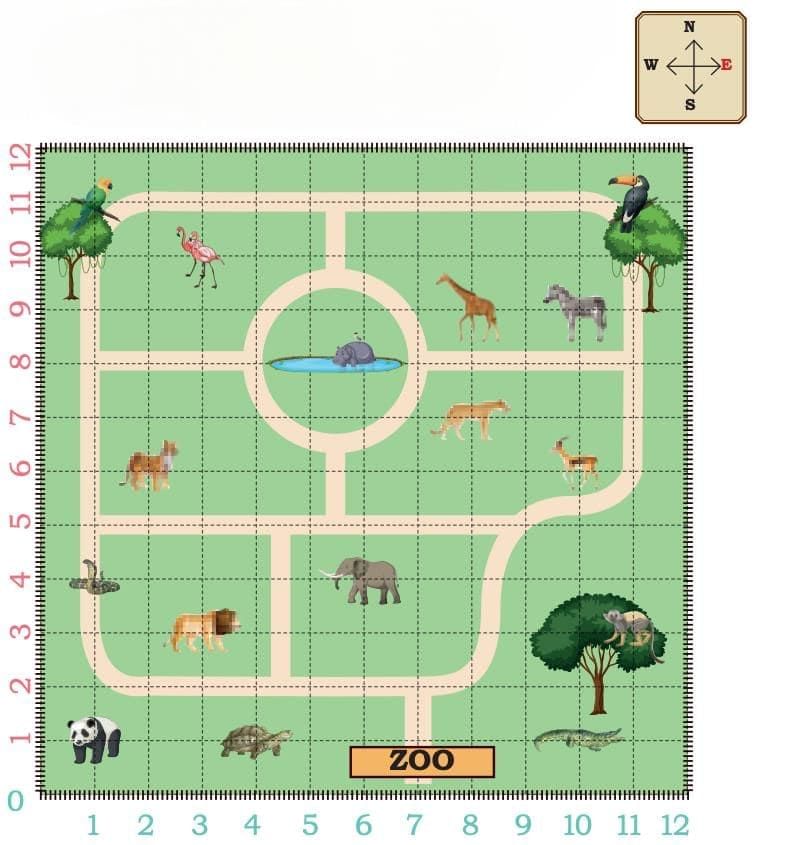
2. Locating the Animals in the Zoological Park (Zoo)
Children observe a map of the zoo drawn on a grid. Each vertical line (column) and horizontal line(row) is marked with a number. To reach the Panda, we will start from zero. Move one step horizontally east and reach the first column. Move up (vertically) one step north and reach the first row. The panda is where the first row and the first column meet.
We write the meeting point of the first row and the first column as (1,1).
To reach the tortoise, move ________ steps towards east and reach the_________ column.
Then move _______ step(s) _______ and reach the first _______.
The location of the tortoise is (4,1). What is at (1,4)?
Answer the following questions now:
1. Locate the animal at the following positions on the map.
Now you know how to find your way using directions, read maps, follow routes, and even use grids to locate places or animals. Maps are like secret guides that help us travel and explore without getting lost. So, whether you are going to a park, a zoo, or even a new friend’s house, you can be a smart explorer and find your way easily!
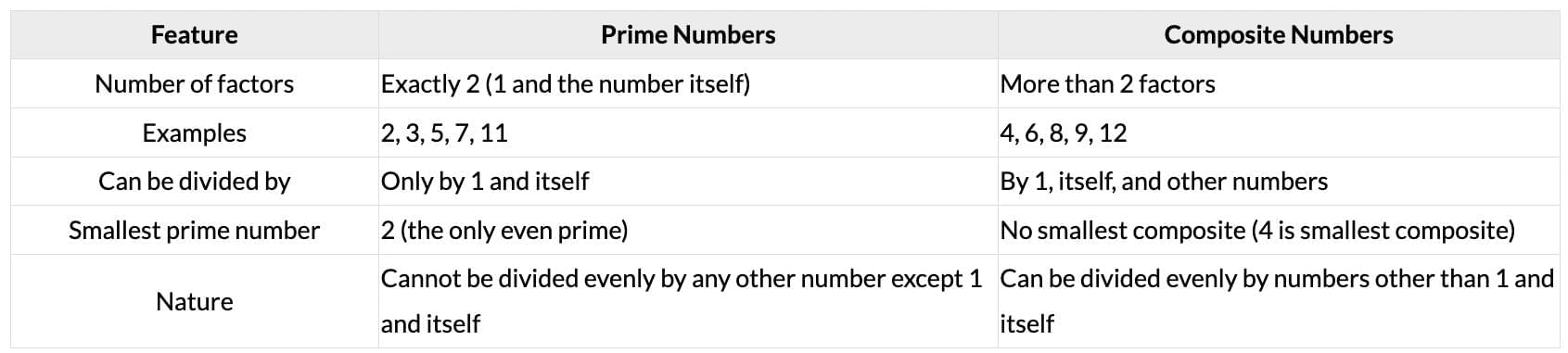
In this chapter, we will learn about factors and multiples and how they are related. A factor divides a number exactly, like 2 is a factor of 8 because 8 ÷ 2 = 4 with no remainder. A multiple is what you get when you multiply a number by a whole number, like the multiples of 3 are 3, 6, 9, 12, and so on. We will also explore common factors (factors shared by two or more numbers), common multiples (multiples shared by two or more numbers), and prime numbers (numbers that have only two factors: 1 and itself).What is a Factor?
A factor of a number is a number that can divide it completely without leaving any remainder.
Example: Factors of 8 are numbers that divide 8 exactly:
1 divides 8 exactly (8 ÷ 1 = 8)
2 divides 8 exactly (8 ÷ 2 = 4)
4 divides 8 exactly (8 ÷ 4 = 2)
8 divides 8 exactly (8 ÷ 8 = 1)
So, the factors of 8 are 1, 2, 4, and 8.
How to find factors?
Start with the number 1 and go up to the number itself.
Divide the number by each one.
If the division has no remainder, then that number is a factor.
Common Factors
When two or more numbers share the same factor, that factor is called a common factor.
Example: Find common factors of 12 and 18.
Factors of 12: 1, 2, 3, 4, 6, 12
Factors of 18: 1, 2, 3, 6, 9, 18
Common factors are the numbers that appear in both lists: 1, 2, 3, and 6.
How to find Common Factors?
Find all factors of the first number.
Find all factors of the second number.
See which factors appear in both lists.
Example 1:
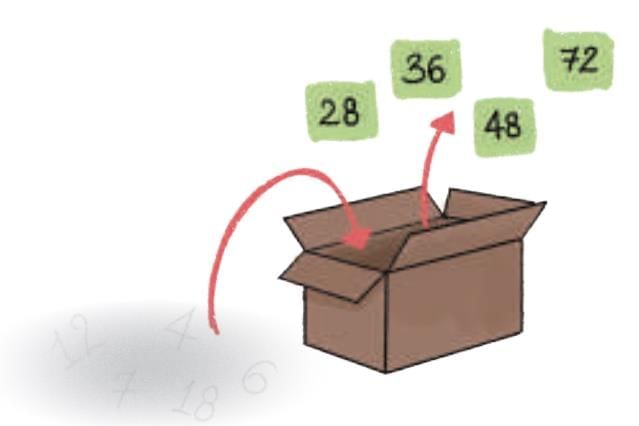
Sometimes, numbers are created by multiplying another number by the same value each time. If we know the final numbers, we can work backwards to find the multiplier. This also teaches us about common factors— numbers that can divide all given numbers exactly. Imagine a magic box. You put a number inside, the box multiplies it by a fixed number, and the result appears. In this activity, the numbers coming out of the box are 28, 36, 48, and 72.
We ask: (a) What could the multiplier be? (b) Could there be more than one multiplier? (c) What numbers might have been inside the box?
To solve this, we find numbers that divide all four outputs exactly. These are common factors.
(a) The multiplier could be 1, 2, or 4 because all the numbers 28, 36, 48, and 72 can be divided evenly by these numbers. (b) Yes, there could be more than one multiplier. For example, if the multiplier were 2, the inside numbers would be half of the given numbers. If it were 4, the inside numbers would be one-fourth of them. (c) The numbers that might have been inside the box depend on the multiplier:
If multiplier is 2 → inside numbers: 14, 18, 24, 36
If multiplier is 4 → inside numbers: 7, 9, 12, 18
If multiplier is 1 → inside numbers: 28, 36, 48, 72 This shows that the same output can come from different possible multipliers.
This activity shows that there can be more than one possible multiplier. It also helps us see that factors divide numbers exactly, while multiples are numbers made by multiplying. The same set of numbers can be made in different ways by choosing different multipliers.How to Identify Factors Using Arrays (Pairs)
A factor pair of a number is two numbers that multiply together to give that number.
For example, for 12:
1 × 12 = 12
2 × 6 = 12
3 × 4 = 12
So, the factors are 1, 2, 3, 4, 6, and 12.
If you try to arrange objects (like dots or blocks) in rows and columns, the number of rows and columns form factor pairs.Example 2:
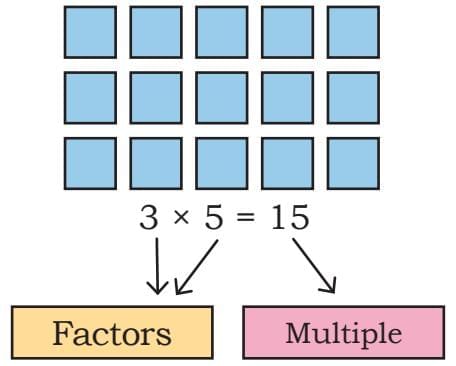
One way to find the factors of a number is by arranging objects into arrays – rows and columns. Each arrangement shows a pair of factors that multiply to make the number.
Here, we see the number 15 can be arranged as 3 rows of 5. This tells us 3 × 5 = 15, so 3 and 5 are factors of 15. This can be seen in the following figure:
Similarly, the number 12 can be arranged as 3 × 4, 2 × 6, and 1 × 12. This tells us its factors are 1, 2, 3, 4, 6, and 12. This can be seen in the following figure:
Students, now try making arrays for numbers like 10, 14, 20, 25, and 32.
Try yourself:What are the factors of 24?
A.1, 2, 3, 6, 12, 24
B.1, 2, 3, 4, 6, 8, 12, 24
C.2, 3, 4, 6, 8, 12
D.1, 2, 4, 6, 8, 24
View SolutionPrime and Composite Numbers
Some numbers are called prime numbers because they have only two factors: 1 and the number itself. For example, 5 is prime because only 1 and 5 divide it exactly.
Other numbers have more than two factors; these are called composite numbers. For example, 12 is a composite number because it has many factors like 1, 2, 3, 4, 6, and 12.
Understanding the difference between prime and composite numbers helps us learn more about how numbers work:
Arrays make it easy to see all the factor pairs of a number. They also help us quickly identify prime numbers, which have only two factors – 1 and the number itself.What is a Multiple?
A multiple of a number is what you get when you multiply that number by any whole number.
Example: Multiples of 3 are:
3 × 1 = 3
3 × 2 = 6
3 × 3 = 9
3 × 4 = 12
and so on…
So, the multiples of 3 are 3, 6, 9, 12, 15, 18, …
How to find multiples?
Multiply the number by 1, 2, 3, 4, etc., and list the answers.Common Multiples
When two or more numbers share the same multiple, that multiple is called a common multiple.
Example: Find common multiples of 3 and 4.
Multiples of 3: 3, 6, 9, 12, 15, 18, 21, 24, …
Multiples of 4: 4, 8, 12, 16, 20, 24, 28, 32, …
Common multiples are: 12, 24, 36, …
How to find common multiples?
Write down multiples of the first number.
Write down multiples of the second number.
See which multiples appear in both lists.
Least Common Multiple (LCM)
The Least Common Multiple or LCM is the smallest number that is a multiple of two or more numbers.
In the example above, the smallest common multiple of 3 and 4 is 12.
How to find an LCM:
List the multiples of each number.
Identify the common multiples from the lists.
Choose the smallest common multiple.
That smallest common multiple is the LCM.
Example 3:
One sunny morning in the forest, Rabbit and Frog decided to have a jumping race. They both started from the same tree stump at position 0 on a long number line painted on the forest floor. Rabbit was fast but liked to take big leaps — 4 steps at a time. The frog was smaller but very quick, jumping 3 steps at a time.
As they hopped along, something interesting happened — they both landed on 12 at the same time! That was their first meeting point. After that, they met again at 24, then 36, and then 48.
The forest owl explained, “These meeting points are called common multiples — numbers that are in both the Rabbit’s list of multiples and the Frog’s list. The first one, where you meet, is called the Least Common Multiple, or LCM.”
Common multiples are numbers that appear in the multiplication tables of both numbers. The smallest one is the LCM, and all other common multiples are multiples of the LCM. When two jump patterns meet, the numbers they land on together are common multiples. Here, Rabbit and Frog’s LCM is 12, so all their common multiples are multiples of 12.
Example 4:
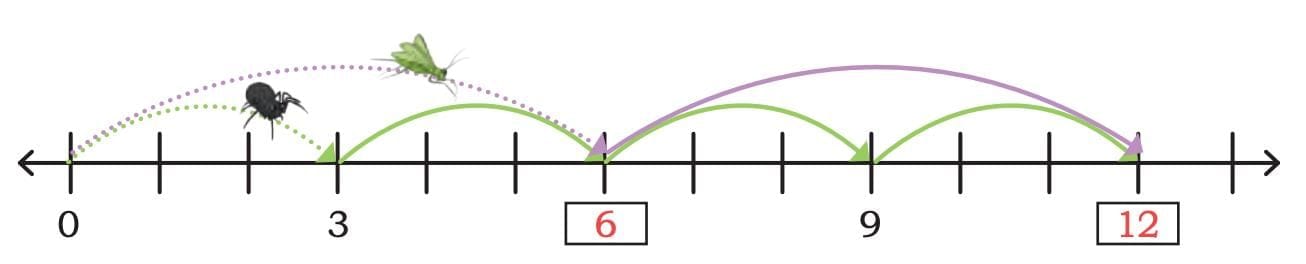
One bright morning, a spider and a grasshopper decided to practise jumping together on the number line. The spider was small but quick, hopping 3 steps each time: 0,3,6,9,12…… The grasshopper was stronger and leapt 6 steps each time: 0,6,12,24……
As they hopped along, they noticed something interesting — they both landed on 6 at the same time. That was their first meeting point. After that, they met again at 12, then 18, then 24, and so on.
The forest parrot explained, “The numbers where you both land together are called common multiples — numbers that appear in both your jumping lists. The first number where you meet is called the Least Common Multiple (LCM).”
In this case, because 6 is already a multiple of 3, every time the grasshopper lands, the spider lands there too. So all the grasshopper’s numbers are also common multiples. The smallest of these, 6, is the LCM of 3 and 6.
Common multiples are numbers that appear in the multiplication tables of both numbers. If one number is a multiple of the other, the larger one becomes the LCM. For jumps of 3 and 6, the common multiples are 6, 12, 18, 24, …, and the LCM is 6. When one number is a multiple of the other, the common multiples are just the multiples of the bigger number.Example 5:
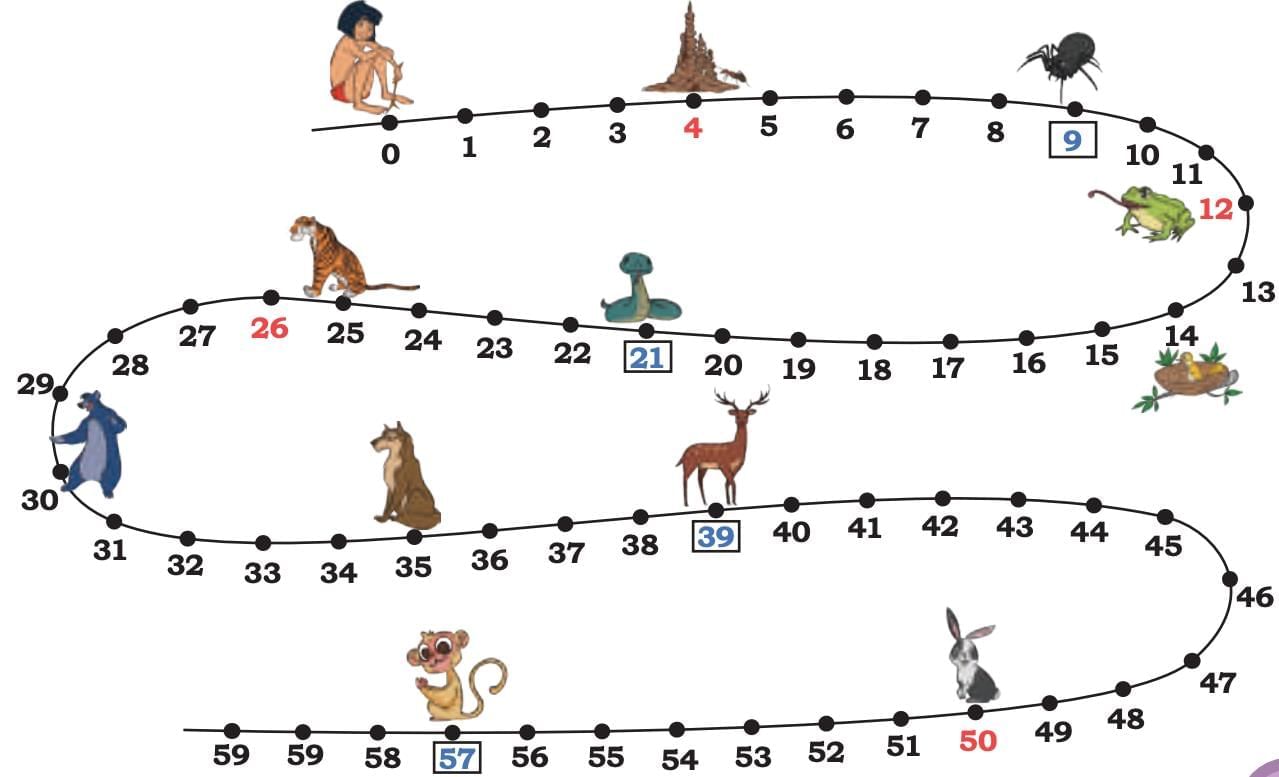
Mowgli was walking along a forest trail where his friends lived at different numbered spots. Starting from 0, he decided to visit his friends by jumping 2 steps at a time.
His jumps went like this: 0,2,4,6,8,10,12,14,16,18……
Looking at the positions on the trail, Mowgli realised he could meet:
The ant at position 4
The frog at position 12
The bird at position 14
The rabbit at position 50
All of these numbers can be divided exactly by 2. This means 2 is a common factor for all these positions — they are all multiples of 2.
When you take jumps of the same size and land on certain numbers, that jump size is a factor of all those numbers. If the same jump works for multiple positions, that number is their common factor. Jumping by 2 steps lets Mowgli meet all friends whose house numbers are multiples of 2. This shows that 2 is a common factor of those numbers.
Try yourself:Which of the following lists shows the first five multiples of 15?
A.15, 25, 35, 45, 55
B.10, 20, 30, 40, 50
C.15, 30, 45, 60, 75
D.1, 3, 5, 15, 30
View SolutionHow to Use Factors and Multiples?
Factors help us divide or break numbers apart.
Multiples help us build numbers up by repeated addition or multiplication.
Common factors and multiples help us solve problems like sharing things equally, finding common timings for events, or arranging objects neatly.
Conclusion
In this chapter, we learned about factors and multiples, two important ideas in numbers. A factor is a number that divides another number exactly without leaving any remainder. Multiples are numbers we get when we multiply a number by whole numbers like 1, 2, 3, and so on. Some numbers share factors, which we call common factors, and some share multiples, called common multiples. The smallest common multiple of two numbers is called the Least Common Multiple or LCM. We also learned about prime numbers, which are special numbers that have only two factors: 1 and themselves. Understanding factors and multiples helps us solve many math problems and real-life situations like sharing things equally and finding common timings.
Time helps us know when things happen and how long they last. Everyday activities—like waking up, going to school, playing, or sleeping—happen at certain times. We measure time in hours, minutes, and seconds. In this chapter, you will learn how hours and minutes are used for most daily activities, while seconds are used for very quick actions like a race, a blink, or turning a page.
What Are Seconds, Minutes, and Hours?
Time is like an invisible ruler that measures how long things take. But instead of using centimetres or metres, we use seconds, minutes, and hours. The smallest unit we often use is a second.
A second is very quick — it’s about the time it takes to blink your eyes, snap your fingers, or say the word “go!” Sixty of these tiny moments make 1 minute.
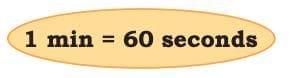
A minute is a little longer — enough time to take a sip of water, tie your shoelaces, or read a short paragraph in a book. One minute = 60 seconds.
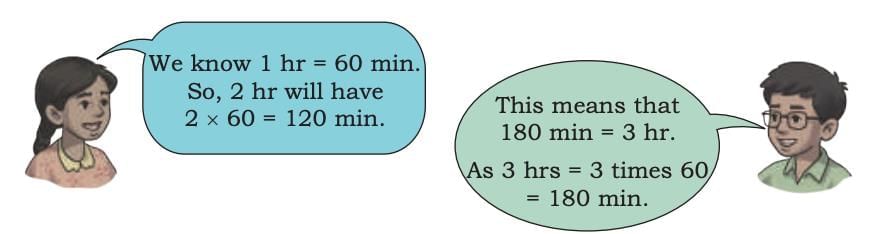
An hour is made of 60 minutes, which means it has 3,600 seconds in total! That’s a lot of seconds. An hour is long enough to watch a cartoon, do a short homework assignment, or play outside with friends before coming back in.
Here’s a quick way to remember:
Seconds are for quick actions.
Minutes are for short tasks.
Hours are for long activities.
Next time you do something, think about it — should you measure it in seconds, minutes, or hours? You’ll start to see time in a whole new way!
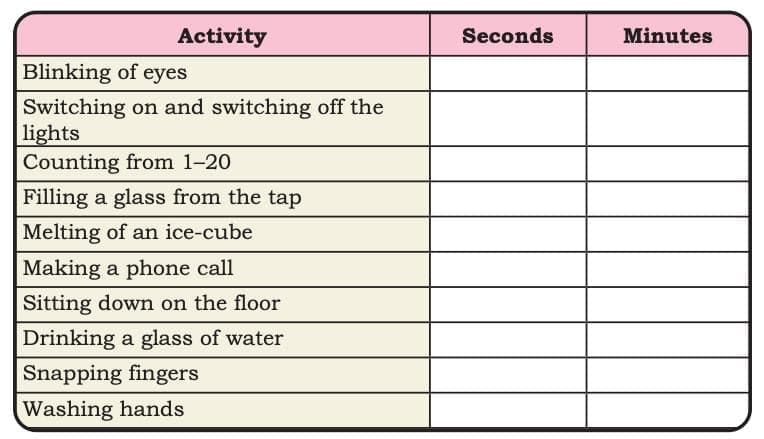
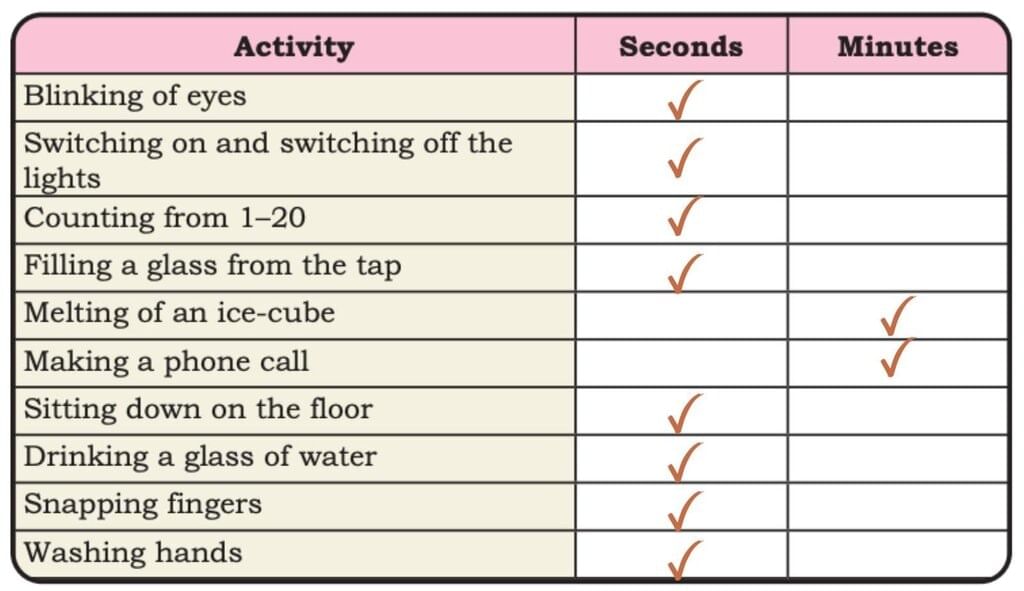
Example: Estimate whether you would take seconds or minutes to complete the following activities. Tick the appropriate cell.
Ans:
Try yourself:
What is a second often compared to?
A.A minute
B.A blink
C.A task
D.An hour
View SolutionTime Duration (Elapsed Time)
Did you know… 1 minute has 60 seconds and 1 hour has 60 minutes? That means in 1 hour, there are 3,600 seconds! Imagine counting every second for a whole hour – it would take forever!
Time duration tells us how long something lasts — from the moment it starts to the moment it ends.
Let’s say a football match starts at 01:15 p.m. and ends at 01:42 p.m.. From 1:15 to 1:42 is 27 minutes. That’s the time duration of the match. For quick activities, we use seconds instead of minutes. If something takes 90 seconds, we can change it into minutes and seconds:
60 seconds = 1 minute
30 seconds left over So, 90 seconds = 1 minute 30 seconds.
Sometimes, the end minutes are smaller than the start minutes. In that case, we borrow 1 hour (which is 60 minutes) before subtracting. This trick helps us find the answer easily.
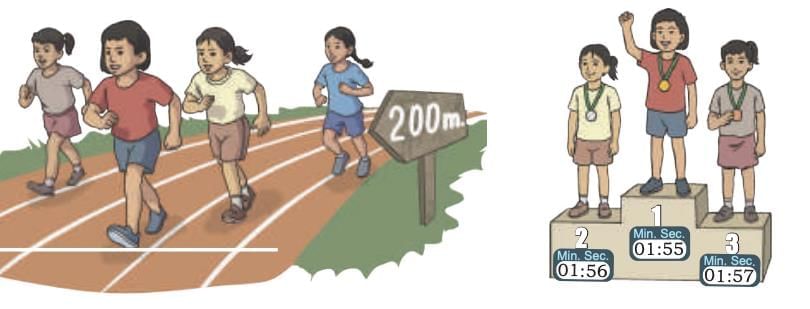
Example: Akira, Sunita, and Mary are participating in a 200 m walking race
Do you notice the use of a new unit, ‘seconds’, in the picture?
In situations like a race, ‘seconds’ help us observe small differences in the time taken by participants.
Each participant took 1 minute, but how much more? Identify the child who won the race. How much time did the child take? Ans: The child who won the race is the one standing in the first place podium — she took 1 minute 55 seconds to complete the 200 m walking race. In races, even a difference of 1 second can change the winner, which is why seconds are used along with minutes to measure time precisely.
Try yourself:
What is time duration?
A.How long something lasts
B.The speed of an object
C.A way to measure weight
D.The distance traveled
View Solution
Mastering the Clock
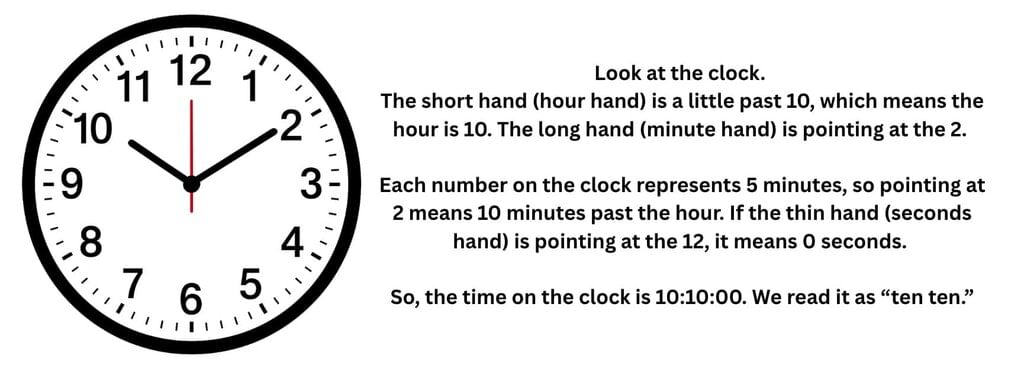
A clock usually has three hands – the hour hand, the minute hand, and the second hand. The hour hand is short and shows the hour, the minute hand is long and shows the minutes, and the seconds hand is thin and moves quickly to show the seconds.
How to read time using a clock:
Look at the hour hand first and see which number it is pointing to or between.
Check the minute hand next. Each big number on the clock represents 5 minutes. For example, if the minute hand is on “3,” it means 15 minutes past the hour.
Check the seconds hand if needed. Like the minute hand, each number represents 5 seconds, and one full round of the seconds hand is 60 seconds or 1 minute.
Example:
Let us perform an activity:
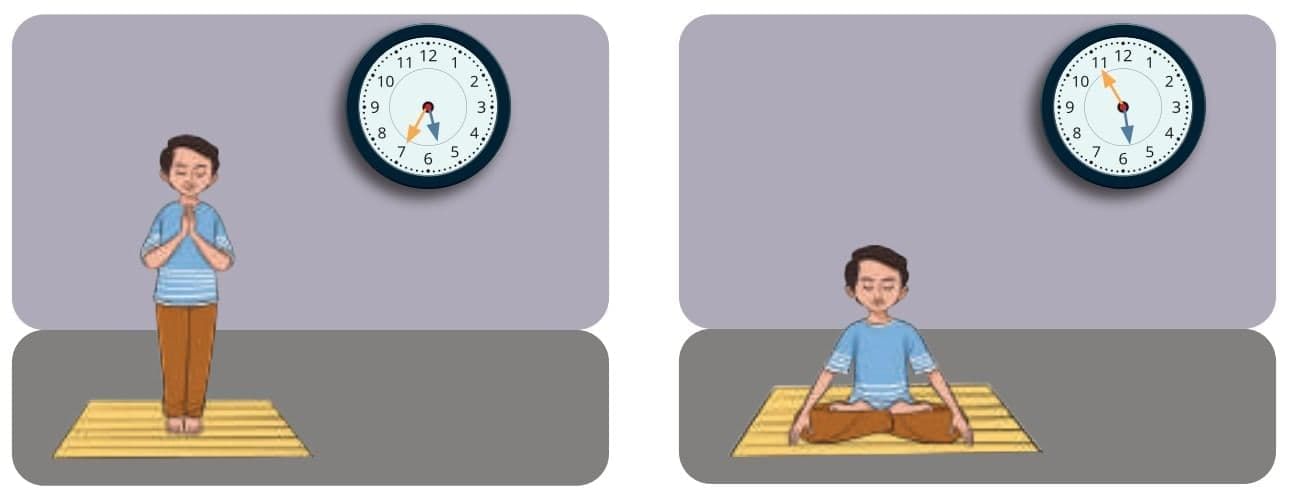
Raghav practices yoga in the morning.
Let us find out
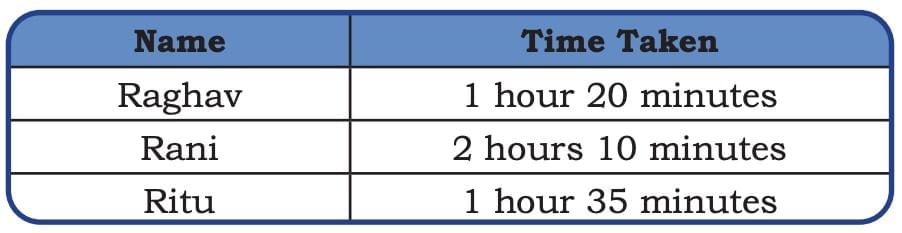
1. At what time did Raghav start practising Yoga? ………………. Ans: The clock shows the short hand (hour hand) between 6 and 7, and the long hand (minute hand) on 6. That means the time is 6:30 a.m. 2. At what time did he finish? ……………. Ans: The second clock shows the short hand near 6 and the long hand on 12. That means the time is 6:55 a.m. 3. How much time did he spend practising Yoga? ……………….. Ans: Start time = 6:30 a.m. End time = 6:55 a.m. Time taken = 25 minutes. 4. Find the time elapsed between the given time periods. Share your strategies. (a) 01:15 p.m. to 01:42 p.m.? → 42 minutes − 15 minutes = 27 minutes. (b) 03:18 p.m. to 08:18 p.m.? → 8 hours 18 minutes − 3 hours 18 minutes = 5 hours. (c) 09:15 a.m. to 11:30 a.m.? → Hours: 11 − 9 = 2 hours. Minutes: 30 − 15 = 15 minutes. Total = 2 hours 15 minutes. 5. The table below shows the time taken by 3 children to paint a picture.
(a) Who took the longest time? Ans: Rani (2 hours 10 minutes) (b) Who took the least time? Ans: Raghav (1 hour 20 minutes)
Try yourself:
What is the main focus of ‘Mastering the Clock’?
A.Understanding schedules
B.Creating clocks
C.Learning to tell time
D.Improving time management
View SolutionConverting Time Formats
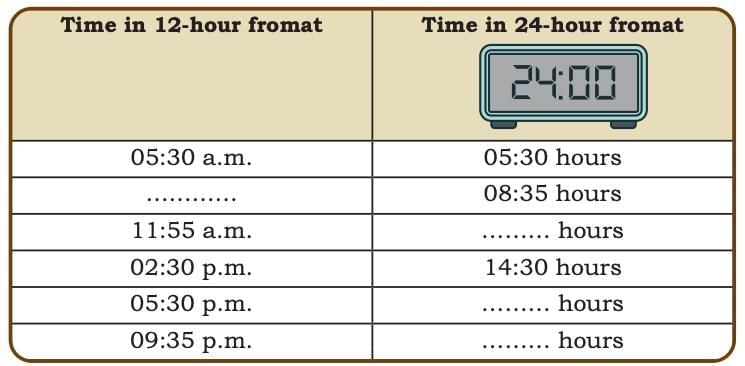
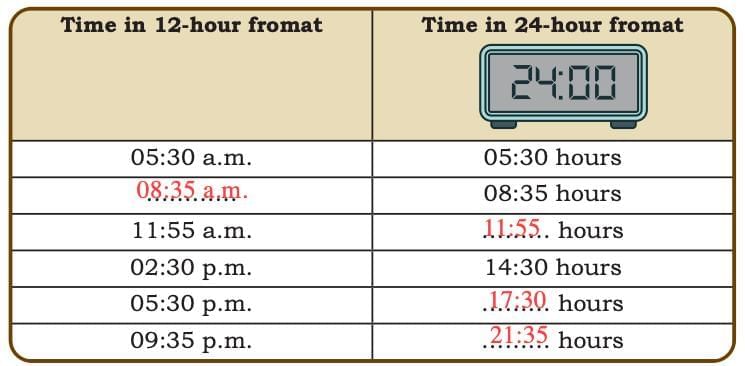
Time can be written in two different ways — the 12-hour format and the 24-hour format. Both show the same time of day but in a different style. Learning to read and change between these formats is important because clocks, watches, and timetables often use different systems.
1. 12-hour format
In the 12-hour format, the numbers on the clock go from 1 to 12 and then repeat. To show whether the time is in the morning or in the afternoon/evening, we use a.m. and p.m.
a.m. stands for “ante meridiem,” which means “before midday.” It is used for times from midnight (12:00 a.m.) to just before noon (11:59 a.m.).
p.m. stands for “post meridiem,” meaning “after midday.” It is used for times from noon (12:00 p.m.) to just before midnight (11:59 p.m.).
For example, if the clock shows 05:30 a.m., it means half past five in the morning. If the clock shows 02:30 p.m., it means half past two in the afternoon.
2. 24-hour format
The 24-hour format counts the hours of the day continuously from midnight (00:00 hours) to just before the next midnight (23:59 hours). There is no need for a.m. or p.m., because the hour number itself tells you if it is morning or evening.
Morning times (midnight to 11:59 a.m.) are written the same as in the 12-hour format, but with hours written as two digits. For example, 5:30 a.m. becomes 05:30 hours.
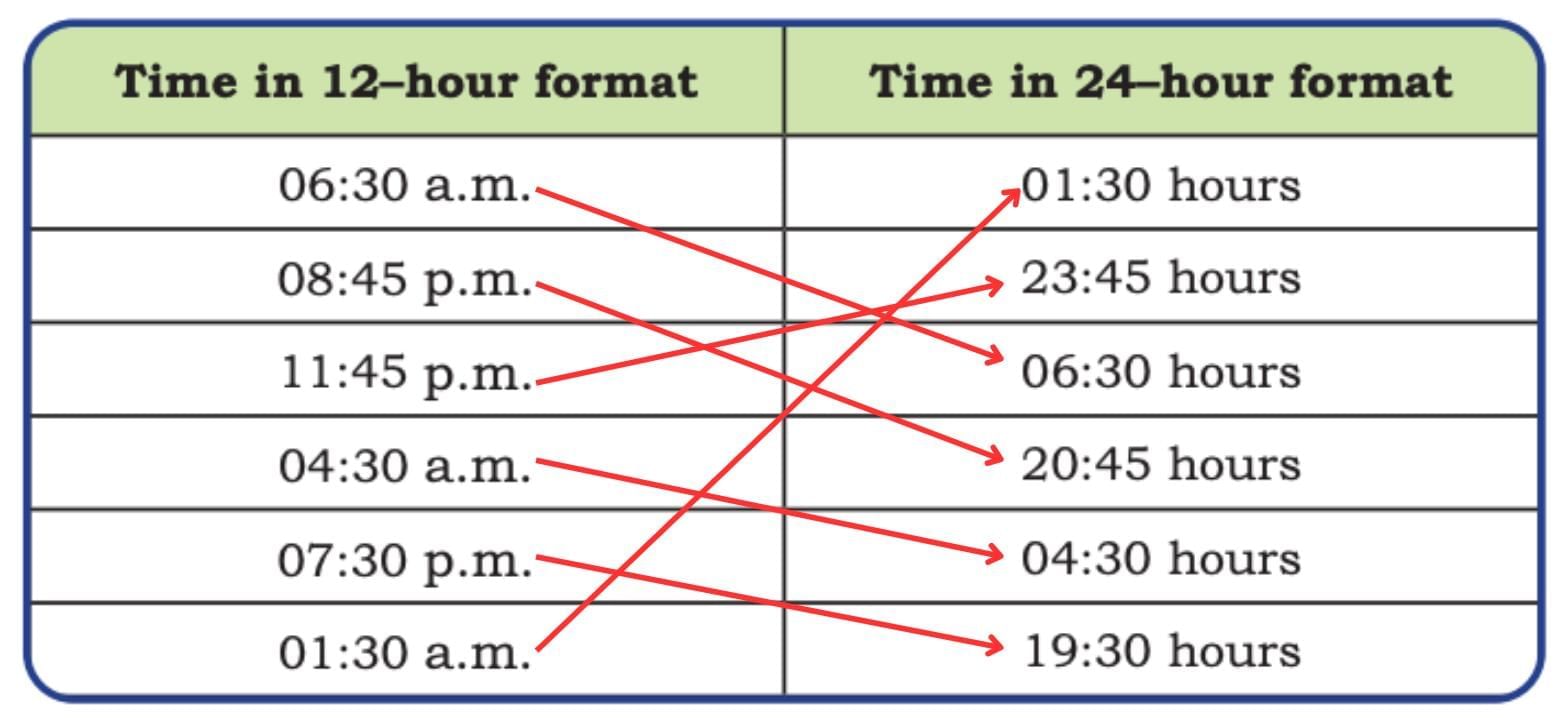
Afternoon and evening times (12:00 noon to 11:59 p.m.) are written by adding 12 to the hour number. For example, 2:30 p.m. becomes 14:30 hours, and 11:45 p.m. becomes 23:45 hours.
Let us perform an activity:
1. Fill in the blanks by writing the time in the appropriate format.
Ans:
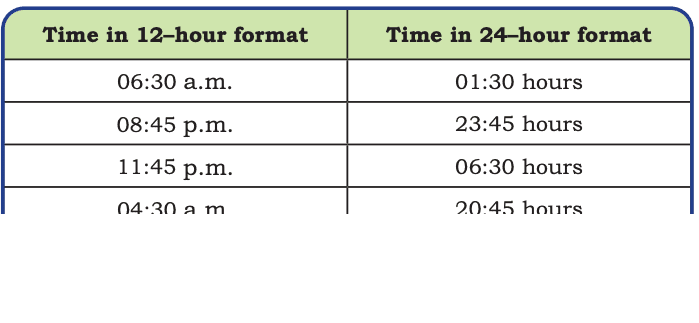
2. Match the following.
Ans:
Try yourself:
What does a.m. stand for?
A.After morning
B.Around midday
C.Before midday
D.After midday
View Solution
Conclusion
Time helps us know when things happen and how long they last. Seconds are for very quick actions, minutes are for short tasks, and hours are for long activities. By learning to read the clock, we can tell the exact time, work out how long something took, and change between the 12-hour and 24-hour formats. Understanding time makes it easier to follow schedules, be on time, and use every moment wisely.