1. We the Travellers — I             – Chapter Notes

Introduction

Have you ever gone on a long trip and wondered how far you travelled or how long it took? Think about where you went, how you got there, and how different your journey would have been a hundred or even a thousand years ago.
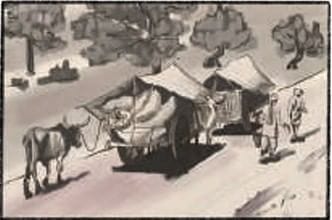
Bullock Carts

Human beings have always been curious explorers. Since ancient times, they have travelled great distances—initially on foot, then using animals like horses, camels, or bullocks. One of the earliest inventions in transport was the boat, even before bullock carts became common. Boats helped early humans cross rivers, lakes, and seas, opening up new lands and trade routes.
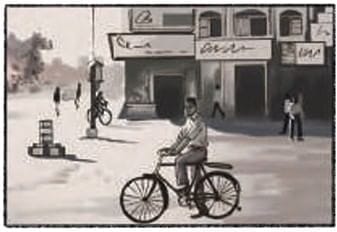
Bicycle

About a hundred years ago, the number of vehicles was very small. People mostly used animal-drawn carts, simple cars, and trains. But over the years, the modes of transport have changed drastically. Today, we have millions of vehicles—cars, buses, motorcycles, airplanes, ships—and this number continues to rise every day.

Reading and Writing Large Numbers

Imagine you have a lot of things, like thousands of candies! How do we write such big numbers? 
Let’s start with 1,000. 
What numbers do we get when we keep adding a thousand?
If we keep adding 1,000, we get these numbersWhat happens when we add 1,000 to 9,000? 
We get Ten Thousand, which is written as 10,000.
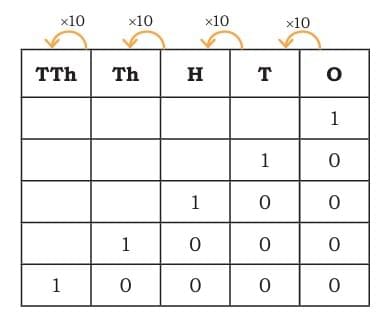
To understand big numbers, we use something called a Place Value Chart. It helps us know the value of each digit in a number. 
Look at the table below and notice the pattern of writing numbers.
Place Value ChartWe add a new column called TTh, which stands for Ten Thousand.

Here’s how it works:

This is 1 

• 10 Ones make 1 Ten (10) 
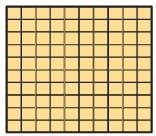
• 10 Tens make 1 Hundred (100) 
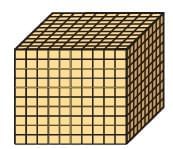
• 10 Hundreds make 1 Thousand (1,000) 

• 10 Thousands make 1 Ten Thousand (10,000)
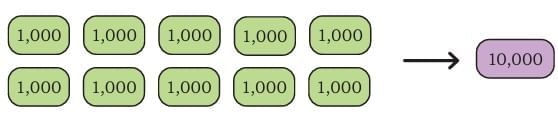
We use commas to make large numbers easier to read. 
For example, 10,000 is read as “Ten Thousand.”

We use the digits from 0 to 9 in different places to write even larger numbers. 
For example:

• 1,380 = 1 Thousand + 3 Hundreds + 8 Tens + 0 Ones.

1,380

• 9,123 = 9 Thousands + 1 Hundred + 2 Tens + 3 Ones.
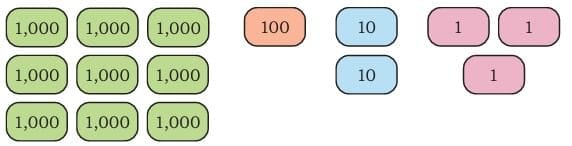
9,123

Let us see how we write numbers beyond 10,000 and how we name them. We write them in the same way as numbers below 9,999.
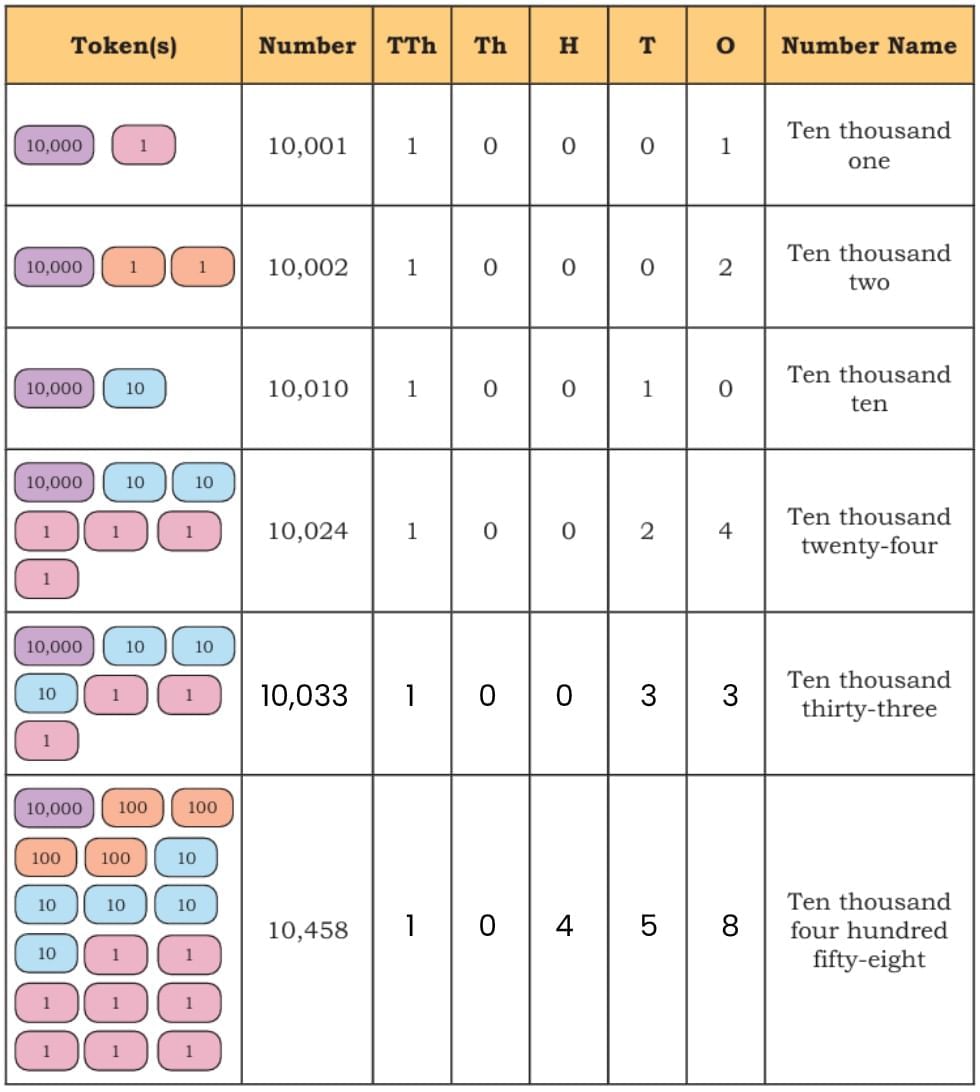
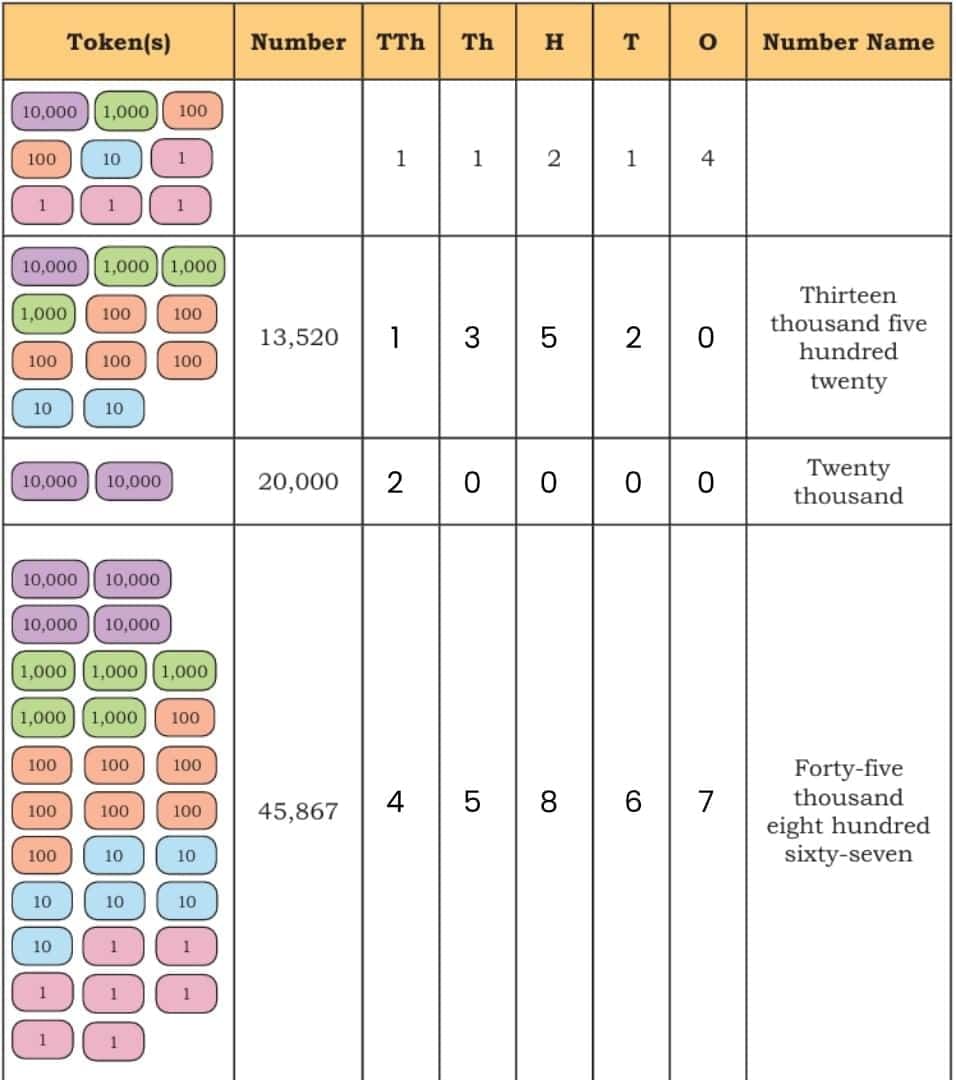
Nearest Tens (10s), Hundreds (100s), and Thousands (1,000s)

Imagine a rabbit trying to find its food! The rabbit needs to go to the nearest place where its food is kept. 

Let’s help a rabbit find its food by understanding how to round numbers to the nearest tens, hundreds, and thousands.

Part 1: Nearest Tens of 2,346

Situation:
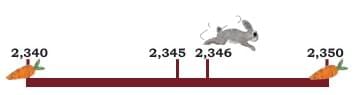
  • The rabbit is standing at 2,346.
  • The food is kept at the neighbouring tens — these are the numbers that are 10 apart from 2,346.
  • The two closest tens are:
    • 2,340 (just before 2,346)
    • 2,350 (just after 2,346)

What to do:

We check which one is closer to 2,346.

  • From 2,346 to 2,340: 6 jumps back
  • From 2,346 to 2,350: 4 jumps forward

Answer:

  • 2,350 is the nearest ten to 2,346
  • It will need 4 jumps to reach 2,350

Part 2: Nearest Hundreds of 2,346

Situation:
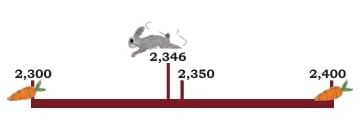
  • The rabbit is still at 2,346
  • The food is now kept at neighbouring hundreds
  • The two closest hundreds are:
    • 2,300
    • 2,400

What to do:

We check which one is closer to 2,346.

  • From 2,346 to 2,300: 46 jumps back
  • From 2,346 to 2,400: 54 jumps forward

Answer:

  • 2,300 is the nearest hundred to 2,346
  • It will need 46 jumps to reach 2,300

Part 3: Nearest Thousands of 2,346

Situation:
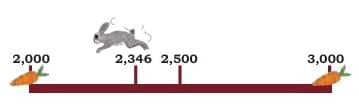
  • The rabbit is still at 2,346
  • The food is now kept at neighbouring thousands
  • The two closest thousands are:
    • 2,000
    • 3,000

What to do:

We check which one is closer to 2,346.

  • From 2,346 to 2,000: 346 jumps back
  • From 2,346 to 3,000: 654 jumps forward

Answer:

  • 2,000 is the nearest thousand to 2,346
  • It will need 346 jumps to reach 2,000

Travelling, Now and Then
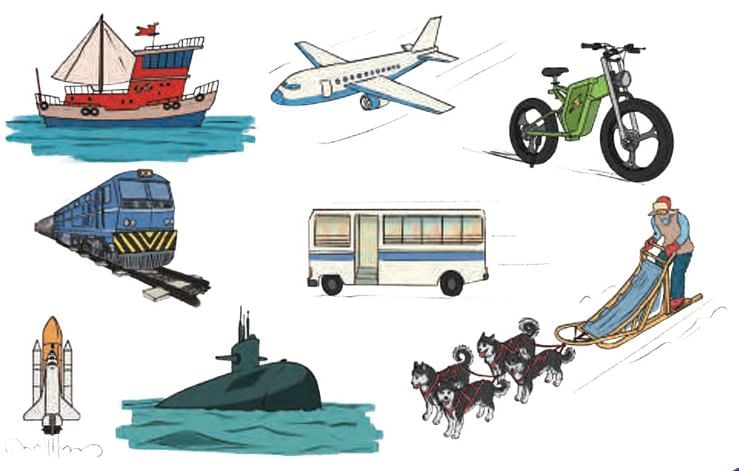
Means of Transport

  • We learnt that people in the past travelled on foot, on animals, and used boats and sailing ships.
  • The animals that have been used for travelling include bullockshorsesdonkeysmules, and elephants.
  • In hilly and snow-covered regions, yaksdogs, and reindeers have been used, while camels have been used in deserts.
  • Now, people use bicyclesmotorbikescarsbusestrainsships, and aeroplanes to travel from one place to another.
  • Submarines are used to go deep under water.
  • Humans are also using spacecraft to travel to outer space.

In an hour a person can generally travel:

  • On foot: 3 – 5 km
  • On horseback: 10 – 15 km
  • By cycle: 12 – 20 km
  • By motorbike: 40 – 60 km
  • By train: 40 – 160 km
  • By ship: 25 – 45 km
  • By aircraft: 750 – 920 km
  • By spacecraft: minimum 28,000 km

Finding Large Numbers Around Us

We saw that the distance (in kilometre) covered by different means of transport in an hour can range from a 1-digit number to a 5-digit number.

Can we find other contexts around us that contain numbers in this range?

Let us consider the situation below.

  • A book has around 200 pages, and each page has about 50 words.
  • The book therefore has about 10,000 words in all.

Usually, we measure distances in sea and air using nautical miles. For now, we will use 1 km = 1,000 m. By now, you know different units of measuring length. We will study the units for measuring lengthkilometre, in detail in a later chapter.

Pastime Mathematics

Math can be fun, even when you are just passing time! Here are some puzzles that involve numbers and logical thinking.

The River Crossing Puzzle
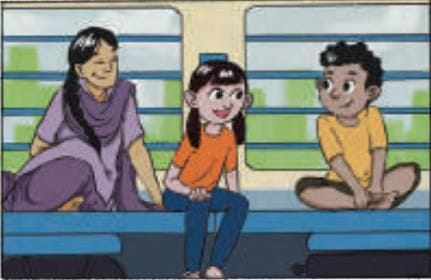
Sanju & Mira in a trainSanju and Mira are sitting in a train. They want to have fun, so they start playing games. Mira gives Sanju a puzzle called the “river crossing puzzle”.

The Puzzle

There is a boatman who wants to cross a river using a small boat.
He has three things with him:
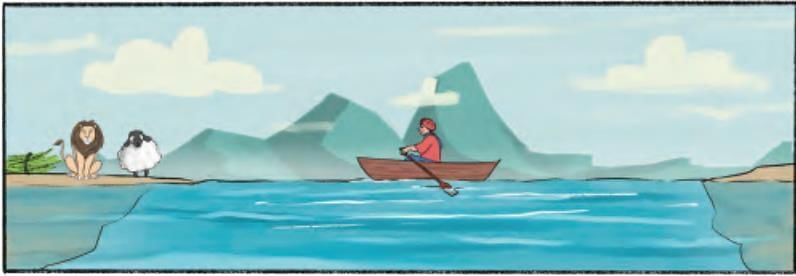
Boatman

  1. lion
  2. sheep
  3. bundle of grass

The boat is very small. It can carry only one thing at a time with the boatman.

But there are two problems:

  • If the sheep and grass are left alone on the riverbank, the sheep will eat the grass.
  • If the lion and sheep are left alone on the riverbank, the lion will eat the sheep.

So the boatman has to be very careful about what he leaves behind when he takes something across.

Goal

Help the boatman take all three — the lion, the sheep, and the grass — to the other side of the river safely.

No one should get eaten, and he should do it in the least number of trips.

Step-by-Step Solution

Let’s go step by step:

First Trip:
The boatman takes the sheep across the river and leaves it on the other side.
Now:

  • Other side: Sheep
  • Starting side: Lion, Grass
  • Nothing gets eaten

Second Trip:
He comes back alone and then takes the lion across the river.
But this time, he does not leave the lion.
Instead, he brings the sheep back with him.

Now:

  • Other side: Lion
  • Starting side: Grass
  • Boat: Boatman and Sheep

Third Trip:
He drops the sheep back on the starting side and takes the grass across the river.
Now:

  • Other side: Lion and Grass
  • Starting side: Sheep

Fourth Trip:
He comes back alone and finally takes the sheep across.

Final Result

All three — lion, sheep, and grass — are safely on the other side.

No one got eaten.

It took the boatman 7 trips total:

  • 4 trips with passengers
  • 3 trips coming back alone or with the sheep

Pile of Pebbles Game

Sanju and Mira are still traveling on the train. Now Sanju teaches Mira a new game called the “Pile of Pebbles.”
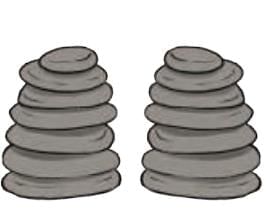
How to Play the Game

  • There are two piles of pebbles.
  • Each pile has 7 pebbles at the beginning.

Rules of the Game:

  1. Two players take turns.
  2. On your turn, you can pick any number of pebbles (1 or more) but only from one pile.
  3. You cannot pick pebbles from both piles in the same turn.
  4. The player who picks the last pebble — that is, there are no pebbles left in both piles after their move — wins the game.

What’s the Challenge?

Mira asks: “How can I make sure I win this game?”

Sanju tells her: “Try playing the game with smaller numbers of pebbles, like 1 in each pile, then 2 in each pile, and so on. Look for a pattern to find a winning strategy.”

Let’s Try Small Examples First

Example 1: 1 pebble in each pile (1, 1)

  • Player 1 takes all the pebbles from one pile.
  • Player 2 takes the last pebble from the other pile — and wins.
  • So, if it starts at (1, 1), the second player wins.

Example 2: 2 pebbles in each pile (2, 2)

  • Player 1 takes 2 from one pile → (0, 2)
  • Player 2 takes 2 from the other pile → (0, 0) → Player 2 wins again

Again, (2, 2) is a losing position for the first player.

Example 3: 3 in each pile (3, 3)

  • Same pattern continues. If both piles are equal, the second player can always copy what the first player does, and win.

What Pattern Do We See?

  • If the two piles have the same number of pebbles, then the second player can always win by copying the first player’s moves.
  • But if the two piles have different numbers, then the first player can win if they know what to do.

Winning Strategy

To win the game:

  • Try to leave the piles in a position where both piles have the same number of pebbles for your opponent.
  • Then, whatever number they take from one pile, you take the same number from the other pile.
  • Keep copying their move until you get the last pebble.

In Our Case (7, 7)

  • The game starts with 7 pebbles in each pile.
  • If you go second, you can win by copying your opponent’s moves.
  • If you go first, you should try to make the piles equal after your move, so the second player cannot copy you and win.

The Number Puzzle

Now it’s Mira’s turn to give a puzzle to Sanju.
She gives him a fun number puzzle that looks simple at first, but has an amazing surprise in the end.

How to Play the Puzzle

Let’s understand the steps clearly:

Step 1:

Pick any two different digits.
For example: 3 and 7

Step 2:

Make two 2-digit numbers using those digits.
You can make:

  • 37 (3 first, 7 second)
  • 73 (7 first, 3 second)

Step 3:

Subtract the smaller number from the bigger number.
Here:
73 – 37 = 36

Step 4:

Now use the two digits of the result (which is 3 and 6)
and repeat Steps 2 and 3.

Let’s do it:

  • 36 and 63
  • 63 – 36 = 27

Use 2 and 7 now:

  • 27 and 72
  • 72 – 27 = 45

Use 4 and 5:

  • 45 and 54
  • 54 – 45 = 9

Now we got a single-digit number — 9.

Mira’s Surprise

Mira says:
“No matter which two digits you start with, you will always end up with 9.”

The whole process will look as shown below.

This makes the puzzle magical and fun. But how did she know that?

Let’s Explore the Pattern

Let’s take a closer look at the examples:
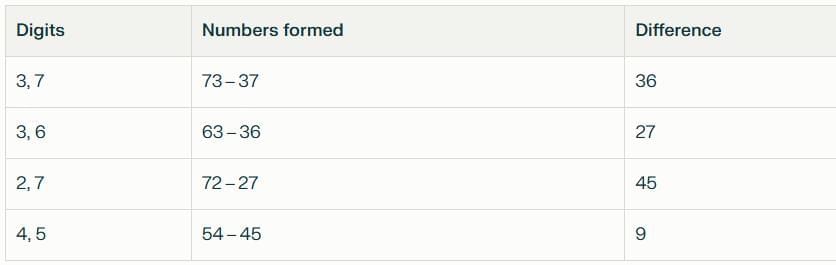
Look at the differences:
36 → 27 → 45 → 9

Each time, we use the digits from the result and continue.

Eventually, we reach 9, a single-digit number.

Try with Other Digits

Let’s try starting with 1 and 9:

  • 91 – 19 = 72
  • Use 7 and 2 → 72 – 27 = 45
  • Use 5 and 4 → 54 – 45 = 9

Again, we get 9.

What’s the Trick or Pattern?

Look at this:
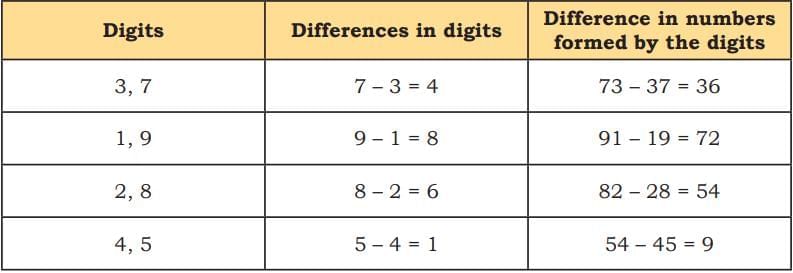
Now look at the relationship:

  • 36 ÷ 4 = 9
  • 72 ÷ 8 = 9
  • 54 ÷ 6 = 9
  • 9 ÷ 1 = 9

So, the difference between the two numbers is always a multiple of 9.

That’s how Mira knew that the process will always end at 9.

Try This Yourself

Try different starting digits and make your own table:

  • Choose digits so that the difference between the numbers is 2, 3, 5, or 7.
  • See what pairs of digits give you 9 in just one or two steps.
  • See which pairs take the longest time (most steps) to reach 9.

King’s Horses

There was once a king who loved horses a lot. He had 20 beautiful horses. The king kept his horses in a big building called a stable. There, a man called a caretaker took care of the horses for the king.

One day, a thief sneaked in at night and stole one horse! Now there were only 19 horses left. The caretaker was scared that the king would be angry if he found out a horse was missing.

So, the clever caretaker tried to trick the king! He arranged the horses in a way so that when the king looked, he saw 5 horses on each side of the stables, and there are 4 sides. The king counted: 5 on this side, 5 on that side, 5 on another, and 5 on the last, which makes 20 horses. The king thought all the horses were there and went away happy.

But there really weren’t 20 horses left! 
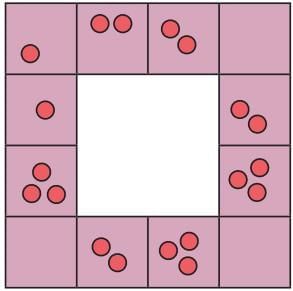
If you count the horses one by one, you’ll see there are only 19 horses. So, what was the caretaker’s trick?

Here’s the trick:
The caretaker put some horses at the corners of the square. These corner horses are counted on both sides — for both sides they are on! For example, if there’s a horse in the left corner, you might count it for the left and the top sides.

So, the king was counting the same horse twice for two sides!

The next night, the thief came again and took one more horse. Now only 18 horses were left. The caretaker moved the horses again, so the king saw 5 horses on each side the next day.
13. Our Home: Earth, a Unique Life Sustaining Planet – Chapter Notes

What would Earth be like if it had never known life at all?
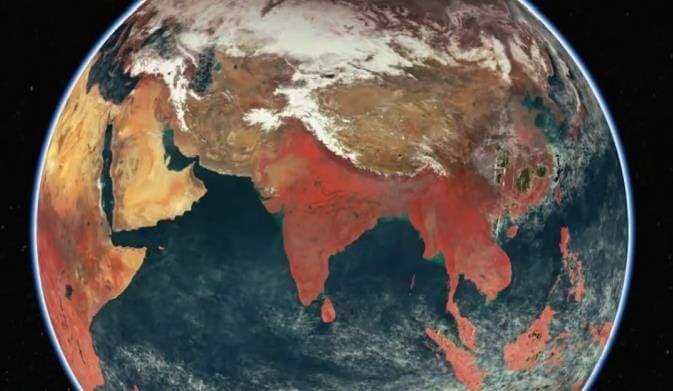
Our planet, Earth, is not just another ball of rock in space. It’s the only known place in the universe that’s bursting with life, from towering mountains to deep oceans and green forests. With the help of powerful satellites like those from ISRO, scientists are uncovering what makes our planet so special. 

Image by Earth Observation Satellite (ISRO)

In this final chapter, you’ll explore what makes Earth so uniquely fit for life. As we tie together everything you’ve learned so far, get ready to discover the special conditions that make our home a truly life-sustaining planet.

About the Image:

  • The image was captured by an ISRO Earth Observation Satellite.
  • It is a mosaic, created by combining nearly 3,000 smaller images.
  • This is a false colour image—special colours are used to highlight different types of information.
  • Such images help scientists study land, water, plant growth, and environmental changes more clearly.

Why Is Earth a Unique Planet?

Out of the billions of planets in the universe, Earth is the only one we know that has life in so many forms—plants, animals, people, and more.

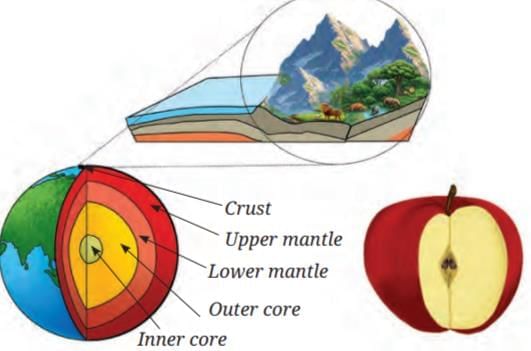
Earth’s Crust is like the thin skin of an apple

  • All living things—from the highest mountain to the deepest ocean—exist on a very thin layer on Earth’s surface called the crust.
  • If the Earth were the size of an apple, the crust where all life exists would be as thin as the apple’s skin.
  • Beneath the crust, there are other layers: upper mantle, lower mantle, outer core, and inner core, but life exists only in the crust.

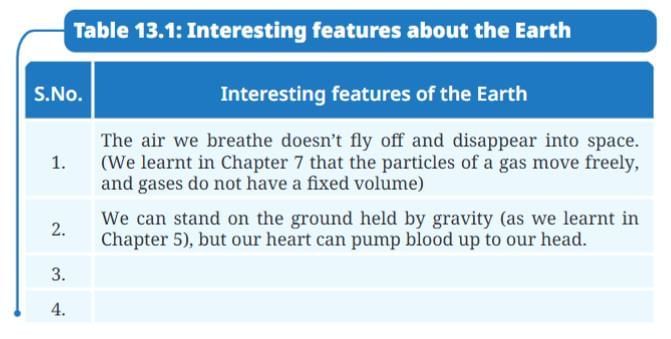
Activity 13.1: What Makes Earth Special?
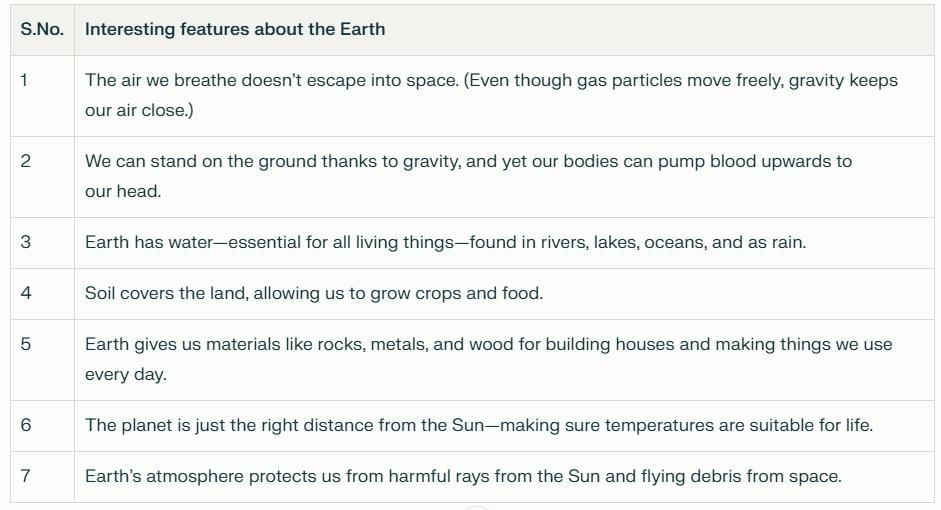
Think about and list some interesting features of Earth that we might take for granted, but which matter a lot for our lives. For example:

Here is the completed table, but you can add your own observations and discuss:

What makes this thin layer so important?

  • Though the crust is very thin compared to the whole Earth, it provides everything needed for life. 
  • Earth gives us the air we need to breathe.
  • It provides water for drinking and other needs.
  • Soil on Earth helps us grow crops and food.
  • Earth supplies materials like rocks, timber, and metals to build homes, buildings, and roads.
  • These features make life possible and help us survive and develop.

What Do the Planets of Our Solar System Look Like?

The Solar System has eight planets that move around the Sun in nearly circular paths (orbits).

Planets in order from the Sun:

  1. Mercury
  2. Venus
  3. Earth
  4. Mars
  5. Jupiter
  6. Saturn
  7. Uranus
  8. Neptune

Types of Planets:

  • Mercury, Venus, Earth, Mars: Smaller, rocky planets.
  • Jupiter, Saturn, Uranus, Neptune: Larger, mostly made of gases.

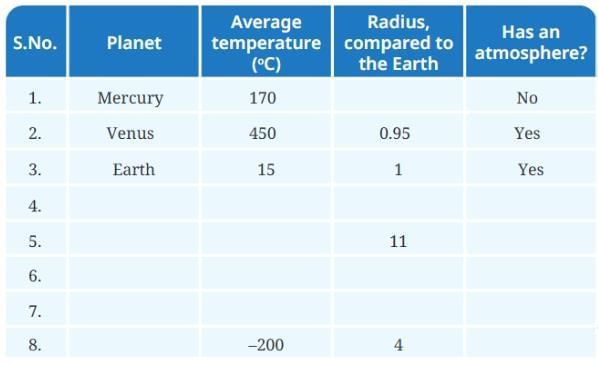
Activity 13.2: Comparing Planets
Collect and compare information about:

  • The average temperature of each planet.
  • How big it is (radius) compared to Earth.
  • Whether it has an atmosphere.
  • Fill out the missing information in this table: 

Observation:

  • All planets in the solar system get their energy from the Sun.
  • Generally, planets closer to the Sun are hotter, and those farther away are colder.

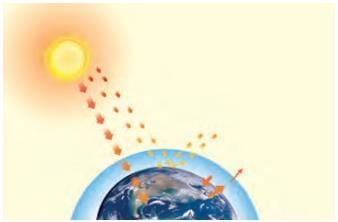
Why Is Venus the Hottest Planet?

  • Even though Venus is not the closest planet to the Sun, it is the hottest.
  • This is because Venus has a thick atmosphere made almost entirely of carbon dioxide.
  • Carbon dioxide traps heat—this is called the greenhouse effect.
  • On Venus, the greenhouse effect is very strong, so the planet is even hotter than Mercury.

On Earth: The greenhouse effect also works, but less strongly. Gases like carbon dioxide trap some of the heat radiated from Earth, keeping the planet warm enough for life.

Difference between planetary and plant greenhouse:

  • On Venus and Earth: Atmosphere traps heat using greenhouse gases.
  • In a plant greenhouse: Glass walls trap warm air by keeping it from escaping.
  • Both keep things warm, but the process is different.

What Makes the Earth Suitable for Life to Exist?

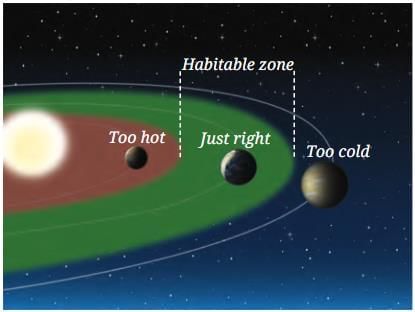
1. Position of the Earth (“Habitable Zone”)

Earth’s distance from the Sun is just right—not too close and not too far.

  • This perfect distance keeps temperatures so that water mostly exists as a liquid, which is essential for all known life.
  • If Earth were closer to the Sun: too hot, all water would evaporate.
  • If Earth were farther: too cold, all water would freeze.
    Habitable Zone
  • Liquid water is needed for life to evolve and survive. While some bacteria can live in ice, complex life forms like plants, animals, and humans need liquid water.
  • The range around a star where liquid water can exist is called the habitable zone or Goldilocks zone (“just right”—not too hot, not too cold).
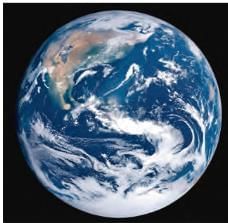
  • Over 70% of Earth’s surface is covered with water, giving Earth its name: the Blue Planet.
    Blue Planet

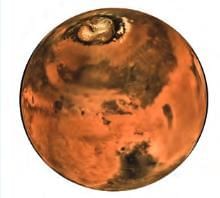
Mars and Life: Mars is at the edge of the Sun’s habitable zone.

Mars

  • Scientists have sent many spacecraft and rovers to Mars.
  • No proof of current life has been found, but Mars may once have had liquid water and simple life.
  • Science is open to new discoveries—future missions and studies may change what we know.

2. Size of the Earth and it Atmosphere

Earth’s nearly circular orbit keeps sunlight and temperature across the year mostly steady, preventing extreme burns or freezes.

  •  Earth’s size is “just right”: If Earth were smaller, its gravity would be too weak to hold the atmosphere. Most gases would escape into space (just like on Mars and Mercury).
  • If Earth were much bigger, gravity could be so strong it might crush living things.
  • The atmosphere on Earth is essential for life: It provides oxygen for breathing.
  • Some atmospheric oxygen turns into ozone, making the ozone layer.
  • The ozone layer acts as a shield, blocking harmful ultraviolet (UV) rays from the Sun, which can damage living cells.
  • The atmosphere also traps enough heat (greenhouse effect) to keep Earth warm but not too hot.

Our Scientific Heritage: Exploring Mars
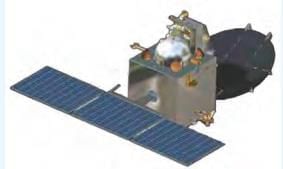
Mangalyaan

  • India’s Mangalyaan (Mars Orbiter Mission), launched by ISRO in 2013, is a major step in studying Mars.
  • This mission studied Mars’ atmosphere, surface, and searched for signs of past water, asking if Mars could ever have supported life.
  • Mangalyaan proved India’s space science strength, showing what can be done with low-cost, smart technology.

3. Magnetic Field of the Earth

Along with Earth’s right position from the Sun, size, and atmosphere, the magnetic field is another key factor that makes sure Earth is a safe and life-supporting planet.

  • Earth behaves like a giant magnet, which is why a freely suspended magnet (like a compass) always points in a fixed direction.
  • The area around a magnet, where its effects are felt, is called the magnetic field.
  • Scientists believe that the movement of molten iron in Earth’s core creates Earth’s magnetic field.

Why is Earth’s Magnetic Field Important?

Earth is constantly bombarded by tiny, high-energy particles from space:

  • Cosmic rays (from far across the universe)
  • Solar wind (charged particles from the Sun)

These particles can be harmful as:

  • They can damage the atmosphere,
  • Reduce the ozone layer,
  • Increase harmful UV rays reaching Earth,
  • And harm living things.

The magnetic field acts as a shield:

  • It pushes many of these harmful particles away from Earth,
  • Helps keep the atmosphere safe,
  • Protects living beings and life on our planet.

What Allows Life to Be Sustained on Earth?

Earth has the right conditions for life, but it is the connections between living (biotic) and non-living (abiotic) things that truly help life thrive on Earth.

Air, Water, and Sunlight

  • The atmosphere of Earth provides essential oxygen for breathing (respiration) for humans, animals, and plants. Plants, in turn, take in carbon dioxide from the air and water from the soil to produce food through photosynthesis, a process that requires sunlight. During photosynthesis, plants release oxygen back into the air, maintaining the balance needed for life.
  • Sunlight is crucial as it heats the surface of the Earth and provides the energy needed for all life processes. Some of this heat is trapped by the atmosphere in what is known as the greenhouse effect, keeping the planet warm enough for water to stay liquid. Without this protective blanket of air, Earth would lose its heat quickly and become too cold for life to exist.
  • Water, which covers nearly 70% of Earth’s surface and forms the hydrosphere (including ponds, lakes, rivers, seas, oceans, and groundwater), is essential to all living things. Water dissolves and transports nutrients in plants and animals, helps animals regulate temperature and digestion, and ensures hydration.
    – The hydrosphere is home to countless species, from tiny plankton to giant whales—many still undiscovered.
    – Freshwater is needed for growing crops and supporting people everywhere.
    – Water vapor in the air forms clouds, which bring rain and snow, refilling rivers, lakes, and underground sources.
    – Rainfall determines what kinds of plants and animals can live in a place.
  • Air movement (wind) also shapes weather and affects when and where it will rain, which influences farming, water supply, and all life on land.

Soil, Rocks, and Minerals

  • The Earth’s crust, or geosphere, is made up of rocks, soil, and minerals. This layer provides almost everything that living things need to survive.
  • Soil is essential for life. It allows plants to grow and contains nutrients like nitrogen and potassium, which come from the breakdown of rocks and the remains of dead plants and animals.
  • Minerals found in rocks and soil are valuable resources—they give us salt, coal, oil, iron, copper, and many other materials needed for building, manufacturing, and daily life.
  • Geodiversity means the variety of landforms, rocks, and soils on Earth. This diversity creates different habitats and environments, helping many kinds of plants and animals to live and thrive.
  • Non-living parts of nature—like soil, rocks, and water—are not just a background; they play an active role in shaping and supporting every form of life on our planet.

Plants, animals, and microorganisms

The biosphere is the zone where life exists on Earth—including land, water, and the lower atmosphere. It contains all living things: trees, shrubs, herbs, animals, insects, and even microscopic organisms like bacteria and fungi.

Every living thing is connected.

  • Plants use photosynthesis to make their own food from sunlight, water, and carbon dioxide.
  • Animals depend on plants (and sometimes other animals) for food and energy.
  • Microorganisms (like bacteria and fungi) are decomposers. They break down dead plants and animals, returning valuable nutrients to the soil and making them available for new life.
  • These connections mean all living beings depend on one another and on their environment, working together in a balance that supports life on Earth—this is the essence of ecology.

 The Importance of Balance

  • Earth is a massive, interconnected system—land, air, water, and life forms all interact.
  • Even small changes (like cutting down forests) can impact rainfall, soil quality, air, and animals.
  • Life is possible because everything stays balanced—preserving this balance is essential for a healthy and habitable Earth.
  • Protecting clean air, water, soil, and all forms of life keeps Earth healthy for the future.

What Keeps Life from Disappearing?

If plants and animals did not reproduce, living things would eventually disappear from Earth.

What is Reproduction?

  • Reproduction ensures that every kind of organism continues, helping life last through generations.
  • Usually, young ones look similar to their parents (cows have calves, cats have kittens) because parents pass down instructions, called genes or genetic material, to their offspring.
  • Genes work like an instruction manual inside every cell, telling it how to form different body parts.

Why is Reproduction Important?

  • Keeps each species (type of organism) going, generation after generation.
  • Allows for small changes (variations) in genes over time.
  • Sometimes these changes help living things survive better in their environment (e.g., camels evolved humps for desert survival).
  • Microbes can become resistant to antibiotics.
  • Over many generations, these small changes can build up and even create new types of living beings.

How Can Offspring Be Similar Yet Different?

Reproduction can lead to both similarity (children look like their parents) and variety (differences, like height or colour). There are two main types of reproduction:

  1. Asexual reproduction: New organisms are almost exact copies of the parent.
  2. Sexual reproduction: Offspring have features from both parents, with some differences.

Asexual Reproduction

In Asexual reproduction, one parent produces new individuals, which are genetic copies. 
Example: Many plants can reproduce when any part of the plants—leaf, stem, or root—is planted in soil. This kind of reproduction is called vegetative propagation.

Activity 13.3: Vegetative Propagation in Plants

  • Plant stem cuttings (e.g., money plant), potato eyes, or pieces of ginger in moist soil.
  • Give them water, air, and sunlight.
  • Observe daily to see when roots, stems, and new leaves appear.
  • This shows how some plants can grow new individuals from just a part of the original plant.

Other examples of Asexual Reproduction (besides plants):

  • Bacteria, amoeba: Divide into two identical individuals.
  • Algae, Planaria: Can regrow from small pieces.
  • Hydra: Grows buds that break off to form new individuals.
  • Planaria: Flatworm can regrow from a fragment (studied for regeneration).

Sexual Reproduction

Sexual reproduction is the process by which two parents, usually called male and female, give rise to new offspring.

  • This is common in almost all animals and flowering plants. Even some microorganisms, like certain bacteria and yeast, have mating types that act like two parents.

Special Cells for Reproduction: Gametes

Both parents produce special reproductive cells called gametes.

  • Male gametes (sperm in animals, pollen in plants)
  • Female gametes (egg in animals, ovule in plants)

Gametes carry half the genetic information of each parent. When male and female gametes combine (a process known as fertilisation), they form a single new cell called a zygote. The zygote contains a complete set of genetic instructions—half from each parent.

Why Don’t Babies Look Exactly Like Their Parents?

  • Every offspring gets a unique mix of genetic material from both parents.
  • That is why babies, calves, kittens, or chicks are similar to their parents but do not look exactly the same.
  • Even siblings can have different features, like different eye or hair color, depending on which genes are inherited.
  • This mixing of genes provides variation, which is important for evolution and adaptation.

Sexual Reproduction in Plants

  • Flowering plants have both male and female parts:
    – Anther (male part): Produces pollen grains (male gametes).
    – Ovule (female part): Found inside the ovary of the flower; contains female gametes.
  • Pollination: Pollen is transferred (by wind, insects, or animals) from the anther to the stigma of a flower, often a different flower.
  • Fertilisation: Pollen reaches the ovule, and gametes fuse to form a zygote inside the ovule.
    – The zygote develops into a seed.
    – The ovule becomes the seed, and the surrounding part of the flower develops into a fruit.
  • Seed Dispersal: Fruits are often eaten by animals or birds, who carry the seeds far from the parent plant. When seeds fall in a suitable spot with sufficient water, they use stored food to grow roots and shoots (germination).

Sexual Reproduction in Animals

Animals have two types of reproductive cells: sperm (male) and egg (female).

  • Fertilisation happens when a sperm and an egg join to form a new cell called a zygote.
  • In fish and frogs, fertilisation takes place in water. Both parents release their sperm and eggs into the water, where they combine. The embryo then develops in the water.
  • In birds and mammals (including humans), fertilisation takes place inside the female’s body. The male deposits sperm, which swim to meet the egg.

After fertilisation:

  • In birds, the female lays an egg. The embryo develops inside the egg, using food stored in the egg until it hatches.
  • In mammals, the embryo develops inside the mother’s body. The mother provides all food and oxygen until the baby is born.
  • The main difference:
    – Birds (and reptiles) lay eggs, providing food for the embryo in the egg itself.
    – Mammals usually give birth to live young, supplying nutrition directly inside the body.
  • Each way of reproduction helps the baby animal grow safely, depending on what’s best for the animal’s survival.

What Are the Threats to Life on Earth?

Earth’s life depends on a delicate balance between living things (plants, animals, microbes) and non-living things (air, water, soil, sunlight). Human actions are disturbing this balance, leading to big environmental problems.

The three main global challenges today:

  1. Climate Change
  2. Biodiversity Loss
  3. Pollution

1. Climate Change

  • Caused by burning fossil fuels (coal, oil, gas), which release greenhouse gases like carbon dioxide and methane.
  • These gases trap more heat in the atmosphere, causing global warming.
  • Normally, carbon dioxide is absorbed by plants, trees, and plankton in oceans, keeping things in balance.
  • However, when we burn fossil fuels, we release extra carbon locked away underground for millions of years. Earth cannot absorb it fast enough, so more heat gets trapped.
  • Even a small temperature increase can:
    – Melt ice caps and raise sea levels, leading to floods in coastal cities.
    – Cause more extreme weather—like heavier rains, stronger storms, longer droughts, and heatwaves.
    – Make some plants and animals disappear forever.
  • Long-term changes in temperature, rainfall, and weather caused by this are called climate change.

2. Biodiversity Loss

Destroying natural habitats (forests, grasslands, wetlands) makes plants and animals disappear.

This upsets food chains and ecosystems:

  • If grasses vanish, plant-eating animals (like deer and grasshoppers) lose their food.
  • Without herbivores, predators (like tigers or foxes) cannot survive.
  • Every species has a role—losing any weakens nature’s ability to support life.

3. Pollution

Air Pollution:

  • Comes from factories, vehicles, and burning fuels.
  • Harms human health, leads to breathing problems, damages crops, and causes smog and acid rain.

Water and Soil Pollution:

  • Caused by factory waste, farm chemicals, and plastic.
  • Harms aquatic life, makes water unsafe, and lowers crop yields.
  • Polluted soil can spread toxins through the food chain.
  • All these problems together harm people, animals, plants, and ecosystems.

The Importance of Balance

  • Small changes in global temperature, oxygen, or the ozone layer can endanger all life.
  • All Earth’s systems—hydrosphere (water), biosphere (living things), atmosphere (air), geosphere (rocks, soil)—are connected.
  • Harm to one system spreads to others.

What Are We Doing About It? (Global Actions)

Countries have agreed on important treaties to protect Earth:

  • Montreal Protocol (1987): Reduced chemical pollution; helped the ozone layer recover.
  • Earth Summit (1992): United nations to work together on climate and biodiversity.
  • Kyoto Protocol (2005) and Paris Agreement (2015): Countries committed to lowering greenhouse gas emissions.
  • Paris Agreement goal: Keep global warming below 1.5°C.
  • As of 2025, the world has not reached this goal—more action is needed.

How Can We Help?

  • Cut down on pollution.
  • Switch to cleaner energy: Use solar, wind, and renewable energy instead of coal and oil.
  • Use energy and water carefully: Turn off lights, don’t waste water, and travel in eco-friendly ways.
  • Reduce, reuse, and recycle: Fix, repair, and recycle clothes, plastic, and other items to produce less waste.
  • Practice sustainable farming and waste management to protect soil and water.
  • Protect biodiversity: Healthy, diverse ecosystems are stronger and support more life.
  • Local communities can manage natural resources wisely and make a big difference.

12. How Nature Works in Harmony – Chapter Notes

How does nature keep everything in balance—and what happens when that harmony is disturbed?

  • From forests and rivers to animals, people, and the land itself, every part of nature is interconnected. 
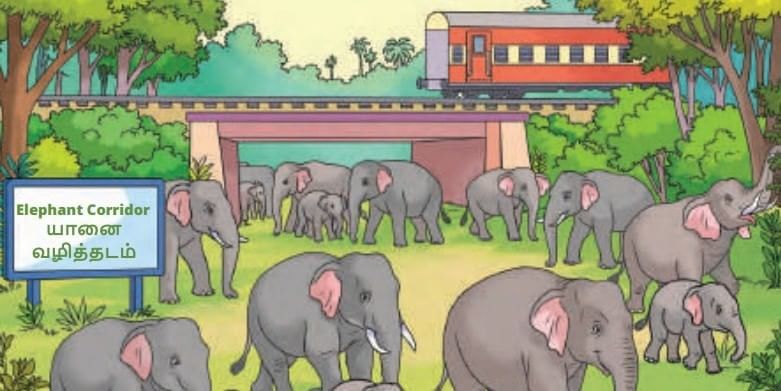
  • Sometimes, when forests are cut down or rainfall changes, animals like elephants lose their homes and food, forcing them to move into farms or villages, leading to new problems. 
    Elephants moving in search of food and shelter
  • Even small changes in one part of nature can affect everything else around it.

In this chapter, you’ll explore how water, sunlight, plants, animals, and even humans are all linked in a web of relationships. You’ll discover why balance in nature is so important, how living things depend on each other, and how human actions can impact the whole system—for better or worse. Let’s get started!

How Do We Experience and Interpret Our Surroundings?

Different habitats have different kinds of plants and animals

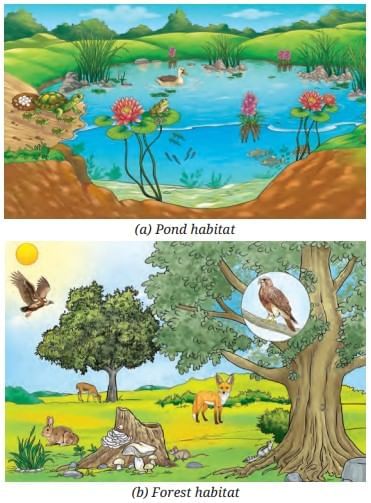
Habitat:

  • A habitat is the place where an organism lives.
  • It provides the surroundings and conditions an organism needs to survive.
  • Habitats can be small (like tree bark) or large (like a pond or forest).

Diversity in Habitats:

  • Different habitats have different kinds of plants and animals (living beings).
  • Organisms adapt to survive in their specific habitats.

Activity: Explore two nearby habitats and identify both the living organisms and the non-living components in each.

  • Select two nearby habitats (e.g., a pond and a forest).
  • List the living and non-living components in each habitat.

Common Characteristics of Habitats

Both habitats (like a pond and a forest) have:

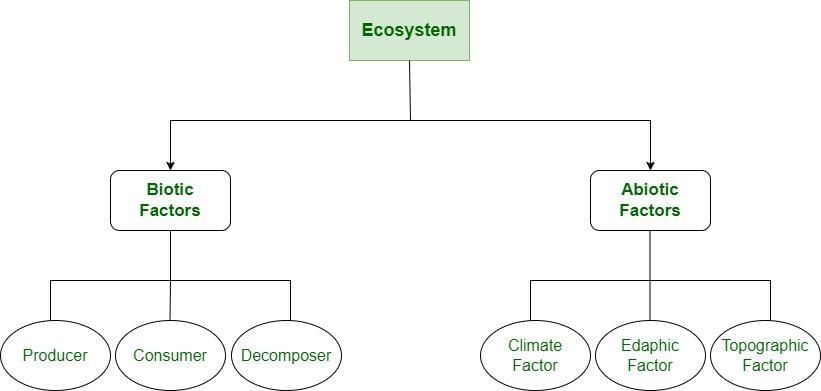
  • Living beings (biotic components): plants, animals, and other organisms.
  • Non-living things (abiotic components): air, water, sunlight, soil, temperature, stones, etc.

Similarities:

  • Both have biotic and abiotic components.

Differences:

  • The types of living beings vary (e.g., fish in a pond, trees in a forest).
  • The types of non-living components also differ (e.g., more water in a pond, more soil and air in a forest).

Biotic and Abiotic Components

  • Biotic components: All living things in a habitat (plants, animals, microbes).
  • Abiotic components: All non-living things in a habitat (sunlight, air, water, soil, temperature).

Why do some organisms live on land and others in water?

  • Every organism needs certain conditions to survive, such as food, water, oxygen, shelter, and space.
  • Example: Fish live in ponds because they get food, oxygen, and shelter there. Pond water provides both biotic needs (food from plants/animals) and abiotic needs (oxygen from water).
  • Many other creatures (frogs, turtles, snakes, insects, birds, plants) share the pond. Each interacts with others and with the non-living parts of the habitat.

Coexistence and Harmony in Habitats

  • Each habitat has its own unique mix of living (biotic) and non-living (abiotic) components, like air, sunlight, water, soil, and temperature.
  • Different species in the same habitat might use resources differently: For example, in a forest, a snake may be active at night, while a rodent is active during the day—helping both survive in the same place but at different times.

Who All Live Together in Nature?

Population

  • Definition: A population is a group of the same kind of organisms (same species) living together in a specific habitat at a given time.
  • Example: All the fish of the same species in a pond form a fish population.

How Do We Measure Population? 

To find the population of a certain plant or animal, you:

  • Mark a fixed area (for example, 1m × 1m in your school garden).
  • Count the number of each type of organism (plants or animals) present in that area.
  • Record this information as the population for that type of organism in that particular area and time. Population means the number of individuals of a particular kind (species) living in a defined area at a certain time.

Community

  • A community is formed by different populations (different types of plants, animals, and microorganisms) living together and interacting in the same habitat.
  • It includes all living (biotic) components of the habitat.

Habitat

  • Definition: A habitat is the physical place or environment where an organism lives.
  • If there is only one type of organism in a habitat, there will be competition for resources like food, water, and space. This can cause shortages and make it hard for other creatures to survive.
  • Diversity in a habitat (many types of organisms living together) helps maintain a balance and supports survival by providing different roles and interactions.

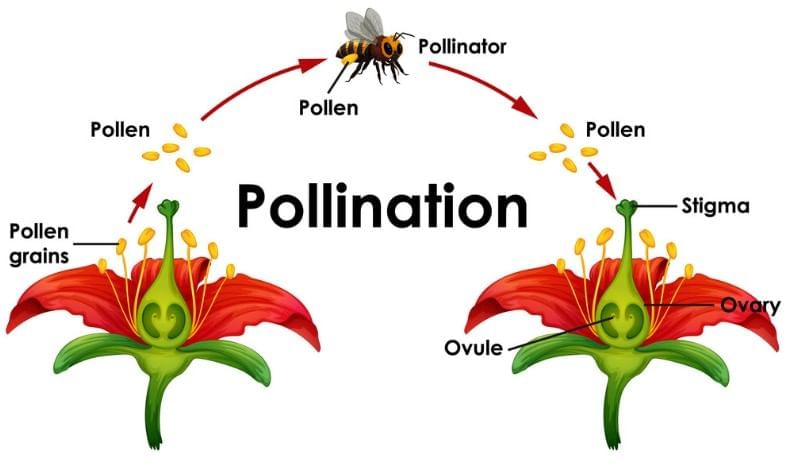
Pollination

  • Flower Structure: Flowers have sepals, petals, stamens (male part), and carpels (female part).
  • Pollination: The process of transferring pollen grains from the stamen of one flower to the carpel of the same or another flower.
  • How it happens: Wind, water, insects, bats, and birds help carry pollen.
  • Why it matters: Pollination is essential for fruits and seeds to form.

Try yourself:

What is a habitat?

  • A.A type of animal
  • B.A process of transferring pollen
  • C.A group of organisms of the same species
  • D.A physical place where an organism lives

View SolutionDoes Every Organism in a Community Matter?

Yes! Every organism in a community plays an important role, helping maintain balance and supporting the survival of other organisms. Here’s how the activities and scientific studies help us understand this:

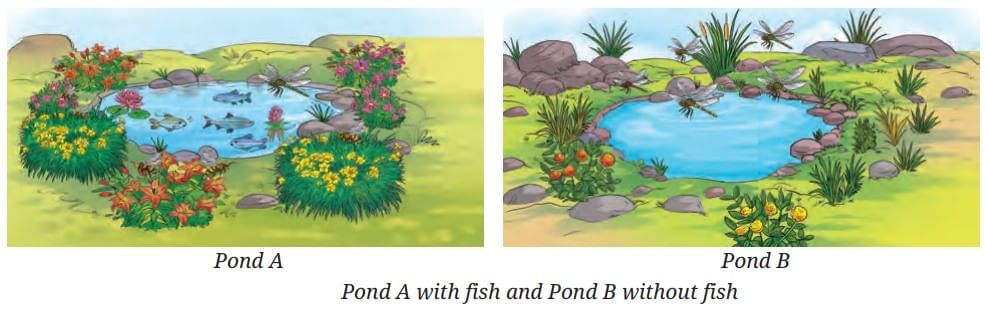
Explanation Using the Pond Example:

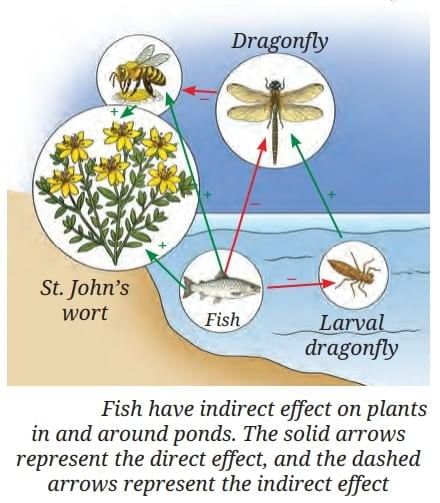
  • Pond A (with fish): There are fewer dragonflies because fish eat the dragonfly larvae in the pond.
  • Pond B (without fish): There are more dragonflies since nothing eats their larvae.

What happens next?

  • Dragonflies are predators of bees, butterflies, and other insects that help pollinate flowers.
  • Fewer dragonflies in Pond A means more bees and butterflies can survive and pollinate the flowers.
  • More pollinators = more pollination, which leads to more flowers producing seeds and more plants.

Scientific studies confirm this: researchers found that plants around ponds with fish were better pollinated than those around ponds without fish, mainly due to this chain of effects.

What Does This Show?

  • Organisms are interconnected. The presence or absence of one type (like fish) can affect many others (like pollinators and plants).
  • Every member of a community has a role (niche): Fish control dragonfly populations, dragonflies affect pollinators, pollinators are essential for plant reproduction, and plants provide food and shelter for all.
  • This is known as a food web or ecological balance, where changes in one group lead to effects (sometimes called a “cascade”) throughout the community.

Impact of Overfishing by Humans

  • Overfishing removes too many fish from ponds or oceans.
  • If too many fish are taken away, dragonfly numbers might rise because their predators have gone. This could lower the number of pollinators, resulting in less pollination for nearby plants.
  • Removing key species like fish upsets the delicate balance of the community, affecting not just other animals but also plants and even the non-living (abiotic) environment.

What Are the Different Types of Interactions Among Organisms and their Surroundings?

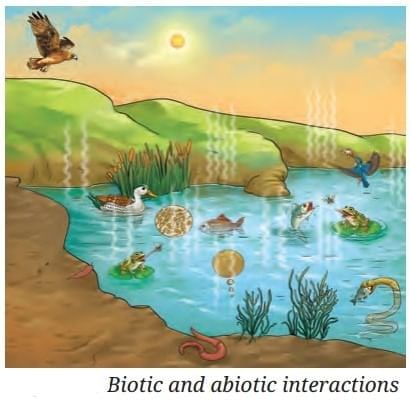
Organisms do not live alone. They constantly interact with both living (biotic) and non-living (abiotic) components in their environment.

1. Interactions Between Biotic and Abiotic Components

Definition: Interactions between living things and non-living things in their environment.

Examples:

  • Plants need sunlight (abiotic) for photosynthesis, water and soil for growth, and air for respiration.
  • Earthworms live in moist soil.
  • Fish lay eggs in water (abiotic).
  • Soil provides nutrients for plants.

2. Interactions Among Abiotic Components

Definition: Interactions between non-living things, which affect the conditions of a habitat.

Examples:

  • Sunlight warms up the day, increasing the temperature.
  • Water evaporation happens faster in strong sunlight.
  • Air currents create gentle waves on the water.

3. Interactions Among Biotic Components

Definition: These are the relationships between living organisms in a community.

Examples:

  • Frogs eat insects (food chain).
  • Water snakes eat fish.
  • Frogs and fish compete for larvae.
  • Many microbes (tiny living beings) interact in the pond, breaking down dead material.
  • Plants provide food and shelter for animals.
  • Mushrooms (fungi) decompose dead plants and animals.

The Concept of Ecosystem

An ecosystem is made up of all the living (biotic) and non-living (abiotic) things in a particular area and all the interactions among them. 

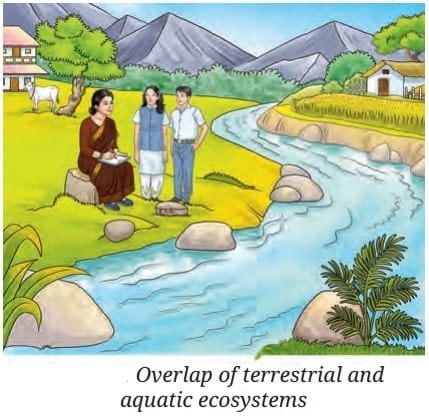
  • Aquatic (water-based) ecosystems include ponds, rivers, and lakes
  • Terrestrial (land-based) ecosystems include forests, grasslands, and farmlands.
  • Ecosystems can overlap—for example, a river running through a forest.

Types of Consumers and Producers

  • Producers (Autotrophs): Make their own food (usually plants via photosynthesis).
  • Consumers (Heterotrophs): Depend on others for food.
    – Herbivores: Eat only plants (deer, horse).
    – Carnivores: Eat only animals (vulture, shikra).
    – Omnivores: Eat both plants and animals (fox, mouse).
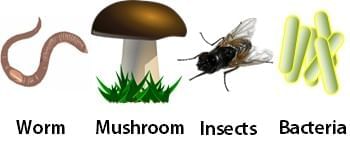
  • Decomposers: Organisms like mushrooms and bacteria that feed on dead plants and animals, recycling nutrients back into the ecosystem.

Who Eats Whom?

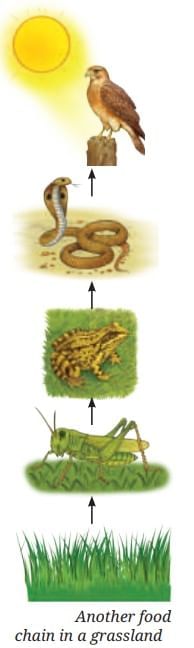
Food Chain: food chain is a simple sequence showing “who eats whom” in an ecosystem.

Example (Grassland Ecosystem):
1. Grass → Hare →TigerGrass is eaten by the hare; hare is eaten by the tiger.
2. Grass → Grasshopper → Frog → Snake → Eagle
Here, each organism is eaten by the next one in the chain.

Trophic Levels

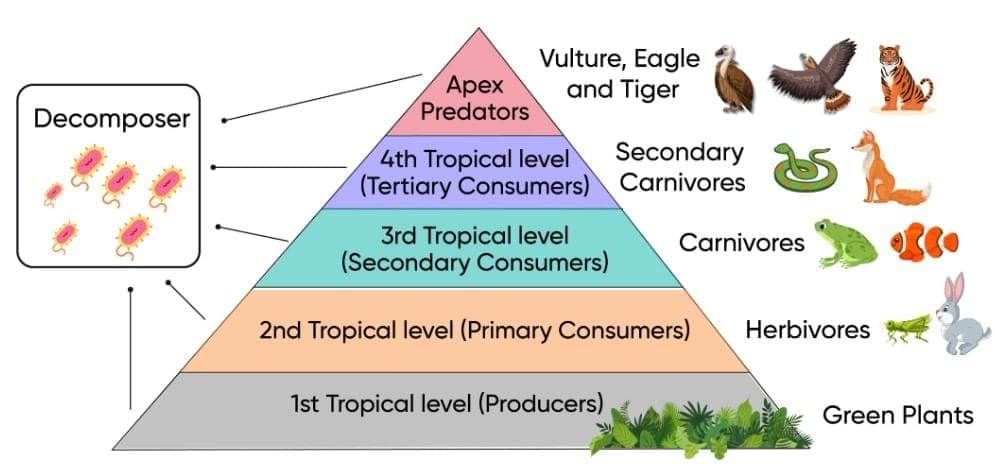
Each organism in a food chain occupies a specific position, called a trophic level:

  • First trophic levelProducers (plants, e.g., grass, millet)
  • Second trophic levelHerbivores (organisms that eat plants, e.g., hare, mouse)
  • Third trophic levelSmall carnivores (those that eat herbivores, e.g., frogs)
  • Fourth trophic level (and above)Large carnivores or top predators (e.g., eagle, hawk, fox)

Trophic Level Pyramid

Ecological Pyramid

  • When you count the number of organisms at each level (e.g., many grasses, fewer mice, only one eagle), and arrange these numbers with the highest at the base and lowest at the top, you get a pyramid shape.
  • Producers are always the base, and top predators are at the top, indicating energy loss at each step.

Food Web

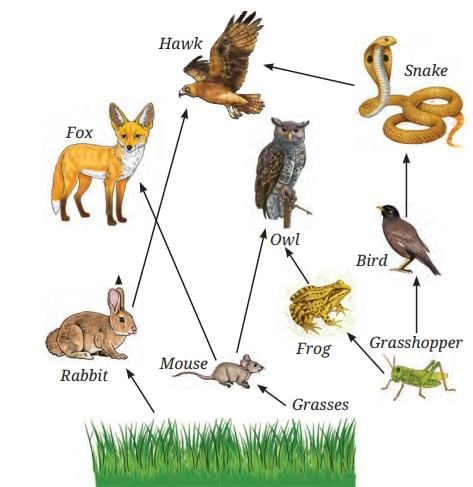
In reality, feeding relationships are not simple chains—they’re much more complex, forming a food web.

  • The grass can be eaten by rabbit or mouse.
  • Grasshoppers can be eaten by the bird or frog.
  • Owls can eat mice or frogs

Because each organism may be eaten by two or more types of organisms, the food chains overlap and link together, making a web.
Food Web

What Happens to Waste in Nature?

What are decomposers?

  • Definition: Decomposers are organisms that break down dead plants, animals, and animal waste into simpler substances, returning nutrients to the soil.
  • Examples: Mushrooms (a type of fungi), bacteria, beetles, and flies.
    Examples of Decomposers
How Decomposition Works

  • When plants, animals, or their waste die, decomposers feed on them.
  • Fungi (like mushrooms) and bacteria break down complex substances in these dead materials into simpler forms.
  • Beetles and flies often feed on things like animal dung (e.g., elephant dung), breaking it down further.
  • This entire process is called decomposition.

Importance of Decomposers
  • Nutrient Recycling: Decomposition returns important nutrients to the soil, which plants use to grow.
  • Balance in Nature: Decomposers prevent the buildup of dead materials and waste in the environment.
  • No Waste in Nature: Nothing truly goes to waste in nature—everything is reused in one form or another thanks to decomposers.
  • Saprotrophs: Another name for decomposers. Sapro means “rotten,” and troph means “food.”

What are migratory birds?

  • Birds that travel thousands of kilometers between different habitats and countries to avoid harsh climates or find food.
  • Example: Demoiselle Cranes visit Khichan village in Rajasthan every winter.

Roles of Migratory Birds

  • Enhance Beauty: Add color and vibrancy to habitats.
  • Ecosystem Balance: Act as pollinators (helping flowers reproduce) and seed dispersers, linking different habitats.
  • Pest Control: Feed on insect pests, helping farmers by reducing crop damage.

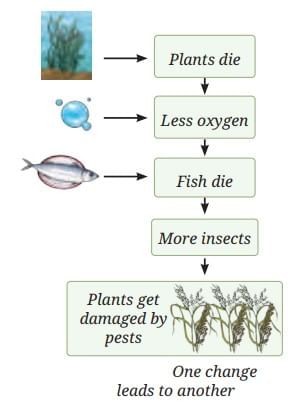
How Does One Change Lead to Another?

If plants in a pond die (e.g., due to pollution), then:

  • Less oxygen is produced in the water.
  • Fish population declines, as they need oxygen.
  • Fewer fish means more insects (fish usually eat them).
  • Extra insects spread to nearby farms and harm crops.
  • Farmers use more pesticides, which further harms the environment.
  • One small change (like plant death) causes a chain reaction or “cascading effects” through the ecosystem.

Effects of Human Intervention: The Frog Leg Export Story

  • In the 1980s, India exported a huge number of Indian bullfrogs.
  • This reduced frog populations.
  • Fewer frogs meant more insects, including pests in farms.
  • Farmers then used more pesticides, harming the environment, water, soil, and health of living beings.
  • The Government banned frog-leg exports to help restore balance.

Ecosystem Balance

  • Interactions between organisms and their environment keep populations and resources stable—this is called ecological balance.
  • This balance is always changing (dynamic), but large disruptions (such as overuse, pollution, loss of species) can harm it.

How Do Interactions Maintain Balance in Ecosystems?

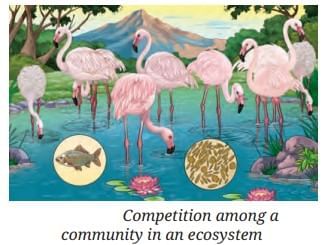
Besides feeding relationships, organisms also compete for common resources like food, water, physical space, or sunlight. This competition helps control population size and keeps the ecosystem balanced. Without it, one species could multiply too much causing an imbalance in the ecosystem

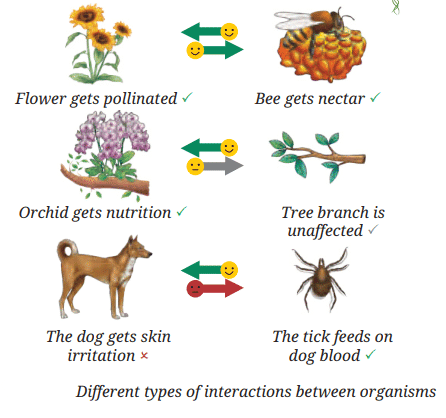
Other Relationships:

  • Mutualism: Both organisms benefit (e.g., bees and flowers).
  • Commensalism: One benefits, the other is unaffected (e.g., orchids on trees).
  • Parasitism: One benefits, the other is harmed (e.g., ticks on dogs).

Benefits of an Ecosystem

  • Forests: Provide clean air, fertile soil, food, timber, medicines, and beauty.
  • Water bodies: Give water and food.
  • All ecosystems: Offer aesthetic value, recreation, and support human well-being.
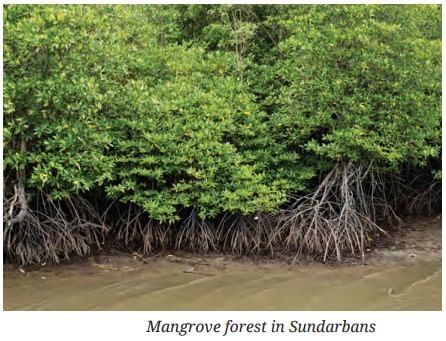
  • Mangroves (e.g., Sundarbans): Protect against floods and storms, absorb carbon dioxide, support unique wildlife; recognized as a World Heritage Site.

Threats to Ecosystems

  • Deforestation, pollution, unsustainable land use, and illegal hunting are harming all types of habitats.
  • The Sundarbans mangroves are under threat from wood cutting, pollution, and resource overuse.
  • Such activities disrupt natural cycles and reduce biodiversity.

How To Protect Ecosystems

  • Protected Areas: Such as national parks, biosphere reserves, and sanctuaries conserve habitats and wildlife. Examples: Jim Corbett, Manas, Nilgiri Biosphere Reserve, Chilika Lake.
  • Community Action: People must work together to conserve resources, avoid pollution, and preserve natural areas.

Human-Made (Artificial) Ecosystems

  • Examples: Farms, fish ponds, parks.
  • When managed well, they can help reduce pollution, support biodiversity, and provide recreational spaces.
  • Need: Continuous care and human management.

Try yourself:

What is the main purpose of interactions?

  • A.To create chaos
  • B.To maintain balance
  • C.To confuse others
  • D.To avoid communication

View Solution

What Are the Benefits of an Ecosystem?

Ecosystems consist of biotic (living) and abiotic (non-living) components that depend on each other to support life processes.

Humans benefit from ecosystems in many ways:

  • Forests provide fresh air, fertile soil, food, fibres, timber, and medicines.
  • Aquatic ecosystems provide water and food.
  • Ecosystems also offer aesthetic (beauty) and recreational (enjoyment) value.
  • This supports human well-being and shows the close connection between nature and humans.
  • However, overusing or misusing natural resources disturbs the balance in nature.

 Real-Life Example: The Sundarbans – A Threatened Ecosystem

  • The Sundarbans have the largest mangrove forests in the world.
  • Located where the Ganges and Brahmaputra Rivers meet, between India and Bangladesh.
  • Home to various flora (plants) and fauna (animals), many of which are endangered.
  • Protects against storms and floods by slowing down strong winds and waves.
  • Trees absorb carbon dioxide from the air and release oxygen.
  • Declared a World Heritage Site by UNESCO (United Nations Educational, Scientific and Cultural Organization) in 1987 due to its importance.

Threats 

  • Mangrove trees are cut for fuelwood and farming.
  • Illegal hunting and overuse of forest resources threaten wildlife.
  • Pollution from industrial waste and untreated sewage damages water and habitat.
  • These human activities disrupt the natural functioning of ecosystems.

Other Threatened Ecosystems in India
Ecosystems across India (forests, rivers, scrublands, wetlands, grasslands, coastal areas) are under threat.

Problems:

  • Deforestation (cutting trees).
  • Overuse of natural resources.
  • Spread of invasive species (non-native plants/animals that harm locals).
  • Unsustainable land use.
  • Pollution.

Call to Action: Think about actions you and your community can take to protect forests, rivers, and wetlands to stop damaging them.

Protected Areas for Conservation

  • Definition: Protected areas are parts of land or water set aside to conserve wildlife and their habitats.
  • India has many protected areas: national parks, wildlife sanctuaries, biosphere reserves, and community conserved areas.
  • Benefits: They protect entire habitats, including endangered animals, birds, and rare plants.

Famous Examples:

  • Jim Corbett National Park (Uttarakhand).
  • Manas National Park (Assam).
  • Nilgiri Biosphere Reserve (Western Ghats).
  • Chilika Lake (Odisha).
  • Eaglenest Wildlife Sanctuary (Arunachal Pradesh).
  • Hemis National Park (Leh).
  • Keibul Lamjao National Park (Manipur).
  • Pirotan Island Marine National Park (Gujarat).
  • Protected areas play a big role in saving nature for future generations.

Our Scientific Heritage

  • The ancient text Vrikshayurveda emphasizes soil health and nourishment.
  • It advocates for continuous soil nourishment through organic manure like Kunapa Jala (a liquid fertilizer made from animal and plant waste by fermentation, which breaks complex substances into simpler ones) and other composted materials.

Human-Made Ecosystems

  • Humans create artificial ecosystems like fish ponds, farms, and parks to meet their needs.
  • When well-designed, they reduce pollution, support biodiversity (variety of life), and provide recreational spaces.
  • Unlike natural ecosystems, these need human care and management.

How Do Healthy Ecosystems Serve Our Farms?

  • Farming is a major livelihood in India but can become unsustainable without environment-friendly practices.
  • Humans have practiced farming for thousands of years to grow food.
  • As population grew, dependence on agriculture increased.
  • Between 1950 and 1965, India faced a food crisis due to low crop production.
  • In the mid-20th century, the Green Revolution used tractors, machines, synthetic fertilizers, and pesticides to increase food production.

However, these methods are now seen as unsustainable due to:

  • Overuse of synthetic chemicals.
  • Excessive groundwater extraction.
  • Growing only one type of crop (monoculture) for commercial gain.

Harms to Environment and Health:

  • Overusing pesticides and monoculture lead to soil degradation (loss of quality).
  • Reduces soil fertility by decreasing friendly microorganisms and organic matter (humus), which binds soil particles.
  • Without humus, soil erodes easily.
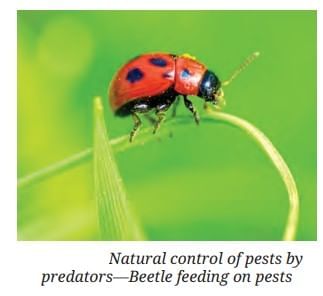
  • Reduces natural predators, increasing pest populations 
  • Heavy irrigation and repeated ploughing disturb soil organisms like earthworms and snails, important for ecological balance.
  • Pests may develop resistance to pesticides, making control harder.
  • Monoculture reduces crop diversity and affects pollinators (e.g., bees), crucial for food production.
  • Understanding ecosystems helps adopt sustainable farming.
  • Some farmers explore organic and natural methods to reduce synthetic fertilizers and minimize interference in natural ecosystems.

Key Terms to Remember 

  • Habitat: A place that provides the right conditions for an organism to live and grow.
  • Components of Habitats: Habitats consist of biotic components (plants, animals, microbes) and abiotic components (air, water, soil, temperature).
  • Ecosystem: The interaction between biotic components and abiotic components in an area, forming a balanced system.
  • Types of Ecosystems: Ecosystems can be terrestrial (such as forests, grasslands, deserts) or aquatic (such as ponds, lakes, seas, oceans).
  • Classification of Organisms: Organisms are often classified as producers (plants), consumers (herbivores, carnivores, omnivores), and decomposers (bacteria, fungi).
  • Producers: Organisms like plants that make their own food.
  • Consumers: Organisms that eat plants or animals for energy.
  • Decomposers: Organisms like bacteria and fungi that break down dead matter and recycle nutrients back into the ecosystem.
  • Food Chains: Sequences that depict who eats whom in an ecosystem.
  • Food Webs: Interconnected food chains showing complex feeding relationships in an ecosystem.
  • Trophic Levels: The positions that different organisms occupy in a food chain, indicating their role in energy transfer.
  • Mutualism: A relationship between organisms where both benefit.
  • Commensalism: A relationship where one organism benefits and the other is unaffected.
  • Parasitism: A relationship where one organism benefits and the other is harmed.
  • Benefits of Ecosystems: The advantages ecosystems provide, which are crucial for human survival and well-being, including clean air, water, food, medicine, and climate regulation.
  • Threats to Ecosystems: Human activities such as pollution, deforestation, habitat loss, climate change, invasive species, and overexploitation of natural resources that endanger ecosystems.
  • Conservation of Ecosystems: Efforts to protect ecosystems, such as establishing national parks and sanctuaries, which are vital for preservation

11. Keeping Time with the Skies – Chapter Notes

Have you ever noticed the Moon shining in the sky during the daytime and wondered why it’s visible when the Sun is also up?

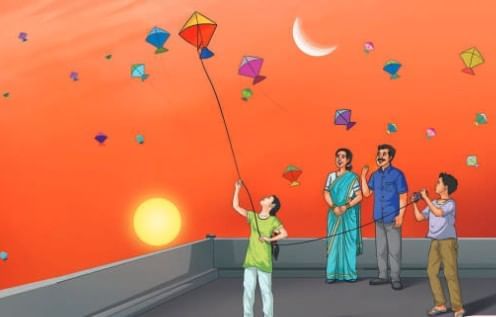
On Makar Sankranti, as Meera watched colorful kites soar above Ahmedabad, she too spotted the Moon in broad daylight—a sight she thought belonged only to the night. 
Kites in the SkyThis surprising view made her curious: Why does the Moon’s shape change night after night, and why doesn’t it always appear as a full circle? If we had no clocks or calendars, how would we track days, months, or years? As we explore these questions, let’s discover how people have “kept time” by simply observing the skies!

How Does the Moon’s Appearance Change and Why?

Phases of the Moon 

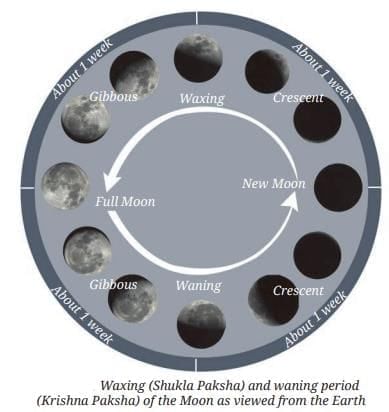
The changing shapes of the Moon’s illuminated (bright) portion, as seen from Earth, are known as the phases of the Moon.

Waning Period (Krishna Paksha):

  • After a full Moon, the bright portion decreases from a full circle to a half circle in about a week.
  • The bright portion continues to shrink, disappearing completely in another week.
  • This two-week shrinking period is called the waning period or Krishna Paksha in India.

New Moon (Amavasya): The day when the Moon is not visible at all.

Waxing Period (Shukla Paksha):

  • After the new Moon, the bright side grows to a half circle in about a week and becomes a full circle (full Moon) in another week.
  • This two-week growing period is called the waxing period or Shukla Paksha in India.
  • The Moon’s waxing and waning occurs in a cyclical (repeating) pattern each month.
  • The full cycle from one full Moon to the next takes about one month.

Important Terms:

  • Full Moon (Purnima): The day when the Moon appears as a full bright circle.
  • New Moon (Amavasya): The day when the Moon is not visible at all.
  • Waxing: The period when the bright part of the Moon increases (after new Moon to full Moon).
  • Waning: The period when the bright part of the Moon decreases (after full Moon to new Moon).
  • Gibbous: More than half but not fully illuminated Moon.
  • Crescent: Less than half illuminated Moon.

Locating the Moon

The Moon’s position in the sky changes each day, even at the same time.

On full Moon day:

  • The Moon is nearly opposite the Sun.
  • When the Sun rises in the east, the Moon is almost setting in the west.

After full Moon:

  • Each morning at sunrise, the bright part of the Moon gets smaller and the Moon appears closer to the Sun’s position in the sky.
  • When the Moon looks like a half circle, it is overhead at sunrise.
  • A few days after, the crescent Moon appears even closer to the Sun.

The phase (shape) of the Moon and its waxing or waning status help you know where and when to look for it in the sky.

  • Waxing Moon: Best seen at sunset.
  • Waning Moon: Best seen at sunrise.

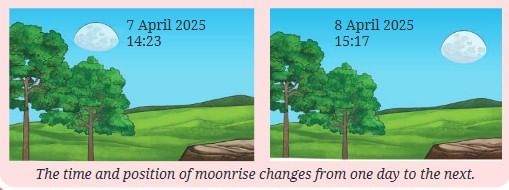
The Moon does not always rise when the Sun sets.

  • The moonrise time gets about 50 minutes later each day.
  • Moonrise can occur in the afternoon (e.g., between 2:00–4:00p.m.), which is why the Moon is sometimes seen in the daylight.
  • After moonrise, you may need to wait about 30 minutes for the Moon to be visible higher in the sky.

Making Sense of Our Observations – The Moon’s Changing Appearance

The Moon’s Shape:
The actual shape of the Moon does not change at all. What changes is how much of the illuminated (bright) part we see from Earth.

The Moon’s Light:
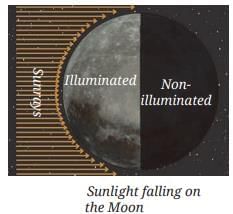
The Moon does not produce its own light. It appears bright because it reflects sunlight that falls on it.

Sunlit and Dark Halves:

  • At any moment, half of the Moon faces the Sun and becomes illuminated by sunlight.
  • The other half, facing away from the Sun, remains in darkness (non-illuminated).

Appearance from Earth:

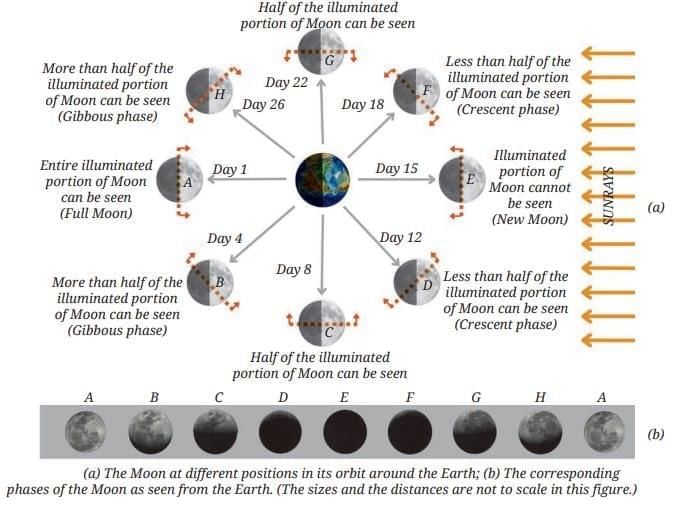
  • As the Moon revolves around the Earth, the position and angle at which we see it changes.
  • Although always one half of the Moon faces Earth, that half is not always fully illuminated.
  • The portion of the Moon we see from Earth may be all illuminated, partly illuminated, or not illuminated at all—resulting in phases.

Full Moon and New Moon:

  • Full Moon: When the entire sunlit half faces Earth, we see the Moon as a whole bright circle.
  • New Moon: When the non-illuminated half faces Earth, we do not see the Moon at all.

Reason for Changing Appearance:

The Moon seems to change shape (phase) on different days because:

  • Its position relative to Earth and Sun is constantly changing as it orbits Earth.
  • We only see the illuminated part facing towards us.

The Moon’s Phases with a Simple Model

Model Demonstration:
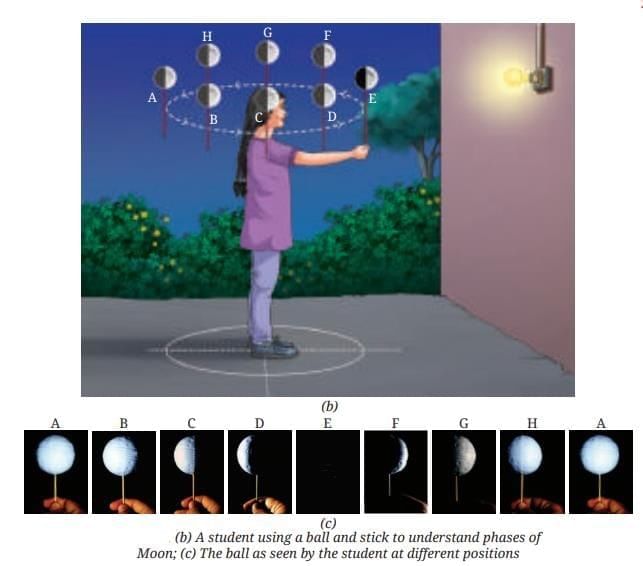
You can use a small ball on a stick to represent the Moon, a torch or lamp as the Sun, and your own head as the Earth.

  • Hold the ball in your hand, slightly above your head.
  • Shine the torch toward the ball to represent sunlight.
  • As you turn in a circle, the ball (“Moon”) shows a changing illuminated portion to your eyes.

What Does the Model Show?

  • Full Moon:
    When the ball is held opposite the lamp (behind you compared to the Sun), the side facing you is fully lit—just like a full Moon.
  • New Moon:
    When the ball is held between your head and the lamp (towards the Sun), you see only the dark side—like a new Moon.
  • Crescent and Gibbous Phases:
    Turning the ball slowly, the visible portion transitions. Sometimes you see a crescent (less than half lit), other times gibbous (more than half lit).
  • The line between the bright and dark parts is always curved—this matches what we see in the real Moon.

The Science Behind the Phases

  • Half Illuminated, Half Dark:
    At every moment, half the Moon is lit by sunlight, and half is in darkness.
  • Moon’s Revolution:
    As the Moon revolves around the Earth, the angle between Earth, Moon, and Sun changes. The part of the Moon we see as bright changes accordingly.

Phase Names:

  • Crescent: Less than half illuminated
  • Gibbous: More than half illuminated
  • Full Moon: Whole face illuminated
  • New Moon: No illuminated part visible

The phases are caused by the changing fraction of the illuminated portion visible from Earth.

 Why Do Moon Phases Occur? (And What Does Not Cause Them)

  • Incorrect Idea: Moon phases are not caused by Earth’s shadow falling on the Moon.
  • Correct Reason: The phases of the Moon occur because of the changing relative positions (orientation) of the Sun, Moon, and Earth as the Moon revolves around Earth.
  • Earth’s Shadow and Lunar Eclipse: The only time Earth’s shadow actually falls on the Moon is during a lunar eclipse.
    Lunar eclipses can only happen on a full Moon day.
    Solar eclipses can only happen on a new Moon day.

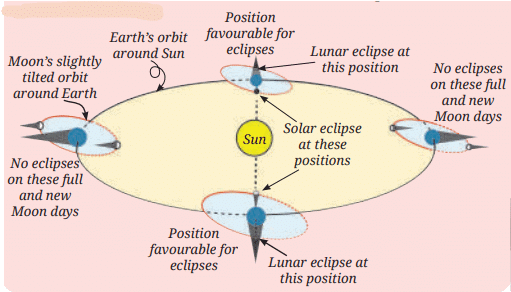
Why Don’t Eclipses Happen Every Month?

  • Eclipses do not occur every month even though there’s a full Moon and new Moon monthly.
  • This is because the Moon’s orbit is slightly tilted relative to Earth’s orbit around the Sun.
  • Most months, the Sun, Earth, and Moon do not line up perfectly for the Earth’s shadow to cover the Moon (lunar eclipse) or for the Moon’s shadow to fall on Earth (solar eclipse).

How Did Calendars Come into Existence?

Natural Cycles and Time Measurement

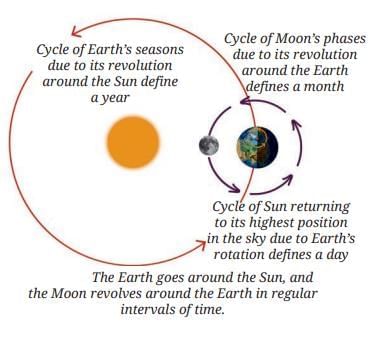
  • The apparent daily motion of the Sun (rising in the east, setting in the west) is due to Earth’s rotation on its axis.
  • This natural cycle forms the basis of the day—the primary unit of timekeeping.
  • Mean Solar Day: The time between one “highest Sun position” (shortest shadow at noon) to the next is about 24 hours, known as a mean solar day.

Shadow Tracking and the Day

  • The shortest shadow during the day marks the Sun’s highest point in the sky (noon).
  • Measuring from one day’s noon to the next gives the length of a day.
  • The average solar day is about 24 hours.

The Month and the Moon

  • The phases of the Moon create another natural cycle—one complete phase cycle (from full Moon to next full Moon) takes about 29.5 days (approximately one month).
  • This lunar cycle is the basis for measuring a month.

The Year and the Seasons

  • One year is the duration for Earth to make a full revolution around the Sun, which is about 365¼ days.
  • The repetition of seasons (spring, summer, autumn, winter) marks the annual cycle.

Try yourself:

What is the primary unit of timekeeping based on Earth’s rotation?

  • A.Month
  • B.Year
  • C.Day
  • D.Hour

View SolutionTypes of Calendars

1. Lunar Calendars

  • Based on the phases of the Moon.
  • Each lunar month is about 29.5 days and 12 lunar months make a year of about 354 days.
  • This lunar year is shorter than a solar year, so the months shift with respect to the seasons over time.

2. Solar Calendars

  • Based on Earth’s revolution around the Sun and the arrival of seasons.
  • The Gregorian calendar is a solar calendar (used worldwide), with months adjusted so the year has 365 days.
  • To correct the extra ¼ day, a leap day is added every 4 years (February 29).
  • Leap year rule: Years divisible by 4 are leap years, with additional adjustments (skip leap years every 100 years, but add them back every 400 years).

3. Luni-Solar Calendars

  • Combine lunar months with corrections to keep in sync with the solar year and seasons.
  • In India and elsewhere, every 2–3 years, an extra month (Adhika Maasa) is added to adjust the calendar with the solar year.
  • The names of months in Indian luni-solar calendars include: Chaitra, Vaisakha, Jyeshtha, Ashadha, Shravana, Bhadrapada, Ashwin, Kartika, Margashirsha (Agrahayan), Pausha, Magha, and Phalguna.
  • Amant Calendars: Month begins after a new Moon and ends on the next new Moon.
  • Purnimant Calendars: Month begins after a full Moon and ends at the next full Moon.

Observations and Heritage

  • Ancient observers noticed 12 cycles of Moon phases fit in one yearly cycle of seasons.
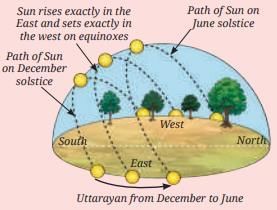
  • The Sun’s position at sunrise changes through the year (northward in summer, southward in winter) due to Earth’s tilt.
  • This movement is described in Indian tradition as Uttarayana (northward, Dec–June) and Dakshinayana (southward, June–Dec).
  • Solstices and equinoxes: Important points for tracking the Sun’s yearly journey and adjusting calendars.

The Indian National Calendar

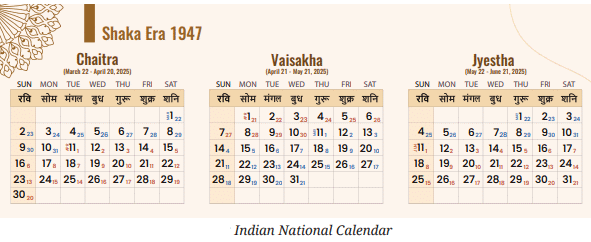
The Indian National Calendar, also known as the Saka Calendar, is a solar calendar officially used by the Government of India along with the Gregorian calendar.

  • It consists of 365 days in a year.
  • The year begins on 22 March (the day after the spring equinox). In leap years, it begins on 21 March.
  • Each month is named after traditional Indian months: Chaitra, Vaisakha, Jyestha, Ashadha, Shravana, Bhadrapada, Ashwin, Kartika, Agrahayana, Pausha, Magha, and Phalguna.
  • Months have 30 or 31 days: In a regular year, months 2–6 have 31 days, the rest have 30 days.
  • In a leap year, a day is added to Chaitra (the first month), making it start on 21 March.
  • The Indian National Calendar was introduced in 1956, based on recommendations by the Calendar Reform Committee (CRC) headed by Meghnad Saha, a famous astrophysicist.
  • The calendar follows principles similar to the ancient Surya Siddhanta.
  • This calendar helps unify timekeeping across India for civil purposes.

Are Festivals Related to Astronomical Phenomena?

Many Indian festivals are linked to the phases of the Moon and thus are based on lunar or luni-solar calendars.

Examples:

  • Diwali: Celebrated on the new Moon of Kartika.
  • Holi: Celebrated on the full Moon of Phalguna.
  • Buddha Purnima: Occurs on the full Moon of Vaisakha.
  • Eid-ul-Fitr: Celebrated after sighting the crescent Moon at the end of Ramazan.
  • Dussehra: Occurs on the tenth day of Ashwina.

These festivals appear on different dates in the Gregorian calendar each year because the lunar year and solar year are not the same length.

  • Luni-solar calendars add an extra (intercalary) month every few years to align lunar months with the solar year, causing date shifts of less than a month in the Gregorian calendar.
  • Pure lunar calendars do not make this adjustment, so festivals like Eid-ul-Fitr can move to different months of the Gregorian calendar over the years.

Solar Festivals

  • Some Indian festivals follow a solar sidereal calendar, so they occur on nearly the same date every year in the Gregorian calendar.
  • Examples: Makar Sankranti, Pongal, Bihu, Vaisakhi, Poila Baisakh, and Puthandu.
  • These were originally linked to solstices or equinoxes, but a slight difference between sidereal and tropical years causes their dates to drift slowly over centuries (e.g., Makar Sankranti shifts by one day every 71 years).

Variations in Festival Dates

  • The exact lunar phase at sunrise can vary for eastern and western parts of India, causing festival dates to differ by a day in different regions even in the same year.
  • To standardize this, the Rashtriya Panchang (national almanac) is published by the Positional Astronomy Centre, Government of India, giving advanced calculations for official festival dates.

Cultural Connection

The Moon and Sun also inspire Indian classical art forms:

  • Music: Ragas like Chandrakauns and Chandranandan are inspired by the Moon.
  • Dance: Gestures (mudras) such as Chandrakala and Ardhachandran in Bharatanatyam and other dances invoke lunar imagery.
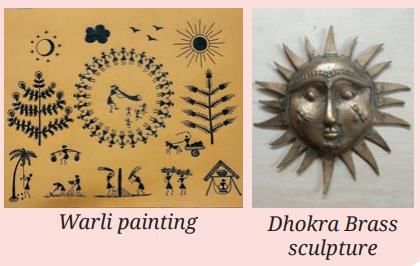
  • Visual Arts: Traditional painting styles (e.g., Madhubani, Warli), sculpture, and pottery frequently depict the Moon and Sun, reflecting their significance in daily life.

Why Do We Launch Artificial Satellites in Space?

Natural vs Artificial Satellites

  • The Moon is Earth’s natural satellite, revolving around our planet.
  • Artificial satellites are man-made objects placed in orbit around Earth by various countries.

Artificial Satellites: Purpose and Functions

  • Appearance: Artificial satellites look like tiny bright spots moving rapidly across the night sky.
  • Orbit: Most orbit at about 800 km above Earth’s surface, completing one orbit in roughly 100 minutes.

Key Uses:

  • Communication (TV, phones, internet)
  • Navigation (GPS, map services)
  • Weather monitoring
  • Disaster management (detecting floods, cyclones, etc.)
  • Scientific research (studying space, environment, and more)

Try yourself:

What is one reason we launch artificial satellites into space?

  • A.To communicate with animals
  • B.To study weather
  • C.To explore oceans
  • D.To grow plants

View Solution

Satellites and Missions by ISRO (Indian Space Research Organisation)

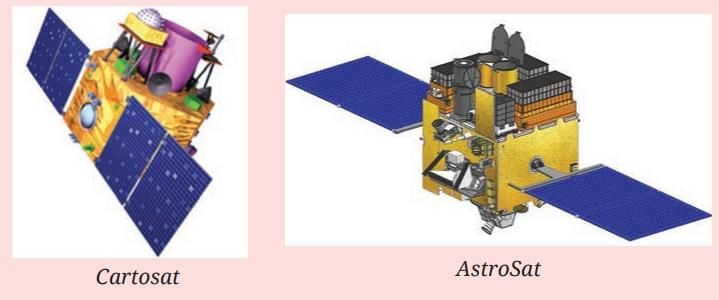
  • Cartosat Series: High-quality imaging satellites for mapping, city planning, and disaster response. 
    Example platform: Bhuvan uses Cartosat images to analyze soil, land use, vegetation, and terrain.
  • AstroSat:
    Observatory satellite for studying stars and celestial objects.
  • Chandrayaan 1, 2, 3:
    Moon missions.
  • Aditya L1:
    Satellite for studying the Sun.
  • Mangalyaan:
    Mars Orbiter Mission.
  • Student Satellites:
    ISRO encourages students to build and launch small satellites, such as: AzaadiSat, InspireSat-1, and Jugnu.

Observing Artificial Satellites

How to Spot:
Look for a small, bright, continuously moving dot in the sky, typically before sunrise or after sunset.

  • Can be seen without a telescope.
  • Satellite-tracking mobile apps or websites help identify visible satellites.

Space Debris (Space Junk)

  • When artificial satellites and rocket parts become old and stop working, they turn into space debris.
  • Risks: Collisions with functional satellites, cluttering orbits.

Disposal:

  • Small debris usually burns up in the atmosphere.
  • Larger fragments can fall and crash to Earth.
  • Countries collaborate on solutions to minimize and remove space debris.

Key Figures in Indian Space Program

Vikram Sarabhai:
Pioneer of India’s space program, known as the “Father of the Indian Space programme”.

  • The Vikram Sarabhai Space Centre (VSSC) in Thiruvananthapuram is named in his honor.
  • VSSC focuses on rocket and launch vehicle technology.

Key Points to Remember

  • Phases of the Moon: The changing shapes of the illuminated part of the Moon observed from day to day, such as new Moon, crescent, and full Moon.
  • Cause of Moon Phases: The phases occur because we see varying portions of the Moon’s illuminated side as it orbits around the Earth.
  • Cycle of Moon Phases: A complete sequence of the Moon’s phases, which takes about a month to finish.
  • Calendars: Systems created based on various natural cycles observed in nature, used to track time.
  • Lunar Calendar: A calendar that follows the cycle of the Moon’s phases.
  • Solar Calendar: A calendar that follows the cycle of seasons, determined by the Earth’s position in its orbit around the Sun.
  • Luni-solar Calendar: A calendar that adapts to both the Moon’s cycles and the seasonal cycles related to the Earth’s orbit.
  • Artificial Satellites: Human-made objects launched from Earth into space, which provide valuable information for human well-being and studies in space science.

10. Light: Mirrors and Lenses – Chapter Notes

Have you ever wondered why the warning “Objects in mirror are closer than they appear” is written on the side-view mirrors of cars?  Or why reading glasses sometimes have a curved line on their lenses?
Let’s explore these questions with Meena! On a sunny afternoon during her summer holidays, Meena visited a science centre. Among all the amazing displays, something unusual caught her eye—a row of curved mirrors. 

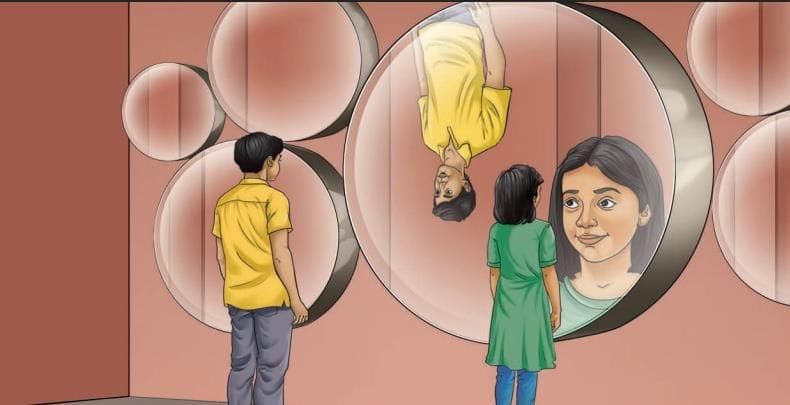
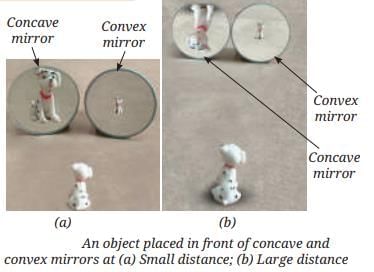
MirrorsTo her surprise, when she looked into one, her face seemed comically larghe, while her brother, just a little farther away, looked upside down! At another mirror, she saw a tiny version of herself staring back.

Why do mirrors behave this way? Through the world of spherical mirrors and lenses, get ready to discover the secrets of light and learn how mirrors can make images appear bigger, smaller, or even flipped around!

What Are Spherical Mirrors?

Spoon as a Mirror—A Simple Observation

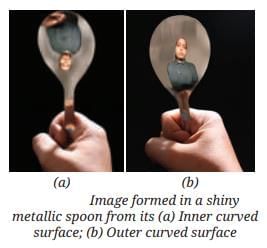
  • shiny metallic spoon can act like a mirror. You can see your face in it if you hold it close. 
  • If you look at the inner (curved inward) side of the spoon, your image appears inverted (upside down).
  • If you look at the outer (bulging outward) side, your image appears erect (upright) but much smaller than your real face.
  • This difference occurs because each side of the spoon curves in a different way, mimicking different types of curved mirrors.

Curved Mirrors and Spherical Mirrors

  • Mirrors like your spoon can be specially made as curved mirrors for scientific and everyday use.
  • The most common type of curved mirror is the spherical mirror.

Definition of Spherical Mirrors:
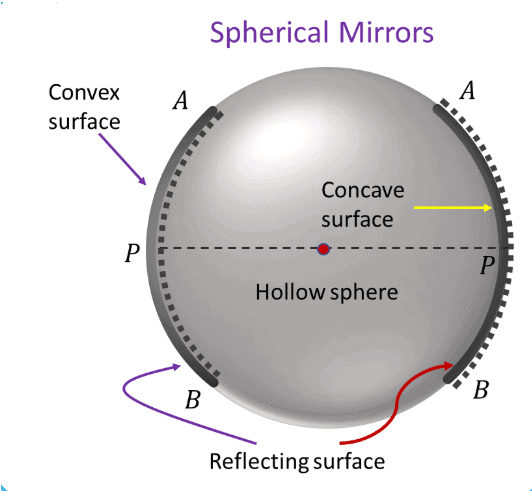
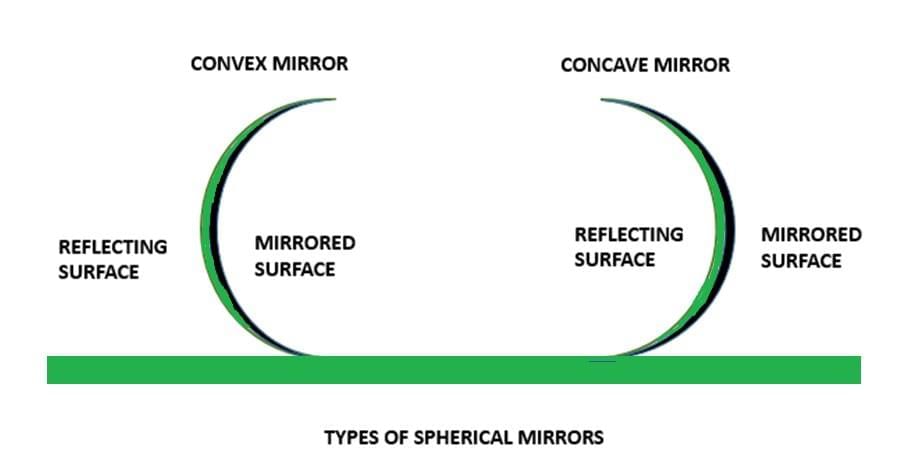
Spherical mirrors are mirrors whose reflecting surfaces are shaped like a part of a hollow glass sphere. Reflecting surfaces of spherical mirrors can curve either inwards or outwards.

Types of Spherical Mirrors

1. Concave Mirror

  • A mirror whose reflecting surface is curved inwards, like the inside of a spoon or a bowl..
  • Edge bulges out, center dips in — think “cave.”
  • The outline of this mirror is part of a circle when viewed from the front.

2. Convex Mirror

  • Reflecting surface curves outwards (like the outer side of a spoon, or the back of a bowl).
  • Center bulges out, edge curves back.

How Spherical Mirrors Are Made?

  • Shape: Spherical mirrors have a shape as if they are parts of an imaginary hollow sphere.
  • Manufacture: Despite their shape, these mirrors are not made by slicing a real hollow glass sphere.
  • Process: They are actually made by grinding and polishing a flat piece of glass into a curved surface. Then, a reflective coating (like a thin layer of aluminum) is added.

Placement of Reflective Coating:

  • If the coating is placed on the outer curved surface, the result is a concave mirror.
  • If the coating is placed on the inner curved surface, the result is a convex mirror.

What Are the Characteristics of Images Formed by Spherical Mirrors?

Concave Mirror:

  • When object is close (small distance): Image is erect but larger (enlarged) than the object.
  • When object moves farther: Image becomes inverted. It starts enlarged but gets smaller as distance increases.

Convex Mirror:

  • At any distance: Image is always erect and smaller (diminished) than the object.
  • As object moves farther: Image size decreases slightly.

Common in BothLateral inversion (left-right reversal) is observed in the images.

Comparison to Plane Mirrors:

  • Spherical mirrors differ from plane mirrors.
  • Plane mirrors always form an erect image of the same size as the object.
  • In concave and convex mirrors, image size changes with object distance.
  • In concave mirrors, images also invert when the object is moved away.

Distinguishing Spherical Mirrors

Idea: Identify if a mirror is plane, concave, or convex by observing object images.

  • Concave: Enlarged erect image close up, inverted when far.
  • Convex: Always erect and diminished.
  • Plane: Always erect and same size.

Real-Life Uses of Spherical Mirrors

 Concave and convex mirrors are used in everyday surroundings.

Concave Mirrors:

  • Reflectors in torches, car headlights, and scooters (concave shape).
  • Dental mirrors used by dentists: Provide enlarged view of teeth when held close inside the mouth.

Convex Mirrors:

  • Side-view mirrors on vehicles: Form erect, smaller images of traffic behind; curved outward for wider road view.
  • Installed at road intersections or sharp bends: Provide visibility from both sides to prevent collisions.
  • Used in big stores: Monitor large areas to deter thefts.

Telescopes

  • Most modern telescopes are reflecting telescopes using curved mirrors.
  • The main mirror is a large concave mirror.

What Are the Laws of Reflection?

Reflection is the bouncing back of light from a surface, like a mirror. The laws of reflection explain how light behaves when it strikes any mirror—plane (flat), concave (curved inward), or convex (curved outward).

The Two Laws of Reflection

1. First Law of Reflection: Angle of Incidence Equals Angle of Reflection

Definition: The angle at which the incoming light ray hits the mirror (angle of incidence, i) is equal to the angle at which it bounces off (angle of reflection, r). In symbols: i = r.

First Law of Reflection

Key Concepts from Setup:

  • Use a plane mirror with stand, torch, comb (with black paper to make a thin slit), paper clip for holding, white paper sheet, and black paper strip.
  • Spread white paper on a table, place mirror upright, and shine a thin beam through the slit onto the mirror.
  • Adjust the beam to hit at different angles; the reflected beam shifts accordingly.

Terms to Remember:

  • Incident Ray: The incoming light ray that strikes the mirror.
  • Reflected Ray: The outgoing light ray that bounces back from the mirror.
  • Normal: An imaginary line drawn at 90° (right angle) to the mirror at the point of incidence.
  • Angle of Incidence (i): The angle between the incident ray and the normal.
  • Angle of Reflection (r): The angle between the reflected ray and the normal.
  • Light is represented as straight rays (lines with arrows) because light travels in straight lines.

How to Prove First Law of Reflection (Observation Process):

  • Draw the mirror line, incident ray, reflected ray, and normal at point O.
  • Measure i and r for different incident angles; record in Table.
  • Special Case: If the incident ray is along the normal, both i and r = 0 (light bounces straight back).
  • Inference (First Law): Measurements show i always equals r, no matter the incoming angle—this is the first law of reflection.
  • Example: Shine a torch beam on a plane mirror at various angles—the bounce angle matches the incoming angle exactly.

2. Second Law of Reflection: All in the Same Plane 

Definition: The incident ray, the normal to the mirror at the point of incidence, and the reflected ray, all lie in the same plane. 

Key Concepts from Setup:

  • Use the same materials as in activity above but add a stiff chart paper sheet extending beyond the table edge.
  • Shine a beam on the mirror; see the reflected beam on the extended flat paper (Figure (a)).
  • Bend the extended part down along the table edge; the reflected beam disappears (Figure (b)).
  • Flatten the paper; the beam reappears.
  • Inference (Second Law): Bending creates a new plane, breaking alignment—the law ensures the rays stay “flat” together for predictable reflection.
  • Step Further: Even if incident rays come from different directions but hit the same point, the normal remains the same, and all (incident ray, normal, reflected ray) stay in one plane.
  • Example: On flat paper, you see the full path; bending hides it because the plane changes.

How Laws Apply to Spherical Mirrors 

The Laws Are Universal: Both laws (i = r and same plane) apply to all mirrors, including spherical ones.

Key Concepts from Setup:

  • Use plane, concave, and convex mirrors with stands, torch, comb (multiple slits uncovered for parallel beams, and paper clip.
  • Shine parallel beams on each mirror one by one.

Observations:

  • Plane Mirror: Reflected beams stay parallel
  • Concave Mirror: Reflected beams come together (converge)
  • Convex Mirror: Reflected beams spread out (diverge).
  • Inference: Each ray obeys the laws, but the mirror’s curve causes parallel rays to converge (concave) or diverge (convex)—this explains focusing or widening effects.

Concentrating Light with Concave Mirrors 

Never look at the Sun or into the mirror reflecting sunlight—it can damage eyes. Focus light only on paper, not on faces or people.

Key Concepts from Setup:

  • Use a concave mirror and thin paper (e.g., newspaper).
  • Hold the mirror facing the Sun; direct reflected light onto the paper.
  • Adjust paper distance for a sharp bright spot.
  • Keep steady for a few minutes.
  • Observation: The paper starts burning and produces smoke.
  • Inference: Concave mirrors converge sunlight to a small point, creating intense heat that can ignite paper—this shows the power of focused reflection.
  • Step Further (Solar Concentrators): Devices using mirrors/lenses to focus sunlight for heating liquids, making steam for electricity, large-scale cooking, or solar furnaces (even melting steel). Recall electric furnaces from an earlier chapter.

What Is a Lens?

Imagine looking through a flat transparent glass window pane—all objects look the same size and shape. But if the surface of the transparent material is curved, objects may not look the same.

How a Water Drop Acts Like a Lens 

Materials: A flat strip of glass or clear plastic (e.g., flat scale), few drops of oil, dropper, water, and a paper or book with printed text.

Key Concepts from Setup:

  • Spread a few drops of oil (or wax) on the glass/plastic strip and rub to make a thin coating (helps water form a round drop).
  • Use a dropper or finger to place a small water drop on the oiled/waxed spot.

Observations as Concepts:

  • The water drop’s surface is curved outward (not flat or curved inward).
  • Place printed text under the strip so it’s directly below the drop.
  • Look down through the drop: Letters below appear different—often larger (enlarged) than nearby letters.
  • Inference: The curved surface of the water drop changes the text’s size, acting like a simple lens.

Definition and Types of Lenses

  • magnifying glass is a lens that enlarges small print, making letters look bigger.
  • Lens Definition: A piece of transparent material (usually glass or plastic) with curved surfaces.
  • Lenses can be convex or concave, like mirrors.
  • Convex Lens: Thicker at the middle than at the edges.
  • Concave Lens: Thicker at the edges than at the middle.
  • Unlike mirrors, lenses allow light to pass through; we see things through a lens, not reflected in it.

How Objects Look Through Lenses 

Materials: A convex lens, a concave lens, a lens holder, and a small object.

Setup:

  • Place the lens upright in the holder.
  • Put the object behind the lens (raise it to lens level if needed).
  • Look through the lens from the other side.
  • Move the object farther and observe changes; repeat for both lenses.

Observations :

Convex Lens:

  • At small distance: Object appears erect and enlarged (larger).
  • As distance increases: Object appears inverted; starts enlarged but gets smaller (diminishes).

Concave Lens:

  • At any distance: Object always appears erect and diminished (smaller).
  • Size changes (gets even smaller) as distance increases.
  • Inference: Distance from the lens affects image size and orientation. Convex lenses can enlarge and invert; concave always diminish and keep erect.

Do Lenses Converge or Diverge Light? 

Materials: A thin transparent glass plate, a convex lens, a concave lens, a torch and comb (for multiple parallel beams), paper clip to hold comb, two identical books, and white paper sheets.

Setup:

  • Use books to hold the glass plate or lens upright between them .
  • Spread paper on both books.
  • Shine multiple parallel beams on the glass plate, convex lens, and concave lens one by one 

Observations:

  • Thin glass plate: Parallel beams pass through unchanged.
  • Convex lens: Beams come together (converge).
  • Concave lens: Beams spread out (diverge).
  • Inference: Convex lenses are converging lenses (focus light); concave are diverging lenses (spread light). (Diagrams show rays passing through each.)

 Drawing Light Through Lenses

  • Drawings of Activity show rays passing through: unchanged in glass plate, converging in convex lens, diverging in concave lens.
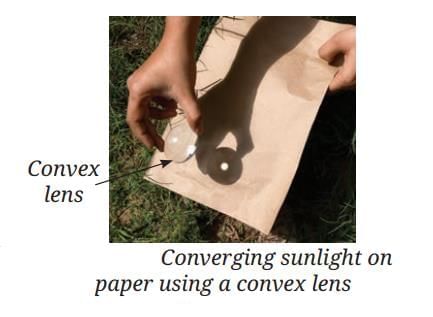
Can a Convex Lens Burn Paper?

  • Setup: Use a convex lens instead of a concave mirror in the path of sunrays.
  • Observation: Yes, you can burn the paper—the lens converges sunlight to a hot point, like a concave mirror.
  • Inference: Convex lenses focus light to create heat, similar to converging mirrors.

Real-Life Uses of Lenses

  • Lenses are important and used everywhere.
  • Eyeglasses: Help people see clearly.
  • Cameras, telescopes, and microscopes: Use lenses to capture or magnify images.
  • Human eye: Has a convex lens that changes shape to focus on near (e.g., reading) or far objects.

Key Points to Remember

  • Concave Mirror Images: A concave mirror forms images that can be bigger (enlarged), smaller (diminished), or the same size as the object. The image can be upright (erect) or upside down (inverted), all depending on how far the object is from the mirror.
  • Convex Mirror Images: A convex mirror always forms images that are upright (erect) and smaller (diminished) than the object, no matter the distance.
  • Laws of Reflection: These are two key rules for how light bounces off mirrors: (1) The angle where the light hits (angle of incidence) is equal to the angle where it bounces back (angle of reflection). (2) The incoming light ray, the normal line (straight up from the mirror at the hit point), and the bouncing ray all stay in the same flat surface (plane).
  • Validity of Reflection Laws: The laws of reflection work the same way for every type of mirror, whether it’s flat (plane), curved inward (concave), or curved outward (convex).
  • Behavior of Mirrors with Light: A concave mirror brings light rays together (converges them), like focusing sunlight to make heat. A convex mirror spreads light rays apart (diverges them), giving a wider view.
  • Convex Lens Images: A convex lens forms images that can be bigger (enlarged), smaller (diminished), or the same size as the object. The image can be upright (erect) or upside down (inverted), depending on how far the object is from the lens.
  • Concave Lens Images: A concave lens always forms images that are upright (erect) and smaller (diminished) than the object, no matter the distance.
  • Behavior of Lenses with Light: A convex lens brings light rays together (converges them), like in a magnifying glass. A concave lens spreads light rays apart (diverges them), like in some eyeglasses.

7. Factors of Production – Short and Long Answer Questions

Q1. What are the four main factors of production, and how do they contribute to creating goods and services?
Answer: The four main factors of production are land, labour, capital, and entrepreneurship. Land includes natural resources like soil, water, and minerals used in production. Labour is the physical and mental effort of people, such as farmers or teachers, creating goods and services. Capital involves money and tools like machinery or factories needed for production. Entrepreneurship combines these factors, with entrepreneurs taking risks to innovate and create new products, benefiting society and creating jobs.

Q2. How does education and training enhance human capital in production?
Answer: Education and training enhance human capital by equipping individuals with knowledge and practical skills for production. Education, from basic literacy to specialized fields like engineering, prepares people to solve real-world problems. Training, such as learning safety rules or observing construction sites, helps apply knowledge practically. These improve the quality and efficiency of labour, enabling workers to excel in their careers and contribute effectively to producing goods and services.

Q3. Why is healthcare important for improving labour productivity?
Answer: Healthcare is crucial for improving labour productivity as it ensures workers are physically and mentally fit. Healthy children attend school regularly, supporting better learning and brain development. Healthy workers perform efficiently, work faster, and remain creative without frequent absences due to illness. Good health enhances overall productivity, allowing individuals to contribute effectively to production processes and support the creation of goods and services needed by society.

Q4. What is the role of technology in the production process?
Answer: Technology enhances the production process by applying scientific knowledge to make work faster and more efficient. It includes traditional tools like pulleys and modern innovations like UPI, GPS, or drones for farming. Technology reduces resource use, improves productivity, and creates new opportunities, such as online learning via SWAYAM or job access through the National Career Service. It complements other factors of production, enabling businesses to produce more effectively.

Q5. How does entrepreneurship drive the production of goods and services?
Answer: Entrepreneurship drives production by combining land, labour, and capital to create innovative goods and services. Entrepreneurs identify problems, develop solutions, and take risks by investing time and money. They make key decisions, coordinate resources, and bring new products to market, creating jobs and benefiting society. For example, J.R.D. Tata’s vision led to Tata Airlines, later Air India, showcasing how entrepreneurship fuels economic and social progress.

Q6. What is meant by human capital, and how does it differ from labour?
Answer: Human capital refers to the knowledge, skills, abilities, and expertise that enhance a person’s productivity in work. It differs from labour, which is the physical and mental effort used in production, like a farmer’s work. Human capital includes specialized skills, such as a scientist’s expertise or a chef’s recipes, improving labour’s efficiency and quality. It requires education, training, and dedication to make work more effective and valuable.

Q7. How do cultural influences like Japan’s kaizen contribute to production?
Answer: Cultural influences like Japan’s kaizen, a 1940s concept of continuous improvement, enhance production by encouraging better work practices. Kaizen promotes a culture of hard work and constant skill refinement, raising productivity and living standards. Similarly, Germany’s work ethic, valuing punctuality and quality, strengthens human capital, making it a leader in technology and manufacturing. These cultural qualities improve efficiency, innovation, and overall economic growth in production processes.

Q8. What are the responsibilities of businesses towards natural resources in production?
Answer: Businesses must use natural resources like land, water, and minerals responsibly to avoid harm to the environment. Overuse, such as polluting rivers or unrecycled smartphones, can damage ecosystems. They should reduce waste and pollution, ensuring resources meet current needs without compromising future generations. Through Corporate Social Responsibility (CSR), businesses must adopt sustainable practices, like wastewater recycling, to protect nature while producing goods and services.

Q9. How does India’s ancient skill heritage influence modern production?
Answer: India’s ancient skill heritage, rooted in traditions like work as worship and Shilpa Shastras, influences modern production by emphasizing precision and skill. Ancient practices, such as treating tools as sacred during Shastra Puja or following detailed design guidelines in sculptures and architecture, promote excellence. These traditions inspire modern craftsmanship, blending art and knowledge to create high-quality products, while encouraging skill development for contemporary jobs.

Q10. Why is India’s young population considered a demographic dividend for production?
Answer: India’s young population, with 65% under 35 as per the Economic Survey of India 2024, is a demographic dividend because it provides a large, productive workforce. With fewer dependents, young workers can drive economic growth by contributing to production. However, this requires quality education, health, and skills training to ensure they are competitive. A skilled youth population boosts businesses, creates jobs, and improves living standards through increased productivity.

Q11. Explain how the factors of production are interconnected in the production process, with an example.
Answer: The factors of production—land, labour, capital, entrepreneurship, and technology—are interconnected, complementing each other to create goods and services. Each factor’s proportion varies by product, but their absence or misuse halts production.

  • Interconnection: Land provides natural resources, labour applies human effort, capital supplies tools and funds, entrepreneurship coordinates these, and technology enhances efficiency. For example, in mobile phone manufacturing, land supplies minerals, labour assembles parts, capital funds factories, entrepreneurship drives innovation, and technology enables advanced production techniques.
  • Impact of Disruption: Supply chain issues, like during COVID-19, show that missing one factor, such as imported materials, stops production.
  • Human Role: Engineers and managers use skills to design and improve processes, ensuring all factors work together effectively.

This synergy ensures efficient production, as seen in India’s mobile phone industry, the world’s second-largest in 2025.

Q12. Describe the role of J.R.D. Tata as an entrepreneur and his contributions to Indian production.
Answer: J.R.D. Tata, born in 1904, was a visionary entrepreneur who significantly shaped Indian production as head of the Tata Group. His entrepreneurial contributions transformed industries and society.

  • Vision and Innovation: He founded Tata Airlines in 1932, later Air India, introducing India’s first airline. His innovative ideas expanded the Tata Group into steel, cars, power, and chemicals, driving industrial growth.
  • Social Responsibility: J.R.D. believed businesses should serve society, ensuring good working conditions and fair treatment for workers, setting a model for ethical production.
  • Legacy: His honesty and hard work earned him the Bharat Ratna in 1992, reflecting his contributions to India’s economic and social progress.

J.R.D. Tata’s entrepreneurship combined resources effectively, creating jobs and advancing India’s industrial landscape.

Q13. Discuss the role of technology in enhancing production and providing opportunities, with examples.
Answer: Technology enhances production by applying scientific knowledge to improve efficiency and create opportunities. It reduces resource use, speeds up processes, and opens new avenues for education and jobs.

  • Production Efficiency: Technology, like drones for fertilizer spraying or robots in surgeries, increases output with fewer resources. For example, UPI enables fast payments, streamlining business transactions.
  • Educational Opportunities: Platforms like SWAYAM offer free online courses in subjects like robotics, enabling flexible learning for students and workers, enhancing skills for production.
  • Job Opportunities: The National Career Service (NCS) connects people to jobs in sectors like plumbing or accounting, removing geographical barriers and boosting employment.
  • Impact: By replacing older methods (e.g., email vs. letters) and complementing traditional tools, technology drives innovation and economic growth.

Technology thus transforms production and empowers individuals with knowledge and job access.

Q14. Explain the challenges to human capital in India and how they can be addressed.
Answer: India faces challenges in building human capital, crucial for effective production, despite progress since independence. Addressing these challenges is essential for economic growth.

  • Challenges: India’s literacy rate in 2023 was 85% for males and 70% for females, indicating gaps in education access. Modern jobs require new skills, but many lack quality education, training, and healthcare to stay competitive.
  • Solutions: Providing quality education and training, like SWAYAM’s online courses, equips people with relevant skills. Improving healthcare ensures a healthy, productive workforce. Encouraging a culture of continuous learning, inspired by practices like Japan’s kaizen, enhances skills.
  • Impact: With 65% of India’s population under 35 (Economic Survey 2024), investing in education, health, and training can harness the demographic dividend, boosting productivity and economic development.

These efforts strengthen human capital, enabling India to meet modern production demands.

Q15. Describe the responsibilities of businesses towards workers and society in the production process.
Answer: Businesses have significant responsibilities towards workers and society in the production process to ensure ethical and sustainable practices.

  • Towards Workers: Businesses must provide fair pay, safe working conditions, and benefits like healthcare or paid leave, as mandated by labour laws. Investing in training and education helps workers gain skills to stay competitive, enhancing productivity and job satisfaction.
  • Towards Society: Through Corporate Social Responsibility (CSR), businesses should support local communities and reduce environmental harm. India’s 2014 CSR law requires companies to invest 2% of profits in social initiatives, setting a global standard.
  • Environmental Responsibility: Businesses must minimize pollution and waste, such as through wastewater recycling, to protect natural resources for future generations.

By fulfilling these responsibilities, businesses contribute to societal welfare, environmental sustainability, and ethical production, aligning with India’s commitment to responsible business practices.

6. The Parliamentary System: Legislature and Executive – Short and Long Answer Questions

Q1. How does the Indian Constitution ensure equal participation in electing representatives?
Answer: The Indian Constitution ensures equal participation through Universal Adult Franchise, allowing every adult citizen to vote, regardless of background, gender, race, or religion. Established post-independence, it enables citizens to elect Lok Sabha representatives directly, reflecting their will. This system promotes inclusivity and fairness, empowering all adults to shape India’s government. It strengthens parliamentary democracy by ensuring the government represents the diverse population through free and equal voting rights.

Q2. Why did India adopt a bicameral Parliament system?
Answer: India adopted a bicameral Parliament with the Lok Sabha and Rajya Sabha to address its diverse challenges and ensure balanced representation. After extensive constitutional debates, leaders decided one house was insufficient for India’s complexity. The Lok Sabha represents the people, while the Rajya Sabha represents states, supporting federalism. This system ensures laws reflect both national and regional interests, promoting unity and thorough legislative discussions.

Q3. What is the role of the Speaker in the Lok Sabha?
Answer: The Speaker of the Lok Sabha, elected by its members, manages sessions and ensures smooth functioning. They maintain discipline, allow members to speak, and enforce parliamentary rules. The Speaker ensures fair and orderly debates, enabling the Lok Sabha to carry out its legislative duties effectively. Their leadership is vital for upholding the democratic process and ensuring the house reflects the people’s voice in lawmaking.

Q4. Who chairs the Rajya Sabha, and what are their responsibilities?
Answer: The Rajya Sabha is chaired by the Vice President of India, who acts as its chairperson. Their responsibilities include maintaining order and fairness during debates, ensuring discussions follow parliamentary rules. They manage sessions, allocate speaking time, and ensure disciplined proceedings. This role is crucial for the Rajya Sabha to effectively represent state interests and contribute to India’s bicameral legislative process.

Q5. How does the Parliament ensure financial accountability of the government?
Answer: The Parliament ensures financial accountability by approving the annual budget, detailing how funds are allocated to ministries. It examines government spending to ensure money is used wisely and fairly. Through discussions and reviews, it checks for transparency and proper fund distribution. The government must provide timely and accurate spending reports, enabling the Parliament to maintain public trust and responsible financial management in governance.

Q6. What are the three lists in the Indian Constitution that define legislative powers?
Answer: The Indian Constitution divides legislative powers into three lists: the Union List, State List, and Concurrent List. The Union List includes subjects like defence, foreign affairs, and currency, exclusive to the central government. The State List covers subjects like police, public health, and local government, handled by states. The Concurrent List includes shared subjects like education and marriage, where both can legislate, but Union laws prevail in conflicts.

Q7. What is the significance of the Sengol in the Indian Parliament?
Answer: The Sengol, a gold-plated sceptre from the Chola era, was presented to Pt. Jawaharlal Nehru on August 14, 1947, symbolizing the transfer of power from British rule. Topped with Nandi, it represents righteous governance. Placed near the Lok Sabha Speaker’s chair, it reminds leaders of their duty to govern justly, reflecting India’s independence and commitment to democratic values in the Parliament.

Q8. Why are translation services provided in the Indian Parliament?
Answer: Translation services in the Indian Parliament ensure discussions are accessible in multiple Indian languages, promoting inclusivity. Initially offered in 12 languages, including Hindi, English, Tamil, and Telugu, they now include 6 more, such as Bodo, Urdu, and Sanskrit. These services allow MPs from diverse linguistic backgrounds to participate effectively in debates and lawmaking. Expanding language support reflects India’s commitment to embracing its linguistic diversity in governance.

Q9. What is the Question Hour, and why is it significant in Parliament?
Answer: The Question Hour is a dedicated time in Parliament when MPs ask ministers about government policies and actions. It is significant because it ensures executive accountability, as the Prime Minister and Council of Ministers must answer to the Lok Sabha. This process allows Parliament to monitor government performance and transparency. However, disruptions during Question Hour can hinder accountability, affecting the ability to address public concerns effectively.

Q10. How does the Judiciary maintain checks and balances in India’s democracy?
Answer: The Judiciary maintains checks and balances by interpreting and applying laws, ensuring the Legislature and Executive follow the Constitution. It acts as the guardian of the Constitution, reviewing laws and executive actions for compliance with constitutional principles. By protecting Fundamental Rights and resolving disputes, it prevents any branch from becoming too powerful. This separation of powers ensures fairness and upholds democratic values in India’s governance system.

Q11. Explain the process of lawmaking in the Indian Parliament, with an example of the RTE Act.
Answer: The lawmaking process in the Indian Parliament involves multiple stages to ensure thorough and fair legislation. A bill, a draft law, is introduced in either the Lok Sabha or Rajya Sabha, followed by discussions, committee reviews, and votes. If passed by both houses, it receives Presidential assent to become an act.

  • Introduction and Debate: The bill is tabled and debated to assess its necessity and impact.
  • Committee Review: A parliamentary committee reviews the bill, addressing issues like funding, as seen with the RTE bill.
  • Voting and Assent: Both houses vote, and the President signs the bill into law.
  • Example: The Right to Education (RTE) Act, 2009, was introduced in the Rajya Sabha, reviewed for funding concerns, passed by the Lok Sabha in August 2009, and became law after Presidential assent, ensuring free education for children aged 6–14.

This process ensures laws align with public and constitutional needs.

Q12. Describe the roles of the President and the Prime Minister in the Union Executive.
Answer: The Union Executive, comprising the President, Vice President, and Council of Ministers led by the Prime Minister, implements Parliament’s laws. Their roles ensure effective governance.

  • President’s Role: As the Head of State, the President appoints the Prime Minister and ministers, summons Parliament, and signs bills into law. They usually follow the Council of Ministers’ advice but can decide independently in cases like a hung Parliament.
  • Prime Minister’s Role: The Prime Minister, appointed from the majority party or coalition in the Lok Sabha, leads the government, coordinates ministries, advises the President, and shapes national policies.
  • Collective Responsibility: The Council of Ministers, chosen from both houses, answers to the Lok Sabha, ensuring accountability.

These roles balance leadership and democratic accountability in India’s governance.

Q13. How does the Indian Parliament uphold federalism and separation of powers?
Answer: The Indian Parliament upholds federalism and separation of powers to ensure balanced governance in India’s democracy.

  • Federalism: The bicameral Parliament, with the Lok Sabha representing people and the Rajya Sabha representing states, ensures regional voices are heard. The Constitution’s Union, State, and Concurrent Lists divide legislative powers, with Union laws prevailing in conflicts, balancing national and state interests.
  • Separation of Powers: The Legislature (Parliament) makes laws, the Executive enforces them, and the Judiciary ensures constitutional compliance. The Parliament holds the Executive accountable through Question Hour, while the Judiciary reviews laws and actions.
  • Impact: These principles protect Fundamental Rights, promote state representation, and maintain fairness, ensuring no single branch dominates.

This structure strengthens India’s democratic framework.

Q14. Discuss the challenges faced by the Indian Parliament and State Assemblies in their functioning.
Answer: The Indian Parliament and State Assemblies face several challenges that hinder their legislative and oversight roles, impacting governance.

  • Disruptions and Absenteeism: Irregular attendance and frequent disruptions, especially during Question Hour, delay lawmaking and weaken government accountability.
  • Poor-Quality Debates: Angry or biased debates often divert focus from public issues, slowing bill passage, sometimes for years.
  • Concerns About Members: Some Lok Sabha members face criminal cases, raising questions about their representation, which affects public trust.
  • Solutions: Citizens can strengthen democracy by staying informed, participating in discussions, and electing responsible leaders. The media highlights issues, often humorously through cartoons, raising awareness.

Addressing these challenges requires collective efforts to enhance legislative efficiency and public trust.

Q15. Explain the legislative journey and impact of the Right to Education (RTE) Act, 2009.
Answer: The Right to Education (RTE) Act, 2009, ensures free and compulsory education for children aged 6–14, significantly impacting India’s education system. Its legislative journey reflects a meticulous parliamentary process.

  • Constitutional Roots: Based on the Directive Principles of State Policy, the idea emerged post-independence. The 86th Constitutional Amendment Act, 2002, added Article 21A, recognizing education as a Fundamental Right.
  • Legislative Process: Introduced in the Rajya Sabha, the bill was reviewed by a committee addressing funding for schools and teachers. Political consensus was reached by 2008, and the Lok Sabha passed it in August 2009, followed by Presidential assent.
  • Impact: The Act enabled legal pathways for school attendance, supported new school construction, and provided free books and uniforms, enhancing educational access.

The RTE Act underscores Parliament’s role in addressing social needs through legislation.

5. Universal Franchise and India’s Electoral System – Short and Long Answer Questions

Q1. What is universal adult franchise, and why is it important in Indian democracy?
Answer:
Universal adult franchise means that every Indian citizen aged 18 and above has the right to vote in elections, regardless of caste, religion, gender, education, or income. This principle was enshrined in the Indian Constitution as a fundamental right under Article 326. It is important because it ensures equal voting rights and gives every citizen a voice in choosing their leaders. Universal franchise strengthens democracy by promoting fairness, equality, and participation on a massive scale, making India one of the largest democracies in the world.

Q2. How does the Election Commission of India ensure that elections are free and fair?
Answer:
The Election Commission of India (ECI) is an independent constitutional body established in 1950 to conduct free and fair elections to the Lok Sabha, Rajya Sabha, State Assemblies, and Presidential elections. The ECI manages the complex logistics of organizing elections across India’s vast territories and diverse population. It continuously upgrades technologies like Electronic Voting Machines (EVMs), enforces the Model Code of Conduct (MCC) to ensure fair play, monitors election spending, and provides facilities to ensure inclusiveness, such as voting accessibility for the elderly and disabled.

Q3. What challenges does India face in conducting elections, and what measures are taken to overcome them?
Answer:
India faces challenges like geographical diversity, a large voter population over 980 million, and social differences. Remote areas, illiteracy, and physical disabilities add complexity. The Election Commission addresses these through extensive planning, traveling to remote locations, providing postal and home voting for eligible groups, and using assistive technologies like Braille-enabled voter cards and ramps at polling stations. Awareness campaigns and voter education also help overcome apathy and misinformation.

Q4. What is the Model Code of Conduct (MCC), and how does it uphold election fairness?
Answer:
The Model Code of Conduct is a set of rules issued by the Election Commission to guide political parties, candidates, and governments. It prevents misuse of government resources during campaign periods, restricts announcing new schemes to influence voters, and bans offering gifts or money to voters. The MCC promotes peaceful and ethical elections by encouraging candidates to campaign responsibly and helping maintain a level playing field. The code has been critical in ensuring free and fair elections across India.

Q5. Describe the different types of elections held in India and how government formation works.
Answer:
India holds elections at multiple levels:

  • Lok Sabha elections for the national Parliament, where 543 constituencies elect Members of Parliament (MPs) through a “First-Past-the-Post” system.
  • State Legislative Assembly elections for state governments, electing Members of Legislative Assembly (MLAs).
  • Local body elections for village, town, and city governance.
    The party or alliance winning the majority in Lok Sabha forms the central government, and its leader becomes the Prime Minister. Similarly, in states, the majority party’s leader becomes the Chief Minister. Rajya Sabha members are indirectly elected by MLAs using a proportional voting system and serve six-year terms, with one-third retiring every two years.

Q6. How are the President and Vice President of India elected?
Answer:
The President of India is elected indirectly by an Electoral College composed of elected MPs of both Houses of Parliament and elected MLAs from states and union territories. The voting uses the single transferable vote system to ensure broad support. Certain nominated members do not vote in this election.
The Vice President is elected by an Electoral College consisting of both elected and nominated members of Parliament using a single transferable vote. The Vice President also chairs the Rajya Sabha and acts as President if required.

Q7. What are some current challenges facing India’s electoral system?
Answer:
Despite being the world’s largest democracy, India faces challenges including the influence of money in politics, the role of candidates with criminal records, voter apathy especially in urban areas, and misinformation. These issues threaten the integrity of elections and the health of democracy. Continuous efforts are needed to educate and empower voters to make informed and responsible choices.

Q8. What steps can strengthen democracy and improve voter participation in India?
Answer:
Democracy can be strengthened by increasing voter awareness through education and media campaigns, encouraging especially young voters to participate, and promoting voter responsibility. The Election Commission works to make voting accessible with facilities and technology for people with disabilities and the elderly. Ensuring free, fair, and transparent elections while combating corruption and misinformation is essential for maintaining a vibrant democracy where every citizen’s voice counts.

Q9. How does universal adult franchise reflect the spirit of Indian democracy?
Answer:
Universal adult franchise embodies India’s democratic spirit by granting every adult citizen, regardless of social or economic status, an equal right to vote. It promotes inclusiveness, equality, and political participation on a massive scale, underpinning the legitimacy of elected governments. This right ensures that democracy belongs to the people and strengthens social unity by valuing every individual’s opinion in governance.

Q10. Why is the Election Commission of India considered a vital institution in the country’s democracy?
Answer:
The Election Commission of India is vital because it safeguards the democratic process by organizing and supervising elections impartially. Its independent status, strict enforcement of rules like the Model Code of Conduct, use of technology, and commitment to inclusiveness uphold the fairness and credibility of elections. With such a vast and diverse electorate, the Commission’s role is crucial in ensuring that India remains one of the world’s largest and most vibrant democracies.

Q11. Explain the concept of universal adult franchise and discuss its significance in Indian democracy.
Answer:
Universal adult franchise is the principle that every Indian citizen aged 18 and above has the right to vote, regardless of caste, religion, gender, education, or income. This foundational idea was established in Article 326 of the Indian Constitution, making India one of the first countries to grant equal voting rights to all adults, including women, from the very beginning.

  • The right to vote empowers citizens to choose their leaders and hold them accountable.
  • It reflects the idea that every individual’s voice matters in a democracy.
  • Universal franchise encourages political participation and ensures that government decisions reflect the will of the people.
  • It promotes equality, inclusiveness, and social justice by removing barriers based on background or status.
  • The system has enabled over 980 million Indians to vote, showcasing the strength and openness of India’s democracy.
    Overall, universal adult franchise is vital in making India’s democracy participative, fair, and representative of all its people.

Q12. Describe the structure and main functions of the Election Commission of India (ECI) in managing elections.
Answer:
The Election Commission of India (ECI) is an independent constitutional body formed in 1950 to conduct and oversee free, fair, and transparent elections for national and state legislatures, as well as the offices of President and Vice President.

  • The ECI supervises elections to the Lok Sabha, Rajya Sabha, State Assemblies, and key government positions.
  • It continually upgrades systems and uses technologies like Electronic Voting Machines (EVMs) for accuracy and efficiency.
  • The Commission enforces the Model Code of Conduct, monitors campaign expenses, and prevents misuse of government resources.
  • It ensures accessibility, enabling remote voting, postal ballots, and assistance for the elderly and disabled.
  • The ECI educates voters and works to increase awareness about the importance and process of voting.
    Through these functions, the ECI plays a vital role in maintaining the credibility and integrity of India’s huge and complex electoral process.

Q13. Discuss the challenges India faces in conducting elections and the measures taken to ensure maximum voter participation.
Answer:
India’s vast size and diversity present major challenges for smooth elections, with over 980 million voters and a range of remote and urban areas.

  • Geographical barriers make it hard to reach all eligible voters, especially those in remote or mountainous regions.
  • Social and physical barriers, including illiteracy and disability, can prevent people from casting their votes.
  • The Election Commission develops solutions like postal voting, home voting for elderly and disabled, and braille-enabled voter cards.
  • Officials travel to difficult locations and deploy mobile polling stations where needed.
  • Public awareness campaigns, the use of app-based requests for accessibility aids, and strong voter education help overcome apathy and confusion.
    These efforts ensure voter inclusion and uphold the democratic principle that every citizen can freely and fairly participate in the electoral process.

Q14. Explain the types of elections held in India and the process of government formation at national and state levels.
Answer:
India’s parliamentary democracy organizes elections at national, state, and local levels, allowing citizens to choose leaders directly or indirectly.

  • Lok Sabha (national) elections use the “First-Past-the-Post” system to elect MPs from 543 constituencies.
  • State Legislative Assemblies hold similar elections for MLAs.
  • Local body elections determine leaders for cities, towns, and villages.
  • Rajya Sabha members are elected indirectly by MLAs using proportional representation and serve staggered six-year terms.
  • The President and Vice President are elected by Electoral Colleges comprising MPs and MLAs through a single transferable vote system.
    After elections, the party or coalition gaining majority seats in Lok Sabha forms the central government, with its leader as Prime Minister. In state assemblies, the majority party’s leader becomes Chief Minister. This structure ensures broad representation and smooth functioning of India’s democratic system.

Q15. What is the Model Code of Conduct (MCC), and how does it contribute to fair elections in India?
Answer:
The Model Code of Conduct (MCC) is a set of guidelines issued by the Election Commission to ensure a free, fair, and peaceful election process.

  • It restricts the ruling government from using official resources or announcing new schemes that could sway voters.
  • The MCC instructs all political parties and candidates to avoid offering bribes, gifts, or incentives to voters.
  • It promotes ethical campaigning and encourages restraint in speeches and conduct to prevent tensions or violence.
  • The code is enforced strictly; violators face legal action and penalties.
  • Introduced in 1960 in Kerala and adopted nationwide by 1991, the MCC is credited with maintaining integrity and fairness in elections.
    By leveling the playing field, the MCC builds public trust in Indian elections and upholds the democratic values of equality and justice.

4. The Colonial Era in India – Short and Long Answer Questions

Q1. What is colonialism, and how did the Age of Colonialism begin?
Answer: Colonialism is a practice where one country takes control of another region, imposing its own political, economic, and cultural systems. The Age of Colonialism began in the 15th century when powerful European nations like Spain, Portugal, Britain, France, and the Netherlands expanded overseas. They built colonies in Africa, Asia, the Americas, and the Pacific, using military force to conquer native peoples, often enslaving or killing them to gain wealth, power, and influence globally.

Q2. Why was India attractive to European colonial powers before the 16th century?
Answer: India was a wealthy and prosperous region trading valuable goods such as spices, cotton, ivory, gems, sandalwood, teakwood, and wootz steel, prized worldwide. It was a major economic and cultural power, contributing about one-fourth of the world’s GDP. European travelers praised India’s flourishing manufacturing, diverse agriculture, and vast trade networks. This incredible wealth, combined with India’s strategic location, made it an appealing target for European colonial powers seeking to dominate global trade.

Q3. Who were the Portuguese, and what impact did they have on India?
Answer: The Portuguese were the first Europeans to arrive in India with Vasco da Gama’s landing near Kozhikode in 1498, initiating European colonization. They seized important ports, including Goa, and controlled sea trade through the cartaz system, forcing ships to buy permits. Their Inquisition in Goa persecuted Hindus, Muslims, Jews, and converts, forcing faith changes and destroying temples. Their aggressive and violent actions strained relations with Indian rulers and created long-lasting religious and social divisions in coastal regions.

Q4. Describe the contributions and resistance of Rani Abbakka I and II.
Answer: Rani Abbakka I ruled Ullal in Karnataka during the 16th century and successfully resisted several Portuguese attacks by forming alliances with neighboring kingdoms. She was eventually captured and died fighting in prison. Rani Abbakka II continued her legacy, reputedly attacking Portuguese ships with fireballs made from coconut shells. Their bravery and resistance are celebrated in the traditional Yakshagana dance-drama, which keeps alive the memory of their courageous fight against colonial oppression.

Q5. What was unique about the Battle of Colachel (1741)?
Answer: The Battle of Colachel was unique because it marked one of the very few occasions where an Asian power defeated a European colonial force decisively. Travancore’s King Marthanda Varma defeated the Dutch East India Company, breaking their control in Kerala. This victory significantly weakened Dutch influence in India and was a symbol of Indian resistance against foreign powers, inspiring further opposition to European colonization in the region.

Q6. How did the British East India Company use the policy of “divide and rule”?
Answer: The British East India Company skillfully exploited rivalries between Indian rulers and communities to increase their influence. They offered military support to some against others and played princes and religious groups against each other. A key example is the Battle of Plassey in 1757, where the British conspired with Mir Jafar to betray Nawab Siraj-ud-daulah. This policy allowed Britain to gradually establish political dominance by weakening Indian unity through strategic manipulation.

Q7. What caused the Bengal Famine of 1770, and what were its effects?
Answer: The Bengal Famine was caused by a combination of crop failure and the British East India Company’s harsh taxation, which demanded cash payments without regard for harvest failures. This forced farmers to sell cattle, tools, and children to survive. Approximately 10 million people, a third of Bengal’s population, died. The British increased taxes during the famine and provided minimal relief. The famine exposed the brutality and neglect of colonial policies, leading to widespread suffering and long-lasting social impacts.

Q8. How did British economic policies affect India’s traditional industries?
Answer: British economic policies devastated Indian industries by imposing heavy taxes on Indian textile exports while importing British manufactured goods with low or no taxes. This imbalance caused the collapse of traditional sectors such as cotton, silk, wool, and paper manufacturing. Skilled artisans lost their livelihoods and many were forced into farming under harsh conditions. By the late 19th century, India’s share of the world economy had drastically declined, turning a once-rich economy into a poor colonial possession.

Q9. What forms of resistance did Indians show against British rule before 1857?
Answer: Before 1857, Indians resisted British rule through numerous movements. The Sanyasi-Fakir Rebellion involved Hindu and Muslim ascetics opposing British tax and movement restrictions. Tribal uprisings like the Kol and Santhal rebellions challenged land grabs and exploitation. Peasant revolts such as the Indigo Revolt protested forced indigo cultivation and violent repression. Although suppressed, these rebellions showed widespread dissatisfaction and laid the groundwork for the larger 1857 uprising and future freedom struggles.

Q10. What were the main causes and impact of the Great Rebellion of 1857?
Answer: The Great Rebellion was mainly caused by sepoys’ anger over religious insults such as cartridges greased with cow and pig fat, combined with grievances over land revenue policies and British arrogance. The rebellion began in Meerut and spread across North and Central India, involving leaders like Rani Lakshmibai and Begum Hazrat Mahal. Though ultimately crushed, the rebellion ended Company rule, leading to direct Crown control. It inspired future nationalist movements, marking a significant turning point in India’s freedom journey.

Q11. Explain the Doctrine of Lapse and its effect on Indian princely states.
Answer:
The Doctrine of Lapse was a policy introduced by the British East India Company in the 19th century to annex princely states without a natural male heir, disregarding Indian adoption customs. This policy allowed the British to expand their territories without direct military conquest.

  • If a ruler died without a biological male heir, the British refused to recognize adopted heirs.
  • Many Indian states, including Jhansi and Awadh, were annexed under this doctrine.
  • It caused widespread anger and resentment among Indian rulers and the public who felt their traditions were being insulted.
  • The policy contributed significantly to unrest that culminated in the 1857 Rebellion.

Overall, the Doctrine of Lapse weakened traditional Indian authority and increased British control, fueling resistance against colonial rule.

Q12. How did British education policies reshape Indian society and culture?
Answer:
British education policies transformed Indian society by emphasizing European knowledge and English language, reshaping cultural and social structures across the country.

  • Introduced English-medium schools designed to create a class of Indians “Indian in blood and color but English in taste.”
  • Traditional Indian education, including Sanskrit, Persian, and local languages, declined sharply.
  • Created a new educated middle class that served in colonial administration and bureaucracy.
  • This education alienated many from their cultural roots and widened social divisions.
  • Despite opposition from some British Orientalists, the English education system became dominant and influenced future nationalist leaders.

Thus, British education deeply influenced Indian identity and social fabric during colonial rule.

Q13. What were the consequences of British land revenue policies on Indian peasants?
Answer:
British land revenue policies had devastating effects on Indian peasants, who bore the brunt of high taxes and rigid collection methods.

  • The British imposed fixed cash taxes regardless of crop success or failure, ignoring traditional farming risks.
  • Many peasants were forced into debt, losing land to moneylenders or landlords empowered by the colonial system.
  • During famines, harsh taxation policies worsened starvation and poverty by leaving little for survival.
  • The economic hardship sparked numerous peasant uprisings, showing widespread discontent.
  • Revenue collected was primarily used to fund British military and administrative expenses rather than local welfare.

These policies seriously undermined rural economies and increased social instability during British rule.

Q14. How did colonial rule bring about cultural exchanges between India and Europe?
Answer:
Although colonialism was exploitative, it also facilitated significant cultural exchanges between India and Europe, influencing ideas and knowledge on both sides.

  • British and French scholars translated major Indian texts like the Vedas, Upanishads, and epics into European languages.
  • Indian philosophy, arts, literature, and sciences influenced Western thinkers, writers, and artists in the 19th century.
  • These translations introduced European audiences to Indian civilization’s depth and richness.
  • Indian culture also absorbed European influences, especially through education, technology, and urban institutions.
  • Despite colonial motives, this exchange enriched global culture and fostered mutual awareness beyond political domination.

Thus, cultural interaction between India and Europe during colonial times was complex and transformative.

Q15. Summarize the overall legacy of European colonialism in India.
Answer:
European colonialism in India left a mixed legacy, with deep exploitation but also some lasting institutional changes.

  • Economically, British policies caused massive wealth drain, famines, and deindustrialization, devastating India’s traditional economy.
  • Administratively, they introduced a centralized bureaucracy, modern legal codes, and an education system that reshaped Indian society.
  • Resistance movements grew, culminating in the 1857 Rebellion that ended Company rule and led to direct Crown governance.
  • Cultural exchanges broadened world knowledge of Indian civilization but also caused loss of heritage through looting.
  • The colonial period set the stage for India’s independence movement, shaping modern nationalism and identity.

While colonial rule brought suffering and hardship, it also inadvertently helped forge India’s path toward freedom and modernization.

3. The Rise of the Marathas – Short and Long Answer Questions

Q1. Who were the Marathas, and how did the Bhakti movement contribute to their unity?
Answer: The Marathas were people of the Deccan plateau, mainly Maharashtra, who spoke Marathi, a language rich in literature. Their sense of unity was shaped by the Bhakti movement (7th–17th centuries), led by saints like Dnyaneshwar, Namdev, Tukaram, and Ramdas. These saints spread devotional teachings through Marathi poetry and translated sacred texts like the Bhagavad Gita. Their messages of equality, faith, and awareness gave the Marathas cultural strength and inspired their rise under Shivaji.

Q2. How did forts help strengthen Maratha power?
Answer: Forts were the backbone of Maratha power. They controlled key trade routes, stored supplies, sheltered armies, and acted as centers for guerrilla attacks. Shivaji captured neglected forts in Pune during his youth, making them bases for Swarajya. His minister Ramachandrapant Amatya, in the Adnyapatra, stressed that forts were the foundation of a state. During long wars, forts enabled the Marathas to resist Mughals like Aurangzeb for decades, even after the fall of major kingdoms.

Q3. What happened during Shivaji’s meeting with Afzal Khan at Pratapgad in 1659?
Answer: In 1659, Bijapur’s general Afzal Khan planned to defeat Shivaji through treachery. At Pratapgad Fort, Shivaji wore hidden armor and carried the wāgh nakh (tiger’s claw). When Afzal Khan attacked, Shivaji killed him instantly. His forces then launched guerrilla strikes, crushing Khan’s large army in the forest. This victory greatly enhanced Shivaji’s reputation as a fearless and cunning leader, strengthening Maratha rule against Bijapur and earning him admiration across the Deccan.

Q4. Why is Shivaji’s raid on Shaista Khan considered remarkable?
Answer: Mughal general Shaista Khan was camped in Pune with a large army. In 1663, Shivaji carried out a daring night raid with only a few soldiers. He entered Khan’s camp secretly, attacked him, and cut his fingers, forcing him to flee in panic. This bold strike stunned the Mughals and boosted the morale of the Marathas. It is remembered as a brilliant example of guerrilla warfare and earned Shivaji lasting fame.

Q5. Describe the importance of Shivaji’s raids on Surat.
Answer: Shivaji raided the rich Mughal port city of Surat twice, gaining wealth worth nearly one crore rupees. However, he displayed fairness by sparing religious places and kind residents, such as Mohandas Parekh. His conduct was reported globally, even in the London Gazette, bringing international recognition. The Surat raids gave the Marathas immense resources to fund their armies while showing that Shivaji combined both strategic brilliance and respect for moral values during warfare.

Q6. What challenges did the Marathas face immediately after Shivaji’s death?
Answer: After Shivaji’s death in 1680, his son Sambhaji became Chhatrapati but was captured and executed by Aurangzeb. The Maratha capital, Raigad, also fell. Shivaji’s younger son Rajaram fled to Gingee, shifting the war to Tamil Nadu. The Marathas fiercely resisted Mughal control using guerrilla warfare. Rajaram’s widow, Tarabai, later led invasions into Mughal territories. Their courage ensured that despite Aurangzeb’s long campaigns, the Mughals never gained complete control over the Marathas.

Q7. What role did Peshwa Bajirao I play in expanding Maratha power?
Answer: Peshwa Bajirao I was one of the most successful Maratha generals in the 18th century. He extended Maratha influence far beyond the Deccan, capturing territories as far as Lahore, Attock, and Peshawar. His brilliant cavalry-led campaigns made the Marathas a pan-Indian power. Bajirao’s leadership ensured rapid expansion and consolidation of Maratha rule. Even after later setbacks like the Third Battle of Panipat in 1761, his achievements laid the foundation of Maratha dominance.

Q8. Describe the key features of Shivaji’s civilian administration.
Answer: Shivaji’s civilian administration was systematic and people-friendly. He eliminated hereditary offices and land grants by paying state officials directly from the treasury. By transferring officials regularly, he prevented corruption and rebellion. He also supported soldiers’ families by giving pensions to widows and jobs to sons. His council of eight ministers, the Ashta Pradhana Mandala, managed operations efficiently. These measures established discipline, fairness, and central authority in the Maratha Empire.

Q9. What were the main features of Maratha naval power under Kanhoji Angre?
Answer: In the 18th century, Kanhoji Angre emerged as the chief of the Maratha navy. He brilliantly used the geography of the Konkan coast to win battles against European powers, despite inferior ships. The Marathas challenged the European practice of issuing trade passes by demanding passes from them in return, frustrating companies like the British and Portuguese. Though labeled a “pirate” by Europeans, Kanhoji Angre symbolized indigenous resistance to foreign naval dominance.

Q10. Explain the cultural contributions of Ahilyabai Holkar.
Answer: Ahilyabai Holkar was a wise and compassionate ruler of central India in the 18th century. Despite personal tragedies, she governed with fairness and care for her people. She rebuilt major temples such as Kashi Vishwanath at Varanasi and Somnath at Gujarat, showcasing her religious devotion. She revived the Maheshwar handloom tradition, supporting local artisans. Ahilyabai also promoted welfare projects and infrastructure. Her reign strengthened spirituality, culture, and prosperity, leaving a lasting legacy.

Q11. Describe Shivaji’s strategies and achievements in building the Maratha power.
Answer:
Shivaji Bhonsle (1630–1680) established Swarajya through innovative warfare, administration, and cultural pride. His leadership transformed the Marathas into a sovereign force.

  • Early life & strategies: At 16, he captured forts in Pune using guerrilla warfare—surprise attacks with small forces against big armies.
  • Military campaigns:
    • Killed Afzal Khan at Pratapgad in 1659.
    • Raided Shaista Khan’s camp at night and forced him to flee.
    • Twice raided Surat, sparing religious sites and earning international fame.
  • Navy and forts: Built a powerful navy to protect the west coast; relied on fort networks for defense.
  • Coronation (1674): Crowned Chhatrapati at Raigad with Vedic rites.
  • Legacy: Extended territories into Tamil Nadu and Karnataka, rejected slavery, and inspired Indian rulers.

Shivaji’s vision of Swarajya, combined with his military and administrative genius, laid the true foundation of the Maratha Empire.

Q12. How did the Marathas resist and expand after Shivaji’s death?
Answer:
After Shivaji’s death in 1680, the Marathas faced Mughal pressure but continued their struggle under brave leaders.

  • Sambhaji: Became Chhatrapati but was captured and executed by Aurangzeb.
  • Rajaram: Fled to Gingee in Tamil Nadu, spreading conflict into the south.
  • Tarabai: Took charge after Rajaram’s death, invading Mughal territories and preserving Maratha independence.
  • Peshwa leadership: Bajirao I expanded towards north India, controlling Lahore, Attock, and Peshawar. His campaigns turned the Marathas into a pan-Indian power.
  • Setbacks and revival: Though defeated at Panipat in 1761, they recovered under Madhavrao I. Mahadji Shinde recaptured Delhi in 1771.

Thus, through grit and leadership, the Marathas resisted Mughal control, emerged as India’s largest power, and eventually rivalled the British.

Q13. Explain the main features of Maratha administration under Shivaji.
Answer:
Shivaji’s administration blended central authority with fairness, ensuring loyalty and stability.

  • Civilian administration:
    • Removed hereditary posts and jagirs.
    • Paid salaries directly from treasury.
    • Transferred officials frequently to avoid corruption.
    • Supported soldiers’ families through pensions and jobs.
    • Used the Ashta Pradhana Mandala as his council of ministers.
  • Revenue system: Collected chauth (25%) and sardeshmukhi (10%) from protected provinces.
  • Military organisation:
    • Divided forces into infantry, cavalry, and navy.
    • Cavalry comprised bargirs (state-funded) and shiledars (self-funded).
    • Forts formed the defensive backbone, supported by the Adnyapatra.
  • Judicial system: Panchayats handled local justice, appeals went to chiefs, while kotwals ensured law and order.
  • Trade and naval power: Encouraged overseas trade and built a navy to challenge Europeans.

Shivaji’s progressive governance ensured that the Maratha Empire remained strong and people-centred.

Q14. Discuss the cultural revival initiated by Shivaji and continued by his successors.
Answer:
Shivaji’s idea of Swarajya went beyond politics, inspiring a cultural and spiritual awakening.

  • Shivaji’s contributions:
    • His royal seal carried Sanskrit inscriptions instead of Persian, symbolizing freedom.
    • Commissioned the Rajya-Vyavahara-Kosha to promote Sanskrit and Marathi in administration.
    • Rebuilt temples, supported literature, and respected all religions.
  • Maratha women:
    • Tarabai defended the empire and led invasions into Mughal territory.
    • Ahilyabai Holkar rebuilt temples, revived handloom crafts, and promoted welfare.
  • Southern Marathas: Serfoji II of Thanjavur enriched Carnatic music, supported Bharatanatyam, started India’s first native printing press, and opened the Dhanwantari Mahal.
  • Other regions: Bhonsles of Nagpur revived Jagannath worship at Puri.

Through these efforts, the Marathas revived Hindu traditions, promoted arts, and inspired pride, proving Indians could govern while preserving culture.

Q15. Why are the Marathas considered the last great Indian power before British rule?
Answer:
The Marathas are seen as the last major Indian empire before colonial rule because of their large territorial control and administration.

  • Political power: Expanded under Bajirao I to Lahore, Attock, and Peshawar. Recaptured Delhi under Mahadji Shinde in 1771.
  • Administration: Shivaji’s system of forts, Ashta Pradhan, fair justice, and trade networks made them efficient rulers.
  • Military strength: Strong cavalry, disciplined armies, modern artillery, and naval supremacy under Kanhoji Angre.
  • Cultural contributions: Promoted Marathi and Sanskrit, rebuilt temples, and supported literature and arts across regions.
  • Decline: Internal divisions and defeat in the three Anglo-Maratha Wars (1775–1818) led to British dominance.

The Marathas shaped India’s destiny as the last great power, keeping Swarajya alive and directly challenging both Mughals and British.