10. Light: Mirrors and Lenses – Textbook Worksheet

Multiple Choice Questions (MCQs)

Instruction: Select the correct option for each question.

  1. Which mirror makes objects appear smaller but gives a wider field of view?
    a) Plane mirror
    b) Concave mirror
    c) Convex mirror
    d) Two-way mirror
  2. Looking at the inner (curved inward) side of a shiny spoon, your face appears:
    a) Erect and diminished
    b) Inverted (upside down)
    c) Erect and same size
    d) Erect and magnified at all distances
  3. The warning “Objects in mirror are closer than they appear” is written because a convex mirror:
    a) Inverts images
    b) Forms enlarged images
    c) Forms diminished images
    d) Does not follow reflection laws
  4. Which statement about a concave mirror is correct?
    a) Always forms erect images
    b) Always forms diminished images
    c) Can form enlarged erect images when object is close
    d) Never focuses light
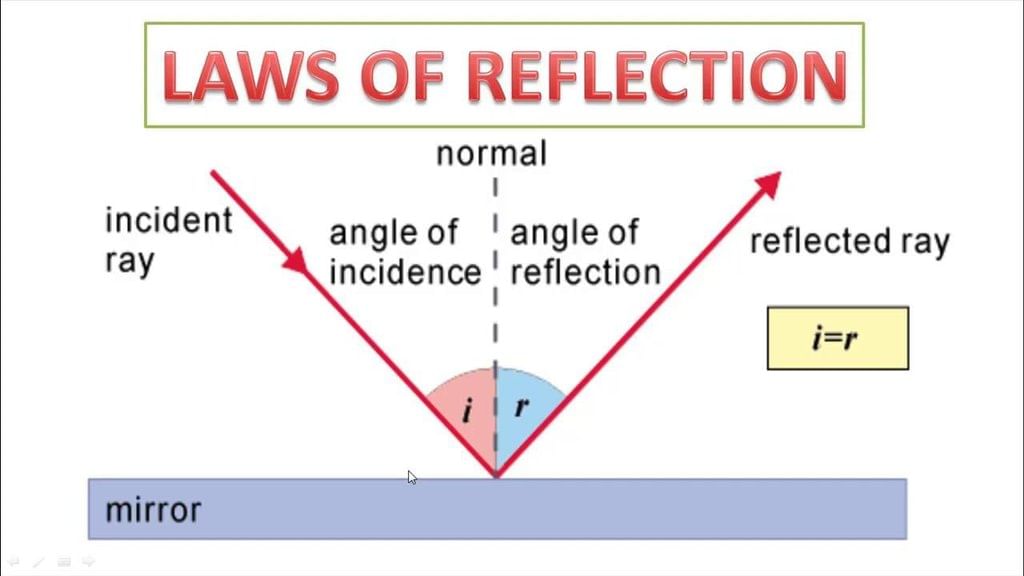
  5. First law of reflection states:
    a) i + r = 90°
    b) i = r
    c) i > r
    d) i < r
Fill in the Blanks

Instruction: Fill in the blanks with the correct word based on the chapter.

  1. A concave mirror can form an __________ image when the object is very close.
  2. A convex mirror always forms an __________ and __________ image.
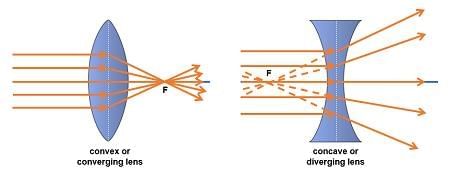
  3. A convex lens is thicker at the __________ than at the edges.
  4. A concave lens is a __________ lens because it spreads light rays apart.
  5. The human eye contains a __________ lens that changes shape to focus.
Very Short Answer Questions

Instruction: Answer the following questions in one line.

  1. Why do vehicle side-view mirrors use convex mirrors?
  2. What is lateral inversion?
  3. State the two laws of reflection in words.
  4. Which mirror can focus sunlight onto paper?
  5. Which lens always gives an erect and diminished image?
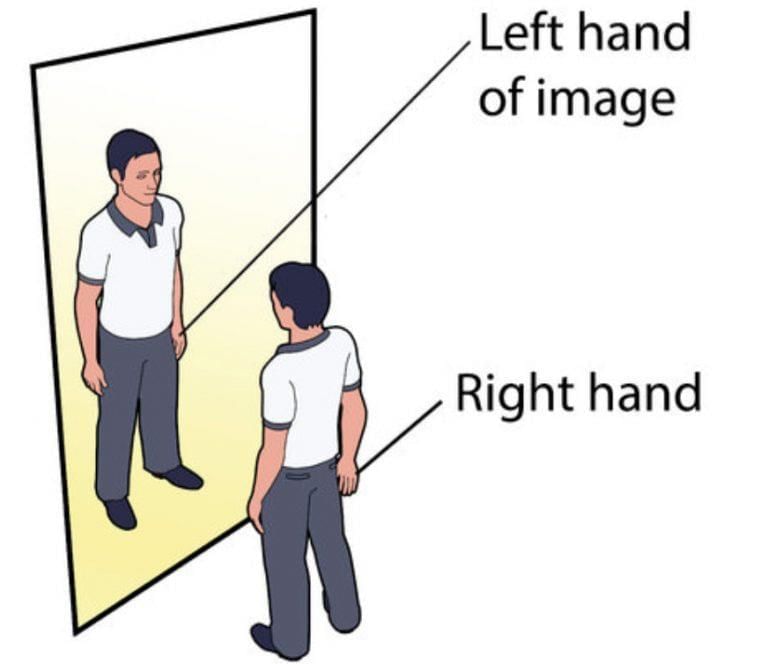
Lateral Inversion

Short Answer Questions

Instruction: Answer the following questions in 2–3 lines.

  1. How does a concave mirror’s image change as the object moves away?
  2. Why do convex mirrors make objects seem farther away?
  3. Explain why a convex lens can burn paper but a concave lens cannot.
  4. How do we know the laws of reflection apply to spherical mirrors?
  5. What images do concave and convex lenses form at various distances?

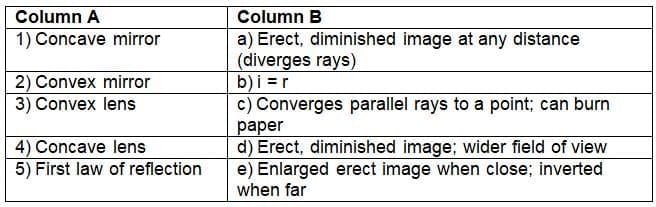
Match the Following

Instruction: Match Column A with the correct option in Column B.
9. The Amazing World of Solutes, Solvents, and Solutions – Textbook Worksheet

Multiple Choice Questions (MCQs)

Instruction: Select the correct option for each question.

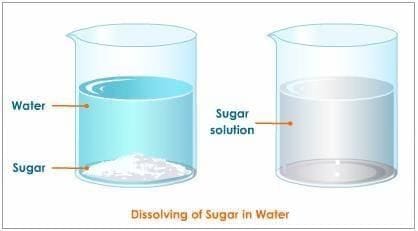
  1. Which of the following forms a true (clear) solution with water?
    a) Sand
    b) Sawdust
    c) Sugar
    d) Chalk powder
  2. In a salt-water solution, which is the solvent?
    a) Salt
    b) Water
    c) Both are solvents
    d) Neither is solvent
  3. Air is a gaseous solution in which the major component (solvent) is:
    a) Oxygen
    b) Nitrogen
    c) Carbon dioxide
    d) Argon
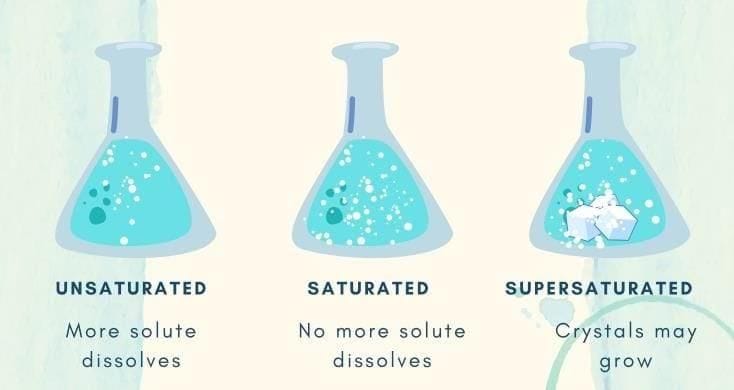
  4. As more salt is added to a fixed amount of water, undissolved salt starts settling. The solution has become:
    a) Dilute
    b) Unsaturated
    c) Saturated
    d) Concentrated but unsaturated
  5. Which statement about dilute vs. concentrated is correct?
    a) They are absolute, fixed terms
    b) They are comparative terms for amount of solute
    c) They depend only on solvent type
    d) They only apply to gases
  6. For most solid solutes in water, increasing temperature generally:
    a) Decreases solubility 
    b) Increases solubility
    c) Has no effect
    d) Makes solution non-uniform
  7. The solubility of gases in water generally:
    a) Increases with temperature
    b) Is highest at boiling point
    c) Is unaffected by temperature
    d) Decreases with temperature
  8. If in a syrup (chashni) sugar amount is more than water, the solvent is still:
    a) Sugar, because it is more
    b) Water, because it is liquid and determines state
    c) Both are solvents
    d) Neither is solvent
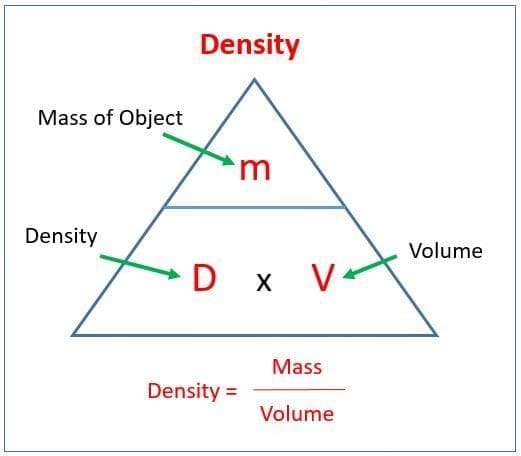
  9. Density is defined as:
    a) Volume per unit mass
    b) Mass per unit volume
    c) Weight per unit mass
    d) Weight per unit volume
  10. Which statement explains why ice floats on water?
    a) Ice has more mass
    b) Ice has higher density
    c) Ice has lower density than liquid water
    d) Ice has no mass

Fill in the Blanks

Instruction: Fill in the blanks with the correct word based on the chapter.

  1. A solution is a __________ mixture in which components are evenly distributed.
  2. In a solid–liquid solution, the solid is the __________ and the liquid is the __________.
  3. When no more solute can dissolve at a given temperature, the solution is __________.
  4. The maximum amount of solute that can dissolve in a fixed quantity of solvent at a given temperature is called __________.
  5. Oxygen dissolves only in __________ quantities in water, yet it is vital for aquatic life.
  6. For gases, solubility generally __________ with increase in temperature.
  7. Density = __________ / __________.
  8. The SI unit of density is __________.
  9. When temperature increases, volume tends to increase and density tends to __________ (if mass stays same).
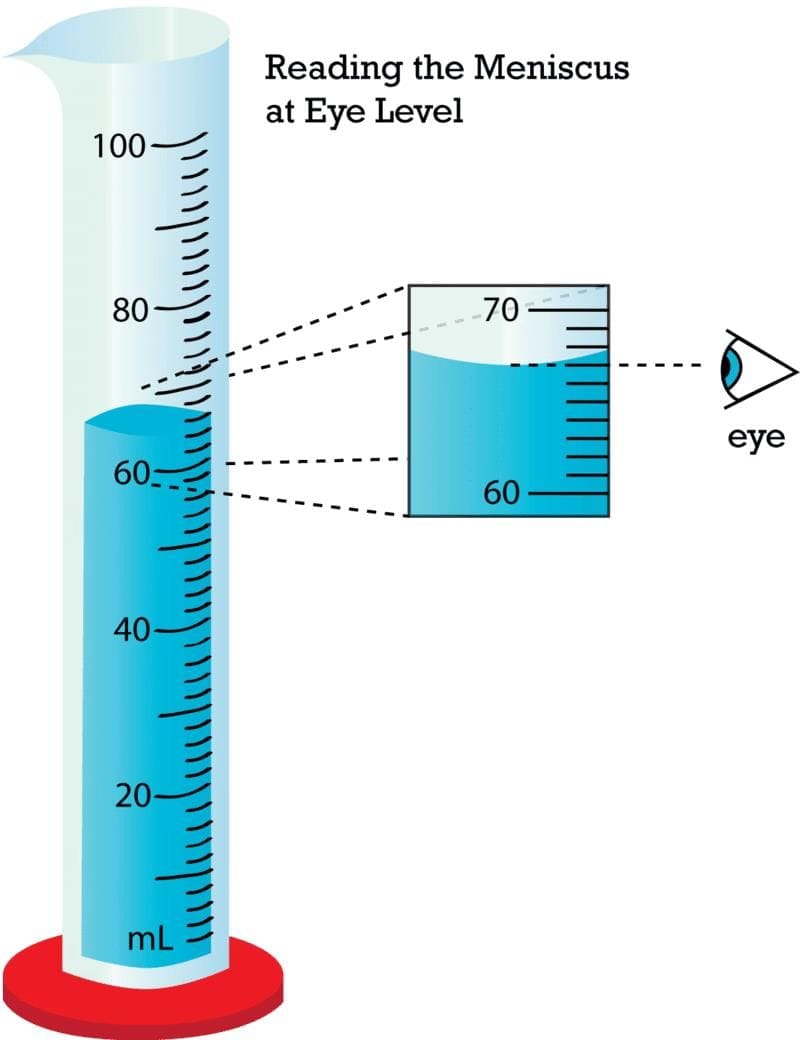
  10. Reading liquids in a measuring cylinder is done at the bottom of the __________ for water and colorless liquids.

Very Short Answer Questions

Instruction: Answer the following questions in one line.

  1. Define solute and solvent with an example.
  2. What happens when a saturated salt solution is heated?
  3. Name the major component of air that acts as the solvent.
  4. State the formula for density.
  5. Which has higher dissolved oxygen: cold water or warm water?

Short Answer Questions

Instruction: Answer the following questions in 2–3 lines.

  1. Why does sugar dissolve in water but sand does not form a solution?
  2. Explain dilute vs. concentrated solutions with an example.
  3. How does temperature affect solubility of solids vs. gases in water?
  4. How do you measure the volume of an irregular solid using a measuring cylinder?
  5. Why does ice float on water and why is this important for aquatic life?

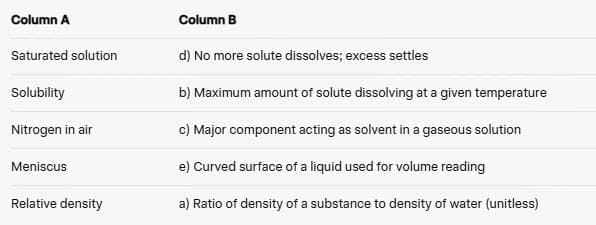
Match the Following

Instruction: Match Column A with the correct option in Column B.
8. Nature of Matter: Elements, Compounds, and Mixtures – Textbook Worksheet

Multiple Choice Questions

Q.1. Kerosene and Petrol are miscible liquids. The difference between their boiling points is more than 25°C. The two liquids can be separated from each other by _____. 
(a) Simple distillation
(b) Steam distillation
(c) Fractional distillation
(d) Any of these

Q.2. How can a saturated solution be made unsaturated?
(a) By heating the solution
(b) By cooling the solution
(c) By increasing the amount of solute
(d) By centrifugation of the solution

Q.3. The cause of Brownian movement is:
(a) Heat changes in liquid state
(b) Convection currents
(c) Impact of molecules of dispersion medium on on dispersed phase
(d) Attractive forces between the particles of dispersed phase and dispersion medium.

Q.4. In which of the following, dispersed phase is a liquid and dispersion medium is a gas? 
(a) Cloud
(b) Smoke
(c) Gel
(d) Soap bubble

Q.5. At room temperature, a non-metal which is a liquid is: 
(a) Sulphur
(a) Bromine
(a) Chlorine
(a) Nitrogen

Fill in the Blanks1. Common salt is _________.

2. A mixture contains more than ______ substance mixed in ______ proportion.
3. Properties of a __________ are different from its constituent elements, whereas a _______ shows the properties of its constituting elements.
4. A solution is defined as a mixture that is_________
5. We can remove salts from a solution by using the process of _________
6. A pure substance has a fixed__________ or ______ at constant temperature.
7. An element is made up of only one kind of _________.
8. Miscible liquids are separated by ________ .
9. Immiscible liquids are separated by using a _______.
10. Filtered tea is a _________ mixture.
11. Alloy is a _______.
12. Sublimation of camphor is a _________ change.
13. Most common chemical change we observe in our routine life is rusting of______.

Very Short Answer Question 

Q.1. Classify the substances given in below figure into elements and compounds

Q.2. Give one example each of homogeneous and heterogeneous mixture.
Q.3. Name the apparatus by which mixture of oil and water can be separated.
Q.4. Is brass a mixture or a compound?
Q.5. What type of solution is an alloy? Liquid solution or solid solution
Q.6. A mixture consisting of two miscible liquids ‘A’ and ‘B’ whose boiling points differ by 50 C can be separated by which process?
Q.7. Give one example of solid- liquid homogeneous mixture.
Q.8. What is a Aqua regia?
Q.9. Which method is used to separate two immiscible liquids?
Q.10. Name two elements which are in liquid state at room temperature? 

Short Answer Types Questions

Q.1. Try segregating the things around you as pure substances or mixtures. 

Q.2. What is meant by a substance? 

Q.3. What type of mixtures are separated by the technique of crystallisation? 

Q.4. What is tyndall effect? Which kinds of solution show it?

Q.5. What is centrifugation? Where it is used?

Q.6. What is crystallization? Where is it used? Why is this better than simple evaporation technique?

Q.7. What is a colloid? What are its various properties?

Q.8. Write a method to separate different gases from air.

Q.9. Explain the following giving examples. 
(a) saturated solution 
(b) pure substance 
(c) colloid 
(d) suspension

Q.10. Write the steps you would use for making tea. Use the words solution, solvent, solute, dissolve, soluble, insoluble, filtrate and residue.

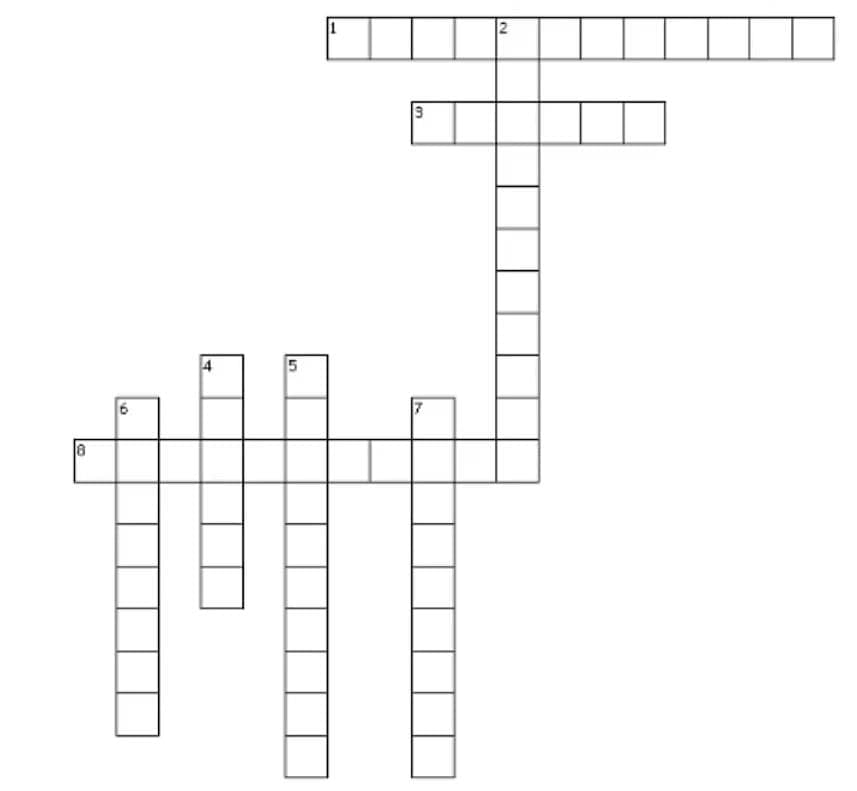
Crossword Puzzle

Across
1. hydrogen ______ is a color gas with a smell of rotten eggs
5. The major components in solution
6. Melting point and boiling point are _______ properties
7. Two elements are liquid at room temperature are mercury and _______
Down
2. In colloids ,The particles are called the ______ phase and the medium in which they are distributed is called the dispersion medium.
3. amount of solute present per unit volume or mass of the solution or solvent
4. denser particles are forced to the bottom and the lighter particles stay at the top when spun rapid

You can find Worksheets Solutions here: Worksheet Solutions: Is Matter Around Us Pure

7. Particulate Nature of Matter – Textbook Worksheet

Multiple Choice Questions

Q.1. According to ancient philosophers, matter consists of:
(a) Three constituents
(b) Four constituents
(c) Five constituents
(d) Six constituents

Q.2. Dry ice is:
(a) Solid ammonia
(b) Solid carbon dioxide
(c) Solid sulphur dioxide
(d) Normal ice. 

Q.3. Which of the following statements is not correct for liquid state?
(a) Particles are loosly packed in the liquid state
(b) Fluidity is the maximum in the liquid state
(c) Liquids can be compressed
(d) Liquids take up the shape of any container in which these are placed

Q.4. Which of the following will sublime? 
(a) Common salt
(b) Sugar
(c) Camphor
(d) Potassium nitrate

Q.5. When the liquid starts boiling, the further heat energy which is supplied: 
(a) Is lost to the surrounding as such
(b) Increases the temperature of the liquid
(c) Increases the kinetic energy of the particles in the liquid 
(d) Is absorbed as latent heat of vaporisation by the liquid

Fill in the blanks:-1. Matter is made up of small_________.
2. The forces of attraction between the particles are _______ in solids, ______ in liquids and _________ in gases.
3. 
__________ is the change of gaseous state directly to solid state without going through liquid state, and vice versa.
4. 
Evaporation causes __________.
5. 
Latent heat of fusion is the amount of heat energy required to change 1 kg of solid into liquid at its ________.
6. 
Solid, liquid and gas are called the three _______ of matter.
7. 
The smell of perfume gradually spreads across a room due to ______.
8. 
Rapid evaporation depends on the ______ area exposed to the atmosphere.
9. 
As the temperature of a system increases, the pressure of the gases ______.
10. 
As the volume of a specific amount of gas decreases, it’s pressure _______.
11. 
As the temperature of a gas decreases, I’s volume ______.
12. 
Gas molecules at higher temperatures have more _______ than at cooler temperatures.
13. 
A sponge has minute ________, in which ________ is trapped.
14. 
The pressure inside of a sealed tube if you raise the temperature go ______
15.
 Forces of attraction in liquids are _______ than in solid.
16. Latent heat of ________ is the amount of heat energy required to change 1 kg of solid into liquid at its melting point.

Very Short Answer Questions

Q.1. Name one property which is shown by naphthalene and not by sodium chloride.

Q.2. A rubber band changes its shape when stretched. Can it be regarded as solid?

Q.3. Gases can be compressed but solids cannot. Explain.

Q.4. Kelvin scale of temperature is regarded better than the Celsius scale. Assign reason.

Q.5. What happens to the heat energy which is supplied to the solid once it has started melting?

Q.6. The freezing point of water is 0°C. What is the corresponding temperature on the Kelvin scale?

Q.7. Are the melting point temperature of the solid state and the freezing point temperature of the liquid state of a substance different?

Q.8. A substance is in liquid state at room temperature and changes into gas upon heating. What will you call its gaseous state?

Q.9. When a crystal of copper sulphate is placed at the bottom of a beaker containing water?

Q.10. The boiling point of ethyl alcohol is 78°C. What is the corresponding temperature on kelvin scale?

Crossword Puzzle

Across
1. 
BEC stands for Bose-Einstein-______

3. The state consists of super energetic and super excited particles

8. Conversion of solid to vapour is called ______
Down
2. 
This is the phenomenon of change of a liquid into vapours at any temperature below its boiling point
4. 
SI unit of Temperature
5. 
CNG stands ____ natural gas
6.
 It is the amount of water vapour present in air.
7. 
LPG stands for ______petroleum gas. 

You can find Worksheet Solutions here: Worksheet Solutions: Particulate Nature of Matter

6. Pressure, Winds, Storms, and Cyclones – Textbook Worksheet

Multiple Choice Questions (MCQs)

Instruction: Select the correct option for each question.

  1. Pressure is defined as:
    a) Force × area
    b) Force / area
    c) Area / force
    d) Mass × acceleration
  2. Why do broader bag straps feel more comfortable than narrow ones for the same load?
    a) They reduce the force
    b) They increase pressure
    c) They decrease pressure by increasing area
    d) They change the weight
  3. SI unit of pressure is:
    a) Newton (N)
    b) Joule (J)
    c) Pascal (Pa)
    d) Watt (W)
  4. Liquid pressure at a point depends mainly on:
    a) Shape of container
    b) Color of liquid
    c) Height (depth) of the liquid column
    d) Total volume of liquid
  5. Which activity shows that liquids exert pressure on the walls?
    a) Balloon inflating
    b) Water jetting sideways from holes in a bottle
    c) Magnet attracting iron
    d) Ice melting
  6. Atmospheric pressure is the pressure exerted by:
    a) Water only
    b) Rocks of Earth
    c) Air around us in all directions
    d) Only wind
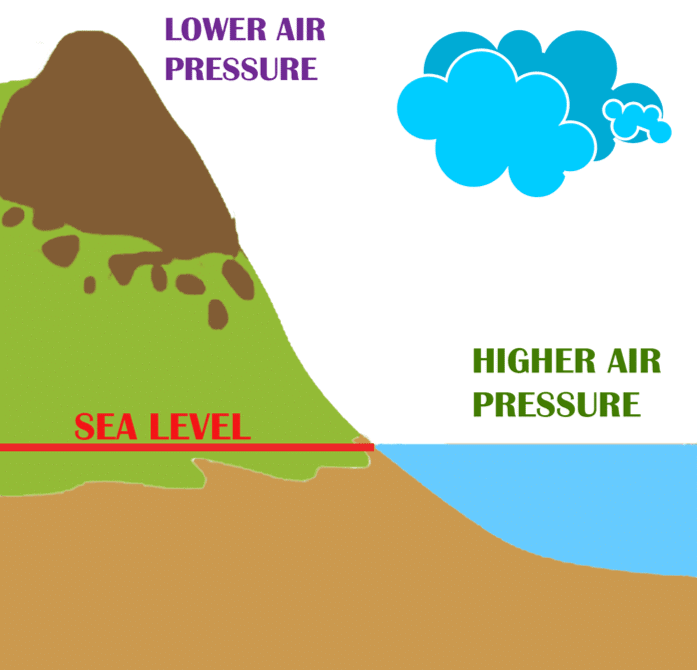
    Atmospheric Pressure
  7. Air moves from a region of:
    a) Low pressure to high pressure
    b) High pressure to low pressure
    c) High temperature to low temperature only
    d) Low density to high density only
  8. During the day at the coast, a sea breeze blows because:
    a) Sea heats faster than land
    b) Land heats faster; air rises over land creating low pressure
    c) Air pressure over sea is always low
    d) Earth stops rotating
  9. High-speed winds between two hanging balloons make them move closer because:
    a) Gravity increases
    b) Pressure between them increases
    c) Pressure between them decreases due to fast air
    d) They gain electric charge
  10. Lightning is produced when:
    a) Sun heats clouds
    b) Charges in clouds and ground discharge suddenly
    c) Wind speed becomes zero
    d) Air becomes very cold

Fill in the Blanks

Instruction: Fill in the blanks with the correct word based on the chapter.

  1. Pressure = __________ / area.
  2. Overhead water tanks are placed high to increase water __________ in the pipes.
  3. 1 pascal (Pa) equals 1 __________ per square metre.
  4. Liquids exert pressure at the bottom and also on the __________ of a container.
  5. At sea level, typical atmospheric pressure is about 1,013 __________ or 1,013 __________.
  6. Air flows from regions of high pressure to regions of __________ pressure.
  7. Daytime coastal wind from sea to land is called a __________ breeze.
  8. Lightning conductors safely carry electric charge into the __________.
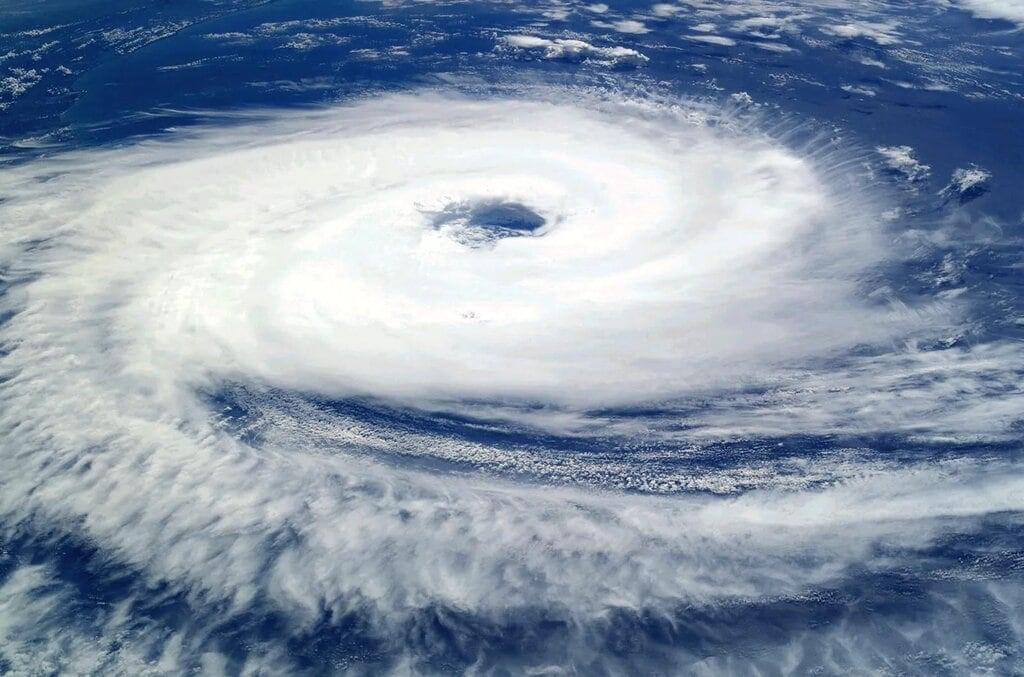
  9. The calm, low-pressure center of a cyclone is called the __________.
  10. A sudden rise of sea water pushed by cyclone winds onto land is called a storm __________.

Cyclone

Very Short Answer Questions

Instruction: Answer the following questions in one line.

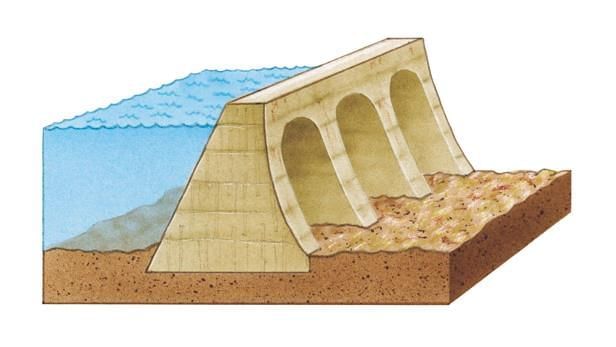
  1. Why are dam walls broader at the base?
  2. Why aren’t we crushed by atmospheric pressure?
  3. What causes a sea breeze?
  4. What simple safety rule helps prevent roofs from blowing off in storms?
  5. What is a thunderstorm?

Dams are build borader at Base

Short Answer Questions

Instruction: Answer the following questions in 2–3 lines.

  1. Explain, with an example, how area affects pressure in daily life.
  2. How does height of a liquid column affect pressure? Mention one application.
  3. Describe briefly how winds are formed.
  4. How does lightning form inside storm clouds?
  5. Why are cyclones dangerous? Give two reasons.

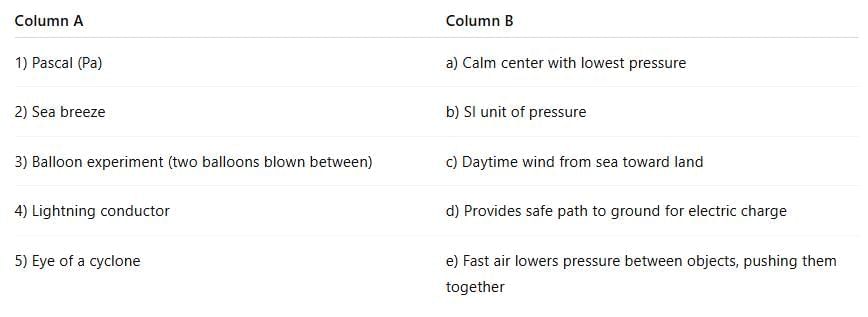
Match the Following

Instruction: Match Column A with the correct option in Column B.

5. Exploring Forces – Textbook Worksheet

Force

Q1. Multiple Choice Questions (MCQs)

Instruction: Select the correct option for each question.

  1. In science, a force is defined as:
    a) Only a push
    b) Only a pull
    c) A push or a pull
    d) Energy of motion
  2. Which of these is NOT an effect of force?
    a) Change of shape
    b) Change of direction
    c) Production of light
    d) Start/stop motion
  3. Forces always involve:
    a) Only one object
    b) Interaction between two objects
    c) Only moving objects
    d) Only heavy objects
  4. The SI unit of force is:
    a) Joule (J)
    b) Watt (W)
    c) Newton (N)
    d) Pascal (Pa)
  5. Friction is a force that:
    a) Aids motion
    b) Always increases speed
    c) Opposes motion between surfaces in contact
    d) Acts only in liquids
  6. Which is a non-contact force?
    a) Muscular force
    b) Friction
    c) Magnetic force
    d) Push with a stick
  7. Gravity is:
    a) Sometimes attractive, sometimes repulsive
    b) Always repulsive
    c) Always attractive
    d) Only acts on Earth
  8. Weight is measured in:
    a) Kilogram (kg)
    b) Newton (N)
    c) Meter (m)
    d) Joule (J)
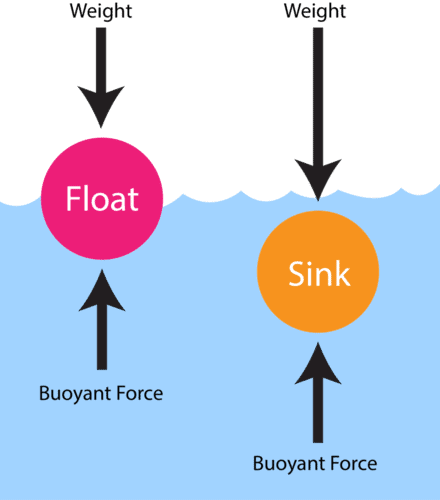
  9. An object floats in a liquid when:
    a) Weight > buoyant force
    b) Weight = buoyant force
    c) Weight < buoyant force
    d) There is no gravity

Q2. Fill in the Blanks

Instruction: Fill in the blanks with the correct word based on the chapter.

  1. A force is a __________ or a __________.
  2. If an object’s speed or direction changes, a __________ has acted.
  3. The SI unit of force is the __________ (symbol: N).
  4. Friction always acts in a direction __________ to motion.
  5. Forces that act without contact are called __________ forces.
  6. The force with which Earth pulls objects is called __________.
  7. Weight is a __________ and is measured in newtons.
  8. The device used to measure weight (force) in newtons is a __________ balance.
  9. The upward force exerted by a liquid on an immersed object is called __________ force.
  10. An object sinks when its __________ is greater than the buoyant force.

Q3. Short Answer QuestionsInstruction: Answer the following questions in 2–3 lines.

  1. How does friction depend on the nature of surfaces?
  2. Explain why cycling uphill feels harder than cycling downhill.
  3. What does “forces work in pairs” mean?
  4. How do we find the least count of a spring balance?
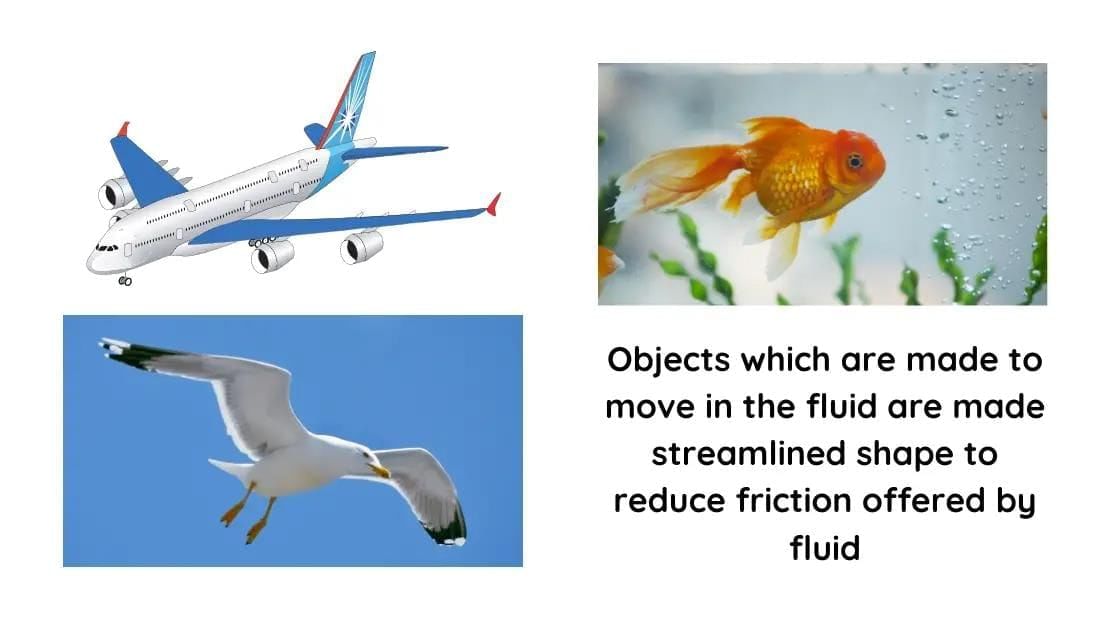
  5. Why do streamlined shapes help in air or water?

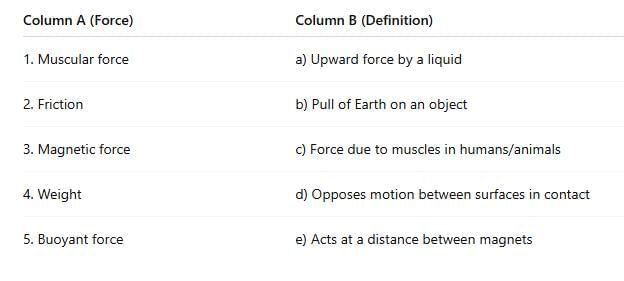
Q4. Match the Following

Instruction: Match Column A with the correct option in Column B.

Q5. Application/Reasoning (Short Problems)

Instruction: Answer the following briefly in 2–3 lines.

  1. A wooden block is pushed on a rough table and stops after some distance. Why?
  2. A 1 kg object has a weight of about 10 N on Earth. What will be its weight on the Moon (g ≈ 1.6 m/s²)?
  3. A spring balance has marks 0 to 5 N with 10 equal divisions between each newton. What is its least count?
  4. Two balloons rubbed with wool repel each other. Which force is acting and why?
  5. A stone sinks in water but a sealed empty plastic bottle floats. Why?

Check the solutions of worksheet here.

4. Electricity: Magnetic and Heating Effects – Textbook Worksheet

Q1. Multiple Choice Questions (MCQs)

Instruction: Select the correct option for each question.

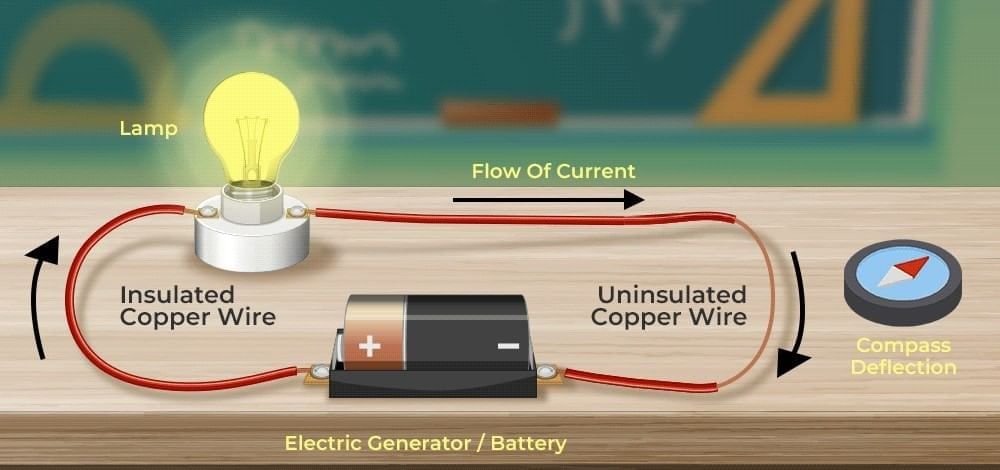
  1. What did Oersted discover in 1820?
    a) Heating effect of current
    b) Electric charge of Earth
    c) Magnetic effect of electric current
    d) Structure of dry cell
  2. Which instrument can detect the magnetic field around a current-carrying wire?
    a) Vernier caliper
    b) Magnetic compass
    c) Thermometer
    d) Barometer
  3. An electromagnet is:
    a) A permanent magnet made of steel
    b) A coil with an iron core that becomes a magnet when current flows
    c) A bar magnet with fixed poles
    d) A coil without any core
  4. Which change will increase the strength of an electromagnet?
    a) Using fewer turns of wire
    b) Reducing current
    c) Inserting a soft iron core
    d) Removing the battery
  5. Lifting electromagnets are used mainly to:
    a) Measure current
    b) Lift and move heavy steel in scrap yards
    c) Store electrical energy
    d) Heat metals
  6. When current passes through a nichrome wire, it becomes hot due to:
    a) Absence of resistance
    b) Magnetic shielding
    c) Cooling effect of current
    d) Heating effect of electric current
  7. Which factor increases heat in a wire for the same time?
    a) Thicker wire and less current
    b) Shorter wire and less current
    c) Longer, thinner wire with more current
    d) No resistance in wire
  8. In a simple voltaic (galvanic) cell, electricity is produced by:
    a) Chemical reactions between metals and electrolyte
    b) Friction 
    c) Magnetic induction
    d) Solar energy

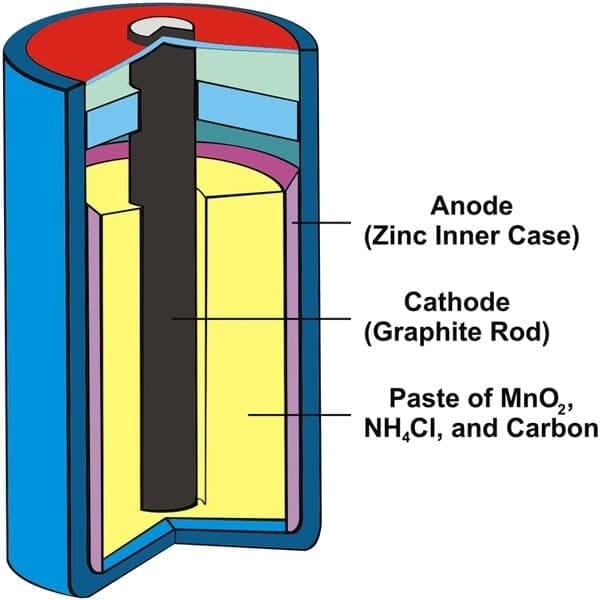
    Dry Cell
  9. In a dry cell, the negative terminal is the:
    a) Zinc container
    b) Carbon rod 
    c) Electrolyte paste
    d) Air gap
  10. Lithium-ion batteries are:
    a) Single-use only
    b) Not suitable for recharging
    c) Only for torches and clocks
    d) Rechargeable and used in phones/laptops

Q2. Fill in the Blanks

Instruction: Fill in the blanks with the correct word based on the chapter.

  1. A current-carrying conductor produces a __________ field around it.
  2. The deflection of a __________ needle shows the presence of current nearby.
  3. An iron nail wrapped with a current-carrying coil becomes an __________.
  4. Reversing the direction of current reverses the __________ of an electromagnet.
  5. The heating of a wire due to current is called the __________ effect of electric current.
  6. __________ wire is used as a heating element because it has high resistance.
  7. A device that produces electricity by a chemical reaction is called an electric __________.
  8. In a dry cell, the electrolyte is a moist __________.
  9. In the lemon battery, the lemon juice acts as an __________.
  10. Multiple cells connected together form a __________.

Q3. Very Short Answer Questions (1 line)

Instruction: Answer the following questions in one line.

  1. What simple observation shows the magnetic effect of current?
  2. Name any one factor that increases the strength of an electromagnet.
  3. What happens to an electromagnet when the current is switched off?
  4. What is resistance?
  5. Which terminal is at the center of a dry cell?

Q4. Short Answer Questions

Instruction: Answer the following questions in 2–3 lines.

  1. State Oersted’s finding and its importance.
  2. How can you make a simple electromagnet at home?
  3. Mention two ways to increase the heat produced in a wire.
  4. What is the basic structure of a dry cell?
  5. How can you light an LED with lemons?

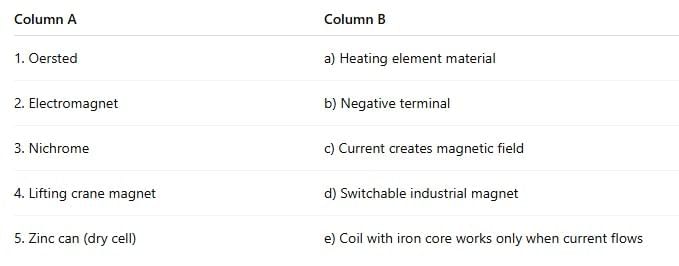
Q5. Match the Following 

Instruction: Match Column A with the correct option in Column B.

Ans: 

  1. Oersted — c) Current creates magnetic field
    He discovered the magnetic effect of electric current.
  2. Electromagnet — e) Coil with iron core works only when current flows
    It becomes magnetic only when powered.
  3. Nichrome — a) Heating element material
    Nichrome’s high resistance makes it ideal for heaters.
  4. Lifting crane magnet — d) Switchable industrial magnet
    Used to lift/drop heavy steel by switching current ON/OFF.
  5. Zinc can (dry cell) — b) Negative terminal
    In a dry cell, the zinc container acts as the negative electrode.

3. Health: The Ultimate Treasure – Textbook Worksheet

Q1. Multiple Choice Questions (MCQs)

Instruction: Select the correct option for each question.

  1. According to WHO, health means:
    a) Only absence of disease
    b) Physical fitness only
    c) Complete physical, mental, and social well-being
    d) Ability to work hard
  2. Which is a sign, not a symptom?
    a) Pain
    b) Tiredness
    c) Dizziness
    d) Fever
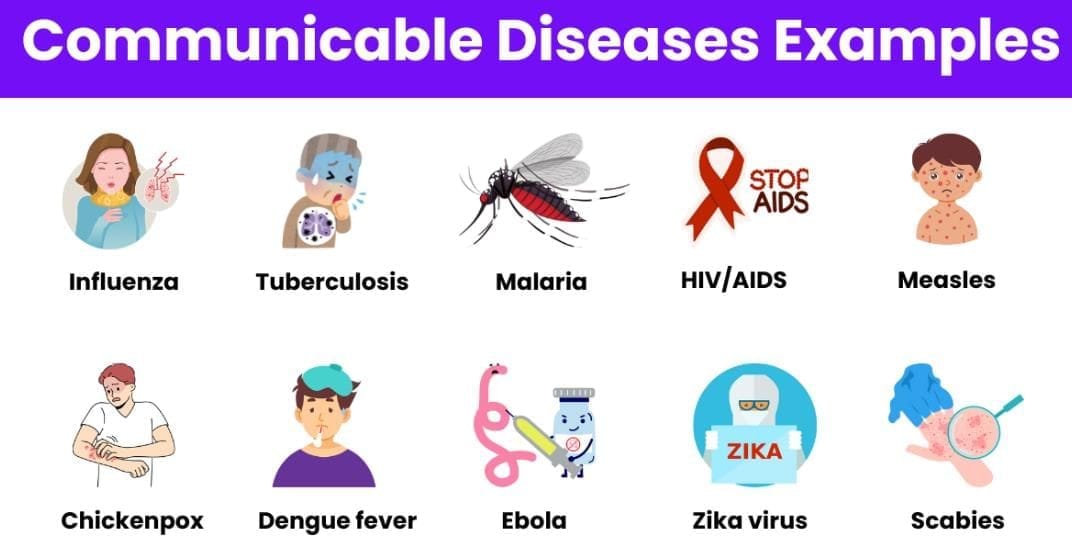
  3. Which disease is non-communicable?
    a) Typhoid
    b) Dengue
    c) Diabetes
    d) Chickenpox
  4. Which habit helps prevent communicable diseases?
    a) Skipping breakfast
    b) Sharing towels
    c) Washing hands with soap
    d) Sleeping very late
  5. Which statement about antibiotics is correct?
    a) They kill viruses like flu
    b) They treat protozoan diseases
    c) They kill bacteria
    d) They are safe to take without prescription
  6. Who discovered the first antibiotic, penicillin?
    a) Edward Jenner
    b) Alexander Fleming
    c) Robert Koch
    d) Louis Pasteur
  7. Vaccines protect by:
    a) Killing pathogens directly in the body
    b) Teaching the immune system to recognize germs
    c) Giving energy to white blood cells
    d) Replacing antibiotics
  8. Which factor commonly increases risk of NCDs?
    a) Playing outdoors
    b) Balanced diet
    c) Longer lifespans and less physical activity
    d) Handwashing
  9. Which practice from Ayurveda supports holistic health?
    a) Variolation
    b) Dinacharya and ritucharya
    c) Overuse of antibiotics
    d) Skipping meals
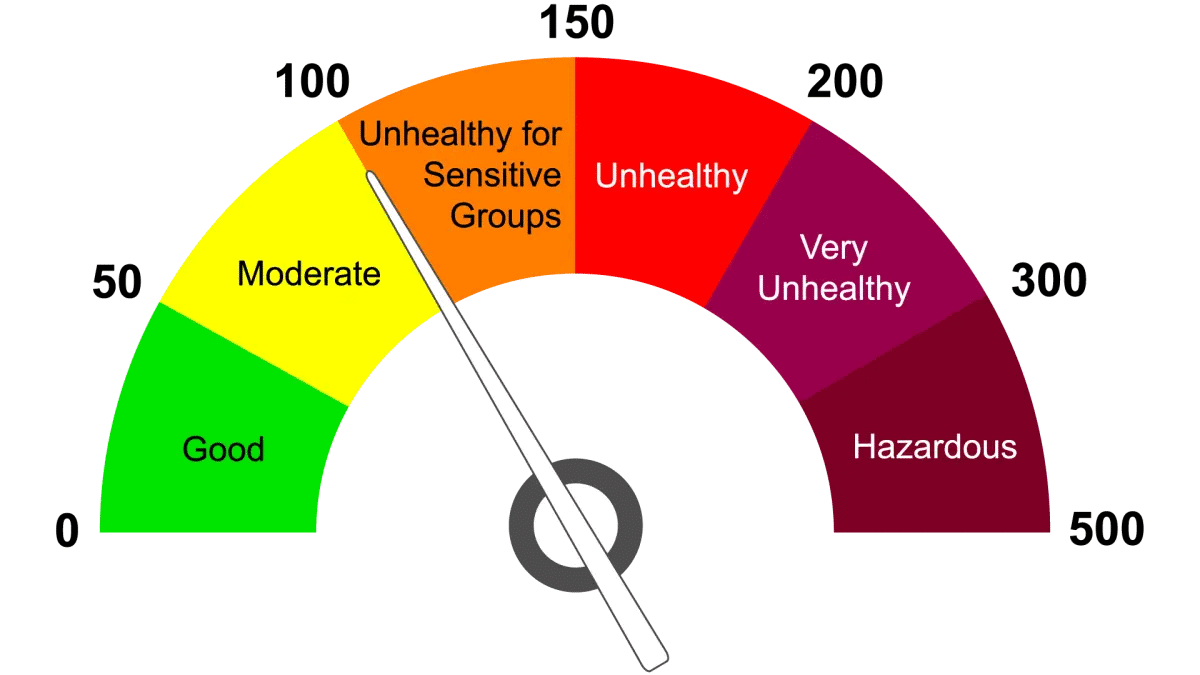
  10. AQI is used to measure:
    a) Water purity
    b) Body temperature
    c) Air quality
    d) Sleep quality

Q2. Fill in the Blanks

Instruction: Fill in the blanks with the correct word based on the chapter.

  1. Health includes physical, mental, and ______ well-being.
  2. Headache is a ______ experienced by the patient.
  3. A measurable change like a rash or swelling is called a ______.
  4. Diseases that spread from person to person are called ______ diseases.
  5. Diseases like cancer and asthma that do not spread are ______ diseases.
  6. The body’s ability to fight diseases is called ______.
  7. Using weakened or inactive germs to train the body’s defense is called a ______.
  8. Taking antibiotics without need can lead to antibiotic ______.
  9. Building and using toilets helps prevent diseases spread through contaminated ______.
  10. Practising ______, like deep breathing, supports mental health in Ayurveda.

Q3. Very Short Answer Questions 

Instruction: Answer the following questions in one line.

  1. What does WHO say about health?
  2. Name one vector that spreads communicable diseases.
  3. What is the term for the body’s natural defense system?
  4. Which discovery led to modern antibiotics?
  5. What does AQI stand for?

Q4. Short Answer Questions 

Instruction: Answer the following questions in 2–3 lines.

  1. How did screen time and loneliness affect student’s health?
  2. How do communicable diseases spread through air?
  3. Why should we finish a full course of antibiotics?
  4. How does community sanitation improve health?
  5. Why are relationships important for health?

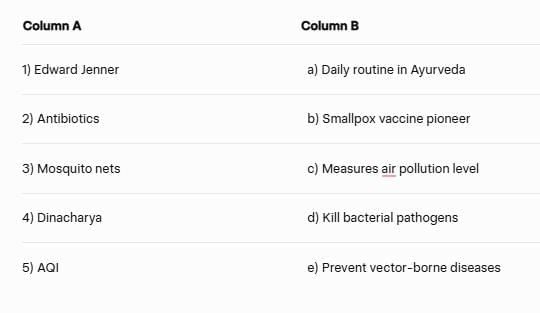
Q5. Match the Following

Instruction: Match Column A with the correct option in Column B.

Check the worksheet solutions here.

2. The Invisible Living World: Beyond Our Naked Eye – Textbook Worksheet

Multiple Choice Questions (MCQs)

Instruction: Select the correct option for each question.

  1. Who first used the term “cell” after observing thin slices of cork?
    a) Antonie van Leeuwenhoek
    b) Robert Hooke
    c) Louis Pasteur
    d) Ananda Mohan Chakrabarty
  2. Which tool allows us to view objects too small to be seen with the naked eye?
    a) Telescope
    b) Periscope
    c) Microscope
    d) Binoculars
  3. A round-bottom flask filled with water can act as:
    a) A lens/magnifier
    b) A telescope
    c) A prism
    d) A mirror
  4. Which cell structure is present in plant cells but absent in animal cells?
    a) Nucleus
    b) Cell membrane
    c) Cell wall
    d) Cytoplasm
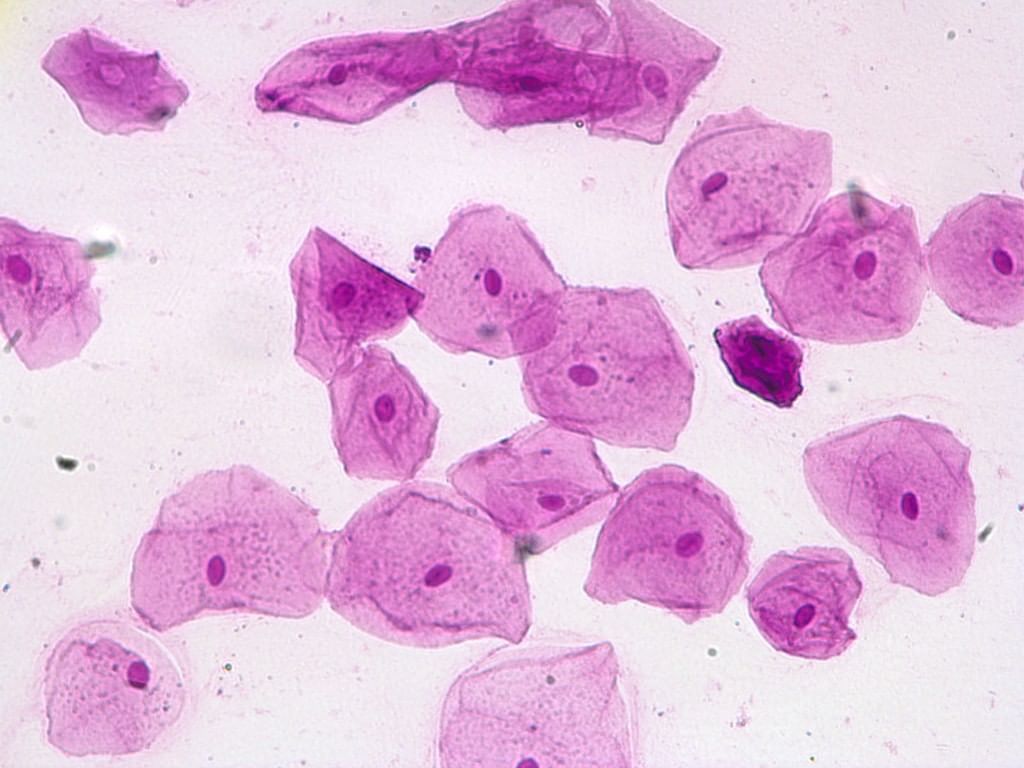
  5. Which statement is true about cheek cells?
    a) They are rectangular and have a cell wall.
    b) They have a large central vacuole. 
    c) They contain chloroplasts.
    d) They are polygon-shaped and lack a cell wall.
  6. Which part of the cell controls all activities like growth and division?
    a) Cytoplasm
    b) Nucleus
    c) Cell membrane
    d) Vacuole
  7. Spirulina is best described as:
    a) A microalga used as a superfood
    b) A nitrogen-fixing bacterium
    c) A fungus used in bread making
    d) A protozoan that causes disease
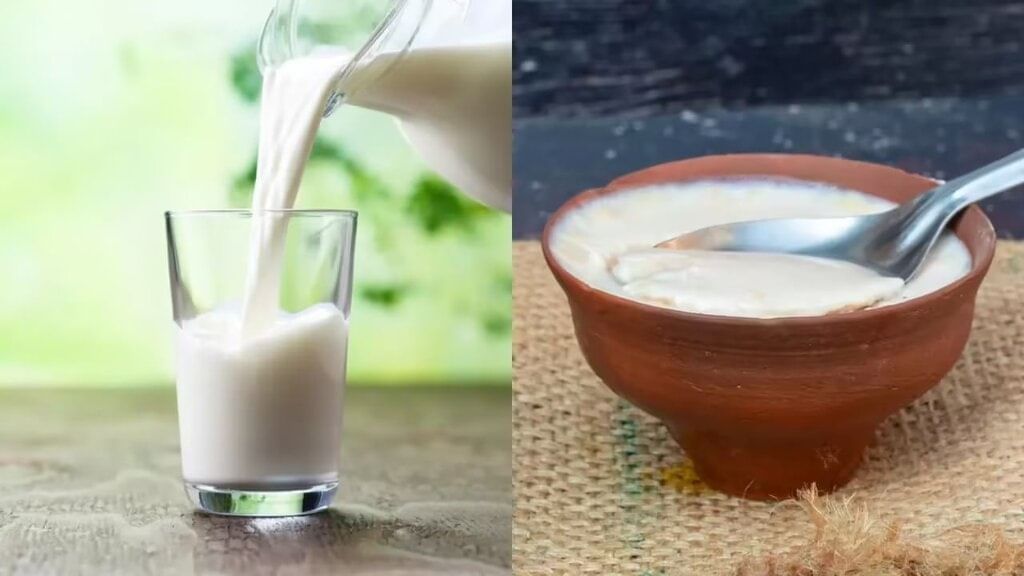
  8. Which microorganism helps convert milk into curd?
    a) Yeast
    b) Rhizobium
    c) Lactobacillus
    d) Amoeba

Milk to Curd

Fill in the BlanksInstruction: Fill in the blanks with the correct word based on the chapter.

  1. The jelly-like substance inside a cell where life processes occur is the ______.
  2. The thin, flexible boundary of a cell that controls entry and exit is the ______ ______.
  3. In onion peel cells, staining with ______ helps make the cells visible.
  4. Cheek cells are commonly stained with ______ ______.
    Cheek Cells
  5. The bacteria that fix nitrogen in legume root nodules are called ______.
  6. The process by which yeast makes dough rise by releasing carbon dioxide is called ______.
  7. Bacterial genetic material without a nuclear membrane is found in a region called the ______.

Very Short Answer Questions 

Instruction: Answer the following questions in one line.

  1. Who is known as the Father of Microbiology?
  2. What do chloroplasts contain that enables photosynthesis?
  3. Name the large storage cavity commonly found in plant cells.
  4. What shape are muscle cells typically described as?
  5. Which organisms decompose waste to form manure?

Short Answer QuestionsInstruction: Answer the following questions in 2–3 lines.

  1. Why are some microorganisms invisible to the naked eye?
  2. How does high salt or sugar preserve pickles and murabbas?
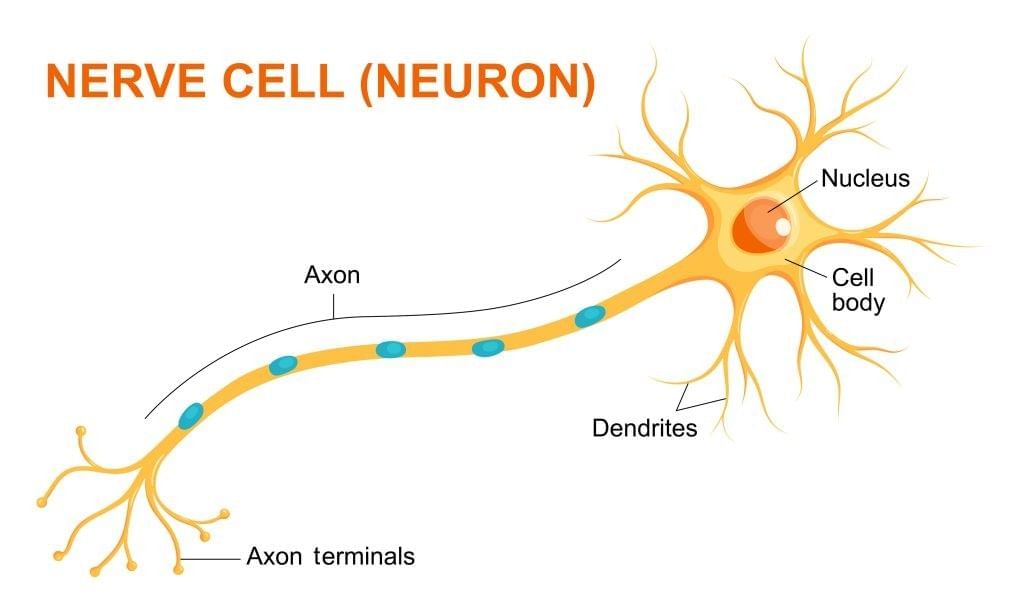
  3. How do nerve cells (neurons) suit their function?

  4. Why is warm milk preferred for curd formation?
  5. What role do microalgae play in Earth’s oxygen supply?

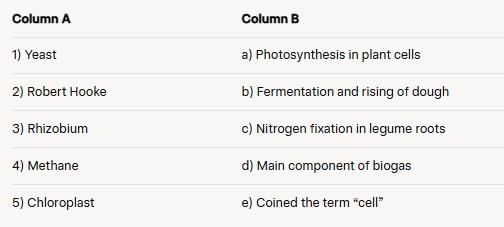
Match the Following 

Instruction: Match Column A with the correct option in Column B.

Check worksheet solutions here.

1. Exploring the Investigative World of Science – Textbook Worksheet

Multiple Choice Questions (MCQs)

Instruction: Select the correct option for each question.

  1. According to this chapter, what starts every good scientific investigation?
    a) Expensive lab equipment
    b) Memorising facts
    c) Asking focused “Why?” and “How?” questions
    d) Copying others’ experiments
  2. What does “controlling variables” mean in an experiment like puffing a puri?
    a) Changing many things at once
    b) Changing nothing at all
    c) Changing only one factor while keeping others the same
    d) Ignoring measurements
  3. In the “roots and kites” symbol, roots mainly remind us to:

    a) Fly kites higher
    b) Rely only on imagination
    c) Stay grounded in careful observations and facts
    d) Ignore data
    Roots and Kites
  4. Which topic best illustrates “the invisible world”?
    a) Moon phases
    b) Microbes in a drop of water
    c) Cyclones
    d) Mirrors and lenses
  5. Which is NOT a correct match of topic to key idea?
    a) Health — immunity and vaccines help prevent disease
    b) Electricity — only lighting bulbs, not heating
    c) Forces — change speed/direction of objects
    d) Pressure and winds — air moves from high to low pressure
  6. What is the main reason for doing “one change at a time” in an experiment?
    a) To finish faster
    b) To make it more exciting
    c) To clearly link cause and effect
    d) To avoid writing observations
  7. Which tool of science is most directly used when you record time to puff a puri?
    a) Classifying
    b) Measuring
    c) Predicting without testing
    d) Guessing
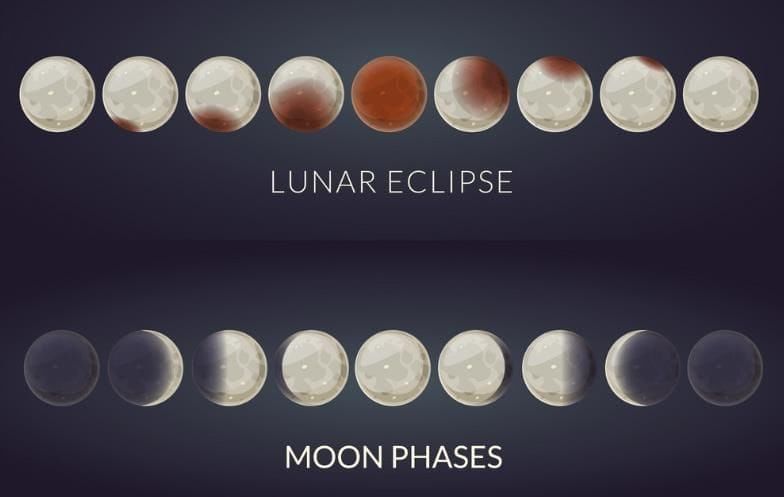
  8. Why do we learn about Moon phases and eclipses under “keeping time with the skies”?
    a) For decoration
    b) To ignore calendars
    c) Because celestial motions helped humans define days, months, years
    d) To stop using watches

Fill in the Blanks

Instruction: Fill in the blanks with the correct word based on the chapter.

  1. Writing down what you see is called __________.
  2. Health is complete physical, mental, and __________ well-being.
  3. Air moves from high pressure to __________ pressure to form winds.
  4. All matter is made of tiny __________ that behave differently in solids, liquids, and gases.
  5. Light can __________ from mirrors and __________ through lenses.
  6. Watching the Sun and Moon helped humans create __________ to track days and months.
  7. Science balances careful observation with __________ thinking.

Very Short Answer Questions

Instruction: Answer the following questions in one line.

  1. What two words best start a scientific investigation?
  2. In an experiment, what do we call the factor we deliberately change?
  3. Name one measurement you could take in the puri experiment.
  4. Give one reason to keep a science notebook.

Short Answer Questions

Instruction: Answer the following questions in 2–3 lines.

  1. Why is changing only one variable at a time important?
  2. How does this chapter connect small observations to big ideas?
  3. What skills are highlighted as core to doing science well?
  4. Give two example variables for the puri activity.

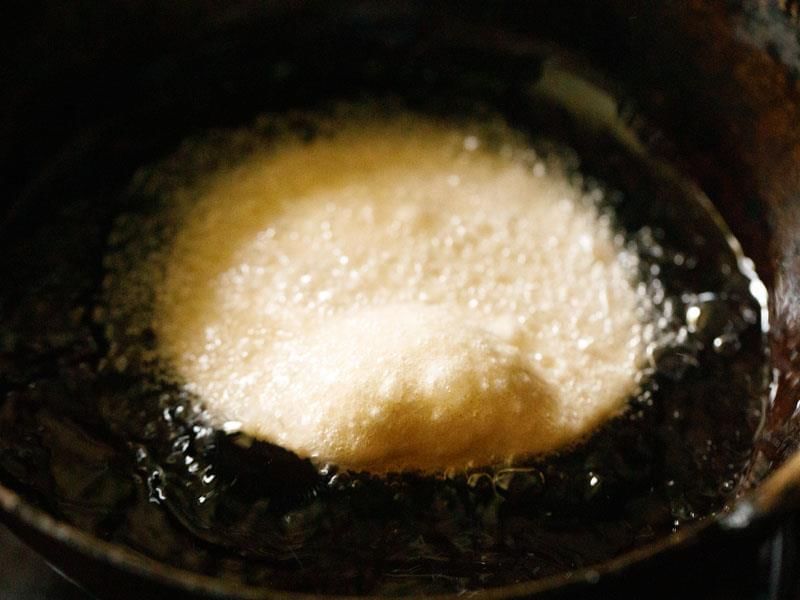
Poori puffing up in Oil

Match the Following

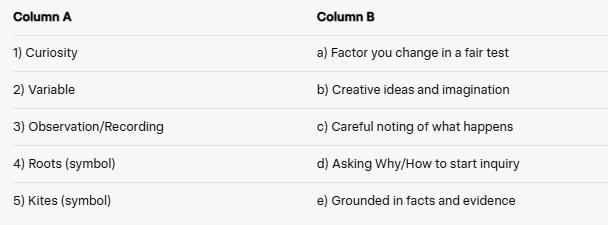
Instruction: Match Column A with the correct option in Column B.

Check the solutions of worksheet here.