9. Spectacular Wonders – Textbook Solutions

Let us do (Page 137)I. Look at the pictures given below and sort them into natural and man-made wonders. 
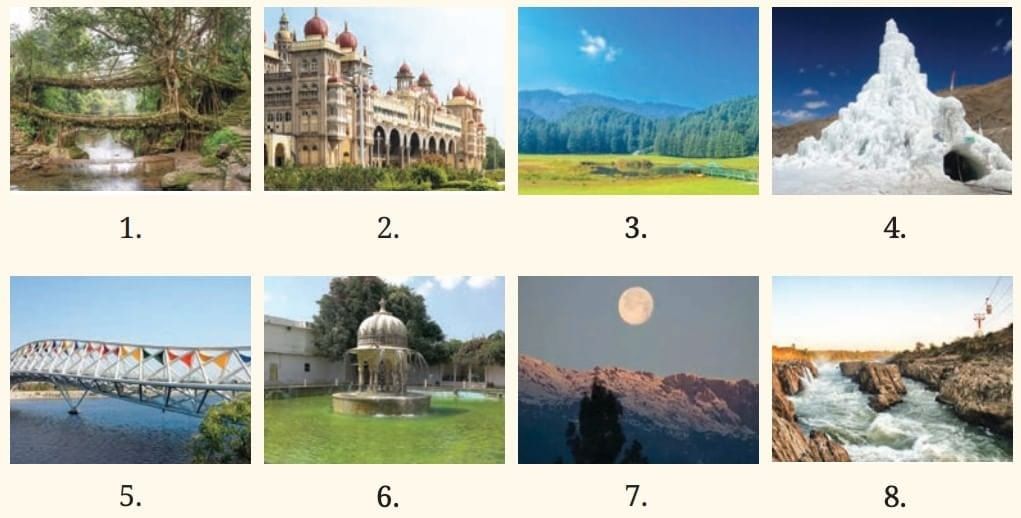
Ans: 
Natural:
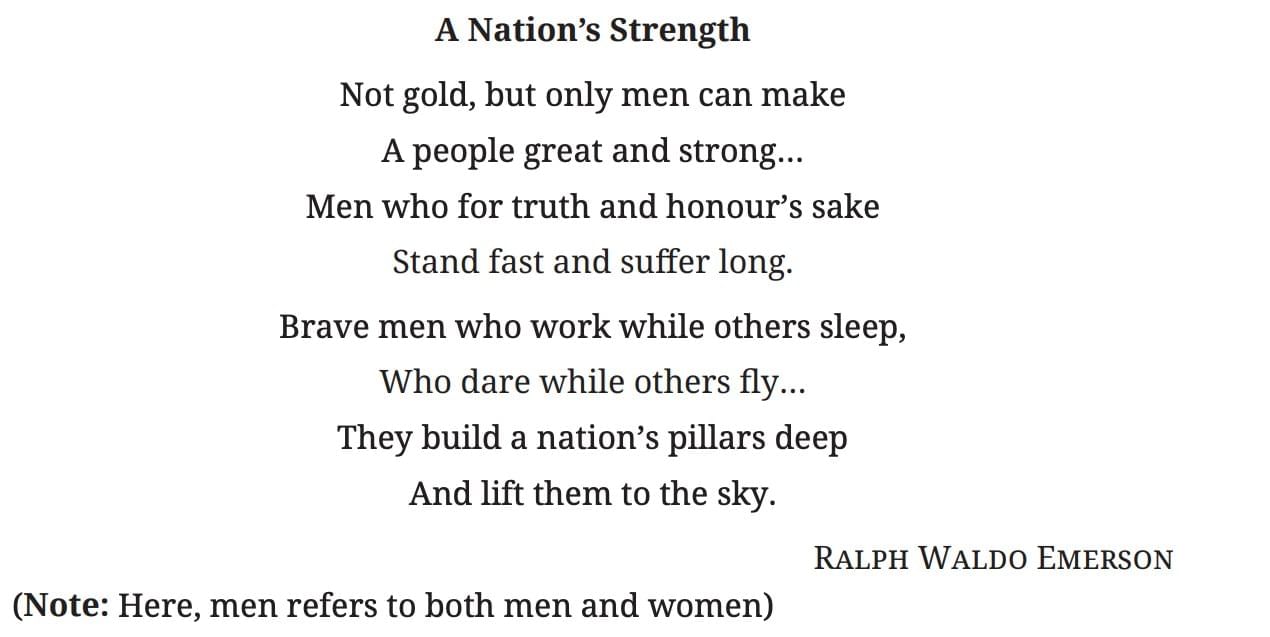
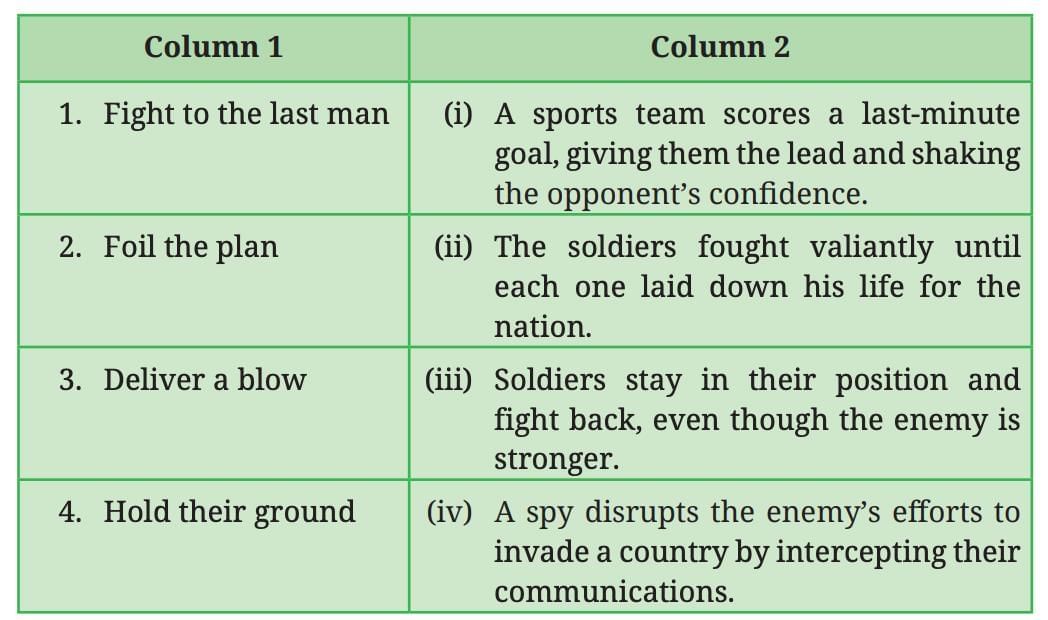
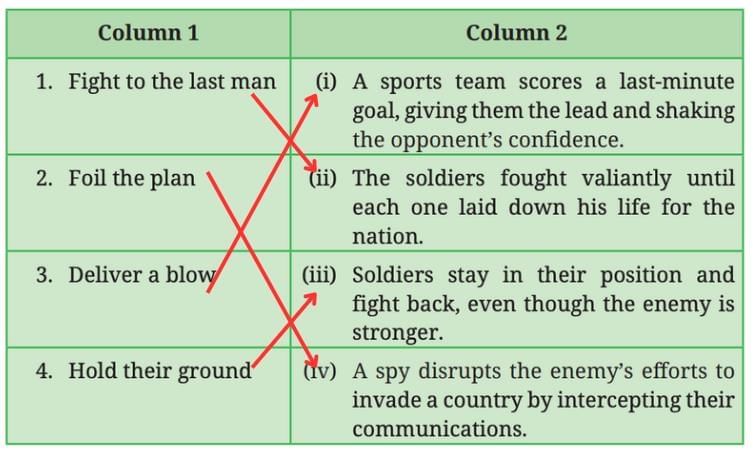
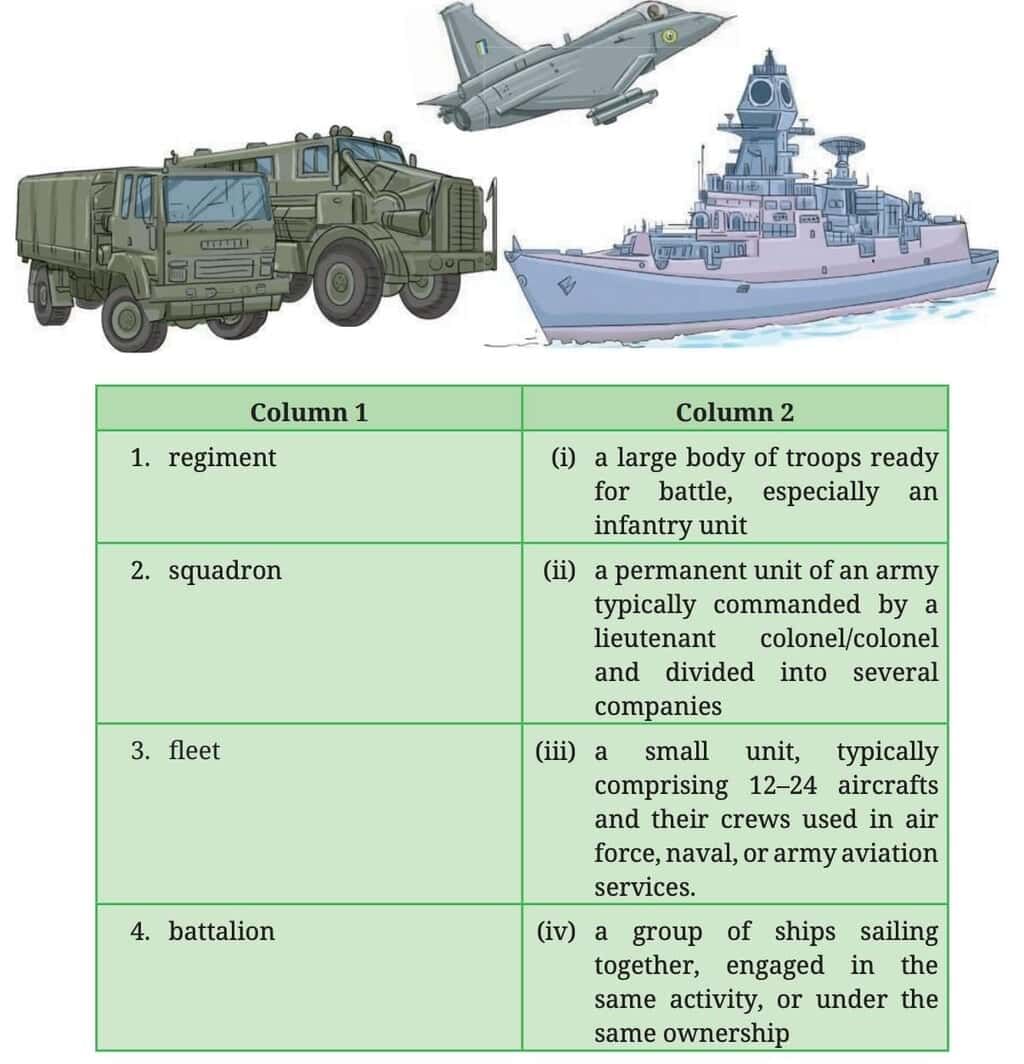
Living Root Bridge, Dzukou Valley, Ice Stupa, and Moon over the Himalayas
Man-made:
Mysore Palace, Bogibeel Bridge, Fountain Garden, and Marble Rocks with Cable Car
II. Which of these wonders—man-made or natural—are more appealing and why? Share your answers with your classmates and teacher.
Ans: Natural wonders are more appealing because they are created by nature without any human help. They show the beauty and power of the Earth. For example, the Living Root Bridge and the Himalayas are not only beautiful but also show how nature can create amazing things over time. These places feel peaceful and make us feel close to the environment.
III. Work in pairs. Write down two wonders of nature that have amazed you. Discuss what makes them impressive.
Ans: 1. The Grand Canyon (USA) – It’s a huge valley carved by the Colorado River. Its size, colours, and rock layers show how old and powerful nature is.
2. Aurora Borealis (Northern Lights) – These colourful lights in the night sky happen in cold places like Norway and Alaska. They look magical and happen because of Earth’s magnetic field and solar winds.
What makes them impressive:
They are both natural and cannot be made by humans. They remind us of the vast and wonderful natural world.

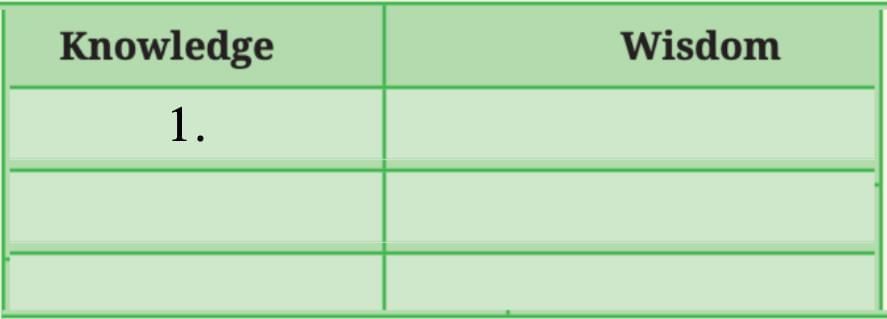
Let us discuss (Page 142)I. Complete the information in the table given below. One example has been done for you. Share your answers with your classmates and teacher.
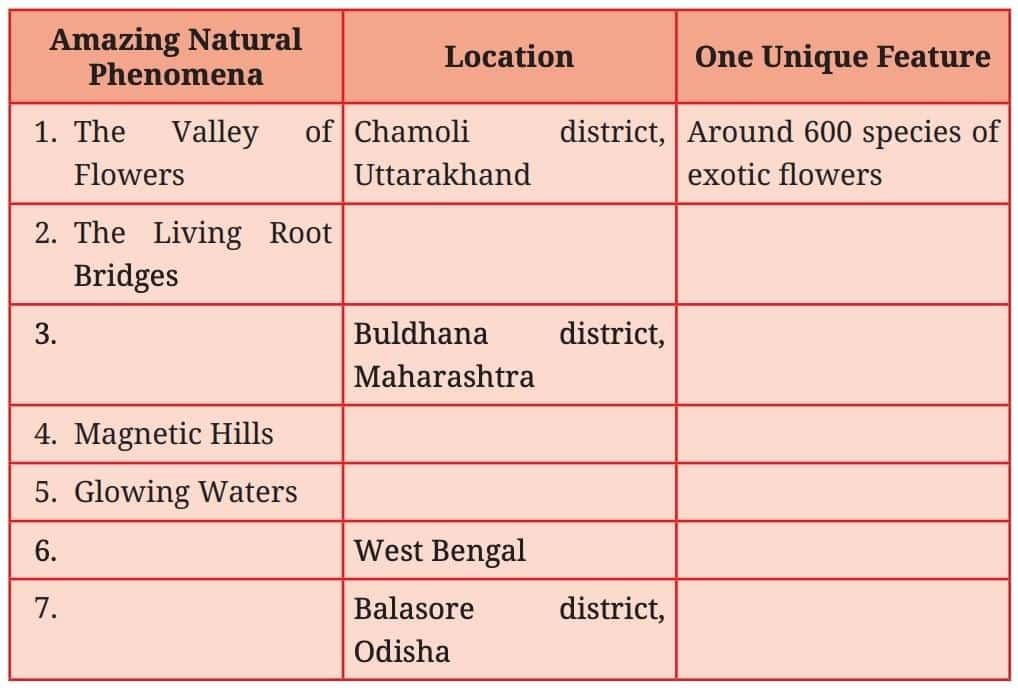
Ans:

Let us think and reflect (Page 142)

I. Read the given extracts and answer the questions that follow.
1. India is home to some of the most mystifying natural phenomena that surprise and spark our imagination.
(i) Replace the underlined phrase with one from the extract. India is the birthplace of several rare species of flora and fauna that thrive in its diverse ecosystems. 
(ii) What does the phrase ‘nature’s unusual side’ suggest about the phenomena described? 
(iii) Complete the similarity by choosing the correct option. spark: imagination: : ______________ : ______________. 
A. inspiration; creativity 
B. wonder; amazement 
C. effort; reward 
D. knowledge; books 
 (iv) Identify whether the following statement is true or false. Some natural phenomena can surprise people.
Ans:

(i) nature’s unusual side
(ii) It suggests rare and surprising natural events that are different from everyday nature.
(iii) B. wonder: amazement
(iv) True

2. Have you seen things disappearing in front of your eyes? Well, such things happen at times, when we keep things in some place, and just forget where we have kept them. But what if there’s a sea that disappears? This happens in Odisha. It is a beach in the Balasore district where one can witness the sea disappearing mysteriously—the Chandipur Beach, which is known for its unique feature of playing hide-and-seek with its visitors.     
(i)     Complete the following sentence with a suitable reason. The writer’s most likely purpose in introducing the information about the Chandipur Beach phenomenon with a question is to____________________. (engage the reader’s curiosity and create a sense of suspense/draw the reader to learn more about the unusual phenomenon/set the tone for the surprising nature of the content that follows)
(ii) Select the option that is correct for both Assertion (A) and Reason (R).          
(A): Chandipur Beach in Odisha is known for its unique feature of the sea disappearing.          
(R)The tides retreat drastically, exposing the Chandipur beach.     
A. Both (A) and (R) are true, and (R) is the correct explanation of (A).     
B. Both (A) and (R) are true, but (R) is not the correct explanation of (A).     
C. (A) is true, but (R) is false.     
D. (A) is false, but (R) is true
(iii) What does the term ‘unique’ suggest about the beach in Balasore?     
A.very popular
B. one of its kind     
C.ancient place     
D.far from the city     
(iv) What does the writer want to convey with the use of the phrase ‘playing hide-and-seek with its visitors’?

Ans: (i) engage the reader’s curiosity and create a sense of suspense
(ii) A. Both (A) and (R) are true, and (R) is the correct explanation of (A).
(iii) B. one of its kind
(iv) The sea appears and disappears due to changing tides, creating a playful and mysterious effect for the visitors.

II. Answer the following questions.
1. How are the living root bridges a boon for the local people of Meghalaya?     
2. Why is the Lonar Crater Lake considered a remarkable and rare site?     
3. What might be the writer’s purpose of highlighting the awe-inspiring natural wonders of India?   
4. The writer uses descriptive language and introductory questions for some of the natural phenomena. What impact does it have on the readers?    
5. Which of these unusual phenomena did you find the most interesting and why?
Ans:
1. They allow safe crossing over waterways during monsoons, unlike weak bamboo bridges.
2. It’s formed by a meteorite impact in basaltic rock, one of the top five largest craters globally, with a unique saline lake.
3. To show India’s unique landscapes, spark curiosity, and encourage appreciation of nature.
4. It grabs attention, makes the phenomena vivid, and encourages readers to think and imagine.
5. The Living Root Bridges,  they are built naturally by intertwining roots, showing human creativity and harmony with nature.

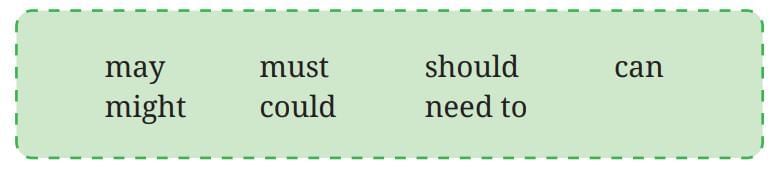
Let us learn (Page 144)I. Fill in the blanks with the correct expressions from the text given in the box below.

  1. I have read many stories _____________________.     
  2. Do you know when this little town _____________________?        
  3. His hard work has helped him _____________________.        
  4. There are no simple solutions to the _____________________of traffic jams.    
  5. He opened the ancient wooden box and stared at the treasure_____________________.        
  6. The garden is _____________________ in springwith lots of beautiful flowers in bloom.

Ans: 

1. I have read many stories to name a few.
2. Do you know when this little town came into existence?
3. His hard work has helped him to no end.
4. There are no simple solutions to the age-old problem of traffic jams.
5. He opened the ancient wooden box and stared at the treasure in disbelief.
6. The garden is in full glory in spring with lots of beautiful flowers in bloom.
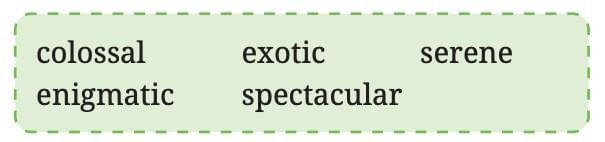
II. Select the correct synonyms from the box given below that match the list of words in 1–5. You may refer to a thesaurus. 

  1. mysterious, puzzling, baffling 
  2.   mighty, gigantic, huge. 
  3.  breath-taking, stunning, awe-inspiring. 
  4. peaceful, calm, tranquil  
  5.  unusual, peculiar, foreign

Ans:

  1. mysterious, puzzling, baffling → enigmatic
  2. mighty, gigantic, huge → colossal
  3. breath-taking, stunning, awe-inspiring → spectacular
  4. peaceful, calm, tranquil → serene
  5. unusual, peculiar, foreign → exotic

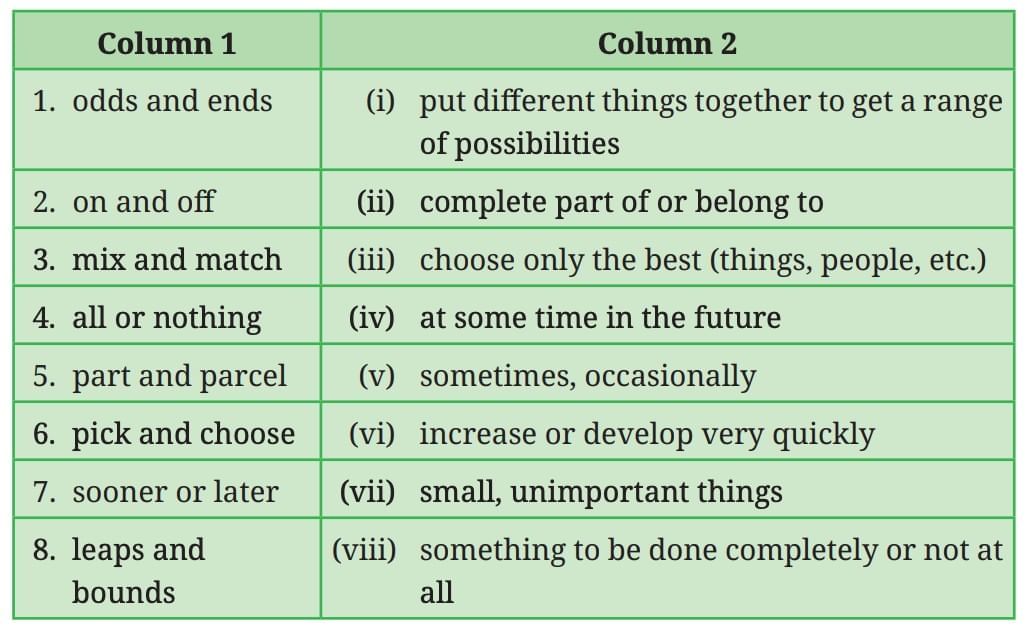
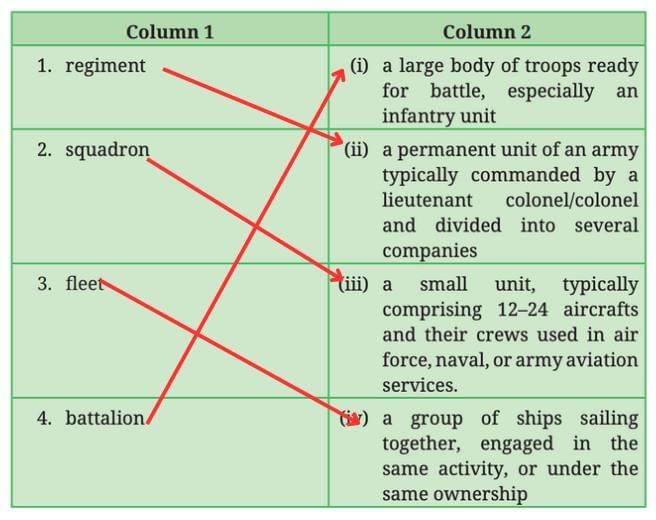
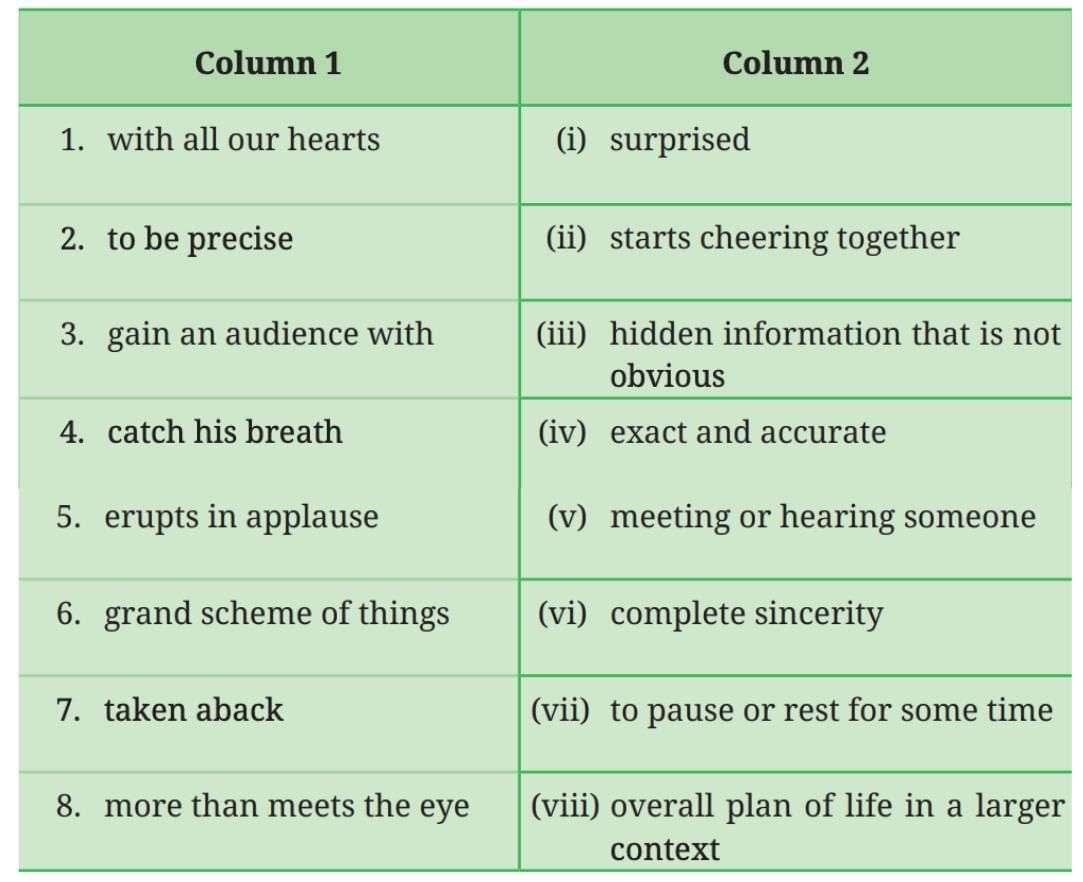
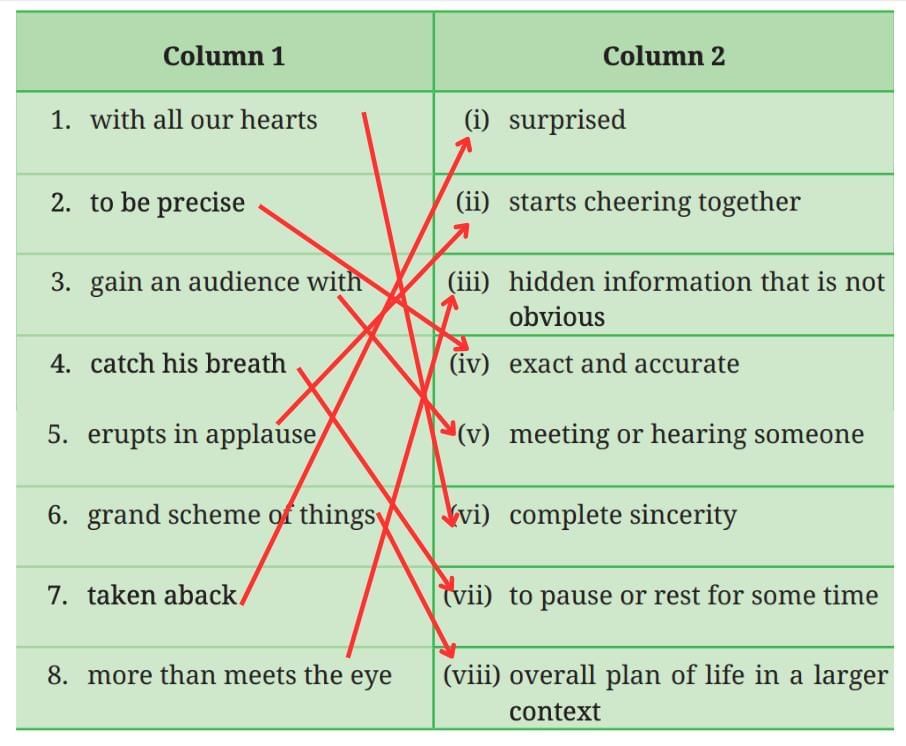
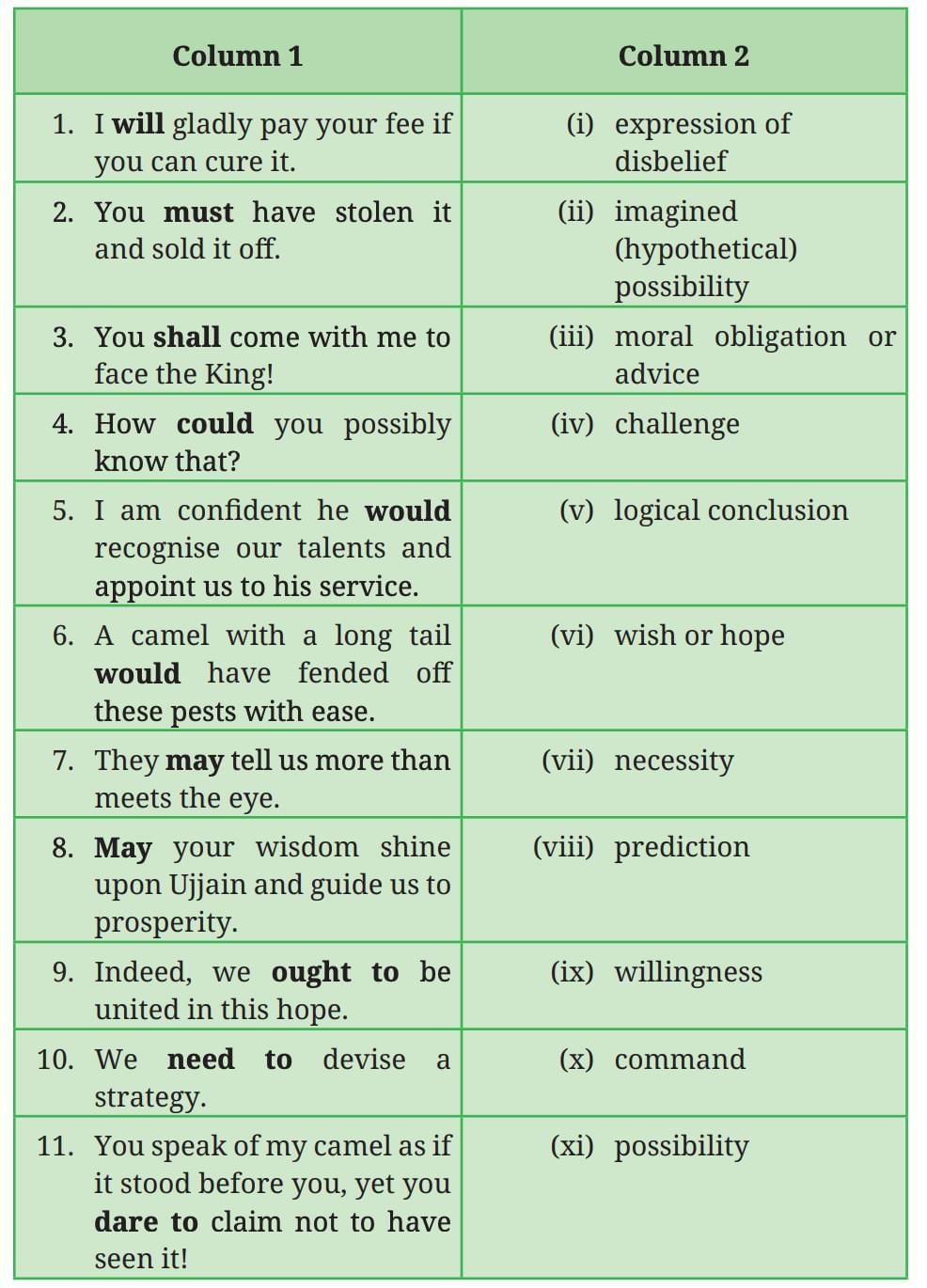
III. The expressions ‘hide-and-seek’ and ‘flora and fauna’ are used in the text. These are called binomials—a pair of fixed words joined by ‘and’ or ‘or’. The binomials are mostly synonyms, antonyms, rhyming words, same-sound words (alliterations), etc. Match the binomials in Column 1 with their meanings in Column 2. You may refer to a dictionary.
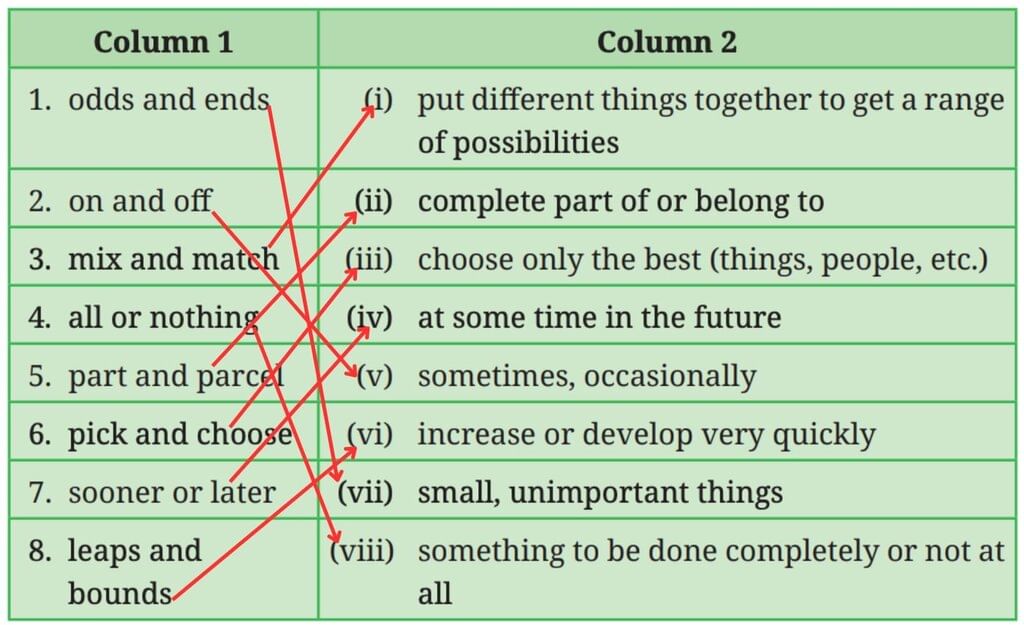
Ans:

Sentences:
1. I cleaned my room and found odds and ends like old pens and buttons.
2. She visits the park on and off when she has free time.
3. I like to mix and match my clothes to create new outfits.
4. This project is all or nothing; we must finish it completely.
5. Helping others is part and parcel of being a good friend.
6. At the store, I can pick and choose the best apples.
7. Sooner or later, I’ll visit the Valley of Flowers.
8. Her drawing skills improved by leaps and bounds this year.

IV. Study the highlighted words in the following sentences from the text.

  • The living root bridges are one of Meghalaya’s most beautiful…     
  •  …creating a striking visual contrast against the surrounding rugged terrain.    
 In the given sentences, the highlighted words ‘living’, ‘striking’, and ‘rugged’ are examples of verbs used as adjectives. Such verbs are called participles.Now, fill in the blanks using the present participle or past participle form of the verbs in the box given below.1. The _______________ marble monument looks even more spectacular inthe moonlight. 
2. The _______________ view of the Himalayas from Darjeeling attracts visitors from all over the world.        
3. The Sun Temple in Konark features intricately _______________ stone wheels and walls. 
4. _______________ at a height of 182 m, the Statue of Unity is dedicated toSardar Vallabhbhai Patel.        
5. The _______________ islands of the Andaman and Nicobar offer some of the cleanest beaches in India.
Ans:

1. The glowing marble monument looks even more spectacular in the moonlight.
2. The amazing view of the Himalayas from Darjeeling attracts visitors from all over the world.
3. The Sun Temple in Konark features intricately carved stone wheels and walls.
4. Standing at a height of 182 m, the Statue of Unity is dedicated to Sardar Vallabhbhai Patel.
5. The scattered islands of the Andaman and Nicobar offer some of the cleanest beaches in India.
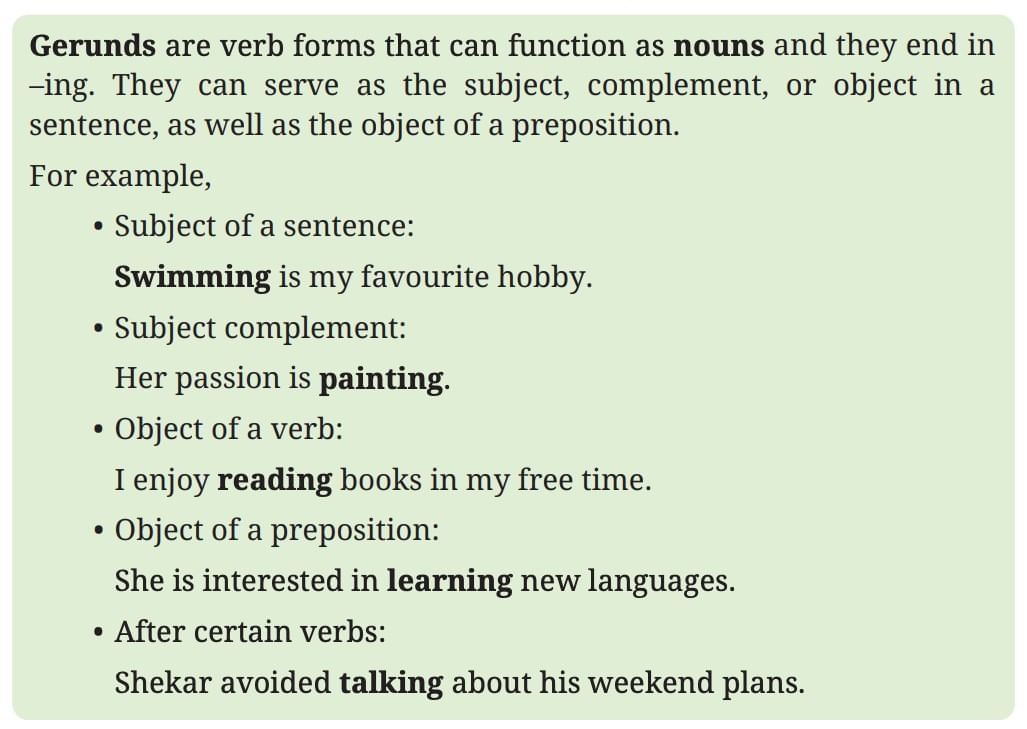
V. Study the highlighted word in the following sentence from the text
Crossing the many waterways without bridges was difficult for people in the past, during monsoons. In the given sentence, the highlighted word ‘crossing’, is one example of a verb used as a noun. Such a verb is called a gerund.Underline the gerunds and participles in the following sentences.  Write ‘G’ for gerunds and ‘P’ for participles in the space provided. One example has been done for you.     
1.    Dancing is a great way to express emotions. G     
2.    Travelling can broaden your perspective.     
3.    The falling leaves signalled the arrival of autumn.     
4.    She enjoys cooking new recipes for her family.     
5.    Reading helps improve your vocabulary.     
6.    He watched the shimmering stars in the night sky.     
7.    Forgetting the keys inside, Kanchan locked the door.

Ans:

1. Dancing is a great way to express emotions. G
2. Travelling can broaden your perspective. G
3. The falling leaves signalled the arrival of autumn. P
4. She enjoys cooking new recipes for her family. G
5. Reading helps improve your vocabulary. G
6. He watched the shimmering stars in the night sky. P
7. Forgetting the keys inside, Kanchan locked the door. P

VI. Combine the following pairs of sentences using participles or gerunds. You may use the clues given in brackets. One example has been done for you.
1. Nitesh entered the room. He saw his friend sitting in the corner. (participle) 
Entering the room, Nitesh saw his friend sitting in the corner.
2. Smitha walked carelessly. She slipped on the doormat. (participle)
3. Sleep for eight hours. It is good for health. (gerund) 
4. Ranjith felt happy about the result. He called his parents. (participle) 
5. Father encouraged Meena. Meena joined the course. (gerund)
Ans:

1. Entering the room, Jitesh saw his friend sitting in the corner. (participle)
2. Walking carelessly, Smitha slipped on the doormat. (participle)
3. Sleeping for eight hours is good for health. (gerund)
4. Feeling happy about the result, Ranjith called his parents. (participle)
5. Encouraged by her father, Meena joined the course. (participle)

Let us listen (Page 148)

I. You will listen to a brother and sister discuss a natural phenomenon. As you listen, mark the four true statements from 1–6 given below.

  1. The brother was taken aback to see the posted pictures.
  2.  The brother admitted to not knowing about his sister’s favourite picture.     
  3. The sister stated that the rainbow mountain was like any other mountain.      
  4.  The brother was aware of the reason for the formation of colours on the mountain.    
  5. The brother was surprised to learn about the mountain being covered with snow till recently.  
  6. The sister understood nature’s role in the beauty of the mountain.

Ans: Please refer to the transcript
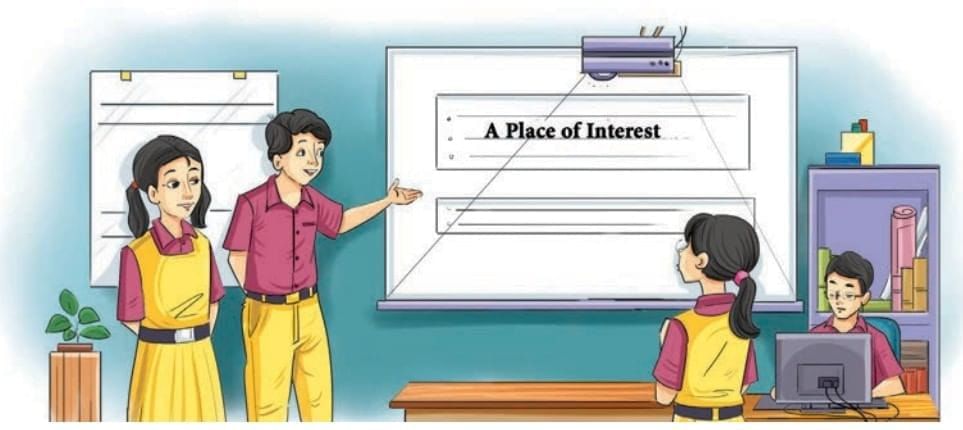
Let us speak (Page 149)I. Work in groups of four. Make a presentation on a place of interest in and around your region that people like to visit. You may use the following guidelines to make your presentation.Guidelines:     
1.    Slides 1–2: Choose any popular place of interest in your region.     
2.    Slides 3–4: Mention where it is located and how to get there.     
3.    Slides 5–6: Describe the attractions of the place, why it is popular and explain its historical importance, if any.     
4.    Slides 7–8: List out weather conditions, local food, customs, and language.     
5.    Slides 9–10: Suggest the best time of the year to visit and why you recommend this place.
Ans:

Slide 1-2: Place – Qutub Minar, Delhi.
Slide 3-4: Location – In Mehrauli, Delhi; reachable by metro (Qutub Minar station) or bus.
Slide 5-6: Attractions – Tallest brick minaret, built in 1192 by Qutb-ud-din Aibak, with intricate carvings; historically important as a symbol of the Delhi Sultanate.
Slide 7-8: Details – Pleasant weather in winter; local food like parathas; Hindi and English spoken; respect monument rules.
Slide 9-10: Best Time – October to March for cool weather; recommended for its historical beauty and architecture.

Let us write (Page 149)I. You just read vivid descriptions of the natural wonders of our country. Write a descriptive essay for your school magazine describing anything from nature that attracted your attention. It may be an object, a place, or an event experienced by you. Remember to give a title to your essay. Use proper format and content organisation—begin with a title, including an introduction (one paragraph), body (two to three paragraphs), and conclusion (one paragraph).
Ans:

A Sparkling Night at Kumbalangi

Last summer, I visited Kumbalangi village in Kerala, and its glowing waters left me spellbound. As night fell, the backwaters twinkled like a sky full of stars, a magical sight I’ll never forget.

The village was quiet, with lush green trees rustling in the breeze. At dusk, we took a boat ride, and soon, the water began to glow with tiny blue-green sparkles. These were micro-planktons, tiny creatures creating bioluminescence. Each ripple in the water sent sparkles dancing, like fireflies in the sea. The air smelled fresh, and the sound of gentle waves was soothing. I dipped my hand in, and the water glowed around my fingers, making me feel like I was in a fairy tale.

The villagers explained that this natural wonder happens when micro-planktons are active, especially on warm nights. I also enjoyed their spicy fish curry and learned about their fishing traditions. The glowing waters felt like nature’s secret light show, teaching me how even tiny creatures can create something extraordinary.

This experience showed me the beauty of nature’s surprises. Kumbalangi’s glowing waters are a treasure, reminding us to explore and protect our environment.

8. The Magic Brush of Dreams  – Textbook Solutions

Let us do (Page 122).                                                   I. Work in pairs. Discuss the following questions. Share your answers with your classmates and teacher.
1. Mention a magical object that you would like to have. Give a reason for your choice. 
2. What would you draw for yourself if you had a magic paintbrush? Why?
3. Would you use the magic paintbrush to draw for someone else? If yes, why? If not, why not?
Ans: 
1. I would like a magic pencil because it could write correct answers for my homework, helping me learn faster.
2. I would draw a flying bike to travel anywhere quickly and have fun exploring new places.
3.  Yes, I would draw food and clothes for poor people to help them live better, like Gopi did in the poem.
II. Work in pairs. Discuss instances of acts of kindness that you have heard, read, or experienced. Share your answers with your classmates and teacher.


Ans: Example: My friend shared her lunch with a classmate who forgot theirs, showing kindness by helping someone in need.
III. Work in pairs and guess the meanings of the words given below and draw pictures depicting their meanings. Share with your classmates and teacher 

Now, arrange these words into different categories as given below.          

Things:     ……………………………………………………….. ……………………………………………………….. 

Actions: ……………………………………………………….. ………………………………………………………..          

Emotions:     ……………………………………………………….. ………………………………………………………..
Ans: Things: paintbrush, twig, fortress, bows, drawing
Actions: winding, feast
Emotions: joy, fear, cold

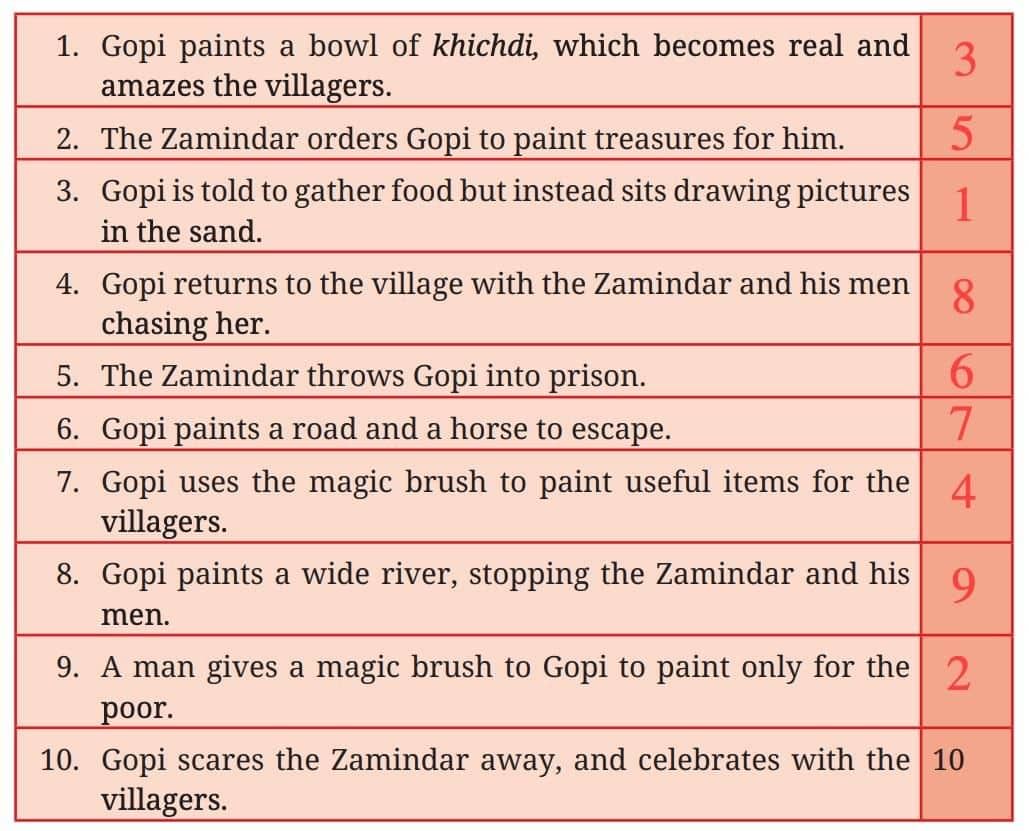
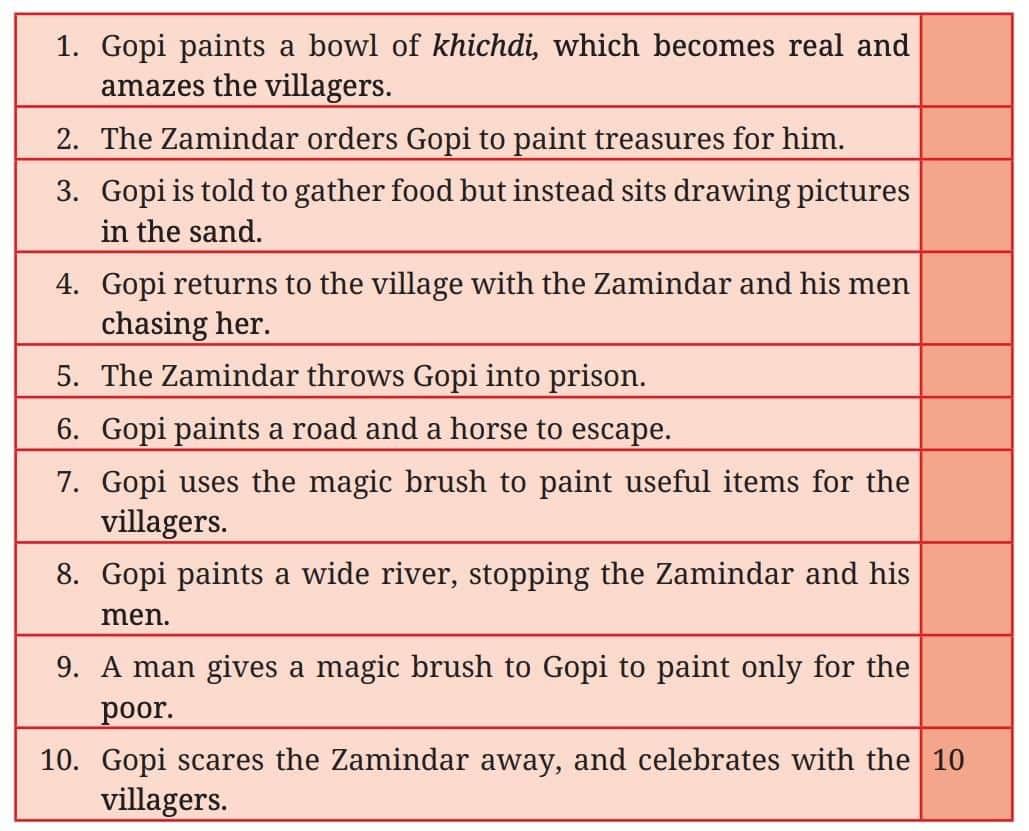
Let us discuss (Page 127)I. Arrange the events in order of occurrence in the poem. The last one has been marked for you. Share your answers with your classmates and teacher.Ans:II. Fill in the blanks by choosing the correct answer from the box given below.

The tone of the poem shifts throughout, reflecting the different moods of the story. Initially, the tone is 1. _________________ as Gopi uses herimagination to draw in the sand, and later when the Zamindar enters the story, the tone shifts to one of 2. _________________. In the final partof the poem, the tone becomes 3. _________________ as Gopi escapes, theZamindar is defeated, and the villagers rejoice.
Ans: The tone of the poem shifts throughout, reflecting the different moods of the story. Initially, the tone is playful and innocent as Gopi uses her imagination to draw in the sand, and later when the Zamindar enters the story, the tone shifts to one of threatening and commanding. In the final part of the poem, the tone
becomes triumphant and celebratoryas Gopi escapes, the Zamindar is defeated, and the villagers rejoice.

(Note: “threatening and commanding” was inferred as the box was incomplete.)

III. Fill in the blanks by choosing the correct option from within the brackets.
1. The poem mostly follows a simple rhyme scheme, _________________, which adds a rhythmic flow. (ABCB, ABBA, ABAB)   
2. This poem belongs to the _________________ poetry genre, which tells astory through verse. (descriptive, narrative or ballad, free style)
An
s: 1. The poem mostly follows a simple rhyme scheme, which adds a rhythmic flow: ABCB (e.g., “hand/sand” and “Gopi/hush” rhyme in the first stanza).
2. This poem belongs to the poetry genre, which tells a story through verse: narrative or ballad.

IV. Give examples from the poem for the following explanations.
1. The poem is rich in imagery, creating clear pictures in the reader’s mind. For example, ___________________.
2. What is the effect of repetition in the line—‘On you, and you and you!’?
Ans:  1. The poem is rich in imagery, creating clear pictures in the reader’s mind. For example: “She paints a mighty river wide, Its currents fast and deep” (vividly describes a wide, rushing river).
2. The effect of repetition in the line “On you, and you and you!” is: It emphasises Gopi’s threat to the Zamindar and his men, making it sound serious and directed at each person.

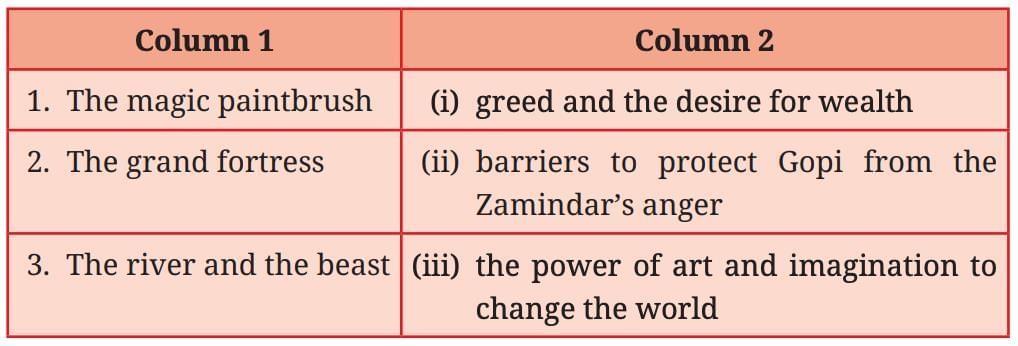
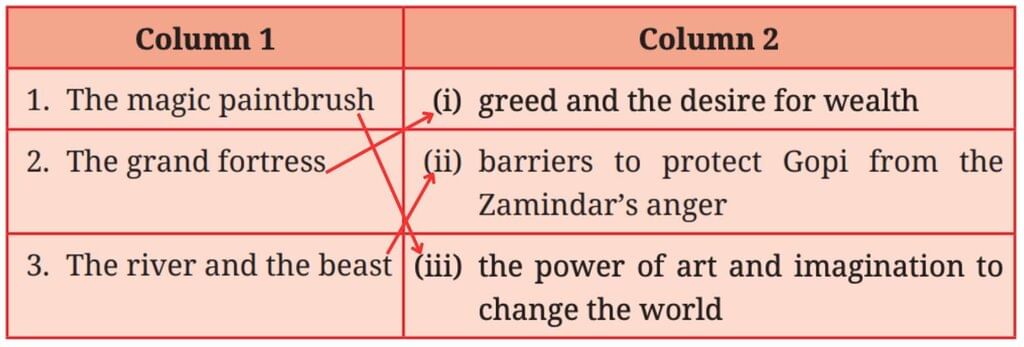
V. Match the phrases from the poem in Column 1 with what they symbolise in Column 2.Ans:

VI. Identify whether the following statement is true or false.
While Gopi uses the magic brush to help others, the Zamindar wants to use it for personal gain. This contrast drives the moral of the story.
Ans:  
True.

Let us think and reflect (Page 128)

I. Read the given extracts and answer the questions that follow.
1. But on a stone there sits a man, 
A brush is in his hand. He looks around. 
He calls to Gopi. “Come here!” he whispers. 
“Hush! We mustn’t let the village know 
About this magic brush.” 
He slips the brush into her hand
And tells her to be sure,
“Paint not for the wealthy ones,
But only for the poor.”

(i) Fill in the blank by selecting the correct option from those given in the brackets. 
The man is whispering and telling Gopi to keep the brush a secretreflects his _______________________ (careful and secretive/ magical and delightful) nature. 
(ii) What is the significance of the man slipping the brush into Gopi’s hand? 
(iii) Complete the following sentence with a suitable reason.          The most likely reason the man instructs Gopi to ‘Paint not for wealthy ones but only for the poor’ is because he_______________________.
(iv) Select the most appropriate title for the extract from the two given below. 
    A.     The Magic Brush’s Secret 
    B.     Gopi’s Special Gift
Ans:

(i) The man is whispering and telling Gopi to keep the brush a secret reflects his careful and secretive nature.
(ii) The significance of the man slipping the brush into Gopi’s hand is: It shows he trusts Gopi to use the magic brush responsibly for good purposes.
(iii) The most likely reason the man instructs Gopi to “Paint not for wealthy ones but only for the poor” is because he wants to help those who need it most, not those who are already rich.
(iv) The most appropriate title for the extract is: A. The Magic Brush’s Secret (focuses on the secrecy and the brush’s magic).

2.    And soon the news spreads far and wide, 
Through forests, fields, and plains, 
Until the Zamindar himself 
Hears of these magic gains. 
“I order you to paint for me, 
A fortress tall and grand. 
Paint treasures, jewels, and riches rare, 
Enough to rule this land.”  
  
 (i) Complete the following sentence with the correct reason.          
The news of Gopi’s magic brush spreads ‘through forests, fields, and plains’ because of its _______________________.     
(ii) Why does the poet refer to things painted by Gopi’s paintbrush as‘magic gains’?
(iii) Which of the following statements given below is false? Rectify the false statement.    
A.     Gopi’s magic brush draws the attention of the powerful Zamindar.     
B.     The Zamindar requests Gopi to paint a grand fortress and jewels.     
(iv)  What does the Zamindar’s demand for a grand fortress and jewels reveal about his character?

Ans:

(i) The news of Gopi’s magic brush spreads through forests, fields, and plains because of its amazing ability to create real objects from paintings.
(ii) The poet refers to things painted by Gopi’s paintbrush as “magic gains” because they become real, useful items that benefit the villagers.
(iii) Which of the following statements is false? B. The Zamindar requests Gopi to paint a grand fortress and jewels. Rectified: The Zamindar orders Gopi to paint a grand fortress and jewels.
(iv) The Zamindar’s demand for a grand fortress and jewels reveals about his character that he is greedy and wants power and wealth.

II. Answer the following questions.

  1. Explain why Gopi made the right decision by refusing to paint for the Zamindar.    
  2. Gopi threatens to draw a beast to scare away the Zamindar. Justify her action. How would you have dealt with the situation differently? 
  3. What is the significance of Gopi celebrating with the villagers at the end of the poem? 
  4. Compare Gopi’s use of the magic brush to how the Zamindar would have used it. 
  5. What can be inferred about Gopi’s character based on her refusal to follow the Zamindar’s orders? 
  6. Justify the appropriateness of the title of the poem. 
  7. If you had the magic brush, how would you use it in today’s world?

Ans:

  1. She followed the man’s rule to help only the poor, not the greedy, showing her kindness and fairness.
  2. Her action was justified to protect herself and stop the chase. I might have painted a tall wall to block the Zamindar safely.
  3. It shows her victory over the Zamindar and her joy in helping the villagers with a feast.
  4. Gopi painted useful things like food and clothes for the poor, while the Zamindar wanted riches and a fortress for himself.
  5. She is brave, honest, and cares about helping others.
  6. “The Magic Brush of Dreams” fits because the brush creates real objects from Gopi’s paintings, fulfilling the villagers’ dreams.
  7.  I would paint food, homes, and schools for people in need to make their lives better.

Let us learn (Page 130)

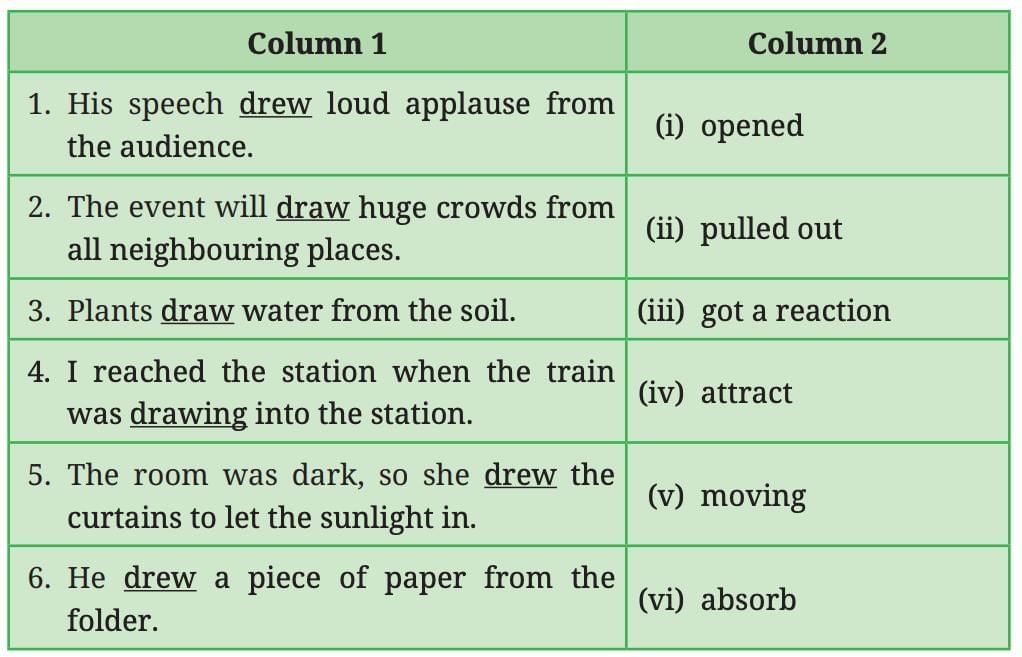
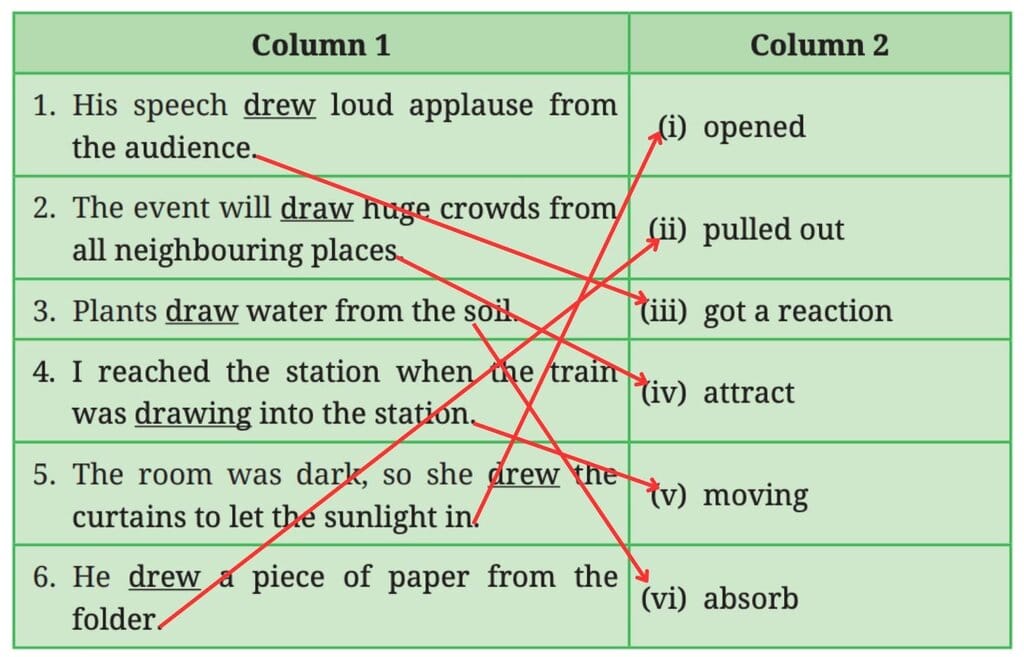
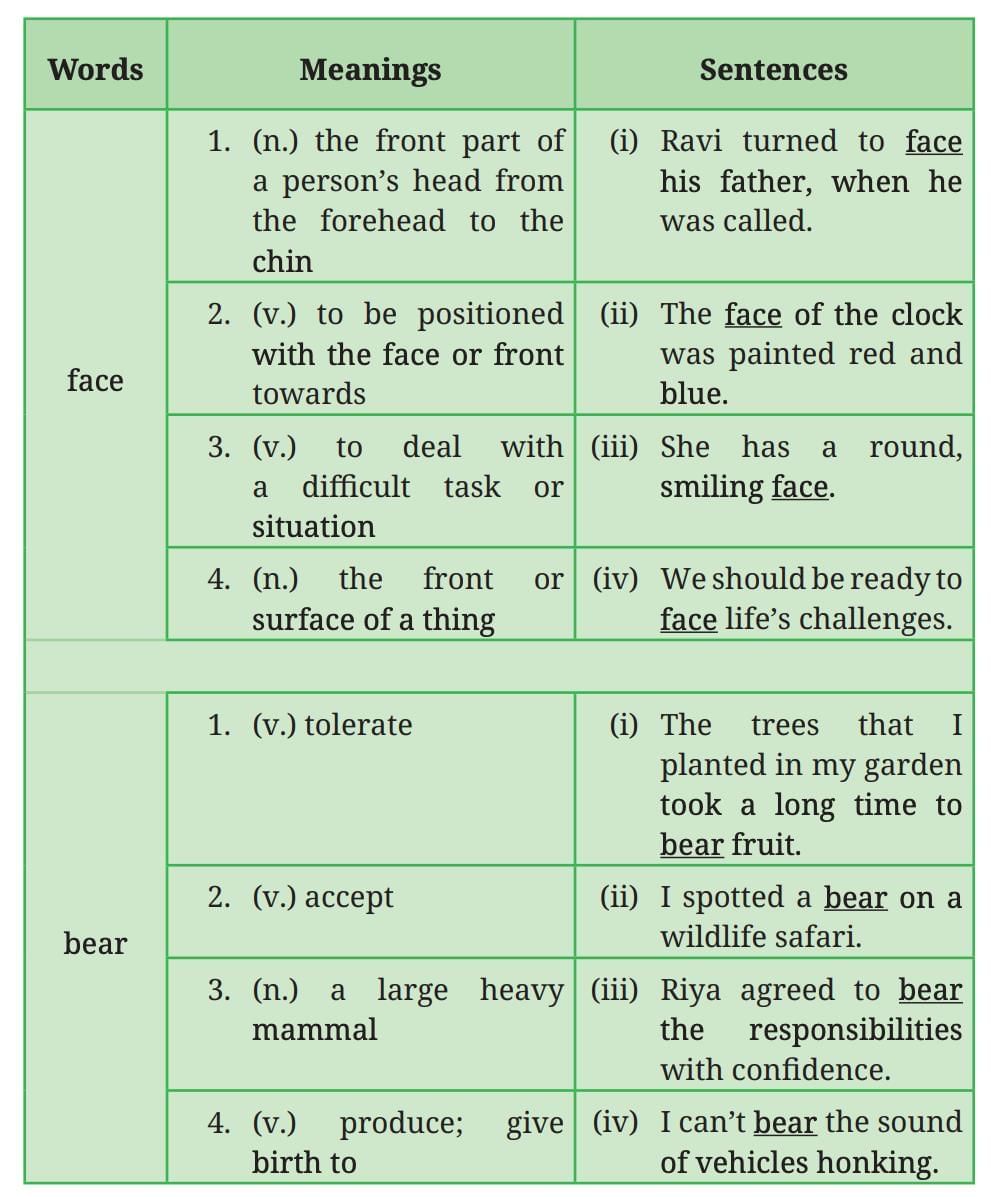
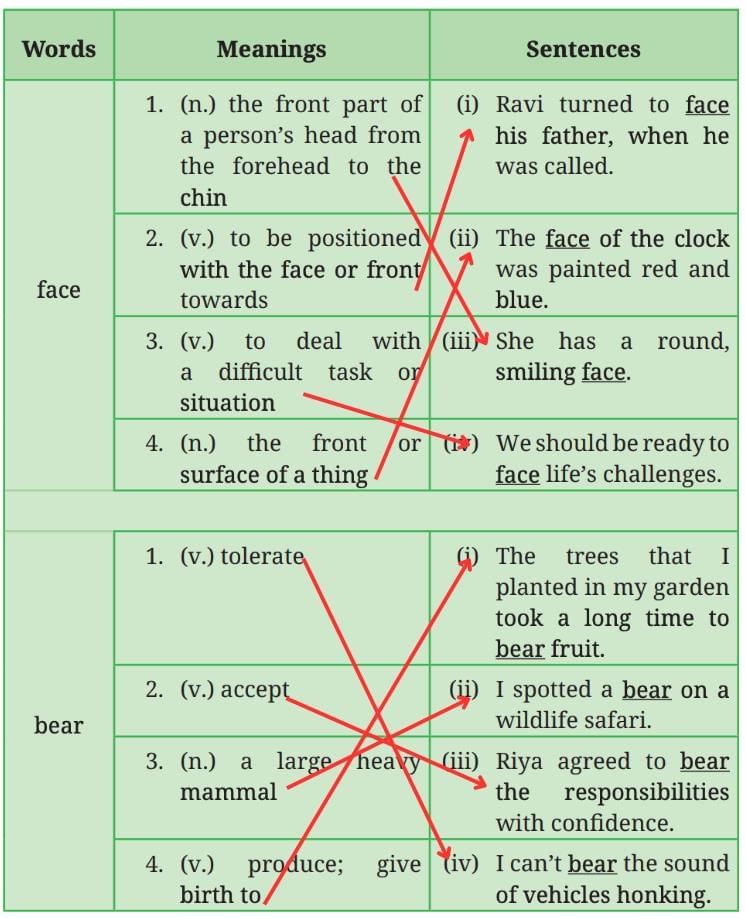
I. The verb ‘draw’ has different meanings in different contexts. Match the sentences in Column 1 with their appropriate meanings in Column 2.Ans:  

II. Fill in the crossword. Clues have been given below. You will find the words in the poem
Ans: 

Across

  1. GALLOP
  2. WHIZ
  3. WHISPER
  4. PLUCK
  5. WEALTHY
  6. SEIZE

Down

  1. ESCAPES
  2. MIGHTY
  3. ROAR
  4. CONFORM
  5. STREAMED
  6. VICTORY

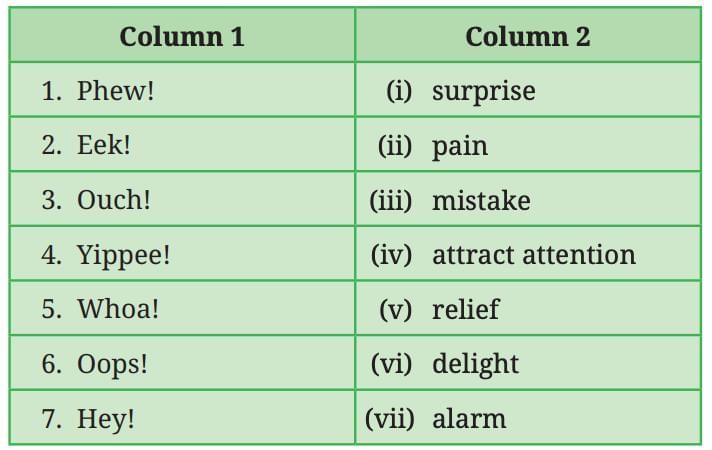
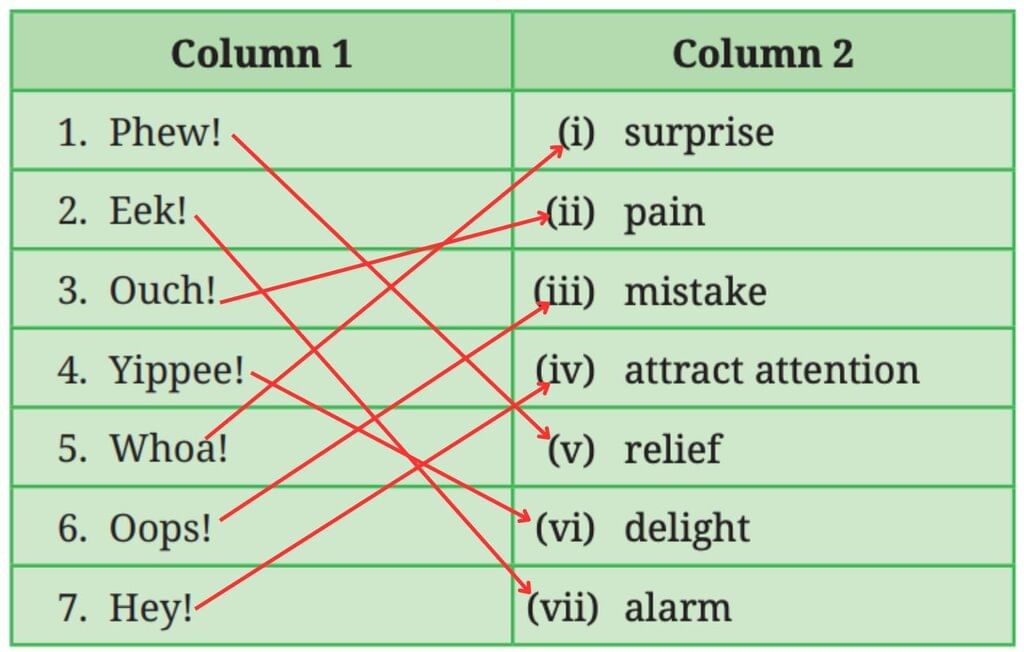
III. There are certain expressions that convey a sudden feeling or reaction. They can be used to express a variety of emotions and thoughts.
Example: … he whispers. “Hush!”          
(‘Hush’ denotes the act of silencing someone) 
Now, match the expressions in Column 1 with what emotions or reactions they convey, in Column 2.Now, create sentences using any five expressions from Column 1.
Ans:

Let us listen (Page 132)

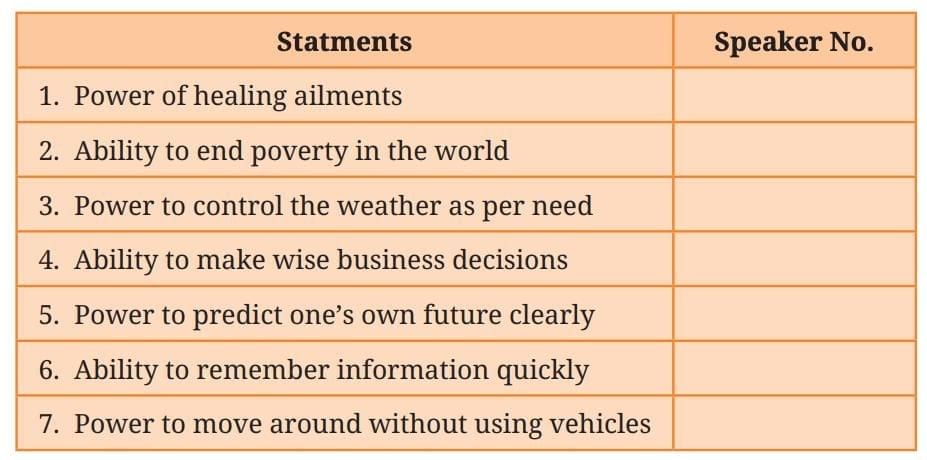
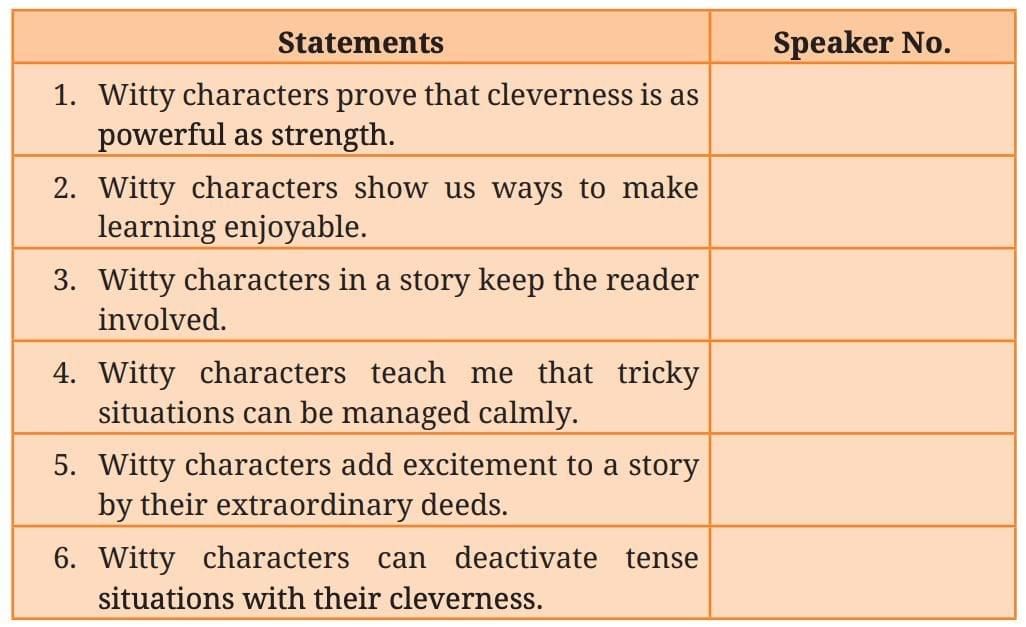
I. You will listen to five speakers speak about a magical power they wish for. As you listen, match statements 1–7 with speakers (i)–(v). There are two statements you do not need. 

Ans: Please refer to the transcript.

Let us speak (Page 133)

I. Intonation is the rise and fall of the pitch of tone while speaking.
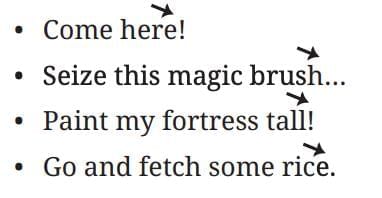
The ‘falling’ tone is the fall in the pitch of the voice from a high level to a low level. It is marked [ ]. The falling tone is generally used in imperative sentences. Such sentences are used in speech for different communicative purposes— to express a command or an instruction, to ask for a favour or to give a warning.          
Read the following sentences from the text with the falling tone.
Ans: Practice reading with a falling tone (voice goes from high to low):
– Come here!
– Seize this magic brush.
– Paint my fortress tall.
– Go and fetch some rice.

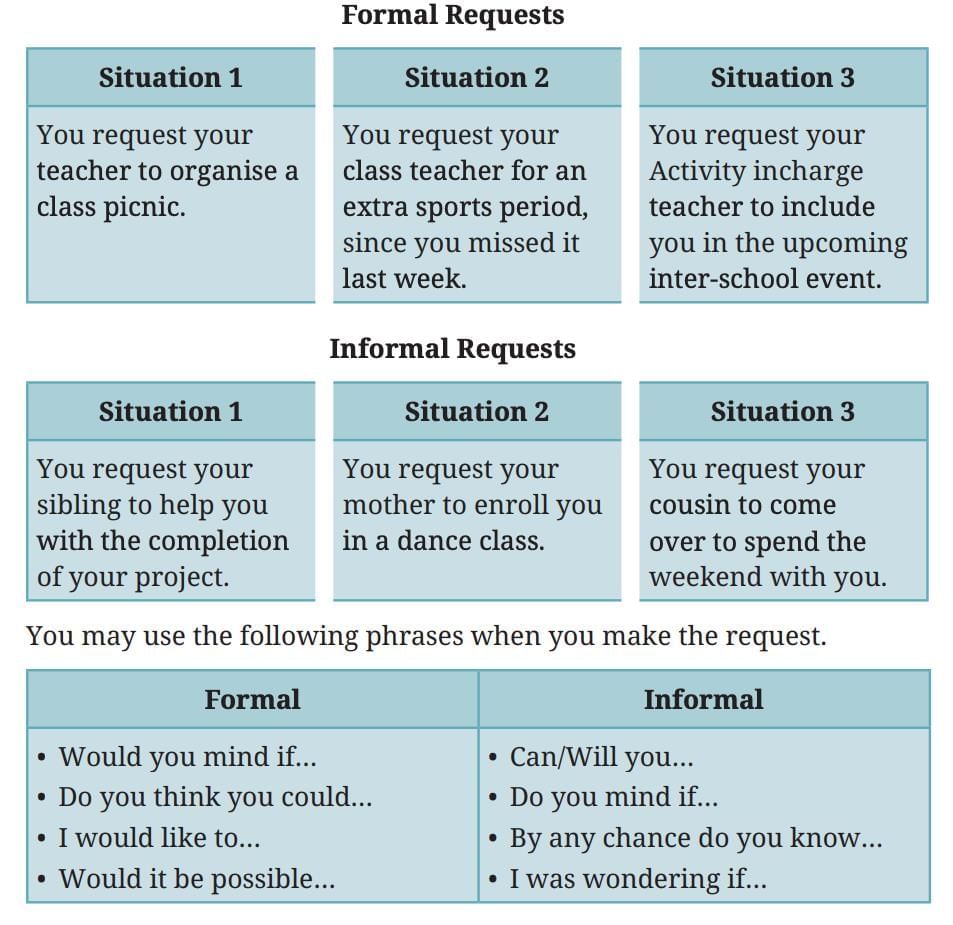
II. Work in pairs. Take turns to make requests for the following formal and informal situations.Ans:

Formal Requests:
1. Would you mind if we had a class picnic, Ma’am?
2. Do you think you could add an extra sports period, since we missed it last week?
3. Would it be possible to include me in the inter-school event, Sir?

Informal Requests:
1. Can you help me with my project, please?
2. Mom, do you mind if I join a dance class?
3. Hey, can you come over this weekend?

Let us write (Page 134)

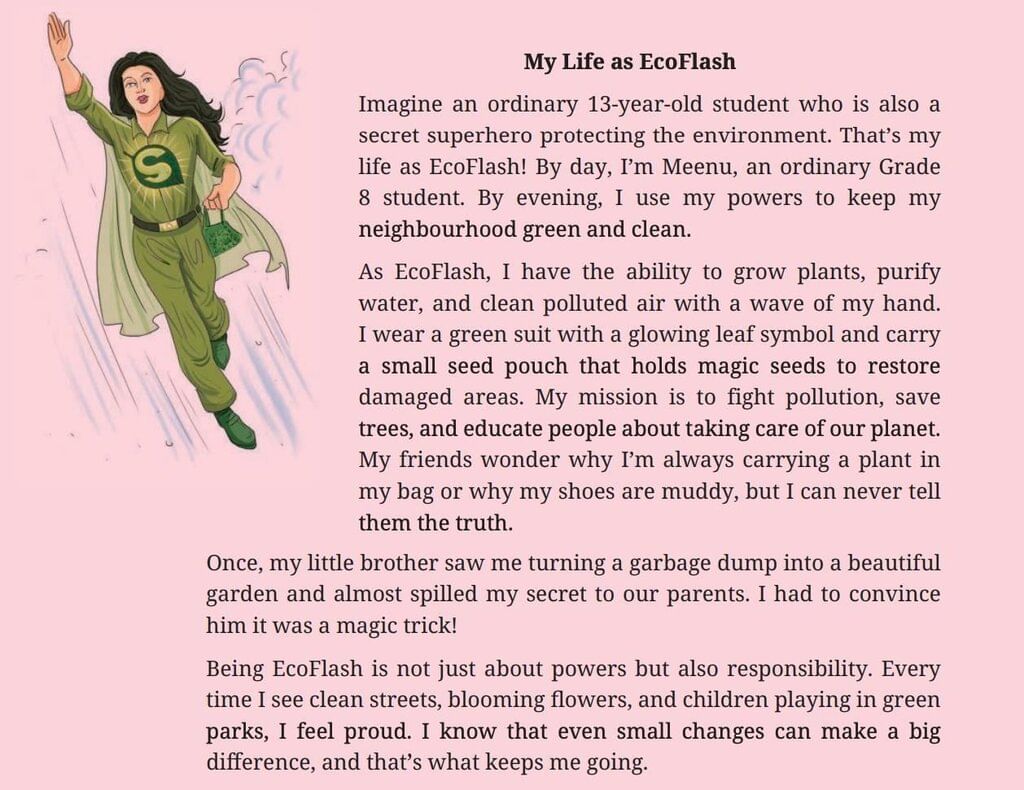
I. An Imaginative essay is a type of creative writing where the writers use their imagination. An imaginative essay can be based on real-life events, observation, or experiences. It is usually a descriptive piece or a personal reflection. Read the sample of an imaginative essay.

II. Complete the given checklist based on your observations and understanding of what an imaginative essay includes. Share the answers with your classmates and teacher.
Ans:

1. Title – A relevant title: Yes, “My Life as EcoFlash” is catchy and relevant.

2. Introduction

– Captivating opening sentence: Yes, introduces Meenu as a superhero.

– Clear statement of the setting, situation, or main idea: Yes, describes Meenu’s dual life.

– Establishes the tone: Yes, playful and adventurous.

– Introduces the narrator briefly: Yes, Meenu as EcoFlash.

3. Setting and Context

– Description of the setting: Yes, neighborhood and school.

– Clear time frame: Yes, present day.

– Brief explanation of imaginative elements: Yes, plant-growing powers.

4. Characters

– Main character introduced with unique traits: Yes, Meenu as EcoFlash.

– Supporting characters briefly described: Yes, brother and friends.

5. Central Idea

– Clear focus on a single powerful idea: Yes, protecting the environment.
– Logical flow of events: Yes, describes daily life and a key event.

6. Language and Style

– Use of sensory details: Yes, mentions muddy shoes and blooming flowers.

– Creative metaphors or similes: Yes, compares powers to a wave of the hand.

7. Resolution

– Key turning point or moment of realisation: Yes, brother almost reveals secret.

– Resolution of the main idea: Yes, continues mission.

– Clear takeaway message: Yes, small changes make a difference.

8. Conclusion

– Ends on a reflective note: Yes, feels proud of clean streets.

– Summarises the main message: Yes, emphasises environmental care.

III. Write an imaginative essay on any one of the following.

  1. Imagine you were a scarf that flew away from a clothesline. Describe the places you travelled to and how you came back. Also, write about what you thought was the most valuable experience.  
  2. Imagine you stumbled upon a magical book in the library. The book transported you to a different period. Describe your experience and an important learning

Ans:

A Magical Book’s Adventure
One rainy afternoon, I found a dusty book in the school library titled “Time’s Door.” Its cover glowed faintly, and when I opened it, a light pulled me in! Suddenly, I was in ancient India, surrounded by bustling markets and colourful clothes. I saw merchants selling spices and heard musicians playing sitars. It was like a dream, but real!

I met a kind boy named Arjun, who showed me his village. We explored a grand palace with tall pillars and ate sweet jalebis. But I noticed people were sad because a drought had dried their fields. Using the book’s magic, I wrote a new page about rain clouds. Soon, gentle rain fell, and the villagers cheered as crops grew again.

Suddenly, the book glowed, pulling me back to the library. I was back in 2025, but the adventure taught me something important. Helping others, even in small ways, can bring happiness. I’ll never forget my journey through time and the lesson that kindness matters.

7. The Case of the Fifth Word – Textbook Solutions

Let us do (Page 101)

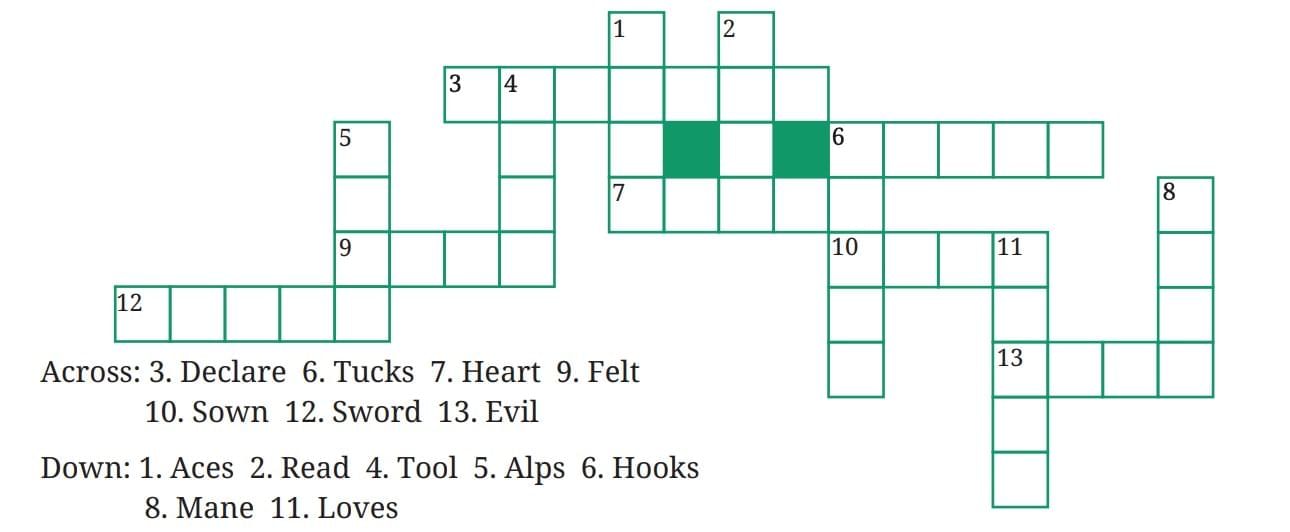
I. Work in pairs. Solve the crossword puzzle given below with the clues in the form of anagrams.

Ans: 

Across

  1. Declare → Anagram: cleared
  2. Tucks → Anagram: stuck
  3. Heart → Anagram: earth
  4. Felt → Anagram: left
  5. Sown → Anagram: owns
  6. Sword → Anagram: words
  7. Evil → Anagram: vile

Down

  1. Aces → Anagram: case
  2. Read → Anagram: dear
  3. Tool → Anagram: loot
  4. Alps → Anagram: slap
  5. Hooks → Anagram: shook
  6. Mane → Anagram: name
  7. Loves → Anagram: solve

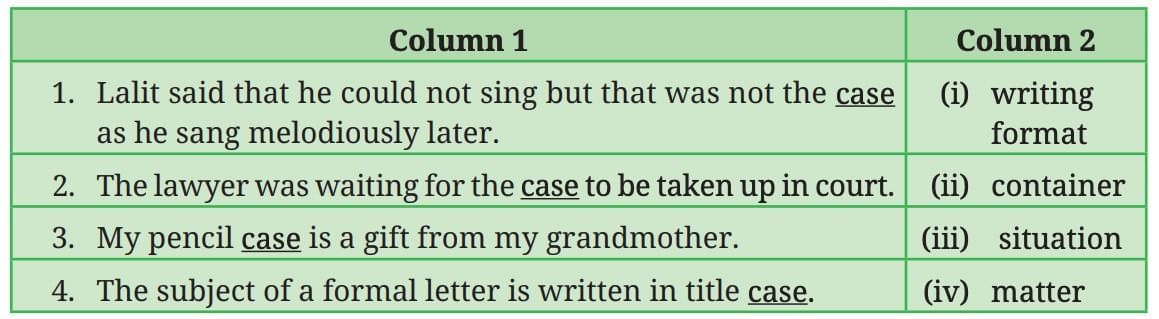
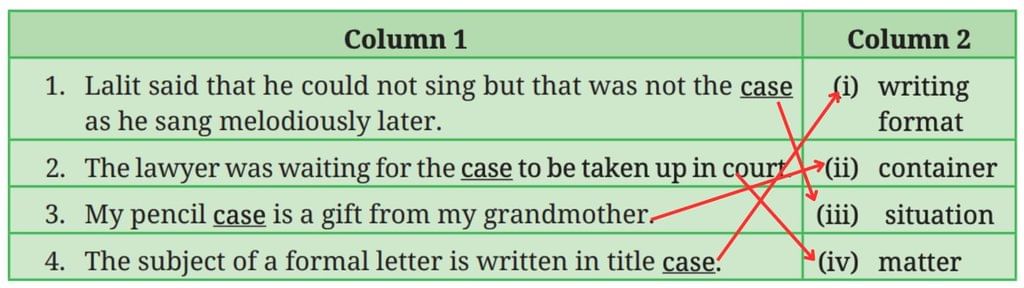
II. Work in pairs. Match the different meanings of ‘case’ in Column 2 with the correct usage in the sentences in Column 1.  Share your answers with your classmates and teacher.

Ans:Let us discuss (Page 104)

I. Complete the following statements with suitable reasons.

  1. Leroy’s nickname was Encyclopedia, and everyone called him by that name because
    Ans: he read many books and never forgot a fact, knowing more than anyone in Idaville.
  2. At the dinner table on Tuesday night, Chief Brown stared at his cream-of-mushroom soup as
    Ans: he was thinking hard about the mysterious four-word code in the jewellery case.
  3. Encyclopedia sat quietly at the dinner table because
    Ans: he knew his parents were discussing the case for him to hear and solve.
  4. Nolan put the will on the kitchen table because
    Ans: he wanted to leave a clue about the hidden jewellery’s location for Davenport.

II. Do you think Chief Brown would need Leroy’s help to solve this case? If yes, why? If no, why not?
Ans: Yes, Chief Brown needed Leroy’s help because the four-word code (Nom, Utes, Sweden, Hurts) was confusing, and Leroy’s clever question about the fir tree solved the case quickly.

Let us discuss (Page 107)I. A fact is something that can be proven true or false. A fact is not based on people’s beliefs. An opinion, on the other hand, is a belief, feeling, or judgment, and can vary from one person to another. An opinion cannot be proven. Identify which of the following statements from parts I and II of the story are facts or opinions. One example has been done for you. Share your answers with your classmates and teacher.     
1.    Encyclopedia’s father was the Chief of Police. Fact     
2.    Everyone thought that Chief Brown must be the smartest police chief in the country.     
3.    An encyclopedia is a book or set of books filled with facts from A to Z.     
4.    Leroy’s friends said that he was like a library and a computer rolled into one, and more user-friendly.    
 5.    Two masked men held up the Diamond Mart on Sixth Avenue.
 6. Nolan and Davenport had met while both were in prison in South Carolina. Leroy’s nickname was Encyclopedia and everyone called him by that name because 
 7.    Chief Brown’s hunch was that Davenport and Nolan decided to hide the loot until things cooled down.
 8. Nolan wrote a four-word code to tell Davenport where he had hidden the stolen jewellery.
Ans:
1. Encyclopedia’s father was the Chief of Police – Fact (verifiable position).
2. Everyone thought that Chief Brown must be the smartest police chief in the country – Opinion (based on people’s beliefs).
3. An encyclopedia is a book or set of books filled with facts from A to Z – Fact (definition of an encyclopedia).
4. Leroy’s friends said that he was like a library and a computer rolled into one, and more user-friendly – Opinion (friends’ subjective view).
5. Two masked men held up the Diamond Mart on Sixth Avenue – Fact (verifiable event).
6. Nolan and Davenport had met while both were in prison in South Carolina – Fact (verifiable past event).
7. Chief Brown’s hunch was that Davenport and Nolan decided to hide the loot until things cooled down – Opinion (based on Chief Brown’s belief).
8. Nolan wrote a four-word code to tell Davenport where he had hidden the jewellery – Fact (verifiable action in the story).
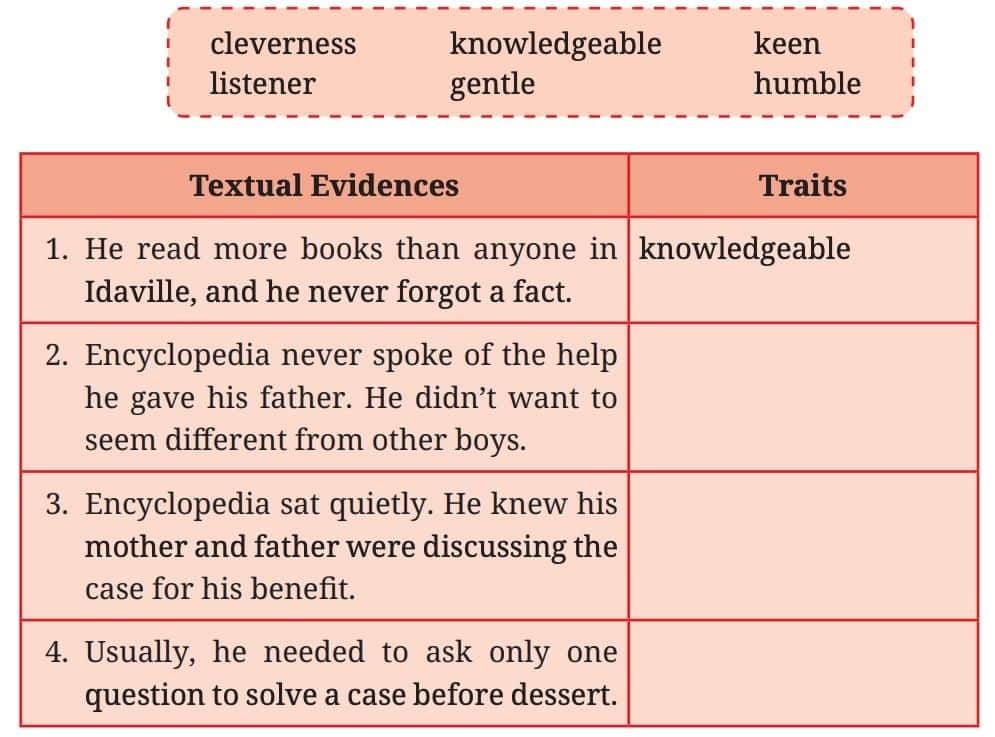
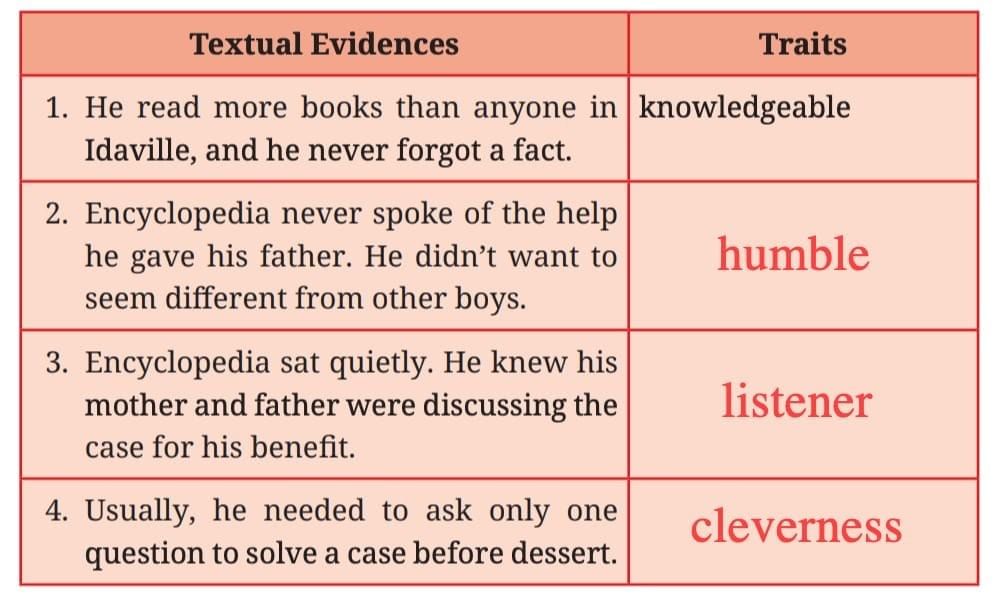
II. Complete the table by choosing the character traits of Leroy given in the box below. There is an extra word that you do not need. One example has been done for you.Ans:

Let us think and reflect (Page 108)

I. Read the given extracts and answer the questions that follow.
1. Chief Brown would have liked to tell everyone about his only child. But who would believe him? Who would believe that the best detective alive was an eighth grader? So, he said nothing. 
Encyclopedia never spoke of the help he gave his father. He didn’t want to seem different from other boys. But there was nothing he could do about his nickname. He was stuck with it. 
Only his parents and teachers called him by his real name, Leroy. Everyone else called him Encyclopedia.

(i)     Complete the following sentence with a suitable reason.          
Chief Brown’s dilemma can be called unique because____________.    
(ii)     What can be inferred about why Encyclopedia never spoke of the help he gave his father?     
A.     He is shy and lacks confidence in his abilities to share his insights.     

B.     He wants to avoid the jealousy others might feel about his skills.     
C.     He desires to blend with the other boys to prevent seeming different.     
D.     He is embarrassed about being smarter than most adults around him.     
(iii)     The parents choose not to call their son ‘Encyclopedia’. Select the reason that is false.     
A.     For them, he is more than his unique abilities; he is their child, with a personal identity.     

B.     Calling him by his real name reflects their affection and the desire to acknowledge him as an ordinary boy.    
C.     They want him to be remembered as different from the others around.    
 (iv)     What does the writer mean by the fact that Leroy was ‘stuck with’ the name Encyclopedia?
Ans: 
(i) Chief Brown’s dilemma can be called unique because he wanted to tell everyone his son was a brilliant detective, but no one would believe an eighth grader could be so talented.
(ii) C. He desires to blend with the other boys to prevent seeming different (text states he didn’t want to seem different).
(iii) C. They want him to be remembered as different from the others around (parents use his real name to treat him as an ordinary boy, not to highlight differences).
(iv) It means everyone called him Encyclopedia because of his vast knowledge, and he couldn’t change this nickname.

2. Chief Brown studied the four words: Nom Utes Sweden Hurts. He shook his head and passed the notebook to Mrs. Brown again. “Can you figure it out?” 
“Nom is a shortening of nominative, a grammatical term,” stated Mrs. Brown, who had taught English and other subjects in high school.“Utes is an American Indian tribe. Sweden is a country in northern Europe. Hurts is hurts.” 
She lifted her gaze to Encyclopedia and shook her head.
 “I can’t figure it out,” she confessed. “Davenport disappeared right after the hold-up,” Encyclopedia reminded her.

(i)     What does Chief Brown’s reaction of shaking his head suggest about his understanding of the four words?
A.     He is confident that the words are a clue.     

B.     He is confused, unable to make sense of the words.     
C.     He believes the words are random and meaningless.    
 D.     He thinks the words are unrelated to the case.     
(ii)     Identify whether the given statement is true or false. Mrs. Brown explained the actual meanings of the individual words rather than decoding the hidden message behind them.     
(iii)     What does Mrs. Brown’s inability to decode the words suggest about the message?     
(iv)     Complete the following sentence suitably.          
The purpose of Encyclopedia’s reminder in the last line of the extract was to _________________. (refocus the discussion on the context of the crime/suggest that the coded message was meant for Davenport/imply that the message was likely a clue about the location of the stolen jewellery)
Ans:

(i) B. He is confused, unable to make sense of the words (shaking his head indicates confusion).
(ii) Mrs. Brown explained the actual meanings of the individual words rather than decoding the hidden message behind them – True (she defines each word literally, not as a code).
(iii) It suggests the message is cleverly hidden and requires specific insight to understand.
(iv) The purpose of Encyclopedia’s reminder in the last line of the extract was to suggest that the coded message was meant for Davenport.

II Answer the following questions. 

  1. Nolan and Davenport were very close. Support this statement with evidence from the text.     
  2. Why did Davenport disappear right after the jewellery hold-up? What might his plans have been if Nolan had not died? 
  3. What does Mrs. Brown’s interest in the case tell us about her? 
  4. Explain why Chief Brown was proud of his son. 
  5. Why were Chief Brown’s suspicions regarding Nolan and Davenport justified, even when there was a lack of concrete proof? 
  6. Analyse the role of the four-word coded message in the story. 
  7. Write a character sketch on Leroy with the help of the character trait stable given in ‘Let us discuss’ section.         

You may begin it like this:         
 Encyclopedia was a knowledgeable eighth grader who never forgot a fact that he read. 
Ans:

1. They met in prison, became friendly due to shared interests, and Davenport lived with Nolan before the robbery.
2. He disappeared to avoid suspicion after the robbery. If Nolan hadn’t died, they might have waited longer to retrieve and share the hidden jewellery.
3. She is curious and engaged, as she asks questions and tries to understand the code.
4. He was proud because Encyclopedia solved mysteries quickly, like finding the jewellery with one question.
5.  His suspicions were justified because Nolan and Davenport were friends from prison, lived together before the robbery, and a clerk thought she recognised Nolan.
6. The code (Nom, Utes, Sweden, Hurts) represented days (Monday to Thursday), hiding the fifth word (Fir for Friday), which led to the jewellery’s location in a fir tree’s jug.
7. Encyclopedia was a knowledgeable eighth grader who never forgot a fact that he read. He was humble, not boasting about helping his father, and wanted to fit in with other boys. As a good listener, he quietly understood his parents’ discussions. His cleverness allowed him to solve cases with just one question.

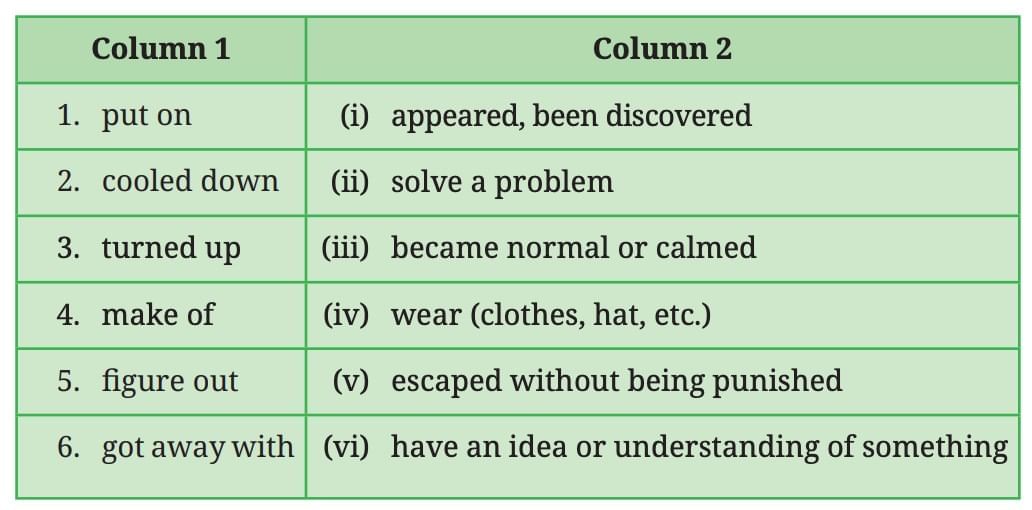
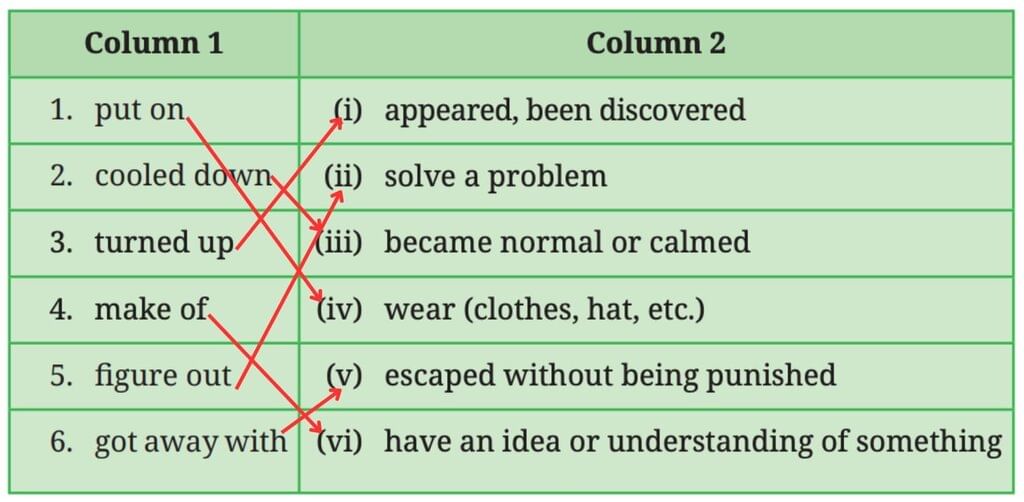
Let us learn (Page 111)I. Match the phrasal verbs from the text given in Column 1 with their meanings in Column 2. You may refer to a dictionary.

Now, fill in the blanks with the phrasal verbs given in Column 1.     
A. Finally, some important evidence about the case has _______________.
B. After I _______________, I understood that I had made a big mistake.    
C. I couldn’t _______________ why he was angry with me.     
D. He _______________ his special coat and went to his friend’s birthdayparty.                     
E. Ravi forgets to do his homework but he _______________ it as teacherdidn’t ask for it that day.                                 F. I do not know what to _______________ his behaviour.
Ans:

Fill in the blanks:

A. Finally, some important evidence about the case has turned up.
B. After I cooled down I understood that I had made a big mistake.
C. I couldn’t figure out why he was angry with me.
D. He put on his special coat and went to his friend’s birthday party.
E. Ravi forgets to do his homework but he got away with it as teacher didn’t ask for it that day.
F. I do not know what to make of his behaviour.

II. Fill in the blanks in the following sentences by choosing the correct word pairs from the box given below.

  1. After running for 50 kilometres last _________________, I felt_________________ for two days.    
  2. When the committee met yesterday, they brought _________________local cases to the _________________.
  3. While learning to drive, Rina used too much force on the_________________, causing the car to _________________ down.  
  4. He has composed a beautiful _________________ of music in order tobring _________________ to thousands of people. S
  5. he was busy _________________ her hair not caring about the_________________ flowers in her garden.
    Ans: 
    1. After running for 50 kilometres last week I felt weak for two days.
    2. When the committee met yesterday, they brought four local cases to the peace.
    3. While learning to drive, Rina used too much force on the brake, causing the car to break down.
    4. He has composed a beautiful piece of music in order to bring peace to thousands of people.
    5. She was busy braiding her hair not caring about the flowers in her garden.

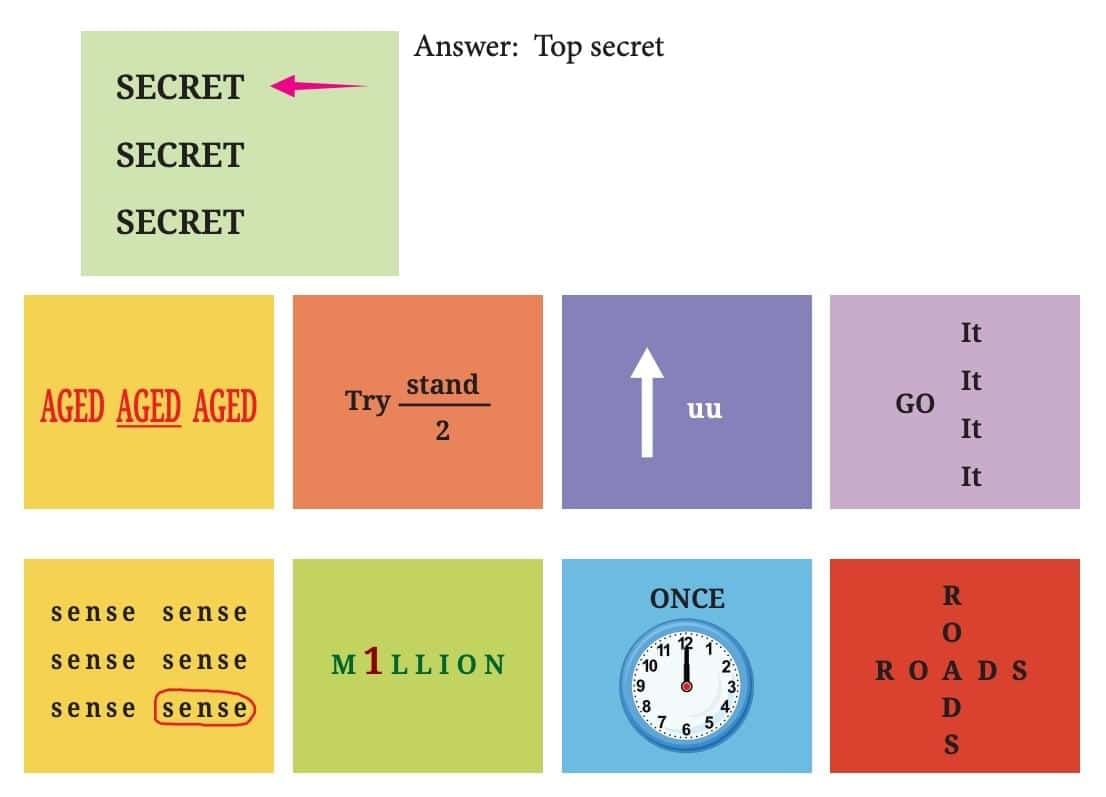
III. Leroy solved the mystery of the missing fifth word with his critical thinking abilities. Work in pairs to solve the puzzles given in the illustrations below and infer what they say. One example has been done for you

IV. Spoonerism is a mistake made when speaking, where the first sounds of the words in a phrase or a sentence are exchanged with each other. This usually gives a funny meaning. Some examples of spoonerism are saying ‘wrong load’ instead of ‘long road’, ’round of mice’ instead of ‘mound of rice’.
Find the correct order for the following spoonerisms.     

  1. knowing sits          
  2. it’s roaring with pain.
  3. plaster man 
  4.  blarm wanket     
  5. tars and crucks      
  6. shake a tower     
  7. bead a rook     
  8. mardon me padam

Ans:

  1. knowing sits → sowing knits (or more sensibly: sewing knits)
  2. it’s roaring with pain → it’s pouring with rain
  3. plaster man → master plan
  4. blarm wanket → warm blanket
  5. tars and crucks → cars and trucks
  6. shake a tower → take a shower
  7. bead a rook → read a book
  8. mardon me padam → pardon me madam

V. Read the following sentences from the text and study the highlighted words.

  1. Everyone thought that he must be the smartest police chief in the country.     
  2. She read what he had copied. 
  3. They tell where the jewellery is hidden. 
  4. “Nom is a shortening of nominative, a grammatical term,” stated Mrs.Brown, who had taught English and other subjects in high school. 
  5. “Nolan and Davenport had met,” Chief Brown said, “while both were in prison in South Carolina.”
  6. When he came up against a case he couldn’t solve, he acted at once. 
  7. The code is simple, especially as it’s written on a sheet from a calendar. 
  8. They became friendly because of shared interests.     
  9. Encyclopedia solved the case for him before dinner was over. 

Now, fill in the blanks with the words in the box given below to complete the following sentences. There are two extra words that you do not need.Detective stories are exciting, keeping readers guessing (i) ____________ the real culprit is. They take place in settings (ii) ____________ clues arehidden carefully. (iii) ____________ the mystery seems tricky, a clever detective always finds answers. Readers often wonder 
(iv) ____________criminals leave small but important clues. The challenge is to decide (v) ____________ suspect is guilty. (vi) ____________ the truth is revealed, everything makes sense. But one may wonder (vii) ____________ they could have solved it themselves. These stories are fun (viii) ____________they make readers think till the very end.
Ans:

  1. We gave him the signal that he was waiting for.
  2. We went to a place where the incident occurred.
  3. The teacher said she would retire soon, who is now nearly sixty.
  4. It was the day when half the class was absent.

VI. Combine the following pairs of sentences using the word given in brackets. One example has been done for you.

  1. We gave him the signal. He was waiting for the signal. (that) 
    Answer: We gave him the signal that he was waiting for. 
  2. We went to a place. The incident occurred there. (where)        
  3. Teacher said she would retire soon. She is now nearly sixty. (who)        
  4. It was the day. Half the class was absent. (when)

Ans:

  1. We went to the place where the incident occurred.
  2. The teacher, who is now nearly sixty, said she would retire soon.
  3. It was the day when half the class was absent.

VII. Read the following sentences from the text

  1. “What’s suspicious about that?” Mrs. Brown asked.  
  2. “What do you make of the four words, Leroy?” 
  3. “Wasn’t he mixed up in a jewellery robbery a few years ago?”    
  4. “Didn’t you search Nolan’s house, dear?”   
  5. “Is there a young fir tree in Mr. Nolan’s palm-tree nursery?”          

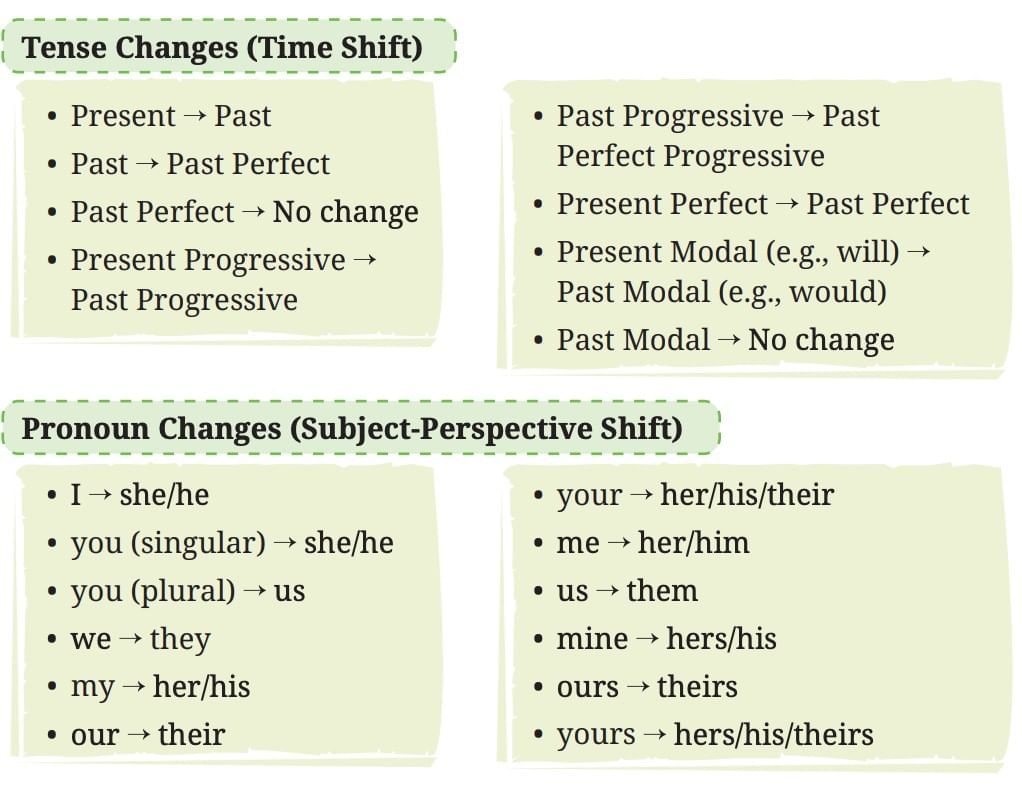
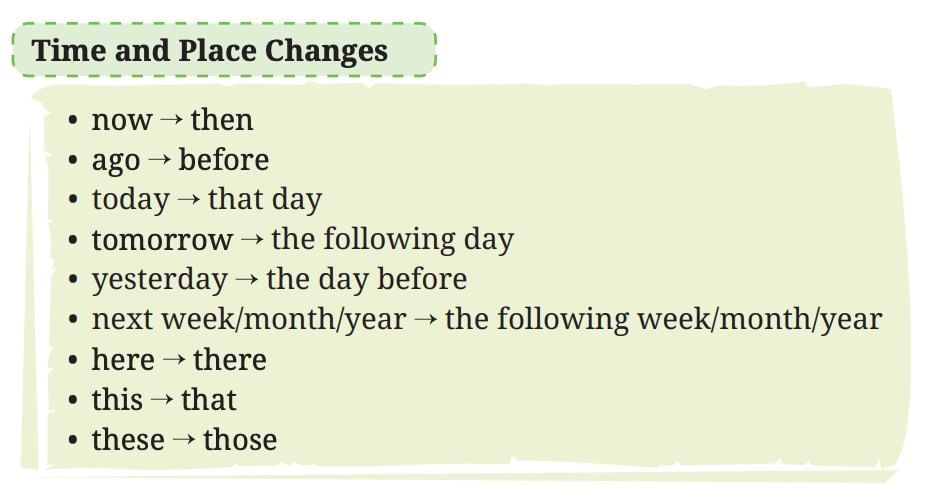
The given sentences are the direct words of the speaker, hence, they are in direct speech. While reporting these direct words to someone else at some other time and some other place, we make certain modifications in person, tense, and adverbs of place and timeThere are two types of Interrogative sentences. They are Wh– questions and Yes/No questions.         
Steps for Reporting Wh– questions and Yes/No questions     

1.    Replace the reporting verb ‘said’ with words like ‘asked’, ‘inquired ’, ’ interrogated’, or ‘questioned’.     
2.    Convert the interrogative sentence into a declarative one.     
3.    Apply the appropriate tense shift as per the rules of tense changes.     
4.    Remove quotation marks and the question mark.     
5.    Omit the conjunction ‘that’ in the reported speech.     
6.    In Wh– Wh-questions, place the Wh–word immediately after the reporting verb in the reported speech.     
7.    In Yes/No questions, use ‘if’ or ‘whether’ immediately after the reporting verb in the reported speech. 

Now, follow these steps to transform the sentences given as examples from direct speech to indirect speech. Indirect Speech

(i) Mrs. Brown asked ______________________________________________.     
(ii)Mrs. Brown questioned Leroy __________________________________.
(iii) Mrs. Brown inquired __________________________________________.     
(iv)     Mrs. Brown asked Chief Brown ________________________________.
(v) Mrs. Brown inquired ___________________________________________.

Ans:
(i) Mrs. Brown asked what was suspicious about that.
(ii) Mrs. Brown questioned Leroy what he made of the four words.
(iii) Mrs. Brown inquired whether Tim Nolan had been mixed up in a jewellery robbery a few years before.
(iv) Mrs. Brown asked Chief Brown whether he had searched Nolan’s house.
(v) Mrs. Brown inquired whether there was a young fir tree in Mr. Nolan’s palm-tree nursery.

VIII. Rewrite the following sentences in Reported Speech.

  1. “Why did you stop talking to me?” asked Rohan.          
    Rohan questioned __________________________________________________.    
  2.  “Did you enjoy the family gathering yesterday?” asked my aunt.          
    My aunt asked ______________________________________________________.
  3. “When will you visit us again?” asked my grandmother.          
    My grandmother inquired _________________________________________.
  4. Madavi said to Ravi, “Will you come with me to meet our old teacher tomorrow?” asked Madavi.          
    Madavi asked Ravi __________________________________________________.
  5. My friend said, “What gift are you planning to give your brother?” 
    My friend inquired _________________________________________________.
  6. “Shall I carry these notebooks to the staffroom, Ma’am?” asked Veenu.
    Veenu asked her teacher ____________________________________________.

Ans: 1. Rohan questioned why I had stopped talking to him.

2. My aunt asked whether I had enjoyed the family gathering the day before.
3. My grandmother inquired when I would visit them again.
4. Madavi asked Ravi whether he would come with her to meet their old teacher the following day.
5. My friend inquired what gift I was planning to give my brother.
6. Veenu asked her teacher whether she should carry those notebooks to the staffroom.

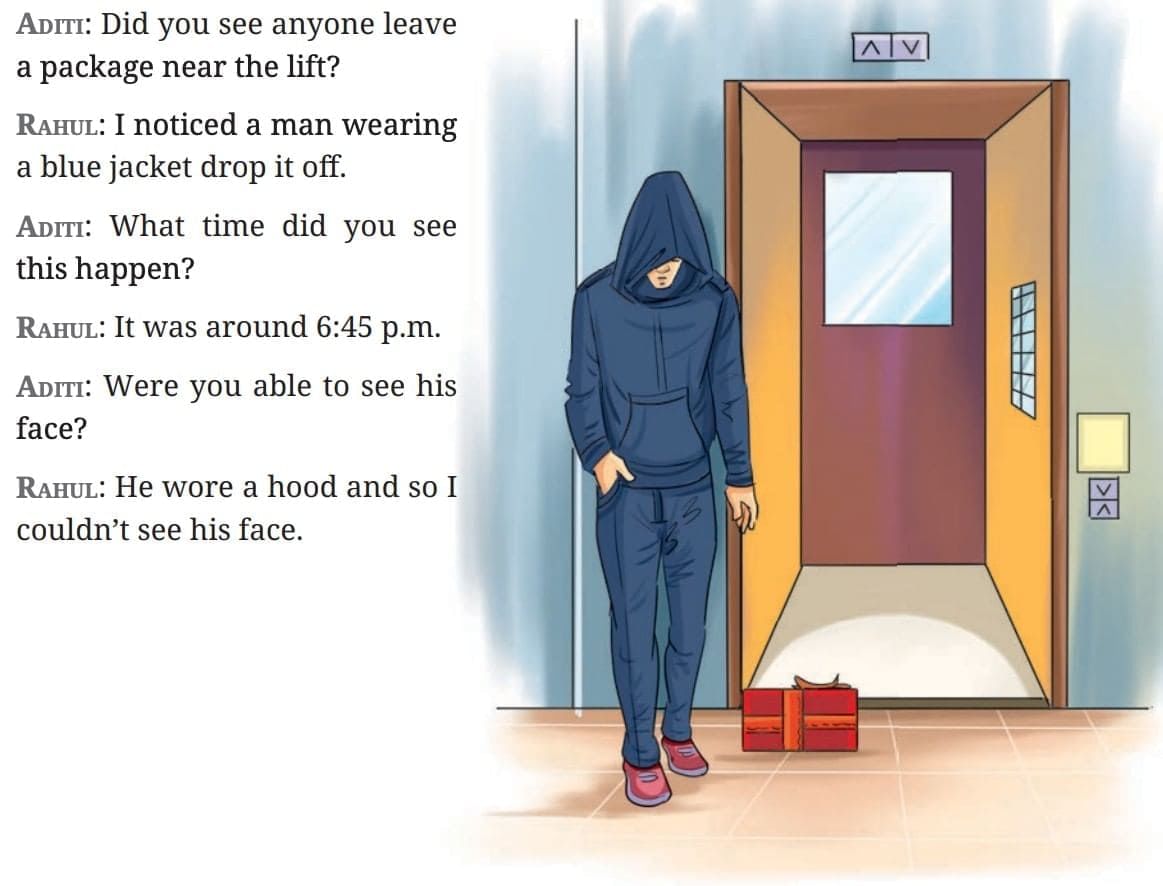
IX. Read the conversation between Aditi and Rahul

Complete the following paragraph by transforming the dialogue in indirect speech. 
Aditi asked Rahul 1. ___________________________________________________. 
Rahul replied that he had noticed a man wearing a blue jacket drop it off. 
Aditi asked Rahul 2. ___________________________________________________.          
Rahul replied that it had been around 6.45 p.m. 
Aditi further inquired 3. _______________________________________________. 
Rahul said that he had worn a hood, so he couldn’t see his face.
Ans:

Aditi asked Rahul whether he had seen anyone leave a package near the lift. 
Rahul replied that he had noticed a man wearing a blue jacket drop it off. 

Aditi asked Rahul what time he had seen it happen. 
Rahul replied that it had been around 6:45 p.m. 

Aditi further inquired whether he had been able to see his face. 
Rahul said that he had worn a hood, so he couldn’t see his face.

Let us listen (Page 117)

I. You will listen to a podcast about ways of improving observation skills. As you listen, mark the statements 1–4 as true or false. 

  1. Observation skills help improve your common sense.  
  2. Rushing through tasks helps you focus better and observe more. 
  3. Taking notes or making sketches helps with what you observe. 
  4. Incorporating tips on observation skills will soon lead to success. 

Ans:

  1. Observation skills help improve your common sense – True.
  2. Rushing through tasks helps you focus better and observe more – False (rushing reduces focus).
  3. Taking notes or making sketches helps with what you observe – True.
  4. Incorporating tips on observation skills will soon lead to success – True.

II. You will once again listen to the podcast. As you listen, complete the given sentences by filling in the blanks with one to three exact words you hear.

  1. It is important to slow down and ___________________ to notice several aspects around you more clearly. 
  2. The more senses like hearing and smelling you use, the more___________________ you absorb.
  3. People who are ___________________ tend to be better observers becausethey seek to understand what they notice.
  4. When you make a note of things, it helps reinforce the ________________in your memory.   
  5. Practising mindfulness helps a person stay ___________________ with their surroundings.

Ans:

  1. It is important to slow down and to notice several aspects around you more clearly.
  2. The more senses like hearing and smelling you use, the more you absorb.
  3. People who are curious tend to be better observers because they seek to understand what they notice.
  4. When you make a note of things, it helps reinforce the information in your memory.
  5. Practising mindfulness helps a person stay present with their surroundings.

Let us speak (Page 118)I. Read the following words from the text loudly with the help of the pronunciation guide given in brackets

Ans: This is a classroom activity. Read with correct pronunciation:

January (ja-nyoo-uh-ree), sour (sau-uh), pizza (peet-zaa), Wednesday (wenz-day), bowl (bol), buffet (buh-fay), pronunciation (pruh-nuhn-see-ay-shn)

II. Work in groups of five or six. Conduct a group discussion on the topic,‘The Interesting Aspects of a Mystery Story’.
Guidelines     
•     The moderator initiates the discussion inviting the speakers to share their views on the subject.     
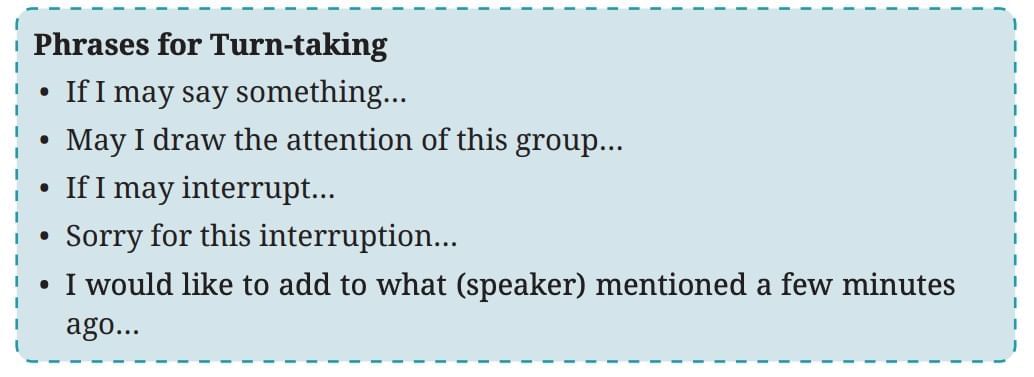
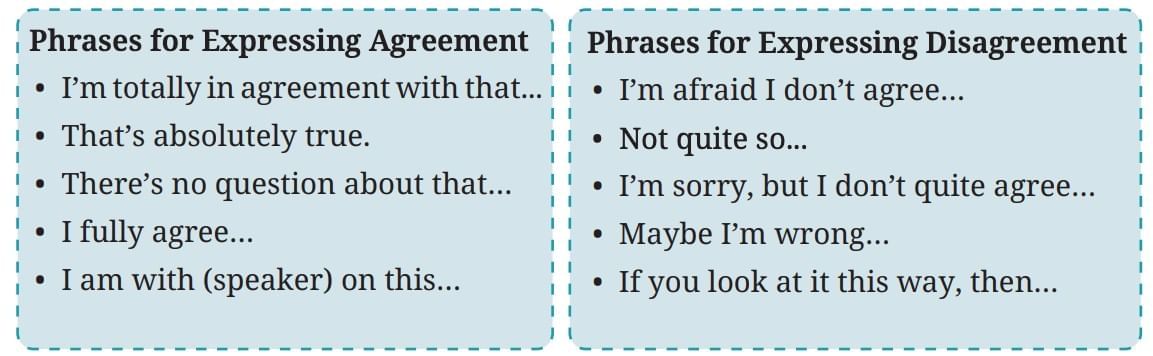
•     The speakers take turns to put forth their viewpoint using polite expressions to agree or disagree.     
•     The speakers may interrupt by raising their hands to add or clarify a point.     
• The moderator ensures equal participation of all the members in the group, consolidates views, and calls upon other speakers to respond. 

• The moderator sums up the points of discussion, suggests guidelines for future action and thanks the members of the group. 
Note: Choose a moderator. Decide upon the duration of the discussion.Ans: This is a classroom activity. Follow these guidelines:
– The moderator starts by asking group members to share what makes mystery stories exciting.
– Speakers take turns, e.g., “I think mysteries are fun because they keep you guessing.”
– Use phrases like “If I may say something…” or “I agree with…” to agree/disagree politely.
– Example points: Mysteries have suspense, clever clues, and surprising endings.
– The moderator ensures everyone speaks and sums up, e.g., “We agree mysteries are exciting because of clues and twists.”

Let us write (Page 119)

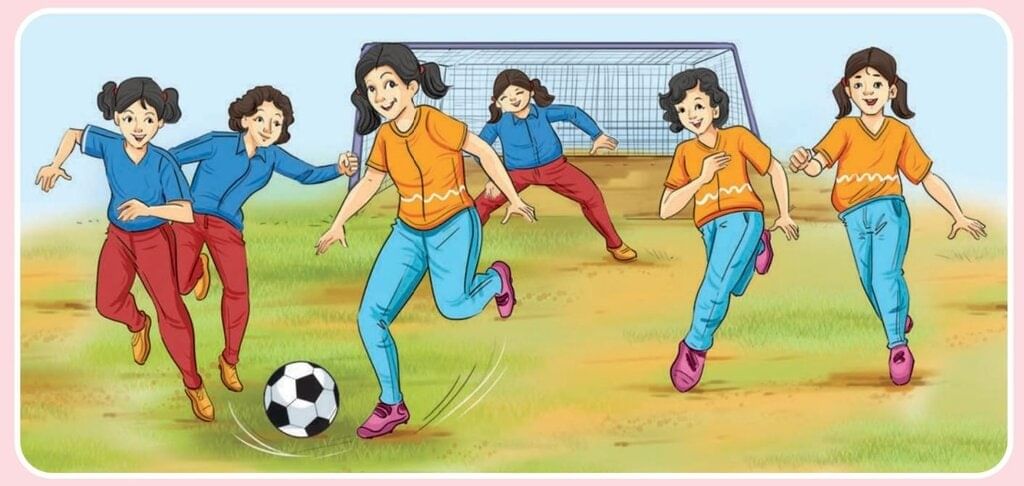
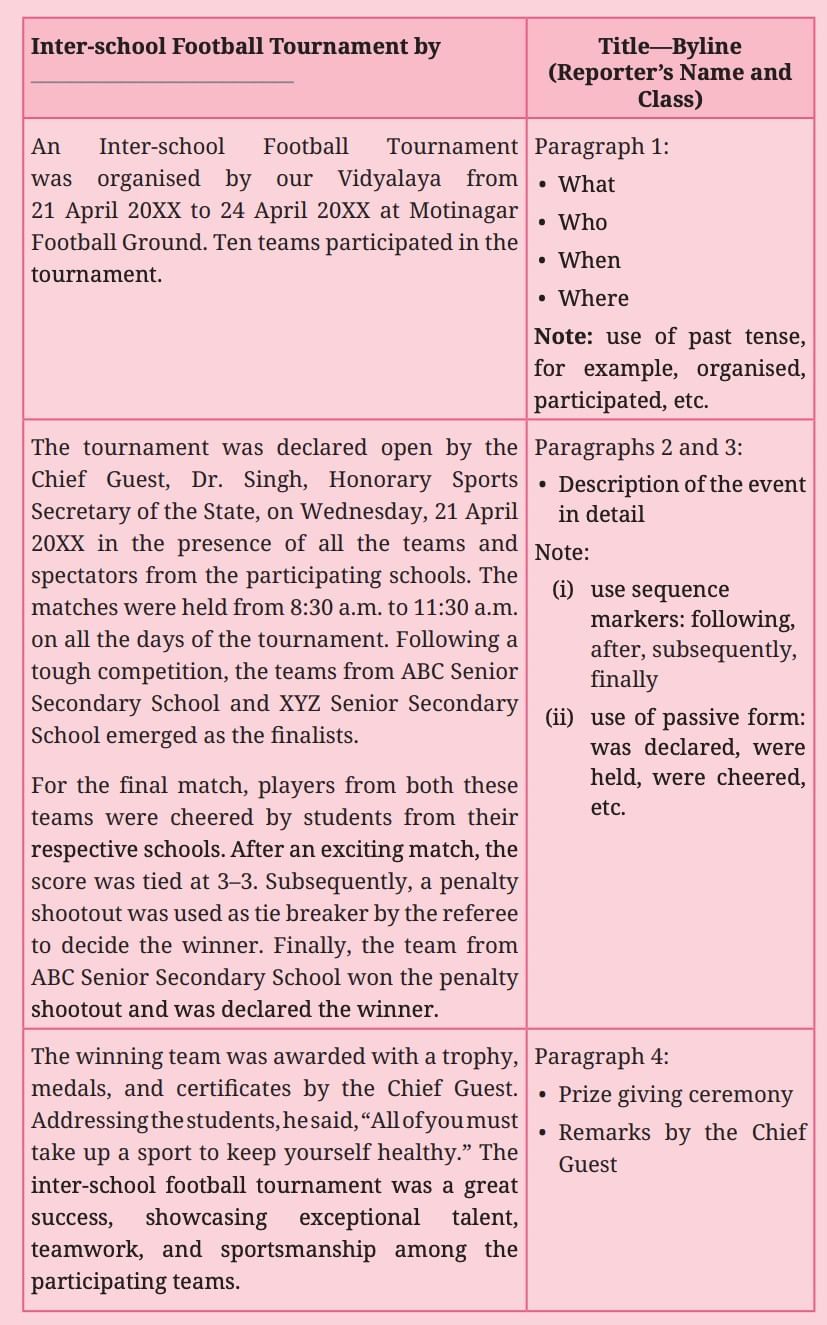
I. A report is written for an event that has already occurred. The purpose of a report is to provide first-hand details of an incident or event. It presents the information in a proper sequence. Read the sample report written about the ‘Inter-school Football Tournament’ organised by your Vidyalaya. Note the format, content, and language used.
Now, as a member of the Art and Craft Club, write a report on an ‘Inter-school Art Exhibition’ organised by your school. Include the necessary details
Ans:

Inter-school Art Exhibition Report
[Your School Name], [City]
1 August 2025

Our school hosted an Inter-school Art Exhibition on 25 July 2025 in the school auditorium. Five schools participated, showcasing paintings, sketches, and crafts by students. The theme was “Nature and Imagination.” Each school set up colourful stalls with artworks like drawings of forests and creative sculptures. Over 200 visitors, including parents and teachers, attended. The chief guest, a local artist, praised the students’ creativity. Our school won the “Best Display” award. The event encouraged young artists and was a great success.

Reported by: [Your Name], Art and Craft Club Member

5. Somebody’s Mother – Textbook Solutions

Let us do (Page 70).                                                     I. Recall a time you helped someone. Write two words describing:
Q1: What were your feelings after you did so?
Ans: Happy, proud
Q2: What might have been the feelings of the person whom you helped?
Ans: Grateful, relieved

II. Work in pairs. Read the words given below. Circle the words you would associate with an elderly person, and underline the words you would associate with a school student. Share the reasons for your choices with your classmates and teacherAns: 
Elderly person: worried, trembling, bent, grey, slow, helpful
(These describe age, caution, or physical traits of older people)
School student: strong, hastening, firm, merry, guide 
(These describe energy, youth, or actions of students)

III. Read the lines. 
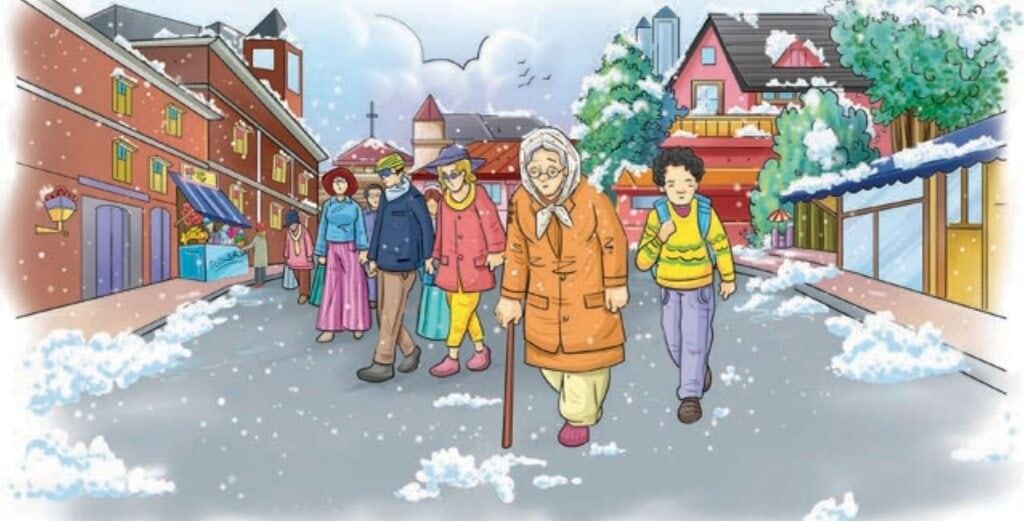
The woman was old and ragged and grey 
And bent with the chill of the Winter’s day. 

Select the suitable meaning of ‘ragged’ as used in these lines. There are four other meanings given below. Discuss with your classmates and teacher.

1. (of clothes) old and torn; synonym: shabby
• a ragged jacket
2. Having an outline, an edge, or a surface that is not straight or even
• a ragged coastline
3. Not smooth or regular; not showing control or careful preparation
• I could hear the sound of his ragged breathing.
• Their performance was still very ragged.
4. (Informal) very tired, especially after physical effort
• The elderly man was ragged after climbing the stairs.
Ans:  (of clothes) old and torn; synonym: shabby – a ragged jacket
Explanation: In this context, the word “ragged” is used to describe the woman’s appearance. She is also described as old, grey, and bent with the chill, which suggests poverty, weakness, and worn-out clothing. Therefore, “ragged” most likely refers to her wearing old and torn clothes.

Let us discuss (Page 73)I. Arrange the events of the poem in the correct order of occurrence. Share your answers with your classmates and teacher.
1. The boy returned to his friends, feeling proud of what he had done.
2. The old woman stood alone at the crossing, hesitant to move.
3. A group of schoolboys passed by, playing and laughing.
4. The boy offered to help the old woman cross the street.
5. The woman prayed for the boy who helped her.
6. The children hurried past the old woman without offering help.
7. The woman placed her hand on the boy’s arm, and he guided her safely across the street.
8. The boy thought about his own mother and hoped someone would help her one day.
Ans: 

1. (2) The old woman stood alone at the crossing, hesitant to move.
2. (3) A group of schoolboys passed by, playing, and laughing.
3. (6) The children hurried past the old woman without offering help.
4. (4) The boy offered to help the old woman cross the street.
5. (7) The woman placed her hand on the boy’s arm, and he guided her safely across the street.
6. (1) The boy returned to his friends, feeling proud of what he had done.
7. (8) The boy thought about his own mother and hoped someone would help her one day.
8. (5) The woman prayed for the boy who helped her.

II. Fill in the blanks by choosing the correct answer from the options given in the brackets
1. The central theme of the poem is _____________. (kindness and empathy/adventure and courage)
2. The tone of the poem is _____________. (humorous and playful/sympathetic and hopeful)
3. The poem is written in couplets with _____________ lines in each stanza.(four/two)
4. The structure of the poem gives a rhythmic flow that reflects both the_____________. (narrative and emotions/story’s pace and message)
5. The poem follows a rhyme scheme of _____________. (AABB/ABAB)
Ans:

1. The central theme of the poem is kindness and empathy.
2. The tone of the poem is sympathetic and hopeful.
3. The poem is written in couplets with two lines in each stanza.
4. The structure of the poem gives a rhythmic flow that reflects both the narrative and emotions.
5. The poem follows a rhyme scheme of ABAB.

III. Pick examples from the poem for the following poetic devices.
1. Simile
2. Alliteration
3. Repetition

Ans:
1. Simile: “Came the boys like a flock of sheep” (compares boys to a flock of sheep using “like”).
2. Alliteration: “Hailing the snow piled white and deep” (repeats the “w” sound).
3. Repetition: “Somebody’s mother” (repeated to emphasise the woman’s importance).

IV. Complete the following sentences appropriately, explaining the imagery.
1. The poem uses imagery to describe scenes of a bustling street. We know this by the phrase _______________________.
2. The line ‘The street was wet with a recent snow’ suggests a cold and _______________________ weather, emphasising the woman’s helplessness.
Ans: 
1. The poem uses imagery to describe scenes of a bustling street. We know this by the phrase “the crowded street”, which helps us imagine a busy and noisy place full of people.
2. The line ‘The street was wet with a recent snow’ suggests cold and uncomfortable weather, emphasising the woman’s helplessness. 

V. Complete the following sentence with a suitable reason.
The poet repeats the phrase Somebody’s mother because it_______________________.

Ans: The poet repeats the phrase “Somebody’s mother” because it reminds us that the old woman is also a loved and cared-for person, deserving kindness and respect, just like anyone else’s mother.

VI. Complete the analogy:
The old woman: vulnerable and neglected:: The young boy:_______________________.
Ans: The old woman: vulnerable and neglected :: The young boy: kind and compassionate.

Let us Think and  Reflect (Page 74) I. Read the given extracts and answer the questions that follow.

1. The woman was old and ragged and grey
     And bent with the chill of the Winter’s day. 
     The street was wet with recent snow 
      And the woman’s feet were aged and slow.

(i) What does the phrase ‘ragged and grey’ refer to?
A. The woman’s emotional state that day.
B. The woman’s old and worn-out appearance.
C. The weather conditions of the particular day.
D. The colour of the street and the surroundings.

(ii) Complete the following sentence with a suitable reason: 
The woman was ‘bent’ with the chill of the Winter’s day because she was _______________________.

(iii) Identify the fact and opinion from the following sentences:
A. The street was wet with recent snow. _______________________
B. The woman was too weak to cross the street on her own._______________________

(iv) Why do you think the woman’s feet were described as ‘aged and slow’?
Ans:
(i) B. The woman’s old and worn-out appearance.
(ii) The woman was “bent” with the chill of the Winter’s day because she was old and weak, and the cold made her hunch over.
(iii) A. The street was wet with recent snow (Fact – describes an observable condition).
B. The woman was too weak to cross the street on her own (Opinion – assumes her weakness).
(iv) The young boy’s actions were driven by kindness and empathy.

2. He guided the trembling feet along, 
     Proud that his own were firm and strong. 
    Then back again to his friends he went, 
    His young heart happy and well content.

(i) What does the contrast between the ‘trembling feet’ of the old woman and the ‘firm and strong’ feet of the boy emphasise?
(ii) Fill in the blank given below by selecting the correct option from the brackets.
• The poem tells us that the boy was ‘proud’ that his feet were strong.
• This tells us that the boy was ________. (arrogant about being strong/grateful for his ability to help)

(iii) What is the boy most likely to tell his friends on getting back?
A. I’m so glad I could help her.
B. I’m worried about her safety.
C. I’m surprised she forgot to thank me.
D. I’m thankful for all your support.

(iv) Rectify the false sentence given below.
The young boy’s actions were driven by a logical decision.
Ans: 
(i) The difference in their age and physical strength showing the boy’s ability to help her.
(ii) The poem tells us that the boy was “proud” that his feet were strong. 
(iii) A. I’m so glad I could help her.
(iv) The young boy’s actions were driven by kindness and empathy.

II Answer the following questions.
1. What might be the old woman’s fears as she waited for a long time at the crossing?
2. How does the poet show the helplessness of the old woman? Support your answer with evidence from the poem.
3. Why does the boy decide to help the old woman? What does this tell us about him?
4. How was the boy’s approach towards the old woman different from that of the other boys in the group?
5. Justify the appropriateness of the title of the poem.
6. What does the poem suggest about the role of empathy and humanity in society?

Ans: 
1. She might have feared falling, being hit by carriages or horses, or being ignored in the slippery street.
2. The poet shows her helplessness by describing her as “old and ragged and grey,” “bent with the chill,” and having “aged and slow” feet. The lines “She stood at the crossing and waited long, / Alone, uncared for” show she was ignored and afraid to move.
3. The boy helps because he feels empathy, thinking of his mother. This shows he is kind, caring, and respectful.
4. The other boys hurried past without helping, while the boy stopped, offered help, and guided her safely, showing kindness.
5. The title “Somebody’s Mother” is appropriate because it emphasises the woman’s value as a loved mother, inspiring the boy’s kindness and her prayer for him.
6. The poem suggests that empathy and humanity, like helping others, make society kinder and show that everyone deserves care and respect.

Let us learn (Page 76)I. The grid given below has the antonyms of the words from the text. Locate these words in the grid horizontally, vertically, and diagonally. One example has been done for you. You may refer to a dictionary.

Ans: Word List and Their Antonyms:

  1. firm – fragile → Found in Row 2: “RAGILE” (starting from Column 5)
  2. meek – bold → Found in Row 3: “BOLD” (diagonally from B in Column 3)
  3. merry – anxious → Found in Row 4: “ANXIOUS” (diagonally, starting from A in Column 1)
  4. kind – cruel → Found in Row 3: “CRUEL” (starting from C in Column 1)
  5. anxious – peaceful → Found in Row 7: “PEACEFUL” (horizontally, starting from Column 1)
  6. bent – straight → Already found in last row

II. Match the words from the text given in Column 1 with the underlined phrases in Column 2.Ans:

III. In the poem, the poet uses the idiom ‘lend a hand’, which means ‘help somebody’. Some more idioms using ‘hand’ are given in Column 1. Match these idioms with their meanings in Column 2. You may refer to a dictionary.

Ans:

IV. Complete the following analogy by filling in the blanks with the correct words from the poem.

1. ___________ : winter :: heat : summer
2. hurt : ___________ :: old: aged
3. whispered : shouted:: humble: ___________
4. eyes : ___________ :: legs : walk
5. having a lot of money: wealthy:: densely packed people: ___________

Ans: 

  1. cold : winter :: heat : summer
  2. hurt : helped :: old : aged
  3. whispered : shouted :: humble : proud
  4. eyes : see :: legs : walk
  5. having a lot of money : wealthy :: densely packed people : crowded

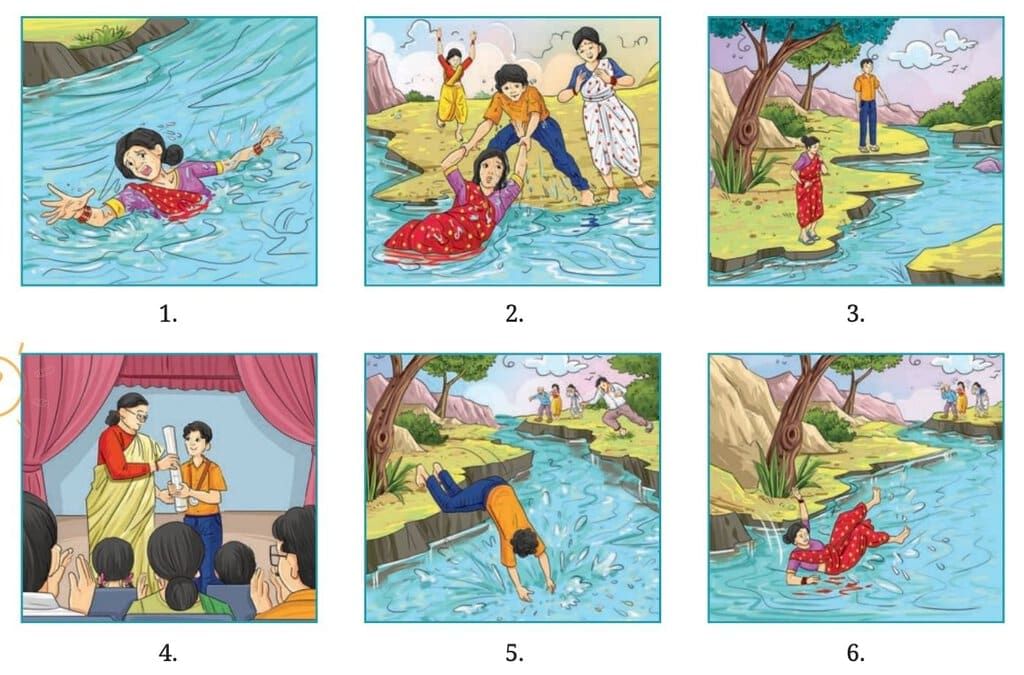
Let Us Listen (Page 78)I. You will listen to a woman read the special broadcast of the news. As you listen, arrange the pictures in the correct sequence of the events that took place.Ans: This is a classroom activity. Listen to the teacher’s broadcast and arrange the pictures (1-6) in order of events. 
Example sequence:

  1. Woman struggling in the river.
  2. Rohan jumps into the river.
  3. Rohan helps the woman to safety.
  4. People witness Rohan’s bravery.
  5. Rohan is honoured at Vigyan Bhawan.
  6. Rohan receives an award.

II. You will once again listen to the special broadcast of the news. As you listen, complete the following
sentences with one to three exact words.

1. The woman was having a difficult time staying afloat due to the_________________.
2. Rohan leapt into the river to save the woman without any_________________.
3. Rohan’s act of bravery was witnessed by _________________.
4. Rohan was honoured at the Vigyan Bhawan for his incredible courage and _________________.
5. Rohan proved that when it comes to saving lives, age is_________________.

Ans: Please refer to the transcript

Let us speak (Page 79)

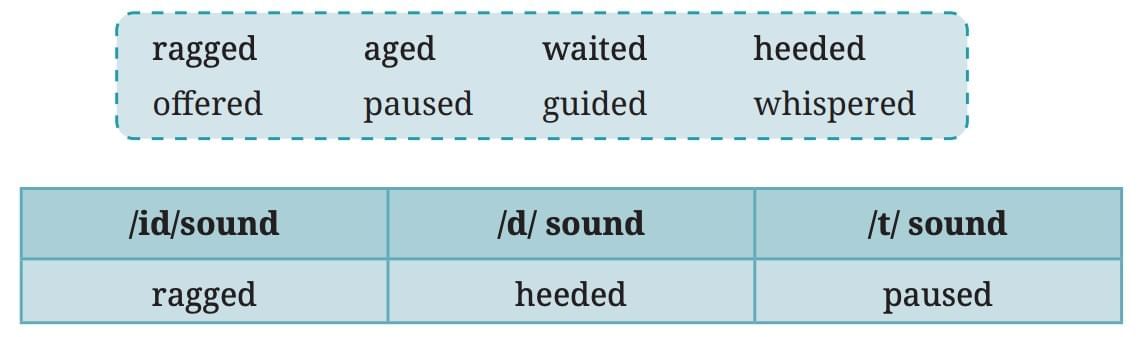
I. Read aloud the list of words from the poem that end in ‘-ed’. As you read, focus on the final sound of each word and place them in the appropriate columns. One example has been done for you.

Ans: This is a classroom activity. Read the words and sort them by their “-ed” sound. Example:

/t/ sound: helped, passed, placed
/d/ sound: guided, hailed, bowed
/ɪd/ sound: waited, contented

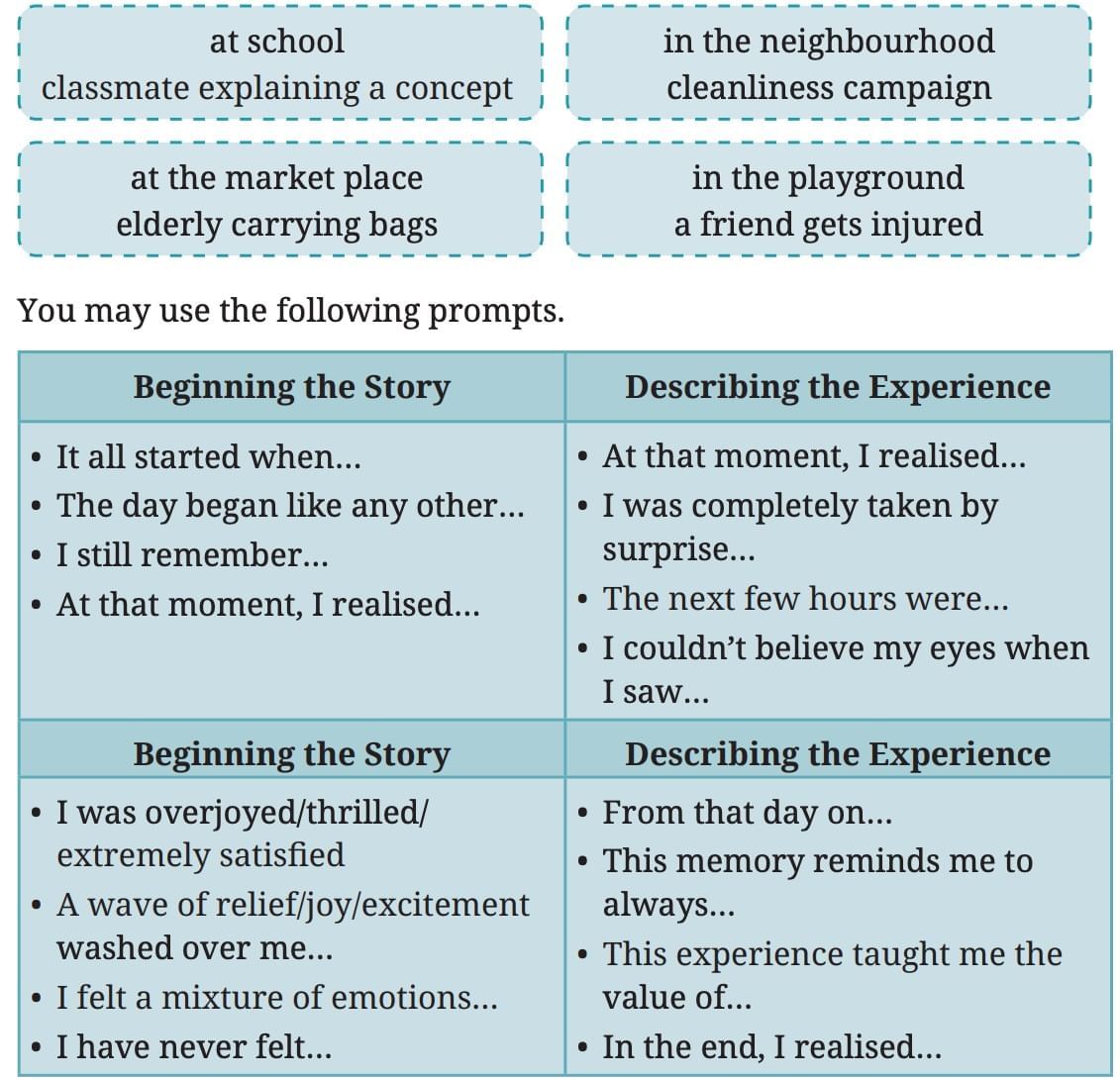
II. Work in pairs. Narrate an incident where you helped someone in the past. Take turns to speak and use the cue cards given below.

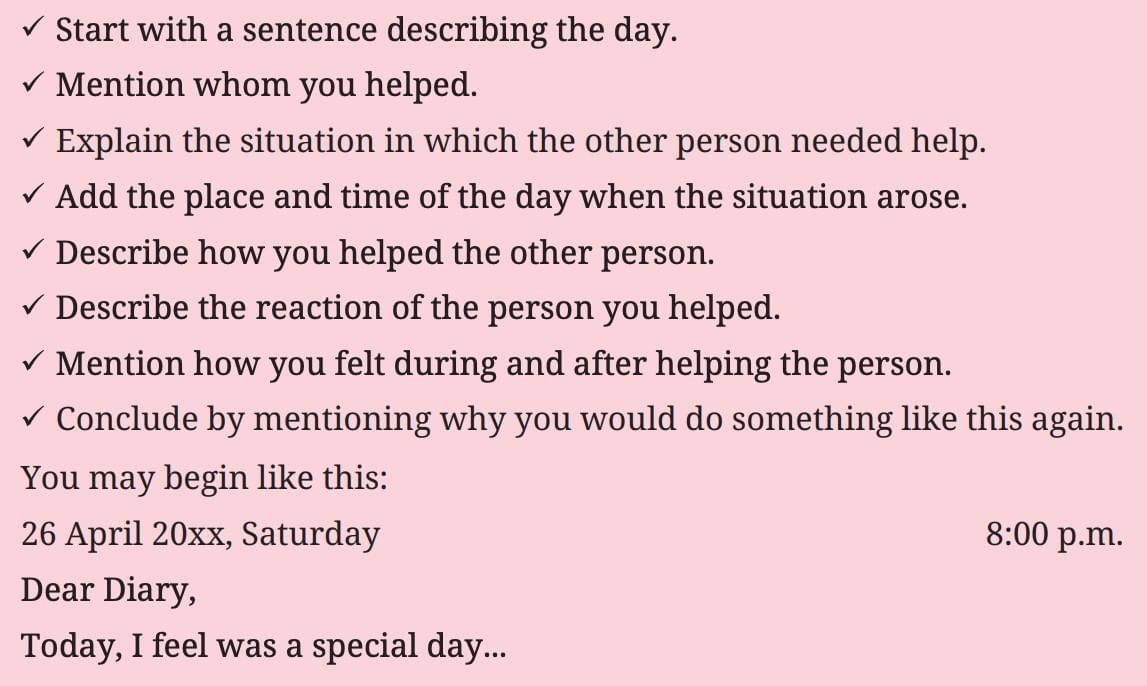
Let us write (Page 80)I. Write a diary entry of a day you helped someone in need. Remember to include the following points while writing it.Ans:

26 April 2025, Saturday
8:00 p.m.
Dear Diary,

Today was a special day because I helped an elderly neighbour, Mrs. Sharma. In the afternoon, at around 2:00 p.m., I saw her struggling to carry heavy grocery bags near our apartment gate. She looked tired and was moving slowly. I offered to carry her bags to her house on the second floor. She smiled and thanked me warmly, saying she felt relieved. I felt happy and proud while helping her, and afterwards, I felt joyful knowing I made her day easier. I would help again because it feels good to be kind and make someone smile.

Yours,
[Your Name]

Let us explore (Page 80)I. Did you know that even Earth has been referred to as mother in the ancient scriptures of India? In section 12.1.12 of Pṛthvi-Sūkta (hymn to the earth) of Atharva Veda, Earth is referred to as mother and us as her children by stating:

The line “Earth is my mother and I am her child” shows Earth is like a caring mother to all of us.

II. Work in groups of four. Find out the names of countries that refer to their country as ‘motherland’ and a few others as ‘fatherland’. Share your findings with your classmates and teacher.
Ans: Motherland: India, Russia, Bangladesh
Fatherland: Germany, Norway, Iceland
III. Read the poem and enjoy.

IV. Make a gratitude card for your mother/grandmother to thank her for at least five things that she does for you.  Also write two things that you would do regularly to help them. Use recycled material to make and decorate the card.

4. A Tale of Valour: Major Somnath Sharma and the Battle of Badgam – Textbook Solutions

Let us do (Page 49).                                                  Let us do these activities before we read.
I. Work in pairs. Share your answers with your classmates and teacher.
Q1: What do you think about the Republic Day Parade on 26 January?
Ans: The Republic Day Parade is a grand event that shows India’s pride, strength, and unity. It makes me feel proud to be Indian.
Q2: What are the highlights of this parade?
Ans: The parade includes marching soldiers, colourful floats, cultural dances, military vehicles, and air shows, displaying India’s diversity and power.
Q3: What bravery awards are given on this day, and who receives them?
Ans: Bravery awards, such as the Param Vir Chakra, Maha Vir Chakra, and Vir Chakra, are given to soldiers and occasionally civilians for their exceptional courage.

II. Work in groups of four and discuss.
Q1: What qualities do you think a soldier should have?
Ans: A soldier should be brave, disciplined, strong, loyal, and ready to protect the country even in danger.
Q2: If you had to share a message with a soldier, what would it be?
Ans: Thank you for your courage and sacrifice. You keep us safe, and we are proud of you!

Let us discuss (Page 59)

I. Arrange the following events in chronological order. The first and the last events have been marked for you. Share your answers with your classmates and teacher.
1. Major Somnath Sharma was born in 1923 in Kangra, Himachal Pradesh. (1)
2. Even after losing Major Somnath Sharma, the soldiers fought bravely to save Srinagar for India.
3. The D Company, under the command of Major Somnath Sharma, was flown into Srinagar.
4. Major Somnath Sharma underwent training at the Royal Military College, Sandhurst.
5. Major Somnath Sharma requested air strikes to combat the enemy at Badgam.
6. Major Somnath Sharma was commissioned into the 19th Hyderabad Regiment in 1942.
7. Major Somnath Sharma was killed immediately after a mortar shell hit him.
8. Major Somnath Sharma was the first recipient of the ParamVir Chakra. (8)

Ans:

  1. (1) Major Somnath Sharma was born in 1923 in Kangra, Himachal Pradesh.
  2. (6) Major Somnath Sharma was commissioned into the 19th Hyderabad Regiment in 1942.
  3. (4) Major Somnath Sharma underwent training at the Royal Military College, Sandhurst.
  4. (3) The D Company, under the command of Major Somnath Sharma, was flown into Srinagar.
  5. (5) Major Somnath Sharma requested air strikes to combat the enemy at Badgam.
  6. (7) Major Somnath Sharma was killed immediately after a mortar shell hit him.
  7. (2) Even after losing Major Somnath Sharma, the soldiers fought bravely to save Srinagar for India.
  8. (8) Major Somnath Sharma was the first recipient of the Param Vir Chakra.

Let us think and reflect (Page 59)

I. Read the given extracts and answer the questions that follow.

1. Vastly outnumbered and facing devastating fire, Major SomnathSharma and his men stood resolute. The air was thick with the sound of gunfire and the cries of battle, but Major Somnath Sharma’s voice cut through the chaos, urging his men to fight with tenacity and valour. Despite heavy casualties and his injuries, Major SomnathSharma displayed unparalleled bravery. He moved fearlessly through the battlefield, directing fire, filling magazines for his gunners, and encouraging his men to hold their ground.

(i) What can be inferred about the conditions from the line: ‘The air was thick with gunfire…’
A. The gunshots had stopped for a while.
B. There was intense fighting on the battlefield.
C. The invaders were retreating from the fight.
D. The Indian soldiers had achieved victory.

Ans: B. There was intense fighting on the battlefield.
(ii) Complete the sentence with a suitable reason. Despite heavy casualties, Major Somnath Sharma continued to lead his men because he was determined to protect Srinagar and inspire his soldiers to keep fighting.
(iii) Select the correct option for both Assertion (A) and Reason (R)given below: 

(A): Major Somnath Sharma moved fearlessly through the battlefield, even though he was injured. 
(R): He believed his courage was important to motivate the soldiers. 
A. Both (A) and (R) are true, and (R) is the correct explanation of (A).
B. Both (A) and (R) are true, but (R) is not the correct explanation of (A).
C. (A) is true, but (R) is false.
D. (A) is false, but (R) is true.(iii) 
Select the correct option for both Assertion (A) and Reason (R):
Ans: A. Both (A) and (R) are true, and (R) is the correct explanation of (A).

(iv) Fill in the blank with the correct word from those given in the brackets: Major Somnath Sharma was filling magazines, and encouraging his men to hold their ground despite ___________________________. (injuries/worry)
Ans: Major Somnath Sharma was filling magazines and encouraging his men to hold their ground despite injuries.

2. Born on 31 January 1923, in the picturesque town of Dadh in Kangra, Himachal Pradesh, Somnath Sharma belonged to a family with a rich military legacy. His father, Major General Amar Nath Sharma, had served the nation with distinction, and young Somnath was deeply inspired by the valorous tales of the Mahabharata, imparted to him by his grandfather
(i) What can be inferred about Somnath Sharma’s early influences on his career? 
A. He was primarily influenced by his father’s achievements in the military.

B. His inspiration came solely from the tales of the Mahabharata.
C. His family and heritage inspired his bravery and sense of duty.
D. He decided to join the military out of necessity rather than passion.

Ans: C. His family and heritage inspired his bravery and sense of duty.
(ii) Identify whether the following statement is true or false: 
Somnath Sharma belonged to a wealth

Ans: False (The text mentions a military legacy, not wealth).
(iii) What does the phrase ‘served the nation with distinction’ tell us about Major General Amar Nath Sharma?
Ans: He performed his duties with exceptional dedication, honour, and excellence./He was highly respected for his contributions to the country.
(iv) Replace the underlined phrase with a word from the extract that has a similar meaning. My family and I visited a popular hill station and stayed in an old but visually charming house surrounded by trees.
Ans: Picturesque

II.  Answer the following questions.
Q1. ‘Major Somnath’s legacy of courage and devotion to the nation remains forever alive, forever alive…’ What is the significance of the repetition in this line?

Ans: The repetition emphasises that Major Somnath’s courage and sacrifice will always be remembered and inspire people forever.

Q2: Why do you think Major Somnath’s leadership was critical during the Battle of Badgam?

Ans: His leadership was critical because he kept his men fighting despite being outnumbered, guided airstrikes, and held the position to save Srinagar.

Q3: What were Major Somnath’s last words? What do they reflect about his sense of duty?

Ans: His last words were, “The enemy is only 50 yards from us. We are heavily outnumbered. We are under devastating fire. I shall not withdraw an inch but will fight to the last man and the last round.” They show his strong duty to protect his country and never give up.

Q4: What might have been the outcome of the Battle of Badgam if Major Somnath and his company had not held their ground?

Ans: The enemy might have captured Srinagar airport and the Kashmir Valley, weakening India’s control over the region.

Q5: Why do you think Major Somnath’s story continues to inspire soldiers and civilians today?

Ans: His story inspires because it shows bravery, sacrifice, and love for the country, encouraging others to be courageous and patriotic.

Q6: How can the values demonstrated by Major Somnath Sharma—courage, duty, and self-sacrifice—be applied in our daily lives?

Ans: We can show courage by facing challenges, doing our duties honestly, and helping others selflessly, like studying hard or helping our community.Let us learn (Page 62)

Q1: Match the expressions from Column 1 with the situations in Column 2 and complete the sentences.

Ans:

Now, complete the following sentences using the expressions from Column 1.

A. The detective managed to foil the plan by finding the hidden evidence before the culprit could get rid of it.
B. The company’s new advertising campaign was meant to deliver a blow to their competitors’ sales.
C. The hikers chose to hold their ground despite the heavy rain, refusing to turn back on their journey.
D. Despite being heavily outnumbered, the soldiers vowed to defend their homeland and fight to the last man, refusing to surrender to the enemy forces.

II. Read the highlighted words in the following sentence from the text. 
contingent of troops posted to Jammu and Kashmir was air-lifted into Srinagar… There are many such collective nouns used in the context of armed forces. 
Match the collective nouns in Column 1 to their meanings in Column 2. 
You may refer to a dictionary

Now, fill in the blanks suitably with words from Column 1 in the table.

A. The commanding officer addressed the entire ________ of soldiersduring the morning assembly.
B. The admiral ordered the entire ________ to set sail for battle.
C. The ________ of infantry advanced slowly through the dense forest.
D. A ________ of fighter jets was sent to intercept the enemy planes.

Ans: 

A. The commanding officer addressed the entire battalion of soldiers during the morning assembly.
B. The admiral ordered the entire fleet to set sail for battle.
C. The regiment of infantry advanced slowly through the dense forest.
D. A squadron of fighter jets was sent to intercept the enemy planes.
III. Read the following words from the text and fill in the blanks with the correct words by taking clues from the meanings given below in the box.Meanings

1. To take and seize control: ____________
2. To invade or occupy an area in large numbers: ____________
3. To flood or overpower someone or something emotionally:____________ 
Now, create a list of at least five other verbs that begin with ‘over’ and frame sentences of your own.

Ans: 

  1. To take and seize control: overthrow
  2. To invade or occupy an area in large numbers: overrun
  3. To flood or overpower someone or something emotionally: overwhelm

​Five other verbs that begin with ‘over’ and sentences:

  1. Overcome – She managed to overcome her fear of public speaking.
  2. Overestimate – Don’t overestimate your ability to complete the project in one day.
  3. Overreact – Please don’t overreact to a small mistake.
  4. Overcook – He overcooked the pasta, so it turned out too soft.
  5. Overlook – I overlooked the spelling error in the report.

IV. In the following pairs of words, ‘c’ is used for nouns, while ‘s’ is used for verbs.

  • advice (noun) and advise (verb)
  • practice (noun) and practise (verb)
  • device (noun) and devise (verb)
  • council (noun) and counsel (verb) 

Now, fill in the blanks correctly with the words given in the brackets.
1. The teacher’s (i) ____________ is always helpful, and she continues to(ii) ____________ students on their career choices. (advice/advise)
2. The musician believes that daily (i) ____________ helps a lot, so she isalways ready to (ii) ____________ her harmonium lessons. (practice/practise)
3. The scientist uses a strange (i) ____________ for experiments and plansto (ii) ____________ new methods for his analysis. (device/devise)
4. The village (i) ____________ met to discuss issues and decided to(ii) ____________ the villagers on important matters. (council/counsel)

Ans: 

  1. The teacher’s (i) advice is always helpful, and she continues to (ii) advise students on their career choices.
  2. The musician believes that daily (i) practice helps a lot, so she is always ready to (ii) practise her harmonium lessons.
  3. The scientist uses a strange (i) device for experiments and plans to (ii) devise new methods for his analysis.
  4. The village (i) council met to discuss issues and decided to (ii) counsel the villagers on important matters.

V. Read the highlighted words in the following sentences from the text.

• …ended with echoes of courage that serve as an inspiration…
• A contingent of troops posted to Jammu and Kashmir was airlifted into Srinagar…
• D Company with 90 soldiers was the last, and they were expected to return by 2:00 p.m.
• The life and sacrifice of Major Somnath Sharma embody the highest ideals of duty, honour, and patriotism. 

The highlighted words are either singular verbs or plural verbs. They are in agreement with the subject of the sentence. This is called Subject-Verb Agreement. Now, fill in the blanks for the following sentences by choosing the correct verb given within brackets.

1. The bouquet of flowers __________ (is/are) beautiful.
2. Neither the teacher nor the students __________ (was/were) aware ofthe change in the schedule.
3. Each of the participants __________ (has/have) submitted their projectson time.
4. The data collected by the researchers __________ (shows/show)significant trends.
5. One of the players __________ (was/were) injured during the match.
6. Either the children or their guardian __________ (has/have) to attendthe meeting.
7. A pair of shoes __________ (is/are) missing from the rack.
8. Neither of the statements __________ (is/are) true.
9. The members of the jury __________ (has deliver/have delivered) their verdict to the court.
10. Mathematics __________ (is/are) an interesting subject for many students.

Ans:

1. The bouquet of flowers is beautiful.
2. Neither the teacher nor the students were aware of the change in the schedule.
3. Each of the participants has submitted their projects on time.
4. The data collected by the researchers show significant trends.
5. One of the players was injured during the match.
6. Either the children or their guardian has to attend the meeting.
7. A pair of shoes is missing from the rack.
8. Neither of the statements is true.
9. The members of the jury have delivered their verdict to the court.
10. Mathematics is an interesting subject for many students.

VI. Read the following passage and correct the incorrect usage of verbs. One example has been done for you. 
A battalion of soldiers stand at attention as the National flag are raised. 
A battalion of soldiers stands at attention as the National flag is raised.

Each soldier salute with pride while the commander and his assistants inspects the parade. The sound of marching feet echo through the air as a group of cadets prepare for their drill. Meanwhile, a convoy of military vehicles pass by, drawing cheers from the gathered crowd.
Ans: Each soldier salutes with pride while the commander and his assistants inspect the parade. The sound of marching feet echoes through the air as a group of cadets prepares for their drill. Meanwhile, a convoy of military vehicles passes by, drawing cheers from the gathered crowd.

Let us listen (Page 66)

I. You will listen to a talk about the Param Vir Chakra. As you listen, complete the sentences by filling in the blanks with one or two exact words or phrases you hear. (Transcript for teacher on page 98)
1. The Param Vir Chakra signifies the ‘Wheel of the Ultimate ____________’.
2. The Param Vir Chakra is awarded to someone who shows exemplary bravery while fighting with the ____________.
3. The Param Vir Chakra was introduced as a Gallantry Medal in 1947by the ____________.
4. The design of the Param Vir Chakra is inspired by Sage Dadhichi, who was a ____________.
5. The state emblem in the centre of the Param Vir Chakra is surrounded by the Vajra and ____________.

Ans: Please refer to the transcript

Let us speak (Page 66)

I. As the citizens of a nation, we all must fulfil our duty. In groups of 4–5, speak about how you propose to serve your nation.You can choose from the themes given below:

You may use the sentence prompts given below to organise what you speak about.
• I believe one of the best ways to serve the nation is by…
• A small change we can make is… and it will have a big impact because…
• If everyone contributes by… it can lead to…
• One of the biggest challenges we face is… and I propose we address it by…
• We can make a difference by working together as a team, if we…
• Serving the nation is not just about big actions; even small efforts like…matter.

Ans: This is a classroom activity. In groups of 4-5, discuss how to serve the nation using these prompts:

Example: I believe one of the best ways to serve the nation is by saving the environment. A small change we can make is planting trees, and it will have a big impact because it keeps the air clean. If everyone contributes by recycling, it can lead to a healthier planet. One of the biggest challenges we face is pollution, and I propose we address it by using less plastic.
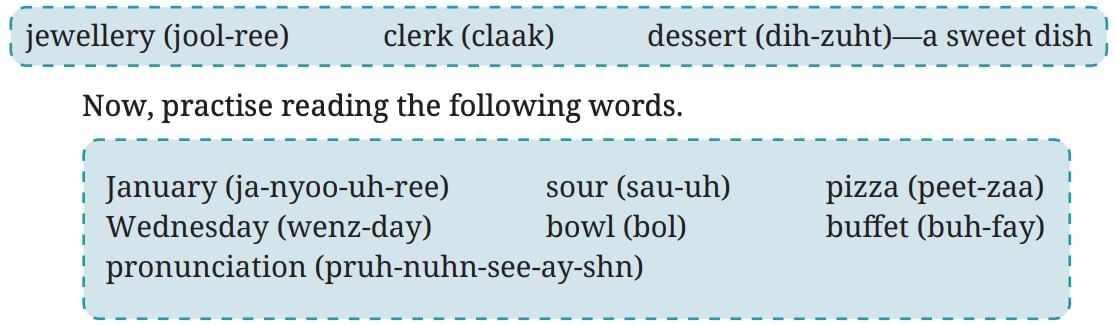
Let us write (Page 67)

I. A letter of enquiry is a formal letter written to seek detailed information about something the writer wants to know. For example, it can be used for joining a course, organising an event, knowing details about a trip, etc. The language used is formal and specific, with relevant queries. Now, write a letter of enquiry. Your school wishes to organise a visit to a Memorial in your state/region. Write the letter to the person in charge of that memorial requesting information regarding available dates for visits, the duration of the tour, any entry fees, and guidelines for student groups.
• Follow the given layout.
• Use the cues given below to draft the letter.

Ans:

Your Address
[City, State, ZIP Code]
31 July 2025

The In charge
National War Memorial
[City, State]

Subject: Enquiry about a School Visit to the National War Memorial

Dear Sir/Madam,

This is to enquire about organizing a school visit to the National War Memorial for our students. Could you please provide details about available dates for visits? Secondly, I would appreciate it if you could explain the duration of the tour and any entry fees. Lastly, could you clarify if there are specific guidelines for student groups? An early reply will be greatly appreciated, as it will help us plan a meaningful trip.

Yours sincerely,
[Your Name]Let us explore (Page 20-21)

I. Out of twenty-one PVC awardees, Major Somnath Sharma was the first recipient of the PVC, and Captain Vikram Batra was the last recipient of the PVC, the highest gallantry award. Captain Vikram Batra is popularly remembered as the “Shershah of Kargil”. His iconic success signal was‘Yeh Dil Mange More’. Captain VikramBatra, the D Company commander, was tasked to capture Point 5140 on 20 June 1999, which he did with exemplary courage. After Point 5140was captured, 13 JAK RIF was tasked to capture Point 4875. On 07 July 1999, Captain Batra led the assault from the front and engaged in a physical fight with the enemy. He killed five enemy soldiers at point-blank range and sustained serious injuries himself. Despite his injuries, his dauntless determination inspired his men to clear the enemy from a dominating position. Later, he succumbed to his injuries. His fearless determination and leadership encouraged his company men to avenge his death and finally capture Point 4875. His inspiring leadership, dedication to duty, and steadfast love for his country continue to be an inspiration for the younger generation. He attended the call of duty with absolute disregard for his safety. He was awarded the Param Vir Chakra (Posthumously).
II. Gallantry awards in India are given to military personnel and others for displaying extraordinary courage in the line of duty. Some of the gallantry awards in India are:
• Param Vir Chakra: The highest military award in India, awarded for the most conspicuous bravery in the presence of the enemy.
• Maha Vir Chakra: The second-highest military award in India, awarded for acts of gallantry in the presence of the enemy.
• Vir Chakra: Awarded for acts of gallantry in the presence of the enemy. 
Find out more about gallantry awards.

Ans: Gallantry awards in India include:
– Param Vir Chakra: The Highest award for bravery against the enemy, like Major Somnath Sharma received.
– Maha Vir Chakra: Second-highest award for gallantry in battle.
– Vir Chakra: Given for courageous acts against the enemy.

III. The Indian government has been steadfast in its initiatives to boost there representation of women in the Indian Armed Forces. These women have been serving the nation selflessly and with pride. Find out the key roles of women in the Indian Army.  Share the information with your classmates and teacher.

Ans: Women in the Indian Army serve as officers, doctors, nurses, engineers, and in logistics. They also work in communication, intelligence, and training roles, contributing bravely to the nation’s defence.

IV. Birsa Munda: A Saga of Courage and Sacrifice Birsa Munda, a revered tribal freedom fighter, spiritual leader, and folk hero, belonged to the Munda tribe. Celebrated as an avenging warrior and a charismatic figure, he emerged as a powerful symbol of tribal resistance against British colonial rule. Among the people of Jharkhand, he is affectionately known as Dharti Aaba—Father of the Land—and is honoured as a divine figure for his selfless dedication to his people. A commemorative stamp designed by Shri Sankha Samanta captures his powerful presence. It features Birsa Munda addressing his followers with a determined expression that reflects his unwavering vision of tribal unity, empowerment, and self-governance. This stamp serves as a lasting tribute to his pivotal role in India’s freedom struggle and his relentless commitment to protecting tribal rights.

V. Make a list of the patriotic songs in any language, including songs from your region. Share the songs with your classmates and teacher.
Ans: Examples of patriotic songs:
1. Vande Mataram
2. Jana Gana Mana
3. Ae Mere Watan Ke Logon
4. Mera Rang De Basanti Chola
5. Sare Jahan Se Achha

3. Wisdom Paves the Way – Textbook

Let us do (Page 27)

Q1: Why do we seek the advice of the elderly in our family?

Ans: We seek advice from the elderly in our family because they have more experience and wisdom, which helps us make good decisions.

Q2: Knowledge is about learning facts and information, while wisdom is about using that knowledge with good judgment.          
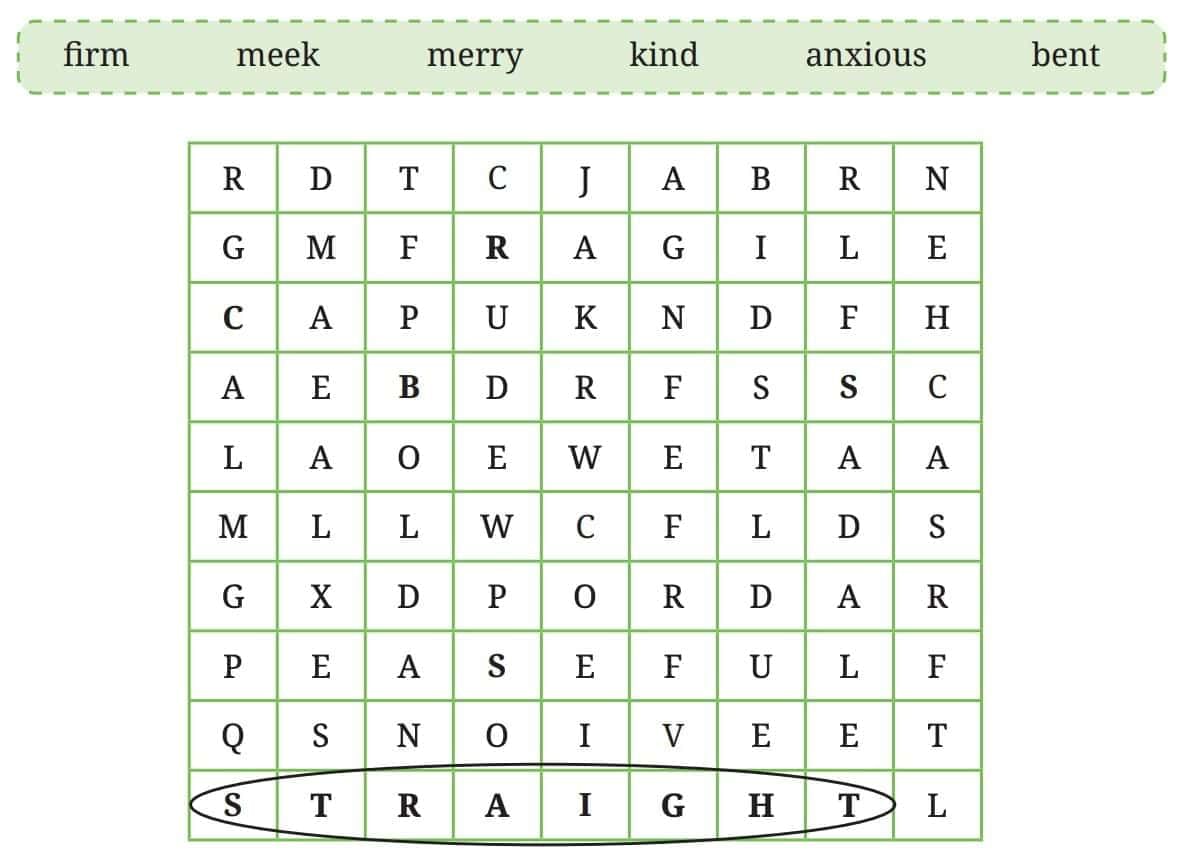
Work in pairs. Read the following situations and classify each one as either ‘knowledge’ or ‘wisdom’. One example has been done for you.    1.    Riya’s understanding of plant care helped her grow a healthy vegetable garden in her backyard.     
2.    Mr. Kumar values time with family over chasing wealth.     
3.    Karuna’s expertise in computer programming helped her develop a successful app.    
4.    Rohan understood the value of time management and created a timetable to complete his assignments systematically.     
5.    Ramesh chose to forgive his friend for a misunderstanding.     
6.    Ms. Vaijayanthi delivered a lecture on Indian Classical music at the cultural festival.

Ans:

Q3: Observe the picture. What do you think might have happened? Share your answers with your classmates and teacher.

Ans: Example Response:

In the picture, it seems that a strong earthquake or storm has recently affected the village. The house shown is badly damaged, with big cracks on the walls and a broken roof. Pieces of the roof are lying on the ground. A monkey is sitting on the roof and a cat is sitting on a tree, which shows that even animals are disturbed and scared. Four people are standing outside the house, talking to each other, probably discussing what has happened and what to do next. The scene shows worry and confusion among the villagers. It clearly looks like a natural disaster has caused the damage.

Let us discuss (Page 32)Q: Complete the following sentences with suitable reasons. One example has been done for you. Share your answers with your classmates and teacher.
1.    Shiv Datt said, “I believe it has been over a week, perhaps even longer,” because it had been a long time since they left the village.     

2.    Dev Datt said, “Indeed, we ought to be united in this hope. That is whywe press on towards Ujjain,” because ___________________________.     3.    Har Datt said, “Look there, friends. A camel has passed this way. Thetracks are fresh,” because ___________________________.     
4.    Shiv Datt said, “It appears to be a merchant, running as if pursued bytrouble,” because ___________________________.     
5.    The merchant said, “How could you possibly know that? The poorcreature has been unwell for two weeks now. Surely you are a healer!” because ___________________________.     
6.    Dev Datt said, “You are free to do as you wish, sir. If the King desiresour presence, we shall be waiting under that banyan tree yonder,” because ___________________________.

1. Shiv Datt said, “I believe it has been over a week, perhaps even longer,” because it had been a long time since they left the village.
2. Dev Datt said, “Indeed, we ought to be united in this hope. That is why we press on towards Ujjain,” because he believed they should stay hopeful together to find work with the King.
3. Har Datt said, “Look there, friends. A camel has passed this way. The tracks are fresh,” because he saw fresh camel tracks on the road, showing a camel had recently passed.
4. Shiv Datt said, “It appears to be a merchant, running as if pursued by trouble,” because the merchant was rushing towards them, looking worried, as if something was wrong.
5. The merchant said, “How could you possibly know that? The poor creature has been unwell for two weeks now. Surely you are a healer!” because the young men described the camel’s exact condition, making him think they had special knowledge.
6. Dev Datt said, “You are free to do as you wish, sir. If the King desires our presence, we shall be waiting under that banyan tree yonder,” because he was confident they had done nothing wrong and were willing to face the King.

Let us discuss (Page 36)

Q: Arrange the following events in order of their occurrence from Scene II of the play. One example has been done for you. Share your answers with your classmates and teacher.     
1.   The King makes the four young men his advisers, impressed by their skills. (8)

2.    Ram Datt explains how he infers from the tracks that the camel is lame.     
3.    The King asks the merchant to clearly state his accusation.     
4.    The King praises the young men for their observations and dismisses the merchant’s accusation.     
5.    Shiv Datt reveals that the camel is blind in its right eye, as it had only chewed on the leaves on the left side of the road.     
6.    Dev Datt explains his observation about the camel’s pain and careful movement.     
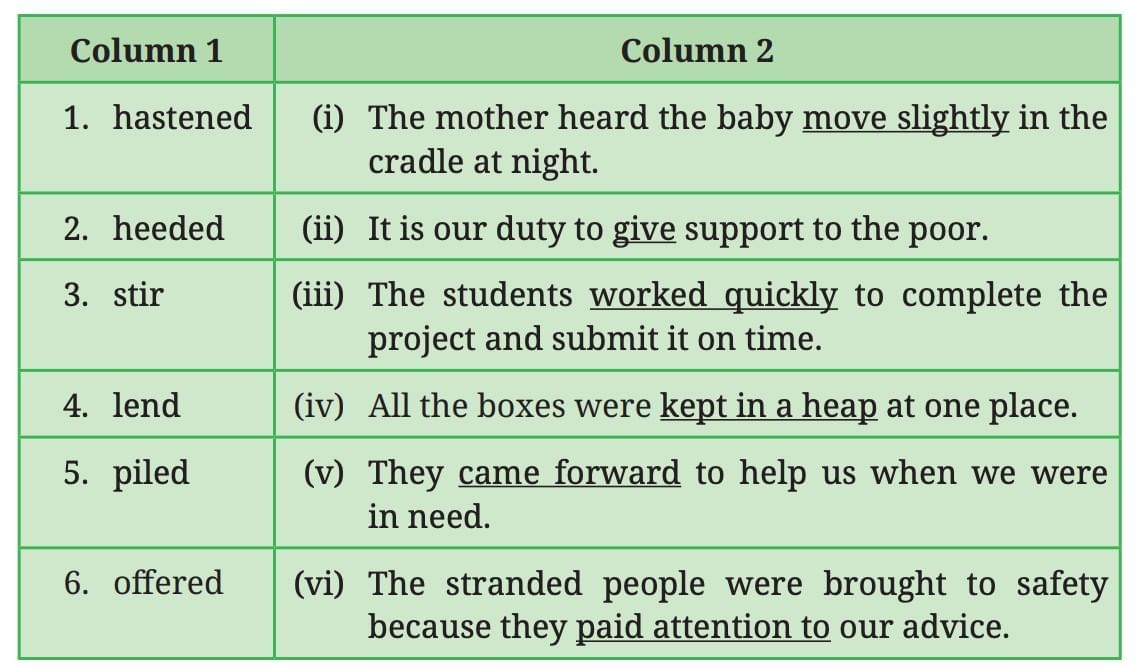
7.    Har Datt clarifies how he knew that the camel had a short tail.
8. The merchant accuses the four men of knowing a lot about his missing camel.

Ans:

  1. (3) The King asks the merchant to clearly state his accusation.
  2. (8) The merchant accuses the four men of knowing a lot about his missing camel.
  3. (2) Ram Datt explains how he infers from the tracks that the camel is lame.
  4. (5) Shiv Datt reveals that the camel is blind in its right eye as it had only chewed on the leaves on the left side of the road.
  5. (7) Har Datt clarifies how he knew that the camel has a short tail.
  6. (6) Dev Datt explains his observation about the camel’s pain and careful movement.
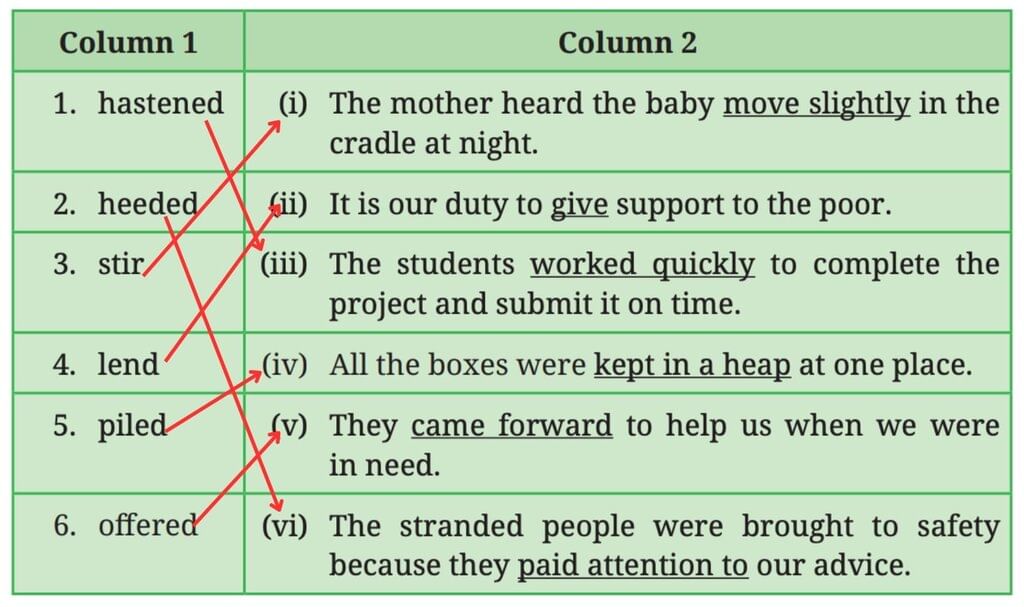
  7. (4) The King praises the young men for their observations and dismisses the merchant’s accusation.
  8. (1) The King makes the four young men his advisers, impressed by their skills.

Let us think and reflect (Page 37)

I. Read the given extracts and answer the questions that follow.
Q1:

(i) Identify the false statement and rectify it.
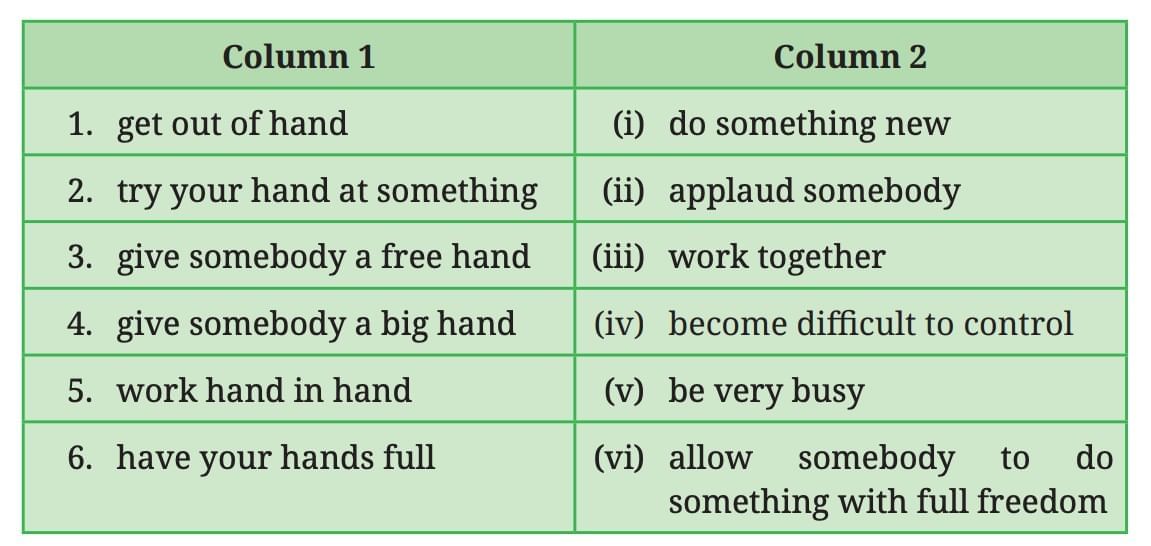
A. Dev Datt believes that finding employment is an easy task
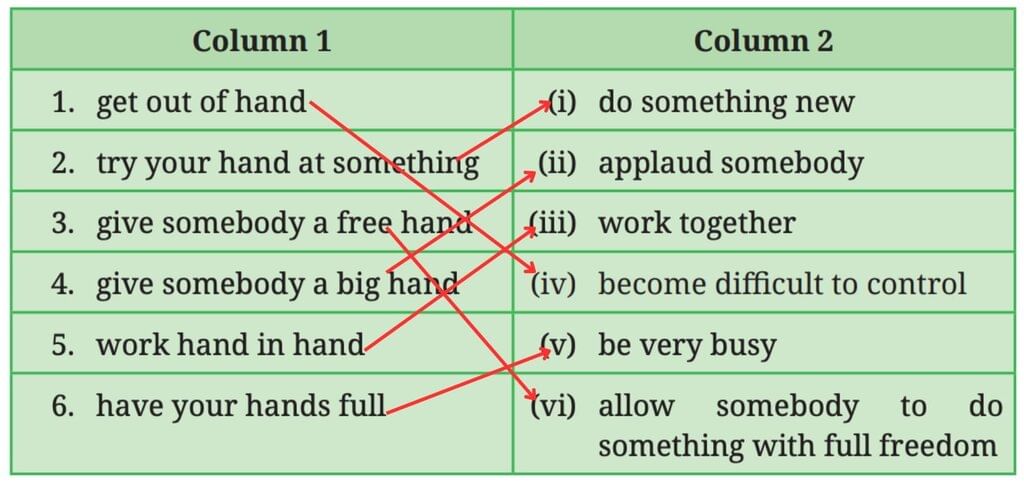
Ans: False
Rectified: Dev Datt believes that finding employment is a challenging task that may take time.
B. Ram Datt is confident that the King would recognise their talents 
Ans: True
(ii) What does Ram Datt’s confidence in gaining the King’s recognition tell us about him?
Ans: Ram Datt’s confidence shows he is optimistic and believes strongly in his and his friends’ abilities.
(iii) Complete the sentence given below with the correct option from those given. In the line, ‘That’s why we press on towards Ujjain’, the phrase ‘press on’ refers to __________.
A. walking with heavy steps     
B. moving forward with determination     
C. Slowing down frequently for rest     
D. stopping briefly to save time
Ans: In the line, “That’s why we press on towards Ujjain,” the phrase ‘press on’ refers to: B. moving forward with determination
(iv) Har Datt says, “We need to devise a strategy.” What can be inferred about Har Datt’s character from his statement?     
A. He is doubtful of their abilities and wants to give up.
B. He is eager to rush into the palace without preparation.     
C. He is cautious and thoughtful, preferring to plan ahead.     
D. He relies on others to make decisions for the group.
Ans:  C. He is cautious and thoughtful, preferring to plan ahead.

Q2:

(i)      Select the option that is true for both Assertion (A) and Reason (R).     
(A):     The Merchant left the court feeling humbled and ashamed.     
(R):     The King commanded that the four wise men join his court.     

A. Both (A) and (R) are true, and (R) is the correct explanation of (A).     
B. Both (A) and (R) are true, but (R) is not the correct explanation of (A).     
C. (A) is true, but (R) is false.     
D. (A) is false, but (R) is true

Ans: B. Both (A) and (R) are true, but (R) is not the correct explanation of (A).
(ii) Complete the following sentence by choosing the correct option. The line, ‘See beyond the obvious’ means that the men had the ability to ______.     
A. Challenge common beliefs with reasoning     
B. interpret information in traditional ways     
C. Notice details that others might overlook     
D. Predict what is going to happen in the future
Ans: C. Notice details that others might overlook
(iii) Complete the following sentence with a suitable reason.              
Ram Datt described the King’s offer as ‘an honour we had notdared to dream of’ because ___________.
Ans:  Ram Datt described the King’s offer as “an honour we had not dared to dream of” because it was a great and unexpected opportunity to serve as the King’s advisers.
(iv) How does the King’s offer to the four men reflect his values asa ruler?
Ans: The King’s offer shows he values wisdom, intelligence, and fairness, as he rewards the men for their clever observations and trusts them to guide his kingdom. 

II. Answer the following questions

Q1: What does the dusty road leading to Ujjain tell us about the challenges of the young men’s journey?

Ans: The dusty road shows the journey was long, tiring, and difficult, as they walked for ten days under the hot sun, facing physical hardship.
Q2: Why did the merchant become suspicious of the four men? What does this tell us about him?

Ans: The merchant became suspicious because the men knew specific details about his camel without seeing it. This shows he is quick to judge and distrustful.
Q3: How do the four young men’s observations about the camel serve as a turning point in the play?

Ans: Their observations prove their intelligence to the King, turning the accusation against them into an opportunity to become his advisers.

Q4: Why did the King believe the four young men and not the merchant?

Ans: The King believed the men because they explained their observations logically, showing wisdom, while the merchant’s accusations lacked proof.

Q5: How does the capability of the four young men make them suitable to become advisors?

Ans: Their ability to notice details, think logically, and explain their observations makes them suitable to give wise advice to the King.

Q6: Why does the merchant feel ashamed for accusing the four young men of stealing his camel?

Ans: The merchant feels ashamed because the King proved the men were innocent and wise, showing his accusations were wrong and unfair.

Let us learn (Page 39)

I. Complete the sentences by filling in the noun form of the textual words given in the brackets.
1. Some word games need a lot of thought and _________________. (deduce)     
2. We need to make close _________________of animals in order to understand their behaviour. (observe)     
3. A detailed _________________ of the documents shows a lot of errors. (scrutinise)     
4. You should not make any false ________________ against anyone. (accuse)    
 5. She was given an award in _________________of her contribution to literature. (recognise)

Ans: 1. Some word games need a lot of thought and deduction.
2. We need to make close observations of animals to understand their behaviour.
3. A detailed scrutiny of the documents shows a lot of errors.
4. You should not make any false accusations against anyone.
5. She was given an award in recognition of her contribution to literature.

II. Match the expressions in Column 1 with their meanings in Column 2

Now, make sentences using any five of the expressions from Column 1

Ans:

  1. With all our hearts, we thanked the doctor for saving our brother’s life.
  2. To be precise, the meeting starts at 10:15 a.m., not 10 o’clock.
  3. She was finally able to gain an audience with the principal to discuss her concerns.
  4. After running up the stairs, he stopped to catch his breath before speaking.
  5. The crowd erupted in applause when the singer walked onto the stage.

III. Match the different meanings of ‘face’ and ‘bear’ with the correct usage in the sentences given in the table below. 
(n. stands for the word noun and v. stands for the word verb.)

Ans:

IV. Match the highlighted words in the sentences in Column 1 with the functions they express in Column 2.

Ans:

1 – ix
2 – v
3 – x
4 – i
5 – viii
6 – ii
7 – xi
8 – vi
9 – iii
10 – vii
11 – iv

V. Complete the following story with modal verbs in the box given belowby using the clues from the functions given within brackets. 

An old man, known for his wisdom, lived in a small village. One day, a young boy asked him, “How 1. _______ (ability) I become wise like you?” The old man smiled and said, “Wisdom 2._______ (necessity) be earned through patience. You 3. _______ (suggestion) listen, more than you speak.” The boy thought for a while and replied, “It 4. _______ (weak possibility) take years, but I’ll try.” The old man nodded. “You 5._______(obligation) learn from your mistakes too. Wisdom 6. _______ (possibility)come slowly, but it always arrives for those who seek it.” The boy knew he 7. _______ (ability) become wise if he followed the old man’s advice.
Ans: 

  1. can
  2. must
  3. should 
  4. might
  5. ought to
  6. may 
  7. could 

VI. Rewrite the following sentences using appropriate modal verbs. You may take clues from the highlighted words. 

1. It is advisable for you to think before you speak.
2. It is unnecessary to worry about things beyond your control.
3. It is not possible for a person to gain experience without taking risks.
4. It is essential to treat others with kindness, even when they disagree with you.
5. It is not allowed to interrupt when someone else is speaking.
Ans:

1. You should think before you speak.
2. You need not worry about things beyond your control.
3. A person cannot gain experience without taking risks.
4. You must treat others with kindness, even when they disagree with you.
5. You must not interrupt when someone else is speaking.

Let us listen (Page 42)

I. You will listen to four people sharing their thoughts on why they enjoy witty characters in stories. As you listen, match statements 1–6 given below to the speakers (i)–(iv). There are two statements you do not need.

Ans: Please refer to the transcript

Let us speak (Page 43)

I. The way in which a word is stressed in a sentence can change its meaning. Read the following examples.

Now, work in pairs. Take turns to say the following sentences aloud by stressing on the highlighted words. Share the meanings of the sentences with each other and teacher.

  • I take my dog for a walk in the evening.
  • take my dog for a walk in the evening.
  • I take my dog for a walk in the evening.     
  • I take my dog for a walk in the evening.      
  • I take my dog for a walk in the evening.
  • I take my dog for a walk in the evening.

Ans: This is a classroom activity. Practice saying the following sentences with stress on the highlighted words:

  1. I take my dog for a walk in the evening. (I, not someone else)
  2. take my dog for a walk in the evening. (Take, not another action)
  3. I take my dog for a walk in the evening. (My dog, not another’s)
  4. I take my dog for a walk in the evening. (Dog, not another pet)
  5. I take my dog for a walk in the evening. (Walk, not another activity)
  6. I take my dog for a walk in the evening. (Evening, not another time)

II. Statements and exclamatory sentences usually end with a falling tone. Listen to the teacher read these sentences aloud and repeat it with the correct intonation.

Now, practise by saying the following sentences with the correct intonation.    

  • Good day, kind sirs.     
  • We regret to inform you that we do not know where it is.     
  • You describe it perfectly!     
  • You shall come with me to face the King!

Ans: This is a classroom activity. Practice saying the following sentences with a falling tone:

  1.  Good day, kind sirs.
  2.  We regret to inform you that we do not know where it is.
  3.  You describe it perfectly!
  4.  You shall come with me to face the King!

Let us write (Page 44)

I. You have observed that the kutcha road leading to your colony is in a very bad condition due to heavy rains. The potholes are dangerous for people and can lead to accidents. They also serve as a breeding ground for mosquitoes, as there is stagnant water all around. Write a letter of complaint to the Commissioner, Municipal Corporation or the Sarpanch, Gram Panchayat to look into the matter and take necessary action. Follow the format of a formal letter and draft the letter with the help of the cues given below.

Ans: Example Response:

To
The Commissioner,
Municipal Corporation,
[City Name]

Date: 31 July 2025

Subject: Complaint regarding the poor condition of the kutcha road leading to our colony

Respected Sir/Madam,

I would like to bring to your attention the poor condition of the kutcha road leading to our colony. I am writing to draw your attention towards the serious inconvenience being caused to the residents due to the heavy rains.

The problems that we face are many. The road is full of potholes and is almost impossible to walk or drive on safely. It is causing inconvenience as people, especially school children and the elderly, are at risk of falling and getting injured. As a result, several minor accidents have already occurred. Consequently, the stagnant rainwater collected in the potholes has become a breeding ground for mosquitoes, increasing the risk of diseases like dengue and malaria.

Firstly, I would like to suggest that the road be repaired and properly drained at the earliest. Secondly, proper levelling and paving must be ensured to avoid future damage. I request you to look into this matter urgently and take swift action for the safety and well-being of the residents.
I look forward to your prompt response.

Thanking you.

Yours sincerely,
Rahul Mehta
Rajiv Nagar Colony
Contact: **********

Let us Explore (Page 44)

I. Staging a play requires creativity, organisation, and teamwork. Steps involved in staging a play:    
1. Choose a play that suits your requirement of theme, duration, number of actors, and available resources.
2. Choose a director, a stage manager, a light and sound in charge,a props manager, a costume designer, and a makeup artist.     
3.  Hold auditions and decide the roles.     
4.  Read the script and plan stage movements and positions for each scene.     
5.  Make a schedule for rehearsal.     
6.  Work on the set design (backdrop) and make or collect the required props.
7.  Design or gather appropriate costumes.    
8.  Plan makeup and hairstyles to suit the play’s time period.     
9.  Check light and sound arrangements.     
10. Hold a dress rehearsal including sound and light effects.     
11. Promote the event through posters and pamphlets.     
12. Organise the backstage with labelled props, costumes, and entrances or exits.     
13. Present the play to the audience.          
Now, present the enactment of the play ‘Wisdom Paves the Way’ with the help of the steps you have just read. Ensure you use the correct intonation and sentence stress.
II. Stories related to wit and wisdom have always fascinated the readers. Go to the library and read the stories associated with the following.       
Vikramaditya and Betal 
Tenali Rama
Gopal the Jester 
Panchatantra Tales

2. A Concrete Example – Textbook Solutions

Let us do these activities .                                before we read. 

I) Read the names of items you usually find in a garden and write their names against each picture given below. 
garden hoşe, sapling, hedge, flower beds, flower pot, pebbles, rockery, fence, vine, wheelbarrow

Ans: 

II) Work in groups of four. What kind of garden would you like to have? Mention the features that you can include and the reasons for your choice. Share your answers with your classmates and teacher. 

Ans:
Type of Garden: We would like to have a Butterfly Garden.

Features to Include:

  • Colorful flowers like marigolds, sunflowers, and zinnias to attract butterflies.
  • A small water pond for butterflies to drink.
  • A bench to sit and watch the butterflies.
  • A signboard with butterfly names and pictures.

Reasons for Choice:

  • Butterflies are pretty and fun to watch, making the garden lively.
  • It helps save butterflies, which are important for nature.
  • We can learn about different butterfly species while enjoying the garden.
  • It’s easy to make with flowers and a little water, so we can do it at school.

Group Discussion Tip: In your group, talk about what you all like—flowers, vegetables, or rocks like Mrs. Jones’s garden. Decide together and add your own ideas, like a treehouse or a rock path. Share your plan with the class and see what others think!

III) Read the title of the poem. What comes to your mind when you read the word ‘concrete’? Does it have more than one meaning? Share your answers with your classmates and teacher.
Ans: When I read the word “concrete,” the first thing I think of is the hard, gray material used in construction—like buildings, roads, and bridges. Yes, “concrete” can have two different meanings:

  • Literal Meaning: A strong, man-made building material made of cement, sand, and gravel.
    Example: “The sidewalk is made of concrete.”
  • Figurative Meaning: Something real, specific, or definite (not abstract).
    Example: “She gave concrete evidence to prove her point.”

Let us discuss

I. Complete the following summary with exact words from the poem. One example has been done for you. Share your answers with your classmates and teacher.

The poem describes Mrs. Jones, the speaker’s next-door neighbour, who has a unique garden filled with 1__________. Her garden includes a peculiar 2___________, a pond, and a rockery, along with an unusual 3____________. that she finds charming. Mrs. Jones plants tiny, 4___________. plants between the stones, which the speaker thinks must be so small that they are planted with a 5________________. One day, Mrs. Jones invites the speaker to see her garden, and they discuss a 6_____________. that Mrs. Jones treasures. When the speaker asks where the 7_____________. flower is, Mrs. Jones says that the speaker has been 8._______________ on it all along.

Ans: The poem describes Mrs. Jones, the speaker’s next-door neighbour, who has a unique garden filled with stones. Her garden includes a peculiar crazy path, a pond, and a rockery, along with an unusual sundial that she finds charming. Mrs. Jones plants tiny delicate plants between the stones, which the speaker thinks must be so small that they are planted with a pin. One day, Mrs. Jones invites the speaker to see her garden, and they discuss a flower that Mrs. Jones treasures. When the speaker asks where the lovely flower is, Mrs. Jones says that the speaker has been standing on it all along.
The answers are exact words or phrases from the poem:
1. stones 
2. crazy path 
3. sundial 
4. delicate 
5. pin 
6. flower 
7. lovely 
8. standing

II. Select the correct option to fill in the blanks for the following sentences.

  1. The tone of the poem is 
    (i) mocking 
    (ii) humorous 
    (iii) mournful 
    (iv) amusing 
    (v) light-hearted
    A. (i), (ii), and (iii)
    B. (i), (ii), and (v)
    C. (ii), (iii), and (iv)
    D. (ii), (iv), and (v)
    Answer:D. (ii), (iv), and (v)
    The poem’s tone is humorous (ii), amusing (iv), and light-hearted (v), as it playfully describes Mrs. Jones’s peculiar garden and the speaker’s funny mistake of stepping on the flower. It is not mocking (i) or mournful (iii), as the tone is gentle and fun.
  2. The speaker in the poem is
    (i) Mrs. Jones
    (ii) the poet
    (iii) a gardener
    (iv) a child
    Answer: (ii) the poet
    The speaker is the poet, Reginald Arkell, who uses the first-person “I” to narrate their visit to Mrs. Jones’s garden and their humorous interaction. 
  3. The rhyme scheme of the poem is
    (i) AABBCC
    (ii) ABAВСС
    (iii) AABСАС
    (iv) ABBАСС
    Answer: (i) AABBCC
    The poem’s rhyme scheme is AABBCC, with each stanza having six lines where the first two rhyme (e.g., “Jones/stones”), the next two rhyme (e.g., “pond/beyond”), and the last two rhyme (e.g., “device/nice”). The options are identical, so any choice (e.g., i) is correct.

III. Complete the following sentences by choosing the correct answer given in the brackets.

  1. The poet uses the word ‘stones’ in all stanzas in order to emphasise her ______________ (obsession with a stony garden/ pride in gardening skills.)
    Ans: The poet uses the word ‘stones’ in all stanzas in order to emphasise her obsession with a stony garden.
    Explanation: The word “stones” appears in each stanza, highlighting Mrs. Jones’s focus on her stone-filled garden, reflecting her obsession with its unique, stony features rather than just pride in gardening.
  2. The poet uses imagery to describe the features of the garden that help readers________________. (understand Mrs. Jones’love for plants/visualise the garden’s peculiar nature)
    Ans: The poet uses imagery to describe the features of the garden that the readers understand the garden’s peculiar nature.
    Explanation: Imagery like “crazy path,” “lily pond,” and “sundial with a strange device” vividly shows the garden’s unusual and peculiar nature, not just Mrs. Jones’s love for plants.

IV. Pick examples of alliteration from the poem.

Answer: Alliteration is the repetition of initial consonant sounds in close proximity. “My next-door neighbour” repeats the “n” sound, and “strange device” repeats the “s” sound, both creating a rhythmic effect in the poem. So, examples of alliteration are:

  • “My next-door neighbour” 
  • “Strange device” 

V. A refrain is a repeated line or phrase that appears in each stanza. Identify the refrain from the poem.

Answer: “My next-door neighbour, Mrs. Jones”. This line is repeated at the start of each stanza (lines 1, 7, 13), serving as a refrain that emphasizes Mrs. Jones’s central role and her unique garden.

VI. Identify the line(s) from the poem that display(s) situational irony.

Answer:  Situational irony occurs when the outcome is the opposite of what is expected. The speaker expects the “lovely” flower to be prominent and visible, but Mrs. Jones reveals they are standing on it, creating a surprising and humorous contrast between expectation and reality. Lines from the poem that display situational irony are:

  • “Where is this lovely thing?” I cried.
  • “You’re standing on it,” she replied.

VII. Complete the following sentences appropriately.

  1. The word ‘concrete’ can refer to _____________________in Mrs. Jones’ garden.
    Ans: The word ‘concrete’ can refer to the stones or stone-based features like the crazy path, rockery, and sundial in Mrs. Jones’ garden.
  2.  The title also has a symbolic meaning, as the poem provides a clear or ‘concrete’ example of Mrs. Jones’ ______________gardening habits.
    Ans: The title also has a symbolic meaning, as the poem provides a clear or ‘concrete’ example of Mrs. Jones’ peculiar gardening habits.

VIII. The title ‘A Concrete Example’ carries both literal and symbolic (metaphorical) meaning. Such word play is called a pun. A pun is a figure of speech that uses words with multiple meanings or words that sound alike but have different meanings, creating a humorous effect.

  • I tried arguing with my pencil but it kept making sharp points. (suggests the idea of an actual sharp pencil point and strong argument points) 
  • My pencil and I had a disagreement but we finally got to the point. (refers to solving an argument and the pencil’s tip)

Let us think and reflect

I. Read the given extract and answer the questions that follow.

Extract:
My next-door neighbour, Mrs. Jones,
has got a garden full of stones:
A crazy path, a lily pond,
a rockery and, just beyond
A sundial with a strange device,
which Mrs. Jones thinks rather nice.

  1. What can be inferred about Mrs. Jones’s taste in gardening from the description of her garden being ‘full of stones’?
    Answer: Mrs. Jones has an unusual and unique taste in gardening, preferring stones and peculiar features over typical plants and flowers. The garden’s stone-dominated features, like the “crazy path,” “rockery,” and “sundial,” suggest she enjoys unconventional and artistic garden designs, distinct from traditional gardens with plants.
  2. Identify whether the following statement is true or false: The garden serves as a means to reveal more about Mrs. Jones herself.
    Answer: True 
    The garden’s unique stone features and tiny plants reflect Mrs. Jones’s peculiar personality and unconventional taste, revealing her character through her gardening style.
  3. What does the poet mean by ‘crazy path’?
    Answer: The poet means a winding, unusual path made of stones that is not straight or typical. The term “crazy path” uses vivid imagery to describe a twisting, unconventional stone path, emphasizing the garden’s peculiar and artistic design.
  4. What does the sundial with a ‘strange device’ suggest about Mrs. Jones’ personality?
    A. She has a fascination with unusual items.
    B. She prefers traditional garden decorations.
    C. She is uninterested in her garden’s appearance.
    D. She likes modern and expensive items.
    Answer: A. She has a fascination with unusual items.
    The “sundial with a strange device,” which Mrs. Jones finds “rather nice,” suggests she enjoys peculiar and unusual items, aligning with her unique garden style, not traditional, indifferent, or modern preferences.

II. Answer the following questions.

  1. How does Mrs. Jones feel about her garden? Support your answer with evidence from the poem.
    Answer: Mrs. Jones feels proud and fond of her garden. The poem states she thinks the sundial’s “strange device” is “rather nice” and invites the speaker to see her stones, showing her enthusiasm. Her positive description of the sundial and her invitation to the speaker highlight her pride and affection for her unique stone garden.
  2. Why do you think the speaker describes the plants as being so small that they could be planted with a ‘pin’?
    Answer: The speaker describes the plants as so small to exaggerate their tiny size, humorously suggesting they are insignificant and hard to plant. The line “unless she plants them with a pin” uses hyperbole to emphasize the delicate, tiny nature of the plants, contrasting with the large stones and adding humor.
  3. What do we get to know about Mrs. Jones based on her gardening style and her interaction with the speaker?
    Answer: Mrs. Jones is peculiar, enthusiastic, and values her unique garden. Her interaction, where she calmly says, “You’re standing on it,” shows her gentle humor and patience. Her stone-filled garden with tiny plants and her pride in showing it to the speaker reveal her unconventional taste, while her calm response reflects a kind, humorous personality.
  4. The poem portrays Mrs. Jones in a positive light. Support this statement.
    Answer: The poem portrays Mrs. Jones positively by showing her enthusiasm for her unique garden and her gentle humor when the speaker steps on her flower. Her pride in the “rather nice” sundial and her patient, humorous reply, “You’re standing on it,” present her as likable and good-natured, not upset by the mistake.
  5. What does the poem tell us about the way people think differently about the world around them?
    Answer: The poem shows that people have different perspectives, as Mrs. Jones values her tiny plants and stone garden, while the speaker sees the plants as insignificant. The contrast between Mrs. Jones’s pride in her “delicate” plants and the speaker’s view that they “don’t mean anything at all” highlights how people perceive the same things differently.

Let us learn

I. Select the appropriate word from the brackets that correctly replaces the underlined word in the sentences from the text.

  1. A sundial with a strange device. (unusual, peculiar, new, rare, external)
    Answer: peculiar
    “Peculiar” means unusual or distinctive, fitting the context of the sundial’s unique design, which Mrs. Jones finds appealing.
  2. … which Mrs. Jones thinks rather nice(pleasant, superior, agreeable, gentle, charming)
    Answer: pleasant
    “Pleasant” conveys a positive, agreeable feeling, similar to “nice,” describing Mrs. Jones’s approval of the sundial.
  3. They are so delicate. (delicious, fragile, dainty, graceful, weak)
    Answer: dainty
    “Dainty” means delicately small and pretty, aligning with the poem’s description of the tiny, fragile plants placed between stones.
  4. ‘Where is this lovely thing?’ I cried. (exclaimed, wept, shouted, announced, whispered)
    Answer: exclaimed
    “Exclaimed” means to speak suddenly with emotion, fitting the speaker’s excited question about the flower’s location.

II. The ‘sundial’ is referred to as a ‘device’ in the poem. Work in pairs to infer the meaning of ‘device’. Share your thoughts with your classmates and teacher.

Answer: In the poem, a “device” refers to a tool or object designed for a specific purpose, here the sundial, which uses the sun’s shadow to tell time.

Now, match the type of instruments in Column 1 with their definitions in Column 2. Column 3 shows one example of each type of instrument. Add more examples in Column 3.

Answer: Column 1Column 2Column 31. implement(iii) something that works on being moved by handSpade, knife, hoe, scissors, screwdriver2. tool(v) something used by hand to make or repairhammer, screwdriver, wrench3. equipment(iv) a set of necessary items for a particular purposeCricket bat, helmet, gloves, lab equipment, gym machines4. appliance(i) something that is electrical and is used to do work in the houseMixer grinder, refrigerator, washing machine, microwave, toaster5. gadget(ii) something small that is mechanical or electronicMobile phone, laptop, smartwatch, calculator, drone

III. Complete the table by making new words in Column 1 using the hints given new in Column 2. Replace the first letter of the given word to create words. One example has been done for you.

1. 

Ans: Column 1 (Type of Word)Column 2 (Hint)Column 3 (Examples or Related Terms)1. NicePleasant feelingKindness, smile, warmth2. Dice(i) Dice cut into small piecesCubes, bits, chopped vegetables3. Rice(ii) Grain that we cookPorridge, sushi, pilaf4. Mice(iii) Plural of mouseRodents, pests, small animals5. Vice(iv) Bad habitSmoking, laziness, gambling

2. 

Ans: Column 1 (Type of Word)Column 2 (Hint)Column 3 (Examples or Related Terms)1. SoilEarth or ground materialDirt, mud, clay2. Boil(i) Heat somethingWater, soup, vegetables3. Toil(ii) Work very hardLabor, effort, farming4. Coil(iii) Length of wire in a circleSpring, rope loop, cable5. Foil(iv) Sheets to wrap food itemsAluminum wrap, plastic coverLet us speak

I. The speaker of the poem might have felt sorry for stepping on Mrs. Jones’ flower. When we make a mistake, we must express regret and apologise for our actions. 

1. When we apologise to a friend or a family member, we use informal language. Take turns to apologise for the following situations and respond to the apology. 
(i) You have eaten your brother’s share of sweets. 
(ii) You have broken your sister’s flower craft. 
(iii) You accidentally spilled ink on your mother’s important documents. 
(iv) You forgot to bring your friend’s notebook to the school after borrowing it.

You may use the following phrases given below.

Ans: The speaker of the poem might have felt sorry for stepping on Mrs. Jones’s flower, and we should express regret when we make mistakes. Below are apologies and responses for the given situations using informal language.

(i) You have eaten your brother’s share of sweets.

  • Apology: “I’m really sorry about eating your sweets, bro. I didn’t mean to!”
  • Response: “That’s alright, but save some for me next time!”

(ii) You have broken your sister’s flower craft.

  • Apology: “Sorry, I didn’t mean to break your flower craft, sis. Please forgive me!”
  • Response: “No problem, but be careful next time. These things happen.”

(iii) You accidentally spilled ink on your mother’s important documents.

  • Apology: “I’m sorry about spilling ink on your documents, Mom. It was an accident!”
  • Response: “It’s no big deal, but please be more careful in the future.”

(iv) You forgot to bring your friend’s notebook to school after borrowing it.

  • Apology: “I’m really sorry for forgetting your notebook, buddy. Please forgive me!”
  • Response: “That’s alright, just bring it tomorrow. No problem!”

2. When we apologise to someone in authority like a Principal or a teacher in a formal setting, we use formal language. Work in pairs and take turns to apologise for the following situations and respond to the apology. 

(i) You did not bring an assignment that was due for submission. 
(ii) You the Principal. were late to school for the past three days and had to meet 
(iii) You did not submit your project work and were asked to explain. You may use the phrases given below.

You may use the phrases given below.

Ans: When apologizing to a Principal or teacher, we use formal language. Below are apologies and responses for the given situations, worked in pairs, using formal phrases.

(i) You did not bring an assignment that was due for submission.

  • Apology: “I’m extremely sorry for not bringing my assignment, Sir/Ma’am. I promise it won’t happen again.”
  • Response: “I accept your apology. Please ensure you submit it tomorrow.”

(ii) You were late to school for the past three days and had to meet the Principal.

  • Apology: “I owe you an apology for being late to school for the past three days, Principal. I’ll do my best not to repeat it.”
  • Response: “I appreciate you saying this, but please be on time from now on.”

(iii) You did not submit your project work and were asked to explain.

  • Apology: “I really regret not submitting my project work, Sir/Ma’am. I assure you that this will never happen again.”
  • Response: “I’m glad you realised your mistake. Please submit it by the end of this week.”

Let us write 

You are a member of the Nature Club of your school. Draft a notice informing the students of Grades 6-8 about the inauguration of the Herb Garden. 

Points to remember: 

  • Mention the purpose of writing, date, time, venue, and any other relevant information-whom to contact, when, and where. 
  • Use formal language in the third person form. 
  • Write the notice in a box.

Ans: 


DELHI PUBLIC SCHOOL, Delhi

NOTICE

Nature Club

Inauguration of the Herb Garden!

The Nature Club is pleased to announce the inauguration of the new Herb Garden, aimed at promoting awareness about medicinal plants and sustainable gardening among students. All students of Grades 6-8 are invited to attend the event. The details are as follows:

  • Date: 25th July 2025
  • Time: 10:00 AM – 11:30 AM
  • Venue: School Courtyard (Near Science Block)

Students are encouraged to participate and learn about the benefits of herbs. For further information, please contact the Club Coordinator, Ms. Sharma, at the school office between 2:00 PM and 3:00 PM on weekdays.
Let’s grow green together!

Name: Aryan Patel 
Signature: 
Class: 8B

Let us explore 

I. Amrit Udyan is a garden spread over an expanse of 15 acres around Rashtrapati Bhavan in New Delhi. It has multiple attractions that include a specially curated garden for children called Bal Vatika, a treehouse, nature’s classroom, etc. It also has the Bonsai, Herbal-I, Herbal-II, Tactile Garden, Arogya Vanam, and Circular Gardens with a diverse variety of flora and fauna. 
Now, find out about popular gardens in your region and share with your classmates and teacher.
Ans: Example (If your region is Mumbai):

  • Garden Name: Sanjay Gandhi National Park (Borivali)
  • Location: Borivali East, Mumbai
  • Area: ~104 sq. km
  • Attractions: Lion & Tiger Safari, Kanheri Caves, Nature Trails, Butterfly Park
  • Unique Features: One of the largest national parks within a city, rich biodiversity.

II. A herbarium is a collection of plant samples preserved for long-term study, usually in the form of dried and pressed plants mounted on paper. Now, collect some fallen flowers and leaves from your neighbourhood. Place them in folds of a newspaper carefully and put a pile of books on them. After one week, take them out and use them to make a card, wall hanging or any other artwork. A sample has been given for your reference.

III Read and enjoy the poem. 
A Sea of Foliage 
A sea of foliage girds our garden round, 
But not a sea of dull unvaried green, 
Sharp contrasts of all colours here are seen; 
The light-green graceful tamarinds abound
Amid the mango clumps of green profound,
And palms arise, like pillars gray, between; 
And o’er the quiet pools the seemuls lean, 
Red-red, and startling like a trumpet’s sound. 
But nothing can be lovelier than the ranges 
Of bamboos to the eastward, when the moon 
Looks through their gaps, and the white lotus changes 
Into a cup of silver. One might swoon 
Drunken with beauty then, or gaze and gaze 
On a primeval Eden, in amaze. 
– TORU DUTT

1. The Wit that Won Hearts – Textbook Solutions

Let us do these activities (Page 1)

1. Select qualities of a person who uses wit from the box given below: 

Answer: Qualities of a person who uses wit: wise, clever, humorous, observant, charming, creative, confident

Reasons for choice:

  • Wise: A witty person uses knowledge thoughtfully, like someone who calmly explains a complex idea in a simple, funny way during a group discussion, making everyone understand and smile.
  • Clever: Wit involves quick thinking, such as a student solving a tricky puzzle in class by connecting unexpected clues, impressing peers with their sharpness.
  • Humorous: A witty person lightens the mood, like a friend who tells a funny story during a boring school event, making everyone laugh and feel at ease.
  • Observant: Wit requires noticing details, like spotting a teacher’s subtle smile and making a playful comment that cheers up the whole class.
  • Charming: A witty person wins people over, like a classmate who uses kind, clever words to convince others to join a school project.
  • Creative: Wit involves original ideas, such as inventing a funny game on the spot to entertain friends during a rainy lunch break.
  • Confident: A witty person speaks boldly, like a student who confidently shares a clever joke during a school assembly, earning applause despite initial nerves.

2. Work in pairs and answer the riddles:

  • I can be a friend or a foe, depending on how you use me. I can bring both joy or pain. what am I?
    Answer: Words. Words can be a friend when used kindly to bring joy, or a foe when used hurtfully to cause pain.
  • What is always in front of you but can’t be seen?
    Answer: The future. It is always ahead in time but cannot be seen.
  • What has to be shared before you can keep it?
    Answer: A secret. You must share it with someone (tell them) before you can keep it (maintain its confidentiality).
  • I can be measured, but I cannot be touched. I can be spent, but I cannot be saved. What am I?
    Answer: Time. Time can be measured (e.g., in hours), cannot be touched, can be spent (e.g., on tasks), but cannot be saved for later use.

Discuss in Pairs (Page 2)

1. Why are qualities like humour and wit important in a person?
Ans: Humour and wit make a person fun to be around, help ease awkward or tense moments, and build stronger connections with others. For example, a witty joke during a boring school group project can lift everyone’s mood, encourage teamwork, and make tasks feel lighter, while clever ideas can spark creative solutions to everyday challenges, like finding a new way to organize a class event.

2. Why do you think kings and queens preferred to have witty people among their courtiers?
Ans: Kings and queens valued witty courtiers because they could lighten serious moments, offer smart solutions to tricky problems, and keep the court lively. For instance, a witty advisor might use a clever story to calm an angry ruler or suggest a unique plan to solve a kingdom’s issue, making them trusted allies who bring both wisdom and joy to the royal circle.

3. If you were asked to solve a disagreement between two people, what approach would you take?
Ans: I would listen calmly to both sides to understand their feelings, ask questions to clarify the issue, and suggest a fair solution that respects everyone’s views. For example, if two friends argue over who gets to lead a school play, I might propose they share the role or take turns, using a funny example like splitting a favorite snack to keep the mood light and friendly.

4. Have you ever been in a situation where a small misunderstanding led to a big problem? How was it resolved?
Ans: Once, I texted a friend a joke about being late, but they thought I was upset, leading to a week of awkward silence. I fixed it by meeting them in person, explaining the joke with a smile, and promising to be clearer next time, which brought us back to laughing together like before.

Let us discuss (Page 7)

1. Rectify the following false statements from the text:

  1. The queen insulted the king by speaking against the quality of his poem.
    • Rectified: The queen did not insult the king or speak against his poem; she yawned due to exhaustion, which the king misinterpreted as disrespect.
  2. Tenali Rama immediately went to the king and convinced him to talk to the queen.
    • Rectified: Tenali Rama did not immediately go to the king; he planned a strategic approach, using the paddy seed analogy in court to make the king realize his mistake.
  3. The courtiers admired the king’s poem and praised his literary talent.
    • Rectified: The courtiers avoided the king and made excuses when he tried reciting his poem, indicating they did not admire it.
  4. The ministers in the court were eager to hear Tenali Rama’s idea about paddy cultivation.
    • Rectified: The ministers and courtiers were skeptical and sarcastic about Tenali Rama’s idea, mocking his claim about the paddy seeds.
  5. The king never realized his mistake and continued to stay angry with the queen.
    • Rectified: The king realized his mistake after Tenali Rama’s analogy, apologized to the queen, and reconciled with her.

Let us think and reflect (Page 7)

1. Read the extracts and answer the questions that follow:

Extract 1:

“… The king thought I was disrespecting his poem and stormed off. Since then, he has not spoken to me. If I had known this would happen I would have chosen another day. Help me, please, Rama. Only you can help the king understand.” Rama nodded thoughtfully. “If you like, I will try my best to resolve this matter, Your Highness. But this needs a well-planned approach and I may need time to find the right strategy.”

(i) Why does the queen believe that only Tenali Rama can help?

  • The queen believes only Tenali Rama can help because of his reputation for quick wit, clever problem-solving, and his special place in the king’s court as a trusted advisor who can influence the king subtly and effectively.

(ii) What does the queen’s statement, “If I had known this would happen, I would have chosen another day,” suggest about her feelings?
She is angry at the king for overreacting.     
A. She is angry at the king for overreacting
B. She regrets the unintended misunderstanding.      
C. She believes the poem was not worth listening to.      
D. She is worried that the ki

  • Answer: B. She regrets the unintended misunderstanding.
  • Explanation: The queen’s statement reflects regret for unintentionally causing the misunderstanding by yawning, indicating she wishes she had been more attentive to avoid the conflict.

(iii) How does Tenali Rama’s response reflect his wisdom and problem-solving skills?

  • Tenali Rama’s response shows wisdom by acknowledging the complexity of the situation and the need for a thoughtful strategy rather than a hasty solution. His calm and calculated approach demonstrates his problem-solving skills, as he plans to address the king’s pride indirectly.

(iv) Fill in the blank by choosing the correct option:

  • The king’s reaction shows that he is sensitive and takes great pride (has a lot of faith/takes great pride) in his poetry.

Extract 2:

That evening, the king approached the queen with a softened expression. “Thirumalambal,” he began, his voice gentle, “I have been foolish. I see now that I overreacted. I let my pride blind me. I’m so sorry.” The queen, who had longed for this moment, smiled and replied, “If you like, we can leave this quarrel behind us. I would very much like to listen to your poem.”

(i) Complete the following with a suitable explanation:

  • When the king said, “I let my pride blind me,” he means that his excessive pride in his poetry caused him to misinterpret the queen’s yawning as disrespect, leading to an unfair reaction and the quarrel.

(ii) Why does the queen say, “If you like, we can leave this quarrel behind us”?

  • The queen says this to express her willingness to move past the conflict, showing forgiveness and a desire to restore their relationship. It also invites the king to agree to reconciliation, making it a mutual decision.

(iii) Fill in the blank by choosing the correct option:

  • The king acknowledges that his pride clouded his judgement, which shows maturity and self-awareness. (intelligence and courage/maturity and self-awareness)

(iv) State any one characteristic that the queen’s response to the king’s apology shows about her.

  • The queen’s response shows her forgiving nature, as she graciously accepts the king’s apology and expresses eagerness to move forward positively.

II. Answer the following questions:

1. Why was the Vijayanagara Empire considered to be in its ‘Golden Era’ during Krishnadeva Raya’s reign?

  • The Vijayanagara Empire was considered to be in its Golden Era during Krishnadeva Raya’s reign (1509–29 CE) because it was a time of great wealth, cultural achievements, and flourishing art, literature, and architecture. Krishnadeva Raya, a wise and powerful monarch, was a patron of learning, supporting poets like the Ashtadiggajas, and his own works, such as Amuktamalyada, enriched the literary tradition.

2. How did Tenali Ramakrishna gain a special place in the king’s court?

  • Tenali Ramakrishna gained a special place in the king’s court due to his quick wit, humour, and ability to provide clever solutions to seemingly insurmountable problems. As a poet and witty advisor among the Ashtadiggajas, his masterpieces and diplomatic problem-solving earned him the king’s trust and admiration.

3. How did the quarrel between the king and the queen affect the palace?

  • The quarrel cast a shadow over the palace, making the once cheerful corridors quiet and forlorn. The king’s absence and refusal to speak to the queen created a tense and somber atmosphere, affecting the overall mood of the palace.

4. What strategy did Tenali Rama use to make the king realize his mistake?

  • Tenali Rama used a metaphorical strategy by presenting a plateful of paddy seeds in court, claiming they could triple the yield. When challenged, he suggested that the success depended on the sower, humorously noting that yawning while sowing would scatter seeds unevenly. This analogy prompted the king to yawn and realize that yawning is natural, not disrespectful, leading him to reflect on his overreaction to the queen.

5. What was the reaction of the courtiers when Tenali Rama introduced his ‘special’ paddy seeds?

  • The courtiers reacted with sarcasm and skepticism. One whispered that the seeds might be “magic” or grow without water, while another mocked that they were from the moon. Their snickers and murmurs reflected disbelief and amusement at Tenali Rama’s bold claim.

6. How does the story conclude, and what lesson can be learned from it?

  • The story concludes with the king apologizing to the queen, acknowledging his pride-driven mistake, and reconciling with her. The queen forgives him, and their bond is restored, with the palace returning to joy. Tenali Rama is rewarded for his wit. The lesson is that misunderstandings can escalate due to pride, but wit, humility, and understanding can resolve conflicts and restore harmony.

Let us learn (Pages 9–11)

I. Fill in the blanks and complete the paragraph:

  • My mother is quite witty, and her sense of humour always lightens stressful moments. Once, at a family dinner, an argument began over a minor issue, and a murmur swept through the room, making everyone feel uncomfortable. Just as things were getting serious, she made a clever remark and laughter rippled through the gathering, making everyone relaxed. The person who started the argument stormed off. Everyone disapproved of the action and a hush fell over. My mind raced back to how my mother had saved other situations like this. Without her, such moments would have cast a shadow over the gatherings. I hope that I grow up to be as witty as my mother.

II. Fill in the blanks with suitable sound words:(Note: The PDF lists only “murmur,” “snickers,” and “thud” in the box, but the context suggests other sound words may be expected. Since only these are provided, I’ll use them where applicable and suggest alternatives based on context.)

  1. “Ah, I see it now!” she said stretching with a yawn as if it had taken her great effort.
  2. A small breeze made the windows rattle, adding to the suspense of the moment.
  3. “So, what’s the answer?” the students murmured, their voices filled with playful enthusiasm.
  4. Leaning forward with a smile, Anaya whispered, “Sometimes, the trickiest questions have the simplest answers.”

III. Create new compound words by matching words in Column 1 with those in Column 2:(Note: The PDF does not provide the columns, so I’ll suggest plausible compound words based on the context and examples given, e.g., sunlight, courtroom, well-planned, paddy seeds.)

Sample Compound Words:

  • Closed: sunlight, courtroom, bookshop
  • Hyphenated: well-planned, quick-witted
  • Open: paddy seeds, royal court

Fill in the blanks with the words created:

  • Ravi was (i) quick-witted, always speaking calmly even in arguments. He grew up in a lively (ii) royal court where he learned to handle different personalities. His friend Arun, however, was (iii) hot-headed and often lost his patience. Despite this, Arun admired Ravi’s (iv) clear-thinking thinking. One evening, as they passed a (v) bookshop, they saw some performers rushing out. Ravi noticed that one of them dropped a (vi) notebook on the ground. “Is this yours?” he asked. “Oh thank you, young man,” the performer smiled, “it’s a recent purchase from the (vii) bookshop round the corner.” True to his nature, Arun promptly said to Ravi, “It’s (viii) well-known that it’s not from a bakery, but bookshop!” Ravi smiled and they walked on.

IV. Match the subordinate clauses (if clauses) in Column 1 with the appropriate main clauses in Column 2:(Note: The PDF does not provide the columns, so I’ll create logical matches based on the story’s context.)Column 1 (If Clause)Column 2 (Main Clause)If I had listened carefullyI would have understood the poem.If the king had not been pridefulHe would not have quarreled with the queen.If Tenali Rama had not intervenedThe palace would have remained forlorn.If the queen had not yawnedThe misunderstanding would not have occurred.

Let us write (Pages 15–16)

Write a narrative essay based on any one of the situations given below:

  • The Day I Learnt the Value of Teamwork

A Narrative Essay: The Day I Learnt the Value of Teamwork

One sunny afternoon, our school organized an inter-class relay race, and I was chosen as part of my class’s team. I was confident in my speed, having won individual races before, and I thought I could carry the team single-handedly. Little did I know, this day would teach me the true value of teamwork.

Our team consisted of four runners: me, Priya, Arjun, and Neha. During practice, I noticed Priya was slower than the rest, and I grew frustrated, believing she would hold us back. Instead of helping her, I focused on perfecting my own lap, thinking my speed would compensate for any weaknesses. On the day of the race, excitement buzzed through the school field, with cheering students and fluttering banners. Our team was ready, and I felt a surge of confidence as I took my position as the final runner.

The race began, and Neha started strong, passing the baton smoothly to Arjun. But when Arjun handed it to Priya, she fumbled slightly, losing a few seconds. My heart sank as I watched her struggle to keep pace. By the time she passed the baton to me, we were in third place. I sprinted with all my might, overtaking one runner but finishing just short of first. Disappointed, I blamed Priya silently, thinking her slow pace cost us the victory.

After the race, our coach called us together. Instead of scolding Priya, he praised her effort and pointed out that teamwork meant supporting each other, not just relying on individual strengths. He explained that if we had practiced as a team, helping Priya improve her speed or baton pass, we could have won. His words hit me hard. I realized my focus on myself had weakened the team.

Determined to make amends, I apologized to Priya and suggested we practice together for the next event. Over the next few weeks, we trained as a unit, encouraging each other and refining our coordination. In the next race, Priya’s improved baton pass and our synchronized efforts led us to first place. The cheers from our classmates felt sweeter than any individual victory.

That day, I learned that teamwork isn’t about being the fastest or the strongest—it’s about lifting each other up to achieve a common goal. This lesson has stayed with me, reminding me to value collaboration in every challenge I face.

Checklist for Narrative Essay Features:

  1. Introduction
    • The essay begins with a clear and engaging opening.
    • The introduction sets the context for the narrative.
    • The central idea or purpose is clear.
  2. Body of the essay
    • Events are narrated in a logical sequence.
    • Descriptive details are used.
    • Characters and settings are clearly described.
    • The narrator’s emotions or thoughts are shared.
    • The essay includes a challenge or a problem or a turning point.
  3. Conclusion
    • The essay ends with an outcome.
    • A lesson or a message is clearly stated.
  4. Writing Style
    • The tone is personal and engaging.
    • First person narration is used (e.g., ‘I’, ‘my’).
  5. Language
    • The essay uses simple and clear language.
    • Grammar, punctuation, and spellings are correctly used.

Let us explore (Page 16)

I. Create a limerick:There once was a poet named Rama, Whose wit sparked a court full of drama. With a jest and a grin, He’d make kings laugh and spin, Solving quarrels with charm and no trauma!

II. Go to the library and read a story of your choice.

  • (This is an activity for students to complete independently. A sample response could be: I read The Clever Fox from Aesop’s Fables. The theme is using intelligence to outsmart challenges. The interesting part was when the fox tricked the crow into dropping the cheese by flattering it.)

III. Make a list of stories of wit, humour, and wisdom.

  • Sample list:
    • The Wit That Won Hearts (Tenali Rama)
    • Birbal’s Khichdi (Akbar and Birbal)
    • The Clever Fox (Aesop’s Fables)
    • The Wise Minister (Panchatantra)
    • The Monkey and the Crocodile (Panchatantra)

15. Bibha Chowdhuri: The Beam of Light that Lit the Path for Women in Indian Science – Chapter Notes

Introduction

In a time when women in India had little access to higher education or careers in science, one woman dared to dream differently – Bibha Chowdhuri. Born in 1913 in Kolkata, she rose against the societal expectations of her time and became India’s first woman physicist. Her story is one of courage, brilliance, and quiet strength, told against the backdrop of a male-dominated world of science. Although she worked with world-renowned scientists and made important discoveries, she remained uncelebrated during her lifetime. This story tells us how Bibha Chowdhuri broke barriers in physics, contributed to cosmic ray research, and laid the foundation for the success of today’s Indian women scientists at ISRO and beyond. From being ignored in history to having a star named after her, Bibha’s journey teaches us that true brilliance always finds a way to shine.

Key Points of the Story

  • In India, women are making big achievements in science, technology, engineering, and mathematics (STEM).
  • One of the first women to work in science in India was Bibha Chowdhuri, born in 1913 in Kolkata.
  • At a time when many women did not have equal access to education, Bibha became the first woman physicist in India.
  • She faced many challenges but still succeeded in high-energy particle physics.
  • In 1945, Bibha went to the University of Manchester to study cosmic rays with a famous scientist named Patrick M.S. Blackett.
  • Her research was recognised, and she was called “India’s New Woman Scientist” by newspapers.
  • She discovered pi-mesons, which are tiny particles, and was even nominated for a Nobel Prize in 1950.
  • After returning to India in 1949, she became the first woman teacher at the Tata Institute of Fundamental Research.
  • Throughout her life, Bibha worked quietly but did not get much recognition during her time.
  • Sadly, she passed away in 1991, and many people forgot about her incredible work.
  • In 2019, a star was named after her to honour her contributions to science.
  • Today, women in India, like Dr. Ritu Karidhal Srivastava, are making headlines for their work in space missions like Chandrayaan-3.
  • Women now lead important missions in Indian space programs, showing how far we have come since Bibha’s time.
  • Bibha’s story inspires many young women to pursue their dreams and break barriers in science.

Try yourself:

Who was the first woman physicist in India?

  • A.Dr. Ritu Karidhal Srivastava
  • B.Bibha Chowdhuri
  • C.Anita Gupta
  • D.Patrick M.S. Blackett

View Solution

Detailed Summary

Bibha Chowdhuri was born in 1913 in Kolkata, during a time when Indian women were discouraged from pursuing education, especially in science. But Bibha was different. From an early age, she showed a strong desire to learn and refused to follow the traditional path expected of women in those days. Her determination to study science was rare and courageous, especially because there were hardly any women in scientific fields at the time.

She studied at the Bose Institute, one of India’s leading scientific institutions. There, she became the first Indian woman to make her mark in high-energy particle physics. Her journey was difficult because the scientific world was dominated by men, but Bibha did not give up. She chipped away at the wall of exclusion, slowly gaining respect through her hard work and intelligence.

In 1945, she got an opportunity to study further at the University of Manchester in England. She worked under the guidance of Patrick M.S. Blackett, a famous physicist who later won the Nobel Prize. Bibha’s research focused on cosmic rays, high-energy particles from space that strike the Earth’s atmosphere. Her Ph.D. thesis on cosmic rays received wide praise. Newspapers even called her “India’s New Woman Scientist” and admired her for her skill in understanding cosmic rays.

Despite her talent, Bibha’s contributions often went unrecognised. During a time when many great scientific discoveries were being made, Bibha worked quietly in the background. One of her most important achievements was the discovery of pi-mesons, a tiny particle inside atoms. This was a breakthrough in physics. In 1950, Bibha was nominated for a Nobel Prize by the famous scientist Erwin Schrödinger. Although she didn’t win, the nomination showed how brilliant she was.

In 1949, Bibha returned to India. She was invited by Homi J. Bhabha, the father of India’s nuclear programme, to join the Tata Institute of Fundamental Research (TIFR). She became the first woman faculty member at TIFR. Her research continued at important institutions like the Physical Research Laboratory in Ahmedabad and the Saha Institute of Nuclear Physics in Kolkata. She worked with India’s leading scientists, including Vikram Sarabhai, and conducted experiments deep underground in the Kolar Gold Mines to study cosmic rays.

Yet, throughout her life, Bibha worked in silence. She never received any major awards. She passed away in 1991, her name almost forgotten.

Years later, her efforts were finally recognised. In 2019, the International Astronomical Union named a star in the Leo constellation as “Bibha”, which means “beam of light”. It was a beautiful tribute to a woman who had been a light for Indian science, even if many failed to notice it during her lifetime.

In recent years, Indian women scientists have taken huge leaps forward, building on Bibha’s legacy. At ISRO, women like Dr. Ritu Karidhal Srivastava, known as the Rocket Woman of India, led key missions like the Mars Orbiter Mission and Chandrayaan-2 and 3. Over 50 women contributed to Chandrayaan-3, showing that women are now leaders in space science. They design spacecraft, build autonomous systems, and manage mission control, something unthinkable in Bibha’s time.

Bibha Chowdhuri’s story reminds us how far we’ve come from a time when women had no space in science to now, when they lead space missions. She was the first spark in a long chain of achievements, and though she lived in the shadows, she helped light up the path for others.

Theme/Message

Theme

  • Breaking gender barriers: Bibha Chowdhuri’s life shows how women can succeed in fields where they are often discouraged, like science and technology.
  • Persistence and quiet strength: She worked without fame or rewards but kept going because of her love for science.
  • From invisibility to recognition: Though ignored in her lifetime, her contribution was finally honoured when a star was named after her.
  • Inspiration for future generations: Bibha’s story inspires girls and women to pursue their dreams, no matter how difficult the path may seem.

Message

  • Talent and hard work will shine even if the world doesn’t recognise it right away.
  • Pioneers often go unnoticed, but they lay the foundation for future success.
  • Women belong in every field, including science, and can lead just as well as men.
  • Progress in society depends on recognising and encouraging every person’s potential, regardless of gender.

Try yourself:

What is the main theme of the text?

  • A.Mystery
  • B.Theme/Message
  • C.Friendship
  • D.Adventure

View Solution

Difficult Words

  • Trailblazer: A person who is the first to do something and opens the way for others.
  • Pioneers: People who are among the first to explore or develop a new area of knowledge or activity.
  • Equitable: Fair and just, ensuring everyone has the same rights and opportunities.
  • Persistence: Continuing to do something despite difficulties or challenges.
  • Exclusion: The act of not allowing someone to be part of a group or activity.
  • Recognition: Acknowledgement of someone’s achievements or importance.
  • Contribution: Something that is given or added to a cause or effort.
  • Legacy: Something handed down from one generation to the next, often relating to achievements or memories.
  • Subatomic: Smaller than an atom; refers to particles that make up atoms.
  • Mentorship: Guidance provided by a more experienced person to a less experienced person.
  • Innovative: Introducing new ideas or methods; creative and original.
  • Acclaim: Public praise for someone’s achievements.
  • Illuminate: To light up; to make something clear or easy to understand.
  • Tenacity: The quality of being determined and not giving up easily.
  • Cosmic: Related to the universe or outer space.

14. Magnifying Glass – Chapter Notes

Introduction

Have you ever looked through a magnifying glass and felt like you entered a new world? 

In The Glass”  by Walter de la Mare, the poet talks about the magic of seeing ordinary things extraordinarily. Through the eyes of a curious observer and with the help of a simple round glass (a magnifying lens), the small wonders of nature, chalk, moss, water, and insects suddenly become vast and magical. This poem celebrates how imagination and observation can turn even the tiniest object into something marvellous.

About the Poet

Walter de la Mare (1873–1956) was a British poet and short story writer known for his dreamlike, mysterious, and imaginative poems. Many of his poems explore childhood, nature, and fantasy. He had a special talent for finding magic in ordinary things and creating rich images with simple words. “The Glass” is a perfect example of how he turns scientific observation into poetic wonder, encouraging readers to see more deeply into the world around them.

Key Points of the Poem

  • The poem is about a person using a round glass, a magnifying glass, to look closely at everyday natural objects.
  • This lens makes small things like chalk, moss, or water appear large, detailed, and magical.
  • The speaker sees a whole forest in a piece of moss, and a hive of bees in a drop of water, showing how much beauty and detail are hidden in tiny things.
  • The speaker also watches a spider spinning its web and notices how clever and skilled the spider is, though flies still fall into its trap.
  • The poem shows how observation, combined with curiosity and imagination, can make the world more exciting.
  • It ends by saying that using special lenses (like telescopes), we could even imagine walking on the moon—highlighting the power of science and wonder.
  • The tone of the poem is playful, curious, and filled with admiration for the hidden beauty in nature.
  • It encourages the reader to look closely and never underestimate the power of small things.

Try yourself:

What does the speaker see in a piece of moss?

  • A.A forest
  • B.A spider
  • C.A bee
  • D.A flower

View Solution

Explanation of the Poem

Stanza 1

With this round glass
I can make Magic talk—
A myriad shells show
In a scrap of chalk;
Of but an inch of moss
A forest—flowers and trees;
A drop of water
Like hive of bees.

Explanation:
The speaker begins by talking about a magical round glass—a magnifying glass. When he looks through it, ordinary things become magical. In a small piece of chalk, he can see tiny shell shapes, as if the chalk holds secrets from the ocean. Just an inch of moss appears to be a whole forest, with miniature flowers and trees. A single drop of water looks like a busy beehive, full of activity. This shows how the glass reveals the hidden, detailed world that our eyes normally miss. It also shows the power of observation and imagination.

Stanza 2

I lie in wait and watch
How the deft spider jets
The woven web-silk
From his spinnerets;
The tigerish claws he has!
And oh! the silly flies
The stumble into his net—
With all those eyes!

Explanation:
Now, the speaker watches a spider closely through the glass. He describes how the spider skillfully spins silk from its spinnerets (the part of the body that releases thread). The word “deft” shows the spider is very skilled at its work. The spider’s claws are compared to a tiger’s, showing its strength and danger, even though it’s tiny. The speaker also notices how flies with many eyes still get trapped, showing that even though they can see well, they’re not always careful. This part of the poem shows the cruel but fascinating part of nature and how even small creatures are full of surprises.

Stanza 3

Not even the tiniest thing
But this my glass
Will make more marvellous
And itself surpass.
Yes, and with lenses like it,
Eyeing the moon,
‘Twould seem you’d walk there
In an afternoon!

Explanation:
In the final part, the poet says that even the smallest object becomes wonderful when seen through the glass. It shows more than expected—it “surpasses” itself, meaning it becomes even more amazing. He then takes this idea even further by imagining using powerful lenses (like telescopes) to look at the moon. Through such lenses, it might seem like you could walk on the moon just in an afternoon! This ending blends science and imagination, showing that with the right tools and curiosity, we can explore entire worlds tiny and distant.

Theme/Message

Theme

  • Curiosity and Observation: The poem celebrates how carefully looking at the world can reveal its hidden beauty.
  • Magic in the Everyday: Even common objects like moss, water, and insects hold amazing details when closely observed.
  • Science and Imagination: The magnifying glass and telescope are tools of science, but they also open doors to creativity and wonder.
  • Nature’s Hidden Wonders: Nature is full of life, even in the tiniest spaces. The poem teaches us to pay attention to the small things.

Message

  • There is magic all around us—if we take the time to look closely.
  • Even the smallest object can be full of beauty, life, and mystery.
  • Curiosity is a powerful tool. It can turn learning into an adventure.
  • We should never ignore the little things—sometimes they show us the biggest wonders.

Try yourself:

What is the main idea of the text?

  • A.It shares a message.
  • B.It discusses a theme.
  • C.It provides a summary.
  • D.It gives a lesson.

View Solution

Difficult Words

  • Myriad: A very large number of something.
  • Deft: Skilful and quick in movement.
  • Jet: To move rapidly or shoot out quickly.
  • Spinnerets: The part of a spider that produces silk.
  • Tigerish: Having qualities similar to a tiger, often fierce or aggressive.
  • Marvellous: Causing great wonder; extraordinary.
  • Claws: Sharp, curved nails on animals, used for gripping or holding.
  • Hives: Structures where bees live and store honey.
  • Woven: Made by interlacing threads or materials.
  • Silky: Smooth and soft like silk.
  • Lens: A piece of glass or other transparent material that focuses light.
  • Forest: A large area covered chiefly with trees and undergrowth.
  • Scrap: A small piece or fragment of something.
  • Stumble: To trip or lose balance while walking.
  • Extraordinary: Very unusual or remarkable.