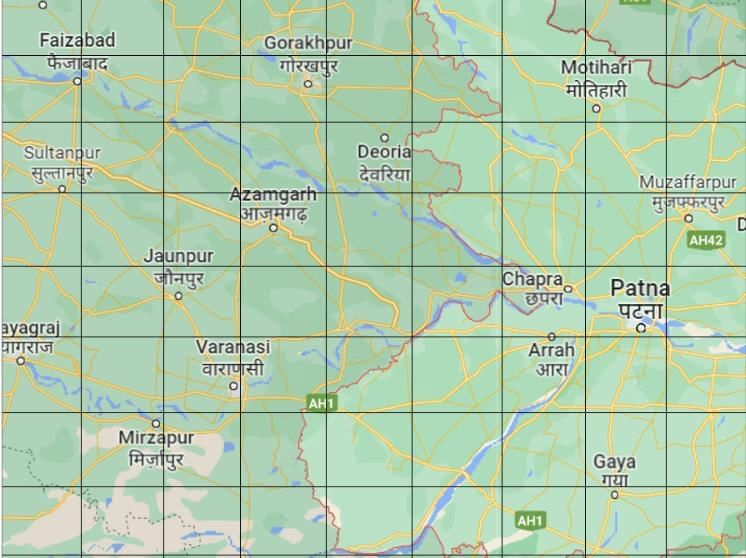
(i) In the given map, a 1cm square grid represents 50km. What is the approximate distance between Jaunpur and Chapra?
(a) 250 km
(b) 450 km
(c) 350 km
(d) 150 km
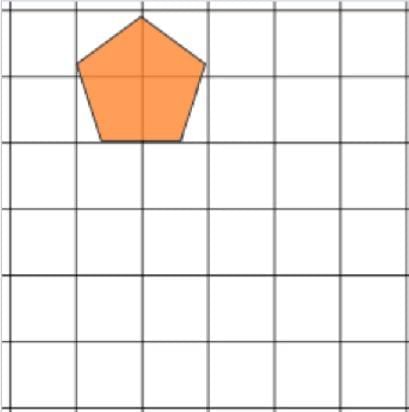
(ii) There is a pentagon drawn on a 1 cm square grid. If Mohan is asked to draw the same picture on a 2cm grid. The side of the square is made two times bigger. Does the area of square grids also become two times bigger?
(a) Yes, becomes two times bigger
(b) No, it becomes 4 times bigger
(c) No, it becomes three times bigger
(d) No, it remains the same
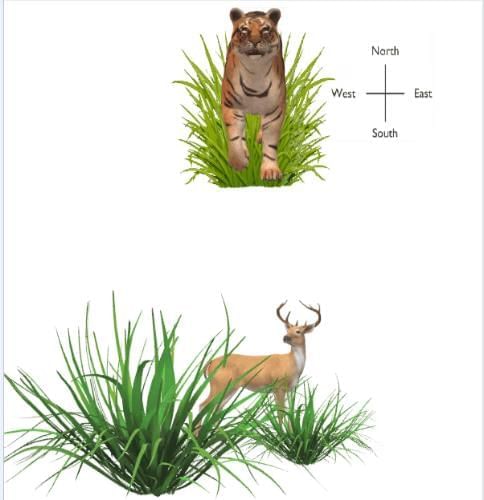
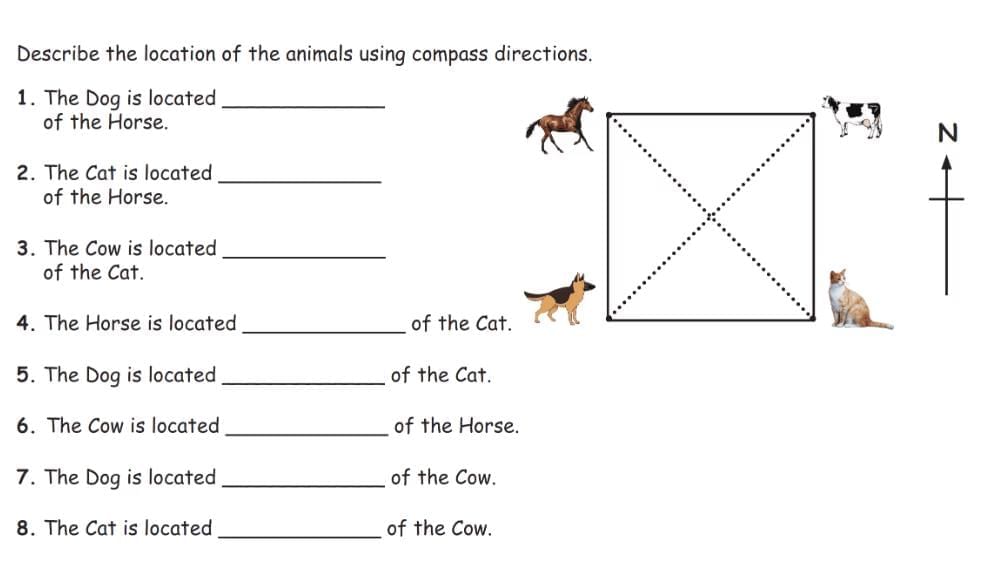
c) If the tiger wants to catch the deer, in which direction he should be making the jump?
(a) North
(b) South
(c) East
(d) West
Answer the following Questions
(i)
(ii) Find out the scale used to draw the map using the distance information given. Places – From Bangalore to Lucknow Actual distance – 1855 Km Distance on map – 5.3 cm
(iii) Height of a building is 9 m and this building is represented by 9 cm on a map. What is the scale used for the map?
(iv) If actual distance between two places A and B is 110 km and it is represented on a map by 25 mm. Then the scale used is _____.
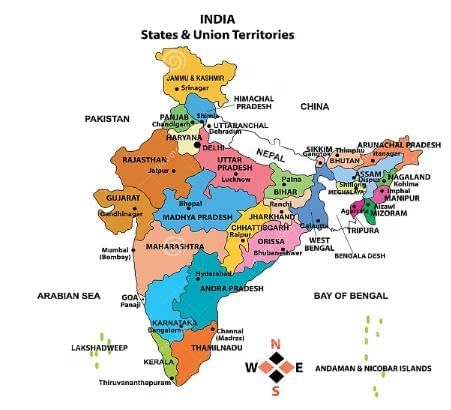
Look at the given map of India and answer the questions that follow
(i) Which State is surrounded by four other states?
(ii) Which state has the largest area?
(iii) Which are the places along the sea coast of South India?
(iv) Mark those states which have the sea on one side.
(v) Name one state which does not have the sea on any side.
(vi) Name 4 Eastern states of India.
(vii) Name 4 South Indian states.
(viii) Which is the capital of Tamil Nadu?
(ix) Sai is going from Tamil Nadu to Punjab. Name the states which fall in between his route.
(x) Harsha is travelling from Delhi to Mumbai (Maharashtra). Name the states which fall in between her route.
Q1. Which of the following is a factor of 24? (a) 5 (b) 6 (c) 7 (d) 9 Ans: (b) 6
Factors are numbers that divide a number exactly.
6 × 4 = 24 → so, 6 is a factor of 24.
Q2. The smallest multiple of any number is: (a) 0 (b) 1 (c) The number itself (d) 2 Ans: (c) The number itself
Multiples are obtained by multiplying the number with whole numbers (0,1,2,3,…).
The smallest multiple is the number itself (not 0, because 0 is a multiple of all numbers but not considered here in such questions).
Q3. Which of the following is a multiple of 7? (a) 21 (b) 22 (c) 23 (d) 25 Ans: (a) 21
Multiples of 7 → 7, 14, 21, 28, …
21 is in the list.
Q4. How many factors does 12 have? (a) 4 (b) 6 (c) 8 (d) 5 Ans: (b) 6
Factors of 12 → 1, 2, 3, 4, 6, 12
Total = 6 factors.
Q5. Which of the following numbers is a common factor of 18 and 24? (a) 3 (b) 4 (c) 5 (d) 7 Ans: (a) 3
Factors of 18 → 1, 2, 3, 6, 9, 18
Factors of 24 → 1, 2, 3, 4, 6, 8, 12, 24
Common factors → 1, 2, 3, 6
From the options, (a) is correct.
Q6. Which of the following numbers is NOT a multiple of 9? (a) 18 (b) 27 (c) 35 (d) 36 Ans: (c) 35
Multiples of 9 → 9, 18, 27, 36, …
35 is not in this list.
Q7.A number that has exactly two factors is called a: (a) Prime number (b) Composite number (c) Even number (d) Odd number Ans: (a) Prime number
Prime numbers have exactly 2 factors: 1 and the number itself.
Composite numbers have more than 2 factors.
Q8.What is the greatest common factor (GCF) of 12 and 16? (a) 2 (b) 3 (c) 4 (d) 6 Ans: (c) 4
Factors of 12 → 1, 2, 3, 4, 6, 12
Factors of 16 → 1, 2, 4, 8, 16
Common factors → 1, 2, 4
Greatest = 4
Q9.The least common multiple (LCM) of 4 and 6 is: (a)12 (b) 24 (c) 10 (d) 8 Ans: (a) 12
Multiples of 4 → 4, 8, 12, 16, 20, 24…
Multiples of 6 → 6, 12, 18, 24…
Smallest common multiple = 12
Q10.Which of the following is a factor of every number? (a) 0 (b) 1 (c) 2 (d) The number itself Ans: (b) 1
1 divides every number exactly.
0 is not a factor of any number.
Fill in the Blanks
Q1. Factors of 20 are ________, ________, ________, ________, ________. Ans: 1, 2, 4, 5, 10, 20
Q2.Multiples of 5 are ________, ________, ________, ________. Ans: 5, 10, 15, 20
Q3.The smallest prime number is ________. Ans: 2
Q4.Common factors of 12 and 18 are ________, ________, ________. Ans: 1, 2, 3, 6
Q5.LCM of 3 and 4 is ________. Ans: 12
Q6. 1 is a factor of every ________. Ans: number
Q7.The number 15 has ________ factors. Ans: 4 (1, 3, 5, 15)
Q8.Multiples of 7 up to 50 are ________, ________, ________, ________, ________, ________. Ans: 7, 14, 21, 28, 35, 42, 49
Answer the Following
Q1: In a sports day event, students are lined up in rows of 6, 9, or 18. What is the smallest number of students that can be arranged in this way?
Sol: To determine the smallest number of students that can be arranged in rows of 6, 9, or 18, we need to calculate the Least Common Multiple (LCM) of the numbers 6, 9, and 18. Prime factors:
6 = 2 × 3
9 = 3 × 3
18 = 2 × 3 × 3
Common factors and multiplication:
Common factors = 2, 3 × 3
Multiply all common factors: 2 × 3 × 3 = 18
Therefore, the smallest number of students is 18.
Q2: A baker has cookies that he wants to pack in boxes of 7, 14, or 21 cookies. What is the least number of cookies he needs to ensure there are no cookies left out?
Sol: To ensure no cookies are left out when packed in boxes of 7, 14, or 21, we find the LCM of these numbers. Prime factors:
7 = 7
14 = 2 × 7
21 = 3 × 7
Common factors and multiplication:
The LCM takes the highest powers of all prime numbers involved: 2 × 3 × 7 = 42
Therefore, the baker needs at least 42 cookies.
Q3: At a community picnic, the organizers want to divide the attendees into groups of 4, 6, or 8 evenly. What is the minimum number of attendees needed?
Sol: To find the minimum number of attendees that can be divided evenly into groups of 4, 6, or 8, we calculate the LCM of these numbers. Prime factors:
4 = 2 × 2
6 = 2 × 3
8 = 2 × 2 × 2
Common factors and multiplication:
Use the highest powers: 2³ and 3¹ → LCM = 8 × 3 = 24
Therefore, at least 24 attendees are needed.
Q4: A classroom has students who need to be arranged in rows of 10, 20, or 25 for a group photo. What is the least number of students that should be present?
Sol: To find the least number of students that can be arranged in rows of 10, 20, or 25, we look for the LCM. Prime factors:
Therefore, at least 100 students should be present.
Q5: A musical concert is organized where the audience must be seated in sections of 15, 30, or 45. How many minimum seats should be available?
Sol: To find the minimum number of seats, calculate the LCM of 15, 30, and 45. Prime factors:
15 = 3 × 5
30 = 2 × 3 × 5
45 = 3 × 3 × 5
Common factors and multiplication:
Highest powers of all primes: 2¹, 3², 5¹ → LCM = 90
Therefore, at least 90 seats should be available. These solutions use the factorization method to find the LCM, ensuring that students can understand the process through basic multiplication of common prime factors.
Q1. Which of the following is a factor of 24? (a) 5 (b) 6 (c) 7 (d) 9
Q2. The smallest multiple of any number is: (a) 0 (b) 1 (c) The number itself (d) 2
Q3. Which of the following is a multiple of 7? (a) 21 (b) 22 (c) 23 (d) 25
Q4. How many factors does 12 have? (a) 4 (b) 6 (c) 8 (d) 5
Q5. Which of the following numbers is a common factor of 18 and 24? (a) 3 (b) 4 (c) 5 (d) 7
Q6. Which of the following numbers is NOT a multiple of 9? (a) 18 (b) 27 (c) 35 (d) 36
Q7.A number that has exactly two factors is called a: (a) Prime number (b) Composite number (c) Even number (d) Odd number
Q8.What is the greatest common factor (GCF) of 12 and 16? (a) 2 (b) 3 (c) 4 (d) 6
Q9.The least common multiple (LCM) of 4 and 6 is: (a)12 (b) 24 (c) 10 (d) 8
Q10.Which of the following is a factor of every number? (a) 0 (b) 1 (c) 2 (d) The number itself
Fill in the Blanks
Q1. Factors of 20 are ________.
Q2.Multiples of 5 are ________, ________, ________, ________.
Q3.The smallest prime number is ________.
Q4.Common factors of 12 and 18 are ________, ________, ________.
Q5.LCM of 3 and 4 is ________.
Q6. 1 is a factor of every ________.
Q7.The number 15 has ________ factors.
Q8.Multiples of 7 up to 50 are ________, ________, ________, ________, ________, ________.
Answer the Following
Q1: In a sports day event, students are lined up in rows of 6, 9, or 18. What is the smallest number of students that can be arranged in this way?
Q2: A baker has cookies that he wants to pack in boxes of 7, 14, or 21 cookies. What is the least number of cookies he needs to ensure there are no cookies left out?
Q3: At a community picnic, the organizers want to divide the attendees into groups of 4, 6, or 8 evenly. What is the minimum number of attendees needed?
Q4: A classroom has students who need to be arranged in rows of 10, 20, or 25 for a group photo. What is the least number of students that should be present?
Q5: A musical concert is organized where the audience must be seated in sections of 15, 30, or 45. How many minimum seats should be available?
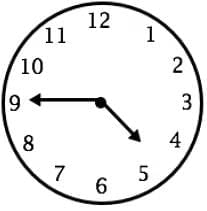
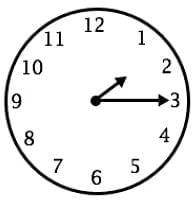
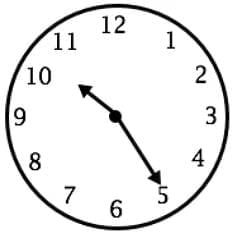
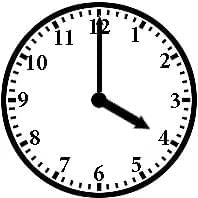
(iii) A ferry boat started to sail at 11:30 a.m. It completed the journey at 3:10 p.m. How long did it sail?
Ans: 3 hours 40 minutes
Calculation: 11:30 a.m. to 2:30 p.m. = 3 hours; 2:30 p.m. to 3:10 p.m. = 40 minutes; total = 3 hours 40 minutes.
(iv) Ragini started her dance practice at 5:40 p.m. and stopped it at 7:10 p.m. How long did she practice?
Ans: 1 hour 30 minutes
Calculation: 5:40 p.m. to 6:40 p.m. = 1 hour; 6:40 p.m. to 7:10 p.m. = 30 minutes; total = 1 hour 30 minutes.
Q9: How many minutes are in 1 hour? (a) 60 (b) 120 (c) 50 (d) 30 Ans: (a) Explanation: There are 60 minutes in 1 hour because 1 minute is 1/60th of an hour. Therefore, 60 minutes make one whole hour.
Q8: Answer the following questions: (i) Manvar started dreaming at 11:50 p.m. His dream lasted for 40 minutes. When did his dream end?
(ii) Shinde started playing volleyball at 4:45 p.m. He played for 1 hour 15 minutes. When did he stop playing?
(iii) A ferry boat started to sail at 11:30 a.m. It completed the journey at 3:10 p.m. How long did it sail?
(iv) Ragini started her dance practice at 5:40 p.m. and stopped it at 7:10 p.m. How long did she practice? Q9: How many minutes are in 1 hour? (a) 60 (b) 120 (c) 50 (d) 30
Q1: Find the perimeter of each of the following figures: (i) Perimeter of the triangle is ______ cm. (ii) Perimeter of the square is ______ cm. (iii) Perimeter of the square is ______ cm.
(iv) Perimeter of the rectangle is ______ cm.
(v) Perimeter of the triangle is ______ cm.
(vi) The perimeter of the rectangle is ______ cm.
Q2: In the following figures, assume that each small square is 1 sq cm. Count the squares and find the area: (i) Area = ______ sq cm.
(ii) Area = ______ sq cm. (iii) Area = ______ sq cm. (iv) Area = ______ sq cm.
(v) Area = ______ sq cm.
Q3:Find the area of the rectangle, whose: (i) length = 5 m 8 cm, breadth = 3 m 75 cm (ii) length = 4 m 50 cm, breadth = 2 m 7 cm (iii) length = 1 m 5 cm, breadth = 90 cm (iv) length = 125 m, breadth = 84 m (v) length = 80 cm, breadth = 24 cm
Q4: Find the perimeter of: (i) The triangle whose sides are 8 cm, 9 cm, and 12 cm. (ii) The square whose side is 14 cm.
Q5: Find the area of the following rectangles: (i)
(ii)
Q6: Find the area of the square, whose: (i) side = 256 dm (ii) side = 92 dm (iii) side = 18m (iv) side = 7 cm (v) side = 20 cm
Q7: Find the area of the following squares: Area of square = side x side (i)
(ii)
Q8: Find the area of a square whose perimeter is 4 cm.
Q9: Area of a rectangle = ______ x ______.
Q10: Area of a square of side 1 cm = ______.
Q11: Area of a rectangle of dimensions 1 m and 2 m is ______ sq m.
Q1. A figure is said to have symmetry if it can be divided into: a) Equal halves b) Unequal parts c) Only straight lines d) Circles only Answer: a) Equal halves
Q2.How many lines of symmetry does a square have? a) 2 b) 3 c) 4 d) 5 Answer: c) 4
Q3. Which of the following shapes has only one line of symmetry? a) Circle b) Equilateral triangle c) Rectangle d) Isosceles triangle Answer: d) Isosceles triangle
Q4.How many lines of symmetry does a circle have? a) 1 b) 2 c) 4 d) Infinite Answer: d) Infinite
Q5.Which alphabet has 2 lines of symmetry? a) A b) H c) C d) F Answer: b) H
Q6: A rectangle has how many lines of symmetry? a) 1 b) 2 c) 3 d) 4 Answer: b) 2
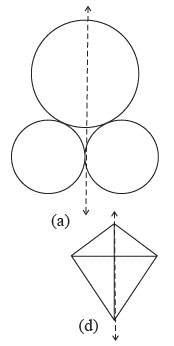
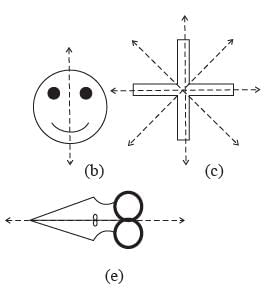
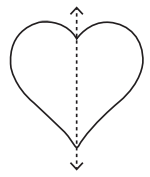
Q7: Which of the shapes is divided into two mirror halves by a dotted line?
(a) A and B (b) A and C (c) B and C (d) All of these Ans: (c)
Shape A: A symmetric star, but the given dotted line may not create perfect mirror halves.
Shape B: A butterfly, which has clear bilateral symmetry along the dotted line.
Shape C: A hexagonal shape that appears symmetric along the given dotted line.
Since B and C are properly divided into two equal mirror halves by the dotted line, the correct answer is:
Answer: (c) B and C
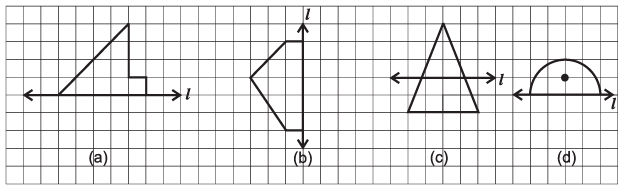
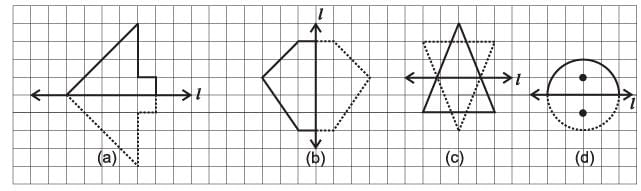
Q8: In the following figures, l is the line of symmetry. Complete the diagram to make it symmetric.
Ans.
Q9: Draw the line (s) of symmetry for each of the following figures :
Ans.
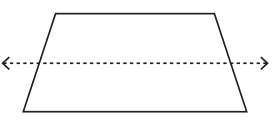
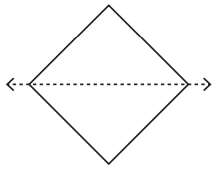
Q10: Is the dotted line on each shape a line of symmetry? Write yes or no.
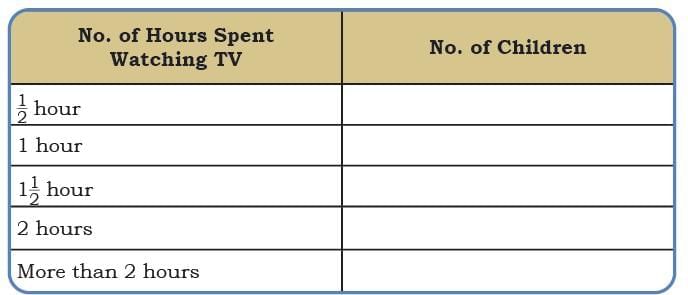
Samaira and Kabir decided to act like reporters and collect information from their friends. They collected data from 35 friends and recorded it in a notebook as shown below.
Ans:
Look at the table and answer the following questions.
Q1: How many children watch TV for more than half an hour? Ans: Number of children who watch TV for more than half an hour =13 + 7 + 3 + 3 = 26 children.
Q2: How many children watch TV for less than two hours? Ans: Number of children who watch TV for less than two hours = 9 + 13 + 7 = 29 children.
Q3: The number of children who watch TV for more than two hours is _________. Ans: Number of children who watch TV for more than two hours is 3.
Q4: More children watch TV for two hours than half an hour. (True/False) Ans: Given statement is false, since only 3 children watch TV for two hours, but 9 children watch TV for half an hour.
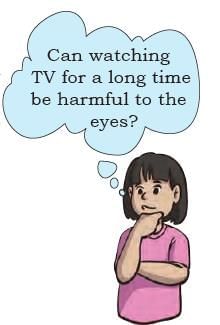
Yes, watching TV for too long can cause eye strain and tiredness.
Stock-Taking in a Shop
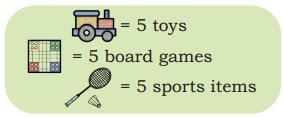
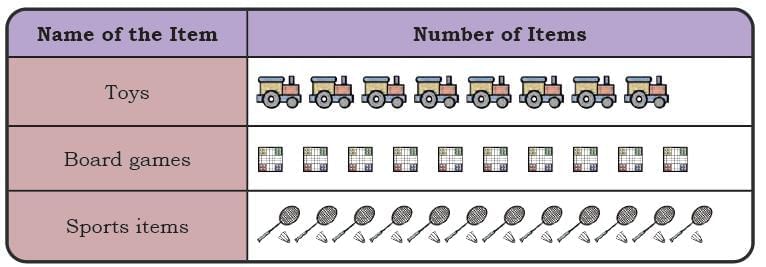
Joseph Uncle takes stock of the play items (toys, board games, and sports items) in his store a week before the summer break. He tries to record the items in his shop using a pictograph. He notices that there are too many items of each kind in his shop and it is not easy to make a picture for every item Dipesh, one of his helpers, suggested using one picture (icon) for every 5 items of each kind. His pictograph is shown below. Dipesh used a scale while recording the items in the pictograph. A scale helps record a large number of things using fewer icons. Now, answer the following questions based on the above pictograph.
Q1: How many toys does Joseph Uncle have? Ans: Joseph Uncle has 8 × 5 = 40 toys
Q2: How many board games does Joseph Uncle have? Ans: Joseph Uncle has 10 × 5 = 50 board games.
Q3: How many total play items does Joseph Uncle have? Ans: Joseph Uncle has 12 × 5 = 60 sports items. Thus, total play items Joseph Uncle has = 40 + 50 + 60 = 150.
Q: Is there any other scale that you can use to make the pictograph? Ans: Yes, we can use another scale to make the pictograph simpler.
Two-wheelers on the Road
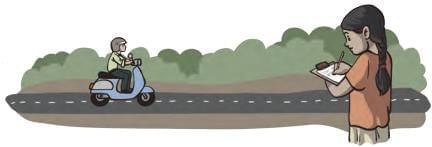
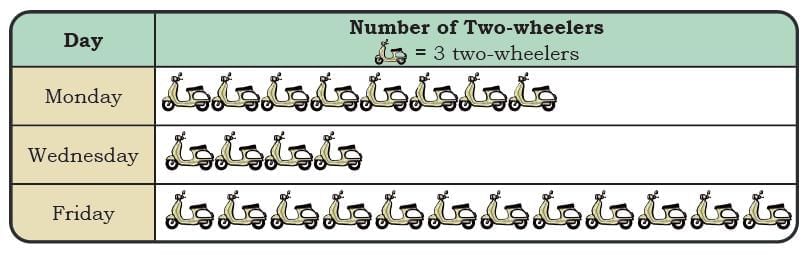
Deepti noted down the number of two-wheelers passing her house in one hour on three different days. She used one icon to show 3 two-wheelers.
Observe the pictograph and answer the following questions.
Q1: Which day had the most two-wheelers passing her house? Ans: Friday
Q2: How many total two-wheelers did she record over three days? Ans: Two-wheeler recorded on Monday = 8 × 3 = 24 two-wheelers
Two-wheeler recorded on Wednesday = 4 × 3 = 12 two-wheelers
Two-wheeler recorded on Friday = 12 × 3 = 36 two-wheelers
Total two-wheelers Deepti recorded over three days = 24 + 12 + 36 = 72 two-wheelers
Q3: How many fewer two-wheelers were seen on Wednesday than on Monday? Ans: On Monday, Deepti saw 24 two-wheelers On Wednesday, Deepti saw 12 two-wheelers Difference = 24 – 12 = 12 two-wheelers ∴ 12 fewer two-wheelers were seen on Wednesday than on Monday.
Q4: How many more two-wheelers were seen on Friday than on Wednesday? Ans: On Wednesday, Deepti saw 12 two-wheelers. On Friday, Deepti saw 36 two-wheelers. Difference = 36 – 12 = 24 two-wheelers. 24 more two-wheelers were seen on Friday than on Wednesday.
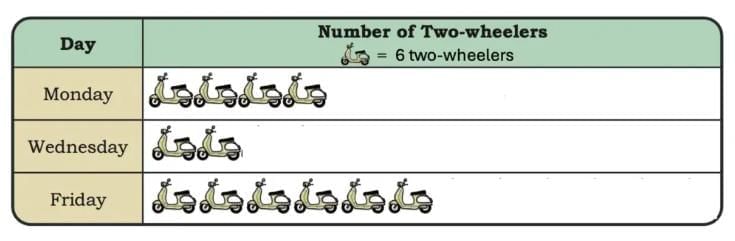
Q5: Choose any other scale and represent the same data using a pictograph in your notebook. Ans: Here 1 = 4 two-wheelers
Recording a Day
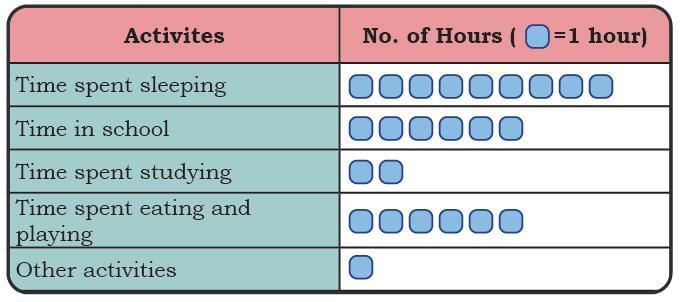
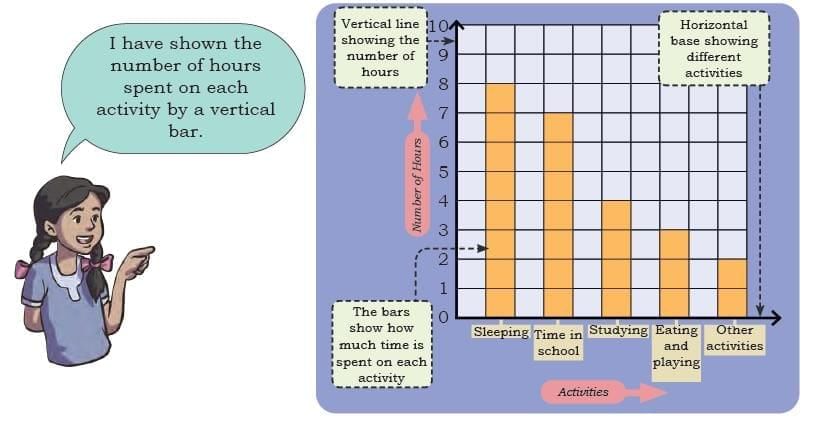
One day Raman and Sheela decided to record how they spent their day. Raman recorded his daily routine in the table below. Sheela recorded her routine in the following manner. Observe Raman’s and Sheela’s routines and answer the following questions.
Q1: Whose daily routine shows more time spent on sleeping? Ans: Raman spent 9 hours on sleeping and Sheela spent 8 hours on sleeping. So, Raman’s daily routine shows more time spent on sleeping.
Q2: Who spends more hours in the school? Ans: Raman spends 6 hours at school and Sheela spends 7 hours at school. So, Sheela spends more hours in school.
Q3: How many more hours does Sheela spend studying compared to Raman? Ans: Sheela spends 4 hours and Raman spends 2 hours in studying. Difference = 4 – 2 = 2 hours Sheela spends 2 more hours studying compared to Raman.
Q4: Is there any activity on which they spend the same amount of time? If yes, name the activity. Ans: No, there is no activity on which they spend the same amount of time.
Q5: Based on their data, whose routine do you think is more balanced? Why? Ans: Sheela’s routine appears to be more balanced with a good allocation for sleep, studying, and other activities.
Day in My Life
Q: Record your daily routine (24 hours) in hours and minutes, as necessary. Note the time spent on activities like sleeping, studying, playing, eating, and others.
Make a bar graph of the time you spend on different activities in the space given below. Ans:
Whose Index Finger is Longer?
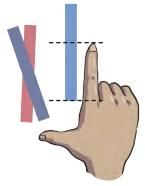
Cut long paper strips from waste paper. Give one strip (each of the same width) to each of your friends. Now, put the paper strip on your index finger and tear off the extra strip extending above your fingers. Paste these paper strips along the horizontal line in the given bar graph.
Write the answers to the following questions based on your graph. 1. Whose index finger is the longest?
2. The length of the longest index finger is _________ cm.
3. The smallest index finger is _________
4. It belongs to _________. Ans: Do it yourself.
Food Wastage in the School Canteen
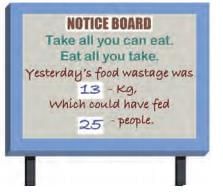
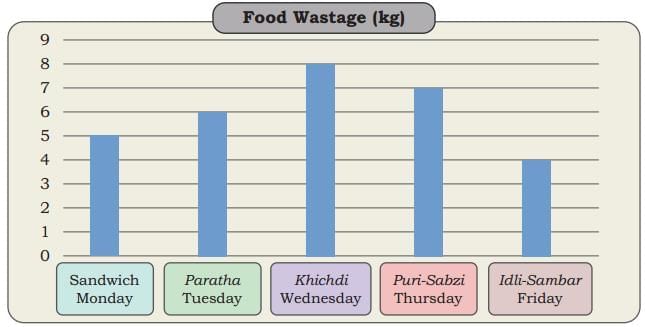
Rani stays in a residential school. Her school’s dining hall displays the amount of food wasted and the number of children the food could have fed. Given below is the data collected over the weekdays for different food items.
Q: Rani was shocked to see the data. What do you think about food wastage? How can we reduce the wastage of food? What can we do with the leftover food? Ans: The food wastage is not only a waste of resources and money, but also disrespectful to the efforts of farmers and cooks. The wastage of food can be reduced by: (i) Preparing food according to the number of people eating. (ii) Serving food in smaller portions. (iii) Storing leftover food properly in the refrigerator. (iv) Teaching children and adults the value of food. The leftover food can be: (i) Shared with neighbours, relatives, and friends. (ii) Donated to NGOs for distribution to the needy. (iii) Used creatively to make new dishes.
Observe the above graph and answer the following questions. Q1: Which food item had the highest amount of wastage? _____________ Ans: Khichdi had the highest amount of wastage i.e., of 8 kg.
Q2: Which food item had the least amount of wastage? _______________ Ans: Idli-Sambhar had the least amount of wastage i.e., of 4 kg.
Q3: How much total food wastage was recorded in these days? _________ Ans: Total food wastage recorded in Monday to Friday = 5 + 6 + 8 + 7 + 4 = 30 kg
Q4: If 1 kg of food waste can feed 3 children, how many children could have been fed with the total food wasted? Ans: 1 kg of food waste can feed 3 children. 30 kg of food waste can feed 3 × 30 = 90 children.
Q5: ________ day had less food wastage than day. Ans: Friday had less food wastage than Wednesday.
Q6: If the same food items are to be repeated next week, can you predict which food item is likely to be wasted the most? Ans: Khichdi had the highest wastage of 8 kg this week. So, Khichdi is most likely to be wasted the most again next week.
Page No. 187
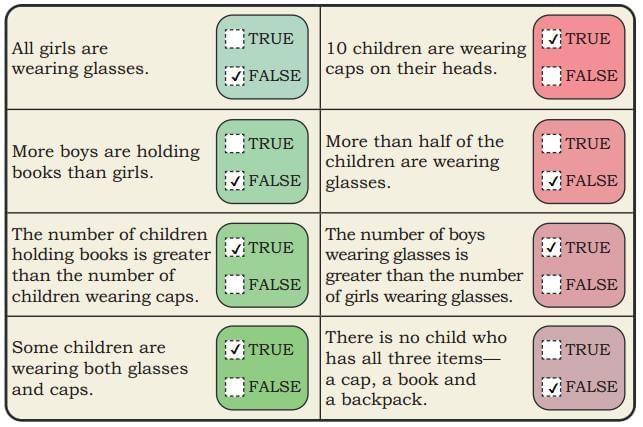
True or False
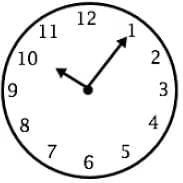
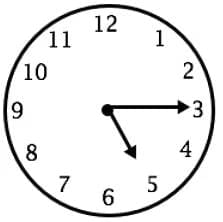
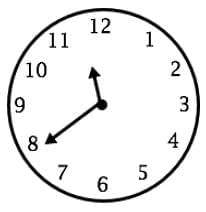
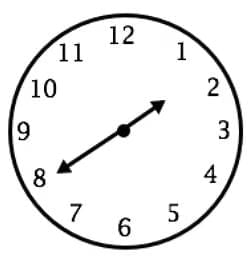
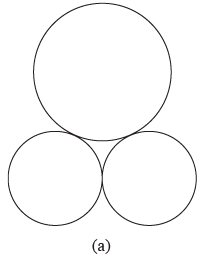
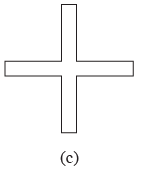
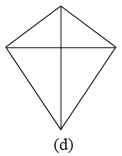
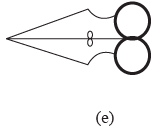
Q: Observe the above picture carefully. Based on your observation, find out which of the following statements are true or false.



 Yes, watching TV for too long can cause eye strain and tiredness.
 Dipesh, one of his helpers, suggested using one picture (icon) for every 5 items of each kind.
 His pictograph is shown below.
 Dipesh used a scale while recording the items in the pictograph. A scale helps record a large number of things using fewer icons.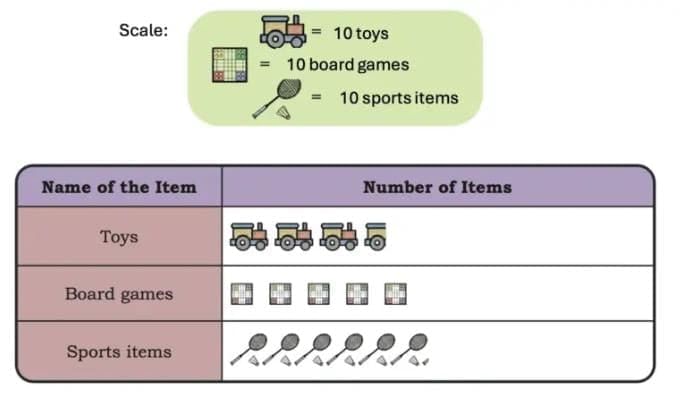
 Sheela recorded her routine in the following manner.
 Observe Raman’s and Sheela’s routines and answer the following questions.
 Paste these paper strips along the horizontal line in the given bar graph.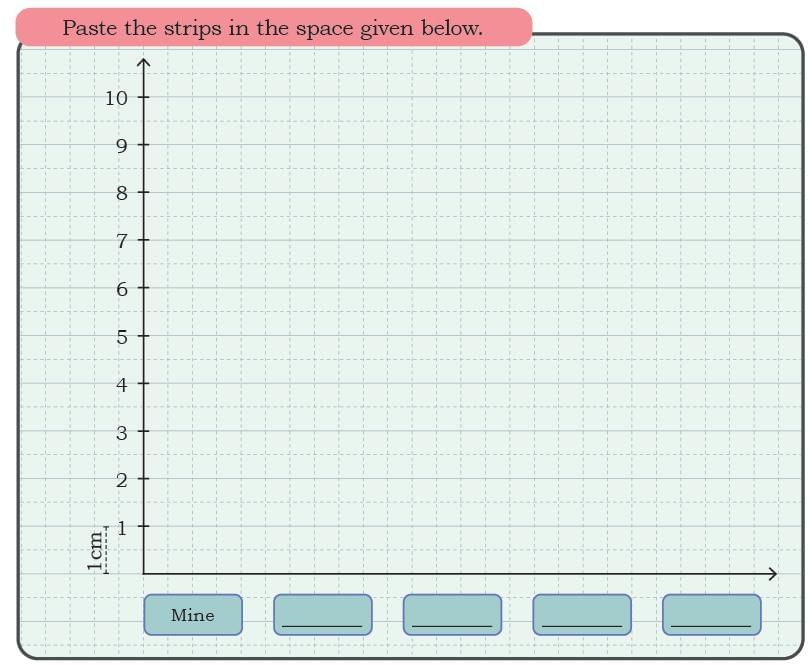
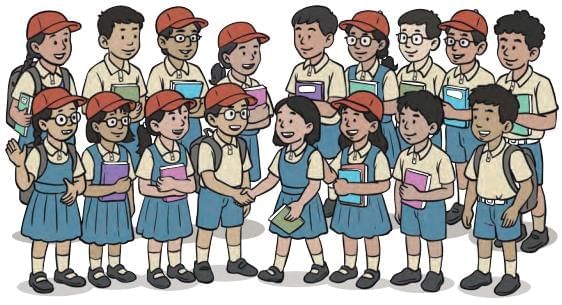 Q: Observe the above picture carefully. Based on your observation, find out which of the following statements are true or false.
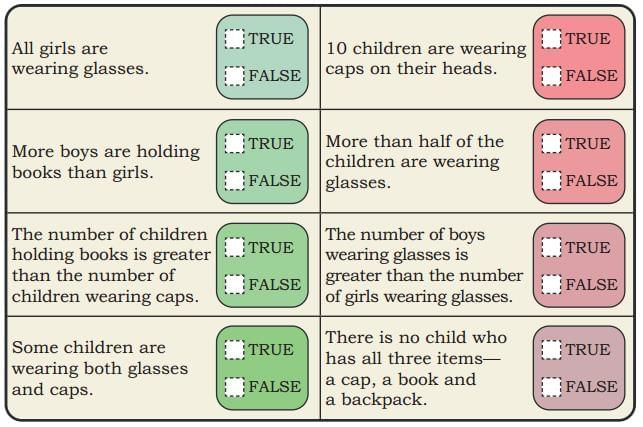 Ans:
Ans: