06. Worksheet Solutions: The Dairy Farm – 2

Q1. What is 36 × 7?
(a) 242
(b) 252
(c) 246
(d) 232

Ans: (b) 252

Q2. If one pen costs ₹28, what will be the cost of 15 pens?
(a) ₹320
(b) ₹420
(c) ₹390
(d) ₹280

Ans: (b) ₹420

Q3. 125 × 20 = ?
(a) 2000
(b) 2250
(c) 2500
(d) 3000

Ans: (c) 2500

Q4. A box has 48 chocolates. How many chocolates are there in 25 boxes?
(a) 1000
(b) 1200
(c) 1100
(d) 1250

Ans: (b) 1200

Q5. 1001 × 9 = ?
(a) 9009
(b) 9090
(c) 9910
(d) 9100

Ans: (a) 9009

Q6. If a student reads 45 pages every day, how many pages will he read in 31 days?
(a) 1395
(b) 1385
(c) 1405
(d) 1415

Ans: (a) 1395

Q7. Multiplying by 10, 100, 1000

a) 5 × 10 = _____
b) 30 × 20 = _____
c) 10 × 600 = _____
d) 40 × 10 = _____
e) 25 × 1000 = _____

Sol: Quick trick:

  • Multiplying by 10 → add one zero.
  • Multiplying by 100 → add two zeros.
  • Multiplying by 1000 → add three zeros.

a) 5 × 10 = 50
b) 30 × 20 = 600
c) 10 × 600 = 6000
d) 40 × 10 = 400
e) 25 × 1000 = 25000

Q8. Find the products using the nearest multiple of 10:

1) 7 × 52
Sol: Take 52 = 50 + 2
7 × 52 = 7 × (50 + 2)
= (7 × 50) + (7 × 2)
= 350 + 14 = 364

2) 12 × 28
Sol: Take 28 = 30 – 2
12 × 28 = 12 × (30 – 2)
= (12 × 30) – (12 × 2)
= 360 – 24 = 336

3) 75 × 31
Sol: Take 31 = 30 + 1
75 × 31 = 75 × (30 + 1)
= (75 × 30) + (75 × 1)
= 2250 + 75 = 2325

Q9. Multiply the following 

(a) 347 by 3

Sol: 

(b) 411 by 31

Sol: 

(c) 573 by 46

Sol: 

(d) 123 by 456.

​Sol: 

Q10. Observe and Complete the Pattern:

(a) 2 × 5 = 10
20 × 5 = 100
200 × 5 = ?
2000 × 5 = ?

Sol:

2 × 5 = 10

20 × 5 = 100

200 × 5 = 1000

2000 × 5 = 10,000

Answer: 200 × 5 = 1000, 2000 × 5 = 10,000

​(b) 2 × 3 = 6
22 × 3 = 66
222 × 3 = 666
2222 × 3 = ?

Sol:

2 × 3 = 6
22 × 3 = 66
222 × 3 = 666
2222 × 3 = 6666

Answer: 2222 × 3 = 6666

​(c) 1 × 1 = 1
11 × 11 = 121
111 × 111 = 12321
1111 × 1111 = ?

Sol: 

1 × 1 = 1
11 × 11 = 121
111 × 111 = 12321
1111 × 1111 = 1234321

Answer: 1111 × 1111 = 1234321

​(d) 2 × 2 = 4
22 × 22 = 484
222 × 222 = 49284
2222 × 2222 = ?

Sol: 

2 × 2 = 4
22 × 22 = 484
222 × 222 = 49284
2222 × 2222 = 4937284

Answer: 2222 × 2222 = 4937284

06. Worksheet: The Dairy Farm – 2

Q1. What is 36 × 7?
(a) 242
(b) 252
(c) 246
(d) 232

Q2. If one pen costs ₹28, what will be the cost of 15 pens?
(a) ₹320
(b) ₹420
(c) ₹390
(d) ₹280

Q3. 125 × 20 = ?
(a) 2000
(b) 2250
(c) 2500
(d) 3000

Q4. A box has 48 chocolates. How many chocolates are there in 25 boxes?
(a) 1000
(b) 1200
(c) 1100
(d) 1250

Q5. 1001 × 9 = ?
(a) 9009
(b) 9090
(c) 9910
(d) 9100

Q6. If a student reads 45 pages every day, how many pages will he read in 31 days?
(a) 1395
(b) 1385
(c) 1405
(d) 1415

Q7. Multiplying by 10, 100, 1000

a) 5 × 10 = _____
b) 30 × 20 = _____
c) 10 × 600 = _____
d) 40 × 10 = _____
e) 25 × 1000 = _____

Q8. Find the products using the nearest multiple of 10:

1) 7 × 52

2) 12 × 28

3) 75 × 31

Q9. Multiply the following 

(a) 347 by 3

(b) 411 by 31

(c) 573 by 46

(d) 123 by 456.

Q10. Observe and Complete the Pattern:

(a) 2 × 5 = 10
20 × 5 = 100
200 × 5 = ?
2000 × 5 = ?

(b) 2 × 3 = 6
22 × 3 = 66
222 × 3 = 666
2222 × 3 = ?

(c) 1 × 1 = 1
11 × 11 = 121
111 × 111 = 12321
1111 × 1111 = ?

(d) 2 × 2 = 4
22 × 22 = 484
222 × 222 = 49284
2222 × 2222 = ?

06. Worksheet Solutions: The Dairy Farm – 1

Q1: Find the following products

(i) 38 x 9 
Ans: 38 x 9 = 342
(ii) 80 x 5
Ans: 80 x 5 = 400

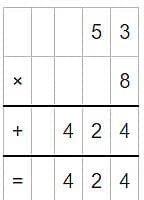
(iii) 53 x 8
Ans: 53 x 8 = 424

Q2: Multiply

(i) 4,032 by 198
Ans: 
=  4,032 x 198 = 798336

(ii) 3,647 by 245
Ans: 
3,647 x  245 = 893515

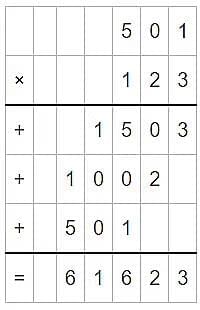
(iii) 501 by 123
Ans:
= 501 x 123 = 61623

Q3: Fill in the blanks

(i) 2,586 x ______ = 2,586
Ans: 2,586 x = 2,586
(Identity Property: The product of any number with 1 is as same as the number itself.)

(ii) 624 x ______ = 38 x 624
Ans: 624 x 38 = 38 x 624
(Commutative property of multiplication is a math rule that says you can multiply numbers in any order, and the result will be the same.)

(iii) 600 x ______ = 0.
Ans: 600 x 0 = 0
(Zero property of multiplication is a fundamental rule in mathematics that states that any number multiplied by zero is equal to zero.)

Q4: Round off the following numbers to the nearest tens

(i) 13,528
Ans: Here’s the general rule for rounding:

  • Number >= 5: If the number you are rounding is followed by 5, 6, 7, 8, or 9, round the number up. Example: 38 rounded to the nearest ten is 40.
  • Number < 5: If the number you are rounding is followed by 0, 1, 2, 3, or 4, round the number down. Example: 33 rounded to the nearest ten is 30.

Therefore, applying these rules, we get:
13,528 = 13,530

(ii) 3,542
Ans: Here’s the general rule for rounding:

  • Number >= 5: If the number you are rounding is followed by 5, 6, 7, 8, or 9, round the number up. Example: 38 rounded to the nearest ten is 40.
  • Number < 5: If the number you are rounding is followed by 0, 1, 2, 3, or 4, round the number down. Example: 33 rounded to the nearest ten is 30.

Therefore, applying these rules, we get:
3,542 = 3,540

(iii) 174
Ans: Here’s the general rule for rounding:

  • Number >= 5: If the number you are rounding is followed by 5, 6, 7, 8, or 9, round the number up. Example: 38 rounded to the nearest ten is 40.
  • Number < 5: If the number you are rounding is followed by 0, 1, 2, 3, or 4, round the number down. Example: 33 rounded to the nearest ten is 30.

Therefore, applying these rules, we get:
174 = 170

Q5: Estimate Products by rounding each number to the nearest Tens

(Find an approximate answer for each multiplication problem by rounding both numbers to the nearest tens place first, then multiplying the rounded numbers.
(i) 52 x 43
Ans: Here’s the general rule for rounding:

  • Number >= 5: If the number you are rounding is followed by 5, 6, 7, 8, or 9, round the number up. Example: 38 rounded to the nearest ten is 40.
  • Number < 5: If the number you are rounding is followed by 0, 1, 2, 3, or 4, round the number down. Example: 33 rounded to the nearest ten is 30.

Therefore, applying these rules, we get:
52 x 43 = 50 x 40 = 2000

(ii) 63 x 52
Ans: Here’s the general rule for rounding:

  • Number >= 5: If the number you are rounding is followed by 5, 6, 7, 8, or 9, round the number up. Example: 38 rounded to the nearest ten is 40.
  • Number < 5: If the number you are rounding is followed by 0, 1, 2, 3, or 4, round the number down. Example: 33 rounded to the nearest ten is 30.

Therefore, applying these rules, we get:
63 x 52 = 60 x 50 = 3000

Q6: Answer the following Questions

(i) Calculate the product of the place values of the two 6s in the number 6,965.

Ans: The place value of 1st 6 in 6,965 is at thousand’s place.
=> First place value of 6 = 6000
The place value of 2nd 6 in 6,965 is at ten’s place.
=> Second place value of 6 = 6000
Product of the place values of 6 in the number 6,965 = 6000 x 60 = 360000

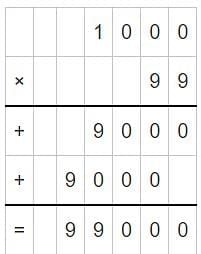
(ii) Find the product of the greatest 2-digit number and the smallest 4-digit number ______.
Ans: Greatest 2-digit no. = 99
Smallest 4-digit no. = 1000
Therefore, the product of the greatest 2-digit number and the smallest 4-digit number = 1000 x 99 = 99000.

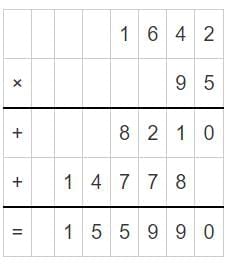
(iii) A transistor costs Rs. 1,642. Find the cost of 95 such transistors. 

Ans: Cost of one Transistor = Rs 1,642
Total number of transistors = 95
Cost of 95 Transistors = 1642 x 95 = 155,990

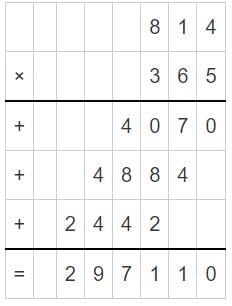
(iv) A candle factory produced 814 candles in a day. How many candles will this factory produce in a year?

Ans: A candle factory produces candles in a day = 814
Total  number of days in a leap year = 365
Candles this factory will produce in one year = 814 x 365 = 2,97,110

(v) A farmer produced 735 quintals of rice. He sold it at the rate of Rs 1525 per quintal. How much money did he get?
Ans: A farmer produced rice = 735 quintals
Cost per quintal = Rs. 1525
Money he got = 1525 x 735 = Rs. 1,120,875

(vi) The cost of a pack of Ghee is Rs. 308 Find the cost of 97 such packs.
Ans: The cost of 1 pack of Ghee = Rs. 308
Total number of packs = 97
Therefore, Total Cost of 97 packs of Ghee = 308 x 97 = 29,876

06. Worksheet: The Dairy Farm – 1

Q1: Find the following products

(i) 38 x 9 ______.

(ii) 80 x 5 ______.

(iii) 53 x 8 ______.
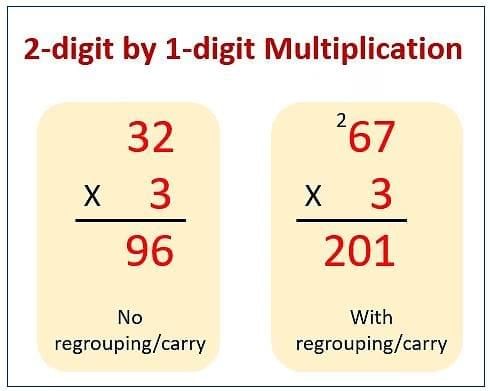
Take the help of this example to solve the questions above:
Q1: Find the following products

Q2: Multiply

(i) 4,032 by 198

(ii) 3,647 by 245

(iii) 501 by 123

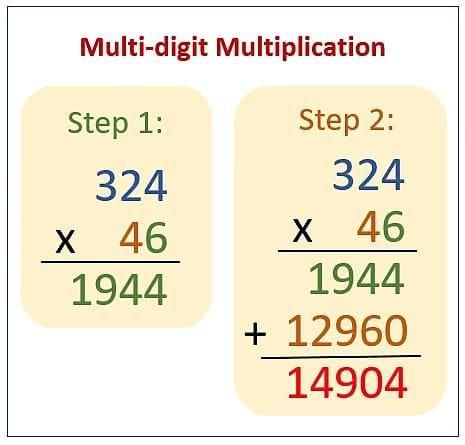
Take the help of this example to solve the questions above:

Q2: Multiply

Q3: Fill in the blanks

(i) 2,586 x ______ = 2,586

(ii) 624 x ______ = 38 x 624

(iii) 600 x ______ = 0.

Q4: Round off the following numbers to the nearest tens

(i) 13,528

(ii) 3,542

(iii) 174
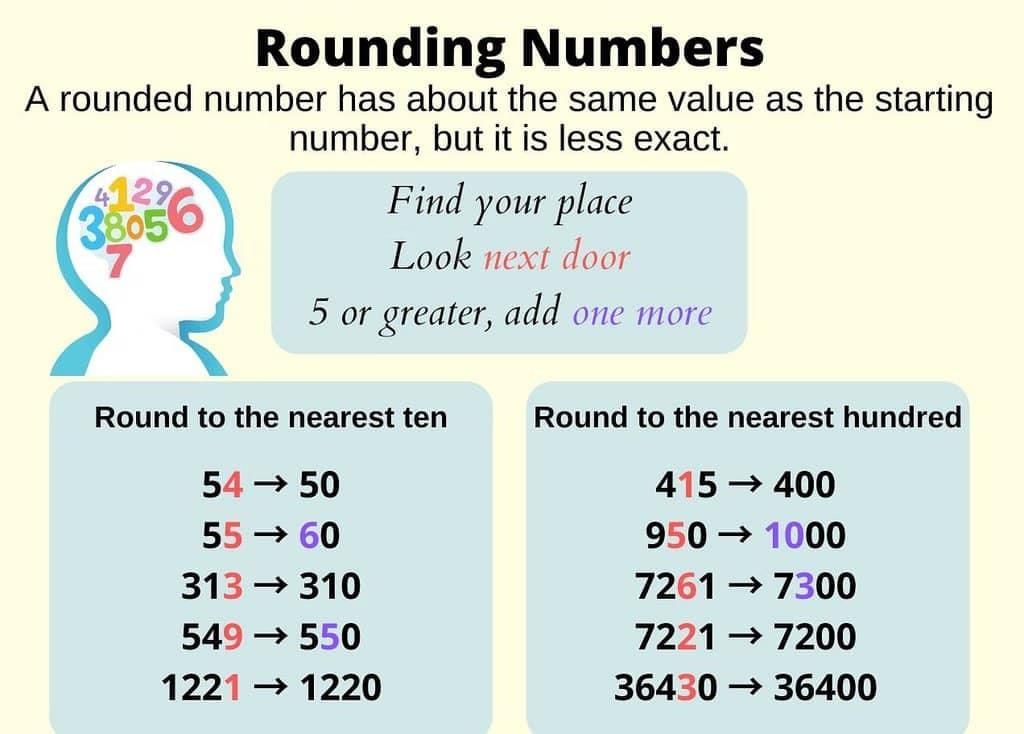
You can solve the questions of rounding off with the help of these examples: Q4: Round off the following numbers to the nearest tens

Q5: Estimate Products by rounding each number to the nearest Tens

Instruction: Find an approximate answer for each multiplication problem by rounding both numbers to the nearest tens place first, then multiplying the rounded numbers.
(i) 52 x 43
(ii) 63 x 52

Q6: Answer the following Questions

(I) Calculate the product of the place values of the two 6s in the number 6,965.

(ii) Find the product of the greatest 2-digit number and the smallest 4-digit number ______.

(iii) A transistor costs Rs. 1,642. Find the cost of 95 such transistors.

(iv) A candle factory produced 814 candles in a day. How many candles will this factory produce in one year?

(v) A farmer produced 735 quintals of rice. He sold it at the rate of Rs. 1525 per quintal. How much money did he get?

(vi) The cost of a pack of Ghee is Rs. 308 Find the cost of 97 such packs.

05. Worksheet Solutions: Far and Near

Q1: 250 cm = ? m
(a) 2.5 m
(b) 25 m
(c) 0.25 m
(d) 2500 m
Sol: (a) 2.5 m

1 meter = 100 centimeters
So, 250 ÷ 100 = 2.5 meters

Q2: A rope is 600 cm long. If cut into 10 equal pieces, the length of each piece is:
(a) 60 m
(b) 60 cm
(c) 6 m
(d) 600 m
Sol: (b) 60 cm

Total length = 600 cm
Number of pieces = 10
Each piece = 600 ÷ 10 = 60 cm

Q3: 5 km = ? m
(a) 500
(b) 5000
(c) 50
(d) 50,000
Sol: (b) 5000

1 kilometer = 1000 meters
So, 5 × 1000 = 5000 meters

Q4: A train is 250 m long. What is its length in kilometers?
(a) 0.025 km
(b) 2.5 km
(c) 0.25 km
(d) 25 km
Sol: (c) 0.25 km

1 kilometer = 1000 meters
So, 250 ÷ 1000 = 0.25 kilometers

Q5: A ribbon is 36 m long. If each piece is 4 m long, how many pieces can be cut?
(a) 8
(b) 9
(c) 10
(d) 12
Sol: (b) 9

Total length = 36 meters
Each piece = 4 meters
Number of pieces = 36 ÷ 4 = 9

Q6: Convert the following into centimeters.

(i) 66 mm

(ii) 32 dm

(iii) 4 cm 8 mm

(iv) 63 km

(v) 16 m

(vi) 1.5 dm

Sol: We use:

  • 1 cm = 10 mm
  • 1 dm = 10 cm
  • 1 m = 100 cm
  • 1 km = 1000 m = 100,000 cm

(i) 66 mm
Since 10 mm = 1 cm
66 mm = 66 ÷ 10 = 6.6 cm

(ii) 32 dm
Since 1 dm = 10 cm
32 dm = 32 × 10 = 320 cm

(iii) 4 cm 8 mm
8 mm = 0.8 cm
So, 4 cm + 0.8 cm = 4.8 cm

(iv) 63 km
1 km = 100,000 cm
63 km = 63 × 100,000 = 6,300,000 cm

(v) 16 m
1 m = 100 cm
16 m = 16 × 100 = 1600 cm

(vi) 1.5 dm
1 dm = 10 cm
1.5 dm = 1.5 × 10 = 15 cm

Q7: Convert the following into kilometers.

(i) 14 m

(ii) 59 hm

(iii) 136 dam

(iv) 207 dam

(v) 5600 cm

(vi) 10000 cm

Sol: We use:

  • 1 km = 1000 m
  • 1 hm (hectometer) = 100 m
  • 1 dam (decameter) = 10 m
  • 1 m = 100 cm

(i) 14 m
1 km = 1000 m
14 m = 14 ÷ 1000 = 0.014 km

(ii) 59 hm
1 hm = 100 m
59 hm = 59 × 100 = 5900 m
5900 ÷ 1000 = 5.9 km

(iii) 136 dam
1 dam = 10 m
136 dam = 136 × 10 = 1360 m
1360 ÷ 1000 = 1.36 km

(iv) 207 dam
207 dam = 207 × 10 = 2070 m
2070 ÷ 1000 = 2.07 km

(v) 5600 cm
1 m = 100 cm → 5600 cm = 5600 ÷ 100 = 56 m
Now, 56 ÷ 1000 = 0.056 km

(vi) 10000 cm
10000 ÷ 100 = 100 m
100 ÷ 1000 = 0.1 km

Q8: Compare the following using >, < or = sign:

(i) 702 cm ………. 503 cm

(ii) 2 m ………. 9 m

(iii) 800 cm ………. 80 m

(iv) 702 cm ………. 5 m

(v) 8 km ………. 7000 m

(vi) 625 cm ………. 9 m

(vii) 10 m ………. 4 cm

(viii) 1000 m ………. 1000 km

(ix) 100 cm ………. 100 m

(x) 1 km ………. 1000 m

Sol: (i) 702 cm > 503 cm 
So, 702 cm > 503 cm

(ii) 2 m … 9 m
Clearly, 2 m < 9 m

(iii) 800 cm … 80 m
Convert: 800 cm = 8 m.
So, 8 m < 80 m 
→ 800 cm < 80 m

(iv) 702 cm … 5 m
Convert: 702 cm = 7 m 2 cm = 7.02 m.
So, 7.02 m > 5 m 
→ 702 cm > 5 m

(v) 8 km … 7000 m
Convert: 8 km = 8000 m.
So, 8000 m > 7000 m 
→ 8 km > 7000 m

(vi) 625 cm … 9 m
Convert: 625 cm = 6 m 25 cm = 6.25 m.
So, 6.25 m < 9 m 
→ 625 cm < 9 m

(vii) 10 m … 4 cm
Convert: 10 m = 1000 cm.
So, 1000 cm > 4 cm 
→ 10 m > 4 cm

(viii) 1000 m … 1000 km
Convert: 1000 m = 1 km.
So, 1 km < 1000 km 

→ 1000 m < 1000 km

(ix) 100 cm … 100 m
Convert: 100 cm = 1 m.
So, 1 m < 100 m 
→ 100 cm < 100 m

(x) 1 km … 1000 m
Convert: 1 km = 1000 m.
So, 1 km = 1000 m

Q9: A road between two villages is 8 km 250 m long. Out of this, workers have repaired 5 km 750 m. How much road is still left to repair?

Sol: Total length of road = 8 km 250 m
Repaired length = 5 km 750 m

First, convert both into metres:

  • 8 km 250 m = 8000 + 250 = 8250 m
  • 5 km 750 m = 5000 + 750 = 5750 m

Length left to repair = 8250 – 5750 = 2500 m

Now convert back into km and m:
2500 m = 2 km 500 m

2 km 500 m of road is still left to repair.

Q10: A cloth merchant bought a roll of cloth 45 m long. He sold 12 m 40 cm to one customer and 18 m 60 cm to another. How much cloth is left with him?

Sol: Total length of cloth = 45 m

Sold cloth:

  • To first customer = 12 m 40 cm = 12.40 m
  • To second customer = 18 m 60 cm = 18.60 m

Total cloth sold = 12.40 m + 18.60 m = 31.00 m

Cloth left = 45.00 m – 31.00 m = 14.00 m

14 m cloth is left with the merchant.

Q11: The distance from a school to the railway station is 4 km 300 m. The bus travels this distance in the morning and returns in the afternoon. What is the total distance covered by the bus in a day?

Sol: Distance from school to railway station = 4 km 300 m

Since the bus goes in the morning and comes back in the afternoon, the distance is covered two times.

Convert into metres first:
4 km 300 m = 4000 + 300 = 4300 m

Total distance = 2 × 4300 = 8600 m

Now convert back into km and m:
8600 m = 8 km 600 m 

The bus covers 8 km 600 m in a day.

Q12: A ribbon is 96 m long. It is cut into 12 equal pieces. What is the length of each piece?

Sol: Total length of ribbon = 96 m
Number of equal pieces = 12

Length of each piece = 96 ÷ 12 = 8 m

Each piece is 8 m long.

Q13: A man walks 3 km every day. How many kilometers will he walk in 15 days?

Sol: Distance walked in 1 day = 3 km
Number of days = 15

Total distance = 3 × 15 = 45 km

The man will walk 45 km in 15 days.

Q14: A train travels 125 km in 1 hour. How much distance will it cover in 8 hours?

Sol: Distance covered in 1 hour = 125 km
Time = 8 hours

Total distance = 125 × 8 = 1000 km

The train will cover 1000 km in 8 hours.

Q15: A road is 420 m long. It is divided into 7 equal sections. What is the length of each section?

Sol: Total length of road = 420 m
Number of equal sections = 7

Length of each section = 420 ÷ 7 = 60 m

Each section is 60 m long.
05. Worksheet: Far and Near

Q1: 250 cm = ? m
(a) 2.5 m
(b) 25 m
(c) 0.25 m
(d) 2500 m

Q2: A rope is 600 cm long. If cut into 10 equal pieces, the length of each piece is:
(a60 m
(b) 60 cm
(c) 6 m
(d600 m

Q3: 5 km = ? m
(a) 500
(b) 5000
(c) 50
(d) 50,000

Q4: A train is 250 m long. What is its length in kilometers?
(a) 0.025 km
(b) 2.5 km
(c) 0.25 km
(d) 25 km

Q5: A ribbon is 36 m long. If each piece is 4 m long, how many pieces can be cut?
(a) 8
(b) 9
(c) 10
(d) 12

Q6: Convert the following into centimeters.

(i) 66 mm

(ii) 32 dm

(iii) 4 cm 8 mm

(iv) 63 km

(v) 16 m

(vi) 1.5 dm

Q7: Convert the following into kilometers.

(i) 14 m

(ii) 59 hm

(iii) 136 dam

(iv) 207 dam

(v) 5600 cm

(vi) 10000 cm

Q8: Compare the following using >, < or = sign:

(i) 702 cm ………. 503 cm

(ii) 2 m ………. 9 m

(iii) 800 cm ………. 80 m

(iv) 702 cm ………. 5 m

(v) 8 km ………. 7000 m

(vi) 625 cm ………. 9 m

(vii) 10 m ………. 4 cm

(viii) 1000 m ………. 1000 km

(ix) 100 cm ………. 100 m

(x) 1 km ………. 1000 m

Q9: A road between two villages is 8 km 250 m long. Out of this, workers have repaired 5 km 750 m. How much road is still left to repair?

Q10: A cloth merchant bought a roll of cloth 45 m long. He sold 12 m 40 cm to one customer and 18 m 60 cm to another. How much cloth is left with him?

Q11: The distance from a school to the railway station is 4 km 300 m. The bus travels this distance in the morning and returns in the afternoon. What is the total distance covered by the bus in a day?

Q12: A ribbon is 96 m long. It is cut into 12 equal pieces. What is the length of each piece?

Q13: A man walks 3 km every day. How many kilometers will he walk in 15 days?

Q14: A train travels 125 km in 1 hour. How much distance will it cover in 8 hours?

Q15: A road is 420 m long. It is divided into 7 equal sections. What is the length of each section?

04. Worksheet Solutions: We the Travellers—II

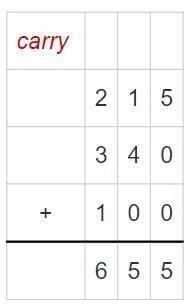
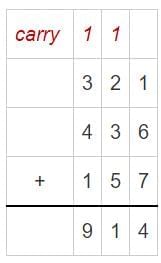
Q1: Arrange in columns and add:
(a) 215, 340 and 100

Ans:

= 215 + 340 + 100 = 650

(b) 321, 436 and 157

= 321 + 436 + 157 = 914

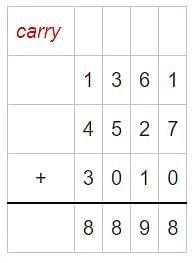
Q2:  Add:

(a) 

Ans: 

(b) 

Ans: 

 (c)

Ans: 


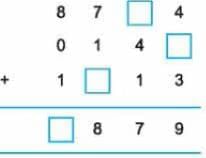
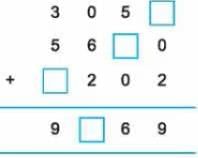
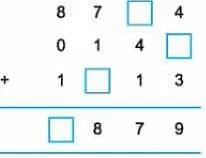
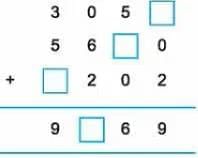
Q3: Fill in thewith the correct digits:

(a) 

(b) 
Ans: (a) The missing numbers are 8724, 0142, 1013.

  • First number = 8724
  • Second number = 0142
  • Third number = 1013
  • Sum = 9879

(b) The missing numbers are 3057, 5610, 1202.

  • First number = 3057
  • Second number = 5610
  • Third number = 1202
  • Sum = 9869

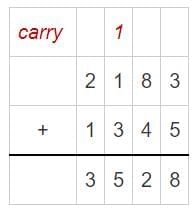
Q4: Monika had Rs 2,183 in her bank account. She again deposited Rs 1,345. What is the amount in Monika’s bank account now?
AnsAmount of money Monika had in the bank = Rs 2,183
Amount Monika deposited in the bank again = Rs 1,345. 

Total amount submitted by Monika = Rs. (2183 + 1345) = Rs. 3528

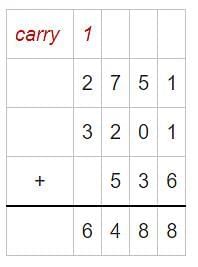
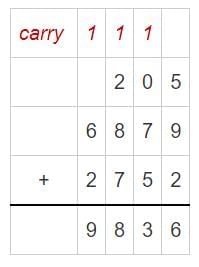
Q5: Arrange in columns and find the sum:
(a) 2,751 + 3,201 + 536
(b) 205 + 6,879 + 2,752
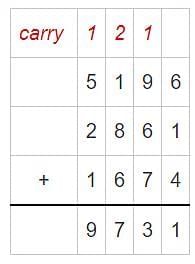
(c) 5196 + 2,861 + 1,674

Ans(a) 2,751 + 3,201 + 536 = 6488

(b) 205 + 6,879 + 2,752 = 9836

(c) 5196 + 2,861 + 1,674 = 9731

Q6: What is 100 more than:

(a) 9,175 + 100 = 9,275
Ans: Start from the hundreds place in 9,175. 
Adding 100 gives:
9,175 + 100 = 9,275.

(b) 7,132 + 100 = 7,232
Ans: Start from the hundreds place in 7,132. 
Adding 100 gives:
7,132 + 100 = 7,232.

(c) 3,721 + 100 = 3,821
Ans: Start from the hundreds place in 3,721. 
Adding 100 gives:
3,721 + 100 = 3,821.

Q7: What is one more than:

(a) 2,738 + 1 = 2,739
Ans: Start from the ones place in 2,738. 
Adding 1 gives:
2,738 + 1 = 2,739.

(b) 8,643 + 1 = 8,644
Ans: Start from the ones place in 8,643. 
Adding 1 gives:
8,643 + 1 = 8,644.

Q8: Fill in the blanks:
(a) ______+ 2,432 = 2,432 + ______= 2,432
(b) 1,937 + 3,132 = 3,132 + ______.
Ans:
(a) 0 + 2,432 = 2,432 + = 2,432 (Since zero added to any number is the number itself)
(b) 1,937 + 3,132 = 3,132 + 1937  (By using the commutative property of addition which  is a fundamental property in maths that states that the order in which you add two numbers does not affect the sum.)

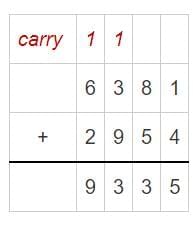
Q9: In an examination, 6,381 boys and 2,954 girls appeared. How many students in all appeared for the examination?
AnsNumber of boys who appeared for exam = 6381
Number of girls who appeared for exam = 2954

Total number of students = 9335


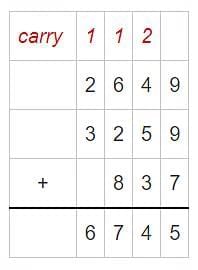
Q10: At a meeting addressed by a political leader, there were 2,649 men 3,259 women and 837 children. How many people were present at the meeting?
AnsNumber of men = 2649
Number of women = 3259
Number of children = 837
Total number of people at the meeting = 2649  + 3259 + 837

Therefore, total number of people present in the meeting = 6745
Q11: Subtract:

(a) 
(b) 
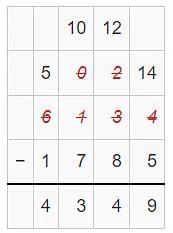
Ans: (a)  400 – 321 = 79
(b) 591 – 360 = 231

Q12: Find the difference between : 
(
a) 153 and 256
(b) 781 and 651

Ans:
(a) 153 and 256 = 256 – 153 = 103
(b) 781 and 651 = 781 – 651 = 130

Q13: Fill in the boxes:
(a) 

Ans

  • Top number = 8617
  • Bottom number = 4223
  • Result = 4394

(b) 

Ans: 

  • Top number = 6328
  • Bottom number = 2725
  • Result = 3603

Q14: Fill in the blanks:
(a) 6,821 – 10 = ______.
(b) 491 – 10 = ______.
(c) 9,386- 100  ______.
Ans:

(a) 6,821 – 10 = 6,811.
(b) 491 – 10 = 481.
(c) 9,386- 100  = 9,286.

Q15: In the year 2010, a poultry farm produced 6,134 eggs. In 2011, it produced 1,785 eggs less than that in 2010. How many eggs were produced in 2011?
Ans: Number of eggs produced by poultry farm in 2010 = 6134
Number of eggs produced in 2011 = Number of eggs produced in 2010 = 6134 – 1785
Therefore, Eggs produced in 2011 = 4349


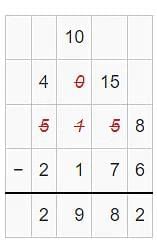
Q16: What must be added to 2,176 to get 5, 158?
AnsTo know which number should be added to 2176 to get 5158, we have to subtract the two numbers = 5158 – 2176 = 2982 should be added to 2176 to get 5158
Q17: In an examination, 8380 candidates appeared. Out of these, 4,090 candidates failed. How many candidates passed?
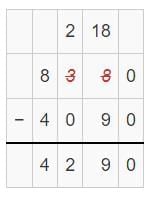
AnsNumber of candidates appeared = 8380
Number of candidates failed = 4090
Number of candidates passed = 8380 – 4090 = 4290


Q18: Last year, a cycle factory produced 8,319 cycles. This year the production came down by 5, 761 cycles. What is the production this year?
AnsLast year, a cycle factory produced = 8319
This year a cycle factory produced less by = 5761
The production this year = 2558 cycles

Q19: To find the difference between two numbers, we always subtract the ______ number from the ______ number.

AnsTo find the difference between two numbers, we always subtract the greater number from the smaller number.

Q20: I am a 5 digit number. My tens digit is 2. My ones and hundreds digit is twice the tens digit. My thousands digit is one subtracted from the product of the ones and tens digit. My ten thousands digit is the difference between the thousands and the tens digit. What number am ‘I’?

Ans: Tens digit = 2
∴ Ones digit = 2×2=4
Hundreds digit = 2×2=4
Thousands digit = (2×4) – 1= 7
Ten thousand digit = 7-2 = 5
∴ The number is
TTh Th H T O
5 7 4 2 4

04. Worksheet: We the Travellers—II

Q1: Arrange in columns and add:
(a) 215, 340 and 100
(b) 321, 436 and 157
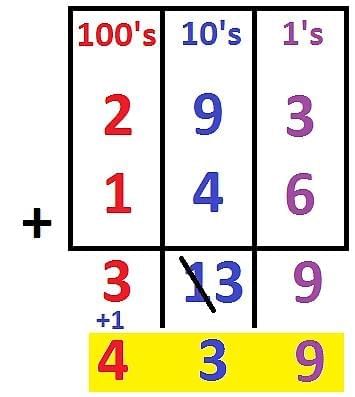
You can take the help of this example to solve the above questions:
Addition of 293 and 146:  

Worksheet: We the Travellers—IIQ2:  Add:
(a) 
(b)  
(c)

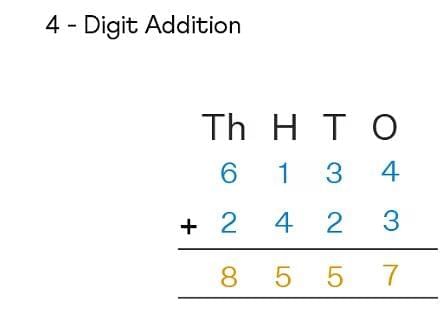
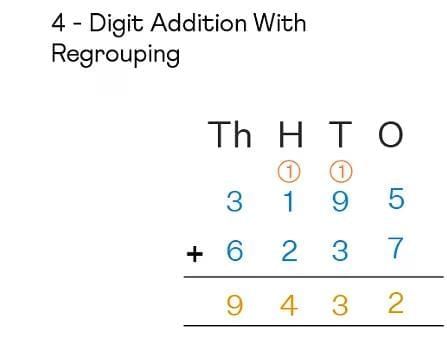
You can take the help of this example to solve the above questions:
Addition of 6134 and 2423: Worksheet: We the Travellers—II

Q3: Fill in theWorksheet: We the Travellers—IIwith the correct digits:

(a) Worksheet: We the Travellers—II

(b) Worksheet: We the Travellers—IIYou can take the help of this example to solve the above questions:
Addition of 6134 and 2423:

Q4: Monika had Rs 2,183 in her bank account. She again deposited Rs 1,345. What is the amount in Monika’s bank account now?

Q5: Arrange in columns and find the sum:
(a)
 2,751 + 3,201 + 536
(b) 205 + 6,879 + 2,752
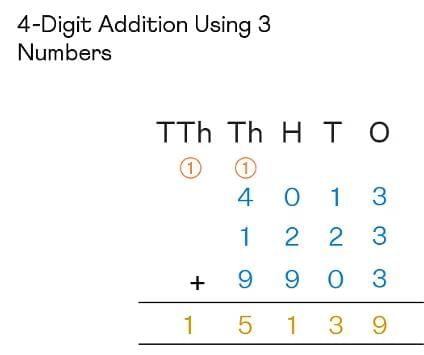
(c) 5196 + 2,861 + 1,674
You can take the help of this example to solve the above questions:

Worksheet: We the Travellers—II

Worksheet: We the Travellers—IIQ6: What is 100 more than:
(a) 9,175 ______.
(b) 7,132 ______.
(c) 3,721 ______.

Q7: What is one more than:
(a) 2,738 ______.
(b) 8,643 ______.

Q8: Fill in the blanks:
(a)
 ______+ 2,432 = 2,432 + ______= 2,432
(b)
 1,937 + 3,132 = 3,132 + ______.

Q9: In an examination 6,381 boys and 2,954 girls appeared. How many students in all appeared for the examination?

Q10: At a meeting addressed by a political leader, there were 2,649 men 3,259 women and 837 children. How many people were present at the meeting?

Q11: Subtract:
(a) 
(b) 

Q12: Find the difference between :
(a)
 153 and 256
(b) 781 and 651

Q13: Fill in the boxes:
(a) 

(b) 

Q14: Fill in the blanks:
(a) 
6,821 – 10 = ______.
(b) 491 – 10 = ______.
(c) 9,386- 100  ______.

Q15: In year 2010, a poultry farm produced 6,134 eggs. In 2011, it produced 1,785 eggs less than that in 2010. How many eggs were produced in 2011?

Q16: What must be added to 2,176 to get 5, 158?

Q17: In an examination 8,380 candidates appeared. Out of these, 4,090 candidates failed. How many candidates passed?

Q18: Last year, a cycle factory produced 8,319 cycles. This year the production came down by 5, 761 cycles. What is the production this year?

Worksheet: We the Travellers—II

Q19: To find the difference between two numbers, we always subtract the ______ number from the ______ number.

Q20: I am a 5-digit number. My tens digit is 2. My ones and hundreds digit is twice the tens digit. My thousands digit is one subtracted from the product of the ones and tens digit. My ten thousand digit is the difference between the thousands and the tens digit. What number am ‘I’?

03. Worksheet (Solutions): Angles as Turns

Q1: A full turn is equal to how many degrees?
​(a) 90°
(b) 180°
(c) 270°
(d) 360°
Ans: (d)

Q2: Two half turns in the same direction are equal to:
(a) A quarter turn
(b) A full turn
(c) Three-quarter turn
(d) No turn
Ans: (b)

Q3: How many quarter turns make a full turn?
(a) 2
(b) 3
(c) 4
(d) 6
Ans: (c)

Q4: How many degrees are in one quarter turn?
(a) 45°
(b) 60°
(c) 90°
(d) 120°
Ans: (c)

Q5: A reflex angle is always:
(a) 
Less than 90°
(b) Between 90° and 180°
(c) Between 180° and 360°
(d) Equal to 90°
Ans: (c)

Q6: For each arrow turn, guess the size in degrees and state the type. 

(a) 1 quarter turn clockwise → ______ ° → type: __________

(b) 3 quarter turns anti‑clockwise → ______ ° → type: __________

(c) 1/2 of a full turn → ______ ° → type: __________

(d) 2/3 of a full turn  → ______ ° → type: __________

(a) 1 quarter turn clockwise
= 90°
→ type: Right angle

(b) 3 quarter turns anti-clockwise
= 3 × 90° = 270°
→ type: Reflex angle (since it’s more than 180° but less than 360°)

(c) 1/2 of a full turn
= 360° ÷ 2 = 180°
→ type: Straight angle

(d) 2/3 of a full turn
= (2/3) × 360° = 240°
→ type: Reflex angle

Q7: A robot starts facing East. It makes the following sequence of turns:

  • 1 quarter turn clockwise,
  • 1 half turn anti‑clockwise,
  • 3 quarter turns clockwise.

(a) What direction is it facing now? __________
(b) What is the net turn (in degrees) relative to the start? __________°

Ans: 

Start: Facing East.

  1. 1 quarter turn clockwise → from East → South.
  2. 1 half turn anti-clockwise → from South → turn 180° left → North.
  3. 3 quarter turns clockwise → 270° right from North → West.

So final direction = West.

Now, net turn relative to start (East):

  • East → West is a 180° turn.
  • Since the robot ended up on the opposite side of its start, the net turn is ±180°.
  • Conventionally, we write it as −180° (anticlockwise) or +180° (clockwise)

Final answers (a) West
(b) Net 180°

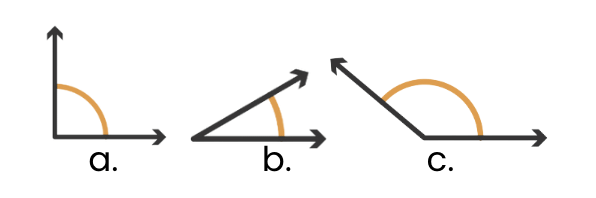
Q8: Identify the type of angles given below: 

Ans: 

a. Right Angle 

b. Acute Angle 

c. Obtuse Angle

Q9. Draw angles with the following degree measures:

a. 60°

b. 45°

c. 180°

Ans:

 a.b.c.

Q10: Draw The following angles 

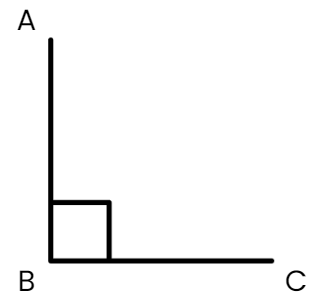
(a) a right angle and label it as ∠ABC.
Ans: 

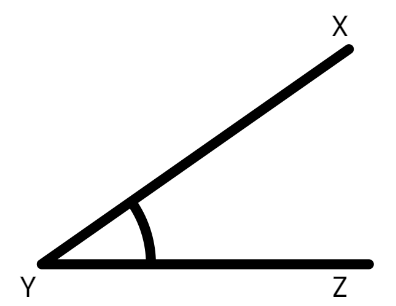
(b) an acute angle and label it as ∠XYZ.
Ans: 

(c) a straight angle and label it as ∠PQR.
Ans: 

03. Worksheet: Angles as Turns

Q1: A full turn is equal to how many degrees?
​(a) 90°
(b) 180°
(c) 270°
(d) 360°

Q2: Two half turns in the same direction are equal to:
(a) A quarter turn
(b) A full turn
(c) Three-quarter turn
(d) No turn

Q3: How many quarter turns make a full turn?
(a) 2
(b) 3
(c) 4
(d) 6

Q4: How many degrees are in one quarter turn?
(a) 45°
(b) 60°
(c) 90°
(d) 120°

Q5: A reflex angle is always:
(a) 
Less than 90°
(b) Between 90° and 180°
(c) Between 180° and 360°
(d) Equal to 90°

Q6: For each arrow turn, guess the size in degrees and state the type. 

(a) 1 quarter turn clockwise → ______ ° → type: __________

(b) 3 quarter turns anti‑clockwise → ______ ° → type: __________

(c) 1/2 of a full turn → ______ ° → type: __________

(d) 2/3 of a full turn  → ______ ° → type: __________

Q7: A robot starts facing East. It makes the following sequence of turns:

  • 1 quarter turn clockwise,
  • 1 half turn anti‑clockwise,
  • 3 quarter turns clockwise.

(a) What direction is it facing now? __________
(b) What is the net turn (in degrees) relative to the start? __________°

Q8: Identify the type of angles given below: 

Worksheet: Angles as Turns

Q9. Draw angles with the following degree measures:

a. 60°

b. 45°

c. 180°

Q10: Draw the following angles:

(a) a right angle and label it as ∠ABC.

(b) an acute angle and label it as ∠XYZ.

(c) a straight angle and label it as ∠PQR.