02. Arithmetic Expressions Chapter Solution

Page No. 24 

Simple Expressions

Q: Choose your favourite number and write as many expressions as you can having that value.
Ans: Let’s choose the number 12. Expressions with the value 12 are:

  • 10 + 2
  • 15 – 3
  • 3 × 4
  • 24 ÷ 2

Page No. 25 

Figure it Out

Q1: Fill in the blanks to make the expressions equal on both sides of the = sign:
(a) 13 + 4 = ______ + 6
Ans: 13 + 4 = 17, so 11 + 6 = 17. The blank is 11.

(b) 22 + ______ = 6 × 5
Ans: 6 × 5 = 30, so 22 + 8 = 30. The blank is 8.

(c) 8 × ______ = 64 ÷ 2
Ans: 64 ÷ 2 = 32, so 8 × 4 = 32. The blank is 4.

(d) 34 – ______ = 25
Ans: 34 – 9 = 25. The blank is 9.

Q2: Arrange the following expressions in ascending (increasing) order of their values.
(a) 67 – 19
(b) 67 – 20
(c) 35 + 25
(d) 5 × 11
(e) 120 ÷ 3
Ans: Calculate each expression:

  • 67 – 19 = 48
  • 67 – 20 = 47
  • 35 + 25 = 60
  • 5 × 11 = 55
  • 120 ÷ 3 = 40

Ascending order: 40 < 47 < 48 < 55 < 60
So, the order is: 120 ÷ 3 < 67 – 20 < 67 – 19 < 5 × 11 < 35 + 25.


Q3: Which is greater? 1023 + 125 or 1022 + 128?
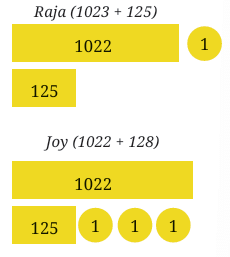
Imagining a situation could help us answer this without finding the values. Raja had 1023 marbles and got 125 more today. Now he has 1023 + 125 marbles. Joy had 1022 marbles and got 128 more today. Now he has 1022 + 128 marbles.  Who has more?
Ans: Raja had 1023 marbles and got 125 more (1023 + 125). Joy had 1022 marbles and got 128 more (1022 + 128). 
Raja started with 1 more marble than Joy, but Joy got 3 more marbles than Raja today. 
So, Joy has 2 more marbles. Therefore, 1023 + 125 < 1022 + 128.


Q4: Which is greater? 113 – 25 or 112 – 24?
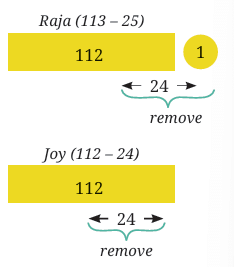
Imagine a situation, Raja had 113 marbles and lost 25 of them. He has 113 – 25 marbles. Joy had 112 marbles and lost 24 today. He has 112 – 24 marbles. Who has more marbles left with them? Raja had 1 marble more than Joy. But he also lost 1 marble more than Joy did. Therefore, they have an equal number of marbles now. That is, 
Ans: Raja had 113 marbles and lost 25 (113 – 25). Joy had 112 marbles and lost 24 (112 – 24). 
Raja started with 1 more marble but lost 1 more than Joy. 
So, they have the same number of marbles now. Therefore, 113 – 25 = 112 – 24.

Page No. 26 
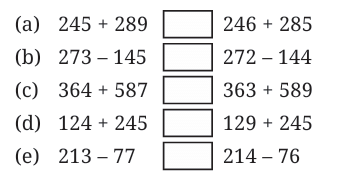
Q1: Use ‘>’ or ‘<’ or ‘=’ in each of the following expressions to compare them. Can you do it without complicated calculations? Explain your thinking in each case.

Ans:

(a) 245 + 289 > 246 + 285

(b) 273 − 144 = 272 − 144

(c) 364 + 587 < 363 + 589

(d) 124 + 245 < 129 + 245

(e) 213 − 77 < 214 − 76

Page No. 28 

Terms in Expressions
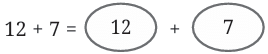
Suppose we have the expression 30 + 5 × 4 without any brackets. Does it have no meaning? When there are expressions having multiple operations, and the order of operations is not specified by the brackets, we use the notion of terms to determine the order. Terms are the parts of an expression separated by a ‘+’ sign. For example, in 12+7, the terms are 12 and 7, as marked below.

We will keep marking each term of an expression as above. Note that this way of marking the terms is not a usual practice. This will be done until you become familiar with this concept. Now, what are the terms in 83 – 14? We know that subtracting a number is the same as adding the inverse of the number. Recall that the inverse of a given number has the sign opposite to it. For example, the inverse of 14 is –14, and the inverse of –14 is 14. Thus, subtracting 14 from 83 is the same as adding –14 to 83. That is,

Thus, the terms of the expression 83 – 14 are 83 and –14.

Q1: Check if replacing subtraction by addition in this way does not change the value of the expression, by taking different examples.
Ans: Subtraction can be written as adding the inverse. For example:

  • 83 – 14 = 83 + (-14). Calculate: 83 – 14 = 69, and 83 + (-14) = 69.
  • 20 – 5 = 20 + (-5). Calculate: 20 – 5 = 15, and 20 + (-5) = 15.
    In both cases, the value remains the same.

Q2: Can you explain why subtracting a number is the same as adding its inverse, using the Token Model of integers that we saw in the Class 6 textbook of mathematics?
Ans:  In the Token Model of integers:

  • positive token represents +1
  • negative token represents -1

When we subtract a number, it means we are removing that many positive tokens.
But removing positive tokens is the same as adding negative tokens of the same value.

Example:
Let’s take the expression: 5 – 3

  • Start with 5 positive tokens: +1 +1 +1 +1 +1
  • Subtract 3 means removing 3 positive tokens:
    Remove +1 +1 +1
  • We are left with: +1 +1 → which is 2

Now, look at the expression: 5 + (-3)

  • Start with 5 positive tokens: +1 +1 +1 +1 +1
  • Add 3 negative tokens: -1 -1 -1
  • Combine them: (+1 and -1 cancel each other)
    So 3 positive and 3 negative tokens cancel out
  • Left with: +1 +1 → which is 2

Conclusion:
Subtracting a number is the same as adding its inverse (opposite).
That’s why:
5 – 3 = 5 + (-3) → both give the same result.

Page No. 29 & 30 

Swapping and GroupingQ1: In the following table, some expressions are given. Complete the table.
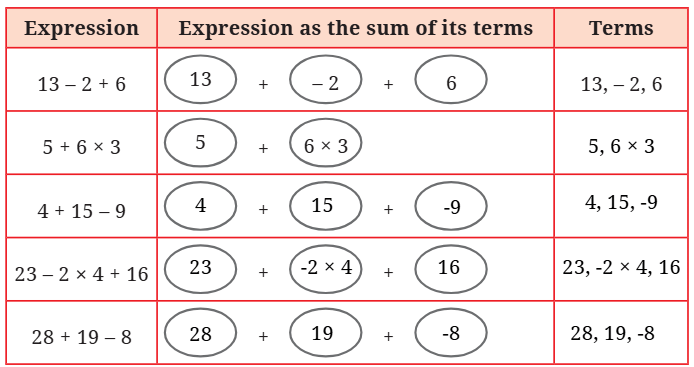
Ans:

Q2: Does changing the order in which the terms are added give different values?
Ans: No, changing the order of addition does not change the value. For example, 6 + (-4) = 2, and (-4) + 6 = 2. 
This is due to the commutative property of addition.

Q3: Will this also hold when there are terms having negative numbers as well? Take some more expressions and check. 
Ans: Yes, it holds. For example:

  • (-5) + 7 = 2, and 7 + (-5) = 2.
  • (-3) + (-2) = -5, and (-2) + (-3) = -5.
    Swapping terms does not change the value.

Q4: Can you explain why this is happening using the Token Model of integers that we saw in the Class 6 textbook of mathematics?
Ans: In the Token Model of integers:

  • positive token means +1
  • negative token means –1
  • When a positive token and a negative token are put together, they cancel each other (because +1 and -1 = 0)

Let’s understand this with an example:

Suppose you start with 0 tokens.

Now if you add 5 negative tokens (–5) and 5 positive tokens (+5):

  • You now have:
    +1 +1 +1 +1 +1
    -1 -1 -1 -1 -1
  • Pair each positive token with a negative token:
    (+1, -1), (+1, -1), (+1, -1), (+1, -1), (+1, -1)
  • Each pair cancels out to 0.

So, in the end, you are left with 0 again.

Why this is important:
This shows how positive and negative numbers balance each other.
Whenever you add or subtract, the total depends on how many positive or negative tokens you finally have.

For example:

  • 3 – 5
    = 3 positive tokens and 5 negative tokens
    = (+1 +1 +1) and (–1 –1 –1 –1 –1)
    Cancel 3 pairs → Left with (–1 –1)
    So, 3 – 5 = -2

This is why subtraction with integers can give negative answers, and the Token Model helps us see this clearly.

Page No. 31 & 32

Q5: Does adding the terms of an expression in any order give the same value? Take some more expressions and check. Consider expressions with more than 3 terms also.
Ans: Yes, adding the terms of an expression in any order gives the same value. This is because addition is commutative and associative, which means:

  • Commutative: Changing the order of numbers doesn’t change the sum.
    (Example: 4 + 5 = 5 + 4 = 9)
  • Associative: Grouping numbers differently doesn’t change the sum.
    (Example: (2 + 3) + 4 = 2 + (3 + 4) = 9)

Let’s check with more terms:

Example 1:
7 + (-2) + 5 + (-3)

Try adding in different orders:

  • (7 + 5) + (-2) + (-3) = 12 – 2 – 3 = 7
  • 7 + (-2) + (-3) + 5 = 7 – 2 – 3 + 5 = 7
  • (-2 + 5) + (-3 + 7) = 3 + 4 = 7

All give the same result.

Q6: Can you explain why this is happening using the Token Model of   integers that we saw in the Class 6 textbook of mathematics? 

Ans: In the Token Model:

  • Positive numbers are shown as positive tokens (+1 each)
  • Negative numbers are shown as negative tokens (–1 each)
  • positive token and a negative token together cancel out (because +1 + (–1) = 0)

When adding integers:

  • You’re simply collecting tokens from all terms
  • You can collect them in any order — the total number of positive and negative tokens stays the same
  • So the final result remains the same, no matter how you arrange the terms.

Therefore, the addition of terms in any order gives the same value.

Q7: Manasa is adding a long list of numbers. It took her five minutes to add them all and she got the answer 11749. Then she realised that she had forgotten to include the fourth number 9055. Does she have to start all over again?
Ans: No, she doesn’t need to start over. 
She can add 9055 to 11749: 11749 + 9055 = 20804. 
This is because addition is commutative and associative.

Page no. 32

Example 7: Amu, Charan, Madhu, and John went to a hotel and ordered four dosas. Each dosa cost ₹23, and they wish to thank the waiter by tipping ₹5. Write an expression describing the total cost. 

Ans: Cost of 4 dosas = 4 × 23          

 Can the total amount with tip be written as 4 × 23 + 5? Evaluating it, we get

Thus, 4 × 23 + 5 is a correct way of writing the expression.

Q: If the total number of friends goes up to 7 and the tip remains the same, how much will they have to pay? Write an expression for this situation and identify its terms.
Ans: Cost of 7 dosas = 7 × 23. Total cost with tip = 7 × 23 + 5.
Terms: 7 × 23, 5.
Evaluate: 7 × 23 = 161, 161 + 5 = 166. They pay ₹166.

The terms in the expression 7 × 23 + 5 are 7 × 23, 5.

Example 8: Children in a class are playing “Fire in the mountain, run, run, run!”. Whenever the teacher calls out a number, students are supposed to arrange themselves in groups of that number. Whoever is not part of the announced group size, is out. Ruby wanted to rest and sat on one side. The other 33 students were playing the game in the class. The teacher called out ‘5’. Once children settled, 
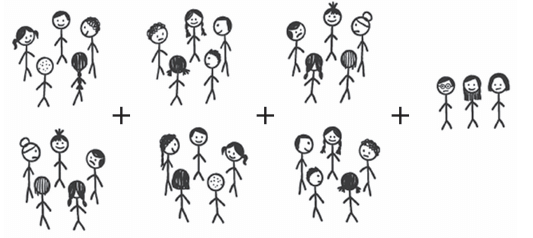
Ruby wrote 6 × 5 + 3 (understood as 3 more than 6 × 5)
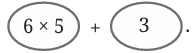
Q: Think and discuss why she wrote this. The expression written as a sum of terms is— 

Ans:  Ruby observed what happened in the game:

  • The children had to form groups of 5.
  • She noticed that there were 6 full groups of 5 students each.
    • That makes 6 × 5 = 30 students.
  • But the total number of children playing was 33.
  • So, 3 children were left out who could not fit into a full group of 5.

Therefore, Ruby wrote:
6 × 5 + 3,
which means:

  • 30 students are in complete groups (6 groups of 5),
  • and 3 students are left out.

Final Expression:

6 × 5 + 3 — written as a sum of terms:

(6 × 5) + 3

Page No. 33

Q1: For each of the cases below, write the expression and identify its terms: 
If the teacher had called out ‘4’, Ruby would write ____________ 
If the teacher had called out ‘7’, Ruby would write ____________ 
Write expressions like the above for your class size.
Ans: 

  • For 4: 33 ÷ 4 = 8 groups of 4 with 1 left (33 – 32 = 1). 
    If the teacher had called out ‘4’, Ruby would write
    Expression: 8 × 4 + 1. 
    Terms: 8 × 4, 1.
  • For 7: 33 ÷ 7 = 4 groups of 7 with 5 left (33 – 28 = 5). 
    If the teacher had called out ‘4’, Ruby would write
     Expression: 4 × 7 + 5. 
    Terms: 4 × 7, 5.
  • For a class of 30: For 5, 30 ÷ 5 = 6 groups. 
    If the teacher had called out ‘4’, Ruby would write 
    Expression: 6 × 5. 
    Terms: 6 × 5.

Q2: Identify the terms in the two expressions for ₹432.
Ans:

  • 432 = 4 × 100 + 1 × 20 + 1 × 10 + 2 × 1. Terms: 4 × 100, 1 × 20, 1 × 10, 2 × 1.
  • 432 = 8 × 50 + 1 × 10 + 4 × 5 + 2 × 1. Terms: 8 × 50, 1 × 10, 4 × 5, 2 × 1.

Q3: Can you think of some more ways of giving ₹432 to someone?
Ans: Some more ways to gave ₹432 to someone are as follows:

  • 4 × 100 + 3 × 10 + 2 × 1 = 400 + 30 + 2 = 432. 
    Terms: 4 × 100, 3 × 10, 2 × 1.
  • 2 × 100 + 4 × 50 + 3 × 10 + 2 × 1 = 200 + 200 + 30 + 2 = 432. 
    Terms: 2 × 100, 4 × 50, 3 × 10, 2 × 1.

Page No. 34 

Q1: What is the expression for the arrangement in the right making use of the number of yellow and blue squares?
Ans: 
The right arrangement has 2 groups of (5 yellow + 3 blue). Expression: 2 × (5 + 3).
Other forms: 5 + 3 + 5 + 3 or 5 × 2 + 3 × 2.

Figure it Out

Q1: Find the values of the following expressions by writing the terms in each case.
(a) 28 – 7 + 8
Ans: Terms: 28, -7, 8. 
Expression: 28 + (-7) + 8 = 21 + 8 = 29.

(b) 39 – 2 × 6 + 11
Ans: Terms: 39, -2 × 6, 11. 
Expression: 39 + (-2 × 6) + 11 = 39 – 12 + 11 = 38.

(c) 40 – 10 + 10 + 10
Ans: Terms: 40, -10, 10, 10. 
Expression: 40 + (-10) + 10 + 10 = 30 + 10 + 10 = 50.

(d) 48 – 10 × 2 + 16 ÷ 2
Ans: Terms: 48, -10 × 2, 16 ÷ 2. 
Expression: 48 + (-10 × 2) + (16 ÷ 2) = 48 – 20 + 8 = 36.

(e) 6 × 3 – 4 × 8 × 5
Ans: Terms: 6 × 3, -4 × 8 × 5. 
Expression: 6 × 3 + (-4 × 8 × 5) = 18 – 160 = -142.


Q2: Write a story/situation for each of the following expressions and find their values.
(a) 89 + 21 – 10
Ans: Story: Ria had 89 candies, got 21 more, and gave 10 to her friend. How many candies does she have now?
Value: 89 + 21 – 10 = 100.

(b) 5 × 12 – 6
Ans: Story: A shop sells 5 packs of 12 pencils each but removes 6 defective ones. How many pencils are left?
Value: 5 × 12 – 6 = 60 – 6 = 54.

(c) 4 × 9 + 2 × 6
Ans: Story: A family buys 4 pizzas costing ₹9 each and 2 drinks costing ₹6 each. What is the total cost?
Value: 4 × 9 + 2 × 6 = 36 + 12 = 48.


Q3: For each of the following situations, write the expression describing the situation, identify its terms and find the value of the expression.
(a) Queen Alia gave 100 gold coins to Princess Elsa and 100 gold coins to Princess Anna last year. Princess Elsa used the coins to start a business and doubled her coins. Princess Anna bought jewellery and has only half of the coins left. Write an expression describing how many gold coins Princess Elsa and Princess Anna together have.
Ans: Elsa’s coins: 2 × 100. Anna’s coins: 100 ÷ 2. 
Expression: 2 × 100 + 100 ÷ 2.
Terms: 2 × 100, 100 ÷ 2.
Value: 2 × 100 + 100 ÷ 2 = 200 + 50 = 250 coins.

(b) A metro train ticket between two stations is ₹40 for an adult and ₹20 for a child. What is the total cost of tickets:
(i) for four adults and three children?
Ans: Expression: 4 × 40 + 3 × 20. Terms: 4 × 40, 3 × 20.
Value: 4 × 40 + 3 × 20 = 160 + 60 = 220. Total cost is ₹220.

(ii) for two groups having three adults each?
Ans: Expression: 2 × (3 × 40). Terms: 2 × (3 × 40).
Value: 2 × (3 × 40) = 2 × 120 = 240. Total cost is ₹240.
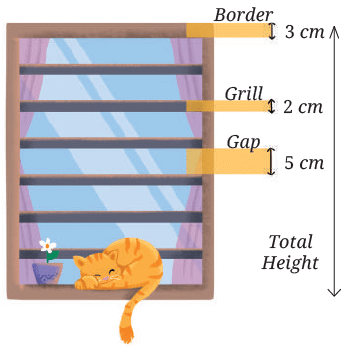
(c) Find the total height of the window by writing an expression describing the relationship among the measurements shown in the picture.
Ans:  Total height of the window is as follows: 
Expression: 5 X 7 + 2 X 6 + 3 X 2
Terms: 5 X 7, 2 X 6, 3 X 2
Value: 35 + 12 + 6 = 53 cm.

Calculation: 5 X 7 + 2 X 6 + 3 X 2 = 35 + 12 + 6 = 53 cm 

Page No. 37, 38 & 39 

Tinker the Terms I
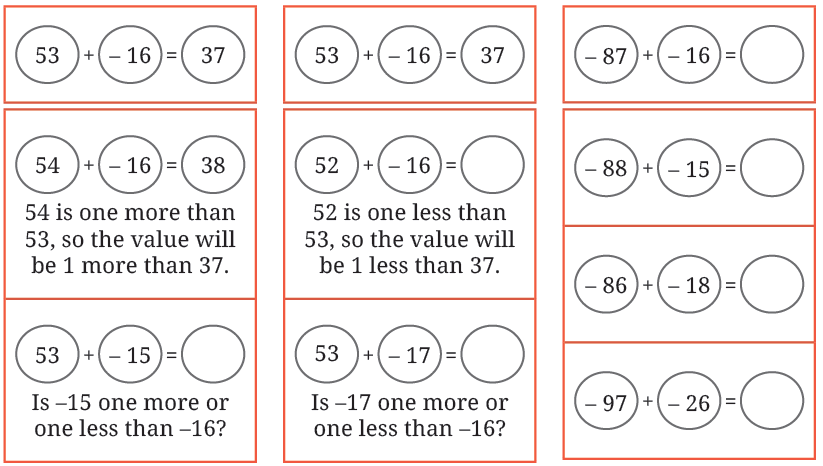
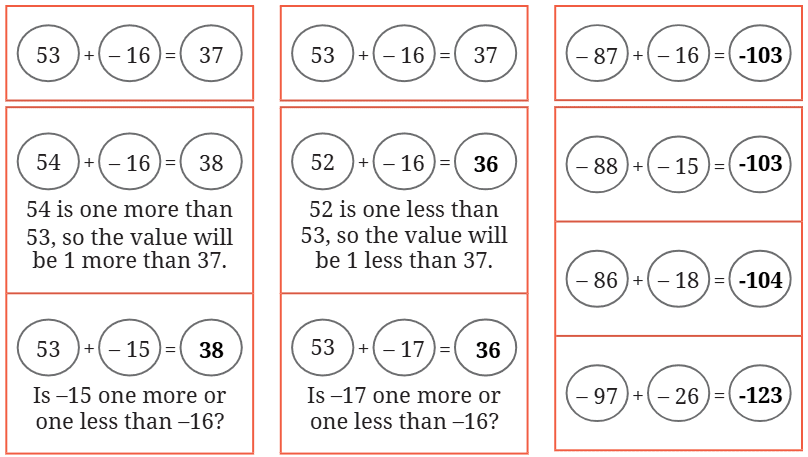
What happens to the value of an expression if we increase or decrease the value of one of its terms? Some expressions are given in following three columns. In each column, one or more terms are changed from the first expression. Go through the example (in the first column) and fill the blanks, doing as little computation as possible.
Ans:

Is −15 one more or one less than −16?

Ans: Yes, –15 is one more than
–16, so the value will be 1
more than 37.

Is −17 one more or one less than −16?

Ans: Yes, –17 is one less than
–16, so the value will be 1
less than 37.

Figure it Out

Q1: Fill in the blanks with numbers, and boxes with operation signs such that the expressions on both sides are equal.
(a) 24 + (6 – 4) = 24 + 6____
Ans: 24 + (6 – 4) = 24 + 6 – 4 = 26

(b) 38 + (_____  _____) = 38 + 9 – 4
Ans: 38 + (9 – 4) = 38 + 9 – 4 = 43

(c) 24 – (6 +4) = 246 – 4
Ans: 24 – (6 + 4) = 24 – 6 – 4 = 14

(d) 24 – 6 – 4 = 24 – 6_____
Ans: 24 – 6 – 4 = 24 – 6 – 4 = 14

(e) 27 – (8 + 3) = 278 3
Ans: 27 – (8 + 3) = 27 – 8 – 3 = 16

(f ) 27– (__________) = 27 – 8 + 3
Ans: 27 – (8 – 3) = 27 – 8 + 3 = 22


Q2: Remove the brackets and write the expression having the same value.
(a) 14 + (12 + 10)
Ans: 14 + (12 + 10) = 14 + 12 + 10.

(b) 14 – (12 + 10)
Ans: 14 – (12 + 10) = 14 – 12 – 10.

(c) 14 + (12 – 10)
Ans: 14 + (12 – 10) = 14 + 12 – 10.

(d) 14 – (12 – 10)
Ans: 14 – (12 – 10) = 14 – 12 + 10.

(e) -14 + 12 – 10
Ans: No brackets to remove. Expression: -14 + 12 – 10.

(f) 14 – (-12 – 10)
Ans: 14 – (-12 – 10) = 14 + 12 + 10.


Q3: Find the values of the following expressions. For each pair, first try to guess whether they have the same value. When are the two expressions equal?
(a) (6 + 10) – 2 and 6 + (10 – 2)
Ans: Initial Guess: Different, due to bracket placement.
Values: (6 + 10) – 2 = 16 – 2 = 14,
6 + (10 – 2) = 6 + 8 = 14.
Conclusion: They are equal because (a + b) – c = a + (b – c).

(b) 16 – (8 – 3) and (16 – 8) – 3
Ans: Initial Guess: Different.
Values: 16 – (8 – 3) = 16 – 5 = 11,
 (16 – 8) – 3 = 8 – 3 = 5.
Conclusion: They are not equal.

(c) 27 – (18 + 4) and 27 + (-18 – 4)
Ans: Initial Guess: Same, as – (a + b) = -a – b.
Values: 27 – (18 + 4) = 27 – 22 = 5,
27 + (-18 – 4) = 27 – 18 – 4 = 5.
Conclusion: They are equal.


Q4: In each of the sets of expressions below, identify those that have the same value. Do not evaluate them, but rather use your understanding of terms.
(a) 319 + 537,  319 – 537,  – 537 + 319,  537 – 319
Ans: Identifications as follows:

  • 319 – 537 and –537 + 319 are the same, because changing the order in addition of a negative number results in subtraction.
  • 319 + 537 and 537 – 319 are not the same, but they are both positive.
  • 319 – 537 and –537 + 319 are negative and equal to each other.

The expressions that have the same value are:

  • 319 – 537
  • –537 + 319

(b) 87 + 46 – 109,   87 + 46 – 109,  87 + 46 – 109,  87 – 46 + 109, 87 – (46 + 109), (87 – 46) + 109
Ans: The first three are identical: 87 + 46 – 109.
87 – 46 + 109 = (87 – 46) + 109 (associative).
87 – (46 + 109) = 87 – 46 – 109 (different).
Equal: 87 + 46 – 109 (three times)

Also, 87 – 46 + 109 and (87 – 46) + 109 have the same value.

Q5: Add brackets at appropriate places in the expressions such that they lead to the values indicated.
(a) 34 – 9 + 12 = 13
Ans: To get 13, we need to first subtract 9 from 34, then add 12.
So, (34 – 9) + 12 = 25 + 12 = 37 (not correct).
Instead, try 34 – (9 + 12):
34 – (9 + 12) = 34 – 21 = 13.
So, the expression is 34 – (9 + 12) = 13.

(b) 56 – 14 – 8 = 34 
Ans: To get 34, we need to subtract 14 and 8 from 56 in the correct order.
(56 – 14) – 8 = 42 – 8 = 34.
So, the expression is (56 – 14) – 8 = 34.

(c) –22 – 12 + 10 + 22 = – 22
Ans: To get –22, we need to group the terms carefully.
–22 – (12 + 10) + 22 = –22 – 22 + 22 = –22.
So, the expression is –22 – (12 + 10) + 22 = –22.


Q6: Using only reasoning of how terms change their values, fill the blanks to make the expressions on either side of the equality (=) equal. 
(a) 423 + ______= 419 + ______ 
Ans:
 We need to make both sides equal.
423 + ___ = 419 + ___.
423 is 4 more than 419 (423 – 419 = 4).
So, the number on the right side should be 4 more than the number on the left side.
If we put 0 on the left, then 0 + 4 = 4 on the right.
423 + 0 = 419 + 4.
So, the blanks are 0 and 4.

(b) 207 – 68 = 210 – ______
Ans: We need to make both sides equal.
207 – 68 = 210 – ___.
First, calculate 207 – 68 = 139.
So, 210 – ___ = 139.
210 – 139 = 71.
So, the blank is 71.

Q7: Using the numbers 2, 3 and 5, and the operators ‘+’ and ‘–’, and brackets, as necessary, generate expressions to give as many different values as possible. For example, 2 – 3 + 5 = 4 and 3 – (5 – 2) = 0.
Ans: Let’s use 2, 3, and 5 with + and – to get different values:

  • 2 + 3 + 5 = 10
  • 2 + 3 – 5 = 0
  • 2 – 3 + 5 = 4
  • 2 – (3 + 5) = –6
  • (2 + 3) – 5 = 0
  • 3 – (5 – 2) = 0
  • 5 – (2 + 3) = 0
  • 5 + 3 – 2 = 6

So, the different values are –6, 0, 4, 6, 10.


Q8: Whenever Jasoda has to subtract 9 from a number, she subtracts 10 and adds 1 to it. For example, 36 – 9 = 26 + 1. 
(a) Do you think she always gets the correct answer? Why?

Ans: Yes, Jasoda always gets the correct answer.
Subtracting 10 and adding 1 is the same as subtracting 9 because 10 – 1 = 9.
For example, 36 – 9 = 27.
Jasoda does 36 – 10 + 1 = 26 + 1 = 27, which is correct.

(b) Can you think of other similar strategies? Give some examples.
Ans:
 Yes, we can use other strategies:
Instead of subtracting 9, subtract 8 and subtract 1 more: 36 – 9 = 36 – 8 – 1 = 28 – 1 = 27.
Or, subtract 5 and subtract 4 more: 36 – 9 = 36 – 5 – 4 = 31 – 4 = 27.
Both give the correct answer.


Q9: Consider the two expressions: a) 73 – 14 + 1,  b) 73 – 14 – 1. For each of these expressions, identify the expressions from the following collection that are equal to it. 
(a) 73 – (14 + 1)
Ans: 
73 – (14 + 1) = 73 – 15 = 58.
Expression a) 73 – 14 + 1 = 59 + 1 = 60 (not equal).
Expression b) 73 – 14 – 1 = 59 – 1 = 58 (equal).
So, it matches expression b).

(b) 73 – (14 – 1)
Ans: 73 – (14 – 1) = 73 – 13 = 60.
Expression a) 73 – 14 + 1 = 60 (equal).
Expression b) 73 – 14 – 1 = 58 (not equal).
So, it matches expression a).

(c) 73 + (–14 + 1)
Ans:
 73 + (–14 + 1) = 73 + (–13) = 73 – 13 = 60.
Expression a) 73 – 14 + 1 = 60 (equal).
Expression b) 73 – 14 – 1 = 58 (not equal).
So, it matches expression a).

(d) 73 + (–14 – 1)
Ans:
 73 + (–14 – 1) = 73 + (–15) = 73 – 15 = 58.
Expression a) 73 – 14 + 1 = 60 (not equal).
Expression b) 73 – 14 – 1 = 58 (equal).
So, it matches expression b).

Removing Brackets—II

Example 15: Lhamo and Norbu went to a hotel. Each of them ordered a vegetable cutlet and a rasgulla. A vegetable cutlet costs ₹43 and a rasgulla costs ₹24. Write an expression for the amount they will have to pay.

Ans:  As each of them had one vegetable cutlet and one rasagulla, each of their shares can be represented by 43 + 24.

Q: What about the total amount they have to pay? Can it be described by the expression: 2 × 43 + 24? 
Ans: Each person had 1 vegetable cutlet and 1 rasgulla.
Cost of one vegetable cutlet = ₹43
Cost of one rasgulla = ₹24

So, cost for one person = 43 + 24 = ₹67
There are 2 people, so total cost = 2 × (43 + 24) = 2 × 67 = ₹134

The expression 2 × 43 + 24 is not correct because it only adds the cost of two cutlets and only one rasgulla.
But there are two rasgullas, so we must multiply the total cost of one person’s food by 2.

Correct expression is: 2 × (43 + 24)

Q: If another friend, Sangmu, joins them and orders the same items, what will be the expression for the total amount to be paid?
Ans: Cost of one vegetable cutlet = ₹43
Cost of one rasgulla = ₹24
Total cost for one person = 43 + 24 = ₹67

Now, there are 3 people (Lhamo, Norbu, and Sangmu).
So, the total amount to be paid = 3 × (43 + 24)
= 3 × 67 = ₹201

Expression: 3 × (43 + 24)

Page No. 41 & 42 

Tinker the Terms II

Example 17: Given 53 × 18 = 954. Find out 63 × 18. 

Ans: As 63 × 18 means 63 times 18, 
63 × 18 = (53 + 10) × 18
                  = 53 ×18 + 10×18 
                  = 954 + 180 
                  = 1134.

Q1: Use this method to find the following products:
(a) 95 × 8
Ans: Write 95 as (100 – 5): 100 × 8 = 800
5 × 8 = 40
800 – 40 = 760
So, 95 × 8 = 760.

(b) 104 × 15
Ans: Write 104 as (100 + 4): 100 × 15 = 1500
4 × 15 = 60
1500 + 60 = 1560
So, 104 × 15 = 1560.

(c) 49 × 50
Ans: Write 49 as (50 – 1): 50 × 50 = 2500
1 × 50 = 50
2500 – 50 = 2450
So, 49 × 50 = 2450.


Q2: Is this quicker than the multiplication procedure you use generally?
Ans: Yes, this method can be quicker because it uses easier numbers like 100 or 50 and then adjusts with simple subtraction or addition, instead of doing long multiplication step by step.


Q4: Which other products might be quicker to find like the ones above?
Ans: Products like 98 × 25, 99 × 10, 103 × 15, or 51 × 50 might be quicker because they can be written as (100 – 2) × 25, (100 – 1) × 10, (100 + 3) × 15, or (50 + 1) × 50, and solved using the same easy method.

Figure it Out

Q1: Fill in the blanks with numbers, and boxes by signs, so that the expressions on both sides are equal.
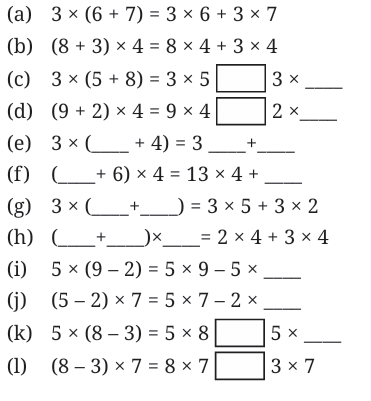
Ans: (a) 3 × (6 + 7) = 3 × 6 + 3 × 7
(b) (8 + 3) × 4 = 8 × 4 + 3 × 4
(c) 3 × (5 + 8) = 3 × 5 + 3 × 8
(d) (9 + 2) × 4 = 9 × 4 + 2 × 4
(e) 3 × (10 + 4) = 30 + 12
(f) (13 + 6) × 4 = 13 × 4 + 24
(g) 3 × (5 + 2) = 3 × 5 + 3 × 2
(h) (2 + 3) × 4 = 2 × 4 + 3 × 4
(i) 5 × (9 – 2) = 5 × 9 – 5 × 2
(j) (5 – 2) × 7 = 5 × 7 – 2 × 7
(k) 5 × (8 – 3) = 5 × 8 – 5 × 3
(l) (8 – 3) × 7 = 8 × 7 – 3 × 7
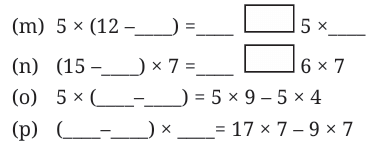
(m) 5 × (12 – 3) = 60 – 5 × 3
(n) (15 – 6) × 7 = 105 – 6 × 7
(o) 5 × (9 – 4) = 5 × 9 – 5 × 4
(p) (17 – 9) × 7 = 17 × 7 – 9 × 7

Q2: In the boxes below, fill ‘<’, ‘>’ or ‘=’ after analysing the expressions on the LHS and RHS. Use reasoning and understanding of terms and brackets to figure this out and not by evaluating the expressions.
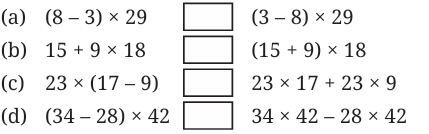
(a) (8 – 3) × 29 ___ (3 – 8) × 29
Ans: >

Explanation:

  • (8 – 3) = 5, so left side is 5 × 29 = 145
  • (3 – 8) = –5, so right side is –5 × 29 = –145
    Since 145 is greater than –145,
    145 > –145 ⇒ So, the answer is: >

(b) 15 + 9 × 18 ___ (15 + 9) × 18
Ans: <

Explanation:

  • Follow BODMAS:
    Left side → 9 × 18 = 162 → 15 + 162 = 177
    Right side → (15 + 9) × 18 = 24 × 18 = 432
    Since 177 < 432,
    So, the answer is: <

(c) 23 × (17 – 9) ___ 23 × 17 + 23 × 9
Ans: =

Explanation:
This shows the distributive property:
23 × (17 – 9) = 23 × 8 = 184
Right side: 23 × 17 = 391, 23 × 9 = 207
391 + 207 = 598
Answer: = So, the answer is: <

(d) (34 – 28) × 42 ___ 34 × 42 – 28 × 42
Ans: =

Explanation:
Left side: (34 – 28) × 42 = 6 × 42 = 252
Right side: 34 × 42 = 1428, 28 × 42 = 1176 → 1428 – 1176 = 252
Both sides are equal.
Answer: =


Q3: Here is one way to make 14: _2_ × ( _1_ + _6_ ) = 14. Are there other ways of getting 14? Fill them out below:
(a) ___ × (___ + ___ ) = 14
Ans:
 7 × (1 + 1) = 14

(b) ___ × (___ + ___ ) = 14
Ans: 
2 × (5 + 2) = 14

(c) ___ × (___ + ___ ) = 14
Ans:
 1 × (10 + 4) = 14

(d) ___ × (___ + ___ ) = 14
Ans:
 14 × (1 + 0) = 14
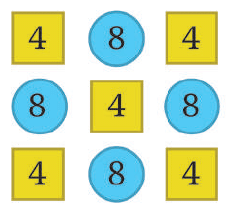

Q4: Find out the sum of the numbers given in each picture below in at least two different ways. Describe how you solved it through expressions.
Ans: Numbers: 4, 8, 4, 8, 4, 8, 4, 8, 4 (in a 3 × 3 grid)
First Way: Add all numbers one by one:
4 + 8 + 4 + 8 + 4 + 8 + 4 + 8 + 4 = 52
Second Way: Count how many 4s and 8s:

  • There are 5 fours: 5 × 4 = 20
  • There are 4 eights: 4 × 8 = 32
    Add them: 20 + 32 = 52

So, the sum is 52.
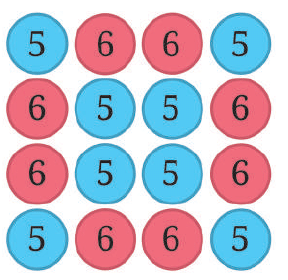
Ans: Numbers: 5, 6, 6, 5, 6, 5, 5, 6, 6, 5, 5, 6, 5, 6, 6, 5 (in a 4 × 4 grid)
First Way: Add all numbers one by one:
5 + 6 + 6 + 5 + 6 + 5 + 5 + 6 + 6 + 5 + 5 + 6 + 5 + 6 + 6 + 5 = 88
Second Way: Count how many 5s and 6s:

  • There are 8 fives: 8 × 5 = 40
  • There are 8 sixes: 8 × 6 = 48
    Add them: 40 + 48 = 88

Figure it Out

Q1: Read the situations given below. Write appropriate expressions for each of them and find their values.
(a) The district market in Begur operates on all seven days of a week. Rahim supplies 9 kg of mangoes each day from his orchard and Shyam supplies 11 kg of mangoes each day from his orchard to this market. Find the amount of mangoes supplied by them in a week to the local district market.
Ans: 

  • Expression for Rahim: 9 kg × 7 days
  • Value for Rahim: 9 × 7 = 63 kg
  • Expression for Shyam: 11 kg × 7 days
  • Value for Shyam: 11 × 7 = 77 kg
  • Total amount: 63 kg + 77 kg = 140 kg

(b) Binu earns ₹20,000 per month. She spends ₹5,000 on rent, ₹5,000 on food, and ₹2,000 on other expenses every month. What is the amount Binu will save by the end of a year?
Ans: 

  • Expression for monthly savings: ₹20,000 – (₹5,000 + ₹5,000 + ₹2,000)
  • Monthly savings: ₹20,000 – ₹12,000 = ₹8,000
  • Expression for yearly savings: ₹8,000 × 12 months
  • Value for yearly savings: ₹8,000 × 12 = ₹96,000

(c) During the daytime a snail climbs 3 cm up a post, and during the night while asleep, accidentally slips down by 2 cm. The post is 10 cm high, and a delicious treat is on its top. In how many days will the snail get the treat?
Ans:  In one day, the snail climbs 3 cm but slips down 2 cm at night.So, net gain in one day = 3 cm – 2 cm = 1 cm.

After 7 days, the snail climbs 7 cm (1 cm per day).
On the 8th day, the snail climbs up 3 cm, reaching from 7 cm to 10 cm.

This time, it reaches the top before slipping down, so it gets the treat.

The snail will get the treat in 8 days.

Q2: Melvin reads a two-page story every day except on Tuesdays and Saturdays. How many stories would he complete reading in 8 weeks? Which of the expressions below describes this scenario?
(a) 5 × 2 × 8
(b) (7 – 2) × 8
(c) 8 × 7
(d) 7 × 2 × 8
(e) 7 × 5 – 2
(f) (7 + 2) × 8
(g) 7 × 8 – 2 × 8
(h) (7 – 5) × 8
Ans: Number of days in a week except Tuesday and Saturday = 7 – 2
Since Melvin reads a two-page story every day except Tuesday and Saturday.
Therefore, number of stories read in a week = 1 × (7 – 2)
So, number of stories read in 8 weeks = 8 × 1 × (7 – 2)
= 8 × (7 – 2) or (7 – 2) × 8 [Expression (b)]
or 7 × 8 – 2 × 8 [Expression (g)]
Only expressions (b) and (g) describe this scenario.


Q3: Find different ways of evaluating the following expressions:
(a) 1 – 2 + 3 – 4 + 5 – 6 + 7 – 8 + 9 – 10
Ans: Way 1: Pair terms: (1 – 2) + (3 – 4) + (5 – 6) + (7 – 8) + (9 – 10) = -1 – 1 – 1 – 1 – 1 = -5.
Way 2: Add sequentially: 1 – 2 = -1, -1 + 3 = 2, 2 – 4 = -2, -2 + 5 = 3, 3 – 6 = -3, -3 + 7 = 4, 4 – 8 = -4, -4 + 9 = 5, 5 – 10 = -5.
Value: -5.

(b) 1 – 1 + 1 – 1 + 1 – 1 + 1 – 1 + 1 – 1
Ans: Way 1: Pair terms: (1 – 1) + (1 – 1) + (1 – 1) + (1 – 1) + (1 – 1) = 0 + 0 + 0 + 0 + 0 = 0.
Way 2: Add sequentially: 1 – 1 = 0, 0 + 1 = 1, 1 – 1 = 0, …, ending at 0.
Value: 0.


Q4: Compare the following pairs of expressions using ‘<‘, ‘>’ or ‘=’ by reasoning.
(a) 49 – 7 + 8 __ 49 – 7 + 8
Ans: Same expression. 
So, 49 – 7 + 8 = 49 – 7 + 8.

(b) 83 × 42 – 18 __ 83 × 40 – 18
Ans: 83 × 42 = 83 × (40 + 2) = 83 × 40 + 83 × 2. 
So, 83 × 42 – 18 > 83 × 40 – 18.

(c) 145 – 17 × 8 __ 145 – 17 × 6
Ans: 17 × 8 = 136, 17 × 6 = 102. 145 – 136 < 145 – 102. 
So, 145 – 17 × 8 < 145 – 17 × 6.

(d) 23 × 48 – 35 __ 23 × (48 – 35)
Ans: 23 × 48 – 35 > 23 × 13 (since 48 > 13). 
So, 23 × 48 – 35 > 23 × (48 – 35).

(e) (16 – 11) × 12 __ -11 × 12 + 16 × 12
Ans: (16 – 11) × 12 = 5 × 12. -11 × 12 + 16 × 12 = (16 – 11) × 12 = 5 × 12. 
So, (16 – 11) × 12 = -11 × 12 + 16 × 12.

(f) (76 – 53) × 88 __ 88 × (53 – 76)
Ans: (76 – 53) = 23, (53 – 76) = -23. 
So, 23 × 88 > -23 × 88. 
Therefore, (76 – 53) × 88 > 88 × (53 – 76).

(g) 25 × (42 + 16) __ 25 × (43 + 15)
Ans: 42 + 16 = 58, 43 + 15 = 58. 
So, 25 × (42 + 16) = 25 × (43 + 15).

(h) 36 × (28 – 16) __ 35 × (27 – 15)
Ans: 28 – 16 = 12, 27 – 15 = 12. 
But 36 > 35. 
So, 36 × (28 – 16) > 35 × (27 – 15).

Page No. 44

Q5: Identify which of the following expressions are equal to the given expression without computation. You may rewrite the expressions using terms or removing brackets. There can be more than one  expression which is equal to the given expression.
(a) 83 –  37 – 12 
(i) 84 – 38 – 12 
(ii) 84 – (37 + 12) 
(iii) 83 – 38 – 13 
(iv) – 37 + 83 –12 
(b) 93 + 37 × 44 + 76 
(i) 37 + 93 × 44 + 76 
(ii) 93 + 37 × 76 + 44 
(iii) (93 + 37) × (44 + 76) 
(iv) 37 × 44 + 93 + 76
Ans: (a) The expressions equal to 83 – 37 – 12 are:
(i) 84 – 38 – 12 (because 84 – 38 = 46 and 46 – 12 = 34, same as 83 – 37 – 12 = 34)
(ii) 84 – (37 + 12) (because 37 + 12 = 49, and 84 – 49 = 35, 
but this is incorrect; correct check: 84 – 49 = 35, not 34, so only (i) and (iv) work)
(iv) –37 + 83 – 12 (because –37 + 83 = 46, and 46 – 12 = 34)
(b) The expressions equal to 93 + 37 × 44 + 76 are:
(iv) 37 × 44 + 93 + 76 (same order of operations)


Q6: Choose a number and create ten different expressions having that value.
Ans: Let’s choose the number 10. Ten different expressions are:

  • 5 + 5
  • 20 – 10
  • 2 × 5
  • 50 ÷ 5
  • 15 – 5
  • 7 + 3
  • 4 × 2 + 2
  • 30 – 20
  • 10 × 1
  • 25 – 15

01. Large Numbers Around Us Chapter Solution

Page No. 2

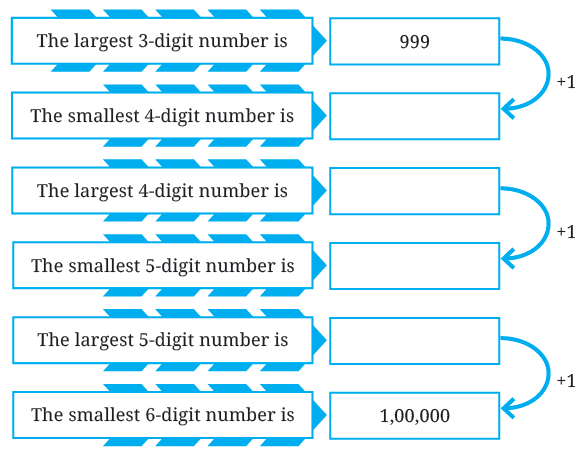
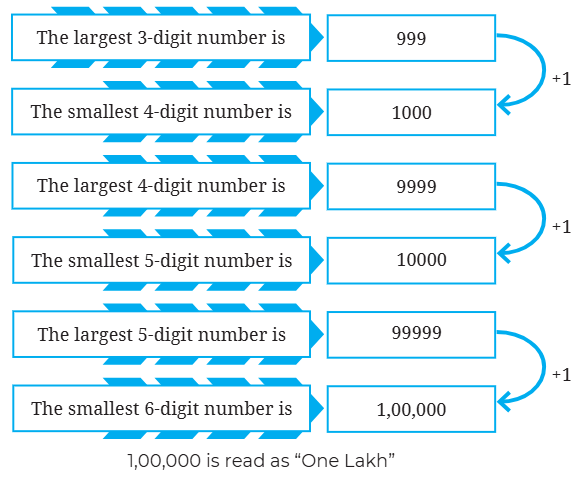
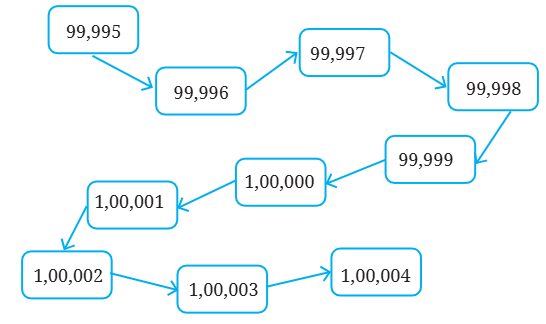
Q: But how much is one lakh? Observe the pattern and fill in the boxes given below.

Ans:

Q1: Roxie suggests, “What if we ate 2 varieties of rice every day? Would we then be able to eat 1 lakh varieties of rice in 100 years?” Will they be able to taste all the lakh varieties in a 100-year lifetime?
Ans: To find out, calculate the number of rice varieties eaten in 100 years.

  • Number of days in a year = 365 (ignoring leap years).
  • Number of days in 100 years = 365 × 100 = 36,500 days.
  • Varieties eaten per day = 2.
  • Total varieties in 100 years = 36,500 × 2 = 73,000.
  • One lakh = 100,000.
    Since 73,000 is less than 100,000, they cannot eat 1 lakh varieties in 100 years.

Q2: What if a person ate 3 varieties of rice every day? Will they be able to taste all the lakh varieties in a 100-year lifetime? Find out.
Ans: Now, calculate for 3 varieties per day.

  • Number of days in 100 years = 365 × 100 = 36,500 days.
  • Varieties eaten per day = 3.
  • Total varieties in 100 years = 36,500 × 3 = 109,500.
  • One lakh = 100,000.
    Since 109,500 is more than 100,000, they can eat 1 lakh varieties in 100 years.

Q3: Choose a number for y. How close to one lakh is the number of days in y years, for the y of your choice?
Ans: To get the number of days in y years, we have 365 × y years.
For 1,00,000 days we have 1,00,000 ÷ 365 ~ 273 years.
Thus, we have 365 × y = 365 × 273 ~ 99645 days (closest to 1 lakh)

Page No. 3 

Figure it Out

Q1: According to the 2011 Census, the population of the town of Chintamani was about 75,000. How much less than one lakh is 75,000?
Ans: One lakh = 1,00,000.
Difference = 1,00,000 – 75,000 = 25,000.
The population is 25,000 less than one lakh.

Q2: The estimated population of Chintamani in the year 2024 is 1,06,000. How much more than one lakh is 1,06,000?
Ans: One lakh = 1,00,000.
Difference = 1,06,000 – 1,00,000 = 6,000.
The population is 6,000 more than one lakh.

Q3: By how much did the population of Chintamani increase from 2011 to 2024?
Ans: Population in 2011 = 75,000. Population in 2024 = 1,06,000.
Increase = 1,06,000 – 75,000 = 31,000.
The population increased by 31,000.

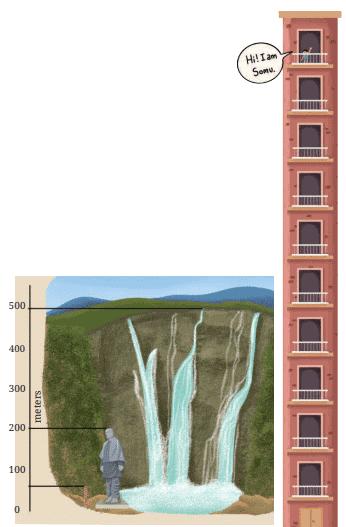
Q: Look at the picture below. Somu is 1 metre tall. If each floor is about four times his height, what is the approximate height of the building?

Ans: Each floor is 4 times Somu’s height. Somu’s height = 1 metre.
So, height of 1 floor = 4 × 1 = 4 metres.
The building has about 10 floors (from the picture).
Height of the building = 4 × 10 = 40 metres.
The approximate height is 40 metres.


Q1: Which is taller — The Statue of Unity or this building? How much taller? ____________m.
Ans: The Statue of Unity is about 180 m
Height of Somu’s building = 40 metres.
The Statue of Unity is taller.
Difference = 180 − 40 = 140 metres.
It is 140 metres taller.


Q2: How much taller is the Kunchikal waterfall than Somu’s building? ___ m.
Ans: Height of the Kunchikal waterfall = about 450 metres.
Height of Somu’s building = 40 metres.
Difference = 450 − 40 = 410 metres.
It is 410 metres taller.


Q3: How many floors should Somu’s building have to be as high as the waterfall? ____________ .
Ans: Height of the Kunchikal waterfall = about 450 metres.
Height of 1 floor = 4 metres.
Number of floors = 450 ÷ 4 = 112.5.
Since we can’t have half a floor, it should have about 113 floors.

Page No. 4 

Reading and Writing Numbers

Q1: How do you view a lakh — is a lakh big or small?
Ans: A lakh (1,00,000) can be seen as both big and small depending on context. It’s big for things like the number of rice varieties (a lot) or days (274 years). It’s small for things like stadium seating (fits in one stadium), humans have (80,000 to 1,20,000) hairs on their tiny head, or fish laying eggs (1000 + at once).  It depends on what you compare it to.

Q2: Write each of the numbers given below in words:
(a) 3,00,600
Ans: Three lakh six hundred.

(b) 5,04,085
Ans: Five lakh four thousand eighty-five.

(c) 27,30,000
Ans: Twenty-seven lakh thirty thousand.

(d) 70,53,138
Ans: Seventy lakh fifty-three thousand one hundred thirty-eight.

Page No. 5 & 6

Q: Write the corresponding number in the Indian place value system for each of the following:
(a) One lakh twenty-three thousand four hundred and fifty-six
Ans: 1,23,456

(b) Four lakh seven thousand seven hundred and four
Ans: 4,07,704

(c) Fifty lakhs five thousand and fifty
Ans: 50,05,050

(d) Ten lakhs two hundred and thirty-five
Ans: 10,00,235

Land of Tens

In the Land of Tens, there are special calculators with special buttons.
Q1: The Thoughtful Thousands only has a +1000 button. How many times should it be pressed to show:
(a) Three thousand?____________?
Ans: 3,000 ÷ 1,000 = 3 times.

(b) 10,000?____________?
Ans: 10,000 ÷ 1,000 = 10 times.

(c) Fifty-three thousand?____________?
Ans: 53,000 ÷ 1,000 = 53 times.

(d) 90,000?____________?
Ans: 90,000 ÷ 1,000 = 90 times.

(e) One Lakh?____________?
Ans: 1,00,000 ÷ 1,000 = 100 times.

(f) ____________? 153 times
Ans: 153 × 1,000 = 1,53,000.

(g) How many thousands are required to make one lakh?
Ans: 1,00,000 ÷ 1,000 = 100 thousands.

Q2: The Tedious Tens only has a +10 button. How many times should it be pressed to show:

(a) Five hundred?_____________
Ans: 500 ÷ 10 = 50 times.

(b) 780?_____________
Ans: 780 ÷ 10 = 78 times.

(c) 1000?_____________
Ans: 1,000 ÷ 10 = 100 times.

(d) 3700?_____________
Ans: 3,700 ÷ 10 = 370 times.

(e) 10,000?_____________
Ans: 10,000 ÷ 10 = 1,000 times.

(f) One lakh?_____________
Ans: 1,00,000 ÷ 10 = 10,000 times.

(g) _____________? 435 times
Ans: 435 × 10 = 4,350.

Q3: The Handy Hundreds only has a +100 button. How many times should it be pressed to show:

(a) Four hundred? ___________ times
Ans: 400 ÷ 100 = 4 times.

(b) 3,700? ___________
Ans: 3,700 ÷ 100 = 37 times.

(c) 10,000? ___________
Ans: 10,000 ÷ 100 = 100 times.

(d) Fifty-three thousand? ___________
Ans: 53,000 ÷ 100 = 530 times.

(e) 90,000? ___________
Ans: 90,000 ÷ 100 = 900 times.

(f) 97,600? ___________
Ans: 97,600 ÷ 100 = 976 times.

(g) 1,00,000? ___________
Ans: 1,00,000 ÷ 100 = 1,000 times.

(h)  ___________? 582 times
Ans: 582 × 100 = 58,200.

(i) How many hundreds are required to make ten thousand?
Ans: 10,000 ÷ 100 = 100 hundreds.

(j) How many hundreds are required to make one lakh?
Ans: 1,00,000 ÷ 100 = 1,000 hundreds.

(k) Handy Hundreds says, “There are some numbers which Tedious Tens and Thoughtful Thousands can’t show but I can.” Is this statement true? Think and explore.
Ans: Yes, the statement is true.

  • Handy Hundreds can show numbers like 100, 200, 300, etc., by pressing the key once for every 100.
  • Tedious Tens can also show these numbers, but it needs more presses. For example, to make 100, we need 10 presses of 10.
  • Thoughtful Thousands cannot show numbers like 100 or 200, because it counts only in multiples of 1000 (like 1000, 2000, 3000…).

So, Handy Hundreds can show some numbers (like 100 or 900) that Thoughtful Thousands cannot, and that Tedious Tens can show but with more effort.


Q4: Find a different way to get 5072 and write an expression for the same.
Ans:  (5 × 1000) + (0 × 100) + (7 × 10) + (2 × 1) = 5072

We break the number based on the place values of each digit:

  • 5 is in the thousands place → 5 × 1000 = 5000
  • 0 is in the hundreds place → 0 × 100 = 0
  • 7 is in the tens place → 7 × 10 = 70
  • 2 is in the ones place → 2 × 1 = 2

Now, add all:
5000 + 0 + 70 + 2 = 5072

Figure it Out

Q: For each number given below, write expressions for at least two different ways to obtain the number through button clicks. Think like Chitti and be creative.
(a) 8300
Ans: Way 1: (8 × 1,000) + (3 × 100) = 8,000 + 300 = 8,300.
Way 2: (83 × 100) = 8,300.

(b) 40629
Ans: Way 1: (4 × 10,000) + (6 × 1,00) + (2 × 10) + (9 × 1) = 40,000 + 6,00 + 20 + 9 = 40,629.
Way 2: (406 × 100) + (29 × 1) = 40,600 + 29 = 40,629.

(c) 56354
Ans: Way 1: (5 × 10,000) + (6 × 1,000) + (3 × 100) + (5 × 10) + (4 × 1) = 50,000 + 6,000 + 300 + 50 + 4 = 56,354.
Way 2: (563 × 100) + (5 × 10) + (4 × 1) = 56,300 + 50 + 4 = 56,354.

(d) 66666
Ans: Way 1: (6 x 10000) + (6 x 1000) + (6 x 100) + (6 x 10) + 6 = 66666
Way 2: 70000 – 3334 = 66666

(e) 367813
Ans:
 Way 1: (3 x 100000) + (6 x 10000) + (7 x 1000) + (8 x 100) + 10 + 3 = 367813
Way 2: 400000 – 32187 = 367813

Page 7 

Q1: Creative Chitti has some questions for you:
(a) You have to make exactly 30 button presses. What is the largest 3-digit number you can make? What is the smallest 3-digit number you can make?
Ans: We can use three types of button presses:

  • +100 adds 100
  • +10 adds 10
  • +1 adds 1
    Each press counts as one button press. Total allowed: 30 presses.

Largest 3-digit number:

To get the largest number, we should use as many +100 presses as possible, followed by +10, then +1.

Let’s press each button 9 times:

  • 9 × +100 = 900
  • 9 × +10 = 90
  • 9 × +1 = 9
    Total = 900 + 90 + 9 = 999

Number of presses used = 9 + 9 + 9 = 27
Remaining 3 presses cannot increase the number without making it a 4-digit number.

✅ Largest 3-digit number = 999

Smallest 3-digit number:

To get the smallest number, we should use:

  • 1 × +100 = 100
    Remaining presses = 29
    Use 29 × +1 = 29
    Total = 100 + 29 = 129

✅ Smallest 3-digit number = 129

(b) 997 can be made using 25 clicks. Can you make 997 with a different number of clicks?
Ans: One way: (9 × 100) + (9 × 10) + (7 × 1) = 900 + 90 + 7 = 997 (25 clicks).
Another way: (99 × 10) + (7 × 1) = 990 + 7 = 997 (106 clicks).
Yes, 997 can be made with a different number of clicks.

Q2: How can we get the numbers (a) 5072, (b) 8300 using as few button clicks as possible?
(a) 5072
Ans: (5 × 1,000) + (7 × 10) + (2 × 1) = 5,000 + 70 + 2 = 5,072 (14 clicks).
This is minimal as each place value uses the largest possible button.

(b) 8300
Ans: (8 × 1,000) + (3 × 100) = 8,000 + 300 = 8,300 (11 clicks).
This is minimal as each place value uses the largest possible button.

Q3: Is there another way to get 5072 using less than 23 button clicks? Write the expression for the same.
Ans: Given method: 23 clicks (not specified).
Minimal method: (5 × 1,000) + (7 × 10) + (2 × 1) = 5,000 + 70 + 2 = 5,072 (14 clicks).
This uses fewer than 23 clicks.

Figure it Out

Q1: For the numbers in the previous exercise, find out how to get each number by making the smallest number of button clicks and write the expression.
Ans: (Already answered in Q2 above for 5072 and 8300. For others from Page 6, Q2):

  • 8300: (8 × 1,000) + (3 × 100) = 8,300
    Clicks: 8 + 3 = 11 clicks.
  • 40629: (4 × 10,000) + (6 × 1,00) + (2 × 10) + (9 × 1) = 40,629
    Clicks: 4 + 6 + 2 + 9 = 21 clicks
  • 56354: (5 × 10,000) + (6 × 1,000) + (3 × 100) + (5 × 10) + (4 × 1) = 56,354
    Clicks: 5 + 6 + 3 + 5 + 4 = 23 clicks.

Q2: Do you see any connection between each number and the corresponding smallest number of button clicks?
Ans: Yes, there is a connection.

Examples:

  • 5072
    Place values: 5 (thousands), 0 (hundreds), 7 (tens), 2 (ones)
    Smallest clicks = 5 (+1000) + 7 (+10) + 2 (+1) = 14 clicks
  • 8300
    Place values: 8 (thousands), 3 (hundreds), 0 (tens), 0 (ones)
    Smallest clicks = 8 (+1000) + 3 (+100) = 11 clicks

Conclusion:
The minimum number of button clicks equals the sum of the digits in the number’s place value form, using the largest possible button for each digit.

Q3: If you notice, the expressions for the least button clicks also give the Indian place value notation of the numbers. Think about why this is so.
Ans: Yes, the expressions for the least button clicks reflect the Indian place value notation because:

  • To minimize button presses, we use the biggest available button for each digit:
    • +1000 for thousands,
    • +100 for hundreds,
    • +10 for tens,
    • +1 for ones.

This is the same as how numbers are written in Indian place value format, where each digit represents a value in its specific place.

Example:

  • 5072 = (5 × +1000) + (0 × +100) + (7 × +10) + (2 × +1)
    This directly shows the Indian place value: 5000 + 70 + 2

Page No. 8 & 9

Q1: How many zeros does a thousand lakh have?
Ans: Thousand lakh = 1,000 × 1,00,000 = 1,00,00,00,000
It has 8 zeros.

Q2: How many zeros does a hundred thousand have?
Ans: Hundred thousand = 1,00,000 (same as 1 lakh).
This has 5 zeros.

Figure it Out

Q1: Read the following numbers in Indian place value notation and write their number names in both the Indian and American systems:
(a) 4050678
Ans: Indian: 40,50,678 → Forty lakh fifty thousand six hundred seventy-eight.
American: 4,050,678 → Four million fifty thousand six hundred seventy-eight.

(b) 48121620
Ans: Indian: 4,81,21,620 → Four crore eighty-one lakh twenty-one thousand six hundred twenty.
American: 48,121,620 → Forty-eight million one hundred twenty-one thousand six hundred twenty.

(c) 20022002
Ans: Indian: 2,00,22,002 → Two crore twenty-two thousand two.
American: 20,022,002 → Twenty million twenty-two thousand two.

(d) 246813579
Ans: Indian: 24,68,13,579 → Twenty-four crore sixty-eight lakh thirteen thousand five hundred seventy-nine.
American: 246,813,579 → Two hundred forty-six million eight hundred thirteen thousand five hundred seventy-nine.

(e) 345000543
Ans: Indian: 34,50,00,543 → Thirty-four crore fifty lakh five hundred forty-three.
American: 345,000,543 → Three hundred forty-five million five hundred forty-three.

(f) 1020304050
Ans: Indian: 1,02,03,04,050 → One Arab two crore three lakh four thousand fifty.
American: 1,020,304,050 → One billion twenty million three hundred four thousand fifty.

Q2: Write the following numbers in Indian place value notation:
(a) One crore one lakh one thousand ten
Ans:
 1,01,01,010

(b) One billion one million one thousand one
Ans:
 1,001,001,001 (1 billion = 100 crore, 1 million = 10 lakh).

(c) Ten crore twenty lakh thirty thousand forty
Ans: 10,20,30,040

(d) Nine billion eighty million seven hundred thousand six hundred
Ans: 
9,080,700,600 (9 billion = 900 crore, 80 million = 80 lakh).

Q3: Compare and write ‘<‘, ‘>’ or ‘=’:
(a) 30 thousand ______ 3 lakhs
Ans: 30,000 < 3,00,000 → <.

(b) 500 lakhs ______ 5 million
Ans: 500 lakhs = 5,00,00,000; 5 million = 50,00,000.
5,00,00,000 > 50,00,000 → >.

(c) 800 thousand ______ 8 million
Ans: 800,000 < 8,000,000 → <.

(d) 640 crore ______ 60 billion
Ans: 640 crore = 6,400,000,000 ,  60 billion = 60,000,000,000

640 crore < 60 billion → <.

Page 10

Q1: Think and share situations where it is appropriate to (a) round up, (b) round down, (c) either rounding up or rounding down is okay and (d) when exact numbers are needed.
Ans: (a) Round up: Ordering food for a party (e.g., 732 people, order 750 sweets to ensure enough).
(b) Round down: Estimating cost for simplicity (e.g., ₹470 item, say ₹450 to avoid overestimating).
(c) Either okay: Estimating population for general discussion (e.g., 76,068 as 75,000 or 76,000).
(d) Exact needed: Financial transactions (e.g., paying ₹470 exactly) or scientific measurements.

Page No. 11

Nearest Neighbours

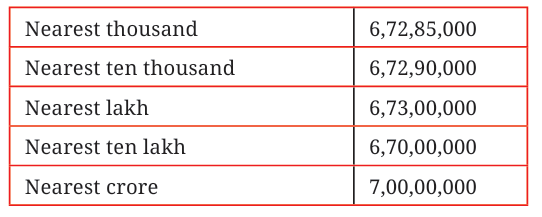
With large numbers it is useful to know the nearest thousand, lakh or crore. For example, the nearest neighbours of the number 6,72,85,183 are shown in the table below.

Q1: Similarly, write the five nearest neighbours for these numbers:
(a) 3,87,69,957
Ans: Nearest thousand: 3,87,70,000
Nearest ten thousand: 3,87,70,000
Nearest lakh: 3,88,00,000
Nearest ten lakh: 3,90,00,000
Nearest crore: 4,00,00,000

(b) 29,05,32,481
Ans: Nearest thousand: 29,05,32,000
Nearest ten thousand: 29,05,30,000
Nearest lakh: 29,05,00,000
Nearest ten lakh: 29,10,00,000
Nearest crore: 29,00,00,000

Q2: I have a number for which all five nearest neighbours are 5,00,00,000. What could the number be? How many such numbers are there?
Ans: The number could be between 4,99,99,501 and 5,00,00,499 as rounding to the nearest thousand, ten thousand, lakh, ten lakh, or crore all yield 5,00,00,000.

Q3: Roxie and Estu are estimating the values of simple expressions.
(1) 4,63,128+4,19,682
Roxie: “The sum is near 8,00,000 and is more than 8,00,000.” 
Estu: “The sum is near 9,00,000 and is less than 9,00,000.”
(a) Are these estimates correct? Whose estimate is closer to the sum?
Ans: Exact sum = 4,63,128 + 4,19,682 = 8,82,810.
Roxie: Near 8,00,000 and more → Correct (8,82,810 > 8,00,000).
Estu: Near 9,00,000 and less → Correct (8,82,810 < 9,00,000).
Difference: |8,82,810 – 8,00,000| = 82,810; |8,82,810 – 9,00,000| = 17,190.
Estu’s estimate is closer.

(b) Will the sum be greater than 8,50,000 or less than 8,50,000? Why do you think so?
Ans: Sum = 8,82,810 > 8,50,000. The numbers are large, and their sum exceeds 8,50,000.

(c) Will the sum be greater than 8,83,128 or less than 8,83,128? Why do you think so?
Ans: Sum = 8,82,810 < 8,83,128. The exact sum is slightly less.

(d) Exact value of 4,63,128 + 4,19,682 = ______________
Ans: 8,82,810.

(2) 14,63,128 − 4,90,020
Roxie: “The difference is near 10,00,000 and is less than 10,00,000.” 
Estu: “The difference is near 9,00,000 and is more than 9,00,000.”
(a) Are these estimates correct? Whose estimate is closer to the difference?
Ans: Exact difference = 14,63,128 – 4,90,020 = 9,73,108.
Roxie: Near 10,00,000 and less → Correct (9,73,108 < 10,00,000).
Estu: Near 9,00,000 and more → Incorrect (9,73,108 > 9,00,000, but not near 9,00,000).
Difference: |9,73,108 – 10,00,000| = 26,892; |9,73,108 – 9,00,000| = 73,108.
Roxie’s estimate is closer.

(b) Will the difference be greater than 9,50,000 or less than 9,50,000? Why do you think so?
Ans: Difference = 9,73,108 > 9,50,000. The difference is large enough to exceed 9,50,000.

(c) Will the difference be greater than 9,63,128 or less than 9,63,128? Why do you think so?
Ans: Difference = 9,73,108 > 9,63,128. The exact difference is slightly more.

(d) Exact value of 14,63,128 − 4,90,020 = _______________
Ans: 9,73,108.

Page No. 13 

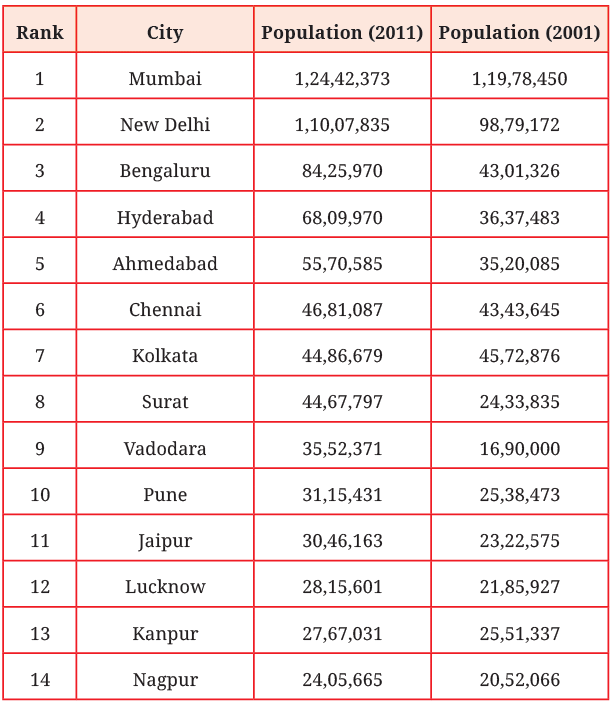
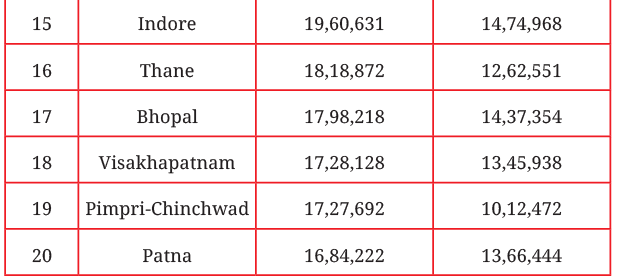
Observe the populations of some Indian cities in the table below.

From the information given in the table, answer the following questions by approximation:
Q1: What is your general observation about this data? Share it with the class.
Ans: The population of most cities increased from 2001 to 2011. Some cities like Bengaluru and Hyderabad grew a lot, while others like Kolkata grew less or decreased.

Q2: What is an appropriate title for the above table?
Ans: “Population of Major Indian Cities (2001 and 2011)”.

Q3: How much is the population of Pune in 2011? Approximately, by how much has it increased compared to 2001?
Ans: Pune 2011: 31,15,431. Pune 2001: 25,38,473.
Increase ≈ 31,15,000 – 25,38,000 = 5,77,000 (approx.).

Q4: Which city’s population increased the most between 2001 and 2011?
Ans: Bengaluru: 84,25,970 – 43,01,326 = 41,24,644 (largest increase).

Q5: Are there cities whose population has almost doubled? Which are they?
Ans: Check if 2011 population ≈ 2 × 2001 population:
Bengaluru: 84,25,970 ÷ 43,01,326 ≈ 1.96 (almost doubled).
Hyderabad: 68,09,970 ÷ 36,37,483 ≈ 1.87 (close).
Cities: Bengaluru, Hyderabad.

Q6: By what number should we multiply Patna’s population to get a number/population close to that of Mumbai?
Ans: Patna 2011: 16,84,222. Mumbai 2011: 1,24,42,373.
Factor ≈ 1,24,42,000 ÷ 16,84,000 ≈ 7.4.
Multiply by about 7.4.

Page No. 14 

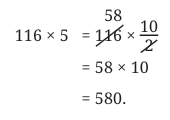
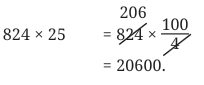
Roxie and Estu are playing with multiplication. They encounter an interesting technique for multiplying a number by 10, 100, 1000, and so on.

Roxie evaluated 116 × 5 as follows:

Estu evaluated 824 × 25 as follows:

Q: Using the meaning of multiplication and division, can you explain why multiplying by 5 is the same as dividing by 2 and multiplying by 10?
Ans: Multiplying by 5 means adding a number to itself 5 times.
Dividing by 2 means splitting a number into 2 equal parts, and multiplying by 10 means adding a zero or multiplying by 10.
If you take a number and divide it by 2, you get half of it.
Then, multiplying that half by 10 gives you 5 times the original number because 1/2 × 10 = 5.
So, dividing by 2 and multiplying by 10 is the same as multiplying by 5.

Figure it Out

Q1: Find quick ways to calculate these products:
(a) 2 × 1768 × 50
Ans: 
First, multiply 2 × 50 = 100. Then, multiply 100 × 1768 = 176800.
So, 2 × 1768 × 50 = 176800.

(b) 72 × 125 [Hint: 125 = 1000 ÷ 8]
Ans: Use the hint: 125 = 1000 ÷ 8. So, 72 × 125 = 72 × (1000 ÷ 8).
First, 72 × 1000 = 72000. Then, 72000 ÷ 8 = 9000.
So, 72 × 125 = 9000.

(c) 125 × 40 × 8 × 25
Ans:
 First, group the numbers: (125 × 8) × (40 × 25).
125 × 8 = 1000, and 40 × 25 = 1000.
Then, 1000 × 1000 = 1000000.
So, 125 × 40 × 8 × 25 = 10,00,000.


Q2: Calculate these products quickly.
(a) 25 × 12 = ______
Ans: 
25 × 12 = 25 × (10 + 2) = (25 × 10) + (25 × 2) = 250 + 50 = 300.
So, 25 × 12 = 300.

(b) 25 × 240 = ______
Ans: 25 × 240 = 25 × (24 × 10) = (25 × 24) × 10.
25 × 24 = 25 × (20 + 4) = (25 × 20) + (25 × 4) = 500 + 100 = 600.
Then, 600 × 10 = 6000.
So, 25 × 240 = 6000.

(c) 250 × 120 = ______
Ans: 250 × 120 = (25 × 10) × (12 × 10) = (25 × 12) × (10 × 10).
25 × 12 = 300
Then, 300 × 100 = 30000.
So, 250 × 120 = 30000.

(d) 2500 × 12 = ______
Ans: 2500 × 12 = (25 × 100) × 12 = (25 × 12) × 100.
25 × 12 = 300. Then, 300 × 100 = 30000.
So, 2500 × 12 = 30000.

(e) ______ × ______ = 120000000
Ans: Let’s find two numbers. Notice 120000000 = 12 × 10000000.
2500 × 48000 = (25 × 100) × (48 × 1000) = (25 × 48) × (100 × 1000).
25 × 48 = 1200, then 1200 × 100000 = 120000000.
So, 2500 × 48000 = 120000000.

How Long is the Product?

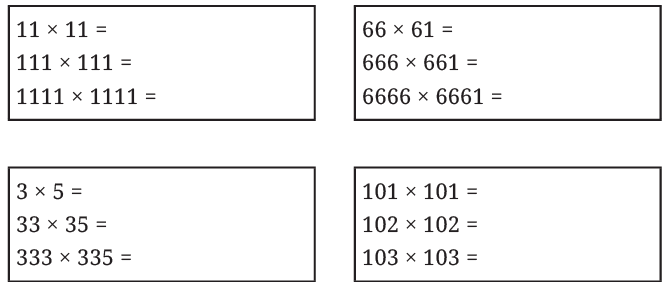
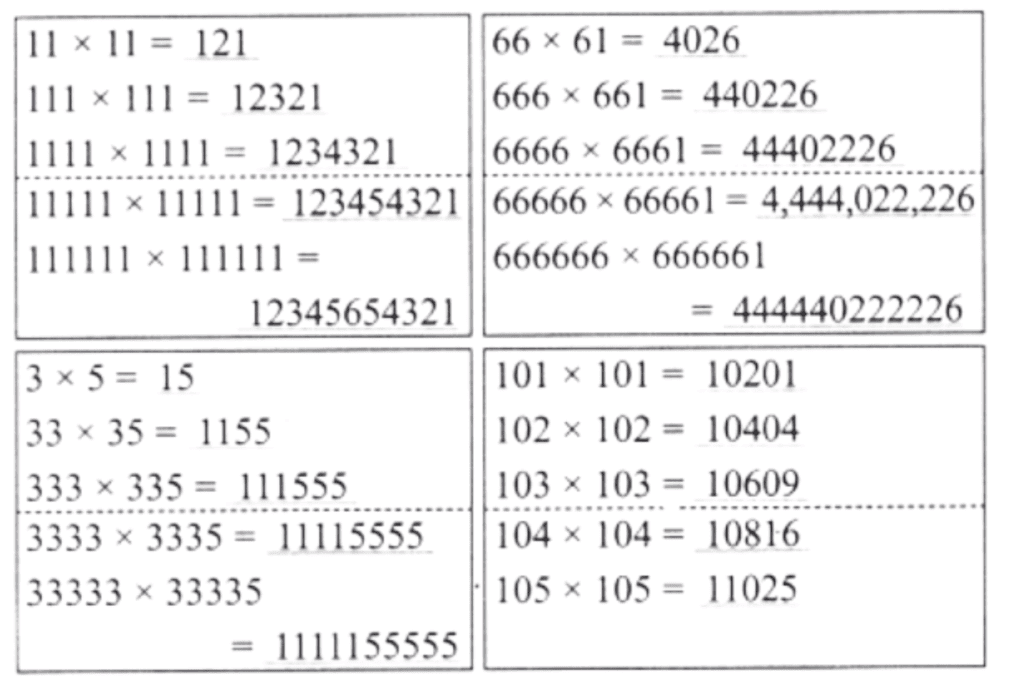
Q3: In each of the following boxes, the multiplications produce interesting patterns. Evaluate them to find the pattern. Extend the multiplications based on the observed pattern.
Ans: 

Page No. 15 
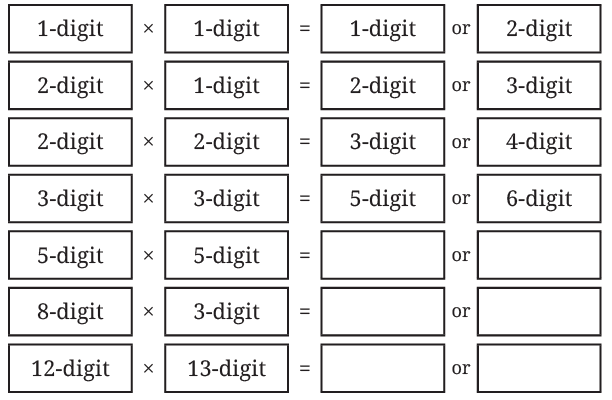
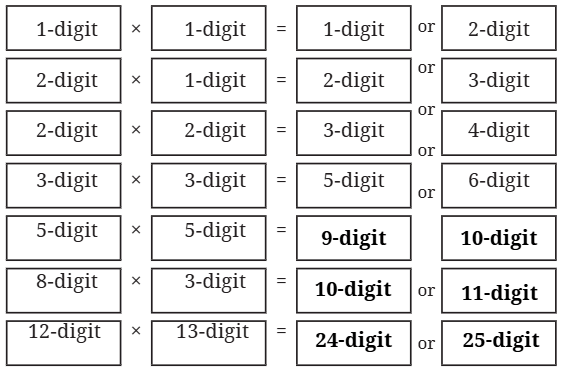
Q4: Observe the number of digits in the two numbers being multiplied and their product in each case. Is there any connection between the numbers being multiplied and the number of digits in their product?
Ans: If two numbers have m and n digits, their product has at most 
m + n digits (if the product is large) or 
m + n − 1 digits (if smaller).
Example: 11×1111 × 11 (2 + 2 = 4 digits, but 121 is 3 digits).
1111×11111111 × 1111 (4 + 4 = 8 digits, 1234321 is 7 digits).


Q5: Roxie says that the product of two 2-digit numbers can only be a 3- or a 4-digit number. Is she correct?
Ans: Yes. Smallest product: 10×10=100 (3 digits).
Largest product: 99×99=9801 (4 digits).
All products are either 3 or 4 digits.


Q6: Should we try all possible multiplications with 2-digit numbers to tell whether Roxie’s claim is true? Or is there a better way to find out?
Ans: No need to try all. Check the smallest (10×10=100, 3 digits) and largest (99×99=9801, 4 digits).
All other products are between these, so only 3 or 4 digits.


Q7: Can multiplying a 3-digit number with another 3-digit number give a 4-digit number?
Ans: No. Smallest 3 digit numbers when multiplied with each other: 100 =10,000 (5 digits).
Products are at least 5 digits.


Q8: Can multiplying a 4-digit number with a 2-digit number give a 5-digit number?
Ans: Yes. Example: 1000×10=10,000 (5 digits).
But it can be 6 digits (e.g., 9999×99=9,89,901).


Q9: Observe the multiplication statements below. Do you notice any patterns? See if this pattern extends for other numbers as well.
Ans: 

Page No. 16

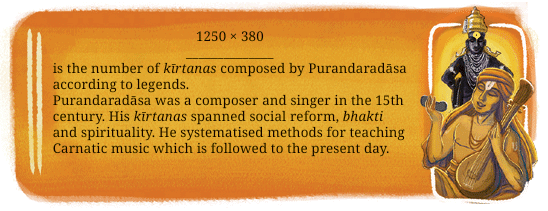
Ans: Let’s assume this:

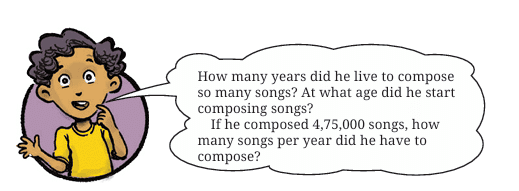
  • He lived for 95 years
  • He started composing songs at age 25

So, number of composing years = 95 − 25 = 70 years

He composed 4,75,000 songs in 70 years

4,75,000 ÷ 70 = 6785.71 songs per year (approx.)

So, he composed about 6,786 songs every year!

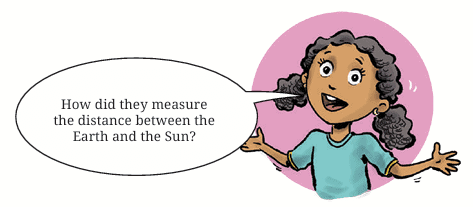
Ans: Scientists cannot use a tape measure to find how far the Sun is! Instead, they used smart methods and mathematics:

1. Astronomical Unit (AU):

One AU is the average distance between the Earth and the Sun.
1 AU = 150 million kilometres.

2. Parallax Method:

Scientists looked at the Sun or planets from two different places on Earth and measured the slight shift in position (called parallax). Using triangle math, they calculated the distance.

3. Radio Signals from Spacecraft:

Spacecraft sent signals back to Earth. By measuring the time it took for the signal to return and knowing the speed of light, scientists found the distance.

Page No. 19 

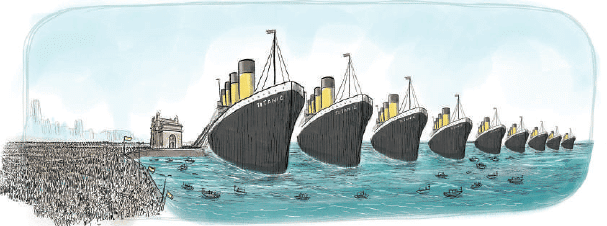
Q1: The RMS Titanic ship carried about 2500 passengers. Can the population of Mumbai fit into 5000 such ships?
Ans: Mumbai population = 1,24,42,373.
One ship = 2,500 passengers. 5,000 ships = 5,000 × 2,500 = 1,25,00,000.
1,24,42,373 < 1,25,00,000. Yes, Mumbai’s population can fit.


Q2: Inspired by this strange question, Roxie wondered, “If I could travel 100 kilometers every day, could I reach the Moon in 10 years?” (The distance between the Earth and the Moon is 3,84,400 km.)
Ans:

  • In 1 year: 100 × 365 = 36,500 km.
  • In 10 years: 36,500 × 10 = 3,65,000 km.
  • Moon distance = 3,84,400 km.
    3,65,000 < 3,84,400, so she cannot reach the Moon in 10 years.

Q3: Find out if you can reach the Sun in a lifetime, if you travel 1000 kilometers every day. (You had written down the distance between the Earth and the Sun in a previous exercise.)
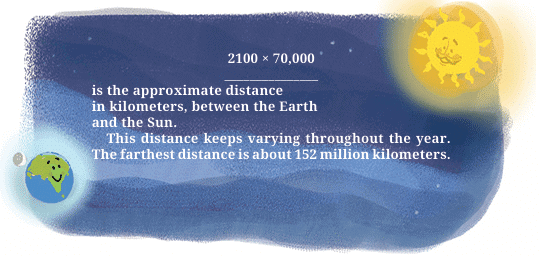
Ans: Sun distance = 14,70,00,000 km.
Lifetime = assume 70 years.
Distance travelled = 1,000 × 365 × 70 = 2,55,50,000 km.
2,55,50,000 < 14,70,00,000. No, you cannot reach the Sun.


Q4: Make necessary reasonable assumptions and answer the questions below:
(a) If a single sheet of paper weighs 5 grams, could you lift one lakh sheets of paper together at the same time?
Ans: Weight = 1,00,000 × 5 = 5,00,000 grams = 500 kg.
Average person can lift ~50 kg. 500 kg is too heavy, so no, you cannot lift it.

(b) If 250 babies are born every minute across the world, will a million babies be born in a day?
Ans: Babies per day = 250 × 60 × 24 = 3,60,000.
3,60,000 < 1,000,000. No, a million babies are not born in a day.

(c) Can you count 1 million coins in a day? Assume you can count 1 coin every second.
Ans: Time taken to count 1 coin = 1 second.
In a single day, we can count 86,400 coins.
[Total seconds in a day = 24 × 60 × 60 = 86,400 seconds]
Thus, we cannot count 1 million coins in a day at the rate of 1 coin per second, since it would take approximately 1,000,000 ÷ 86,400 ~ 12 days to complete the task.

Page No. 19

 Figure it Out

Q1: Using all digits from 0 – 9 exactly once (the first digit cannot be 0) to create a 10-digit number, write the —
(a) Largest multiple of 5
Ans: Largest number: 9876543210 (ends in 0, divisible by 5).

(b) Smallest even number
Ans: Smallest number: 1023456798 (ends in 2, even).


Q2: The number 10,30,285 in words is Ten lakhs thirty thousand two hundred eighty five, which has 43 letters. Give a 7-digit number name which has the maximum number of letters.
Ans: 77,77,777 (Seventy-seven lakhs seventy-seven thousand seven hundred seventy-seven).
This has 61 letters, making it one of the longest 7-digit numbers.


Q3: Write a 9-digit number where exchanging any two digits results in a bigger number. How many such numbers exist?
Ans: Number must be smallest possible: 123456789.
Any swap (e.g., 213456789) is larger.


Q4: Strike out 10 digits from the number 12345123451234512345 so that the remaining number is as large as possible.
Ans: Keep highest digits: 5544332211 (10 digits, largest possible).


Q5: The words ‘zero’ and ‘one’ share letters ‘e’ and ‘o’. The words ‘one’ and ‘two’ share a letter ‘o’, and the words ‘two’ and ‘three’ also share a letter ‘t’. How far do you have to count to find two consecutive numbers which do not share an English letter in common?
Ans: The problem involves finding two consecutive numbers whose English names share no common letters.
Here, zero and one share “e” and “o”.
one (1) and two (2) share “o”.
two (2) and three (3) share “t”.
……………………………..
Nineteen and twenty share: ‘t’, ‘e’, ‘n’
…………….. and so on.
Therefore, there are no consecutive numbers that do not share a letter in common.

Q6: Suppose you write down all the numbers 1, 2, 3, 4, …, 9, 10, 11, … The tenth digit you write is ‘1’ and the eleventh digit is ‘0’, as part of the number 10.
(a) What would the 1000th digit be? At which number would it occur?
Ans: Digits: 1-9 (9 digits), 10-99 (2 × 90 = 180 digits), 100-999 (3 × 900 = 2700 digits).
1000th digit is in 100-999 range. After 9 + 180 = 189 digits, at number 99.
1000 – 189 = 811 digits into 100-999.
Each number (100 to 999) has 3 digits, so 811 ÷ 3 = 270 numbers (810 digits) + 1 digit.
Number 370 (100 + 270), digits: 3, 7, 0. 811th digit = 3, 1000th digit = 3.

(b) What number would contain the millionth digit?
Ans: Let’s calculate: 1–9: 9 × 1 = 9 digits
    10–99: 90 × 2 = 180 digits
    100–999: 900 × 3 = 2700 digits
    1000–9999: 9000 × 4 = 36,000 digits
    10000–99999: 90,000 × 5 = 450,000 digits
   100000–999999: 900,000 × 6 = 5,400,000 digits
So, the millionth digit must lie within the 100000–999999 range (6-digit numbers).
Let’s subtract the earlier ranges first:
    Total digits before 6-digit numbers:
    9 + 180 + 2700 + 36000 + 450000 = 488,889 digits
    Digits remaining to reach 1,000,000:
    1,000,000 – 488,889 = 511,111 digits
Each 6-digit number = 6 digits →
511111 ÷ 6 = 85,185 full numbers = 511,110 digits, with 1 digit left
Start of 6-digit numbers: 100000
85,185th number = 100000 + 85184 = 185184
So, the millionth digit is the first digit of number 185185

(c) When would you have written the digit ‘5’ for the 5000th time?
Ans

Single-digit numbers (1-9): 1 (only 5)
Two-digit numbers (10-99)

  • (15, 25, 35,…, 95), totaling 9 occurrences.
  • 50, 51, 52, …, 59, totaling 10 occurrences.

Thus, 19 occurrences of the digit 5 in the range 10-99.
Total occurrences so far: 1 + 19 = 20

Three-digit numbers (100-999)
(i) Units position: Numbers like 105, 115, ….., 995 contribute 10 occurrences per 100 numbers. Across 900 numbers, there are 90 occurrences.

(ii) Tens position: Numbers like 150-159, 250-259, ……, 950-959 also contribute 10 occurrences per 100 numbers, and 90 occurrences in all.

(iii) Hundreds position: Numbers like 500-599 contribute 100 occurrences in this range.
Thus, 90 (units) + 90 (tens) + 100 (hundreds) = 280 occurrences
Total occurrences so far: 20 + 280 = 300

Four-digit numbers (1000-9999)
Now it gets more intense! Here, 5 appears in four positions (units, tens, hundreds, thousands):
(i) Units position: Every 10 numbers, e.g., 1005, 1015, …, 9995 = 900 occurrences total.

(ii) Tens position: 1050-1059, 1150-1159, …, 9950-9959. That’s 900 occurrences total.

(iii) Hundreds position: 1500-1599,2500-2599,…, 9500-9599 = 900 occurrences total.

(iv) Thousands position: 5000-5999 = 1000 occurrences
Adding these up: 900 (units) + 900 (tens) + 900 (hundreds) + 1000 (thousands) = 3700 occurrences
Total occurrences so far: 300 + 3700 = 4000
Numbers starting from 10000 onward
For the 5000th number, we require 5000 – 4000 = 1000 more numbers that lie in 10001-10999.

(v) Among 10000-10999, one digit 5 appears in 100 numbers (e.g., 10005, 10015,….., 10995).
The digit 5 appears in 100 numbers (e.g., 10050-10059, …, 10950-10959).
The digit 5 appears in 100 numbers (e.g., 10500-10599).
Total 4000 + 300 = 4300
In 11000-11999
5 at unit place = 100
5 at tens place = 100
5 at a hundred place = 100
Total 4300 + 300 = 4600
In 12000-12999
4600 + 300 = 4900
In 13000- 13999
Unit = 100
Total = 5000
Final number = 13995


Q7: A calculator has only ‘+10,000’ and ‘+100’ buttons. Write an expression describing the number of button clicks to be made for the following numbers:
(a) 20,800
Ans: (2 × 10,000) + (8 × 100) = 20,000 + 800 = 20,800 (10 clicks).

(b) 92,100
Ans: (9 × 10,000) + (21 × 100) = 90,000 + 2,100 = 92,100 (30 clicks).

(c) 1,20,500
Ans: (12 × 10,000) + (5 × 100) = 1,20,000 + 500 = 1,20,500 (17 clicks).

(d) 65,30,000
Ans: (653 × 10,000) = 65,30,000 (653 clicks).

(e) 70,25,700
Ans: (702 × 10,000) + (57 × 100) = 70,20,000 + 5,700 = 70,25,700 (759 clicks).


Q8: How many lakhs make a billion?
Ans: 1 billion = 1000 million = 1000 × 10 lakhs = 10,000 lakhs.

Q9: You are given two sets of number cards numbered from 1 – 9. Place a number card in each box below to get the (a) largest possible sum (b) smallest possible difference of the two resulting numbers.

Ans(a) To get the largest possible sum, use the largest digits in both sets.

  • First set (5 boxes): 9, 8, 7, 6, 5 (number: 98765)
  • Second set (4 boxes): 9, 8, 7, 6 (number: 9876)
  • Sum: 98765 + 9876 = 108641

(b) To get the smallest possible difference, make the numbers as close as possible.

  • First set (5 boxes): 1, 0, 0, 0, 0 (number: 10000, using 1 and assuming remaining as 0 for simplicity)
  • Second set (4 boxes): 9, 9, 9, 9 (number: 9999)
  • Difference: 10000 – 9999 = 1

Page No. 21

Q10: You are given some number cards: 4000, 13000, 300, 70000, 150000, 20, 5. Using the cards get as close as you can to the numbers below using any operation you want. Each card can be used only once for making a particular number.
(a) 1,10,000: Closest I could make is 4000 × (20 + 5) + 13000 = 1,13,000
Ans: Given: 1,13,000 (close).
Another try: 150000 − 40000 = 1, 10,000 (exact, but 40000 not a card).
Best: 1,13,000.

(b) 2,00,000:
Ans: 1,50,000 + 70,000 – 4000 × 5 = 2,00,000

(c) 5,80,000:
Ans: 70,000 × 5 + 1,50,000 + 4,000 × 20 = 5,80,000

(d) 12,45,000
Ans: 70,000 × 20 – 1,50,000 – 4,000 – 300 × 5 = 12,44,500
This gives us 12,44,500, which is very close to 12,45,000.

(e) 20,90,800
Ans: 13,000 × 300 – 70,000(20 + 5) – 1,50,000 + 4,000 = 20,04,000


Q11: Find out how many coins should be stacked to match the height of the Statue of Unity. Assume each coin is 1 mm thick.
Ans: Statue of Unity = 180 metres = 180,000 mm.
Coins = 180,000 ÷ 1 = 1,80,000 coins.

Q12: Grey-headed albatrosses have a roughly 7-feet wide wingspan. They are known to migrate across several oceans. Albatrosses can cover about 900 – 1000 km in a day. One of the longest single trips recorded  is about 12,000 km. How many days would such a trip take to cross the Pacific Ocean approximately?
Ans: Distance = 12,000 km. Speed = 950 km/day (average).
Days = 12,000 ÷ 950 ≈ 12.63.
Approximately 13 days.


Q13: A bar-tailed godwit holds the record for the longest recorded non-stop flight. It travelled 13,560 km from Alaska to Australia without stopping. Its journey started on 13 October 2022 and continued for about 11 days. Find out the approximate distance it covered every day. Find out the approximate distance it covered every hour.
Ans: Daily: 13,560 ÷ 11 ≈ 1,232.73 km/day.
Hourly: 1,232.73 ÷ 24 ≈ 51.36 km/hour.


Q14: Bald eagles are known to fly as high as 4500 – 6000 m above the ground level. Mount Everest is about 8850 m high. Aeroplanes can fly as high as 10,000 – 12,800 m. How many times bigger are these heights compared to Somu’s building?
Ans: Somu’s building = 40 m (from Page 3).

  • Eagles (5,250 m avg): 5,250 ÷ 40 = 131.25 times.
  • Everest: 8,850 ÷ 40 = 221.25 times.
  • Aeroplanes (11,400 m avg): 11,400 ÷ 40 = 285 times.

15. Rani Abbakaka Chapter Solution

Let us do these activities before we read (Page 206)

Q1: Solve the riddle given below and share your answer with your classmates and the teacher.
She was a queen who led the fight,
She fought for her country and her right.
With a shining sword in her hand,
Her son on her back in a cloth band
Remembered as a warrior grand,
She died defending her beloved Motherland.

Who is she?

Ans: The answer to the riddle is Rani Abbakka. She was a queen who fought bravely against the Portuguese to protect her country, Ullal. She is remembered as a great warrior who died defending her motherland.

Q2: Think of any other women warriors who made a significant contribution to India’s struggle for Independence. Share your answers with your classmates and the teacher.

Ans: Other women warriors who contributed to India’s struggle for Independence include Rani Lakshmibai of Jhansi, who fought against the British in 1857, and Captain Lakshmi Sahgal, who led the Rani of Jhansi Regiment in the Indian National Army.

Let us discuss (Page 213)

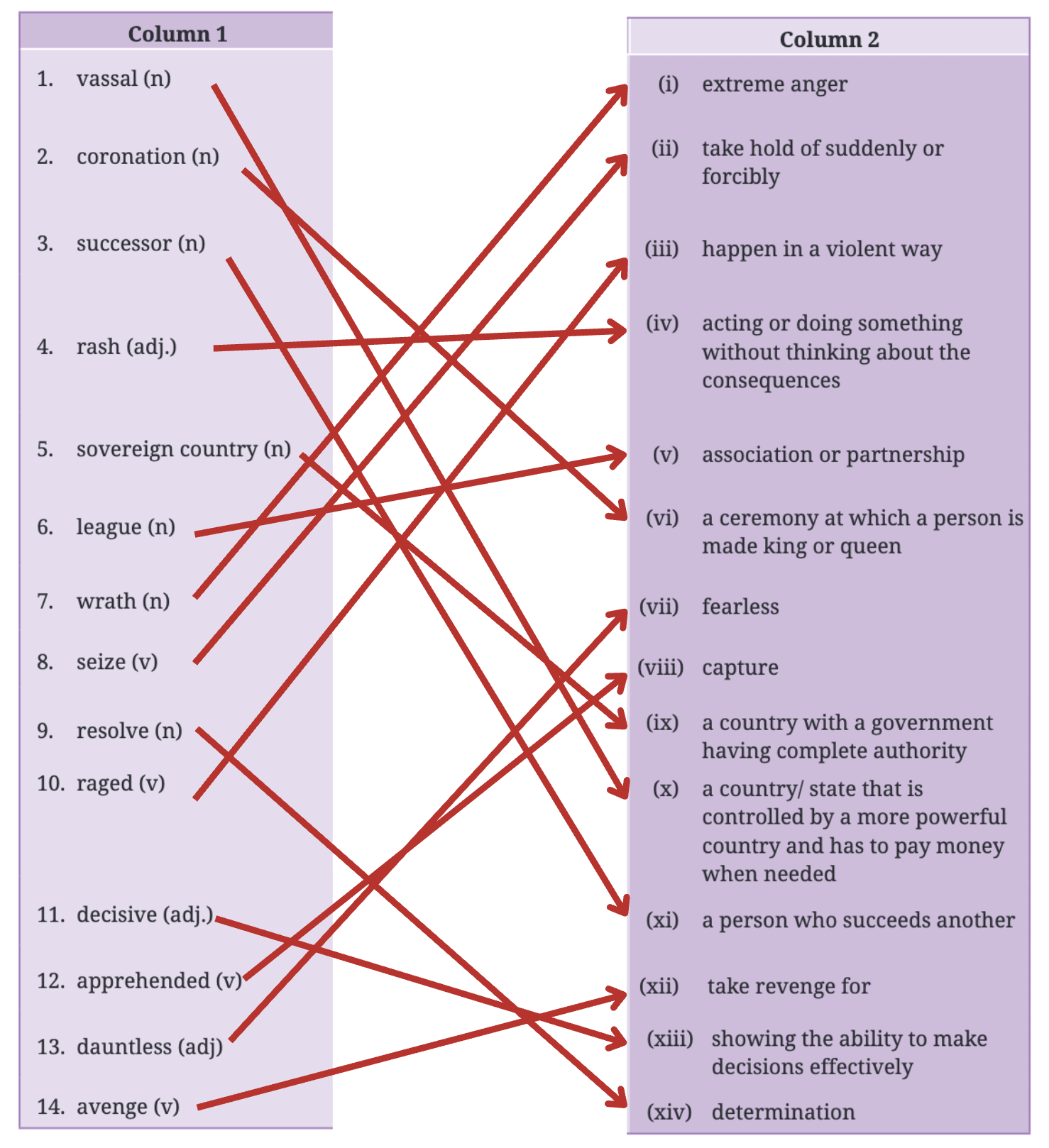
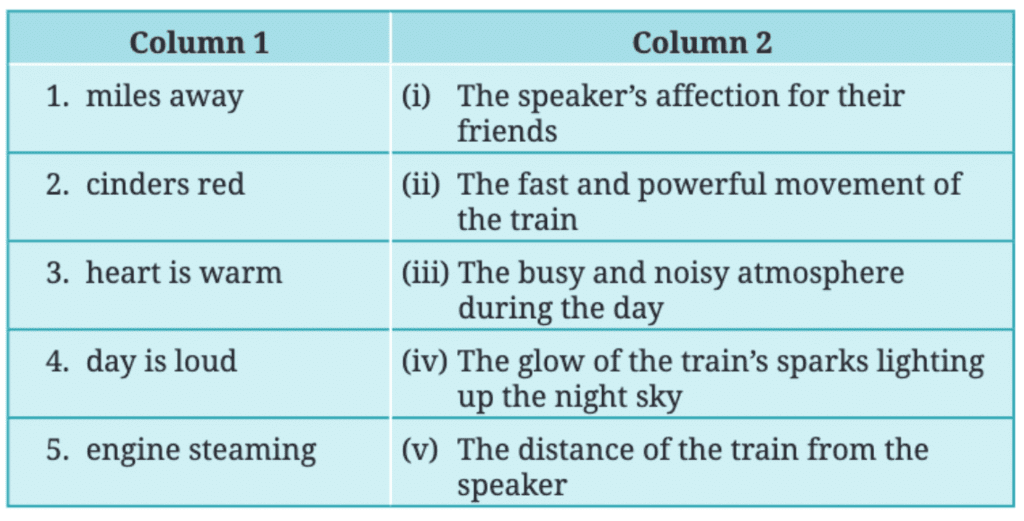
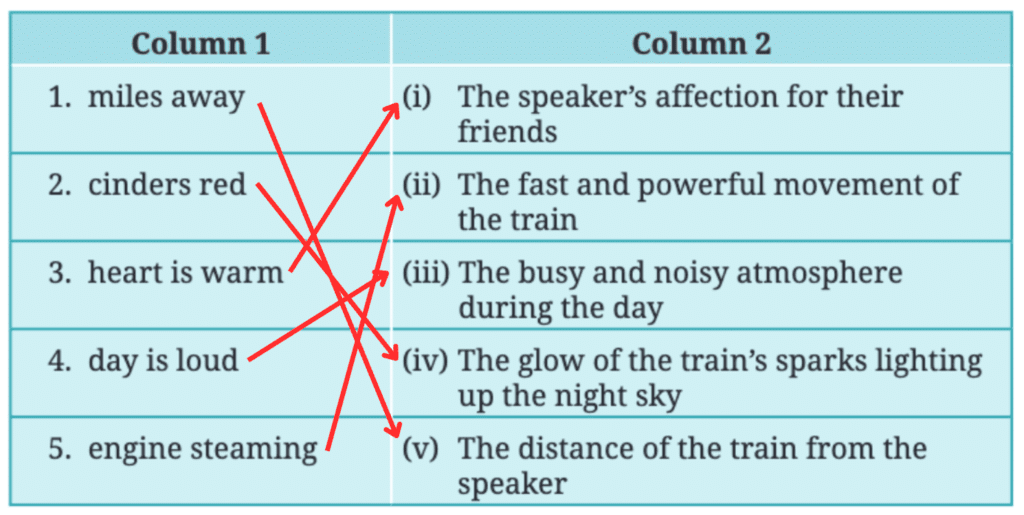
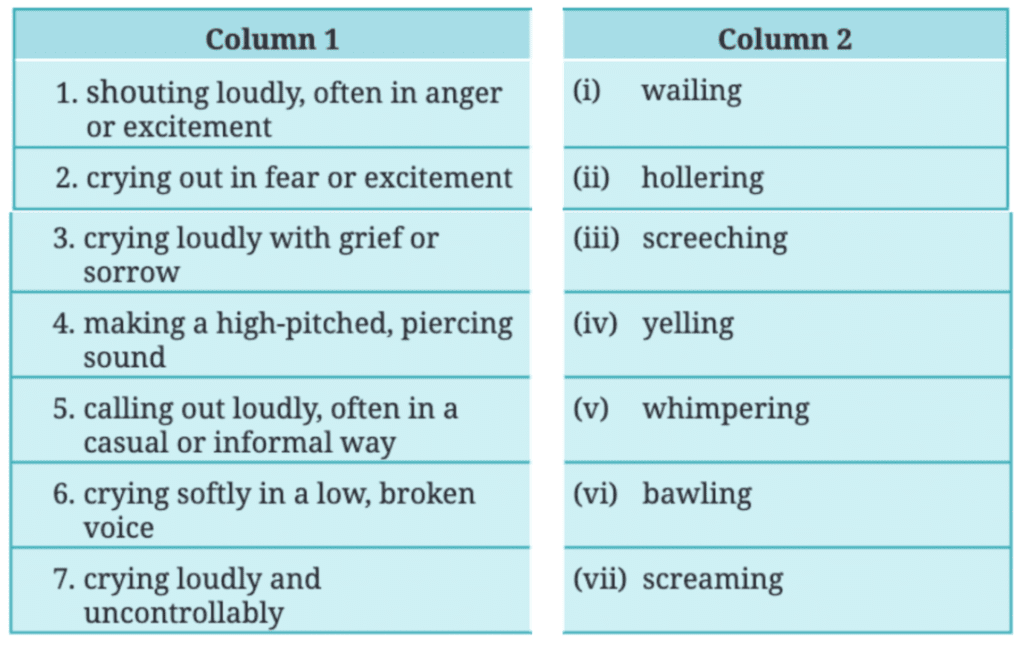
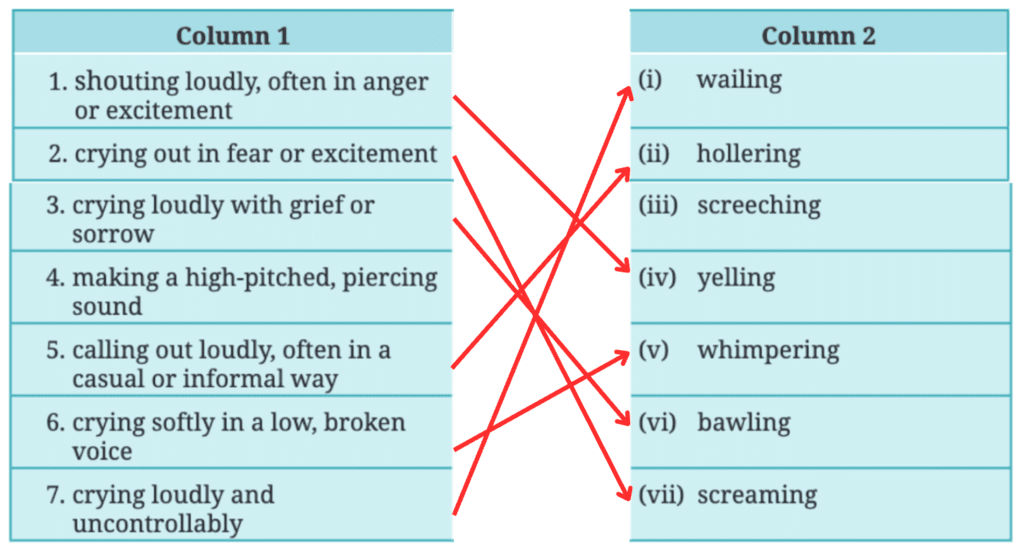
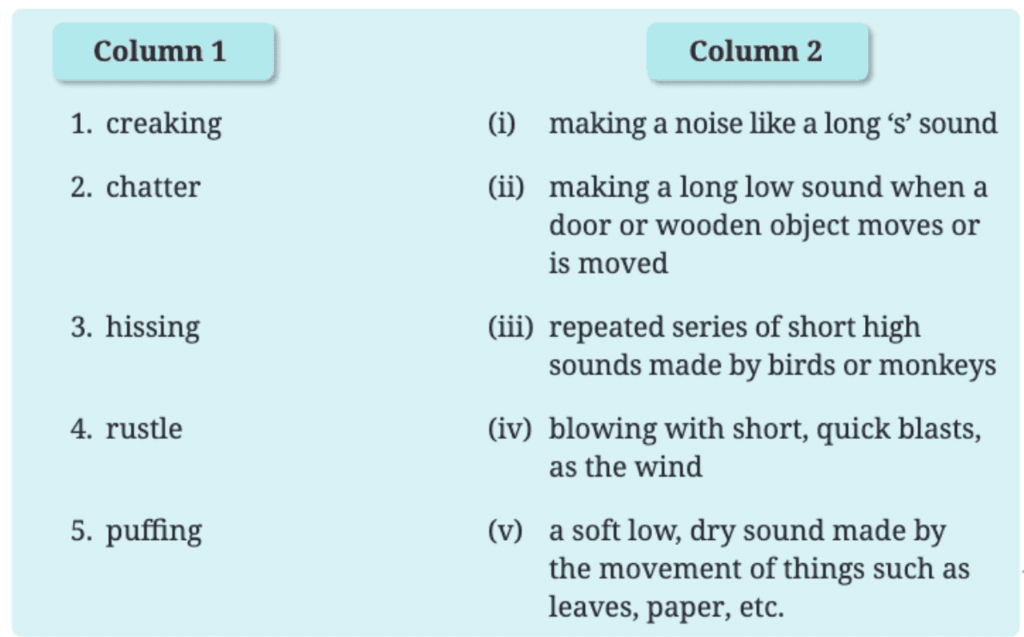
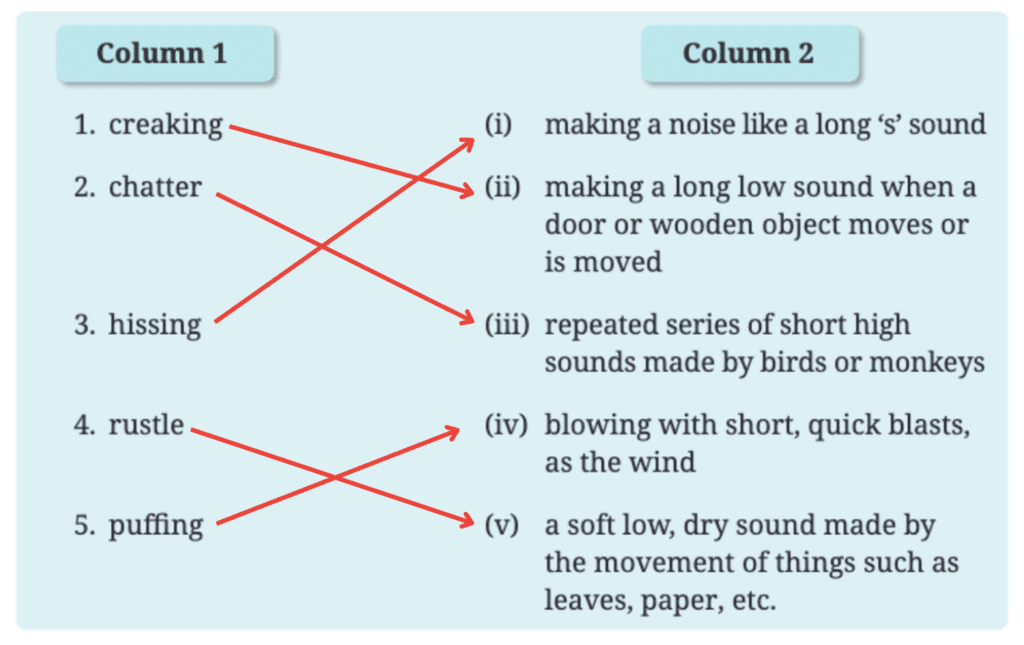
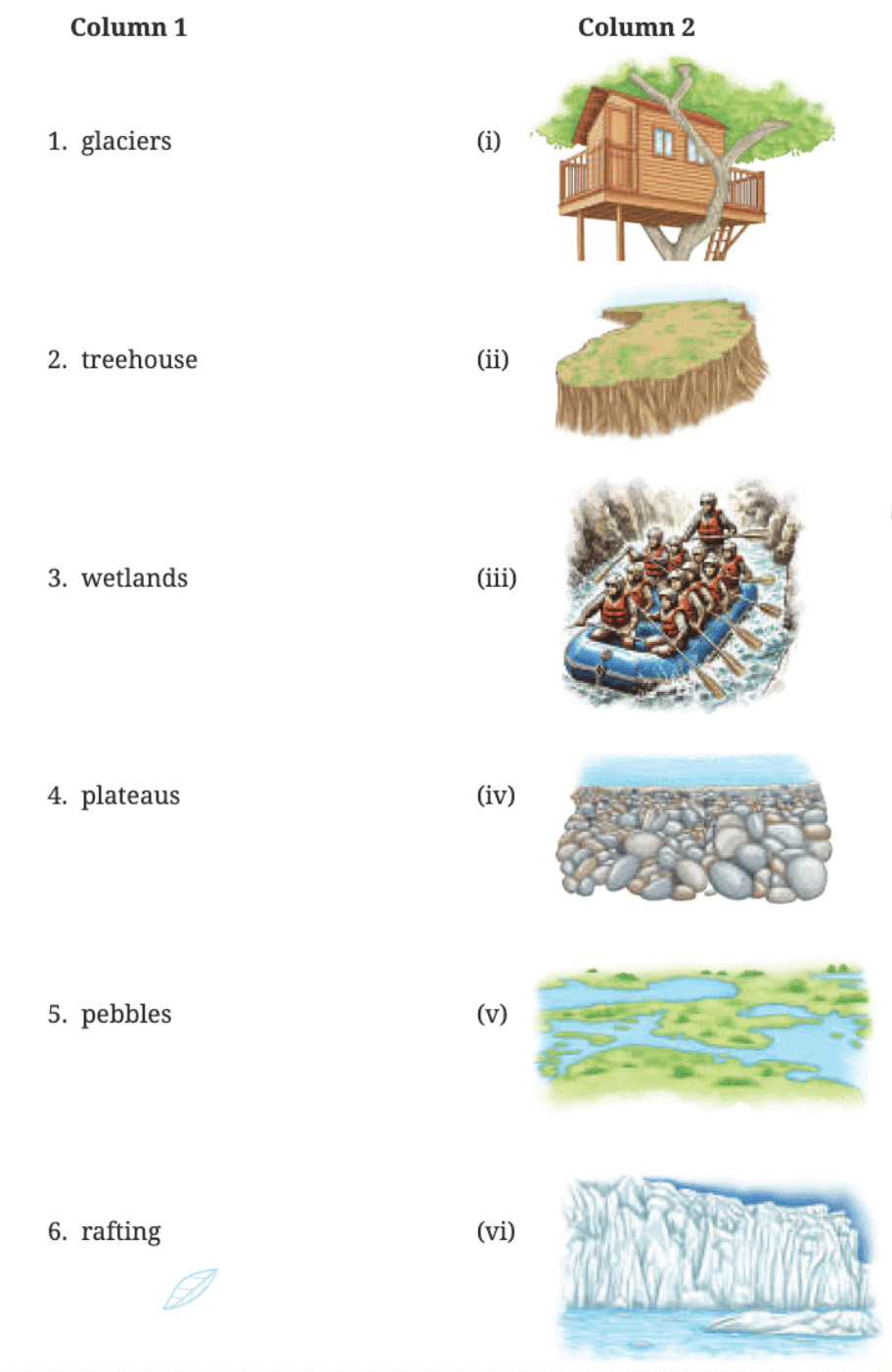
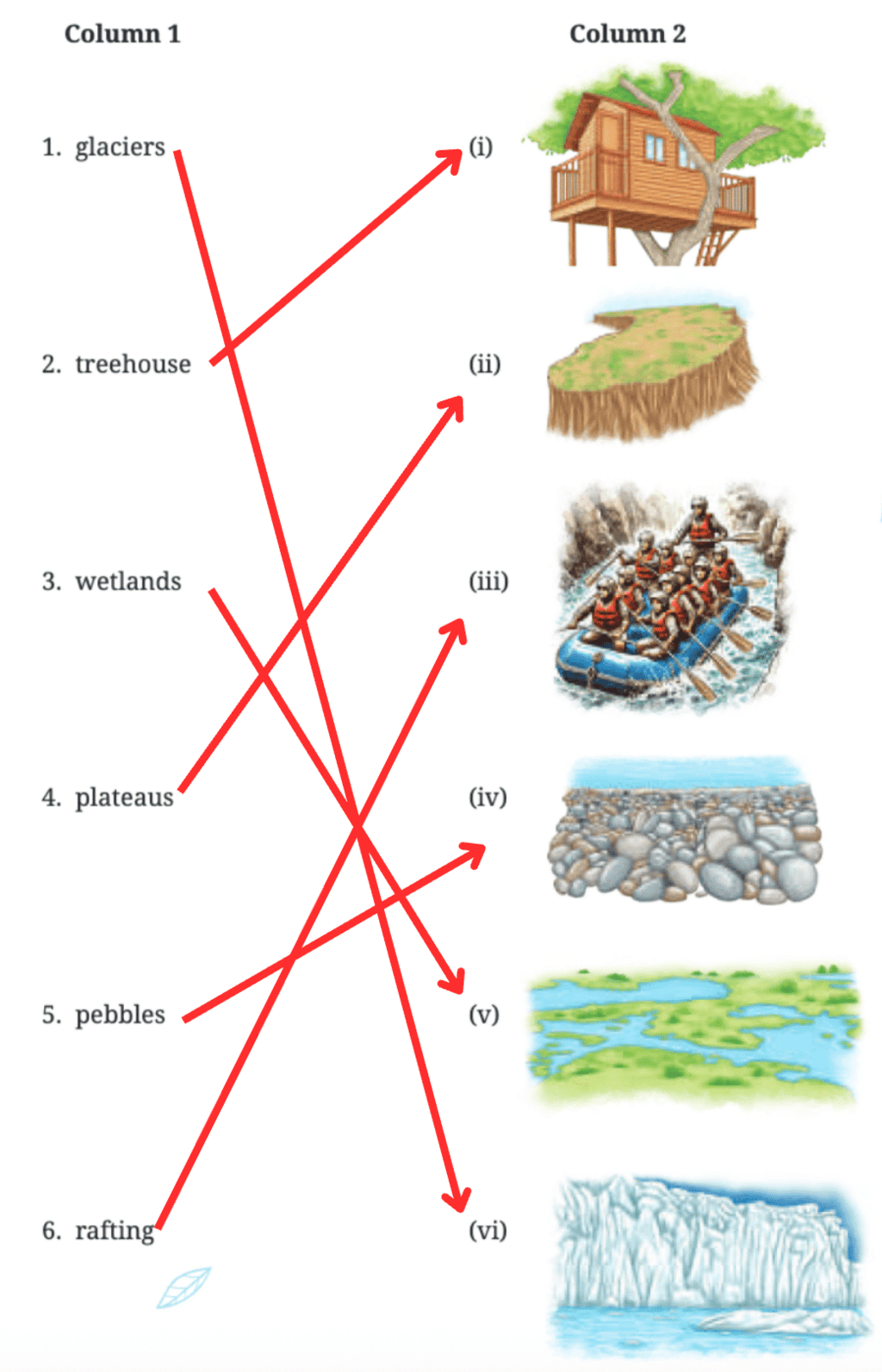
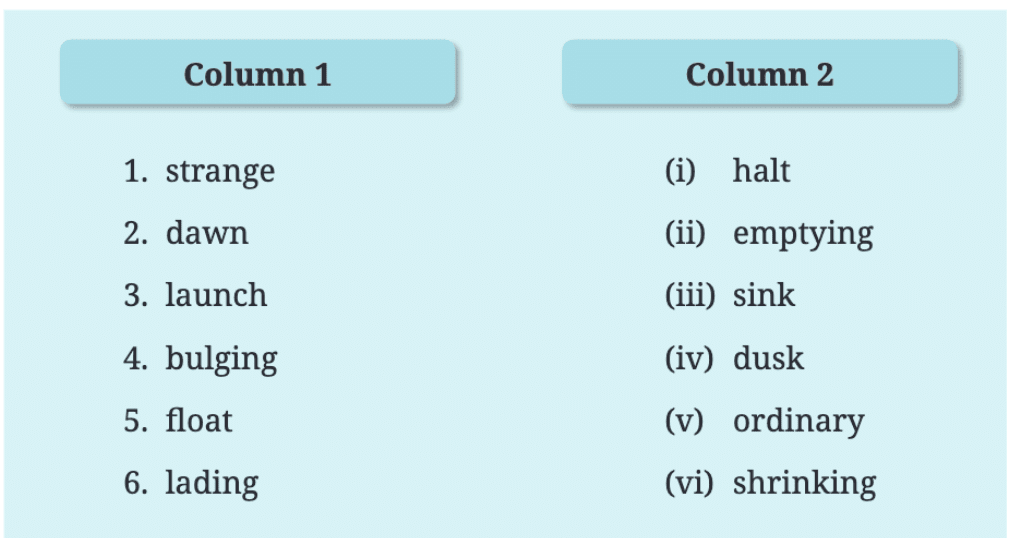
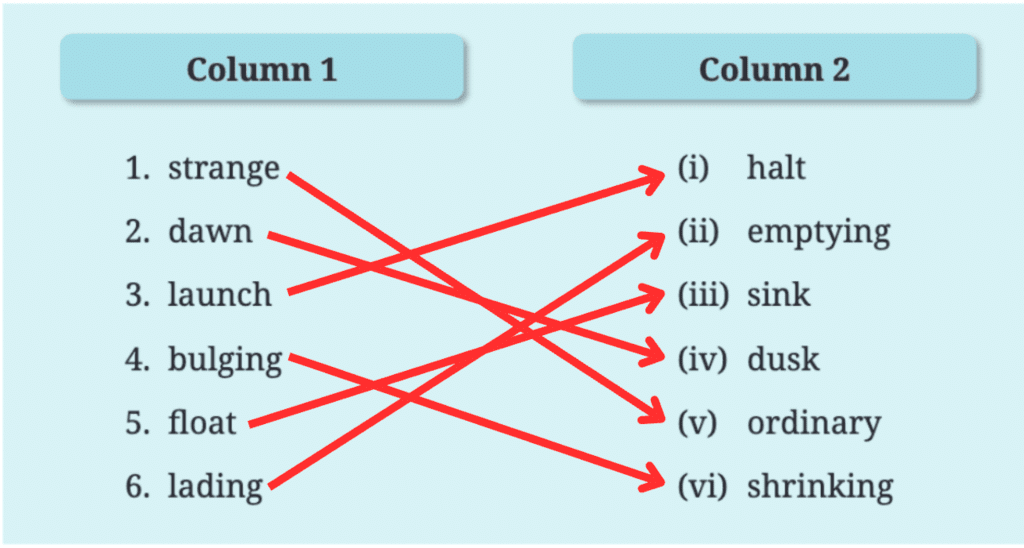
QI: Match the words in Column 1 with their meanings in Column 2. Share your answers with your classmates and the teacher.

Ans:

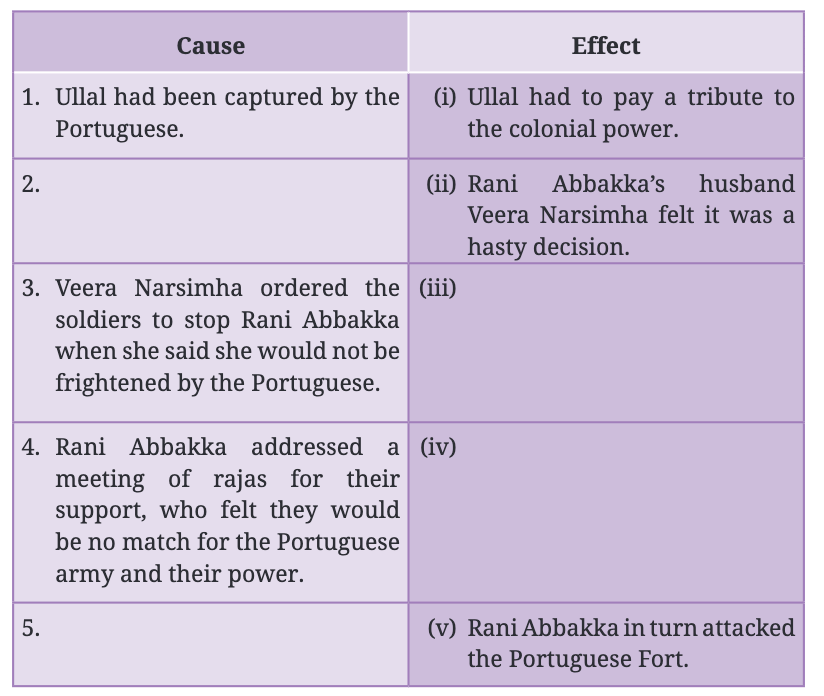
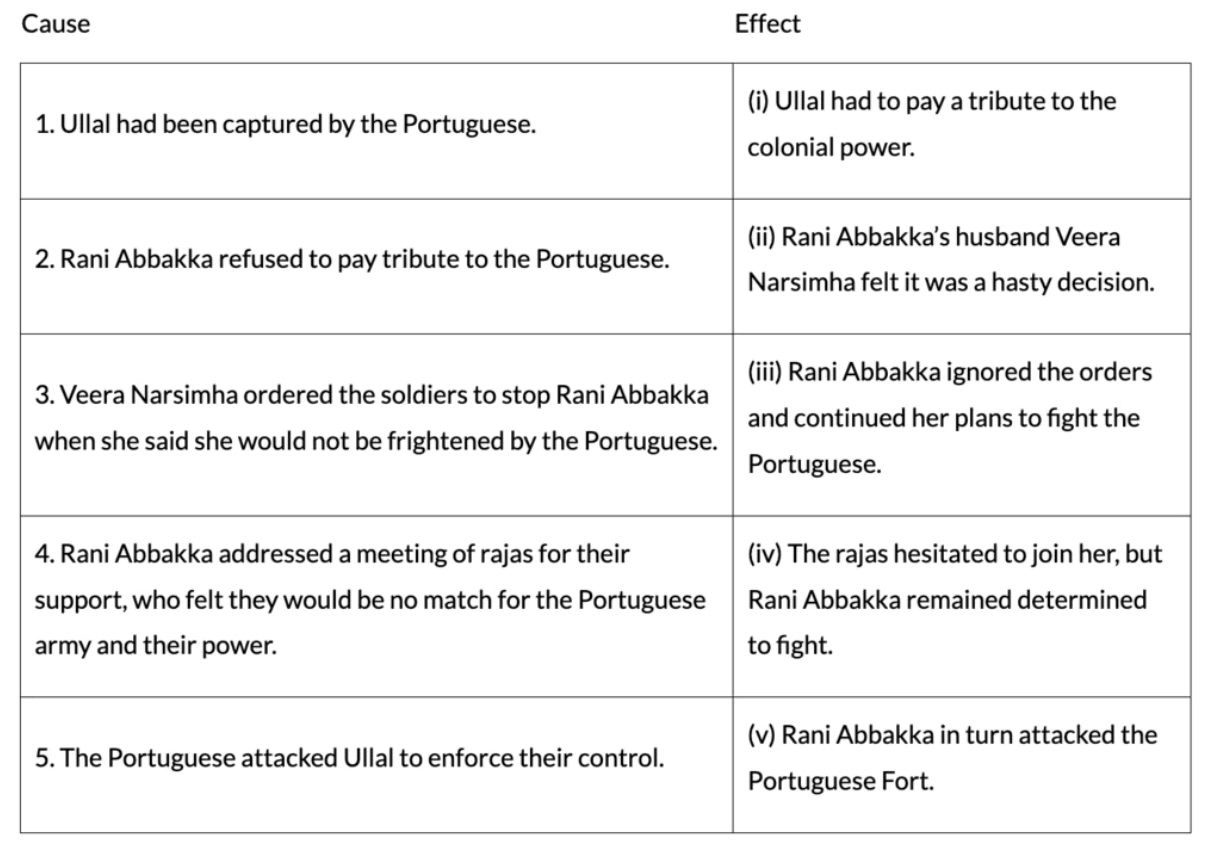
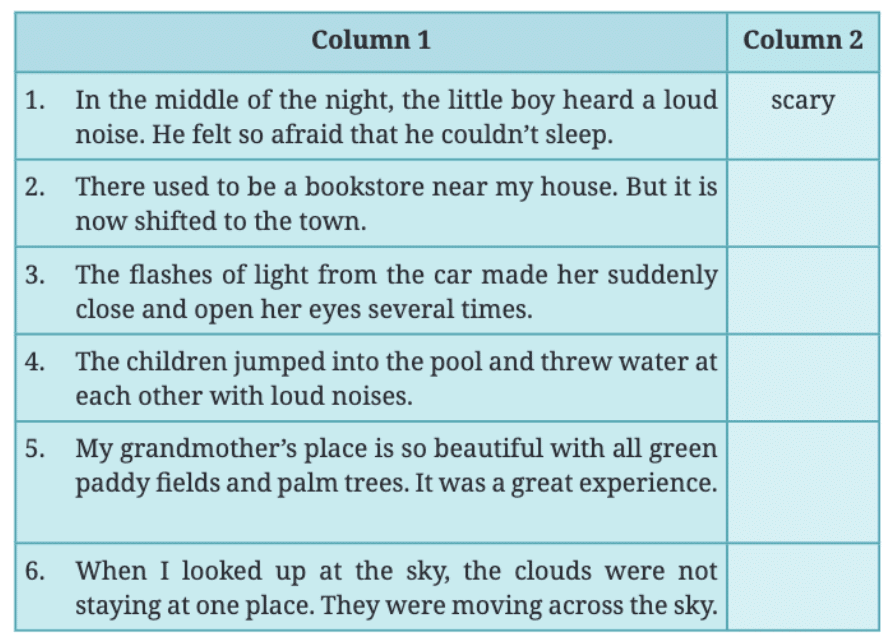
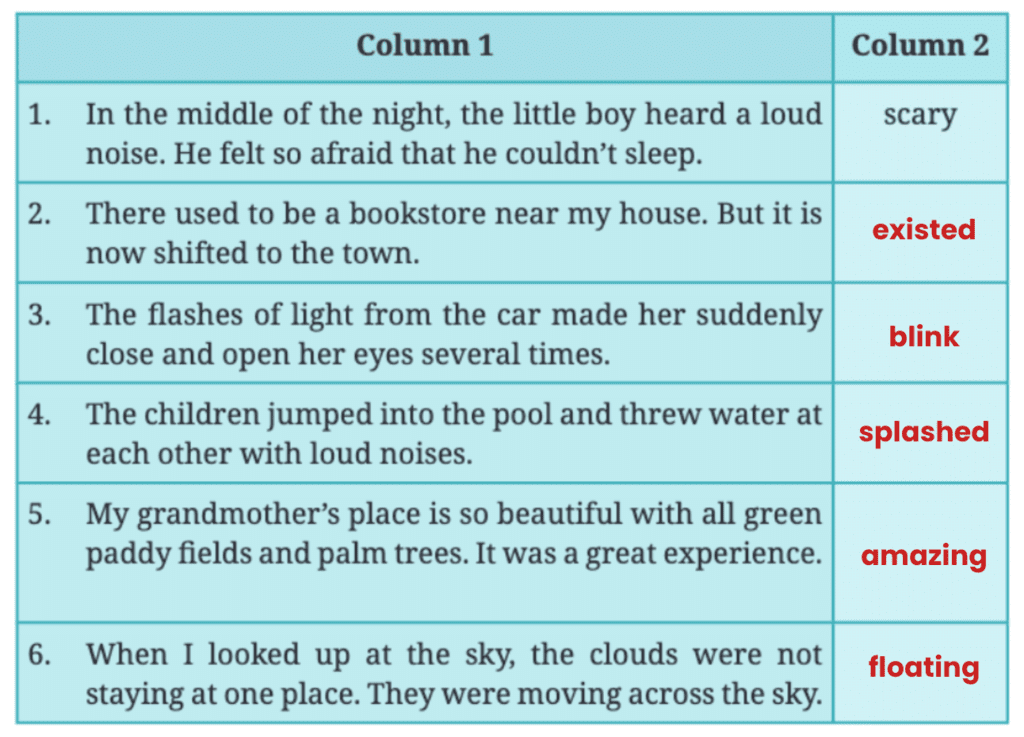
QII: Complete the table given below based on your understanding of the story. An example has been done for you. Share your answers with your classmates and the teacher.

Ans:

Let us think and reflect (Page 214)

QI: Read the extract given below and answer the questions that follow.
Portuguese envoy: Our Governor has sent me to remind you that the annual tribute from Ullal is long overdue and…
Rani Abbakka: We are a sovereign country. We don’t pay tribute to Portugal. And we don’t take orders from the Portuguese!
Portuguese envoy: Your Majesty, you will regret your stand.
Abbakka ordered merchant ships to be built and in alliance with the Zamorin of Kozhikode, she defied the Portuguese and established a hugely profitable trading relation with Arabia.

1. What does the word ‘tribute’ mean in this context?

Ans: In this context, ‘tribute’ means money or goods that Ullal had to pay to the Portuguese as a sign of being controlled by them.

2. Complete the sentence with a suitable reason. Rani Abbakka says, “We are a sovereign country” because

Ans: Rani Abbakka says, “We are a sovereign country” because Ullal is an independent nation with its own authority and does not accept Portuguese rule.

3. Identify whether the following statement is true or false. The Portuguese envoy threatened Rani Abbakka.

Ans: True. The Portuguese envoy threatened Rani Abbakka by saying, “Your Majesty, you will regret your stand.”

4. Choose a word given in brackets to replace the underlined word. “… she defied the Portuguese and established a hugely profitable trading relation with Arabia.” (defeated/disobeyed)

Ans: The word to replace ‘defied’ is ‘disobeyed’.

5. Choose the option that lists the qualities of Rani Abbakka, based on this extract.
(i) bold (ii) thoughtful (iii) capable (iv) generous (v) determined
A. (i), (ii), and (v)
B. (ii), (iii), and (iv)
C. (i), (iii), and (v)
D. (ii), (iv), and (v)

Ans: C. (i), (iii), and (v)

Rani Abbakka was bold in refusing the Portuguese, capable in building trade relations, and determined to defy foreign control.

QII: Answer the following questions.

1. Rani Abbakka spoke to her mother on her deathbed. How might these words have made her mother feel?
Ans: Rani Abbakka’s words to her mother, promising to protect Ullal and fight for its freedom, likely made her mother feel proud and reassured. Her mother would have felt confident that her daughter was strong and capable of leading Ullal.

2. What does the support of the people of Ullal and the soldiers for Rani Abbakka suggest about their mindset?
Ans: The support of the people and soldiers suggests they had a patriotic and brave mindset. They trusted Rwarning: This chunk ends abruptly and does not complete the sentence or provide further context for the remaining questions. Below, I will continue to provide answers for the remaining questions based on the provided document and ensure all questions related to “Rani Abbakka” are addressed, maintaining the requested format and simplicity.

3. How might the people of Ullal have felt when the mighty Portuguese were defeated?
Ans: The people of Ullal likely felt joyful, proud, and relieved when the Portuguese were defeated. Their victory would have boosted their confidence in Rani Abbakka’s leadership and their own strength as a community.

4. Why do you think Rani Abbakka’s victory against the Portuguese would have inspired other rulers to go against a foreign power?Ans: Rani Abbakka’s victory showed that a small kingdom like Ullal could defeat a powerful foreign force like the Portuguese. This would have inspired other rulers by proving that courage, strategy, and unity could overcome even strong enemies, encouraging them to resist foreign control.

Let us learn (Page 215)

QI: Study the following words from the text.

seize, sovereign, their, soldiers. 

The spelling of the given words have ‘ei’ and ‘ie’ in them. 

Spelling tip: ‘i’ before ‘e’ except after ‘c’. 
For example: receive, deceive. 

Now, fill in the blanks with ‘ie’ or ‘ei’ for the following words.

Ans:

  1. c_ei_ling – ceiling
  2. bel_ie_ve – believe
  3. th_ie_f – thief
  4. ach_ie_ve – achieve
  5. perc_ei_ve – perceive
  6. prot_ei_n – protein
  7. soc_ie_ty – society
  8. sh_ie_ld – shield
  9. w_ei_ght – weight
  10. fr_ie_nd – friend

QII: Study the highlighted word in the following sentence from the text.

 …; and Bangadi too may have to face their wrath.

 Was the initial letter ‘w’ pronounced? There are many words in the English language where certain letters are not pronounced but are spelt. They are called ‘silent letters’. 

For example: campaign, knowledge, pneumonia, honour, calm. Now, find more words with silent letters.

Ans: The initial ‘w’ in ‘wrath’ is not pronounced; it is a silent letter. More words with silent letters include:

  • doubt (silent ‘b’)
  • wrist (silent ‘w’)
  • knight (silent ‘k’)
  • debt (silent ‘b’)
  • listen (silent ‘t’)

QIII: Read the following expressions from the text. 

laughing stock, last laugh. 

Use the dictionary page given below to find the meanings of the following. burst out laughing, don’t make me laugh, laugh until you cry, have a good laugh. Now, use these expressions in sentences of your own.

Ans:

  • burst out laughing: Suddenly start laughing.
    Sentence: When Rani Abbakka tricked the Portuguese, her soldiers burst out laughing at their confusion.
  • don’t make me laugh: Used to show something is impossible or ridiculous.
    Sentence: The Portuguese thought they could scare Rani Abbakka—don’t make me laugh!
  • laugh until you cry: Laugh so hard that tears come to your eyes.
    Sentence: The people of Ullal laughed until they cried when they heard how Rani Abbakka outsmarted the enemy.
  • have a good laugh: Find something amusing.
    Sentence: After the victory, Rani Abbakka and her soldiers had a good laugh about the Portuguese’s failed attack.

QIV: Read the following dialogues from the text.

  • Rani Abbakka said, “I will make them pay for this.”
  • The merchants said to the Arabians, “Visit us again, brother.”

The given sentences are the direct words of the speaker; hence, they are in direct speech. 

The reported forms or indirect forms of speech for the given sentences are:

  • Rani said that she would make them pay for that.
  • The merchants told the Arabian brothers to visit them again.

While reporting direct speech to indirect speech, we make certainmodifications related to time, place, and person.

  •  Time (Tense): Verbs are typically shifted back from a present tenseto a past form in reported speech to reflect the change in time.
  • Place (Adverbs of Place): Words indicating place are adjusted to fitthe new context.
  • Person: Pronouns and subjects are modified to align with theperspective of the reporter. 

Rewrite the following sentences in direct speech to indirect speech. Remember to make the necessary changes.

Ans:

  1. The teacher said, “Women of valour have made significant contributions throughout history.”
    Ans: The teacher remarked that women of valour had made significant contributions throughout history.
  2. “I enjoy reading historical novels,” said Smitha.
    Ans: Smitha shared that she enjoyed reading historical novels.
  3. The captain said to the coach, “Our team won the championship last year.”
    Ans: The captain told the coach that their team had won the championship the previous year.
  4. The class teacher said, “Please turn off the lights when you leave.”
    Ans: The class teacher requested that they turn off the lights when they left.
  5. “Finish the work before dinner,” said mother to Ravi.
    Ans: Mother advised Ravi to finish the work before dinner.
  6. The vet said to the pet owner, “Take the dog for a walk.”
    Ans: The vet instructed the pet owner to take the dog for a walk.

QV: Read the conversation between the Captain and the team.
Captain: We need to focus on our strategy for the final match.
Player: I have some ideas on how we can improve our strategy.
Captain: Make sure to share those ideas with the team during practice.

Complete the following paragraph by transforming the dialogue in the indirect form of speech.

Ans: The Captain remarked that they needed to focus on their strategy for the final match. To which one of the players replied that he had some ideas on how they could improve their strategy. The Captain advised the player to make sure to share those ideas with the team during practice.

Let us write (Page 221)

Q: India’s past was heroic, and at present, the pace of her development is inspiring. Women play a significant role in it. These women are around us, inspiring us all the time. With these thoughts, write a conversation between two students, Pratap and Tarana, discussing the role played by women in forming India’s identity as a strong nation.

Ans:
Pratap: Tarana, I have a lot of respect for women like Rani Abbakka, who fought bravely against the Portuguese to protect Ullal.
Tarana: I believe in the capabilities of women. Did you know Rani Lakshmibai led her army in the 1857 revolt against the British?
Pratap: Yes, their courage shaped India’s identity as a fearless nation. Women like Indira Gandhi also strengthened India as a global leader.
Tarana: Absolutely! Modern women like Kalpana Chawla, who became an astronaut, inspire us to aim high and contribute to India’s progress.
Pratap: I admire how women in the Armed Forces, like Captain Lakshmi Sahgal, fought for freedom and now serve the nation.
Tarana: And women like Kiran Bedi, who reformed policing, show how women lead with strength and vision.
Pratap: These women prove that India’s strength comes from their determination and leadership.
Tarana: I agree, Pratap. Their contributions make India a proud and powerful nation today.

14. My Dear soldiers Chapter  Solution

Let us do these activities before we read (Page 199)

QI: Look around and identify the people who contribute to your life selflessly with a risk to their own lives. Share your answers with your classmates and the teacher.
Ans: Soldiers, firefighters, and doctors contribute to our lives selflessly by risking their lives to protect and help us.

QII: Work in pairs. Discuss at least three questions that you would like to ask the people identified in I.
Ans: 1. How do you stay brave when you face danger?
2. What made you choose this job?
3. How do you feel when you save someone’s life?

Let us discuss (Page 201)

QI: Complete the summary with an exact word from the poem. An example has been done for you. Share your answers with your classmates and the teacher.
Ans: The poem is a tribute to the soldiers of the 1. land who defend the 2. borders of their country. It highlights their untiring commitment and sacrifices as they guard the nation. The soldiers remain vigilant and dedicated, whether it’s windy, snowy, or 3. scorching hot. They walk on 4. lonely stretches of land like the yogis. Their duty takes them to different terrains, including mountains, valleys, 5. deserts, and marshes. The poet acknowledges that they have given a major part of their 6. youth to protect the nation. The poet says the wind chimes show their respect to the soldiers’ 7. feat. The poet concludes with prayers for their well-being and blessings.

QII: Select the correct option for the following questions.
1: The theme of the poem is _______
(i) patriotism and sacrifice 
(ii) heroism and awareness 
(iii) nature and hardship 
(iv) seasons and terrain
Ans: (i) patriotism and sacrifice

2: The tone of the poem is ______
(i) admiring (ii) sad (iii) respectful(iv) grateful (v) prayerful
A. Only (v) 
B. (i) and (iii)
C. (ii), (iii) and (v) 
D. (i), (iii), (iv) and (v)
Ans: D. (i), (iii), (iv) and (v)

QIII: Complete the following sentences by explaining why the poet has used the following poetic devices.
1: Imagery because  _________________________________________________
Ans: Imagery because it helps the reader picture the soldiers guarding in harsh weather and lonely places.

2: Simile because the soldiers are likened to _________________________________________________
Ans: Simile because the soldiers are likened to yogis walking in lonely places.

3: Metaphor because the poet uses wind chimes  _________________________________________________
Ans: Metaphor because the poet uses wind chimes to show the respect and honour for soldiers’ brave actions.

4: Repetition of the words ‘you’ and ‘we’ because  _________________________________________________
Ans: Repetition of the words ‘you’ and ‘we’ because it shows the connection between the soldiers and the people they protect.

5: Alliteration such as ‘season or snowy’ and to create  _________________________________________________
Ans: Alliteration such as ‘season or snowy’ and to create a rhythm and make the poem sound more powerful.

Let us think and reflect (Page 202)

QI. Read the extract given below and answer the questions that follow. 

When we are all asleep
You still hold on to your deed
Windy season or snowy days
Or scorching sun’s sweltering rays
You are there guarding all the time awake
Treading the lonely expanses as yogis

1: Identify a set of opposite words from the extract.
Ans: Asleep and awake

2: Complete the sentence appropriately. The phrase ‘still hold on to your deed’ refers to the soldier’s attitude of
Ans: The phrase ‘still hold on to your deed’ refers to the soldier’s attitude of staying committed to their duty.

3: Identify whether the following statement is true or false. The soldiers walk across the deserted stretches of land.
Ans: True

4: Give evidence from the extract to show that soldiers face harsh weather conditions.
Ans: “Windy season or snowy days / Or scorching sun’s sweltering rays” shows soldiers face harsh weather conditions.

5: Which quality of the soldiers is highlighted in this extract?
(i) modesty
 (ii) optimism 
(iii) simplicity 
(iv) dedication
Ans: (iv) dedication

QII. Answer the following questions.

1: Who is the speaker of this poem? How can you say so?
Ans: The speaker is A.P.J. Abdul Kalam, the poet. We can say so because his name is mentioned as the author of the poem.

2: How is the theme of the poem conveyed through imagery? Support your answer with examples from the poem.
Ans: The theme of patriotism and sacrifice is shown through imagery like “windy season or snowy days” and “treading the lonely expanses,” which help us imagine soldiers working hard in tough conditions.

3: How does the poet highlight the commitment of the soldiers? Provide examples from the poem to support your answer.
Ans: The poet highlights soldiers’ commitment by saying they guard “all the time awake” and work in “windy season or snowy days,” showing they never stop protecting the nation.

4: What is the significance of the line ‘Prime of your youth given to the nation!!’ with reference to sacrifice and service?
Ans: The line means soldiers give their young years to serve the nation, sacrificing their personal life to protect the country.

5: The poem ends with a prayer for the soldiers’ well-being and blessings. Why is it important for each one of us to pray for the well-being of soldiers?
Ans: It is important to pray for soldiers because they risk their lives to keep us safe, and praying shows our gratitude and support for them.

Let us learn (Page 202)

QI: The poem mentions a few terrains (physical features of land)-valleys, deserts, and marshes. Identify the terrains from the box given below. There are two that you do not need.Ans: Mountains, delta, peninsula

QII: Study the following phrases from the poem.

  • treading the lonely expanses
  • climbing the heights
  • scorching sun 

Such phrases are word pairs that come together in combinations and are called collocations.

Fill in the blanks by choosing the words given in the brackets that collocate appropriately.
Ans:

  1. The hikers reached the peak (summit/peak) of the mountain after several days of trekking through challenging conditions.
  2. The barren (empty/barren) landscape of the desert made it nearly impossible to find any water sources.
  3. In the rainforest, the dense (heavy/dense) forest provides a habitat for a diverse range of wildlife.
  4. Chitra is a very adventurous (heroic/adventurous) person and enjoys mountain climbing.
  5. I’ll try to get back in time, but I’m not making (doing/making) any promises.

Let us write (Page 205)

QI: An acrostic poem is the one in which the first letter of each line spells out a word, name or phrase when read vertically. Read the example given below and compose your own acrostic poem.

Ans: 

13. A Homage to our Brave soldiers Chapter Solution

 Let us do these activities before we read (Page 180)

QI: Homage means ‘something that is said or done to show respect publicly for someone’. Whom should every Indian pay homage to? Share your answers with your classmates and the teacher.
Ans: Every Indian should pay homage to soldiers because they protect our country and sacrifice their lives for our freedom.

QII: Work in pairs to complete the table by writing any three ways in which we can celebrate the victories and honour the sacrifices of the soldiers. An example has been done for you. Share your answers with your classmates and the teacher.

Ans:

Let us discuss (Page 187)

QI: Complete the table given below. An example has been done for you. Check your answers with the teacher.

Ans:

QII: Find the paragraph(s) and sentences in the text that evoke the feelings given below.
1: feeling of wonder
Ans: “We were awestruck and humbled by his bravery.” (Page 182)

2: heartening
Ans: “It was heartening to know that our government has recognised the sacrifice of brave soldiers.” (Page 181)

3: sense of motivation
Ans: “It touched my heart and also motivated me.” (Page 182)

4: pride
Ans: “It truly is a majestic site that filled me with pride for our nation.” (Page 183)

5: visually inspiring
Ans: “The overall environment created an emotive experience that was visually inspiring.” (Page 185)

6: sadness
Ans: “It was sad to think about the massive devastation and loss of life caused by wars.” (Page 185)

7: gratitude
Ans: “In my view, it is also an expression of deep gratitude for the supreme sacrifice made by our brave soldiers defending the sovereignty and integrity of the country.” (Page 188)

8: inspiration
Ans: “I am inspired by your letter!” (Page 191)

QIII: Which is India’s highest gallantry award?
Ans: India’s highest gallantry award is the Param Vir Chakra.

QIV: How would Ananda feel after reading this letter?
Ans: Ananda would feel inspired and motivated to join the Armed Forces and visit the National War Memorial.

QV: Do you think Soumya enjoyed writing this letter? Why or why not?
Ans: Yes, Soumya enjoyed writing the letter because she was excited to share her inspiring experience and felt proud while writing about the soldiers.

Let us discuss (Page 191)

QI: Why was Ananda reminded of the poem ‘Pushp ki Abhilasha’?
Ans: Ananda was reminded of the poem ‘Pushp ki Abhilasha’ because she saw people offering flowers to soldiers at the Chandigarh War Memorial, just like the flower in the poem wants to be offered to brave soldiers.

QII: How does Soumya’s letter help Ananda in pursuing her hobby?
Ans: Soumya’s letter helps Ananda pursue her hobby of stamp collecting (philately) because the envelope has a beautiful stamp celebrating India’s independence, which Ananda can add to her collection.

QIII: Ananda is inspired to act after reading the letter from Soumya. What actions does she intend to take up? Fill in the table citing the sentences from the text.

Ans:

Let us think and reflect (Page 192)

QI. Read the extracts given below and answer the questions that follow.

1. You can see the obelisk surrounded by wreaths that have been placed as a mark of respect. The lighting design is planned in such a way that it transforms the monument’s landscape as sunlight changes from dawn to dusk. It truly is a majestic site that filled me with pride for our nation. I was also overwhelmed by the interminable flame as a metaphor for eternal stories of courage and valour.

(i): Complete the analogy with a word from the extract. flame: valour :: wreath:
Ans: flame: valour :: wreath: respect

(ii): How does the lighting design make the monument visually appealing?
Ans: The lighting design makes the monument visually appealing by transforming the monument’s landscape as sunlight changes from dawn to dusk.

(iii): State whether the following sentence is a fact or an opinion. It truly is a majestic site…
Ans: It is an opinion because it shows the writer’s feelings about the site.

(iv): What does the everlasting flame suggest?
Ans: The everlasting flame suggests the eternal stories of courage and valour of the soldiers, showing their sacrifices will never be forgotten.

(v): Choose the correct option to complete the sentence. The tone of the writer in this extract is _____
A. modest 
B. light-hearted 
C. admiring 
D. nostalgic
Ans: C. admiring

2. I was happy to hear that you got an opportunity to visit the National War Memorial. I have heard a lot about it. Some people might see a war memorial as just a monument, statue, an edifice to celebrate a war or victory and commemorate those who sacrificed their lives or got injured in the war. In my view, it is also an expression of deep gratitude for the supreme sacrifice made by our brave soldiers defending the sovereignty and integrity of the country.

(i): Choose a line from the extract which shows that Ananda was aware about the National War Memorial.
Ans: “I have heard a lot about it.”

(ii): What might be the most likely reason for people to consider a war memorial as a monument?
Ans: People consider a war memorial as a monument because it is a statue or structure built to celebrate war heroes or victories.

(iii): Fill in the blank with a suitable word from the extract. We conduct special competitions at school to _________ our Independence day.
Ans: We conduct special competitions at school to commemorate our Independence day.

(iv): Select a phrase from the extract showing that Ananda is expressing an opinion.
Ans: “In my view”

(v): Complete the sentence with a suitable reason. Ananda refers to the sacrifice of soldiers as ‘supreme’ sacrifice because ________.
Ans: Ananda refers to the sacrifice of soldiers as ‘supreme’ sacrifice because they give their lives to protect the country’s freedom and safety.

QII. Answer the following questions.

1: What is the significance of the National War Memorial?
Ans: The National War Memorial is important because it honours the soldiers who sacrificed their lives for India’s freedom and safety after Independence, reminding us of the cost of freedom.

2: Lance Naik Albert Ekka is an example of selflessness, determination, and exceptional courage. Elaborate.
Ans: Lance Naik Albert Ekka showed selflessness by risking his life to save his team, determination by fighting even after being injured, and exceptional courage by attacking enemy bunkers alone during the 1971 war.

3: Explain how the National War Memorial and Museum app will be helpful in spreading awareness about war heroes.
Ans: The app helps spread awareness by providing information about war heroes in 21 languages, showing their stories through murals, and answering questions interactively, making it easy for people to learn.

4: Why is it our duty to pay homage to our brave soldiers?
Ans: It is our duty to pay homage to brave soldiers because they sacrifice their lives to protect our country, ensuring we live in peace and freedom.

5: What is the main idea of this text? How does it justify the title, ‘A Homage to our Brave Soldiers’?
Ans: The main idea is to honour the sacrifices of soldiers who protect India. The title is justified because the text describes the National War Memorial and soldiers’ bravery, showing respect for them.

6: Why were the students awestruck and humbled? Explain in your own words.
Ans: The students were amazed and felt humbled because they learned about Lance Naik Albert Ekka’s bravery in the 1971 war, where he fought fearlessly and sacrificed his life for his team.

Let us learn (Page 194)

Study the following words taken from the text.
disregard, inconsequential, immortal, undaunted

These words are made by adding word beginnings like dis-, in-, im- and unto the root words regard, consequence, mortal, and daunt, respectively. Such word beginnings are called prefixes.

  • dis-+regard
  • in-+consequential
  • im-+mortal 
  • un-+daunted

QI: Match the prefixes with their meanings and the root words to create a new word in the table given below. An example has been done for you.


Ans:

Now, complete the paragraph by using the new words created in the table.
Ans: Soldiers undergo (i) extraordinary training to prepare for their challenging duties. They learn to (ii) deactivate explosives and handle (iii) malfunctioning equipment with precision. They stand as a powerful force against (iv) antiservice elements, displaying (v) unquestionable bravery. (vi) exservice members often share their experiences to inspire new recruits. Their service can continually (vii) redefine the essence of commitment and sacrifice.

QII: Find words associated with ‘brave’ by filling in the missing vowels in the boxes given below.

Ans:

QIII: Fill in the blanks with the correct opposite words of ‘brave’ from the box to complete the following sentences.

1. Ajay’s ____________ refusal to stand up for his friend was disappointing to everyone.
2. The ____________ child hid behind his mother, too scared to meet the new teacher.
3. Anjali’s ____________ of heights prevented her from climbing the tall ladder.
4. Sushma felt ____________ as she entered the dark, abandoned building alone.

Ans:

  1. Ajay’s cowardly refusal to stand up for his friend was disappointing to everyone.
  2. The child hid behind his mother, too timid to meet the new teacher.
  3. Anjali’s fear of heights prevented her from climbing the tall ladder.
  4. Sushma felt scared as she entered the dark, abandoned building alone.

QIV: Read the following sentences from the text and divide them into two parts. An example has been done for you.
1: I aspire to be courageous like him when I join the army!
Part 1: I aspire to be courageous like him
Part 2: when I join the army!

2: They exchange letters and share their feelings of gratitude for the freedom they enjoy because of the sacrifices made by the bravehearts of the country.
Part 1: They exchange letters and share their feelings of gratitude
Part 2: for the freedom they enjoy because of the sacrifices made by the bravehearts of the country

3: Though seriously wounded in this encounter, he continued to fight alongside his comrades.
Part 1: Though seriously wounded in this encounter
Part 2: he continued to fight alongside his comrades

4: The sacrifices of the soldiers make monuments like the National War Memorial extremely important so that we should never forget the cost of freedom.
Part 1: The sacrifices of the soldiers make monuments like the National War Memorial extremely important
Part 2: so that we should never forget the cost of freedom

QV: Combine the following pairs of sentences using suitable subordinating conjunctions given in the box below.

1. Wasi burst into tears. He heard the good news.
2. Himani was very nervous. She delivered a great presentation.
3. This is the place. I was born.
4. The students performed very well. They studied diligently.
5. Water the plants. They will die.

Ans:

  1. Wasi burst into tears when he heard the good news.
  2. Himani was very nervous though she delivered a great presentation.
  3. This is the place where I was born.
  4. The students performed very well because they studied diligently.
  5. Water the plants unless they will die.

QVI: Complete the following sentences with suitable main clause or subordinate clause.
Ans:

  1. Farheen was late to work because she missed the bus.
  2. The dog started barking when a stranger came to the door.
  3. She completed the marathon although she was very tired.
  4. They saw a beautiful sunset while they were hiking in the mountains.
  5. Abhishek received a promotion after working hard for two years.
  6. They finished the project before the deadline approached.
  7. We waited in the car until the rain stopped.
  8. The children played happily as the waves rushed to the shore.

Let us write (Page 198)

Q: You have read about the sacrifices made by the Armed Forces during war. However, the Armed Forces also play a key role during peace time. Write a letter to your friend sharing how the Armed Forces contribute their services during the times of natural calamities (floods, earthquakes, etc.), infrastructure development (building bridges in remote areas, etc.) and for welfare initiatives (medical camps, establishment of libraries, etc.)

House No. 45, Sector 10
Chandigarh
05 May 2025

Dear Priya,

I hope you are doing well! I recently learned how our Armed Forces help during peace time, and I wanted to share this with you. During natural disasters like floods and earthquakes, they rescue people and provide food and shelter. They also build bridges in remote areas for better connectivity. Additionally, they organise medical camps and set up libraries for community welfare.

I feel so proud of them! What do you think? Write back soon.

Your friend,
Ananda

12. Conquering the summit Chapter Solution

Let us do these activities before we read (Page 166)

QI: Identify the activities represented by the icons given below. Share your answers with your classmates and the teacher.

Ans: 1. Paragliding
2. Mountain biking
3. Rock climbing
4. River rafting

QII: Work in pairs and discuss the following questions.
1: Why do you think people undertake the activities identified above?
Ans: People undertake these activities for fun, adventure, to challenge themselves, and to enjoy nature.

2: How would they prepare for these activities?
Ans: They prepare by training, getting the right equipment, learning safety rules, and checking the weather.

3: Which one of them do you find the most exciting? Why?
Ans: I find river rafting the most exciting because it’s thrilling to ride fast on water with friends.

QIII: Work in pairs to complete the word web given below. Share the answers with the teacher.

Ans:

Let us discuss (Page 169)

Read the statements given below and explain each statement in your own words.

1. Arunima Sinha is considered a beacon of hope and resilience.
Ans: Arunima is seen as a source of inspiration and strength because she didn’t give up after losing her leg in an accident. She climbed Mount Everest, showing others that they can overcome tough challenges with determination.

2. Arunima decided to climb Mount Everest despite losing her leg.
Ans: Even though Arunima lost her leg in a train accident, she made a big decision to climb Mount Everest, the highest mountain in the world, proving she could achieve her dream with a prosthetic leg.

3. Bachendri Pal’s guidance was crucial in Arunima’s journey to the summit of Mount Everest.
Ans: Bachendri Pal, the first Indian woman to climb Everest, helped Arunima a lot by giving her confidence and advice. Her support was very important for Arunima to succeed in reaching the top of Mount Everest.

4. Arunima’s achievements go beyond just physical endurance.
Ans: Arunima’s success isn’t only about her physical strength to climb mountains. It also shows her mental strength, courage, and determination to face difficulties and achieve her goals, inspiring others.

5. Arunima’s autobiography inspires readers around the world.
Ans: Arunima wrote a book about her life called Born Again on the Mountain. It motivates people everywhere by sharing her story of losing her leg, facing challenges, and climbing Mount Everest, encouraging them to chase their dreams.

Let us think and reflect (Page 170)

I. Read the extract given below and answer the questions that follow.

Bachendri Pal instilled confidence in Arunima and said, “My child, you decided to climb Mount Everest in these situations with a prosthetic leg—you have conquered the Everest within you; the world will realise it later.” 

On 21 May 2013, after 52 exhausting days, Arunima Sinha reached the summit of Mount Everest. Standing at the top of the world, she felt a surge of emotions—pride, relief, and an overwhelming sense of achievement.

1: Complete the sentence with a suitable reason. Bachendri Pal said that Arunima had conquered the Everest within her because __________
Ans: Bachendri Pal said that Arunima had conquered the Everest within her because she decided to climb it with a prosthetic leg despite her challenges.

2: How might Arunima have felt after what Bachendri Pal told her?
Ans: Arunima might have felt confident and motivated to achieve her goal.

3: Choose a phrase from the extract which shows that reaching the summit of Mount Everest was tiring.
Ans: 52 exhausting days

4: Select the correct option to complete the sentence. After her success when Arunima felt ‘an overwhelming sense of achievement’, she would have most likely said, “______________”
(i) I am confident of my abilities
(ii) I will accomplish this soon
(iii) I am excited to begin this climb
(iv) I finally realised my dream
Ans: (iv) I finally realised my dream

QII. Answer the following questions.

1: What did Arunima do in order to fulfil her ambition of conquering Mount Everest?
Ans: Arunima completed a mountaineering course, trained for 18 months, and got guidance from Bachendri Pal.

2: Arunima is a beacon of hope and resilience. Support this statement with evidence from the text.
Ans: Arunima lost her leg but still climbed Mount Everest, showing hope and resilience by not giving up.

3: Arunima’s autobiography is titled Born Again on the Mountain: A Story of Losing Everything and Finding It Back. Why do you think this title is appropriate?
Ans: The title is appropriate because Arunima lost her leg but found new strength and success by climbing Everest.

4: Arunima says, “Failure is when we don’t have goals worthy enough.” What would be the most likely impact of this statement on readers?
Ans: This statement might inspire readers to set big goals and work hard to achieve them.

Let us learn (Page 171)

QI: Read the underlined phrases in sentences (i)–(v) and match them with their appropriate meanings given in the box below.

(i) Nisha was relieved when the final match was over after several exhausting days of practice.
(ii) Despite several failures, her heartfelt attempts to learn the guitar showed her determination and passion for music.
(iii) Moving to a new city was a life-altering event for Jagan, as it gave him the chance to make new friends and try different activities.
(iv) Competing in the marathon requires not just physical strength but also mental fortitude to stay focused and finish the race.
(v) The lighthouse served as a beacon of hope for the sailors lost at sea.

Ans: 

1. genuine, sincere efforts – (ii) heartfelt attempts
2. strength of mind – (iv) mental fortitude
3. periods of time filled with tiring and demanding activities – (i) exhausting days
4. an incident or experience that significantly changes a person’s life – (iii) life-altering event
5. a source of inspiration or encouragement – (v) beacon of hope

QII: Complete the following table by filling in the gaps with correct parts of speech mentioned. An example has been done for you.

Ans: 

QIII: Study the highlighted words in the following sentences from the text.

  • Arunima made a vow that many would deem impossible.
  • Her father was an army engineer.
  • Standing at the top of the world, she felt surge of emotions—pride, relief, and an overwhelming sense of achievement.
  • She planted the Indian flag at the summit and left behind a photograph of her idol, Swami Vivekananda.
  • Arunima Sinha’s journey from devastating accident to scaling the highest peak in the world stands as a beacon of hope and resilience. 

The highlighted words are articles.

‘A’ and ‘an’ are indefinite articles; ‘the’ is the definite article. The choice between ‘a’ and ‘an’ depends on the sound that follows the article, specifically the initial sound of the word that follows.

1: Fill in the blanks with ‘a’, ‘an’, ‘the’. Put an ‘x’ where no article is required.
Ans: We planned (i) an adventurous trip to (ii) a remote island. (iii) The island was known for its beautiful landscapes and (iv) x diverse wildlife. On (v) the first day, we set out to explore (vi) the island’s dense jungle. (vii) A guide led us through (viii) the thick foliage and showed us (ix) a hidden waterfall. In (x) the evening, we gathered around (xi) a campfire to share stories and enjoy (xii) a meal we cooked. (xiii) The experience was truly unforgettable, and we felt (xiv) a connection with (xv) x nature.

2: There is an error in each sentence that has been underlined. Correct the error in the following sentences.

(i): We waited for a hour before the bus finally arrived.
Ans: We waited for an hour before the bus finally arrived.
Explanation: “a hour” is incorrect because “hour” starts with a vowel sound (/aʊ/), so “an” is used: “an hour.”

(ii): The guide insisted on an uniform jacket for the group’s safety during the trek.
Ans: The guide insisted on a uniform jacket for the group’s safety during the trek.
Explanation: “an uniform” is incorrect because “uniform” starts with a consonant sound (/juː/), so “a” is used: “a uniform.”

(iii): Mount K2 is a second highest peak in the world.
Ans: Mount K2 is the second highest peak in the world.
Explanation: “a second highest peak” is incorrect; “the” is needed for the superlative form to specify it’s a unique position: “the second highest peak.”

(iv): A Ganga is a sacred river in India, known for its cultural importance.
Ans: The Ganga is a sacred river in India, known for its cultural importance.
Explanation: “A Ganga” is incorrect because “Ganga” is a specific river, so the definite article “The” is used: “The Ganga.”

(v): Challenges are faced with courage and determination by a brave.
Ans: Challenges are faced with courage and determination by the brave.
Explanation: “a brave” is incorrect because “brave” here refers to a general group (brave people), so “the” is used: “the brave.”

(vi): A North Star has guided travellers for centuries.
Ans: The North Star has guided travellers for centuries.
Explanation: “A North Star” is incorrect because “North Star” is a specific star, so the definite article “The” is used: “The North Star.”

Let us write (Page 174)

Q1: Read the various components of a formal letter from the box given below.

Ans: 

Q2: Write a letter to the Principal of your school requesting her to organise an excursion to a nearby hill station for Grade 7 students of your school.

123, Green Street
Lucknow
Uttar Pradesh
10 May 2025

The Principal
St. Mary’s School
Lucknow
Uttar Pradesh

Subject: Request to organise an excursion to a hill station

Dear Madam,

I am Riya Sharma, a student of Grade 7-A. I am writing to request you to organise an excursion to a nearby hill station for Grade 7 students.

An excursion to a hill station will be fun and educational. We can enjoy nature, learn about the environment, and do adventure activities like trekking. It will also help us bond with our classmates.

I kindly request you to consider this idea and arrange the trip for us.

Yours sincerely,
Riya Sharma
Grade 7-A, Roll Number 12

11. Travel Chapter Solution

Let us do these activities before we read (Page 157)

QI: Complete the following word web on travel.

Ans:

QII: You are going on a trip to an adventure camp with your classmates and teacher.
1: How will you travel to the adventure camp?
Ans: I will travel to the adventure camp by bus with my classmates and teacher.

2: What things will you take along?
Ans: I will take a water bottle, snacks, a backpack, comfortable clothes, and a camera.

3: Why would you like to go there?
Ans: I would like to go there to have fun, try new activities, and spend time with my friends.

4: What are the activities you would like to do with your friends?
Ans: I would like to do trekking, rope climbing, and campfire storytelling with my friends.

5: How much time will it take to complete your adventure trip?
Ans: The adventure trip will take about 3 days to complete.

QIII: Discuss in pairs. What might be the reasons that people enjoy train journeys?
Ans: People enjoy train journeys because:

  1. They can see beautiful views like mountains and rivers.
  2. It’s relaxing to sit and watch the scenery.
  3. They can talk and play with friends or family.
  4. Trains are comfortable and have space to move around.

Let us discuss (Page 161)

QI: The main ideas of each stanza of the poem are given below. Write the number of the stanza against the matching main idea.
1. At night, the speaker imagines the train and hears its engine in the quiet 
Ans: 
Stanza 2
2. The speaker feels a strong desire to take any train, no matter where it goes
Ans:
 Stanza 3
3. The speaker hears the train whistle during the day, even though the train is far away
Ans: 
Stanza 1

QII: Read the poem and underline the rhyming words in each stanza. Write the rhyming words from each stanza. An example has been done for you.
1. Stanza (i)
Ans:
 away-day; speaking-shrieking
2. Stanza (ii)
Ans:
 by-sky; dreaming-steaming
3. Stanza (iii)
Ans:
 make-take; knowing-going

QIII: Identify the rhyme scheme of the poem from the options given below.
1. AABB 
2. ABCA 
3. ABAB 
4. ABBC
Ans: 1. AABB

QIV: Identify the word in the poem that personifies the whistle of the train.
Ans: shrieking

QV: Tone refers to the attitude the poet has about the poem. Which of these words can be used to describe the poet’s tone in this poem?Ans: excited; curious; enthusiastic; joyful

QVI: Select the words that tell us what the train symbolises for the poet.
1. education 
2. adventure 
3. comfort 
4. opportunities
Ans: 2. adventure

QVII: Complete the following by choosing the correct option from those given in brackets.
The poet repeats the line, ‘…there isn’t a train goes by,’ in all three stanzas to _______. (highlight the speaker’s fascination with the train/suggest that the area has many trains passing through)
Ans: The poet repeats the line, ‘…there isn’t a train goes by,’ in all three stanzas to highlight the speaker’s fascination with the train.

QVIII: The poem contrasts the busy day with the stillness of the night. What is the common factor in these?
Ans: The common factor is the speaker’s thoughts about the train in both day and night.

QIX: Imagery is a literary device that uses descriptive language to create mental pictures and appeal to the reader’s senses (sight, sound, smell, taste and touch). It makes the descriptions more relatable. Select the phrases from the poem that are examples of imagery.
Ans: – day is loud

  • whistle shrieking
  • cinders red on the sky
  • engine steaming

Let us think and reflect (Page 162)

QI. Read the extract given below and answer the questions that follow.

1. My heart is warm with the friends I make, 
And better friends I’ll not be knowing… 

(i): Choose the suitable option to complete the following. 
The line ‘My heart is warm’ refers to a heart that is _____
A. filled with worries
B. full of love
C. feeling upset
D. experiencing anger
Ans: B. full of love

(ii): What does the speaker say about her current friends?
Ans: The speaker says she makes friends who make her heart warm.

(iii): What does the line ‘better friends I’ll not be knowing’ suggest about the speaker’s feelings toward their current friends?
Ans: It suggests the speaker feels her current friends are the best and she won’t find better ones.

(iv): Complete the following suitably. 
The tone of the speaker in these lines is ______ (grateful/content)
Ans: The tone of the speaker in these lines is content.

QII. Answer the following questions.

1: What does the phrase ‘cinders red on the sky’ tell us about the train at night?
Ans: It tells us the train’s sparks light up the night sky like red cinders.

2: What is the significance of the repeated references to the train’s whistle?
Ans: The train’s whistle shows the speaker’s strong fascination with trains and travel.

3: What does the line ‘no matter where it’s going’ reveal about the speaker’s attitude towards travel?
Ans: It reveals the speaker loves travel and adventure so much that she doesn’t care about the destination.

4: Do you think the poet actually sees and hears the train? Why or why not?
Ans: No, the poet doesn’t actually see or hear the train because the train is miles away, and she imagines its sounds and sights.

Let us learn (Page 163)

QI: Read the expressions from the poem given in Column 1 and match them with what they indicate in Column 2.

Ans: 

Now, use the expressions in Column 1 to fill in the following blanks correctly.
1. After meeting her old friend, her heart is warm with the joy of rekindled memories.
2. As I arrived at the railway station I could hear the engine steaming.
3. The marketplace is bustling, and the day is loud with the chatter of shoppers and vendors.
4. The bonfire glowed brightly, throwing cinders red into the dark night sky.
5. The sound of a train could still be heard miles away as the evening grew quiet.

QII: The poet uses the word ‘shrieking’ to tell us about the sound of the train’s whistle. There are other words that tell us about different types of related sounds. 

Read the meanings of such words in Column 1 and match them with the words in Column 2.

Ans:

Now, complete the following paragraph by using suitable words from Column 2.
The street was filled with a variety of sounds. A shopkeeper was yelling to attract customers, while a child nearby was hollering at his friend to wait for him. From the other side of the road, a toddler was bawling uncontrollably after dropping his ice cream, and his mother tried to calm him as he began whimpering softly. In the background, someone’s loud screaming voice added to the bustling noise of the busy evening.

Let us write (Page 165)

QI: A diamante poem is a poem that is shaped like a diamond, which uses specific types of words like adjectives and -ing words. 

Let us now write a diamante poem that connects ‘reading’ and ‘adventure’.

Ans:

QII: We come across many interesting characters while travelling. They become interesting because of their actions, their behaviour, and manner of speaking. Describe one such character that you met.
Ans: I met a character named Mr. Ravi, a cheerful train conductor. He was tall with a big smile and wore a blue uniform. Mr. Ravi checked tickets and helped passengers with their bags. He was kind and funny, always telling jokes to make everyone laugh. I liked when he said, “This train is your magic carpet, enjoy the ride!” to a child.

10. The Tunnel Chapter Solution

Let us discuss (Page 144)

Q1: Suraj compares the train to a magical creature. Pick the phrases that convey the meaning.
Ans: 1. Green, black, and gold dragon
2. Beautiful monster
3. Showering sparks
4. Roared a challenge

Q2: Suraj knew that the train was close by because
Ans: He heard the shrill whistle of the engine and a sound like distant thunder from the tunnel.

Q3: What did Suraj see inside the tunnel?
Ans: Suraj saw damp and sticky walls, a bat flying past, and a lizard scuttling between the lines.

Q4: Select the correct option. 
What does Sunder Singh convey about the tunnel? 
He says that _______________ (it is damp and sticky inside/he has lent it to the Government).
Ans: He has lent it to the Government.

Q5: The watchman has created a system through which he informs the locomotive driver about any danger in the tunnel. The following flow chart shows this system. Refer to the text and complete the flow chart.

Ans: 

Let us discuss (Page 149)

Q1: Sunder Singh knew that the leopard was in the tunnel because ___________.
Ans: He heard a rhythmic sawing sound, like someone cutting a branch, which was the leopard’s sound.

Q2: Why do you think Suraj was unable to do any shouting in the tunnel in the beginning?
(i) He was afraid of the leopard.
(ii) He didn’t want to disturb the leopard.
(iii) He was trying to listen for the leopard.
(iv) He didn’t really believe Sunder Singh.

Ans: (i) He was afraid of the leopard.

Q3: What made the leopard disappear into the darkness?
Ans: The leopard disappeared because Suraj and Sunder Singh shouted together, and their voices rang through the tunnel, scaring the leopard.

Q4: How did Suraj know Sunder Singh was at the tunnel?
Ans: Suraj saw the lamp lit by Sunder Singh near the tunnel, even though he couldn’t see Sunder Singh himself.

Q5: Why did Suraj’s father take him along to Delhi?
Ans: Suraj’s father took him to Delhi on a business trip to teach him about his business, as he didn’t know where Suraj went most of the time.

Let us think and reflect (Page 149)

QI. Read the following lines and answer the questions that follow.

1. Suraj had to turn and look back at the opening to reassure himself that there was still daylight outside. Ahead of him, the tunnel’s other opening was just a small round circle of light. 

The tunnel was still full of smoke from the train, but it would be several hours before another train came through. Till then, the cutting belonged to the jungle again. 

Suraj didn’t stop, because there was nothing to do in the tunnel and nothing to see. He had simply wanted to walk through, so that he would know what the inside of a tunnel was really like.

(i): Write whether the following statement is true or false.
Suraj looked back at the opening of the tunnel to check if the train was coming.

Ans: False

Suraj didn’t look back at the tunnel opening to check for the train; he already knew it was coming from hearing its whistle and thunder-like sound, and he focused on moving forward without stopping.

(ii): Choose the correct option to complete the sentence given below.
Suraj did not stop anywhere in the tunnel because
A. there was nothing to see in the tunnel
B. the tunnel was damp and sticky
C. he was in a hurry to get out of the tunnel
D. it was time for another train to come

Ans: A. there was nothing to see in the tunnel

Suraj didn’t stop anywhere in the tunnel because he saw only damp walls, a bat, and a lizard, implying there was nothing interesting to see, so he kept moving forward without pausing.

(iii): What does the sentence ‘Till then, the cutting belonged to the jungle again’ mean?
Ans: It means that after the train passed, the area around the tunnel became quiet and was taken over by the jungle’s natural sounds and animals until the next train came.

(iv): Suraj wanted to know the inside of the tunnel. What character trait of Suraj is highlighted here?
Ans: Curiosity

Q2. “The train will soon be here,” said Suraj. 
“Yes, my friend. And if we don’t drive the leopard out of the tunnel, it will be run over and killed. I can’t let that happen.” 
“But won’t it attack us if we try to drive it out?” asked Suraj, beginning to share the watchman’s concern. 
“Not this leopard. It knows me well. We have seen each other many times. It has a weakness for goats and stray dogs, but it will not harm us. Even so, I’ll take my axe with me. You stay here, Suraj.”

(i): What was the watchman’s concern?
Ans: The watchman was concerned that the leopard in the tunnel would be run over and killed by the train.

(ii): Complete the sentence with a suitable reason.
Sunder Singh was sure that the leopard in the tunnel would not attack him and Suraj because

Ans: he knew the leopard well, as they had seen each other many times, and it only attacked goats and stray dogs.

(iii): Select the sentences that are true from those given below.
A. Suraj wants to see the leopards in the jungle.
B. Suraj is concerned about Sunder Singh’s safety.
C. The leopard in the tunnel attacks goats and stray dogs.
D. Sunder Singh wants to protect Suraj.
E. Sunder Singh knows all about the animals in the jungle.

Ans: C. The leopard in the tunnel attacks goats and stray dogs.
D. Sunder Singh wants to protect Suraj.

(iv): Choose the correct option to complete the sentence.
Sunder Singh decides to take his axe with him. This tells us that he was
A. violent
B. cautious
C. bold
D. afraid

Ans: B. cautious

QII. Answer the following questions.

1: What does Sunder Singh convey by saying that he has lent his tunnel to the Government?
Ans: Sunder Singh means he takes care of the tunnel like it’s his own, but he allows the Government to use it for trains.

2: According to Sunder Singh, “It is safer in the forest than in the town”. What example does Sunder Singh give to support his opinion? What does this tell us about him?
Ans: He says he was almost run over by a bus in town. This shows he feels more comfortable and safe in the jungle than in busy towns.

3: Sunder Singh has become part of the jungle life. Support the view with a suitable reason.
Ans: He lives in a hut near the tunnel, knows the jungle sounds and animals like the leopard, and feels safe there, showing he is part of jungle life.

4: Sunder Singh and Suraj form an unlikely friendship. What draws them together?
Ans: Their shared interest in the tunnel and trains, and Suraj’s curiosity and Sunder Singh’s welcoming nature, bring them together.

5: Why is Sunder Singh referred to as a ‘firefly’?
Ans: Sunder Singh is called a firefly because his lamp lights up the darkness for trains and leopards, like a firefly’s light in the night.

6: Do you think Suraj is an adventure-loving boy? Give reasons.
Ans: Yes, Suraj loves adventure because he cycles to the jungle, walks through a dark tunnel, and joins Sunder Singh to scare a leopard, showing his curiosity and bravery.

Let us learn (Page 151)

QI: Complete the following sentences using the suitable phrases from the text given in the box below.

1. We could hear the ______________________ of the train long before it came into view at the station.
2. The street was completely dark but the little boy walked to his house guided by the ______________________ from the houses.
3. The ______________________ from the carpenter’s workshop grew louder every hour.
4. From the balcony, she watched the ______________________ from her neighbour’s chimney float across the backyard.

Ans: 1. We could hear the approaching engine of the train long before it came into view at the station.
2. The street was completely dark but the little boy walked to his house guided by the flickering lights from the houses.
3. The sawing sound from the carpenter’s workshop grew louder every hour.
4. From the balcony, she watched the drifting smoke from her neighbour’s chimney float across the backyard.

QII: The text has many ‘sound words’. Some of these words are given in Column 1 and their meanings are given in Column 2. Match the words with their meanings. You can use a dictionary.

Ans:

Now, complete the sentences given below by filling in the blanks with the correct form of the sound words given in Column 1.

1. The steam engine reached the station __________________ black smoke into the sky.
2. Suddenly, the snake raised its hood and made a __________________ noise.
3. When the wind blew, I heard the __________________ of the wooden roof.
4. He heard a __________________ of leaves behind him when he was walking in the woods.
5. I get disturbed by the continuous __________________ of the monkeys in the neighbourhood.

Ans: 1. The steam engine reached the station puffing black smoke into the sky.
2. Suddenly, the snake raised its hood and made a hissing noise.
3. When the wind blew, I heard the creaking of the wooden roof.
4. He heard a rustle of leaves behind him when he was walking in the woods.
5. I get disturbed by the continuous chatter of the monkeys in the neighbourhood.

QIII. Read what the watchman Sunder Singh did regularly at the tunnel as part of his duty. Notice the use of ‘would’. 

Every day, before the train came through, he would walk the length of the tunnel. If all was well, he would return to his hut and take a nap. If something was wrong, he would walk back up the line and wave a red flagand the engine driver would slow down. At night, the watchman lit an oil lamp and made a similar inspection of the tunnel.

1: Why is the word ‘would’ used here?
(i) to make a polite request
(ii) to express a desire
(iii) to talk about a habit in the past

Ans: (iii) to talk about a habit in the past

In these sentences, the word ‘would’ is used to speak about a past habit.

Would and used to both describe something that happened regularly in the past. However, ‘used to’ indicates a past action that doesn’t happen any longer.

  • used to paint when I was in Grade 4.
  • Riya used to eat a lot of junk food, but she stopped last year.

2: Complete the sentences using the verb in brackets with the correct form of ‘used to’ or ‘would’.

When I was a child we used to live in a village near a forest. Back then, we (i) _____________ (grow) vegetables in our back garden. Every day we (ii) _____________ (get up) early and go for a walk. The weather in summer (iii) _____________ (be) really nice. There was a lake near the house and we (iv) _____________ (go) there every Sunday for a picnic. Winters (v) _____________ (be) rather cold. In the evenings, my father(vi) _____________ (tell) us incredible stories and we (vii) _____________(listen) with admiration.
Ans: When I was a child we used to live in a village near a forest. Back then, we (i) would grow vegetables in our back garden. Every day we (ii) would get up early and go for a walk. The weather in summer (iii) used to be really nice. There was a lake near the house and we (iv) would go there every Sunday for a picnic. Winters (v) used to be rather cold. In the evenings, my father (vi) would tell us incredible stories and we (vii) would listen with admiration.

QIV: We use punctuation marks to make our writing clear. You already know how to use full stops and commas. Let us look at three more punctuation marks—brackets, semicolon, and colon. 

Colon (:) is used to introduce a list or an explanation.

  • You need the following ingredients to make Ela Ada: ghee, coconut, jaggery, and rice flour.
  • He has one goal: to win the championship.

Semicolon (;) is used to connect two clauses which are closely related without a conjunction.

  • She loves reading; he prefers watching movies.
  • Suraj followed close behind; but he found he was unable to do any shouting.

Now, use semicolons and colons to punctuate the following paragraph.

Ans:

We explored the busy by-lanes of Charminar, the heart of Hyderabad; it was an exciting day. We wanted to do a few things: buy bangles, taste biryani, and purchase pearl earrings, which are special to this area. As we walked through the lanes, we saw stalls selling spices, clothes, and jewellery; the market was full of colours. We visited some famous spots: Charminar, Golconda Fort, Salar Jung Museum, and Chowmahalla Palace; each place was beautiful.

09. North,south, East,West Chapter Solution

Let us do these activities before we read (Page 118)

QI: Work in pairs. Discuss the place that you have enjoyed travelling to. Talk about who you went with, how you travelled, and what you learnt from the experience.
Ans: I enjoyed travelling to Manali with my family. We went by car, and I learned about the beautiful mountains and local culture.

QII: Which State or Union Territory of India do you live in? Write the following details about it.
1. Part of the country—North, East, Northeast, West, South or Centre
2. Its capital 
3. Language 
4. River(s)
5. Tourist attraction 
6. Food

Ans:

I live in Uttar Pradesh.

  1. Part of the country: North
  2. Capital: Lucknow
  3. Language: Hindi
  4. River(s): Ganga, Yamuna
  5. Tourist attraction: Taj Mahal
  6. Food: Kebabs, Biryani

QIII: Work in pairs. Recall the names of the states of our country which have ‘Pradesh’ in their names. Mention if it is in the North, East, Northeast, West, South or Centre of our country. Recall any special feature about each ‘Pradesh’. Share your answers with your classmates and the teacher.

Ans:

Let us discuss (Page 125)

Q: Complete the table given below based on Shaana’s postcards. An example has been done for you. Share your answers with your classmates and the teacher.

Ans:

Let us think and reflect (Page 126)

QI. Read the extracts given below and answer the questions that follow.

1. Amma tells me that places like the Sundarbans are called wetlands. I never knew such a place existed, and that it was possible for trees called mangroves to grow in seawater! But Amma is sad about how much this place floods today.

We also saw crocodiles and a lonely snake while boating. I hope they don’t follow us home. 

How is everyone? Are you missing me yet?

(i): What feeling does Shaana most likely experience when she says, “I never knew such a place existed…”?
A. pride
B. hope
C. relief
D. wonder

Ans: D. wonder

(ii): Complete the following sentence with a suitable reason. 
Amma is sad about the frequent flooding in Sundarbans because ________
Ans: it harms the environment and wildlife.

(iii): Select the evidence from the text that reflects a feeling of the speaker’s slight nervousness.
Ans: “I hope they don’t follow us home.”

(iv): Select the option that applies to both the Assertion and the Reason.
Assertion: 
The speaker is missing her friends.
Reason: 
The speaker wishes to know the well-being of her friends.
A. Both the assertion and the reason are true, and the reason correctly explains the assertion.
B. Both the assertion and the reason are true, but the reason does not correctly explain the assertion.
C. The assertion is true, but the reason is false.
D. Both the assertion and the reason are false.

Ans: A. Both the assertion and the reason are true, and the reason correctly explains the assertion.

2. Amma and Appa are fast asleep, and I should be sleeping too, but I just love looking out of the window. I think we’re in the southwest part of the country, in Goa, and you won’t believe how nice the plateaus look. 

There are so many hills here, and beaches too. There are also a lot of tunnels that the train goes through. I used to be afraid of tunnels, but I’m not any more. Someday, I wish we could all go on a tour of the plateaus.

(i): Complete the sentence with a suitable reason. 
The speaker chooses to stay awake because ___________
Ans: she loves looking at the beautiful plateaus outside the train window.

(ii): What does the speaker mean by saying, ‘You won’t believe how nice the plateaus look’?
Ans: She means the plateaus are very beautiful and surprising to see.

(iii): What has been the change in the speaker’s attitude towards tunnels?
A. from fear to comfort
B. from courage to confidence
C. from doubt to clarity
D. from fascination to delight

Ans: A. from fear to comfort

(iv): Fill in the blanks with the correct option from those given in the brackets. 

The speaker’s wish to share the experience of touring the plateaus with others indicates her ________ (ability to communicate/sense of connection) as well as the value she places on ________ (shared experiences/updating information) with her peers.
Ans: The speaker’s wish to share the experience of touring the plateaus with others indicates her sense of connection as well as the value she places on shared experiences with her peers.

II. Answer the following questions.

Q1: Shaana mentions that she used to be afraid of tunnels. What could have been the most likely reason for her to be scared of tunnels?
Ans: She was scared because tunnels are dark and enclosed, which can feel frightening.

Q2: Do you think Shaana’s Appa and Amma enjoyed themselves, just like children do? Support your answer with evidence from the text.
Ans: Yes, they enjoyed themselves like children. Evidence: In Kashmir, they threw snowballs at each other.

Q3: Shaana mentions less snow in the glaciers and more flooding in the Sundarbans. Explain what these observations indicate.
Ans: These observations indicate climate change, causing melting glaciers and increased flooding.

Q4: Shaana’s visits to different parts of the country highlight the diversity of India’s geography. Support this statement with evidence from the text.
Ans: Shaana visits snowy glaciers in Kashmir, mountains in Himachal Pradesh, thick forests in Arunachal Pradesh, sandy deserts in Gujarat, rivers like Narmada, and coastal Chennai, showing India’s varied landscapes.

Q5: How does Shaana use language to convey her excitement, curiosity, and sometimes her fears about the places she visits?
Ans: She uses excited words like “you won’t believe” for plateaus, curious phrases like “I never knew such a place existed” for Sundarbans, and nervous phrases like “I hope they don’t follow us home” for crocodiles.

Q6: What might Shaana have learned from her travels across India? How would it impact her understanding of the country?
Ans: Shaana learned about India’s diverse landscapes, cultures, and wildlife. This would make her appreciate India’s variety and understand its environmental challenges better.

Q7: What could be the author’s purpose of presenting the text in the form of postcards?
Ans: The author uses postcards to show Shaana’s personal experiences and emotions, making the story engaging and relatable.

Let us learn (Page 128)

QI: Read the words from the text given in Column 1 and match them with suitable pictures in Column 2.

Ans:

QII: Read the situations given in Column 1. Choose the associated words from the text given in the box below and write them in Column 2.

Ans:

QIII: The following word grid has six words related to ‘travel’ used in the lesson. Circle the words in the grid. You can search horizontally and vertically. The last letter of each word has been highlighted.

Ans: 

QIV: Read the following sentences from the text and underline the subject and the verb.

1. Amma and Appa are fast asleep.
(When the subject of a sentence has two or more nouns or pronouns that are connected by ‘and’, we use a plural verb).
Ans: Amma and Appa (subject) are (verb) fast asleep.

2. It’s hot, dry, and there is sand everywhere.
(In case the subject is ‘it’, the verb that follows is either ‘is’ or ‘was’ depending on the tense of the sentence).
Ans: It (subject) is (verb) hot, dry, and there is sand everywhere.

3. There are so many hills here, and beaches too.
(When we begin a sentence with ‘there’, the subject comes after the verb).
Ans: There are (verb) so many hills (subject) here, and beaches too.

Let us understand subject-verb agreement better.

  • A subject and its verb must agree, even if other words or phrases come between them. 
    Example: The formation of paragraphs is important in writing.
  • When the subjects are considered individually, we use a singular verb. 
    Example:Every man and womanhas the right to vote.
  • Collective nouns such as ‘class’, ‘committee’, ‘audience’, and ‘team’ can be singular or plural, based on the context of the sentence. If the sentence implies the group is acting as one unit, the noun is singular and takes a singular verb. 
    Example: The committeedecides on the new policy tomorrow.
  • The indefinite pronouns ‘each’, ‘either’, ‘every’, ‘much’, and ‘neither’ always require singular verbs. 
    Example: Each of the children was given a gift.
  • Subjects that look plural because they end in ‘s’ but refer to one thing are singular. 
    Example: Mathematicsis an interesting subject.
  • Some nouns (like glasses, scissors, pants, and tongs) are plural but take a singular verb when the phrase ‘pair of’ is placed before it. Here, ‘pair’ is the subject. 
    This pair of scissors is sharp.
  • When subjects are joined by ‘or’ or ‘nor’, the verb should match the subject that is closer to it.
    – Neither the students nor the teacherwants to cancel the trip.
    – Either the manager or the employeesare responsible for the mistake.

QV: Choose the correct option from the words given in the brackets.

1. A pair of sunglasses is (is/are) essential when travelling to sunny destinations.
2. Either the tour guide or the tourists have (has/have) to arrive first at the meeting point.
3. The information on travel expenses is (is/are) useful for first-time travellers.
4. Neither the flight crew nor the pilot was (was/were)aware of the delay.
5. The news about the heavy rains makes (makes/make)many people reconsider their vacation plans.
6. A pair of binoculars is (is/are) useful for spotting wildlife on a safari.
7. The hill stations in India remain (remains/remain) a popular travel destination during winter.
8. Keeping accounts is important for spending money wisely during travel.
9. Either the ticket or the bus passes needs to be used for travelling in the tourist bus.
10. Neither the passengers nor the taxi driver was aware of the best route to the hotel.

Let us write (Page 133)

Q: Imagine that you have to travel to your hometown to attend a family event. Write an application to the Principal of your school, requesting leave of absence. Remember to include the duration of the leave, the reason for the leave and mention how you will complete your school work. Use the format of the application and the verbal cues given below.

Leave Application

123, Green Street
Lucknow
Uttar Pradesh
10 May 2025

The Principal
St. Mary’s School
Lucknow
Uttar Pradesh

Subject: Request for leave for 5 days

Dear Sir,

I am writing to request 5 days leave with effect from 15 May 2025 to 19 May 2025 in order to attend a family event in my hometown.
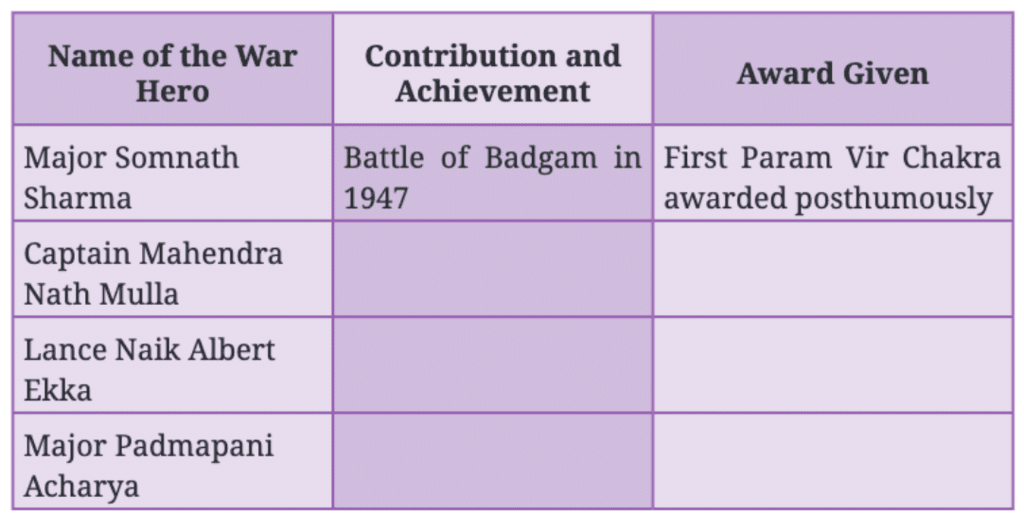
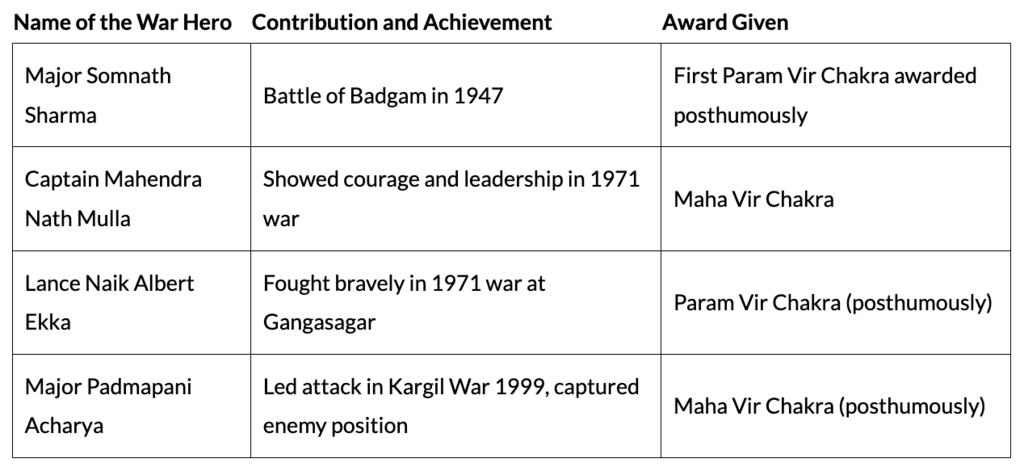
I would like to assure you that I would complete all my school work by taking notes from my classmates and submitting assignments on time.

I would be grateful if you could grant me the leave.

Yours sincerely,
Riya Sharma
Class 7, Section A, Roll Number 12

08. Paper Boats Chapter Solution

Let us do these activities before we read (Page 109)

I. Read the questions given below. Share your answers with your classmates and the teacher.

Q1: What comes to mind when you think about ‘paper boats’?
Ans: Paper boats make me think of folding paper into small boats and floating them on water, like in a stream or puddle, for fun.

Q2: What do you think someone might hope for when they send a paper boat down a stream?
Ans: Someone might hope their paper boat reaches a faraway place or that someone finds it and learns about them.

Q3: Read the title of the poem ‘Paper Boats’ and predict what the poem might be about.
Ans: The poem might be about a child making paper boats, floating them on a stream, and imagining where they go or who finds them.

II: Read the given paragraph and match the highlighted words with their meanings given in the box below.

I love to play beside a 1. running stream at a short distance from my grandparent’s house. I love to see it 2. skipping along to join a river. On the river, I can see boats with 3. bulging sails moving swiftly. Some of them take the people from one shore to the other, while in some of thempeople can be seen 4. lading things too. I can spend hours watching the busy river and dreaming about them, 5. burying my head in my pillow at night.
Ans: 1. running – speedily flowing
2. skipping – bouncing
3. bulging – swelling
4. lading – loading
5. burying – putting

Let us discuss (Page 111)

QI: Choose the correct words from the brackets to complete the summary of the poem given below.

The poet sends paper boats down a 1. __________ (stream/river) each day, writing his name and the name of his 2. __________ (school/ village) on them. He hopes that someone in a 3. __________ (strange/familiar) land will find them and know who he is. The poet fills his boats with 4. __________(rose/shiuli) flowers from his garden, hoping they will be safely carried to another land at 5. __________ (night/morning). As he launches his boats, he imagines that the 6. __________ (clouds/birds) in the sky are like friends, racing with his boats. At night, he dreams that his paper boats continue to 7. __________ (swim/float) under the midnight stars, with the fairies of sleep sailing in them, their baskets full of 8. __________ (dreams/fruits).

Ans: The poet sends paper boats down a 1. stream each day, writing his name and the name of his 2. village on them. He hopes that someone in a 3. strange land will find them and know who he is. The poet fills his boats with 4. shiuli flowers from his garden, hoping they will be safely carried to another land at 5. night. As he launches his boats, he imagines that the 6. clouds in the sky are like friends, racing with his boats. At night, he dreams that his paper boats continue to 7. float under the midnight stars, with the fairies of sleep sailing in them, their baskets full of 8. dreams.

QII: Choose the correct option for the following. The theme of the poem is ________________.
1. innocence 2. imagination 3. ignorance 4. playfulness 5. travel
(i) 1, 2 and 3 
(ii) 3, 4 and 5 
(iii) 1, 4 and 5 
(iv) 1, 2 and 4
Ans: (iv) 1, 2 and 4 (innocence, imagination, playfulness)

QIII: Identify whether the following statement is true or false. 
The setting of the poem is a natural, outdoor environment.
Ans: True

QIV: Complete the following sentence by choosing the correct word given within the brackets.
The tone is ____________________ (sad and serious/gentle and wishful) and the mood is ____________________ (thoughtful/boring).
Ans: The tone is gentle and wishful and the mood is thoughtful.

QV: Identify the examples of alliteration from the poem.
Ans: 
1. big black letters
2. paper boats

QVI: Fill in the blanks with suitable words from the poem.
1. The repetition of words ___________ and ___________ emphasises thepassage of time.
2. The poet uses imagery like ___________ and ___________ to create aclear picture in the minds of the readers.
Ans: 1. The repetition of words day by day and one by one emphasises the passage of time.
2. The poet uses imagery like midnight stars and fairies of sleep to create a clear picture in the minds of the readers.

QVII: Match the descriptions in Column 1 with what they symbolise in Column 2.

Ans: 

Let us think and reflect (Page 112)

QI. Read the extract given below and answer the questions that follow.

1. When night comes I bury my face in my arms and dream that my paper boats float on and on under the midnight stars.The fairies of sleep are sailing in them, and the lading is their basketsfull of dreams.

(i): Select the option that is most likely to be the speaker as per the extract.


Ans: C.

(ii): What can be inferred about the speaker’s feelings when night comes?
Ans: The speaker feels dreamy and imaginative, thinking about paper boats floating under the stars.

(iii): What kind of beings are the ‘fairies of sleep’ imagined as? Select the most appropriate option.
A. mischievous 
B. gentle 
C. fearsome 
D. playful
Ans: B. gentle

(iv): Fill in the blank by selecting the correct option from those given in the brackets.
The phrase ‘lading is their baskets full of dreams’ suggests that thespeaker imagines the fairies of sleep carefully _________________(carrying his dreams /collecting his wishes) in their baskets.
Ans: The phrase ‘lading is their baskets full of dreams’ suggests that the speaker imagines the fairies of sleep carefully carrying his dreams in their baskets.

QII. Answer the following questions.

1: Why do you think the poet writes his personal details on the paper boats?
Ans: The poet writes his name and village on the paper boats to share who he is, hoping someone far away will find them and know about him.

2: The poet talks about the imagination of a child. Support this view with examples from the poem.
Ans: The poet shows a child’s imagination by dreaming that paper boats float under midnight stars, imagining clouds racing with the boats, and picturing fairies of sleep sailing with baskets of dreams.

3: How does the poet bring together imagination and reality to make the poem more interesting?
Ans: The poet mixes reality, like making paper boats and floating them in a stream, with imagination, like dreaming they travel to strange lands or carry fairies with dreams, making the poem magical and engaging.

Let us learn (Page 113)

QI: The poet has used phrases like ‘blooms of the dawn’ and ‘fairies of sleep’ in the poem. In the same way we can create phrases. Now, select words from Column 1 and Column 2 and combine them with ‘of’. Write as many phrases as possible in Column 3.

Ans:

QII: The poet uses words like ‘dawn’, ‘night’ and ‘midnight’ to show different parts of the day. The box given below has some more words. Write the words in the appropriate columns.

Ans: 

QIII: Match the words from the text given in Column 1 with their opposites in Column 2.

Ans: 

Let us listen (Page 114)

Let us listen You will listen to a conversation between a girl and her father about the art of paper folding called origami. As you listen, select the true statements from 1–7. (Transcript for the teacher on pg. 137) 

  • Father : Sai dear! What are you working on there with all that paper? 
  • Sai : Baba, I am trying to make an origami crane, but it’s a bit tricky. I keep messing up the folds. 
  • Father : Ah, origami! I remember doing that when I was your age. You know, Sai, origami has a really interesting history. 
  • Sai : Really? I thought it was just something fun to do with paper. 
  • Father :It is fun, but it’s also an age-old art form. Origami started in Japan over a thousand years ago. Back then, paper was really expensive, so it was only used for special occasions, like religious ceremonies. 
  • Sai : Wow, I didn’t know that. So, it wasn’t just for doing crafts? 
  • Father :It wasn’t until the seventeenth century that people began making animals, flowers and other designs just for fun. 
  • Sai : So, people have been making paper cranes for hundreds of years? 
  • Father : Yes, and the crane is especially important in Japanese culture. It’s a symbol of peace and long life. There’s even a belief that if you fold a thousand paper cranes, you can make a wish, and it will come true. 
  • Sai : A thousand cranes? That’s a lot! But it sounds like a really nice tradition. 
  • Father :It is. Origami isn’t just about the final shape—it’s about the process, the patience and the creativity involved. And over the years, it’s spread all over the world, with people adding their own styles and techniques. 
  • Sai :I had no idea origami had such a long history. It makes folding this crane feel even more special.
  • Father :I’m glad you think so, Sai. Perhaps we can start with something simpler next time. How about we make an origami paper boat next? It’s easier, and we can float it in the stream outside. 
  • Sai : A boat sounds awesome! Let’s do it! But first, I want to finish this crane. Can you help me with the last few steps? 
  • Father : Of course! Let’s finish this crane together. After that, we’ll sail our paper boat. 

Statements

  1. Sai was trying to make an origami boat. 
  2. Sai’s father used to do origami as a child. 
  3. Paper was very expensive so it was used only for special occasions. 
  4. People have been making paper cranes for thousands of years. 
  5. There is a belief that if you make a thousand paper cranes, your wish will come true. 
  6. The art of origami is about enjoying the process. 
  7. Sai’s father suggests making a paper bookmark next time.

Ans:

1. Sai was trying to make an origami boat.
False. She was trying to make an origami crane.

2. Sai’s father used to do origami as a child.
True. He mentions that he remembers doing origami when he was Sai’s age.

3. Paper was very expensive so it was used only for special occasions.
True. The father explains that in ancient times, paper was costly and used mainly for religious ceremonies.

4. People have been making paper cranes for thousands of years.
False. Origami began over a thousand years ago, but making cranes and decorative items for fun started around the 17th century.

5. There is a belief that if you make a thousand paper cranes, your wish will come true.
True. Sai’s father shares this cultural belief during the conversation.

6. The art of origami is about enjoying the process.
True. The father says origami is about the process, patience, and creativity—not just the final shape.

7. Sai’s father suggests making a paper bookmark next time.
False. He suggests making a paper boat next time.

Let us speak (Page 115)

Create any craft item using eco-friendly materials. Make a presentation in front of your classmates and teacher about the craft item you have made.

Your presentation should include the following information: 

  • Introduction of the item 
  • Description of how you made it 
  • Reason why you like the craft 
  • Conclusion

Use the phrases given below to make your presentation. 

  • Today, I’m going to show you a… I made. 
  • This… is made of… (materials) 
  • It’s… (describe colour, shape, size) 
  • It can be used to… 
  • First, I started by… 
  • Then, I used… (tool or material) to… 
  • The most difficult part was to… 
  • This… is special to me because… 
  • I hope you enjoyed seeing my craft and learning about it. 
  • Thank you for your attention.

Ans: 
Here is a sample eco-friendly craft presentation using the given structure and phrases. You can use it as a script for your classroom activity:

Craft Presentation: Newspaper Photo Frame

  • Today, I’m going to show you a photo frame I made.
  • This photo frame is made of old newspapers, cardboard, glue, and natural colours.
  • It’s rectangular in shape, grey and brown in colour, and medium in size.
  • It can be used to display your favourite photograph on a study table or wall.

How I Made It

  • First, I started by folding strips of newspaper tightly into sticks.
  • Then, I used cardboard as a base and arranged the rolled newspaper sticks around it like a border. I glued everything in place and let it dry.
  • After that, I painted the frame using colours made from turmeric and beetroot juice to make it more attractive.
  • The most difficult part was to roll the newspaper tightly and evenly, but I practised and got better at it!

Why I Like This Craft

  • This photo frame is special to me because I made it using things we usually throw away. 
  • It helped me understand how we can reuse materials and reduce waste. 
  • I also enjoyed decorating it in my own style.

Conclusion

I hope you enjoyed seeing my craft and learning about it.
Thank you for your attention!

Let us write (Page 116)

A diary entry is a personal document. It records an individual’s account ofa day of her or his life expressing the thoughts, feelings and opinions in the individual’s mind.

The guidelines to compose a diary entry include:

  • mentioning day, date and time of writing it
  • beginning with a general sentence describing the day or feelings towards an event or experience
  • giving details
  • concluding with a final remark

Now, write a diary entry expressing your joy in experiencing a rainy day. You may begin as given below:

Ans:

Friday, 15 July 20XX               6:30 p.m. 
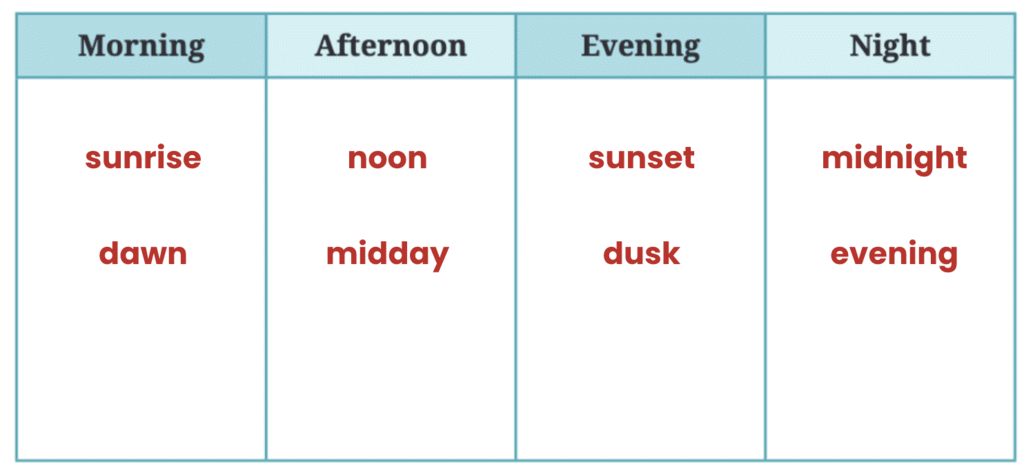
Dear Diary, 

It was quite humid today. On my journey back from school, I wished that it would rain. And it did! The sky turned dark, and raindrops started falling. I ran outside and felt the cool water on my face. I made paper boats and floated them in a small stream near my house. It was so fun watching them sail! The sound of rain was calming, and everything looked fresh and green. I danced in the rain with my friends, laughing loudly. Today was a happy day, and I hope it rains again soon. 

Yours, 
[Your Name]

Let us explore (Page 116)

I) Shiuli flowers often find a mention in Rabindranath Tagore’s poems. These flowers are found in many parts of our country. 
Look at the pictures of shiuli flowers and recall what you call them in your language

1. Find out names of some more trees or plants in your locality which have fragrant flowers. Write their names in your language and English language. Draw any two flowers and colour them.
Ans: Name of Shiuli Flower in Different Languages:

  • English: Night Jasmine / Coral Jasmine
  • Hindi: हरसिंगार (Harsingar)
  • Bengali: শিউলি (Shiuli)
  • Tamil: பரிஜாதம் (Parijatam)
  • Telugu: పారిజాతం (Parijatam)
  • Marathi: पारिजातक (Parijatak)

Other Trees or Plants with Fragrant Flowers:Local Language NameEnglish Nameचमेली (Chameli)Jasmineगुलाब (Gulab)Roseबेला (Bela)Arabian Jasmineरजनीगंधा (Rajnigandha)Tuberoseमोगरा (Mogra)Jasmine (variety)चम्पा (Champa)Plumeria / Frangipani

Draw and Colour Any Two Flowers:
You can draw:

  1. Rose – Colour it red or pink
  2. Jasmine – Colour it white with green leaves

II Solve the riddles given below. Share your answers with your classmates and the teacher. 

Riddle 1:
I have water that you cannot drink,
People come to see how in me the Sun sinks.
I can be rough, I can be calm,
I hold within myself plenty of charm.
My depths tell a never-ending tale.
Who am I with dolphins and the whale?
Answer: Sea or Ocean

Riddle 2:
I sit in stillness, but move with the wind,
My surface mirrors the world you are in.
The trees around me live happily,
In me, you can take a dip daily.
Home to ducks, frogs, fish, and all,
Can you guess what I am, after all?
Answer: Pond or Lake

Riddle 3:
I gently travel through valleys deep,
My soft murmur can make you sleep.
Little paper boats float on me in rain
The merry laughter of the kids I gain.
You may sit beside me without any fear,
Who am I who skips along, crystal clear?
Answer: Stream or Brook

Riddle 4:
I have a bed, but I do not sleep.
I have a bank, but no money I keep.
I carry stories, old and new,
High mountains to the oceans blue.
I journey far to meet the sea,
Can you guess, who I can be?
Answer: River