Have you ever thought about how many grains of rice are in a single bag, or how many stars twinkle in the night sky? Numbers are everywhere, helping us count, measure, and understand the world around us. Sometimes, these numbers are small, like the number of fingers on your hand. But often, especially when we talk about populations, distances between cities, or even the variety of life on Earth, the numbers become very, very large!
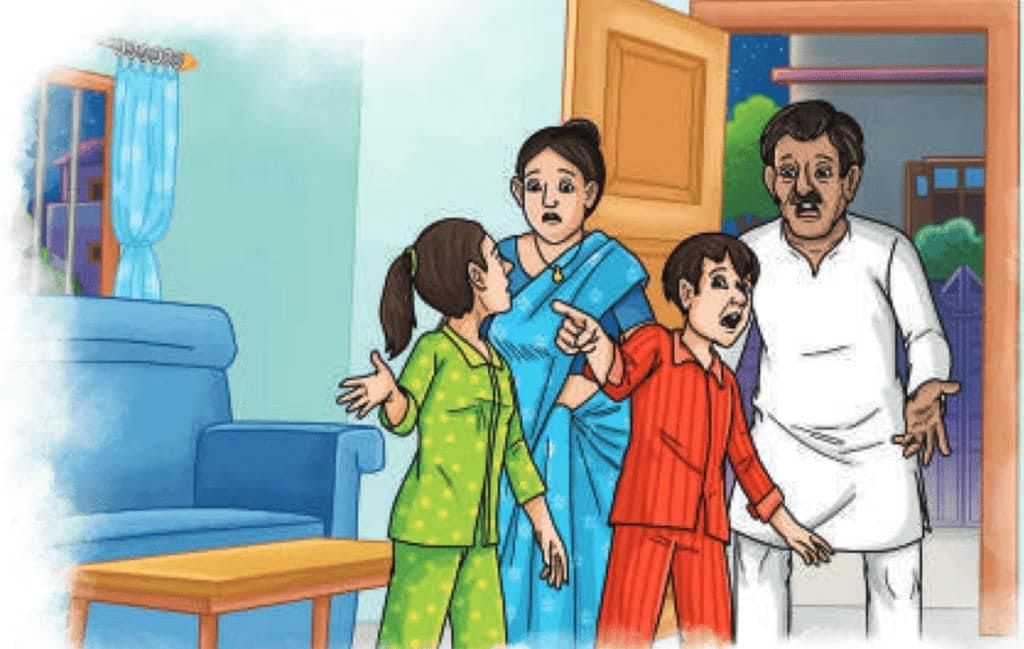
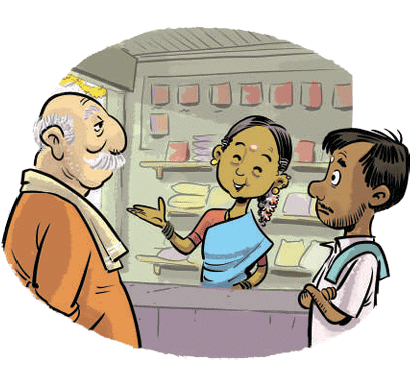
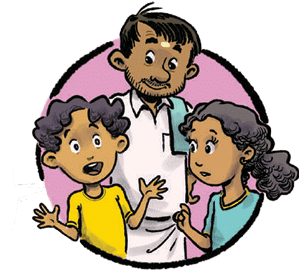
Imagine a farmer named Eshwarappa, walking through a market in Karnataka. He overhears a conversation about rice – not just any rice, but lakhs of varieties that used to exist in India! A lakh!Eshwarappa hearing a conversationThat sounds like a huge number. Eshwarappa Eshwarappa shared this incident with his daughter Roxie and son Estu . They wonder,
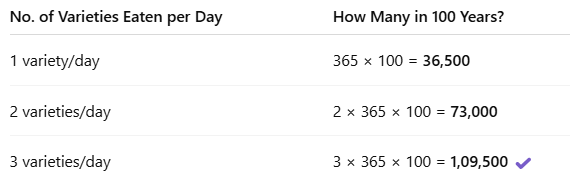
“Can a person taste all 1 lakh rice varieties in their lifetime?”
Let’s Calculate!
There are 365 days in a year. So if someone lives for 100 years, the number of days is:100×365=36,500 days.
So, if someone eats 3 different types of rice every single day for 100 years, they can taste all 1 lakh rice varieties! This story from your textbook introduces us to the fascinating world of large numbers. It makes us question: How big is a lakh? How do we even write or say such big numbers?
In this chapter, we will embark on a journey to explore these “Large Numbers Around Us.”
Getting a Feel for Large Numbers
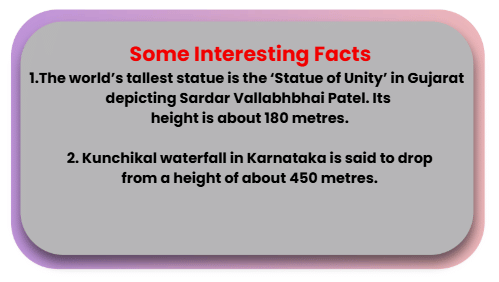
Sometimes, we hear big numbers like 180 metres or 450 metres—but it’s hard to imagine how tall that really is. So we compare it to something we know.
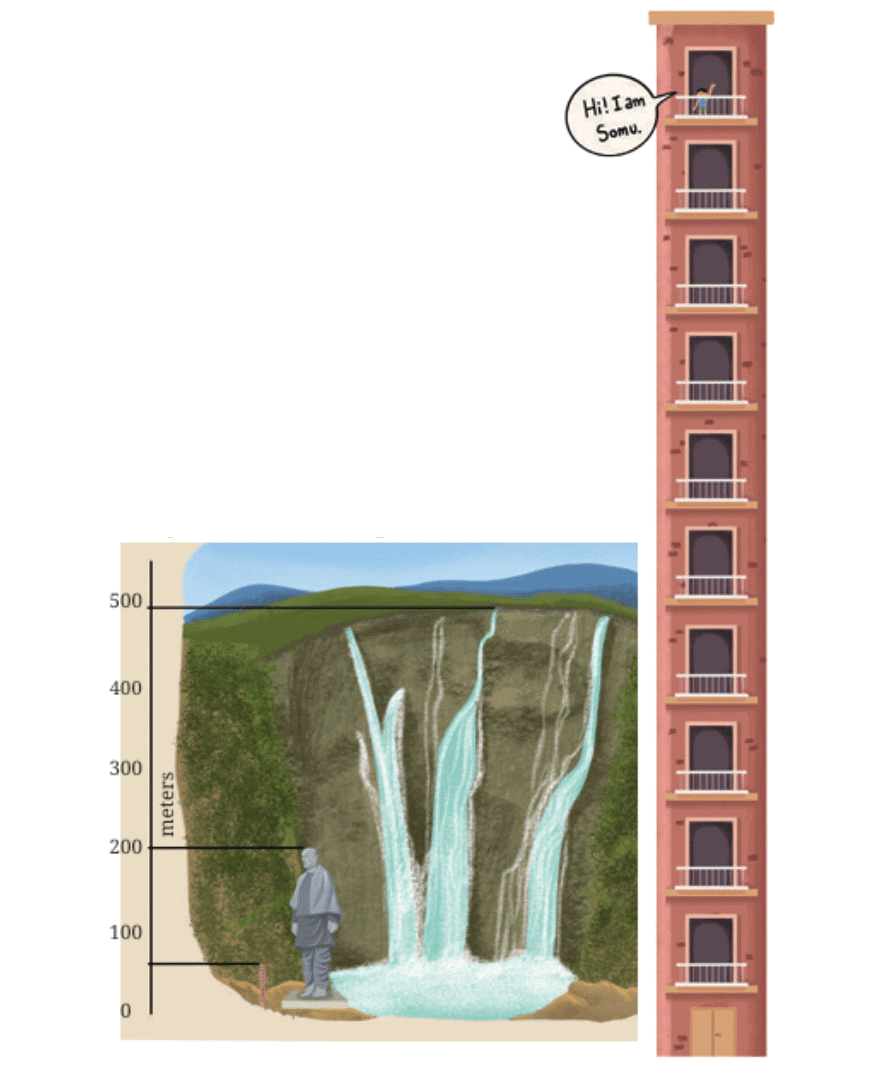
Let’s Look at Somu’s Building
Somu is 1 metre tall.
Each floor is about 4 times his height. So, 1 floor = 4 metres.
There are 10 floors, so the total height of the building is:
10×4=40 metres
Q1: Which is taller — The Statue of Unity or Somu’s building? How much taller?
Statue of Unity = 180 metres
Somu’s building = 40 metres
180−40=140180−40=140 metres taller
Answer: The Statue of Unity is taller by 140 metres.
Q2: How much taller is the Kunchikal waterfall than Somu’s building?
Waterfall height = 450 metres
Building height = 40 metres
450−40=410450−40=410 metres taller
Answer: The waterfall is 410 metres taller than Somu’s building.
Q3: How many floors should Somu’s building have to be as tall as the waterfall?
Waterfall = 450 metres
1 floor = 4 metres
450÷4=112.5450÷4=112.5
We can’t have half a floor in reality, so we round up to 113.
Answer: Somu’s building should have 113 floors to be as tall as the waterfall!
Is One Lakh a Very Large Number?
This is actually a very interesting question because…
Sometimes 1 lakh feels very big and sometimes it feels small, depending on what we are talking about.
Let’s see why:
Roxie gives three examples to show how huge one lakh can feel:
1 Lakh Varieties of Rice
Imagine tasting a new type of rice every day.
It would take 274 years to try them all!
We live only about 70–80 years. So, we’ll never finish them!
Living for 1 Lakh Days
One year has 365 days.
1,00,000 ÷ 365 ≈ 274 years!
That’s like living three lifetimes. So yes, it’s big.
1 Lakh People Standing in a Line
If each person takes about 0.38 meters of space, then:
1,00,000 people = 38 km long line.
That’s like a line from one city to another!
Estu gives a different view. He shows how small 1 lakh can feel:
Stadium Seats
The cricket stadium in Ahmedabad holds more than 1 lakh people.
They all fit in one place — that feels not so big, right?
Hair on a Human Head
An average person has 80,000 to 1,20,000 hairs.
That means 1 lakh hairs fit on your head!
So, in a tiny space, you can already have 1 lakh things.
Fish Eggs
Some fish can lay 1 lakh eggs at once!
Even 10 lakh (a million) in some species!
That makes 1 lakh seem small in nature.
Q: So,is 1 lakh big or small?
Ans: It depends on what you’re comparing it with.
If you’re saving ₹1 lakh, it feels like a lot of money.
But if a government spends ₹1 lakh on a city, it’s very little.
If you’re counting people or things in small spaces, 1 lakh may not feel big.
But if you want to do something 1 lakh times, it’s a huge effort.
Reading and Writing Large Numbers
Now that we have a better feel for large numbers like lakhs, how do we actually read and write them clearly?
The Indian Place Value System
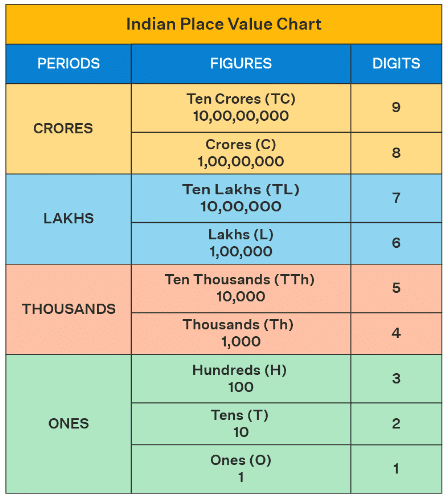
In the Indian system, numbers are grouped into hundreds, thousands, lakhs, crores, and so on. Here’s a breakdown:
Units: The first three digits from the right are the units, tens, and hundreds.
Thousands: The next two digits are the thousands.
Lakhs: The next two digits are the lakhs.
Crores: The digits after lakhs are the crores.
Indian Place Value Chart
Comma Rules:
The first comma comes after 3 digits from the right (thousands group).
Next commas come after 2 digits each.
Example: 12,78,830 is grouped as 12 (lakhs), 78 (thousands), 830 (hundreds & below)
Q: Write these in words:
(a) 3,00,600 Ans: Three lakh six hundred
(b) 5,04,085 Ans: Five lakh four thousand eighty-five
(d) 70,53,138 Ans: Seventy lakh fifty-three thousand one hundred thirty-eight
Writing Number Names as Numbers
Now let’s go the other way — you are given the number in words, and you need to write it in figures (numbers).
Q: Write the numbers
(a) One lakh twenty-three thousand four hundred and fifty-six Ans: 1,23,456
(b) Four lakh seven thousand seven hundred and four Ans: 4,07,704
(c) Fifty lakhs five thousand and fifty Ans: 50,05,050
(d) Ten lakhs two hundred and thirty-five Ans: 10,00,235
Try yourself:
What is the height of Somu’s building?
A.40 metres
B.180 metres
C.450 metres
D.100 metres
View Solution
The Land of Tens
Understanding place value is like having a secret code for numbers. Each digit in a number holds a specific value based on its position. The “Land of Tens” analogy from the chapter helps illustrate this beautifully using special calculators.
Imagine calculators with limited buttons:
Thoughtful Thousands (+1000 button): To make 3,000, you press it 3 times. To make 10,000, you press it 10 times. To make one lakh (1,00,000), you need to press it 100 times (since 1 lakh = 100 thousands).
Tedious Tens (+10 button): To make 500, you press it 50 times (50 x 10 = 500). To make 1,000, you press it 100 times (100 x 10 = 1000). To make one lakh (1,00,000), you need a whopping 10,000 presses (10,000 x 10 = 1,00,000)!
Handy Hundreds (+100 button): To make 3,700, you press it 37 times (37 x 100 = 3700). To make 10,000, you press it 100 times (100 x 100 = 10,000). To make one lakh (1,00,000), you press it 1,000 times (1,000 x 100 = 1,00,000).
This shows how many smaller units make up larger ones: 100 thousands make a lakh, 10,000 tens make a lakh, and 1,000 hundreds make a lakh.
What is Place Value?
Place value defines the value of each digit in a number based on its position. Each position, or “place,” in a number has a unique value that helps determine the overall number.
Example 1: What are the place values of each digit in the number 92,735? Ans:
5 is Ones
3 is Tens
7 is Hundreds
2 is Thousands
9 is Ten thousands
The diagram below illustrates the above example in more detail.
Now, let’s meet Creative Chitti, a calculator with buttons for +1, +10, +100, +1000, +10000, +100000, etc. I am Creative ChittiChitti shows that numbers can be made in many ways. For example, 5072 could be:
(50 x 100) + (7 x 10) + (2 x 1) = 5000 + 70 + 2 = 5072
(3 x 1000) + (20 x 100) + (72 x 1) = 3000 + 2000 + 72 = 5072
Another way: (4 x 1000) + (10 x 100) + (6 x 10) + (12 x 1) = 4000 + 1000 + 60 + 12 = 5072
This leads us to the idea of expanded form. While Chitti is creative, Systematic Sippy wants to use the fewest button clicks possible. To make 5072 with the fewest clicks, Sippy would press:
+1000 button: 5 times (for 5000)
+100 button: 0 times (for 0 hundreds)
+10 button: 7 times (for 70)
+1 button: 2 times (for 2)
Total clicks = 5 + 0 + 7 + 2 = 14 clicks. The expression is: (5 x 1000) + (0 x 100) + (7 x 10) + (2 x 1) = 5072.
Notice something important? The way Systematic Sippy makes the number with the fewest clicks directly corresponds to the standard expanded form based on place value! Each digit is multiplied by its place value (ones, tens, hundreds, thousands, etc.).
Expanded Form: When we write a number in expanded form, we break it down to show the value of each digit. It’s like stretching the number out to see each part clearly.
Example 2: Write in expanded form: 4,582 Sol: Let’s expand 4,582:
Thousands place: The digit 4 is in the thousands place, so its value is 4,000.
Hundreds place: The digit 5 is in the hundreds place, so its value is 500.
Tens place: The digit 8 is in the tens place, so its value is 80.
Ones place: The digit 2 is in the ones place, so its value is 2.
Putting it all together: 4,582 = 4,000 + 500 + 80 + 2
Of Crores and Crores!
We’ve talked about lakhs, but the world of large numbers doesn’t stop there! What happens when we have numbers even bigger than ten lakhs?
As numbers get bigger, it becomes difficult to read and understand them unless they are written properly with commas. To help us, two main systems are used around the world:
The Indian Number System
The International Number System (also called the American System)
In the Indian system, the next major milestone after lakh is the crore as we already discussed above.
1 Crore = 100 Lakhs
1 Crore = 1,00,00,000 (That’s a 1 followed by seven zeros!)
Think back to the Creative Chitti calculator. If you pressed the +10,00,000 (ten lakh) button ten times, you would reach 1,00,00,000, which is one crore.
Just like lakhs, crores help us talk about very large quantities, such as the population of large cities or entire states, or the cost of major projects.
And it doesn’t stop at crores! The next step in the traditional Indian system is the arab.
1 Arab = 100 Crores
1 Arab = 1,00,00,00,000 (A 1 followed by nine zeros!)
International System of Writing Numbers
The number 100000 is read as one hundred thousand or 1 lakh. It is a 6-digit numeral.
In the International System, the number 10 lakh or ten hundred thousand, that is, a thousand thousand, is called a million.
It is written as under:
Instead of lakhs, crores, etc. as periods, we use millions, billions, etc.
Let us write the smallest 8-digit number in the two systems of numerations.
The International place value chart is given below.
The chart can be expanded to include more than nine places.
The section just before the millions is known as the billions section.
Next, we have the trillions section.
The places before the hundred billions are referred to as: – trillions place – ten trillions place – hundred trillions place
When we compare the two systems of counting, we can see the following connections.
Note that in the Indian system, starting from the right after the first period of 3 digits all other periods are of 2 digits but in the International system, each period consists of three digits.
We place a comma or leave space after every 3 digits.
The abacus shows the number six million eight hundred forty-nine thousand two hundred forty.
To make the task of reading and writing such large numbers easy, start counting digits from the right by threes and leave some space or put a comma after every three digits as shown below.
Try yourself:
What are the two main systems used to write large numbers around the world?
A.Metric and Imperial
B.Indian and International
C.American and European
D.Local and Global
View Solution
Number Names – Indian vs. American
Let’s take an example number:
→ 9876501234
In the Indian system, we place commas like this:
9,87,65,01,234 We read it as: 9 arab 87 crore 65 lakh 1 thousand 234 or 987 crore 65 lakh 1 thousand 234
In the American system, commas look like this:
9,876,501,234 We read it as: 9 billion 876 million 501 thousand 234
Understanding Zeros in Large Numbers
1 thousand = 1,000 → 3 zeros
1 lakh = 1,00,000 → 5 zeros
1 crore = 1,00,00,000 → 7 zeros
1 arab = 1,00,00,00,000 → 9 zeros
Now let’s answer these questions:
Q: How many zeros in a thousand lakh?
1 lakh = 1,00,000
1,000 × 1,00,000 = 1,00,00,00,000 → 8 zeros
But let’s calculate more carefully:
1000×1,00,000=1,00,00,00,000(which is actually 10 crores)
So the number has 8 zeros.
Q: How many zeros in a hundred thousand?
1 thousand = 1,000
100 × 1,000 = 1,00,000 → 5 zeros
So Ans: 5 zeros
Exact and Approximate Values
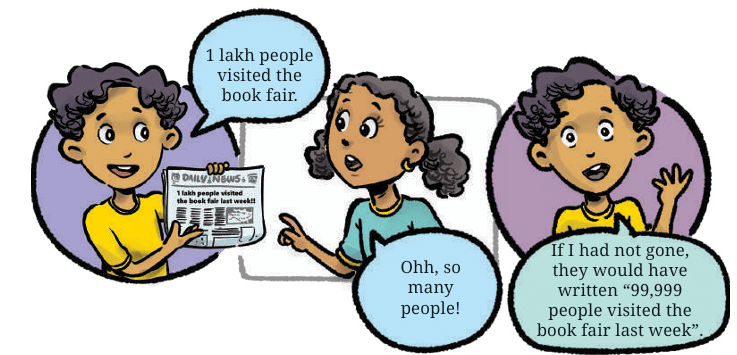
Read the image above. Does this mean exactly 100,000 people walked through the gates? Probably not! It’s likely an approximation or an estimate. The actual number might have been 98,543 or maybe 101,210. For a headline, saying “about 1 lakh” gives a good enough idea of the crowd size without needing the precise count.
This brings us to the important concept of estimation. Often, especially with large numbers, we don’t need the exact value. An approximate value is easier to understand, remember, and use.
Why do we use approximate numbers?
Example:
The exact population of Chintamani town is 76,068.
But saying “about 75,000 people live there” gives a quick idea without needing to know the exact count.
Two Common Ways of Rounding:
1. Rounding Up:
When we increase the number to a higher, easier number.
Example: A school has 732 people. The principal may round it up and order 750 sweets.
2. Rounding Down:
When we reduce the number a little to make it simpler.
Example: An item costs ₹470, but the shopkeeper might say it’s around ₹450.
Let’s Summarise:
Nearest Neighbours
A common way to estimate is by rounding to the nearest ten, hundred, thousand, lakh, crore, etc. This involves looking at the digit to the right of the place value you’re rounding to.
Rule: If the digit to the right is 5 or greater, round up the digit in the target place value. If the digit to the right is 4 or less, keep the digit in the target place value the same. All digits to the right of the target place value become zeros.
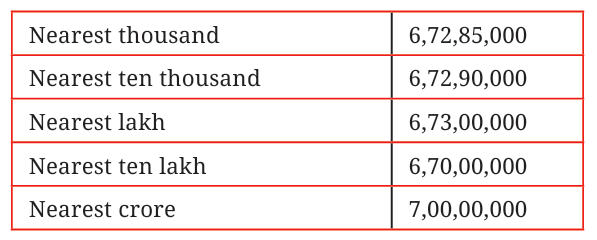
Let’s find the nearest neighbours for 6,72,85,183:
Nearest Thousand: Look at the hundreds digit (1). Since 1 < 5, keep the thousands digit (5) the same. 6,72,85,000
Nearest Ten Thousand: Look at the thousands digit (5). Since 5 ≥ 5, round up the ten thousands digit (8) to 9. 6,72,90,000
Nearest Lakh: Look at the ten thousands digit (8). Since 8 ≥ 5, round up the lakhs digit (2) to 3. 6,73,00,000
Nearest Ten Lakh: Look at the lakhs digit (2). Since 2 < 5, keep the ten lakhs digit (7) the same. 6,70,00,000
Nearest Crore: Look at the ten lakhs digit (7). Since 7 ≥ 5, round up the crores digit (6) to 7. 7,00,00,000
Patterns in Products
Instead of multiplying directly by numbers like 5, 25, or 50, Roxie and Estu uses a shortcut based on how those numbers relate to 10, 100, or 1000.
These shortcuts are possible because:
5 = 10 ÷ 2
25 = 100 ÷ 4
50 = 100 ÷ 2
125 = 1000 ÷ 8
So, multiplying a number by 5 is the same as:
Dividing the number by 2 and then multiplying by 10 → a × 5 = (a ÷ 2) × 10
And multiplying a number by 25 is the same as:
Dividing the number by 4 and then multiplying by 100 → a × 25 = (a ÷ 4) × 100
These are based on properties of multiplication and division:
Multiplication is associative and distributive
You can rearrange factors in multiplication for easier calculation
For example: a × 5 = a × (10 ÷ 2) = (a ÷ 2) × 10 This works because multiplication and division are inverse operations that can be grouped like this for easier solving.
Example 1: 116 × 5
Instead of directly multiplying 116 × 5, Roxie breaks it into:
116 × 5 = (116 ÷ 2) × 10
Why does this work?
Because 5 = 10 ÷ 2, so multiplying by 5 is the same as dividing the number by 2 and then multiplying the result by 10.
So,
116 ÷ 2 = 58
Then, 58 × 10 = 580Example 2: 824 × 25
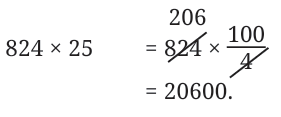
Estu applies a similar shortcut: 824 × 25 = (824 ÷ 4) × 100 Why?
Because 25 = 100 ÷ 4, so multiplying by 25 is like dividing by 4 and then multiplying the result by 100.
So,
824 ÷ 4 = 206
Then, 206 × 100 = 20600
Fascinating Facts about Large Numbers
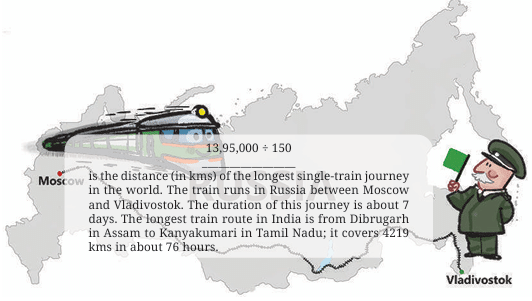
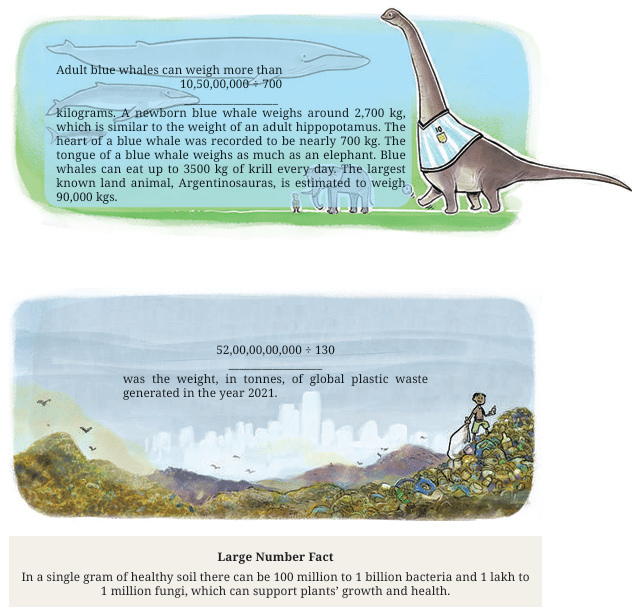
This lesson uses real-world facts involving huge numbers to show how multiplication and divisionhelp us understand large quantities — like distances, weights, populations, and more.
1. Using Multiplication to Discover Big Facts
2. Using Division to Break Down Big Facts
Try yourself:How many zeros are in a crore?A.5 zerosB.7 zerosC.9 zerosD.8 zerosView Solution
Did You Ever Wonder….?
Estu’s Question:
Can the entire population of Mumbai fit into 1 lakh buses?
Step 1: Understand the Numbers
1 lakh buses = 1,00,000 buses
Each bus holds = 50 people
So, total people in 1 lakh buses = 1,00,000 × 50 = 50,00,000 = 50 lakh people
Step 2: Compare with Mumbai’s Population
Population of Mumbai = 1 crore 24 lakh = 1,24,00,000 people
People buses can carry = 50 lakh
So, can everyone fit into the buses? No! Because 1 crore 24 lakh is more than double50 lakh.
Conclusion: The whole population of Mumbai cannot fit in 1 lakh buses.
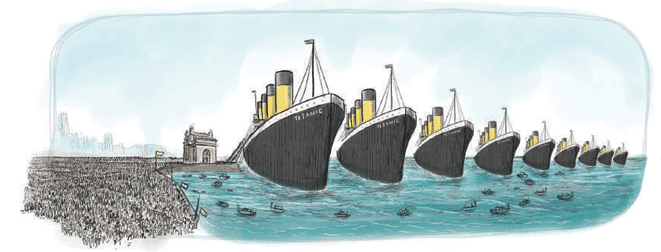
Now think about the Titanic Ship:
Can the population of Mumbai fit into 5000 Titanic-like ships?
Step 1: How many people fit in 1 ship?
Each Titanic can carry = 2,500 people
So, 5000 ships can carry = 5000 × 2500 = 1,25,00,000 = 1 crore 25 lakh people
Step 2: Compare again
Mumbai’s population = 1 crore 24 lakh
Space on ships = 1 crore 25 lakh
Yes! The population of Mumbai can fit into 5000 Titanic-like ships.
Solved Examples
Example 1: Write the number 70,53,138 in words using the Indian system. Ans: Seventy lakh fifty-three thousand one hundred thirty-eight.
Example 2: Write the number name “Fifty lakh five thousand fifty” in figures using the Indian system. Ans: 50,05,050
Example 3: Compare 500 lakhs and 5 million. Use ‘<‘, ‘>’, or ‘=’.
Ans: 500 lakhs = 500 x 1,00,000 = 5,00,00,000
5 million = 5 x 1,000,000 = 5,000,000
Since 5,00,00,000 is much larger than 5,000,000,
500 lakhs > 5 million
Example 4: Using Systematic Sippy’s method (fewest clicks), how would you make the number 3,67,813? Write the expression.
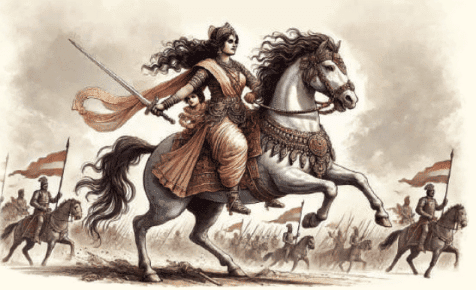
This story is about Rani Abbakka, a brave queen of Ullal who fought against the Portuguese to protect her land’s freedom.
It shows her courage, determination, and leadership as she stood up to a powerful enemy.
She inspired her people and other rulers to defend their country.
Explanation of the Story
Rani Abbakka and the Portuguese Threat
The story begins with Rani Abbakka, the queen of Ullal, a small coastal kingdom in India. At the time, Ullal was under pressure from the Portuguese, who had captured it and demanded tribute (money or goods) to maintain control. Rani Abbakka, however, believed Ullal was a sovereign (free) country and boldly refused to pay. When a Portuguese envoy visited to collect the overdue tribute, she firmly declared,
“We are a sovereign country. We don’t pay tribute to Portugal. And we don’t take orders from the Portuguese!” Though the envoy warned her of the consequences, Abbakka stood her ground.
Conflict at Home
Soon after her coronation (the ceremony of becoming queen), Abbakka shared her plan to resist the Portuguese with her husband, Veera Narasimha, the king of Bangadi. While she was determined to fight for Ullal’s independence, he was worried. He feared that her bold move might anger the Portuguese, bringing danger to his own kingdom. He called her decision rash and tried to persuade her to change her mind. Despite his concerns, Abbakka refused to back down. When she declared she wasn’t afraid of the Portuguese, Veera Narasimha even ordered his soldiers to stop her. But Abbakka’s determination remained strong.
Gathering Allies and Strategic Planning
Rani Abbakka reached out to local rajas (kings) for support. She held a meeting to unite them against the Portuguese threat. Although many of the rajas were unsure if their small forces could match the Portuguese army, Abbakka’s confidence and leadership encouraged them. To further strengthen Ullal, she ordered the building of merchant ships and formed an alliance with the Zamorin of Kozhikode, a powerful coastal ruler. This move allowed her to defy the Portuguese and establish successful trade with Arabia, boosting Ullal’s economy and position in the region.
The Battle for Ullal
Furious at her defiance, the Portuguese launched an attack on Ullal. Rani Abbakka bravely led her soldiers into battle, fighting alongside them. The battle lasted four days, with the people of Ullal showing great courage. In the end, the Portuguese were defeated and forced to retreat, never to trouble Ullal again. Abbakka even attacked the Portuguese fort, displaying her dauntless spirit and fierce commitment to her people and land.
Legacy of a Brave Queen
The people of Ullal stood by Abbakka, inspired by her courage and strong leadership. Her victory over the powerful Portuguese brought great pride to the kingdom and inspired other Indian rulers to resist foreign powers. Rani Abbakka’s story is a powerful reminder that with unity, strategic thinking, and fearless leadership, even the strongest enemies can be defeated.
Moral of the Story
The story teaches us the importance of courage, determination, and standing up for what is right.
Rani Abbakka’s bravery shows that even in the face of a powerful enemy, one person’s leadership and belief in freedom can inspire others and lead to victory.
It encourages us to value independence and work together for a common goal.
Difficult Words
Vassal: A state controlled by a more powerful country, forced to pay money or goods.
Coronation: A ceremony where someone is officially made king or queen.
Successor: A person who takes over a position or role from someone else.
Rash: Acting quickly without thinking about the results.
Sovereign: Free and independent, not controlled by others.
League: A partnership or alliance.
Wrath: Extreme anger.
Seize: To take something suddenly or by force.
Resolve: Strong determination to achieve a goal.
Raged: Happened in a fierce or violent way.
Decisive: Able to make decisions quickly and effectively.
This poem is a heartfelt tribute to soldiers who protect the nation with courage and dedication.
It celebrates their sacrifices, bravery, and tireless efforts in guarding the country under tough conditions.
The poet expresses deep gratitude and prays for their well-being, highlighting their selfless service.
ExplanationStanza 1
Oh! Defenders of borders You are great sons of my land When we are all asleep You still hold on to your deed
Explanation The poet begins by addressing soldiers as “Defenders of borders,” showing their role in protecting the country’s boundaries. Calling them “great sons” (meaning all soldiers, men and women) reflects their importance to the nation. While people sleep peacefully, soldiers stay awake, committed to their duty of safeguarding the country. This highlights their vigilance and sacrifice.
Stanza 2
Windy season or snowy days Or scorching sun’s sweltering rays You are there guarding all the time awake Treading the lonely expanses as yogis
Explanation This stanza describes the harsh conditions soldiers face. Whether it’s windy, snowy, or extremely hot, they remain on duty, always alert. The phrase “treading the lonely expanses as yogis” compares soldiers to yogis (spiritual seekers) who walk alone with focus. It shows their determination and strength in patrolling remote, lonely areas.
Stanza 3
Climbing the heights or striding the valleys Defending the deserts or guarding the marshes Surveillance in seas and by securing the air Prime of your youth given to the nation!!
Explanation The poet explains the diverse terrains where soldiers work—mountains, valleys, deserts, marshes, seas, and air. They climb high peaks, patrol lowlands, and monitor all areas to keep the nation safe. The line “Prime of your youth given to the nation” emphasizes that soldiers dedicate their youthful years, a precious time, to serve the country, showing their immense sacrifice.
Stanza 4
Wind chimes of my land vibrate your feat We pray for you brave men!! May the Lord bless you all!!
Explanation In the final stanza, the poet uses “wind chimes” to symbolise the nation’s pride and respect for soldiers’ brave actions (“feat”). The poet, along with the people, prays for the soldiers’ safety and well-being, asking for divine blessings. This shows gratitude and admiration for their courage and service.
Moral of the Poem
The poem teaches us to value and respect the sacrifices made by soldiers.
It encourages gratitude for their selfless service, as they protect the nation under tough conditions.
They give up personal comforts and safety.
We should honour their dedication and pray for their strength and safety.
Difficult Words
Defenders: Protectors or guardians.
Borders: Boundaries of a country.
Deed: Duty or task.
Scorching: Very hot.
Sweltering: Uncomfortably hot.
Treading: Walking or stepping on.
Expanses: Large, open areas.
Yogis: Spiritual people who meditate and live simply.
This lesson is a letter exchange between two friends, Soumya and Ananda, who share their feelings about brave soldiers who fought for India.
Soumya writes about her visit to the National War Memorial in New Delhi, describing how it honours soldiers who died in wars.
She shares stories of heroes and the memorial’s features, like the eternal flame and circles representing bravery and sacrifice.
Ananda replies, expressing gratitude and inspiration to join the Armed Forces.
The lesson teaches us to respect and remember soldiers’ sacrifices for our freedom.
Explanation of the Story
The story is told through two letters between Soumya, who lives in Bengaluru, and Ananda, who lives in Chandigarh. It focuses on their thoughts about soldiers and Soumya’s visit to the National War Memorial.
Soumya’s Letter (14 April):
Soumya writes to Ananda, reminding him of their earlier conversation about war and peace. She reflects on India’s journey—its fight for independence and the wars fought after 1947 to defend the nation. Curious about the brave soldiers who sacrificed their lives, Soumya finds some answers during her school trip to New Delhi, where she visits the National War Memorial.
Her teacher explains that the memorial, built between April 2018 and February 2019 near India Gate and inaugurated by Prime Minister Narendra Modi, honours soldiers who died in conflicts such as the Indo-China War (1962), Indo-Pak Wars (1965 and 1971), and the Kargil War (1999). The memorial holds 29,000 tablets with over 26,000 names of fallen heroes.
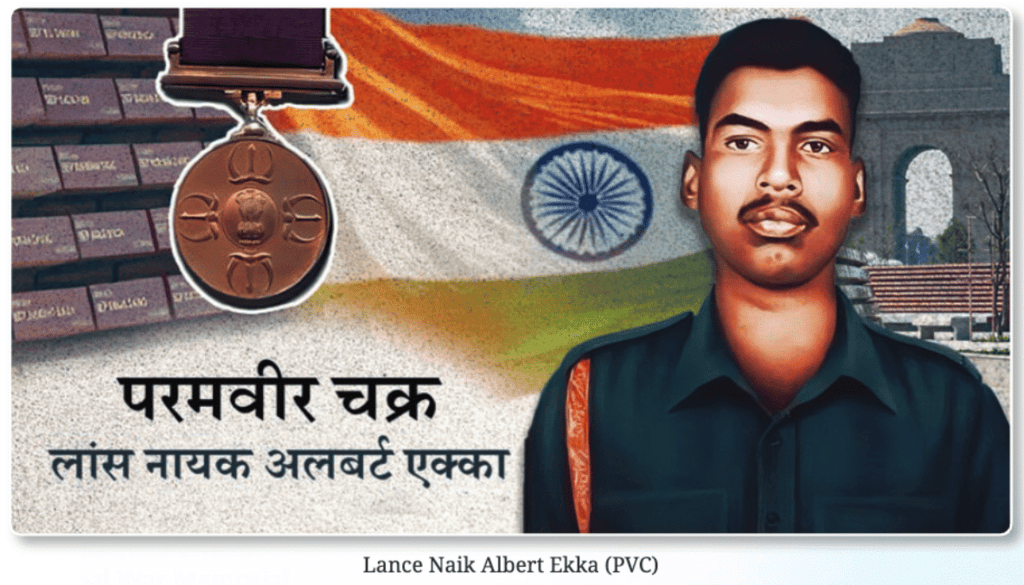
Soumya also learns about bravery awards like the Param Vir Chakra (PVC), awarded to 21 soldiers, starting with Major Somnath Sharma in 1947. Other notable heroes include Lance Naik Albert Ekka, Flying Officer Nirmal Jit Singh Sekhon, Second Lieutenant Arun Khetarpal, and Major Hoshiar Singh. Captain Mahendra Nath Mulla, a Navy officer, received the Maha Vir Chakra (MVC).
Inspired by the story of Lance Naik Albert Ekka, who bravely fought and died in the 1971 war despite serious injuries, Soumya feels a deep desire to one day serve the nation like him.
The National War Memorial has several symbolic sections:
Amar Chakra (Circle of Immortality): Home to the eternal flame, symbolising that soldiers’ spirits live on.
Veerta Chakra (Circle of Bravery): Displays six bronze murals of heroic battles.
Tyag Chakra (Circle of Sacrifice): Walls shaped like a Chakravyuh formation, listing soldiers’ names.
Raksha Chakra (Circle of Protection): Rows of trees representing the protectors of the nation.
Soumya describes the memorial’s beauty—the respectful wreaths, the lighting that changes from dawn to dusk, and the pride mixed with sadness she felt. Her class is preparing presentations about soldiers, and she chooses Major Padmapani Acharya, a 1999 Kargil War hero who, despite severe injuries, led his men to victory and was posthumously awarded the MVC. Soumya ends her letter excitedly, sharing a website link about the memorial.Ananda’s Letter (24 April)
Ananda is deeply moved by Soumya’s letter. He praises her vivid description and agrees that the National War Memorial is not just a monument but a symbol of gratitude for those who gave their lives for India’s freedom. Inspired by her experience, he too dreams of joining the Armed Forces.
He recalls visiting a war memorial in Chandigarh’s Bougainvillaea Garden, where people laid flowers to honour fallen soldiers. This visit reminds him of the famous Hindi poem Pushp ki Abhilasha by Makhanlal Chaturvedi, where a flower wishes to fall on the path of brave soldiers rather than be used for mere decoration.
Ananda shares his admiration for Captain Anuj Nayyar, another MVC awardee from the Kargil War, whose mother wrote a heartfelt book about him. Ananda mentions an interview where Captain Nayyar’s mother talks about the pain and pride of keeping her son’s memory alive.
Excited about the National War Memorial and Museum app, which provides information in 21 languages and showcases murals, Ananda expresses his wish to visit the memorial one day. He also plans to suggest creating a collage of inspiring heroes at school.
Before ending, Ananda warmly shares his love for philately—stamp collecting—and appreciates Soumya’s beautifully stamped letters. He concludes by telling her that her letter truly inspired him.
Moral of the Story
The lesson teaches us to be thankful for soldiers who gave their lives so we can live in a free and safe country.
It encourages us to honour their bravery by remembering their stories, visiting memorials, and learning about their sacrifices.
The story also inspires us to be courageous, serve our nation, and live in a way that respects the freedom soldiers fought for.
Difficult Words
Here are the meanings of some words from the lesson, explained simply:
Homage: Showing respect publicly for someone.
Memorial: A place or statue built to remember people who died.
Patriotism: Love and loyalty for one’s country.
Sacrifices: Giving up something important, like life, for a cause.
Inaugurated: Officially opened or started.
Tribute: An act to show respect or gratitude.
Etched: Carved or written permanently, like names on stone.
Gallantry: Great courage, especially in battle.
Posthumously: After someone has died.
Citation: A description of someone’s brave actions for an award.
Awestruck: Feeling amazed and impressed.
Commemorates: Honors and remembers officially.
Obelisk: A tall, pointed stone pillar.
Wreaths: Rings of flowers used to show respect for the dead.
Interminable: Never-ending, like an eternal flame.
Murals: Large paintings or designs on walls.
Valour: Great bravery in danger.
Solemn: Serious and respectful.
Sovereignty: A country’s independence and control over itself.
This chapter tells the inspiring story of a young woman who faced a life-changing accident but refused to give up.
With strong will and determination, she overcame challenges to achieve something extraordinary.
It is a story of courage, hope, and never giving up on dreams, no matter how tough things get.
Explanation of the Story
Early Life and Dreams
Arunima Sinha, a 24-year-old from Ambedkar Nagar, Uttar Pradesh, was always passionate about sports. Her father was an army engineer, and her mother worked as a health supervisor. Arunima excelled in sports, especially volleyball, and after completing her law degree, she planned to join the paramilitary forces. This would allow her to pursue her love for sports while building a career.
A Life-Changing Incident
On April 11, 2011, Arunima’s life took a dramatic turn when she met with a terrible train accident. She lost one of her legs, and doctors had to fit her with an artificial limb. While recovering in the hospital, Arunima, refusing to give up, found new inspiration. She read about Mount Everest and decided she would climb it, despite her injury. Many thought this dream was impossible, but Arunima was firm in her resolve.
The Climb to Mount Everest
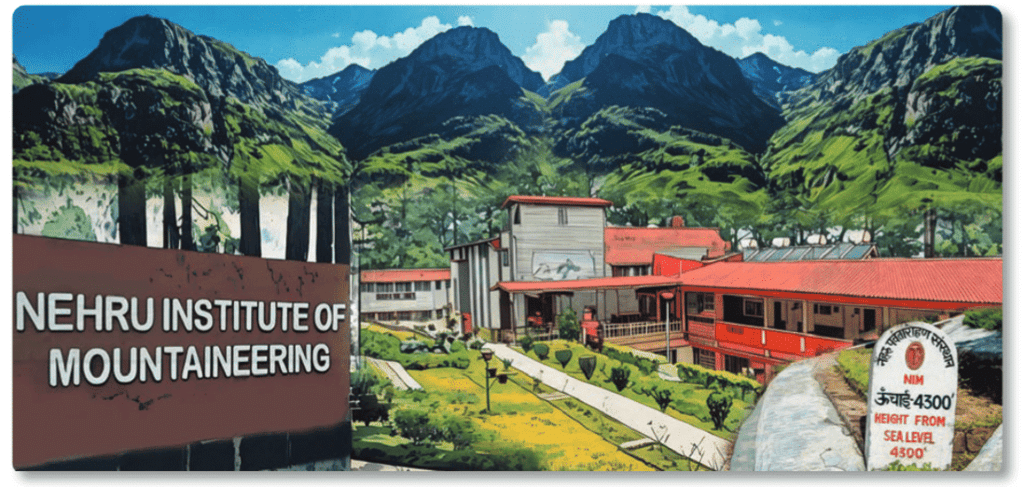
To achieve her dream, Arunima trained rigorously. She enrolled at the Nehru Institute of Mountaineering in Uttarkashi and underwent 18 months of intense preparation. She was guided by Bachendri Pal, the first Indian woman to climb Mount Everest, who believed that Arunima had already won by daring to dream so big.
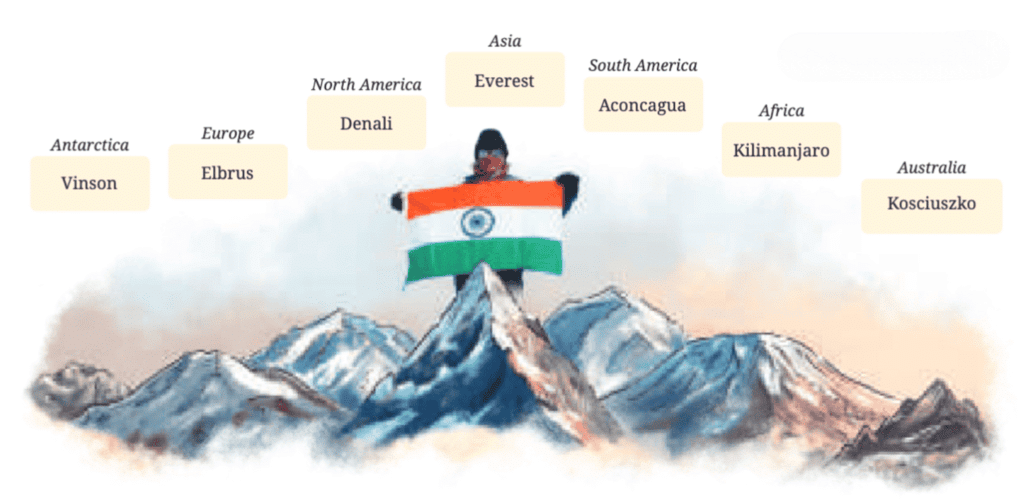
After 52 challenging days of climbing, on May 21, 2013, Arunima reached the summit of Mount Everest. She proudly planted the Indian flag and placed a photograph of Swami Vivekananda, her inspiration, at the top. She became the first Indian woman with an artificial leg to achieve this remarkable feat.
Conquering the Seven Summits
Arunima’s achievements didn’t stop with Everest. By July 2016, she had conquered the highest peaks of all seven continents, including mountains in Europe, Africa, Australia, South America, North America, and Antarctica. In January 2019, she became the first woman amputee to climb Mount Vinson in Antarctica, completing her mission to conquer the Seven Summits.
The Spirit of Arunima’s Journey
Arunima’s story is not just about physical endurance but about incredible mental strength and courage. Her journey proves that with determination, perseverance, and belief in oneself, even the most impossible challenges can be overcome.
Moral of the Story
The story teaches us that no matter how difficult life gets, we should never give up on our dreams.
With courage, hard work, and belief in ourselves, we can achieve great things, even when others think it’s impossible.
Arunima’s journey shows that challenges can make us stronger if we face them with determination.
Difficult Words
Beacon: A source of inspiration or guidance, like a light that shows the way.
Resilience: The ability to bounce back from tough situations.
Amputated: When a part of the body, like a leg, is surgically removed.
Prosthetic leg: An artificial leg that helps a person move and walk.
Feat: A great achievement or success.
Harrowing: Something very upsetting or scary.
Rigorous: Very strict or tough, like hard training.
Endeavour: A serious effort to achieve something.
Surge: A sudden strong feeling or increase, like a wave of emotions.
Endurance: The ability to keep doing something difficult for a long time.
This short and lively poem, written by Edna St. Vincent Millay, expresses a deep love for travel and adventure through the speaker’s fascination with trains.
The speaker imagines the sounds and sights of trains passing by, even when they are far away, and feels a strong urge to hop on any train, no matter its destination.
The poem captures the excitement of exploring new places and the joy of making friends, while highlighting the speaker’s restless spirit and longing for new experiences.
Explanation of the Poem Stanza 1
The railroad track is miles away, And the day is loud with voices speaking, Yet there isn’t a train goes by all day But I hear its whistle shrieking.
Explanation:
In this stanza, the speaker describes how the railway tracks are far from where they are, and the day is noisy with people talking. Despite the distance and the absence of trains passing nearby, the speaker imagines hearing the loud, piercing whistle of a train every time one goes by. The word “shrieking” makes the whistle sound sharp and exciting, showing how the speaker’s mind is always on trains. This reflects their strong fascination with travel, as the idea of a train’s journey captures their attention even in a busy, noisy day, pulling them away from the chatter around them.
Stanza 2
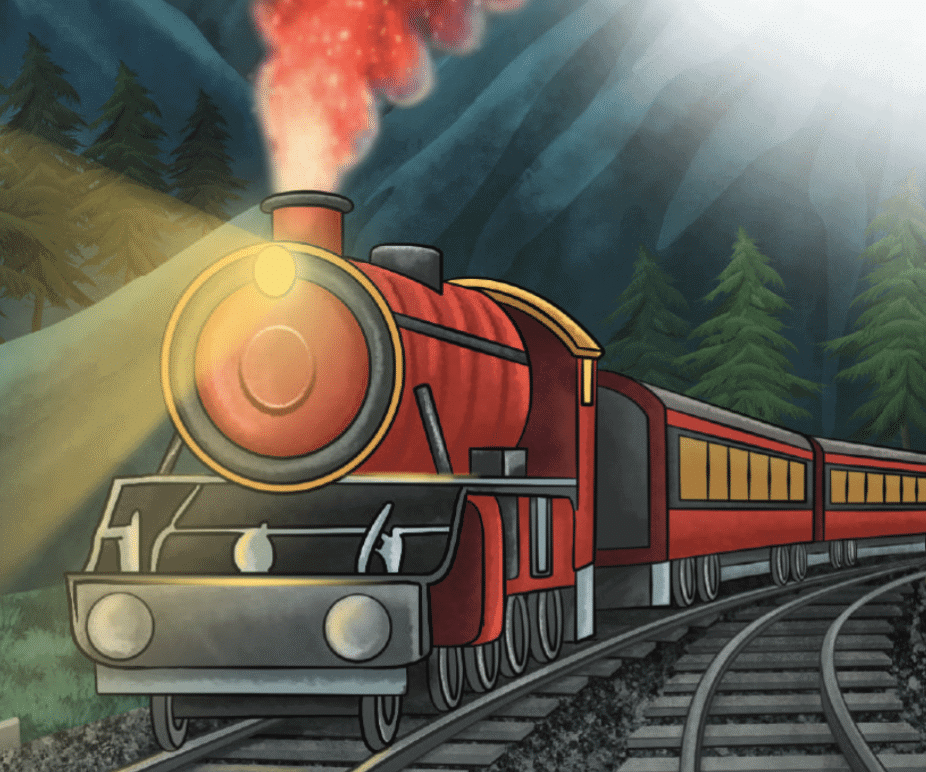
All night there isn’t a train goes by, Though the night is still for sleep and dreaming, But I see its cinders red on the sky, And hear its engine steaming.
Explanation:
Here, the speaker talks about the quiet night, a time meant for sleeping and dreaming. Even though no trains pass close by, the speaker imagines seeing the train’s red cinders—glowing sparks from the engine—lighting up the night sky and hearing the sound of the engine puffing steam. This vivid picture shows how the speaker’s imagination keeps the train alive in their mind, even in the calm and silent night. The cinders and steaming engine add a sense of movement and energy, revealing the speaker’s excitement about trains and the adventures they represent, keeping them awake with thoughts of travel.
Stanza 3
My heart is warm with the friends I make, And better friends I’ll not be knowing; Yet there isn’t a train I wouldn’t take, No matter where it’s going.
Explanation:
In the final stanza, the speaker shares their love for the friends they’ve made, describing their heart as “warm” with affection and saying they couldn’t find better friends. However, despite this happiness, the speaker admits they would jump on any train, no matter where it’s headed. This shows a powerful pull toward travel and exploration that is stronger than their ties to friends. The phrase “no matter where it’s going” highlights the speaker’s adventurous spirit, ready to embrace the unknown just for the thrill of the journey. It balances the comfort of friendship with the irresistible call of new experiences.
Moral of the Poem
The poem teaches us that a love for adventure and exploration can live alongside strong connections with friends.
It encourages us to embrace curiosity and be open to new experiences, even if it means leaving the familiar behind.
The speaker’s excitement for travel shows that following your passions can lead to a fuller, more exciting life.
Difficult Words
Here are the meanings of some difficult words from the poem, explained simply:
Railroad: A track made of steel rails for trains to travel on.
Shrieking: Making a loud, high-pitched sound, like a sharp whistle.
Cinders: Small pieces of burnt coal or wood, like glowing sparks from a train’s engine.
Steaming: Giving off steam, like the puffing sound from a train’s engine.
Warm: Full of love or affection, like feeling happy and close to friends.
This exciting story, written by Ruskin Bond, follows Suraj, a young boy who loves adventure and is fascinated by trains.
Set in a jungle near a railway tunnel, the story describes Suraj’s visit to watch a steam train burst out of the tunnel and his unexpected meeting with Sunder Singh, the watchman who looks after the tunnel.
Together, they share a thrilling moment when they face a leopard in the tunnel, forming a special friendship.
The story is full of vivid descriptions of the jungle and the train, capturing the thrill of exploration and bravery.
Explanation of the Story
Suraj’s Fascination with the Jungle Train
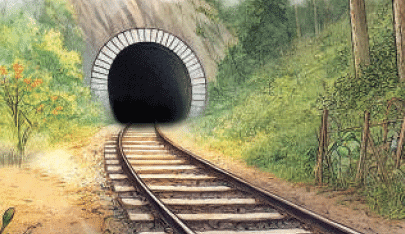
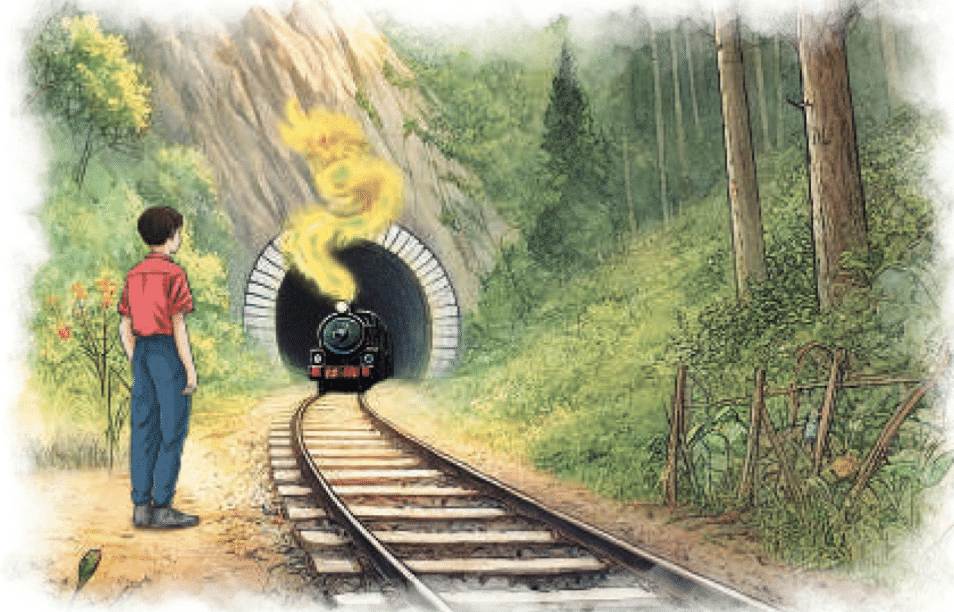
The story begins on a hot noon in a jungle where a railway track cuts through towering evergreen trees. Suraj, a young boy, waits near a tunnel, eager to watch the midday steam train burst out. He isn’t catching a train; he simply loves the sight of it, finding it magical. He has cycled from town, hidden his bike in a nearby village, and walked over a hill to reach the tunnel’s exit.
As he waits, he hears the distant whistle and rumble. The train bursts out like a green, black, and gold dragon, spitting sparks and roaring past, stirring the jungle into motion. After the train passes, Suraj, curious, decides to walk through the tunnel. Inside, it’s damp, smoky, and dark, with a bat and a lizard startling him. Emerging into sunlight on the other side, he notices a flash of orange and gold on the hillside—a swishing tail disappearing among the trees.
Meeting Sunder Singh, the Watchman
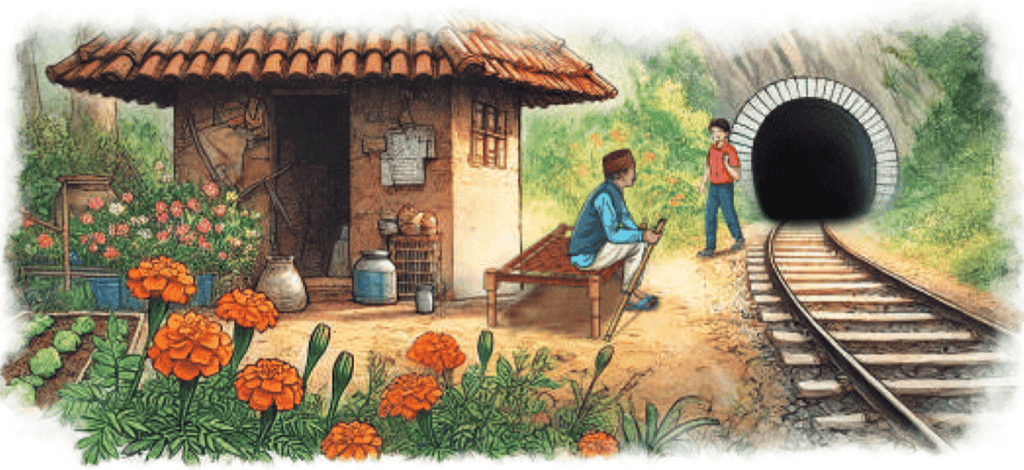
Nearby, Suraj finds a small hut belonging to Sunder Singh, the tunnel’s watchman. His job is to inspect the tunnel and signal trains if anything is wrong—using a red flag by day or an oil lamp at night. Sunder Singh welcomes Suraj warmly, joking that the tunnel is “his,” though officially it belongs to the government.
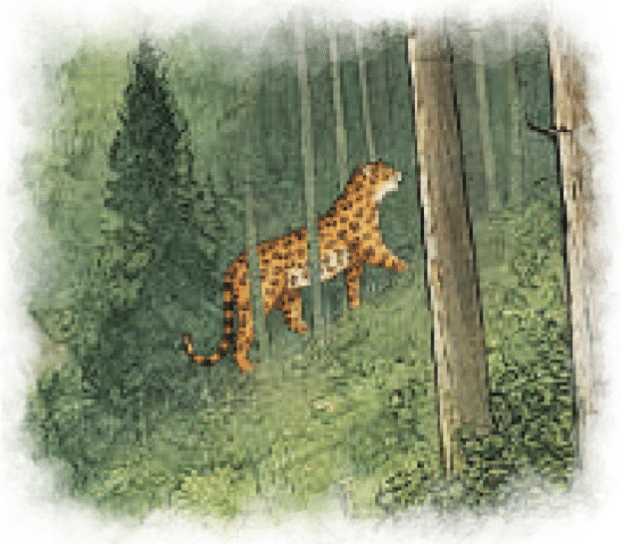
As they chat, Suraj mentions the flash he saw, and Sunder Singh explains it was “his” leopard—a familiar visitor to the area, harmless unless provoked. He also tells Suraj about the night train at 9 p.m., inviting him to return and promising to escort him home safely. Suraj leaves, planning to get his parents’ permission.
The Night Adventure
The next evening, Suraj returns. As the jungle cools and darkens, they enjoy tea, surrounded by the sounds of birds and forest creatures. When darkness falls, Sunder Singh checks the tunnel with his oil lamp while Suraj waits.
Suddenly, they hear a sawing sound from the tunnel. Realising the leopard is inside and could be hit by the oncoming train, Sunder Singh decides to scare it away. Taking an axe for safety and reassuring Suraj, they both enter the tunnel. Their shouts and lamp startle the leopard, which flees into the jungle. After ensuring the tracks are clear, they step aside just in time as the night train roars through, leaving the jungle still and silent once again.
Suraj’s Farewell to the Jungle
A week later, Suraj rides the same night train with his father, who is heading to Delhi on business. As the train crosses bridges and villages, Suraj recognises the tunnel. Peering out into the darkness, he spots a familiar glow—the oil lamp of Sunder Singh, standing watch. As the train speeds through and the jungle fades behind, Suraj thinks fondly of the lonely watchman who lights up the darkness for both trains and leopards.
Moral of the Story
The story teaches us that courage and curiosity can lead to exciting adventures and unexpected friendships.
Suraj’s bravery in exploring the tunnel and facing the leopard with Sunder Singh shows that stepping out of your comfort zone can bring rewarding experiences.
It also highlights the importance of kindness and trust, as seen in the bond between Suraj and Sunder Singh, who work together to protect the leopard.
Difficult Words
Here are the meanings of some difficult words from the story, explained simply:
Shimmered: Shined with a soft, wavy light.
Embankment: A wall of stones or earth to support a railway.
Cutting: A narrow path dug through a hill for a railway.
Scrub-covered: Covered with short trees and bushes.
Serpents: Snakes, used here to describe the railway tracks.
Snorting: Making a loud sound through the nose, like the train’s engine.
Puffing: Blowing out air or steam in short bursts.
Instinctively: Doing something without thinking, like a reflex.
Flinch: To pull back quickly from something surprising or scary.
Plume: A long, thin cloud, like smoke trailing behind.
Shisham: A type of tree found in northern India.
Contemplation: Deep thinking or daydreaming.
Reassure: To make someone feel calm or safe.
Scuttled: Ran quickly with small steps.
Dazzled: Blinded or amazed by bright light.
Swishing: Moving with a soft, sweeping sound, like a tail.
Obstacles: Things that block or get in the way.
Porcupine: A small animal with sharp spines on its back.
Range: An area or region, like where the leopard roams.
Yawned: Opened the mouth wide, usually when tired.
Swooped: Moved down quickly through the air, like birds flying.
Scent: A pleasant smell, like of flowers.
Tailorbird: A small bird known for sewing leaves to make a nest.
Twilight: The soft light just after sunset or before sunrise.
Quaint: Unusual or old-fashioned in a charming way.
Nightjar: A bird active at night with a short beak.
Flexing: Bending or stretching, like limbs moving.
Trimming: Adjusting, like fixing the wick of a lamp.
Padded: Soft, quiet steps, like an animal’s footsteps.
Rustle: A soft sound, like leaves moving.
Sawing: A back-and-forth sound, like cutting wood.
Lithe: Slim and graceful in movement.
Sinewy: Lean and strong, with visible muscles.
Snarling: Growling with teeth shown, like an angry animal.
Twitching: Making small, sudden movements.
Defying: Challenging or standing up against something.
Tremor: A slight shaking or vibration.
Scribbling: Writing quickly or messily.
Fringe: The edge or border, like the jungle’s boundary.
Flickering: Shining with an unsteady, wavering light.
This story follows Shaana, a young girl from Rameswaram island, who travels across India with her parents.
Through postcards written to her friends, she shares her experiences of visiting different places, exploring diverse landscapes, and learning about India’s rich geography and culture.
The story highlights the beauty and variety of India’s regions.
ExplanationShaana’s travel adventure takes her across various parts of India, each with its unique geography, weather, and wildlife. Her journey reflects her curiosity, playful spirit, and growing confidence.
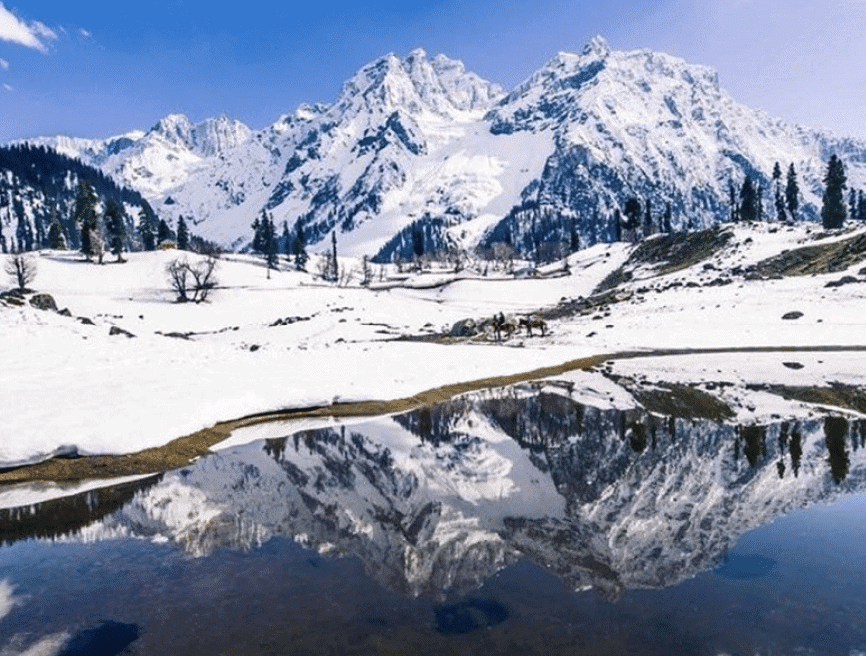
Kashmir (North) – Glaciers and SnowballsIn her 30 April postcard, Shaana writes from Thajiwas Glacier in Kashmir, high up in the north. She describes the white and blue glaciers and how they all had to wear four layers of clothes because of the freezing cold. Her parents enjoy throwing snowballs at each other and love the place. However, they notice that there was more snow the previous year, hinting at possible climate changes. Shaana likes the snow but feels so cold that her hands shake from not wearing gloves. She ends her note by sending love to her PT teacher and Library Ma’am.
Thajiwas Glacier
Himachal Pradesh – Mountains and Playful ImaginationOn 10 May, Shaana reaches Himachal Pradesh. She enjoys the peaceful mountains and is woken up each morning by the chirping of colourful birds. At night, she hears growling sounds and imagines they are bears, but her mother says it’s just her father snoring. She even jokes about wanting to hug a bear, showing her playful imagination and adventurous spirit.
Arunachal Pradesh – Forests and Red PandasIn her 17 May postcard, Shaana travels all the way east to Arunachal Pradesh, which she learns is far from Himachal Pradesh. The journey includes two trains and a long drive through a dense forest, where they reach a treehouse. The forest is so thick that Shaana warns that if you blink or stop to tie your shoelace, you could get lost. She declares Arunachal her favourite stop so far and hopes to see red pandas, reflecting her growing love for nature and wildlife.
Red Pandas
Sundarbans, West Bengal – Mangroves and Crocodiles
By 24 May, Shaana reaches the Sundarbans in West Bengal, a wetland area where mangrove trees grow in seawater. She is surprised to learn this and feels amazed. During a boat ride, she spots crocodiles and a lonely snake, which makes her both nervous and excited. Her mother expresses sadness about how much the area floods now, gently introducing the topic of climate change.
Sundarbans
Gujarat – Deserts and Surprise Test
In her 30 May postcard, Shaana shares that they’ve crossed the entire country from east to west, reaching Gujarat. She finds the desert hot, dry, and sandy, calling it a beach without the sea. Although she dislikes the heat, she loves the colourful clothes worn by people in the region. Her mother surprises her with a holiday test, and Shaana proudly says she scored 88%, showing she’s still learning even while travelling.
Narmada River – Rafting and Water Thrills
On 7 June, Shaana writes about travelling to the Narmada River in central India, after leaving the desert. She tries rafting, which she finds wild and fast, unlike the calm image she had of rivers. She ends up soaked, while her father is so scared he swears never to go rafting again. Shaana, on the other hand, loves the water and wants to do it again.
Goa – Plateaus, Beaches, and Tunnels
Shaana writes from Goa on 12 June, describing the beautiful plateaus, hills, and beaches. She travels by train through many tunnels, something she used to fear but now enjoys. She says she would love to go on a plateau tour with her friends in the future, showing how her confidence has grown.
Chennai and Puducherry – Surfing and Family Fun
In her 17 June postcard, Shaana returns to Tamil Nadu, visiting Chennai and then Puducherry. She learns to surf and only falls twice, proudly saying she’s good at it now. Her parents play in the water like children, and she jokes about having to control them. She also observes that the waves and water here are different from those on her island.
Olaikaadu Beach – Floating and Pebble Treasures
On 24 June, before heading home, Shaana’s family stops at Olaikaadu beach. She wants to learn diving, but there aren’t any suits in her size, so she spends the day floating and watching fish while her parents dive. She also collects pretty pebbles, which she plans to gift her classmates.
Back Home in Rameswaram – Reflections and Farewell
In her final letter dated 25 June, Shaana writes to her parents, amazed that they travelled across the entire country. She fondly remembers the forests, glaciers, deserts, wetlands, rivers, plateaus, and beaches, as well as the different languages and people they encountered. She expresses a desire to travel again and take her friends along next time.
Conclusion: A Journey Through India’s DiversityShaana’s adventure captures the geographical and cultural richness of India—from the snowy glaciers of the north to the sandy deserts of the west, the thick forests of the east to the beaches of the south. Through her postcards, she shares her joy, imagination, fears, and growing confidence. Her journey is both an exploration of nature and a discovery of herself, showing that travel is not just about visiting places—but about seeing the world with curiosity and wonder.
Moral of the Story
The story teaches us to appreciate the beauty and diversity of our country.
It encourages curiosity and openness to new experiences, as Shaana learns about different landscapes, animals, and environmental changes.
It also shows the importance of sharing experiences with others, fostering a sense of connection and understanding.
Difficult Words
Glacier: A large mass of ice that moves slowly over land.
Chirping: Short, sharp sounds made by birds.
Snoring: Loud breathing noises made while sleeping.
Treehouse: A small house built in a tree.
Wetlands: Areas of land covered with water, like marshes or swamps.
Mangroves: Trees that grow in salty coastal waters.
Plateaus: Flat, elevated areas of land.
Rafting: Traveling on a river using a small inflatable boat.
This gentle and imaginative poem, written by Rabindranath Tagore, captures the simple joy of a child floating paper boats down a stream.
The child writes their name and village on the boats, hoping someone far away will find them.
The poem blends the child’s playful actions with dreams of connection, using nature and imagination to create a peaceful and hopeful mood.
It reflects the innocence and curiosity of childhood.
Explanation of the PoemStanza 1
Day by day I float my paper boats one by one down the running stream.
Explanation:
The poem begins with the child describing how they carefully send their paper boats down a flowing stream, one at a time, every day. This simple, repetitive act shows the child’s love for this joyful routine, which brings them excitement and peace. The phrase “day by day” emphasises that this is a special part of their daily life, like a cherished ritual. The “running stream” is lively and moving, symbolising a pathway that carries the child’s boats—and their hopes—toward unknown destinations, sparking their sense of adventure and wonder.
Stanza 2
In big black letters I write my name on them and the name of the village where I live. I hope that someone in some strange land will find them and know who I am.
Explanation:
Here, the child explains that they write their name and the name of their village in bold, big black letters on each boat. This act is like sending a message in a bottle, hoping a stranger in a faraway “strange land” will discover the boat and learn about them. The big black letters show the child’s eagerness to be noticed and remembered, making the boats personal and meaningful. This stanza reveals the child’s curiosity about the world and their longing to connect with others, even those they’ve never met, through their small creations.
Stanza 3
I load my little boats with shiuli flower from our garden, and hope that these blooms of the dawn will be carried safely to land in the night.
Explanation:
In this stanza, the child shares that they fill their paper boats with shiuli flowers from their garden, hoping these delicate flowers, which bloom at dawn, will reach another land by night. The shiuli flowers, small and fragrant, symbolise beauty, purity, and the freshness of a new day. By placing them in the boats, the child adds a precious gift to their message, trusting the stream to carry them gently. This act shows the child’s care and optimism, as they imagine their flowers travelling through the day to bring joy to someone far away, connecting their world to another.
Stanza 4
I launch my paper boats and look up into the sky and see the little clouds setting the white bulging sails. I know not what playmate of mine in the sky sends them down the air to race with my boats!
Explanation:
As the child sets the boats afloat, they look up and see small clouds in the sky that look like they have “white bulging sails,” resembling boats racing through the air. The child imagines these clouds as playful friends sent by an unseen “playmate” in the sky, joining in a fun race with their paper boats. This vivid imagination turns a simple activity into a magical game, linking the child’s boats with the natural world. The clouds, fluffy and swift, add a joyful and dreamy element, making the child feel like they’re part of a bigger, playful adventure with nature.
Stanza 5
When night comes I bury my face in my arms and dream that my paper boats float on and on under the midnight stars. The fairies of sleep are sailing in them, and the lading is their baskets full of dreams.
Explanation:
When night falls, the child rests, burying their face in their arms, and dreams of their paper boats continuing to float under the twinkling midnight stars. In their dream, “fairies of sleep” sail in the boats, carrying baskets filled with dreams. This magical image blends the child’s real boats with a fantasy world, where their creations travel through a starry night. The gentle fairies and baskets of dreams create a peaceful, hopeful mood, suggesting that the child’s hopes and imagination keep moving forward, spreading wonder even in their sleep. This stanza ends the poem with a calm, dreamy vision of endless possibilities.
Moral of the Poem
The poem teaches us that even small actions, like floating paper boats, can carry big dreams and hopes.
It shows how a child’s imagination can connect them to the world, inspiring us to stay curious and find joy in simple things.
The poem encourages us to dream freely and believe that our small efforts can reach far and touch others.
Difficult Words
Here are the meanings of some difficult words from the poem, explained simply:
Float: To drift or move gently on the water’s surface.
Stream: A small, flowing body of water, like a tiny river.
Shiuli: Small, white, sweet-smelling flowers that bloom in the early morning.
Blooms: Flowers, especially when they are open and pretty.
Dawn: The time in the early morning when the sun begins to rise.
Launch: To send something, like a boat, into motion or start its journey.
Bulging: Swelling or puffing out, like sails filled with wind.
Playmate: A friend who plays games or has fun with you.
Bury: To hide or cover, like resting your face in your arms.
Fairies: Tiny, magical beings from stories, often kind and gentle.
Lading: The load or items carried, like the fairies’ baskets of dreams.
This funny and exciting story, written by Anita Rau Badami, is told by Anita, a 14-year-old girl, about her younger brother Anand, who loves inventing things.
Anand thinks he’s a scientist and creates gadgets that often cause trouble.
The story describes two of his inventions—a burglar alarm that soaks their father and a time machine that might have worked during a real burglary.
The tale is full of humour and shows Anand’s creative spirit, even if his inventions don’t always go as planned.
Explanation of the Story
The Burglar Alarm Disaster
The story begins with Anita’s father returning home, only to get drenched by a falling water bag rigged to a “burglar alarm.” Furious and soaked, he demands to know who is behind the mess. Anita and her younger brother Anand exchange glances — Anand, the self-proclaimed inventor, is the one responsible. Their mother guesses right away that Anand is behind it.
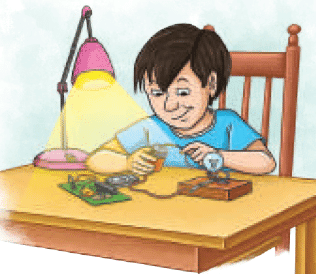
Anita, 14, narrates how her 13-year-old brother is always tinkering with electrical gadgets and dreaming up wild inventions that rarely work as expected. After a wave of thefts in their neighbourhood, Anand decided to invent a burglar alarm that would activate when someone gently opened the door, releasing a water bag and ringing a bell.
Unfortunately, the alarm couldn’t distinguish between a thief and a family member. So, when Papa returned and opened the door softly, he triggered the device and got soaked. Anita had warned Anand not to involve her if anything went wrong — and wisely kept her distance when Papa got angry. After the mishap, Anand didn’t invent anything for about a week.
The Time Machine Experiment
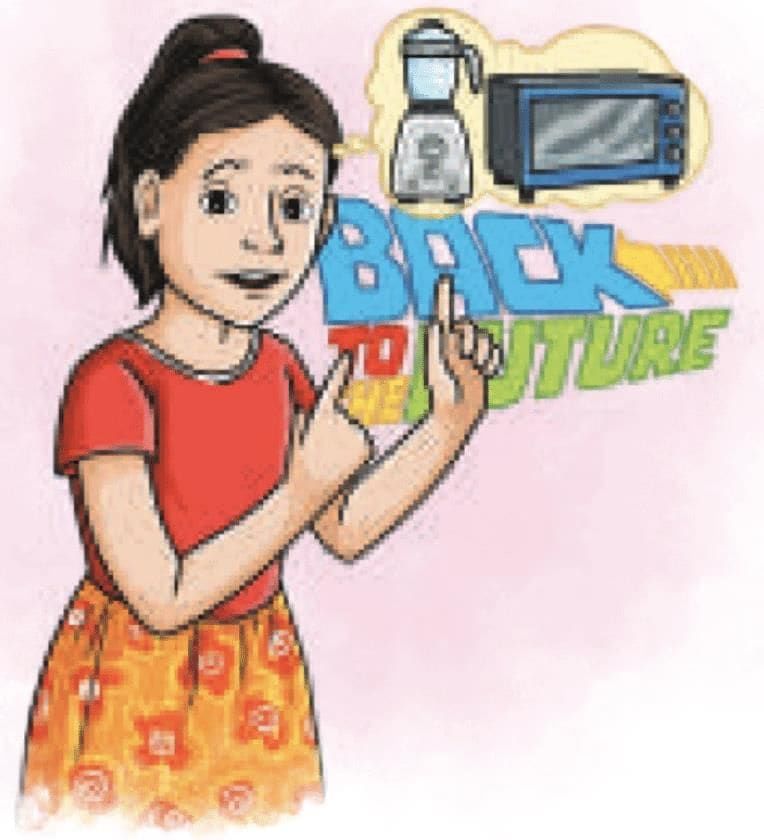
Anand’s curiosity sparked again after watching the movie Back to the Future, which featured a time-traveling machine. He became obsessed with the idea of building one himself. Papa, worried about the chaos from Anand’s last invention, locked up his toolbox, while Ma kept a close eye on household appliances to stop Anand from taking parts.
Despite this, Anand transformed his room into a buzzing lab filled with wires, switches, springs, and bulbs. After two weeks of noisy and secretive work, Anand announced that his time machine was complete. Papa firmly refused to test it, but Ma softened and persuaded him to at least take a look.
Soon after, Ma and Papa had to attend a wedding in Kharagpur and reluctantly agreed to leave Anand and Anita home alone for one night. They made Anand promise not to touch the time machine in their absence — a promise he made half-heartedly.
The Intruder and the Strange Disappearance
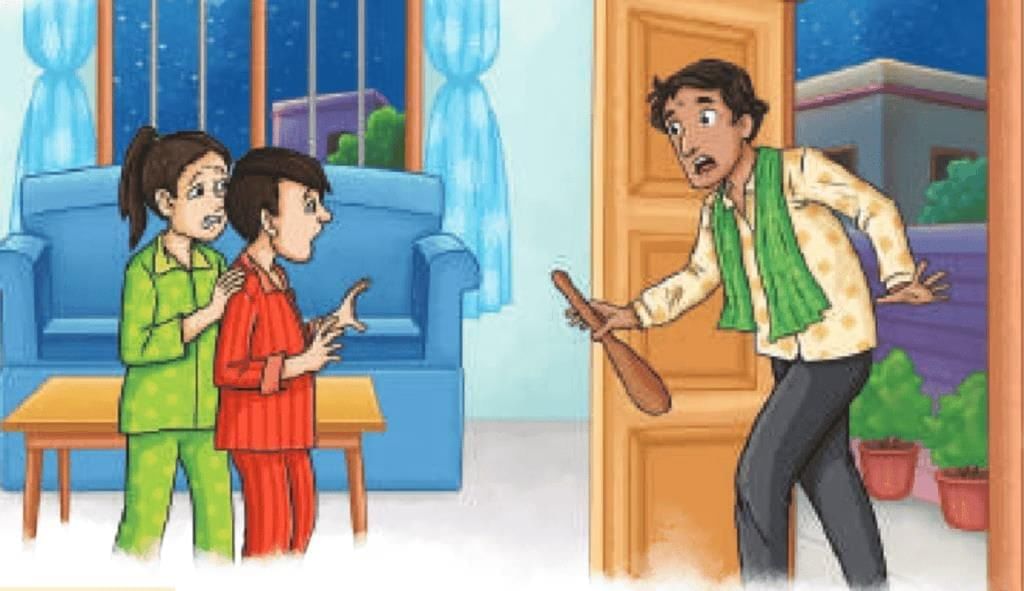
That night, while Anita was reading late into the night, she heard strange scratching and clicking sounds at the front door. Alarmed, she woke Anand. Moments later, the door burst open, and they saw Boppa — a rough-looking man who had recently started sweeping the neighbourhood. He threatened them with a stick and demanded to know where their father’s room was.
Thinking quickly, Anand lied and pointed Boppa to his own room — the one with the time machine — buying them time. Soon after, strange and eerie sounds like crashes, thumps, and a humming noise came from that room.
Panicked, Anand and Anita shouted for help. Neighbours, including Mrs. and Mr. Sharma and Dr. Mohan, came rushing in and freed the children. They entered Anand’s room to find the time machine still humming — but Boppa had vanished. Only his green scarf lay near the machine. Despite a thorough search, Boppa was nowhere to be found. The adults believed he had run away unnoticed, but Anand insisted the time machine had transported him through time.
A New Beginning
Boppa was never seen again, and his mysterious disappearance remained unsolved. Papa dismantled the time machine, saying it was unsafe — though perhaps a tiny part of him wondered if it had actually worked.
Anand, however, was thrilled. Convinced he was a genius, he immediately launched into a new project: inventing a telephone to contact aliens. Anita, amused and exasperated, continued to watch and narrate the adventures of her wildly imaginative brother.
Moral of the Story
The story teaches us that creativity and imagination are important, even if things don’t always work out as planned.
Anand’s inventions caused trouble, but his quick thinking helped during a dangerous moment.
It shows that trying new ideas is valuable, and mistakes can lead to unexpected solutions.
Difficult Words
Here are the meanings of some difficult words from the story, explained simply:
Racket: A loud and annoying noise.
Sopping: Completely wet, like being soaked with water.
Scowling: Looking angry or upset with a frown.
Rigged up: Put together quickly or temporarily.
Tinkering: Playing or experimenting with tools or gadgets.
Dynamos: Machines that make electricity.
Hoo-ha: A big fuss or commotion.
Blueprint: A detailed plan or drawing for a project.
Clanging: A loud, ringing sound, like metal hitting metal.
Stealthily: Moving quietly or secretly to avoid being noticed.
Sceptical: Doubting or not believing something easily.
Frantic: Hurried and disorganized, often in a panic.
Crestfallen: Looking sad or disappointed.
Offended: Feeling upset or hurt by something said or done.
Groggily: Acting sleepy or confused, like just waking up.
Ruffianly: Looking rough or like a troublemaker.
Brandishing: Waving something, like a stick, in a threatening way.
Cudgel: A short, thick stick used as a weapon.
Muffled: A sound that’s quiet or not clear, like it’s covered.
Eerie: Strange and a bit scary.
Clattering: Loud, repeated noises, like things banging together.
Unison: Doing something together at the same time.
Hastily: Doing something quickly, often without care.
Peering: Looking closely or carefully.
Indulgently: Acting kindly or fondly, often with a smile.
Intruders: People who enter a place without permission.

 Each floor is about 4 times his height.
 1 Lakh Varieties of Rice









 But saying “about 75,000 people live there” gives a quick idea without needing to know the exact count.

 Then, 206 × 100 = 20600