06. Say the Right Thing Chapter Notes

Introduction

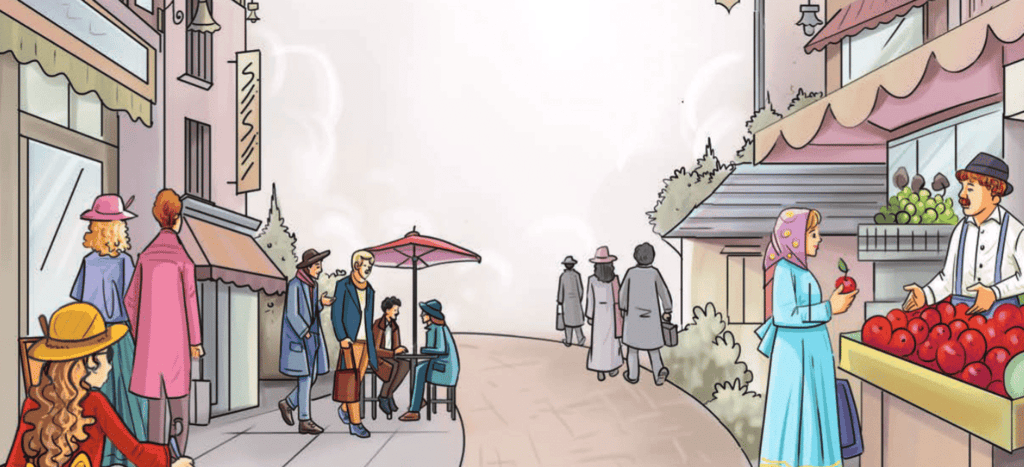
  • This humorous play, written by G.C. Thornley, tells the story of Mary Shaw, a young girl who wants to talk to guests visiting her home.
  • Her mother, Mrs. Shaw, teaches her how to be polite and say kind things to make the guests feel welcome.
  • However, when the guests arrive, Mary makes funny mistakes by saying the wrong things, upsetting them.
  • The play shows the importance of speaking carefully and kindly to others.
Explanation of the Story 

Scene I: Preparing for the Guests

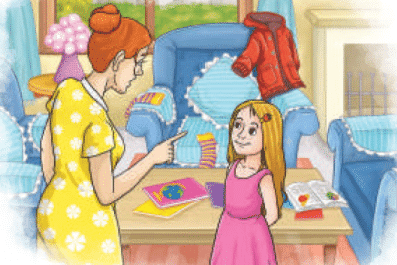
The story begins with Mrs. Shaw preparing the house for two guests, Mrs. Harding and Mrs. Lee. She asks her daughter, Mary, to put away a coat to keep the room tidy, as she wants to make a good impression. Mary complains that her mother always tells her to clean up and insists she’s not a child. Mrs. Shaw explains that Mrs. Harding is the wife of a wealthy man who recently moved to Lanfield, and Mrs. Lee is his sister, staying with them. Mary is curious about the visit and asks what they’ll talk about. Mrs. Shaw says it will be about various things and that Mary will need to visit people and talk politely in the future.
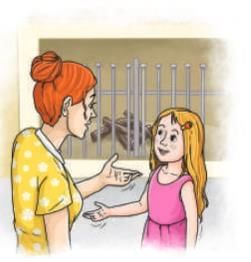
Mary boasts that she can talk well and wants to stay and speak with the guests. Mrs. Shaw is hesitant, worried that Mary might say the wrong things and ruin her chance to become friends with Mrs. Harding. Mary insists she knows how to be polite, saying phrases like “Good afternoon” and “How are you?” Mrs. Shaw agrees to let her stay but gives her advice: be kind, say things that make people happy, laugh to keep the mood light, and start conversations if everyone is quiet. She also tells Mary to ask guests to stay longer when they want to leave, like saying, “Must you go? Can’t you stay?” Mary promises to follow these rules, changes into a clean dress, and feels confident she can handle the visit.

Scene II: The Visit Goes Wrong

Mrs. Harding and Mrs. Lee arrive at Mrs. Shaw’s house. Mrs. Shaw welcomes them politely and is happy they like the new town, Lanfield. When the room becomes quiet, she looks at her daughter Mary to speak kindly as she was told earlier.
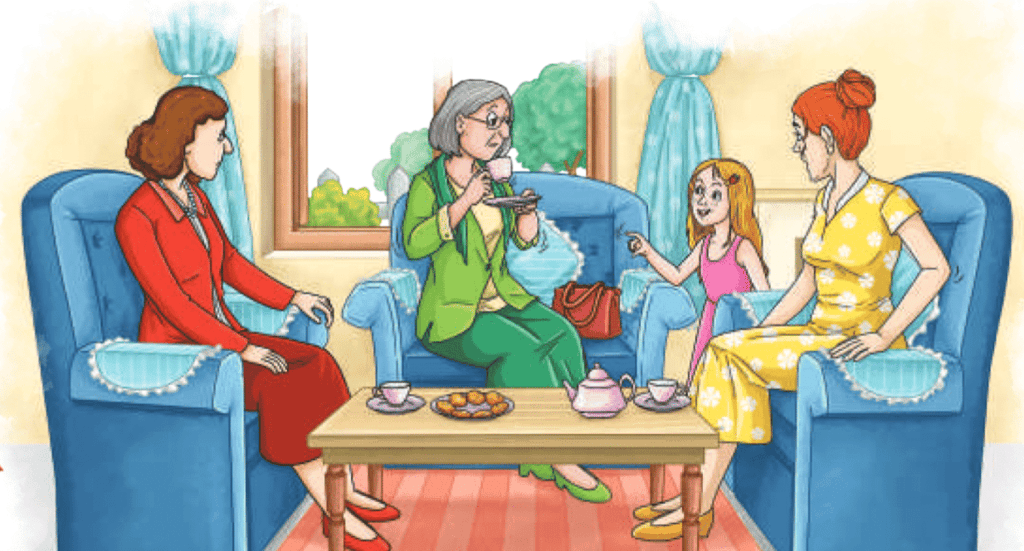
But Mary immediately makes a mistake. She compliments Mrs. Harding for having “beautiful children,” but Mrs. Harding replies that she has no children. Mary keeps insisting she saw a boy and a girl, which makes Mrs. Harding unhappy and everyone uncomfortable.

To change the topic, Mrs. Shaw talks about Mr. Best, a man who lives nearby. Mary jokes about him traveling to London every day, calling it a boring life. She also says that he only reads newspapers and makes a rude comment about bankers. Mrs. Lee then says that her brother is also a banker and does the same. Mary feels embarrassed and says sorry.

Mrs. Shaw brings up Mrs. Best to lighten the mood, but Mary laughs at her clothes—a blue dress with a red coat. Mrs. Harding then says she also wears the same clothes, which makes things awkward again.

Mary tries to keep talking but keeps saying the wrong things. She speaks badly about Mrs. Cotter for staying in bed and calling the doctor often. But then Mrs. Harding says she stays in bed in the morning, and Mrs. Lee says she goes to the doctor regularly. Mary quietly says sorry again.

Then, when Mrs. Shaw mentions her good friend Mrs. Grantley, Mary calls her “too talkative” and says such women aren’t interesting. Mrs. Lee calmly replies that her mother is very talkative. Mary is embarrassed once again.

Next, Mary sees a dirty dog outside and complains about it loudly. Mrs. Harding looks out and says that the dog, Towzer, belongs to her. Mary blushes and apologizes.

Still looking out, Mary sees Mr. Pomeroy riding a horse and makes fun of him for riding and practising shooting every day. But Mrs. Lee says her brother does the same and even moved to Lanfield for those activities.

Finally, Mrs. Harding says they must leave. Mrs. Shaw, trying to be polite, asks them to stay longer. But Mary forgets everything her mother taught her and says the wrong thing: “Oh, must you stay? Can’t you go?”

The visit ends in an uncomfortable silence, and Mary’s attempt to be helpful turns into a series of embarrassing moments for everyone.

Moral of the Story

  • The play teaches us that we should think before we speak and choose words that are kind and respectful.
  • Mary’s mistakes show that being polite and careful in conversations helps make others feel welcome and avoids hurting their feelings.
  • It reminds us to listen to good advice and practice speaking thoughtfully.

Difficult Words

Here are the meanings of some difficult words from the story, explained simply:

  • Hilariously: In a very funny way.
  • Blunders: Careless mistakes that cause problems.
  • Embarrasses: Makes someone feel uncomfortable or shy.
  • Wealthy: Having a lot of money or riches.
  • Polite: Showing kindness and respect to others.
  • Compliments: Kind words said to praise someone.
  • Awkward: Uncomfortable or embarrassing.
  • Mocking: Making fun of someone in a mean way.
  • Apologises: Says sorry for doing something wrong.
  • Disapprovingly: Showing that you don’t like or agree with something.
05. A Funny Man Chapter Notes

Introduction

  • This poem, written by Natalie Joan, is a light-hearted and funny story about a strange man who does odd things.
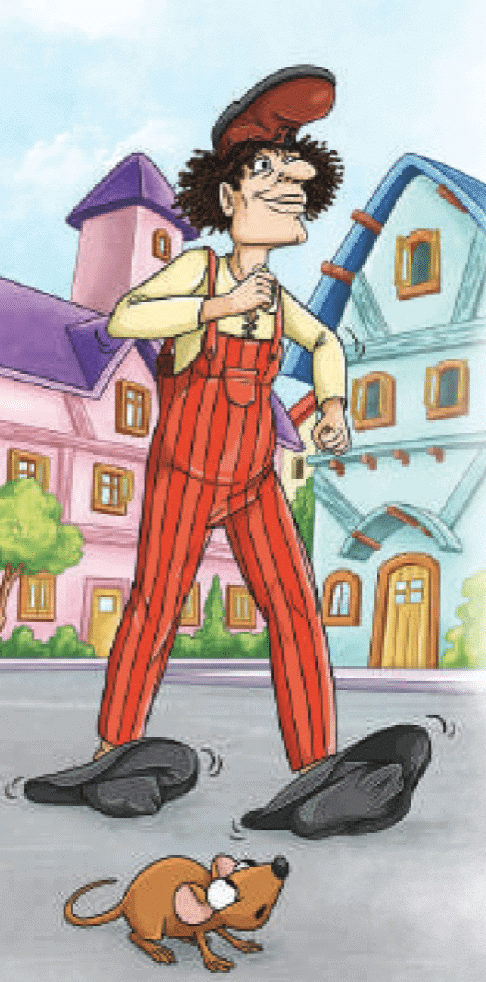
  • The poet meets a man who wears a shoe on his head and hats on his feet, offers a bun as a rose, and hops home on his head.
  • The poem uses silly actions and playful words to make readers smile and enjoy the fun of imagination.

ExplanationStanza 1

One day a funny kind of man
Came walking down this street
He wore a shoe upon his head
And hats upon his feet.

Explanation:

The poem begins with the poet talking about a “funny kind of man” walking down the street in a strange way. He looks very odd and funny because he wears a shoe on his head instead of a hat, and hats on his feet instead of shoes. This mix-up in how he dresses catches the reader’s eye and makes the poem feel playful and silly. The man’s strange style shows that he doesn’t follow the usual rules and likes to be different. This makes him interesting and funny from the very beginning.

Stanza 2

He raised the shoe and smiled at me,
His manners were polite;
But never had I seen before
Such a funny sounding sight.

Explanation:

In this part, the funny man sees the poet and politely lifts the shoe on his head like he’s tipping a hat, and smiles at her. His polite behavior is different from how strange he looks, which makes it even more funny. The poet is surprised by how odd this is and calls it a “funny sounding sight.” This means it feels so strange that it’s like she can almost hear how unusual it is. The poet’s reaction shows she is amazed to see something so different from normal.

Stanza 3

He said, “Allow me to present
Your Highness with a rose.
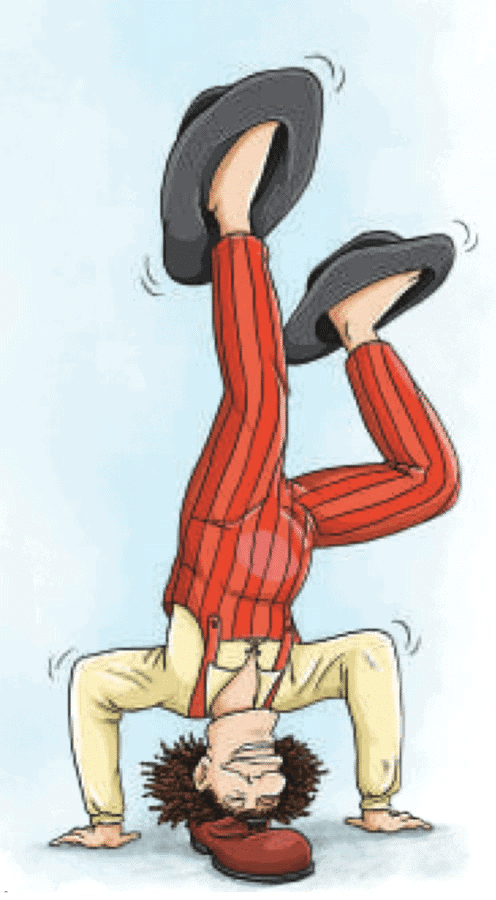
”And taking out a currant bun
He held it to my nose

Explanation:
The funny man talks politely and calls the poet “Your Highness,” a special title used for kings and queens. This makes his way of speaking playful and silly. He says he wants to give her a rose, which is a kind gift. But instead of a flower, he takes out a currant bun—a small sweet bread with dried fruits—and holds it near her nose like a flower to smell. This surprise is funny because a bun is food, not a nice-smelling gift. It shows the man’s funny and playful nature and how he likes to surprise people.

Stanza 4

I staggered back against the wall
And then I answered, “Well!
I never saw a rose with such
A funny looking smell.”

Explanation:

Surprised by what the man did, the poet almost falls back against the wall. She answers in a smart way, saying she has never seen a “rose” that has such a “funny looking smell.” By calling the bun a rose, she is joining in the man’s joke and shows she is having fun. The words “funny looking smell” mix seeing and smelling in a playful way because smells are something we feel, not see. This shows the fun and happy moment between the poet and the man, where they both enjoy being silly.

Stanza 5

He then began to sing a song,
And sat down on the ground;
You never heard in all your life
Such a funny feeling sound.

Explanation:

The funny man keeps acting strange by sitting on the ground and singing a song. The poet says the song has a “funny feeling sound,” meaning it sounds unusual and makes you feel amused. The song probably has a strange tune or words that match the man’s playful personality. Sitting on the ground while singing shows he doesn’t care about rules and likes to do things his own way, unlike most people who would stand while singing. This part of the poem makes the mood more fun and invites us to laugh at the man’s happy and silly actions.

Stanza 6

“My friend, why do you wear two hats
Upon your feet?” I said.
He turned the other way about,
And hopped home on his head.

Explanation:
Curious about his strange look, the poet asks the man why he wears “two hats on your feet.” She asks kindly because she wants to understand his odd choice. Instead of answering, the man turns around and hops home on his head, which is even sillier. This is funny because he doesn’t answer the question and does something very strange—hopping on his head is not something people can really do. The poem ends with this funny picture, making us smile at the man’s playful and free-spirited way of being.

Moral of the Poem

  • The poem teaches us that it’s okay to be different and have fun in our own way.
  • The funny man’s silly actions show that imagination and playfulness can bring joy to others.
  • It reminds us to enjoy life’s light moments and not take everything too seriously.

Difficult Words

Here are the meanings of some difficult words from the poem, explained simply:

  • Manners: Polite behaviour or way of acting.
  • Polite: Showing respect and kindness to others.
  • Present: To give something to someone formally.
  • Highness: A title used to address someone important, like a king or queen.
  • Currant: A small, dried fruit used in baking.
  • Bun: A small, round bread, sometimes with fruits inside.
  • Staggered: Moved unsteadily, as if about to fall.
  • Hopped: Jumped on one foot or moved by jumping.

04. Animals, Birds, and Dr. Dolittle Chapter Notes

Introduction

  • This story, written by Hugh Lofting, is a funny and heartwarming tale about John Dolittle, a doctor who learns to talk to animals.
  • At first, he treats people, but a parrot named Polynesia and a man who sells cat food convince him to become an animal doctor.
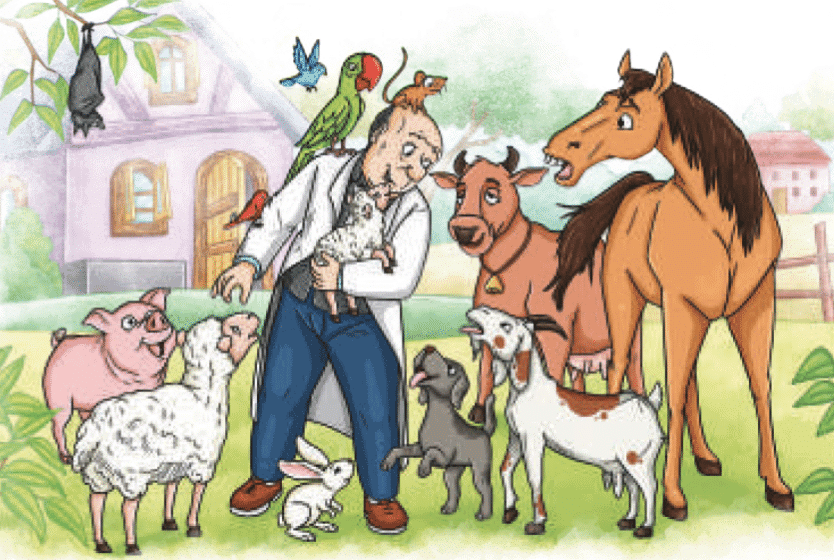
  • By learning animal languages, Dolittle helps animals like horsescows, and even mice, making him famous among creatures worldwide.
  • The story shows the importance of understanding and caring for animals.

Explanation of the Story

A New Idea

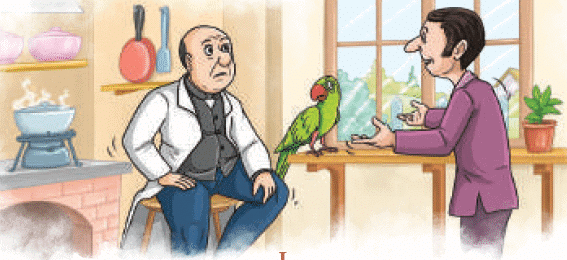
The story begins with Doctor Dolittle in his kitchen, talking to the Cat’s-food-Man, who has a stomach ache. The man suggests that Dolittle should stop being a people’s doctor and become an animal doctor instead, praising Dolittle’s deep knowledge about animals. Polynesia, a parrot, overhears the conversation and agrees. She encourages Dolittle to focus on treating animals, who would appreciate him more.

Learning to Speak Animal Languages

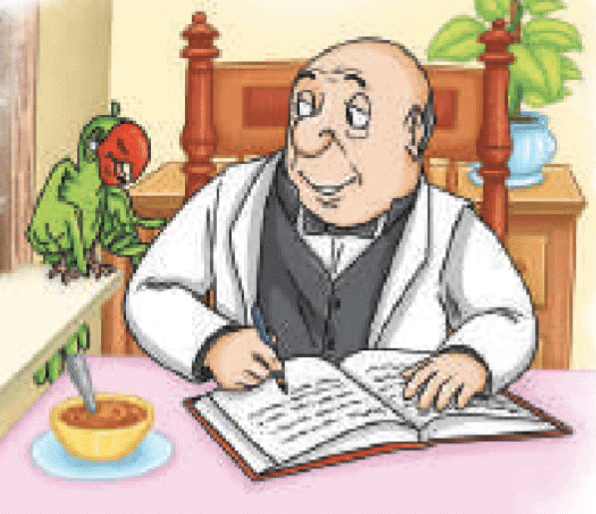
Polynesia reveals a big secret — animals can talk in their own languages. She shows Dolittle the difference between human and bird speech, exciting him with the idea that he could learn it too. That rainy afternoon, Polynesia begins teaching Dolittle the basics of bird language. Later, when Jip the dog enters, Polynesia explains how animals also communicate through their ears, tails, feet, and noses. With practice and Polynesia’s help, Dolittle learns to understand and speak to animals fluently, inspiring him to officially become an animal doctor.

Success as an Animal Doctor

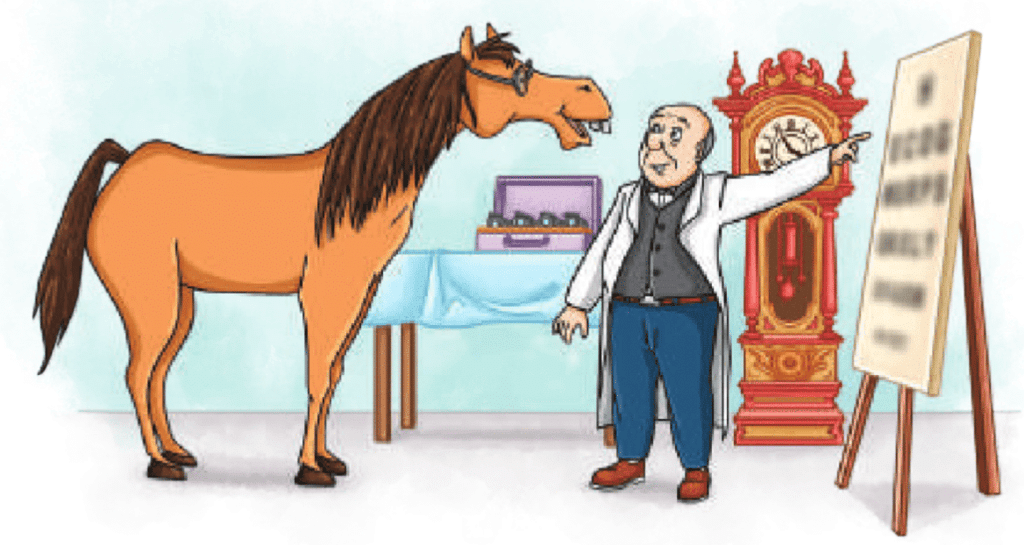
News spreads that Dolittle can talk to animals. People start bringing him sick pets, and farmers bring their cows and sheep. One day, a plough horse visits, complaining that the local vet cannot understand him. Dolittle listens carefully and learns that the horse is going blind in one eye and needs glasses, not medicine. Dolittle promises to help, and soon the horse receives green spectacles and can work comfortably again.

A World Full of Happy Animals

As Dolittle’s reputation grows, more animals — from mice and badgers to bats — come to see him, filling his garden. To manage the crowd, Dolittle builds special labelled doors and tunnels for different animals. Birds spread the news across countries, and in a few years, Doctor Dolittle became famous among animals worldwide. He is content, living a life where he truly understands and helps his animal friends.

Moral of the Story

  • The story teaches us to listen to others and be open to new ideas, even if they seem unusual at first.
  • Dolittle’s willingness to learn from Polynesia shows that understanding and respecting animals can make a big difference.
  • It also reminds us that kindness and care for all creatures, big or small, can lead to happiness and success.

Difficult Words

Here are the meanings of some difficult words from the story, explained simply:

  • Veterinarians (Vets): Doctors who treat animals.
  • Scholar: A person who is good at reading and learning.
  • Twitching: Making small, quick movements, like shaking a nose or ear.
  • Spectacles: Glasses worn to help see better.
  • Ploughing: Using a tool to turn soil in fields for farming.
  • Diagnose: To find out what is wrong with someone or something.
  • Cure: To make someone healthy again after being sick.
  • Crowded: Full of many people or animals in one place.
  • Famous: Well-known by many people or animals.
  • Patiently: Waiting calmly without getting upset.

03. Three Days to see Chapter Notes

Introduction

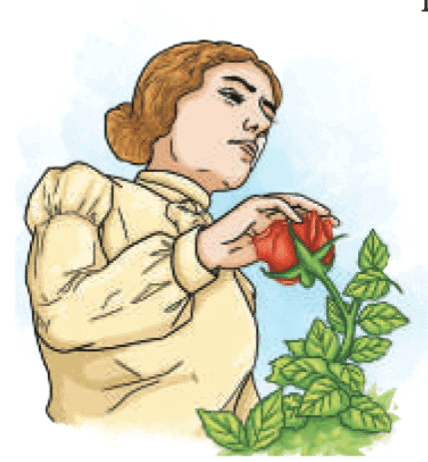
  • This essay, written by Helen Keller, a well-known author who could not see or hear, shares what she would do if she could see for just three days.
  • She describes how she enjoys the world by touching things and imagines the beauty she could experience with sight.
  • Helen plans each day carefully, focusing on peoplenaturehistory, and daily life.
  •  The essay encourages us to value our senses and enjoy the world around us.

Explanation of the Story

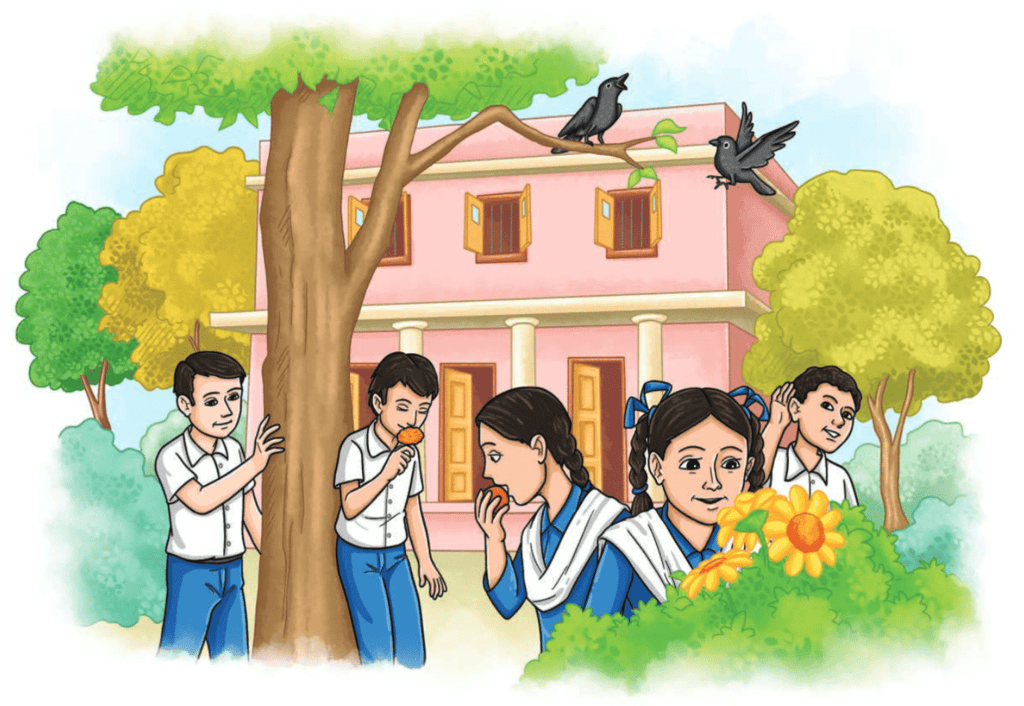
The essay starts with Helen Keller explaining how she finds joy in touching things, even though she is blind. She feels the shape of a leaf, the smooth bark of a tree, or the rough surface of a pine. In spring, she touches tree branches to find buds, which show nature waking up after winter. Sometimes, she feels a bird shaking with song on a branch, which makes her happy. However, she wishes she could see these things, as sight would show her even more beauty. She imagines having three days of sight and divides them into three parts.

Day 1

On the first day, Helen wants to see the people who have made her life special with their kindness and friendship. Since she cannot see, she knows her friends by touching their faces, feeling if they are happy or sad. She wishes to look into their eyes to understand their true feelings, calling eyes the “window of the soul.” This day is about spending time with loved ones and appreciating their importance in her life.

Day 2

On the second day, Helen would wake up early to watch the sunrise, when night turns into day with beautiful light. She wants to see the sun brighten the earth. She plans to visit museums to learn about the world’s past and present. In museums, she would see models of old animals like dinosaurs and learn about how people have grown smarter over time. This day is about enjoying nature’s beauty and understanding the history of life.

Day 3

On the third day, Helen would go to a busy city to watch people living their daily lives. Standing at a street corner, she would look at their faces to see if they were smiling, serious, or sad. She feels happy seeing smiles, proud of people working hard, and kind toward those who are struggling. This day is about understanding the lives of ordinary people and feeling connected to them.

At the end of the three days, Helen knew she would become blind again. She understands that three days are not enough to see everything she wants. She tells people who can see to use their eyes as if they might lose their sight tomorrow. She also suggests listening to music, touching things, smelling flowers, and tasting food as if those senses could be gone. Helen believes that using all senses fully helps us find happiness in life, but she thinks sight is the most wonderful sense.

Moral of the Story

  • The story teaches us to appreciate our senses and use them to enjoy the world around us.
  • Helen Keller demonstrates that even tiny things, like a leaf or a smile, can be very special.
  • By reflecting on what life would be like without a sense, she helps us understand the value of what we have.
  • The story encourages us to show kindness to those who cannot see or hear.
  • It inspires us to live each day with a sense of wonder and gratitude.

Difficult Words

Here are the meanings of some words from the essay, explained simply:

  • Symmetry: The even shape of something, like a leaf, that looks the same on both sides.
  • Quiver: A small, fast shake, like a bird moving while singing.
  • Longing: A strong wish for something.
  • Companionship: The feeling of being close to friends or family.
  • Behold: To look at something with amazement.
  • Panorama: A wide, beautiful view, like a sunrise.
  • Glimpse: A quick look at something.
  • Pageant: A big display, like a museum show.
  • Condensed: Made short, like a quick summary of history.
  • Carcasses: The bones or remains of dead animals.
  • Mastodons: Big, furry animals like elephants that lived long ago.
  • Stature: The size or height of a person or thing.
  • Haunts: Places where people often go, like a shop or workplace.
  • Merely: Only or just.
  • Strains: Tunes or music, like songs from a band.
  • Tactile: Related to touching things.
  • Morsel: A tiny piece of food.
  • Facets: Different parts of something, like the joys of life.

02. Try Again Chapter Notes

Introduction

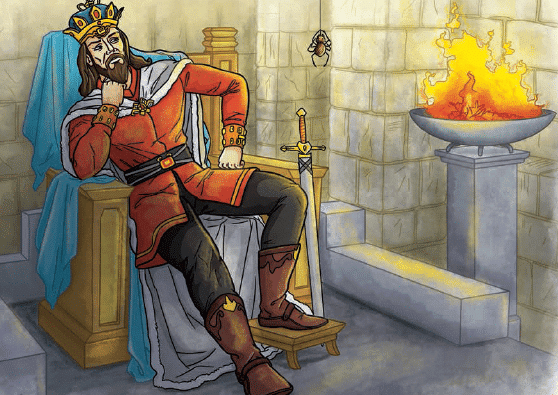
  •  The poem, written by Eliza Cook, is a narrative poem that tells the inspiring story of King Bruce of Scotland.
  • The king is feeling sad and defeated after failing multiple times to achieve an important goal for his people.
  • While sitting alone, he watches a spider repeatedly attempt to climb to its web, falling each time but never giving up.
  • The spider’s persistence motivates King Bruce to try again, leading to his eventual success.
  • The poem delivers a powerful message about perseverance and resilience, encouraging readers to keep trying despite setbacks.

Explanation Stanza 1

King Bruce of Scotland flung himself down
In a lonely mood to think;
‘Tis true he was monarch, and wore a crown,
But his heart was beginning to sink.

Explanation:
King Bruce of Scotland is feeling lonely and sad. He throws himself down, lost in his thoughts. Even though he is a king with a crown and great power, he feels upset inside. This stanza sets the scene, showing that even a strong ruler can feel weak when facing problems. The poet uses simple words to describe the king’s sadness, helping readers understand his troubled feelings.

Let’s Revise: How does the poet help us understand King Bruce’s mood?  View Answer

Stanza 2

For he had been trying to do a great deed,
To make his people glad;
He had tried and tried, but couldn’t succeed
And so he became quite sad.

Explanation:
The king’s sadness comes from his repeated failures to do something important that would make his people happy. He has tried many times, but each attempt has failed. This makes him very unhappy, and he feels his efforts are useless. The stanza shows the king’s good intentions and the heavy responsibility he feels as a leader, making his struggle relatable to anyone who has faced challenges.

Let’s Revise: What was the reason behind King Bruce’s repeated attempts?  View Answer

Stanza 3

He flung himself down in low despair,
As grieved as man could be;
And after a while he pondered there,
“I’ll give it all up,” said he.

Explanation:
Feeling hopeless, King Bruce lies down, filled with deep sorrow, as sad as anyone could be. After thinking for a while, he decides to give up completely, saying, “I’ll give it all up.” This moment shows the king at his lowest point, ready to abandon his dreams. The poet builds suspense by emphasising his despair, preparing readers for a change in the story.

Let’s Revise: Why did King Bruce decide to give up?  View Answer

Stanza 4

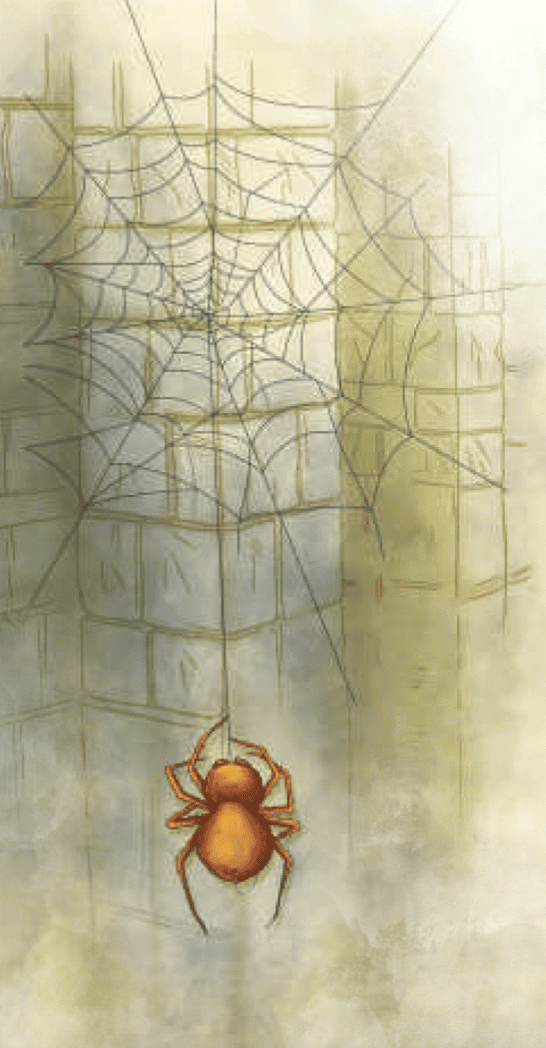
Now just at that moment a spider dropped,
With its silken, filmy clue;
And the King, in the midst of his thinking, stopped
To see what the spider would do.
‘Twas a long way up to the ceiling dome,
And it hung by a rope so fine;
That how it would get to its cobweb home,
King Bruce could not divine.

Explanation:
While King Bruce is lost in thought, a spider suddenly drops down on a thin, silky thread. The king stops thinking about his problems and watches the spider with curiosity. The spider’s web is high up near the ceiling, and the thread looks very fragile. King Bruce wonders how such a small creature will reach its home. This stanza introduces the spider, shifting the focus from the king’s sadness to the spider’s effort, setting up the lesson to come.

Let’s Revise: Why does King Bruce find the spider’s climb so fascinating?  View Answer

Stanza 5

It soon began to cling and crawl
Straight up with strong endeavour;
But down it came with a slippery sprawl,
As near to the ground as ever.
Up, up it ran, not a second to stay,
To utter the least complaint;
Till it fell still lower, and there it lay,
A little dizzy and faint.

Explanation:
The spider starts climbing the thread, holding on tightly and moving upward with great effort. However, it slips and falls back to the ground, almost to where it started. Without stopping to rest or complain, the spider tries again right away but falls again, feeling dizzy and weak. This stanza shows the spider’s determination and its first failures, which are similar to the king’s own struggles. The poet’s clear description makes the spider’s effort exciting to read about.

Let’s Revise: How is the spider’s struggle similar to King Bruce’s situation?  View Answer

Stanza 6

Its head grew steady – again it went,
And travelled a half-yard higher;
‘Twas a delicate thread it had to tread,
And a road where its feet would tire.
Again it fell and swung below,
But again it quickly mounted;
Till up and down, now fast, now slow,
Nine brave attempts were counted.

Explanation:
After resting, the spider’s head clears, and it climbs again, reaching a bit higher—about half a yard more than before. The thread is very thin, and the climb is tiring for the spider’s small feet. Despite making progress, it falls again and swings below the thread. The spider keeps trying, going up and down, sometimes quickly and sometimes slowly. The poet counts nine brave tries, each ending in a fall. This stanza builds tension, showing the spider’s hard work and the king’s growing interest.

Let’s Revise: How does the spider’s repeated effort affect the mood of the poem?  View Answer

Stanza 7

“Sure,” cried the King, “that foolish thing
Will strive no more to climb;
When it toils so hard to reach and cling,
And tumbles every time.”

Explanation:
King Bruce, watching the spider’s repeated failures, speaks out loud. He thinks the spider is foolish and will stop trying because it works so hard, but falls every time. This stanza shows the king’s doubt, which mirrors his own feelings of hopelessness about his failed attempts. The poet uses the king’s words to create drama, making readers wonder if the spider will give up or keep going.

Let’s Revise: Why does the poet have the king call the spider “foolish”?  View Answer

Stanza 8

But up the insect went once more,
Ah me! ’tis an anxious minute;
He’s only a foot from his cobweb door,
Oh say, will he lose or win it?
Steadily, steadily, inch by inch,
Higher and higher he got;
And a bold little run at the very last pinch
Put him into his native cot.

Explanation:
Despite the king’s doubts, the spider tries again, and the poet describes the moment as tense, saying, “Ah me! ’tis an anxious minute.” The spider is now just a foot away from its web, its “cobweb door.” Moving slowly and steadily, inch by inch, it climbs higher. With a final, brave effort, it reaches its web. This stanza is the high point of the spider’s journey, showing its success through hard work. The poet’s words like “steadily” and “inch by inch” highlight the spider’s careful progress.

Let’s Revise: What effect does the spider’s “bold little run” have on the king and the story?  View Answer

Stanza 9

“Bravo, bravo!” the King cried out,
“All honour to those who try;
The spider up there, defied despair;
He conquered, and why shouldn’t I?”

Explanation:
King Bruce is thrilled by the spider’s success and shouts, “Bravo, bravo!” He praises the spider for its courage, saying it “defied despair” by not giving up despite many falls. Inspired, he realises that if a tiny spider can succeed, he too can try again. This stanza is a turning point for the king, as the spider’s example gives him new hope and determination to continue his efforts.

Let’s Revise: Why does the king say, “He conquered, and why shouldn’t I?”  View Answer

Stanza 10

And Bruce of Scotland braced his mind,
And gossips tell the tale,
That he tried once more as he tried before,
And that time did not fail.

Explanation:
Motivated by the spider, King Bruce makes up his mind to try again. The poet notes that people later tell the story that he made one more attempt and succeeded this time. This final stanza ends the poem on a hopeful note, showing that the king’s hard work, inspired by the spider, leads to success. It reinforces the poem’s message that trying again can bring victory.

Let’s Revise: What does the phrase “And that time did not fail” imply about King Bruce’s final attempt?
  View Answer

Moral of the Poem

  • The poem teaches us that we should never give up, even if we fail many times.
  • The spider’s hard work and determination show that success comes from keeping on trying.
  • King Bruce’s story shows that failures are like steps that lead to success if we stay strong and believe in ourselves.
  • The poem encourages us to find inspiration in small things, like a spider, to achieve our goals.

Difficult Words

Here are the meanings of some words from the poem, explained simply:

  • Flung: Threw or dropped himself down quickly.
  • Monarch: A king or queen who rules a country.
  • Deed: An important action or task.
  • Despair: A feeling of sadness and hopelessness.
  • Grieved: Felt very sad or upset.
  • Pondered: Thought deeply about something.
  • Filmy: Very thin and light, like a spider’s thread.
  • Divine: To guess or figure out.
  • Endeavour: A strong effort to do something.
  • Sprawl: To fall or spread out in a clumsy way.
  • Dizzy: Feeling unsteady or confused.
  • Faint: Weak or tired.
  • Toils: Works very hard.
  • Mounted: Climbed up.
  • Pinch: A small, quick effort or push.
  • Cot: The spider’s web or home.
  • Braced: Prepared or made himself strong.

01. The Day The River spoke Chapter Notes

Introduction

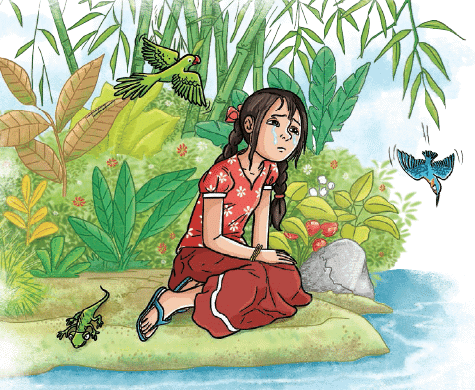
  • The story is written by Kamala Nair and tells the story of a young girl named Jahnavi who lives in a coastal village in India.
  • Jahnavi has a big dream of going to school, but her family does not allow her because she is a girl and has to take care of her younger siblings.
  • One day, she talks to a magical river, which encourages her to follow her dream.
  • The story teaches us about couragedetermination, and the importance of education, especially for girls.

Explanation of the Story

Life in the Village

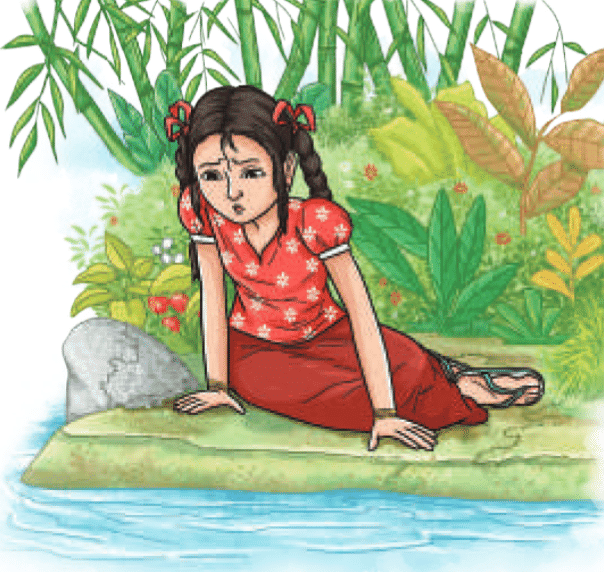
Jahnavi, a bright and curious girl, lives in a coastal village with her parents and three brothers — Gopi (whom she calls Ettan), Meena, Ramu, and Appu. Her parents work on a farm, and Jahnavi often spends time near a nearby river. She dreams of going to school like her brothers, but her mother keeps postponing it, saying she is either too young or needed at home to care for her siblings.

A Cry by the River

One day, feeling hopeless, Jahnavi cries by the river, thinking she will never go to school. To her surprise, the river speaks to her in a sleepy, kind voice. Scared at first, Jahnavi soon shares her wish to learn about the world — about spiders, bamboo, and the moon — and her fear of being too old to start school. The river listens patiently and encourages her, telling her that girls are just as capable as boys. It advises her to simply walk into the classroom and listen quietly, believing the teacher might let her stay. The river also talks about ships and suggests that Chandu, a fisherman, could someday take her to see one.

Q: How does the river comfort and encourage Jahnavi?  View Answer

Jahnavi’s Brave Step

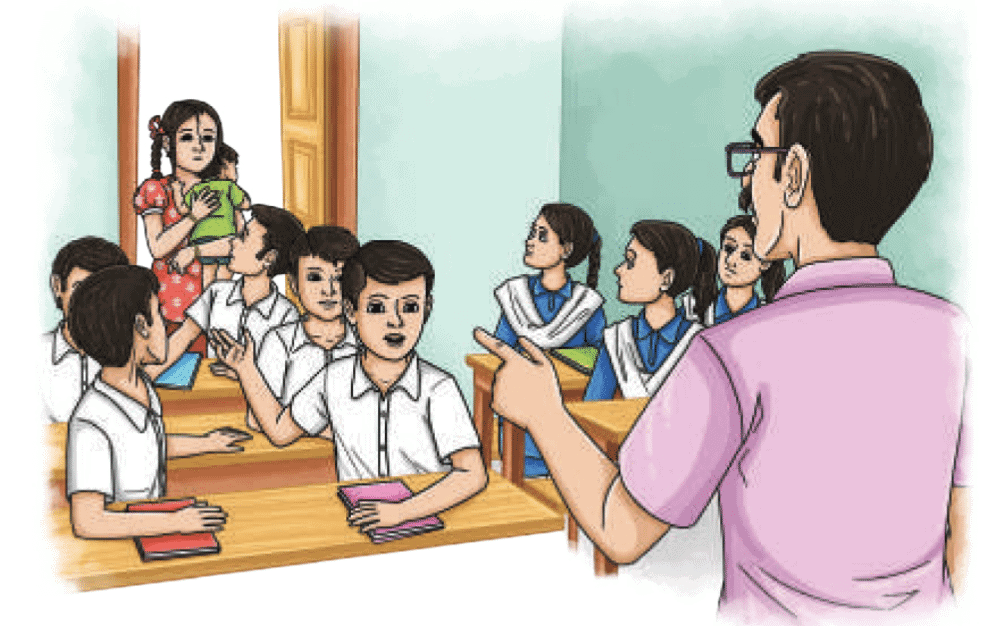
The next day, carrying her youngest brother Appu, Jahnavi stands shyly by the classroom door, listening to a story about King Ashoka. Gradually, she moves inside and sits at the back. The teacher notices her, learns she is Gopi’s sister, and decides to talk to her family.

A Dream Comes True

That evening, the teacher visits Jahnavi’s home. Though her father worries, her mother supports Jahnavi’s wish, recalling her own childhood dream of studying. They agree to let Jahnavi join school. The next morning, Jahnavi runs excitedly to the river and shares the good news. She dreams of learning to read, write, and someday become a teacher to help other girls. The river chuckles and invites her back to learn even more, including the secrets of the ships beyond the sea.

Moral of the Story

  • The story teaches us that courage and determination can help us achieve our dreams, even when things seem difficult.
  • It also shows that education is important for everyone, especially girls, who may face challenges in getting it.
  • The river’s encouragement reminds us to believe in ourselves and take small steps toward our goals.
  • The story highlights the value of support from others, like the teacher and Jahnavi’s mother, in making dreams come true.

Let’s Revise: What does the story tell us about Jahnavi’s character?
  View Answer

Difficult Words

Here are the meanings of some difficult words from the story, explained simply:

  • Splashed: Water or liquid falling in drops with a sound (e.g., tears splashed down her face).
  • Slithered: Moved smoothly by sliding, like a snake or lizard.
  • Murmuring: Speaking in a soft, low voice, almost like a whisper.
  • Startled: Suddenly surprised or shocked.
  • Thicket: A group of bushes or trees growing close together.
  • Shrieked: Made a loud, high-pitched sound, like a scream.
  • Conspiratorially: Speaking secretly, as if sharing a special plan.
  • Catamaran: A small boat made of logs tied together, used by fishermen.
  • Panting: Breathing heavily because of running or being tired.
  • Rustle: A soft sound made by leaves or paper moving.

12. Earth, Moon And The Sun : Chapter Notes

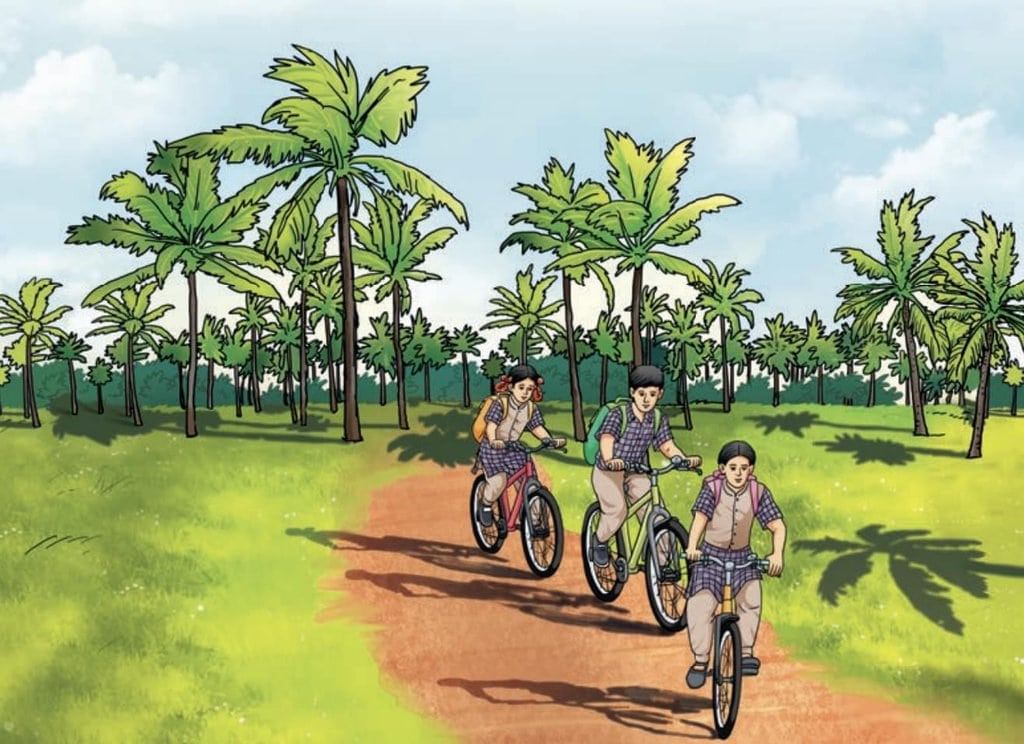
One morning in Kanniyakumari, 12-year-old Rashmika was cycling to school excited for science class. The teacher asked students to share interesting observations.

Rashmika noticed that the coconut tree shadows were long in the morning but shorter in the afternoon. She thought this happened because the Sun moved across the sky. But she also remembered learning that the Earth moves around the Sun, so she wondered: Does the Sun move, or does the Earth move?

Let’s explore how the Earth, Moon, and Sun work together to create day and night, seasons, and amazing events like eclipses!

Rotation of the Earth

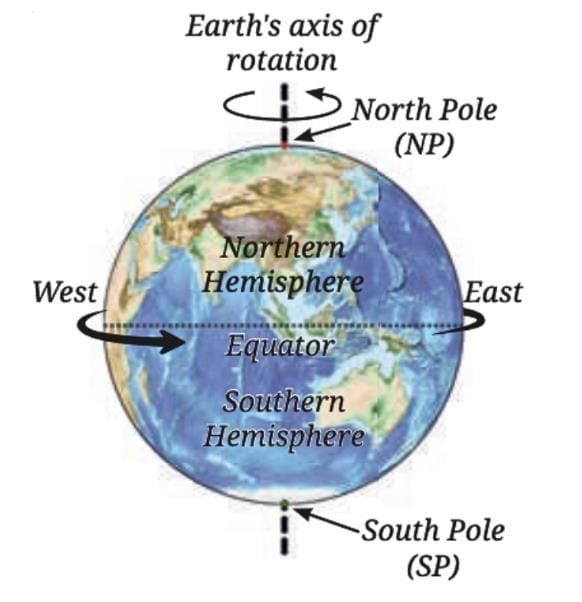
The Earth’s rotation is the spinning motion on its axis, which is an imaginary line passing through the North and South Poles. 

This rotation takes approximately 24 hours to complete one full turn, causing the cycle of day and night.Direction of Rotation

  • When viewed from above the North Pole, the Earth rotates counterclockwise, from west to east.
  • This rotation makes the Sun appear to rise in the east, move across the sky, and set in the west, although the Sun itself remains stationary relative to the Earth.

Day and Night Cycle

  • The Earth’s rotation causes one side to face the Sun, experiencing daytime.
  • The opposite side faces away from the Sun, experiencing nighttime or darkness.
  • For example, in India, the eastern regions see the sunrise first because they face the Sun earlier during the Earth’s rotation.

Apparent Motion of Celestial Objects

  • The Earth’s rotation makes the Sun, Moon, and stars appear to move across the sky from east to west.
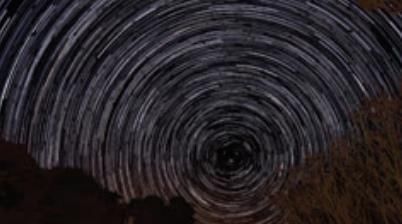
  • The Pole Star (Dhruva Tara) appears almost stationary because the Earth’s axis points close to it.
  • Other stars, such as those in the Big Dipper (Saptarishi), seem to circle around the Pole Star.

Fascinating Fact:

Foucault Pendulum demonstrates Earth’s rotation physically using a swinging pendulum that changes its plane of oscillation over time.

Revolution of the Earth

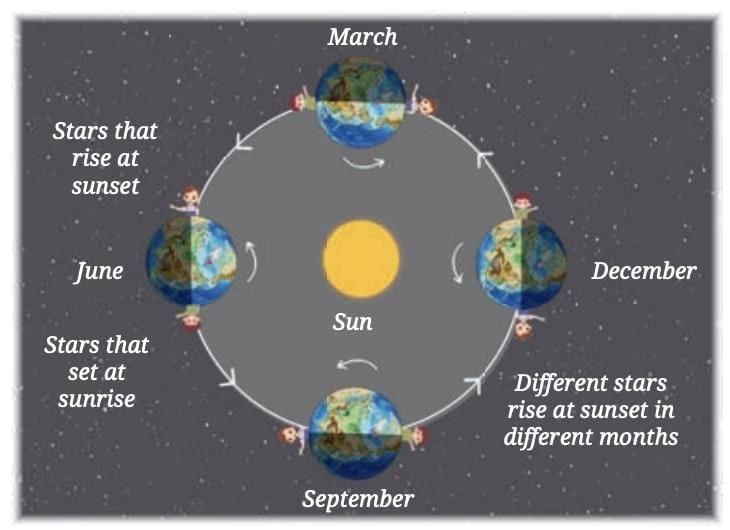
The Earth’s revolution is its movement around the Sun along a nearly circular path called an orbit. It takes about 365 days and 6 hours to complete one revolution, which defines a year.

Changing View of the Night Sky

  • As the Earth revolves around the Sun, it faces different directions in space throughout the year.
  • This causes the portion of the night sky visible after sunset to change gradually.
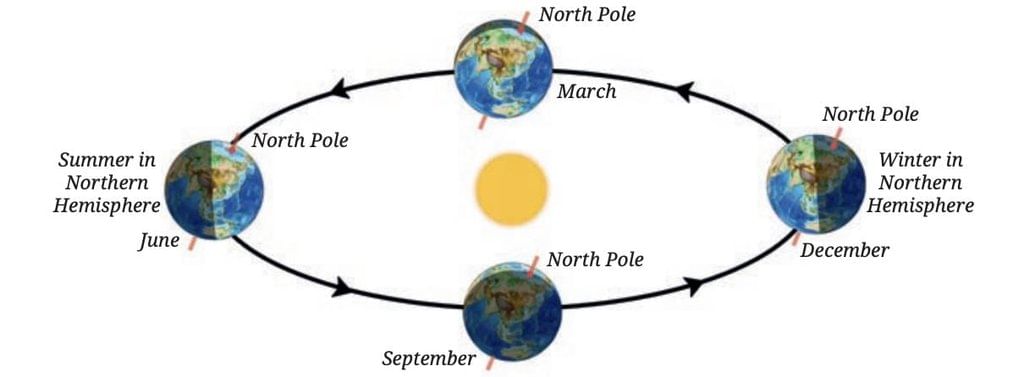
  • Different constellations and stars appear at different times during the year.
  • This changing view of the night sky helps us observe various celestial patterns and seasons.
  • It also allows astronomers to track the movement of stars and planets across the sky.

Fascinating Fact

Astrophotographers use long-exposure photography, keeping the camera’s shutter open for an extended time. This technique captures the apparent motion of stars as curved arcs called star trails, showing how stars seem to move in circular paths due to Earth’s rotation.

Seasons on the Earth

  • The Earth’s axis is tilted at an angle relative to its orbit around the Sun.
  • This tilt, along with the Earth’s spherical shape, causes the different seasons we experience.
  • Around June 21, the Northern Hemisphere tilts toward the Sun, receiving more direct and intense sunlight.
  • During this time, the Sun stays above the horizon for more than 12 hours, resulting in summer in the Northern Hemisphere.
  • At the same time, the Southern Hemisphere tilts away from the Sun, getting less direct sunlight and shorter daylight hours, causing winter there.
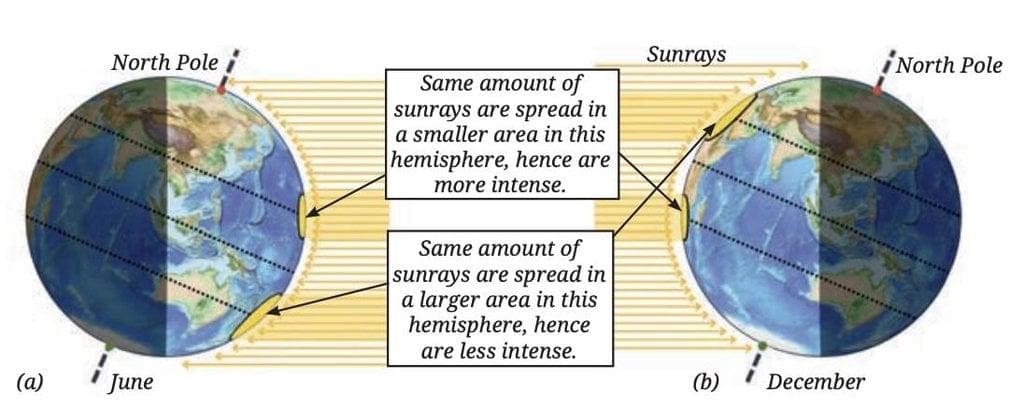
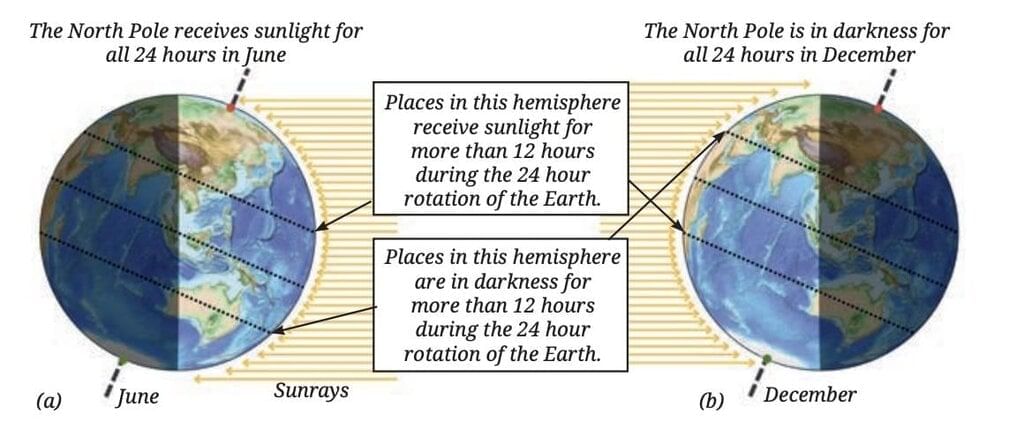
  • Around December 22, the situation reverses: the Northern Hemisphere tilts away from the Sun, leading to winter, while the Southern Hemisphere tilts toward the Sun, enjoying summer.
  • The difference in the Sun’s intensity and the length of the day during these times causes the changes in temperature and weather that define the seasons.

(a) More intense sunlight in the Northern Hemisphere and less intense sunlight in the Southern Hemisphere in June (b) The opposite situation happens in December

In the Northern Hemisphere (a) Longer daytime in June(b) Shorter daytime in December

Solstices and Equinoxes

  • In the Northern Hemisphere, the longest day of the year, called the summer solstice, occurs around June 21.
  • The shortest day, known as the winter solstice, happens around December 22.
  • On March 21 (the spring equinox) and September 23 (the autumn equinox), day and night are equal, each lasting about 12 hours.
  • At the equator, days and nights remain almost equal (12 hours each) throughout the year, with very little seasonal change.

Fascinating Facts 

The polar regions experience extreme daylight conditions — either six months of continuous daylight (known as the Midnight Sun) or six months of darkness.
At the North Pole, the Sun rises on March 21 and stays above the horizon for six months, setting on September 22. The South Pole experiences the opposite—six months of darkness followed by six months of daylight. 

Misconceptions About Seasons

  • Seasons are not caused by the Earth being closer to the Sun when tilted toward it or by an oval orbit with significant distance variations. 
  • The Earth is actually closest to the Sun in January, but the tilt and spherical shape are the primary reasons for seasonal changes.

Eclipses

Eclipses occur when one celestial body blocks light from another, casting a shadow. The Moon’s position relative to the Earth and Sun causes solar and lunar eclipses.

Solar Eclipse

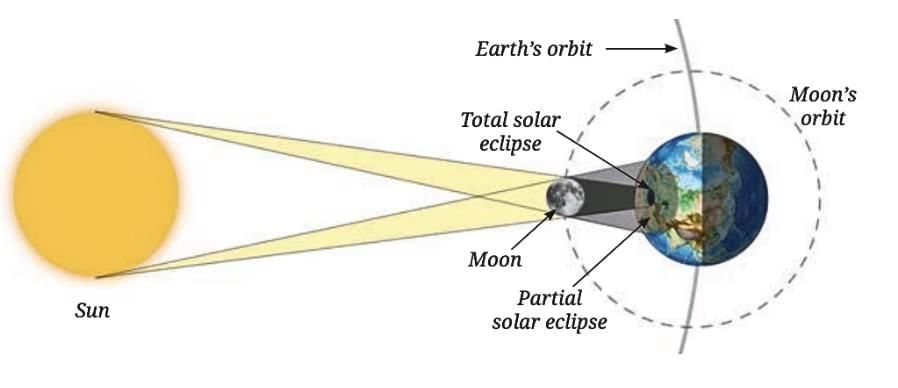
  • solar eclipse occurs when the Moon comes between the Earth and the Sun, blocking sunlight from reaching certain parts of the Earth.
  • Although the Moon is much smaller than the Sun, their apparent sizes in the sky are similar because the Moon is much closer to Earth.
  • This alignment allows the Moon to fully or partially cover the Sun.

Types of Solar Eclipses

1. Total Solar Eclipse:

  • The Moon completely blocks the Sun, casting a shadow on a small area of the Earth.
  • Observers in this area experience total darkness during the day. The sky becomes dark, and the Sun is completely obscured for a few minutes.

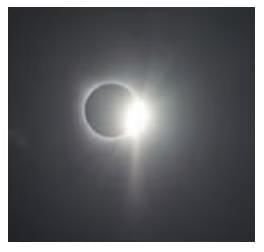
Total solar eclipse

A ‘diamond ring’ seen after a total solar eclipse, just when the Moon starts to move away

2. Partial Solar Eclipse:

  • The Moon only partially covers the Sun, and observers in the affected area see a part of the Sun obscured by the Moon.

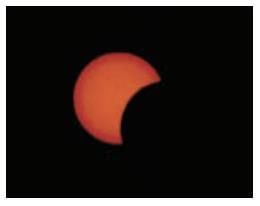
Partial Solar Eclipse 

Safe Viewing of Solar Eclipses

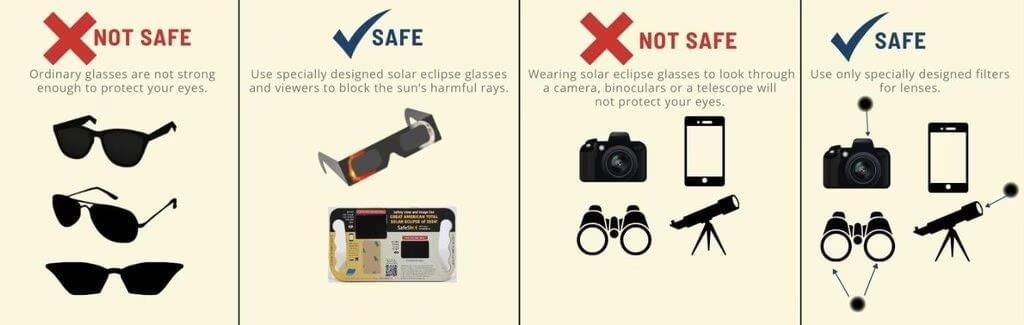
  • Direct viewing of a solar eclipse is dangerous because the Sun’s intense light can cause permanent blindness, even when the Sun is only partially covered by the Moon.
  • Safe methods for viewing a solar eclipse include:
    1. Using specialized solar goggles designed for eclipse viewing.
    2. Attending organized viewing events where safety measures are in place.
    3. Projecting the Sun’s image using a mirror to watch the eclipse safely.

  • Superstitions about eclipses, like avoiding eating or going outside, stemmed from historical fears but are no longer necessary with our modern understanding of eclipses.

Duration of the Solar Eclipse

  • The total solar eclipse is visible only for a few minutes because of the Earth’s rotation and the Moon’s motion in its orbit. 
  • As the Moon moves away from the Sun, the eclipse shifts into a partial solar eclipse, and daylight begins to return.

Historical Views on Solar Eclipses

  • Ancient civilizations feared eclipses because they did not understand the phenomenon. They believed that the Sun, a major source of heat and light, had been momentarily blocked by some cosmic force.
  • Many superstitions surrounded solar eclipses, with people refraining from activities like eating, cooking, or leaving the house.
  • Today, scientists study solar eclipses because they offer a rare opportunity to observe the Sun’s atmosphere and other phenomena that are not visible during normal circumstances.

Fascinating Facts

The Sanskrit word for eclipse is “grahan.” Ancient Indian astronomical texts, such as the Surya Siddhanta, provided calculations to predict eclipses long before modern astronomy developed. These texts use poetic shlokas to describe the phenomenon.

Dive Deeper – Why Planets Can’t Block the Sun? 

  • Mercury and Venus are closer to the Sun than Earth, but they are still too small and far away to block the Sun significantly.
  • Transit of Venus is a rare event that occurs when Venus moves directly between Earth and the Sun.
  • During the Transit of Venus, Venus appears as a tiny black dot crossing the face of the Sun.
  • This event is rare because Venus has to align perfectly with the Sun and Earth, which doesn’t happen often.
  • Although Venus is much smaller than the Sun, it’s visible as a small dot when it crosses in front of the Sun.

Lunar Eclipse

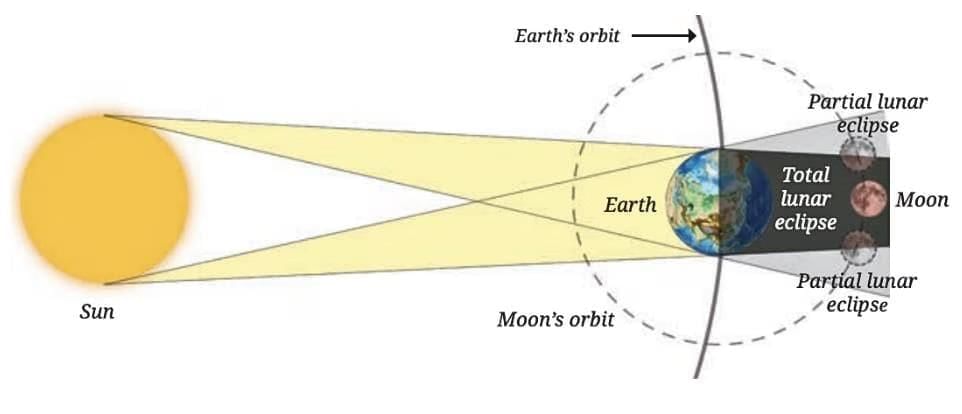
lunar eclipse occurs when the Earth comes between the Sun and the Moon, blocking the sunlight from reaching the Moon. This results in the Earth’s shadow falling on the Moon. The event is only visible during a full moon, when the Earth is directly aligned between the Sun and the Moon.

Types of Lunar Eclipses

1. Total Lunar Eclipse:

  • In a total lunar eclipse, the Moon is completely covered by the Earth’s shadow.
  • During this event, the Moon takes on a dark red color, which is often referred to as a “blood moon.” The reddish hue is caused by the Earth’s atmosphere scattering sunlight, which then reaches the Moon.
  • The Moon remains red until it moves out of the Earth’s shadow.

2. Partial Lunar Eclipse:

  • In a partial lunar eclipse, only part of the Moon enters the Earth’s shadow. The rest of the Moon remains visible and appears unaffected.
  • This creates a distinctive shape where part of the Moon looks darker, and the rest remains bright

Viewing a Lunar Eclipse

  • Unlike a solar eclipse, a lunar eclipse is safe to watch with the naked eye. Since the Moon is not as bright as the Sun, the Earth’s shadow provides a dimmer, more diffuse light.
  • It is also possible to observe both total and partial lunar eclipses from the Earth without special protection, making them easier for amateur astronomers and enthusiasts to view.

Fascinating Facts

The Kodaikanal Solar Observatory in southern India, established in 1899, has been providing valuable data about the Sun for over 100 years. It is operated by the Indian Institute of Astrophysics (IIA), Bengaluru. The observatory has contributed significantly to solar studies.

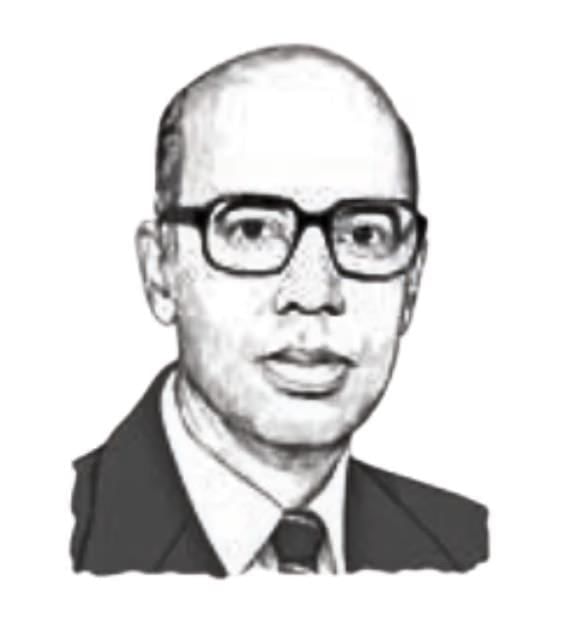
Know a Scientist: M.K. Vainu Bappu

  • M.K. Vainu Bappu is regarded as the father of modern Indian astronomy. He led efforts to set up many astronomical instruments and telescopes in India, such as those at Manora Peak (Uttarakhand) and Kavalur (Tamil Nadu).
  • The observatory at Kavalur has been named after him in recognition of his contributions.
  • Bappu made significant discoveries, including a comet, and was known for his studies on stars and solar eclipses. He traveled worldwide to study solar eclipses, contributing greatly to modern astronomical research in India.

Points to Remember

  • In the 19th century, scientist Leon Foucault used a long pendulum, known as the Foucault pendulum, to demonstrate the Earth’s rotation. A 22-meter Foucault pendulum is installed in the Constitution Hall of India’s new Parliament building in New Delhi, symbolizing India’s connection to the cosmos.
  • Ancient Indian astronomer Aryabhata, in his 5th-century text Aryabhatiya, explained the apparent motion of stars due to Earth’s rotation, comparing it to a person on a moving boat seeing stationary objects move backward. He estimated the Earth’s rotation period as 23 hours, 56 minutes, and 4.1 seconds, remarkably close to the modern value.
  • Astrophotographers capture star trails—arcs of star movement in long-exposure photographs—showing the apparent motion of stars due to Earth’s rotation.
  • The Bhil and Pawara communities in India’s Tapi Valley used the appearance of specific star patterns to predict monsoon rains, demonstrating traditional knowledge of celestial movements.
  • At the North Pole, the Sun rises on March 21 (spring equinox) and remains visible for six months until setting on September 22. The South Pole experiences the opposite, with six months of darkness followed by six months of daylight.
  • Ancient Indian texts like the Surya Siddhanta, written in Sanskrit shlokas, provided calculations to predict eclipses, reflecting advanced astronomical knowledge.
  • The Kodaikanal Solar Observatory, established in 1899 in Tamil Nadu’s Palani hills, has collected over 100 years of solar data, operated by the Indian Institute of Astrophysics, Bengaluru.

Difficult Words

  • Rotation: The spinning motion of an object, like the Earth, around its own axis, completing one turn in about 24 hours.
  • Axis of Rotation: An imaginary line passing through the North and South Poles, around which the Earth rotates.
  • Revolution: The motion of an object, like the Earth, around another object, such as the Sun, taking about 365 days and 6 hours.
  • Orbit: The nearly circular path the Earth follows while revolving around the Sun.
  • Solstice: The longest (summer solstice, around June 21) or shortest (winter solstice, around December 22) day in the Northern Hemisphere, due to the Earth’s tilt.
  • Equinox: Days when day and night are equal (12 hours each), occurring around March 21 (spring equinox) and September 23 (autumn equinox) in the Northern Hemisphere.
  • Solar Eclipse: An event where the Moon blocks sunlight from reaching Earth, causing total or partial darkness in specific areas.
  • Lunar Eclipse: An event where the Earth blocks sunlight from reaching the Moon, casting a shadow that makes the Moon appear dark red (total) or partially shadowed (partial).
  • Apparent Size: The perceived size of an object in the sky, depending on its actual size and distance from the observer, allowing the Moon to appear as large as the Sun during a solar eclipse.
  • Transit of Venus: A rare event where Venus appears as a small black dot crossing the Sun’s face, due to its small apparent size compared to the Sun.

Summary

The Earth’s rotation on its axis, from west to east every 24 hours, causes the day-night cycle and the apparent east-to-west motion of the Sun, Moon, and stars. Its revolution around the Sun, taking about 365 days, leads to changing night sky views and, due to the Earth’s tilted axis and spherical shape, seasonal variations. Solar eclipses occur when the Moon blocks sunlight, creating brief darkness, while lunar eclipses happen when the Earth’s shadow darkens the Moon. These phenomena, safely observed with proper precautions, highlight the dynamic interplay of Earth, Moon, and Sun, studied by ancient and modern scientists alike.

11. Light : Shadows And Reflections : Chapter Notes

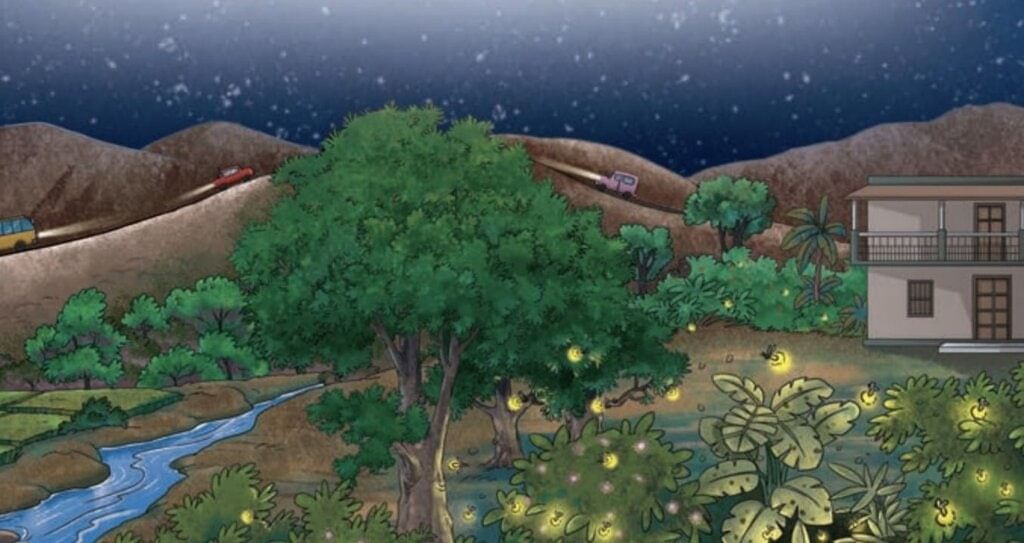
Keshav visits his friend Jatin’s village in the Western Ghats and is amazed by the forests, streams, and especially the glowing dance of fireflies at night. 

He learns from Jatin’s grandparents that fireflies use light to communicate, but their numbers are falling due to light pollution and deforestation.

On the way back to the city, Keshav watches the moonlit hills and wonders — does the Moon produce its own light? 

Or is it just reflected sunlight, like he read in his science book? As he thinks, he notices something interesting: light always travels in a straight line.

Sources of Light

Light enables us to see objects and is produced by various sources, both natural and artificial.

Natural Sources of Light

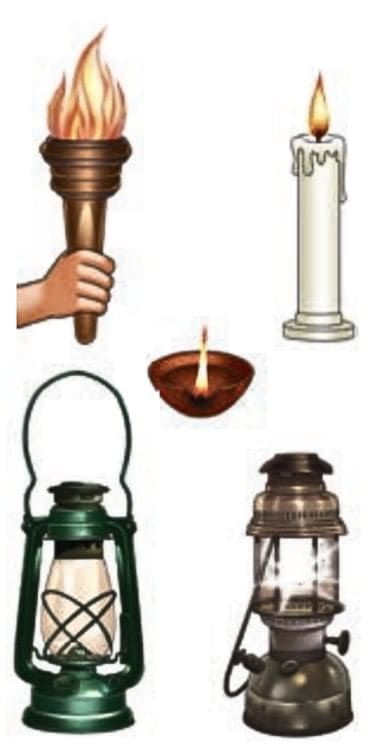
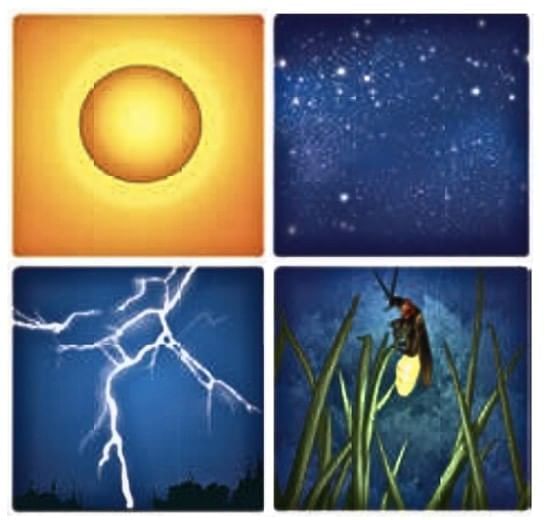
These include the Sun, stars, fire, lightning, and certain animals (like fireflies) that emit their own light. 

Artificial Sources of Light

Humans have developed several artificial sources over time, beginning with fire created using fuels like oil and wax. 

With technological advancement, electric lights such as bulbs, tube lights, and LED lamps have become common.

Luminous Objects

  • These are objects that emit their own light. 
  • Examples include the Sun (the primary natural light source), stars, lightning, natural fire, and certain animals like fireflies. 

Non-Luminous Objects 

  • These objects do not produce their own light but reflect light from luminous sources. The Moon is a non-luminous object that shines by reflecting sunlight. 
  • Other examples include planets like Mars and Venus, and everyday objects like mirrors.

Science and Society

LED lamps are energy-efficient, brighter, and longer-lasting than traditional bulbs. They help reduce electricity bills and are environmentally friendly. Recognizing these benefits, the Indian government actively promotes their use. However, used LED lamps must be properly recycled and not discarded in regular waste.

Try yourself:

What do fireflies use light for?

  • A.To communicate
  • B.To find food
  • C.To attract predators
  • D.To navigate

View Solution

​Does Light Travel in a Straight Line?

Light travels in a straight line under normal conditions, a property known as rectilinear propagation.

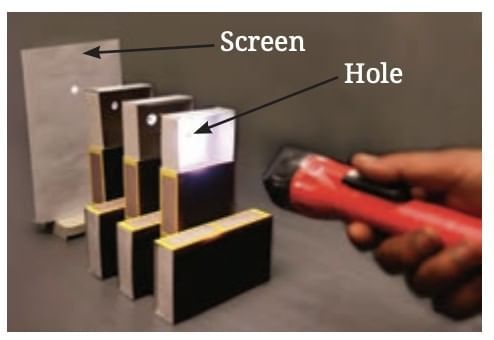
  • When light passes through aligned holes in a straight line, it creates a bright spot on a screen.
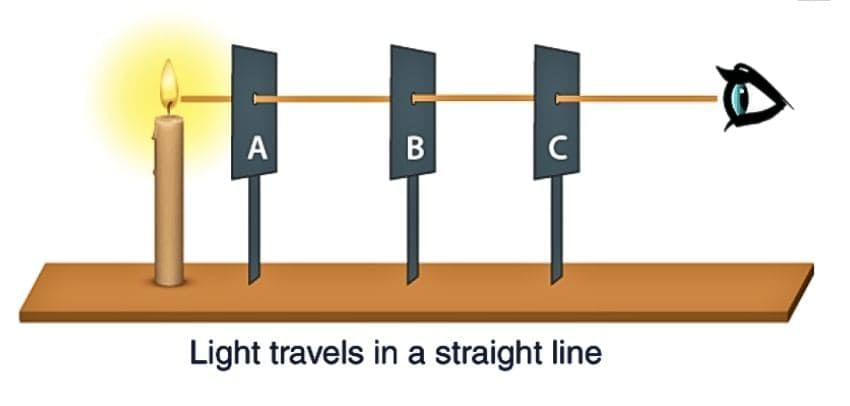
  • If the holes are misaligned, no spot appears, indicating that light does not bend around obstacles.
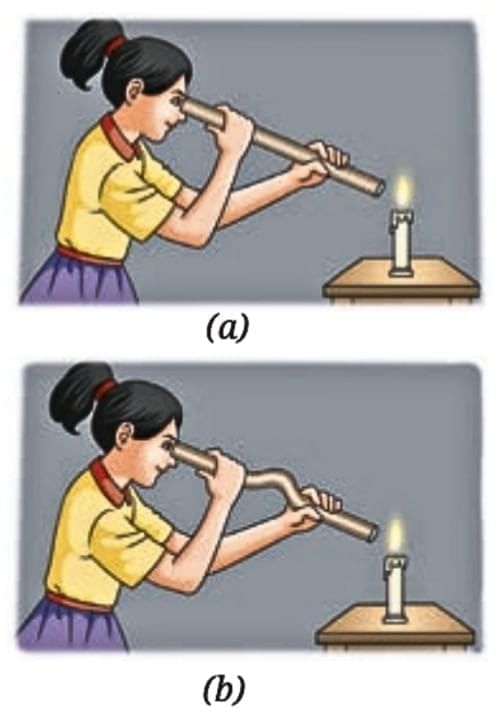
  • Similarly, a candle flame is visible through a straight pipe but not a bent one, confirming that light follows a straight path.

Viewing candle flame through (a) a straight pipe (b) a bent pipe

Dive Deeper

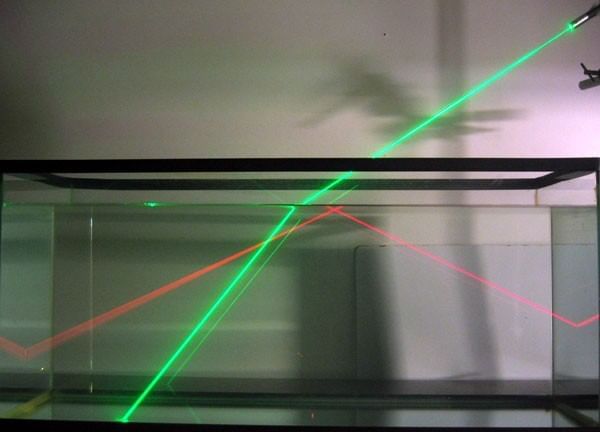
Light generally travels in a straight line. This can be seen clearly when a laser beam passes through a medium like water. However, under special conditions, light can also bend — a fascinating concept you’ll explore in higher grades.
Caution: 
Lasers should always be used under teacher supervision. Only low-power laser pointers are safe for basic use. Never point a laser at anyone’s eyes — it can cause serious injury.

Light Through Transparent, Translucent, and Opaque Materials

When light encounters different materials, its behavior depends on the material’s properties.

Transparent Materials

  • These allow light to pass through almost completely, enabling clear visibility of objects on the other side. 
  • Examples include glass and clear plastic. 

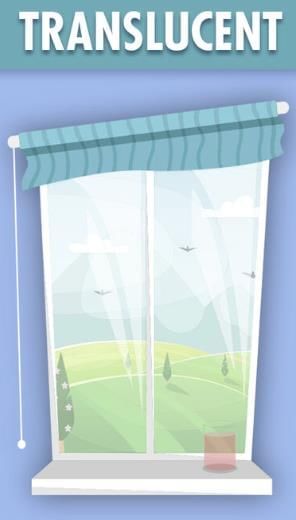
Translucent Materials 

  • These allow light to pass through partially, causing diffused or blurred visibility. 
  • Examples include tracing paper and frosted glass. 

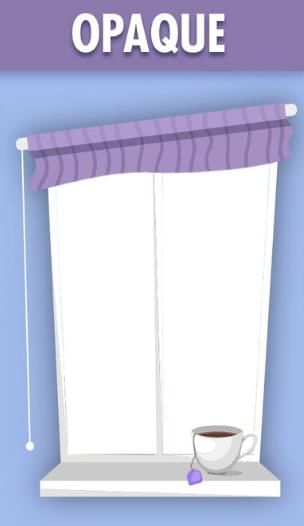
Opaque Materials

  • These block light completely, preventing any light from passing through. 
  • Examples include cardboard and thick cloth. 

Shadow Formation

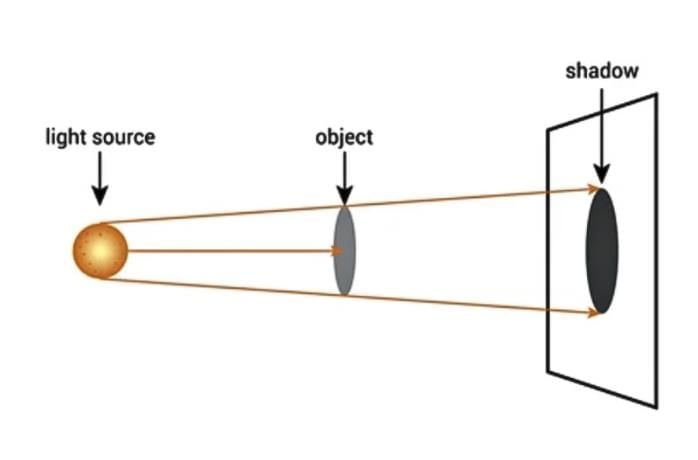
A shadow is a dark region formed when an object blocks light from reaching a surface.

Conditions for Shadow Formation

Shadows require three components: 

  • A light source (e.g., Sun or torch), 
  • An opaque or partially opaque object to block the light, 
  • A screen (e.g., wall, floor, or ground) where the shadow appears.

Types of Shadows

  • Opaque objects create the darkest, most defined shadows. 
  • Translucent objects produce lighter, less distinct shadows.
  • Transparent objects may create faint shadows or none at all.

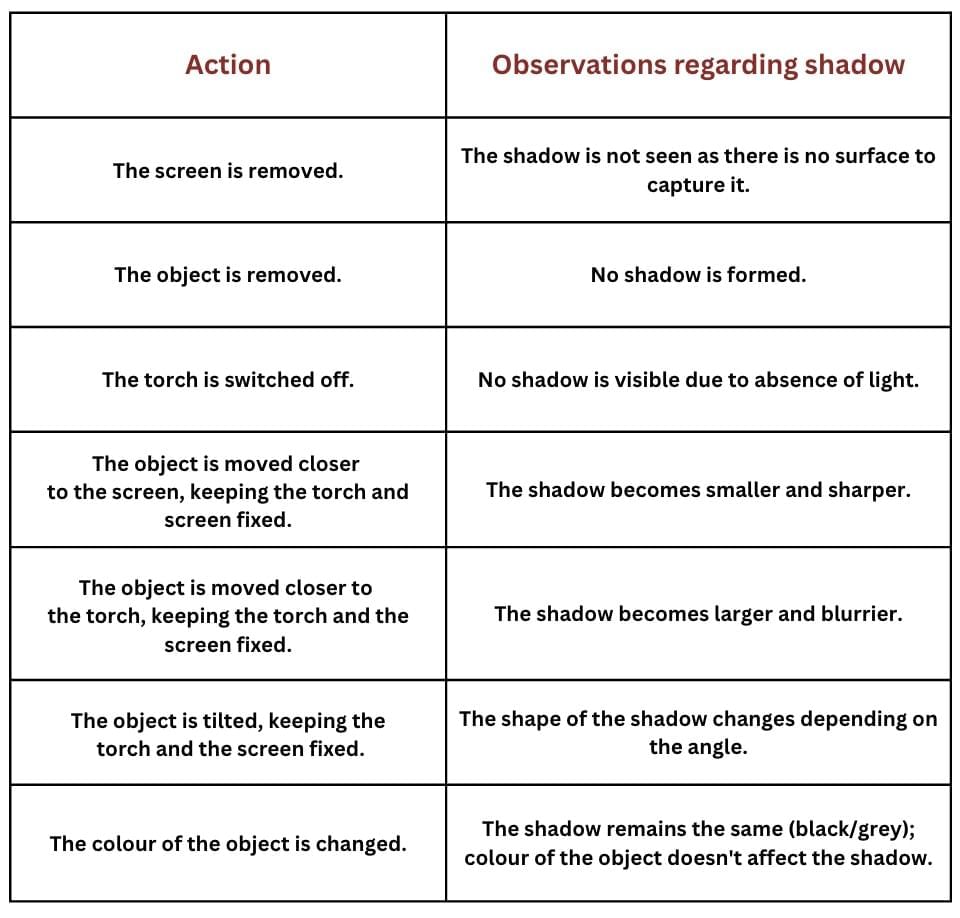
Shadow Characteristics and Observations 

From the above observations we can conclude:

  • Shadows are formed when an opaque object blocks light from reaching a surface, which acts as a screen. 
  • To observe a shadow, we need a light source, an opaque object, and a screen. 
  • The size, shape, and clarity of the shadow depend on the positions of the object, light source, and screen. 
  • Changing the colour of the object does not affect the colour of the shadow. 
  • Shadows help us understand the presence and shape of objects but do not reveal their colour.

Fascinating Facts 

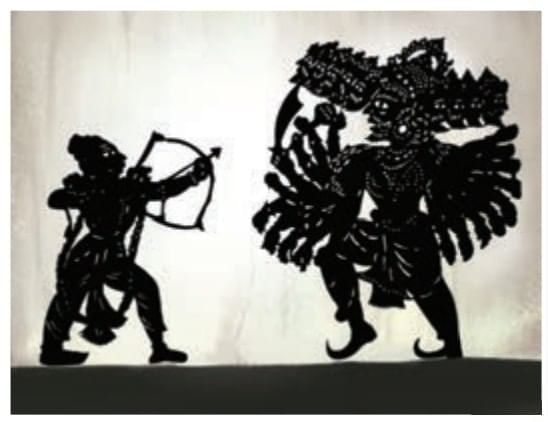
Shadow play, or shadow puppetry, is an ancient art where flat cut-out puppets are placed between a light source and a screen to create lifelike movements. 

Different Indian regions have unique styles like Charma Bahuli Natya (Maharashtra), Keelu Bomme and Tholu Bommalata (Andhra Pradesh), Togalu Gombeyaata (Karnataka), Ravana Chhaya (Odisha), Tholpavakoothu (Kerala), and Bommalattam (Tamil Nadu). 

These performances entertain and convey important community messages.

Try yourself:

What type of materials allows light to pass through almost completely?

  • A.Opaque materials
  • B.Transparent materials
  • C.Translucent materials
  • D.Reflective materials

View Solution

​Reflection of Light

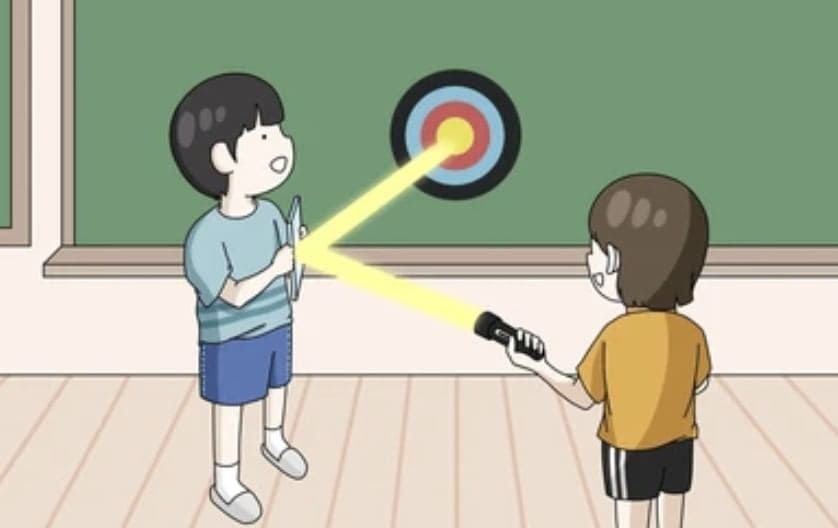
Reflection occurs when light bounces off a surface, changing its direction.

Reflection by Shiny Surface

  • Shiny surfaces, such as polished steel plates or plane mirrors, reflect light efficiently, creating bright spots on nearby surfaces. 
  • For example, tilting a mirror can direct sunlight onto walls not directly lit. 
  • When a light beam hits a plane mirror, it changes direction as a reflected beam, which is why mirrors are used to redirect light in many applications.

Images Formed in a Plane Mirror

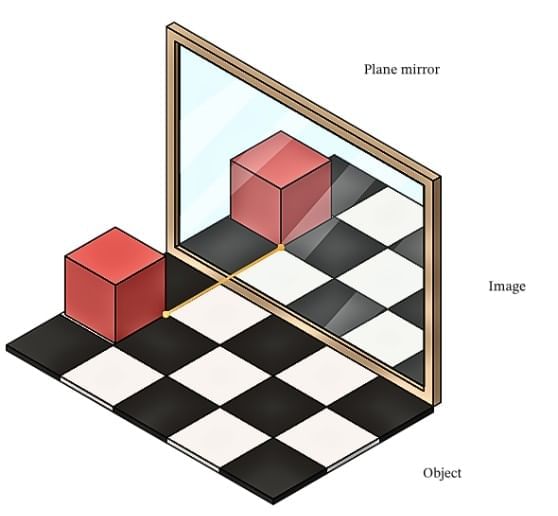
A plane mirror is a flat mirror that forms a virtual image of an object placed in front of it.

Image Characteristics

  • Same Size: The image is the same size as the object.
  • Erect: The image is upright, with the top of the object appearing at the top.
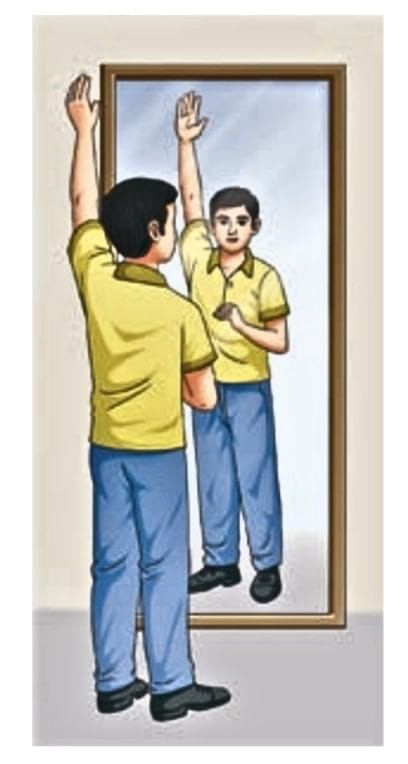
  • Laterally Inverted: The left side of the object appears as the right side in the image, and vice versa 
    For example: raising your left arm makes the image raise its right arm). This is called lateral inversion.)
    Another example:  word “AMBULANCE” is written in reverse letters on the front of ambulances so that drivers in vehicles ahead can see the word correctly in their rear-view mirrors. This helps them quickly recognize an approaching ambulance and give way.

Distance Relationship: The image’s distance from the mirror equals the object’s distance from the mirror. Moving closer to the mirror makes the image appear closer, and moving farther makes it appear farther.

Fascinating Fact

The exact time when mirrors were invented is unknown. Early mirrors were made by polishing stone or metal. With the invention of glass mirrors, the traditional art of making metal mirrors faded but still survives in places like Kerala, where the unique Aranmula Kannadi metal mirror has been crafted for centuries.

Pinhole Camera

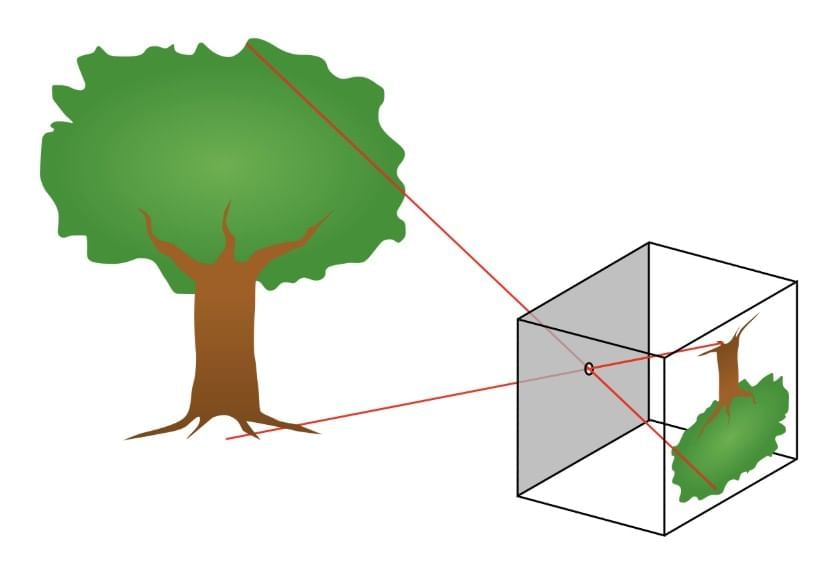
A pinhole camera is a simple device that uses a tiny hole to form an image on a screen.

Working Principle

Light rays from an object pass through a small hole (pinhole) and form an inverted (upside-down) image on a screen, such as tracing paper. The image shows the object’s colors but is reversed vertically.

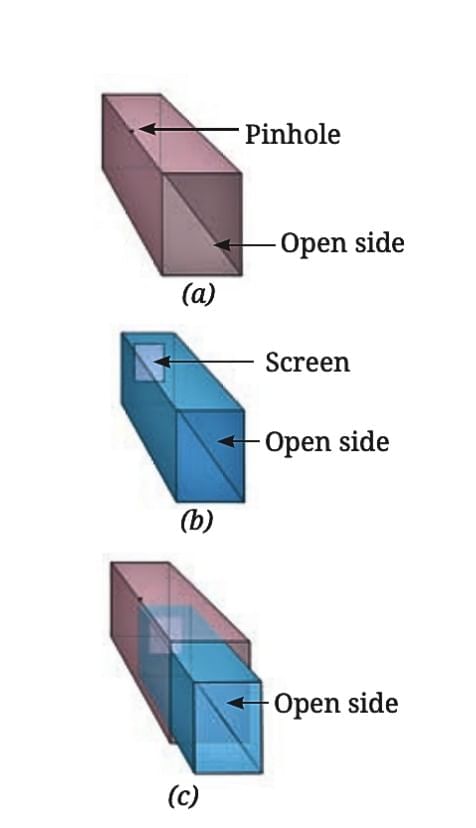
Making a pinhole cameraA sliding pinhole camera

  • Use two cardboard boxes, one slightly smaller to slide inside the other.Make a small hole in one side of the larger box.
  • Cut a square on the opposite side of the smaller box and cover it with thin translucent paper (like tracing paper) to act as a screen.
  • Slide the smaller box inside the larger one so the tracing paper is inside.
  • Point the pinhole side towards a distant object in bright sunlight.
  • Look through the open side, cover your head and camera with a dark cloth to see the image clearly.
  • Adjust the smaller box forward or backward until the image appears on the tracing paper.

Try yourself:

What is a characteristic of the image formed by a plane mirror?

  • A.It is always larger than the object.
  • B.It is the same size as the object.
  • C.It is always smaller than the object.
  • D.It is always distorted.

View Solution

Characteristics of Image Formed 

  • The image formed on the tracing paper is upside down (inverted).
  • The images show the colours of the objects on the other side.

Dive Deeper

A pinhole camera forms an upside-down image, while a mirror produces a laterally inverted image that is not upside down. These concepts will be explored further in higher grades.

Making Some Useful Items

The properties of light, such as its straight-line travel and reflection, are used to create practical devices.

Periscope

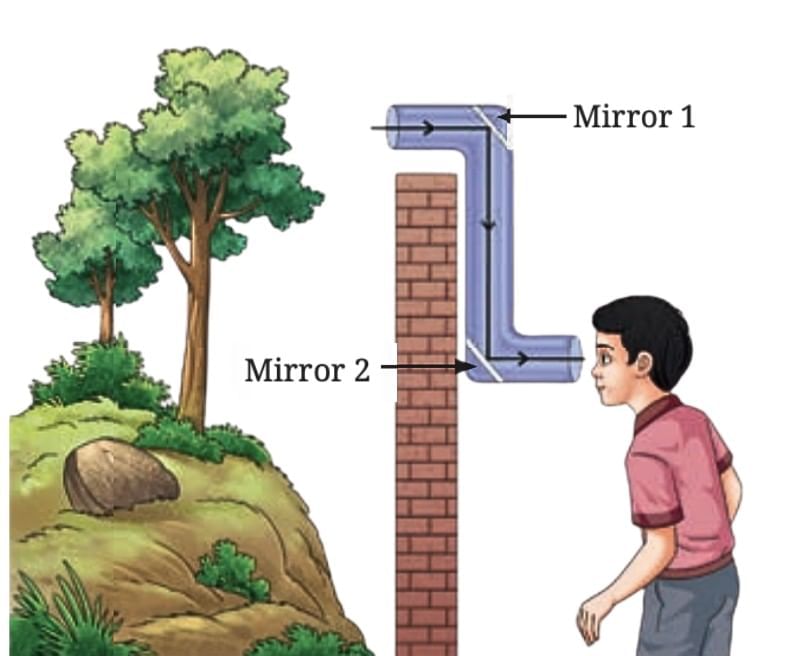
  • A simple periscope is made by placing two plane mirrors inside a Z-shaped box
  • The reflection from these mirrors allows us to see objects that are not directly visible
  • Periscopes are commonly used in submarines, tanks, and by soldiers to see outside their bunkers. You can also use one to see over taller people.

A Periscope

Kaleidoscope

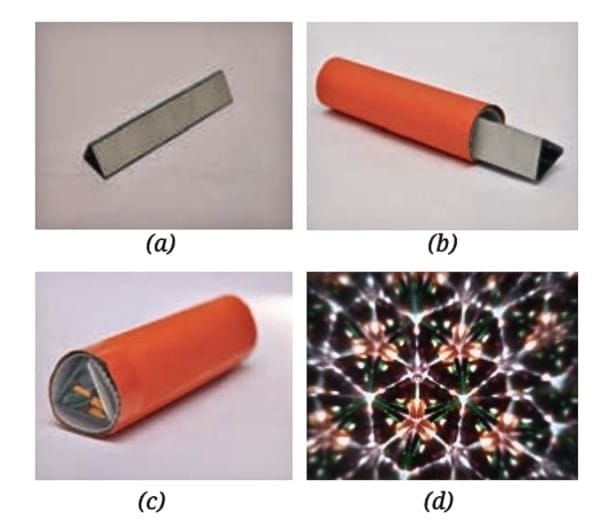
  • ​A kaleidoscope is made by joining three rectangular plane mirrors in a triangular shape and placing them inside a circular tube. 
  • Colored pieces like broken bangles or beads are placed on one end, covered with a transparent sheet and tracing paper. 
  • Looking through the open end shows beautiful, ever-changing patterns due to multiple reflections from the three mirrors. 
  • Artists often use kaleidoscopes to find inspiration for new designs.

A kaleidoscope

Difficult Words

  • Luminous Objects: Objects that emit their own light, such as the Sun, stars, or fireflies.
  • Non-Luminous Objects: Objects that do not emit light but reflect light from other sources, such as the Moon or a mirror.
  • Rectilinear Propagation: The property of light traveling in a straight line.
  • Transparent Materials: Materials that allow light to pass through almost completely, like glass.
  • Translucent Materials: Materials that allow light to pass through partially, causing diffused visibility, like tracing paper.
  • Opaque Materials: Materials that block light completely, like cardboard.
  • Shadow: A dark region formed when an object blocks light from reaching a surface.
  • Reflection: The change in direction of light when it bounces off a surface, such as a mirror.
  • Lateral Inversion: The left-right reversal of an image in a plane mirror, where the left side appears as the right side.
  • Pinhole Camera: A device that uses a tiny hole to form an inverted image of an object on a screen.
  • Periscope: A device with two plane mirrors that allows viewing of objects not directly visible, used in submarines and bunkers.
  • Kaleidoscope: A device with three mirrors forming symmetrical patterns from reflected objects, used for design inspiration.

10. Life Processes In Plants : Chapter Notes

All living beings grow and need food for their growth. While animals eat food to grow, what about plants? Have you ever seen plants eating like animals? As animals grow, their size and weight increase, and their bodies change. What changes do you notice in plants as they grow? Food provides nutrients like carbohydrates, fats, proteins, vitamins, and minerals, along with water, all essential for growth.

Let’s explore how plants obtain these nutrients for their growth.

How Do Plants Grow?

Plant growth involves visible changes such as the emergence of new leaves and branches, increased height, and a thicker stem. 

These changes occur as plants obtain essential resources like water, sunlight, and nutrients from their environment.

Role of Sunlight and Water

  •  Sunlight provides energy for food production, while water is crucial for nutrient transport and maintaining plant structure. 
  • Plants grown with both sunlight and water show better growth, with more leaves, greater height, and vibrant green leaves, compared to those lacking either resource. 
  • For instance, a plant without water may wilt or die, and one without sunlight may have pale or yellow leaves due to reduced food production.

Fascinating Fact
The ancient Indian text Vrikshayurveda states, “Trees do not produce fruits and flowers merely because they are planted.” 
This text contains valuable observations about plant growth, soil, and farming methods to improve crop health and yield. 
Based on practical experience and long-term patterns, it systematically guides agricultural practices. 
For example, it describes ways to prepare organic manure using water, barley, and seeds like green gram, black gram, and horse gram.

Try yourself:

What do roots absorb from the soil for plant growth?

  • A.Carbon dioxide and chlorophyll
  • B.Fruits and flowers
  • C.Sunlight and air
  • D.Water and minerals

View Solution

How Do Plants Get Food for Their Growth?

Unlike animals, plants produce their own food through a process called photosynthesis, primarily in their leaves. This food, stored as starch (a carbohydrate), provides energy and building blocks for growth.

Leaves: The ‘Food Factories’ of Plants

Leaves are the primary sites for food production due to their broad, flat structure and the presence of chlorophyll, a green pigment that captures sunlight. Chlorophyll enables leaves to convert sunlight, water, and carbon dioxide into food.

Starch Production

  • Leaves store food as starch, a carbohydrate. 
  • The presence of starch can be confirmed by an iodine test, where a leaf turns blue-black if starch is present. 
  • This indicates that the leaf has produced food.

Dive Deeper 

Decolourisation of a leaf in the beginning of testing enables us to easily observe colour change and, thus, the presence of starch.

Fascinating Facts

Some plant leaves look red, violet, or brown because they have more colored pigments than green chlorophyll, which hides the green color. Some of these pigments also assist in photosynthesis. You can perform an iodine test on such leaves to detect starch, which shows that photosynthesis has occurred.

Chlorophyll

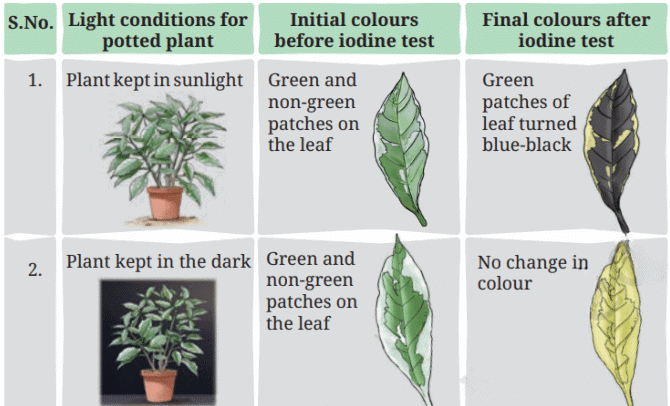
  • Leaves have green and non-green patches due to the presence or absence of chlorophyll.
  • Starch is produced only in the green parts of the leaf where chlorophyll is present.
  • Non-green patches usually lack sufficient chlorophyll and do not produce detectable starch.
  • The presence of starch can be confirmed by performing an iodine test, where starch turns blue-black.
  • Leaves exposed to sunlight produce starch, while leaves kept in darkness do not, even if they have green patches.
  • This shows that chlorophyll, in the presence of sunlight, is essential for the preparation of starch in plants.
  • Because leaves produce food through this process, they are often called the “food factories” of plants.

Try yourself:

What is the primary function of chlorophyll in plants?

  • A.Captures sunlight for photosynthesis
  • B.Stores food as starch
  • C.Produces oxygen during respiration
  • D.Absorbs water from the soil

View Solution

Role of Air in Food Preparation

Air, specifically carbon dioxide, is a key component in photosynthesis. Plants take in carbon dioxide from the air to produce food.

Carbon Dioxide Requirement

  • Carbon dioxide from the air is essential for plants to prepare food (starch).
  • When a leaf is kept in an environment without carbon dioxide, starch is not produced in that part.
  • This shows that carbon dioxide is a key ingredient required for photosynthesis.

Oxygen Release During Photosynthesis

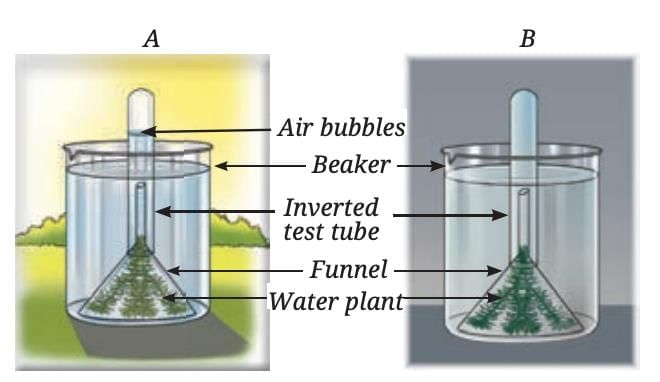
  • During photosynthesis, plants release oxygen gas.
  • Oxygen production is evident when plants are exposed to sunlight, and bubbles of oxygen can be observed.
  • The release of oxygen confirms that photosynthesis happens only in the presence of sunlight.

Activity showing the release of oxygen during photosynthesis

Photosynthesis: In a Nutshell

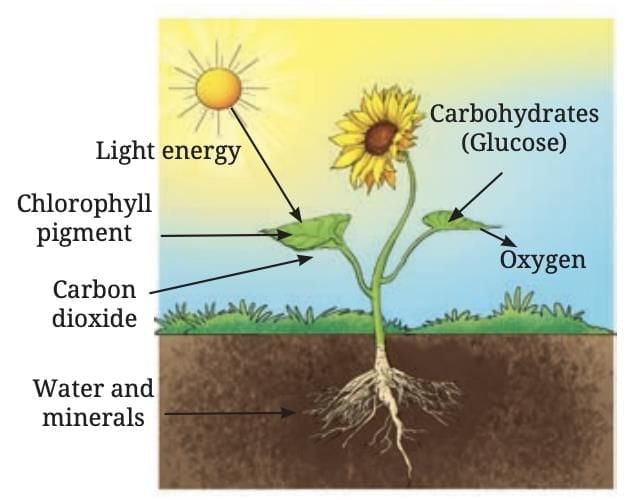
Photosynthesis is the process by which plants use sunlight, chlorophyll, carbon dioxide, and water to produce glucose (a simple carbohydrate) and oxygen. 

  • Glucose serves as an immediate energy source and can be converted into starch for storage. 
  • The word equation for photosynthesis is:
  • Oxygen is released as a by-product, which is vital for the survival of other living beings. 
  • Photosynthesis occurs mainly in leaves but also in other green parts of the plant containing chlorophyll.

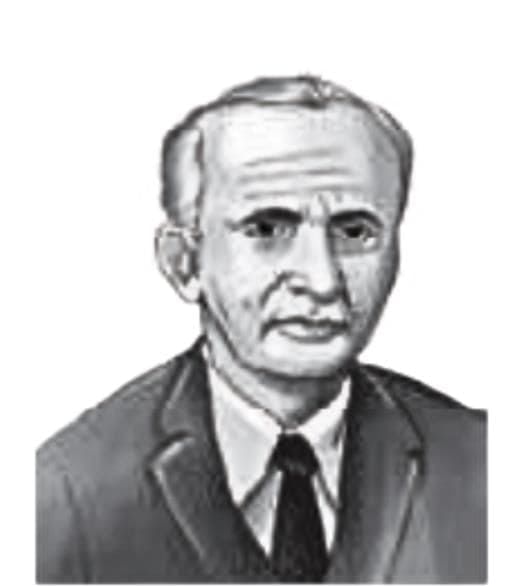
Know A Scientist: Rustom Hormusji Dastur

Many scientists worldwide have contributed to understanding photosynthesis. In India, Rustom Hormusji Dastur (1896–1961) was a notable plant scientist who studied this process. He served as the head of the Botany Department at the Royal Institute of Science, Bombay (now the Institute of Science, Mumbai) from 1921 to 1935. Dastur researched how factors like water availability, temperature, and light color affect photosynthesis, highlighting their importance in the process.

How Do Leaves Exchange Gases During Photosynthesis?

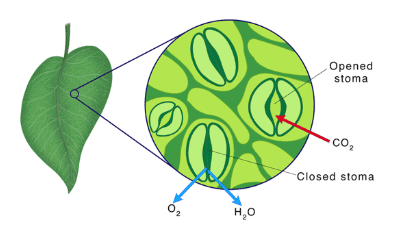
Leaves have tiny pores called stomata on their surface, which facilitate the exchange of gases during photosynthesis and respiration.

  • These pores allow carbon dioxide to enter the leaf for photosynthesis and oxygen to exit as a by-product. 
  • Stomata also play a role in respiration by allowing oxygen intake and carbon dioxide release.

Stomata

Transport in Plants

Plants have a transport system to move water, minerals, and food to different parts, ensuring growth and survival. 
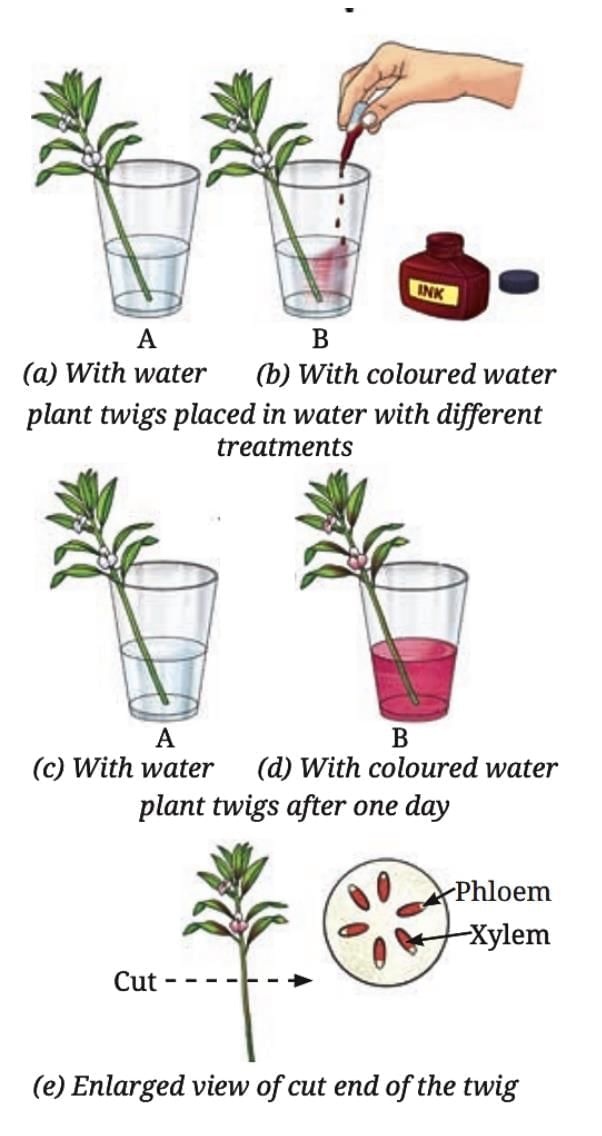
Roots absorb water and minerals from the soil, which are transported to other parts of the plant through specialized tissues called Xylem.

  • All living beings need water to grow, and plants use water for photosynthesis.
  • Water and minerals from the soil are absorbed by the roots of plants.
  • Minerals are essential nutrients for plant growth.
  • Water and minerals travel from the roots to other parts of the plant through a tissue called xylem.
  • The xylem consists of thin tube-like structures in stems, branches, and leaves that carry water and dissolved minerals upward.
  • The movement of water and minerals can be demonstrated by placing plant twigs in colored water, where the color travels up the stem and into leaves and flowers.
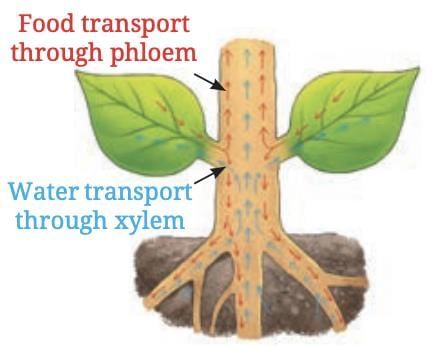
  • Water transported through the xylem supports various functions in the plant.

Transport of Food

Food produced in the leaves (glucose or starch) is distributed to non-green parts of the plant, such as roots, stems, and fruits, for growth and storage, through specialized tissue called phloem 

  • Leaves are the primary site of photosynthesis, where food is prepared.
  •  The phloem is vascular tissue that transports food from the leaves to other parts of the plant. 
  • This ensures that areas not involved in photosynthesis, like roots and developing fruits, receive the energy and nutrients they need.
  • Some of this transported food is stored in other parts of the plant, such as seeds and roots.

Try yourself:

What is the function of stomata in leaves?

  • A.Produce glucose
  • B.Exchange gases
  • C.Transport water
  • D.Store starch

View Solution

Do Plants Respire?

Plants, like animals, respire to produce energy for growth and other functions. Respiration occurs in all parts of the plant, whether green or non-green.

  • During respiration, plants break down glucose using oxygen, releasing carbon dioxide, water, and energy. The word equation for respiration is:
    Glucose + Oxygen → Carbon dioxide + Water + Energy
  • The energy released supports processes like growth, cell repair, and nutrient transport.
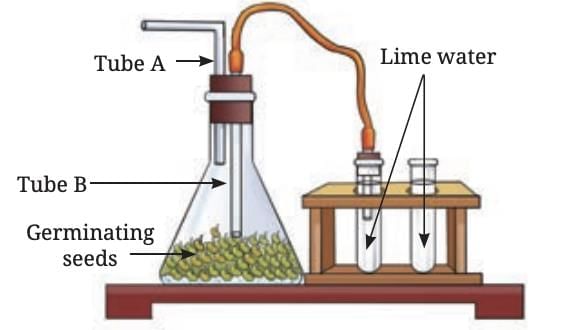
  • An experiment with soaked moong bean seeds shows that carbon dioxide is released during respiration, which turns lime water milky.
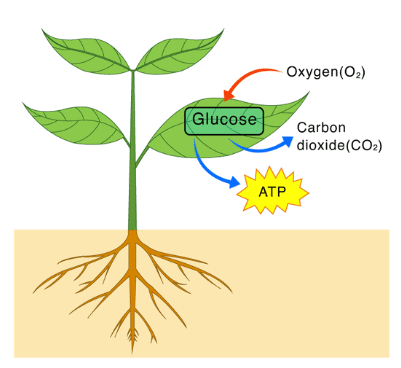
  • This carbon dioxide comes from the seeds respiring inside the flask.
  • The energy produced in respiration is used by plants for growth and development.
  • All parts of the plant, whether green or non-green, carry out respiration.
  • Plants have distinct processes for synthesizing food (photosynthesis), transporting food, and using it to produce energy (respiration).

Respiration in Plants 

Terms to Remember

  • Photosynthesis: The process by which plants use sunlight, chlorophyll, carbon dioxide, and water to produce glucose and oxygen.
  • Chlorophyll: A green pigment in leaves that captures sunlight for photosynthesis.
  • Stomata: Tiny pores on leaf surfaces that allow gas exchange (carbon dioxide in, oxygen out) during photosynthesis and respiration.
  • Xylem: Vascular tissue that transports water and minerals from roots to other parts of the plant.
  • Phloem: Vascular tissue that transports food (glucose or starch) from leaves to other parts of the plant.
  • Respiration: The process by which plants break down glucose using oxygen to release energy, carbon dioxide, and water.
  • Glucose: A simple carbohydrate produced during photosynthesis, used as an energy source or stored as starch.
  • Starch: A carbohydrate stored in plants, produced from glucose during photosynthesis.

09. Life Processes In Animal : Chapter Notes

  • Life processes like nutrition, respiration, excretion, and reproduction are essential for the survival of all living beings.
  • Animals eat different types of food based on their needs:
    1. Bees and sunbirds suck nectar from flowers.
    2. Human and animal infants feed on mother’s milk.
    3. Snakes swallow their prey whole.
    4. Some aquatic animals filter tiny food particles from water.
  • Animals obtain energy from food to carry out life processes.
  • Food contains complex components like carbohydrates, proteins, and fats, which must be broken down into simpler forms to be used by the body.
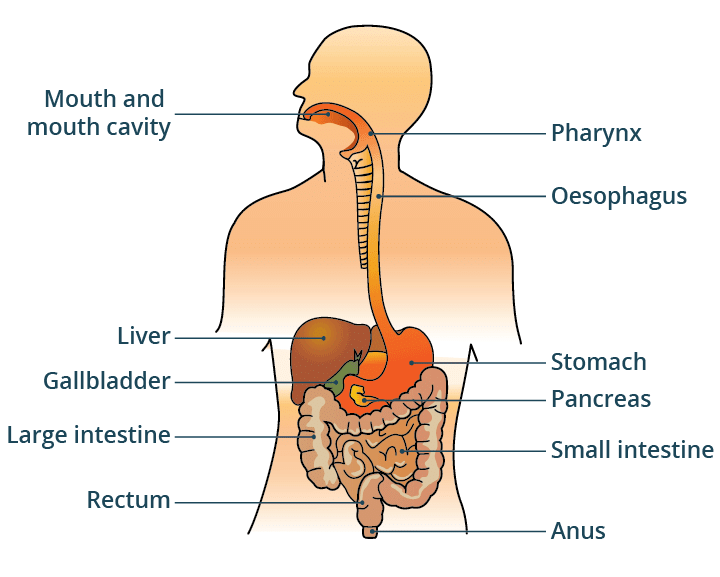
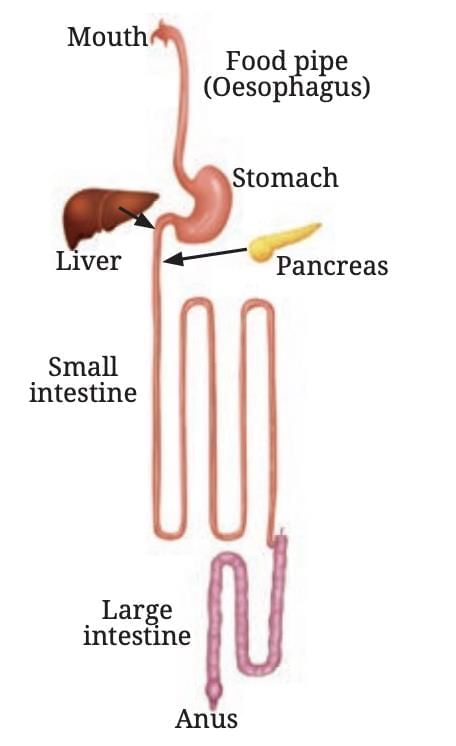
  • This breakdown happens in a long tube called the alimentary canal, which starts at the mouth and ends at the anus.Human Digestive System
  • Digestive juices secreted at various points in the alimentary canal help break down food.
  • The simpler food is absorbed and transported to different body parts for various functions.

Nutrition in Animals

Complex food components must be broken down into simpler forms before the body can use them. This breakdown process is called digestion. Digestion occurs in different ways across animals depending on their type and structure.

To understand digestion better, we first study how it happens in humans.

Digestion in Human Beings

Digestion is the process of breaking down complex food into simpler substances. It occurs in the alimentary canal, a long tube from the mouth to the anus.

Beginning with the mouth cavity

  • Digestion begins in the mouth, where food enters and is broken down into smaller pieces by teeth through crushing and chewing. This is called mechanical digestion.
  • When you think of your favorite food, your mouth produces more saliva, which moistens the food.
  • Saliva contains digestive juices that start breaking down starch (a carbohydrate) into sugar, which is why starchy foods like chapati or rice taste sweet when chewed for some time.

Science and Society

A healthy mouth requires good oral hygiene. We should brush our teeth and clean our tongue twice a day, and rinse our mouth with water after each meal to prevent tooth decay and bad smell in the mouth. Find out the ways our elders were maintaing oral hygiene. 

 Activity to Investigate Saliva’s Role 

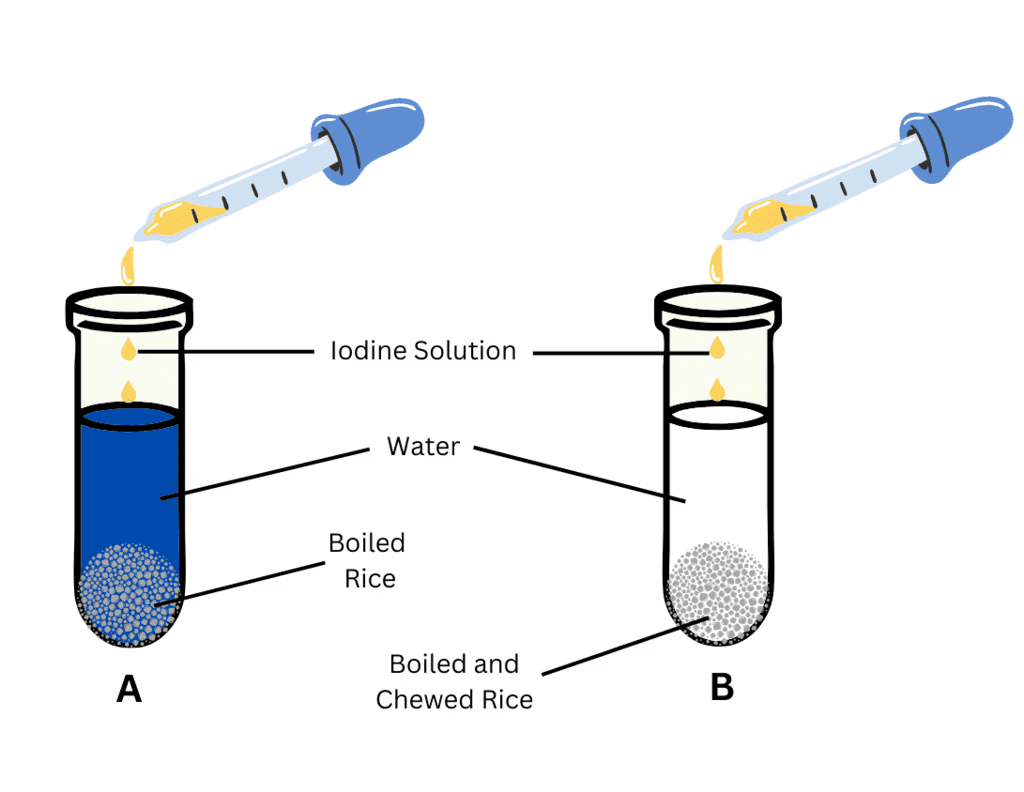
Aim: To observe the effect of saliva on the breakdown of starch in boiled rice.

Materials Needed: Two test tubes ,Teaspoon, Boiled rice , Water and Iodine solution 

Procedure:

  •  Label the test tubes as ‘A’ and ‘B’. 
  •  Place one teaspoonful of boiled rice in test tube A and a teaspoonful of chewed boiled rice in test tube B. 
  •  Add 3–4 mL of water to both test tubes. 
  •  Note the initial colour of the rice-water mixture. 
  •  Add 3–4 drops of iodine solution to each test tube and mix the contents. 
  •  Observe the colour changes in both test tubes. 

Observations:

  •  In test tube A, the boiled rice may turn blue-black, indicating the presence of starch. 
  •  In test tube B, the chewed rice may not change colour or show a very light blue-black colour, indicating the breakdown of starch into simpler sugars. 

2. Food pipe (Oesophagus): A passage from the mouth to the stomach

  • After chewing, saliva moistens the food, making it soft and easy to swallow.
  • The tongue mixes the chewed food with saliva and pushes it into the food pipe or oesophagus.
  • The oesophagus is a long, flexible tube connecting the mouth to the stomach.
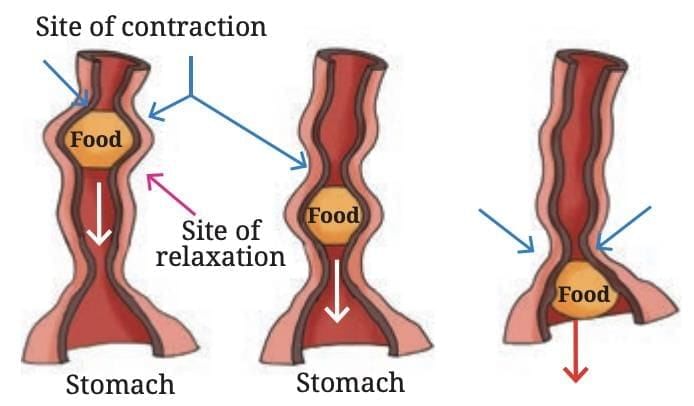
  • Food moves down the oesophagus by a wave-like motion called peristalsis, where the walls of the food pipe contract and relax gently.Movement of food in the food pipe
  • This movement continues throughout the alimentary canal, pushing food forward for digestion.

3. Stomach

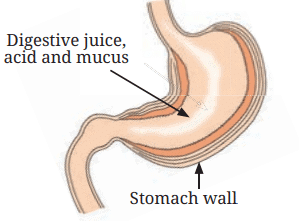
  • The walls of the stomach contract and relax to churn the food, mixing it thoroughly.
  • The stomach lining secretes digestive juiceacid, and mucus.
  • Digestive juice breaks down proteins into simpler components.
  • The acid helps in protein digestion and kills harmful bacteria.
  • Mucus protects the stomach lining from being damaged by the acid.
  • Food is partially digested in the stomach and turned into a semi-liquid mass, ready for the next stage of digestion.

Fascinating Facts 

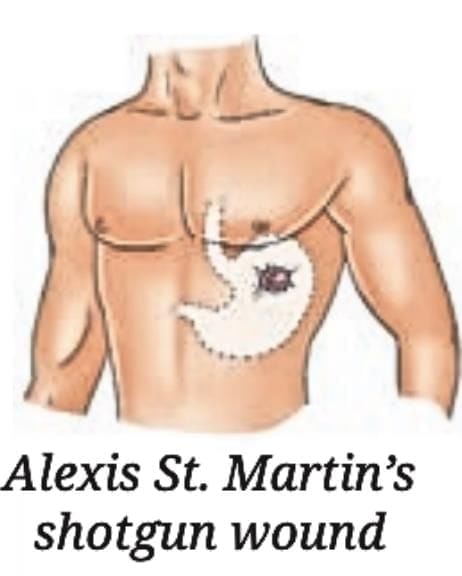
  • In 1822, Alexis St. Martin was accidentally shot in the stomach, leaving a small permanent hole after treatment.
  • Dr. William Beaumont, his doctor, used this opening to directly observe digestion in the stomach.
  • Beaumont conducted experiments to study how different foods are broken down.
  • He also explored how emotions can affect the process of digestion.
  • This accidental discovery significantly advanced our understanding of stomach function.

Try yourself:

What begins the process of digestion in humans?

  • A.Oesophagus
  • B.Anus
  • C.Mouth
  • D.Stomach

View Solution

4. Small Intestine

  • After leaving the stomach, partially digested food enters the small intestine, which is about 6 meters long, making it the longest part of the alimentary canal.Alimentary canal if it is stretched out
  • The small intestine receives digestive secretions from:
    1. Its own inner lining.
    2. The liver, which produces bile.
    3. The pancreas, which produces pancreatic juice.
  • Bile is mildly basic; it neutralizes stomach acid and breaks fats into tiny droplets, aiding digestion.
  • Pancreatic juice is also basic and helps neutralize acid, while breaking down carbohydrates, proteins, and fats.
  • Digestive juices from the small intestine further break down fats, proteins, and carbohydrates into simpler forms.
  • Nutrients are absorbed into the blood through the inner lining of the small intestine.
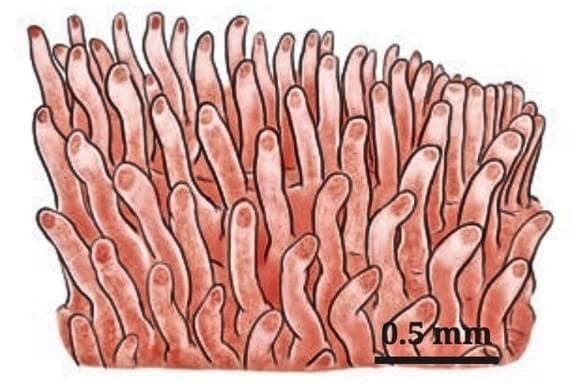
  • The lining has thousands of finger-like projections called villi, which increase the surface area for efficient absorption.
  • Absorbed nutrients provide energy, help growth and repair, and support body functions.

Science and Society 

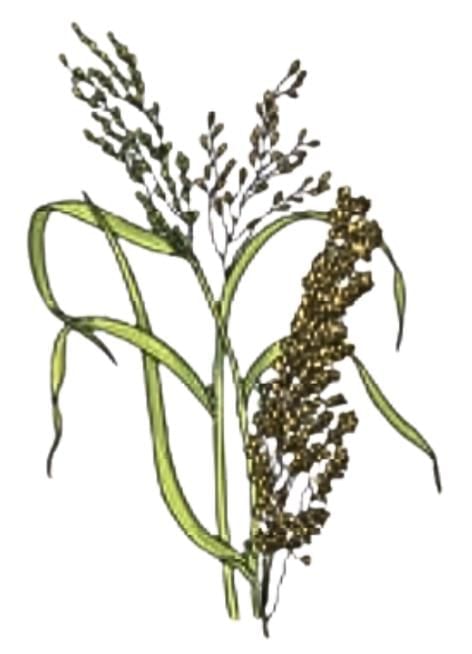
  • Celiac disease is a condition where the body reacts to gluten, a protein found in wheat, barley, and rye.
  • This reaction damages the inner lining of the small intestine, impairing nutrient absorption.
  • As a result, the small intestine cannot function properly.
  • The only way to manage celiac disease is to avoid gluten-containing foods.
  • Millets such as jowar, bajra, and ragi are good alternatives because they are naturally gluten-free.
5. Large Intestine

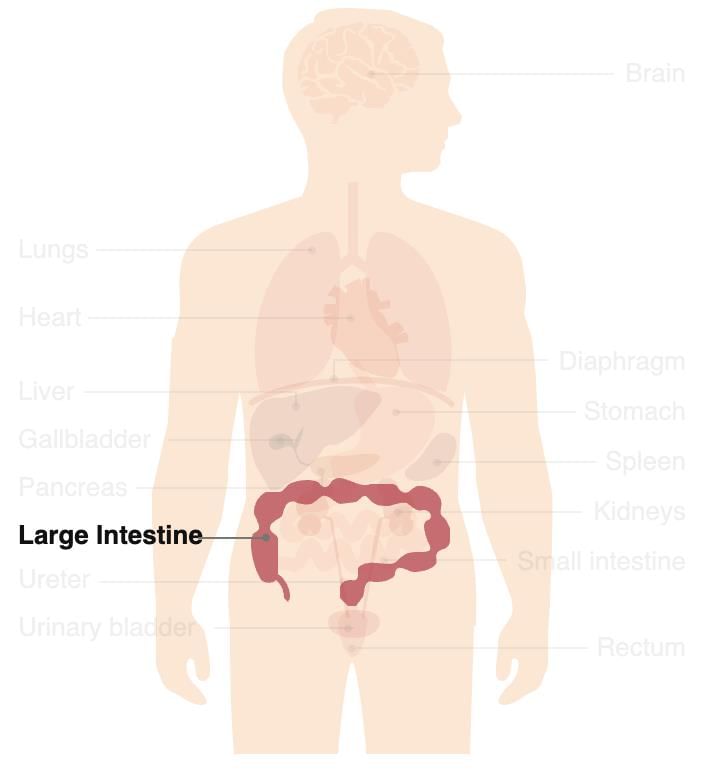
  • After nutrient absorption in the small intestine, undigested food moves into the large intestine.
  • The large intestine is about 1.5 meters long, shorter but wider than the small intestine.
  • Its main function is to absorb water and some salts from the undigested food.
  • This process turns the waste into a semi-solid form called stool.
  • Stool is stored in the rectum until the body is ready to eliminate it.
  • The waste is expelled through the anus in a process called egestion.
  • Eating fiber-rich foods like fruits, vegetables, and whole grains helps keep the large intestine healthy and stool easier to pass.

Fascinating Facts

  • The large intestine contains helpful bacteria that break down undigested fiber.
  • These bacteria produce nutrients important for health.
  • Eating fiber-rich and fermented foods like curd and pickles supports a healthy digestion.

Science and Society 

  • The ancient Ayurvedic text Charaka Samhita stresses the importance of easily digestible foods.
  • Spices like ginger, black pepper, and cumin are used to improve digestion.
  • Modern nutrition also highlights eating at proper times, mindful eating, and avoiding overeating to maintain good digestive health.

Digestion in Other Animals

Not all animals digest food like humans. Their digestive systems are adapted to their diets and habitats:

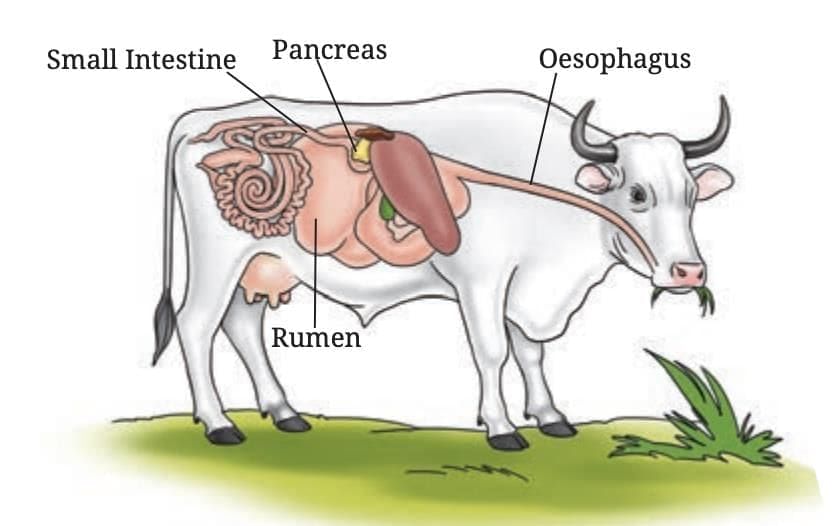
Ruminants 

  • These grass-eating animals, partially chew it, and swallow it into their stomachs for partial digestion.
  • The food is then brought back to the mouth for thorough chewing, a process called rumination.
  • Ruminants spend about 8 hours a day chewing their food.
  • After chewing, the food moves down the alimentary canal for further digestion.

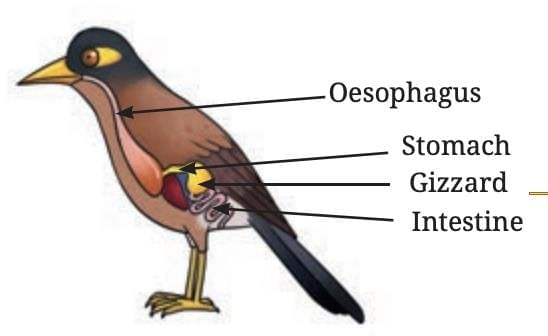
Birds

  • Birds lack teeth but have a special stomach chamber called the gizzard.
  • The gizzard breaks down food by contracting and relaxing, often with the help of small stones (grit) swallowed by birds.
  • Animals show variations in their digestive systems to suit different types of food.
  • Nutrients from digested food help build and repair the body or are broken down to release energy.
  • The process of converting nutrients into energy is called respiration.

Try yourself:

What is the primary function of bile produced by the liver?

  • A.To neutralize stomach acids
  • B.To produce digestive juices
  • C.To break down carbohydrates
  • D.To absorb nutrients

View Solution

Respiration in Animals

Respiration is the process by which animals use oxygen to break down nutrients (like glucose) to release energy, producing carbon dioxide and water as by-products. 

Breathing, a physical process, brings oxygen into the body and removes carbon dioxide, while respiration is a chemical process occurring in cells.

Respiration in Humans

  • Breathing is the process of inhaling (breathing in) oxygen and exhaling (breathing out) carbon dioxide.
  • Breathing is essential for survival; without it, humans cannot live more than a few minutes.
  • All living beings, including plants and animals, breathe.
  • The respiratory system is the body system responsible for breathing and gas exchange.

Human Respiratory System

  • Nostrils: Openings in the nose through which air is inhaled and exhaled.
  • Nasal Passages: Small passages after the nostrils lined with tiny hairs and mucus that trap dust and dirt. Breathing through the nose is better than through the mouth because of this filtration.
  • Windpipe (Trachea): Tube that carries air from the nasal passages to the lungs and divides into two branches.
  • Lungs and Alveoli: The windpipe branches further inside the lungs into finer tubes ending in tiny balloon-like sacs called alveoli, where gas exchange occurs.
  • Protection: The lungs are protected by the rib cage, a bony structure surrounding them.

Science and Society

  • Although the respiratory system filters out much dust from inhaled air, small infectious particles can still enter the lungs.
  • For example, during the COVID-19 pandemic, the SARS-CoV-2 virus affected the respiratory system.
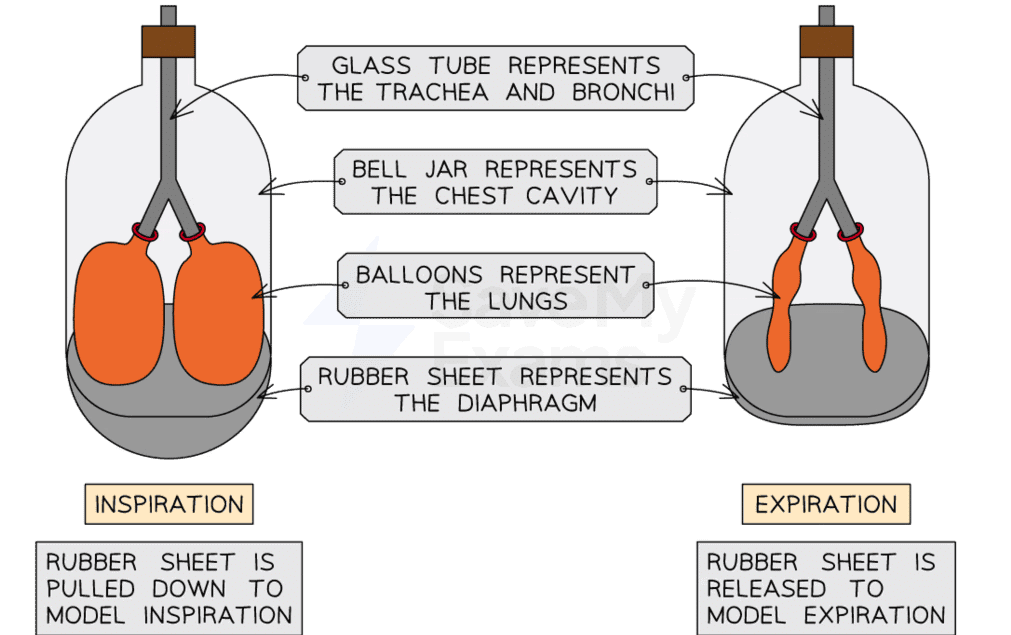
  • This virus caused breathing difficulties and serious lung problems in many people.

Activity: Understanding Breathing Mechanism through a Simple Model

Materials Needed: Wide transparent plastic bottle with a lid (bottom removed) ,  Y-shaped hollow tube, Deflated balloons (2), Rubber bands, Clay (for sealing) , Thin rubber sheet ,Large rubber band (for securing rubber sheet).

Procedure

Prepare the Bottle: 

  •  Take the wide transparent plastic bottle and remove its bottom. 
  •  Make a hole in the lid of the bottle. 

Prepare the Tube and Balloons: 

  •  Take the Y-shaped hollow tube. Fix the two deflated balloons to the forked end of the tube and secure them with rubber bands to make them airtight. 

Assemble the Model: 

  •  Insert the straight end of the tube tightly through the lid of the bottle and seal the lid with clay to ensure it is airtight. 
  •  Attach a thin rubber sheet to the open base of the bottle tightly using a large rubber band. 

Conducting the Experiment:

  • Pulling the Rubber Sheet Downward: Pull the rubber sheet from the center of the base downwards. Observe the balloons closely. 
  • Releasing the Rubber Sheet: Release the rubber sheet upwards and observe the changes in the balloons. Model of Mechanism of Breathing

Observations:

  •  When you pull the rubber sheet downwards, the balloons inflate. 
  •  Conversely, when you release the rubber sheet upwards, the balloons deflate. 

Process of Respiration Involves: 

(i) Inhalation

  •  When you breathe in (inhale), your chest expands as your ribs move up and outwards. 
  •  The diaphragm, which is a dome-shaped muscle located below your lungs, moves downwards during inhalation. 
  •  This movement increases the space inside your chest, allowing air to enter your lungs. 

(ii) Exhalation

  •  When you breathe out (exhale), your ribs move down and inwards, while the diaphragm moves upwards. 
  •  This reduces the space inside your chest and helps to push air out of your lungs. 

 In the activity we discussed before, the balloons represent the lungs, and the rubber sheet represents the diaphragm.

Science and Society

Breathing exercises like Pranayama and Tummo have been practiced for centuries worldwide to boost lung health and mental calmness. Pranayama from India enhances respiration and concentration, while Tummo breathing in cold Ladakh improves lung function and body warmth. Deep breathing combined with chanting is also used in many traditions to promote relaxation and clarity of mind.

Try yourself:

What is the first part of the respiratory system where air enters the body?

  • A.Nostrils
  • B.Windpipe
  • C.Alveoli
  • D.Lungs

View Solution

What do we Breathe Out? 

When we exhale, the air we breathe out contains more carbon dioxide compared to the air we inhale. 

This can be demonstrated through an experiment with lime water. 

  • Lime water is a clear solution that turns milky when it reacts with carbon dioxide.
  • Two test tubes with equal amounts of fresh lime water are taken.(a) Air is passed into lime water with a pichkari/syringe (b) Air is exhaled into lime water
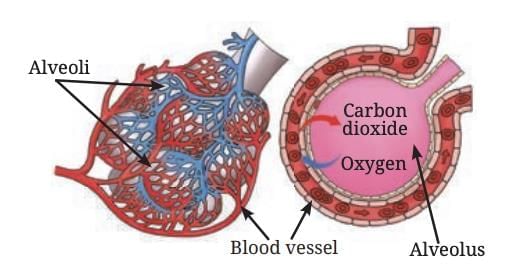
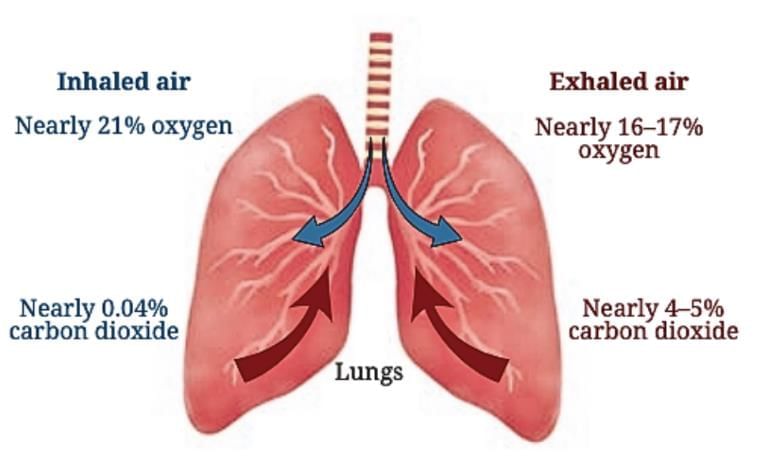
  • Air similar to inhaled air is passed through lime water in test tube A using a syringe.
  • Exhaled air is blown through a straw into lime water in test tube B.
  • Test tube B (exhaled air) turns milky, showing a reaction with carbon dioxide.
  • Test tube A (inhaled air) shows no change and remains clear.
  • This indicates exhaled air contains a higher concentration of carbon dioxide than inhaled air.

(ii) Gas Exchange

  • Fresh air enters the lungs through breathing and fills tiny sacs called alveoli.
  • Alveoli have thin walls surrounded by blood vessels.
  • Carbon dioxide from the blood is released into the alveoli to be exhaled.
  • Oxygen from the alveoli passes into the blood and is carried to the entire body.
  • Oxygen is used to break down glucose from food, releasing energy in a process called respiration.

Gas exchange through alveoli

  • Overall Process of Respiration: In cells, oxygen breaks down glucose to release energy, carbon dioxide, and water. 
    Glucose + Oxygen → Carbon dioxide + Water + Energy
  • Inhaled air contains about 21% oxygen and 0.04% carbon dioxide.
  • Exhaled air contains about 16–17% oxygen and 4–5% carbon dioxide.
  • Breathing is a physical process of air intake and release.
  • Respiration is a chemical process inside the body that produces energy.
  • Both breathing and respiration are vital for survival.

The percentage of oxygen and carbon dioxide in inhaled and exhaled air

Difference Between Breathing and Respiration

 Role of the Circulatory System

  • The circulatory system transports nutrients, oxygen, and waste products in the body.
  • It consists of the heartblood, and blood vessels.
  • The heart pumps blood through vessels to deliver oxygen and nutrients and remove wastes.

Science and Society

  • Smoking damages the lungs and increases the risk of lung cancer and other respiratory diseases.
  • It causes persistent coughing and makes the body prone to frequent infections.
  • Smoking releases toxic chemicals into the air, harming others through passive smoking.
  • Children, pregnant women, and the elderly are especially vulnerable to passive smoking.
  • Avoiding smoking protects both personal health and the health of those around us.

Respiration in Other Animals

Different animals live in different habitats and have different breathing mechanisms suited to their environments.

Animals have adapted respiratory systems based on their habitats:

  • Lungs: Animals like birds, elephants, lions, cows, lizards, and snakes breathe through lungs, though lung structures vary.
  • Gills: Aquatic animals like fish use gills, which extract dissolved oxygen from water and release carbon dioxide.

Breathing body parts in a fish

  • Skin and Gills: Amphibians like frogs use gills as tadpoles, lungs as adults on land, and moist skin for gas exchange in water.
  • Moist Skin: Earthworms breathe through their moist skin, allowing oxygen and carbon dioxide exchange.

Try yourself:

What happens to lime water when exhaled air is passed through it?

  • A.It turns milky
  • B.It remains clear
  • C.It changes color
  • D.It bubbles

View Solution

Terms to Remember

  • Alimentary Canal: The long tube in the digestive system from the mouth to the anus where food is digested and absorbed.
  • Mechanical Digestion: The physical breakdown of food into smaller pieces, such as by chewing.
  • Peristalsis: The wave-like muscle contractions that move food through the digestive system.
  • Villi: Finger-like projections in the small intestine that increase surface area for nutrient absorption.
  • Egestion: The process of expelling undigested waste (stool) through the anus.
  • Ruminants: Animals like cows that partially digest food, regurgitate it, and chew it again.
  • Gizzard: A muscular chamber in birds that grinds food, often with swallowed stones.
  • Alveoli: Tiny air sacs in the lungs where oxygen and carbon dioxide are exchanged.
  • Diaphragm: A dome-shaped muscle below the lungs that aids breathing by moving up and down.
  • Respiration: The chemical process in cells where oxygen breaks down glucose to release energy.
  • Circulatory System: The system (heart, blood, blood vessels) that transports nutrients, oxygen, and waste.