12. Short Answers Type Questions: Statistics

Question 1. Find the mean of: 10, 90, 20, 80, 30 and 70.
 Solution:
 Number of observations = 6 Sum of the observations = 10 + 90 + 20 + 80 + 30 + 70 = 300
∴ Mean = (300/6)= 50
Thus, the required mean = 50


Question 2. Find the range and prepare a frequency table for the following observations:
 4, 1, 1, 2, 3, 5, 2, 3, 3, 1, 2, 2, 4, 2, 5, 4, 1, 1, 3, 2
 Solution:
 Arranging the observations in ascending order:
1, 1, 1, 1, 1, 2, 2, 2, 2, 2, 2, 3, 3, 3, 3, 4, 4, 4, 5, 5
Lowest observation = 1
Highest observation = 5

∴ Range = 5 – 1 = 4
Thus, the required range = 4.
Frequency table:

ObservationTally marksFrequency
1||||5
2||||  |6
3||||4
4|||3
5||2


Question 3. Make a cumulative frequency table for the following:

Class intervalTally marksFrequency
100-110||||4
110-120||||  |6
120-130||2
130-140|||3
140-150||||5
Total20

Solution: Cumulative frequency table:

Class intervalTally marksFrequencyCumulative frequency
100-110IIII44
110-120||||66 + 4 = 10
120-130II210 + 2 = 12
130-140III312 + 3 = 15
140-150||||515 + 5 = 20
Total20

Question 4. Form a frequency table for the following:

Marks obtained Number of students 
More than 50
More than 40
More than 30
More than 20
More than 10
More than 0  
0
20
37
44
46
50

Solution:

Marks obtainedFrequencyCumulative frequency
0–10
10–20  
20–30
30–40  
40–50
50 – 46 = 4  
46 – 44 = 2 
44 – 37 = 7 
37 – 20 = 17 
20 – 0 = 20  
4
6
13
30
50
Total50 

Question 5. Find the mean of the first six multiples of 6.
 Solution:
 Six multiples of 6 are: 6, 12, 18, 24, 30, 36


Thus, the required mean = 21


Question 6. If the mean of 8, 5, 2, x, 6, 5 is 6, then find the value of x.
 Solution:
 We have the number of observations = 6

∴               Mean = 
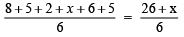
Now,                     [∵ Mean is 6]

⇒ 26 + x = 6 x 6 ⇒ x = 36 – 26 = 10


Question 7. If the mean of the following data is 15 then find the value of p.

xi510152025
fi645p7

Solution: We can have the following table from the given data :
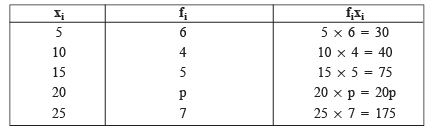
∴ we have           ∑ (fi) = 6+4+5+p+7 = 22+p

                           ∑ (xifi) = 30+40+75+20p+175 = 320+20p

∵ Mean,               
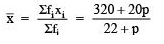
 But Mean = 15

∴    

 ⇒ 320 + 20p = 15(22 + p)
⇒ 320 + 20p = 330 + 15p
⇒ 20p – 15p = 330 – 320
⇒ 5p = 10
⇒   p= (10/5)= 2
Thus, the required value of p is 2

Question 8. If the mean of the following data is 18.75, find the value of p:

xi101520p30
fi510782

Solution: From the given data we can prepare the following table:

xifi(fi * xi)
10510 x 5 = 50
151015 x 10 = 150
20720 x 7 = 140
PSp x 8 = 8p
30230 x 2 = 60
∑(fi) = 32∑(xi * fi) = 400 + 8p

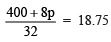
∵     

But the mean is 18.75.

∴ 

⇒ 400 + 8p = 18.75 x 32
⇒ 400 + 8p = 600
⇒ 8p = 600 – 400 = 200
⇒   p= (200/8) = 25
Thus, the required value of p is 25.


Question 9. The following observations are arranged in ascending order:
 26,  29,  42,  53,  x,  x + 2,  70,  75,  82,  93
 If the median is 65, find the value of x.
 Solution:
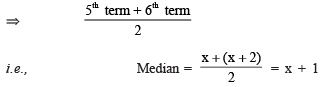
 Number of observations (n) = 10 Here ‘n’ is even
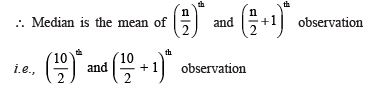
∴ x + 1 = 65 or x = 65 – 1 = 64

Thus, the required value of x is 64.

Question 10. Construct a frequency table with equal class intervals from the following data on the monthly wages (in rupees) of 30 workers of a factory taking one of the class interval as 8440–8540 (8540 not included). 8740, 8780, 8760, 8740, 8450, 8200, 8440, 9080, 8880, 8840, 8340, 8140, 8660, 8960, 8400, 9100, 8460, 8880, 8540, 8140, 8760, 8300, 8350, 8660, 8950, 9120, 9100, 8320, 8150, 9080.
Solution: 
Here, the lowest observation = 8140
The highest observation = 9120
∵ One of the classes is 8440–8540,
i.e. the class size = 100
∴ To cover the given data, we have the classes as: 8140–8240; 8240–8340; ….; 9040–9140.
Now, the required frequency table is:

Wages (in f)Tally marksFrequency
8140-8240IIII4
8240-8340II2
8340-8440III3
8440-8540III3
8540-8640I1
8640-8740II2
8740-8840||||5
8840-8940III3
8940-9040III3
9040-9140IIII4
Total30

Question 11. The mean of 40 numbers was found to be 35. Later on, it was detected that a number 56 was misread as 16. Find the correct mean of the given numbers.
 Solution: 
Number of observations = 40
∵ Calculated mean = 35
∴ Calculated sum = 40 x 35 = 1400
Since the number 56 is misread as 16.
∴ Correct sum of the numbers = 1400 – [Wrong observation] + [Correct observation]
= 1400 – [16] + [56]
= (1400 – 16 + 56) = 1440
∴ The correct mean =
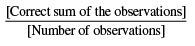
= (14440/40)= 36
Thus, the correct mean = 36.

Question 12. The mean of 72 items was found to be 63. If two of the items were misread as 27 and 9 instead of 72 and 90 respectively. Find the correct mean.
 Solution:
 Number of items = 72
Calculated mean = 63
∴ Calculated sum = 72 x 63 = 4536
Since, the item 72 is misread as 27.
And the item 90 is misread as 9.
∴ Correct sum of 72 items = [Calculated sum] – [Sum of the wrong items] + [Sum of the correct items]
= [4536] – [27 + 9] + [72 + 90] = [4536] – [36] + [162]
= [4536 – 36 + 162] = 4662
∴ Correct mean 

Thus, the required correct mean is 64.75.
 

Question 13. A train travels between two stations x and y. While going from x to y, its average speed is 72 km per hour, and while coming back from y to x, its average speed is 63 km per hour. Find the average speed of the train during the whole journey.
 Solution: 
Let the distance between x and y is s km.
Since, average speed = Total Distance / Total Time

For the train going from x to y, Average speed = 72 km/hr
∴ Time taken = Distance / speed = s/72 hours

For the train coming back from y to x, Average speed = 63 km/hr
∴ Time taken = Distance / speed = s/63 hours

 Now, the total time taken to cover 2s km
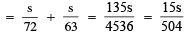
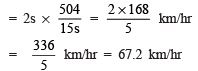
∴ Average speed during the whole journey 

Thus, the required average speed = 67.2 km/hr.

 Question 14. Find the mode for the following data using the relation: mode = (3 median – 2 mean)

Item (x) Frequency (f) 
16
17
18
19
20
21 
1
1
3
4
1
2
Item (x)Frequency (f)Cumulative frequencyfx
16171819202111341212591012161754762042
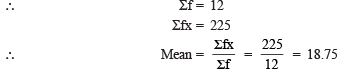
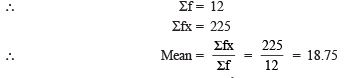
Total  225

Since, Mode = 3(Median) – 2(Mean)
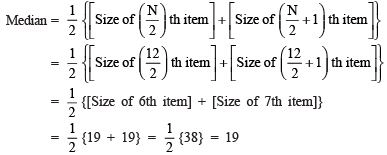
∴ Mode of the above data = 3(19) – 2(18.75)
= 57 – 37.5 = 19.5
11. Short Answer Type Questions: Surface Areas & Volumes

Q1. If the circumference of the base of a right circular cylinder is 110 cm, then find its base area.
 Solution: 
Let r be the radius of the base of the cylinder.

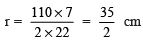
∴ Circumference = 2πr = 2 x(22/7)x r
Now, 2 x(22/7) x r= 110

⇒    

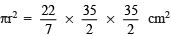
Now, Base area =   

Q2. The radii of two cylinders are in the ratio of 2 : 3 and heights are in the ratio of 5 : 3.
 Find the ratio of their volumes.
 Solution: 
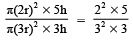
Ratio of the radii = 2 : 3 Let the radii be 2r and 3r Also, their heights are in the ratio of 5:3 Let the height be 5h and 3h
∴ Ratio of their volumes = 


Q3. If the radius of a sphere is doubled, then find the ratio of their volumes.
 Solution:
 Let the radius of the original sphere = r
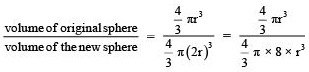
∴ Radius of new sphere = 2r

∴  Ratio of their volumes =  = 1/8

Q4. If the radius of a sphere is such that πr2 = 6cm2 then find its total surface area.
 Solution: 
∵ πr2 = 6cm
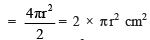
∴ Curved S.A. of the hemisphere 
= 2 × 6 cm2 = 12 cm
Also, plane S.A. of the hemisphere = π r2 = 6 cm
⇒ Total S.A. = C.S.A. + plane S.A. = 12 cm2 + 6 cm2 = 18 cm2

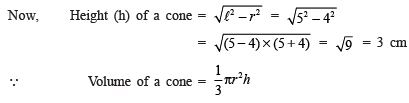
 Q5. The surface area of a sphere of radius 5 cm is five times the area of the curved surface of a cone of radius 4 cm. Find the height and the volume of the cone (taking π = (22/7).
  Solution:
 Surface area of the sphere = 4πr2 = 4 × π × 5 × 5 cm2
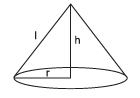
Curved surface area of the cone (with slant height as ‘ℓ’) = πrℓ = π × 4 × ℓ cm2

Since,    

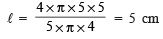
∴ 4 × π × 5 × 5 = 5 × π × 4 × ℓ
⇒ 

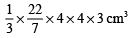
∴ Volume of the cone = 


Q6. Find the slant height of a cone whose radius is 7 cm and height is 24 cm.
 Solution:
 Here, h = 24 cm and r = 7 cm

Since,

= 25 cm
∴ Slant height = 25 cm.
 

Q7. The diameter of a road roller, 120 cm long is 84 cm. If it takes 500 complete revolutions to level a playground, find the cost of levelling it at 2 per square metre.
 Solution:
 Here, radius (r) = 42 cm
Length of the roller = Height of the cylinder
⇒ h = 120 cm
∴ Curved surface area of the roller = 2πrh =2 x(22/7) x 42 x 120 cm
= 2 x 22 x 6 x 120 cm2 = 31680 cm2
∴ Area levelled in one revolution = 31680 cm2

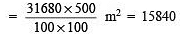
⇒ Area levelled in 500 revolutions = 31680 x 500 cm2

∴ Cost of levelling the playground = 2 x 1584 = 3168.


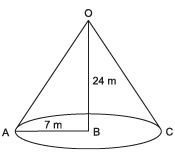
Q8. A conical tent of radius 7 m and height 24 m is to be made. Find the cost of the 5 m wide cloth required at the rate of 50 per metre.
 Solution:
 Radius of the base of the tent (r) = 7 m
Height (h) = 24 m
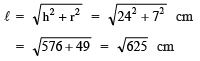
Slant height (ℓ)=

Now, curved surface area of the conical tent = πrℓ
= (22/7) x 7 x 25 m2 = 22 x 25 m2 = 550 m
Let ‘ℓ’ be the length of the cloth.

∴ ℓ  x b = 550
⇒ ℓ  x 5 = 550
⇒ ℓ = (550/5) m = 110 m
∴ Cost of the cloth = 50 x 110 = 5500.


Q9. How many lead balls, each of radius 1 cm, can be made from a sphere of radius 8 cm?
 Solution:
 Radius of the lead ball (r) = 1 cm

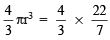
∴ Volume of a lead ball =  x 1 x 1 x 1 cm3

= (4/3) x (22/7) cm3
Radius of the sphere (r) = 8 cm

∴ Volume of a sphere = x 8 x 8 x 8 cm3

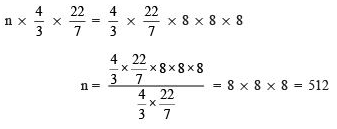
Let the required number of balls = n
∴ [Volume of n-lead balls] = [Volume of the sphere]

Thus, the required number of balls is 512.

Q10.  A particular plastic box 1.5 m long, 1.25 m wide and 65 cm deep are to be made. It is opened at the top. Ignoring the estimated thickness of the plastic sheet, determine the:

(i)The area of the sheet needed for making the box.

(ii)The cost of the separate sheet for it, if a sheet measuring 1m² cost Rs. 20.

Solution: Given: The length (l) of the given box = 1.5m

The breadth (b) of the given box = 1.25 m

The depth (h) of the given box = 0.65m

(i) Box is to be open at the top

The area of the sheet needed.

= 2 x length x height + 2 x breadth x height + 2 x length x breadth.

= [ 2 × 1.5 × 0.65 + 2 × 1.25 × 0.65 + 1.5 × 1.25 ]m²

= (1.95 + 1.625 + 1.875) m²

 = 5.45 m²

(ii) The cost of a sheet per m² Area = Rs.20.

The cost of a sheet of 5.45 m² area = Rs (5.45×20)

= Rs.109.

10. Short Answers Type Questions- Heron’s Formula

Q1. Find the area of a triangle whose sides are 8 cm, 10 cm, and 12 cm.

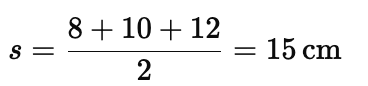
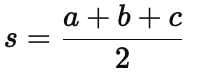
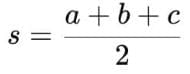
Sol: Let the semi-perimeter s be:

Heron’s formula for the area of the triangle:

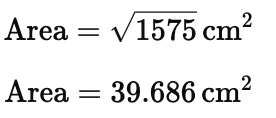
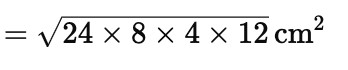
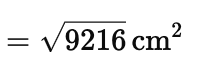
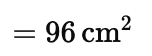
Substituting the values:

Q2. Find the area of a triangle whose sides are 4.5 cm and 10 cm and perimeter 20.5 cm.

Sol:Given:
Side a = 4.5 cm
Side b = 10 cm
Perimeter of triangle = 20.5 cm
Perimeter = a + b + c
20.5 = 4.5 + 10 + c

20.5 = 14.5 + c

c = 20.5 – 14.5

c = 6 cm

Semiperimeter (s): 

Using Heron’s formula,

Q3. If every side of a triangle is doubled, by what percentage is the area of the triangle increased?

Sol:Let a, b and c be the sides of a triangle.

Semiperimeter (s): 

Now, if each of the side is doubled, then the new sides of a triangle are:

A = 2a, B = 2b, C = 2c

New Semiperimeter (S): 

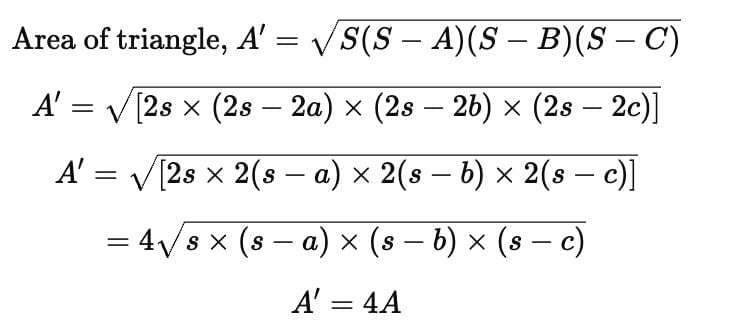
By Heron’s formula,

Hence, the area is increased by 300%, if the sides of the triangle are doubled.

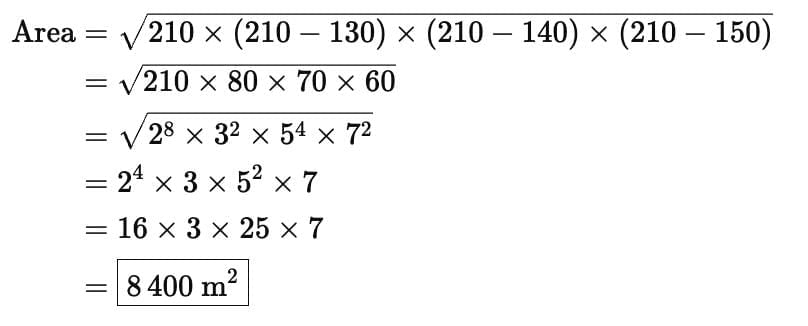
Q4. A triangular field has sides 130 m, 140 m, and 150 m. A gardener has to put a fence all around it and also plant grass inside. How much area does he need to plant grass?

Sol: Given,

Sides of triangular park are 130m, 140m and 150m.

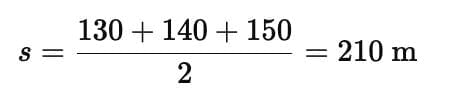
Semi perimeter (s):

Using Heron’s formula, we have;

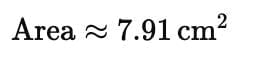
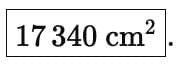
Area of triangle The area that needs to be planted with grass is 8400m2.
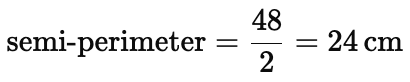
Q5. Find the area of a triangle whose two sides are 16 cm and 20 cm, and the perimeter is 48 cm.

Sol:Assume that the third side of the triangle is x.

Now, the three sides of the triangle are 16 cm, 20 cm, and ‘c’ cm.

It is given that the perimeter of the triangle is 48 cm:

Perimeter= a + b + c
48 = 16 + 20 + c
c = 48 − (16 + 20) 
c = 48 − 36 
c = 12cm


Q6. The sides of a triangle are in the ratio 8: 15: 17 and its perimeter is 680 cm. Find its area.

Sol: Given:The ratio of the sides of the triangle is given as 8: 15: 17.
Let the common ratio between the sides of the triangle be “x”.

Thus, the sides are 8x,15x, and 17x.

It is also given that the perimeter of the triangle is 680 cm:8x + 15x + 17x = 680cm
40x = 680cm
x = 17
Now, the sides of the triangle are:
8 × 17 = 136cm, 
15 × 17 = 255cm, 
17 × 17 = 289cm
the semi-perimeter of the triangle s=6802=340
Using Heron’s formula:
 Area 


Q7. The lengths of the sides of a triangle are in the ratio 3 : 4 : 5 and its perimeter is 120 cm, find its area. 

The sides are in the ratio of 3 : 4 : 5.
Let the sides be 3x, 4x and 5x.
∴ Perimeter = 3x + 4x + 5x = 12x
Now 12x = 120                [Perimeter = 120 cm]
⇒   x =(120/12) = 10
∴ Sides of the triangle are: a = 3x = 3 x 10 = 30 cm
b = 4x = 4 x 10 = 40 cm
c = 5x = 5 x 10 = 50 cm
Now, semi-perimeter (s) = (120/12)
cm = 60 cm
∵ (s – a) = 60 – 30 = 30 cm
(s – b) = 60 – 40 = 20 cm
(s – c) = 60 – 50 = 10 cm

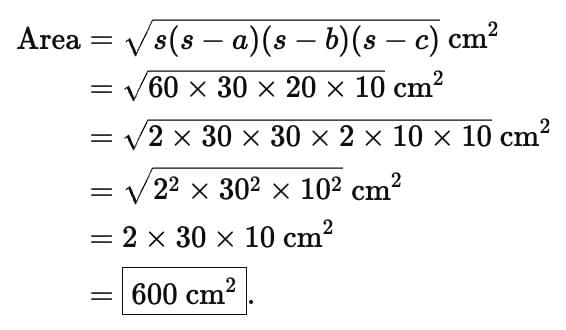
Using Heron’s formula, we have  

Thus, the required area of the triangle = 600 cm2.

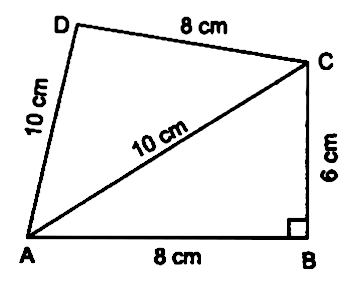
Q8. Find the area of a quadrilateral ABCD in which AB = 8 cm, BC = 6 cm, CD = 8 cm, DA = 10 cm and AC = 10 cm.

In ΔABC, ∠B = 90°

∴ area of right (rt ΔABC) = (1/2) x 8 x 6 cm2 = 24 cm2
In ΔACD,
a = AC = 10 cm b = AD = 10 cm c = CD = 8 cm

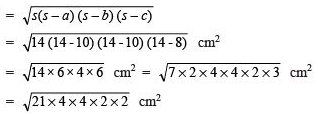
∴Area of ΔACD 

= 2 x 4√21 = 8√21 cm2

= 8 x 4.58 cm2 = 36.64 cm2

Now, area of quadrilateral ABCD = ar (ΔABC) + ar (ΔACD)
= 24 cm2 + 8√21 cm
= 24 cm2 + 36.64 cm2
= 60.64 cm2


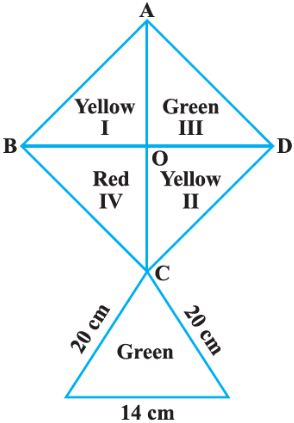
Q9. How much paper of each shade is needed to make a kite given in the figure, in which ABCD is a square of diagonal 44 cm.

∵ The diagonals of a square bisect each other at right angles

∴ OB = OD = OA = OC = (44/2) = 22 cm
Now, ar rt (Δ –I) = (1/2)× OB × OA
= (1/2) × 22 × 22 cm2 = 242 cm2
Similarly ar rt (Δ –II) = arrt(Δ–III) = ar rt (Δ –IV) = 242 cm2

∵ Sides of ΔCEF are 20 cm, 20 cm and 14 cm

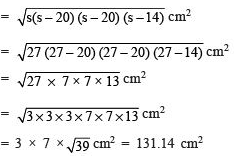
⇒ Area of ΔCEF 

Now, area of yellow paper = ar (Δ – I) + ar (Δ – II)
= 242 cm+ 242 cm2 = 484 cm2
Area of red paper = ar (Δ – IV) = 242 cm2
Area of green paper = ar (Δ – III) + ar ΔCEF
= 242 cm2 + 131.14 cm2
= 373.14 cm2

09. Short Answer Type Questions: Circles

Question 1. The diameter of circle is 3.8 cm. Find the length of its radius.
 Solution: 
Since, the diameter of circle is double its radius.
∴ Diameter = 2 x Radius
⇒ (1/2)x Diameter = Radius

⇒ Radius = (1/2) x 3.8 cm

  = 1/2 x 38/10 cm

  =  19/10 = 1.9 cm

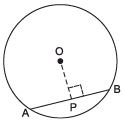
Question 2. In the adjoining figure, O is the centre of the circle. The chord AB = 10 cm is such that OP ⊥ AB. Find the length of AP.
 Solution:
 ∵ OP ⊥ AB
∴ P is the mid-point of AB.

Short Answer Type Questions: Circles

⇒ AP =(1/2)AB
⇒ AP = (1/2)x 10 cm = 5 cm
 

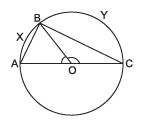
Question 3. In the figure AOC is a diameter of the circle and arc AXB = (1/2) arc BYC. Find ∠BOC. 
 Solution: 
∵ arc AXB = (1/2)arc BYC
∴ ∠AOB = (1/2) ∠BOC

Short Answer Type Questions: Circles

Also ∠AOB + ∠BOC = 180°
⇒  (1/2)∠BOC + ∠BOC = 180°
⇒  (3/2) ∠BOC = 180°
⇒ ∠BOC =  (1/2) × 180° = 120°


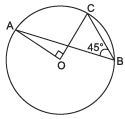
Question 4. In the figure ∠ABC = 45°. Prove that OA ⊥ OC.
 Solution: 
Since the angle subtended at the centre by an arc is double the angle subtended by it at any other point on the remaining part of the circle.

Short Answer Type Questions: Circles

∴ ∠ABC =(1/2)∠AOC
⇒ ∠AOC = 2 ∠ABC = 2 × 45° = 90°                  [∵ ∠ABC = 45°]
Thus, OA ⊥ OC.


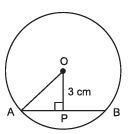
Question 5. Look at the adjoining figure, in which O is the centre of the circle. If AB = 8 cm and OP = 3 cm, then find the radius of the circle.
 Solution: 
∵ OP ⊥ AB
∴ P is the mid-point of AB.

Short Answer Type Questions: Circles

⇒ AP = (1/2)AB = (1/2)x 8 cm = 4 cm
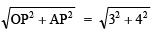
Now, in right ΔOPA, Radius, OA = Short Answer Type Questions: Circles = 5 cm


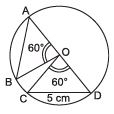
Question 6. In the adjoining figure, O is the centre of the circle. Find the length of AB.
 Solution:
 Since chord AB and chord CD subtend equal angles at the centre,
i.e. ∠ AOB = ∠ COD                  [Each = 60°]

Short Answer Type Questions: Circles

∴ Chord AB = Chord CD
⇒ Chord AB = 5 cm                  [∵ Chord CD = 5 cm]
Thus, the required length of chord AB is 5 cm.

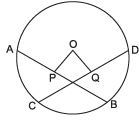
Question 7. In the adjoining figure, O is the centre of the circle and OP = OQ. If AP = 4 cm, then find the length of CD.
 Solution:
 ∵ OP = OQ
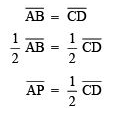
∴ Chord AB and chord CD are equidistant from the centre.

Short Answer Type Questions: Circles

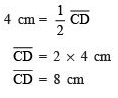
Thus, the required length of CD is 8 cm.


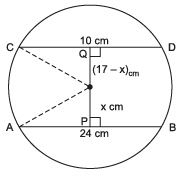
Question 8. AB and CD are two parallel chords of a circle that are on opposite sides of the centre such that AB = 24 cm and CD = 10 cm and the distance between AB and CD is 17 cm. Find the radius of the circle.
 Solution: 
∵ Perpendicular from the centre to a chord bisects the chord.

Short Answer Type Questions: Circles

∴ AP = (1/2)AB = (1/2)x 24 cm
= 12 cm
Similarly, CQ = (1/2)CD =(1/2)x 10 cm = 5 cm
Let OP = x cm
⇒ OQ = (17 – x) cm
Now, in right ΔAPO, x+ 122 = OA2                  …(1)
Again, in right ΔCOQ, OC= CQ2 + (17 – x)2
= 5+ 172 + x2 – 34x
= 25 + 289 + x2 – 34x = 314 + x2 – 34x                  …(2)
From (1) and (2),
we have x2 + 314 – 34x = x2 + 122
⇒ x2 – x2 – 34x = 144 – 314
⇒ – 34x = -170
⇒ x= (-170/34)  = 5

Now from (1), we have OA= 52 + 122 = 25 + 144
⇒ OA= 169
⇒ OA = 13 cm
Thus, the required radius of the circle = 13 cm.


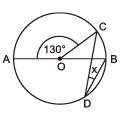
Question 9. If O is the centre of the circle, then find the value of x.
 Solution:
 ∵ AOB is a diameter.
∴ ∠ AOC + ∠ COB = 180°                  [Linear pairs]
⇒ 130° + ∠ COB = 180°
⇒ ∠ COB = 180° – 130° = 50°
Now, the arc CB is subtending ∠COB at the centre and ∠CDB at the remaining part.

Short Answer Type Questions: Circles

∴ ∠ CDB = (1/2)∠COB
⇒ ∠ CDB = (1/2)x 50° = 25°
Thus, the measure of x = 25°


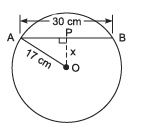
Question 10. The radius of a circle is 17 cm. A chord of length 30 cm is drawn. Find the distance of the chord from the centre.
 Solution:
 Length of chord AB = 30 cm.
Since, OP ⊥ AB
∴ P is the mid-point of AB.

Short Answer Type Questions: Circles

AP = (1/2)AB =(1/2) x 30 cm = 15 cm
Now, in right ΔAPO, AO2 = AP2 + OP2
⇒ 172 = 15+ OP2
∴ OP2 = 172 – 152 = (17 – 15)(17 + 15)
= 2 x 32 = 64
⇒ OP = 64 = 8 cm
∴ The distance of the chord AB from the centre O is 8 cm.


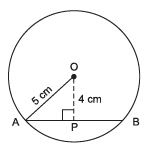
Question 11. Find the length of a chord which is at a distance of 4 cm from the centre of a circle of radius 5 cm.
 Solution:
 ∵ The perpendicular distance, OP = 4 cm

Short Answer Type Questions: Circles

∴ In right ΔAPO, AO2 = AP2 + OP2
⇒ 52 = AP+ 42
⇒ AP2 = 5– 4= (5 – 4)(5 + 4)
= 1 x 9 = 9
⇒ AP = √9= 3 cm
Since the perpendicular from the centre to a chord of a circle divides the chord into two equal parts.
∴ AP =  (1/2) AB
⇒ AB = 2AP
⇒ AB = 2 x 3 cm = 6 cm
Thus, the required length of chord AB is 6 cm.

08. Short Answer Type Questions: Quadrilaterals

Q1: In the adjoining figure, if ∠ B = 68°, then find ∠ A, ∠ C and ∠ D.

 Solution: Because the opposite angles of a parallelogram are equal
Therefore, ∠ B= ∠ D
⇒ ∠ D = 68°                           [∵ ∠B = 68°,    given]

∵ ∠ B and ∠ C are supplementary.
∴ ∠ B + ∠ C = 180°
⇒ ∠ C = 180° – ∠ B = 180° – 68° = 112°
Since ∠A and ∠C are opposite angles.
∴ ∠ A= ∠ C
⇒ ∠ A = 112°                                 [∵ ∠ C = 112°]
Thus, ∠ A = 112°, ∠ D = 68° and ∠ C = 112°.


Q2: In the figure, ABCD is a parallelogram. If AB = 4.5 cm, then find other sides of the parallelogram when its perimeter is 21 cm.

 Solution: ∵ Opposite sides of a parallelogram are equal.
∴ AB = CD = 4.5 cm, and BC = AD
Now, AB + CD + BC + AD = 21 cm
⇒ AB + AB + BC + BC = 21 cm
⇒2[AB + BC] = 21 cm
⇒ 2[4.5 cm + BC] = 21 cm
⇒ 9 cm + 2BC = 21 cm
=  2BC = 12

Therefore, BC=AD=6
Thus, BC = 6 cm, CD = 4.5 cm and AD = 6 cm.
 

Q3: In a parallelogram ABCD, if (3x – 10)° = ∠ B and (2x + 10)° = ∠ C, then find the value of x. Solution: Since the adjacent angles of a parallelogram are supplementary

∴ ∠ B + ∠ C = 180°
⇒ (3x – 10)° + (2x + 10)° = 180°
⇒ 3x + 2x – 10° + 10° = 180°
⇒ 5x = 180°
⇒ x= (1800/5)= 36°
Thus, the required value of x is 36°.


Q4: The adjoining figure is a rectangle whose diagonals AC and BD intersect at O. If ∠ OAB = 27°, then find ∠ OBC.

 Solution: Since the diagonals of a rectangle are equal and bisect each other.
∴ OA = OB
⇒ ∠ OBA = ∠ OAB = 27°
Also, each angle of a rectangle measures 90°.

∴ ∠ ABC = 90°
⇒ ∠ ABO + ∠ CBO = 90°
⇒ ∠ OBA + ∠ OBC = 90°
⇒ 27° + ∠ OBC = 90°
⇒ ∠ OBC = 90° – 27° = 63°


Q5: In a quadrilateral, ∠ A : ∠ B : ∠ C : ∠ D = 1 : 2 : 3 : 4, then find the measure of each angle of the quadrilateral.
 Solution: 
Since ∠ A : ∠ B : ∠ C : ∠ D = 1 : 2 : 3 : 4

∴ If ∠ A = x, then ∠ B = 2x, ∠ C = 3x and ∠ D = 4x. ∴ ∠ A + ∠ B + ∠ C + ∠ D = 360°
⇒ x + 2x + 3x + 4x = 360° ⇒ 10x = 36°
⇒ x= (3600/10)= 36°
∴ ∠ A = x = 36° 

∠ B = 2x = 2 x 36° = 72° 

∠ C = 3x = 3 x 36° = 108°

 ∠ D = 4x = 4 x 36° = 144°


Q6:  In the adjoining figure, ABCD is a trapezium in which AB || CD. If ∠ A = 36° and ∠ B = 81°, then find ∠ C and ∠ D.

 Solution: ∵ AB || CD and AD is a transversal.            [∵ ABCD is a trapezium in which AB || CD]
∴ ∠ A + ∠ D = 180°
⇒ ∠ D = 180° –  ∠ A = 180° – 36° = 144°
Again, AB || CD and BC is a transversal.

∴ ∠ B + ∠ C = 180°
⇒ ∠ C = 180° – ∠ B = 180° – 81° = 99°
∴ The required measures of ∠ D and ∠ C are 144° and 99° respectively.


Q7: In the figure, the perimeter of Triangle ABC is 27 cm. If D is the mid-point of AB and DE || BC, then find the length of DE.

 Solution: Since D is the mid-point of AB and DE || BC.
∴ E is the mid-point of AC, and DE = (1/2) BC.
Since the perimeter of DABC = 27 cm
∴ AB + BC + CA = 27 cm
⇒ 2(AD) + BC + 2(AE) = 27 cm
⇒ 2(4.5 cm) + BC + 2(4 cm) = 27 cm
⇒ 9 cm + BC + 8 cm = 27 cm
∴ BC = 27 cm – 9 cm – 8 cm = 10 cm

∴  (1/2)BC =(10/2) = 5 cm
⇒ DE = 5 cm.


Q8: In the adjoining figure, DE || BC and D is the mid-point of AB. Find the perimeter of ΔABC when AE = 4.5 cm.

 Solution: ∵ D is the mid-point of AB and DE || BC.
∴ E is the mid-point of AC and DE = (1/2)BC.

⇒ 2DE = BC
⇒ 2 x 5 cm = BC
⇒ BC = 10 cm
Now DB = 3.5 cm
∴ AB = 2(DB) = 2 x 3.5 cm = 7 cm            [D is the mid-point of AB]
Similarly, AC = 2(AE) = 2 x 4.5 cm = 9 cm
Now, perimeter of ΔABC = AB + BC + CA = 7 cm + 10 cm + 9 cm = 26 cm


Q9: If the angle of a parallelogram is (4/5) of its adjacent angle, then find the measures of all the angles of the parallelogram. Solution: Let ABCD is a parallelogram in which ∠ B = x

∴ ∠ A= (4/5)x
Since the adjacent angles of a parallelogram are supplementary.
∴ ∠ A + ∠ B = 180°
⇒ (4/5)x + x = 180°
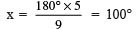
⇒ 4x + 5x = 180° x 5
⇒ 9x = 180° x 5
⇒ 
∴ ∠ B = 100°
Since ∠ B= ∠ D            [Opposite angles of parallelogram]
∴ ∠ D = 100°
Now, ∠ A= (4/5)x =(4/5) x 100° = 80°
Also ∠ A= ∠ C             [Opposite angles of parallelogram]
∴ ∠ C = 80°
The required measures of the angles of the parallelogram are: ∠ A = 80°, ∠ B = 100° ∠ C = 80° and ∠ D = 100°


Q10: Find the measure of each angle of a parallelogram, if one of its angles is 15° less than twice the smallest angle.
Solution:
 Let the smallest angle = x
Since, the other angle = (2x ∠ 15°)
Thus, (2x ∠ 15°) + x = 180°             [∵ x and (2x ∠ 15°) are the adjacent angles of a parallelogram]
⇒ 2x ∠ 15° + x = 180°
⇒ 3x ∠ 15° = 180°
⇒ 3x = 180° + 15° = 195°
⇒ x= (1950/3)= 65°
∴ The smallest angle = 65°
∴ The other angle = 2x – 15° = 2(65°) – 15° = 130° -15° = 115°
Thus, the measures of all the angles of a parallelogram are: 65°, 115°, 65° and 115°.


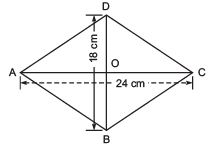
Q11: The lengths of the diagonals of a rhombus are 24 cm and 18 cm respectively. Find the length of each side of the rhombus. Solution: Since the diagonals of a rhombus bisect each other at right angles.
∴ O is the mid-point of AC and BD
⇒ AO =(1/2)AC and DO =(1/2)BD
Also ∠ AOD = 90°.
Now, ΔAOD is a right triangle, in which

AO = (1/2)AC =(1/2)(24 cm) = 12 cm
and DO = (1/2)BD =(1/2)(18 cm) = 9 cm
Since, AD2 = AO2 + DO2
⇒ AD2 = (12)2 + (9)2
= 144 + 81 = 225 = 152
⇒ AD = √(15)2 = 15
⇒ AD = AB = BC = CD = 15 cm (each)
Thus, the length of each side of the rhombus = 15 cm.
 

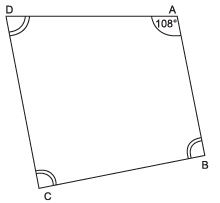
Q12: One angle of a quadrilateral is of 108° and the remaining three angles are equal. Find each of the three equal angles.
 Solution:
 ABCD is a quadrilateral
∴ ∠A + ∠B + ∠C + ∠D = 360°
⇒ 108° + [∠B + ∠C + ∠D] = 360°
⇒ [∠B + ∠C + ∠D]
= 360° – 108° = 252°

Since,
∠D = ∠B = ∠C
∴ ∠B + ∠C + ∠D = 252°
⇒ ∠B + ∠B + ∠B = 252°
⇒  3∠B = 252°
⇒ ∠B = (2520/3) = 84°
∴ ∠B = ∠C = ∠D = 84°
Thus, the measure of each of the remaining angles is 84°.


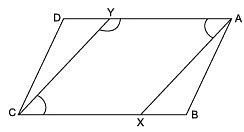
Q13: In the figure, AX and CY are respectively the bisectors of opposite angles A and C of a parallelogram ABCD. Show that AX || CY
Solution: 
Given, ABCD is a parallelogram

AX and CY are the bisectors of the angles A and C.

We have to show that AX || CY

∠DAB = 2x
∠DCB = 2y
We know that opposite angles of a parallelogram are equal.
So, ∠A = ∠C
2x = 2y
x = y
As DC || AB, XC || AY
∠XCY = ∠CYB [Alternate angles]
∠CYB = x
∠XAY = x
As ∠XAY and ∠CYB are corresponding angles
AX || CY
Therefore, AX is parallel to CY.


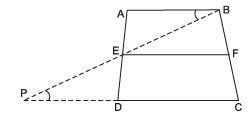
Q14: E and F are respectively the midpoints of the non-parallel sides AD and BC of a trapezium ABCD. Prove that: EF || AB and  EF = (1/2)(AB + CD)

 Solution: Let us join BE and extend it to meet CD produced at P.
In ΔAEB and ΔDEP, we get AB || PC and BP is a transversal,
∴ ∠ABE = ∠EPD             [Alternate angles]
AE = ED            [∵ E is the midpoint of AB]
∠AEB = ∠PED             [Vertically opp. angles]
⇒ ΔAEB ≌ ΔDEP
⇒ BE = PE and AB = DP [SAS]
⇒ BE = PE and AB = DP
Now, in ΔEPC, E is a midpoint of BP and F is midpoint of BC
∴ EF || PC and EF =(1/2)PC            [Mid point theorem]
i.e., EF || AB and EF = (1/2) (PD + DC)
= (1/2) (AB + DC)
Thus, EF || AB and EF = (1/2) (AB + DC)

07. Short Question Answer: Triangles

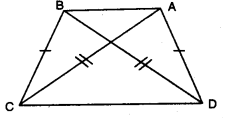
Q1: In the given figure, AD = BC and BD = AC, prove that ∠DAB = ∠CBA
Ans:

Short Question Answer: TrianglesIn ∆DAB and ∆CBA, we have
AD = BC [given]
BD = AC [given]
AB = AB [common]
∴ ∆DAB ≅ ∆CBA [by SSS congruence axiom]

Since corresponding parts of congruent triangles are equal [c.p.c.t]
Thus, ∠DAB =∠CBA 

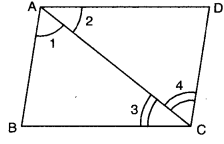
Q2: In the given figure, if ∠1 = ∠2 and ∠3 = ∠4, then prove that BC = CD.
Ans:

Short Question Answer: TrianglesIn ∆ABC and ∆CDA, we have
∠1 = ∠2 (given)
AC = AC [common]
∠3 = ∠4 [given]
∆ABC ≅ ∆CDA [by ASA congruence axiom]
Since corresponding parts of congruent triangles are equal [c.p.c.t]
∴ BC = CD

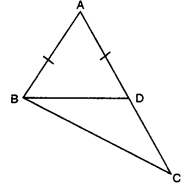
Q3: In the given figure, AC > AB and D is a point on AC such that AB = AD. Show that BC > CD.
Ans:

Short Question Answer: TrianglesHere, in ∆ABD, AB = AD
∠ABD = ∠ADB
[∠s opp. to equal sides of a ∆]
In ∆BAD
ext. ∠BDC = ∠BAD + ∠ABD
⇒ ∠BDC > ∠ABD ….(ii)
Also, in ∆BDC .
ext. ∠ADB > ∠CBD …(iii)
From (ii) and (iii), we have
∠BDC > CD [∵ sides opp. to greater angle is larger]

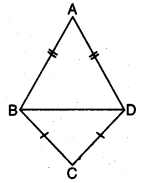
Q4: In the given figure, ∆ABD and ABCD are isosceles triangles on the same base BD. Prove that ∠ABC = ∠ADC.
Ans:

Short Question Answer: TrianglesIn ∆ABD, we have
AB = AD (given)
∠ABD = ∠ADB [angles opposite to equal sides are equal] …(i)
In ∆BCD, we have
CB = CD
⇒ ∠CBD = ∠CDB [angles opposite to equal sides are equal] … (ii)
Adding (i) and (ii), we have
∠ABD + ∠CBD = ∠ADB + ∠CDB
⇒ ∠ABC = ∠ADC

Q5: In the given figure, ∠B < ∠A and ∠C < ∠D. Show that AD < BC.
Ans:

Here, ∠B < ∠A
⇒ AO < BO …..(i)
and ∠C < ∠D
⇒ OD < CO …..(ii)
[∴ side opposite to greater angle is longer]
Adding (i) and (ii), we obtain
AO + OD < BO + CO
AD < BC

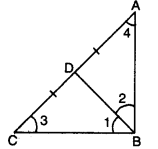
Q6: In a triangle ABC, D is the mid-point of side AC such that BD = 1/2 AC. Show that ∠ABC is a right angle.
Ans:

Short Question Answer: TrianglesHere, in ∆ABC, D is the mid-point of AC.
⇒ AD = CD = 1/2AC …(i)
Also, BD = 1/2AC… (ii) [given]
From (i) and (ii), we obtain
AD = BD and CD = BD
⇒ ∠2 = ∠4 and ∠1 = ∠3 …..(iii)
In ∆ABC, we have
∠ABC + ∠ACB + ∠CAB = 180°
⇒ ∠1 + ∠2 + ∠3 + ∠4 = 180°
⇒ ∠1 + ∠2 + ∠1 + ∠2 = 180° [using (iii)]
⇒ 2(∠1 + ∠2) = 180°
⇒ ∠1 + ∠2 = 90°
Hence, ∠ABC = 90°
Its a right-angled triangle 


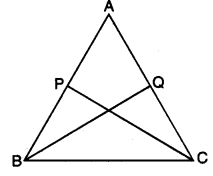
Q7: ABC is an isosceles triangle with AB = AC. P and Q are points on AB and AC respectively such that AP = AQ. Prove that CP = BQ.
Ans:
Short Question Answer: TrianglesIn ∆ABQ and ∆ACP, we have
AB = AC (given)
∠BAQ = ∠CAP [common]
AQ = AP (given)
∴ By SAS congruence criteria, we have
∆ABQ ≅ ∆ACP
CP = BQ


Q8: In figure, ‘S’ is any point on the side QR of APQR. Prove that PQ + QR + RP > 2PS.
Ans:
 
In ∆PQS, we have
PQ + QS > PS …(i)
[∵ sum of any two sides of a triangle is greater than the third side]
In ∆PRS, we have
RP + RS > PS …(ii)
Adding (i) and (ii), we have
PQ + (QS + RS) + RP > 2PS
Hence, PQ + QR + RP > 2PS. [∵ QS + RS = QR]

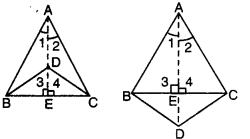
Q9: If two isosceles triangles have a common base, prove that the line joining their vertices bisects them at right angles.
Ans:
 Here, two triangles ABC and BDC having the common base BC,
such that AB = AC and DB = DC.
Now, in ∆ABD and ∆ACD

Short Question Answer: Triangles

AB = AC [given]
BD = CD [given]
AD = AD [common]
∴ ΔABD ≅ ΔΑCD [by SSS congruence axiom]
⇒ ∠1 = ∠2 [c.p.c.t.]
Again, in ∆ABE and ∆ACE, we have
AB = AC [given]
∠1 = ∠2 [proved above]
AE = AE [common]
∆ABE = ∆ACE [by SAS congruence axiom]
BE = CE [c.p.c.t.]
and ∠3 = ∠4 [c.p.c.t.]
But ∠3 + ∠4 = 180° [a linear pair]
⇒ ∠3 = ∠4 = 90°
Hence, AD bisects BC at right angles.

Q10: In the given figure, in ∆ABC, ∠B = 30°, ∠C = 65° and the bisector of ∠A meets BC in X. Arrange AX, BX and CX in ascending order of magnitude.
Ans:

Here, AX bisects ∠BAC.
∴ ∠BAX = ∠CAX = x (say)
Now, ∠A + ∠B + C = 180° [angle sum property of a triangle]
⇒ 2x + 30° + 65° = 180°
⇒ 2x + 95 = 180°
⇒ 2x = 180° – 95°
⇒ 2x = 85°
⇒ x = 85 / 2 = 42.59
In ∆ABX, we have x > 30°
BAX > ∠ABX
⇒ BX > AX (side opp. to larger angle is greater)
⇒ AX < BX
Also, in ∆ACX, we have 65° > x
⇒ ∠ACX > ∠CAX
⇒ AX > CX [side opp. to larger angle is greater]
⇒ CX > AX … (ii)
Hence, from (i) and (ii), we have
CX < AX < BX

Q11: In the given figure, ∆ABC and ∆DBC are two isosceles triangles on the same base BC and vertices A and D are on the same side of BC, AD is extended to intersect BC at P. Show that : (i) ∆ABD ≅ ∆ACD (ii) ∆ABP ≅ ∆ACP
Ans:

(i) In ∆ABD and ∆ACD
AB = AC [given]
BD = CD [given]
AD = AD [common)]
∴ By SSS congruence axiom, we have
∆ABD ≅ ∆ACD
(ii) In ∆ABP and ∆ACP
AB = AC [given]
∠BAP = ∠CAP [c.p.cit. as ∆ABD ≅ ∆ACD]
AP = AP [common]
∴ By SAS congruence axiom, we have
∆ABP ≅ ∆ACP

Q12: In the given figure, it is given that AE = AD and BD = CE. Prove that ∆AEB ≅ ∆ADC.
Ans:

We have AE = AD … (i)
and CE = BD … (ii)
On adding (i) and (ii),
we have AE + CE = AD + BD
⇒ AC = AB
Now, in ∆AEB and ∆ADC,
we have AE = AD [given]
AB = AC [proved above]
∠A = ∠A [common]
∴ By SAS congruence axiom, we have
∆AEB = ∆ADC

06. Short Answer Type Questions: Lines & Angles

Q.1. If P, Q, and R are three collinear points, then name all the line segments determined by them.

Ans.Short Answer Type Questions: Lines & Angles

We can have the following line segments:

Short Answer Type Questions: Lines & Angles


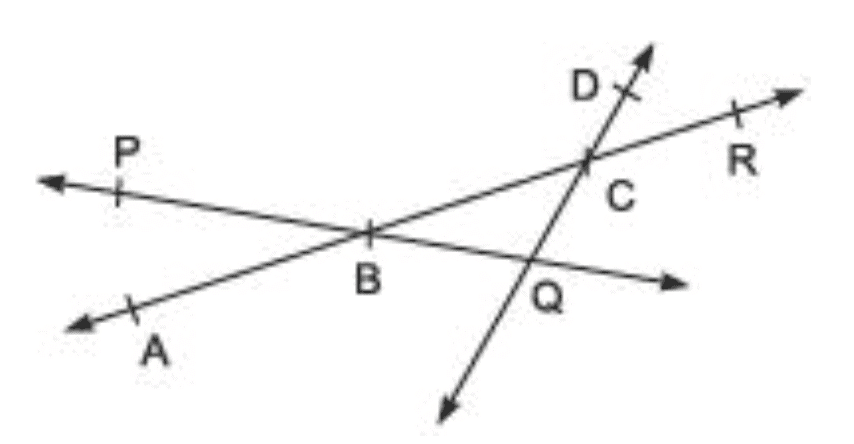
Q.2. In the adjoining figure, identify at least four collinear points.

Short Answer Type Questions: Lines & Angles

Ans. The four collinear points are A, B, C, and R.
 

Q.3. Find the complement of 36°.
Ans. ∵ 36° + [Complement of 36°] = 90°
⇒ Complement of 36°= 90° – 36° = 54°

Q.4. Find the supplement of 105°.
Ans.  105° + [Supplement of 105°] = 180°
⇒ Supplement of 105° = 180° – 105° = 75°


Q.5. Angles ∠ P and 100° form a linear pair. What is the measure of ∠ P?
Ans. 
∵ The sum of the angles of a linear pair equal to 180°.
∴ ∠ P + 100° = 180° ⇒ ∠ P = 180° – 100 = 80°.

Q.6. In the adjoining figure, what is the measure of p?Ans. ∵ p and 120° form a linear pair.
∴ p + 120° = 180° ⇒ p = 180° – 120° = 60°

Q.7. In the adjoining figure, AOB is a straight line. Find the value of x.Ans. ∵ AOB is a straight line.
∴ ∠AOC + ∠COB = 180°
⇒ 63° + x = 180° ⇒ x = 180° – 63° = 117°


Q.8. In the given figure, AB, CD, and EF are three lines concurrent at O. Find the value of y.Ans. ∵ ∠AOE and ∠BOF and vertically opposite angles.
∴ ∠AOE = ∠BOF = 5y ….. (1)
Now, CD is a straight line,
⇒ ∠COE + ∠EOA + ∠AOD = 180°
⇒ 2y + 5y + 2y = 180° [From (1)]
⇒ 9y = 180°⇒ y = (180°/2)= 20°
Thus, the required value of y is 20°.
 

Q.9. In the adjoining figure, AB || CD and PQ is transversal. Find x.Ans. ∵ AB || CD and PQ is a transversal.
∴ ∠ BOQ = ∠ CQP [∵ Alternate angles are equal]
⇒ x = 110° [∵ ∠ CQP = 110°]
 

Q.10. Find the measure of an angle that is 26° more than its complement.
Ans. 
Let the measure of the required angle be x.
∴ Measure of the complement of x° = (90° – x)
⇒ x° – (90° – x) = 26°
⇒ x – 90° + x = 26°
⇒ 2x = 26° + 90° = 116°
⇒ x = (116°/2) = 58°
Thus, the required measure = 58°.


Q.11. Find the measure of an angle if four times its complement is 10° less than twice its supplement.
Ans. Let the measure of the required angle be x.
∴ Its complement = (90° – x) and Its supplement = (180° – x)
According to the condition:

4(Complement of x) = 2(Supplement of x) – 10

⇒ 4(90° – x) = 2(180° – x) – 10°
⇒ 360° – 4x = 360° – 2x – 10°
⇒ 4x – 2x = 360° – 360° + 10°
⇒ 2x = 10° ⇒ x = (10°/2)= 5°
Thus, the measure of the required angle is 5°.


Q.12. Two supplementary angles are in the ratio 3:2. Find the angles.
Ans. Let the measure of the two angles be 3x and 2x.
∵ They are supplementary angles.
∴ 3x + 2x = 180°
⇒ 5x = 180° ⇒ x = (180°/5) = 36°
∴ 3x = 3 x 36° = 108° and 2x = 2 x 36° = 72°
Thus, the required angles are 108° and 72°.


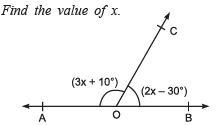
Q.13. In the adjoining figure, AOB is a straight line.

Short Answer Type Questions: Lines & Angles

Ans. ∵ AOB is a straight line.
∴ ∠ AOC + ∠ BOC = 180°
⇒ (3x + 10°) + (2x – 30°) = 180° [Linear pair]
⇒ 3x + 2x + 10° – 30° = 180°
⇒ 5x – 20° = 180°
⇒ 5x = 180° + 20° = 200° ⇒ x = (200°/5) = 40°
Thus, the required value of x is 40°.


Q.14. In the adjoining figure, find ∠ AOC and ∠ BOD.Ans. ∵ AOB is a straight line.
∴ ∠AOC + ∠COD + ∠DOB =180°
⇒ x + 70° + (2x – 25°) = 180°
⇒ x + 2x = 180° + 25° – 70°
⇒ 3x = 205° – 70° = 135° ⇒ x = (135°/3) = 45°
∴ ∠ AOC = 45°
⇒ ∠ BOD = 2x – 25° = 2 (45°) – 25° = 90° – 25° = 65°


Q.15. In the adjoining figure, AB || CD. Find the value of x.Ans. Let us draw EF || AB and pass through point O.
∴ EF || CD and CO is a transversal.
⇒ ∠ 1 = 25° [Alternate angles]
Similarly, ∠ 2 = 35°
Adding, ∠ 1 + ∠ 2 = 25° + 35° ⇒ x = 60°
Thus, the required value of x is 60°.

05. Short Question Answer: Introduction to Euclid’s Geometry

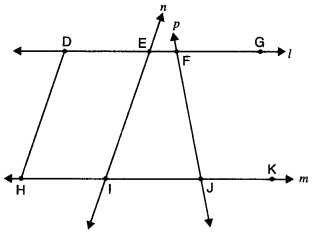
Q1:In the given figure, name the following :
(i) Four collinear points
(ii) Five rays
(iii) Five line segments
(iv) Two-pairs of non-intersecting line segments.

Ans:
(i) 
Four collinear points are D, E, F, G and H, I, J, K
(ii) Five rays are DG, EG, FG, HK, IK.
(iii) Five line segments are DH, EI, FJ; DG, HK.
(iv) Two-pairs of non-intersecting line segments are (DH, EI) and (DG, HK).

Q2: In figure, it is given that AD=BC. By which Euclid’s axiom it can be proved that AC = BD?
Ans:
 
We can prove it by Euclid’s axiom 3. “If equals are subtracted from equals, the remainders are equal.”
We have AD = BC
⇒ AD – CD = BC – CD
⇒ AC = BD

Q3: In the beow figure, if AB = PQ, PQ = XY, then AB = XY. State True or False. Justify your answer.
Ans:
True.
∵ By Euclid’s first axiom “Things which are equal to the same thing are equal to one another”.
∴ AB = PQ and XY = PQ ⇒ AB = XY

Q4: In the given figure, AC = XD, C is mid-point of AB and D is mid-point of XY. Using an Euclid’s axiom, show that AB = XY.
Ans:
 
∵ C is the mid-point of AB
AB = 2AC
Also, D is the mid-point of XY
XY = 2XD
By Euclid’s sixth axiom “Things which are double of same things are equal to one another.”
∴ AC = XD = 2AC = 2XD
⇒ AB = XY

Q5: In the figure, we have BX and 1/2 AB = 1/2 BC. Show that BX = BY.
Ans:

Here, BX = 1/2 AB and BY = 1/2 BC …(i) [given]
Also, AB = BC [given]
⇒ 1/2AB = 1/2BC …(ii)
[∵ Euclid’s seventh axiom says, things which are halves of the same thing are equal to one another]
From (i) and (ii), we have
BX = BY

Q6: In the given figure, if ∠1 = ∠3, ∠2 = ∠4 and ∠3 = ∠4, write the relation between ∠1 and ∠2, using an Euclid’s axiom.
Ans:

Here, ∠3 = ∠4, ∠1 = ∠3 and ∠2 = ∠4. Euclid’s first axiom says, the things which are equal to equal thing are equal to one another. So ∠1 = ∠2.,

Q7: In the given figure, AB = BC, BX = BY, show that AX = CY.
Ans:

Given that AB = BC and BX = BY
By using Euclid’s axiom 3, equals subtracted from equals, then the remainders are equal, we have
AB – BX = BC – BY
AX = CY

Q8: In the given figure, AC = DC and CB = CE. Show that AB = DE. Write the Euclid’s axiom to support this.
Ans:

We have
AC = DC
CB = CE
By using Euclid’s axiom 2, if equals are added to equals, then wholes are equal.
⇒ AC + CB = DC + CE
⇒ AB = DE.

Q9: Define : (a) a square (b) perpendicular lines.
Ans:

(a) A square : A square is a rectangle having same length and breadth. Here, undefined terms are length, breadth and rectangle.
(b) Perpendicular lines : Two coplanar (in a plane) lines are perpendicular, if the angle between them at the point of intersection is one right angle. Here, the term one right angle is undefined.

Q10: If A, B and C are any three points on a line and B lies between A and C (see figure), then prove that AB + BC = AC.
Ans: 
In the given figure, AC coincides with AB + BC. Also, Euclid’s axiom 4, states that things which coincide with one another are equal to one another. So, it is evident that:
AB + BC = AC.

04. Short Answer Type Questions: Linear Equations in Two Variables

Question 1. Is (3, 2) a solution of x + y = 6?
Solution: (3, 2) means x = 3 and y = 2
∴ Substituting x = 3 and y = 2 in x + y = 6,
we have 3 + 2 = 6
⇒ 5 = 6 which is not correct Since
L.H.S. ≠ R.H.S.
∴ (3, 2) is not a solution of x + y = 6.


Question 2. Is  a solution of 2x + 3y = 12?
Solution: The given equation is 2x + 3y = 12  …(1)

Here Solution = 

⇒ x = 2 and y = (8/3)
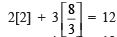
Substituting x = 2 and y =(8/3)  in (1), we get


⇒ 4 + 8 = 12
⇒ 12 = 12
∵ L.H.S. = R.H.S

 is a solution of 2x + 3y = 12.


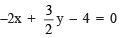
Question 3. Express in the form of ax + by + c = 0 and write the value of a, b and c. 
Solution: We have 
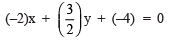
⇒     …(1)

Comparing (1) with ax + by + c = 0, we have
a = –2, b = (3/2) and c = –4.

Question 4. Express 2x = 5 in the form ax + by + c = 0 and find the value of a, b and c.
Solution: 2x = 5 can be written as 2x – 5 = 0
⇒ 2x + (0)y – 5 = 0
⇒ 2x + (0)y + (–5) = 0                                …(1)
Comparing (1) with ax + by + c = 0, we get
a = 2,  b = 0 and  c = –5.


Question 5. Write two solutions of 3x + y = 8.
Solution: We have 3x + y = 8
For x = 0, we have 3(0) + y = 8
⇒ 0 x y= 8 ⇒ y = 8

  .e. (0, 8) is a solution.
For x = 1, we have 3(1) + y = 8
⇒ 3 + y = 8
⇒ y = 8 – 3 = 5 

    i.e. (1, 5) is another solution.


Question 6. If x = –1 and y = 2 is a solution of kx + 3y = 7, find the value k.
Solution: We have kx + 3y = 7                          …(1)
∴ Putting x = –1 and y = 2 in (1), we get
k(–1) + 3(2) = 7
⇒ –k + 6 = 7
⇒ –k = 7 – 6 = 1
⇒ k= –1
Thus, the required value of k = –1.

Question 7. Show that x = 2 and y = 1 satisfy the linear equation 2x + 3y = 7.
Solution: We have 2x + 3y = 7                       …(1)
Since, x = 2 and y = 1 satisfy the equation (1).
∴ Substituting x = 2 and y = 1 in (1), we get
L.H.S. = 2(2) + 3(1) = 4 + 3 = 7
= R.H.S.
Since, L.H.S. = R.H.S.
∴ x = 2 and y = 1 satisfy the given equation.

Question 8. Write four solutions of 2x + 3y = 8.
Solution: We have 2x + 3y = 8   …(1)
Let us assume x = 0.
∴ Substituting x = 0 in (1), we get
2(0) + 3y = 8
⇒ 0 + 3y = 8
⇒ y= (8/3)

∴  is a solution of (1)

Again assume y = 0.
∴ From (1), we have
2x + 3(0) = 8
⇒ 2x = 8
⇒   x= (8/2)  = 4

∴ (4, 0) is a solution of (1).
Again assume x = 1.
∴ From (1), we have
2(1) + 3y = 8
⇒ 3y = 8 – 2 = 6
⇒ y = (6/3) = 2
∴ (1, 2) is a solution of (1).
Again assume x = 2.
∴ From (1), we have
2(2) + 3y = 8
⇒ 4 + 3y = 8
⇒ 3y = 8 – 4 = 4
⇒ y = (4/3)

 is a solution of (1).

∴ The required four solutions are:,  (4, 0), (1, 2) and

03. Short Answer Type Questions: Coordinate Geometry

Question 1. What are the coordinates of A, B, C and D in the following figure?

Solution: The coordinates of A are (–4, 3).
The coordinates of B are (4, 2).
The coordinates of C are (–3, –2).
The coordinates of D are (4, –2).
 

Question 2. Look at the following figure and answer the following:
(i) What is the abscissa of P?
(ii) What is the ordinate of Q?
(iii) What is the ordinate of R?
(iv) What is the abscissa of S?

Solution: (i) The abscissa of P is –3.
(ii) The ordinate of Q is –2.
(iii) The ordinate of R is 2.
(iv) The abscissa of S is –5.
 

Question 3. Look at the following figure and answer the following:

(i) Which point is having its ordinate as (–5)?
(ii) Which point is having abscissa as 4?
(iii) What are the coordinates of origin?
(iv) Which point is having abscissa as (–3)?
Solution: (i) The point B is having its ordinate as (–5).
(ii) The point C is having its abscissa as 4.
(iii) The coordinates of O are (0, 0).
(iv) The point A is having abscissa as (–3).


Question 4. Look at the following figure and answer the following:
(i) Which two points have the same abscissa?

(ii) Which two points have the same ordinate?

Solution: (i) ∵ The abscissa of the point Q is 6.  
The abscissa of the point R is 6.
∴The points Q and R have the same abscissa.
(ii) ∵ The ordinate of P is (–3).  
The ordinate of R is (–3).
∴ The points P and R have the same ordinate.

Question 5. Read the coordinates of the vertices of the triangle ABC in the following figure:

Solution: The vertices of the triangle are A, B and C.
The coordinates of A are (–6, 4).
The coordinates of B are (–3, –3).
The coordinates of C are (2, 2).
 

Question 6. Write the coordinates of quadrilateral PQRS as shown in the following figure:

Solution: The vertices of the quadrilateral are P, Q, R and S.
The coordinates of P are (–4, 4).
The coordinates of Q are (8, 2).
The coordinates of R are (6, –3).
The coordinates of S are (–2, –2).
 

Question 7. Write the vertices of the following quadrilateral OBCD.

Solution: The vertices of the quadrilateral are O, B, C and D.
The coordinates of O are (0, 0).
The coordinates of B are (4, 2).
The coordinates of C are (8, 0).
The coordinates of D are (4, –2).