Chapter – 10 ( Summary )

Near Magna Charta island
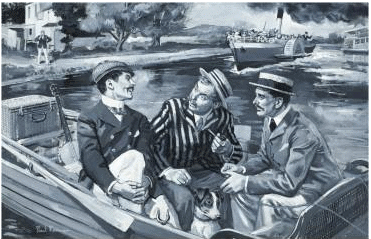
George towed the boat upto  Staines. At half- past seven they sculled up close to the left bank and looked for a spot to stop at. They had originally intended to camp at Magna Charta Island. But somehow they did not like to look at the scenery and wanted to have their supper and go to bed.

Pitching the tent
George suggested that they should pitch the’ tent before eating supper. They thought it to be an easy task and it did not take them just ten minutes. To drop the hoops into the sockets was a dangerous task. George and Harris helped each other to fix the covering. George did his part all right, but it was new work for Hams, and he bungled it. Finally the cover was fixed after half an hour.

Behaviour after supper
They boiled the water and made supper in dead silence which lasted f minutes. After it they felt contented and felt that they were quarrelsome and before supper. After taking the supper they loved each other and everybody. George wondered why they couldn’t be always happy and generous like that and why they couldn’t remain away from sins and temptations. The narrator said that he always longed for this kind of life. George related a story about his father. He said that once his father travelled with another fellow through Wales. They stopped at a little inn, where they joined the other fellows and spent the evening with them.

The narrator’s outing at night
They went to bed at ten but the narrator could not sleep. The sound of the lapping water round the boat and the wind among the branches kept him restless and disturbed. He put on whatever clothes he could and crept under the canvas on to the bank. It was a glorious night. The moon had sunk and left the quiet earth alone with the stars. It was full of comfort and of strength. The day had been full of fret and care and their hearts had been full of evil and bitter thoughts. The world had seemed so hard and wrong to them. Night, like some great loving mother, gently laid her hand upon their fevensh heads and removed their pain.

The story of a knight
The writer narrated the story of a good knight who was lost in the forest. The name of the dark forest was Sorrow. The good knight was shown a vision, about which nothing could be said. They could not tell about it.
Chapter – 9 ( Summary )

George’s experience of towing
Jim and Harris made George work. He towed them till Runnymede. The narrator considered tow- lines strange. He described how he got into a mess when he dealt with them himself. Once he and his friends were going down in Bovericy. They saw two men who were looking for their boat which had gone off when they were disentangling their tow-line. He also remembers how George tied a tow-line to the boat of a young couple and made them tow four bulking chaps in another boat for a long time. The girl was shocked when she could not see her aunt. Hams asked if they had recovered the old lady. George replied that he did not know. In fact they towed the wrong boat.

Bad towing by girls
The narrator said that being towed by girls was the most exciting experience. It took three girls to tow always, two to hold the rope, and third one to run round and round. They generally began by getting themselves tied up. They got the line round their legs and had to sit down on the path and to undo each other and then they twisted it round their necks, and were nearly strangled. At the end of a hundred yards, they were naturally breathless. They sat down on the grass and laughed. In the meantime the boat drifted out midstream. This was the dullest moment.

The boat trip with a Cousin
The narrator, then, describes what happened when he was out with a young lady, his on a river trip down goring. It was half when they reached Benson’s lock. She was reach home before evening. The narrator drew out a map and found that they were just a mile and half to the next lock, Wallingford. They rowed on and passed the bridge and never looked at a lock. The girl thought that they had lost their way and began to cry. The narrator pulled on for another mile. Then he began to get nervous himself. He still went on pulling however, and still no lock came in sight and the river grew more and more gloomy and mysterious under the gathering shadows of the night. Suddenly they heard the sweet sounds of an accordion. A boat came along. The narrator asked the occupants if they could tell him the way to Wallingford lock. They told him that there was no Wallingford lock for the last one year. They were very close to Cleeve now. The narrator thanked him and wished them a pleasant trip. They got home in time for supper.

Chapter – 8 ( Summary )

The act of tresspassing

Harris and Jim stopped under the willows by Kempton Park and lunched. It was a pleasant little spot. They had just begun to eat the bread and jam when a gentleman in a short sleeves and a short pipe came along. He asked them if they knew that they were tresspassing and told them that it was his duty to turn them off. Harris was a well- made man and looked hard and bony. He asked the gentleman how he would accomplish his task. He said that he would consult his master and went away. He never returned. Actually he wanted a shilling and was trying to blackmail them. But both Harris and Jim were angry and blamed the owners who allowed that to happen. The narrator wanted to kill the owner, but Harris wanted to kill him, his family, friends, relatives, and bum down his house. Harris decided to calm himself by singing a comic songs of the ruins.

Harris as a singer

It was one of Harris’ fixed ideas that he could sing a comic song. But 1l his friends knew that he could not sing, and would never be able to sing, and that he should not be allowed to sing. Harris did not know that he made an ass of himself when he Sang. He did not realise that he annoyed many.

A German singer

Jim was reminded of an incident which threw light on the inner working of human mind. Once he was at a fashionable and highly cultured party. There were two young students who had come back from Germany. They asked if they had heard Herr Slossenn Boschen sing his great German comic song. No one had heard it. The young man said that it was the funniest song that had ever been written. They could get Herr Slossenn Boschen to sing it. They brought him and he sat down to the piano and began to sing. The prelude did not suggest a comic song. It was a soulful music. The narrator who did not understand German simply watched the two young men. When they tittered, the narrator tittered; when they roared, he also roared. He noticed that as the song progressed, most of the listeners seemed to be doing the same. Yet the German professor did not seem happy. He was surprised when they began to Laugh. As the listeners continued to laugh, he got angry and ended his song amidst their laughter. He got up, swore at them, and then danced and shook his fists. He said that he had never been so insulted in all his life.

Grave misunderstanding

It appeared that the song was not comic at all. It was about a young girl who had given UP her life to save her lover’s soul. It was a tragic song. The two young men who had done this thing disappeared. They had taken their revenge for being considered common persons. The narrator never saw a party break up so quietly. They did not say goodnight to one another.

Different places

They reached Sunburry Lock at half-past three. And then they sculled up to Walton and went past Oatlands Park, a famous old place. Henry VIII lived here. The late Duchess of York who lived at Oatlands, was very fond of dogs. She had a special graveyard made for the large number of dogs she had kept. At Weybridge they saw George’s blazer on one of the lock gates.

George joins in

Montmorency gave a furious bark, Jim shrieked and Harris roared. George waved his hat and yelled back. The lock keeper rushed out thinking that someone had fallen into the lock. George had a banjo with him. He thought that it was very easy to learn the banjo.

Chapter – 7 ( Summary )

The narrator’s dress sense

The river afforded a good opportunity for dress. Men could reflect their  tastes in colours. The narrator liked a little red in all his things-red and black. His hair was a sort of golden brown. So the dark red matched  with his hair. A light blue necktie went well with it. A pair of Russian-leather shoes and a red silk handkerchief round the waist added charm to his personality.

Harris’ dress sense

Harris kept to shades a mixture of orange or yellow but in his opinion they didn’t suit him well. His complexion was too dark for yellows, but he didn’t pay attention to any suggestion.

George’s dress sense

George had bought some new things for this trip, but the narrator was rather vexed about them. The blazer was gaudy. He did not want George to know about his opinion. The narrator and Harris were worried about it because it would attract attention to the boat.

Girls in a boat

Girls also didn’t  look bad in a boat ,if they were prettily dressed .But he was of the opinion that a boating dress  ought to be a dress that can be worn in a boat’. The narrator once went with  two Ladies of this kind. They were both beautifully dressed. But they were dressed for a photographic studio, not for a river picnic. The first thing that they thought was that the boat was not clean. They thought that a drop of water would ruin their dress. Jim was stroke. He did his best, but could not prevent a few drops of water falling on their clothes. He left his seat and asked another man to row. The ladies felt relieved, but when the man spread more than a pint of water on their dresses, they began to protect themselves with their umbrellas and drew rugs and coats over themselves.

The narrator’s dislike of tombs

Harris wanted to get out at Hampton Court and visit Mrs. Thomas’s tomb. The writer objected to it. He is reminded of his visit to a village church. It was a lovely landscape. Suddenly the narrator looked up and saw an old bald-headed man coming to him. He was carrying a huge bunch of keys in his hand that shook and jingled at every step. He insisted that Jim should see the tomb. Jim protested. The old bald-headed man persisted and requested him to see the memorial windows. He burst into tears and asked Jim to see the skulls at least. Jim had to run away from the scene.

Harris’ liking for old places

Harris who was interested in tombs, graves, epitaphs and monuments revealed that he had joined the trip to see Mrs. Thomas’s Tomb. Jim reminded him that they had to reach Shepperton by five o’clock to meet George. This made Harris angry and he said why George had not taken the day off and joined them at the start. He further remarked that he had never seen him doing any work.

Mishap with Harris

Harris wanted to go to the pub to have a drink. Jim told him that they were miles away from a pub. He told Hams to take out a bottle from the hamper. The bottle was at the bottom of the hamper and seemed difficult to find and he had to lean further and further. In trying to steer at the same time, he pulled the wrong line and sent the boat into the bank. This upset him and he dived down right into the hamper and stood there on his head holding on the sides of the boat. He had to stay there till the narrator got hold of his legs and hauled him back.

Chapter – 6 ( Summary )

Importance of Kingston
It was a glorious morning, late spring or early summer when every leaf was green. Kingston or ‘Kymingeston’, as it was called earlier, was known ?‘ many great kings. Great Caesar crossed the river there. The Roman kings camped upon its sloping uplands. Queen Elizabeth had stopped there.

History of Kingston
Many old houses there spoke of those days when nobles and courtiers lived there. They lived in red brick houses. They had oak stairs that did not creak. The writer was reminded of a magnificent carved oak staircase in one of the houses of Kingston. It was a shop now in the marketplace, but it was evidently the mansion of some great person. The shopkeeper once took his friend through the shop and up the staircase of his house. The wall all the way up was oak-panelled. The friend was surprised to see the house. The oak- panelling was covered with blue wall-paper. The owner said that the room looked cheerful now. It was awfully gloomy before.
Jim felt sad to think, ’’Each person has what he doesn’t want and other people have what he does want.”

The story of Stivvings
Jim remembered a boy at his school. He was called Standford and Merton. His real name was Stivvings. He was the most extraordinary lad. He loved studies. He desired to win prizes and grow up to be a clever man. He wanted to bring credit to his parents. But he used to fall ill about twice a week and couldn’t go to school. If there was any known disease going within ten miles of him, he had it and had it badly. He had to stay in bed when he was ill, and eat chickens and custards and hot-house grapes. The other boys would have sacrificed ten terms of their school-life for the sake of being ill for a day. They took things to make them ill, instead they made them fat. Nothing made them ill until the holidays began. Then they would fall III till the term recommenced, when they would suddenly get well again.

The journey to Hampton Court
Jim now began to think about life. He thought how the art treasures of today were only the dug- up commonplaces of three or four hundred years ago. His thoughts were suddenly interrupted by Hams. He threw away the sculls, got up, and left his seat and sat on his back and stuck his legs in the air. Montmorency howled and turned a somersault and the top hamper jumped up and all the things came out. Harris wanted Jim to scull. Jim ran the boat round the walls of Hampton Court. It looked peaceful and quiet.

The maze
Harris asked Jim if he had ever seen the maze at Hampton Court. Harris said that he went in once to show it to someone. He had studied the map and thought that it was vety simple to come out. There they met some people who wanted to come out. Harris told them to follow him. They went round and round but could not find the way out Then Harris did not know what to do. So he Suggested that the best thing was to go back to the entrance. They started again but failed to find the Way out. They all got crazy and called the keeper. He came and gave instructions to them. But they could not understand anything. The young keeper also got lost with them. Then the old keeper came after dinner and rescued them. Harris said that it was a very fine maze. Harris and Jim agreed that they would try to get George into it, On their way back.

Chapter – 5 ( Summary )

George fails in his duty
The narrator was woken up by his housekeeper, Mrs Poppets, at nine o’clock in the morning. He woke Harris up and both began to accuse each other for not waking each other up. Soon they realised that George who took the responsibility of waking them up at 6.30 in the morning was still asleep. He was snoring. They were angry with him and rushed to him. Harris landed him one with a slipper and Jim shouted in his ear. George woke up. “Get up, you fat-headed chunk!” said Harris, “It’s quarter to ten” . He got up and fell into the bath-tub.

Weather -Forecasts
Montmorency had invited two other dogs and they were whiling away their time by fighting with each other on the doorstep. They calmed them with an umbrella and sat down to take their breakfast. George got hold of the paper and read the ‘weather— forecast’ to them. The writer thought that the ‘weather4orecast’ was a fraud. It was generally wrong. He remembered a lovely day that was ruined by the forecast “Heavy showers with thunderstorms may be expected”. They didn’t go out that day. But it did not rain at all. The next morning they read that it was going to be a warm and ‘fair’ day, but they returned home drenched. The barometer was useless.

Getting ready
The friends carted out their luggage on to the doorstep and waited for a cab. They  seemed to have a good deal of luggage. No cab came by, but the street boys stopped there to look at the luggage. Biggs’ boy was the first to arrive. Biggs, their green grocer, secured the services of the most unprincipled errand-boys that civilization had ever produced. He came to a dead stop in front of their luggage. And then another boy stopped there. Then the young gentleman from the boot-shop stopped there. Soon a small crowd collected there. One party thought that it was a wedding and pointed out Harris as the bridegroom, while the party of elders thought that it was a funeral, and the writer was probably the corpse’s brother. Finally, a cab turned up and they went to the Waterloo station. Nobody knew at Waterloo where the eleven-five train to Kingston started from.

Train journey to Kingston
They gave bribe to the engine driver and begged him to reach Kingston by 11. .5. Thus they reached Kingston by the London and South-Western Railway. They learnt, afterwards, that the train they had come by was really the Exeter Mail and they had spent hours looking for it.

The boat journey begins
Their boat was waiting for them at Kingston just below the bridge. They stored their luggage in it and stepped in. With Harris at the sculls, and the writer at the tiller-lines, and Montmorency in the prow, they shot out on to the waters. it was to be their home for a fortnight.

Chapter – 4 ( Summary )

The food question
Now the friends discussed the food question. George said, “Begin with breakfast. Now for breakfast we shall want a frying pan, a tea-pot and a kettle, and a methylated stove, but no oil”. Harris and Jim agreed. George was practical.

Oil stove
They had taken an oil stove with them once, but would not commit this mistake again. The oil oozed down to the rudder and into the river and spoiled the whole atmosphere. Even the wind brought with it the fragrance of paraffin oil. They took an oath never to take paraffin oil with them.

Smell of the cheeses
George suggested that they should take with them eggs, bacon, cold meat, tea, bread and butter and jam. They would not take cheese because cheese, like oil, gave strong smell. The narrator remembered a friend who had bought a couple of cheese of Liverpool. He asked the narrator to take those cheeses to London. He took them away in a cab. The smell of the cheeses made the horses run at a very fast speed. They were beyond control. But a clever porter put a handkerchief over the horse’s nose in order to control his speed. The narrator then caught a train. In the train, people felt so uncomfortable with the smell that they moved out of the bogey in which he was sitting. His friend was detained in Liverpool longer than he expected. Three days later, his wife called on him. Even she hated the smell of the cheeses. She did not keep it in her room in a hotel. Finally, Tom took them to a sea-side town, and buried them on the beach.

Packing begins
The next day, they got all things together and met in the evening to pack them. They got a big Gladstone for the clothes, and a couple of hampers for the food items, and the cooking utensils. They placed everything in a heap, in the middle of the floor and sat round it. The narrator said that he would pack. He thought that he knew more about it than any other. His two friends readily agreed. He felt annoyed because he did not like others doing nothing.

Wrong packing
However he packed the things. When he was Strapping the bag, Harris said, “Aren’t you going to put the boots in ?“ The narrator got irritated. George’s senseless laughs increased his irritation. The narrator had to unpack the bag and put the boots in when he finally packed. George and Harris Came forward to do the hampers. Jim began to look at them. Firstly they broke a cup, and then Hams squashed a tomato. They became so nervous that they placed light things at the bottom and heavy things on the top. The preserves got smashed. Harris sat on the butter. They wanted buffer but could not find it. At last they found it on Harris’ back.

Montmorency’s misdeeds
Montmorency was in it all, of course. He put his leg into the jam and he pretended that the lemons were rats, and got into the hamper and killed three of them before Harris could land him with a frying pan. The packing was done at 12.50 at midnight. They were ready to sleep. Harris was to sleep with them and they went upstairs. They asked George to wake them up at 6.30. But George was asleep at that time. They placed the bath tub where he could tumble into it on getting out in the morning and went to bed themselves.

Chapter – 3 ( Summary )

The things for the trip
The next evening, the friends met to discuss and chalk out their plans. Harris said that the first thing to settle was what to take with them. He asked the narrator (Jim) to get a piece of paper and write down, grocery catalogue. Then Harris seemed eager everything on himself back of other people.

Uncle Podger
Harris reminded the narrator (Jim) of his poor Uncle Podger. There was a lot of commotion in the house when Uncle Podger undertook to do a job. He involved all the members of the family when he was hanging a picture on the wall. He would lift up the picture and drop it, and it would come out of the frame, and he would try to save the glass and cut his finger, and then he would look for his handkerchief. He could not find it because it was in the pocket of his coat and he was sifting on it. And then he would shout, “oh, you can give it up, I have found it myself now.” Then he would ask for the hammer. When all the members did not find it, he would again shout at them.  After several mishaps, he would be able to hang the picture on the wall at midnight. The wall would be in shambles. He would, then, come down after hanging the picture and survey the mess that he had created and say proudly, “Why, some people would have had a man in to do a little thing like that”. Jim thought that Harris would be exactly like Uncle Podger when he grew up.

Travelling light
The first list that the friends made had to be discarded because it was too long. George suggested that they should make a list of those things that they couldn’t do without. Jim remarked that George sometimes came out with sensible Suggestion. He then commented that many people loaded their boats with unnecessary and useless things. He opined that the boat of life should be light. A person should take along with him only those things which were needed. He should take with him one or two friends, someone to love and someone to love you, a cat, a dog and a pipe or two, enough food and sufficient clothes and drinks. He would find the boat easier to pull.


Individual tastes
George was to prepare the list and he said that they would carry a boat cover instead of a tent. Both George and Harris proclaimed that they loved an early morning swim. Jim did not like to get up early in the morning and thus hated an early morning swim. Harris said that it always gave him an appetite. George did not want him to have a swim because in that case, he would eat more.
Jim persuaded George to let Harris have a bath. George, then, told them that two suits of flannel would be enough. They would wash them on the river. Jim and Harris came to know later on that George was an imposter and he knew nothing about washing and clothes.

Chapter – 2 ( Summary )

Planning the trip
After taking the decision of having a boat trip along the river, the friends began to plan it. They planned to start from Kingston on Saturday and George would join them at Chertsey in the afternoon, when his bank closed. They debated about the stay at night. George and the narrator wished to ‘camp out’ at night. The narrator insisted on it. He became poetical about the sun setting in the evening, and the birds becoming silent. He went into a nostalgic mood and described how they would tie their boat in a corner and pitch their tent and eat a small meal. They would Listen to the song of the flowing river. They would lie down under the starry sky. His description of the natural scenery showed that civilization was taking man away from the lap of nature.

Harris’ objection
The poetic mood of the narrator was interrupted by Harris who asked, “How about when it rained ?“ Harris used to weep whenever he ate raw Onions. Harris was fond of drinks. For him that place was the best where he could get a drink. But he was right in his opinion that it was unpleasant to Camp out in rainy weather. It was tedious and hopeless to attempt to make wood fire. So they would have to light a stove to cook food. The bread’ be soaked in rain water. The pie, the jam, the butter and salt would become rich with rainwater.

Problems in a rain
You would wake up from your sleep because you felt that an elephant was sitting on your chest. You would feel that the world had come to an end because you heard faint cries coming from under your bed. Then suddenly you realised that the tent had fallen down. In the morning all the three Mends would be speechless owing to severe cold that they caught in the night. They would quarrel with one another and shout at one another.

Montmorency, the dog
So they took the decision that they would sleep out for five nights in a hotel or a pub when it rained. Even Montmorency, the dog, hailed this decision. He looked like a fox-terrier having a gentle look in his eyes. When the narrator had owned the dog he had thought that he would not live long. But after paying for a dozen chickens that he had killed, and rescuing him from a hundred and fourteen street fights, listening to the angry neighbour whose cat he had killed, the narrator changed his opinion about the dog. The only thing that was yet to be decided was what to take along with them. Harris came with a suggestion that he knew a place where they would get excellent Irish whisky. George said that he felt thirsty. The debate was adjourned to the following night . all the three put on their hats.

Chapter – 1 ( Summary )

Three friends
George, Harris and the narrator were friends. All the three considered themselves to be seriously ill. They felt seedy. They met to discuss how to deal with their problems. George and Harris thought they suffered from fits of giddiness. 

But the narrator was sure that he suffered from the ailment of liver. He was certain about his ailment because he had recently been reading a patent liver-pill circular. He had been in the habit of imagining, after reading patent medicine advertisements, that he had the same symptoms of the ailment as described in them.

Visit to the British Museum 
One day, the narrator went to the British Museum. There he consulted a medical dictionary and went through every disease alphabetically. After reading it, he was convinced that he suffered from every disease mentioned in the dictionary. 

He thought that the only disease that he did not suffer from was the disease of the housemaid’s knee (arthritis) though he suffered from ‘gout’ in the extreme form. He thought that the students of the medical colleges would not have to ‘walk the hospitals’ if they had him as a patient. He was a hospital himself.

The doctor’s advice
He went to the doctor who was his friend. He his pulse, looked at his tongue and examined thoroughly. The doctor, then, prescribed medicines . He went to the chemist to get the medicines. 

The chemist refused to give him the prescribed medicines by saying that he was only a chemist The narrator read the prescription. The medicines prescribed were “one pound beefsteak, with one pint bitter beer every six hours, a ten-mile walk every morning and sleep at 11 sharp every night.”

Plan for a boat-trip
The narrator, then, said that he suffered from a weak liver even as a boy. The disease never left him even for a day. The family considered it laziness and cured it by giving him clumps on the side of his head. The friends described to each other their maladies. They came to the conclusion that the remedy for their maladies was ‘rest’ and a holiday. 

They should seek out some old—world spot far away from the crowd. They discussed a sea trip but the narrator was strongly opposed to it. He gave a graphic detail of what happened to his brother-in-law and a friend who went to sea-trips. 

George seemed to be the only person who liked sea-trips and he boasted about it He, finally, put forward a suggestion : “Let’s go up the river a boat trip” . They all agreed with this suggestion. The only one who did not accept this suggestion was Montmorency — the dog. But his objection was ruled out.