NCERT Solutions: The BAUDHĀYANA- Pythagoras Theorem
Page No. 39
Figure it Out
Q1: Earlier, we saw a method to create a square with double the area of a given square paper. There is another method to do this in which two identical square papers are cut in the following way (pieces labeled 1, 2, 3, 4).
Can you arrange these pieces to create a square with double the area of either square?
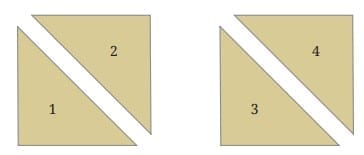
Ans: Given: Two identical squares
These two are cut diagonally, forming two equal triangles, as shown in the figure.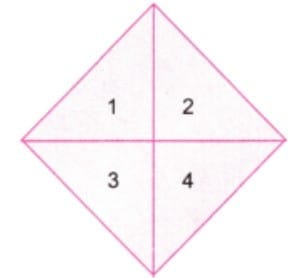
Thus, we have four identical triangles from two identical squares.
Area of two triangles = Area of the given square
Area of four triangles = double the area of the given square.
Q2: The length of the two equal sides of an isosceles right triangle is given. Find the length of the hypotenuse. Find bounds on the length of the hypotenuse such that they have at least one digit after the decimal point.
(i) 3 (ii) 4 (iii) 6 (iv) 8 (v) 9
Ans: For an isosceles right triangle with equal sides of length a, the hypotenuse c is given by:
Formula: c² = 2a² or c = a$\sqrt{2}$
(i) When a = 3:
c = 3$\sqrt{2}$
To find bounds, we calculate:
- 4² = 16 and 5² = 25
- (3$\sqrt{2}$)² = $9 \times 2$ = 18
- Since 16 < 18 < 25, we have 4 < 3$\sqrt{2}$ < 5
For more precision:
- 4.2² = 17.64
- 4.3² = 18.49
- Since 17.64 < 18 < 18.49
Ans: Length of hypotenuse = 3$\sqrt{2}$ units ≈ 4.24 units
Bounds: 4.2 < hypotenuse < 4.3
(ii) When a = 4:
c = 4$\sqrt{2}$
To find bounds:
- (4$\sqrt{2}$)² = $16 \times 2$ = 32
- 5² = 25 and 6² = 36
- Since 25 < 32 < 36, we have 5 < 4$\sqrt{2}$ < 6
For more precision:
- 5.6² = 31.36
- 5.7² = 32.49
- Since 31.36 < 32 < 32.49
Ans: Length of hypotenuse = 4$\sqrt{2}$ units ≈ 5.66 units
Bounds: 5.6 < hypotenuse < 5.7
(iii) When a = 6:
c = 6$\sqrt{2}$
To find bounds:
- (6$\sqrt{2}$)² = $36 \times 2$ = 72
- 8² = 64 and 9² = 81
- Since 64 < 72 < 81, we have 8 < 6$\sqrt{2}$ < 9
For more precision:
- 8.4² = 70.56
- 8.5² = 72.25
- Since 70.56 < 72 < 72.25
Ans: Length of hypotenuse = 6$\sqrt{2}$ units ≈ 8.49 units
Bounds: 8.4 < hypotenuse < 8.5
(iv) When a = 8:
c = 8$\sqrt{2}$
To find bounds:
- (8$\sqrt{2}$)² = $64 \times 2$ = 128
- 11² = 121 and 12² = 144
- Since 121 < 128 < 144, we have 11 < 8$\sqrt{2}$ < 12
For more precision:
- 11.3² = 127.69
- 11.4² = 129.96
- Since 127.69 < 128 < 129.96
Ans: Length of hypotenuse = 8$\sqrt{2}$ units ≈ 11.31 units
Bounds: 11.3 < hypotenuse < 11.4
(v) When a = 9:
c = 9$\sqrt{2}$
To find bounds:
- (9$\sqrt{2}$)² = $81 \times 2$ = 162
- 12² = 144 and 13² = 169
- Since 144 < 162 < 169, we have 12 < 9$\sqrt{2}$ < 13
For more precision:
- 12.7² = 161.29
- 12.8² = 163.84
- Since 161.29 < 162 < 163.84
Ans: Length of hypotenuse = 9$\sqrt{2}$ units ≈ 12.73 units
Bounds: 12.7 < hypotenuse < 12.8
Page No. 40
Q3: The hypotenuse of an isosceles right triangle is 10. What are its other two sidelengths? [Hint: Find the area of the square composed of two such right triangles.]
Ans:
Given: Hypotenuse of isosceles right triangle = 10 units
To find: Length of the two equal sides
Solution:
Let a be the length of each equal side.
Using the formula for isosceles right triangle: c² = 2a²
Given c = 10
Substituting: (10)² = 2a²
100 = 2a²
Dividing by 2: a² = $\frac{100}{2}$ = 50
Taking square root: a = $\sqrt{50}$
Simplifying $\sqrt{50}$:
$\sqrt{50}$ = $\sqrt{25 \times 2}$ = $\sqrt{25}$ × $\sqrt{2}$ = 5$\sqrt{2}$
Finding bounds:
- (5$\sqrt{2}$)² = $25 \times 2$ = 50
- 7² = 49 and 8² = 64
- Since 49 < 50 < 64, we have 7 < 5$\sqrt{2}$ < 8
More precisely:
- 7.0² = 49
- 7.1² = 50.41
- So 7.0 < 5$\sqrt{2}$ < 7.1
Ans: Each of the two equal sides has length 5$\sqrt{2}$ units ≈ 7.07 units
Page No. 47
Figure it Out
Q1: If a right-angled triangle has shorter sides of lengths 5 cm and 12 cm, then what is the length of its hypotenuse? First draw the right-angled triangle with these sidelengths and measure the hypotenuse, then check your answer using Baudhāyana’s Theorem.
Ans: Given AB = 5 cm
BC = 12 cm
AC = 13 cm (by measurement)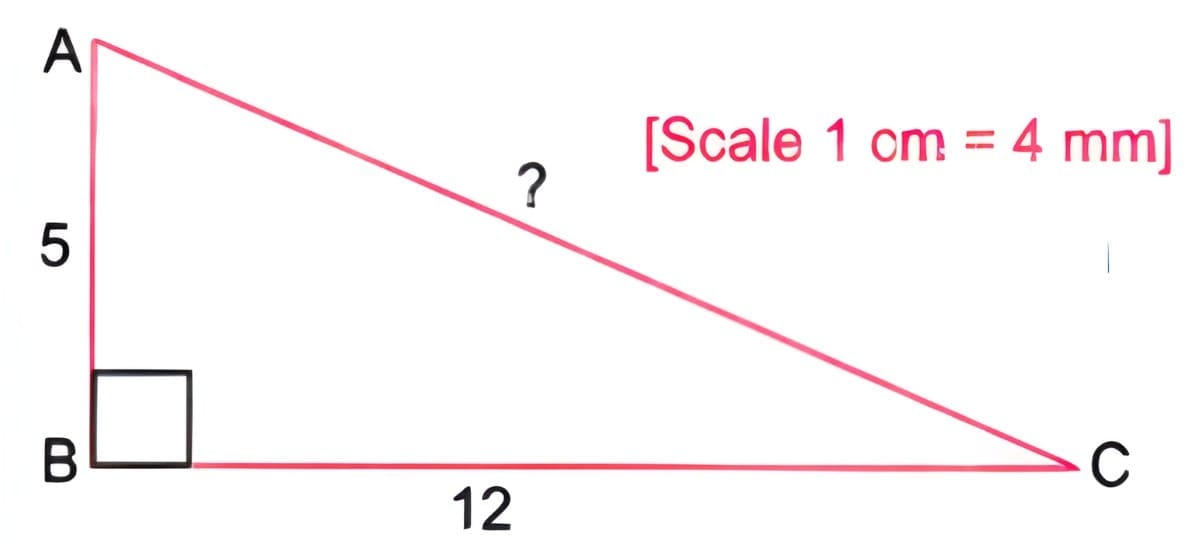
Using Baudhāyana’s Theorem
AC2 = AB2 + BC2
⇒ 5² + 12² = c²
⇒ 25 + 144 = c²
⇒ 169 = c²
⇒ c = $\sqrt{169}$ = 13
Answer: The length of the hypotenuse is 13 cm.
Q2: If a right-angled triangle has a short side of length 8 cm and hypotenuse of length 17 cm, what is the length of the third side? Again, try drawing the triangle and measuring, and then check your answer using Baudhāyana’s Theorem.
Ans: Here, AB = 8 cm
AC = 17 cm
BC = 15 cm (by measurement)
Using Baudhāyana’s Theorem,
AB2 + BC2 = AC2
82 + BC2 = 172
BC2 = 289 – 64
= 225
= 152
∴ BC = 15 cm
Therefore, the other side of the right-angled triangle is 15 cm, which satisfies Baudhayana’s Theorem.
Q3: Using the constructions you have now seen, how would you construct a square whose area is triple the area of a given square? Five times the area of a given square?
Ans: (a) ABCD is a square with side a.
AC = a√2
ACEF is a rectangle with sides a√2 and a.
Now AE = a√3
AEGH is a square with a side of a√3
Then Ar AEGH = 3a2
Ar ABCD = a2
∴ Area of AEGH = 3 × Area of ABCD
(b) ABCD and CFED are squares with side ‘a’.
BE is a diagonal of the rectangle ABFE.
In rectangle ABFE
EF = a and BF = BC + CF = a + a = 2a
Using Baudhayana’s Theorem
BE2 = EF2 + BF2
= a2 + (2a)2
= a2 + 4a2
= 5a2
BE = √5 a
BEFG is a square with side BE.
Area BEFG = BE2
= (√5a)2
= 5a2
Then the area of BEFG = 5 × the area of ABCD
Q4: Let a, b and c denote the length of the sides of a right triangle, with c being the length of the hypotenuse. Find the missing sidelength in each of the following cases:
(i) a = 5, b = 7
Ans:
Given: a = 5, b = 7, c = ?
Formula: a² + b² = c²
Calculation:
- 5² + 7² = c²
- 25 + 49 = c²
- 74 = c²
- c = $\sqrt{74}$
Finding bounds:
- 8² = 64 and 9² = 81
- Since 64 < 74 < 81, we have 8 < $\sqrt{74}$ < 9
More precise:
- 8.6² = 73.96
- 8.7² = 75.69
- So 8.6 < $\sqrt{74}$ < 8.7
Ans: c = $\sqrt{74}$ ≈ 8.60 units
(ii) a = 8, b = 12
Ans:
Given: a = 8, b = 12, c = ?
Formula: a² + b² = c²
Calculation:
- 8² + 12² = c²
- 64 + 144 = c²
- 208 = c²
- c = $\sqrt{208}$
Simplifying:
- $\sqrt{208}$ = $\sqrt{16 \times 13}$ = 4$\sqrt{13}$
Finding bounds:
- 14² = 196 and 15² = 225
- Since 196 < 208 < 225, we have 14 < $\sqrt{208}$ < 15
More precise:
- 14.4² = 207.36
- 14.5² = 210.25
- So 14.4 < $\sqrt{208}$ < 14.5
Answer: c = $\sqrt{208}$ = 4$\sqrt{13}$ ≈ 14.42 units
(iii) a = 9, c = 15
Ans:
Given: a = 9, c = 15, b = ?
Formula: a² + b² = c²
Rearranging: b² = c² – a²
Calculation:
- b² = 15² – 9²
- b² = 225 – 81
- b² = 144
- b = $\sqrt{144}$ = 12
Answer: b = 12 units
Verification: 9² + 12² = 81 + 144 = 225 = 15²
(iv) a = 7, b = 12
Ans:
Given: a = 7, b = 12, c = ?
Formula: a² + b² = c²
Calculation:
- 7² + 12² = c²
- 49 + 144 = c²
- 193 = c²
- c = $\sqrt{193}$
Finding bounds:
- 13² = 169 and 14² = 196
- Since 169 < 193 < 196, we have 13 < $\sqrt{193}$ < 14
More precise:
- 13.8² = 190.44
- 13.9² = 193.21
- So 13.8 < $\sqrt{193}$ < 13.9
Answer: c = $\sqrt{193}$ ≈ 13.89 units
(v) a = 1.5, b = 3.5
Ans:
Given: a = 1.5, b = 3.5, c = ?
Formula: a² + b² = c²
Calculation:
- (1.5)² + (3.5)² = c²
- 2.25 + 12.25 = c²
- 14.5 = c²
- c = $\sqrt{14.5}$
Finding bounds:
- 3² = 9 and 4² = 16
- Since 9 < 14.5 < 16, we have 3 < $\sqrt{14.5}$ < 4
More precise:
- 3.8² = 14.44
- 3.9² = 15.21
- So 3.8 < $\sqrt{14.5}$ < 3.9
Answer: c = $\sqrt{14.5}$ ≈ 3.81 units
Page No. 48Math Talk
Q: List down all the Baudhāyana triples with numbers less than or equal to 20.
Ans: Baudhāyana triples with numbers ≤ 20:
To find these, we check which triples (a, b, c) satisfy a² + b² = c² where a, b, c ≤ 20.
The complete list:
- (3, 4, 5)– Primitive
- 3² + 4² = 9 + 16 = 25 = 5²
- (6, 8, 10)– Scaled version of (3, 4, 5) [multiply by 2]
- 6² + 8² = 36 + 64 = 100 = 10²
- (5, 12, 13)– Primitive
- 5² + 12² = 25 + 144 = 169 = 13²
- (9, 12, 15)– Scaled version of (3, 4, 5) [multiply by 3]
- 9² + 12² = 81 + 144 = 225 = 15²
- (8, 15, 17)– Primitive
- 8² + 15² = 64 + 225 = 289 = 17²
- (12, 16, 20)– Scaled version of (3, 4, 5) [multiply by 4]
- 12² + 16² = 144 + 256 = 400 = 20²
Total: 6 Baudhāyana triples with numbers ≤ 20
Primitive triples: (3, 4, 5), (5, 12, 13), (8, 15, 17)
Non-primitive triples: (6, 8, 10), (9, 12, 15), (12, 16, 20)
Q: Is there an unending sequence of Baudhāyana triples?
Ans: Yes, there is an unending (infinite) sequence of Baudhāyana triples.
Proof:
We know that (3, 4, 5) is a Baudhāyana triple.
We can generate infinite triples by multiplying each term by any positive integer k:
- ($3 \times 1$, $4 \times 1$, $5 \times 1$) = (3, 4, 5)
- ($3 \times 2$, $4 \times 2$, $5 \times 2$) = (6, 8, 10)
- ($3 \times 3$, $4 \times 3$, $5 \times 3$) = (9, 12, 15)
- ($3 \times 4$, $4 \times 4$, $5 \times 4$) = (12, 16, 20)
- And so on…
Since k can be any positive integer (1, 2, 3, 4, 5, …, ∞), and each gives us a valid Baudhāyana triple, there are infinitely many Baudhāyana triples.
Q: Is (30, 40, 50) a Baudhāyana triple?
Ans: Yes, (30, 40, 50) is a Baudhāyana triple.
Verification:
We need to check if 30² + 40² = 50²
Calculation:
- 30² = 900
- 40² = 1600
- 50² = 2500
- 900 + 1600 = 2500
Ans: Yes, (30, 40, 50) is a Baudhāyana triple.
Note: This is a scaled version of (3, 4, 5), multiplied by 10.
- ($3 \times 10$, $4 \times 10$, $5 \times 10$) = (30, 40, 50)
Q: Is (300, 400, 500) a Baudhāyana triple?
Ans: Yes, (300, 400, 500) is a Baudhāyana triple.
Verification:
We need to check if 300² + 400² = 500²
Calculation:
- 300² = 90,000
- 400² = 1,60,000
- 500² = 2,50,000
- 90,000 + 1,60,000 = 2,50,000
Answer: Yes, (300, 400, 500) is a Baudhāyana triple.
Note: This is a scaled version of (3, 4, 5), multiplied by 100.
- ($3 \times 100$, $4 \times 100$, $5 \times 100$) = (300, 400, 500)
Q: Do you see any pattern among the triples (3, 4, 5), (6, 8, 10), (9, 12, 15), (12, 16, 20)?
Ans: Yes, there is a clear pattern:
Observation:
- (3, 4, 5) = ($3 \times 1$, $4 \times 1$, $5 \times 1$)
- (6, 8, 10) = ($3 \times 2$, $4 \times 2$, $5 \times 2$)
- (9, 12, 15) = ($3 \times 3$, $4 \times 3$, $5 \times 3$)
- (12, 16, 20) = ($3 \times 4$, $4 \times 4$, $5 \times 4$)
Pattern: Each triple is obtained by multiplying all three numbers of (3, 4, 5) by the same positive integer.
General form: (3k, 4k, 5k) where k = 1, 2, 3, 4, …
This pattern shows that:
- All these triples are scaled versions of the primitive triple (3, 4, 5)
- If we know one Baudhāyana triple, we can generate infinitely many more by scaling
- Among these, only (3, 4, 5) is primitive (no common factor > 1)
Q: Can we form a conjecture on Baudhāyana triples based on this observation?
Ans: Yes, we can form the following conjecture:
Conjecture: (3k, 4k, 5k) is a Baudhāyana triple, where k is any positive integer.
Verification of the conjecture:
We need to check if (3k)² + (4k)² = (5k)²
Left side:
- (3k)² + (4k)²
- = 9k² + 16k²
- = 25k²
Right side:
- (5k)² = 25k²
Since LHS = RHS, the equation is satisfied!
Conclusion: The conjecture is TRUE.
(3k, 4k, 5k) is indeed a Baudhāyana triple for any positive integer k.
This proves there are infinitely many Baudhāyana triples (one for each value of k = 1, 2, 3, …).
Q: Can we further generalise the conjecture?
Ans: Yes, we can make a more general statement:
Page No. 49
Q: Is (5, 12, 13) a primitive Baudhāyana triple? What are the other primitive Baudhāyana triples with numbers less than or equal to 20?
Ans: Yes, (5, 12, 13) is a primitive Baudhāyana triple.
Reason:
- First, verify it’s a Baudhāyana triple: 5² + 12² = 25 + 144 = 169 = 13²
- Check for common factors: The numbers 5, 12, and 13 have no common factor greater than 1.
- GCD(5, 12, 13) = 1
Therefore, (5, 12, 13) is primitive.
From our earlier list, the primitive triples are:
1. (3, 4, 5)
- GCD(3, 4, 5) = 1
2. (5, 12, 13)
- GCD(5, 12, 13) = 1
3. (8, 15, 17)
- GCD(8, 15, 17) = 1
There are 3 primitive Baudhāyana triples with numbers ≤ 20:
- (3, 4, 5)
- (5, 12, 13)
- (8, 15, 17)
Q: Generate 5 scaled versions of each of these primitive triples. Are these scaled versions primitive?
Ans: Scaled versions of (3, 4, 5):
- k = 2: (6, 8, 10)
- k = 3: (9, 12, 15)
- k = 4: (12, 16, 20)
- k = 5: (15, 20, 25)
- k = 6: (18, 24, 30)
Are these primitive? No, each has common factor k > 1.
Scaled versions of (5, 12, 13):
- k = 2: (10, 24, 26)
- k = 3: (15, 36, 39)
- k = 4: (20, 48, 52)
- k = 5: (25, 60, 65)
- k = 6: (30, 72, 78)
Are these primitive? No, each has common factor k > 1.
Scaled versions of (8, 15, 17):
- k = 2: (16, 30, 34)
- k = 3: (24, 45, 51)
- k = 4: (32, 60, 68)
- k = 5: (40, 75, 85)
- k = 6: (48, 90, 102)
Are these primitive? No, each has common factor k > 1.
Conclusion: No, scaled versions are never primitive because they all have a common factor k > 1.
Q: If (a, b, c) is non-primitive, and the integers have f — greater than 1 — as a common factor, then is (a/f, b/f, c/f) a Baudhāyana triple? Check this statement for (9, 12, 15). Justify this statement.
Ans: Yes, if (a, b, c) is non-primitive with common factor f > 1, then (a/f, b/f, c/f) is also a Baudhāyana triple.
Checking for (9, 12, 15):
First, find the common factor:
- 9 = $3 \times 3$
- 12 = $3 \times 4$
- 15 = $3 \times 5$
- Common factor f = 3
Dividing by f = 3:
- ($\frac{9}{3}$, $\frac{12}{3}$, $\frac{15}{3}$) = (3, 4, 5)
Verification:
- 3² + 4² = 9 + 16 = 25 = 5²
Yes, (3, 4, 5) is a Baudhāyana triple!
General Justification:
Given: (a, b, c) is a Baudhāyana triple with common factor f
- This means: a² + b² = c²
- Also: a = f × p, b = f × q, c = f × r for some integers p, q, r
To prove: (a/f, b/f, c/f) = (p, q, r) is a Baudhāyana triple
Starting with: a² + b² = c²
Substituting:
- (f × p)² + (f × q)² = (f × r)²
- f²p² + f²q² = f²r²
- f²(p² + q²) = f²r²
Dividing both sides by f²:
- p² + q² = r²
This proves: (p, q, r) = (a/f, b/f, c/f) is a Baudhāyana triple!
Important conclusion:
- Every non-primitive triple can be “reduced” to a primitive triple by dividing by the common factor
- If we find all primitive triples, we can generate all Baudhāyana triples by scaling
Page No. 50
Figure it Out
Q1: Find 5 more Baudhāyana triples using this idea.
Ans: (1 + 3 + 5 + … + 47) + 49 = 252
242 + 72 = 252 (24, 7, 25)
(1 + 3 + 5 + … + 79) + 81 = 412
402 + 92 = 412 (40, 9, 41)
(1 + 3 + 5 + … + 119) + 121 = 612
602 + 112 = 612 (60, 11, 61)
(1 + 3 + 5 + … + 167) + 169 = 852
842 + 132 = 852 (84, 13, 85)
(1 + 3 + 5 + …+ 223) + 225 = 1132
1122 + 152 = 1132 (112, 15, 113)
Q2: Does this method yield non-primitive Baudhāyana triples? [Hint: Observe that among the triples generated, one of the smaller sidelengths is one less than the hypotenuse.]
Ans: (24, 7, 25)
HCF of 24, 7, 25 is 1.
(40, 9, 41)
HCF of 40, 9, 41 is 1, etc.
The triples generated by the above method are primitive in nature.
Q3: Are there primitive triples that cannot be obtained through this method? If yes, give examples.
Ans: In each of the above case we have taken the sum of the first ‘n’ odd numbers where ‘n’ is a perfect square.
We observe that the smallest number in the triple is always odd.
Consider triples such as (8, 15, 17), (16, 63, 65), etc.
Such triples cannot be generated by this method.
Figure it Out
Q1: Find the diagonal of a square with sidelength 5 cm.
Ans:
Given: Square with side = 5 cm
To find: Length of diagonal
Method:
A diagonal of a square divides it into two congruent right-angled triangles.
For each triangle:
- Both perpendicular sides = 5 cm (sides of square)
- Hypotenuse = diagonal of square
Using Baudhāyana’s Theorem:
Let d = length of diagonal
- 5² + 5² = d²
- 25 + 25 = d²
- 50 = d²
- d = $\sqrt{50}$
Simplifying:
- $\sqrt{50}$ = $\sqrt{25 \times 2}$ = $\sqrt{25}$ × $\sqrt{2}$ = 5$\sqrt{2}$
Finding approximate value:
- $\sqrt{2}$ ≈ 1.414
- 5$\sqrt{2}$ ≈ $5 \times 1$.414 = 7.07
Ans: The diagonal of the square is 5$\sqrt{2}$ cm ≈ 7.07 cm.
Q2: Find the missing sidelengths in the following right triangles:
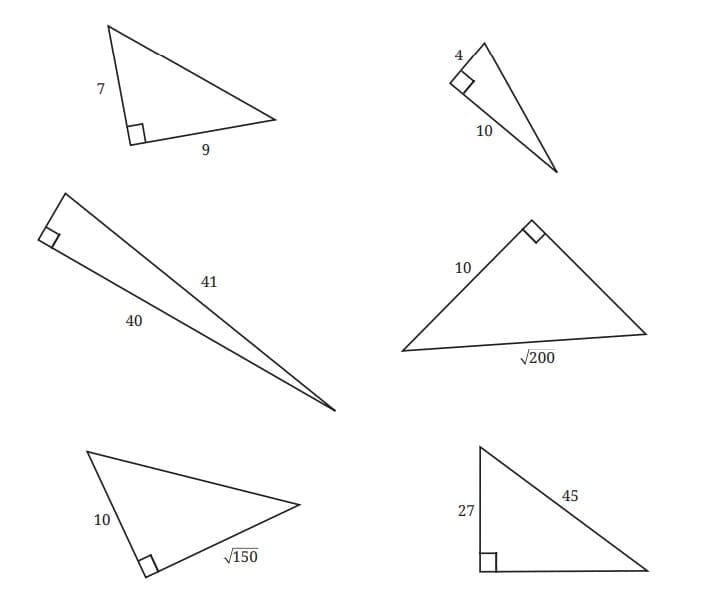
(i) Sides: 7 and ?, Hypotenuse: ?
If one perpendicular side = 7 and other perpendicular side = 9:
Given: a = 7, b = 9, c = ?
Using Baudhāyana’s Theorem:
- 7² + 9² = c²
- 49 + 81 = c²
- 130 = c²
- c = $\sqrt{130}$
(ii) Sides: 4 and 10, Hypotenuse: ?
Given: a = 4, b = 10, c = ?
Using Baudhāyana’s Theorem:
- 4² + 10² = c²
- 16 + 100 = c²
- 116 = c²
- c = $\sqrt{116}$
Simplifying:
- $\sqrt{116}$ = $\sqrt{4 \times 29}$ = 2$\sqrt{29}$
(iii) Sides: 40 and ?, Hypotenuse: 41
Given: a = 40, c = 41, b = ?
Using Baudhāyana’s Theorem:
b² = c² – a²
- b² = 41² – 40²
- b² = 1681 – 1600
- b² = 81
- b = $\sqrt{81}$ = 9
Ans: b = 9 units
(iv) Sides: 27 and ?, Hypotenuse: 45
Given: a = 27, c = 45, b = ?
Using Baudhāyana’s Theorem:
b² = c² – a²
- b² = 45² – 27²
- b² = 2025 – 729
- b² = 1296
- b = $\sqrt{1296}$ = 36
Ans: b = 36 units
(v) Sides: √200 and 10, Hypotenuse: ?
102 + d2 = (√200)2
⇒ 100 + d2 = 200
⇒ d2 = 200 – 100
⇒ d2 = 100
⇒ d = √100
⇒ d = 10
(vi) Sides: 10 and 150, Hypotenuse: ?
e2 = 102 + (√150)2
⇒ e2 = 100 + 150
⇒ e2 = 250
⇒ e = √250
⇒ e = 5×5×5×2−−−−−−−−−−√
⇒ e = 5√10
Q3: Find the sidelength of a rhombus whose diagonals are of length 24 units and 70 units.
Ans:
Given:
- Diagonal 1 (d₁) = 24 units
- Diagonal 2 (d₂) = 70 units
To find: Side length of the rhombus
Key properties of a rhombus:
- Diagonals bisect each other at right angles (90°)
- All four sides are equal
Solution:
When diagonals intersect, they form 4 right-angled triangles.
Each right triangle has:
- One side = d₁/2 = $\frac{24}{2}$ = 12 units
- Other side = d₂/2 = $\frac{70}{2}$ = 35 units
- Hypotenuse = side of rhombus (s)
Using Baudhāyana’s Theorem:
s² = 12² + 35²
- s² = 144 + 1225
- s² = 1369
- s = $\sqrt{1369}$ = 37
Ans: The side length of the rhombus is 37 units.
Q4: Is the hypotenuse the longest side of a right triangle? Justify your answer.
Ans: c2 = a2 + b2
∴ c2 > a2 and c2 > b2
or c > a and c > b
Hence, ‘c’ is the longest side of the right triangle.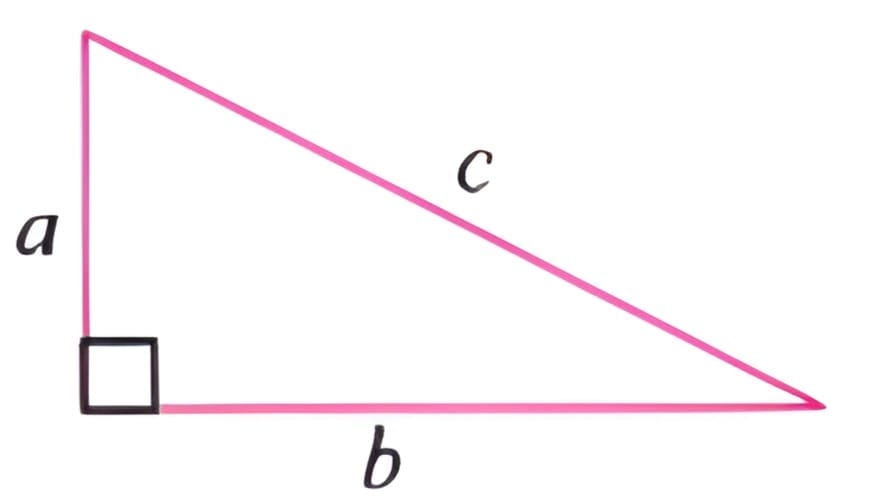
Q5: True or False—Every Baudhāyana triple is either a primitive triple or a scaled version of a primitive triple.
Ans:
TRUE
Explanation:
Every Baudhāyana triple falls into one of two categories:
Category 1: Primitive Triples
- These have no common factor greater than 1
- Examples: (3, 4, 5), (5, 12, 13), (8, 15, 17), (7, 24, 25)
- GCD of all three numbers = 1
Category 2: Non-primitive Triples (Scaled versions)
- These have a common factor f > 1
- They can be reduced by dividing by f
- The reduced form is a primitive triple
- Examples:
- (6, 8, 10) = 2 × (3, 4, 5) → scaled version of (3, 4, 5)
- (9, 12, 15) = 3 × (3, 4, 5) → scaled version of (3, 4, 5)
- (10, 24, 26) = 2 × (5, 12, 13) → scaled version of (5, 12, 13)
Proof:
For any Baudhāyana triple (a, b, c):
- Let f = GCD(a, b, c) (the greatest common divisor)
Case 1: If f = 1
- The triple is primitive
Case 2: If f > 1
- We can write: a = f × p, b = f × q, c = f × r
- Then (p, q, r) = (a/f, b/f, c/f) is a primitive triple
- And (a, b, c) = f × (p, q, r) is a scaled version
Therefore, the statement is TRUE.
Every Baudhāyana triple is either primitive OR a scaled version of a primitive triple. There’s no third category!
Q6: Give 5 examples of rectangles whose sidelengths and diagonals are all integers.
Ans:
Q7: Construct a square whose area is equal to the difference of the areas of squares of sidelengths 5 units and 7 units.
Ans: Area of square = 72 – 52
= 49 – 25
= 24 sq. units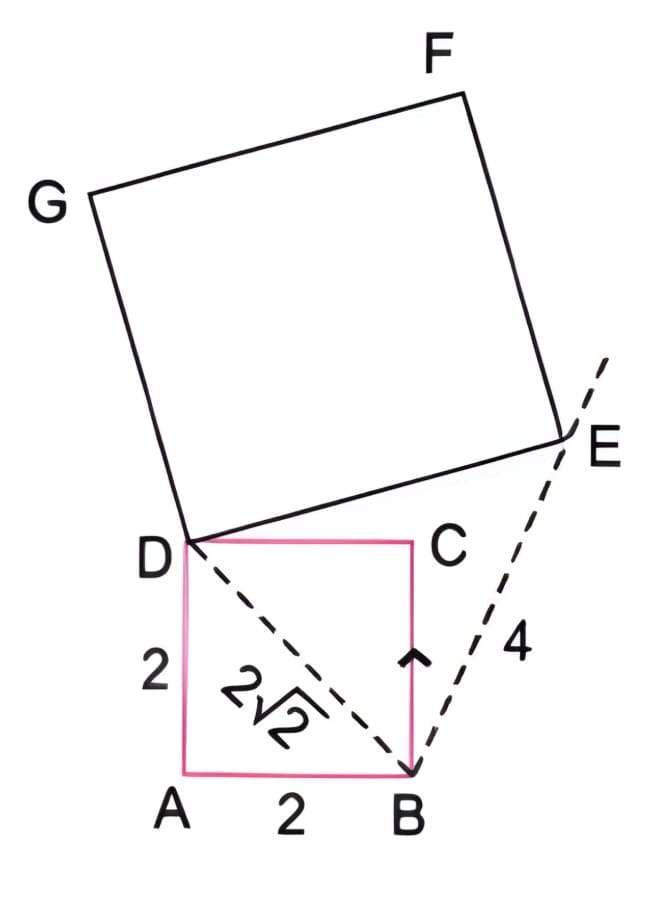
1. Construct a square ABCD with a side of 2 cm.
Then DB = 2√2 units
2. Draw BE ⊥ DB at B such that BE = 4 units
3. Join DE.
DE2 = (2√2)2 + 42
= 8 + 16
= 24
⇒ DE = √24
4. Draw a square with side DE (DEFG).
Area of DEFG = (√24)2 = 24 square units.
Q8: (i) Using the dots of a grid as the vertices, can you create a square that has an area of (a) 2 sq. units, (b) 3 sq. units, (c) 4 sq. units, and (d) 5 sq. units?
(ii) Suppose the grid extends indefinitely. What are the possible integer-valued areas of squares you can create in this manner?
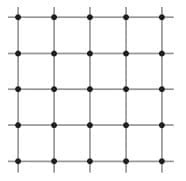
Ans: (i) (a) Area = 2 sq. units
2 = 12 + 12
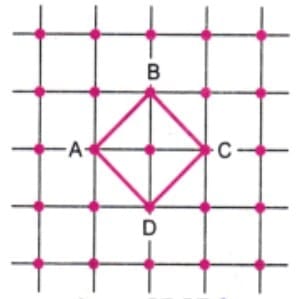
Mark dots A, B, C, and D as shown.
Join AB, BC, CD, and DA.
Then ABCD is a square and area ABCD = 2 sq. units
(b) Square with area 3 units is not possible as 3 ≠ a2 + a2 for any integer ‘a’.
(c) 4 = 2 × 2
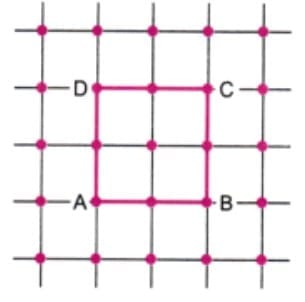
Mark dots A, B, C, D as shown.
Join AB, BC, CD, DA.
Then ABCD is a square.
and ar ABCD = 2 × 2 = 4 sq. units
(d) (i)
Mark dots A, B, C, and D as shown.
Join A, B, C, and D
AB2 = 22 + 12 = 5
AB = √5 units
Hence, ABCD is a square with an area of 5 sq units.
(ii) Let the given value of area be x, where ‘x’ is an integer.
Then, x = a2 + b2, where ‘a’ and ‘b’ are integers or x is a perfect square, we can create squares with vertices as dots of the grid.
Page No. 54
Q9: Find the area of an equilateral triangle with sidelength 6 units. [Hint: Show that an altitude bisects the opposite side. Use this to find the height.]
Ans: Let ΔABC be an equilateral triangle.
AB = BC = CA = 6 cm
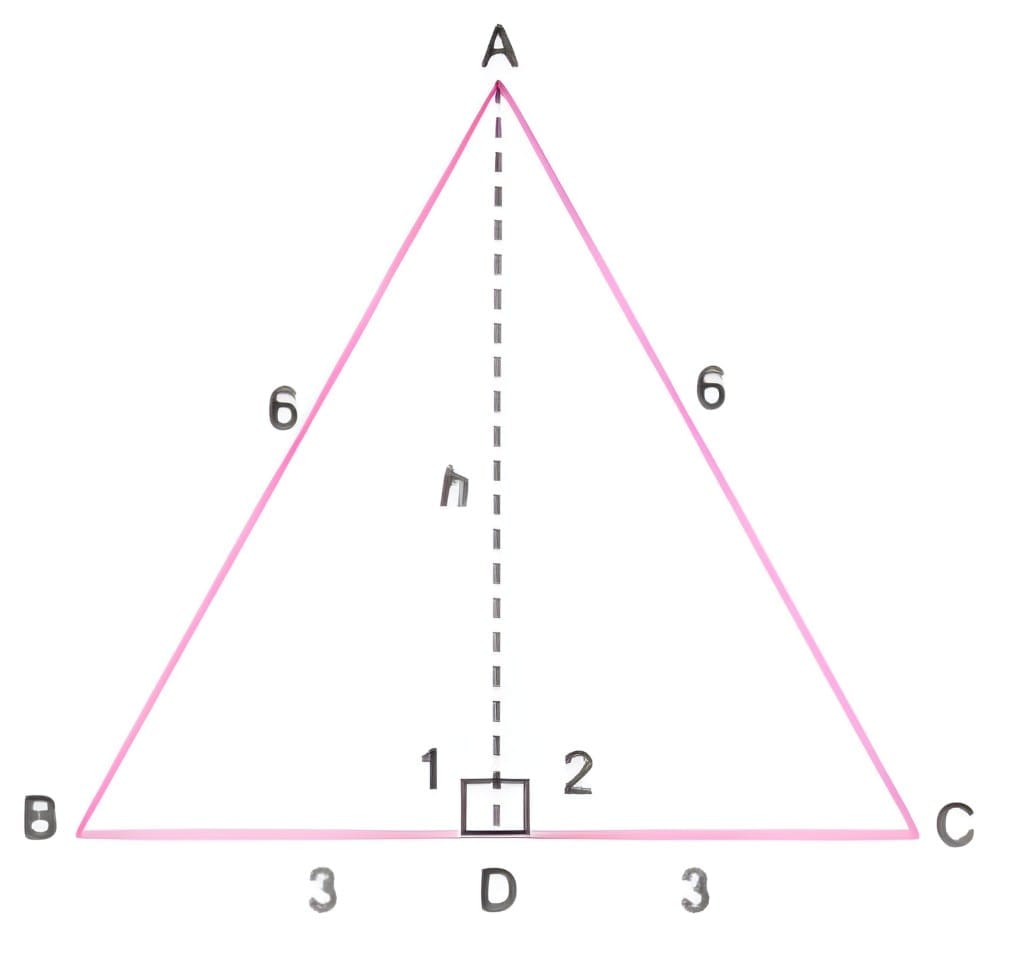
Let AD be perpendicular to BC.
Then ∠1 = ∠2 (each = 90°)
AB = AC (each = 6 cm)
AD = AD (common)
ΔADB ≅ ΔADC (RHS)
BD = DC (CPCT)
∴ BD = DC = 1/212 × 6 cm = 3 cm
In ΔADC,
h2 + 32 = 62 (Baudhayana’s triple)
⇒ h2 = 36 – 9 = 27
⇒ h = 3×3×3−−−−−−−√
⇒ h = 3√3 cm
Ar ABC = 1/21× BC × AD
= 1/21× 6 × 3√3 sq. units
= 9√3 sq. units