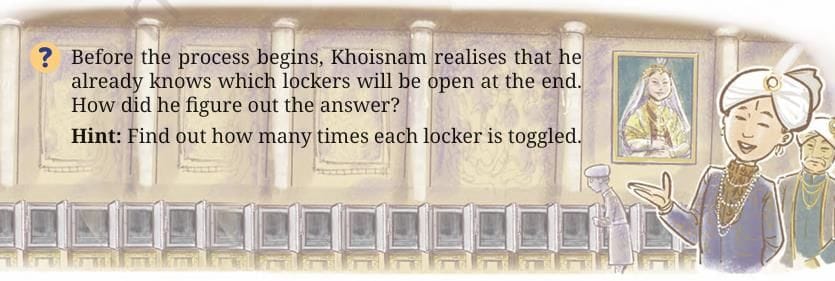
Queen Ratnamanjuri had a vast treasure of precious stones. Before passing away, she wrote a will, but instead of giving her treasure directly to her son Khoisnam (to protect him from their 99 relatives’ demands), she devised a puzzle.
Her will stated:
“If all 100 of you solve the puzzle together, you’ll share the treasure. But if one of you solves it alone, they get everything.”
Khoisnam and his 99 relatives were summoned to a secret room with 100 closed lockers, numbered 1 to 100. Each person received a unique number from 1 to 100.
The minister explained:
Each person would take turns opening or closing lockers, following a specific pattern.
What Each Person Has to Do:
Person 1 opens every locker (1, 2, 3, 4, … up to 100). So now, all lockers are open.
Person 2 goes next. They toggle every 2nd locker: That means they change locker number 2, 4, 6, 8… (If it’s open, they close it. If it’s closed, they open it.)
Person 3 toggles every 3rd locker: Lockers 3, 6, 9, 12, … (again changing open to closed and vice versa).
Person 4 toggles every 4th locker: Lockers 4, 8, 12, 16, …
This continues until Person 100, who only toggles locker number 100.
In the end, only some lockers remain open. The open lockers reveal the code to the fortune in the safe.
To understand which lockers are open in the end, we need to look at how many times each locker is toggled (opened or closed).
The Trick:
A locker will be open if it is toggled an odd number of times.
A locker will be closed if it is toggled an even number of times.
The number of times a locker is toggled is equal to the number of factors of that locker number. Example:
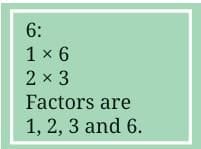
We check which people will toggle locker number 6.
Locker 6 will be toggled by:
Person 1 (since 1 is a factor of 6),
Person 2 (2 is a factor of 6),
Person 3 (3 is a factor of 6),
Person 6 (6 is a factor of 6).
So locker 6 has 4 factors: 1, 2, 3, and 6.
Therefore, locker 6 will be toggled 4 times → even number of times → it will end up closed.
Locker 6 will be toggled by:
Person 1 (since 1 is a factor of 6),
Person 2 (2 is a factor of 6),
Person 3 (3 is a factor of 6),
Person 6 (6 is a factor of 6).
So locker 6 has 4 factors: 1, 2, 3, and 6.
Therefore, locker 6 will be toggled 4 times → even number of times → it will end up closed.
Partner Factors
Every factor of a number has a partner:
For locker 6:
1 × 6 = 6 → partners: 1 and 6
2 × 3 = 6 → partners: 2 and 3
So factors come in pairs.
That’s why most numbers have an even number of factors, because they can be grouped in pairs.
But Some Lockers Stay Open! Why?
There are special numbers that have an odd number of factors. These are perfect squares like:
1 (1 × 1),
4 (2 × 2),
9 (3 × 3),
16 (4 × 4),
25 (5 × 5), and so on.
These numbers have a factor that repeats (like 3 × 3 = 9), so they don’t form full pairs — the square root is repeated.
So they have an odd number of total factors and will be toggled an odd number of times → they will stay open.
Only the lockers with numbers that are perfect squares will be open in the end.
So, lockers: 1, 4, 9, 16, 25, 36, 49, 64, 81, 100 (These are all perfect squares up to 100) → These will remain open.
All the others will be closed.
Does every number have an even number of factors?
Let’s explore a few cases:
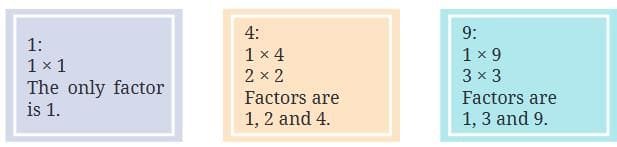
1:
Factor pair: 1 × 1
Factors: 1 (only one factor – an odd number of factors)
4:
Factor pairs:
1 × 4
2 × 2
Factors: 1, 2, 4 (3 factors – odd)
9: Factor pairs:
1 × 9
3 × 3
Factors: 1, 3, 9 (3 factors – odd)
A number will have an odd number of total factorsonly if it is a perfect square.
Why are the numbers, 1, 4, 9, 16, …, called squares?
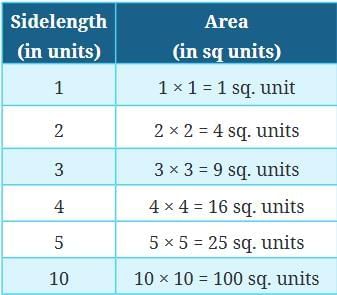
We know that the number of unit squares in a square (the area of a square) is the product of its sides.
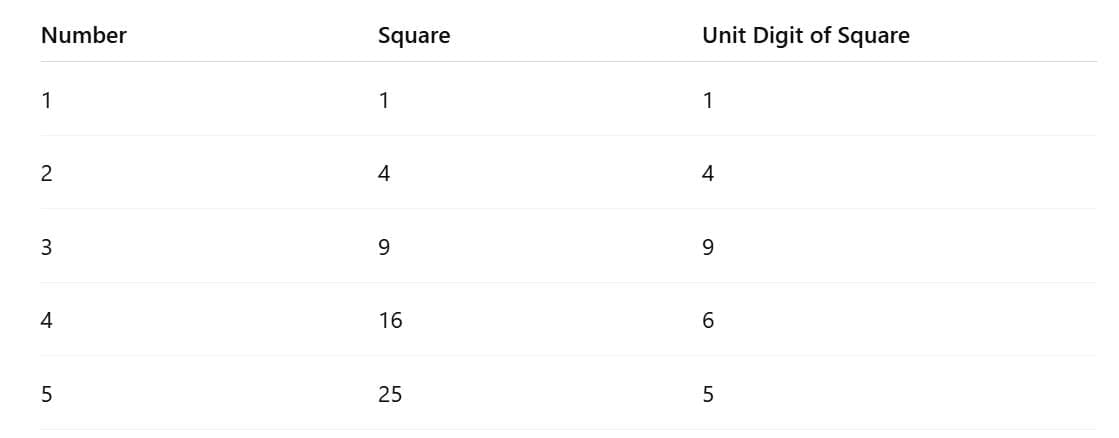
The table below gives the areas of squares with different sides.
A square number is a number that can be expressed as the product of a number with itself. For any number n, its square is written as n² (read as ‘n squared’).
Examples:
1 x 1 = 1² = 1
2 x 2 = 2² = 4
3 x 3 = 3² = 9
Can we have a square of side length or 2.5 units?
Yes, there area in square units are , and (2.5)² = (2.5) × (2.5) = 6.25.
The squares of natural numbers are called perfect squares. For example, 1, 4, 9, 16, 25, … are all perfect squares. Try yourself:What happens if one person solves the puzzle first?A.They get nothing.B.They share the treasure.C.They get everything.D.They help others.View Solution
Patterns and Properties of Perfect Squares
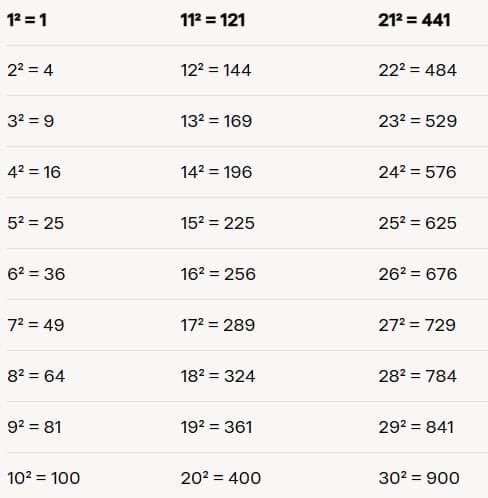
First, let’s calculate the squares of the first 30 natural numbers (natural numbers are counting numbers starting from 1).
What Patterns Can We Notice in Square Numbers?
Let’s study the unit digit (the digit in the ones place) of square numbers.
Look at these examples of perfect squares:
Observation: Units Digits That Can Appear in Squares
Square numbers can only end in these digits:
0, 1, 4, 5, 6, or 9
They never end in:
2, 3, 7, or 8
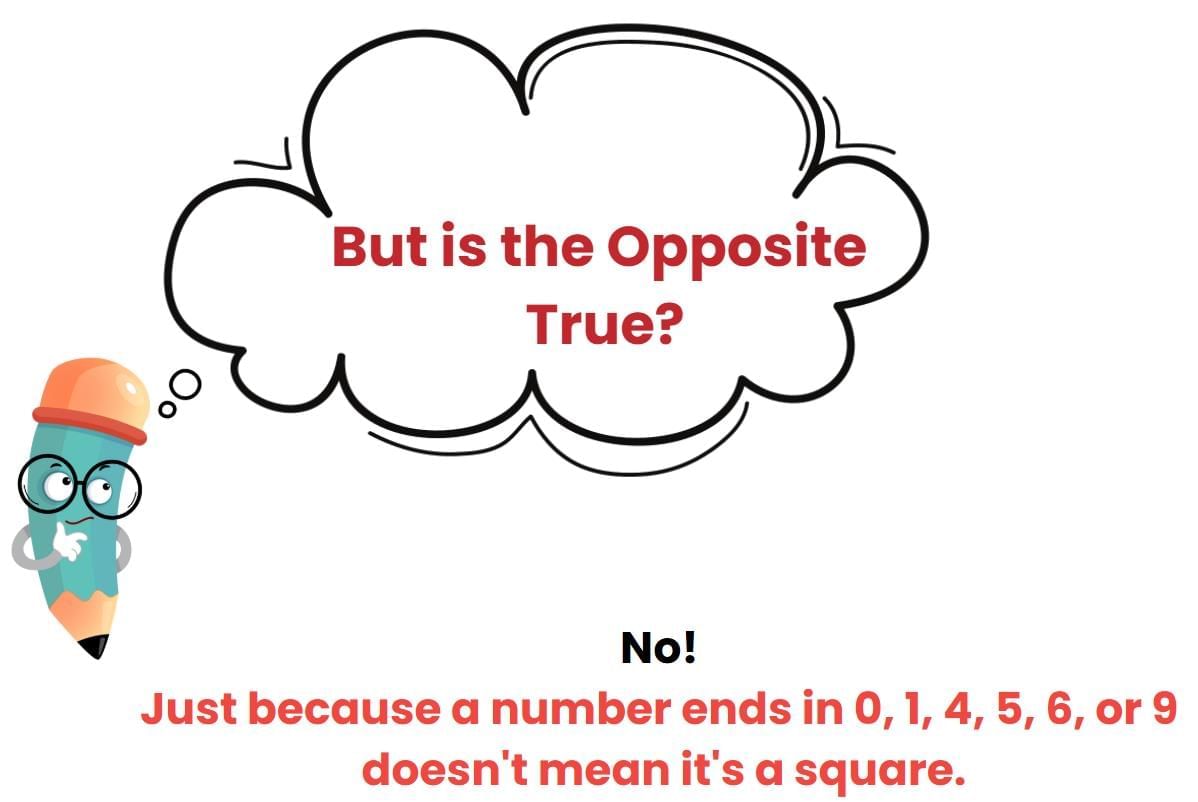
Example:
16 and 36 are square numbers that end in 6.
But 26 also ends in 6, and 26 is NOT a square.
So, unit digit can help us rule out non-squares, but it cannot confirm a square.
Write five numbers that you know are not square numbers, just by looking at their units digit:
Examples:
23 → ends in 3 → not a square
47 → ends in 7 → not a square
58 → ends in 8 → not a square
132 → ends in 2 → not a square
703 → ends in 3 → not a square
These cannot be squares because their unit digit is 2, 3, 7, or 8.
Now,
If a number ends in 2, 3, 7, or 8, it is definitely not a perfect square.
Let’s have a look:
a) Pattern with Squares Ending in 1
Let’s look at squares like:
122= 144 → ends in 4
92=81 → ends in 1
112=121 → ends in 1
192=361 → ends in 1
212=441 → ends in 1
292=841 → ends in 1
So, if a number ends in 1 or 9, its square often ends in 1.
b) Pattern with Squares Ending in 6
Examples:
42=16
62=36
142=196
162=256
242=576
262=676
So if a number ends in 4 or 6, its square can end in 6.
Number of Zeros at the End
Pattern: If a number ends with n zeros, its square ends with 2n zeros.
1 zero → 2 x 1 = 2 zeros
2 zeros → 2 x 2 = 4 zeros
Parity (Even or Odd)
Parity means whether a number is even or odd.
Even number squared:
2² = 4 (even)
4² = 16 (even)
Odd number squared:
1² = 1 (odd)
3² = 9 (odd)
So:
Even numbers have even squares.
Odd numbers have odd squares.
The square has the same parity as the number!
Perfect Squares and Odd Numbers
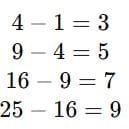
Let’s look at the differences between one square number and the next. What pattern do you observe?
Try continuing this with more square numbers. We can see that each difference is an odd number, and these odd numbers increase by 2 each time. This shows that if we keep adding consecutive odd numbers starting from 1, we get the sequence of perfect squares.
From this, we observe that perfect squares are the sum of consecutive odd numbers starting from 1.
1 = 1 = 1²
1 + 3 = 4 = 2²
1 + 3 + 5 = 9 = 3²
1 + 3 + 5 + 7 = 16 = 4²
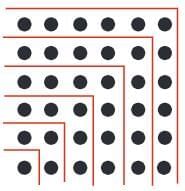
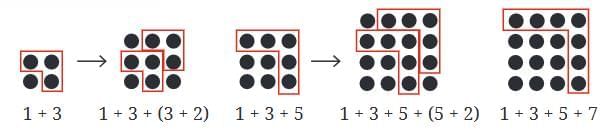
We can also see this in the figure given below, notice how when we add odd number of dots, they form a square.
The picture below explains why each subsequent inverted L gives the next odd number:
We see that the sum of the first n odd numbers is n2. Alternatively, every square is a sum of successive odd numbers starting from 1
This also means we can check if a number is a perfect square by successively subtracting odd numbers (1, 3, 5, …) from it. If we reach 0, the number is a perfect square. Consider the number 25, successively subtract 1, 3, 5, … until you get or cross over 0, 25 – 1 = 24 24 – 3 = 21 21 – 5 = 16 16 – 7 = 9 9 – 9 = 0
Q. Using the pattern above, find (36)2, given that (35)2 = 1225.
Solution: Given: 352 =1225 This means the sum of the first 35 odd numbers is 1225. Now you are asked to find: 362=? You can just add the 36th odd number to 1225.
How do we find the 36th Odd Number?
There’s a formula for the nth odd number:
nth odd number = 2n – 1
So:
36th odd number = 2 × 36 – 1
= 72 – 1 = 71
Now just add:
1225+71=1296
So, 362=1296
What if a Number is Not a Square?
Let’s say we take a number like 38 and try subtracting consecutive odd numbers from it:
This means we couldn’t reach 0, so 38 is not a perfect square.
A number is a perfect squareonly if you can subtract consecutive odd numbers from it (starting with 1), and you end up at 0.
If you don’t reach 0, it is not a perfect square.
Find how many numbers lie between two consecutive perfect squares. Do you notice a pattern?
Let’s take examples:
Between 1² = 1 and 2² = 4 → numbers are: 2 and 3 → 2 numbers
Between 2² = 4 and 3² = 9 → numbers are: 5, 6, 7, 8 → 4 numbers
Between 3² = 9 and 4² = 16 → numbers are: 10 to 15 → 6 numbers
Between 4² = 16 and 5² = 25 → numbers are: 17 to 24 → 8 numbers
Pattern: The number of values between n² and (n+1)² is always 2n. Where ‘n‘ is the number that we are squaring
How many square numbers are there between 1 and 100?
What can we say about numbers ending with 2, 3, 7, or 8?
A.They cannot be perfect squares.
B.They can be perfect squares.
C.They are always even.
D.They are always odd.
View Solution
Perfect Squares and Triangular Numbers
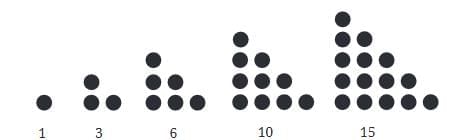
Triangular numbers are numbers that can be represented by a triangular grid of objects.
The first few triangular numbers are 1, 3, 6, 10, 15, …
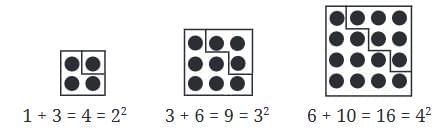
By adding two consecutive triangular numbers, we get a perfect square.
Square Roots
Imagine a square of area 49 sq. cm. What is the length of its side?
We know that 7 × 7 = 49, or 72 = 49. So, the length of the side of a square with an area of 49 sq. cm is 7 cm. We call 7 the square root of 49.
Definition: If y= x2 then x is the square root of y. The symbol of square root is: √
Determining the number whose square is already known is called finding the square root.
Example:
12= 1, √1 is 1. 22= 4, √4 is 2. 32= 9, √9 is 3.
Finding Square Roots
8×8=64, so the √64 is 8
Also, (−8)×(−8)=64 So:
√64=+8 or −8
Important: Every perfect square has two square roots — one positive and one negative. But in this chapter, we will mostly work with the positive square root only.
So: √64=8 √100=10
Given a number, such as 576 or 327, how do we find out if it is a perfect square? If it is a perfect square, how can we find its square root?
There are 4 methods to find this, lets understand each one of them.
1. List all the Square Numbers
We know that perfect squares end in digits like 1, 4, 5, 6, 9, or an even number of zeros. However, just because a number ends in one of these digits doesn’t guarantee it is a perfect square.
For example, it’s easy to tell that 327 is not a perfect square. But we can’t immediately confirm whether 576 is a square without further checking.
One way to check this is by listing perfect squares in order and checking if 576 appears among them. Since 202=400, we can calculate the squares of 21, 22, 23, and so on until we reach or exceed 576:
20² = 400 21² = 441 22² = 484 23² = 529 24² = 576
This confirms that 576 is indeed a perfect square. However, this method becomes inefficient and time-consuming when dealing with larger numbers.
2. Finding square root through repeated subtraction
Remember that any perfect square can be written as the sum of consecutive odd numbers starting from 1. Take the number 81 as an example:
We subtracted consecutive odd numbers beginning with 1 and reached 0 in the 9th step. This tells us that the √81 is 9.
3. Finding the square root through prime factorisation
We know that a perfect square is the result of multiplying a whole number by itself. But can we use a number’s prime factorization to determine if it’s a perfect square?
Yes—we can. If the prime factors of a number can be evenly divided into two identical groups, then the product of the factors in one group gives the square root of the number.
Lets understand this.
Prime factorisation means breaking a number down into the prime numbers that multiply to make it.
Prime numbers are numbers greater than 1 that cannot be divided exactly by any number other than 1 and itself. Examples: 2, 3, 5, 7, 11
Composite numbers are numbers that can be divided exactly by numbers other than 1 and itself. Examples: 6, 8, 12, 15
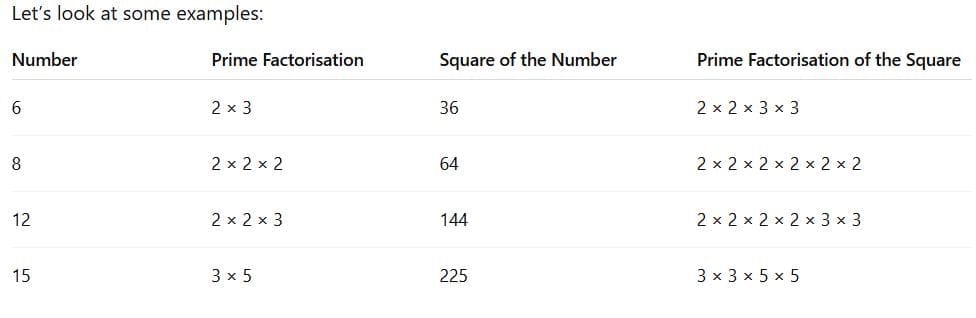
Every composite number can be written as a multiplication of only prime numbers. This is called its prime factorisation.
What do we notice?
When we square a number, each of its prime factors appears twice as many times in the square.
For example: 6 has 2 and 3 as prime factors 36 (which is 6 × 6) has two 2s and two 3s
This happens because squaring a number means multiplying it by itself:
So, 6 × 6 = (2 × 3) × (2 × 3) = 2 × 2 × 3 × 3
For example, let’s find the square root of 256:
The prime factorisation of 256 is 2 × 2 × 2 × 2 × 2 × 2 × 2 × 2.
Pairing the prime factors, we have 256 = (2 × 2 × 2 × 2) × (2 × 2 × 2 × 2) = (2 × 2 × 2 × 2)².
Therefore, the square root of 256 is 2 × 2 × 2 × 2 = 16.
Q) Is 324 a perfect square? 324 = 2 × 2 × 3 × 3 × 3 × 3. These can be grouped as 324 = (2 × 3 × 3) × (2 × 3 × 3). = (2 × 3 × 3)2 = 182.
We can also write the prime factors in pairs. That is, 324 = (2 × 2) × (3 × 3) × (3 × 3), which shows that 324 is a perfect square. Thus, 324 = (2×3×3)2 = 182. Therefore, 324 =18.
4. Estimating Square Roots
Sometimes we are given a number that is not a perfect square, like √1936, and we are asked to find its square root. How do we find the square root of such a big number? We can estimate the square root of a big number by finding two perfect squares close to it. Then, we narrow down the possible values. Let’s try to find the square root of 1936.
Step 1: Find two perfect squares between which 1936 lies.
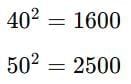
We know:
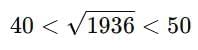
So, 1936 lies between 1600 and 2500. This means:
Step 2: Look at the last digit.
The last digit of 1936 is 6. Perfect squares that end in 6 usually come from numbers ending in 4 or 6 (since etc.) So the square root of 1936 might end in 4 or 6. That means it could be 44 or 46.
Step 3: Try one of the guesses. Let’s try 452:
Now compare 2025 with 1936: 2025 is more than 1936.
So, the square root must be less than 45. That narrows it to:
40<√1936<45
Step 4: Try 44
Let’s check 442:
Perfect! So, √1936=44
Consider the following situation — Aribam and Bijou play a game. One says a number and the other replies with its square root. Aribam starts. He says 25, and Bijou quickly responds with 5. Then Bijou says 81, and Aribam answers 9. The game goes on till Aribam says 250. Bijou is not able to answer because 250 is not a perfect square. Aribam asks Bijou if he can at least provide a number that is close to the square root of 250.
How Can Bijou Estimate √250?
Let’s think step by step:
Find two perfect squares around 250:
100=102
400=202
So we know: 100 < 250 < 400 and √100 = 10, √400 = 20
So, 10 < √250 < 20
But, we are still very far away from the number whose square is 250
Get closer:
152=225
162=256
So: 15 < √250 < 16
Which is it closer to?
250 is closer to 256 than 225.
So, √250 is approximately 16. We also know it is less than 16.
Try yourself:
What are triangular numbers represented by?
A.Square grids
B.Triangular grids
C.Rectangular grids
D.Circular grids
View Solution
Cubic Numbers
In geometry, a cube is a solid shape where all sides are equal and all angles are right angles.
Cube
Now, think of a cube with side 2 cm. How many 1 cm³ cubes fit inside it?
Volume of big cube = 2×2×2=8 cm³
Volume of small cube = 1×1×1=1 cm³
Number of small cubes = 8÷1=8
So, 2³ = 8. That’s why we call 8 a cubic number—it’s the cube of 2.
Try with 3 cm:
Volume = 3×3×3=27 cm³ → 3³ = 27
A cubic number shows how many unit cubes fit inside a cube of side n.
Definition of a cubic number: A cubic number (or perfect cube) is obtained by multiplying a number by itself three times. For any number n, its cube is written as n³.
Examples:
1 x 1 x 1 = 1³ = 1
2 x 2 x 2 = 2³ = 8
3 x 3 x 3 = 3³ = 27
These are called Cube Numbers because each of these numbers can be used to form a cube with equal-length sides using unit cubes (1 cm³ cubes)
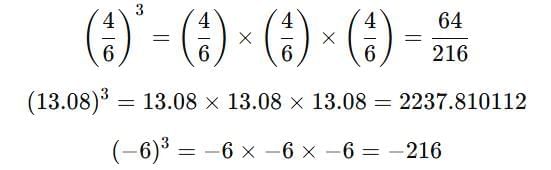
Just as we can take squares of fractions/decimals we also can compute cubes of such numbers
Taxicab Number
Once, a great mathematician named Srinivasa Ramanujan was sick and staying in a hospital in England. Another famous mathematician, G. H. Hardy, came to visit him. Hardy told Ramanujan that he came in a taxi numbered 1729. He said the number looked boring and hoped it wasn’t a bad sign.
Ramanujan replied immediately, “No, Hardy, it is a very interesting number.” He explained that 1729 is special because:
1729=13+123=93+103
This means that 1729 is the smallest number that can be written as the sum of two cube numbers in two different ways.
After this conversation, the number 1729 became famous and is now called the Hardy-Ramanujan Number.
What Is a Taxicab Number?
Numbers that can be written as the sum of two cube numbers in two different ways are called Taxicab Numbers.
For example:
1729 = 1³ + 12³ = 9³ + 10³
4104 = 2³ + 16³ = 9³ + 15³
13832 = 2³ + 24³ = 18³ + 20³
You can try checking these using a calculator.
How Did Ramanujan Know This?
Ramanujan loved numbers deeply. He would spend hours playing with and studying them. His friends often said that he could see beautiful patterns in numbers that no one else noticed.
One of his colleagues, John Littlewood, even said:
“Every positive number was one of Ramanujan’s personal friends.”
This means that numbers weren’t just symbols to Ramanujan—they felt alive and full of meaning to him.
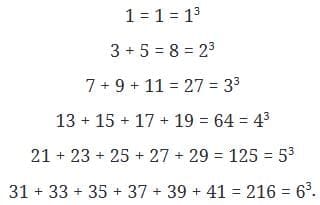
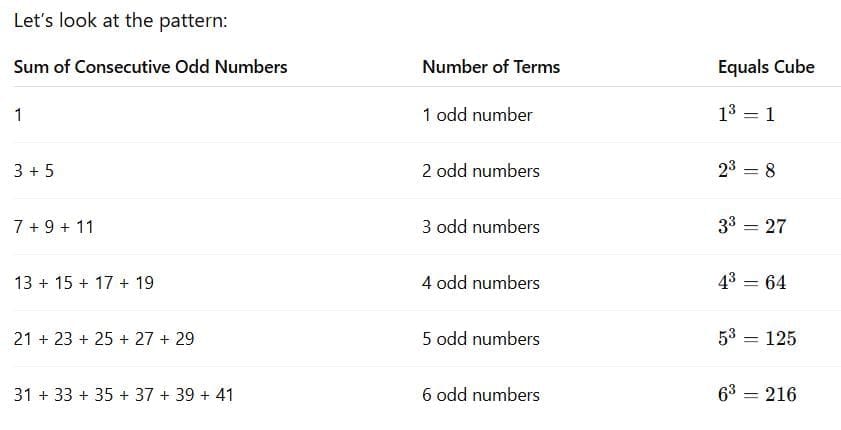
Perfect Cubes and Consecutive Odd Numbers
Perfect cubes can also be represented as the sum of consecutive odd numbers.
So, for each cube number like n3, we are adding n consecutive odd numbers.
Later in this series, we get the following set of consecutive numbers: 91 + 93 + 95 + 97 + 99 + 101 + 103 + 105 + 107 + 109.
Can you tell what this sum is without doing the calculation?
There are 10 odd numbers, so it must be the cube of 10.
91+93+95+⋯+109=103=1000
Cube Roots
We know that: This means that 2 is the cube root of 8.
We write this as: This special symbol — — is read as “cube root.”
Definition
If: Then: In simple words:
If a number y is made by multiplying x × x × x,
Then x is the cube root of y.
Finding Cube Roots
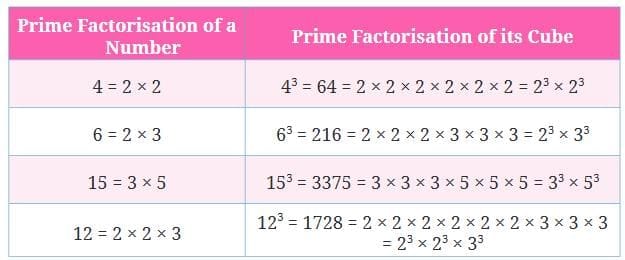
The most common method for finding the cube root of a perfect cube is prime factorization.
Example: Is 3375 a perfect cube?
Sol: Let’s break 3375 into prime factors:
3375=3×3×3×5×5×5
We can group the factors into three identical groups:
(3×5)(3×5), (3×5)(3×5), (3×5)(3×5) So, it is a perfect cube
Another Way (Grouping into Triplets):
You can also check by grouping same factors into sets of three:
3375=(3×3×3)×(5×5×5)
So, 3375 is a perfect cube and its cube root is 15.
Example : Find if 8000 is a perfect cube or not.
Sol: Prime factorization of 8000 is 2 × 2 × 2 × 2 × 2 × 2 × 5 × 5 × 5
So, = 2 × 2 × 5 = 20 So, 8000 is a perfect cube
Observe that each prime factor of a number appears three times in the prime factorisation of its cube.
Try yourself:
What do we call numbers that are the result of multiplying a number by itself three times?
A.Cubic numbers
B.Even numbers
C.Square numbers
D.Prime numbers
View Solution
Successive Differences
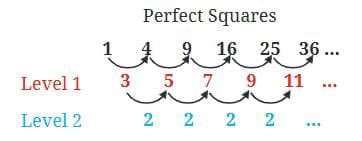
You’ve already seen how perfect squares show a pattern when we calculate successive differences.
Let’s recall:
Perfect Squares:
1, 4, 9, 16, 25, 36
So, after two levels of differences, we get a constant value. That tells us that perfect squares settle into a fixed pattern at Level 2.
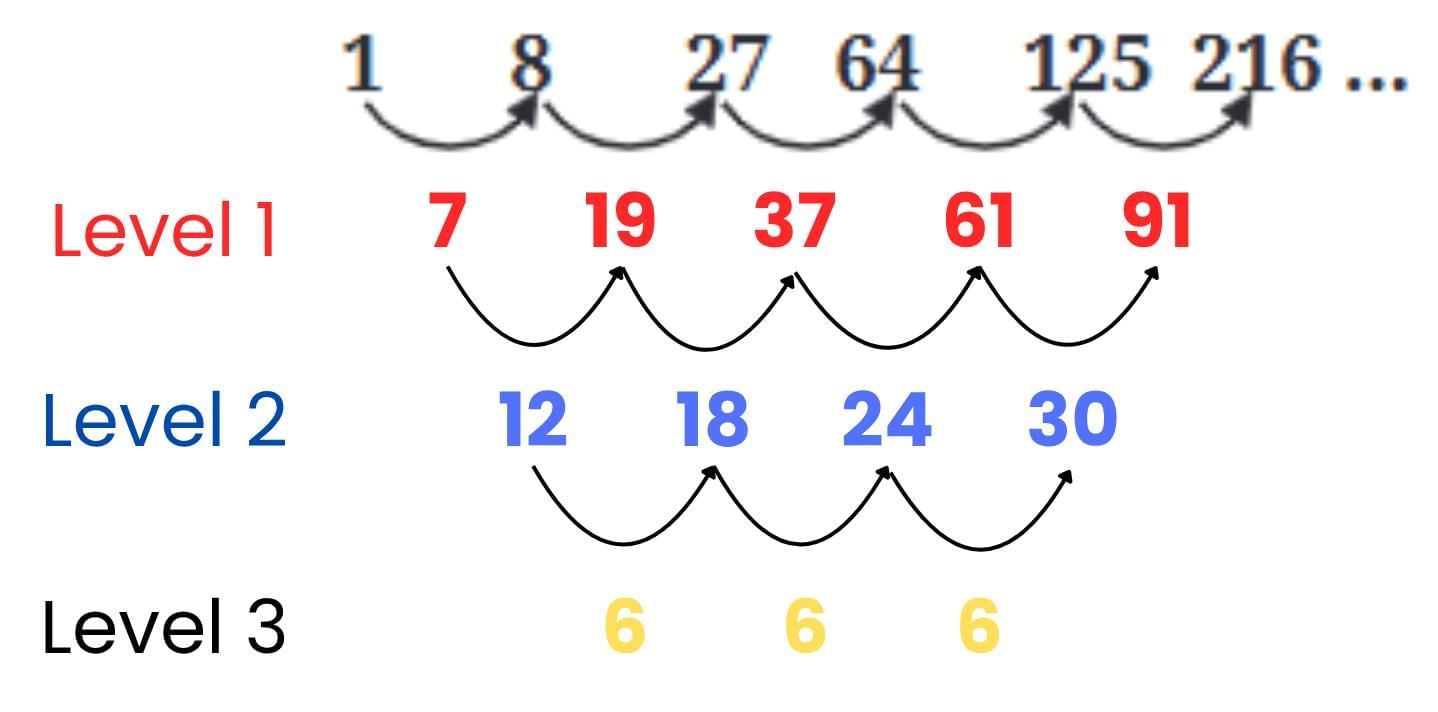
Now let’s try the same for perfect cubes.
Perfect Cubes:
1, 8, 27, 64, 125, 216
What do we observe?
The differences become constant at Level 3 for perfect cubes.
For perfect squares, it happened at Level 2.
This tells us something interesting:
The level at which the differences become constant matches the power (or exponent) of the numbers.
Perfect squares (exponent 2) settle at Level 2.
Perfect cubes (exponent 3) settle at Level 3.
A Pinch of History
Ancient Records
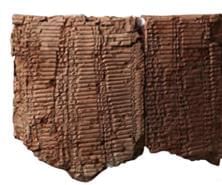
The Babylonians, around 1700 BCE, made the first known lists of perfect squares (like 1, 4, 9, 16) and perfect cubes (like 1, 8, 27, 64).
These lists were written on clay tablets.
They used them to quickly find square roots and cube roots, especially in solving problems related to land measurement, building design, and other geometric calculations.
Clay tablets used by Babylonians
Use in Ancient India
In Sanskrit (an ancient Indian language), certain words were used for these concepts:
Varga meant both a square shape and square of a number.
Ghana meant both a solid cube and the cube of a number (number multiplied by itself three times).
Varga-varga referred to the fourth power (square of a square).
These words were used in India as early as the third century BCE.
Aryabhata’s Definition (499 CE)
Aryabhata, a famous Indian mathematician, explained:
A square figure (having 4 equal sides) and the number representing its area are both called varga.
The product of two equal numbers (like 5 × 5) is also called varga.
Why the Word “Root”?
In ancient India, the Sanskrit word mula was used. It means:
Root of a plant, basis, origin, or cause.
In mathematics, varga-mula meant the square root and ghana-mula meant the cube root.
The idea was: Just as a plant grows from its root, a square grows from its square root.
This idea of “root” for mathematical operations was later used in Arabic (word: jidhr) and Latin (word: radix), both meaning “root of a plant”.
Another Word: Pada
The word pada, which means foot, base, or origin, was also used in Sanskrit.
The mathematician Brahmagupta (628 CE) said:
The pada (root) of a krti (square) is the number that was squared to get it.
Solved Examples
1. Find the square root of 196.
Solution: We use prime factorization. 196 = 2 x 98 = 2 x 2 x 49 = 2 x 2 x 7 x 7 Group the factors into pairs: (2 x 2) x (7 x 7) Take one factor from each pair and multiply: 2 x 7 = 14 Therefore, the square root of 196 is 14.
2. Is 243 a perfect square?
Solution: We find the prime factors of 243. 243 = 3 x 81 = 3 x 3 x 27 = 3 x 3 x 3 x 9 = 3 x 3 x 3 x 3 x 3 The prime factors are (3 x 3) x (3 x 3) x 3. Since the factor 3 is left over and cannot be paired, 243 is not a perfect square.
3. Find the cube root of 1728.
Solution: We use prime factorization. 1728 = 2 x 864 = 2 x 2 x 432 = 2 x 2 x 2 x 216 = 2 x 2 x 2 x 6³ = 2 x 2 x 2 x (2×3) x (2×3) x (2×3) = 2x2x2x2x2x2x3x3x3 Group the factors into triplets: (2 x 2 x 2) x (2 x 2 x 2) x (3 x 3 x 3) Take one factor from each triplet and multiply: 2 x 2 x 3 = 12 Therefore, the cube root of 1728 is 12.
4. What is the smallest number by which 392 must be multiplied to make it a perfect cube?
Solution: Find the prime factors of 392. 392 = 2 x 196 = 2 x 2 x 98 = 2 x 2 x 2 x 49 = (2 x 2 x 2) x 7 x 7 The prime factor 2 forms a triplet, but the factor 7 only appears twice. To make it a perfect cube, we need one more 7. Therefore, the smallest number to multiply by is 7.
5. Find the smallest square number that is divisible by 4, 9, and 10.
Solution: First, find the LCM (Least Common Multiple) of 4, 9, and 10. 4 = 2 x 2 9 = 3 x 3 10 = 2 x 5 LCM = 2 x 2 x 3 x 3 x 5 = 180 Now, find the prime factors of the LCM: 180 = 2 x 2 x 3 x 3 x 5. To make it a perfect square, all factors must be in pairs. The factor 5 is not in a pair. So, we need to multiply by 5. 180 x 5 = 900 Therefore, the smallest square number divisible by 4, 9, and 10 is 900.