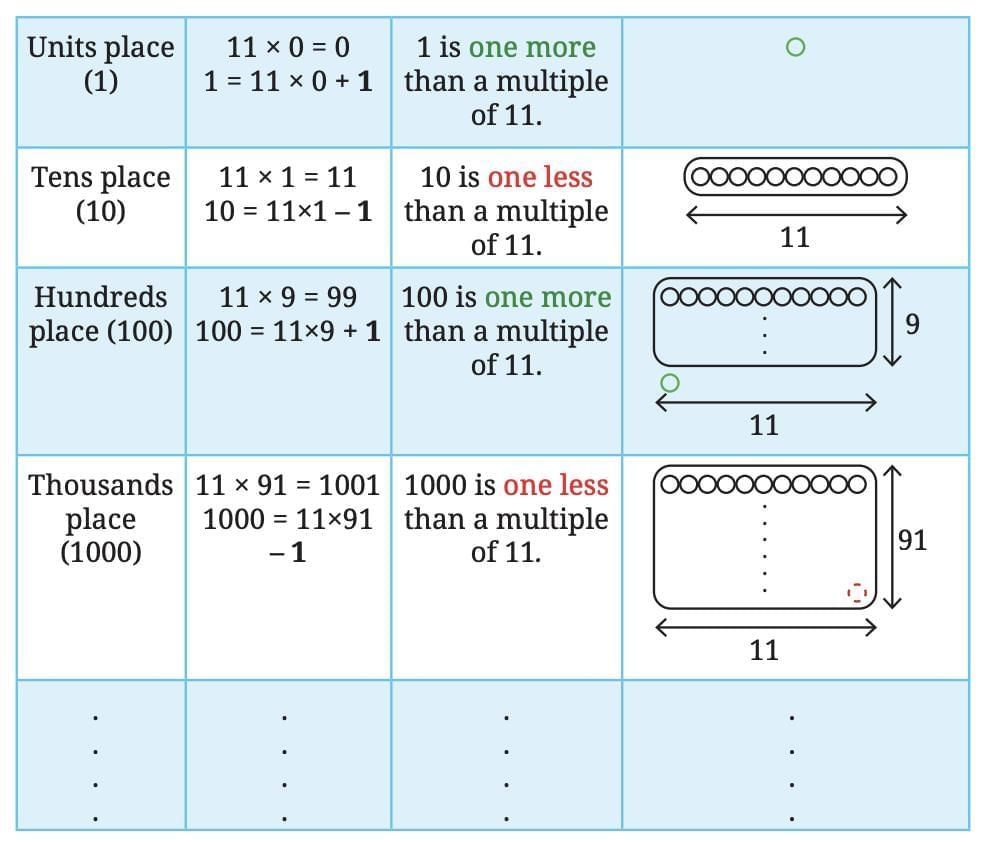
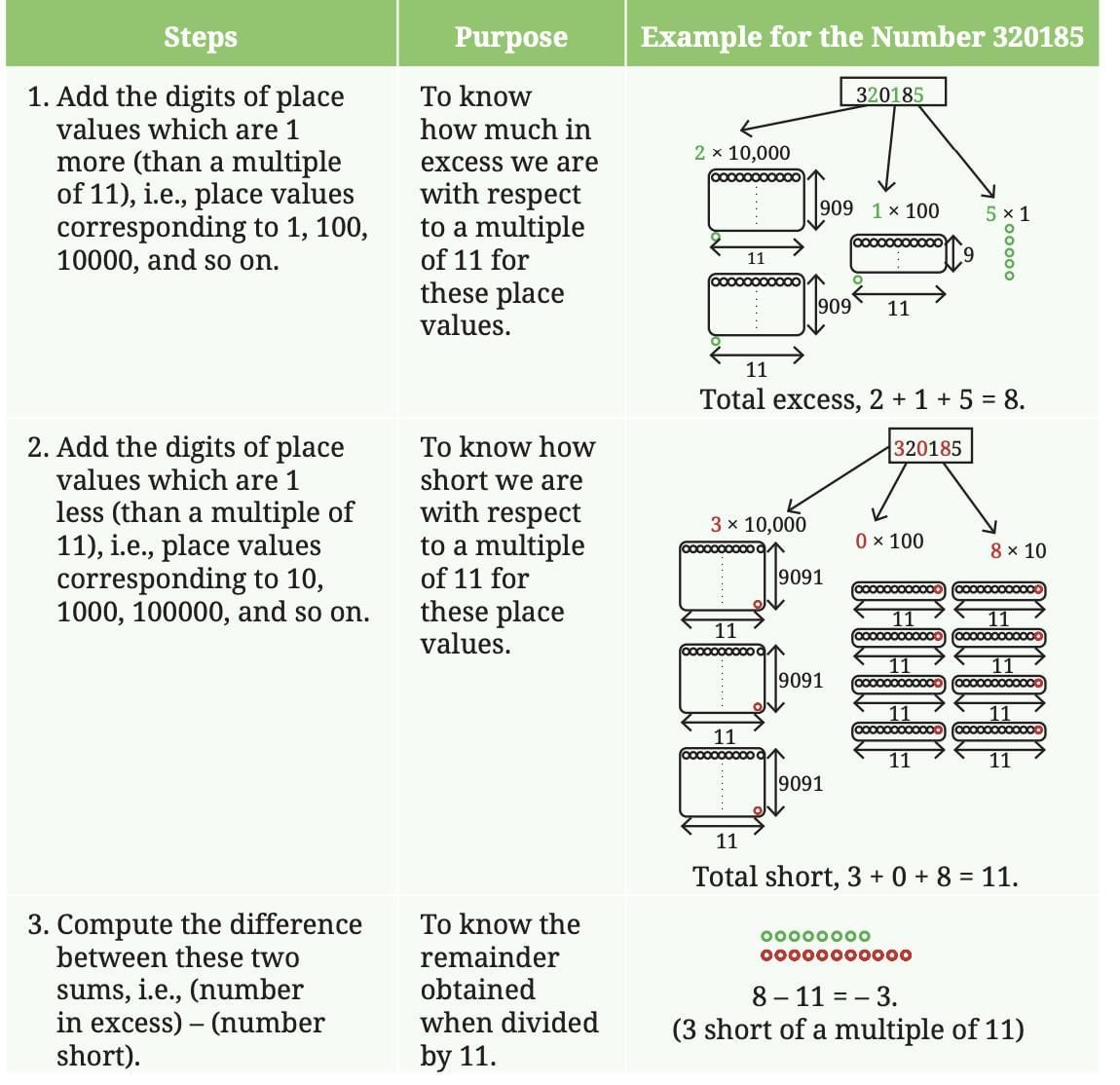
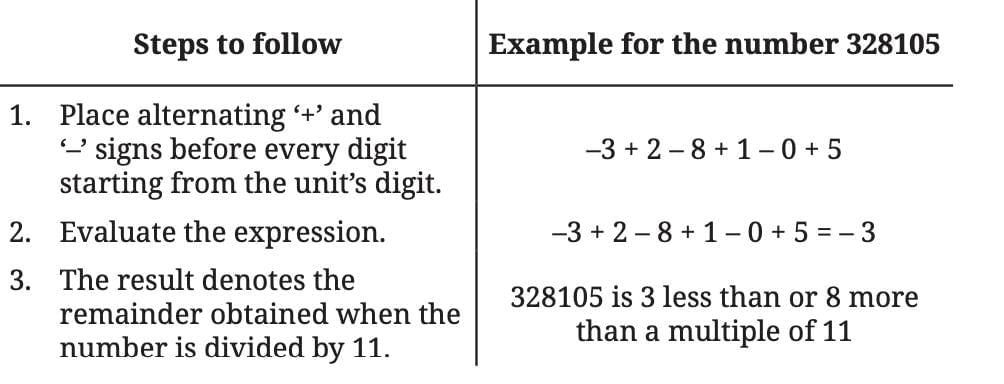
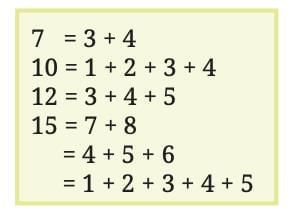
Anshu is curious about writing numbers as the sum of consecutive natural numbers. He has written thefollowing—
He begins experimenting and wonders about various patterns. His exploration leads to some key questions:
Can every natural number be written as a sum of consecutive numbers?
Which numbers can be written as sums of consecutive numbers in multiple ways?
Can all even numbers be written as a sum of consecutive numbers?
Can 0 be written as a sum of consecutive numbers, possibly using negative numbers?
Exploration:
Natural Numbers: Not all can be expressed (e.g., powers of 2 like 2, 4, 8 cannot).
Multiple Ways: Numbers like 15 have multiple representations.
Even Numbers: Some can (e.g., 12 = 3 + 4 + 5), but not all (e.g., 2).
Zero: Possible with negative numbers (e.g., -1 + 0 + 1 = 0).
Four Consecutive Numbers with + and – Signs
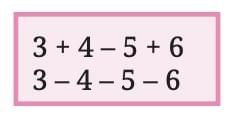
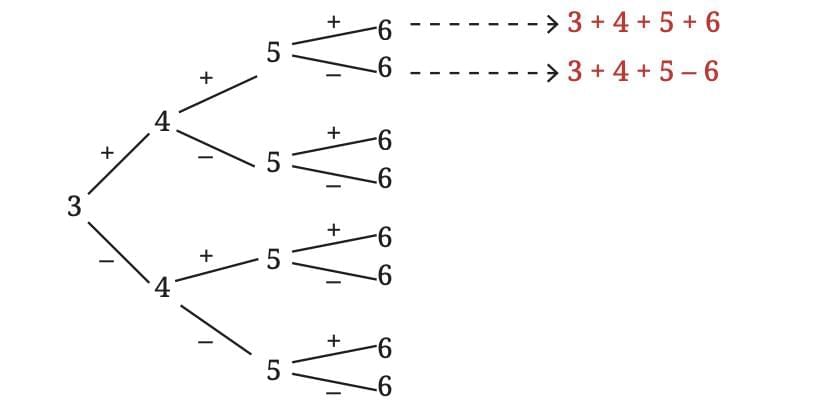
Take four consecutive numbers (e.g., 3, 4, 5, 6), place ‘+’ or ‘–’ between them, forming 8 expressions (2^3 due to three positions for signs).Eight such expressions are possible. You can use the diagram below to systematically list all the possibilities.
You can repeat the same pattern using any other set of four consecutive numbers as well.
Observation: It can be observed that certain sums always occur, regardless of which four consecutive numbers are chosen.
Hint: Use algebra and describe the 8 expressions in a general form. For any four consecutive numbers n, n+1, n+2, n+3, the eight expressions are:
n + (n+1) + (n+2) + (n+3)
n + (n+1) + (n+2) – (n+3)
n + (n+1) – (n+2) + (n+3)
n – (n+1) + (n+2) + (n+3)
n + (n+1) – (n+2) – (n+3)
n – (n+1) + (n+2) – (n+3)
n – (n+1) – (n+2) + (n+3)
n – (n+1) – (n+2) – (n+3)
All results from the evaluated expressions are even numbers, meaning they are divisible by 2.
Negative numbers that are divisible by 2, such as –2, –4, –6, and so forth, are also considered even numbers.
With any four consecutive numbers, regardless of how addition (‘+’) or subtraction (‘–’) signs are placed between them, the resulting expressions consistently produce even numbers.
Examine whether each calculated expression results in an even or odd number and identify any consistent patterns.
Experiment again with different groups of four numbers to verify if the observed pattern (e.g., all results being even) remains consistent across various sets.
Explanation1: Using Algebra – Why All 8 Expressions Have the Same Parity?
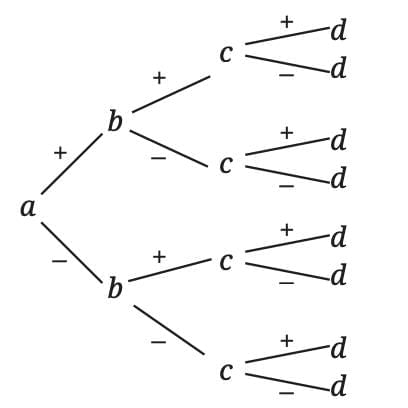
Let’s take any 4 consecutive numbers: a, b, c, and d. Now, consider one of the 8 possible expressions, like:
a + b – c – d
Now change one sign — for example, replace +b with -b. The new expression becomes:
a – b – c – d
Let’s find the difference between the original and the new expression:
(a + b – c – d) – (a – b – c – d) = a + b – c – d – a + b + c + d = 2b (which is an even number)
So, changing one sign changes the total by an even number.
Now suppose you change a negative sign to a positive sign instead. For example, if you change -c to +c, the result again changes by an even number — specifically, 2c.
Conclusion:
Every time you change a sign in any of the 8 expressions, the value changes by an even number. This means all 8 expressions will either all be even or all be odd — they will always have the same parity.
Explanation 2: Using Rules of Odd and Even Numbers
We know some basic rules:
Odd ± Odd = Even
Even ± Even = Even
Odd ± Even = Odd
Now, let’s understand the parity (whether the result is odd or even) of expressions like:
a + b and a – b
You might have noticed that both of these will always have the same parity, no matter if a and b are odd or even.
So we can say: a ± b always has the same parity.
Let’s build on that.
Now try: a ± b + c and a ± b – c — even these will have the same parity.
If we keep extending this pattern, we can confidently say that:
All expressions of the form a ± b ± c ± d will have the same parity.
Conclusion:
No matter how you place the plus and minus signs among four numbers, the final result will always be either all odd or all even — but never a mix.
Explanation 3: Using the Positive and Negative Token Model
You can also understand this using the positive and negative token model you learned in the Integers chapter.
Think of each ‘+’ sign as adding a positive token and each ‘–’ sign as adding a negative token. The overall result depends on how these tokens combine.
Even though there are infinite ways to choose four numbers (a, b, c, d) and mix them with ‘+’ and ‘–’ signs, mathematical reasoning helps us avoid checking each one manually.
It proves that no matter how you place the signs, all expressions of the form a ± b ± c ± d will always have the same parity (either all odd or all even).
So, the parity stays constant, even if the numbers and signs change.
Breaking Even
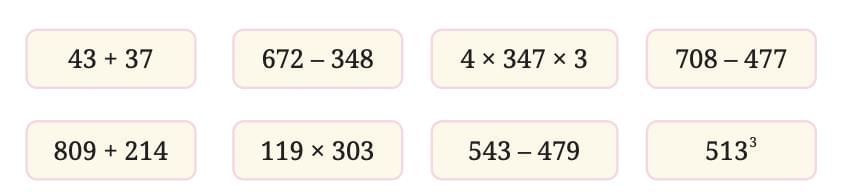
Using our understanding of even numbers, we can determine which of the following arithmetic expressions result in even numbers—without actually calculating them.
We’ll use the parity rules:
Even ± Even = Even
Odd ± Odd = Even
Even × Any Number = Even
Odd ± Even = Odd
Odd × Odd = Odd
For example,
We can find which of these are even, without calculating using parity:
Expressions:
43 + 37 → Odd + Odd = Even
672 – 348 → Even – Even = Even
4 × 347 × 3 → 4 is even ⇒ Even × Anything = Even
708 – 477 → Even – Odd = Odd
809 + 214 → Odd + Even = Odd
119 × 303 → Odd × Odd = Odd
5133 → Odd exponent = Odd
Let’s explore another example to see how the pattern holds.
Based on our understanding of how even and odd numbers behave during operations, let’s examine which of the following algebraic expressions always result in an even number for any integer values used.
2a + 2b
Always even, because both terms are multiples of 2.
Example: a = 3, b = –4 → 2(3) + 2(–4) = 6 – 8 = –2 (even)
3g + 5h
Can be odd or even depending on values of g and h.
Example: g = 1, h = 1 → 3 + 5 = 8 (even)
g = 2, h = 1 → 6 + 5 = 11 (odd)
Not always even.
4m + 2n
Always even, both terms are even.
Example: m = 2, n = 3 → 8 + 6 = 14 (even)
2u – 4v
Always even, as both terms are even.
Example: u = 1, v = 1 → 2 – 4 = –2 (even)
13k – 5k = 8k
8k is always even for any integer k.
Example: k = 2 → 8 × 2 = 16 (even)
6m – 3n
Not always even. 6m is even, 3n is odd if n is odd.
Example: m = 2, n = 1 → 12 – 3 = 9 (odd)
Not guaranteed to be even.
b²
Square of even number → even
Square of odd number → odd
So, not always even.
Example: b = 2 → 4 (even), b = 3 → 9 (odd)
x + 1
Depends on x
x even → x + 1 = odd
x odd → x + 1 = even
So, not always even.
4k × 3j = 12kj
Always even, as 12 is even.
Example: k = 1, j = 1 → 12 (even)
Expression 1: 4m + 2q This expression will always result in an even number for any integer values of m and q. Here’s why:
Reason 1: Both 4m and 2q are always even for any integers m and q, because multiplying any number by an even number results in an even product. Their sum, therefore, is also even.
Reason 2: The expression can be rewritten as 2(2m + q), which clearly shows that 2 is a factor. So, the whole expression is divisible by 2 and thus always even.
Assuming value of m and q If m = 4 and q = -9 4 × 4 + 2 × (-9) = 16 – 18 = -2 (Even)
Expression 2: x² + 2
x² is even if x is even, and odd if x is odd.
So, x² + 2 will be:
Even when x is even
Odd when x is odd
This means the expression does not always result in an even number.
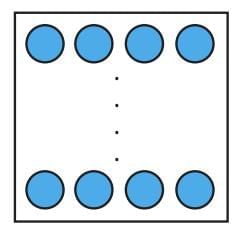
Even numbers that are multiples of 4 (remainder 0 when ÷ 4).
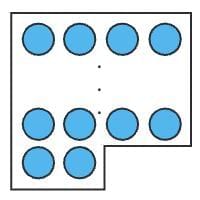
Even numbers that are not multiples of 4 (remainder 2 when ÷ 4).
Cases:
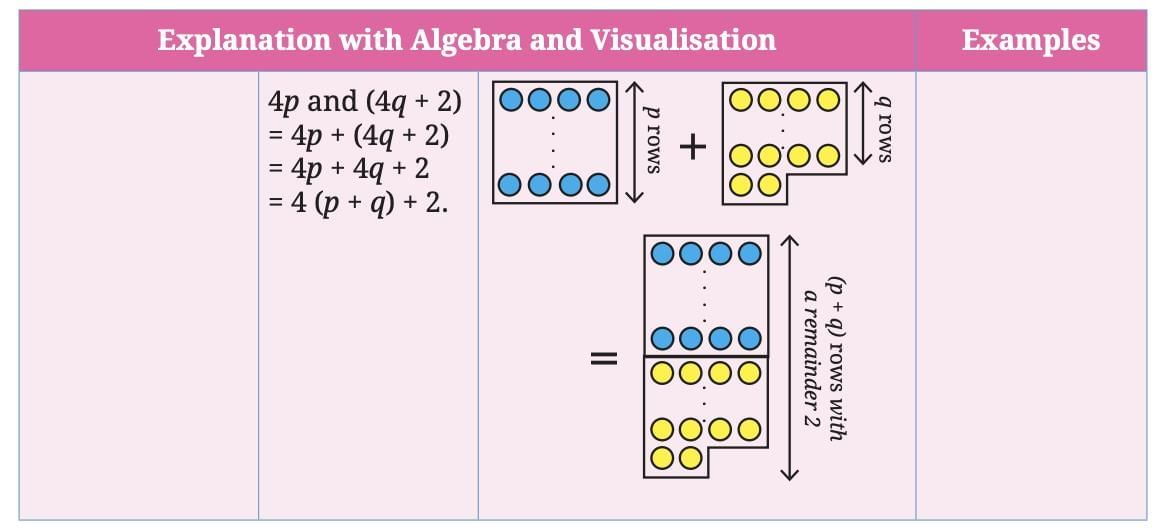
The table explains what happens when different types of even numbers are added together, focusing on their relationship with multiples of 4 using algebra and block visualisations for clarity.
General Rule: Sum is divisible by 4 if both numbers are multiples of 4 or both are not; otherwise, remainder 2.
Always, Sometimes, or Never
Statements:
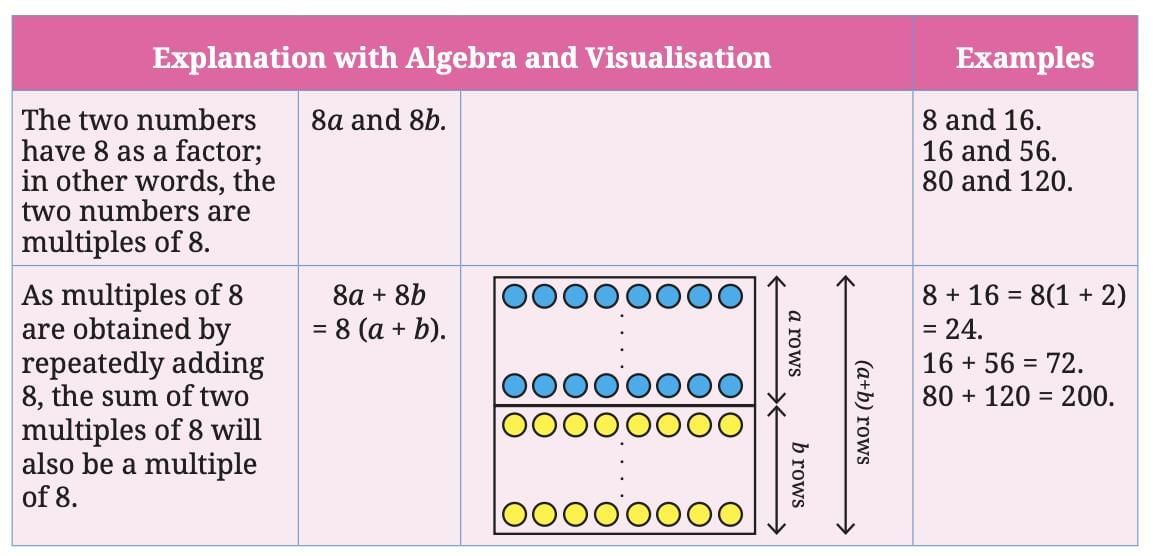
1. (a) If 8 exactly divides two numbers separately, it must exactly divide their sum.
Let’s say the two numbers are:
8a and 8b (since 8 divides them, they are multiples of 8)
Now, add them: 8a + 8b = 8(a + b)
Since (a + b) is a whole number, the result is clearly a multiple of 8. So, their sum is also divisible by 8.
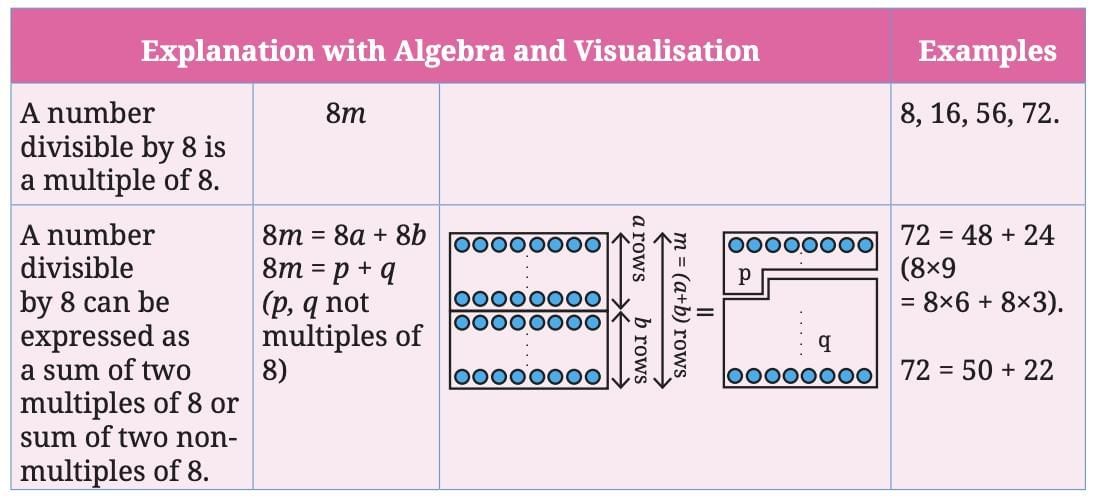
2. If a number is divisible by 8, then 8 also divides any two numbers(separately) that add up to the number.
Case 1: When It Is Always True
If 8 exactly divides two numbers separately, it will also divide their sum.
This is always true.
Adding two multiples of 8 will always give another multiple of 8.
Example:
16 and 24 are both divisible by 8
16 + 24 = 40, and 40 is also divisible by 8
Reason: Multiples of 8 stay multiples when you add them together.
Case 2: When It Is Not Always True
If a number is divisible by 8, can we say that the numbers used to make it are also divisible by 8?
Not always true
Just because a total is divisible by 8 doesn’t mean each part is
Example:
30 + 10 = 40 → 40 is divisible by 8
But 30 and 10 are not divisible by 8
Reason: The rule doesn’t work in reverse — the parts may not be divisible by 8 even if the whole is.
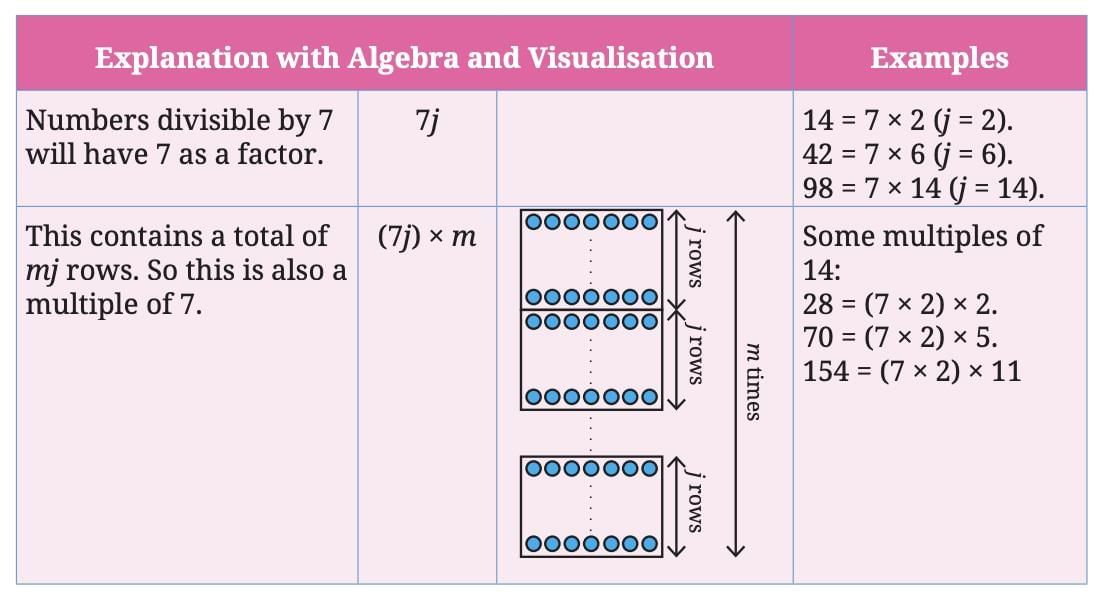
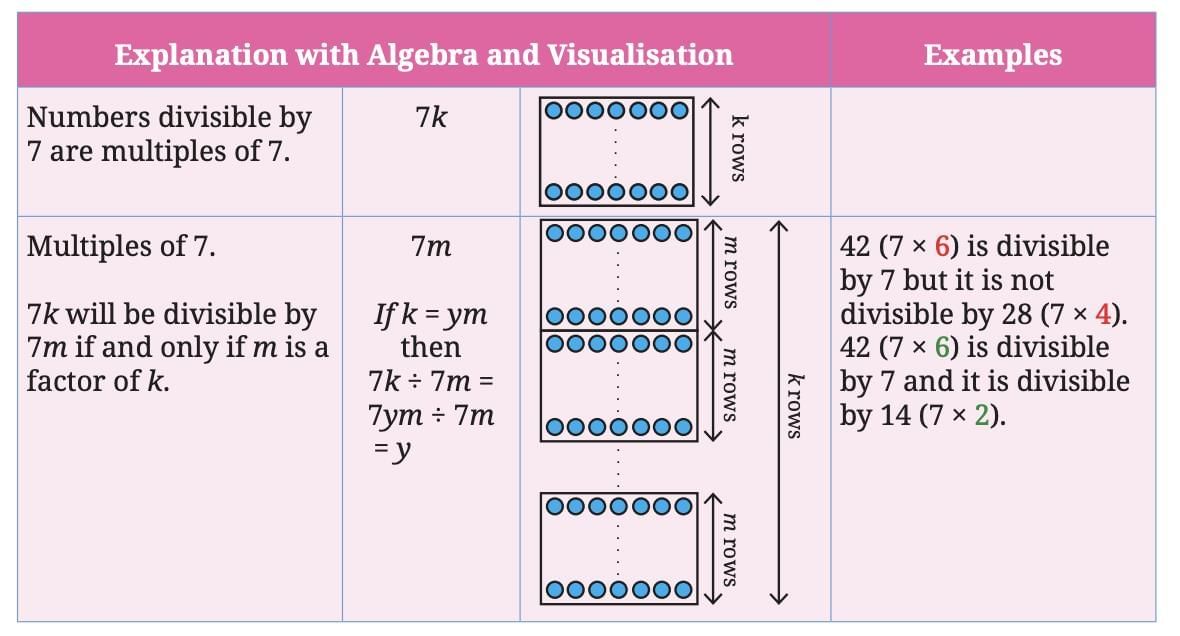
3. If a number is divisible by 7, then all multiples of that number will be divisible by 7.
Explanation: This is always true. If a number is divisible by 7, multiplying it by any whole number will still keep 7 as a factor.
Example:
14 is divisible by 7
14 × 2 = 28 → 28 is also divisible by 7
14 × 5 = 70 → 70 is also divisible by 7
Reason: Multiplying a multiple of 7 keeps the factor 7 in the result.
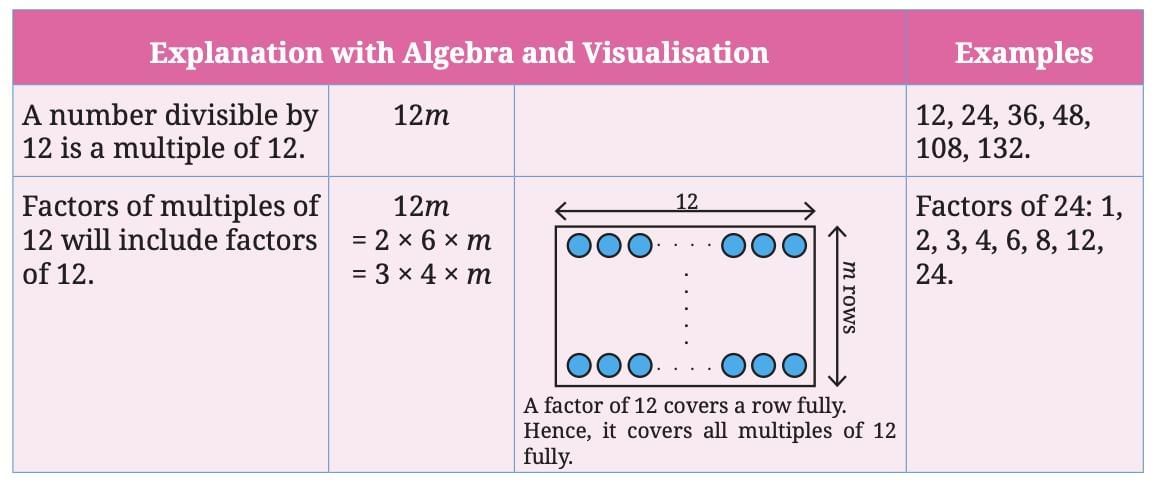
4. If a number is divisible by 12, then the number is also divisible by all the factors of 12.
Explanation: This is always true. A number divisible by 12 must also be divisible by 1, 2, 3, 4, and 6 — because these are the factors of 12.
Example: 60 is divisible by 12
So, 60 ÷ 2 = 30
60 ÷ 3 = 20
60 ÷ 4 = 15
60 ÷ 6 = 10
→ Hence, 60 is divisible by all the factors of 12
5. If a number is divisible by 7, then all multiples of that number will be divisible by 7.
Explanation:
Let’s say a number is divisible by 7. This means it can be written as 7 × k.
Now, consider another number which is a multiple of 7, say 7 × m.
The original number will be divisible by this new multiple only if m divides k.
Example where it is not true:
42 is divisible by 7 → (7 × 6)
Is 42 divisible by 28? (28 = 7 × 4) → 6 is not divisible by 4 → So, 42 is not divisible by 28
Example where it is true:
42 = 7 × 6
14 = 7 × 2 → 6 is divisible by 2 → So, 42 is divisible by 14
6. If a number is divisible by both 9 and 4, it must be divisible by 36. Explanation:
Always true
The LCM (Least Common Multiple) of 9 and 4 is 36.
So, if a number is divisible by both 9 and 4, it is also divisible by their LCM, which is 36.
7. If a number is divisible by both 6 and 4, it must be divisible by 24. Explanation:
Always true
The LCM of 6 and 4 is 24.
A number divisible by both 6 and 4 will always be divisible by 24.
8. When you add an odd number to an even number, we get a multiple of 6.
Explanation:
Never true
An odd number + an even number = odd number
But all multiples of 6 are even, so the sum cannot be a multiple of 6.
Therefore, this is never true.
Example: 3 (odd) + 4 (even) = 7 → not a multiple of 6.
Let’s also look at this algebraically:
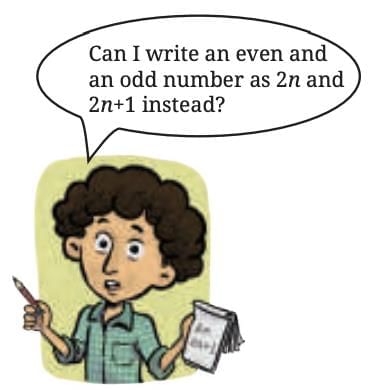
Let even number = 2n
Let odd number = 2m + 1
Their sum = 2n + (2m + 1) = 2(n + m) + 1 → which is odd
Now, a multiple of 6 looks like 6j (where j is any whole number) Suppose 2(n + m) + 1 = 6j Then: 2(n + m) = 6j – 1 → left side is even, right side is odd → not possible.
So again, this confirms the statement is never true.
What Remains?
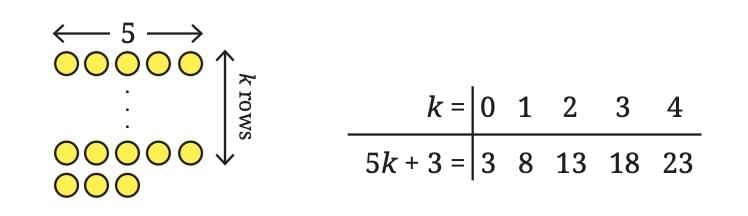
We are looking for numbers that give a remainder of 3 when divided by 5.
Example: Try dividing the numbers below by 5:
3 ÷ 5 → remainder 3
8 ÷ 5 → remainder 3
13 ÷ 5 → remainder 3
18 ÷ 5 → remainder 3
23 ÷ 5 → remainder 3
These numbers form the list: 3, 8, 13, 18, 23, …
All these numbers are 3 more than multiples of 5. So, if we take multiples of 5 (like 0, 5, 10, 15, 20…), and add 3, we get our required numbers.
Thus, the general form of such numbers is:
5k + 3, where k is a whole number (k = 0, 1, 2, 3, …)
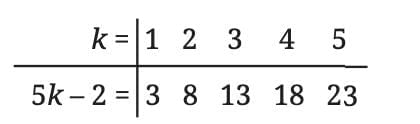
Another form: 5k – 2
Let’s test 5k – 2 for k = 1, 2, 3…:
k = 1 → 5(1) – 2 = 3
k = 2 → 10 – 2 = 8
k = 3 → 15 – 2 = 13
k = 4 → 20 – 2 = 18
k = 5 → 25 – 2 = 23
These are the same numbers as before! So, 5k – 2 (for k ≥ 1) also works.
Checking Divisibility QuicklyDivisibility Rules
General Form of a Number:
Let a number be written like this: … + 1000d + 100c + 10b + a, where:
a = units digit
b = tens digit
c = hundreds digit
d = thousands digit
and so on…
Divisibility by 10
Any number can be written in expanded form using place values.
For example: A 5-digit number edcba means: 10000e + 1000d + 100c + 10b + a
Here, every term except a (units digit) is a multiple of 10.
So, the number will be divisible by 10 only if the units digit a is 0.
Divisibility by 5
Again, in any number written as: … + 1000d + 100c + 10b + a
Only the units digit matters for divisibility by 5.
A number is divisible by 5 only if a is 0 or 5, because all other parts are divisible by 5 already.
Divisibility by 2
All the terms except the unit digit are even (since they are multiples of 10, 100, etc.).
So, a number is divisible by 2 only if a is even (i.e., 0, 2, 4, 6, or 8).
Divisibility by 4
Let’s look at the last two digits of the number: 10b + a.
This is because all the other digits form multiples of 100, which are already divisible by 4.
So, a number is divisible by 4 if the number formed by its last two digits is divisible by 4.
Divisibility by 8
Now, we look at the last three digits: 100c + 10b + a.
This is because all the other digits are multiples of 1000, which are divisible by 8.
So, a number is divisible by 8 if the number formed by the last three digits is divisible by 8.
Divisibility by 9
A number is divisible by 9 if the sum of its digits is divisible by 9.
Example: Let’s take a number made only of 9s and 0s, like 99009.
Each term is either a multiple of 9 or 0. So any number made only of 9s and 0s is divisible by 9.
Important Concept: Remainders with 9
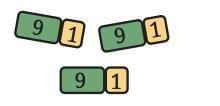
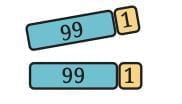
Is 10 divisible by 9? → No, remainder is 1 (since 10 = 9 × 1 + 1)For other multiples of 10
20 ÷ 9 → remainder 2
30 ÷ 9 → remainder 3
and so on…
So, any multiple of 10 leaves a remainder equal to its tens digit when divided by 9.
Similarly, for multiples of 100:
100 ÷ 9 → remainder 1
200 ÷ 9 → remainder 2
300 ÷ 9 → remainder 3 → So the remainder is the same as the number of hundreds.
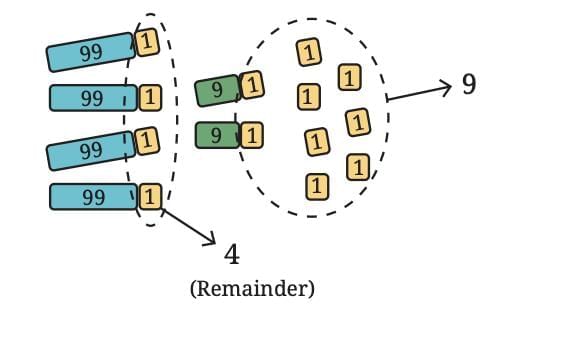
Example: Using the above observation, find the remainder when 427 is divided by 9.
Answer: Break 427 into parts: 427 = 400 + 20 + 7
Now take the remainders:
400 → remainder 4
20 → remainder 2
7 → remainder 7
Now add: 4 + 2 + 7 = 13
But 13 is not yet the remainder. Do the same again: 1 + 3 = 4
So, remainder = 4
Will this work with bigger numbers?
Let’s understand a very interesting property of the number 9 and how it helps in divisibility.
We know:
1 = 0 + 1
10 = 9 + 1
100 = 99 + 1
1000 = 999 + 1
10000 = 9999 + 1 …and so on.
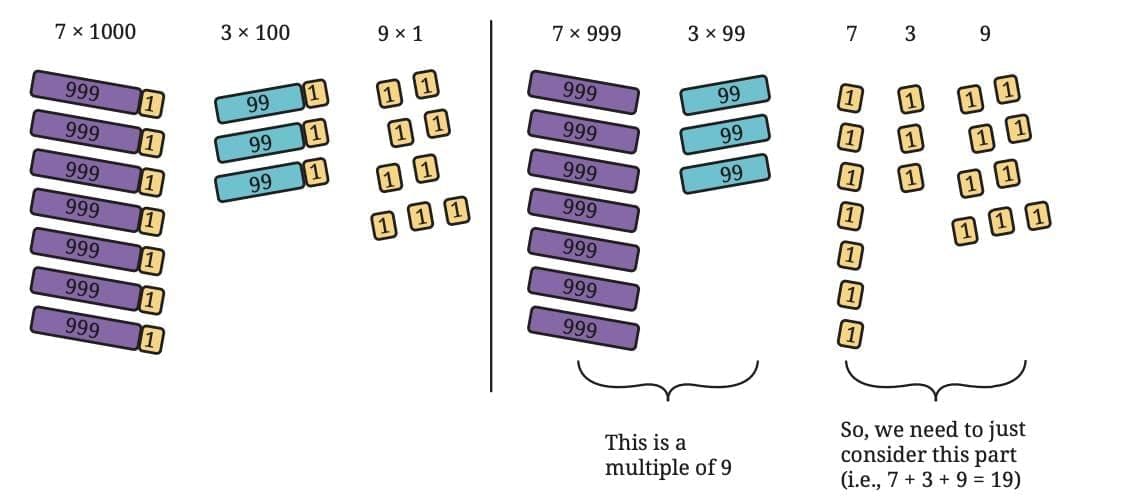
This means that any power of 10 is just 1 more than a multiple of 9. So, each digit in a number shows its effect on the remainder when the number is divided by 9.
Example: 7309
Write it in its expanded form: 7309 = 7 × 1000 + 3 × 100 + 0 × 10 + 9 × 1


 Even numbers that are multiples of 4 (remainder 0 when ÷ 4).
 Even numbers that are not multiples of 4 (remainder 2 when ÷ 4).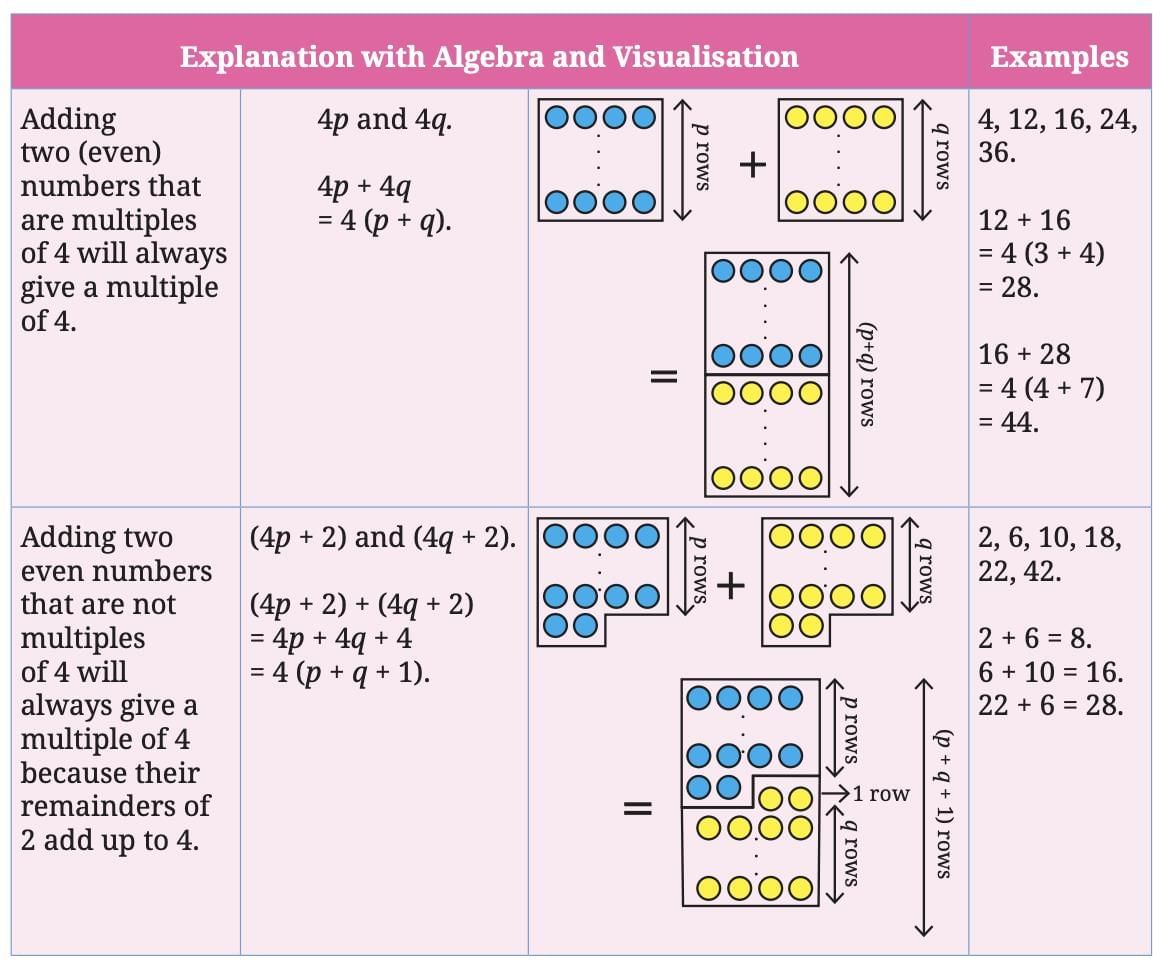
 k = 5 → 25 – 2 = 23