Introduction
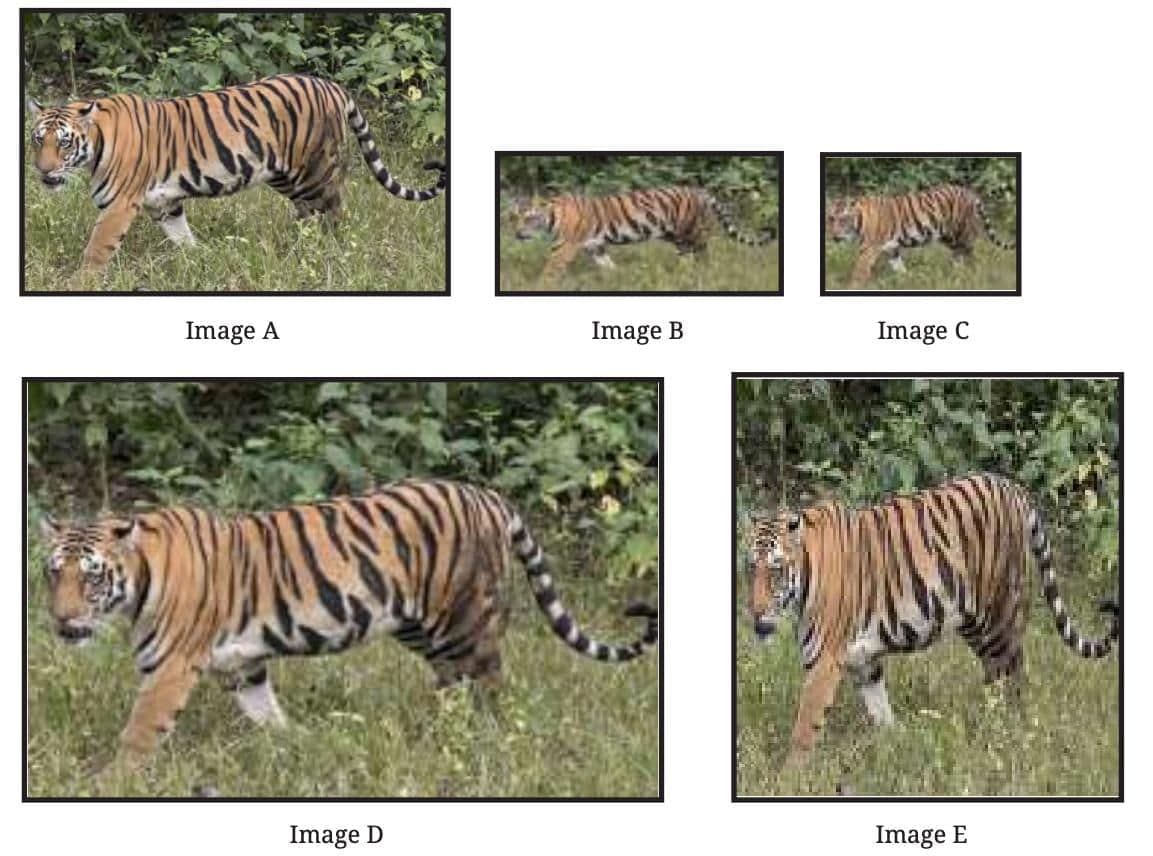
You’re making a birthday card and adding a cute photo of a tiger. You try resizing it on your computer. But something strange happens…In some cases, the tiger still looks perfectly fine – just bigger or smaller. However, in others, it appears stretched or squished. What’s going on? Let’s find out using 5 tiger images: A, B, C, D, and E.
What We Observed
- Images A, C, and D look similar to each other.
But B and E look a bit odd: - B is stretched (elongated).
- E is squished (fatter).
So what’s the secret behind the ones that look similar?
What We Discovered
- A → C: Width and height both become half → Looks similar
- A → D: Width and height both become 1.5 times → Looks similar
- A → B: Width decreases by 20 mm, and height also by 20 mm. But this is subtraction, not multiplication → Looks different
- E is a square, while A is a rectangle → Shape changes → Looks different
When both width and height change by the same multiplication factor, the image looks similar. This is called a Proportional Change.
- Proportional change = shape stays the same
- Non-proportional change = shape looks distorted
Ratios
We saw earlier that images A, C, and D looked similar because their width and height changed in the same way. Now, let us use ratios to understand this better.
A Ratio :
- compares two quantities using the form a:b.
- represents such proportional relationships in mathematics.
Examples of Ratios
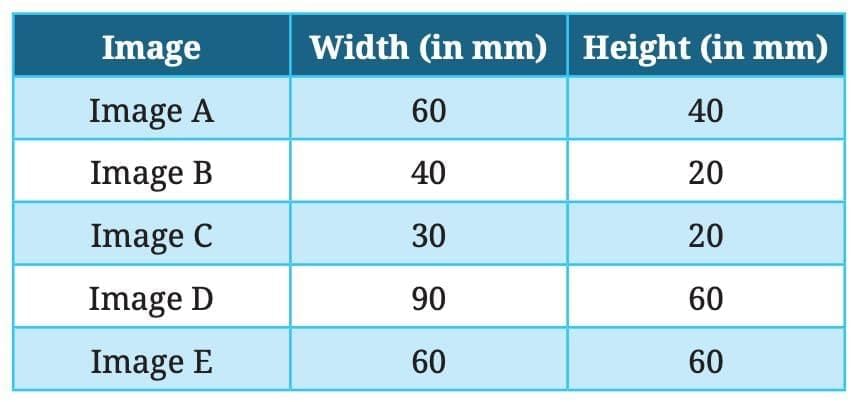
- Image A: Width to height ratio is 60 : 40.
- Image C: Width to height ratio is 30 : 20.
- Image D: Width to height ratio is 90 : 60.
Proportional Ratios
Ratios are proportional if the terms of the ratios change by the same multiplying factor.
Example: To check if the ratios of Image A (60 : 40) and Image C (30 : 20) are proportional:
- Multiply both terms of 60 : 40 by ½:
- 60 × ½ = 30
- 40 × ½ = 20
- Result: 30 : 20, which matches the ratio of Image C.
This shows that the ratios 60 : 40 and 30 : 20 are proportional because they are related by the same factor (½).
Finding the Multiplying FactorTo find the factor that transforms the ratio of Image A (60 : 40) to Image D (90 : 60):
Divide the corresponding terms of Image D by Image A:
- For the first term: 90 ÷ 60 = 1.5
- For the second term: 60 ÷ 40 = 1.5
- Since both terms are multiplied by the same factor (1.5), the ratios are proportional.
- So, multiply both terms of 60 : 40 by 1.5:
- 60 × 1.5 = 90
- 40 × 1.5 = 60
- Result: 90 : 60, which matches the ratio of Image D.
Ratios in their Simplest Form
To reduce a ratio to its simplest form, divide both terms by their Highest Common Factor (HCF).
Following our previous example:
For Image A, the ratio of width to height is 60 : 40.
- HCF of 60 and 40 is 20.
- Divide both terms by 20: 60 ÷ 20 = 3, 40 ÷ 20 = 2.
- Simplest form: 3 : 2.
For Image D, the ratio is 90 : 60.
- HCF of 90 and 60 is 30.
- Divide both terms by 30: 90 ÷ 30 = 3, 60 ÷ 30 = 2.
- Simplest form: 3 : 2.
Since the simplest forms of the ratios for Images A and D are both 3 : 2, they are proportional.
For Image B, the ratio is 40 : 20.
- HCF of 40 and 20 is 20.
- Divide both terms by 20: 40 ÷ 20 = 2, 20 ÷ 20 = 1.
- Simplest form: 2 : 1.
For Image E, the ratio is 60 : 60.
- HCF of 60 and 60 is 60.
- Divide both terms by 60: 60 ÷ 60 = 1, 60 ÷ 60 = 1.
- Simplest form: 1 : 1.
The simplest forms of the ratios for Images B (2 : 1) and E (1 : 1) are not the same as 3 : 2 (Images A, C, and D). Therefore, the ratios of Images B and E are not proportional to those of Images A, C, and D.
When two ratios are the same in their simplest forms, they are said to be in proportion or proportional.
The :: symbol is used to indicate that two ratios are proportional. For example, a : b :: c : d means the ratios a : b and c : d are proportional.
For Images A, C, and D:
- 60 : 40 :: 30 : 20 (both simplify to 3 : 2).
- 60 : 40 :: 90 : 60 (both simplify to 3 : 2).
Let us solve an example
Nitin and Hari were building a compound wall around their house.
- Nitin built the longer side of the wall: 60 ft
He used 3 bags of cement - Hari built the shorter side of the wall: 40 ft
She used 2 bags of cement
Nitin started to worry:
We’ll compare the ratio of wall length to cement bags used. “I used more cement. Did Hari use too little? Will her wall be weak?”
Let’s find out using ratios!
What Do We Notice?
- Both have the same ratio in simplest form: 20 : 1.
- This means: for every 20 feet of wall, they used 1 bag of cement.
- So, the cement per foot of wall is the same for both!
Since the ratios are proportional, the amount of cement per foot is equal. Nitin should not worry — both walls are equally strong!
Trairasika – The Rule of Three
Let us understand this using an example:
In our rainy-day school lunch example:
- Normal day: 120 students → 15 kg rice
- Rainy day: 80 students → ? kg rice
We compared two ratios:
120:15::80:?
Using proportional reasoning:
- The number of students changed by a factor of 80120=23
- So, rice needed = 15×23 =10 kg
This is called the Rule of Three or Trairasika — when three values are known and we find the fourth that keeps the proportion.
The Algebra Behind It
Let’s say:
a:b::c:d
This means:
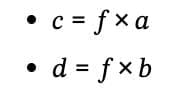
So, both quantities are changed by the same factor f.
Deriving the Rule
From:
ca=db
Multiply both sides by abab:
ab×ca=ab×db⇒bc
This is called cross multiplication.
Rule of Three Formula
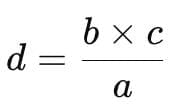
When:
a:b::c:d,
Ancient Wisdom: Āryabhaṭa’s Method
In ancient India, this was known as Trairasika. Āryabhaṭa (199 CE) explained it like this:
Rule of Three problems.
There were 3 numbers given:
- Pramāṇa = measure (a)
- Phala = known outcome (b)
- Ichchhā = desired measure (c)
To find Ichchhāphala = desired outcome (d), Āryabhaṭa says, “Multiply the phala by the ichchhā and divide the resulting product by the pramāṇa.”
In other words, Āryabhaṭa says,

Then, according to him:

Which is the same as our modern formula!
Sharing, but Not Equally!
Let us begin with an activity:
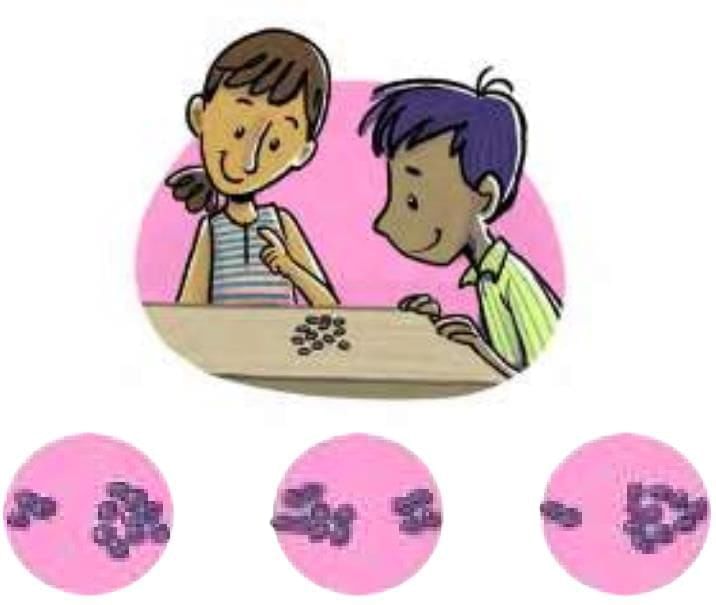
Take 12 objects (coins, seeds, pebbles). Now, form a pair and try sharing them in different ways.
- If both of you get the same number:
You each get 6 counters
Ratio = 6 : 6 = 1 : 1 (simplest form)
This implies that Equal share = Equal ratio - If you both get the following number:
Your partner gets 5 counters
You get 7 counters
This implies that Partner: You = 5 : 7 - Now, if you want to divide 12 counters in the ratio 3 : 1.
Let’s build this step-by-step:
- First, your partner gets 3, you get 1 → 4 counters used
- Repeat:
- Next 3 for partner, 1 for you → 8 used
- Final 3 for partner, 1 for you → 12 used
- So:
- Partner = 3 + 3 + 3 = 9 counters
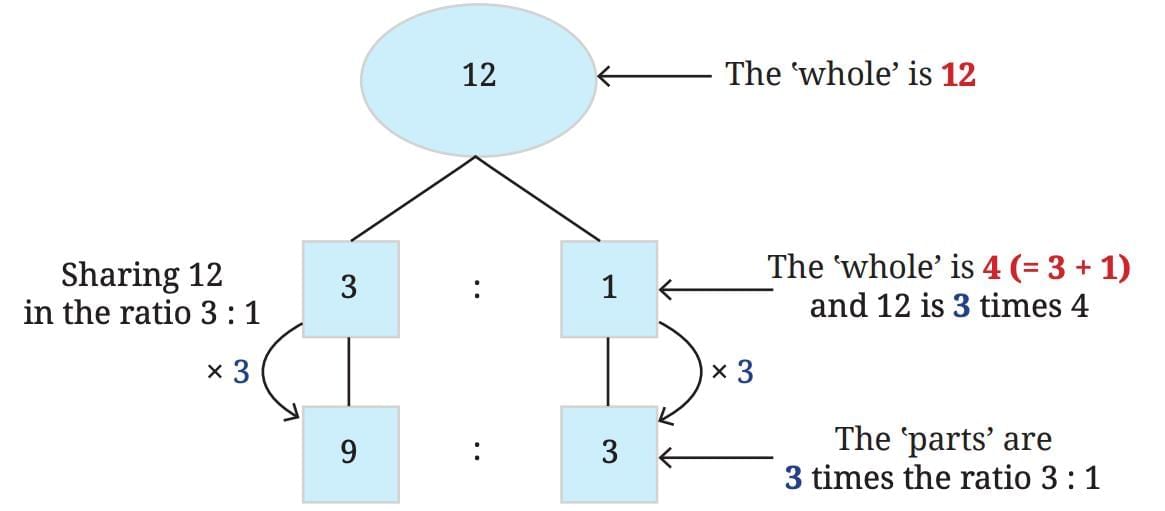 You = 1 + 1 + 1 = 3 counters
Total = 12
Ratio = 9 : 3 = 3 : 1
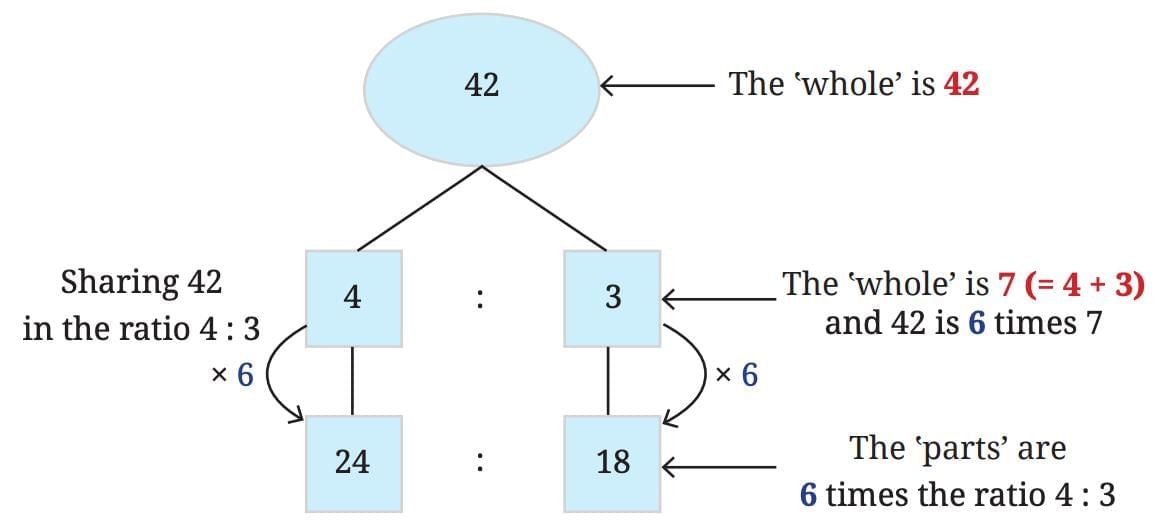
What if you had to share 42 counters in the ratio 4 : 3?
Repeating the steps will take too long! Let’s use a quicker method.
To divide 42 in the ratio 4 : 3:
- Add the parts:
4+3=7 parts in total - Find the size of one part:
42÷7=6 - Now multiply:
- Partner gets: 4×6=24
- You get: 3×6=18
So, 42 shared in 4 : 3 becomes 24 : 18
General Rule for Sharing
To divide a quantity x in the ratio m:n
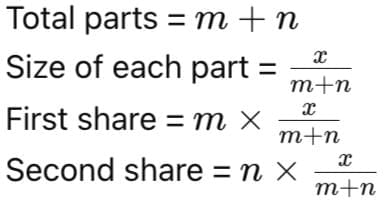

Hence,
This method gives parts in exact proportion to the ratio.
Let’s Try One!
Divide 60 in the ratio 2 : 3
- Total parts = 2+3 = 5
- Each part = 60÷5 =12
- Shares:
- First = 2×12=24
- Second = 3×12=36
So, 60 is split as 24 : 36
Unit Conversions
- When solving problems involving proportionality, it is often necessary to convert units to ensure consistency across measurements.
- Using the same units for all quantities in a ratio or proportion ensures accurate comparisons.
Key Unit Conversions
- Length:
- 1 metre = 3.281 feet
- Area:
- 1 square metre = 10.764 square feet
- 1 acre = 43,560 square feet
- 1 hectare = 10,000 square metres
- 1 hectare = 2.471 acres
- Volume:
- 1 millilitre (mL) = 1 cubic centimetre (cc)
- 1 litre = 1,000 mL or 1,000 cc
- Temperature:
- Conversion between Fahrenheit and Celsius:
- Fahrenheit = (9/5 × Celsius) + 32
- Celsius = 5/9 × (Fahrenheit – 32)
- Conversion between Fahrenheit and Celsius:
Application in Proportions
- When comparing ratios (e.g., length of a wall to cement bags), ensure all measurements are in the same units before simplifying or checking proportionality.
- Example: If one wall’s length is given in metres and another in feet, convert both to the same unit (using 1 metre = 3.281 feet) to compare ratios accurately.
Key Points to Remember
- Convert units to the same system before comparing ratios or solving proportion problems.
- Use the provided conversion factors for length, area, volume, and temperature to ensure accurate calculations.
- Temperature conversions require specific formulas, unlike direct multiplication for other units.