Short Answer Type Questions
Ques 1: What is a tissue? How does tissue formation help multicellular organisms?
Ans: A tissue is a group of cells that are similar in structure and work together to perform a specific function. In multicellular organisms, different groups of cells perform different functions, leading to the division of labour. This division of labour increases the efficiency of the body and enables it to carry out complex life processes. For example, muscle tissue enables movement while nervous tissue carries messages to different parts of the body.
Ques 2: What is meristematic tissue? State its main characteristics.
Ans: Meristematic tissue is a type of plant tissue made up of actively dividing cells responsible for the growth of plants. Its main characteristics are:
(a) Cells are small in size with thin cell walls and a large, prominent nucleus.
(b) Cytoplasm is dense with many organelles.
(c) Vacuoles are generally absent and cells are tightly packed with little or no intercellular space.
These features allow the cells to carry out continuous and rapid cell division.
Ques 3: What is differentiation? How does meristematic tissue become permanent tissue?
Ans: Differentiation is the process by which meristematic cells lose the ability to divide and undergo changes in structure and function to become specialised permanent tissues. Due to continuous cell division, new cells are added to the plant body. Some of these cells remain meristematic while others lose the ability to divide. Those that lose the ability to divide become specialised to perform specific functions such as support, transport or storage. This process by which meristematic tissue becomes specialised to perform specific functions is called differentiation.
Ques 4: Distinguish between apical meristem and intercalary meristem.
Ans: Apical meristem is located at the tips of roots and shoots of the plant. It helps the plant grow in length by continuous cell division at the root and shoot tips. Intercalary meristem is located at the base of the internode or just above the node. It helps the plant regenerate after being cut or grazed by animals. For example, grass grows back after mowing because of the intercalary meristem present at the nodes of its stem. Apical meristem is responsible for increase in length, whereas intercalary meristem is responsible for regrowth after cutting.
Ques 5: What is the role of epidermis in plants?
Ans: The epidermis forms the outermost layer of the plant body. It consists of a tightly packed, single layer of flat and rectangular cells and protects all parts of the plant. Its functions are:
(a) The epidermal cells are covered with a waxy layer of cutin called cuticle, which reduces water loss through transpiration and provides protection against mechanical injury and parasites.
(b) In roots, epidermal projections called root hair increase the surface area for absorption of water and minerals from soil.
(c) In leaves, the epidermis contains pores called stomata which help in gaseous exchange and transpiration.
Ques 6: Distinguish between collenchyma and sclerenchyma.
Ans: Collenchyma consists of living cells with unevenly thickened corners due to deposition of pectin. It provides support and flexibility to parts of the plant like stems and tendrils, allowing them to bend without breaking. Sclerenchyma cells have thick walls due to deposition of lignin, making them hard and strong. Most sclerenchyma cells are dead. It is found in stems, leaf veins and hard coverings of seeds and nuts such as coconut husk and walnut shell. While collenchyma provides flexibility, sclerenchyma provides rigidity and mechanical strength to the plant.
Ques 7: What are the components of xylem? State its function in plants.
Ans: Xylem is a complex permanent tissue that transports water and minerals from roots to other parts of the plant. It also provides strength to the plant. Xylem consists of four components:
(a) Tracheids – tubular and thick-walled, help in water conduction.
(b) Vessels – tubular and thick-walled, help in water transport.
(c) Xylem parenchyma – the only living component, stores food.
(d) Xylem fibres – primarily sclerenchymatous, provide mechanical support.
Tracheids and vessels are tubular and help in the upward movement of water and minerals from the soil to leaves.
Ques 8: What is connective tissue? Name any four types found in the human body and give one function of each.
Ans: A tissue that connects and supports other tissues and organs of the body is called connective tissue. Both blood and bones are connective tissues. Four types and their functions are:
(a) Blood – transports nutrients, gases and hormones to different parts of the body.
(b) Bone – gives strength, support and protection to the body.
(c) Cartilage – provides flexibility and cushions the ends of bones for shock absorption.
(d) Tendon – connects muscles to bones and brings about movement.
(e) Ligament – connects bone to bone, provides stability and helps prevent dislocation.
Ques 9: How are smooth muscles different from cardiac muscles?
Ans: Smooth muscles are found in organs like the stomach and intestines. Their cells are spindle-shaped, have a single nucleus and lack striations. They produce slow, continuous involuntary movements like digestion. Cardiac muscles are found only in the heart. Their fibres are cylindrical and branched with a single nucleus and have faint striations. Cardiac muscles work tirelessly and rhythmically, enabling the heart to beat throughout life without fatigue. Both are involuntary muscles, but unlike smooth muscles, cardiac muscles never get fatigued. Smooth muscles work in digestion while cardiac muscles control the beating of the heart.
Ques 10: What is a neuron? Name its three main parts and state the function of each.
Ans: A neuron or nerve cell is the basic structural and functional unit of nervous tissue. It is specialised to receive, process and transmit messages. The three main parts of a neuron are:
(a) Cell body – contains the nucleus and controls cell activities.
(b) Dendrites – branch-like extensions that receive signals from other neurons and carry them to the cell body.
(c) Axon – a long fibre that carries messages from the cell body to axon terminals, which then transmit messages to other cells.
Together, these parts allow the nervous tissue to form the body’s control and coordination network.
Ques 11: Name the four types of joints in the human body and give one example of each.
Ans: A joint is a junction between two or more bones that allows movement. The four types of joints are:
(a) Ball and socket joint – allows movement in all directions (forward, backward, sideways, circular). Example: shoulder joint.
(b) Hinge joint – allows movement in one direction only, like a door hinge. Example: elbow joint and knee joint.
(c) Pivot joint – allows the head to move side to side. Example: joint between skull and backbone.
(d) Fixed joint – bones are joined together and cannot move. Example: bones of the skull.
Ques 12: Why do plant cells have more and bigger vacuoles compared to animal cells?
Ans: Plant cells have more in number and bigger-sized vacuoles compared to animal cells. This is because vacuoles in plant cells are essential for maintaining turgidity and rigidity, which helps plant cells withstand external environmental conditions and wear and tear. Vacuoles also store important substances required for plant growth, such as amino acids, sugars and various organic acids. Animal cells do not need large vacuoles for structural support since they have a flexible cell membrane and their shape is maintained by other means. Therefore, plant vacuoles are larger in size and greater in number.
Long Answer Type Questions
Ques 1: Describe the three types of meristematic tissues found in plants with respect to their location and function.
Ans: Meristematic tissues are plant tissues made up of actively dividing cells responsible for the growth of plants. Plants grow in three ways – increase in length, increase in girth, and regrowth after cutting. Corresponding to these, plants have three types of meristematic tissues:
(i) Apical Meristem:
Apical meristem is located at the tips of roots and shoots of the plant. The cells at these tips divide continuously and help the plant grow in length (increase in height of stem and depth of roots). The experiment with onion root bulbs shows that roots grow only from their tips, confirming the presence of actively dividing cells at the apical region. Similarly, shoot tips also contain apical meristem. These are called apical meristems.
(ii) Lateral Meristem:
Lateral meristem is located along the circumference or sides of the stem. The cells divide and produce new cells inside and outside in a concentric manner, leading to an increase in the diameter (girth) of the stem. Annual growth rings visible on the cut trunk of a tree are formed due to the activity of lateral meristem during favourable and unfavourable growth conditions. By counting these annual rings, scientists can estimate the age of a tree.
(iii) Intercalary Meristem:
Intercalary meristem is located at the base of the internode or just above the node. The node is the point on the plant stem where branches or leaves arise. When the tip of a stem is cut, new branches arise from the nodes due to the activity of intercalary meristem. This is why a hedge becomes bushy after trimming and grass regrows after mowing or grazing by animals. Together, these three types of meristems account for growth in length, girth and branching in plants.
Ques 2: Describe the structure and functions of phloem as a complex permanent tissue in plants.
Ans: Phloem is a complex permanent tissue that transports food prepared in the leaves to other parts of the plant. It is called a complex tissue because it is made up of more than one type of cell working together. Unlike xylem, phloem is mostly made up of living cells. 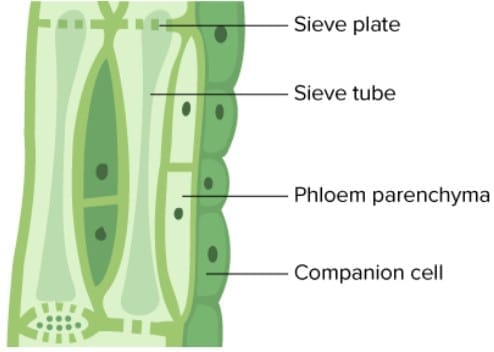
The components of phloem are:
(i) Sieve tubes: These are long, tubular cells joined end to end by perforated walls called sieve pores. Sieve tubes transport food from leaves to all other parts of the plant. Some cells are long and tubular, joined end to end, forming the main pathway for food transport.
(ii) Companion cells: These are specialised parenchyma cells associated with sieve tube cells. The cellular functions of sieve tube cells are regulated by companion cells. Their main function is to monitor loading and unloading of sugars in sieve tubes.
(iii) Phloem parenchyma: These cells store food materials such as resin, tannins and latex. They also aid in the slow lateral conduction of food.
(iv) Phloem fibres: These are primarily sclerenchymatous in nature. They provide mechanical strength and support to the sieve tubes and protect them.
Phloem, together with xylem, forms the vascular tissue system of plants, which is organised into three tissue systems – dermal, ground and vascular. The vascular tissue system consists of xylem and phloem which together form the conducting system of the plant.
Ques 3: Give five points of differences between plant cell and animal cell.
Ans:
| Plant Cell | Animal Cell |
|---|---|
| Size is usually larger than animal cell. | Size is usually smaller than plant cell. |
| Cell wall made of cellulose is present. | Cell wall is absent. |
| Plastids are present. | Plastids are absent. |
| Vacuoles are large in number and bigger in size. | Vacuoles are small in size and less in number. |
| Centriole is absent. | Centriole is present. |
Ques 4: Describe the musculoskeletal system. How do muscles and bones work together to produce movement?
Ans: The musculoskeletal system is made up of bones, muscles, joints, cartilage, tendons and ligaments. This system helps us stand upright, move, maintain posture and protect delicate organs. It functions under the control of the nervous system.
Structure of the musculoskeletal system:
(i) Bones form a rigid framework made of a matrix containing calcium and phosphorus compounds, giving them strength and rigidity. They provide support and protect internal organs.
(ii) Muscles are of three types – skeletal (voluntary), smooth (involuntary) and cardiac. Skeletal muscles are made up of bundles of long, cylindrical cells called muscle fibres, which are unbranched, multinucleate and striated.
(iii) Tendons are strong, flexible bands that connect muscles to bones. They transmit the force of muscle contraction to the bone to produce movement.
(iv) Ligaments connect bone to bone, providing stability at joints and helping prevent dislocation and excessive movement.
(v) Cartilage has a soft, jelly-like matrix and provides flexibility and cushioning at the ends of bones and between vertebrae.
How muscles and bones produce movement:
Muscles pull on bones to produce movement at joints. When a muscle contracts, it shortens and the tendon transmits this force to the bone, causing movement at the joint. Joints allow movement but cannot move bones on their own. For example, when the bicep muscle contracts, it pulls the forearm bone upward through the tendon. The nervous system controls all muscle activity. During exercise, the brain signals the heart to beat faster to meet the body’s increased oxygen demand.
Ques 5: Describe the skeletal system of the human body. What is the role of the vertebral column and the rib cage?
Ans: The skeletal system consists of a framework of bones that provides strength and protects delicate internal organs. It includes the skull, vertebral column and rib cage. On average, the adult human skeleton makes up about 12-15 per cent of body weight.
Role of the Vertebral Column:
The vertebral column, also called the backbone or spine, extends from the base of the skull. It is a flexible column made up of a series of small bones called vertebrae. It supports the body and helps us stand upright. Between each vertebra is a cartilage disc which acts as a cushion and allows flexibility, so we can bend and twist without injuring the internal spinal cord. The vertebral column also protects the delicate spinal cord running through it.
Role of the Rib Cage:
Humans have 12 pairs of ribs which together form the rib cage. The rib cage acts like a protective cage to protect vital organs such as the heart and lungs. The ribs are attached to the spine at the back and to the breast bone (sternum) in the front. They are joined by flexible cartilage which allows the rib cage to expand and contract during breathing. This movement increases and decreases the space in the chest, allowing air to move in and out of the lungs. Injury to the ribs can make breathing painful and difficult.
Other components:
The skull is a hard case of flat bones joined together by fixed joints to protect the brain, eyes and ears. The bones of the skull cannot move, which keeps the brain safe even when the body moves. Together, all parts of the skeletal system work in coordination with the muscular system under the control of the nervous system to produce movement, maintain posture and protect internal organs.