Introduction
What Have We Learned So Far?
We’ve already seen that algebra uses letter symbols (like x, a, b, etc.) to:
- Represent patterns
- Show relationships
- Write general statements in a compact form
Algebra isn’t just about letters and numbers — algebra is a powerful tool to:
- Make predictions
- Prove properties
- Solve different types of problems
What is Distributivity?
Distributivity is a rule that connects multiplication and addition.
Instead of solving:
3×(4+5)
We can rewrite it as:
(3×4)+(3×5)=12+15=27
Both give the same result.
This is called the Distributive Property:
a × (b+c) = a × b + a × c
In this chapter, we will learn:
- Explore multiplication patterns
- Use algebra to explain them
- Solve problems faster using distributivity
Some Properties of Multiplication
Increments in Products
Let’s take two numbers:23 × 27
If we increase 27 by 1:
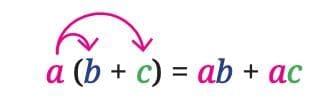
If a, b and c are three numbers, then-
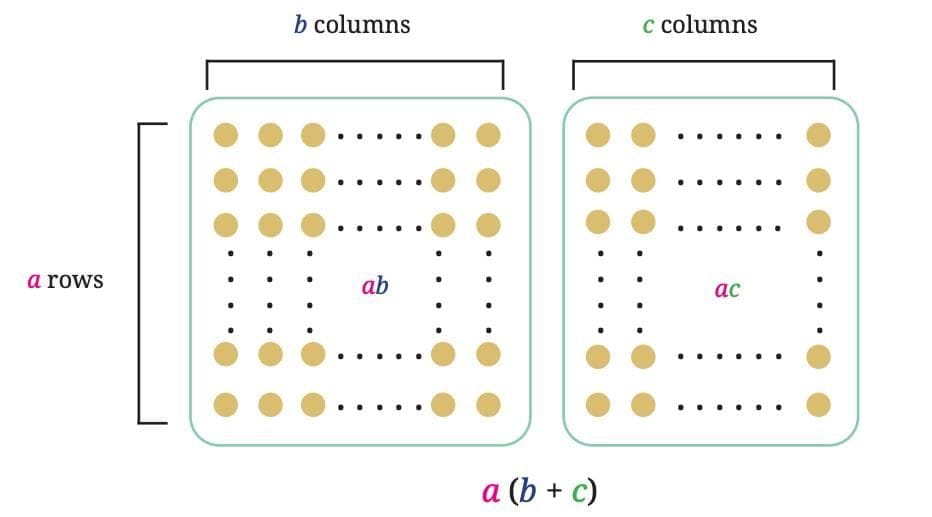
This property can be visualised nicely using a diagram:
This is called the distributive property of multiplication over addition. Using the identity a (b + c) = ab + ac with a = 23, b = 27, and c = 1, we have:
23×(27+1)=23×27+23
So, the product increases by 23.
We can also similarly expand (a + b) c using the distributive property as follows-
(a + b) c = c (a + b) (commutativity of multiplication)
= ca + cb (distributivity)
= ac + bc (commutativity of multiplication)
If we increase both numbers:
Now, let us see what happens if both numbers in a product are increased by 1. If in a product ab, both a and b are increased by 1, then we obtain (a + 1) (b + 1).
This can be expanded by considering (a + 1) as a single term. Then, by the distributive property, we have
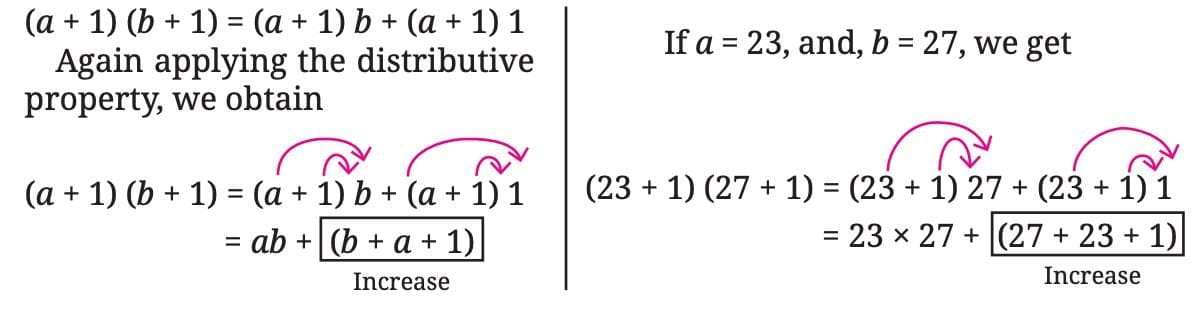
Thus, the product ab increases by a + b + 1 when each of a and b is increased by 1.
If one of the numbers in a product is increased by 1and the other is decreased by 1:

Let us again take the product ab of two numbers a and b. If a is increased by 1 and b is decreased by 1, then their product will be (a + 1)(b – 1). Expanding this, we get
If a and b are negative integers?
Check by substituting different values for a and b.
Example 1:
Let a=−5, b=8
LHS:(a+1)(b+1)=(−5+1)(8+1)=(−4)(9)=−36
RHS:ab+a+b+1=(−5)(8)+(−5)+8+1=−40−5+8+1=−36
LHS = RHS
We have seen that integers also satisfy the distributive property, that is, if x, y and z are any three integers, then x (y + z) = xy + xz.
Thus, the expressions we have for the increase of products hold when the letter-numbers take on negative integer values as well.
An identity is a mathematical statement that is always true, for all values of the variables involved.
Examples of identities:
- a(b+8)=ab+8a
- (a+1)(b−1)=ab+b−a−1
- (a+b)2=a2+2ab+b2
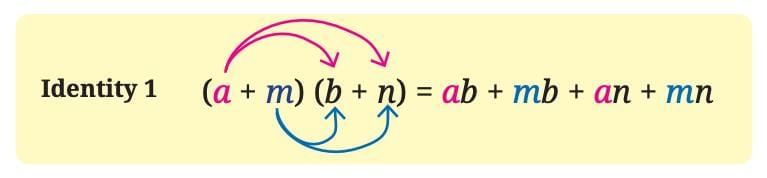
If a is increased by m and b is increased by n:
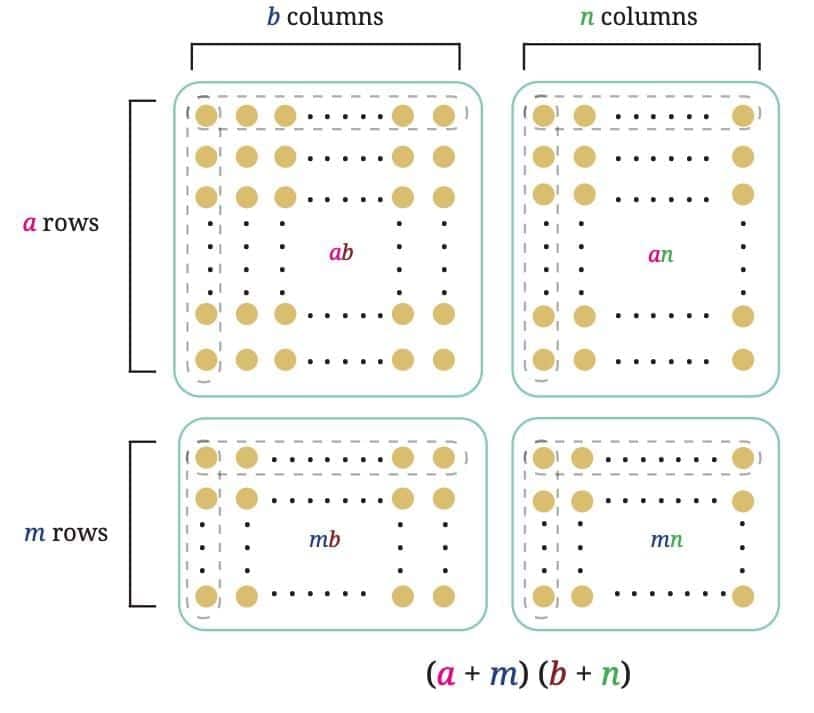
If a and b are the initial numbers being multiplied, they become a + m and b + n.
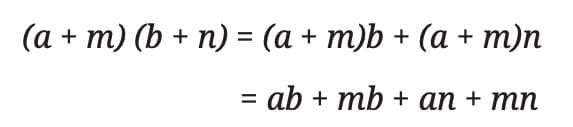
The increase is an + bm + mn.
Notice that the product is the sum of the product of each term of (a + m) with each term of (b + n).
This identity can be visualised as follows:
This identity works even when m or n are negative, which means one or both numbers are decreased.
When one or both numbers are decreased:
Let’s simplify:(a+1)(b−1)=(a+1)(b+(−1))
Use Identity 1 with m=1, n=−1:ab+a(−1)+1(b)+1(−1)=ab−a+b−1=ab+b−a−1
Generalising, we can find the product (a + u) (b – v) as follows.
(a + u) (b – v) = (a + u) b – (a + u) v
= ab + ub – (av + uv)
= ab + ub – av
A Pinch of History
The distributive property – the rule that says:
(a+b)×c=ac+bc
was used long ago by mathematicians in many ancient civilisations like Egypt, Mesopotamia, Greece, China and India. Even though they didn’t always write it as a formula, they used the same idea in their calculations. Famous mathematicians used it as the following:
- Euclid (Greece) used it in geometric form.
- Āryabhaṭa (India) used it in algebraic calculations.
- But the first clear statement of the distributive property came from Brahmagupta, an Indian mathematician.
What Did Brahmagupta Say?
In his book Brahmasphuṭasiddhānta, Verse 12.55, he described multiplication like this:
“Break the number being multiplied (the multiplier) into two or more parts. Multiply each part separately by the other number (multiplicand), and then add the results.”
This is the same as: (a+b)×c=a×c+b×c
He called this method: khaṇḍa-guṇanam = “multiplication by parts”
In the next verse (Verse 12.56), Brahmagupta further describes a method for doing fast multiplication using this distributive property, which we explore further in the next section.
Fast Multiplications Using the Distributive Property
The distributive property can be used to come up with quick methods of multiplication when certain types of numbers are multiplied.
When one of the numbers is 11, 101, 1001, …
Let us understand this with the help of an example: 3874 × 11
Let us take the first multiplication:
3874 × 11 = 3874 (10 + 1) = 38740 + 3874 = 42614
Notice how the digits are getting added.
Let us take a 4-digit number dcba, that is, the number that has
- d in the thousands place,
- c in the hundreds place,
- b in the tens place and
- a in the units place.
dcba × (10 + 1) = dcba × 10 + dcba.
This becomes:
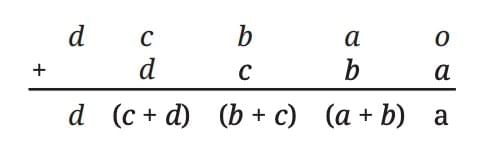
Continuing with our example, the above can be used to obtain the product in one line.
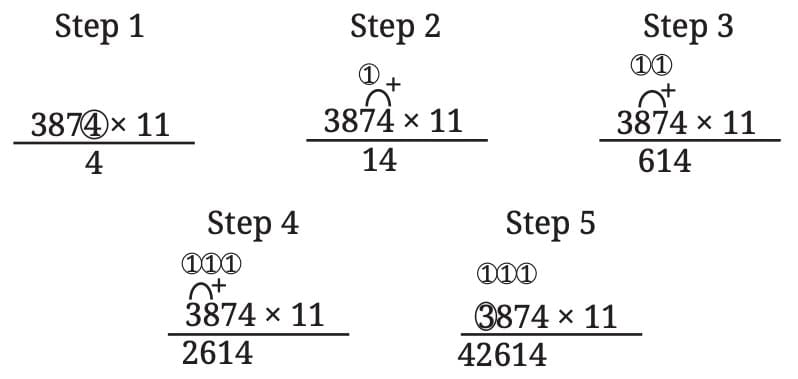
Such methods of applying the distributive property to easily multiply two numbers were discussed extensively in the ancient mathematical works of Brahmagupta (628 CE), Sridharacharya (750 CE) and Bhaskaracharya (Lilavati, 1150 CE). In his work Brahmasphuṭasiddhānta (Verse 12.56), Brahmagupta refers to such methods for fast multiplication using the distributive property asista-gunana.
Special Cases of the Distributive Property
Square of the Sum/Difference of Two Numbers
This can be understood with the help of an example:
Q: The area of a square of side length 60 units is 3600 sq. units (602), and that of a square of side length 5 units is 25 sq. units (52). Can we use this to find the area of a square of side length 65 units?
A square of side length 65 can be split into 4 regions as shown in the figure:
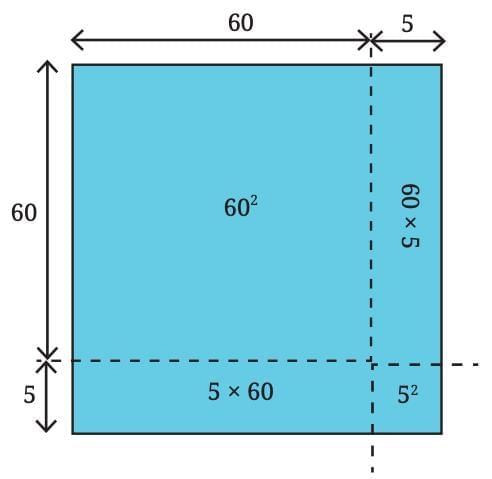
a square of side length 60, a square of side length 5, and two rectangles of side lengths 60 and 5.
The area of the square of side length 65 is the sum of the areas of all its constituent parts. Can you find the areas of the four parts in the figure above?
652=(60+5)2
We can use the identity:
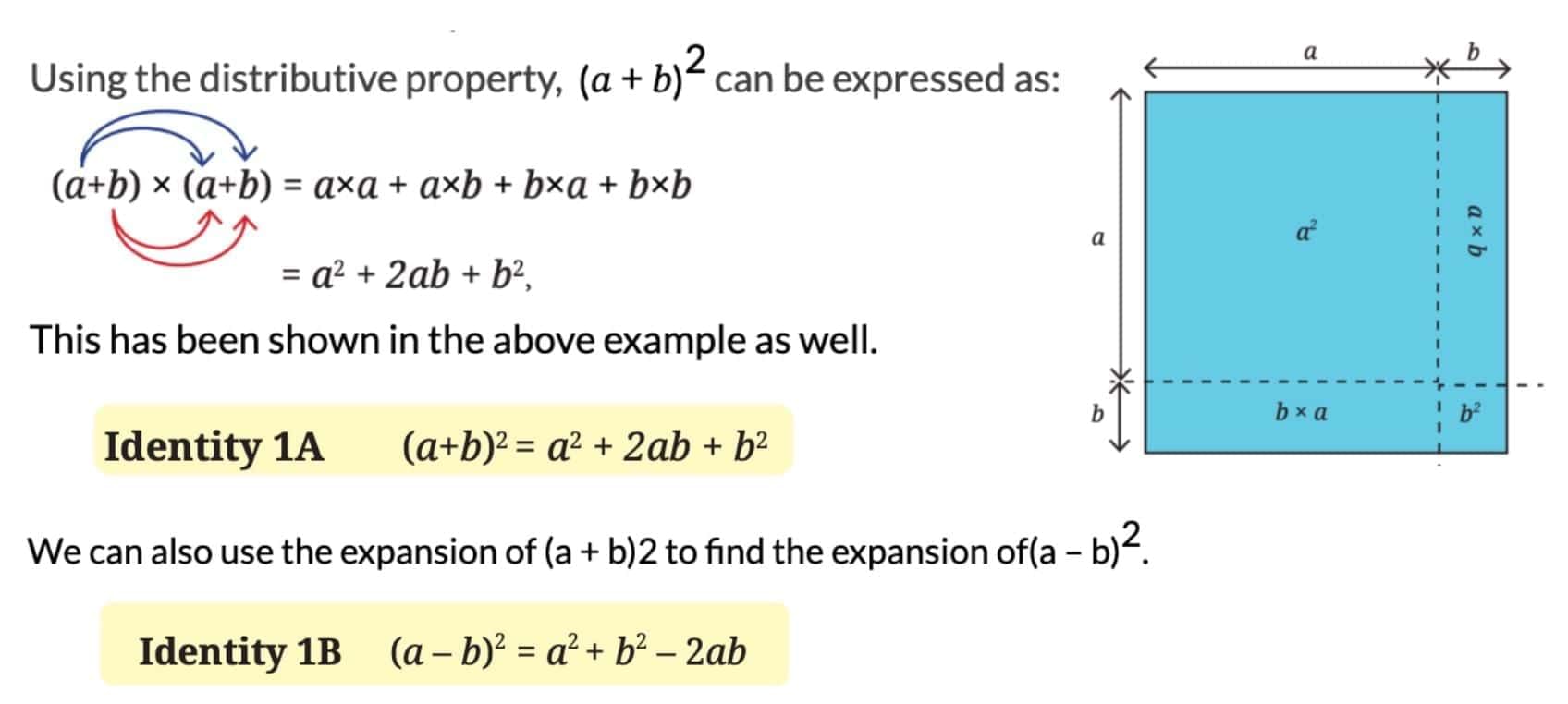
(a+b)2=a2+2ab+b2
Here, a=60, b=5
652=602+2×60×5+52
=3600+600+25
=4225 sq. units
Let us multiply (60 + 5) × (60 + 5) using the distributive property.
(60 + 5) × (60 + 5) = 60 × 60 + 5 × 60 + 60 × 5 + 5 × 5
= 602 + 2 × (60 × 5) + 52
General Form:
Investigating PatternsPattern 1
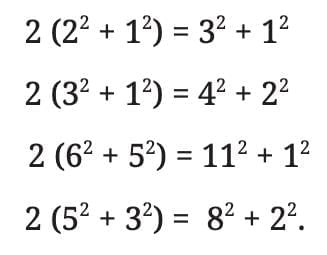
Let’s look at these examples:
What is happening here?
You’re seeing a math identity in action:
2(a² + b²) = (a + b)² + (a − b)²
The pattern is that for any pair of natural numbers a and b, twice the sum of their squares, 2 × (a² + b²), can be expressed as the sum of two squares, specifically (a + b)² + (a – b)². This is directly explained by the identity:
- 2 × (a² + b²) = (a + b)² + (a – b)²
The notes also mention (a – b)² = a² + b² – 2ab, but it’s not directly used here. The key is combining:
- (a + b)² = a² + 2ab + b²
- (a – b)² = a² – 2ab + b²
Adding these eliminates the 2ab terms, yielding the identity. Since a and b are natural numbers, a + b is a natural number, and a – b is an integer (possibly zero if a = b). The square (a – b)² is always non-negative, ensuring the result is a sum of two squares.
This means:
If you take two numbers (a and b),
Find their squares and add them, then double the result —
It’s equal to the sum of the square of their sum and the square of their difference!
Verifying the Identity
Let’s derive the identity:
- (a + b)² = a² + 2ab + b²
- (a – b)² = a² – 2ab + b²
Adding these:
- (a + b)² + (a – b)² = (a² + 2ab + b²) + (a² – 2ab + b²)
Combine like terms:
- a² + a² + 2ab – 2ab + b² + b²
- = 2a² + 2b²
- = 2 × (a² + b²)
Thus:
- 2 × (a² + b²) = (a + b)² + (a – b)²
This confirms that for any pair of numbers a and b, twice the sum of their squares can be expressed as the sum of the squares of (a + b) and (a – b). Since natural numbers are positive integers, a + b is a natural number, and a – b is an integer (possibly zero or negative, but its square is non-negative), ensuring the result is a sum of two squares.
Example: 2 × (2² + 1²) = 3² + 1²
Left side: 2 × (4 + 1) = 2 × 5 = 10
Right side: 9 + 1 = 10
Identity check: Let a = 2, b = 1.
(2 + 1)² + (2 – 1)² = 3² + 1² = 9 + 1 = 10
2 × (2² + 1²) = 2 × (4 + 1) = 10
The identity holds, and the pattern matches.
Pattern 2
Let’s look at these examples:
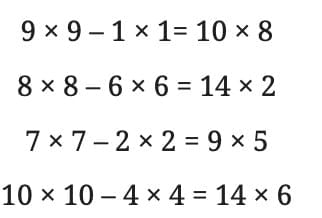
You can observe a pattern here:
a² – b² = (a + b)(a – b)
This is a standard algebraic identity called the difference of squares.
Let’s verify it using the distributive property:
(a + b)(a – b) = a × a – a × b + b × a – b × b
= a² – ab + ab – b²
= a² – b² (since –ab and +ab cancel out)
So yes, this pattern always works. It’s a true identity.
For example,
We can write 31² in the form of the identity above:
Let a = 31, b = 1
(31 + 1)(31 – 1) + 1²
= 32 × 30 + 1
= 960 + 1
= 961
Your Turn!
Question: Use this identity to quickly calculate the product.
1. 98 × 102 = ?
Hint: Write them as (100 – 2)(100 + 2)
Now apply the identity a² – b² = (a + b)(a – b).

2. 45 × 55 = ?
Mind the Mistake, Mend the Mistake
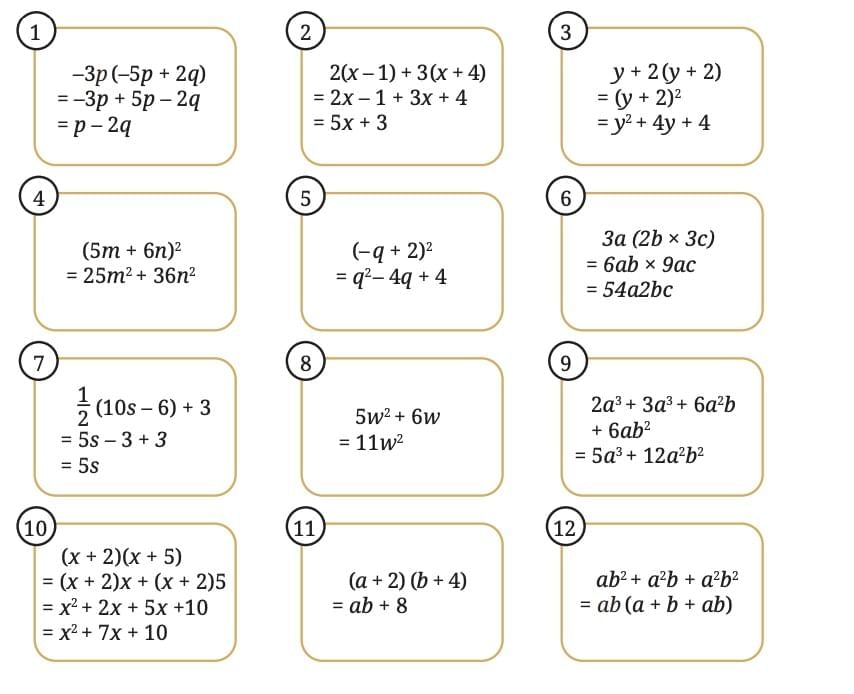
We have expanded and simplified a few algebraic expressions to their simplest form.
- Review each simplification carefully to check for any errors.
- If you spot a mistake, try to understand and explain what went wrong.
- After that, rewrite the expression correctly.
Think It Through – Then Check Your Answer
This Way or That Way, All Ways Lead to the Bay
Look at the pattern shown in the figure.
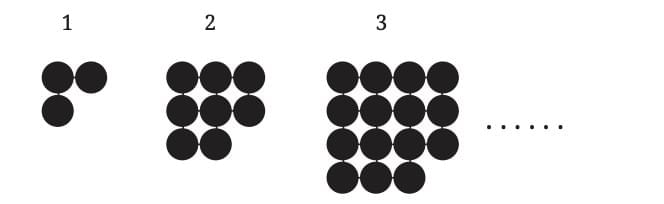
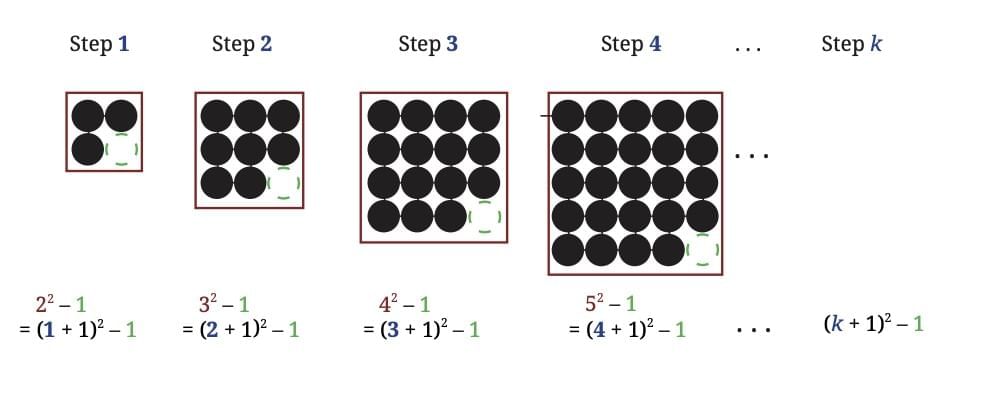
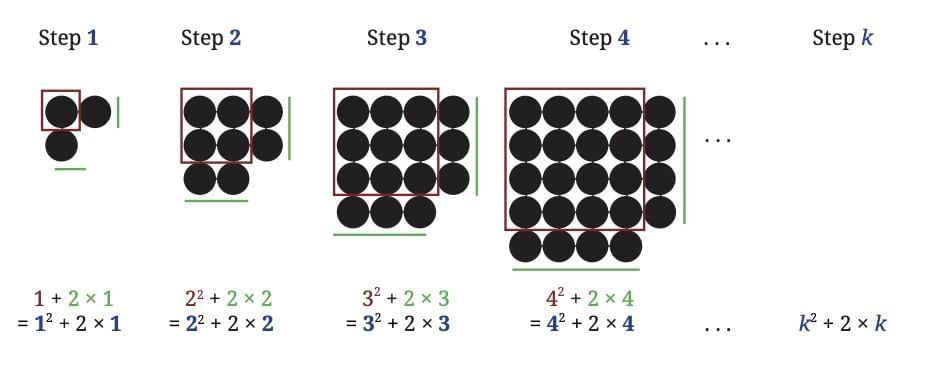
We are looking at a sequence of figures that follow a specific pattern. Each figure in the sequence predictably adds more circles. There are multiple ways to approach this pattern:
Method 1
Method 2
Method 3
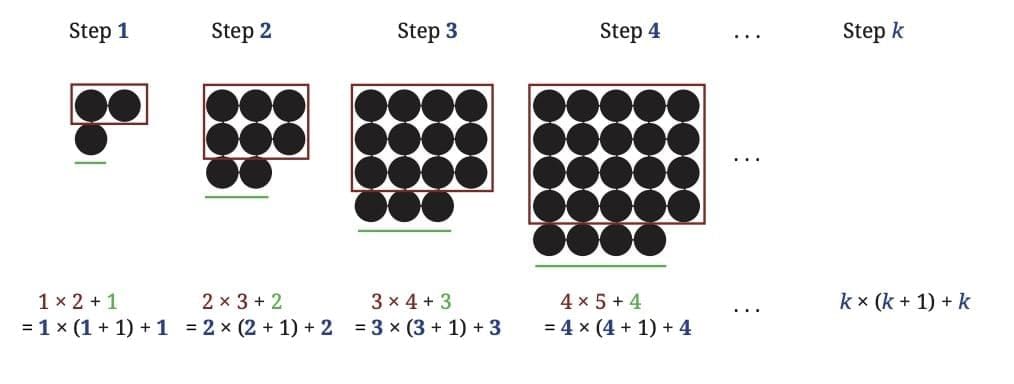
Method 4
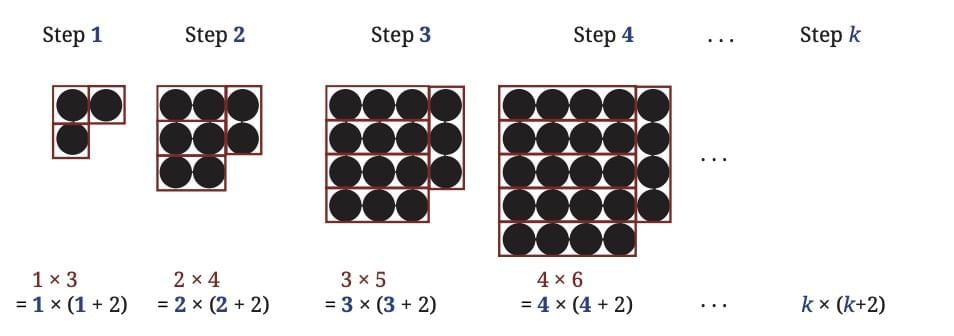
You may have used a method that matches one of the expressions shown, or perhaps a different approach altogether. While these expressions may appear different at first, they all describe the same pattern.
That means they should be mathematically equivalent. Let’s simplify each expression to verify if they are indeed the same.

Note: Mathematics allows for multiple perspectives
- There isn’t always just one right way to recognize or solve a problem.
- Different approaches can lead to the same result, and discovering them often involves thinking creatively and exploring new ideas.
- Some methods might feel more natural or easier than others, but trying out various strategies can help us see patterns more clearly and make learning more interesting.