Introduction to Proportional Reasoning
- Concept: Proportional reasoning involves comparing quantities using ratios to understand how they change together.
- Ratio: A comparison of two quantities, written as a:b, meaning for every a units of the first quantity, there are b units of the second.
- Proportional Ratios: Two ratios a:b and c:d are proportional (written as a:b :: c:d) if their terms change by the same factor, i.e., a/b = c/d.
Observing Similarity in Change
- Context: Comparing digital images of different sizes using ratios to check for similarity.
- Example: Images A, C, and D have width-to-height ratios of 60:40, 30:20, and 90:60, respectively. These simplify to 3:2, showing they are proportional and look similar despite size differences.
- Non-Proportional Images: Image B (elongated) and Image E (square, compressed) have different ratios, making them appear distorted.
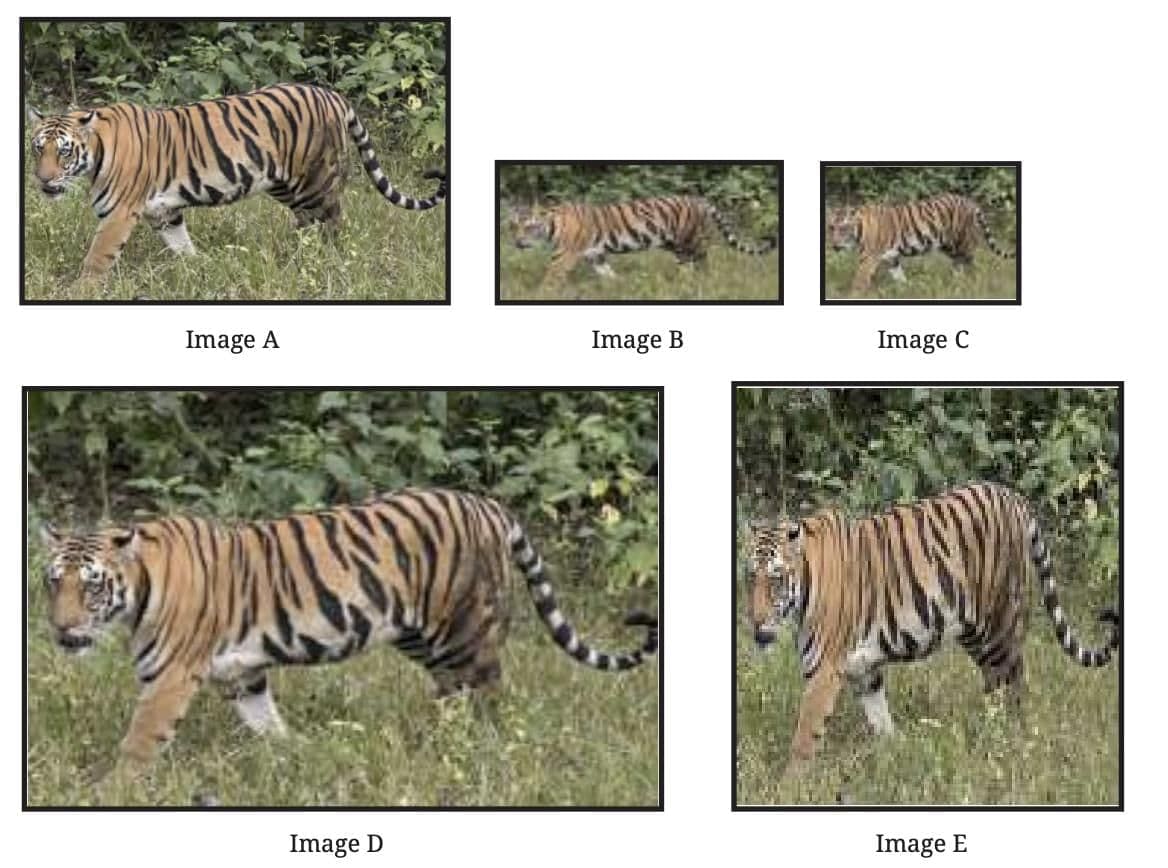
Understanding Ratios
- A ratio compares two quantities, written as
a : b. - Example: Width to height in Image A is
60 : 40.
Proportional Ratios (in simplest form):
- A: 60 : 40 = 3 : 2
- C: 30 : 20 = 3 : 2
- D: 90 : 60 = 3 : 2
Non-Proportional:
- B: 40 : 20 = 2 : 1
- E: 60 : 60 = 1 : 1
If different ratios simplify to the same form, they are said to be proportional.
Simplest Form of Ratios
- To simplify a ratio, divide both terms by their Highest Common Factor (HCF).
- Example:
- 60 : 40 → HCF = 20 → Simplest form = 3 : 2
- 90 : 60 → HCF = 30 → Simplest form = 3 : 2
- So,
60:40 :: 90:60means both ratios are proportional. - Symbol ‘::’ is used to indicate proportionality.
Rule of Three (Trairasika)
- If a : b :: c : d, then d = (b × c) / a
Example: Midday Meal
- 120 students : 15 kg
- 80 students : ?
→ 80 = 2/3 of 120 → 15 × 2/3 = 10 kg rice needed
Example: Travel Distance
- 150 min : 90 km
- 240 min : ?
→ Use cross multiplication
→ x = (240 × 90) / 150 = 144 km
Example: Tea Cost
- Himachal: 200 g : ₹200 → ₹1000 per kg
- Meghalaya: 1 kg : ₹800
→ Himachal tea is more expensive
Problem Solving Using Proportional Reasoning
Example 1: Check if 3 : 4 and 72 : 96 are proportional
→ Simplify 72 : 96 → 3 : 4. Hence, they are proportional.
Example 2: Lemonade Mixing
- 6 glasses : 10 spoons
- To make 18 glasses → Multiply both by 3 → 18 : 30
Example 3: Cement Usage
- Nitin: 60 ft : 3 bags → 20 : 1
- Hari: 40 ft : 2 bags → 20 : 1
→ Proportional, walls are equally strong.
Example 4: Teacher-Student Ratio
- My school: 5 : 170
- Compare this with your school ratio and check if proportional.
Example 5: Blackboard Dimensions
- Measure and compare width-to-height ratio with your notebook drawing.
Example 6: Neelima and Mother’s Age
- At age 3: 3 : 30 = 1 : 10
- At age 12: 12 : 39 = 4 : 13 → Not proportional
- Adding the same number does not keep ratio proportional.
More Solved Examples and Applications
Example 1: Simplifying Ratios
- Problem: Are the ratios 3:4 and 7:96 proportional?
- Solution: Simplify 7:96 by dividing by their highest common factor (1), resulting in 7:96. Since 3:4 is not equal to 7:96, they are not proportional.
Example 2: Lemonade Sweetness
- Problem: For 6 glasses of lemonade, 10 spoons of sugar are used. How many spoons for 18 glasses to maintain sweetness?
- Solution: Ratio of glasses to sugar is 6:10. The factor of change from 6 to 18 glasses is 18 ÷ 6 = 3. Multiply sugar (10) by 3: 10 × 3 = 30. Thus, 30 spoons are needed (6:10 :: 18:30).
Example 3: Wall Strength
- Problem: Nitin builds a 60 ft wall with 3 bags of cement; Hari builds a 40 ft wall with 2 bags. Are the walls equally strong?
- Solution: Nitin’s ratio: 60:3 = 20:1. Hari’s ratio: 40:2 = 20:1. Since both ratios are equal, the walls are equally strong.
Example 4: Teacher-Student Ratio
- Problem: A school has 5 teachers and 170 students (ratio 5:170). Compare with another school’s ratio.
- Solution: Simplify 5:170 to 1:34. Compare with the other school’s simplified ratio to check proportionality.
Example 5: Blackboard Ratios
- Problem: Measure a blackboard’s width and height, find the ratio, and draw a proportional rectangle.
- Solution: If the blackboard’s ratio is w:h, a proportional rectangle has the same ratio. Compare drawings to verify similarity.
Example 6: Age Ratios
- Problem: Neelima is 3 years old, her mother is 30 (ratio 3:30 = 1:10). What is the ratio when Neelima is 12?
- Solution: Mother’s age increases by 9 years (30 + 9 = 39). New ratio: 12:39 = 4:13, which is not the same as 1:10.
Example 7: Coffee Strength
- Problem: Regular coffee uses a 15:40 coffee-to-milk ratio. Stronger coffee uses 20:40; lighter uses 10:40. Compare strengths.
- Solution: Regular (15:40 = 3:8), stronger (20:40 = 1:2), lighter (10:40 = 1:4). Stronger has a higher coffee proportion; lighter has less.
Example 8: Brick Wall Patterns
- Problem: Find the ratio of grey to colored bricks in a patterned wall.
- Solution: Observe the pattern and count bricks to determine the simplest ratio.
Example 9: Human Body Ratios
- Problem: Measure head, torso, arms, and legs of a friend and find ratios (e.g., head:torso).
- Solution: Record measurements and express as ratios in simplest form.
Example 10: Tea Prices
- Problem: Compare the price per kg of tea from Meghalaya (8000 rupees/kg) and Himachal (2000g for 200 rupees).
- Solution: Himachal: 2000g = 2kg, so 200 ÷ 2 = 100 rupees/kg. Meghalaya’s tea is more expensive.
Example 11: Shampoo Prices
- Problem: Compare shampoo volume (6ml:180ml) and price (2 rupees:154 rupees) ratios.
- Solution: Simplify ratios: volume (1:30), price (1:77). Since 1:30 is not equal to 1:77, they are not proportional, possibly due to packaging/marketing costs.
Example 12: Sharing Counters
- Problem: Share 42 counters in a 4:3 ratio.
- Solution: Total parts = 4 + 3 = 7. Each part = 42 ÷ 7 = 6. Partner gets 4 × 6 = 24, you get 3 × 6 = 18.
Example 13: Sand and Cement Mixture
- Problem: A 40kg mixture has a sand:cement ratio of 3:1. Find quantities.
- Solution: Total parts = 3 + 1 = 4. Sand: (3/4) × 40 = 30kg. Cement: (1/4) × 40 = 10kg.
4. Practical Problems
- Problem 7: Mass of 1L gold vs. water (ratio 37:2, 1L water = 1kg).
- Solution: Gold mass = (37/2) × 1 = 18.5kg.
- Problem 8: Manure for a 200ft × 500ft plot (10 tonnes/acre).
- Solution: Area = 200 × 500 = 100,000 sq.ft. 1 acre = 43,560 sq.ft. Plot = 100,000 ÷ 43,560 ≈ 2.3 acres. Manure = 10 × 2.3 = 23 tonnes.
- Problem 9: Time to fill a 10L bucket if a 500ml mug takes 15s.
- Solution: 10L = 10,000ml. Ratio = 10,000 ÷ 500 = 20. Time = 15 × 20 = 300s = 5 minutes.
- Problem 10: Cost of 2,400 sq.ft land if 1 acre costs 15,000,000 rupees.
- Solution: 2,400 ÷ 43,560 ≈ 0.055 acres. Cost = 0.055 × 15,000,000 ≈ 825,000 rupees.
Unit Conversions
Length
- 1 metre = 3.281 feet
Area
- 1 square metre = 10.764 square feet
- 1 hectare = 10,000 square metres = 2.471 acres
- 1 acre = 43,560 square feet
Volume
- 1 mL = 1 cc
- 1 litre = 1,000 mL or 1,000 cc
Temperature
- °F = (9/5 × °C) + 32
- °C = 5/9 × (°F – 32)
Summary
- Ratio a : b shows comparison between two values.
- Ratios a : b and c : d are proportional if ad = bc.
- To divide a number in ratio m : n → Use formulas
- First part: m × x / (m + n)
- Second part: n × x / (m + n)
- Rule of Three helps solve for an unknown in proportional relationships.
Key Formulas
- Proportionality: a:b :: c:d means a/b = c/d, or a × d = b × c.
- Ratio Division: To divide quantity x in ratio m:n, first part = (m/(m+n)) × x, second part = (n/(m+n)) × x.
- Simplifying Ratios: Divide both terms by their highest common factor to get the simplest form.