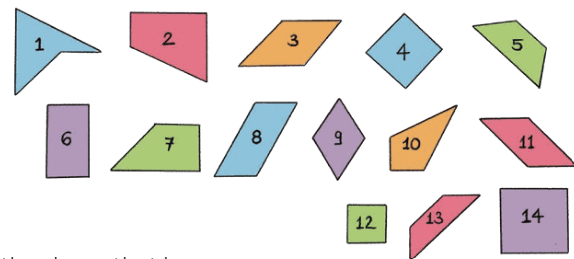
Page 39 (Let Us Do)
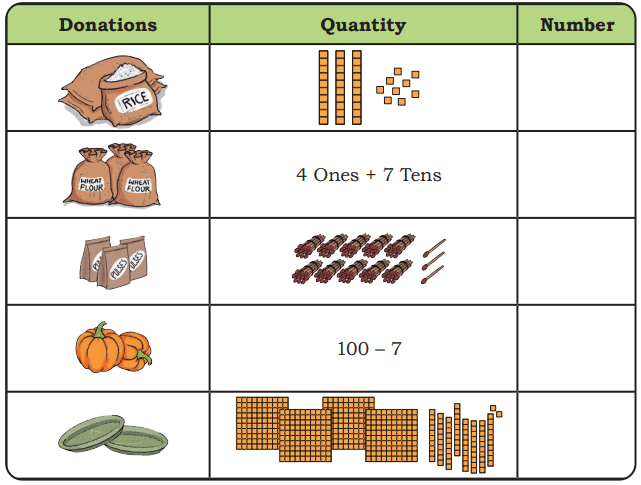
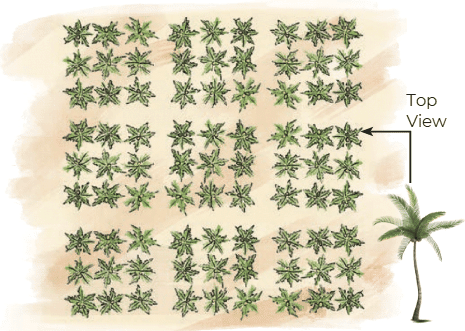
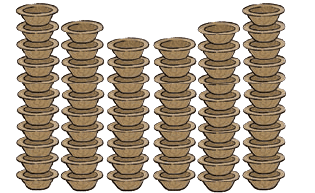
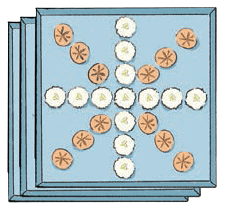
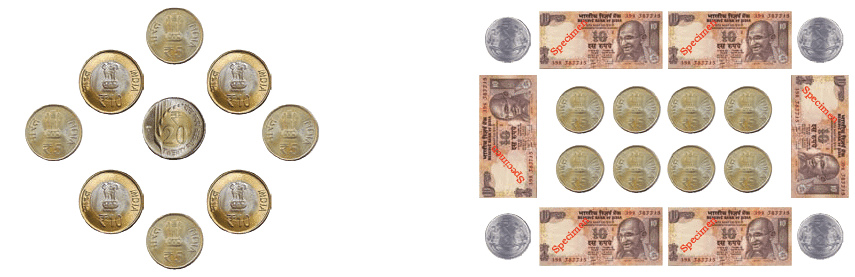
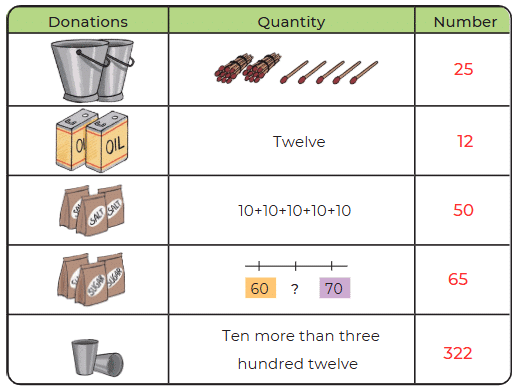
Q: Jaspreet and Gulnaz receive many donations. The donations are shown in the table below. Write the number in each case.
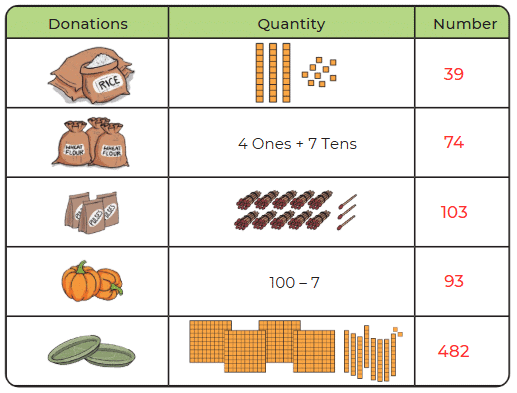
Ans:
Page 40 (Let Us Do)
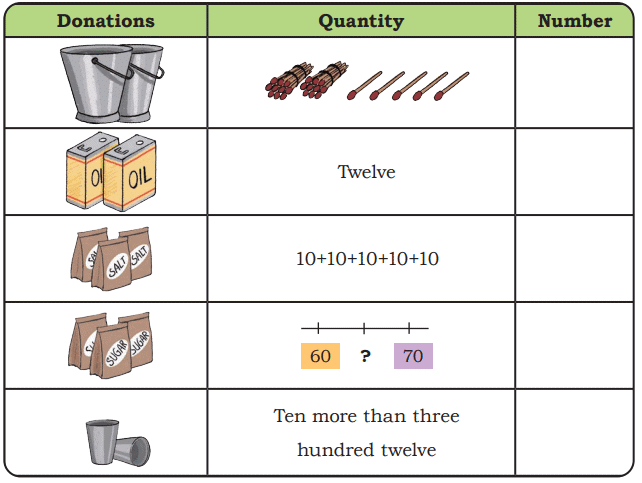
Ans:
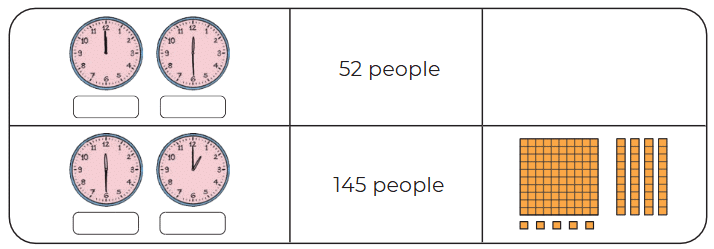
Q: Write the time and draw the number of people who had food at different time slots using HTO blocks as shown below.
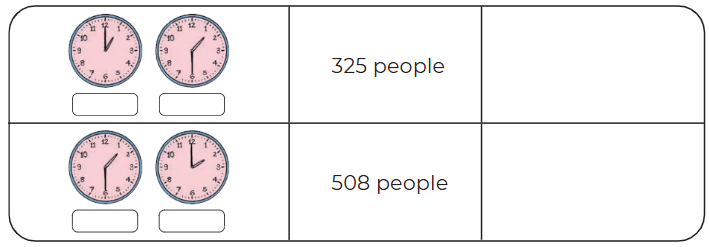
The time slot when the most number of people came for lunch is _____________________.
The time slot when the least number of people came for lunch is _____________________.
Ans:
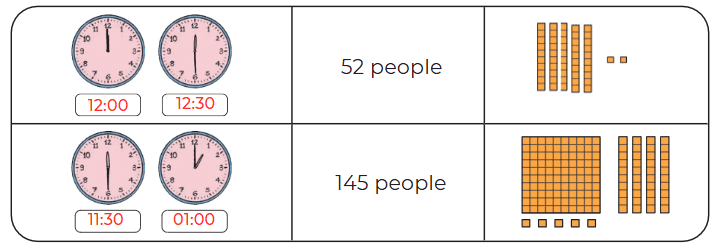
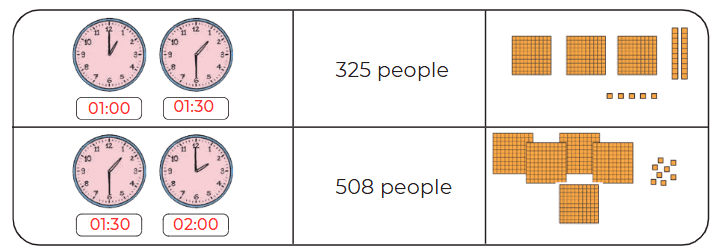
Ans:
The time slot when the most number of people came for lunch is 1:30 to 2:00.
The time slot when the least number of people came for lunch is 12:00 to 12:30.
Let Us Do
Q1:
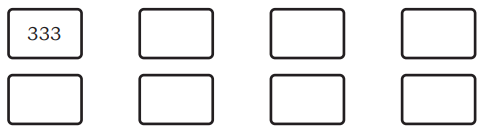
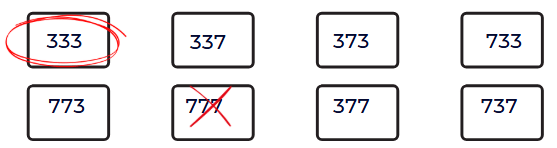
(a) Make 3-digit numbers using the digits 3 and 7. Write the numbers in the boxes given below. Circle the smallest and cross out the largest.Ans: The possible 3-digit numbers using digits 3 and 7 (with repetition allowed) are:
- Smallest number: 333 (circle this)
- Largest number: 777 (cross this out)


(b) Make six 3-digit numbers using the digits 3, 5, 0, 8 such that all numbers are less than 550. You can repeat the digits.Ans:
Possible 3-digit numbers less than 550 using digits 3, 5, 0, 8 with repetition:


(c) Mark the numbers you made in 1(b) on the number line.Ans:
Page 42 (Let Us Do)
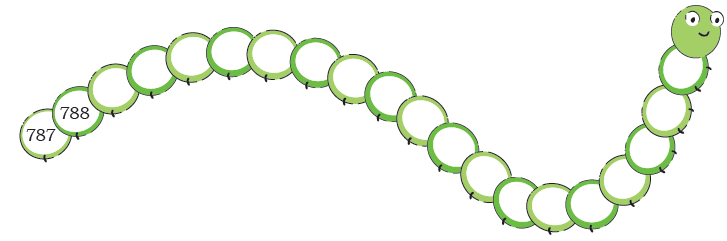
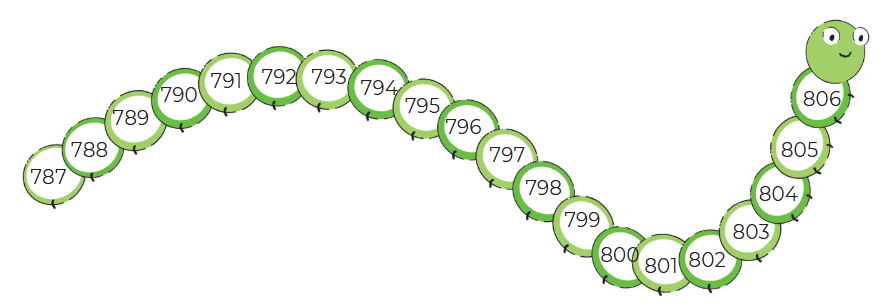
Q2: Fill in the blanks with appropriate numbers.
(a)
Ans:


(b)
Ans:
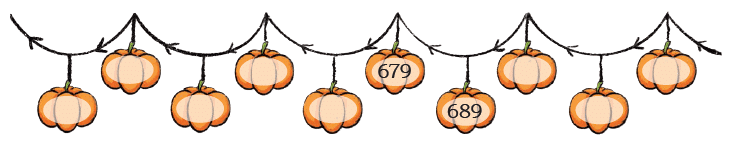
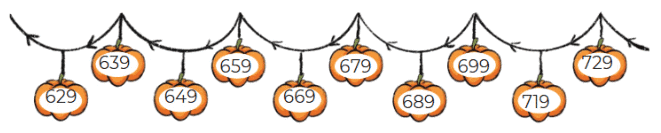
(c)
Ans:


(d)
Ans:


(e)
Ans:
Page 43 (Let Us Do)
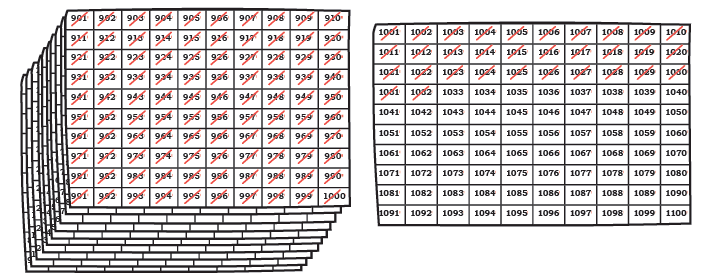
Let us see how they did it.
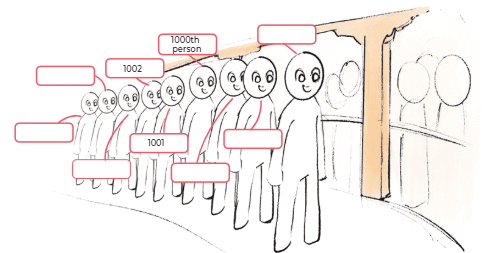
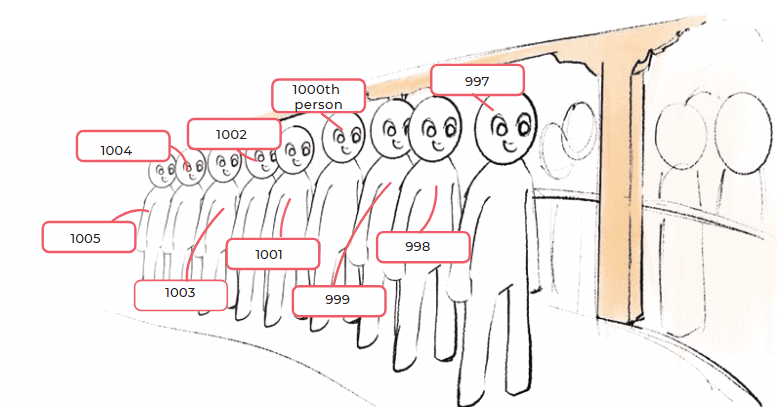
Q: How many people came for the community lunch? __________
Ans: 1032
Fill in the blanks with appropriate numbers.
Ans:
Page 44 (Let Us Do)
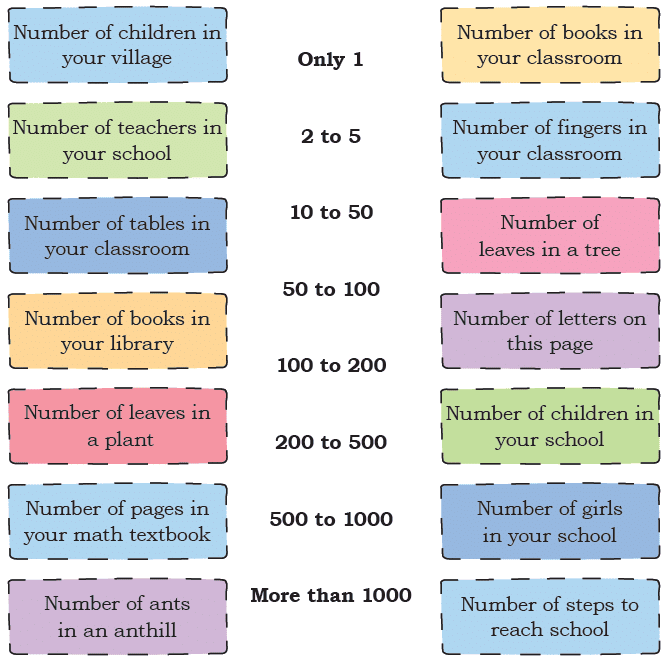
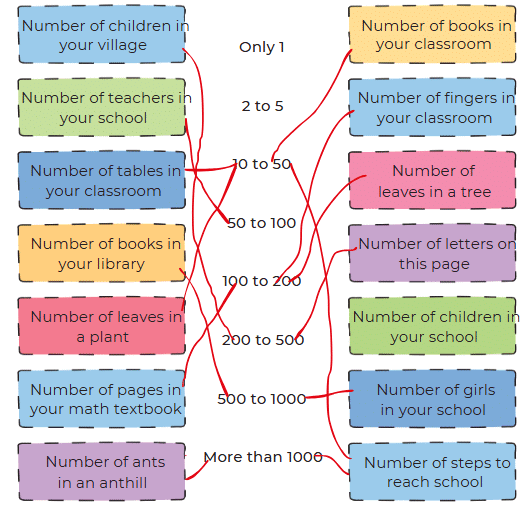
Q3: Identify the range of numbers most suitable for the following situations. Share your thoughts.
Ans:
Q: Identify things around you that are more than 1000 in number.
Ans: Examples of things with more than 1000 in number:
- Grains of rice in a sack
- Stars in the sky
- Leaves on a large tree
- People in a big city
Page 47 (Let Us Break Up One-Thousand)
Q:
(a) We are at 900. How much more to make 1000? __________.
900 + ____ = 1000
Ans: 900 + 100 = 1000
So, 100 more is needed.
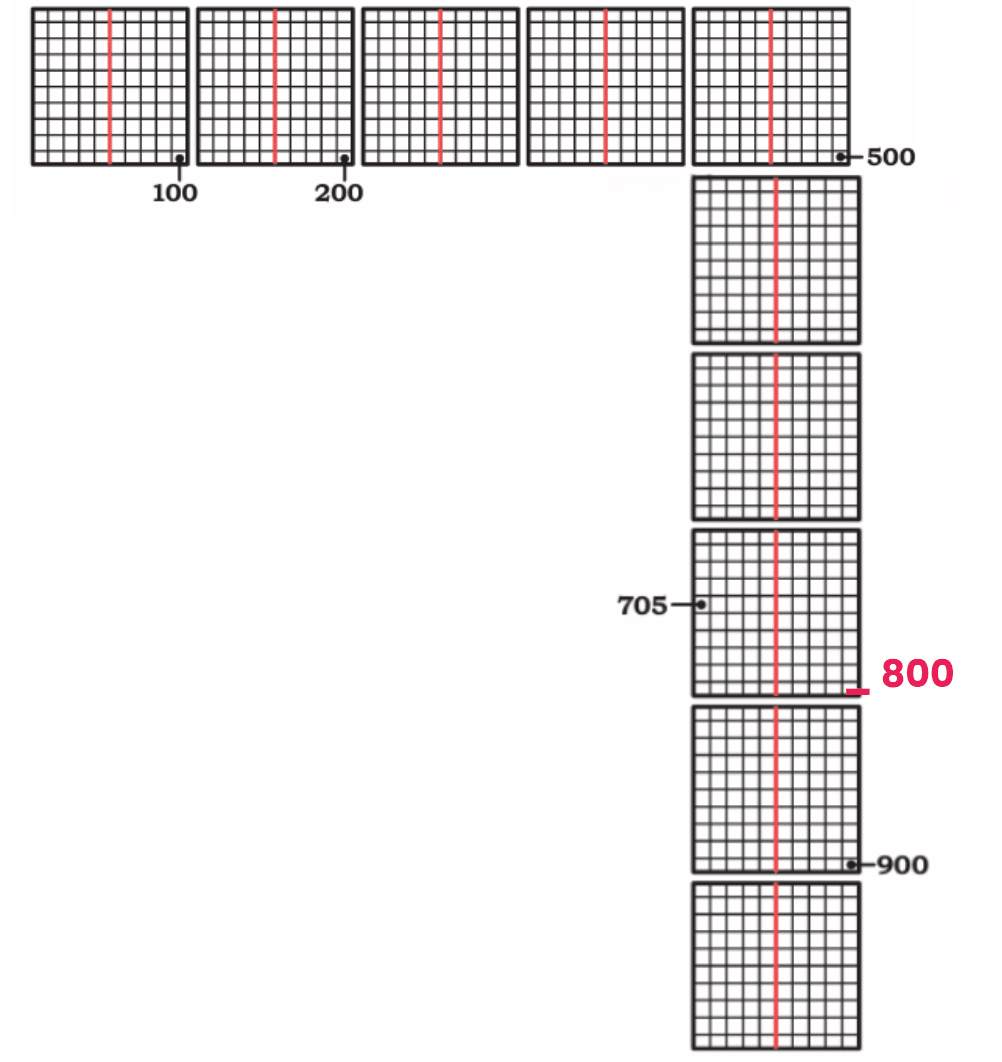
(b) Mark 800. How much more to make 1000?
800 + ______ = 1000
Ans: 800 + 200 = 1000
So, 200 more is needed.
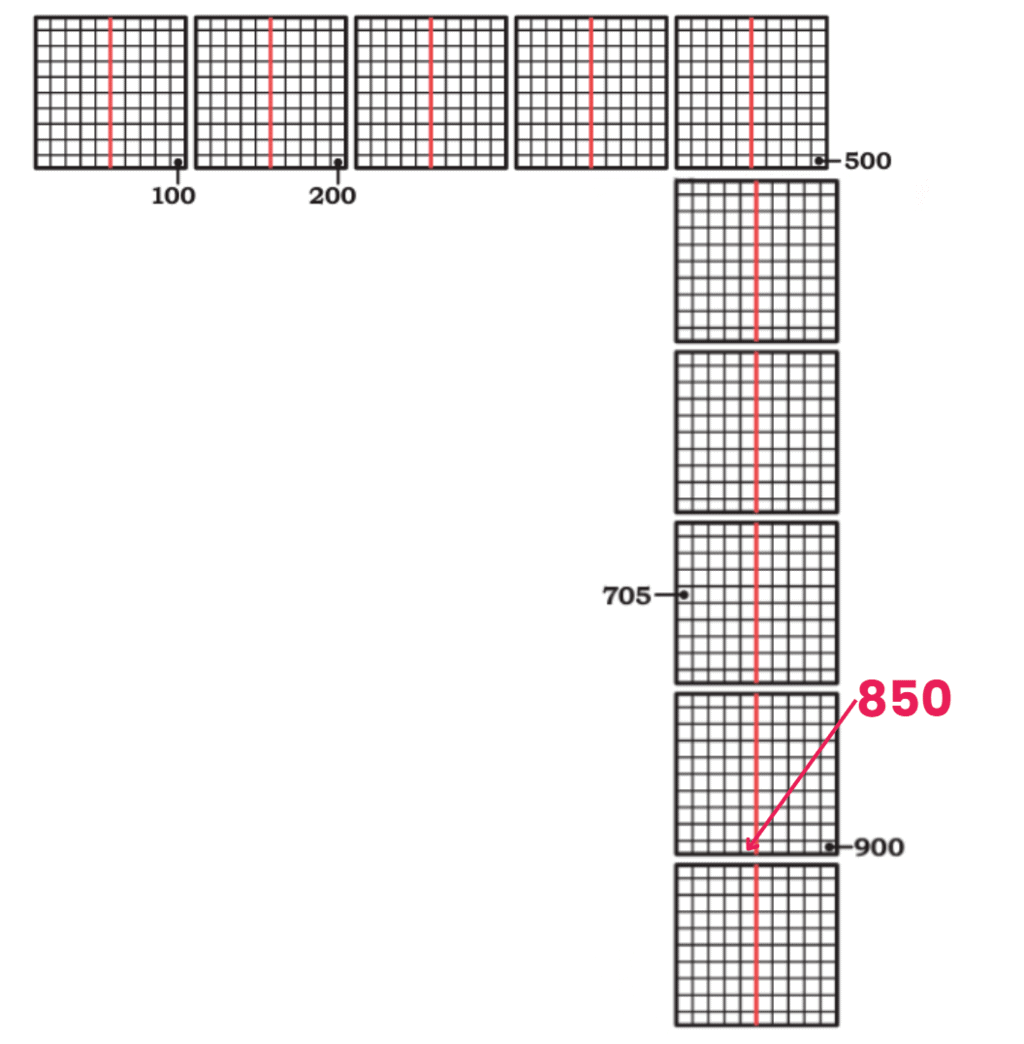
(c) Mark 850. How much more to 1000?
850 + ____ = 1000
Ans: 850 + 150 = 1000
So, 150 more is needed.
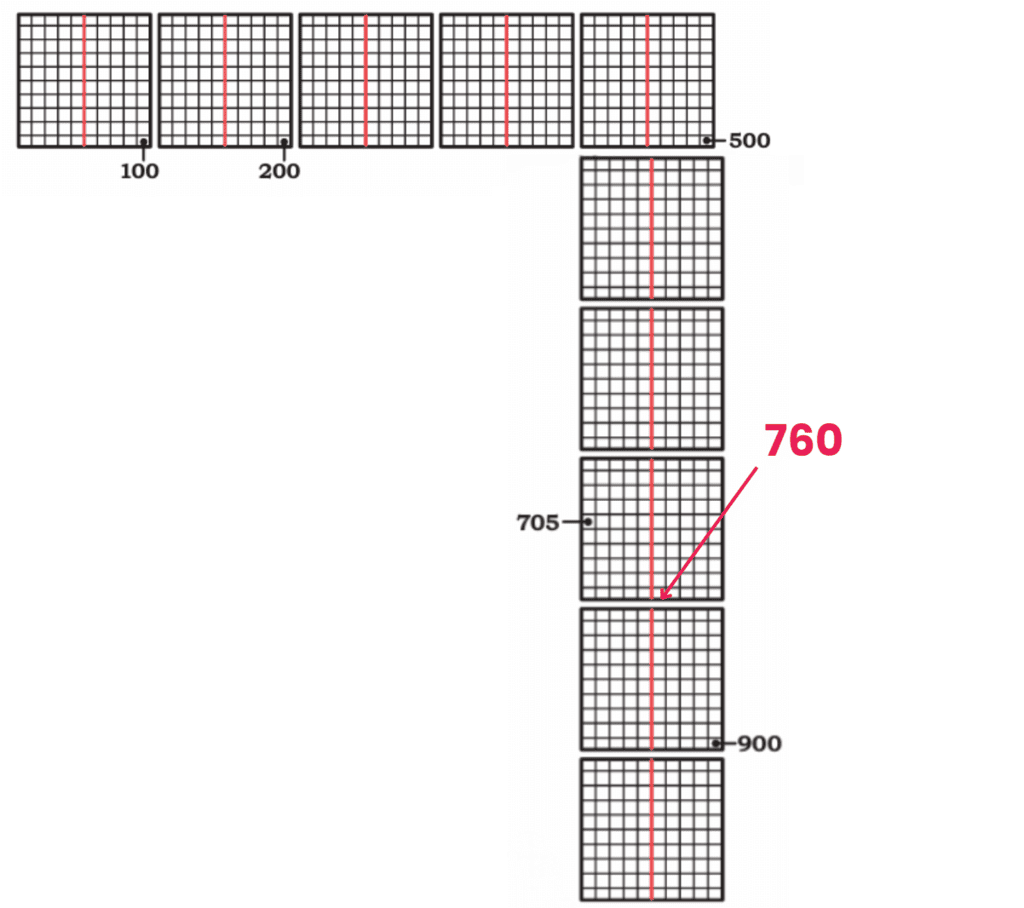
(d) Mark 760. How much more to 1000?
760 + _____ = 1000
Ans: 760 + 240 = 1000
So, 240 more is needed.
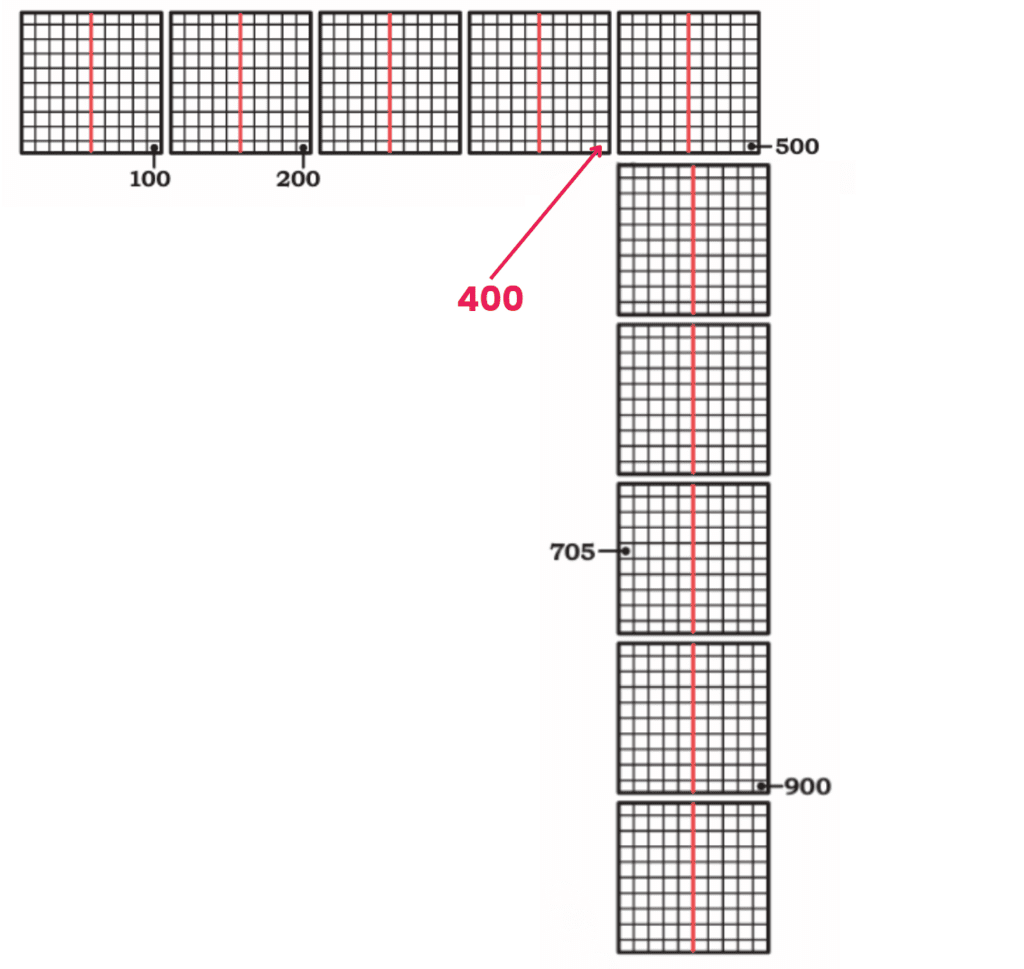
(e) Mark 400. How much less is 400 than 1000?
1000 – ____ = 400
Ans: 1000 – 600 = 400
So, 400 is 600 less than 1000.
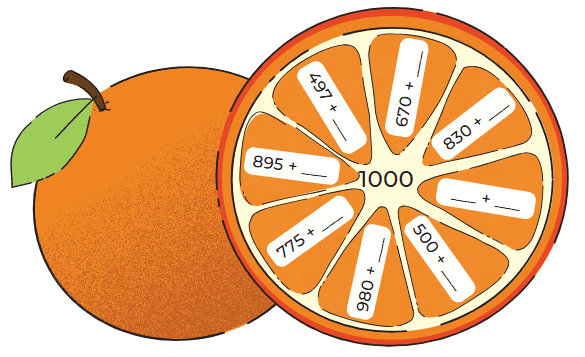
(f): Complete the addition facts leading to 1000.
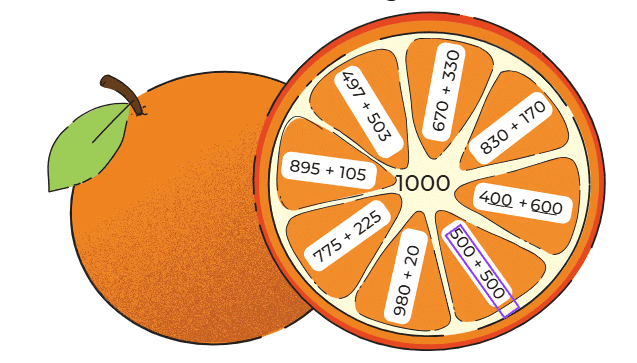
Ans:
Page 48 (Grouping and Regrouping)
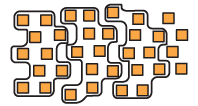
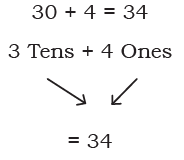
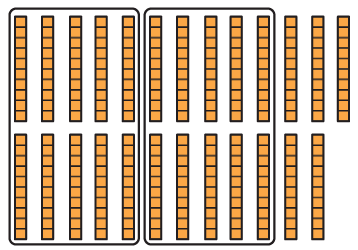
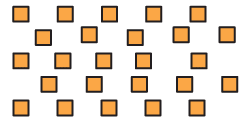
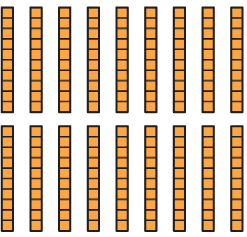
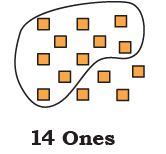
Look at the pictures below. Circle as many groups of 10 Ones or 10 Tens as possible. Write the final number against the following pictures.
Q1:
Ans:
Q2:
Ans: 200 + 50 = 250
2 Hundreds + 5 Tens + 0 Ones
= 250
Q3:
Ans: 20 + 5 = 25
2 Tens + 5 Ones = 25.
Q4:
Ans: 100 + 80 = 180
1 Hundred + 8 Tens + 0 Ones = 180
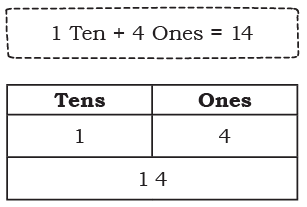
Page 49 (Grouping and Regrouping)
Circle groups of ten 1s, 10s, and 100s as many times as required in each of the following pictures. Fill in the empty boxes.
(a) Ans:
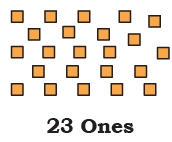
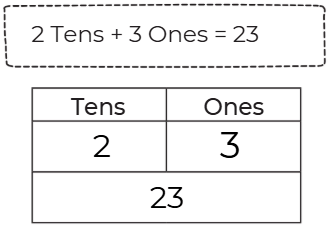
(b) Ans:
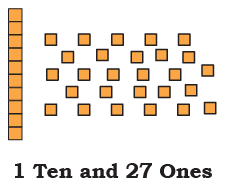
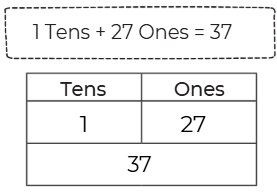
(c)
Ans:
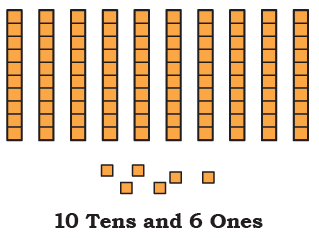
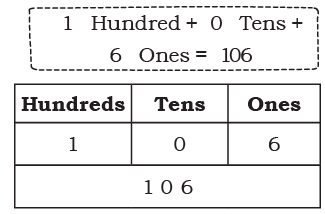
(d)
Ans:
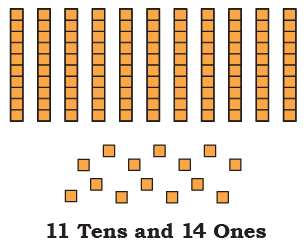
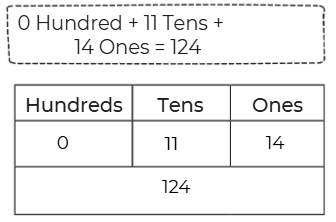
(e)
Ans:
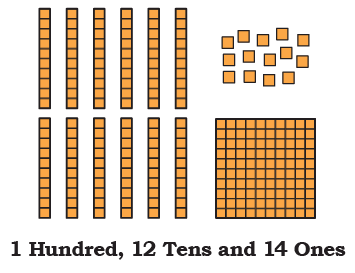
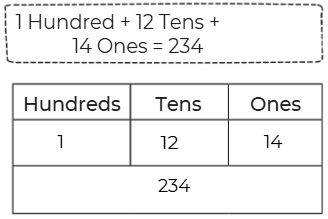
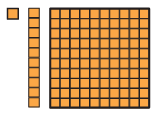
(f)
Ans:
Page 50 (Let Us Solve)
Identify and write the numbers for each of the following in your notebook. Draw pictures like these, if needed.
(a) 45 Ones
(b) 39 Ones
(c) 35 Tens
(d) 86 Tens
(e) 10 Tens and 1 Ones
(f) 15 Tens and 23 Ones
(g) 34 Tens and 12 Ones
(h) 19 Tens and 10 Ones
(i) 2 Hundreds, 13 Tens and 7 Ones
Ans:
(a) 45
(b) 39
(c) 350
(d) 860
(e) 101
(f) 173
(g) 352
(h) 200
(i) 337
Page 51 (Numbers Beyond 1000 (One Thousand))
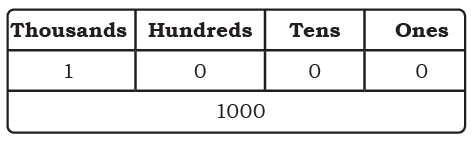
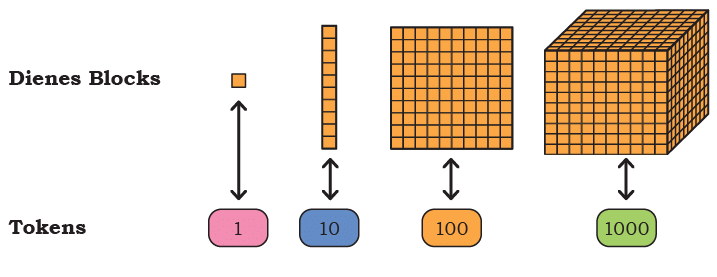
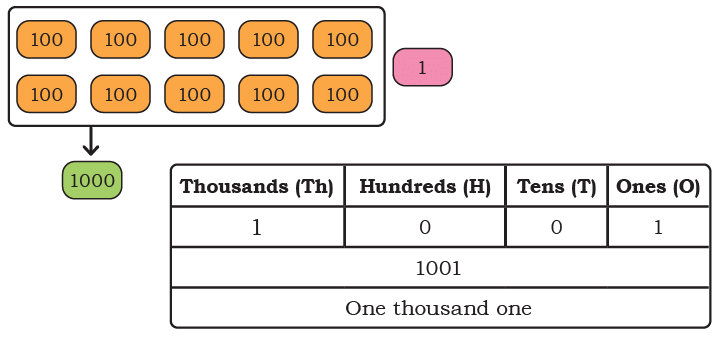
We will use tokens in place of Dienes blocks for larger numbers.
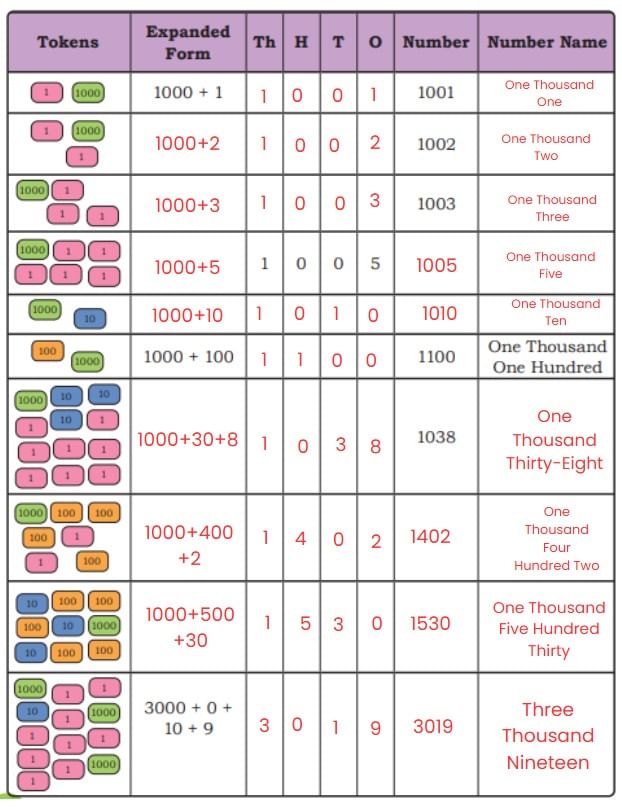
1 Thousand + 0 Hundred + 0 Tens + 1 Ones = 1001
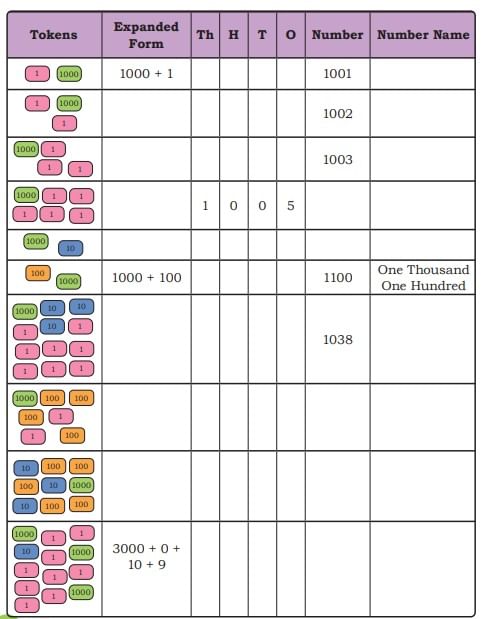
Look at the table below and fill in the blanks.
Ans:
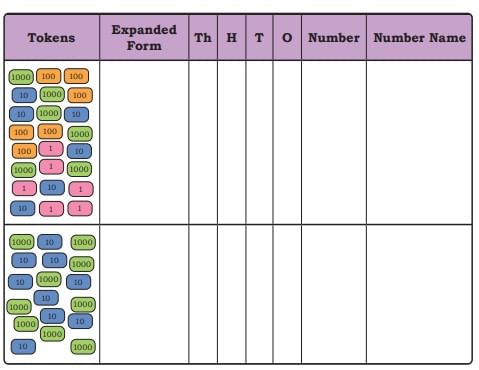
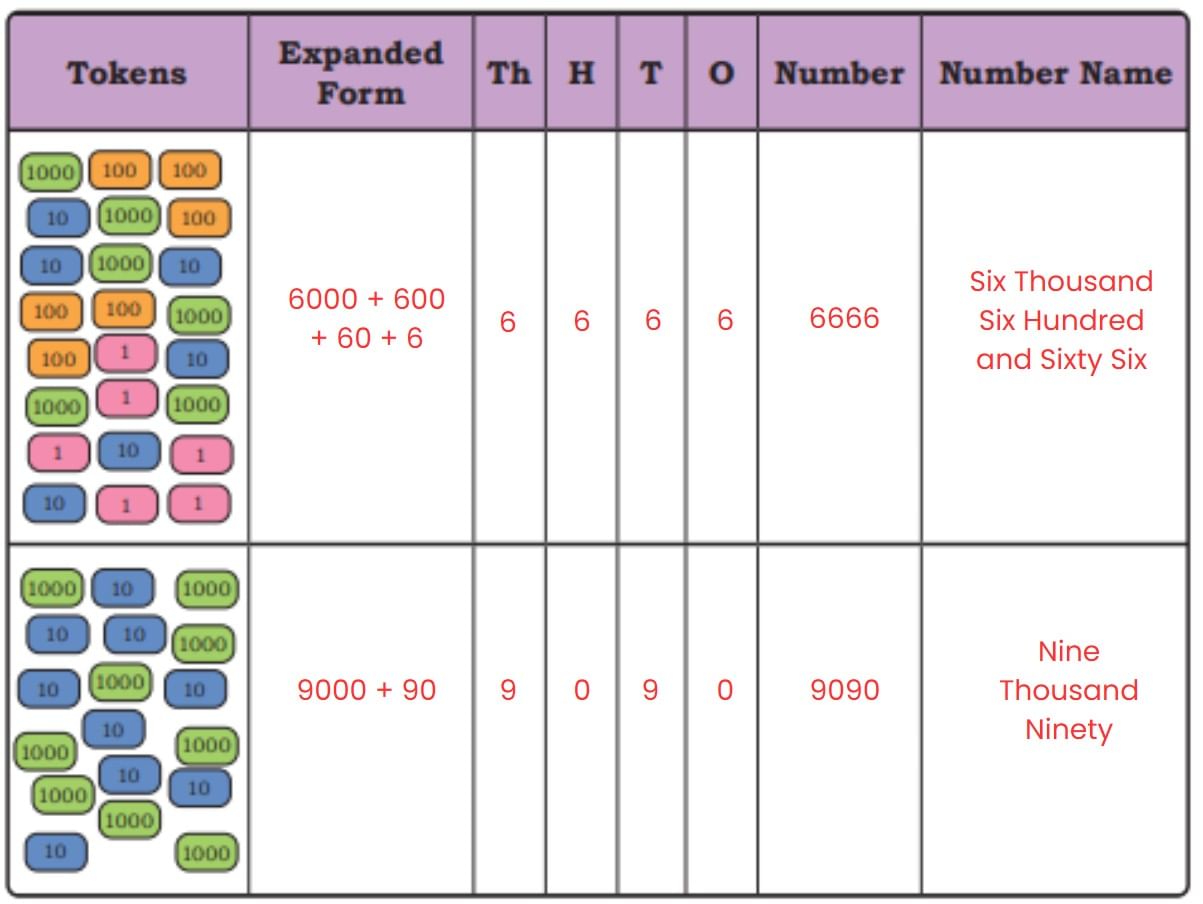
Ans:
Page 53
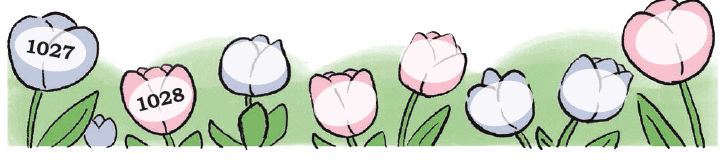
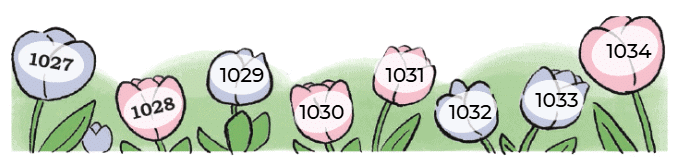
Q: Write the numbers in a sequence—forward and backward as indicated.
(a)
Ans:


(b)
Ans:


(c)
Ans:

(d)

Ans:
Page 54 (Let Us Play)
Q: Make the place value slider. Children can take turns to increase or decrease the number as told.
(a) 1895 – increase the number by 1
Ans: 1895 + 1 = 1896
(b) 2785 – increase the number by 10
Ans: 2785 + 10 = 2795
(c) 3369 – decrease the number by 2
Ans: 3369 – 2 = 3367
(d) 5648 – decrease the number by 10
Ans: 5648 – 10 = 5638
(e) 6487 – increase the number by 20
Ans: 6487 + 20 = 6507
Page 54 (Let Us Think)
Q1: Ram wrote 7 Thousand 0 Hundreds 2 Tens 4 Ones as 724. Is this correct? Write the correct number.
Ans: 7 Thousand 0 Hundreds 2 Tens 4 Ones = 7000 + 0 + 20 + 4 = 7024
Ram’s number 724 is incorrect.
Correct number: 7024
Q2: Richa wrote 5 Thousand 6 Hundreds 0 Tens 3 Ones as 563. Is this correct? Write the correct number.
Ans: 5 Thousand 6 Hundreds 0 Tens 3 Ones = 5000 + 600 + 0 + 3 = 5603
Richa’s number 563 is incorrect.
Correct number: 5603
Page 55 (Number Line)



Q1: Which of these numbers lie between 2226 and 3226? Circle the correct answers.
Ans: Numbers between 2226 and 3226 are:
2236, 3126, 3216Q2:
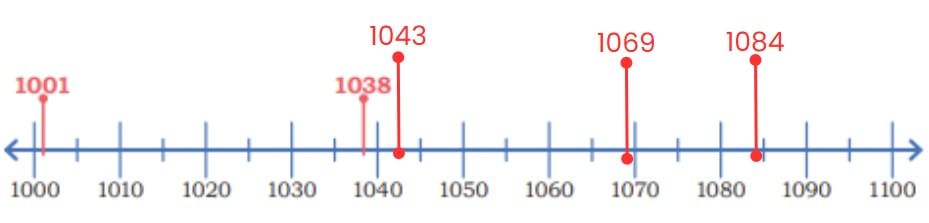
(a) 1001 and 1038 are marked on the number line. Try to mark 1043, 1069, and 1084 on the same number line.
Ans:

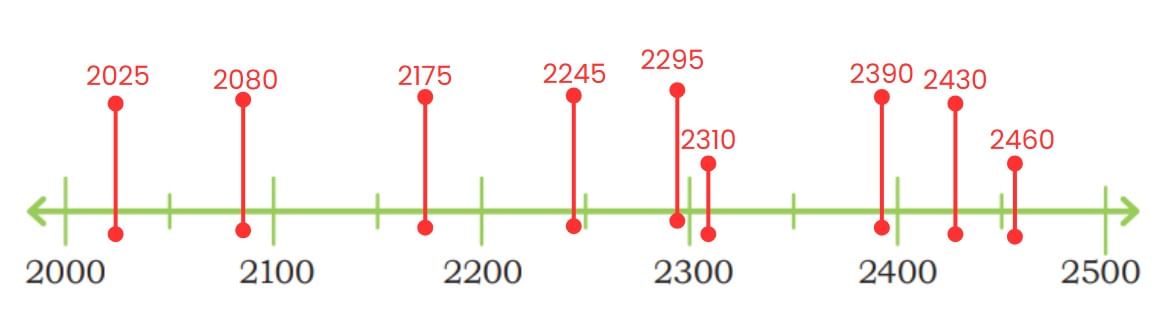
(b) Mark the following numbers on the number line below: 2025, 2080, 2175, 2245, 2295, 2310, 2390, 2430, 2460
Ans:


(c) Mark the following numbers on the number line below: 5512, 5548, 5590, 5636, 5673, 5695
Ans:


(d) Mark the following numbers on the number line below: 8679, 8990, 8923, 8763
Ans:
Page 56 (Let Us Play)

Use the arrow cards (given at the end of the book) to make different numbers. Take turns giving a number for the grade to make using the arrow cards. Read aloud the number and express them in expanded form and in words.
3452 is made up of the cards 3000, 400, 50 and 2.
The expanded form of 3452 is 3000 + 400 + 50 + 2.
In words, 3452 is three thousand four hundred fifty two.
What cards are used to make 4085? Write it in expanded form and in words.
Ans: Cards used: 4000, 0, 80, 5
Expanded form: 4000 + 0 + 80 + 5
In words: Four thousand eighty-five
Page 56 (Find Me!)
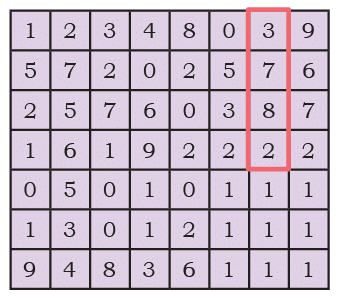
Read aloud the numbers and locate them in the grid.
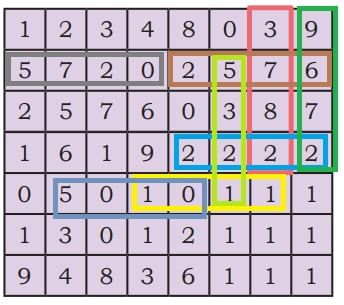
Ans:
Q1: The number 3782.
Ans: Already done
Q2: Two thousand five hundred and seventy-six.
Ans: 2576 is found in the grid
Q3: A 4-digit number with all digits the same.
Ans: 2222 is found in the grid:
Q4: The smallest 4-digit number in this table.
Ans: The smallest 4-digit number is 1011.
Q5: The largest 4-digit number in this table.
Ans: The largest 4-digit number is 9672
Q6: A number more than 5000 and less than 5200.
Ans: 5010 is found in the grid
Q7: A number between 5600 and 6300.
Ans: 5720 number between 5600 and 6300 in the grid.
Q8: A 4-digit number all of whose digits can be found on a die.
Ans: A die has digits 1 to 6. A possible number is 5321
Page 57 (Let Us Solve)
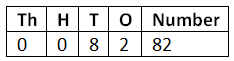
Q1: Use tokens of 1s, 10s, 100s, 1000s to identify the numbers and write them in the table.
(a) 6 Tens and 22 Ones
Ans: 6 Tens = 60, 22 Ones = 22
Total = 60 + 22 = 82
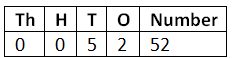
(b) 4 Tens and 12 Ones
Ans: 4 Tens = 40, 12 Ones = 12
Total = 40 + 12 = 52
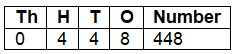
(c) 3 Hundreds, 14 Tens, and 8 Ones
Ans:3 Hundreds = 300, 14 Tens = 140, 8 Ones = 8
Total = 300 + 140 + 8 = 448
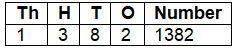
(d) 12 Hundreds, 18 Tens, and 2 Ones
Ans: 12 Hundreds = 1200, 18 Tens = 180, 2 Ones = 2
Total = 1200 + 180 + 2 = 1382
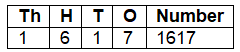
(e) 1 Thousand, 5 Hundreds, 10 Tens, and 17 Ones
Ans: 1 Thousand = 1000, 5 Hundreds = 500, 10 Tens = 100, 17 Ones = 17
Total = 1000 + 500 + 100 + 17 = 1617
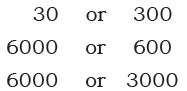
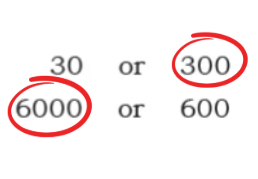
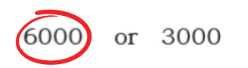
Q2A: Circle the number that is bigger.
Ans:
- 30 or 300: 300
- 6000 or 600: 6000
- 6000 or 3000: 6000
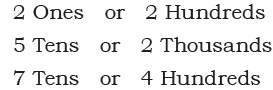
Q2B: Circle the number that is smaller.
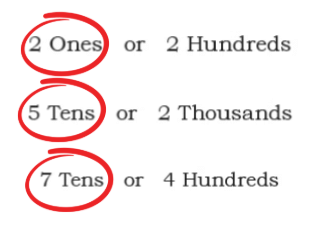
Ans:
- 2 Ones or 2 Hundreds: 2 Ones
- 5 Tens or 2 Thousands: 5 Tens
- 7 Tens or 4 Hundreds: 7 Tens
Page 58 (Comparing Numbers)
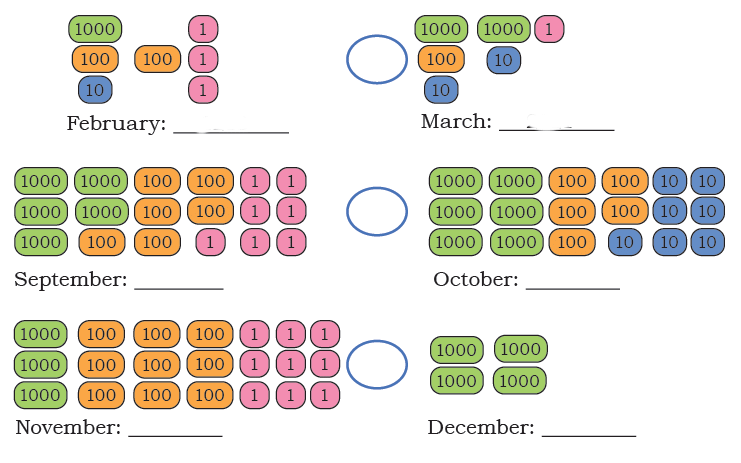
Jaspreet and Gulnaz help to keep a record of the number of plates used in the Gurudwara every month. Use the signs <and> to find the month when a larger number of plates were used.
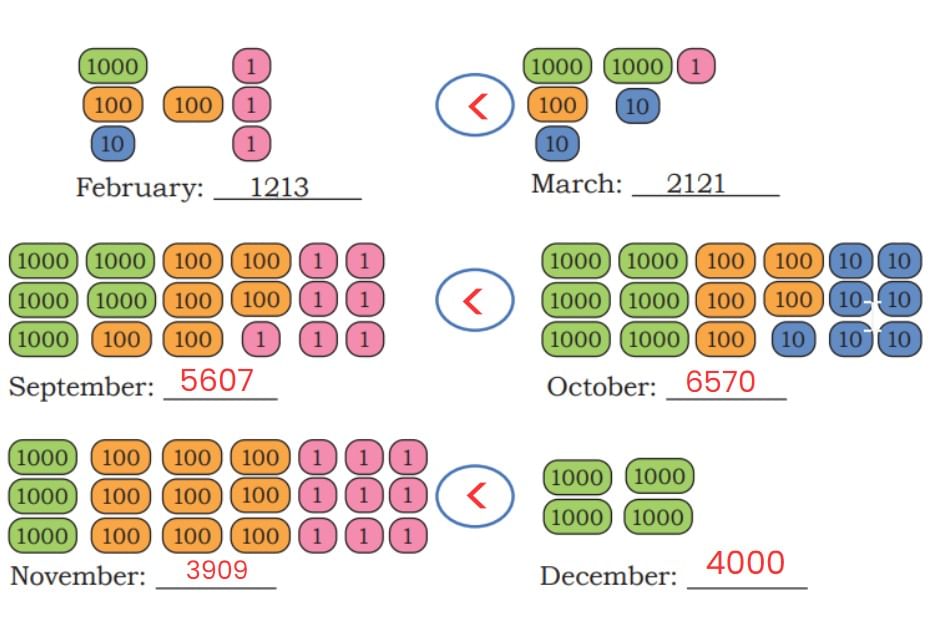
Ans:
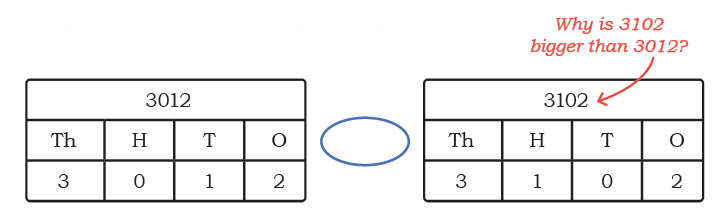
Q: Compare the numbers using the signs <and>.
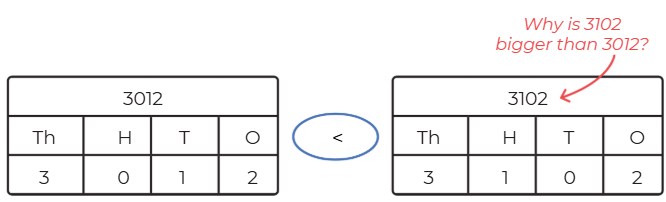
Describe how you decided which number is the bigger one. Which position (Th, H, T, O) helped you to decide this?
Ans:
3012 < 3102
3102 is bigger than 3012 because the hundreds place in 3102 has 1 hundred, while 3012 has 0 hundreds. The thousands, tens, and ones places are the same.
Page 58 (Let Us Do)
Compare the following pairs of numbers using < and >. Make a Th, H, T, O table, if necessary. Share your thoughts with the class.
(a) 2190 ______2910
Ans: 2190 < 2910
(Th: 2 vs 2, H: 1 vs 9, 1 < 9, so 2190 is smaller)
(b) 7087 ______ 7088
Ans: 7087 < 7088
(Th: 7 vs 7, H: 0 vs 0, T: 8 vs 8, O: 7 vs 8, 7 < 8, so 7087 is smaller)
(c) 1009______ 9001
Ans: 1009 < 9001
(Th: 1 vs 9, 1 < 9, so 1009 is smaller)
(d) 982 ______ 1024
Ans: 982 < 1024
(Th: 0 vs 1, 0 < 1, so 982 is smaller)
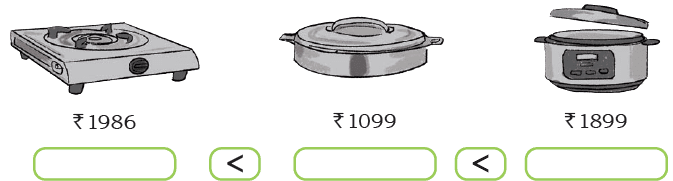

Q2: Order the prices of the following objects from smallest to biggest (increasing order)
Ans:
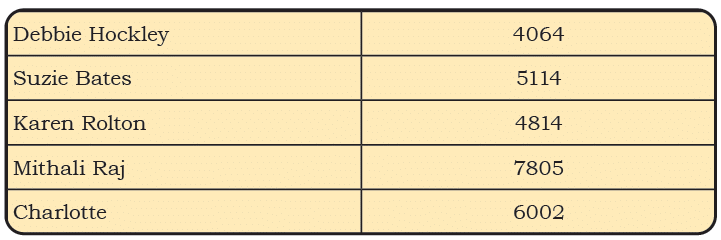
Q3: The following women international cricketers have played 200 ODIs (One-Day International Matches). Listed below are their scores. Arrange the runs scored by them in increasing order (from lowest to highest).
Ans: 4064 < 4814 < 5114 < 6002 < 7805
Page 60 (Let Us Do)
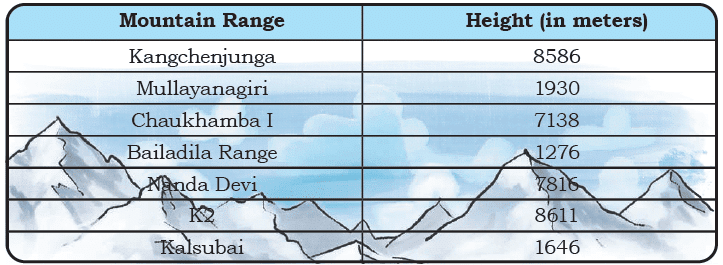
Q4: Arrange the following mountain ranges in decreasing order of height (from highest to lowest).
Ans:
- K2: 8611 meters
- Kangchenjunga: 8586 meters
- Nanda Devi: 7816 meters
- Chaukhamba I: 7138 meters
- Mullayanagiri: 1930 meters
- Kalsubai: 1646 meters
- Bailadila Range: 1276 meters
Q5 Use the signs <, =, > to compare the following.
(a) 2 Tens + 4 Thousands + 3 Hundreds _____ 2043
Ans: 2 Tens + 4 Thousands + 3 Hundreds = 4000 + 300 + 20 = 4320
4320 > 2043
(b) 2 Tens + 4 Thousands + 3 Hundreds _____ 4320
Ans: 2 Tens + 4 Thousands + 3 Hundreds = 4320
4320 = 4320
(c) 2 Thousands + 9 Hundreds + 9 Tens + 9 Ones _____ 3000
Ans: 2 Thousands + 9 Hundreds + 9 Tens + 9 Ones = 2000 + 900 + 90 + 9 = 2999
2999 < 3000
(d) 15 Ones + 9 Tens + 3 Hundreds _____ 1593
Ans: 15 Ones + 9 Tens + 3 Hundreds = 300 + 90 + 15 = 405
405 < 1593
(e) 5000 + 30 + 4 _____ 5034
Ans: 5000 + 30 + 4 = 5034
5034 = 5034
(f) 5000 + 300 + 4 _____ 5340
Ans: 5000 + 300 + 4 = 5304
5304 < 5340
Q6 Fill the blanks with digits 0 –9 such that the numbers meet the condition.
(a): 7__ __3 < 768__
Ans:
- We have 7 _ _ 3 on the left and 768 _ on the right. The “<” means the first number must be smaller than the second.
- The first number starts with 7 and ends with 3, but the middle two spots are blank. The second number is 768 with one blank at the end.
- Both numbers start with 7, so we need to look at the next digits to make sure 7 _ _ 3 is smaller than 768 _.
- For 768 _, the last digit can be anything (like 7680, 7681, 7682, etc.). But we need to make the first number smaller.
- In 7 _ _ 3, the second digit (first blank) should be 0, 1, 2, 3, 4, 5, or 6. Why? Because numbers like 7033, 7133, 7233, up to 7633 are all smaller than 7680 (or any 768_ number).
- The third digit in 7 _ _ 3 can be anything (0–9), but the second digit is the important one to keep it smaller.
The first blank in 7 _ _ 3 can be 0, 1, 2, 3, 4, 5, or 6.
(b) 853__ < 8__3__
Ans:
- We have 853 _ on the left and 8 _ 3 _ on the right. We need 853 _ to be smaller than 8 _ 3 _.
- Both numbers start with 8, so we look at the next digits.
- In 853 _, the second digit is 5. In 8 _ 3 _, the second digit is a blank.
- To make 8 _ 3 _ bigger than 853 _, the second digit of 8 _ 3 _ must be bigger than 5. So, it can be 6, 7, 8, or 9.
- That makes numbers like 863_, 873_, 883_, or 893_, which are all bigger than 853_ (like 8530, 8531, etc.).
- The last digits in both numbers can be anything (0–9), but the second digit of 8 _ 3 _ is what matters most.
The first blank in 8 _ 3 _ can be 6, 7, 8, or 9.
(c) __2__1 < 5__2__
Ans:
- We have _ 2 _ 1 on the left and 5 _ 2 _ on the right. We need _ 2 _ 1 to be smaller than 5 _ 2 _.
- The second number starts with 5, so it’s like 502_, 512_, 522_, etc., depending on the blank.
- The first number has a 2 in the second spot and a 1 at the end, so it’s like _ 2 _ 1. The first and third digits are blank.
- Since 5 (in 5 _ 2 _) is bigger than anything starting with 1, 2, 3, or 4, we can make the first number start with a small digit like 1, 2, 3, or 4.
- For example:
- If the second number is 502 _, the first number can be 1211, 2211, etc., because 1211 < 5020 or 2211 < 5020.
- If the second number is 512 _, the first number can be 1211, 2211, etc., because 1211 < 5120 or 2211 < 5120.
- The third digit in _ 2 _ 1 and the last digit in 5 _ 2 _ can be anything (0–9), but the first digit of _ 2 _ 1 should be small.
The first blank in _ 2 _ 1 can be 1, 2, 3, or 4, and the first blank in 5 _ 2 _ can be 0, 1, 2, 3, or 4 to make pairs that work.
Example: If we pick 1211 and 5120, then 1211 < 5120, which is true!
Page 61 (Challenge!)

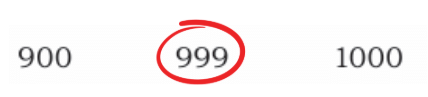
Q: There are 99 numbers strictly between 700 and 800 excluding 700 and 800. How many numbers are there strictly between 7000 and 8000? Circle the correct answer:
Ans: Numbers between 700 and 800 (excluding 700 and 800) are 701 to 799, which is 799 – 701 + 1 = 99 numbers.
Numbers between 7000 and 8000 (excluding 7000 and 8000) are 7001 to 7999, which is 7999 – 7001 + 1 = 999 numbers.
Let Us Explore
Q1: Make as many four-digit numbers as possible using the digits 2, 3, 4, 7 without repetition. There are 24 different numbers possible. Find as many as you can and arrange the numbers in decreasing order in your notebook.
Ans: Using digits 2, 3, 4, 7 without repetition, the possible 4-digit numbers are (24 permutations):
7432, 7423, 7342, 7324, 7243, 7234, 4732, 4723, 4372, 4327, 4273, 4237,
3742, 3724, 3472, 3427, 3274, 3247, 2743, 2734, 2473, 2437, 2374, 2347
Arranged in decreasing order:
7432 > 7423 > 7342 > 7324 > 7243 > 7234 > 4732 > 4723 > 4372 > 4327 > 4273 > 4237 > 3742 > 3724 > 3472 > 3427 > 3274 > 3247 > 2743 > 2734 > 2473 > 2437 > 2374 > 2347
Q2: Compare with your friends to find what other numbers they have made. See if all of you together can come up with all the 24 numbers. How do you know that you have all possible such numbers?
Ans: Do it Yourself!