Concept: Proportional reasoning involves comparing quantities using ratios to understand how they change together.
Ratio: A comparison of two quantities, written as a:b, meaning for every a units of the first quantity, there are b units of the second.
Proportional Ratios: Two ratios a:b and c:d are proportional (written as a:b :: c:d) if their terms change by the same factor, i.e., a/b = c/d.
Observing Similarity in Change
Context: Comparing digital images of different sizes using ratios to check for similarity.
Example: Images A, C, and D have width-to-height ratios of 60:40, 30:20, and 90:60, respectively. These simplify to 3:2, showing they are proportional and look similar despite size differences.
Non-Proportional Images: Image B (elongated) and Image E (square, compressed) have different ratios, making them appear distorted.
Understanding Ratios
A ratio compares two quantities, written as a : b.
Example: Width to height in Image A is 60 : 40.
Proportional Ratios (in simplest form):
A: 60 : 40 = 3 : 2
C: 30 : 20 = 3 : 2
D: 90 : 60 = 3 : 2
Non-Proportional:
B: 40 : 20 = 2 : 1
E: 60 : 60 = 1 : 1
If different ratios simplify to the same form, they are said to be proportional.
Simplest Form of Ratios
To simplify a ratio, divide both terms by their Highest Common Factor (HCF).
Example:
60 : 40 → HCF = 20 → Simplest form = 3 : 2
90 : 60 → HCF = 30 → Simplest form = 3 : 2
So, 60:40 :: 90:60 means both ratios are proportional.
Symbol ‘::’ is used to indicate proportionality.
Rule of Three (Trairasika)
If a : b :: c : d, then d = (b × c) / a
Example: Midday Meal
120 students : 15 kg
80 students : ? → 80 = 2/3 of 120 → 15 × 2/3 = 10 kg rice needed
Example: Travel Distance
150 min : 90 km
240 min : ? → Use cross multiplication → x = (240 × 90) / 150 = 144 km
Example: Tea Cost
Himachal: 200 g : ₹200 → ₹1000 per kg
Meghalaya: 1 kg : ₹800 → Himachal tea is more expensive
Problem Solving Using Proportional Reasoning
Example 1: Check if 3 : 4 and 72 : 96 are proportional → Simplify 72 : 96 → 3 : 4. Hence, they are proportional.
Example 2: Lemonade Mixing
6 glasses : 10 spoons
To make 18 glasses → Multiply both by 3 → 18 : 30
Example 3: Cement Usage
Nitin: 60 ft : 3 bags → 20 : 1
Hari: 40 ft : 2 bags → 20 : 1 → Proportional, walls are equally strong.
Example 4: Teacher-Student Ratio
My school: 5 : 170
Compare this with your school ratio and check if proportional.
Example 5: Blackboard Dimensions
Measure and compare width-to-height ratio with your notebook drawing.
Example 6: Neelima and Mother’s Age
At age 3: 3 : 30 = 1 : 10
At age 12: 12 : 39 = 4 : 13 → Not proportional
Adding the same number does not keep ratio proportional.
More Solved Examples and Applications
Example 1: Simplifying Ratios
Problem: Are the ratios 3:4 and 7:96 proportional?
Solution: Simplify 7:96 by dividing by their highest common factor (1), resulting in 7:96. Since 3:4 is not equal to 7:96, they are not proportional.
Example 2: Lemonade Sweetness
Problem: For 6 glasses of lemonade, 10 spoons of sugar are used. How many spoons for 18 glasses to maintain sweetness?
Solution: Ratio of glasses to sugar is 6:10. The factor of change from 6 to 18 glasses is 18 ÷ 6 = 3. Multiply sugar (10) by 3: 10 × 3 = 30. Thus, 30 spoons are needed (6:10 :: 18:30).
Example 3: Wall Strength
Problem: Nitin builds a 60 ft wall with 3 bags of cement; Hari builds a 40 ft wall with 2 bags. Are the walls equally strong?
Solution: Nitin’s ratio: 60:3 = 20:1. Hari’s ratio: 40:2 = 20:1. Since both ratios are equal, the walls are equally strong.
Example 4: Teacher-Student Ratio
Problem: A school has 5 teachers and 170 students (ratio 5:170). Compare with another school’s ratio.
Solution: Simplify 5:170 to 1:34. Compare with the other school’s simplified ratio to check proportionality.
Example 5: Blackboard Ratios
Problem: Measure a blackboard’s width and height, find the ratio, and draw a proportional rectangle.
Solution: If the blackboard’s ratio is w:h, a proportional rectangle has the same ratio. Compare drawings to verify similarity.
Example 6: Age Ratios
Problem: Neelima is 3 years old, her mother is 30 (ratio 3:30 = 1:10). What is the ratio when Neelima is 12?
Solution: Mother’s age increases by 9 years (30 + 9 = 39). New ratio: 12:39 = 4:13, which is not the same as 1:10.
Solution: Simplify ratios: volume (1:30), price (1:77). Since 1:30 is not equal to 1:77, they are not proportional, possibly due to packaging/marketing costs.
Example 12: Sharing Counters
Problem: Share 42 counters in a 4:3 ratio.
Solution: Total parts = 4 + 3 = 7. Each part = 42 ÷ 7 = 6. Partner gets 4 × 6 = 24, you get 3 × 6 = 18.
Example 13: Sand and Cement Mixture
Problem: A 40kg mixture has a sand:cement ratio of 3:1. Find quantities.
You’re making a birthday card and adding a cute photo of a tiger. You try resizing it on your computer. But something strange happens…In some cases, the tiger still looks perfectly fine – just bigger or smaller. However, in others, it appears stretched or squished. What’s going on? Let’s find out using 5 tiger images: A, B, C, D, and E.
What We Observed
Images A, C, and D look similar to each other. But B and E look a bit odd:
B is stretched (elongated).
E is squished (fatter).
So what’s the secret behind the ones that look similar?
What We Discovered
A → C: Width and height both become half → Looks similar
A → D: Width and height both become 1.5 times → Looks similar
A → B: Width decreases by 20 mm, and height also by 20 mm. But this is subtraction, not multiplication → Looks different
E is a square, while A is a rectangle → Shape changes → Looks different
When both width and height change by the same multiplication factor, the image looks similar. This is called a Proportional Change.
Proportional change = shape stays the same
Non-proportional change = shape looks distorted
Ratios
We saw earlier that images A, C, and D looked similar because their width and height changed in the same way. Now, let us use ratios to understand this better.
A Ratio :
compares two quantities using the form a:b.
represents such proportional relationships in mathematics.
Examples of Ratios
Image A: Width to height ratio is 60 : 40.
Image C: Width to height ratio is 30 : 20.
Image D: Width to height ratio is 90 : 60.
Proportional Ratios
Ratios are proportional if the terms of the ratios change by the same multiplying factor. Example: To check if the ratios of Image A (60 : 40) and Image C (30 : 20) are proportional:
Multiply both terms of 60 : 40 by ½:
60 × ½ = 30
40 × ½ = 20
Result: 30 : 20, which matches the ratio of Image C. This shows that the ratios 60 : 40 and 30 : 20 are proportional because they are related by the same factor (½).
Finding the Multiplying FactorTo find the factor that transforms the ratio of Image A (60 : 40) to Image D (90 : 60): Divide the corresponding terms of Image D by Image A:
For the first term: 90 ÷ 60 = 1.5
For the second term: 60 ÷ 40 = 1.5
Since both terms are multiplied by the same factor (1.5), the ratios are proportional.
So, multiply both terms of 60 : 40 by 1.5:
60 × 1.5 = 90
40 × 1.5 = 60
Result: 90 : 60, which matches the ratio of Image D.
Ratios in their Simplest Form
To reduce a ratio to its simplest form, divide both terms by their Highest Common Factor (HCF).
Following our previous example:
For Image A, the ratio of width to height is 60 : 40.
HCF of 60 and 40 is 20.
Divide both terms by 20: 60 ÷ 20 = 3, 40 ÷ 20 = 2.
Simplest form: 3 : 2.
For Image D, the ratio is 90 : 60.
HCF of 90 and 60 is 30.
Divide both terms by 30: 90 ÷ 30 = 3, 60 ÷ 30 = 2.
Simplest form: 3 : 2.
Since the simplest forms of the ratios for Images A and D are both 3 : 2, they are proportional.
For Image B, the ratio is 40 : 20.
HCF of 40 and 20 is 20.
Divide both terms by 20: 40 ÷ 20 = 2, 20 ÷ 20 = 1.
Simplest form: 2 : 1.
For Image E, the ratio is 60 : 60.
HCF of 60 and 60 is 60.
Divide both terms by 60: 60 ÷ 60 = 1, 60 ÷ 60 = 1.
Simplest form: 1 : 1.
The simplest forms of the ratios for Images B (2 : 1) and E (1 : 1) are not the same as 3 : 2 (Images A, C, and D). Therefore, the ratios of Images B and E are not proportional to those of Images A, C, and D.
When two ratios are the same in their simplest forms, they are said to be in proportion or proportional. The :: symbol is used to indicate that two ratios are proportional. For example, a : b :: c : d means the ratios a : b and c : d are proportional.
For Images A, C, and D:
60 : 40 :: 30 : 20 (both simplify to 3 : 2).
60 : 40 :: 90 : 60 (both simplify to 3 : 2).
Let us solve an example
Nitin and Hari were building a compound wall around their house.
Nitin built the longer side of the wall: 60 ft He used 3 bags of cement
Hari built the shorter side of the wall: 40 ft She used 2 bags of cement
Nitin started to worry:
We’ll compare the ratio of wall length to cement bags used. “I used more cement. Did Hari use too little? Will her wall be weak?”
Let’s find out using ratios!
What Do We Notice?
Both have the same ratio in simplest form: 20 : 1.
This means: for every 20 feet of wall, they used 1 bag of cement.
So, the cement per foot of wall is the same for both!
Since the ratios are proportional, the amount of cement per foot is equal. Nitin should not worry — both walls are equally strong!
Trairasika – The Rule of Three
Let us understand this using an example:
In our rainy-day school lunch example:
Normal day: 120 students → 15 kg rice
Rainy day: 80 students → ? kg rice
We compared two ratios:
120:15::80:?
Using proportional reasoning:
The number of students changed by a factor of 80120=23
So, rice needed = 15×23 =10 kg
This is called the Rule of Three or Trairasika — when three values are known and we find the fourth that keeps the proportion.
The Algebra Behind It
Let’s say:
a:b::c:d
This means:
So, both quantities are changed by the same factor f.
Deriving the Rule
From:
ca=db
Multiply both sides by abab:
ab×ca=ab×db⇒bc
This is called cross multiplication.
Rule of Three Formula
When:
a:b::c:d,
Ancient Wisdom: Āryabhaṭa’s Method
In ancient India, this was known as Trairasika. Āryabhaṭa (199 CE) explained it like this:
Rule of Three problems.
There were 3 numbers given:
Pramāṇa = measure (a)
Phala = known outcome (b)
Ichchhā = desired measure (c)
To find Ichchhāphala = desired outcome (d), Āryabhaṭa says, “Multiply the phala by the ichchhā and divide the resulting product by the pramāṇa.”
In other words, Āryabhaṭa says,
Then, according to him:
Which is the same as our modern formula!
Sharing, but Not Equally!
Let us begin with an activity:
Take 12 objects (coins, seeds, pebbles). Now, form a pair and try sharing them in different ways.
If both of you get the same number: You each get 6 counters Ratio = 6 : 6 = 1 : 1 (simplest form) This implies that Equal share = Equal ratio
If you both get the following number: Your partner gets 5 counters You get 7 counters This implies that Partner: You = 5 : 7
Now, if you want to divide 12 counters in the ratio 3 : 1. Let’s build this step-by-step:
First, your partner gets 3, you get 1 → 4 counters used
Repeat:
Next 3 for partner, 1 for you → 8 used
Final 3 for partner, 1 for you → 12 used
So:
Partner = 3 + 3 + 3 = 9 counters
You = 1 + 1 + 1 = 3 counters Total = 12 Ratio = 9 : 3 = 3 : 1
What if you had to share 42 counters in the ratio 4 : 3?
Repeating the steps will take too long! Let’s use a quicker method.
To divide 42 in the ratio 4 : 3:
Add the parts: 4+3=7 parts in total
Find the size of one part: 42÷7=6
Now multiply:
Partner gets: 4×6=24
You get: 3×6=18
So, 42 shared in 4 : 3 becomes 24 : 18
General Rule for Sharing
To divide a quantity x in the ratio m:n
Hence,
This method gives parts in exact proportion to the ratio.
Let’s Try One!
Divide 60 in the ratio 2 : 3
Total parts = 2+3 = 5
Each part = 60÷5 =12
Shares:
First = 2×12=24
Second = 3×12=36
So, 60 is split as 24 : 36
Unit Conversions
When solving problems involving proportionality, it is often necessary to convert units to ensure consistency across measurements.
Using the same units for all quantities in a ratio or proportion ensures accurate comparisons.
Key Unit Conversions
Length:
1 metre = 3.281 feet
Area:
1 square metre = 10.764 square feet
1 acre = 43,560 square feet
1 hectare = 10,000 square metres
1 hectare = 2.471 acres
Volume:
1 millilitre (mL) = 1 cubic centimetre (cc)
1 litre = 1,000 mL or 1,000 cc
Temperature:
Conversion between Fahrenheit and Celsius:
Fahrenheit = (9/5 × Celsius) + 32
Celsius = 5/9 × (Fahrenheit – 32)
Application in Proportions
When comparing ratios (e.g., length of a wall to cement bags), ensure all measurements are in the same units before simplifying or checking proportionality.
Example: If one wall’s length is given in metres and another in feet, convert both to the same unit (using 1 metre = 3.281 feet) to compare ratios accurately.
Key Points to Remember
Convert units to the same system before comparing ratios or solving proportion problems.
Use the provided conversion factors for length, area, volume, and temperature to ensure accurate calculations.
Temperature conversions require specific formulas, unlike direct multiplication for other units.
We’ve already seen that algebra uses letter symbols (like x, a, b, etc.) to:
Represent patterns
Show relationships
Write general statements in a compact form
Algebra isn’t just about letters and numbers — algebra is a powerful tool to:
Make predictions
Prove properties
Solve different types of problems
What is Distributivity?
Distributivity is a rule that connects multiplication and addition.
Instead of solving:
3×(4+5)
We can rewrite it as:
(3×4)+(3×5)=12+15=27
Both give the same result.
This is called the Distributive Property:
a × (b+c) = a × b + a × c
In this chapter, we will learn:
Explore multiplication patterns
Use algebra to explain them
Solve problems faster using distributivity
Some Properties of Multiplication
Increments in Products
Let’s take two numbers:23 × 27
If we increase 27 by 1:
If a, b and c are three numbers, then-
This property can be visualised nicely using a diagram:
This is called the distributive property of multiplication over addition. Using the identity a (b + c) = ab + ac with a = 23, b = 27, and c = 1, we have:
23×(27+1)=23×27+23
So, the product increases by 23.
We can also similarly expand (a + b) c using the distributive property as follows-
(a + b) c = c (a + b) (commutativity of multiplication)
= ca + cb (distributivity)
= ac + bc (commutativity of multiplication)
If we increase both numbers:
Now, let us see what happens if both numbers in a product are increased by 1. If in a product ab, both a and b are increased by 1, then we obtain (a + 1) (b + 1).
This can be expanded by considering (a + 1) as a single term. Then, by the distributive property, we have
Thus, the product ab increases by a + b + 1 when each of a and b is increased by 1.
If one of the numbers in a product is increased by 1and the other is decreased by 1:
Let us again take the product ab of two numbers a and b. If a is increased by 1 and b is decreased by 1, then their product will be (a + 1)(b – 1). Expanding this, we get
If a and b are negative integers?
Check by substituting different values for a and b.
Example 1: Let a=−5, b=8
LHS:(a+1)(b+1)=(−5+1)(8+1)=(−4)(9)=−36
RHS:ab+a+b+1=(−5)(8)+(−5)+8+1=−40−5+8+1=−36
LHS = RHS
We have seen that integers also satisfy the distributive property, that is, if x, y and z are any three integers, then x (y + z) = xy + xz.
Thus, the expressions we have for the increase of products hold when the letter-numbers take on negative integer values as well.
An identity is a mathematical statement that is always true, for all values of the variables involved.
Examples of identities:
a(b+8)=ab+8a
(a+1)(b−1)=ab+b−a−1
(a+b)2=a2+2ab+b2
If a is increased by m and b is increased by n:
If a and b are the initial numbers being multiplied, they become a + m and b + n.
The increase is an + bm + mn.
Notice that the product is the sum of the product of each term of (a + m) with each term of (b + n).
This identity can be visualised as follows:
This identity works even when m or n are negative, which means one or both numbers are decreased.
When one or both numbers are decreased:
Let’s simplify:(a+1)(b−1)=(a+1)(b+(−1))
Use Identity 1 with m=1, n=−1:ab+a(−1)+1(b)+1(−1)=ab−a+b−1=ab+b−a−1
Generalising, we can find the product (a + u) (b – v) as follows.
(a + u) (b – v) = (a + u) b – (a + u) v
= ab + ub – (av + uv)
= ab + ub – av
A Pinch of History
The distributive property – the rule that says:
(a+b)×c=ac+bc
was used long ago by mathematicians in many ancient civilisations like Egypt, Mesopotamia, Greece, China and India. Even though they didn’t always write it as a formula, they used the same idea in their calculations. Famous mathematicians used it as the following:
Euclid (Greece) used it in geometric form.
Āryabhaṭa (India) used it in algebraic calculations.
But the first clear statement of the distributive property came from Brahmagupta, an Indian mathematician.
What Did Brahmagupta Say?
In his book Brahmasphuṭasiddhānta, Verse 12.55, he described multiplication like this:
“Break the number being multiplied (the multiplier) into two or more parts. Multiply each part separately by the other number (multiplicand), and then add the results.”
This is the same as: (a+b)×c=a×c+b×c
He called this method: khaṇḍa-guṇanam = “multiplication by parts”
In the next verse (Verse 12.56), Brahmagupta further describes a method for doing fast multiplication using this distributive property, which we explore further in the next section.
Fast Multiplications Using the Distributive Property
The distributive property can be used to come up with quick methods of multiplication when certain types of numbers are multiplied.
When one of the numbers is 11, 101, 1001, …
Let us understand this with the help of an example: 3874 × 11
Let us take the first multiplication:
3874 × 11 = 3874 (10 + 1) = 38740 + 3874 = 42614
Notice how the digits are getting added.
Let us take a 4-digit number dcba, that is, the number that has
d in the thousands place,
c in the hundreds place,
b in the tens place and
a in the units place.
dcba × (10 + 1) = dcba × 10 + dcba.
This becomes:
Continuing with our example, the above can be used to obtain the product in one line.
Such methods of applying the distributive property to easily multiply two numbers were discussed extensively in the ancient mathematical works of Brahmagupta (628 CE), Sridharacharya (750 CE) and Bhaskaracharya (Lilavati, 1150 CE). In his work Brahmasphuṭasiddhānta (Verse 12.56), Brahmagupta refers to such methods for fast multiplication using the distributive property asista-gunana.
Special Cases of the Distributive Property
Square of the Sum/Difference of Two Numbers
This can be understood with the help of an example:
Q: The area of a square of side length 60 units is 3600 sq. units (602), and that of a square of side length 5 units is 25 sq. units (52). Can we use this to find the area of a square of side length 65 units?
A square of side length 65 can be split into 4 regions as shown in the figure:
a square of side length 60, a square of side length 5, and two rectangles of side lengths 60 and 5.
The area of the square of side length 65 is the sum of the areas of all its constituent parts. Can you find the areas of the four parts in the figure above?
652=(60+5)2
We can use the identity:
(a+b)2=a2+2ab+b2
Here, a=60, b=5
652=602+2×60×5+52
=3600+600+25
=4225 sq. units
Let us multiply (60 + 5) × (60 + 5) using the distributive property.
The pattern is that for any pair of natural numbers a and b, twice the sum of their squares, 2 × (a² + b²), can be expressed as the sum of two squares, specifically (a + b)² + (a – b)². This is directly explained by the identity:
2 × (a² + b²) = (a + b)² + (a – b)²
The notes also mention (a – b)² = a² + b² – 2ab, but it’s not directly used here. The key is combining:
(a + b)² = a² + 2ab + b²
(a – b)² = a² – 2ab + b²
Adding these eliminates the 2ab terms, yielding the identity. Since a and b are natural numbers, a + b is a natural number, and a – b is an integer (possibly zero if a = b). The square (a – b)² is always non-negative, ensuring the result is a sum of two squares.
This means:
If you take two numbers (a and b), Find their squares and add them, then double the result — It’s equal to the sum of the square of their sum and the square of their difference!
Verifying the Identity
Let’s derive the identity:
(a + b)² = a² + 2ab + b²
(a – b)² = a² – 2ab + b²
Adding these:
(a + b)² + (a – b)² = (a² + 2ab + b²) + (a² – 2ab + b²)
Combine like terms:
a² + a² + 2ab – 2ab + b² + b²
= 2a² + 2b²
= 2 × (a² + b²)
Thus:
2 × (a² + b²) = (a + b)² + (a – b)²
This confirms that for any pair of numbers a and b, twice the sum of their squares can be expressed as the sum of the squares of (a + b) and (a – b). Since natural numbers are positive integers, a + b is a natural number, and a – b is an integer (possibly zero or negative, but its square is non-negative), ensuring the result is a sum of two squares.
Example: 2 × (2² + 1²) = 3² + 1²
Left side: 2 × (4 + 1) = 2 × 5 = 10
Right side: 9 + 1 = 10
Identity check: Let a = 2, b = 1.
(2 + 1)² + (2 – 1)² = 3² + 1² = 9 + 1 = 10
2 × (2² + 1²) = 2 × (4 + 1) = 10
The identity holds, and the pattern matches.
Pattern 2
Let’s look at these examples:
You can observe a pattern here: a² – b² = (a + b)(a – b)
This is a standard algebraic identity called the difference of squares.
Let’s verify it using the distributive property: (a + b)(a – b) = a × a – a × b + b × a – b × b = a² – ab + ab – b² = a² – b² (since –ab and +ab cancel out)
So yes, this pattern always works. It’s a true identity.
For example,
We can write 31² in the form of the identity above:
Let a = 31, b = 1 (31 + 1)(31 – 1) + 1² = 32 × 30 + 1 = 960 + 1 = 961
Your Turn!
Question: Use this identity to quickly calculate the product.
1. 98 × 102 = ? Hint: Write them as (100 – 2)(100 + 2) Now apply the identity a² – b² = (a + b)(a – b).
We are looking at a sequence of figures that follow a specific pattern. Each figure in the sequence predictably adds more circles. There are multiple ways to approach this pattern:
Method 1
Method 2
Method 3
Method 4
You may have used a method that matches one of the expressions shown, or perhaps a different approach altogether. While these expressions may appear different at first, they all describe the same pattern.
That means they should be mathematically equivalent. Let’s simplify each expression to verify if they are indeed the same.
Note: Mathematics allows for multiple perspectives
There isn’t always just one right way to recognize or solve a problem.
Different approaches can lead to the same result, and discovering them often involves thinking creatively and exploring new ideas.
Some methods might feel more natural or easier than others, but trying out various strategies can help us see patterns more clearly and make learning more interesting.
Anshu is curious about writing numbers as the sum of consecutive natural numbers. He has written thefollowing—
He begins experimenting and wonders about various patterns. His exploration leads to some key questions:
Can every natural number be written as a sum of consecutive numbers?
Which numbers can be written as sums of consecutive numbers in multiple ways?
Can all even numbers be written as a sum of consecutive numbers?
Can 0 be written as a sum of consecutive numbers, possibly using negative numbers?
Exploration:
Natural Numbers: Not all can be expressed (e.g., powers of 2 like 2, 4, 8 cannot).
Multiple Ways: Numbers like 15 have multiple representations.
Even Numbers: Some can (e.g., 12 = 3 + 4 + 5), but not all (e.g., 2).
Zero: Possible with negative numbers (e.g., -1 + 0 + 1 = 0).
Four Consecutive Numbers with + and – Signs
Take four consecutive numbers (e.g., 3, 4, 5, 6), place ‘+’ or ‘–’ between them, forming 8 expressions (2^3 due to three positions for signs).Eight such expressions are possible. You can use the diagram below to systematically list all the possibilities.
You can repeat the same pattern using any other set of four consecutive numbers as well.
Observation: It can be observed that certain sums always occur, regardless of which four consecutive numbers are chosen.
Hint: Use algebra and describe the 8 expressions in a general form. For any four consecutive numbers n, n+1, n+2, n+3, the eight expressions are:
n + (n+1) + (n+2) + (n+3)
n + (n+1) + (n+2) – (n+3)
n + (n+1) – (n+2) + (n+3)
n – (n+1) + (n+2) + (n+3)
n + (n+1) – (n+2) – (n+3)
n – (n+1) + (n+2) – (n+3)
n – (n+1) – (n+2) + (n+3)
n – (n+1) – (n+2) – (n+3)
All results from the evaluated expressions are even numbers, meaning they are divisible by 2.
Negative numbers that are divisible by 2, such as –2, –4, –6, and so forth, are also considered even numbers.
With any four consecutive numbers, regardless of how addition (‘+’) or subtraction (‘–’) signs are placed between them, the resulting expressions consistently produce even numbers.
Examine whether each calculated expression results in an even or odd number and identify any consistent patterns.
Experiment again with different groups of four numbers to verify if the observed pattern (e.g., all results being even) remains consistent across various sets.
Explanation1: Using Algebra – Why All 8 Expressions Have the Same Parity?
Let’s take any 4 consecutive numbers: a, b, c, and d. Now, consider one of the 8 possible expressions, like:
a + b – c – d
Now change one sign — for example, replace +b with -b. The new expression becomes:
a – b – c – d
Let’s find the difference between the original and the new expression:
(a + b – c – d) – (a – b – c – d) = a + b – c – d – a + b + c + d = 2b (which is an even number)
So, changing one sign changes the total by an even number.
Now suppose you change a negative sign to a positive sign instead. For example, if you change -c to +c, the result again changes by an even number — specifically, 2c.
Conclusion:
Every time you change a sign in any of the 8 expressions, the value changes by an even number. This means all 8 expressions will either all be even or all be odd — they will always have the same parity.
Explanation 2: Using Rules of Odd and Even Numbers
We know some basic rules:
Odd ± Odd = Even
Even ± Even = Even
Odd ± Even = Odd
Now, let’s understand the parity (whether the result is odd or even) of expressions like:
a + b and a – b
You might have noticed that both of these will always have the same parity, no matter if a and b are odd or even.
So we can say: a ± b always has the same parity.
Let’s build on that.
Now try: a ± b + c and a ± b – c — even these will have the same parity.
If we keep extending this pattern, we can confidently say that:
All expressions of the form a ± b ± c ± d will have the same parity.
Conclusion:
No matter how you place the plus and minus signs among four numbers, the final result will always be either all odd or all even — but never a mix.
Explanation 3: Using the Positive and Negative Token Model
You can also understand this using the positive and negative token model you learned in the Integers chapter.
Think of each ‘+’ sign as adding a positive token and each ‘–’ sign as adding a negative token. The overall result depends on how these tokens combine.
Even though there are infinite ways to choose four numbers (a, b, c, d) and mix them with ‘+’ and ‘–’ signs, mathematical reasoning helps us avoid checking each one manually.
It proves that no matter how you place the signs, all expressions of the form a ± b ± c ± d will always have the same parity (either all odd or all even).
So, the parity stays constant, even if the numbers and signs change.
Breaking Even
Using our understanding of even numbers, we can determine which of the following arithmetic expressions result in even numbers—without actually calculating them.
We’ll use the parity rules:
Even ± Even = Even
Odd ± Odd = Even
Even × Any Number = Even
Odd ± Even = Odd
Odd × Odd = Odd
For example,
We can find which of these are even, without calculating using parity:
Expressions:
43 + 37 → Odd + Odd = Even
672 – 348 → Even – Even = Even
4 × 347 × 3 → 4 is even ⇒ Even × Anything = Even
708 – 477 → Even – Odd = Odd
809 + 214 → Odd + Even = Odd
119 × 303 → Odd × Odd = Odd
5133 → Odd exponent = Odd
Let’s explore another example to see how the pattern holds.
Based on our understanding of how even and odd numbers behave during operations, let’s examine which of the following algebraic expressions always result in an even number for any integer values used.
2a + 2b
Always even, because both terms are multiples of 2.
Example: a = 3, b = –4 → 2(3) + 2(–4) = 6 – 8 = –2 (even)
3g + 5h
Can be odd or even depending on values of g and h.
Example: g = 1, h = 1 → 3 + 5 = 8 (even)
g = 2, h = 1 → 6 + 5 = 11 (odd)
Not always even.
4m + 2n
Always even, both terms are even.
Example: m = 2, n = 3 → 8 + 6 = 14 (even)
2u – 4v
Always even, as both terms are even.
Example: u = 1, v = 1 → 2 – 4 = –2 (even)
13k – 5k = 8k
8k is always even for any integer k.
Example: k = 2 → 8 × 2 = 16 (even)
6m – 3n
Not always even. 6m is even, 3n is odd if n is odd.
Example: m = 2, n = 1 → 12 – 3 = 9 (odd)
Not guaranteed to be even.
b²
Square of even number → even
Square of odd number → odd
So, not always even.
Example: b = 2 → 4 (even), b = 3 → 9 (odd)
x + 1
Depends on x
x even → x + 1 = odd
x odd → x + 1 = even
So, not always even.
4k × 3j = 12kj
Always even, as 12 is even.
Example: k = 1, j = 1 → 12 (even)
Expression 1: 4m + 2q This expression will always result in an even number for any integer values of m and q. Here’s why:
Reason 1: Both 4m and 2q are always even for any integers m and q, because multiplying any number by an even number results in an even product. Their sum, therefore, is also even.
Reason 2: The expression can be rewritten as 2(2m + q), which clearly shows that 2 is a factor. So, the whole expression is divisible by 2 and thus always even.
Assuming value of m and q If m = 4 and q = -9 4 × 4 + 2 × (-9) = 16 – 18 = -2 (Even)
Expression 2: x² + 2
x² is even if x is even, and odd if x is odd.
So, x² + 2 will be:
Even when x is even
Odd when x is odd
This means the expression does not always result in an even number.
Even numbers that are multiples of 4 (remainder 0 when ÷ 4).
Even numbers that are not multiples of 4 (remainder 2 when ÷ 4).
Cases:
The table explains what happens when different types of even numbers are added together, focusing on their relationship with multiples of 4 using algebra and block visualisations for clarity.
General Rule: Sum is divisible by 4 if both numbers are multiples of 4 or both are not; otherwise, remainder 2.
Always, Sometimes, or Never
Statements:
1. (a) If 8 exactly divides two numbers separately, it must exactly divide their sum.
Let’s say the two numbers are:
8a and 8b (since 8 divides them, they are multiples of 8)
Now, add them: 8a + 8b = 8(a + b)
Since (a + b) is a whole number, the result is clearly a multiple of 8. So, their sum is also divisible by 8.
2. If a number is divisible by 8, then 8 also divides any two numbers(separately) that add up to the number.
Case 1: When It Is Always True
If 8 exactly divides two numbers separately, it will also divide their sum.
This is always true.
Adding two multiples of 8 will always give another multiple of 8.
Example:
16 and 24 are both divisible by 8
16 + 24 = 40, and 40 is also divisible by 8
Reason: Multiples of 8 stay multiples when you add them together.
Case 2: When It Is Not Always True
If a number is divisible by 8, can we say that the numbers used to make it are also divisible by 8?
Not always true
Just because a total is divisible by 8 doesn’t mean each part is
Example:
30 + 10 = 40 → 40 is divisible by 8
But 30 and 10 are not divisible by 8
Reason: The rule doesn’t work in reverse — the parts may not be divisible by 8 even if the whole is.
3. If a number is divisible by 7, then all multiples of that number will be divisible by 7.
Explanation: This is always true. If a number is divisible by 7, multiplying it by any whole number will still keep 7 as a factor.
Example:
14 is divisible by 7
14 × 2 = 28 → 28 is also divisible by 7
14 × 5 = 70 → 70 is also divisible by 7
Reason: Multiplying a multiple of 7 keeps the factor 7 in the result.
4. If a number is divisible by 12, then the number is also divisible by all the factors of 12.
Explanation: This is always true. A number divisible by 12 must also be divisible by 1, 2, 3, 4, and 6 — because these are the factors of 12.
Example: 60 is divisible by 12
So, 60 ÷ 2 = 30
60 ÷ 3 = 20
60 ÷ 4 = 15
60 ÷ 6 = 10
→ Hence, 60 is divisible by all the factors of 12
5. If a number is divisible by 7, then all multiples of that number will be divisible by 7.
Explanation:
Let’s say a number is divisible by 7. This means it can be written as 7 × k.
Now, consider another number which is a multiple of 7, say 7 × m.
The original number will be divisible by this new multiple only if m divides k.
Example where it is not true:
42 is divisible by 7 → (7 × 6)
Is 42 divisible by 28? (28 = 7 × 4) → 6 is not divisible by 4 → So, 42 is not divisible by 28
Example where it is true:
42 = 7 × 6
14 = 7 × 2 → 6 is divisible by 2 → So, 42 is divisible by 14
6. If a number is divisible by both 9 and 4, it must be divisible by 36. Explanation:
Always true
The LCM (Least Common Multiple) of 9 and 4 is 36.
So, if a number is divisible by both 9 and 4, it is also divisible by their LCM, which is 36.
7. If a number is divisible by both 6 and 4, it must be divisible by 24. Explanation:
Always true
The LCM of 6 and 4 is 24.
A number divisible by both 6 and 4 will always be divisible by 24.
8. When you add an odd number to an even number, we get a multiple of 6.
Explanation:
Never true
An odd number + an even number = odd number
But all multiples of 6 are even, so the sum cannot be a multiple of 6.
Therefore, this is never true.
Example: 3 (odd) + 4 (even) = 7 → not a multiple of 6.
Let’s also look at this algebraically:
Let even number = 2n
Let odd number = 2m + 1
Their sum = 2n + (2m + 1) = 2(n + m) + 1 → which is odd
Now, a multiple of 6 looks like 6j (where j is any whole number) Suppose 2(n + m) + 1 = 6j Then: 2(n + m) = 6j – 1 → left side is even, right side is odd → not possible.
So again, this confirms the statement is never true.
What Remains?
We are looking for numbers that give a remainder of 3 when divided by 5.
Example: Try dividing the numbers below by 5:
3 ÷ 5 → remainder 3
8 ÷ 5 → remainder 3
13 ÷ 5 → remainder 3
18 ÷ 5 → remainder 3
23 ÷ 5 → remainder 3
These numbers form the list: 3, 8, 13, 18, 23, …
All these numbers are 3 more than multiples of 5. So, if we take multiples of 5 (like 0, 5, 10, 15, 20…), and add 3, we get our required numbers.
Thus, the general form of such numbers is:
5k + 3, where k is a whole number (k = 0, 1, 2, 3, …)
Another form: 5k – 2
Let’s test 5k – 2 for k = 1, 2, 3…:
k = 1 → 5(1) – 2 = 3
k = 2 → 10 – 2 = 8
k = 3 → 15 – 2 = 13
k = 4 → 20 – 2 = 18
k = 5 → 25 – 2 = 23
These are the same numbers as before! So, 5k – 2 (for k ≥ 1) also works.
Checking Divisibility QuicklyDivisibility Rules
General Form of a Number:
Let a number be written like this: … + 1000d + 100c + 10b + a, where:
a = units digit
b = tens digit
c = hundreds digit
d = thousands digit
and so on…
Divisibility by 10
Any number can be written in expanded form using place values.
For example: A 5-digit number edcba means: 10000e + 1000d + 100c + 10b + a
Here, every term except a (units digit) is a multiple of 10.
So, the number will be divisible by 10 only if the units digit a is 0.
Divisibility by 5
Again, in any number written as: … + 1000d + 100c + 10b + a
Only the units digit matters for divisibility by 5.
A number is divisible by 5 only if a is 0 or 5, because all other parts are divisible by 5 already.
Divisibility by 2
All the terms except the unit digit are even (since they are multiples of 10, 100, etc.).
So, a number is divisible by 2 only if a is even (i.e., 0, 2, 4, 6, or 8).
Divisibility by 4
Let’s look at the last two digits of the number: 10b + a.
This is because all the other digits form multiples of 100, which are already divisible by 4.
So, a number is divisible by 4 if the number formed by its last two digits is divisible by 4.
Divisibility by 8
Now, we look at the last three digits: 100c + 10b + a.
This is because all the other digits are multiples of 1000, which are divisible by 8.
So, a number is divisible by 8 if the number formed by the last three digits is divisible by 8.
Divisibility by 9
A number is divisible by 9 if the sum of its digits is divisible by 9.
Example: Let’s take a number made only of 9s and 0s, like 99009.
Each term is either a multiple of 9 or 0. So any number made only of 9s and 0s is divisible by 9.
Important Concept: Remainders with 9
Is 10 divisible by 9? → No, remainder is 1 (since 10 = 9 × 1 + 1)For other multiples of 10
20 ÷ 9 → remainder 2
30 ÷ 9 → remainder 3
and so on…
So, any multiple of 10 leaves a remainder equal to its tens digit when divided by 9.
Similarly, for multiples of 100:
100 ÷ 9 → remainder 1
200 ÷ 9 → remainder 2
300 ÷ 9 → remainder 3 → So the remainder is the same as the number of hundreds.
Example: Using the above observation, find the remainder when 427 is divided by 9.
Answer: Break 427 into parts: 427 = 400 + 20 + 7
Now take the remainders:
400 → remainder 4
20 → remainder 2
7 → remainder 7
Now add: 4 + 2 + 7 = 13
But 13 is not yet the remainder. Do the same again: 1 + 3 = 4
So, remainder = 4
Will this work with bigger numbers?
Let’s understand a very interesting property of the number 9 and how it helps in divisibility.
We know:
1 = 0 + 1
10 = 9 + 1
100 = 99 + 1
1000 = 999 + 1
10000 = 9999 + 1 …and so on.
This means that any power of 10 is just 1 more than a multiple of 9. So, each digit in a number shows its effect on the remainder when the number is divided by 9.
Example: 7309
Write it in its expanded form: 7309 = 7 × 1000 + 3 × 100 + 0 × 10 + 9 × 1
In this chapter, we dive into the fascinating world of four-sided figures, known as quadrilaterals. The term “quadrilateral” comes from the Latin words quadri, meaning four, and latus, meaning side —together describing shapes with four sides.
What are Quadrilaterals?
A quadrilateral is a closed figure made of four straight line segments (sides), and has four vertices and four angles.
Observe the following figures.
At first glance, many shapes may appear similar, but not all of them qualify as quadrilaterals. By observing a few examples, you’ll learn to identify what makes a shape a quadrilateral and why certain figures don’t fit the definition.
Figs. (i), (ii), and (iii) are quadrilaterals, and the others are not
We begin our exploration with the most familiar types—rectangles and squares—before discovering the unique properties of other quadrilaterals.
Let’s unfold the shape of things—four sides at a time!
Rectangles
A rectangle is a quadrilateral where:
All angles are 90° (right angles).
Opposite sides are equal in length.
The definition precisely states the conditions a quadrilateral has to satisfy to be called a rectangle.
A Carpenter’s Problem
A carpenter wanted to make a strong rectangular frame using two thin wooden strips. She had heard that if you join two strips diagonally, from corner to corner, the frame becomes more stable and forms a perfect rectangle when tied at the ends.
She already had one strip of wood that was 8 cm long. Now, she needed to figure out:
What should be the length of the second strip?
Where should she join them?
And, what angle should they make?
To solve this, we imagine the structure as a rectangle, with the wooden strips acting as its diagonals. Let’s name the rectangle ABCD, and let the diagonals AC and BD intersect at point O, the center of the rectangle.
Deduction 1: What is the length of the other diagonal?
Since ABCD is a rectangle, we have
AB = CD
∠BAD = ∠CDA = 90°
AD is common to both triangles.
So, ∆ ADC ≅ ∆ DAB by the SAS congruence condition.
Therefore, AC equals BD, because they are corresponding parts of two congruent triangles formed by the diagonals of the rectangle. This tells us an important geometric fact — the diagonals of a rectangle are always equal in length.
Deduction 2: What is the point of intersection of the two diagonals?
Since ABCD is a rectangle, we have
Consider triangles ∆AOB and ∆COD:
The blue angles are equal since they are vertically opposite angles.Therefore, ∠AOB = ∠COD (vertically opposite angles).
In order to show congruence, we have to deduce if∠1 and ∠2 are equal:
In ∆BCD, since∠3 + ∠2 + 90 = 180, we have ∠3 + ∠2 = 90°. So, ∠2 = 90° – ∠3
Thus, ∠1 = ∠2 (since both equal 90° – ∠3).
Therefore In ∆AOB and ∆COD:
∠AOB = ∠COD
∠1 = ∠2
AB = CD (opposite sides).
By AAS congruence: ∆AOB ≅ ∆COD.
Thus, OA = OC, OB = OD (corresponding parts).
O is the midpoint of AC and BD, so the diagonals bisect each other.
Conclusion: The diagonals of a rectangle always intersect at their midpoints. In geometry, when two lines cut each other at their midpoints, we say they bisect each other. The word bisect means to divide into two equal parts.
Deduction 3: What are the angles between the diagonals?
Let’s try a small experiment. Suppose we draw two diagonals:
of equal length,
that bisect each other,
but they meet at an angle of 60° instead of the usual 90°.
We can determine the other angles between the diagonals by using vertically opposite angles and linear pair relationships.
1. Use vertically opposite angles:
Angle AOB = 60°
Therefore, angle COD = 60° (because they are vertically opposite)
2. Use linear pairs (angles on a straight line add up to 180°):
Angle AOD = 180° – 60° = 120°
Angle BOC = 120° (again, vertically opposite to angle AOD)
In ∆AOB, since OA = OB, the angles opposite them are equal, say a
Now, let’s find the value of a
In ∆AOB, we have a + a + 60 = 180°(interior angles of a triangle). Therefore, 2a = 120° Thus, a = 60°
Similarly, we can find the values of all the other angles
The angles add up to 90°, since 30° + 60° = 90°.
What can we say about its sides?
Proving That ABCD is a Rectangle
We observe that: △AOB ≅ △COD △AOD ≅ △COB
From this congruence, we know that the corresponding sides are equal:
AB = CD
AD = CB
Since both pairs of opposite sides are equal, and the angles are right angles (as shown earlier), ABCD satisfies the definition of a rectangle.
Now we know how the wooden strips must be arranged to form the corners of a rectangle — they should be equal in length and joined at their midpoints.
Real-Life Use of This Method
This method of using equal-length strips joined at their midpoints to form a rectangle is actually used in real-life construction.
Carpenters in Europe often use this technique to create perfectly rectangular frames.
Similarly, farmers in Mozambique (a country in Africa) apply this method while building houses, ensuring the base of the house forms a rectangle.
This simple yet effective geometric principle helps ensure accuracy and strength in construction.
The Process of Finding Properties
From earlier classes, we’ve learned that geometric properties—like those of parallel lines, angles, and triangles—can be discovered through logical reasoning, also called geometric deduction.
We can apply the same method to special types of quadrilaterals.
1. Deduction (Reasoning)
We use known facts and logic to prove new properties.
For example, in The Carpenter’s Problem, we deduced that the diagonals of a rectangle are equal and bisect each other.
2. Experimentation and Observation
If we struggle to deduce a property, we can try to observe it in real-life examples:
Construct a quadrilateral on paper.
Look at shapes in the real world.
Measure and observe patterns.
This method helps us form a conjecture—a statement we believe is true based on many examples, but we haven’t logically proven yet.
For example: If we draw many rectangles and observe that the diagonals always bisect each other, we might think this is always true. But without proof, we can’t be completely sure—it’s still a conjecture.
Deduction 4: What is the shape of a quadrilateral with all the angles equal to 90°?
In quadrilateral ABCD with ∠A = ∠B = ∠C = ∠D = 90°:
Conclusion: A quadrilateral with all angles 90° has equal opposite sides, making it a rectangle.
Note: Writing ∆BAD ≅ ∆CDB is incorrect due to mismatched vertex order.
Are the Opposite Sides of a Rectangle Parallel?
Yes, they definitely are. Let’s understand why using a transversal property from geometry.
Consider line segment AB as a transversal to the lines AD and BC.
Since ∠A and ∠B are both 90°, their sum is: ∠A + ∠B = 90° + 90° = 180°
According to the transversal property, if the sum of the interior angles on the same side of the transversal is 180°, then the lines are parallel.
Therefore, AD || BC.
Similarly, we can show:
Line AB acts as a transversal to DC and AB
Since the adjacent angles ∠A and ∠D (or ∠B and ∠C) also add up to 180°, we conclude: AB || DC
Properties of a Rectangle
Through all the above deductions and observations, we can now summarise the key properties of a rectangle:
Property 1: All the angles of a rectangle are 90°.
Property 2: The opposite sides of a rectangle are equal.
Property 3: The opposite sides of a rectangle are parallel to each other.
Property 4: The diagonals of a rectangle are of equal length and theybisect each other.
A Special Rectangle
In the quadrilaterals shown below, we examine whether any of them are not rectangles.
All these quadrilaterals are rectangles. Let’s analyse further:
Square
A square is a quadrilateral where:
All angles = 90°
All sides are equal
This means every square satisfies the conditions to be a rectangle as well. But the reverse is not true: A rectangle may not have all sides equal, so not every rectangle is a square.
Real-Life Analogy
That’s because being Malayali is a part of being Indian — just like being a square is a part of being a rectangle. Such relationships can be depicted easity by Venn Diagrams.
In a Venn diagram:
A set is represented as a closed curve (usually a circle or an oval). For example, the set of all squares is represented as
All squares are part of the rectangle family, so the set of squares is entirely inside the set of rectangles.
The Venn diagram representation of these two sets would be as follows —
This shows:
Every square is a rectangle.
But outside the “square” circle, the rest of the rectangle set contains other rectangles that are not squares.
Carpenter’s Problem for a Square
The Carpenter’s Problem involves arranging wooden strips so that the thread joining their endpoints forms a specific quadrilateral. In this case, the target quadrilateral is a square.
A square is a special kind of rectangle, with all four sides equal.
To achieve this an additional condition is required: Diagonals must be perpendicular to each other (intersect at 90 degrees)
Deduction 5: What should be the angle formed by the diagonals?
In square ABCD, diagonals AC and BD intersect at O.
In ∆BOA and ∆BOC:
BO = BO (common).
OA = OC (diagonals bisect).
AB = BC (square sides equal).
By SSS congruence: ∆BOA ≅ ∆BOC.
∠BOA = ∠BOC (corresponding angles).
∠BOA + ∠BOC = 180° (straight line).
Thus, ∠BOA = ∠BOC = 90°.
Conclusion: Diagonals must be equal, bisect each other, and intersect at 90° to form a square.
Properties of a Square
Property 1: All sides are equal (AB = BC = CD = DA).
Property 2: Opposite sides parallel (AB || DC, AD || BC).
Property 3: All angles are 90°.
Property 4: Diagonals are equal, bisect each other at 90° (AC = BD, OA = OC, OB = OD).
Note: The diagonals divide the vertex angles into two equal parts, each measuring 45°. In ∆ADC, we have, ∠1 + ∠3 + 90 = 180 Since AD = DC, we have ∠1 = ∠3. Thus, ∠1 = ∠3 = 45°. In the same way, determine the measures of ∠2 and ∠4.
Property 5: The diagonals divide the vertex angles into two equal parts, each measuring 45°.
Angles in a Quadrilateral
To analyse the sum of angles in any quadrilateral, consider a quadrilateral SOME.
Draw a diagonal SM. We get two triangles ∆SEM and ∆SOM.
In ∆SEM: ∠1 + ∠2 + ∠3 = 180°.
In ∆SOM: ∠4 + ∠5 + ∠6 = 180°.
Adding all angles of triangles ∆SEM and ∆SOM. (∠1 + ∠4) + (∠3 + ∠6) + ∠2 + ∠5 = 180° + 180° = 360°. These are the quadrilateral’s angles (e.g., ∠S = ∠1 + ∠4). Therefore, ∠S + ∠O + ∠M + ∠E = 360°.
Therefore, the sum of all angles in any quadrilateral is 360°
This shows why a quadrilateral cannot have three right angles unless the fourth angle is also a right angle.
More Quadrilaterals with Parallel Opposite Sides
Rectangles and squares are special quadrilaterals where:
Opposite sides are parallel.
All angles are right angles (90°).
But can a quadrilateral have opposite sides parallel without being a rectangle? Let’s explore:
Try drawing two pairs of parallel lines that do not intersect at 90° angles.
Observation:
In the quadrilateral ABCD, we find:
AB || CD and AD || BC.
But none of the angles are 90°.
Hence, it is not a rectangle.
Therefore, there is a broader category of quadrilaterals where the opposite sides are parallel. These types of quadrilaterals are known as parallelograms.
Is a Rectangle a Parallelogram?
Yes, a rectangle is indeed a parallelogram. This is because a rectangle has both pairs of opposite sides parallel, which matches the basic definition of a parallelogram.
However, a rectangle has an additional property — all its angles are right angles (90°). This makes a rectangle a special type of parallelogram.
So, we can say:
Every rectangle is a parallelogram, but not every parallelogram is a rectangle.
We can represent this relationship using a Venn diagram, where the set of all rectangles is shown as a subset within the larger set of all parallelograms.
To explore further, let’s construct and study a parallelogram to understand the relationship between its sides and angles.
Example: Draw a parallelogram with adjacent sides of lengths 4 cm and 5 cm, and an angle of 30° between them. Solution:
Step 1: Draw the base
Use a ruler to draw line segment AB = 4 cm.
Step 2: Construct angle 30° at point A
At point A, use a protractor to draw a 30° angle.
Along this angle, use a ruler to draw line segment AD = 5 cm.
Step 3: Draw line parallel to AB through point D
Using a set-square or compass, draw a line through point D that is parallel to AB.
Step 4: Draw line parallel to AD through point B
Again using a set-square or compass, draw a line through point B that is parallel to AD.
Step 5: Mark the intersection point as C
The point where the lines from Steps 3 and 4 intersect is point C.
Now, join points C to B and C to D.
Deduction 6— What can we say about the angles of a parallelogram?
In parallelogram ABCD, we know that AB is parallel to CD, and AD acts as a transversal.
So, the interior angles on the same side of the transversal (∠A and ∠D) must add up to 180°:
∠A + ∠D = 180° If ∠A = 30°, then ∠D = 180° – 30° = 150°
Similarly, since AD is parallel to BC, and lines AB and CD act as transversals, we get:
∠A + ∠B = 180° ∠C + ∠D = 180°
Using this logic, we find:
∠B = 150° and ∠C = 30°
So, in this parallelogram:
Each pair of adjacent angles adds up to 180°:∠A + ∠B = ∠A + ∠D = ∠C + ∠D = ∠B + ∠C = 180°
Each pair of opposite angles is equal:∠A = ∠C and ∠B = ∠D
This pattern holds true in all parallelograms. Let’s prove this generally:
Suppose one angle is x. Then, the angle opposite to it must also be x, because:
Since ∠P + ∠R = 180°,∠R = 180° – x
And ∠A + ∠R = 180°,∠A = 180° – (180° – x) = x
So:
∠P = ∠A = x ∠R = ∠E = 180° – x
Deduction 7: What can we say about the sides of a parallelogram?
At first glance, it seems that the opposite sides of a parallelogram are equal. But can we prove it logically, perhaps using congruence of triangles?
Let’s consider triangles ∆ABD and ∆CDB within parallelogram ABCD
In parallelogram ABCD:
∠ABD = ∠CDB (They are opposite angles of the parallelogram — so they are equal.)
Also, since AD || BC and BD is a transversal,
∠ADB = ∠CBD (These are alternate interior angles, and hence equal.)
The side BD is common to both triangles ∆ABD and ∆CDB.
Using the AAS (Angle–Angle–Side) criterion: ∆ ABD ≅ ∆ CDB
Therefore, the corresponding sides of these triangles are equal:
AD = BC
AB = CD
Thus, opposite sides of a parallelogram are always equal.
Properties of Parallelogram
Property 1: The opposite sides of a parallelogram are equal.
Property 2: The opposite sides of a parallelogram are parallel.
Property 3: In a parallelogram, the adjacent angles add up to 180°, and the opposite angles are equal.
Deduction 8— What is the point of intersection of the two diagonals in a parallelogram?
In parallelogram EASY, diagonals AE and YS intersect at O.
Therefore, corresponding parts of the triangles are equal:
OA = OY
OE = OS
Thus, the point O, where the diagonals intersect, is the midpoint of both diagonals. Hence, the diagonals of a parallelogram bisect each other.
Property 4: The diagonals of a parallelogram bisect each other.
Quadrilaterals with Equal Side Lengths
Squares are not the only quadrilaterals with equal side lengths. Let’s investigate this through a construction.
Start by drawing two equal sides, AD and AB, but not at a right angle to each other.
Use a compass to measure the length of AB, then place the compass point on the other arm and draw an arc and mark point– D at the same distance.
Keeping this length fixed, draw arcs from points B and D. Mark their point of intersection as C.
Join D to C and B to C
You’ve now formed a quadrilateral ABCD where all four sides are equal.
In this construction, ∠BAD is 50°, but you could choose any angle less than 180° to create a different quadrilateral with all sides equal.
Rhombus
A quadrilateral in which all the sides have the same length is a rhombus.
Deduction 9— What can we say about the angles in a rhombus?
Let’s consider a rhombus named GAME.
In triangle ∆GAE, since sides GE and GA are equal, we get: a = d.
Similarly, in triangle ∆MAE, ME = MA, so: b = c.
In triangles GAE and MAE:
GA = MA (Sides of rhombus — all sides are equal)
AE = AE (Common side)
∠GAE = ∠MAE (Diagonal GE = ME, and diagonal GM bisects ∠G and ∠M, so these angles are equal)
Therefore, ∆GAE ≅ ∆MAE by SAS (Side-Angle-Side) Congruence Rule
Thus, a = b = c = d, and ∠G = ∠M, (Corresponding angles of congruent triangles)
These properties apply to any rhombus.
Now, let’s apply them to the rhombus ABCD that we constructed earlier. Let the four angles formed at the intersection of the diagonals be all equal, each marked a.
In triangle ∆ADB, the angle sum is: a + a + 50° = 180°, which gives: a = 65°.
Hence, the angles of the rhombus ABCD are: 50°, 130°, 50°, and 130°.
This confirms that opposite angles in a rhombus are equal.
Another Way: Interestingly, another way to find the remaining angles of the rhombus is to use the fact that the diagonals of a rhombus bisect each other at equal angles.
Consider the lines EM and GA and its transversal AE. Since the alternate angles are equal, EM||GA.
Similarly, consider the lines GE and AM and its transversal AE. Since the alternate angles are equal, GE||AM.
Since opposite sides are parallel, GAME is a parallelogram. This means every rhombus is also a parallelogram, and all properties of parallelograms apply to rhombuses. Therefore:
Opposite angles are equal
Adjacent angles add up to 180°
These can be verified using the same reasoning as in Deduction 6.
Example (Rhombus ABCD):
If ∠A = ∠C = 50°, then ∠D = ∠B = 180° – 50° = 130°
Venn Diagram Showing Relationship Between Rectangle, Rhombus, Parallelogram and Square
We know that a square is a rectangle, because it has all the properties of a rectangle — opposite sides are equal and all angles are 90°. Since the opposite sides are also parallel, a square is a parallelogram. Furthermore, as all sides are of equal length, a square is also a rhombus.
Let us list the properties of a rhombus.
Property 1: All the sides of a rhombus are equal to each other.
Property 2: The opposite sides of a rhombus are parallel to each other.
Property 3: In a rhombus, the adjacent angles add up to 180°, and the opposite angles are equal.
Property 4: The diagonals of a rhombus bisect each other.
Property 5: The diagonals of a rhombus bisect its angles.
One lazy afternoon, Reema was reading an old book.
Suddenly, a piece of paper fell out. It had strange symbols on it.
Curious, she ran to her father and asked what the symbols meant.
Her father explained that the symbols were numbers used about 4000 years ago in a region called Mesopotamia.
Mesopotamia is an ancient civilisation located in what is now Iraq and nearby countries.
Reema’s eyes lit up, “Seriously? These strange symbols were numbers?” Her curiosity was sparked, and questions started swirling in her head.
The Human Need to Count
Even in the Stone Age, humans needed to count:
Food supplies
Number of animals
Trade of goods
Offerings in rituals
Tracking days (for example, to predict full moon or seasons)
But they did not use the same number symbols we use today.
Origin of Modern Number System
Our number system, both spoken and written, started thousands of years ago in India.
Ancient Indian texts like the Yajurveda Samhita had names for numbers such as:
One → Eka
Ten → Dasha
Hundred → Shata
Thousand → Sahasra
Ten thousand → Ayuta
… and continued up to very large numbers like 10¹².
The Digits 0–9
The way we write numbers using 0–9 started around 2000 years ago in India.
The earliest written example of this system was found in the Bakhshali manuscript (around the 3rd century CE).
In this manuscript, the digit 0 was written as a dot.
The mathematician Aryabhata (around 499 CE) explained how to do proper calculations using these digits.
Spread of Indian Numerals to the World
Around 800 CE, the Indian number system spread to the Arab world.
Two famous Arab scholars helped:
Al-Khwārizmī wrote a book called On the Calculation with Hindu Numerals.
Al-Kindi wrote On the Use of the Hindu Numerals.
These works helped make Indian numerals popular in the Arab world.
Spread to Europe
Around 1100 CE, the Indian number system reached Europe and Africa.
An Italian mathematician named Fibonacci (around 1200) strongly supported the use of Indian numerals in Europe.
But Europeans were used to Roman numerals, so the new system was not adopted quickly.
By the 17th century, scientists realized that Indian numerals made calculations easier and more efficient, so they became widely used.
Why Are They Sometimes Called Arabic Numerals?
European scholars learned these numbers from the Arabs, so they mistakenly called them Arabic numerals.
However, Arab scholars themselves called them Hindu numerals, giving credit to India.
Today, many books and scholars use the correct terms:
Hindu numerals
Indian numerals
Or the combined term Hindu-Arabic numerals
Note: The word Hindu here refers to the people of India, not the religion.
Evolution of Digits
The digits 0 to 9 did not always look like they do today.
Their shapes changed gradually over time until they became the symbols we now use.
Different Number Systems Before
Before the Indian number system became popular worldwide, many civilisations had their own ways of writing numbers.
In this chapter, you will learn about some of those systems.
These systems are not shown in historical order but in a way that helps you understand how the idea of writing numbers developed.
French mathematician Pierre-Simon Laplace said:
“The method of expressing every number with just 10 symbols, using place value, was developed in India. It looks simple now, but it made calculations much easier and helped mathematics grow.”
Reema’s small discovery led to a big journey through history and mathematics.
The way we write and use numbers today is the result of thousands of years of development — and it all started in ancient India.
The Mechanism of Counting
Imagine You Live in the Stone Age
Let’s go back in time, around 10,000 years ago, when people lived in the Stone Age.
Suppose you own a herd of cows.
You don’t have numbers like 1, 2, 3, 4, or words like “three” or “five” to count or compare things.
The Natural Questions You Might Ask
If you had cows, here are some common questions:
Q1: How can we check if all the cows have come back after grazing?
Q2: Do we have fewer cows than our neighbour?
Q3: If we have fewer cows, then how many more cows do we need to have the same number as our neighbour?
The Problem
Back then, people did not have:
Number names (like one, two, three)
Written symbols (like 1, 2, 3) So, how could they count or compare without numbers?
A Simple Solution — Using Objects Like Sticks
People used things around them, such as:
Pebbles
Sticks
Seeds
Let’s focus on using sticks.
Method 1: Counting with Sticks
For each cow, you keep one stick.
If you have 10 cows, you keep 10 sticks.
After grazing, if you collect sticks as each cow returns, you can check if any cow is missing by seeing if all sticks are used.
What Is This Method Called?
This method is called “one-to-one mapping”:
One cow is matched with one stick.
No cow shares a stick with another cow.
This helps in counting and keeping track.
Representing Numbers with Sticks
Over time, this method helped people create a way to represent numbers. For example:
You already know how to count your own cows by making one stick per cow. Now let’s compare with your neighbour.
Q2: Do we have fewer cows than our neighbour?
Step 1: Your neighbour does the same thing: they lay out one stick for each of their cows.
Step 2: Place your stick‐pile next to your neighbour’s stick‐pile.
Step 3: See which pile is shorter.
If your pile is shorter, you have fewer cows.
If your pile is longer, you have more cows.
If they are equal, you both have the same number of cows.
Q3: How many more cows do we need to match our neighbour?
Step 1: Line up sticks from both piles side by side, one at a time.
Step 2: Continue pairing until one pile runs out of sticks.
Step 3: Count the remaining sticks in the neighbour’s pile.
Those leftover sticks tell you exactly how many cows you still need.
Method 2: Using a Sequence of Sounds (or Names)
Instead of objects, you can use a fixed sequence of sounds or names to count. Here’s how:
Choose a sequence—for example, the letters of a language (a, b, c, …).
One-to-one mapping:
First object → first sound (or name)
Second object → second sound
Third object → third sound
… and so on.
This way, each object (cow) gets a unique sound, and the last sound you speak tells you how many objects there are.
Example: Using English Letters
If you have 5 cows, you go “a, b, c, d, e.”
The last letter you say is e, which stands for 5.
Limitation
Using only the 26 letters a … z lets you count only up to 26 objects.
To count more, you would need additional sounds or names (for example, “aa,” “ab,” etc.), and a rule to extend the sequence.
How Many Numbers Can Be Represented Using Sounds of Letters?
From Method 2, we saw that we can use letters (like a, b, c…) to count. But that system only lets us count up to the number of letters in the alphabet. For example, using the English alphabet, we can count only up to 26 (z).
To count more than 26, we would need to invent more sounds or combine letters (like aa, ab…), which can get confusing.
So, we now look at Method 3.
Method 3: Using a Sequence of Written Symbols (Roman Numerals)
In this method, we use a set of special symbols to represent numbers.
This was actually used in Europe long ago, before the modern number system came into use. It is called the Roman Number System.
Examples of Roman Numerals
Here’s a part of the system:
Can This Method Be Extended for Bigger Numbers?
Yes, Roman numerals can go beyond 20, but as numbers grow larger:
The symbols become longer and more complex.
You need to learn more and more symbols to represent bigger numbers.
So, while this system worked for many years in Europe, it was not ideal for doing fast calculations or writing very large numbers.
What Is a Number System?
From all the methods we’ve seen (sticks, sounds, symbols), we learn:
To count anything, we need a standard sequence.
This sequence could be:
Physical objects (like sticks, pebbles)
Spoken names (like a, b, c…)
Written symbols (like I, II, III or 1, 2, 3)
We call this standard sequence a number system.
One-to-One Mapping
To count a group of things:
You map (match) each object with one part of the number system (one stick, one name, or one symbol).
This is called one-to-one mapping.
Challenges with Each MethodMethodTypeAdvantageDisadvantageMethod 1Sticks (Physical Objects)Simple and unendingNot practical for large numbers (you need too many sticks)Method 2Sounds (Letters/Names)Easy to say and rememberLimited — you run out of lettersMethod 3Symbols (Roman Numerals)Useful and common in EuropeCan’t easily represent very large numbers; symbols get too long
What Are Numerals?
The symbols used in any written number system are called numerals.
Examples in the Hindu number system (what we use today) are: 0, 1, 2, 5, 36, 193, etc.
Each numeral usually has a name too (like “five”, “thirty-six”).
Different societies used different number systems:
Some used only objects or names.
Others, like the Chinese, used all three forms: objects, names, and symbols.
Some Early Number Systems
I. Use of Body Parts
Many cultures worldwide have used hands and body parts for counting. For instance, a group in Papua New Guinea used their body parts as a standard sequence for numbers.
II. Tally Marks on Bones and Other Surfaces
What are Tally Marks?
A tally mark is a simple line or notch made to count things.
People used to cut marks on surfaces like bones, rocks, or cave walls.
These marks were made one by one as each item was counted.
For example, if someone had to count 5 animals, they would make 5 separate marks like this: | | | | |
How Tally Marks Were Used
Each mark represented one object.
The total number of marks showed the total number of things counted.
This method is similar to counting with sticks, but instead of collecting sticks, they just made a line or cut to show the count.
Discovery of Ancient Tally Marks
Scientists called archaeologists have found old bones with tally marks on them.
These bones are believed to be used for counting thousands of years ago.
Important Discoveries
Ishango Bone:
Found in the Democratic Republic of Congo.
It is between 20,000 to 35,000 years old.
It has notches in columns that may have been used as a kind of calendar.
Lebombo Bone:
Found in South Africa.
It is even older – around 44,000 years old.
It has 29 notches, and may have been used to track the moon, like a lunar calendar.
It is one of the oldest tools used for counting.
III. Number Names Obtained by Counting in Twos
Some people in the world used very different ways to count and name numbers. One group like that is the Gumulgal, an indigenous (native) community in Australia.
2. How did the Gumulgal count numbers?
They used a system based on counting in 2s. Let’s look at how they named numbers:
For any number more than 6, they simply used the word “ras”.
So basically:
They built new number names by adding more 2s and sometimes a 1.
Surprisingly, no. Other faraway groups of people used similar systems, even though they never met each other.
Example 1: Bakairi people (South America)
1 = tokale
2 = ahage
3 = ahage tokale (2 + 1)
4 = ahage ahage tokale (2 + 2 + 1)
5 = ahage ahage ahage (2 + 2 + 2)
Example 2: Bushmen (South Africa)
1 = xa
2 = t’oa
3 = ‘quo
4 = t’oa-t’oa (2 + 2)
5 = t’oa-t’oa-t’a (2 + 2 + 1)
6 = t’oa-t’oa-t’oa (2 + 2 + 2)
Even though they lived in different parts of the world, their number names look very similar.
Historians were puzzled. These groups never met or contacted each other. Still, their number systems are very alike. One idea is that all of them may have come from common ancestors, and later spread to different places.
Why is counting in 2s important?
It’s better than tally marks, where we just keep adding one line for each number.
In the Gumulgal system, using 2s helped them make numbers faster.
This idea of group counting became important in many number systems around the world.
Common group sizes used in history:
2 (like Gumulgal)
5 (used in Roman numerals like V = 5)
10 (our current system, based on fingers)
20 (used by some tribes)
Why did humans think of group counting?
Quickly count the number of objects in each of the following boxes:
You can tell the number easily only up to 4 or 5 objects.
For example:
You can recognize 2 Chicken at a glance.
But you will need to count if there are 7.
This limit of human eyesight and memory made people start grouping numbers for easier counting.
Problem with group counting
Let’s say you use only 5s to count. Then how will you write a number like 1345? You will need to do:
5 + 5 + 5… many times, which is slow and confusing.
So, even though grouping is better than tally marks, it becomes difficult for big numbers.
People refined (improved) this idea further, which led to the advanced number systems we use today—like the decimal system based on 10.
IV. The Roman Numerals
What are Roman numerals?
Roman numerals are a number system used in ancient Rome. Instead of digits like 1, 2, 3… they used letters from the alphabet as symbols for numbers.
Basic Roman symbols
These are the main symbols used in the Roman numeral system:
These special numbers with their own symbols are called landmark numbers.
How to write Roman numerals?
To write a number in Roman numerals:
Break the number into groups of 10s, 5s, and 1s.
Use the correct symbols to show each part.
Example: Write 27 in Roman numerals
Let’s break it down:
27 = 10 + 10 + 5 + 1 + 1
So we write:
10 = X
10 = X
5 = V
1 = I
1 = I
Answer: 27 = XXVII
Symbols for bigger numbers
If we keep repeating symbols like:
50 = XXXXX That becomes long and difficult. So, a new symbol was made:
L = 50 So now:
40 = 50 – 10 = XL
This is like how 4 is written as:
5 – 1 = IV
But people were not always consistent. Sometimes, 40 was just written as:
XXXX (10 + 10 + 10 + 10)
How to write big numbers?
We keep subtracting from the number using landmark values.
Compared to some earlier number systems, the Roman number system was much more efficient.
It developed from the ancient Greek number system around the 8th century BCE in Rome.
Over time, it spread across Europe as the Roman Empire grew.
Why Was It Efficient?
The Roman system used groups of numbers to represent values.
These groups are based on what we now call landmark numbers (like I = 1, V = 5, X = 10, L = 50, C = 100, D = 500, M = 1000).
For example:
Instead of writing 10 separate ‘I’s to show the number 10, they used just one ‘X’.
Using such landmarks saved time and space and made numbers easier to write.
But Was It Good for Calculations?
Not really.
Even though Roman numerals were efficient for writing numbers, they were not very useful for calculations.
Doing addition, subtraction, multiplication or division using Roman numerals is hard.
Try adding these Roman numerals: CCXXXII + CCCCXIII
First, count how many I’s, X’s, and C’s there are.
Group them using the largest possible landmark.
For example: 5 C’s = D (500)
Even a simple addition like this becomes complicated without converting to our modern number system.
Try It Yourself
Add: LXXXVII + LXXVIII
Then, think: How would you multiply Roman numbers like:
V × L
L × D
V × D
VII × IX
Now try multiplying: CCXXXI × MDCCCLII It’s not easy!
How Did People Calculate Then?
People in Roman times used a special tool called the abacus.
Only specially trained people knew how to use it for calculations.
We’ll learn more about the abacus later.
Don’t think that every new number system was just an improvement of the older one.
The development of number systems is complex and not always clearly understood.
This is true for both the Roman system and the systems we will study next.
The Idea of a Base
I. The Egyptian Number System
The Egyptian Number System was developed by the ancient Egyptians around 3000 BCE (more than 5000 years ago). It is a way of writing numbers using special symbols. Egyptians did not use digits like 1, 2, 3… like we do. Instead, they grouped numbers using landmark numbers.
What are Landmark Numbers?
Landmark numbers are important base numbers used to build other numbers. In the Egyptian system, these landmark numbers are:
1
10 (which is 10 × 1)
100 (which is 10 × 10)
1,000 (which is 10 × 100)
10,000 (which is 10 × 1,000) … and so on.
So, each new landmark number is 10 times the previous one. These are all powers of 10
How Are Numbers Built Using Landmark Numbers?
To build any number, Egyptians:
Start with the biggest landmark number that is less than or equal to the given number.
Then they count how many times that landmark number fits into the number.
Then they go to the next smaller landmark number and repeat.
They keep doing this until the full number is formed.
Symbols for Landmark Numbers
Each landmark number had its own symbol. So instead of writing 100 as “100”, they would draw a specific symbol that means 100.
Example: Writing 324
Let’s break down the number 324 using landmark numbers.
II. Variations on the Egyptian System and the Notion of Base
In the Egyptian system, we group numbers by multiplying by 10 each time. But what if we change this idea? What if instead of grouping 10 collections to get the next landmark number, we use 5 collections?
Can we still build a number system that way?
Yes—we can. And we can also do the same using any positive number, like 2, 3, 4, or even 7.
Building a New Number System with 5 as the Base
Let’s try making a number system using 5 instead of 10.
We begin like this:
First landmark number = 1
Group 5 of these → 5 (second landmark number)
Group 5 of these → 25 (third landmark number)
Group 5 of these → 125 (fourth landmark number)
So each time, we multiply the previous landmark number by 5.
This gives us a new system with these landmark numbers:
1 (which is 5⁰)
5 (5¹)
25 (5²)
125 (5³)
625 (5⁴)
3125 (5⁵) … and so on.
These are called the powers of 5.
Writing a Number in This New System (Base-5 System)
Let’s write the number 143 using this base-5 system.
We do this by:
Starting with the largest landmark number smaller than 143.
Then subtract and continue with the next lower landmark number, and so on.
Let’s break 143:
The largest landmark number less than 143 is 125 (which is 5³)
143 – 125 = 18
The next landmark number is 25, but 25 is bigger than 18, so skip it
Next is 5 18 – 5 = 13 13 – 5 = 8 8 – 5 = 3
Then we move to 1s 3 – 1 = 2 2 – 1 = 1 1 – 1 = 0
So we have used:
1 of 125
3 of 5
3 of 1
143 = 125 + 5 + 5 + 5 + 1 + 1 + 1
This is how we write 143 in the base-5 system.
What Is a Base-n System?
We call a number system a base-n system if:
It starts with 1 as the first landmark number, and
Every next landmark number is made by multiplying the previous one by a fixed number n.
Examples:
Base-10 system (like the Egyptian system): 1, 10, 100, 1000… (powers of 10)
Base-5 system (like the one we just made): 1, 5, 25, 125… (powers of 5)
Our regular number system (what we use daily) is also a base-10 system. That’s why it is called the decimal system.
The landmark numbers of a base-n number system are the powers of n starting from n0 = 1, n, n2, n3,…
Advantages of a Base-n System
What is the advantage of having landmark numbers that are all the powers of a number?
To understand this, let us perform some arithmetic operations using them.
Example: Add the following Egyptian numerals:
Let us find the total number of | and and group them starting from the largest possible landmark number. It has a total of
15 and 15 |.
Since 10 gives the next landmark number the sum can be regrouped as:
Since 10| gives a , we have:
See how similar they are
In a base-n number system, addition is done differently compared to the Roman numeral system.
In the Roman system, you must be careful when grouping and rearranging numbers, as they don’t always group by the same size to reach the next value.
This careful grouping can make addition more complex in the Roman system because it relies on specific landmark numbers like I, V, X, L, C, D, and M.
For example, to move from IV (4) to V (5), you simply add one more unit, but moving from IX (9) to X (10) requires a different approach, as it involves removing the smaller value and adding a larger one.
On the other hand, a base-n system simplifies addition because it follows a consistent pattern based on the base.
In these systems, you can easily add numbers without worrying about rearranging them in complicated ways to reach the next value.
The benefits of a base number system become even clearer when you look at multiplication.
In base-n, multiplication can be done quickly and systematically, making it easier to handle larger numbers compared to the Roman system.
What would be a simple rule to multiply a number with
The process of multiplying two numbers involves using landmark numbers.
When these landmark numbers are powers of a number, their product is also a landmark number.
This characteristic makes multiplication easier.
However, this is not true for Roman numerals, which makes multiplication using them more challenging.
A number system that has landmark numbers as powers of a number, or base number systems, is very useful for both representing numbers and performing arithmetic operations.
The concept of a base number system marked a significant change in the history of number systems.
Our current Hindu number system is based on this structure.
Abacus that Makes Use of the Decimal System
In the 11th century, even those who still used Roman numerals began to use a calculating tool called the abacus, which was built on the decimal system.
The abacus was a board with lines, where each line represented a power of 10.
Numbers were represented by grouping them into landmark numbers (powers of 10), similar to how they have been grouped previously.
For each power of 10, counters were placed on the corresponding line based on how many times that power occurred.
A counter placed above a line contributed a value of 5.
For instance, the number 3426 can be grouped as follows: 3426 = 1000 + 1000 + 1000 + 100 + 100 + 100 + 100 + 10 + 10 + 1 + 1 + 1 + 1.
This number was represented as illustrated in the abacus.
Notice how the 6 ones are represented.
To understand how the abacus was used for calculations, consider a simple addition problem: 2907 + 43.
The two numbers were placed on either side of a vertical line in the abacus.
III. Shortcomings of the Egyptian System
The Egyptian number system allowed for relatively efficient representation of numbers up to a crore (107).
It made calculations easier, but there was a significant drawback.
As the need arose to represent larger numbers, an infinite number of symbols would be required for increasingly larger powers of 10.
This highlights a recurring challenge in the representation of numbers that appears in another form.
The next and final concept in the development of number systems addresses this issue.
It not only solves the problem of large number representation but also greatly simplifies how numbers are represented and calculated.
Place Value Representation
I. The Mesopotamian Number System
Initially, the Mesopotamian number system had different symbols for different landmark numbers.
Later, it evolved into a base-60 system, also known as the sexagesimal system, which was very efficient.
The choice of base 60 is debated, with theories ranging from its connection to lunar cycles to its ease of representing fractions.
The influence of this system is still seen in our time measurements (1 hour = 60 minutes, 1 minute = 60 seconds).
This system used a symbol for 1 and for 10.
Numbers from 1 to 59 could be represented using combinations of these symbols.
For example, 640 was represented as (10) × 60 + 40.
In a more compact form, they would represent it by placing the symbols for 10 and 40 next to each other, where the position indicated the power of 60.
What made the Mesopotamian system revolutionary was its use of place value.
The rightmost set of symbols represented 1s, the next to the left represented 60s, then 3600s, and so on.
A blank space indicated the absence of a power of 60.
This removed the need for an unending sequence of symbols for landmark numbers.
This idea of place value is a major breakthrough in the history of number systems, offering an elegant solution to representing an unending sequence of numbers with a finite set of symbols.
However, the Mesopotamian system was not a fully developed place value system.
It had ambiguities due to inconsistent spacing for blanks, making it difficult to distinguish numbers like 60 from 3600.
Later Mesopotamians introduced a ‘placeholder’ symbol for blank spaces, similar to our 0.
This made the system unambiguous.
However, this placeholder was mainly used in the middle of numbers, not at the end, leading to some remaining ambiguities.
II. The Mayan Number System
The Mayan civilization in Central America developed its own place value system independently.
They also used a placeholder symbol for zero, which looked like a seashell.
Their system was primarily base-20, but with a puzzling third landmark number of 360 instead of 400, possibly related to their calendar.
They used a dot for 1 and a bar for 5, combining them to represent numbers from 1 to 19.
The symbols for different landmark numbers were written vertically, with the lowest set representing 1s, the next 20s, then 360s, and so on.
Despite its place value notation and use of a zero placeholder, the Mayan system was not a true base-20 system, limiting its advantages for computations.
Nevertheless, its independent development of place value and zero is a significant advance.
Interestingly, base-20 counting can still be found in some European languages.
III. The Chinese Number System
The Chinese used two number systems: a written system and a rod-based system for computations.
The rod numerals, developed by at least the 3rd century AD and used until the 17th century, were more efficient.
This was a decimal (base-10) system with specific symbols for 1 to 9.
Similar to the Mesopotamians, rod numerals used blank spaces to indicate skipped place values.
However, due to more uniform symbol sizes, these blanks were easier to locate.
The Chinese system, with a symbol for zero, would be a fully developed place value system.
IV. The Hindu Number System
The Hindu/Indian number system is a base-10 (decimal) place value system that uses ten symbols: 0, 1, 2, 3, 4, 5, 6, 7, 8, 9. Each digit’s position determines its value (e.g., in 375, 3 is in the hundreds place, 7 in the tens, and 5 in the ones).
The Hindu number system has had a symbol for 0 since at least 200 BCE. The use of 0 as a digit and the single-digit representation in each position eliminate ambiguity in reading and writing numbers. This is why it is now used worldwide.
The introduction of 0 as a digit and a number was a breakthrough. In Indian mathematics, 0 was not just a placeholder but a number in its own right. Aryabhata (499 CE) used its arithmetic properties for computations. Brahmagupta (628 CE) codified 0 as a number on which basic arithmetic operations could be performed, creating the concept of a ‘ring‘ (a set of numbers closed under addition, subtraction, and multiplication). These ideas laid the foundation for modern mathematics, especially algebra and analysis.
This history shows the evolution of ideas in number representation:
Counting in groups of a single number: (e.g., Gumulgal’s ukasar-ukasar-urapon)
Grouping using landmark numbers: (e.g., Roman numerals I, V, X, L, C, M)
Choosing powers of a number as landmark numbers (the idea of a base): (e.g., 1, 101, 102, 103…)
Using positions to denote landmark numbers (the idea of place value system): (e.g., 1729 where position matters)
The idea of 0 as a positional digit and as a number.
The discovery of 0 and the resulting Indian number system is one of the greatest inventions, constantly appearing in our daily lives and forming the basis of modern science, technology, computing, accounting, and surveying.
Imagine you have a big sheet of paper. What happens if you keep folding it in half, over and over again? It gets thicker and thicker very quickly! How many times can you fold it over and over? Estu and Roxie
This shows how quickly things can grow when they double repeatedly. Let’s find out how thick a paper would be after 46 folds, assuming its starting thickness is 0.001 cm.
Here’s a table showing how the thickness changes with each fold:
(The symbol ‘≈’ means ‘approximately equal to’.)
After just 10 folds, the paper is a little over 1 cm thick. After 17 folds, it’s about 131 cm thick, which is more than 4 feet! This rapid growth is called exponential growth or multiplicative growth.
Let’s look at how the thickness increases over larger sets of folds:
After 26 folds, the paper would be about 670 meters thick, which is almost as tall as the Burj Khalifa, the world’s tallest building! And after 30 folds, it would be around 10.7 km thick, which is the typical height airplanes fly at. The deepest part of the ocean, the Mariana Trench, is about 11 km deep. It’s amazing how quickly the thickness grows!
What happens when you fold a paper many times?
Every time you fold a paper, its thickness doubles.
That means:
After 1 fold → thickness becomes 2 times
After 2 folds → thickness becomes 4 times (2 × 2)
After 3 folds → thickness becomes 8 times (2 × 2 × 2)
You can see that each time, the thickness doubles.
What happens after 10 folds?
The thickness becomes 1024 times more than before.
This is because:
210=1024
So, every 10 folds increase the thickness by 1024 times (That is 2 multiplied by itself 10 times), no matter where you start from.
Exponential Notation and Operations
Folding a Paper – Understanding the Pattern
The starting thickness of a paper is 0.001 cm.
When we fold it once, the thickness becomes: 0.001 cm × 2 = 0.002 cm
When we fold it twice: 0.001 cm × 2 × 2 = 0.004 cm This is also written as: 0.001 cm × 2²
When folded three times: 0.001 cm × 2 × 2 × 2 = 0.008 cm This is also written as: 0.001 cm × 2³
When folded four times: 0.001 cm × 2 × 2 × 2 × 2 = 0.016 cm Or: 0.001 cm × 2⁴
So, every time you fold the paper, you multiply the thickness by 2.
After 7 folds, the thickness becomes: 0.001 cm × 2 × 2 × 2 × 2 × 2 × 2 × 2 = 0.001 cm × 2⁷ = 0.128 cm
This pattern shows how the thickness grows very fast using powers of 2.
What is Exponential Notation?
Exponential notation is a shorthand way of writing repeated multiplication of the same number.
Examples:
n × n = n² → read as “n squared” or “n raised to the power 2“
n × n × n = n³ → read as “n cubed” or “n raised to the power 3“
n × n × n × n = n⁴ → read as “n raised to the power 4“
n × n × n × n × n × n × n = n⁷ → “n raised to the power 7“
In general:
nᵃ means you are multiplying n by itself a times.
Examples of Exponential Form
5⁴ = 5 × 5 × 5 × 5 = 625
This is called the exponential form of 625.
Here, 5 is the base, and 4 is the exponent or power.
It is read as:
“5 raised to the power 4”
or “5 to the power 4”
or “5 power 4”
or “4th power of 5”
Here, 4 is the exponent/power, and 5 is the base.
2 × 2 × 2 × 2 × 2 × 2 × 2 × 2 × 2 × 2 = 210 = 1024 Remember 210? This shows that after 10 folds, the paper becomes 1024 times thicker.
Lets see some more examples:
4 × 4 × 4 = 4³ = 64 This is read as “4 raised to the power 3” or “4 cubed”.
Lets take cube of -4.
(–4) × (–4) × (–4) = (–4)³ = –64 The cube is negative because multiplying three negative numbers gives a negative result.
Using Letters (Algebra) in Exponential Form
When letters are multiplied, we can also use exponents:
a × a × a × b × b = a³ × b² This is read as “a cubed times b squared”
a × a × b × b × b × b = a² × b⁴ This is read as “a squared times b raised to the power 4”
So, each letter is multiplied by itself the number of times shown in the exponent.
Now we group the same prime numbers and use exponents to show how many times each is used:
2 × 2 × 2 × 2 = 2⁴
3 × 3 × 3 × 3 = 3⁴
5 × 5 = 5²
So, in exponential form:
32400 = 2⁴ × 3⁴ × 5²
The Stones that Shine …
Three daughters with curious eyes, Each got three baskets — a kingly prize. Each basket had three silver keys, Each opens three big rooms with ease. Each room had tables — one, two, three, With three bright necklaces on each, you see. Each necklace had three diamonds so fine… Can you count these stones that shine? Hint: Find out the number of baskets and rooms.
How many rooms were there altogether?
Lets see by this diagram:
From the diagram, the number of rooms is 34. This can be computed by repeatedly multiplying 3 by itself,
3 × 3 = 9.
9 × 3 = 27.
27 × 3 = 81.
81 × 3 = 243.
How many diamonds were there in total? Can we find out by just one multiplication using the products above?
Instead of writing 3 × 3 × 3 × 3 × 3 × 3 × 3, we write:
3⁷ (read as “3 to the power 7”)
3⁷= (3 × 3 × 3 × 3) × (3 × 3 × 3)
We already calculated that: 3⁴ = 81
And using above calculations, we also know that 3³ = 27.
So, we can just multiply 3⁴ by 3³ Then:
3⁴ × 3³ = 81 × 27 = 2187
This is a shortcut using exponents.
Rules of Exponents
Multiplying same bases
If the base is the same, just add the powers:
p⁴ × p⁶ = p¹⁰
because (p × p × p × p) × (p × p × p × p × p × p) = p¹⁰
General Rule: nᵃ × nᵇ = nᵃ⁺ᵇ
General Rule for Powers of Powers (nᵃ)ᵇ = (n)ᵃ×ᵇ , where a and b are counting numbers.
This means:
(2⁵)² = 2⁵ × 2⁵ = 2¹⁰
(3²)⁴ = 3⁸
(nᵃ)ᵇ = (nᵇ)ᵃ = nᵃ×ᵇ
Magical Pond
Q. In the middle of a beautiful, magical pond lies a bright pink lotus. The number of lotuses doubles every day in this pond. After 30 days, the pond is completely covered with lotuses. On which day was the pond half full?
Answer:
The number of lotuses doubles daily.
On day 30, the pond is fully covered.
Since the lotuses double every day, the day before (day 29), the pond must have been half full.
This is because doubling the lotuses from day 29 to day 30 makes the pond fully covered. The pond was half full on day 29.
Q. Write the number of lotuses (in exponential form) when the pond was —
(i) fully covered (ii) half covered
Answer:
Let’s assume we start with 1 lotus on day 1.
The number of lotuses doubles each day, so:
On day 1: 1 lotus
On day 2: 1 × 2 = 2 lotuses
On day 3: 2 × 2 = 4 lotuses
On day 4: 4 × 2 = 8 lotuses
And so on.
This pattern shows the number of lotuses on day “n” is 2(n-1).
For day 30 (fully covered):
Number of lotuses = 2(30-1) = 229.
For day 29 (half covered):
Number of lotuses = 2(29-1) = 228.
(i) Fully covered (day 30): 229 lotuses
(ii) Half covered (day 29): 228 lotuses
Q. There is another pond in which the number of lotuses triples every day. When both the ponds had no flowers, Damayanti placed a lotus in the doubling pond. After 4 days, she took all the lotuses from there and put them in the tripling pond. How many lotuses will be in the tripling pond after 4 more days?
Answer: In the first pond (Doubling Pond), the number of lotuses double every day, so for the first 4 days it doubles every day. So, after the first 4 days, the number of lotuses is 1 × 2 × 2 × 2 × 2 = 24. In the second pond (Tripling Pond), the number of lotuses triple every day, so for the next four days, they triple every day. So, after the next 4 days, the number of lotuses is 24 × 3 × 3 × 3 × 3 = 24 × 34
Q. What if Damayanti had changed the order in which she placed the f lowers in the lakes? How many lotuses would be there?
Answer:
Suppose she placed 1 lotus in the tripling pond first, for 4 days:1×34
Then moved it to the doubling pond for 4 days:34×24= (3 × 3 × 3 × 3) × (2 × 2 × 2 × 2)
By regrouping it, this can be expressed as:
(3 x 2) x (3 x 2) x (3 x 2) x (3 x 2) = (3 x 2)4 = 64
So, when we find such problems where the base numbers are different but powers are same, we just multiply the base numbers like we multiplied (3 x 2), and raise it to the power.
So, in general form:
ma × na = (mn)a , where a is a counting number
Q. Simplify and write it in exponential form.
Answer:
Look at the Expression: This means:
Group the Terms: You can pair each 10 in the numerator with a 5 in the denominator:
=105×105×105×105
Simplify Each Pair:
=2×2×2×2=24
What Happened Here? We started with , and after simplifying, we got 24. Notice that:
The exponent (4) stayed the same.
The base became 105=2.
So, We Can Generalize a Rule: When you divide two powers that have the same exponent, but different bases, you can divide the bases and keep the exponent the same.
These rules are helpful shortcuts in simplifying expressions using exponents. Always remember:
If bases multiply, and powers are same, combine bases.
If bases divide, and powers are same, divide bases.
How Many Combinations
Estu has 4 dresses and 3 caps. How many different ways can Estu combine the dresses and caps?
To find the total number of combinations:
For each cap, Estu can wear 4 different dresses.
So for 3 caps: 4 + 4 + 4 = 12 combinations Or, 4 × 3 = 12 combinations
Similarly, for each dress, he can wear 3 different caps.
Estu and Roxie came across a safe containing old stamps and coins that their great-grandfather had collected. It was secured with a 5-digit password. Since nobody knew the password, they had no option except to try every password until it opened. They were unlucky and the lock only opened with the last password, after they had tried all possible combinations. How many passwords did they end up checking?
To make it easier, first try a simpler version:
(a) 2-digit Lock:
Each digit has 10 options: 0 to 9
So total combinations = 10 × 10 = 100 passwords
These are: 00, 01, 02, …, 99
(b) 3-digit Lock:
Now, add one more digit to each 2-digit password
Total = 100 (previous combinations) × 10 = 1,000 passwords
From 000 to 999
(c) 5-digit Lock:
Each digit has 10 options
So total = 10 × 10 × 10 × 10 × 10 = 100,000 passwords
From 00000 to 99999
Lock CombinationsThe Other Side of Powers
Imagine a line that is 16 units long.
We know:
16 = 2 × 2 × 2 × 2 = 2⁴
Now, if we erase (remove) half of the line:
We divide 16 by 2 → 16 ÷ 2 = 8 8 = 2 × 2 × 2 = 2³
Now, erase half again:
8 ÷ 2 = 4 4 = 2 × 2 = 2²
Again, erase half a third time:
4 ÷ 2 = 2 2 = 2¹
So, we started from 2⁴ and after dividing by 2 three times, we reached 2¹.
We can write this as:
2⁴ ÷ 2³ = 2¹
Or, 2⁴ ÷ 2³ = 2(4-3) = 2¹
General Rule of Dividing Powers
If you divide two powers with the same base, you subtract the exponents.
That means:
nᵃ ÷ nᵇ = n⁽ᵃ ⁻ ᵇ⁾, where n is not zero, and a > b.
Try This
What is:
2100 ÷ 225?
Use the rule:
2¹⁰⁰ ÷ 2²⁵ = 2⁽¹⁰⁰ ⁻ ²⁵⁾ = 2⁷⁵
Why Can’t n Be 0?
We have a rule:
nᵃ ÷ nᵇ = nᵃ⁻ᵇ, where n ≠ 0
Let’s see why n cannot be 0:
Example:
Take:
2⁴ ÷ 2⁴ = 2⁴⁻⁴ = 2⁰
Now,
2⁴ = 16
So, 2⁴ ÷ 2⁴ = 16 ÷ 16 = 1
Therefore, 2⁰ = 1
In fact for any letter number a
20 = 2a – a = 2a ÷ 2a = 1.
In general,
xa ÷ xa = xa – a = x0, and so
1 = x0 ,
where x ≠ 0 and a is a counting number.
So, any number when raised to the power 0 is equals to 1.
This rule works for any number except 0.
Let’s say we halve a line of length 2⁴ = 16 units again and again:
Halve it 5 times:
2⁴ ÷ 2⁵ =
But by using the above general form we can write,
2⁴ ÷ 2⁵ = 2⁴⁻⁵ = 2⁻¹
That means: 2⁻¹ = 1 ÷ 2 =
Halve it 10 times:
In general form we can write: 2⁴ ÷ 2¹⁰ = 2⁴⁻¹⁰ = 2⁻⁶
In normal form we can write: 2⁴ ÷ 2¹⁰ =
So, we learn:
n-a = 1 ÷ nᵃ, and nᵃ = 1 ÷ n⁻ᵃ , where n is not a zero
Summary of General forms:
Power Lines
Power line is a line having all the powers of a number on it, this helps us in making difficult power calculations, very easy
Let us arrange the powers of 4 along a line.
Power Line of 4
Q. Can we say that 16384 (47) is 16 (42) times larger than 1,024 (45)?
Yes, since 47 ÷ 45 = 4(7-5) = 42.
Q. How many times larger than 4–2 is 42
42 ÷ 4-2 = 4 (2-(-2)) = 4(2+2) = 44
So, 42 is 44 larger than 4–2
Powers of 10
What are Powers of 10?
“Powers of 10” means writing numbers using exponents of 10. This is a shorter and easier way to show how many times 10 is multiplied.
For example:
10 = 10¹ (10 is multiplied once)
100 = 10² (10 × 10)
1000 = 10³ (10 × 10 × 10)
Using Powers of 10 in Numbers
Let’s take a number and write it in expanded form and then in powers of 10:
So, Using powers of 10: 561.903 = (5 × 10²) + (6 × 10¹) + (1 × 10⁰) + (9 × 10⁻¹) + (0 × 10⁻²) + (3 × 10⁻³)
Scientific Notation
Why Do We Need Scientific Notation?
When we deal with very large numbers, it becomes hard to:
Count the number of zeroes correctly.
Place commas at the right positions.
Read or write the number without making mistakes.
Example: It is easy to confuse ₹5,000 with ₹50,000 just because of one missing zero.
To avoid such confusion, we use a way of writing numbers called Scientific Notation (also known as Standard Form).
What is Scientific Notation?
Scientific Notation is a method to write very large or very small numbers using powers of 10.
Format: A number in scientific notation is written as: x × 10y, where:
x is a number between 1 and 10 (called the coefficient),
y is an exponent (any whole number), and
10y shows how many times 10 is multiplied.
Example of Breaking a Number into Scientific Notation
Let’s take the number 5900.
We can write it in many ways using powers of 10:
5900 = 590 × 10
= 59 × 10²
= 5.9 × 10³ → This is the correct scientific notation (Because 5.9 is between 1 and 10)
Another example:
80,00,000 = 8 × 10⁶
Why Is Scientific Notation Useful?
Let’s look at some big facts:
This helps us read and write large numbers easily and quickly.
Importance of the Exponent (Power of 10)
In the scientific form x × 10y, the exponent y is very important:
It tells us how big the number is.
Changing x changes the number a little.
Changing y changes the number a lot.
Example:
2 × 10⁷ = 2 crore
3 × 10⁷ = 3 crore → Only 50% more
But 2 × 10⁸ = 20 crore → 10 times more
Accuracy and Approximation
When we say Kohima has a population of 1,42,395, it seems like we are sure about the number right down to the last person.
But often, when we use big numbers, we are not always interested in the exact value. We just want to know how big the number is.
If we are only sure that the population is about 1,42,000, we can write it as: 1.42 × 10⁵
If we are only sure it’s about 1,40,000, we can write: 1.4 × 10⁵
In scientific notation, the number of digits in the beginning (called the coefficient) shows how accurately we know the value.
When we talk about very old things, like a dinosaur’s skeleton, we say:
“It is 70 million years old.”
We don’t usually add the exact number of years (like 70 million and 15 years), because it doesn’t matter much.
These are rounded-off numbers, and that is good enough for most purposes.
We often use scientific notation to write very large distances:
Distance from Sun to Saturn:
14,33,50,00,00,000 m
= 1.4335 × 10¹² m
Distance from Saturn to Uranus:
14,39,00,00,00,000 m
= 1.439 × 10¹² m
Distance from Sun to Earth:
1,49,60,00,00,000 m
= 1.496 × 10¹¹ m
These scientific forms make large numbers easier to read and compare.
Did You Ever Wonder?
Last year, you learned some fun thinking activities (thought experiments) in your Large Numbers chapter. Let’s continue that with a new situation.
The Situation
A man named Nanjundappa wants to donate:
Jaggery equal to the weight of Roxie
Wheat equal to the weight of Estu
He is trying to find out how much money this donation would cost him.
How Do We Calculate the Cost?
We use these formulas:
Cost of Jaggery = Roxie’s weight × Cost of 1 kg of jaggery
Cost of Wheat = Estu’s weight × Cost of 1 kg of wheat
Make Assumptions (Use Reasonable Values)
If we don’t know the exact weights or prices, we can make reasonable guesses.
Let’s assume:
Roxie is 13 years old and weighs 45 kg
Cost of 1 kg of jaggery is ₹70
Then, Jaggery cost = 45 × 70 = ₹3150
Now assume:
Estu is 11 years old and weighs 50 kg
Cost of 1 kg of wheat is ₹50
Then, Wheat cost = 50 × 50 = ₹2500
A Cultural Tradition
This kind of donation is called Tulābhāra or Tulābhāram. It means donating something (like jaggery, fruits, coins, etc.) equal to a person’s weight.
It is:
A symbol of devotion or surrender (bhakti)
A way of showing gratitude
A support to the community
Roxie now wonders: If I donate 1-rupee coins equal to my weight, how many coins will I need?
To find this, you can follow these steps:
Problem Solving Steps
Step 1: Guess Make a quick guess without doing any maths.
Step 2: Estimate & Calculate
(i) Understand the relationship: Total weight of coins = Roxie’s weight
(ii) Make assumptions: For example, assume 1 coin weighs 5 grams
(iii) Do the math: Convert Roxie’s weight to grams (1 kg = 1000 grams → 45 kg = 45000 grams) Now divide by the weight of 1 coin: 45000 ÷ 5 = 9000 coins
This is how you solve such interesting real-life math problems using logic, estimation, and some simple calculations.
Linear Growth vs. Exponential Growth
Roxie is reading a science-fiction story where someone builds a ladder to reach the Moon. She wonders, “If such a ladder were real, how many steps would it need?”
Make a Guess
Before calculating, try to guess: Would the number of steps be in thousands, lakhs, crores, or even more?
Let’s Do the Math
Step 1: Distance to the Moon
The Moon is about 3,84,400 kilometers away from Earth.
Step 2: Step Size
Let’s assume each step of the ladder is 20 cm apart. (Remember: 100 cm = 1 metre, 1000 metres = 1 km)
Step 3: Convert Units
Convert 3,84,400 km to centimeters:
1 km = 1,00,000 cm
So, 3,84,400 km = 3,84,400 × 1,00,000 = 38,44,00,00,000 cm
Now divide by 20 cm (each step):
Number of steps = 38,44,00,00,000 ÷ 20 = 1,92,20,00,000 steps (which is 192 crore and 20 lakh steps, or 1.922 billion steps)
What Is Linear Growth?
This ladder increases in a fixed way — each step is 20 cm. So you add 20 cm every time:
20 + 20 + 20 + 20 + … (1,92,20,00,000 times)
This kind of growth is called Linear Growth — where the value increases by the same amount each time.
What Is Exponential Growth?
Now imagine folding a piece of paper:
First fold = 2 layers
Second fold = 4 layers
Third fold = 8 layers
Fourth fold = 16 layers
and so on…
This growth multiplies each time, not adds.
This is Exponential Growth — the value doubles (or multiplies) every time.
To cover the distance between the Earth and the Moon, it takes
1,92,20,00,000 steps with linear growth whereas it takes just 46 folds of
a piece of paper.
This shows how fast exponential growth can become large compared to linear growth.
Getting a Sense for Large Numbers
You have already learned:
Number System
We use these systems to count very large quantities
You might know the size of the world’s human population. Have you ever wondered how many ants there might be in the world or how long ago humans emerged? In this section, we shall explore numbers significantly larger than arabs and billions. We shall use powers of 10 to represent and compare these numbers in each case.
Large numbers are easier to handle using powers of 10.
Animal and human populations are often expressed this way to keep things simple and clear.
A picture of a starling murmuration over a farm in the UK. Starling murmuration is a mesmerising aerial display of thousands of starlings flying in synchronised, swirling patterns. It is often described as a ‘choreographed dance’.
Comparing Humans and African Elephants
Human population (2025): 8 × 10⁹
African elephant population: 4 × 10⁵
We divide:
So, there are about 20,000 people for every African elephant.
We can use powers of 10 to write the population of various species:
Interesting fact: Ants are so many that their total weight is more than all wild birds and mammals on Earth.
1021 is supposed to be the number of grains of sand on all beaches and deserts on Earth. This is enough sand to give every ant 10 little sand castles to live in.
A sand castle and an Ant
1023 The estimated number of stars in the observable universe is 2 × 10²³.
1025 There are an estimated 2 × 1025 drops of water on Earth (assuming 16 drops per millilitre)
A different way to say your age!
“How old are you?” asked Estu.
“I completed 13 years a few weeks ago!” said Roxie.
“How old are you?” asked Estu again.
“I’m 4840 days old today!” said Roxie.
“How old are you?” asked Estu again.
“I’m ______ hours old!” said Roxie.
Make an estimate before finding this number.
Estu: “I am 4070 days old today. Can you find out my date of birth?”
If you have lived for a million seconds, how old would you be?
1,000,000 seconds ≈ 11.6 days
We shall look at approximate times and timelines of some events and phenomena, and use powers of 10 to represent and compare these quantities.
Fun Fact
10⁶ seconds is less than 2 weeks, but 10⁹ seconds is over 31 years!
This shows how fast exponential growth happens.
A Pinch of History
Ancient Indian texts like Lalitavistara, Ganita-Sara-Sangraha, and Amalasiddhi talk about extremely large numbers.
These texts belonged to Buddhist and Jaina traditions and were written over 2000 years ago.
Lalitavistara: Dialogue Between Arjuna and Prince Gautama
This is a Buddhist text from the 1st century BCE.
It gives names for very large numbers by multiplying powers of 10.
Example:
1 hundred kotis = 1 ayuta = 10⁹
1 hundred ayutas = 1 niyuta = 10¹¹
… and it continues up to 10⁵³
Other Ancient Indian Texts
Mahaviracharya (a Jain mathematician) listed numbers up to 10²³.
A Jain text named Amalasiddhi went up to 10⁹⁶.
A grammar book by Kāccāyana (in Pali language) mentioned numbers up to 10¹⁴⁰ called asaṅkhyeya (meaning uncountable).
How They Named Large Numbers (Power Play)
They used bases like:
Sahassa = 1 thousand
Koti = 1 crore (10 million)
For example:
Prayuta (10⁶) was said as “10 hundred thousand”
This is similar to how we say:
1 lakh = 100 × 1,000 = 1,00,000 (10⁵)
1 crore = 100 × 1 lakh = 1,00,00,000 (10⁷)
1 arab = 100 × 1 crore = 10⁹
And so on…
Fun Facts About Huge Numbers
Googol = 10¹⁰⁰ (a 1 followed by 100 zeros)
Googolplex = 10^Googol (a 1 followed by a googol of zeros)
Estimated number of atoms in the universe = between 10⁷⁸ and 10⁸²
So, googolplex is much larger than anything in the real world.
Highest Currency Notes in History
In India, the highest note is ₹2000
Hungary (1946): Printed a note of 1 sextillion pengő (10²¹) – but it was never used.
Zimbabwe (2009): Printed a note of 100 trillion dollars (10¹⁴) – it was worth only around 30 US dollars
Queen Ratnamanjuri had a vast treasure of precious stones. Before passing away, she wrote a will, but instead of giving her treasure directly to her son Khoisnam (to protect him from their 99 relatives’ demands), she devised a puzzle.
Her will stated:
“If all 100 of you solve the puzzle together, you’ll share the treasure. But if one of you solves it alone, they get everything.”
Khoisnam and his 99 relatives were summoned to a secret room with 100 closed lockers, numbered 1 to 100. Each person received a unique number from 1 to 100.
The minister explained:
Each person would take turns opening or closing lockers, following a specific pattern.
What Each Person Has to Do:
Person 1 opens every locker (1, 2, 3, 4, … up to 100). So now, all lockers are open.
Person 2 goes next. They toggle every 2nd locker: That means they change locker number 2, 4, 6, 8… (If it’s open, they close it. If it’s closed, they open it.)
Person 3 toggles every 3rd locker: Lockers 3, 6, 9, 12, … (again changing open to closed and vice versa).
Person 4 toggles every 4th locker: Lockers 4, 8, 12, 16, …
This continues until Person 100, who only toggles locker number 100.
In the end, only some lockers remain open. The open lockers reveal the code to the fortune in the safe.
To understand which lockers are open in the end, we need to look at how many times each locker is toggled (opened or closed).
The Trick:
A locker will be open if it is toggled an odd number of times.
A locker will be closed if it is toggled an even number of times.
The number of times a locker is toggled is equal to the number of factors of that locker number. Example:
We check which people will toggle locker number 6.
Locker 6 will be toggled by:
Person 1 (since 1 is a factor of 6),
Person 2 (2 is a factor of 6),
Person 3 (3 is a factor of 6),
Person 6 (6 is a factor of 6).
So locker 6 has 4 factors: 1, 2, 3, and 6.
Therefore, locker 6 will be toggled 4 times → even number of times → it will end up closed.
Locker 6 will be toggled by:
Person 1 (since 1 is a factor of 6),
Person 2 (2 is a factor of 6),
Person 3 (3 is a factor of 6),
Person 6 (6 is a factor of 6).
So locker 6 has 4 factors: 1, 2, 3, and 6.
Therefore, locker 6 will be toggled 4 times → even number of times → it will end up closed.
Partner Factors
Every factor of a number has a partner:
For locker 6:
1 × 6 = 6 → partners: 1 and 6
2 × 3 = 6 → partners: 2 and 3
So factors come in pairs.
That’s why most numbers have an even number of factors, because they can be grouped in pairs.
But Some Lockers Stay Open! Why?
There are special numbers that have an odd number of factors. These are perfect squares like:
1 (1 × 1),
4 (2 × 2),
9 (3 × 3),
16 (4 × 4),
25 (5 × 5), and so on.
These numbers have a factor that repeats (like 3 × 3 = 9), so they don’t form full pairs — the square root is repeated.
So they have an odd number of total factors and will be toggled an odd number of times → they will stay open.
Only the lockers with numbers that are perfect squares will be open in the end.
So, lockers: 1, 4, 9, 16, 25, 36, 49, 64, 81, 100 (These are all perfect squares up to 100) → These will remain open.
All the others will be closed.
Does every number have an even number of factors?
Let’s explore a few cases:
1:
Factor pair: 1 × 1
Factors: 1 (only one factor – an odd number of factors)
4:
Factor pairs:
1 × 4
2 × 2
Factors: 1, 2, 4 (3 factors – odd)
9: Factor pairs:
1 × 9
3 × 3
Factors: 1, 3, 9 (3 factors – odd)
A number will have an odd number of total factorsonly if it is a perfect square.
Why are the numbers, 1, 4, 9, 16, …, called squares?
We know that the number of unit squares in a square (the area of a square) is the product of its sides.
The table below gives the areas of squares with different sides.
A square number is a number that can be expressed as the product of a number with itself. For any number n, its square is written as n² (read as ‘n squared’).
Examples:
1 x 1 = 1² = 1
2 x 2 = 2² = 4
3 x 3 = 3² = 9
Can we have a square of side length or 2.5 units?
Yes, there area in square units are , and (2.5)² = (2.5) × (2.5) = 6.25.
The squares of natural numbers are called perfect squares. For example, 1, 4, 9, 16, 25, … are all perfect squares. Try yourself:What happens if one person solves the puzzle first?A.They get nothing.B.They share the treasure.C.They get everything.D.They help others.View Solution
Patterns and Properties of Perfect Squares
First, let’s calculate the squares of the first 30 natural numbers (natural numbers are counting numbers starting from 1).
What Patterns Can We Notice in Square Numbers?
Let’s study the unit digit (the digit in the ones place) of square numbers.
Look at these examples of perfect squares:
Observation: Units Digits That Can Appear in Squares
Square numbers can only end in these digits:
0, 1, 4, 5, 6, or 9
They never end in:
2, 3, 7, or 8
Example:
16 and 36 are square numbers that end in 6.
But 26 also ends in 6, and 26 is NOT a square.
So, unit digit can help us rule out non-squares, but it cannot confirm a square.
Write five numbers that you know are not square numbers, just by looking at their units digit:
Examples:
23 → ends in 3 → not a square
47 → ends in 7 → not a square
58 → ends in 8 → not a square
132 → ends in 2 → not a square
703 → ends in 3 → not a square
These cannot be squares because their unit digit is 2, 3, 7, or 8.
Now,
If a number ends in 2, 3, 7, or 8, it is definitely not a perfect square.
Let’s have a look:
a) Pattern with Squares Ending in 1
Let’s look at squares like:
122= 144 → ends in 4
92=81 → ends in 1
112=121 → ends in 1
192=361 → ends in 1
212=441 → ends in 1
292=841 → ends in 1
So, if a number ends in 1 or 9, its square often ends in 1.
b) Pattern with Squares Ending in 6
Examples:
42=16
62=36
142=196
162=256
242=576
262=676
So if a number ends in 4 or 6, its square can end in 6.
Number of Zeros at the End
Pattern: If a number ends with n zeros, its square ends with 2n zeros.
1 zero → 2 x 1 = 2 zeros
2 zeros → 2 x 2 = 4 zeros
Parity (Even or Odd)
Parity means whether a number is even or odd.
Even number squared:
2² = 4 (even)
4² = 16 (even)
Odd number squared:
1² = 1 (odd)
3² = 9 (odd)
So:
Even numbers have even squares.
Odd numbers have odd squares.
The square has the same parity as the number!
Perfect Squares and Odd Numbers
Let’s look at the differences between one square number and the next. What pattern do you observe?
Try continuing this with more square numbers. We can see that each difference is an odd number, and these odd numbers increase by 2 each time. This shows that if we keep adding consecutive odd numbers starting from 1, we get the sequence of perfect squares.
From this, we observe that perfect squares are the sum of consecutive odd numbers starting from 1.
1 = 1 = 1²
1 + 3 = 4 = 2²
1 + 3 + 5 = 9 = 3²
1 + 3 + 5 + 7 = 16 = 4²
We can also see this in the figure given below, notice how when we add odd number of dots, they form a square.
The picture below explains why each subsequent inverted L gives the next odd number:
We see that the sum of the first n odd numbers is n2. Alternatively, every square is a sum of successive odd numbers starting from 1
This also means we can check if a number is a perfect square by successively subtracting odd numbers (1, 3, 5, …) from it. If we reach 0, the number is a perfect square. Consider the number 25, successively subtract 1, 3, 5, … until you get or cross over 0, 25 – 1 = 24 24 – 3 = 21 21 – 5 = 16 16 – 7 = 9 9 – 9 = 0
Q. Using the pattern above, find (36)2, given that (35)2 = 1225.
Solution: Given: 352 =1225 This means the sum of the first 35 odd numbers is 1225. Now you are asked to find: 362=? You can just add the 36th odd number to 1225.
How do we find the 36th Odd Number?
There’s a formula for the nth odd number:
nth odd number = 2n – 1
So:
36th odd number = 2 × 36 – 1
= 72 – 1 = 71
Now just add:
1225+71=1296
So, 362=1296
What if a Number is Not a Square?
Let’s say we take a number like 38 and try subtracting consecutive odd numbers from it:
This means we couldn’t reach 0, so 38 is not a perfect square.
A number is a perfect squareonly if you can subtract consecutive odd numbers from it (starting with 1), and you end up at 0.
If you don’t reach 0, it is not a perfect square.
Find how many numbers lie between two consecutive perfect squares. Do you notice a pattern?
Let’s take examples:
Between 1² = 1 and 2² = 4 → numbers are: 2 and 3 → 2 numbers
Between 2² = 4 and 3² = 9 → numbers are: 5, 6, 7, 8 → 4 numbers
Between 3² = 9 and 4² = 16 → numbers are: 10 to 15 → 6 numbers
Between 4² = 16 and 5² = 25 → numbers are: 17 to 24 → 8 numbers
Pattern: The number of values between n² and (n+1)² is always 2n. Where ‘n‘ is the number that we are squaring
How many square numbers are there between 1 and 100?
What can we say about numbers ending with 2, 3, 7, or 8?
A.They cannot be perfect squares.
B.They can be perfect squares.
C.They are always even.
D.They are always odd.
View Solution
Perfect Squares and Triangular Numbers
Triangular numbers are numbers that can be represented by a triangular grid of objects.
The first few triangular numbers are 1, 3, 6, 10, 15, …
By adding two consecutive triangular numbers, we get a perfect square.
Square Roots
Imagine a square of area 49 sq. cm. What is the length of its side?
We know that 7 × 7 = 49, or 72 = 49. So, the length of the side of a square with an area of 49 sq. cm is 7 cm. We call 7 the square root of 49.
Definition: If y= x2 then x is the square root of y. The symbol of square root is: √
Determining the number whose square is already known is called finding the square root.
Example:
12= 1, √1 is 1. 22= 4, √4 is 2. 32= 9, √9 is 3.
Finding Square Roots
8×8=64, so the √64 is 8
Also, (−8)×(−8)=64 So:
√64=+8 or −8
Important: Every perfect square has two square roots — one positive and one negative. But in this chapter, we will mostly work with the positive square root only.
So: √64=8 √100=10
Given a number, such as 576 or 327, how do we find out if it is a perfect square? If it is a perfect square, how can we find its square root?
There are 4 methods to find this, lets understand each one of them.
1. List all the Square Numbers
We know that perfect squares end in digits like 1, 4, 5, 6, 9, or an even number of zeros. However, just because a number ends in one of these digits doesn’t guarantee it is a perfect square.
For example, it’s easy to tell that 327 is not a perfect square. But we can’t immediately confirm whether 576 is a square without further checking.
One way to check this is by listing perfect squares in order and checking if 576 appears among them. Since 202=400, we can calculate the squares of 21, 22, 23, and so on until we reach or exceed 576:
20² = 400 21² = 441 22² = 484 23² = 529 24² = 576
This confirms that 576 is indeed a perfect square. However, this method becomes inefficient and time-consuming when dealing with larger numbers.
2. Finding square root through repeated subtraction
Remember that any perfect square can be written as the sum of consecutive odd numbers starting from 1. Take the number 81 as an example:
We subtracted consecutive odd numbers beginning with 1 and reached 0 in the 9th step. This tells us that the √81 is 9.
3. Finding the square root through prime factorisation
We know that a perfect square is the result of multiplying a whole number by itself. But can we use a number’s prime factorization to determine if it’s a perfect square?
Yes—we can. If the prime factors of a number can be evenly divided into two identical groups, then the product of the factors in one group gives the square root of the number.
Lets understand this.
Prime factorisation means breaking a number down into the prime numbers that multiply to make it.
Prime numbers are numbers greater than 1 that cannot be divided exactly by any number other than 1 and itself. Examples: 2, 3, 5, 7, 11
Composite numbers are numbers that can be divided exactly by numbers other than 1 and itself. Examples: 6, 8, 12, 15
Every composite number can be written as a multiplication of only prime numbers. This is called its prime factorisation.
What do we notice?
When we square a number, each of its prime factors appears twice as many times in the square.
For example: 6 has 2 and 3 as prime factors 36 (which is 6 × 6) has two 2s and two 3s
This happens because squaring a number means multiplying it by itself:
So, 6 × 6 = (2 × 3) × (2 × 3) = 2 × 2 × 3 × 3
For example, let’s find the square root of 256:
The prime factorisation of 256 is 2 × 2 × 2 × 2 × 2 × 2 × 2 × 2.
Pairing the prime factors, we have 256 = (2 × 2 × 2 × 2) × (2 × 2 × 2 × 2) = (2 × 2 × 2 × 2)².
Therefore, the square root of 256 is 2 × 2 × 2 × 2 = 16.
Q) Is 324 a perfect square? 324 = 2 × 2 × 3 × 3 × 3 × 3. These can be grouped as 324 = (2 × 3 × 3) × (2 × 3 × 3). = (2 × 3 × 3)2 = 182.
We can also write the prime factors in pairs. That is, 324 = (2 × 2) × (3 × 3) × (3 × 3), which shows that 324 is a perfect square. Thus, 324 = (2×3×3)2 = 182. Therefore, 324 =18.
4. Estimating Square Roots
Sometimes we are given a number that is not a perfect square, like √1936, and we are asked to find its square root. How do we find the square root of such a big number? We can estimate the square root of a big number by finding two perfect squares close to it. Then, we narrow down the possible values. Let’s try to find the square root of 1936.
Step 1: Find two perfect squares between which 1936 lies.
We know:
So, 1936 lies between 1600 and 2500. This means:
Step 2: Look at the last digit.
The last digit of 1936 is 6. Perfect squares that end in 6 usually come from numbers ending in 4 or 6 (since etc.) So the square root of 1936 might end in 4 or 6. That means it could be 44 or 46.
Step 3: Try one of the guesses. Let’s try 452:
Now compare 2025 with 1936: 2025 is more than 1936.
So, the square root must be less than 45. That narrows it to:
40<√1936<45
Step 4: Try 44
Let’s check 442:
Perfect! So, √1936=44
Consider the following situation — Aribam and Bijou play a game. One says a number and the other replies with its square root. Aribam starts. He says 25, and Bijou quickly responds with 5. Then Bijou says 81, and Aribam answers 9. The game goes on till Aribam says 250. Bijou is not able to answer because 250 is not a perfect square. Aribam asks Bijou if he can at least provide a number that is close to the square root of 250.
How Can Bijou Estimate √250?
Let’s think step by step:
Find two perfect squares around 250:
100=102
400=202
So we know: 100 < 250 < 400 and √100 = 10, √400 = 20
So, 10 < √250 < 20
But, we are still very far away from the number whose square is 250
Get closer:
152=225
162=256
So: 15 < √250 < 16
Which is it closer to?
250 is closer to 256 than 225.
So, √250 is approximately 16. We also know it is less than 16.
Try yourself:
What are triangular numbers represented by?
A.Square grids
B.Triangular grids
C.Rectangular grids
D.Circular grids
View Solution
Cubic Numbers
In geometry, a cube is a solid shape where all sides are equal and all angles are right angles.
Cube
Now, think of a cube with side 2 cm. How many 1 cm³ cubes fit inside it?
Volume of big cube = 2×2×2=8 cm³
Volume of small cube = 1×1×1=1 cm³
Number of small cubes = 8÷1=8
So, 2³ = 8. That’s why we call 8 a cubic number—it’s the cube of 2.
Try with 3 cm:
Volume = 3×3×3=27 cm³ → 3³ = 27
A cubic number shows how many unit cubes fit inside a cube of side n.
Definition of a cubic number: A cubic number (or perfect cube) is obtained by multiplying a number by itself three times. For any number n, its cube is written as n³.
Examples:
1 x 1 x 1 = 1³ = 1
2 x 2 x 2 = 2³ = 8
3 x 3 x 3 = 3³ = 27
These are called Cube Numbers because each of these numbers can be used to form a cube with equal-length sides using unit cubes (1 cm³ cubes)
Just as we can take squares of fractions/decimals we also can compute cubes of such numbers
Taxicab Number
Once, a great mathematician named Srinivasa Ramanujan was sick and staying in a hospital in England. Another famous mathematician, G. H. Hardy, came to visit him. Hardy told Ramanujan that he came in a taxi numbered 1729. He said the number looked boring and hoped it wasn’t a bad sign.
Ramanujan replied immediately, “No, Hardy, it is a very interesting number.” He explained that 1729 is special because:
1729=13+123=93+103
This means that 1729 is the smallest number that can be written as the sum of two cube numbers in two different ways.
After this conversation, the number 1729 became famous and is now called the Hardy-Ramanujan Number.
What Is a Taxicab Number?
Numbers that can be written as the sum of two cube numbers in two different ways are called Taxicab Numbers.
For example:
1729 = 1³ + 12³ = 9³ + 10³
4104 = 2³ + 16³ = 9³ + 15³
13832 = 2³ + 24³ = 18³ + 20³
You can try checking these using a calculator.
How Did Ramanujan Know This?
Ramanujan loved numbers deeply. He would spend hours playing with and studying them. His friends often said that he could see beautiful patterns in numbers that no one else noticed.
One of his colleagues, John Littlewood, even said:
“Every positive number was one of Ramanujan’s personal friends.”
This means that numbers weren’t just symbols to Ramanujan—they felt alive and full of meaning to him.
Perfect Cubes and Consecutive Odd Numbers
Perfect cubes can also be represented as the sum of consecutive odd numbers.
So, for each cube number like n3, we are adding n consecutive odd numbers.
Later in this series, we get the following set of consecutive numbers: 91 + 93 + 95 + 97 + 99 + 101 + 103 + 105 + 107 + 109.
Can you tell what this sum is without doing the calculation?
There are 10 odd numbers, so it must be the cube of 10.
91+93+95+⋯+109=103=1000
Cube Roots
We know that: This means that 2 is the cube root of 8.
We write this as: This special symbol — — is read as “cube root.”
Definition
If: Then: In simple words:
If a number y is made by multiplying x × x × x,
Then x is the cube root of y.
Finding Cube Roots
The most common method for finding the cube root of a perfect cube is prime factorization.
Example: Is 3375 a perfect cube?
Sol: Let’s break 3375 into prime factors:
3375=3×3×3×5×5×5
We can group the factors into three identical groups:
(3×5)(3×5), (3×5)(3×5), (3×5)(3×5) So, it is a perfect cube
Another Way (Grouping into Triplets):
You can also check by grouping same factors into sets of three:
3375=(3×3×3)×(5×5×5)
So, 3375 is a perfect cube and its cube root is 15.
Example : Find if 8000 is a perfect cube or not.
Sol: Prime factorization of 8000 is 2 × 2 × 2 × 2 × 2 × 2 × 5 × 5 × 5
So, = 2 × 2 × 5 = 20 So, 8000 is a perfect cube
Observe that each prime factor of a number appears three times in the prime factorisation of its cube.
Try yourself:
What do we call numbers that are the result of multiplying a number by itself three times?
A.Cubic numbers
B.Even numbers
C.Square numbers
D.Prime numbers
View Solution
Successive Differences
You’ve already seen how perfect squares show a pattern when we calculate successive differences.
Let’s recall:
Perfect Squares:
1, 4, 9, 16, 25, 36
So, after two levels of differences, we get a constant value. That tells us that perfect squares settle into a fixed pattern at Level 2.
Now let’s try the same for perfect cubes.
Perfect Cubes:
1, 8, 27, 64, 125, 216
What do we observe?
The differences become constant at Level 3 for perfect cubes.
For perfect squares, it happened at Level 2.
This tells us something interesting:
The level at which the differences become constant matches the power (or exponent) of the numbers.
Perfect squares (exponent 2) settle at Level 2.
Perfect cubes (exponent 3) settle at Level 3.
A Pinch of History
Ancient Records
The Babylonians, around 1700 BCE, made the first known lists of perfect squares (like 1, 4, 9, 16) and perfect cubes (like 1, 8, 27, 64).
These lists were written on clay tablets.
They used them to quickly find square roots and cube roots, especially in solving problems related to land measurement, building design, and other geometric calculations.
Clay tablets used by Babylonians
Use in Ancient India
In Sanskrit (an ancient Indian language), certain words were used for these concepts:
Varga meant both a square shape and square of a number.
Ghana meant both a solid cube and the cube of a number (number multiplied by itself three times).
Varga-varga referred to the fourth power (square of a square).
These words were used in India as early as the third century BCE.
Aryabhata’s Definition (499 CE)
Aryabhata, a famous Indian mathematician, explained:
A square figure (having 4 equal sides) and the number representing its area are both called varga.
The product of two equal numbers (like 5 × 5) is also called varga.
Why the Word “Root”?
In ancient India, the Sanskrit word mula was used. It means:
Root of a plant, basis, origin, or cause.
In mathematics, varga-mula meant the square root and ghana-mula meant the cube root.
The idea was: Just as a plant grows from its root, a square grows from its square root.
This idea of “root” for mathematical operations was later used in Arabic (word: jidhr) and Latin (word: radix), both meaning “root of a plant”.
Another Word: Pada
The word pada, which means foot, base, or origin, was also used in Sanskrit.
The mathematician Brahmagupta (628 CE) said:
The pada (root) of a krti (square) is the number that was squared to get it.
Solved Examples
1. Find the square root of 196.
Solution: We use prime factorization. 196 = 2 x 98 = 2 x 2 x 49 = 2 x 2 x 7 x 7 Group the factors into pairs: (2 x 2) x (7 x 7) Take one factor from each pair and multiply: 2 x 7 = 14 Therefore, the square root of 196 is 14.
2. Is 243 a perfect square?
Solution: We find the prime factors of 243. 243 = 3 x 81 = 3 x 3 x 27 = 3 x 3 x 3 x 9 = 3 x 3 x 3 x 3 x 3 The prime factors are (3 x 3) x (3 x 3) x 3. Since the factor 3 is left over and cannot be paired, 243 is not a perfect square.
3. Find the cube root of 1728.
Solution: We use prime factorization. 1728 = 2 x 864 = 2 x 2 x 432 = 2 x 2 x 2 x 216 = 2 x 2 x 2 x 6³ = 2 x 2 x 2 x (2×3) x (2×3) x (2×3) = 2x2x2x2x2x2x3x3x3 Group the factors into triplets: (2 x 2 x 2) x (2 x 2 x 2) x (3 x 3 x 3) Take one factor from each triplet and multiply: 2 x 2 x 3 = 12 Therefore, the cube root of 1728 is 12.
4. What is the smallest number by which 392 must be multiplied to make it a perfect cube?
Solution: Find the prime factors of 392. 392 = 2 x 196 = 2 x 2 x 98 = 2 x 2 x 2 x 49 = (2 x 2 x 2) x 7 x 7 The prime factor 2 forms a triplet, but the factor 7 only appears twice. To make it a perfect cube, we need one more 7. Therefore, the smallest number to multiply by is 7.
5. Find the smallest square number that is divisible by 4, 9, and 10.
Solution: First, find the LCM (Least Common Multiple) of 4, 9, and 10. 4 = 2 x 2 9 = 3 x 3 10 = 2 x 5 LCM = 2 x 2 x 3 x 3 x 5 = 180 Now, find the prime factors of the LCM: 180 = 2 x 2 x 3 x 3 x 5. To make it a perfect square, all factors must be in pairs. The factor 5 is not in a pair. So, we need to multiply by 5. 180 x 5 = 900 Therefore, the smallest square number divisible by 4, 9, and 10 is 900.
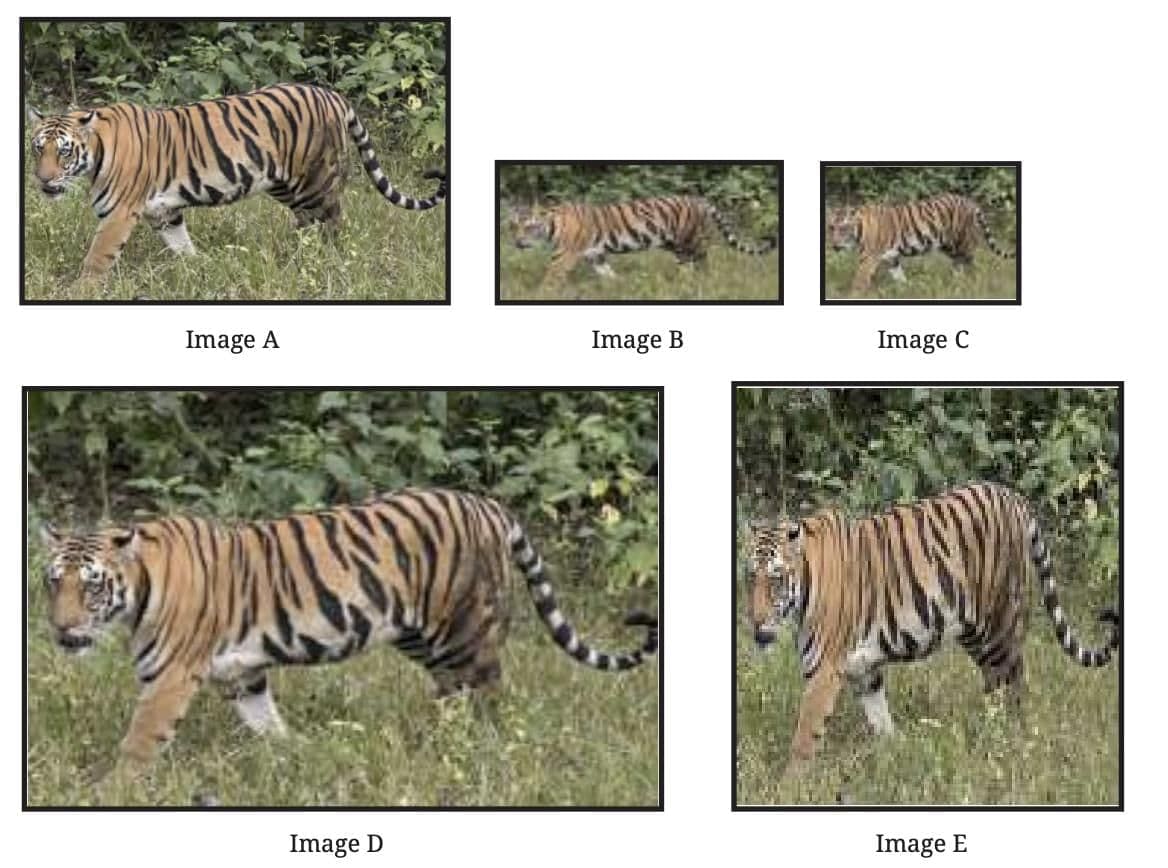
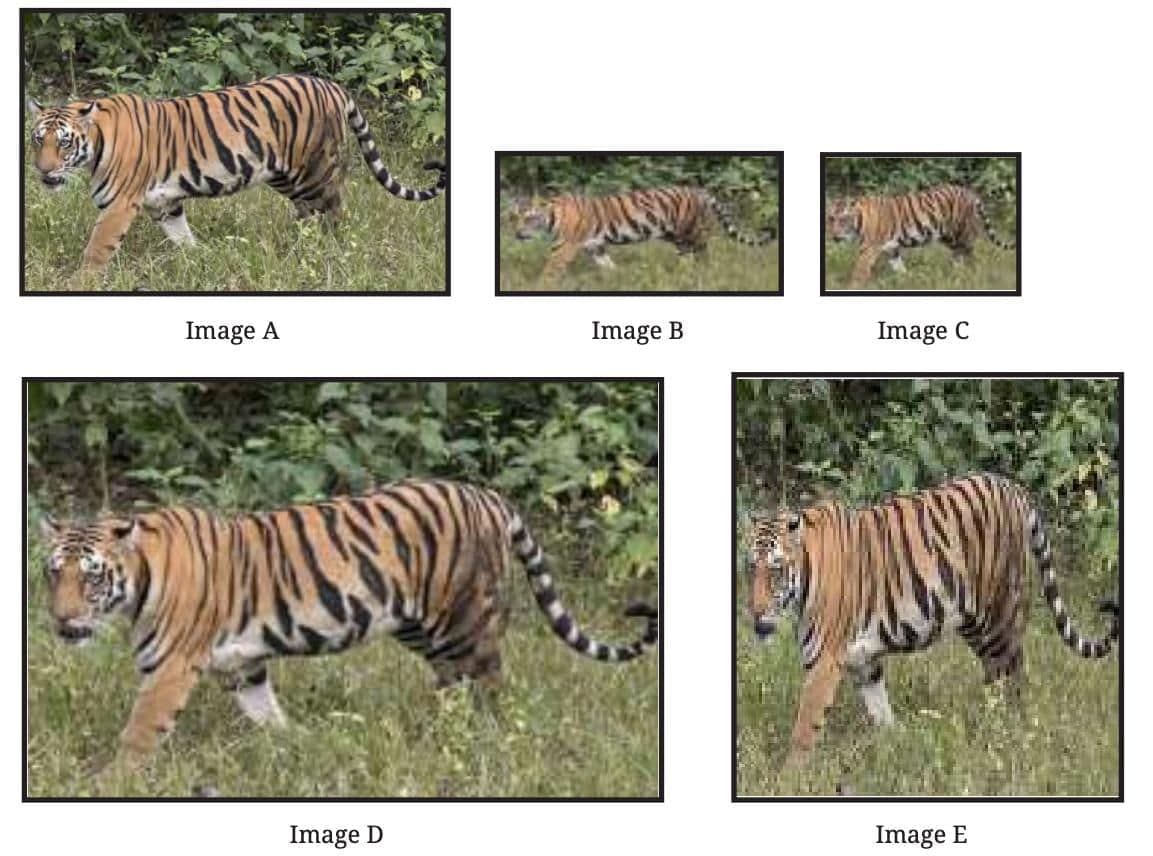
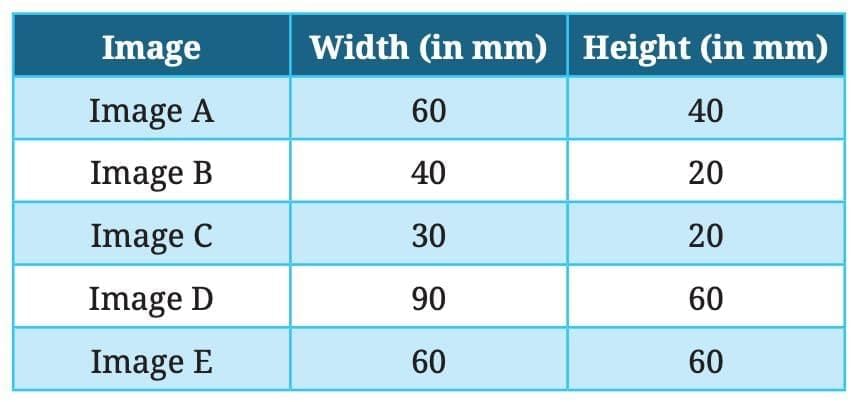
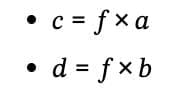
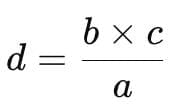


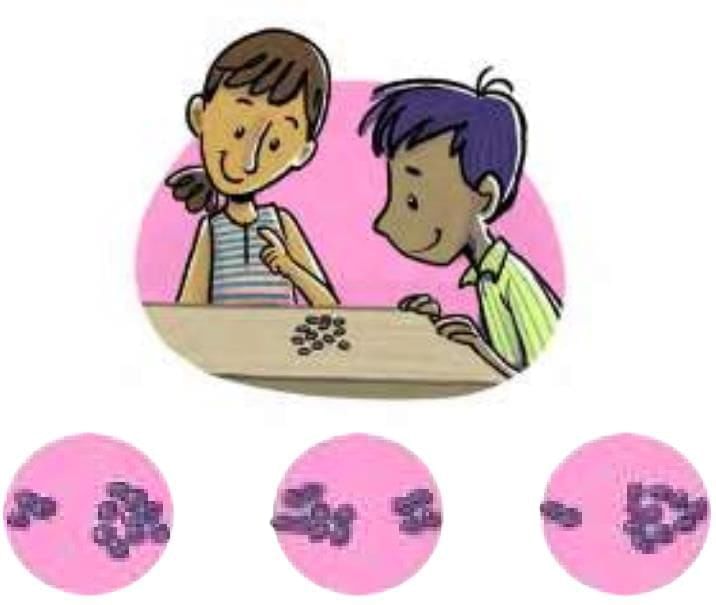
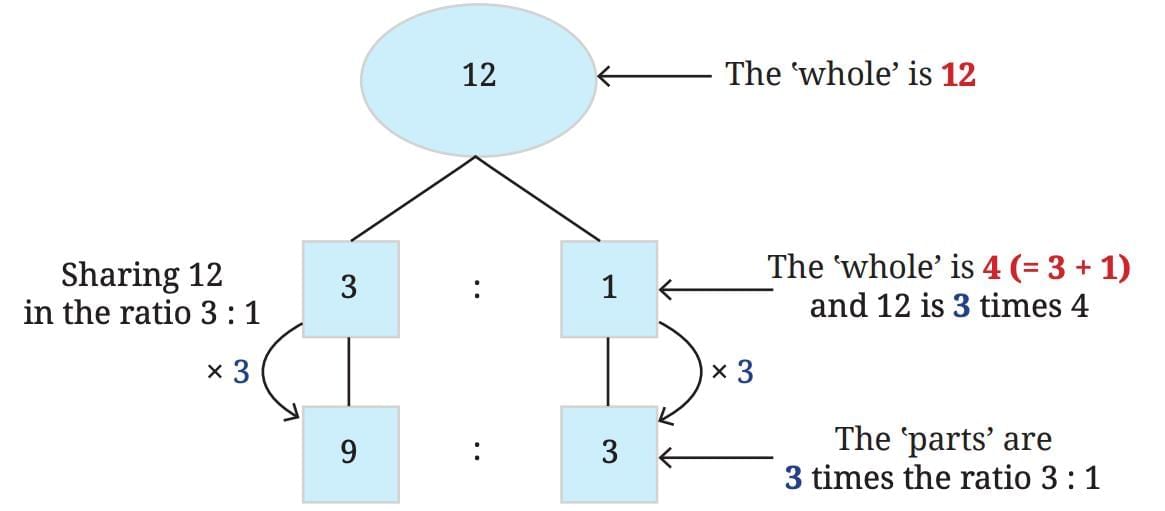 You = 1 + 1 + 1 = 3 counters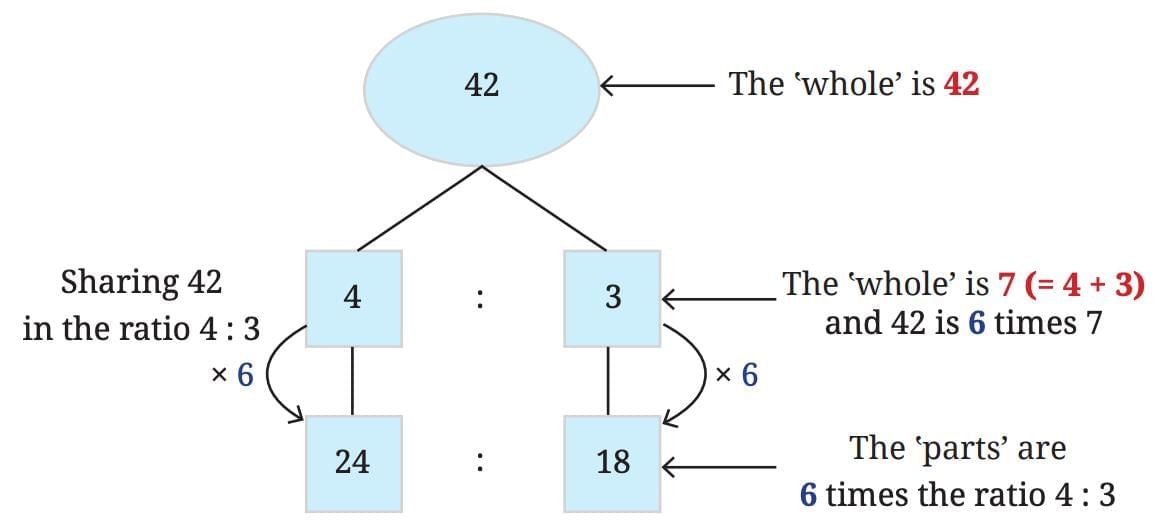
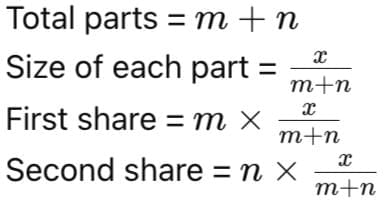

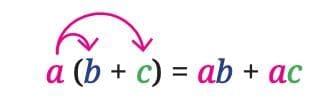
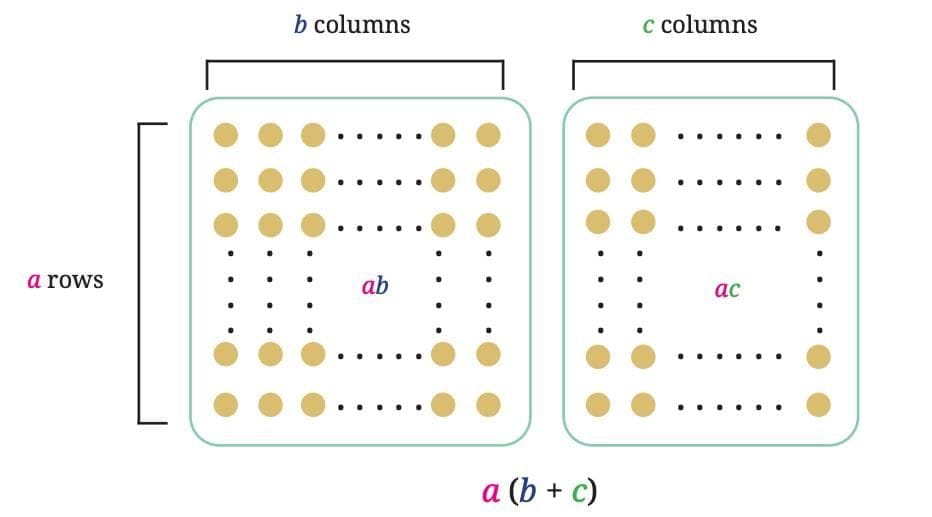
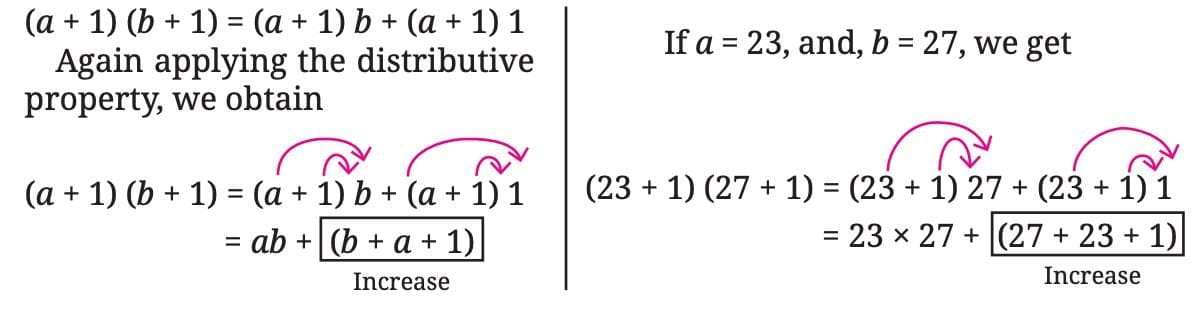

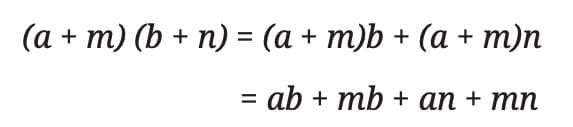
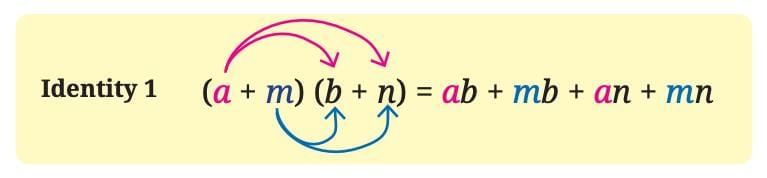
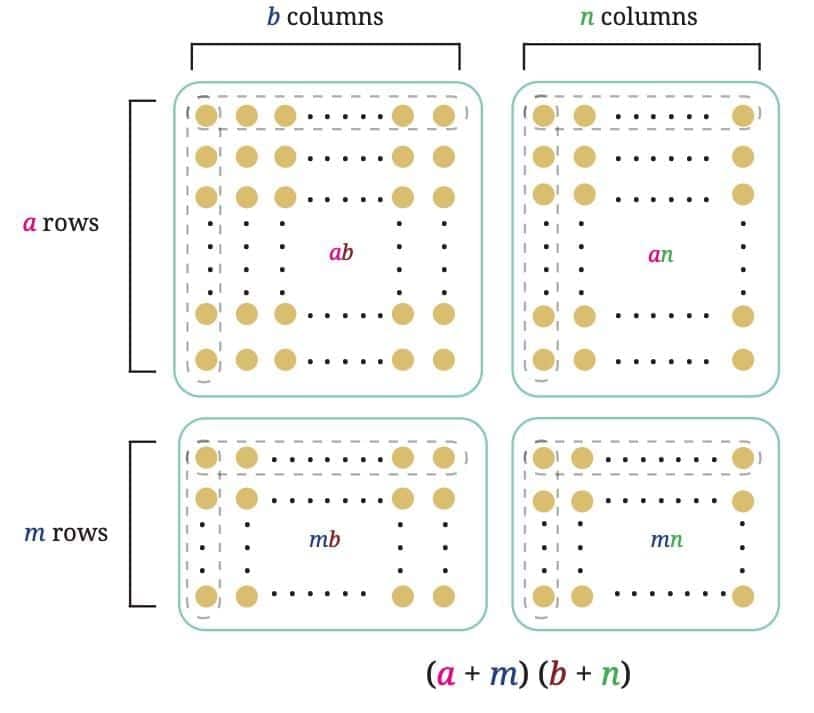
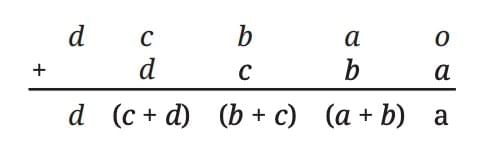
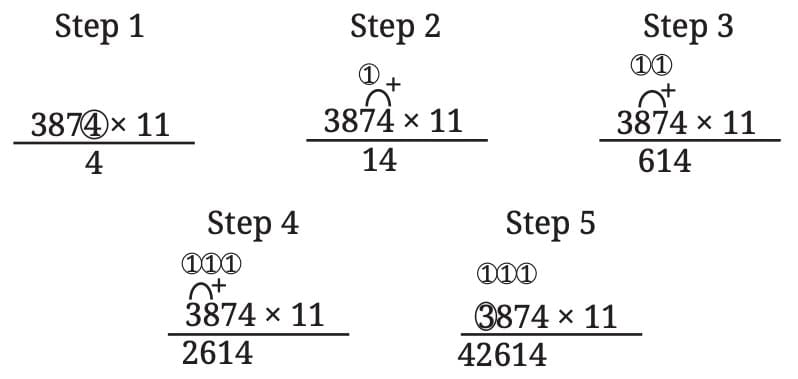
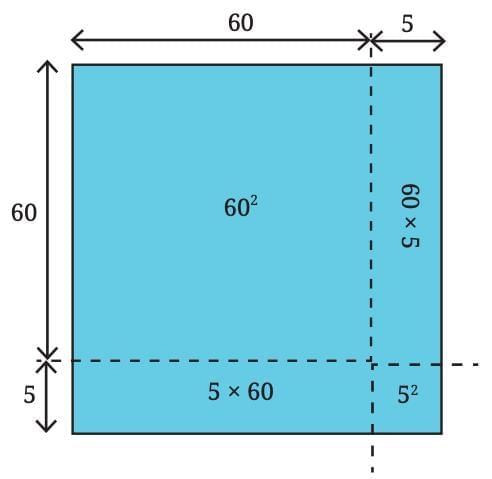
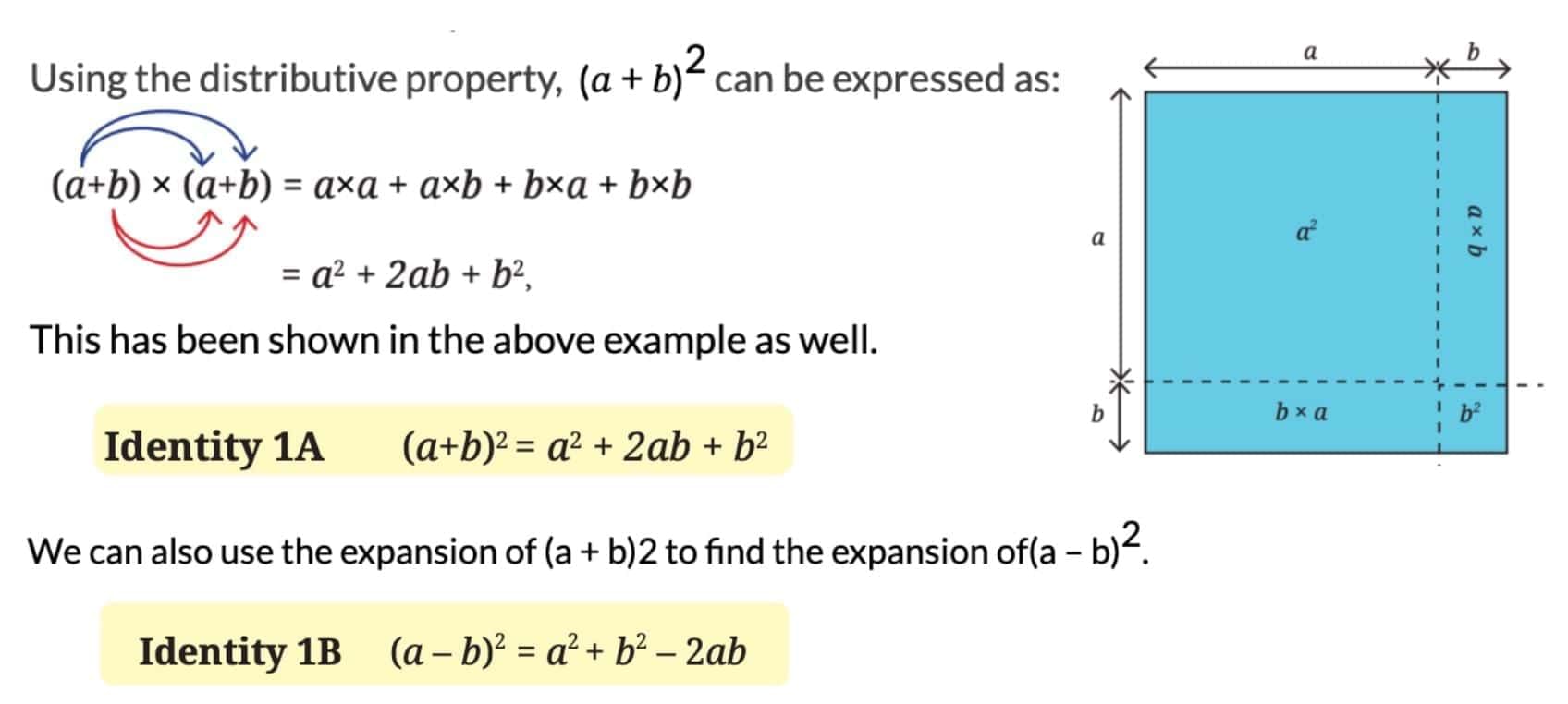
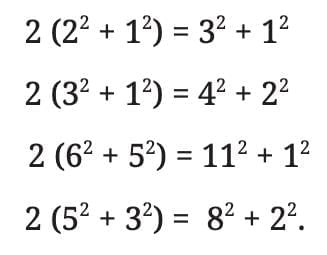
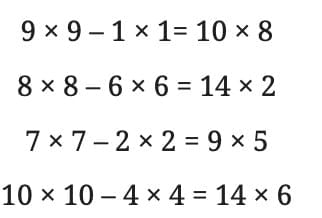

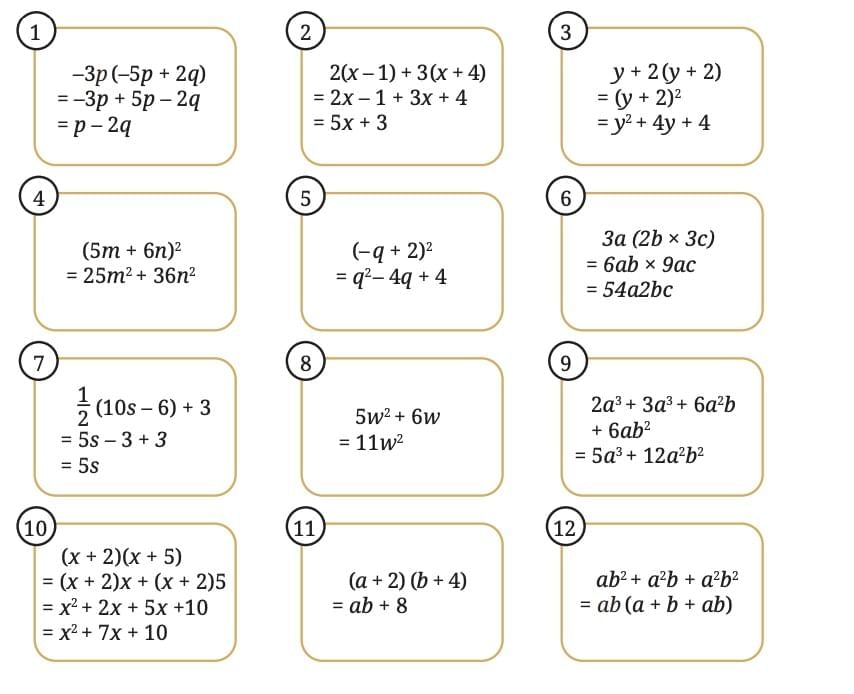
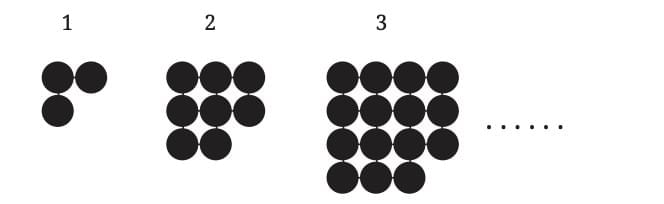
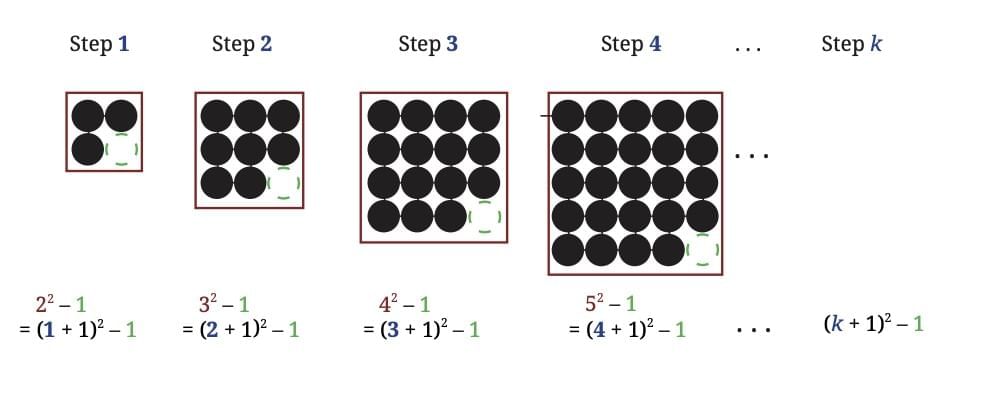
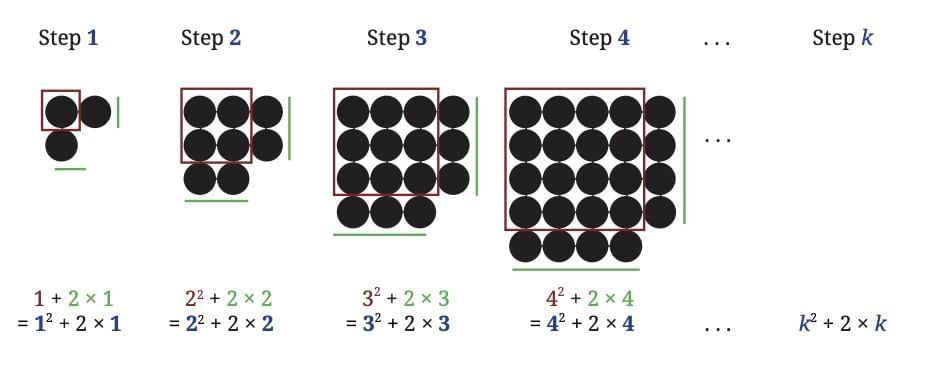
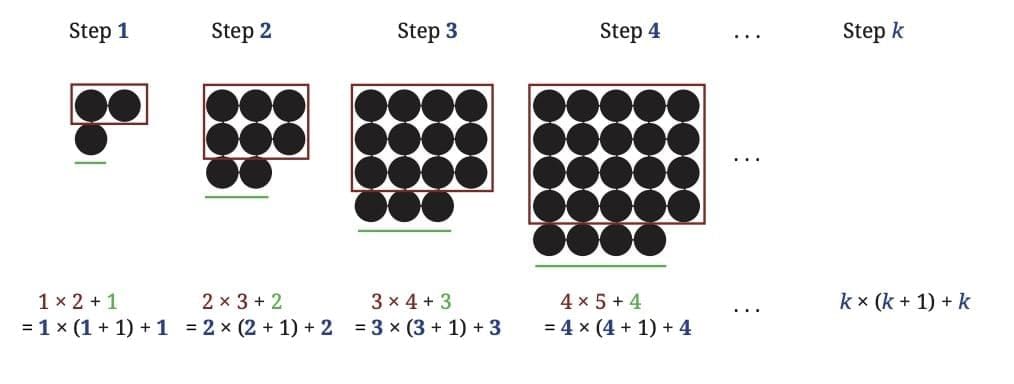
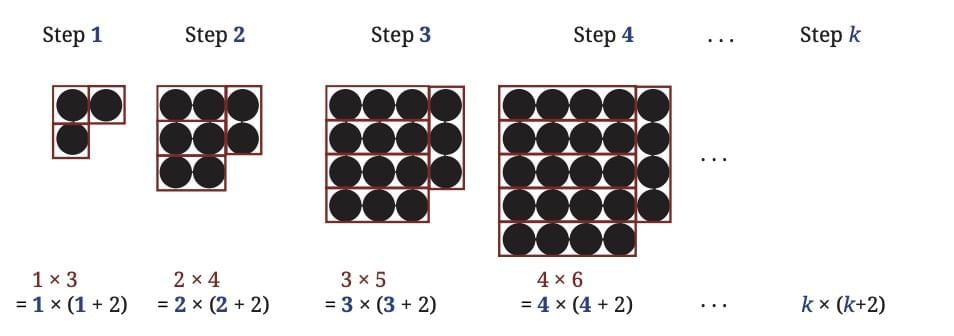

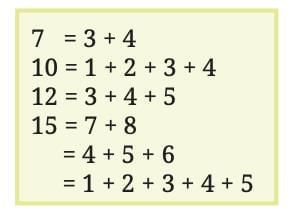
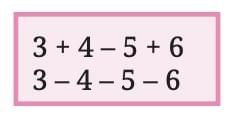
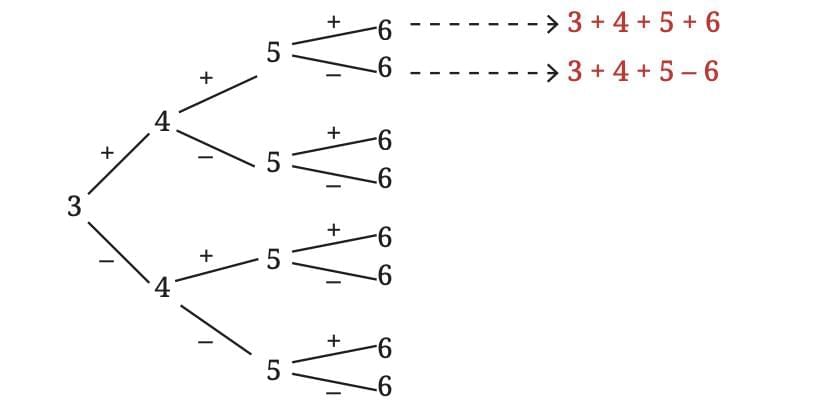
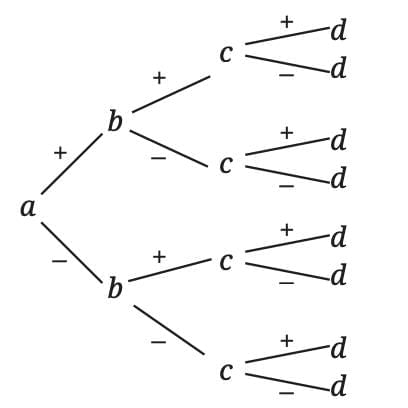
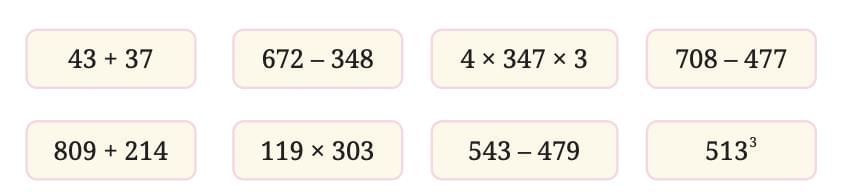

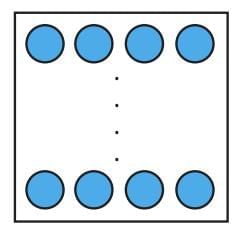 Even numbers that are multiples of 4 (remainder 0 when ÷ 4).
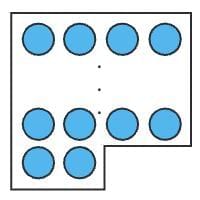 Even numbers that are not multiples of 4 (remainder 2 when ÷ 4).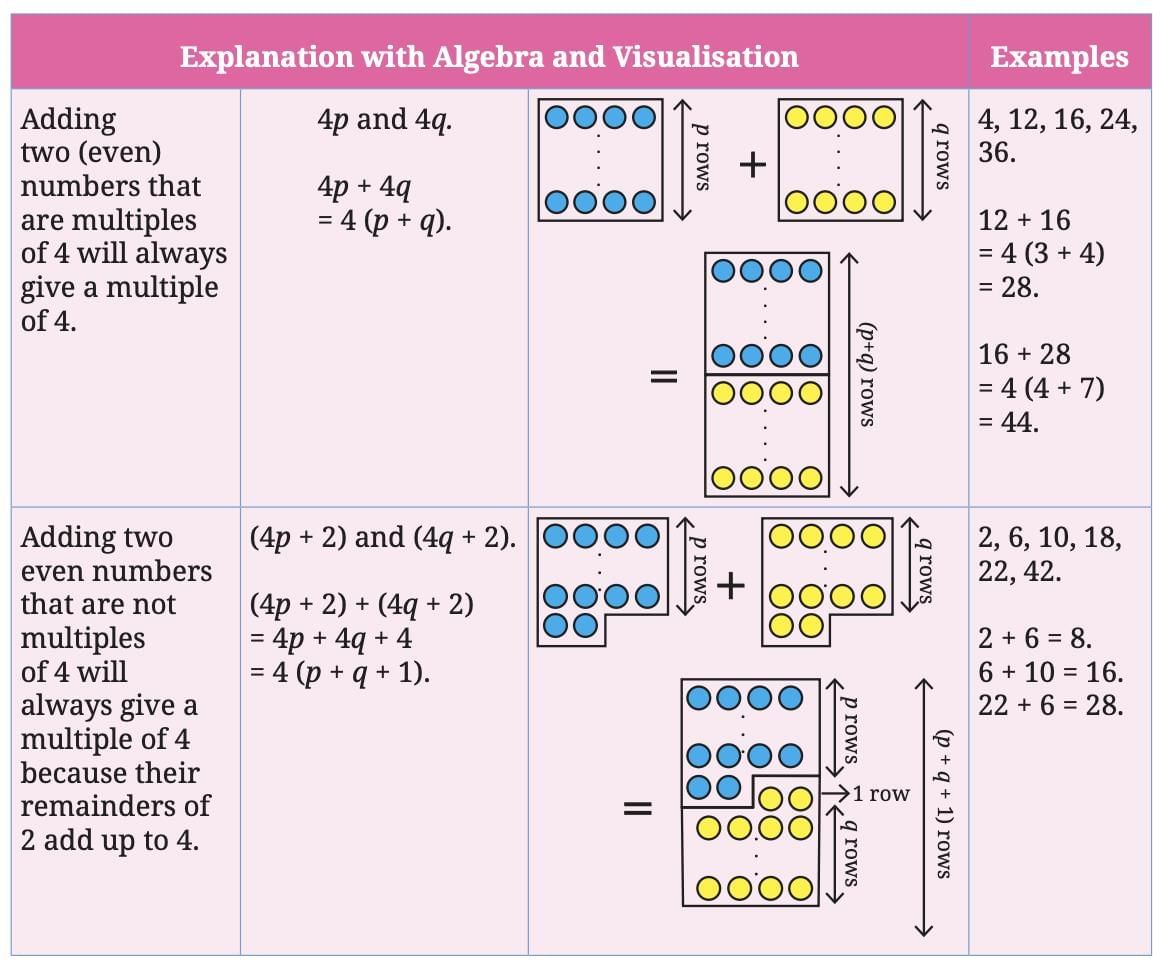
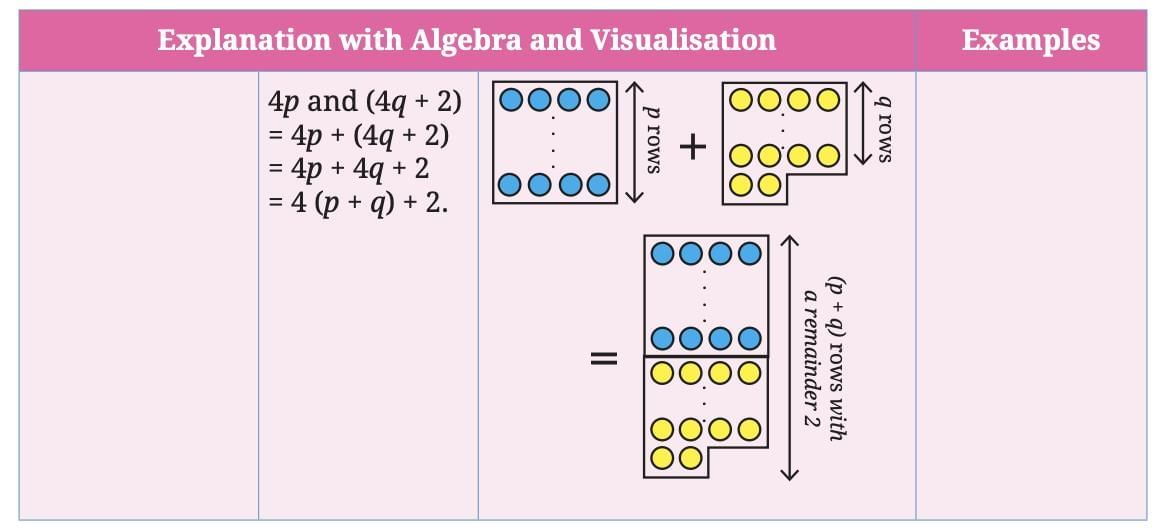
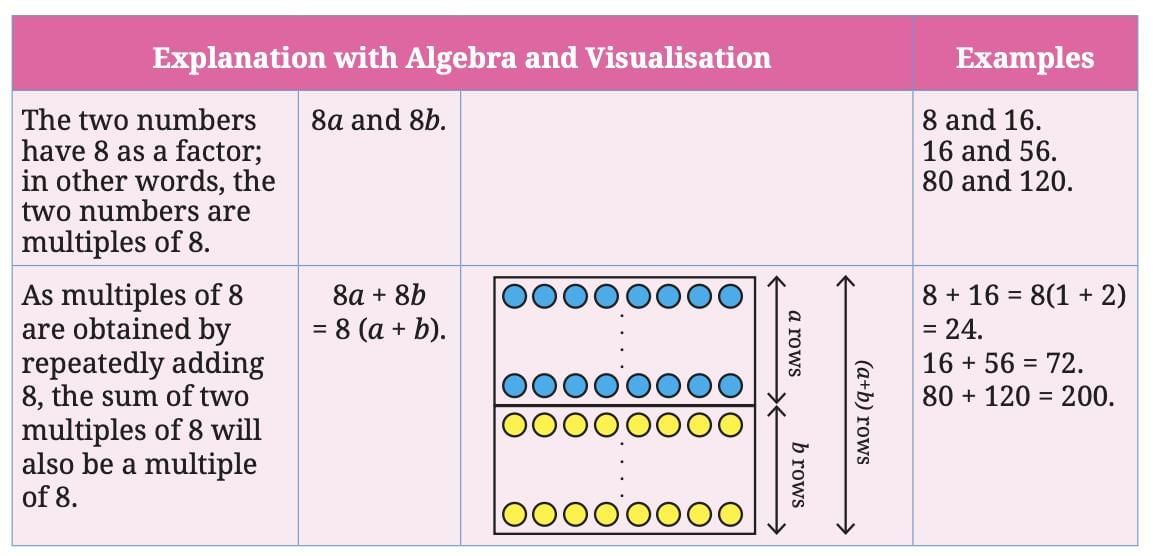
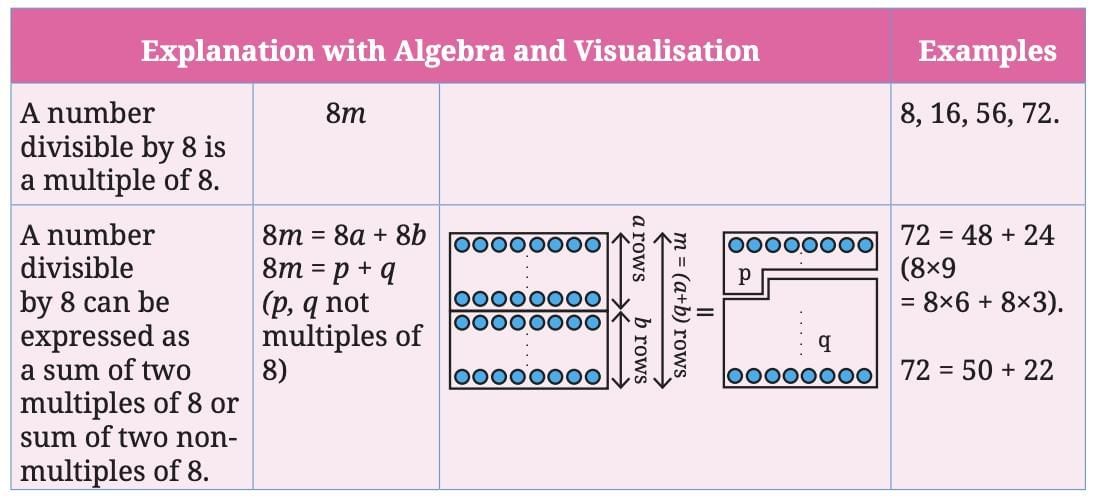
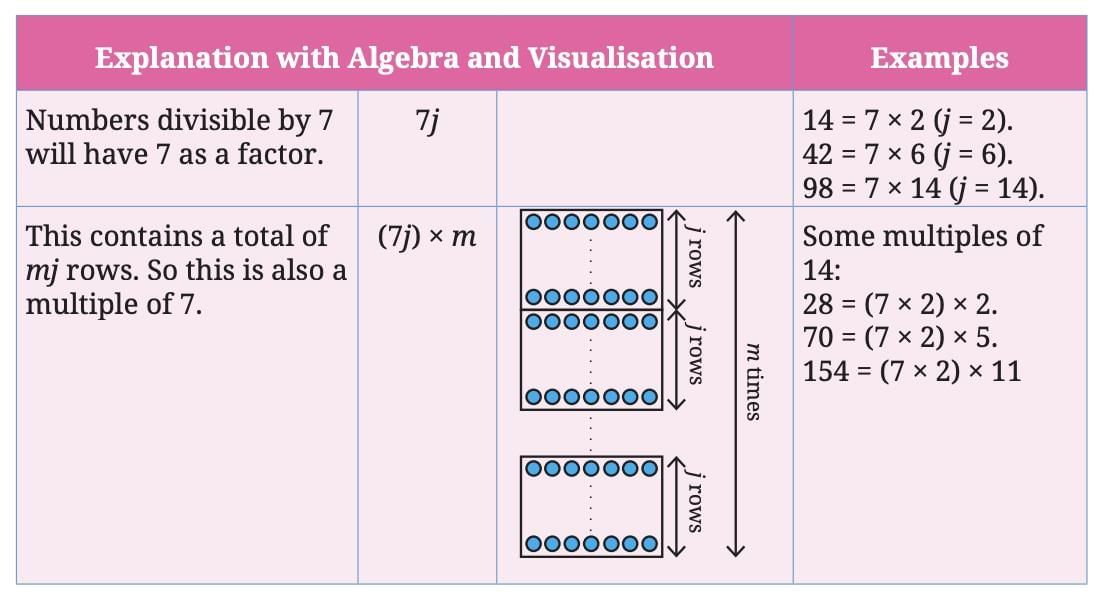
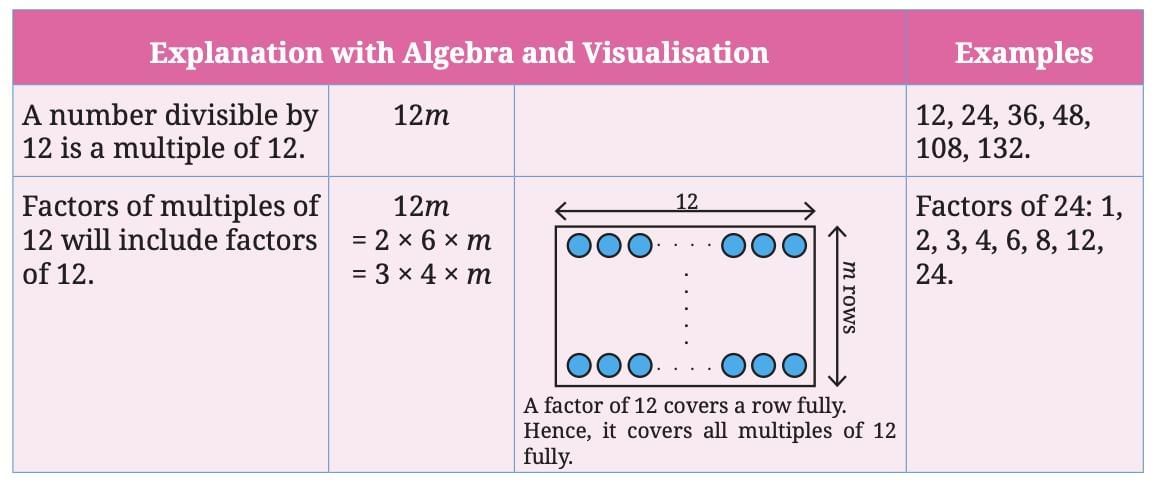
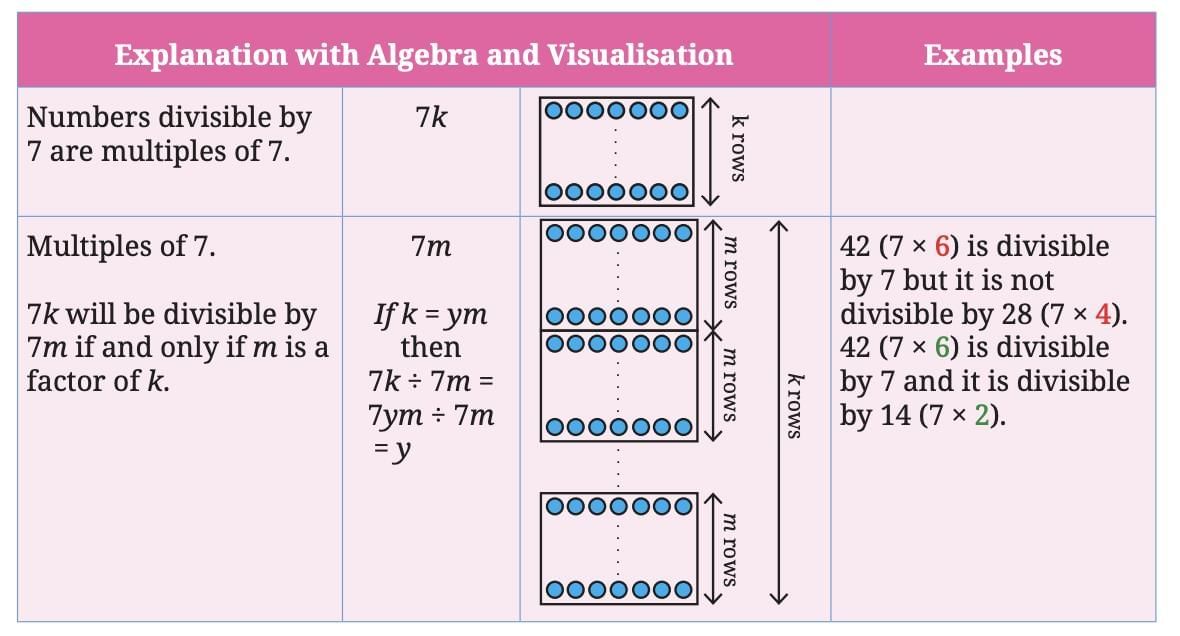
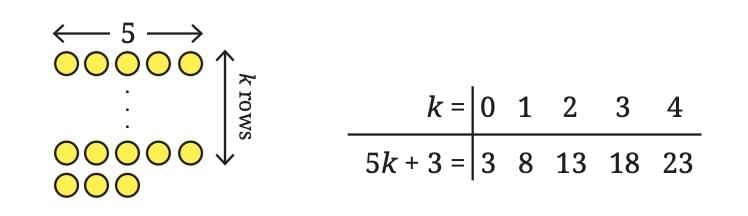
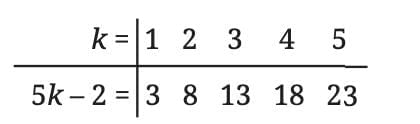 k = 5 → 25 – 2 = 23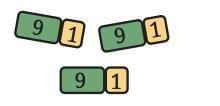
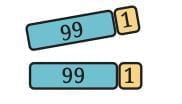
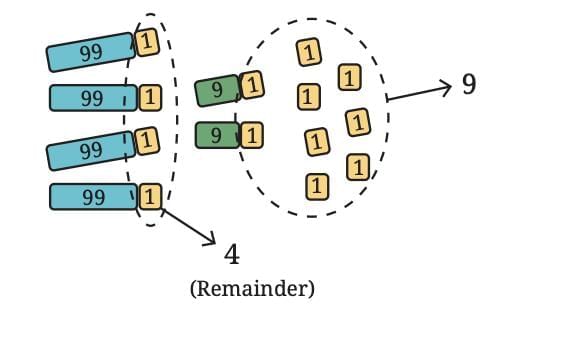
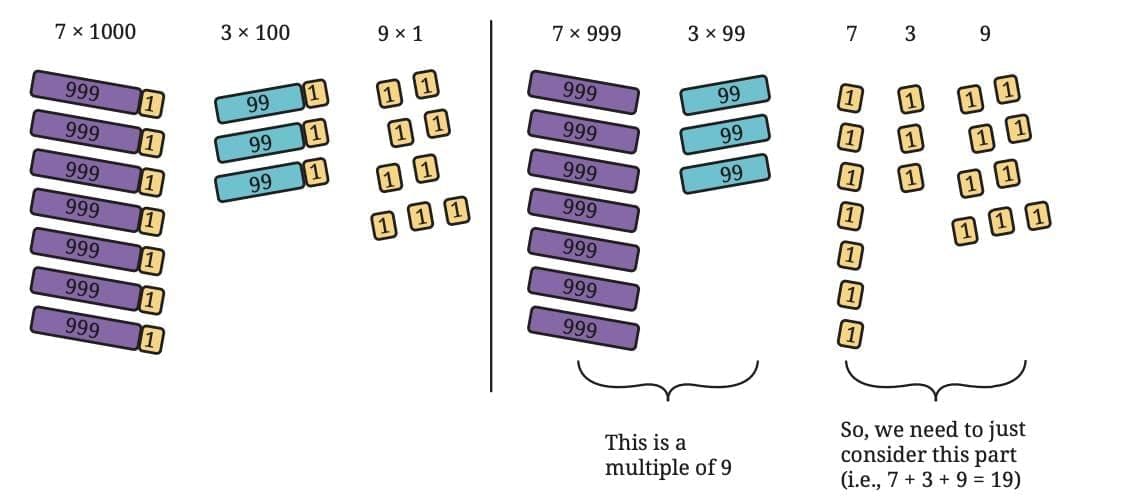
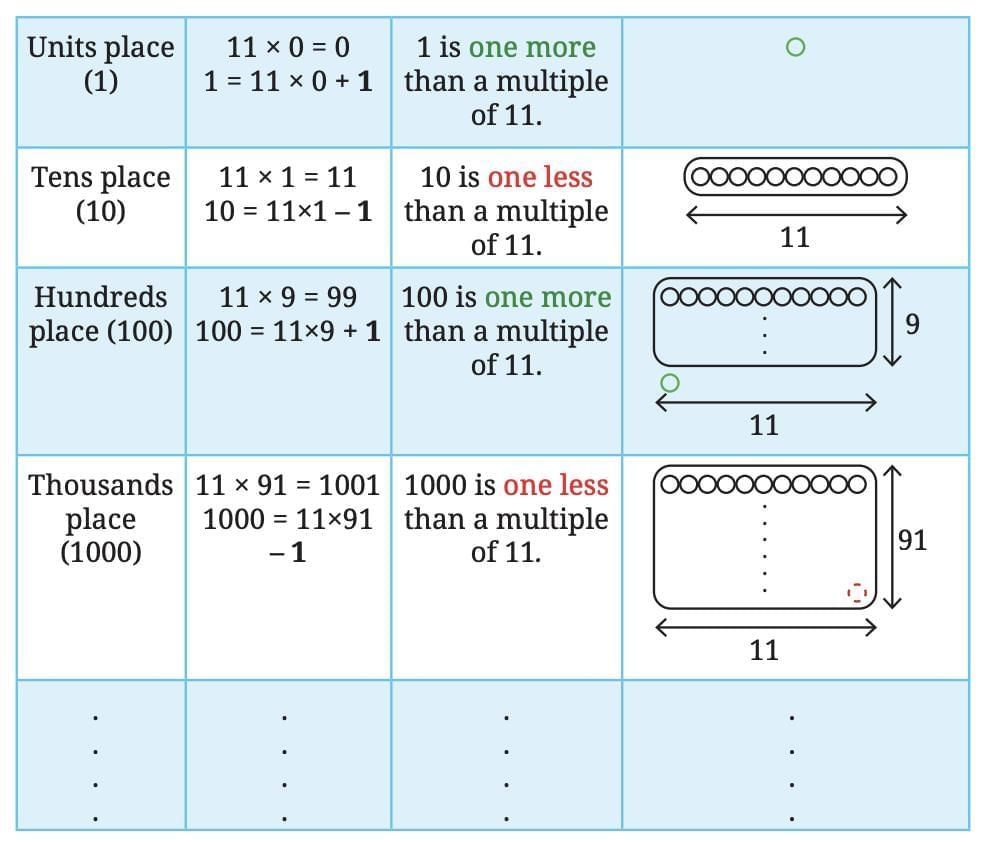
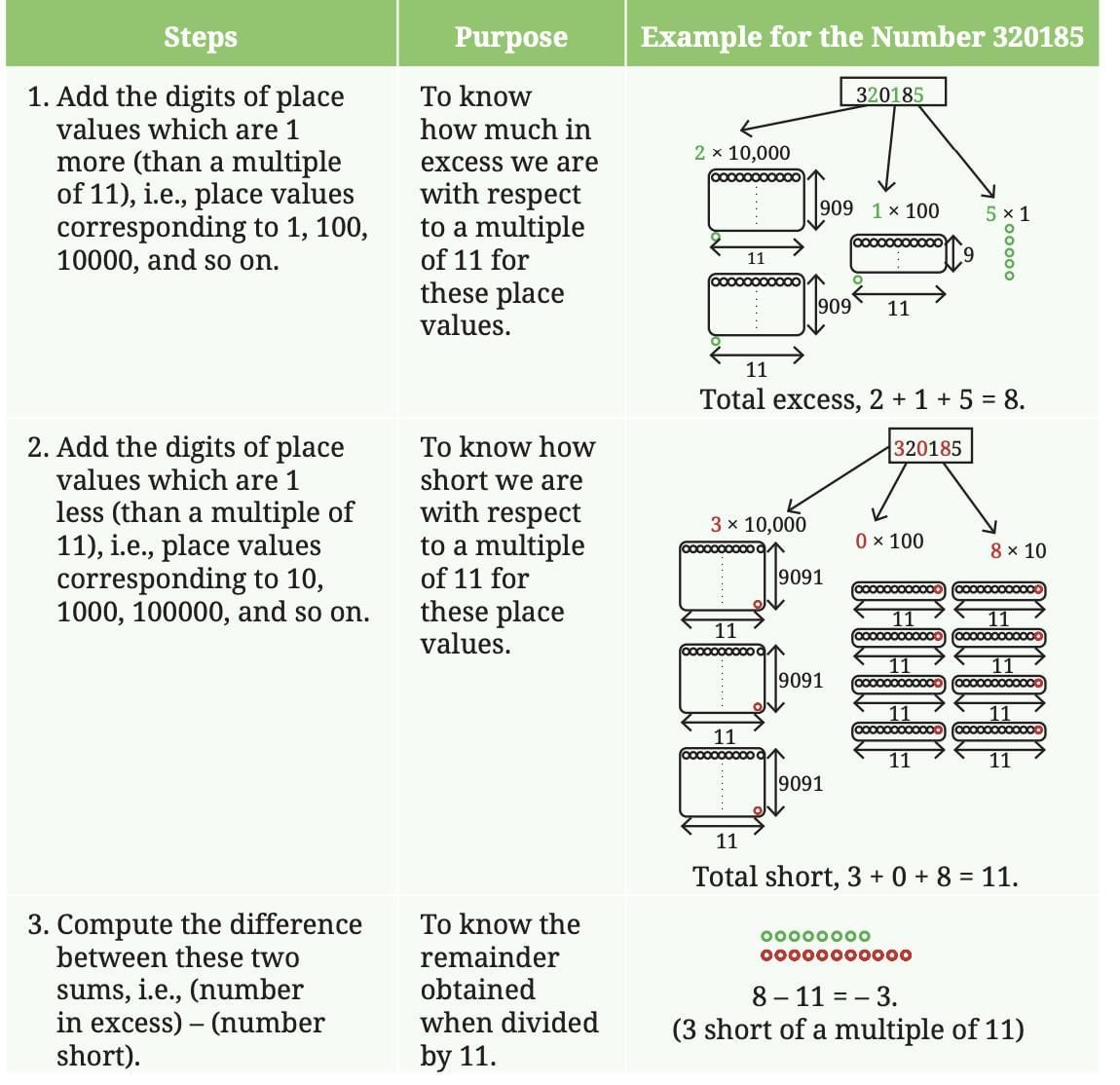
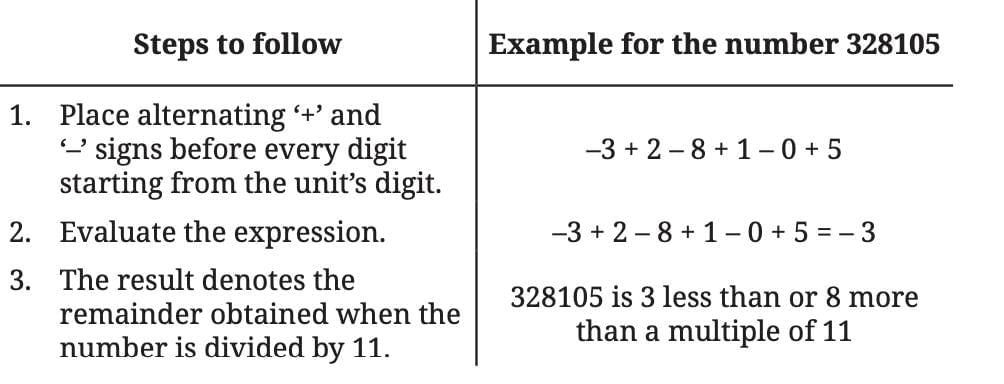
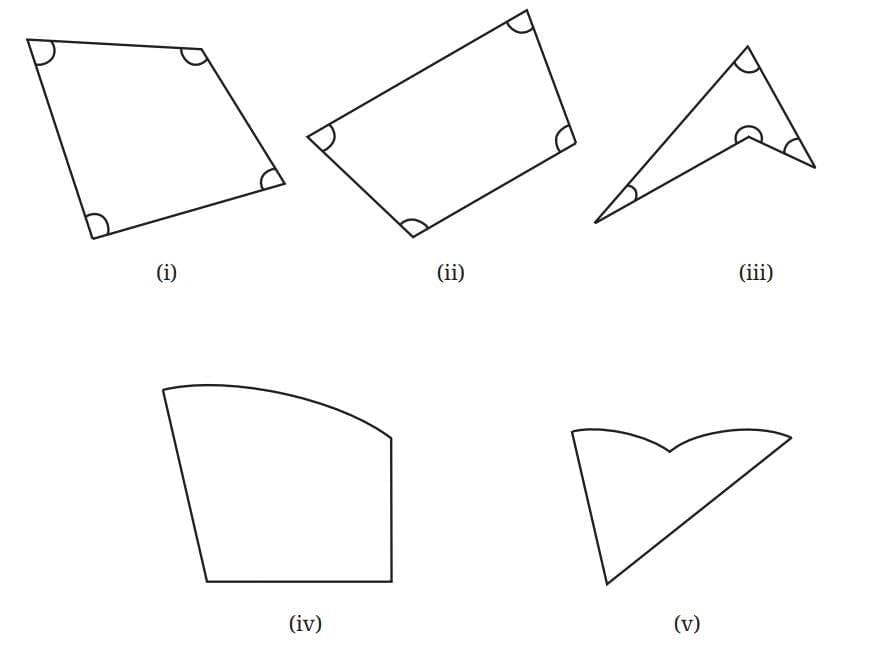
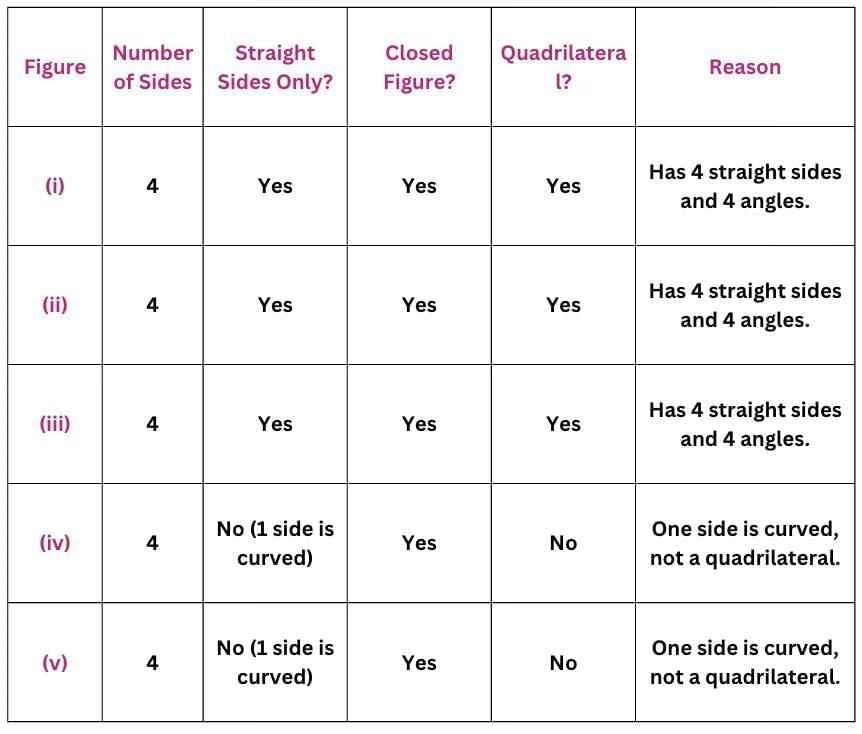
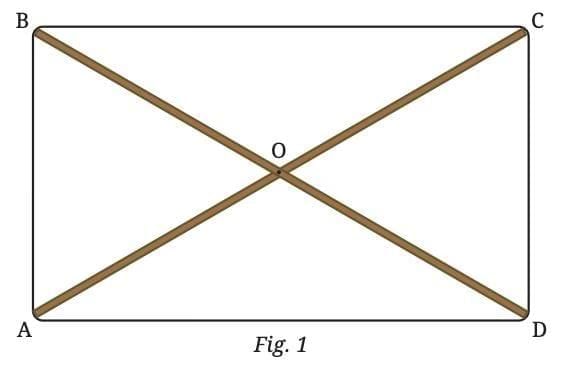
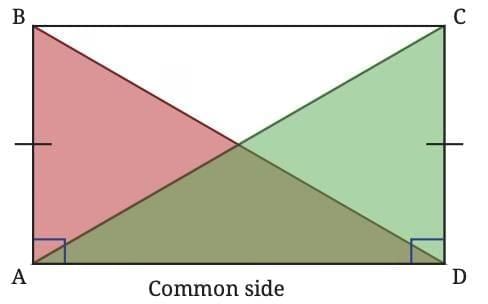
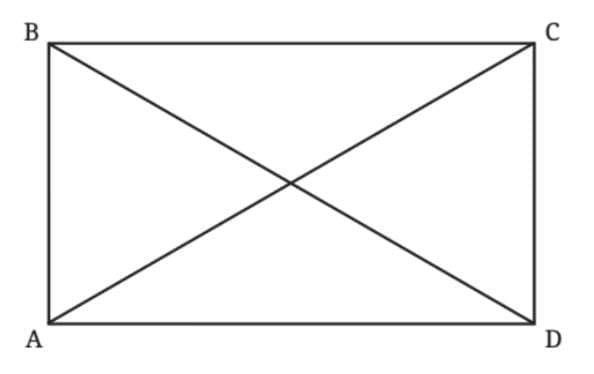
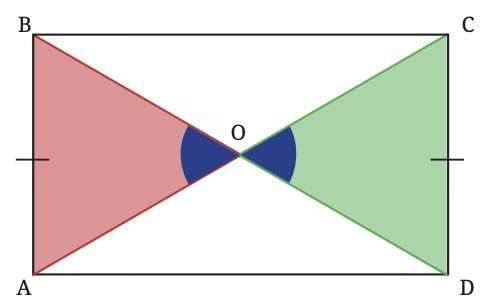
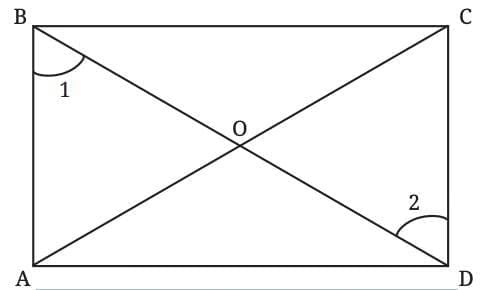
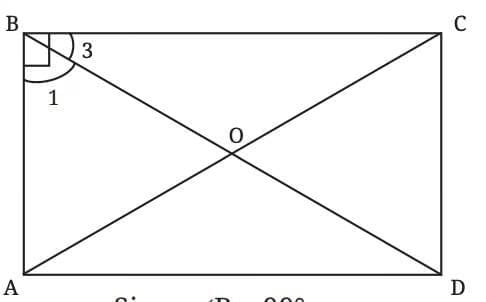
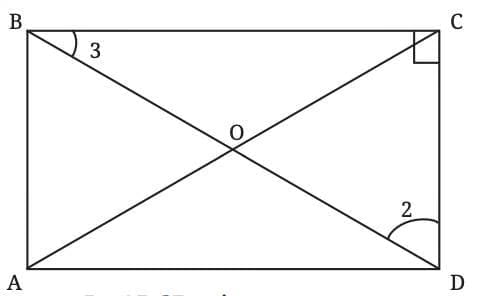
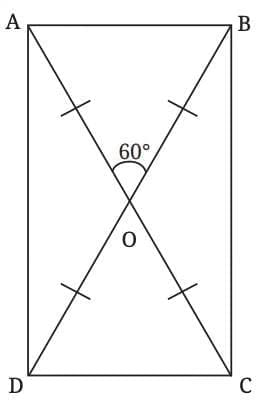
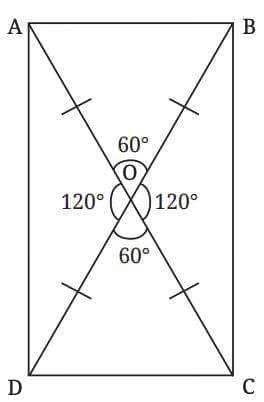 Angle BOC = 120° (again, vertically opposite to angle AOD)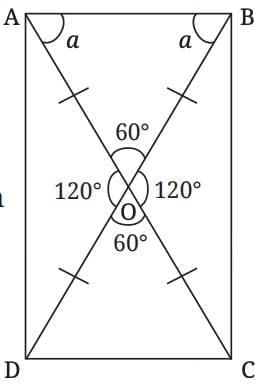
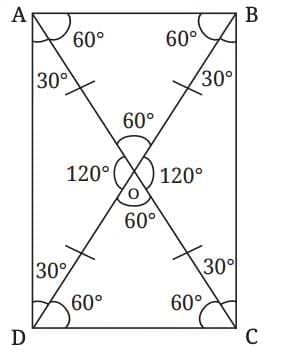
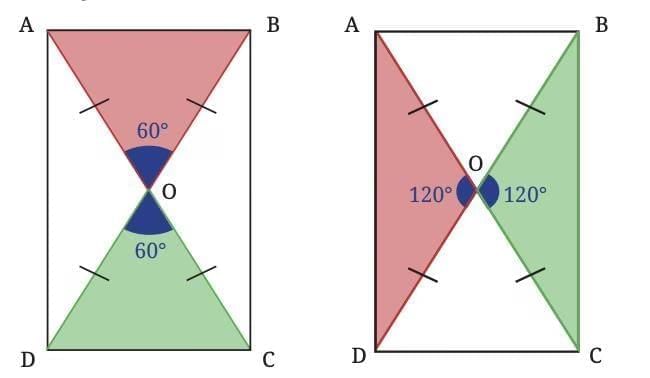
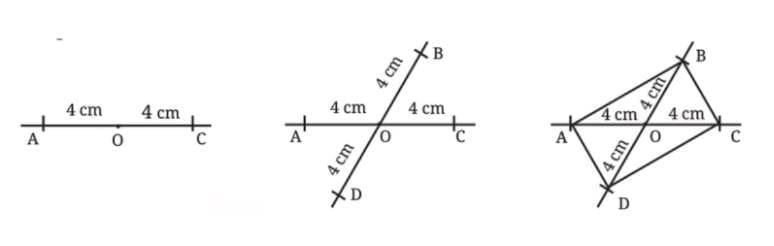
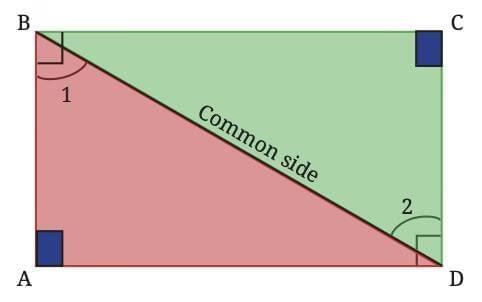
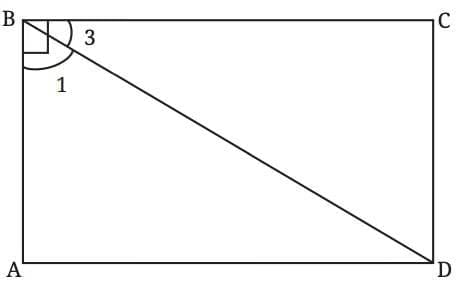
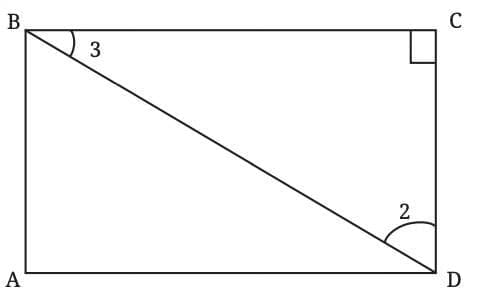
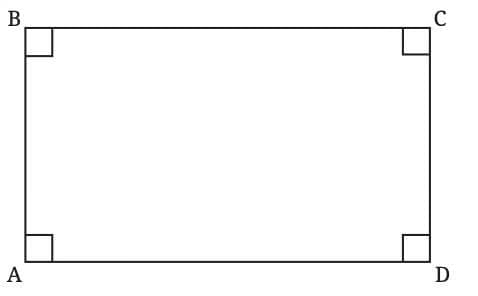
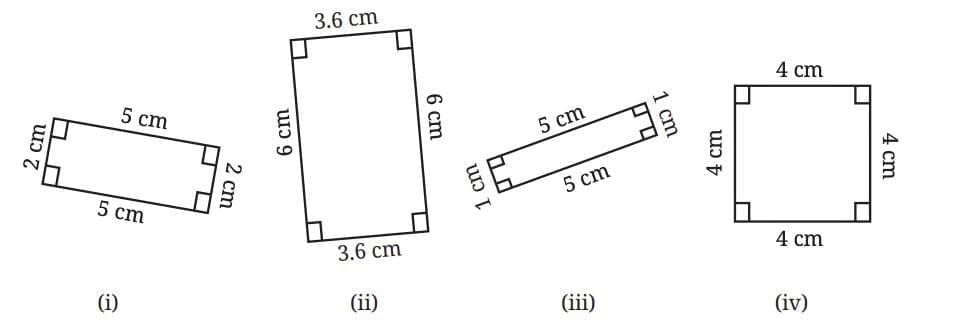
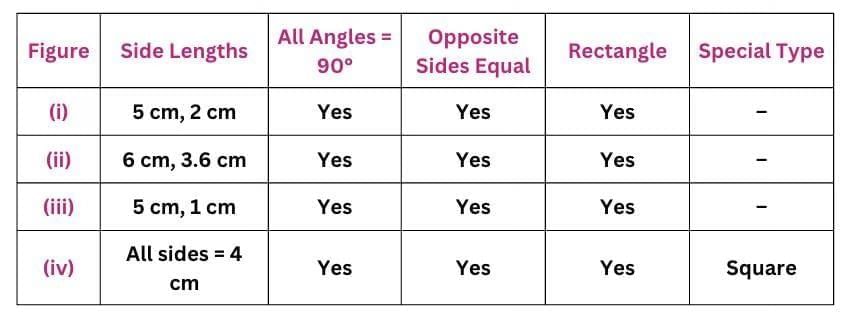

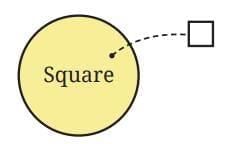 A set is represented as a closed curve (usually a circle or an oval). For example, the set of all squares is represented as
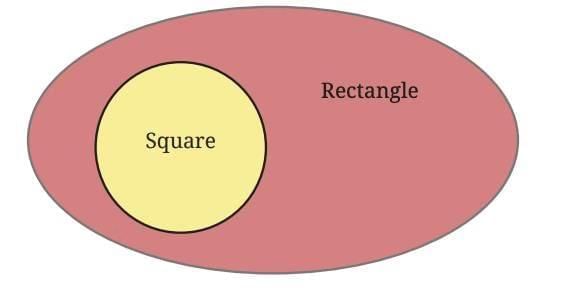 The Venn diagram representation of these two sets would be as follows —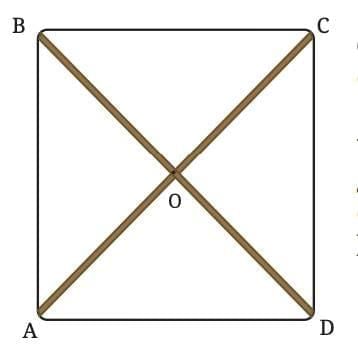
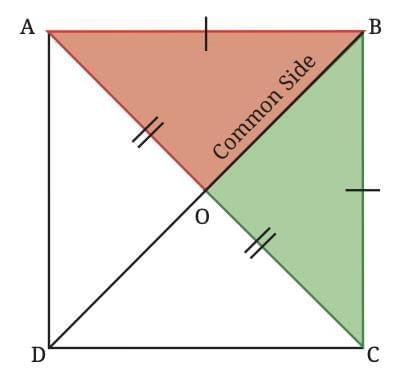
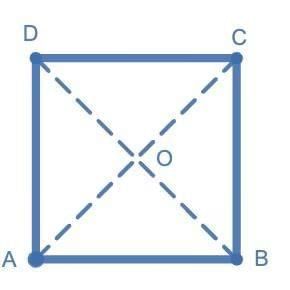
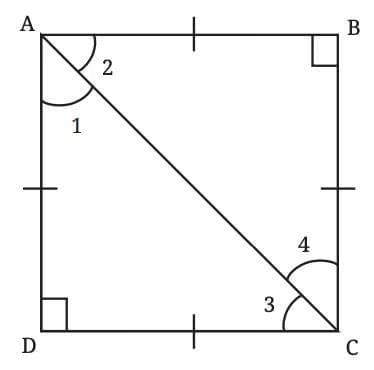
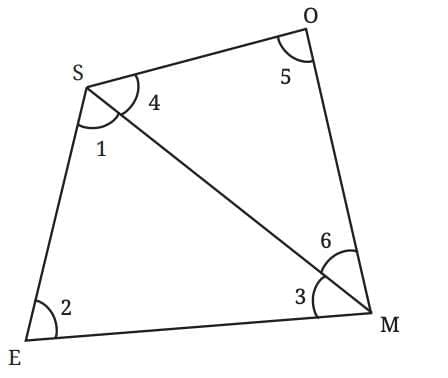
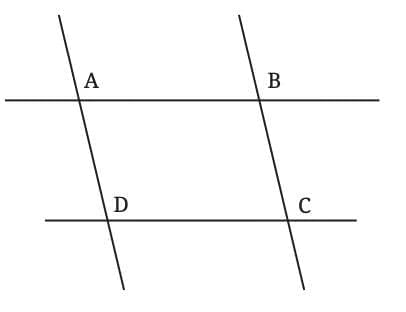
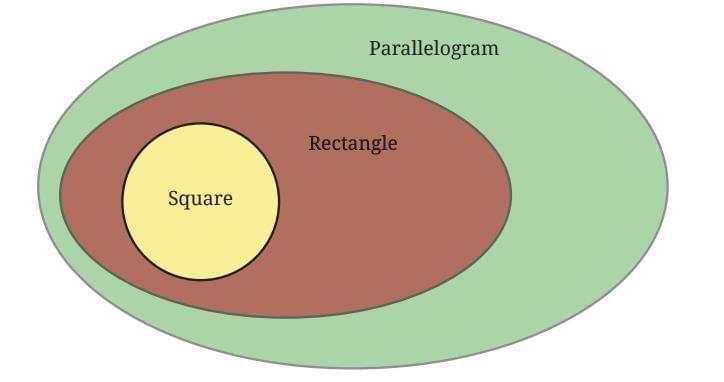
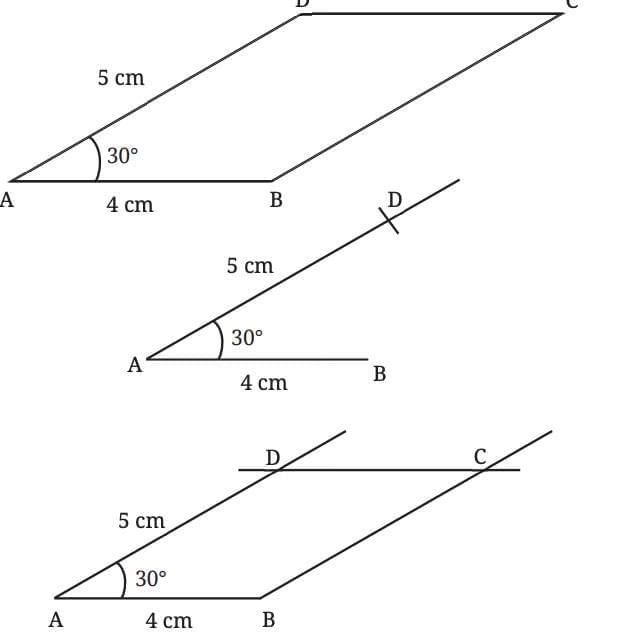 Now, join points C to B and C to D.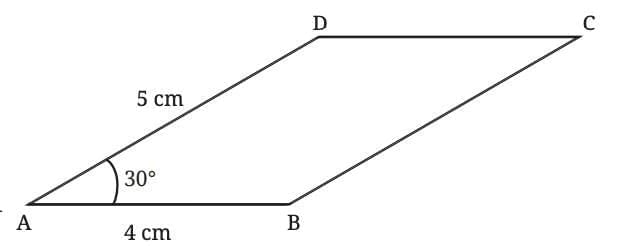
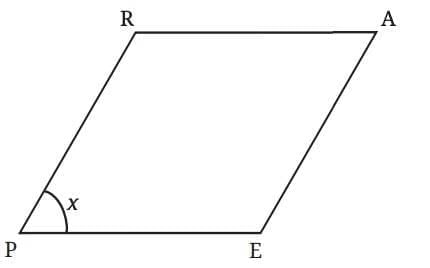
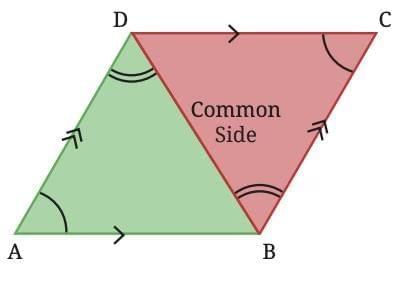
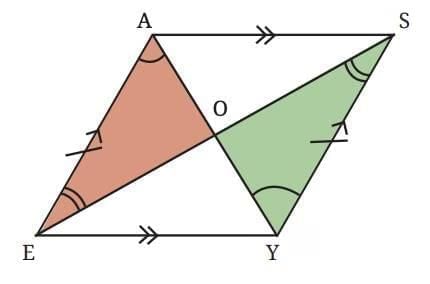
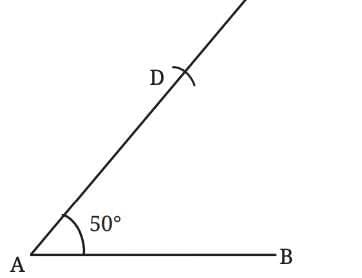 Use a compass to measure the length of AB, then place the compass point on the other arm and draw an arc and mark point– D at the same distance.
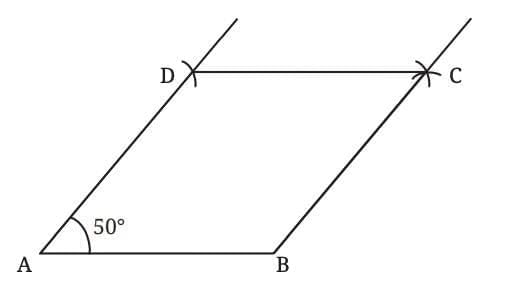 Join D to C and B to C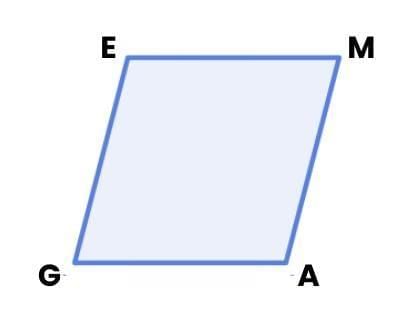
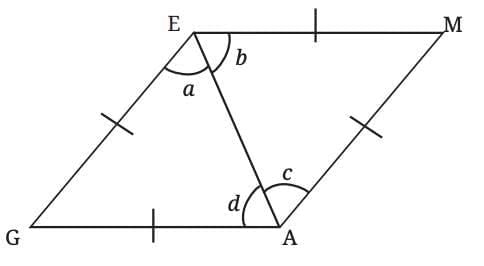
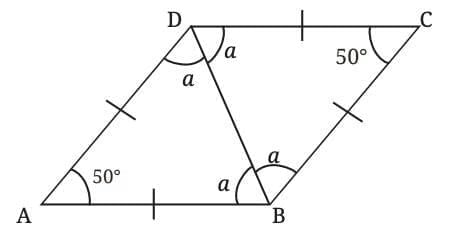
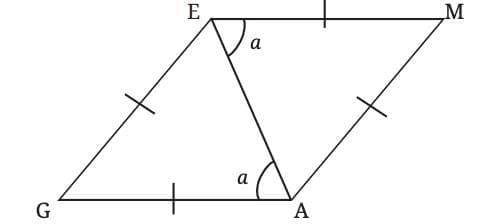
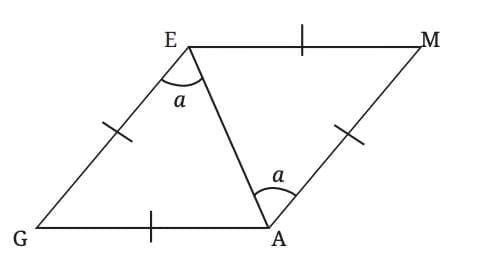
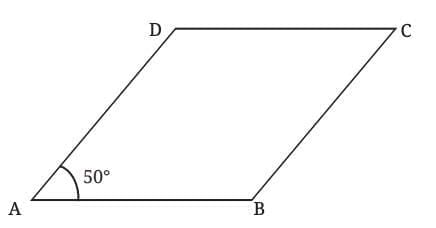
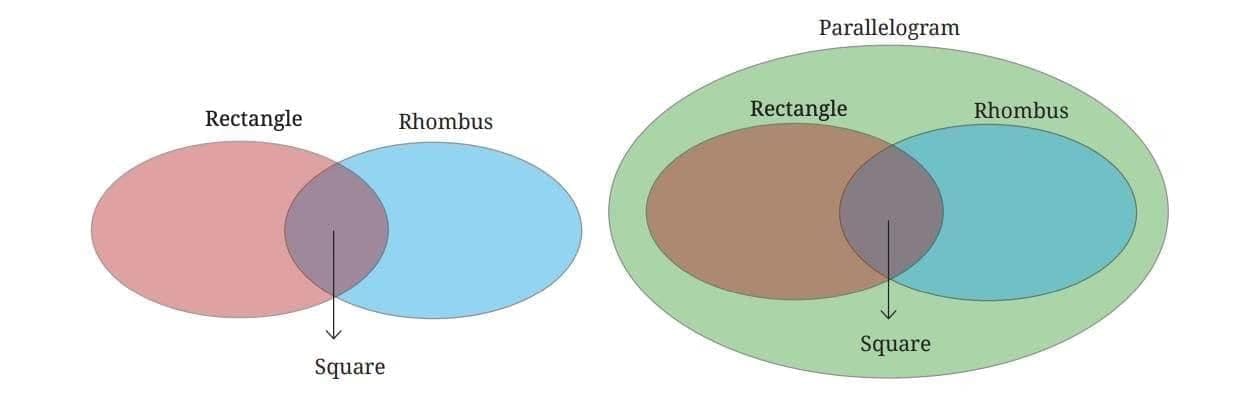
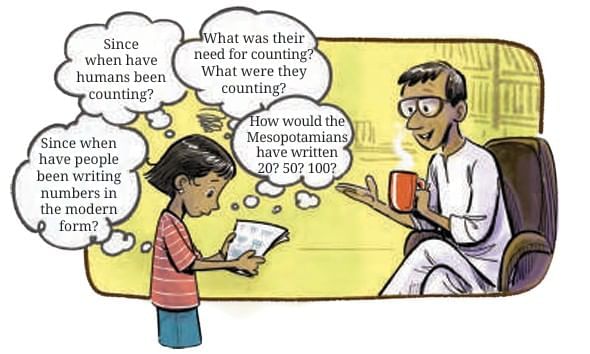
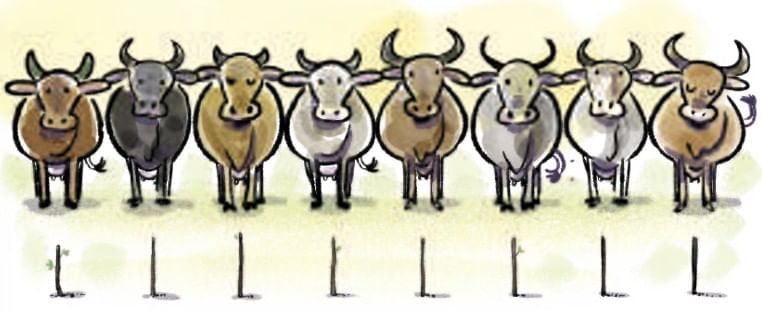
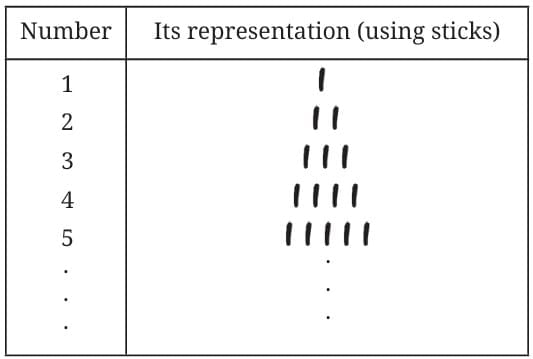
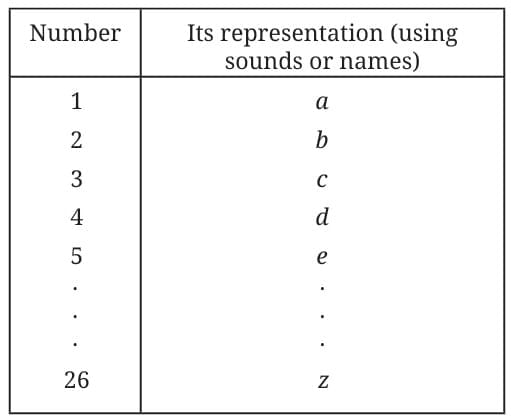
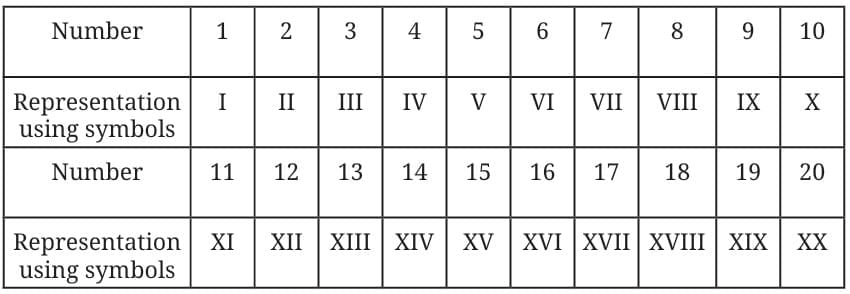
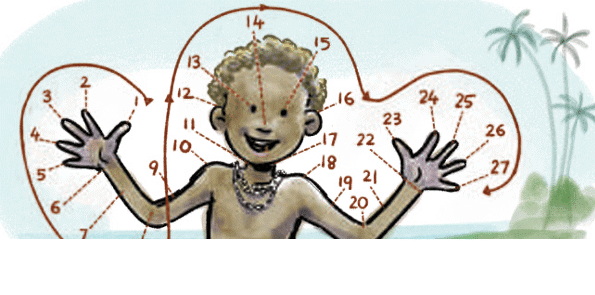
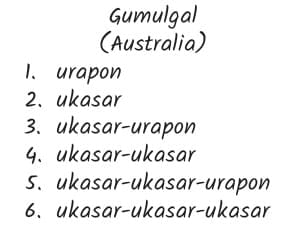
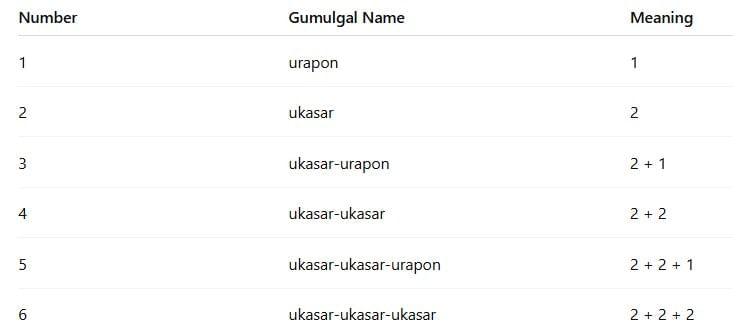
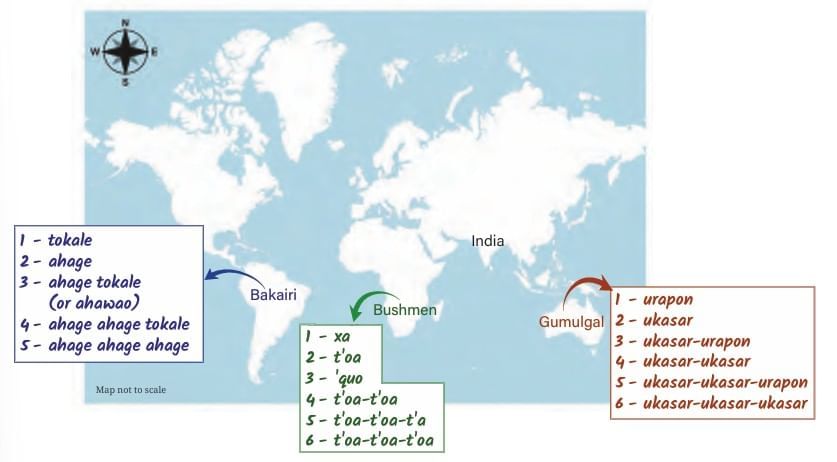
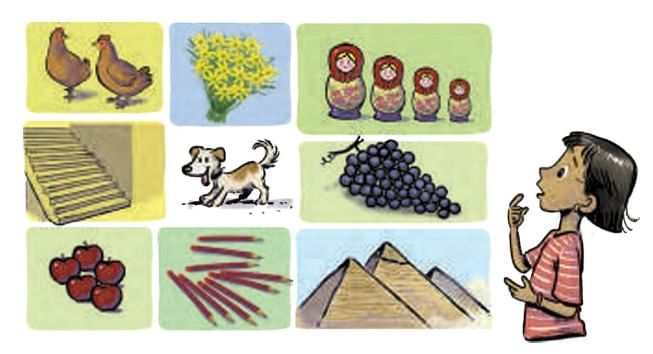

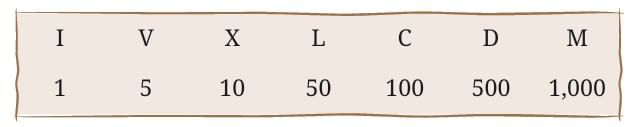
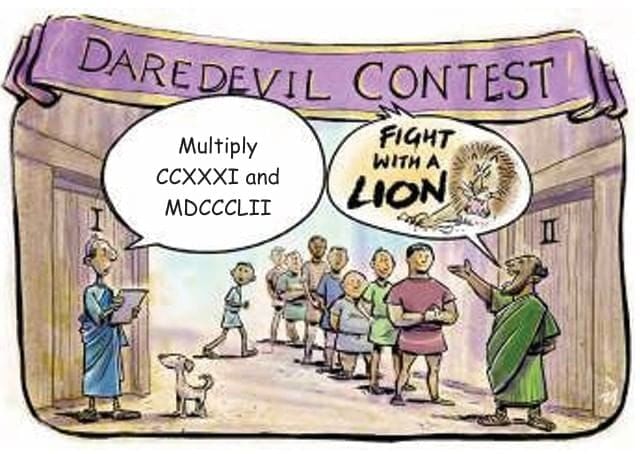

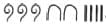
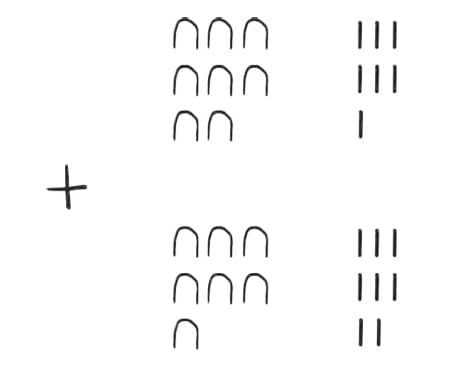


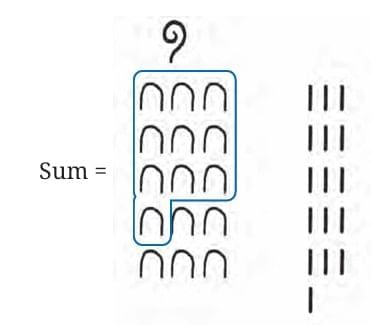
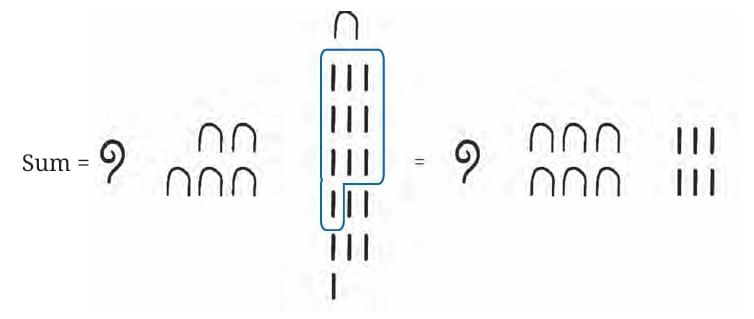
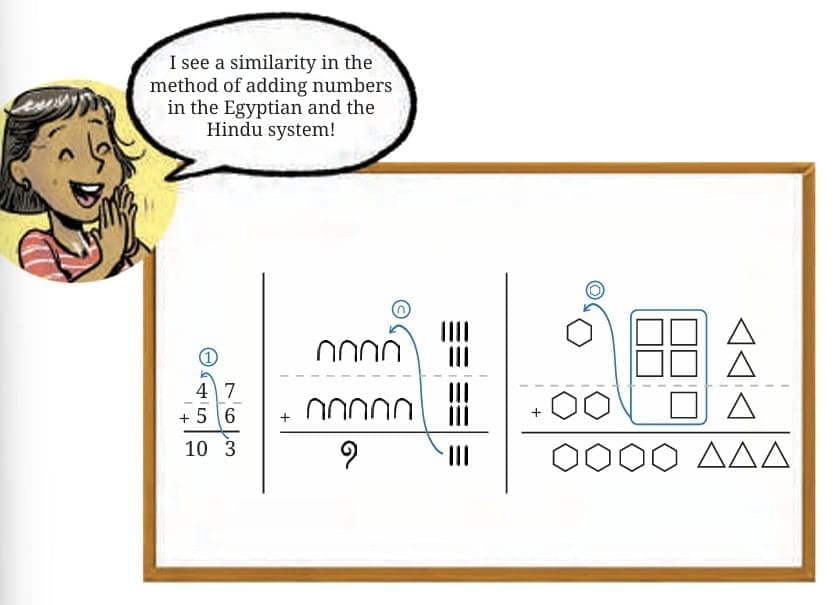

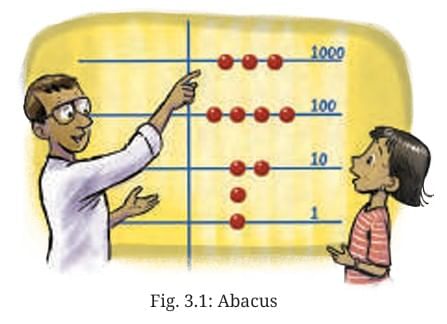
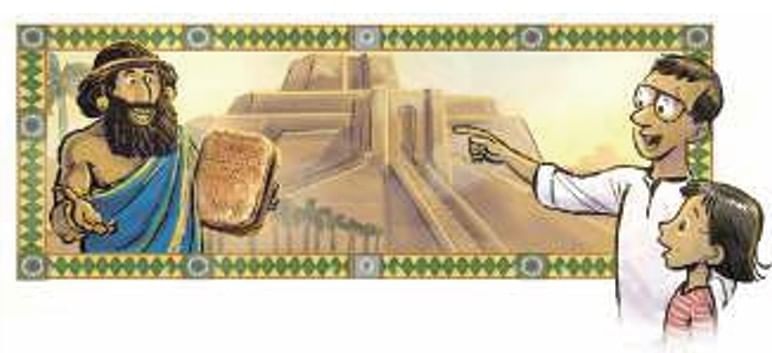
 for 1 and
  for 10.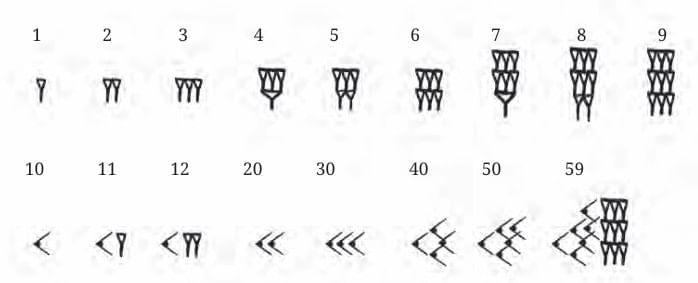

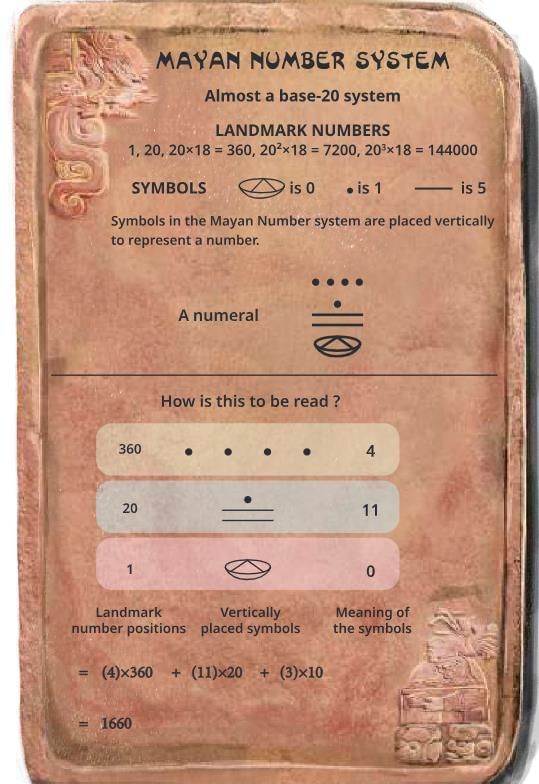

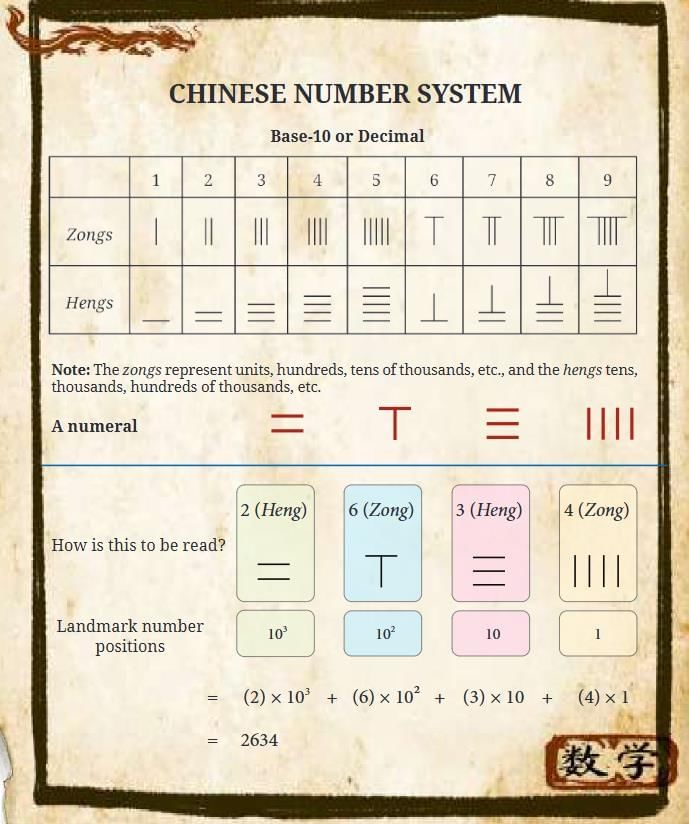
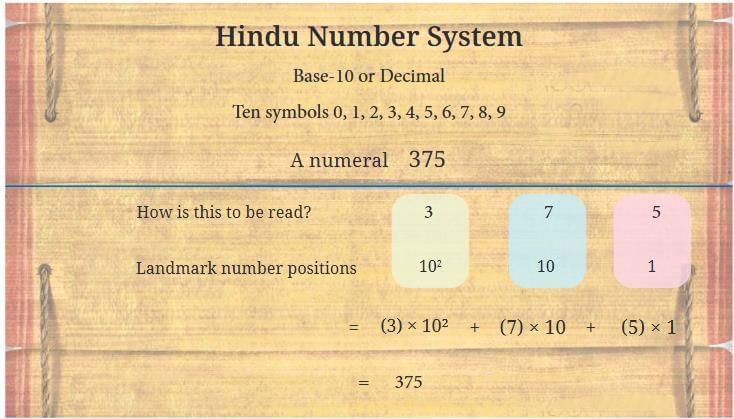
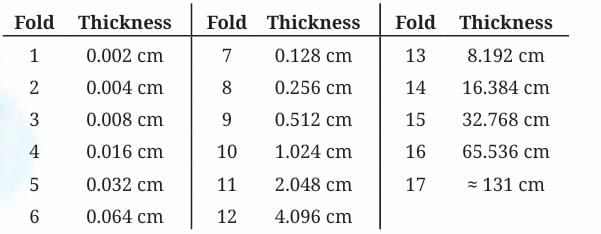

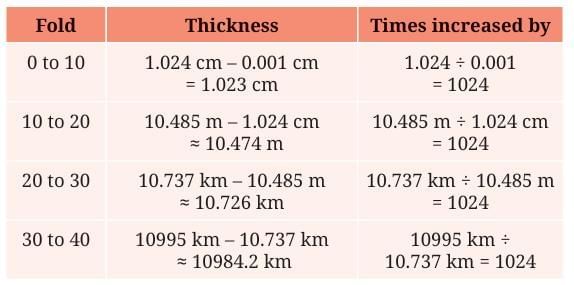
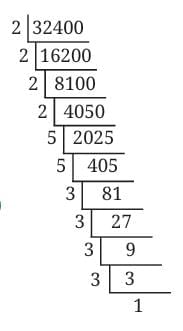
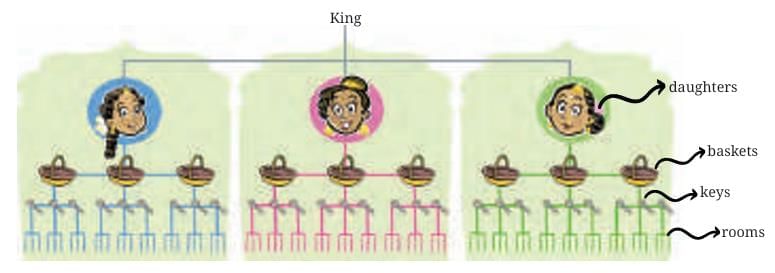

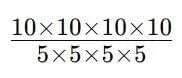
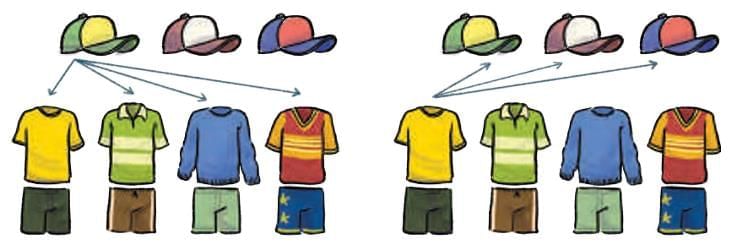
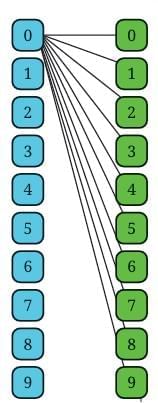

 That means: 2⁻¹ = 1 ÷ 2 =
  In normal form we can write: 2⁴ ÷ 2¹⁰ =