6️⃣ We Distribute, Yet Things Multiply – Textbook Solutions

Page 142

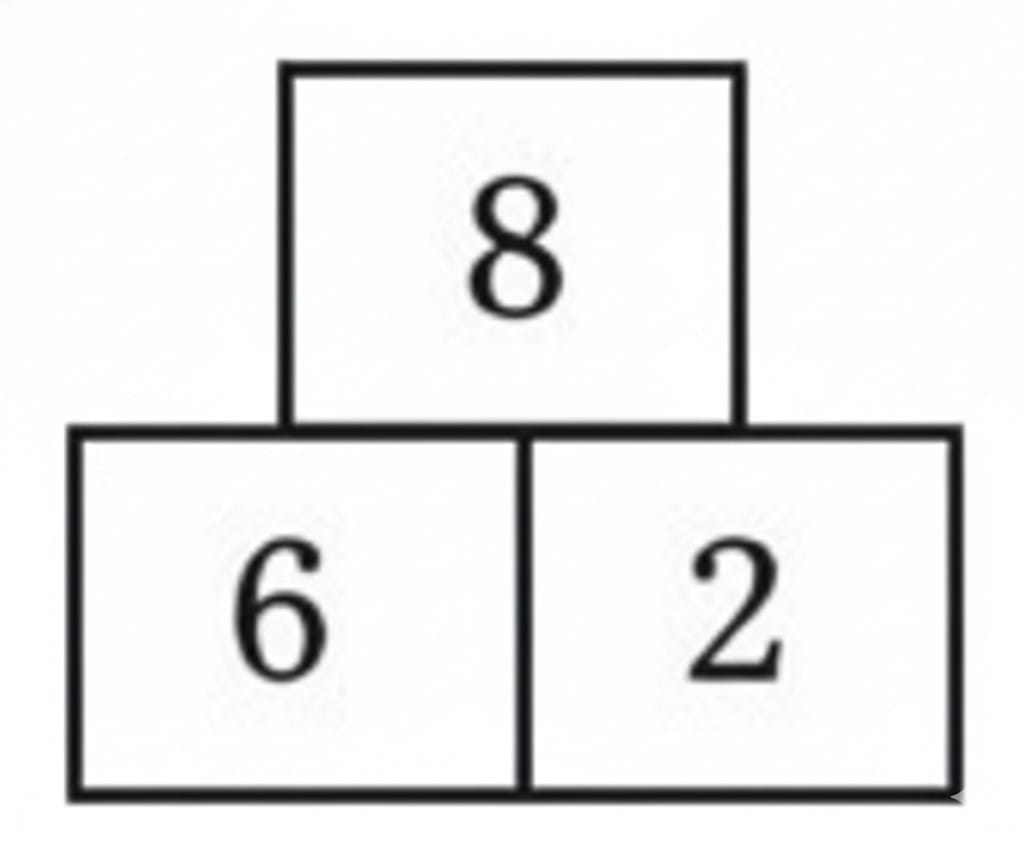
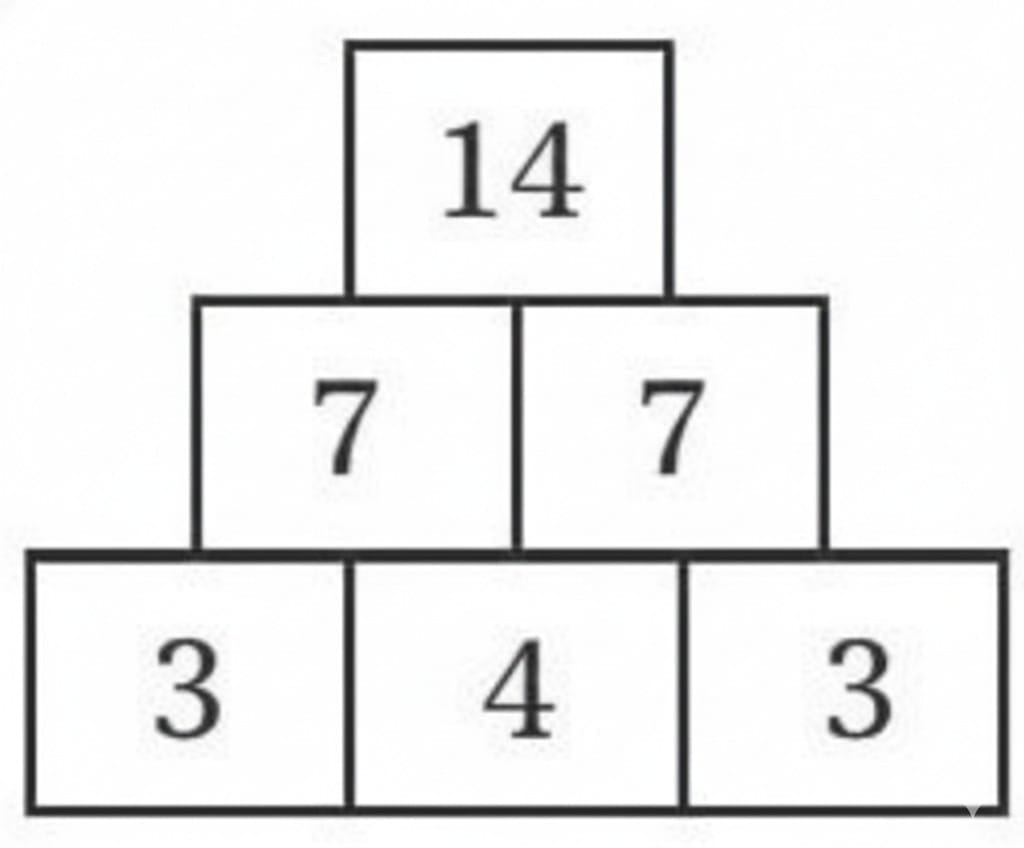
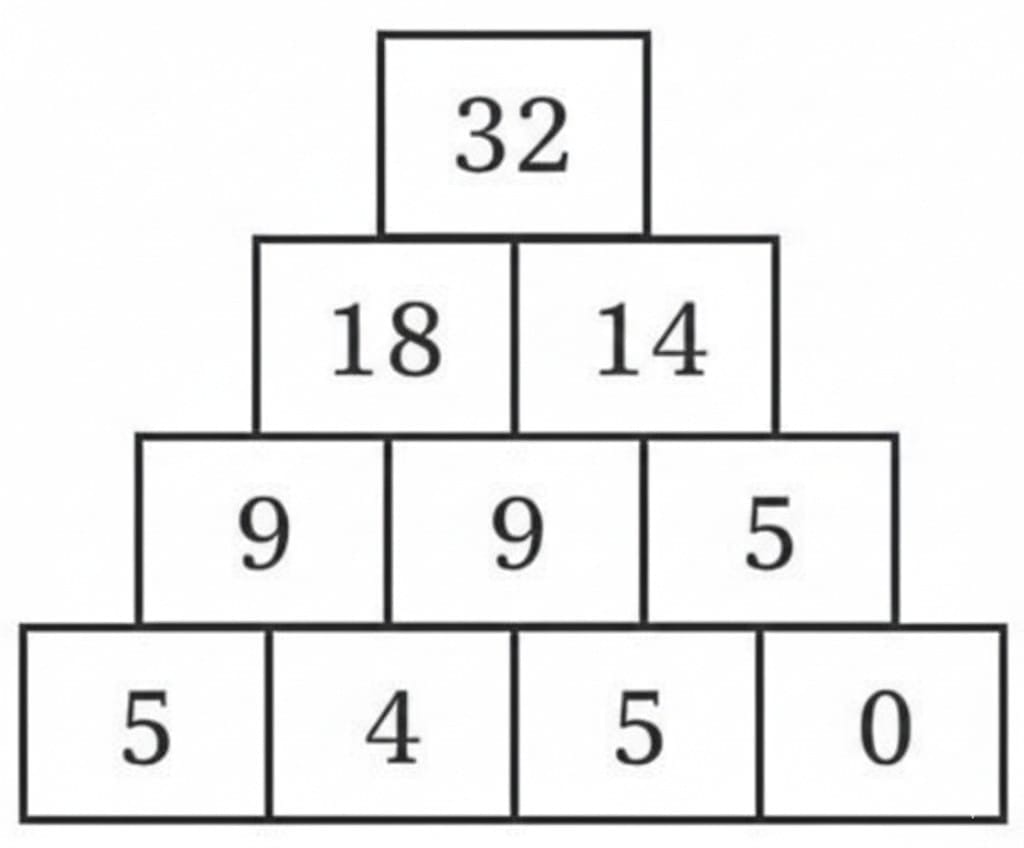
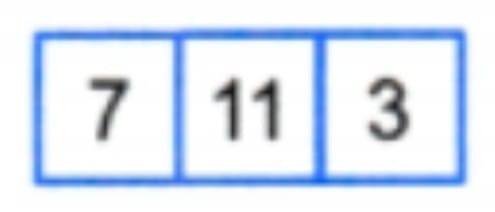
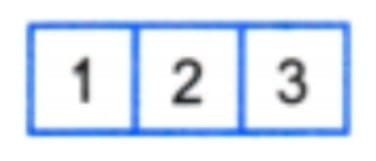
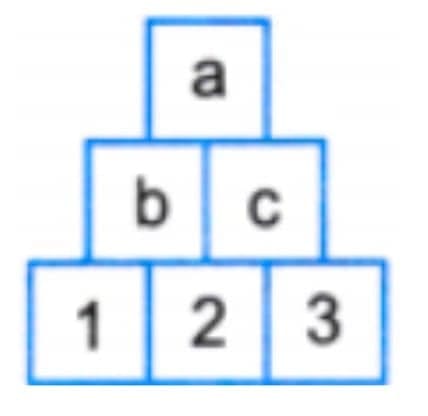
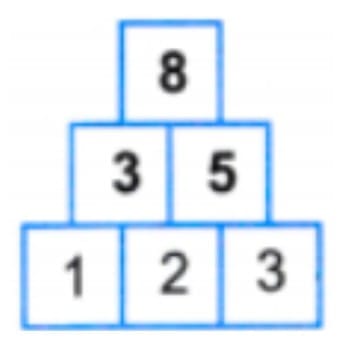
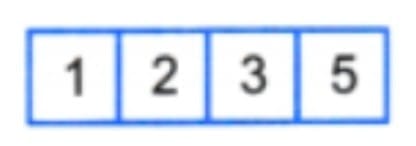
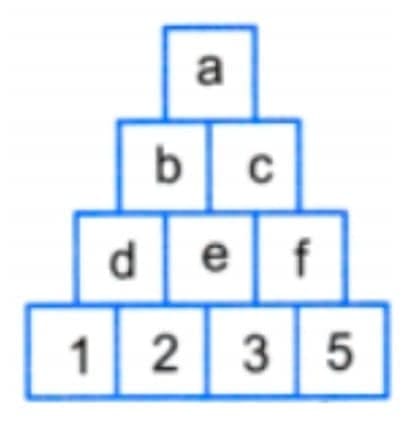
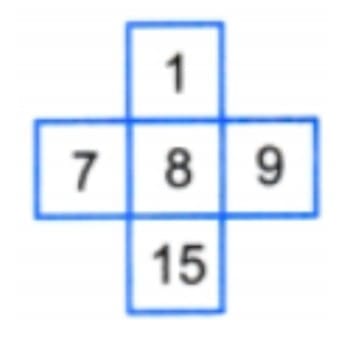
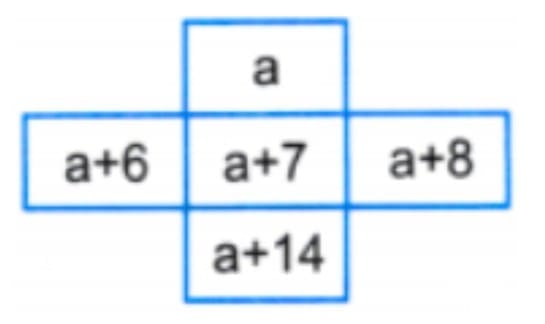
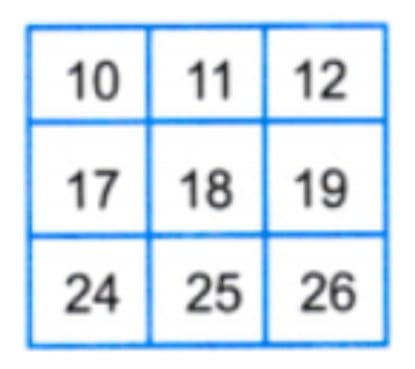
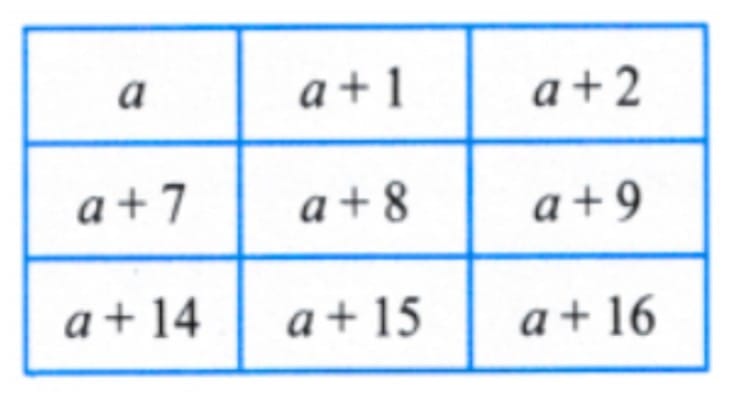
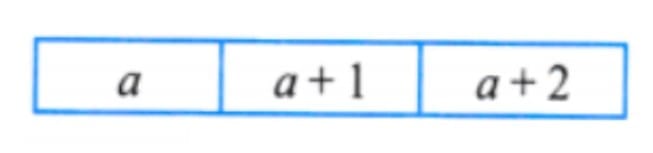
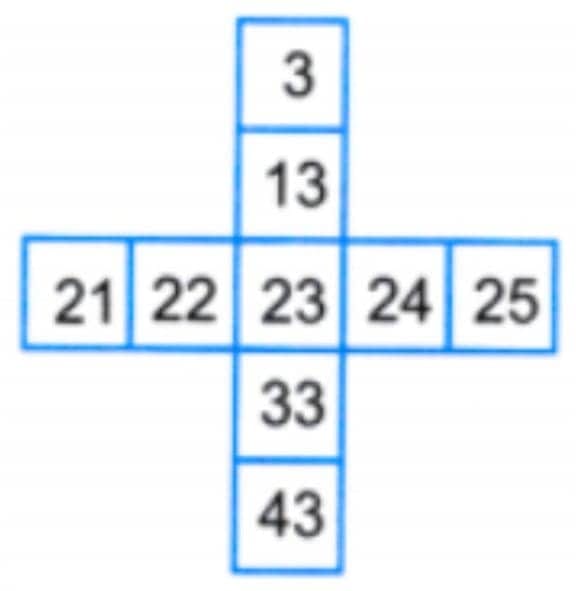
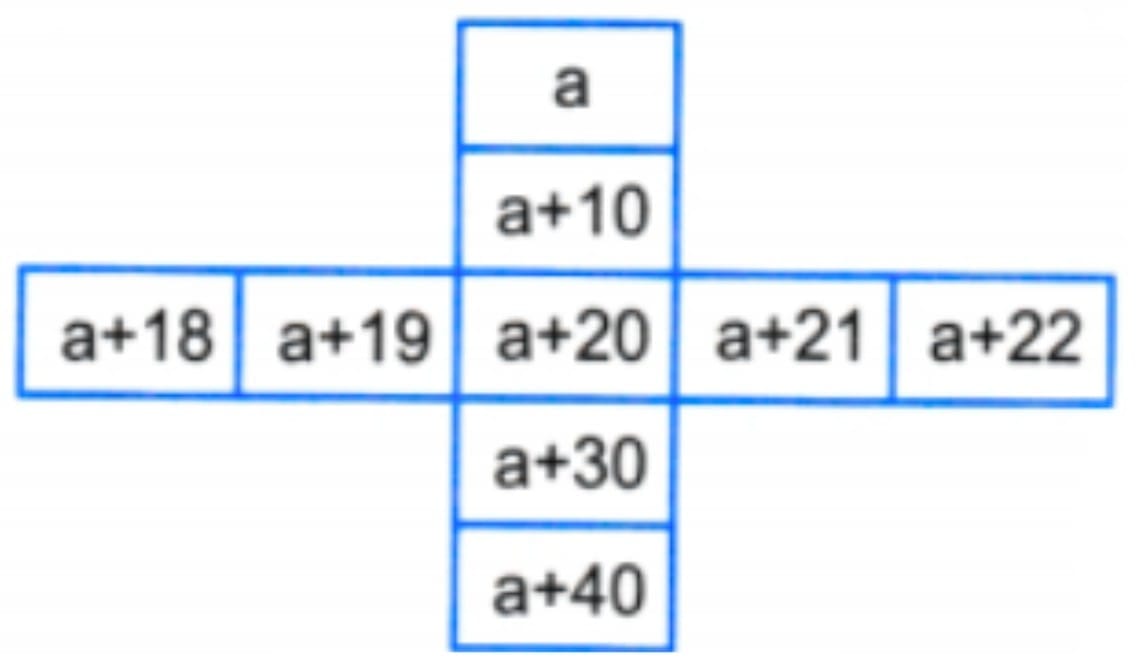
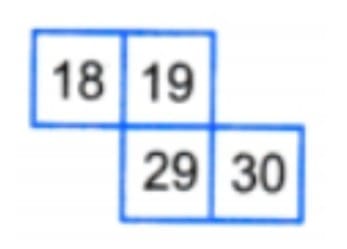
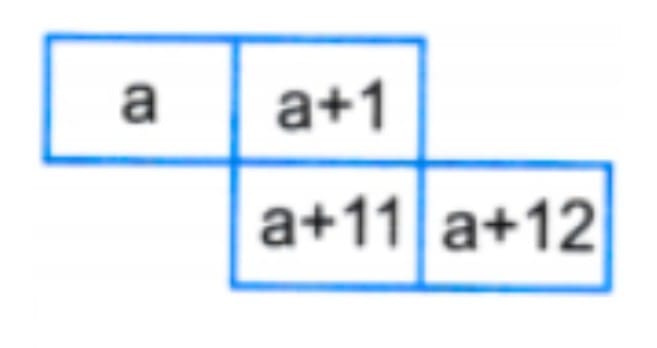
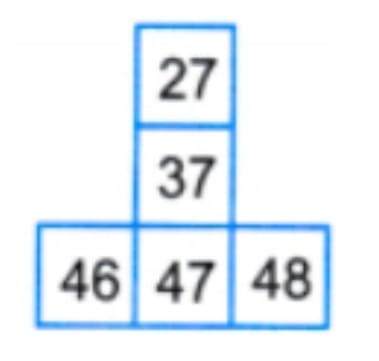
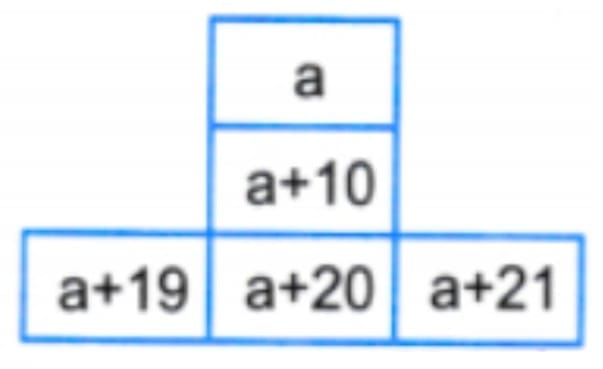
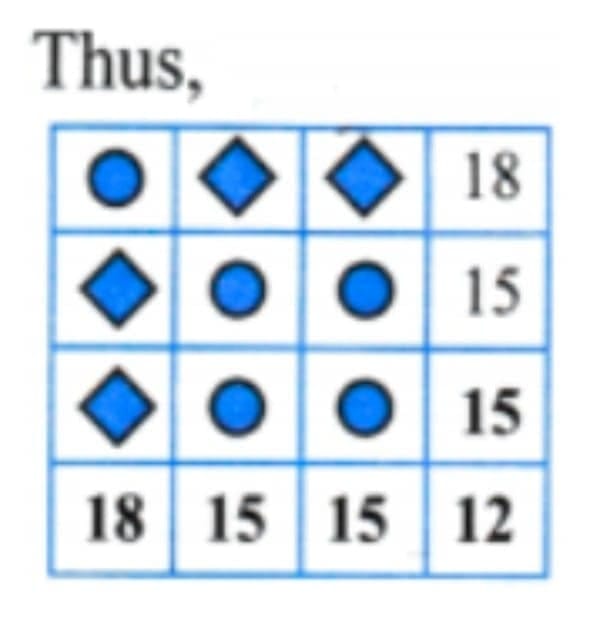
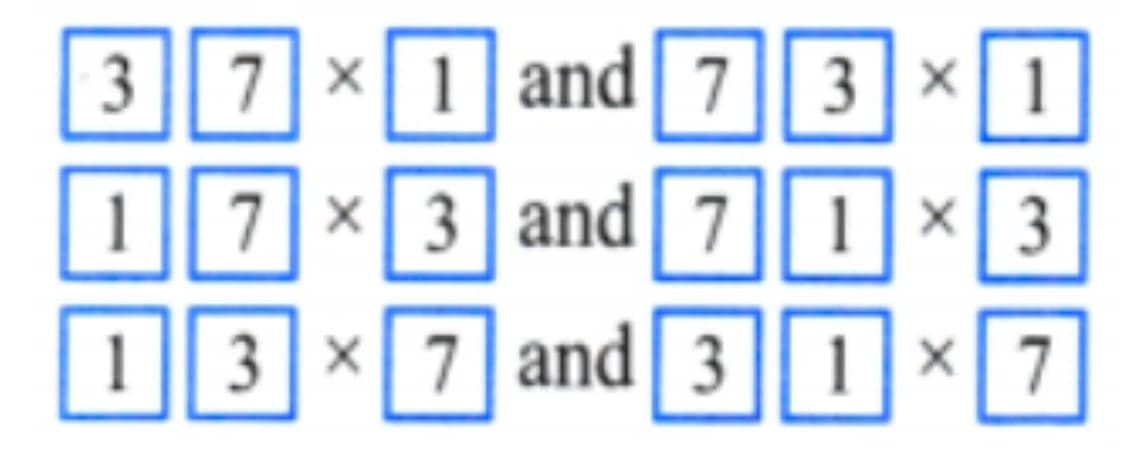
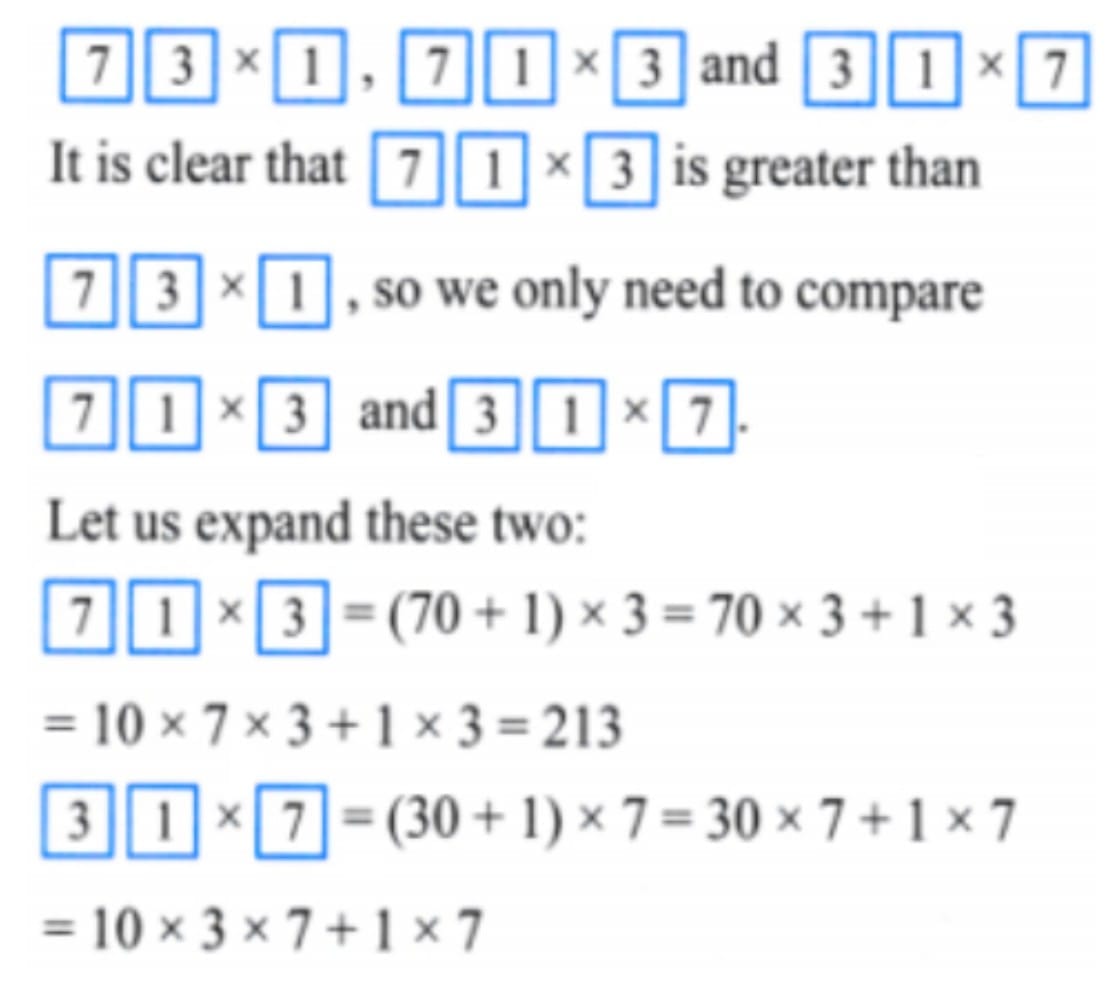
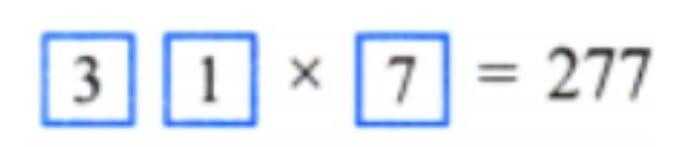
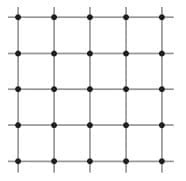
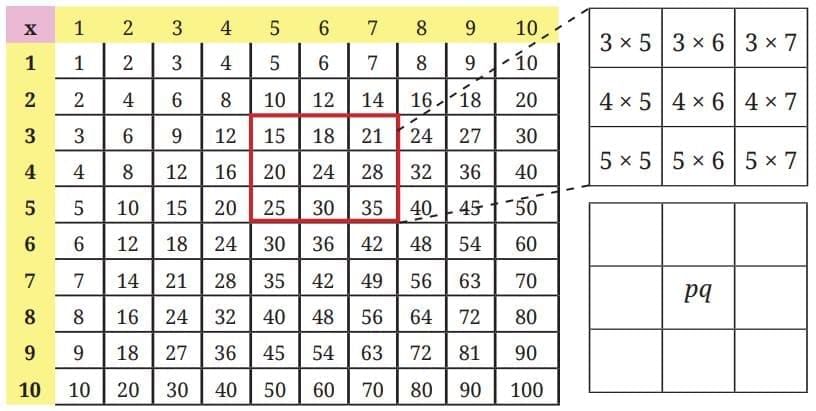
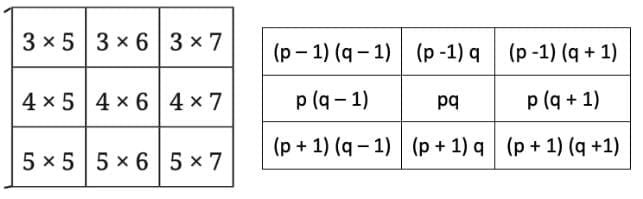
Q1. Observe the multiplication grid below. Each number inside the grid is formed by multiplying two numbers. If the middle number of a 3 × 3 frame is given by the expression pq, as shown in the figure, write the expressions for the other numbers in the grid.


Ans: 

Q2. Expand the following products.
(i) (3 + u) (v – 3)
(ii) 2/3 (15 + 6a)
(iii) (10a + b) (10c + d)
(iv) (3 – x) (x – 6)
(v) (–5a + b) (c + d)
(vi) (5 + z) (y + 9)

Ans: (i) (3 + u) (v – 3)
We have, (3 + u) (v – 3)
= 3(v – 3) + u(v – 3)
= 3v – 9 + uv – 3u
= 3v – 3u + uv – 9
(ii) 2/3 (15 + 6a)
2/3 × 15 + 2/3 × 6a
= 2 × 5 + 2 × 2a
= 10 + 4a.
(iii) (10a + b) (10c + d)
= (10a + b)10c + (10 a + b)d
= 100ac + 10bc + 10ad + bd.
(iv) (3 – x) (x – 6)
= (3 – x)x – (3 – x)6
= 3x – x2 – (18 – 6x)
= 3x – x2 – 18 + 6x
= – x2 + 6x + 3x – 18
= – x2 + 9x – 18.
(v) (–5a + b) (c + d)
= (–5a + b)c + (–5a + b)d
= – 5ac + bc – 5ad + bd
= – 5ac – 5ad + bc + bd.
(vi) (5 + z) (y + 9)
= (5 + z)y + (5 + z)9
= 5y + zy + 45 + 9z
= 5y + 9z + zy + 45.

Q3. Find 3 examples where the product of two numbers remains unchanged when one of them is increased by 2 and the other is decreased by 4.
Ans: 
If the two numbers are x and y, then:
x × y = (x + 2) × (y − 4)
xy = (x + 2)y – (x + 2)4
xy = xy + 2y – (4x + 8)
xy = xy + 2y – 4x – 8
xy – xy = 2y – 4x – 8
0 = 2y – 4x – 8
4x + 8 = 2y
2(2x + 4) = 2y
y = 2x + 4.
Examples:
(i) x = 1,  y = 6 → Product = 1 × 6 = 6
Check: (1 + 2) × (6 − 4) = 3 × 2 = 6.
(ii) x = 2, y = 8→ Product = 16
Check: (2 + 2) × (8 − 4) = 4 × 4 =16.
(iii) x = 5, y =14 → Product = 5 × 14 = 70
Check: (5 + 2) × (14 − 4) = 7 × 10 = 70.
Therefore, (1, 6), (2, 8), and (5, 14) are three valid examples.

Q4. Expand (i) (a + ab – 3b2) (4 + b), and (ii) (4y + 7) (y + 11z – 3).
Ans: (i) (a + ab – 3b2) (4 + b)
= (a + ab – 3b2)4 + (a + ab – 3b2)b
= 4a + 4ab – 12b2 + ab + ab2 – 3b3
= – 3b3 – 12b2 + ab2 + 4ab + ab + 4a
= – 3b3 – 12b2 + ab2 + 5ab + 4a.
(ii) (4y + 7) (y + 11z – 3)
= (4y + 7)y + (4y + 7)11z – (4y + 7)3
= 4y2 + 7y + 44yz + 77z – (12y + 21)
= 4y2 + 7y + 44yz + 77z – 12y – 21
= 4y2 + 7y – 12y + 44yz + 77z – 21
= 4y2 – 5y + 44yz + 77z – 21.

Q5. Expand (i) (a – b) (a + b), (ii) (a – b) (a2 + ab + b2) and (iii) (a – b)(a+ a2b + ab2 + b3), Do you see a pattern? What would be the next identity in the pattern that you see? Can you check it by expanding?
Ans: (i) (a − b)(a + b)
= (a − b)a + (a − b)b
= a2 – ab + ab – b2
= a2 – b2.
(ii) (a – b) (a2 + ab + b2)
= (a – b)a2 + (a – b)ab + (a – b)b2
= a3 – a2b + a2b – ab2 + ab2 – b3
= a3 – b3.
(iii) (a – b)(a3 + a2b + ab2 + b3)
= (a – b)a3 + (a – b)a2b + (a – b)ab2 + (a – b)b3
= a4 – a3b + a3b – a2b2 + a2b2 – ab3 + ab3 – b4
= a4 – b4.
We observe the following pattern (a – b) (an + an-1 b + ….. + bn) = an+1 – bn+1
The next identity would be: (a − b)(a4 + a3b + a2b2 + ab3 + b4) = a5 − b5.

Page 149

Figure it Out

Q1. Which is greater: (a – b)2 or (b – a)2? Justify your answer.
Ans:  
Here, (a – b)2 = a2 + b2 – 2ab ……….(1)
and (b – a)2 = b2 + a2 – 2ba
b2 + a2 = a2 + b2 and ba = ab
(b – a)2 = a2 + b2 – 2ab ……….(2)
Comparing (1) and (2), we get (a – b)2 = (b – a)2

Q2. Express 100 as the difference of two squares.
Ans: Therefore, a2 – b2 = 100
Or, a2 – b2 = 2 × 2 × 5 × 5
Or, (a + b) (a – b) = 50 × 2
When, (a + b) = 50 and (a – b) = 2
Then ‘a’ should be = 26 and ‘b’ should be = 24
So, (a + b) (a – b) = (26 + 24) (26 – 24) = 262 – 242 = 676 – 576 = 100
Therefore, 100 = 262 – 24

Q3. Find 4062, 722, 1452, 10972, and 1242 using the identities you have learnt so far.
Ans: 
4062
= (400+6)2
= (400)2 + (6)2 + 2×400×6
= 160000 + 36 + 4800
= 164836
722
= (70 + 2)2
= (70)2 + (2)2 + 2×70×2
= 4900 + 4 + 280
= 5184
1452
= (150- 5)2
= (150)2 + (5)2 – 2×150×5
= 22500 + 25 – 1500
= 21025
10972
= (1100- 3)2
= (1100)2 + (3)2 – 2×1100×3
= 1210000 + 9 – 6600
= 1203409
1242
= (100+ 24)2
= (100)2 + (24)2 + 2×100×24
= 10000 + 576 + 4800
= 15376

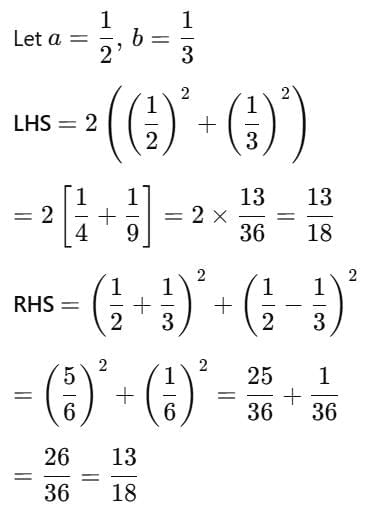
Q: Do Patterns 1 and 2 hold only for counting numbers? Do they hold for negative integers as well? What about fractions? Justify your answer.

Ans: Pattern 1
2(a2 + b2) = (a + b)2 + (a – b)2
Case-I
Let a = 4, b = 2
LHS = 2(42 + 22) = 2 × (16 + 4) = 40
RHS = (4 + 2)2 + (4 – 2)2 = 36 + 4 = 40
∴ Pattern 1 holds for counting numbers.

​Case-II
Let a = -4, b = -2
LHS = 2((-4)2 + (-2)2)
= 2 × (16 + 4)
= 2 × 20
= 40
RHS = (-4 + (-2))2 + (-4 – (-2))2
= (-4 – 2)2 + (-4 + 2)2
= (-6)2 + (-2)2
= 36 + 4
= 40
LHS = RHS
∴ Pattern 1 holds for negative integers also.

​Case-III

The pattern holds for fractions also.

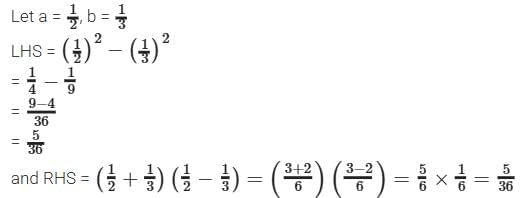
Pattern 2
a2 – b2 = (a + b) (a – b)
Case-I
Let a = 5, b = 3
LHS = 52 – 32 = 25 – 9 = 16
RHS = (5 + 3) (5 – 3) = 8 × 2 = 16
∴ LHS = RHS
∴ Pattern 2 holds for counting numbers.

Case-II
Let a = -5, b = -3
Now, LHS = (-5)2 – (-3)2 = 25 – 9 = 16
and RHS = [(-5) + (-3)] [(-5) – (-3)]
= (-5 – 3) (-5 + 3)
= (-8) (-2)
= 16
∴ LHS = RHS
∴ Pattern 2 holds for negative integers also.

Case III

​∴ LHS = RHS
∴ Pattern 2 holds for fractions also.

Page 154 – 155

Figure it Out

Q1. Compute these products using the suggested identity.
(i) 462using Identity 1A for (a + b)2
Ans: Identity (a + b)2 = a2 + 2ab + b2
So, 462 = (40 + 6)2
= (40)2 + 2 × 40 × 6 + (6)2
= 1600 + 480 + 36
= 2116
(ii) 397 × 403 using Identity 1C for (a + b) (a – b)
Ans: Identity (a + b) (a – b) = a2 – b2
So, 397 × 403
= (400 – 3) × (400 + 3)
= (400)2 – (3)2
= 160000 – 9
= 159991
(iii) 912 using Identity 1B for (a – b)2
Ans: Identity (a – b)2 = a2 + b2 – 2ab
So, 912 = (100 – 9)2
= (100)2 + (9)2 – 2×100×9
= 10000 + 81 –1800
= 8281
(iv) 43 × 45 using Identity 1C for (a + b) (a – b)
Ans: Identity (a + b) (a – b) = a2 – b2
So, 43 × 45
= (44 – 1) (44 + 1)
= (44)2 – (1)2
= 1936 – 1
= 1935

Q2. Use either a suitable identity or the distributive property to find each of the following products.
(i) (p – 1)(p + 11)
Ans: Distributive property
∴ (p – 1) (p + 11) = p2 + 11p – p – 11 = p2 + 10p – 11
(ii) (3a – 9b)(3a + 9b)
Ans: Identity (a + b) (a – b)
∴ (3a – 9b) (3a + 9b) = (3a)2 – (9b)2 = 9a2 – 81b2
(iii) – (2y + 5) (3y + 4)
Ans: Distributive property
∴ – (2y + 5) (3y + 4) =-6y2 – 8y – 15y – 20 = -6y2 – 23y – 20
(iv) (6x + 5y)2
Ans: Identity(a + b)2
∴ (6x + 5y)2 = (6x)2 + 2 × 6x × 5y + (5y)2 = 36x2 + 60xy + 25y2
(v) (2x – 1/2)2
Ans: Identity (a – b)2
∴ (2x – 1/2)2 = (2x)2 + (1/2)2 – 2 × 2x × 1/2 = 4x2 + 1/4 – 2x
(vi) (7p) × (3r) × (p + 2)
Ans: Distributive property
∴ (7p) × (3r) × (p + 2) = 21pr × (p + 2) = 21p2r + 42pr

Q3. For each statement identify the appropriate algebraic expression(s).
(i) Two more than a square number.
2 + s, (s + 2)2, s2 + 2, s2 + 4, 2s2, 22s
Ans: s2 + 2
Explanation: Let be the number = s
∴ Square number = s2
So, two more the square number is = s2+ 2
(ii) The sum of the squares of two consecutive numbers
m²+n2, (m + n)2, m2 + 1, m2 + (m + 1)2, m2 + (m – 1)2, {m + (m + 1)}2, (2m)2 + (2m + 1)2
Ans: m2 + (m + 1)2
Explanation: Let be the consecutive numbers are = m and (m + 1)
So, the sum of the square numbers = m2 + (m + 1)

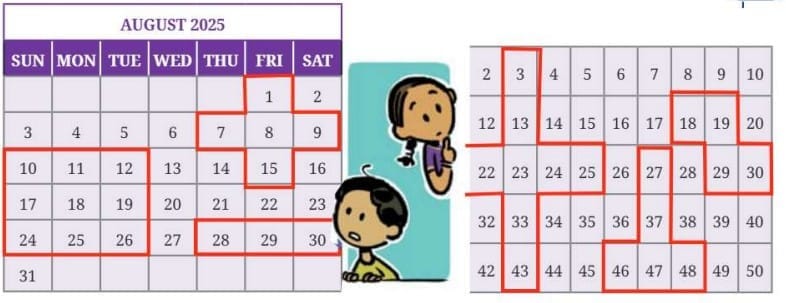
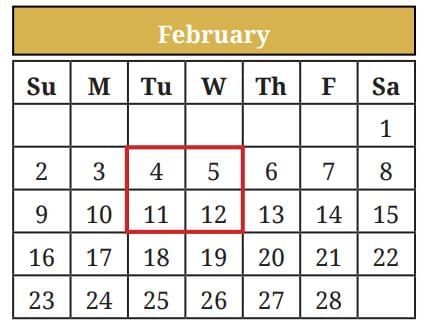
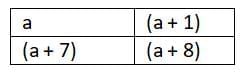
Q4. Consider any 2 by 2 square of numbers in a calendar, as shown in the figure.
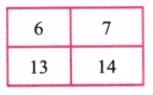
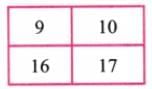
Find products of numbers lying along each diagonal — 4 × 12 = 48, 5 × 11 = 55. Do this for the other 2 by 2 squares. What do you observe about the diagonal products? Explain why this happens.

Hint: Label the numbers in each 2 by 2 square as

Ans: Case – I

Here, 6 × 14 = 84
13 × 7 = 91
Difference = 91 – 84 = 7

​Case-II

​Here, 9 × 17 = 153
16 × 10 = 160
Difference = 160 – 153 = 7
We observe that the difference of the diagonal products in both cases is always 7.

Q5. Verify which of the following statements are true.
(i) (k + 1)(k + 2) – (k + 3) is always 2.
Ans: Statement is false.
Explanation: (k + 1) (k + 2) – (k + 3)
= k2 + 2k + k + 2 – k – 3
= k2 + 2k – 1
Now, if k = 1, then (1)2 + 2 × 1 – 1 = 2
If k = 2, then (2)2 + 2 × 2 – 1 = 7
If k = 3, then (3)2 + 2 × 3 – 1 = 14
(ii) (2q + 1)(2q – 3) is a multiple of 4.
Ans: Statement is false.
Explanation: (2q + 1) (2q – 3)
= 4q2 – 6q + 2q – 3
= 4q2 – 4q – 3
=4(q2 –q) – 3
Here we see that 3 is not divisible by 4, so the entire equation is not divisible by 4.
(iii) Squares of even numbers are multiples of 4, and squares of odd numbers are 1 more than multiples of 8.
Ans: Statement is true.
Explanation: Let be the even number is = 2n (even is always divisible by 2).
∴ Square of 2n = (2n)2 = 4n2 (We see it is always a multiple of 4)
And the odd number is = 2n + 1
∴ Square of 2n + 1 = (2n + 1)2 = (2n)2 + 2×2n×1 + 12 = 4n2 + 4n + 1 = 4(n2 + n) + 1
(n2 + n) is always an even number because n is odd, the square of an odd number is always odd, and odd + odd = even.
Example: If (n2 + n) = 2, then 4×2 + 1 = 9 (9 is 1 more than multiples of 8)
If (n2 + n) = 4, then 4×4 + 1 = 17 (9 is 1 more than multiples of 8) etc.
(iv) (6n + 2)2 – (4n + 3)2 is 5 less than a square number.
Ans: Statement is false.
Explanation: (6n + 2)2 – (4n + 3)2
= {(6n)2 + 2×6n×2 + (2)2} –{(4n)2 + 2×4n×3 + (3)2}
= 36n2 + 24n + 4 – 16n2 – 24n – 9
= 20n2– 5
Clearly we see 20 is a square number so 20n2 is also not a square number.

Q6. A number leaves a remainder of 3 when divided by 7, and another number leaves a remainder of 5 when divided by 7. What is the remainder when their sum, difference, and product are divided by 7?
Ans:
 Let the numbers be x and y.
x = 7a + 3, y = 7b + 5
Sum = x + y
= 7a + 3 + 7b + 5
= 7(a + b) + 8
= 7(a + b) + 7 + 1
= 7(a + b + 1) + 1
∴ The remainder on division by 7 is 1.
Difference = x – y
= (7a + 3) – (7b + 5)
= 7a + 3 – 7b – 5
= 7(a – b) – 2
= 7(a – b) – 1 + 5 (∵ -2 = -7 + 5)
= 7(a – b – 1) + 5
∴ The remainder on division by 7 is 5.
Product = xy
= (7a + 3) (7b + 5)
= 49ab + 35a + 21b + 15
= (49ab + 35a + 21b + 14) + 1
= 7(7ab + 5a + 3b + 2) + 1
∴ The remainder on division by 7 is 1.

Q7. Choose three consecutive numbers, square the middle one, and subtract the product of the other two. Repeat the same with other sets of numbers. What pattern do you notice? How do we write this as an algebraic equation? Expand both sides of the equation to check that it is a true identity.
Ans: Let be the three consecutive numbers are = x, (x + 1), (x + 2)
Therefore,(x + 1)2 – x(x + 2)
= x2 + 2x + 1 – x2 – 2x
= 1
And let be the other sets of consecutive numbers are = (x – 1), x, (x + 1)
Therefore, x2 – (x – 1) (x + 1)
= x2 – x2 – x + x + 1
= 1
In the pattern we have observed, the value of the equation is always 1.
Hence, the algebraic equation is:-(x + 1)2 – x(x + 2) = 1

Q8. What is the algebraic expression describing the following steps-add any two numbers. Multiply this by half of the sum of the two numbers? Prove that this result will be half of the square of the sum of the two numbers.
Ans:
 Let be the two numbers are = x and y
Sum of these numbers are = (x + y)
Multiplying this by half = 1/2 × (x + y)
Now, 1/2 × (x + y) × (x + y)
= (x + y)2/2
Therefore, the result will be half of the square of the sum of the two numbers.

Q9.  Which is larger? Find out without fully computing the product.
(i) 14 × 26 or 16 × 24

(ii) 25 × 75 or 26 × 74
Ans: 

(i) Let p = 14 × 26
p’ = 16 × 24
= (14 + 2) (26 – 2)
= 14 × 26 + 2 × 26 – 14 × 2 – 2 × 2
= 14 × 26 + 2(26 – 14 – 2)
= 14 × 26 + 2 × 10
p’ = p + 2 × 10
∴ p’ > p or 16 × 24 > 14 × 26

(ii) Let p = 25 × 75
p’ = 26 × 74
= (25 + 1) (75 – 1)
= 25 × 75 + 75 × 1 – 25 × 1 – 1 × 1
= p + (75 – 25 – 1)
= p + 49
∴ p’ > p or 26 × 74 > 25 × 75

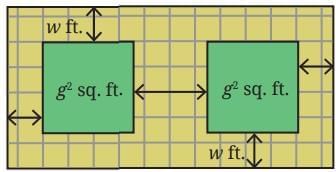
Q10. A tiny park is coming up in Dhauli. The plan is shown in the figure. The two square plots, each of area g2 sq. ft., will have a green cover. All the remaining area is a walking path w ft. wide that needs to be tiled. Write an expression for the area that needs to be tiled.
Ans: Area of square plot = g2 sq. ft., so length of side = g ft.
∴ Length of the tiny park = (w + g + w + g + w) ft= (3w + 2g) ft
And breadth of the tiny park = (w + g + w) = (2w + g) ft
Total area of the park = (3w + 2g) × (2w + g)
= 6w2 + 3wg + 4wg + 2g2
= (6w2 + 7wg + 2g2) sq. ft.
So, the remaining area that needs to be tiled for the walking path is
= (6w2 + 7wg + 2g2) – (g2) sq. ft.
= (6w2 + 7wg + g2) sq. ft.

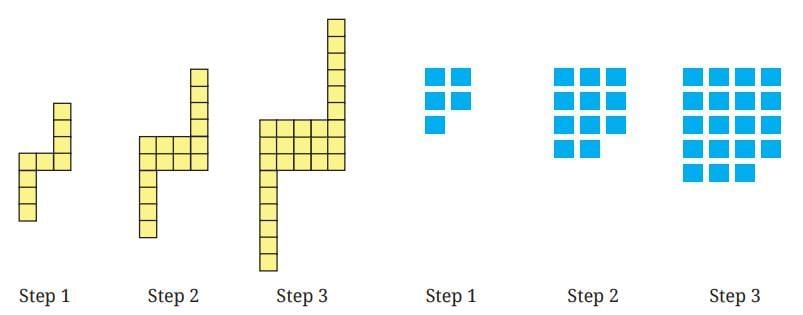
Q11. For each pattern shown below, 
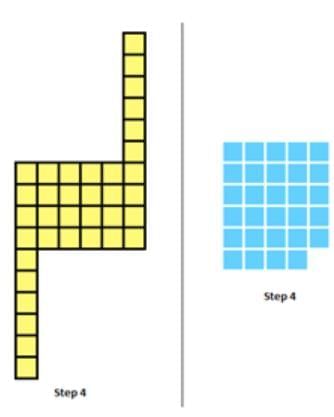
(i) Draw the next figure in the sequence.
Ans: Next figure in the sequence:
(ii) How many basic units are there in Step 10? 
Ans: Step 1 has (1 + 1)2 + 1 or 5 squares
Step 2 has (2 + 1 )2 + 2 or 11 squares
Step 3 has (3 + 1)2 + 3 or 19 squares
Hence step 10 has (10 + 1)2 + 10 or 131 squares
(iii) Write an expression to describe the number of basic units in Step y.
Ans: In 1stfigure:-
Step 1:- (1 + 2)2 = 9
Step 2:- (2 + 2)2 = 16
Step 3:- (3 + 2)2 = 25
→ Step y:- (y + 2)2
In 2nd figure:-
Step 1:- (1+1)2+ 1 = 5
Step 2:- (2+1)2+ 2 = 16
Step 3:- (3 + 1)2+ 3= 25
→ Step y:- (y + 1)2 + y

5️⃣ Number Play – Textbook Solutions

Page 122

Figure it Out

Q1. The sum of four consecutive numbers is 34. What are these numbers?
Ans: Let four consecutive numbers be x, (x + 1), (x + 2) and (x + 3).
x + (x + 1) + (x + 2) + (x + 3) = 34
x + x + 1 + x + 2 + x + 3 = 34
4x + 6 = 34
4x = 34 – 6
4x = 28
x = 28/7 = 7.
So, (x + 1 ) = 7 + 1 = 8
(x + 2) = 7 + 2 = 9
(x + 3) = 7 + 3 = 10
Therefore, the given four consecutive numbers are 7, 8, 9, and 10.

Q2. Suppose p is the greatest of five consecutive numbers. Describe the other four numbers in terms of p.
Ans: 
Given p is the greatest of five consecutive numbers.
The other four numbers in terms of p are (p – 1), (p – 2), (p – 3), and (p – 4).
p – 1 is the second largest number
p – 2 is the third largest number
p – 3 is the second smallest number
p – 4 is the smallest number
∴ p > (p – 1) > (p – 2) > (p – 3) > (p – 4).

Q3. For each statement below, determine whether it is always true, sometimes true, or never true. Explain your answer. Mention examples and non-examples as appropriate. Justify your claim using algebra.
(i) The sum of two even numbers is a multiple of 3.
Ans: Let the two even numbers be 2a + 2b
Sum = 2a + 2b = 2(a + b)
For 2(a + b) to be a multiple of 3, (a + b) must be multiple of 3.
Example:
2 + 4 = 6 → divisible by 3
2 + 8 = 10 → not divisible by 3 
ConclusionSometimes true.

(ii) If a number is not divisible by 18, then it is also not divisible by 9.
Ans: If a number is divisible by 18, then it is also divisible by 9 because 9 is a factor of 18.
18a ÷ 9 = 2a → divisible by 9.
But if a number is divisible by 9, it is not always divisible by 18.
9b ÷ 18 = b/2 → not divisible by 9.
Example: 9 is divisible by 9 but not divisible by 18.
27 is divisible by 9 but not 18.
ConclusionSometimes true.

(iii) If two numbers are not divisible by 6, then their sum is not divisible by 6.
Ans: Let the two numbers be a and b.
Not divisible by 6 means they do not satisfy 6∣a or 6∣b.
But their sum can still be divisible by 6.
Example: 2 and 4 → both not divisible by 6.
But, 2 + 4 = 6 → divisible by 6.
ConclusionSometimes true.

(iv) The sum of a multiple of 6 and a multiple of 9 is a multiple of 3.
Ans: Let the multiple of 6 be 6a, the multiple of 9 be 9b.
Sum: 6a + 9b = 3(2a + 3b)→ clearly divisible by 3.
Example:
6 + 9 = 15 → divisible by 3.
12 + 18 = 30 → divisible by 3.
ConclusionAlways true.

(v) The sum of a multiple of 6 and a multiple of 3 is a multiple of 9.
Ans: Let multiple of 6 be 6a, multiple of 3 be 3b.
Sum: 6a + 3b = 3(2a + b).
For it to be divisible by 9, 2a + b must be divisible by 3.
Example:
6 (6 × 1) + 3 (3 × 1) = 9 →divisible by 9
6 + 6 = 12 → not divisible by 9
ConclusionSometimes true.

Q4. Find a few numbers that leave a remainder of 2 when divided by 3 and a remainder of 2 when divided by 4. Write an algebraic expression to describe all such numbers.
Ans: Here, Remainder = 2, Dividend = 3
∴ Number = (Quotient × Dividend) + Remainder = (K × 3) + 2
where, K = 1, 2, 3,…..
Numbers = 1 × 3 + 2 = 3 + 2 = 5
Numbers = 2 × 3 + 2 = 6 + 2 = 8
Numbers = 3 × 3 + 2 = 9 + 2 = 11
Thus, 5, 8, and 11 are numbers that leave a remainder of 2 when divided by 3.
Algebraic expression = 3K + 2
Here, Remainder = 2, dividend = 4
Number = 4K + 2, where K = 1, 2, 3, 4, …
Numbers = 4 × 1 + 2 = 4 + 2 = 6
Numbers = 4 × 2 + 2 = 8 + 2 = 10
Numbers = 4 × 3 + 2 = 12 + 2 = 14
Algebraic expression = 4K + 2
Thus, 6, 10, and 14 are numbers that leave a remainder of 2 when divided by 4.

Q5. “I hold some pebbles, not too many, When I group them in 3’s, one stays with me. Try pairing them up — it simply won’t do, A stubborn odd pebble remains in my view. Group them by 5, yet one’s still around, But grouping by seven, perfection is found. More than one hundred would be far too bold, Can you tell me the number of pebbles I hold?”

Ans: Grouped in 3’s leaves 1.
Pairing (2’s) leaves 1.
Grouped by 5 leaves 1.
Grouped by 7 is perfect.
Number ≤ 100.
L.C.M of 2, 3, and 5 = 30.
In all those cases, when we group them, 1 pebble remains.
So, the actual number of pebbles must be = 30 + 1 = 31, but 31 is not divisible by 7.
The next multiple of 30 is 2 × 30 = 60.
So, 60 + 1 = 61, but this is also not divisible by 7.
Similarly, the next number is 90 + 1 = 91.
And 91 is divisible by 7.
Hence, the number of pebbles I hold = 91.

Q6. Tathagat has written several numbers that leave a remainder of 2 when divided by 6. He claims, “If you add any three such numbers, the sum will always be a multiple of 6.” Is Tathagat’s claim true?
Ans: A number that leaves remainder of 2 when divided by 6 can be written as 6k + 2.
Three such numbers are: (6a + 2), (6b + 2), (6c + 2).
(6a + 2) + (6b + 2) + (6c + 2) = 6(a + b + c) + 6 = 6(a + b + c + 1).
This sum is divisible by 6.
So yes, Tathagat’s claim is always true.
Example: Take 20, 26, 32 → sum = 78 → divisible by 6.
Take 2, 8, 14 → sum = 24 → divisible by 6.

Page 123

Q7. When divided by 7, the number 661 leaves a remainder of 3, and 4779 leaves a remainder of 5. Without calculating, can you say what remainders the following expressions will leave when divided by 7? Show the solution both algebraically and visually.
(i) 4779 + 661 
(ii) 4779 – 661
Ans: Given, 661 = K × 7 + 3, where K = 1, 2, 3, 4, …
and, 4779 = K × 7 + 5
Algebraic Method:
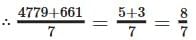
(i) 4779 + 661
4779 = (682 × 7 ) + 5
Remainder = 5
661 = (94 × 7) + 3
Remainder = 3
∴ = 1 = Remainder
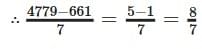
(ii) 4779 – 661
∴  = 4 = Remainder

Visualization Method:
(i) 4779 + 661 = (682 × 7) + 5 + (94 × 7) + 3
= 7 × (682 + 94) + 5 + 3
= 7 × 776 + 8
= Divisible by 7 + 8/7
= 1, Remainder
(ii) 4779 – 661 = (682 × 7) + 5 – (94 × 7) – 3
= 7 × (682 – 94) + 5 – 3
= 7 × 588 + 2
= Divisible by 7 + 2
= 2, Remainder

Q8. Find a number that leaves a remainder of 2 when divided by 3, a remainder of 3 when divided by 4, and a remainder of 4 when divided by 5. What is the smallest such number? Can you give a simple explanation of why it is the smallest?
Ans: A number that leaves a remainder of 2 when divided by 3 is = 3x + 2
A number that leaves a remainder of 3 when divided by 4 is = 4x + 3
A number that leaves a remainder of 4 when divided by 5 is = 5x + 4
L.C.M of 3, 4, and 5 = 60
All the numbers are the same, so 4x + 3 = 3x + 2
4x – 3x = 2 – 3
x = -1
Each remainder is 1 less than the divisor.
Hence, the number is 1 less than the L.C.M = (60 – 1) = 59.
So, 59 is the smallest number that satisfies all the given conditions.

Page 126

Figure it Out

Q1. Find, without dividing, whether the following numbers are divisible by 9.
(i) 123
Ans: Digit sum of the number 123 = (1 + 2 + 3) = 6
Now, (6 ÷ 9) is not divisible by 9.
So, the whole number 123 is not divisible by 9.

(ii) 405
Ans: Digit sum of the number 405 = (4 + 0 + 5) = 9
Now, (9 ÷ 9) = 1,divisible by 9.
So, the whole number 405 is divisible by 9.

(iii) 8888
Ans: Digit sum of the number 8888 = (8 + 8 + 8 + 8) = 32
Now, (32 ÷ 9) is not divisible by 9.
So, the whole number 8888 is not divisible by 9.

(iv) 93547
Ans: Digit sum of the number 93547 = (9 + 3 + 5 + 4 + 7) = 9
Now, (28 ÷ 9) is not divisible by 9.
So, the whole number 93547 is not divisible by 9.

(v) 358095
Ans: Digit sum of the number 358095 = (3 + 5 + 8 + 0 + 9 + 5) = 30
Now, (30 ÷ 9) is not divisible by 9.
So, the whole number 358095 is not divisible by 9.

Q2. Find the smallest multiple of 9 with no odd digits.
Ans:
 If we multiply 9 by odd digits, we will get odd digits as a result.
So, we will multiply 9 by only even digits.

  • 18 ( 1 is odd)
  • 36 ( 3 is odd)
  • 72 (7 is odd)
  • 90 (9 is odd)
  • 108 ( 1 is odd)
  • 216 ( 1 is odd)
  • 288(2 + 8 + 8 = 18 → divisible by 9, and digits 2,8,8 are even)

Q3. Find the multiple of 9 that is closest to the number 6000.
Ans: 
First Divide 6000 by 9 → (6000 ÷ 9) →Quotient = 666 and Remainder = 6
So, 5994 is 6 less than 6000.
And next closest number is 667×9 = 6003, 6003 is 3 greater than 6000.
Hence, the closest to the number 6000 that is multiple of 9 = 6003.

Q4. How many multiples of 9 are there between the numbers 4300 and 4400?
Ans:
 The multiples of 9 are there between the numbers 4300 and 4400 are 4302, 4311, 4320,………, 4392
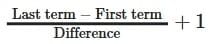
The number of multiples of 9 = = +1
=  + 1= 10 + 1
= 11
Thus, the multiples of 9 are 11.

Page 130

Q: Between the numbers 600 and 700, which numbers have the digital root:
(i) 5
(ii) 7
(iii) 3

Ans:
(i) Digital root 5:
608 = 6 + 0 + 8 = 14 = 1 + 4 = 5;
617 = 6 + 1 + 7 = 14 = 1 + 4 = 5;
662 = 6 + 6 + 2 = 14 = 1 + 4 = 5;
689 = 6 + 8 + 9 = 23 = 2 + 3 = 5, etc.

(ii) Digital root 7:
610 = 6 + 1 + 0 = 7;
619 = 6 + 1 + 9 = 16 = 1 + 6 = 7;
637 = 6 + 3 + 7 = 16 = 1 + 6 = 7;
673 = 6 + 7 + 3 = 16 = 1 + 6 = 7, etc.

(iii) Digital root 3:
606 = 6 + 0 + 6 = 12 = 1 + 2 = 3;
615 = 6 + 1 + 5 = 12 = 1 + 2 = 3;
633 = 6 + 3 + 3 = 12 = 1 + 2 = 3;
678 = 6 + 7 + 8 = 21 = 2 + 1 = 3, etc.

Q: Write the digital roots of any 12 consecutive numbers. What do you observe?
Ans: 
The digital roots of any 12 consecutive numbers are:

  • 105 = 1 + 0 + 5 = 6;
  • 106 = 1 + 0 + 6 = 7;
  • 107 = 1 + 0 + 7 = 8;
  • 108 = 1 + 0 + 8 = 9;
  • 109 = 1 + 0 + 9 = 10 = 1 + 0 = 1;
  • 110 = 1 + 1 + 0 = 2;
  • 111 = 1 + 1 + 1 = 3;
  • 112 = 1 + 1 + 2 = 4;
  • 113 = 1 + 1 + 3 = 5;
  • 114 = 1 + 1 + 4 = 6;
  • 115 = 1 + 1 + 5 = 7;
  • 116 = 1 + 1 + 6 = 8

Observation:
The digital roots of cycles repeat after 9 numbers.
6 → 7 → 8 → 9 → 1 → 2 → 3 → 4 → 5 → 6 → 7 → 8
So, the digital roots of consecutive numbers form a repeating cycle of length 9.
The digital root of multiples by 9:

  • 405 = 4 + 0 + 5 = 9;
  • 234 = 2 + 3 + 4 = 9;
  • 1035 = 1 + 0 + 3 + 5 = 9;
  • 936 = 9 + 3 + 6 = 18 = 1 + 8 = 9, etc.

Q: We saw that the digital root of multiples by 9 is always 9. Now, find the digital roots of some consecutive multiples of (i) 3, (ii) 4, and (iii) 6.
Ans:

(i) The digital roots of some consecutive multiples of 3 are:
39 = 3 + 9 = 12 = 1 + 2 = 3;
42 = 4 + 2 = 6;
45 = 4 + 5 = 9;
48 = 4 + 8 = 12 = 1 + 2 = 3;
51 = 5 + 1 = 6;
54 = 5 + 4 = 9;
57 = 5 + 7 = 12 = 1 + 2 = 3;
60 = 6 + 0 = 6;
63 = 6 + 3 = 9 etc.
Thus, the digital roots of consecutive multiples of 3 are 3, 6, 9, 3, 6, 9,……

(ii) The digital roots of some consecutive multiples of 4 are:
32 = 3 + 2 = 5;
36 = 3 + 6 = 9;
40 = 4 + 0 = 4;
44 = 4 + 4 = 8;
48 = 4 + 8 = 12 = 1 + 2 = 3;
52 = 5 + 2 = 7;
56 = 5 + 6 = 11 = 1 + 1 = 2;
60 = 6 + 0 = 6, etc.
Thus, the digital roots of consecutive multiples of 4 are 5, 9, 4, 8, 3, 7, 2, 6,……..

(iii) The digital roots of some consecutive multiples of 6 are:
30 = 3 + 0 = 3;
36 = 3 + 6 = 9;
42 = 4 + 2 = 6;
48 = 4 + 8 = 12 = 1 + 2 = 3;
54 = 5 + 4 = 9;
60 = 6 + 0 = 6;
66 = 6 + 6 = 12 = 1 + 2 = 3;
72 = 7 + 2 = 9;
78 = 7 + 8 = 15 = 1 + 5 = 6, etc.
Thus, the digital roots of consecutive multiples of 6 are 3, 9, 6, 3, 9, 6, 3, 9, 6,……….

Q: What are the digital roots of numbers that are 1 more than a multiple of 6? What do you notice? Try to explain the patterns noticed.
Ans: The digital roots of the numbers that are 1 more than a multiple of 6 are:
37 = 3 + 7 = 10 = 1 + 0 = 1;
43 = 4 + 3 = 7;
49 = 4 + 9 = 13 = 1 + 3 = 4;
55 = 5 + 5 = 10 = 1 + 0 = 1;
61 = 6 + 1 = 7;
67 = 6 + 7 = 13 = 1 + 3 = 4, etc.
Hence, the digital roots of the numbers that are 1 more than a multiple of 6 are 1, 7, 4, 1, 7, 4,…..
We notice the digital roots cycle through 1, 7, 4, and then repeat: 1, 7, 4, 1, 7, 4, 1, 7, 4,………

Q: I’m made of digits, each tiniest and odd, No shared ground with root #1 – how odd!
My digits count, their sum, my root – All point to one bold number’s pursuit – The largest odd single-digit I proudly claim. What’s my number? What’s my name?

Ans: Try: 111 111 111
Digits = 9
Sum = 1 + 1 + 1 + 1 + 1 + 1 + 1 + 1 + 1 = 9
Digital root = 9
All digits are odd (1)
Satisfies all the conditions.
Hence, the answer is 111 111 111.

Page 131

Figure it Out

Q1. The digital root of an 8-digit number is 5. What will be the digital root of 10 more than that number?
Ans: Consider the 8-digit number 80000006.
The digital root of 80000006 = 8 + 0 + 0 + 0 + 0 + 0 + 0 + 6
= 14
= 1 + 4
= 5
10 more than 80000006 = 80000006 + 10 = 80000016
The digital root of 80000016 = 8 + 0 + 0 + 0 + 0 + 0 + 1 + 6
= 15
= 1 + 5
= 6
Thus, the digital root of 10 more than 80000006 is 6.

Q2. Write any number. Generate a sequence of numbers by repeatedly adding 11. What would be the digital roots of this sequence of numbers? Share your observations.
Ans:
 Consider the number = 40
The sequence of numbers by repeatedly adding 11 are 40, 51(40 + 11), 62(51 + 11), 73(62 + 11), 84(73 + 11), 95(84 + 11), 106(95 + 11), 117(106 + 11), 128(117 + 11), 139(128 + 11), etc.
The digital roots of this sequence of numbers are:
40 = 4 + 0 = 4;
51 = 5 + 1 = 6;
62 = 6 + 2 = 8;
73 = 7 + 3 = 10 = 1 + 0 = 1;
84 = 8 + 4 = 12 = 1 + 2 = 3;
95 = 9 + 5 = 14 = 1 + 4 = 5;
106 = 1 + 0 + 6 = 7;
117 = 1 + 1 + 7 = 9;
128 = 1 + 2 + 8 = 11 = 1 + 1 = 2;
139 = 1 + 3 + 9 = 13 = 1 + 3 = 4,… etc.
Thus, the digital roots of this sequence of numbers are 4, 6, 8, 1, 3, 5, 7, 9, 2, 4,…..
Observations:
The digital roots are 4, 6, 8, 1, 3, 5, 7, 9, 2, 4,……
This sequence starts repeating after 9 steps.
So the digital roots form a cycle: 4, 6, 8, 1, 3, 5, 7, 9, 2, 4,……

Q3. What will be the digital root of the number 9a + 36b + 13?
Ans: First Method:
The digital root of the number 9a + 36b + 13 = 9a + 36b + 9 + 4
= 9(a + 4b + 1) + 4
= 9 + 4
= 13 [∵ The digital root of multiples of 9 is always 9.]
= 1 + 3
= 4
Thus, the digital root of the number 9a + 36b + 13 will be 4.
Second Method:
We have 9a + 36b + 13
Here, a and b are integers
Put a = 1, b = 1,
9a + 36b + 13 = 9 × 1 + 36 × 1 + 13
= 9 + 36 + 13
= 58
The digital root of 58 = 5 + 8 = 13 = 1 + 3 = 4
Put a = 2, 6 = 3,
9a + 36b + 13 = 9 × 2 + 36 × 3 + 13
= 18 + 108 + 13
= 139
The digital root of 139 = 1 + 3 + 9 = 13 = 1 + 3 = 4
Thus, the expression 9a + 36b + 13 always has a digital root of 4.

Q4. Make conjectures by examining if there are any patterns or relations between
(i) the parity of a number and its digital root.
(ii) the digital root of a number and the remainder obtained when the number is divided by 3 or 9.
Ans: 
Consider the pattern: 8, 16, 24, 32, 40,……
(i) 8 = 8 = digital root, parity → even
16 = 1 + 6 = 7 = digital root, parity → odd
24 = 2 + 4 = 6 = digital root, parity → even
32 = 3 + 2 = 5 = digital root, parity → odd
40 = 4 + 0 = 4 = digital root, parity → even

(ii) Divided by 3
8 ÷ 3 ⇒ 2, Remainder
24 ÷ 3 ⇒ 0, Remainder
32 ÷ 3 ⇒ 2, Remainder
40 ÷ 3 ⇒ 1, Remainder
Divided by 9
8 ÷ 9 ⇒ 8, Remainder
24 ÷ 9 ⇒ 6, Remainder
32 ÷ 9 ⇒ 5, Remainder
40 ÷ 9 ⇒ 4, Remainder

Page 132-134

Figure it Out

Q1. If 31z5 is a multiple of 9, where z is a digit, what is the value of z? Explain why there are two answers to this problem.
Ans: We know that the digital root of multiples of 9 is always 9.
So, the digit root of the number 31z5 is = 9
Hence the value of z = 0 or 9.
Proceedings:
Therefore, 3 + 1 + z + 5 = 9
Or, 9 + z = 9
Or, z = 0
Now, the expression 3 + 1 + z + 5 = 9 + z must be divisible by 9.
If z = 0, then 9 + z = 9 is divisible by 9.
And when z = 9, then 9 + z = 18 is divisible by 9.
So, the value of z = 0 or 9.
And the numbers are 3105 and 3195.
That’s why there are two answers to this problem.

Q2. “I take a number that leaves a remainder of 8 when divided by 12. I take another number which is 4 short of a multiple of 12. Their sum will always be a multiple of 8”, claims Snehal. Examine his claim and justify your conclusion.
Ans: 1st number = 12k + 8
2nd number = 12k – 4
Sum = 12k + 8 + 12k – 4 = 24k + 4
According to Snehal, it is always a multiple of 8.
If we put k = 1, 24 × 1 + 4 = 24, which is a multiple of 8.
k = 2, 24 × 2 + 4 = 48, which is a multiple of 8.
k = 3, 24 × 3 + 4 = 76, which is not a multiple of 8.
So, her claim is “Sometimes True”.

Q3.  When is the sum of two multiples of 3, a multiple of 6 and when is it not? Explain the different possible cases, and generalise the pattern.
Ans:
 Multiples of 3 are: 3, 6, 9, 12, 15, 18,……….
3 + 6 = 9, not a multiple of 6.
6 + 9 = 15, not a multiple of 6.
3 + 9 = 12, multiple of 6.
6 + 12 = 18, multiple of 6.
There are two possible cases.

  • If both numbers are odd, then the sum is a multiple of 6.
  • If both numbers are even, then the sum is a multiple of 6.

Q4. Sreelatha says, “I have a number that is divisible by 9. If I reverse its digits, it will still be divisible by 9 “.
(i) Examine if her conjecture is true for any multiple of 9.
(ii) Are any other digit shuffles possible such that the number formed is still a multiple of 9?

Ans: Consider a number that is divisible by 9 = 72
We know that,
If the sum of the digits is divisible by 9, then the number is divisible by 9.
If its digits are reversed
27 = 2 + 7 = 9, it is also divisible by 9.
(i) True
(ii) Yes, any other digit shuffle is possible that the number is still a multiple of 9.

Q5. If 48a23b is a multiple of 18, list all possible pairs of values for a and b.
Ans: 
48a23b is a multiple of 18.
As we know that,
If the number is a multiple of 18, then it is also a multiple of 2 and 9.
∴ 48a23b
Sum of the digits = 4 + 8 + a + 2 + 3 + b = 17 + a + b

Case 1: Put a = 1 and b = 0
481230, it is possible values of a and b.
Sum = 18, it is divisible by 9.

Case 2: Put a = 4 and b = 6
484236
Sum = 17 + 10 = 27, it is divisible by 9.
Thus, the possible values of a and 6 are a = 1 and b = 0, a = 4 and b = 6; there are two possible cases.

Q6. If 3p7q8 is divisible by 44, list all possible pairs of values for p and q.
Ans: 
Given by question, 3p7q8 is divisible by 44.
As we know, if a number is divisible by 44, then it is also divisible by 4 and 11.
∴ 3p7q8
Case 1: Put p = 1 and q = 0
37708 is divisible by 4 and 11, then it is also divisible by 44.

Case 2: Put p = 5 and q = 2
35728 is divisible by 4 and 11, then it is also divisible by 44.

Case 3: Put p = 3 and q = 4
33748 is divisible by 4 and 11, then it is also divisible by 44.

Case 4: Put p = 1 and q = 6
31768 is divisible by 4 and 11, then it is also divisible by 11.
Thus, (p = 7, q = 0), (p = 5, q = 2), (p = 3, q = 4), and (p = 1 and q = 6) are the possible pairs of values for p and q.

Q7. Find three consecutive numbers such that the first number is a multiple of 2, the second number is a multiple of 3, and the third number is a multiple of 4. Are there more such numbers? How often do they occur?
Ans: 
Let x, x + 1 and (x + 2) be the three numbers
Put x = 2, ⇒ 2, 3, 4
Put x = 14, ⇒ 14, 15, 6
Put x = 26, ⇒ 26, 27, 28
Put x = 38, ⇒ 38, 39, 40
Thus, the three consecutive numbers are (14, 15, 16),
Put x = 26, ⇒ 26, 27, 28
(26, 27, 28) and (38, 39, 40)
There are infinite numbers, spaced apart by 12.

Q8. Write five multiples of 36 between 45,000 and 47,000. Share your approach with the class.
Ans: Step:

We know that if a number is a multiple of 36, then it is also a multiple of 4 and 9.
45000
Last two digits = 00, it is divisible by 4.
Sum of the digits = 4 + 5 + 0 + 0 + 0 = 9, it is also divisible by 9.
Thus, 45000 is completely divisible by 36.
The five multiples of 36 between 45,000 and 47,000.
(45,000 + 36), (45,000 + 2 × 36), (45,000 + 3 × 36), (45,000 + 4 × 36) and (45,000 + 5 × 36)
i.e., 45,036, 45,072, 45,108, 45,144, and 45,180.

Q9. The middle number in the sequence of 5 consecutive even numbers is 5p. Express the other four numbers in sequence in terms of p.
Ans: 
Let be the 5 consecutive even numbers are = x, (x + 2), (x + 4), (x + 6), (x + 8)
The middle number is (x + 4)
Therefore, (x + 4) = 5p
Or, x = 5p – 4
So, the other four numbers are =
1st number → 5p – 4
2nd number → 5p – 2
4th number → 5p + 2
5th number → 5p + 4

Q10. Write a 6-digit number that it is divisible by 15, such that when the digits are reversed, it is divisible by 6.
Ans: 
We know that if the number is divisible by 3 and 5, then it is also divisible by 15.
Consider the number 643215.
Sum of the digits = 6 + 4 + 3 + 2 + 1 + 5 = 21, which is divisible by 3.
Thus, 643215 is divisible by 3.
One’s place = 5, it is also divisible by 5.
Hence, 643215 is divisible by 15.
One’s place is not 0, because the digits are reversed, it becomes a 5-digit number.
Lakhs place is always taken as an even number.
Reversed the digits:
512346
One’s place = 6, 512346 is divisible by 2.
Sum of the digits = 5 + 1 + 2 + 3 + 4 + 6 = 21.
It is also divisible by 3.
Hence, 512346 is divisible by 6.

Q11. Deepak claims, “There are some multiples of 11 which, when doubled, are still multiples of 11. But other multiples of 11 don’t remain multiples of 11 when doubled”. Examine if his conjecture is true; explain your conclusion.
Ans:
 The multiples of 11 are: 11, 22, 33, 44, 55,…
When doubled, 22, 44, 66, 88, 110,……
i.e. (11) × 2, 11 × 4, 11 × 6, 11 × 8, 11 × 10,…. are also multiples of 11.
False, if multiples of 11 are doubled, then the multiples of 11 are these numbers.

Q12. Determine whether the statements below are ‘Always True’, ‘Sometimes True’, or ‘Never True’. Explain your reasoning. 
(i) The product of a multiple of 6 and a multiple of 3 is a multiple of 9.
Ans: ‘Always True’
Explanation: Let be the two numbers are = 6a and 3b.
So the product of these = (6a × 3b) = 18ab
It saws that 18ab is also divisible by 9. [18 is a multiple of 9]
Example: If a = 3 and b = 2
(18 × 3 × 2) = 108, so 108 is a multipleof p.

(ii) The sum of three consecutive even numbers will be divisible by 6.
Ans: ‘Always True’
Explanation: Let be the first consecutive even number = x
So the other consecutive even numbers = (x + 2) and (2 + 4)
Therefore, sum of these number = x + x + 2 + x + 4 = 3x + 6 = 3(x + 2)
Example: If x = 6, then 3(6 + 2) = 24, divisible by 6.
When x = 10, then 3(10 + 2) = 36, divisible by 6.

(iii) If abcdef is a multiple of 6, then badcef will be a multiple of 6.
Ans: ‘Always True’
Explanation: If a number is divisible by 6 it must be divisible by 2 and 3.
Checking divisibility by 2: We check the last digits of the number, if it is even then the number must be divisible by 2.
And checking divisibility by 3: We check the sum of the digits of the number if it is divisible by 3, then the number is also divisible by 3.
Here we can see that the last digit of both the numbers ‘abcdef’ and ‘badcef’ is the same and all the digits are the same, only their positions have changed.
So, if abcdef is a multiple of 6, then badcef should be a multiple of 6.

(iv) 8 (7b-3)-4 (11b+1) is a multiple of 12.
Ans: ‘Never True’
Explanation: 8 × (7b – 3) – 4 × (11b + 1)
= 56b –24 – 44b – 4
= 12b – 28
We see that 12b is a multiple of 12 but 28 is not a multiple of 12.
So, we say that 12b – 28 is not divisible by 12.

Q13. Choose any 3 numbers. When is their sum divisible by 3? Explore all possible cases and generalise.
Ans: 
Let the three numbers be n1, n2, and n3.
Let their remainders when divided by 3 be r1, r2, and r3.
The sum n1 + n2 + n3 is divisible by 3 if and only if r1 + r2 + r3 is divisible by 3.
Case 1: All remainders are 0.
r1 = 0, r2 = 0, r3 = 0
Sum of remainders = 0 + 0 + 0 = 0, which is divisible by 3.

Case 2: All remainders are 1.
r1 = 1, r2 = 1, r3 = 1
Sum of remainders = 1 + 1 + 1 = 3, which is divisible by 3.

Case 3: All remainders are 2.
r1 = 2, r2 = 2, r3 = 2
Sum of remainders = 2 + 2 + 2 = 6, which is divisible by 3.

Case 4: One remainder is 0, one is 1, and one is 2.
r1 = 0, r2 = 1, r3 = 2 (in any order).
Sum of remainders = 0 + 1 + 2 = 3, which is divisible by 3.
The sum of three numbers is divisible by 3 if and only if all three numbers have the same remainder when divided by 3, or if they all have different remainders when divided by 3.

Q14. Is the product of two consecutive integers always multiple of 2? Why? What about the product of these consecutive integers? Is it always a multiple of 6? Why or why not? What can you say about the product of 4 consecutive integers? What about the product of five consecutive integers?
Ans:
 Yes, the product of two consecutive integers is always a multiple of 2.
1 × 2 = 2, 2 × 3 = 6, 5 × 6 = 30, 10 × 11 = 110, and so on.
Since we know that multiplying by an odd number and an even number is always an even number.
No, it is not always a multiple of 6.
1 × 2 = 2, 4 × 5 = 20, 7 × 8 = 56
Since it is not divisible by 6.
The product of 4 consecutive integers
2 × 3 × 4 × 5 = 120,
4 × 5 × 6 × 7 = 840,
5 × 6 × 7 × 8 = 1680
We can say that the product of 4 consecutive integers, divisible by 12.
The product of five consecutive integers is:
1 × 2 × 3 × 4 × 5 = 120,
2 × 3 × 4 × 5 × 6 = 720,
3 × 4 × 5 × 6 × 7 = 2520
Hence, we can say that the product of five consecutive integers is always divisible by 24.

Q15. Solve the cryptarithms — 
(i) EF × E = GGG 
(ii) WOW × 5 = MEOW

Ans: (i) EF × E = GGG
=10E + F × E = 100 G + 10G + G
= (10E + F) × E = 111G
If E = 1, then 10 + F = 111G
[It is not possible because for any value of F, LHS can’t be equal to RHS]
If E = 2, then (20 + F) × 2 = 111G
[It is also not possible because for any value of F, LHS can’t be equal to RHS]
For E = 3, then (30 + F) × 3 = 111G
=90 + 3F = 111G
If F = 7 and G = 1, then LHS = RHS.
∴ The values of E, F, and G are 3, 7, and 1, respectively.
(ii) WOW × 5 = MEOW
Using the same process as the previous one.
(100W + 10O + W) × 5 = MEOW
⇒ (101 W + 10 O) × 5 = MEOW
⇒ 505 W + 50 O = MEOW
Let’s try possible values of W and O such that the result is a 4-digit number.
If we set W = 5 and O = 7, we obtain a 4-digit number.
505 × 5 + 50 × 7 = 2875
On the right-hand side, if MEOW = 2875
W = 5, O = 7
1000M + 100E + 10O + W = 1000M + 100E + 70 + 5 = 1000M + 100E + 75
If we take M = 2 and E = 8, then it satisfies the LHS.
So, the values of M, E, O, and W are 2, 8, 7, and 5, respectively.

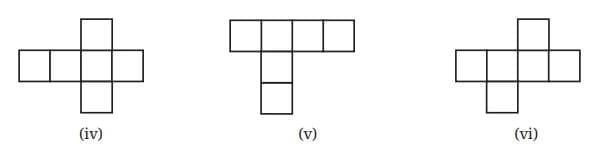
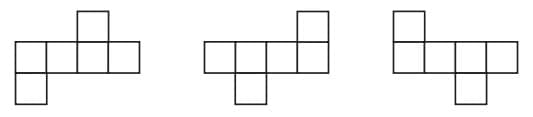
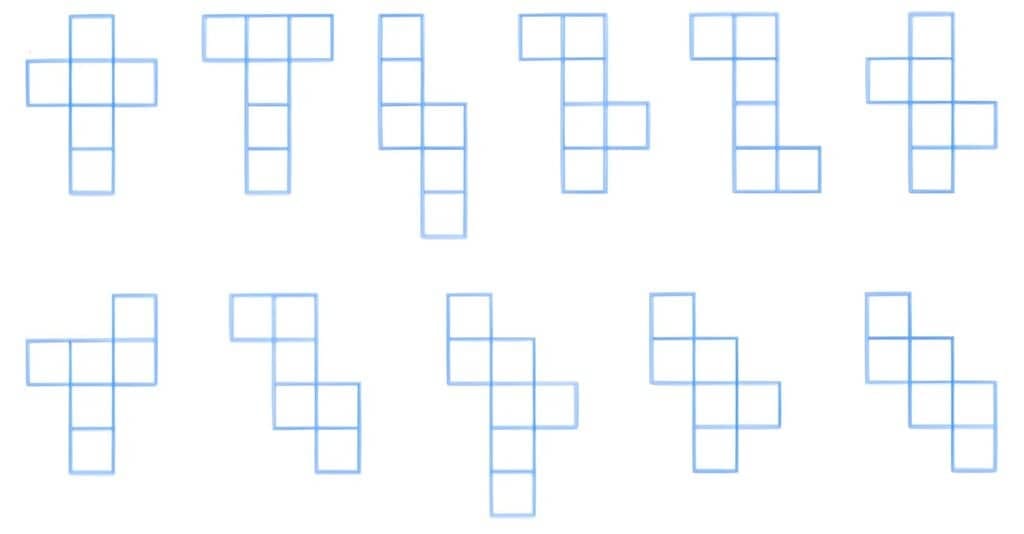
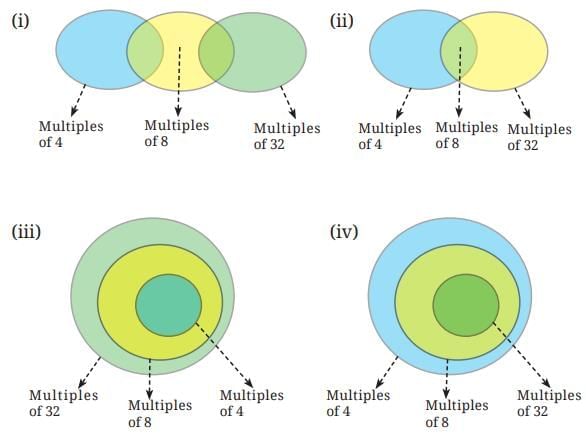
Q16. Which of the following Venn diagrams captures the relationship between the multiples of 4, 8, and 32?
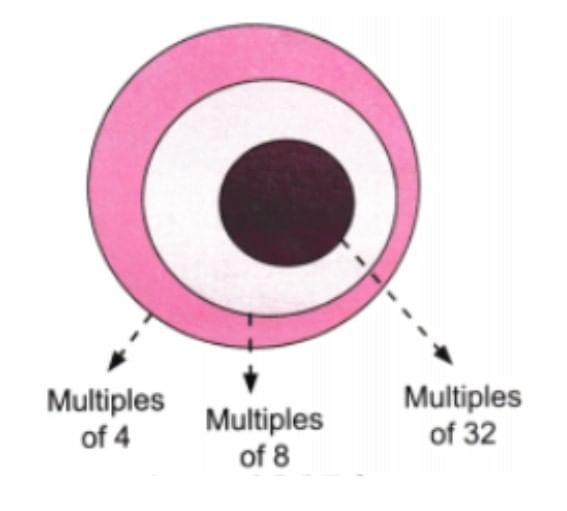
Ans: The correct answer is option (iv).

(iv) Multiples of 4 are: 4, 8, 12, 16, 20, 24, 28, 32, 36, 40, 44, 48, 52, 56, 60, 64,…
Multiples of 8 are: 8, 16, 24, 32, 40, 48, 56, 64,….
Multiples of 32 are: 32, 64, 96, 128,…
The Venn diagram captures the relationship between the multiples of 4, 8, and 32:

4️⃣ Quadrilaterals – Textbook Solutions

Page 94

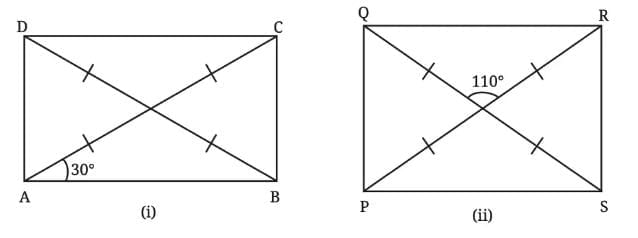
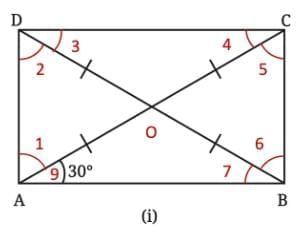
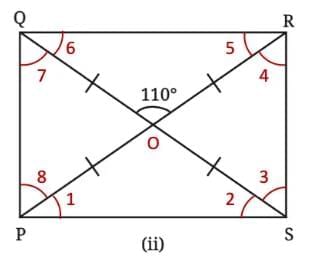
Q1. Find all the other angles inside the following rectangles.

Ans:
(i) 

∠1 + ∠9 = 90° ……… (All corner angles of a rectangle are 90°)
∠1 + 30° = 90°
∠1 = 90° – 30°
∠1 = 60°
∠1 = ∠5 = 60°………. (Alternate interior angles)
∠9 = ∠4 = 30°………. (Alternate interior angles)
In △AOB, OA = OB, then the angles opposite them are equal
∴ ∠9 = ∠7 = 30°
∠7 = ∠3 = 30°………. (Alternate interior angles)
In △AOD, OA = OD, then the angles opposite them are equal
∴ ∠2 = ∠1 = 60°
∠2 = ∠6 = 60°………. (Alternate interior angles)
In △AOB,
∠9 + ∠7 + ∠AOB = 180° ………. (Sum of angles of a triangle)
30° + 30° + ∠AOB = 180°
60° + ∠AOB = 180°
∠AOB = 180° – 60°
∠AOB = 120°
∠AOB = ∠COD = 120° ………… (Vertically opposite angles)
∠AOB + ∠AOD = 180° …………. (Linear pair)
120° + ∠AOD = 180°
∠AOD = 180° – 120°
∠AOD = 60°
∠AOD = ∠BOC = 60° ………… (Vertically opposite angles)
Thus, ∠1 = ∠5 = ∠2 = ∠6 = ∠AOD = ∠BOC = 60°.
∠AOB = ∠COD = 120°.
∠9 = ∠4 = ∠7 = ∠3 = 30°.
(ii)


 ∠POS = ∠ROQ = 110° ………… (Vertically opposite angles)
∠POS + ∠POQ = 180° …………. (Linear Pair)
110° + ∠POQ = 180°
∠POQ = 180° – 110°
∠POQ = 70°
∠POQ = ∠SOR = 70° ………… (Vertically opposite angles)
In △POS, OP = OS, then the angles opposite them are equal.
∴ ∠1 = ∠2 = a
In △POS,
∠1 + ∠2 + ∠POS = 180° …………. (Sum of angles of a triangle)
a + a + 110° = 180°
2a = 180° – 110°
2a = 70°
a = 35°
∴ ∠1 = ∠2 = a = 35°
∠1 = ∠5 = 35° ………… (Alternate interior angles)
∠2 = ∠6 = 35° ………… (Alternate interior angles)
Since ABCD is a rectangle, ∠P = 90°
∠9 = ∠1 + ∠8
90° = 35° + ∠8
∠8 = 90° – 35°
∠8 = 55°
∠8 = ∠4 = 55° ………… (Alternate interior angles)
In △POQ, OP = OQ, then the angles opposite them are equal i.e. ∠7 = ∠8 = 55°
∠7 = ∠2 = 55° ………… (Alternate interior angles)
Thus, ∠POS = ∠ROQ = 110°.
∠POQ = ∠SOR = 70°.
∠1 = ∠2 = ∠5 = ∠6 = 35°.
∠8 = ∠4 = ∠7 = ∠2 = 55°

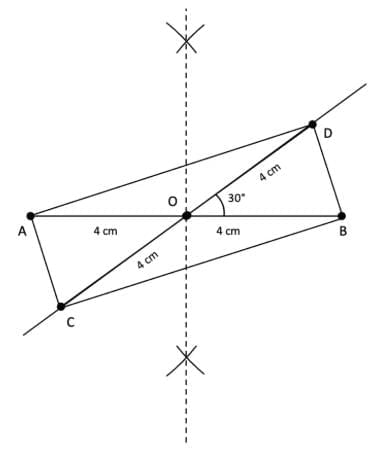
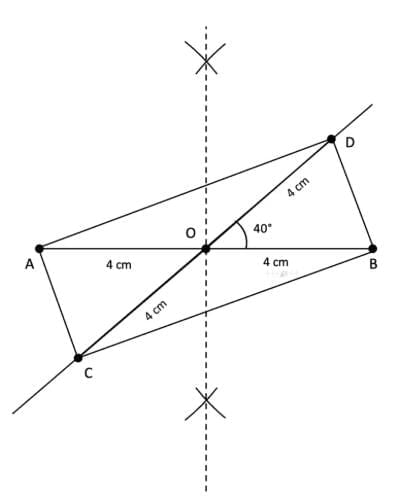
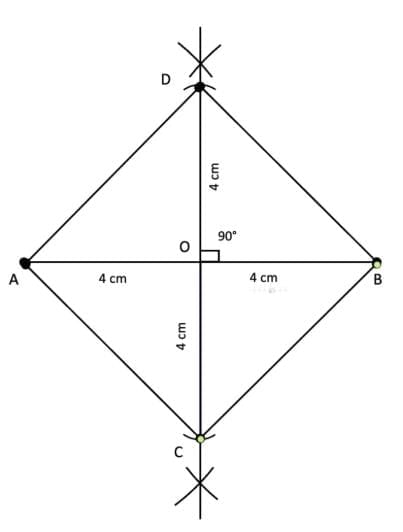
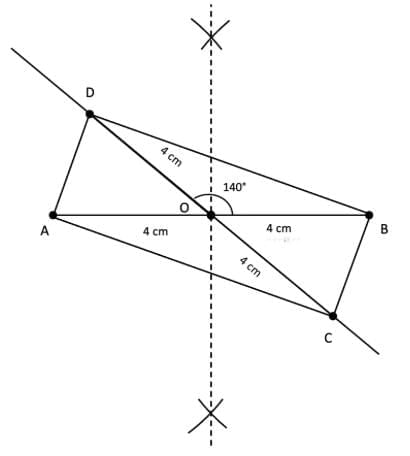
Q2. Draw a quadrilateral whose diagonals have equal lengths of 8 cm that bisect each other, and intersect at an angle of 
(i) 30° 
(ii) 40° 
(iii) 90° 
(iv) 140°
Ans: 
(i) Draw a line AB equal to 8 cm.
Take point O on AB such that AO = BO = 4 cm.
Using a protractor, draw an angle of 30° at O on OB.
On this line, take points C and D such that OC = OD = 4 cm.
Join AD, DB, BC, and CA.
ABCD is the required quadrilateral.

Since diagonals AB and CD are equal and are bisecting each other at O, ACBD is a rectangle.

(ii) Draw a line AB equal to 8 cm.

Take point O on AB such that AO = BO = 4 cm.

Using a protractor, draw an angle of 40° at O on OB.

On this line, take points C and D such that OC = OD = 4 cm.

Join AD, DB, BC, and CA.

ABCD is the required quadrilateral.

Since diagonals AB and CD are equal and are bisecting each other at O, ACBD is a rectangle.(iii) Draw a line AB equal to 8 cm.
Take a point O on AB such that AO = BO = 4 cm.
Using a protractor, draw an angle of 90° at O on OB.
On this line, take points C and D such that OC = OD = 4 cm.
Join AD, DB, BC, and CA.
ACBD is the required square. 

Since diagonals AB and CD are equal and are bisecting each other at M, and also the diagonals are perpendicular to each other, ACBD is a square.(iv) Draw a line AB equal to 8 cm.
Take a point O on AB such that AO = BO = 4 cm.
Using a protractor, draw an angle of 140° at O on OB.
On this line, take points C and D such that OC = OD = 4 cm.
Join AD, DB, BC, and CA.
ACBD is the required quadrilateral.

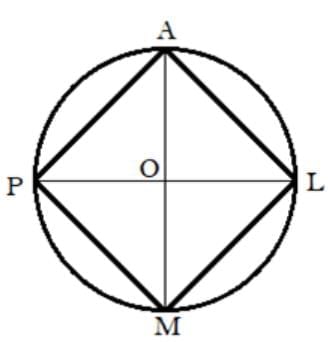
Q3. Consider a circle with centre O. Line segments PL and AM are two perpendicular diameters of the circle. 

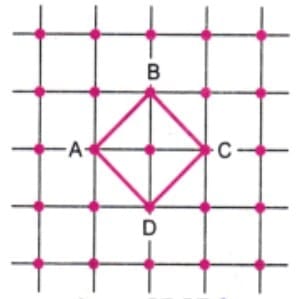
What is the figure APML? Reason and/or experiment to figure this out.

Ans: ∴ PL = PO + OL

= r + r

= 2r

and AM = AO + OM

= r + r

= 2r

∴ PL = AM

∴ In the quadrilateral APML, diagonals PL and AM are equal and are perpendicular to each other.

Also, OP = OA = OL = OM = r

∴ Diameters PL and AM bisect each other at O.

∴ Quadrilateral APML is a square.

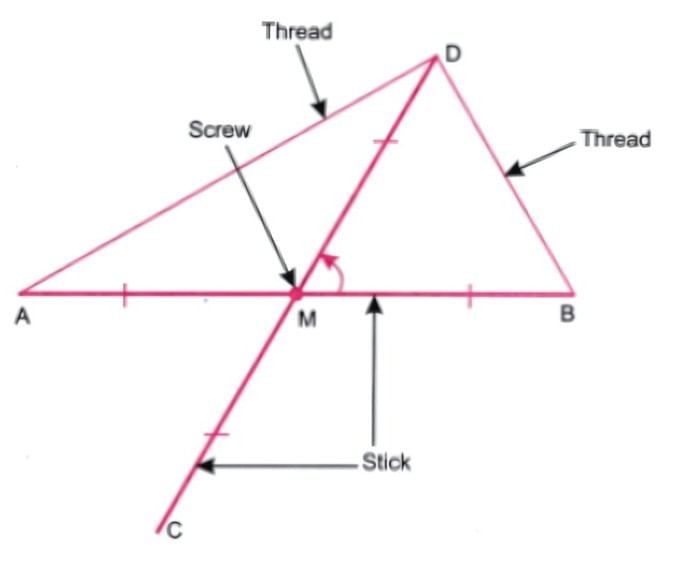
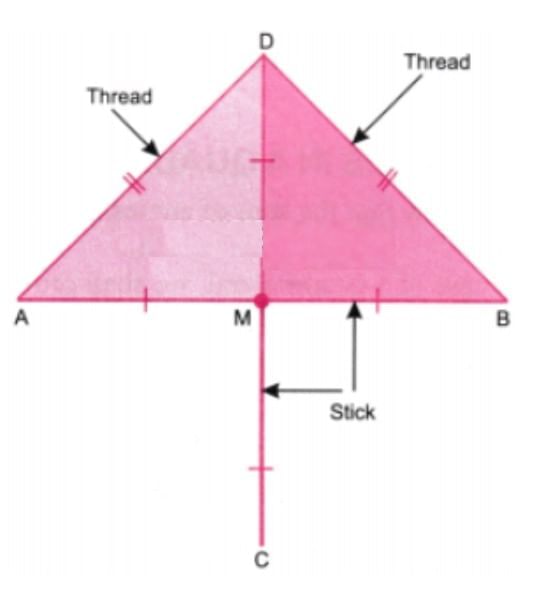
Q4. We have seen how to get 90° using paper folding. Now, suppose we do not have any paper but two sticks of equal length, and a thread. How do we make an exact 90° using these?
Ans: Let AB and CD be two sticks of equal length, say 6 cm.
Mark the midpoints of the sticks using a ruler.
Fix a screw to the sticks at their midpoints.
Using a thread, measure distances AD and BD.
Keep on moving the sticks about the screw, so that the distances AD and BD are equal.

In this position, fix the sticks by tightening the screw.
The new positions of the sticks are shown in the figure.
Tie pieces of thread along AD and BD.

Consider ∆AMD and ∆BMD.
We have AM = BM, AD = BD
and MD is common
∴ By the SSS condition,
∆AMD and ∆BMD are congruent.
∴ ∠AMD = ∠BMD
Also ∠AMD + ∠BMD = 180° (Linear angles)
∴ ∠AMD + ∠AMD = 180°
⇒ 2∠AMD = 180°
⇒ ∠AMD = 90°
∴ ∠AMD = ∠BMD = 90°
∴ Angle between the sticks is 90°.

Q5. We saw that one of the properties of a rectangle is that its opposite sides are parallel. Can this be chosen as a definition of a rectangle? In other words, is every quadrilateral that has opposite sides parallel and equal a rectangle?
Ans: 
Let ABCD be a quadrilateral in which opposite sides are parallel and equal.
Here AB || DC and AD || BC.
Also, AB = DC and AD = BC.
In the quadrilateral ABCD, opposite sides are equal.
For ABCD to be a rectangle, we require each angle to be 90°.
Given information AB || DC and AD || BC can not help us to prove that each angle of ABCD is 90°.

∴ ABCD may not be a rectangle.
∴ A rectangle can not be defined as a quadrilateral with equal and parallel opposite sides.

Page 102

Figure it Out

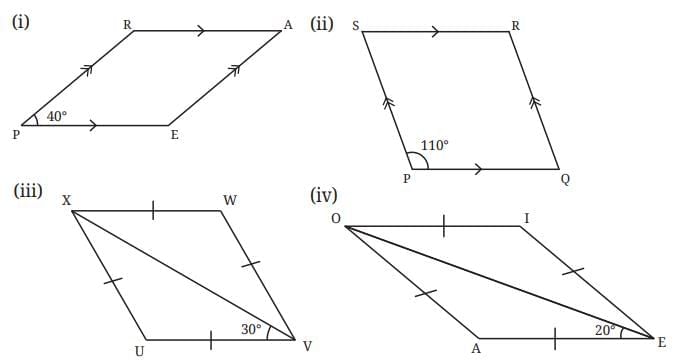
Q1. Find the remaining angles in the following quadrilaterals.

Ans: (i) Here PR ∥ EA, and PE ∥ RA
Therefore, PEAR is a parallelogram.
∠P = ∠A = 40° …………. (Opposite angles of a parallelogram are equal)
∠P + ∠R = 180° …………. (The sum of the adjacent angles of a parallelogram is 180°)
40° + ∠R = 180°
∠R = 180° – 40°
∠R = 140°.
∠R = ∠E = 140° …………. (Opposite angles of a parallelogram are equal)
(ii) Here PQ ∥ SR, and PS ∥ QR
∴ PQRS is a parallelogram.
∠P = ∠R = 110° …………. (Opposite angles of a parallelogram are equal)
∠P + ∠S = 180° …………. (The sum of the adjacent angles of a parallelogram is 180°)
110° + ∠S = 180°
∠S = 180° – 110°
∠S = 70°.
∠S = ∠Q = 70° …………. (Opposite angles of a parallelogram are equal)
(iii) Here, XWUV is a rhombus (all sides equal). 
In △VUX, UV = UX, then the angles opposite them are equal.
∴ ∠UXV = ∠UVX = 30°
∠UXV = ∠WXV = 30° …………. (The diagonals of a rhombus bisect its angles)
Also, ∠UVX = ∠WVX = 30° …………. (The diagonals of a rhombus bisect its angles)
∠E = 2 × ∠UVX = 2 × 30° = 60°
∠V = ∠X = 60° …………. (Opposite angles of a rhombus are equal)
∠V + ∠U = 180° …………. (The sum of adjacent angles of a rhombus is 180°)
60° + ∠U = 180°
∠U = 180° – 60°
∠U = 120°
∠U = ∠W = 120° …………. (Opposite angles of a rhombus are equal)
(iv) Here, AEIO is a rhombus (all sides equal). 
In △EAO, AE = AO, then the angles opposite them are equal.
∴ ∠AOE = ∠AEO = 20°
∠AEO = ∠IEO = 20° …………. (The diagonals of a rhombus bisect its angles)
Also, ∠AOE = ∠IOE = 20° …………. (The diagonals of a rhombus bisect its angles)
∠E = 2 × ∠AEO = 2 × 20° = 40°
∠E = ∠O = 40° …………. (Opposite angles of a rhombus are equal)
∠E + ∠A = 180° …………. (The sum of adjacent angles of a rhombus is 180°)
40° + ∠A = 180°
∠A = 180° – 40°
∠A = 140°
∠A = ∠I = 140° …………. (Opposite angles of a rhombus are equal)

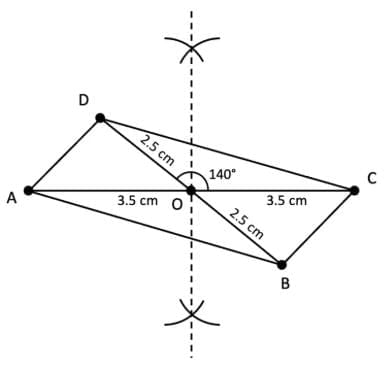
Q2. Using the diagonal properties, construct a parallelogram whose diagonals are of lengths 7 cm and 5 cm, and intersect at an angle of 140°.
Ans: 

Steps of construction:
(i) Draw a line segment AC of length 7 cm and mark its midpoint as O.
(ii) At point O, draw an angle of 140° with respect to diagonal AC.
(iii) From O, along the 140° line in both directions, mark OD = 2.5 cm OD and OB = 2.5 cm using a compass.
(iv) Join D to A and C.
Join B to A and C.
ABCD is the required parallelogram.

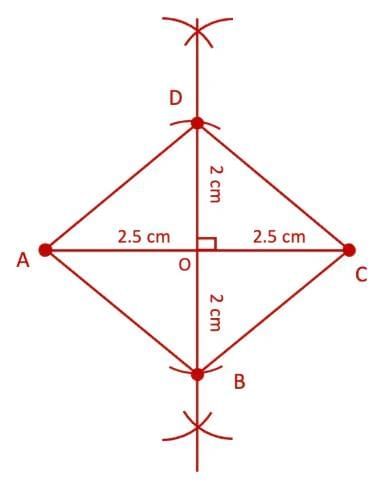
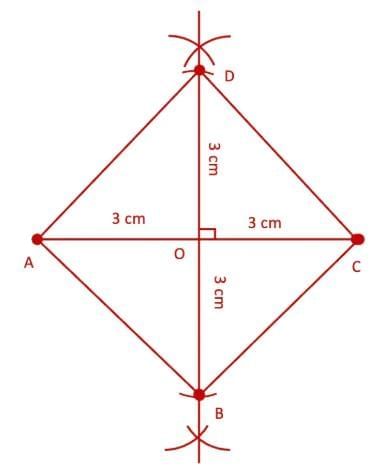
Q3. Using the diagonal properties, construct a rhombus whose diagonals are of lengths 4 cm and 5 cm.
Ans: 

Steps of construction:
(i) Draw a line segment AC of length 5 cm.
(ii) Draw the perpendicular bisector of AC, intersecting it at O.
(iii) With O as centre and radius 2 cm, mark points B (below) and D (above) on the perpendicular bisector.
(iv) Join A–D, D–C, C–B, and B–A.
ABCD is the required rhombus.

Page 107 & 108

Figure it Out

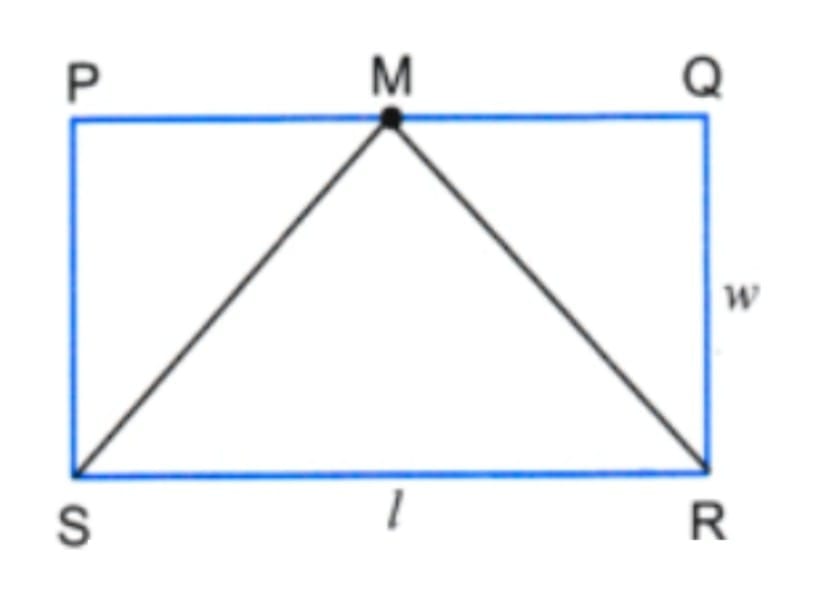
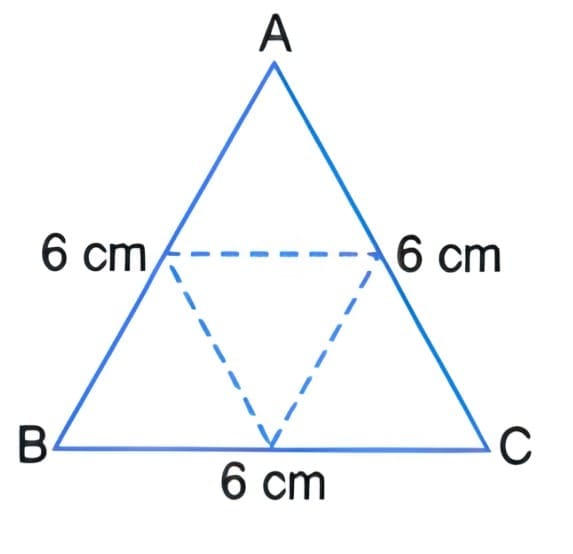
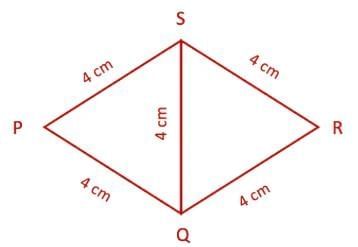
Q1. Find all the sides and the angles of the quadrilateral obtained by joining two equilateral triangles with sides 4 cm.
Ans: 

Since all sides of an equilateral triangle are equal.
Thus, the lengths of all sides of the given quadrilateral are equal.
∴ PQ = QR = RS = SP = 4 cm.
Also, the measure of all angles of an equilateral triangle is 60°.
∠P = ∠R = 60°
∠S = ∠PSQ + ∠RSQ = 60° + 60° = 120°.
∠Q = ∠PQR + ∠RQS = 60° + 60° = 120°.

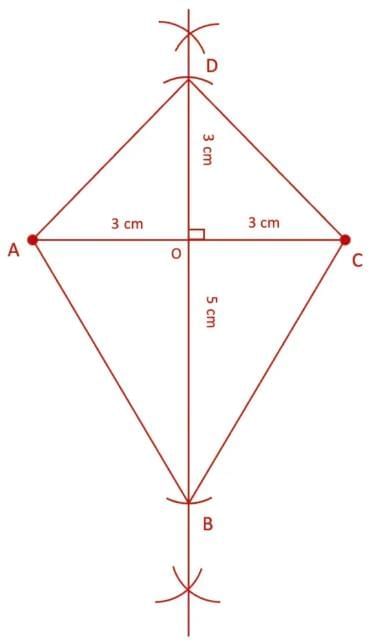
Q2. Construct a kite whose diagonals are of lengths 6 cm and 8 cm.
Ans: 

(i) Draw a line segment AC = 6 cm.
(ii) Construct the perpendicular bisector of AC; let it meet AC at O (so O is the midpoint).
(iii) With centre O and radius 3 cm draw an arc to cut the bisector above AC; label that point D. With centre O and radius 5 cm draw an arc to cut the bisector below AC; label that point B.
(iv) Join A ⁣− ⁣B,  B ⁣− ⁣C,  C ⁣− ⁣D,  D ⁣− ⁣A.
ABCD is the required kite.

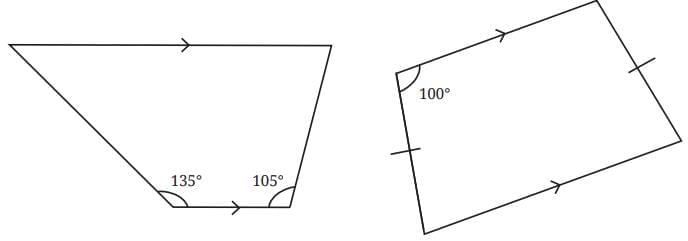
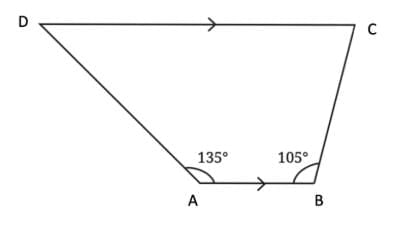
Q3. Find the remaining angles in the following trapeziums —
Ans: 
Since AB ∥ DC, and AD is a tranversal, then
∠A + ∠D = 180° …………. (Sum of angles on the same side of the transversal)
135° + ∠D = 180°
∠D = 180° – 135°
∠D = 45°
Also, since AB ∥ DC, and BC is a tranversal, then
∠B + ∠C = 180° …………. (Sum of angles on the same side of the transversal)
105° + ∠C = 180°
∠C = 180° – 105°
∠C = 75°

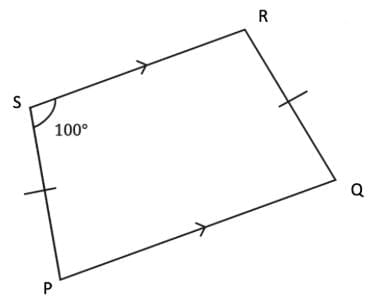
Since PQ ∥ SR, and PS is a tranversal, then
∠P + ∠S = 180° …………. (Sum of angles on the same side of the transversal)
∠P + 100° = 180°
∠P = 180° – 100° = 80°.
∠S = ∠R = 100° …………… (Angles opposite to equal sides are equal)
Also, since PQ ∥ SR, and QR is a tranversal, then
∠Q + ∠R = 180° …………… (Sum of angles on the same side of the transversal)
∠Q + 100° = 180°
∠Q = 180° – 100° = 80°.

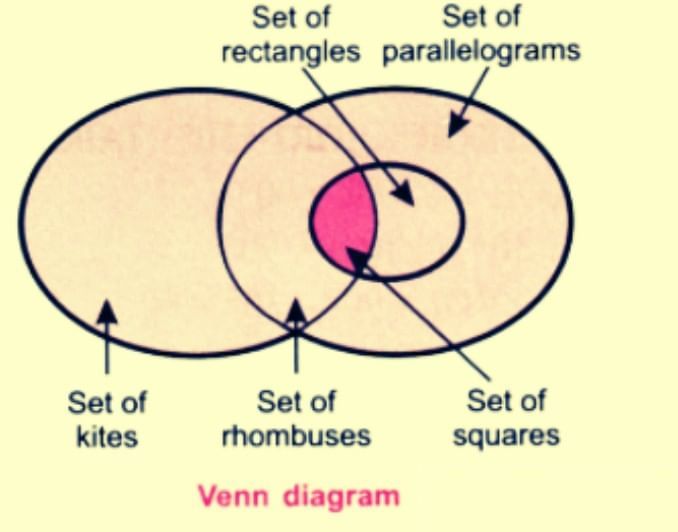
Q4. Draw a Venn diagram showing the set of parallelograms, kites, rhombuses, rectangles, and squares. Then, answer the following questions 
(i) What is the quadrilateral that is both a kite and a parallelogram?
(ii) Can there be a quadrilateral that is both a kite and a rectangle?
(iii) Is every kite a rhombus? If not, what is the correct relationship between these two types of quadrilaterals?

Ans: (i) The set of rhombuses is common to both the set of kites and the set of parallelograms.
∴ A rhombus is both a kite and a parallelogram.
(ii) A kite is not a rectangle, and a rectangle is not a kite.
∴ There can be no quadrilateral that is both a kite and a rectangle.
Also, there is no common portion of the set of kites and the set of rectangles.
(iii) Every kite is not a rhombus.
In the given figure, the kite ABCD is not a rhombus.
Correct relationship: Every rhombus is a kite, but not every kite is a rhombus.

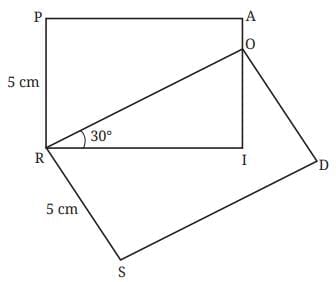
Q5. If PAIR and RODS are two rectangles, find ∠IOD.
Ans: Since PAIR and RODS are two triangles.
∠RIO = 90° ……… (Corner angle of a rectangle)
In △RIO,
∠IRO + ∠IOR + ∠RIO = 180° …………. (Sum of angles of a triangle)
30° + ∠IOR + 90° = 180°
120° + ∠IOR = 180°
∠IOR = 180° – 120° = 60°.
∴ ∠IOD = 90° – ∠IOR = 90° – 60° = 30°.

Q6. Construct a square with a diagonal 6 cm without using a protractor.
Ans: 

Steps of construction:
(i) Draw a line segment AC = 6 cm and mark its midpoint as O.
(ii) With O as centre and radius greater than half of AC, draw arcs above and below AC from points A and C.
(iii) Join the arc intersections to get a line perpendicular to AC and passing through O.
(iv) Again, with O as centre and radius equal to 3 cm, mark points B and D on the perpendicular line.
(v) Connect A–B–C–D–A.
Hence, ABCD is the required square with a diagonal of 6 cm.

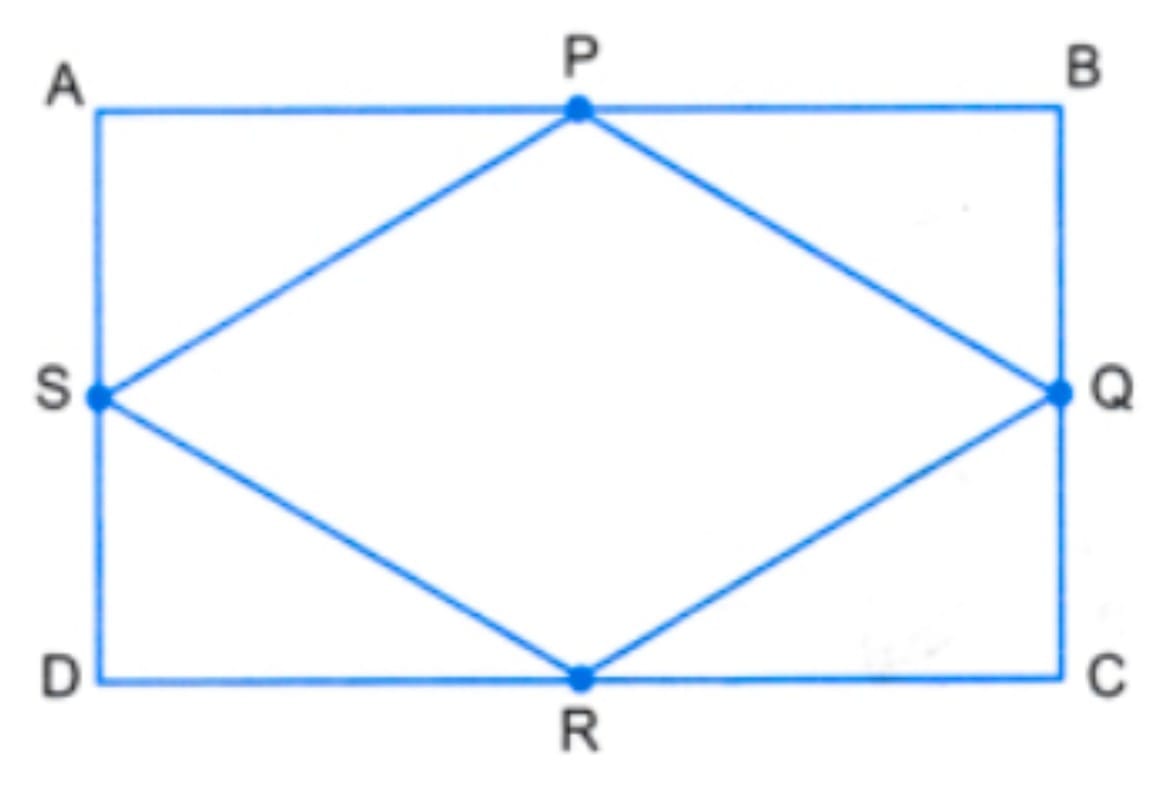
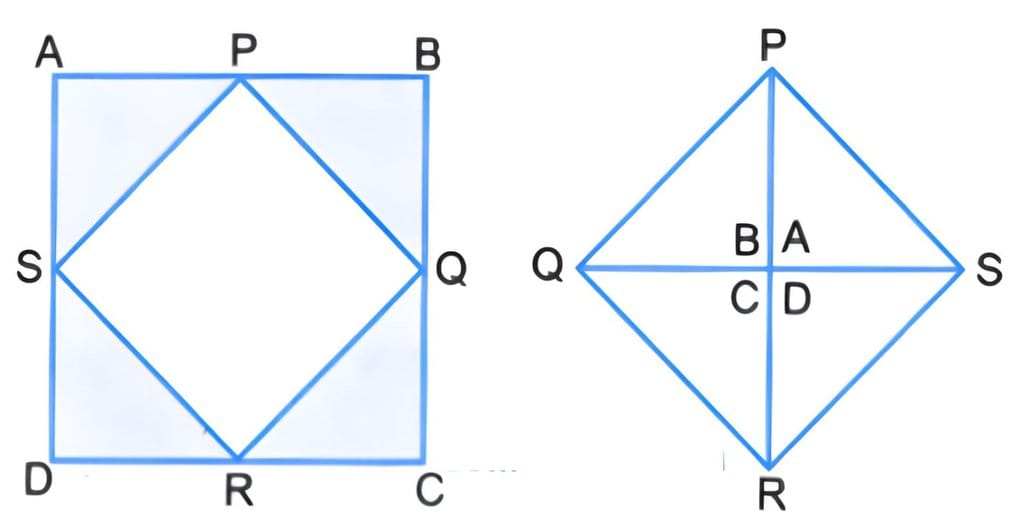
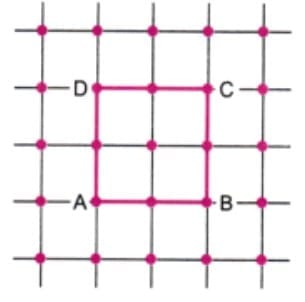
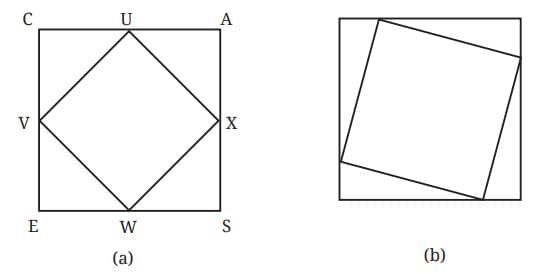
Q7. CASE is a square. The points U, V, W and X are the midpoints of the sides of the square. What type of quadrilateral is UVWX? Find this by using geometric reasoning, as well as by construction and measurement. Find other ways of constructing a square within a square such that the vertices of the inner square lie on the sides of the outer square, as shown in Figure (b).

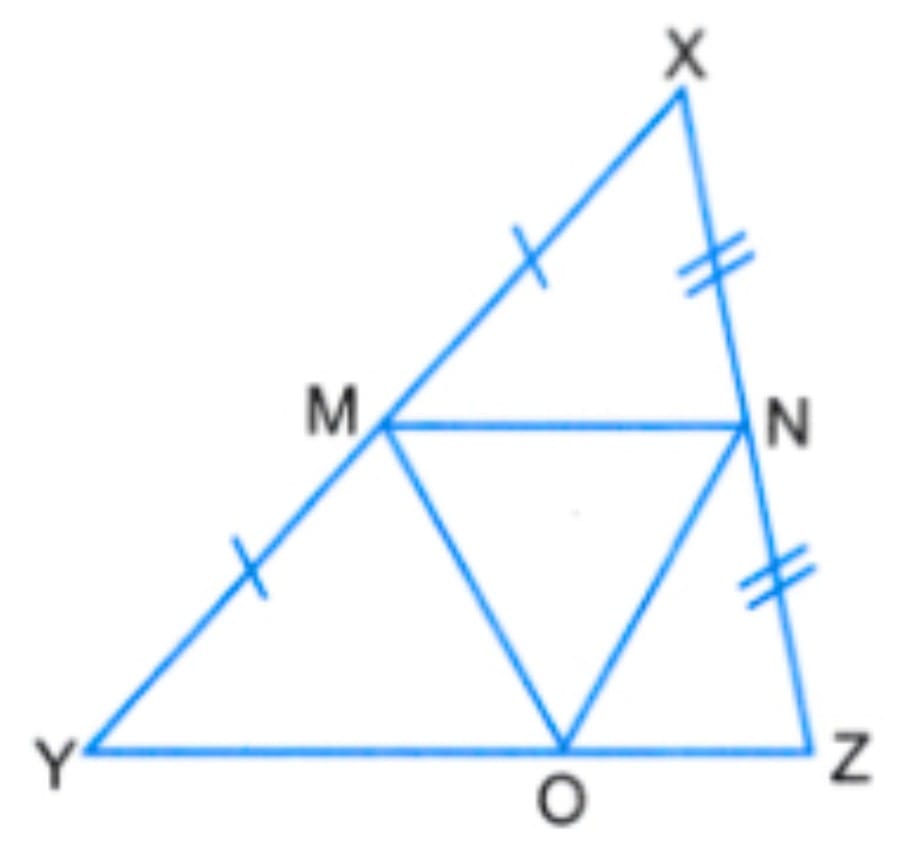
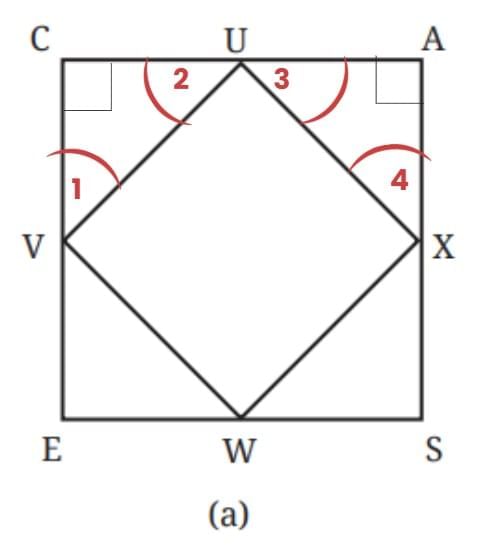
Ans: (a) U, V, W, and X are the midpoints of the sides of the square.
In ∆VCU and ∆UAX,
we have VC = UA, ∠VCU = ∠UAX = 90°, and CU = AX.
∴ By the SAS condition, ∆VCU and ∆UAX are congruent.
∴ VU = UX
Similarly, VU = XW, VU = WV.
∴ Sides of the quadrilateral UVWX are equal.

In ∆VCU, VC = CU
⇒∠1 = ∠2
Also, ∠1 + ∠C + ∠2 = 180°
⇒∠1 + 90° + ∠1 = 180°
⇒2∠1 = 90°
⇒∠1 = 45°
∴ ∠2 is also 45°.
Similarly, ∠3 = ∠4 = 45°
We have ∠2 + ∠VUX + ∠3 = 180°
⇒45° + ∠VUX + 45° = 180°
⇒∠VUX = 180° – 90°
⇒ ∠VUX = 90°
Similarly, ∠VXW = 90°, ∠XWV = 90° and ∠WVU = 90°.
∴ By definition, the quadrilateral UVWX is a square.

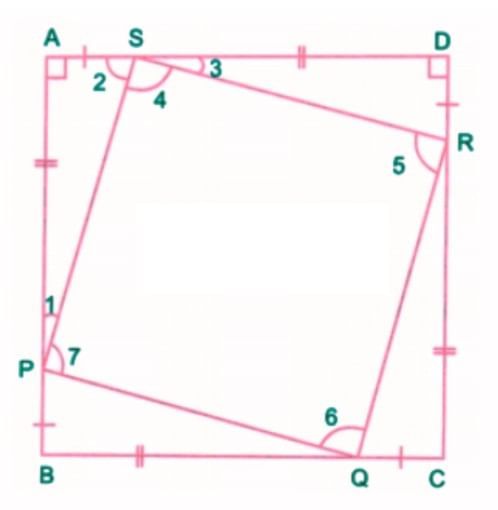
​(b) Let ABCD be a square.
Take points P, Q, R, and S such that AS = BP = CQ = DR.

Since the sides of squares are equal,
we have DS = AP = BQ = CR.
In ∆PAS and ∆SDR, we have
PA = SD, ∠PAS = ∠SDR = 90°, and AS = DR.
∴ By the SAS condition, ∆PAS and ∆SDR are congruent.
∴ PS = SR
Similarly, PS = RQ, PS = QP.
∴ Sides of the quadrilateral PQRS are equal.
In ∆PAS, ∠1 + ∠2 + 90° = 180°
⇒∠1 + ∠2 = 90°
⇒∠3 + ∠2 = 90° (∵ ∠1 = ∠3)
Also, ∠2 + ∠4 + ∠3 = 180°
⇒ 90° + ∠4 = 180°
⇒ ∠4 = 180° – 90°
⇒ ∠4 = 90°
∴ Similarly, ∠5 = 90°, ∠6 = 90°, and ∠7 = 90°.
By definition, the quadrilateral PQRS is a square.

Q8. If a quadrilateral has four equal sides and one angle of 90°, will it be a square? Find the answer using geometric reasoning as well as by construction and measurement.
Ans: Reasoning:

  • A rhombus is a quadrilateral with four equal sides.
  • If a rhombus has one angle of 90°, then:
  • Its opposite angle is also 90° (opposite angles of a rhombus are equal).
  • Each adjacent angle must also be 90° (sum of adjacent angles in a parallelogram/rhombus is 180°).
  • Thus, all four angles are 90°.
  • Since the quadrilateral has all sides equal and all angles right angles, it is a square.

Construction and measurement:

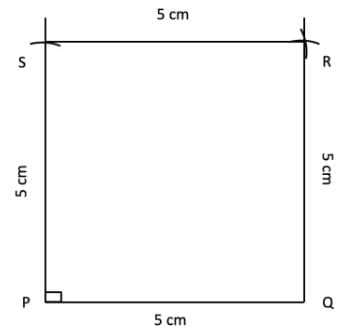
Steps of construction:
(i) Draw a line segment PQ of length 5 cm.
(ii) At point PP, construct a perpendicular line to PQ.
(iii) On this perpendicular, mark point S such that PS = 5 cm.
(iv) With S as centre and radius 5 cm, draw an arc to the right of PS.
(v) With Q as centre and radius 5 cm, draw an arc above PQ to intersect the arc from step (4) at point R.
Join Q–R, R–S, and S–P to complete the square PQRS.
Verification by measurement:
All sides: PQ = QR = RS = SP = 5 cm
All angles: ∠P =∠Q =∠R =∠S = 90°.
Conclusion: The figure constructed is a square.

Q9. What type of quadrilateral is one in which the opposite sides are equal? Justify your answer.
Hint: Draw a diagonal and check for congruent triangles.

Ans: If a quadrilateral has opposite sides equal, then it is a parallelogram. 
Geometric reasoning using a diagonal:

Given: Quadrilateral ABCD with AB = CD and BC = DA.
Draw diagonal AC.
In △ABC and △CDA,
AB = CD (given)
BC = DA (given)
AC = AC (common side)
By SSS congruence, △ABC ≅ △CDA.
From congruence, corresponding angles are equal:
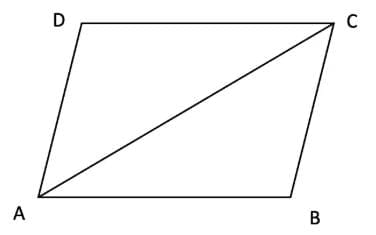
∠BAC =∠DCA and ∠ACB =∠CAD.
But these are alternate interior angles.
∴ AB ∥ DC and AD ∥ BC.
Hence, ABCD is a parallelogram.

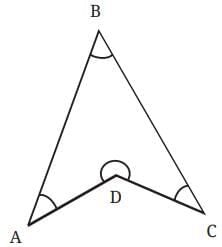
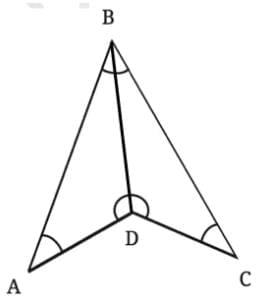
Q10. Will the sum of the angles in a quadrilateral such as the following one also be 360°? Find the answer using geometric reasoning as well as by constructing this figure and measuring.
Ans: Yes, the sum of the angles in a quadrilateral will always be 360°.
Construction: Mark four non-collinear points as A, B, C, and D, and join them to form a quadrilateral ABCD.

Geometric reasoning:
In quad. ABCD, join BD to divide it into two triangles.
Now, In △BAD,
∠DBA + ∠BAD + ∠ADB = 180° ……….(1)……. (Sum of angles of a triangle)
In △BCD,
∠BCD + ∠CDB + ∠DBC = 180° ……….(2)……. (Sum of angles of a triangle)
Adding (1) and (2), we get
∠DBA + ∠BAD + ∠ADB + ∠BCD + ∠CDB + ∠DBC = 180° + 180°
(∠DBA + ∠DBC) + (∠ADB + ∠CDB) + ∠BAD + ∠BCD = 360°
∠ABC + ∠ADC + ∠BAD + ∠BCD = 360°
Thus, the sum of the angles of the given quadrilateral is 360°.

Q11. State whether the following statements are true or false. Justify your answers.
(i) A quadrilateral whose diagonals are equal and bisect each other must be a square.
Ans: False.

A quadrilateral whose diagonals are equal and bisect each other is a rectangle. A square is a special case of a rectangle where all sides are also equal.

(ii) A quadrilateral having three right angles must be a rectangle.
Ans: True.

Let ABCD be a quadrilateral having three right angles at A, D, and C.
We have ∠A + ∠B + ∠C + ∠D = 360°.
⇒ 90° + ∠B + 90° + 90° = 360°
⇒ ∠B = 360° – 270°
⇒ ∠B = 90°.
∴ Each angle of ABCD is 90°.
∴ Given quadrilateral is a rectangle.

(iii) A quadrilateral whose diagonals bisect each other must be a parallelogram.
Ans: True.

If the diagonals bisect each other, then the two triangles formed by a diagonal are congruent, which gives pairs of opposite sides parallel. Hence the figure is a parallelogram.

(iv) A quadrilateral whose diagonals are perpendicular to each other must be a rhombus.
Ans: False.

Squares, kites, and some other quadrilaterals also have perpendicular diagonals. Therefore, having perpendicular diagonals does not necessarily mean the quadrilateral is a rhombus.

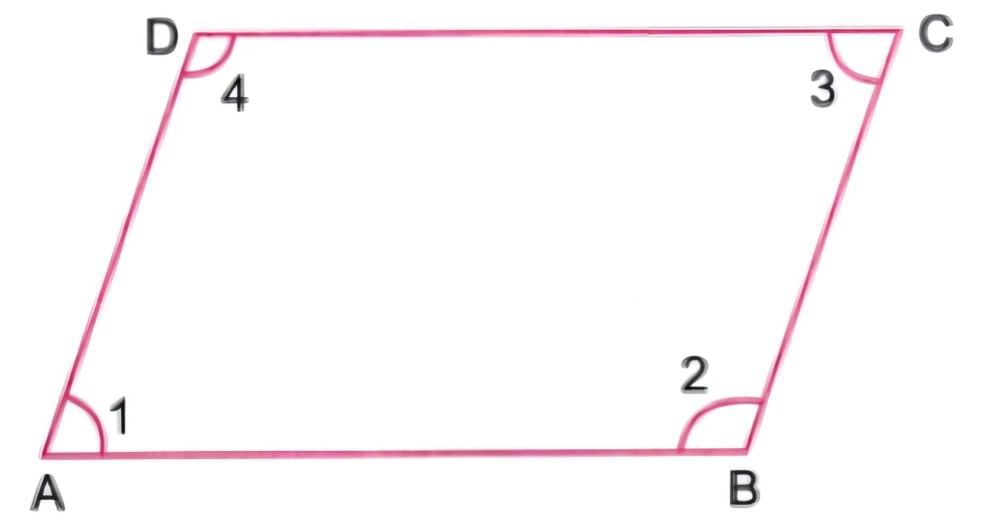
(v) A quadrilateral in which the opposite angles are equal must be a parallelogram.
Ans:
 True.

Let ABCD be a quadrilateral in which ∠1 = ∠3 and ∠2 = ∠4.
We have, ∠1 + ∠2 + ∠3 + ∠4 = 360°.
⇒ ∠1 + ∠2 + ∠1 + ∠2 = 360°
⇒ 2(∠1 + ∠2) = 360°
⇒ ∠1 + ∠2 = 180°
AB is a transversal of lines AD and BC, and the sum of internal angles ∠1 and ∠2 on the same side is 180°.
∴ Lines AD and BC are parallel.
Again, ∠1 + ∠2 + ∠3 + ∠4 = 360°
⇒ ∠3 + ∠2 + ∠3 + ∠2 = 360°
⇒ 2(∠2 + ∠3) = 360°
⇒ ∠2 + ∠3 = 180°
BC is a transversal of lines AB and DC, and the sum of internal angles ∠2 and ∠3 on the same sides is 180°.
∴ Lines AB and DC are parallel.
∴ Opposite sides of quadrilateral ABCD are parallel.
∴ ABCD is a parallelogram.
∴ The given statement is true

(vi) A quadrilateral in which all the angles are equal is a rectangle.
Ans: True

If all four angles are equal, each angle must be 360°/4 = 90°. A quadrilateral with four right angles is a rectangle.

(vii) Isosceles trapeziums are parallelograms.
Ans: False.

An isosceles trapezium has exactly one pair of parallel sides and the non-parallel sides equal while a parallelogram must have two pairs of parallel sides. So an isosceles trapezium is not a parallelogram.

06. We distribute, Yet things multiply – Textbook Solutions

Page 142

Q1. Observe the multiplication grid below. Each number inside the grid is formed by multiplying two numbers. If the middle number of a 3 × 3 frame is given by the expression pq, as shown in the figure, write the expressions for the other numbers in the grid.

Ans: 

Q2. Expand the following products.
(i) (3 + u) (v – 3)
(ii) 2/3 (15 + 6a)
(iii) (10a + b) (10c + d)
(iv) (3 – x) (x – 6)
(v) (–5a + b) (c + d)
(vi) (5 + z) (y + 9)

Ans: (i) (3 + u) (v – 3)
= (3 + u)v – (3 + u)3
= 3 + uv – (9 + 3u)
= 3 + uv – 9 + 3u
= uv + 3u + 3 – 9
= uv + 3u – 6.
(ii) 2/3 (15 + 6a)
2/3 × 15 + 2/3 × 6a
= 2 × 5 + 2 × 2a
= 10 + 4a.
(iii) (10a + b) (10c + d)
= (10a + b)10c + (10 a + b)d
= 100ac + 10bc + 10ad + bd.
(iv) (3 – x) (x – 6)
= (3 – x)x – (3 – x)6
= 3x – x2 – (18 – 6x)
= 3x – x2 – 18 + 6x
= – x2 + 6x + 3x – 18
= – x2 + 9x – 18.
(v) (–5a + b) (c + d)
= (–5a + b)c + (–5a + b)d
= – 5ac + bc – 5ad + bd
= – 5ac – 5ad + bc + bd.
(vi) (5 + z) (y + 9)
= (5 + z)y + (5 + z)9
= 5y + zy + 45 + 9z
= 5y + 9z + zy + 45.

Q3. Find 3 examples where the product of two numbers remains unchanged when one of them is increased by 2 and the other is decreased by 4.
Ans: 
If the two numbers are x and y, then:
x × y = (x + 2) × (y − 4)
xy = (x + 2)y – (x + 2)4
xy = xy + 2y – (4x + 8)
xy = xy + 2y – 4x – 8
xy – xy = 2y – 4x – 8
0 = 2y – 4x – 8
4x + 8 = 2y
2(2x + 4) = 2y
y = 2x + 4.
Examples:
(i) x = 1,  y = 6 → Product = 1 × 6 = 6
Check: (1 + 2) × (6 − 4) = 3 × 2 = 6.
(ii) x = 2, y = 8→ Product = 16
Check: (2 + 2) × (8 − 4) = 4 × 4 =16.
(iii) x = 5, y =14 → Product = 5 × 14 = 70
Check: (5 + 2) × (14 − 4) = 7 × 10 = 70.
Therefore, (1, 6), (2, 8), and (5, 14) are three valid examples.

Q4. Expand (i) (a + ab – 3b2) (4 + b), and (ii) (4y + 7) (y + 11z – 3).
Ans: (i) (a + ab – 3b2) (4 + b)
= (a + ab – 3b2)4 + (a + ab – 3b2)b
= 4a + 4ab – 12b2 + ab + ab2 – 3b3
= – 3b3 – 12b2 + ab2 + 4ab + ab + 4a
= – 3b3 – 12b2 + ab2 + 5ab + 4a.
(ii) (4y + 7) (y + 11z – 3)
= (4y + 7)y + (4y + 7)11z – (4y + 7)3
= 4y2 + 7y + 44yz + 77z – (12y + 21)
= 4y2 + 7y + 44yz + 77z – 12y – 21
= 4y2 + 7y – 12y + 44yz + 77z – 21
= 4y2 – 5y + 44yz + 77z – 21.

Q5. Expand (i) (a – b) (a + b), (ii) (a – b) (a2 + ab + b2) and (iii) (a – b)(a+ a2b + ab2 + b3), Do you see a pattern? What would be the next identity in the pattern that you see? Can you check it by expanding?
Ans: (i) (a − b)(a + b)
= (a − b)a + (a − b)b
= a2 – ab + ab – b2
= a2 – b2.
(ii) (a – b) (a2 + ab + b2)
= (a – b)a2 + (a – b)ab + (a – b)b2
= a3 – a2b + a2b – ab2 + ab2 – b3
= a3 – b3.
(iii) (a – b)(a3 + a2b + ab2 + b3)
= (a – b)a3 + (a – b)a2b + (a – b)ab2 + (a – b)b3
= a4 – a3b + a3b – a2b2 + a2b2 – ab3 + ab3 – b4
= a4 – b4.
The next identity would be: (a − b)(a4 + a3b + a2b2 + ab3 + b4) = a5 − b5.

Page 149

Figure it Out

Q1. Which is greater: (a – b)2 or (b – a)2? Justify your answer.
Ans:  
Using identify:-
(a – b)2 = a2 + b2 – 2ab
And (b – a)² = b2 + a2 – 2ab = a2 + b2 – 2ab
We see that both the expressions are equal, so neither is greater.

Q2. Express 100 as the difference of two squares.
Ans: Therefore, a2 – b2 = 100
Or, a2 – b2 = 2 × 2 × 5 × 5
Or, (a + b) (a – b) = 50 × 2
When, (a + b) = 50 and (a – b) = 2
Then ‘a’ should be = 26 and ‘b’ should be = 24
So, (a + b) (a – b) = (26 + 24) (26 – 24) = 262 – 242 = 676 – 576 = 100
Therefore, 100 = 262 – 24

Q3. Find 4062, 722, 1452, 10972, and 1242 using the identities you have learnt so far.
Ans: 
4062
= (400+6)2
= (400)2 + (6)2 + 2×400×6
= 160000 + 36 + 4800
= 164836
722
= (70 + 2)2
= (70)2 + (2)2 + 2×70×2
= 4900 + 4 + 280
= 5184
1452
= (150- 5)2
= (150)2 + (5)2 – 2×150×5
= 22500 + 25 – 1500
= 21025
10972
= (1100- 3)2
= (1100)2 + (3)2 – 2×1100×3
= 1210000 + 9 – 6600
= 1203409
1242
= (100+ 24)2
= (100)2 + (24)2 + 2×100×24
= 10000 + 576 + 4800
= 15367

Page 154 – 155

Q1. Compute these products using the suggested identity.
(i) 462using Identity 1A for (a + b)2
Ans: Identity (a + b)2 = a2 + 2ab + b2
So, 462 = (40 + 6)2
= (40)2 + 2 × 40 × 6 + (6)2
= 1600 + 480 + 36
= 2116
(ii) 397 × 403 using Identity 1C for (a + b) (a – b)
Ans: Identity (a + b) (a – b) = a2 – b2
So, 397 × 403
= (400 – 3) × (400 + 3)
= (400)2 – (3)2
= 160000 – 9
= 159991
(iii) 912 using Identity 1B for (a – b)2
Ans: Identity (a – b)2 = a2 + b2 – 2ab
So, 912 = (100 – 9)2
= (100)2 + (9)2 – 2×100×9
= 10000 + 81 –1800
= 8281
(iv) 43 × 45 using Identity 1C for (a + b) (a – b)
Ans: Identity (a + b) (a – b) = a2 – b2
So, 43 × 45
= (44 – 1) (44 + 1)
= (44)2 – (1)2
= 1936 – 1
= 1935

Q2. Use either a suitable identity or the distributive property to find each of the following products.
(i) (p – 1)(p + 11)
Ans: Distributive property
∴ (p – 1) (p + 11) = p2 + 11p – p – 11 = p2 + 10p – 11
(ii) (3a – 9b)(3a + 9b)
Ans: Identity (a + b) (a – b)
∴ (3a – 9b) (3a + 9b) = (3a)2 – (9b)2 = 9a2 – 81b2
(iii) – (2y + 5) (3y + 4)
Ans: Distributive property
∴ – (2y + 5) (3y + 4) =-6y2 – 8y – 15y – 20 = -6y2 – 23y – 20
(iv) (6x + 5y)2
Ans: Identity(a + b)2
∴ (6x + 5y)2 = (6x)2 + 2 × 6x × 5y + (5y)2 = 36x2 + 60xy + 25y2
(v) (2x – 1/2)2
Ans: Identity (a – b)2
∴ (2x – 1/2)2 = (2x)2 + (1/2)2 – 2 × 2x × 1/2 = 4x2 + 1/4 – 2x
(vi) (7p) × (3r) × (p + 2)
Ans: Distributive property
∴ (7p) × (3r) × (p + 2) = 21pr × (p + 2) = 21p2r + 42pr

Q3. For each statement identify the appropriate algebraic expression(s).
(i) Two more than a square number.
2 + s, (s + 2)2, s2 + 2, s2 + 4, 2s2, 22s
Ans: s2 + 2
Explanation: Let be the number = s
∴ Square number = s2
So, two more the square number is = s2+ 2
(ii) The sum of the squares of two consecutive numbers
m²+n2, (m + n)2, m2 + 1, m2 + (m + 1)2, m2 + (m – 1)2, {m + (m + 1)}2, (2m)2 + (2m + 1)2
Ans: m2 + (m + 1)2
Explanation: Let be the consecutive numbers are = m and (m + 1)
So, the sum of the square numbers = m2 + (m + 1)

Q4. Consider any 2 by 2 square of numbers in a calendar, as shown in the figure.
Find products of numbers lying along each diagonal — 4 × 12 = 48, 5 × 11 = 55. Do this for the other 2 by 2 squares. What do you observe about the diagonal products? Explain why this happens.

Ans: Other 2 by 2 squares and products of diagonal 
We observe that the product of each diagonal is 7 more than the product of the other diagonals.
Explanation: When we see the 2 by 2 squares we see that
The difference between the first number in the first row and the first number in the second row is 7.
And the difference between the second number in the first row and the second number in the second row is also 7.
When we cross multiply the numbers, the difference will remain the same.

Q5. Verify which of the following statements are true.
(i) (k + 1)(k + 2) – (k + 3) is always 2.
Ans: Statement is false.
Explanation: (k + 1) (k + 2) – (k + 3)
= k2 + 2k + k + 2 – k – 3
= k2 + 2k – 1
Now, if k = 1, then (1)2 + 2 × 1 – 1 = 2
If k = 2, then (2)2 + 2 × 2 – 1 = 7
If k = 3, then (3)2 + 2 × 3 – 1 = 14
(ii) (2q + 1)(2q – 3) is a multiple of 4.
Ans: Statement is false.
Explanation: (2q + 1) (2q – 3)
= 4q2 – 6q + 2q – 3
= 4q2 – 4q – 3
=4(q2 –q) – 3
Here we see that 3 is not divisible by 4, so the entire equation is not divisible by 4.
(iii) Squares of even numbers are multiples of 4, and squares of odd numbers are 1 more than multiples of 8.
Ans: Statement is true.
Explanation: Let be the even number is = 2n (even is always divisible by 2).
∴ Square of 2n = (2n)2 = 4n2 (We see it is always a multiple of 4)
And the odd number is = 2n + 1
∴ Square of 2n + 1 = (2n + 1)2 = (2n)2 + 2×2n×1 + 12 = 4n2 + 4n + 1 = 4(n2 + n) + 1
(n2 + n) is always an even number because n is odd, the square of an odd number is always odd, and odd + odd = even.
Example: If (n2 + n) = 2, then 4×2 + 1 = 9 (9 is 1 more than multiples of 8)
If (n2 + n) = 4, then 4×4 + 1 = 17 (9 is 1 more than multiples of 8) etc.
(iv) (6n + 2)2 – (4n + 3)2 is 5 less than a square number.
Ans: Statement is false.
Explanation: (6n + 2)2 – (4n + 3)2
= {(6n)2 + 2×6n×2 + (2)2} –{(4n)2 + 2×4n×3 + (3)2}
= 36n2 + 24n + 4 – 16n2 – 24n – 9
= 20n2– 5
Clearly we see 20 is a square number so 20n2 is also not a square number.

Q6. A number leaves a remainder of 3 when divided by 7, and another number leaves a remainder of 5 when divided by 7. What is the remainder when their sum, difference, and product are divided by 7?
Ans:
 Let be the number x is divided by 7 and the remainder is 3.
∴ x ≡ 3 (mod7)
And suppose the number y is divided by 7 and the remainder is 5.
∴ y ≡ 5 (mod7)
Q7. Choose three consecutive numbers, square the middle one, and subtract the product of the other two. Repeat the same with othersets of numbers. What pattern do you notice? How do we write this as an algebraic equation? Expand both sides of the equation to check that it is a true identity.
Ans: Let be the three consecutive numbers are = x, (x + 1), (x + 2)
Therefore,(x + 1)2 – x(x + 2)
= x2 + 2x + 1 – x2 – 2x
= 1
And let be the other sets of consecutive numbers are = (x – 1), x, (x + 1)
Therefore, x2 – (x – 1) (x + 1)
= x2 – x2 – x + x + 1
= 1
In the pattern we have observed, the value of the equation is always 1.
Hence, the algebraic equation is:-(x + 1)2 – x(x + 2) = 1

Q8. What is the algebraic expression describing the following steps-add any two numbers. Multiply this by half of the sum of the two numbers? Prove that this result will be half of the square of the sum of the two numbers.
Ans:
 Let be the two numbers are = x and y
Sum of these numbers are = (x + y)
Multiplying this by half = 1/2 × (x + y)
Now, 1/2 × (x + y) × (x + y)
= (x + y)2/2
Therefore, the result will be half of the square of the sum of the two numbers.

Q9.  Which is larger? Find out without fully computing the product.
(i) 14 × 26 or 16 × 24

Ans: 14 × 26 = (20 – 6) (20 + 6) = (20)2 – (6)2
And 16 × 24 = (20 – 4) (20 + 4) = (20)2 – (4)2
∴ (4)2< (6)2, in the 2nd condition smaller number will be subtracted from (20)2.
So, the larger product will be = 16 × 24
(ii) 25 × 75 or 26 × 74
Ans: 25 × 75 = (50 – 25) (50 + 25) = (50)2 – (25)2
And 26 × 74 = (50 – 24) (50 + 24) = (50)2 – (24)2
∴ (24)2< (25)2, in the 2nd condition smaller number will be subtracted from (50)2.
So, the larger product will be = 26 × 74

Q10. A tiny park is coming up in Dhauli. The plan is shown in the figure. The two square plots, each of area g2 sq. ft., will have a green cover. All the remaining area is a walking path w ft. wide that needs to be tiled. Write an expression for the area that needs to be tiled.
Ans:Area of square plot = g2 sq. ft., so length of side = g ft.
∴ Length of the tiny park = (w + g + w + g + w) ft= (3w + 2g) ft
And breadth of the tiny park = (w + g + w) = (2w + g) ft
Total area of the park = (3w + 2g) × (2w + g)
= 6w2 + 3wg + 4wg + 2g2
= (6w2 + 7wg + 2g2) sq. ft.
So, the remaining area that needs to be tiled for the walking path is
= (6w2 + 7wg + 2g2) – (g2) sq. ft.
= (6w2 + 7wg + g2) sq. ft.

Q11. For each pattern shown below, 
(i) Draw the next figure in the sequence.
Ans: Next figure in the sequence:
(ii) How many basic units are there in Step 10? 
Ans: In the first figure, the number of basic units in step 1 = 9
And in the first figure, the number of basic units in step 1 = 5
(iii) Write an expression to describe the number of basic units in Step y.
Ans: In 1stfigure:-
Step 1:- (1 + 2)2 = 9
Step 2:- (2 + 2)2 = 16
Step 3:- (3 + 2)2 = 25
→ Step y:- (y + 2)2
In 2nd figure:-
Step 1:- (1+1)2+ 1 = 5
Step 2:- (2+1)2+ 2 = 16
Step 3:- (3 + 1)2+ 3= 25
→ Step y:- (y + 1)2 + y

05. Number play – Textbook Solutions

Page 122

Figure it Out

Q1. The sum of four consecutive numbers is 34. What are these numbers?
Ans: Let four consecutive numbers be x, (x + 1), (x + 2) and (x + 3).
x + (x + 1) + (x + 2) + (x + 3) = 34
x + x + 1 + x + 2 + x + 3 = 34
4x + 6 = 34
4x = 34 – 6
4x = 28
x = 28/7 = 7.
So, (x + 1 ) = 7 + 1 = 8
(x + 2) = 7 + 2 = 9
(x + 3) = 7 + 3 = 10
Therefore, the given four consecutive numbers are 7, 8, 9, and 10.

Q2. Suppose p is the greatest of five consecutive numbers. Describe the other four numbers in terms of p.
Ans: 
If p is the greatest of five consecutive numbers, then the other four numbers are (p – 1), (p – 2), (p – 3), and (p – 4).

Q3. For each statement below, determine whether it is always true, sometimes true, or never true. Explain your answer. Mention examples and non-examples as appropriate. Justify your claim using algebra.
(i) The sum of two even numbers is a multiple of 3.
Ans: Let the two even numbers be 2a + 2b
Sum = 2a + 2b = 2(a + b)
For 2(a + b) to be a multiple of 3, (a + b) must be multiple of 3.
Example:
2 + 4 = 6 → divisible by 3
2 + 8 = 10 → not divisible by 3 
ConclusionSometimes true.

(ii) If a number is not divisible by 18, then it is also not divisible by 9.
Ans: If a number is divisible by 18, then it is also divisible by 9 because 9 is a factor of 18.
18a ÷ 9 = 2a → divisible by 9.
But if a number is divisible by 9, it is not always divisible by 18.
9b ÷ 18 = b/2 → not divisible by 9.
Example: 9 is divisible by 9 but not divisible by 18.
27 is divisible by 9 but not 18.
ConclusionSometimes true.

(iii) If two numbers are not divisible by 6, then their sum is not divisible by 6.
Ans: Let the two numbers be a and b.
Not divisible by 6 means they do not satisfy 6∣a or 6∣b.
But their sum can still be divisible by 6.
Example: 2 and 4 → both not divisible by 6.
But, 2 + 4 = 6 → divisible by 6.
ConclusionSometimes true.

(iv) The sum of a multiple of 6 and a multiple of 9 is a multiple of 3.
Ans: Let the multiple of 6 be 6a, the multiple of 9 be 9b.
Sum: 6a + 9b = 3(2a + 3b)→ clearly divisible by 3.
Example:
6 + 9 = 15 → divisible by 3.
12 + 18 = 30 → divisible by 3.
ConclusionAlways true.

(v) The sum of a multiple of 6 and a multiple of 3 is a multiple of 9.
Ans: Let multiple of 6 be 6a, multiple of 3 be 3b.
Sum: 6a + 3b = 3(2a + b).
For it to be divisible by 9, 2a + b must be divisible by 3.
Example:
6 (6 × 1) + 3 (3 × 1) = 9 →divisible by 9
6 + 6 = 12 → not divisible by 9
ConclusionSometimes true.

Q4. Find a few numbers that leave a remainder of 2 when divided by 3 and a remainder of 2 when divided by 4. Write an algebraic expression to describe all such numbers.
Ans: L.C.M of 3 and 4 = 12.
All such numbers are given by the expression = 12a + 2.
Examples:
(i) 12 × 1 + 2 = 12 + 2 = 14.
(ii) 12 × 2 + 2 = 24 + 2 = 26.
(iii) 12 × 3 + 2 = 36 + 2 = 38.

Q5. “I hold some pebbles, not too many, When I group them in 3’s, one stays with me. Try pairing them up — it simply won’t do, A stubborn odd pebble remains in my view. Group them by 5, yet one’s still around, But grouping by seven, perfection is found. More than one hundred would be far too bold, Can you tell me the number of pebbles I hold?”

Ans: Grouped in 3’s leaves 1.
Pairing (2’s) leaves 1.
Grouped by 5 leaves 1.
Grouped by 7 is perfect.
Number ≤ 100.
L.C.M of 2, 3, and 5 = 30.
In all those cases, when we group them, 1 pebble remains.
So, the actual number of pebbles must be = 30 + 1 = 31, but 31 is not divisible by 7.
The next multiple of 30 is 2 × 30 = 60.
So, 60 + 1 = 61, but this is also not divisible by 7.
Similarly, the next number is 90 + 1 = 91.
And 91 is divisible by 7.
Hence, the number of pebbles I hold = 91.

Q6. Tathagat has written several numbers that leave a remainder of 2 when divided by 6. He claims, “If you add any three such numbers, the sum will always be a multiple of 6.” Is Tathagat’s claim true?
Ans: A number that leaves remainder of 2 when divided by 6 can be written as 6k + 2.
Three such numbers are: (6a + 2), (6b + 2), (6c + 2).
(6a + 2) + (6b + 2) + (6c + 2) = 6(a + b + c) + 6 = 6(a + b + c + 1).
This sum is divisible by 6.
So yes, Tathagat’s claim is always true.
Example: Take 20, 26, 32 → sum = 78 → divisible by 6.
Take 2, 8, 14 → sum = 24 → divisible by 6.

Page 123

Q7. When divided by 7, the number 661 leaves a remainder of 3, and 4779 leaves a remainder of 5. Without calculating, can you say what remainders the following expressions will leave when divided by 7? Show the solution both algebraically and visually.
(i) 4779 + 661 (ii) 4779 – 661
Ans: (i) 4779 + 661
= Remainder 5 + Remainder 3
= Remainder 8
8 divided by 7 → remainder 1.
(ii) 4779 – 661
= Remainder 5 – Remainder 3
= Remainder 2

Q8. Find a number that leaves a remainder of 2 when divided by 3, a remainder of 3 when divided by 4, and a remainder of 4 when divided by 5. What is the smallest such number? Can you give a simple explanation of why it is the smallest?
Ans: A number that leaves a remainder of 2 when divided by 3 is = 3x + 2
A number that leaves a remainder of 3 when divided by 4 is = 4x + 3
A number that leaves a remainder of 4 when divided by 5 is = 5x + 4
L.C.M of 3, 4, and 5 = 60
All the numbers are the same, so 4x + 3 = 3x + 2
4x – 3x = 2 – 3
x = -1
Each remainder is 1 less than the divisor.
Hence, the number is 1 less than the L.C.M = (60 – 1) = 59.
So, 59 is the smallest number that satisfies all the given conditions.

Page 126

Figure it Out

Q1. Find, without dividing, whether the following numbers are divisible by 9.
(i) 123
Ans: Digit sum of the number 123 = (1 + 2 + 3) = 6
Now, (6 ÷ 9) is not divisible by 9.
So, the whole number 123 is not divisible by 9.

(ii) 405
Ans: Digit sum of the number 405 = (4 + 0 + 5) = 9
Now, (9 ÷ 9) = 1,divisible by 9.
So, the whole number 405 is divisible by 9.

(iii) 8888
Ans: Digit sum of the number 8888 = (8 + 8 + 8 + 8) = 32
Now, (32 ÷ 9) is not divisible by 9.
So, the whole number 8888 is not divisible by 9.

(iv) 93547
Ans: Digit sum of the number 93547 = (9 + 3 + 5 + 4 + 7) = 9
Now, (28 ÷ 9) is not divisible by 9.
So, the whole number 93547 is not divisible by 9.

(v) 358095
Ans: Digit sum of the number 358095 = (3 + 5 + 8 + 0 + 9 + 5) = 30
Now, (30 ÷ 9) is not divisible by 9.
So, the whole number 358095 is not divisible by 9.

Q2. Find the smallest multiple of 9 with no odd digits.
Ans:
 If we multiply 9 by odd digits, we will get odd digits as a result.
So, we will multiply 9 by only even digits.

  • 18 ( 1 is odd)
  • 36 ( 3 is odd)
  • 72 (7 is odd)
  • 90 (9 is odd)
  • 108 ( 1 is odd)
  • 216 ( 1 is odd)
  • 288(2 + 8 + 8 = 18 → divisible by 9, and digits 2,8,8 are even)

Q3. Find the multiple of 9 that is closest to the number 6000.
Ans: 
First Divide 6000 by 9 → (6000 ÷ 9) →Quotient = 666 and Remainder = 6
So, 5994 is 6 less than 6000.
And next closest number is 667×9 = 6003, 6003 is 3 greater than 6000.
Hence, the closest to the number 6000 that is multiple of 9 = 6003.

Q4. How many multiples of 9 are there between the numbers 4300 and 4400?
Ans: 
First divide 4300 by 9 = (4300 ÷ 9) = Quotient = 477 and Remainder = 7
The smallest number is 478×9 = 302 which divisible by 9. (Between 4300 – 4400)
Now, divide 4400 by 9 = (4400 ÷ 9) = Quotient = 488 and Remainder = 8
And the largest number is 488×9 = 4392 which divisible by 9. (Between 4300 – 4400)
Therefore the multiple of 9 between the number 4300 to 4400 is = (488 – 478) + 1 = 10 + 1 = 11.

Page 131

Figure it Out

Q1. The digital root of an 8-digit number is 5. What will be the digital root of 10 more than that number?
Ans: Let be the 8-digit number is = x
So, digital root of x = 5
Now the number 10 more than that is = (x + 10)
∴ Digital root of (x + 10) is = 5 + 1 + 0 = 6
Therefore 6 will be the digital root of 10 more than that number.

Q2. Write any number. Generate a sequence of numbers by repeatedly adding 11. What would be the digital roots of this sequence of numbers? Share your observations.
Ans:
 Let the first number of the sequence be 4.
Digital roots:

  • 4 → 4
  • 15 → 1 + 5 = 6
  • 26 → 2 + 6 = 8
  • 37 → 3 + 7 = 10 → 1 + 0 = 1
  • 48 → 4 + 8 = 12 → 1 + 2 = 3
  • 59 → 5 + 9 = 14 → 1 + 4 = 5
  • 70 → 7 + 0 = 7
  • 81 → 8 + 1 = 9
  • 92 → 9 + 2 = 11 → 1 + 1 = 2
  • 103 → 1 + 0 + 3 = 4
  • 114 → 1 + 1 + 4 = 6

We can see that the pattern repeats every 9 terms.

Q3. What will be the digital root of the number 9a + 36b + 13?
Ans: We find the digital root by taking the expression modulo 9:
9a = 0( mod 9)
36 b = 0( mod 9)
13 = 4( mod 9)
So, 9a + 36b + 13 = 4 mod 9
Hence, the digital root is 4.

Q4. Make conjectures by examining if there are any patterns or relations between
(i) the parity of a number and its digital root.
(ii) the digital root of a number and the remainder obtained when the number is divided by 3 or 9.
Ans: (i)
 There is no fixed relation between Parity and digital root. Parity and digital root are independent. A number can be even or odd regardless of its digital root.
Example: Even number 14 has a digital root, 1 + 4 = 5, which is odd.
Also, even number 24 has a digital root, 2 + 4 = 6, which is even.
(ii) The digital root of a number is the same as the remainder when the number is divided by 9, except when the remainder is 0 — in that case, the digital root is 9.
If the digital root is 3, 6, or 9, then the number is divisible by 3.

Page 132-134

Figure it Out

Q1. If 31z5 is a multiple of 9, where z is a digit, what is the value of z? Explain why there are two answers to this problem.
Ans: We know that the digital root of multiples of 9 is always 9.
So, the digit root of the number 31z5 is = 9
Hence the value of z = 0 or 9.
Proceedings:
Therefore, 3 + 1 + z + 5 = 9
Or, 9 + z = 9
Or, z = 0
Now, the expression 3 + 1 + z + 5 = 9 + z must be divisible by 9.
If z = 0, then 9 + z = 9 is divisible by 9.
And when z = 9, then 9 + z = 18 is divisible by 9.
So, the value of z = 0 or 9.
And the numbers are 3105 and 3195.
That’s why there are two answers to this problem.

Q2. “I take a number that leaves a remainder of 8 when divided by 12. I take another number which is 4 short of a multiple of 12. Their sum will always be a multiple of 8”, claims Snehal. Examine his claim and justify your conclusion.
Ans: 1st number = 12k + 8
2nd number = 12k – 4
Sum = 12k + 8 + 12k – 4 = 24k + 4
According to Snehal, it is always a multiple of 8.
If we put k = 1, 24 × 1 + 4 = 24, which is a multiple of 8.
k = 2, 24 × 2 + 4 = 48, which is a multiple of 8.
k = 3, 24 × 3 + 4 = 76, which is not a multiple of 8.
So, her claim is “Sometimes True”.

Q3.  When is the sum of two multiples of 3, a multiple of 6 and when is it not? Explain the different possible cases, and generalise the pattern.
Ans:
 Let the two numbers be 3a and 3b (multiples of 3)
Sum = 3a + 3b = 3(a + b)
This is always divisible by 3.
But it’s divisible by 6 only if the value of (a + b) is even.
So, we can conclude that

  • If a + b is even -> sum divisible by 6
  • If a + b is even -> sum divisible by 6

Q4. Sreelatha says, “I have a number that is divisible by 9. If I reverse its digits, it will still be divisible by 9 “.
(i) Examine if her conjecture is true for any multiple of 9.
(ii) Are any other digit shuffles possible such that the number formed is still a multiple of 9?

Ans: (i) We know that a number is divisible by 9 if the sum of its digits is divisible by 9.
So, if we reverse the digits of a number which a multiple of 9, then it will still be divisible by 9 as the sum of the digits remains the same.
Example: 117 is divisible by 9, as well as 711 and 171.
(ii) As long as the sum of digits remains the same, any shuffle will work.

Q5. If 48a23b is a multiple of 18, list all possible pairs of values for a and b.
Ans: 
LCM of 2 and 9 is 18.
So if the number is divisible by 2 and 9, then it is divisible by 18.
A number is divisible by 2 if the last digit is even or 0.
A number is divisible by 9 if the sum of its digits is divisible by 9.
In 48a23b, the sum of the digits apart from a and b is 4 + 8 + 2 + 3 = 17
So if a = 1 and b = 0, the number becomes 481230, which is divisible by both 2 and 9; thus divisible by 18.
No more values can be obtained.
So the values of a and b are 1 and 0, respectively.

Q6. If 3p7q8 is divisible by 44, list all possible pairs of values for p and q.
Ans: 
LCM of 4 and 11 is 44.
So if a number is divisible by 4 and 11, then it is divisible by 44.
If the last two digits of a number are divisible by 4, then the whole number is divisible by 4.
A number is divisible by 11 if the difference between the sum of its digits in odd places and the sum of its digits in even places is either 0 or divisible by 11.
So, (3+7+8)-(p+q) = 18-p-q must be divisible by 11 or 0.
If the values of p = 7 and q = 0, then the number becomes 37708, which is divisible by both 4 and 11; thus divisible by 44.
Also, values that are possible:
p = 5, q = 2;
p = 3, q = 4;
p = 1, q = 6;

Q7. Find three consecutive numbers such that the first number is a multiple of 2, the second number is a multiple of 3, and the third number is a multiple of 4. Are there more such numbers? How often do they occur?
Ans: 
The first set of numbers which satisfies the conditions is 14, 15, 16.
LCM of 2, 3, and 4 = 12
If we add 12 to the first number, then the sequence repeats.
So, the next such sets are:
14, 15, 16
26, 27, 28
38, 39, 40
50, 51, 52
And so on

Q8. Write five multiples of 36 between 45,000 and 47,000. Share your approach with the class.
Ans: Step:

Divided 45000 by 36.
We will get 1250.
Now, to get the multiple between 45000 and 47000, we have to multiply 36 by more than 1250.
So, the five multiples of 36 between 45,000 and 47,000 are:
36 × 1251 = 45036
36 × 1252 = 45072
36 × 1253 = 45108
36 × 1254 = 45144
36 × 1255 = 45180

Q9. The middle number in the sequence of 5 consecutive even numbers is 5p. Express the other four numbers in sequence in terms of p.
Ans: 
Let be the 5 consecutive even numbers are = x, (x + 2), (x + 4), (x + 6), (x + 8)
The middle number is (x + 4)
Therefore, (x + 4) = 5p
Or, x = 5p – 4
So, the other four numbers are =
1st number → 5p – 4
2nd number → 5p – 2
4th number → 5p + 2
5th number → 5p + 4

Q10. Write a 6-digit number that it is divisible by 15, such that when the digits are reversed, it is divisible by 6.
Ans: 
LCM of 3 and 5 is 15.
So if a number is divisible by both 3 and 5, then the number is divisible by 15.
A number is divisible by 3 if the sum of its digits is divisible by 3.
If the last digit of a number is 0 or 5, then the number is divisible by 5.
For the reverse number to be divisible by 6, it has to be divisible by 2 and 3.
So the first digit should be even, and the sum of the digits should be divisible by 3.
Let’s try 234105..
Here, some of the digits are 15, the last digit is 5, and in reverse order, the last digit is even.
So it satisfies all the conditions.

Q11. Deepak claims, “There are some multiples of 11 which, when doubled, are still multiples of 11. But other multiples of 11 don’t remain multiples of 11 when doubled”. Examine if his conjecture is true; explain your conclusion.
Ans:
 Let’s check Dipak’s hypothesis.
11 × 2 = 22
Now, the multiples of 22, such as 44, 66, 88, are all multiples of 11.
11 × 3 = 33
Now, the multiples of 33, such as 66, 99, 132, are all multiples of 11.
So, Deepak’s claim is not correct.
All doubled multiples of 11 are still multiples of 11.

Q12. Determine whether the statements below are ‘Always True’, ‘Sometimes True’, or ‘Never True’. Explain your reasoning. 
(i) The product of a multiple of 6 and a multiple of 3 is a multiple of 9.
Ans: ‘Always True’
Explanation: Let be the two numbers are = 6a and 3b.
So the product of these = (6a × 3b) = 18ab
It saws that 18ab is also divisible by 9. [18 is a multiple of 9]
Example: If a = 3 and b = 2
(18 × 3 × 2) = 108, so 108 is a multipleof p.

(ii) The sum of three consecutive even numbers will be divisible by 6.
Ans: ‘Always True’
Explanation: Let be the first consecutive even number = x
So the other consecutive even numbers = (x + 2) and (2 + 4)
Therefore, sum of these number = x + x + 2 + x + 4 = 3x + 6 = 3(x + 2)
Example: If x = 6, then 3(6 + 2) = 24, divisible by 6.
When x = 10, then 3(10 + 2) = 36, divisible by 6.

(iii) If abcdef is a multiple of 6, then badcef will be a multiple of 6.
Ans: ‘Always True’
Explanation: If a number is divisible by 6 it must be divisible by 2 and 3.
Checking divisibility by 2: We check the last digits of the number, if it is even then the number must be divisible by 2.
And checking divisibility by 3: We check the sum of the digits of the number if it is divisible by 3, then the number is also divisible by 3.
Here we can see that the last digit of both the numbers ‘abcdef’ and ‘badcef’ is the same and all the digits are the same, only their positions have changed.
So, if abcdef is a multiple of 6, then badcef should be a multiple of 6.

(iv) 8 (7b-3)-4 (11b+1) is a multiple of 12.
Ans: ‘Never True’
Explanation: 8 × (7b – 3) – 4 × (11b + 1)
= 56b –24 – 44b – 4
= 12b – 28
We see that 12b is a multiple of 12 but 28 is not a multiple of 12.
So, we say that 12b – 28 is not divisible by 12.

Q13. Choose any 3 numbers. When is their sum divisible by 3? Explore all possible cases and generalise.
Ans: 

  • 3,6,9 → sum = 18 → Divisible by 3
  • 1,2,3 → sum = 6 → Divisible by 3
  • 1,2,4 → sum = 7 → Not Divisible by 3

The sum of 3 numbers is divisible by 3 if their total sum is divisible by 3
So if all numbers leave the same remainder mod 3 (like 1, 4, 7 ), or their remainders sum to 3 or 6, the result is divisible by 3.

Q14. Is the product of two consecutive integers always multiple of 2? Why? What about the product of these consecutive integers? Is it always a multiple of 6? Why or why not? What can you say about the product of 4 consecutive integers? What about the product of five consecutive integers?
Ans:
 Yes, the product of two consecutive integers is always a multiple of 2.
Product of two consecutive numbers: n(n + 1)
If n even → even × odd = even
If n odd → odd × even = even
No, it sometimes can be divisible by 6, if the last digits are even and the sum of the digits is divided by 3.
2 × 3 = 6 [Divisible by 6]
3 × 4 = 12 [Divisible by 6]
4 × 5 = 20 [Not divisible by 6]
The product of 4 consecutive integers is divisible by 24.
The product of 5 consecutive integers is divisible by 120.

Q15. Solve the cryptarithms — 
(i) EF × E = GGG 
(ii) WOW × 5 = MEOW

Ans: (i) EF × E = GGG
=10E + F × E = 100 G + 10G + G
= (10E + F) × E = 111G
If E = 1, then 10 + F = 111G
[It is not possible because for any value of F, LHS can’t be equal to RHS]
If E = 2, then (20 + F) × 2 = 111G
[It is also not possible because for any value of F, LHS can’t be equal to RHS]
For E = 3, then (30 + F) × 3 = 111G
=90 + 3F = 111G
If F = 7 and G = 1, then LHS = RHS.
∴ The values of E, F, and G are 3, 7, and 1, respectively.
(ii) WOW × 5 = MEOW
Using the same process as the previous one.
(100W + 10O + W) × 5 = MEOW
⇒ (101 W + 10 O) × 5 = MEOW
⇒ 505 W + 50 O = MEOW
Let’s try possible values of W and O such that the result is a 4-digit number.
If we set W = 5 and O = 7, we obtain a 4-digit number.
505 × 5 + 50 × 7 = 2875
On the right-hand side, if MEOW = 2875
W = 5, O = 7
1000M + 100E + 10O + W = 1000M + 100E + 70 + 5 = 1000M + 100E + 75
If we take M = 2 and E = 8, then it satisfies the LHS.
So, the values of M, E, O, and W are 2, 8, 7, and 5, respectively.

Q16. Which of the following Venn diagrams captures the relationship between the multiples of 4, 8, and 32?
Ans: The correct answer is option (iv).
Here are the reasons for the answer.

  • Every multiple of 32 is also a multiple of 8 and 4.
  • Every multiple of 8 is also a multiple of 4.
  • But not every multiple of 4 is a multiple of 8 or 32.

04. Quadrilaterals – Textbook Solutions

Page 94

Q1. Find all the other angles inside the following rectangles.

Ans:
(i) 

∠1 + ∠9 = 90° ……… (All corner angles of a rectangle are 90°)
∠1 + 30° = 90°
∠1 = 90° – 30°
∠1 = 60°
∠1 = ∠5 = 60°………. (Alternate interior angles)
∠9 = ∠4 = 30°………. (Alternate interior angles)
In △AOB, OA = OB, then the angles opposite them are equal
∴ ∠9 = ∠7 = 30°
∠7 = ∠3 = 30°………. (Alternate interior angles)
In △AOD, OA = OD, then the angles opposite them are equal
∴ ∠2 = ∠1 = 60°
∠2 = ∠6 = 60°………. (Alternate interior angles)
In △AOB,
∠9 + ∠7 + ∠AOB = 180° ………. (Sum of angles of a triangle)
30° + 30° + ∠AOB = 180°
60° + ∠AOB = 180°
∠AOB = 180° – 60°
∠AOB = 120°
∠AOB = ∠COD = 120° ………… (Vertically opposite angles)
∠AOB + ∠AOD = 180° …………. (Linear pair)
120° + ∠AOD = 180°
∠AOD = 180° – 120°
∠AOD = 60°
∠AOD = ∠BOC = 60° ………… (Vertically opposite angles)
Thus, ∠1 = ∠5 = ∠2 = ∠6 = ∠AOD = ∠BOC = 60°.
∠AOB = ∠COD = 120°.
∠9 = ∠4 = ∠7 = ∠3 = 30°.
(ii)


 ∠POS = ∠ROQ = 110° ………… (Vertically opposite angles)
∠POS + ∠POQ = 180° …………. (Linear Pair)
110° + ∠POQ = 180°
∠POQ = 180° – 110°
∠POQ = 70°
∠POQ = ∠SOR = 70° ………… (Vertically opposite angles)
In △POS, OP = OS, then the angles opposite them are equal.
∴ ∠1 = ∠2 = a
In △POS,
∠1 + ∠2 + ∠POS = 180° …………. (Sum of angles of a triangle)
a + a + 110° = 180°
2a = 180° – 110°
2a = 70°
a = 35°
∴ ∠1 = ∠2 = a = 35°
∠1 = ∠5 = 35° ………… (Alternate interior angles)
∠2 = ∠6 = 35° ………… (Alternate interior angles)
Since ABCD is a rectangle, ∠P = 90°
∠9 = ∠1 + ∠8
90° = 35° + ∠8
∠8 = 90° – 35°
∠8 = 55°
∠8 = ∠4 = 55° ………… (Alternate interior angles)
In △POQ, OP = OQ, then the angles opposite them are equal i.e. ∠7 = ∠8 = 55°
∠7 = ∠2 = 55° ………… (Alternate interior angles)
Thus, ∠POS = ∠ROQ = 110°.
∠POQ = ∠SOR = 70°.
∠1 = ∠2 = ∠5 = ∠6 = 35°.
∠8 = ∠4 = ∠7 = ∠2 = 55°

Q2. Draw a quadrilateral whose diagonals have equal lengths of 8 cm that bisect each other, and intersect at an angle of 
(i) 30° 
(ii) 40° 
(iii) 90° 
(iv) 140°
Ans: 
(i) 30°


(ii) 40° 


(iii) 90° 


(iv) 140°


Q3. Consider a circle with centre O. Line segments PL and AM are two perpendicular diameters of the circle. 
What is the figure APML? Reason and/or experiment to figure this out.
Ans: .  

The figure is a square.
Therefore, the opposite sides are parallel. The opposite sides are equal in length and all angles are 90°.

Q4. We have seen how to get 90° using paper folding. Now, suppose we do not have any paper but two sticks of equal length, and a thread. How do we make an exact 90° using these?
Ans: We have to tie the two sticks together at one end so that they can rotate like a hinge.
Then we have to cut a thread of length 12 units (for example, 12 cm ) and tie its ends to the free ends of the two sticks.
After that, we have to mark the thread into segments of 3 units, 4 units, and 5 units.
We will form a triangle with the thread:

  • Keep the 3-unit side along one stick.
  • Keep the 4-unit side along the other stick.
  • The 5-unit side will naturally form the hypotenuse.

By the Pythagoras theorem (32 + 42 = 52), the angle between the sticks will be exactly 90°.

Q5. We saw that one of the properties of a rectangle is that its opposite sides are parallel. Can this be chosen as a definition of a rectangle? In other words, is every quadrilateral that has opposite sides parallel and equal a rectangle?
Ans: 
No, this can’t be the definition of a rectangle. A quadrilateral with opposite sides parallel and equal is a parallelogram, but not all parallelograms are rectangles. A rectangle needs all angles to be right angles.

Page 102

Figure it Out

Q1. Find the remaining angles in the following quadrilaterals.

Ans: (i) Here PR ∥ EA, and PE ∥ RA
Therefore, PEAR is a parallelogram.
∠P = ∠A = 40° …………. (Opposite angles of a parallelogram are equal)
∠P + ∠R = 180° …………. (The sum of the adjacent angles of a parallelogram is 180°)
40° + ∠R = 180°
∠R = 180° – 40°
∠R = 140°.
∠R = ∠E = 140° …………. (Opposite angles of a parallelogram are equal)
(ii) Here PQ ∥ SR, and PS ∥ QR
∴ PQRS is a parallelogram.
∠P = ∠R = 110° …………. (Opposite angles of a parallelogram are equal)
∠P + ∠S = 180° …………. (The sum of the adjacent angles of a parallelogram is 180°)
110° + ∠S = 180°
∠S = 180° – 110°
∠S = 70°.
∠S = ∠Q = 70° …………. (Opposite angles of a parallelogram are equal)
(iii) Here, XWUV is a rhombus (all sides equal). 
In △VUX, UV = UX, then the angles opposite them are equal.
∴ ∠UXV = ∠UVX = 30°
∠UXV = ∠WXV = 30° …………. (The diagonals of a rhombus bisect its angles)
Also, ∠UVX = ∠WVX = 30° …………. (The diagonals of a rhombus bisect its angles)
∠E = 2 × ∠UVX = 2 × 30° = 60°
∠V = ∠X = 60° …………. (Opposite angles of a rhombus are equal)
∠V + ∠U = 180° …………. (The sum of adjacent angles of a rhombus is 180°)
60° + ∠U = 180°
∠U = 180° – 60°
∠U = 120°
∠U = ∠W = 120° …………. (Opposite angles of a rhombus are equal)
(iv) Here, AEIO is a rhombus (all sides equal). 
In △EAO, AE = AO, then the angles opposite them are equal.
∴ ∠AOE = ∠AEO = 20°
∠AEO = ∠IEO = 20° …………. (The diagonals of a rhombus bisect its angles)
Also, ∠AOE = ∠IOE = 20° …………. (The diagonals of a rhombus bisect its angles)
∠E = 2 × ∠AEO = 2 × 20° = 40°
∠E = ∠O = 40° …………. (Opposite angles of a rhombus are equal)
∠E + ∠A = 180° …………. (The sum of adjacent angles of a rhombus is 180°)
40° + ∠A = 180°
∠A = 180° – 40°
∠A = 140°
∠A = ∠I = 140° …………. (Opposite angles of a rhombus are equal)

Q2. Using the diagonal properties, construct a parallelogram whose diagonals are of lengths 7 cm and 5 cm, and intersect at an angle of 140°.
Ans: 

Steps of construction:
(i) Draw a line segment AC of length 7 cm and mark its midpoint as O.
(ii) At point O, draw an angle of 140° with respect to diagonal AC.
(iii) From O, along the 140° line in both directions, mark OD = 2.5 cm OD and OB = 2.5 cm using a compass.
(iv) Join D to A and C.
Join B to A and C.
ABCD is the required parallelogram.

Q3. Using the diagonal properties, construct a rhombus whose diagonals are of lengths 4 cm and 5 cm.
Ans: 

Steps of construction:
(i) Draw a line segment AC of length 5 cm.
(ii) Draw the perpendicular bisector of AC, intersecting it at O.
(iii) With O as centre and radius 2 cm, mark points B (below) and D (above) on the perpendicular bisector.
(iv) Join A–D, D–C, C–B, and B–A.
ABCD is the required rhombus.

Page 107 & 108

Figure it Out

Q1. Find all the sides and the angles of the quadrilateral obtained by joining two equilateral triangles with sides 4 cm.
Ans: 

Since all sides of an equilateral triangle are equal.
Thus, the lengths of all sides of the given quadrilateral are equal.
∴ PQ = QR = RS = SP = 4 cm.
Also, the measure of all angles of an equilateral triangle is 60°.
∠P = ∠R = 60°
∠S = ∠PSQ + ∠RSQ = 60° + 60° = 120°.
∠Q = ∠PQR + ∠RQS = 60° + 60° = 120°.

Q2. Construct a kite whose diagonals are of lengths 6 cm and 8 cm.
Ans: 

(i) Draw a line segment AC = 6 cm.
(ii) Construct the perpendicular bisector of AC; let it meet AC at O (so O is the midpoint).
(iii) With centre O and radius 3 cm draw an arc to cut the bisector above AC; label that point D. With centre O and radius 5 cm draw an arc to cut the bisector below AC; label that point B.
(iv) Join A ⁣− ⁣B,  B ⁣− ⁣C,  C ⁣− ⁣D,  D ⁣− ⁣A.
ABCD is the required kite.

Q3. Find the remaining angles in the following trapeziums —
Ans: 
Since AB ∥ DC, and AD is a tranversal, then
∠A + ∠D = 180° …………. (Sum of angles on the same side of the transversal)
135° + ∠D = 180°
∠D = 180° – 135°
∠D = 45°
Also, since AB ∥ DC, and BC is a tranversal, then
∠B + ∠C = 180° …………. (Sum of angles on the same side of the transversal)
105° + ∠C = 180°
∠C = 180° – 105°
∠C = 75°

Since PQ ∥ SR, and PS is a tranversal, then
∠P + ∠S = 180° …………. (Sum of angles on the same side of the transversal)
∠P + 100° = 180°
∠P = 180° – 100° = 80°.
∠S = ∠R = 100° …………… (Angles opposite to equal sides are equal)
Also, since PQ ∥ SR, and QR is a tranversal, then
∠Q + ∠R = 180° …………… (Sum of angles on the same side of the transversal)
∠Q + 100° = 180°
∠Q = 180° – 100° = 80°.

Q4. Draw a Venn diagram showing the set of parallelograms, kites, rhombuses, rectangles, and squares. Then, answer the following questions 
(i) What is the quadrilateral that is both a kite and a parallelogram?
(ii) Can there be a quadrilateral that is both a kite and a rectangle?
(iii) Is every kite a rhombus? If not, what is the correct relationship between these two types of quadrilaterals?

Ans: (i) A rhombus is a quadrilateral that is both a kite and a parallelogram.
(ii) A square is a quadrilateral that is both a kite and a rectangle.
(iii) No, every kite is not a rhombus.
Correct relationship: Every rhombus is a kite, but not every kite is a rhombus.

Q5. If PAIR and RODS are two rectangles, find ∠IOD.
Ans: Since PAIR and RODS are two triangles.
∠RIO = 90° ……… (Corner angle of a rectangle)
In △RIO,
∠IRO + ∠IOR + ∠RIO = 180° …………. (Sum of angles of a triangle)
30° + ∠IOR + 90° = 180°
120° + ∠IOR = 180°
∠IOR = 180° – 120° = 60°.
∴ ∠IOD = 90° – ∠IOR = 90° – 60° = 30°.

Q6. Construct a square with a diagonal 6 cm without using a protractor.
Ans: 

Steps of construction:
(i) Draw a line segment AC = 6 cm and mark its midpoint as O.
(ii) With O as centre and radius greater than half of AC, draw arcs above and below AC from points A and C.
(iii) Join the arc intersections to get a line perpendicular to AC and passing through O.
(iv) Again, with O as centre and radius equal to 3 cm, mark points B and D on the perpendicular line.
(v) Connect A–B–C–D–A.
Hence, ABCD is the required square with a diagonal of 6 cm.

Q7. CASE is a square. The points U, V, W and X are the midpoints of the sides of the square. What type of quadrilateral is UVWX? Find this by using geometric reasoning, as well as by construction and measurement. Find other ways of constructing a square within a square such that the vertices of the inner square lie on the sides of the outer square, as shown in Figure (b).

Ans: 

Q8. If a quadrilateral has four equal sides and one angle of 90°, will it be a square? Find the answer using geometric reasoning as well as by construction and measurement.
Ans: Reasoning:

  • A rhombus is a quadrilateral with four equal sides.
  • If a rhombus has one angle of 90°, then:
  • Its opposite angle is also 90° (opposite angles of a rhombus are equal).
  • Each adjacent angle must also be 90° (sum of adjacent angles in a parallelogram/rhombus is 180°).
  • Thus, all four angles are 90°.
  • Since the quadrilateral has all sides equal and all angles right angles, it is a square.

Construction and measurement:

Steps of construction:
(i) Draw a line segment PQ of length 5 cm.
(ii) At point PP, construct a perpendicular line to PQ.
(iii) On this perpendicular, mark point S such that PS = 5 cm.
(iv) With S as centre and radius 5 cm, draw an arc to the right of PS.
(v) With Q as centre and radius 5 cm, draw an arc above PQ to intersect the arc from step (4) at point R.
Join Q–R, R–S, and S–P to complete the square PQRS.
Verification by measurement:
All sides: PQ = QR = RS = SP = 5 cm
All angles: ∠P =∠Q =∠R =∠S = 90°.
Conclusion: The figure constructed is a square.

Q9. What type of quadrilateral is one in which the opposite sides are equal? Justify your answer.
Hint: Draw a diagonal and check for congruent triangles.

Ans: If a quadrilateral has opposite sides equal, then it is a parallelogram. 
Geometric reasoning using a diagonal:

Given: Quadrilateral ABCD with AB = CD and BC = DA.
Draw diagonal AC.
In △ABC and △CDA,
AB = CD (given)
BC = DA (given)
AC = AC (common side)
By SSS congruence, △ABC ≅ △CDA.
From congruence, corresponding angles are equal:
∠BAC =∠DCA and ∠ACB =∠CAD.
But these are alternate interior angles.
∴ AB ∥ DC and AD ∥ BC.
Hence, ABCD is a parallelogram.

Q10. Will the sum of the angles in a quadrilateral such as the following one also be 360°? Find the answer using geometric reasoning as well as by constructing this figure and measuring.
Ans: Yes, the sum of the angles in a quadrilateral will always be 360°.
Construction: Mark four non-collinear points as A, B, C, and D, and join them to form a quadrilateral ABCD.

Geometric reasoning:
In quad. ABCD, join BD to divide it into two triangles.
Now, In △BAD,
∠DBA + ∠BAD + ∠ADB = 180° ……….(1)……. (Sum of angles of a triangle)
In △BCD,
∠BCD + ∠CDB + ∠DBC = 180° ……….(2)……. (Sum of angles of a triangle)
Adding (1) and (2), we get
∠DBA + ∠BAD + ∠ADB + ∠BCD + ∠CDB + ∠DBC = 180° + 180°
(∠DBA + ∠DBC) + (∠ADB + ∠CDB) + ∠BAD + ∠BCD = 360°
∠ABC + ∠ADC + ∠BAD + ∠BCD = 360°
Thus, the sum of the angles of the given quadrilateral is 360°.

Q11. State whether the following statements are true or false. Justify your answers.
(i) A quadrilateral whose diagonals are equal and bisect each other must be a square.
Ans: False.

A quadrilateral whose diagonals are equal and bisect each other is a rectangle. A square is a special case of a rectangle where all sides are also equal.

(ii) A quadrilateral having three right angles must be a rectangle.
Ans: True.

Three right angles force the fourth to be right as well and a quadrilateral with four right angles is a rectangle.

(iii) A quadrilateral whose diagonals bisect each other must be a parallelogram.
Ans: True.

If the diagonals bisect each other, then the two triangles formed by a diagonal are congruent, which gives pairs of opposite sides parallel. Hence the figure is a parallelogram.

(iv) A quadrilateral whose diagonals are perpendicular to each other must be a rhombus.
Ans: False.

Squares, kites, and some other quadrilaterals also have perpendicular diagonals. Therefore, having perpendicular diagonals does not necessarily mean the quadrilateral is a rhombus.

(v) A quadrilateral in which the opposite angles are equal must be a parallelogram.
Ans:
 True.

If both pairs of opposite angles are equal, then each pair of adjacent angles are supplementary, which implies opposite sides are parallel. Hence the quadrilateral is a parallelogram.

(vi) A quadrilateral in which all the angles are equal is a rectangle.
Ans: True

If all four angles are equal, each angle must be 360°/4 = 90°. A quadrilateral with four right angles is a rectangle.

(vii) Isosceles trapeziums are parallelograms.
Ans: False.

An isosceles trapezium has exactly one pair of parallel sides and the non-parallel sides equal while a parallelogram must have two pairs of parallel sides. So an isosceles trapezium is not a parallelogram.

7. Proportional Reasoning – Textbook Solutions

Question: Which images look similar and which ones look different?

Answer: Images A, C, and D look similar, even though they have different sizes. Images B and E look different.

Question: Do images B and E look like the other three images?

Answer: No, images B and E do not look like the other three images (A, C, D). Image B appears elongated, and image E appears compressed and fatter.

Question: Why?

Answer: Images A, C, and D are similar because they all are rectangles. Image E is a square (width equals height), unlike the rectangular shapes of A, C, and D. Image B, although rectangular, does not look like images A, C, and D.  It appears to be more elongated. 

Question: Can we observe any pattern to answer this question? Perhaps by measuring the rectangles? What makes images A, C, and D appear similar, and B and E different?

Answer: 

Comparison between Image A and Image C:

  1. Image C is exactly half the width and half the height of Image A.
  2. This means both the width and height are reduced by the same factor — they are divided by 2.
  3. When both dimensions (width and height) are changed by the same factor using multiplication or division, the shape and look of the image remain the same.
  4. Therefore, even though Image C is smaller, it looks similar to Image A.

Similarly compare Image A and Image D yourself

Comparison between Image A and Image B:

  1. Image B is 20 millimetres less in both width and height compared to Image A.
  2. In this case, the change is made by subtracting a fixed amount, not by dividing or multiplying by the same number.
  3. Also, even though the height of B is half the height of A, the width is not half — so the change is not by the same factor.
  4. When the width and height do not change by the same factor, the shape of the image changes.
  5. That is why Image B looks different from Image A, even though both have the same difference in size.

Similarly compare Image A and Image E yourself

Question: Can you check by what factors the width and height of image D change as compared to image A? Are the factors the same?

Answer: To compare Image A (60 mm width, 40 mm height) with Image D (90 mm width, 60 mm height):

  • Width factor: 90 ÷ 60 = 1.5
  • Height factor: 60 ÷ 40 = 1.5

The factors are the same (1.5), confirming that the width and height of Image D change by the same factor compared to Image A, making them proportional.

Images A, C, and D look similar because their widths and heights havechanged by the same factor. We say that the changes to their widths andheights are proportional.

163

Example 4: Is the teacher-to-student ratio in your school proportional to the one in my school (5:170)?

Answer: Let’s assume:

  • There are 10 teachers
  • There are 340 students

Then the ratio of teachers to students in your school is: 10 : 340

Now simplify the ratio by dividing both numbers by 10:
(10 ÷ 10) : (340 ÷ 10) = 1 : 34

Final Answer:  10 : 340 or simplified: 1 : 34

You can fill in the blanks with the actual number of teachers and students in your school to calculate your own ratio.

Example 5: What is the ratio of width to height of the blackboard? Can you draw a rectangle with proportional width and height? Do classmates’ rectangles look the same?

Answer: Suppose the width of the blackboard is 240 cm and the height is 120 cm.

Step1:  Find the ratio of width to height

Ratio = Width : Height
= 240 : 120

Now simplify the ratio by dividing both numbers by 120:
= (240 ÷ 120) : (120 ÷ 120)
2 : 1

Step2:  Multiply the ratio of width to height with same number 

​= 2 x 2 : 1 x 1 = 4: 2

or 

​= 2 x 4 : 1 x 4 = 8 : 4

Step 3: Draw a rectangle in the notebook

Now, draw a rectangle in your notebook using the same ratio. For example, you can draw:

  • Width = 8 cm
  • Height = 4 cm (because 8 : 4 = 2 : 1)

Ask your classmates to do the same. If everyone uses the same ratio, all rectangles should look the same in shape, even if sizes are different.

Page 164

Example 7: Fill in the missing numbers for ratios proportional to 14 : 21:

(a)     ?     : 42

Answer: 

We are told that the second term is 42.

  • In the original ratio, the second term is 21.
  • To get 42, we do:
    21 × 2 = 42
  • So, we multiply the first term also by 2:
    14 × 2 = 28

Final Answer – 28 : 42

(b) 6 :      ?     

Answer: We are told the first term is 6.

  • In the original ratio, the first term is 14.
  • To get 6, we ask: what multiplied by 14 gives 6?
    We rewrite this:
    14 × (some number) = 6
    The multiplying factor is 6/14 = 3/7

So, now multiply the second term (21) by 3/7:

  • 21 × 3/7 = 9

Answer: 6 :  ​​​​

(c) 2 :     ?     

Answer:  We are told the first term is 2.

  • In the original ratio, the first term is 14.
  • To get 2, we use the multiplication factor:
    14 × (1/7) = 2
  • So, use the same factor on 21:
    21 × (1/7) = 3

Final Answer – 2 :  

Filter Coffee!

Filter coffee is a beverage made by mixing coffeedecoction with milk. Manjunath usually mixes 15mL of coffee decoction with 35 mL of milk to makeone cup of filter coffee in his coffee shop.In this case, we can say that the ratio of coffeedecoction to milk is 15 : 35.If customers want ‘stronger’ filter coffee,Manjunath mixes 20 mL of decoction with 30 mL ofmilk. The ratio here is 20 : 30.

3. a story of numbers – Textbook Solutions

Page 48

Questions (Implied from Reema’s Curiosity):

Q1: Since when have humans been counting?

Ans: Humans have been counting since at least the Stone Age (around 10,000 years ago) to track quantities of food, livestock, trade goods, ritual offerings, and to predict events like lunar phases or seasons.

Q2: What was their need for counting?

Ans: The need arose to quantify resources (e.g., food, livestock), manage trade, record ritual offerings, and track time for events like new moons or seasonal changes.

Q3: What were they counting?

Ans: They counted food items, animals in livestock, trade goods, ritual offerings, and days for calendrical purposes.

Q4: Since when have people been writing numbers in the modern form?

Ans: The modern form (Hindu numerals, 0–9) originated in India around 2000 years ago, with the earliest known use in the Bakhshali manuscript (c. 3rd century CE). Aryabhata (c. 499 CE) formalized their use, and they spread globally by the 17th century.

Q5: How would the Mesopotamians have written 20, 50, 100?

Ans: The Mesopotamian (Babylonian) system was a base-60 positional system using symbols for 1 (⟐) and 10 (⟐). Numbers were grouped into powers of 60, with a placeholder for zero in later periods. 
Assuming the simplified notation from Section 3.4:

  • 20: 20 = 20 × 1 = ⟐⟐ (two 10s).
  • 50: 50 = 5 × 10 = ⟐⟐⟐⟐⟐ (five 10s).
  • 100: 100 = 1 × 60 + 40 × 1 = ⟐,⟐⟐⟐⟐ (one 60 and four 10s). 

Note: Commas separate place values for clarity, though spacing was inconsistent in practice.

Page 51

Q1. How do we ensure that all cows have returned safely aftergrazing?

Ancient humans used sticks to count their herd of cows through a very practical, physical method:

  • For each cow in the herd, one stick was set aside.
  • After the cows went out to graze, the herder would collect a stick for each cow that returned.
  • If a stick remained with no cow to match it, that meant a cow was missing; if all sticks matched, then all cows had returned.

Q2. Do we have fewer cows than our neighbour?

Ancient humans could compare herds without words by using physical objects—typically sticks, stones, or tallies—to represent each cow. Here’s how they would determine if they had fewer cows than their neighbor:

  • Each person would create a collection of sticks, one stick for each cow in their herd.
  • They would then place their collections side by side.
  • By pairing off the sticks one by one from each herd, they could see which collection finished first.
  • If your pile of sticks was exhausted before your neighbor’s, this showed you had fewer cows.
  • The difference in the length (or count) of the two piles directly told you how many fewer cows you had.

This method worked because it relied entirely on one-to-one correspondence, requiring no written numbers or words—just an exact physical representation.

Q3. If there are fewer, how many more cows would we need so that we have the same number of cows as our neighbour?

If you find that you have fewer cows than your neighbor after comparing your piles of sticks (one stick per cow):

  • Take your pile of sticks and your neighbor’s pile of sticks.
  • Pair them one-to-one as far as possible.
  • The number of sticks left (unpaired) in your neighbor’s pile tells you exactly how many cows you would need to add to your herd to have the same number as your neighbor.
  • In other words, you simply count the extra sticks in your neighbor’s pile after pairing, and that is the answer.

How will you use such sticks to answer the other two questions (Q2 and Q3)?

Ans: Same as above.

Page 53

Q: How many numbers can you represent in this way using the sounds of the letters of your language?

Ans: Using only the sounds of English letters, you can represent at most 26 distinct numbers, since there are 26 letters. Letters don’t naturally map to numbers, so without creating combinations or a naming system, this method is limited. For numbers beyond 26, you’d need to combine letter sounds or use a more complex system.

Q: Do you see a way of extending this method to represent bigger numbers as well? How?

Ans: To represent bigger numbers using letter sounds, we need a fixed, ordered system—called a number system. While using letter sounds is convenient, it’s limited as there are only 26 letters. To extend it for bigger numbers, we must combine letter sounds or symbols to create a longer, standard sequence—just like Roman or Hindu number systems do.

Page 54

Figure it Out

Q1. Suppose you are using the number system that uses sticks to represent numbers, as in Method 1. Without using either the number names or the numerals of the Hindu number system, give a method for adding, subtracting, multiplying and dividing two numbers or two collections of sticks.

Ans: Using sticks (Method 1) to perform arithmetic operations:

  • Addition:
    Combine two collections of sticks into a single larger collection. The total number of sticks now represents the sum.
  • Subtraction:
    Remove sticks from one collection to match the number in another. The remaining sticks represent the difference.
  • Multiplication:
    Think of multiplication as repeated addition. For example, to multiply 3 by 4, create 4 groups each having 3 sticks, then combine all the groups into one pile and count sticks.
  • Division:
    Divide a collection of sticks into equal smaller groups. The number of groups you can make represents the quotient, and leftover sticks (if any) are the remainder.

Q2. One way of extending the number system in Method 2 is by using strings with more than one letter—for example, we could use ‘aa’ for 27. How can you extend this system to represent all the numbers? There are many ways of doing it!

Ans: Extending a letter-based number system like Method 2 (‘a’ to ‘z’ representing 1 to 26):

To represent numbers beyond 26, use combinations of letters similar to how letters form words. For example:

  • ‘a’ = 1, ‘b’ = 2, …, ‘z’ = 26
  • ‘aa’ = 27, ‘ab’ = 28, ‘ac’ = 29, and so on.

This works like a base-26 system, where each position represents powers of 26, similar to how digits work in the decimal system (base-10).

You can keep extending to three letters, four letters, etc., allowing representation of all natural numbers.

Q3. Try making your own number system.

Ans: Do it Yourself!

Hint: Try these steps:

  • Choose simple symbols or objects (like stones, shells, hand signs, or colors).
  • Assign each symbol a specific value, starting from 1.
  • Decide on a method to combine symbols to form larger numbers — for example, repetition to indicate quantity (like tally marks), or place value methods (like grouping symbols in sets).
  • Create rules for arithmetic operations based on how you combine or separate these symbols.

For instance, you could use colored beads where each color counts as a certain number, and putting beads together adds their values; different bead strings could represent larger numbers.

This approach both honours ancient counting methods and encourages creative thinking about the concept of numbers.

Page 56

Q: Can you see how their number names are formed? 

Ans: The Gumulgal number system forms number names by counting in twos, combining the words “urapon” (1) and “ukosar” (2):

  • 1: urapon
  • 2: ukosar
  • 3: ukosar-urapon (2 + 1)
  • 4: ukosar-ukosar (2 + 2)
  • 5: ukosar-ukosar-urapon (2 + 2 + 1)
  • 6: ukosar-ukosar-ukosar (2 + 2 + 2)

Q: Can you see how the names of the other numbers are formed?

Ans: The pattern uses “ukosar” for each group of 2 and “urapon” for an additional 1, building numbers additively based on twos and ones.

  • 3 = 2 + 1, 
  • 4 = 2 + 2, 
  • 5 = 2 + 2 + 1, 
  • 6 = 2 + 2 + 2.

Gumulgal called any number greater than 6 ras.

Page 57

Q: Quickly count the number of objects in each of the following boxes:

Ans: Let’s count:

Observation:

  • You can instantly recognize smaller quantities (1–4).
  • For larger groups (like grapes, flowers, sticks), you likely had to count or estimate.
  • This supports the idea that human perception easily handles up to 4 items instantly, but beyond that, counting is needed.

Page 58

Q: What could be the difficulties with using a number system that counts only in groups of a single particular size? How would you represent a number like 1345 in a system that counts only by 5s?

1. Lack of Flexibility

  • You can only count in fixed steps (e.g., 5, 10, 15…), so it’s hard to represent numbers that aren’t exact multiples of that size, 
  • Example: 1,234 can’t be represented accurately. 

2. Representation Becomes Lengthy or Complicated

  • To represent numbers like 1, 2, or 3, you’d have to invent special symbols or combinations, since they don’t fit in the group size.
  • Example: Representing the number 3 might need a symbol like “~~~” (three dashes), or a new symbol altogether, adding unnecessary complexity for small values.

3. Complex Arithmetic Systems

  • Adding, subtracting, or comparing numbers becomes harder because there’s no positional value system or digits.
  • Example: In our normal number system, adding 243 and 159 is easy because we use place values.
    For example:
    243 = 2 hundreds + 4 tens + 3 ones
    159 = 1 hundred + 5 tens + 9 ones
    We can align the digits and add them column by column.
  • But in a system where you only use symbols or count in fixed steps (like 5s), there’s no such place value.
    For example, if ‘A’ = 5, then:
    1. A + A = 10 — but there’s no clear way to write 10 unless you define a new symbol for it.
    2. AAAAA (5 times A) = 25, and AAAAAA = 30 — but to compare them, you have to count each symbol every time.

4. Inefficiency for Large Numbers:

  • Counting big numbers would require repeating the base unit multiple times, which is slow and impractical.

Representing 1345 in a System That Counts Only by 5s:

1345 can be written as: 1345 = (5 × 269) + 0

So, you would represent it as “269 groups of 5” and “0 extra units.”

In a simple group-of-5 system, you’d need 269 marks or symbols, each standing for 5, which is very inefficient for large numbers.

Page 59

Figure it Out

Q1. Represent the following numbers in the Roman system.

(i) 1222

(ii) 2999

(iii) 302

(iv) 715

Ans:

Explanation:

(i) 1222

Break it down:
1000 + 200 + 20 + 2 = M + CC + XX + II
Answer: MCCXXII

(ii) 2999

Break it down:
2000 + 900 + 90 + 9 = MM + CM + XC + IX
Answer: MMCMXCIX

(iii) 302

Break it down:
300 + 2 = CCC + II
Answer: CCCII

(iv) 715

Break it down:
700 + 10 + 5 = DCC + X + V
Answer: DCCXV

Page 60

Q: Do it yourself now: LXXXVII + LXXVIII

Ans: Step 1: Write all symbols together:
L + L + X + X + X + X + X + V + V + I + I + I + I + I

Step 2: Group and simplify:

  • I + I + I + I + I = V
  • V + V = X
  • X + X + X + X + X = L

Step 3: Now combine:
L + L = C, plus remaining X and V

Final Answer: CLXV

Q: How will you multiply two numbers given in Roman numerals, without converting them to Hindu numerals? Try to find the product of the following pairs of landmark numbers: V × L, L × D, V × D, VII × IX.

Ans: You cannot multiply directly in Roman numerals on an abacus. You must:

  1. Convert Roman → Hindu-Arabic
  2. Multiply using abacus
  3. Convert result back → Roman numeral

This method ensures accurate and efficient multiplication.

Note:

  • _X = 10,000, so _XX = 20,000, and _XXV = 25,000
  • Roman numerals above 3,999 use overlines to indicate multiplication by 1,000

Q: DAREDEVIL CONTEST: Multiply CCXXXI and MDCCCLII

  • CCXXXI = 200 + 20 + 11 = 231
  • MDCCCLII = 1000 + 700 + 50 + 2 = 1752

Multiplication in Roman numerals is impractical without conversion.
So, convert to Hindu-Arabic numerals:

231 × 1752 = 404712

Converting 404712 to Roman Numerals:

404712 = CD (400,000) + IV (4) + DCC (700) + XII (12)

So, Roman numeral: _CDIVDCCXII
(where CD means 400,000)

Page 60-70

Figure it out

Q1. A group of indigenous people in a Pacific island use different sequences of number names to count different objects. Why do you think they do this? 

Ans: Different sequences help keep track of various categories of objects. This method is practical in daily life, like using one set of words for counting coconuts and another for people. It allows them to focus on context, improve accuracy, and avoid confusion.

Q2. Consider the extension of the Gumulgal number system beyond 6 in the same way of counting by 2s. Come up with ways of performing the different arithmetic operations (+, –, ×, ÷)for numbers occurring in this system, without using Hindu numerals. Use this to evaluate the following:

(i) (ukasar-ukasar-ukasar-ukasar-urapon) + (ukasar-ukasarukasar-urapon)

(ii) (ukasar-ukasar-ukasar-ukasar-urapon) – (ukasar-ukasarukasar)

(iii) (ukasar-ukasar-ukasar-ukasar-urapon) × (ukasar-ukasar)

(iv) (ukasar-ukasar-ukasar-ukasar-ukasar-ukasar-ukasar-ukasar) ÷ (ukasar-ukasar)

Ans: First, define base terms:

  • urapon = 1
  • ukasar = 2

So:

  • ukasar-urapon = 3
  • ukasar-ukasar = 4
  • ukasar-ukasar-urapon = 5
  • ukasar-ukasar-ukasar = 6
  • ukasar-ukasar-ukasar-urapon = 7
  • ukasar-ukasar-ukasar-ukasar = 8
  • ukasar-ukasar-ukasar-ukasar-urapon = 9
  • etc.

(i) (ukasar-ukasar-ukasar-ukasar-urapon) + (ukasar-ukasar-ukasar-urapon)

  • First term: 4 ukasar + 1 urapon = 9
  • Second term: 3 ukasar + 1 urapon = 7

Add using parts:

  • 4 + 3 = 7 ukasar
  • 1 + 1 = 2 urapon = 1 ukasar

Total: 7 ukasar + 1 ukasar = 8 ukasar

Answer: 8 ukasar or ukasar-ukasar-ukasar-ukasar-ukasar-ukasar-ukasar-ukasar

(ii) (ukasar-ukasar-ukasar-ukasar-urapon) – (ukasar-ukasar-ukasar)

  • First term = 9
  • Second term = 6

Subtract by cancelling:

  • Remove 3 ukasar from 4 ukasar → 1 ukasar remains
  • 1 urapon stays

Answer: ukasar + urapon = ukasar-urapon

(iii) (ukasar-ukasar-ukasar-ukasar-urapon) × (ukasar-ukasar)

Multiply:

  • First term = 4 ukasar + 1 urapon = 9
  • Second term = 2 ukasar = 4

Use repeated addition:

  • 9 × 4 = 36
  • 36 = 18 ukasar

Answer: 18 ukasar
→ Write out 18 repetitions of “ukasar” if needed, or say “18 ukasar” in Gumulgal form.

(iv) (ukasar × 8) ÷ (ukasar-ukasar)

  • Numerator: 8 × ukasar = 8 × 2 = 16
  • Denominator: ukasar-ukasar = 4

Divide:

  • 16 ÷ 4 = 4
    → 4 = ukasar-ukasar

Answer: ukasar-ukasar

Q3: Identify the features of the Hindu number system that make it efficient when compared to the Roman number system.

Ans: Features of the Hindu number system that make it efficient:

  • Uses place value (units, tens, hundreds…)
  • Has only 10 symbols (0–9) to write any number
  • Includes zero, making calculations easier
  • Easy to use for large numbers and arithmetic operations

Q4: Using the ideas discussed in this section, try refining the number system you might have made earlier.

Ans: Do it Yourself!

Hint: Tips to refine your number system

  • Add symbols for higher values to reduce repetition
  • Introduce place value (just like Hindu numerals)
  • Define clear rules for operations (+, –, ×, ÷)
  • Possibly create shortcuts or grouping patterns (like grouping by 5s or 10s) to improve speed and consistency.

Page 62

Q1: Represent the following numbers in the Egyptian system: 10458, 1023, 2660, 784, 1111, 70707.

1. 10,458

Let’s break it down:

  • 1 × 10,000 
  • 4 × 100
  • 5 × 10
  • 8 × 1 

Representation:

2. 1023

Let’s break it down:

  • 1 × 1,000
  • 0 × 100
  • 2 × 10 
  • 3 × 1

Representation:

3. 2660

Let’s break it down:

  • 2 × 1,000 
  • 6 × 100 
  • 6 × 10
  • 0 × 1

Representation:

4. 784

Let’s break it down:

  • 7 × 100 
  • 8 × 10 
  • 4 × 1

Representation:

5. 1111

Let’s break it down:

  • 1 × 1,000
  • 1 × 100
  • 1 × 10
  • 1 × 1 

Representation:

6. 70707

Let’s break it down:

  • 7 × 10,000
  • 0 × 1,000
  • 7 × 100 
  • 0 × 10
  • 7 × 1

Representation:

Q2: What numbers do these numerals stand for?

Ans: Using the Egyptian Number System:

  • 2 × 10= 2 × 100 = 200
  • 7 × 10 = 70
  • 3 × 1 = 3

Total value: 200 + 70 + 3 = 273

Ans: Using the Egyptian Number System:

  • 4 × 10= 4 × 1,000 = 5,000
  • 3 × 102 = 3 × 100 = 300
  • 1 × 10 = 10
  • 2 × 1 = 2

Total = 4,000 + 300 + 10 + 2 = 4,312

Q: Express the number 143 in this new system.

Ans: Let us start grouping, starting with the size 53 = 125, as this is the largest landmark number smaller than 143. We get—

143 = 125 + 5 + 5 + 5 + 1 + 1 + 1.

Using the standard symbols,

So the number 143 in the new system is:

Page 63Figure it Out

Q1. Write the following numbers in the above base-5 system using the symbols in Table 2: 15, 50, 137, 293, 651.

Ans: Representing in base-5 system

1. 15

  • 25 is too big.
  • Largest power: 5 (51), can use 3 times (5×3 = 15).
  • 15 = 5+5+5 = 3×5
  • Base-5 symbols: 

2. 50

  • Largest power 52=25, fits twice.
  • 5×2=50; nothing left.
  • Base-5 symbols:

3. 137

  • Largest power 53=125 fits once. 137−125 = 12
  • Next, 51=5 fits twice. 12−10 = 2
  • Next, 5= 1 fits twice.
  • 137 = 125 + 5 + 5 + 1 + 1
  • Base-5 symbols:

4. 293

  • 5⁴ = 625 is too big.
  • 5³ = 125 fits twice (125 × 2 = 250). 293 − 250 = 43
  • 5² = 25 fits once. 43 − 25 = 18
  • 5¹ = 5 fits three times. 18 − 15 = 3
  • 5⁰ = 1 fits three times.
  • 293 = 125 + 125 + 25 + 5 + 5 + 5 + 1 + 1 + 1
  • Base-5 symbols: 

5. 651

  • 5⁴ = 625 fits once. 651 − 625 = 26
  • 5² = 25 fits once. 26 − 25 = 1
  • 5⁰ = 1 fits once.
  • 651 = 625 + 25 + 1
  • Base-5 symbols:

Q2. Is there a number that cannot be represented in our base-5 system above? Why or why not?

Ans: No, every whole number can be represented in base-5.
This is because base-5 is a positional numeral system, and like base-10, it can represent any non-negative integer using combinations of digits 0–4.

Q3. Compute the landmark numbers of a base-7 system. In general, what are the landmark numbers of a base-n system? The landmark numbers of a base-n number system are the powers of n starting from n0 = 1, n, n2, n3, …

Ans:  Landmark numbers of base-7:

  • 7⁰ = 1
  • 7¹ = 7
  • 7² = 49
  • 7³ = 343
  • 7⁴ = 2401

In general, the landmark numbers of a base-n system are:
1, n, n², n³, n⁴, …
That is, powers of n, starting from n0 = 1.

Page 65

Figure it Out

Q1. Add the following Egyptian numerals:

Ans: Try it yourself!

Q2. Add the following numerals that are in the base-5 system that we created:

Remember that in this system, 5 times a landmark number gives the next one!

Ans: Let’s convert this to numerals

First numeral (left side)

This is: 1 circle, 2 hexagons, 1 square, 2 triangles

Value:

  • 1 × 125 = 125
  • 2 × 25 = 50
  • 1 × 5 = 5
  • 2 × 1 = 2

Sum: 125 + 50 + 5 + 2 = 182

Second numeral (right side):

Value:

  • 3 × 125 = 375
  • 1 × 25 = 25
  • 2 × 5 = 10
  • 2 × 1 = 2

Sum: 375 + 25 + 10 + 2 = 412

Page 66

Q: How to multiply two numbers in Egyptian numerals?

Let us first consider the product of two landmark numbers.

1. What is any landmark number multiplied by (that is 10)? Find the following products—

(i) 10 × 10 = 100

100 =

(ii) 100 × 10= 1,000

1,000 =

(iii) 1,000 × 10 = 10,000

10,000 =

(iv) 10,000 × 10 = 100,000

100,000 = 

Each landmark number is a power of 10 and so multiplying it with10 increases the power by 1, which is the next landmark number.

2. What is any landmark number multiplied by (102)? Find the following products—

(i) 10 × 100 = 1,000

1,000 =

(ii) 100 × 100 = 10,000

10,000 =

(iii) 1,000 × 100 = 100,000

100,000 =

(iv) 10,000 × 100 = 1,000,000

1,000,000 =

Each landmark number represents a power of 10, so multiplying it by 102 increases the power by 2, resulting in the landmark number that is two steps higher.

Page 67

Q: Find the following products—

Here are the computations for each part:

(i) 10 × 100,000 = 1,000,000

1,000,000 =

(ii) 100 × 1,000 = 100,000

100,000 = 

(iii) 1,000 × 1,000 = 1,000,000

1,000,000 = 

(iv) 10,000 × 1,000,000 = 10,000,000,000 = 1010

Thus, the product of any two landmark numbers is another landmark number!

Q: Does this property hold true in the base-5 system that we created? Does this hold for any number system with a base?

Ans: In any place-value system, each “landmark number” is just a power of the base:

  • In base-10 → 10, 100, 1,000 are powers of 10
  • In base-5 → 5, 25, 125 are powers of 5

When you multiply a landmark by the base, it just moves to the next bigger landmark.

Q: What can we conclude about the product of a number and (10), in the Egyptian system?

(i)

Ans: 

As these are numbers, the distributive law holds. So,

(ii)

Ans: We can expandas

Applying the distributive property 

Now find the following products—

Ans: Applying the distributive property 

Page 69-70

Figure it Out

Q1. Can there be a number whose representation in Egyptian numerals has one of the symbols occurring 10 or more times? Why not?

Ans: No, you cannot have one symbol appear 10 or more times in a standard Egyptian numeral.

Reason:
Egyptian numerals use a form of additive system—each symbol represents a power of ten (1, 10, 100, 1,000, etc.). To write a number, you repeat the symbol as many times as needed (up to 9). But as soon as you reach 10 of a symbol, you replace it with a single symbol of the next higher value.

Example:

  • Nine arches (10s) = 90
  • Ten arches (10s) would be written as one spiral (100), not 10 arches.

Q2. Create your own number system of base 4, and represent numbers from 1 to 16.

Ans: Try it yourself!

Hint: Let’s assign easy-to-draw symbols to each digit (in place of usual 0, 1, 2, 3):

  • 0: • (dot)
  • 1: | (vertical line)
  • 2: = (double line)
  • 3: ∆ (triangle)

Base-4 has places: 4¹, 4⁰, etc.

Q3. Give a simple rule to multiply a given number by 5 in the base-5 system that we created.

Ans: Simple Rule: To multiply a number by 5 in base-5, add a zero to the right of the number (just as multiplying by 10 in decimal adds a zero).

Example:

  • In base-5, 213₅ × 5 = 2130₅.
  • In symbols (using previous base-5 system):Suppose ■ stands for the base-5 digit “1”, then this rule means you just add a new place with a 0 (the lowest symbol or blank).

Why? 
Because each shift to the left increases the place value by one power of 5, so the new number is five times as large.

Page 73Figure it Out

Q1. Represent the following numbers in the Mesopotamian system using—

(i) 63

(ii) 132 

(iii) 200 

(iv) 60

(v) 3605

Ans: 

(i) 63  

(ii) 132 

(iii) 200 

(iv) 60

(v) 3605

Q: Look at the representation of 60. What will be the representation for 3,600?

Ans:The representation for 3,600 is a single mark or symbol in the “2” diamond.

Page 76

Q: Represent the following numbers using the Mayan system:

(i) 77

(ii) 100 

(iii) 361 

(iv) 721

Ans: Try it Yourself!

Page 78

Q: Where does the Hindu/Indian number system figure in the evolution of ideas of number representation? What are its landmark numbers? And does it use a place value system?

Ans: The Hindu/Indian number system plays a crucial role in the evolution of number representation. It introduced two major innovations:

  1. The concept of zero as a digit, and
  2. A place value system based on base-10.

These ideas greatly simplified writing and calculating large numbers and influenced the development of modern numerals used worldwide today (often called Hindu-Arabic numerals).

Landmark numbers in this system are powers of 10, such as:

  • 1 (10⁰)
  • 10 (10¹)
  • 100 (10²)
  • 1,000 (10³), and so on.

Yes, the Hindu number system uses a place value system, meaning the position of a digit determines its value based on powers of 10. For example, in the number 345, the digit 3 represents 300 (3 × 100), 4 represents 40 (4 × 10), and 5 represents 5 (5 × 1).

This system laid the foundation for modern arithmetic and digital computation.

​Page 80Figure it Out

Q1. Why do you think the Chinese alternated between the Zong and Heng symbols? If only the Zong symbols were to be used, how would 41 be represented? Could this numeral be interpreted in any other way if there is no significant space between two successive positions?

Ans: Using Zong and Heng symbols:

  • The Chinese number system used Zong (vertical) and Heng (horizontal) symbols to show place value clearly.
  • They alternated the direction of the symbols at each place (units, tens, hundreds, etc.) to avoid confusion when reading the number.
  • This made it easier to know which digit belonged to which place even when spaces were small or missing.In Chinese system: 41 = 4 tens and 1 unit.

Using only Zong symbols, it would be written as:
(Zong for 4) followed by (Zong for 1) → looks like: IIII I
Without alternating the symbol direction or keeping proper spacing, IIIII could be misread as 5 (i.e., 1 five) instead of 41.

The lack of direction or spacing removes the clue that one part is “tens” and the other is “units”.

Q2. Form a base-2 place value system using ‘ukasar’ and ‘urapon’ as the digits. Compare this system with that of the Gumulgal’s.

Ans: To form a base-2 place value system using ‘ukasar’ and ‘urapon’, we assign:
• ‘ukasar’ = 0
• ‘urapon’ = 1

This system works just like the binary number system, where each position from right to left represents increasing powers of 2. For example:
• The first place is 2⁰ = 1
• The next is 2¹ = 2
• Then 2² = 4 and so on.

So, we can represent numbers like this

A group of indigenous people in Australia called the Gumulgal had the following words for their numbers.

In the Gumulgal System, we can name every number, but in the binary system, only the numbers shown in the table have names.

Q3. Where in your daily lives, and in which professions, do the Hindu numerals, and 0, play an important role? How might our lives have been different if our number system and 0 hadn’t been invented or conceived of?

Ans: Hindu numerals Usage 

  • Hindu numerals and the digit zero are used in everyday life, such as telling time, counting and managing money, reading prices, doing mathematics in school, writing phone numbers, etc. 
  • Professions like banking, teaching, engineering, and science rely heavily on this number system.
  • Zero is especially important because it helps in representing place value and making large numbers easy to write and understand

Without zero and the Hindu numeral system:

  1. Basic calculations would be very difficult.
  2. Trading and writing dates would be challenging
  3. Technology like computers and calculators wouldn’t exist
  4. Progress in all fields would be much slower

Q4. The ancient Indians likely used base 10 for the Hindu number system because humans have 10 fingers, and so we can use our fingers to count. But what if we had only 8 fingers? How would we be writing numbers then? What would the Hindu numerals look like if we were using base 8 instead? Base 5? Try writing the base-10 Hindu numeral 25 as base-8 and base-5 Hindu numerals, respectively. Can you write it in base-2?

Ans: If we had only 8 fingers, we might have used base-8. Similarly, with 5 fingers, we could have used base-5.

Let’s convert the base-10 number 25 into different bases:

1. Base-8:
25 ÷ 8 = 3 remainder 1
3 ÷ 8 = 0 remainder 3
So, 25 in base-8 = 31

2. Base-5:
25 ÷ 5 = 5 remainder 0
5 ÷ 5 = 1 remainder 0
1 ÷ 5 = 0 remainder 1
So, 25 in base-5 = 100

3. Base-2:
25 ÷ 2 = 12 remainder 1
12 ÷ 2 = 6 remainder 0
6 ÷ 2 = 3 remainder 0
3 ÷ 2 = 1 remainder 1
1 ÷ 2 = 0 remainder 1
So, 25 in base-2 = 11001

In base-8 or base-5 systems, the Hindu numerals would have included only the digits needed (0 to 7 for base-8, and 0 to 4 for base-5).

2. Power Play – Textbook Solutions

Page 22

Which expression describes the thickness of a sheet of paper after it is folded 10 times? The initial thickness is represented by the letter-number v. 

(i) 10v (ii) 10 + v (iii) 2 × 10 × v (iv) 210 (v) 210v (vi) 102 v

Answer: 

The correct expression for the thickness of a sheet of paper after it is folded 10 times is (v) 2¹⁰v.

When a sheet of paper is folded, its thickness doubles with each fold. This is a form of exponential growth, not linear growth.

The process can be broken down as follows:

  • Initial thickness: v
  • After 1 fold: The paper has 2 layers, so the thickness is 2 × v, or 2¹v.
  • After 2 folds: The paper is folded again, doubling the layers to 4. The thickness becomes 4 × v, or 2²v.
  • After 3 folds: The thickness doubles again to 8 times the original, or 2³v.

Following this pattern, the thickness after ‘n’ folds is given by the formula:
Total Thickness = 2ⁿ × v

For 10 folds, you substitute n = 10 into the formula:
Total Thickness = 2¹⁰v

The other options are incorrect because they represent linear relationships, whereas the folding process is exponential. For instance, 10v would imply the thickness only increases by the original amount with each fold, rather than doubling the total current thickness

What is (– 1)5 ? Is it positive or negative? What about (– 1)56

Answer:

  • The expression (–1)⁵ equals –1, which is a negative number. When a negative number is raised to an odd exponent, the result is always negative.
    The calculation is: (–1) × (–1) × (–1) × (–1) × (–1) = –1.
  • What about (–1)⁵⁶?
    The expression (–1)⁵⁶ equals +1, which is a positive number. When a negative number is raised to an even exponent, the result is always positive. This happens because the negative signs are multiplied an even number of times, causing them to cancel each other out in pairs.

Is (– 2)4 = 16? Verify.

Answer:

Yes, the statement (–2)⁴ = 16 is correct. To verify this, you multiply –2 by itself four times:

(–2) × (–2) × (–2) × (–2) = (4) × (–2) × (–2) = (–8) × (–2) = 16.

As with the previous example, raising the negative base (–2) to an even power (4) results in a positive number.

Figure it Out 

1. Express the following in exponential form:
(i) 6 × 6 × 6 × 6                                (ii) y × y 
(iii) b × b × b × b                             (iv) 5 × 5 × 7 × 7 × 7 
(v) 2 × 2 × a × a                              (vi) a × a × a × c × c × c × c × d

Answers:
(i) 64
(ii) y
(iii) b4
(iv) 52 × 73
(v) 22 × a2
(vi) a3 × c4 × d

2. Express each of the following as a product of powers of their prime factors in exponential form.
(i) 648      (ii) 405           (iii) 540                (iv) 3600

Answers:
(i) 648 = 2 × 2 × 2 × 3 × 3 × 3 × 3 = 23 × 34
(ii) 405 = 3 × 3 × 3 × 3 × 5 = 34 × 5 
(iii) 540 = 2 × 2 × 3 × 3 × 3 × 5 = 22 × 33 × 5 
(iv) 3600 = 2 × 2 × 2 × 2 × 3 × 3 × 5 × 5 = 24 × 32 × 52

3. Write the numerical value of each of the following:
(i) 2 × 10³       (ii) 72 × 23          (iii) 3 × 44         (iv) (– 3)2 × (– 5)2
(v) 32 × 104     (vi) (– 2)5 × (– 10)
6

Answers:
(i) 2 × 103 = 2 × 1000 = 2000 
(ii) 72 × 23 = 49 × 8 = 392 
(iii) 3 × 44 = 3 × 256 = 768 
(iv) (– 3)2 × (– 5)2 = 9 × 25 = 225 
(v) 32 × 104 = 9 × 10000 = 90000 
(vi) (– 2)5 × (– 10)6 = – 32 × 1000000 = – 32000000

Page 24

Q. Use this observation to compute the following. (i) 29 (ii) 57 (iii) 46

Answer:

  • (i) 2⁹
    Using the rule, this can be expressed as a product of powers. For example, since 9 = 4 + 5, we can write:
    2⁹ = 2⁴⁺⁵ = 2⁴ × 2⁵
    The final value is calculated by multiplying 2 by itself 9 times:
    2⁹ = 512
  • (ii) 5⁷
    This can be expressed using the same logic. For example, since 7 = 3 + 4, we have:
    5⁷ = 5³⁺⁴ = 5³ × 5⁴
    The final value is calculated by multiplying 5 by itself 7 times:
    5⁷ = 78,125
  • (iii) 4⁶
    This expression can be broken down as well. For example, since 6 = 3 + 3, we have:
    4⁶ = 4³⁺³ = 4³ × 4³
    The final value is calculated by multiplying 4 by itself 6 times:
    4⁶ = 4,096

Q. Write the following expressions as a power of a power in at least two different ways:
(i) 86 (ii) 715 (iii) 914 (iv) 58

Answers:
(i) 86 = (82)3 = (83)
(ii) 715 = (73)5 = (75)3
(iii) 914 = (92)7 = (97)2
(iv) 58 = (52)4 = (54)2

Page 25

Q. In the middle of a beautiful, magical pond lies a bright pink lotus. The number of lotuses doubles every day in this pond. After 30 days, the pond is completely covered with lotuses. On which day was the pond half full?

Answer: 

  • The number of lotuses doubles daily.
  • On day 30, the pond is fully covered.
  • Since the lotuses double every day, the day before (day 29), the pond must have been half full.
  • This is because doubling the lotuses from day 29 to day 30 makes the pond fully covered.
    The pond was half full on day 29.

Q. Write the number of lotuses (in exponential form) when the pond was — 

(i) fully covered (ii) half covered

Answer: 

Let’s assume we start with 1 lotus on day 1.

The number of lotuses doubles each day, so:

  • On day 1: 1 lotus
  • On day 2: 1 × 2 = 2 lotuses
  • On day 3: 2 × 2 = 4 lotuses
  • On day 4: 4 × 2 = 8 lotuses
  • And so on.

This pattern shows the number of lotuses on day “n” is 2(n-1).

For day 30 (fully covered):

  • Number of lotuses = 2(30-1) = 229.

For day 29 (half covered):

  • Number of lotuses = 2(29-1) = 228.
  • (i) Fully covered (day 30): 229 lotuses
  • (ii) Half covered (day 29): 228 lotuses

Q. There is another pond in which the number of lotuses triples every day. When both the ponds had no flowers, Damayanti placed a lotus in the doubling pond. After 4 days, she took all the lotuses from there and put them in the tripling pond. How many lotuses will be in the tripling pond after 4 more days?

Answer: 
In the first pond (Doubling Pond), the number of lotuses double every day, so for the first 4 days it doubles every day. 
So, after the first 4 days, the number of lotuses is 1 × 2 × 2 × 2 × 2 = 24
In the second pond (Tripling Pond), the number of lotuses triple every day, so for the next four days, they triple every day.
So, after the next 4 days, the number of lotuses is 24 × 3 × 3 × 3 × 3 = 24 × 34

Q. What if Damayanti had changed the order in which she placed the f lowers in the lakes? How many lotuses would be there?

Answer: 

  • Suppose she placed 1 lotus in the tripling pond first, for 4 days:1×34
  • Then moved it to the doubling pond for 4 days:34×24= (3 × 3 × 3 × 3) × (2 × 2 × 2 × 2)

By regrouping it, this can be expressed as:

(3 x 2) x (3 x 2) x (3 x 2) x (3 x 2) = (3 x 2)= 64

Q. Use this observation to compute the value of 25 × 55.

Answer:
25 × 55 = (2 × 5)5 = 105 = 100000

Q. Simplify  and write it in exponential form.

Answer: 

Look at the Expression:
This means:

Group the Terms:
You can pair each 10 in the numerator with a 5 in the denominator:

=105×105×105×105

Simplify Each Pair:

=2×2×2×2=24

Page 27

QWhat is 2100 ÷ 225 in powers of 2?

Answer: 2100 ÷ 225 = 2(100 – 25) = 275

Page 29

Q. We had required a and b to be counting numbers. Can a and b be any integers? Will the generalised forms still hold true?

Answer:
The general forms you identified, known as the laws of exponents, were initially observed for counting numbers (positive integers), but they do indeed hold true when the exponents a and b are any integers (positive, negative, or zero).

Let’s verify the two main rules you’re asking about with integer exponents.

1. Product of Powers Rule: nᵃ × nᵇ = nᵃ⁺ᵇ

nᵃ × nᵇ = nᵃ⁺ᵇ

This rule states that when you multiply powers with the same base, you add the exponents. Let’s test it with a negative exponent.

  • Example: Consider 3⁵ × 3⁻².
  • Using the definition of a negative exponent:
    3⁻² is the same as 1 / 3². So the expression is 3⁵ × (1/3²) = 3⁵ / 3².
    This means (3×3×3×3×3) / (3×3) = 3³ = 27.
  • Using the generalized rule:
    We add the exponents: 3⁵⁺⁽⁻²⁾ = 3³ = 27.

As you can see, both methods yield the same result. The rule works perfectly with integers.

2. Power of a Power Rule: (nᵃ)ᵇ = nᵃᵇ

(nᵃ)ᵇ = nᵃᵇ

This rule states that to raise a power to another power, you multiply the exponents. Let’s test this with a negative exponent as well.

  • Example: Consider (4²)⁻³.
  • Using the definition of a negative exponent:
    The expression means 1 / (4²)³.
    This is 1 / (4² × 4² × 4²) = 1 / 4²⁺²⁺² = 1 / 4⁶.
  • Using the generalized rule:
    We multiply the exponents: 4²ˣ⁽⁻³⁾ = 4⁻⁶.
    Since 4⁻⁶ is the same as 1 / 4⁶, the results match.

These rules hold true because of the mathematical definitions for zero and negative exponents:

  • Zero Exponent: n⁰ = 1
  • Negative Exponent: n⁻ᵃ = 1 / nᵃ

QWrite equivalent forms of the following.
(i) 2– 4    (ii) 10– 5         (iii) (– 7)–2          (iv) (– 5)– 3        (v) 10– 100

Answers:
(i) 2– 4 = 1/24
(ii) 10– 5 = 1/105
(iii) (– 7)–2 = 1/(– 7)2
(iv) (– 5)– 3 = 1/(– 5)3
(v) 10– 100 = 1/10100

QSimplify and write the answers in exponential form.
(i) 2– 4 × 27    (ii) 32 × 3– 5 × 36         (iii) p3 × p–10         (iv) 24 × (– 4) – 2         (v) 8p × 8q

Answers:
(i) 2– 4 × 27 = 2(–4 + 7) = 23
(ii) 32 × 3– 5 × 36 = 3(2 – 5 + 6) = 33
(iii) p3 × p–10 = p(3 – 10) = p–7
(iv) 24 × (– 4) – 2 = 24 × 1/(–4)2 = 24 × 1/16 = 16 × 1/16 = 1 = 20 (or 40
(v) 8p × 8q = 8(p + q)

Page 30

Q. Can we say that 16384 (47) is 16 (42) times larger than 1,024 (45)? 

Answer: Yes, since 47 ÷ 45 = 4(7-5) = 42

Q. How many times larger than 4–2 is 42

Answer: 42 ÷ 4-2 = 4 (2-(-2)) = 4(2+2) = 44

So, 42 is 44 larger than 4–2

Q. Use the power line for 7 to answer the following questions.

Answer: 

  • 2,401 × 49 = ?
    • 2,401 is 7⁴ and 49 is .
    • 7⁴ × 7² = 7⁴⁺² = 7⁶
    • From the power line, 7⁶ is 117,649.
  • 49³ = ?
    • 49 is .
    • (7²)³ = 7²ˣ³ = 7⁶
    • From the power line, 7⁶ is 117,649.
  • 343 × 2,401 = ?
    • 343 is  and 2,401 is 7⁴.
    • 7³ × 7⁴ = 7³⁺⁴ = 7⁷
    • From the power line, 7⁷ is 823,543.
  • 16,807 / 49 = ?
    • 16,807 is 7⁵ and 49 is .
    • 7⁵ / 7² = 7⁵⁻² = 7³
    • From the power line,  is 343.
  • 7 / 343 = ?
    • 7 is  and 343 is .
    • 7¹ / 7³ = 7¹⁻³ = 7⁻²
    • From the power line, 7⁻² is 1/49.
  • 16,807 / 8,23,543 = ?
    • 16,807 is 7⁵ and 8,23,543 is 7⁷.
    • 7⁵ / 7⁷ = 7⁵⁻⁷ = 7⁻²
    • From the power line, 7⁻² is 1/49.
  • 1,17,649 × (1 / 343) = ?
    • 1,17,649 is 7⁶ and 1/343 is 7⁻³.
    • 7⁶ × 7⁻³ = 7⁶⁻³ = 7³
    • From the power line,  is 343.
  • (1 / 343) × (1 / 343) = ?
    • 1/343 is 7⁻³.
    • 7⁻³ × 7⁻³ = 7⁻³⁻³ = 7⁻⁶
    • Since 7⁶ is 117,649, then 7⁻⁶ is 1/117,649.

Powers of 10

Q. Write these numbers in the same way: (i) 172, (ii) 5642, (iii) 6374.

Answer: 

(i) 172
This number can be broken down by place value: 1 hundred, 7 tens, and 2 ones.
172 = (1 × 10²) + (7 × 10¹) + (2 × 10⁰)

(ii) 5642
This number is composed of 5 thousands, 6 hundreds, 4 tens, and 2 ones.
5642 = (5 × 10³) + (6 × 10²) + (4 × 10¹) + (2 × 10⁰)

(iii) 6374
This number is composed of 6 thousands, 3 hundreds, 7 tens, and 4 ones.
6374 = (6 × 10³) + (3 × 10²) + (7 × 10¹) + (4 × 10⁰)

Page 31 

Scientific NotationQWrite the large-number facts we read just before in this form (scientific notation).
(i) The Sun is located 30,00,00,00,00,00,00,00,00,000 m from the centre of our Milky Way galaxy. 
(ii) The number of stars in our galaxy is 1,00,00,00,00,000. 
(iii) The mass of the Earth is 59,76,00,00,00,00,00,00,00,00,00,000 kg.

Answers:
(i) 3 × 10²² m (ii) 1 × 10¹¹ stars (iii) 5.976 × 1024 kg

Page 32

QCan you say which of the three distances is the smallest?

Answer:

• The distance between the Sun and Saturn is 14,33,50,00,00,000 m = 1.4335 × 10¹² m.

• The distance between Saturn and Uranus is 14,39,00,00,00,000 m = 1.439 × 10¹² m.

• The distance between the Sun and Earth is 1,49,60,00,00,000 m = 1.496 × 10¹¹ m.

Compare and see which one has the least power of 10.

•Sun to Saturn: 1.4335 × 10¹² m -> 12

•Saturn to Uranus: 1.439 × 10¹² m -> 12

•Sun to Earth: 1.496 × 10¹¹ m -> 11

So, the distance between Sun and Earth is the smallest.
Q. Express the following numbers in standard form.
(i) 59,853      (ii) 65,950        (iii) 34,30,000         (iv) 70,04,00,00,000

Answers:
(i) 59,853 = 5.9853 × 10⁴
(ii) 65,950 = 6.595 × 10⁴
(iii) 34,30,000 = 3.43 × 10⁶
(iv) 70,04,00,00,000 = 7.004 × 10¹⁰

Page 38

QCalculate and write the answer using scientific notation:
(i) How many ants are there for every human in the world? 
(ii) If a flock of starlings contains 10,000 birds, how many flocks could there be in the world?

Answer:
(i) Global human population as of 2025 is 8.2 arab/8.2 billion (8.2 × 10⁹). 
Estimated population of ants globally is 20 padma/20 quadrillion (2 × 10¹⁶). 
Number of ants per human = (2 × 10¹⁶) / (8.2 × 10⁹) = (2 / 8.2) × 10(16-9) ≈ 0.2439 × 107 = 2.439 × 10⁶ ants per human. 
(ii) The estimated global population of starlings is around 1.3 arab/1.3 billion (1.3 × 10⁹). 
If a flock contains 10,000 birds (104 birds). 
Number of flocks = (1.3 × 10⁹) / 104 = 1.3 × 10(9-4) = 1.3 × 10⁵ flocks.

Page 39

(iii) If each tree had about 104 leaves, find the total number of leaves on all the trees in the world.

Answer:
The estimated number of trees (2023) globally stands at 30 kharab/3 trillion (3 × 10¹²). Total number of leaves = (3 × 10¹² trees) × (104 leaves/tree) = 3 × 10(12+4)
= 3 × 10¹⁶ leaves.

(iv) If you stacked sheets of paper on top of each other, how many would you need to reach the Moon?

Answer:
Distance to the Moon is approximately 3,84,400 km = 3.844 × 10⁸ m. 
Thickness of one sheet of paper is 0.001 cm = 1 × 10⁻⁵ m. 
Number of sheets = (3.844 × 10⁸ m) / (1 × 10⁻⁵ m/sheet) = 3.844 × 10(8 – (-5)) = 3.844 

Page 40

Q. Think of some events or phenomena whose time is of the order of 
(i) 105 seconds and (ii) 106 seconds. Write them in scientific notation.

Answers:
(i) 105 seconds ≈ 1.16 days. Example: A short trip, like a weekend getaway. 
(ii) 106 seconds ≈ 11.57 days. Example: A two-week vacation.

Page 41

A fossil of Kelenken Guillermoi, a type of terror bird, is dated to 15 million years ago ( ≈_______________ seconds).

Answer:
15 million years = 15 × 106 years. 
1 year ≈ 3.1536 × 10⁷ seconds. 
15 × 10years × 3.1536 × 10⁷ seconds/year ≈ 47.304 × 10¹³ seconds 
= 4.7304 × 10¹⁴ seconds.

Page 42

Plants on land started 47 crore/470 million years ago ( ≈ _______________ seconds).

Answer:
470 million years = 470 × 106 years = 4.7 × 10⁸ years. 
1 year ≈ 3.1536 × 10⁷ seconds. 4.7 × 10⁸ years × 3.1536 × 10⁷ seconds/year 
≈ 14.822 × 10¹⁵ seconds = 1.4822 × 10¹⁶ seconds.

Q. Calculate and write the answer using scientific notation:
(i) If one star is counted every second, how long would it take to count all the stars in the universe? Answer in terms of the number of seconds using scientific notation. 
(ii) If one could drink a glass of water (200 ml) every 10 seconds, how long would it take to finish the entire volume of water on Earth?

Answers:
(i) The estimated number of stars in the observable universe is 2 × 10²³. Time to count = 2 × 10²³ seconds. 
(ii) Estimated number of drops of water on Earth is 2 × 1025 drops (assuming 16 drops per millilitre). 
Volume of water on Earth = (2 × 1025 drops) / (16 drops/ml) = 0.125 × 1025 ml = 1.25 × 1024 ml. 
Volume of one glass = 200 ml. 
Number of glasses = (1.25 × 1024 ml) / (200 ml/glass) = 0.00625 × 1024 glasses = 6.25 × 10²¹ glasses. 
Time to finish = (6.25 × 10²¹ glasses) × (10 seconds/glass) = 6.25 × 10²² seconds.

Figure it Out (Page 44)

Q1. Find out the units digit in the value of 2224 ÷ 432? [Hint: 4 = 22]

Answer:
2224 ÷ 432 = 2224 ÷ (22)32 = 2224 ÷ 264 = 2(224-64) = 2160
To find the units digit of 2160, observe the pattern of units digits of powers of 2: 
21 = 2 
22 = 4 
23 = 8 
24 = 16 (units digit is 6) 
25 = 32 (units digit is 2) 
The pattern of units digits is 2, 4, 8, 6, and it repeats every 4 powers. 
Divide the exponent 160 by 4: 160 ÷ 4 = 40 with a remainder of 0. 
A remainder of 0 means the units digit is the same as the 4th power in the cycle, which is 6. So, the units digit in the value of 2224 ÷ 432 is 6.

Q2. There are 5 bottles in a container. Every day, a new container is brought in. How many bottles would be there after 40 days?

Answer:
Initial bottles = 5 Bottles added per day = 5 (since a new container with 5 bottles is brought in) 
Total bottles after 40 days = Initial bottles + (Bottles added per day × Number of days) Total bottles = 5 + (5 × 40) = 5 + 200 = 205 bottles.

Q3. Write the given number as the product of two or more powers in three different ways. The powers can be any integers.
(i) 643 (ii) 1928 (iii) 32–5

Answers:

(i) 64³

First, note that the base 64 can be written as 2⁶, or . Using the power of a power rule (nᵃ)ᵇ = nᵃᵇ, we find that 64³ = (2⁶)³ = 2¹⁸. We can now express 2¹⁸ in different ways.

  • Way 1: By splitting the exponent into a sum (18 = 10 + 8):
    2¹⁰ × 2⁸
  • Way 2: By changing the base to 4 (since 2² = 4):
    (2²)⁹ = 4⁹
  • Way 3: By changing the base to 8 (since 2³ = 8):
    (2³)⁶ = 8⁶

(ii) 192⁸

First, find the prime factors of 192, which are 2⁶ × 3. Therefore, 192⁸ = (2⁶ × 3)⁸. Using the exponent rules, we can write this in several ways.

  • Way 1: By distributing the exponent to each factor inside the parenthesis:
    (2⁶)⁸ × 3⁸ = 2⁴⁸ × 3⁸
  • Way 2: By changing the base of the first term:
    (2²)²⁴ × 3⁸ = 4²⁴ × 3⁸
  • Way 3: By grouping common exponents after splitting a power:
    2⁴⁰ × 2⁸ × 3⁸ = 2⁴⁰ × (2 × 3)⁸ = 2⁴⁰ × 6⁸

(iii) 32⁻⁵

First, recognize that 32 = 2⁵. Using the power of a power rule, 32⁻⁵ = (2⁵)⁻⁵ = 2⁻²⁵. This can be expressed in different forms.

  • Way 1: By splitting the negative exponent into a sum (-25 = -10 + -15):
    2⁻¹⁰ × 2⁻¹⁵
  • Way 2: By splitting the exponent into a sum of a negative and a positive integer (-25 = -30 + 5):
    2⁻³⁰ × 2⁵
  • Way 3: By rearranging the exponents using the power of a power rule:
    (2⁻⁵)⁵ = (1/32)⁵

Q4. Examine each statement below and find out if it is ‘Always True’, ‘Only Sometimes True’, or ‘Never True’. Explain your reasoning.
(i) Cube numbers are also square numbers. 
(ii) Fourth powers are also square numbers.
(iii) The fifth power of a number is divisible by the cube of that number. 
(iv) The product of two cube numbers is a cube number. 
(v) q46 is both a 4th power and a 6th power (q is a prime number).

Answers: 
(i) Cube numbers are also square numbers.

Only Sometimes True

Reasoning: A number  is a cube number. For it to also be a square number, it must be possible to write it as  for some integer m.

  • When it is true: Consider the cube number 6464 = 4³, and it is also a square number because 64 = 8². This works because the base number (4) is itself a perfect square (). If we take any base that is a square number, say , its cube will be (k²)³ = k⁶. This can be rewritten as (k³)², which is a perfect square.
  • When it is false: Consider the cube number 88 = 2³, but 8 is not a perfect square. Similarly, 27 = 3³ is not a perfect square. This happens whenever the base is not a perfect square.

Since the statement is true for some numbers (like 1, 64, 729) but false for others (like 8, 27, 125), it is only sometimes true.

(ii) Fourth powers are also square numbers.

Always True

Reasoning: A fourth power of a number n is n⁴. Using the laws of exponents, we can rewrite this expression:
n⁴ = n²⁺² = n² × n² = (n²)²
Since  is an integer (if n is an integer), (n²)² is the square of an integer. Therefore, any fourth power is also a perfect square.

  • Example: 3⁴ = 81, which is  (and 9 = 3²).
  • Example: 5⁴ = 625, which is 25² (and 25 = 5²).

(iii) The fifth power of a number is divisible by the cube of that number.

Always True

Reasoning: Let the number be n. Its fifth power is n⁵ and its cube is . To check for divisibility, we divide n⁵ by . Using the quotient rule for exponents (nᵃ / nᵇ = nᵃ⁻ᵇ):
n⁵ / n³ = n⁵⁻³ = n²
For any non-zero integer n, the result  is also an integer. Since the division results in an integer, n⁵ is always divisible by .

(iv) The product of two cube numbers is a cube number.

Always True

Reasoning: Let the two cube numbers be  and . Their product is a³ × b³. Using the laws of exponents, we can combine this into a single term:
a³ × b³ = (a × b)³
Since a and b are integers, their product (a × b) is also an integer. Therefore, (a × b)³ is, by definition, a cube number.

Example: 8 × 27 = 2³ × 3³ = (2 × 3)³ = 6³ = 216.

(v) q⁴⁶ is both a 4th power and a 6th power (q is a prime number).

Never True

Reasoning: For an expression xᵃ to be a perfect bth power, the exponent a must be a multiple of b.

Is it a 4th power? For q⁴⁶ to be a 4th power, 46 must be divisible by 4. Since 46 ÷ 4 = 11.5, which is not an integer, q⁴⁶ is not a 4th power.

Is it a 6th power? For q⁴⁶ to be a 6th power, 46 must be divisible by 6. Since 46 ÷ 6 ≈ 7.67, which is not an integer, q⁴⁶ is not a 6th power.

Since q⁴⁶ is neither a 4th power nor a 6th power, it can’t possibly be both. Therefore, the statement is never true.

5. Simplify and write these in the exponential form.

Answer

  • (i) 10⁻² × 10⁻⁵
    When multiplying powers with the same base, you add the exponents (nᵃ × nᵇ = nᵃ⁺ᵇ).
    10⁻² × 10⁻⁵ = 10⁻²⁺⁽⁻⁵⁾ = 10⁻⁷
  • (ii) 5⁷ ÷ 5⁴
    When dividing powers with the same base, you subtract the exponents (nᵃ ÷ nᵇ = nᵃ⁻ᵇ).
    5⁷ ÷ 5⁴ = 5⁷⁻⁴ = 
  • (iii) 9⁻⁷ ÷ 9⁴
    Using the same division rule as above:
    9⁻⁷ ÷ 9⁴ = 9⁻⁷⁻⁴ = 9⁻¹¹
  • (iv) (13⁻²)⁻³
    To raise a power to another power, you multiply the exponents ((nᵃ)ᵇ = nᵃᵇ).
    (13⁻²)⁻³ = 13⁽⁻²⁾ˣ⁽⁻³⁾ = 13⁶
  • (v) (m⁵n¹²)/(mn)⁹
    Assuming the expression is a fraction, first distribute the exponent in the denominator, and then apply the division rule for each base.
    1. Distribute the exponent: (m⁵n¹²)/(m⁹n⁹)
    2. Subtract exponents for each base: m⁵⁻⁹ n¹²⁻⁹
    3. Simplify: m⁻⁴n³

6. If 12² = 144 what is (i) (1.2)² (ii) (0.12)² (iii) (0.012)² (iv) 120²

Answer

  • (i) (1.2)²
    This can be written as (12 × 10⁻¹)² = 12² × (10⁻¹)² = 144 × 10⁻² = 1.44
  • (ii) (0.12)²
    This is (12 × 10⁻²)² = 12² × (10⁻²)² = 144 × 10⁻⁴ = 0.0144
  • (iii) (0.012)²
    This is (12 × 10⁻³)² = 12² × (10⁻³)² = 144 × 10⁻⁶ = 0.000144
  • (iv) 120²
    This can be written as (12 × 10¹)² = 12² × (10¹)² = 144 × 10² = 14,400

Figure it Out (Page 45)

7. Circle the numbers that are the same—

Answer: 

Explanation: 

Here is the simplification of each expression:

  1. 2⁴ × 3⁶
    This expression is already in its simplest prime factor form.
  2. 6⁴ × 3²
    First, express 6 as its prime factors (2 × 3).
    = (2 × 3)⁴ × 3²
    = (2⁴ × 3⁴) × 3²
    = 2⁴ × 3⁽⁴⁺²⁾
    2⁴ × 3⁶
  3. 6¹⁰
    Express 6 as its prime factors (2 × 3).
    = (2 × 3)¹⁰
    2¹⁰ × 3¹⁰
  4. 18² × 6²
    Express 18 (2 × 3²) and 6 (2 × 3) as their prime factors.
    = (2 × 3²)² × (2 × 3)²
    = (2² × 3⁴) × (2² × 3²)
    = 2⁽²⁺²⁾ × 3⁽⁴⁺²⁾
    2⁴ × 3⁶
  5. 6²⁴
    Express 6 as its prime factors (2 × 3).
    = (2 × 3)²⁴
    2²⁴ × 3²⁴

Q. 8. Identify the greater number in each of the following— (i) 4³ or 3⁴ (ii) 2⁸ or 8² (iii) 100² or 2¹⁰⁰
Answer:
(i) To compare 4³ and 3⁴, we calculate their values.
4³ = 4 × 4 × 4 = 64.
3⁴ = 3 × 3 × 3 × 3 = 81.
Since 81 is greater than 64, 3⁴ is the greater number.

(ii) To compare 2⁸ and 8², we calculate their values.
2⁸ = 2 × 2 × 2 × 2 × 2 × 2 × 2 × 2 = 256.
8² = 8 × 8 = 64.
Since 256 is greater than 64, 2⁸ is the greater number.

(iii) To compare 100² and 2¹⁰⁰, we can evaluate or estimate their values.
100² = 100 × 100 = 10,000.
2¹⁰⁰ can be written as (2¹⁰)¹⁰. Since 2¹⁰ = 1024, 2¹⁰⁰ = (1024)¹⁰.
Clearly, (1024)¹⁰ is a vastly larger number than 10,000. Therefore, 2¹⁰⁰ is the greater number.

Q. 9. A dairy plans to produce 8.5 billion packets of milk in a year. They want a unique ID (identifier) code for each packet. If they choose to use the digits 0–9, how many digits should the code consist of?
Answer:
The code should consist of 10 digits.
The dairy needs to generate unique codes for 8.5 billion (8.5 × 10⁹) packets. Using the digits 0–9 provides 10 options for each position in the code. A code with ‘n’ digits can generate 10ⁿ unique combinations. We need to find the smallest integer ‘n’ where 10ⁿ is greater than or equal to 8.5 × 10⁹.

  • If n = 9, 10⁹ = 1 billion, which is not enough codes.
  • If n = 10, 10¹⁰ = 10 billion, which is more than 8.5 billion and can therefore provide a unique code for each packet.

Q. 10. 64 is a square number (8²) and a cube number (4³). Are there other numbers that are both squares and cubes? Is there a way to describe such numbers in general?
Answer:
Yes, there are other numbers that are both perfect squares and perfect cubes. Such numbers can be described in general as perfect sixth powers.
A number that is a square has prime factors with even exponents, and a number that is a cube has prime factors with exponents that are multiples of three. For a number to be both, its prime factors’ exponents must be multiples of both 2 and 3, which means they must be multiples of 6.
Therefore, any number of the form n⁶, where ‘n’ is an integer, will be both a square and a cube.

  • 1 (since 1⁶ = 1, which is 1² and 1³)
  • 64 (since 2⁶ = 64, which is 8² and 4³)
  • 729 (since 3⁶ = 729, which is 27² and 9³)

Q. 11. A digital locker has an alphanumeric (it can have both digits and letters) passcode of length 5. Some example codes are G89P0, 38098, BRJKW, and 003AZ. How many such codes are possible?
Answer:
There are 60,466,176 possible codes.
This is calculated based on the following assumptions:

  • The code has a fixed length of 5 characters.
  • “Alphanumeric” includes the 10 digits (0–9) and the 26 uppercase letters of the English alphabet (A–Z), as shown in the examples. This gives a total of 36 possible characters for each position.
  • Each position in the code is independent.

The total number of combinations is found by raising the number of character choices to the power of the code length:
Total codes = 36 × 36 × 36 × 36 × 36 = 36⁵ = 60,466,176.

Q. 12. The worldwide population of sheep (2024) is about 10⁹, and that of goats is also about the same. What is the total population of sheep and goats? (i) 2⁰⁹ (ii) 10¹¹ (iii) 10¹⁰ (iv) 10¹⁸ (v) 2 × 10⁹ (vi) 10⁹ + 10⁹
Answer:
The correct expressions for the total population are (v) 2 × 10⁹ and (vi) 10⁹ + 10⁹.
The calculation is:
Total Population = (Sheep Population) + (Goat Population)
Total Population = 10⁹ + 10⁹
This sum can be simplified as 2 × (10⁹). Both expressions represent the same value, which is 2 billion.

Q. 13. Calculate and write the answer in scientific notation:
Answer:

(i) If each person in the world had 30 pieces of clothing, find the total number of pieces of clothing.
Total clothing = (8 × 10⁹ people) × 30 pieces/person = 240 × 10⁹ = 2.4 × 10¹¹ pieces of clothing.

(ii) There are about 100 million bee colonies in the world. Find the number of honeybees if each colony has about 50,000 bees.
Total honeybees = (100 × 10⁶ colonies) × (50,000 bees/colony) = (1 × 10⁸) × (5 × 10⁴) = 5 × 10¹² honeybees.

(iii) The human body has about 38 trillion bacterial cells. Find the bacterial population residing in all humans in the world.
Total bacteria = (38 × 10¹² cells/person) × (8 × 10⁹ people) = (3.8 × 10¹³) × (8 × 10⁹) = 30.4 × 10²² = 3.04 × 10²³ bacterial cells.

(iv) Total time spent eating in a lifetime in seconds.
(Note: This assumes an average lifespan of 75 years and 1.5 hours spent eating per day.)
Total seconds = (75 years) × (365 days/year) × (1.5 hours/day) × (3600 seconds/hour) ≈ 148,000,000 seconds = 1.48 × 10⁸ seconds.

Q. 14. What was the date 1 arab/1 billion seconds ago?
Answer:
Assuming the current date is August 11, 2025, the date 1 billion (10⁹) seconds ago was December 4, 1993.
Here is the calculation:

  • 1 billion seconds is equal to approximately 11,574 days (1,000,000,000 ÷ 86,400 seconds/day).
  • Going back 11,574 days from August 11, 2025, lands on December 4, 1993. This calculation accounts for the exact number of days in each month and includes all leap years in the period (1996, 2000, 2004, 2008, 2012, 2016, 2020, and 2024).

1. A Square and A Cube – Textbook Solutions

Patterns and Properties of Perfect Squares

Page 4

Q. Find the squares of the first 30 natural numbers and fill in the table below.
Answer:Q. What patterns do you notice? Share your observations and make conjectures.

Answer:

The squares of the first 30 natural numbers are:

  • 1² = 1, 2² = 4, 3² = 9, 4² = 16, 5² = 25, 6² = 36, 7² = 49, 8² = 64, 9² = 81, 10² = 100
  • 11² = 121, 12² = 144, 13² = 169, 14² = 196, 15² = 225, 16² = 256, 17² = 289, 18² = 324, 19² = 361, 20² = 400
  • 21² = 441, 22² = 484, 23² = 529, 24² = 576, 25² = 625, 26² = 676, 27² = 729, 28² = 784, 29² = 841, 30² = 900
  • Observation: The units digits of these square numbers are only 0, 1, 4, 5, 6, or 9. None of them end in 2, 3, 7, or 8.

Q. If a number ends in 0, 1, 4, 5, 6 or 9, is it always a square?

Answer: No. For example, the number 26 ends in 6, but it is not a perfect square. Just looking at the units digit is not enough to confirm if a number is a square, but it can tell us if a number is not a square.

Q. Write 5 numbers such that you can determine by looking at their units digit that they are not squares.

Answer: Any number ending in 2, 3, 7, or 8 is not a perfect square. Five examples are: 12, 33, 47, 58, and 102.

Page 5

Q. Which of the following numbers have the digit 6 in the units place?
(i) 38² (ii) 34² (iii) 46² (iv) 56² (v) 74² (vi) 82²

Answer:

To find the units digit (that is, the last digit) of the square of a number, we only need to look at the units digit of the original number, because squaring affects the last digit in a predictable way.

Here is a table showing what happens when we square numbers ending in each digit from 0 to 9:

From this table, we observe that:

A number’s square ends in 6 if the number itself ends in 4 or 6.
Checking Each Option:

  1. 38²: The number ends in 8 → 8² ends in 4 → does not end in 6
  2. 34²: The number ends in 4 → 4² ends in 6 → ends in 6
  3. 46²: The number ends in 6 → 6² ends in 6 → ends in 6
  4. 56²: The number ends in 6 → 6² ends in 6 → ends in 6
  5. 74²: The number ends in 4 → 4² ends in 6 → ends in 6
  6. 82²: The number ends in 2 → 2² ends in 4 → does not end in 6

Q. If a number contains 3 zeros at the end, how many zeros will its square have at the end?

Answer: Its square will have 6 zeros at the end. The number of zeros at the end of a square is always double the number of zeros at the end of the original number.

Q. What do you notice about the number of zeros at the end of a number and the number of zeros at the end of its square? Will this always happen? Can we say that squares can only have an even number of zeros at the end?

Answer: The number of zeros at the end of a square is always double the number of zeros in the original number. This will always happen. Yes, we can say that perfect squares can only have an even number of zeros at the end.

Q. What can you say about the parity of a number and its square?

Answer: The square of an even number is always even. The square of an odd number is always odd.

Page 7

Q. Find how many numbers lie between two consecutive perfect squares. Do you notice a pattern?

Answer: Between n² and (n+1)², there are 2n non-perfect square numbers. For example, between 2² (4) and 3² (9), there are 22 = 4 numbers (5, 6, 7, 8). Between 3² (9) and 4² (16), there are 23 = 6 numbers (10, 11, 12, 13, 14, 15).

Q. How many square numbers are there between 1 and 100? How many are between 101 and 200? Using the table of squares you filled earlier, enter the values below, tabulating the number of squares in each block of 100. What is the largest square less than 1000?

Answer:

The largest square less than 1000 is 31² = 961.

Q. Can you see any relation between triangular numbers and square numbers? Extend the pattern shown and draw the next term.

Answer:The sum of two consecutive triangular numbers is a perfect square.

  • 1 + 3 = 4 = 2²
  • 3 + 6 = 9 = 3²
  • 6 + 10 = 16 = 4²
  • The next term would be 

10 + 15 = 25 = 5²

Page 10: Figure it Out

1. Which of the following numbers are not perfect squares?
(i) 2032 (ii) 2048 (iii) 1027 (iv) 1089

Answer:

  • (i) 2032 ends in 2. Not a perfect square.
  • (ii) 2048 ends in 8. Not a perfect square.
  • (iii) 1027 ends in 7. Not a perfect square.
  • (iv) 1089 might be. lets find out:
    We know, 30²=900, so, 1089 is very close to 900, lets list the squares of the next numbers.
    31= 961
    322 =  1024
    33² = 1089. So, 1089 is a perfect square.
  • So, (i), (ii), and (iii) are not perfect squares.

2. Which one among 64², 108², 292², 36² has last digit 4?

Answer: A square has the last digit 4 if the original number’s last digit is 2 or 8.
Therefore, 108² and 292² will have the last digit 4.

3. Given 125² = 15625, what is the value of 126²?

(i)   15625 + 126  (ii) 15625 + 262   (iii) 15625 + 253  (iv) 15625 + 251  (v) 15625 + 512

Answer: From the question we know that, 125² = 15625. That means 15625 is the sum of 125 consecutive natural numbers. To find 126², we need to find the 126th odd number and add it with 125th odd number that is 15625.

126th odd number = (2 x 126) -1 = 251.

Therefore, 1262 = 15625 + 251 = 15876.

4. Find the length of the side of a square whose area is 441 m².

Answer: The length is √441. We know 20²=400 and the number ends in 1, so the root must end in 1 or 9. Trying 21, we get 21² = 441. The length is 21 m.

5. Find the smallest square number that is divisible by each of the following numbers: 4, 9, and 10.

Answer: First, find the LCM of 4, 9, and 10.

  • 4 = 2², 9 = 3², 10 = 2 × 5.
  • LCM = 2² × 3² × 5 = 4 × 9 × 5 = 180.
  • The prime factorization of 180 is 2 × 2 × 3 × 3 × 5. To make it a perfect square, all prime factors must be in pairs. The factor 5 is not paired.
  • We must multiply by 5: 180 × 5 = 900.
  • The smallest square number is 900.

6. Find the smallest number by which 9408 must be multiplied so that the product is a perfect square. Find the square root of the product.

Answer:

Prime factorization of 9408: 

9408 = 2 × 4704 

= 2 × 2 × 2352  

= 2 × 2 × 2 × 2 × 2 × 2 × 3 × 7 × 7.

In pairs: (2×2) × (2×2) × (2×2) × (7×7) × 3. 

The factor 3 is unpaired.

The smallest number to multiply by is 3.

The new number is 9408 × 3 = 28224.

The square root is 2 × 2 × 2 × 7 × 3 = 168.

7. How many numbers lie between the squares of the following numbers?
(i) 16 and 17 (ii) 99 and 100

Answer: There are 2n numbers between n² and (n+1)².

  • (i) Between 16² and 17²: 2 × 16 = 32 numbers.
  • (ii) Between 99² and 100²: 2 × 99 = 198 numbers.

8. In the following pattern, fill in the missing numbers:

Answer: The pattern is a² + b² + (ab)² = (ab+1)².

9. How many tiny squares are there in the following picture? Write the prime factorisation of the number of tiny squares.

Answer: There are 1025 tiny squares

1025 = 5 × 5 × 41

Page 12

Q. Complete the table below.

Answer:

Q. What patterns do you notice in the table above?

Answer: The last digit of a cube can be any digit from 0 to 9.

  • Cube of a number ending in 1 ends in 1.
  • Cube of a number ending in 2 ends in 8.
  • Cube of a number ending in 3 ends in 7.
  • Cube of a number ending in 4 ends in 4.
  • Cube of a number ending in 5 ends in 5.
  • Cube of a number ending in 6 ends in 6.
  • Cube of a number ending in 7 ends in 3.
  • Cube of a number ending in 8 ends in 2.
  • Cube of a number ending in 9 ends in 9.
  • Cube of a number ending in 0 ends in 0.

Q. We know that 0, 1, 4, 5, 6, 9 are the only last digits possible for squares. What are the possible last digits of cubes?

Answer: All digits from 0 to 9 are possible last digits for cubes.

Page 13

Q. Similar to squares, can you find the number of cubes with 1 digit, 2 digits, and 3 digits? What do you observe?

Answer:

  • 1-digit cubes: 1³, 2³ (1, 8) -> 2 cubes.
  • 2-digit cubes: 3³, 4³ (27, 64) -> 2 cubes.
  • 3-digit cubes: 5³, 6³, 7³, 8³, 9³ (125, 216, 343, 512, 729) -> 5 cubes.
  • Observation: The number of cubes in a given range of digits is not as regular as squares.

Q. Can a cube end with exactly two zeroes (00)? Explain.

Answer: No. For a number to end in zero, it must be a multiple of 10. The cube of a multiple of 10 (like 10, 20, 30) will have a number of zeros that is a multiple of 3. For example, 10³ = 1000 (3 zeros), 20³ = 8000 (3 zeros). It is impossible for a perfect cube to end in exactly two zeros.

Q. The next two taxicab numbers after 1729 are 4104 and 13832. Find the two ways in which each of these can be expressed as the sum of two positive cubes.

Answer:

  • 4104: 4104 = 2³ + 16³ = 8 + 4096. Also, 4104 = 9³ + 15³ = 729 + 3375.
  • 13832: 13832 = 2³ + 24³ = 8 + 13824. Also, 13832 = 18³ + 20³ = 5832 + 8000.

Page 14

Q. Can you tell what this sum is without doing the calculation?
91+93 +95 + 97 + 99 + 101 + 103 + 105 + 107 + 109.

Answer: This is a series of 10 consecutive odd numbers. The sum of n consecutive odd numbers starting from the correct term gives n³. The sum shown is 10³ that is, 1000.

Page 15

Q. Find the cube roots of these numbers: 
(i) ³√64              (ii) ³√512                 (iii) ³√729

Answer:

(i) ³√64

Step 1: Prime factorisation

64 = 2 × 2 × 2 × 2 × 2 × 2

Step 2: Group the factors into triplets

(2 × 2 × 2) × (2 × 2 × 2) 
cube root = 2 × 2 = 4

(ii) ³√512

Step 1: Prime factorisation

512 = 2 × 2 × 2 × 2 × 2 × 2 × 2 × 2 × 2

Step 2: Group the factors into triplets

(2 × 2 × 2) × (2 × 2 × 2) × (2 × 2 × 2) 

cube root = 2 × 2 × 2 = 8

(iii) ³√729

Step 1: Prime factorisation

729 = 3 × 3 × 3 × 3 × 3 × 3

Step 2: Group the factors into triplets

(3 × 3 × 3) × (3 × 3 × 3) 
cube root = 3 × 3 = 9

Page 16: Figure it Out

1. Find the cube roots of 27000 and 10648.

Answer:

(i) ³√27000

Step 1: Prime factorisation

27000 = 27 × 1000

  = (3 × 3 × 3) × (2 × 2 × 2 × 5 × 5 × 5)

Step 2: Group the prime factors into triplets

(3 × 3 × 3) × (2 × 2 × 2) × (5 × 5 × 5) = (3³) × (2³) × (5³)

cube root = 3 × 2 × 5 = 30

(ii) ³√10648

Step 1: Prime factorisation

10648 = 2 × 2 × 2 × 11 × 11 × 11 = 2³ × 11³

Step 2: Group the prime factors into triplets

(2 × 2 × 2) × (11 × 11 × 11)

cube root = 2 × 11 = 22

2. What number will you multiply by 1323 to make it a cube number?

Answer: Prime factorization of 1323 = 3 × 441 = 3 × 21² = 3 × (3×7)² = 3 × 3² × 7² = 3³ × 7².

  • The factor 3 is a triplet, but 7 is only a pair. We need one more 7 to make it a triplet.
  • You must multiply by 7.

3. State true or false. Explain your reasoning.
(i) The cube of any odd number is even.

False. 

When you cube an odd number, you multiply it by itself three times:
For example:

  • 3³ = 3 × 3 × 3 = 27 (odd)
  • 5³ = 5 × 5 × 5 = 125 (odd)

Rule:

  • Odd × Odd = Odd
  • So, Odd × Odd × Odd = Odd

Thus, the cube of an odd number is also oddnot even.

(ii) There is no perfect cube that ends with 8.
False. 2³ = 8, and any number ending in 2 will have a cube ending in 8 (e.g., 12³ = 1728).

(iii) The cube of a 2-digit number may be a 3-digit number.
False. The smallest 2-digit number is 10, and 10³ = 1000 (a 4-digit number). 
All other 2-digit cubes will be larger. 

(iv) The cube of a 2-digit number may have seven or more digits.
False. The largest 2-digit number is 99. 99³ = 970299 (a 6-digit number). So a 2-digit number cannot have 7 or more digits

(v) Cube numbers have an odd number of factors.
False. This is true for square numbers. For a number to have an odd number of factors, it must be a perfect square. Some cube numbers are also perfect squares (e.g., 64 = 8² = 4³), and these will have an odd number of factors. But most cubes (like 8, 27) are not perfect squares and have an even number of factors.

4. You are told that 1331 is a perfect cube. Can you guess without factorisation what its cube root is? Similarly, guess the cube roots of 4913, 12167, and 32768.

Answer:

  • 1331: Ends in 1, so root ends in 1. We know 10³=1000 and 20³=8000. 1331 lies between 1000 and 8000, and between 10 and 20 only 11 is a number that ends with 1. So, the root is 11.
  • 4913: Ends in 3, so root ends in 7. We know 10³=1000 and 20³=8000. 4913 lies between 1000 and 8000, and between 10 and 20 only 17 is a number that ends with 1. So, the root is 17.
  • 12167: Ends in 7, so root ends in 3. We know, 20³=8000 and 30³=27000. 12167 lies between 8000 and 27000. So, cube root of 12167 lies between 20 and 30. Only 23 is a number that ends with 3. So, the root is 23.
  • 32768: Ends in 8, so root ends in 2. We know, 30³=27000 and 40³=64000. 32768 lies between these numbers, so cube root of 32768 lies between 30 and 40. 32 is the only number that ends with 2. So, the root is 32.

Page 17

5. Which of the following is the greatest? Explain your reasoning.
(i) 67³ – 66³               (ii) 43³ – 42³              (iii) 67² – 66²              (iv) 43² – 42²

Answer:

  • We know n² – (n-1)² = 2n – 1.
  • We know n³ – (n-1)³ = 3n² – 3n + 1.
  • (iii) 67² – 66² = 2(67) – 1 = 133.
  • (iv) 43² – 42² = 2(43) – 1 = 85.
  • (i) 67³ – 66³ = 3(67)² – 3(67) + 1 = 3(4489) – 201 + 1 = 13467 – 200 = 13267.
  • (ii) 43³ – 42³ = 3(43)² – 3(43) + 1 = 3(1849) – 129 + 1 = 5547 – 128 = 5419.
  • Comparing the results, (i) 67³ – 66³ is the greatest.
Page 18: It’s Puzzle Time!

Look at the following numbers: 3    6    10    15    1 

They are arranged such that each pair of adjacent numbers adds up to a square.
Q. Try arranging the numbers 1 to 17 (without repetition) in a row in a similar way — the sum of every adjacent pair of numbers should be a square. Can you arrange them in more than one way? If not, can you explain why?

Answer:

Step 1: What sums are allowed?

Perfect squares less than or equal to 34 (because 17 + 16 = 33) are:

4,9,16,254, 9, 16, 25

So, any two neighbours in the arrangement must add up to 4, 9, 16, or 25.

Step 2: Try to find which numbers go together

List pairs of numbers from 1 to 17 whose sum is one of those perfect squares:

Sum = 4:

  • 1 + 3

Sum = 9:

  • 1 + 8
  • 2 + 7
  • 3 + 6
  • 4 + 5

Sum = 16:

  • 1 + 15
  • 2 + 14
  • 3 + 13
  • 4 + 12
  • 5 + 11
  • 6 + 10
  • 7 + 9
  • 8 + 8 → not allowed (same number twice)

Sum = 25:

  • 8 + 17
  • 9 + 16
  • 10 + 15
  • 11 + 14
  • 12 + 13

This tells us which numbers can be next to each other.

Step 3: Use logic and trial to arrange

Now, we try to connect these numbers step by step. After careful trial and checking, this arrangement works:

16,9,7,2,14,11,5,4,12,13,3,6,10,15,1,8,17

Let’s check that each pair adds up to a perfect square:

  • 16 + 9 = 25
  • 9 + 7 = 16
  • 7 + 2 = 9
  • 2 + 14 = 16
  • 14 + 11 = 25
  • 11 + 5 = 16
  • 5 + 4 = 9
  • 4 + 12 = 16
  • 12 + 13 = 25
  • 13 + 3 = 16
  • 3 + 6 = 9
  • 6 + 10 = 16
  • 10 + 15 = 25
  • 15 + 1 = 16
  • 1 + 8 = 9
  • 8 + 17 = 25

All pairs are correct, and every number from 1 to 17 is used exactly once.

Final Answer:

Yes, it is possible to arrange the numbers from 1 to 17 in this way. One such arrangement is:

16,9,7,2,14,11,5,4,12,13,3,6,10,15,1,8,17

No, we cannot arrange them in more than one way.