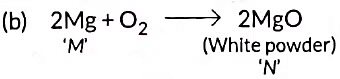
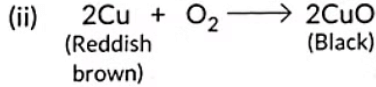
04. Previous Year Questions: Carbon & its Compounds – 1

Previous Year Questions 2025

Q1: A hydrocarbon which does not belong to the same homologous series of carbon compounds is:  (1 Mark)
(a)
 C₄H₁₀
(b) C₆H₁₄
(c) C₇H₁₄
(d) C₁₀H₂₂

Hide Answer  

Ans: (c) C₇H₁₄Alkanes have the general formula CₙH₂ₙ₊₂.

  • Option (a), (b),and (d) all are alkanes
    C₄H₁₀ , C₆H₁₄, C₁₀H₂₂→ fits CnH2n+2 (n=4 → H=10)
  • But C₇H₁₄ fits CnH2n, which is the general formula for alkenes, not alkanes.

Hence, C₇H₁₄ does not belong to the same homologous series as the others.


Q2: Choose the incorrect statement about the common reaction used in hydrogenation of vegetable oils:  (1 Mark)
(a)
 It is an addition reaction.
(b) It takes place in the presence of nickel or palladium catalyst.
(c) The product contains only single bonds between carbon atoms.
(d) It is an addition reaction which occurs in the presence of an acid catalyst.

Hide Answer  

Ans: (d) It is an addition reaction which occurs in the presence of an acid catalyst.

Hydrogenation of vegetable oils is an addition reaction that occurs in the presence of nickel or palladium catalyst, not an acid catalyst. Hence, statement (d) is incorrect.


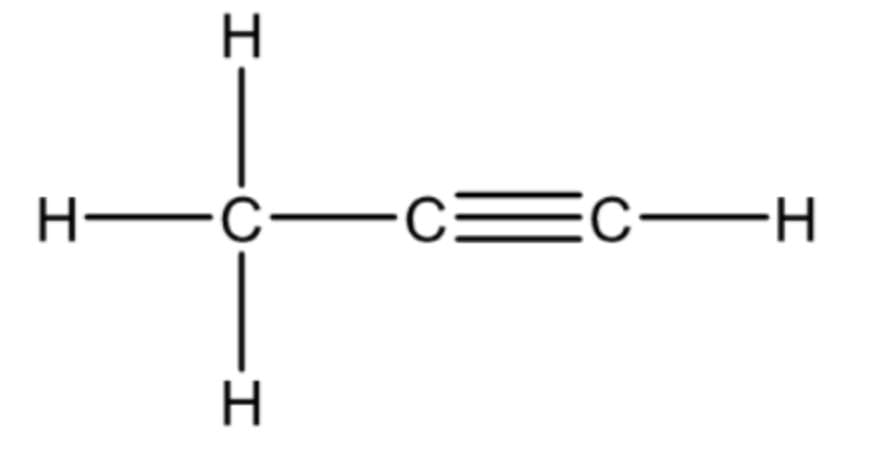
Q3: Select from the following a hydrocarbon having one C–C bond and one C ≡ C bond. (1 Mark)

(a) Benzene
(b) Cyclohexane
(c) Butyne
(d) Propyne

Hide Answer  

Ans: (d) Propyne

Propyne has one carbon–carbon single bond (C–C) and one carbon–carbon triple bond (C≡C).
Hence, it satisfies the given condition.Previous Year Questions 2025

Q4: Two statements are given — one labelled as Assertion (A) and the other labelled as Reason (R). Select the correct
answer to these questions from the codes (A), (B), (C) and (D) as given below.  
(1 Mark)

Assertion (A): Propanal and propanone are structural isomers.
Reason (R): Propanal and propanone both have the same molecular formula.

(A) Both Assertion (A) and Reason (R) are true and Reason (R) is the correct explanation of Assertion (A).
(B) Both Assertion (A) and Reason (R) are true, but Reason (R) is not the correct explanation of Assertion (A).
(C) Assertion (A) is true, but Reason (R) is false.
(D) Assertion (A) is false, but Reason (R) is true.

Hide Answer  

Ans: (A) Both Assertion (A) and Reason (R) are true and Reason (R) is the correct explanation of Assertion (A).
Propanal (CH₃CH₂CHO) and propanone (CH₃COCH₃) have the same molecular formula (C₃H₆O) but differ in structure — one is an aldehyde and the other a ketone.
Hence, they are structural isomers, and the reason correctly explains the assertion.


Q5: Two statements are given — one labelled as Assertion (A) and the other labelled as Reason (R). Select the correct
answer to these questions from the codes (A), (B), (C) and (D) as given below. (1 Mark)

Assertion (A): Carbon and its compounds are our major sources of fuels.
Reason (R): Most of the carbon compounds on burning release a large amount of heat and light.

(A) Both Assertion (A) and Reason (R) are true and Reason (R) is the correct explanation of Assertion (A).
(B) Both Assertion (A) and Reason (R) are true, but Reason (R) is not the correct explanation of Assertion (A).
(C) Assertion (A) is true, but Reason (R) is false.
(D) Assertion (A) is false, but Reason (R) is true.

Hide Answer  

Ans: (A) Both Assertion (A) and Reason (R) are true and Reason (R) is the correct explanation of Assertion (A).

Carbon and its compounds like coal, petroleum, and natural gas are major fuels because they release large amounts of heat and light on burning (combustion).
Thus, both statements are true, and the Reason correctly explains the Assertion.

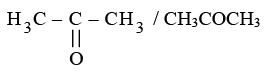
Q6: Select from the following the members of same homologous series:  (2 Marks)

Previous Year Questions 2025

Hide Answer  

Ans: (1) and (4)

  • (1) Propanal (CH₃CH₂CHO) and (4) Butanal (CH₃CH₂CH₂CHO) both contain the –CHO functional group (aldehyde group).
  • They differ by a –CH₂– unit, which is the defining feature of a homologous series.
  • (2) is an ketone (–O group) and (3) is a carboxylic acid (–COOH group), so they belong to different series.

Hence, (1) and (4) are members of the same homologous series — the aldehyde series.


Q7: A saturated organic compound ‘A’ with two carbon atoms belongs to the homologous series of alcohols. On oxidation, it forms an organic acid ‘B’ with molecular mass 60 u. On heating ‘A’ with excess concentrated sulphuric acid at 443 K, an unsaturated hydrocarbon ‘C’ is formed.
(i) Name A, B, and C.
(ii) Calculate molecular mass of C.
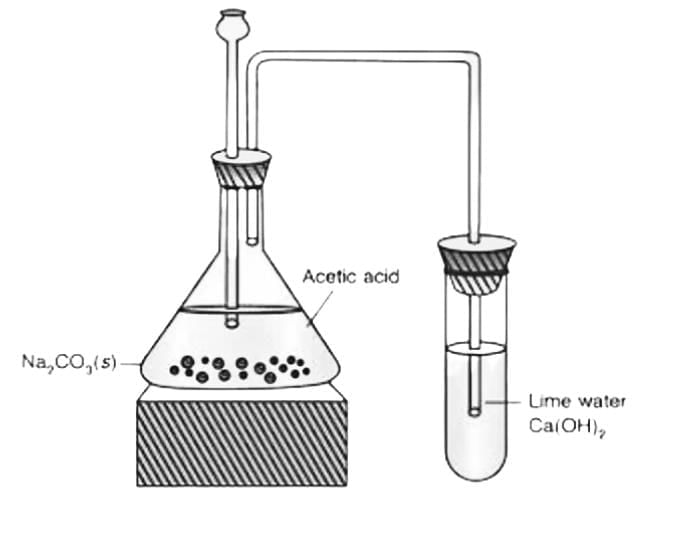
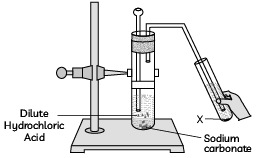
(iii) What happens when a pinch of sodium carbonate is added to compound B? Write chemical equation for the reaction.
(iv) Draw electron dot structure of compound B.  (5 Marks)

Hide Answer  

Ans: 
(i) 

A = Ethanol (CH₃CH₂OH) — a saturated two-carbon alcohol.

B = Ethanoic acid (CH₃COOH) — the organic acid formed on oxidation (molar mass 60 u).
Molar mass: 12×2 (C) +1×4 (H) +16×2 (O) =24+4+32=60 u
On heating ethanol with excess concentrated H2SO4 at 443 K, dehydration occurs forming ethene (C2H4)

Therefore, C = Ethene(CH₂=CH₂) — the unsaturated hydrocarbon formed on dehydration of ethanol.

(ii) Molecular Mass of  C₂H₄ → M = 2 × 12 + 4 × 1 = 28 u.
(iii) Ethanoic acid reacts with sodium carbonate to give sodium ethanoate, CO₂ and H₂O (effervescence of CO₂; CO₂ turns lime water milky). Balanced equationPrevious Year Questions 2025(iv) Electron Dot Structure of B (CH₃COOH):


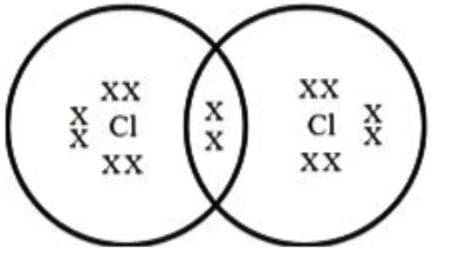
Q8: (i) Draw electron dot structure of chlorine molecule. (Atomic Number of Chlorine = 17)
(ii) What happens when chlorine reacts with methane in the presence of sunlight? Write the name of the reaction.
(iii) Name the two oxidising agents used for the conversion of alcohols to acids.
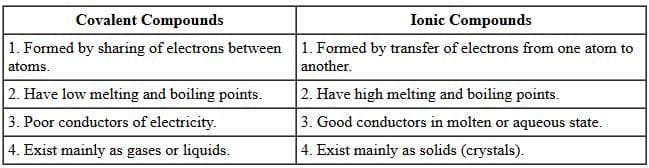
(iv) List four differences in properties between covalent compounds and ionic compounds. (5 Marks)

Hide Answer  

Ans:
(i) Cl₂ Structure: Previous Year Questions 2025

(ii) When chlorine reacts with methane (CH₄) in the presence of sunlight, hydrogen atoms in methane are replaced by chlorine atoms one by one, forming chloromethane (CH₃Cl) and hydrogen chloride (HCl).

Reaction:

Name of the reaction: Substitution reaction or photo-chemical reaction.

(iii) The two oxidising agents used are:

  • Alkaline potassium permanganate (KMnO₄)
  • Acidified potassium dichromate (K₂Cr₂O₇)


(iv) 
Previous Year Questions 2025


Q9: (i) A compound ‘X’ having two carbon atoms in its molecule turns blue litmus red, and a 5-8% solution of ‘X’ in water is widely used as a preservative. Identify the compound ‘X’ and write its structure. 
(ii) Compare its pH nature with a mineral acid.
(iii) ‘X’ on reacting with alcohols produces sweet smelling compounds, used in making perfumes. Name the reaction and write its chemical equation.
(iv) When sodium carbonate is added to ‘X’, a colourless gas is produced which turns lime water milky. Write the chemical equation for the reaction giving the name of the salt produced.  (5 marks)

Hide Answer  

Ans:
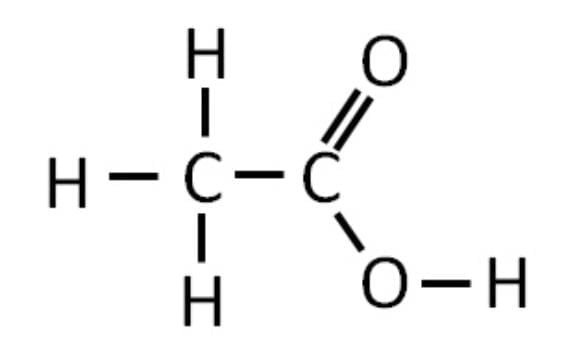
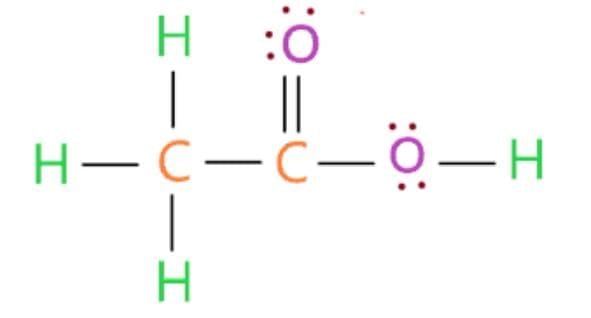
(i) X: Ethanoic acid (CH₃COOH), commonly called acetic acid or vinegar.

  • (Clues: 2 carbon atoms, turns blue litmus red, 5–8% aqueous solution used as preservative.)

Structure of CH₃COOH:  Previous Year Questions 2025
(ii) pH Comparison: Ethanoic acid (weak acid, pH ~3-4) is less acidic than mineral acids (e.g., HCl, pH ~1).
(iii)  

  • Reaction: Acetic acid + Alcohol → Ester + Water
  • This reaction is called esterification.

Example with ethanol:

The product CH₃COOC₂H₅ (ethyl acetate) has a sweet smell, used in perfumes.

(iv)  Reaction with sodium carbonate 

  • Reaction: Acetic acid + Sodium carbonate → Sodium acetate + Carbon dioxide + Water
  • CO₂ is the colorless gas which turns lime water milky.
  • Salt formed: Sodium acetate (CH₃COONa).


Q10: (a) Define the term “homologous series of carbon compounds”. Write a homologous series of compounds having functional group -CHO.
(b) Design an experiment to distinguish between an alcohol and a carboxylic acid. Also write chemical equation for that case in which reaction occurs.  (5 Marks)

Hide Answer  

Ans: 
(a) Homologous Series for –CHO (Aldehydes)
Definition:
homologous series is a family of compounds in which the same functional group is present and successive members differ by a –CH₂– unit. Members of a homologous series show similar chemical properties (because of the same functional group) and a gradation in physical properties with increasing molecular mass.

Aldehyde series (–CHO):
General formula: CₙH₂ₙO

Each member differs by a –CH₂– unit and has the same functional group (–CHO).

(b) Procedure:

  1. Take two small test tubes. Put a little of the unknown compound in each (or use labelled samples: one known alcohol and one known carboxylic acid for demonstration).
  2. Add a pinch (or a small spatula) of sodium carbonate (Na₂CO₃) to each test tube and observe.

Observation:

  • The carboxylic acid reacts with sodium carbonate to produce effervescence (bubbling) due to the evolution of carbon dioxide (CO₂) gas.
  • An alcohol does not produce CO₂ with sodium carbonate and therefore shows no effervescence.Previous Year Questions 2025

Chemical Equation:
General reaction of a carboxylic acid (RCOOH) with sodium carbonate:Previous Year Questions 2025

Example with ethanoic acid:Previous Year Questions 2025

Conclusion:
Effervescence (CO₂ evolution) — the sample is a carboxylic acid. No effervescence — the sample is an alcohol.


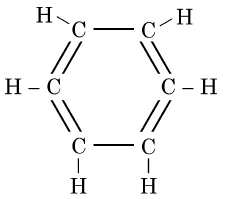
Q11: (a) Name two cyclic hydrocarbons and draw the structure of any one.
(b) Explain the process of micelle formation on adding soap in water.  (5 marks)

Hide Answer  

Ans: 
Cyclic Hydrocarbons: Cyclohexane, Benzene.

(a) Cyclohexane Structure:

C₆H₁₂ (six-carbon ring, single bonds)

(b) Benzene Structure:

 C₆H₆ (ring with alternating double bonds)

(c) Micelle formation

When soap is added to water, the soap molecules arrange themselves into spherical structures called micelles.

Each soap molecule has two ends:

  • hydrophobic tail (long hydrocarbon chain) that repels water but attaches to oil or grease.
  • hydrophilic head (ionic end) that dissolves in water.

In water, the hydrophobic tails surround and trap the oily dirt in the centre, while the hydrophilic heads remain outward in contact with water. This forms an emulsion of oil in water known as a micelle, which can then be easily rinsed away, cleaning the dirt.

Previous Year Questions 2025

Q12: (A) Name an alcohol and a carboxylic acid having two carbon atoms in their structures. Draw their structures and state how this alcohol can be converted into a carboxylic acid. What happens when these two compounds react in the presence of an acid? Write chemical equations for the reactions involved in the two cases mentioned above.  (5 Marks)

Hide Answer  

Ans: (A)

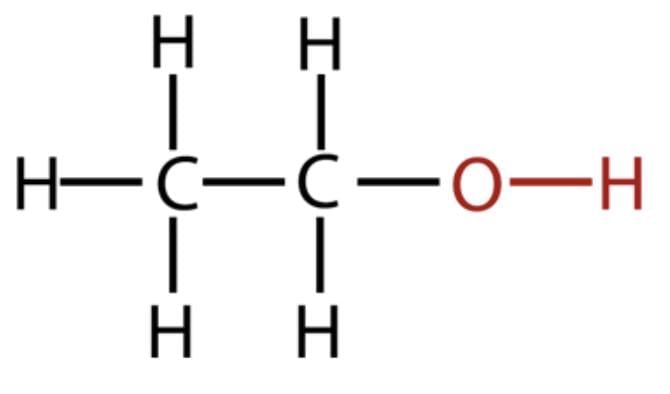
Alcohol: Ethanol (C₂H₅OH); Carboxylic Acid: Ethanoic acid (CH₃COOH).

Structures:

  • Ethanol: Previous Year Questions 2025
  • Ethanoic acid: Previous Year Questions 2025

Conversion of the alcohol into the carboxylic acid (oxidation) 

Ethanol is oxidised to ethanoic acid using an oxidising agent such as alkaline potassium permanganate (or acidified potassium dichromate) with heat:
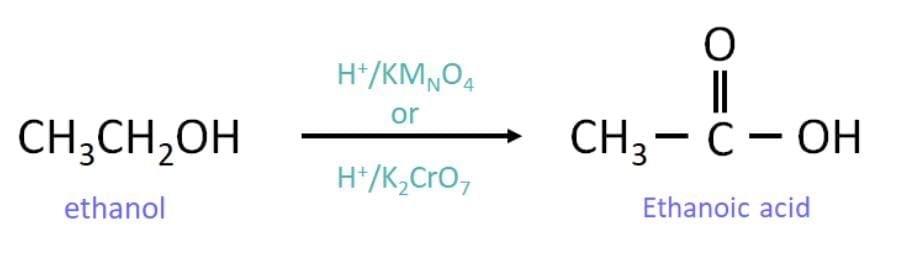
Previous Year Questions 2025Reaction between the alcohol and the acid in presence of an acid (esterification)
Ethanol reacts with ethanoic acid in the presence of an acid catalyst to give an ester (ethyl ethanoate) and water:Previous Year Questions 2025(Ester formed: ethyl ethanoate, a sweet-smelling compound used in perfumes and flavoring.)


Q13: The combining capacity of various elements depends on the number of valence electrons. Also the reactivity of elements is explained as their tendency to attain a completely filled outer shell, that is, to attain a noble gas configuration. This may be either through gain of electrons or loss of electrons or sharing of electrons. 

(a) An element A has atomic number 16, how will it attain its nearest noble gas configuration?
(b) Write the number of (i) single and (ii) double covalent bonds in a molecule of butene (C₄H₈).
(c) (A) Explain the formation of a molecule of ammonia (NH₃), using electron dot structure. (Atomic number of nitrogen is 7)

OR
(c) (B) Why does carbon share its valence electrons with other atoms of carbon or with atoms of other elements?  ( 4 Marks)

Hide Answer  

Ans:
(a) Element A has atomic number 16 → electron configuration 2, 8, 6 (valence = 6).
To attain the nearest noble-gas configuration (argon, with 8 in outer shell) it will gain 2 electrons to form the S²⁻ ion (or equivalently share electrons to complete its octet).
(b) Butene (C₄H₈): One C=C double bond and the rest single bonds).

  • C–H single bonds: 8
  • C–C single bonds: 2 (there are 3 C–C connections total, one of them is the double bond)
    So total single covalent bonds = 8 + 2 = 10.
  • Double covalent bonds = 1 (one C=C).

Previous Year Questions 2025(c) (A) NH₃ Formation:

Nitrogen (atomic no. 7) has 5 valence electrons. It needs 3 more electrons to complete its octet. Each hydrogen brings 1 electron; three H atoms share their electrons with N to form three N–H single covalent bonds. Nitrogen also retains one lone pair.
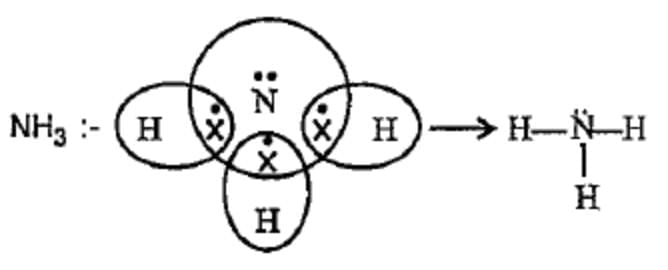
Previous Year Questions 2025OR 
(c) (B) Carbon has 4 valence electrons; losing 4 electrons or gaining 4 electrons is energetically unfavourable. So carbon shares its four valence electrons with other atoms (including other carbon atoms) to attain a filled outer shell (noble-gas configuration). Sharing also allows strong C–C bonds (catenation), giving stable chains, rings and many compounds.

Previous Year Questions 2024

Q1: Carbon compounds:
(i) are good conductors of electricity.
(ii) are bad conductors of electricity.
(iii) have strong forces of attraction between their molecules.
(iv) have weak forces of attraction between their molecules.
The correct statements are:    (1 Mark) (2024)
(a) 
(i) and (ii)
(b) (ii) and (iii)
(c) (ii) and (iv)
(d) (i) and (iii)

Hide Answer  

Ans: (c)

The correct answer is (c) because carbon compounds generally do not conduct electricity well (bad conductors), and they have weak forces of attraction between their molecules, which means the molecules can move around easily. This explains why carbon compounds often exist as gases or liquids rather than solids.


Q2: (A) (i) Define a homologous series of carbon compounds.
(ii) Why is the melting and boiling points of C4H8 higher than that of C3H6 or C2H4?
(iii) Why do we NOT see any gradation in the chemical properties of homologous series compounds?
(iv) Write the name and structures of (i) aldehyde and (ii) ketone with molecular form C3H6O.
OR
(B) (i) Write the name and structure of an organic compound ‘X’ having two carbon atoms in its molecule and its name is suffixed with ‘-ol’.
(ii) What happens when ‘X’ is heated with excess concentrated sulphuric acid at 443 K? Write the chemical equation for the reaction stating the conditions for the reaction. Also, state the role played by concentrated sulphuric acid in the reaction.
(iii) Name and draw the electron dot structure of the hydrocarbon produced in the above reaction.   (4 to 5 Marks) (2024)

Hide Answer  

Ans: (A) (i) A homologous series is a group of carbon compounds where each member differs from the next by a CH2 unit. They share the same functional group and exhibit similar chemical properties.
(ii) The melting and boiling points of C4H8 are higher than those of C3H6 or C2H4 because these points increase with molecular mass.
(iii) There is no gradation in the chemical properties of compounds in a homologous series because their properties are determined solely by their functional group, which remains constant.
(iv) (i) Aldehyde: Propanal
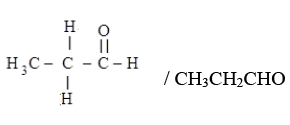
Previous Year Questions 2024
(ii) Ketone: Propanone
Previous Year Questions 2024
OR
(B) (i) The organic compound X with two carbon atoms and the suffix -ol is Ethanol.
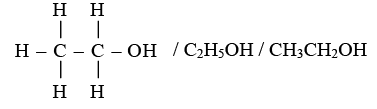
Previous Year Questions 2024
(ii) When X is heated with excess concentrated sulphuric acid at 443 K, it undergoes dehydration to form ethene. The reaction can be represented as:

Previous Year Questions 2024


(iii)The hydrocarbon produced in the reaction is ethene.
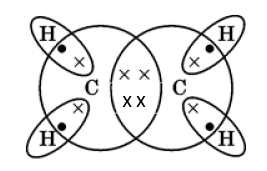
Previous Year Questions 2024


Q3: Consider the following statements about homologous series of carbon compounds :
(A) All succeeding members differ by — CH2 unit.
(B) Melting point and boiling point increases with increasing molecular mass.
(C) The difference in molecular masses between two successive members is 16 u.
(D) C2H2 and C3H4 are NOT the successive members of alkyne series.
The correct statements are —   (1 Mark) (2024)
(a)
 (A) and (B)
(b) (B) and (C)
(c) (A) and (C)
(d) (C) and (D)

Hide Answer  

Ans: (a)
In a homologous series of carbon compounds, like alkanes or alkynes, each member differs from the next by a specific group of atoms (—CH2), which is explained in statement (A). As the size of the molecules increases (more carbon and hydrogen atoms), their melting and boiling points also generally increase, as stated in (B). Thus, both (A) and (B) are correct, making option (a) the right answer.


Q4: (a) (i) Give reason why carbon can neither form C4+ cations nor C4- anions but form covalent compounds.
(ii) What is homologous series of carbon compound? Write the molecular formula of any two consecutive members of homologous series of aldehydes.
(iii) Draw the structure of the molecule of cyclohexane (C6H12).
OR
(b) (i) Name a commercially important carbon compound having functional group —OH and write its molecular formula.
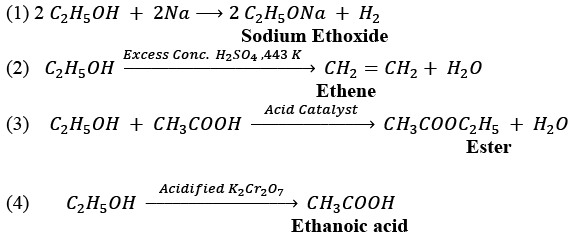
(ii) Write chemical equation to show its reaction with
(1) Sodium metal
(2) Excess cone, sulphuric acid
(3) Ethanoic acid in the presence of an acid catalyst
(4) Acidified potassium dichromate
Also write the name of the product formed in each case.    (4 to 5 Marks) (2024)

Hide Answer  

Ans: (a) (i) Carbon cannot form C4+ cations because removal of 4 electrons from a carbon atom would require a large amount of energy and it cannot form C4- anion because it would be difficult for the nucleus with 6 protons to hold 10 electrons.
Thus it shares electrons to form covalent compounds.
(ii) A homologous series is a group of compounds that share the same functional group, with each member differing by a specific number of CH2 units. For example, the molecular formulas of two consecutive members of the aldehyde series are:

  • CH3CHO (Ethanal)
  • C2H5CHO (Butanal)

(iii)Structure of cyclohexane (C6H12)
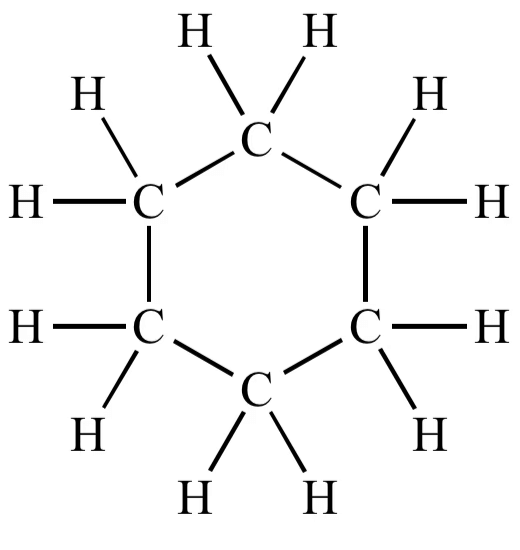
Previous Year Questions 2024OR
(b) (i)  A commercially important carbon compound with the functional group —OH is Ethanol with the molecular formula C2H5OH.
(ii)
Previous Year Questions 2024
NOTE: Name of the product for each reaction is given in bold letters under the reaction.


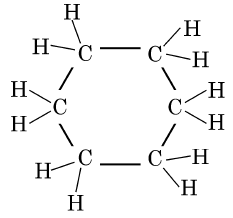
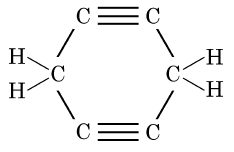
Q5: The structural formula of Cyclohexane is   (1 Mark) (CBSE 2024)
(a) 
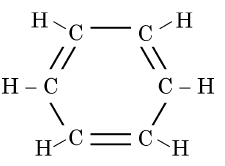
Previous Year Questions 2024
(b) Previous Year Questions 2024
(c) Previous Year Questions 2024
(d) Previous Year Questions 2024

Hide Answer  

Ans: (b)
The correct structural formula for cyclohexane is shown in option (b). Cyclohexane, C6H12 , is a cyclic hydrocarbon with a six-membered ring structure, where each carbon atom is bonded to two other carbon atoms and two hydrogen atoms. This configuration ensures all carbon-carbon bonds are single, fitting the description and structure in option (b).


Q6: Which one of the following hydrocarbons is different from the others?   (1 Mark) (2024)
(a) 
C4H10
(b) C7H14
(c) C5H12
(d) C2H6

Hide Answer  

Ans: (b)

  • The hydrocarbons C4H10 (butane), C5H12 (pentane), and C2H6 (ethane) are all alkanes, which are saturated hydrocarbons containing only single bonds.
  • However, C7H14 is an alkene, which has at least one double bond.
  • Therefore, option (b) is different from the others.


Q7: More than three million carbon compounds have been discovered in the field of chemistry. The diversity of these compounds is due to the capacity of carbon atoms for bonding with one another as well as with other atoms. Most of the carbon compounds are poor conductors of electricity and have low melting and boiling points.
(a) Write the molecular formula of first two members of homologous series having functional group —Br.
(b) Given below are the formulae of some functional groups :

Previous Year Questions 2024

Write the name of these functional groups.
(c) What would be observed on adding a 5% alkaline potassium permanganate drop by drop to some warm ethanol taken in a test tube? State the role of KMn04 in the reaction and write the chemical equation for the reaction involved.
OR
(c) Write the name of the compound formed when ethanol is heated at 443 K temperature with excess of cone. H2S04. What is the role of cone. H2S04 in the reaction? Write the chemical equation for the reaction involved.   (4 to 5 Marks) (2024)

Hide Answer  

Ans: (a) The first two members of homologous series having functional group —Br. are CH3Br, C2H5Br
(b) (i) Aldehyde (ii) Ketone
(c) When a 5% alkaline potassium permanganate solution is added drop by drop to warm ethanol in a test tube, the following is observed:

The purple colour of potassium permanganate fades, indicating a reaction.

The role of KMnO4 in this reaction is as an oxidising agent.


Previous Year Questions 2024
OR
(c) When ethanol is heated at 443 K with excess concentrated H2SO4, the compound formed is Ethene. 

The role of concentrated H2SO4 is as a dehydrating agent. 
The chemical equation for this reaction is:

Previous Year Questions 2024


Q8: The number of single and double bonds present in a molecule of benzene (C6H6) respectively, are: (1 Mark) (2024)
(a)
 6 and 6  
(b) 9 and 3
(c) 3 and 9
(d) 3 and 3

Hide Answer  

Ans: (b)

Six single bonds between Carbons and Hydrogens, three single bonds between six Carbons and Hydrogens ( alternatively) . Three double bonds present between carbons ( alternatively in hexagonal ring). So a total of nine single bonds, three double bonds are present in benzene ring.


Q9: The melting and boiling points of carbon compounds are generally low and they are largely non-conductors of electricity. State two conclusions based on these two properties.   (2 Marks) (2024)

Hide Answer  

Ans: 

(i) Low melting points and boiling points – Weak intermolecular forces of attraction.
(ii) Non-conductors of electricity – Bonding in these compounds does not give rise to any ions. / Covalent bonds or sharing of electrons do not form any charged particles.


Q10: Case-based/data-based questions with 3 short  sub-parts. Internal choice is provided in one of these sub-parts.  
Carbon is a versatile element that forms the basis of all living organisms and many of the things we use. A large variety of compounds is formed because of its tetravalency. Compounds of carbon are formed with oxygen, hydrogen, nitrogen, sulphur, chlorine and many other elements.
Answer the following questions:  
(a) What are hydrocarbons?
(b) List two properties by virtue of which carbon can form a large number of compounds.

(c) (i) Write the formula of the functional group present in
(1) aldehydes, and (2) ketones. Write chemical equation for the reaction that occurs between ethanoic acid and ethanol in the presence of a catalyst.
OR
(c) (ii) What are structural isomers ? Write the structures of two isomers of butane (C4H10).   (4 to 5 Marks) (2024)

Hide Answer  

Ans: (a) Hydrocarbons are compounds made up of carbon and hydrogen only.
(b) Two key properties that allow carbon to form a vast number of compounds are:

  • Tetravalency: Carbon can form four covalent bonds.
  • Catenation: Carbon atoms can bond with each other to form long chains.


(c) (i)Previous Year Questions 2024
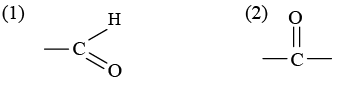
Previous Year Questions 2024
(c) (ii)  Structural isomers are compounds that have the same molecular formula but different structures. Two isomers of butane (C₄H₁₀) are:
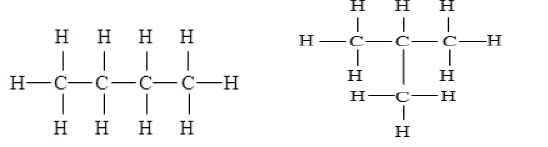
Previous Year Questions 2024


Q11: Distinguish between a saturated and an unsaturated hydrocarbon by flame test. List the products of combustion reaction of a saturated hydrocarbon.     (2 Marks) (2024)

Hide Answer  

Ans:
Previous Year Questions 2024

The products of the combustion reaction of a saturated hydrocarbon are:

  • Carbon dioxide (CO2)
  • Water (H2O)


Q12: Why is the conversion of ethanol to ethanoic acid an oxidation reaction? Name the oxidising agent used in this conversion. Write chemical equation for this oxidation reaction. How is this reaction different from the reaction in which ethanol burns in the presence of oxygen?      (3 Marks) (2024)

Hide Answer  

Ans:

(i) Oxygen is added to ethanol to produce ethanoic acid. 

(ii) Alkaline potassium permanganate or Acidified potassium dichromate

(iii)Previous Year Questions 2024

(iv) It is oxidation reaction while other is combustion reaction/ burning of ethanol is exothermic while other is endothermic.

Previous Year Questions 2023

Q1: Explain why carbon forms compounds mainly by covalent bonds. Explain in brief two main reasons for carbon forming a large number of compounds. Why does carbon form strong bonds with most other elements?    (5 Marks) (2023)

Hide Answer  

Ans: As carbon has four valence electrons and it can neither loose nor gain four electrons thus, it attains noble gas configuration only by sharing of electrons. Thus, it forms covalent compounds. The existence of large number of compounds is due to some unique properties of carbon which are:
(i) Catenation: Carbon atoms possess an unique property to link together to form very long chains. This property is referred to as catenation.
A large number of carbon atoms can join together to form straight chains, branched chains and rings as shown below:
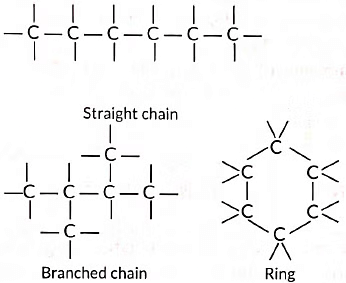
Previous Year Questions 2023

(ii) Tetravalency: Due to small size and presence of four valence electrons, a carbon atom can form multiple bonds with some other carbon atoms as well as with other atoms like oxygen, nitrogen etc., This increases the variety of compounds formed by it and hence the number of compounds is tremendously increased.

Previous Year Questions 2023Due to small size, the nucleus of carbon atom can hold its shared pairs of electrons strongly. As a result, the bonds that carbon forms with most of the other elements such as hydrogen, oxygen, nitrogen, etc. are very strong there by making these compounds exceptionally stable.


Q2: (i) Draw two structural isomers of butane.
(ii) Draw the structures of propanol and propanone.
(iii) Name the third homologue of:
(a) alcohols
(b) aldehydes
(iv) Name the following:

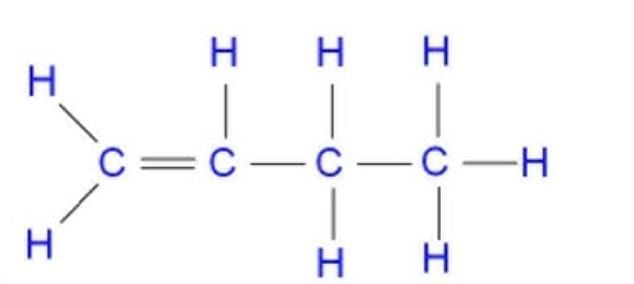
(b) CH– CH2CH = CH2
(v) Show the covalent bond formation in nitrogen molecule. (5 Marks) (2023)

Hide Answer  

Ans: (i) Structural isomers of butane are the following:
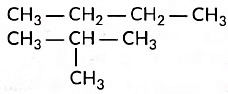
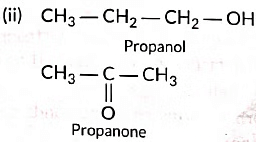
Previous Year Questions 2023
(iii) (a) Three homologue of alcohol are the following:CH3OH, CH3CH2OH, CH3CH2CH2OH
Third homologue of alcohol is CH3CH2CH2OH
(b) Three homologue of aldehyde are the following:
HCHO, CH3CHO, CH3CH,CHO
Third homologue of aldehyde is CH3CH2CHO.
(iv) (a) Benzene (b) But-1-ene
(v) Z = 7, Previous Year Questions 2023Previous Year Questions 2023


Q3: Write the chemical equation for the following:
(i) Combustion of methane
(ii) Oxidation of ethan
(iii) Hydrogenation of ethene
(iv) Esterification reaction
(v) Saponification reaction
     (5 Marks) (2023)

Hide Answer  

Ans: (i) The process in which compounds of carbon react with oxygen to give carbon dioxide, water, heat and light, is known as combustion. Alkanes burn in air and release large amount of heat, therefore can be used as excellent fuels.
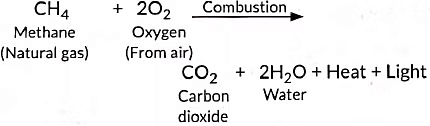
Previous Year Questions 2023
(ii) Oxidation is a process in which oxygen is added to a substance.

Previous Year Questions 2023
(iii) Hydrogenation means addition of hydrogen to an unsaturated compound.

Previous Year Questions 2023
(iv) When alcohol is added to carboxylic acid in the presence of acid catalyst then, a fruity smelling ester is formed. This process is called esterification.

Previous Year Questions 2023
(v) Esters react in the presence of an acid or a base to give the alcohol and carboxylic acid. This reaction is known as saponification because it is used in the preparation of soap.

Previous Year Questions 2023


Q4: Consider the structures of the three cyclic carbon compounds (I), (II) and (III) given below and select the correct option from the following: 

(a) (I) and (III) are isomers of hexane and (II) is benzene.
(b) (I) is an isomer of hexane, (II) is benzene and (III) is an isomer of hexene. 
(c) (I) is a saturated cyclic hydrocarbon and (II) and (III) are unsaturated cyclic hydrocarbons. 
(d) (I) is cyclohexane and (II) and (III) are the isomers of benzene.  (1 Mark) (CBSE 2023)

Hide Answer  

Ans: (c)
Structure (I) is cyclohexane, a saturated cyclic hydrocarbon with single bonds between all the carbon atoms.
Structure (II) is benzene, an unsaturated cyclic hydrocarbon with alternating double bonds, giving it aromatic stability.
Structure (III) is cyclohexene, an unsaturated cyclic hydrocarbon with one double bond.
Thus, (I) is a saturated cyclic hydrocarbon, and (II) and (III) are unsaturated cyclic hydrocarbons, making (c) the correct answer.


Q5: A saturated organic compound ‘A’ belongs to the homologous series of alcohols. On heating ‘A’ with concentrated sulphuric acid at 443 K, it forms an unsaturated compound ‘B’ with molecular mass 28 u. The compound ‘B’ on addition of one mole of hydrogen in the presence of Nickel, changes to a saturated hydrocarbon ‘C’.  
(A) Identify A, B and C. 
(B) Write the chemical equations showing the conversion of A into B. 
(C) What happens when compound C undergoes combustion? 
(D) State one industrial application of hydrogenation reaction. 
(E) Name the products formed when compound A reacts with sodium. (4 to 5 Marks) (CBSE 2023)

Hide Answer  

Ans: (A) Ethanol (C2H5OH) belongs to alcohol’s homologous series. 
A- Ethanol (C2H5OH) 
B- Ethene (C2H4
C- Ethane (C2H6
(B) Dehydration occurs when ethanol is heated with concentrated sulphuric acid at 443 K, resulting in the formation of ethene Concentrated sulphuric acid serves as a dehydrating agent in this reaction.

Previous Year Questions 2023(C) Compound C is ethane. When it undergoes combustion, it forms COand water.
Previous Year Questions 2023(D) Hydrogenation reactions are used in the production of saturated vegetable ghee from unsaturated vegetable oils. 
(E) Sodium ethoxide is formed when ethanol (C2H5OH) reacts with sodium (Na). The reaction is as follows:

Previous Year Questions 2023

Get additional INR 200 off today with EDUREV200 coupon.Avail Offer

Previous Year Questions 2022

Q1: Carbon forms compounds mainly by covalent bonding. Why ? (Term II, 2021-22 C)

Hide Answer  

Ans: Carbon forms compounds mainly by covalent bonding.Carbon primarily forms covalent compounds due to its unique electronic structure:

  • Carbon has four electrons in its outer shell, making it challenging to gain or lose electrons to achieve a stable octet.
  • To attain a stable configuration, carbon shares its valence electrons with other atoms, either with other carbon atoms or different elements.

This ability to share electrons leads to the formation of a vast number of compounds, including:

  • Catenation: Carbon can bond with itself, creating long chains, branched structures, or rings.
  • Strong bonds: The small size of carbon allows for strong interactions with shared electrons, resulting in stable compounds.

Overall, carbon’s unique properties enable it to form a diverse range of stable covalent compounds.


Q2: (a) Write the molecular formula of the following carbon compounds : 
(i) Methane 
(ii) Propane
(b) Carbon compounds have low melting and boiling points. Why? (Term II, 2021-22)

Hide Answer  

Ans: (a) (i) Methane (CH4)
(ii) Propane (CH3CH2CH3) or C3H8
(b) Due to weak intermolecular forces of attraction, covalent compounds generally have low melting and boiling points.


Q3: Covalent compounds have low melting and boiling points. Why?   (2022)

Hide Answer  

Ans:  Covalent compounds have low melting and boiling points due to the following reasons:

  • The forces of attraction between the molecules are very weak.
  • A small amount of heat can easily break these molecular forces.
  • This results in low melting and boiling points compared to other types of compounds.

Previous Year Questions 2021

Q1: Write the name of an allotrope of carbon. (2021C)

Hide Answer  

Ans: Diamond is a well-known allotrope of carbon.


Q2: “Carbon prefers to share its valence electrons with other atoms of carbon or with atoms of other elements rather than gaining or losing the valence electrons in order to attain noble gas configuration.” Give reasons to justify this statement. (Term II, 2021)

Hide Answer  

Ans: Carbon prefers to share its valence electrons with other atoms of carbon or with atoms of other elements rather than gaining or losing the valence electrons in order to attain noble gas configuration. Carbon has an atomic number of 6, meaning it has four electrons in its outer shell. Here are the reasons why it prefers sharing electrons:

  • If carbon were to gain four electrons, it would form a C4- anion. This would create strong repulsions among the eight electrons in the valence shell, making it hard for the nucleus to hold onto ten electrons.
  • If it lost four electrons, it would create a C4+ cation. This process requires a significant amount of energy, as the nucleus would then only hold onto two electrons.

To overcome these challenges, carbon shares its valence electrons with other atoms. This sharing leads to the formation of a covalent bond, allowing both atoms to achieve a stable noble gas configuration.


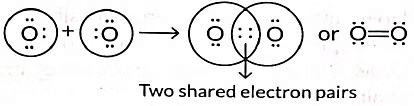
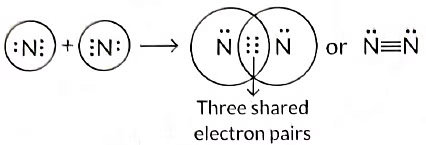
Q3: Draw the electron dot structure of the molecules of (a) Oxygen, and (b) Nitrogen. The atomic numbers of oxygen and nitrogen are 8 and 7 respectively.  (Term II, 2021-22 C)

Hide Answer  

Ans: (a) Formation of oxygen molecule:
Previous Year Questions 2021

(b) Formation of nitrogen molecule:
Previous Year Questions 2021


Q4: Carbon forms compounds mainly by covalent bonding. Why?   (Term II, 2021-22 C)

Hide Answer  

Ans: Carbon can form only covalent compounds because carbon can neither gain nor lose four electrons to acquire stable octet. The only way by which it can acquire the nearest noble gas configuration is by sharing its valence electrons with other C-atoms or atoms of other elements. Hence, carbon forms compounds mainly by covalent bonding.


Q5: State the reason why
(i) carbon compounds have low melting and boiling points.
(ii) carbon compounds do not conduct electricity.
(iii) carbon can form only covalent compounds.   (Term II, 2021-22)

Hide Answer  

Ans: (i)  Carbon compounds typically have low melting and boiling points because:

  • They are held together by weak intermolecular forces.
  • This weak attraction results in lower energy requirements to change states.

(ii) Carbon compounds do not contain ions and hence, are generally poor conductors of electricity.
(iii) Carbon can form only covalent compounds because carbon can neither gain nor lose four electrons to acquire stable octet. The only way by which it can acquire the nearest noble gas configuration is by sharing its valence electrons with other C-atoms or atoms of other elements.


Q6: (a) Draw the electron dot structure for ethyne.   (Term II, 2021-22)
(b) List two differences between the properties exhibited by covalent compounds and ionic compounds.

Hide Answer  

Ans: 

(b) 


Q7: (a) Write the molecular formula of the following carbon compounds: 
(i) Methane 
(ii) Propane
(b) Carbon compounds have low melting and boiling points. Why? (Term II, 2021-22)

Hide Answer  

Ans: (a) (i) Methane (CH4)
(ii) Propane (CH3CH2CH3) or C3H8
(b) Due to weak intermolecular forces of attraction, covalent compounds generally have low melting and boiling points.


Q8: Consider the carbon compounds having following molecular formula:
(i) C3H6
(ii) C3H8
(iii) C4H6
(iv) C6H6
(v) C6H12
(a) State the number of double covalent bonds present in C3H6.
(b) Write the formula of first member of the homologous series to which the carbon compound C4H6 belongs.
(c) Which one of the above compounds forms ring structure of carbon atoms?
(d) Identify, which of the above compounds, is a member of alkane series. (Term II, 2021-22)

Hide Answer  

Ans: (a) C3H6(or CnH2n, n = 3) i.e, alkene series thus, has one double covalent bond.
(b) C4H6 (or CnH2n-2, n = 4) i.e., alkyne series.
The first member of alkyne series is ethyne (C2H2) HC ≡ CH.
(c) C6H12 can form ring structure of C-atoms.
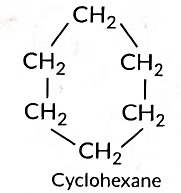
Previous Year Questions 2021
(d) Alkane series: Cn H2n+2
Only C3H8 is a member of alkane series CH3 — CH2 — CH3


Q9:  The molecular formulae of two alkynes, A and B are CxH2 and C3Hy respectively.
(a) Find the values of x and y.
(b) Write the names of A and B. (Term II, 2021-22)

Hide Answer  

Ans: (a) General formula of alkyne CnH2n – 2
For CxH2, 2n – 2 = 2 ⇒ n = 2 ∴ x = 2.
For C3Hy, n = 3, y = 2n – 2 = 2 x 3 – 2 = 4
Hence, x = 2, y = 4
(b) A is ethyne (C2H2) and B is propyne (C3H4).


Q10: What is a homologous series? Find the difference in molecular mass between the two consecutive members of a homologous series. State how in a homologous series of carbon compounds the following properties vary with increase in molecular mass:   (Term II, 2021-22)
(i) Melting and boiling points
(ii) Chemical properties

Hide Answer  

Ans: A homologous series is the family of organic compounds having the same functional group, similar chemical properties but the successive (adjacent members of the series differ by a —CH2 unit or 14 mass units.
(i) As the molecular mass increases in a homologous series, melting and boiling points also increases.
(ii) Chemical properties remains same for the members of homologous series because they all have same functional group.


Q11: Draw two different possible structures of a saturated hydrocarbon having four carbon atoms in its molecule. What are these two structures of the hydrocarbon having same molecular formula called? Write the molecular formula and the common name of this compound. Also write the molecular formula of its alkyne.   (Term II, 2021-22)

Hide Answer  

Ans: 

These are called structural isomers as they have the same molecular formula i.e., C4H10 but different structures. As the molecular formula is C4H10, common name of this compound is butane. The alkyne of four carbon atoms is butyne. Its structure i is as follows:
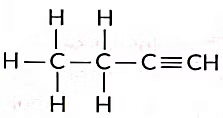
Previous Year Questions 2021
The molecular formula of butyne is C4H6.


Q12: (i) Write the molecular formula of benzene and draw its structure.
(ii) Write the number of single and double covalent bonds present in a molecule of benzene.
(iii) Which compounds are called alkynes?  (Term II, 2021-22)

Hide Answer  

Ans: (i) Molecular formula of benzene is C6H6.
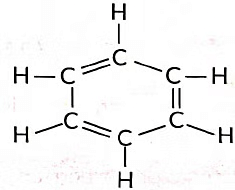
Previous Year Questions 2021

(ii) Number of single bonds = 9
Number of double bonds = 3
(iii) Alkynes are the unsaturated hydrocarbons that contain at least one triple bond between two carbon atoms (—C ≡ C—)


Q13: Consider the following organic compounds:
(i) 

(a) Name the functional group present in these compounds.
(b) Write the general formula for the compounds of this functional group.
(c) State the relationship between these compounds and draw the structure of any other compound having similar functional group   (Term II, 2021-22)

Hide Answer  

Ans: (a) Aldehyde (—CHO) group.
(b) CnH2nO
(c) Compound (i) is propanal, and compound (ii) is ethanal. They belong to the same homologous series where each successive compound differs from each other by a—CH2 unit.
Other member of same homologous series:
Previous Year Questions 2021

Also read: Previous Year Questions: Carbon & its Compounds – 2

Previous Year Questions 2020

Q1: How are covalent bonds formed? (2020)

Hide Answer  

Ans:  Covalent bonds are formed when two atoms share a pair of electrons. This sharing allows both atoms to achieve a stable electronic configuration, similar to that of noble gases.

  • The shared electrons belong to the outermost shells of the atoms.
  • Covalently bonded molecules have strong bonds within the molecule.
  • However, the forces between these molecules (intermolecular forces) are generally weak.


Q2: Covalent compounds are generally poor conductors of electricity. Why? (2020)

Hide Answer  

Ans: Covalent compounds are generally poor conductors of electricity due to the following reasons:

  • Covalent compounds do not contain ions.
  • They consist of atoms that share electrons, rather than transferring them.
  • This lack of charged particles means they cannot conduct electricity effectively.


Q3: Name a cyclic unsaturated carbon compound. (2020)

Hide Answer  

Ans: A cyclic unsaturated carbon compound is a compound that contains a carbon ring with one or more double or triple bonds between the carbon atoms. An example of a cyclic unsaturated carbon compound is benzene, which has a ring of six carbon atoms with alternating double bonds.


Q4: Carbon, a member of group 14, forms a large number of carbon compounds estimated to be about three million. Why is this property not exhibited by other elements of this group? Explain. (2020)

Hide Answer  

Ans:  Carbon is unique among group 14 elements due to its ability to form a vast number of compounds, estimated at around three million. This is primarily because of two key properties:

  • Catenation: Carbon can bond with itself, creating long chains, branched structures, or rings. This allows for the formation of large molecules.
  • Bond Strength: Carbon forms strong bonds with other elements, including single, double, and triple bonds. This stability is due to its small size, which allows the nucleus to hold onto shared electrons effectively.

In contrast, other elements in this group, like silicon, can form fewer and less stable compounds. Their bond energies decrease as you move down the group, leading to limited catenation.


Q5: 3 mL of ethanol is taken in a test tube and warmed gently in a water bath. A 5% solution of alkaline potassium permanganate is added first drop by drop to this solution, then in excess.
(i) How is 5% solution of KMnO4 prepared?
(ii) State the role of alkaline potassium permanganate in this reaction. What happens on adding it in excess?

(iii) Write chemical equation of this reaction. (2020)

Hide Answer  

Ans: (i) 5% solution of KMnO4 is prepared by adding 5 g of KMnO4 in 95 g of water.
(ii) Here alkaline KMnO4 acts as an oxidising agent. It oxidises ethanol to ethanoic acid by donating nascent oxygen. If excess of KMnO4 is added the purple colour will persist indicating no more alcohol is left and reaction stops.
(iii) Previous Year Questions 2020


Q6: (a) Define isomerism. Draw all possible isomers of butane.
(b) “A compound ‘X’ on combustion gives a yellow flame with lots of smoke.” What inference would you draw from this statement ?
(c) State the role of alkaline KMnO4 in the reaction involving conversion of an alcohol to corresponding carboxylic acid. (2020)

Hide Answer  

Ans: (a) Isomers are those molecules which have the same molecular formula but different structural formulae i.e., show different properties and the phenomenon is called isomerism. The structures of possible isomers of butane (C4H10) are:
Previous Year Questions 2020(b) The compound ‘X’ is likely an unsaturated compound (such as an alkene or alkyne) that burns in air, producing a yellow, sooty flame with significant smoke.
(c) Alkaline KMnO4 acts as an oxidising agent which oxidise alcohol (—OH) to corresponding carboxylic acid (—COOH).


Q7: (a) What is a homologous series? Explain with an example.
(b) Define the following terms giving one example of each.
(i) Esterification
(ii) Addition reaction   (2020)

Hide Answer  

Ans: (a) A homologous series is a group of organic compounds that share the same functional group and have similar chemical properties. Each successive member of the series differs by a -CH2– unit or 14 mass units.

  • The alkane series, for example, has the general formula CnH2n+2.
  • The first member is methane (CH4).
  • The second member is ethane (C2H6).
  • The third member is propane (C3H8).

(b) (i) Carboxylic acids react with alcohols in the presence of a little concentrated sulphuric acid to form pleasant smelling esters. This reaction is called esterification reaction.

Previous Year Questions 2020
(ii) Those reactions in which atoms or group of atoms are simply added to a double or triple bond without the elimination of any atom or molecule, are known as addition reactions.
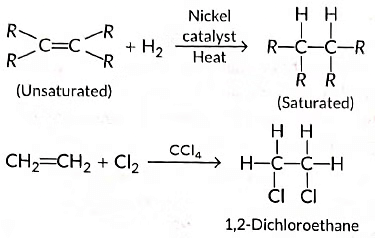
Previous Year Questions 2020


Q8: (a) Carry out following conversions:
(i) Ethanol to ethene
(ii) Ethanol to ethanoic acid
(b) Differentiate between addition reaction and substitution reaction. Give one example of each.    (2020)

Hide Answer  

Ans: (a) (i) When ethanol is heated with cone. H2SO4 at 443 K, ethene is obtained due to dehydration of ethanol.
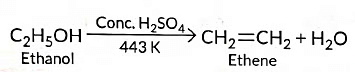
Previous Year Questions 2020
(ii) When 5 % alkaline KMn04 solution is added drop by drop to warm ethanol then it gets oxidised to ethanoic acid.

Previous Year Questions 2020
(b) Addition reactions: Those reactions in which atoms or group of atoms are simply added to a double or triple bond without the elimination of any atom or molecule, are known as addition reactions.
Substitution reactions: The reactions which involve the displacement or substitution of an atom or a group of atoms in an organic compound by another atom or group of atoms, are known as substitution reactions. Saturated hydrocarbons are fairly unreactive and inert in the presence of most of the reagents. However, in presence of sunlight, hydrocarbons undergo rapid substitution reactions. e.g.,
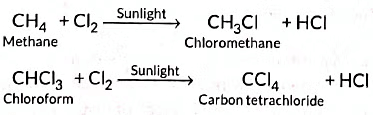
Previous Year Questions 2020


Q9: (a) A compound ‘X’ undergoes addition reaction with H2 to form a compound Y having molecular mass 30 g mol-1. ‘X’ decolorises bromine water and burns with a smoky flame. Identify ‘X’ and Y and write chemical equations of the reactions involved.
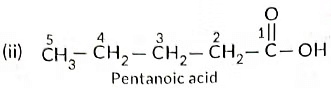
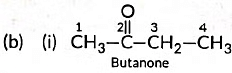
(b) Write the structural formulae of (i) Butanone, and (ii) Pentanoic acid.
(c) Would you be able to check if water is hard by using a detergent ? Give reason to justify your answer.    (2020 C)

Hide Answer  

Ans: (a) As the molecular mass of Y is 30 g mol-1, it is ethane (C2H6 = 12 x 2 + 6 x 1 = 30).
‘X’ is ethene (CH2 = CH2) which decolourises Br2  water and burns with a smoky flame.
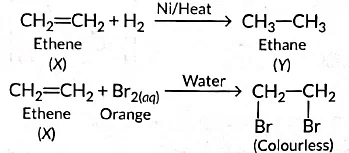
Previous Year Questions 2020
(c)  No, you cannot determine if water is hard using a detergent. This is because detergents function effectively in both hard and soft water. The calcium and magnesium salts of detergents are soluble, allowing them to work well even in hard water.


Q10: Assertion(A): Esterification is a process in which a sweet smelling substance is produced.
Reason (R): When esters react with sodium hydroxide an alcohol and sodium salt of carboxylic acid are obtained.
(a) Both (A) and (R) are true, and (R) is the correct explanation of (A). 
(b) Both (A) and (R) are true, and (R) is not the correct explanation of (A). 
(c) (A) is true but (R) is false. 
(d) (A) is false but (R) is true.  (CBSE 2020)

Hide Answer  

Ans: (b)
Assertion (A): Esterification is a process in which a sweet-smelling substance is produced. This is true. Esterification is a chemical reaction between an acid (usually a carboxylic acid) and an alcohol, resulting in the formation of an ester, which typically has a fruity or sweet smell.
Reason (R): When esters react with sodium hydroxide, an alcohol and sodium salt of carboxylic acid are obtained. This is also true. This reaction is known as saponification, where an ester reacts with a strong base to produce an alcohol and the salt of a carboxylic acid.
Since both statements are true, but the reason does not explain the assertion (as esterification and saponification are different processes), the correct answer is (b) Both (A) and (R) are true, and (R) is not the correct explanation of (A).


Q11: Assertion(A): Carbon has a strong tendency to either lose or gain electrons to attain noble gas configuration.
Reason (R): Carbon has four electrons in its outermost shell and has the tendency to share electrons with carbon or other elements. 
(a) Both (A) and (R) are true, and (R) is the correct explanation of (A). 
(b) Both (A) and (R) are true, and (R) is not the correct explanation of (A). 
(c) (A) is true but (R) is false. 
(d) (A) is false but (R) is true.  (CBSE 2020)

Hide Answer  

Ans: (d)
Assertion (A): Carbon has a strong tendency to either lose or gain electrons to attain noble gas configuration. This is false. Carbon does not lose or gain electrons easily because that would require a lot of energy. Instead, it tends to share electrons.
Reason (R): Carbon has four electrons in its outermost shell and has the tendency to share electrons with carbon or other elements. This is true. Carbon typically forms covalent bonds by sharing electrons to achieve a stable electron configuration.
Since the assertion is false but the reason is true, the correct answer is (d) (A) is false but (R) is true.


Q12: Which oils should be chosen for cooking to remain healthy? (CBSE 2020)

Hide Answer  

Ans: Oils that are best for cooking are those rich in unsaturated fatty acids. These oils are beneficial for health, while animal fats typically contain saturated fats, which can be harmful.

  • Choose oils like olive oil, canola oil, and sunflower oil.
  • Avoid animal fats such as butter and lard.
  • Unsaturated fats can help reduce cholesterol levels.

Previous Year Questions 2019

Q1: What is a homologous series of carbon compounds? Give an example and list its three characteristics. (2019)

Hide Answer  

Ans: A homologous series is defined as a group of compounds having the same functional group, similar chemical properties in which the successive members differ by a -CH2 group or 14 mass unit.
For example, in alkane homologous series, the general formula is CnH2n+2 i.e.; first three members are CH4. C2H6 and C3H8 where two successive members differ by -CH2 group.
Characteristics of homologous series: 

  • All compounds in the series can be represented by a general formula, e.g., for alcohol it is CnH2n+1OH, for alkane CnH2n+2, for alkene CnH2n and for alkynes CnH2n-2, where, n = 1, 2, 3….. 
  • All compounds in the series have similar chemical properties. 
  • All members of the series, show a gradual change in their physical properties.
  • Physical properties generally increase as the molecular mass increases.


Q2: What happens when 5% alkaline potassium permanganate solution is added drop by drop to warm propyl alcohol (propanol) taken in a test tube? Explain with the help of a chemical equation. (CBSE 2019)

Hide Answer  

Ans: When a 5% alkaline potassium permanganate solution is added drop by drop to warm propanol, a chemical reaction occurs:

  • The propanol is oxidised to propanoic acid.
  • In this process, the alkaline potassium permanganate acts as the oxidising agent.

The chemical equation for this reaction is:

Previous Year Questions 2019


Q3: The formulae of four organic compounds are given as following:

Previous Year Questions 2019

(A) Which one of these compounds P, Q, R or S is a saturated hydrocarbon?  
(B) Identify the organic acid and give its structural formula.   (CBSE 2019)

Hide Answer  

Ans: (A) S is a saturated hydrocarbon.
(B) Q is an organic acid.
Structural formula:
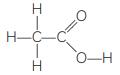
Previous Year Questions 2019

Attention!Sale expiring soon, act now & get EduRev Infinity at 40% off!Claim Offer

Previous Year Questions 2018

Q1: A compound ‘X’ on heating with excess conc. sulphuric acid at 443 K gives an unsaturated compound ‘Y’. ‘X’ also reacts with sodium metal to evolve a colourless gas ‘Z’. Identify ‘X’, ‘Y and ‘Z. Write the equation of the chemical reaction of formation of ‘Y’ and also write the role of sulphuric acid in the reaction.   (2018)

Hide Answer  

Ans: As X reacts with conc. H2SO4 to give an alkene so it should be an alcohol as cone. H2SO4 acts as a dehydrating agent. The reaction of X with Na also confirms that it is an alcohol because alcohols react with Na metal to evolve colourless hydrogen gas.

Previous Year Questions 2018
Here, cone H2SO4 acts as a dehydrating agent i.e., helps in the removal of water.

Previous Year Questions 2018


Q2: (a) Why are most carbon compounds poor conductors of electricity? 
(b) Write the name and structure of a saturated compound in which the carbon atoms are arranged in a ring. Give the number of single bonds present in this compound. (2018)

Hide Answer  

Ans: (a)  Most carbon compounds are poor conductors of electricity because:

  • Carbon forms covalent bonds with other elements.
  • There are no mobile electrons in these compounds.
  • Carbon compounds do not dissociate into ions.

(b) Structure: 
Previous Year Questions 2018
Name: Cyclopentane
Number of single bonds: 15
Structure: C5H10


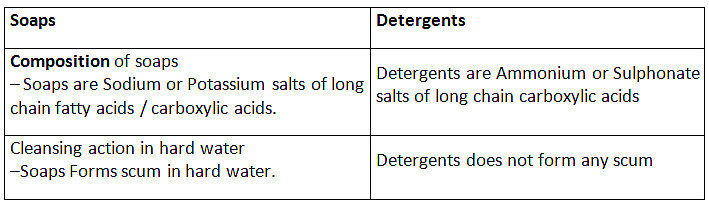
Q3: (a) Compare soaps and detergents on the basis of their composition and cleansing action in hard water.
(b) What happens when ethanol is treated with sodium metal? State about the behaviour of ethanol in this reaction.
(c) Draw the structure of cyclohexane.
(d) Name the following compound.  (2018)
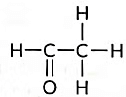
Previous Year Questions 2018

Hide Answer  

Ans: (a)
Previous Year Questions 2018 
(b) Reaction of Ethanol with Sodium Metal:

  • When ethanol reacts with sodium metal, hydrogen gas is released.
  • Ethanol behaves like an acid in this reaction.

(c) structure of cyclohexane is below-
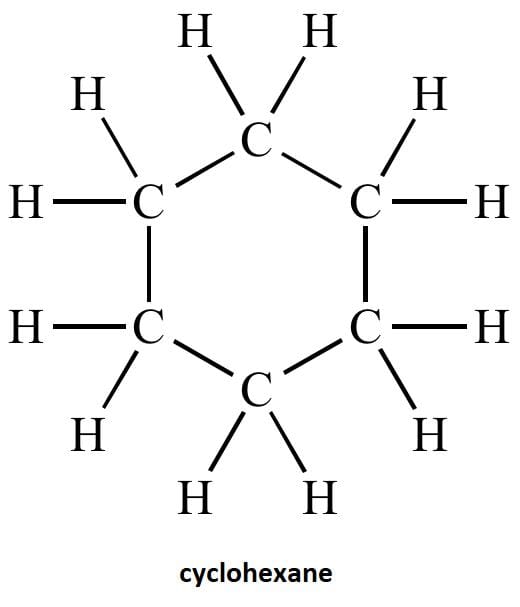
Previous Year Questions 2018
(d) Name of the compound is Ethanal and it is an Acetaldehyde 


Q4: A gas is evolved when ethanol reacts with sodium. Name the gas evolved and also write the balanced chemical equation of the reaction involved. (CBSE 2018, 16)

Hide Answer  

Ans: When ethanol reacts with sodium metal, it forms sodium ethoxide (C2H5O Na+) and hydrogen gas is released. The reaction is as follows:

Previous Year Questions 2018So, the gas is hydrogen that is evolved during the reaction.

Previous Year Questions 2017

Q1: Write the molecular formula of first two members of homologous series having functional group -CI.  (Delhi 2017)

Hide Answer  

Ans: The molecular formula of first two members of homologous series having – Cl functional group are CH3CI and CH3CH2CI.


Q2: Write the molecular formula of first two members of homologous series having functional group -OH.   (Delhi 2017)

Hide Answer  

Ans: The molecular formula of first two members of homologous series having – OH functional group are CH3OH and CH3CH2OH.


Q3: Write the molecular formula of the 2nd and 3rd member of the homologous series whose first member is ethene.  (AI 2017)

Hide Answer  

Ans: Homologous series of alkenes have general formula, CnH2n whose first member is ethene.
2nd member of homologous series of alkenes is C3H6 i.e., propene.
3rd member of homologous series of alkenes is C4H8 i.e., butene.


Q4: Write the molecular formula of the 2nd and 3rd member of the homologous series whose first member is methane.  (AI 2017)

Hide Answer  

Ans: Methane, CH4 is an alkane. Alkanes have general formula, CnH2n+2.
2nd member of homologous series of alkanes is C2Hi.e., ethane.
3rd member of homologous series of alkanes is C3H8 i.e., propane.


Q5: Two carbon compounds X and Y have the molecular formula C4H8 and C5H12 respectively. Which one of these is most likely to show addition reaction? Justify your answer. Also give the chemical equation to explain the process of addition reaction in this case.   (Delhi 2017)

Hide Answer  

Ans: All unsaturated hydrocarbons (containing double or triple bonds) have tendency to get converted to saturated hydrocarbons (single bonds) by adding small molecules such as hydrogen (H2), halogens (X2), etc. Such reactions are called addition reactions. Compound with the molecular formula C4H8 belongs to alkene series (CnH2n). Hence, it will undergo addition reaction.
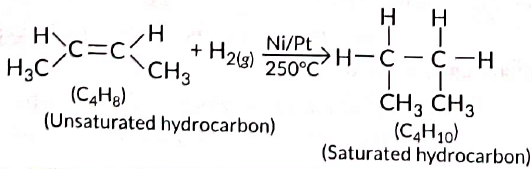
Previous Year Questions 2017


Q6: Soaps and detergents are both types of salts. State the difference between the two. Write the mechanism of the cleansing action of soaps. Why do soaps not form lather (foam) with hard water? Mention any two problems that arise due to the use of detergents instead of soaps.    (Delhi 2017, Al 2015)

Hide Answer  

Ans: The molecules of soap are sodium or potassium salts of long-chain carboxylic acids. Detergents are generally ammonium or sulphonate salts of long chain carboxylic acids.
Difference between Soap and Detergent
Soaps:
(i) Soaps are sodium salts of long chain carboxylic acids.
(ii) The ionic group in soap is -COONa+.
(iii) Soaps are not useful when water is hard.
Detergents
(i) Detergents are the odium salt of long chain benzene sulphonic acids.
(ii) The ionic groups in detergents is SO3Na+ or SO4Na+.
(iii) Detergent can be used for washing purpose even when water is hard
Cleansing action of soap can be described as follows:
The soap molecule is generally represented as RCOONa. In solution, it ionises to form RCOO and Na+. Each soap molecule has a polar head group (carboxylate ion, COO group) and a long nonpolar hydrocarbon tail (R group from long chain fatty acid). The polar head attracts the polar water molecule and is called hydrophilic end and the nonpolar tail attracts the water-insoluble oily or greasy dirt particles.


Q7: Why are certain compounds called hydrocarbons? Write the general formula for homologous series of alkanes, alkenes and alkynes and also draw the structure of the first member of each series. Write the name of the reaction that converts alkenes into alkanes and also write a chemical equation to show the necessary conditions for the reaction to occur.   (AI 2017)

Hide Answer  

Ans: Compounds consisting of carbon and hydrogen are known as hydrocarbons.
(a) Saturated hydrocarbons: Alkanes (CnH2n+2) are the compounds of carbon that have a single bond.
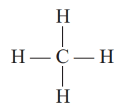
Previous Year Questions 2017
(b) Unsaturated hydrocarbons: The compounds of carbon having double bonds are alkene (CnH2n) and having triple bonds are alkyne (CnH2n-2). The reaction which converts unsaturated hydrocarbons to saturated hydrocarbons i.e. alkenes to alkane is known as hydrogenation reaction. It is used to obtain ghee from oil.
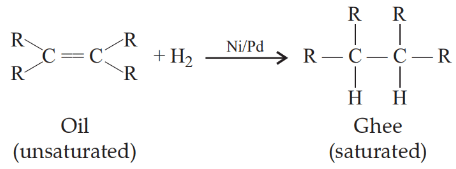
Previous Year Questions 2017


Q8: A student took four test tubes P, Q, R and S and filled about 8 mL of distilled water in each. After that he dissolved an equal amount of Na2SO4 in P, K2SO4 in Q, CaSO4 in R and MgSO4 in S. On adding an equal amount of soap solution and shaking each test tube well, a good amount of lather will be obtained in the test tubes: 
(a) P and Q 
(b) P and R 
(c) P, Q and S 
(d) Q, R and S

Hide Answer  

Ans: (a)
Soap forms lather easily in soft water, while hard water (which contains calcium and magnesium ions) reacts with soap to form scum, preventing the formation of lather.
In this case:
(i) Test tube P contains Na₂SO₄ (sodium sulfate), and Test tube Q contains K₂SO₄ (potassium sulfate). Both sodium and potassium salts do not contribute to water hardness, so they will allow soap to form lather.
(ii) Test tube R contains CaSO₄ (calcium sulfate), and Test tube S contains MgSO₄ (magnesium sulfate). Both calcium and magnesium contribute to water hardness, which prevents lather formation.
Therefore, a good amount of lather will be obtained in test tubes P and Q.


Q9: A student is given equal amount of three samples of water with temporary hardness labelled as ‘A’, ‘B’ and ‘C’. He keeps the three samples at different temperatures – A at room temperature, B at 50 ºC and C at 95 ºC. Which sample will give maximum amount of lather when 10 mL of soap solution is added to each sample and shaken for equal time? 
(a) A only 
(b) Both A and B 
(c) Both B and C 
(d) C only (CBSE 2017)

Hide Answer  

Ans: (d)
In this scenario:

  • Sample C is kept at 95 ºC, which is close to boiling temperature. At this high temperature, the temporary hardness will be significantly reduced due to the decomposition of bicarbonates, allowing more lather to form when soap is added.
  • Samples A (at room temperature) and B (at 50 ºC) will still retain more temporary hardness than sample C, and therefore will produce less lather.

Thus, sample C will give the maximum amount of lather, making the correct answer (d) C only.


Q10: What is a saturated hydrocarbon? Write the formula of any one saturated hydrocarbon.  (CBSE 2017)

Hide Answer  

Ans: A saturated hydrocarbon is a type of hydrocarbon where the carbon atoms are connected by only single covalent bonds. This means that each carbon atom is bonded to as many hydrogen atoms as possible.The formula for one example of a saturated hydrocarbon is CH4, which is known as methane.


Q11: Ethanol reacts with sodium and forms two products. These are: 
(a) sodium ethanoate and hydrogen 
(b) sodium ethanoate and oxygen 
(c) sodium ethoxide and hydrogen 
(d) sodium ethoxide and oxygen (CBSE 2017, 16, 14, 11)

Hide Answer  

Ans: (c)
When ethanol (C₂H₅OH) reacts with sodium (Na), it forms sodium ethoxide (C₂H₅ONa) and hydrogen gas (H₂) as products. The reaction is as follows:Previous Year Questions 2017In this reaction, sodium displaces hydrogen from ethanol, resulting in the formation of sodium ethoxide and the release of hydrogen gas.

Thus, the correct answer is (c) sodium ethoxide and hydrogen.

Also read: Previous Year Questions: Carbon & its Compounds – 2

Previous Year Questions 2016

Q1: Write the next homologue of each of the following:   (Delhi 2016)
(i) C2H4
(ii) C4H6

Hide Answer  

Ans. (i) C2H4 belongs to alkene series having general formula, CnH2n.
Thus, next homologue will be C3H2×3 = C3H6
(ii) C4Hbelongs to alkyne series having general formula, CnH2n-2.
Thus, next homologue will be C5H2×5-2 = C5H8 


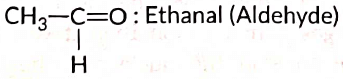
Q2: Name the following compounds:    (Delhi 2016)
(a) CH3—CH2—OH
(b)    

Hide Answer  

Ans: (a) CH3 – CH2 – OH: Ethanol (Alcohol)
(b) Previous Year Questions 2016

Q3: Select saturated hydrocarbons from the following: (Delhi 2016)
C3H6; C5H10; C4H10; C6H14; C2H

Hide Answer  

Ans: Saturated hydrocarbons (alkanes) follow the general formula CnH2n+2. From the given compounds, the following satisfy this formula:

  • C4H10
  • C6H14


Q4: Write the name and structure of an alcohol with three carbon atoms in its molecule. (Al 2016)

Hide Answer  

Ans: An alcohol with three carbon atoms is called propanol. Its structure can be represented as follows:

  • Carbon chain: C-C-C
  • Hydroxyl group: -OH attached to one of the carbons

In summary, propanol consists of:

  • Three carbon atoms
  • One hydroxyl group
Previous Year Questions 2016


Q5: Write the name and structure of an alcohol with four carbon atoms in its molecule. (AI 2016)

Hide Answer  

Ans: An alcohol with four carbon atoms is butanol and its structure is:
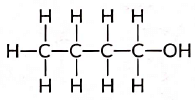
Previous Year Questions 2016


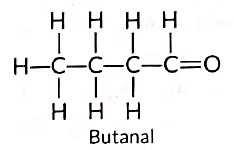
Q6: Write the name and structure of an aldehyde with four carbon atoms in its molecule.  (AI 2016)

Hide Answer  

Ans: An aldehyde with four carbon atoms is butanal and its structure is:
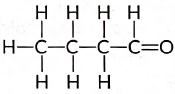
Previous Year Questions 2016


Q7: Which element exhibits the property of catenation to maximum extent and why? (Foreign 2016)

Hide Answer  

Ans: Carbon exhibits the property of catenation to the maximum extent due to several key factors:

  • Carbon can form strong bonds with other carbon atoms, creating large and complex molecules.
  • This ability allows for various structures, including long chains, branched chains, and rings.
  • Carbon’s small size contributes to the strength of the carbon-carbon bonds, making them stable.
  • With a valency of four, carbon can bond with up to four other atoms, enhancing its versatility.

Other elements, like silicon, show limited catenation, forming fewer and more reactive compounds.


Q8: Write the name and molecular formula of the fourth member of alkane series. (Foreign 2016)

Hide Answer  

Ans: The general formula of the alkane series is CnH2n+2. For fourth member of alkane series, n = 4
∴ C4H2 x 4 + 2 = CH10 i.e., butane.


Q9: What is homologous series of carbon compounds?    (Foreign 2016)

Hide Answer  

Ans:  A homologous series is a group of organic compounds that share the same functional group and exhibit similar chemical properties. The key characteristics include:

  • Each member differs from the next by a -CH2– unit.
  • They have a consistent pattern in their physical properties, such as boiling points and solubility.
  • The chemical properties remain similar due to the presence of the same functional group.

For example, compounds like alcohols and alkenes form homologous series where each successive compound has one more carbon atom than the previous one.


Q10: When ethanol reacts with ethanoic acid in the presence of cone. H2SO4, a substance with fruity smell is produced. Answer the following: 
(i) State the class of compounds to which the fruity smelling compounds belong. Write the chemical equation for the reaction and write the chemical name of the product formed. 
(ii) State the role of cone. H2SO4 in this reaction.    (Delhi 2016)

Hide Answer  

Ans: (i) When ethanol reacts with ethanoic acid in the presence of concentrated H₂SO₄, the product formed is ethyl ethanoate, which belongs to the class of ester compounds known for their fruity smell.

Previous Year Questions 2016

 (ii) The role of concentrated H₂SO₄ in this reaction is two fold:

  • It acts as a dehydrating agent, helping to remove water.
  • It serves as a catalyst to speed up the reaction.


Q11: Write chemical equation of the reaction of ethanoic acid with the following: 
(a) Sodium; 
(b) Sodium hydroxide; 
(c) Ethanol 
Write the name of one main product of each reaction. (Al 2016)

Hide Answer  

Ans: Ethanoic acid reacts with sodium as well as sodium hydroxide to form sodium ethanoate.
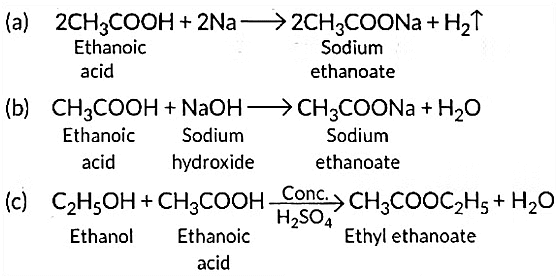
Previous Year Questions 2016


Q12: Write three different chemical reactions showing the conversion of ethanoic acid to sodium ethanoate. Write balanced chemical equation in each case. Write the name of the reactants and the products other than ethanoic acid and sodium ethanoate in each case.   (Al 2016)

Hide Answer  

Ans: Ethanoic acid reacts with Na2CO3 to form sodium ethanoate and CO2 gas is liberated.

Previous Year Questions 2016
With sodium hydrogen carbonate it forms sodium ethanoate.

Previous Year Questions 2016
With NaOH It forms sodium ethanoate.
Previous Year Questions 2016


Q13: List two tests for experimentally distinguishing between an alcohol and a carboxylic acid and describe how these tests are performed. (Al 2016)

Hide Answer  

Ans: Tests for distinguishing between an alcohol and a carboxylic acid are:
(i) Litmus test: When we place a drop of carboxylic acid on blue litmus paper it turns red while alcohol will not change the colour of blue litmus paper.
(ii) Sodium hydrogen carbonate test/sodium carbonate
test: If a pinch of NaHCO3 or Na2CO3 is added to two test tubes containing alcohol and carboxylic acid respectively, then test tube containing carboxylic acid will show the evolution of colourless gas with brisk effervescence while test tube containing alcohol does not show any reaction.


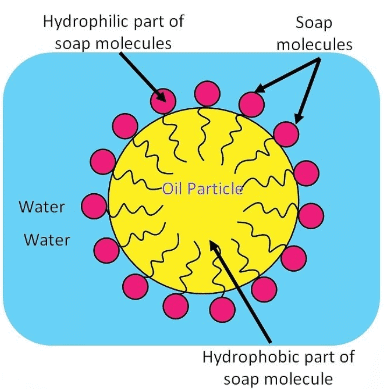
Q14: Why is reaction between when soap is added to water? Will a micelle be formed in other solvents such as ethanol also? State briefly how the formation of micelles help to clean the clothes having oily spots.  (Foreign 2016)

Hide Answer  

Ans: A micelle is a tiny cluster of molecules with non-polar groups inside and hydrophilic groups outside. When soap is added to water:

  • The hydrophobic tails of soap molecules avoid water, forming a cluster.
  • The hydrophilic heads remain in contact with water, stabilising the structure.

If ethanol is used instead of water, micelles will not form because ethanol lacks the necessary polar characteristics.The formation of micelles helps clean oily spots on clothes by:

  • Trapping oily dirt in the centre of the micelle.
  • Allowing the dirt to be easily rinsed away due to the colloidal nature of micelles.

Thus, soap effectively removes grease and dirt from fabrics.Previous Year Questions 2016

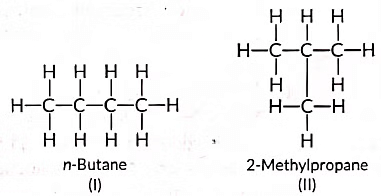
Q15: Which of the following are correct structural isomers of C4H10?

(a) (I) and (III) 
(b) (II) and (IV ) 
(c) (I) and (II) 
(d) (III) and (IV ) (CBSE 2016, 15, 14, 11)

Hide Answer  

Ans: (c)
The molecular formula C₄H₁₀ represents butane and its isomer isobutane (also called 2-methylpropane).
Structures (I) and (II)in the image represent these two structural isomers of C₄H₁₀:
(I) shows a straight chain structure (n-butane).
(II) shows a branched structure (isobutane or 2-methylpropane).
Thus, the correct answer is (c) (I) and (II).


Q15: Catenation is the ability of an atom to form bonds with other atoms of the same element. It is exhibited by both carbon and silicon. Compare the ability of the catenation of the two elements. Give reasons. (CBSE 2016, 11, 10)

Hide Answer  

Ans: Catenation is the ability of an atom to bond with other atoms of the same element. This property is notably exhibited by both carbon and silicon, but carbon demonstrates it to a far greater extent.

  • Carbon can form long chains, branched structures, or rings due to its strong carbon-carbon bonds.
  • Carbon has a valency of four, allowing it to bond with up to four other atoms, including other carbon atoms.
  • This results in a vast number of stable compounds, as the bonds formed are strong and do not easily break.
  • In contrast, silicon can form chains of only seven or eight atoms with hydrogen, but these compounds are highly reactive.

Overall, the unique ability of carbon to catenate leads to an extensive variety of compounds, making it essential for life and numerous applications.

Previous Year Questions 2016

Previous Year Questions 2015

Q1: Write the name and formula of the 2nd member of homologous series having general formula CnH2n. (Delhi 2015)

Hide Answer  

Ans: Homologous series of alkenes have general formula, CnH2n whose first member is ethene.
2nd member of homologous series of alkenes is C3H6 i.e., propene.


Q2: Write the name and formula of the 2nd member of homologous series having general formula CnH2n+2. (Delhi 2015)

Hide Answer  

Ans: Alkanes have general formula, CnH2n + 2.
2nd member of homologous series of alkanes is C2H6 i.e., ethane.


Q3: Write the name and formula of the 2nd member of homologous series having general formula CnH2n-2.   (Delhi 2015)

Hide Answer  

Ans: General formula, CnH2n-2 belongs to alkyne series. The second member of this series is propyne i.e., (C3H4) or CH3—C≡CH.


Q4: Write the number of covalent bonds in the molecule of ethane. (Al 2015, Delhi 2014)

Hide Answer  

Ans: The structural formula of ethane (C2H6) is
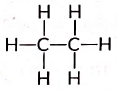
Previous Year Questions 2015There are total 7 covalent bonds. Six C — H covalent bonds and one C — C covalent bond.


Q5: Write the number of covalent bonds in the molecule of butane, C4H10. (AI 2015)

Hide Answer  

Ans: Butane (C4H10) has the following structural formula as:
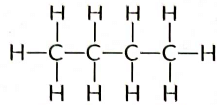
Previous Year Questions 2015

 Butane (C4H10) contains a total of 13 covalent bonds. This includes:

  • 10 C — H bonds
  • 3 C — C bonds


Q6: With the help of an example, explain the process of hydrogenation. Mention the essential conditions for the reaction and state the change in physical property with the formation of the product. (Delhi 2015)

Hide Answer  

Ans: The process of adding hydrogen to an unsaturated compound is called hydrogenation. For example, the hydrogenation of ethene leads to the formation of ethane.

Previous Year Questions 2015
Conditions for Hydrogenation
(i) Presence of an unsaturated compound (i.e. an unsaturated hydrocarbon)
(ii) Presence of a catalyst such as finely divided palladium or nickel
In case of the hydrogenation of vegetable oils, liquid unsaturated fatty acids are converted into solid saturated fatty acids.
03. Previous Year Questions: Metals & Non-metals

Previous Year Questions 2025

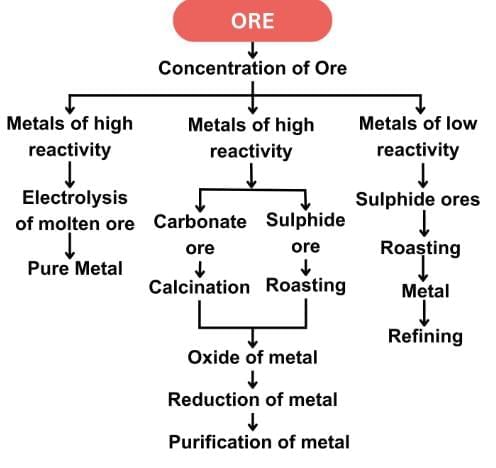
Q1: The metals obtained from their molten chlorides by the process of electrolytic reduction are:  (1 Mark)
(a) 
Gold and silver
(b) Calcium and magnesium
(c) Aluminium and silver
(d) Sodium and iron

Hide Answer  

Ans: (b) Calcium and magnesium
Highly reactive metals (like sodium, magnesium, calcium) are obtained by electrolytic reduction of their molten chlorides — the chapter gives magnesium and calcium as examples of metals produced this way.


Q2: The most common method of extraction of metals from their oxide ores is:  (1 Mark)
(a) 
Reduction with carbon
(b) Reduction with hydrogen
(c) Reduction with aluminium
(d) Electrolytic reduction

Hide Answer  

Ans: (a) Reduction with carbon
Metals that are moderately reactive are usually extracted from their oxide ores by reducing them with carbon.

Example:
ZnO + C → Zn + CO

Here, carbon acts as a reducing agent and converts zinc oxide into metallic zinc.


Q3: Reaction between two elements A and B, forms a compound C. A loses electrons and B gains electrons. Which one of the following properties will not be shown by compound C?  (1 Mark)
(a)
 It has high melting point.
(b) It is highly soluble in water.
(c) It has weak electrostatic forces of attraction between its oppositely charged ions.
(d) It conducts electricity in its molten state or aqueous solution.

Hide Answer  

Ans: (c) It has weak electrostatic forces of attraction between its oppositely charged ions.
When element A loses electrons and element B gains electrons, an ionic compound is formed. Ionic compounds have strong electrostatic forces of attraction between oppositely charged ions, giving them high melting points, solubility in water, and electrical conductivity in molten or solution form. Hence, statement (c) is incorrect.


Q4: Aluminium powder is used in thermit welding because:  (1 Mark)
(a) 
Its reaction with iron is highly exothermic.
(b) When it is heated with iron (III) oxide, molten iron is obtained.
(c) When it is heated with iron (III) oxide, molten aluminium oxide is obtained to join railway tracks.
(d) Its melting point is low as compared to iron and a molten alloy of iron and aluminium is formed on heating which is used to join railway tracks.

Hide Answer  

Ans: (b) When it is heated with iron (III) oxide, molten iron is obtained.
Aluminium reacts with iron(III) oxide in a highly exothermic thermit reaction, producing molten iron used for welding railway tracks.
Fe₂O₃ + 2Al → 2Fe(l) + Al₂O₃ + Heat


Q5: The products formed when Aluminium and Magnesium are burnt in the presence of air respectively are:  (1 Mark)
(a)
 Al₃O₄ and MgO₂
(b) Al₂O₃ and MgO
(c) Al₃O₄ and MgO
(d) Al₂O₃ and MgO₂

Hide Answer  

Ans: (b) Al₂O₃ and MgO
When aluminium and magnesium burn in air, they react with oxygen to form their respective metal oxides.

4Al + 3O₂ → 2Al₂O₃
2Mg + O₂ → 2MgO


Q6: A metal, M, displaces iron from aqueous solution of ferrous sulphate but fails to do so in case of aqueous solution of aluminium sulphate. The metal M is:  (1 Mark)
(a)
 Magnesium
(b) Copper
(c) Lead
(d) Zinc

Hide Answer  

Ans: (d) Zinc
Zinc is more reactive than iron and can displace it from ferrous sulphate solution:
Zn + FeSO₄ → ZnSO₄ + Fe
However, zinc is less reactive than aluminium, so it cannot displace aluminium from aluminium sulphate solution.


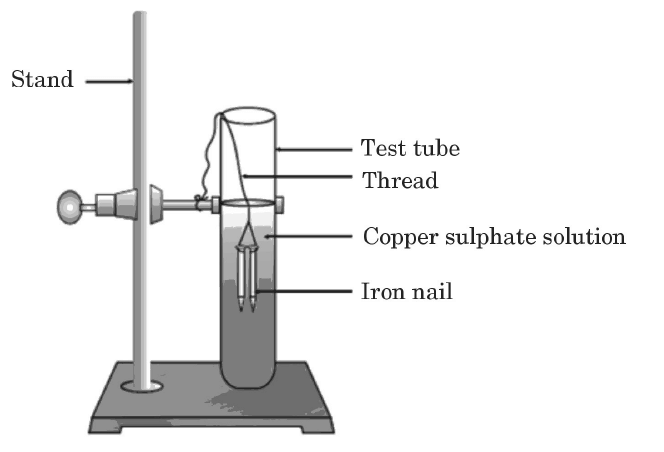
Q7: The colour of the solution observed after about 1 hour of placing iron nails in copper sulphate solution is:  (1 Mark)
(a) 
Blue
(b) Pale green
(c) Yellow
(d) Reddish brown

Hide Answer  

Ans: (b) Pale green
When iron nails are placed in copper sulphate solution, a displacement reaction occurs where iron displaces copper:
Fe + CuSO₄ → FeSO₄ + Cu
Copper gets deposited as a reddish-brown layer, and the solution turns pale green due to the formation of iron(II) sulphate.


Q8: Assertion (a): Hydrogen gas is not evolved when a metal reacts with nitric acid.
Reason (R): Nitric acid is a strong reducing agent and reduces the hydrogen produced in the reaction to water.  (1 Mark)

(A) Both Assertion (A) and Reason (R) are true and Reason (R) is the correct explanation of Assertion (A). 
(B) Both Assertion (A) and Reason (R) are true, but Reason (R) is not the correct explanation of Assertion (A). 
(C) Assertion (A) is true, but Reason (R) is false. 
(D) Assertion (A) is false, but Reason (R) is true.

Hide Answer  

Ans: (c) Assertion (A) is true, but Reason (R) is false.
When metals react with nitric acid, hydrogen gas is not evolved because nitric acid is a strong oxidising agent and it oxidises the hydrogen formed to water, while itself getting reduced to nitrogen oxides (N₂O, NO, or NO₂).


Q9: Assertion (A): The metals high up in the reactivity series cannot be obtained from their compounds by heating with carbon.
Reason (R): Displacement reactions can also be used to obtain metal.  (1 Mark)

(A) Both Assertion (A) and Reason (R) are true and Reason (R) is the correct explanation of Assertion (A). 
(B) Both Assertion (A) and Reason (R) are true, but Reason (R) is not the correct explanation of Assertion (A). 
(C) Assertion (A) is true, but Reason (R) is false. 
(D) Assertion (A) is false, but Reason (R) is true.

Hide Answer  

Ans: (b) Both Assertion (A) and Reason (R) are true, but Reason (R) is not the correct explanation of Assertion (A).

Metals high up in the reactivity series (like sodium, calcium, and aluminium) cannot be obtained by heating with carbon because they have a stronger affinity for oxygen than carbon does. They are extracted by electrolytic reduction, not by displacement reactions.


Q10: Assertion (A): Ductility is that property of metals which enables copper to be used in making cooking utensils.
Reason (R): Copper is a metal which is ductile as well as malleable.  (1 Mark)

(A) Both Assertion (A) and Reason (R) are true and Reason (R) is the correct explanation of Assertion (A). 
(B) Both Assertion (A) and Reason (R) are true, but Reason (R) is not the correct explanation of Assertion (A). 
(C) Assertion (A) is true, but Reason (R) is false. 
(D) Assertion (A) is false, but Reason (R) is true.

Hide Answer  

Ans: (d) Assertion (A) is false, but Reason (R) is true.
Copper is used for making cooking utensils because it is malleable and a good conductor of heat, not because of its ductility. Ductility allows a metal to be drawn into wires, while malleability allows it to be beaten into thin sheets.


Q11: Assertion (a): Brass is prepared by first melting copper and then dissolving tin into it in a definite proportion.
Reason (R): The primary metal of brass is copper.  (1 Mark)

(A) Both Assertion (A) and Reason (R) are true and Reason (R) is the correct explanation of Assertion (A). 
(B) Both Assertion (A) and Reason (R) are true, but Reason (R) is not the correct explanation of Assertion (A). 
(C) Assertion (A) is true, but Reason (R) is false. 
(D) Assertion (A) is false, but Reason (R) is true.

Hide Answer  

Ans: (d)  Assertion (A) is false, but Reason (R) is true.
Brass is an alloy of copper and zinc, not copper and tin. Therefore, the statement about tin is false. However, the reason is true because copper is indeed the primary metal in brass.


Q12: Assertion (a): Silver chloride turns grey in sunlight.
Reason (R): Decomposition of silver chloride into silver and chlorine takes place by sunlight.  (1 Mark)

(A) Both Assertion (A) and Reason (R) are true and Reason (R) is the correct explanation of Assertion (A). 
(B) Both Assertion (A) and Reason (R) are true, but Reason (R) is not the correct explanation of Assertion (A). 
(C) Assertion (A) is true, but Reason (R) is false. 
(D) Assertion (A) is false, but Reason (R) is true.

Hide Answer  

Ans: (a) Both Assertion (a) and Reason (R) are true and Reason (R) is the correct explanation of the Assertion (a).
Silver chloride turns grey in sunlight because it decomposes into silver and chlorine gas when exposed to light:
2AgCl → 2Ag + Cl₂
The grey colour is due to the formation of metallic silver.


Q13: The main observations while performing the experiment of burning magnesium ribbon in air are: 
(i) Magnesium ribbon burns with a dazzling white flame.
(ii) A white powder is formed.
(iii) Magnesium ribbon vapourises.
(iv) Aqueous solution of the white powder turns blue litmus to red. (1 Mark)
(a)
 (i) and (iv)
(b) (ii) and (iii)
(c) (i) and (ii)
(d) (iii) and (iv)

Hide Answer  

Ans: (c) (i) and (ii)
When magnesium ribbon burns in air, it burns with a dazzling white flame and forms a white powder of magnesium oxide (MgO).
2Mg + O₂ → 2MgO
The oxide formed is basic in nature, so it turns red litmus blue, not the other way around.


Q14: While burning a magnesium ribbon in air, list two safety measures which should be followed. Also state two observations of this activity.  (2 Marks)

Hide Answer  

Ans:

Safety measures:

  • Wear protective goggles to avoid harm from the bright white light produced.
  • Do not look directly at the burning magnesium ribbon.

Observations:

  • Magnesium ribbon burns with a dazzling white flame.Previous Year Questions 2025
  • white powder of magnesium oxide (MgO) is formed after burning.

Reaction:
2Mg + O₂ → 2MgO


Q15: (a) In common practice silver is recovered from silver nitrate solution by the use of copper metal. Name the type of reaction that takes place in this process and give the chemical equation of the reaction involved.
(b) Name the method used for refining silver.  (2 Marks)

Hide Answer  

Ans:

(a) The reaction between copper and silver nitrate is a displacement reaction.
In this process, copper being more reactive than silver displaces silver from silver nitrate solution.
As a result, silver metal is deposited and copper nitrate is formed in the solution.

Chemical equation:
Cu + 2AgNO₃ → Cu(NO₃)₂ + 2Ag

(b) The method used for refining silver is electrolytic refining.
In this process, impure silver is made the anode and a thin strip of pure silver is made the cathode.
A solution of silver nitrate is used as the electrolyte. When electric current is passed, pure silver deposits on the cathode, and impurities settle at the bottom as anode mud.


Q16: Cinnabar is an ore of a metal ‘X’. When this ore is heated in air, it is first converted into oxide of ‘X’ (XO) and then reduced to metal ‘X’ on further heating. Identify metal ‘X’ and write chemical equations for the reactions that occur in the above processes.  (2 Marks)

Hide Answer  

Ans:  The metal ‘X’ is mercury (Hg). Its ore, cinnabar (HgS), when heated in air, first forms mercuric oxide (HgO), which on further heating is decomposed to produce liquid mercury and oxygen gas.

The reactions involved are:

Reactions:

  • 2HgS + 3O₂ → 2HgO + 2SO₂
  • 2HgO → 2Hg + O₂


Q17: Name a metal found in the earth’s crust 
(i) in free state and 
(ii) in the form of its compound. 
State where each of these metals are placed in the reactivity series of metals.  (2 Marks)

Hide Answer  

Ans:

(i) Gold (Au) is found in the free state in the earth’s crust. It is placed low in the reactivity series, as it is least reactive.
(ii) Zinc (Zn) is found in the form of its compounds, such as zinc oxide (ZnO) or zinc sulphide (ZnS). It is placed in the middle of the reactivity series.


Q18: (a) Show the formation of magnesium chloride by electron transfer. Write the name of the cation and anion present in the compound formed. (Atomic Number of Mg=12, Cl=17)  (2 Marks)
OR
(b) How is zinc extracted from its ore? Name the processes involved in the extraction and write chemical equations for the reactions that occur during these processes. (2 Marks)

Hide Answer  

Ans: 
(a) Magnesium has the electronic configuration 2,8,2 and chlorine has 2,8,7.
Magnesium loses its two outermost electrons to form a magnesium ion (Mg²⁺), while each chlorine atom gains one electron to form a chloride ion (Cl⁻).
These oppositely charged ions attract each other to form magnesium chloride (MgCl₂).

Previous Year Questions 2025OR

(b) Zinc is extracted from its ore zinc blende (ZnS) by two main steps — roasting and reduction.

  1. Roasting: The zinc sulphide ore is heated in the presence of excess air to form zinc oxide.
    2ZnS + 3O₂ → 2ZnO + 2SO₂
  2. Reduction: The zinc oxide formed is then heated with carbon to obtain metallic zinc.
    ZnO + C → Zn + CO


Q19: (a) With the help of an activity, explain the conditions under which iron articles get rusted.  (3 Marks)

Hide Answer  

Ans: (a)
Aim: To find the conditions under which iron articles get rusted.

Activity:

  1. Take three clean iron nails and place them in three separate test tubes labeled A, B, and C.
  2. In test tube A, add ordinary water and cork it.Previous Year Questions 2025
  3. In test tube B, add boiled distilled water (to remove dissolved air), pour a thin layer of oil over it, and cork it.
  4. In test tube C, put some anhydrous calcium chloride and cork it tightly.

Observation:

  • After a few days, the iron nails in test tube A get rusted.
  • The nails in test tube B and test tube C do not rust.

Conclusion:
Iron articles rust only when both air (oxygen) and water (moisture) are present together.
The rust formed is hydrated iron(III) oxide (Fe₂O₃·xH₂O).

OR

(b) (i) Name two metals which react violently with cold water. List any three observations which a student notes when these metals are dropped in a beaker containing water.
(ii) Write a test to identify the gas evolved (if any) during the reaction of these metals with water.

Hide Answer  

Ans:
(i) The two metals which react violently with cold water are Sodium (Na) and Potassium (K).

Observations:

  1. The metals move rapidly on the surface of water due to the evolution of a gas.
  2. The reaction is highly exothermic — the evolved heat may ignite the metal, producing a flame (potassium gives a lilac flame, sodium gives a golden-yellow flame).
  3. The gas evolved during the reaction burns with a pop sound, confirming it is hydrogen gas.

Reactions:

Previous Year Questions 2025

(ii) Test for hydrogen gas:
Bring a burning matchstick near the mouth of the test tube — the gas burns with a ‘pop’ sound, confirming the presence of hydrogen gas.


Q20: (a) “Displacement reactions also play a key role in extracting metals in the middle of the reactivity series.” Justify this statement with two examples.
(b) Why can metals high up in the reactivity series not be obtained by reduction of their oxides by carbon?  (3 Marks)

Hide Answer  

Ans:

(a) Metals in the middle of the reactivity series, such as iron, zinc, and lead, can be extracted from their oxides using displacement reactions.
Highly reactive metals like aluminium act as reducing agents and displace less reactive metals from their oxides.

Examples:

  1. 3MnO₂ + 4Al → 3Mn + 2Al₂O₃ + Heat
  2. Fe₂O₃ + 2Al → 2Fe + Al₂O₃ + Heat

These reactions are highly exothermic and produce the metal in the molten state (as in the thermit reaction).

(b) Metals high up in the reactivity series (like sodium, calcium, aluminium) cannot be obtained by carbon reduction because they have a greater affinity for oxygen than carbon. Therefore, their oxides cannot be reduced by carbon and are instead extracted by electrolytic reduction of their molten compounds.Previous Year Questions 2025


Q21: Name and describe the most widely used method for refining impure metals?  (3 Marks)

Hide Answer  

Ans:

The most widely used method for refining impure metals is Electrolytic Refining.

In this process:

  • The impure metal is made the anode.
  • thin strip of pure metal is made the cathode.
  • solution of the metal salt (such as copper sulphate for copper) is used as the electrolyte.Previous Year Questions 2025

When electric current is passed:

  • The pure metal from the anode dissolves into the electrolyte.
  • An equal amount of pure metal is deposited on the cathode.
  • Insoluble impurities settle down at the bottom of the anode as anode mud.

Example:
For copper refining —
Impure copper (anode), pure copper (cathode), and acidified CuSO₄ solution (electrolyte):
Cu (anode) → Cu²⁺ + 2e⁻
Cu²⁺ + 2e⁻ → Cu (cathode)


Q22: Design an activity to show that metals are good conductors of heat and have high melting points.  (3 Marks)

Hide Answer  

Ans:

Aim: To show that metals are good conductors of heat and have high melting points.

Materials required:
An aluminium or copper wire, a stand with a clamp, a pin, wax, and a burner or candle.Previous Year Questions 2025

Procedure:

  1. Clamp one end of the metal wire to the stand and fix a pin to the free end using wax.
  2. Heat the wire near the clamped end using a spirit lamp or burner.
  3. Observe what happens after some time.

Observation:
After heating, the pin fixed with wax falls off because the heat travels quickly through the metal wire and melts the wax.

Conclusion:
This shows that metals are good conductors of heat.
Also, the metal wire itself does not melt easily, proving that metals have high melting points.


Q23: Samples of four metals A, B, C, and D were added one by one to the following solutions. The results obtained were tabulated as follows:

(i) Which is the least reactive metal?
(ii) What would be observed if C is added to a solution of copper sulphate?
(iii) Arrange the metals A, B, C, and D in the order of their decreasing reactivity.  (3 Marks)

Hide Answer  

Ans:

(i) D — it shows no reaction with any of the salt solutions, so it is the least reactive metal.

(ii) Displacement will occur as ‘C’ is able to displace Fe from its solution, indicating that it is more reactive than Fe. However, ‘C’ is not able to displace Al, which means it is less reactive than Al.

Hence, the metal ‘C’ is more reactive than Cu and is placed above Cu in the reactivity series. Therefore, ‘C’ will displace Cu from its salt solution.
When C is added to copper sulphate, C displaces copper from the solution and copper metal gets deposited while a salt of C is formed:
C + CuSO₄ → C-SO₄ (aqueous) + Cu (s)

(iii) Order of decreasing reactivity: B > C > A > D.
Reasoning (brief):

  • B displaces Fe, Cu and Zn, so B is the most reactive of the four.
  • C displaces Fe but not Zn, so C is less reactive than Zn but more reactive than Fe (hence above A).
  • A displaces Cu but not Fe or Zn, so A is less reactive than Fe and Zn but more reactive than Cu.
  • D shows no displacement with any salt, so it is the least reactive.

Q24: (a) Observe the following diagram showing an experiment to determine the conditions under which a metal ‘M’ corrodes.

List your observations in each of the three cases A, B and C with reason, if the metal ‘M’ is generally protected against corrosion by the method of galvanisation.  (3 Marks)
Ans: ______

OR
(a) Show the formation of Aluminium Nitride (AlN) by the transfer of electrons. [At. no. of Al = 13; N = 7]
(b) “Ionic compounds are solids and are generally brittle and break into pieces when pressure is applied.” Give reason to justify the statement.

Hide Answer  

Ans:
Observations:

  • Test tube A: The metal ‘M’ rusts (corrodes) because both moisture and air are present. Corrosion requires the presence of water and oxygen together.
  • Test tube B: The metal ‘M’ does not rust, because oil prevents the entry of air into the water. Hence, even though moisture is present, air is absent.
  • Test tube C: The metal ‘M’ does not rust, because the air is dry, and there is no moisture to support corrosion.

Reason:
Metal ‘M’ (such as iron) rusts only in the presence of both air and moisture.

Galvanisation:
In galvanisation, a thin layer of zinc is coated on iron to protect it from corrosion. Zinc acts as a sacrificial metal, preventing rusting even if the coating is damaged.
OR
(a) 
(b) Regarding the properties of ionic compounds, they are typically solid at room temperature due to the strong electrostatic forces between the ions, which hold them in a rigid lattice structure. When pressure is applied to an ionic solid, the layers of ions can shift. If like charges are forced together, they repel each other, leading to the compound breaking into pieces. This brittleness is a characteristic feature of ionic compounds.

 Hence, ionic compounds are solid and brittle due to the strong ionic bonds and the repulsion of like charges when pressure is applied.


Q25: (i) Consider the following metals: K, Ca, Al, Cu, Ag, Fe
Select from the above metals, a metal which:
I. 
Does not react with oxygen even at high temperature.
II. Reacts with oxygen at ordinary temperature and forms a protective oxide layer which prevents the metal from further oxidation.
III. Catches fire when kept in the open.
IV. Does not burn in oxygen but the hot metal is coated with a black coloured oxide layer.
(ii) What are amphoteric oxides? With the help of balanced chemical equations show that aluminium oxide is an amphoteric oxide.
(iii) What are alkalis? Give one example.  (5 Marks)

Hide Answer  

Ans:  (i)
I. Does not react with oxygen even at high temperature: Ag.
II. Reacts with oxygen at ordinary temperature and forms a protective oxide layer: Al.
III. Catches fire when kept in the open: K.
IV. Does not burn but on heating the hot metal is coated with a black oxide layer: Cu.

(ii) An amphoteric oxide is one that reacts with both acids and bases to give salts and water. Aluminium oxide shows this behaviour:

With acid:
Al₂O₃ + 6HCl → 2AlCl₃ + 3H₂O

With base:
Al₂O₃ + 2NaOH → 2NaAlO₂ + H₂O

(iii) Alkalis are substances produced when certain metal oxides dissolve in water; they are basic (alkaline) in nature. Example: sodium oxide dissolves in water to give sodium hydroxide:
Na₂O + H₂O → 2NaOH — NaOH (sodium hydroxide) is an example of an alkali.


Q26: Many pure metals like copper, iron, and gold are very soft and as such are considered unsuitable for certain uses. Metallic objects around us such as cooking utensils, statues, ornaments, guns, etc., are actually not made up of pure metals. Instead of pure metals, alloys are used in the design of most of the useful objects. Making alloys enhances the basic properties of a metal which is the primary constituent (metal) of an alloy.
(I) How does electrical conductivity and melting point of a metal change when it is converted to its alloy by mixing a small amount of an element in it? (1 Mark)
(II) Name an alloy used for welding two wires together in an electric circuit. Write its major constituents. (1 Mark)
(III) (a) What are alloys?

(b) How is ‘Brass’ (an alloy) prepared? (2 Mark)

Hide Answer  

Ans:

(I) When a metal is converted into an alloy, both its electrical conductivity and melting point decrease.

(II) The alloy used for welding electrical wires is Solder, which is made up of lead (Pb) and tin (Sn).

(III) (a) Alloys are homogeneous mixtures of two or more metals, or of a metal and a non-metal, prepared by first melting the primary metal and then dissolving the other elements in definite proportions before cooling.

(b) Brass is prepared by mixing copper (Cu) and zinc (Zn) — copper is the main constituent and zinc is added to improve hardness and strength.

Previous Year Questions 2024

Q1: A metal and a non-metal that exists in liquid state at room temperature are respectively:    (2024)
(a) 
Bromine and Mercury
(b) 
Mercury and Iodine
(c) 
Mercury and Bromine
(d) 
Iodine and Mercury

Hide Answer  

Ans: (c)

  • Mercury is a metal that is liquid at room temperature.
  • Bromine is a non-metal that is also liquid at room temperature.
  • Thus, the correct answer is (c) Mercury and Bromine.


Q2: Oxides of aluminum and zinc are:    (2024)
(a)
 acidic
(b) basic
(c) amphoteric
(d) neutral

Hide Answer  

Ans: (c)

Oxides of aluminum and zinc are classified as amphoteric. 
This means they can react with both acids and bases, displaying the following characteristics:

  • They can act like acids in some reactions.
  • They can behave like bases in other reactions.
  • This versatility makes them important in various chemical processes.


Q3: The metals which are found in both free state as well as combined state are:    (2024)
(a)
 Gold and platinum  
(b) Platinum and silver  
(c) Copper and silver  
(d) Gold and silver  

Hide Answer  

Ans: (c)
The correct answer is (c) Copper and silver. These metals can be found in their pure, uncombined form (free state) in nature, as well as in compounds with other elements (combined state). This means they can exist both as standalone metals and as part of various minerals.


Q4: A metal ‘X’ is used in the thermit process. When ‘X’ is heated with oxygen, it gives an oxide ‘Y’, which is amphoteric in nature. ‘X’ and ‘Y’ respectively are:    (2024)
(a) 
Mn, MnO2
(b) Al, Al2O3
(c) Fe, Fe2O3
(d) Mg, MgO

Hide Answer  

Ans: (b)

 Metal ‘X’ is aluminium, used in the thermit process. When aluminium is heated with oxygen, it produces aluminium oxide (Y), which is amphoteric. This means it can react with both acids and bases.

  • Metal X: Aluminium (Al)
  • Oxide Y: Aluminium oxide (Al2O3)
  • Nature: Amphoteric


Q5: Source-based/case-based questions with 2 to 3 short subparts.    (2024)
The metals produced by various reduction processes are not very pure. They contain impurities, which must be removed to obtain pure metals. The most widely used method for refining impure metals is electrolytic refining.
(i) What is the cathode and anode made of in the refining of copper by this process?
(ii) Name the solution used in the above process and write its formula.
(iii) (A) How does copper get refined when electric current is passed in the electrolytic cell?
OR
(iii) (B) You have two beakers ‘A’ and ‘B’ containing copper sulphate solution. What would you observe after about 2 hours if you dip a strip of zinc in beaker ‘A’ and a strip of silver in beaker ‘B’? Give reasons for your observations in each case.

Hide Answer  

Ans: (i) The cathode is made of pure copper and the anode is made of impure copper.
(ii)) The solution used in this process is acidified copper sulphate, with the formula CuSO4.
(iii) (A)  When electric current is passed through the electrolytic cell:

  • Pure copper from the anode dissolves into the electrolyte.
  • An equivalent amount of pure copper is deposited on the cathode.
  • Soluble impurities enter the solution.
  • Insoluble impurities settle at the bottom of the anode, forming anode mud.

Previous Year Questions 2024
OR
(iii) (B) Observations after 2 hours:

  • Beaker A: The blue colour of the solution fades or becomes colourless.
  • Reason: Zinc is more reactive than copper, displacing it from the solution.
  • Beaker B: No change in colour is observed.
  • Reason: Silver is less reactive than copper, so no reaction occurs.


Q6: Assertion – Reason based questions: These questions consist of two statements — Assertion (A) and Reason (R). Answer these questions selecting the appropriate option given below:    (2024)
Assertion (A) : Different metals have different reactivities with water and dilute acids.
Reason (R): Extraction of a metal from its ore depends on its position in the reactivity series.
(a) 
Both (A) and (R) are true and (R) is the correct explanation of (A).
(b) Both (A) and (R) are true, but (R) is not the correct explanation of (A).
(c) (A) is true, but (R) is false.
(d) (A) is false, but (R) is true.

Hide Answer  

Ans: (b)
Assertion (A) is correct because different metals react differently with water and acids. However, while Reason (R) is also true, it explains how we extract metals rather than directly explaining why their reactivities vary.


Q7: State reasons for the following:    (2024)
(a) Zinc oxide is an amphoteric oxide.
(b) Sodium metal is stored in bottle filled with kerosene oil.
(c) In the reactions of nitric acid with metals, generally hydrogen gas is not evolved.

Hide Answer  

Ans: (a) Amphoteric oxide (zinc oxide) reacts with acids as well as bases to produce salt and water.  

  • Reaction with acids: Zinc oxide reacts with acids to form a salt and water. For example:ZnO+2HCl→ZnCl2+H2O
  • Reaction with bases: Zinc oxide reacts with strong bases to form a salt (zincate). For example:ZnO+2NaOH+H2O→Na2[Zn(OH)4]
    (b) If kept in open, sodium metal reacts vigorously with air and catches fire / kerosene oil does not allow sodium to come in contact with air and catch fire.
    (c) Nitric acid is a strong oxidising agent. It oxidises the hydrogen produced in the reaction to water. This is due to the strong oxidizing nature of nitric acid, which reduces itself to nitrogen oxides (like NO, NO₂) while oxidizing the hydrogen.


Q8: (a) State giving reason the reduction process to obtain the following metals from their compounds: (2024)
(i) Mercury,
(ii) Copper and
(iii) Sodium
OR
(b) State giving reason for the change in appearance observed when each of the following metal is exposed to atmospheric air for some time:
(i) Silver,
(ii) Copper and
(iii) Iron

Hide Answer  

Ans: (a) (i) Reduction Process- Roasting
Reason: Mercury has low reactivity.
(ii) Reduction Process– Roasting
Reason: Copper has low reactivity.
(iii) Reduction Process– Electrolytic Reduction.
Reason: Sodium has high reactivity.
OR
(b) (i) Change in appearance – White to black colour.
Reason: Silver sulphide is formed.
(ii) Change in appearance – Reddish brown to green colour.
Reason: Basic Copper Carbonate is formed.
(iii) Change in appearance- Grey to brown colour.
Reason: Rust (iron oxide) is formed.


Q9: Name the ore of mercury and state the form in which it is found in nature. Write the chemical equations along with the condition required for the reactions involved in the extraction of mercury from its ore.    (2024)

Hide Answer  

Ans: Ore of mercury: Cinnabar

Form in nature: Sulphide ore

The extraction of mercury from cinnabar involves the following chemical reactions:

  • When heated in air, cinnabar (HgS) converts to mercuric oxide (HgO):
  • 2HgS(s) 3O2(g) → 2HgO(s) 2SO2(g)
  • Further heating of mercuric oxide produces mercury:
  • 2HgO(s) → 2Hg(l) O2(g)


Q10: Some metals react with acids to produce salt and hydrogen gas. Illustrate it with an example. How will you test the presence of this gas?     (2024)

Hide Answer  

Ans: Zn + H2SO4 → ZnSO4 + H2 (g)

To test for the presence of hydrogen gas:

  • Bring a burning matchstick near the gas.
  • If hydrogen is present, it will burn with a pop sound.


Q11: 
Assertion – Reason based questions: These questions consist of two statements — Assertion (A) and Reason (R). Answer these questions selecting the appropriate option given below:    (CBSE 2024)
Assertion ( A): A piece of zinc metal gets reddish-brown coating when kept in copper sulphate solution for some time. 
Reason (R): Copper is more reactive metal than zinc.

(a) 
Both (A) and (R) are true and (R) is the correct explanation of (A).
(b) Both (A) and (R) are true, but (R) is not the correct explanation of (A).
(c) (A) is true, but (R) is false.
(d) (A) is false, but (R) is true.

Hide Answer  

Ans: (c)
Assertion (A): A piece of zinc metal gets a reddish-brown coating when kept in copper sulfate solution for some time. This is true. When zinc is placed in a copper sulfate solution, a displacement reaction occurs where zinc displaces copper from copper sulfate. The copper then deposits on the zinc surface as a reddish-brown coating.
Reason (R): Copper is more reactive than zinc. This is false. In the reactivity series, zinc is more reactive than copper, which is why zinc can displace copper from copper sulfate.
Since Assertion (A) is true but Reason (R) is false, the correct answer is (c) (A) is true, but (R) is false


Q12: Consider the following compounds:    (CBSE 2024)
FeSO4; CuSO4; CaSO4; Na2CO3
The compound having maximum number of water of crystallisation in its crystalline form in one molecule is ______.
(a) 
FeSO4
(b) CuSO4
(c) CaSO4
(d) Na2CO3

Hide Answer  

Ans: (d) Na2CO3
Na2CO⋅ 10H2O (hydrated sodium carbonate) has the largest concentration of water molecules in its crystalline structure, with 10 molecules per formula unit.

Previous Year Questions 2023

Q1: The following questions are source based/case based questions. Read the case carefully and answer the questions that follow. The melting points and boiling points of some ionic compounds are given below:

These compounds are termed ionic because they are formed by the transfer of electrons from a metal to a non-metal. The electron transfer in such compounds is controlled by the electronic configuration of the elements involved. Every element tends to attain a completely filled valence shell of its nearest noble gas or a stable octet.
(i) Show the electron transfer in the formation of magnesium chloride.
(ii) List two properties of ionic compounds other than their high melting and boiling points.
(iii) (A) While forming an ionic compound say sodium chloride how does sodium atom attain its stable configuration?      OR

(B) Give reasons: 
(i) Why do ionic compounds in the solid state not conduct electricity? 
(ii) What happens at the cathode when electricity is passed through an aqueous solution of sodium chloride?  (2023)

Hide Answer  

Ans: (i) Transfer of electrons during the creation of magnesium chloride:
(ii) The two properties of ions Compounds are:
(a) Solubility: Electrovalent compounds are generally soluble in water and insoluble in solvents such as kerosene, petrol, etc.
(b) Conduction of Electricity: 

  • The conduction of electricity through a solution involves the movement of charged particles.
  • A solution of an ionic compound in water contains ions, which move to the opposite electrodes when electricity is passed through the solution.
  • Ionic compounds in the solid state do not conduct electricity because movement of ions in the solid is not possible due to their rigid structure.
  • But ionic compounds conduct electricity in the molten state.
  • This is possible in the molten state since the electrostatic forces of attraction between the oppositely charged ions are overcome due to the heat.
  • Thus, the ions move freely and conduct electricity.

(iii) (A) 

  • Sodium atom has one electron in its outermost shell. 
  •  If it loses the electron from its M shell then its L shell now becomes the outermost shell and that has a stable octet. 
  •  The nucleus of this atom still has 11 protons but the number of electrons has become 10, so there is a net positive charge giving us a sodium cation Na+
  •  On the other hand chlorine has seven electrons in its outermost shell and it requires one more electron to complete its octet. 
  •  If sodium and chlorine were to react, the electron lost by sodium could be taken up by chlorine. 
  •  After gaining an electron, the chlorine atom gets a unit negative charge, because its nucleus has 17 protons and there are 18 electrons in its K, L and M shells. 
  •  This gives us a chloride anion Cl

Previous Year Questions 2023
(B) (i) 

  • The conduction of electricity through a solution involves the movement of charged particles.
  • A solution of an ionic compound in water contains ions, which move to the opposite electrodes when electricity is passed through the solution.
  • Ionic compounds in the solid state do not conduct electricity because the movement of ions in the solid is not possible due to their rigid structure.
  • But ionic compounds conduct electricity in the molten state.
  • This is possible in the molten state since the electrostatic forces of attraction between the oppositely charged ions are overcome due to the heat.
  • Thus, the ions move freely and conduct electricity.

(ii)When electricity is passed through a solution of sodium chloride in water, hydrogen gas is released twice as much as oxygen gas is released at the anode.


Q2: The following questions are source-based/case-based questions. Read the case carefully and answer the questions that follow. Metals are required for a variety of purposes. For this, we need their extraction from their ores. Ores mined from the earth are usually contaminated with many impurities which must be removed before the extraction of metals. The extraction of pure metal involves the following steps:
(1) Concentration of ore
(2) Extraction of metal from the concentrated ore
(3) Refining of metal
(a) Name an ore of mercury and state the form in which mercury is present in it.
(b) What happens to zinc carbonate when it is heated strongly in a limited supply of air?
(c) The reaction of a metal A with Fe2Ois highly exothermic and is used to join railway tracks.

(I) Identify the metal A and name the reaction taking place.
(II) Write the chemical equation or the reaction of metal A with Fe2O3.   (2023)

Hide Answer  

Ans: (a) An ore of mercury is cinnabar, and mercury is present in it in the form of mercury sulfide (HgS).
(b) When zinc carbonate (ZnCO3) is heated strongly in a limited supply of air, it undergoes thermal decomposition to produce zinc oxide (ZnO), carbon dioxide (CO2), and water (H2O):
ZnCO3(s) → ZnO(s) + CO2(g)
(c) (I)  The metal  A  is aluminium (Al), and the reaction is called the thermite reaction.
(II) The chemical equation for the reaction of iron (A) with iron(III) oxide (Fe2O3) is:
2Al(s) + Fe2O3(s) → 2Fe(s) + Al2O3(s)
This reaction is highly exothermic and is used in various industrial applications, including joining railway tracks due to its high heat generation and the ability to melt and fuse metals.


Q3: A metal ‘X’ is used in thermite process. When X is burnt in air it gives an amphoteric oxide ‘Y’. ‘X’ and ‘Y’ are respectively: 
(a) Fe and Fe2O3
(b) Al and Al2O3
(c) Fe and Fe3O4
(d) Al and Al3O4 (CBSE 2023)

Hide Answer  

Ans: (b)
In the thermite process, aluminum (Al) is used because of its high reactivity and ability to reduce metal oxides, such as iron oxide, to produce molten iron.
When aluminum is burnt in air, it forms aluminum oxide (Al₂O₃), which is an amphoteric oxide (meaning it can react with both acids and bases).
Therefore, X is aluminum (Al) and Y is aluminum oxide (Al₂O₃), making the correct answer (b) Al and Al₂O₃.


Q4: Almost all metals combine with oxygen to form metal oxides. Metal oxides are generally basic in nature. But some metal oxides show both basic as well as acidic behaviour. Different metals show different reactivities towards oxygen. Some react vigorously while some do not react at all.
(A) What happens when copper is heated in air? (Give the equation of the reaction involved). 
(B) Why are some metal oxides categorised as amphoteric? Give one example. 
(C) Complete the following equations: 

OR
(C) On burning sulphur in oxygen a colourless gas is produced. 
(i) Write chemical equation for the reaction. 
(ii) Name the gas formed.
(iii) State the nature of the gas. 
(iv) What will be the action of this on a dry litmus paper? (CBSE 2023)

Hide Answer  

Ans: (A) Copper is a reactive element. When it is heated in the air, it forms black copper oxide (CuO).
Previous Year Questions 2023(B) Metal oxides are categorised as amphoteric oxides that react with both acids as well as bases to create salts and water. Amphoteric oxides, among many others, include lead oxide and zinc oxide. These oxides are oxygen compounds that show both acidic and basic characteristics. These undergo a neutralisation reaction to form water and salt.

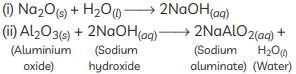
Example: Previous Year Questions 2023
(C) Previous Year Questions 2023

OR

(C) (i) Previous Year Questions 2023

(ii) The gas formed is sulphur dioxide which is colourless and poisonous. 
(iii) The nature of the gas is acidic. 
(iv) SO2 gas has no effect on dry litmus paper because it shows acidic behavior only in the presence of water

Get additional INR 200 off today with EDUREV200 coupon.Avail Offer

Previous Year Questions 2022

Q1: A clear solution of slaked lime is made by dissolving Ca(OH)2 in an excess of water. This solution is left exposed to air. The solution slowly goes milky as a faint white precipitate form. Explain why a faint white precipitate forms, and support your response with the help of a chemical equation.

OR

Keerti added dilute Hydrochloric acid to four metals and recorded her observations as shown in the table given below:
Select the correct observation(s) and give chemical equation(s) of the reaction involved.  (2022)

Hide Answer  

Ans: When a clear solution of slaked lime (Ca(OH)2) is exposed to air, carbon dioxide (CO₂) from the atmosphere dissolves into the solution and reacts with the dissolved calcium hydroxide. This reaction produces calcium carbonate (CaCO₃), which is insoluble and appears as a faint white precipitate (“milky” appearance). The chemical equation is:
Previous Year Questions 2022Thus, the “milkiness” arises from the formation of solid calcium carbonate.OR
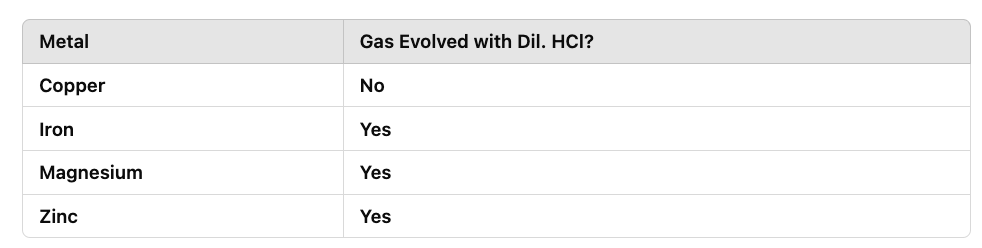
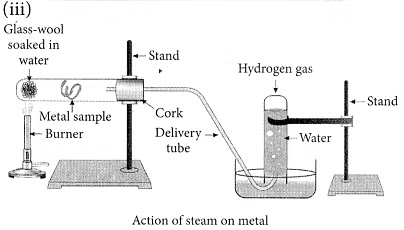
  1. Copper (below H)
    • Does not react with dilute HCl to give hydrogen gas.
    • No visible reaction under normal conditions.
  2. Iron (above H)
    • Does react to produce hydrogen gas.
    • Reaction:  Fe(s) + 2HCl(aq) → FeCl2(aq) + H2(g)
  3. Magnesium (above H)
    • Does react quite vigorously, giving hydrogen gas.
    • Reaction: Mg(s) + 2HCl(aq) → MgCl2(aq) + H2(g)
  4. Zinc (above H)
    • Does react, evolving hydrogen gas.
    • Reaction: Zn(s) + 2HCl(aq) → ZnCl2(aq) + H2(g)

Therefore, corrected table becomes :Previous Year Questions 2022

So, the correct observations are for  iron and zinc only.

Previous Year Questions 2021

Q1: Why is potassium kept immersed in kerosene? (2021 C)

Hide Answer  

Ans: 

  • Potassium is kept immersed in kerosene because it reacts vigorously with air and water.
  • The reaction with air forms a layer of potassium oxide on the surface, while the reaction with water produces potassium hydroxide.
  • Both of these reactions release hydrogen gas, which is highly flammable.
  • By keeping potassium immersed in kerosene, it is protected from air and water, preventing any unwanted reactions.


Q2: Give a reason why: 
(a) gold and silver are used for making jewellery. 
(b) a few metals are used for making cooking utensils. (2021 C)

Hide Answer  

Ans: (a) Gold and silver are highly malleable metals so, they are used for making jewellery.
(b)  Metals used to make cooking utensils are chosen not just for their good heat conduction but also for their relatively low reactivity. You generally don’t want a metal that reacts with food or with the conditions (high temperature, presence of water vapor, mild acids in food, etc.). Here’s how it ties to reactivity:

  1. Metals below hydrogen in the reactivity series (like coppersilvergold) do not readily react with acids or water under normal cooking conditions.
  2. Metals that form stable oxide layers (like aluminum, which is higher in the series) are protected from further corrosion by that oxide coating.
  3. Alloys such as stainless steel (predominantly iron but mixed with chromium/nickel) also resist corrosion because chromium forms a very adherent oxide layer that protects the iron underneath.

Thus, metals like iron (in stainless steel)aluminum, and copper are commonly used for utensils because:

  • They do not corrode easily or leach into food.
  • They are good conductors of heat.
  • They maintain a protective surface layer (oxide or alloy layer), preventing further reaction

Previous Year Questions 2020

Q1: Compare in tabular form the reactivities of the following metals with cold and hot water:   (2020)
(a) Sodium 
(b) Calcium 
(c) Magnesium

Hide Answer  

Ans:


Q2: (a) Write the electron dot structure of Ca (At. No. 20) and O (At. No. 8). 
(b) Show the formation of calcium oxide by the transfer of electrons. 
(c) Name the ions present in this compound. 
(d) List four important characteristics of this compound.   (2020)

Hide Answer  

Ans: 

(b) The formation of calcium oxide (CaO) involves the transfer of electrons. Calcium (Ca) donates two electrons to oxygen (O) to form Ca2+ cation and O2- anion. The ionic bond is formed between these ions to create calcium oxide.
(c) In calcium oxide (CaO), the ions present are Ca2+ (calcium cation) and O2- (oxygen anion).
(d) Four important characteristics of calcium oxide (CaO) are:

  • It is a white, crystalline solid.
  • It has a high melting and boiling point.
  • It is an ionic compound.
  • It is commonly used as a desiccant and in cement production.


Q3: List three differentiating features between the processes of galvanisation and alloying.   (2020)

Hide Answer  

Ans: Three differentiating features between the processes of galvanisation and alloying are as follows:

  • Definition: Galvanisation is the process of applying a protective zinc coating to iron or steel to prevent corrosion, while alloying is the process of combining two or more metals or metals with a non-metal to create a new material with enhanced properties.
  • Purpose: Galvanisation is primarily used to protect the base metal from corrosion by providing a sacrificial layer of zinc, whereas alloying is done to improve specific properties of the metal, such as strength, hardness, or resistance to corrosion.
  • Procedure: In galvanisation, the metal is coated with zinc through processes like hot-dip galvanisation or electroplating. On the other hand, alloying involves melting and mixing different metals or adding non-metallic elements to create an alloy with the desired properties.


Q4: (a) Complete and balance the following chemical equations:  (2020)
(i) AI2O3 + HCI →
(ii) K2O + H2O →
(iii) Fe + H2O →

(b) An element ‘X’ displaces iron from the aqueous solution of iron sulphate. List your observations if the element ‘X’ is treated with the aqueous solutions of copper sulphate, zinc sulphate and silver nitrate. Based on the observations arrange X, Zn, Cu and Ag in increasing order of their reactivities.

Hide Answer  

Ans: (a) Complete and balance the following chemical equations:
(i) AI2O3 + 6HCl  2AlCl3 + 3H2O
(ii) K2O + H2 2KOH
(iii) Fe + 2H2 Fe(OH)2 + H2
(b) Observations:

  • When element ‘X’ is treated with copper sulphate solution, no reaction occurs.
  • When element ‘X’ is treated with zinc sulphate solution, ‘X’ displaces zinc from the solution, resulting in the formation of ‘X’ sulphate and zinc metal.
  • When element ‘X’ is treated with silver nitrate solution, ‘X’ displaces silver from the solution, resulting in the formation of ‘X’ nitrate and silver metal.

Based on the observations, the increasing order of reactivities is:
Ag<Cu<Zn<X


Q5: (i) By the transfer of electrons, illustrate the formation of a bond in magnesium chloride and identify the ions present in this compound.
(ii) Ionic compounds are solids. Give reasons.
(iii) With the help of a labelled diagram show the experimental set-up of steam action on a metal.   (2020)

Hide Answer  

Ans: 

(ii) Ionic compounds are solids because the particles that make up ionic compounds are held together by strong electrostatic bonds.
Previous Year Questions 2020


Q6: (a) (i) Write two properties of gold that make it the most suitable metal for ornaments. 
(ii) Name two metals which are the best conductors of heat. 
(iii) Name two metals that melt when you keep them on your palm. 
(b) Explain the formation of the ionic compound CaO with an electron-dot structure. Atomic numbers of calcium and oxygen are 20 and 8 respectively.         (2020)

Hide Answer  

Ans: (a) (i) The malleability and ductility properties of gold make it suitable for ornaments. Also, beacause of less reactive natureof gold, it’s prefered for making jewellery. 
(ii) Silver and gold. 
(iii) Gallium and caesium have so low melting points that they melt even on keeping them in the palm.
Previous Year Questions 2020

(b) Formation of the ionic compound CaO (calcium oxide) with an electron-dot structure:

Calcium oxide (CaO) is formed through the transfer of electrons between calcium (Ca) and oxygen (O) atoms. Calcium, with an atomic number of 20, loses two electrons to achieve a stable electron configuration similar to that of a noble gas (argon), while oxygen, with an atomic number of 8, gains two electrons to complete its valence shell.

The electron-dot structure of CaO can be represented as follows:

Previous Year Questions 2020

In this structure, the calcium atom loses its two valence electrons to oxygen, resulting in a Ca2+cation and an O2- anion. The electrostatic attraction between these oppositely charged ions forms the ionic bond in calcium oxide (CaO).


Q7: Carbon cannot reduce the oxides of sodium, magnesium and aluminium to their respective metals. Why? Where are these metals placed in the reactivity series? How are these metals obtained from their ores? Take an example to explain the process of extraction along with chemical equations.        (2020)

Hide Answer  

Ans: Sodium, magnesium and aluminium have a higher affinity towards oxygen than carbon because these are highly reactive metals. Hence, carbon cannot reduce the oxides of sodium, magnesium and aluminium to their respective metals. These metals are placed at the top of the reactivity series. Highly reactive metals like Na, Mg, Al, etc. are extracted by electrolytic reduction of their molten chlorides or oxides. Electrolytic reduction is brought about by passing electric current through the molten state. Metal gets deposited at the cathode.
NaCl ⇌ Na+ + Cl
At cathode : Na+ + e → Na+
At anode : 2Cl → Cl2 + 2e


Q8: Write balanced chemical equations to explain what happens, when
(i) Mercuric oxide is heated.
(ii) A mixture of cuprous oxide and cuprous sulphide is heated.
(iii) Aluminium is reacted with manganese dioxide.
(iv) Ferric oxide is reduced with aluminium.
(v) Zinc carbonate undergoes calcination.              (2020)

Hide Answer  

Ans: (i) On heating, mercuric oxide decomposes to give mercury and oxygen.
Previous Year Questions 2020
(ii) On heating a mixture of cuprous oxide and cuprous sulphide, copper and sulphur dioxide are produced.
Previous Year Questions 2020
(iii) When aluminium is heated with manganese dioxide, manganese and aluminium oxide are formed.
Previous Year Questions 2020
(iv) Ferric oxide reacts with aluminium to produce aluminium oxide and iron.
Previous Year Questions 2020
(v) On calcination, zinc carbonate produces zinc oxide and carbon dioxide.
Previous Year Questions 2020


Q9: (a) Name the following:             (CBSE 2020)
(i) Metal that can be cut by a knife
(ii) Lustrous non-metal
(iii) Metal that exists in liquid state at room temperature
(iv) Most malleable and ductile metal
(v) Metal that is the best conductor of electricity
(vi) Non-metal that can exist in different forms
(b) How are alloys better than metals? Give the composition of solder and amalgam.

Hide Answer  

Ans: (a) (i) Sodium
(ii) Iodine
(iii) Mercury
(iv) Gold
(v) Silver
(vi) Carbon
(b) Alloys offer several advantages over pure metals:

  • They are generally stronger.
  • They resist corrosion better.
  • They often have lower melting points.
  • They usually have lower electrical conductivity. 
    The composition of:
  • Solder: An alloy of lead and tin.
  • Amalgam: An alloy of mercury with another metal.
Also read: NCERT Solutions: Metals & Non-metals

Previous Year Questions 2019

Q1: What would a student report nearly after 30 minutes of placing duly cleaned strips of aluminium, copper, iron and zinc in freshly prepared iron sulphate solution taken in four beakers?   (2019)

Hide Answer  

Ans: After approximately 30 minutes, the student would observe that the strip of iron would start to show signs of corrosion or rusting. This is because iron is more reactive than copper, aluminium, and zinc and will displace the iron from the iron sulphate solution, forming iron oxide (rust) on its surface.

Explanation: When cleaned metal strips of aluminium (Al), copper (Cu), iron (Fe), and zinc (Zn) are each placed into separate beakers containing freshly prepared iron(II) sulphate (FeSO₄) solution, here’s what the student would observe after about 30 minutes:

  1. Aluminium strip (Al)
    • Above Fe in the reactivity series:
      Al+FeSO4⟶Al2(SO4)3+Fe
    • Expected change: A brownish deposit of iron on the aluminium strip and possible fading of the greenish FeSO₄ solution.
  2. Copper strip (Cu)
    • Below Fe in the reactivity series:
      • Copper cannot displace iron from its salt.
    • Expected change: No reaction; the copper strip remains unchanged, and the solution color stays the same.
  3. Iron strip (Fe)
    • Same metal as in the solution:
      • No net displacement reaction occurs because the metal and the dissolved ion are both iron.
    • Expected change: No reaction; no visible change in the metal strip or the solution.
  4. Zinc strip (Zn)
    • Above Fe in the reactivity series:Zn+FeSO4⟶ZnSO4+ Fe
    • Expected change: A brownish deposit of iron on the zinc strip and the FeSO₄ solution may lose its greenish color as Fe²⁺ ions are displaced.

Summary of Observations

  • Al in FeSO₄: Brownish deposit (iron) forms on the strip.
  • Cu in FeSO₄: No change.
  • Fe in FeSO₄: No change.
  • Zn in FeSO₄: Brownish deposit (iron) forms on the strip.


Q2: A pale green solution of ferrous sulphate was taken in four separate test tubes marked I, II, III and IV. Pieces of Cu, Zn and Al were dropped in test tubes II, III and IV respectively. In which case(s) 
(a) Does the colour of the ferrous sulphate solution match with the colour in test tube (I)? Give reason. 
(b) the colour of the ferrous sulphate solution will fade and a black mass will be deposited on the surface of the metal.   (2019 C)

Hide Answer  

Ans: (a) The colour of the ferrous sulphate solution in test tube (I) will match the colour of the solution in test tube II when a piece of copper is dropped in it. This is because copper is less reactive than iron and will not displace iron from ferrous sulphate solution, resulting in no change in the colour of the solution.
No reaction: Cu + FeSO4 → CuSO+ Fe
(b) The colour of the ferrous sulphate solution will fade and a black mass will form on the metal surface in the following cases:

  1. Zinc displacing iron:Zn+FeSO4 ⟶ ZnSO4+Fe (s)
    • The FeSO₄ solution fades because Fe²⁺ ions are replaced by Zn²⁺.
    • The displaced iron is deposited on the zinc strip, often appearing black or brown in color.
  2. Aluminium displacing iron:2Al+3FeSO4⟶Al2(SO4)3+3Fe (s)
    • Similarly, the pale green color of FeSO₄ solution fades as iron ions are displaced.
    • The black/brown deposit of iron forms on the aluminium strip.


Q3: An ore on treatment with dilute hydrochloric acid produces brisk effervescence. Name the type of ore with one example. What steps will be required to obtain metal from the enriched ore? Also, write the chemical equations for the reactions involved in the process.       (AI 2019)

Hide Answer  

Ans: The ore that produces brisk effervescence when treated with dilute hydrochloric acid is a carbonate ore. One example of a carbonate ore is limestone (CaCO3).
Steps to obtain metal from the enriched ore:

  • Calcination: The ore is heated strongly in the absence of air to convert it into metal oxide.
    CaCO3(s) → CaO(s) + CO2(g)
  • Reduction: The metal oxide is then reduced using a suitable reducing agent, such as carbon or hydrogen, to obtain the metal.
    CaO(s) + C(s) → Ca(s) + CO(g)


Q4: Silver articles become black when kept in the open for some time, whereas copper vessels lose their shiny brown surfaces and gain a green coat when kept in the open. Name the substances present in the air with which these metals react and write the name of the products formed.       (2019)

Hide Answer  

Ans:  

  •  The substances present in the air with which silver reacts are hydrogen sulphide (H2S) and sulphur compounds. Silver reacts with these substances to form a black layer of silver sulphide (Ag2S) on its surface. 
  •  The substances present in the air with which copper reacts are moisture, carbon dioxide (CO2), and oxygen (O2). Copper reacts with these substances to form a green layer of copper carbonate (CuCO3) or copper hydroxide (Cu(OH)2) on its surface. 


Q5: (a) List in tabular form three chemical properties based on which we can differentiate between a metal and a non-metal.
(b) Give reasons for the following:
(i) Most metals conduct electricity well.
(ii) The reaction of iron 
(III) oxide (Fe2O3) with heated aluminium is used to join cracked machine parts. (Delhi 2019)

Hide Answer  

Ans: (a)
Previous Year Questions 2019
(b) (i) Metals conduct electricity due to the flow of free electrons present in them.
(ii) The reaction of iron (III) oxide, Fe2O3 with aluminium is highly exothermic and the iron produced melts. This molten iron is used to join cracked iron parts of machines and railway tracks.
Previous Year Questions 2019

Previous Year Questions 2018

Q1: (a) What is reactivity series? How does the reactivity series help in predicting the relative activity of various metals?
(b) Suggest different chemical processes used for obtaining a metal from its oxides of metals in the middle and top of the reactivity series. Support your answer with one example.    (CBSE Sample Paper 2018)

Hide Answer  

Ans: (a)  The reactivity series is a list of metals arranged in order of their decreasing reactivity. It helps predict how metals will react with each other and with other substances.

Key points about the reactivity series:

  • Metals higher in the series are more reactive.
  • For example, if metal A can displace metal B from a solution, A is more reactive than B.

Previous Year Questions 2018(b) The metals in the middle of the reactivity series are obtained from their ores by chemical reduction with a suitable reducing agent, e.g.
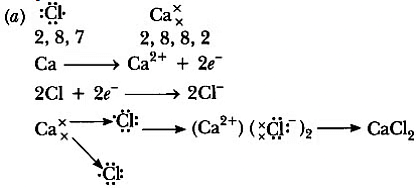
ZnO + C → Zn + CO
The metals at the top of the series are obtained by electrolytic reduction of their molten orc.
Al2O3  → 2Al3+ + 3O2-
At cathode: 2Al3+ + 6e → 2Al
At anode: O2- – 2e → O
O + O → O2


Q2: (a) Write the steps involved in the extraction of pure metals in the middle of the activity series from their carbonate ores.
(b) How is copper extracted from its sulphide ore? Explain the various steps supported by chemical equations. Draw a labelled diagram for the electrolytic refining of copper.   (2018)

Hide Answer  

Ans: (a) Extraction of metals of medium reactivity:

  • The metals in the middle of the reactivity series include zinciron, and lead.
  • These metals are typically found in the form of carbonates or sulphides.
  • To extract the metal, the carbonate ores must first be converted to oxides, as it is easier to obtain metals from their oxides.

(b) Copper glance (Cu2S) when heated in air gets partially oxidised to copper oxide which further reacts with the remaining copper glance to give copper metal.

Electrolytic refining of copper:

  • The process uses an electrolyte of acidified copper sulphate.
  • The anode is made of impure copper, while the cathode is a strip of pure copper.
  • When electric current is passed, pure copper is deposited on the cathode.
  • Soluble impurities dissolve in the solution, and insoluble impurities settle as anode mud.
Previous Year Questions 2018
Attention!Sale expiring soon, act now & get EduRev Infinity at 40% off!Claim Offer

Previous Year Questions 2017

Q1: Describe an activity to find out the conditions under which iron rusts.     (2017)

Hide Answer  

Ans: To find out the conditions under which iron rusts, you can perform the following activity:

  • Take three test tubes and label them as A, B, and C.
  • Fill test tube A with water, test tube B with water and oil, and test tube C with water and salt.
  • Place a small piece of iron nail in each test tube and allow them to stand undisturbed for a few days.
  • Observe the test tubes regularly and note any changes in the appearance of the iron nails.
  • After a few days, check for the presence of rust on the iron nails in each test tube.
  • Analyze the results and determine the conditions under which iron rusts.


Q2: A metal ‘X’ combines with a non-metal ‘Y’ by the transfer of electrons to form a compound Z.
(i) State the type of bond in compound Z.
(ii) What can you say about the melting point and boiling point of compound Z?
(iii) Will this compound dissolve in kerosene or petrol?
(iv) Will this compound be a good conductor of electricity?
       (2017)

Hide Answer  

Ans: (i) The type of bond in compound Z is an ionic bond.
(ii) Ionic compounds generally have high melting and boiling points due to the strong electrostatic forces of attraction between the positive and negative ions.
(iii) Ionic compounds like compound Z do not dissolve in non-polar solvents like kerosene or petrol. They are only soluble in polar solvents.
(iv) No, compound Z will not be a good conductor of electricity in a solid state because the ions are held in a fixed position and cannot move. However, it may conduct electricity when dissolved in water or molten state as the ions become free to move and carry electric charge.


Q3: Why do some metal surfaces acquire a dull appearance when they are exposed to moist air? Write the colour acquired by the surfaces of copper and silver in such a situation and also write the chemical names of the substances due to which it happens.                (Board Term I, 2017)

Hide Answer  

Ans: When metal surfaces are exposed to moist air, they can undergo oxidation. This process results in the formation of metal oxides on the surface. The effects on different metals are as follows:

  • Copper: The surface develops a greenish coating known as copper(II) oxide (CuO), which gives it a dull appearance.
  • Silver: The surface forms a blackish coating called silver sulfide (Ag2S), also resulting in a dull look.


Q4: (a) Define corrosion.
(b) What is corrosion of iron called?
(c) How will you recognise the corrosion of silver?
(d) Why corrosion of iron is a serious problem?
(e) How can we prevent corrosion of iron?      (Board Term I, 2017)

Hide Answer  

Ans:(a) The process of slowly eating up metals due to their conversion into oxides, carbonates, sulphides, etc., by the action of atmospheric gases and moisture is called corrosion.
(b) The corrosion of iron is called rusting.
(c) Silver articles become black after some time when exposed to air. This is due to the formation of a coating of black silver sulphide (Ag2S) on its surface by the action of H2S gas present in the air.
(d) Corrosion of iron is a serious problem. Every year large amount of money is spent to replace damaged iron articles. Corrosion causes damage to car bodies, bridges iron railings, ships and to all objects made of metals especially those of iron.
(e) Corrosion of iron is prevented by coating it with a layer of oil. The reason is that the layer of oil does not allow air and water to reach the surface of iron. Corrosion of iron can also be prevented by painting, greasing, galvanising, anodising, electroplating or making alloys. 

Previous Year Questions 2016

Q1: Give a reason for the following:                   (Board Term I, 2016)
(i) Hydrogen gas is not evolved when most of the metals react with nitric acid.
(ii) Zinc oxide is considered as an amphoteric oxide.
(iii) Metals conduct electricity.

Hide Answer  

Ans: (i) Most metals do not evolve hydrogen gas when they react with nitric acid because nitric acid is a strong oxidizing agent. It oxidizes hydrogen gas produced during the reaction to water and itself gets reduced to nitrogen oxides. Therefore, instead of hydrogen gas, the products obtained are nitrogen oxides.
(ii) Zinc oxide is considered an amphoteric oxide because it shows both acidic and basic properties. It reacts with acids to form zinc salts and water, exhibiting basic characteristics. Additionally, it reacts with bases to form zincates and water, showing acidic properties. This ability to react with both acids and bases classifies it as an amphoteric oxide.

ZnO + 2HCl →  ZnCl2   + H2 O

ZnO + 2NaOH + H2 O →  Na2   (Zn (OH)4 )

(iii) Metals conduct electricity because they have a large number of free or delocalized electrons. These electrons are not bound to any particular atom and can move freely throughout the metal lattice. When a potential difference is applied across a metal, these free electrons can easily move and carry an electric current.


Q2: Reverse of the following chemical reaction is not possible: 
Zn(s) + CuSO4(aq) → ZnSO4(aq) + Cu(s) Justify this statement with reason.                   (Board Term I, 2016)

Hide Answer  

Ans: The reverse of the given chemical reaction is not possible because it violates the principle of conservation of mass. In the forward reaction, zinc (Zn) displaces copper (Cu) from copper sulfate (CuSO4) to form zinc sulfate (ZnSO4) and copper. However, in the reverse reaction, copper cannot displace zinc from zinc sulfate, as copper is less reactive than zinc. Hence, the reverse of this reaction is not feasible.


Q3: (a) Define corrosion. (CBSE 2016)
(b) What is corrosion of iron called?
(c) How will you recognise the corrosion of silver?
(d) Why corrosion of iron is a serious problem?
(e) How can we prevent corrosion of iron?

Hide Answer  

Ans: (a) It is a process in which a metal reacts with substances present in the air to form surface compounds.
(b) Rusting.
(c) Black layer on its surface due to formation of Ag2S.
(d) It makes the metal weak and brittle, which is a serious problem.
(e) Oiling, painting, greasing, galvanisation, and alloying can prevent iron from corrosion.


Q4: (a) Define corrosion, what name is given to the corrosion of iron?
(b) Name the colour of the coating formed on silver and copper articles, when exposed to air.
(c) List two damages caused by corrosion and suggest how corrosion can be prevented.    (CBSE 2016)

Hide Answer  

Ans: (a) When a metal is attacked by substances around it, such as moisture, acids, etc., it is said to corrode and this process is called corrosion. Corrosion of iron is called rusting.
(b) Coating formed on silver is black and that formed on copper is green.
(c) Damages caused by corrosion:

  • It causes damage to car bodies and bridges.
  • It damages iron railings and ships.

Prevention of corrosion:

  • Corrosion can be prevented by oiling, painting, greasing and galvanising.
  • Corrosion can be prevented by galvanising and alloying.


Q5: Give reasons for the following:    (CBSE 2016)
(i) Carbonate and sulphide ores are usually converted into oxides during the process of extraction of metals.
(ii) Ionic compounds have generally high melting points.
(iii) Hydrogen is not a metal, but it has been assigned a place in the reactivity series of metals.
(iv) The galvanised iron article is protected against rusting even if the zinc layer is broken.
(v) The wires carrying current in homes have a coating of PVC.

Hide Answer  

Ans: (i) It is easier to convert metal oxides to metals as compared to carbonates and sulphides. Therefore carbonates are calcinated and sulphides are roasted to oxides.
(ii) There are electrostatic forces of attraction between the cations and anions in ionic compounds which are difficult to break. Therefore ionic compounds have high melting points.
(iii) Metals above hydrogen evolve hydrogen gas and metals below hydrogen do not evolve hydrogen when treated with an acid. That is when hydrogen has been assigned a place in the reactivity series of metals.
(iv) Even if the zinc layer is broken, it will preferentially be oxidised because it is more reactive than iron.
(v) The wires carrying current in homes have a coating of PVC. This is because PVC is an insulating substance and protects from electric shock.

Previous Year Questions 2015

Q1: What happens when carbon dioxide is compressed in water at higher pressure?    (CBSE 2015)

Hide Answer  

Ans: Carbonic acid is formed.
CO2 + H2O → H2CO3


Q2: Write the chemical equation for the reaction taking place when steam is passed over hot aluminium.    (CBSE 2015)

Hide Answer  

Ans: 2Al(s) + 3H2O (g) → Al2O3(s) + 3H2(g)


Q3: (a) Write the electron dot structure for chlorine (At No. 17) and calcium (At No. 20). Show the formation of calcium chloride by the transfer of electrons.
(b) Identify the nature of the above compound and explain the three physical properties of such compounds.    (CBSE 2015)

Hide Answer  

Ans:
Previous Year Questions 2015
(b) It is an ionic compound.
Physical properties:
(i) It is hard and solid.
(ii) It has a high melting and boiling point.
(iii) It is soluble in water.

Also read: NCERT Solutions: Metals & Non-metals

Previous Year Questions 2013

Q1: Explain the following: 
(A) Carbon cannot reduce the oxides of Na or Mg. 
(B) Iron articles are galvanised. 
(C) Metals like Na, K, Ca and Mg are never found in their free state in nature. (CBSE 2013)

Hide Answer  

Ans: (A) Sodium and magnesium have a tendency to react with oxygen rather than carbon because these are highly reactive metals. They have a greater affinity for oxygen than for carbon. Hence, their oxides are stable. The reduction of these metallic oxides with carbon requires very high temperature and at that temperature, metals react with carbon to form their corresponding carbides. Hence, carbon cannot reduce the oxides of Na or Mg. 
(B) Galvanisation is a process of formation of thin layer over metal surface. It prevents further contact of metal surface with atmosphere and reduces the corrosion level. So, iron articles are galvanised with a thin layer of zinc over them. Since zinc is more reactive than iron, it undergoes oxidation more readily than iron. As a result, iron articles remain protected. 
(C) Metals such as Na, K, Ca and Mg are highly reactive metals and hence they are not found in their free state in nature. Na, K, Ca and Mg  are alkali and alkaline Earth metals. They are the most reactive metals and readily react with atmospheric oxygen and other gases. Therefore, they are found in nature in the form of their compounds.

Previous Year Questions 2012

Q1: In nature, aluminium is found in combined state, whereas silver/gold are found in free state. Give reason. (CBSE 2012, 11, 10)

Hide Answer  

Ans: Silver and gold are least reactive metals and are often found in their native or free state. Aluminium is a very reactive metal and is never found in free state, but in combined state.

02. Previous Year Questions with Solutions: Acids, Bases and salts

Previous Year Questions 2025

Q1: In one formula unit of salt ‘X’, seven molecules of water of crystallisation are present. The salt ‘X’ is:  (1 Mark)
(a) 
CuSO₄
(b) Na₂CO₃
(c) FeSO₄
(d) CaSO₄

Hide Answer  

Ans: (c) FeSO₄

Iron(II) sulphate crystals contain seven molecules of water of crystallisation, and its formula is FeSO₄·7H₂O.
Salts like CuSO₄·5H₂O and CaSO₄·2H₂O also have fixed numbers of water molecules, but FeSO₄·7H₂O specifically contains seven.


Q2: Consider the following reactions:  (1 Mark)
(i) Dilute hydrochloric acid reacts with sodium hydroxide
(ii) Magnesium oxide reacts with dilute hydrochloric acid
(iii) Carbon dioxide reacts with sodium hydroxide
It is found that in each case:
(a)
 Salt and water is formed
(b) Neutral salts are formed
(c) Hydrogen gas is formed
(d) Acidic salts are formed

Hide Answer  

Ans: (a) Salt and water is formed

When an acid reacts with a base or a basic oxide, or when a non-metallic oxide reacts with a base, the products are salt and water.
Hence, in all three reactions given — (i), (ii), and (iii) — neutralisation reactions occur, producing salt and water.


Q3: Tooth enamel is made up of calcium hydroxyapatite (a crystalline form of calcium phosphate). This chemical starts corroding in the mouth when the pH is:  (1 Mark)
(a) 
7
(b) 5
(c) 10
(d) 14

Hide Answer  

Ans: (b) 5

Tooth decay begins when the pH of the mouth falls below 5.5. At this pH, acids produced by bacteria start corroding tooth enamel, which is made of calcium hydroxyapatite.


Q4: The warning sign shown in the given figure must invariably be displayed/pasted on the containers which contain hydroxide of:  (1 Mark)
(a) Aluminium
(b) Calcium
(c) Sodium
(d) Magnesium

Hide Answer  

Ans: (c) Sodium

Concentrated sodium hydroxide (NaOH) is a strong base that is highly corrosive. It can cause severe burns and must therefore be stored in containers displaying a warning sign for corrosive substances.


Q5: The body of human beings works within the pH range of:  (1 Mark)
(a)
 6.1 to 6.8
(b) 6.5 to 7.3
(c) 7.0 to 7.8
(d) 7.5 to 8.1

Hide Answer  

Ans: (c) 7.0 to 7.8
The human body functions properly only within a narrow pH range of 7.0 to 7.8; any change beyond this range can disturb normal metabolic activities.


Q6: A few pieces of granulated zinc are taken in a test tube and 2 mL of sodium hydroxide solution is added to it. When the contents are warmed, the product formed is:  (1 Mark)
(a)
 Na₂ZnO
(b) NaZnO₂
(c) Na₂ZnO₂
(d) NaZn(OH)₂

Hide Answer  

Ans: (c) Na₂ZnO₂

When zinc reacts with sodium hydroxide upon warming, sodium zincate (Na₂ZnO₂) and hydrogen gas are formed.
Reaction:
Previous Year Questions 2025


Q7: Which of the given option represents a family of salts ?  (1 Mark)
(a)
 NaCl, Na₂SO₄, CaSO₄
(b) K₂SO₄, Na₂SO₄, CaSO₄
(c) NaNO₃, CaCO₃, Na₂CO₃
(d) MgSO₄, CuSO₄, MgCl₂

Hide Answer  

Ans: (b) K₂SO₄, Na₂SO₄, CaSO₄

Salts having the same negative radical (anion) or the same positive radical (cation) belong to the same family.
Here, all three salts contain the sulphate (SO₄²⁻) ion, so they belong to the family of sulphate salts.


Q8: A common feature observed in the crystals of washing soda, copper sulphate, gypsum and ferrous sulphate is that all  (1 Mark)
(a)
 exhibit basic nature
(b) exhibit acidic nature
(c) have a fixed number of water molecules of crystallisation
(d) are coloured

Hide Answer  

Ans: (c) have fixed number of water molecules of crystallisation

Crystals of salts like washing soda (Na₂CO₃·10H₂O), copper sulphate (CuSO₄·5H₂O), gypsum (CaSO₄·2H₂O) and ferrous sulphate (FeSO₄·7H₂O) contain a definite number of water molecules known as water of crystallisation.


Q9: The chlorine produced during the electrolysis of brine solution is used in the manufacture of:  (1 Mark)
(a)
 Ammonia
(b) Disinfectants
(c) Plaster of Paris
(d) Soap and detergents

Hide Answer  

Ans: (b) Disinfectants

Chlorine gas obtained from the electrolysis of brine is used to manufacture bleaching powder, which is widely used as a disinfectant to make drinking water free from germs.


Q10: When a mixture of baking soda and tartaric acid is heated (or mixed in water) a product ‘X’ is formed, which is responsible for making breads and cakes soft and spongy. The product ‘X’ is  (1 Mark)
(a) 
Carbon dioxide
(b) Carbon monoxide
(c) Sodium tartrate
(d) Hydrogen

Hide Answer  

Ans: (a) Carbon dioxide

When baking soda (NaHCO₃) reacts with tartaric acid, carbon dioxide gas is released. This gas gets trapped in the dough, making breads and cakes soft and spongy.


Q11: You have three aqueous solutions A, B and C as given below :  (1 Mark)
(a) Potassium nitrate
(b) Ammonium chloride
(c) Sodium carbonate
Choose the correct increasing order of pH is:
(a)
 A < B < C
(b) B < C < A
(c) C < A < B
(d) B < A < C

Hide Answer  

Ans: (d) B < A < C

  • Ammonium chloride (B) is a salt of a strong acid and weak base, so it is acidic (lowest pH).
  • Potassium nitrate (A) is formed from a strong acid and strong base, so it is neutral (pH ≈ 7).
  • Sodium carbonate (C) is a salt of a strong base and weak acid, so it is basic (highest pH).
    Hence, the order of increasing pH is B < A < C.


Q12: The formula of washing soda is:  (1 Mark)
(a) 
NaHCO₃·6H₂O
(b) Na₂CO₃·6H₂O
(c) NaHCO₃·10H₂O
(d) Na₂CO₃·10H₂O

Hide Answer  

Ans: (d) Na₂CO₃·10H₂O

Washing soda is sodium carbonate decahydrate, and its chemical formula is Na₂CO₃·10H₂O, showing that each formula unit contains 10 molecules of water of crystallisation.


Q13: Juice of tamarind turns blue litmus to red. It is because of the presence of a chemical compound called  (1 Mark)
(a)
 Acetic acid
(b) Methanoic acid
(c) Oxalic acid
(d) Tartaric acid

Hide Answer  

Ans: (d) Tartaric acid
Tamarind contains tartaric acid, which is an acidic substance that turns blue litmus paper red.


Q14: The nature of aqueous solution of potassium nitrate is : (1 Mark)
(a)
 Acidic
(b) Basic
(c) Neutral
(d) Alkaline

Hide Answer  

Ans: (c) Neutral
Potassium nitrate is formed from a strong acid (HNO₃) and a strong base (KOH).
Salts of a strong acid and a strong base are neutral in nature, having a pH of 7.


Q15: The water of crystallization is present in  (1 Mark)
(i) Bleaching Powder
(ii) Plaster of Paris
(iii) Washing Soda
(iv) Baking Soda
(a) 
(ii) and (iv)
(b) (ii) and (iii)
(c) (i) and (iii)
(d) (i) and (iv)

Hide Answer  

Ans: (b) (ii) and (iii)Plaster of Paris (CaSO₄·½H₂O) and washing soda (Na₂CO₃·10H₂O) contain water of crystallisation, while bleaching powder and baking soda do not.


Q16: A crystalline substance of green colour ‘X’ emits gases of characteristic odour when heated over a flame. It first loses water and changes colour. On further heating, it decomposes and produces a solid compound Y.  (2 Marks)
(a) Identify ‘X’ and ‘Y’
(b) State the change in colour observed when ‘X’ is heated.

OR 

Write chemical equations to show what happens when an acid reacts with a  (3 Marks)
(i) Metal
(ii) Base
(iii) Carbonate

Hide Answer  

Ans:

(a) ‘X’ is Ferrous sulphate (FeSO₄·7H₂O) and ‘Y’ is Ferric oxide (Fe₂O₃).

(b) When heated, green crystals of ferrous sulphate lose water of crystallisation and turn white, then brown on further heating due to the formation of ferric oxide.

or
Ans:

(i) Acid + Metal → Salt + Hydrogen gas
Example:

Previous Year Questions 2025

(ii) Acid + Base → Salt + Water
Example:

Previous Year Questions 2025

(iii) Acid + Carbonate → Salt + Carbon dioxide + Water
Example:

Previous Year Questions 2025


Q17: Seawater contains many salts dissolved in it. Common salt is separated from these salts. Deposits of solid salt are also found in several parts of the world. These large crystals are often brown due to impurities. This is called rock salt and is mined like coal. The common salt is an important raw material for chemicals of daily use.

A mild non-corrosive basic salt ‘A’ used in cooking is heated to form ‘B’, which removes permanent hardness from water. Identify A and B. Write the equation of the reaction.  (2 Marks)

or 

Write the chemical formula of washing soda. How is it obtained from baking soda? List two uses of washing soda.  (3 Marks)

Hide Answer  

Ans:

‘A’ is Baking soda (NaHCO₃) and ‘B’ is Sodium carbonate (Na₂CO₃). When baking soda, a mild non-corrosive basic salt used in cooking, is heated, it forms sodium carbonate, which removes permanent hardness of water.
Previous Year Questions 2025

OR
Ans:

Washing soda (Na₂CO₃· 10H₂O) is obtained by heating baking soda (NaHCO₃) followed by recrystallisation.

Previous Year Questions 2025

It is used in the manufacture of glass, soap and paper, and for removing permanent hardness of water.


Q18: Dry HCl gas does not change the colour of dry litmus paper. Why?  (2 Marks)

Hide Answer  

Ans: Dry HCl gas does not change the colour of dry litmus paper because it does not produce hydrogen ions (H⁺) in the absence of water. Acids show their acidic behaviour only in aqueous solution, where they ionise to release H⁺ (or H₃O⁺) ions that cause the colour change in litmus.


Q19: Giving reason, state the advantage of using baking powder over baking soda for the preparation of bread or cakes.  (2 Marks)

OR 

State the chemical property in each case on which the following uses of baking soda are based upon:  (3 Marks)
(i) As an anti-acids
(ii) as a constituent in making baking powder
(iii) in soda-acid fire-extinguishers

Hide Answer  

Ans: Baking powder is preferred over baking soda because it contains both baking soda (NaHCO₃) and a mild edible acid (like tartaric acid). When mixed in dough, they react to produce carbon dioxide, which makes breads and cakes soft and spongy without leaving any bitter taste.

OR
Ans:

(i) As an antacid: Baking soda is alkaline and neutralises excess acid in the stomach, giving relief from acidity.
(ii) As a constituent in baking powder: It reacts with a mild edible acid to produce carbon dioxide, which makes baked goods soft and spongy.
(iii) In soda-acid fire extinguishers: It reacts with acid to release carbon dioxide gas, which helps extinguish fire by cutting off the oxygen supply.


Q20: A chemical compound ‘X’ is used to bleach washed clothes in laundry as well as to make drinking water free from germs. Identify ‘X’. How is this compound represented ? Write the method of its preparation along with the chemical equation for the reaction that occurs.  (2 Marks)

Hide Answer  

Ans: The compound ‘X’ is Bleaching powder, represented as Ca(ClO)₂. It is used for bleaching clothes and disinfecting drinking water.

It is prepared by the action of chlorine gas on dry slaked lime:
Previous Year Questions 2025


Q21: Seawater contains many salts dissolved in it. Common salt is separated from these salts. Deposits of solid salt are also found in several parts of the world. These large crystals are often brown due to impurities. This is called rock salt and is mined like coal. The common salt is an important raw material for chemicals of daily use.

Write balanced chemical equations showing the products formed during electrolysis of brine. List two uses of any one of the products. (3 Marks)

OR

Common salt is a very important chemical compound for our daily life. It’s chemical name is sodium chloride and it is used as a raw material in the manufacture of caustic soda, washing soda, baking soda etc. It is also used in the preservation of pickles, butter, meat etc.
(i) Name the acid and the base from which common salt can be obtained. (1 Mark)
(ii) State the nature (acidic/basic/neutral) of sodium chloride. Give reason for the justification for your answer.  (1 Marks)
(iii) (a) What happens when electric current is passed through an aqueous solution of sodium chloride (called brine)? Name the products obtained along with the corresponding places in the electrolytic cell where each of these products is obtained.  (2 Marks)

Hide Answer  

Ans: When electric current is passed through an aqueous solution of sodium chloride (brine), it undergoes electrolysis, producing three important products — chlorine gas, hydrogen gas, and sodium hydroxide.

Equations:

  • Chlorine (Cl₂) → liberated at the anode
  • Hydrogen (H₂) → liberated at the cathode
  • Sodium hydroxide (NaOH) → formed in the solution

Uses of Chlorine:

  • Used for disinfecting drinking water.
  • Used in the manufacture of PVC (polyvinyl chloride), bleaching powder, and pesticides.

OR

Ans:
(i) Common salt (sodium chloride) is obtained from hydrochloric acid (HCl) and sodium hydroxide (NaOH).Previous Year Questions 2025(ii) Sodium chloride is neutral in nature because it is formed from a strong acid (HCl) and a strong base (NaOH), giving a salt with pH 7.


(iii) (a) 

When electric current is passed through aqueous sodium chloride (brine), the process is called the chlor-alkali process. The products formed are:

  • Sodium hydroxide (NaOH) – formed near the cathode
  • Chlorine gas (Cl₂) – liberated at the anode
  • Hydrogen gas (H₂) – released at the cathodePrevious Year Questions 2025


Q22: The following questions are source-based/case-based questions. Read the case carefully and answer the questions that follow.

Acid-base indicators can be used to distinguish between an acid and a base. Universal indicator, a mixture of several indicators, shows different colours at different concentrations of acids and bases, thereby indicating their pH on the pH scale of 0 – 14. The pH of a solution is measured by pH paper, which is a paper impregnated with a universal indicator.  

Answer the following questions:  (3 Marks)
(a) Solution P is a strong acid, while solution Q is a strong base. On the pH scale, where would you place the solutions P and Q ?
(b) A solution has a pH of 7. Name a compound you would use to
(i) Increase its pH
(ii) Decrease its pH
(c) (i) When the pH of a solution is decreased from 4 to 2, what effect does it produce on its hydronium ion concentration ? State the colour change shown by the pH paper.

Hide Answer  

Ans:
(a) 

  • Solution P (strong acid) → pH between 0 and 2
  • Solution Q (strong base) → pH between 12 and 14

(b) A solution with pH = 7 is neutral.
(i) To increase its pH → add a base, e.g., sodium hydroxide (NaOH).
(ii) To decrease its pH → add an acid, e.g., hydrochloric acid (HCl).
(c) (i) When the pH decreases from 4 to 2, the solution moves further down the pH scale, showing an increase in acidity and 100 times more hydronium ion concentration.
(ii) The pH paper colour shifts from orange (pH 4) to red (pH 2), indicating a stronger acid.

Previous Year Questions 2024

Q1: Select a pair of natural indicators from the following:    (2024)
(a) 
Litmus and methyl orange
(b) Turmeric and Litmus
(c) Phenolphthalein and methyl orange
(d) Methyl orange and Turmeric

Hide Answer  

Ans: (b)

  • Turmeric and litmus are both natural indicators.
  • They change colour when they come into contact with acids or bases:
  • Turmeric turns red in alkaline solutions.
  • Litmus turns red in acidic solutions and blue in alkaline solutions.
  • This makes them useful for testing the pH of substances.


Q2: A chemical compound used in glass, soap and paper industries is   (2024)
(a)
 Washing Soda
(b) Baking Soda
(c) Bleaching Powder
(d) Common Salt

Hide Answer  

Ans: (a)

  • Washing soda, or sodium carbonate, is a chemical compound that is used in making glass, as a cleaning agent in soaps, and in the paper-making process.
  • It’s important for its ability to soften water and enhance cleaning.


Q3: An aqueous solution of a salt turns blue litmus to red. The salt could be the one obtained by the reaction of:   (2024)
(a)
 HNO3 and NaOH
(b) H2SO4 and KOH
(c) CH3COOH and NaOH
(d) HCl and NH4OH 

Hide Answer  

Ans: (d)

  • When hydrochloric acid (HCl) reacts with ammonium hydroxide (NH4OH), it forms ammonium chloride, which is an acidic salt.
  • This acid can turn blue litmus paper red, indicating that the solution is acidic.


Q4: Consider the following compounds:    (2024)
FeSO4, CuSO4, CaSO4, Na2CO3.
The compound having the maximum number of water of crystallization in its crystalline form in one molecule is:
(a)
 FeSO4
(b) CuSO4
(c) CaSO4
(d) Na2CO3

Hide Answer  

Ans: (d)

  • Sodium carbonate (Na2CO3) can exist as a hydrated compound called washing soda, which has 10 water molecules attached to each formula unit (Na2CO3·10H2O). 
  •  This means it has the highest number of water of crystallization compared to the other compounds listed. 


Q5: The salt present in tooth enamel is:    (2024)
(a) 
Calcium phosphate  
(b) Magnesium phosphate
(c) Sodium phosphate
(d) Aluminium phosphate

Hide Answer  

Ans: (a)

  • Tooth enamel is primarily composed of a mineral known as hydroxyapatite, which is a form of calcium phosphate.
  • This mineral plays a crucial role in: Strengthening teeth and making them resistant to decay
  • Thus, the correct answer is (a) Calcium phosphate.


Q6: An aqueous solution of sodium chloride is prepared in distilled water. The pH of this solution is:    (2024)
(a)
 6
(b) 8
(c) 7
(d) 

Hide Answer  

Ans: (c)

Sodium chloride (NaCl) is a neutral salt, formed from a strong acid (HCl) and a strong base (NaOH). When NaCl dissolves in water, it dissociates into sodium (Na⁺) and chloride (Cl⁻) ions, both of which do not react with water to affect the pH. As a result, the solution remains neutral, with a pH of 7.


Q7: Solid Calcium oxide reacts vigorously with water to form Calcium hydroxide accompanied by the liberation of heat. From the information given above it may be concluded that this reaction    (2024)
(a)
 is endothermic and pH of the solution formed is more than 7.
(b) is exothermic and pH of the solution formed is 7.
(c) is endothermic and pH of the solution formed is 7.
(d) is exothermic and pH of the solution formed is more than 7.

Hide Answer  

Ans: (d)

  • The reaction of solid calcium oxide with water is exothermic, meaning it releases heat.
  • This reaction produces calcium hydroxide, which is a strong base.
  • As a result, the pH of the solution formed is greater than 7, indicating it is alkaline.


Q8: Juice of tamarind turns blue litmus to red. It is because of the presence of an acid called:     (2024)
(a) 
Methanoic acid
(b) Acetic acid
(c) Tartaric acid
(d) Oxalic acid

Hide Answer  

Ans: (c)

The juice of tamarind contains tartaric acid, a natural organic acid. This acid:

  • Causes the solution to be acidic.
  • Turns blue litmus paper red, indicating acidity.
    Thus, the correct answer is (c) tartaric acid.


Q9: The oxide which can react with HCl as well as KOH to give corresponding salt and water is     (2024)
(a) 
CuO
(b) Al2O3
(c) Na2O
(d) K2O

Hide Answer  

Ans: (b)

Aluminum oxide (Al₂O₃) is an amphoteric oxide, meaning it can react with both acids and bases to form salts and water.

  • Reaction with acid (HCl): Al₂O₃ + 6HCl → 2AlCl₃ + 3H₂O
    Aluminum oxide reacts with hydrochloric acid to form aluminum chloride and water.
  • Reaction with base (KOH): Al₂O₃ + 2KOH + 3H₂O → 2KAl(OH)₄
    Aluminum oxide reacts with potassium hydroxide in aqueous solution to form potassium aluminate, demonstrating its ability to react with bases.


Q10: Identify the product ‘X’ obtained in the following chemical reaction:     (CBSE 2024)
(a) 
Quick lime    
(b) Gypsum
(c) Lime Stone    
(d) Plaster of Paris

Hide Answer  

Ans: (a)

The product ‘X’ obtained from the reaction is quick lime.

Here’s a brief explanation of the process:

  • Heating calcium carbonate (CaCO3) leads to its decomposition.
  • This decomposition produces calcium oxide (CaO) and carbon dioxide (CO2).
  • This process is known as calcination, commonly used in making cement and lime.

Thus, the answer is (a) quick lime.


Q11: (i) The pH of a sample of tomato juice is 4.6. How is this juice likely to be in taste? Give reason to justify your answer.
(ii) How do we differentiate between a strong acid and a weak base in terms of ion-formation in aqueous solutions?
(iii) The acid rain can make the survival of aquatic animals difficult. How?   (2024)

Hide Answer  

Ans: (i)  The taste of tomato juice will be slightly sour; The pH 4.6 indicates that tomato juice is an acid and acids are sour in taste.
(ii) Acids that give more H+ions / H3O+ are Strong Acids Bases that give less OH ions are Weak Bases.
(iii) Living animals can survive within a pH range of 7·0 to 7·8. So, if the pH of river water becomes low due to acid rain (pH < 5·6), then survival of aquatic animals becomes difficult.


Q12: Case based / data based questions with 2 to 3 short sub-parts. Internal choice is provided in one of these sub-parts.
Salts play a very important role in our daily life. Sodium chloride which is known as common salt is used almost in every kitchen. Baking soda is also a salt used in faster cooking as well as in baking industry. The family of salts is classified on the basis of cations and anions present in them.
(a) Identify the acid and base from which Sodium chloride is formed.
(b) Find the cation and the anion present in Calcium sulphate.
(c) “Sodium chloride and washing soda both belong to the same family of salts.” Justify this statement.
OR
(c) Define the term pH scale. Name the salt obtained by the reaction of Potassium hydroxide and Sulphuric acid and give the pH value of its aqueous solution.   (2024)

Hide Answer  

Ans:  (a) Acid – HCl, Base – NaOH

(b) Cation – Ca2+ , Anion – SO42-

(c) Salts that share the same cation but have different anions are considered part of the same family. For example:

  • Sodium chloride (NaCl)
  • Washing soda (sodium carbonate, Na2CO3)

Both contain the Na+  cation.

OR

 (c) The pH scale measures how acidic or basic a solution is, ranging from 0 (acidic) to 14 (basic), with 7 being neutral. When Potassium hydroxide (KOH) reacts with Sulfuric acid (H2SO4), it produces Potassium sulfate (K2SO4), which is a neutral salt. Its aqueous solution has a pH of approximately 7.


Q13: 1 gram of solid sodium chloride was taken in a clean and dry test tube and concentrated sulphuric acid was added to it.
(i) Name the gas evolved in the reaction.
(ii) What will be observed when this gas is tested with (I) dry, and (II) wet blue litmus paper? Write your conclusion about the nature (acidic/basic) of this gas.      (2024)

Hide Answer  

Ans: (i) The gas evolved is HCl gas.

(ii) When tested with:

  • Dry blue litmus paper: No change in colour.
  • Wet blue litmus paper: Turns red.

Conclusion: The HCl gas is acidic in nature.


Q14: (a) A few crystals of ferrous sulphate were taken in a dry boiling tube and heated. Tiny water droplets were observed in the tube after some time.
(i) From where did these water droplets appear? Explain.
(ii) What color change will be observed during heating?
(iii) How many molecules of water are attached per molecule of FeSO4 crystal? Write the molecular formula of crystalline forms of (I) Copper sulphate, and (II) Sodium carbonate.
(iv) State how is Plaster of Paris obtained from gypsum. Write two uses of Plaster of Paris.
OR
(b) An acid ‘X’ present in tamarind when mixed with ‘Y’, produces a mixture ‘Z’. ‘Z’ on addition to a dough when heated makes cakes soft and spongy. ‘Y’ is prepared from common salt and helps in faster cooking.
(i) Write the common names of ‘X’, ‘Y’ and ‘Z’, and the chemical formula of ‘Y’.
(ii) How is ‘Y’ prepared and how does it help in making cakes soft and spongy? Illustrate the reaction with a suitable chemical equation.
(iii) Write the name and chemical formula of a mild base other than ‘Y’ used as an antacid.   (2024)

Hide Answer  

Ans: (a) (i)The water droplets appear due to the evaporation of water of crystallisation in ferrous sulphate crystals when heated.
(ii) The colour change observed during heating is from green to white.

(iii) Each molecule of FeSO4 crystal has seven water molecules attached, represented as FeSO4 · 7H2O. The molecular formulas for the crystalline forms are:

  • (I) Copper sulphate: CuSO4 · 5H2O
  • (II) Sodium carbonate: Na2CO3 · 10H2O

(iv) Plaster of Paris is obtained by heating gypsum (CaSO4 · 2H2O) at 373 K, which causes it to lose water molecules.

Two uses of Plaster of Paris are:

  • It is used by doctors to support fractured bones.
  • It is also used in making decorative items.

Previous Year Questions 2024
OR
(b) (i) X-Tartaric acid , Y-Baking soda , Z- Baking powder Y- NaHCO3
(ii) NaCl + H2O +CO2 +NH→ NH4Cl +NaHCO3
NaHCO3 + H+ → CO2 + H2O + Sodium salt of acid CO2 released during heating makes the cake soft and spongy. 
(iii) Magnesium hydroxide; Mg(OH)2


Q15: Write the common name and the chemical name of the compound Write the method of its preparation. Give chemical equation for the reaction, when water reacts with    (2024)

Hide Answer  

Ans: Common Name: Plaster of Paris

Chemical Name: Calcium sulphate hemihydrate

Preparation Method:

  • Plaster of Paris is made from gypsum (CaSO4 · 2H2O).
  • It is prepared by heating gypsum at 373 K.

Chemical Equation:

When water reacts with Plaster of Paris:

CaSO4 · ½H2O + 1½ H2O → CaSO4 · 2H2O


Q16: The following questions are source-based/case-based questions. Read the case carefully and answer the questions that follow:    (2024)
Three metal samples of magnesium, aluminium and iron were taken and rubbed with sand paper. These samples were then put separately in test tubes containing dilute hydrochloric acid. Thermometers were also suspended in each test tube so that their bulbs dipped in the acid. The rate of formation of bubbles was observed. The above activity was repeated with dilute nitric acid and the observations were recorded.
Answer the following questions:
(a) When activity was done with dilute hydrochloric acid, then in which one of the test tubes was the rate of formation of bubbles the fastest and the thermometer showed the highest temperature?
(b) Which metal did not react with dilute hydrochloric acid? Give reason.
(c) (i) Why is hydrogen gas not evolved when a metal reacts with dilute nitric acid? Name the ultimate products formed in the reaction.
OR
(c) (ii) Name the type of reaction on the basis of which reactivity of metals is decided. You have two metals X and Y. How would you decide which is more reactive than the other?

Hide Answer  

Ans: (a) The test tube with magnesium had the fastest rate of bubble formation and the highest temperature.

(b) All three metals react with dilute hydrochloric acid as they are more reactive than hydrogen.

(c)(i) Hydrogen gas is not produced when a metal reacts with dilute nitric acid because nitric acid is a strong oxidising agent. It oxidises the hydrogen gas to water. The ultimate products are water and nitrogen oxides.
OR

(c)(i) The type of reaction that determines the reactivity of metals is a displacement reaction. If metal X displaces metal Y from its salt solution, then metal X is more reactive than metal Y, and vice versa.

Previous Year Questions 2023

Q1: When sodium bicarbonate reacts with dilute hydrochloric acid, the gas evolved is   (2023)
(a) Hydrogen; it given pop sound with burning match stick.
(b) Hydrogen; it turns lime water milky.
(c) Carbon dioxide; it turns lime water milky.
(d) Carbon dioxide; it blows off a burning match stick with a pop sound.

Hide Answer  

Ans: (c)
Sol: When sodium bicarbonate reacts with dilute hydrochloric acid, carbon dioxide gas is liberated. The reaction that occurs is shown below:
NaHCO3 + HCI → NaCl + H2O + CO2
Carbon dioxide when passed into lime water gives a milky solution. This is due to the formation of an insoluble suspension of calcium carbonate:
Previous Year Questions 2023


Q2: Select a pair of olfactory indicators from the following:    (2023)
(a) Clove oil and vanilla essence 
(b) Onion and turmeric 
(c) Clove oil and litmus paper
(d) Vanilla and methyl orange

Hide Answer  

Ans: (a)

  • Clove oil and vanilla essence are the correct pair of olfactory indicators.
  • They change their smell in the presence of acids or bases.
  • Other options like onion and turmeric do not serve as olfactory indicators.
  • Litmus paper and methyl orange are not olfactory indicators.


Q3: Sodium hydroxide is termed as alkali while ferric hydroxide is not because:   (2023)
(a) Sodium hydroxide is a strong base, while ferric hydroxide is a weak base.
(b) Sodium hydroxide is a base which is soluble in water while ferric hydroxide is also a base but it is not soluble in water.
(c) Sodium hydroxide is a strong base while ferric hydroxide is a strong acid.
(d) Sodium hydroxide and ferric hydroxide both are strong base but the solubility of sodium hydroxide in water is comparatively higher than that of ferric hydroxide.

Hide Answer  

Ans: (b)
Sol: Sodium hydroxide is classified as an alkali, while ferric hydroxide is not due to the following reasons:

  • Sodium hydroxide is a strong base, whereas ferric hydroxide is a weak base.
  • Sodium hydroxide is soluble in water, while ferric hydroxide is not.
  • Sodium hydroxide is not a strong acid; it is a base, while ferric hydroxide does not fit this classification.
  • Both are bases, but sodium hydroxide has a higher solubility in water compared to ferric hydroxide.


Q4: Hydronium ions are formed by the reaction between   (2023)
(a) Sodium hydroxide and water
(b) Calcium chloride and water
(c) Hydrogen chloride gas and water
(d) Ethanol and water

Hide Answer  

Ans: (c)
Sol: 
According to Arrhenius theory, acids are substances which dissociate in aqueous solution to give hydrogen ions (or hydronium ions).
Previous Year Questions 2023


Q5: Fresh milk has a pH of 6. To delay its curdling, a chemical substance is added to it, which is   (2023)
(a) Sodium carbonate 
(b) Baking powder 
(c) Sodium hydroxide (caustic soda) 
(d) Baking soda (sodium hydrogen carbonate)

Hide Answer  

Ans: (d)
Sol: 

Fresh milk has a pH of about 6 and can curdle when bacteria convert lactose into lactic acid, lowering the pH further. Sodium hydrogen carbonate (NaHCO₃), commonly called baking soda, is a mild base that neutralizes this acid, maintaining the pH closer to neutral and delaying curdling.

  • Reaction:
    NaHCO₃ + H⁺ (from lactic acid) → Na⁺ + H₂O + CO₂
    This neutralizes the acid produced, preventing the milk from souring quickly.


Q6: The name of the salt used to remove permanent hardness of water is   (2023)
(a) Sodium hydrogen carbonate (NaHCO3)
(b) Sodium chloride (NaCI)
(c) Sodium carbonate decahydrate (Na2CO3.10H2O)
(d) Calcium sulphate hemihydrate (CaSO4. 1/2 H2O)

Hide Answer  

Ans: (c)
Sol: Na2CO3.10H2O is used to remove permanent hardness of water. Washing soda (Na2CO3.10H2O) reacts with soluble calcium and magnesium chlorides and sulphates in hard water to form insoluble carbonates, that can be removed by filtration and then water becomes soft.


Q7: A student took a small amount of copper oxide in a conical flask and added dilute hydrochloric acid to it with constant stirring. He observed a change in colour of the solution.
(i) Write the name of the compound formed and its colour.
(ii) Write a balanced chemical equation for the reaction involved.   (2023)

Hide Answer  

Ans: (i) The compound formed is copper chloride (CuCl2) and its colour is green in aqueous solution.
(ii) The balanced chemical equation for the reaction is: CuO + 2HCl → CuCl2 + H2O


Q8: (a) Write a balanced equation to show the reaction that occurs when a piece of aluminium is dipped in a dilute solution of (i) sulphuric acid and (ii) sodium hydroxide.
(b) Write the colour of the solution formed when copper oxide is treated with hydrochloric acid. Give a reason for this observation.      (2023)

Hide Answer  

Ans: (a) (i) 2AI + 3H2SO4 → AI2(SO4)3 + 3H2
(ii) 2AI + 2NaOH + 2H2O → 2NaAIO2 + 3H2
(b) 

  • The solution formed when copper oxide reacts with hydrochloric acid is a bluish-green colour.
  • This occurs because copper oxide reacts with hydrochloric acid to produce copper chloride and water.
  • The copper chloride dissolves in water, resulting in the bluish-green colour of the solution.


Q9: (i) Suggest a safe procedure for diluting a strong concentrated acid.
(ii) Name the salt formed when sulphuric acid is added to sodium hydroxide and write its pH.
(iii) Dry hydrochloric acid (HCl) gas does not change the colour of dry blue litmus paper. Why?      (2023)

Hide Answer  

Ans: (i)  

  •  During the dilution of a strong concentrated acid, always add acid to water and not the water to acid. 
  •  The dissociation of an acid in water is a highly exothermic process, as the acid has a strong affinity for water. 
  •  Adding water to acid can cause a violent reaction due to the rapid generation of heat. 
  •  By adding acid to water slowly and with constant stirring, the heat generated can be dissipated more effectively, ensuring a safe dilution process. 

(ii) The salt formed when sulphuric acid is added to sodium hydroxide is sodium sulphate (Na2SO4). Sodium sulphate is a neutral salt, and its aqueous solution will have a pH of 7.
(iii) Dry hydrochloric acid (HCl) gas does not change the colour of dry blue litmus paper because:

  • The colour change requires the presence of hydrogen ions (H+).
  • HCl gas can only produce these ions in an aqueous solution, where it dissociates.
  • Without water, HCl gas does not release H  ions, hence no colour change occurs.


Q10: Two solutions M and N give red and blue colour respectively with a universal indicator.
(i) In which solution will the hydrogen ion concentration be more? Justify your answer.
(ii) If both M and N solutions are mixed and the resultant mixture is tested with a universal indicator, it turns green. What is the nature of the salt formed? Justify your answer.      (2023)

Hide Answer  

Ans: (i) Solution M gives a red color with a universal indicator, indicating that it is an acidic solution with a higher hydrogen ion concentration. Solution N gives a blue color with a universal indicator, indicating that it is a basic solution with a lower hydrogen ion concentration.
(ii) When solutions M and N are mixed, the resulting green color with a universal indicator indicates that the mixture is neutral. This suggests that a salt solution is formed, which is neither acidic nor basic.


Q11: On heating X at 373 K, it loses water molecules and becomes Y. Y is a substance which doctors use for supporting fractured bones in the right position.
(i) Identify X and V.
(ii) How can X be reobtained from Y?      (2023)

Hide Answer  

Ans: (i) X is gypsum (CaSO4 · 2H2O) and Y is Plaster of Paris (CaSO4 · 0.5H2O). V is the substance doctors use for supporting fractured bones in the right position.
(ii) X can be reobtained from Y by:

  • Adding water to Plaster of Paris.
  • This process converts it back to gypsum.
    The reaction is: CaSO4 · 0.5H2O + 1.5H2O → CaSO4 · 2H2O


Q12: Consider the following salts:
(i) yCI
(ii) NH4X
(iii) ZCO3
(a) What would be the pH of the salt solution if in yCI, y is sodium? Give a reason for your answer.
(b) If in salt NH4X, X is nitrate, then its solution will give what colour with a universal indicator? Why?
(c) What would be the change in colour in a blue litmus solution if ZCO3 is added to it and Z is potassium?
      (2023)

Hide Answer  

Ans: (a) If in yCI, y is sodium, the salt formed is NaCI. NaCI is a salt of a strong acid (HCI) and a strong base (NaOH), making it a neutral salt. Hence, the pH of the salt solution would be 7.
(b) If in salt NH4X, X is nitrate, the salt formed is NH4NO3. NH4NO3 is a salt of a weak base (NH4OH) and a strong acid (HNO3). It is an acidic salt and will give an orange-yellow colour with a universal indicator.
(c) Potassium carbonate (K₂CO₃) is a basic salt formed from a strong base (KOH) and a weak acid (H₂CO₃). In solution, it hydrolyzes to produce OH⁻ ions, making the solution basic (pH > 7):

K₂CO₃ + H₂O ⇌ 2K⁺ + HCO₃⁻ + OH⁻
Since blue litmus paper remains blue in basic solutions and only turns red in acidic solutions, adding K₂CO₃ will not change its color—it stays blue.


Q13: The industrial process used for the manufacture of caustic soda involves electrolysis of an aqueous solution of compound ‘X’. In this process, two gases Y and Z are liberated. Y is liberated at the cathode and Z, which is liberated at the anode, on treatment with dry slaked lime, forms a compound ‘B’. Name X, Y, Z, and B.      (2023)

Hide Answer  

Ans: Compound X: Sodium chloride (NaCl).

  • Gas Y: Hydrogen gas (H2) is liberated at the cathode.
  • Gas Z: Chlorine gas (Cl2) is liberated at the anode.
  • Compound B: Bleaching powder (CaOCl2) is formed when chlorine gas reacts with dry slaked lime (Ca(OH)2).


Q14: Select washing soda from the following: 
(a) NaHCO3
(b) Na2CO3.5H2
(c) Na2CO3.10H2
(d) NaOH (CBSE 2023)

Hide Answer  

Ans: (c)
Washing soda is chemically known as sodium carbonate decahydrate (Na₂CO₃·10H₂O). It is commonly used as a cleaning agent.
The other options represent different compounds:
(a) NaHCO₃: This is sodium bicarbonate, also known as baking soda.
(b) Na₂CO₃·5H₂O: This is not a common form of sodium carbonate; washing soda specifically has 10 molecules of water.
(d) NaOH: This is sodium hydroxide, also known as caustic soda.
Therefore, the correct answer is (c) Na₂CO₃·10H₂O.


Q15: The table below has information regarding pH and the nature (acidic/basic) of four different solutions. Which of the following option in the table is correct?  (CBSE 2023)

Hide Answer  

Ans: (b)
(a) Lemon juice: Lemon juice is acidic with a pH around 2-3, but it is acidic, not basic. So, this option is incorrect.
(b) Milk of magnesia: This is basic with a pH around 10, which would turn the pH paper blue, indicating a basic nature. This option is correct.
(c) Gastric juice: Gastric juice is acidic with a pH around 1-3, not 6. A pH of 6 is close to neutral, which is not correct for gastric juice. So, this option is incorrect.
(d) Pure water: Pure water has a neutral pH of 7, but it would usually turn the pH paper green, not yellow. So, this option is also incorrect.
Therefore, the correct answer is (b) Milk of magnesia – Blue, pH 10, Basic.


Q16: (A) A compound ‘X’ which is prepared from gypsum has the property of hardening when mixed with proper quantity of water. Identify ‘X’ and write its chemical formula. 
(B) State the difference in chemical composition between baking soda and baking powder. (CBSE 2023)

Hide Answer  

Ans: (A) The compound ‘X’ is Plaster of Paris. It is prepared by heating gypsum at 373 K. Its chemical formula is  CaSO4 · 0.5H2O.
Previous Year Questions 2023(B) The differences between baking soda and baking powder are:
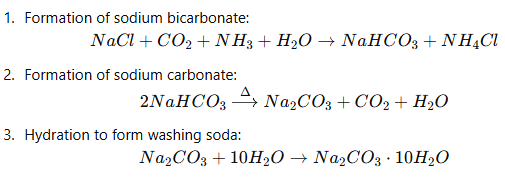
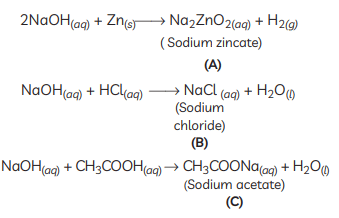
Baking Soda: Sodium bicarbonate (NaHCO₃), a single compound.Pure NaHCO₃, a base that releases CO₂ when heated or combined with an acid:
2NaHCO₃ → Na₂CO₃ + H₂O + CO₂ (on heating).
Baking Powder: A mixture of sodium bicarbonate (NaHCO₃) and acid salts (e.g., monocalcium phosphate, Ca(H₂PO₄)₂), often with a filler like starch.
A leavening agent containing NaHCO₃ and an acid salt (e.g., monocalcium phosphate). When moistened, the acid reacts with NaHCO₃ to release CO₂ without needing an external acid:
NaHCO₃ + H⁺ (from acid salt) → Na⁺ + H₂O + CO₂.

Hide Answer  


Q17: (A) Suggest one remedial measure each to counteract the change in pH in human beings in following cases: 
(i) Production of too much acid in stomach during indigestion. 
(ii) Stung by a honey bee/nettle leaves. 
(B) Fresh milk has a pH of 6. When it changes into curd, will its pH increase or decrease? Why? (CBSE 2023)

Hide Answer  

Ans: . (A) (i) To get relief from this acidic pain, one must take antacids. These contain bases to neutralise the excess acids. 
Examples: Magnesium hydroxide (milk of magnesia) i.e., Mg(OH)2 or Aluminium hydroxide. 
(ii)  

  • A bee injects an acidic fluid into a person’s skin when it stings them causing pain and irritation.
  • Applying a baking soda solution, a base made of sodium hydrogen carbonate, is the cure.
  • By neutralising the acid, the solution relieves the pain.
  • Accidental contact with nettle plant leaves causes the stinging hair to inject formic or methanoic acid into the person’s epidermis, causing burning discomfort.
  • As the nettle sting is acidic, it can be relieved by applying a basic substance to the skin, such as baking soda.

(B) When fresh milk changes into curd, its pH decreases because curd is acidic. The pH gets increased for a basic solution and decreased for an acidic solution.

Get additional INR 200 off today with EDUREV200 coupon.Avail Offer

Previous Year Questions 2022

Q1: Which of the options in the given table are correct?      (2022)
(a) (i) and (ii)
(b) (i) and (iv)
(c) (ii) and (iii) 
(d) (iii) and (iv)

Hide Answer  

Ans: (c)
Sol: 

  • Orange is a natural source of citric acid.
  • Tamarind contains tartaric acid.


Q2: Three test tubes A, B and C contain distilled water, an acidic solution and a basic solution respectively. When red litmus solution is used for testing these solutions, the observed colour changes respectively will be:      (2022) 
(a) A – no change; B – becomes dark red; C – becomes blue 
(b) A – becomes light red; B – becomes blue; C – becomes red 
(c) A – becomes red; B – no change; C – becomes blue 
(d) A – becomes light red; B – becomes dark red; C – becomes blue

Hide Answer  

Ans: (a)
Sol: Colour of red litmus remains red in neutral solutions, become dark red in acidic and blue in presence of basic solutions. So, there will be no change in colour of red litmus in distilled water (test tube A). In test tube B, it becomes dark red and in test tube C, red litmus turns blue.


Q3: Concentrated H2SO4 is diluted by adding drop by drop (2022)
(a) Water to acid with constant stirring
(b) Acid to water with constant stirring
(c) Water to acid followed by a base
(d) Base to acid followed by cold water

Hide Answer  

Ans: (b)
Sol: 

  • If you add water to acid, you form an extremely concentrated solution of acid initially.
  • The reaction of conc. acid with water is highly exothermic, and the solution may boil very violently, splashing concentrated acid.
  • If you add acid to water, the solution that forms is very dilute and a small amount of heat released.


Q4: Select from the following the statement which is true for bases.      (2022)
(a) Bases are bitter and turn blue litmus red.
(b) Bases have a pH less than 7.
(c) Bases are sour and change red litmus to blue.
(d) Bases turn pink when a drop of phenolphthalein is added to them.

Hide Answer  

Ans: (d)
Sol: Bases are substances which have bitter taste, soapy touch and turn red litmus solution to blue. Bases have pH more than 7. Bases give pink colour with phenolphthalein.


Q5: A solution gives yellowish orange colour when a few drops of universal indicator are added to it. This solution is of :      (2022)
(a) Lemon juice 
(b) Sodium chloride 
(c) Sodium hydroxide 
(d) Milk of magnesia

Hide Answer  

Ans: (a)
Sol: Few drops of universal indicators in a solution give yellowish orange colour to solution. This indicates that the solution used was acidic in nature. For example: lemon juice.


Q6: Anita added a drop each of diluted acetic acid and diluted hydrochloric acid on pH paper and compared the colours. Which of the following Is the correct conclusion?    (2022)
(a) pH of acetic acid is more than that of hydrochloric acid
(b) pH of acetic acid is less than that of hydrochloric add.
(c) Acetic acid dissociates completely in aqueous solution,
(d) Acetic acid Is a strong acid.  

Hide Answer  

Ans: (a)
HCl is stronger acid than CH3COOH so, pH of acetic add is more than that of hydrochloric acid.

Previous Year Questions 2021

Q1: State the purpose for which litmus is used in laboratories.    (2021C)

Hide Answer  

Ans: Litmus is used in laboratories as an indicator to identify whether a substance is acidic or basic. It works as follows:

  • Litmus changes colour in response to acidity or basicity.
  • Red litmus paper turns blue in basic solutions.
  • Blue litmus paper turns red in acidic solutions.
  • When neutral, litmus remains purple.


Q2: Out of the two hydrochloric acid and acetic acid, which one is considered as strong acid and why ? Write the name/molecular formula of one more strong acid.  (2021 C)

Hide Answer  

Ans: Hydrochloric acid is considered a strong acid because it completely dissociates in water, releasing H+  ions. In contrast, acetic acid only partially dissociates, making it a weak acid.

Another example of a strong acid is H2SO4 (sulphuric acid).

Also watch: Acids, Bases and Salts

Previous Year Questions 2020

Q1: A visually challenged student, has to perform a lab test to detect the presence of acid in a given solution. The acid-base indicator preferred by him will be:   (2020)
(a) Blue litmus 
(b) Clove oil 
(c) Red cabbage extract 
(d) Hibiscus extract

Hide Answer  

Ans: (b)
Sol: Clove oil can be used as acid-base indicator by visually challenged student. Clove oil gives different odour in acidic and basic solution.


Q2: An aqueous solution ‘A’ turns phenolphthalein solution pink. In addition of an aqueous solution ‘B’ to ‘A’, the pink color disappears. The following statement is true for solution ‘A’ and ‘B’.   (2020)
(a) A is strongly basic and B is a weak base.
(b) A is strongly acidic and B is a weak acid.
(c) A has pH greater than 7 and B has pH less than 7.
(d) A has pH less than 7 and B has pH greater than 7.

Hide Answer  

Ans: (c)
Sol: As the aqueous solution of A turns phenolphthalein solution pink, hence A is basic in nature. On adding an acidic solution, the pink colour will disappear. Hence, B is an acid.


Q3: The acid produced in our stomach during digestion of food is (2020)

(a) Hydrochloric acid
(b) Oxalic acid
(c) Lactic acid
(d) Acetic acid

Hide Answer  

Ans: (a)

Hydrochloric acid (HCl) is produced in the stomach and plays a vital role in digestion. Its key functions include:

  • Breaking down food effectively.
  • Creating an acidic environment that helps kill harmful bacteria.
  • Ensuring proper digestion and maintaining stomach health.


Q4: (i) Draw a labelled diagram to show the preparation of hydrogen chloride gas in the laboratory.
(ii) Test the gas evolved first with dry and then with wet litmus paper. In which of the two cases does the litmus paper show a change in color?
(iii) State the reason for the exhibiting acidic character by dry HCl gas/HCl solution.      (2020)

Hide Answer  

Ans: (i) To prepare hydrogen chloride gas in the laboratory:

  • Set up a test tube with some solid sodium chloride (NaCl).
  • Add concentrated sulphuric acid (H2SO4) to the test tube.
  • Observe the gas evolved from the delivery tube.


(ii) Testing the gas with litmus paper:

  • Dry blue litmus paper: No colour change.
  • Moist blue litmus paper: Turns red.

This indicates that hydrogen chloride (HCl) gas is not acidic without water but becomes acidic when in contact with moisture.

(iii) When hydrogen chloride (HCl) gas dissolves in water, it forms hydrochloric acid solution (HCl(aq)). In the solution, HCl dissociates and produces H+ or H3O+ ions. The presence of these ions makes HCl solution acidic. The reaction can be represented as: HCl(g) + H2O(l) → H3O+(aq) + Cl(aq)


Q5: Complete and balance the following chemical equations:       (2020)
(i) NaOH(aq) + Zn(s) →
(ii) CaCO3(s) + H2O(l) + CO2(g) →
(iii) HCl(aq) + H2O(l) →

Hide Answer  

Ans: (i) 2NaOH(aq) + Zn(s) → Na2ZnO2(aq) + H2(g)
(ii) CaCO3(s) + H2O(l) + CO2(g) → Ca(HCO3)2(aq)
(iii) HCl(aq) + H2O(l) → H3O+(aq) + Cl(aq)


Q6: (a) You are provided with concentrated sulphuric acid. Describe the process of preparing a dilute solution of sulphuric acid.
(b) What is the effect of dilution on (H3O+/OH) ratio?
(c) If the H3O+ ion concentration is increased in a solution, will the pH increase or decrease? What are the probable colours of pH paper if the pH range is 0-5 ? (2020)

Hide Answer  

Ans: (a) To prepare a dilute solution of sulphuric acid, follow these steps:

  • Start with a beaker filled with a sufficient amount of water.
  • Slowly add the concentrated acid to the water while stirring continuously.
  • Always add acid to water, never the other way around, to minimise the risk of splashing or glass breakage due to heat.

(b) The effect of dilution on the (H₃O⁺/OH⁻) ratio:

  • When an acid or base is diluted, the concentration of ions (H₃O⁺ and OH⁻) per unit volume decreases.
  • This results in a reduced (H₃O⁺/OH⁻) ratio.

(c) If the concentration of H₃O⁺ ions increases in a solution:

  • The pH will decrease.
  • For pH paper in the range of 0-5, the probable colours will be red or orange, indicating acidic conditions.


Q7: List the important products of the Chlor-alkali process. Write one important use of each.       (2020)

Hide Answer  

Ans: The important products of the Chlor-alkali process are sodium hydroxide, chlorine, and hydrogen.

  • Sodium hydroxide (NaOH): It is used in the manufacture of soaps and detergents.
  • Chlorine (Cl2): It is used as a germicide and disinfectant for sterilization of drinking water and swimming pools.
  • Hydrogen (H2): It is used in the manufacture of ammonia, which is used for the preparation of various fertilizers.


Q8: How is washing soda prepared from sodium carbonate? Give its chemical equation. State the type of this salt. Name the type of hardness of water which can be removed by it?       (2020)

Hide Answer  

Ans:  Washing soda is prepared by recrystallising sodium carbonate. The chemical equation for its preparation is:

Na2CO3(s) 10H2O(l) → Na2CO3.10H2O(s)

Washing soda is classified as a basic salt. It is effective in removing:

  • Permanently hard water by eliminating calcium and magnesium ions.
  • Temporary hardness caused by these ions.


Q9: Give reasons for the following:
(i) Only one half of water molecule is shown in the formula of plaster of Paris.
(ii) Sodium hydrogen carbonate is used as an antacid.
(iii) On strong heating, blue-colored copper sulfate crystals turn white.
       (2020)

Hide Answer  

Ans: (i) Only one half of the water molecule is shown in the formula of plaster of Paris (CaSO4.½H2O) because:

  • One molecule of water is shared by two molecules of calcium sulfate (CaSO4).
  • This means the effective water of crystallisation for each CaSO4 unit is half a molecule.

(ii) Sodium hydrogen carbonate (NaHCO3) is used as an antacid because:

  • It is a weak base.
  • It reacts with excess acid in the stomach, neutralising it and providing relief from hyperacidity.

(iii) On strong heating, blue-coloured copper sulfate crystals turn white because:

  • These crystals are hydrated copper sulfate (CuSO4.5H2O).
  • When heated, they lose their water of crystallisation and become anhydrous copper sulfate (CuSO4), which is white.


Q10: During electrolysis of brine, a gas ‘G’ is liberated at the anode. When this gas ‘G’ is passed through slaked lime, a compound ‘C’ is formed, which is used for disinfecting drinking water.
(i) Write the formula of ‘G’ and ‘C’.
(ii) State the chemical equations involved.
(iii) What is the common name of compound ‘C’? Give its chemical name.       (2020)

Hide Answer  

Ans: (i) The formula of ‘G’ is Cl2 and the formula of ‘C’ is CaOCl2.
(ii) The chemical equations involved are:

  • At the anode during electrolysis of brine: 
    2NaCl(aq) + 2H2O(l) → Cl2(g) + H2(g) + 2NaOH(aq)
  • When chlorine gas (G) is passed through slaked lime:
    Ca(OH)2(s) + Cl2(g) → CaOCl2(s) + H2O(l)

(iii) The common name of compound ‘C’ is bleaching powder. Its chemical name is calcium hypochlorite.


Q11: A cloth strip dipped in onion juice is used for testing a liquid ‘X’. The liquid ‘X’ changes its odour. Which type of an indicator is onion juice? The liquid ‘X’ turns blue litmus red. List the observations the liquid ‘X’ will show on reacting with the following: 
(a) Zinc granules 
(b) Solid sodium carbonate. 
Write the chemical equations for the reactions involved.      (CBSE 2020)

Hide Answer  

Ans:  Onion juice is an olfactory indicator. Olfactory indicators give one type of odour in acidic medium and a different odour in basic medium. As the liquid ‘X’ turns blue litmus red, hence it is an acidic solution. 
(a) Acids react with active metals such as zinc, magnesium, etc. and evolve hydrogen gas. The chemical equation for the reaction is:
Zn(s) + dil.H2SO4(aq) → ZnSO4(aq) + H2(g)
 (b) Acids react with metal carbonates to give carbon dioxide with brisk effervescence. The observation with solid sodium carbonate will be the release of carbon dioxide gas. The chemical equation for the reaction is: 
2HCl(aq) + Na2CO3(s) → 2NaCl(aq) + H2O(l) + CO2(g)


Q12: A chemical compound ‘X’ is used in the soap and glass industry. It is prepared from brine.
(a) Write the chemical name, common name and chemical formula of ‘X’.
(b) Write the equation involved in its preparation.
(c) What happens when it is treated with water containing Ca or Mg salts?      (2020)

Hide Answer  

Ans: (a)  The chemical name of ‘X’ is Sodium Carbonate, commonly known as washing soda. Its chemical formula is Na2CO3(b) The equation involved in the preparation of Sodium Carbonate is: 
Previous Year Questions 2020
(c) When Sodium Carbonate is treated with water containing calcium (Ca) or magnesium(Mg) salts, it forms insoluble precipitates. For example: 

  • Na2CO3 + CaCl2 → CaCO3 + 2NaCl
  • Na2CO3 + MgSO4 → MgCO3 + Na2SO4


Q13: How can it be proved that the water of crystallisation makes a difference in the state and colour of the compounds? (CBSE 2020)

Hide Answer  

Ans: 

  • The water of crystallisation gives the crystals of the salts their shape and colour.
  • For example, the presence of water of crystallisation in copper sulphate crystals imparts them blue colour and crystalline shape.
  • Heat a few crystals of CuSO4. 5H2O which are blue in colour in a dry boiling tube.
  • On heating, the blue copper sulphate crystals turn white and a powdery substance is formed.
  • Tiny droplets of water are seen in the boiling tube.
  • Cool the boiling tube and add 2-3 drops of water on the white copper sulphate powder.
  • The crystals of copper sulphate again become blue in colour.
  • CuSO4.5H2O → CuSO4.5H2O

Previous Year Questions 2019

Q1: Blue litmus solution is added to two test tubes A and B containing dilute HCl and NaOH solution respectively. In which test tube a colour change will be observed? State the colour change and give its reason.       (2019)

Hide Answer  

Ans: The colour change will be observed in test tube A containing dilute HCl. The blue litmus paper will turn red in test tube A. This is because HCl is an acid and it turns blue litmus paper red.


Q2: Out of HCI and CH3COOH, which one is a weak acid and why? Explain with the help of an example.       (2019)

Hide Answer  

Ans: Out of HCI and CH3COOH, CH3COOH is a weak acid because it dissociates partially in the solution. This can be proved with the help of the following example. If 1 M HCI and 1 M CH3COOH are taken in the beaker as shown in the figure, greater deflection is observed in the case of HCI. This shows that more ions are produced by HCI in the solution, which produces more current.


Q3: (a) What does pH scale measure?
(b) Write its range.
(c) State the significance of highest and lowest values of pH scale. 
       (2019 C)

Hide Answer  

Ans: (a) pH scale is used to measure the strength of acids and bases.
(b) The pH value ranges from 0 to 14.
(c) Lowest value of pH scale indicates the highly acidic solution. Highest value of pH scale indicates the highly basic solution.


Q4: “Sodium hydrogen carbonate is a basic salt”. Justify this statement. How is it converted into washing soda?        (AI 2019)

Hide Answer  

Ans: Sodium hydrogen carbonate (NaHCO3) is basic in nature as on hydrolysis it gives a mixture of strong base (NaOH) and weak acid (H2CO3). Sodium hydrogen carbonate is converted to washing soda in the following way:
(i) Thermal decomposition of NaHCO3:
2 NaHCO3(s) → Na2CO3(s) + CO2(g) + H2O(g)
(ii) Recrystallization of sodium carbonate:
Na2CO3 + 10H2O → Na2CO3·10H2O (solid)
Thus, sodium hydrogen carbonate is converted into washing soda through thermal decomposition and recrystallization.


Q5: A solution ‘X’ gives orange colour when a drop of it falls on pH paper, while another solution Y gives bluish colour when a drop of it falls on pH paper. What is the nature of both the solutions? Determine the pH of solutions ‘X’ and ‘Y’.        (2019)

Hide Answer  

Ans: Solution ‘X’ is an acidic solution with a pH range of 3-4. Solution ‘Y’ is a basic solution with a pH of 9.


Q6: On adding a few drops of universal indicator in three colorless solutions X, Y, and Z taken separately in three test tubes, a student observed the changes in color as green in X, red in Y, and blue in Z.
(a) Arrange X, Y, and Z in increasing order of their pH values.
(b) Which one of the three X, Y, and Z will change the color of phenolphthalein? Why?        (2019 C)

Hide Answer  

Ans: (a) The increasing order of pH values for solutions X, Y, and Z is Y < X < Z.
(b) Solution Z will change the color of phenolphthalein because it is a basic solution that changes the color of phenolphthalein from colorless to pink.


Q7: Why is sodium hydrogen carbonate an alkaline salt? List its two important uses.        (2019 C)

Hide Answer  

Ans:

  • Sodium hydrogen carbonate (NaHCO3) is considered an alkaline salt because it has a pH value greater than 7.
  • This occurs as it is a salt formed from a strong base and a weak acid.
  • Two important uses of sodium hydrogen carbonate are:
  • It serves as an antacid in medicines, helping to neutralise excess stomach acid.
  • It is used as a food additive in various products, enhancing taste and texture.


Q8: Identify the acid and the base from which sodium chloride is obtained. Which type of salt is it? When is it called rock salt? How is rock salt formed?       (2019)

Hide Answer  

Ans:  

  • Sodium chloride is obtained by the neutralization of sodium hydroxide (base) with hydrochloric acid (acid). 
  •  It is a neutral salt. 
  •  When sodium chloride is found in the form of solid deposits with impurities, it is called rock salt. 
  • Rock salt is formed by the evaporation of salty water from inland lakes. 


Q9: A white powder is added while baking cakes to make it soft and spongy. Name its main ingredients and explain the function of each ingredient. Write the chemical reaction taking place when the powder is heated during baking.       (2019)

Hide Answer  

Ans: 

  • The white powder added while baking cakes to make them soft and spongy is baking powder.
  • Its main ingredients are sodium hydrogen carbonate and a mild edible acid like tartaric acid or citric acid.
  • Sodium hydrogen carbonate decomposes to give out carbon dioxide, which causes the cake to rise and makes it soft and spongy.
  • The function of tartaric acid or citric acid is to neutralize sodium carbonate formed during heating, which can otherwise make the cake bitter.
  • The reaction taking place when the powder is heated is : 2 NaHCO3 (heat) → Na2CO+ H2O + CO2


Q10: (a) Why is electrolysis of brine called ‘Chlor-alkali process’? Write the chemical equation involved in this process.
(b) A few crystals of hydrated copper sulphate are heated in a dry test-tube. Enlist any two observations.       (2019)

Hide Answer  

Ans: (a) The electrolysis of brine is called the ‘Chlor-alkali process’ because it produces chlorine (chlor) and sodium hydroxide (alkali). The chemical equation involved in this process is: 2NaCl + 2H2O → 2NaOH + Cl2 + H2
(b) Two observations when hydrated copper sulphate crystals are heated in a dry test-tube are:
(i) The color of copper sulphate crystals becomes white after heating.
(ii) Water droplets are noticed at the mouth side of the boiling tube, which are obtained from the water of crystallization.


Q11: State the observation and inference made by a student when he brings 
(A) a wet blue litmus paper and 
(B) a wet red litmus paper in contact with the gas liberated during thermal decomposition of ferrous sulphate. (CBSE 2019)

Hide Answer  

Ans: (A) Observation: The moist blue litmus paper will turn red. 
Inference: The gas liberated is acidic in nature. 
(B) Observation: Wet red litmus paper will remain red. 
Inference: The gas liberated is acidic in nature.

Attention!Sale expiring soon, act now & get EduRev Infinity at 40% off!Claim Offer

Previous Year Questions 2018

Q1: 2 mL of sodium hydroxide solution is added to a few pieces of granulated zinc metal taken in a test tube. When the contents are warmed, a gas evolves which is bubbled through a soap solution before testing. Write the equation of the chemical reaction involved and the test to detect the gas. Name the gas which will be evolved when the same metal reacts with a dilute solution of a strong acid.       (2018)

Hide Answer  

Ans: 

  • It is observed that active metals like zinc react with strong bases like sodium hydroxide (NaOH) to liberate hydrogen gas (H2) and the corresponding salt.
  • The equation for the chemical reaction is: 2NaOH(aq) + Zn(s) → Na2ZnO2(aq) + H2(g)
  • The evolution of gas is confirmed by the bubble formation in soap solution.
  • The test to detect hydrogen gas (H2) is as follows:
  • When a burning matchstick is kept on the mouth of the test tube, a “pop” sound is heard, which confirms the presence of hydrogen gas.
  • When the same metal (zinc) reacts with a dilute solution of a strong acid, hydrogen gas (H2) will also be evolved.


Q2:  The pH of a salt used to make tasty and crispy pakoras is 14. Identify the salt and write a chemical equation for its formation.       (2018)

Hide Answer  

Ans: Sodium bicarbonate (NaHCO₃), but the pH is approximately 8-9, not 14.
Sodium bicarbonate (NaHCO₃) is indeed used in cooking (e.g., pakoras) to release CO₂, making the batter light and crispy:

  • Preparation (Solvay process):
    NaCl + H₂O + CO₂ + NH₃ → NH₄Cl + NaHCO₃
    However, NaHCO₃ is a weak base (from a strong base, NaOH, and weak acid, H₂CO₃), and its aqueous solution has a pH of about 8-9, not 14. A pH of 14 indicates a strong base like NaOH, which is not used for pakoras due to its caustic nature.
  • Reaction in cooking:
    2NaHCO₃ (heat) → Na₂CO₃ + H₂O + CO₂


Q3: Identify the compound X on the basis of the reactions given below. Also, write the name and chemical formulae of A, B and C. (CBSE 2018, 16)

Hide Answer  

Ans: 

  • X must be a compound which forms water with acids.
  • This means it must be a base, which reacts with acids to form salt and water.
  • This base also reacts with zinc metal and releases hydrogen gas.
  • So, it must be NaOH (sodium hydroxide).

Previous Year Questions 2018X: NaOH (Sodium hydroxide)
A: Na2ZnO2 (Sodium zincate)
B: NaCl (Sodium chloride)
C: CH3COONa (Sodium acetate)

Previous Year Questions 2017

Q1: With the help of an example, explain what happens when a base reacts with a non-metallic oxide. What do you infer about the nature of non-metal oxide?        (Board Term I, 2017)

Hide Answer  

Ans:  

  • When a base reacts with a non-metallic oxide, it forms a salt and water.
  • For example, when calcium hydroxide (a base) reacts with carbon dioxide (a non-metallic oxide), it produces calcium carbonate (salt) and water.
  • The reaction can be represented as follows: CO2 + Ca(OH)2 → CaCO3 + H2O

From this reaction, we can infer that non-metallic oxides are generally acidic in nature.


Q2: How will the following substances dissociate to produce ions in their solutions?        (Board Term I, 2017)
(i) Hydrochloric acid
(ii) Sulphuric acid
(iii) Potassium hydroxide
(iv) Magnesium hydroxide
(v) Nitric acid
(vi) Sodium hydroxide

Hide Answer  

Ans: The dissociation of the given substances to produce ions in their solutions are as follows:
(i) Hydrochloric acid (HCI): HCI → H+ + Cl
(ii) Nitric acid (HNO3): HNO3 → H+ + NO3
(iii) Sulphuric acid (H2SO4): H2SO4 → 2H+ + SO42-
(iv) Sodium hydroxide (NaOH): NaOH → Na+ + OH
(v) Potassium hydroxide (KOH): KOH → K+ + OH
(vi) Magnesium hydroxide (Mg(OH)2): Mg(OH)2 → Mg2+ + 2OH


Q3: Explain how an antacid works.       (Board Term 1, 2017)

Hide Answer  

Ans:  An antacid works by neutralising excess stomach acid, which can lead to discomfort and irritation. Here’s how it functions:

  • Antacids contain a base, such as magnesium hydroxide (found in Milk of Magnesia).
  • When taken, the base reacts with the excess hydrochloric acid in the stomach.
  • This reaction produces salt and water, alleviating symptoms of indigestion.
  • The resulting salt, magnesium chloride, is neutral and helps relieve pain.
    The reaction can be represented as follows:
    Mg(OH)2 + 2HCl → MgCl2 + 2H2O
Also watch: Acids, Bases and Salts

Previous Year Questions 2016

Q1: Answer the following questions:     (CBSE 2016)
(i) State the colour of phenolphthalein in soap solution.
(ii) Name the by-product of chlor-alkali process which is used for the manufacture of bleaching powder.
(iii) Name one indicator which specifies the Various levels of H+ ion concentration.

Hide Answer  

Ans: 
(i) Phenolphthalein in soap solution turns pink.
(ii) Chlorine gas (Cl₂) is the by-product of the chlor-alkali process used to manufacture bleaching powder.
(iii) One indicator that shows various levels of H+ ion concentration is litmus.


Q2: On passing excess carbon dioxide gas through lime water, it first turns milky and then becomes colourless. Explain why? Write all the chemical equations of the reactions involved.    (CBSE 2016)

Hide Answer  

Ans:  

  • When excess carbon dioxide is passed through lime water, the following occurs:
  • The lime water initially turns milky due to the formation of calcium carbonate (CaCO3).
  • With further addition of carbon dioxide, the solution becomes colourless as calcium bicarbonate (Ca(HCO3)2) is formed, which is soluble in water.
  • The chemical reactions involved are:
    Ca(OH)2 + CO2 → CaCO3(s) + H2O
    CaCO3(s) + CO2(g) + H2O(l) → Ca(HCO3)2


Q3: Name of type of chemical reaction represented by the following equation :    (CBSE 2016)
(i) CaO + H2O → Ca(OH)2
(ii) 3BaCl2 + Al2 (SO4)3 → 2AlCl3 + 3BaSO4
Previous Year Questions 2016

Hide Answer  

Ans: 
(i) Combination reaction.
(ii) Double displacement reaction.
(iii) Decomposition reaction.


Q4: (a) Define olfactory indicators. Name two substances which can be used as olfactory indicators.
(b) Choose strong acids from the following :
CH3COOH, H2SO4, H2CO3, HNO3     (CBSE 2016)

Hide Answer  

Ans: (a) 

  • Indicators which work on the basis of odour are called olfactory indicators.
  • Onion and vanilla extracts can be used as olfactory indicators.

(b) H2SO4 and HNO3 are strong acids out of the four acids given.


Q5: (a) The soil in a field is highly acidic. List any two materials which can be added to this soil to reduce its acidity. Give the reason for your choice. (CBSE 2016)
(b) A gas produced in the laboratory is highly soluble in water. Its colourless solution turns pink when a few drops of phenolphthalein is added to it. What is the nature of this gas?

Hide Answer  

Ans: (a)  To reduce the acidity of soil, the following materials can be added: 

  • Lime, (CaO) can be added to neutralize acidity.
  • Chalk, (CaCO3) can also be added to neutralise acidity.

 It is because CaO and CaCO3are basic in nature which neutralize acid present in soil. 

(b) The nature of gas is basic because it turns phenolphthalein pink. The following reaction takes place in aqueous solution, Example:  NH3 + H2O → NH4+ + OH


Q6: (a) The pH of soil A is 7.5 while that of soil B is 4.5. Which of the two soils A or B should be treated with powdered chalk to adjust its pH and why?    (CBSE 2016)
(b) Name the chemical which is injected into the skin of a person:
(i) During an ant’s sting
(ii) During the nettle leaf sting.
How can the effect of these stings be neutralised?
(c) Explain how the pH change in the river water can endanger the lives of aquatic animals like fish?

Hide Answer  

Ans: 
(a) Soil B has a pH of 4.5, making it acidic. It should be treated with powdered chalk, which is basic, to raise its pH.(b)The chemical injected during stings is:

(i) During an ant’s sting: Formic acid (HCOOH).

(ii) During a nettle sting: Formic acid (HCOOH).

  • The effects of these stings can be neutralised by rubbing the area with a mild base, such as baking soda (NaHCO3).

(c) A change in the pH of river water can be dangerous for aquatic life:

  • It may reduce the amount of oxygen dissolved in the water.
  • Both acidic and basic water can harm the skin of aquatic animals, such as fish.


Q7: State reasons for the following statements: 
(i) Stain of curry on a white cloth becomes reddish brown when soap is scrubbed on it and turns yellow again when the cloth in washed with plenty of water.
(ii) Curd should not be kept in copper or brass vessels. What is done to protect it?    (CBSE 2016)

Hide Answer  

Ans: 
(i)

  • A stain of curry on a white cloth turns reddish-brown when soap is scrubbed on it because:
  • Turmeric in the curry reacts with sodium hydroxide in the soap, forming a red compound.
  • When the cloth is rinsed with plenty of water, the sodium hydroxide becomes very dilute, stopping the reaction and returning the stain to its original yellow colour.

(ii) 

  • Curd should not be stored in copper or brass vessels because:
  • Curd contains lactic acid, which reacts with these metals, altering the taste.
  • To prevent this, curd should be kept in glass, steel, or ceramic containers that do not react with lactic acid.

Previous Year Questions 2015

Q1: (a) A student detected the pH of four unknown solutions A, B, C and D as follows: 11, 5, 7 and 2. 
Predict the nature of the solution. 
(b) Explain how an antacid works.    (CBSE 2015) 

Hide Answer  

Ans: 
(a) A is basic, ‘B’ is acidic ‘C’ is neutral and ‘D’ is strongly acidic.
(b) Hyperacidity is Caused by excess of hydrochloric acid in stomach. Antacid is basic in nature. It neutralises excess of acid and releases CO2 gas which gives relief from pain caused by hyperacidity.


Q2: Explain the action of dilute hydrochloric acid on the following with chemical equations:    (CBSE 2015) 
(a) Magnesium ribbon 
(b) Sodium hydroxide 
(c) Crushed egg shells 

Hide Answer  

Ans: 
(a) Hydrogen gas will be formed, e.g.
Mg (s) + 2HCl (dil) → MgCl2 (aq) + H2 (s)
(b) Sodium chloride and water will be formed, e.g.
NaOH + HCl → NaCl + H2O (Neutralization reaction)
(c) Crushed egg shells are made up of CaCO3 which reacts with dil HCl to give brisk effervescence due to CO2, e.g.
CaCO3 (s) + 2HCl → CaCl2 + H2O + CO2


Q3: What is meant by water of crystallisation? How would you show that copper sulphate crystals contain water of crystallisation? (CBSE 2015) 

Hide Answer  

Ans: 

  • Water which is present in the crystals of a compound is called water of crystallisation.
  • It is defined as the fixed number of water molecules present in one formula unit of a salt.
  • Copper sulphate crystals are blue in colour.
  • On heating solid copper sulphate crystals, they lose water of crystallisation and become white.
  • On adding a few drops of water to the white powder, blue colour of copper sulphate is restored.
  • This shows that copper sulphate crystals contain water of crystallisation.


Q4: (a) Three acidic solutions A, B and C have p H = 0, 3 and 5 respectively.
(i) Which solution has highest concentration of H+ ions?
(ii) Which solution has the lowest concentration of H+ ions?
(b) How concentrated sulphuric acid can be diluted? Describe the process.    (CBSE 2015)

Hide Answer  

Ans: 
(a) (i) Solution A has the highest concentration of H+ ions.
(ii) Solution C has the lowest concentration of H+ ions.
(b)  To dilute concentrated sulphuric acid:

  • Always add the acid to water, not the other way around.
  • Start by pouring some water into a beaker.
  • Gradually add concentrated sulphuric acid in small amounts to the water.
  • Stir the mixture continuously with a glass rod.
  • If the beaker gets hot, cool it by placing it in cold water.


Q5: Give the chemical name and formula of bleaching powder. What happens when it is exposed to air? Mention two uses of bleaching powder.    (CBSE 2015)

Hide Answer  

Ans: Chemical name of bleaching powder is calcium oxychloride.
Formula: CaOCl2 . On exposure to air, it absorbs moisture.
Uses:
(i) As an oxidising agent in chemical industries.
(ii) For disinfecting drinking water to make it free from germs. 


Q6: (a) What is pH value of salt formed by a
(i) Weak acid and strong base?
(ii) Strong acid and strong base?
(b) 15 mL of water and 10 ml of sulphuric acid are to be mixed in a beaker
(i) State the method that should be followed with reason.
(ii) What is this process called?    (CBSE 2015)
(c) What is observed when sulphur dioxide is passed through
(i) water (ii) lime water?

Also write chemical equations for the reactions that take place.

Hide Answer  

Ans: 
(a) (i) The pH value will be greater than 7.
(ii) The pH value will be less that than 7.
(b) (i) When mixing, the acid should be added slowly to water. This prevents splashing and allows for constant cooling since the reaction is highly exothermic.

(ii) This process is known as dilution.

(c) (i) Sulphurous acid is formed.
SO2 + H2O → H2SO3 (Sulphurous acid)
Previous Year Questions 2015
Lime water turned turns milky due to formation of calcium sulphite.


Q7: (a) State the chemical properties on which the following uses of baking soda are based:
(i) as an antacid
(ii) as soda-acid fire extinguisher
(iii) to make bread and cake soft and spongy.
(b) How washing soda is obtained from baking soda? Write balanced chemical equation.    (CBSE 2015)

Hide Answer  

Ans: 
(a)  (i) It is weakly basic in nature and neutralises hyperacidity.
(ii) It liberates CO2 with H2SO4 reacts with it, which extinguisher fire.
(iii) It liberates CO2 on heating which makes bread and cake soft and sponge.
(b) Previous Year Questions 2015Baking soda on heating gives sodium carbonate which on crystallisation from aqueous solution gives washing soda, e.g.

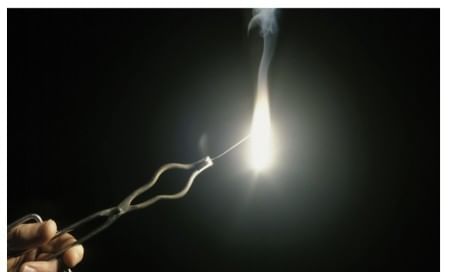
Na2CO3 + 10H2O → Na2CO3.10H2O


Q8: State reason for the following statements:    (CBSE 2015)
(a) Tap water conducts electricity whereas distilled water does not.
(b) Dry hydrogen chloride gas does not turn blue litmus red whereas dilute hydrochloric acid does.
(c) During summer season, a milk man usually adds a very small amount of baking soda to fresh milk.
(d) For a dilution of acid, acid is added into water and not water into acid. 

(e) Ammonia is a base but does not contain hydroxyl group.

Hide Answer  

Ans: 

(a) Tap water conducts electricity because it contains ions that facilitate electrical flow, while distilled water lacks these ions. 

(b) Dry hydrogen chloride (HCl) gas does not turn blue litmus red because it does not form ions. In contrast, dilute hydrochloric acid releases H and Cl- ions, which are responsible for its acidic properties.

(c) A milkman adds a small amount of baking soda to fresh milk to prevent it from souring. Baking soda inhibits the formation of lactic acid, which causes milk to spoil. 

(d)  When diluting an acid, it is crucial to add acid to water rather than the other way around. This is because adding water to acid can cause a violent reaction and splashing due to the heat generated. 

(e) Ammonia is classified as a base despite not containing a hydroxyl group. When dissolved in water, it produces hydroxide ions (OH-), which gives it basic properties.  NH3 + H2O → NH4+ + OH


Q9: (a) Define universal indicator. Mention its one use.
(b) Solution A gives pink colour when a drop of phenolphthalein indicator is added to it. Solution B gives red colour when a drop of methyl orange is added to it. What type of solutions are A and B and which one of the solutions A and B will have a higher pH value?
(c) Name one salt whose solution has pH more than 7 and one salt whose solution has pH less than 7.    (CBSE 2015)

Hide Answer  

Ans: (a)  A Universal indicator is a mixture of several indicators. It shows different colours at different concentrations of H+ ion concentrations.(b) Solution A is alkaline in nature.
Solution B is acidic in nature.
Solution A has a higher pH value.
(c)  Salts of weak acid and strong base give a solution which have pH more than 7. i.e. basic salt Sodium acetate is an example of such salts. Salts of strong acid and weak base give a solution which has pH less than 7. i.e. Acidic salt. Ammonium chloride is an example of such salts.

01. Previous Year Questions: Chemical Reactions & Equations

Previous Year Questions 2025

Q1: Electrolysis of water is a decomposition reaction. The mass ratio (MH : MO) of hydrogen and oxygen gases liberated at the electrodes during electrolysis of water is: (1 Mark)
(a)
 8:1
(b) 2:1
(c) 1:2
(d) 1:8

Hide Answer  

Ans: (d) 1:8

During the electrolysis of water, water decomposes to form hydrogen and oxygen gases:
Previous Year Questions 2025
The volume ratio of hydrogen to oxygen is 2 : 1, but since oxygen is eight times heavier than hydrogen, the mass ratio (Mₕ : Mₒ) is 1 : 8.


Q2: Consider the following reactions:  (1 Mark)
(i) Dilute hydrochloric acid reacts with sodium hydroxide
(ii) Magnesium oxide reacts with dilute hydrochloric acid
(iii) Carbon dioxide reacts with sodium hydroxide
It is found that in each case:
(a)
 Salt and water is formed
(b) Neutral salts are formed
(c) Hydrogen gas is formed
(d) Acidic salts are formed

Hide Answer  

Ans: (a) Salt and water is formed

In all three reactions, an acid reacts with a base (or basic oxide) to produce salt and water, which is a neutralisation reaction — a type of double displacement reaction.


Q3: In which one of the following situations a chemical reaction does not occur?  (1 Mark)
(a)
 Milk is left open at room temperature during the summer
(b) Grapes get fermented
(c) An iron nail is left exposed to humid atmosphere
(d) Melting of glaciers

Hide Answer  

Ans: (d) Melting of glaciers

Melting of glaciers is only a physical change — the state of water changes from solid (ice) to liquid, but no new substance is formed. Hence, no chemical reaction takes place.


Q4: The correct balanced chemical equation showing exothermic reaction in which natural gas burns in air is:  (1 Mark)
(a)
 CH₄ + O₂ → CO₂ + 2H₂O
(b) CH₄ + 2O₂ → 2CO₂ + 2H₂O + Energy
(c) CH₄ + 2O₂ → CO₂ + 2H₂O
(d) CH₄ + 2O₂ → CO₂ + 2H₂O + Energy

Hide Answer  

Ans: (d) CH₄ + 2O₂ → CO₂ + 2H₂O + Energy

When natural gas (methane) burns in air, it combines with oxygen to form carbon dioxide and water, releasing heat energy. This makes it an exothermic reaction.


Q5: Consider the following chemical equation: (1 Mark)
pAl + qH₂O → rAl₂O₃ + sH₂
To balance this equation, the values of ‘p’, ‘q’, ‘r’, and ‘s’ are:

(a) 3, 2, 2, 1
(b) 2, 3, 3, 1
(c) 2, 3, 1, 3
(d) 3, 1, 2, 2

Hide Answer  

Ans: (c) 2, 3, 1, 3

  • Write skeletal equation: Al + H₂O → Al₂O₃ + H₂
  • Balance Al → 2Al + H₂O → Al₂O₃ + H₂
  • Balance O → 3H₂O → Al₂O₃ + H₂
  • Balance H → 3H₂O → Al₂O₃ + 3H₂
    Final: 2Al + 3H₂O → Al₂O₃ + 3H₂


Q6: The main observations while burning magnesium ribbon in air are:  (1 Mark)
(i) Magnesium ribbon burns with a dazzling white flame
(ii) A white powder is formed
(iii) Magnesium ribbon vaporises
(iv) Aqueous solution of the white powder turns blue litmus red
(a) 
(i) and (iv)
(b) (ii) and (iii)
(c) (i) and (ii)
(d) (iii) and (iv)

Hide Answer  

Ans: (c) (i) and (ii)

When magnesium ribbon burns in air, it burns with a dazzling white flame and forms a white powder of magnesium oxide, showing that a chemical reaction has taken place.Previous Year Questions 2025


Q7: The values of a, b, c and d in the following balanced chemical equation are respectively:  (1 Mark)
aPb(NO₃)₂ → bPbO + cNO₂ + dO₂
are:

(a) 1, 1, 2, 1
(b) 1, 1, 1, 2
(c) 2, 2, 1, 4
(d) 2, 2, 4, 1

Hide Answer  

Ans: (d) 2, 2, 4, 1

Balancing Steps (1 Mark):

  1. Write skeletal equation: Pb(NO₃)₂ → PbO + NO₂ + O₂
  2. Balance Pb: 1 atom on each side → no change.
  3. Balance N: There are 2 nitrogen atoms in Pb(NO₃)₂, so write 2Pb(NO₃)₂ → 2PbO + 4NO₂ + O₂.
  4. Balance O: Left side has 12 oxygen atoms; right side has 4 (in PbO) + 8 (in NO₂) = 12 → balanced.

Final balanced equation:
Previous Year Questions 2025


Q8: Examples of thermal decomposition reactions are:   (1 Mark)
(i) 2AgCl → 2Ag + Cl₂
(ii) CaCO₃ → CaO + CO₂
(iii) 2H₂O → 2H₂ + O₂
(iv) 2KClO₃ → 2KCl + 3O₂
(a)
 (i) and (ii)
(b) (ii) and (iii)
(c) (iii) and (iv)
(d) (ii) and (iv)

Hide Answer  

Ans: (d) (ii) and (iv)

Thermal decomposition reactions are those that require heat to break down a compound into simpler substances.

  • CaCO₃ → CaO + CO₂ (by heating)
  • 2KClO₃ → 2KCl + 3O₂ (by heating)
    Both are thermal decomposition reactions.


Q9: Assertion (a): Decomposition reactions are generally endothermic reactions.  (1 Mark)
Reason (R): Decomposition of organic matter into compost is an exothermic process.
(a) 
Both A and R are true, and R is the correct explanation of A
(b) Both A and R are true, but R is not the correct explanation of A
(c) A is true, but R is false
(d) A is false, but R is true

Hide Answer  

Ans: (b) Both A and R are true, but R is not the correct explanation of A

  • A: Decomposition reactions usually require energy (heat, light, or electricity), making them endothermic.
  • R: Composting involves microbial breakdown, releasing heat (exothermic).

Both are true, but R describes an exception (biological process), not a general explanation for A.


Q10: Assertion (a): Silver chloride turns grey in sunlight.  (1 Mark)
Reason (R): It decomposes into silver and chlorine in sunlight.
(a)
 Both A and R are true and R is the correct explanation of A
(b) Both A and R are true, but R is not the correct explanation of A
(c) A is true, but R is false
(d) A is false, but R is true

Hide Answer  

Ans: (a) Both A and R are true and R is the correct explanation of A

When silver chloride is exposed to sunlight, it decomposes into silver and chlorine gas, turning the substance grey due to the formation of silver metal.


Q11: Assertion (a): All exothermic reactions are accompanied with evolution of heat and light.  (1 Mark)
Reason (R): Combination reactions may or may not be exothermic.
(a)
 Both A and R are true and R is the correct explanation of A
(b) Both A and R are true, but R is not the correct explanation of A
(c) A is true, but R is false
(d) A is false, but R is true

Hide Answer  

Ans: (d) A is false, but R is true

All exothermic reactions release heat, but not necessarily light.
Also, combination reactions may or may not be exothermic — for example, formation of slaked lime is exothermic, but not all combination reactions release light.


Q12: A student performs the following experiment in his school laboratory. List two observations to justify that in this experiment a chemical change has taken place.  (2 Marks)

Hide Answer  

Ans:

  • Bubbles of hydrogen gas are evolved when zinc granules react with dilute sulphuric acid.
  • The test tube becomes warm, showing that heat is produced — an exothermic chemical reaction has taken place.

Reaction:

Zn + H2SO → ZnSO+ H2


Q13: What happens when:  (2 Marks)
(a) Lead nitrate is thermally decomposed
(b) Natural gas burns in air
(Write balanced chemical equations)

Hide Answer  

Ans: 

(a) When lead nitrate is heated, it decomposes to form lead oxidenitrogen dioxide, and oxygen.
Previous Year Questions 2025

Observation: Brown fumes of nitrogen dioxide are evolved.

(b) When natural gas (methane) burns in air, it forms carbon dioxide and water, releasing heat energy.
Previous Year Questions 2025

Observation: It is an exothermic reaction accompanied by the evolution of heat.


Q14: Translate and balance the following:  (2 Marks)
(a) Nitric acid reacts with calcium hydroxide to form calcium nitrate and water
(b) Sodium chloride reacts with silver nitrate to form silver chloride and sodium nitrate

Hide Answer  

Ans: 

(a) Word equation:
Nitric acid + Calcium hydroxide → Calcium nitrate + Water

Balanced chemical equation:

2HNO+ Ca(OH)→ Ca(NO3)+ 2H2O

(b) Word equation:
Sodium chloride + Silver nitrate → Silver chloride + Sodium nitrate

Balanced chemical equation:

NaCl + AgNO→ AgCl + NaNO3


Q15: Balance the following chemical equations:  (2 Marks)
(a) 

(b) Previous Year Questions 2025

Hide Answer  

Ans:

(a) Photosynthesis reaction:

  • Write formula: CO₂ + H₂O → C₆H₁₂O₆ + O₂.
  • Balance C: glucose has 6 C → put 6 CO₂.
  • Balance H: glucose has 12 H → put 6 H₂O.
  • Check O: LHS O = 6×2 (from CO₂) + 6×1 (from H₂O) = 12+6 = 18. RHS O = 6 (in C₆H₁₂O₆) + 2×(coefficient of O₂). To get 18 total, O₂ coefficient must be 6 (6 + 12 = 18).
  • Final balanced equation:
Previous Year Questions 2025

This is a balanced chemical equation representing the process of photosynthesis.

(b) Thermal decomposition of lead nitrate:

  • Write products: Pb(NO₃)₂ → PbO + NO₂ + O₂.
  • Start with 1 formula unit: Pb is balanced (1 Pb → 1 PbO). Nitrogen: 2 N on left → put 2 NO₂ on right.
  • Count O with these coefficients: LHS O = 6 (from Pb(NO₃)₂). RHS O = 1 (in PbO) + 2×2 (in 2 NO₂) = 1 + 4 = 5 → missing 1 O atom. That comes from ½ O₂.
  • To avoid fraction, multiply entire equation by 2.
  • Final balanced equation:
Previous Year Questions 2025

This is a balanced decomposition reaction with emission of brown fumes of NO₂.


Q16: What is observed when hydrated ferrous sulphate crystals are heated in a dry boiling tube? Write the balanced chemical equation.  (2 Marks)

Hide Answer  

Ans:

When hydrated ferrous sulphate crystals (FeSO4·7H2O) are heated, they lose water and the green crystals turn white. On further heating, a brown solid (ferric oxide) and gases (sulphur dioxide and sulphur trioxide) are produced with a characteristic odour of burning sulphur.Previous Year Questions 2025
Balanced chemical equation:
Previous Year Questions 2025


Q17: Write the balanced chemical equation for the reaction between aqueous solutions of sodium sulphate and barium chloride. State two types of reactions in which it is classified.  (2 Marks)

Hide Answer  

Ans: 
Equation:Previous Year Questions 2025

Types of reactions:

  1. Double displacement reaction – because there is an exchange of ions between reactants.
  2. Precipitation reaction – because an insoluble white precipitate of barium sulphate (BaSO₄) is formed.


Q18: A copper wire on burning gets coated with a black substance.  (2 Marks)
(a) Write the chemical equation for the reaction
(b) How can this chemical change be reversed?

Hide Answer  

Ans: (a) Chemical equation:
Copper reacts with oxygen to form black copper(II) oxide.

(b) This change can be reversed by passing hydrogen gas over the heated black copper(II) oxide:

Previous Year Questions 2025The black coating turns brown again as copper metal is regenerated.



Q19: (a) (i) Define the term decomposition reaction. Write one chemical equation each for decomposition reaction where energy is supplied in the form of heat, light or electricity.
(ii) Decomposition of vegetable matter into compost is considered an exothermic reaction. Why ?
OR
(b) Why are decomposition reactions called the opposite of combination reactions ? Write one chemical equation each for these two types of reactions mentioning the name of the reactant(s) and the product(s) involved in the reactions.  (3 Marks)

Hide Answer  

Ans: 

(i)  A decomposition reaction is a reaction in which a single compound breaks down into two or more simpler substances when energy is supplied in the form of heat, light, or electricity.

Examples:

  • By heat (thermal decomposition):Previous Year Questions 2025
  • By light (photodecomposition):Previous Year Questions 2025
  • By electricity (electrolytic decomposition):Previous Year Questions 2025

(ii) Decomposition of vegetable matter into compost is exothermic because it releases heat energy during the breakdown of organic matter.

OR

(b) Decomposition reactions are called the opposite of combination reactions because:

  • In a combination reactiontwo or more substances combine to form a single product.
  • In a decomposition reaction, a single substance breaks down into two or more products.

Examples:

  • Combination reaction:
    Previous Year Questions 2025(Hydrogen and oxygen combine to form water.)
  • Decomposition reaction:Previous Year Questions 2025(Lead nitrate decomposes to form lead oxide, nitrogen dioxide, and oxygen.)



Q20: How is a double displacement reaction different from a displacement reaction? Explain giving example in the form of balanced chemical equations.  (3 Marks)

Hide Answer  

Ans: 


Q21: What change is observed when copper powder is heated in a china dish? Name the phenomenon and write the balanced reaction. How is this different from the change observed when copper wares lose shine in moist air? Name the coating and its colour.  (3 Marks)

Hide Answer  

Ans: When copper powder is heated in a china dish, its shiny brown surface turns black because copper reacts with oxygen to form black copper(II) oxide. This phenomenon is called oxidation.

Previous Year Questions 2025

When copper wares lose their shine in moist air, they get coated with a green layer of basic copper carbonate, formed due to the reaction of copper with carbon dioxide and moisture present in air.

Thus, heating causes oxidation forming black CuO, whereas exposure to moist air forms a green coating of basic copper carbonate on copper.


Q22: (a) Why do we balance a chemical equation? Name and state the law that suggests the balancing of a chemical equation? Balance the following chemical equation:  (3 Marks)
Zn + H₃PO₄ → Zn₃(PO₄)₂ + H₂
OR
(b) Define a precipitation reaction. Give its example and also express the reaction that occurs in the form of a balanced chemical equation.  (3 Marks)

Hide Answer  

Ans: 

(a) A chemical equation is balanced to ensure that the number of atoms of each element is the same on both sides of the equation, satisfying the Law of Conservation of Mass.

Law of Conservation of Mass: Mass can neither be created nor destroyed in a chemical reaction; the total mass of reactants equals the total mass of products.

Balancing the equation:
Unbalanced:
Zn + H3PO→ Zn3(PO4)+ H2

Balanced:
3Zn + 2H3PO4 → Zn3(PO4)2 + 3H2

OR

(b) precipitation reaction is a double displacement reaction in which an insoluble solid (precipitate) is formed when two aqueous solutions react.
Example:
When sodium sulphate reacts with barium chloride, a white precipitate of barium sulphate is formed.
Na2SO4(aq) + BaCl2(aq) → BaSO4(s) + 2NaCl(aq)
Here, BaSO4 is the precipitate formed.


Q23: Write balanced equations for the following:  (3 Marks)
(a) Steam passed over red-hot iron
(b) Natural gas burns in air
(c) Glucose reacts with oxygen in cells

Hide Answer  

Ans:

(a) When steam is passed over red-hot ironferric oxide and hydrogen gas are formed:

Previous Year Questions 2025

(b) When natural gas (methane) burns in air, it forms carbon dioxide and water, releasing heat energy:

Previous Year Questions 2025

(c) When glucose reacts with oxygen in cells during respiration, it produces carbon dioxide, water, and energy:

Previous Year Questions 2025


Q24: Explain why respiration is considered as an exothermic reaction. Give the chemical equation for this reaction.  (3 Marks)

Hide Answer  

Ans:

Respiration is considered an exothermic reaction because during this process, energy is released in the form of heat when glucose reacts with oxygen in the cells of our body. This released energy is used by living organisms to perform various life functions.

Chemical equation:

Thus, respiration is an exothermic process as it liberates heat energy during the breakdown of glucose.

Previous Year Questions 2024

Q1: Select from the following a decomposition reaction in which the source of energy for decomposition is light:    (2024)
(a) 2FeSO→ Fe2O3 + SO2 + SO3
(b) 2H2O → 2H2 + O2
(c) 2AgBr → 2Ag + Br2
(d) CaCO3 → CaO + CO2

Hide Answer  

Ans: (c)
A decomposition reaction is when a compound breaks down into simpler substances. Option (c) 2AgBr → 2Ag + Bris the correct answer because it requires light energy to break down silver bromide (AgBr) into silver (Ag) and bromine (Br2). The other options do not use light for decomposition.


Q2: When 2 mL of sodium hydroxide solution is added to a few pieces of granulated zinc in a test tube and then warmed, the reaction that occurs can be written in the form of a balanced chemical equation as:    (2024)
(a) NaOH + Zn → NaZnO2 + H2O
(b) 2NaOH + Zn → Na2ZnO2 + H2
(c) 2NaOH + Zn → NaZnO2 + H2
(d) 2NaOH + Zn → Na2ZnO2 + H2O

Hide Answer  

Ans: (b)
When sodium hydroxide (NaOH) reacts with zinc (Zn), it produces sodium zincate and hydrogen gas. The balanced equation 2NaOH + Zn → Na2ZnO2 + H2 shows that two molecules of sodium hydroxide react with one piece of zinc to form sodium zincate and hydrogen gas. This is the correct representation of the reaction, making option (b) the right answer.


Q3: Select from the following a process in which a combination reaction is involved:     (2024)

(a) Black and White photography
(b) Burning of coal
(c) Burning of methane
(d) Digestion of food

Hide Answer  

Ans: (b)
Burning of coal involves the reaction of carbon (coal) with oxygen to form carbon dioxide: C (s) + O2(g) → CO2(g). This is a combination reaction as two substances (carbon and oxygen) combine to form a single product (carbon dioxide).


Q4: Consider the following cases:
(A) CaSO4 + AI →
(B) CuSO4  +  Ca →
(C) FeSO4 + Cu  →
(D) ZnSO4 + Mg → 
The cases in which new products will form are:    (2024)
(a)
 (A) and (B)    
(b) (B) and (C)
(c) (C)and(D)
(d) (B) and (D)

Hide Answer  

Ans: (d)
New products will form when a more reactive metal displaces a less reactive metal from its compound. In (B) and (D), calcium and magnesium are more reactive than copper and zinc, so they will successfully displace them, resulting in new products.


Q5: Identify the correct statement about the following reaction:     (2024)
2H2S + SO2 → 2H2O + S
(a) H2S is oxidising agent and SO2 is reducing agent.
(b) H2S is reduced to sulphur.
(c) SO2 is oxidising agent and H2S is reducing agent.
(d) SO2 is oxidised to sulphur.

Hide Answer  

Ans: (c)
In the reaction, hydrogen sulfide (H2S) loses hydrogen to form sulfur (H2S is oxidized to sulfur), which means it acts as a reducing agent, while sulfur dioxide (SO2) gains hydrogen to form 
H2O (SO2 is reduced to H2O), which means it acts as an oxidizing agent. Therefore, the correct statement is (c) because SO2 is the oxidizing agent and H2S is the reducing agent in this reaction.


Q6: Consider the following Chemical equation:     (2024)


In order to balance this chemical equation, the values of a, b, c and d must be
(A)
 1, 6, 2 and 3    
(B) 1, 6, 3 and 2
(C) 2, 6, 2 and 3    
(D) 2, 6, 3 and 2

Hide Answer  

Ans: (a)
To balance the chemical equation Al2O3 + HCl → AlCl3 + H2O , we need to ensure that the number of each type of atom is the same on both sides. The correct coefficients are 1 for Al2O3, 6 for HCl, 2 for AlCl3, and 3 for H2O, giving option (A) as the right choice. The balanced equation is Previous Year Questions 2024


Q7: Which of the following reactions is different from the remaining three?     (2024)
(a)
 NaCl + AgNO3 → AgCl + NaNO3  
(b) CaO + H2O → Ca(OH)2 
(c) KNO3 + H2SO4 → KHSO4 + HNO3 
(d) ZnCl2 + H2S →  ZnS + 2HCl 

Hide Answer  

Ans: (b)
In the reactions listed, options (a), (c), and (d) involve double displacement or exchange of ions between reactants, where compounds are formed by swapping partners. However, option (b) is a combination reaction, where calcium oxide (CaO) reacts with water (H2O) to form calcium hydroxide (Ca(OH)2) without exchanging ions. This makes (b) different from the others.


Q8: Zn + 2CH3COOH → Zn(CH3COO)+ H2     (2024)
The above reaction is a:
(a) 
Decomposition reaction
(b) Displacement reaction
(c) Double displacement reaction
(d) Combination reaction

Hide Answer  

Ans: (b)
In the given reaction, zinc (Zn) replaces hydrogen in acetic acid (CH3COOH) to form zinc acetate (Zn(CH3COO)2) and hydrogen gas (H2). This type of reaction, where one element displaces another from a compound, is called a displacement reaction. Therefore, option (b) is correct.


Q9: To balance the following chemical equation, the values of the coefficients x, y and z must be respectively :     (2024)


(a)
 4, 2, 2    
(b) 4, 4, 2
(c) 2, 2, 4    
(d) 2, 4, 2

Hide Answer  

Ans: (c) x Zn(NO3)2 → y ZnO + z NO2 + O2

Step 1: Assume x = 2 (2 molecules of Zn(NO3)2).

Step 2:Distribute atoms:

  • Zn: 2 atoms → 2 ZnO (y = 2)
  • N: 4 atoms → 4 NO2 (z = 4)
  • O: 12 atoms → 2 in ZnO, 8 in NO2, remaining 2 form O2.

Step 3:Verify all elements are balanced:

  • Zn: 2 on both sides.
  • N: 4 on both sides.
  • O: 12 on both sides.

   2Zn(NO3)2 → 2ZnO + 4NO2 + O2


Q10: Which of the following is a redox reaction, but not a combination reaction?     (2024)
(a) 
C + O→ CO2
(b) 2 H2 + O2 → 2 H2O
(c) 2 Mg + O2 → 2 MgO
(d) Fe2O3 + 3 CO → 2 Fe + 3 CO2

Hide Answer  

Ans: (d)
A redox reaction involves both oxidation and reduction, where electrons are transferred between substances. In option (d), iron(III) oxide (Fe2O3) is reduced to iron (Fe), while carbon monoxide (CO) is oxidized to carbon dioxide (CO2). Unlike the other options, which are combination reactions, this one shows the reduction and oxidation of different substances, making it a redox reaction but not a combination reaction.


Q11: Name the type of chemical reaction in which calcium oxide reacts with water. Justify your answer by giving a balanced chemical equation for the chemical reaction.    (2024)

Hide Answer  

Ans: Combination reaction – Single product is formed (or any other)
Previous Year Questions 2024


Q12: Write one chemical equation each for the chemical reaction in which the following have taken place:
(i) Change in colour
(ii) Change in temperature
(iii) Formation of precipitate
Mention colour change/temperature change (rise/fall)/compound precipitated along with the equation.    (2024)

Hide Answer  

Ans: (i) Change in colour: The solution will become green in colour.
Previous Year Questions 2024
(ii) Change in temperature: The temperature will increase.
Previous Year Questions 2024
(iii) Formation of precipitate: Yellow precipitate of PbIis formed.
Previous Year Questions 2024


Q13: When magnesium ribbon is burnt in the air, an ash of white colour is produced. Write the chemical equation for the reaction giving the chemical name of the ash produced. State the type of chemical reaction justifying your answer.     (2024)

Hide Answer  

Ans: 2 Mg + O2 → 2MgO
Magnesium oxide
Type – Combination reaction
Reason: Two or more substances combine to form a single product.


Q14:Study the experimental set-up shown in the diagram and write a chemical equation for the chemical reaction involved. Name and define the type of reaction. List two other metals that can be used in place of iron to show the same type of reaction with copper sulphate solution.     (2024)
Previous Year Questions 2024

Hide Answer  

Ans: Fe(s) + CuSO4 (aq) → FeSO4(aq) + Cu(s)
Displacement reaction: A reaction in which a more reactive metal displaces a less reactive metal from its salt solution.
Other metals that can be used in place of iron to show the same type of reaction with copper sulphate solution: Zinc, Aluminium, Calcium, Magnesium


Q15: For Q. Nos., two statements are given – One labelled as Assertion (A) and the other labelled as Reason (R). Select the correct answer to these questions from the codes (a), (b), (c) and (d) as given below:    (2024)
Assertion (A): Hydrogen gas is not evolved when zinc reacts with nitric acid.
Reason (R): Nitric acid oxidises the hydrogen gas produced to water and itself gets reduced.
(a) 
Both Assertion (A) and Reason (R) are true and Reason (R) is the correct explanation of the Assertion (A).
(b) 
Both Assertion (A) and Reason (R) are true, but Reason (R) is not the correct explanation of the Assertion (A).
(c) 
Assertion (A) is true, but Reason (R) is false.
(d) 
Assertion (A) is false, but Reason (R) is true.

Hide Answer  

Ans: (a)
In this scenario, both the Assertion (A) and the Reason (R) are true. When zinc reacts with nitric acid, hydrogen gas is not produced because the nitric acid oxidizes any hydrogen gas formed into water while itself getting reduced. Thus, the reason correctly explains why hydrogen gas is not evolved, making option (a) the right choice.


Q16: What is a chemical reaction? Describe one activity each to show that a chemical change has occurred in which (i) a change of colour, and (ii) a change in temperature has taken place.    (2024)

Hide Answer  

Ans: A chemical reaction involves the breaking and making of bonds between atoms to produce new substances. when reactant changes to products.
(i) Add lead nitrate solution to potassium iodide solution taken in a test tube. The colour changes from colourless solution to yellow ppt.
Previous Year Questions 2024
(ii) Calcium oxide reacts vigorously with water to produce slaked lime (calcium hydroxide) releasing a large amount of heat.
Previous Year Questions 2024


Q17: (i) Define a decomposition reaction. How can we say that  (I) electrolysis of water, and (II) blackening of silver bromide when exposed to sunlight, are decomposition reactions? Mention the type of energy involved in each case.  
(ii) The type of reactions in which (I) calcium oxide is formed, and (II) calcium hydroxide is formed are opposite reactions to each other. Justify this statement with the help of chemical equations.
     (2024)

Hide Answer  

Ans: (i) A reactant breaks down to give two or more products. A reaction which requires energy to split a compound or reactant in two or more simple substances.
(I) Water splits into hydrogen gas and oxygen gas.
Type of Energy: Electrical energy
(II) Silver bromide decomposes into silver and bromine
Type of Energy: Light energy
(ii) (I) Formation of calcium oxide:
Previous Year Questions 2024It is an endothermic reaction/decomposition reaction.

(II) Formation of calcium hydroxide:
Previous Year Questions 2024It is exothermic/combination reaction


Q18: (a) Copper powder is taken in a china dish and heated over a burner. Name the product formed and state its colour. Write the chemical equation for the reaction involved.     (2024)
OR
(b) Write a chemical equation for the chemical reaction that occurs when the aqueous solutions of barium chloride and sodium sulphate react together. Write the symbols of the ions present in the compound precipitated in the reaction.

Hide Answer  

Ans: (a) Copper Oxide
It’s colour is Black.
Previous Year Questions 2024OR(b)Previous Year Questions 2024


Q19: (A) Write the essential conditions for the following reaction to take place and name its types: 
2AgCl → 2Ag + Cl2
(B) Complete the following chemical reaction in the form of a balanced equation: 
                  (CBSE 2024)

Hide Answer  

Ans: (A) Previous Year Questions 2024

Sunlight is essential for the above reaction to take place.  This is a decomposition reaction. Such reactions require energy either in the form of heat, light or electricity for breaking down the reactants. Silver chloride turns grey after its decomposition into silver and chlorine by sunlight.  This reaction is used in black and white photography.

(B) Previous Year Questions 2024

Previous Year Questions 2023

Q1: When aqueous solutions of potassium iodide and lead nitrate are mixed, an insoluble substance separates out. The chemical equation for the reaction involved is      (2023)
(a) Kl + PbNO3 → Pbl + KNO3
(b) 2KI+ Pb(NO3)2 → Pbl2 + 2KNO
(c) KI + Pb(NO3)2 → Pbl +KNO3
(d) Kl + PbNO3 → Pbl2 + KNO3

Hide Answer  

Ans: (b)
When potassium iodide (KI) and lead nitrate (Pb(NO3)2) are mixed, they react to form lead iodide (PbI2), which is an insoluble substance that precipitates out of the solution, and potassium nitrate (KNO3). The correct balanced equation for this reaction is 2KI+ Pb(NO3)2 → Pbl2 + 2KNO3. This shows that two potassium iodide molecules are needed to react with one lead nitrate molecule to produce one lead iodide and two potassium nitrate molecules, confirming option (b) as the correct answer.


Q2: The balanced chemical equation showing the reaction between quick lime and water is      (2023)
(a) 2CaO + H2O → 2CaOH + H2 + Heat
(b) CaO + H2O → Ca(OH)2 + H2 + Heat
(c) CaO  + H2O → Ca(OH)2 + Heat
(d) 2CaO + 3H2O → 2Ca(OH)+ O2 + Heat

Hide Answer  

Ans: (c)
The balanced chemical equation for the reaction between quick lime (calcium oxide, CaO) and water CaO + H2O → Ca(OH)2 + Heat. In this reaction, quick lime reacts with water to form calcium hydroxide (Ca(OH)2), which is also known as slaked lime, and releases heat. This makes option (c) the correct answer, as it accurately represents the products and the heat released during the reaction.


Q3: Assertion (A): In the following reaction ZnO + C → Zn + CO 
ZnO undergoes reduction.
Reason (R): Carbon is a reducing agent that reduces ZnO to Zn.      (2023)
(a) Both Assertion (A) and Reason (R) are true and Reason (R) is the correct explanation of Assertion (A)
(b) Both Assertion (A) and Reason (R) are true, but Reason (R) is not the correct explanation of the Assertion (A)
(c) Assertion (A) is true, but Reason (R) is False.
(d) Assertion (A) is false, but Reason (R) is true.

Hide Answer  

Ans: (a)
Sol: The reaction in which oxygen is added or hydrogen is removed or loss of electrons takes place is called an oxidation reaction. In the reaction,
(i) Carbon is getting oxidised to carbon monoxide.
(ii) Zinc oxide is getting reduced to zinc.
Carbon is a reducing agent that reduces ZnO to Zn.


Q4: Assertion (A): The reaction of quick lime with water is an exothermic reaction. 
Reason (R): Quicklime reacts vigorously with water releasing a large amount of heat.      (2023)
(a) Both Assertion (A) and Reason (R) are true and Reason (R) is the correct explanation of Assertion (A)
(b) Both Assertion (A) and Reason (R) are true, but Reason (R) is not the correct explanation of the Assertion (A)
(c) Assertion (A) is true, but Reason (R) is False
(d) Assertion (A) is false, but Reason (R) is true

Hide Answer  

Ans: (a)
Sol: Reaction of quick lime (CaO) with water is an exothermic reaction because CaO reacts vigorously with water releasing a large amount of heat.
CaO(s) + H2O(I) → Ca(OH)2(ag) + Heat


Q5: (i) While electrolyzing water before passing the current some drops of an acid are added why? Name the gases liberated at the cathode and anode. Write the relationship between the volume of gas collected at the anode and the volume of gas collected at the cathode.
(ii) What is observed when silver chloride is exposed to sunlight? Give the type of reaction involved.  
 (2023 C)

Hide Answer  

Ans: 

(i) Acid is added to water before electrolysis to increase its conductivity. This allows the current to pass through the solution easily. Hydrogen gas is liberated at the cathode, while oxygen gas is liberated at the anode. The volume of gas collected at the anode is twice the volume of gas collected at the cathode. 2H2O(l) → 2H2(g) + O2(g)
(ii) When silver chloride is exposed to sunlight, it decomposes to form silver metal and chlorine gas. 2AgCl(s) → 2Ag(s) + Cl2(g) This is a photochemical decomposition reaction.


Q6: (a) Define a double displacement reaction.
(b) Write the chemical equation of a double displacement reaction which is also a (i) Neutralisation reaction and (ii) Precipitation reaction. Give justification for your answer.   (2023)

Hide Answer  

Ans: 

(a) The chemical reaction in which two reactants exchange ions to form two new compounds is called a double displacement reaction.
(b) (i) When an aqueous solution of an acid reacts with a base (alkali) by exchanging their ions/radicals to form salt and water as the only products, the reaction which takes place is called neutralisation reaction.
Previous Year Questions 2023
(ii) When the aqueous solutions of two ionic compounds react by exchanging their ions/radicals, to form two or more new compounds such that one of the products formed is an insoluble salt, and hence forms precipitate, the double displacement reaction is said to be precipitation reaction. When lead nitrate solution is mixed with potassium iodide solution, a yellow precipitate is formed. This reaction is a precipitation reaction and can be expressed as follows:
Previous Year Questions 2023


Q7: The emission of brown fumes in the given experimental set-up is due to:

Previous Year Questions 2023

(a) thermal decomposition of lead nitrate which produces brown fumes of nitrogen dioxide. 
(b) thermal decomposition of lead nitrate which produces brown fumes of lead oxide. 
(c) oxidation of lead nitrate forming lead oxide and nitrogen dioxide. 
(d) oxidation of lead nitrate forming lead oxide and oxygen. (CBSE 2023)

Hide Answer  

Ans: (a)
When lead nitrate is heated, it undergoes thermal decomposition, resulting in the formation of lead oxide,PbO (a yellow solid), nitrogen dioxide NO2 (a brown gas), and oxygen, O2. The brown fumes observed in this setup are due to the release of nitrogen dioxide gas.
The reaction is as follows:Previous Year Questions 2023

Thus, the correct answer is (a) thermal decomposition of lead nitrate which produces brown fumes of nitrogen dioxide.


Q8: In the experimental setup given below, it is observed that on passing the gas produced in the reaction in the solution ‘X’ the solution ‘X’ first turns milky and then colourless.

Previous Year Questions 2023

The option that justifies the given observation is that ‘X’ is aqueous calcium hydroxide and: 
(a) it turns milky due to carbon dioxide gas liberated in the reaction and after some time it becomes colourless due to the formation of calcium carbonate. 
(b) it turns milky due to the formation of calcium carbonate and on passing excess of carbon dioxide it becomes colourless due to the formation of calcium hydrogen carbonate which is soluble in water. 
(c) it turns milky due to the passing of carbon dioxide through it. It turns colourless as on further passing carbon dioxide, sodium hydrogen carbonate is formed which is soluble in water. 
(d) the carbon dioxide liberated during the reaction turns lime water milky due to the formation of calcium hydrogen carbonate and after some time, it turns colourless due to the formation of calcium carbonate which is soluble in water.   (CBSE 2023)

Hide Answer  

Ans: (b)
When carbon dioxide is passed through aqueous calcium hydroxide (lime water), it initially reacts to form calcium carbonate, which is insoluble in water and causes the solution to turn milky:Previous Year Questions 2023However, when excess carbon dioxide is passed through the solution, the calcium carbonate further reacts with the carbon dioxide and water to form calcium hydrogen carbonate, which is soluble in water, causing the solution to become clear again:

Previous Year Questions 2023Thus, the correct answer is (b).
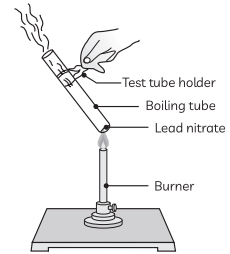

Q9: Assertion (A): The colour of aqueous solution of copper sulphate turns colourless when a piece of lead is added to it. 
Reason (R): Lead is more reactive than copper, and hence displaces copper from its salt solution.
(a) Both Assertion (A) and Reason (R) are true and Reason (R) is the correct explanation of Assertion (A)
(b) Both Assertion (A) and Reason (R) are true, but Reason (R) is not the correct explanation of the Assertion (A)
(c) Assertion (A) is true, but Reason (R) is False
(d) Assertion (A) is false, but Reason (R) is true (CBSE 2023)

Hide Answer  

Ans: (a)
Assertion (A): The color of the aqueous solution of copper sulfate turns colourless when a piece of lead is added to it. This is true. Copper sulfate solution is blue due to the presence of copper ions. When lead is added, it reacts with copper sulfate, displacing copper and forming lead sulfate, which is colourless in solution.
Reason (R): Lead is more reactive than copper and displaces copper from its salt solution. This is also true. Lead, being more reactive, displaces copper ions from copper sulfate, resulting in the precipitation of copper and the formation of colourless lead sulfate in the solution.
Since the reason correctly explains the assertion, the correct answer is (a)


Q10: (A) Identify the reducing agent in the following reactions: 
(i) 4NH3 + 5O2 → 4NO + 6H2
(ii) H2O + F2 → HF + HOF 
(iii) Fe2O3 + 3CO → 2Fe + 3CO2
(iv) 2H2 + O2 → 2H2
(B) Define a redox reaction in terms of gain or loss of oxygen.

Hide Answer  

Ans: (A) (i) NH3 is the reducing agent because it gets oxidised to NO by the removal of hydrogen and addition of oxygen. O2 has been reduced to H2O by the addition of hydrogen. 
(ii) H2O is the reducing agent. Here, F2 gets reduced to HF (addition of hydrogen) and H2O gets oxidised to HOF (removal of hydrogen).
(iii) CO is the reducing agent. Here, CO has been oxidised to CO2 by the addition of oxygen. Fe2O3 has been reduced to Fe by the removal of oxygen.
(iv) H2 is the reducing agent as it gets oxidised to H2O by the addition of oxygen. O2 has been reduced to H2O by the addition of hydrogen. 
(B) The reaction in which one element gets oxidised or addition of oxygen occurs and other element gets reduced or removal of oxygen occurs in other element is called redox reaction. 
Example:
Previous Year Questions 2023

Get additional INR 200 off today with EDUREV200 coupon.Avail Offer

Previous Year Questions 2022

Q1: Sodium reacts with water to form sodium hydroxide and hydrogen gas. The balanced equation which represents the above reaction is   (2022)
(a) Na(s) + 2H2O(l) → 2NaOH(aq) + 2H2(g)
(b) 2Na(s) + 2H2O(l) → 2NaOH(aq) +H2(g)
(c) 2Na(s) + 2H2O(l) → NaOH(aq) + 2H2(g)
(d) 2Na(s) + H2O(l) → 2NaOH(aq) + 2H2(g)

Hide Answer  

Ans: (b)
In the reaction between sodium (Na) and water (H2O), two sodium atoms react with two water molecules to produce two sodium hydroxide (NaOH) molecules and one hydrogen gas (H2) molecule. The balanced equation shows that two sodium atoms are needed for every two water molecules, which is why option (b) is correct. It accurately represents the conservation of mass in the reaction.


Q2: It is important to balance the chemical equations to satisfy the law of conservation of mass. Which of the following statements of the law is incorrect?    (2022)
(a) The total mass of the elements present in the reactants is equal to the total mass of the elements present in the products. 
(b) The number of atoms of each element remains the same, before and after a chemical reaction. 
(c) The chemical composition of the reactants is the same before and after the reaction. 
(d) Mass can neither be created nor can it be destroyed in a chemical reaction.

Hide Answer  

Ans: (c)
Sol: A balanced equation follows law of conservation of mass that means the total mass of reactants is equal to the total mass of products but the chemical composition of reactants does not remain same before and after the reaction.


Q3: C6H12O6(aq) + 6O2(g) → 6CO2(g) + 6H2O(I)
The above reaction is a/an    (2022)
(a) Displacement reaction 
(b) Endothermic reaction 
(c) Exothermic reaction 
(d) Neutralisation reaction

Hide Answer  

Ans: (c)
Sol: In the process of respiration, glucose combines with oxygen in cells of our body and provides energy. Thus, respiration is an exothermic process.
C6H12O6(aq) + 6O2(g) → 6CO2(g) + 6H2O(I) + Energy


Q4: Which of the following statements about the reaction given below are correct?
MnO2 + 4HCI → MnCl2 + 2H2O + Cl
(i) HCL is oxidized to Cl2.
(ii) MnO2 is reduced to MnCl2.
(iii) MnClacts as an oxidizing agent.
(iv) HCI acts as an oxidizing agent.   (2022)

(a) (ii), (iii) and (iv)
(b) (i), (ii) and (iii)
(c) (i) and (ii) only
(d) (iii) and (iv) only

Hide Answer  

Ans: (c)
In the reaction, hydrochloric acid (HCl) loses electrons and is converted to chlorine gas (Cl2), so statement (i) is correct. Manganese dioxide (MnO2) gains electrons and is transformed into manganese chloride (MnCl2), making statement (ii) correct as well. However, MnCl2 does not act as an oxidizing agent; it is the reduced form of manganese. Therefore, the correct statements are (i) and (ii), which is why option (c) is the right choice.


Q5: Assertion (A): Burning of natural gas is an endothermic process. 
Reason (R): Methane gas combines with oxygen to produce carbon dioxide and water.   (2022)
(a) Both (A) and (R) are true and (R) is the correct explanation of (A).
(b) Both (A) and (R) are true but (R) is not the correct explanation of (A).
(c) (A) is true, but (R) is false.
(d) (A) is false, but (R) is true.

Hide Answer  

Ans: (d)
In this case, the Assertion (A) is false because the burning of natural gas (which is primarily methane, CH₄) is actually an exothermic process, meaning it releases heat. The Reason (R) is true because methane does combine with oxygen to produce carbon dioxide (CO2) and water (H2O) during combustion. Thus, option (d) is the correct choice, stating that the Assertion is false while the Reason is true.


Q6: Consider the following processes
I. Dilution of sulphuric acid 
II. Sublimation of dry ice 
III. Condensation of water vapours 
IV. Dissolution of ammonium chloride in water 
The endothermic process(es) is/are    (2022)
(a) I and III 
(b) Il only 
(c) Ill only 
(d) Il and IV

Hide Answer  

Ans: (d)
Sol: During sublimation of dry ice, heat is absorbed, so, it is an endothermic process. Dissolution of NH4CI in water is also an endothermic process.


Q7: When lead nitrate powder is heated in a boiling tube. we observe    (2022)
(a) Brown fumes of nitrogen dioxide
(b) Brown fumes of lead oxide 
(c) Yellow fumes of nitrogen dioxide
(d) Brown fumes of nitric oxide.

Hide Answer  

Ans: (a)

When lead nitrate (Pb(NO3)2) is heated, it decomposes and produces brown fumes of nitrogen dioxide (NO2). This happens because the lead nitrate breaks down into lead oxide (PbO), nitrogen dioxide (NO2), and oxygen (O2). The brown color of the fumes is characteristic of nitrogen dioxide, making option (a) the correct answer.


Q8: Assertion (A): Silver salts are used in black-and-white photography.
Reason (R): Silver salts do not decompose in the presence of light.   (2022)

(a) Both (A) and (R) are true and (R) is the correct explanation of (A).
(b) Both (A) and (R) are true but (R) is not the correct explanation of (A).
(c) (A) is true, but (R) is false.
(d) (A) is false, but (R) is true.

Hide Answer  

Ans: (c)
Sol: Silver salt (AgCl) are used in black and white photography. Silver salt (AgCl) is photosensitive compound, it decomposes into elemental chlorine (Cl2) and Ag(metal).
AgBr is also used as black and white photography.
Previous Year Questions 2022


Q9: Mention with reason the colour changes observed when:   (2022)
(A) Silver chloride is exposed to sunlight
(B) Copper powder is strongly heated in the presence of oxygen
(C) A piece of zinc is dropped in copper sulphate solution.

Hide Answer  

Ans: 

Previous Year Questions 2022

AgCI decomposes on absorbing light energy.

Previous Year Questions 2022

Previous Year Questions 2022
Copper metal undergoes oxidation. Zn displaces Cu from CuSOsolution. Colour changes from blue to colourless.


Q10: A shining metal ‘M’, on burning gives a dazzling white flame and changes to a white powder ‘N’.
(a) Identify ‘M’ and ‘N’.
(b) Represent the above reaction in the form of a balanced chemical equation.
(c) Does ‘M’ undergo oxidation or reduction in this reaction? Justify.     (2022)

Hide Answer  

Ans: 

(a) ‘M’ is (Mg) Magnesium and ‘N’ is (MgO) Magnesium Oxide
Previous Year Questions 2022

(c) ‘M’ undergoes oxidation in this reaction because Mg gain oxygen to form MgO.

Previous Year Questions 2021

Q1: What is a balanced chemical equation?  (2021 C)

Hide Answer  

Ans: The equation which contains an equal number of atoms of each element on both sides of the arrow is called a balanced chemical equation.


Q2: Name the type of chemical reaction that takes place when quicklime is added to water.      (2021 C)

Hide Answer  

Ans: The reaction between CaO and H2O to form Ca(OH)2 is an exothermic and combination reaction.


Q3: Give the chemical name of the reactants as well as the products of the following chemical equation:   (2021 C)
HNO3 + Ca(OH)2 → Ca(NO3)2 + H2O

Hide Answer  

Ans: Reactants: Nitric acid, calcium hydroxide (slaked lime)
Products: Calcium nitrate, water


Q4: Assertion (A): Burning of natural gas is an endothermic process. 
Reason (R): Methane gas combines with oxygen to produce carbon dioxide and water
(a) Both (A) and (R) are true, and (R) is the correct explanation of (A). 
(b) Both (A) and (R) are true, and (R) is not the correct explanation of (A). 
(c) (A) is true but (R) is false. 
(d) (A) is false but (R) is true.  (CBSE Term-1 2021)

Hide Answer  

Ans: (d)
Assertion (A): Burning of natural gas is an endothermic process. This is incorrect. Burning (or combustion) of natural gas, which mainly consists of methane, is an exothermic process, meaning it releases heat.
Reason (R): Methane gas combines with oxygen to produce carbon dioxide and water. This statement is correct. During combustion, methane reacts with oxygen to produce carbon dioxide and water as products.
Since the assertion is false, but the reason is true, the correct answer is (d) (A) is false but (R) is true.

Also read: Important Equations and Definitions: Chemical Reactions and Equations

Previous Year Questions 2020

Q1: In which of the following, the identity of the initial substance remains unchanged?  (2020)
(a) Curdling of milk 
(b) Formation of crystals by process of crystallisation 
(c) Fermentation of grapes
(d) Digestion of food

Hide Answer  

Ans: (b)
Sol: Formation of crystals is a physical change while others are chemical change.


Q2: Assertion (A): The following is a balanced chemical equation for the action of steam on iron:
3Fe (s) + 4H2O (g) → Fe3O4 (s) + 4H(g)
Reason (R): The law of conservation of mass holds good for a chemical equation.  (2020)
(a) Both (A) and (R) are true and (R) is the correct explanation of the assertion (A).
(b) Both (A) and (R) are true, but (R) is not the correct explanation of the assertion (A).
(c) (A) is true, but (R) is false. 
(d) (A) is false, but (R) is true.

Hide Answer  

Ans: (a)
In this question, both the Assertion (A) and the Reason (R) are true. 
The balanced chemical equation 3Fe (s) + 4H2O (g) → Fe3O4 (s) + 4H(g) correctly represents the reaction of steam with iron, forming iron(II,III) oxide (Fe3O4) and hydrogen gas (H2). 
The Reason (R) states that the law of conservation of mass holds, meaning that mass is neither created nor destroyed in a chemical reaction, which is indeed reflected in the balanced equation. Therefore, option (a) is correct, as the Reason accurately explains the Assertion.


Q3: When hydrogen sulphide gas is passed through a blue solution of copper sulphate, a black precipitate of copper sulphide is obtained and the sulphuric acid so formed remains in the solution. The reaction is an example of a   (2020)
(a) Combination reaction 
(b) Displacement reaction 
(c) Decomposition reaction 
(d) Double displacement reaction.

Hide Answer  

Ans: (d)

When hydrogen sulfide (H2S) is passed through a blue solution of copper sulfate (CuSO4), it forms a black precipitate of copper sulfide (CuS) while sulfuric acid (H2SO4) remains in the solution. This process involves the exchange of ions between the reactants, characteristic of a double displacement reaction. In this type of reaction, the ions from both compounds swap partners, which makes option (d) the correct answer.


Q4: In a double displacement reaction such as the reaction between sodium sulphate solution and barium chloride solution: 
(A) Exchange of atoms takes place 
(B) Exchange of ions takes place 
(C) A precipitate is produced 
(D) An insoluble salt is produced 
The correct option is    (2020)
(a) (B) and (D) 
(b) (A) and (C)
(c) Only (B)
(d) (B), (C) and (D)

Hide Answer  

Ans: (d)
In a double displacement reaction, like the one between sodium sulfate and barium chloride, the ions in the reactants swap places. This results in the formation of an insoluble salt (barium sulfate), which is a solid that separates out (precipitate) from the solution. So, options (B), (C), and (D) are all correct because they describe the ion exchange and the formation of a precipitate.


Q5: Mention with reason the colour changes observed when: 
(i) Silver chloride is exposed to sunlight.
(ii) copper powder is strongly heated in the presence of oxygen.    (2020)

Hide Answer  

Ans: 

AgCl decomposes on absorbing light energy.
Previous Year Questions 2020
Copper metal undergoes oxidation.


Q6: If copper is kept open in the air, it slowly loses its shining brown surface and gains a green coating. It is due to the formation of    (2020)
(a) CuSO4
(b) CuCO3
(c) Cu(NO3)2
(d) CuO

Hide Answer  

Ans: (b)
When copper is left exposed to air, it reacts with oxygen and carbon dioxide, leading to the formation of a green coating called copper carbonate (CuCO3). This green layer is a sign of corrosion and happens over time as the copper oxidizes, which is why option (b) is correct.


Q7: What happens when food materials containing fats and oils are left for a long time? List two observable changes and suggest three ways by which this phenomenon can be prevented.    (CBSE 2020)

Hide Answer  

Ans: Food materials containing fats and oils change when left for a long time due to a process called rancidity. This occurs when air interacts with these substances, affecting their smell and taste. The observable changes include:

  • The food develops an unpleasant smell.
  • The taste of the food becomes off or stale.

To prevent rancidity, consider these methods:

  • Vacuum packing to limit air exposure.
  • Refrigeration to slow down oxidation.
  • Storing food away from direct sunlight to reduce heat exposure.


Q8: In the electrolysis of water
(a) Name the gases liberated at the anode and cathode.
(b) Why is it that the volume of gas collected on one electrode is two times that on the other electrode?
(c) What would happen if dil. H2SO4 is not added to water?    (2020)

Hide Answer  

Ans: (a) At anode: Oxygen gas is liberated. At cathode: Hydrogen gas is liberated.

(b) In the test tube covering the cathode, the amount of gas collected is double than that of the gas collected in the test tube covering the anode due to stochiometry.

2H2O → 2H2 + O2

(c)Without adding dilute sulphuric acid, water would not conduct electricity effectively, which would hinder the electrolysis process. As addition of a few drops of sulphuric acid make water a good conductor of electricity. 


Q9: 1 g of copper powder was taken in a China dish and heated. What change takes place in healing? When hydrogen gas is passed over this heated substance, a visible change is seen in it. Give the chemical equations of reactions, the name and the colour of the products formed in each case.   (2020)

Hide Answer  

Ans: When copper powder is heated in a China dish, the reddish brown surface of copper powder becomes coated with a black substance which is copper oxide.
 
When hydrogen gas is passed over CuO, the black coating on the surface turned reddish brown due to the formation of Cu.


Q10: A compound ‘A’ is used in the manufacture of cement. When dissolved in water, it evolves a large amount of heat and forms compound ‘B’. 
(i) Identify A and B. 
(ii) Write the chemical equation for the reaction of A with water.
(iii) List two types of reactions in which this reaction may be classified.   (2020)

Hide Answer  

Ans: (i) Compound A is calcium oxide (CaO) and compound B is calcium hydroxide (Ca(OH)2).
(ii) The chemical equation for the reaction of A (calcium oxide) with water is:
CaO(s) + H2O(l) → Ca(OH)2(aq)
(iii) The reaction can be classified as a combination reaction and an exothermic reaction. It is a combination reaction because two substances combine to form a new compound, and it is exothermic because it evolves a large amount of heat.


Q11: Identify the type of each of the following reactions. Also, write a balanced chemical equation for each reaction. 
(i) A reaction in which the reaction mixture becomes warm. 
(ii) A reaction in which an insoluble substance is formed.   (2020)

Hide Answer  

Ans: (i) The type of reaction in which the reaction mixture becomes warm is an exothermic reaction. An example of such a reaction is the combustion of methane (CH4):
CH4(g) + 2O2(g) → CO2(g) + 2H2O(g) + heat
(ii) The type of reaction in which an insoluble substance is formed is a precipitation reaction. An example of such a reaction is the reaction between silver nitrate (AgNO3) and sodium chloride (NaCl):
AgNO3(aq) + NaCl(aq) → AgCl(s) + NaNO3(aq)
In this reaction, silver chloride (AgCl) is formed as an insoluble substance, which precipitates out of the solution.


Q12: Lead nitrate solution is added to a test tube containing potassium iodide solution.
(a) Write the name and colour of the compound precipitated.
(b) Write the balanced chemical equation for the reaction involved.
(c) Name the type of this reaction justifying your answer.    (2020)

Hide Answer  

Ans: (a) The compound precipitated is lead iodide (PbI2), which is yellow in color.
(b) The balanced chemical equation for the reaction is:
Pb(NO3)2(aq) + 2KI(aq) → PbI2(s) + 2KNO3(aq)
(c) The type of this reaction is a precipitation reaction. In this reaction, a solid (precipitate) is formed when two solutions are mixed together. In this case, lead iodide is formed as a yellow precipitate.


Q13: Study the figure given below and answer the following questions:

(A) Name the process depicted in the diagram. 
(B) Write the composition of gases collected at the anode and cathode. 
(C) Write the balanced chemical equation of the reaction taking place in this case. 
(D) The reaction does not take place if a few drops of dilute sulphuric acid are not added to water. Why?  (CBSE 202
0)

Hide Answer  

Ans: (A) Electrolytic decomposition of water/ electrolysis of water. 
(B) The gas collected at cathode is hydrogen which is double the volume of oxygen collected at anode. 
(C) The balanced chemical equation for the reaction is:Previous Year Questions 2020
(D) The reaction does not occur without dilute sulphuric acid because:

  • Water is a poor conductor of electricity.
  • Adding sulphuric acid improves conductivity, allowing the reaction to proceed.

Previous Year Questions 2019

Q1: Translate the following statement into a balanced chemical equation : 
“Barium chloride reacts with aluminium sulphate to give aluminium chloride and barium sulphate.”   (CBSE 2019)

Hide Answer  

Ans: 3BaCl2 + Al2(SO4)→ 2AICI3 + 3BaSO4


Q2: What is observed after about 1 hour of adding the strips of copper and aluminium separately to the ferrous sulphate solution filled in two beakers? Name the reaction if any change in colour is noticed. Also, write a chemical equation for the reaction.    (CBSE 2019)

Hide Answer  

Ans: 

Cu(s) + FeSO₄(aq) → No change will take place

Copper is less reactive than Fe, so Cu cannot displace iron from a ferrous sulphate solution. Hence, No reaction will take place.

2 Al(s) + 3 FeSO₄(aq) → Al₂(SO₄)₃ + 3 Fe(s) (Displacement reaction)

When Al is added to a FeSO₄(aq) solution, the green colour of FeSO₄(aq) disappears and the Fe is seen setting down as the reaction occurs. Al being higher in the reactivity series displaces the Fe in FeSO₄.


Q3: A student wants to study a decomposition reaction by taking ferrous sulphate crystals. Write two precautions he must observe while performing the experiment.    (CBSE 2019)

Hide Answer  

Ans: (i) Test tube should be dried properly.
(ii) Hold the test tube in a test tube holder.


Q4: 2 g of silver chloride is taken in a China dish, and the China dish is placed in sunlight for some time. What will be your observation in this case? Write the chemical reaction involved in the form of a balanced chemical equation. Identify the type of chemical reaction.    (Delhi 2019)

Hide Answer  

Ans: When silver chloride (AgCl) is exposed to sunlight, it undergoes a decomposition reaction and gets converted into silver (Ag) and chlorine gas (Cl2). The balanced chemical equation for this reaction is:

2AgCl(s) → 2Ag(s) + Cl2(g)

The observation in this case would be that the white silver chloride gradually turns grayish-white or silver-colored due to the formation of silver, and the chlorine gas may be seen as a pale yellowish-green gas. This is an example of a photodecomposition reaction, where light energy is used to break down the compound into its elements.


Q5: Identify the type of reactions taking place in each of the following cases and write the balanced chemical equation for the reactions.
(a) Zinc reacts with silver nitrate to produce zinc nitrate and silver.
(b) Potassium iodide reacts with lead nitrate to produce potassium nitrate and lead iodide.   (CBSE 2019)

Hide Answer  

Ans: (a) The type of reaction taking place is a single displacement reaction. Zinc (Zn) displaces silver (Ag) from silver nitrate (AgNO3) to form zinc nitrate (Zn(NO3)2) and silver (Ag). The balanced chemical equation for this reaction is:
Zn(s) + 2AgNO3(aq) → Zn(NO3)2(aq) + 2Ag(s)
(b) The type of reaction taking place is a double displacement reaction or a precipitation reaction. Potassium iodide (KI) reacts with lead nitrate (Pb(NO3)2) to produce potassium nitrate (KNO3) and lead iodide (PbI2). The balanced chemical equation for this reaction is:
2KI(aq) + Pb(NO3)2(aq) → 2KNO3(aq) + PbI2(s)


Q6: When potassium iodide solution is added to a solution of lead (II) nitrate in a test tube, a precipitate is formed. 
(a) What is the colour of this precipitate? Name the compound precipitated. 
(b) Write the balanced chemical equation for this reaction. 
(c) List two types of reactions in which this reaction can be placed.   (2019)

Hide Answer  

Ans: (a) The color of the precipitate formed is yellow. The compound precipitated is lead iodide (PbI2)
(b) The balanced chemical equation for this reaction is:
2KI(aq) + Pb(NO3)2(aq) → PbI2(s) + 2KNO3(aq)
(c) The two types of reactions in which this reaction can be placed are a double displacement reaction and a precipitation reaction. In a double displacement reaction, the positive and negative ions of two compounds switch places to form new compounds. In a precipitation reaction, a solid precipitate is formed when two solutions are mixed together.


Q7: 2 g of ferrous sulfate crystals are heated in a dry boiling tube. (a) List any two observations. (b) Name the type of chemical reaction taking place. (c) Write a balanced chemical equation for the reaction and name the products formed.    (Al 2019, Board Term 1, 2017, 2016)

Hide Answer  

Ans: (a) Two observations during the heating of ferrous sulfate crystals are:
1. The crystals lose water and become anhydrous.
2. The color of the crystals changes from green to a reddish-brown color.
(b) The type of chemical reaction taking place is a thermal decomposition reaction.
(c) The balanced chemical equation for the reaction is:
FeSO4⋅7H2O(s) → Fe2O3(s) + SO2(g) + H2O(g)
The products formed are ferric oxide (Fe2O3), sulfur dioxide (SO2), and water (H2O).


Q8: You might have noted that when copper powder is heated in a China dish, the reddish-brown surface of copper powder becomes coated with a black substance. 
(a) Why has this black substance formed? 
(b) What is the black substance? 
(c) Write the chemical equation of the reaction that takes place. 
(d) How can the black coating on the surface be turned reddish-brown?    (Al 2019)

Hide Answer  

Ans: (a) The black substance is formed because copper reacts with oxygen in the air to form copper oxide.
(b) The black substance is copper oxide (CuO).
(c) The chemical equation for the reaction is:
2Cu(s) + O2(g) → 2CuO(s)
(d) The black coating on the surface can be turned reddish-brown by reducing it back to copper. This can be done by passing hydrogen gas over the hot copper oxide. The chemical equation for this reaction is:
CuO(s) + H2(g) → Cu(s) + H2O(g)
The reduction reaction converts the black copper oxide back to reddish-brown copper.


Q9: (A) Design an activity to demonstrate the decomposition reaction of lead nitrate. 
(B) Draw a labelled diagram of the experimental set-up. List two main observations. 
(C) Write a balanced chemical equation for the reaction stating the physical state of the reactant and the products. (CBSE 2019)

Hide Answer  

Ans: (A) Take a small amount of lead nitrate powder in a boiling tube. Hold the boiling tube with a pair of tongs and heat it over the flame first gently and then strongly. 
(B) Labelled diagram of the experimental setup:
Previous Year Questions 2019

Two main observations:

(i) We observe emission of brown fumes of a gas which is nitrogen dioxide.
(ii) The white colour of lead nitrate changes to yellow colour as lead oxide is formed.
(C) Balanced equation:
Previous Year Questions 2019

Previous Year Questions 2018

Q1: Decomposition reactions require energy either in the form of heat or light or electricity to break down the reactants. Write one equation each for decomposition reactions where energy is supplied in the form of heat, light, and electricity.    (2018)

Hide Answer  

Ans: Decomposition reaction with heat energy supplied:

ZnCO3(s) → ZnO(s) + CO2(g)

Decomposition reaction with light energy supplied:

2H2O2(l) → 2H2O(l) + O2(g)

Decomposition reaction with electrical energy supplied:

2AgCl(s) → 2Ag(s) + Cl2(g)

Previous Year Questions 2017

Q1: Take 3 g of barium hydroxide in a test tube. Now add about 2 g of ammonium chloride and mix the contents with the help of a glass rod. Now touch the test tube from outside. 
(i) What do you feel about touching the test tube?
(ii) State the inference about the type of reaction that occurred. 
(iii) Write the balanced chemical equation of the reaction involved.    (Board Term 1, 2017)

Hide Answer  

Ans: (i) On touching the test tube from outside, you will feel the test tube becoming cold.
(ii) The inference about the type of reaction that occurred is that it is an endothermic reaction. In endothermic reactions, heat is absorbed from the surroundings, resulting in a decrease in temperature
(iii) The balanced chemical equation for the reaction is:
Ba(OH)2(s) + 2NH4Cl(s) → BaCl2(aq) + 2NH3(g) + 2H2O(l)


Q2: (a) Can a displacement reaction be a redox reaction? Explain with the help of an example.
(b) Write the type of chemical reaction in the following:
(i) Reaction between an acid and a base
(ii) Rusting of iron.     (Board Term I, 2017)

Hide Answer  

Ans: (a) Consider the following displacement reaction:
Zn(s)+ CuSO4(aq) → ZnSO4(aq) + Cu(s)
Here, Zn has changed into ZnSO4 (i.e., Zn2+ ions) by loss of electrons. Hence, Zn has been oxidised. CuSO4 (i.e., Cu2+) has changed into Cu by gain of electrons. Hence, CuSO4 has been reduced. Thus, the above reaction is a displacement reaction as well as a redox reaction.
(b) (i) Neutralisation reaction
(ii) Oxidation reaction.

Previous Year Questions 2016

Q1: Name the type of chemical reaction represented by the following equation: 
(i) CaO + H2O → Ca(OH)2 
(ii) 3BaCl2 + Al2(SO4)3 → 2AlCl3 + 3BaSO4 
(iii) 2FeSO4 + Heat → Fe2O3 + SO2 + SO3     (Board Term 1, 2016)

Hide Answer  

Ans: (i) The type of chemical reaction represented by the equation CaO + H2O → Ca(OH)2 is a combination or synthesis reaction.
(ii) The type of chemical reaction represented by the equation 3BaCl2 + Al2(SO4)3 → 2AlCl3 + 3BaSO4 is a double displacement or precipitation reaction.
(iii) The type of chemical reaction represented by the equation 2FeSO4 + Heat → Fe2O3 + SO2 + SO3 is a thermal decomposition reaction. 


Q2: (a) A solution of potassium chloride when mixed with silver nitrate solution, an insoluble white substance is formed. Write the chemical reaction involved and also mention the type of the chemical reaction. (NCERT Exemplar)
(b) Ferrous sulfate, when heated, decomposes with the evolution of a gas having a characteristic odor of burning sulfur. Write the chemical reaction involved and identify the type of reaction.   (Board Term 1, 2016)

Hide Answer  

Ans: (a) The chemical reaction involved is a double displacement reaction or a precipitation reaction. The reaction between potassium chloride (KCl) and silver nitrate (AgNO3) produces silver chloride (AgCl), which is an insoluble white substance. The balanced chemical equation for this reaction is:
KCl(aq) + AgNO3(aq) → AgCl(s) + KNO3(aq)
(b) The chemical reaction involved is a thermal decomposition reaction. Ferrous sulfate (FeSO4) when heated decomposes to form ferric oxide (Fe2O3), sulfur dioxide (SO2), and water (H2O). The balanced chemical equation for this reaction is:
FeSO4(s) → Fe2O3(s) + SO2(g) + H2O(g)

Also read: Important Equations and Definitions: Chemical Reactions and Equations

Previous Year Questions 2015

Q1: What can be seen when a strip of copper metal is placed in a solution of silver nitrate? (CBSE 2015)

Hide Answer  

Ans: When a strip of copper metal is placed in a solution of silver nitrate, copper displaces silver from silver nitrate solution as copper is a more reactive metal than silver. Copper nitrate is formed with a shiny greyish white deposit of silver on the copper strip.
Previous Year Questions 2015


Q2: What is a reduction reaction? Identify the substances that are oxidised and the substances that are reduced in the following reactions. (A) Fe2O+ 2Al → Al2O3 + 2Fe 
(B) 2PbO + C → 2Pb + CO2  (CBSE 2015)

Hide Answer  

Ans: A reduction reaction is a reaction in which hydrogen is added to a substance or oxygen is removed from a substance. 
(A) In this reaction, Fe2O3 is losing oxygen and forming Fe, whereas Al is gaining oxygen and forming Al2O3. Therefore, Fe2O3 is getting reduced and Al is getting oxidised. 
(B) In this reaction, PbO is losing oxygen and forming Pb whereas C is gaining oxygen and forming CO. Therefore, PbO is getting reduced and C is getting oxidised.

Previous Year Questions 2012

Q1: Name and state the law that is kept in mind when we balance chemical equations. (CBSE 2012)

Hide Answer  

Ans: The law which should be kept in mind when we balance chemical equations is the law of conservation of mass which states that “Matter can neither be created nor be destroyed”. It means that the total mass of atoms of reactants is equal to total mass of atoms of products, as atoms can neither be created nor be destroyed.