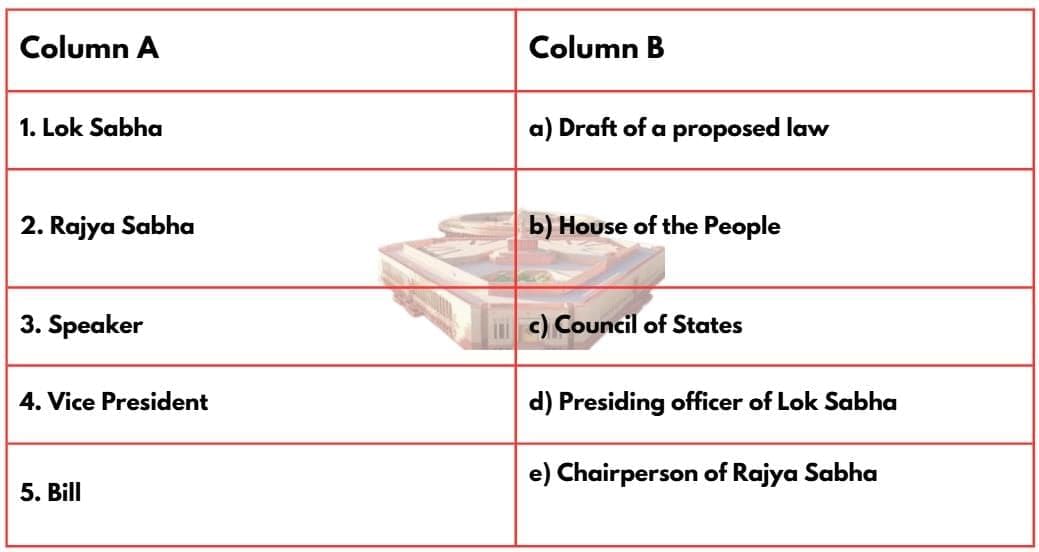
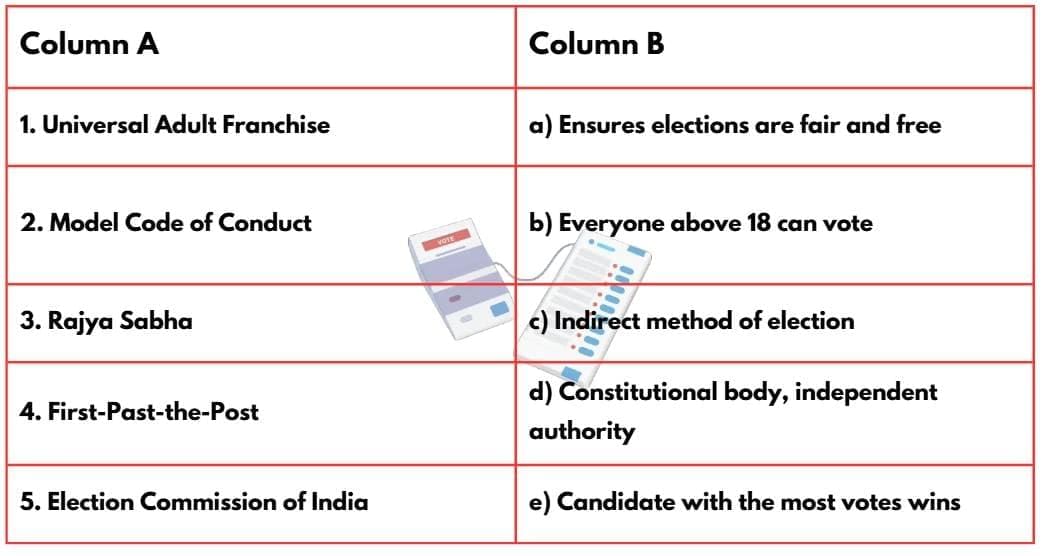
Q1. The Parliament of India consists of— (a) Lok Sabha and Rajya Sabha only (b) The President and Lok Sabha (c) The President, Lok Sabha, and Rajya Sabha (d) The Prime Minister and Lok Sabha
Q2. How many Lok Sabhas have been formed as of June 2024? (a) 15 (b) 16 (c) 17 (d) 18
Q3. Who presides over the sessions of the Lok Sabha? (a) President (b) Vice President (c) Speaker (d) Prime Minister
Q4. Who is the chairperson of the Rajya Sabha? (a) Prime Minister (b) Speaker (c) Vice President of India (d) President of India
Q5. Which of the following is not a legislative function of Parliament? (a) Making laws (b) Checking the government (c) Signing bills into law (d) Approving budgets
Q6. In the lawmaking process, a proposal for a law is called— (a) Act (b) Bill (c) Gazette (d) Clause
Q7. Article 21A of the Constitution makes education for children of which age group a Fundamental Right? (a) 0 to 6 years (b) 6 to 14 years (c) 14 to 18 years (d) 18 to 21 years
Q8. The President appoints the Prime Minister based on— (a) Seniority in Parliament (b) Support of the majority in Lok Sabha (c) Rajya Sabha majority (d) Governor’s recommendation
Q9. Which list allows both Union and State governments to make laws? (a) Union List (b) State List (c) Concurrent List (d) Federal List
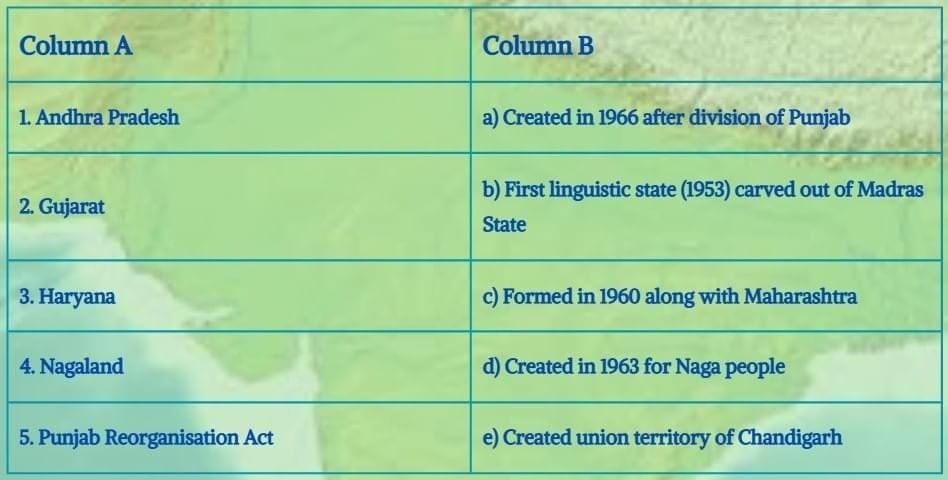
Q10. Which former Prime Minister resigned as Railway Minister in 1956 after a train accident? (a) Jawaharlal Nehru (b) Lal Bahadur Shastri (c) Atal Bihari Vajpayee (d) Morarji DesaiMatch the Following
True or False
Q1. The Rajya Sabha is a permanent house and never dissolves completely. Q2. Only State governments can legislate on Defence and Foreign Affairs. Q3. The Parliament meets three times a year—Budget, Monsoon, and Winter Sessions. Q4. Money Bills can only be introduced in the Rajya Sabha. Q5. Judiciary acts as the guardian of the Constitution. Q6. All states in India have a bicameral legislature with two houses.Fill in the Blanks
Q1. The Indian Parliament follows a ______ system consisting of two houses. Q2. The presiding officer of the Lok Sabha is called the ______. Q3. The RTE Act makes education for children aged ______ to ______ a Fundamental Right. Q4. The Prime Minister and Council of Ministers are collectively responsible to the ______. Q5. The ______ appoints the Prime Minister of India. Q6. In case of conflict in the Concurrent List, the ______ law prevails. Q7. ______ Hour in the Lok Sabha is used by MPs to hold ministers accountable.Very Short Answer Questions
Q1. What is meant by the term “bicameral legislature”? Q2. Who are the members of the Union Executive? Q3. What is meant by federalism? Q4. Define a ‘bill’ in the context of Parliament. Q5. What is the role of the Judiciary in checks and balances? Q6. Mention two states that have bicameral legislatures. Q7. What are the three lists in the Constitution that divide subjects for lawmaking? Q8. Why are legislatures important in a democracy? Q9. State one major challenge faced by India’s legislatures. Q10. Who said in the Lok Sabha, “Governments will come and go, parties will rise and fall, but the nation and its democracy must endure”?
Q1. What is the minimum age to vote in India? (a) 16 years (b) 18 years (c) 21 years (d) 25 years
Q2. Which Article of the Indian Constitution ensures the universal adult franchise? (a) Article 324 (b) Article 21 (c) Article 326 (d) Article 14
Q3. Which body is responsible for conducting free and fair elections in India? (a) Parliament of India (b) Supreme Court of India (c) Election Commission of India (d) Planning Commission
Q4. How many constituencies are there for Lok Sabha elections? (a) 545 (b) 500 (c) 543 (d) 520
Q5. Members of the Rajya Sabha are elected by: (a) The citizens of India directly (b) Members of State Legislative Assemblies (c) The President of India (d) Governors of States
Q6. Which voting system is used in Lok Sabha elections? (a) Proportional Representation (b) Single Transferable Vote (c) First-Past-the-Post (d) Indirect Voting
Q7. The “Festival of Democracy” refers to: (a) Cultural festivals in India (b) General Elections (c) Independence Day celebrations (d) Republic Day
Q8. The President of India is elected by: (a) All Indian citizens (b) Judges of the Supreme Court (c) An Electoral College of MPs and MLAs (d) Only MPs of Lok Sabha
Q9. Who was the Chief Election Commissioner famous for strict electoral reforms in the 1990s? (a) Sukumar Sen (b) Rajiv Gandhi (c) T.N. Seshan (d) K.R. Narayanan
Q10. One major challenge of India’s elections is: (a) Small population (b) Lack of diversity (c) Money power and criminalization in politics (d) Limited number of eligible voters
Match the Following
True or False
Q1. Every Indian citizen above 21 years can vote. Q2. The Lok Sabha has 543 constituencies for elections. Q3. The Rajya Sabha never dissolves completely. Q4. Women in India got the right to vote in 1950, much later than Switzerland. Q5. The Election Commission of India was established in 1950. Q6. The Model Code of Conduct prevents political leaders from misusing government resources during elections.
Fill in the Blanks
Q1. The right to vote in India is based on ______ adult franchise. Q2. The Chief Election Commissioner in the 1990s who brought strict reforms was ______. Q3. Lok Sabha members are also called ______. Q4. The minimum voting age in India is ______ years. Q5. Elections in India are often called the “Festival of ______.” Q6. The Rajya Sabha is also known as the ______ House. Q7. Article ______ of the Indian Constitution provides for universal adult franchise.
Very Short Answer Questions
Q1. Define Universal Adult Franchise in one sentence. Q2. Who can vote in India? Q3. What is the value of each vote in India? Q4. Who conducts the elections in India? Q5. What is the role of the State Election Commission? Q6. What do MPs and MLAs stand for? Q7. Write one key feature of the Model Code of Conduct. Q8. Why is the Rajya Sabha called the “Permanent House”? Q9. Which method of voting is used to elect the President of India? Q10. Mention one challenge faced in conducting elections in India.
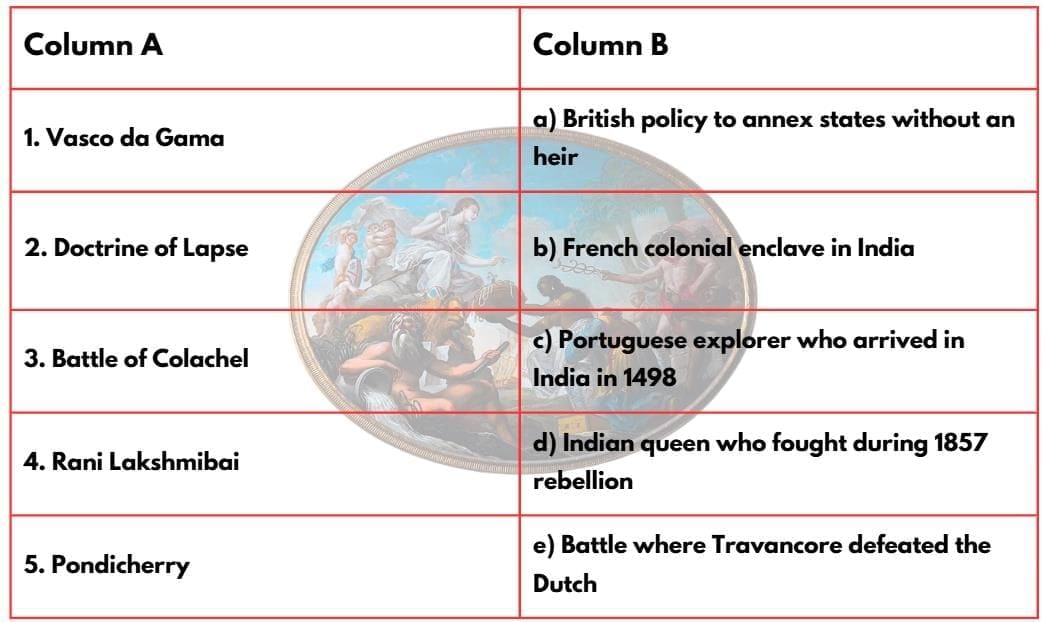
Q1. What is colonialism? (a) One country taking control of another, imposing political, economic, and cultural systems (b) Trading goods between countries (c) Forming alliances for protection (d) Promoting local cultures
Q2. Which European explorer arrived in India in 1498, marking the start of European colonisation? (a) Christopher Columbus (b) Vasco da Gama (c) Ferdinand Magellan (d) Robert Clive
Q3. The Portuguese used which system to control trade in the Arabian Sea? (a) Subsidiary Alliance (b) Cartaz pass system (c) Doctrine of Lapse (d) Divide and Rule
Q4. Which Indian queen resisted Portuguese control in Ullal using alliances and fireballs made from coconut shells? (a) Rani Lakshmibai (b) Rani Abbakka (c) Begum Hazrat Mahal (d) Rani Durgavati
Q5. The Dutch lost control in India after which battle? (a) Battle of Plassey (b) Battle of Colachel (c) Battle of Buxar (d) Battle of Panipat
Q6. Which European power established a trading post in Pondicherry in 1674? (a) Portuguese (b) Dutch (c) French (d) British
Q7. What strategy did the British use to become rulers while pretending to be traders? (a) Subsidiary Alliance (b) Divide and Rule (c) Cartaz system (d) Assimilation policy
Q8. The Doctrine of Lapse allowed the British to annexe princely states on what condition? (a) Ruler died without a natural male heir (b) Ruler converted to Christianity (c) The territory was conquered by the British army (d) Ruler was voted out
Q9. What was one major cause of the Bengal Famine of 1770–72? (a) Crop failure only (b) British taxation demands during the famine (c) War destruction (d) Natural drought alone
Q10. Which Indian leader wrote about the drain of India’s wealth caused by British rule? (a) Dadabhai Naoroji (b) Jawaharlal Nehru (c) Mahatma Gandhi (d) Romesh Chunder DuttMatch the Following
True or False
Q1. The British used a ‘divide and rule’ policy to control India. Q2. The Portuguese Inquisition in Goa lasted until the early 19th century. Q3. The French extensively interfered in Indian social and religious customs. Q4. The Bengal Famine killed around 10 million people due to both crop failure and British policies. Q5. The Battle of Plassey was won with the help of Mir Jafar’s betrayal of Nawab Siraj-ud-daulah. Q6. The British Crown took over direct control of India from the East India Company after 1857.Fill in the Blanks
Q1. Colonialism began in the __________ century with European expansion. Q2. Vasco da Gama landed at __________ in India. Q3. __________ was the colonial capital of Portuguese India. Q4. The British used the __________ strategy to exploit rivalries among Indian rulers. Q5. The __________ rebellion of 1857 is considered a major turning point in Indian resistance. Q6. The __________ rebellion was led by ascetics opposing British tax policies. Q7. The British education policy was shaped by Thomas __________.Very Short Question Answers
Q1. What was the main goal of European colonialism? Q2. Name the European powers that competed for control over India. Q3. Who were Rani Abbakka I and II? Q4. What was the significance of the Battle of Plassey? Q5. Explain the Doctrine of Lapse briefly. Q6. What caused the Bengal Famine of 1770 to become so deadly? Q7. Name one way the British changed traditional Indian industries. Q8. Who was Begum Hazrat Mahal, and what role did she play? Q9. How did the British education policy divide Indian society? Q10. What was one unintended positive consequence of colonial rule in India?
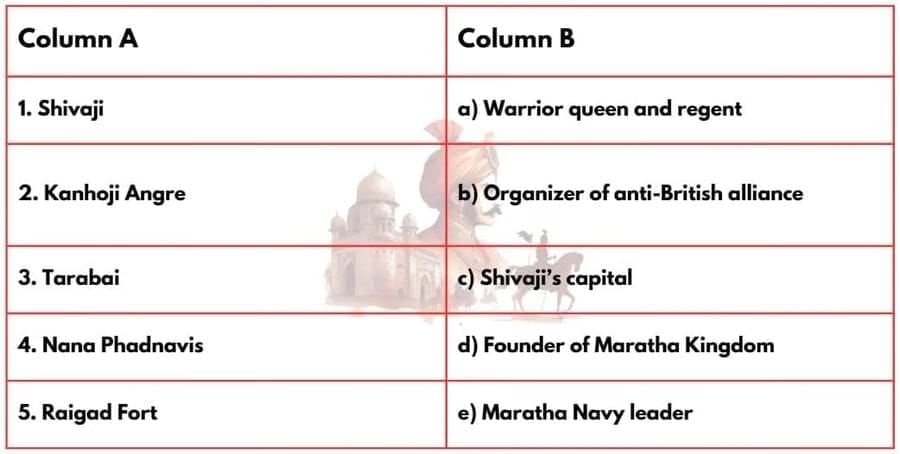
Q1. The Marathas primarily hail from which region? (a) Punjab (b) Maharashtra (c) Gujarat (d) Rajasthan
Q2. The Maratha leader who founded the kingdom and envisioned Swarajya was— (a) Sambhaji (b) Tarabai (c) Shivaji (d) Bajirao I
Q3. Which military tactic was Shivaji famous for? (a) Large-scale infantry battles (b) Naval warfare only (c) Guerrilla warfare (d) Siege warfare only
Q4. The council of ministers established by Shivaji was known as— (a) Peshwa (b) Ashta Pradhana Mandala (c) Diwan (d) Mansabdari
Q5. The Maratha tax called ‘chauth’ was approximately— (a) 10% (b) 15% (c) 25% (d) 50%
Q6. Who led the Maratha Navy in the 18th century, earning a reputation as a formidable admiral? (a) Kanhoji Angre (b) Sambhaji (c) Mahadji Shinde (d) Nana Phadnavis
Q7. Which queen led Maratha resistance after Rajaram’s death? (a) Ahilyabai Holkar (b) Tarabai (c) Jijabai (d) Rani Durgavati
Q8. The capital fort of Shivaji’s kingdom was— (a) Daulatabad (b) Raigad (c) Purandar (d) Pratapgad
Q9. Which Maratha ruler is credited for organizing the first pan-Indian anti-British alliance? (a) Nana Phadnavis (b) Bajirao I (c) Mahadji Shinde (d) Peshwa Balaji Bajirao
Q10. The script primarily used by Marathas for correspondence was— (a) Devanagari (b) Modi (c) Persian (d) Kannada
Match the Following
True or False
Q1. Shivaji abolished hereditary posts and paid officials salaries.
Q2. The Maratha army included only infantry and cavalry, no navy.
Q3. Chauth was a tax levied only on territories directly ruled by Marathas.
Q4. Ahilyabai Holkar was known for charitable works and temple restoration.
Q5. The Marathas had modern ships that matched European technology.
Q6. Trade and infrastructure development were supported under Maratha rule.
Fill in the Blanks
Q1. The Maratha movement for self-rule is called ________.
Q2. Shivaji’s council of eight ministers was called ________.
Q3. The tax called ‘chauth’ amounted to ________ percent of revenue.
Q4. The famous Maratha naval commander was ________.
Q5. The fort at which Shivaji was crowned is called ________.
Q6. The script used for Maratha official correspondence was called ________.
Q7. The leader credited with uniting Indian powers against the British was ________.
Very Short Question Answers
Q1. Who was Shivaji and why is he important?
Q2. What was guerrilla warfare used by the Marathas?
Q3. What was the ‘chauth’ tax?
Q4. How did the Marathas challenge European naval power?
Q5. Name two cultural contributions of the Marathas.
Q6. Who was Tarabai and what was her role?
Q7. Describe the Maratha administrative system under Shivaji.
Q8. What was Nana Phadnavis known for?
Q9. How did Marathas support trade and infrastructure?
Q1. The iqta system made administrative positions hereditary in the Delhi Sultanate. Q2. Timur’s invasion left Delhi devastated in the late 14th century. Q3. Krishnadevaraya was a great builder and patron of literature. Q4. Akbar started the jizya tax on non-Muslims. Q5. Ahom warriors used their knowledge of terrain to defeat the Mughals at Saraighat. Q6. Guru Gobind Singh introduced the Khalsa for strengthening Sikh identity.
Fill in the Blanks
Q1. Prithviraj Chauhan was defeated in ________, establishing the Delhi Sultanate. Q2. The Vijayanagara Empire was founded by two brothers, ________ and ________. Q3. The Rajput leader who resisted Akbar at the Battle of Haldighati was ________. Q4. Babur’s army used ________ and ________ in the First Battle of Panipat. Q5. Trade and ________ were economic strengths of medieval India. Q6. Temples served as centers of ________, learning, and culture. Q7. The Ahoms defeated the Mughals in the Battle of ________.
Very Short Question Answers
Q1. What is meant by “medieval period” in Indian history? Q2. Name any two dynasties of the Delhi Sultanate. Q3. Who was Timur and what was the impact of his invasion? Q4. Why did Muhammad bin Tughlaq shift his capital, and what happened as a result? Q5. Mention one reason for the decline of the Vijayanagara Empire. Q6. What was the jizya tax? Q7. Name the founder of the Bahmani Sultanate. Q8. Who was Rani Durgavati and why is she remembered? Q9. What was a hundi? Q10. Mention one contribution of Akbar to literature and culture.
Q1. Resources that we find in nature and are used without much modification are called ……………… (a) Human Resources (b) Natural Resource (c) Renewable Resource (d) Human Made Resource
Q2. How are natural resources primarily categorized? (a) By color (b) By use and renewability (c) By size (d) By location
Q3. Which of the following is an example of a renewable resource? (a) Coal (b) Petroleum (c) Solar energy (d) Natural gas
Q4. What factor can change substances into resources? (a) Air (b) Time and technology (c) Water (d) Soil
Q5. What is the main focus of sustainable development? (a) Exploiting resources for short-term gain (b) Using resources carelessly (c) Balancing present needs with future conservation (d) Wasting resources
Q6. Which of the following is a non-renewable resource? (a) Solar energy (b) Timber (c) Coal (d) Wind
Match the Following
True or False
Q1. Natural resources include only those substances that have economic value. Q2. Renewable resources can never be depleted or exhausted. Q3. Overexploitation of renewable resources can disrupt nature’s restoration and regeneration cycles. Q4. Resource conservation involves using resources carelessly without thinking about the future. Q5. Sustainable development aims to balance the use of resources for current needs and conserve them for the future.
Fill in the Blanks
Q1: All ___________ have some utility and value.
Q2:_______ is an example of a resource essential for life.
Q3: Human beings use ________ and _________ to develop resources.
Q4: ________is an example of a renewable resource that can be depleted if overused.
Q5:_______or _______makes an object or substance a resource.
Q6: _____________ is an example of a non-renewable resource used for energy
Very Short Question Answers
Q1. What are non-renewable resources? Q2. What do you mean by stock of resource? Q3. How are natural resources classified by their use? Q4. Why must renewable resources be used sustainably? Q5. How does the uneven distribution of natural resources affect human life? Q6. What is resource conservation? Q7. Name some natural resources. Q8. What is sustainable development? Q9. What is the natural resource curse? Q10. What is utility? Q.11. What makes a substance a resource? Q.12. What are renewable resources? Q.13. What is Vrikshayurveda, and how does it promote sustainable resource use? Q.14. What is technology? Q.15. What are natural resources?
लघु उत्तरीय प्रश्नोत्तर (Short Answer Type Questions)
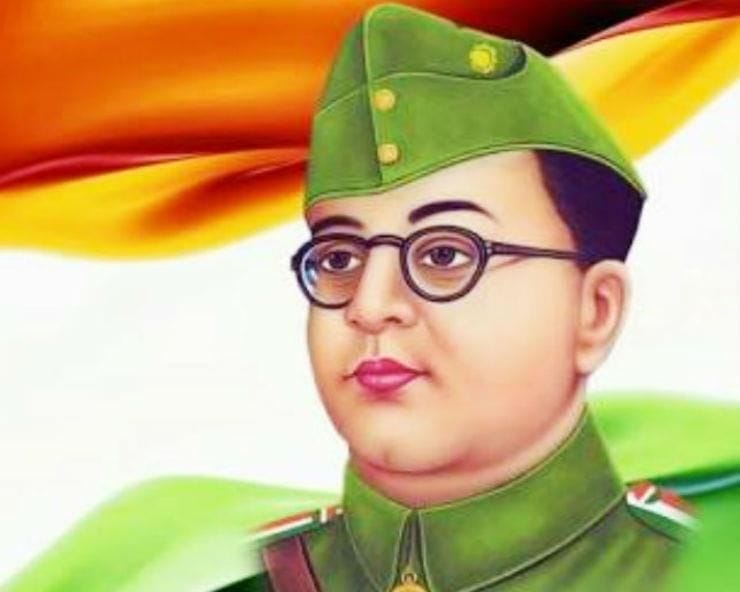
प्रश्न 1: नेताजी सुभाषचंद्र बोस का मुख्य उद्देश्य क्या था? उत्तर: नेताजी का मुख्य उद्देश्य भारत को अंग्रेजों की हुकूमत से आज़ाद कराना था। उन्होंने आज़ाद हिंद फौज का नेतृत्व किया। उनके नारे “दिल्ली चलो” और “जय हिंद” बहुत प्रसिद्ध हुए।
नेताजी सुभाषचंद्र बोस प्रश्न 2: नेताजी का सपना क्या था? उत्तर: नेताजी का सपना एक ऐसा आज़ाद और खुशहाल भारत बनाना था जहाँ सभी लोग बराबर हों। वे चाहते थे कि जात-पात, अमीर-गरीब का भेद न हो। साथ ही, सभी को शिक्षा और अवसर मिले।
प्रश्न 3: नेताजी ने युवाओं को क्या संदेश दिया? उत्तर: नेताजी ने युवाओं से कहा कि वे उनके सपने को अपनाएँ और इसे पूरा करें। उन्होंने कहा कि यह सपना उन्हें ताकत और खुशी देता है। युवा इसे सच करके देश की सेवा करें।
प्रश्न 4: नेताजी के सपने में महिलाओं की क्या भूमिका थी? उत्तर: नेताजी चाहते थे कि महिलाएँ पुरुषों की तरह बराबर अधिकार पाएँ। वे समाज और देश की सेवा में हिस्सा लें। उन्हें सम्मान और अवसर मिले।
प्रश्न 5: नेताजी ने समाज में किस तरह की समानता की बात की? उत्तर: नेताजी ने कहा कि समाज में जात-पात का भेदभाव न हो। सभी लोग एक-दूसरे के साथ बराबरी से रहें। अमीर-गरीब का अंतर भी खत्म हो।
प्रश्न 6: नेताजी के सपने में शिक्षा की क्या अहमियत थी? उत्तर: नेताजी चाहते थे कि हर व्यक्ति को शिक्षा मिले। इससे लोग आगे बढ़ सकें और देश की सेवा करें। शिक्षा से समाज में बराबरी आएगी।
प्रश्न 7: नेताजी ने काम करने वालों के बारे में क्या कहा? उत्तर: नेताजी चाहते थे कि मेहनत करने वालों की इज्जत हो। आलसी और कामचोर लोगों के लिए समाज में कोई जगह न हो। मेहनत को सम्मान मिले।
प्रश्न 8: नेताजी के सपने में भारत दुनिया के लिए क्या बनना था? उत्तर: नेताजी चाहते थे कि भारत दुनिया के लिए एक आदर्श बने। हमारा देश ऐसा हो जो दूसरों को अच्छे समाज और देश का रास्ता दिखाए।
प्रश्न 9: नेताजी ने अपने सपने को पूरा करने के लिए क्या कहा? उत्तर: नेताजी ने कहा कि सपने को पूरा करने के लिए हर मुश्किल सहनी होगी। वे इसके लिए त्याग और अपनी जान तक देने को तैयार थे। यह सपना उनके लिए सच्चाई था।
प्रश्न 10: नेताजी ने कब और कहाँ युवाओं को अपने सपने के बारे में बताया? उत्तर: नेताजी ने 29 दिसंबर, 1929 को मेदिनीपुर में युवक-सम्मेलन में अपने सपने की बात कही। यह बात बहुत प्रेरणादायक थी। उन्होंने युवाओं को देश की सेवा के लिए प्रेरित किया।
दीर्घ उत्तरीय प्रश्नोत्तर (Long Answer Type Questions)
प्रश्न 1: नेताजी सुभाषचंद्र बोस के सपने के मुख्य बिंदु क्या थे? उत्तर: नेताजी का सपना एक आज़ाद और खुशहाल भारत बनाना था। वे चाहते थे कि समाज में कोई भेदभाव न हो, जैसे जात-पात या अमीर-गरीब का अंतर। महिलाओं को पुरुषों के समान अधिकार और सम्मान मिले। हर व्यक्ति को शिक्षा और काम के अवसर मिलें। मेहनत करने वालों की इज्जत हो और आलसी लोगों के लिए कोई जगह न हो। उनका सपना था कि भारत दुनिया के लिए एक आदर्श देश बने।
प्रश्न 2: नेताजी के सपने को पूरा करने के लिए युवाओं की क्या भूमिका थी? उत्तर: नेताजी ने युवाओं से कहा कि वे उनके सपने को अपनाएँ और इसे सच करें। यह सपना उन्हें ताकत और खुशी देता था। उन्होंने युवाओं को देश और समाज की सेवा के लिए प्रेरित किया। नेताजी चाहते थे कि युवा मेहनत करें और एक ऐसा समाज बनाएँ जहाँ सभी बराबर हों। वे इस सपने को उपहार के रूप में युवाओं को देना चाहते थे। उनके लिए यह सपना जीवन का मकसद था।
प्रश्न 3: नेताजी के सपने में समाज में समानता की क्या अहमियत थी? उत्तर: नेताजी के सपने में समानता बहुत जरूरी थी। वे चाहते थे कि समाज में जात-पात का भेदभाव खत्म हो। सभी लोग एक-दूसरे के साथ बराबरी से रहें। महिलाओं को भी पुरुषों की तरह अधिकार और सम्मान मिले। पैसों की असमानता न हो और हर व्यक्ति को शिक्षा और अवसर मिले। इससे एक खुशहाल और एकजुट समाज बनेगा, जो देश को मजबूत करेगा।
प्रश्न 4: नेताजी के सपने से हमें आज क्या प्रेरणा मिलती है? उत्तर: नेताजी का सपना हमें आज भी प्रेरणा देता है कि हम एक बेहतर समाज और देश के लिए मेहनत करें। हमें जात-पात, अमीर-गरीब जैसे भेदभाव को खत्म करना चाहिए। महिलाओं को बराबर सम्मान और अवसर देने चाहिए। शिक्षा और मेहनत को बढ़ावा देना चाहिए। नेताजी का सपना हमें सिखाता है कि मेहनत और त्याग से हम अपने देश को दुनिया का आदर्श बना सकते हैं। यह हमें एकजुट होकर काम करने की प्रेरणा देता है।
प्रश्न 5: नेताजी के स्वतंत्रता संग्राम में योगदान को उनके सपने के साथ कैसे जोड़ा जा सकता है? उत्तर: नेताजी ने स्वतंत्रता संग्राम में आज़ाद हिंद फौज बनाकर और “दिल्ली चलो”, “जय हिंद” जैसे नारे देकर देश को आज़ाद करने की लड़ाई लड़ी। उनका सपना एक आज़ाद, समृद्ध और बराबरी वाला भारत था। इस सपने ने उन्हें और उनके सैनिकों को प्रेरणा दी। वे चाहते थे कि आज़ादी के बाद ऐसा समाज बने जहाँ सभी को बराबर अवसर और सम्मान मिले। उनका योगदान और सपना दोनों एक-दूसरे से जुड़े थे, क्योंकि आज़ादी उनके सपने का पहला कदम थी। आज भी उनका सपना हमें समाज सुधार के लिए प्रेरित करता है।
लघु उत्तरीय प्रश्नोत्तर (Short Answer Type Questions)
प्रश्न 1: कविता “आदमी का अनुपात” का मुख्य विषय क्या है? उत्तर: कविता का मुख्य विषय यह है कि आदमी ब्रह्मांड की विशालता के सामने बहुत छोटा है, फिर भी वह ईर्ष्या, घमंड और स्वार्थ से भरा है। कवि कहते हैं कि हमें झगड़ों के बजाय मिल-जुलकर रहना चाहिए। यह कविता हमें प्रेम और एकता का संदेश देती है।
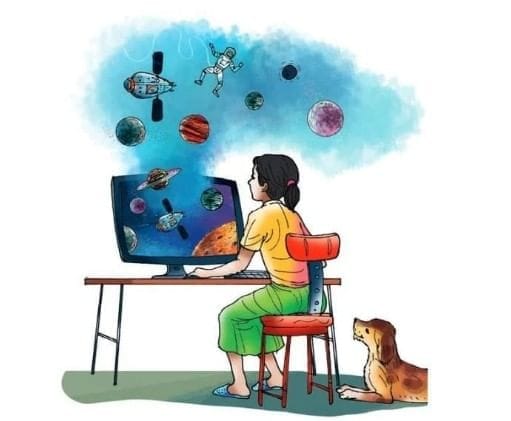
प्रश्न 2: कवि ने पृथ्वी को ब्रह्मांड में कैसे दर्शाया है? उत्तर: कवि ने पृथ्वी को अनगिनत तारों और लाखों ब्रह्मांडों में बहुत छोटी बताया है। यह आकाशगंगा का एक छोटा-सा हिस्सा है। यह दर्शाता है कि पृथ्वी और इंसान की जगह बहुत छोटी है।
प्रश्न 3: कविता में “अनुपात” शब्द का क्या अर्थ है? उत्तर: “अनुपात” शब्द कविता में इंसान और ब्रह्मांड के आकार की तुलना को दर्शाता है। यह दिखाता है कि इंसान कितना छोटा है। कवि इस शब्द से हमें हमारी वास्तविक स्थिति समझाते हैं।
प्रश्न 4: कवि ने इंसान के नकारात्मक गुणों के बारे में क्या कहा है? उत्तर: कवि कहते हैं कि इंसान के भीतर ईर्ष्या, अहंकार, स्वार्थ, नफरत और अविश्वास भरे हैं। ये गुण उसे दूसरों से अलग करते हैं। वह इनके कारण दीवारें खड़ी करता है।
प्रश्न 5: कविता में “दो दुनिया” से क्या तात्पर्य है? उत्तर: “दो दुनिया” से तात्पर्य है कि एक ही कमरे में दो लोग अपने-अपने अलग विचारों और भावनाओं के कारण अलग-अलग दुनिया बना लेते हैं। यह इंसान की अलगाव की प्रवृत्ति को दिखाता है।
प्रश्न 6: कविता में कमरे से पृथ्वी तक की तुलना क्यों की गई है? उत्तर: कवि ने कमरे से पृथ्वी तक की तुलना इसलिए की ताकि यह दिखा सकें कि इंसान कितना छोटा है। यह तुलना ब्रह्मांड की विशालता को समझाने में मदद करती है। कवि हमें हमारी असल जगह बताते हैं।
प्रश्न 7: कविता से हमें क्या संदेश मिलता है? उत्तर: कविता हमें सिखाती है कि हमें झगड़े और घमंड छोड़कर प्रेम और एकता के साथ रहना चाहिए। हम ब्रह्मांड में बहुत छोटे हैं। इसलिए हमें मिल-जुलकर रहना चाहिए।
प्रश्न 8: कविता में “नभ गंगा” से क्या तात्पर्य है? उत्तर: “नभ गंगा” से तात्पर्य आकाशगंगा से है, जिसमें हमारी पृथ्वी और अनगिनत तारे शामिल हैं। यह ब्रह्मांड की विशालता को दर्शाता है। कवि इसे पृथ्वी की छोटी जगह दिखाने के लिए उपयोग करते हैं।
प्रश्न 9: कवि ने इंसान को “दूसरों का स्वामी” क्यों कहा है? उत्तर: कवि ने इंसान को “दूसरों का स्वामी” इसलिए कहा क्योंकि वह अपने घमंड और स्वार्थ के कारण दूसरों पर हुकूमत करना चाहता है। वह खुद को बड़ा समझता है। यह उसकी गलत सोच को दर्शाता है।
प्रश्न 10: कविता में दीवारें खड़ी करने का क्या अर्थ है? उत्तर: दीवारें खड़ी करने का अर्थ है कि इंसान अपने नकारात्मक गुणों जैसे ईर्ष्या और नफरत के कारण लोगों के बीच अलगाव पैदा करता है। वह एकता के बजाय विभाजन को बढ़ावा देता है। कवि इसे गलत बताते हैं।
दीर्घ उत्तरीय प्रश्नोत्तर (Long Answer Type Questions)
प्रश्न 1: कविता “आदमी का अनुपात” में कवि ने इंसान की छोटी जगह को कैसे समझाया है? उत्तर: कवि ने इंसान की छोटी जगह को कमरे से लेकर ब्रह्मांड तक की तुलना करके समझाया है। एक आदमी कमरे में है, कमरा घर में, घर मोहल्ले में, मोहल्ला शहर में, शहर प्रदेश में, प्रदेश देश में और देश पृथ्वी पर है। पृथ्वी अनगिनत तारों और लाखों ब्रह्मांडों में एक छोटा-सा हिस्सा है। यह तुलना दिखाती है कि इंसान ब्रह्मांड की विशालता में बहुत छोटा है। फिर भी वह अपने भीतर नकारात्मक भावनाएँ रखता है। कवि हमें सिखाते हैं कि हमें इस छोटी जगह को समझकर प्रेम और एकता के साथ रहना चाहिए।
प्रश्न 2: कविता में इंसान के नकारात्मक गुणों का वर्णन कैसे किया गया है और इससे क्या संदेश मिलता है? उत्तर: कवि कहते हैं कि इंसान के भीतर ईर्ष्या, अहंकार, स्वार्थ, नफरत और अविश्वास जैसे नकारात्मक गुण हैं। ये गुण उसे दूसरों से अलग करते हैं और वह दीवारें खड़ी करता है। वह खुद को दूसरों का स्वामी समझता है और एक छोटे से कमरे में भी अपनी अलग दुनिया बना लेता है। इससे हमें संदेश मिलता है कि हमें इन बुरे गुणों को छोड़ देना चाहिए। हमें ब्रह्मांड की विशालता को समझकर प्रेम और विश्वास के साथ रहना चाहिए। यह कविता हमें एकता का महत्व सिखाती है।
प्रश्न 3: कविता “आदमी का अनुपात” से हमें क्या शिक्षा मिलती है? उत्तर: कविता हमें सिखाती है कि इंसान ब्रह्मांड की विशालता में बहुत छोटा है, फिर भी वह अपने भीतर नकारात्मक भावनाएँ जैसे ईर्ष्या, घमंड और नफरत रखता है। वह दूसरों से अलगाव पैदा करता है और दीवारें खड़ी करता है। कवि कहते हैं कि हमें इन बुराइयों को छोड़कर प्रेम और विश्वास के साथ रहना चाहिए। जब हम इतने छोटे हैं, तो झगड़े और अहंकार का कोई मतलब नहीं है। हमें मिल-जुलकर और एकता के साथ जीवन जीना चाहिए। यह कविता हमें मानवता और एकता का संदेश देती है।
प्रश्न 4: कविता “आदमी का अनुपात” के दूसरे प्रसंग में कवि ने ब्रह्मांड की विशालता को कैसे दर्शाया है? उत्तर: कवि ने दूसरे प्रसंग में बताया है कि हमारी पृथ्वी अनगिनत तारों में बहुत छोटी है, जैसे करोड़ों में एक बिंदु। यह पृथ्वी आकाशगंगा का हिस्सा है, जिसमें बहुत सारे तारे हैं। लाखों ब्रह्मांड हैं, और हर ब्रह्मांड में कई पृथ्वियाँ और सृष्टियाँ हैं। यह अनुपात दिखाता है कि इंसान और पृथ्वी ब्रह्मांड में कितने छोटे हैं। कवि हमें सिखाते हैं कि हमें अपनी छोटी जगह को समझना चाहिए। इससे हमें विनम्रता और एकता का महत्व पता चलता है।
प्रश्न 5: कविता में कवि ने इंसान की प्रवृत्ति को कैसे दर्शाया है और इसका क्या प्रभाव पड़ता है? उत्तर: कवि ने इंसान की प्रवृत्ति को नकारात्मक बताया है, जिसमें वह ईर्ष्या, अहंकार, स्वार्थ, नफरत और अविश्वास से भरा है। वह अपने चारों ओर दीवारें खड़ी करता है और दूसरों पर हुकूमत करना चाहता है। एक छोटे से कमरे में भी वह अपनी अलग दुनिया बना लेता है। इसका प्रभाव यह पड़ता है कि लोग एक-दूसरे से अलग हो जाते हैं और आपसी प्रेम व विश्वास कम हो जाता है। कवि हमें सिखाते हैं कि हमें इन प्रवृत्तियों को छोड़कर प्रेम और एकता के साथ रहना चाहिए। यह कविता हमें बेहतर इंसान बनने की प्रेरणा देती है।
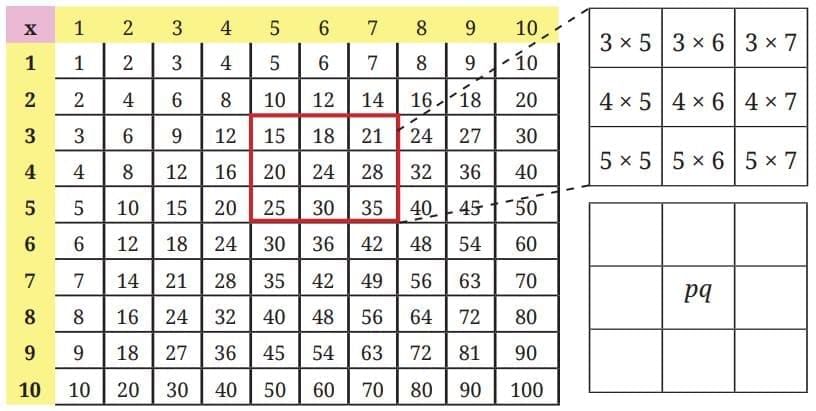
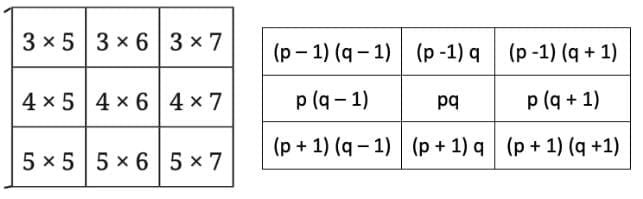
Q1. Observe the multiplication grid below. Each number inside the grid is formed by multiplying two numbers. If the middle number of a 3 × 3 frame is given by the expression pq, as shown in the figure, write the expressions for the other numbers in the grid.
Q5. Expand (i) (a – b) (a + b), (ii) (a – b) (a2 + ab + b2) and (iii) (a – b)(a3 + a2b + ab2 + b3), Do you see a pattern? What would be the next identity in the pattern that you see? Can you check it by expanding? Ans: (i) (a − b)(a + b) = (a − b)a + (a − b)b = a2 – ab + ab – b2 = a2 – b2. (ii) (a – b) (a2 + ab + b2) = (a – b)a2 + (a – b)ab + (a – b)b2 = a3 – a2b + a2b – ab2 + ab2 – b3 = a3 – b3. (iii) (a – b)(a3 + a2b + ab2 + b3) = (a – b)a3 + (a – b)a2b + (a – b)ab2 + (a – b)b3 = a4 – a3b + a3b – a2b2 + a2b2 – ab3 + ab3 – b4 = a4 – b4. The next identity would be: (a − b)(a4 + a3b + a2b2 + ab3 + b4) = a5 − b5.
Page 149
Figure it Out
Q1. Which is greater: (a – b)2 or (b – a)2? Justify your answer. Ans: Using identify:- (a – b)2 = a2 + b2 – 2ab And (b – a)² = b2 + a2 – 2ab = a2 + b2 – 2ab We see that both the expressions are equal, so neither is greater.
Q2. Express 100 as the difference of two squares. Ans: Therefore, a2 – b2 = 100 Or, a2 – b2 = 2 × 2 × 5 × 5 Or, (a + b) (a – b) = 50 × 2 When, (a + b) = 50 and (a – b) = 2 Then ‘a’ should be = 26 and ‘b’ should be = 24 So, (a + b) (a – b) = (26 + 24) (26 – 24) = 262 – 242 = 676 – 576 = 100 Therefore, 100 = 262 – 242
Q3. For each statement identify the appropriate algebraic expression(s). (i) Two more than a square number. 2 + s, (s + 2)2, s2 + 2, s2 + 4, 2s2, 22s Ans: s2 + 2 Explanation: Let be the number = s ∴ Square number = s2 So, two more the square number is = s2+ 2 (ii) The sum of the squares of two consecutive numbers m²+n2, (m + n)2, m2 + 1, m2 + (m + 1)2, m2 + (m – 1)2, {m + (m + 1)}2, (2m)2 + (2m + 1)2 Ans: m2 + (m + 1)2 Explanation: Let be the consecutive numbers are = m and (m + 1) So, the sum of the square numbers = m2 + (m + 1)2
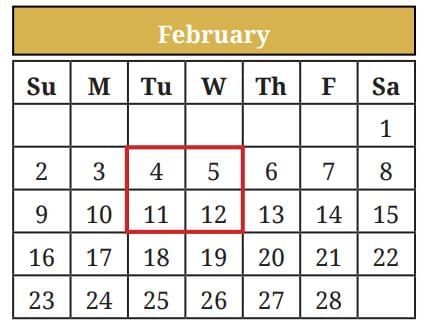
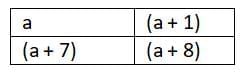
Q4. Consider any 2 by 2 square of numbers in a calendar, as shown in the figure. Find products of numbers lying along each diagonal — 4 × 12 = 48, 5 × 11 = 55. Do this for the other 2 by 2 squares. What do you observe about the diagonal products? Explain why this happens. Ans: Other 2 by 2 squares and products of diagonal We observe that the product of each diagonal is 7 more than the product of the other diagonals. Explanation: When we see the 2 by 2 squares we see that The difference between the first number in the first row and the first number in the second row is 7. And the difference between the second number in the first row and the second number in the second row is also 7. When we cross multiply the numbers, the difference will remain the same.
Q5. Verify which of the following statements are true. (i) (k + 1)(k + 2) – (k + 3) is always 2. Ans: Statement is false. Explanation: (k + 1) (k + 2) – (k + 3) = k2 + 2k + k + 2 – k – 3 = k2 + 2k – 1 Now, if k = 1, then (1)2 + 2 × 1 – 1 = 2 If k = 2, then (2)2 + 2 × 2 – 1 = 7 If k = 3, then (3)2 + 2 × 3 – 1 = 14 (ii) (2q + 1)(2q – 3) is a multiple of 4. Ans: Statement is false. Explanation: (2q + 1) (2q – 3) = 4q2 – 6q + 2q – 3 = 4q2 – 4q – 3 =4(q2 –q) – 3 Here we see that 3 is not divisible by 4, so the entire equation is not divisible by 4. (iii) Squares of even numbers are multiples of 4, and squares of odd numbers are 1 more than multiples of 8. Ans: Statement is true. Explanation: Let be the even number is = 2n (even is always divisible by 2). ∴ Square of 2n = (2n)2 = 4n2 (We see it is always a multiple of 4) And the odd number is = 2n + 1 ∴ Square of 2n + 1 = (2n + 1)2 = (2n)2 + 2×2n×1 + 12 = 4n2 + 4n + 1 = 4(n2 + n) + 1 (n2 + n) is always an even number because n is odd, the square of an odd number is always odd, and odd + odd = even. Example: If (n2 + n) = 2, then 4×2 + 1 = 9 (9 is 1 more than multiples of 8) If (n2 + n) = 4, then 4×4 + 1 = 17 (9 is 1 more than multiples of 8) etc. (iv) (6n + 2)2 – (4n + 3)2 is 5 less than a square number. Ans: Statement is false. Explanation: (6n + 2)2 – (4n + 3)2 = {(6n)2 + 2×6n×2 + (2)2} –{(4n)2 + 2×4n×3 + (3)2} = 36n2 + 24n + 4 – 16n2 – 24n – 9 = 20n2– 5 Clearly we see 20 is a square number so 20n2 is also not a square number.
Q6. A number leaves a remainder of 3 when divided by 7, and another number leaves a remainder of 5 when divided by 7. What is the remainder when their sum, difference, and product are divided by 7? Ans: Let be the number x is divided by 7 and the remainder is 3. ∴ x ≡ 3 (mod7) And suppose the number y is divided by 7 and the remainder is 5. ∴ y ≡ 5 (mod7) Q7. Choose three consecutive numbers, square the middle one, and subtract the product of the other two. Repeat the same with othersets of numbers. What pattern do you notice? How do we write this as an algebraic equation? Expand both sides of the equation to check that it is a true identity. Ans: Let be the three consecutive numbers are = x, (x + 1), (x + 2) Therefore,(x + 1)2 – x(x + 2) = x2 + 2x + 1 – x2 – 2x = 1 And let be the other sets of consecutive numbers are = (x – 1), x, (x + 1) Therefore, x2 – (x – 1) (x + 1) = x2 – x2 – x + x + 1 = 1 In the pattern we have observed, the value of the equation is always 1. Hence, the algebraic equation is:-(x + 1)2 – x(x + 2) = 1
Q8. What is the algebraic expression describing the following steps-add any two numbers. Multiply this by half of the sum of the two numbers? Prove that this result will be half of the square of the sum of the two numbers. Ans: Let be the two numbers are = x and y Sum of these numbers are = (x + y) Multiplying this by half = 1/2× (x + y) Now, 1/2×(x + y) × (x + y) = (x + y)2/2 Therefore, the result will be half of the square of the sum of the two numbers.
Q9. Which is larger? Find out without fully computing the product. (i) 14 × 26 or 16 × 24 Ans: 14 × 26 = (20 – 6) (20 + 6) = (20)2 – (6)2 And 16 × 24 = (20 – 4) (20 + 4) = (20)2 – (4)2 ∴ (4)2< (6)2, in the 2nd condition smaller number will be subtracted from (20)2. So, the larger product will be = 16 × 24 (ii) 25 × 75 or 26 × 74 Ans: 25 × 75 = (50 – 25) (50 + 25) = (50)2 – (25)2 And 26 × 74 = (50 – 24) (50 + 24) = (50)2 – (24)2 ∴ (24)2< (25)2, in the 2nd condition smaller number will be subtracted from (50)2. So, the larger product will be = 26 × 74
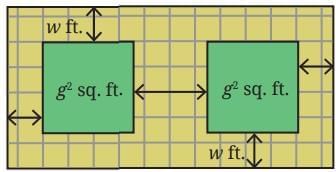
Q10. A tiny park is coming up in Dhauli. The plan is shown in the figure. The two square plots, each of area g2 sq. ft., will have a green cover. All the remaining area is a walking path w ft. wide that needs to be tiled. Write an expression for the area that needs to be tiled. Ans:Area of square plot = g2 sq. ft., so length of side = g ft. ∴ Length of the tiny park = (w + g + w + g + w) ft= (3w + 2g) ft And breadth of the tiny park = (w + g + w) = (2w + g) ft Total area of the park = (3w + 2g) × (2w + g) = 6w2 + 3wg + 4wg + 2g2 = (6w2 + 7wg + 2g2) sq. ft. So, the remaining area that needs to be tiled for the walking path is = (6w2 + 7wg + 2g2) – (g2) sq. ft. = (6w2 + 7wg + g2) sq. ft.
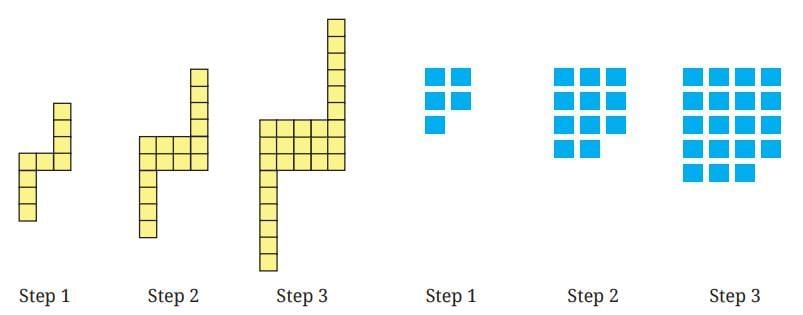
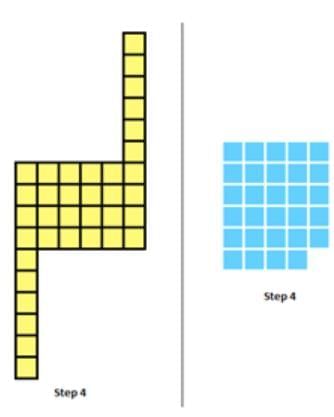
Q11. For each pattern shown below, (i) Draw the next figure in the sequence. Ans: Next figure in the sequence: (ii) How many basic units are there in Step 10? Ans: In the first figure, the number of basic units in step 1 = 9 And in the first figure, the number of basic units in step 1 = 5 (iii) Write an expression to describe the number of basic units in Step y. Ans: In 1stfigure:- Step 1:- (1 + 2)2 = 9 Step 2:- (2 + 2)2 = 16 Step 3:- (3 + 2)2 = 25 → Step y:- (y + 2)2 In 2nd figure:- Step 1:- (1+1)2+ 1 = 5 Step 2:- (2+1)2+ 2 = 16 Step 3:- (3 + 1)2+ 3= 25 → Step y:- (y + 1)2 + y
Q1. The sum of four consecutive numbers is 34. What are these numbers? Ans: Let four consecutive numbers be x, (x + 1), (x + 2) and (x + 3). x + (x + 1) + (x + 2) + (x + 3) = 34 x + x + 1 + x + 2 + x + 3 = 34 4x + 6 = 34 4x = 34 – 6 4x = 28 x = 28/7 = 7. So, (x + 1 ) = 7 + 1 = 8 (x + 2) = 7 + 2 = 9 (x + 3) = 7 + 3 = 10 Therefore, the given four consecutive numbers are 7, 8, 9, and 10.
Q2. Suppose p is the greatest of five consecutive numbers. Describe the other four numbers in terms of p. Ans: If p is the greatest of five consecutive numbers, then the other four numbers are (p – 1), (p – 2), (p – 3), and (p – 4).
Q3. For each statement below, determine whether it is always true, sometimes true, or never true. Explain your answer. Mention examples and non-examples as appropriate. Justify your claim using algebra. (i) The sum of two even numbers is a multiple of 3. Ans: Let the two even numbers be 2a + 2b Sum = 2a + 2b = 2(a + b) For 2(a + b) to be a multiple of 3, (a + b) must be multiple of 3. Example: 2 + 4 = 6 → divisible by 3 2 + 8 = 10 → not divisible by 3 Conclusion: Sometimes true.
(ii) If a number is not divisible by 18, then it is also not divisible by 9. Ans: If a number is divisible by 18, then it is also divisible by 9 because 9 is a factor of 18. 18a ÷ 9 = 2a → divisible by 9. But if a number is divisible by 9, it is not always divisible by 18. 9b ÷ 18 = b/2 → not divisible by 9. Example: 9 is divisible by 9 but not divisible by 18. 27 is divisible by 9 but not 18. Conclusion: Sometimes true.
(iii) If two numbers are not divisible by 6, then their sum is not divisible by 6. Ans: Let the two numbers be a and b. Not divisible by 6 means they do not satisfy 6∣a or 6∣b. But their sum can still be divisible by 6. Example: 2 and 4 → both not divisible by 6. But, 2 + 4 = 6 → divisible by 6. Conclusion: Sometimes true.
(iv) The sum of a multiple of 6 and a multiple of 9 is a multiple of 3. Ans: Let the multiple of 6 be 6a, the multiple of 9 be 9b. Sum: 6a + 9b = 3(2a + 3b)→ clearly divisible by 3. Example: 6 + 9 = 15 → divisible by 3. 12 + 18 = 30 → divisible by 3. Conclusion: Always true.
(v) The sum of a multiple of 6 and a multiple of 3 is a multiple of 9. Ans: Let multiple of 6 be 6a, multiple of 3 be 3b. Sum: 6a + 3b = 3(2a + b). For it to be divisible by 9, 2a + b must be divisible by 3. Example: 6 (6 × 1) + 3 (3 × 1) = 9 →divisible by 9 6 + 6 = 12 → not divisible by 9 Conclusion: Sometimes true.
Q4. Find a few numbers that leave a remainder of 2 when divided by 3 and a remainder of 2 when divided by 4. Write an algebraic expression to describe all such numbers. Ans: L.C.M of 3 and 4 = 12. All such numbers are given by the expression = 12a + 2. Examples: (i) 12 × 1 + 2 = 12 + 2 = 14. (ii) 12 × 2 + 2 = 24 + 2 = 26. (iii) 12 × 3 + 2 = 36 + 2 = 38.
Q5. “I hold some pebbles, not too many, When I group them in 3’s, one stays with me. Try pairing them up — it simply won’t do, A stubborn odd pebble remains in my view. Group them by 5, yet one’s still around, But grouping by seven, perfection is found. More than one hundred would be far too bold, Can you tell me the number of pebbles I hold?”
Ans: Grouped in 3’s leaves 1. Pairing (2’s) leaves 1. Grouped by 5 leaves 1. Grouped by 7 is perfect. Number ≤ 100. L.C.M of 2, 3, and 5 = 30. In all those cases, when we group them, 1 pebble remains. So, the actual number of pebbles must be = 30 + 1 = 31, but 31 is not divisible by 7. The next multiple of 30 is 2 × 30 = 60. So, 60 + 1 = 61, but this is also not divisible by 7. Similarly, the next number is 90 + 1 = 91. And 91 is divisible by 7. Hence, the number of pebbles I hold = 91.
Q6. Tathagat has written several numbers that leave a remainder of 2 when divided by 6. He claims, “If you add any three such numbers, the sum will always be a multiple of 6.” Is Tathagat’s claim true? Ans: A number that leaves remainder of 2 when divided by 6 can be written as 6k + 2. Three such numbers are: (6a + 2), (6b + 2), (6c + 2). (6a + 2) + (6b + 2) + (6c + 2) = 6(a + b + c) + 6 = 6(a + b + c + 1). This sum is divisible by 6. So yes, Tathagat’s claim is always true. Example: Take 20, 26, 32 → sum = 78 → divisible by 6. Take 2, 8, 14 → sum = 24 → divisible by 6.
Page 123
Q7. When divided by 7, the number 661 leaves a remainder of 3, and 4779 leaves a remainder of 5. Without calculating, can you say what remainders the following expressions will leave when divided by 7? Show the solution both algebraically and visually. (i) 4779 + 661 (ii) 4779 – 661 Ans: (i) 4779 + 661 = Remainder 5 + Remainder 3 = Remainder 8 8 divided by 7 → remainder 1. (ii) 4779 – 661 = Remainder 5 – Remainder 3 = Remainder 2
Q8. Find a number that leaves a remainder of 2 when divided by 3, a remainder of 3 when divided by 4, and a remainder of 4 when divided by 5. What is the smallest such number? Can you give a simple explanation of why it is the smallest? Ans: A number that leaves a remainder of 2 when divided by 3 is = 3x + 2 A number that leaves a remainder of 3 when divided by 4 is = 4x + 3 A number that leaves a remainder of 4 when divided by 5 is = 5x + 4 L.C.M of 3, 4, and 5 = 60 All the numbers are the same, so 4x + 3 = 3x + 2 4x – 3x = 2 – 3 x = -1 Each remainder is 1 less than the divisor. Hence, the number is 1 less than the L.C.M = (60 – 1) = 59. So, 59 is the smallest number that satisfies all the given conditions.
Page 126
Figure it Out
Q1. Find, without dividing, whether the following numbers are divisible by 9. (i) 123 Ans: Digit sum of the number 123 = (1 + 2 + 3) = 6 Now, (6 ÷ 9) is not divisible by 9. So, the whole number 123 is not divisible by 9.
(ii) 405 Ans: Digit sum of the number 405 = (4 + 0 + 5) = 9 Now, (9 ÷ 9) = 1,divisible by 9. So, the whole number 405 is divisible by 9.
(iii) 8888 Ans: Digit sum of the number 8888 = (8 + 8 + 8 + 8) = 32 Now, (32 ÷ 9) is not divisible by 9. So, the whole number 8888 is not divisible by 9.
(iv) 93547 Ans: Digit sum of the number 93547 = (9 + 3 + 5 + 4 + 7) = 9 Now, (28 ÷ 9) is not divisible by 9. So, the whole number 93547 is not divisible by 9.
(v) 358095 Ans: Digit sum of the number 358095 = (3 + 5 + 8 + 0 + 9 + 5) = 30 Now, (30 ÷ 9) is not divisible by 9. So, the whole number 358095 is not divisible by 9.
Q2. Find the smallest multiple of 9 with no odd digits. Ans: If we multiply 9 by odd digits, we will get odd digits as a result. So, we will multiply 9 by only even digits.
18 ( 1 is odd)
36 ( 3 is odd)
72 (7 is odd)
90 (9 is odd)
108 ( 1 is odd)
216 ( 1 is odd)
288(2 + 8 + 8 = 18 → divisible by 9, and digits 2,8,8 are even)
Q3. Find the multiple of 9 that is closest to the number 6000. Ans: First Divide 6000 by 9 → (6000 ÷ 9) →Quotient = 666 and Remainder = 6 So, 5994 is 6 less than 6000. And next closest number is 667×9 = 6003, 6003 is 3 greater than 6000. Hence, the closest to the number 6000 that is multiple of 9 = 6003.
Q4. How many multiples of 9 are there between the numbers 4300 and 4400? Ans: First divide 4300 by 9 = (4300 ÷ 9) = Quotient = 477 and Remainder = 7 The smallest number is 478×9 = 302 which divisible by 9. (Between 4300 – 4400) Now, divide 4400 by 9 = (4400 ÷ 9) = Quotient = 488 and Remainder = 8 And the largest number is 488×9 = 4392 which divisible by 9. (Between 4300 – 4400) Therefore the multiple of 9 between the number 4300 to 4400 is = (488 – 478) + 1 = 10 + 1 = 11.
Page 131
Figure it Out
Q1. The digital root of an 8-digit number is 5. What will be the digital root of 10 more than that number? Ans: Let be the 8-digit number is = x So, digital root of x = 5 Now the number 10 more than that is = (x + 10) ∴ Digital root of (x + 10) is = 5 + 1 + 0 = 6 Therefore 6 will be the digital root of 10 more than that number.
Q2. Write any number. Generate a sequence of numbers by repeatedly adding 11. What would be the digital roots of this sequence of numbers? Share your observations. Ans: Let the first number of the sequence be 4. Digital roots:
4 → 4
15 → 1 + 5 = 6
26 → 2 + 6 = 8
37 → 3 + 7 = 10 → 1 + 0 = 1
48 → 4 + 8 = 12 → 1 + 2 = 3
59 → 5 + 9 = 14 → 1 + 4 = 5
70 → 7 + 0 = 7
81 → 8 + 1 = 9
92 → 9 + 2 = 11 → 1 + 1 = 2
103 → 1 + 0 + 3 = 4
114 → 1 + 1 + 4 = 6
We can see that the pattern repeats every 9 terms.
Q3. What will be the digital root of the number 9a + 36b + 13? Ans: We find the digital root by taking the expression modulo 9: 9a = 0( mod 9) 36 b = 0( mod 9) 13 = 4( mod 9) So, 9a + 36b + 13 = 4 mod 9 Hence, the digital root is 4.
Q4. Make conjectures by examining if there are any patterns or relations between (i) the parity of a number and its digital root. (ii) the digital root of a number and the remainder obtained when the number is divided by 3 or 9. Ans: (i) There is no fixed relation between Parity and digital root. Parity and digital root are independent. A number can be even or odd regardless of its digital root. Example: Even number 14 has a digital root, 1 + 4 = 5, which is odd. Also, even number 24 has a digital root, 2 + 4 = 6, which is even. (ii) The digital root of a number is the same as the remainder when the number is divided by 9, except when the remainder is 0 — in that case, the digital root is 9. If the digital root is 3, 6, or 9, then the number is divisible by 3.
Page 132-134
Figure it Out
Q1. If 31z5 is a multiple of 9, where z is a digit, what is the value of z? Explain why there are two answers to this problem. Ans: We know that the digital root of multiples of 9 is always 9. So, the digit root of the number 31z5 is = 9 Hence the value of z = 0 or 9. Proceedings: Therefore, 3 + 1 + z + 5 = 9 Or, 9 + z = 9 Or, z = 0 Now, the expression 3 + 1 + z + 5 = 9 + z must be divisible by 9. If z = 0, then 9 + z = 9 is divisible by 9. And when z = 9, then 9 + z = 18 is divisible by 9. So, the value of z = 0 or 9. And the numbers are 3105 and 3195. That’s why there are two answers to this problem.
Q2. “I take a number that leaves a remainder of 8 when divided by 12. I take another number which is 4 short of a multiple of 12. Their sum will always be a multiple of 8”, claims Snehal. Examine his claim and justify your conclusion. Ans: 1st number = 12k + 8 2nd number = 12k – 4 Sum = 12k + 8 + 12k – 4 = 24k + 4 According to Snehal, it is always a multiple of 8. If we put k = 1, 24 × 1 + 4 = 24, which is a multiple of 8. k = 2, 24 × 2 + 4 = 48, which is a multiple of 8. k = 3, 24 × 3 + 4 = 76, which is not a multiple of 8. So, her claim is “Sometimes True”.
Q3. When is the sum of two multiples of 3, a multiple of 6 and when is it not? Explain the different possible cases, and generalise the pattern. Ans: Let the two numbers be 3a and 3b (multiples of 3) Sum = 3a + 3b = 3(a + b) This is always divisible by 3. But it’s divisible by 6 only if the value of (a + b) is even. So, we can conclude that
If a + b is even -> sum divisible by 6
If a + b is even -> sum divisible by 6
Q4. Sreelatha says, “I have a number that is divisible by 9. If I reverse its digits, it will still be divisible by 9 “. (i) Examine if her conjecture is true for any multiple of 9. (ii) Are any other digit shuffles possible such that the number formed is still a multiple of 9? Ans: (i) We know that a number is divisible by 9 if the sum of its digits is divisible by 9. So, if we reverse the digits of a number which a multiple of 9, then it will still be divisible by 9 as the sum of the digits remains the same. Example: 117 is divisible by 9, as well as 711 and 171. (ii) As long as the sum of digits remains the same, any shuffle will work.
Q5. If 48a23b is a multiple of 18, list all possible pairs of values for a and b. Ans: LCM of 2 and 9 is 18. So if the number is divisible by 2 and 9, then it is divisible by 18. A number is divisible by 2 if the last digit is even or 0. A number is divisible by 9 if the sum of its digits is divisible by 9. In 48a23b, the sum of the digits apart from a and b is 4 + 8 + 2 + 3 = 17 So if a = 1 and b = 0, the number becomes 481230, which is divisible by both 2 and 9; thus divisible by 18. No more values can be obtained. So the values of a and b are 1 and 0, respectively.
Q6. If 3p7q8 is divisible by 44, list all possible pairs of values for p and q. Ans: LCM of 4 and 11 is 44. So if a number is divisible by 4 and 11, then it is divisible by 44. If the last two digits of a number are divisible by 4, then the whole number is divisible by 4. A number is divisible by 11 if the difference between the sum of its digits in odd places and the sum of its digits in even places is either 0 or divisible by 11. So, (3+7+8)-(p+q) = 18-p-q must be divisible by 11 or 0. If the values of p = 7 and q = 0, then the number becomes 37708, which is divisible by both 4 and 11; thus divisible by 44. Also, values that are possible: p = 5, q = 2; p = 3, q = 4; p = 1, q = 6;
Q7. Find three consecutive numbers such that the first number is a multiple of 2, the second number is a multiple of 3, and the third number is a multiple of 4. Are there more such numbers? How often do they occur? Ans: The first set of numbers which satisfies the conditions is 14, 15, 16. LCM of 2, 3, and 4 = 12 If we add 12 to the first number, then the sequence repeats. So, the next such sets are: 14, 15, 16 26, 27, 28 38, 39, 40 50, 51, 52 And so on
Q8. Write five multiples of 36 between 45,000 and 47,000. Share your approach with the class. Ans: Step: Divided 45000 by 36. We will get 1250. Now, to get the multiple between 45000 and 47000, we have to multiply 36 by more than 1250. So, the five multiples of 36 between 45,000 and 47,000 are: 36 × 1251 = 45036 36 × 1252 = 45072 36 × 1253 = 45108 36 × 1254 = 45144 36 × 1255 = 45180
Q9. The middle number in the sequence of 5 consecutive even numbers is 5p. Express the other four numbers in sequence in terms of p. Ans: Let be the 5 consecutive even numbers are = x, (x + 2), (x + 4), (x + 6), (x + 8) The middle number is (x + 4) Therefore, (x + 4) = 5p Or, x = 5p – 4 So, the other four numbers are = 1st number → 5p – 4 2nd number → 5p – 2 4th number → 5p + 2 5th number → 5p + 4
Q10. Write a 6-digit number that it is divisible by 15, such that when the digits are reversed, it is divisible by 6. Ans: LCM of 3 and 5 is 15. So if a number is divisible by both 3 and 5, then the number is divisible by 15. A number is divisible by 3 if the sum of its digits is divisible by 3. If the last digit of a number is 0 or 5, then the number is divisible by 5. For the reverse number to be divisible by 6, it has to be divisible by 2 and 3. So the first digit should be even, and the sum of the digits should be divisible by 3. Let’s try 234105.. Here, some of the digits are 15, the last digit is 5, and in reverse order, the last digit is even. So it satisfies all the conditions.
Q11. Deepak claims, “There are some multiples of 11 which, when doubled, are still multiples of 11. But other multiples of 11 don’t remain multiples of 11 when doubled”. Examine if his conjecture is true; explain your conclusion. Ans: Let’s check Dipak’s hypothesis. 11 × 2 = 22 Now, the multiples of 22, such as 44, 66, 88, are all multiples of 11. 11 × 3 = 33 Now, the multiples of 33, such as 66, 99, 132, are all multiples of 11. So, Deepak’s claim is not correct. All doubled multiples of 11 are still multiples of 11.
Q12. Determine whether the statements below are ‘Always True’, ‘Sometimes True’, or ‘Never True’. Explain your reasoning. (i) The product of a multiple of 6 and a multiple of 3 is a multiple of 9. Ans: ‘Always True’ Explanation: Let be the two numbers are = 6a and 3b. So the product of these = (6a × 3b) = 18ab It saws that 18ab is also divisible by 9. [18 is a multiple of 9] Example: If a = 3 and b = 2 (18 × 3 × 2) = 108, so 108 is a multipleof p.
(ii) The sum of three consecutive even numbers will be divisible by 6. Ans: ‘Always True’ Explanation: Let be the first consecutive even number = x So the other consecutive even numbers = (x + 2) and (2 + 4) Therefore, sum of these number = x + x + 2 + x + 4 = 3x + 6 = 3(x + 2) Example: If x = 6, then 3(6 + 2) = 24, divisible by 6. When x = 10, then 3(10 + 2) = 36, divisible by 6.
(iii) If abcdef is a multiple of 6, then badcef will be a multiple of 6. Ans: ‘Always True’ Explanation: If a number is divisible by 6 it must be divisible by 2 and 3. Checking divisibility by 2: We check the last digits of the number, if it is even then the number must be divisible by 2. And checking divisibility by 3: We check the sum of the digits of the number if it is divisible by 3, then the number is also divisible by 3. Here we can see that the last digit of both the numbers ‘abcdef’ and ‘badcef’ is the same and all the digits are the same, only their positions have changed. So, if abcdef is a multiple of 6, then badcef should be a multiple of 6.
(iv) 8 (7b-3)-4 (11b+1) is a multiple of 12. Ans: ‘Never True’ Explanation: 8 × (7b – 3) – 4 × (11b + 1) = 56b –24 – 44b – 4 = 12b – 28 We see that 12b is a multiple of 12 but 28 is not a multiple of 12. So, we say that 12b – 28 is not divisible by 12.
Q13. Choose any 3 numbers. When is their sum divisible by 3? Explore all possible cases and generalise. Ans:
3,6,9 → sum = 18 → Divisible by 3
1,2,3 → sum = 6 → Divisible by 3
1,2,4 → sum = 7 → Not Divisible by 3
The sum of 3 numbers is divisible by 3 if their total sum is divisible by 3 So if all numbers leave the same remainder mod 3 (like 1, 4, 7 ), or their remainders sum to 3 or 6, the result is divisible by 3.
Q14. Is the product of two consecutive integers always multiple of 2? Why? What about the product of these consecutive integers? Is it always a multiple of 6? Why or why not? What can you say about the product of 4 consecutive integers? What about the product of five consecutive integers? Ans: Yes, the product of two consecutive integers is always a multiple of 2. Product of two consecutive numbers: n(n + 1) If n even → even × odd = even If n odd → odd × even = even No, it sometimes can be divisible by 6, if the last digits are even and the sum of the digits is divided by 3. 2 × 3 = 6 [Divisible by 6] 3 × 4 = 12 [Divisible by 6] 4 × 5 = 20 [Not divisible by 6] The product of 4 consecutive integers is divisible by 24. The product of 5 consecutive integers is divisible by 120.
Q15. Solve the cryptarithms — (i) EF × E = GGG (ii) WOW × 5 = MEOW Ans: (i) EF × E = GGG =10E + F × E = 100 G + 10G + G = (10E + F) × E = 111G If E = 1, then 10 + F = 111G [It is not possible because for any value of F, LHS can’t be equal to RHS] If E = 2, then (20 + F) × 2 = 111G [It is also not possible because for any value of F, LHS can’t be equal to RHS] For E = 3, then (30 + F) × 3 = 111G =90 + 3F = 111G If F = 7 and G = 1, then LHS = RHS. ∴ The values of E, F, and G are 3, 7, and 1, respectively. (ii) WOW × 5 = MEOW Using the same process as the previous one. (100W + 10O + W) × 5 = MEOW ⇒ (101 W + 10 O) × 5 = MEOW ⇒ 505 W + 50 O = MEOW Let’s try possible values of W and O such that the result is a 4-digit number. If we set W = 5 and O = 7, we obtain a 4-digit number. 505 × 5 + 50 × 7 = 2875 On the right-hand side, if MEOW = 2875 W = 5, O = 7 1000M + 100E + 10O + W = 1000M + 100E + 70 + 5 = 1000M + 100E + 75 If we take M = 2 and E = 8, then it satisfies the LHS. So, the values of M, E, O, and W are 2, 8, 7, and 5, respectively.
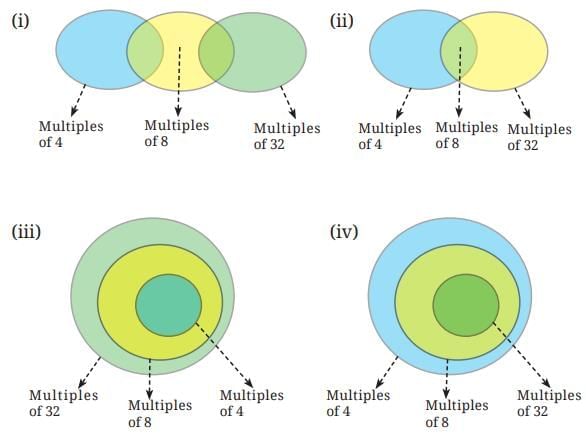
Q16. Which of the following Venn diagrams captures the relationship between the multiples of 4, 8, and 32? Ans: The correct answer is option (iv). Here are the reasons for the answer.
Every multiple of 32 is also a multiple of 8 and 4.
Every multiple of 8 is also a multiple of 4.
But not every multiple of 4 is a multiple of 8 or 32.