Page 42
Q. In each of the following, there are two groups of numbers. Look carefully at the numbers in each group and their sums. Interchange pairs of numbers between the two groups to make their sums equal. Try to do this using the least number of moves. You could write each number on a small piece of paper.
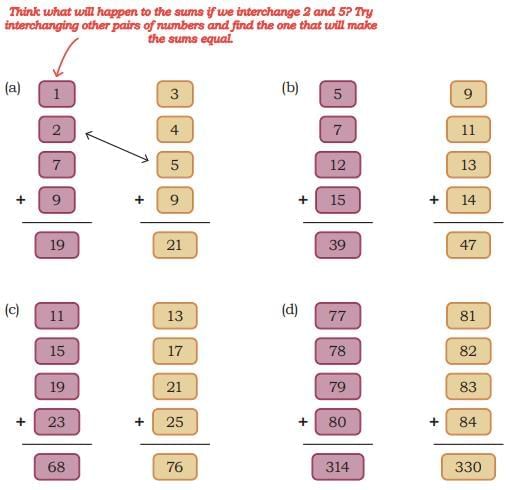
Ans:
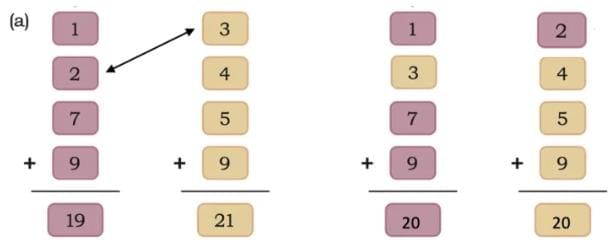
Swap (2 ↔ 3) → both sums become 20. (1 move)
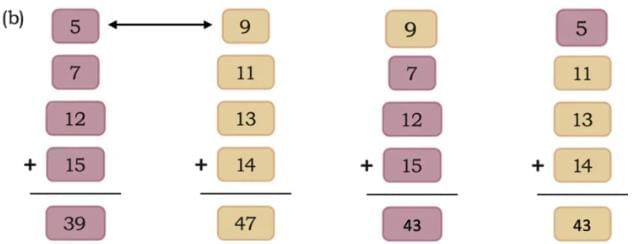
Swap (5 ↔ 9) → both sums become 43. (1 move)
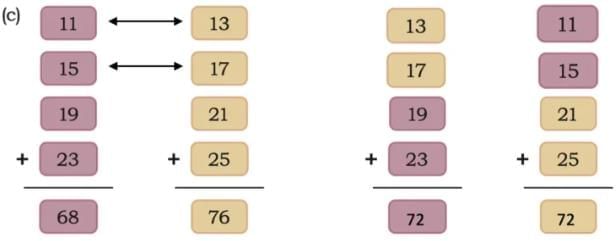
Swap (11 ↔ 13) and (15 ↔ 17) → both sums become 72. (2 moves)
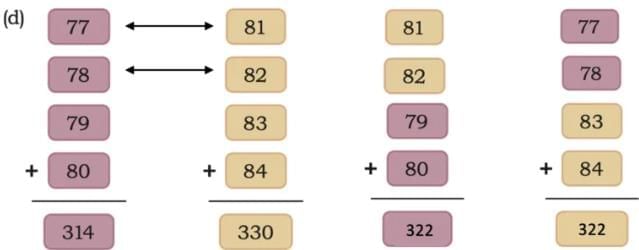
Swap (77 ↔ 81) and (78 ↔ 82) → both sums become 322. (2 moves)
Explanation: In each case we swap numbers so that the difference between the two group sums is removed. A single swap changes each group by the difference between the two swapped numbers; choose swaps so that the net change equalises the sums with the fewest moves.
Page 43
Fuel Arithmetic
Q1. A lorry has 28 litres of fuel in its tank. An additional 75 litres is filled. What is the total quantity of fuel in the lorry? The total quantity of fuel in the tank is 28 L + 75 L.
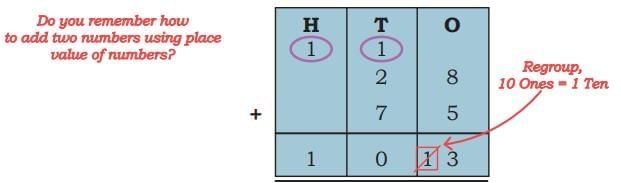
28 L + 75 L = 103 L. So the lorry has 103 litres of fuel after filling.
Let us try one more.
Q2. Find the sum of 49 and 89.
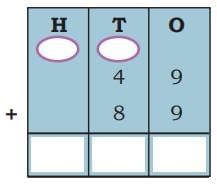
Ans:
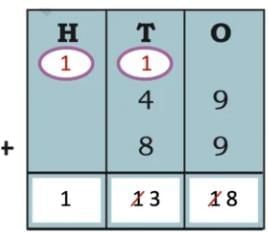
49 + 89 = 138. You can add tens first (40 + 80 = 120) and then units (9 + 9 = 18); 120 + 18 = 138.
Let Us Solve
Q. Add the following numbers. Wherever possible, find easier ways to add pairs of numbers.
1. 15 + 79
2. 46 + 99
3. 38 + 35
4. 5 + 89
5. 76 + 28
6. 69 + 20
Ans:
1.
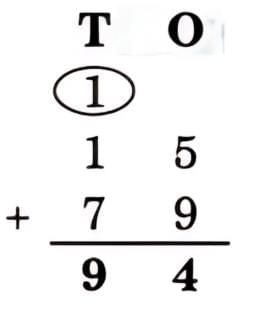
15 + 79 = 94. (Add 15 + 80 – 1 = 95 – 1 = 94.)
2.
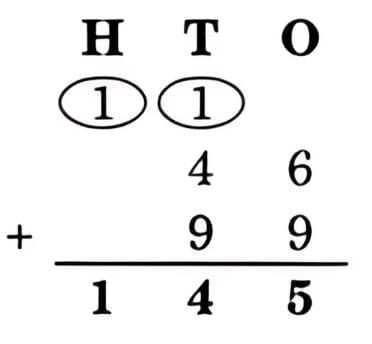
46 + 99 = 145. (46 + 100 – 1 = 146 – 1 = 145.)
3.
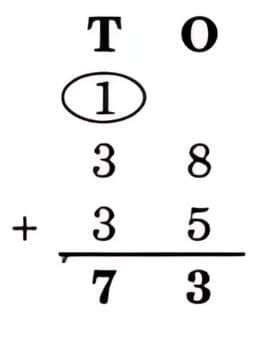
38 + 35 = 73. (30 + 30 = 60 and 8 + 5 = 13; 60 + 13 = 73.)
4.
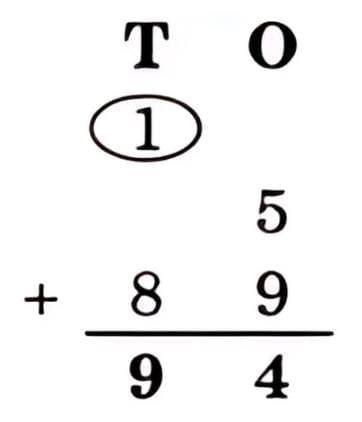
5 + 89 = 94. (5 + 90 – 1 = 95 – 1 = 94.)
5.
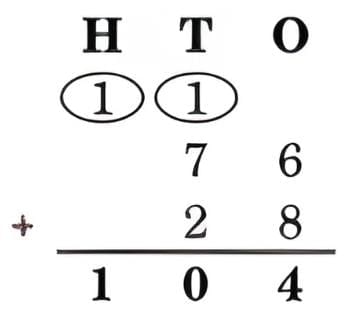
76 + 28 = 104. (76 + 24 = 100, plus 4 more = 104; or 76 + 20 + 8 = 104.)
6.
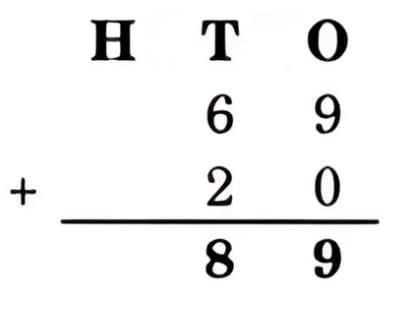
69 + 20 = 89. (Add tens and units separately: 60 + 20 = 80 and 9 + 0 = 9; total 89.)
Page 44
Relationship Between Addition and Subtraction
Q1. Find the relationship between the numbers in the given statements and fill in the blanks appropriately.
(a) If 46 + 21 = 67, then,
67 – 21 = _______.
67 – 46 = _______.
(b) If 198 – 98 = 100, then,
100 + _______ = 198.
198 – _______ = 98.
(c) If 189 + 98 = 287, then,
287 – 98 = _______.
287 – 189 = _______.
(d) If 872 – 672 = 200, then,
200 + _______ = 872.
872 – _______ = 672.
Ans:
(a) If 46 + 21 = 67, then,
67 – 21 = 46.
67 – 46 = 21.
(b) If 198 – 98 = 100, then,
100 + 98 = 198.
198 – 100 = 98.
(c) If 189 + 98 = 287, then,
287 – 98 = 189.
287 – 189 = 98.
(d) If 872 – 672 = 200, then,
200 + 672 = 872.
872 – 200 = 672.
Explanation: These examples show that addition and subtraction are inverse operations. From an addition sentence A + B = C, we get two subtraction sentences C – A = B and C – B = A.
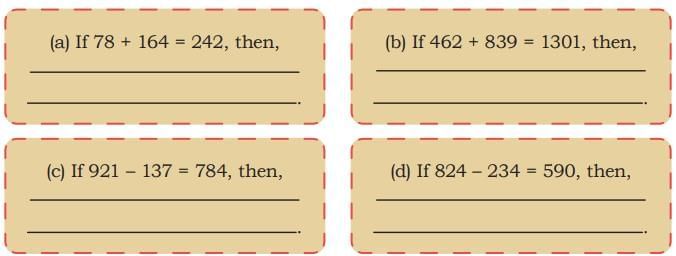
Q2. In each of the following, write the subtraction and addition sentences that follow from the given sentence.
Ans:
(a) If 78 + 164 = 242, then
242 − 164 = 78
242 − 78 = 164
(b) If 462 + 839 = 1301, then
1301 − 839 = 462
1301 − 462 = 839
(c) If 921 − 137 = 784, then
784 + 137 = 921
921 – 784 = 137
(d) If 824 − 234 = 590, then
824 – 590 = 234
590 + 234 = 824
Explanation: Each pair shows how a given addition or subtraction can be turned into the related subtraction and addition sentences by reversing the operation.
Page 45
Let Us Solve
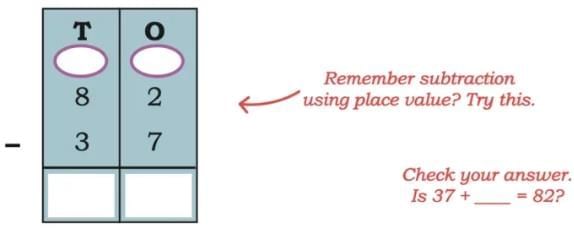
Q1. What is the difference between 82 and 37?
Ans:
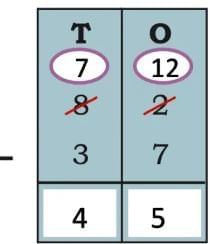
Difference = 82 – 37 = 45.
Check your answer. Is 37 + ____ = 82?
Ans:Yes, 37 + 45 = 82.
2. 57 – 11 = ______________
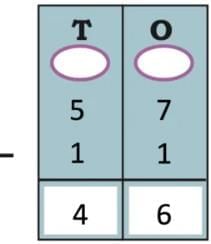
Ans: 57 – 11 = 46.
3. 23 – 19 = ______________
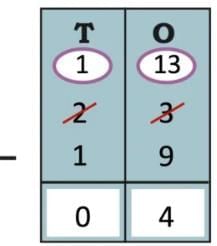
Ans: 23 – 19 = 4.
4. 49 – 21 = ______________
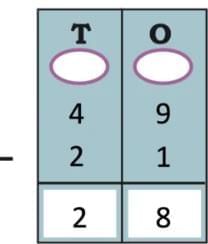
Ans: 49 – 21 = 28.
5. 56 – 18 = ______________
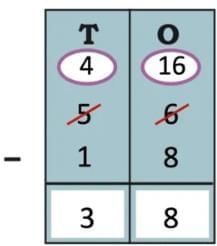
Ans: 56 – 18 = 38.
6. 93 – 35 = ______________
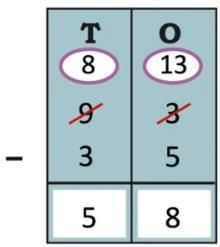
Ans: 93 – 35 = 58.
7. 84 – 23 = ______________
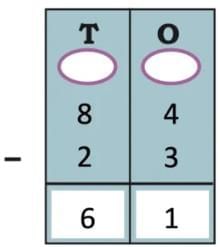
Ans: 84 – 23 = 61.
8. 70 – 43 = ______________
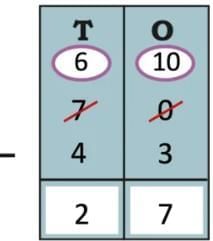
Ans: 70 – 43 = 27.
9. 65 – 47 = ______________
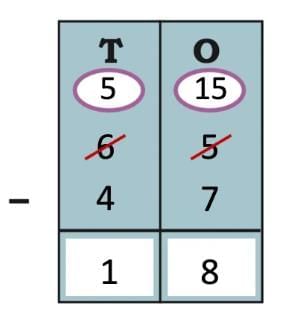
Ans: 65 – 47 = 18.
Sums of Consecutive Numbers
Numbers that follow one another in order without skipping any number are called consecutive numbers. Here are some examples –

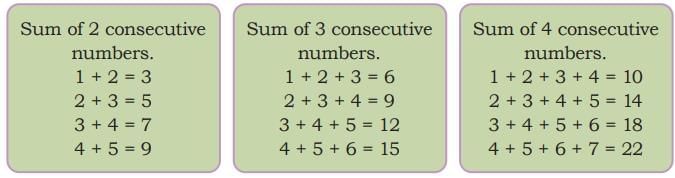
Q1. In each of the boxes above, state whether the sums are even or odd. Explain why this is happening.
Ans: (i) Sum of 2 consecutive numbers: Always odd.
Reason: Each pair has one even and one odd number; even + odd = odd.
(ii) Sum of 3 consecutive numbers: Always divisible by 3. The parity depends on the starting number; it can be even or odd but the sum is always a multiple of 3 because the three remainders modulo 3 add to 0.
(iii) Sum of 4 consecutive numbers: Always even.
Reason: There are two even and two odd numbers; even + even = even and odd + odd = even, so total is even.
Q2. What is the difference between the two successive sums in each box? Is it the same throughout?
Ans: (i) Sum of 2 consecutive numbers:
Differences:
5 – 3 = 2
7 – 5 = 2
9 – 7 = 2.
The difference is always 2.
(ii) Sum of 3 consecutive numbers:
Differences:
9 – 6 = 3
12 – 9 = 3
15 – 12 = 3
The difference is always 3.
(iii) Sum of 4 consecutive numbers:
Differences:
14 – 10 = 4
18 – 14 = 4
22 – 18 = 4
The difference is always 4.
So, the difference between successive sums is the same throughout each box because each successive group shifts every number by 1, increasing the total by the count of numbers.
Q3. What will be the difference between two successive sums for:
(a) 5 consecutive numbers
(b) 6 consecutive numbers
Ans:
(a) Sum of 5 consecutive numbers:
1 + 2 + 3 + 4 + 5 = 15
2 + 3 + 4 + 5 + 6 = 20
3 + 4 + 5 + 6 + 7 = 25
Difference: 20 – 15 = 5, 25 – 20 = 5.
The difference is 5 because each new group adds 1 to each of the five numbers.
(b) Sum of 6 consecutive numbers:
1 + 2 + 3 + 4 + 5 + 6 = 21
2 + 3 + 4 + 5 + 6 + 7 = 27
3 + 4 + 5 + 6 + 7 + 8 = 33
Difference: 27 – 21 = 6, 33 – 27 = 6.
The difference is 6 for the same reason: each of the six numbers increases by 1.
Page 46
Let us see some more interesting patterns in sums.
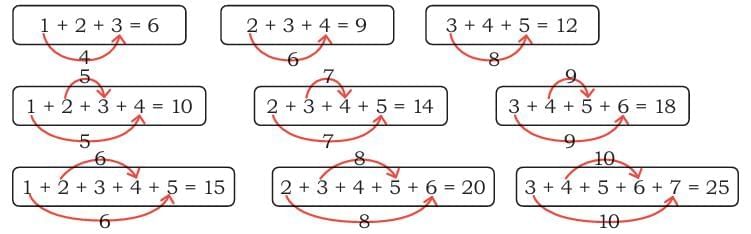
Notice how the sums of 3, 4, and 5 consecutive numbers are related to the numbers being added.
Use your understanding to find the following sums without adding the numbers directly.
(a) 67 + 68 + 69
(b) 24 + 25 + 26+ 27
(c) 48 + 49 + 50 + 51 + 52
(d) 237 + 238 + 239 + 240 + 241 + 242
Sol:
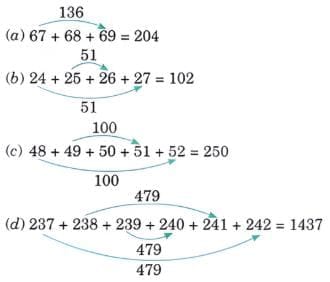
Expanded solutions:
(a) 67 + 68 + 69 = 3 × 68 = 204 (middle number × 3).
(b) 24 + 25 + 26 + 27 = 4 × 25.5 = 102 (average × count).
(c) 48 + 49 + 50 + 51 + 52 = 5 × 50 = 250 (middle number × 5).
(d) 237 + 238 + 239 + 240 + 241 + 242 = 6 × 239.5 = 1,437 (average × 6).
Tip: For a sequence of consecutive numbers, multiply the average (middle value or average of two middle values) by the number of terms to get the sum quickly.
Page 48
Let Us Solve
Q1. Find the following sums. Try not to write TTh, Th, H, T, and O at the top. Align the digits carefully.
(a) 238 + 367
(b) 1,234 + 12,345
(c) 12 + 123
(d) 46,120 + 12,890
(e) 878 + 8,789
(f) 1,749 + 17,490
Ans:
(a) 238 + 367
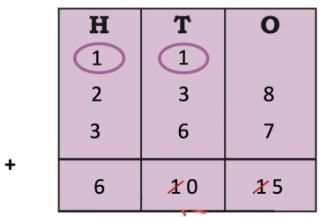
= 605.
(b) 1,234 + 12,345
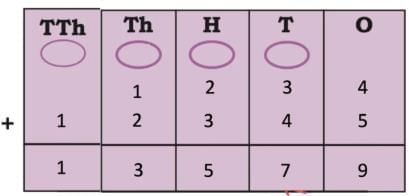
= 13,579.
(c) 12 + 123
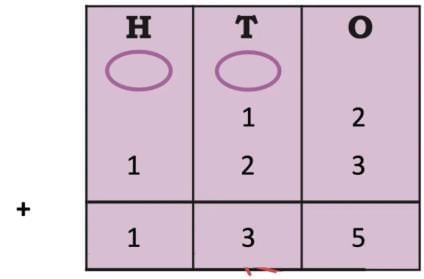
= 135.
(d) 46,120 + 12,890
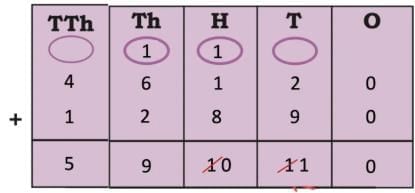
= 59,010.
(e) 878 + 8,789
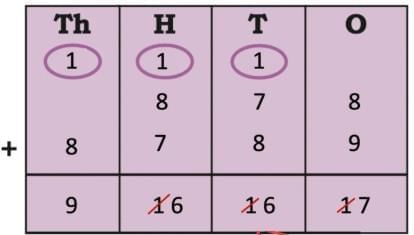
= 9,667.
(f) 1,749 + 17,490
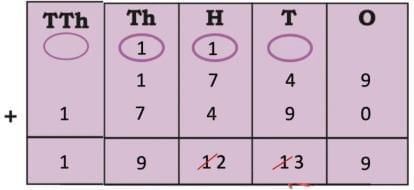
= 19,239.
Method note: Align digits by place value (units under units, tens under tens, etc.) and add from right to left carrying where needed.
Q2. The great Indian road trip!
Nazrana and her friends planned a road trip across India, starting from Delhi. They first drove to Mumbai, then Goa, then Hyderabad, and finally Puri.
Look at the distances marked on the map and help them find the total distance travelled.
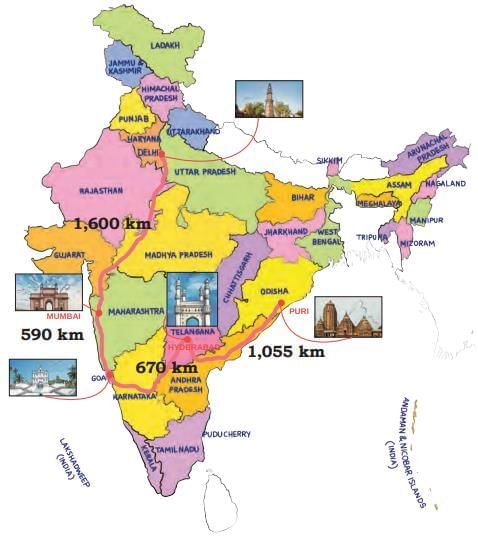
Ans: In the given map, the distances between the cities are as follows:
Delhi to Mumbai = 1600 km.
Mumbai to Goa = 590 km
Goa to Hyderabad = 670 km
Hyderabad to Puri = 1055 km
Total distance = 1600 + 590 + 670 + 1055 = 3915 km.
The total distance travelled by Nazrana and her friends is 3,915 km.
Q3. Find 2 numbers among 5,205, 6,220, 7,095, 8,455, and 4,840 whose sum is closest to the following.
(а) 10,000
Ans: 5,205 + 4,840 = 10,045.
This sum is the closest to 10,000 among all pairs; the difference is 45.
(b) 15,000
Ans: 6,220 + 8,455 = 14,675.
The difference from 15,000 is 325; this is the closest possible pair.
(c) 13,000
Ans: 8,455 + 4,840 = 13,295.
The difference from 13,000 is 295; this is the closest among pairs.
(d) 16,000
Ans: 7,095 + 8,455 = 15,550.
The difference from 16,000 is 450; this is the nearest pair available.
Pages 50-52
Q1. Subtract the following. Try not to write TTh, Th, H, T, and O at the top. Align the digits carefully.
(a) 4,578 – 2,222
Ans:
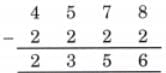
4,578 – 2,222 = 2,356.
(b) 15,324- 11,780
Ans:
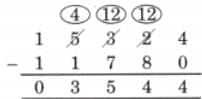
15,324 – 11,780 = 3,544.
(c) 5,423 – 423
Ans:
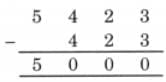
5,423 – 423 = 5,000.
(d) 123 – 12
Ans:
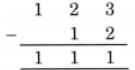
123 – 12 = 111.
(e) 77,777 – 777
Ans:
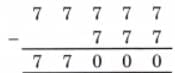
77,777 – 777 = 77,000.
(f) 826 – 752
Ans:
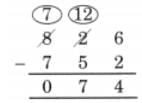
826 – 752 = 74.
Q2. Mary’s train journey to Delhi.
Mary is on a train journey. She starts from Kolkata with ₹12,540.
She spends ₹3,275 on food and other expenses during her trip to Varanasi. In Varanasi, her uncle gives her a gift worth ₹4,900. She then travels to Delhi, spending ₹2,645 on the train ticket. She spends ₹1,275 on souvenirs in Delhi. How much money is Mary left with at the end of the Delhi trip?
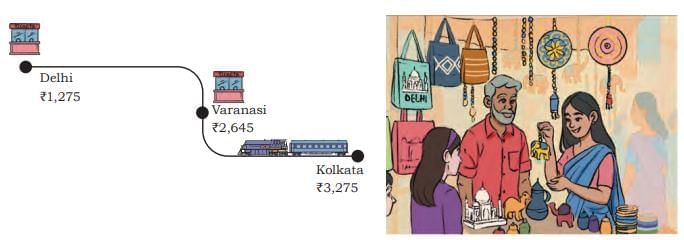
Ans: Mary starts her journey from Kolkata with ₹12,540.
She spent ₹3,275 on food and other expenses to reach Varanasi.
In Varanasi, her uncle gave her ₹4,900 as a gift.
She then spent ₹2,645 on a train ticket to Delhi.
In Delhi, she bought souvenirs worth ₹1,275.
Total money she had after receiving gift = ₹12,540 + ₹4,900 = ₹17,440.
Total expenses during the journey = ₹3,275 + ₹2,645 + ₹1,275 = ₹7,195.
Money left with Mary = ₹17,440 – ₹7,195 = ₹10,245.
Thus, Mary had ₹10,245 left after completing her Delhi trip.
Q3. Members of a school council have raised ₹70,500. They plan to set up a Maths Lab with some games and models worth ₹39,785, buy library books worth ₹9,545, and purchase sports equipment worth ₹19,548.
(a) Estimate whether the school council has raised enough money to make the purchases. Share your thoughts in class.
(b) Check your estimate with calculations.
Ans: (a) Estimated amount required for Maths Lab with games and models (₹39,785) ≈ ₹40,000.
Estimated amount required for library books (₹9,545) ≈ ₹10,000.
Estimated amount required for sports equipment (₹19,548) ≈ ₹20,000.
Total estimated amount = ₹40,000 + ₹10,000 + ₹20,000 = ₹70,000.
Amount raised = ₹70,500.
So, the school council has enough money according to the estimate.
(b) Now, calculating the actual total cost:
₹39,785 + ₹9,545 + ₹19,548 = ₹68,878.
Money raised by the school council = ₹70,500.
Balance amount = ₹70,500 – ₹68,878 = ₹1,622.
Therefore, the school council will be left with ₹1,622 after all the purchases.
Q4. A truck can carry 8,250 kg of goods. A factory loads 3,675 kg of cement and 2,850 kg of steel on it.
(a) What is the total weight loaded onto the truck?
(b) How much more weight can the truck carry before reaching its maximum capacity?
Ans: (a) Weight of cement = 3,675 kg.
Weight of steel = 2,850 kg.
Total weight of cement and steel = 3,675 kg + 2,850 kg = 6,525 kg.
So, total weight loaded onto the truck = 6,525 kg.
(b) Maximum capacity of truck = 8,250 kg.
Remaining capacity = 8,250 kg – 6,525 kg = 1,725 kg.
The truck can carry 1,725 kg more before reaching its maximum capacity.
Quick Sums and Differences
Sukanta likes the numbers 10, 100, 1,000, and 10,000. He wants to figure out what number he should add to a given number such that the sum is 100 or 1,000. Help him fill in the blanks with an appropriate number.
59 + _____ = 100
Try this method for the number 59.
Ans:
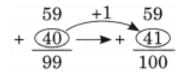
Method: Subtract the given number from the target. For 59 to reach 100, 100 – 59 = 41. So 59 + 41 = 100.
Now, use this method to solve the following.
877 + ________ = 1,000 and 666 + ________ = 1,000
4,103 + ________ = 10,000 and 5,555 + ________ = 10,000
Ans:
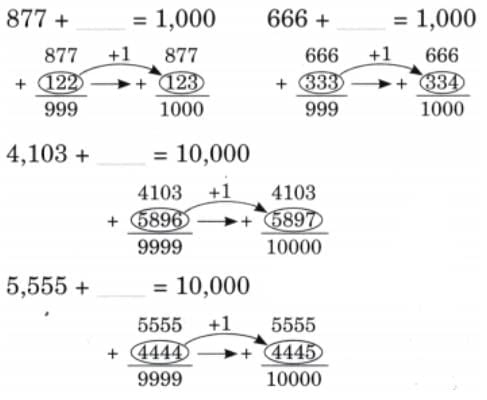
877 + 123 = 1,000.
666 + 334 = 1,000.
4,103 + 5,897 = 10,000.
5,555 + 4,445 = 10,000.
Will this method work if the units digit is 0? What do you think? What other methods can you use to find the missing number to fill in the blanks? Share your thoughts in the class.
(a) 180 + ________ = 1,000
Ans:
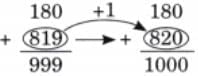
180 + 820 = 1,000.
(b) 760 + ________ = 1,000
Ans:
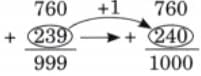
760 + 240 = 1,000.
(c) 400 + ________ = 1,000
Ans:
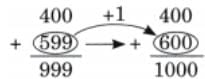
400 + 600 = 1,000.
Namita likes the number 9. She wants to subtract 9 or 99 from any number. Find a way to quickly subtract 9 or 99 from any number.
(a) 67 – 9 = _____
Ans:
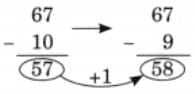
67 – 9 = 58.
(b) 83 – 9 = _____
Ans:
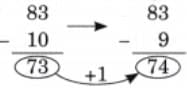
83 – 9 = 74.
(c) 144 – 9 = _____
Ans:
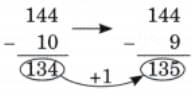
144 – 9 = 135.
(d) 187 – 99 = _____
Ans:
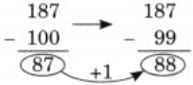
187 – 99 = 88.
(e) 247 – 99 = _____
Ans:
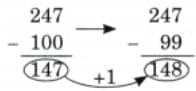
247 – 99 = 148.
(f) 763 – 99 = _____
Ans:
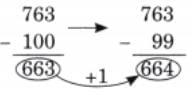
763 – 99 = 664.
Rule: To subtract 9 or 99 from any number: subtract 10 or 100 first, then add 1 to the result. For example, to do 67 – 9, compute 67 – 10 = 57 and then add 1 to get 58.
Namita wonders if she can get 9 or 99 as the answer to any subtraction problem. Find a way to get the desired answer.
(a) 32 – _____ =9
(b) 66 – _____ =9
(c) 877 – _____ = 99
(d) 666 – _____ = 99
Ans: This is reverse subtraction.
We are given the starting number and the difference and must find the number that was subtracted.
Do: Missing number = Starting number – Difference.
(a) 32 – _____ = 9
_____ = 32 – 9 = 23.
(b) 66 – _____ = 9
_____ = 66 – 9 = 57.
(c) 877 – _____ = 99
_____ = 877 – 99 = 778.
(d) 666 – _____ = 99
_____ = 666 – 99 = 567.
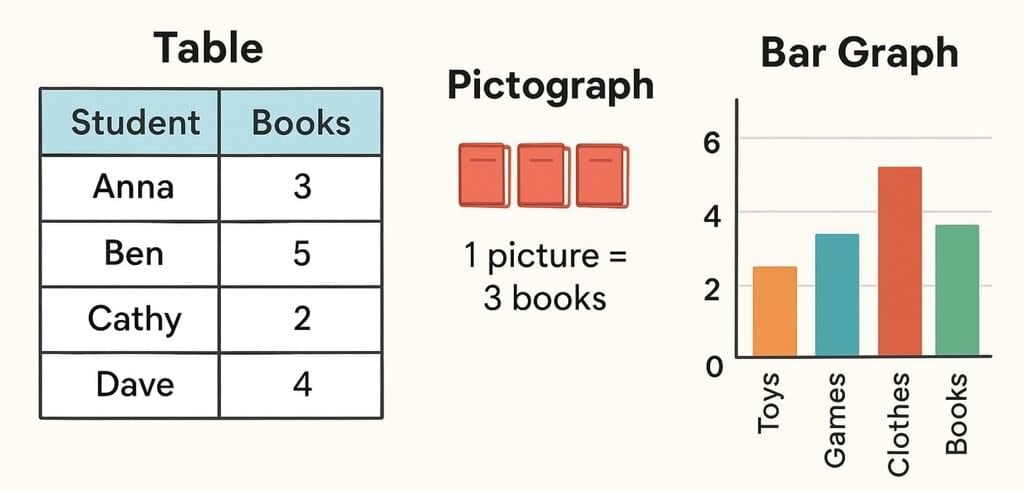
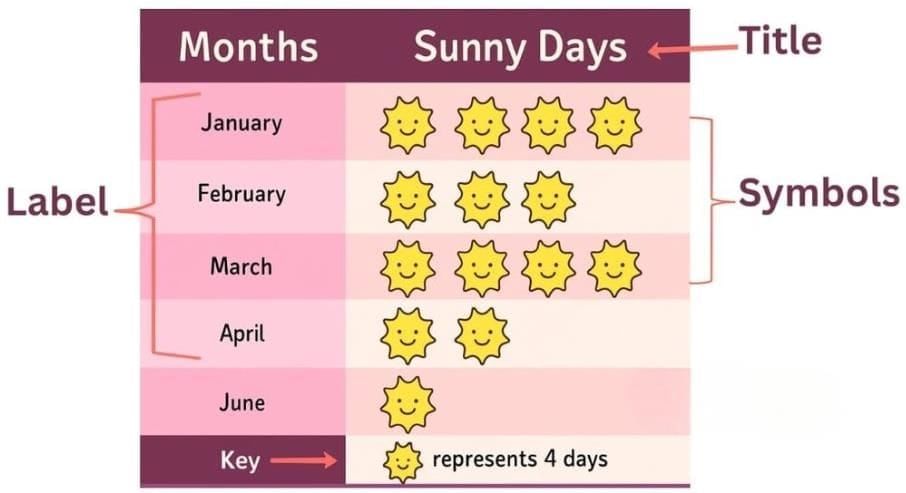
 The collected data was organised in a table, which shows how much time each child spends watching TV.
 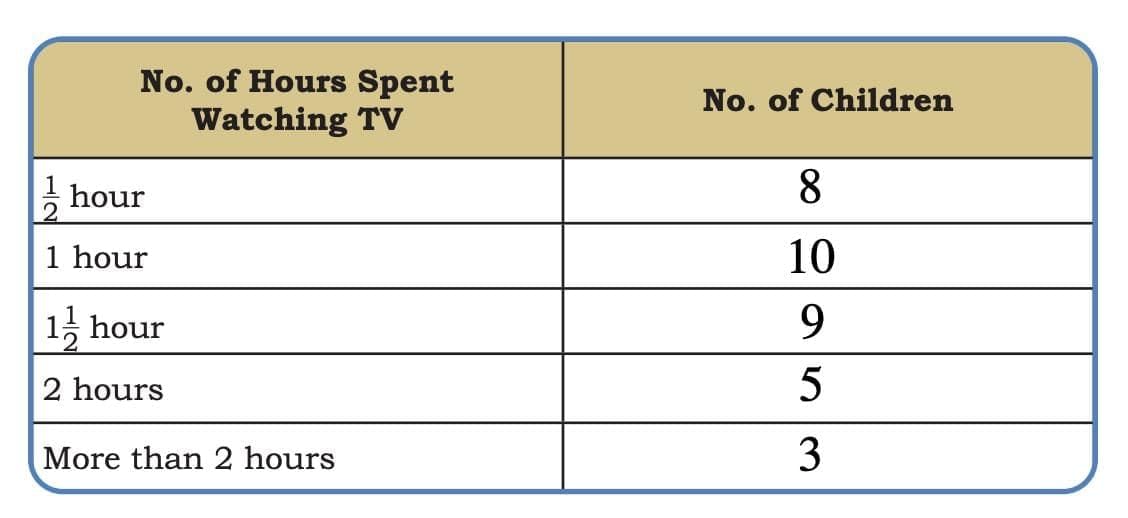 Based on this information, we will answer a few questions related to their TV viewing habits.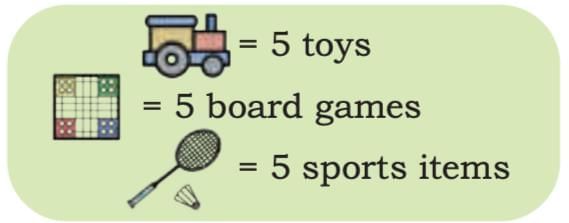
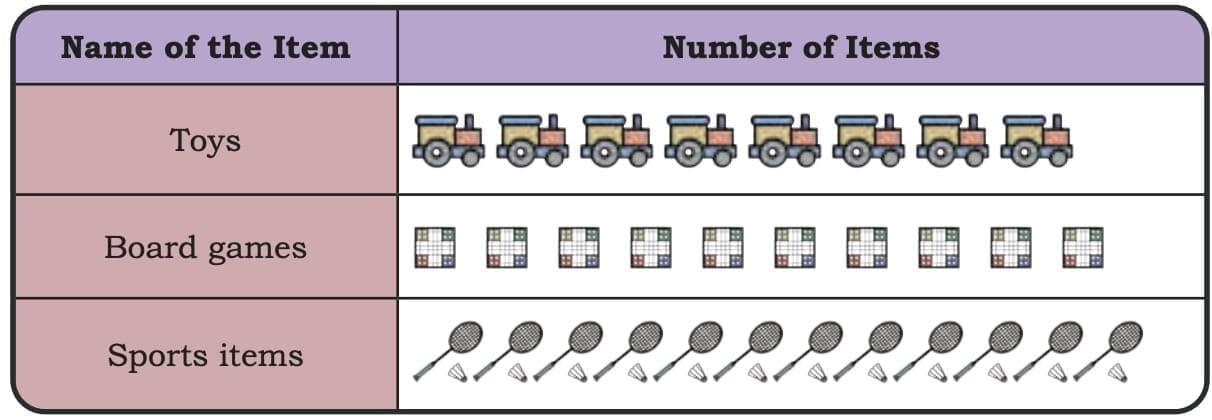
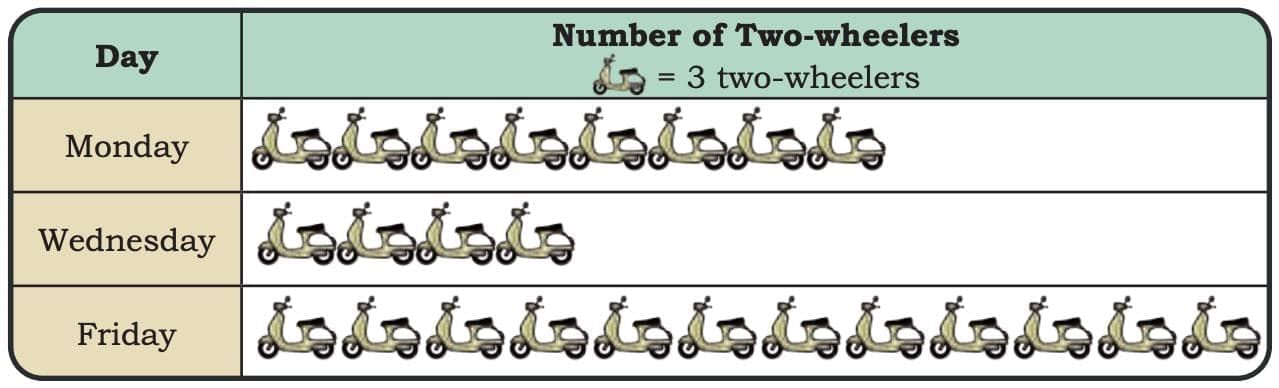 Observe the pictograph and answer the following questions.
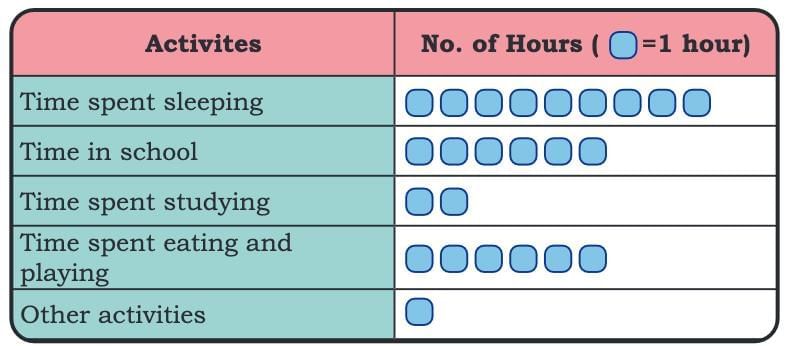 Sheela recorded her routine in the following manner:
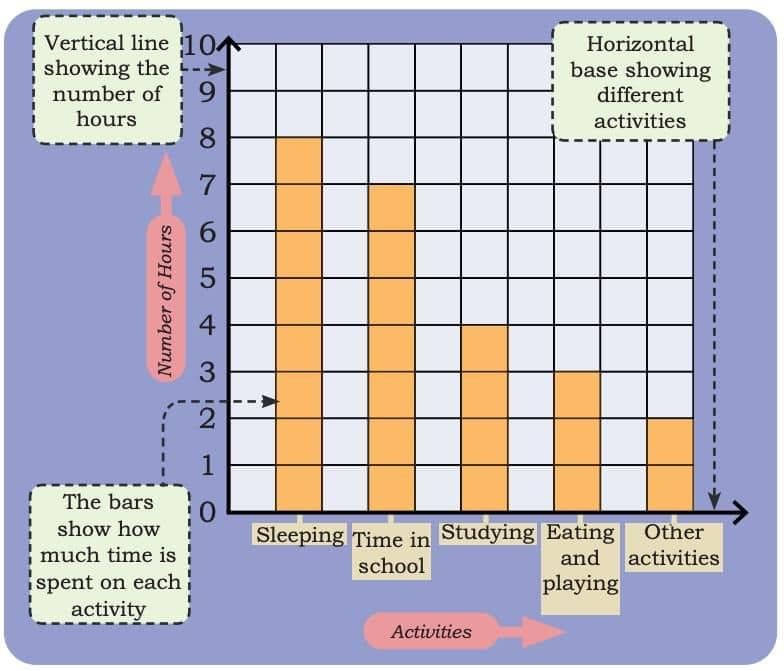 How is Sheela’s recording different from Raman’s recording?
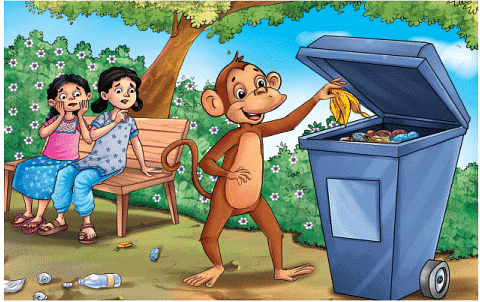
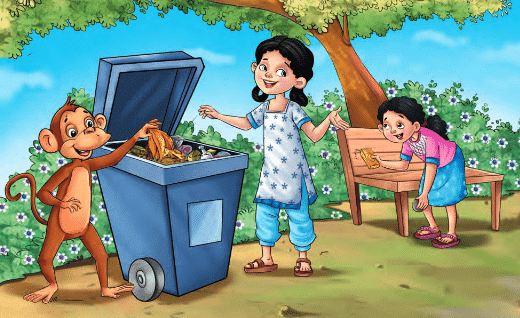
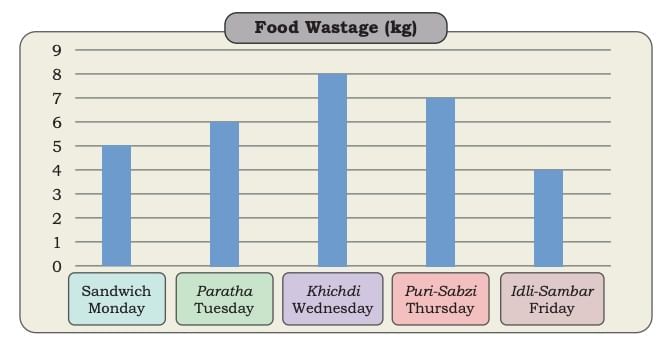 Rani was shocked to see the data. What do you think about food wastage? How can we reduce the wastage of food? What can we do with the leftover food?





















 Onshangla