Q1: A new sapling starts with a height of 2 cm. How tall might the plant be after 4 years if its height doubles each year?
Solution: Initial height = 2 cm
The height doubles each year, so after 4 years: = 21 × 24 = (2)1+4 = 32 cm
The plant will be 32 cm tall after 4 years.
Q2: The number of books in a library increases by 5 times every 2 years. A library starts with 100 books. How many books will there be in the library after:
(a) 6 years
(b) 10 years
Solution: Initial number of books = 100
The number of books increases by a factor of 5 every 2 years.
(a) After 6 years (3 periods of 2 years):
Number of books after 6 years = 100 × 5³ = 100 × 125 = 12500 books
After 6 years: 12500 books
(b) After 10 years (5 periods of 2 years):
Number of books after 10 years = 100 × 5⁵ = 100 × 3125 = 312500 books
After 10 years: 312500 books
Q3: The number of bacteria in a culture increases 3 times every hour. A culture starts with 1 bacterium. How many bacteria will be in the culture after 5 hours?
Solution:
Initial bacteria = 1
The bacteria triple every hour, so after 5 hours: Number of bacteria after 5 hours = 1 × 3⁵ = 1 × 243 = 243 bacteria
The number of bacteria will be 243 after 5 hours.
Q4: The planet Uranus is approximately 2,896,819,200,000 metres awayfrom the Sun. What is this distance in standard form?
Solution:
The distance of Uranus from the Sun is given as 2,896,819,200,000 meters.
To express this in standard form:
2,896,819,200,000 = 2.8968192 × 10¹²
So, the distance of Uranus from the Sun in standard form is:
2.8968192 × 10¹² meters
Q5: An inch is approximately equal to 0.02543 metres. Write this distance in standard form.
Solution:
We are given that 1 inch ≈ 0.02543 meters.
To express this in standard form:
0.02543 = 2.543 × 10⁻²
So, the distance in standard form is:
2.543 × 10⁻² meters
Q6: A particular star is at a distance of about 8.1 × 10¹³ km from the Earth. Assuring that light travels at 3 × 10⁸ m per second, find how long does light takes from that star to reach the Earth.
Solution:
Given, a particular star is at a distance of about 8.1 × 10¹³ km from the Earth.
Assuring that light travels at 3 × 10⁸ m per second.
We have to find the time the light takes from that star to reach the Earth.
We know, speed = distance / time
Given, speed = 3 × 10⁸ m/s
Distance = 8.1 × 10¹³ km
We know, 1 km = 1000 m
= 8.1 × 10¹³ × 10³
Using the law of exponents,
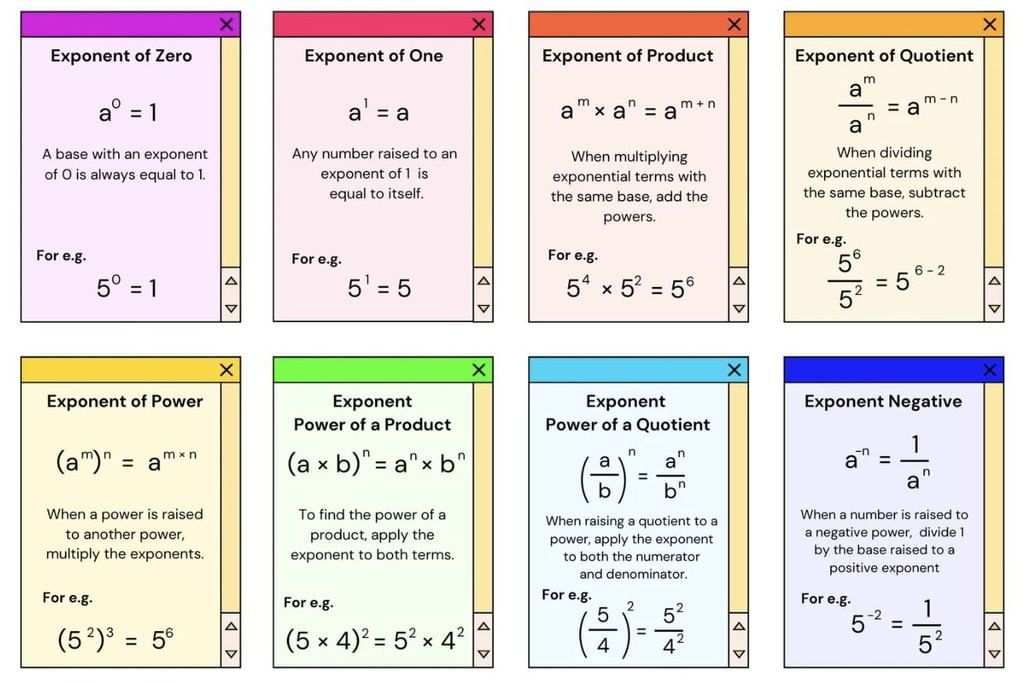
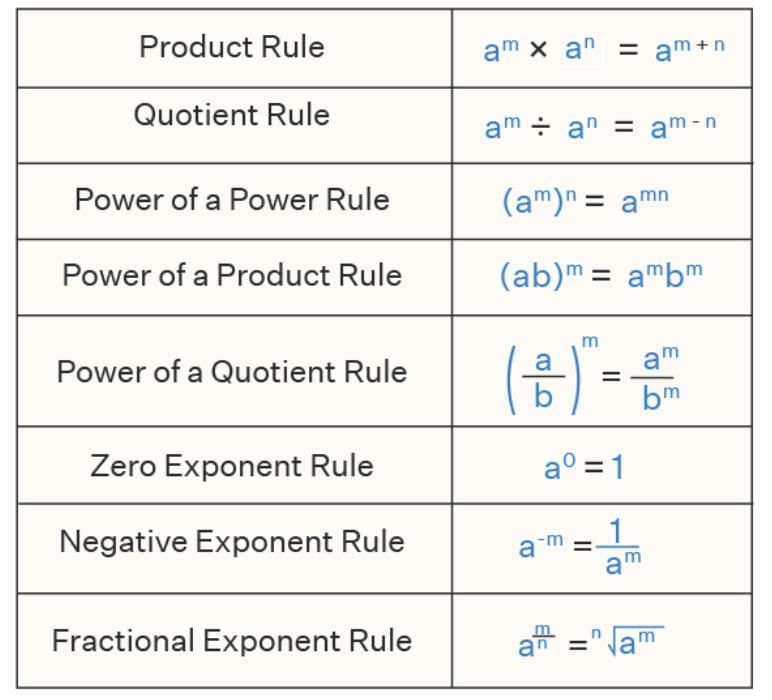
am × an = am + n
= 8.1 × 10¹³ + 3
= 8.1 × 10¹⁶ m
Time = distance / speed
= 8.1 × 10¹⁶ / 3 × 108
= (8.1 / 3) × (1016/108)
= 2.7 × (1016/108)
Using the law of exponents,
am ÷ an = am – n
= 2.7 × 10¹⁶ – 8
= 2.7 × 10⁸ seconds
Therefore, the required time is 2.7 × 10⁸ seconds.
Q7: In a stack, there are 4 books, each of thickness 15mm, and 6 paper sheets, each of thickness 0.010mm. What is the total thickness of the stack?
Solution:
Thickness of each book = 15mm
Number of books in the stack = 4
Thickness of 4 books = 4 × 15 = 60mm
Thickness of each paper sheet = 0.010mm
Thickness of 6 paper sheets = 6 × 0.010 = 0.060mm
Total thickness of the stack = 60mm + 0.060mm = 60.060mm
Q8: A number when divides ( –15) –1 results ( –5) –1. Find the number.
Solution:
Let x be the number such that
( –15) –1 ÷ x = ( –5) –1
⇒ –1/15 ÷ x = –⅕
⇒ –1/15 × 1/x = –⅕
⇒ –1/15x = –⅕
⇒ 15x = 5
⇒ x = ⅓ or 3 –1
Q9: A savings account balance quadruples every 3 years. The initial balance in a savings account is 1500 rupees. How much will the balance be after 9 years?
Solution:
Initial balance = 1500 rupees
The balance quadruples every 3 years, so after 9 years:
Balance after 9 years = 1500 × 4³ = 1500 × 64 = 96000 rupees
The balance will be 96000 rupees after 9 years
Q10: The volume of the Earth is approximately 7.67 × 10⁻⁷ times thevolume of the Sun. Express this figure in usual form.
Solution:
The volume of Earth is approximately 7.67 × 10⁻⁷ times the volume of the Sun. We are asked to express this in usual form.
To convert from scientific notation to usual form, we move the decimal point to the left by 7 places (since the exponent is -7):
7.67 × 10–7 = 0.000000767
So, the volume of Earth as a fraction of the volume of the Sun is:
Q1: Give a reason to show that the number given below is a perfect square: 5963 Sol: The unit digit of the square numbers will be 0, 1, 4, 5, 6, or 9 if we examine the squares of numbers from 1 to 10. Thus, the unit digit for all perfect squares will be 0, 1, 4, 5, 6, or 9, and none of the square numbers will end in 2, 3, 7, or 8. Given 5963 We have the property of a perfect square, i.e. a number ending in 3 is never a perfect square. Therefore the given number 5963 is not a perfect square.
Q2: 2025 plants are to be planted in a garden in a way that each of the rows contains as many plants as the number of rows. Find the number of rows and the number of plants in each row. Sol: Let the number of rows be x. Thus, the number of plants in each row = x. Total many contributed by all the students = x × x = x² Given, x² = Rs.2025 x2 = 3 × 3 × 3 × 3 × 5 × 5 ⇒ x2 = (3 × 3) × (3 × 3) × (5 × 5) ⇒ x2 = (3 × 3 × 5) × (3 × 3 × 5) ⇒ x2 = 45 × 45 ⇒ x = √(45 × 45) ⇒ x = 45 Therefore, Number of rows = 45 Number of plants in each row = 45
Q3: Find out the cube root of 13824 by the prime factorisation method. Sol: First, let us prime factorise 13824: 13824 = 2 × 2 × 2 × 2 × 2 × 2 × 2 × 2 × 2 × 3 × 3 × 3 = 2 ³ × 2 ³ × 2 ³ × 3 ³ 3√13824 = 2 × 2 × 2 × 3 = 24
Q4: (13/10) ³ Sol: The cube of a rational number is the result of multiplying a number by itself three times. To evaluate the cube of (13/10) ³ Firstly we need to convert into proper fractions, i.e.(13/10) ³ We need to multiply the given number three times, i.e. (13/10) × (13/10) × (13/10) = (2197/1000) ∴ the cube of (1 3/10) is (2197/1000)
Q5: By what least number should the number be divided to obtain a number with a perfect square? In this, in each case, find the number whose square is the new number 4851. Sol: The number is a perfect square if and only if the prime factorization creates pairs; it is not exactly a perfect square if it is not paired up. Given 4851, Resolving 4851 into prime factors, we obtain 4851 = 3 X 3 X 7 X 7 X 11 = (32 X 72 X 11) To obtain a perfect square, we need to divide the above equation by 11 we obtain, 9075 = 3 X 3 X 7 X 7 The new number = (9 X 49) = (3² X 7² ) Taking squares on both sides of the above equation, we obtain ∴ The new number = (3 X 7)² = (21)² Therefore, the new number is a square of 21
Q6: Find the cube root of 10648 by the prime factorisation method. Sol:10648 = 2 × 2 × 2 × 11 × 11 × 11 Grouping the factors in triplets of number equal factors, 10648 = (2 × 2 × 2) × (11 × 11 × 11) Here, 10648 can be grouped into triplets of number equal factors, ∴ 10648 = 2 × 11 = 22 Therefore, the cube root of 10648 is 22.
Q7: Without adding, find the sum of the following: (1+3+5+7+9+11+13+15+17+19+21+23) Sol: (1 + 3 + 5 + 7 + 9 + 11 + 13 + 15 + 17 + 19 + 21 + 23) As per the given property of perfect square, for any natural number n, we have some of the first n odd natural numbers = n² But here n = 12 By applying the above the law, we get thus, (1 + 3 + 5 + 7 + 9 + 11 + 13 + 15 + 17 + 19 + 21 + 23) = 12² = 144
Q8: By what least number should the given number be divided to get a perfect square number? In each of the following cases, find the number whose square is the new number 1575. Sol: A method for determining the prime factors of a given number, such as a composite number, is known as prime factorisation. Given 1575, Resolve 1575 into prime factors, we get 1575 = 3 X 3 X 5 X 5 X 7 = (3² X 5² X 7) To obtain a perfect square, we have to divide the above equation by 7 Then we get, 3380 = 3 X 3 X 5 X 5 New number = (9 X 25) = (3² X 5² ) Taking squares on both sides of the above equation, we get ∴ New number = (3 X 5)² = (15)²
Q9:If m is the required square of a natural number given by n, then n is (a) the square of m (b) greater than m (c) equal to m (d) √m Ans: (d) Sol: n² = m Then, = n = √m Q10: The cube of 100 will have _________ zeroes. Sol: The cube of 100 will have six zeroes. = 1003 = 100 × 100 × 100 = 1000000
Q11: Use the following identity and find the square of 189. (a – b)² = a² – 2ab + b² Sol: 189 = (200 – 11) 2 = 40000 – 2 x 200 x 11 + 112 = 40000 – 4400 + 121 = 35721
Q12: What would be the square root of the number 625 using the identity (a +b)² = a² + b² + 2ab? Sol: (625)² = (600 + 25)² = 600² + 2 x 600 x 25 +25² = 360000 + 30000 + 625 = 390625
Q13:Show that the sum of two consecutive natural numbers is 13². Sol: Let 2n + 1 = 13 So, n = 6 So, ( 2n + 1)² = 4n² + 4n + 1 = (2n² + 2n) + (2n² + 2n + 1) Substitute n = 6, (13)² = ( 2 x 6² + 2 x 6) + (2 x 6² + 2 x 6 + 1) = (72 + 12) + (72 + 12 + 1) = 84 + 85
Q15: Find the cube root of 91125 by the prime factorisation method. Sol: 91125 = 3 × 3 × 3 × 3 × 3 × 3 × 3 × 5 × 5 × 5 By grouping the factors in triplets of equal factors, 91125 = (3 × 3 × 3) × (3 × 3 × 3) × (5 × 5 × 5) Here, 91125 can be grouped into triplets of equal factors, ∴ 91125 = (3 × 3 × 5) = 45 Thus , 45 is the cube root of 91125.
Q16: A cuboid of plasticine made by Parikshit with sides 5 cm, 2 cm, and 5 cm. How many such cuboids will be needed to form a cube? Sol: The given side of the cube is 5 cm, 2 cm and 5 cm. Therefore, volume of cube = 5 × 2 × 5 = 50 The prime factorisation of 50 = 2 × 5 × 5 Here, 2, 5 and 5 cannot be grouped into triples of equal factors. Therefore, we will multiply 50 by 2 × 2 × 5 = 20 to get the perfect square. Hence, 20 cuboids are needed to form a cube.
Q17: State true or false. (i) The cube of any odd number is even (ii) A perfect cube never ends with two zeros. (iii) If the square of a number ends with 5, then its cube ends with 25. (iv) There is no perfect cube which ends with 8. (v) The cube of a two-digit number may be a three-digit number. (vi) The cube of a two-digit number may have seven or more digits. (vii) The cube of a single-digit number may be a single-digit number. Sol: (i) This statement is false. Taking a cube of any required odd numbers 3³= 3 x 3 x 3 = 27 7³=7 x 7 x 7= 343 5³=5 x 5 x 5=125 All the required cubes of any given odd number will always be odd. (ii) This statement is true. 10³= 10 x 10 x 10= 1000 20³ = 20 x 20 x 20 = 2000 150³ =150 x150 x150 = 3375000 Hence a perfect cube will never end with two zeros. (iii) This statement is false. 15²= 15 x15= 225 15³= 15 x 15 x 15= 3375 Thus, the square of any given number ends with 5; then the cube ends with the number 25 is an incorrect statement. (iv) This statement is false. 2³= 2x2x2= 8 12³ = 12 x 12 x 12= 1728 Accordingly, There are perfect cubes ending with the number 8 (v) This statement is false. The minimum two digits number is 10 And 10³=1000→4 Digit number. The maximum two digits number is 99 And 99³=970299→6 Digit number Accordingly, the cube of two-digit numbers can never be a three-digit number. (vi) This statement is false 10³=1000→4 Digit number. The maximum two digits number is 99 And 99³=970299→6 Digit number Accordingly, the cube of two-digit numbers can never have seven or more digits. (vii) This statement is true 1³ = 1 x 1 x 1= 1 2³ = 2 x 2 x 2= 8 According to the cube, a single-digit can be a single-digit number.
Q18: Find the cube of 3.5. Sol: 3.53 = 3.5 x 3.5 x 3.5 = 12.25 x 3.5 = 42.875
Q19: Find the smallest whole number from which 1008 should be multiplied to obtain a perfect square number. Also, find out the square root of the square number so obtained. Sol: Let us factorise the number 1008.1008 = 2 × 2 × 2 × 2 × 3 × 3 × 7 = ( 2 × 2 ) × ( 2 × 2 ) × ( 3 × 3 ) × 7 Here, 7 cannot be paired. Therefore, we will multiply 1008 by 7 to get a perfect square. New number so obtained = 1008 ×7 = 7056 Now, let us find the square root of 70567056 = 2 × 2 × 2 × 2 × 3 × 3× 7 × 7 7056 = (2 × 2 ) × ( 2 × 2 ) × ( 3 × 3 ) ×( 7 × 7 ) 7056 = 2² × 2² × 3² × 7² 7056 = (2 × 2 × 3 × 7)² Therefore; √7056 = 2 × 2 × 3 × 7 = 84
Q21: There are _________ perfect cubes between 1 and 1000. Sol: There are 8 perfect cubes between 1 and 1000. 2 × 2 × 2 = 8 3 × 3 × 3 = 27 4 × 4 × 4 = 64 5 × 5 × 5 = 125 6 × 6 × 6 = 216 7 × 7 × 7 = 343 8 × 8 × 8 = 512 9 × 9 × 9 = 729
Q22: Is 392 a perfect cube? If not, find the smallest natural number by which 392 should be multiplied so that the product is a perfect cube. Sol: The prime factorisation of 392 gives: 392 = 2 x 2 x 2 x 7 x 7 As we can see, number 7 cannot be paired in a group of three. Therefore, 392 is not a perfect cube. We must multiply the 7 by the original number to make it a perfect cube. Thus, 2 x 2 x 2 x 7 x 7 x 7 = 2744, which is a perfect cube, such as 23 x 73 or 143. Hence, the smallest natural number, which should be multiplied by 392 to make a perfect cube, is 7.
Q23: Which of the following numbers are in perfect cubes? In the case of a perfect cube, find the number whose cube is the given number 256 Sol: A perfect cube can be expressed as a product of three numbers of equal factors Resolving the given number into prime factors, we obtain 256 = 2 × 2 × 2 × 2 × 2× 2 × 2 × 2 Since the number 256 has more than three factors ∴ 256 is not a perfect cube.
Q24: Find the smallest number by which 128 must be divided to get a perfect cube. Sol: The prime factorisation of 128 is given by: 128 = 2 × 2 × 2 × 2 × 2 × 2 × 2 By grouping the factors in triplets of equal factors, 128 = (2 × 2 × 2) × (2 × 2 × 2) × 2 Here, 2 cannot be grouped into triples of equal factors. Therefore, to obtain a perfect cube, we will divide 128 by 2.
Q25: There are _________ perfect squares between 1 and 100. Sol: There are 8 perfect squares between 1 and 100. 2 × 2 = 4 3 × 3 = 9 4 × 4 = 16 5 × 5 = 25 6 × 6 = 36 7 × 7 = 49 8 × 8 = 64 9 × 9 = 81
Q26: Show that each of the numbers is a perfect square. In each case, find the number whose square is the given number: 7056 Sol: 7056, A perfect square is always expressed as a product of pairs of prime factors. Resolving 7056 into prime factors, we obtain 7056 = 11 X 539 = 12 X 588 = 12 X 7 X 84 = 84 X 84 = (84)² Thus, 84 is the number whose square is 5929 Therefore,7056 is a perfect square.
Example: 16, 25, 49 are squares; but 23, 47 are not.
(b) Digits Pattern
Numbers ending in 1 or 9 → square ends in 1.
Numbers ending in 4 or 6 → square ends in 6.
Example: 19² = 361 (ends in 1).
(c) Zeros Rule
If number ends in n zeros, square ends in 2n zeros.
Example: 100² = 10,000 (2 zeros → 4 zeros).
(d) Parity (Even/Odd)
Square of even number = even.
Square of odd number = odd.
Example: 12² = 144 (even), 25² = 625 (odd).
(e) Odd Number Differences
Difference of consecutive squares = odd number.
2² – 1² = 3, 3² – 2² = 5, 4² – 3² = 7.
Sum of first n odd numbers = n².
(f) Perfect Square Test (Subtraction Rule)
Subtract consecutive odd numbers from n.
If result becomes 0 → number is a perfect square.
Example: 25 – 1 – 3 – 5 – 7 – 9 = 0 → 25 is a square.
(g) Finding Next Square
(n+1)² = n² + (2n+1).
Example: 35² = 1225 → 36² = 1225 + 71 = 1296.
(h) Numbers Between Squares
Between n² and (n+1)² → always 2n numbers.
Example: Between 4² = 16 and 5² = 25 → 8 numbers.
(i) Triangular Numbers Relation
Triangular numbers: 1, 3, 6, 10, 15, …
Sum of two consecutive triangular numbers = perfect square.
Square Roots
Definition
If y = x², then x = √y.
Every square root has ± values, but usually positive root is used.
Example: √49 = ±7.
Methods to Check/Find Square Roots
Listing Squares → compare with nearby perfect squares. List squares of natural numbers: 1² = 1, 2² = 4, 3² = 9, 4² = 16, … Compare the given number with the list of squares. If it matches a square → the square root is the corresponding number. Quick Tip: If the number is not a perfect square, it lies between the squares of two numbers → √n is between those two numbers.
Successive Subtraction of Odd Numbers → subtract until 0. – Start with the given number. – Subtract 1, 3, 5, 7, 9… successively (odd numbers in order). – Count how many subtractions you can do until the result becomes 0. – The number of subtractions = the square root.Quick Tip:
This method works only for perfect squares.
The sequence of odd numbers always starts from 1.
Prime Factorisation → group factors in pairs.
Example: 256 = 2⁸ → √256 = 2⁴ = 16.
Estimation → use nearby perfect squares. – Identify perfect squares closest to the given number – one smaller, one larger. – Conclude that the square root lies between the roots of these perfect squares. – Refine by checking multiples to find the exact root (if it is a perfect square). Quick Tip:
For numbers not perfect squares, this method gives a good approximate value.
Works well with decimal approximations too.
For Non-Perfect Squares
When a number is not a perfect square, its square root can be estimated by comparing it with nearby perfect squares.
Steps:
Identify the perfect squares just below and above the number.
Conclude that the square root lies between the roots of these perfect squares.
Refine the estimate using linear approximation or trial and error.
Quick Tip:
This method gives a quick approximation.
For more precision, use long division or a calculator.
Cubic Numbers
Definition and Notation
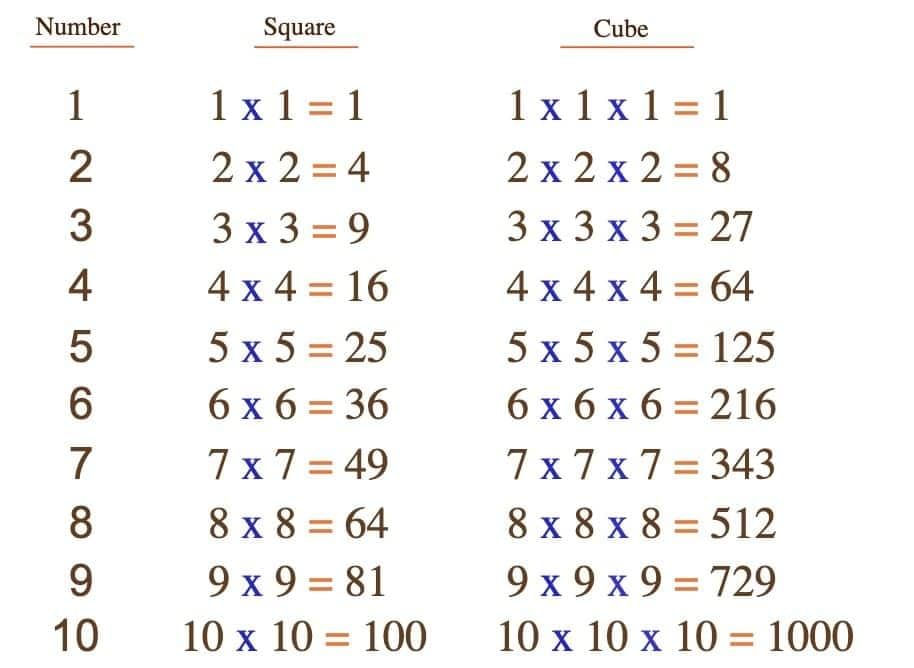
Cube = n³ = n × n × n.
Represents volume of cube of side n.
Examples: 2³ = 8, 3³ = 27, 4³ = 64.
Properties
Cubes grow faster than squares.
Possible last digits of cubes → any digit (0–9).
Relation with Odd Numbers
n³ = sum of n consecutive odd numbers.
Example: 4³ = 13+15+17+19 = 64.
Taxicab Numbers
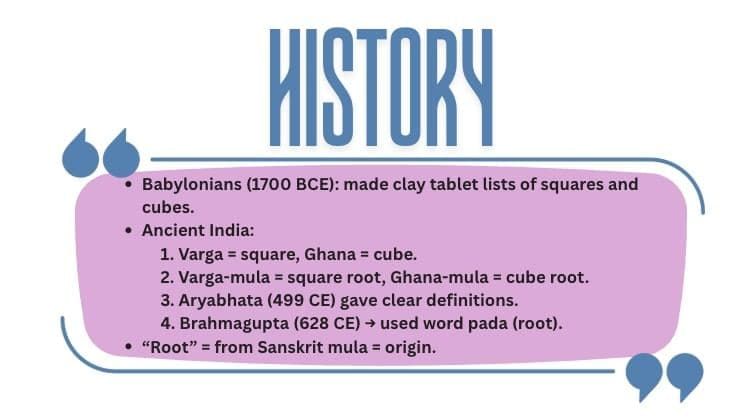
First discovered by Ramanujan (famous Hardy–Ramanujan number).
1729 = 1³+12³ = 9³+10³.
Smallest number expressible as sum of two cubes in two ways.
A natural number n is a perfect square if n = m², where m is a natural number. So, when a number is the square of another number, it’s called a perfect square! Example: 9 = 3² (The square of 3 is 9) 25 = 5² (The square of 5 is 25)
Digits of a Perfect Square:
If a number ends in 2, 3, 7, or 8, it can never be a perfect square.
The squares of even numbers are even, and the squares of odd numbers are odd.
A number ending in an odd number of zeros cannot be a perfect square.
Between Two Squares:
Between n² and (n+1)², there are exactly 2n non-perfect square numbers!
The Pythagorean Triplet Connection:
For any natural number n greater than 1, the numbers 2n, (n² – 1), and (n² + 1) form a Pythagorean triplet.
Square Roots
The square root is the opposite of squaring a number! Example: If you square 4, you get 16. If you take the square root of 16, you get 4.
Number of Digits in Square Numbers
If a number n has n digits, then the number of digits in its square root is:
n/2 if n is even.
(n+1)/2 if n is odd.
[Question: 694414]
Square of a Number:
When you multiply a number by itself, it’s called squaring that number. Example: 3 × 3 = 9 (This means 9 is the square of 3!) 5 × 5 = 25 (This means 25 is the square of 5!)
Perfect Square:
A number like 16, which can be expressed as 4², is called a perfect square! But remember, not every number is a perfect square. For example, 32 is not a square number. So, always check if a number is the square of another number.
Remember
All-natural numbers are not perfect squares or square numbers, 32 is not a square number. In general, if a natural number ‘m’ can be expressed as n2, where n is also a natural number, then ‘m’ is the perfect square. The numbers like 1, 4, 9, 16, 25, and 36 are called square numbers.
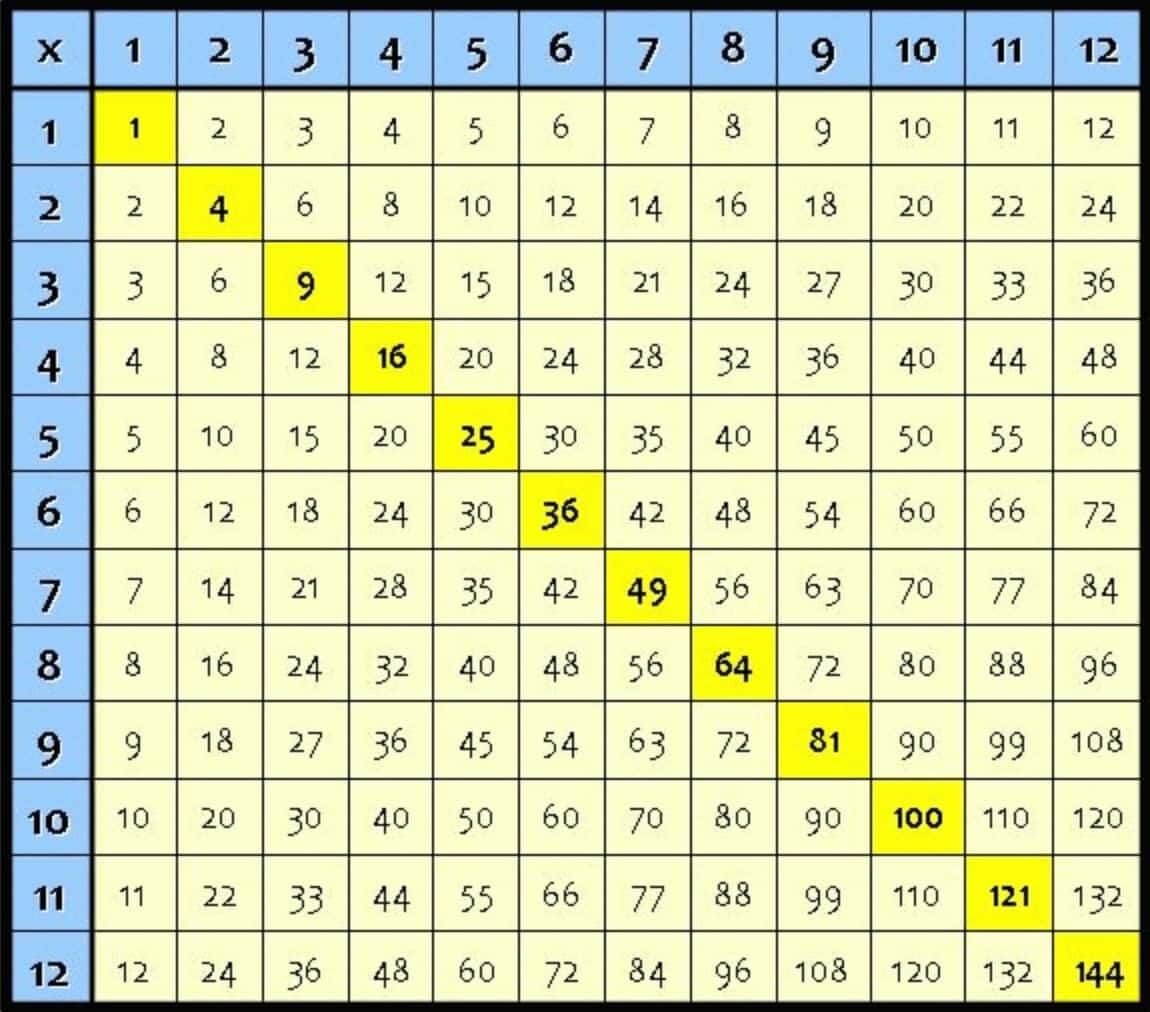
Table: Square of numbers from 1 and 10.
Properties of Square Number
Table: Let us consider the square of all natural numbers from 1 to 20.
From the table, we conclude that:
Property 1: “The ending digits (the digits in the one’s place) of a square number is 0, 1, 4, 5, 6 or 9 only.”
[Question: 694416]
Some Interesting Patterns
Triangular numbers are: 1, 3, 6, 10, 15, 21, etc. If we combine two consecutive triangular numbers, we get a square number. 1 + 3 = 4, ‘4’ is a square number 3 + 6 = 9, ‘9’ is a square number 6 + 10 = 16, ‘16’ is a square number and so on.
12 =1 112 = 121 1112 = 12321 11112 = 1234321
72 = 49 672 = 4489 6672 = 444889 66672 = 44448889 and so on.
Cube of a number
A natural number multiplied by itself three times gives a cube of that number, e.g. 1 × 1 × 1 = 1 2 × 2 × 2 = 8 3 × 3 × 3 = 27 4 × 4 × 4 = 64 The numbers 1, 8, 27, 64, … are called cube numbers or perfect cubes.
Perfect Cube: A number is a perfect cube if it can be expressed as n3 for some integer n. Prime Factor Test: In the prime factorization of a perfect cube, every prime factor appears in groups of three.
Cube Root of a Number The cube root of a number is the side length of a cube whose volume is that number. is the inverse operation of cubing x.For example :
This means the cube root of 8 is 2.
Prime Factorization Method: Factorize the number, group identical factors in threes, and multiply one factor from each triplet to get the cube root.
Steps to Calculate Cube Root
1. Prime Factorize the Number Break the number down into its prime factors.
2. Group the Factors in Threes Arrange identical factors into sets of three.
8000 = (2 × 2 × 2) (2 × 2 × 2) (5 × 5 × 5)
3. Multiply One Factor from Each Triplet From each group of three identical primes, take one prime and multiply them together.
8000 = (2 × 2 × 2) (2 × 2 × 2) (5 × 5 × 5) Picking one prime from each triplet: 2 × 2 × 5 = 20
4. Result The product you get in Step 3 is the cube root of the original number.
Therefore, cube root of 8000 is
[Question: 1284091]
Properties of Perfect Cubes
(a) Property 1 If the digit in the one’s place of a number is 0, 1, 4, 5, 6 or 9, then the digit in the one’s place of its cube will also be the same digit.
(b) Property 2
If the digit in the one’s place of a number is 2, the digit in the one’s place of its cube is 8, and vice-versa.
(c) Property 3
If the digit in the one’s place of a number is 3, the digit in the one’s place of its cube is 7 and vice-versa.
Examples of Properties 1, 2 & 3
(d) Property 4
Cubes of even natural numbers are even.
Examples of Property 4
(e) Property 5
Cubes of odd natural numbers are odd.
Examples of Property 5
(f) Property 6
Cubes of negative integers are negative.
Examples of Property 6
Some Interesting Patterns in Cubes
1. Adding consecutive odd numbers
Note that we start with [n * (n – 1) + 1] odd number.
2. Difference of two consecutive cubes:
23 – 13 = 1 + 2 * 1 * 3
33 – 23 = 1 + 3 * 2 * 3
43 – 33 = 1 + 4 * 3 * 3
53 – 43 = 1 + 5 * 4 * 3
3. Cubes and their prime factor Each prime factor of the number appears three times in its cube.
Facts That Matter
If we multiply a number by itself three times, the product so obtained is called the perfect cube of that number.
There are only 10 perfect cubes from 1 to 1000.
Cubes of even numbers are even and those of odd numbers are odd.
The cube of a negative number is always negative.
If the prime factors of a number cannot be made into groups of 3, it is not a perfect cube.
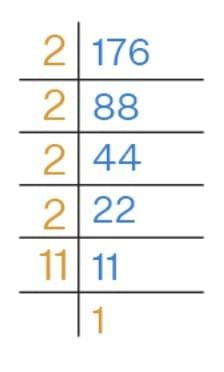
Q1: Is 176 a perfect square? If not, find the smallest number by which it should be multiplied to get a perfect square.
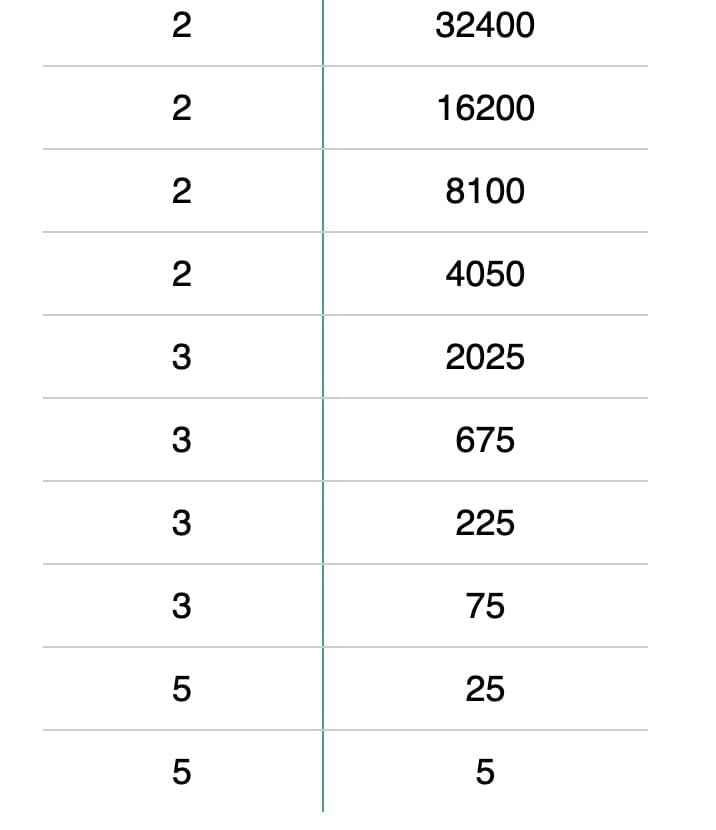
Solution: Prime factorization of 176: 176 = 2⁴ × 11.To make it a perfect square, multiply by 11. 176 × 11 = 1936, which is a perfect square. √1936 = 44.
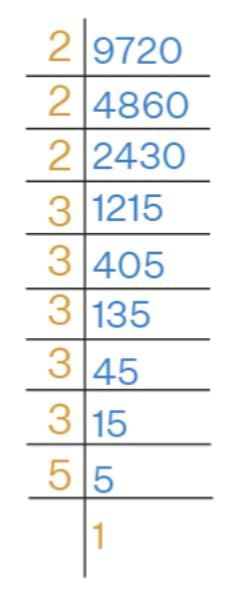
Q2:Is 9720 a perfect cube? If not, find the smallest number by which it should be divided to get a perfect cube.
Solution: Prime factorization of 9720: 9720 = 23 × 35 × 5 To make it a perfect cube, divide by 32 × 5 = 45 Divide 9720 by 21725 to get a perfect cube.
Q3: By what smallest number should 216 be divided so that the quotient is a perfect square? Also, find the square root of the quotient.
Solution: Prime factorization of 216: 216 = 2³ × 3³. To make the quotient a perfect square, divide by 2 and 3. 216 ÷ 6 = 36 √36 = 6
Q4: By what smallest number should 3600 be multiplied so that the quotient is a perfect cube? Also, find the cube root of the quotient.
Solution: Prime factorization of 3600: 3600 = 2⁴ × 3² × 5². To make it a perfect cube, multiply by 2² × 3 × 5 = 4 × 3 × 5 = 60. 3600 × 60 = 216000, and the cube root of 216000 is 60.
Q5: A farmer wants to plough his square field of side 150m. How much area will he have to plough?
Solution: The area of a square field is given by the formula: Area = (side)2 Here, the side of the square field is 150 meters. Area = (150)2 = 22,500 m² So, the farmer will have to plough 22,500 square meters.
Q6: What will be the number of unit squares on each side of a square graph paper if the total number of unit squares is 256?
Solution: The total number of unit squares on a square graph paper is the square of the number of unit squares on each side. Let the number of unit squares on each side be x. So, x² = 256. Taking the square root of both sides: x = √256 = 16 Therefore, there are 16 unit squares on each side of the square graph paper.
Q7:If one side of a cube is 15m in length, find its volume.
Solution: The volume of a cube is given by the formula: Volume = side³ Here, the side length is 15 meters. Volume = 15³ = 3375 m³ So, the volume of the cube is 3375 cubic meters.
Q8: Find the number of plants in each row if 1024 plants are arranged so that the number of plants in a row is the same as the number of rows.
Solution: The total number of plants is 1024, and we are told that the number of plants in each row is the same as the number of rows. Let the number of rows (and plants per row) be x. The total number of plants is the product of the number of rows and the number of plants per row: x × x = 1024 x² = 1024 Taking the square root of both sides: x = √1024 = 32. Therefore, the number of plants in each row is 32.
Q11: Difference of two perfect cubes is 189. If the cube root of the smaller of the two numbers is 3, find the cube root of the larger number.
Solution: Let the two perfect cubes be x³ and y³, where x is the cube root of the smaller number and y is the cube root of the larger number. We are given: y³ – x³ = 189 and x = 3. So, 3³ = 27. Now, substitute into the equation: y³ – 27 = 189 y³ = 189 + 27 = 216 So, y = ∛216 = 6. Therefore, the cube root of the larger number is 6.
Q10: A hall has a capacity of 2704 seats. If the number of rows is equal to the number of seats in each row, then find the number of seats in each row.
Solution: Let the number of rows and the number of seats in each row be x. The total number of seats is given by: x × x = 2704 x² = 2704 Taking the square root of both sides: x = √2704 = 52. Therefore, the number of seats in each row is 52.
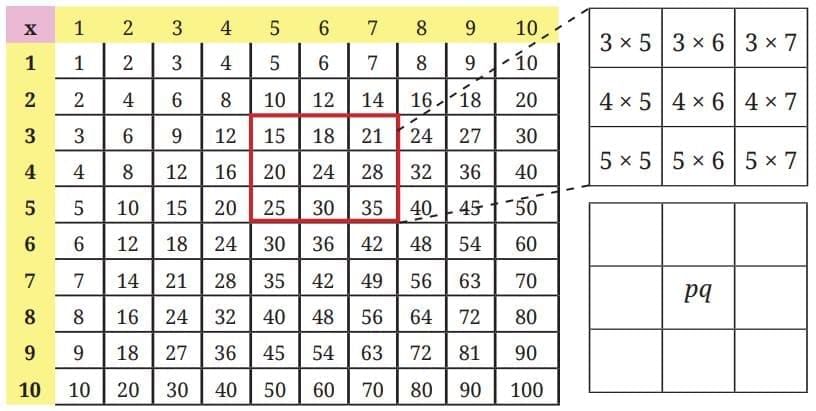
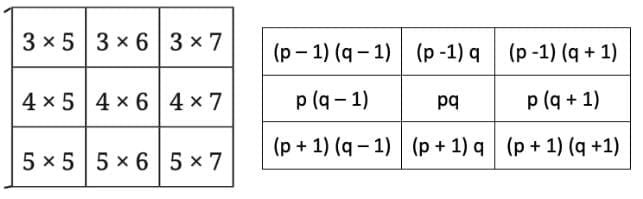
Q1. Observe the multiplication grid below. Each number inside the grid is formed by multiplying two numbers. If the middle number of a 3 × 3 frame is given by the expression pq, as shown in the figure, write the expressions for the other numbers in the grid.
Q5. Expand (i) (a – b) (a + b), (ii) (a – b) (a2 + ab + b2) and (iii) (a – b)(a3 + a2b + ab2 + b3), Do you see a pattern? What would be the next identity in the pattern that you see? Can you check it by expanding? Ans: (i) (a − b)(a + b) = (a − b)a + (a − b)b = a2 – ab + ab – b2 = a2 – b2. (ii) (a – b) (a2 + ab + b2) = (a – b)a2 + (a – b)ab + (a – b)b2 = a3 – a2b + a2b – ab2 + ab2 – b3 = a3 – b3. (iii) (a – b)(a3 + a2b + ab2 + b3) = (a – b)a3 + (a – b)a2b + (a – b)ab2 + (a – b)b3 = a4 – a3b + a3b – a2b2 + a2b2 – ab3 + ab3 – b4 = a4 – b4. We observe the following pattern (a – b) (an + an-1 b + ….. + bn) = an+1 – bn+1 The next identity would be: (a − b)(a4 + a3b + a2b2 + ab3 + b4) = a5 − b5.
Page 149
Figure it Out
Q1. Which is greater: (a – b)2 or (b – a)2? Justify your answer. Ans: Here, (a – b)2 = a2 + b2 – 2ab ……….(1) and (b – a)2 = b2 + a2 – 2ba b2 + a2 = a2 + b2 and ba = ab (b – a)2 = a2 + b2 – 2ab ……….(2) Comparing (1) and (2), we get (a – b)2 = (b – a)2
Q2. Express 100 as the difference of two squares. Ans: Therefore, a2 – b2 = 100 Or, a2 – b2 = 2 × 2 × 5 × 5 Or, (a + b) (a – b) = 50 × 2 When, (a + b) = 50 and (a – b) = 2 Then ‘a’ should be = 26 and ‘b’ should be = 24 So, (a + b) (a – b) = (26 + 24) (26 – 24) = 262 – 242 = 676 – 576 = 100 Therefore, 100 = 262 – 242
Q3. For each statement identify the appropriate algebraic expression(s). (i) Two more than a square number. 2 + s, (s + 2)2, s2 + 2, s2 + 4, 2s2, 22s Ans: s2 + 2 Explanation: Let be the number = s ∴ Square number = s2 So, two more the square number is = s2+ 2 (ii) The sum of the squares of two consecutive numbers m²+n2, (m + n)2, m2 + 1, m2 + (m + 1)2, m2 + (m – 1)2, {m + (m + 1)}2, (2m)2 + (2m + 1)2 Ans: m2 + (m + 1)2 Explanation: Let be the consecutive numbers are = m and (m + 1) So, the sum of the square numbers = m2 + (m + 1)2
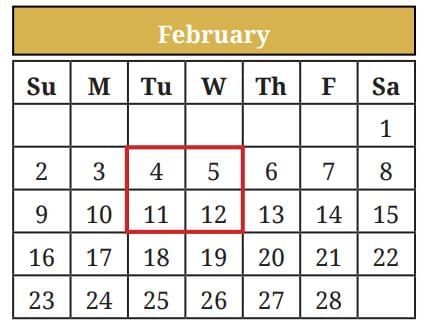
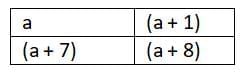
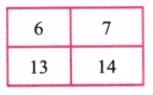
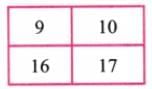
Q4. Consider any 2 by 2 square of numbers in a calendar, as shown in the figure. Find products of numbers lying along each diagonal — 4 × 12 = 48, 5 × 11 = 55. Do this for the other 2 by 2 squares. What do you observe about the diagonal products? Explain why this happens.
Here, 9 × 17 = 153 16 × 10 = 160 Difference = 160 – 153 = 7 We observe that the difference of the diagonal products in both cases is always 7.
Q5. Verify which of the following statements are true. (i) (k + 1)(k + 2) – (k + 3) is always 2. Ans: Statement is false. Explanation: (k + 1) (k + 2) – (k + 3) = k2 + 2k + k + 2 – k – 3 = k2 + 2k – 1 Now, if k = 1, then (1)2 + 2 × 1 – 1 = 2 If k = 2, then (2)2 + 2 × 2 – 1 = 7 If k = 3, then (3)2 + 2 × 3 – 1 = 14 (ii) (2q + 1)(2q – 3) is a multiple of 4. Ans: Statement is false. Explanation: (2q + 1) (2q – 3) = 4q2 – 6q + 2q – 3 = 4q2 – 4q – 3 =4(q2 –q) – 3 Here we see that 3 is not divisible by 4, so the entire equation is not divisible by 4. (iii) Squares of even numbers are multiples of 4, and squares of odd numbers are 1 more than multiples of 8. Ans: Statement is true. Explanation: Let be the even number is = 2n (even is always divisible by 2). ∴ Square of 2n = (2n)2 = 4n2 (We see it is always a multiple of 4) And the odd number is = 2n + 1 ∴ Square of 2n + 1 = (2n + 1)2 = (2n)2 + 2×2n×1 + 12 = 4n2 + 4n + 1 = 4(n2 + n) + 1 (n2 + n) is always an even number because n is odd, the square of an odd number is always odd, and odd + odd = even. Example: If (n2 + n) = 2, then 4×2 + 1 = 9 (9 is 1 more than multiples of 8) If (n2 + n) = 4, then 4×4 + 1 = 17 (9 is 1 more than multiples of 8) etc. (iv) (6n + 2)2 – (4n + 3)2 is 5 less than a square number. Ans: Statement is false. Explanation: (6n + 2)2 – (4n + 3)2 = {(6n)2 + 2×6n×2 + (2)2} –{(4n)2 + 2×4n×3 + (3)2} = 36n2 + 24n + 4 – 16n2 – 24n – 9 = 20n2– 5 Clearly we see 20 is a square number so 20n2 is also not a square number.
Q6. A number leaves a remainder of 3 when divided by 7, and another number leaves a remainder of 5 when divided by 7. What is the remainder when their sum, difference, and product are divided by 7? Ans: Let the numbers be x and y. x = 7a + 3, y = 7b + 5 Sum = x + y = 7a + 3 + 7b + 5 = 7(a + b) + 8 = 7(a + b) + 7 + 1 = 7(a + b + 1) + 1 ∴ The remainder on division by 7 is 1. Difference = x – y = (7a + 3) – (7b + 5) = 7a + 3 – 7b – 5 = 7(a – b) – 2 = 7(a – b) – 1 + 5 (∵ -2 = -7 + 5) = 7(a – b – 1) + 5 ∴ The remainder on division by 7 is 5. Product = xy = (7a + 3) (7b + 5) = 49ab + 35a + 21b + 15 = (49ab + 35a + 21b + 14) + 1 = 7(7ab + 5a + 3b + 2) + 1 ∴ The remainder on division by 7 is 1.
Q7. Choose three consecutive numbers, square the middle one, and subtract the product of the other two. Repeat the same with other sets of numbers. What pattern do you notice? How do we write this as an algebraic equation? Expand both sides of the equation to check that it is a true identity. Ans: Let be the three consecutive numbers are = x, (x + 1), (x + 2) Therefore,(x + 1)2 – x(x + 2) = x2 + 2x + 1 – x2 – 2x = 1 And let be the other sets of consecutive numbers are = (x – 1), x, (x + 1) Therefore, x2 – (x – 1) (x + 1) = x2 – x2 – x + x + 1 = 1 In the pattern we have observed, the value of the equation is always 1. Hence, the algebraic equation is:-(x + 1)2 – x(x + 2) = 1
Q8. What is the algebraic expression describing the following steps-add any two numbers. Multiply this by half of the sum of the two numbers? Prove that this result will be half of the square of the sum of the two numbers. Ans: Let be the two numbers are = x and y Sum of these numbers are = (x + y) Multiplying this by half = 1/2× (x + y) Now, 1/2×(x + y) × (x + y) = (x + y)2/2 Therefore, the result will be half of the square of the sum of the two numbers.
Q9. Which is larger? Find out without fully computing the product. (i) 14 × 26 or 16 × 24 (ii) 25 × 75 or 26 × 74 Ans:
(ii) Let p = 25 × 75 p’ = 26 × 74 = (25 + 1) (75 – 1) = 25 × 75 + 75 × 1 – 25 × 1 – 1 × 1 = p + (75 – 25 – 1) = p + 49 ∴ p’ > p or 26 × 74 > 25 × 75
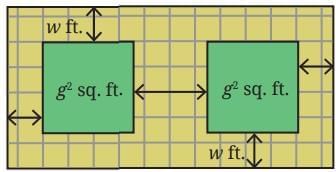
Q10. A tiny park is coming up in Dhauli. The plan is shown in the figure. The two square plots, each of area g2 sq. ft., will have a green cover. All the remaining area is a walking path w ft. wide that needs to be tiled. Write an expression for the area that needs to be tiled. Ans: Area of square plot = g2 sq. ft., so length of side = g ft. ∴ Length of the tiny park = (w + g + w + g + w) ft= (3w + 2g) ft And breadth of the tiny park = (w + g + w) = (2w + g) ft Total area of the park = (3w + 2g) × (2w + g) = 6w2 + 3wg + 4wg + 2g2 = (6w2 + 7wg + 2g2) sq. ft. So, the remaining area that needs to be tiled for the walking path is = (6w2 + 7wg + 2g2) – (g2) sq. ft. = (6w2 + 7wg + g2) sq. ft.
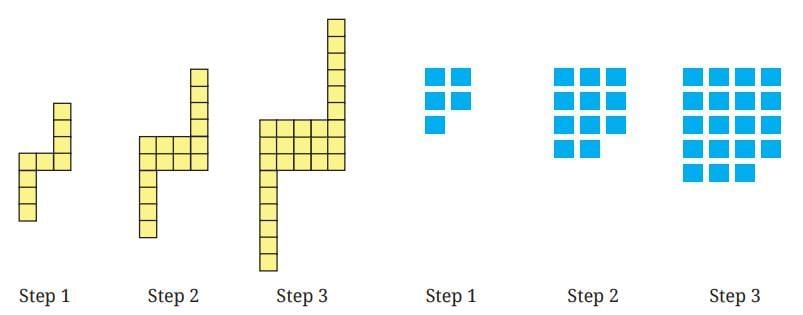
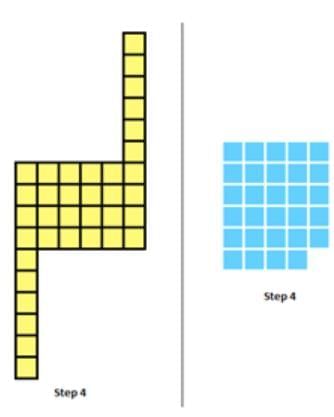
Q11. For each pattern shown below, (i) Draw the next figure in the sequence. Ans: Next figure in the sequence: (ii) How many basic units are there in Step 10? Ans: Step 1 has (1 + 1)2 + 1 or 5 squares Step 2 has (2 + 1 )2 + 2 or 11 squares Step 3 has (3 + 1)2 + 3 or 19 squares Hence step 10 has (10 + 1)2 + 10 or 131 squares (iii) Write an expression to describe the number of basic units in Step y. Ans: In 1stfigure:- Step 1:- (1 + 2)2 = 9 Step 2:- (2 + 2)2 = 16 Step 3:- (3 + 2)2 = 25 → Step y:- (y + 2)2 In 2nd figure:- Step 1:- (1+1)2+ 1 = 5 Step 2:- (2+1)2+ 2 = 16 Step 3:- (3 + 1)2+ 3= 25 → Step y:- (y + 1)2 + y
Q1. The sum of four consecutive numbers is 34. What are these numbers? Ans: Let four consecutive numbers be x, (x + 1), (x + 2) and (x + 3). x + (x + 1) + (x + 2) + (x + 3) = 34 x + x + 1 + x + 2 + x + 3 = 34 4x + 6 = 34 4x = 34 – 6 4x = 28 x = 28/7 = 7. So, (x + 1 ) = 7 + 1 = 8 (x + 2) = 7 + 2 = 9 (x + 3) = 7 + 3 = 10 Therefore, the given four consecutive numbers are 7, 8, 9, and 10.
Q2. Suppose p is the greatest of five consecutive numbers. Describe the other four numbers in terms of p. Ans: Given p is the greatest of five consecutive numbers. The other four numbers in terms of p are (p – 1), (p – 2), (p – 3), and (p – 4). p – 1 is the second largest number p – 2 is the third largest number p – 3 is the second smallest number p – 4 is the smallest number ∴ p > (p – 1) > (p – 2) > (p – 3) > (p – 4).
Q3. For each statement below, determine whether it is always true, sometimes true, or never true. Explain your answer. Mention examples and non-examples as appropriate. Justify your claim using algebra. (i) The sum of two even numbers is a multiple of 3. Ans: Let the two even numbers be 2a + 2b Sum = 2a + 2b = 2(a + b) For 2(a + b) to be a multiple of 3, (a + b) must be multiple of 3. Example: 2 + 4 = 6 → divisible by 3 2 + 8 = 10 → not divisible by 3 Conclusion: Sometimes true.
(ii) If a number is not divisible by 18, then it is also not divisible by 9. Ans: If a number is divisible by 18, then it is also divisible by 9 because 9 is a factor of 18. 18a ÷ 9 = 2a → divisible by 9. But if a number is divisible by 9, it is not always divisible by 18. 9b ÷ 18 = b/2 → not divisible by 9. Example: 9 is divisible by 9 but not divisible by 18. 27 is divisible by 9 but not 18. Conclusion: Sometimes true.
(iii) If two numbers are not divisible by 6, then their sum is not divisible by 6. Ans: Let the two numbers be a and b. Not divisible by 6 means they do not satisfy 6∣a or 6∣b. But their sum can still be divisible by 6. Example: 2 and 4 → both not divisible by 6. But, 2 + 4 = 6 → divisible by 6. Conclusion: Sometimes true.
(iv) The sum of a multiple of 6 and a multiple of 9 is a multiple of 3. Ans: Let the multiple of 6 be 6a, the multiple of 9 be 9b. Sum: 6a + 9b = 3(2a + 3b)→ clearly divisible by 3. Example: 6 + 9 = 15 → divisible by 3. 12 + 18 = 30 → divisible by 3. Conclusion: Always true.
(v) The sum of a multiple of 6 and a multiple of 3 is a multiple of 9. Ans: Let multiple of 6 be 6a, multiple of 3 be 3b. Sum: 6a + 3b = 3(2a + b). For it to be divisible by 9, 2a + b must be divisible by 3. Example: 6 (6 × 1) + 3 (3 × 1) = 9 →divisible by 9 6 + 6 = 12 → not divisible by 9 Conclusion: Sometimes true.
Q4. Find a few numbers that leave a remainder of 2 when divided by 3 and a remainder of 2 when divided by 4. Write an algebraic expression to describe all such numbers. Ans: Here, Remainder = 2, Dividend = 3 ∴ Number = (Quotient × Dividend) + Remainder = (K × 3) + 2 where, K = 1, 2, 3,….. Numbers = 1 × 3 + 2 = 3 + 2 = 5 Numbers = 2 × 3 + 2 = 6 + 2 = 8 Numbers = 3 × 3 + 2 = 9 + 2 = 11 Thus, 5, 8, and 11 are numbers that leave a remainder of 2 when divided by 3. Algebraic expression = 3K + 2 Here, Remainder = 2, dividend = 4 Number = 4K + 2, where K = 1, 2, 3, 4, … Numbers = 4 × 1 + 2 = 4 + 2 = 6 Numbers = 4 × 2 + 2 = 8 + 2 = 10 Numbers = 4 × 3 + 2 = 12 + 2 = 14 Algebraic expression = 4K + 2 Thus, 6, 10, and 14 are numbers that leave a remainder of 2 when divided by 4.
Q5. “I hold some pebbles, not too many, When I group them in 3’s, one stays with me. Try pairing them up — it simply won’t do, A stubborn odd pebble remains in my view. Group them by 5, yet one’s still around, But grouping by seven, perfection is found. More than one hundred would be far too bold, Can you tell me the number of pebbles I hold?”
Ans: Grouped in 3’s leaves 1. Pairing (2’s) leaves 1. Grouped by 5 leaves 1. Grouped by 7 is perfect. Number ≤ 100. L.C.M of 2, 3, and 5 = 30. In all those cases, when we group them, 1 pebble remains. So, the actual number of pebbles must be = 30 + 1 = 31, but 31 is not divisible by 7. The next multiple of 30 is 2 × 30 = 60. So, 60 + 1 = 61, but this is also not divisible by 7. Similarly, the next number is 90 + 1 = 91. And 91 is divisible by 7. Hence, the number of pebbles I hold = 91.
Q6. Tathagat has written several numbers that leave a remainder of 2 when divided by 6. He claims, “If you add any three such numbers, the sum will always be a multiple of 6.” Is Tathagat’s claim true? Ans: A number that leaves remainder of 2 when divided by 6 can be written as 6k + 2. Three such numbers are: (6a + 2), (6b + 2), (6c + 2). (6a + 2) + (6b + 2) + (6c + 2) = 6(a + b + c) + 6 = 6(a + b + c + 1). This sum is divisible by 6. So yes, Tathagat’s claim is always true. Example: Take 20, 26, 32 → sum = 78 → divisible by 6. Take 2, 8, 14 → sum = 24 → divisible by 6.
Page 123
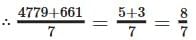
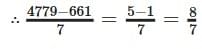
Q7. When divided by 7, the number 661 leaves a remainder of 3, and 4779 leaves a remainder of 5. Without calculating, can you say what remainders the following expressions will leave when divided by 7? Show the solution both algebraically and visually. (i) 4779 + 661 (ii) 4779 – 661 Ans: Given, 661 = K × 7 + 3, where K = 1, 2, 3, 4, … and, 4779 = K × 7 + 5 Algebraic Method: (i) 4779 + 661 4779 = (682 × 7 ) + 5 Remainder = 5 661 = (94 × 7) + 3 Remainder = 3 ∴ = 1 = Remainder (ii) 4779 – 661 ∴ = 4 = Remainder
Q8. Find a number that leaves a remainder of 2 when divided by 3, a remainder of 3 when divided by 4, and a remainder of 4 when divided by 5. What is the smallest such number? Can you give a simple explanation of why it is the smallest? Ans: A number that leaves a remainder of 2 when divided by 3 is = 3x + 2 A number that leaves a remainder of 3 when divided by 4 is = 4x + 3 A number that leaves a remainder of 4 when divided by 5 is = 5x + 4 L.C.M of 3, 4, and 5 = 60 All the numbers are the same, so 4x + 3 = 3x + 2 4x – 3x = 2 – 3 x = -1 Each remainder is 1 less than the divisor. Hence, the number is 1 less than the L.C.M = (60 – 1) = 59. So, 59 is the smallest number that satisfies all the given conditions.
Page 126
Figure it Out
Q1. Find, without dividing, whether the following numbers are divisible by 9. (i) 123 Ans: Digit sum of the number 123 = (1 + 2 + 3) = 6 Now, (6 ÷ 9) is not divisible by 9. So, the whole number 123 is not divisible by 9.
(ii) 405 Ans: Digit sum of the number 405 = (4 + 0 + 5) = 9 Now, (9 ÷ 9) = 1,divisible by 9. So, the whole number 405 is divisible by 9.
(iii) 8888 Ans: Digit sum of the number 8888 = (8 + 8 + 8 + 8) = 32 Now, (32 ÷ 9) is not divisible by 9. So, the whole number 8888 is not divisible by 9.
(iv) 93547 Ans: Digit sum of the number 93547 = (9 + 3 + 5 + 4 + 7) = 9 Now, (28 ÷ 9) is not divisible by 9. So, the whole number 93547 is not divisible by 9.
(v) 358095 Ans: Digit sum of the number 358095 = (3 + 5 + 8 + 0 + 9 + 5) = 30 Now, (30 ÷ 9) is not divisible by 9. So, the whole number 358095 is not divisible by 9.
Q2. Find the smallest multiple of 9 with no odd digits. Ans: If we multiply 9 by odd digits, we will get odd digits as a result. So, we will multiply 9 by only even digits.
18 ( 1 is odd)
36 ( 3 is odd)
72 (7 is odd)
90 (9 is odd)
108 ( 1 is odd)
216 ( 1 is odd)
288(2 + 8 + 8 = 18 → divisible by 9, and digits 2,8,8 are even)
Q3. Find the multiple of 9 that is closest to the number 6000. Ans: First Divide 6000 by 9 → (6000 ÷ 9) →Quotient = 666 and Remainder = 6 So, 5994 is 6 less than 6000. And next closest number is 667×9 = 6003, 6003 is 3 greater than 6000. Hence, the closest to the number 6000 that is multiple of 9 = 6003.
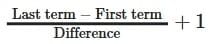
Q4. How many multiples of 9 are there between the numbers 4300 and 4400? Ans: The multiples of 9 are there between the numbers 4300 and 4400 are 4302, 4311, 4320,………, 4392 The number of multiples of 9 = = +1 = + 1= 10 + 1 = 11 Thus, the multiples of 9 are 11.
Page 130
Q: Between the numbers 600 and 700, which numbers have the digital root: (i) 5 (ii) 7 (iii) 3 Ans: (i) Digital root 5: 608 = 6 + 0 + 8 = 14 = 1 + 4 = 5; 617 = 6 + 1 + 7 = 14 = 1 + 4 = 5; 662 = 6 + 6 + 2 = 14 = 1 + 4 = 5; 689 = 6 + 8 + 9 = 23 = 2 + 3 = 5, etc.
Q: Write the digital roots of any 12 consecutive numbers. What do you observe? Ans: The digital roots of any 12 consecutive numbers are:
105 = 1 + 0 + 5 = 6;
106 = 1 + 0 + 6 = 7;
107 = 1 + 0 + 7 = 8;
108 = 1 + 0 + 8 = 9;
109 = 1 + 0 + 9 = 10 = 1 + 0 = 1;
110 = 1 + 1 + 0 = 2;
111 = 1 + 1 + 1 = 3;
112 = 1 + 1 + 2 = 4;
113 = 1 + 1 + 3 = 5;
114 = 1 + 1 + 4 = 6;
115 = 1 + 1 + 5 = 7;
116 = 1 + 1 + 6 = 8
Observation: The digital roots of cycles repeat after 9 numbers. 6 → 7 → 8 → 9 → 1 → 2 → 3 → 4 → 5 → 6 → 7 → 8 So, the digital roots of consecutive numbers form a repeating cycle of length 9. The digital root of multiples by 9:
405 = 4 + 0 + 5 = 9;
234 = 2 + 3 + 4 = 9;
1035 = 1 + 0 + 3 + 5 = 9;
936 = 9 + 3 + 6 = 18 = 1 + 8 = 9, etc.
Q: We saw that the digital root of multiples by 9 is always 9. Now, find the digital roots of some consecutive multiples of (i) 3, (ii) 4, and (iii) 6. Ans: (i) The digital roots of some consecutive multiples of 3 are: 39 = 3 + 9 = 12 = 1 + 2 = 3; 42 = 4 + 2 = 6; 45 = 4 + 5 = 9; 48 = 4 + 8 = 12 = 1 + 2 = 3; 51 = 5 + 1 = 6; 54 = 5 + 4 = 9; 57 = 5 + 7 = 12 = 1 + 2 = 3; 60 = 6 + 0 = 6; 63 = 6 + 3 = 9 etc. Thus, the digital roots of consecutive multiples of 3 are 3, 6, 9, 3, 6, 9,……
(ii) The digital roots of some consecutive multiples of 4 are: 32 = 3 + 2 = 5; 36 = 3 + 6 = 9; 40 = 4 + 0 = 4; 44 = 4 + 4 = 8; 48 = 4 + 8 = 12 = 1 + 2 = 3; 52 = 5 + 2 = 7; 56 = 5 + 6 = 11 = 1 + 1 = 2; 60 = 6 + 0 = 6, etc. Thus, the digital roots of consecutive multiples of 4 are 5, 9, 4, 8, 3, 7, 2, 6,……..
Q: What are the digital roots of numbers that are 1 more than a multiple of 6? What do you notice? Try to explain the patterns noticed. Ans: The digital roots of the numbers that are 1 more than a multiple of 6 are: 37 = 3 + 7 = 10 = 1 + 0 = 1; 43 = 4 + 3 = 7; 49 = 4 + 9 = 13 = 1 + 3 = 4; 55 = 5 + 5 = 10 = 1 + 0 = 1; 61 = 6 + 1 = 7; 67 = 6 + 7 = 13 = 1 + 3 = 4, etc. Hence, the digital roots of the numbers that are 1 more than a multiple of 6 are 1, 7, 4, 1, 7, 4,….. We notice the digital roots cycle through 1, 7, 4, and then repeat: 1, 7, 4, 1, 7, 4, 1, 7, 4,………
Q: I’m made of digits, each tiniest and odd, No shared ground with root #1 – how odd! My digits count, their sum, my root – All point to one bold number’s pursuit – The largest odd single-digit I proudly claim. What’s my number? What’s my name?
Ans: Try: 111 111 111 Digits = 9 Sum = 1 + 1 + 1 + 1 + 1 + 1 + 1 + 1 + 1 = 9 Digital root = 9 All digits are odd (1) Satisfies all the conditions. Hence, the answer is 111 111 111.
Page 131
Figure it Out
Q1. The digital root of an 8-digit number is 5. What will be the digital root of 10 more than that number? Ans: Consider the 8-digit number 80000006. The digital root of 80000006 = 8 + 0 + 0 + 0 + 0 + 0 + 0 + 6 = 14 = 1 + 4 = 5 10 more than 80000006 = 80000006 + 10 = 80000016 The digital root of 80000016 = 8 + 0 + 0 + 0 + 0 + 0 + 1 + 6 = 15 = 1 + 5 = 6 Thus, the digital root of 10 more than 80000006 is 6.
Q2. Write any number. Generate a sequence of numbers by repeatedly adding 11. What would be the digital roots of this sequence of numbers? Share your observations. Ans: Consider the number = 40 The sequence of numbers by repeatedly adding 11 are 40, 51(40 + 11), 62(51 + 11), 73(62 + 11), 84(73 + 11), 95(84 + 11), 106(95 + 11), 117(106 + 11), 128(117 + 11), 139(128 + 11), etc. The digital roots of this sequence of numbers are: 40 = 4 + 0 = 4; 51 = 5 + 1 = 6; 62 = 6 + 2 = 8; 73 = 7 + 3 = 10 = 1 + 0 = 1; 84 = 8 + 4 = 12 = 1 + 2 = 3; 95 = 9 + 5 = 14 = 1 + 4 = 5; 106 = 1 + 0 + 6 = 7; 117 = 1 + 1 + 7 = 9; 128 = 1 + 2 + 8 = 11 = 1 + 1 = 2; 139 = 1 + 3 + 9 = 13 = 1 + 3 = 4,… etc. Thus, the digital roots of this sequence of numbers are 4, 6, 8, 1, 3, 5, 7, 9, 2, 4,….. Observations: The digital roots are 4, 6, 8, 1, 3, 5, 7, 9, 2, 4,…… This sequence starts repeating after 9 steps. So the digital roots form a cycle: 4, 6, 8, 1, 3, 5, 7, 9, 2, 4,……
Q3. What will be the digital root of the number 9a + 36b + 13? Ans: First Method: The digital root of the number 9a + 36b + 13 = 9a + 36b + 9 + 4 = 9(a + 4b + 1) + 4 = 9 + 4 = 13 [∵ The digital root of multiples of 9 is always 9.] = 1 + 3 = 4 Thus, the digital root of the number 9a + 36b + 13 will be 4. Second Method: We have 9a + 36b + 13 Here, a and b are integers Put a = 1, b = 1, 9a + 36b + 13 = 9 × 1 + 36 × 1 + 13 = 9 + 36 + 13 = 58 The digital root of 58 = 5 + 8 = 13 = 1 + 3 = 4 Put a = 2, 6 = 3, 9a + 36b + 13 = 9 × 2 + 36 × 3 + 13 = 18 + 108 + 13 = 139 The digital root of 139 = 1 + 3 + 9 = 13 = 1 + 3 = 4 Thus, the expression 9a + 36b + 13 always has a digital root of 4.
Q4. Make conjectures by examining if there are any patterns or relations between (i) the parity of a number and its digital root. (ii) the digital root of a number and the remainder obtained when the number is divided by 3 or 9. Ans: Consider the pattern: 8, 16, 24, 32, 40,…… (i) 8 = 8 = digital root, parity → even 16 = 1 + 6 = 7 = digital root, parity → odd 24 = 2 + 4 = 6 = digital root, parity → even 32 = 3 + 2 = 5 = digital root, parity → odd 40 = 4 + 0 = 4 = digital root, parity → even
Q1. If 31z5 is a multiple of 9, where z is a digit, what is the value of z? Explain why there are two answers to this problem. Ans: We know that the digital root of multiples of 9 is always 9. So, the digit root of the number 31z5 is = 9 Hence the value of z = 0 or 9. Proceedings: Therefore, 3 + 1 + z + 5 = 9 Or, 9 + z = 9 Or, z = 0 Now, the expression 3 + 1 + z + 5 = 9 + z must be divisible by 9. If z = 0, then 9 + z = 9 is divisible by 9. And when z = 9, then 9 + z = 18 is divisible by 9. So, the value of z = 0 or 9. And the numbers are 3105 and 3195. That’s why there are two answers to this problem.
Q2. “I take a number that leaves a remainder of 8 when divided by 12. I take another number which is 4 short of a multiple of 12. Their sum will always be a multiple of 8”, claims Snehal. Examine his claim and justify your conclusion. Ans: 1st number = 12k + 8 2nd number = 12k – 4 Sum = 12k + 8 + 12k – 4 = 24k + 4 According to Snehal, it is always a multiple of 8. If we put k = 1, 24 × 1 + 4 = 24, which is a multiple of 8. k = 2, 24 × 2 + 4 = 48, which is a multiple of 8. k = 3, 24 × 3 + 4 = 76, which is not a multiple of 8. So, her claim is “Sometimes True”.
Q3. When is the sum of two multiples of 3, a multiple of 6 and when is it not? Explain the different possible cases, and generalise the pattern. Ans: Multiples of 3 are: 3, 6, 9, 12, 15, 18,………. 3 + 6 = 9, not a multiple of 6. 6 + 9 = 15, not a multiple of 6. 3 + 9 = 12, multiple of 6. 6 + 12 = 18, multiple of 6. There are two possible cases.
If both numbers are odd, then the sum is a multiple of 6.
If both numbers are even, then the sum is a multiple of 6.
Q4. Sreelatha says, “I have a number that is divisible by 9. If I reverse its digits, it will still be divisible by 9 “. (i) Examine if her conjecture is true for any multiple of 9. (ii) Are any other digit shuffles possible such that the number formed is still a multiple of 9? Ans: Consider a number that is divisible by 9 = 72 We know that, If the sum of the digits is divisible by 9, then the number is divisible by 9. If its digits are reversed 27 = 2 + 7 = 9, it is also divisible by 9. (i) True (ii) Yes, any other digit shuffle is possible that the number is still a multiple of 9.
Q5. If 48a23b is a multiple of 18, list all possible pairs of values for a and b. Ans: 48a23b is a multiple of 18. As we know that, If the number is a multiple of 18, then it is also a multiple of 2 and 9. ∴ 48a23b Sum of the digits = 4 + 8 + a + 2 + 3 + b = 17 + a + b
Case 1: Put a = 1 and b = 0 481230, it is possible values of a and b. Sum = 18, it is divisible by 9.
Case 2: Put a = 4 and b = 6 484236 Sum = 17 + 10 = 27, it is divisible by 9. Thus, the possible values of a and 6 are a = 1 and b = 0, a = 4 and b = 6; there are two possible cases.
Q6. If 3p7q8 is divisible by 44, list all possible pairs of values for p and q. Ans: Given by question, 3p7q8 is divisible by 44. As we know, if a number is divisible by 44, then it is also divisible by 4 and 11. ∴ 3p7q8 Case 1: Put p = 1 and q = 0 37708 is divisible by 4 and 11, then it is also divisible by 44.
Case 2: Put p = 5 and q = 2 35728 is divisible by 4 and 11, then it is also divisible by 44.
Case 3: Put p = 3 and q = 4 33748 is divisible by 4 and 11, then it is also divisible by 44.
Case 4: Put p = 1 and q = 6 31768 is divisible by 4 and 11, then it is also divisible by 11. Thus, (p = 7, q = 0), (p = 5, q = 2), (p = 3, q = 4), and (p = 1 and q = 6) are the possible pairs of values for p and q.
Q7. Find three consecutive numbers such that the first number is a multiple of 2, the second number is a multiple of 3, and the third number is a multiple of 4. Are there more such numbers? How often do they occur? Ans: Let x, x + 1 and (x + 2) be the three numbers Put x = 2, ⇒ 2, 3, 4 Put x = 14, ⇒ 14, 15, 6 Put x = 26, ⇒ 26, 27, 28 Put x = 38, ⇒ 38, 39, 40 Thus, the three consecutive numbers are (14, 15, 16), Put x = 26, ⇒ 26, 27, 28 (26, 27, 28) and (38, 39, 40) There are infinite numbers, spaced apart by 12.
Q8. Write five multiples of 36 between 45,000 and 47,000. Share your approach with the class. Ans: Step: We know that if a number is a multiple of 36, then it is also a multiple of 4 and 9. 45000 Last two digits = 00, it is divisible by 4. Sum of the digits = 4 + 5 + 0 + 0 + 0 = 9, it is also divisible by 9. Thus, 45000 is completely divisible by 36. The five multiples of 36 between 45,000 and 47,000. (45,000 + 36), (45,000 + 2 × 36), (45,000 + 3 × 36), (45,000 + 4 × 36) and (45,000 + 5 × 36) i.e., 45,036, 45,072, 45,108, 45,144, and 45,180.
Q9. The middle number in the sequence of 5 consecutive even numbers is 5p. Express the other four numbers in sequence in terms of p. Ans: Let be the 5 consecutive even numbers are = x, (x + 2), (x + 4), (x + 6), (x + 8) The middle number is (x + 4) Therefore, (x + 4) = 5p Or, x = 5p – 4 So, the other four numbers are = 1st number → 5p – 4 2nd number → 5p – 2 4th number → 5p + 2 5th number → 5p + 4
Q10. Write a 6-digit number that it is divisible by 15, such that when the digits are reversed, it is divisible by 6. Ans: We know that if the number is divisible by 3 and 5, then it is also divisible by 15. Consider the number 643215. Sum of the digits = 6 + 4 + 3 + 2 + 1 + 5 = 21, which is divisible by 3. Thus, 643215 is divisible by 3. One’s place = 5, it is also divisible by 5. Hence, 643215 is divisible by 15. One’s place is not 0, because the digits are reversed, it becomes a 5-digit number. Lakhs place is always taken as an even number. Reversed the digits: 512346 One’s place = 6, 512346 is divisible by 2. Sum of the digits = 5 + 1 + 2 + 3 + 4 + 6 = 21. It is also divisible by 3. Hence, 512346 is divisible by 6.
Q11. Deepak claims, “There are some multiples of 11 which, when doubled, are still multiples of 11. But other multiples of 11 don’t remain multiples of 11 when doubled”. Examine if his conjecture is true; explain your conclusion. Ans: The multiples of 11 are: 11, 22, 33, 44, 55,… When doubled, 22, 44, 66, 88, 110,…… i.e. (11) × 2, 11 × 4, 11 × 6, 11 × 8, 11 × 10,…. are also multiples of 11. False, if multiples of 11 are doubled, then the multiples of 11 are these numbers.
Q12. Determine whether the statements below are ‘Always True’, ‘Sometimes True’, or ‘Never True’. Explain your reasoning. (i) The product of a multiple of 6 and a multiple of 3 is a multiple of 9. Ans: ‘Always True’ Explanation: Let be the two numbers are = 6a and 3b. So the product of these = (6a × 3b) = 18ab It saws that 18ab is also divisible by 9. [18 is a multiple of 9] Example: If a = 3 and b = 2 (18 × 3 × 2) = 108, so 108 is a multipleof p.
(ii) The sum of three consecutive even numbers will be divisible by 6. Ans: ‘Always True’ Explanation: Let be the first consecutive even number = x So the other consecutive even numbers = (x + 2) and (2 + 4) Therefore, sum of these number = x + x + 2 + x + 4 = 3x + 6 = 3(x + 2) Example: If x = 6, then 3(6 + 2) = 24, divisible by 6. When x = 10, then 3(10 + 2) = 36, divisible by 6.
(iii) If abcdef is a multiple of 6, then badcef will be a multiple of 6. Ans: ‘Always True’ Explanation: If a number is divisible by 6 it must be divisible by 2 and 3. Checking divisibility by 2: We check the last digits of the number, if it is even then the number must be divisible by 2. And checking divisibility by 3: We check the sum of the digits of the number if it is divisible by 3, then the number is also divisible by 3. Here we can see that the last digit of both the numbers ‘abcdef’ and ‘badcef’ is the same and all the digits are the same, only their positions have changed. So, if abcdef is a multiple of 6, then badcef should be a multiple of 6.
(iv) 8 (7b-3)-4 (11b+1) is a multiple of 12. Ans: ‘Never True’ Explanation: 8 × (7b – 3) – 4 × (11b + 1) = 56b –24 – 44b – 4 = 12b – 28 We see that 12b is a multiple of 12 but 28 is not a multiple of 12. So, we say that 12b – 28 is not divisible by 12.
Q13. Choose any 3 numbers. When is their sum divisible by 3? Explore all possible cases and generalise. Ans: Let the three numbers be n1, n2, and n3. Let their remainders when divided by 3 be r1, r2, and r3. The sum n1 + n2 + n3 is divisible by 3 if and only if r1 + r2 + r3 is divisible by 3. Case 1: All remainders are 0. r1 = 0, r2 = 0, r3 = 0 Sum of remainders = 0 + 0 + 0 = 0, which is divisible by 3.
Case 2: All remainders are 1. r1 = 1, r2 = 1, r3 = 1 Sum of remainders = 1 + 1 + 1 = 3, which is divisible by 3.
Case 3: All remainders are 2. r1 = 2, r2 = 2, r3 = 2 Sum of remainders = 2 + 2 + 2 = 6, which is divisible by 3.
Case 4: One remainder is 0, one is 1, and one is 2. r1 = 0, r2 = 1, r3 = 2 (in any order). Sum of remainders = 0 + 1 + 2 = 3, which is divisible by 3. The sum of three numbers is divisible by 3 if and only if all three numbers have the same remainder when divided by 3, or if they all have different remainders when divided by 3.
Q14. Is the product of two consecutive integers always multiple of 2? Why? What about the product of these consecutive integers? Is it always a multiple of 6? Why or why not? What can you say about the product of 4 consecutive integers? What about the product of five consecutive integers? Ans: Yes, the product of two consecutive integers is always a multiple of 2. 1 × 2 = 2, 2 × 3 = 6, 5 × 6 = 30, 10 × 11 = 110, and so on. Since we know that multiplying by an odd number and an even number is always an even number. No, it is not always a multiple of 6. 1 × 2 = 2, 4 × 5 = 20, 7 × 8 = 56 Since it is not divisible by 6. The product of 4 consecutive integers 2 × 3 × 4 × 5 = 120, 4 × 5 × 6 × 7 = 840, 5 × 6 × 7 × 8 = 1680 We can say that the product of 4 consecutive integers, divisible by 12. The product of five consecutive integers is: 1 × 2 × 3 × 4 × 5 = 120, 2 × 3 × 4 × 5 × 6 = 720, 3 × 4 × 5 × 6 × 7 = 2520 Hence, we can say that the product of five consecutive integers is always divisible by 24.
Q15. Solve the cryptarithms — (i) EF × E = GGG (ii) WOW × 5 = MEOW Ans: (i) EF × E = GGG =10E + F × E = 100 G + 10G + G = (10E + F) × E = 111G If E = 1, then 10 + F = 111G [It is not possible because for any value of F, LHS can’t be equal to RHS] If E = 2, then (20 + F) × 2 = 111G [It is also not possible because for any value of F, LHS can’t be equal to RHS] For E = 3, then (30 + F) × 3 = 111G =90 + 3F = 111G If F = 7 and G = 1, then LHS = RHS. ∴ The values of E, F, and G are 3, 7, and 1, respectively. (ii) WOW × 5 = MEOW Using the same process as the previous one. (100W + 10O + W) × 5 = MEOW ⇒ (101 W + 10 O) × 5 = MEOW ⇒ 505 W + 50 O = MEOW Let’s try possible values of W and O such that the result is a 4-digit number. If we set W = 5 and O = 7, we obtain a 4-digit number. 505 × 5 + 50 × 7 = 2875 On the right-hand side, if MEOW = 2875 W = 5, O = 7 1000M + 100E + 10O + W = 1000M + 100E + 70 + 5 = 1000M + 100E + 75 If we take M = 2 and E = 8, then it satisfies the LHS. So, the values of M, E, O, and W are 2, 8, 7, and 5, respectively.
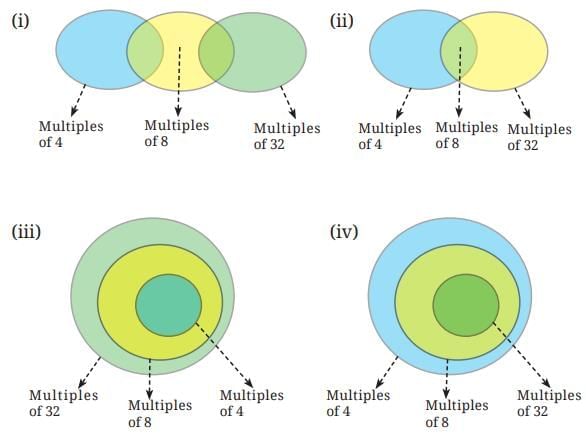
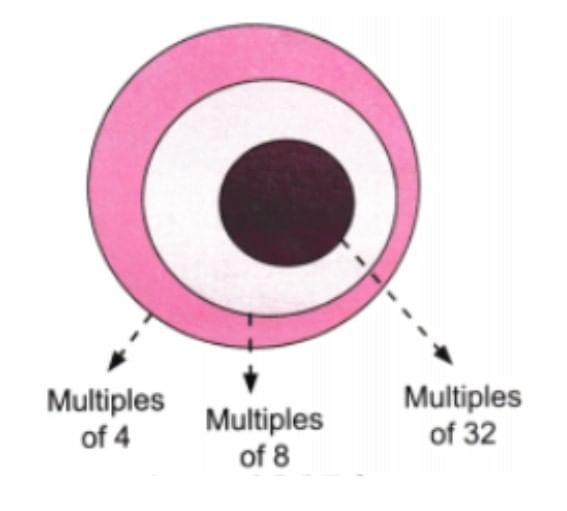
Q16. Which of the following Venn diagrams captures the relationship between the multiples of 4, 8, and 32? Ans: The correct answer is option (iv).
(iv) Multiples of 4 are: 4, 8, 12, 16, 20, 24, 28, 32, 36, 40, 44, 48, 52, 56, 60, 64,… Multiples of 8 are: 8, 16, 24, 32, 40, 48, 56, 64,…. Multiples of 32 are: 32, 64, 96, 128,… The Venn diagram captures the relationship between the multiples of 4, 8, and 32:
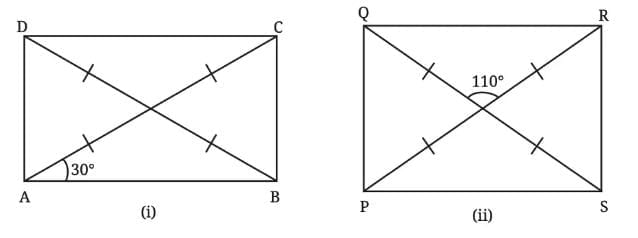
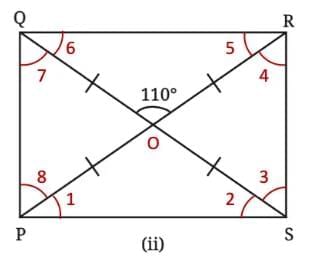
Q1. Find all the other angles inside the following rectangles.
Ans: (i)
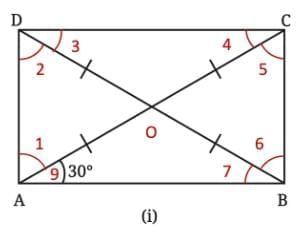
∠1 + ∠9 = 90° ……… (All corner angles of a rectangle are 90°) ∠1 + 30° = 90° ∠1 = 90° – 30° ∠1 = 60° ∠1 = ∠5 = 60°………. (Alternate interior angles) ∠9 = ∠4 = 30°………. (Alternate interior angles) In △AOB, OA = OB, then the angles opposite them are equal ∴ ∠9 = ∠7 = 30° ∠7 = ∠3 = 30°………. (Alternate interior angles) In △AOD, OA = OD, then the angles opposite them are equal ∴ ∠2 = ∠1 = 60° ∠2 = ∠6 = 60°………. (Alternate interior angles) In △AOB, ∠9 + ∠7 + ∠AOB = 180° ………. (Sum of angles of a triangle) 30° + 30° + ∠AOB = 180° 60° + ∠AOB = 180° ∠AOB = 180° – 60° ∠AOB = 120° ∠AOB = ∠COD = 120° ………… (Vertically opposite angles) ∠AOB + ∠AOD = 180° …………. (Linear pair) 120° + ∠AOD = 180° ∠AOD = 180° – 120° ∠AOD = 60° ∠AOD = ∠BOC = 60° ………… (Vertically opposite angles) Thus, ∠1 = ∠5 = ∠2 = ∠6 = ∠AOD = ∠BOC = 60°. ∠AOB = ∠COD = 120°. ∠9 = ∠4 = ∠7 = ∠3 = 30°. (ii)
∠POS = ∠ROQ = 110° ………… (Vertically opposite angles) ∠POS + ∠POQ = 180° …………. (Linear Pair) 110° + ∠POQ = 180° ∠POQ = 180° – 110° ∠POQ = 70° ∠POQ = ∠SOR = 70° ………… (Vertically opposite angles) In △POS, OP = OS, then the angles opposite them are equal. ∴ ∠1 = ∠2 = a In △POS, ∠1 + ∠2 + ∠POS = 180° …………. (Sum of angles of a triangle) a + a + 110° = 180° 2a = 180° – 110° 2a = 70° a = 35° ∴ ∠1 = ∠2 = a = 35° ∠1 = ∠5 = 35° ………… (Alternate interior angles) ∠2 = ∠6 = 35° ………… (Alternate interior angles) Since ABCD is a rectangle, ∠P = 90° ∠9 = ∠1 + ∠8 90° = 35° + ∠8 ∠8 = 90° – 35° ∠8 = 55° ∠8 = ∠4 = 55° ………… (Alternate interior angles) In △POQ, OP = OQ, then the angles opposite them are equal i.e. ∠7 = ∠8 = 55° ∠7 = ∠2 = 55° ………… (Alternate interior angles) Thus, ∠POS = ∠ROQ = 110°. ∠POQ = ∠SOR = 70°. ∠1 = ∠2 = ∠5 = ∠6 = 35°. ∠8 = ∠4 = ∠7 = ∠2 = 55°
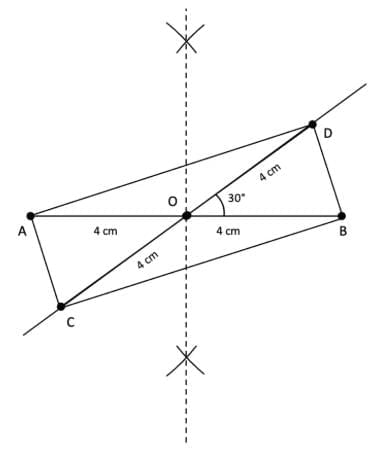
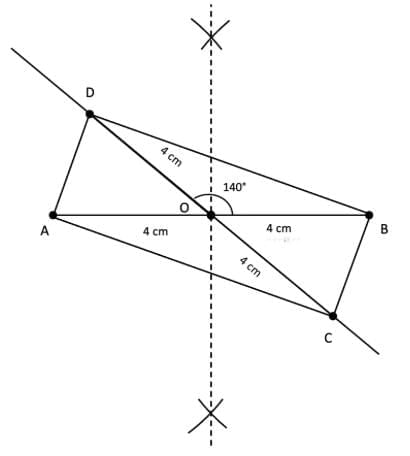
Q2. Draw a quadrilateral whose diagonals have equal lengths of 8 cm that bisect each other, and intersect at an angle of (i) 30° (ii) 40° (iii) 90° (iv) 140° Ans: (i) Draw a line AB equal to 8 cm. Take point O on AB such that AO = BO = 4 cm. Using a protractor, draw an angle of 30° at O on OB. On this line, take points C and D such that OC = OD = 4 cm. Join AD, DB, BC, and CA. ABCD is the required quadrilateral.
Since diagonals AB and CD are equal and are bisecting each other at O, ACBD is a rectangle.
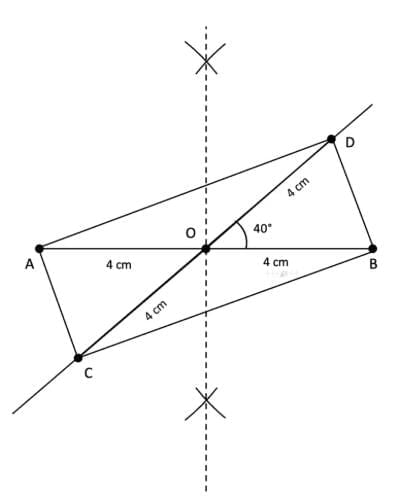
(ii) Draw a line AB equal to 8 cm.
Take point O on AB such that AO = BO = 4 cm.
Using a protractor, draw an angle of 40° at O on OB.
On this line, take points C and D such that OC = OD = 4 cm.
Join AD, DB, BC, and CA.
ABCD is the required quadrilateral.
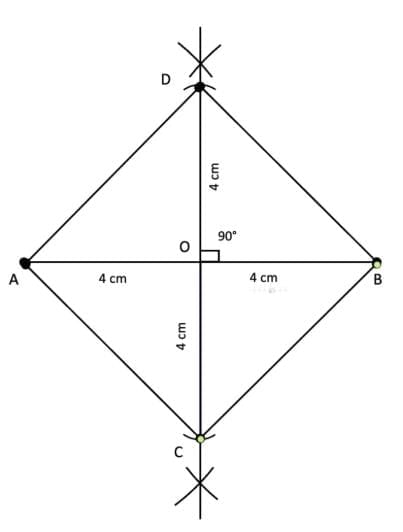
Since diagonals AB and CD are equal and are bisecting each other at O, ACBD is a rectangle.(iii) Draw a line AB equal to 8 cm. Take a point O on AB such that AO = BO = 4 cm. Using a protractor, draw an angle of 90° at O on OB. On this line, take points C and D such that OC = OD = 4 cm. Join AD, DB, BC, and CA. ACBD is the required square.
Since diagonals AB and CD are equal and are bisecting each other at M, and also the diagonals are perpendicular to each other, ACBD is a square.(iv) Draw a line AB equal to 8 cm. Take a point O on AB such that AO = BO = 4 cm. Using a protractor, draw an angle of 140° at O on OB. On this line, take points C and D such that OC = OD = 4 cm. Join AD, DB, BC, and CA. ACBD is the required quadrilateral.
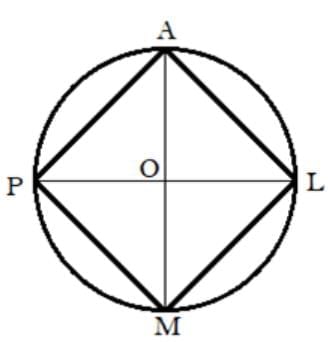
Q3. Consider a circle with centre O. Line segments PL and AM are two perpendicular diameters of the circle.
What is the figure APML? Reason and/or experiment to figure this out.
Ans: ∴ PL = PO + OL
= r + r
= 2r
and AM = AO + OM
= r + r
= 2r
∴ PL = AM
∴ In the quadrilateral APML, diagonals PL and AM are equal and are perpendicular to each other.
Also, OP = OA = OL = OM = r
∴ Diameters PL and AM bisect each other at O.
∴ Quadrilateral APML is a square.
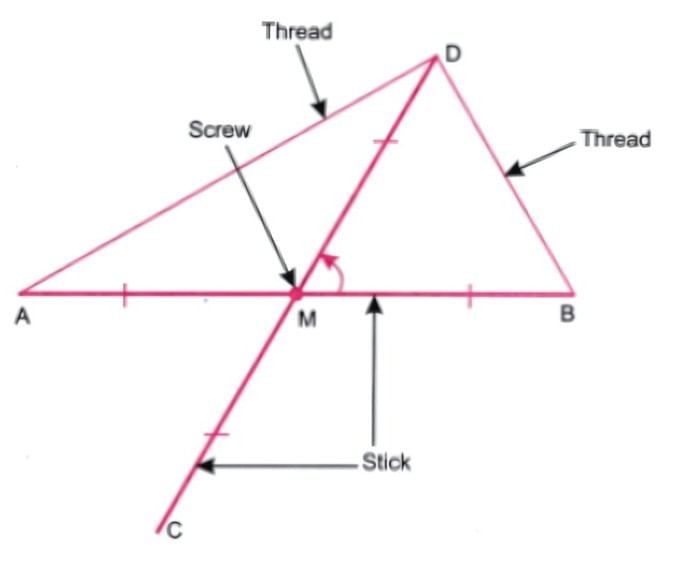
Q4. We have seen how to get 90° using paper folding. Now, suppose we do not have any paper but two sticks of equal length, and a thread. How do we make an exact 90° using these? Ans: Let AB and CD be two sticks of equal length, say 6 cm. Mark the midpoints of the sticks using a ruler. Fix a screw to the sticks at their midpoints. Using a thread, measure distances AD and BD. Keep on moving the sticks about the screw, so that the distances AD and BD are equal.
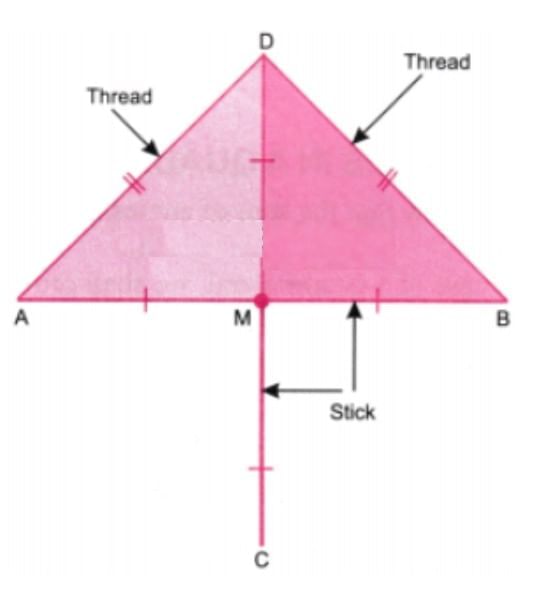
In this position, fix the sticks by tightening the screw. The new positions of the sticks are shown in the figure. Tie pieces of thread along AD and BD.
Consider ∆AMD and ∆BMD. We have AM = BM, AD = BD and MD is common ∴ By the SSS condition, ∆AMD and ∆BMD are congruent. ∴ ∠AMD = ∠BMD Also ∠AMD + ∠BMD = 180° (Linear angles) ∴ ∠AMD + ∠AMD = 180° ⇒ 2∠AMD = 180° ⇒ ∠AMD = 90° ∴ ∠AMD = ∠BMD = 90° ∴ Angle between the sticks is 90°.
Q5. We saw that one of the properties of a rectangle is that its opposite sides are parallel. Can this be chosen as a definition of a rectangle? In other words, is every quadrilateral that has opposite sides parallel and equal a rectangle? Ans: Let ABCD be a quadrilateral in which opposite sides are parallel and equal. Here AB || DC and AD || BC. Also, AB = DC and AD = BC. In the quadrilateral ABCD, opposite sides are equal. For ABCD to be a rectangle, we require each angle to be 90°. Given information AB || DC and AD || BC can not help us to prove that each angle of ABCD is 90°.
∴ ABCD may not be a rectangle. ∴ A rectangle can not be defined as a quadrilateral with equal and parallel opposite sides.
Page 102
Figure it Out
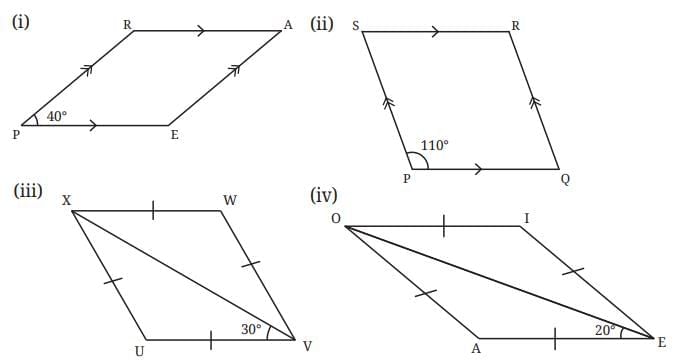
Q1. Find the remaining angles in the following quadrilaterals.
Ans: (i) Here PR ∥ EA, and PE ∥ RA Therefore, PEAR is a parallelogram. ∠P = ∠A = 40° …………. (Opposite angles of a parallelogram are equal) ∠P + ∠R = 180° …………. (The sum of the adjacent angles of a parallelogram is 180°) 40° + ∠R = 180° ∠R = 180° – 40° ∠R = 140°. ∠R = ∠E = 140° …………. (Opposite angles of a parallelogram are equal) (ii) Here PQ ∥ SR, and PS ∥ QR ∴ PQRS is a parallelogram. ∠P = ∠R = 110° …………. (Opposite angles of a parallelogram are equal) ∠P + ∠S = 180° …………. (The sum of the adjacent angles of a parallelogram is 180°) 110° + ∠S = 180° ∠S = 180° – 110° ∠S = 70°. ∠S = ∠Q = 70° …………. (Opposite angles of a parallelogram are equal) (iii) Here, XWUV is a rhombus (all sides equal). In △VUX, UV = UX, then the angles opposite them are equal. ∴ ∠UXV = ∠UVX = 30° ∠UXV = ∠WXV = 30° …………. (The diagonals of a rhombus bisect its angles) Also, ∠UVX = ∠WVX = 30° …………. (The diagonals of a rhombus bisect its angles) ∠E = 2 × ∠UVX = 2 × 30° = 60° ∠V = ∠X = 60° …………. (Opposite angles of a rhombus are equal) ∠V + ∠U = 180° …………. (The sum of adjacent angles of a rhombus is 180°) 60° + ∠U = 180° ∠U = 180° – 60° ∠U = 120° ∠U = ∠W = 120° …………. (Opposite angles of a rhombus are equal) (iv) Here, AEIO is a rhombus (all sides equal). In △EAO, AE = AO, then the angles opposite them are equal. ∴ ∠AOE = ∠AEO = 20° ∠AEO = ∠IEO = 20° …………. (The diagonals of a rhombus bisect its angles) Also, ∠AOE = ∠IOE = 20° …………. (The diagonals of a rhombus bisect its angles) ∠E = 2 × ∠AEO = 2 × 20° = 40° ∠E = ∠O = 40° …………. (Opposite angles of a rhombus are equal) ∠E + ∠A = 180° …………. (The sum of adjacent angles of a rhombus is 180°) 40° + ∠A = 180° ∠A = 180° – 40° ∠A = 140° ∠A = ∠I = 140° …………. (Opposite angles of a rhombus are equal)
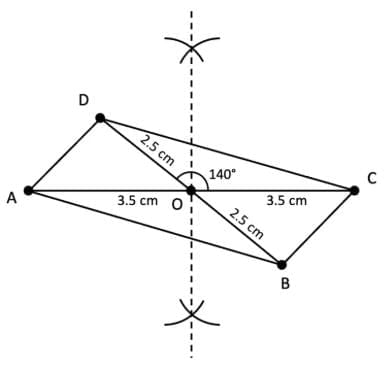
Q2. Using the diagonal properties, construct a parallelogram whose diagonals are of lengths 7 cm and 5 cm, and intersect at an angle of 140°. Ans:
Steps of construction: (i) Draw a line segment AC of length 7 cm and mark its midpoint as O. (ii) At point O, draw an angle of 140° with respect to diagonal AC. (iii) From O, along the 140° line in both directions, mark OD = 2.5 cm OD and OB = 2.5 cm using a compass. (iv) Join D to A and C. Join B to A and C. ABCD is the required parallelogram.
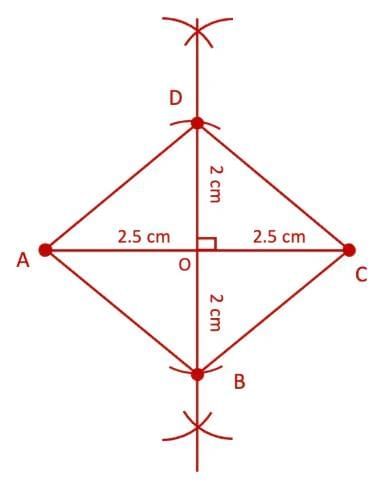
Q3. Using the diagonal properties, construct a rhombus whose diagonals are of lengths 4 cm and 5 cm. Ans:
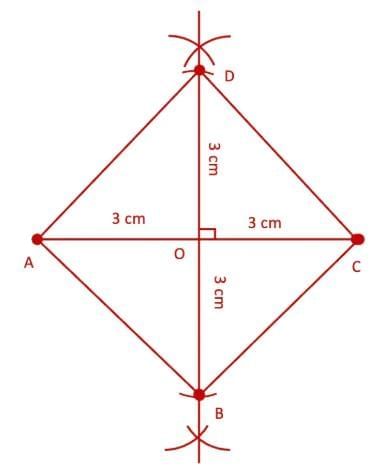
Steps of construction: (i) Draw a line segment AC of length 5 cm. (ii) Draw the perpendicular bisector of AC, intersecting it at O. (iii) With O as centre and radius 2 cm, mark points B (below) and D (above) on the perpendicular bisector. (iv) Join A–D, D–C, C–B, and B–A. ABCD is the required rhombus.
Page 107 & 108
Figure it Out
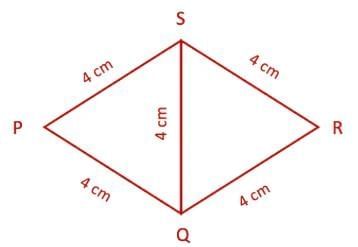
Q1. Find all the sides and the angles of the quadrilateral obtained by joining two equilateral triangles with sides 4 cm. Ans:
Since all sides of an equilateral triangle are equal. Thus, the lengths of all sides of the given quadrilateral are equal. ∴ PQ = QR = RS = SP = 4 cm. Also, the measure of all angles of an equilateral triangle is 60°. ∠P = ∠R = 60° ∠S = ∠PSQ + ∠RSQ = 60° + 60° = 120°. ∠Q = ∠PQR + ∠RQS = 60° + 60° = 120°.
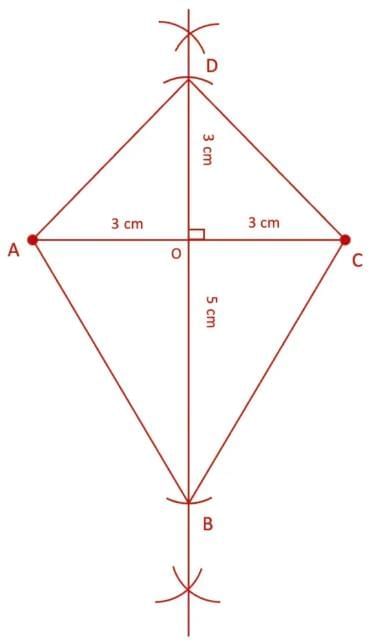
Q2. Construct a kite whose diagonals are of lengths 6 cm and 8 cm. Ans:
(i) Draw a line segment AC = 6 cm. (ii) Construct the perpendicular bisector of AC; let it meet AC at O (so O is the midpoint). (iii) With centre O and radius 3 cm draw an arc to cut the bisector above AC; label that point D. With centre O and radius 5 cm draw an arc to cut the bisector below AC; label that point B. (iv) Join A − B, B − C, C − D, D − A. ABCD is the required kite.
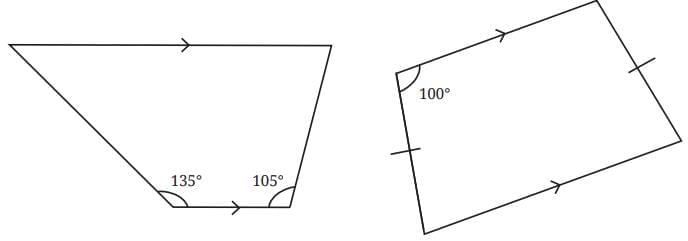
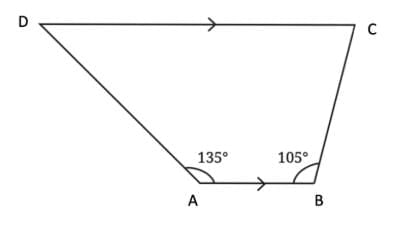
Q3. Find the remaining angles in the following trapeziums — Ans: Since AB ∥ DC, and AD is a tranversal, then ∠A + ∠D = 180° …………. (Sum of angles on the same side of the transversal) 135° + ∠D = 180° ∠D = 180° – 135° ∠D = 45° Also, since AB ∥ DC, and BC is a tranversal, then ∠B + ∠C = 180° …………. (Sum of angles on the same side of the transversal) 105° + ∠C = 180° ∠C = 180° – 105° ∠C = 75°
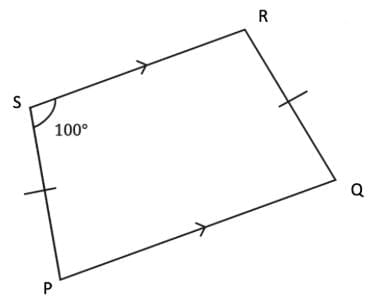
Since PQ ∥ SR, and PS is a tranversal, then ∠P + ∠S = 180° …………. (Sum of angles on the same side of the transversal) ∠P + 100° = 180° ∠P = 180° – 100° = 80°. ∠S = ∠R = 100° …………… (Angles opposite to equal sides are equal) Also, since PQ ∥ SR, and QR is a tranversal, then ∠Q + ∠R = 180° …………… (Sum of angles on the same side of the transversal) ∠Q + 100° = 180° ∠Q = 180° – 100° = 80°.
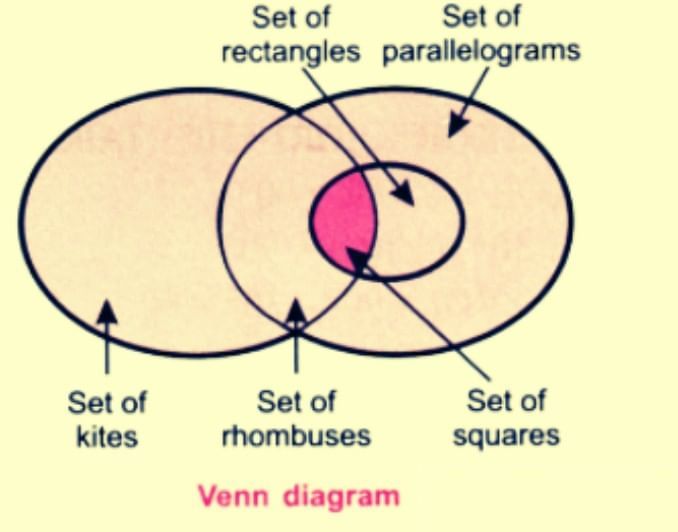
Q4. Draw a Venn diagram showing the set of parallelograms, kites, rhombuses, rectangles, and squares. Then, answer the following questions (i) What is the quadrilateral that is both a kite and a parallelogram? (ii) Can there be a quadrilateral that is both a kite and a rectangle? (iii) Is every kite a rhombus? If not, what is the correct relationship between these two types of quadrilaterals? Ans: (i) The set of rhombuses is common to both the set of kites and the set of parallelograms. ∴ A rhombus is both a kite and a parallelogram. (ii) A kite is not a rectangle, and a rectangle is not a kite. ∴ There can be no quadrilateral that is both a kite and a rectangle. Also, there is no common portion of the set of kites and the set of rectangles. (iii) Every kite is not a rhombus. In the given figure, the kite ABCD is not a rhombus. Correct relationship: Every rhombus is a kite, but not every kite is a rhombus.
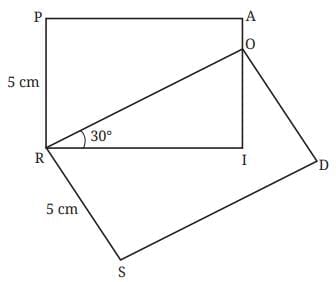
Q5. If PAIR and RODS are two rectangles, find ∠IOD. Ans: Since PAIR and RODS are two triangles. ∠RIO = 90° ……… (Corner angle of a rectangle) In △RIO, ∠IRO + ∠IOR + ∠RIO = 180° …………. (Sum of angles of a triangle) 30° + ∠IOR + 90° = 180° 120° + ∠IOR = 180° ∠IOR = 180° – 120° = 60°. ∴ ∠IOD = 90° – ∠IOR = 90° – 60° = 30°.
Q6. Construct a square with a diagonal 6 cm without using a protractor. Ans:
Steps of construction: (i) Draw a line segment AC = 6 cm and mark its midpoint as O. (ii) With O as centre and radius greater than half of AC, draw arcs above and below AC from points A and C. (iii) Join the arc intersections to get a line perpendicular to AC and passing through O. (iv) Again, with O as centre and radius equal to 3 cm, mark points B and D on the perpendicular line. (v) Connect A–B–C–D–A. Hence, ABCD is the required square with a diagonal of 6 cm.
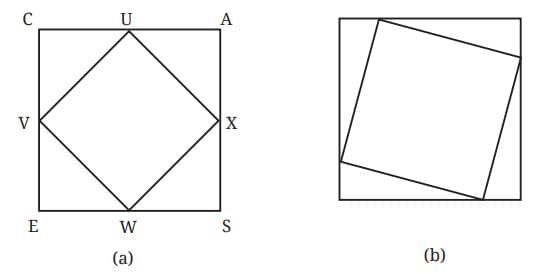
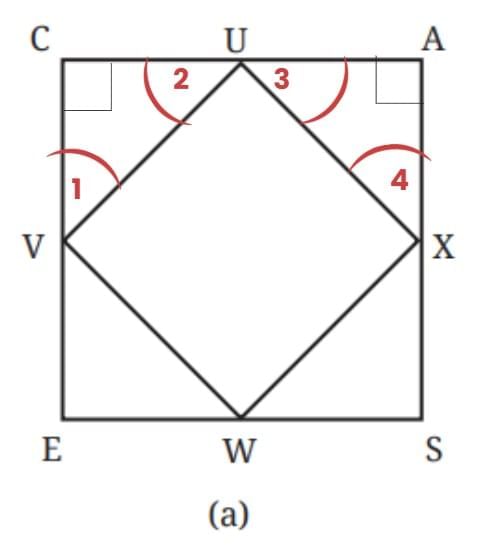
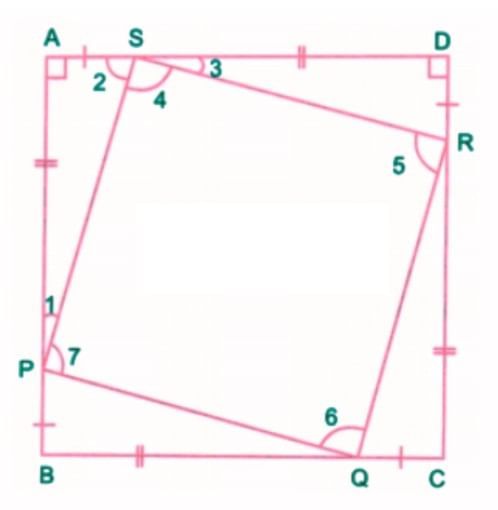
Q7. CASE is a square. The points U, V, W and X are the midpoints of the sides of the square. What type of quadrilateral is UVWX? Find this by using geometric reasoning, as well as by construction and measurement. Find other ways of constructing a square within a square such that the vertices of the inner square lie on the sides of the outer square, as shown in Figure (b).
Ans: (a) U, V, W, and X are the midpoints of the sides of the square. In ∆VCU and ∆UAX, we have VC = UA, ∠VCU = ∠UAX = 90°, and CU = AX. ∴ By the SAS condition, ∆VCU and ∆UAX are congruent. ∴ VU = UX Similarly, VU = XW, VU = WV. ∴ Sides of the quadrilateral UVWX are equal.
In ∆VCU, VC = CU ⇒∠1 = ∠2 Also, ∠1 + ∠C + ∠2 = 180° ⇒∠1 + 90° + ∠1 = 180° ⇒2∠1 = 90° ⇒∠1 = 45° ∴ ∠2 is also 45°. Similarly, ∠3 = ∠4 = 45° We have ∠2 + ∠VUX + ∠3 = 180° ⇒45° + ∠VUX + 45° = 180° ⇒∠VUX = 180° – 90° ⇒ ∠VUX = 90° Similarly, ∠VXW = 90°, ∠XWV = 90° and ∠WVU = 90°. ∴ By definition, the quadrilateral UVWX is a square.
(b) Let ABCD be a square. Take points P, Q, R, and S such that AS = BP = CQ = DR.
Since the sides of squares are equal, we have DS = AP = BQ = CR. In ∆PAS and ∆SDR, we have PA = SD, ∠PAS = ∠SDR = 90°, and AS = DR. ∴ By the SAS condition, ∆PAS and ∆SDR are congruent. ∴ PS = SR Similarly, PS = RQ, PS = QP. ∴ Sides of the quadrilateral PQRS are equal. In ∆PAS, ∠1 + ∠2 + 90° = 180° ⇒∠1 + ∠2 = 90° ⇒∠3 + ∠2 = 90° (∵ ∠1 = ∠3) Also, ∠2 + ∠4 + ∠3 = 180° ⇒ 90° + ∠4 = 180° ⇒ ∠4 = 180° – 90° ⇒ ∠4 = 90° ∴ Similarly, ∠5 = 90°, ∠6 = 90°, and ∠7 = 90°. By definition, the quadrilateral PQRS is a square.
Q8. If a quadrilateral has four equal sides and one angle of 90°, will it be a square? Find the answer using geometric reasoning as well as by construction and measurement. Ans: Reasoning:
A rhombus is a quadrilateral with four equal sides.
If a rhombus has one angle of 90°, then:
Its opposite angle is also 90° (opposite angles of a rhombus are equal).
Each adjacent angle must also be 90° (sum of adjacent angles in a parallelogram/rhombus is 180°).
Thus, all four angles are 90°.
Since the quadrilateral has all sides equal and all angles right angles, it is a square.
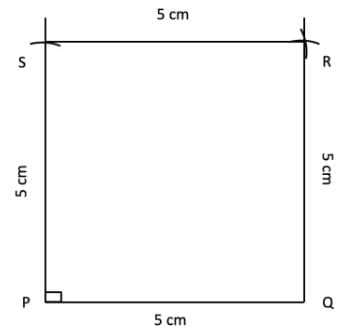
Construction and measurement:
Steps of construction: (i) Draw a line segment PQ of length 5 cm. (ii) At point PP, construct a perpendicular line to PQ. (iii) On this perpendicular, mark point S such that PS = 5 cm. (iv) With S as centre and radius 5 cm, draw an arc to the right of PS. (v) With Q as centre and radius 5 cm, draw an arc above PQ to intersect the arc from step (4) at point R. Join Q–R, R–S, and S–P to complete the square PQRS. Verification by measurement: All sides: PQ = QR = RS = SP = 5 cm All angles: ∠P =∠Q =∠R =∠S = 90°. Conclusion: The figure constructed is a square.
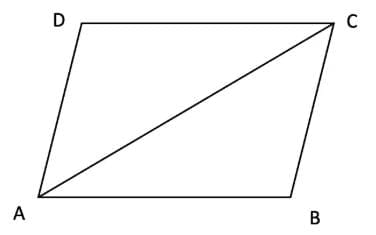
Q9. What type of quadrilateral is one in which the opposite sides are equal? Justify your answer. Hint: Draw a diagonal and check for congruent triangles. Ans: If a quadrilateral has opposite sides equal, then it is a parallelogram. Geometric reasoning using a diagonal:
Given: Quadrilateral ABCD with AB = CD and BC = DA. Draw diagonal AC. In △ABC and △CDA, AB = CD (given) BC = DA (given) AC = AC (common side) By SSS congruence, △ABC ≅ △CDA. From congruence, corresponding angles are equal: ∠BAC =∠DCA and ∠ACB =∠CAD. But these are alternate interior angles. ∴ AB ∥ DC and AD ∥ BC. Hence, ABCD is a parallelogram.
Q10. Will the sum of the angles in a quadrilateral such as the following one also be 360°? Find the answer using geometric reasoning as well as by constructing this figure and measuring. Ans: Yes, the sum of the angles in a quadrilateral will always be 360°. Construction: Mark four non-collinear points as A, B, C, and D, and join them to form a quadrilateral ABCD.
Geometric reasoning: In quad. ABCD, join BD to divide it into two triangles. Now, In △BAD, ∠DBA + ∠BAD + ∠ADB = 180° ……….(1)……. (Sum of angles of a triangle) In △BCD, ∠BCD + ∠CDB + ∠DBC = 180° ……….(2)……. (Sum of angles of a triangle) Adding (1) and (2), we get ∠DBA + ∠BAD + ∠ADB + ∠BCD + ∠CDB + ∠DBC = 180° + 180° (∠DBA + ∠DBC) + (∠ADB + ∠CDB) + ∠BAD + ∠BCD = 360° ∠ABC + ∠ADC + ∠BAD + ∠BCD = 360° Thus, the sum of the angles of the given quadrilateral is 360°.
Q11. State whether the following statements are true or false. Justify your answers. (i) A quadrilateral whose diagonals are equal and bisect each other must be a square. Ans: False.
A quadrilateral whose diagonals are equal and bisect each other is a rectangle. A square is a special case of a rectangle where all sides are also equal.
(ii) A quadrilateral having three right angles must be a rectangle. Ans: True.
Let ABCD be a quadrilateral having three right angles at A, D, and C. We have ∠A + ∠B + ∠C + ∠D = 360°. ⇒ 90° + ∠B + 90° + 90° = 360° ⇒ ∠B = 360° – 270° ⇒ ∠B = 90°. ∴ Each angle of ABCD is 90°. ∴ Given quadrilateral is a rectangle.
(iii) A quadrilateral whose diagonals bisect each other must be a parallelogram. Ans: True.
If the diagonals bisect each other, then the two triangles formed by a diagonal are congruent, which gives pairs of opposite sides parallel. Hence the figure is a parallelogram.
(iv) A quadrilateral whose diagonals are perpendicular to each other must be a rhombus. Ans: False.
Squares, kites, and some other quadrilaterals also have perpendicular diagonals. Therefore, having perpendicular diagonals does not necessarily mean the quadrilateral is a rhombus.
(v) A quadrilateral in which the opposite angles are equal must be a parallelogram. Ans:True.
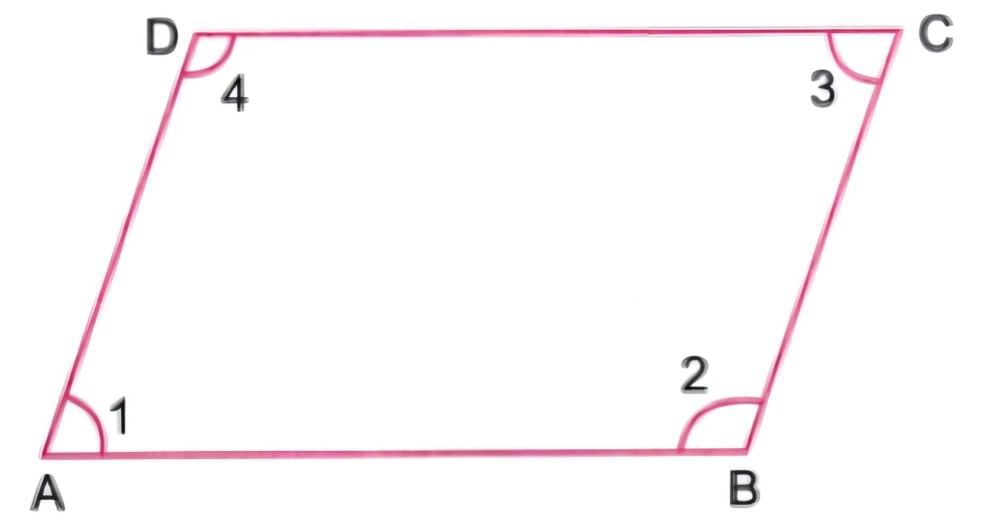
Let ABCD be a quadrilateral in which ∠1 = ∠3 and ∠2 = ∠4. We have, ∠1 + ∠2 + ∠3 + ∠4 = 360°. ⇒ ∠1 + ∠2 + ∠1 + ∠2 = 360° ⇒ 2(∠1 + ∠2) = 360° ⇒ ∠1 + ∠2 = 180° AB is a transversal of lines AD and BC, and the sum of internal angles ∠1 and ∠2 on the same side is 180°. ∴ Lines AD and BC are parallel. Again, ∠1 + ∠2 + ∠3 + ∠4 = 360° ⇒ ∠3 + ∠2 + ∠3 + ∠2 = 360° ⇒ 2(∠2 + ∠3) = 360° ⇒ ∠2 + ∠3 = 180° BC is a transversal of lines AB and DC, and the sum of internal angles ∠2 and ∠3 on the same sides is 180°. ∴ Lines AB and DC are parallel. ∴ Opposite sides of quadrilateral ABCD are parallel. ∴ ABCD is a parallelogram. ∴ The given statement is true
(vi) A quadrilateral in which all the angles are equal is a rectangle. Ans: True
If all four angles are equal, each angle must be 360°/4 = 90°. A quadrilateral with four right angles is a rectangle.
(vii) Isosceles trapeziums are parallelograms. Ans: False.
An isosceles trapezium has exactly one pair of parallel sides and the non-parallel sides equal while a parallelogram must have two pairs of parallel sides. So an isosceles trapezium is not a parallelogram.
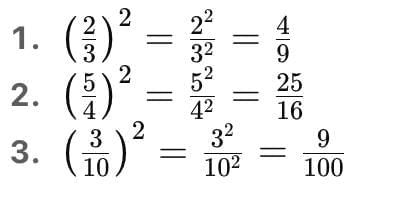
 Example: 8² ÷ 2² = (8 ÷ 2)² = 4²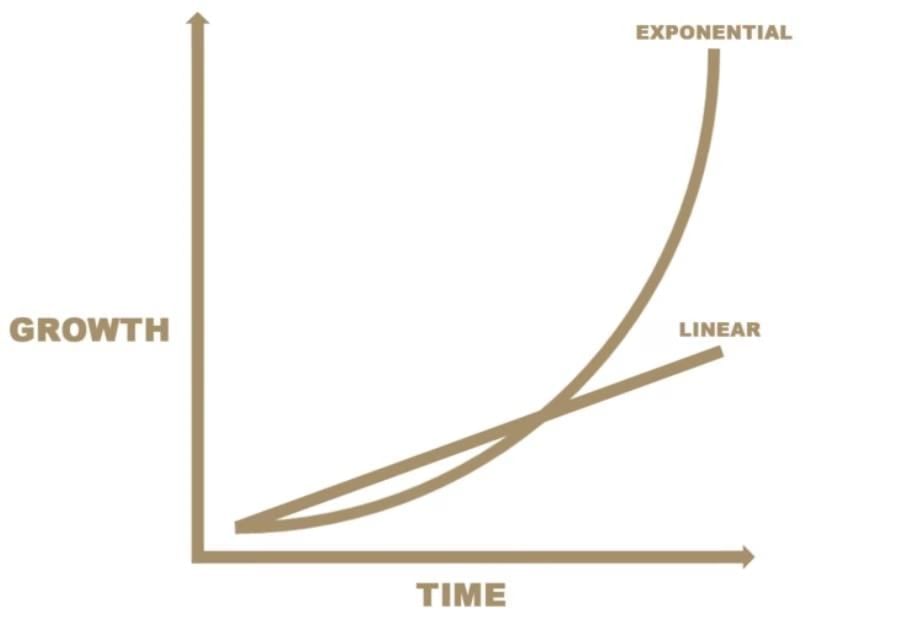
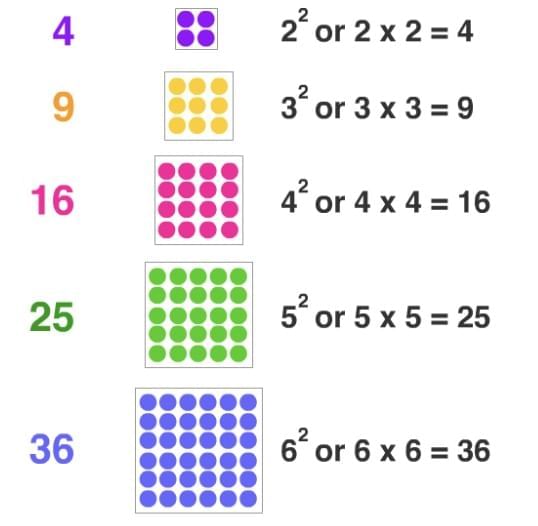 Squares of natural numbers = perfect squares.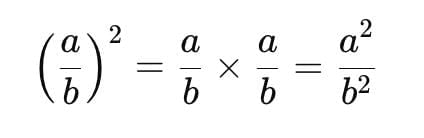
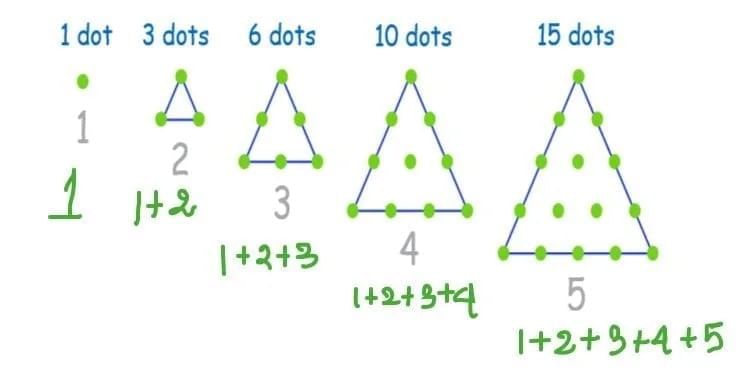 Sum of two consecutive triangular numbers = perfect square.
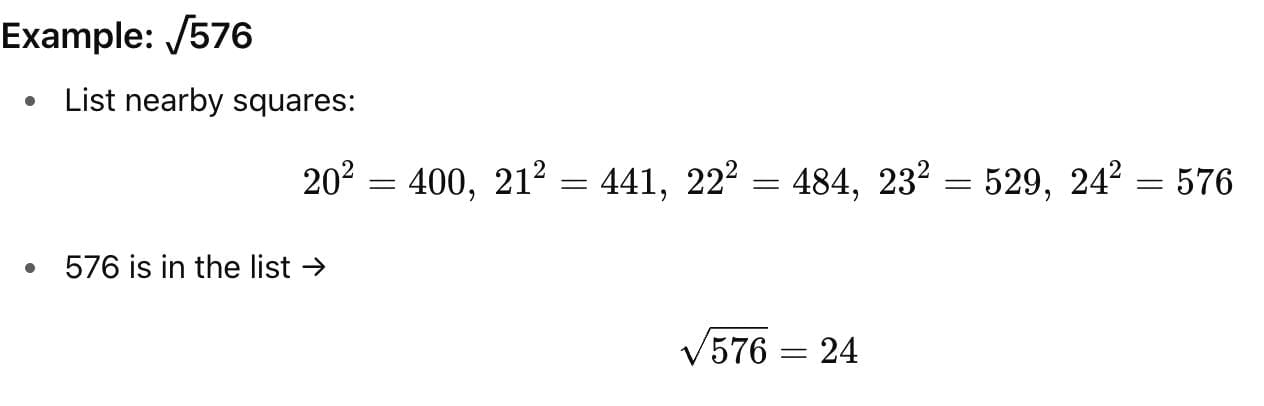 Listing Squares → compare with nearby perfect squares.
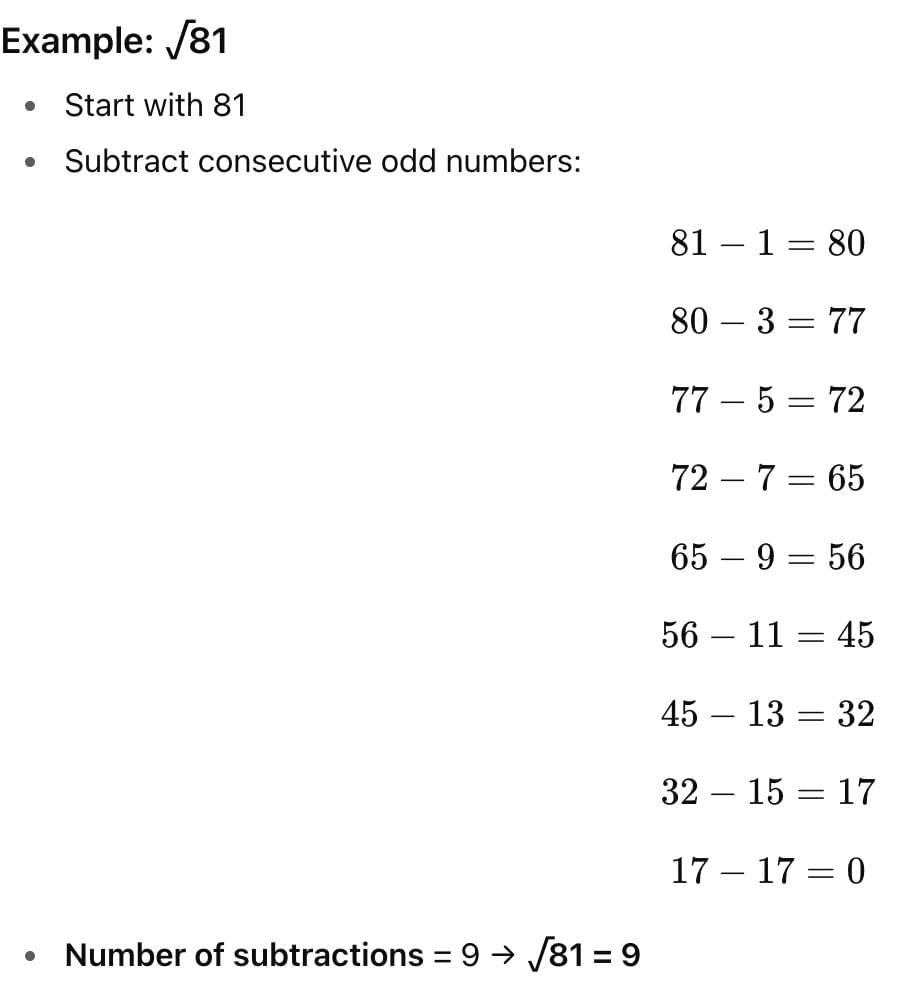 Successive Subtraction of Odd Numbers → subtract until 0.
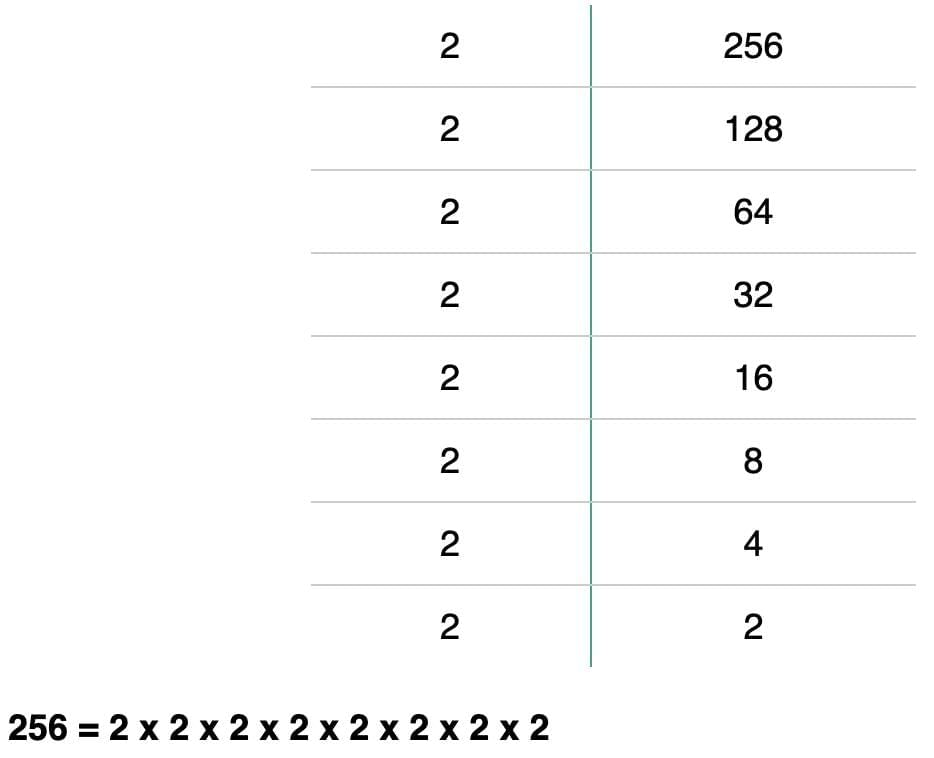 Example: 256 = 2⁸
 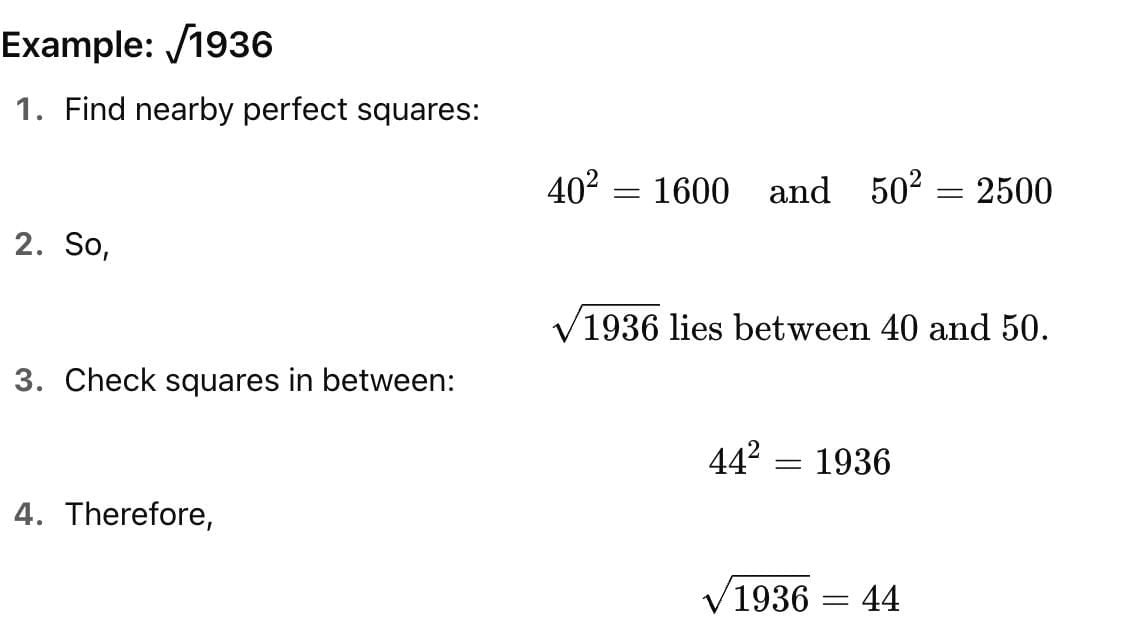 Estimation → use nearby perfect squares.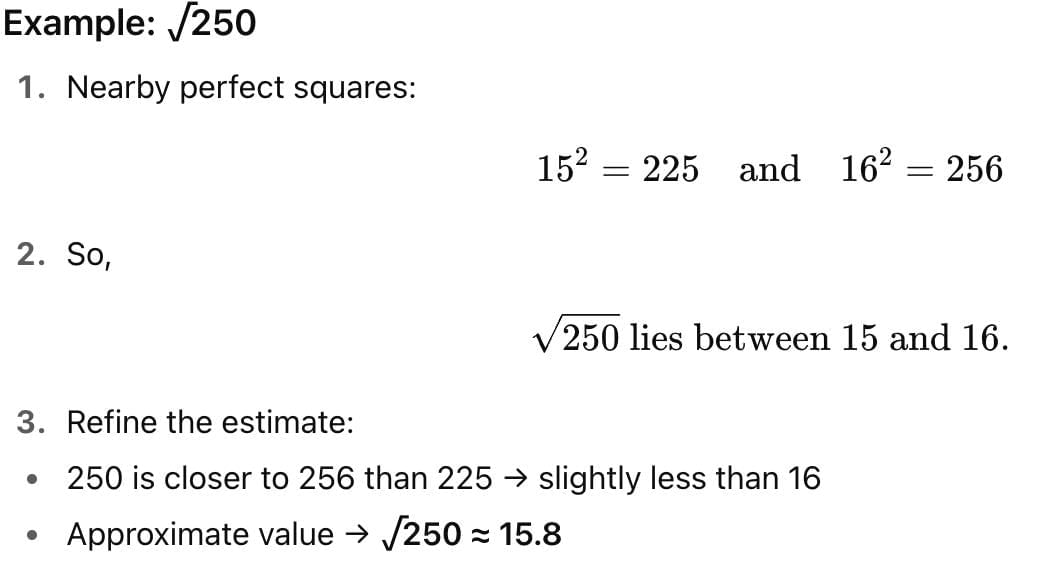
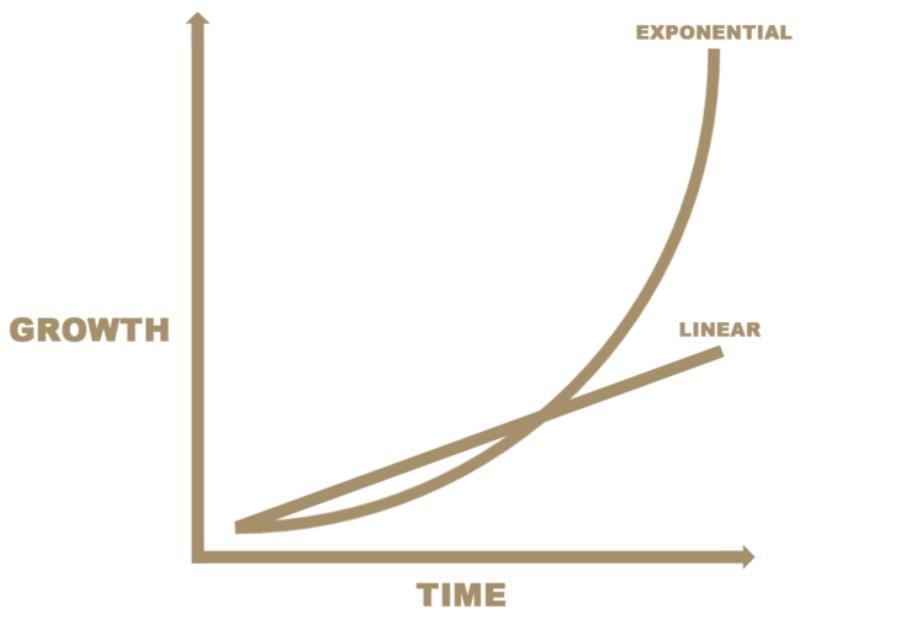
 Cubes grow faster than squares.
 Other examples: 4104, 13832.
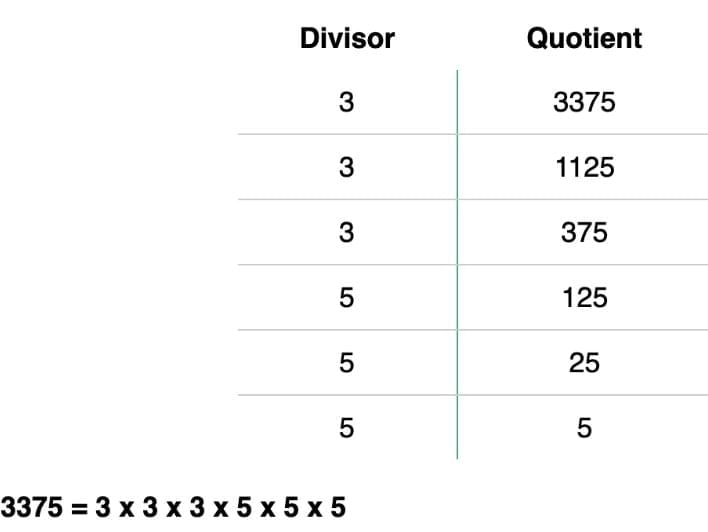 Example: 3375 = (3×3×3)(5×5×5) → ³√3375 = 15.
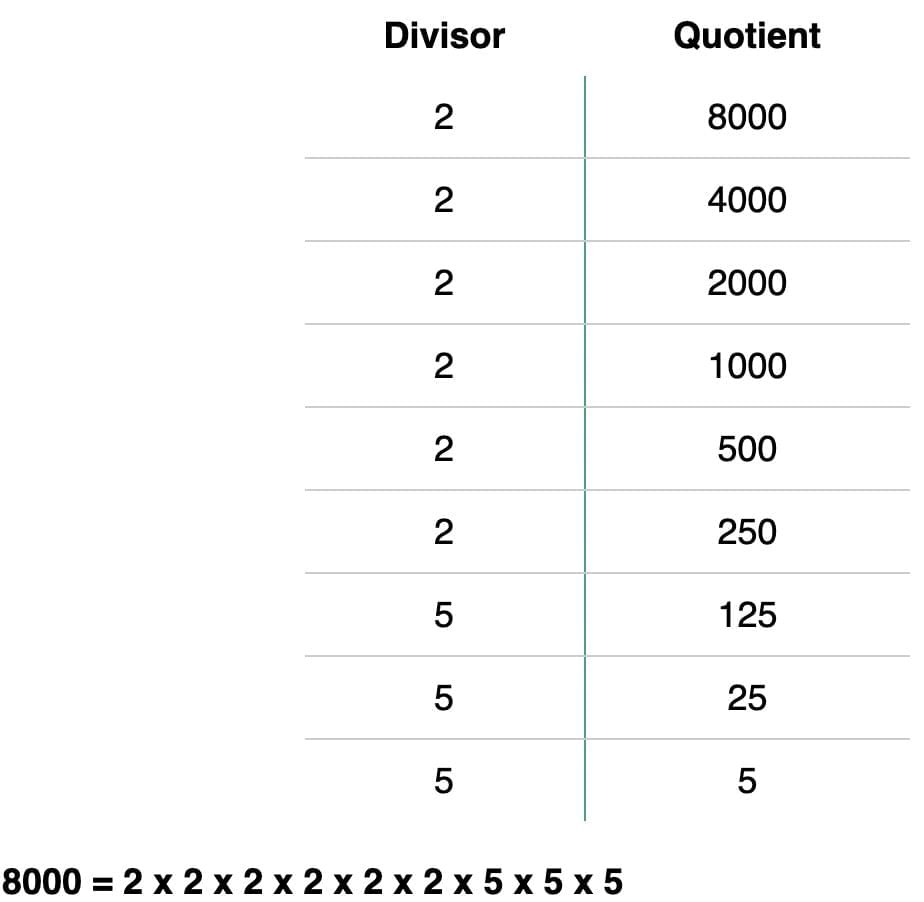 Example: ³√8000 = 20.8000 = (2×2×2) (2×2×2) (5×5×5)= 2×2×2 = 20.