The Big Questions
Q1: How did a land of diverse geographies, languages and religions come together to challenge and finally end nearly two centuries of British rule?
Ans: Despite India’s vast diversity of languages, faiths, and customs, people across the subcontinent were united by a shared experience of colonial exploitation – economic drain, racial discrimination, repressive laws (like the Arms Act and Rowlatt Act), and denial of political rights. This shared grievance was channelled through multiple, sometimes overlapping, movements: social reform movements that modernised Indian society; the Indian National Congress, which gradually shifted from seeking dialogue to demanding Purna Swaraj; mass programmes like Swadeshi, Boycott, Non-Cooperation, and Civil Disobedience that mobilised ordinary people, including peasants, workers, students, and women; revolutionary movements that used armed resistance; and cultural and religious symbols (like Vande Mataram and Bharat Mata) that fostered a shared sense of nationhood. Over nearly 90 years (1857-1947), this combination of ideas, sacrifice, and mass participation – along with external factors like Britain’s exhaustion after World War II and global decolonisation – finally forced the British to leave India.
Q2: What were the main developments and who were some important figures in India’s struggle for freedom?
Ans: Key developments include: the 1858 Royal Proclamation and continued colonial exploitation; 19th-century reform movements (Brahmo Samaj, Arya Samaj); the founding of the Indian National Congress (1885); the 1905 Partition of Bengal and the Swadeshi-Boycott movement; the founding of the All-India Muslim League (1906); the 1907 Surat Split between Moderates and Nationalists; revolutionary activities (Alipore Bomb Case, Ghadar Movement, Kakori Robbery); the Home Rule Movement; Gandhi’s Non-Cooperation Movement (1920-22); the Jallianwala Bagh Massacre (1919); the Khilafat Movement; the Purna Swaraj declaration (1929) and Civil Disobedience Movement (1930s), including the Salt March; the Government of India Act (1935); World War II and the Indian National Army under Subhas Chandra Bose; the Quit India Movement (1942); and finally Partition and Independence (1947). Important figures include Bal Gangadhar Tilak, Bipin Chandra Pal, Lala Lajpat Rai, Aurobindo Ghose, Mahatma Gandhi, Jawaharlal Nehru, Sardar Vallabhbhai Patel, Subhas Chandra Bose, Bhagat Singh, Muhammad Ali Jinnah, B.R. Ambedkar, Sarojini Naidu, and countless lesser-known freedom fighters, including many women and tribal leaders like Birsa Munda.
Q3: What issues did the leading freedom fighters agree or disagree upon?
Ans: While all freedom fighters agreed on the ultimate goal of freeing India from British rule, they disagreed sharply on methods and, at times, on the vision for independent India:
- Moderates vs. Nationalists: Moderates sought gradual reform and dialogue with the British; Nationalists demanded Swaraj and used mass boycott.
- Non-violence vs. Revolutionary violence: Gandhi’s satyagraha rejected violence, while revolutionaries like Bhagat Singh, Khudiram Bose, and the Ghadar Party believed armed resistance was necessary.
- Gandhi vs. Congress colleagues on Non-Cooperation: Many leaders, including Motilal Nehru, Jawaharlal Nehru, and Subhas Chandra Bose, disagreed with Gandhi’s decision to abruptly call off the Non-Cooperation Movement after Chauri Chaura.
- Ambedkar vs. Gandhi: Disagreed on separate electorates for the Depressed Classes, resolved through the Poona Pact.
- Congress vs. Muslim League: Disagreed on whether Hindus and Muslims formed one nation or two, a division that eventually led to Partition, though several Muslim leaders like Maulana Azad and Abdul Ghaffar Khan opposed the Two-Nation idea.
Let’s Explore
Page No – 38
Q1: Talk to your grandparents or elderly family members and find out what they remember or heard about India’s freedom struggle. Note which leaders or methods people supported. Discuss in class how, despite sharing the same goal of freedom, people followed different paths.
Ans: (Do it Yourself – activity) Students should interview elders, record which leaders (e.g., Gandhi, Bose, Bhagat Singh) or methods (nonviolence, revolutionary action) were remembered or admired in their family, and then discuss in class how, despite everyone wanting freedom, people were drawn to different approaches – some favouring Gandhi’s satyagraha, others supporting more radical or armed methods.
Q2: Below are the first two stanzas of the song. Can you make out some of their meaning? (referring to the first two stanzas of “Vande Mataram”)
Ans: (Do it Yourself – reflection) Broadly, the first stanza praises the motherland as being blessed with cool breezes, rich harvests, and abundant fruit and water, describing her as fertile and beautiful. The second stanza continues this praise, describing the moonlit nights, blossoming trees, sweet speech, and the mother who grants joy and blessings to her children. Overall, the song personifies India as a nurturing and beloved mother deserving devotion.
Page No – 43
Q3: How are the values expressed by Swami Vivekananda above relevant in the 21st century? Can some of them help you achieve your goals? Share your thoughts with your classmates.
Ans:(Do it Yourself – reflection) Swami Vivekananda’s call to overcome fear and self-doubt, and his motto “Arise, awake, and stop not till the goal is reached,” remain relevant today as messages of self-confidence, discipline, and perseverance. His encouragement to combine modern scientific progress with pride in one’s own cultural roots can inspire young people to pursue their goals – whether academic, personal, or professional – with both ambition and a sense of identity, without blindly copying others.
Page No – 50
Q4: Why do you think the Bande Mataram daily avoided using the word ‘independence’?
Ans: The daily likely avoided the word “independence” to escape immediate prosecution and censorship under repressive colonial press laws (like the Vernacular Press Act), while still conveying the same idea through less explicitly confrontational language such as “absolute national autonomy.” This allowed the paper to spread nationalist ideas without giving the British an easy legal pretext to shut it down immediately.
Q5: Comment on the phrase ‘absolute national autonomy’ in the above quotation from a Bande Mataram article.
Ans: “Absolute national autonomy” essentially meant complete self-rule or independence, even though the word “independence” was not directly used. It signalled that the movement’s real goal was not merely to reverse the Partition of Bengal, but to end British control over India entirely – a bold demand phrased carefully to avoid direct sedition charges.
Q6: Looking at the two boxes on either side of the daily’s title in Fig. 2.12, what do you observe?Ans: (Do it Yourself – observation based on the image) Students should note that one box is labelled “Swadeshi Paper of India” and the other “Our Policy: India for Indians,” reflecting the newspaper’s clear nationalist stance and its dedication to promoting India’s self-reliance and self-rule right from its masthead.
Page No – 52
Q7: In what ways are these two representations of Mother India similar or different?(referring to Abanindranath Tagore’s painting and the cover of Subramania Bharati’s Vijaya)
Ans: (Do it Yourself – comparison) Both representations personify India as a woman/mother figure, evoking devotion and reverence. Abanindranath Tagore’s painting shows a serene, spiritual, saffron-clad figure holding symbolic objects, giving it a calm, divine quality, while the Vijaya cover appears more overtly political/patriotic in its imagery. Both, however, share the common purpose of inspiring emotional attachment to the nation as a mother figure.
Q8: What details can you discern in the front cover of Subramania Bharati’s Vijaya?
Ans: (Do it Yourself – observation) Students should describe visual elements they notice, such as a map of India, patriotic or religious symbolism, and text referencing “Vande Mataram,” all combining to present India as a sacred motherland worthy of devotion and struggle.
Page No – 55
Q9: You may explore further and find out more about the freedom struggle in the North-East and known and lesser-known freedom fighters from this area.
Ans: (Do it Yourself – research activity) Students can research figures such as Tirot Sing (Khasi Revolt), Maniram Dewan, Piyali Baruah, Kanak Lata Baruah, Kushal Konwar, and Rani Gaidinliu, and present their findings on the region’s contribution to India’s freedom struggle.
Page No – 56
Q10: When the judge asked Tilak if he had anything to say after being sentenced, Tilak replied, “There are higher powers that rule the destinies of men and nations; and I think, it may be the will of Providence that the cause I represent may be benefited more by my suffering than by my pen and tongue.” What message do you think he was trying to convey?
Ans: Tilak was suggesting that his imprisonment and personal suffering would serve the nationalist cause even more powerfully than his writings or speeches could. He implied that his sacrifice would inspire and mobilise people more than words alone, showing his calm acceptance of punishment and his belief that a higher purpose was being served through his suffering.
Q11: On another occasion, Tilak famously declared, “Swaraj is my birthright and I shall have it.” What does this reveal about Tilak’s character?
Ans: This statement reveals Tilak’s unshakeable determination, self-confidence, and conviction that freedom was not a favour to be granted by the British but a natural right of Indians. It reflects his bold, uncompromising, and fearless character as a leader unwilling to settle for anything less than full self-rule.
Page No – 63
Q12: What does Tagore mean when he assumes that the colonial rulers ‘congratulated themselves’ after the Jallianwala Bagh massacre?
Ans: Tagore meant that the British authorities, instead of expressing remorse for the massacre, seemed to view their brutal show of force as a successful way of teaching Indians a “lesson” and reasserting control. He was criticising the rulers’ complete lack of empathy and their belief that such violent suppression would keep Indians obedient, when in reality it deepened resentment and united Indians against British rule.
Page No – 69
Q13: Form groups to analyse, compare and discuss the various elements or demands contained in the above resolution.(referring to the Purna Swaraj resolution passed at the Lahore session, 1929)
Ans: Students should identify the key elements of the resolution:
(1) the assertion that freedom is an “inalienable right” of the Indian people.
(2) the claim that people have the right to alter or abolish a government that oppresses them.
(3) the accusation that British rule had exploited India economically, politically, culturally, and spiritually.
(4) the final declaration that India must sever the British connection and attain complete independence (Purna Swaraj).
Groups can discuss how this resolution marked a clear ideological shift from earlier demands for dominion status to an uncompromising demand for full independence.
Think About It
Page No – 62
Q1: (Khadi spinning):Ans: Spinning khadi was far more than making cloth – it was a powerful symbol of Swadeshi and self-reliance. It provided employment and income for millions of impoverished villagers who could spin and weave cloth at home, directly reduced India’s dependence on British textile imports, and united people symbolically and economically in the struggle against foreign rule. Gandhi made the spinning wheel (charkha) a daily discipline and a national symbol of self-sufficiency.
Page No – 76
Q2: (Sacrifice numbers – Non-Cooperation, Salt Satyagraha, Civil Disobedience, Quit India):
Ans:(Class discussion) These figures – tens of thousands jailed during each movement and nearly 10,000 killed during the Quit India Movement alone – highlight the massive scale of collective sacrifice by ordinary Indians, not just well-known leaders. They show that the freedom struggle was sustained by the willingness of common people – students, workers, peasants, and women – to endure imprisonment, violence, and even death for the cause of independence.
Q3: (List of lesser-known freedom fighters):
Ans: (Do it Yourself – reflection and research) Students should recognise that history often remembers only a few prominent leaders, while thousands of other Indians – including many women and people from every region of the country – made equally important sacrifices. Students can research and add names of freedom fighters from their own region or community, and reflect on the often-overlooked contributions of women who supported freedom fighters within their families.
Questions and Activities
(The following are suggested activities to choose from, as presented in the textbook.)
True or False
1. Right from its inception, the Indian National Congress called for India’s independence.
Ans: False. The early Congress expressed full faith in the “providential character” of British rule and sought greater Indian participation in governance through dialogue, not outright independence.
2. Bal Gangadhar Tilak turned a Shivaji festival into a popular event.
Ans: True. Tilak turned both the Ganesh Chaturthi and the Shivaji festival into popular nationalist events using religious and patriotic symbols.
3. The Ghadar Movement of 1914-15 aimed to start a mutiny within the British Indian Army while British troops were busy with World War I.
Ans: True.
4. Vallabhbhai Patel earned the title ‘Sardar’ for his leadership during the Satyagraha agitation in Gujarat.
Ans: True. He earned it for leading the successful Bardoli movement (1928) for peasant rights.
5. The Kakori train robbery of 1925 was carried out to fund the activities of the Hindustan Republican Association.
Ans: True.
6. The ‘Do or Die’ call was given by Mahatma Gandhi during the Non-Cooperation Movement in 1920.
Ans: False. The “Do or Die” call was given during the Quit India Movement in August 1942, not the Non-Cooperation Movement.
7. B.R. Ambedkar and Gandhi were in total agreement regarding the issue of ‘separate electorates’ for Dalits.
Ans: False. They disagreed – Ambedkar wanted separate electorates, while Gandhi opposed them, fearing they would divide Hindu society; the disagreement was resolved through the Poona Pact.
8. Sir Stafford Cripps was sent to India in 1942 because Winston Churchill supported immediate independence for India.
Ans: False. Cripps was sent to seek India’s support for the war effort by offering dominion status only after the war ended, not immediate independence.
9. Subhas Chandra Bose raised an army during his stay in Germany.
Ans: False. In Germany he sought support from anti-British forces; he actually formed the Indian National Army later, in Singapore in 1943, from Indian prisoners of war and volunteers.
10. The Radcliffe Line, which divided India and Pakistan, was announced a few weeks before Independence Day.
Ans: True.
Who Am I?
1. Known as the ‘Lion of Punjab’, I was severely injured during a brutal lathi charge while protesting against the Simon Commission.
Ans: Lala Lajpat Rai
2. I famously declared, ‘Swaraj is my birthright, and I shall have it!’ I used the Kesari newspaper and festivals like Ganesh Chaturthi to unite people against British rule.
Ans: Bal Gangadhar Tilak
3. I was a leader of the Nationalist faction of the Congress. In the daily Bande Mataram, I wrote on the need for India to attain absolute autonomy.
Ans: Aurobindo Ghose (Sri Aurobindo)
4. I earned my nickname ‘Bagha’ after wrestling a tiger with my bare hands. I was a revolutionary leader who died in a gunfight at while waiting for a shipment of German arms to start an uprising.Ans: Jatin Mukherjee (Bagha Jatin)
5. I organised the daring attempt to throw a bomb at the Viceroy in 1912. I later escaped to Japan, where I spent years working to organise a movement from there.
Ans: Rash Behari Bose
6. I was martyred at a young age after an attempt on the life of a British judge.
Ans: Khudiram Bose
7. I was martyred at a young age after throwing non-lethal bombs in Delhi’s Central Legislative Assembly.
Ans: Bhagat Singh
8. I turned the freedom struggle into a mass movement through the principles of ahimsa and satyagraha, leading campaigns such as the Dandi March.
Ans: Mahatma Gandhi
9. I sought help from the Axis powers during World War II to organise the Indian National Army.
Ans: Subhas Chandra Bose
10. A British lawyer, I was given just five weeks to draw the boundary line that would partition the Indian subcontinent into two separate nations.
Ans: Cyril Radcliffe
Reflective and Activity-Based Questions
Q1: What kinds of sacrifices are needed to achieve freedom? Think about the lives of Indian soldiers during wars, families suffering during famines, leaders and ordinary people who were arrested, and countless others who lost their homes and safety while participating in protests. If you were living during India’s freedom struggle, would you have chosen to participate in it? What comforts, opportunities, or personal goals might you have been willing to give up for a cause you strongly believed in?
Ans: (Do it Yourself – personal reflection) Achieving freedom required sacrifices such as loss of life, imprisonment, physical suffering (lathi charges, hunger strikes, torture in jails like the Cellular Jail), loss of property and homes, separation from families, and giving up careers, education, and personal comfort. Students should reflect personally on whether they would have participated, and what they might have been willing to sacrifice – such as safety, education, family time, or material comforts – for a cause they believed in.
Q2: What values does Tilak’s statement, “Swaraj is my birthright and I shall have it,” reflect? Can these values be meaningful for young people today?
Ans: This statement reflects courage, self-respect, determination, and an unwavering belief in one’s rights. These values remain meaningful today, encouraging young people to stand up confidently for what they believe is just and to pursue their goals with conviction, rather than passively accepting an unfair situation.
Q3: How did peasants, workers, tribals, and students contribute to the national movement in ways different from political leaders?
Ans: While political leaders devised strategies, wrote resolutions, and gave speeches, peasants, workers, tribals, and students contributed through direct, grassroots action: peasants like those in Champaran and Kheda resisted exploitative taxes and practices; workers participated in strikes (as during Quit India); tribals like Birsa Munda’s followers rose in armed resistance to protect their land and rights; and students boycotted schools and colleges, participated in processions, and, in some cases, joined revolutionary activities. Their contribution lay in mass, on-the-ground participation and personal sacrifice, which gave the movement its true strength as a people’s struggle rather than one confined to elite leadership.
Q4: Discuss in class this extract from Nehru’s speech on 15 August 1947:
“Long years ago we made a tryst with destiny, and now the time comes when we shall redeem our pledge, not wholly or in full measure, but very substantially. At the stroke of the midnight hour, when the world sleeps, India will awake to life and freedom. A moment comes, which comes but rarely in history, when we step out from the old to the new, when an age ends, and when the soul of a nation, long suppressed, finds utterance…”
What is meant by “redeem our pledge”? How would you define the ‘soul of a nation’?
Ans: (Class discussion) “Redeem our pledge” refers to fulfilling the promise of freedom that had been the goal of the long struggle – the “tryst with destiny” made through decades of sacrifice. The “soul of a nation” can be understood as the collective spirit, identity, and aspirations of its people – their shared culture, values, and desire for self-determination – which had been suppressed under colonial rule and was now finding expression through independence.
Q5: Imagine you are a freedom fighter.
(a) Explain the method you support to achieve freedom.
Ans: I would support Gandhiji’s method of non-violence and Satyagraha. I would participate in peaceful protests, boycott foreign goods, promote Swadeshi, and encourage people to unite against British rule. Satyagraha was based on truth, non-violence and accepting suffering for a just cause.
(b) Discuss with your classmates any other method they would support. Be respectful in your debate.
Ans: Some classmates might support the Nationalist method of Swaraj, Swadeshi and boycott, while others might support the revolutionary approach of using stronger actions against British rule. We should listen respectfully to their views because different freedom fighters also followed different paths towards the same goal.
(c) What does this debate teach us about unity and disagreement?
Ans: The debate teaches us that people can disagree about methods but still remain united by a common goal. India’s freedom struggle had many different approaches, yet it became a collective struggle. We should respect different opinions while working together for a common purpose.
Q6: Write a news report based on an important event in the Freedom Movement (Swadeshi, boycott, satyagraha, Non-Cooperation, Quit India, or Partition).
(a) Write a headline.
Ans: Headline: “Quit India Movement Launched: Indians Demand Freedom”
(b) Include one interview or public reaction.
Ans: A participant in the movement said, “We want the British to leave India and give our country freedom. We are ready to face difficulties for this cause.”
(c) Explain why this event was important.
Ans: The Quit India Movement was launched in 1942 after the failure of the Cripps Mission. It became an important mass movement against British rule. Many people participated, and the British government responded with mass arrests and repression. The movement showed the strong determination of Indians to achieve freedom.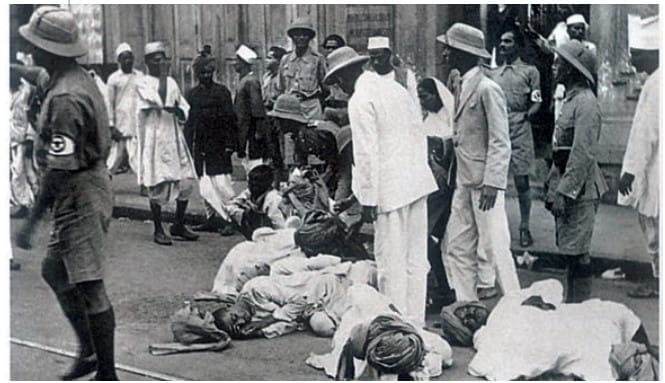 Quit India Movement
Q7: Imagine you are part of a team creating a small museum exhibition on India’s freedom struggle for students of your age.
(a) Choose a title for your exhibit.
Ans: Title of the Exhibit: “India’s Journey to Freedom”
(b) Select three objects and explain what each object represents.
Ans: Three Objects and What They Represent:(c) Write a short note on what visitors should learn or feel after seeing this exhibit.
Ans: Visitors should learn that India’s freedom was the result of a long and collective struggle involving people from different backgrounds and different approaches. They should feel proud of the courage and sacrifices of the freedom fighters and understand the importance of unity, courage and responsibility in protecting freedom.
Q8: As a class activity, write and stage a small play or skit based on the Freedom Movement.
Ans: (Do it Yourself – group activity) Students should collaboratively write and perform a short skit dramatising an event or figure from the chapter, such as the Salt March, the Jallianwala Bagh Massacre, or the story of a revolutionary.
Q9: India achieved freedom after great sacrifice. What responsibilities do citizens have today to protect and strengthen this freedom? Write 5 to 10 lines.
Ans: (Sample answer) Citizens today have a responsibility to value and safeguard the freedom won through immense sacrifice. This includes respecting the Constitution and democratic institutions, exercising the right to vote responsibly, promoting communal harmony and unity in a diverse society, standing against corruption and injustice, and contributing constructively to national development. Citizens must also remember the sacrifices of freedom fighters by staying informed and engaged, working towards equality and justice for all sections of society, and ensuring that democratic freedoms are neither taken for granted nor misused. Ultimately, protecting freedom means actively participating in nation-building rather than being passive beneficiaries of it.