Q.1. Fill in the blank (i) When a ball is thrown upwards, ________ energy is transformed into ________ energy. (ii) The sum of the potential and kinetic energies of a body is called ________ energy. (iii) Work is measured as a product of ________ and _________. (iv) The electricity meter installed in our home measures electric energy in the units of ______. (v) The work done on a body moving in a circular path is ___________.
Q.2. How are Joule (J) and ergs (erg) related? (a) 1J = 107erg (b) 1erg = 107J (c) 1J = 10–7erg (d) None
Q.3. If the force is applied at an angle θ then work done is (a) W = FS Cos θ F = Force (b) W = FS θ S = Distance (c) W = FS Sin θ W = work (d) None
Q.4. If a body is stored at a height ‘h’ then it will posses: (a) Kinetic energy (b) Potential energy (c) Both (d) None
Q.5. If the body starts from rest, then change in its kinetic energy is (a) Positive (b) Negative (c) Zero (d) May be Positive or negative depending upon the mass of the body
Q.6. When do we say that work is done?
Q.7. Define 1 J of work.
Q.8. What is the kinetic energy of an object?
Q.9. What is power?
Q.10. An object thrown at a certain angle to the ground moves in a curved path and falls back to the ground. The initial and the final points of the path of the object lie on the same horizontal line. What is the work done by the force of gravity on the object?
Q.11. Illustrate the law of conservation of energy by discussing the energy changes which occur when we draw a pendulum bob to one side and allow it to oscillate. Why does the bob eventually come to rest? What happens to its energy eventually? Is it a violation of the law of conservation of energy?
Q.12. Define average power.
Q.13. In each of the following a force, F is acting on an object of mass, m. The direction of displacement is from west to east shown by the longer arrow. Observe the diagrams carefully and state whether the work done by the force is negative, positive or zero.
Q.14. Define 1 watt of power.
Q.15. A battery lights a bulb. Describe the energy changes involved in the process.
Q1: If the area of an object is less than the pressure acting on that object will be (a) Less (b) More (c) Independent of area (d) None of the above Ans: (b) Explanation: Pressure is defined as force divided by area (P = F / A). For a given force, if the area decreases the value of P increases. Therefore, when the area is smaller, the pressure on the object is greater.
Q2: Even though stone also attracts earth towards itself, earth does not move (a) Because of greater mass of earth (b) Because of lesser mass of stone (c) Force exerted by stone is less (d) Force exerted earth is large Ans: (a) Explanation: The stone and Earth attract each other with equal forces (Newton’s third law). However, acceleration = force/mass. Because the Earth has a very large mass, the acceleration produced in Earth by the stone’s pull is extremely small and thus not noticeable.
Q3: Which of the statements is correct? (a) Mass is constant and weight is variable (b) Mass is variable and weight is constant. (c) Both Mass and weight are variable (d) Both Mass and weight are constant. Ans: (a) Explanation: Mass is an intrinsic property of matter and does not change with location. Weight is the force due to gravity on that mass (W = mg) and depends on the local gravitational acceleration g, so weight can change with place (for example, on the Moon or at different heights).
Q4: Weight of the object is: (a) More at the equator and less at poles (b) More at poles and less at equator (c) Same at poles and equator (d) Depend on Mass of the object Ans: (b) Explanation: Effective weight depends on local gravitational acceleration. Two factors make weight slightly greater at the poles than at the equator: (i) centrifugal effect of Earth’s rotation reduces apparent gravity at the equator, and (ii) Earth is slightly flattened at the poles which affects g. Hence weight is more at the poles and less at the equator for the same mass.
Q5: An object is put one by one in three liquids having different densities. The object floats with 1/9, 2/11 and 3/7 parts of their volumes outside the liquid surface in liquids of densities d1, d2 and d3respectively. Which of the following statement is correct? (a) d1 > d2 > d3 (b) d1 > d2 < d3 (c) d1 < d2 > d3 (d) d1 < d2 < d3 Ans: (a) Explanation: If a fraction fout of volume is outside, the submerged fraction is 1 – fout. The submerged fraction is proportional to the liquid’s density (for the same object). Submerged fractions here are 8/9 (≈0.889), 9/11 (≈0.818), and 4/7 (≈0.571). These numbers show d1 > d2 > d3, so option (a) is correct.
Q6: In the relation F = GM mld2, the quantity G (a) depends on the value ofg at the place of observation (b) is used only when the Earth is one of the two masses (c) is greatest at the surface of the Earth (d) is universal constant of nature Ans: (d) Explanation: G is the universal gravitational constant. Its value does not depend on location, nor on the masses involved. It is the same for all pairs of masses anywhere in the universe.
Q7: Law of gravitation gives the gravitational force between (a) the Earth and a point mass only (b) the Earth and Sun only (c) any two bodies having some mass (d) two charged bodies only Ans: (c) Explanation: Newton’s law of universal gravitation applies to any two masses anywhere: it gives the mutual gravitational force between any pair of masses, not only Earth-related pairs.
Q8: The value of quantity G in the law of gravitation (a) depends on mass of Earth only (b) depends on radius of Earth only (c) depends on both mass and radius of Earth (d) is independent of mass and radius of the Earth Ans: (d) Explanation: The universal constant G is independent of the properties of Earth or any other body. It is a fundamental constant of nature and has the same value everywhere.
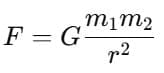
Q9: Two particles are placed at some distance. If the mass of each of the two particles is doubled, keeping the distance between them unchanged, the value of gravitational force between them will be (a) 1/4 times (b) 4 times (c) 1/2 times (d) unchanged Ans: (b) Explanation: Gravitational force If both masses are doubled, the product m1 × m2 becomes 4 times larger, so the force becomes 4 times the original.
Q10: The atmosphere is held to the Earth by (a) gravity (b) wind (c) clouds (d) Earth’s magnetic field Ans: (a) Explanation: The atmosphere is retained around the Earth because of Earth’s gravitational attraction on air molecules. Wind or clouds do not hold the atmosphere; Earth’s magnetic field affects charged particles but not the neutral gases of the atmosphere.
Fill in the blank
(i) The value of g on the earth is about Six times of that on the moon. (ii) In fluids (liquids and gases), pressure acts in All directions, and pressure increases as the depth increases. (iii) If the area of a snow shoe is five times Bigger than the area of an ordinary shoe, then the pressure of a snow shoe on the snow is five times smaller. (iv) Force acting on a unit area is called Pressure. (v) The weight of an object on the earth is about Six times of its weight on the moon.
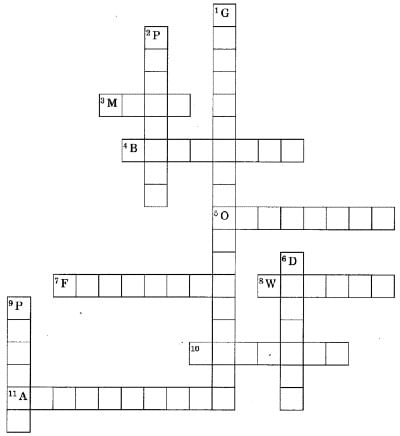
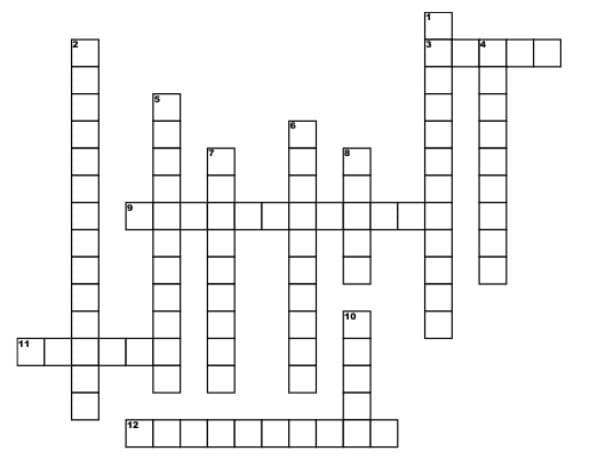
Crossword
Across
3. Quantity of matter contained in a body 4. The property due to which a body immersed in fluid experiences upward force. 5. Acceleration due to gravity of moon is how much time that of Earth 7. Whenever objects fall towards the Earth under gravitational force alone, we say that objects are in 8. The force with which a body is attracted towards the Earth 10. Force of gravitation due to Earth is called 11. Nature of gravitational force is always
Down
1. Force between two bodies due to their masses 2. Thrust on unit area 6. Mass per unit volume 9. SI unit of pressure
Ans:
Across: 3. Mass 4. Buoyancy 5. One sixth 7. Free fall 8. Weight 10. Gravity 11. Attractive
Down: 1. Gravitational force 2. Pressure 6. Density 9. Pascal
Very Short Answer Questions
Q1: A man of mass 60 Kg is standing on the floor holding a stone weighing 40 N. What is the force with which the floor is pushing him up? Ans: The gravitational pull on the man = Mg = 60 × 10 = 600 N The weight he is carrying (stone) = 40 N Total downward force on the floor = 600 N + 40 N = 640 N By Newton’s third law and equilibrium, the floor pushes the man upward with a force of 640 N.
Q2: State Archimedes Principle? Ans: According to Archimedes’ principle, when a body is partially or completely immersed in a fluid, it experiences an upthrust (buoyant force) equal to the weight of the fluid displaced by the body.
Q3: Why does a block of plastic released under water come up to the surface of water? Ans: The density of the plastic is less than the density of water. Therefore the buoyant force on the plastic (which depends on the fluid displaced) is greater than the weight of the plastic, and the net upward force makes the block rise to the surface and float.
Q4: Why will a sheet of paper fall slower than one that is crumpled into a ball? Ans: A flat sheet of paper has a much larger surface area facing the air, so it experiences greater air resistance (drag). This larger opposing force slows its fall. A crumpled ball has a smaller area and encounters less air resistance, so it falls faster.
Q5: Why is it difficult to hold a schoolbag having a strap made of a thin and strong string? Ans: A thin strap concentrates the bag’s weight on a small area of the shoulder. Pressure = force / area, so a smaller contact area gives a larger pressure on the shoulder, which feels painful and makes it difficult to hold.
Q6: What makes a body to float or sink in a liquid? Ans:
When an object is immersed in a liquid, it experiences its weight acting downward and an upthrust (buoyant force) from the liquid acting upward.
If the weight of the body is greater than the upthrust, the object sinks.
If the weight of the body is less than the upthrust, the object floats.
If the weight equals the upthrust, the object remains neutrally buoyant (suspends at that depth).
Q7: What is the importance of universal law of gravitation? The universal law of gravitation is important due to the following: Ans:
This law explains why objects stay on Earth – the force that binds us to Earth.
It describes the motion of planets around the Sun and satellites around planets.
It accounts for the tides on Earth caused by the gravitational pull of the Moon and Sun.
It explains why the Moon moves around the Earth under gravitational attraction.
Q8: What happens to the force between two objects, if (i) The mass of one object is doubled? (ii) The distance between the objects is doubled and tripled? (iii) The masses of both objects are doubled? Ans:
(i) The force between two objects will be doubled (force ∝ product of masses). (ii) If distance is doubled, force becomes 1/4 of the original (since force ∝ 1 / r2). If distance is tripled, force becomes 1/9 of the original. (iii) If both masses are doubled, the force becomes 4 times the original (product of masses increases by 4).
Q9: State the universal law of gravitation. According to Newton’s universal law of gravitation: Ans: Every mass in the universe attracts every other mass with a force that is directly proportional to the product of their masses and inversely proportional to the square of the distance between their centres.
Q10: What do you mean by buoyancy? Ans: Buoyancy (or upthrust) is the upward force experienced by an object when it is wholly or partially immersed in a fluid. It equals the weight of the fluid displaced by the object.
Q1: If the area of an object is less than the pressure acting on that object will be (a) Less (b) More (c) Independent of area (d) None of the above
Q2: Even though stone also attracts earth towards itself, earth does not move (a) Because of greater mass of earth (b) Because of lesser mass of stone (c) Force exerted by stone is less (d) Force exerted earth is large
Q3: Which of the statements is correct? (a) Mass is constant and weight is variable (b) Mass is variable and weight is constant. (c) Both Mass and weight are variable (d) Both Mass and weight are constant.
Q4: Weight of the object is: (a) More at the equator and less at poles (b) More at poles and less at equator (c) Same at poles and equator (d) Depend on Mass of the object
Q5: An object is put one by one in three liquids having different densities. The object floats with 1/9, 2/11 and 3/7 parts of their volumes outside the liquid surface in liquids of densities d1, d2 and d3respectively. Which of the following statement is correct? (a) d1 > d2 > d3 (b) d1 > d2 < d3 (c) d1 < d2 > d3 (d) d1 < d2 < d3
Q6: In the relation F = GM mld2, the quantity G (a) depends on the value ofg at the place of observation (b) is used only when the Earth is one of the two masses (c) is greatest at the surface of the Earth (d) is universal constant of nature
Q7: Law of gravitation gives the gravitational force between (a) the Earth and a point mass only (b) the Earth and Sun only (c) any two bodies having some mass (d) two charged bodies only
Q8: The value of quantity G in the law of gravitation (a) depends on mass of Earth only (b) depends on radius of Earth only (c) depends on both mass and radius of Earth (d) is independent of mass and radius of the Earth
Q9: Two particles are placed at some distance. If the mass of each of the two particles is doubled, keeping the distance between them unchanged, the value of gravitational force between them will be (a) 1/4 times (b) 4 times (c) 1/2 times (d) unchanged
Q10: The atmosphere is held to the Earth by (a) gravity (b) wind (c) clouds (d) Earth’s magnetic field
Fill in the blank
(i) The value of g on the earth is about _________ of that on the moon. (ii) In fluids (liquids and gases), pressure acts in ____________ directions, and pressure ________ as the depth increases. (iii) If the area of a snow shoe is five times ________ than the area of an ordinary shoe, then the pressure of a snow shoe on the snow is five times __________. (iv) Force acting on a unit area is called __________. (v) The weight of an object on the earth is about __________ of its weight on the moon.
Crossword
Across
3. Quantity of matter contained in a body 4. The property due to which a body immersed in fluid experiences upward force. 5. Acceleration due to gravity of moon is how much time that of Earth 7. Whenever objects fall towards the Earth under gravitational force alone, we say that objects are in 8. The force with which a body is attracted towards the Earth 10. Force of gravitation due to Earth is called 11. Nature of gravitational force is always
Down
1. Force between two bodies due to their masses 2. Thrust on unit area 6. Mass per unit volume 9. SI unit of pressure
Very Short Answer Questions
Q1: A man of mass 60 Kg is standing on the floor holding a stone weighing 40 N. What is the force with which the floor is pushing him up? Q2: State Archimedes Principle? Q3: Why does a block of plastic released under water come up to the surface of water? Q4: Why will a sheet of paper fall slower than one that is crumpled into a ball? Q5: Why is it difficult to hold a schoolbag having a strap made of a thin and strong string? Q6: What makes a body to float or sink in a liquid? Q7: What is the importance of universal law of gravitation? Q8: What happens to the force between two objects, if (i) the mass of one object is doubled? (ii) the distance between the objects is doubled and tripled? (iii) the masses of both objects are doubled? Q9: State the universal law of gravitation. Q10: What do you mean by buoyancy?
Q1. The inability of the body to change its state of rest or motion is:
Ans: The inability of a body to change its state of rest or motion is known as inertia. This property means that an object will resist changes to its motion, whether it is at rest or moving at a constant speed.
Key points about inertia:
Objects remain in their current state unless acted upon by an external force.
Inertia explains why we continue moving forward in a car when it suddenly stops; our bodies want to maintain their state of motion.
The more massive an object, the greater its inertia. For example, a train has more inertia than a small cart.
Inertia is quantitatively measured by an object’s mass, with the SI unit being kilograms (kg).
In summary, inertia is the natural tendency of objects to resist changes in their state of motion or rest, and it is a fundamental concept in understanding motion.
Q2. A batsman hits a cricket ball which then rolls on a level ground. After covering a short distance, the ball comes to rest. The ball slows to a stop because
(a) the batsman did not hit the ball hard enough. (b) velocity is proportional to the force exerted on the ball. (c) there is a force on the ball opposing the motion. (d) there is no unbalanced force on the ball, so the ball would want to come to rest.
Ans: Correct Answer is Option (c)
The cricket ball comes to rest because:
There is a force acting on it that opposes its motion.
This opposing force is typically friction between the ball and the ground.
As a result, the ball slows down and eventually stops.
Q3. An object experiences a net zero external unbalanced force. Is it possible for the object to be travelling with a non-zero velocity? If yes, state the conditions that must be placed on the magnitude and direction of the velocity. If no, provide a reason.
Ans: No, it is not possible for an object to travel with a non-zero velocity if it experiences a net zero external unbalanced force. This is because:
Unbalanced forces cannot equal zero.
If the net force is zero, the object will either remain at rest or continue moving at a constant velocity.
To change the object’s speed or direction, an unbalanced force must be applied.
Q4. Why do you fall in the forward direction when a moving bus brakes to a stop and fall backwards when it accelerates from rest?
Ans: When a moving bus brakes to a stop, we fall forward due to our body’s inertia. Here’s how it works:
We are initially moving at the same speed as the bus.
When the bus suddenly stops, the lower half of our body comes to rest.
The upper half, however, continues moving forward because it is not in close contact with the bus.
Conversely, when the bus accelerates from rest:
We start off at rest, seated in the bus.
As the bus moves forward, our feet are pushed along with it.
The upper part of our body tends to remain still due to inertia, causing us to fall backwards.
Q5. Explain why some of the leaves may get detached from a tree if we vigorously shake its branch.
Ans: Some leaves may detach from a tree when its branch is vigorously shaken due to the principle of inertia. This occurs because:
When the branch moves, the leaves tend to stay in their original position.
This resistance to change causes some leaves to fall off as the branch shakes.
In summary, the shaking motion does not affect all leaves equally, leading to detachment.
Q6. Why is it advised to tie any luggage kept on the roof of a bus with a rope?
Ans: It is important to tie luggage on the roof of a bus with a rope for safety reasons. Here are the key points:
When the bus moves, the luggage moves with it at the same speed and direction.
If the bus suddenly changes direction or slows down, the luggage continues moving due to its inertia.
This inertia can cause the luggage to slide off the roof, potentially leading to accidents.
Therefore, securing luggage with a rope helps prevent it from being thrown off during travel.
Q7. Why are the passengers sitting in a moving bus pushed in the forward direction when the bus stops suddenly?
Ans: The passengers in a moving bus are pushed forward when the bus stops suddenly due to inertia. Here’s how it works:
As the bus comes to a stop, the passengers’ feet also stop.
However, the upper part of their bodies continues to move forward because of inertia.
This difference in motion causes them to fall forward.
Q8. State Newton’s first law of Motion?
Ans: Newton’s first law of motion states that:
An object at rest will remain at rest.
An object in motion will continue moving in a straight line at a constant speed.
This continues until an external force acts on it.
This principle is known as inertia, which describes the tendency of objects to resist changes in their state of motion.
For example, when a car suddenly brakes, passengers feel a jolt forward because their bodies want to maintain their state of motion due to inertia.
In summary, the first law highlights that:
Objects resist changes in motion.
The mass of an object is a measure of its inertia.
Q9. Define force and what are the various types of forces?
Ans: Force is a push or pull that can change the state or shape of an object. It can:
Make an object move faster or slower.
Change the direction of an object’s motion.
Alter the shape and size of objects.
The main types of forces include:
Gravitational force: Attracts objects towards each other.
Electrostatic force: Acts between charged particles.
Electromagnetic force: Influences charged particles in motion.
Nuclear force: Holds protons and neutrons together in an atom’s nucleus.
Q10. State Newton’s second law of motion?
Ans: Newton’s second law of motion states that:
The rate of change of momentum of an object is proportional to the unbalanced force acting on it.
This change in momentum occurs in the same direction as the applied force.
The formula for this law can be expressed as:
F = ma, where:
F is the force applied,
m is the mass of the object, and
a is the acceleration produced.
The unit of force is the newton (N), which is defined as the force required to accelerate a 1 kg mass by 1 m/s².
Q11. When a carpet is beaten with a stick, dust comes out of it. Explain.
Ans: When a carpet is beaten with a stick, dust comes out because:
The carpet fibres vibrate back and forth.
Dust particles that are loosely bound remain at rest due to inertia.
As the carpet moves, these particles are dislodged and come out.
Q.1. Fill in the blanks (i) When a running car stops suddenly, the passengers are jerked ___________. (ii) In collisions and explosions, the total _________ remains constant, provided that no external ___________ acts. (iii) If there were no unbalanced force of ___________ and no _________ resistance, a moving bicycle would go on moving for ever. (iv) When a stationary car starts suddenly, the passengers are jerked ___________. (v) To every action, there is an ___________ and __________ reaction.
Q.2. The inability of the body to change its state of rest or motion is :- (a) Momentum (b) Force (c) Inertia (d) Acceleration.
Q.3. The S.I. unit of weight is: (a) Newton (b) Newton m (c) Newton/sec (d) Newton m/s
Q.4. A batsman hits a cricket ball which then rolls on a level ground. After covering a short distance, the ball comes to rest. The ball slows to a stop because (a) the batsman did not hit the ball hard enough. (b) velocity is proportional to the force exerted on the ball. (c) there is a force on the ball opposing the motion. (d) there is no unbalanced force on the ball, so the ball would want to come to rest.
Q.5. If the initial velocity is zero then the force acting is :- (a) Retarding (b) Acceleration (c) Both (d) None.
Q.6. An object experiences a net zero external unbalanced force. Is it possible for the object to be travelling with a non-zero velocity? If yes, state the conditions that must be placed on the magnitude and direction of the velocity. If no, provide a reason.
Q.7. Why do you fall in the forward direction when a moving bus brakes to a stop and fall backwards when it accelerates from rest?
Q.8. Why is the weight of the object more at the poles than at the equator?
Q.9. Explain why some of the leaves may get detached from a tree if we vigorously shake its branch.
Q.10. Why is it advised to tie any luggage kept on the roof of a bus with a rope?
Q.11. Why does the passenger sitting in a moving bus are pushed in the forward direction when the bus stops suddenly?
Q.12. State Newton’s first law of Motion?
Q.13. Define force and what are the various types of forces?
Q.14. State Newton’s second law of motion?
Q.15. When a carpet is beaten with a stick, dust comes out of it. Explain.
(i) _______ and _______ are used to describe the overall motion of an object and to locate its final position with reference to its initial position at a given time. Ans: distance, displacement
Distance and displacement are physical quantities used to describe how far an object has traveled and its final position relative to its starting point. Distance is the total path length covered, while displacement is the shortest straight-line distance from the initial to the final position.
(ii) An object is said to be in ________ if it changes its position with respect to its surroundings in a given time. Ans: motion
An object is said to be in motion when it changes its position relative to a reference point over time, indicating movement.
(iii) The quantity that specifies both the speed and the _______ of an object’s motion is called velocity.
Ans: direction
Velocity is defined as the speed of an object in a specific direction, making it a vector quantity that includes both magnitude and direction.
(iv) The distance time graph for __________ is a straight line.
Ans: Uniform motion
Uniform motion refers to motion at a constant speed in a straight line, represented graphically as a straight line on a distance-time graph.
(v) A non uniform motion is also called an __________ motion.
Ans: accelerated
A non-uniform motion is also referred to as accelerated motion, where the velocity of the object changes over time, indicating varying speeds.
Q.2. The numerical ratio of displacement to distance for a moving object is: (a) Always less than 1 (b) Equal to 1 or more than 1 (c) Always more than 1 (d) Equal to 1 or less than 1
Ans. Option (d)
The numerical ratio of displacement to distance for a moving object can be described as follows:
It can be equal to 1 when the path taken is straight.
It can be less than 1 if the object moves in a curved path.
Thus, the ratio is always equal to 1 or less than 1.
Q.3. A boy is sitting on a merry-go-round which is moving with a constant speed of 10 m S–1. This means that the boy is: (a) At rest (b) Moving with no acceleration (c) In accelerated motion (d) Moving with uniform velocity
Ans. Option (c)
The boy is in accelerated motion while sitting on the merry-go-round.
Even though he moves at a constant speed of 10 m/s, the direction of his motion changes continuously.
This change in direction means he is experiencing centripetal acceleration.
Q.4. In which of the following cases of motion, the distance moved and the magnitude of displacement are equal ? (a) If the car is moving on straight road (b) If the car is moving on circular road (c) If the pendulum is moving to and fro (d) If a planet is moving around the sun
Ans. Option (a)
The distance moved and the magnitude of displacement are equal when the car is moving on a straight road.
For other options:
On a circular road, the distance is greater than the displacement.
A pendulum moving to and fro covers more distance than its displacement.
A planet moving around the sun also has a greater distance than its displacement.
Q.5. The speed of a moving object is determined to be 0.06 m/s. this speed is equal to: (a) 2.16 km/h (b) 1.08 km/h (c) 0.216 km/h (d) 0.0216 km/h
Ans. Option (c)
The speed of the moving object is 0.06 m/s. To convert this speed into kilometres per hour (km/h), we use the following conversion:
1 m/s is equivalent to 3.6 km/h.
Therefore, to convert 0.06 m/s to km/h:
0.06 m/s × 3.6 = 0.216 km/h.
Thus, the correct answer is option (c) 0.216 km/h.
Q.6. Is displacement a scalar quantity? Ans.
Displacement is a vector quantity, meaning it has both magnitude and direction. Its units include metres and kilometres.
In contrast, a scalar quantity only has magnitude and no direction. Examples of scalar quantities include distance and speed.
Thus, displacement differs from distance, as it considers the shortest path between two points.
Q.7. State whether distance is a scalar or a vector quantity. Ans. Distance is a scalar quantity. It is measured in units such as:
Metres
Kilometres
Unlike vector quantities, distance does not require a direction to be specified. It only needs a numerical value.
Q.8. Give one example of a situation in which a body has a certain average speed but its average velocity is zero. Ans:Movement around a circular track is an example where a body has an average speed but its average velocity is zero.
When an object moves in a circular path, it returns to its starting point.
After completing one full round, the displacement is zero.
Since average velocity depends on displacement, it is also zero.
However, the object can have a non-zero average speed, as it has covered a distance around the track.
Q.9. Which of the two can be zero under certain conditions: average speed of a moving body or average velocity of a moving body? Ans:Average velocity can be zero under certain conditions. This occurs when:
The displacement of the body is zero.
In such cases, the average velocity will also be zero.
In contrast, the average speed of a moving body cannot be zero unless the body is not moving at all.
Q.10. What does the path of an object look like when it is in uniform motion? Ans: The path of an object in uniform motion is represented graphically as:
A straight line on a distance-time graph.
This indicates that the object travels equal distances in equal intervals of time.
Q.11. Distinguish between speed and velocity. Ans:Speed refers to how fast an object moves, measured as the distance travelled per unit of time. It is a scalar quantity, meaning it only has magnitude and no direction. Velocity, on the other hand, is the speed of an object in a specific direction. It is a vector quantity, which means it includes both magnitude and direction.
Speed: Distance travelled / Time taken
Velocity: Displacement / Time taken
Q.12. An object has moved through a distance. Can it have zero displacement? If yes, support your answer with an example. Ans:Yes, an object can move through a distance and still have zero displacement. Displacement refers to the change in an object’s position from its starting point to its ending point.
If an object travels from point A to point B and then returns to point A, the total displacement is zero.
This is because the starting and ending positions are the same, despite the distance travelled being greater than zero.
For example, if an object moves 10 metres forward and then 10 metres back, its displacement is zero, even though it has travelled a total distance of 20 metres.
Q.13. State which of the following situations are possible and give an example for each of these: (a) an object with a constant acceleration but with zero velocity (b) an object moving in a certain direction with an acceleration in the perpendicular direction. Ans.
(a) An object can have a constant acceleration while having a zero velocity. For example:
A ball dropped from rest at a height experiences a gravitational acceleration of 9.81 m/s² towards the Earth, even though its initial velocity is zero.
(b) An object can move in a specific direction while experiencing acceleration in a perpendicular direction. For instance:
An athlete running along a circular path maintains a constant speed, but the direction of their velocity changes constantly. The acceleration is directed towards the centre of the circle, which is perpendicular to their motion.
Q.14. A train starting from rest moves with a uniform acceleration of 0.2 m/s2 for 5 minutes. Calculate the speed acquired and the distance travelled in this time.
Ans: The train starts from rest and accelerates uniformly at 0.2 m/s² for 5 minutes (or 300 seconds). To calculate the speed acquired and the distance travelled, we can use the following equations:
Final Speed (v): v = u + at
Distance (S): S = ut + ½ at²
Given:
Initial velocity (u) = 0
Acceleration (a) = 0.2 m/s²
Time (t) = 300 seconds
Calculating the final speed:
v = 0 + (0.2 × 300) = 60 m/s
Now, calculating the distance travelled:
S = 0 + ½ × 0.2 × (300)²
S = 0 + 0.1 × 90000 = 9000 m or 9 km
Q.15. State an important characteristic of uniform circular motion. Name the force which brings about uniform circular motion. Ans: An important characteristic of uniform circular motion is that the direction of motion changes continuously, which means the object is accelerated. This acceleration occurs even though the speed remains constant. The force that causes this type of motion is known as centripetal force.
Q.1. Fill in the blanks: (i) _______ and _______ are used to describe the overall motion of an object and to locate its final position with reference to its initial position at a given time. (ii) An object is said to be in _____ if it changes its position with respect to its surroundings in a given time. (iii) The quantity that specifies both the speed and the _______ of an object’s motion is called velocity. (iv) The distance time graph for ____ is a straight line. (v) A non uniform motion is also called an ____ motion.
Q.2. The numerical ratio of displacement to distance for a moving object is: (a) Always less than 1 (b) Equal to 1 or more than 1 (c) Always more than 1 (d) Equal to 1 or less than 1
Q.3. A boy is sitting on a merry-go-round which is moving with a constant speed of 10 m S–1. This means that the boy is: (a) At rest (b) Moving with no acceleration (c) In accelerated motion (d) Moving with uniform velocity
Q.4. In which of the following cases of motion, the distance moved and the magnitude of displacement are equal ? (a) If the car is moving on straight road (b) If the car is moving on circular road (c) If the pendulum is moving to and fro (d) If a planet is moving around the sun
Q.5. The speed of a moving object is determined to be 0.06 m/s. this speed is equal to: (a) 2.16 km/h (b) 1.08 km/h (c) 0.216 km/h (d) 0.0216 km/h
Q.6. Is displacement a scalar quantity?
Q.7. State whether distance is a scalar or a vector quantity.
Q.8. Give one example of a situation in which a body has a certain average speed but its average velocity is zero.
Q.9. Which of the two can be zero under certain conditions: average speed of a moving body or average velocity of a moving body?
Q.10. What does the path of an object look like when it is in uniform motion?
Q.11. Distinguish between speed and velocity.
Q.12. An object has moved through a distance. Can it have zero displacement? If yes, support your answer with an example.
Q.13. State which of the following situations are possible and give an example for each of these: (a) an object with a constant acceleration but with zero velocity (b) an object moving in a certain direction with an acceleration in the perpendicular direction.
Q.14. A train starting from rest moves with a uniform acceleration of 0.2 m/s2 for 5 minutes. Calculate the speed acquired and the distance travelled in this time.
Q.15. State an important characteristic of uniform circular motion. Name the force which brings about uniform circular motion.
Q1. Which of the following is a type of connective tissue that transports substances in the body? (a) Bone (b) Blood (c) Cartilage (d) Tendon
(b) Blood
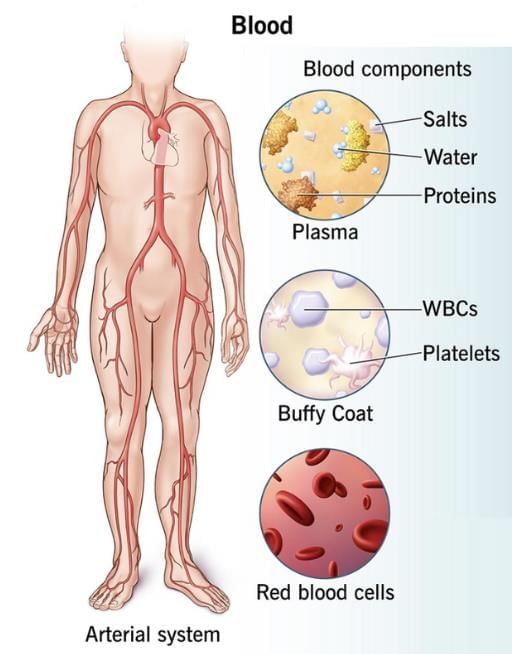
Solution: Blood is a connective tissue that transports gases, nutrients, hormones, and waste materials throughout the body.
Q2. What is the main function of ligaments in the body? (a) Connect muscles to bones (b) Provide flexibility to bones (c) Connect bones to other bones (d) Store minerals like calcium and phosphorus
(c) Connect bones to other bones
Solution: Ligaments are a type of connective tissue that is highly elastic and helps in connecting one bone to another, providing strength and stability to joints.
Q3. Which of the following tissues is responsible for the transport of water and minerals in plants?
(d) Xylem Solution: Xylem consists of tubular structures like tracheids and vessels, which transport water and minerals from the roots to other parts of the plant.
Q4. Which of the following tissues provides protection to organs and forms a barrier in the body?
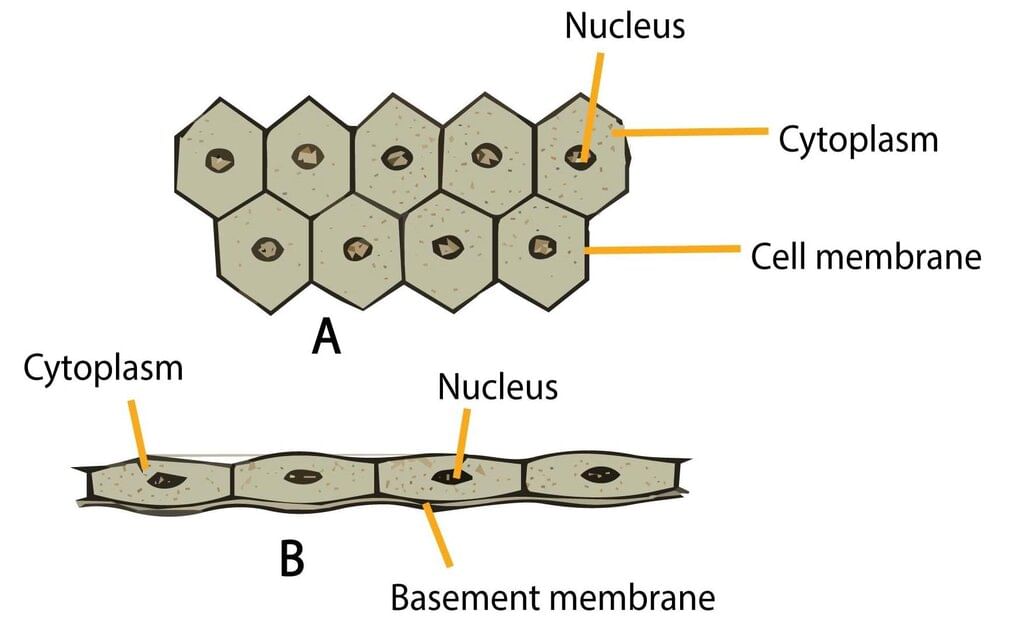
(c) Epithelial tissue Solution: Epithelial tissue covers organs and cavities in the body, forming a continuous sheet that acts as a protective barrier and regulates material exchange.
Q5. Which of the following tissues makes the plant hard and stiff, and is found in the husk of a coconut?
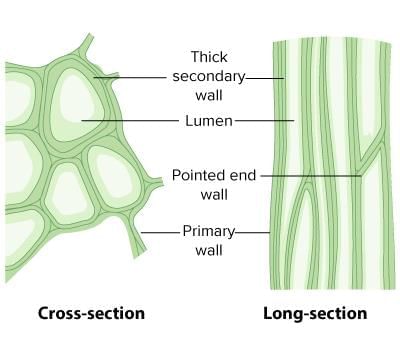
(c) Sclerenchyma Solution: Sclerenchyma is a type of permanent tissue that provides strength and stiffness to plant parts. Its cells are dead with thick lignified walls, and it is found in stems, around vascular bundles, and in hard coverings like the husk of a coconut.
Fill in the blanks
(i) ________________ tissue is found between the skin and muscles, around blood vessels and nerves and in the bone marrow.
Areolar connective
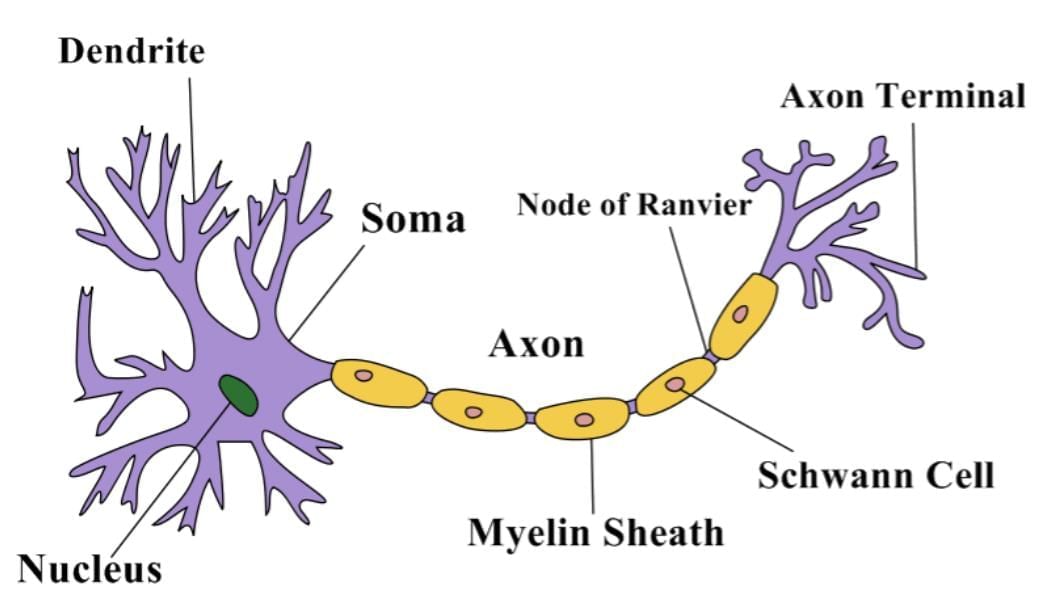
(ii) The signal that passes along the nerve fibre is called a _______________.
nerve impulse
(iii) Xylem and phloem together form a __________ in plants.
vascular bundle
(iv) __________ is the most common simple permanent tissue, consisting of unspecialized cells with thin cell walls.
Parenchyma
(v) The flexibility in plants is due to permanent tissue named ____________.
collenchyma
Short Answer Questions
Q1. Water hyacinth floats on the water surface. Explain.
Water hyacinth floats on the surface of water due to presence of aerenchyma. It is modified form of parenchyma, which contains large air cavities. It provides buoyancy which helps water hyacinth in floating.
Q2. What are the different types of connective tissue?
Blood – It has a fluid matrix (plasma) and transports gases, food, hormones, and waste materials.
Bone – A strong, non-flexible tissue that supports the body, anchors muscles, and protects organs.
Ligament – Connects bones to bones; it is elastic and strong with very little matrix.
Tendon – Connects muscles to bones; it is strong and fibrous but has limited flexibility.
Cartilage – Has a solid matrix of proteins and sugars; provides smoothness at joints and is found in the nose, ear, trachea, and larynx.
Areolar tissue – Found between skin and muscles and around organs; fills spaces and helps in repair.
Adipose tissue – Stores fat under the skin and around internal organs; also acts as an insulator.
Q3. Define the process of differentiation.
In a multicellular organism, cells become specialized to perform different functions. They take up a specific role and lose the ability to divide. As a result, they form a permanent tissue. This process of taking up a permanent shape, size, and a function is called differentiation. Differentiation leads to the development of various types of permanent tissues.
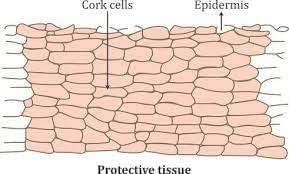
Q4. How does the cork act as a protective tissue?
In plants the secondary meristem cuts off many external layers of cells that are dead and arranged in a compact manner. Such layers together make cork. They have deposition of suberin which is very hard and impermeable hence protects plants from unfavorable conditions and microbial attack etc.
Q5. What are complex permanent tissues? Name their types and describe their functions.
Ans: Complex permanent tissues are made up of more than one type of cell that work together to perform a specific function. The two main types are xylem and phloem.
Xylem transports water and minerals vertically and is made of tracheids, vessels, xylem parenchyma, and xylem fibres.
Phloem transports food from leaves to other parts of the plant and is made of sieve cells, sieve tubes, companion cells, phloem fibres, and phloem parenchyma.
Q6. If a potted plant is covered with a glass jar, water vapour appears on the wall of the glass jar. Explain why?
Plant always loose water from the surface of leaves. This process is known as transpiration. Water reaches leaves by xylem vessels, where evaporation takes place by stomata.
Q7. What is the utility of tissues in multicellular organisms?
There is a clear cut division of labour in multicellular organisms i.e. different parts of the body of a multicellular organism perform specific functions. For example, brain controls all other parts of body, heart pumps blood to all parts of body, kidneys remove waste materials from body, sense organs collect information from external sources for sensory perception etc. All these functions would never be possible without formation of tissues in multicellular organisms.
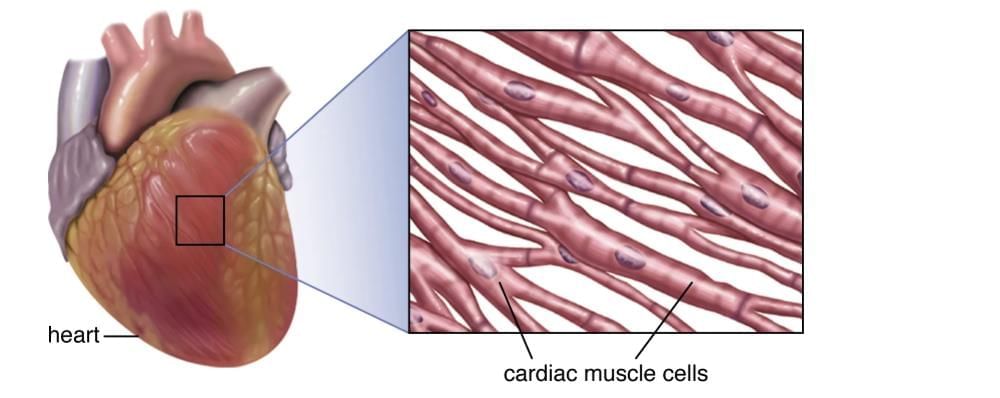
Q8. Give three features of cardiac muscles.
(1) Cardiac muscles are involuntary i.e. they don’t work under our will. (2) Its cells are cylindrical, branched, striated and uninucleate. (3) It shows rhythmic contraction and relaxation throughout the person’s life.
Q9: What is glandular epithelium, and how is it formed?
Glandular epithelium is a type of epithelial tissue specialised to secrete substances. It is formed when a portion of the epithelial tissue folds inward to create a multicellular gland.
Q10. Draw a labelled diagram of a Neuron.
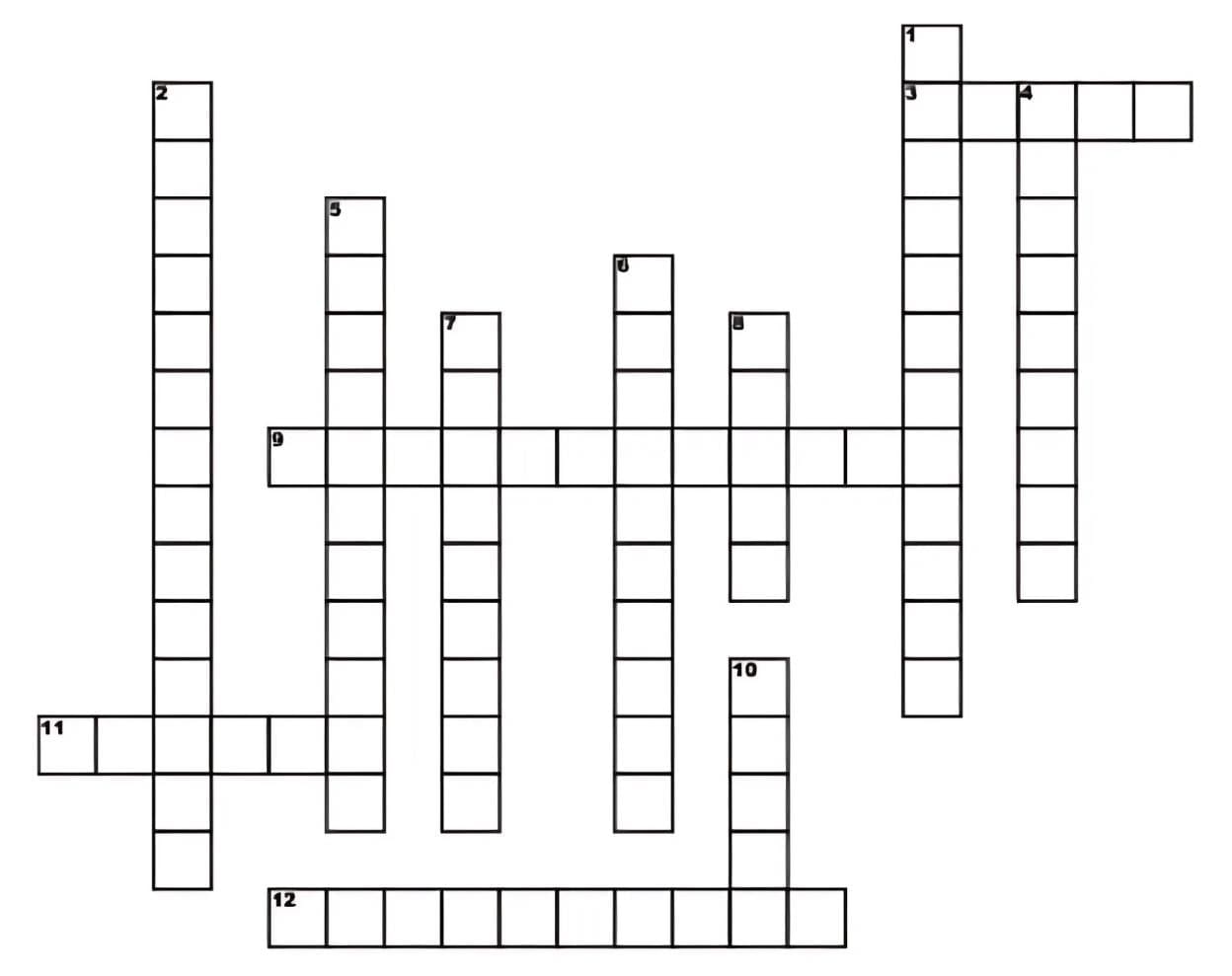
Crossword Puzzle
Across Clues
3. A component of the waxy outer coating of aquatic plant leaves.
9. Tissue responsible only for growth.
11. Conducts dissolved food materials produced by photosynthesis.
12. Most abundant of the cell types found in the major parts of higher plants.
Down Clues
1. Thick, tough secondary walls impregnated with lignin
2. Certain cells are associated with the sieve tube
4. Tubes with pits rather than openings at the ends
5. Provide flexible support for growing and mature plant organs. An extra primary wall in the corners
6. Parenchyma tissue with connected air spaces
7. Outermost layer of cells
8. Pairs of cells that border stomata
10. Chief conducting tissue of water and minerals
Answer
Across 3. Cutin 9. Meristem 11. Phloem 12. Parenchyma
Q 1. Which of the following is a type of connective tissue that transports substances in the body? (a) Bone (b) Blood (c) Cartilage (d) Tendon
Q 2. What is the main function of ligaments in the body? (a) Connect muscles to bones (b) Provide flexibility to bones (c) Connect bones to other bones (d) Store minerals like calcium and phosphorus
Q 3. Which of the following tissues is responsible for the transport of water and minerals in plants?
Q1: Cells were first discovered by _____. (a) Chadwick (b) Dalton (c) Robert Hooke (d) None of these Ans: (c)
In 1665, Robert Hooke observed cork cells under a microscope and coined the term “cell”.
Q2: Amoeba acquires its food through _____. (a) endocytosis (b) plasmolysis (c) cell organelles (d) None of these Ans: (a)
Endocytosis is the process by which Amoeba engulfs food particles by surrounding them with its cell membrane and forming a food vacuole.
Q3: _______ impart beautiful colours to flowers to attract insects for pollination. (a) Centrosome (b) Chromoplasts (c) Plastids (d) Vacuole Ans: (b)
Chromoplasts are a type of plastid responsible for the bright red, yellow, and orange pigments in flowers and fruits, which help attract pollinators.
Q4: Ribosomes carry out _____ synthesis. (a) Protein (b) Lipids (c) Enzymes (d) All of these Ans: (a)
Ribosomes are tiny organelles present in both prokaryotic and eukaryotic cells that synthesize proteins, which are essential for various cellular functions.
Fill in the blanks
(i) The movement of water through a selectively permeable membrane is called osmosis. (ii) The cell is the basic structural and functional unit of life. (iii) Protoplasm is commonly called the physical basis of life. (iv) Cell division for growth and repair is called mitosis. (v) Transporting channel of the cell is endoplasmic reticulum.
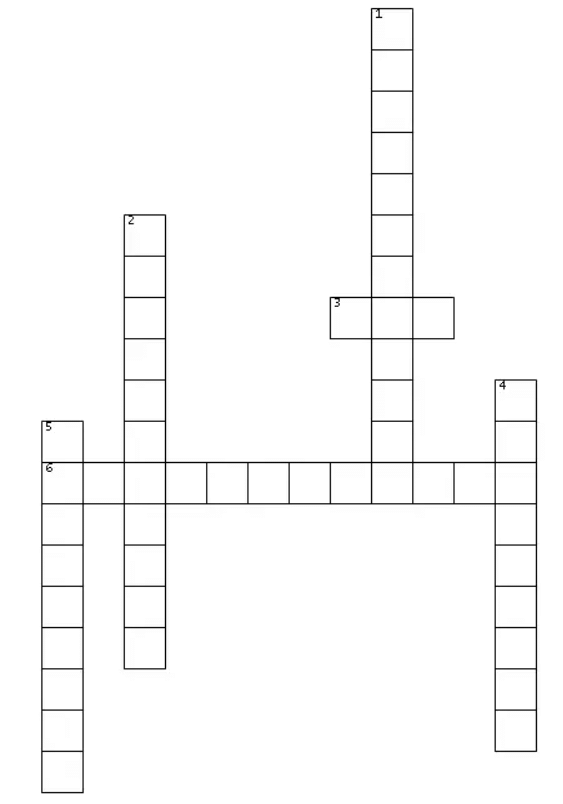
Crossword Puzzle
Q1:
ACROSS
3. ___stands DeoxyriboNucleic Acid 6. These are important for photosynthesis in plants
DOWN
1. They are the powerhouses of the cell 2. Paramoecium is a ____________ organisms 4. It is a kind of waste disposal system of the cell 5. One of the biologists who presented the cell theory
Q1: Where are proteins synthesised inside the cell? Ans: Ribosomes are the sites for protein synthesis inside the cell.
Q2: Which organelle is known as the powerhouse of the cell? Why? Ans: It is the Mitochondria of the cell also known as the powerhouse of the cell because it synthesizes energy in the form of ATP during respiration which is vital for various life activities.
Q3: Why are lysosomes known as suicide bags? Ans: Lysosomes are cell organelles filled with hydrolytic(digestive) enzymes. When a cell is damaged, its lysosomes may burst and its enzymes digest the cell’s contents. Due to this, we can say that lysosomes are suicide bags.
Q4: If the organisation of a cell is destroyed due to some physical or chemical influence, what will happen? Ans: If the organisation of a cell is destroyed due to some physical or chemical influence then such cell would not survive any more as its lysosomes digest up all components of that cell.
Q5: Where do lipids and proteins get synthesized? Ans: Lipids get synthesized in the smooth endoplasmic reticulum and proteins get synthesised in the ribosome and rough endoplasmic reticulum.
Q6: What would happen if the plasma membrane breaks down? Ans: If the plasma membrane breaks down, substances will move freely in and out of the cell, disturbing the internal environment, and the cell will not survive.
Short Answer Questions
Q1: Who discovered cells in living organisms? Give an example of the unicellular organism.
Ans: Leeuwenhoek (1674) was the first to observe the free living cells in pond water. Examples of unicellular organisms: Amoeba, Chlamydomonas, Paramoecium, Bacteria, etc.
Q2: Why is the cell called the structural and functional unit of life? Ans: All living organisms are made up of cells so the cell is the basic building unit of a living organism and all the activities performed by a living organism are the sum total of activities performed by its cells hence cell is called the structural and functional unit of life.
Q3: What is the function of plastids? Ans: Plastids are present only in plant cells. There are two types of plastids chromoplast (coloured plastids) and leucoplasts (white or colourless). Chromoplast: Consists of coloured pigments and gives different colours to flowers, fruits and leaves. The green colour pigment present in the leaf is called chlorophyll which helps in photosynthesis and a plastid with chlorophyll is called chloroplast. Leucoplast: It stores starch, oil and protein granules in it.
Q4: Why do mitochondria have largely folded inner membranes? Ans: Mitochondria have a largely folded inner membrane which provides the increased surface area for ATP-generating chemical reactions. Mitochondria is the site for cellular respiration and provides energy to the cell.
 If both masses are doubled, the product m1 × m2 becomes 4 times larger, so the force becomes 4 times the original.